menu

Jason’s Article: Gamers Gonna Game

Are you a Quiet Speculation member?

If not, now is a perfect time to join up! Our powerful tools, breaking-news analysis, and exclusive Discord channel will make sure you stay up to date and ahead of the curve.

Greetings, Expectoraters,

This weekend I was at Gen Con and I realized I had no idea what I was doing.

The Best Four Days in Gaming

As I mentioned last week and maybe a few other times, I play Magic: the Gathering. Accordingly, trips to Gen Con started out as reasons to grind Magic events, and in recent years focused on trading for value to sell to dealers. After an abysmal trading landscape last year that included no free tables in the Magic area, an unfavorable shark-to-guppy ratio and dealers paying the least I've ever seen, I decided I wasn't going to even take binders or sell boxes to Gen Con this year.

I wasn't about to skip the event, mind you. A free badge coupled with a free place to stay made it an impossible event to pass up, but if I wasn't going to play Magic and I wasn't going to grind events and I wasn't going to grind value, what else was there to do at Gen Con?

I don't know, how about everything?

Wednesday

I decided to take my wife with me because if I was going to wander around aimlessly without a plan, I wanted to at least be able to play some two-player games.

Actually, I decided to take my wife with me because I always say "I'm off to have fun for five days in Indianapolis! Don't forget to pay the utility bill and mow the yard on Sunday," and she always punches me right in the kidneys. She has tiny little fists, like a Capuchin monkey and it hurts like crap, but I deserve kidney punches for leaving her at home with a dog and responsibilities and no board games, so bringing her along was a no-brainer.

This meant we were bringing the dog with us and waiting until she got out of work, so we wouldn't be getting into Indianapolis until around 8pm, which wouldn't be too big a deal. We dropped the dog at my brother's empty house--the little prick is in Hawaii for work. Must be nice--and headed over to Kilroy's Bar and Grill in downtown Indy for a party thrown by Gathering Magic.

Adam Styborski's photo diary is a great summary and saves me from posting a bunch of pictures from the event--handy because I didn't take any.

Scroll all the way down for Wednesday. I know, I don't get that format either. Still, would it kill you to read the whole thing? It's 90% pictures. I met a lot of great people at the party and put a lot of faces to names.


It was a surprise to me, too.

It was the best possible way to start the weekend. Not only that, despite the line to buy a badge being closed at 7pm, we found out the will call pickup line was open later and snagged Brittany's badge after waiting a mere nine seconds. Not having to stand on that line Thursday morning was an excellent break.

I did start to get a little heartburn when the guy at the booth insisted I would have to have current and relevant press credentials to pick up a press badge but he ended up being full of it and I got my badge fine the next day.

Thursday

With not a ton of relevant Gen Con experience I assumed everything was either like the Magic the Gathering area, where you buy a bunch of generic $2 tickets and then sign up for events an hour before they start or like the Rio Grande Games room where you sit down at an empty table and a volunteer shows you how to play a game.

Gen Con is NOT like that. At all. I managed to walk into this year with the only experience I have being exceptions to the rule. For the most part, you sign up for a time you want to play a certain game, months ahead of time usually, and buy a ticket for that specific event. You can randomly stroll up and pay with generic tickets, but people who pre-registered get priority and you get booted if they show up.

I ran into a bunch of my friends, including Aaron "the Godslayer" Sulla and after he showed me his entire day planned out in the form of specific game tickets he had for each two-hour block, I realized I had made a huge mistake and was not going to get to play anything.

The thing that I found is that people like structure in their lives and they tend to follow rules. In this case, total ignorance of the rules actually got there. Every time Brittany or I saw a game we were interested in there was a timed session about to start and people who pre-registered didn't show up. Nearly 100% of the time, in fact.

If it was slated for six people and one didn't show up, they'd say "screw it" and run it with seven people and take our money. I'm not saying "have a chaotic, unplanned Gen Con" because sometimes you get blown out, but in my experience, if you really want to do something and it sells out, go anyway. Chances are the other thing you picked at that time slot is something you wouldn't mind missing if the event is indeed full and it's not hard to kill a few hours.

My experience was that despite events selling out, people like my wife and me randomly walking up and saying "this looks fun" were rewarded at an astonishing rate. Show up to the "sold out" game session and you'll likely be able to play it.

We did a fair amount of gaming in the Rio Grande Games room as well, because they didn't charge money, generic tickets or otherwise, to demo the games, they had a good volunteer-to-attendee ratio and there was a relaxed atmosphere. We got most of a full day in gaming and went back to the house to check on the dog and call it a night.

Friday

We did more luck-sacking on Friday. We just barged into gaming sessions about to start and there were always empty spots. A lot of board gaming tends to be "you had to be there" and doesn't make for great copy, but Friday night is worth ranting about.

Friday afternoon I did manage to meet QS' own Doug Linn and his charming wife right before we cut out for the afternoon. They also introduced us to their friend Andy D who performed his crazy blend of rock and rap about Vikings and Wizards and other nerd craziness on Saturday night. There isn't enough room in the article to list everyone cool I met, but Doug is on the short list of QS people I haven't met and I feel like it's noteworthy. Whatever, you're a captive audience. Do something. Yeah, that's what I thought.

We called it an early day Friday to eat something away from downtown, let the dog out and to take a break because we planned head back at around 8pm. We had an appointment with Rob Dougherty to preview a game he and Darwin Kastle had been developing called "Star Realms" and you probably already know how to play it.

We sat down across from each other and Rob started explaining the game to us. You command a fleet of Spaceships and you're engaged in a battle with another fleet commander. They have a starting life total of that can be adjusted but this time was set at 50 and cards that have attack power are applied to either your opponents' bases or their faces.

It plays similarly to Ascension or Dominion (the games are quite similar to each other, but "Star Realms" incorporates elements that are unique to both) but I feel like it pared down the game into pure gameplay and dispensed with a lot of the elements that complicate those games a bit.

What you are left with is a very straight-forward game that is simple to learn without lacking nuance, quick to play without feeling unsatisfying and affordable at $15 per set without feeling like the designers skimped on anything. Unlike Ascension, it doesn't require a board and a ton of accouterments--the entire game fits in a box the size of a standard deckbox.

Being able to play a game that plays the same as Ascension that you can carry around in your pocket is very appealing. A few brief key points that made me like how the game played a lot:

  • Scoring is simple--there are no point values on cards or honor points to win. You shoot your opponent until they are out of life to win.
  • The base game is expandable--add another deck for each two additional players. This allows 2HG, Emperor and other variants, which are actively encouraged.
  • The game felt balanced. The starting player gets an opening hand of three, the non-starter gets five. That feels like a number that was arrived at after lots of testing by the developers.
  • The one-cost units are good, even late. Most similar games make you dread drawing the first units you buy, but "Star Realms" didn't have this problem.
  • There are four factions and some of the intra-faction synergy you saw in Ascension is incorporated into Star Realms--it pays to play multiple cards sharing a faction in a single turn.
  • The game introduces two types of bases, both of which grant bonuses (they're like constructs) but one of which must be destroyed before they can attack your life total.

I enjoyed the demo and it's safe to say I'm a big advocate of the game. Accordingly, you can be sure that when the Kickstarter campaign for this game launches, I'll be one of the first to support it, and I'm going to make sure all of you know about it. This is a great little game, it's affordable, it's a play system most people know already from other deckbuilding games, and it's cheap, portable and expandable. A great way to end Friday.

Saturday

One drawback of playing it all loosey-goosey with the schedule is that occasionally you don't look into something as much as you should. We resolved to look at the event guide a bit before Saturday to decide when we should get up and head over and we found a Discworld game at the JW Marriott at 8am.

Now, Mayfair games has a Discworld board game that we'd demoed on Friday and really liked. It's easy to win, but easy to disrupt the other person from winning too and it's simple to learn. If you like Discworld books you laugh at a lot of inside jokes. If you haven't read the Discworld books, you laugh at a lot of dick jokes, but it doesn't impair your ability to play the game (Brittany has read a lot of the books, I haven't).

Following a positive experience with one Discworld game we expected another and resolved to get up at 7am (sometimes I am still awake at 7am so this was not the easiest feat in the world for me) to be there on time. If I'd read a little more of the description I might have seen it was slated for a five hour block of time. I might have questioned, "Hey, what gaming system is the 'Hero System'?" Some of you may already see where this is going.

We arrived five minutes to 8:00 at the JW Marriott and walked into a room that contained two large, circular tables and what was unmistakably a DM/GM and a few players already seated, passing around character sheets. This was to be a five-hour Dungeons and Dragons-esque roleplaying Session set in the Discworld universe.

What do you do in this situation? Well, if you're us, you say "Sweet, this is happening" and just go with it. We'd been letting fate guide our Gen Con experience thus far and it hadn't steered us wrong yet. It turned out to be a decent experience. I've played D&D as well as a few other D20 and D6 systems before but Brittany had exactly zero RP experience. She turned out to be a natural and didn't get bored or hate it.

I realize roleplaying games like this aren't for everyone and I was glad we both got a kick out of it. If you'd told me Friday night "Hey, you know Hero System is a roleplaying system and it's scheduled for a five-hour block, so you're going to be playing some sort of D&D thing until 1pm," I'd have likely said "Oh, well %&^* that noise" and we'd have slept in.

But since a bit of misadventure saw us showing up to the session (and two of the people who scheduled their spots six months in advance didn't show, natch) we went with it and had a good time. I really think you should get outside of your comfort zone a bit because you never know what kind of games you like until you play them.

A large chunk of our day was gone, but we were undeterred and did some gaming in the TCG Hall. We also cruised over to the exhibitor hall and got a ton of games demoed for us, including Sol Forge, a game I've somehow managed to avoid being exposed to until now. I like Sol Forge, but I got crushed by the computer on Normal difficulty my first game--I was ahead by like 56 before it stabilized, too, it was brutal--so I clearly have a lot to learn.

If you want to play it loose like we did all weekend, the exhibitor hall is a low-risk place to get games demoed for free. You're surrounded by a bunch of sweaty gamers and it's quite loud in the hall, but games are being demonstrated for free and you don't have to worry about someone who pre-registered showing up and booting you.

Sunday

I'm not sure Gen Con should be allowed to advertise itself as "The best four days in gaming" when everyone packs up on Sunday. There is less than half as much to do on Sunday as there is on Saturday and the exhibitor hall is jimmy-jammed with people trying to take advantage of last day price drops and the free "Family Fun" passes they give out to people with small, screaming children in strollers.

We got some decent gaming in, still, but we got there at 8am and there wasn't much to do until 10. Luckily we left our EDH decks at home because we were sick of the weight. Actually luckily there were game libraries where you could check out a game and play it, so this helped us kill a few hours.

If I had it all to do over, I would play some Magic on Sunday. 2HG with the wife would have been a nice capper to the weekend. As it was, we had some fun, but we were on the road headed home by 3:00. Sunday is a great day to play Magic, however, as the same events that fired all weekend fire on Sundays.

Sunday also saw the Magic 20th Anniversary Tournament I want to talk about briefly.

There were eight qualifying tournaments of various format and the winner of each got to play in a special draft event on Sunday that involved drafting every set, some regular booster draft, some Rochester draft. I'd love to bust a pack of Alpha or Arabian Nights. Even the Zenidkar pack was nuts.
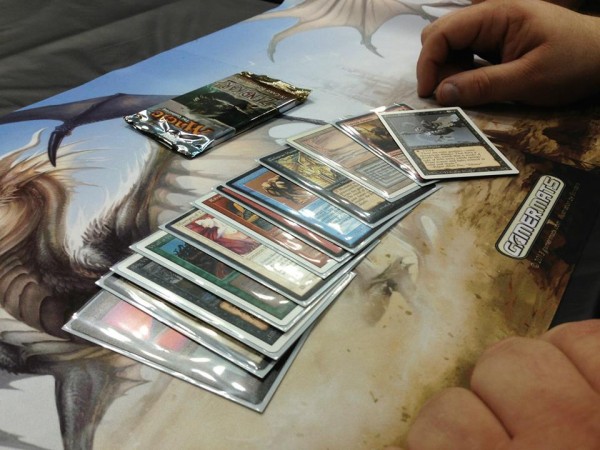
That Underground Sea wasn't in a pack of Revised. It was in a pack of Zendikar. All.The.Value.
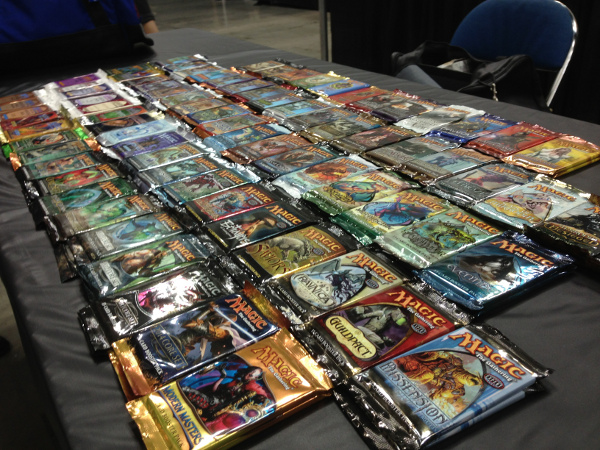
These two photos are from Stybs' photo diary, which I linked and hope you read.

It must have been an amazing experience to draft off Magic History to celebrate the 20th Anniversary of the game.

How Wizards of the Coast Celebrated the 20th Anniversary

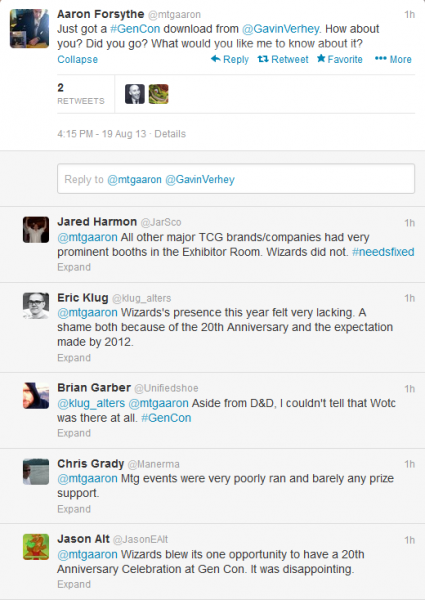
They didn't.

There was no party, no event, nothing. Magic the Gathering wouldn't be here today if it weren't for the exposure it got during Gen Con in the early years and it literally boggles the mind that they had no presence at Gen Con whatsoever.

The Magic events were put on by a TO and by all accounts the prize support was bad and the entry fees too high. With special goggles, pins, promo cards and spoilers at PAX, I thought for sure the Gen Con stuff would be even better. Even San Diego Comic Con got exclusive planeswalkers.

Wizards only got one chance to celebrate its 20th anniversary in the place that helped launch the game into the global juggernaut it is today and there wasn't so much as a promo card given out. It felt like a slap in the face and no one in attendance could quite figure it out.
That said, I mostly tried to play games that weren't Magic so it's not as though it ruined my weekend. I would have loved for the Magic stuff to be better, but the rest of the con was so good it hardly mattered. My enjoyment wasn't impaired at all, and taking the wife and playing new games was clearly the play.

I'll be there next year, and I'll be playing some Magic on Sunday so make sure you say hello. I'm sure I'll have something even better than our current angry stag token to hand out by this time next year.

No Competition

Since Gen Con is such a cultural juggernaut, there wasn't much Magic played this weekend outside of the TCG Hall. I'll be back next week to talk more about Theros, most likely, and we'll probably have some decklists to talk about.

I hope you've enjoyed this little Gen Con retrospective. If you aren't planning to go next year, perhaps you should. Playing Magic 24/7 is worth the $80 cover charge by itself, and the other fun things to do for nearly free--we bought $40 worth of generic tickets on Thursday and used only half of them in four days--make it more than worth going. What else do you have to do, anyway?

Until next week, this is Jason Alt and this has been my article.

Avatar photo

Jason Alt

Jason Alt is a value trader and writer. He is Quiet Speculation's self-appointed web content archivist and co-captain of the interdepartmental dodgeball team. He enjoys craft microbrews and doing things ironically. You may have seen him at magic events; he wears black t-shirts and has a beard and a backpack so he's pretty easy to spot. You can hear him as co-host on the Brainstorm Brewery podcast or catch his articles on Gatheringmagic.com. He is also the Community Manager at BrainstormBrewery.com and writes the odd article there, too. Follow him on Twitter @JasonEAlt unless you don't like having your mind blown.

View More By Jason Alt

Posted in Free, Web ReviewTagged 8 Comments on Jason’s Article: Gamers Gonna Game

Have you joined the Quiet Speculation Discord?

If you haven't, you're leaving value on the table! Join our community of experts, enthusiasts, entertainers, and educators and enjoy exclusive podcasts, questions asked and answered, trades, sales, and everything else Discord has to offer.

Want to create content with Quiet Speculation?

All you need to succeed is a passion for Magic: The Gathering, and the ability to write coherently. Share your knowledge of MTG and how you leverage it to win games, get value from your cards – or even turn a profit.

Insider: To Crack or Not to Crack (Sealed Product)

Are you a Quiet Speculation member?

If not, now is a perfect time to join up! Our powerful tools, breaking-news analysis, and exclusive Discord channel will make sure you stay up to date and ahead of the curve.

Welcome back readers! As promised in my article, "To Crack or Not to Crack (Specialty Product)", today I'm breaking down the values of various sealed products. I will use eBay to determine sealed box prices as that's how most of us would sell it.

It's important to look at the rate of return per year, as typically you invest in sealed product for a longer term investment (several years). It's also important to keep in mind that sealed product has many factors that help determine its value. If there is a chase card in the set the product will tend to be more valuable. If the set was fun to draft it will also be more valuable.

For those curious how I determined the Rate of Return Per Year, the equation is:

Rate of Return = ((Current Value / Purchase Price) ^ (1 / # of years)) - 1

Set Name Set Release Date MSRP @ Release ($) Current eBay Price ($) # of Years Between Release and Now Average eBay Price ($) Rate of Return Per Year(%)
Arabian Nights December 1993[23] 87  $458 per pack ($27480) 20 27480 33.3%
Antiquities March 1994[24] 87  $90 per pack ($3240+) 19 3240 21.0%
Legends June 1994[25] 88.2  $125.88 per pack ($4531.68) 19 4531 23.0%
The Dark August 1994[26] 87  $569 19 569 10.4%
Fallen Empires November 1994[27] 87  $85-$100 19 95 0.5%
Homelands[IX] October 1995[28] 105  $85-93 18 95 -0.6%
Ice Age June 1995[29] 106.2  $220-$250 18 235 4.5%
Alliances June 10, 1996[11] 101.25  $510-$600 17 555 10.5%
Coldsnap[IX] July 21, 2006[32] 90  $140-$180 7 160 8.6%
Mirage October 7, 1996[11] 90  $280-$290 17 285 7.0%
Visions February 3, 1997[35] 90  $230-$235 16 232 6.1%
Weatherlight June 9, 1997[11] 90  $177-$250 16 207 5.3%
Tempest October 13, 1997[11] 90  $550-$600 16 575 12.3%
Stronghold March 2, 1998[11] 90  $280-$315 15 297 8.3%
Exodus June 15, 1998[11] 90  $250-$340 15 295 8.2%
Urza's Saga October 12, 1998[41] 90 $600-$700 15 650 14.1%
Urza's Legacy February 15, 1999[11] 90 $300-$380 14 340 10.0%
Urza's Destiny June 7, 1999[43] 90 330-400 14 365 10.5%
Mercadian Masques October 4, 1999[45] 90 233-250 14 242 7.3%
Nemesis February 14, 2000[47] 90 130-140 13 135 3.2%
Prophecy June 5, 2000[48] 90 105-140 13 122 2.4%
Invasion October 2, 2000[49] 90 160-200 13 180 5.5%
Planeshift February 5, 2001[50] 90 102-150 12 126 2.8%
Apocalypse June 4, 2001[60] 90 242 12 242 8.6%
Odyssey October 1, 2001 90 190-235 12 212 7.4%
Torment February 4, 2002[52] 90 130-170 11 150 4.8%
Judgment May 27, 2002[53] 90 160-170 11 165 5.7%
Onslaught October 7, 2002[54] 90 285-320 11 302 11.6%
Legions February 3, 2003 90 171-187 10 179 7.1%
Scourge May 26, 2003[56] 90 160-170 10 165 6.2%
Mirrodin October 3, 2003[57] 90 175-180 10 177 7.0%
Darksteel February 6, 2004[58] 90 200-230 9 215 10.2%
Fifth Dawn June 4, 2004[60] 90 185-195 9 190 8.7%
Champions of Kamigawa October 1, 2004[62] 90 260-290 9 275 13.2%
Betrayers of Kamigawa February 4, 2005[62] 95 200 8 200 9.8%
Saviors of Kamigawa June 3, 2005[62] 95 120-130 8 125 3.5%
Ravnica: City of Guilds October 7, 2005[67] 95 360-365 8 362 18.2%
Guildpact February 3, 2006[68] 95 255-270 7 262 15.6%
Dissension May 5, 2006[69] 95 250-300 7 275 16.4%
Time Spiral October 6, 2006[70] 95 220-230 7 225 13.1%
Planar Chaos February 2, 2007[71] 95 200-250 6 225 15.5%
Future Sight May 4, 2007[72] 95 350-450 6 400 27.1%
Lorwyn October 12, 2007[74] 95 345-450 6 373 25.6%
Morningtide February 1, 2008[75] 95 200-230 5 215 17.7%
Shadowmoor May 2, 2008[77] 95 250-320 5 285 24.6%
Eventide July 25, 2008[78] 95 180-200 5 190 14.9%
Shards of Alara October 3, 2008[81] 95 160-250 5 205 16.6%
Conflux February 6, 2009[82] 95 220-300 4 260 28.6%
Alara Reborn April 30, 2009[83] 95 175-225 4 200 20.5%
Zendikar October 2, 2009[84] 95 325 4 325 36.0%
Worldwake February 5, 2010[85] 95 410-475 3 443 67.1%
Rise of the Eldrazi April 23, 2010[86] 95 220-230 3 225 33.3%
Scars of Mirrodin October 1, 2010[88] 95 105-115 3 110 5.0%
Mirrodin Besieged February 4, 2011[89] 95 100-120 2 110 7.6%
New Phyrexia May 13, 2011[90][91] 95 100-104 2 102 3.6%
Innistrad September 30, 2011[94] 95 140-150 2 145 23.5%
Dark Ascension February 3, 2012[96] 95 80-100 1 90 -5.3%
Avacyn Restored May 4, 2012[97] 95 100-115 1 107.5 13.2%

Now let's review the data.

It's good to see that for the most part your rate of return for sealed product beats normal inflation (3%). However, given an average inflation of 3% you would have actually lost money had you invested in (Fallen Empires, Homelands, or Prophecy).

It's also important to note that as MSRP data was not available for some of the early sets, I had to take the known pack price and multiply by the number of packs per box. Thus, the "box" price does not include the usual cost reduction for purchasing a full box.

It's interesting that Homelands and Dark Ascension are currently the only sets with negative rates of return (i.e. they are worth less now then the original MSRP price). However, I expect Dark Ascension will go up over time as it was an under-opened set.

What's more impressive is that it appears Wizards was on a roll with creating highly desirable sets as they have all had impressive rates of return from 2005-2010.

This data reflects the current value of the sealed product compared to their previous MSRP. However, one should not look at these recent rates of return and assume they will continue to grow at that rate.

What is far more likely is that with the explosion in the player base the demand for some older product caused prices to spike to the threshold people will pay for out-of-print boxes. Thus, boxes are likely reaching their threshold faster, which also means that as more years pass the price per box will not rise as rapidly as it has recently.

This data indicates that when an obvious multi-format all-star is printed it is wise to purchase boxes of that product and not open them--the price of a current Worldwake box is enough to purchase a playset of the very card that drives the box price up that much (Jace, the Mind Sculptor).

I only did expansion sets because with the exception of the original printings and 7th Edition, core sets tend to have a lot of reprints and fewer valuable cards. Given their aim is to pull new players into the game they are also designed for a less experienced player, thus making them less desirable for retro-drafters.

The data also proves that sets with rare mana-fixing lands tend to gain in value at a higher rate compared to other sets (Onslaught at 11.6% compared to Legions at 7.1%, Zendikar at 36% compared to Alara Reborn at 20.5%).

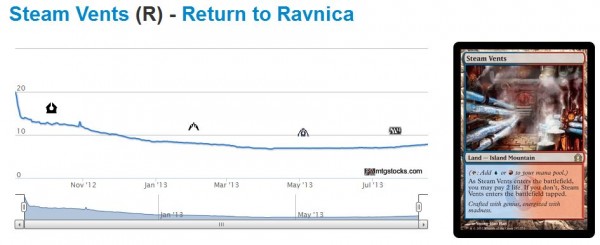
I didn't look at data on in-print sets (Return to Ravnica, Gatecrash, Dragon's Maze) because these can still be picked up at MSRP. However, it's important to note that Return to Ravnica possess two multi-format all stars (Abrupt Decay, Deathrite Shaman) as well as shocklands, important for mana bases in Modern. If I were to guess which of the current in-print sets would have the highest rate of return it would definitely be Return to Ravnica.

Lastly, when deciding whether to crack your sealed product it's important to include some factors not directly related to rate of return on your investment.

These include, tradeability and liquidity (if you're big on trading you want lots of new stuff to trade to people building new decks); playability (MTG is a game first and foremost and if you don't play with your cards you lose a large portion of the reason to buy them); and of course the overall joy you get from opening packs.

Insider: Exploring the Kelly Criterion

Are you a Quiet Speculation member?

If not, now is a perfect time to join up! Our powerful tools, breaking-news analysis, and exclusive Discord channel will make sure you stay up to date and ahead of the curve.

Last week’s article generated a significant amount of positive interactions-–many QS subscribers visited the forums and shared their own investment portfolio. I want to thank everyone who participated in the exercise. Hopefully the experience was an insightful one.

I for one learned something about myself. In the past my bets have generally been conservative in nature. I’ve disclaimed before my hesitation to go deep in an investment because I am eager to reduce risk through diversification. On paper this sounds like a great theory, but it may surprise you to hear that this strategy may not yield the highest possible payout. Diversification is designed to prevent a portfolio from going to zero, not infinity.

Now, my most recent investments have followed a different style to maximize productivity. This new strategy, which I have been implementing informally without realizing, is known as the Kelly Criterion.

Whoa, the Co-Founder of QS is Famous?

J. L. Kelly Jr.

Kelly Reid may be famous, but if he is it has nothing to do with the Kelly Criterion. The original theory was developed by J. L. Kelly Jr. in 1956–-I doubt our Kelly is this old.

From Wikipedia, the Kelly Criterion, also known as the Kelly Bet,

“is a formula used to determine the optimal size of a series of bets…The Kelly strategy will do better than any essentially different strategy in the long run.”

The Wikipedia entry goes on to explain that Kelly’s strategy may yield optimal gambling outcomes but there may be individual investing constraints that interfere with obtaining optimal growth rate.

Despite this, I feel the underlying concept should be explored further for potential reapplication to MTG speculation.

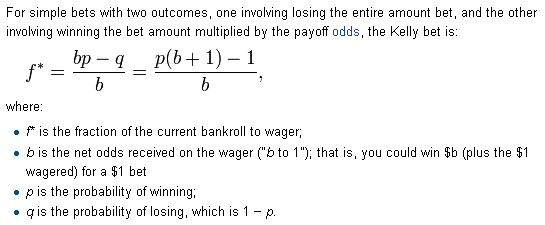
Borrowing again from Wikipedia, the Kelly Criterion states:

The equation may look fairly simple, and in reality it does require some assumptions. In MTG speculation, we don't often run the risk of losing everything, but we do risk losing money. The application to MTG finance may be imperfect, but an example is at least worth a try.

A First Test

I’m going to test my Innistrad booster box investment here. Immediately there are some difficult assumptions we must make--this is no exact science.

For the sake of exercise, let’s say I expect Innistrad boxes to hit $200 in a reasonable time frame of a few years. Since boxes can be purchased on eBay for $149 a box, this represents odds of 1.34:1 meaning b = 1.34 ($200 / $149). I feel the probability of earning the $200 is fairly reasonable if we’re willing to wait long enough, so let’s say the probability is 75%. This would make p = 0.75 and q = 0.25.

Plugging in the numbers we get an estimate for what fraction of our portfolio should comprise of Innistrad booster boxes based on our specific assumptions. In this case that fraction equals (0.75 * (1 + 1.34) – 1) / 1.34, or about 56%.

This means that if our assumptions are correct and there’s a 75% chance we will sell at $200 for every Innistrad booster box we purchase at $149, we should take 56% of our MTG funds and place them into this investment. Wow, that’s steep!

Another Example - Shocklands

The example above seems difficult to execute in real life. I don’t have the courage to go that deep on Innistrad boxes. Remember, my current position represents only about 25% of my portfolio. So either I am not 75% confident in making bank or I am not honestly expecting to sell these at $200 per box. One of these assumptions must be incorrect, or else I’m not behaving rationally to maximize profits.

Let me try another example with shocklands, this time comparing scenarios before and after the recent PTQ schedule changes.

Before the change in schedule was announced, Modern season would have lined up perfectly with Standard rotation to drive shockland prices higher. Also, there was not enough time for any reprints and we are fairly confident shocklands aren’t in Theros.

Therefore, let’s assume we were 90% confident in making bank on shocklands with the old PTQ schedule. As for returns, demand would have increased fairly rapidly in the fall, driving prices upward. For this fall, I was expecting to sell my shocklands with a 1.7:1 payout, meaning I would get $12 for every $7 shockland I purchased ($12 / $7 = 1.7).

Applying the equation discussed earlier, I calculate a portfolio fraction of (0.95 * (1.7 + 1) - 1) / 1.7 = 92%! Wow, this would have been incredibly deep! But if we were truly this confident in such a solid return, logic would dictate we should have been this eager to invest.

Even though it seems crazy to invest in anything this deeply, I do want to point out that many QS subscribers did have very significant investments in shocklands.

While 92% seems excessive, some application of utility theory may have yielded a more practical number that our emotions could handle. Just look at Zendikar fetchlands, which would have had similar assumptions while they were Standard-playable, and you will see how the Kelly Criterion can yield superior results!

Now let’s test different numbers because Modern season is a year away. Demand won’t be as high and there’s some reprint risk now. I’m actually thinking of selling these this fall anyway once Standard rotates, but I am far less excited about the potential profit. Perhaps I expect $10 now for each $7 shockland, a payout of 1.4:1 ($10 / $7 = 1.4). Also, I am less confident in such a payout so soon after a reprint–-I’ll use a likelihood of 60%.

Now my portfolio fraction is (0.60 * (1.4 + 1) - 1) / 1.4 = 31%. This is a severe drop! With these assumptions, I should invest 31% of my portfolio in shocklands instead of 92%. This is a full 2/3 less the investment!

Can This Really Be Useful?

I don’t have the fortitude to withstand the risk associated with investing 92% of my MTG portfolio in one position. Because of the human aversion to losing everything, I’m guessing I’m not alone in this regard. That’s where Utility Theory and Fractional Kelly Betting come into play–-but that’s an article for another week.

Perhaps the Kelly Criterion can still be useful in a comparative sense, however. The shockland example above illustrates what I mean. With two different sets of criterion, we can use an unemotional, proven strategy to identify where we should make larger bets and where we may need to scale back. Likewise if our assumptions need to change due to a WOTC announcement, a reprint, or a shift in metagame we can use this equation to help us estimate what adjustments are needed.

This tool can also help us sort through the hundred’s of new speculation targets we face each month. If you come across an opportunity that seems risky, consider the likelihood of turning a profit and how much profit, and see how the resulting Kelly Bet would compare versus a more tried-and-true option.

Although I often advocate diversification, sometimes it’s better to just buy another Birthing Pod rather than possibly overpaying on Keen Sense. Of course, if you find Keen Sense or any other cards below mtg.gg buy prices–-well, this equates to 99% likelihood of profit. You should know what to do here, and if it were possible to put 100% of my collection into guaranteed profit I would.

The equation can also help us identify situations where selling is best because it can yield negative numbers! A negative portfolio fraction can be obtained should the payout be too low and unlikely. In this case, we would actually want to sell our entire position (and theoretically, sell short even further if it were possible). Should you end up with this outcome when doing a test, perhaps it’s time to bail and move on.

The Kelly Criterion isn’t the answer--at least not for me. But it is a proven, numerical strategy that is set up to maximize outcome. In the game of MTG there is no guarantee, and we are left with many assumptions on price trajectories. But by putting our best guesses down on paper, the Kelly Criterion can be a valuable tool to help us evaluate if we’re thinking along the right path or if we should move onto the next target.

I cannot bring myself to embrace this tool completely, but I have certainly implemented it lately with extensive investment in Innistrad boxes and shocklands. Now I can finally use numbers to back up my rationale.

Sigbits

  • I mentioned Elesh Norn, Grand Cenobite recently because the card was sold out at SCG for $9.99 and I expected a price bump. That price bump has happened and now Elesh Norn is $14.99. But she is still sold out! I expect to see $19.99 next.
  •  

  • Horizon Canopy continues its run--I wish I hadn’t sold mine already! The card is up to $30 on TCG Player and SCG is sold out at $29.99. What interests me is that the foils on SCG are only twice the nonfoils, and there are a couple in stock. If Modern is going to become a mainstay, that multiplier needs to go higher. Especially for a card like Horizon Canopy which is also played in Legacy. Perhaps I will buy these last couple SCG copies…wait let me check the Kelly Criterion…nah, the potential gain is not worth the difficulty moving it given fees.
  •  

  • Chord of Calling is even stranger. They are selling on SCG’s site for $29.99 but foils are only $49.99. This is a multiplier less than 2x for a major Modern card. I wonder why the multiplier is so low–-if the price bump in Chord is legit, then the foils should at least hit $60 retail to obtain that 2x multiplier.

-Sigmund Ausfresser
@sigfig8

Insider: Three Month Outlook

Are you a Quiet Speculation member?

If not, now is a perfect time to join up! Our powerful tools, breaking-news analysis, and exclusive Discord channel will make sure you stay up to date and ahead of the curve.

Magic 2014 (M14) release events have finished up now, and we are in the period where not much is happening at all in the world of Magic. Theros (THS) previews will be starting at some point, and it looks like a few cards are starting to leak out as well.

However, it is a good time to make a plan for the next few months as the Fall is usually the most exciting time for players, and is also an excellent time to be a speculator. Here's a three month outlook from an MTGO speculator's perspective.

September

Previews for THS will be starting up, followed by paper prereleases on September 21st. For MTGO users, this means we can expect a week of Cube draft as well as the attendant out-of-print draft queues. Last time we saw Rise of the Eldrazi (ROE) awarded as prizes for Cube.

Triple ROE turned out to be a popular format and prices on the ROE mythic rares like Ulamog, the Infinite Gyre and Linvala, Keeper of Silence dropped considerably. Now that prices have mostly stabilized (though Ulamog might be headed lower yet), these are a couple of cards that are worthwhile targets for the Modern speculator.

The popularity of the out-of-print draft format this time around should dictate the speculative strategy. If the format is popular, then waiting for prices to stabilize is your best bet before picking up Modern playables. If the format is unpopular and drafts aren't firing, then it's best to pick up any Modern playables right away.

The MTGO player base often responds to the news of out-of-print draft queues by panic-selling their copies before the influx of supply drops prices. Prices drop, but more as a result of this panic selling than due to the influx of supply. When the draft queues turn out to be unpopular, prices tend to snap back in short order.

Lastly, if the cards in question happen to be all-format staples like the Zendikar (ZEN) fetchlands, then get your tix ready. For cards like the fetchlands, it doesn't matter how popular the draft format is. Prices will drop in the short term, but the underlying trend for Modern and the growth in the MTGO is so strong, staples should be snapped up as much as possible when they enter the market.

A Note on Prereleases

It used to be that the cost of entry and prize structure for online prereleases discouraged players from participating. Players would look out to release events with lower costs and larger prize pools and save their tix for these instead of joining the prerelease queues.

For speculators, this meant there was an opportunity to pick up cheap, older reprints and flip them to Standard players as the new set became legal.

This strategy worked out for me last year with Overgrown Tomb and Temple Garden heading into the release of Return to Ravnica (RTR), but not so well for Sacred Foundry and Watery Grave from Gatecrash (GTC). I think this strategy was hit and miss partly because of how popular prereleases have become.

Many more events are firing now than they used to, which means the window when new cards are scarce is smaller. For this reason I have dropped this as a speculative strategy around prerelease events; it's just too unpredictable.

October

THS release events will be in full swing by the second week of October, and this can mean that there are opportunities on new cards that are not well understood. For example, last year Sphinx's Revelation was in the 4-6 ticket range until the end of October. Needless to say the speculators who correctly identified it as a staple of Block and Standard were paid off handsomely.

This means we should keep our eyes peeled for what look to be powerful, new cards that aren't getting much attention. This is a good time to do some testing of THS Standard and to pay attention to what the brewers are up to.

Outside of stumbling onto a diamond in the rough, the Fall is the best buying opportunity of the year due to rotation. Cards from Innistrad (ISD) block and Magic 2013 (M13) will start looking for price bottoms in October.

Leaving Standard will cause some cards to drop to permanent junk status, never to be picked up again in competitive constructed formats. Others are just taking a breather and will soon bounce back in price as they continue to be played in Modern.

This is the time to start watching prices on Modern staples and playables from these sets. Once prices bottom out, there will be a buying opportunity.

With the Modern PTQ season being pushed back to the summer, there is less of an impetus to pick up Modern playables. However, prices on cards from ISD block and M13 will be at depressed prices. And that's not just relative to in-season prices, they will be depressed relative to out-of-season price levels too as this will be the first time they're playable solely in the Modern format.

Also, Modern is growing in popularity and this means that seasonal swings in price will not be as pronounced as in the past. When cards are on sale it's time to buy them up, even if the holding period is longer than it has been in the past due to the season getting pushed into the Summer. This means that I would expect a bigger short-term bounce back in Modern playables from ISD block and M13 after they have found their price bottom.

A Note on Booster Packs

Once THS release events start, M14 will no longer be awarded as a prize in Standard and Modern constructed events, including two- and eight-man queues. Players will also be scrounging for tix, selling boosters in order to pay for release events.

This results in a great buying opportunity on core set boosters. Core set Limited is relatively popular among MTGO users, so prices will bounce back by the end of November. Last year, prices on M13 went from 2.8 tix per booster at the end of October, to around 3.7 tix per booster six weeks later.

Speculating on boosters is a great way to build up capital as the turn-around time on these investments is typically short, and the high liquidity and low buy/sell spread means that if necessary they can be dumped quickly. Nevertheless, the nature of MTGO economy means that release events are a good time to pick up boosters on the cheap.

November

Last year, Scars of Mirrodin (SOM) block mythics bottomed out as a whole during the first half of November. After that, they saw steady prices increases. These price increases are anticipated due to the steady demand that redeemers place on the MTGO market. And this is for any and all mythic rares.

On a percentage basis, one of the best-performing SOM mythic rares last year was Mindslaver. It went from 1.1 tix on November 7th, to 5.4 tix by March 14th, a gain of almost 400%! While unusual, this is the magnitude of what is possible on mythics that are rotating out of Standard.

The theory of how redemption affects prices and how speculators can profit from it is an idea I return to frequently. Applying this theory when it comes to speculating is the best way to earn safe, predictable and decent profits. This year should be no different as I expect the mythic rares from ISD and M13 to follow the same pattern.

Heart-wrenching Losses

Are you a Quiet Speculation member?

If not, now is a perfect time to join up! Our powerful tools, breaking-news analysis, and exclusive Discord channel will make sure you stay up to date and ahead of the curve.

I wrote the beginning of this article a hundred times over in my head on the long drive home from the PTQ this past weekend. In some versions I started it by talking about how my scream could be heard multiple halls away when I heard the news of the final standings. In others I reflected on how it was possible that on top of the four undefeated players, there were seventeen x-1's at the end of round seven of the two hundred ten player PTQ.

Most of them ended with me trailing off about how this was the most tilted I've ever been in more than a decade. The one thing that was never present in any of those version though were the words I quit. This game has given so much to me, how could I ever think about quitting? Sure I took this one harder than most, who wouldn't after not being able to draw into the top eight at x-1?

Without this game, I would not have all the close friendships I have built over the years nor the money to purchase new appliances for the house I'm buying. On top of that, there is no other game that can provide the level of complexity and competitiveness that Magic offers to us.

There will always be another event. It is important to remember that in the heat of the moment when the tilt is so much that it causes you to scream to let it all out. Your friends will be there for you to help you figure out if you made a misplay or to point out that you in fact just got screwed for the umpteenth time in the last however many games.

Even if talking through the games isn't enough, they will attempt to take your mind off of it with talk of the epic tales of comic books past. All of it is part of the game. If there were no mana screw, no mulliganing, or no heart-wrenching losses, you would loose the triumphant feeling when you finally conquer your next milestone!

This is how it happened...

Lonely and Seeking in Columbus

Over the last few weeks, my confidence about Standard and my angle on it has been exponentially growing. Between second place at a big TCG Player event, first place at a decently sized FNM, and two top-eights of two smaller TCG Player events, I found myself feeling unstoppable.

This was my PTQ to win. No one was expecting my deck to be so good or so well played, I arrogantly thought.

It's important to not let your prior success get to your head. Take every game one play at a time and don't rush. Think something along these lines:

Han Solo: Keep your distance, though, Chewie, but don't look like you're trying to keeping your distance.
Chewbacca: [barks something]
Han Solo: I don't know. Fly casual.

Most of the decks I faced were to be expected, but as you will see, there were a couple of curve balls in there as well.

Round 1: Jund 2-1
Round 2: Esper Midranger 2-0
Round 3: Mono Red splash Black 2-1
Round 4: RG Dragonmaster 2-1
Round 5: Jund 0-2
Round 6: RG Dragonmaster 2-0
Round 7: RG Dragonmaster 2-1
Round 8: GB Rock 1-2

Final Record: 6-2, 17th Place

As you can see, I started out crushing the event with a quick 4-0 start. It certainly was an epic conquest to overcome my first round Jund opponent though.

Jund

Between Huntmaster of the Fells, Thragtusk, and now Scavenging Ooze, they can gain an incredible amount of life to stabilize. The first game in particular, my opponent gained fifteen life. The problem for him was that although he was drawing a bunch of lifegain creatures, he was not drawing enough removal to deal with my ever-expanding board presence.

Game two would have been more of the same, but instead I didn’t draw my third land until a couple turns after I needed to and then it took a few more after that to find the fourth. If I would have drawn lands on time, I would have curved out on him instead of struggling to stay in the game with only two lands to work with.

Game three, I had nearly the same hand as game two except this time with the appropriate lands. It was here, in the first round, that I got to see the true power of Zealous Conscripts in this deck. The card often reads, "Cast this creature and win the game."

Esper

Round two my opponent led with Watery Grave and I started taking mental victory laps. Esper Control, which he is obviously playing, is one of this deck's best matchups.

Wait. What’s that? Main deck Lifebane Zombie? Okay, well that’s certainly not typical but it seems good right now. My hand revealed exactly zero white creatures because they were already in play, but against other opponents it seems great.

He followed up with Liliana of the Veil which is also atypical but still a good card, except against me. By that point I was starting to see that this was not a typical Esper Control deck. By the time it came to turn five, the maindeck Blood Baron of Vizkopa didn’t throw me off but I still didn’t know how to beat it. Luckily I drew a Blood Artist to go with my Falkenrath Aristocrat in play and won on the spot.

Game two was more of the same beating. He must not have had enough cards to bring in against me because he again cast and whiffed with Lifebane Zombie. This Esper Midrange deck was actually quite good and looked sweet as a metagame call, just not against my deck.

Red Decks

After that, I had to play against a lot of the same archetype. The monored splashing black for just a couple cards gave me a run for my money, but sandbagging my Blood Artists helped me win a race he didn’t know he was behind in. I did lose a game to his double Hellrider draw though because I couldn’t find removal.

The Dragonmaster decks are not as bad as monored because they are not quite as fast. I lost a couple games to this deck but it was situations like me mulliganning to three cards or their double Hellrider draw when I have no removal. Overall, the matchup is great for Aristocrats.

There are many ways your opponent can play the games. I have had opponents play games where they looked like a planeswalker control deck, ones where they board in a bunch of removal spells to become a more midrange control deck like Jund, and ones where they just try to beat you as fast as possible. Of the three, I’ve found the more aggressive they are the harder it is for you. I always board in at least three more removal spells as well to defeat their huge monsters.

Jund (Again)

My round five loss to the eventual PTQ winner playing Jund was a complete disaster of a match. For the resources I was given, I believe I played extremely well. My opponent, Dan, also played well and did not give me any easy outs with my poor draws.

In game one, not only did he miracle two Bonfires, but he also gained sixteen life. In spite of all of that, the win should have been mine if I would not have drawn half of the lands in my deck. My eight lands in play and two in hand at the end of the game did not help me secure the victory.

Game two I had to fight against the perfect draw for this matchup. Again he had double miracled Bonfire, but on top of that, he drew the exact removal he needed for each of my creatures on the exact turns he needed them.

When your Jund opponent has Pillar of Flame, Tragic Slip and Bonfire, it’s going to be a hard fight, but most of the time they don’t match up exactly with your draw. Their deck plays such varied removal spells that you can almost always recover to go on the offensive. That was just not the case with this game.

Jund is a matchup I am definitely comfortable playing against with this deck. This is the only Jund deck that I have lost 0-2 to since I’ve been playing this deck.

G/B Rock

Even at 6-1, I still had to play out the last round of the event against G/B Rock. Playing against this deck seems both easier or harder than Jund, depending on the draw. If they can set up Disciple of Bolas to sacrifice a creature and gain a ton of life, you are probably in trouble.

Game one, my opponent tried to play aggressively and I was much more suited to be the aggressor. Because of how my opponent played game one, however, I sideboarded incorrectly and game two was much harder on me.

The biggest problem was that I still had Fiend Hunters against a deck with as much or more removal than Jund. If I would have known his deck configuration or seen different cards from it, I would have sideboarded as if it were a Jund deck.

After stealing his Thragtusk with my Zealous Conscripts and sacrificing it to my Cartel Aristocrat, I thought I had the game locked up, but through a few unlucky draw steps in a row, I was unable to deal him that last one life point.

As it turns out, I did make a play mistake. My board was dwindling and he played another Thragtusk. My hand consisted of both Oblivion Ring and one of the Fiend Hunters I left in, but I had no way in play to sacrifice the Fiend Hunter. I decided to cast Fiend Hunter first over Oblivion Ring because I did not think it mattered. How wrong I was.

At that point, I did not believe my opponent had anything but lands in hand, but he had apparently been sandbagging a Putrefy for a couple turns. He killed my Fiend Hunter, got his Thragtusk back, blocked to kill one of my remaining creatures, and then untapped to cast Disciple of Bolas to draw five cards and gain five more life.

If I would have cast the spells in the opposite order, I believe I would have won the game. Game three was a disaster where I could not ever draw my fourth land and my opponent drew all four Thragtusks. Normally this matchup is not as hard as it turned out in this instance.

The Metagame Is Passing You By

As you can see, if you are not prepared for Kibler’s presence in the metagame, you are going to have a hard time right now. Outside the red-green deck and Jund there are not a whole lot of other successful strategies right now. Aristocrats is poised to prey on both of these decks and take a lot of opponents by surprise.

Players are still not giving legitimate credit to this archetype and are thrown to have to play against it. There is still a lot more room for growth before Standard rotates. If you still have Standard events you are heading to, keep working on this metagame and you will start winning.

For Aristocrats in particular, I think we have reached a point where Fiend Hunter is more of a liability than a resource. In addition, Thalia, Guardian of Thraben has not been pulling her weight either. She is certainly great against UWR or Esper Control but many fewer copies of those decks are floating around right now.

With those factors in mind, I have retooled the deck to be even better against the decks I am facing often. If I were able to go to the TCG Player event this weekend, here is the version I’d play.

Untitled Deck

Creatures

4 Champion of the Parish
4 Doomed Traveler
4 Cartel Aristocrat
4 Blood Artist
2 Skirsdag High Priest
4 Xathrid Necromancer
4 Falkenrath Aristocrat
2 Zealous Conscripts

Spells

4 Tragic Slip
2 Gather the Townsfolk
2 Mark of Mutiny

Land

4 Godless Shrine
4 Sacred Foundry
3 Blood Crypt
4 Isolated Chapel
1 Dragonskull Summit
1 Sacred Foundry
3 Cavern of Souls
3 Mutavault
1 Plains

Sideboard

2 Doom Blade
1 Oblivion Ring
2 Profit // Loss
3 Erase
3 Devout Chaplain
2 Appetite for Brains
2 Sin Collector

As you can see, there have been some changes to the deck. After putting Fiend Hunter back into my deck for the PTQ, I needed another solution. I explored many possible new cards last week, but none of them seemed to fit.

Mark of Mutiny was amazing of course, but I had a hard time casting it much of the time. It also did not mesh well with Thalia, but since I decided it was time to cut her, adjusting the mana to cast Mark more reliably seemed reasonable. The new mana base has an additional land as well as more red mana. Both of those facts help with Mark of Mutiny but also Zealous Conscripts.

With the last two spots left in the deck, I decided to try out Gather the Townsfolk. They are like mini-Increasing Devotions (or actual ones on five or less life). It does have synergy with this deck, but casting too many of those against Jund is asking to be blown out. Two is the perfect number for you to have some amazing draws but no blowouts.

There were no changes to the sideboard because I loved every card. Sure I did not utilize every card in there but that allocation gives me an advantage against every deck I might have to play against. Go crush some events with this deck!

Tournament Tips

"If you are thinking about mulliganing for a long time, usually it's correct to ship it. The reason why is because most of the time, you're trying to convince yourself to keep it." - LSV

Until Next Time,

Never Give Up, Unleash the Force!

Mike Lanigan
MtgJedi on Twitter
Jedicouncilman23@gmail.com

Insider: Another Person’s Portfolio

Are you a Quiet Speculation member?

If not, now is a perfect time to join up! Our powerful tools, breaking-news analysis, and exclusive Discord channel will make sure you stay up to date and ahead of the curve.

If you haven’t read Sigmund’s excellent article from Monday, please take a few minutes to go do so now.

I’ll wait.

I loved this article. Its simplicity is its beauty. I’m also sure it comes to no one’s surprise that Sig and I share some investing idols, notably Warren Buffett. That man’s lessons have informed my moves in Magic finance for years. His advice hasn’t steered me wrong despite obviously being meant for a slightly different audience, as I wrote last week.

I’ve written thousands upon thousands of words every month about what cards I think are primed to increase, which ones are tailing downward, and which ones are just going to be stagnant. But as Sig pointed out on Monday, nothing speaks more clearly than disclosing my own positions to you guys.

Power in Parallels

The reason I enjoyed watching Sig walk through his portfolio so much was that I wanted to compare it to mine! I think that’s the biggest value, and exactly why following it up with my own is a good idea. Of course it’s a good idea to know what one stock market expert is investing in, but at the end of the day it’s one person’s opinion.

And you know what’s better than one person’s opinion? Two, of course. For instance, if we’re both on the same page in terms of a spec, I’m going to be more confident in myself. This is just one of the reasons why our forums are so useful. Of course, at the end of the day it’s your money and you shouldn’t trust anyone but yourself with it, but comparing notes can only help.

So let’s get started.

Sealed Product

I don’t own nearly as much Sealed product as Sigmund does, and I think that highlights the biggest difference in our respective approaches-–cash outlays.

Whereas Sig trolls eBay for good deals and puts out the cash to acquire and hold, I’m much more cautious with my money. For instance, I rarely buy into a card I think will rise in cash unless I’m extremely confident in a huge spike, which doesn’t happen all that often.

I prefer trading into specs, and the reason is simple: there’s less risk. If I pay $4-5 for a card and it doubles overnight to $10, I’m realistically looking at getting $7 or so on a buylist or through other outlets. While this profit is nice, compare it to this: I trade a $5 retail card that sells for $2.50 for the card I think is going to spike (cough cough, Aetherling). Then, when the card I’m speccing on does hit $10, that $7 cash I’m pulling looks a lot better when my “in” price was $2.50 cash instead of $4-5.

While this particular example is more related to speculation than Sealed product in particular, the principle of the “cash outlay” remains the same. I don’t like to tie up cash in cards for the long-term. Even my biggest and most public spec, blue Zendikar fetches (I was the largest single holder in Oklahoma for a time with more than 100), was done entirely through trading.

Part of this is simply psychological. It’s a lot easier for me to justify spending “Magic money,” aka other cards, than it is for me to spend actual, pay-the-bills cash. Even though Sealed product is usually a safe investment, I tend to stay away from too much because I don’t like to tie up cash.

But that doesn’t mean I don’t have similar positions, even if they aren't strictly Sealed product, which I’ll get to shortly.

But first, with that said, I do own some Sealed product. At the moment I have two Modern Masters boxes, purchased at roughly MSRP, that I intend to hold on to for a long time. With Modern cards still appreciating, I have no reason to doubt these will pass $300 in the next year. They could easily be $500 three or four years down the road when not only Modern staples have continued to appreciate, but casual cards like Stonehewer Giant that are currently suppressed begin to rebound.

I also have two From the Vault: Legends that someone sold to me a few weeks ago, and while I am looking to sell these, I’m not in any rush.

The final piece of my Sealed portfolio consists of a pair of Dragon’s Maze boxes that I won at GP: Houston a few months back. I never cracked them, and I haven’t decided exactly what to do with them. I don’t have any cash tied up in these, so it’s possible I could just keep them in the closet and hope that Voice of Resurgence continues to get more expensive, but with so little else in the set I’m not sure if that’s better than just flipping them now. Thoughts?

Printed Money

This is what I alluded to above. While I don’t have boxes of Innistrad or Zendikar, I have the next best thing: A longbox of full-art Zendikar lands.

I have maybe 500 of these socked away with about 75 Unhinged lands. Every time I can, I trade for one, bring it home and drop it in the box where I hope not to see it again for a decade or so. I also have a decent stack of foil Zendikar lands, which have gone crazy in the past two years and now are all at least $15, with some reaching $25.

This is how I compensate for not having boxes. These lands, I believe, will continue to appreciate at near the same rate as a box of Zendikar, and are much easier on the wallet to acquire. An Unhinged Island, for instance, has gone up nearly 20 percent in the past year.

TCGPlayer makes it difficult to track Zendikar lands, but on Star City Games all of them are now at least a dollar retail and some are sold out at $2.50. To me, these types of deals take the place of Sealed product in terms of the safe, long-term, low-risk bet that Sig uses boxes for.

Standard

Again, we see some differences between Sigmund and I. While he and I like many of the same bets in Standard right now--shocks and Oozes come to mind—-I don’t mind playing the market a little more. I’m certainly not up-to-the-minute with all of the latest one-week wonders, but I don’t mind taking a position in some Standard cards I have a lot of faith in.

Right now, that means a lot of Jace, Architect of Thought, Deathrite Shaman, Scavenging Ooze, Blood Baron of Vizkopa, Domri Rade and shocklands. I think these are all great places to put money, and I have a fair amount of these to show for it.

Of course, I’m also in a different position than Sigmund here because I sell singles at a brick and mortar store. While not all of my customers are into Standard (most are casual players), enough are that I also try to stock popular Standard items to keep moving.

Overall, I would say that maybe 25 percent of my Standard stock is devoted to “spec” calls like the ones mentioned above (and don’t forget Exava), while the rest is just stuff I know I’ll move through, so it’s not quite as relevant in terms of what I’m confident about.

The Buylist Box

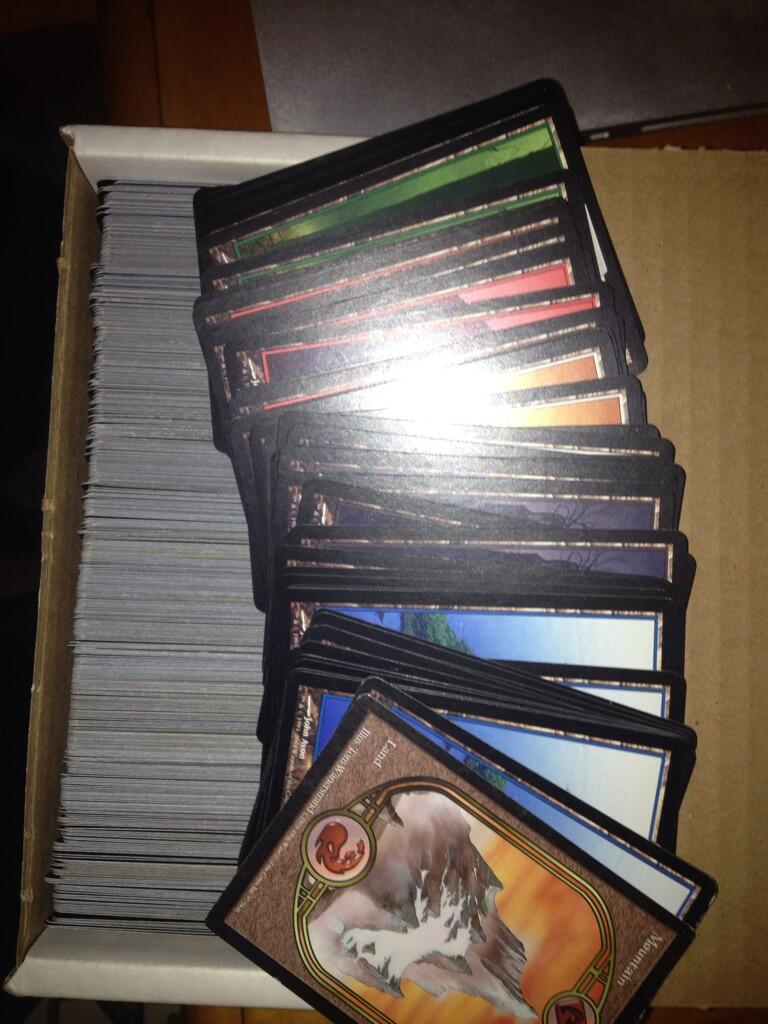
This is one of my favorites, and it’s something you may not be familiar with. While this represents a pretty small portion of my Magic holdings at any one time, maybe five percent, it’s an important tool for grinding out value over the long term.

The concept of the buylist box is simple. All those Seaside Citadels, Liliana's Caresses and such that can be sold for anywhere from a quarter to two or three dollars, I put in the box. Most of these have no rush to sell, so I just let the box build up over time. It typically has between 100 and 500 cards in it, and I’ll usually empty it out when I make it to a Grand Prix. Of course, if it fills up before then, I’ll buylist them out online.

Some people pick everything down to nickels, but I’ll usually stick to stuff that is a quarter or more. Sometimes what is a quarter to one dealer is a dime to others, so basically I’m ending up with at least cards worth a dime to a dealer in the box.

Anyway, here’s what it looks like right now.

My decks

It’s easy to overlook this, but I actually have quite a bit of value tied up in my decks, even though most of them are only casual decks. I have Merfolk and Living End built for Modern, but I have no Standard or Legacy decks put together.

I do have plenty of fetchlands, shocklands and other cool and semi-expensive cards in decks, from my EDH deck to my Allies deck (lands) and other fun decks.

Overall, I would say that in terms of singles, I have maybe 10 percent tied up in my decks.

Other

I hold a dozen duals, all white-bordered, as well as a playset of Wastelands and Forces. I do agree in the abstract that Legacy’s ceiling is what it used to be, due to the advent of Modern, but I also don’t think the bottom is falling out. Because of that, I’ve held onto these cards. I also own six Jaces (and at the moment have three from a collection I’m trying to sell).

That’s pretty much all my exposure to Legacy (outside of also-Modern cards).

Modern, though, I am pretty exposed to. Though I own no Bobs or Goyfs or Thoughtseizes, and sold my extra Fetchlands six months ago, I’m invested in a lot of the smaller items. I own about 60 shocklands of varying flavors, both because I expect them to go up after rotation and because they sell well in the store.

I’m also heavily invested in things like Inkmoth Nexus, Scars fastlands, Birthing Pods and some of the Modern Masters uncommons I expect to rebound, like Spell Snare and Kitchen Finks.

Rounding out, I also traffic a lot in casual cards. We’re talking the Parallel Lives and Asceticisms of the bunch here. These solidly grow over time, and I love having them in my binders and the store case.

Overall, I would say that in Modern nearly 50 percent of my stock right now are “staple-ish” cards that I believe are overpriced, and 0 percent are ones I think are too expensive to really “spec” on, like Bob, Goyf and Clique. The other 50 percent is tied to widely-played cards that sell/trade well, even if I think the price on these or more or less correct.

Closing the Book

I think that pretty much covers it. As you can see, one of the biggest things I advocate is diversification, which is reflected in my own collection. Sure, Scars lands may never take off, but I only have some of my eggs in that basket. Legacy may crash, but as a whole it won’t destroy my collection.

I think that’s the trick to steadily accumulating value. Going really deep on a card you think is underpriced is good, but you shouldn’t ever invest too heavily in it at the expense of the rest of your collection, because these things don’t always pan out. But if you spread around that opportunity, you’ll open yourself to enough of it paying off to outweigh any losses (or simply lack of growth) you might incur.

I hope this was a valuable exercise. I enjoyed writing it and taking stock of my own stuff, something that can be hard to do from time to time. For all of you, I think it would be helpful to compare your own collection to mine and Sigmund’s and see if you can draw any conclusions of your own. Remember, what is right for me may not be right for you, and that’s okay. But comparing notes never hurts.

Thanks for reading,

Corbin Hosler

@Chosler88 on Twitter

Insider: The Tracks of my Trades, 2012 Edition

Are you a Quiet Speculation member?

If not, now is a perfect time to join up! Our powerful tools, breaking-news analysis, and exclusive Discord channel will make sure you stay up to date and ahead of the curve.

I was going through some old documents the other day and found a list of every trade I made from September 21 through October 19. Conveniently, Return to Ravnica released on October 5, so this exactly covers the period two weeks before through two weeks after rotation. I originally made this list in order to come back later and see how I did on my trades long-term, so finding this just before this year’s rotation couldn’t be more perfect. In this article, I’m going to review some of the trades I made last year and examine how the trends of 2012 may be applied to 2013.

Trade 1 – September 21, 2012

I traded out:

1x Thundermaw Hellkite, $16.42 (then), $13.52 (now)

I received:

1x Isochron Scepter $4.26 (then), $4.95 (now)
1x Force Spike $0.37 (then), $0.50 (now)
1x Brainstorm $2.34 (then), $2.90 (now)
1x Life from the Loam $8.49 (then), $5 (now)
1x Izzet Charm $1.12 (then), $0.65 (now)
1x Fire // Ice $0.92 (then), $0.70 (now)

Total: $17.50 (then), $14.70 (now)

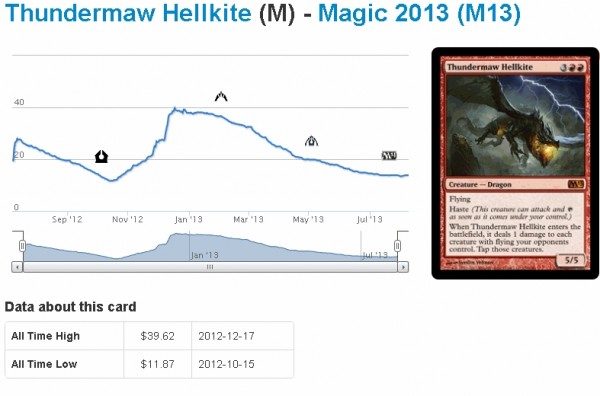
So I guess I’m starting out with one that I wish I could take back. Both now and at the time, this is a slightly favorable trade for me, but that’s not taking into account what happened in between. Take a look at this graph from MTGStocks.com:

I correctly identified that Thundermaw Hellkite was trending downward at the time of this trade, falling all the way to $11.87 on October 15, but failed to take into account the shakeup Return to Ravnica’s release would have on the metagame and prices. As soon as UWR Midrange, Mono Red, and other strategies started running the card, its price rocketed all the way to $39.62. The cards I acquired were all from the freshly-released Izzet v. Golgari Duel Deck. Unfortunately, Life from the Loam was reprinted again in Modern Masters, which took away some of the long-term upside this trade might have had.

What can we learn from this?

1. Just because a card’s price is falling in the current meta does not mean next year’s meta won’t be favorable to that card. At the moment, I am avoiding overhyped mythics like Archangel of Thune, Kalonian Hydra, and the new Planeswalkers, but if these fall too low, a change in approach will be advisable. I’ll be keeping a close eye on these mythics in the coming weeks.

Trade 2 – September 21, 2012

I traded out:

1x Nicol Bolas, Planeswalker (Duel Decks version), $7.27 (then), $5.45 (now)

I received:

2x Silverblade Paladin, $3.97 (then), $2.48 (now)

Total: $7.94 (then), $4.96 (now)

I like this trade, as it let me get rid of Nicol Bolas, which had just seen its third printing, and allowed me to acquire Silverblade Paladins, a favorite target of mine last year. At the time of this trade, the Paladin was overshadowed by Mirran Crusader in Standard, and as a result its price was depressed. After rotation, Silverblade Paladin spiked as high as $10.65, and I took the opportunity to trade the copies I had acquired one-for-one for shock lands.

What can we learn from this?

2. Casual cards seeing wide-release reprint should probably be traded. In M14, this includes cards like Door of Destinies and Sanguine Bond, which formerly had a high price due to casual appeal, but should see a dip with greater supply entering the market.

3. If a card from the current block seems good but isn’t seeing play, try to determine if a rotating card has been outclassing it. Identifying these situations correctly can be quite profitable.

Trade 3 – September 28, 2012

I traded out:

1x Humility, $11.21 (then), $14.97 (now)

I received:

1x Rhystic Study, $1.84 (then), $2.02 (now)
2x Celestial Colonnade, $2.24 (then), $7.54 (now)
2x Zendikar Full-Art Island, $0.83 (then), $0.49 (now)
1x Batterskull, $7.80, (then), $12.53 (now)
1x Figure of Destiny (premium deck version), $5.51 (then), $4.90 (now)

Total: $21.29 (then), $35.51 (now)

Given that Humility is on the Reserved List, my trade partner agreed to give me a premium on this trade. I recall using SCG pricing for this one, which worked to my advantage as my notes show I only got about a $5 premium, not the $10 I got according to MTG Stocks. The cards I acquired were a combination of Modern, EDH, and rotating cards, and even though Humility has gone up, it’s pretty clear I came out ahead long-term.

What can we learn from this?

4. Targeting rotating or underpriced cards that see eternal play (Modern or Legacy) virtually guarantees long-term gains. This year, that means cards like Snapcaster Mage, Geist of Saint Traft, and Liliana of the Veil should be high on your list of acquisitions after rotation.

5. It is realistic to ask for and get a premium for cards on the Reserved List.

6. Trades are going to look different based on what site you are using for pricing. If you know your prices well, you can get more value from your cards by using a site with favorable price listings. For example, if you can find a card which has a TCG Player mid-level price higher than that of Star City Games, you can grind trading for that card at SCG prices (getting more value on your cards since SCG’s prices are usually higher), and trading away the card at TCG Player prices (where the cards you’re acquiring will be priced lower than on SCG). Sometimes your trade partner may have a different site he or she would like to use, and that’s okay. There’s no need to bully people into using your preferred site—everyone should leave a trade happy.

Trade 4 – September 28, 2012

I traded out:

1x Regrowth (Unlimited) $4.18 (then), $4.32 (now)
1x Blood Moon (Chronicles) $5.46 (then), $7.64 (now)
1x Trading Post $2.16 (then), $0.47 (now)

Total: $11.80 (then), $12.43 (now)

I received:
2x Murderous Redcap $1.26 (then), $1.33 (now)
3x Surgical Extraction $3.96 (then), $3.38 (now)

Total: $14.40 (then), $12.80 (now)

Despite the numbers working out in my favor, I’m not sure I like this trade. I somehow convinced myself that because Surgical Extraction is a playable sideboard card in Eternal formats, it was going to spike after rotation and I had to get mine right away. This obviously didn’t pan out, and I think I could have gotten some more value out of the cards I traded away.

What can we learn from this?

7. Patience is a virtue. I could have found someone else who wanted Standard stock in exchange for rotating cards, but I let my anxiousness to get the card sooner cause me to trade away sweet older cards for narrow sideboard cards. I should have waited for a better deal.

8. Assuming rotating Standard sideboard cards that see niche play in Eternal formats are going to spike within a year or two is often erroneous. I could have picked these up at any point in the last year and probably gotten a much better deal on them. This year I’ll be more discerning with my rotation targets.

Trade 5 – September 29, 2012

I traded out:

1x Loxodon Smiter $4.64 (then), $3.95 (now)
1x Shardless Agent $7.88 (then), $15.23 (now)
1x Baleful Strix $10.64 (then), $20.89 (now)
3x Devastation Tide $1.08 (then), $0.49 (now)
1x Terminus $4.72 (then), $3 (now) (note: this spiked to $11 a few days after the trade)
1x Ancient Tomb (FTV) $13.90 (then), $9.15 (now)

Total: $45.02 (then), $58.44 (now)

I received:

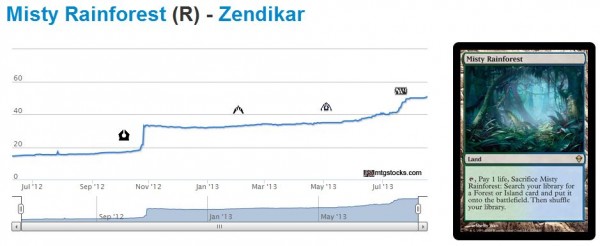
1x Misty Rainforest $16.78 (then), $49.99 (now)
1x Arid Mesa $11.05 (then), $35 (now)
1x Ancient Tomb (Tempest) $9.72 (then), $8.92 (now)

Total: $37.55 (then), $93.91 (now)

This trade was with one of the more financially-inclined traders at my LGS, and it was kind of a fun one to work out because we both knew that many of these cards were likely to spike. I gave up a bit of value at the time to ensure I got the lands I wanted, but I was happy to do so. We were both successful at targeting items that saw an increase, but given that I got the fetch lands, it definitely came out more favorably for me.

What can we learn from this?

9. As I stated a couple articles ago, sometimes you can trade cards that you think are going to go up if you’re trading for cards that are going to go up more. That’s exactly what I did here and it worked out beautifully.

10. If you’re super confident in a spec (or just want the cards really badly), it’s okay to give up some additional value to make a trade happen. Ubiquitous staples like fetch lands often warrant a premium, and that’s just a reality a trader has to accept.

Until Next Time

It’s amazing how detailing just five trades can eat up a word count so fast, but there’s a lot of information to be learned by digging deep on past deals. I plan to use the principles I’ve detailed here to shape my trading strategies in the coming months, and as I determine my objectives, I will share them in upcoming articles.

The trades I detailed today cover the weeks before and of the Return to Ravnica prerelease. I have several more trades recorded from this period, though, including ones immediately following rotation. There’s definitely more principles that can be learned from these, so let me know in the comments if you’d like to see a part two. I hope this was instructive and helpful to you all.

Insider: Breaking Down FTV: 20

Are you a Quiet Speculation member?

If not, now is a perfect time to join up! Our powerful tools, breaking-news analysis, and exclusive Discord channel will make sure you stay up to date and ahead of the curve.

Welcome back readers! This week I will be breaking down FTV: 20. I feel this is necessary given the current going rate on eBay for this product, around $200-$240. What everyone jumps to is the foil JTMS and many people assume that a FTV Foil is close to a pack foil. In reality, they are typically more equivalent to the regular version.

A lot of stores are using the current price of the contents to hype it to players, failing to account for the fact that prices will drop across the board for every card in it. But how much do we expect them to drop? For this we'll look over previous card values for comparison.

Past Chase Cards

The following cards were considered the "chase" cards of the previous FTV series. Each card is accompanied by its price trajectory. (As usual all price data came from Black Lotus Project.)

Card Name FTV Release Date Price Before Spoiler Price at FTV Release Current Price
Nicol Bolas (Legends) August 29, 2008 $8 $8 $14
Berserk August 28, 2009 Not Available Not Available $43
Mox Diamond August 27, 2010 $37.50 $32.18 $18.33
Kiki-Jiki, Mirror Breaker August 26, 2011 $5 $7 $17.50
Maze of Ith August 31, 2012 $27 $27 $21.60


First of all, there are a few issues with these cards that make analysis tricky. The main one is that we can't disassociate the change in value due to playability. What I mean by this is that if I have a $10 card and it gets reprinted, we expect a price drop (for ease of math let's say its reprint puts exactly twice as many into the market place). Assuming constant demand, that would imply the price should drop by about one half (to $5).

But what happens if that card suddenly becomes the secret tech in some top tier deck and demand doubles, thus jumping it right back to $10? Because we are looking for the trend of what the reprinting does to the value, looking solely at the price at time A and comparing to time B we'd say well reprinting has no effect on value, which is not only counter-intuitive but known to be incorrect (see the entire Chronicles set).

On the flip side, metagames change and cards that used to be highly sought after fall by the wayside as better cards get printed or decks fall out of favor. Thus, you ideally want to use cards whose value was disassociated with their actual playability.

The best one on this list for that is Mox Diamond. While it saw some play in Legacy (mainly Lands) that deck was never highly played enough to constitute it having played a significant role in Mox Diamond's value. I don't like to determine trends from one data point however.

Luckily, I already wrote an article on how reprints affect price. My data indicated roughly a 27.66% price drop when regular cards were reprinted in a major set (i.e. not specialty product). Comparing that with Mox Diamond we actually see that Mox Diamond dropped by about 43%.

That being said, I believe the demand for Jace the Mind Sculptors will remain considerably higher than the demand for Mox Diamonds, and thus expect less drastic of a drop. Still, it's good to see them side by side. So assuming we use only the 27.66% price drop that means our $135 Jace drops to just over $99.

Parsing Out FTV: 20

Our own store was nice enough to compile a list of current values for the full FTV 20 list.

1. Dark Ritual $0.84**
2. Swords to Plowshares $3.57**
3. Hymn To Tourach $1.45
4. Fyndhorn Elves $0.96
5. Impulse $0.55
6. Wall of Blossoms $1.61
7. Thran Dynamo $5.43
8. Tangle Wire $4.80
9. Fact or Fiction $1.75
10. Chainer's Edict $1.15
11. Akroma's Vengeance $1.54
12. Gilded Lotus $2.87
13. Ink-Eyes, Servant of Oni $6.83
14. Char $0.60
15. Venser, Shaper Savant $17.59
16. Chameleon Colossus $2.71
17. Cruel Ultimatum $0.88
18. Jace, the Mind Sculptor $135
19. Green Sun's Zenith $4.51
20. Kessig Wolf Run $1.50

**These two come with a caveat, as existing foil prints are quite valuable and hard to find, whereas non-foil ones are cheap. FNM foil Swords to Plowshares go for upwards of $100 each, the Judge promos closer to $30. Foil Dark Rituals are in a similar boat with pack foils in the $25-$35 range, judge foils in the $50-$75. I do expect these existing prices to take a hit, but the type of person who wants to foil out their Legacy deck is unlikely to want FTV foils over the long term. (They will likely trade for them, but will likely move towards the originals.)

If you add them up you get $196.14. Multiplying by the expected value (73.4%) you get roughly $144. The good news is that a few of the FTV cards will likely be worth more as they are either the first foils (Hymn to Tourach) or simply much cheaper alternatives to pack/judge foils (Swords/Dark Ritual).

However, the value of several cards was predominantly due to a complete lack of availability that will for the most part be solved by this printing (Thran Dynamo, Fyndhorn Elves). These cards are the ones which will take a much larger hit.

The last factor to consider is that with most of the FTVs there's a few "chaff" cards that will languish in your trade binder and won't be able to unload at their current value (Char, Impulse, Wall of Blossoms, Chainer's Edict, Fact or Fiction, Cruel Ultimatum, Kessig Wolf-Run, Akroma's Vengeance). These are by no means bad cards, but the little existing demand for them will be satiated by this printing.

The last card I want to touch on is Venser, Shaper Savant because I feel he will take the biggest price hit of the entire printing. His current price is dictated by a lack of availability and demand as a one-of by Legacy control players (usually Miracles). This printing I expect will drop his price considerably, and I won't be suprised if he ends up in the $6-9 range.

Having said all this, I wouldn't recommend picking up an FTV:20 as a financial investment unless you can get it for under $120. Personally, I don't need any of the cards in it so I'm setting my buy price at $100 or less as a financial investment. However, inversely I do recommend trading for these singles out of it, should they trade anywhere near their existing price:

  • Swords to Plowshares
  • Dark Ritual
  • Hymn to Tourach
  • Gilded Lotus
  • Green Sun's Zenith

All five have a lot of potential as foils; the first two for Legacy players who want to foil their deck but can't afford pack foil versions. Hymn is the only foil version available (and with new artwork). The last two are great EDH staples.

Jason’s Article: Play Magic

Are you a Quiet Speculation member?

If not, now is a perfect time to join up! Our powerful tools, breaking-news analysis, and exclusive Discord channel will make sure you stay up to date and ahead of the curve.

Greetings, Spectroscopists!

Apparently google doesn't think "spectroscopists" is a word. Let me ask you something, google. What do you call someone who analyzes samples using spectroscopes? Oh, a chemist? Good answer, google. That's why they pay you the big bucks.

Speaking of chemists, I used to be one. I also feel like I used to be a Magic player, and that has probably got to change and I'll tell you why.

Story Time

I used to grind Magic, trying to win a PTQ or get enough byes to have an easier time of it at GPs. I would spend a lot of my disposable income on cards, travel costs and accessories and went from loving to win to hating to lose. Losing a win-and-in to make Day 2 of a GP or getting 9th at a PTQ feels really bad, and the more that happened, the less I felt like I was ever going to achieve any level of success at the game.

We'd travel to GPs with Ryan Bushard in our car, and invariably I'd envy his lifestyle a bit. We were playtesting and writing out how to sideboard the night before until late and then we were getting up at 8 am sometimes while Ryan would set his alarm until noon and tell us he'd catch up with us later. I'd battle all day only to fall a bit short and Ryan would offer to bring us food between rounds and regale us with tales of business meetings/dinners and the figureheads of the community he was rubbing shoulders with while we were grinding.

I think the moment I realized it was time for a change was GP Montreal in 2011. Ryan asked us as we were in line to cross the border back into America "Do you think they're going to ask how much money we have like they do sometimes? I have about $3,000 and I don't know if I should declare it."

Here I was with $1 left in my wallet out of the $300 I exchanged at the border going in to Canada and Ryan was afraid he had too much money after a weekend of trading and selling to dealers. I spent my weekend playing M12 Sealed, which is only slightly more fun than finding out if you can get poison ivy on your scrotum (you totally can guys, trust me). Ryan spent his weekend sleeping in, taking hour lunch breaks and occasionally making a trade or two. Granted, $3,000 wasn't profit, but it was still a lot of money to gross in a weekend of selling to one of maybe four dealers.

By January 2012 I was a full-time financier and I haven't looked back since. That is, until I started to think the pendulum swung too far in the opposite direction, and maybe a happy financier is a well-rounded financier.

How To Be Well-Rounded

I'm not suggesting you should start playing in GPs instead of going to them to trade and buylist. I think that's not the play. What I am going to suggest is that there are two or three weekends a month where there is no GP to go to, and are you serving yourself or your community by ignoring the game on your "time off"? I've been skipping a lot lately--FNMs, weekly booster drafts, casual nights, PTQs.

You can make the case that binders don't change over that often at your LGS and there aren't too many trades to be had, but who even likes trading anymore? I have become increasingly disillusioned with the concept of trading for value lately, and with eBay then and TCG Player now as outs, every trade I've done lately has been because someone approached me and I traded with them for stuff that sold well.

I notice people's buttholes tended to pucker up when I'd approach them and ask to trade, and the stuff they wanted from me was stuff I found I was selling instead of keeping around to trade. In general, the play is to trade a Geist of Saint Traft into cards that seemed smaller but added up to more value than just selling a Geist. However, if you aren't inclined to do a ton of trading, just selling the Geist and trying to buy another one at buylist felt like what I wanted to be doing.

The real shift for me didn't come in the form of me falling in love with trading again. I think value trading and I are going to see other people and it's probably going to stay that way. I may get drunk and dial the first few numbers of value trading's phone number every now and again, but it's over and I should move on.

What's taken its place is me falling in love with winning, and to win, you have to play.

My first tip to people who grind finance style almost exclusively is to become a casual magic player again. If you don't like to trade as much as you used to, it's because you're trading with the wrong people. If you don't like to play, similarly, you may be playing the wrong formats.

Even though it rotates the most often, Standard almost always feels stale to me. I see everything from Innistrad block as lame ducks--cards not worth picking up because they're about to rotate no matter how long until actual rotation there may be. Standard is unfortunately the format we as players have the most opportunities to play. This may require you to play some non-sanctioned games--something that may seem like a tough sell at first.

Going Casual Casual

When I first started in finance, Ryan told me that he spent one day a week going to a local community college and playing casual games there. When I took his advice and did it myself, I saw the appeal.

First of all, casual players make up a larger percentage of total players than anyone realizes. It's estimated there are two casual players for every player with a DCI Number. You're never going to meet these people if you only play FNM and GPs, but that's a shame, because those people have twice the demand for cards and less than half of the availability.

I never expected to encounter such a large group of people for whom the concept of buying a single card on the internet seemed foreign, but that's what I encountered. And when I did, I managed to trade a lot of the stuff in my lead-off or "junk" binder.

Standard players don't take a second look at Archangel's Light and neither do hardcore EDH players. But there is a category of player that devours cards like that and it's foolish to ignore them. I can't keep cards like that in stock, and I have a similarly-difficult time holding onto prerelease and Game Day promo cards because there is a significant portion of the Magic-playing population that loves promos like that but simply doesn't play in events, even events as casual as a pre-release.

Keep a casual deck to play a few games with those players and potentially demonstrate some cards they've never seen before. The best part about interacting with casual players is encouraging them to venture to the LGS for a pre-release. Those events are who those players are for, after all, and you may be able to grow your LGS' player base with an infusion of new players who may want to get a bit more competitive.

The casual players will value cards competitive players consider bad, undervalue cards competitive players consider good and are unpretentious and easy to hang out with. Casual players aren't going to get out their phone and look up the price of every card to make the trade take forever, either.

You could probably screw them if you wanted to. I'd advise against it. You can shear a sheep for life but you can only skin it once. Be honest about the money value of the trades, hook them up with casual cards that won't sell online or trade out well anywhere else and play a few damn games with them while you're at it. There are worse ways to spend an afternoon.

Going Hardcore Casual

I used to think playing EDH was just dicking around for durdles. I've grown a bit as a player and community member and I've come to realize that actually playing EDH is dicking around for durdles, but it's a pretty worthwhile endeavor.

I used to borrow the occasional EDH deck and play it but I never wanted to have money invested in it. Why have money tied up in cards when you could sell those cards? If I want to dick around, I'll play Type 4. Well, nobody plays Type 4 anymore. I don't think anyone even knows how. What's replaced it is either Cube Drafting or EDH.

I got into EDH recently because I don't have decks built because I don't play much. During the lull between taking everything off of eBay and getting a high enough TCG Player level to list everything, I decided to see if I could get my wife to play Magic somehow.

Quick sidebar--if you want to teach someone how to play Magic, give them confidence, and retain a basic understanding of the rules and turn structure, show them Duels of the Planeswalkers. The tutorial on there is superb for teaching a non-player and I think I finally figured out why.

If you are teaching someone and they do something they can't, it's up to you to catch it, back them up and explain why they can't do that. That's a frustrating way to learn. DoTP doesn't let you do anything you can't do, and if you try and it doesn't let you it makes you go through the thought process of "Hey why can't I play this land... oh, okay, I remember, I've played one already this turn" and it's more conducive to the learning process.

Anyway, my wife got sick of me talking about nothing but this silly children's card game both at home and when we were out with our friends. She decided to at least humor me a bit and get more into it, and I thought giving her her own deck was a good way to do that. Since I had a ton of EDH goodies stocked up ready to sell, I figured I'd break a rule and get high from my own supply. It's a few weeks later and I've got four decks built and my wife wins roughly half of the games we play.

Trading with EDH players can be less annoying than trading with value traders or people trying to pick up cards for a tournament. EDH players have everything and they want everything.

Getting deeper into EDH has taught me that a few fundamental truths about EDH held by the finance community are not necessarily correct. Sure, EDH is a one-of format; the finance community loves to point this out. It's harder for a card that gets played in a one-of format versus a four-of format to drive prices up in the short term, but most players have more than one deck.

Sure, they'll likely only ever want one foil Diluvian Primordial, but how many Thespian's Stages can you trade to a single player? Gilded Lotuses? Strionic Resonators?

Cards that can go in nearly any deck take longer to go up than they should, which gives ample opportunity to pick them up. A card like Chromatic Lantern or Illusionist's Bracers gets spoiled. Everyone looks at it and goes "Oh, EDH card. Cool, whatever," and goes about their day. The card drops to a buck or two because people are more interested in picking up the stuff they want for Standard. The foils sit at roughly twice the non-foil price for a while until they suddenly shoot up to ten or fifteen times as much and everyone acts surprised.

"Why did that go up all of a sudden?" Probably because it was always going to. Don't be kicking yourself in six months or a year because you could have gotten foil Illusionist's Bracers for $5 and didn't. Sure, it's a one-of format, but let's not forget you sell someone X copies, where X is the number of decks the card can go in.

Maybe you already play and understand EDH, but then again, maybe you don't. It will cost you less to put a deck together than you think, especially if you don't jam real duals and stuff like that in there.

Once you've wrathed someone's entire board with a Gruul Ragebeast you can't get more than a dime for on a buylist, you'll see the appeal of building a deck for cheap and opening yourself up to a huge group of players you might have been avoiding. EDH is even more unfair than Vintage and let's not pretend that doesn't appeal to some of us.

Hardcore Rambling

I took 2,200 words to make roughly half the points I felt like I wanted to make. I might revisit this topic at a later date, but honestly, if I can get some of the finance community to embrace playing casually, I've done my job.

You'll have to go looking to find them, but if you can be their hookup you won't regret it. If nothing else, you'll play more Magic and that never hurt anyone.

The People Who Took My Advice

Lots of people played Magic this weekend already. Between the GP in Warsaw, the SCG Open and Game Day, there was a lot of Magic to be played. Somewhat hypocritically, I skipped Game Day, but that has more to do with me wanting to wait until after rotation to get back into Standard than it does with me playing less Magic. I played FNM; get off my back, jack.

GP Warsaw

Too Bad It Wasn't Legacy

I would have played Hive Mind and called the deck "Warsaw Pacts" and been hailed as the comic genius you all knew I was all along.

How many Jund decks were there in the Top 8? Well, that depends--are you like most of the pundits lately who refer to the new Golgari midrange deck as "Redless Jund" which I think is stupid as hell? Do you call Gruul decks "blackless Jund?" "Hey, how'd you do this week with mono red?" "Oh, were you referring to my 'green- and blackless Jund deck?" Can we agree it's Golgari and move on? I don't care how the deck started out, I only care about how it ended up.

While I'm harping on about the deck, though, let's talk about it. I think it's a great deck. Once you come to grips with the fact that you can win games of Magic without Olivia you can take some of the pressure off of your mana base, run a few cards like Lifebane Zombie and Mutilate and generally get there.

I don't know if this list is better than Jund, but it wins games and lets you sell those Huntmasters while you can still get something for them. I wish people had played Mutilate more than 30 seconds before they rotated, but c'est la vie. For the record, Marcel White was the genius behind the Mutilate call and I hope he made some money on it. I know I did.

I think Lifebane Zombie is a card to watch, and its price and inclusion will be largely dependent on the white and green creatures in Theros. Getting a Thragtusk, Huntmaster or Restoration Angel is important. What he can get after rotation is going to matter a great deal.

I don't know how much credit Jeff Hoogland deserves for this list, but he was the first person I saw running it and context has taught me that if I see him running a deck I've never seen before, there's a good chance he was at least partly responsible. It's good to see Europe taking a chance on a deck I like and playing it to a good finish.

Non-redless Jund was better-represented in the Top 8, including an odd version run by Felipe Becerra whose name should sound familiar because he was 2013's rookie of the year. It was a much zombier build than the rest of the Top 8, but I like it.

It's all going to rotate, but it looks fun, and playing a Jund deck in a Standard format whose rotation is imminent can get stale otherwise. This is a throwback to the Jund-colored Zombie decks we saw a year ago and I'm a fan. I guess I'm not the only one who sold his Huntmasters.

The other Jund decks are stock and hardly worth mentioning. You know what's in them--cards you want to be selling.

That's not entirely true, it also contains a card you want to be picking up. Shops are out of the DoTP Scavenging Oozes, and Ooze is still heating up. It was $25 when it was a one-of in Maverick. How many copies need to flood the market to keep it below $20 when Standard and Modern decks run between two and four copies?

We'll find out, but I imagine that number is greater than the number that are actually out there. Ooze can be had for a criminally-cheap $13 some places. This is a $20 card, folks. Hoard accordingly.

I like the Naya list in the Top 8, but it's losing the potent Thundermaw-Resto combo. What it's keeping is turn two Loxodon Smiter, and that may be more of a thing post-rotation if the Block PT results are to be believed. Smiter may have room to grow.

Speaking of "room to grow" how many copies of Domri Rade do you have? Paying $15 to sell them for $20 seems miserable, but if you want them to play with maybe you want to pay it. SCG has them at $20 now. I imagine that isn't the ceiling.

I can't imagine Domri will be worse in a smaller format, and if the format slows down at all, hitting a planeswalker on turn two may be all you need to do because slower, large creatures won't be able to race the emblem. If you can still snag Domri cheap and you want them to play with, you may have to do it very very soon. Expect these to be hot commodities.

Bant Hexproof won't be a deck soon. I imagine Fiendslayer Paladin, accordingly, won't be a card. With no Rancor and no Spectral Flight, will people bother with decks like this going forward? We keep Unflinching Courage and Ethereal Armor, but without hexproof dudes to Voltron up are we just asking to get our pants pulled down X-for-one style?

I think what Theros gives us to mitigate removal blowing out Voltron decks will be a large factor in the price of cards like Fiendslayer. I am inclined to sell sell sell right now. I think Green/White wants to be populating and sandbagging in the future, not vomiting its hand out.

Will Ratchet Bomb be too much for the deck to handle? I can't say, but I think how weak Fiendslayer is without something to buff him makes him a sell, pseudo-hexproof aside.

The deck may limp on, and without Geist it will be even more affordable. Dropping blue makes it stronger against Burning Earth and it keeps Voice. I'm talking in circles at this point. Regardless, even if a deck using Fiendslayer and auras emerges post-rotation, he probably doesn't have as much room to go up as he has room to go down. I'm saying "sell" and sticking to it.

No UWR in the Top 8? Curious. I expected to see a bit more than a smattering of copies in the Top 16 after the deck's strong showing at World Champs.

Steve Hatto's monored deck in the Top 16 is hilarious. I imagine anyone who got bolted for lethal by a bloodrushed Rubblebelt Maaka likely flipped the table.

Lifebane Zombie forced people to drop Restoration Angel and play more Aetherlings than they wanted to and it didn't actually go that badly for them. Expect rotation to force just as many players to play Aetherling. Pick them up now while they're criminally cheap.

That's all from Warsaw.

Play More Legacy

Or some at all. If Huey Jensen didn't have such a good Sunday, I wouldn't have tuned in to coverage at all. "Double Standard" is not a term used positively and SCG Opens are no exception.

Saturday

Salt Lake City was host to a Double Standard weekend of Margical crads, which, without even clicking on the links, you already know was a double dose of Jund and Gruul. Let's confirm our preconception together.

Four G/R aggro decks in the Top 8 on Saturday. Huey Jensen made Top 8 but was ultimately vanquished and the say was won by Jacob Tobey and his G/R aggro build.

This deck is reminiscent of the G/R deck Brian Kibler piloted to a perfect 3-0 last weekend, and Burning Earth is red hot right now. This week's Brainstorm Brewery featured a lengthy discussion of the card I won't rehash here, but the tl;dr is that you might want to sell these for the $4 they are right now.

The card is hot, but buying in at $4 requires the card to go up significantly to be worth it and as much of a proponent of this card as I was at $1, I don't think it's a buy now. They could hit $5 or $6, but it's not seeing much maindeck play and it requires a less greedy manabase than most people are willing to play.

That B/G deck is back with another Top 8. I feel like it retains enough goodies in its creature base that a variation of it can endure the rotation. Expect a new iteration to feature more cards with scavenge, and expect Deadbridge Chant to be a great combo with Scavenging Ooze and spells like Doom Blade and Abrupt Decay.

There was so little diversity in the Top 16 here it's a little boring to even talk about. There was a Bant Hexproof deck, an Aristocrats deck, a Zombie deck, one B/G deck, a Naya deck and a U/W Flash deck in the Top 16, and that short list is all the non-Jund and GR decks in the entire Top 16. All the lists looked pretty much the same and they are largely populated by creatures that are about to rotate.

I'm hoping Sunday showed us something a little different.

Sunday

Not really. Today Jund decks prevailed. Huey Jensen doubled down on the deck from the day before, changing exactly one card in the sideboard. This time it got there for him and he took home the trophy. It also got there for a staggering 50% of the Top 16. How fun. You're right, guys. This is much better than having a Legacy tournament.

The half of the Top 16 that wasn't Jund Midrange featured seven other decks, which was surprising. Two Flash decks made it, but that was the extent of control's Top 16 finishes.

Midrange is winning the day now, but with Midrange poised to lose all of the silly mid-sized utility creatures that prevail now, expect a new archetype on the horizon. It's likely aggro, but control may know what it needs to do moving forward. One-for-one removal is bad against Huntmasters and Thragtusks. Will it be bad against Loxodon Smiters and Voices of Resurgence?

Well, yes, in that last case. Still, Magic is about to look radically different, so expect cards that are bad now because they can't hang with Olivia and Thundermaw to suddenly get better.

Lingering Souls isn't played to great effect anymore, and that card was really holding Desecration Demon down. Demon spiked to $3ish, and why not? It's always been secretly the best black beatstick in the block, but it got stuffed by cards like Lingering Souls.

Will Young Pyromancer do as good a job holding him down? Who knows? I do know that I saw the buylist price creep up on this guy starting a few months ago and I socked a bunch away. It feels good to sell these for way above bulk.

Which other bulk rares are going to have their time to shine? I have a lot of faith in Scion of Vitu-Ghazi right now, and I think its use in conjunction with Voice of Resurgence, Advent of the Wurm, etc. may be too much for even the Ratchetiest of Bombs to contend with.

I'm sure there are RTR cards you're keeping an eye on that aren't being played right now because of cards that are about to rotate. There is probably at least one bulk rare that is the next $4 card that no one has spotted yet. Be the one to spot it, or just notice what dealers are buying. You don't need to be too far ahead of a card to make money, you just need to be ready.

Do some testing and see if it talks you out of a card or makes you want to go even deeper. It only takes one wacky Travis Woo brew to make all of your Intruder Alarms $4 overnight and you're in the money. Besides, there are worse ways to spend an afternoon than playing Magic.

Insider: One Person’s Portfolio

Are you a Quiet Speculation member?

If not, now is a perfect time to join up! Our powerful tools, breaking-news analysis, and exclusive Discord channel will make sure you stay up to date and ahead of the curve.

Some of you may already know that I am a stock market investor first and MTG investor second. I probably spend more time on the latter simply because I enjoy it more (plus you can’t play EDH with stocks). But in terms of retirement planning and true investing, most of my funds are in the stock market.

That doesn’t mean I don’t have sizable investments in Magic cards. A few MTG trends are predictable enough that I’ve decided to make measurable bets on them. I try to write about these ideas each week.

It’s one thing for me to read a stock market analyst’s recommendation of a list of stocks-–opinions are a dime a dozen on Wall Street. Sometimes all I really want to know is where the experts are putting their money.

What is Warren Buffet’s latest position? What is Carl Ichan up to now? Which company should I avoid because Bill Ackman just recently bought one percent of its value?

I don’t claim to be an MTG (or Wall Street) finance expert. But I always appreciate it when others disclose their positions. The old adage “Put your money where your mouth is” comes to mind.

My intent this week is to do just that. I will present part of my MTG portfolio so you have an idea of where I’m placing my bets in the MTG market.

Breaking it Down

To try and ensure this article is relevant to most readers, I’m going to summarize my top holdings from multiple categories. These categories include sealed product, Standard, and an “other” category consisting of Modern/Legacy/Vintage/casual formats.

Each category will be treated as a separate portfolio totaling 100%. I will also try to provide relative size of each of these separate portfolios as well.

Finally I want to emphasize that although I am very eager to make money from this hobby, I also have a soft spot for certain cards. My “not for trade” binder of casual goodies will not be factored into these percentages. That includes a few graded Alpha Rares, some of my favorite old-school cards like Shahrazad and Island of Wak-Wak, and my 125 copies of Jaya Ballard, Task Mages. Some of these cards do have value but I have no desire to sell them.

Sealed Product

Roughly half of the value in my Magic collection lies in sealed product. I have advocated for these investments in the past because they perform very consistently. By finding a popular set with Eternal-playable cards, you can rest assured an investment in sealed boxes of that set will increase in value eventually.

My sealed product portfolio can be broken down into two categories: Innistrad booster boxes, comprising roughly half of my sealed product in value; and other.

I have written my opinions on Innistrad booster boxes on multiple occasions. The set was a huge hit, casual players enjoyed it, drafters enjoyed it, and the set contains the most-played planeswalker in eternal formats--Liliana of the Veil. Taking my own advice, I went deep on this investment with the hopes of doubling up in a couple years. Progress has been slow while I anxiously await this eBay listing to finally sell out:

If I would have known someone would list dozens of these boxes at $149 each shipped, I would have been eager to wait before pulling the trigger. Instead I’m left holding some boxes I overpaid on while I wait impatiently for the price to go up. It’ll happen eventually, of this I am confident. By the way, if you’re interested in building up your own position in Innistrad Booster Boxes, my recommendation would be to buy these.

After my Innistrad position there is a steep drop off in percentages of my sealed portfolio. Modern Masters and Return to Ravnica boxes are second and third, representing roughly 15% each of my sealed portfolio. Next would come New Phyrexia and Avacyn Restored booster boxes at about 5% each. I also have a small position of Scars of Mirrodin Fat Packs. Lastly I own a single box of a few sets including Dark Ascension, Dragon’s Maze, and Magic 2012 (hey, this box was only $65 shipped).

Standard

My Standard collection is much smaller than my sealed product holding--roughly one-third in value. I struggle with buying into Standard heavily because I’m not an active trader. I haven’t been to an FNM in months and I probably haven’t even played a game of Magic since I met up with QS’s very own David Schumann in South Carolina while traveling to visit family.

In short: investing in a highly-liquid, ever-evolving format is tricky for me.

That being said I still do own a few sizable positions--most of them are in staples which I expect will increase in value in the coming months. The top of the list should come as no surprise: over half of my Standard collection’s value comes from shocklands.

These have finally turned the corner and are now on an upward trend. We may have missed out on the perfect storm because Modern season no longer overlaps with Standard rotation. But Standard rotation alone will send these higher as they disappear from trade binders everywhere. The big decision will come this fall--do I sell out or do I hold through Modern season next year? I’m open to your thoughts on this one.

After shocklands there is a significant drop-off in value (I hope you’re noticing a trend here--I like to buy deeply when I’m most confident). Scavenging Ooze is my most recent position and it already represents almost 20% of my Standard portfolio. This card is everywhere in Standard thanks to Kibler’s popular deck. We already know Ooze is Legacy-playable and I am fairly confident this creature will impact Modern as well. This is a solid holding.

The next 10% of my Standard portfolio are my foil and nonfoil Abrupt Decays. I don’t own many since I always seem to trade these away, but I am doing my best to sit on a few. I also own one foil Liliana of the Veil, but because she is so expensive she actually is a noteworthy position in my portfolio. Other holdings above 5% include my foil and non-foil Avacyn, Angel of Hope and my collection of Supreme Verdicts.

Other

If sealed product makes up roughly half of my total MTG portfolio and Standard is about 20%, this would leave the last 30% in other formats, including Modern, Legacy and casual. In this realm I don’t have concentration in many positions. Last week I discussed the criticality of portfolio diversification, and I am living that suggestion actively. I will do my best to touch upon some of the noteworthy cards I’m holding.

Before Modern became big, I went out and purchased a handful of Zendikar fetchlands. Not nearly as many as Corbin, mind you, but still a decent amount. Most of them are now sold, but I still own my personal set of twenty. Because I play Melira Pod in Modern, I have a set of Misty Rainforests and Scalding Tarns seeing no play. My unused Zendikar fetchlands make up about 15% of my “Other” portfolio. I wasn’t going to sell these, but the threat of a reprint is so high that I may be tempted to in the coming months.

I still believe in Scars of Mirrodin fast lands, although these haven’t really moved lately. Modern season is surely going to drive a price increase on these, but now we need to wait another ten months for this to happen. Until then, these will remain in a binder--they make up about 10% of my “Other” portfolio.

With the recent announcements around Theros block I purchased seven copies of Serra's Sanctum. This is probably the next largest position in the “Other” category. I’ll likely be sitting on these for a while, it being on the Reserved List and all.

Other than these lands, I don’t really hold significant positions in anything else. Instead I have a smattering of other small positions that add up to a nicely diversified portfolio.

A few other Modern bets I’m sitting on include Birthing Pod, Inkmoth nexus, and Spellskite. But these positions are miniscule.

In short, I am well-set up for any reprints Wizards wants to throw our way. There is no way they will reprint enough product to significantly damage my “Other” portfolio. I feel relatively safe sitting on all of these at least into Modern PTQ season.

That’s About It

Hopefully this was a useful exercise--I know it helped me digest where my largest bets are and where I may want to strengthen a bit. I’m content with my sealed product exposure, but I could probably benefit from a little more exposure to dual lands. I’m also content with my number of shocklands, but I don’t have a specific exit strategy. I need to work on that.

Sometimes I wish Wall Street analysts would be this transparent. Quit recommending stocks for just one second, and tell me where you’re placing your bets! I don’t have enough money to buy every stock my favorite Wall Street pros are recommending. If I bought just one share of every stock Jim Cramer suggested I would likely run out of money in under a week. By sharing specific details of their portfolio, I feel experts would showcase their confidence a lot more effectively.

In essence this is what I’m attempting here. I encourage you to share your own portfolio distributions. Hopefully this will be helpful. Let me know what you think in the comments. If this was a useful article structure let me know and I’ll try to reapply it (I have some interesting ideas brewing). If you would rather I go back to older article formats please let me know too. My primary goal is to make everyone money so their hobby pays for itself.

Sigbits

  • Another artificial spike? The chart pattern for Horizon Canopy sure has the pattern. This card sold out overnight on TCG Player, but the price has already dropped significantly from the peak as people attempt to undercut the market and sell their copies at the newly-inflated price. If you have spare copies I’d sell them now. Buying into this hype seems bad.
  • I wish people would stop messing with Land Equilibrium. This card is up and down every day it seems. Buy one copy for EDH and move on--manipulation of this card’s value seems incredibly risky.
  • I have a growing hunch that rare slivers in M14 are going to be casual gold in the coming months. They likely won’t end up in bulk bins, and I’d encourage you to hold onto even your common and uncommon slivers after drafting. These may never break the bank, but they are going to be easy buy-list fodder as time goes on. Case in point, look at the trajectory of Bonescythe Sliver:

-Sigmund Ausfresser
@sigfig8

Insider: Back in the “Dead Zone”

Are you a Quiet Speculation member?

If not, now is a perfect time to join up! Our powerful tools, breaking-news analysis, and exclusive Discord channel will make sure you stay up to date and ahead of the curve.

Some times are great for Magic finance. Modern season is shooting prices up left and right or you’re knee-deep in new spoilers that promise to shake up the metagame. It’s not only easier to make money, but much less of a grind to do so.

This is not one of those times.

I first introduced the concept of the “dead zone” last year, and it spawned a great deal of interest, both from local players and readers of the site. It also was a great motivator for me personally, so today I want to revisit and update the concept.

The Dead Zone

When I was in high school, I played sports competitively and Magic not at all. It was cross country/basketball in the fall, basketball in the winter and baseball in the spring. Come my senior year I had somewhat tired of going straight into another serious sport like baseball, so I decided to stick with tennis full-time, rather than simply doing it alongside baseball as I had in the past. Considering I was going to play basketball at college the next year, I was definitely looking forward to a more relaxing sport.

Well, I learned a lot that year. Tennis is a fun game, but I had a huge problem: I would stand in the “dead zone.”

The dead zone was an area of the court near the middle of your side. You weren’t close enough to the net to make any power plays, but you weren’t far enough back to be defensive. Instead, you sat in the middle and didn’t accomplish much.

That's exactly where we are with Magic right now. M14 is out, Standard is pretty much set, Modern is now a million months away, and there’s just not much to do. You should have already sold out of your rotating cards, and we don’t know enough about Theros to start speculating on it.

But I’ll return to my old adage, the one that seems to apply to every part of my life and especially Magic finance. Where others see danger, find the opportunity.

It’s my adaptation of a favorite of Warren Buffet (an incredibly successful investor and great human being): “Be Fearful When Others Are Greedy and Greedy When Others Are Fearful.”

Obviously this translates very well into Magic finance. Cards drop to bulk rare status because people flood the market with them. Modern Masters drops prices of previously-expensive cards, and people stay away. Previously-expensive cards like Stonehewer Giant tank because of the new product, and all of a sudden nobody wants them.

Lands, in particular, are a great example of this. Right now, people are fearful (not exactly, but it serves the purpose of the analogy) and being careless with their shocklands, just like they were with their Scars lands. So I’m greedy and I pick all of them up because they’ll pay off later.

On the flip side, people greedily buy into spiking cards and want to hold them until they reach their absolute pinnacle. Instead, I’m fearful in a good way, and tell everyone to “sell into the hype and leave the last 10% for the next guy.”

And you know what? It’s a strategy that makes a lot of money. Thanks, Mr. Buffett.

Opportunity in the Dead Zone

Just like me on the tennis court in high school, right now we’re stuck in the dead zone. But that’s just an excuse. Other people may be bored or paralyzed by the unknown rotation coming up, but there is opportunity if you look hard enough.

For me, the biggest opportunity to be found in the dead zone is a surprisingly easy one: time.

You don't have to scramble to pick up the hot new cards for a new Standard format, there’s no fast-approaching PTQ season to stock up for, and Magic attendance typically lulls in the summer. All of which adds up to some free time on your hands. Let’s talk about the best ways to use that time.

Organizing Your Collection

The most important is certainly cleaning out and organizing your collection. This is hugely important, and often overlooked. We talk all the time about how often cards like Merrow Commerce (to name one from a recent #pickthepic) are worth real money to a dealer, and how getting these adds up fast.

But those cards have to come from somewhere, and chances are you probably already have a fair number of these in boxes around your house, just waiting to be found. So just make yourself do it! Personally, I love sorting cards and pulling out things worth money, even if it’s just a quarter at a time.

Of course, it’s not always easy to set aside hours to sit down and pull those boxes out of the closet. But there’s not a better time to do it! Pull up something handy like MTG.gg and began digging through all that old crap you have socked away. Sort it by highest buy price and go crazy. When you’re done, you can either put everything back away or bulk it out to a store, now that you know it’s true bulk.

The only better way to do this than at home with a good beer is with a group of friends. Tear through those old sets and reminisce about the draft format, all while making some money at the same time. You never know what you’ll find. My best story is finding a Loyal Retainers in a box of bulk, but chances are you’re going to come across something valuable you didn’t know you had, even if it’s just a few Imperious Perfects.

I consider myself pretty good at picking cards, and can usually spot anything worth a nickel or more to a dealer. But after writing this article a year ago and taking my own advice, I still found stuff I didn't know I had like Springleaf Drums from back when I started playing.

One of my goals this year is to re-organize the case I run at the LGS. When I first started, everything was sorted by color and the store binder that went with the case was well-organized. Of course, as things began to sell and get replaced it gradually became more and more messy, and now the only thing ordered at all is the fact that the lands are grouped together.

I’m going to change that this month. Rather than grind the trade tables for more Standard stuff that no one wants right now anyway, I’m going to take some time and re-organize things there.

Now obviously not everyone has a case they have to keep in order, but I know you all have binders that could use the same treatment. Clean them out already! Make sure to pull any rotating stuff you haven’t yet, but don’t forget about those things that randomly get thrown in. I know I still have some random Zendikar full-art lands in the back of my binder that I keep forgetting to bring home and lose to the box of hundreds I already have in the closet.

I also have stuff like Wolfir Avenger, uncommons that I thought would be really good that never really panned out. While keeping these around a year ago was a good decision (and similar calls like Lightning Mauler paid off well), it’s time for them to go and be replaced by the same calls for next year.

Stuff like Burning-Tree Emissary deserves a place in your binder, but it should come at the expense of those cards whose ship has sailed. Remember, a focused binder makes money, and the more cluttered yours is, the more time every trade is going to take, which decreases the amount you’re going to get done in a given night.

Finding New Trade Partners

Speaking of trading, another suggestion I have that has paid off well for me in the past is taking a trip. It doesn’t have to be a long road trip for a PTQ or a crazy adventure like GP: Vegas, but instead go try out a different LGS. Getting new faces (and binders) in front of you is a great way to generate some momentum in your collection, and sitting down with the same ten people who still don’t want anything else you have is time better spent trying something new. Buying collections is always a crapshoot, albeit sometimes a profitable one. If you want to do that, there’s no better time to start than now.

If you still want to just trade, this is also the time to stock up on stuff for next Standard season. Sure, we don’t know much about the coming format, but we can still measure power level. I advocated picking up Sigarda last year based on this, and while the metagame never evolved to make her dominant, she did see enough play to merit a strong price increase.

Raw power will often come through early in a format, which means something like Trostani is appealing, especially since it’s a less-known factor than something like Sphinx's Revelation, which while having upside is still already expensive. But some stuff is still relatively underpriced, and I like Jace and Exava as pickups based solely on power level.

That pretty much covers my plan for the “Dead Zone,” but the most important thing is this: Don’t get burned out. This is also a great time to just step back from the game for a bit and recharge.

I’ve talked about a handful of productive ways to make this “boring” time in Magic finance profitable, and I’m sure I’ve missed some. What suggestions do you all have? How can we turn what is typically a down season into something much more?

Thanks for reading,

Corbin Hosler

@Chosler88 on Twitter

Insider: Finding Value in M14

Are you a Quiet Speculation member?

If not, now is a perfect time to join up! Our powerful tools, breaking-news analysis, and exclusive Discord channel will make sure you stay up to date and ahead of the curve.

Magic 2014 (M14) has been available online for a couple of weeks now, and the market prices on cards from this set have settled down enough to make early analysis possible. Last week I went over the case for buying the reprinted planeswalkers, and this week I'll expand to cover each of the mythic rares.

Briefly though, M14 has a few staple rares in Lifebane Zombie, Mutavault and Scavenging Ooze. Regular rares that start at a high price are bound to head lower due to the amount that comes into the market from limited play.

At some point prior to the release of Theros in the Fall these will be worth picking up. Look for these to head lower in the weeks ahead, possibly bottoming out in the last week of September during the week of online Cube draft that coincides with the paper release of the new set. But for the moment, steer clear of speculating on regular rares.

The Rating System

I use this rating system to think about the value of mythic rares. I feel the system has utility and is a good way to assess whether or not cards are worth buying. Each mythic is followed by the current price and a rating, either Good Value, Fully Priced or Borderline. I also present a Top Overall Pick.

  • Good Value -- At current prices or in the given price range, this card is a buy and I expect it to see higher prices in the medium- to long-term. These cards are the best speculative targets from a value perspective. Some of these cards might never make a splash in competitive constructed formats, but the risk of loss, if bought at the suggested prices, is low.
  • Fully Priced -- This is the other end of the spectrum, where downside risks are high. Fully Priced cards might maintain a high price, but further gains are doubtful. Do not buy these at current prices to speculate on.
  • Borderline -- This is somewhere in the middle of the other two, with some possibility of moving up or down in price. For cards with this rating, further scrutiny is required beyond just the price. If you have a large amount of capital, buy some amount of these cards and scoop up more if the price falls.

All prices are taken from mtgotraders and are current as of August 8th, 2013.

Fully Priced

Darksteel Forge: This card has an extremely narrow effect with a high casting cost, about as pure junk as you can get. Nevertheless, due to the redemption value of mythic rares, this can be a buy at the right price. At prices up to 0.35 tix, any mythic rare from a redeemable set is a snap buy. Current price is 0.65 tix and so it's Fully Priced.

Devout Invocation: This is another spell with too high a casting cost and too little impact to make a dent in competitive play. Pure junk. Current price is 0.79 tix and Fully Priced.

Garruk, Caller of Beasts: Seeing early play in combination with Craterhoof Behemoth and other green creatures, this card feels like it will lose a lot with Fall rotation. We haven't seen a six-casting cost planeswalker hold a price higher than 10 tix for very long, and I don't think this one will turn out differently. Keep your eyes out for a green creature like the 'hoof that can be cheated into play to win the game on the spot. Sell these now. Current price is 10.56 tix and Fully Priced.

Kalonian Hydra: This big dumb green monster will win the game quickly if left alone. It's getting some early play in Zvi's Elves deck, but without haste or a way to impact the board in some way, I can't see it holding the near 10 tix price that it has so far. If this fell into the 4-5 tix range, it might get me interested. Current price is 9.96 tix and Fully Priced.

Ring of Three Wishes: Pure junk. Move along. Nothing to see here. Snap buy at 0.35 tix or less, but at the current price of 0.49 tix, this card is Fully Priced.

Rise of the Dark Realms: Nine mana is just too much to expect this to do anything in Standard. It has some casual appeal I think, so it's not pure junk, but I'd be more interested at 0.5 tix or less. At the current price of 0.69 tix, this card is Fully Priced.

Shadowborn Demon: I want this card to work, but it's going to have to overcome the splash damage from the maindeck graveyard hate provided by the all-star Scavenging Ooze. I think this one is destined to drift down in price over time. In the 1.0-1.5 tix range, I'd think about it. Current price is 3.08 tix and this card is Fully Priced.

Borderline

Archangel of Thune: Triggering the Gavony Township ability of this card without using the combat phase can have a large impact on the game. Domri Rade does it for zero mana and Scavenging Ooze does it for {G}. Both of these cards will be played in Fall Standard, and while they might not all show up together, Naya is the right shard to make the mana work.

This card briefly touched 10 tix earlier this week, but has since firmed up in price. It's a tough call. It could go to 25+ tix if it finds a home in a top deck, but it could also drift down to 5 tix over time. If it was back down in the 8-9 tix range, I'd be a buyer, but at the current price of 13.31. tix it's Borderline.

Jace, Memory Adept: Older versions of this card command a price in the 7-8 tix range, so I'm going to hazard a guess that its price will converge with the M13 version in the 5.0-5.5 tix range. This might be a little conservative, but among the reprinted planeswalkers this one has seen the most play and thus has some downside. Ajani and Liliana can't see less play, but this card might. I have been buying this card at below 4 tix, but the current price is 4.48 tix which means this is Borderline.

Primeval Bounty: Like Deadbridge Chant, this is a six-casting cost enchantment that will not impact the game state right away but will provide a long term advantage. It's not clear to me which is better, but unlike the Dragon's Maze enchantment this card is splashable. It's most certainly a card to keep an eye on; if it drifts down into the 2.0-2.5 tix range I'd be more interested in accumulating these. Current price is 3.81 tix and Borderline.

Scourge of Valkas: Being compared to Thundermaw Hellkite is probably a little unfair, but people will do it as this is the heir to the throne in terms of core set dragons. Unlike most dragons that show up in the mythic slot, this one might actually see play in Standard. It's got a small comes into play effect which can do worse than sending Lifebane Zombie in the yard. I think this is one to target on the dips, so if it gets back down into the 0.7-1.0 tix range, make sure to grab a few copies. Current price though is 1.11 tix, so this card is Borderline.

Windreader Sphinx: This one looks like pure junk, but it's teetering on the edge of being a buy right now due to its low price. If you can find copies in the 0.3 to 0.4 tix range, there's zero risk in picking up a few copies due to the redemption value of mythic rares. Current price though is 0.43 tix, so this card is Borderline.

Good Value

Ajani, Caller of the Pride: In the multi-coloured world that the combination of the shock lands and the check lands has created, mono-colour planeswalkers have been mostly left on the bench. In last week's article I explained why I like the reprinted planeswalkers from M14 at certain price points. I anticipate that the M13 and M14 versions will converge in price in the 3.5 to 3.8 tix range by October.

This means Ajani is a definite buy in the 2.5 to 2.8 tix range (where it was at last week), with almost no risk and plenty of upside heading into the a new Fall Standard. The current price of 3.11 tix is just a little above my comfort zone, but this card is still Good Value.

Chandra, Pyromaster: The last new version of Chandra was from M12 and arrived with more interest and held a 6 ticket price floor for months after release. I also suspect that WoTC wouldn't make Chandra the face of the set without pushing the power level of this card. I anticipate we'll see this card played at some point, which points to a 10+ tix price when that happens. Current price is 5.47 tix and Good Value.

Liliana of the Dark Realms: Similar to Ajani, this is another planeswalker without a home and thus little to no downside. If Tibalt, the Fiend-Blooded didn't exit, I'd be talking about this card as the lowest-priced planeswalker ever on MTGO. I'm expecting this to converge in price with the M13 version in the 3.0 to 3.5 tix range. Current price is 2.52 tix which means this represents Good Value.

Wrapping Up

There was a large buying opportunity on many of the M14 mythic rares last weekend as the big push of release events flooded the market with supply. As always, value is dependent on price, so last week's 'good buy' turns into this week's 'not touching that with a 10 foot pole'. However, the reprinted planeswalkers still hold good value, and I think Chandra will show up in Standard at some point.

It's difficult to predict what the metagame of Fall Standard will bring, but if we can make a few low-risk bets, we get cheap upside heading into a period which sees the most turnover in card use.

It wouldn't take much use in Standard for any of Ajani, Chandra or Liliana to reach 10+ tix. Jace is close, but his application is largely determined at this point as as a useful tool in some control builds. Archangel of Thune also is very intriguing but the price and the hype seem too high at the moment.

Want Prices?

Browse thousands of prices with the first and most comprehensive MTG Finance tool around.


Trader Tools lists both buylist and retail prices for every MTG card, going back a decade.

Quiet Speculation