menu

Insider: Pro Tour Prep

Are you a Quiet Speculation member?

If not, now is a perfect time to join up! Our powerful tools, breaking-news analysis, and exclusive Discord channel will make sure you stay up to date and ahead of the curve.

This time of the year can be one of the most profitable ones. The Pro Tour usually causes some big price spikes, and the Standard Pro Tour even more so.

Oh yea, before we go any farther, let’s talk about Boros Reckoner.

Sell now.

I called this card in my set review a few weeks back when it was $4, and I hope you made moves on it like I did. I picked up several at the prerelease and made money trading them off when they hit $15. Since then it’s gone even more crazy and is pushing $25, which is nuts.

So I’ll repeat: Sell now. No rare in the post-mythic era from a reasonably-opened set has sustained $25+ for more than a month or two, including things like Stoneforge Mystic and Snapcaster Mage. Reckoner sees no play outside of Standard, and though it may go up a little more in the short-term if it has a good Pro Tour, you’re much better off selling now. I see this dropping back to $10-15 in a few months.

Okay, with that out of the way, let’s talk about how you’re going to handle this Pro Tour. There’s going to be hype flying all around, and things like Domri Rade and Gyre Sage are already starting to warm up.

I’ll talk about those two cards, but first I want to talk in more general terms about the Pro Tour and speculating.

A Year Ago

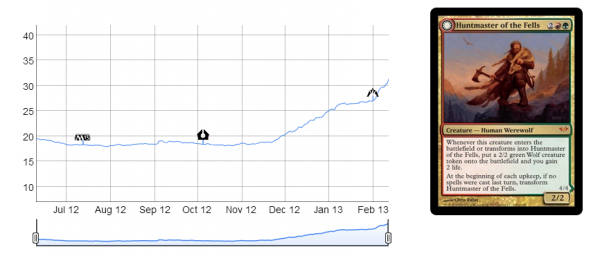
At this time last year I received a tip that Huntmaster of the Fells was going to be a hot card at the Pro Tour, and I shared it with Insiders here.

But even armed with that knowledge, I didn’t go out and buy them all on Thursday. Instead, I waited to see if it put up some results first. When it was doing well on Friday afternoon, I made the move on the card and profited a week later when it spiked to $30.

The lesson from this? It takes more than hype to make me confident on moving a card. Sure, maybe that means I’ll make slightly less money than if I was the very first to get in, but it also limits my risk.

Remember Nivmagus Elemental? The card received all kinds of hype early in the tournament and sold out in a matter of hours. Except then it didn’t put up any results, and people who moved on the card got burned badly.

That’s the danger of moving on a card too early. There’s a sweet spot where you can still make money, and while it may not be the absolute most, it will be much less risky.

This Year

Let’s start with Gyre Sage. This is the card I’m most excited about, as you’ll be able to get in on these for $2 apiece right now if you really want to buy in cash. And if the deck performs well, you’re going to make money at that price.

Another option is to see how it does on Friday. Chances are it’s not going to spike just from Friday, allowing you to stock up for some at FNM if you’d rather go about it that way. Personally I’m not buying in for cash, but that’s not because I don’t think it’s a pretty good spec right now. I’m just at a point in my life where I’m already tied up in some cards, and tossing in the fact that my wife and I just moved into our new house and are up to our chest in boxes to unpack I’m just not sure I have the time to worry about tying up more money in cards.

On a small tangent, there’s nothing wrong with taking a break like this if you get to a point where it feels necessary. I made some moves on Reckoner after I called it and did well, and with everything else going on right now I’m happy to stand pat for the moment.

So my plan is to pick up a few at FNM to have a position in the card if it takes off, but I’m also not risking too much if it doesn’t.

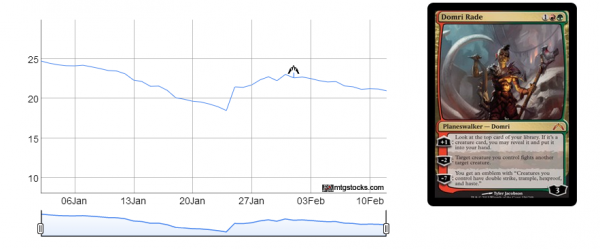
Now let’s talk about Domri Rade, and why I actually think Sage may be a better buy. You can get in on Domri now at $20 or so, and if it has a good weekend I think it would spike to $50 or so, whereas Sage will likely go from $2 to $8-10 ala Wolfir Silverheart a few months back.

So let’s break that down. Right now you can buylist Domri at $15 or so, and Sage at basically nothing. If Domri jumps to $50, you’re likely to cash out for around $35, netting you $20 a card, or a 125 percent or so increase. Definitely good.

Imagine instead of investing $80 in a playset Domris, you put it in Sages. They hit $8-10 retail, and you’ll be able to get $5-6 “on the outs” (either buylist or eBay after fees). So with Domri, we turn our playset at $80 into $140.

With Sage, on the other hand, we turn 40 Sages into $6, or $240 on the outs.

Using this math, you see why it’s sometimes better to go for cheaper cards. Of course, there are plenty of cons to this, since if the card flops you’re left with practically nothing, whereas Domri will always be good trade fodder since it’s a planeswalker and unlikely to be irrelevant. So while Sage may pay more off if it hits, Domri is safer if they both miss.

This is another example of the layers beyond the simple “speculate on good cards” that many people think it is, and understanding and weighing these options when making a decision for yourself is vital to being successful.

Thanks for reading,

Corbin Hosler

@Chosler88 on Twitter

Tournament Tips #1

Are you a Quiet Speculation member?

If not, now is a perfect time to join up! Our powerful tools, breaking-news analysis, and exclusive Discord channel will make sure you stay up to date and ahead of the curve.

Author's Note: This article was originally intended to be a small section at the end of my column, but it turned into much more once I got writing. Look for this to be a small segment in the future.

Tournament Tips

From time to time, I am going to include this little bonus section at the end of my articles. The goal is to briefly talk about tournament preparation and ways to improve your game. These little snip-its are topics that writers typically do not talk about but are extremely important to playing at a high level. If there are any specific areas that you want me to discuss, feel free to leave your ideas in the comments section of any of my articles.

The first item on my agenda came to my attention two days ago and while obvious, is still something that every player messes up from time to time. The topic? Read your cards as well as your opponents'. This may be a fundamental premise of Magic, but yet players make incorrect plays based on false assumptions frequently. I think the main reason for this is pride. Players feel as if reading their opponents’ cards degrades their skills as a player because of jokes about new comers to the game. We've all heard it or said at some point: “He didn’t really have a chance. He even had to read all my cards.”

Put your pride on hold. If you don’t know what a card does, read it. If you don’t know how a card interacts in a certain situation because you can’t remember if the card says "may" or not, read it. If you don’t know how a card affects the game, call a judge and ask. Don’t assume you know how a card functions just because you have played a similar card in the past. Don’t assume you know the exact wording on a card just because you tend to have an amazing memory for card text.

I could go on and on about similar situations, but you get the point. Let me share with you the origins of this topic with a story.

Boros Reckoner

Even though I write about constructed Magic every week, I am just as concerned with Magic finance as competitive play. The financial side of the game is a brilliant organism and I find myself trying to dissect it regularly. The price trend of Boros Reckoner has been the focus of my intrigue lately. You can see the graph on TCG Player here.

Some specific prices that stick out are as follows.

  • Jan 27 -- $4.82
  • Jan 29 -- $9.94
  • Feb 10 -- $16.49

Of the big sites, only Channelfireball has any copies in stock and they have it listed at $27.99! Trollandtoad.com, Starcitygames.com, Cardkingdom.com, Coolstuffinc.com, ABUgames.com, Empirecards.com, Strikezoneonline.com, and Adventureson.com are all sold out.

This is an intriguing conundrum for a…

trained armodon

Boros Reckoner is more than just a Trained Armodon in disguise though. His current price tag puts him in contention with two of the most influential cards of the last few years. Should we really be talking about Boros Reckoner in the same breath as Snapcaster Mage and Deathrite Shaman, which have changed the landscape of both Modern and Legacy? Can a mere 3/3 for three mana really make that big of an impact?

All of this information has been swirling around in my head since the Gatecrash release. I was lucky enough to open Boros Reckoner in one of my sealed pools and he was pretty good. Twenty dollars good though? There is no doubt I would say no to that question. In fact, I did say no. When presented with the opportunity to sell my Boros Reckoners for eight dollars apiece, I leaped at the chance. The card was ten dollars on TCG player and I was getting eight for them. What insane value! Never did it enter my thoughts that this elephant impersonator might double in price (or triple if you count Channelfireball’s price).

Let me pause there for a moment. Let all that information sink in and try to put yourself in my confused shoes.

An Imperfect Memory

Have you ever played against Spitemare? It’s basically the same card, but it costs one more mana and is easier to cast. I've only played against it once myself. When Modern was first established, a local shop held a tournament. A few friends and I journeyed down to the event excited to try out our new brews. In that event I played against a Spitemare deck. That’s right, a whole deck dedicated to casting a four-mana 3/3. The goal was to deal it tons of damage with cards like Blasphemous Act and Shivan Meteor. I was playing an untuned version of Splinter Twin and he had no chance. (See, we all say it sometimes.)

Having already seen Spitemare in action made the price growth of Boros Reckoner seem even more bizarre to me than otherwise. I just didn’t get it. There had to be a reason this card was continuing to grow at insane rates. As I thought about it I continued to read Magic article hoping to find my answer. Eventually, one article showed me the light.

What happens when you play Boros Reckoner and then Domri Rade the following turn? When the article in question presented this idea, I had to pause to reread both cards! And with that the first tournament tip came to me, less like the traditional light bulb moment, and more like a supernova exploding in my head.

Whenever Boros Reckoner is dealt damage, it deals that much damage to target creature or player.

My past experience with Spitemare caused me to remove the option of damaging a creature from my memory and so every time I looked at Boros Reckoner, that part of the text did not exist for me. This may be an extreme example from my personal experience, but it is relevant to all players. No matter what the circumstances are, reread the card as many times as it takes. You'll be glad you did.

The interaction between Reckoner and Domri is one to be feared, so have a plan for it if you are playing any kind of aggressive deck in Standard right now. The worst case scenario is Reckoner fighting your 2/2 and redirecting the two damage to your other 2/2. The reason Reckoner is so good in Standard is because against another creature deck, it is almost always a two-for-one in your favor. Think about its impact on Standard at Thragtusk levels because that is the trajectory it is taking.

Ravnica City Zoo Updates

If you haven't read about the field trip to the zoo, take a couple minutes and do that first.

OK, now that you're back, I have some updates for you.

This Standard Zoo deck is a ton of fun to play. You are faster than nine out of ten of your opponents and based on what cards are seeing play, they can’t do much to disrupt you. Naya is my favorite color combination and this deck reminds me why. Here’s my updated list.

Untitled Deck

Creatures

4 Experiment One
4 Rakdos Cackler
3 Dryad Militant
2 Thalia, Guardian of Thraben
3 Strangleroot Geist
4 Flinthoof Boar
3 Silverblade Paladin
4 Ghor-Clan Rampager

Spells

4 Rancor
4 Boros Charm
2 Searing Spear
2 Oblivion Ring

Lands

4 Temple Garden
4 Sacred Foundry
4 Stomping Ground
2 Rootbound Crag
4 Sunpetal Grove
2 Mountain

Sideboard

3 Skullcrack
2 Pillar of Flame
2 Mizzium Mortars
3 Ray of Revelation
1 Rest in Peace
3 Purify the Grave
1 Oblivion Ring

The most important change was to cut a land. Twenty-one lands may still be too many and another might come out. With fewer mana sources, I decided to cut the Aurelia's Furys as well. With an X of one or two, I felt the impact would not be large enough to warrant the card. Oblivion Ring was added specifically to combat Boros Reckoner, but also as a catch-all removal spell. You many strong plays on turns one and two, and following that up by removing their blocker can turn the tide early enough to prevent your opponent from getting back in the game. Boros Reckoner could make an appearance in this deck as well, but currently I like the damage output of Silverblade Paladin too much.

After testing this deck, I am more confident in its power to win games. I have beaten every midrange deck including the following: Jund Midrange, Jund Control, Naya Midrange, G/W Humans, U/W Tempo featuring Talrand, Sky Summoner instead of Thundermaw Hellkite, BUG Control and 5-color Control. The only matches I have lost are to other aggressive decks. They always go three games and when I lose, it has been due to me drawing four to five lands in a row, mulliganing, or not having access to a color.

In my opinion, this deck is the fastest in the format. You have multiple ways to increase a creature's power and then give them double strike. This deals the opponent massive chunks of damage. For example, even with a mull to five and drawing many lands in a row, I almost won a game where my opponent played double Centaur Healer and double Thragtusk. He ended at two life because I drew yet another land and couldn't finish him off. This deck is powerful. Give it a try.

A note on the sideboard before I finish today. For now, I really like the spells in the board. One thing to keep in mind if you plan to play this deck is that you cannot really sideboard out that many cards. The most I have brought in from the sideboard is four or five in any one game. The most common cards to come out are Thalia, Guardian of Thraben, Oblivion Ring, and occasionally a Silverblade Paladin or Ghor-Clan Rampager if you are on the draw against Mono-red. Therefore, you do not want many four-of slots in the board because you cannot bring in that many cards.

That's all for this week. Next week should feature a sweet SCG Cincy tournament report featuring my sweet Zoo deck, unless I freak out and switch decks at the last moment. I wouldn't do that, would I? Tune in next week for the details.

Until Next Time,

Unleash your power to read!

Mike Lanigan
MtgJedi on Twitter
Jedicouncilman23@gmail.com

Insider: The Jund Onslaught

Are you a Quiet Speculation member?

If not, now is a perfect time to join up! Our powerful tools, breaking-news analysis, and exclusive Discord channel will make sure you stay up to date and ahead of the curve.

A very interesting phenomenon is happening right now in Magic: The Gathering. In the past, blue decks were the big thing. For the most part, every Legacy deck still runs blue. However, we are seeing Standard, Modern, and even Legacy shift towards a particular color combination –- Jund.

Jund provides players with some powerful tools. It has the best burn and aggro cards from red, the best removal spells from black, and the most efficient creatures from green. Combining these different strengths results in some very powerful spells, such as Bloodbraid Elf and Abrupt Decay.

What Does This Mean for My Portfolio?

There are quite a few cards that fit into ultra-efficient Jund strategies. We are starting to see these decks in Standard, and I’d like to talk about the cards that go into them and what we can expect to see increase in the future. These decks can dominate a format, as we’ve seen with the 37% peak in Modern. If this happens, we will see Standard flooded with Jund decks, and we can be the ones there to make some money off of it.

The Midrange Cards

Photo from MTGStocks.com

Huntmaster of the Fells –- This card has been on our radar for quite a while and has finally passed the $30 mark. Since it has replaced Bloodbraid Elf in Modern Jund, it could potentially become the next $40+ Standard mythic. We may be close to sell right now, but I see it gaining popularity, not losing it.

Olivia Voldaren –- Olivia is the ultimate sleeper rare. It has dropped to sub-$10 multiple times and shot to $20 overnight. I will be sad when it rotates for that reason. However, it is currently gettable at around $10, and is being played in the Jund decks, as well as some other midrange decks.

Rakdos's Return –- This card shuts down control if it resolves, and hurts aggro if it comes down early. Paired with Liliana of The Veil, you can destroy your opponent’s hand. The fact that it does damage to the opponent as well makes it a huge blowout at any point in the game.

Abrupt Decay –- Very efficient removal, and it hates on blue? This card gets rid of most of the scary cards in Standard. Silverblade Paladin, Liliana of the Veil, Domri Rade and even Detention Sphere. It has some limitations late-game, but it will usually shine in any Jund or 5-color control deck.

The Aggro Cards

Deathrite Shaman -– This card is being played in every format. In Standard, Jund Aggro and Burn lists are loving his life loss, and it fights a lot of cards like Feeling of Dread and Lingering Souls.

Hellrider –- This card is at its all-time high right now. I can’t see it going too much higher anytime soon. However, it is holding its popularity, and is quite the blowout in aggro decks.

Domri Rade –- Aggro-oriented card advantage, removal, and impending doom for any opponent, especially control? Yes please! In a deck with even 40% creatures, you are looking at the same card advantage of Liliana’s +1 ability, and the removal is often more specific! Get that emblem off, and no control player can beat you. That means they spend their time dealing with Domri, while you build up an army to take them down.

The Foils

If you've read my articles, you know I follow foils closely. I like to know which ones have increased, which ones might increase, and how to make money off of them. So, I almost always devote a part of my articles to the shiny rectangles we all know and love.

Burning-Tree Emissary –- When I saw this free 2/2, I squealed with delight. It seems a few others squealed as well, as it was the third most popular card in the SCG New Jersey top sixteen -- right behind Boros Reckoner and Hellrider. TCGPlayer is currently almost sold out of these in foil at $3-4, but you may be able to pick some up cheap from the previous naysayers.

Flinthoof Boar –- Foils of these were available at $.25 a month ago, but those days are long gone. You can still get these at $1-2 in a few places, and I would pick them up in a heartbeat. I will be grabbing some myself.

Notable Non-Jund Mentions

Blind Obedience –- We have seen this pop up in a few control lists -- but now it has appeared for the first time in an aggro/midrange deck. Monowhite Humans was running a full set, and they worked extremely well, leaving the field clear for attackers. It also helps them outrace their opponent, and use up extra mana on extort to widen the life gap.

Boros Reckoner -- This guy has shot up due to his current popularity. Drop them fast while they are at $20 or so. As more stock piles in from Gatecrash, they will drop in value fairly quickly. I see them as an $8-10 card max.

Stromkirk Noble -- I love seeing this guy. I know he's a big deal, and he should be a $6-7 card easily. He hurts Humans bad, and should make it into a lot more decks than we see him in now. He continues to grow as he hits, and if you get him in once or twice, there is little stopping him.

So, SCG Edison was a very interesting development -- please remember to keep an eye on your decks and bags. I have seen quite a few pots about theft at this tournament, and it should remind us all to watch our stuff. Jason wrote a great article on protecting your items a few days ago.

Until next time, remember to pick up the shinies!

Progress

Are you a Quiet Speculation member?

If not, now is a perfect time to join up! Our powerful tools, breaking-news analysis, and exclusive Discord channel will make sure you stay up to date and ahead of the curve.

I’ve only been back from the Bahamas for a couple days, but there are already plenty of results in the three constructed formats that I’m trying to tackle, and I already have quite a few observations about all three. For this week’s article I’m just going to break into what I’ve done and what I’ve discovered.

Modern

I’ll start with the format that I’ve done the least with thus far. Last night a bunch of Minnesota players got together and did a bunch of Modern battling. On my part I mostly just jammed Burn against other decks and was relatively happy with how the deck played out. The list I was playing was pretty stock:

"Bump"

spells

4 Lightning Bolt
4 Goblin Guide
3 Searing Blaze
3 Shard Volley
2 Flames of the Blood Hand
4 Bump in the Night
3 Deathrite Shaman
4 Ash Zealot
4 Rift Bolt
2 Magma Jet
4 Skullcrack
2 Pillar of Flame
1 Grim Lavamancer

lands

4 Scalding Tarn
4 Arid Mesa
4 Mountain
3 Blood Crypt
4 Blackcleave Cliffs
1 Marsh Flats

My testing more or less confirmed my hypothesis about where WotC’s Modern philosophy leads us: Burn is The Rock. Every game where I drew reasonably was close and I felt favored in most games where I had Goblin Guide. The ability to consistently goldfish on turn four makes you a formidable opponent for basically every deck. Even a turn three Wurmcoil Engine out of Tron is beatable, but it might mean you have to Searing Blaze your own blocking Goblin Guide/face.

Burn is probably the worst deck for actually abusing Deathrite Shaman, but the card definitely does work. Getting extra value out of burn spells and enabling such turn twos as “Play Ash Zealot, kill your Deathrite Shaman” is a big game.

If you like playing Burn and are planning on PTQ-ing I must say this is the first format where there are basically no decks that I feel are truly atrocious matchups now that Skullcrack is a card. You’ll need to be wise about Lightning Helix, but everything is very winnable. Even Kitchen Finks is quite beatable, though I think the Pillar of Flames are a necessary concession just for games where you have multiple Guides and they have Finks. It’s also not noticeably worse than other options such as Burst Lightning which you will end up kicking considerably fewer times than you’ll end up caring about removing creatures from the game. On this note, I would consider switching out a Mountain or Blood Crypt[/car] for a [card]Stomping Ground for Deathrite Shaman. You can almost always afford to be shocked by your lands in my experience, so this inclusion is basically free.

Pauper

Going through dailies it’s looking like Post, Temporal Fissure and Monogreen Stompy (ewwwwwwwww) are the three most popular decks. For the life of me I can’t figure out why anybody would want to play Stompy, but you’re almost guaranteed to run into it once or twice per daily event, so it’s very important to know how your matchup against the deck goes!

As of now I’m messing around with Delver a lot. I have the following cards locked in as absolute and the rest of the deck changes rather rapidly:


Good play and Stormbound Geist out of the board have made all flavors of Post to be jokes of matchups, though I don’t have much experience against Temporal Fissure at this point.
One thing that I’m trying to figure out is whether or not I want Spellstutter Sprite in the deck. I know for certain that I don’t want the half-card that is Cloud of Faeries, but not having Cloud doesn’t invalidate Spellstutter. It still counters relevant spells in literally every matchup, the question is whether or not it’s just to have around on account of the prevalence of Stompy. I don’t know the answer at this point, but switching to another creature that blocks well (Frostburn Weird) might be the play.

I still have a bit of uncertainty about the Stompy matchup, but I have no doubt in my mind that it can be made winnable. I mean, the opposition is freakin’ Monogreen. One card that has been suggested to me is Coral Net, but I’ve yet to test it. The card looks pretty miserable on the surface but I’ve absolutely been wrong before. It might just be the best answer to Scattershot Archer.
I have yet to see anything to diminish my faith in Delver MUC. Being an 18 land deck with a fistful of Cantrips allows for such insane consistency that if your strategy is at all viable you will win matches.

Standard

It’s looking like I was correct in predicting that the Dual reprints would make the most dramatic impact on Standard of any Gatecrash card. Other cards, most noticeably Boros Reckoner, are making splashes but nothing has really changed on a fundamental level other than having significantly better mana.

I think that Esper with Blind Obedience is a pretty cool concept. Just the thought of having an Extort engine with Lingering Souls and Think Twice gets me a little giddy, but right now there is a different deck that I’m more excited about…

I just can’t give up on Rakdos's Return. I’ve been messing around a bit with Jace+RR Grixis but I still need to do a lot more testing before I figure out exactly where the deck wants to be. Right now I know for sure I need Snapcaster, Rakdos’s Return and a bunch of removal. Everything else has been moving parts.

As for win conditions in the deck Nephalia Drownyard is an enticing option, but I think Esper is just a dramatically better Drownyard deck. That being the case my current guilty pleasure is playing one of each of the following two cards:


Basically, the worst thing that happens when you cast a Griselbrand is that you draw seven cards. Let’s face it though, there is no cooler spell to hardcast in Standard. Possibly not in any other format either. It might turn out to be the wrong way to go about battling, but I’ll be damned if it isn’t the most satisfying.

The biggest thing that I’m trying to figure out is how many, if any, Counterspells to be playing. It seems to me that you need to play too much sorcery speed removal to make your Counters particularly good against aggressive decks and that the Sphinx's Revelation decks are so much better at permission than you that playing counters for them just feels foolish. I think I’d just rather be Duressing and Slaughter Gamesing.

Back to Work

I apologize for only having the one publishable list, but it’s really too early in testing to get married to too many things. The most important thing to remember when working on decks is that every slot needs to be justified and as some parts move around other parts get better or worse. The more I discover, the more solid the lists get, but I find that at this stage broader discussions are of much greater value.

I’ll absolutely be working on Grixis and Pauper in the near future, so hopefully I have a solid list of one or the other for next week. Until then, thanks for reading!

Ryan Overturf
@RyanOverdrive on Twitter

Insider: Reallocation – Time to Move Profits into Standard

Are you a Quiet Speculation member?

If not, now is a perfect time to join up! Our powerful tools, breaking-news analysis, and exclusive Discord channel will make sure you stay up to date and ahead of the curve.

So, have you lightened up on Modern inventory yet? It's not a bad time to unwind positions.  While shifting into Eternal staples is much cheaper than it was just three months ago thanks to Modern price spikes, a larger player base and much better value can be found speculating in Standard. 

First, some cards to avoid:

Boros Reckoner how you mock me. Early Febuary I made a SELL recommendation on this guy and now  moving copies at >$20 is Ebay easy. Up over 5 dollars in one day seems like a spike and I still can't get on board with the Reckoner at these prices.

Thragtusk just keeps making its way into Event Decks. Prices for this resilient beater are about to test pre-Return to Ravnica values but until I see prices hold above ten $10 on Ebay I am not ready to call a bottom. I would open a position at <$10.

With copies of Aurelia's Fury down more than 20% from a $25 Gatecrash release price, we've got a mythic worth watching. Here is a card that is looking to get abused with Snapcaster Mage but has Avacyn Restored's Bonfire of the Damned and Entreat the Angels miracles to compete with. I think Bonfire is going to always keep a lid on Aurelia's Fury pricing while, at least while copies are selling for <$10, Entreat the Angels seems like much better value.

What I'm looking to acquire:

Would you rather own a single copy of Entreat the Angels or five playsets of Signal the Clans? The instant is a likely inclusion in any Commander deck that can run it and it looks very breakable at 2cc. This card has Gifts Ungiven price potential even if it lacks the blue card's functionality.

For as little as $1.75 you can pick up Firemane Avenger. Dealing three damage to any target and gaining three life in a fast Standard environment is very good. With Lingering Souls, Thatcher Revolt and other token producing spells to keep Battalion triggers activated, the Avenger is a spec target with a great chance to spike. I'll be looking to slowly trade/ sell out of copies at $5.

Legion Loyalist is a bargain at less than $4. Goblins see play in every Magic format and offers red players a superb one drop. In Standard both first strike and can't be blocked by tokens are very relevant, making the Loyalist capable of shaking up a meta relying on efficient token generation.

Clan Defiance is a card I'm having a hard time evaluating. While it doesn't compare well to Bonfire, it is often more bang for the buck when compared to Aurelia's Fury. With Ebay offering speculators a chance to grab copies for less than $1.5 per, Clan Defiance is not a bad play if you can imagine a Standard decklist looking to running eight similar effects.

About Shocks

Steam Vents for less than $6.5 is crazy. Right now Guildpact versions are over $15 and even if you think that is high, a 49% discount seems excessive.

Return to Ravnica's Hallowed Fountain is currently discounted 51% to its Dissension counterpart.  With near mint copies still treading over $10 mid, the Fountain is going to be a much more popular card in Modern formats.

Near mint Gatecrash copies of Breeding Pool already command a price of $12, making it more expensive than either Hallowed Fountain or the Steam Vents. But compring that $12 price to Dissension prices you'll see that these lands sell at a 48.5% discount to Dissension copies. 

While old Shocklands test all time lows thanks to a flood of supply, picking up any Shockland at current prices is likely to pay off.  What follows is a little cheat sheet, naming the card and its discount to older copies:

Blood Crypt (42%)

Breeding Pool (48.5%)

Godless Shrine (36%)

Hallowed Fountain (51%)

Overgrown Tomb (39%)

Sacred Foundry (14%)

Steam Vents (49%)

Stomping Ground (30%)

Temple Garden (30.5%)

Watery Grave (27%)

From that list it should be clear why Hallowed Fountain, Steam Vents and Breeding Pool are a speculators best Shockland targets.

Insider: Touch of the Eternal — Preparing for Major Events

Are you a Quiet Speculation member?

If not, now is a perfect time to join up! Our powerful tools, breaking-news analysis, and exclusive Discord channel will make sure you stay up to date and ahead of the curve.

Welcome devoted (or not-so-devoted) readers to another edition of Touch of the Eternal. This article will focus on preparing for major events; not from the standpoint of playtesting, planning the trip, or putting together a group, but rather from the "hitting the trade floor" side of things. So without further ado, let's begin.

Preparation

  1. Snacks and water -- Make sure you have some of each. Events can last a long time and the cost of food/drinks on site is usually astronomical (for example at SCG Atlanta a bottle of water was $4 in the event hall.) This is critical because as the day progresses hunger and thirst will wear you down physically and mentally. When you're mentally tired you make worse trade decisions. Many event halls have a policy barring outside food and drink so beware of this before hand. Usually water isn't an issue, but trying to bring in fast food may raise eyebrows.
  2. Prepare your trade binders -- This is critical but there's some discrepancy on how you should order your binder. One camp says to mix your cards up so trade partners must look through your whole binder, which encourages impulse trades. The other camp says to order your cards by color and format, this allows traders looking for something specific to determine if you have what they want quickly and efficiently. Of course many traders will just look through the whole binder anyway (for hidden gems) so you don't necessarily miss out on the "impulse trade" benefit.

    I subscribe to the ordered camp. All cards are color coordinated and I have separate binders for each format. I also have a Legacy commons/uncommons binder and a Standard commons/uncommons binder. These are often very profitable within the hour or two before the tournament as many players scramble to pick up the latest sideboard tech or remaining cards for their deck. They'll often trade at a premium for these cards as their only other option is to pay the often-overpriced vendors.

    Another common strategy is to have "high dollar" cards grouped together. This keys potential traders into valuing everything on the front page of each section (if you color coordinate it) a little higher. It's also a good idea to check over your binders prior to each event to refresh your "have list" in your mind. Then if you hear people asking for a specific card (which will often be one of the more valuable ones), you can let them know if you have it.

    Check out QS forums and insider alerts for latest pricing trends and hot cards. You pay for this service, so you might as well get the most out of it. Knowledge is power and knowing the cards that are "hot" or good speculation targets ahead of time can be huge. In large trades, people will often rely on price memory and look up only the hottest or most expensive cards. It's also a good idea to note any TCG player or eBay shortages, as when very few are on the market it is a good indicator of increased demand and often a price spike (see Oblivion Stone).

  3. Wear something that helps you standout -- I personally have a bright-green "Trade?" shirt. I wear this to major events for several reasons. 1) it sticks out and allows people to easily spot you, 2) it often opens up dialogue, and 3) it lets people know why I'm there.
  4. Know what you need -- While it's often advantageous to pick up that rare foil someone is undervaluing, it's also a good idea to know what you're looking for. This ties in somewhat with #3 above, but can extend into your personal collection too. You can also talk to reliable friends who can't attend an event (keyword being reliable) to see if there's anything they need. I know several people who ask me to pick up stuff for them when they can't go due to family or work commitments, a service they'll pay me handsomely for.

Trading

Pricing Cards on the Floor

Pricing cards can be a bit daunting. Here are some strategies I've seen used in the past.

  1. Sharking -- A strategy used by a lot of sharks is to point out cards in your binder and ask for a price, then focus on the cards you get wrong. They will either ignore the cards you get right or try to argue you down. This strategy can be very profitable (for the sharks) as people often jump to price memory and miss out on recent spikes. However, never feel obligated to keep a price if you look it up and find you were way off. If they don't want to trade with you anymore then you saved yourself a loss and it's no biggie; there are plenty of people to trade with. Another shark strategy I've seen is to lock you into a price saying something like, "you put this card at X dollars" (which is TCG low), when the shark is valuing their cards via TCG High or SCG.
  2. Range -- This is the strategy I tend to use. When people ask for a price I give them a range. This leaves me more wiggle room to haggle, but also it prevents me from getting stuck at a price point when there's a difference in pricing model between traders. This strategy helps mitigate recent trend spikes and gives you an excuse to look up prices when you're unsure.
  3. Buylist -- This strategy is to value all cards via their buylist price. This is a way to immediately trade like cash, and gives one an opportunity to take advantage of differences in buylists. For example, if you know the buylist price for a hot card on SCG and other websites, you can use the lowest price from one to get more in trade and then sell to the other site (usually one uses SCG buylist for the trade and sells to others.)
  4. Bulk -- This strategy is often used to accumulate large numbers of bulk rares or other rares at buylist prices, but only from one side of the trade. I've actually bulked out my stuff several times to acquire Legacy staples. When people bulk out there's a general acknowledgment that they will lose money, but are willing to do so in order to get rid of junk for something they will use. This strategy is honestly the most profitable, but it takes a larger collection and an excellent knowledge of the latest prices.

    An example of this would be trading a Volcanic Island for a bunch of Standard rares. The person with the Volcanic Island will value it at the middle retail price (in cash) and then offers the other person buylist prices on their cards to get up to the Volcanic Island. This allows the Volcanic Island owner to double up his money or more, if he can sell the cards quickly. The risk in this strategy is that you can get stuck with a bunch of less-desirable cards that will rapidly depreciate if you can't unload them in time.

Trading Etiquette

Trading etiquette is another tricky subject. Most decent people will step in if they see really lopsided trade, and I agree with this. As someone who has been ripped off before, I know the feeling is terrible and it can cause newer players to quit. This is bad for everyone. A bigger challenge can be when you see dealer-vs.-dealer trading. Some dealers and store owners only want the hottest Standard cards because their local area doesn't play older formats and those "staples" have little value to them. These dealers will trade at a loss just to get the stuff they know will sell, and I won't step in on that type of trade.

It's also poor etiquette to pipe up in a trade you're not involved in (unless one person is clearly trying to screw an unaware person over). This includes the "Oh, I have that too," the "Can I see that?", and the "I want that too." It's also poor etiquette to jump into an existing trade to get another trade out of a prior partner. I had someone pull this on me at SCG Atlanta. After he'd already sharked another dealer and I was in the midst of a trade, he jumped back in to grab more, despite the fact he had thanked me for not jumping in on his trade... Some people are just jerks.

Cards to Watch

Ancestral Vision -- Still the best card in Legacy to cascade into. It has gone up a buck or two in the past two months (a 40-50% increase). Should it ever be unbanned in Modern it would quickly jump to $10-15.

Mindbreak Trap -- While Storm may be somewhat weakened in Modern, it is by no means dead and MB Trap can also hit decks like Eggs and occasionally Jund (if they play something before cascading). It's a mythic that at one point was 20-25 dollars, courtesy of the "next FoW" hype.

Jason’s Archives: You Don’t Know What You Got ’til It’s Gone

Are you a Quiet Speculation member?

If not, now is a perfect time to join up! Our powerful tools, breaking-news analysis, and exclusive Discord channel will make sure you stay up to date and ahead of the curve.

Greetings, Speculators!

To a greater extent than usual, I'm here today to state the obvious.

Oh My God, Keep an Eye on Your Stuff

Seriously.

There were cards played this weekend in Edison, New Jersey. But the biggest story of the weekend is that decks and binders and backpacks were stolen in Edison this weekend. Stuff walked off. I'm not sure if it happened more than it usually does (it will happen at least once an event) or if it happened to the friends of people I follow on Twitter, but it happened.

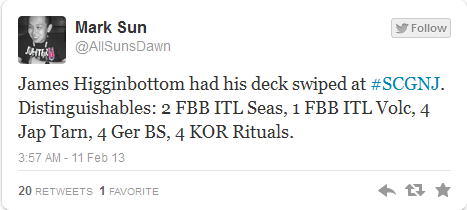
The gut-punch of having your backpack or binder or stash box or deck grow legs is something I've only felt vicariously, but even then the despair and physical pain are quite palpable. James Higginbottom, who had the unfortunate experience of losing his deck, echoes the sentiment perfectly -- "It's hard not to want to quit." What's the point in going on? Your tournament day is over. You have to think about how much it will cost to get that deck back together. Worse, what if you were borrowing it and you have to pay someone back? Some of those cards may be impossible to ever replace. Moreover, no one is more acutely aware of the exact retail value of their cards than the guy who just finished filling out a police report.

It Can Happen to You

This weekend I was just chilling on the couch listing some items on eBay and watching the X-Files (I party hard on a Saturday night) when I got a call I never wanted to get. A friend of mine called to tell me his backpack grew legs from behind our LGS' table at a gaming event on local Western Michigan University's campus. He gave me a list of distinguishables in case someone tried to sell the collection to me or the store I buy for, and I passed it along to Ryan Bushard in case they tried to fence the stuff in Lansing. If the thief/thieves were sophisticated enough to split up the collection between a lot of different stores we were boned. But if someone brought (easily) 10k in cards to any local store, they would probably not be able to buy all of it and call someone in the network of grinders like myself, Ryan or QS Insider Carter Hatfield. It was unlikely, but it was the only prayer we had of recovering the collection. I advised my friend to call Carter if he hadn't already to widen the net to a 3-hour radius of Kalamazoo and to check eBay for new listings of distinguishables from his collection from the same seller. I was out of advice at this point, and platitudes wouldn't help someone who just had the wind knocked out of him, so I hung up and passed the word on to Ryan to get the word out to his network of stores and players.

My buddy had to go through the mental exercise of inventorying his cards and he realized how much value he was carrying around with him. You may not think your cards are worth a ton retail, but try it sometime. Open up the bag you take with you everywhere and start adding it up. You may not carry power, or duals or Legacy staples around with you on a daily basis, but what about your EDH decks? What about your binder? A bigass stack of $5 cards adds up slower than a stack of FBB Duals and pimp fetches, but it still adds up and you have no idea the sheer volume of $5 cards on you until you put them in a huge, teetering stack. If you do this for more than a few minutes you'll realize what my buddy did filling out the police report -- my cards are worth a $&%^ton! If you had to pay retail to replace your stuff, you would be boned. It would be way easier to quit than rebuild.

Do Something Proactive

Renter's Insurance

I didn't have this the first year I lived in an apartment because I never got around to it. Bad move. I could easily have been wiped out and had no recourse to replace my stuff. Sure, it's just stuff and surviving a break-in or a fire is preferable to perishing in it, but escaping with your life doesn't mean you won't be stuck with the task of replacing your stuff. Which would you rather take with you to the store to buy a new TV and sofa -- the unburned half of your checkbook and whatever you have in the bank? Or a check from your insurance company? No brainer, right? If you don't have renter's or home-owner's insurance, stop doing it wrong. Your cards should be included in your policy and most policies should protect you if you're burgled, there is a fire, or even something crazy occurs like damage from a riot or exploding water heater. These policies are so cheap it's actually ridiculous not to have one. I have a friend who got cut a huge check from his insurance company when he was burgled and he managed to convert an apartment full of stuff he didn't even like anymore into a check that he used to fund a trip to Europe. Personally I'd buy a new sofa and TV, but, different strokes. Make sure your policy could be stretched to cover your car window getting smashed and the thief absconding with your bag. This is the second most common kind of theft suffered by Magic event attendees.

Caveat Emptor -- This will not protect you if you leave your bag under your chair at an event and come back to discover you've been hamburgled. This is the most common type of theft experienced by Magic event attendees.

Insurance Policies That Cover Your Collection

It's possible to just straight up insure your collection. This requires appraisal of the collection, and it requires a heftier monthly premium than would renter's insurance alone, but if you don't have 10-50k lying around to rebuy your stuff, this is an option you may want to explore.

Don't Be an Accessory to the Theft of Your Own Stuff

If a criminal takes your bag from behind a table, under your chair or off of a table because you got six binders out of your bag to do a trade with a ton of people, guess what? He couldn't have done it without you. Congratulations.

Be vigilant. Take your bag with you when you leave the table "for like two seconds, I swear" to get basic lands (friend got a bag stolen at a PT doing this.). Wrap your strap around your leg and put the bag between your feet while you play or trade. Manage the number of binders you have on the table. I'm sure my friend felt secure with his bag behind the table our LGS had at that event with the store owner and two friends sitting right there. The area behind the table isn't accessible to the public and there were people around. Until the guys sitting there went to sign up for an event and the LGS owner was distracted helping a customer. Why couldn't they split their attention between what they were doing and watching my buddy's bag? Because it isn't their $&%^ing job to watch your bag. It's your job to watch your bag. And when a job pays -$20,000 a second when you screw up at it, you might want to make sure you're actually doing it.

More Than Just Thefts Happened in Edison

There was also the playing of Margical crads.

Edison Open Standard Decks

Is that seven different decks in the top eight? If you're charitable in your definitions (I am) then, yes, it is. Not bad, Standard. Not bad at all.

The big boogeyman of the event was Boros Reckoner -- a card I miscalled severely. In the future, when someone like me says "I can't think of anything I'd rather cast on turn two," and then "This should be a $5 card" in the same review, chances are they're fixating on the post-redemption prices of cards like Abrupt Decay and Armada Wurm (5 dollars, all) and not about short-term profit potential. By the time Reckoner hit $10, everyone realized the card was the bee's knees, and this weekend when a popular site pretended it was almost $20 lots of people payed along. My advice? Snag them for around $9 from eBay before you cite a site (like that?) being sold out at $18. Not every website has to live in the real world because not every site both sells cards and publishes tournament results. People would rather pay $18 in the sidebar of the article they're reading than save $9 by opening a new tab to browse eBay. Why? I don't know, but their laziness is your potential gain. Show people the $9 on eBay when you pick these up and show them the sold out at $18 when you out them and you should have a pretty good day of trading.

When asked by the SCG coverage team how they planned to deal with Boros Reckoner, half the respondents said "I jammed it." Not a bad answer, I guess. With Mizzium Mortars poised to replace Bonfire of the Damned as the sweeper of choice in a world with Frontline Medic (conveniently a human) and Mutilate still failing to materialize, Reckoner is a great guy to have on your side. If their life total is precariously low from a few turns of beats about the face from your creatures, Mortars won't save them if it Chars their own face when they cast it. Reckoner is non-mythic and can't maintain its current price, but for now, WHEEEEEEEE.

Before we cover top eight, look at all the Saito-esque R/G decks in the top sixteen. I am not surprised. The deck punished inconsistent draws from your opponent, but perhaps its own greatest weakness is its inability to survive a mulligan to six against most decks. Even Saito has moved on.

The event was won by a Jund deck with zero Gatecrash cards in its 75. Not even Stomping Ground? Is this the right list?

Osyp got a deck tech playing a deck very similar to the one Chris Marshall piloted to second place. I'd recommend watching it. This is most likely my new FNM because the Ghost Dad deck I liked so much last week needs sweepers and playing a ton of spirits isn't conducive to that.

Naya Zoo and Naya Humans in the top eight. Could Boros Elite be a card? I hope so. I went deep on this guy. 1/1 for 1 is weak, but 3/3's for 1 get banned. Even though this guy is only 3 power sometimes, so is Delver of Secrets. I hear that card's good. Look into Boros Elite before you buy.

The mono-red Pyreheart decks are splashing a little white. And why not? We have Sacred Foundry and we have Boros Charm. There is literally no reason not to do it if you can afford the mana base. Ok, I'm sure someone can think of a reason. Fine, there is "practically" no reason not to. Happy?

This Junk Midrange deck looks awesome. Jund sometimes wishes it had creatures like Restoration Angel and Loxodon Smiter, and when you cut Olivia and Searing Spear, this is what you get. I like it more than I like Jund because RestoTusk feels like cheating.

Blind Obedience feels poised to spike. It's getting more and more maindeck play in control to stuff haste dudes that could kill the Planeswalker you just tapped out for. Making Ash Zealot a mere grizzly bear for a turn is pretty strong, and taking the Lava Axe effect away from [card Thundermaw Hellkite]Thundermaw[/card] makes your Wraths better. Marcel was all over this card and I falsely compared it to Stony Silence. In the right deck, the Kismet effect is maindeckable. These would have to see a lot of maindeck play for their price to go up, but I think an increase in demand means their price will maintain longer than most cards which I feel are poised to go down --[card Prime Speaker Zegana]Zegana[/card], [card Master Biomancer]Biomancer[/card], [card Aurelia, the Warleader]Aurelia[/card], Aurelia's Fury, [card Obzedat, Ghost Council]Obzedat[/card], Reckoner et.al.-- and having an asset that will maintain its price makes it less risky to go deep.

Moar Standard!

There was an SCG Classic in Memphis and the results were... unexpected. Get it? Because of the Unexpected Results deck that got 7th place. You haven't clicked the link yet, have you? You just have no idea what I'm talking about. Well, go on! Click the link! Click click click click. Come on! I want to talk about this deck!

I can't believe this deck got top eight. It has no tutors, no stacking effects (UeR shuffles first, anyway) and little mana ramp. What it does have is the ability to hit Omniscience or Enter the Infinite off of Unexpected Results and then lol all the way home. This deck reminds me of the Brilliant Ultimatum/[card Emrakul the Aeons Torn]Emrakul[/card] deck I loved so much, but that deck had tutors and stacking. Clearly this deck can go to an event and win more than it loses though, so give it a try. If you're a fan of "Woo brews" this is at least a fun deck for FNM. Also top eight of an SCG classic.

Memphis may not be aware that Gatecrash is out by the look of the rest of the top eight. These look like pre-Gatecrash decks with a few new cards. Still, these archetypes got there and they're at least tried and true builds. Congrats to all competitors.

SCG Open Edison Legacy Decks

Legacy surprised me a bit. After taking a month or two off, Sneak and Show put two dudes in the top eight. Not bad. I keep wanting to tell people Esper Stoneblade isn't a deck (because I hate it) but it always manages at least one top eight. And no Merfolk deck in the top eight means Corbin will likely podcast this week. He's kind of like Punxsutawney Phil like that.

Between Modern and Legacy (the 12-Post deck ran an astonishing four), Oblivion Stone shot up recently. I don't know whether this is a real price or not, but there you have it. I like this 12-Post build a lot. Could we see 16-Post with 4 Thespian's Stage? No, don't be an idiot. (I made a categorical statement like that because if someone does make it some day and points out I was wrong about this, I will laugh until I lapse into a coma from hypoxia. I have never wanted to be wrong more in my life.)

Elves pushed all the way to 16th? Not good for anyone with a huge stack of Deathrite Shamans (All of QS' insiders, for example). I expected more Deathrite Shamans in the top sixteen, but any given Sunday...

I love that BUG is running both [card Shardless Agent]Agent[/card] and [card Baleful Strix]Strix[/card], and not just because I found a ton of Planechase decks at $20 each recently. I think it's a nice cascade chain is all. Strix certainly keeps aggro at bay (who wants to trade a Tarmogoyf with a cantrip?) and the card draw and flying are very nice. If you miss a Strix and hit Abrupt Decay instead, I'm sure you'll live. I don't play decks like this, but I like that BUG is doing well, and not just because I have a pile of Bayous to trade out.

No real surprises here. Not a ton of Gatecrash cards, not much new actionable intel, just a solid Legacy top eight. I like that Sunday afternoon is Legacy day and I'm sad to see it go from every event.

One Last Thing

One story has a happy ending. My buddy was talking to his girlfriend and she suggested he go looking in dumpsters and trash cans for his bag. After spending all day looking in every receptacle on campus, he reached into a trash can and pulled out his entire backpack. Someone swiped a bag containing $10k in cards and a TI-84 calculator. They took the calculator and jammed the cards in the trash.

Since this wasn't a Magic event but rather an informal gaming "convention" on a college campus, the thief was likely hoping to snag a backpack containing a laptop or at least some expensive text books. What he got instead was a backpack full of "useless" gaming accessories which he jammed in a garbage can on his way to sell the calculator for $30 to a pawn shop. My buddy is the world's luckiest lucksack, and he almost doesn't deserve the elation he's feeling to have his cards back after having the worst night of his life. After all, he practically handed his bag off to the thief by leaving it unattended. If your bag goes missing at a GP or SCG event or even a prerelease, don't expect the thief not to recognize the value of his haul. He's targeting your cards and you'll never see them again. Be vigilant, be smart and for the love of God, don't be an accessory to your own burglary. There are enough bad beat stories in this game as it is.

Until next week!

Insider: I Sold Into Modern Hype, What’s Next?

Are you a Quiet Speculation member?

If not, now is a perfect time to join up! Our powerful tools, breaking-news analysis, and exclusive Discord channel will make sure you stay up to date and ahead of the curve.

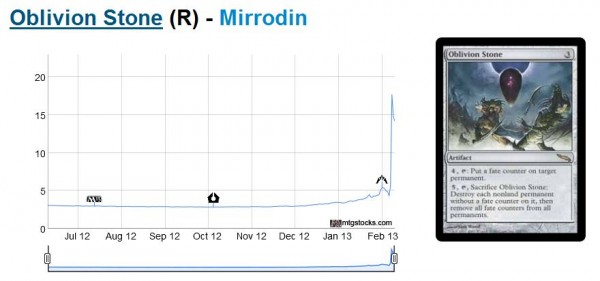
It may seem like Modern has settled based on the price trends of certain cards. Spellskite, for example, had tripled in price before pulling back down below $10 again. But the craziness hasn’t ended yet. Take a look at one of the latest culprits, Oblivion Stone (chart from mtgstocks.com).

In fact, so many cards follow a similar trend of skyrocketing in a matter of days and then immediately pulling back. It’s almost like the speculators take notice, buy out the internet, and then flood the market with copies yet again when they inevitably list theirs for sale in an attempt to profit. Spellskite, Fulminator Mage, and Serra Ascendant all followed a similar pattern.

But I really don’t want to spend another week writing about the Modern phenomenon. The examples may be different, but the overall message remains the same: I’m selling spiked cards which may appear in Modern Masters (I only wish I owned more Oblivion Stones to sell!). This strategy has enabled me to “bank” a significant amount of profits. By selling the Modern staples I acquired a couple years ago for Legacy play, I am ringing the register and taking some investments off the table.

The result: I’m left with significant cash holdings. It’s the inevitable outcome when you sell significantly more than you buy. As my Modern collection dwindles in anticipation of Modern Masters, my cash reserves are building. While this may seem great, I must remember that this cash is not gaining at a rate above inflation, and so in theory it’s dropping in purchasing power.

In other words, cash is very safe but also very stagnant. In order to grow the portfolio some more I need to get back into buying.

I Sold High – Time to Buy Low

I remember hearing a basic mantra along these lines. “Always do the opposite of what the general market is doing”. In other words when people are buying like crazy and sending prices to new highs, I look to sell. When people are panic selling quality cards with upside potential I seek to buy. This applies to both MTG Finance as well as Wall Street.

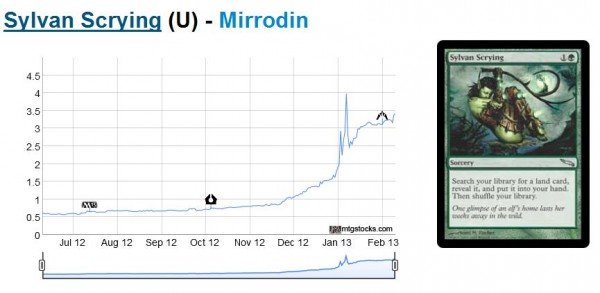
So in this time of massive Modern price increases (Sylvan Scrying is another one – chart from mtgstocks.com), I’ve been freeing up some cash in anticipation of purchasing under-valued cards.

Fortunately, there are many – most of which are in Return to Ravnica. Right around this time is when Return to Ravnica card prices will bottom. And just like clockwork, as fewer packs of the set are opened, the powerful Standard winners will rise to the top.

Return to Ravnica Buys

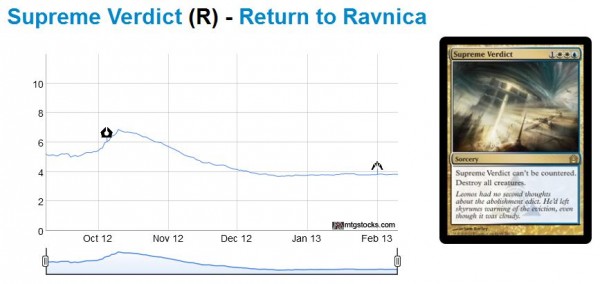
The key here is to pick up cards that are played consistently in Standard today, and should be well positioned for when Innistrad block rotates out. I have my eye on many of the removal spells – both mass and spot varieties. Currently I’ve been attempting to grab sets of Supreme Verdict on eBay for under $3 each. This has been difficult, and I sense a hard price floor of $3 has been hit (chart from mtgstocks.com). Take a look at how flat, how unmoving, that price line is.

As Innistrad block rotates, we will say farewell to Terminus. Starting then, Supreme Verdict will become the premier board sweeper in Standard. And while the promo version may prevent Supreme Verdict from hitting the same highs that Terminus did, I still see this card reaching $5 cash, $8 retail in less than a year.

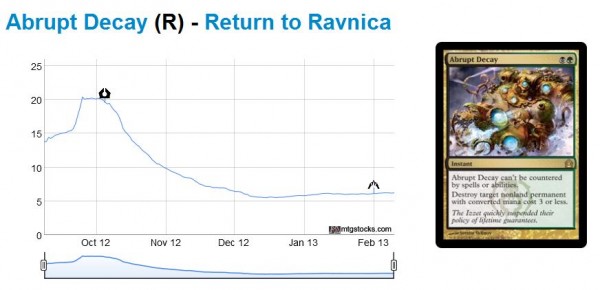
Speaking of $5 cash / $8 retail, Abrupt Decay has also appeared to bottom (see chart from mtgstocks.com).

Seeing as this card retailed for $20 when it first came out, there is certainly some upside potential here. The increase will be gradual, but trading away hyped Gatecrash cards (I’m looking at you, Boros Reckoner) into Return to Ravnica cards like Abrupt Decay will provide stability and upside to your portfolio. Dreadbore, the other Return to Ravnica removal spell, has also bottomed. I like this one less because it’s counterable, a sorcery, and less likely to see eternal play.

Other Places to Store Cash

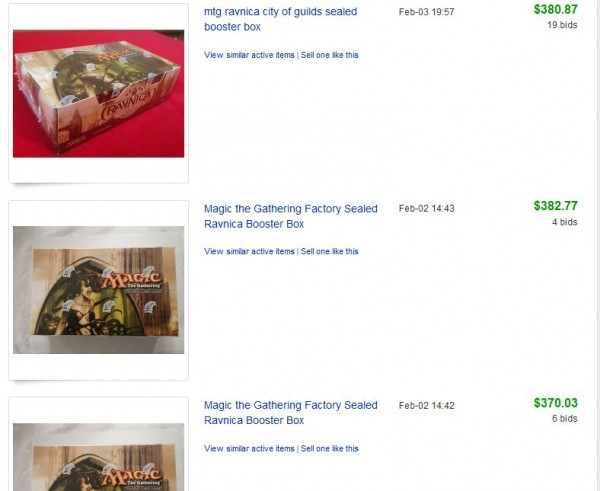
If Standard isn’t your area of interest, perhaps there are some longer-term opportunities worth considering. I would recommend buying a booster box or two of Return to Ravnica to sit on for a few years. Booster boxes of the original Ravnica set are reaching $400 on eBay auctions. Even if boxes of the newer Return to Ravnica reach $200, it still represents a 100% gain over the course of a few years. While less exciting than the Modern price curves observed above, I sure would be pleased with doubling up on an investment in a few years’ time.

Even if you don’t want to wait that long, holding a booster box or two of Return to Ravnica will be just as safe as cash if you can buy in at around $90 shipped. It’s very unlikely the price goes much lower…ever.

If Return to Ravnica isn’t your thing, then you could keep an eye on other Standard cards. We are about halfway through Modern PTQ season, and Standard season is next. Demand for Standard staples will go up, driving prices higher. Just be careful buying into too many Innistrad block cards. There may be some profitability there, but the time horizon to sell these for profit will be short. I know I’m a bit early, but I always consider format rotation when I acquire older Standard cards. Only acquire them if you feel demand will increase significantly within a three month timeframe. If not, you may be left holding the hot potato come Standard rotation.

Buy Something

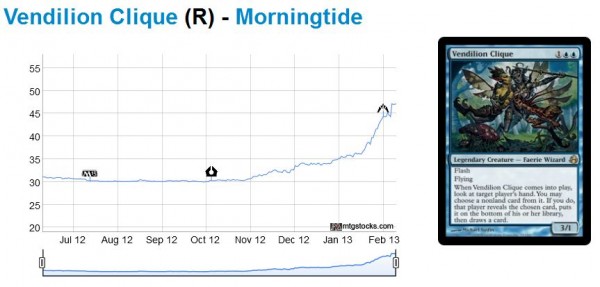
I’m not quitting Magic. But my collection has reduced significantly now that I’ve sold my Tarmogoyfs, Dark Confidants, Thoughtseizes, Fetch Lands and most recently Vendilion Cliques (chart from mtgstocks.com). Modern prices have absolutely gone nuts, and selling into this boom is rewarding.

But my job isn’t done and I do not intend to stop speculating. I will need to acquire new cards to start the next cycle of buying and selling. I believe with Gatecrash’s release, the time to start acquiring Return to Ravnica cards is now. What’s more, I will also prepare my cash reserves to buy back into Modern as Modern Masters is spoiled. As people panic-sell their collections, I expect this modest bubble to burst.

Again my mantra is to do the opposite of the market. Since Modern willbe around for a while I intend to buy back into the format as everyone else sells. Then as prices re-stabilize and next year’s Modern PTQ season begins I will be well-positioned to sell yet again, repeating the cycle.

…

Sigbits – Return to Ravnica Edition

- Shock lands continue to drop in the wake of the news that Dragon’s Maze will contain more of them. But as I eye eBay, Card Shark, and Amazon I am seeing some copies of Hallowed Fountain priced at $8. The drop may continue for a little more, but eventually buying new Shock Lands at $8 is going to be a steal. It just may take a while. I’m holding my copies, but I’m not shelling out any more cash for them for the time being.
- Deathrite Shaman has also stabilized in price. Looking at the price chart, it appears $15 has become the new target price point for the Elf Shaman. Since this card is slightly less ubiquitous than Snapcaster Mage, I’m wondering if this is a short term price ceiling. Demand isn’t likely to increase drastically for a few months. Then again, supply may decrease a little bit as fewer packs of Return to Ravnica are opened. Still, I may sell a couple copies here or there to take some profits off the table.
- Sphinx's Revelation still sees Standard play and I don’t think it’s any less broken with Gatecrash. But the price has been pulling back significantly in the past couple months. This is one card in Return to Ravnica that likely hasn’t bottomed yet. I may target these in trade eventually, but not at $17.99 - that’s for sure.

-Sigmund Ausfresser
@sigfig8

Fixing What Ain’t Broke

Are you a Quiet Speculation member?

If not, now is a perfect time to join up! Our powerful tools, breaking-news analysis, and exclusive Discord channel will make sure you stay up to date and ahead of the curve.

As Americans, we all know the saying, “If it ain’t broke, don’t fix it,” and it has become an accepted phrase in our language. It originated in 1977, when Bert Lance was interviewed for the magazine Nation’s Business. Lance was the Director of the Office of Management and Budget under President Jimmy Carter at the time. The reason I bring this saying up is because I am directly opposed to it. This is the direct opposite of my thought process in life but also in Magic. For example, when I typed up the quote, I originally had it as, ”If it isn’t broken, don’t fix it.” I automatically adjusted the grammar in the sentence to make it better than what it was. This is my mentality with Magic also.

Anytime a new set is released, it is natural to look to existing archetypes as a basis for the new format. Why would you leave them exactly the same? Shouldn’t there be new cards that make the deck better? The answer varies, but the process is the same every time. Some players did just that and updated their Standard decks with new Gatecrash cards and others added some lands to smooth out the mana as their only change. Today I want to dissect an existing archetype and see if some new Gatecrash cards will improve it.

Zombies has been a deck since Return to Ravnica was introduced to Standard. Initially it was a Tier 1 deck but then fell out of popularity until it was reintroduced as Rakdos. Adding red cards to the deck increased the power level considerably and was a major development in the Standard metagame. The Rakdos version still sees play, but can we do better?

I ran this deck at some major events and I can say one of the worst parts is the mana base. Even with twelve duals, I lost plenty of games because I had a pile of red cards in hand I could not cast. This is because the red cards are not really splashable. Both Hellrider and Thundermaw Hellkite have double red in their cost that create problems. The obvious conclusion is to add more red sources, but adding mountains to a deck with Geralf's Messenger won’t work either. The solution for most players was to risk a greedy mana base because the cards were so inherently powerful.

Now that Gatecrash is Standard-legal, I am taking a look at other options. Is there another color we could add that would be just as powerful as red? What new cards would even fit into this deck?

One new card sticks out as a possibility, Duskmantle Seer. Despite its terrible, unflavorful name, I think this card is uniquely powerful. It seems to me the best application would be in a deck with a low mana curve so you do not take much damage. Coincidentally, this might be just what we are looking for to shake things up in the Zombie deck. This is not the type of card we have come to think of as being a part of Zombies. For one, it’s a vampire and for two, we have come to think of haste creatures and burn as synonymous with Zombies. This type of “If it ain’t broke, don’t fix it,” mentality might be holding us back from a better version of the deck.

Let’s start with why Duskmantle Seer is good in the first place. The reason I like the card so much is because of when the trigger happens. At the beginning of your upkeep each player reveals the top card of his or her library, loses life equal to that card's converted mana cost, then puts it into his or her hand. In years past, cards that resemble Duskmantle Seer have not been playable because the symmetrical effect is granted to your opponent first. With this one, you both draw on your turn so your opponent cannot gain an advantage. Even if your opponent kills it on their turn, they do not get to draw a free card.

Another perk is that the damage dealt off of each trigger tends to undo whatever value you may be giving your opponent with extra cards. If they are dead, it doesn’t matter that they have a full hand of cards. The plan is for you to keep drawing more cheap aggressive cards and for them to draw expensive ones that deal them a lot of damage.

What makes Duskmantle Seer specifically good in a deck like Zombies? Most games play out with you as the aggressive deck getting in some early damage and then either you win or your opponent stabilizes because you failed to draw enough threats to keep the pressure up. The Gatecrash vampire solves both of these problems at once. It forces your opponent to take more damage, assuming they don’t draw a bunch of lands, and it allows you to draw some extra cards.

Its states are another perk. Being a 4/4 is extremely relevant because Restoration Angel cannot block it and live. Flying is also relevant because many decks right now lack flyers. Seer seems to be the perfect mix of abilities and mana cost to impact Standard.

If we are planning to try out blue in Zombies, there should be other benefits we can gain from the color. Since we are losing some of the damage capability the red cards provided us, we need something to help keep us ahead. Unsummon seems perfect for this role to help us maintain tempo. Snapcaster Mage allowing us to reuse the Unsummon or another removal spell seems like a strong play as well.

With that being said, take a look at the current iteration of the Zombie Blues.

Untitled Deck

Creatures

4 Gravecrawler
4 Diregraf Ghoul
4 Knight of Infamy
2 Thrill Kill Assassin
3 Snapcaster Mage
4 Geralfs Messenger
3 Vampire Nighthawk
3 Duskmantle Seer

Spells

4 Unsummon
2 Tragic Slip
2 Ultimate Price
2 Murder

Lands

4 Dimir Guildgate
4 Watery Grave
4 Drowned Catacomb
11 Swamp

One card I did not mention above that is crucial to this strategy is Vampire Nighthawk. The additional lifegain it provides is essential when you are racing another aggro deck, in addition to mitigating damage from Duskmantle Seer. Nighthawk is one of the linchpins that hold this deck together.

Another card I looked into for the deck was Diregraf Captain. We are already in blue and we are playing zombies, so this captain seems like an auto-inclusion. This turns out not to be the case because we would rather play stronger cards like Knight of Infamy, Thrill Kill Assassin, Snapcaster Mage, Vampire Nighthawk and Duskmantle Seer. When you actually analyze how many slots would be affected by swapping the Captain and Nighthawk, it becomes clear how much the deck has to change.

If you like Zombies but want to try a new version of it, I suggest giving the Zombie Blues a try. It is a fresh take on the deck and is sure to surprise some opponents. Players are not used to playing against Duskmantle Seer so they will have a hard time fighting against it.

Until Next Time,

Unleash the Force of Blue Zombies!

Mike Lanigan
MtgJedi on Twitter
Jedicouncilman23@gmail.com

Insider: Changes to Redemption

Are you a Quiet Speculation member?

If not, now is a perfect time to join up! Our powerful tools, breaking-news analysis, and exclusive Discord channel will make sure you stay up to date and ahead of the curve.

If you've been reading this column, then you know that one of the pillars of speculating on MTGO is redemption. (For background on this aspect of the MTGO economy, read my column on redemption.) Redemption provides predictable demand in the digital market, supporting prices on all redeemable mythics. For sets that have rotated out of Standard, redemption reduces supply of mythic rares over time, leading to rising prices. In a subsequent column I talked about mythics from Scars of Mirrodin and Mirrodin Besieged as the cards most likely to see gains from this effect.

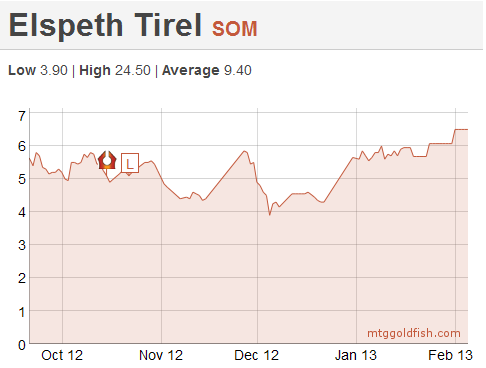
To see evidence of this effect, look at the chart for Elspeth Tirel below (charts courtesy of mtggoldfish, which takes its pricing data from supernovabots). The bottom occurs early in December, about two months after Scars block rotated out of Standard. Since then it has seen steady price increases.


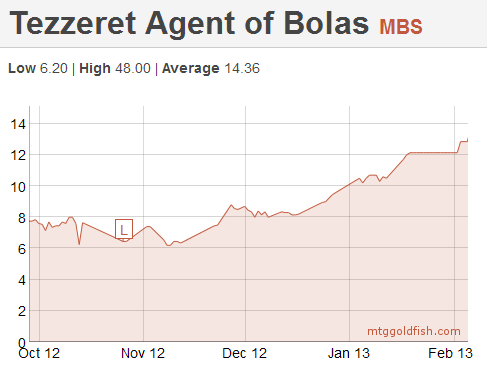
The chart for Tezzeret, Agent of Bolas is similar (see below), but in this case the bottom occurred in early November and the subsequent increases in price have been bigger. Both charts exhibit the predictable effect of redeemers buying up mythics from sets that have just rotated out of Standard. Paying attention to these patterns and buying up these cards, after they rotate and thus become "worthless," has been a consistent way to make profits on MTGO.

Changes to Redemption

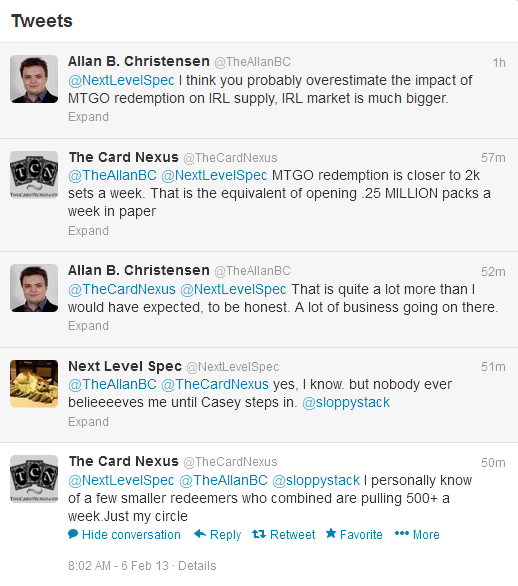
This week, WoTC announced that the per-set surcharge for redemption would increase from $5 to $25. Set redemption has become a large enterprise, and people have estimated that 2000 sets are redeemed each week. Here's a Twitter conversation from a few days ago (Feb. 6th, 2013), that included Ted Knutson (@NextLevelSpec) and Casey, the owner/operator of The Card Nexus (@TheCardNexus).

This sounds like a big deal. If the underlying market dynamics are going to change, then it's important for speculators to get a handle on what that might look like. Using economic theory, experience and some intuition, we should be able to get some idea of what to expect from the MTGO economy going foward.

A Tax on Redeemers

The image below is a typical supply and demand graph used in economics to analyze the impact of a tax. In this case, the downward sloping dotted line is the demand curve, representing in our case demand from redeemers for digital cards. Let's imagine this is the market for junk mythic rares. The upward sloping solid line is the supply curve, representing supply of junk mythic rares in the MTGO market. Drafters are the suppliers in this case.

Where the two lines intersect determines the prevailing market price and market quantity, which is respectively Pe and Qe in the graph. Market price is easy to think about. It is the prevailing buy price for a junk mythic on the classifieds. Market quantity is a little stranger to think about, but if you just consider a given time period, say 24 hours, then some quantity will be bought and sold at that price in that time period. This is what Qe represents.

In thinking about how this increase in the cost of redemption affects the market for junk mythic rares on MTGO, it neatly resembles a per-unit tax. Instead of a single, uniform price, suppliers of junk mythics will see a lower price, and demanders will see a higher price. In the graph, the tax acts to increase prices redeemers pay for junk mythics (Pe goes to Pc) and reduce the price drafters get for junk mythics (Pe goes to Pp). Market quantity drops too (Qe goes to Qt). WoTC is capturing the gap that has opened up between the supply and demand curves.

Essentially, redeemers perceive this "tax increase" as a higher price. This will lead redeemers to demand less. In the real world, those redeemers who were not making much money will be forced out of the market as their small profits go to zero or possibly negative. The low cost redeemers will still be able to make a profit and they will stick around, continuing to redeem sets. Drafters will see less returns to drafting due to the lower price of junk mythics. The worst drafters will end up drafting less, while the best drafters will see their profits reduced.

Impacts on MTGO

The effect on the player base as a whole is a little more complicated, and needs to be broken down in a few stages. Let's start with drafters. This group sells the contents of their drafts and uses any prizes they have won in order to continue to draft. With lower prices on the cards, this will discourage drafters from entering into repeated drafts. Drafting activity will decrease as a result.

As for Constructed players, they will see lower singles prices in general, which should encourage more Constructed play, assuming card ownership is a barrier to entry. But reducing the barrier to entry for Constructed is just part of what determines if a player will take up or play a format such as Standard. Adequate prize support encourages repeated play and for Constructed players that means they have to sell their prizes into the market for tix. In this case, more Constructed play means more booster packs on the market, which means lower costs for drafters.

At this point, drafters are seeing two competing effects. First, they have a harder time doing repeat drafts due to the lower prices they receive on their cards. But, initial drafts are cheaper due to more boosters on the market from Constructed players. Which effect will dominate?

A little intuition and experience with the MTGO market suggests that the market for drafts and sealed deck play is bigger than the market for Constructed play. When prices fall due to higher redemption fees, the dominant effect will be a reduction in Limited play. The increase in Constructed play will only be a second order effect and will not fully compensate for the drop off in drafting.

Impacts on Speculators

As speculators, we will have to adjust our expectations about price floors for mythics. Our job is to identify good value, find low prices, and wait for the market to move higher. If redemption were ending completely, then this type of speculating would end too. Without the support on prices from redemption, the value of digital cards would steadily fall due to the large amount of Limited play relative to Constructed.

The increase in redemption fees signals that WoTC wants a piece of the profits that redeemers have been making. It does not mean that redemption is over. The theory around how redemption supports prices is unchanged. For speculators, we can continue to employ a strategy around redeemable cards. The level of prices will change, but the direction and trends will be the same. As an example, the lowest price I can remember for a mythic was around 0.26 tix, which Elbrus, the Binding Blade briefly touched while Dark Ascension was being drafted. The change to redemption means that we will eventually see a mythic priced at 0.10 tix.

Prices will adjust downward to take into account the lower amount of redemption activity, but there will still be profits to be made on buying low and selling high on redeemable mythics. For speculators who are buying and selling digital objects on MTGO, the increase in the price of redemption should not affect your speculative strategies. Just be on the look out for consistently lower price floors and price ceilings.

Insider: Gatecrash, Redemptions and Bubbles

Are you a Quiet Speculation member?

If not, now is a perfect time to join up! Our powerful tools, breaking-news analysis, and exclusive Discord channel will make sure you stay up to date and ahead of the curve.

There has been a lot of news in the last week, and no shortage of discussion topics on this site. This week I want to hit each of these individually and offer my thoughts, as there’s a lot of relevance here.

Let’s start with the easy one.

Gatecrash

The top eight from the first Standard event (the SCG Open in Atlanta) looked a lot like what we expected. We saw appearances from the expected parties in red-based aggro and the Boros version with Champion of the Parish.

All of that was expected. What I didn’t expect was for Boros Reckoner to go to $13 retail. I called this a good pickup at the $3 it was on preorder, so hopefully you took my advice and made some money, but I expected it to go to $6-8, not $10+. I attribute this mostly to the limited number of copies available, and I expect this to fall to those levels I mentioned in a month or two, making this a sell right now.

Champion and Mayor of Avabruck form the basis of the Naya Humans deck that won the event, and this will hopefully increase the demand and price on both of these cards, which I’ve been targeting over the past month.

The Event Decks, however, aren’t going to help in this regard. They lower the ceiling for Champion, and that’s not all. The hits keep coming in the form of Rancor, Strangleroot Geist, Wolfir Silverheart and Thragtusk again!

Frankly, this sucks. Not for Thragtusk, which I assume you all sold a few months back at its peak, per the consensus advice of QS, but for the other stuff, especially the uncommons. Rancor was/is legitimate money and I still have a big pile of Strangleroot Geists I picked up in a collection a while back, and was hoping they’d pick up in popularity again.

The Event Deck cools off what I was hoping would be an opportunity in the form of Dungeon Geists. This spirit had fallen way down but with Esper Spirits top-eighting there could be a resurgence. That doesn’t mean this isn’t a fine pickup if you believe in the deck, but it does mean the ceiling will be lowered.

And with the other Event Deck, add Clifftop Retreat, [card Thalia, Guardian of Thraben]Thalia[/card], Boros charm, Silverblade Paladin and Champion to the hits. Again, while I don’t expect massive price drops from these, the ceiling is lowered quite a bit since there’s a lot of value in these Event Decks.

Anyway, with all of that in mind I’m basically in a holding pattern until the Pro Tour. This event will be the major driver of prices and the metagame for the next month or so, so be ready when the Pro Tour rolls around and keep a close eye on things.

Redemptions

If you haven’t heard, Wizards is raising the cost of set redemptions from $5 to $25. That’s a huge change, and one that people are none too happy about.

Because Wizards releases so little information to us, it’s hard to know exactly how much of the market is filled with redemption cards. But courtesy of Ted Knutson and The Card Nexus, we know that close to 2,000 sets are redeemed every week, or the equivalent of .25 million packs a week.

That’s insane.

Those numbers are huge, and this is going to make a real difference in prices moving forward. Yes, the price of all cards in paper from new sets is going to rise some, but remember my motto about finding opportunities instead of obstacles.

Rather than focus on the increase in price on Standard stuff, which is difficult to gauge with so little information, I want to focus on finding the positives here, and there is a major one. I’ll leave the MTGO-specific things to our crew who knows that system better than I, but I’m excited about how this affects casual cards.

The perfect one to start with is Mind Grind. Here’s a card that isn’t likely to be played in Standard but, based off things like Glimpse the Unthinkable, we can assume will be popular casually. While cards like this in recent sets have had some success (Parallel Lives), the effect is much less prominent than it was 4-5 years ago because so many more hit the market through redemptions.

Remove this, and all of a sudden getting in on those Mind Grinds at a buck in trade changes from a $2-3 prospect in a couple of years to something closer to $6-7. Again, with so little information available about print runs, I’m spitballing a little with the numbers here, but the theory behind it is sound even if the math isn’t exact.

Watching the price of Gatecrash singles three months from now compared to Return to Ravnica should give us some more data to work with, and I plan on revisiting this topic then.

The Modern Bubble?

Are Modern prices in a bubble right now? As Sigmund mentioned in his article earlier this week, a lot of downward pressure is coming to the Modern format in the next six months. The season will rotate, Modern Masters will increase supply and I assume we’ll see some more targeted reprints.

So what does that say about the high prices we’re seeing right now?

For the most part, I think the presence of at least a small bubble is all but certain. Fulminator Mage, for instance, is a card I advocated for since last year so the price increase isn’t unexpected to me. But there’s no way it should be $20. Insane and sometimes inexplicable rises like that have been way too common in the last three months, and they're probably not sustainable moving forward.

That said, I believe a lot of the demand is real and not solely the work of speculators. This isn’t an Aluren situation, it’s one where increased demand is being supplemented by rampant speculation, and I don’t think it’s going to hold.

That doesn’t mean there aren’t still some good targets. Spellskite, for instance, is a card I’ve been hot on for a few months and it’s finally making a move. You can still get these at $5 in trade, and it’s a solid bet going forward. But that’s a 100% increase, not 500-600% like Fulminator Mage. It’s also been a somewhat incremental growth rather than an overnight explosion. I think this will be the best heuristic for distinguishing between the real bets and the speculation-driven bubbles.

I have a sell call on pretty much everything that could be in Modern Masters. And for that matter, most of Modern in general. Prices are going to come down across the board after the PTQ season ends and Modern Masters releases. Then we’ll have a window in the Fall when the next major set comes out to get back into Modern staples, at which point I’ll be moving back into the format hard.

That’s my story, and I’m sticking to it.

Thanks for reading,

Corbin Hosler

@Chosler88 on Twitter

Insider: This Time, It’s Aggro

Are you a Quiet Speculation member?

If not, now is a perfect time to join up! Our powerful tools, breaking-news analysis, and exclusive Discord channel will make sure you stay up to date and ahead of the curve.

We’ve seen the first tournament results since the release of Gatecrash. No one knows what the meta will evolve into –- remember RTR? We were in combo/midrange everywhere, and then 45% of the meta was R/B Aggro. However, we have an entirely different situation. This time, it’s aggro.

The top decks were actually an assortment of aggro decks. We had Boros, Naya, and even Jund competing for first. However, there were a few cards I was very happy to see in play.

Jund

This deck seemed like a great contender, with some mainboard answers to Humanimator, and the resiliency to take on most other decks.

Deathrite Shaman –- This card is one we’ve been seeing in Legacy and Modern lists, and hoping to see in Standard. It has been compared to Noble Hierarch, and the foils are around 400% of the nonfoil price. I can’t stop saying to pick these up. It’s been pretty steady at $15 for a while now, but that’s way too cheap for a card of its caliber.

Abrupt Decay –- Uncounterable removal that gets rid of the majority of permanents played in Standard. This card also has foils at 400%, and is Modern- and Legacy-playable. I don’t think we will ever see this card go down until it rotates out, and it’s back up from there.

Experiment One & Flinthoof Boar –- These guys were great pickups. The Boars are up to about $2 each now, and the Experiments are probably near their peak, at $4 each. They preordered at $2.

Naya

I said in my last article that Humans were a big deal –- and I wasn't wrong. They made multiple showings at this event, and the list isn’t terribly different. There are a few cards I’d like to remind everyone of –- and one standout I’d like to get more of myself.

Frontline Medic –- This guy had some mixed reviews, but operates very well. Its sac ability makes control decks play around it, and the battalion trigger makes blocking awkward. At $5 right now, this card is a bit cheap. I see it around $8-$10.

Champion of the Parish –- This card has been mentioned quite a few times around here, and it is probably one of the best one-drops in Standard. I love picking these up around $5.

Boros

There isn’t a ton to point out here, as quite a few of these cards are already highly priced (Thundermaw Hellkite, Hellrider), but there was definitely something to mention in this deck.

Stromkirk Noble –- I have always loved this card. I've put it in a ton of decks, and although I've said this about a few cards in this article, it's one of the best one-drops by far. Humans all over the scene makes this a much bigger deal. At $3.50 for a once-$9 card printed over a year ago, I’ll be holding on to my stack for a while.

Ash Zealot –- I have been a bit questionable on this card, but the first time I saw someone hesitate to Snapcaster Mage to Unsummon a creature, I knew this was a thing. At $2.50, it isn’t a terrible card to grab. I am not sure how much upside we have.

Honorable Mentions

Cartel Aristocrat –- This card might be a good foil pickup if Humanimator decks continue playing it. The sac outlet is a necessity, and I could see it at $2-3 easily if the deck keeps it as a 4-of.

Drogskol Reaver –- Somehow, even as a one-of, this was a star in the 5th place Flash deck. It might be something to keep an eye on at $3. We have seen what happens to Dark Ascension mythics that get popular.

Drogskol Captain –- This was a $5 foil at one point, and is down to $1.50. If this deck catches on at all, it could go back up. Lords are always susceptible to increases when they become played -- I guarantee there are tons of casuals who put aside playsets of these.

Dungeon Geists –- This guy has been on my radar for a while, and he had a few appearances in Atlanta. I don’t know how much of an upside I can see for it, but it could be a $3-4 card in a week or two.

Dungeon Geists: Steady decline, but ready for a spike.

Orzhov Charm –- I mentioned this before, and it did see some play. I would love to see it as the next $2 charm, and I love it in foil at $3.

I’d love to know what cards you guys found interesting, especially foils –- feel free to let me know what you think!

Insider: PT Gatecrash Preview

Are you a Quiet Speculation member?

If not, now is a perfect time to join up! Our powerful tools, breaking-news analysis, and exclusive Discord channel will make sure you stay up to date and ahead of the curve.

The Gatecrash Pro Tour is less than 2 weeks away, so there’s still time to make some speculations about where the Standard format is going. After only one large Standard event since Friday’s release of Gatecrash was the SCG Open in Atlanta. This gives a place to jump off from to see what we think might pop up in the Pro Tour. Along the way, we’ll see where our recent specs have gone, and what we want to do about them.

Mutilate and Nephalia Drownyard

Both of these already more than doubled it’s retail price since I talked about them here, but by the time I get to transaction costs, I want to give them a bit more time to grow. At $3+ I’m making a profit on Mutilates, but I think this card can hit 5. Drownyard is up to $1, and I’m in at pricing varying between $0.25 and $0.35. I expect to see a number of Esper Control decks at the Pro Tour, and they will be guaranteed to run Drownyard, and it’s yet to be seen if they will play Mutilate. In the Star City Open, none of the top 8 decks were playing a full complement of Boros Charm, while some in the top 16 were. Mutilate really is better than Supreme Verdict only if Boros Charm is a card, otherwise they’re relatively equal depending on what your manabase supports. Even if Mutilate doesn’t make an appearance in this Pro-Tour, if Boros Charm sees a lot of play, I’ll want to go even deeper on Mutilates, despite the fact that they’ve already begun to increase.

Tokens

One deck in the top 8 of the SCG Atlanta was a 4-color tokens deck. This has me interested to pick up Intangible Virtues again. They can be found around $1 retail, but likely traded for much cheaper, and if the token strategies pick up steam, this card will see some growth, but the ceiling isn’t terribly high, I’d say $2.50. One thing to consider, if a tokens deck becomes popular, the new GTC card, Illness in the Ranks will likely gain some popularity, and as a $0.50 uncommon, has room to grow. More importantly, Curse of Death's Hold has fallen steeply since it’s no longer been played, but if weenie decks are a thing, this card will make a comeback. As soon as I see a token deck emerge during Pro Tour Coverage, I’ll be scouring the internet for these. Right now various retailers around the net carry them at under $0.50.

Lingering Souls is another card worth considering before the Pro Tour. Whether it’s Esper Control or Tokens, I expect this card to see a ton of play, especially now that Godless Shrine is legal. It’s current price of about $2 is mostly due to Legacy and Modern play, but if it becomes a highly played card in Standard again, this will exceed $3-4 pretty quickly. It being Modern PTQ season, means demand for both formats will really drive this card up. Sets can still be found on EBay close to $9.

Humans

Champion of the Parish has increased from $4 when I recommended it a few weeks ago to $5, and is seeing quite a bit of play. With his appearance in an upcoming Event Deck, I think we can see this card get up to $7 or 8 at the most, so keep that ceiling in mind if you still want to get in. Now that I'm already in at average price just under $4, I'm willing to hold on while it climbs, but given that it's already at 5, and it's ceiling has shifted down a bit it's probably best to stay out, while people who already have them should wait a bit to unload. Mayor of Avabruck is another card worth considering, while it will only slot into decks that can afford to play green, most Humans decks do, and he’s an important card to the deck’s power. At only $2.50 it has some potential to grow, but not enough for me to be interested in making a move at this point. Some Jund lists I’ve seen have been playing Victim of Night, and if that card becomes the go-to cheap removal spell, maybe Mayor is the right pick, as it still remains a werewolf even on his “front” face. If humans is indeed popular, I expect Slayer of the Wicked to start making Sideboard appearances. Killing Olivia, Mayor of Avabruck and Huntmaster of the Fells, Blood Artist and any number of Zombies, is no joke. I don’t know how much a Sideboard presence will affect its price, but it currently sits at $0.25, and is a fairly safe play.

Esper Spirits

Spirits hasn’t been popular since it’s debut in Pro Tour Dark Ascension almost a year ago. Putting up a top 8 finish at the SCG is reason to give it a new look. Most of the usual cards appear, but most notably is the reemergence of Dungeon Geists. At it’s all time low price of $1.50, it seems safe to assume the card is at it’s absolute bottom, however, when people thought the deck had legs last year, it quickly shot up to $8. While I don’t expect that same result, I feel there’s an opportunity to be had on this card, and I’m going to pick up just a set for now. I will, however, bookmark it on several reputable retailers to place an order as soon as I know more about Pro Tour decklists.

RDW

Tomahiro Saito posted a decklist that he defines as the best aggro deck in the format. It’s a typical RDW list, but it splashes Green for Flinthoof Boar and Rancor. It gets access to green via 8 dual lands and Burning-Tree Emmisary. I think Flinthoof Boar is a decent spec target here, as it’s only $0.25, and it could also find homes in other strategies, even if this one doesn’t emerge to be the aggro deck of choice this season.

What other archetypes do you think might emerge from this Pro Tour? Are there cards that you could buy into now before it hypes? What cards have potential to appear as answers to other strategies that might emerge? If you have any, get ready with your research so that when decklists hit the net, you’re the quickest to the E-shopping cart.

Want Prices?

Browse thousands of prices with the first and most comprehensive MTG Finance tool around.


Trader Tools lists both buylist and retail prices for every MTG card, going back a decade.

Quiet Speculation