menu

More Worlds

Are you a Quiet Speculation member?

If not, now is a perfect time to join up! Our powerful tools, breaking-news analysis, and exclusive Discord channel will make sure you stay up to date and ahead of the curve.

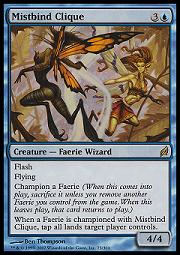
Worlds coverage has given us an in depth look at the formats of Standard, Extended, and Vintage. As per usual, were going to use that information, and extract what we can in the way of cards that should see a relative price increase because of it. Continuing with its popularity, Faeries was heavily played in the extended portions of the event. Being a deck that relies more on play skill and familiarity rather than auto-wins, its bound to be a deck that does well in the hands of seasoned pro-tour and national championship competitors. Because of this we can expect to see a small bump in the price of cards from the UB menace, though I expect this to be short lived. If Faeries becomes a deck of popularity, Jund will once again rise to bring balance to the force.

But enough about Faeries, lets talk about this weekends real price upset, Necrotic Ooze. This thing jumped from almost pennies a piece to highs of up to $5.00 through online vendors in less than an hour. The window is getting smaller for people looking to snag the freshly released tech pieces, and the Necrotic Ooze flight left long ago. We all knew it was coming, and you can't say you didn't. After how well Gerry Thompson (@G3RRYT) did with it in the Legacy open recently, running a deck that showcased the awesome interactions between the ooze and graveyards, we all knew that the next format to abuse it in would be extended.

With both Fauna Shaman and Necrotic Ooze being in extended, it was just a matter of adding in the already discovered engine of Quillspike and Devoted Druid to make things degenerate quickly. Personally I love the deck, and you can expect me to be playing it this year for PTQ's. I've even added one card to the list for an additional kill outlet, but since this is a financial article, I'll just leave it at that.

Going over the extended meta game there are many strategies that put up a decent finish. Revamped decks from last year, recent type 2 decks, and artifact based aggro decks were all present. Combo in the form of Valakut based Scapeshift decks, Pyromancer Ascension, and Pestermite/Splinter twin were all there. Speaking of artifact based aggro strategies its something to be on the lookout for as the extended season is about to really start heating up, and so will those cooled off card prices. Expect to see the staple cards in every deck see a bump in price, with just a few seeing a continual surge while the others return to their average prices.

Picking up a few Tempered Steel, Etched Champion, Ethersworn Canonist, and Burrenton Forge-Tender while they are  still below peak prices will net you a sizeable profit to the right person. Many uncommons from Lorwyn block will currently go for a higher price than many current standard rares, and should be an item to watch for as you flip though binders.

Legacy didn't have much in the way of results, showing the team competition as two already well known decks played against each other, being aether vial driven Merfolk and Counter-top. The public event for Legacy was won by Survival, and from what I've been able to find so far, there isn't much in the way of innovation currently in the format.

Standard as a format is relevant all year long thanks to the ongoing Starcitygames.com open series, which is doing more events than it did last year. Brian Kibblers (@BMkibler) Caw-go deck was one highlighted all over the internet including here on this site, and can be expected to be a player early in this years open series events. The top 8 of Worlds saw a large majority of control which was surprising but not completely unexpected.

As the meta shifted to aggro strategies to combat RUG and other ramp ideas, control had to shift as well. This time it went back to winning games on the back of Consume the Meek, Sea Gate Oracle, Jace, the Mind Sculptor, and Grave Titan. I expect the black titan will see a rise back to its rather recent highs as the finals were a U/B control mirror, so if you were able to pick any up during the price lull now would be a good time to use Worlds hype and mark their price up a bit to gain some profits.

Primeval titan held its crown as the king of the titans, though all of them including Abyssal Persecutor and Wurmcoil Engine showed up in the standard portion of decks with more than 13 points. The trend of 1-2 copies of Inferno titan in R/G Ramp style decks continued, as did the need for Avenger of Zendikar. As long as ramp strategies continue to have a place in the metagame, expect those cards to carry a decent price. Watch the metagame closely and when the decks no longer show results, take advantage of the lower prices.

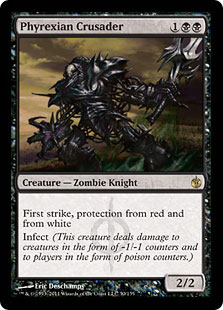
We were given a pair of preview cards from Mirrodin Besieged, a pair of 2/2's for 3. The first being 1WW has double strike and protection from black and green, and its counterpart costing 1BB with first strike and infect, protection from red and white. If Infect becomes a viable archetype with the second set, expect to see both of these cards with at least moderate demand. Paladin en-vec always saw demand in every set that it was printed in, and with White based aggro decks missing few pieces to be a upper tier deck, now is the time to stock up on key components of both Infect and White based aggro. Its also worth noting that the black card is currently one of the hardest creatures to kill in standard, with disfigure being its biggest threat.

Know what card was underrepresented at worlds that can still get you a good price to most players? Molten-tail Masticore. Its made almost no impact in standard since its release, and I see its value dropping off unless

something in the next set makes this card shine. As we have seen with the -ling type cards; Torchling and Thornling, the various Masticore style cards can't compete with the original, and will only see fringe play. Get rid of any extra copies of the card you have while they still maintain the "masticore" card type price boost, because more and more people are coming to realize that its a bit of a bust.

Mox Opal's numbers aren't looking good for standard either. With another two sets to come out in the Mirrrodin block, it could see its value rise, and the inclusion in extended gives us a good sign for the card. I would hold what you have and try to pick them up at a decent rate because a metalcraft strategy could see a boost come the next set.

That's all for this week, as usual please feel free to comment.

Stephen Moss

@MTGstephenmoss on twitter

E-mail me: MTGstephenmoss@gmail.com

Dragon Broodmother

Are you a Quiet Speculation member?

If not, now is a perfect time to join up! Our powerful tools, breaking-news analysis, and exclusive Discord channel will make sure you stay up to date and ahead of the curve.

This week I wanted to take some time out and talk about an aspect of Judging that is taken much more seriously than your average ruling or penalty: Disqualifications. DQ’s are never pleasant for anyone involved. As Judges, we do everything we can to preserve the integrity of our tournament and that each game of Magic is played as fairly as the next. Sometimes, however, a player thinks he can game the system to his advantage. When this happens it carries a heavy penalty.

Now, not all DQ’s stem from cheating. Sometimes a player just doesn’t know that what he is doing is cheating. It sounds kind of funny but this situation happened when I was running a Alara Block Sealed Deck event. I was posting pairing for the second round when a player came up to me.

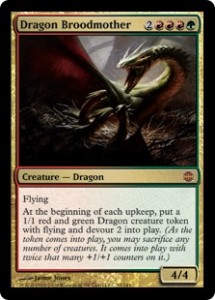
“JUDGE! I have a question. I have Dragon Broodmother in my deck. Twice in my last match I had him in play but was only putting tokens into play on my upkeeps. I honestly thought that was how it worked. I thought that until after the match when my opponent pointed out to me that it in fact was supposed to trigger EACH upkeep. Should either of us get a penalty for that last round?”

I genuinely don’t think that this player was trying to get his opponent in trouble. He also mentioned that he was interested in becoming a judge and had done some reading in the policy documents. This was why he was so curious what should happen. Now as far as this situation goes, on the surface, it seems pretty straight forward: one player was forgetting a triggered ability, and the other player seemed to realize this but was neglecting to tell his opponent or call a judge. Now if this were Awakening Zone there wouldn’t have been a problem. But there is one small difference between the Zone’s spawning ability and the Broodmother's: the Zone’s is optional.  Those three letters–"may"–make all the difference.

If you had missed the trigger for Awakening Zone,it is just assumed that you choose not to put a token in play. However, Dragon Broodmother’s ability isn’t optional and it must happen each upkeep. Now if both players honestly missed the trigger and when one realized it (if they do all) and they called a Judge the situation would have been very different. Warning for Missed Trigger, Warning for Failure to Maintain Game State (see below) and we would have put 2 tokens into play, as many triggers as there would have been in a turn cycle (from the end of one players phase, to the start of that players next same phase). This far after the fact I would have just explained that to him and forgotten about it.

Knowing that the Dragon Broodmother's ability is mandatory I felt like I needed to have a discussion with this player’s opponent from last round. I wanted to make sure that he wasn’t just misunderstood, or maybe he had just noticed after the fact. I didn’t want to go into an interrogation; I just wanted to see what had happened and if there was anything fishy going on.

The discussion I had with him revealed that he indeed knew that the Dragon should have been spawning each upkeep. He didn’t mention it to his opponent because, in his words, “it was terrible for me.” I genuinely don’t think his intentions were to cheat. I think he was just trying to be competitive and take advantage of his opponent’s mistake. However, in this instance, there is a fine line between competitive and Fraud. Knowingly disregarding the rules to gain advantage is the very definition given in the Infraction Procedure Guide as Cheating – Fraud. So after a brief discussion, I had no other choice, but to disqualify him.

Like I said earlier, Disqualifications are not fun for anyone involved. The players end up in an uncomfortable situation. The Judge has to deliver the bad news to someone.  Luckily in this instance, the player at fault wasn’t trying to be sneaky or underhanded. He just learned a valuable lesson for his future tournaments.

I really just wanted to take you through a little bit of the thought process Judges go through for a Disqualification. Whenever there is a high profile DQ at an event, the parts of it that become public are greatly speculated upon, but it should be known that no DQ is ever taken lightly by Judges. Much consideration is always taken before handing out such a heavy penalty.

As always, Keeping it Fun (when not handing out DQs),

Kyle Knudson

Level 2 Judge

Allon3word at gmail.com

BONUS RULES STUFF:

Failure to Maintain Game State
This is a warning that is given out a lot and it's a lot of fancy words for what it really means. When two players are playing magic, and they notice a problem, they call a Judge to answer their question. Usually an issue is caught right away which causes a penalty for the player who messed something up, and we move on. Now if it is not caught right away and some time has passed or some important game action has happened (attack phase, a card drawn, a spell played, etc.) then the opposing player will get a warning as well.

It is both players responsibility to make sure that the game is being played properly and this penalty exists to reinforce this philosophy. It is always a warning and is never upgraded.

Living the Dream: Going Infinite

Are you a Quiet Speculation member?

If not, now is a perfect time to join up! Our powerful tools, breaking-news analysis, and exclusive Discord channel will make sure you stay up to date and ahead of the curve.

Author’s Note: This is an article that has really been a long time coming.  As I am currently stuck on a four-hour flight to Virginia for the holidays and to take down a few events in the meantime (Six days late for the Star City Games Invitational – a long story I’d much prefer not to get into), I figured now was as good a time as any to go ahead and cover what’s been on my mind for a while in this special edition of Rhythmik Study. I will be using terms in this article dealing with trading.  For those of you not sure, “sell value” in this article is defined as “the price the average high-end vendor sells this card for.”  “Trade value” is the same as “sell value,” but is used in the context of a trade with other players, and “buy value” is defined as “The highest price a vendor is willing to pay in cash for the card in question.  Enjoy.

For those of you who don’t know me, my name is Jeph Foster, and I am a grinder.  As many of you I’m sure know all too well, the life of a grinder is hard.  Whether you’re a PTQ grinder, 5K/Open grinder, Grand Prix grinder, or all of the above, the toll grinding takes on your wallet, free time, and, to some, your sanity is nothing to be taken lightly.  Unless your costs are being subsidized by appearance fees from Wizards of the Coast and Star City Games (in which case, you’ve been winning money at these events anyway), they can simply be way too much to keep up with.  I’ve been grinding for two years, mostly for fun, friendship, and the love of the game.  I’ve never taken a cash prize in an event (though I have won several events with large product payout and intangible payout , such as a PTQ), though I haven’t paid for anything Magic related in over two years.  This primer will show you how to keep your EV as high as possible, even if you aren’t Gerry Thompson.

I’m going to start with a small disclaimer: some of these are much more obvious than others, while a few are quite a bit less conventional.

Take advantage of your free time at events. This is a problem I see with players all the time.  As soon as they go 0-2 in an event, they just railbird their friends or mope around, and waste their time feeling dejected for the rest of the day.  If you have the misfortune of falling out of contention early at a large event – or any event for that matter – take advantage of the time.  When you go to a Premier Event, you spend the day surrounded by people who play the game, several of which are people who also couldn’t find a way to make their decks perform like they wanted. If you’re still confident in yourself and your deck (or another deck you brought with you) and haven’t put yourself on tilt, enter a side event.  Win-a-box eight man tourneys run all day at PTQs, GPs and 5K’s/Opens. For $15-18, you can take down three players and take home a box, or easily sell it off site to players for an easy $80. When I fell out of contention of Day Two at Pro Tour: Amsterdam, I immediately signed up for a generic Grand Prix Trial. While I came in second and was unable to secure the slot, I still won a box which I was able to sell to players for €7 per draft set (Wescoe Check – off site, of course).   However, if you aren’t feeling up to slinging spells, trading is always an amazing option and can even be more profitable.

Trade constantly, even if you aren’t gaining much value per trade. Players are always looking for that guy that’s going to give him a Mox Opal for his Predator Dragon.  Sorry, guys but this just does not happen.  Sure, every once in a while you get that blowout trade, but incremental advantage over several trades is always better than obscene advantage over few trades. Let’s look at it this way: Predator Dragon is a bulk rare that vendors always buy for about $.10-15, and Blackborder.com is buying Mox Opal for $10. This trade is about $9.90 in your favor.  However, if over fifteen trades, each trade is even value except you ask for 2 Preordains or Mana Leaks and an Everflowing Chalice or Joraga Treespeaker as a throw-in, we actually make more.  Let’s take a look at the figures - Blackborder.com is paying $.25 each for Preordain and Mana Leak and is paying $.75 each for Everflowing Chalice and Joraga Treespeaker.  This makes our profit per trade $1.25, and our profit over fifteen trades is a respectable $18.75; you get this just for mising a couple of commons and uncommons!  You’ve made almost double the profit, and you still come off as a cool guy because you aren’t “trying to rip them off.”  One thing that I do is carry a notebook with a handwritten list of cards that either have high buy values compared to their sell values (at least 75%) or are grossly undervalued by most players (TrollandToad.com buys Sorin for $6.00 and Sanguine Bond for $1.50. You can get them from players for about that in sell/trade value, if not less) as well as commons that can be sold to vendors for at least a quarter.

This accomplishes several things: First, it allows you to know at a glance exactly how much trade value you should ask for your cards as well as theirs.  Traders that are confident in the prices of the cards they are looking for are more convincing to other players than players who seem shaky and quote prices off the top of their head, or who simply make random guesses.

Second, having this cheat-sheet keeps players from having to check their smart phones for prices. This expedites the trades and saves a lot of annoyance.

Finally, this allows you to keep your losses to a minimum.  While you may know buy prices off-hand, being off even by a dollar on a card or two can mean the difference between a small profit and an unnecessary loss.

Remember, when making 10, 20, or even 100 trades in a day at large events, every quarter counts.  An extra quarter over 100 trades in a weekend is enough to pay for your meals for that weekend.  In the same vein, spending an extra half an hour searching through sites’ buylists at large events where there are multiple dealers can really improve your profit margin if you capitalize at the event by trading for the most profitable cards, or sell only to the dealers offering even just a quarter extra for certain cards.

Note: all prices quoted are at the time of writing this article and are subject to change.

Rotate your stock regularly. No one cares how long that Nissa Revane has been sitting in your binder at $10-12 sell value if no one is looking for it in a trade.  The cards you have with high buy value should be sold off if they sit in your binder too long, or traded at a slight discount to players if it means turning the card you receive into something you can profit off of.  For this, we go back to incremental advantage.  If you take a loss on one card in a trade, and gain value on either what you received in exchange for that card or other cards in the trade in question, you still gain advantage.

One of the best ways to help with keeping stock fresh is to ask every player you trade with what they are looking for – even if you don’t have it.  One thing that a lot of players seem to have in common is a case of laziness when it comes to finding cards.  Keeping a list of players in the back of the same notebook you should be using to record buy prices and the contents of each completed trade (recording each trade you make is a good idea as well, it allows you to track your profit as well as where each card goes, preventing awkward “Well, I thought I had that card” moments) as well as a physical description of the person to help relocate them later gives you more things to look for while trading.  This provides even more opportunities to earn incremental advantage.  Players are also more likely to help out people who do their card hunting for them.

Twitter is your friend. Okay, I may be focusing just a little too much on trading, but trading is one of the keys to keeping your costs down and your EV (Expected Value) as close to even as possible – maybe even positive.  Most articles on trading specific cards can be outdated by the time they print.  I recall one podcast I did with Kelly Reid and Dave Heilker earlier this year at Grand Prix Columbus where we were talking about Survival of the Fittest and how it was the breakout card of the tournament.  By the time Kelly was able to get everything mixed and ready for post, the cat was out of the bag and the price was already beginning to skyrocket.  Twitter is a very up-to-date resource that constantly relays information about hot cards and what to pick up from the people at the tournaments.  Having Twitter available on your mobile device while at a large tournament allows you to pick up hints from other people who are there, and can be an invaluable resource.

For more information on Twitter, how it works, and how to use it as a resource, check out Dan Barrett’s article on Star City Games, located here (http://www.starcitygames.com/magic/misc/20719_SCG_Talent_Search_Knowledge_Profit_and_You_A_Twitter_Primer.html).

Make friends. While I in no way advocate seeing your friends as simply another resource to be used for personal gain, this game is all about interaction with other people.  The people I play Magic with every month at large events are like an extended family to me, but we all also help each other keep costs per person down.  If seven people share a room together for the weekend, a hotel can be as little as $15 per person, as the same goes for travelling to these events.  Having five people that all want to go to the same event actually justifies driving as opposed to flying, which cuts costs to almost nothing.

Friends can also lend cards when you are in desperate need of them, or can even share a card pool, making the game even cheaper.  I know when I head to an event, I sense players’ desperation for chase rares, and will charge a premium for necessary cards from those who weren’t smart enough to come prepared.  With this in mind, I make sure I have everything I need to go ahead of time, or borrow what I don’t need from my friends before leaving for the event.  Nothing can be a money sink like losing tons of value on a trade or paying five dollars over market value for a hot card that no one can find.  Just for a few recent examples, Grand Prix: Washington D.C. saw Linvala, Keeper of Silence shoot to twenty dollars, Pro Tour: Honolulu had fifteen-dollar Uril, the Mist Stalkers, and Treefolk Harbinger, a previously unplayed uncommon was fetching a whopping €5 (roughly $6.60) at Pro Tour: Amsterdam.

Just remember that borrowing cards should be a two-way street – don’t leave someone cold who has helped you out when you were desperate for cards.

Become a DCI Judge. There have been plenty of times that I’ve found myself unable to find space in my budget to justify putting myself at a potential loss when taking meals, hotel and travel into account for an event.  Even at times I can afford to head out to a tournament, sometimes card availability is too low to build two decks for each Star City Games Open event.  Fortunately, many Premier Tournament Organizers are understaffed and looking for judges.  Becoming a sanctioned judge takes a lot of time and effort, but the rewards heavily outweigh the costs.  Most events offer compensation of about a booster box per day, with Star City Opens and Grand Prix offering DCI Judge promos as well.  While some promos are better than others, compensation for a weekend of judging can be sold for anywhere from $200-$500, with many Tournament Organizers offering free hotel accommodations and food as an extra incentive for judges willing to offer their time.  At worst, this results in a free pseudo-vacation (judging is still hard work!); at best, you may be able to make enough money to pay for your next flight and have a few promotional cards left over to fill holes in your Legacy deck, or trade for what you need.  Speaking of trading, most Tournament Organizers will typically allow judges a round or two off as a break to grab lunch, which is plenty of time to grab a quick bite and still head out to the trading floor to make a few extra bucks (Read: Take advantage of your free time at events).  The best part about judging is the ability to stay connected to the game and see your closest friends, even if you can’t really afford to.

As a quick note: Judging is not something you should get into simply for the monetary gain.  Anyone considering becoming a judge should be genuinely interested in being constantly connected to the game. Remember, Tournament organizers typically do not compensate Rules Advisors.  This means becoming certified requires a lot of volunteer work and studying first.

Write articles. While this kind of goes with what was mentioned above – do this for the love of the game, not the money – writing articles for various websites dedicated to the game can bring in enough money to mitigate the losses you might incur from traveling or amenities at events.  Some sites, like ManaNation.com, pay their writers in store credit and award cash for exceptional writers, while TCGPlayer.com lets anyone blog and pays people based on their popularity.  This is not only a great way to make a little bit of extra cash, but can also help get your name out there, not only as a player, deckbuilder, or theorist, but also as a writer.  Sharing your new deck with the world can also serve as conclusive proof that you were the first to build it, and receive the credit you are due, and your articles can always end up in a collection of your published works to submit if you ever want to be a professional blogger or columnist.

Fly for free (well, almost). Yes.  You read that right.  Mise flights as much as possible.  This is a secret I’ve been keeping relatively well-kept for a while, but I figured I’d go ahead and share it with a couple hundred of my closest friends – you guys.  Have you ever been sitting at the airport, and someone comes over the PA saying the flight is overbooked?  Well, it’s a little-known fact that airlines like to sell more tickets than they actually have available seats so they can still send out a full aircraft even if a few people don’t show up.  (Un)Fortunately, sometimes everyone who said they were going to show up does.  When this happens, the airline starts looking for someone to give up their seat.  You may ask “Why would I want to give up my seat?”  Well, Federal Law requires domestic airlines to be pretty generous to the people who don’t get to fly when they wanted to.  Typically, this generosity is in the form of a free meal and a $200-300 voucher for future flights (about one almost free round-trip flight; airlines still requires you to pay about $20 in taxes each-way on flights purchased with vouchers).  There are a few ways to manipulate the odds for this to happen in your favor so you aren’t always drawing dead.

First, fly out on Thursday night or Friday morning.  These are relatively busy travel days that also happen to be perfect for flying to a big event, anyway.  The busier the travel day, the more likely you are to hit an overbooked flight.

Second, try to get a flight with a layover in a “hub” airport.  Hubs are airports that are typically very large and are popular transfer stations for connecting flights.  These flights tend to fill up more often simply because the people on the flight to the hub could literally be going anywhere in the country.  Layovers also give you two opportunities to be booked on a full flight.

Third, be proactive.  As soon as you arrive at your gate, ask to speak to a representative to see if your flight is overbooked and express interest in giving up your seat if needed.  These are first-come, first-served, and expressing interest before they ask for volunteers ensures that if anyone is getting paid, it’s you.

Closing Shop

As my plane is getting ready to land, my battery is running dead, and I’m pretty sure I’ve touched on everything I wanted to in this article, I’m going to go ahead and bring this one to a close.  Remember, while you may not need to do well in the tournament to go infinite, you still have to play tight, be smart, and get a little lucky with your draws.  If you follow this guide, maybe you’ll be one step closer to living the dream.

Jeph “Rhythmik” Foster

What Coverage Can Do For The Casual You

Are you a Quiet Speculation member?

If not, now is a perfect time to join up! Our powerful tools, breaking-news analysis, and exclusive Discord channel will make sure you stay up to date and ahead of the curve.

Sometimes simplicity is simply better because it’s simple. That is, there mere essence of something can be tantalizingly more satisfying than more stuff. Complexity is, after all, the greatest threat to Magic there is.

While it won’t surprise many of you this past weekend was Worlds 2010, the ultimate end to the entire year's worth of events. Brad Nelson came in favorite to win Player of the Year, but found his potential title threatened by Brazilian master Paulo Vitor Damo de Rosa then tied by Guillaume Matignon when the Frenchman won Worlds. Brian Kibler and a crew of others piloted a new Standard deck, Caw-Go, and a multitude of amazing other things were shared.

The weekend was awesome (since, for starters, it was a four-day weekend) for the entire community of Magic players.

Really.

Alright. So I see your strange look. I get it. “What does the highest level of Magic competition have to do with casual guys like you (and maybe me)?”

Casual Bias

I can’t beat around the bush so I won’t: I’m starting to really enjoy the competitive side of Magic. I’m not competing, no, but having a healthy appreciation and growing understanding for this completely different and often diametrically opposing view of Magic is something I’m after. What I want to accomplish is obtain a more varied and multi-faceted knowledge set around the entirety of Magic.

I also happen to really enjoy writing up coverage and I’m looking to cover even more.

With that devastating admission of bias out of the way, let’s get down to business. Coverage is, at its most basic, a self-styles tournament report: “Follow along as I regale my story of bad beats, epic wins, and wisdom distilled from a day (or two, or more) of Magic battling.”

But there’s a lot more to it than just one player at one event.

There are four forms of coverage that are fairly common across any site:

  • Matches (Player 1 vs. Player B), including Top 8 details
  • Deck Tech and Strategy Breakdowns
  • Player Spotlighting
  • Locale Highlights

All of these, while geared in different levels towards competitive play, can be a valuable resource for anyone looking to have some fun playing Magic. There isn’t a secret to decode from coverage or anything hidden within the walls of text and images, but when was the last time you looked to a textbook to provide inspiration and something new to think about?

I believe I can help convince you try it.

Locale Highlights

There is perhaps the only thing about big events can be argued successfully to be better than the actual event itself: location means a lot. While travelling a few hours and booking a hotel room for a weekend isn’t necessarily the first consideration that comes to mind playing Magic (and I’m not touching any international travels here) what if there was something more compelling to tip the scales?

Say, for instance, there was epic barbeque in St. Louis, MO where a big event was held last year. If you’re into good food it’s a no brainer to gather a few friends and pile into a car for a road trip. In fact, a quick turn of some travel and food channels, with a little Google-fu thrown in, yields that just about every major city where events are held has some local flavors to enjoy.

Don’t like food? Try naturalism, museums, historical sites, or the nightlife. Everywhere you go there is something to do: the issue isn’t what it is but where and how to find it. Failing that you can always just look for completely ridiculous things, which is always a great fallback in foreign lands (be they international or just too many miles outside your geographic region).

The point is really simple: the pure essence of going somewhere and having an absolute blast is universally appealing. If there’s some Magic in the mix it’s all the better.

Player Spotlighting

Here’s where things step up to the next level. Every domain has its famous faces, be it art, music, or criminal activity. Everybody has “their thing” that they do that puts them on the map. Magic is no different with its own bevy of people and faces.

Here’s the thing: everyone can make Magic their thing. What players do is their own deal; although mimicry may be the sincerest form of flattery you only need a few glances to see that just about everything in Magic style and personalization has been done.

You want to wear a completely over-the-top hat? That makes the goofy local guy seems pretty tame, no? (And, for the record, Love Janse was playing some very awesome Magic while fighting for the last minute usurp of the Rookie of the Year title! Nice!)

While many of the highlights from players detail their professional exploits there’s something else bubbling just beneath the crusty outer layer of competition: they are everyday Magic players too.  While they might play with a lot more on the line, they also make mistakes, run with a small crew of great fellow players, and have quirky, interesting habits and styles all their own.

It isn’t that there is some awesome new way to play to learn from these players (thought if you’re looking for tips and tricks to playing better you’re reading the right stuff) but that it’s okay to be yourself. Even the greatest players of the game are powerfully unique individuals.

And that says a lot about how amazing this game is.

Deck Tech and Strategy

Look. Be honest. Sometimes you want to win. It’s okay, really. We all do from time to time. And this ideas isn’t what I’m going to talk about.

When players come to a major tournament they usually come with everything they’ve got, including any new interactions and approaches to playing their particular formats. Sometimes, these different ideas and approaches are more than just “real ultimate tech” but show off completely amazing interactions.

Check out the breakdown of Conley Wood’s Extended deck from World 2010. I may not be the biggest Johnny out there but I’ll be damned if I didn’t find something really cool in Conley’s pile of Necrotic Ooze awesomeness.

The “latest” tech is really just “new, cool thing I like to do” in Magic. You don’t have to be competitive to enjoy doing new things. You don’t have to even care about balancing a deck or ensuring consistency to want to try something out. Running through what the top players think is something really awesome is usually a good starting point for trying something for yourself.

There’s much more to Necrotic Ooze than what Conley and Legacy deck designers have already done: it’s up to you to explore even more. (And I'd detail a few more interesting things but completely unsubstantiated rumor has it that Conley's deck crashed Magic Online. There's so much awesome packed in there the client can't take it, or something. So try it out and tell me if it's true!)

Matches

Perhaps the most difficult connection between your kitchen table and the tables on webcasts are between the games played in their respective locations. While reading the fine details about an epic control mirror match won’t be a suggested reading on any casual Magic lists anytime soon, there is something to be said about what happens at the meta-level for these matches.

If you look carefully in these high-level games, you’ll often notice a judge stationed nearby. You’ll see each player progress sequentially, though smoothly and effortlessly, through the phases of each turn. Through the commentary you can hear details about what players are scribbling down or making notes about.

Kitchen tables are often rife with the hallmarks of disorganization:

  • Life totals marked only by dice
  • Tokens that aren’t tokens at all
  • Food and drink “interacting” with cards
  • Non-essential cards, decks, and related Magic equipment spread everywhere

One of the things that bothers me in games is when life totals get screwy because dice move, I miss interactions or cards, or somebody doesn’t specifically point out I lose one more life than I thought. While I still use dice to mark life, miss things due to distraction, and apply less-than-rigorous mathematics to interactions, taking better notes and keeping the area clear for just the game at hand is something I’ve taken to heart.

While I’m not after becoming the next “great player” of the game, simple of procedural changes and clarifications has games I play moving much smoother. By taking note of which locals are those to go-to with judge-type questions (like card interactions, game flow and sequencing, spell casting, and more) you can resolve many rules issues before they ever take off.

Playing closer to the rules is something I always advocate and that fact that Magic at the highest level can move so easily is a testament to the efficacy of the rules systems and procedures in place (in comparison to sports like Baseball where human error on the part of those enforcing the rules can glaringly cause an incorrect call to stand over an empirically correct decision–Magic is tight).

It’s the End of the Worlds

Worlds coverage isn’t for everyone just the same way as the things I write aren’t for everyone. While I encourage all of you to check out the coverage you may have missed or to mark your calendar and join in the excitement next time, the fact is that even these dry, boring details tell a bigger picture within Magic than I would have thought possible.

So pour a cup of coffee, pull up the coverage archive, and find out what you may have been missing. Just like big events there’s something in there for everyone!

Adam Styborski

Adam Styborski is a Magic player, marketer, and writer based out of the Washington, D.C. metro area. An acolyte of big events, kitchen tables, and everything inbetween, Adam finds interesting and contemplative subject matter across the entire range of Magic. With his trusty pauper cube, EDH decks, and occasional Constructed favorite you'll find just about everything touched at some point - mainly what you are asking to hear. As an editor for Quiet Speculation, Adam is a resource for your suggestions, submissions, questions, and concerns about anything that doesn't involve tournament decks and financial musings. You can reach out to him at styborski@gmail.com or on Twitter as @the_stybs.

View More By Adam Styborski

Posted in Feature, Free, TimmyTagged , 2 Comments on What Coverage Can Do For The Casual You

Have you joined the Quiet Speculation Discord?

If you haven't, you're leaving value on the table! Join our community of experts, enthusiasts, entertainers, and educators and enjoy exclusive podcasts, questions asked and answered, trades, sales, and everything else Discord has to offer.

Want to create content with Quiet Speculation?

All you need to succeed is a passion for Magic: The Gathering, and the ability to write coherently. Share your knowledge of MTG and how you leverage it to win games, get value from your cards – or even turn a profit.

Promo stickers

Are you a Quiet Speculation member?

If not, now is a perfect time to join up! Our powerful tools, breaking-news analysis, and exclusive Discord channel will make sure you stay up to date and ahead of the curve.

We just got QS stickers in the mail today:

And I am really excited about them!

They represent one of our first forays into paid advertising. I am planning a more legit post with an actual give-away in it, but know now that we will be handing out a lot of these to our fans. Here's why I like stickers for advertising:

-they are inexpensive, which is good

-They allow people to show support on what they like, be it their binder or deckboxes or anything

-They are more visible than T-shirts. I don't wear T-shirts with anything printed on them unless it's my vintage Admiral Kirk from Wrath of Khan(!!!) shirt or some residual thrift-store shirts from when I was more of a hip-star. Shirts are also expensive unless you screenprint your own (which I can do, but I am too busy to atm).

-They have trade-specific uses - my dream is that if two people each have a QS sticker on their binder, then they are extra-cool trading partners to each other and tell us about it.

-They are easy to send out and pass around.

Promotion-wise, I see sending out two stickers to anyone who signs up for the promotion, so they can have one and ideally give the other to a friend, who will also use it. I'd like to get pictures of people who use them and put them on the site.

Just about the most important thing in running a social lifestyle site like QS is creating a "tribe" of users who you take care of and who honor you by using your products. These stickers are a great branding opportunity in that regard. Special thanks to the guys at Yo! MTG Taps for having a pretty rad name and telling us where to get quality stickers.

Douglas Linn

Doug Linn has been playing Magic since 1996 and has had a keen interest in Legacy and Modern. By keeping up closely with emerging trends in the field, Doug is able to predict what cards to buy and when to sell them for a substantial profit. Since the Eternal market follows a routine boom-bust cycle, the time to buy and sell short-term speculative investments is often a narrow window. Because Eternal cards often spike in value once people know why they are good, it is essential for a trader to be connected to the format to get great buys before anyone else. Outside of Magic, Doug is an attorney in the state of Ohio.  Doug is a founding member of Quiet Speculation, and brings with him a tremendous amount of business savvy.

View More By Douglas Linn

Posted in Biz Blog7 Comments on Promo stickers

Have you joined the Quiet Speculation Discord?

If you haven't, you're leaving value on the table! Join our community of experts, enthusiasts, entertainers, and educators and enjoy exclusive podcasts, questions asked and answered, trades, sales, and everything else Discord has to offer.

Want to create content with Quiet Speculation?

All you need to succeed is a passion for Magic: The Gathering, and the ability to write coherently. Share your knowledge of MTG and how you leverage it to win games, get value from your cards – or even turn a profit.

Real Time Worlds 2010: Extended

Are you a Quiet Speculation member?

If not, now is a perfect time to join up! Our powerful tools, breaking-news analysis, and exclusive Discord channel will make sure you stay up to date and ahead of the curve.

Worlds Top 8, seeded:
1. Paulo Vitor Damo da Rosa, BRA (UB Control)
2. Love Janse, SWE (Eldrazi Green)
3. Guillaume Wafo-Tapa, FRA (UB Control)
4. Guillaume Matignon, FRA (UB Control)
5. Eric Froehlich, USA (B/r Vampires)
6. Lukas Jaklovsky, CZE (UB Control)
7. Christopher Wolf, AUT (UB Control)
8. Jonathan Randle, ENG (UW Control)

5:22 PM, Saturday: Wizards is offering a live webcast of the Top 8 competition at their website, www.wizards.com. I'll encourage all of you to watch the video feed live, as it will be more entertaining and more informative than anything I could write up in the moment. @magicprotour on Twitter has been a particular brand of awesome in terms of getting breaking news on The Internet 🙂

Worlds is my favorite time of the year for Magic, and this year has been no exception. Enjoy the rest of the tournament 🙂 Analysis to follow throughout the next week!

5:45 AM, Saturday: Standard results for each top 8 competitor:

1. Paulo Vitor Damo da Rosa : 5-1
2. Love Janse : 4-2
3. Guillaume Wafo-Tapa : 6-0
4. Guillaume Matignon : 3-3
5. Eric Froehlich : 6-0
6. Lukas Jaklovsky : 6-0
7. Christopher Wolf : 5-1
7. Jonathan Randle: 3-3

5:05 AM, Saturday: Top 8 Standard decklists have been revealed!

The brackets are as follows:

Damo da Rosa, UB Control versus Randle, UW Control
Janse, Eldrazi Green versus Wolf, UB Control
Wafo-Tapa, UB Control versus Jaklovsky, UB Control
Matignon, UB Control versus Froehlich, B/r Vampires

If I may be so bold as to make predictions...

Damo da Rosa should have the edge in the Blue Control semi-mirror. Both players pack 4 Tectonic Edges, both players have 2 Jace Beleren and 4 Jace, the Mind Sculptor, but Damo da Rosa has a more threatening creature suite with 3 Grave Titan versus Randle's 3 Baneslayer Angels, and Damo da Rosa has a much more versatile sideboard to go along with 4 Inquisition of Kozilek in the maindeck.

My pick: Damo da Rosa in 4 games.

Christopher Wolf might have a slight edge in his matchup against Eldrazi Green in a 3-game set, but Janse packs 4 Acidic Slimes and an extra Eye of Ugin in his sideboard. With up to four games postboard, I like his chances. I'm not sure if he's going to bring in the Oracle of Mul Daya as well, but that could prove further problematic. Wolf, for his part, has 3 Flashfreeze and 2 Mindbreak Trap that could be relevant.

My pick: Love Janse in 5 games.

Guillaume Wafo-Tapa is a master of Blue Control. Here he is again playing the deck, this time in a mirror match against Lukas Jaklovsky. Both decks are going to board into a very similar configuration most likely, and the 75-card lists are not very different. As such, I like Wafo-Tapa's chances to advance.

My pick: Guillaume Wafo-Tapa in 4 games.

Guillaume Matignon is playing an identical 75 to fellow Frenchman Wafo-Tapa [Note: MTGSalvation user Kengy pointed out that this is, indeed, not the case. Wafo-Tapa sports 2 Stoic Rebuttal and 1 Jace Beleren versus Matignon's 1 Cancel, 1 Deprive, and 1 Disfigure. Thanks! -Dylan]. Eric Froehlich is playing a standard B/r Vampires list. Froehlich's 3 maindeck Dark Tutelage will probably be his most important card here. Notably, he has maindeck Vampire Hexmage (notable against Jace), but is missing the 4th Viscera Seer. He has 3 Duress and a Sarkhan the Mad waiting for him in the sideboard. Matignon, for his part, has 2 maindeck Consume the Meek and 3 Ratchet Bomb in the sideboard. He also has 2 Disfigure maindeck and 2 more in the sideboard to replace the otherwise-dead Doom Blades. Overall I like Froehlich's chances in this match, although Matignon appears to be as well-prepared as any UB Control deck could be against the B/r Vampires threat. Spreading Seas, Disfigure, and Consume the Meek should be too much for the Vampires to handle.

My pick: Guillaume Matignon in 5 games.

4:18 AM, Saturday: First look at a Polymorph decklist from deckbuilding genius Akira Asahara. I believe this is the man to credit for Squadron Hawk Control in Standard, as well.

Untitled Deck

Maindeck

4 Creeping Tar Pit
4 Darkslick Shores
2 Drowned Catacomb
4 Island
1 Khalni Garden
4 Misty Rainforest
1 Murmuring Bosk
4 Mutavault
1 Sunken Ruins
2 Emrakul, the Aeons Torn
4 Bitterblossom
4 Cryptic Command
2 Duress
3 Jace, the Mind Sculptor
4 Mana Leak
4 Polymorph
4 Ponder
4 Preordain
4 Thoughtseize

Sideboard

2 Consume the Meek
2 Doom Blade
1 Duress
2 Infest
2 Jace Beleren
2 Smother
4 Wurmcoil Engine

Bitterblossom (and Black's disruption team of Duress & Thoughtseize) make this deck much, much, much scarier than last season's Standard decks along the same line (using Awakening Zone and Khalni Garden to make tokens).

A few oddities. There's a Murmuring Bosk, but no Green or White in the deck. It's important to note that this allows Misty Rainforest to fetch up a Blue source or a Black source, which is most likely the reason for inclusion. And I wonder how necessary a second Emrakul is? This deck has Jace, the Mind Sculptor and Thoughtseize to purge it from hand. That being said, Asahara is very well-versed in building decks so I have to imagine he considered all of this.

I like the mini transformation in the sideboard with the Wurmcoil Engines. From the sounds of the coverage, this is a card that's been popping up quite frequently throughout the format.

Asahara was 3-2 with his brew going into the 6th and final Extended round. Full round 18 results are not public yet.

4:03 AM, Saturday: Of course, it's a little anticlimactic to report this after finding the Top 8, but this is the part that I know most of you are interested in for Extended coverage. Here is the composition of the Extended field at Worlds 2010:

Jund, 48, 15.2% of the field
"Vivid" Control, 41, 13.0%
Scapeshift, 32, 10.1%
Faeries, 30, 9.5%
GW Hideaway, 28, 8.9%
White Weenie, 21, 6.7%
Elves, 17, 5.4%
Merfolk, 17, 5.4%
Polymorph, 13, 4.1%
Mono Red, 13, 4.1%
Doran, 7, 2.2%
Pyromancer Ascension, 7, 2.2%
Reveillark, 7, 2.2%
Tempered Steel, 7, 2.2%
Others, 28, 8.9%

Broken down further (subjective groupings, this is rough at best):

Aggro: 120, 39.0%
Aggro-Control/Midrange: 47, 15.3%
Control: 60, 19.5%
Combo: 81, 26.3%

With 8 unaccounted for without seeing the decklists.

More deck analysis to come as soon as decklists are made available!

3:38 AM, Saturday: @magicprotour on Twitter looks to be implying that Love Janse and Adam Witton played out their match, and Janse was victorious. Sorry Australia. 🙁

That means your World Champion will be one of the following:

Paulo Vitor Damo da Rosa, BRA
Guillaume Matignon, FRA
Guillaume Wafo-Tapa, FRA
Lukas Jaklovsky, CZE
Eric Froehlich, USA
Christopher Wolf, AUT
Love Janse, SWE
Jonathan Randle, ENG

Pending final standings... [Note: Final standings in, this is your Top 8!]

3:28 AM, Saturday: on Twitter confirms that da Rosa, Matignon, Wafo-Tapa, Jaklovsky, and Froehlich have all drawn into the Top 8. Congratulations!

3:20 AM, Saturday: Results are in!

PV Damo da Rosa of Brazil and Guillaume Matignon of France drew as expected. They're both in Top 8.

Guillaume Wafo-Tapa of France beat Love Janse of Sweden. Wafo-Tapa is in Top 8! Love Janse is playing for Top 8 against Adam Witton of Australia, both of whom have hopes alive.

Lukas Jaklovsky of Czech Republic beat Isaac Egan of Australia. Lukas and Christopher Wolf of Austria can draw in Round 18 to make Top 8! Wolf beat American Matt Sperling in Round 17.

Eric Froelich of USA beat Shuuhei Nakamura of Japan. Froelich, paired against da Rosa in R18, is in with a draw or a win. However, Paulo can decline to draw and play the matchup instead to affect the Top 8 seeding. Barring any such scenario, Eric Froelich is likely in the Top 8 as well!

Bertil Elfgren of Sweden beat Yong Han Choo of Singapore. Elfgren squares off with Jonathan Randle of England. Elfgren is in with a win; Randle likely would be as well.

And that's likely your Top 8 of Worlds, 2010! One more time, in no particular order:

1. Paulo Vitor Damo da Rosa, BRA
2. Guillaume Matignon, FRA
3. Guillaume Wafo-Tapa, FRA
4. Lukas Jaklovsky, CZE
5. Christopher Wolf, AUT
6. Eric Froehlich, USA
7. Bertil Elfgren, SWE OR Jonathan Randle, ENG
8. Love Janse, SWE OR Adam Witton, AUS

2:50 AM, Saturday: End game analysis:

o Round 17 winner at Table 1 is guaranteed a spot in the Top 8 with a draw in round 18. An Intentional Draw may be good enough, as there may only be 8 players at 40+ points.

o Round 17 winner at Table 2 is guaranteed a spot in the Top 8 with a draw in round 18.

o Round 17 winners at Tables 3-7 will probably be guaranteed a spot in the Top 8 as long as the tiebreakers don't change too much. The exceptions are 36-pointers Shuuhei Nakamura and Bertil Elfgren, whose tiebreakers are both worse than 34-pointers Christia Gawrilowicz and Josh Utter-Leyton.

o Jonathan Randle is most likely on the outside-looking-in, even if he wins out. His tiebreakers are the worst of the 34-pointers and worse than any 36-pointers.

o Christia Gawrilowicz has better tiebreakers than every 36-pointer except Eric Froehlich, Lukas Jaklovsky, and Matt Sperling.

2:08 AM, Saturday: Here are the standings going into Round 17:

1. Paulo Vitor Damo da Rosa, Brazil - 40 points, (OMW% 62.72%)
2. Love Janse, Sweden - 39, (60.75%)
3. Guillaume Matignon, France - 39, (55.33%)
4. Guillaume Wafo-Tapa, France - 37 (65.27%)
5. Eric Froehlich, USA - 36 (66.74%)
6. Lukas Jaklovsky, Czech Republic - 36 (63.30%)
7. Matt Sperling, USA - 36 (62.23%)
8. Christopher Wolf, Austria - 36 (61.48%)
9. Adam Witton, Australia - 36 (61.06%)
10. Isaac Egan, Australia - 36 (59.68%)
11. Yong Han Choo, Singapore - 36 (58.72%)
12. Bertil Elfgren, Sweden - 36 (56.77%)
13. Shuuhei Nakamura, Japan - 36 (54.45%)
14. Christia Gawrilowicz, Austria - 34 (62.63%)
15. Josh Utter-Leyton, USA - 34 (56.96%)
16. Jonathan Randle, England - 34 (53.03%)

Round 17 pairings of note:

1. Damo da Rosa (40) versus Matignon (39)
2. Janse (39) versus Wafo-Tapa (37)
3. Jaklovsky (36) versus Egan (36)
4. Froehlich (36) versus Nakamura (36)
5. Wolf (36) versus Sperling (36)
6. Elfgren (36) versus Choo (36)
7. Witton (36) versus Utter-Leyton (34)
8. Gawrilowicz (34) versus Randle (34)

Updates to come. Looks like Woods, Williams, and Froehlich all lost in round 16.

12:51 AM, Saturday: At the halfway point of Day 3's Extended portion, Conley Woods is 3-0, Eric Froehlich is 2-1, and David Williams is 1-2 with the Necrotic Ooze deck. That makes for an overall record of 6-3. Sitting in 3rd place with the best tiebreakers of the three players on 36 points, Froehlich is set to play Guillaume Wafo-Tapa's 4CC deck in round 16. Keep checking back for details and/or new tech!

12:15 AM, Saturday: Thanks to @magicprotour and @rtassicker from Twitter, it looks as if the three players sporting this deck are Conley Woods (@conley81), David Williams (@dwpoker) and Eric Froehlich (@efropoker). Pretty solid players to say the least! 😉 From one professional poker player to a couple of others: Keep kicking ass with this awesome brew!

11:59 PM, Friday: We have a decklist! Lots of combos!

Untitled Deck

Maindeck

4 Necrotic Ooze
4 Devoted Druid
1 Quillspike
4 Fauna Shaman
1 Thornling
1 Grim Poppet
1 Molten-Tail Masticore
1 Reveillark
1 Shriekmaw
4 Fulminator Mage
4 Acidic Slime
2 Makeshift Mannequin
2 Primal Command
4 Thoughtseize
4 Birds of Paradise
3 Forest
3 Swamp
4 Verdant Catacombs
1 Misty Rainforest
1 Murmuring Bosk
4 Gilt-Leaf Palace
4 Twilight Mire
2 Tectonic Edge

Sideboard

1 Skinrender
2 Shriekmaw
1 Obstinate Baloth
2 Maelstrom Pulse
4 Kitchen Finks
2 Memoricide
2 Duress
1 Cloudthresher

What Makes This Deck Tick

Necrotic Ooze is a card that I've been trying to find a home in Standard for months. It's also been featured in some of Gerry Thompson's (and other's) brews breaking Survival of the Fittest in Legacy. Above is Conley Woods' take on an Extended deck featuring the Scars of Mirrodin rare. According to @magicprotour, the deck is 5-1 through the first 2 rounds of Extended (played, obviously, by Conley Woods and two others), with the only loss coming from a misplay.

So how does it actually work?

4 Fauna Shaman
4 Necrotic Ooze

This engine is the glue that holds the deck together. With these two creatures in play and without summoning sickness (we'll get to Thornling later), you can start to do some degenerate things. Note that, with a Fauna Shaman in the graveyard, Necrotic Ooze can pull double-duty by turning on the rest of the combo.

4 Devoted Druid

Fauna Shaman is normally limited to a single activation per turn. However, with a Devoted Druid in your graveyard, Necrotic Ooze gains the ability, "Put a -1/-1 counter on Necrotic Ooze: Untap Necrotic Ooze." Most notably, that allows you activate Necrotic Ooze's "G, T, Discard a creature card: Search your library for a creature card, reveal it, and put it into your hand. Then shuffle your library," c/o Fauna Shaman. Conveniently, Necrotic Ooze's 4/3 body allows you to do this twice without expiring. Every Green mana you have open can potentially be another Fauna Shaman activation with a Necrotic Ooze in play.

That is, until Quillspike hits the graveyard.

1 Quillspike

Assuming all of the pieces are in the graveyard for Necrotic Ooze to borrow their activated abilities, Quillspike and Devoted Druid allow you to generate infinite mana (Tap Necrotic Ooze for G thanks to Devoted Druid, or for any color thanks to Birds of Paradise, then put a -1/-1 counter on it from Devoted Druid to untap it, and remove a -1/-1 counter from Necrotic Ooze to give it +3/+3 thanks to Quillspike. Quillspike is like the turbo-speed button for the deck.

1 Molten-Tail Masticore

Molten-Tail Masticore gives you an incredible outlet for your infinite Green mana. Fauna Shaman tutors for it, and with a deck full of creatures, you can probably deal enough damage to win (though it's important to note that it's not infinite damage, just infinite mana). Masticore also gives Necrotic Ooze Regeneration, and the upkeep cost is not copied.

1 Grim Poppet

When in the graveyard with a Devoted Druid, Necrotic Ooze gains the ability to distribute infinite -1/-1 counters among any number other target creatures.

1 Thornling

You can make infinite Green mana, you can kill every creature on the board, or you can just grow your Necrotic Ooze to massive proportions. Too bad you can't give it Haste (remember Anger in old-school Reanimator circa Odyssey Block?). Except with Thornling, you can. And you can make your Necrotic Ooze Indestructible, or give it Trample, for G. Note that Path to Exilecan still be a problem.

1 Shriekmaw

Removal you can tutor for with Fauna Shaman. Solid.

2 Primal Command

This card pretty much does anything. Tutor + lifegain, land destruction + tutor, land destruction + graveyard hate, or any other combination thereof. Look at this deck so far, and try to imagine fighting against it with a Control deck in this format. What the hell do you pick to answer? It looks like there are so many threats, and answering any non-Ooze threat just threatens to power up any Necrotic Oozes up anyway when they finally do hit play.

Yikes.

2 Makeshift Mannequin

This might be my favorite part of the deck. Instant speed Necrotic Ooze? Gotcha. Multiple uses out of Reveillark (with Fulminator Mage and Acidic Slime to abuse)? Sure thing.

4 Acidic Slime
4 Fulminator Mage
2 Tectonic Edge

This is extra awesome. Nonbasic lands are going to be everywhere this season. We all already know that. This 10-pack of land destruction should be enough to keep your opponent off of a color (Or that critical second or third of a color - Yes, I'm looking at you, Cryptic Command). Especially when combined with Fauna Shaman to find a Reveillark to abuse these 2-power creatures, I would not look forward to sitting across from this deck with any sort of 4- or 5CC style of deck.

4 Thoughtseize

And as if all that disruption wasn't enough... Because the combo package is all creature-based and you have Fauna Shaman, there is so much built-in redundancy to the combo package. This frees up a ton of extra space for the deck to cram in all of this utility and disruption.

Mana

4 Birds of Paradise
3 Swamp
3 Forest
4 Verdant Catacombs
4 Gilt-Leaf Palace
4 Twilight Mire
1 Murmuring Bosk
1 Misty Rainforest

The five fetchlands help find Murmuring Bosk, which is the only way (alongside Birds of Paradise, of course) to cast Reveillark. Again, an extremely efficient package, this time to provide White mana with only 1 truly extra card (Murmuring Bosk itself - the Verdant Catacombs would be present anyway, and Misty Rainforest should often be the same as a Forest otherwise.

Twilight Mire, Gilt-Leaf Palace and Verdant Catacombs form the basis for a rock solid G/B manabase. Ironically, having such amazing options for pretty much any color combination allows for some extremely creative mana bases, but also provides a huge liability when it comes to cards like Fulminator Mage or Anethemancer.

All in all, an extremely cool deck. I'm pretty certain that this will be one of the big forces when it comes to the upcoming PTQ season.

10:55 PM, Friday: Hello and welcome back once again to The Brewery!

Tonight figures to be a big night for fans of Magic: the Gathering's Constructed formats... The first round of Extended at Worlds, 2010 in Chiba, Japan has already finished!

Rumor has it that Conley Woods (and others perhaps) have broken Necrotic Ooze. Will it use Quillspike and Devoted Druid? Gigantomancer? Something else entirely? I'm excited to see. 🙂

Meanwhile, what will the rest of the field look like?

Check back with Quiet Speculation throughout the night for up-to-the-minute news and analysis of the event and format! For The Brewery's live analysis of Standard's Caw-Go deck (as played by Brian Kibler), check here.


Images in E-books

Are you a Quiet Speculation member?

If not, now is a perfect time to join up! Our powerful tools, breaking-news analysis, and exclusive Discord channel will make sure you stay up to date and ahead of the curve.

Several of our readers have asked why Understanding Gush lacks card images. Having just completed a law course on the subject, I'll tell you the answer is "copyright infringement." The Fair Use doctrine is unlikely to cover our use, and I don't want QS to be sued out of existence! We are currently seeking licenses or permissions, while at the same time, exploring how to add helpful images to the work without infringing copyrights. If I could load this book over-full with pictures, I would certainly do it!

Douglas Linn

Doug Linn has been playing Magic since 1996 and has had a keen interest in Legacy and Modern. By keeping up closely with emerging trends in the field, Doug is able to predict what cards to buy and when to sell them for a substantial profit. Since the Eternal market follows a routine boom-bust cycle, the time to buy and sell short-term speculative investments is often a narrow window. Because Eternal cards often spike in value once people know why they are good, it is essential for a trader to be connected to the format to get great buys before anyone else. Outside of Magic, Doug is an attorney in the state of Ohio.  Doug is a founding member of Quiet Speculation, and brings with him a tremendous amount of business savvy.

View More By Douglas Linn

Posted in Biz Blog3 Comments on Images in E-books

Have you joined the Quiet Speculation Discord?

If you haven't, you're leaving value on the table! Join our community of experts, enthusiasts, entertainers, and educators and enjoy exclusive podcasts, questions asked and answered, trades, sales, and everything else Discord has to offer.

Want to create content with Quiet Speculation?

All you need to succeed is a passion for Magic: The Gathering, and the ability to write coherently. Share your knowledge of MTG and how you leverage it to win games, get value from your cards – or even turn a profit.

November

Are you a Quiet Speculation member?

If not, now is a perfect time to join up! Our powerful tools, breaking-news analysis, and exclusive Discord channel will make sure you stay up to date and ahead of the curve.

What’s going on everybody? Hope you all enjoyed Thanksgiving! It’s been a month and that means time to review all the hot news that came out this past month and what it means going forward. I am partially in a food coma at this point on Thanksgiving Day and debating on battling Best Buy at 5am for this sweet TV I want,  but I will do my best to make coherent comments and opinions. As always, if there is a topic you wish to hear me write on, feel free to leave a comment stating the topic.

Magic Player Rewards Discontinued

There is a mix-bag reaction to this news, and the easiest way to see this split is just look at MTGSalvation and Magictraders. It seems like the majority of people on Salvation were upset with it and people on MOTL were ok with the decision. My take on this is that this is a pretty good move by WoTC. This goes back to my argument about TOs needing to have stores to run certain events; less chance for fraud and ruining it for other people. If things kept happening the way they were, WoTC was going to lose confidence in store-run events and we could have seen something even more drastic happen; sort of a domino effect that was luckily stopped. We need to have faith that WoTC will put this money towards more programs such as Gateway and FNM. Hell, they doubled the FNM prizes that could be given out at stores and no one said a word, and when they got rid of a program that gave away FREE cards, people complained. Magic players sure do feel like they are an entitled lot, don’t they?

MED4

The full list is out and this is definitely going to stir some things up on MTGO. Notice how Library of Alexandria is not restricted on Classic MTGO; just a thought going forward about potential real-life implications. Another factor is the dual lands being reprinted again. Well, this should obviously drop the prices in the short term. They could rebound a bit as more people view this development as a way to get into the format and the demand goes up after awhile.

Paypal Charges in 2011

Starting in 2011, Paypal is required to report to to the IRS if you do more than $20,000 in received payments or 200 payments in a year. I said this back in my second article, but you need to be recording what you do to avoid problems with the law and the IRS. This is going to change how people do business and I wouldn’t be surprised if people start giving discounts for non-paypal transactions to avoid this. Yes it is shady, and yes it will probably be done. Personally, I have no problem with this because I already report on my taxes my Magic profits and you should too.

Winterking Results

Results are in and lots of Cryptic Commands appeared and not many Reflecting Pools. Granted this could all change with Mirrodin Besieged to still come out before the extended season but it is something to note while trying to pick up cards before the season. You are buying cards while they are cheap now, aren’t you? I honestly wouldn’t invest in Fae stuff at the moment because it looks like Merfolk just might be stronger and on paper it looks like it could beat Fae as well. Mystic Gate was the filter land of choice this weekend as well. No Doran decks showed up in the T8 lists. This could be from people being prepared for it or the loss of Goyf and Slaughter Pact is more important than initially thought.

Fire and Lightning Deck and Trends

This has caused quite the firestorm of conversation on MOTL in the past week or so. One dealer from overseas was particularly upset about the fact that Chain Lighting was in this new set (granted he admitted to not being very good, so take that point of view for what it is worth). He felt like this gave him no faith in WoTC and what they wanted for the future of the game. I personally think this set is a great idea and have had zero problems with any of their decisions in the past year. New players like it because it is basically a ready-made legacy deck that only needs a few cheap Type 2 fetches to be really exciting. Old players like it because it reminds them of when they had Chain Lightnings and Fireblasts to play with and could potentially bring some of these players back. I think the positives far out weigh the negatives on this box set and any they do in the future. Notice more people complain when there is a bad set like Phyrexia vs Coalition that did not do anything to any significant card’s value compared to Elspeth vs Tezzeret which basically neutered Elspeth’s value forever.

Buy High/ Sell Low

Buy High:
1.  GerryT- Congrats buddy! Good luck at Worlds

2. Thanksgiving- Yum Yum Yum!

3. P90X- Yep, one week in and I am hating life. Just the way a good work out system should be.

4. U/B Control- Raised my constructed rating up 60pts in 3 weeks with this deck.

Sell Low

1. Tom Brady- Way to ruin my day with 4 TDs and make me sweat out my Fantasy match up this week

2. The BCS- Just get rid of it for playoffs. More money and more TV, that’s what they care about anyway.

3. Derek Jeter’s Agent- You are not making yourself any friends with your media comments.

4. SOM Planeswalkers- Dropping every day, don’t even want to give a real number on them any more :/

Contact
E-mail: tennis_stu_3001@hotmail.com
MOTL: stu55
AIM: stoopskoo15
Store: The Vault- Greensburg, PA

Buy List Updates

Are you a Quiet Speculation member?

If not, now is a perfect time to join up! Our powerful tools, breaking-news analysis, and exclusive Discord channel will make sure you stay up to date and ahead of the curve.

First the apology, then the numbers
.

I’m sorry that I haven’t been able to get you weekly updates with the numbers we all know and love. I’ve ended up taking over some of the web mastering responsibilities for QS and it’s taken up more of my time then I thought it could have. Between taking the lead in building out the new non-financial content and working on many of the visual aspects to the site I’ve barely even had time to play! (1-1 drop from an SOM draft last night in fact).

Even now I don’t have the time to write up the normal blow-by-blow that I like to put together. However, most of my spread sheets are fairly automated so there’s no reason why I can’t at least give you the numbers.

For this week, please give these sheets a bit of a look. I hope you find them as interesting as I do.

[iframe https://spreadsheets.google.com/pub?key=0AukC5EWiTvOpdGREaGlyaHhfOWU0OXBRWmVhUDItbWc&hl=en&single=true&gid=1&output=html&widget=false 567px 600px]

[iframe https://spreadsheets.google.com/pub?key=0AukC5EWiTvOpdGREaGlyaHhfOWU0OXBRWmVhUDItbWc&hl=en&single=true&gid=3&output=html&widget=false 567px 600px]

[iframe https://spreadsheets.google.com/pub?key=0AukC5EWiTvOpdGREaGlyaHhfOWU0OXBRWmVhUDItbWc&hl=en&single=true&gid=5&output=html&widget=false 567px 600px]

[iframe https://spreadsheets.google.com/pub?key=0AukC5EWiTvOpdGREaGlyaHhfOWU0OXBRWmVhUDItbWc&hl=en&single=true&gid=7&output=html&widget=false 567px 600px]

[iframe https://spreadsheets.google.com/pub?key=0AukC5EWiTvOpdGREaGlyaHhfOWU0OXBRWmVhUDItbWc&hl=en&single=true&gid=8&output=html&widget=false 567px 100%]

Printable link to all of Standard on one page

And a recap of the Google Docs tools


So here are some things you need to keep in mind with these spread sheets.

  • 1. Access to these will require a (free) Google Docs account.
    2. None of the editions are required to enter, but I included the functionality to deal with reprints.
    3. If it seems like they glitched out, refresh the page, your entered data should be safe.
    4. They are not very fast, so be patient.
    5. I have written them in such a way as when I refresh my source data, the templates associated with your personal Google Docs account will be refreshed too. If I add vendors or features (or you find it broken) come back and get a new template. I’ll continue to advance the version numbers.
    6. Edit only the YELLOW cells. There isn’t a way for me to protect the formulas in the other cells so I have marked the safe ones in yellow and hid as many of the others as I could.
    7. If you’re having any issues I didn’t cover here, please let me know in the comments, I’ll respond as fast as I can.
  • [iframe https://docs.google.com/embeddedtemplate?id=0AukC5EWiTvOpdHpkY3ljQ2pXRGlkRVd2RURKNnRLUFE 567px 210px]

    [iframe https://docs.google.com/embeddedtemplate?id=0AukC5EWiTvOpdGljVTRBeHpXQVpzNUVfaWF6Nnk3SVE 567px 210px]

    Chris McNutt

    Born in Seattle, Washington, Chris McNutt has been playing and collecting Magic: The Gathering since Unlimited Edition. As an active player, tournament organizer and judge he regularly scrubs out of Pro Tour Qualifiers but inexplicably cleans up at the local draft tables. When not net decking Chris is either busy working as an Information Technology Sales Rep or spending time with his family. Other non-magical pastimes include playing guitar and an unhealthy number of video games. Cursed with an undying love of generating spreadsheets purely for ñ€Ɠfunñ€, heñ€ℱll be crunching the numbers each week in order to serve up delicious data burritos to the salivating, hungry readers of Quiet Speculation.

    View More By Chris McNutt

    Posted in Finance, Free5 Comments on Buy List Updates

    Have you joined the Quiet Speculation Discord?

    If you haven't, you're leaving value on the table! Join our community of experts, enthusiasts, entertainers, and educators and enjoy exclusive podcasts, questions asked and answered, trades, sales, and everything else Discord has to offer.

    Want to create content with Quiet Speculation?

    All you need to succeed is a passion for Magic: The Gathering, and the ability to write coherently. Share your knowledge of MTG and how you leverage it to win games, get value from your cards – or even turn a profit.

    Dissecting Standard Caw-Go, Worlds 2010

    Are you a Quiet Speculation member?

    If not, now is a perfect time to join up! Our powerful tools, breaking-news analysis, and exclusive Discord channel will make sure you stay up to date and ahead of the curve.

    Welcome back to The Brewery! I hope this middle-of-the-night writeup goes over well enough; Worlds 2010 is going on literally as I write this! I had no plans on writing anything tonight, and then I saw this exceptional brew played to a 6-0 record by Brian Kibler:

    Caw-Go, as played by Brian Kibler

    Untitled Deck

    Maindeck

    4 Squadron Hawk
    3 Day of Judgment
    2 Condemn
    3 Journey to Nowhere
    3 Gideon Jura
    2 Stoic Rebuttal
    1 Deprive
    2 Mana Leak
    4 Spell Pierce
    1 Jace Beleren
    4 Jace, the Mind Sculptor
    4 Preordain
    1 Spreading Seas
    4 Plains
    4 Island
    3 Tectonic Edge
    4 Celestial Colonnade
    4 Seachrome Coast
    4 Glacial Fortress
    1 Arid Mesa
    2 Scalding Tarn

    Sideboard

    1 Tectonic Edge
    1 Day of Judgment
    1 Jace Beleren
    1 Deprive
    3 Spreading Seas
    2 Condemn
    3 Celestial Purge
    2 Flashfreeze
    1 Elspeth Tirel


    Last time I wrote about UW Control at The Brewery, it was Kyle Sanchez' take on the deck during TCGplayer's Wizard World Series in Austin, TX. Kyle Sanchez later wrote about his win with what he thought was the best deck in Standard. Today's UW "Caw-Go" from Worlds has a much different take on the classic Control combination.

    First, let me say that this is one of the coolest decks I have ever seen. To be honest, I was getting a little sick of the current Standard format. Extended has been drawing more and more of my attention and concentration when it came to brewing up new decks or tweaking established archetypes.

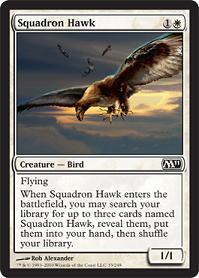
    Why is Squadron Hawk so awesome?

    The simpler question might just be what doesn't? Let's start with the most obvious card choice: Squadron Hawk. Notice that this deck eschews UW stalwart, Wall of Omens (more on this later), and that Squadron Hawk is the only true creature that this deck offers. Squadron Hawk provides 4 primary functions:

    o A reshuffle effect after Jace, the Mind Sculptor Brainstorms for you.

    o An automatic 4-of blocker against Aggro decks.

    o Explosive, easy to find, & difficult-to-answer win condition against other Control decks.

    o Evasive attacker against opposing Planeswalkers.

    Squadron Hawk has been finding its place in Standard over the last few weeks, and it should be no surprise why. In terms of sheer card advantage, casting one Hawk offers up drawing 3 cards; you're guaranteed to draw three more Squadron Hawks, but it's a lot closer to "Draw 3 cards"-style card advantage than typically credited for. Boros; White Weenie; GW, Naya, and Bant Fauna Shaman; UW Control... All now often turn to Squadron Hawk for any or all of its 4 major roles.

    In short, Squadron Hawk is really good.

    Removal Suite

    UB Control gets Doom Blade. UR Control gets Lightning Bolt. UW Control gets... Condemn or Journey to Nowhere? Clearly, the strength of UW over the other Blue-based Control options isn't on the back of its superior spot removal (though notice how both choices can be pretty awesome against Vengevine). Instead, White gets to turn to a pretty slick group of mass removal spells. First and foremost is obviously Day of Judgment. Caw-Go plays 3 copies in the maindeck and the 4th in the sideboard. Alongside Day of Judgment in the "mass removal" category is Gideon Jura. Make no mistake: Gideon Jura's Assassinate ability only kills 1 creature at a time, but his +2 ability can neutralize an entire board full of creatures every bit as well as Day of Judgment in the right circumstance.

    Gideon isn't the only Planeswalker on this list. Jace, the Mind Sculptor could probably get a whole heading of his own, but for our purposes each ability will be separated. Jace's Unsummon is 1-part spot removal, 1-part general utility spell ala Into the Roil. Most often used is obviously his Fateseal or Brainstorm, but having the ability to Unsummon can be critical as well. Either way, Jace functions as pseudoremoval in a deck already laden with removal.

    Where's Wall of Omens?

    Wall of Omens has been a pretty automatic 4-of in UW Control decks since Rise of the Eldrazi. Incidentally, it was also featured in one of Brian Kibler's most recent well-known Standard decks, Next Level Bant. I thought it was a pretty good choice too, and Kyle Sanchez agreed. I ended up coming to the conclusion that Wall of Omensplayed so well with White's mass removal suite (by trying to force an opponent to overextend into a Wrath to attack past the Wall), and that it most likely replaced the automatic playset of Preordain that UB and UR Control have been playing universally. Caw-Go takes the opposite approach, completely dumping the Wall in favor of Preordain. I have to admit, I've been a huge fan of Preordain. It's one of my favorite cards ever printed, and it's exceptionally powerful.

    When I play Blue-based Control decks, I find myself casting my first Preordain later and later in the game, even if it's in my opening hand. The exception would, of course, be if I need to dig for a land drop. But it sure as hell makes me happy to see my opponent cast it on turn 1, especially blindly on the play! Note to all of you out there: "Scry 2, then draw a card" gets much, much better as your drawing needs become better defined. Even in Pyromancer Ascension, I've often been saving my Preordains. Your mileage may vary.

    Spell Pierce is Awesome, and Other Thoughts on Countermagic

    I'll say it again: Spell Pierce is awesome. Not only is it such a huge surprise to an opponent not expecting it (And certainly never expecting 4 copies! Maybe we all will now?), but it can often be just as good as Mana Leak but for half the cost. Think of the type of spells you're going to Mana Leak in the most important matchups: Against any deck with Summoning Trap, you're rarely going to Mana Leak a non-creature spell if you can afford to, and in the same situation, how often do you find yourself with a single U untapped when that Summoning Trap actually does hit the stack? In either case, Spell Pierce works almost as well, especially when backed up by a set of truly hard counters. Stoic Rebuttal will never have Metalcraft turned on (Notice Caw-Go's lack of both Ratchet Bomb and, perhaps more notably, Everflowing Chalice in a format full of ramping strategies), and Deprive has the nasty side effect of setting you back a turn, but both answer Primeval Titan, Avenger of Zendikar, Grave Titan, and any other card that Negate, the format's alternative "hard" counter, cannot touch.

    The most intriguing portion of this decklist may be the 2-of Mana Leak. It's certainly unconventional, but I surmise that the convention is simply wrong. Deckbuilders have been lazy by assuming that every Blue-based Control deck in this format needs to start with 4 Mana Leak. I know I sure have been. If you tend to just swipe decks of The Internet without paying much attention (let's face it, we all have at times), some of these nuances might not seem like such a big deal. But as someone who looks through a lot of decklists, Caw-Go is really cool.

    Card Advantage

    Almost everything in this deck provides solid (real or "virtual") card advantage. Going down the list, Squadron Hawk, Day of Judgment, Gideon Jura, Jace Beleren, Jace the Mind Sculptor, Preordain, Elspeth Tirel & Spreading Seas either draw cards, "draw" cards, provide card selection, removal multiple threats at once, or provide other utility while replacing itself. In Elspeth's case, she provides card advantage in the way every Planeswalker should by providing another powerful Sorcery every turn. Notice that this list includes every single nonland win condition in this deck. Can any other deck in Standard say that? It's a fairly varied threat selection as well, with Squadron Hawk, Gideon Jura, and Celestial Colonnade providing wins via damage and Jace, the Mind Sculptor and Jace Beleren providing alternate win conditions as well (with Brian Kibler claiming 50% of his match wins at Worlds due to Jace, the Mind Sculptor himself).

    Every single other nonland card in the deck is either efficient 1-for-1 removal or a Counterspell. Again, awesome. No gimmicks, no shenanigans, just Control, Card Advantage, and Kill.

    Lands

    UW Control has the second best manabase in Standard behind UB Control, with the only difference being Celestial Colonnade versus Creeping Tar Pit. However, Celestial Colonnade is good for most of the same reasons as Creeping Tar Pit: They're both evasive manland threats, and they both combine with other threats in the deck to create 2- or 3-turn clocks in the blink of an eye.

    However, there are a few lands to make note of, especially for novices to the archetype or format.

    Arid Mesa and Scalding Tarn are included to reshuffle the deck after a Jace, the Mind Sculptor Brainstorm. I suppose they can also be used to shuffle the deck in case an opposing Jace, the Mind Sculptor Fateseals you. This is very much a deck based around abusing Jace, the Mind Sculptor as much as possible.

    Tectonic Edge is huge in so many matchups, and the 4th copy lives in the sideboard. It can come in for Control matchups or against Valakut, and having the flexibility to increase the deck's land count against other Blue Control decks is impressive. The deck plays just 26 lands in the maindeck, but between both Preordain and the 27th land, this deck is well-suited to mirror matches.

    Remaining Sideboard Cards

    Celestial Purge is an easy answer to Vampires and Dark Tutelage, and it provides additional Instant-speed removal against the Red decks of the format (Including against Koth of the Hammer!). Flashfreeze fills a similar catch-all role against both Red and Green. Extra copies of Day of Judgment, Condemn, Jace Beleren, Deprive, and 3/4s of a playset of Spreading Seas round out what is an incredibly interesting collection of 75 cards. One thing I can say for certain is that UW Control, and specifically this version with Squadron Hawk, is one of the top decks in Standard. It would probably be my top choice for a tournament right now, though I have an admitted distaste for the current RG Valakut decks for various reasons.

    So, what's the verdict. Off-hours articles on breakout Standard (or Extended!) decks from Worlds/Pro Tours: Yea or Nay in the future?

    Thanks for reading 🙂

    Dylan Lerch
    @dtlerch on Twitter
    dtlerch at gmail dot com
    The Brewery

    Addendum: It's been made clear, through @torerotutor, @MacAree, and others that I took for granted as obvious the coolest interaction between Squadron Hawk and Jace, the Mind Sculptor. It goes like this:

    Cast Squadron Hawk, finding his 3 buddies. Beg Jace, the Mind Sculptor to Brainstorm for you, and then put back 2 Squadron Hawks to the top of your library. Cast Squadron Hawk #2, shuffling your library and netting you 2 of his buddies. You're now +2 Squadron Hawks and +3 random cards in hand from the beginning.

    Brainstorm again next turn, and return 1 Squadron Hawk to the top of your library. You can probably count on some number of cards in hand being completely useless by this point, but you'll have to return one to the top of your library either way form Jace. Cast Squadron Hawk #3, finding the last Hawk and reshuffling your library once more. You've now cast 3 Squadron Hawks, leaving 1 in your hand, and drawn a net of 5 cards (Truly, draw 6 and reshuffle 1).

    Turn 3 of this card advantage avalanche sees you Brainstorm, returning 2 cards to the top of your library, and you can cast your last Squadron Hawk to reshuffle any dead or undesirable cards.

    Final tally is 4 Squadron Hawks in play (alive or dead) for 4WWWW over 3 turns, drawing 9 cards from Jace and reshuffling 3.

    Sick. And awesome.

    Thanks for all the comments, and I hope this explains part of why this deck is so freaking cool.

    On Surveys and Publishing

    Are you a Quiet Speculation member?

    If not, now is a perfect time to join up! Our powerful tools, breaking-news analysis, and exclusive Discord channel will make sure you stay up to date and ahead of the curve.

    Hi, and welcome to the Biz Blog. It's a part of the site we set up so I could talk about the particulars of running QS as a business. I enjoy talking business strategy and development and entrepreneurship is thrilling. This is mainly a little outlet for some thoughts I have about the site, and I hope business-minded QSers will share some interest in it, too! One of the hot trends in businesses now is transparency, where you get to read Steve Jobs on Twitter or experience other carefully-crafted-but-seemingly-spontaneous occurrances that are meant to make you feel like these CEOs and businesses are jus' plain folk. Maybe this is a lunge at that trend, who knows.
    Continue reading "On Surveys and Publishing"

    Douglas Linn

    Doug Linn has been playing Magic since 1996 and has had a keen interest in Legacy and Modern. By keeping up closely with emerging trends in the field, Doug is able to predict what cards to buy and when to sell them for a substantial profit. Since the Eternal market follows a routine boom-bust cycle, the time to buy and sell short-term speculative investments is often a narrow window. Because Eternal cards often spike in value once people know why they are good, it is essential for a trader to be connected to the format to get great buys before anyone else. Outside of Magic, Doug is an attorney in the state of Ohio.  Doug is a founding member of Quiet Speculation, and brings with him a tremendous amount of business savvy.

    View More By Douglas Linn

    Posted in Biz Blog2 Comments on On Surveys and Publishing

    Have you joined the Quiet Speculation Discord?

    If you haven't, you're leaving value on the table! Join our community of experts, enthusiasts, entertainers, and educators and enjoy exclusive podcasts, questions asked and answered, trades, sales, and everything else Discord has to offer.

    Want to create content with Quiet Speculation?

    All you need to succeed is a passion for Magic: The Gathering, and the ability to write coherently. Share your knowledge of MTG and how you leverage it to win games, get value from your cards – or even turn a profit.

    Five Elements of the Best Precon Decks

    Are you a Quiet Speculation member?

    If not, now is a perfect time to join up! Our powerful tools, breaking-news analysis, and exclusive Discord channel will make sure you stay up to date and ahead of the curve.

    In our time at Ertai's Lament we've reviewed dozens of preconstructed decks (and we're only getting started)! However there is the common rail against the critic: it is easier to tear down than it is to build up. There is truth in this, of course, and while we won't be building any preconstructed decks today at Quiet Speculation I can at least offer some thoughts on what separates the good from the bad. And rather than take the half-empty perspective, let's keep things upbeat and discuss what characteristics make up a good preconstructed deck. They certainly exist and we all have our favourites.

    And so, here are five characteristics that I have identified as being vital to a successful preconstructed deck.

    Note that when I say 'successful' I don't necessarily mean competitive. While few would argue that winning isn't an important component of fun, it is far from "the only thing." How a deck plays out–the experience of piloting it, win or lose–warrants just as much consideration. I've had a blast losing with a fantastic precon just as I've been bored to tears grinding out a win with a lousy one. Few decks will get the highest of marks in each of these, but ones that score well in each are ones to be enjoyed again and again.

    A Solid Curve

    This is one of the very first things I look for when assessing a preconstructed deck for the first time, and it can reveal a great deal about how the deck wants to be operated, as well as what resources it needs. A high concentration of cheap cards is generally looking to overwhelm an opponent early. These are decks like Rise of the Vampires from Zendikar, or to draw from the current set, Myr of Mirrodin. Fast, aggressive decks are optimized when they explode out of the gate but they face two overlapping challenges in their march towards victory.

    First, their creatures get outclassed quickly. This makes sense. If most of what you have is cheap, the other player with the midrange deck will eventually start landing larger critters. The second problem is that the red zone becomes congested. Once things begin to bog down in the middle, your attack begins to lose its steam. Both of these problems tend to be exacerbated the longer the game goes on.

    The answer? Removal. There are other answers, of course, but the most rock steady of them all is either good burn (Lightning Bolt, Galvanic Blast) or good kill (Doom Blade, Smother).

    On the other end of the spectrum are the tail-heavy decks: those decks with a substantial quantity of expensive cards. An example of this might be Eldrazi Arisen, which packs in a several of the namesake beaters with equally gargantuan price tags, or Magic 2011's Stampede of Beasts. These decks tend to surrender the early game in exchange for increased power later on, stuffing the deck with high-power creatures and effects. The problems faced by this deck are quite different: namely, how can you ensure you'll land your power cards before dying to a faster deck?

    For these decks mana ramping becomes critical. Harrow, Growth Spasm, or Llanowar Elves are examples of ways to get the mana you need faster than just playing a land each turn and for decks such as these that is critical.

    There are other perils that come with tilting the scale too far in one direction or another. All the ramp in the world won't change the fact that if your opening grip includes three creatures that cost six mana you've effectively mulliganed yourself and may hurt your chances at victory. A common susceptibility of decks filled with cheap cards is that you run out of things to do. If each of your cards has only a minor effect on the game, and you rely on getting a bunch of them out fast to overwhelm your foe, you might well run out of steam and look for answers from the top of your deck.

    Good preconstructed decks have a well-considered mana curve that doesn't hobble your chances out of the gate by having too high a probability of bad draws.

    A Coherent Strategy

    There's a common practice amongst those engaged in sales called "the elevator pitch." Imagine you're a salesman for some widget company. You're out cold calling, prospecting for business, and you find yourself alone on the elevator with the CEO of the company you're trying to sell to. The doors close and you've got one minute of this person's time to make your pitch. What do you say?

    The same tack can be taken with a Magic deck. Pretend you have 30 seconds to answer the question "How does your deck win?" Could you answer beyond the generic "With creatures and spells." Let's look to some recent decks for examples.

    Invading Spawn (Rise of the Eldrazi): Filled with expensive creatures, it uses Eldrazi Spawn-generating spells and creatures to ramp into huge beaters in the midgame, and dominate the battlefield.

    The Adventurers (Zendikar): Using the Allies mechanic to keep weenie creatures relevant throughout the game while getting in through to your opponent for lethal on the back of a creature swarm and burn spells to clear the way.

    In short, if you can't come up with an "elevator pitch" for a deck it likely doesn't have a coherent strategy (and there are more than a few decks that seem like a pile of mediocre cards thrown together).

    A Sense of Identity

    What makes tribal decks so popular? Why do people put so much time and effort into their Commander (EDH) creations? Simple: many people like their decks to convey a sense of theme. This goes beyond strategy and moves into where you find mention of such elements as style and "fun." These decks have both a sense of themselves and what they are trying to illustrate.

    One of the primary purposes of intro decks is to serve as a showcase for a particular set. Zendikar's set of decks were, by and large, failures from this perspective for two reasons. First, they almost completely ignored some of the central themes of the "Adventure World" setting, such as traps and quests. Secondly, they had a huge Magic 2010 component. Core sets, by design, tend to be worldless. There's no real 'story' that the cards are set in or that plays itself across the face of the cards. A full 33% of nonland cards in Zendikar's intro decks were from M10.

    Scars of Mirrodin's M11 content? About 9%. Consequently, the Scars decks are much more evocative of the world within which they are set, and all major Scars mechanics have their day in the sun.

    Other decks that have had this strong sense of identity include Izzet Gizmometry from Guildpact, the delightfully complex Suspended Sentence from Future Sight, and Betrayers of Kamigawa's Ninjutsu.

    Answers to Problems

    This one's obvious: all the luck and good intentions in the world won't make a deck full of vanilla creatures any fun to play, no matter how it manages on the battlefield. Understanding that a deck is often only as good as the support it brings to its win condition is a leap that all nascent deck designers take at some point in their careers (should they wish any kind of career at all). We touched upon some of this in the section above about mana curves: decks with high curves need rampand swarm decks demand a robust removal suite. But of course, there are other kinds of problems as well.

    In designing a set with a substantial proportion of artifacts, the designers for the Scars of Mirrodin decks decided that they actually needed an answer to the problem such a design contained. Why not make a deck not just including, but optimising for artifact removal? Thus Relic Breaker was born, and within it lurk Molder Beasts, Oxidda Scrapmelters, Viridian Revels and more. Of course, the caveat here is that Relic Breaker is a deck that could thrive only within such an artificial world because most decks don't contain enough relics for the deck to be profitable playing.

    In general, when assessing a deck and reviewing its card selection you must ask "What problems might this deck face and what are its answers to them?" If its only answer is a pair of Lightning Bolts you're unlikely to get very far. Successful intro decks have the ability to deal with the threats they are likely to face. For faster decks, which look to turn every expensive card in your deck into a dead draw, these are most often creatures. For other decksthey could range from removal to ramp to ways to tutor out your critical cards. For an example of the latter case, we need look no further than Magic 2011's Reign of Vampirism, which realised that getting out the Captivating Vampire was so critical for the deck's win condition that it made sure to include a pair of Diabolic Tutors, two Rise from the Graves (double the normal allotment for a Black precon) and even a singleton Nature's Spiral, the latter cards in case he met an untimely demise.

    Interactions/Synergies

    Lastly, do the cards in the deck play well with the other cards assembled? Obviousl, a mechanic like Ally ensures that The Adventurers oozes synergies but that’s baked in at the card design level and as examples go a bit too low-hanging a fruit. Let's turn instead to 2009 and Planechase's Metallic Dreams, an artifact-centric construction and superb example of synergy.

    The impressive characteristic of Metallic Dreams was in the number of different ways the deck gave you to win. It packed in a number of brutes as closers, such as Qumulox and Broodstar, but if you didn't draw into them there was no need for panic. The deck also had Bosh, Iron Golem who could transform some of the artifacts you spent all game assembling into direct damage. No Bosh? No worries. Instead of sacrificing them, keep your army of tinkertoys and drop a Darksteel Forge instead, turning the tide at a stroke by making them indestructible. And if you feel truly adventurous, there's always the Door to Nothingness.

    Four disparate win conditions bound together by one common theme: they are enabled by all the other artifacts you've deployed. This degree of synergy lets you develop normally throughout the game then tailor your endgame based upon which of these you've assembled. This humble little "casual" offering remains a masterpiece of modern preconstructed synergy.

    Tying it all Together

    Ever since the first preconstructed decks were released for Tempest they have been a popular, enduring, but much-derided medium. In recent years Wizards of the Coast has concocted more and more ways to sell you a deck of sixty cards, including the Duel Decks, the Summer-release casual sets (such as Archenemy), and even the recent Duels of the Planeswalkers offerings. There are a number of promising signs that the product as a whole is improving (as we've seen in the Scars of Mirrodin decks, though that's a topic for a different time). The precon isn't going away and so long as the standouts continue to blend these five elements I've highlighted they will continue to be an enjoyable part of the Magic experience.

    So what are some of the best precon decks that you have played, and what elements made them so memorable? I'd love to hear it!

    All Day 8 Mans: The BC Magic Club Winter Tournament

    Are you a Quiet Speculation member?

    If not, now is a perfect time to join up! Our powerful tools, breaking-news analysis, and exclusive Discord channel will make sure you stay up to date and ahead of the curve.

    Recently, I had the good fortune to spend a would be lazy Saturday at the Magic BC (Bellevue College) Club’s Winter Tournament. I figure this is a day worth recounting; not only was it the most Magic related fun I’ve had in awhile, but hopefully the idea will catch on elsewhere and we can see more events like this in the future. Here’s the official announcement on our local Magic forum, Northwest Magic .

    For those of you too lazy to click the link and read, it's 8-mans in basically any format you want, firing all day long in real life. That’s every bit as awesome as it sounds. As soon as you can get 8 people to sign up and pay, off you go to play a single elimination tournament. There were queues for Standard, Scars draft, RGD draft, 2HG sealed, Scars of Mirrodin sealed, Rise of the Eldrazi Draft, EDH and Legacy.

    Adding to the fun, there was also a point system in place where you got 5 victory points for winning an 8-man queue, 3 points for second and 1 point just for entering (these were also the Scars booster pack prizes as well). The top 8 players with the most points by 6:00PM that evening got to do a free Urza’s Saga draft for more packs and prizes and places 9-16 got a free Ravnica-Guildpact-Dissension draft. The prize support for these events was very generous.

    Now, the best way to take advantage of the system and be most likely to make money is to simply grind Constructed events all day. This is because all of the events had the same victory points awarded as well as booster packs for prizes. Since the constructed events were only $5, the drafts $15, and sealed even more, you could realistically spend $20-25 for a bunch of packs and a free Urza’s Saga draft. So if one were to look for maximum EV, then that’s clearly the plan.

    I decided it would be more fun to mix things up and do some drafts, plus my column is supposed to mainly focus on Limited so I really couldn’t write about this if I played Standard all day. To briefly touch on the Constructed portion of my day, I simply played Valakut Ramp in two queues, splitting the finals of one and winning the other. I just recently picked up Valakut after being against playing it for so long (because it’s non-interactive, any idiot can play it, etc.). All I’m going to say is I haven’t won so much with a deck with so little effort.

    As for the drafts, I did three Scars of Mirrodin drafts over the course of the day. In the first draft, I recognized 3 other drafters and figured the table was half inexperienced drafters. I cracked my first pack which contained Darksteel Axe, Arrest, Skinrender, Grasp of Darkness and, I believe, a Myrsmith. It was a very powerful pack to be sure, but I picked the Skinrender without too much thought. It’s a good thing I didn’t take the White cards, because White was cut hard from my right.

    I took Cystbearer second out of a horrible pack and after that, the packs just got horrendously bad, and there were no more poison cards. We were all complaining good-naturedly to one another about the awful cards we were picking. The second pack had a Tempered Steel staring back at me in the rare slot. I had zero White cards at this point, so there was no way I was taking it. Ben Konrady, to my right, lit up like a Christmas Tree when he saw my little gift.

    Early in pack 2, I took a Chrome Steed over a Furnace Celebration, figuring it might come back. In the coming packs I picked up a second Vulshok Replica, a Neurok Replica and a Culling Dais. When I saw a second Furnace Celebration, I took it. Sadly, the one I passed did not come back. But by the end of pack two, I had settled into a R/u Metalcraft deck.

    I opened an Arc Trail to kick off pack 3, a welcome sight to be sure. Ben was agonizing over his pack and eventually passed it with a pained expression on his face. I looked at the pack and found a Hoard-Smelter Dragon staring back at me! I couldn’t windmill slam that one fast enough. Actually, I’ve been more careful with windmill slams since a few years ago, I showed up to a Champions of Kamigawa draft more than a little tipsy and accidentally windmilled the Kokusho, the Evening Star I opened back into the pack (instead of into my draft pile) and passed it.

    Anyway, the rest of pack 3 was unremarkable, but I found myself at 21 playable cards because of the miserable pack 1. I decided to play two off-color Spellbombs because I needed the artifacts for Metalcraft, and I could also use them to fling with Barrage Ogre or to fire up Furnace Celebration.

    None of the games I played were that interesting though. I played against fellow PTQ warrior Colin McCune round 1, who didn’t play any creatures in game 1, and in game 2 I just played the Dragon and it won the game by itself. In round 2, my opponent was playing R/B Aggro and was flooded out both games. I just played a Neurok Replica and his entire deck couldn’t get around it. Game 1 I went crazy with Furnace Celebration, and in game 2 Hoard-Smelter Dragon did what he always does and won the game for me. I split with Ben in the finals.

    After taking down my first Standard queue, I decided to don the draft hat and battle with 40 cards again, Scars style. Ben also joined me in this draft (I faced him in the Standard 8 man also, I think I might have a stalker...) as well as Matt Hague, who had ridden up here with me. This deck was quite a bit better than my first one: I started with an Oxidda Scrapmelter over nothing, but the Red and the White were cut hard so I wound up splashing the Scrapmelter in a U/B control deck (with the help of a Blackcleave Cliffs). I had no rares, but my 40-card pile did feature the Red creature plus Skinrender, Volition Reins, x2 Grasp of Darkness, Darksteel Axe, as well as some Darkslick Drakes and Sky Eel Schools.

    I built my deck next to Matt, and he showed me the Hoard-Smelter Dragon and Sunblast Angel he picked up. Obviously, we battled first round. I’ll make a long story short and just say I played terribly, punting both games. I threw away game one by attacking with my Moriok Replica. He blocked with a Perilous Myr and a 1/1 Myr via Origin Spellbomb. The attack wasn’t the mistake. What WAS a mistake was not sacrificing the Replica to draw two cards. Instead, I let him kill it and then the Perilous Myr took out my Palladium Myr. A couple turns later he played a Golem Artisan I couldn’t deal with and I lost.

    Game two, I started out strong again, but this time Matt had his little Red Dragon that could. I hit it with Skinrender to shrink it to a 2/2. My plan was then to sac Neurok Replica and return the Skinrenderto my hand and finish off the Dragon. I decided to wait until his end step to bounce it. On his turn, he played a post combat Flameborn Hellion. I don’t bounce my Skinrender as planned. Instead I untap, and send both my guys in; after all the 5/4 couldn’t block
right?


    Yeah
 no.

    I just ran it right into his Hellion and he mulched my 3/3. Turns out it’s not Iron-Barb Hellion and, unlike his Mirrodin cousin, it CAN block. I can’t finish the Dragon off anymore and it took over the game and killed me pretty much by itself. Inexcusable.

    One of my biggest weaknesses as a player is I think and process information very fast. I go with what ‘feels’ right. Most of the time, my instinct is correct. But I don’t slow down to consider other plays and sometimes, like a lemming, I march right off a cliff without thinking. Have you ever watched the pros do video drafts? They usually stop at key moments and walk through all possible options, and at times they even change what they initially planned to do based on this analysis. I don’t do this nearly often enough. Oh well, time to shake off the cobwebs and go do battle once more.

    For the final draft, it was a $30 Scars of Mirrodin draft where the prizes were doubled and the winner got a box. I drafted a solid but unspectacular R/W Metalcraft deck. The only interesting choice was pick 1 pack 1 where I had to choose between Revoke Existence and True Conviction. In a vacuum, the rare is the better card, but I’m not too excited about first-picking a card with triple White in its cost. I conservatively drafted the removal spell and found a foil True Conviction for my fourth pick. Since I had an Arrest and an Origin Spellbomb at this point, I felt safe in taking it. Unfortunately, I lost in the first round to G/B Infect. My deck was a little slow game 1, and he killed me turn 6. Game 2 he curved out on me again and, once again, I was dead by turn 6. It wasn’t even remotely close.

    The clock struck 4:15, and at 6:00 sharp the judges would count up all points and determine the top 16. At this moment I had 11 points, and I needed a few more to make sure I was in the top 8, as a lot of people had 12-13 points. I joined the next Standard queue with Valakut. By 5:20, I had won both my matches and made the finals. All I have to do is hope the other semi-final bracket finishes by 6:00 so I can offer the split and, barring that, just concede and get my 3 points for second place.

    Instead of watching the semifinals match and agonizing over something I have no control over, I decided instead to farm alchemy materials in Dragon Quest IX. I can’t play the game for 2 minutes without glancing up at the clock and then at the two opponents, just having a grand ole time, playing SOOOOO SLOWLY!! I’m in my own personal hell at this point. I want to run over and scream to them PLAY FASTER YOU IDIOTS!

    Of course they are perfectly nice guys and are not idiots at all, but at that particular moment those two guys were frustrating me to no end through no fault of their own. Yeah, I was taking this a bit too seriously, especially for an event that’s meant to be casual and fun. I got a little carried away in my mind.

    Obviously, they finish at 6:05, so the victory points from this event doesn’t count. I play the finals while the judges are adding up the points and I beat my finals opponent in ten minutes. I ended up with the 15th most points, which got me top 16 and I got to draft Ravnica-Guildpact-Dissension. As I sat down, I realized all the ringers are in the Urza’s Saga draft and there are only three people in our pod who have even drafted this set before; me, Ben and Grant Bolanos.

    This is easily my favorite block to draft and I could write an entire article on drafting this set, but to make this short, RGD is very hostile to players who haven’t drafted it. The set is slow and very card advantage based. Furthermore, the guild system demands you are three colors and most novices to this format will gravitate toward a two color deck. Since most of the best cards are guild based, they miss out on at least one pack’s worth of the best cards and their deck is often much lower quality.

    Also, Blue is easily the best color, so I want to be any 3 color combination with Blue in it that has a guild in all three sets, with one exception. Red/Blue/Green doesn’t get a guild in Ravnica, but it’s generally considered the strongest three color combination. You don’t get a guild in the first pack, but the mono colored cards are good enough to get you through. When drafting with a table of people who know what they are doing, I try to avoid it and go into Grixis colors or Esper.

    This wasn't one of those tables.

    I started the draft off correctly. In my opening pack I see Compulsive Research, Last Gasp, Faiths Fetters and Tolsimir Wolfblood. The latter is easily the strongest card in the pack and is a veritable bomb. The problem is I don’t want to be Green/White since it is a pretty weak color combination and sets you up for disaster in the later packs. I think about it for three seconds and just take the Blue card. I slowly settle into a Blue/Black/White (Esper) deck.

    The second pack saw me open these cards in the following order: Pillory of the Sleepless, Pillory of the Sleepless, Mortify, Orzhov Pontiff. I had forgotten that the Pontiff isn’t as good in RGD as it would be in Scars, since there are far fewer one toughness creatures in Ravnica. In the Dissension pack I picked up a bunch of fliers and a couple of Plumes of Peace to round out my deck. All told, it was an above average deck, but it could have been better.

    I beat my first round opponent quickly. He was playing Green/Black. Even though I am stuck on four lands for awhile, he couldn’t put enough pressure on me before my fliers took over and just swarmed him. I got paired against Grant in the second round. Suddenly, I remembered why the Esper deck isn’t the strongest. I played Pillories and Plumes, but it didn't matter. He had Peel from Reality, Ogre Savant and Izzet Chronarch and he was able to return every creature that I enchanted to his hand, plus he slowed me down by bouncing my creatures. It was a complete rout. He and Ben split the finals.

    Over all, I had a ton of fun and I am eagerly awaiting a second one of these. Everyone that went that I talked to has nothing but positive things to say about it. Congratulations to Greg Steffen and the rest of the Magic BC Club for putting on such a stellar event!

    Want Prices?

    Browse thousands of prices with the first and most comprehensive MTG Finance tool around.


    Trader Tools lists both buylist and retail prices for every MTG card, going back a decade.

    Quiet Speculation