
menu

MTGO: Modern is On the Horizon!

Are you a Quiet Speculation member?

If not, now is a perfect time to join up! Our powerful tools, breaking-news analysis, and exclusive Discord channel will make sure you stay up to date and ahead of the curve.

Welcome back folks, and happy New Year!

Today I'm going to discuss a much-requested topic - Modern speculation targets.
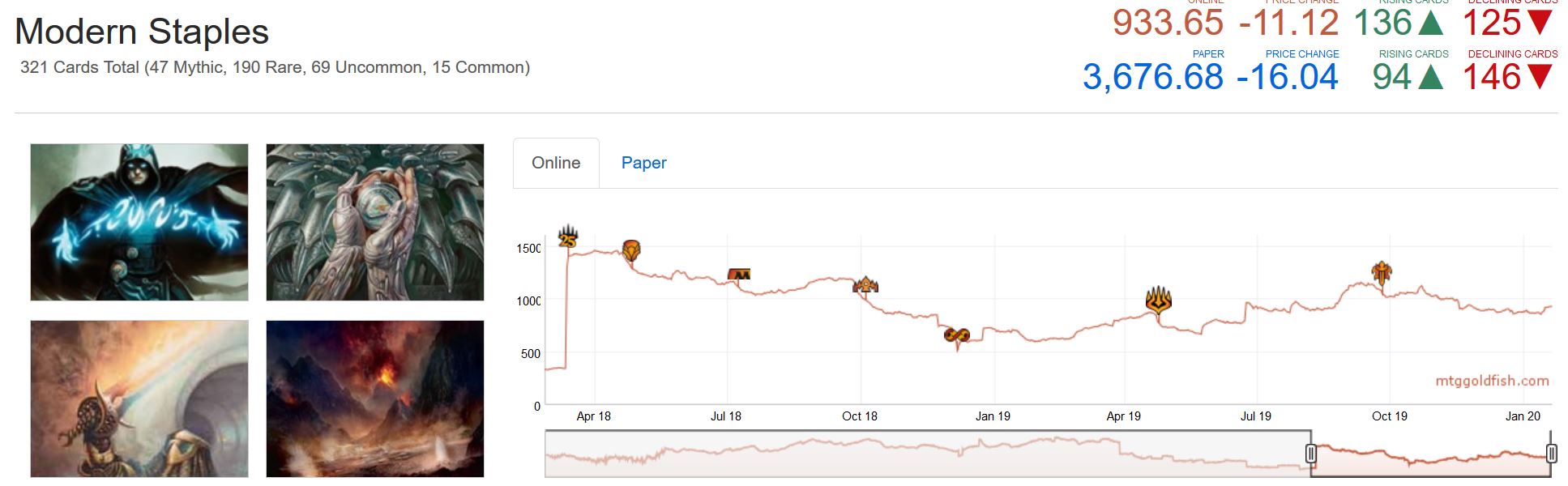
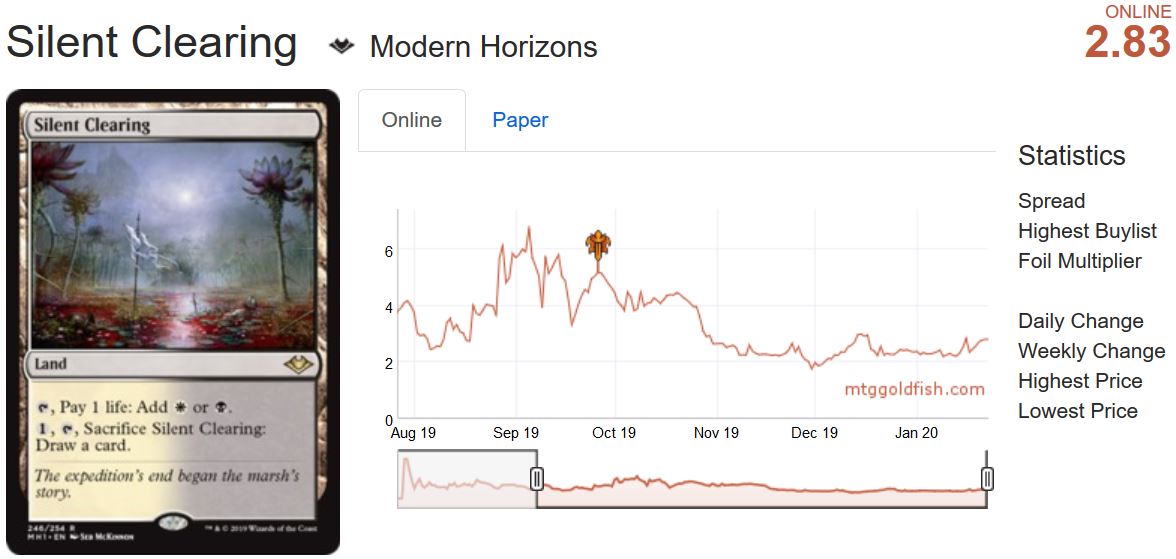
As you can see, Modern has been recovering for quite a while now. Like all of Magic Online, prices in Modern took a dive with the release of the Open Beta of Magic Arena, and then as panic waned and players came back to Magic Online, prices have been recovering ever since.

What many might not know is that Magic Online finance is often cyclical, with Standard more popular in the fall and winter months and Modern more popular in the spring and summer months. The price index of Modern staples peaked in September at around $1,150 and dipped to $869 after the release of Throne of Eldraine. The calendar is starting to swing back and, as one would expect, Modern prices are beginning to climb again. The much-needed bans probably helped spur interest too!

So, now is a good time to invest into Modern. Players should consider buying the staples they want to play with, and investors should look to put in the capital now and sell in three to six months.

I. Modern Horizons

In the fall, I counseled against investing into Modern Horizons because we were told that cards from the set would begin to be included in treasure chests after the release of Eldraine. Only three cards from the set ended up being included, and only at low frequencies. Consequently, the set's overall value has trended upward in recent months, and we can expect that trend to continue. Below are some of the cards I expect to go up in value over the next several months.

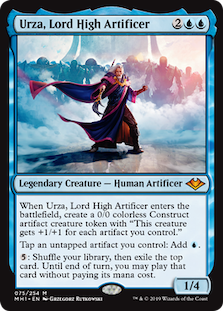
1. Urza, Lord High Artificer
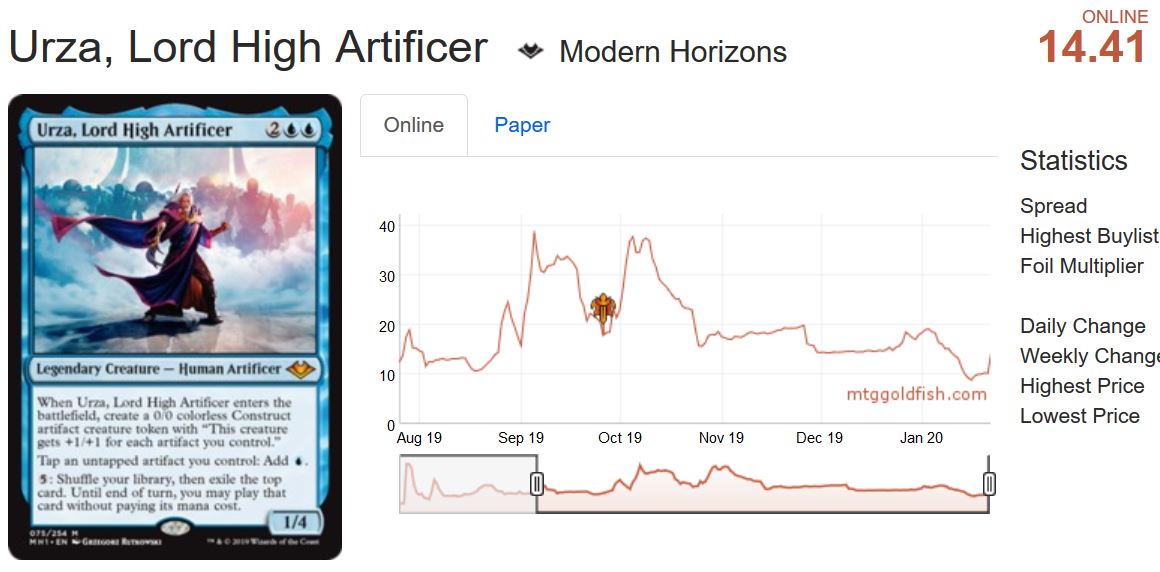
Wizards has made clear, for better or for worse, that it is willing to sacrifice busted format staples from Magic's past at the altar of new sets, especially new premium sets like Modern Horizons. Urza's value got cut in half when Mox Opal was banned, and undoubtedly it will take some time for players to create a new shell around him. As a mythic from a set with small supply, it won't take much for Urza to climb to $20, with as much as $30 to $35 possible. I like, too, that the floor on Urza is high (around $7 I'd say) due to Legacy and Commander demand.

EDIT: When composing this article, Urza was $9, and it has now spiked to $14. I still think it is a good (but no longer amazing) spec at $14. The card is just too powerful to not feature prominently in a top tier deck in Modern.

2. Waterlogged Grove & Silent Clearing
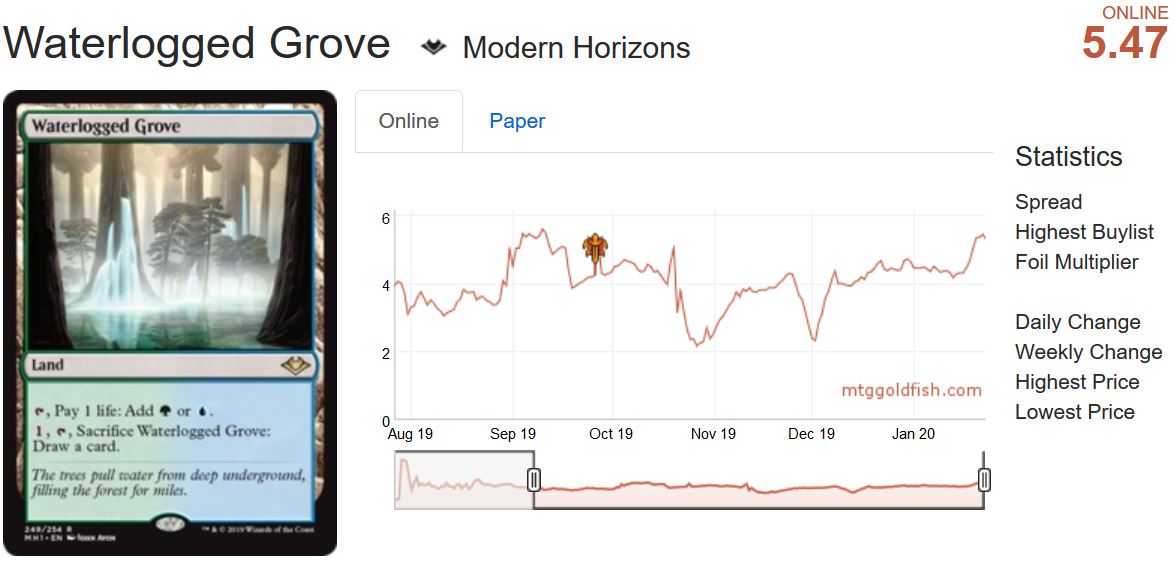
Sunbaked Canyon has climbed to $14. Nurturing Peatland and Fiery Islet have climbed to $10. Yet Waterlogged Grove and Silent Clearing are still stuck at $5.50 and $2.75 respectively. These lands are just too useful to not see more play, and undoubtedly will go up in value as more and more players turn their attention to Modern. Don't expect to triple your money on these, but I'd wager that they will both be 50% higher at some point during the spring or summer.

3. Hexdrinker
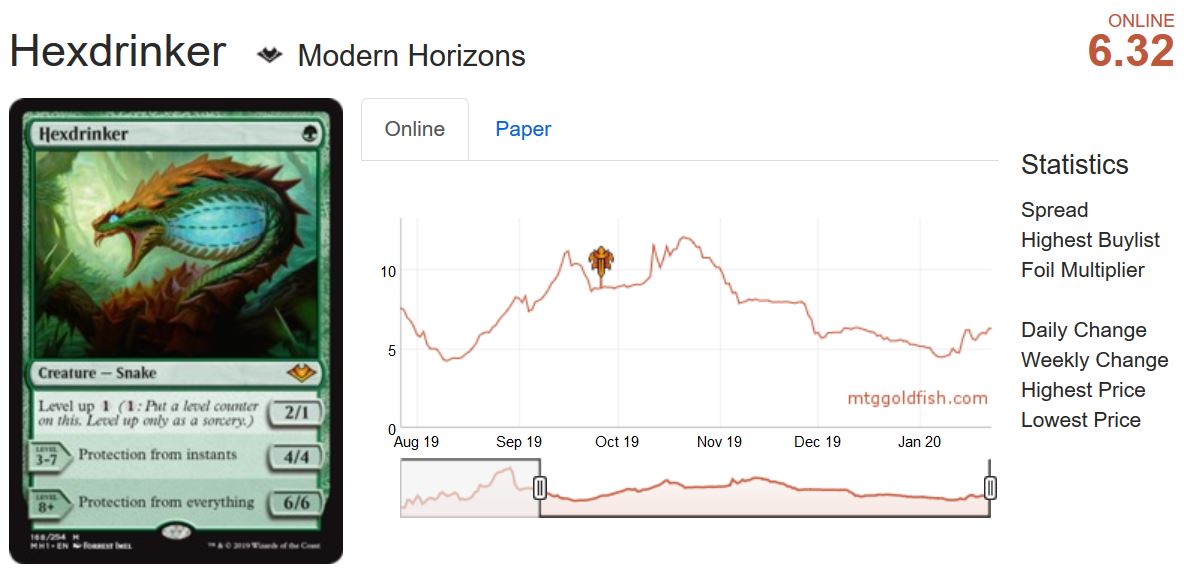
I considered discussing a few other cards in this slot, but as a powerful mythic that fits into a prominent archetype and can slot into several others, Hexdrinker gets the nod. I like that it is a relatively cheap buy, and as a mythic it has a high price ceiling. It saw a sizeable amount of play until Urza and Oko took the format over by storm. Now that the format has been reset by bannings, we should expect Hexdrinker to find more homes than it had in November and December.

For players, I would feel safe buying playsets of most Modern Horizons cards. The only card I might feel a bit queasy about is Wrenn and Six, mainly because it has nothing back to fall on outside of Modern playability and because it is so expensive. With that said, if you'd prefer to own it rather than rent it, it isn't in the treasure chests so there will be no external downward pressure exerted on it.

II. A Brand New Format!

1. Past in Flames
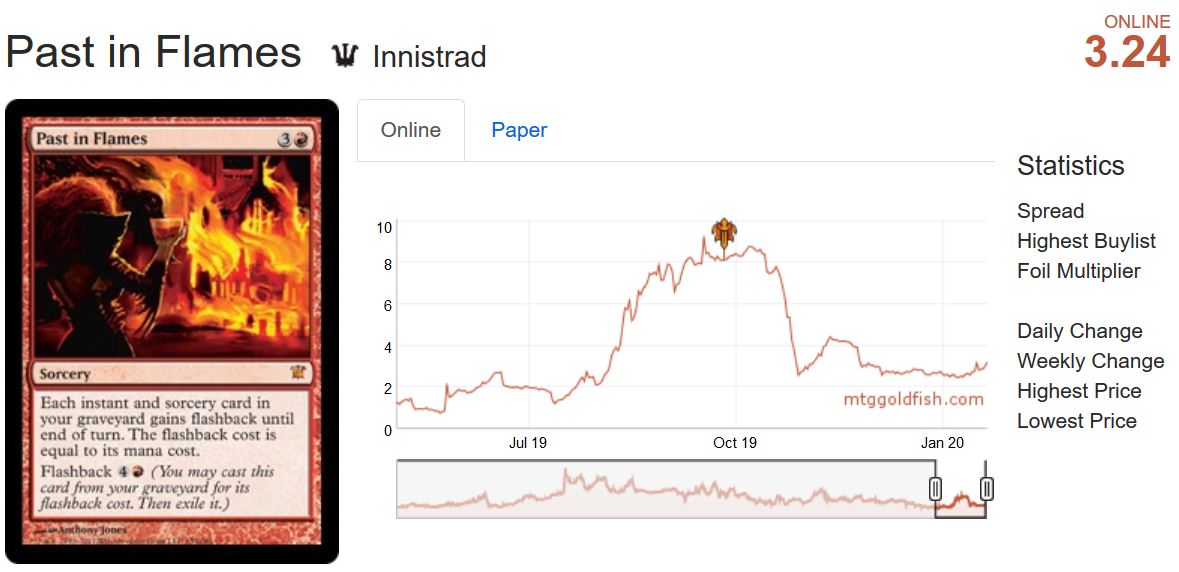
One of the best parts about overpowered metagame-hogging decks getting banned is that it frees up room in the meta for other decks to enter the top tier of competitive play again. Gifts Storm has already shown signs of life in tournament results this week, and that success has begun to be reflected in the price of Gifts staples, as Gifts Ungiven, Past in Flames, Remand, and Aryia of Flame have all increased in price.

While I got in at the absolute floor of $2.50, there's no shame at getting in at a low price of $3.25. As long as Modern is balanced with a healthy meta that ebbs and flows, there's no reason why Past in Flames won't reach $6 again. The other aforementioned pieces of this deck are also worth considering if you wish to diversify or focus on cheaper cards.

2. Aether Vial
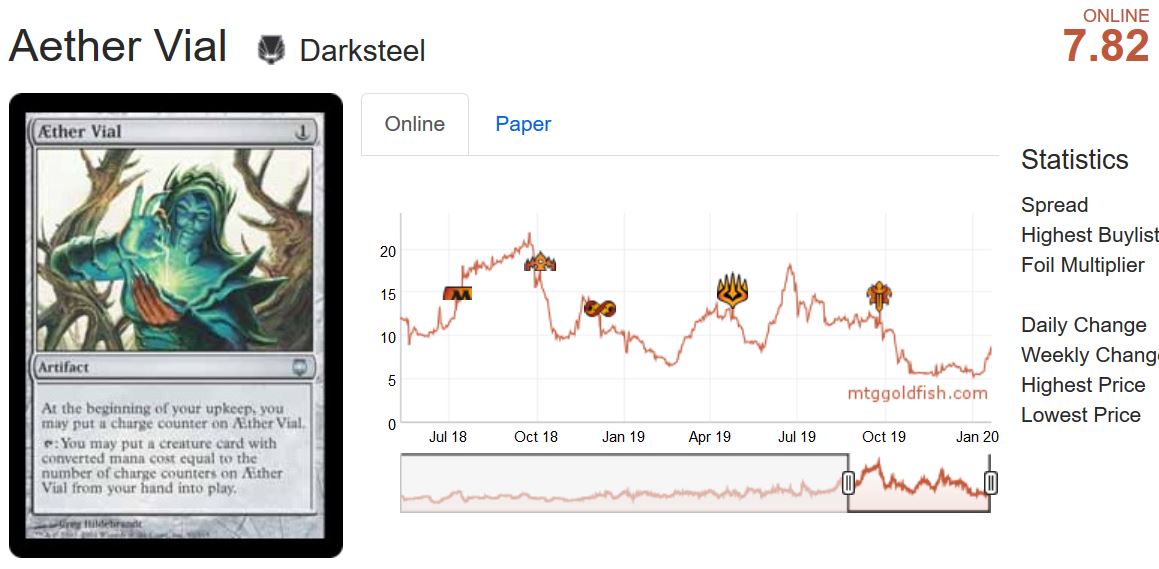
Aether Vial is one of Modern's hallmark cards and one of several that separate Modern from Pioneer. Aether Vial stands to benefit from the ban of Mox Opal and Oko as decks like Humans can reemerge.  Aether Vial is an attractive speculation as well because it has a history of reaching a ceiling during Modern season more than double the current price. For those scared that Pioneer will destroy Modern, that Aether Vial is starting to climb again should reassure you that Modern is still a format that players want to play.

In general, while the staples in Amulet Titan variants have spiked already, cards from other decks are still acquirable at prices that will likely go up. It is better to buy into Modern now than to wait until March or April to do so.

3. Light up the Stage
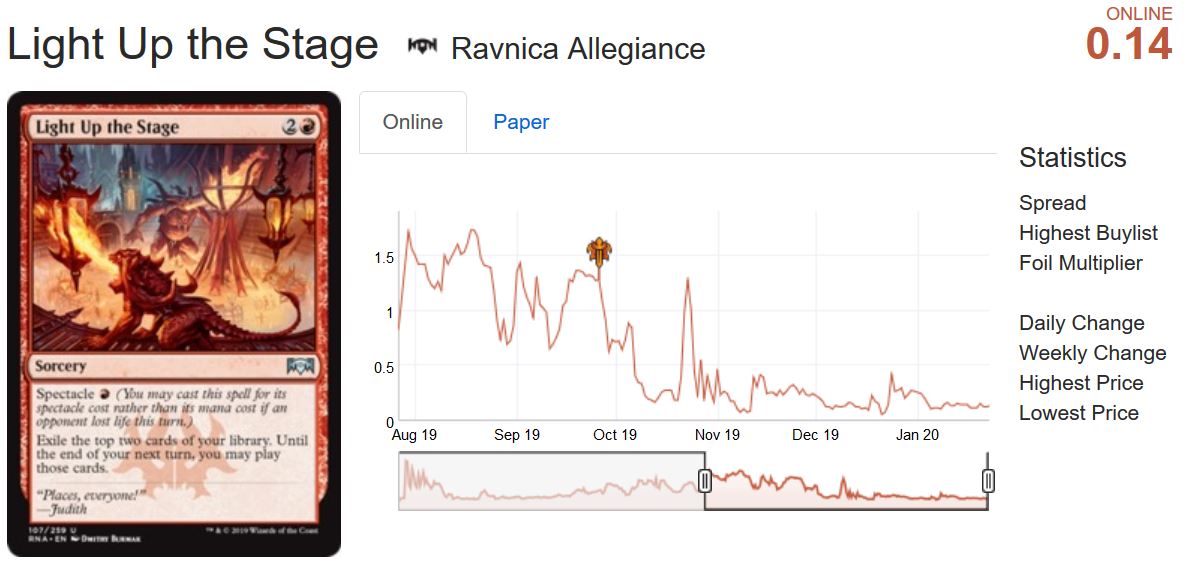
Investing into Modern is not just for those with a lot of capital! There are some cheap attractive options as well. As Red's most premium pure card draw spell, Light up the Stage is widely used in Pioneer and Modern. It's also sitting at $0.14, practically an all-time low. There are a lot out there, but fewer than you think since Ravnica Allegiances was not drafted much on MTGO. This feels like a $0.50 card to me even if it never sees Standard play, and I think it could spike higher. But at the very least, if you enjoy playing aggressive Red decks, now is a good time to pick up this staple.

IV. Signing Off

I've received a few questions about whether it is better to invest or speculate on certain days of the week. To date, I've not noticed card prices being higher or lower on the weekend contra during the week. At the very least I can say that demand is relatively stable, and I think it prudent to focus on other things when making buying and selling decisions. For formats as fluid as Pioneer and Modern, it could be prudent to study which cards broke out or over-performed on a given weekend (like Niv Mizzet, Reborn did recently).

Thanks for reading! As always, please leave your questions and comments either here or on Discord. Next week I'll be back with my Financial Power Rankings for the Theros Beyond Death mythics, so stay tuned for that!

 

Beyond First Impressions: Theros Review

Are you a Quiet Speculation member?

If not, now is a perfect time to join up! Our powerful tools, breaking-news analysis, and exclusive Discord channel will make sure you stay up to date and ahead of the curve.

With the Prerelease out of the way the actual work of exploring Theros: Beyond Death has begun. As Jordan previously noted, there are a number of interesting role players in Theros. However, there don't appear to be any unequivocal home runs. Considering how 2019 went, that's a very nice change; I'd like a chance to finally catch my breath in the wake of Hogaak, Arisen Necropolis and Oko, Thief of Crowns.

With that in mind, I've already looked at some standout cards, and couldn't find one that didn't have massive setbacks regarding Modern playability. That spirit continues this week, as I examine some more cards that have Modern potential, but may end up not actually being worth the effort. Based on what I've seen from my own efforts and those of others, Theros isn't a block that will unequivocally shake up Modern, but it should disrupt some stagnant decks. And that's more than good enough for me.

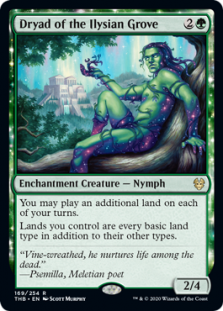
Dryad of the Ilysian Grove

Dryad of the Ilysian Grove is Prismatic Omen mixed with Exploration, given legs and with better stats than (but for the same price as) Azusa, Lost but Seeking. A lot of the chatter I've seen on the card has been for Pioneer, where despite multiple bannings, Mono-Green Devotion remains a top deck. We have Mono-Green Devotion in Modern too, but Leyline of Abundance is still legal here, so it's not interested in a 2/4 enchantment creature.

I initially saw a few players talking about Dryad as an answer to Blood Moon. But just like with Omen, Dryad and Moon operate on the same layer, so timestamps determine which effect applies. Thus, a Dryad cast after Moon unlocks mana, but cannot preempt the enchantment. And again, Modern already has Prismatic Omen for this purpose.

Even if Dryad did play well against Blood Moon, it wouldn't be played for that purpose. Amulet Titan runs Azusa, and Dryad being more robust makes it appear more attractive. However, Azusa gives two land drops to Dryad's one, and in Amulet that's all that matters. Amulet doesn't care about land types, so Dryad's second ability is superfluous. The deck that actually wants Dryad must not only want additional land drops but care about basic land types.

Dryad Struggles to Belong

Both conditions apply to Valakut. Some pilots were already running Prismatic Omen to make Scapeshift kills faster, so Dryad's chances look good up front; with Omen out, a Scapeshift for six is all that's needed for 18 damage, compared to the seven lands normally required. Ramp spells and additional land drops are functionally the same, and with 28 lands on average, Valakut should theoretically be able to make good use of Dryad.

Unfortunately, Dryad sits in an odd place on Valakut's curve. The deck's usual line is turn one suspending Search for Tomorrow, turn two ramping with Farseek or Sakura-Tribe Elder, hitting five mana on turn three, and dropping Primeval Titan turn four; the Scapeshift kill requires Omen on turn three to kill on turn four. Dryad doesn't much alter either line. Valakut also empties its hand quickly, so the extra land drop will lose impact if not exactly on-curve. And Dryad doesn't find more land or Valakut, making it questionable whether it's better than Omen.

Still, several actual Valakut players I know lost their minds over Dryad, and their investigation is at least suggestive.

Dryad Valakut, Test Deck

Creatures

4 Sakura-Tribe Elder
4 Dryad of the Ilysian Grove
4 Primeval Titan

Instants

4 Veil of Summer

Sorceries

4 Farseek
2 Explore
4 Search for Tomorrow
4 Scapeshift
2 Hour of Promise

Lands

4 Wooded Foothills
4 Valakut, the Molten Pinnacle
4 Stomping Ground
3 Snow-Covered Mountain
3 Mountain
2 Cinder Glade
2 Forest
1 Snow-Covered Forest
1 Sheltered Thicket
1 Castle Garenburg
1 Field of the Dead
1 Verdant Catacombs
1 Windswept Heath

Their idea is to treat Dryad as a combination ramp spell and Omen, which frees up some slots now used for Veil of Summer. This configuration is closer to pure combo than to a ramp deck with a combo kill. They've had some success in testing, but part of that is due to other decks still adjusting to the bans.

Valakut's Odd Child

As far as can be determined so far, Dryad is a fine card, but not exceptional in Valakut. Because of how the deck curves out, the kill speed over Omen hasn't noticeably changed. Valakut doesn't have card draw, so Dryad only actually grants one extra land drop before Valakut runs out of cards in hand (maybe two). In terms of actually going off, Dryad is a wash.

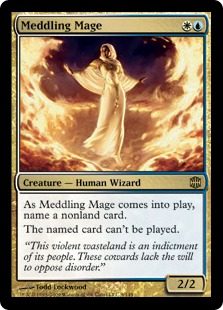
However, Dryad is having an unexpected positive impact on the Humans matchup, and to some extent against midrange thanks simply to being an affordable 2/4. Dryad is a solid wall against Humans that nets some value when resolved. Humans can very narrowly goldfish Valakut since its kill speed is similar, so a persistent road block significantly alters the race. Meddling Mage can still be backbreaking, especially for this Bolt-less version, which means the sideboard is geared against Humans. Against UW decks, Dryad attacks planeswalkers and frequently slips through Jund's discard to put some pressure down or absorb an edict effect to protect Titan.
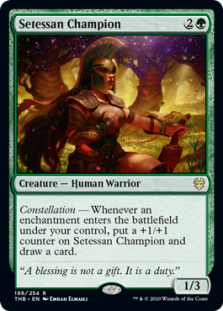
I don't think that Dryad will find a home in Valakut based solely on its text box. If pilot want an Omen effect, Dryad can be played in that slot with little effort or change to the gameplan. However, given a need for an actual creature to deal or absorb damage, Dryad is far better than Azusa.

Setessan Champion

In terms of potential archetype churn, there may be no deck more affected by Theros than Bogles. After all, the set's about auras, and Bogles is an aura deck. However, that didn't happen last time we visited Theros. Bogles is a very stagnant deck, and has been throughout Modern's history. Once Wizards realized that hexproof is broken compared to shroud, they stopped printing cheap hexproof creatures, and no aura has approached Ethereal Armor or the Umbra enchantments in power. The most dramatic change I've ever seen the deck make is moving Leyline of Sanctity to the maindeck.

But Setessan Champion may deeply impact the archetype: it doesn't challenge any of the actual one-drop threats, but rather Kor Spiritdancer. Spiritdancer is the card that Bogles likes to cast but never actually enchant. Lacking hexproof, it's actually vulnerable to removal. The only times I've seen it enchanted is when Bogles has no Bogles, or when it's up against combo and needs to accelerate the kill. Spiritdancer is played because it draws cards as a cast trigger; Bogles usually has to mulligan aggressively to find a threat and some good auras, so that card advantage is essential.
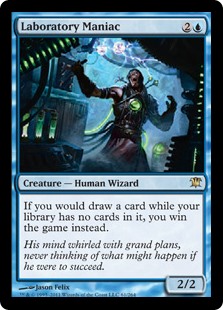
Champion has some drawbacks compared with Spiritdancer: a higher mana cost and the card draw effect being an enters rather than a cast trigger. Counterspells become stronger and the deck slightly clunkier as a result. However, Champion offers some compensating factors; primarily, it actually does something when not enchanted. Spiritdancer is 0/2 while Champion is 1/3, a stat upgrade substantial in that the Warrior can plausibly attack and block. And unlike Spiritdancer, Champion grows just by playing auras. Bogles can keep loading up its hexproof creatures and still grow Champion. +1/+1 counters will also survive if all the auras get destroyed, leaving behind a real gameplan should Engineered Explosives go off.

Restored to... Glory?

I think that Champion is close enough to Spiritdancer that it's worth reexamining Bogles, especially in light of Theros also bringing Staggering Insight to the table. Bogles asks a lot of its current two-mana enchantments and tries to ride its GW manabase for all its worth, but I've seen Keen Sense in Bogles before. Adding lifelink and +1/+1 is enough of an upgrade to include it, especially in a churning Modern where Burn will be prominent.

Bant Bogles, Test Deck

Creatures

4 Slippery Bogle
4 Gladecover Scout
4 Setessan Champion

Enchantments

4 Ethereal Armor
4 Spider Umbra
4 Rancor
2 Gryff's Boon
2 Hyena Umbra
2 Spirit Mantle
2 Staggering Insight
4 Daybreak Coronet
4 Leyline of Sanctity

Lands

1 Dryad Arbor
3 Horizon Canopy
3 Waterlogged Grove
3 Misty Rainforest
3 Windswept Heath
3 Temple Garden
2 Breeding Pool
2 Hallowed Fountain

The mana is still very reliable, and adding blue grants more sideboard options. I haven't noticed much actual impact on matchups during testing, but that may be because I'm sticking close the classic formula. I've seen some Bogles decks online that are barely recognizable. In any case, I haven't felt any negative impact from adding Theros cards and blue, so I'm going to keep working on the deck.

Thassa's Oracle

On the surface, Oracle isn't so flashy; manipulating the top of the library without drawing a card is only playable occasionally in combo decks or when repeatable. But of all the Theros cards I've examined, Thassa's Oracle has the most clear home.

The second part of Oracle's text turns it into a win condition, albeit a tough one to trigger. Assuming, of course, that the condition is being met the "correct way," with lots of blue permanents in play. It's much easier to just Oracle with an empty library. And there happens to already be a deck in Modern that does exactly that.

Ad Nauseam, Test Deck

Creatures

1 Thassa's Oracle
4 Simian Spirit Guide

Artifacts

4 Lotus Bloom
4 Pentad Prism

Enchantments

4 Phyrexian Unlife

Instants

4 Angel's Grace
4 Spoils of the Vault
1 Lightning Storm
4 Ad Nauseam
4 Pact of Negation

Sorceries

4 Serum Visions
2 Sleight of Hand

Lands

4 City of Brass
4 Darkslick Shores
3 Temple of Enlightenment
3 Temple of Deceit
2 Seachrome Coast
2 Gemstone Mine
1 Island
1 Plains

Ad Nauseam decks have traditionally run Laboratory Maniac as an alternative to Lightning Storm, though some have recently opted for Jace, Wielder of Mysteries. In either case, since Ad Nauseam draws its entire deck, playing Maniac and Serum Visions or using Jace's +1 won the game. While a decent way around Leyline of Sanctity, these options cost a minimum of four mana on the combo turn. Oracle does the same job, only requires one card, and is two mana. Thus, Oracle is a straight upgrade and replacement for the previous options.

An Answer with More Questions

A singleton upgrade for a fairly niche deck might not be enough to warrant much discussion. But the more general application of a self-contained Laboratory Maniac is.

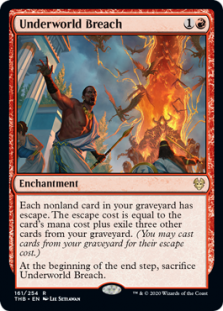
At the beginning of spoiler season, it looked like Underworld Breach would the Modern card. Breach, Grinding Station, and any 0-CMC artifact mills the entire library. Escaping Mox Opal repeatedly generated mana, building into either Grapeshot or Banefire on turn three. Of course, Opal was banned immediately thereafter, making that deck dead-on-arrival.

However, the combo still mills a whole library. And it costs less than Ad Nauseam, even if it is spread out over two cards. As Dredge has repeatedly shown, milling an entire library is very powerful. I have been trying to find a use for the combo, and Thassa's Oracle is the obvious win condition. As a bonus it can also scry towards missing pieces and block if necessary. Just make sure to have one in hand before comboing off. The main problem has been that to get everything together consistently and quickly I've been building decks that are effectively more elaborate versions of traditional Ad Nauseam. And more elaborate combos is not where a combo deck wants to be. I think this is solvable by thinking more outside the box with card choices, so it's worth pursuing.
The potentially fatal problem for the deck is the combo itself. This is an all or nothing combo with a very narrow usage. All the milled cards have to be exiled to keep the loop going, so typical graveyard shenanigans don't work. Firing off a full set of Creeping Chills sounds good, but if triggered then they can't be exiled to pay for escape. Same with creatures like Narcomoeba. To get value from milling my deck, I need to stock the graveyard with fodder first, which defeats the point of the combo. It doesn't generate any mana either, so there's no way to combo off except with Oracle. Ad Nauseum technically does, because it finds Simian Spirit Guide. The combo is built to exile the library, and does so efficiently, but it can't do anything else.

But What Does it Mean?

Everything I've found so far has been more intriguing than obviously good, and none of it has clearly won a place in Modern. However, I can't dismiss these cards, either. It's like there are pieces that I can't quite grasp when solving this puzzle. I intend to keep working on the solutions, but if you've had any success, please share in the comments.

QS Insider Cast – Theros: Beyond Death, Modern Bannings, and More!

Are you a Quiet Speculation member?

If not, now is a perfect time to join up! Our powerful tools, breaking-news analysis, and exclusive Discord channel will make sure you stay up to date and ahead of the curve.

Welcome back to the QS Cast! Chris O’Berry and Sam Lowe discuss Theros: Beyond Death, recent Modern Bannings, Promo Pack reprints, and the Pioneer road ahead. This cast was originally broadcasted live to Insiders in the QS Insider Discord, January 20th, 2020.

Show Notes

- Legacy is awesome, but not very relevant right now.
- Pioneer is the way forward. Ride the wave.
- What did we get right during spoiler season?
- Modern Bannings - initial impressions and the road ahead
- PTQ Promos: Cryptic Command, Surgical Extraction, Aether Vial
- Promo pack reprints, shocklands galore
- Questions, Pioneer Discussion, and Desperate Ravings
- Welcome to 2020!

Wanna chat? Find us on Twitter or in the QS Discord

Chroberry – @chroberry
Chris Martin – @ChiStyleGaming
Sam Lowe – @MahouManSam

How to Reduce Risk of Receiving Counterfeits

Are you a Quiet Speculation member?

If not, now is a perfect time to join up! Our powerful tools, breaking-news analysis, and exclusive Discord channel will make sure you stay up to date and ahead of the curve.

Safety is central to much of what we do at work. The mantra, “Nothing we do is worth getting hurt” comes to mind. Because of this focus, many lines of defense are implemented to avoid injury. People will wear protective equipment such as safety glasses and steel-toed boots. There are safety trainings in place to remind people of safe operating procedures.

The first line of defense, however, is to develop a process where these safety procedures and protective equipment aren’t needed at all. This can be done by engineering the risk out of the system altogether.

In a way, this parallels with counterfeits in Magic. There are many resources out there to help you identify fakes. David Schumann wrote about this back in 2014, and Apathy House contains some of the fundamentals of fake spotting. While these resources will always be highly valuable (fakes can never be avoided completely), we can still implement some buying strategies to help us reduce the risk of receiving a fake in the first place.

With social media touching on counterfeit cards more often lately—and as people may be planning larger Magic purchases with tax returns—I wanted to share my strategy for avoiding counterfeit cards. While not foolproof, I have never received a fake when purchasing a Magic card. I hope to keep that streak going for years to come.

Avoiding Fakes on eBay

I wish I could say that counterfeit Magic cards could only be obtained from sellers overseas. Many are produced overseas, so this is a reasonable assumption. Unfortunately, it’s incorrect.

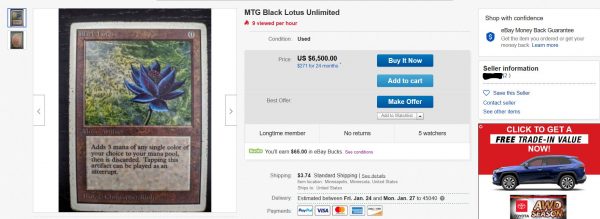
If you want to shop around for fake Magic cards, there are always some to be found on eBay. This morning I googled “MTG Black Lotus” and the second listing down appears highly questionable.

At first glance, I didn’t like the coloring on this lotus. It almost seems too bright. The card may look like it has been shuffled in play for 27 years, but I suspect otherwise. But the biggest red flag for me is under “Seller Information”. I blacked out the name, but I left behind the only thing you need to see: the seller’s feedback rating. This seller hasn’t done an eBay transaction in over a year, has just two feedback, and is now deciding out of the blue to sell Magic’s most coveted card?

This is exactly the kind of listing I avoid at all costs to minimize odds of receiving a fake. The only time I’ll purchase high-end cards from eBay is if a major vendor is selling it. I stick with the PWCC auctions, Kid Icarus, Card Kingdom, and ABUGames as my favorite eBay sellers. Other safe eBay sellers include MTG Seattle, Strike Zone, and Power 9 (Dan Bock). In general, any eBay seller with 10,000’s or 100,000’s of feedback is probably safe.

Imposter Sellers on eBay

I wish I could tell you that all you have to do is stick to this set list of eBay sellers and you’re guaranteed to dodge fakes. Unfortunately, that’s not the case. While sticking to the major sellers will drastically reduce your chance of receiving a fake, there’s still another layer of complexity that needs to be navigated.

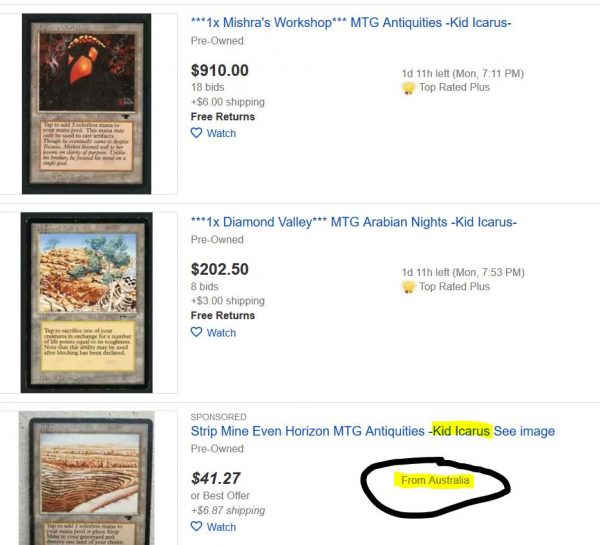
When shopping from these sellers on eBay, you still need to be very careful. You see, many of these sellers place their store name in their listings, making them easy to find and identify. But imposters have caught on. Kid Icarus is a top-rated seller, so all his listings contain the “Top Rated Plus” Ribbon. That is one thing an imposter can’t fake, but they still use the Kid Icarus name to deceive buyers:

These three listings all contain “Kid Icarus” in the name. But one is not like the others—that last listing is an imposter. The “From Australia” is a dead giveaway.

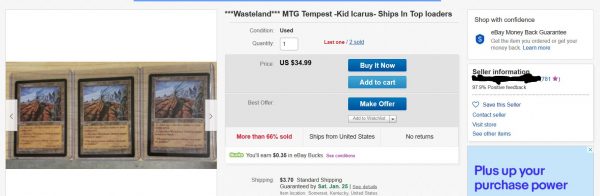
Imposters aren’t only international, too. Check out this listing from Kentucky:

This seller at least has 781 feedback, so these Wastelands are probably real. But check out that feedback score: 97.9%. That’s dismal in the world of eBay, especially when you have hundreds of transactions to your name. Kid Icarus, this is not. Don’t be fooled by these imposters—always check the seller information before making a purchase.

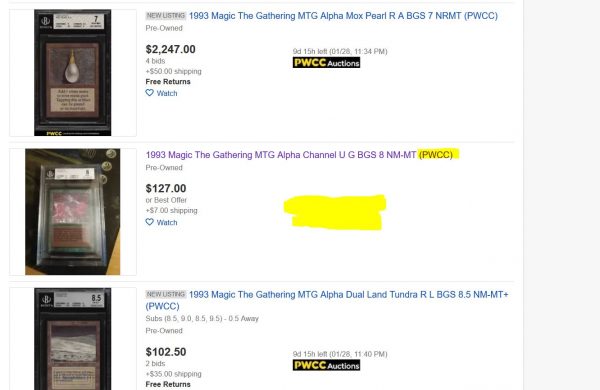
Another seller with imposters is PWCC:

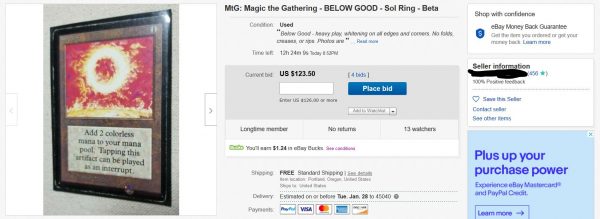
Then there’s the subtle Card Kingdom imposter. Card Kingdom only sells “Below Good” cards on eBay. You can watch for their new listings by saving “MTG Below Good” because that shows up in any of their eBay listings. Unfortunately, others have caught on to this trend—while they’re not stealing Card Kingdom’s name directly, one could be deceived by this subtle (maybe unintentional?) impersonation.

You may bid on this auction thinking you’re getting a card from Card Kingdom, one of the most trusted Magic sellers on the net. Instead, you’d be getting a copy from a small shop in Portland, Oregon. Does this Portland shop have the same staff and expertise to confirm cards are not counterfeit? Doubtful. This card may be 100% legitimate (judging by this seller’s feedback rating, it probably is) but this is the kind of listing I eschew in favor of a more reliable seller.

Reapplying to Other Platforms

It’s difficult to perform the same blatant impersonation when selling on TCGPlayer. Unless you upload pictures, there’s no open field where one can pretend to be a seller they are not. All sellers’ feedback ratings are more prevalently visible too—there’s no chance of purchasing from a Channel Fireball imposter.

That said, there are still large sellers with 10,000+ feedback and smaller sellers with under 10 feedback. Which would you rather buy your Dual Lands from? It’s possible all these sellers with low feedback are selling nothing but genuine cards. But when spending $100’s or $1000’s, is it worth the risk?

For example, check out the listings for Revised Underground Sea:

There are a couple hundred copies for sale from over 100 sellers. As is often the case, the new seller lists at a slightly lower price point to try and build up feedback. But would you want a $300 purchase to be this seller’s first sale? Without any feedback, it’s impossible to buy with confidence. TCGPlayer will protect you the buyer from counterfeits, of course, but is that a hassle you’re willing to endure to save 3%? If I were shopping for this card, I’d be more inclined to grab those two MP copies—they’re just $9 more and are sold by stores with 1,000+ and 25,000+ feedback.

This isn’t a blanket statement to knock new sellers. Everyone has to start somewhere. I’m merely cautioning you the buyer when shopping for high-end cards on popular platforms. The newly launched seller may be 100% legitimate—I’m not saying otherwise. All I’m insisting is that sellers with less feedback are, by definition, less vetted by the community for their customer service, card quality, and ability to spot fakes.

Peer-to-Peer Buying

TCGPlayer and eBay have customer service teams to protect buyers from counterfeits. If you receive a card you suspect is fake and the seller isn’t cooperating, you can contact their support staff for help.

When buying cards peer to peer through social media like Facebook, Twitter, and Discord, this becomes much trickier. Your recourse could involve much more effort. Or in the worst case, you may have no recourse other than involving the police (talk about a hassle!).

Therefore, one needs to be more cautious when dealing in peer-to-peer transactions. To minimize risk of receiving counterfeits, I have three tips:

  • When buying high-end cards, stick to trusted sellers.
  • Never be too shy to ask a seller for references. Then, make sure to vet at least a couple of the references if there’s still doubt.
  • If a deal smells fishy, there’s no obligation to complete the transaction. A few times in the past I’ve talked with a seller from MOTL or Facebook and I got an odd feeling that the seller was almost too eager to complete the transaction. I decided to play it safe and passed on the deal. It’s just not worth the risk.
  • If any doubt remains whatsoever, pay via PayPal Goods & Services and eat the fee.

None of these tips are breakthrough or eye-opening. But they’re all really important when trying to avoid counterfeit sellers online.

Wrapping It Up

None of the advice in this article can guarantee a card’s authenticity. Any time you purchase a high dollar card, you should scrutinize it closely. I’m sure even major sellers make mistakes once in a while; nobody is perfect.

Instead, this article is geared more towards risk reduction. It really comes down to playing the odds—there are certainly deals to be had out there when buying from new, inexperienced sellers. But you have to ask yourself if it’s worth the risk. Saving 3% may seem inconsequential if it means a higher risk of receiving a counterfeit.

There was an error retrieving a chart for Underground Sea

Even some experienced sellers should be scrutinized closely—these are the imposters on eBay posing as other large vendors. They may still be selling legitimate cards, but I don’t like how they’re using deceptive listing titles. It leaves a sour taste in my mouth, and I won’t support such action with my dollars.

I’m sure there are other safe avenues to purchase genuine cards. It’s not like the market for Power is controlled completely by Card Kingdom and ABUGames. Plenty of individuals have these cards for sale as well. In these cases, it’s best to vet sellers as much as possible by asking for references and cross-checking with said references. Usually, if the seller is a bad apple, this becomes apparent somewhat quickly. And as always, if there is any doubt, you are not obligated to complete the transaction.

By following these principles, I have avoided every receiving a counterfeit card. It could be that I’m still very lucky. But I believe that my strategy removes some of the counterfeit risk that’s out there, even though I may have to pay a couple percent more for my cards. This is a price I’m willing to pay to ensure I am receiving genuine cards.

…

Sigbits

  • Revised Dual Lands are all over Card Kingdom’s hotlist this week. Included are Tropical Island ($220), Badlands ($145), Scrubland ($110), and Plateau ($75). Their numbers aren’t the most compelling, but if you’re trying to liquidate some Duals I’d keep an eye on these numbers…they tend to fluctuate a good deal and you may catch a decent sell price.
  • There’s a Reserved List card I almost never discuss on Card Kingdom’s hotlist: Survival of the Fittest. Their current buy price is $60, and I’m not sure what is driving demand for this card. It’s banned in Legacy, underwhelming in Vintage, and too old for other formats. It must be 100% Commander demand catalyzing the higher price tag.
  • Just about every printing of Vampiric Tutor is on Card Kingdom’s hotlist this week. Eternal Masters copies are posted at $53, Visions at $47, Sixth Edition at $48, and Judge Promos at $52. I assume this card is extremely liquid to be ever-present on Card Kingdom’s hotlist in so many printings.


Fool Me Once: Introducing GR Eldrazi Stompy

Are you a Quiet Speculation member?

If not, now is a perfect time to join up! Our powerful tools, breaking-news analysis, and exclusive Discord channel will make sure you stay up to date and ahead of the curve.

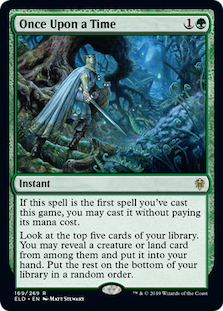
Just when I figure out an Oko shell I like, Wizards drops the hammer on the card I'd built around! Not that I think Oko was particularly balanced in Modern; I did endorse the walker as my candidate of choice as face of the 2020 metagame, after all. Fortunately for me, plenty more Modern game-changers have been released in recent months, and it didn't take long to occupy myself with a different idea: integrating Once Upon a Time into Colorless Eldrazi Stompy. Today, we'll see where that experiment has led the deck and weigh the benefits of different color splashes.

For starters, the deck:

GR Eldrazi Stompy, Jordan Boisvert

Creatures

4 Eldrazi Mimic
4 Eternal Scourge
4 Thought-Knot Seer
4 Reality Smasher
2 Endless One
4 Simian Spirit Guide

Artifacts

4 Serum Powder
4 Chalice of the Void
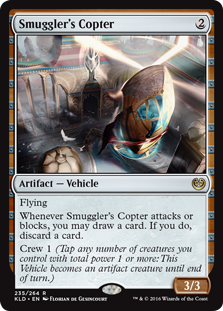
2 Smuggler's Copter

Instants

4 Once Upon a Time
4 Dismember

Lands

4 Eldrazi Temple
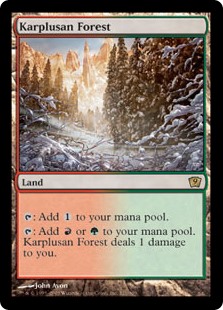
4 Karplusan Forest
2 Gemstone Caverns
2 Ghost Quarter
2 Blast Zone
2 Mutavault
2 Blinkmoth Nexus
1 Wastes
1 Forest

Sideboard

4 Relic of Progenitus
1 Surgical Extraction
4 Abrade
1 Gut Shot
2 Ratchet Bomb
2 Damping Sphere
1 Sorcerous Spyglass

Thanks to my experiments with Gx Eldrazi shells and continued testing of Once Upon a Time alongside Serum Powder since coming across Once a Powder Tron in a 5-0 dump, I've become a believer in what the controversial cantrip does for the cannoli carnivores.

Landing on Both Feet

A critical area of focus in redesigning the deck was the manabase. I considered Hashep Oasis as a green source that also produced colorless, but the upside of its activated ability seemed incredibly marginal; barring a lucky Gemstone Caverns or being Path to Exiled, I'd have to draw and play a whopping three copies before even thinking about paying four mana for a sorcery-speed Giant Growth. So I turned to the painlands, which at four copies grant us a second color splash more or less free of charge.

No Pain, No Gain

The go-to in that case was Karplusan Forest. There weren't really any colored cards besides Once I was interested in running main, but Karplusan nonetheless taps for Simian Spirit Guide, giving the creature a significant utility boost throughout the game. Red is also among the deck's most useful splashes, and I've lamented not having access to red sideboard cards in the past.

Naturally, running a full set of painlands hurts our action-packed manabase, which draws its strength from how much the lands themselves do for us when cards start to run dry. In theory, the early-game boost and actual card filtering from Once, increased relevance of mid-game Guides, and actual land filtering of Once itself should help on this front, covering for the card they directly replace: Zhalfirin Void. But I'd be hesitant to add too many color sources for fear of further watering down our land effects.

Less Is More

I also trimmed a Wastes for a Forest, which turns on cantrips stranded in hand if opponents Path or Quarter us, and trimmed the land count to just 20, as we function fine with just a couple in the opener and lack mana-sinks late-game. Specifically, the cuts were a Ghost Quarter (as we pressure big mana decks like Tron and Amulet more reliably) and Blast Zone (which we lack the mana to support at three copies).

Ghetty Green

The main reason for splashing at all is Once Upon a Time. Between this cantrip and Serum Powder, Eldrazi Stompy gains an unmatched capability to execute its Plan A, bringing the deck even closer to its Eye of Ugin-fueled prime.
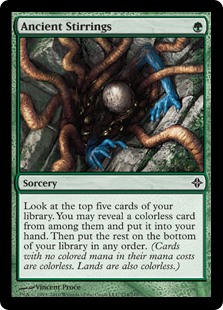
While the potpourri of Once a Powder Tron eschewed Simian Spirit Guide in favor of Urza land enabler Expedition Map, an early play replacing the dreaded turn-one Chalice, I actually love the Ape alongside Once. Turn-one Chalice is all the more reliable when Once can grab our choice of an Eldrazi, a land, or a functional Lotus Petal out of our top five cards.

Omissions

Ancient Stirrings and Noble Hierarch are absent from the deck despite making my core for Gx Eldrazi strategies. This is still Colorless Eldrazi Stompy at heart, meaning we don't want to spend precious early-game mana futzing around setting up our plays; at that stage of the game, we're already looking to establish a clock or lock opponents out of the game.
A notable omission in the sideboard is Collector Ouphe, which I'd previously praised in Once-powered Eldrazi decks. With the recent bans to Oko and Opal, though, I expect a significant lull in artifact-themed decks barring Whirza. The most threatening course of action Whirza has against us is to search up Ensnaring Bridge, which Ouphe does little to stop.

One card I considered for the side was Veil of Summer, a tool against the Bx and Ux decks looking to grind us out. It's no secret I'm partial to the stick-a-threat-and-counter-spells playstyle, Veil is simply too at-odds with our consistent Plan A to be of much use in this deck, and Relic already hassles interactive opponents enough in the one-mana slot besides having many other applications. Still, it's nice to know we have access to Veil should a counterspell-heavy deck that does pose issues for us arise down the road.
Better Red

Just as green is reserved for the mainboard, red finds itself mostly in the side. An exception to this principle is Simian Spirit Guide, which is now easier to cast than ever and choosable off Once in a pinch.

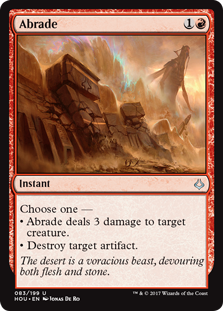
As far as the sideboard goes, though, Abrade seems like a significant improvement to Spatial Contortion. Like Relic, it's extremely potent in its role compression, so I'm comfortable with a full set: against creature decks, we can never have enough Pyrophobia; against prison, we can never have enough Shatter. The latter has historically menaced Eldrazi Stompy to the point that Karn, the Great Creator fishing up Ratchet Bomb to tick into a Bridge-breaking activation, clunky as the plan reads on paper, was a godsend for the strategy.

Colorless Contrasts

There are also some notable colorless cards filling in for the usual suspects.

Good Cop, Bad Cop

First on our list is Smuggler's Copter, a card I've lauded in CES for giving us a Splinter Twin-style pressure effect while soaring over opponents gumming up the battlefield with value creatures.

Copter is all the better in this build, making excellent pilots of those newly-castable Simian Guides and spare Endless Ones. And with a full eight mulligan-helpers in the deck and the notable absence of the once-convenient Zhalfirin Void, Copter assuages the burden of drawing too many enablers or lands. When we mulligan especially low, or opponents throw a wrench into our plans with a fast Damping Sphere or Ghost Quarter, Copter can turn a clunky hand into an acceptable plan, so it acts as an insurance policy as well.

Something I don't like about Copter is that it can't be found by Once. I also tried Karn, the Great Creator in this slot, but never wanted them together for this reason. Karn's utility is still high, especially its ability to grab Relic of Progenitus against midrange and start recurring Scourge as of Game 1. But it strains the sideboard and is quite expensive at four mana given our Once-affected manabase. Abrade also covers for many of Karn's biggest draws in helping us defeat artifact-based prison.

It Don't Matter to Me

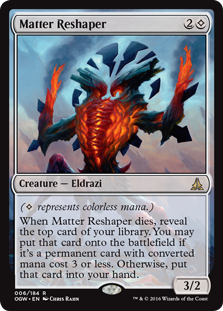
The final change in this version is my total forsaking of Matter Reshaper. I've elected to relegate the grinding plan to the sideboard for Game 2, where it takes the form of a set of Relics. I think those will prove enough, at least as the metagame settles; we now have more anti-aggro tools with Abrade, and I find shaken-up metagames often default to aggro in their early stages. Reshaper, too, was appealing for role-compression purposes, but we may have those bases covered with Abrade; besides, Reshaper was always garbage against linear combo and other fast archetypes.
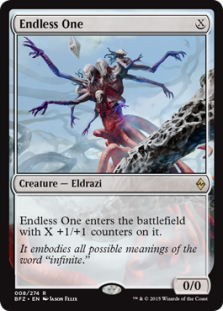
Endless One remains, as the card is more potent alongside Once Upon a Time and a pair of Copters. I frequently cast the Eldrazi for 1 just to have a pilot, and late-game, it can be found with the cantrip to create a big attack with Eldrazi Mimics or just register a large body. Endless plays nice with our Plan A, benefits from an increased ability to find Temple, and is highly adaptable to different situations. Of course, it's never tremendously impactful for its price, especially compared with Seer and Smasher; I can see going back to Reshaper if Fatal Push or Wild Nacatl decks start giving us trouble, but I'm not holding my breath.

New Horizons

I was indeed excited to start tuning Six Shadow, a deck that's been killed along with many others by the recent bans. Still, Once Upon a Time has got me bursting with ideas too, and I can't wait to see if it fits into my pettest of decks. How goes everyone else's new-year brewing?

Insider- MTG Business Models (Part 1)

Are you a Quiet Speculation member?

If not, now is a perfect time to join up! Our powerful tools, breaking-news analysis, and exclusive Discord channel will make sure you stay up to date and ahead of the curve.


It's always sad to see a game store close. I have numerous great memories from my childhood while at my local game store (LGS). These are where I met my best friends and best men at my wedding. These are the places we go to when we want to relax and enjoy the company of people with similar hobbies and interests; where people of various backgrounds with a great many differences can bond over shared interests and realize that despite these differences we still have a lot in common. Their importance in the MTG Finance realm is paramount.

All that being said, I think one should take a step back and consider this statement. I don't know the background or history of Wizard's Keep Games, but I find it a bit hard to believe that the Secret Lair series was the straw that broke the camels back. I say this being one of the people who criticized WoTC for that series myself. I think WoTC has misevaluated the importance of LGS's to their own business model, but that is on them to figure out.

Every store needs to understand that WoTC has a monopoly on Magic: The Gathering and all their other franchises. They are going to do what they think will generate them the most income as all good businesses do. This means that WoTC's #1 priority is their own business growth. We've seen a lot of game stores pop up in large part due to Magic's massive growth over these 26 years, with many generating a significant amount of revenue with just Magic singles sales. In fact, that may very well be where our problem lies.

Magic singles are a very lucrative business. When you compare buylist prices to store retail price you often see profits of 30-50%, which is insanely high compared to almost every other industry. Now, to be fair, there are overhead costs that eat into those profits, but if you can turn over a large number of cards regularly those costs are minor profit reducers. So why is that the problem?

With singles being so lucrative, it makes sense that more and more people would want in on the market. The biggest bottleneck was how to convey your wares to the world. While we have almost always had eBay as an option, TCGPlayer opening up to non-B&M (brick and mortar) stores was the real game-changer. Now anyone can own a store with your competitor's prices readily visible, making pricing a lot easier.

To make matters worse for LGS's, these non-B&M stores have much lower overhead costs. This means they can price out many B&M stores that don't have enough singles sales to make overhead costs negligible. In this very real and unfortunate way, every one of us who sells cards on TCGPlayer but doesn't own a physical store presence is contributing to the downfall of the LGS.

The Great Debate

Interestingly enough, I often see two types of players debate this problem on social media.

One side argues that the higher cost of the cards is that the store provides additional value; the LGS provides an environment to play those cards, and if there were no stores, there is little reason to buy the cards. This is a legitimate argument, but one that likely obfuscates a potential root cause of a store's financial problems. This argument is only accurate to the point where the price difference equals the actual overhead costs + TCGPlayer low with shipping. Obviously, the buyer doesn't know the store's overhead costs, but it's important to understand that any copy of the same card has the same "play value," in that a copy of Sol Ring I buy from the cheapest store on TCGPlayer is just as playable as the copy I buy from my LGS.

This is important to understand, because we live in a society where people want the best deal. The definition of "best" will likely vary from person to person, but the financial impact on their wallet is almost always a significant factor in defining "best." A store that tries to sell a card for $10 when the same card can be readily had for $6 online needs to justify the $4 price difference. There may be additional value in immediate accessibility, but there may not.

The other side argues that their LGS prices are not competitive with the market and those stores often try to justify this cost difference due to overhead costs. This argument is typically only known at the micro level; between the person arguing and their LGS owner who is likely not in the debate to begin with, so each instance is very localized.

Unfortunately, this makes it extremely difficult to determine the validity of their concerns. They could be well grounded or they could simply be unhappy with their LGS. In our example above, they view the $10 price tag on a card they can buy online for $6 as the store owner trying to "rip off" their local players. Again the $4 price difference may or may not be justified but the potential buyer views the markup as unreasonable and thus has no interest in making the purchase. The store owner now makes 0% profit instead of whatever they would have had the price been believed to be reasonable from the potential customer.

Why this is Important?

We will now circle back to the Secret Lair series from WoTC. While one could make a fair argument that supplemental products with specific cards included has meant that WoTC has always had a toe in the MTG singles market, the Secret Lair series implies WoTC is willing to dip their whole foot in. One could argue that the Spellbook series was really the initial start of this transition.

However, the big difference here was that the Spellbooks were distributed through LGS's, so they got a share of the profits. The Secret Lair series bypasses the LGS entirely, which is what has rankled so many store owners. To be fair, this is quite justified as they are already being squeezed by non-B&M stores, but nobody can compete with WoTC in the singles market.

There was an error retrieving a chart for Benthic Biomancer

Adapt

Everything isn't doom and gloom, though. In the natural world, species that face harsh climates adapt, and so too can the LGS. The LGS environment is definitely a resource store owners can utilize. You have a relatively captive audience, especially during tournaments, which offers a lot of opportunities:

Snacks and Drinks

Many LGS's offer prepackaged snacks and drinks. While they typically won't be making a ton of money off this per transaction, concessions do offer good profit margins when purchased in bulk. Having access to a big bulk store like Costco or Sam's Club allows you to buy these items at a heavily discounted rate, and you can make a 50-75% profit margin while still being competitive with any nearby convenience stores. These profits also tend to scale nicely with tournament attendance.

There was an error retrieving a chart for Mastermind's Acquisition

Inventory Acquisition

As a person who buys and sells cards online, one major challenge I face is acquiring new inventory. All online transactions carry additional risk because they aren't instantaneous: cards can get lost in the mail, people can sell fakes, or even fail to ship out cards. Large stores are willing to shell out thousands of dollars just to set up a few tables at a MagicFest, and for good reason. You can't grow your singles business without consistently acquiring new inventory, and having an actual set, safe location to conduct these transactions can be a vital resource.

I've been to numerous shops where the owner doesn't actively try to pick up cards from patrons and simply waits on them to come up to the store to sell. This likely means that a lot of patrons never trade or sell cards into their LGS simply because they aren't actively trying to get rid of anything. However, when given the opportunity, many players will be happy to move cards they don't really use towards things they do want, though that requires having a good inventory to entice trade-ins.

To be continued...


Emerging Pioneer Staples

Are you a Quiet Speculation member?

If not, now is a perfect time to join up! Our powerful tools, breaking-news analysis, and exclusive Discord channel will make sure you stay up to date and ahead of the curve.

2020 is here, and it’s going to be a big one for Pioneer. With the new year comes the first Premier-level Pioneer events, which until now has been played mostly on Magic Online. Bringing Pioneer to Magic Fests and the Players Tour, the first of which is at the end of January, will drastically drive up demand for cards while increasing exposure to the format. Add in the fact that the upcoming PTQ season will be Pioneer, and you have a recipe for higher prices. That makes Pioneer cards look like a great place to be heading into the spring. 

At this point, the constant bans that defined the early days of the format are behind us, and the metagame is stabilizing. I expect staples from all of the top decks to appreciate in value, so now really is the time to buy-in to any deck you know you plan on playing.

This past weekend, I burned the last bits of credit from online stores and spent some cash getting the cards I was missing from Mono-Black Aggro, and I’m eyeing some Teferi, Hero of Dominaria to have access to the Azorius Control deck. I’ve also been exploring the possibility for some spec targets, some as solid options in top-tier decks likely to see slow and sure growth, and some a bit more speculative. Upcoming events do hold the potential to rock the boat and the metagame, and any breakout deck would bring with the chance for breakout prices.

There was an error retrieving a chart for Dread Wanderer

Mono-Black has recovered from the Smuggler's Copter ban and is again the most popular deck in Pioneer, and with a great track record. I’ve been following innovations in the deck, and by increasing demand for new cards they could drive up prices. An example is Dread Wanderer starting to see play as up to a 4-of, which explains its price increase from $1 to $1.20 in the past week.

There was an error retrieving a chart for Rotting Regisaur

Another piece of growing tech in the black deck is Rotting Regisaur, up to a four-of as a huge threat that plays well in a deck that can quickly empty the hand. 

Green decks that once defined the metagame suffered from the Oko, Thief of Crowns ban, but a new Mono-Green deck that merges an aggressive plan with the Devotion of Nykthos, Shrine to Nyxhas become one of the top contenders in the field. It has driven up the price of its cards online, and I’ve identified two that look particularly attractive. 

There was an error retrieving a chart for Surrak, the Hunt Caller

Surrak, the Hunt Caller is a staple of the deck as a 4-of, where it helps give it a sort of combo kill with a hasty Ghalta, Primal Hunger. What stands out about the card is its low spread, which at the time of this writing was actually negative, with Cardkingdom is paying $0.72 and selling for $1.79, but they are widely available on TCGplayer for around $0.60. Buy prices have now fallen a bit and the cheapest copies are drying up, but once more people catch on to the deck I expect them to start increasing across the board.

There was an error retrieving a chart for Rhonas the Indomitable

Another staple is Rhonas the Indomitable, which while only a 2-of, has the upside of being used in another rising archetype, the Soulflayer-Zetalpa, Primal Dawn deck that is now putting up very real and consistent finishes. Its price doubled over the course of December to around $13, but it has stayed stable. With buy prices at $11, it could be a solid play if these decks become mainstays. 

One strategy starting to pick up steam online is a Dredge-style graveyard deck, without Dredge cards themselves but many of the familiar payoffs like Prized Amalgam and Narcomoeba. Seemingly a key card that has brought it to the next-level is Decimator of Provinces, which gives it a powerful kill-condition to pair with its small creatures. 

There was an error retrieving a chart for Decimator of the Provinces
 

CardKingdom is paying $0.8 for Decimtor of the Provinces,  so when I found some available for under $1, I picked up a handful of low-risk playsets, and I’m going to hold onto them with the hope the deck sees a real breakout and the price spikes. A finals finish in the SCG Pioneer Classic this week in the hands of Ross Merriam could be exactly what I was looking for.

The biggest emerging Pioneer trend online this week is a Five-Color Niv-Mizzet Reborn control deck. It started picking up steam early in the week when a 5-0 in a Preliminary event caught attention, but another on Friday by the same player turned things into a frenzy over the weekend, which culminated in the Pioneer Challenge where it took three of the top four spots! The price of Niv-Mizzet Reborn has consequently spiked online, along with solid growth by four-ofs Fabled Passage and Teferi, Time Raveler. 

There was an error retrieving a chart for Niv-Mizzet Reborn

Heliod, Sun-Crowned is one of the hottest cards in Theros: Beyond Death, as seen in its price as the second-most expensive in the set so far, because of its incredible combo potential with Walking Ballista. This Pioneer-legal combo is sure to make waves in a format where a two-card combo was recently banned, and as such Walking Ballista has seen a nice price spike. It’s not clear what the best deck for the combo will be, but I imagine one viable strategy will be a White Devotion plan with cards like Knight of the White Orchid that makes the most of all the God has to offer. A very attractive piece of that plan could be Archangel of Tithes, which almost turns it on single-handedly. 

There was an error retrieving a chart for Archangel of Tithes

While this creature was never quite good enough for Modern, Archangel of Tithes seems perfect in power level for Pioneer, and is well-positioned in this metagame where aggressive decks in all colors are among the most successful. It’s especially attractive now that Mono-Red aggro is becoming one of the best in the field. It matches up quite well against their strategy, and the five-toughness flier matches up perfectly against their top-end of Glorybringer. 


N’Oko: Parsing the January Bans

Are you a Quiet Speculation member?

If not, now is a perfect time to join up! Our powerful tools, breaking-news analysis, and exclusive Discord channel will make sure you stay up to date and ahead of the curve.

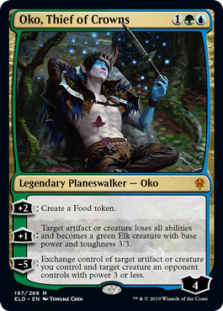
Well, everyone should have seen another ban coming. There was no way that Wizards wasn't going to let their last scheduled banned and restricted announcement go by without doing something about Oko, Thief of Crowns. However, I didn't expect it to go this far. Three cards banned would be a fairly substantial shift by itself, but considering what is getting banned, I'm calling it a seismic shift. Another year, another entirely new Modern.

What should not be surprising is the lack of compensating unbans. As I've previously noted, there aren't many plausible candidates. My opinion on Splinter Twin seems to fall in line with Wizards'. And not unbanning the artifact lands makes sense in that Wizards is specifically trying to power down artifact decks.

Oko, Thief of Crowns

Everyone was expecting Oko to get banned. There didn't seem to be any other option, and Wizards' announcement reflects this fact:

Oko, Thief of Crowns has become the most played card in competitive Modern, with an inclusion rate approaching 40% of decks in recent league play and tabletop tournaments. In additional to having a high overall power level, Oko has proven to reduce metagame diversity and diversity of game play patterns in Modern.

The last few months of 2019 saw him shoot to the top of the format and just sit there. There was no opportunity cost to playing Oko. He made fodder for all his abilities. He never needed to downtick to do something. His starting loyalty was absurd, particularly for a three-mana planeswalker. Wizards admitted that Oko had just slipped through the cracks and they hadn't tested him enough, its high loyalty stemming from a broader issue of overestimating planeswalker vulnerability. Last weekend was the final straw, as GP Austin saw a Day 1 that was dominated by Oko...

Deck NameTotal #
Urza Decks82
Death's Shadow Decks61
Eldrazi Tron48
Tron41
Burn35
Titan Field35
Infect34
Jund 33
Snow Control31
Snowblade28
Mono-Red Prowess25
Humans24

...which would eventually translate into a Top 8 of primarily Oko decks. All the props in the world to Ian Birrell getting 4th with a completely stock Jund list, but he was the only player who wasn't riding a stream of food. Once a Top 8 has 26 of 32 (81%) possible Okos present, there's clearly something amiss. The pattern was repeating over at SCG Knoxville, where the Day 2 Metagame was dominated by various Oko decks:

Deck NameTotal #
Temur Urza10
Mono-Red Prowess9
Eldrazi Tron6
Infect6
Bant Snowblade5
Sultai Urza4
Burn4
Mono-Green Tron4
4-C Whirza3
Amulet Titan3
Humans3
Gifts Storm3
Devoted Devastation3
Simic Urza2
Urza Prison2
Oko Jund2
Jund2
Crabvine2
Titanshift2

An explicitly Oko-oriented deck was the most played, with lots of other decks running Oko as a package. Simply put, with little opportunity cost to doing so and the substantial upside of snowballing out of control, it was wrong for decks not to run Oko. Some decks splashing Oko included Infect, Amulet Titan, Death's Shadow, and Jund, as reflected in the Top 32:

Deck NameTotal #
Temur Urza7
Sultai Urza4
Bant Snowblade3
4-C Whirza3
Amulet Titan2
Mono-Red Prowess2
Infect 2
Golgari Yawgmoth1
Mono-Green Devotion1
Humans1
Oko Jund1
RG Eldrazi1
UR Kiki-Jiki1
Eldrazi Tron1
Crabvine1
Mono-Green Tron1

Oko dodged the finals not for lack of effort. Decks that went over Oko's top did very well, but that's likely because the SCG meta saw the impact of Oko first, and had more time to adjust. Perhaps Modern overall would have ended up in a similar spot, but with Oko already banned in multiple formats, Wizards elected to take one on the chin and ban the planeswalker.

Post-Oko Winners

The format as a whole wins, as gameplay and deck strategy should diversify. No longer will it be a version of Standard's snowball-value gameplay. There's also no longer a power card for every single deck to play, which will incentivize innovation in deck configuration.
Any deck that was looking to actually do something with non-ETB artifacts and creatures also wins. Oko rendered big creatures and splashy artifacts useless by making them 3/3 Elk. Death's Shadow was initially seen as an answer to Urza, but Oko pilots have since turned plenty of 11/11s into Wild Nacatls. Death's Shadow is an obvious beneficiary as a result. Primeval Titan was very strong even with Oko around, but Oko made it far less threatening; the Titan is unleashed now, too. On a more somber note, prison pieces will come back into vogue. It didn't matter if Ensnaring Bridge was in play when it was just going to become an Elk, and the same follows for any artifact that wasn't part of the 0-1 CMC value engine common among Urza decks.

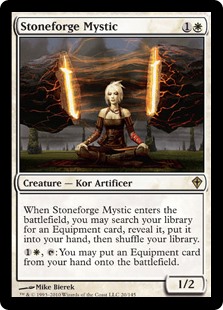
The largest individual winner is Stoneforge Mystic. Mystic hasn't yet had the chance to take off in Modern, and Oko tucked it further away. Fair cards with many possible homes take time to catch on, as did Jace, the Mind Sculptor. Oko forestalled the brewing process by rendering equipment ridiculous. Without it, Mystic may finally have a chance to spread her wings.
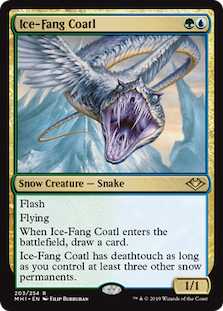
Post-Oko Losers

All the decks that were playing Oko take a hit. However, the loss won't be felt equally. UGx Urza decks will almost certainly disappear; the reasons to play green were Oko and Gilded Goose, the latter present mainly to pump Oko out faster. Simic Urza should revert to Grixis Whriza, which may actually benefit considerably for the same reasons I mentioned about artifact decks above.

Oddly, I think the biggest loser will be Bant Snowblade. Snowblade was starting to gain some traction as an anti-Urza deck in the run-up to SCG Knoxville, and didn't do too badly in Austin either. However, this was based on it being a better Oko deck rather than its own merits as a deck. Snowblade had more ways to accelerate into Oko while playing less air than a typical Urza deck. Playing fewer artifacts meant dodging typical hate.
The deck also enjoyed turning its mana dorks into actual threats. Also, Elking a friendly Spell Queller and then bouncing Queller with Jace or Teferi meant that the Quelled card would stay exiled forever. With Oko gone, Bant is back to being filled with dinky creatures and uninspiring payoffs, as it was before Throne of Eldraine. Stoneblade will still be around, but its shell needs an overhaul.
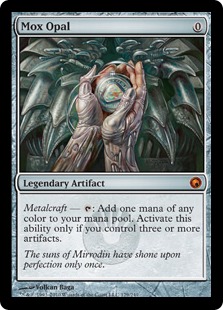
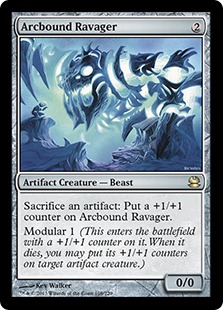
The other big loser is Infect. Ever since Gitaxian Probe was banned, Infect has struggled. The deck never goes away completely, but without the information advantage of Probe, it just can't maneuver past all the removal and discard in Modern. Oko gave Infect new legs via an alternate win condition immune to typical Infect hate by virtue of its focus on value and stretching of enemy resources. Infect will now default back to its uninspiring pre-Eldraine configuration.

Mox Opal

While some have speculated on Mox Opal getting banned for years, I've always disagreed. The problem was never Opal itself, as evidenced by Affinity. Opal needed a lot of setup and was frequently bad on its own. It was in the presence of overpowered engine cards that Opal became unfair. Even without Opal around, Ironworks would have been too good thanks to how absurd a mana engine it is. Meanwhile, there's no reason to play Affinity or similar artifact decks without the acceleration of Opal. They're too fragile easy to hate out otherwise. However, Wizards decided that Opal being a main component of Oko decks was the final straw:

As a source of fast mana in the early game, Mox Opal has long contributed to strategies that seek to end the game quickly and suddenly, whether with explosive attacks, one-turn win combos, or by locking out the opponent with “prison” elements. While none of these decks previously warranted a ban of Mox Opal, it has historically been a part of decks that approached problematic impact on the metagame or did indeed necessitate other bans.

Wizards is concerned about Urza just coming back. They're even more worried that Opal will be a greater problem in the future.

As the strongest enabler in the recent Urza artifact decks, and a card that has been concerning in the past and would likely cause balance issues in the future, Mox Opal is banned in Modern.

Reading between the lines, Wizards is concerned about future cards proving unsustainable alongside Opal, and wanted to get ahead of the problem. I think that means they're worried about Underworld Breach combo, a deck which is almost certainly dead before it ever got a chance to live. It may also imply another set with pushed artifacts in the pipeline.

Affinity is Dead

And with that, Affinity is finally dead. It hasn't done well for quite some time, but losing Opal is the final nail in the coffin. There's simply no reason to play an aggro deck that dies to not only Supreme Verdict but to Stony Silence, especially when it's no faster than other aggro decks. Humans sounded the knell by being a very similar deck that was more disruptive and resilient, but Affinity stuck around in some capacity as a metagame deck. Hardened Scales may remain, since it has green acceleration, but it's a tough sell. It will take some very pushed artifact creatures or synergies to make construct aggro a thing again.
Many fringe artifact decks also look significantly worse. Lantern (thankfully) died years ago, but this also means Cheeri0s is gone. The combo only generated mana by looping Opal, and trying to make Mox Amber work in its place takes Cheeri0s into a very different combo space.

Long Live Urza

Given that artifact decks are taking such a huge hit, the hope is that the targeted deck will also go. But I don't think that banning Opal will hurt Urza that much. He'll just roll with the punches and adapt. According to Wizards:

We considered options that would further weaken Urza-based artifact decks, while still allowing for decks based around that general strategy. Ultimately, we determined that banning Mox Opal was the correct option.

However, Urza, Lord High Artificer doesn't need Opal. Simic Urza decks did, because they were all about getting out a powerful engine quickly, be it Emry, Urza, Oko, or Karn. Gilded Goose coupled with Opal was the key to getting them online before opponents could respond, which was the key to Simic's success.
However, Grixis Whirza was already slower than Simic. Its main plan was as a prison deck, and all it needed to do was get out the right lock piece eventually. It can also combo win from nowhere. Earlier is obviously better than later, but it isn't necessary; Opal's greatest contribution was how efficiently it helped Urza empty its hand for Ensnaring Bridge, which is only relevant against hyper-aggressive decks. Against everything else, Whirza was playing a slower reactionary game anyway, so the Opals were primarily replacing lands. Whirza will just run an extra land or two and use the extra slots for either another artifact or some more interaction. Urza is still an absurd card, so I predict that all Wizards is dong is kicking the can down the road.

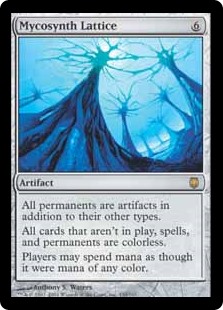
Mycosynth Lattice

Finally, there's the truly unexpected banning. I couldn't find any writers calling for banning Lattice before today, didn't see any discussion threads about it, and would never have expected such a ban to happen even if there were said calls. Mycosynth Lattice just doesn't do anything. The only reason for banning it is Karn, the Great Creator's non-symmetrical effect. However, Wizards thought lowly enough of the combination to pull the trigger.

This combination, popular in Eldrazi and other Tron decks, can completely lock the opponent out from casting further spells. While decks featuring this combination often win in other ways, the deckbuilding cost to include this interaction is low, causing it to show up more often than is fun in competitive play.

I don't disagree with the reasoning. Getting locked out of the game is horrible, but the deterministic nature of the Lattice lock is much worse. Against typical prison locks, you're only truly out of the game when you have no answers left in your deck. Lattice lock offers a one-time window to answer. Once Karn and Lattice are on the board, the only source of mana the opponent could have is Simian Spirit Guide. Unless enough creatures are on the board to kill Karn, that's the end.
I did not think that fact was enough for Wizards to ever take action. I suspect that, due to the Simic Oko decks, Wizards was seeing the lock come up far too much. With Oko leaving the format, the lock would have necessarily become far less frequent since his deck is going away. However, Wizards decided that they wanted to be sure. On Twitter, LSV called the Lattice ban "forward-looking." I see the point, and it is better to strike while the iron is hot. That said, I don't think I've ever been more surprised by a banning before. Even the Twin ban was less surprising, despite the reactions at the time.

Modern Moves On

With a major pillar removed and several recent distortions gone, Modern is once again wide open. The incoming set will further muddy the waters. We'll just have to wait and see how this all plays out.

Old School: Cautious Optimism for 2020

Are you a Quiet Speculation member?

If not, now is a perfect time to join up! Our powerful tools, breaking-news analysis, and exclusive Discord channel will make sure you stay up to date and ahead of the curve.

From 2017-2018, the Old School community exploded as the format gained traction outside Sweden (its birthplace) and around the globe. This growth was enough to earn the attention of the finance community. Speculators and investors alike flocked to these older cards as a safe haven, expecting to turn profits galore.

And it worked, if you purchased cards early enough in the cycle. But anyone who came to the party in late 2018 was met with an unpleasant surprise: prices plateaued and then dropped far from their peaks. This left speculators and vendors with excess stock for which they paid too much. Demand slowed at the higher prices (naturally) and prices had to drop back down again.

There was an error retrieving a chart for Angus Mackenzie

So where are we now? What’s the trajectory from here? What should we expect for 2020? This week I’ll share my lukewarm viewpoint and reveal how I’m cautiously approaching the year.

Assessing the Landscape

First, I need to examine where supply and demand stand as of this moment. These data will be important in determining both direction and timeline for the year to come.

On the supply side, things still look relatively glum. Browsing sites like Card Kingdom and ABUGames, which are known for keeping robust stock of Magic’s earliest cards, I find many copies of various cards sitting in stock.

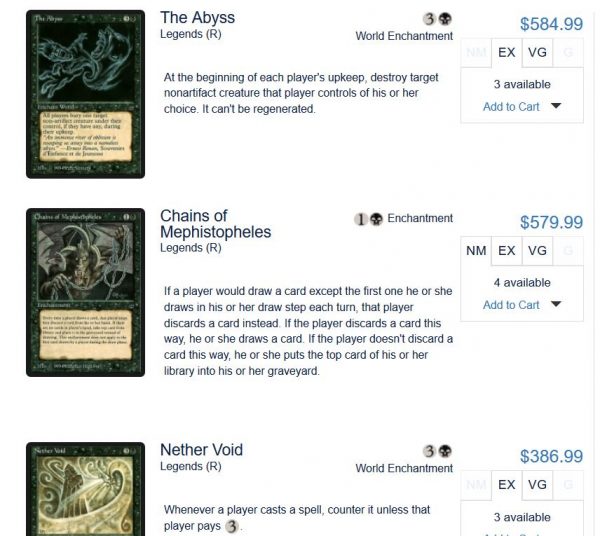
For example, at Card Kingdom, I’ve seen the same copies of Nether Void, The Abyss, and Chains of Mephistopheles in stock for weeks now. I’ve been following these closely in the hopes that they drop pricing further (making them more attractive to acquire with store credit). Since I started watching, their price has drifted down about $10-$20…still not enough. (As an aside, for some reason Moat has sold well for Card Kingdom, and they have increased their price twice in the past three months).

Browsing stock from other early sets, such as Arabian Nights and Antiquities yields a similar picture. Even Alpha is relatively plentiful. I remember thinking the time was soon coming when Alpha rares would disappear from the market due to their scant supply. Now, other than Black Lotus, you can have your pick of Power, Duals, and high-end rares on Card Kingdom’s site. While ABUGames’ stock of high-end Alpha and Beta cards isn’t as robust, Card Kingdom seems to have enough supply to keep the market afloat.

Besides these two vendors, I’ve also noticed supply has flowed back onto TCGPlayer and eBay. In general, if you want a fair price on an older card, there are plenty of options available.

So how about demand? The health of demand is a little trickier to evaluate. We can gauge demand by examining buylist prices, but these have obviously dropped as stores restocked the staples. Vendors have been slow in adjusting their prices, so it’s no surprise their overpriced cards haven’t been selling rapidly.

I’d prefer to look at this more anecdotally. I’m an active participant in the Old School Discord group, and cards are posted for sale there on an hourly basis. Most times a card is posted with a reasonable price (10-15% below TCG low and Card Kingdom), it sells. I have had success selling through a couple playsets of Thunder Spirit, a Beta Icy Manipulator, and some Dual Lands lately. In each case, these sold within a few hours.

Of course, this isn’t enough data to make a definitive claim about market demand. I’ll merely conclude that the most desirable, older cards can still sell easily as long as their prices are adjusted sufficiently. No one is paying retail on these cards right now, but a 10-20% discount to retail will net a quick sale. This market is still liquid enough if you’re an eager seller.

My Current Action Plan

The current landscape of supply and demand is questionable at best. Increasing supply and falling buylist prices make for a challenging environment in which to turn a profit. Up until recently, my favorite angle has been trade credit arbitrage with ABUGames. Falling trade credit offers has rendered this strategy nearly obsolete.

For example, I recently purchased a heavily played Beta Smoke from Cool Stuff Inc for $45 because ABUGames offered $90+ in credit. By the time the card arrived, however, ABU’s offer had dropped 30% to $69.60, eliminating the profit potential entirely. The same happened to me with Unlimited Fork as well.

There was an error retrieving a chart for Fork

These constantly dropping numbers has turned me off completely from ABU credit arbitrage. So where does that leave me?

Put simply, I’m in a “buy what I want to keep for a while” mode. Quick flips and easy arbitrage has mostly evaporated except for a few corner cases. I’ve shifted my focus away from these opportunities and towards adding cards I most want to collect and play. If I’m going to sink more cash into Old School, I want it to be in cards I can enjoy—I can’t count on easy gains at this time.

For those curious, my recent acquisitions have included a playset of Thunder Spirit, a Nether Void, and a Beta Copy Artifact. I’m trying to pick up cool cards I can potentially use, and have a decent enough demand profile. Prices have retreated so much that I felt content acquiring these at their current prices.

In summary, I’m a net buyer at these depressed prices, but only the most useful/interesting/playable cards. This is not the time to be buying random Old School junk that no one plays, such as garbage Alpha and Beta rares and terrible Legends cards.

Looking Ahead to 2020

After my failed attempt to predict trends in 2019, I’m hesitant to make any bold predictions for the year ahead. In Old School in particular, it is especially difficult to predict what will happen with prices.

And it’s not just me having this existential dilemma—this past weekend, the Old School Discord was abuzz with debate on what card prices will do in the future. Some felt that Old School play has leveled out and prices will continue to drift downward. Others were banging the drum on Alpha, stating that even a fading market could still support cards from Magic’s first set due to its collectability. Others still have seen new Old School players entering the format, and predict a recovery in prices this year.

For me, I am voting with my dollars. I don’t think buying a stack of inexpensive Alpha Holy Armors will be all that rewarding in 2020. Instead, I’d rather be taking advantage of these price drops by purchasing cards I’ve been wanting anyways. There are plenty of deals to be found these days, between eBay auctions ending lower, peer-to-peer deals, and coupons galore. Sticking to the most playable cards ensures the best demand profile.

Want some specific examples? Well, Winter Mishra's Factory seems to have pulled back dramatically and is highly desirable. I already mentioned Thunder Spirits and will double down on them here.  I especially like Beta cards that are playable in other formats: Swords to Plowshares, Lightning Bolt, and Sol Ring come immediately to mind. I’d avoid Dark Ritual, though—there just seems to be a ton of these for sale out there.

There was an error retrieving a chart for Lightning Bolt

Wrapping It Up

All the rampant speculation in 2017 and 2018 inflated Old School prices tremendously, and prices became highly unsustainable. It has taken over a year for prices to cool back down toward reality, and I genuinely believe we’re finally leveling out. That begs the question, though: where do things go from here?

I’m hesitant to be 100% bullish as I have been in the past. Magic is in a weird place right now, and prices aren’t as volatile as they once were. I check MTG Stocks daily, and many times there are only a few cards that have moved more than 5%. Most movement in Old School cards has just been noise.

The daily movement of up 3%, down 4%, up 5%, down 3%, etc. probably won’t end this month or next. As 2020 unfolds, however, I do expect some of the more desirable Old School cards to climb. But I wouldn’t advocate speculating in anticipation of this trend. Instead, buy only what you’ve been wanting to acquire so you don’t mind waiting patiently for things to unfold.

With some luck, we’ll see a nice rebound in staples. If not, and prices fall further, I know of dozens of players in the Old School Discord who will eagerly buy at lower prices given the opportunity. This provides a sort of price floor, making me feel more confident in my purchases today.

…

Sigbits

  • If you want to review what cards are most desirable from Old School, I’d recommend checking out their hotlist. You won’t find stuff like North Star and Cleanse on there. Instead, you’ll find the stuff that’s selling well for the store. The top card on their list today is Drop of Honey. This is a card that skyrocketed to $600 on Legacy play (of all things), but has pulled way back from that high. Now CK offers $245 on their buylist. A recovering Old School market would likely send this card higher.
  • I mentioned Beta Lightning Bolt before and it’s no coincidence the card is on Card Kingdom’s hotlist with a $140 buy price. Card Kingdom’s aggressive buy price is somewhat surprising given they nine copies in stock already. They must sell this one quickly to maintain the high buy price.
  • Here’s one I haven’t seen on Card Kingdom’s hotlist in quite some time, but is there now: Mirror Universe. This is one that speculators and investors hit hard due to the card’s more iconic nature. Then the price pulled way back down when people realized it had little utility in play. Card Kingdom’s buy price is $120 now, and they have a dozen copies in stock. No need to rush on this one if you need a copy—more inventory will have to drain before this can tick higher again.


U Mirin’: Theros Beyond Death Spoilers, Pt. 2

Are you a Quiet Speculation member?

If not, now is a perfect time to join up! Our powerful tools, breaking-news analysis, and exclusive Discord channel will make sure you stay up to date and ahead of the curve.

Theros: Beyond Death spoilers are well underway. David covered the heavy-hitters earlier this week, but more cards have been revealed, and the set seems packed full of low-level goodies that stand to very marginally improve some of Modern's many strategies. Let's take a look at at some of the most underrated tech in the new set!

A House Is Not a Home

The following cards may already have homes in Modern, however fringe. I can see these spells slotting into existing archetypes right away, albeit with a little tweaking.

Gallia of the Endless Dance

"Other Satyrs you control get +1/+1 and have haste." Yawn! It's the rest of the text on Gallia that makes it interesting. Attacking with three creatures is par for the course in hyper-aggressive Zoo strains like 8-Whack, and that's exactly where I expect Gallia to end up. Even there, it's not realistically triggering until turn three. I still think that's enough to merit inclusion, as the looting effect is just bonkers in a deck that peters out so quickly.
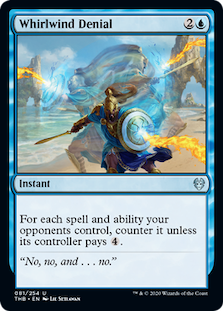
Icing on the cake: if we do ever happen to get a Satyr on the level of pushed beaters like Hexdrinker or Grim Flayer, Gallia will start to look appealing as a build-around card.

Whirlwind Denial

Our first control card, Whirlwind Denial sets the bar high for stack wars, functioning as Flusterstorm that also hits creatures and, critically, planeswalkers—that's the type of card blue mages duke it out over. Three mana is a heck of a lot for a stack war, but considering Denial's other fringe applications (such as dealing with storm), I can see it making the cut as a tech choice in sideboards.

Thassa's Intervention

Yet another control card, Thassa's Intervention doesn't do one thing particularly well. But it offers players a choice between two extremely relevant effects. In a topdeck war, when opponents have little going on, or should players badly need an answer locked away within the deck, digging mode does an okay Dig Through Time impression. And otherwise, with a planeswalker on deck ticking up, counterspell mode says "no" and enables the snowball. Intervention offers enough utility for control mages to consider in the main.

Dream Trawler

And, I'd argue, Dream Trawler offers enough raw power to reshape how control players build their decks. Trawler is the Morphling Modern never had; a Baneslayer Angel that draws extra cards and can give itself hexproof at will, both without any mana investment. Six mana is a ton, but if players are happy to tap out for Lyra Dawnbringer, I don't see why they wouldn't be happy to invest in this guy. The drawing alone gives this thing a tool against attrition and control decks as gamebreaking as lifelink is for aggro ones.

Kroxa, Titan of Death's Hunger

It's not all control cards I'm excited about. This escape cycle of fatties seems promising, too. Especially Kroxa, Titan of Death's Hunger, who I think fits pretty smoothly into Smallpox decks. We've seen these strategies have middling success in Modern, most recently with Rankle Pox. If they're up for splashing red, Kroxa provides inevitability and card neutrality while tapping the graveyard, a resource Pox players have otherwise struggled to capitalize on.

Utility Belt

My favorite kinds of spoilers are ones for cards that don't necessarily turn archetypes on their heads or spawn new strategies. I prefer cards with specific, niche applications; ones that either replace or simply provide alternatives to existing role-players. The more novel the design philosophy in a given set, the likelier we are to see such spells, and Theros: Beyond Death has already given us five.

Mire Triton

First up is Mire Triton, which packs a ton of potentially relevant text into one sleek design. Triton gains pilots life, self-mills, swings for a passable 2 damage, and provides a deathtouch body on defense. On top of all that, it's a Zombie Merfolk, supporting two beloved tribes.
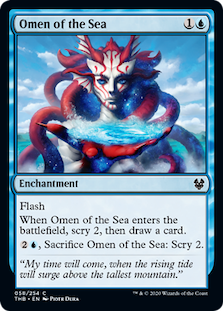
If Triton ends up belonging to either clan, it should be to Zombies; that's a deck that appreciates self-mill and is already in black to begin with. Two mana's not a great rate for 2/1s in Modern, but this little guy does enough stuff to perhaps make the cut somewhere anyway.

Omen of the Sea

Speaking of two-drops, let's dive into escape, Magic's latest take on flashback. Omen of the Sea costs one more than the banned Preordain, but offers pilots flash; in instant-speed decks, spending mana on enemy turns can be quite similar to getting it for free. Additionally, Sea's extra effect lets pilots squeeze value out of the enchantment down the road, and its card type plays nice with certain mechanics (delirium, constellation, etc.).
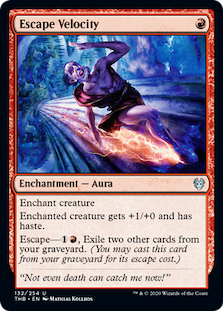
I'm especially interested in how players will stack Sea's two abilities. With five mana available, pilots can cast Sea and respond to its enters-the-battlefield trigger by cracking it, yielding scry 2, scry 2, draw a card. This enchantment has a lot of modes and may be flying under the radar right now.

Escape Velocity

Anger might not be legal in Modern, but Escape Velocity gives players the possibility of having haste on all their guys thanks to a card in the graveyard. Sure, it costs mana to activate, and two can be a lot when a creature is also being cast that turn. But exiling just two cards is hardly a cost, meaning Escape Velocity will probably sit in the grave and threaten haste throughout a game. Plus, as an enchantment, the power boost lasts, and should add up over multiple attaches.

Cling to Dust

The last escape card we'll see today is my favorite design thus far. Early on, Cling to Dust provides cantripping (or life-gaining) grave disruption; on paper, it eventually morphs into a card advantage engine. Realistically, though, the spell sits somewhere in the middle, fronting a burst of value and then ensuring another one or two down the road. Escaping more than twice in a game should prove difficult with a five-card requirement.
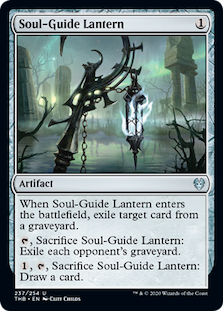
Cantrips on passable effects are nothing to sneeze at, and neither is versatility. I love that Cling can function as lifegain or simply a cantrip in a pinch, but also blow opponents out in certain situations as well as just post a speed bump for anyone gently interacting with the graveyard (think Snapcaster Mage, Emry, Lurker of the Loch, or Unearth). This card's high floor and ceiling make it a winner in my book, even with with gold standards like Surgical Extraction legal.

Soul-Guide Lantern

This lamp isn't playing when it comes to the graveyard, either. An update to Scrabbling Claws, Soul-Guide Lantern also offers players plenty of options. It immediately removes a card, threatens a grave nuke at any time, and can be cashed in for a card as needed. The artifact reminds me too of Nihil Spellbomb, but more generic in that nonblack decks can play it. I wonder if it's generic enough to see mainboard use alongside Mox Opal and the rest of the artifact core propelling Oko decks to the top of the format.
There's No Escape!

From spoilers, that is! And as long as they keep flowing, we'll keep hot-taking. Which Theros: Beyond Death cards have you brewing?

Heroes Arise: Theros Beyond Death Spoilers

Are you a Quiet Speculation member?

If not, now is a perfect time to join up! Our powerful tools, breaking-news analysis, and exclusive Discord channel will make sure you stay up to date and ahead of the curve.

Happy New Year! I'll be kicking off 2020 by leaping into spoiler season. Spoilers for Theros: Beyond Death began trickling in while everyone was on holiday break. Now, with our holiday hangovers but a painful memory, the flood has begun. There appears to be considerable potential for Modern cards, and given how 2019 went, I'm perhaps even underestimating their power.

As I was writing this article, I realized there was a thread running through the piece. Specifically, I was making the same point over and over again. I've therefore decided to lead off with that point so I don't have to mention it ad infinitum:

Graveyard hate is very important in Modern.

Many cards in Theros: Beyond Death care about the graveyard (appropriately enough). Particularly, they need large quantities of graveyard cards to work. Players packing mass graveyard removal will have more success against the new cards than those relying on Surgical Extraction. In fact, Rest in Peace is so effective against most of these new cards that my analyses carry this asterisk: They don't work against a Rest in Peace.

New Mechanic: Escape

First up is the only new mechanic, escape. Escape allows cards to be cast from the graveyard by paying a cost, then exiling some number of other graveyard cards. In effect, by trying to avoid just redoing flashback, Wizards has hybridized flashback with retrace. Modern has historically been a graveyard-centric format, so it makes sense that escape would have a home in Modern. At time of writing, there are two cards with potential, though both have problems beyond my above asterisk that make me wonder if they'll actually make it.

Underworld Breach

The big story so far is Underworld Breach. Breach is a two-mana enchantment that only stays in play for one turn and gives everything escape; a broader Past in Flames, but for half the mana cost. Cheating on mana is everything for combo decks, framing Breach as a strict upgrade to Past.

In practice, it's maybe not an improvement at all. Escape requires fodder, and current storm lists don't make enough to go around. From personal experience, the typical Past-fueled kill flashes back a minimum of four cards to successfully Grapeshot for the win. If you need to find a win-condition, it's much more. A minimum Storm-off would therefore need to exile 12+ cards from the graveyard to win. The typical Storm list doesn't run fetchlands or Thought Scour to just fill up the graveyard, so the exiled cards would have to be already-played cantrips and rituals... which are what pilots want to be replaying in the first place. It is possible that looping Manamorphose with Goblin Electromancer in play makes exiling everything else acceptable, but that seems precarious. Perhaps a drastic Storm redesign is in order, but Breach looks to me like a proverbial "six-of-one, half-dozen of the other" situation.
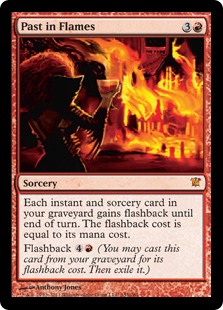
To really make Breach shine requires building around it, and the obvious combo has already been found: Grinding Station activations provide the right number of cards to feed each escape. Combine with any 0-CMC artifact to mill the entire deck. With Mox Opal being the looped card, mana is generated every escape, which then builds until Grapeshot or Banefire is lethal. It's a simple, straightforward combo (asterisk).
Storm has plenty of options to adapt against disruption and still combo off, while the early Grinding lists are very linear and vulnerable to attack. A Grinding Station combo deck will be vulnerable to all the Storm hate plus artifact hate. I think the combo will be worse Storm, but cheap artifacts often surprise.

Ox of Agonas

The other escape card is Ox of Agonas. Reason being, it has the same critical text as Bedlam Reveler, and drawing three cards is very good. It's also beneficial to have Ox in hand when the first one is cast, thanks to escape. However, anyone planning to cast Ox is going to be disappointed. Reveler being a 3/4 prowess creature is better at the same rate, but more importantly, Reveler can be as cheap as two red. The only reason to play Ox is to always escape it for two red. As a bonus, the Ox will then be a better 5/3 creature.

This restriction naturally points towards Dredge, the deck that most wants creatures popping out of its graveyard. Skipping over the question of how to fit Ox into a list as tight as Dredge, the card looks like a fit. As Cathartic Reunion showed, Dredge really likes discarding its hand as a cost to draw cards and activate its namesake mechanic. Dredging is also the fastest way to get the necessary eight cards in the graveyard to actually escape Ox; normal dredging finds Ox and provides the fodder, then Ox creates more dredges and a big threat.
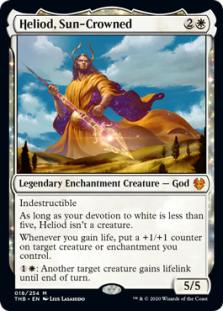
Everything I've said so far is indicative of a payoff card, not an enabler. Ox needs a full graveyard and to be in there itself to be worthwhile. This means that Dredge would have executed its gameplan before Ox does anything, which makes Ox seem superfluous. Also, eight cards is a lot to exile, and there's not a lot that Dredge wants to exile from its own graveyard. Even the lands are important for setting up late-game Conflagrates.

Dredge doesn't need more payoff cards; it needs something to replace Faithless Looting. Given that other decks that could set up Ox could also run Reveler without jumping through hoops, I don't think Ox will make it.

Returning Characters: Gods

The other big category are the new Gods. The only God to have a noticeable impact on Modern from our first trip to Theros was Keranos, God of Storms. I ran him as a finisher in Jeskai Control decks, but a more common role was in UR Twin as a mirror card. Twin mirrors tended to become counterspell wars, and the combo was often completely dropped. Therefore, Dispel and Negate were paramount cards. Keranos being a creature everywhere but in play let it slip through Negate walls and then grind to victory. I haven't seen Keranos or any other Theros god see serious play since. However, there are three new ones with potential, primarily of the combo variety.

Heliod, Sun-Crowned

Heliod is notable only because he is an infinite combo piece. His fair usage is the same as that of Ajani's Pridemate, which lets him nicely slot into Soul Sisters, but not much else. Heliod would be a Thalia's Lieutenant-type effect in that deck, but if team-pumps were what Sisters was missing before now, they've already had access to everything from Honor of the Pure to Force of Virtue. The deck's anemic creatures and lack of disruption remain its primary problems.

The simplest combo with Heliod is infinite life with Spike Feeder. It's almost as if Heliod was designed with this combo in mind. Even better, this combo is findable off Collected Company. While this is a simple and effective combo, I don't think Company decks will bother. Infinite life via Kitchen Finks, Melira, Sylvok Outcast, and Viscera Seer used to be their main combo, but infinite mana with Devoted Druid and Vizier of Remedies has replaced it, as Tron could beat infinite life by restarting the game withKarn Liberated.
Winning outright with Heliod is more clunky. This combo needs a Walking Ballista with at least two counters and two mana to give Ballista lifelink; then, Ballista goes infinite. I don't think that any deck will plan around this combo. It requires Heliod to be in play and then six mana to kill in a single turn. It is possible to cheapen the mana cost with Hardened Scales, but that trades off with the additional setup work necessary. I could see this combo being an incidental one in a deck that already runs Heliod and Ballista, but I don't think any deck would do so. This fact likely limits Heliod only to Company decks, which may mean this combo never occurs in Modern.

Klothys, God of Destiny

Next is an entirely new god. I seen some chatter about Klothys being an anti-control card similar to Keranos, but much cheaper, and incidentally hateful against Snapcaster Mage. As a three-mana creature, Klothys is a bit too slow to manage graveyard decks like Dredge or Grixis Death's Shadow. The former should have plenty of dredgers in the 'yard; the latter will have fed their 'yard to Gurmag Angler by then. However, if all that's needed is to prevent small numbers of specific cards from being reused later on, Klothys is more resilient than Scavenging Ooze.

But if all that's required is an inexorable clock against a control deck or Jund, she's not unreasonable. There will be plenty of non-land cards in a typical attrition match to guarantee two damage a turn for the whole game. I actually think that Klothys is better against Jund than against blue-based control, as the only way for Jund to kill Klothys is to discard her. UWx has counters and Detention Sphere and can always bounce Klothys with either Teferi.
Still, I can't think of a deck that actually wants to use her. Zoo is better off with Domri Rade, and GR Ramp doesn't need help against Jund or UW control. While Jund can't remove a resolved Klothys, I don't think they'd need to in a mirror match; she's not racing a Tarmogoyf or Tireless Tracker. Being a sticky, cheap value engine is fine, but I think Klothys is too slow and limited in its applications right now.

Purphoros, Bronze-Blooded

For the same cost as Through the Breach, the new Purphoros is a more inefficient and restrictive Sneak Attack. Which is fair; Sneak is a Legacy staple for a reason, and is why these effects are quite rare. Considering that Breach has had its moments in Modern and Sneak is pretty busted, Purphoros has a high bar to clear.

Purphoros won't be cheating in Griselbrand or Emrakul, the Aeons Torn, but there are plenty of red or artifact creatures available which are serviceable. Blightsteel Colossus is the best for winning immediately, while Combustible Gearhulk looks like the best option for card advantage; Darigaaz Reincarnated has meme value. Sundering Titan is also an interesting option for decks more interested in disruption, though I don't know how it beats immediately winning.
The question is if this is something Modern wants to do. The Legacy version is all about cantrips and Sol lands. Modern's cantrips are comparatively weak, and Eldrazi Temple is as close as we get to Ancient Tomb. The closest analogue to Show and Tell is Through the Breach, which sees considerable play but hasn't had much of a metagame impact for over a year. Given that Breach and Purphoros are five-mana cards, I can't see a deck for them that doesn't have acceleration, which most likely means green. And when going for green and ramping, why not just play Primeval Titan and be a Valakut deck?

Never-Ending Story

Theros: Beyond Death features many interesting build-around cards. I'm skeptical that they will make it in Modern given their limitations. However, like Underworld Breach, these cards will force reexamination of a stagnant archetypes and matchups. This is arguably as valuable as actually making the final deck; without new challenges, there's no growth, and the format becomes stagnant. I'm all for novel cards getting the juices flowing, even if they prove underwhelming in the end.

Time Walk: Is This the New Era of MTG Finance? (2018)

Are you a Quiet Speculation member?

If not, now is a perfect time to join up! Our powerful tools, breaking-news analysis, and exclusive Discord channel will make sure you stay up to date and ahead of the curve.

Editor's Note: Sigmund is out for the week, traveling to visit family. In the meantime, please enjoy this unlocked Insider article from 2018 regarding Springtime Reserved List buyouts. We may never see market behavior such as this again, but there are important lessons here to review. As we draw closer to that time of year, it is important to reflect on these lessons and plan accordingly. 

Nothing in life is guaranteed except for death and taxes. That’s the saying, at least. But I would posit there is a third phenomenon that has become nearly as predictable these last few years.

I’m referring to the annual Spring Reserved List Buyouts (I should get that trademarked!). It looks like early spring has catalyzed the rampant buying of Reserved List cards time and again, although trends were admittedly muted in 2014 and 2015.

There was an error retrieving a chart for Lion's Eye Diamond

In the past, these cards would spike in price, drift a little lower and then establish a new base. But look at the magnitude of the spike this year in comparison to previous years. The move is so much larger. What’s more, the move is much broader than in the past. Academy Rector, for example, has spiked recently but had been largely flat in price during previous buying frenzies.

There was an error retrieving a chart for Academy Rector

Is there a reason for the more pronounced moves? Are these trends going to be more permanent? Why are things different this time? This week Sig investigates these huge buyouts to try and decipher exactly what the long-term trajectory may be for these beloved, classic cards.

This Time Is Different

A couple years ago, Craig Berry posted a public video that announced his intent to buyout Lion's Eye Diamond. He also hit Moat around that same time, and the action resulted in a large price jump. This, in turn, triggered numerous other price increases across the Reserved List. The action was exciting, lasted a few weeks at most, and then people forgot about it.

Things are a little different this time. The breadth is so extreme. It’s not just the playable Legacy and Commander cards that are getting targeted—the distribution is far more complete. How else can you explain the lockstep move of stuff like Reparations and Grave Robbers?

There was an error retrieving a chart for Grave Robbers

These cards aren’t actually being played anywhere. Reparations shows up in 192 decklists on EDH REC. While that’s a huge number compared to Grave Robbers’ five lists, the number still isn’t relevant when it comes to impacting supply. It isn’t particularly strong in Old School, either, although it feels like a precursor to Deathrite Shaman.

The same can be said for so many of the spiking cards from less powerful sets such as Mirage, The Dark, and Homelands. Yes, even Homelands.

There was an error retrieving a chart for Mystic Decree

Then you need to look at the magnitude of these moves—they’re huge! When Craig Berry bought out LED, he helped spike the price from $75 to $175 in a few short days. That was a significant increase for sure. But the recent movement has taken this card from $145 to $275! While percentage-wise this may not be quite so large, the absolute magnitude of the move is larger. Also, this time around the movement happened much more quickly.

When you look at the change in some of the older cards, the movement is even crazier. Preacher spiked from $20 to $70 overnight. Jihad just recently jumped from $80 to $300-plus (the price still needs to settle). Over and over again we see this significant pressure to the upside in a much larger magnitude than any time before.

The other major difference is the participation in this market. When Craig Berry went viral with his Lion's Eye Diamond buyout, he became the face of market manipulation. Since then, multiple major investors have entered the market and started buying quantities of Reserved List cards. These are people with a deep appreciation for Magic’s nostalgia and even deeper pockets. The result: many copies of classic cards are disappearing from the market with no return in the foreseeable future.

And while some pump-and-dumps never even hit the radar for major vendors, this time it almost feels like vendors are in the forefront of the charge. ABU Games is paying record-high numbers on old favorites from Arabian Nights, Alpha, etc. (see Sigbits for examples). The fact that these moves are backed by large vendors tells me they have confidence the higher prices are here to stay. That is rather frightening.

Implications

I try not to publicize my pro-Reserved List views too frequently. My interest in the device that makes Magic spectacularly investable is not lauded by much of the socially active community. But the reality is, even I am starting to feel the pinch that is occurring with all these buyouts.

At first, I was mostly amused by the movement and the reaction in the community. It seemed like there would be some crazy prices for a few weeks and then they would settle back down. But things have not transpired this way. Instead, prices continue to climb, cards continue to disappear, and it’s making entry into some of my favorite formats absolutely prohibitive.

I really enjoy Vintage, and while I don’t play Legacy anymore, I still like watching coverage on camera. But Vintage and Legacy decks are approaching $20,000 and $10,000, respectively, making the formats prohibitively expensive. The Old School format is getting hit the worst, as people make key cards cost 5-10 times more than they were just a few weeks ago. If this appreciation was organically driven due to increased participation in the format that would be fine. But these big-time investors buying up hundreds of copies have little plans to play. They want the return on investment and that dollar is their bottom line.

There’s a nuanced difference here I want to dwell on. I’m a collector and Magic investor too, but I never advocate buying up dozens of copies of a single card. Not because I oppose the market manipulation, but because trying to move so many copies of something obscure may be impossibly difficult! If you listed Jihad on TCGplayer for a competitive price, you’ll probably get the sale. But if you were sitting on 100 copies of Jihad, liquidating that quantity will either be extremely slow, or crush the card’s value.

There was an error retrieving a chart for Jihad

Apparently that doesn’t matter to these investors. From what I’ve read and heard, these investors plan to sit on the cards for a long time. This has major implications.

Because many copies are being acquired to hold and not to flip, copies won’t be re-entering the market as they had in the past. These new prices may be far stickier than before, and this means it will become far more expensive for us smaller-time speculators and players to stay involved. I’ve already been priced out of many cards I once thought it would be really cool to own. If I’m right and these are investors buying copies, then these trends will continue and affordable old Magic cards will disappear altogether.

In other words, this may be “it.” This time, things are different. These cards may be disappearing from the market for a long time…

Prioritize, Prioritize, Prioritize

I hope I’m wrong. I hope what is going on is a run-of-the-mill pump and dump scheme, and copies will come back into the market as sellers undercut each other one by one. But we need to be prepared in case this really is the transition for older Magic cards from game pieces to investment pieces. Because we still love the game, we need to preserve as much as we can with deliberate actions.

First, as I’ve said many times before, you must prioritize what you wish to acquire most and act accordingly. If you’re like me, you get distracted by all these buyouts, experiencing regret each time a card you don’t own spikes in price. This reaction is unhealthy and breeds panic-buying. We have to learn to let things go.

It’s easier to do this if we have a cognizant plan in place to help organize our buying. For example, I really wanted to own a Guardian Beast. I noticed the quantities available for sale were extremely thin, so I spent some of my scant remaining cash to acquire one. Now if the card spikes I can ignore the noise as I already have a copy to play with. On the other hand, this meant I couldn’t buy something else that may have spiked. I need to accept the fact that I wanted Guardian Beast more, and that I was okay with missing other boats as a result.

It sounds simple on paper, but ignoring emotional reactions can be very difficult in practice. The more diligent we can be with our priorities, the better we’ll feel when there is another buyout day after day. Today I saw Field of Dreams spiked—I felt no remorse because that card was never a priority of mine. On the other hand, Rasputin Dreamweaver jumped 30% and I didn’t have to worry because I already own my copy. Because I am focused on priorities, I know I only have to worry about certain cards and I can ignore others.

There was an error retrieving a chart for Field of Dreams

I highly recommend you do the same if you have any interest in Old School or in collecting cards from Magic’s earliest sets. Just be cautious, monitor markets closely (both the U.S. and European market), and don’t contribute to the buyout madness. Try to avoid inciting panic, because it will inevitably cause a spike and lock some people out of the cards they wished to own. While we can’t be blamed for others’ inaction, we can at least try to protect those who also appreciate the game for what it is against the big-time investors who see only dollar signs.

Wrapping It Up

There have been buyouts before, and I haven’t dwelled as much on them because they were so often a flash in the pan. In the news for a day and then forgotten about.

I think it’s different this time.

I think there are enough people with deep pockets out there looking to convert capital into long-term investments. I heard a recent interview of high-end collector Brian Nocenti on the Fast Finance podcast. He describes his intent to form an investment firm of sorts with Magic cards. He also talked about how it wasn’t uncommon for comic book collectors to have seven figures worth of comic books—he is predicting Magic to go this direction soon.

I suspect there are a handful of others who agree and are now acting accordingly. Rudy of Alpha Investments is one of the more vocal proponents of MTG investing, but there are many quiet investors out there doing just as much damage to the secondary market.

If that’s the case, then buckle up because we are about to be taken on a wild ride that Richard Garfield could not have predicted in a million years. Things could get even more ridiculous than they already are, and the only way to stay sane in this environment is to have a definitive plan in place that we can execute against. Everyone’s plan will look different, but the key is to have one in place for acquisitions and exit prices. If we’re not purposeful in this regard, we will be left with buyers’ and sellers’ remorse as cards move in price and force our hand.

…

Editor's Note: These are a snapshot of buylist prices at the time. You will see far less aggressive prices from these buylists at current, so treat them as food for thought. 

Sigbits

  • Last weekend I discovered that ABU Games pays even more aggressively on older cards than Card Kingdom. For example, did you know ABU Games pays $280 on Near Mint Jihad? I thought Card Kingdom’s $140 buy price was attractive, but $280 is ludicrously high! They even pay $175 on played copies!
  • Another crazy number: Diamond Valley. ABU Games pays $420 on Near Mint copies and $224 on played copies. This is just insane. That’s a full $140 more than Card Kingdom’s current buy price of $280. I thought Card Kingdom was leading the charge on these older cards, but it turns out they are just trying to catch up to ABU Games' aggressive numbers.
  • Last week I posted an alert in the QS Discord that Card Kingdom upped their buy price of Library of Alexandria to $980. I thought that was a record high for the card. I was very wrong. It turns out ABU Games is paying $1200 for Near Mint copies. However, they’re only offering $600 on played copies currently, so if you need to sell to a vendor make sure you ship your played copies to Card Kingdom for a better number.

December Brew Report: A Story to Tell

Are you a Quiet Speculation member?

If not, now is a perfect time to join up! Our powerful tools, breaking-news analysis, and exclusive Discord channel will make sure you stay up to date and ahead of the curve.

Full bellies? Droopy eyes? Scrolling and clicking? It's the new year, all right! But why focus on the future when we could dwell on the past? Read on for an after-holiday treat: the spiciest brews to come out of 2019's death throes.

Technologic

Urza and Oko might be hogging the spotlight, but artifacts have a lot more to offer than those two dominators of the card type might have us believe.

Kethis 8Mox, TWISTEDWOMBAT (5-0)

Creatures

4 Kethis, the Hidden Hand
4 Emry, Lurker of the Loch
3 Hope of Ghirapur
2 Sai, Master Thopterist

Planeswalkers

2 Teferi, Time Raveler
1 Jace, Wielder of Mysteries

Artifacts

4 Arcum's Astrolabe
4 Mishra's Bauble
4 Mox Opal
2 Engineered Explosives
4 Mox Amber
4 Grinding Station
1 Wishclaw Talisman

Sorceries

3 Unearth

Lands

1 Eiganjo Castle
1 Hallowed Fountain
1 Minamo, School at Water's Edge
1 Misty Rainforest
1 Overgrown Tomb
1 Polluted Delta
3 Prismatic Vista
1 Snow-Covered Forest
1 Snow-Covered Island
1 Snow-Covered Plains
1 Snow-Covered Swamp
1 Temple Garden
1 Urborg, Tomb of Yawgmoth
2 Verdant Catacombs
1 Watery Grave

Sideboard

2 Ashiok, Dream Render
2 Assassin's Trophy
3 Fatal Push
2 Oko, Thief of Crowns
2 Urza, Lord High Artificer
2 Veil of Summer
2 Weather the Storm

First up is Kethis 8Mox, a deck that taps Simic Urza's most ridiculous element: the free mana generated by Mox Opal. Here, though, Mox Amber is added into the mix, supplementing the usual Simic Urza Mox package of Mox, Bauble, Astrolabe, and Engineered Explosives with a suite of cheap legends.

Emry, Lurker of the Loch has already proven itself alongside these enablers, generating infinite mana with a couple Moxen (an occurrence twice as likely with more cogs in the mix). Grinding Station rounds out the combo, threatening to mill opponents it comes together against. New to the party is Kethis, the Hidden Hand, who gives the deck inevitability against anyone trying to disrupt the combo over a series of turns. In the mid-game, pilots can simply slam Kethis, replay Moxen and Emry out of their graveyards, and go off that way. Unearth even functions as a Kethis should opponents strip it with Thoughtseize, and further bulletproofs the plan.
That plan, though, is still soft to all kinds of graveyard hate, as well as the ubiquitous Collector Ouphe. 8Mox acknowledges these shortcomings by including both Urza and Oko in the sideboard to attack prepared opponents from a more robust and decidedly proven angle.

Glitter Affinity, OHN (5-0)

Creatures

4 Gingerbrute
4 Arcbound Ravager
2 Memnite
4 Ornithopter
4 Signal Pest
4 Steel Overseer
4 Vault Skirge

Artifacts

4 Cranial Plating
4 Mox Opal
4 Springleaf Drum

Enchantments

4 All That Glitters

Instants

2 Galvanic Blast

Lands

3 Blinkmoth Nexus
4 Darksteel Citadel
2 Glimmervoid
4 Inkmoth Nexus
1 Plains
2 Spire of Industry

Sideboard

2 Blood Moon
1 Dispatch
2 Etched Champion
1 Experimental Frenzy
2 Ghirapur Aether Grid
1 Grafdigger's Cage
1 Spell Pierce
1 Stubborn Denial
2 Thoughtseize
1 Torpor Orb 1 Wear // Tear

Who said Affinity was dead? The archetype suffered significant dips in the shadow of Hardened Scales, but with that deck now AWOL, faster shells reminiscent of the onetime giant's former self have started to surface. Glitter Affinity is one such shell, leaning on All That Glitters to functionally increase the number of its best card, Cranial Plating.
The rest of the mainboard should look quite familiar, but I'd like to draw attention to Gingerbrute, an innocuous one-drop that's been prying its way into artifact-based aggro shells by virtue of its sheer versatility. Brute gains life, enables Affinity's mana engines, and turns sideways right away for Signal Pest—or, more importantly, Plating.

Fighting Fit

Much as one-mana haste creatures might get your war drums beating, to me, nothing says "aggro" like a set of Lightning Bolts. And Modern still affords us a million ways to cast its best spell.

Season Zoo, OLAVOJUSMTM (5-0)

Creatures

4 Noble Hierarch
4 Monastery Swiftspear
4 Tarmogoyf
3 Eidolon of the Great Revel
1 Bloodbraid Elf

Artifacts

3 Mishra's Bauble

Enchantments

4 Season of Growth
2 Rancor

Instants

4 Lightning Bolt
4 Mutagenic Growth
3 Temur Battle Rage
2 Manamorphose
2 Become Immense
1 Tarfire

Lands

4 Arid Mesa
2 Horizon Canopy
2 Mountain
1 Snow-Covered Forest
4 Stomping Ground
2 Sunbaked Canyon
4 Wooded Foothills

Sideboard

1 Bloodbraid Elf
1 Abrade
3 Alpine Moon
2 Chandra, Acolyte of Flame
3 Cindervines
1 Huntmaster of the Fells
1 Pillage
3 Scavenging Ooze

Season Zoo contains some of my favorite cards and synergies. Huge Goyfs? Got 'em. Mutagenic Growth to Mental Misstep enemy Bolts and win combat? Oh yeah. But this deck takes things one step further, abusing an unlikely enchantment called Season of Growth (had to hover? Me too).

Growth turns all those Mutagenic Growths we (well, I) would've played anyway into cantrips, but its real strength in this build is what it does for Rancor. The storied enchantment has never seen much play in Modern, as it nonetheless opens casters up to two-for-ones while on the stack and tends to lack huge creatures to enchant. Not here, where Goyf towers over the battlefield. Season makes sure Rancor replaces itself right away, and combines with the aura into a card advantage engine should opponents lack instant-speed interaction. Besides, +2/+0 and trample just doesn't suck in a Zoo deck—Swiftspear and Hierarchs suddenly hit like Goyfs themselves.
Mono-Red Prowess, MHAYASHI (5-0)

Creatures

4 Bedlam Reveler
4 Monastery Swiftspear
4 Soul-Scar Mage

Instants

4 Lava Dart
4 Lightning Bolt
4 Manamorphose

Sorceries

4 Crash Through
4 Firebolt
4 Light Up the Stage
4 Warlord's Fury

Artifacts

4 Mishra's Bauble

Lands

16 Mountain

Sideboard

4 Bonecrusher Giant
4 Kiln Fiend
3 Leyline of the Void
4 Smash to Smithereens

Upping the aggression quotient is Mono-Red Prowess, a deck that's no stranger to Modern. Its Phoenix-free variants, though, are breaking out in force for the first time now that Faithless Looting is banned.

This particular build has a lot that pushes my buttons. I love the notion of balancing tension between the full set of Baubles (prowess triggers) and Bedlam Reveler (who could care less), and have tried that mix before (to middling results). Crash Through seems like the greatest card ever in this deck, forcing its damage disher-outters past whatever blockers opponents might be counting on. Same deal with Warlord's Fury, which actually has great synergy with Crash.

Another cool dimension at work is Mono-Red's transformative sideboard. Against linear decks, Kiln Fiend pushes it further up the spectrum towards aggression, while Bonecrusher Giant gives the deck some oomph against interactive opponents. Leyline and Smash are just great pieces of interaction for those few faster strategies.

Sickness & Spaghetti

These last two decks don't exactly lump together, hence my cheesy topic line. But they are pretty sweet!

Rankle Pox, SEPOMON (5-0)

Creatures

2 Rankle, Master of Pranks
3 Haakon, Stromgald Scourge
4 Bloodghast

Planeswalkers

4 Liliana of the Veil

Artifacts

1 Crucible of Worlds

Instants

2 Fatal Push
2 Nameless Inversion

Sorceries

4 Collective Brutality
3 Inquisition of Kozilek
4 Lingering Souls
4 Smallpox
3 Thoughtseize

Lands

1 Castle Locthwain
2 Fetid Heath
3 Flagstones of Trokair
3 Ghost Quarter
2 Godless Shrine
2 Marsh Flats
1 Plains
2 Shambling Vent
2 Silent Clearing
3 Snow-Covered Swamp
3 Urborg, Tomb of Yawgmoth

Sideboard

2 Cry of the Carnarium
2 Damnation
2 Disenchant
4 Leyline of the Void
1 Murderous Rider
2 Stony Silence
2 Surgical Extraction

Rankle, Master of Pranks is the new face of Pox, at least according to Rankle Pox. After disrupting opponents for a few turns, the Faerie aims to come down on-curve (perhaps a modified curve thanks to Smallpox) and seal the deal with a stream of "symmetrical" effects, each of which should break synergy.
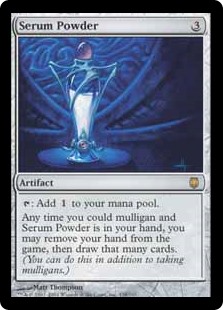
The first mode denies answers to the 3/3, the second gasses up the turn player while feeding opponents tools that are unlikely to matter, and the third deals with problem creatures, freely with Bloodghast in the picture. I'd been hoping we'd see a home for Rankle in Modern since it was spoiled, and it seems like this could be it.

Once a Powder Tron, BAIBURQUENO (5-0)

Creatures

4 Eternal Scourge
4 Reality Smasher
4 Thought-Knot Seer
3 Walking Ballista

Planeswalkers

4 Karn, the Great Creator

Artifacts

4 Chalice of the Void
4 Expedition Map
3 Serum Powder

Instants

2 Dismember
4 Once Upon a Time

Lands

2 Blast Zone
4 Eldrazi Temple
1 Forest
2 Gemstone Caverns
1 Hashep Oasis
4 Urza's Mine
4 Urza's Power Plant
4 Urza's Tower
2 Wastes

Sideboard

1 Walking Ballista
2 Dismember
1 Ensnaring Bridge
1 Grafdigger's Cage
3 Leyline of the Void
1 Liquimetal Coating
1 Mycosynth Lattice
1 Pithing Needle
1 Spatial Contortion
1 Tormod's Crypt
1 Torpor Orb
1 Wurmcoil Engine

I think my old standby Colorless Eldrazi Stompy is still playable, in a loose sense of the word, but outclassed; Once Upon a Time does for all creature and land decks what Serum Powder once did for us and only us. I messed around with the instant in Eldrazi shells after it was spoiled, and was blown away by the consistency Once afforded. I've always categorized post-Eye-ban Eldrazi decks as approaching their prime in different ways: Bant via Hierarch, Tron via Tron lands, Colorless via Powder, and lately, Gx via Once. Something I hadn't considered is what would happen if multiple modes were combined.

Which brings us to Once a Powder Tron, an Eldrazi Stompy deck splashing green for Once to give it maximal control over its openers, and subsequently over its Temple draws. The Tron package is also included here, offering as many ways as possible to reach an absurd amount of mana early. Only the most critical Eldrazi make the cut: Scourge for its Powder synergies and control abuse, Thought-Knot for its all-around utility and bulk, and Smasher for its aptitude at sealing the deal. The other threats are Walking Ballista and Karn, the Great Creator, both standbys of the Eldrazi Tron deck itself making a comeback lately.

As for disruption, the deck preserves Chalice of the Void, but forgoes Simian Spirit Guide. Rather, Expedition Map and Dismember are the deck's turn one plays, while Chalice is reserved for turn two and the heavy-hitters come out reliably as of turn three.


I can imagine this build struggling at the exact stages where Colorless Eldrazi Stompy has the most fun: in the early-mid-game. Should opponents find a way to deal with its mana advantage, say, via Damping Sphere or Blood Moon, Once Upon a Tron is left drawing Powder and Once and Map and lacking plays that put the pressure on. And there's no room for Zhalfirin Void to smooth out the draws. But I'm excited to see whether its explosiveness can adequately compensate for its unreliability.

Happy Brew Year

These decks might be from 2019, but I'm sure the coming year holds plenty of innovation for us to slice into. Happy new year once again from Modern Nexus!

Want Prices?

Browse thousands of prices with the first and most comprehensive MTG Finance tool around.


Trader Tools lists both buylist and retail prices for every MTG card, going back a decade.

Quiet Speculation