menu

Extreme Tokens

Are you a Quiet Speculation member?

If not, now is a perfect time to join up! Our powerful tools, breaking-news analysis, and exclusive Discord channel will make sure you stay up to date and ahead of the curve.

Sometimes I feel like a pirate searching for hidden treasure…

When I am working on a format, I typically spend a lot of time scouring Gatherer. Often I find myself looking through the Standard card pool many times because each time my perspective changes. One time I will be looking for creatures that pair well with Nightshade Peddler and another I will be looking for every creature with the subtype beast.

Many of these searches are dead ends (or missing parts of the map to continue the pirate analogy), but they provide a great overall picture of what cards exist in Standard. It can also help to augment the narrow searches with a broader one because it's easy to miss a card that doesn't have the exact wording you searched for.

Treasure Found

This story began with me looking for a sideboard card. This is a strange place to start a treasure hunt, but sometimes you find your treasure in the most unlikely of places. Ahrr you still with me?

Pirate jokes aside, I ended up looking through hundreds of Avacyn Restored cards searching for Appetite for Brains. My cards from this set are still unsorted so it took a while, but eventually I found them. As I was looking through cards from the set, I noticed some Nightshade Peddlers and I began to wonder what other hidden gems there were in Standard that had not been explored yet.

Sometimes all it takes in deck building is the tiniest of ideas to get the ball rolling in your head. As I was searching for my sideboard cards, I tried to keep my mind open about possible playable cards. Cards that would never have been playable in other formats could turn out to be quite powerful right now. There are limitations, but this principle will keep your eyes open for the next discovery.

Right before I came across the last Appetite for Brains, I noticed it. My hidden treasure. This card was very powerful in Avacyn Restored Limited. Could it really be playable in Standard? No one in their right mind would ever think it was constructed-worthy. But it doesn't take much for this card to pile on a lot of damage very quickly. These are the things that went through my mind.

After that, my thoughts spiraled into deck building mode and I had to refocus in order to find the last card I was looking for. You may laugh when you see the card, but stay with me. Just hover over the name because I guarantee you don’t know what it does.

Goldnight Commander

Stop and think about it for a minute. Yes, yes, it’s a four-mana 2/2 with no comes-into-play ability. Normally I would say that's unplayable but the Commander is very good. As long as you can trigger your bulk uncommon enough, it provides an Overrun every turn. The way we can get the most triggers each turn is by playing cards that make more than one creature, aka tokens.

Here’s a quick example. If I cast Lingering Souls and then Goldnight Commander, I can follow up by flashing back the Lingering Souls. That turn I'm swinging with two 3/3 flyers and a 4/4 guy on the ground. Often you'll have even more creatures but those two cards alone already add up to a lot of damage.

What really sold me though was Increasing Devotion. That’s right, your team gets +5/+5! Not only do you get five 1/1’s, you also get a huge pump effect as well.

Armed with my new weapon from the booty, I set out to build a deck. My goal was a solid tokens build that happened to run Goldnight Commander as well. What I came up with is basically a regular aggro deck with a combo win, pairing Goldnight Commander with almost any other card in the deck to go nuts. The closest comparison I can think of is Craterhoof Behemoth, but we get the effect for four mana. Also, the price tag is quite a bit smaller on our uncommon than the rising star mythic.

First take a look at the deck list, then we will analyze it.

Extreme Tokens

Untitled Deck

Creatures

4 Avacyns Pilgrim
4 Arbor Elf
2 Mentor of the Meek
4 Goldnight Commander
2 Trostani, Selesnyas Voice

Spells

2 Intangible Virtue
4 Midnight Haunting
4 Lingering Souls
2 Sorin, Lord of Innistrad
4 Increasing Devotion
3 Collective Blessing

Lands

3 Gavony Township
1 Vault of the Archangel
4 Temple Garden
4 Overgrown Tomb
4 Sunpetal Grove
4 Woodland Cemetery
4 Forest
1 Plains

This a tokens deck and all of the normal heroes are included. There is nothing surprising about Lingering Souls, Midnight Haunting, Intangible Virtue or Sorin, Lord of Innistrad. Even the one mana-creatures, Elf and Pilgrim, are almost an auto-inclusion these days. I am not going to spend time discussing these known playable cards. Some of the others need explanation though.

Mentor of the Meek -- When this card was first spoiled players thought it was going to do amazing things for white-based aggro. Due to the dominance of the tier one decks that never happened, but now that the format is slower Mentor has time to draw a lot of cards. I have always liked the interaction between Mentor and planeswalkers. Alongside a planeswalker that makes tokens, Mentor will guarantee at least one extra card per turn. Since this deck wants as many creatures as it can find, a draw engine attached to a body is perfect.

Trostani, Selesnya's Voice -- Trostani is a new addition to the deck. While the populate ability may come up when the board stalls, the main reason I included it was for the life gain. Against the new Zombie deck particularly, you need an extra turn or two in order to win. Trostani lets you buy this crucial time to set up, and it's not bad as a blocker either.

Collective Blessing -- When I started seeing this enchantment appear as a one-of in decks, I was intrigued. After I saw how amazing it was, I wondered why players didn't play more copies. Three may seem like a lot but Blessing plus Increasing Devotion wins a lot of games. If you need to be active earlier in the game, these can be sided out.

Sideboarding

As for now, I don’t have a sideboard together. I know there will be one Trostani and some spot removal like Tragic Slip and Sever the Bloodline, but I have not come up with a strategy against the controlling decks.

Against Bant Control this deck is well positioned because they do not have many counterspells and each of your cards makes an army all by itself. The worst matchup is certainly U/W Flash, and that's what I want many sideboard spots for.

Honestly, I have no idea what to bring in to beat them. They can literally counter all your spells. The best bet is to draw your Midnight Hauntings and cast them on the opponent’s turn, but they can still block with Restoration Angel so even that plan won't always work. I am open to suggestions for the sideboard, so please send me some ideas if you have any.

This deck is not just a casual FNM deck to have fun with, although it is a ton of fun to kill someone on turn three via Goldnight Commander. Extreme Tokens has the ability to beat most decks in the format. With the decline of U/W Flash due to the return of Zombies, I think this is the time to break out some Extreme Tokens.

Until next time,

Unleash Extreme Tokens!

Mike Lanigan
MtgJedi on Twitter
Jedicouncilman23@gmail.com

Insider: My Spec Jumped, Now What?

Are you a Quiet Speculation member?

If not, now is a perfect time to join up! Our powerful tools, breaking-news analysis, and exclusive Discord channel will make sure you stay up to date and ahead of the curve.

What are the biggest movers of the last few weeks? While there are a couple, let’s start with one I’ve been on for the last month or so (along with, hopefully, many of you).

Thundermaw Hellkite

A couple weeks ago in my column I wrote this:

“Thundermaw Hellkite continues to climb. We’ve been ahead of this one for awhile, and it’s starting to pay off. I have a handful in my trade binder that people have been going crazy for over the last two weeks, but I’ve been up front with them that I have to have at least $20 to trade them away. While people scoffed at me at first, it’s now up to $20 on SCG and pushing that on TCGPlayer. Wouldn’t be surprised to see this hit $25 on the trade floor in the next week or two.”

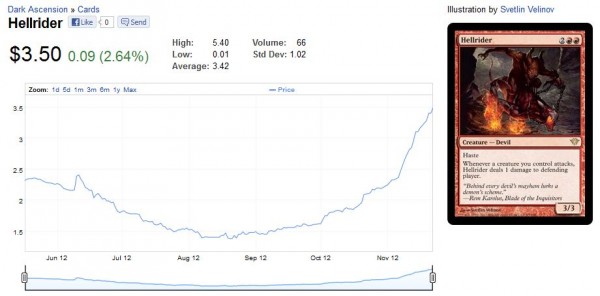
Like I predicted, it’s now up to $25 on SCG. So, if you did like I did and stocked up on it, congrats, you’ve made money! Now, for the rest of the article, feel free to insert Whatever Card Name you want in place of Thundermaw, since this is about more than one card. Heck, the other card I’ve been advising you to stock up on (Hellrider) is up over $7 on TCGPlayer, and I have a few dozen of those I got at $2-4 in trade.

So we’ve “made money.” Sweet. Of course, the truth is we haven’t done anything yet, and you haven’t made a single red cent. The truth is, as we know, you don’t “make” anything until you sell. This is called the Myth of Making Profits, and if you’re unfamiliar I would suggest reading this article, where I laid everything out.

So now back to our Hellkites. The price has steadily gone up over the last few weeks, and we have plenty on hand. What now?

Understanding the Spike

I generally divide price increases on speculation targets into two camps. Which one a particular price increase falls under dictates how I react to it.

The Instant Spec

Let’s start with the “instant spec” camp. This is basically Nivmagus Elemental. In other words, a card that moves based on hype, whisperings or an unbanning. We can look at Scapeshift, Leveler, Land Tax and countless others for recent examples.

This spike is characterized by a massive and sudden increase in demand, usually fueled by hype. We see prices jump drastically in a matter of minutes or hours. There’s a lot of money to be made in situations like this, but you have to be very careful about the timing, since these things don’t always pan out (see Elemental, Nivmagus for proof).

In these cases, I always advise to sell into the hype. This means get your copies cheap, and get them on the market as soon as possible. Sometimes this means eBay, other times it just means cashing out on the buylist or even trading them away.

Sure, sometimes these hyped cards pay off and stay hot or reasonably expensive, such as Huntmaster of the Fells, but the risk is also higher. This is why I sold off my Scapeshifts as soon as they arrived. While the card still commands a respectable price, I was happy to lock in my profits as soon as I could, and in this case it also made me the most money.

Moreover, there’s nothing wrong with leaving a little bit of money on the table in these situations. It’s better to cash out at 80% of the spike rather than wait too long and end up missing your window, losing money or making significantly less in the process.

The Slow Increase

Now, let’s talk about the type of price spike that I feel Hellkite falls under –- the "slow increase."

Hellkite has been coming on for a month or so at this point, and we’ve seen $2-5 increases every week during that duration. What’s so important about this is that when a card’s price rises like this, it’s because there is true demand and most importantly sustained demand driving the increase.

This is important because it means the eventual fall will come in the same way. Now, I’m sure this isn’t 100% true all the time, but it’s been a good rule of thumb for me and it’s proven reliable enough over the last few years.

So with Thundermaw, I don’t advise selling quite yet. There’s nothing wrong with doing so if you want to lock in profits now, but it’s easy to follow the trajectory of a card like this. Just as we started to accumulate it as it made more top eight appearances, we can liquidate it in the same manner. I’m not sure how much higher it can or will rise over the next few months, but I imagine the peak is around $35.

Given that we’ve established the card won't drop quickly in price, I have no problem holding onto mine and watching the decklists come in. If I see two weeks of below-average Hellkite sightings, I’m probably selling. On the other hand, if it continues to put up results I feel comfortable waiting to see if it will rise any more. Either way, you’ll have plenty of time to cash out before the bottom falls out from under it, and that’s really the point.

The risk of holding Hellkite (the slow increase spec) is much lower than that of holding Nivmagus Elemental (the instant spec), so I’m willing to bear that risk in search of higher returns.

It’s Up to You

As I said above, this is just my approach to specs and it’s paid off well for me in the past. But that doesn’t mean this is the 100% correct approach. In the end, you may decide that selling now is the best move, and I can’t fault that. Either way, the most important thing is to consider all the information you have about the card, and the opinions offered by those around you, to make up your own mind about the best course of action, and go from there.

What do you guys think? Are my theories sound? Should we be selling or holding Hellkites? Let us know. After all, the more opinions you have, the more informed your decision will be.

Thanks for reading,

Corbin Hosler

@Chosler88 on Twitter

Building a Pauper Cube- Part 1

Are you a Quiet Speculation member?

If not, now is a perfect time to join up! Our powerful tools, breaking-news analysis, and exclusive Discord channel will make sure you stay up to date and ahead of the curve.

I stopped playing pauper a little bit before the monoblue Delver decks started showing up on what I like to refer to as “the day my brother took his Serrated Arrows back.” Truth be told I wish that I had just shelled out the infinite (3-4) tickets per Arrows to keep playing between then and now, because in the interim I had really missed making Mulldrifters.

Recently I started playing Pauper again and have played some sweet games since. The sweetest I’ve played since my return ended like this:

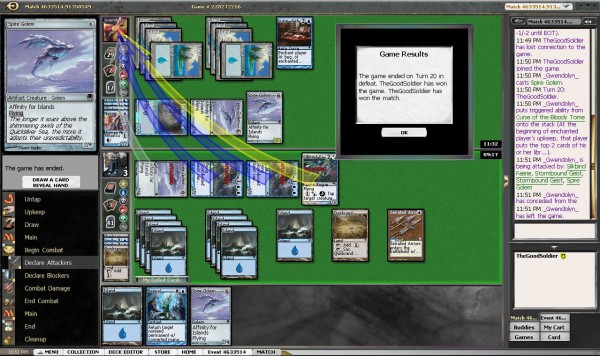
Some players lack the courage it takes to cast Accumulated Knowledge for four with ten cards left in their deck while enchanted by Curse of the Bloody Tome.

Seeing as I play Pauper strictly as an outlet for having fun, I would like to try to minimize those instances of unfun games. Seeing as altering the actual Pauper format is outside of my grasp I thought it might be interesting to explore building a Pauper Cube. After all, Cube is basically the best way to play Magic. At the very least the drafting portion is fun.

My friend Dana Kinsella has a very fun common cube, but there are a few fundamental problems with it. Basically the mana is too good and the decks are often incoherent as a result. It’s one of those Cubes where the best card and/or the best manafixing is usually the correct pick. There are strong strategies to build around and interesting card interactions, but while playing Dana’s cube I’ve never played less than four colors and I’ve never lost a match.

I want to build a cube with a higher emphasis on drafting actual decks. As a baseline for this I intend to use popular archetypes from the Pauper format as ideas for which decks I want to have viable in my cube. The Cloudpost decks clearly suffer from the singleton nature of Cube, but their base strategies should still be draftable even without their namesake acceleration.

I want this cube to generate games that are very similar to playing actual Pauper, and I’ve crafted a set of rules to follow while building that I believe will help me reach this end.

Storm Must Be Draftable

This is hardly the most important rule for the Cube to be fun to play, but for my ends this is the rule that matters the most. If combo can’t be drafted in my Cube then I will consider the Cube to be a failure. Combo is one of the pillars of the Pauper format and without it good removal just ends up mattering too much. I don’t want a cube that asks which player can build the best beatdown or control deck, I want a Pauper Cube that involves as much strategic planning as a well-built powered Cube.

Cards Should Be Powerful in Multiple Archetypes

One of the issues with having Storm as a draftable archetype in a lot of Cubes is that many of the cards that are good in Storm just don’t fit into other decks at all. To some extent this is unavoidable. I’m not going to just not include Dark Ritual, but I also don’t plan to put every Desperate Ritual variant in the Cube.

Luckily there are a number of cards that are good in Storm decks that happen to fit into other decks very well. All of the card draw/filtering are going to be fine in any deck that can cast them and cards like Nightscape Familiar still get to block when featured in non-storm decks. Spells with Suspend also tend to have enough impact to be good enough in non-combo decks while also being great for adding to storm.

Another thing to keep in mind will be having a high enough threshold of artifacts for an affinity/metalcraft deck to be viable while making sure that most of the artifacts included will be good enough without needing such a theme in one’s deck.

Following this rule will probably be the most important for the success of the cube, as it allows players to explore strategies that I hadn’t thought of as well as making is super easy to hybridize all of the strategies that I intend for the Cube.

Manafixing Should be Hard to Come By

Good manafixing makes for boring cubes. I want to avoid having four/five color decks being draftable as much as possible. They should be able to exist, but not able to be forced. I plan to avoid cards like Kodama's Reach and Signets. I do still want some ramp and fixing, but I’m going to need to be very careful with this selection. The Ravnica bouncelands are probably necessary for their interactions with the Urza block “free” mechanic for the Storm decks and the odd Sakura Tribe Elder isn’t going to hurt anybody, but for the most part mana fixing will be rare.

Hate is Probably Necessary

If Storm is going to viable I don’t want it to be the case that players just lose every time their opponent casts Empty the Warrens. Echoing Truth and Echoing Decay are pretty automatic includes and will help to combat the Storm decks while being completely reasonable cards on their own.

That said, I want to avoid cards like Circle of Protection: Red that would just invalidate certain decks on their own. There will be cards that are good against every strategy, but nothing that just colds any of them. That’s just not fun Magic.

~
At this point I’m not exactly close to having a finished list, but I have a large stack of cards sitting next to me and a lot of ideas for the direction that I want this cube to go. In addition to Storm I want Tortured Existence, Burn, Poison, MUC and Metalcraft to all be viable archetypes to draft. I’m currently undecided on whether or not to include Slivers in my Cube. They can be pretty good with Changelings but mostly they just don’t overlap with other archetypes at all and that will probably ultimately be the reason they end up not being included.

I plan to have a finished list ready come next week and I would love to hear any ideas that anybody has in the comments sections either for archetypes that I should try to work into the cube or singular sweet cards that I might not know about. Let me know!

-Ryan Overturf
@RyanOverdrive on Twitter

Insider: Staying Ahead of Standard

Are you a Quiet Speculation member?

If not, now is a perfect time to join up! Our powerful tools, breaking-news analysis, and exclusive Discord channel will make sure you stay up to date and ahead of the curve.

Standard is finally starting to sort itself out. We’re seeing less new brews and more iterations of existing decks improving on each other week to week. Rakdos deck becomes updated Rakdos deck. Reanimator becomes updated Reanimator. Bant Control becomes updated Bant Control. You get the picture. Determining what Standard cards are going to move in value depends a lot on the matchups between the top decks, and not as much on a unseen innovation appearing out of nowhere. Speculating in this type of metagame is much different than the brand new format we had only a month ago.

Picking cards in a new format means determining what types of strategies will pop out with the new set, and what existing cards will do in this new format, and what sorts of things will answer these new strategies. This season I picked up on Tamiyo as a great coupling with Jace, Sever the Bloodline as a sweet answer card. I missed the mark on Chromatic Lantern, but luckily it hasn’t cost me much as it still sits around where I bought it and it has some time to grow still. Finding cards that tweak the existing strategies to beat each other is a different animal altogether.

Aggro

The Aggro Rakdos deck is now leaning on Hellrider and Thundermaw Hellkite to give them the reach they need to end the game before the slower decks can respond by gaining life with Thragtusk and Sphinx's Revelation. Cards like Slaughter Games and Duress can be used to pre-empt the problem cards, but more recently the deck has shifted to a more Mid-range build playing creatures that shift a bit farther up the curve. As the winner of the GP in San Antonio, it’s the other decks that will need to combat this new shift in strategy. Playing creatures that cost a bit more mana opens the deck up to vulnerability to sweepers. Terminus and Supreme Verdict already see play, but if this Rakdos deck is the new go-to aggro strategy, I’d expect to see more of this. Currently most decks either play a split of the sweepers, or simply max-out on one of the two in their 75. As a result we see Thundermaw Hellkite finally getting the attention he deserves around $15+ and Hellrider has climbed as high as $8. While the Hellkite can likely sustain this price until he finds himself deckless, the Hellrider has reached it's ceiling. Hellrider does come from an underdrafted set, but only can be played in specific strategies, and is unlikely to be widespread across the format. Given that most of the deck is fairly inexpensive, people will gravitate towards this deck, which is why it moved up so suddenly. I expect we'll see it drop to at least $6 almost immediately.

Reanimator

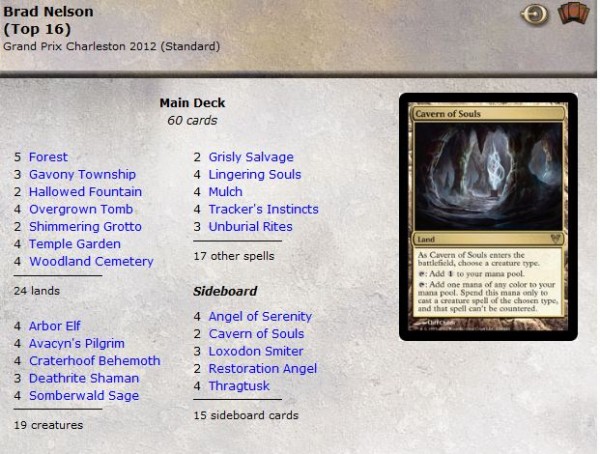
Lately, people have shifted to Brad Nelson’s Craterhoof Behemoth build, which relies on mana-dorks and the Behemoth to punch through for a bunch of damage. Reanimator builds have occupied a majority of my personal testing, and what I’ve found is that the Unburial Rites target itself is the most driving force to what the deck will look like. Behemoth wants lots of little creatures in play when it arrives to the scene to end the game in quick fashion. Where as, to combat the Rakdos decks, Angel of Serenity may actually be the best target. Griselbrand is best against slow grindy control decks, and I have personally settled on a split between the two. The Behemoth build is trying to put forward enough of a threat that the control decks can’t deal with it while also packing enough power into one swing to offset any lifegain. If control decks move back to a heavier assortment of sweepers this mana-dork strategy won’t be as strong. Further, there is some debate as to which parts of the color pie should be included in the manabase. Is it best as GBwr, Junk, or even newer versions featuring blue for Forbidden Alchemy and Tracker's Instinct? As far as determining profitable positions, the fat targets are the key, and are going to continue to change with the meta. As one moves up I want to be buying into the ones that are coming down. Angel of Serenity has fallen to about $15 on EBay, while Griselbrand, who still sees some Legacy play is around $8. Even though the Angel is twice as expensive, I like it as a target right now. It appears in other decks as well, including some of the Bant Control lists, and will almost certainly find a time when it will shoot back above $20. Griselbrand, on the other hand will be unlikely to appear in other decks because 8-mana is a lot more than 7, and the BBBB restriction on his mana cost is a bit unwieldy.

Control Decks


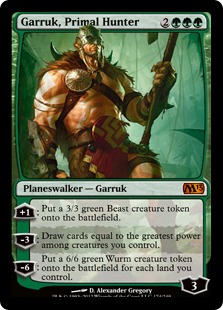
Bant Control decks have been seen splashing Nephalia Drownyard at the top tables lately, and this doesn’t suprise me at all. Going into this past weekend, Bant Control seemed like the deck to beat, and the best way to beat a Thragtusk mirror is to stop caring about your opponents lifetotal and just deck them out after they’ve drawn too many cards with a Sphinx's Revelation. Turns out, that the Rakdos deck had found all the right answers to be able to edge out the Control decks in this event, but the meta still found that Bant Control breaker to be a colorless land that required Black to activate. This increased my confidence in Nephalia Drownyard in the future, although many do not agree. As I mentioned above, these control decks will need to increase the quantity of sweepers they play if they want to survive the creature decks. Terminus is already inflated to $12 from the $5-6 when I (and others here on QS) reccomended it early in the season, I dont think there’s much more room for it to grow. What I do want to consider investing in is Garruk, Primal Hunter. He’s sold out on Star City Games around $8, and more and more Bant lists are including some number of him in the deck. Even having been printed twice, $8 is fairly low for a Planeswalker that is actually seeing Standard play. I’m cashing out my profits on Terminus and Tamiyo. The M13 printing seems to have increased significantly more than the M12 version, according to mtggoldfish.com but this may have to do with redemptions more than the card itself. Since M13 has both Thragtusk and Thundermaw Hellkite, people are going to be more aggressively trying to complete redemptions of the Core Set.

Conclusion

New spec targets are Garruk, Primal Hunter, and Angel of Serenity which I plan to buy into on both MTGO and in paper. What did I miss that control decks might latch onto to adapt to the newest Aggro builds? How will the Aggro decks next level those changes?

Jason’s Archives: What You’re Ignoring

Are you a Quiet Speculation member?

If not, now is a perfect time to join up! Our powerful tools, breaking-news analysis, and exclusive Discord channel will make sure you stay up to date and ahead of the curve.

Greetings, Speculators!

As a writer for the free side of QS, I like that my articles are free to read and disseminate. My philosophy about finance is to answer any question people ask me because I can't get all the money out there to be made and I don't benefit from keeping secrets.

However, I also believe in the founding philosophy of this site. Namely, that it takes work to aggregate and analyze data, which is worth paying for when you lack the time, training or inclination to do it yourself. Consequently I take great pains in my articles to give relevant financial information and either disguise it as metagame analysis or stray away from covering anything another writer is distributing behind the paywall.

The more I wrote, the more I tried to slip in. I have a difficult time keeping secrets, and if I have good financial information I don't like keeping it to myself. The QS forums are an excellent outlet for me, since they let me participate a little more directly in discussions on speculation. The forums were also an excellent place for me to learn that the forums were the only place people listened to my advice.

I know my readers understand that an article examining which decks and archetypes are trending up or down at various tournaments has financial relevance. However, I do feel like there are a lot of people out there who want to get better at the finance game. I don't personally take offense if my own advice is ignored, but the whole concept got me thinking about what resources out there people tend to overlook, and how much better everyone could be if they started noticing them.

Twitter

I probably harp on this more than I should, considering you could write an entire article about the importance of Twitter, but you're a captive audience, dammit.

I think my exuberance about Twitter as a Magic resource stems from my early dismissal of it as a mere global facebook wall -- a graffiti board for narcissists that seemed to lack any real value. But as someone who has now embraced the platform, I've become a huge proponent. A lot of you are not on Twitter. That's a shame; you're missing a lot. Magic players are people too, and people use Twitter to tease their friends about bad beats, share their new brews, ask questions about prices and trends -- you name it, it's happening on Twitter.

If Japanese players are asking for Thundermaw Hellkites from their Twitter followers before an event, could that be relevant? If Ryan Bushard sees one of the dealers buying all of the blue fetchlands in the GP hall, are you going to run with that information at 3:00 PM on Friday or will you remain in the dark until Monday's tournament results?

Quiet Speculation does an excellent job of sending out e-mail alerts from major events but not everyone is affiliated with QS. Lots of finance personalities noticed the trend while there was still time to buy Misty Rainforests at $13, and if you didn't, you probably weren't paying attention to Twitter. You won't get every hot tip by following the right people and spending time to filter your stream down, but you're sure going to miss all of them if you don't.

Facebook

Feel free to point out that I wasn't on facebook until a week or two ago. I'm making up for lost time though, gradually unfriending all the people from high school and college I haven't thought about since deleting my account in 2009 and friending a ton of Magic people I know.

Joining interest groups is a great way to let people know you buy or sell cards and a good way to organize trades or rides to events as well. So Facebook is a distraction machine, they sell your data and violate your privacy, your mother's on there ever ready to embarrass you on your wall and you're helping to enrich a weasely douche like Mark Zuckerberg, but once you get past all that it's just like Twitter. Except one in six people on the planet use Twitter, while roughly half the people with internet access are on Facebook.

For all I know, I could be the only person affiliated with QS who wasn't using it, but I'm back now so friend me already. Just like Twitter, people volunteer good information and if you're missing it, you're not going to optimize the time you spend online trying to improve as a financier.

Forums

QS's forum is great. As a writer, I get to use it for free (well, I pay for it in servitude, but I don't write a check) so naturally I'm all about spending as much time there as I can since it's leaving money on the table otherwise. However, if I'm ever afflicted with a terminal case of writers' block or I get fired for accidentally tweeting a pic of my junk or something, I could see paying to access the QS forums. Between the e-mail blasts and the good info being dispersed liberally throughout the forums, you'll make your subscription back in no time.

Of course there are other websites that have merit and don't require you to shell anything out. These can also be valuable resources.

MTG Salvation - MTG Salvation is best known for its spoiler (although I think QS's free spoiler for RtR was far superior) but the forums on MTG Salvation are pretty informative, especially the rumor mill. While many of the "rumors" are unsubstantiated, they tend to discuss spoiled cards for a day or two before they are "officially" added to the spoiler. That lead time gives you a chance to decide whether or not you want to buy that card at its presale price. I bought 40 Thragtusks for $5 each because I saw it early and thought there was no way it wouldn't be worth three times that. Sure, you waste some mental energy brewing with fake cards that never see print, but is brewing as a mental exercise a wasted one? I don't think so.

The Source there is a lot of good information about Legacy posted here by players and brewers of the format. Eternal formats are important to watch because there is a lot of profit potential. When a Standard card goes from unplayable to playable, it goes from a dime or a quarter to a few dollars, and if it sees sustained play, it will go up from there incrementally. That's not the case with Eternal cards. When no one played Energy Field, you could get them for around $1. When Rest in Peace was printed, the card shot up to $15. Who bought them at $1? This guy, because I don't ignore Legacy.

When a Legacy card spikes, the supply is so much lower that players scramble to get their copies and will pay anything. Hellrider spiked and the average player said "Oh, rad. I have a set of those in a box somewhere." Academy Rector spiked and the average player said "#$%^, ok, how much?" and got out their wallet. Be the guy holding the Academy Rector, not your wallet in one hand and a bottle of lube in the other.

Pojo Seriously, hear me out. Yes, Pojo has a reputation for being monkey mecca. But good info comes from even bad forums. Between the forum on the mothership and the one on Pojo, I watched people talk about the Izzet Staticaster/Nightshade Peddlar combo. I laughed at them for being bad, until someone tried it and got there.

The deck isn't great, but it had enough merit for the SRS community to give it serious consideration for a minute. Not every bad idea is a bad idea, and forums that only super casual brewers frequent have merit. Sure, a lot of the stuff is bad, but if there is anything you find yourself agreeing with, how many other people are going to be on it?

Try Sending a ^$*% e-mail Once in a While

I've never refused to answer a question via e-mail or Twitter even if the person was asking me for information QS charges for. Most people will answer e-mails if they make their addresses public. It's just that no one really thinks to ask.

If you want to get better at financial analysis, you're not going to do so by reading the same info everyone else is reading and the same time they're reading it. That approach makes no sense, but it's the most common approach. Sure, you can carve out a few bucks exploiting lag and buying Thundermaw at $19 before it hits $25, but wouldn't you rather have been ahead of the curve and gotten them at $8 or $10? If you wait for everyone else to be on the card, you're not making much money, and if you're not making much money, why bother? Use your free resources and maximize your profit potential.

Texas Was Messed With

I used to make up stupid puns but when they start recycling event cities it became too much of a hassle. I'm not saying you guys aren't worth it, but... you aren't.

GP San Antonio Top 16

Did you get the e-mail blast about the B/R deck that is fast enough to race Thragtusk? This has been a lopsided format where the control decks came early and easily and it took players a bit longer to figure out aggro. Thragtusk is almost solely responsible for this, but the printing of decent planeswalkers, Detention Sphere and Angel of Serenity made it more obvious this time around. Aggro may have finally been solved, and if you didn't get Hellriders at $2 when I told you to I actually don't feel sorry for you. You can buy mine for $8. Knight of Infamy is another breakout star in Tyler Little's winning list, but there isn't a ton of profit potential. If you can buy cheap, buy in fours because these will trade better than they sell and having a whole playset to trade out at a premium is the play.

There actually weren't too many surprises, here. Nearly equal amounts of the new B/R beatstick, U/W Flash, Reanimator and Bant made up the top sixteen. Breakout cards from the weekend were few, but a G/W Humans deck emerged that Sam Black and Jackie Lee both really liked. Gavony Township in a deck with Precinct Captain was a long time coming, and it's good someone finally cracked the code. Mayor of Avabruck pumps humans when he's not flipped. Perhaps that's why he's so biggity bonkers. I sat on a million copies of Mayor before I finally got fed up and dumped them. Bad move -- that card's on the rise again and I can't keep them in my binder or my store.

Get [card Thalia, Guardian of Thraben]Thalia[/card]. It's getting a ton of play in Standard and it will never go down because it's a giant beating in Legacy. Get Thalia. Pay retail right now if you have to, it's cheaper than you'll pay later.

Both Garruks made appearances, often in the same deck. One of those is overpriced. The other is underpriced. Which is which? I don't know, this is a free article.

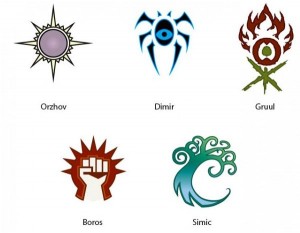
Seeing a Naya deck before Boros and Gruul and a Grixis deck before Dimir makes me think the post Gatecrash standard could bear up to 10 solid archetypes, maybe more. U/W Flash gave a lot of people heartburn but I don't think we'll see one, monolithic, "best" deck in Standard again for a long time. We're more likely to see the "rock-paper-scissors" formats of Mirrodin Standard that were so much fun to watch. Standard keeps getting healthier.

I will be posting my thoughts about how Standard develops using the #brewdontbitch hashtag I started using when people were calling for Thragtusk to be banned. Standard is much more fun than it's been in a while.

Commentary on This Topic Will Be Ridiculed

I'll Just Leave This Here

I'm going to do my best to congratulate my good friend Aaron "The Godslayer" Sulla on taking down a 5k. I don't want to hear about how small the event was, how there were no pros there or whatever negative crap people feel compelled to spout whenever a Seance deck wins an event. I'm sick of hearing it. My friend won an event and that's awesome. That's all I will say about that. You can hear his soothing Baritone when he tries to stump us on BSB's "Guessing with the Godslayer" segment or troll him by calling his pizza shop and having him deliver a pie to "I.C. Weiner" at a fake address. Your call.

Bye! Have a Beautiful Time!

That's it from my end. Hit me up in the forums, on Twitter, on my e-mail, on my podcast, on facebook, on google+... I'm pretty reachable. Don't ignore potential sources of info, and remember to go with your gut. "How can that possibly be bad?" is a phrase that rarely describes a bad card, concept or spec. You can do it, I believe in you. Now go make some money.

Insider: There’s Something About Jace

Are you a Quiet Speculation member?

If not, now is a perfect time to join up! Our powerful tools, breaking-news analysis, and exclusive Discord channel will make sure you stay up to date and ahead of the curve.

Jace, the Mindsculptor has been climbing steadily since January of this year.
That's pretty impressive growth for a card that's only legal competitively in Legacy and Vintage, though it's fair to say some of that demand was from Commander players picking the card up while it was 'cheap'.
The break from the steady upward trend recently is very odd; when analyzing the card from a competitive standpoint not much has changed beyond the success of U/W Miracles in Legacy the past few months, and I'm unaware of anything that would dramatically increase demand for the card from casuals.
Channelfireball raised their buy price to $55 the week before GP San Jose, selling the card for $80, something we hadn't seen since before the bannings. A few weeks later, Starcity raised their buy price to $60 and began selling them for $100. The internet consequentially went insane.

And hasn't stopped.

My question is, why?

The card obviously holds a special place in the game's history for both good and bad reasons along with the notoriety it holds because of that. It's the best planeswalker ever printed, and probably one of the best cards ever printed. It's name is Jace, the Mind Sculptor, and Patrick Chapin loves it. Maybe people just decided their Jaces were worth more than the old buylist prices, but that doesn't feel like the whole story.

The only reason I can think of for this price spike is speculation that Jace, the Mindsculptor will be unbanned in the Modern format as some pros have called for.

If Jace was unbanned the internet would go insane again, and most copies available online would be bought out within the hour. Retail outlets would adjust their prices, I wonder if would SCG stop at $150? The exact price doesn't really matter, what matters is the reaction to the unbanning itself along with the new presumably higher retail price.

Part of Jace's infamy will always be tied to the $100 retail price tag he held when he was in Standard, and the feeling of being 'priced out' many players had who wanted to play the format. Why would Wizards want those feelings brought back into the fold for a Modern format without the type of support Standard has? A format they are trying to make more accessible. A format that can't afford that kind of bad press unbanning a $150+ Jace would cause.

Modern Masters has shown us how serious Wizards is taking establishing the format, and shows us the way unbanning Jace could work. Of course, Jace isn't eligible for Modern Masters itself, but some type of artificial supply increase is needed before the card is unbanned to lessen the public backlash as well as alleviate legitimate price and supply issues. That of course brings about several questions that there are no answers to yet: If the supply increase happens, how big will it be and how much will it effect the price? Will it come before the unbanning or after?

The uncertainty that these questions brings make me want to stay away from holding copies of Jace, the Mind Sculptor in the long term, I have no problem acquiring the card in general, but a hold has too much inherent risk, especially when factoring in the initial investment required.

Insider: Playing on the Fringe – Scouring Today’s Cardpool for Tomorrow’s Staples

Are you a Quiet Speculation member?

If not, now is a perfect time to join up! Our powerful tools, breaking-news analysis, and exclusive Discord channel will make sure you stay up to date and ahead of the curve.

An understanding of the meta can create opportunities for profit. Recently Thundermaw Hellkite and Hellrider doubled in price as red decks took advantage of a Mid-Range field in Standard. When looking for the next big thing in Standard there are a couple of approaches that work to grind out profits.

Looking Ahead

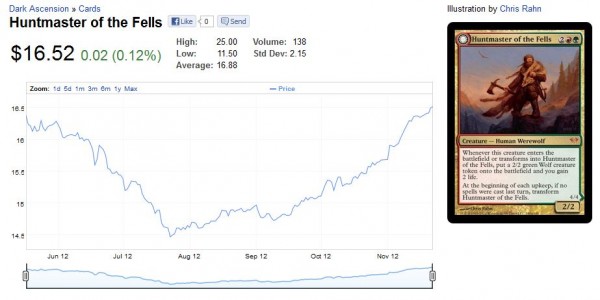
First, look for cards breaking under $20 after peaking ~$25 or more. These are cards that were either once very playable or suffering from a supply imbalance. Presently Huntmaster of the Fells fits the bill on both counts. Having once traded around $25, this mythic comes out of Dark Ascension. A much maligned set that remains unpopular and undrafted, the effects these supply constraints put on card prices can be seen in the wild price fluctuations of Falkenrath Aristocrat. Where Huntmaster has a much more stable price history, it will likely benefit from Gatecrash's Gruul additions. Already a very playable planeswalker has been added to G/R: Domri Rade. At >$20, a 25% return on investment is a conservative expectation even if Huntsmaster fails to increase its decklist numbers. Geist of Saint Traft provides a good example of how cards breaking $25 in standard having a hard time staying under $20 while in the format.

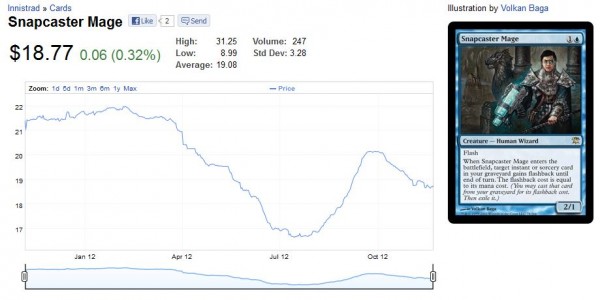
Unlike Geist, Snapcaster Mage is a rare. Its increased availability relative to both mythics from the same set and anything Dark Ascension weigh on its price. That said, the present Meta has found Snapcaster out of favor. With plenty of great potential targets already in Standard and a slew of new opportunities coming with Gatecrash the Mage makes a great trade target at current sub $20 pricing.  Because supply should dry up only as Snapcaster's Standard life is approaching an end, I am hesitant to suggest this target as a cash acquisition. While Snapcaster will see play across multiple MtG formats, the price cycle of cards does suggest that picking up for long term value should still be done post rotation.

Bonfire of the Damned is another interesting trade target at $24. Should this card break under $20 again while in standard it certainly merits a look. I doubt it sees a sub $20 pricing as red will gain momentum through the release of Gatecrash, and as an efficient way to pressure the endless waves of Thragtusks. Getting this card in your binder will make you a popular trade partner, but using cash to get Bonfire in there is a mistake.

Some Bolder Moves

Another, more risky, if less capital intensive, approach to grind out some profits involves finding a card with supply constraints trading at a deep discount. Identify catalysts for that card and assume some measure of success for the card in the format. What, if any, other cards will ride the coat-tails of success? Making every card involved in the process a part of a cheap speculation can offer !00%+ returns in short order.

The most obvious example I can think of is Havengul Lich. Trading under $3.50, this mythic from Dark Ascension is a potential 5 bagger that will increase the play-ability of  Innistrad's Evil Twin and the oft-printed Clone. While it will be very hard for Clone to ever reach $1, this uncommon rare will be a very liquid commodity should Havengul find a home in house Dimir. Evil Twin could end up a $4 card should Havengul take off.

Chromatic Lantern remains my favorite value play. While it could see an increase in popularity with Havengul, it already has a great future thanks to Commander and it's unique form of acceleration and mana fixing. Here is a card that is at least as good as Coalition Relic, and is trading at a $2 discount to the Relic. Keep in mind, Relic has seen multiple reprints.

Expecting Boros to show up at all means cards like Slayer's Stronghold and Zealous Conscripts could test their high water marks. While the Stronghold likely has more legs, both have already made the occasional cameo appearance on the pro circuit. Rootbound Crag and Drowned Catacombs  make good trade targets. While they've seen multiple printings, players will continue to look for them especially as the color combinations are featured in Gatecrash. Both have limited upside and plenty of supply, making cash investments look risky here. Occasionally  foils of these core set Duals show up at<33%premium to regular versions. If you can move them, these foils offer good value at those prices.

Allow your experience playing Magic to inform your investments. Using your own player expectations and the information your trade partner's desires reveal will open up multiple lines of investment. Some will play out locally as you get to know your market and its quirks. Others will allow you to take advantage of the differences between your local meta and the non-local MtG scene. Playing the middle man between these two markets will grind out plenty of returns, happy hunting!

Insider: Early Speculation Anticipating Gatecrash

Are you a Quiet Speculation member?

If not, now is a perfect time to join up! Our powerful tools, breaking-news analysis, and exclusive Discord channel will make sure you stay up to date and ahead of the curve.

The release of Gatecrash is rapidly approaching, and when it arrives Standard will get a face-lift of sorts. The remaining five Shock Lands will become available as well as some [hopefully] powerful cards from the remaining five guilds. For quick reference, the five guilds in Gatecrash are Boros (W/R), Simic (U/G), Dimir (U/B), Gruul (G/R), and Orzhov (W/B).

Each of these five guilds will have an impact on Standard in varying ways. As the metagame evolves to absorb the new set, certain cards will shift in popularity and value. But rather than wait for the shift in value, we can begin speculating on what may be powerful with the release of Gatecrash.

In fact this has already begun in some circumstances – I will do my best to bring you up to speed on recent price moves based on Gatecrash speculation. I’ll also try to mention a few possible ideas that may not have gotten everyone’s notice yet.

Orzhov

Black/White is always a popular casual color combination. Therefore, any awesome Legendary Creatures in Gatecrash that represent the Orzhov guild have a chance at being financially relevant. But before getting excited about speculation on new cards, we should first consider cards already in Standard which may see a price bump with the printing of many Orzhov cards.

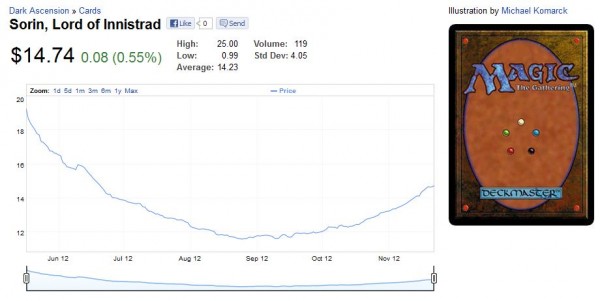
To me, three obvious cards come to mind – and one of them has already seen a small price rebound. Check out the token B/W Planeswalker, Sorin, Lord of Innistrad (chart from blacklotusproject.com):

This Planeswalker really hasn’t seen that much increase in play lately. But the anticipation of strong B/W cards to enable a viable Orzhov deck has already bumped Sorin up in price. He’s not near his peak yet, so there is certainly some more upside. If he sees increased play with the release of Gatecrash, he has potential to return to $20 (cash prices).

But if his fifteen minutes of fame is cut short, his run will end. Still, once Gatecrash is released there will be so much hype that people will want to brew decks with Sorin. Whether he is a hit or a myth, he will still see increased demand – it could be wise to acquire Sorin in trades now and move him shortly after release unless he breaks out.

Two other clear options for Orzhov include Lingering Souls and Vault of the Archangel. Both have already seen some price increase. They are both from Dark Ascension and were, therefore, opened in fewer quantities. These seem like auto-includes in any strong Orzhov deck – I would recommend acquiring these either at discount prices or in trades, as they are well positioned to be strong players come Gatecrash release.

Dimir

Blue/Black is often the most popular and powerful color combination. After all, there is a reason Underground Sea is the most expensive Dual Land. But in Standard, this trend tends to break down. Perhaps Wizards is afraid of making this very control-based guild too powerful. Either way, Dimir is bound to have an impact on the format.

That being said, it’s difficult to identify cards in current Standard that are on the rise from Dimir anticipation. Nephalia Drownyard would be the most obvious choice, but the card has already seen significant play and still is nearly bulk. Evil Twin also has an essence of Dimir associated, but it too seems near bulk rare status. Should these two see increased play, potential upside is still limited.

In my opinion, Dimir may make a strong partner to Orzhov to create a Tier 1 Esper Control deck. Such a deck has already seen some success in Standard, and having access to Watery Grave and Godless Shrine can certainly help. A powerful removal spell, draw spell, or counterspell would also strengthen the deck and improve the utility of Snapcaster Mage.

In fact, Snapcaster Mage may see increased play again should this be the case. It may return to $20 but its price cap does seem fairly firm in that region (chart from blacklotusproject.com).

Geist of Saint Traft is another powerful creature that may fit into an Esper Control deck. Though this Legendary Creature is even more expensive than Snapcaster – acquire cautiously, in my opinion. I’d rather have $30 worth of Lingering Souls than one Geist of Saint Traft.

Gruul

One prime creature comes to mind when I think Gruul…

I have been bullish on Huntmaster of the Fells (chart from blacklotusproject.com) since his price bottomed a couple months ago. He’s been a 4-of in many successful Jund lists at SCG Opens. And being a Mythic Rare from Dark Ascension, his potential upside is significant… once people break down that apparent price barrier of $20. For some reason he’s bumping into a ceiling that Geist of Saint Traft hasn’t dealt with.

Either way, with Jund decks already being popular and powerful, Gruul will likely strengthen the strategy. This can only increase the playability of Huntmaster, and I can see his price finally hitting $20 cash, should Jund/Gruul decks remain Tier 1.

Although slightly more on the speculative side, Somberwald Sage is another creature worth considering. This mana-producing creature has already proven relevant in Standard with Brad Nelson’s G/B/W ramp / [cardUnburial Rites[/card] deck.

With Gruul likely to bring more poweful creatures, Somberwald Sage may have another home in Standard. Her power has been proven – now it’s just a matter of finding the optimal color combination and guild to maximize her power. I feel the release of Gatecrash will help her chances more than hurt them. And at $1 each, you could do worse for a small cap speculation.

Boros

The most obvious play here, in my opinion, is Clifftop Retreat. This land has already run up to compete in price with the other Innistrad Dual Lands. Because these lagged behind for so long, they are now the only Innistrad Dual Lands I own. The rest are all sold. I’ll be selling these once the first awesome Boros card is spoiled.

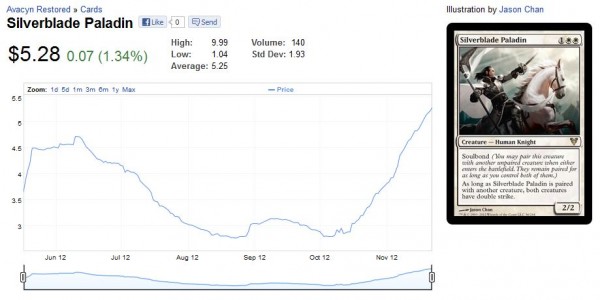
Some players anticipate Silverblade Paladin to be a good fit with a Boros deck (chart from blacklotusproject.com).

The Paladin’s recent success has already helped bolster his price to an all-time high. Double Strike is such a powerful ability that essentially doubles the power of an attacker. With Boros being a fast-paced attack-oriented guild, Double Strike can provide a powerful one-two punch. Silverblade Paladin is one card I am consistently trying to pick up, but they sell to dealers so freely it’s uncanny. Buy and sell prices are rising to keep pace with demand and I can see this creature hitting $10.

I’d caution from there, however, since Silverblade Paladin was a promo. Even though Restoration Angel sees a ton of play, her promo has kept her very close to the $10 range and Silverblade Paladin may have that same price ceiling to contend with.

Sublime Archangel is another creature on the rapid rise. She could fit in reasonably well in a creature-based Boros deck. Once she hits the board, her presence is known and I’m surprised it took so long for her to get notice. My eye is definitely on her and I plan on trading for her when I can.

An even better fit for Boros may be Hellrider (chart from blacklotusproject.com).

This card has been on quite the run lately, driving the price up more than double it’s bottom. And blacklotusproject.com hasn’t even caught up yet – expect to see this card finally plateau near $6.

I am not sure how much room this one has to go – it’s a tough one to predict. On the one hand, he’s a rare from Dark Ascension and may be slightly harder to find. He is also very powerful in creature-based decks that like to attack. On the other hand, Red aggressive decks are often hated out of formats and marquis creatures from these decks often hit a ceiling quickly. It may all depend on what Boros brings to the table that can enable this guy. The same goes for Thundermaw Hellkite, which also has potential upside in the right Tier 1 deck.

Simic

Last but not least we have Simic, the mysterious U/G guild. Most rumors on this guild include some sort of Merfolk creature theme. Thus many in the QS forums have been advocating Master of the Pearl Trident. I personally don’t see this creature hitting the big time, but I could be wrong. He is fairly cheap to acquire now, so if you are bullish on Merfolk in Standard, the time to acquire is now before any Merfolk [potentially] get spoiled.

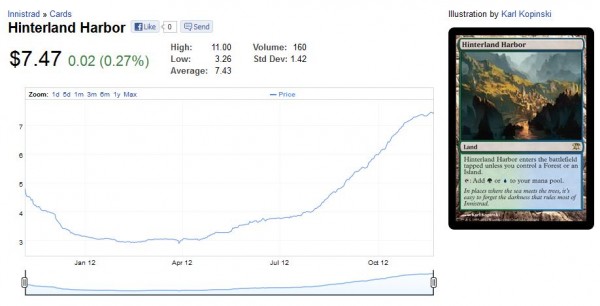
Hinterland Harbor would be a clear play on the lands front. But at $11.99 on Star City Games already, I’m not sure how much more room this one has to grow. Looking at the chart it appears this one has already leveled in price (chart from blacklotusproject.com).

Can Hinterland Harbor go up further? Of course… Woodland Cemetery set precedent on how high these can go. But until we see Simic become a major strategy, I’m inclined to hold off. I like Clifftop Retreat much more going into Gatecrash release.

Summing it Up

When new sets are launched, it means opportunity. Being able to anticipate what cards may become more popular well before spoiler season can net you solid profits. In fact, it may be nearing a bit late on many of the ones I listed above. Sorin, Lord of Innistrad, Clifftop Retreat and Silverblade Paladin have already seen price bumps.

But even if we are too late to the speculation party this time around, it is very helpful to analyze what moved and why. We can then reapply the logic when subsequent sets are released to help us stay ahead of the curve next time around.

…

Sigbits

  • It’s amazing how some Commons from recent sets have gotten so expensive, relatively speaking. Spell Pierce is definitely trade binder-worthy now. It buylists for $0.25 and sells for $1.49 on Star City Games. Lorwyn copies of Ponder also buy lists for $0.25 on Star City Games and all versions will cost you $1.49 to buy.
  • For a card that sees slight play in Modern, Cryptic Command sure has remained financially relevant. Both promo and normal versions buy list at $10 on Star City Games. Some players haven’t noticed this gradual price increase and still value the card around $12. Watch out for a reprint in Modern Masters, however.
  • The price of Terminus has proven to be fairly resilient. Even as the Standard metagame fluctuates, the card remains sold out at Star City Games at $12.99. This is another card that everyone values differently. I’ve managed to purchase this card recently from a dealer booth for $5 and sell them online for $9. Quite the discrepancy.

Insider: Financial Guide to Masters Edition Events on MTGO

Are you a Quiet Speculation member?

If not, now is a perfect time to join up! Our powerful tools, breaking-news analysis, and exclusive Discord channel will make sure you stay up to date and ahead of the curve.

This week sees the return of the Master's Edition sets to MTGO, just in time for American Thanksgiving. 4 pack sealed deck queues will run until the 28th, and 64 player draft events will run over the long weekend. When playing in these events, it's good to keep in mind the secondary market value of the cards that you crack. Below is a guide to the price of notable cards in each set, as well as some comments on limited play and other oddities.

As a rule of thumb a card worth 4 tix, essentially close to cost of a pack, is worth rare drafting. Keeping the pricier cards in mind when drafting will help you to "go infinite" and play in future drafts for free or at lower cost. Playing in more events cheaply gives you continued chances at cracking one of the high value foils. Unlike normal in-print sets, the foils in the MED sets can be priced at many multiples of the non-foil version's price.

All prices are from MTGOTraders and are current as of Wednesday November 21st, 2012. These prices will fall as a result of the events, but they provide a useful reference for those who will be playing MED I through IV sealed deck and draft.

MED

A complete set of Master's Edition (MED) is priced at 164 tix. It was released at a time when the online player base was much smaller. It is also pretty bad for limited play as a standalone set, because it was meant to be played with 10th Edition. These factors have combined to create the situation where the set was only lightly opened, and Force of Will is the most expensive card in the digital economy as a result. Crack a foil version and it will definitely pay for a few drafts! Notably, Animate Dead and Lightning Bolt are reproduced here with their original art, which is why foil versions go for 7 and 6 tix respectively.

Cards over 4 tix:

  • Foil Animate Dead ($7.0)
  • Foil Ankh of Mishra ($5.0)
  • Foil Armageddon ($4.9)
  • Berserk ($4.19), Foil Berserk ($10.5)
  • Foil Contagion ($4.0)
  • Foil Diamond Valley ($8.0)
  • Force of Will ($105), Foil Force of Will ($295)
  • Foil Hydroblast ($4.0)
  • Foil Hymn to Tourach ($18.0)
  • Nevinyrral's Disk, ($5.52), Foil Nevinyrral's Disk ($15.2)
  • Foil Ivory Tower ($4.45)
  • Foil Lightning Bolt ($6.0)
  • Foil Mishra's Factory ($6.0)
  • Foil Moat ($10.2)
  • Foil Pyroblast ($6.0)
  • Sylvan Library ($7.9), Foil Sylvan Library ($21.75)
  • Foil Thawing Glaciers ($7.75)
  • Winter Orb ($5.12), Foil Winter Orb ($14.1)

Notable Commons and Uncommons: Hydroblast ($1.88), Pyroblast ($2.0), Foil Goblin Grenade ($2.0), Foil High Tide ($3.0), Foil Zuran Orb ($1.0)

MED II

Master's Edition 2 (MED2) is priced at 151 tix for the set. It heralded the printing of the original allied dual lands but otherwise the power level of this set is probably the lowest of all the Master's Editions. Like MED, limited play was again quite poor.

Creatures are such a huge part of Limited and it's only in recent years that WoTC has gotten a better at designing and costing them. Thus, MED2 has such notables as Adarkar Sentinel and Kjeldoran Skycaptain. To modern eyes these cards may seem mediocre, but both of them should pretty much make the cut every time in sealed deck.

Lastly, Gorilla Shaman was printed in this set as an uncommon, but due to its original paper printing in Alliances at common, it is legal for play in Pauper. That's why it carries such a high price. It is a fantastic sideboard card to bring in against Affinity builds, which rely heavily on the Mirrodin artifact lands.

Cards over 4 tix:

  • Badlands ($13.42), Foil Badlands ($40.3)
  • Foil Brainstorm ($15.0)
  • Helm of Obedience, ($4.63), Foil Helm of Obedience ($12.75)
  • Imperial Seal ($5.87), Foil Imperial Seal ($20.55)
  • Mana Crypt ($12.05), Foil Mana Crypt ($48.2)
  • Necropotence, ($4.89), Foil Necropotence ($13.45)
  • Savannah ($24.42), Foil Savannah ($73.3)
  • Taiga ($10.72), Foil Taiga ($32.2)
  • Foil Temporal Manipulation ($6.0)
  • Underground Sea ($29.73), Foil Underground Sea ($81.75)

Notable Commons and Uncommons: Brainstorm ($1.57), Gorilla Shaman ($1.52), Foil Gorilla Shaman ($3.45)

MED III

A set of Master's Edition 3 (MED3) is priced at 139 tix. It saw the printing of the original enemy dual lands, and development was handled by Erik Lauer, who implemented a more enjoyable limited experience this go around. There are some important things to keep in mind for sealed deck and draft. Portal Three Kingdoms shows up here, along with the Horsemanship ability. Creatures with this ability play out much like creatures with shadow from Tempest block, i.e. they are evasive and should be valued as such.

Riding the Dilu Horse, an uncommon, deserves special mention. Although it is a sorcery, it grants +2/+2 and Horsemanship permanently as if it were an enchantment. Don't ask me why; Portal was a strange beast.

There are also many overcosted gold creatures from Legends in this set. In sealed deck, six or seven mana is not too much for these creatures as not much removal can take them out and games usually go long enough for large creatures to matter. Also, Remove Soul is excellent pseudo removal as a consequence.

Cards over 4 tix:

  • Bayou ($14.64), Foil Bayou ($51.25)
  • Bazaar of Baghdad ($5.67), Foil Bazaar of Baghdad ($15.6)
  • Foil Black Vise ($9.45)
  • Foil Capture of Jingzhou ($5.45)
  • Foil Concordant Crossroads ($4.65)
  • Grim Tutor ($4.7), Foil Grim Tutor ($12.95)
  • Foil Karakas ($7.35)
  • Land Tax ($10.2), Foil Land Tax ($28.05)
  • Mana Drain ($20.13), Foil Mana Drain ($110)
  • Plateau ($7.06), Foil Plateau ($24.75)
  • Scrubland ($15.9), Foil Scrubland ($47.7)
  • Foil The Abyss ($4.35)
  • Foil The Tabernacle at Pendrell Vale ($5.4)
  • Tropical Island ($20.49), Foil Tropical Island ($61.5)
  • Volcanic Island ($18.78), Foil Volcanic Island ($65.75)

Notable Commons and Uncommons: Chain Lightning ($0.39), Foil Chain Lightning ($1.0)

MED IV

Master's Edition 4 (MED4) is priced at 285 tix. This set basically filled out all the pre-Mirage cards WoTC wanted online that weren't previously available. Notably absent were the Power Nine. All ten of the original duals were printed again and original art versions of Balance, Black Vise, Counterspell, Dark Ritual, Fireball and Swords to Plowshares (among others) show up here as well. Following in the footsteps of MED3, MED4 was another decent limited environment. In comparison to MED2, the power level of this set is off the charts, with many Eternal format staples from Alpha, Arabian Nights and Antiquities appearing for the first time.

Cards over 4 tix:

  • Foil Armageddon ($5.65)
  • Ashnod's Altar, ($4.49), Foil Ashnod's Altar ($12.35)
  • Badlands ($13.51), Foil Badlands ($40.55)
  • Bayou ($17.04), Foil Bayou ($59.65)
  • Candelabra of Tawnos ($5.65), Foil Candelabra of Tawnos ($15.55)
  • City of Brass ($4.82), Foil City of Brass ($13.25)
  • Foil Control Magic ($7.55)
  • Foil Copy Artifact ($5.75)
  • Foil Dark Ritual ($5.00)
  • Demonic Tutor ($8.00) Foil Demonic Tutor ($32.0)
  • Fastbond ($4.22), Foil Fastbond ($11.6)
  • Library of Alexandria ($11.56), Foil Library of Alexandria ($55)
  • Mana Vault ($7.4), Foil Mana Vault ($20.35)
  • Maze of Ith ($9.89), Foil Maze of Ith ($27.2)
  • Mishra's Workshop ($17.56), Foil Mishra's Workshop ($65)
  • Plateau ($8.27), Foil Plateau ($28.95)
  • Foil Regrowth ($5.20)
  • Savannah ($24.67), Foil Savannah ($74.05)
  • Scrubland ($16.04), Foil Scrubland ($48.15)
  • Sinkhole ($6.5), Foil Sinkhole ($17.9)
  • Sol Ring ($5.43), Foil Sol Ring ($14.95)
  • Foil Stasis ($5.9)
  • Strip Mine ($8.93), Foil Strip Mine ($24.55)
  • Taiga ($10.86), Foil Taiga ($32.6)
  • Foil Time Vault ($15.0)
  • Tropical Island ($20.5), Foil Tropical Island ($61.5)
  • Underground Sea ($23.68), Foil Underground Sea ($65.15)
  • Volcanic Island ($17.32), Foil Volcanic Island ($60.65)

Notable Commons and Uncommons: Foil Swords to Plowshares ($3.0), Foil Counterspell ($1.2)

Going Infinite

Although the cost of entry for 4 pack MED sealed is 20 tix, the combined secondary market cost of one pack of each of the MEDs is equal to 24 tix currently. At the outset of these events, WoTC is essentially offering a discount for players to enter the queues. Clearly they want people to play these events.

As a comparison, normal 4 pack sealed only costs 16 tix. The extra cost of the MED queues is made up for in the prize payout, as it has been increased by a total of 8 packs. Going 2-1 in a MED sealed queue will turn your 20 tix into 4 packs (one of each of the MEDs), plus you get to keep the cards that you open. As long as the price of packs doesn't crash too hard, 'going infinite' this week should be doable for those who are decent at sealed.

Speculating on Eternal Formats

Prices on Pauper staples from all four sets should crash as a result of these events. Pauper is a format that goes in and out of favor, but has been observed to drive up prices on certain commons quite high. This year, Tempest Lotus Petal reached 10+ tix. Determine the commons from the MED sets that are low in price and sock them away for the future. In particular, pay attention to the cards from MED and MED2, the sets with the lowest supply and thus the most potential for price spikes.

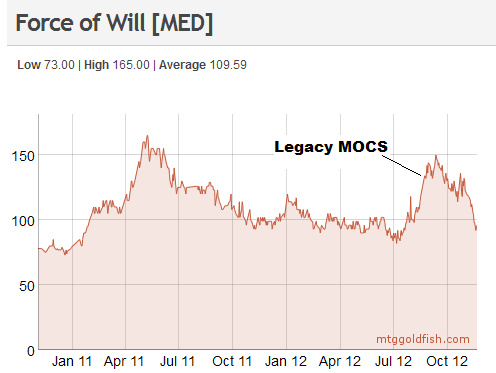
Depending on how popular these events are, there could be a large fall in the prices of many Legacy and Classic staples from these sets. Down the road, it's wise to anticipate another Legacy MOCS, such as the one that occurred this past summer on August the 18th. The result of having a high profile tournament online was to stoke interest in Legacy, pushing up the price of many Eternal cards. This type of seasonal swing is the bread and butter strategy of investing in Eternal staples on MTGO. Fluctuating interest drives prices up and down, creating opportunities for speculators. Legacy on MTGO is no different from Modern in this regard.

In addition, Modern Masters will be printed in the summer of 2013 which will make Eternal formats more affordable across the board for constructed play. Staples not printed in the MED sets and not in line to be reprinted soon are safe bets and will see price increases.

Wasteland is a good example of a Legacy staple that saw a recent price drop due to Tempest-Stronghold-Exodus (TSE) queues popping up on MTGO. WoTC has shown that it will rotate through out-of-print formats and next in line is Urza's block and Masques block. This suggests that we will not see another round of TSE or MED events in the medium term. Wasteland previously touched over 40 tix, suggesting that at the current price of 29 tix, there is some value for speculators in buying Wasteland.

Going forward, I will be paying close attention to the price of Force of Will. There could be a huge buying opportunity on this card if the price comes down enough. And if you haven't seen this contest in the forums, be sure to join in! I want to see what everyone thinks will happen to the price of Force of Will as a result of these holiday MED events.

Bringing Back the Boss

Are you a Quiet Speculation member?

If not, now is a perfect time to join up! Our powerful tools, breaking-news analysis, and exclusive Discord channel will make sure you stay up to date and ahead of the curve.

A little over two years ago, right after the release of Worldwake, a deck broke out in Standard. This was an important development because Jund was at the peak of its dominance. Until this point, there were not many options to combat the powerhouse tier one deck. There were talks of banning Bloodbraid Elf in Standard because we were seeing top eights with as many as six Jund decks.

At Pro Tour San Diego 2010, the Channelfireball team piloted a new Naya deck. Since the deck's designer, Tom Ross, was nick-named "The Boss," the deck was named Boss Naya. The catchy name stuck and most players remember it because of that. What made Boss Naya so good were the new toys from Worldwake like Stoneforge Mystic, Raging Ravine, Stirring Wildwood, and Basilisk Collar. The deck also featured a combo from the sideboard that aimed to assemble Cunning Sparkmage equipped with a Basilisk Collar. At the time, this was a brand new innovation. We had not seen an interaction like this before, so it took the field by surprise.

When I saw the coverage of this deck, I was immediately on board. Since the Naya shard was released in Shards of Alara, I had been playing that color combination to much success so changing my preexisting deck by a handful of cards was no problem at all. As I am prone to do even with a Pro Tour top eight deck, I immediately began to incorporated changes. My analysis was that the amateur metagame would have a larger percentage of Jund and aggressive decks so I wanted that Cunning Sparkmage package maindeck instead of as a sideboard plan. After making adjustments, I headed off to a Star City 5k the weekend after the Pro Tour. As I suspected, most of the players had not adjusted to the new deck and I wrecked the field with my version.

This was my list:

Boss Naya by Michael Lanigan
5th place at SCG Richmond, Virginia on 2010-02-28

Untitled Deck

Creatures

2 Birds of Paradise
4 Bloodbraid Elf
4 Cunning Sparkmage
4 Knight of the Reliquary
4 Noble Hierarch
4 Ranger of Eos
1 Scute Mob
2 Stoneforge Mystic
4 Wild Nacatl

Spells

2 Oblivion Ring
1 Basilisk Collar
1 Behemoth Sledge
2 Ajani Vengeant
1 Elspeth, Knight-Errant

Lands

4 Arid Mesa
3 Misty Rainforest
2 Raging Ravine
1 Sejiri Steppe
2 Stirring Wildwood
1 Tectonic Edge
2 Terramorphic Expanse
5 Forest
2 Mountain
2 Plains

Sideboard

1 Basilisk Collar
1 Behemoth Sledge
2 Baneslayer Angel
1 Goblin Bushwhacker
1 Scute Mob
2 Manabarbs
1 Oblivion Ring
3 Lightning Bolt
3 Summoning Trap

This is one of my favorite decks that I have ever played, for many reasons. Certainly one reason was my success with it, but there are so many synergies in the deck and it is a ton of fun to play. With a deck like this, you can utilize your skill and outplay your opponent by taking a variety of lines of play. What makes this deck so powerful is that all of the cards are strong and playable on their own, but when you get them online together, they become even better.

The reason I wanted to talk about this today is because there are a lot of similarities between Boss Naya and what I am playing in Standard right now. Building this deck did not start with the concept of Boss Naya, but it did end up rather similar. Here's the deck for comparison.

Boss Jund

Untitled Deck

Creatures

3 Deathrite Shaman
4 Nightshade Peddler
4 Izzet Staticaster
4 Huntmaster of the Fells
3 Falkenrath Aristocrat
3 Olivia Voldaren
2 Zealous Conscripts
2 Thundermaw Hellkite
2 Thragtusk

Spells

4 Farseek
4 Trackers Instincts

Lands

4 Cavern of Souls
4 Overgrown Tomb
4 Blood Crypt
4 Steam Vents
3 Woodland Cemetery
3 Rootbound Crag
3 Hinterland Harbor

Sideboard

3 Slaughter Games
2 Snapcaster Mage
4 Pillar of Flame
2 Bonfire of the Damned
2 Evil Twin
1 Falkenrath Aristocrat
1 Zealous Conscripts

Similarities Checklist:

  1. Powerful Spells on their own, check.
  2. Even more powerful synergies, check.
  3. Card advantage, check.
  4. Lands that affect the game, check.
  5. Sparkmage + Collar combo, double check!
  6. Green, Red, and White mana, nada.

Despite not being a Naya deck at all, these two decks have a lot of conceptual elements in common. If you look closely, this is basically just a different version of the current Jund deck in Standard. There are many cards that overlap between the two decks. We all know Thragtusk, Huntmaster of the Fells, Falkenrath Aristocrat, Olivia Voldaren, Thundermaw Hellkite and Farseek are strong cards. Lots of decks use these cards on their merits alone. Let me talk about the cards you don't see too often and provide some details.

The Stars

Nightshade Peddler -- Here's the secret. This is the best card in the deck. I know, it seems like I'm joking around and in another sentence or two, I'm gonna laugh as I type some witty comment to let you in on my joke. But this time I'm serious.

There is a lot going on with Mr. Flower Salesman here. (Nightshade is a flower, in case you didn't know, and he peddles it, hence the nickname.) The two-mana creature acts more like an enchantment but pairs well with Izzet Staticaster, Huntmaster of the Fells, Olivia Voldaren, and Thundermaw Hellkite. There will rarely be a time when you don't have something to soulbond with it. The goal is to get him online with Staticaster to become a creature-killing machine gun. Think about how many decks omit removal entirely and rely solely on creatures to win the game right now. This Boss Naya synergy completely dominates those matchups. Even against the rest of the field, there is rarely a deck you don't want him in play against.

Izzet Staticaster -- If there were an actual Izzet deck being played right now, I would advocate this new addition to the guild in the deck. Right now, Lingering Souls and mana creatures are being played more than they should with no repercussions due to the lack of Pyroclasm in the format. Against decks that run these cards, you don't even need the Nightshade Peddler to pair with it because it is capable of killing multiple cards on its own. Even if they pump the tokens with Intangible Virtue or Gavony Township, you can always find the Peddler or a second Staticaster.

Zealous Conscripts -- Stealing permanents can be a viable way to win the game, especially if you can sacrifice them to Falkenrath Aristocrat or use the ability of a planeswalker you took. The power level of Conscripts varies depending on what deck you are playing against. Make sure to side it out against the fast decks, but bring the other one in against any midrange or control deck.

Deathrite Shaman -- While new to Standard, this one drop has a proven itself in Modern and Legacy. In Standard many players are utilizing their graveyards and against the slower decks you can take a big chunk out of their life total with the black ability. Shaman interacts with more than just the graveyard decks too. Against Snapcaster decks, you can remove their flashback target before they can cast it and even against decks like Mono Red, the lifegain can give you enough time to stabilize.

I foresee players arguing about my decision to run three copies stating it should either be four or zero depending on your evaluation of the card, but I think three is the correct number. You don't always want one in play and you certainly don't want two, so I believe three to be exactly right.

Tracker's Instincts -- It may not seem like it, but this innocuous little sorcery is one of the most powerful cards in the deck. Think of it as an Impulse with upside and you will begin to catch on to the power level. With so many synergies in the deck, being able to assemble them more easily is definitely a plus. The cards you don't choose also go to your graveyard, which is important for Deathrite Shaman. By the way, the first time you pick Nightshade Peddler over a mythic rare, you know you are on board with this deck.

Cavern of Souls -- Did you get the memo? Pro players have been sending it out to computer screens across the world for weeks now. Counterspells are back. If you are not ready for them, you will be left unable to resolve a spell the entire game. Cavern, despite the differing creature types, is absolutely necessary in this deck. It's presence alone changes the U/W Flash and control matchups entirely. When they can no longer rely on all their counters as removal spells, they find themselves quickly overwhelmed. Don't forget, almost all of your creatures are either humans or vampires but name dragon or beast with confidence when necessary.

Sideboard Basics

Aggro Package -- 4 Pillar of Flame, 2 Snapcaster Mage, 2 Bonfire of the Damned

Midrange -- 2 Bonfire of the Damned, 2 Evil Twin, 1 Falkenrath Aristocrat, 1 Zealous Conscripts

Control -- 1 Falkenrath Aristocrat, 1 Zealous Conscripts, 3 Slaughter Games

Short Local Tournament Recap

Round 1 -- Jund

This will definitely feel like a mirror match because you share a lot of the same cards except you have card draw from Tracker's Instincts and can kill any of their threats in multiple ways. Unless one of you lands a quick Olivia Voldaren that goes unanswered, the match tends to go long, but you are definitely favored. In this match I ended up losing game one while I was mana screwed. Game two, I was in control the whole game and he never really saw removal to keep my creatures from running him over. In game three, my turn two Farseek, turn three Huntmaster, turn four Bonfire was enough to win a quick game with not much time left in the round.

Round 2 -- Jund

At first I thought this was going to be a replay of round 1, but then he played a Dreg Mangler followed up by a Falkenrath Aristocrat. It was basically still Jund, just a more aggressive version. Again, I lost game one to never hitting a fifth land despite fighting through many of his threats while stuck on four lands. Game two, my life total ended over twenty and was basically me doing what this deck does and killing every creature he played. Game three, I thought I was going to stabilize after he Bonfired my first two Huntmasters and [card Dreadbore]Dreadbored[/card] the third, but a topdecked Rakdos's Return killed me a turn too soon to allow my summoning-sick Deathrite Shaman to gain some life. A very close game that I thought I should have won but given the cards I drew, I don't think there were any plays I could have made differently.

Dreg Mangler was quite good and it makes me think it should see more play. He may have been onto something with Dreg Mangler into Falkenrath Aristocrat.

Round 3 -- Junk Troll Rites

Being a different version of the reanimator deck, my cards are naturally good against him since he has no removal. Lotleth Troll is still good though and I took a lot of damage from it before gaining it back. I'm not sure he had an answer to Staticaster, let alone when paired it Peddler. This was a quick two games and I was in control almost the whole time. If he did not tap his mana wrong in game one to leave one less black open, it may have been closer but we will never know. This is a great example of Boss Jund dominating certain decks.

Round 4 - Naya Midrange

I would say this is one of the best matchups for this deck. They also have no removal so how are they supposed to beat your machine gun? Game one I stumbled on mana again and I thought I was going to be overrun by Restoration Angel and two Thragtusks plus a Borderland Ranger, but luckily I [card Trackers Instincts]Tracker's Instincted[/card] into an Olivia to pair with my Peddler.

Make sure you play around Selesnya Charm in this match. It is one of their only ways to interact with you. I declined to kill a second creature during his combat step and take a dangerous amount of damage so that he could not remove her. Then when I untapped I killed a creature and responded to the removal spell by killing the rest of his creatures. Going as low as two life after that attack, I ended the game at eleven once I got back on track. Game two was no contest because I started killing his creatures early. Even when he had the Oblivion Ring, I had a replacement to keep up the killing machine.

Abiding the Boss

In Summary, Boss Jund is really a force in the metagame right now. My plan is to take the deck to the TCG Player Invitational next weekend and let it loose on the high profile event. Hopefully there will be great results to follow. I have not been this excited for an event in a long time. If you've been hating Standard recently like I was, give this deck a shot and you won't be disappointed.

Until Next Time,

Unleash the Boss Jund Force!

Mike Lanigan
MtgJedi on Twitter
(I'm active on twitter again, so send me a message sometime.)
Jedicouncilman23@gmail.com

P.S. If you want a flashback to Boss Naya, here's the link to the original deck tech.

Insider: I Just Bought A Collection.

Are you a Quiet Speculation member?

If not, now is a perfect time to join up! Our powerful tools, breaking-news analysis, and exclusive Discord channel will make sure you stay up to date and ahead of the curve.

I've been thinking a lot about buying collections again recently. It's fun as all heck to see what's in someone's binder and you can make a pretty good profit with turnover. Moreover, I was tired of seeing Sig and Corbin post about going through collections – jealous! I started hitting Craigslist last week to see what I could find. I live in Cincinnati and I figured that there would be a lot of competition for collections, so I was not hopeful about what I'd find. Chas Andres talks about how you need to emotionally distance yourself from getting a good deal, since people can and will sell to the first person who shows up with cash.

First attempt: a failed start.

I messaged someone on Craigslist who ended up living about a mile from me. He had a small stack of cards and no pictures of what they actually were, but he had no idea what Magic cards were. He had some random worthless Heroclix figures and cards that he'd picked up at a swap meet. He said he paid $100 for them, so I had hope. He also said that he was not going to negotiate, that he wanted the full $100 – and he had a habit of typing in all caps. Oh boy.

I walked over and checked out the stack, hoping for old Revised duals. Instead, it was a stack full of trash from Odyssey block – and someone had already picked out all the rares and foils! Seriously, the only thought I had looking through it was "I wonder how much Deep Analysis is on buylist." There was absolutely nothing of value in the stack and I broke the news to the guy that I wasn't even going to make a pity offer of $5. He took it fine but I think he was internally kicking himself, because whoever swapped those cards to him made out like a bandit if they got $100 for them.

Round Two: Too good to be true?

After checking out that collection, I went to CL again to see what I could find. Another guy said that he had a big collection and wanted about $500 for it. He listed things like Unlimited Drudge Skeletons for $18.00 (in reailty, $0.25...) but luckily, he had a list of all of the rares. On Saturday, he sent it over to me and boy, this was STACKED. He had easily $500 in value in that rare binder and I wanted at it. Unfortunately, I was about three hours away in Indianapolis and I wasn't getting back until Sunday!

We went back and forth, with me trying to instill in him that I was the one he was going to sell this to. Call Oprah and tell

Taken from a site about how "the Secret can get you girls." All I want are foils, man.

her I figured out The Secret – I was using this guy's name a lot, telling him that the offers from other people for $250 were insulting, and more. I wanted this guy to hold out for me and in the end, it worked out.

One thing you need to make deals on Craigslist is cash. Not money in the bank, but the Nike shoebox full of twenties. Banks are closed on weekends and evenings and this is when deals happen. I made sure to get $500 out of my bank so that I could be prepared for this. Honestly, even if he were around on Saturday, I didn't have the actual money to get this collection – ATMs limit the cash withdrawals and I would have felt awful.

On Sunday night, I gave myself time to price out his list. It would be easy, and foolish, to punch the whole thing into a decklist builder on a Magic store and see what it would all cost to buy. This is bad; everyone will sell you Island Fish Jasconius for $.30, but nobody will buy it for that (or even half that). I used Trader Tools and I checked out all the rares on the list. It came out to be $850 in total, so I felt that anything around $500 would be a good deal. I'll also note that I didn't do the deal until a Tuesday morning. Sure, other people were emailing offers to the guy, but I was beating the war drums about meeting at the earliest opportunity with cash. This gives me hope that in a city as big as Cincy, I can still get a deal if I'm not the first to see it.

As an aside, you have to figure out what your time premium is worth. $0 is not the correct answer. This number is going to inform how much of a discount you apply to the cards that you want. I wanted to double up on this, so spending anything over $500 would not really be worth my time. I don't think you have to kick yourself morally about lowballing to get a good price if you think the discount you're applying is worth it. You also have to figure that you're assuming the risk of selling these cards. You also must only buy on what you can see. People on Ebay fail this all the time since they want to hope that there will be gold hidden in the uncommons. Look, this kind of stuff happens, but what kind of premium do you want to put on it? I find that you can get about 10% of the value of the collection's rares in “buried binder treasure” and that's about it. You can't hope that the guy just randomly didn't know that Plateau was a rare.

We ended up meeting in a Target parking lot yesterday morning. I kept the cash in my car and didn't pull it out until we had made a deal already and the cards were loaded into my car. This is a safety measure. This also totally looked like a drug deal. I looked at the cards to make sure all of the money stuff was there, and it was. Unfortunately, I also realized this principle right there:

People don't take care of their cards.

Casual players never use sleeves. They mock their friends who use sleeves. All those bulk rares I priced out? I can't sell them even at bulk – I'll have to get rid of them some other way. Those elves like Ambush Commander and hits like Kamahl, Fist of Krosa had white, nasty, beat borders. That moves a card from “I can buylist this out” to “maybe I can trade this away?” That makes your job significantly harder.

On the balance, most casual players play bad cards. The really good stuff sits in a binder because the text is too long to understand. I have this mental rule that always comes true – you'll find a mint Force of Will because nobody can understand it. I found one here, a little prize in the binder that the guy didn't even figure into what he wanted for the collection! The $90 offset from that certainly takes the sting out of it. Thank goodness the best cards are blue and casual players are allergic to Islands.

I ended up offering him $480 for it, which was a bit more than what I wanted to pay. However, I wanted these cards emotionally – I had pursued them and seeing things like Force in there made me a little more generous in my offer. While Goblin Piledriver and Sword of Fire and Ice were chewed up, I could still get something from them. Things like a mint foil Stifle helped make me confident in what I could offer.

If you buy a collection based on mint prices for cards, you will be seriously disappointed.

The Pareto Principle: 80% of everything is junk.

The Pareto principle is this theory that 20% of “things” do 80% of the work. That's vague, so let me explain the 80/20 principle more. In my law practice, 20% of my customers pay 80% of my fees. In a company, 80% of the salesforce will be average and 20% will be excellent. Those 20% will account for 80% of the profits. This rule tends to work out all the time, everywhere, in spooky ways.

80% of the rares in this binder were absolute trash. 20% were solid gold, and made up a huge portion of the actual value. For example, there was an entire set of Onslaught in the collection. You've got a set of 244 cards, but the five fetchlands and the Goblin Piledriver and Sharpshooter drive most of the value of the set. This plays out in even more extreme examples in other sets (like Prophecy and Homelands).

This collection was definitely 80% trash, but when I'd portioned it out, the remaining 20% that could sell above bulk looked pretty nice. I had to trim anything that wasn't NM and I was pretty strict in my grading – I probably left a bit of money on the table but I don't really want to push it on condition with online stores. I was also prepared to sell all of it. In fact, the only card that I really wanted from the whole thing was a Sword of Fire and Ice – the rest I could sell happily! This underscores a point I learned from a Magic card's flavor text:

Trade to trade, not to keep.

- Amulet of Unmaking

I've definitely bought collections before where I ended up keeping all of the money cards. This gets to be expensive. You get a big box and all the fun stuff is, well, fun. I've kept the Badlands, the Italian Force of Will, the Sliver Queen – you name it. That really eats into your profits and it means you have to work so much harder to break even. I've made my mind to sell as much of this as I can – I want all that money back in the bank at the end of the month!

Now what do I do with all these crummy, beat cards?

Honestly, I still haven't made my mind up. I'm 12 hours in and I've got the entire thing sorted. Removing 8,000 cards from binder sleeves takes practice if you want to end up with neat stacks.

Here are my options, as I see them:

Sell to played-friendly buylists: ABUGames has a great played-card option on their site and the prices are good. Unfortunately, their setup takes a lot of time to punch in a bigger list of cards, and this still leaves me with about 8k in actual stone terrible bulk commons and uncommons. Things like the worn Goblin Sharpshooter will probably go this route.

Sell as a collection on Ebay: This is attractive, since people seem to be going nuts about buying collections these days. I've seen things go for hundreds of dollars and all they have in the pictures are Ball Lightnings. That's buying on faith, for sure.

Piece out and sell on Ebay: There are a few cards, like the Force of Will, that I can get much more for on Ebay versus buylists, even with a 16% loss. Ebay is much friendlier to played cards, so the slight dings on the Polluted Deltas shouldn't hurt them too badly in the market. As a result of some research, I found that there's not much of a price difference when you're selling two cards or four cards – the Ebay market is pretty efficient in that regard. I have no fears about throwing up, say, two Mystical Tutors.

Stock up a trade binder and grind: I don't trade a lot these days and the thought of grinding $1 cards over and over is not appealing. I'd love to run an automatic box (you get any card in here, you have to throw in two bulk rares though) at events, so I might retain a big stack of cards for this purpose. I also don't know that there's much appeal in most of these cards for traders. Do people want Safe Haven, Bloodbound March and Forsaken Wastes? Maybe they do and I can be the king of crazy casual binders! This method does have the advantage of converting played bulk into unplayed bulk, even if I'm doing low-level trading.

When I have tackled collections before, I've run into played cards but never on a level like this. I'm looking at a stack of about six hundred worn and beat cards, from Counterspells and Lightning Bolts to Crypt Rats and Wirewood Hivemasters. They're all good and someone would love them. Things like the Hivemasters are theoretically worth money, but the only venue I can think of to dump them is Ebay – and the low profits plus a big cut make that an unattractive option.

Since I've covered a lot of my initial investment, I want to ask you, the reader, what I should do next. My time is kind of important to me and after I break even, I tend to care less about getting each last penny. Is the correct option to just send it postage-payable to Kelly Reid and make him deal with it? Let me know below!


-Doug Linn

Postscript: I wanted to provide actual reader value in this article instead of turning it into a bragpost, but If you'd like to know the hits of this set and what convinced me to get it, here's a short list. Vampiric Tutor, Goblin Piledriver, Stifle, foil Stifle, a copy of each Onslaught fetch and a kicker Delta, Arcbound Ravager, miscellaneous expensive Slivers, Lion's Eye Diamond. Casual cards like Crucible of Worlds and Altar of Dementia added up quickly, too. This isn't the collection of a one-time FNM player, but it had a good mix of chase cards.

Let’s Talk Real Estate

Are you a Quiet Speculation member?

If not, now is a perfect time to join up! Our powerful tools, breaking-news analysis, and exclusive Discord channel will make sure you stay up to date and ahead of the curve.

It’s your turn. You’re battling with GW Humans. Your opponent is on Bant Control and has just cast their second Thragtusk. Your relevance in the game is quickly deteriorating. You draw your card.

Land.

Again.

Worse yet, it’s a basic Plains.

Basic. Freakin’. Plains.

Chalk up another loss to mana flood.

So what happens now? Maybe you trim a land from your deck. Twenty-three lands could be on the high side with four Avacyn's Pilgrim, right? Let’s try twenty-two.

How many one-landers do you mulligan before you start missing that twenty-third land? How often do you contemplate jumping all the way to twenty-four at this point?

It’s a maddening dance, and no matter how many lands you play from week to week the balance never feels quite right. A number of players even end up quitting Magic because they can’t get over the games that they lose to drawing the wrong quantity of lands. I’ve heard more than one person try to sell people on WoW TCG on account of its more stable resource system.

I’m personally way too deep into Magic to even consider such a move. I’m more inclined to put the work in to trying to find the build of a given deck that best manages the problem with lands. It’s a topic that probably doesn’t get as much direct attention as it deserves. Even still, I believe that the Magic community as a whole has gotten much better at determining how many lands to play in the past several years.

Back when I started playing competitively I would hear a lot of clamoring about wanting to build “20/20/20” style decks. Twenty lands, twenty creatures, twenty spells. This was what was believed to be “correct” in the original Ravnica block era. The idea was basically to play as few lands as possible, or rather to “cheat” on lands because drawing more spells would generally lead to winning more games.

Even the limited format back then was heavily dedicated to cheating on lands. The popular consensus was to pick up as many bouncelands as possible and to play as few as 14 lands whenever possible. Again, drawing more spells leads to more game wins.

This is a notion that has carried over from the very early days of Magic. The most influential deck along these lines is probably Dave Price’s Deadguy Red:

Deadguy Red

spells

4 Ball Lightning
2 Dwarven Soldier
4 Fireblast
3 Goblin Digging Team
4 Goblin Vandal
4 Hammer of Bogardan
4 Incinerate
4 Ironclaw Orcs
3 Kaerveks Torch
4 Lava Hounds
2 Viashino Sandstalker

lands

4 Dwarven Ruins
18 Mountain

Price’s deck had four drops, X spells and a Hammer of Bogardan that you know that he was planning on buying back. Even still, there is no way that a deck intending to play turn two Grizzly Bears with downside is going to play more than twenty-two lands.

These days Ironclaw Orcs isn’t even close to playable. I even hear people rag on Grizzly Bears proper in modern limited sets from time to time!

Spells are just stronger now. In light of this, there is an elevated importance to making land drops as the game progresses, especially when trying to go big. I will never understand a Thragtusk deck that only plays twenty-four lands. I don’t care how many Unburial Rites and Faithless Lootings are featured. I just won’t get it. Never.

When your spells are very strong, and I think it’s safe to say that Thragtusk is, just being able to curve out will win a high percentage of games.

Perhaps the most eye-opening decklist that I ever saw came from Simon Gortzen’s PT San Diego winning Jund deck:

Jund

spells

4 Bloodbraid Elf
3 Broodmate Dragon
4 Putrid Leech
3 Siege-Gang Commander
4 Sprouting Thrinax
2 Garruk Wildspeaker
4 Blightning
4 Lightning Bolt
3 Maelstrom Pulse
2 Rampant Growth

lands

2 Dragonskull Summit
4 Forest
2 Lavaclaw Reaches
3 Mountain
4 Raging Ravine
1 Rootbound Crag
4 Savage Lands
3 Swamp
4 Verdant Catacombs

Twenty-Seven lands. Masterful.

I had quite the Jesse’s Girl moment when I saw this list. Nothing but very powerful spells and a grip of lands to assure the casting thereof. There is beauty in simplicity, and it is showcased here in this deck. I never looked at Jund the same after this list. I even played 26 lands in Jund to the top 8 of an extended PTQ with four being the top of my curve the year after.

It is now quite common for me to add one or two lands to almost every deck that I play before even getting in a single game. Why? Because if I’m playing it I probably believe it to be the most powerful strategy. If I have the most powerful strategy then the most important thing is execution. Execution necessitates having the proper resources. The proper resources are quantities and colors of mana.

The Concrete Application of All This Theory

So where am I going with all of this? I suppose that the more general conclusion that I’m driving at is that Prosak wasn’t playing enough lands in UW Flash, nor enough Sphinx's Revelations.

I wrote a few weeks back about the importance of scaling power levels, and playing more lands plays directly into a strategy intending to scale. If you play more lands you’ll make more land drops and your Sphinx's Revelation will draw more cards. When you draw more cards (and gain more life), you win more games. That’s the whole reason that people cheat on lands in the first place, right? To have a higher percentage of their draws be spells? Turns out drawing more cards accomplishes the same goal.

The counterpoint that I frequently encounter is that cards like Thought Scour make it easier for one to hit lands. This isn’t entirely false. It’s true that cantrips allow a player to draw more cards, and drawing more cards leads to drawing more lands, but I’ve already written about the problems with Thought Scour on more than one occasion. In a nutshell my counterpoint here is that jamming Thought Scours instead of lands invites an unnecessary amount of entropy into your games and also fills your deck with relatively low impact spells. You don’t beat Thragtusks with one-for-ones, and Runechanter's Pike while powerful, is undoubtedly more clunky than just burying your opponent in the card advantage acquired from higher impact spells and the ability to cast them.

So what the hell does any of this have to do with a GW aggro deck flooding? To an extent this is something of a subjective question. Do you believe that the aggressive decks can consistently beat the slower decks before they get off the ground, or do you believe that the slower decks will beat the aggressive decks simply by virtue of surviving to turn five? Is the solution to ignore the fast decks? The slow ones? To try to beat both? Is the answer to hybridize- to build a deck capable of winning quickly but equally capable of going long? Does all of this remain a static aspect of Standard or does it change weekly with the metagame? I see a lot more value leaving these as questions rather than trying to provide absolute answers. It’s not like there’s only one good answer.

~

The idea for this article started out as me wanting to write a love letter to the 27th land, but clearly I wasn’t able to find much focus. Now and again I think that unfocused stream of conscious thinking can be a good thing. Let me know in the comments if you found any of this interesting or thought provoking, or if you thought it was just complete trash. As always, I would love to field any questions.
Until next week, good luck; high five!

-Ryan Overturf
@RyanOverdrive on Twitter

Return to Ravnica Draft #3

Are you a Quiet Speculation member?

If not, now is a perfect time to join up! Our powerful tools, breaking-news analysis, and exclusive Discord channel will make sure you stay up to date and ahead of the curve.

Zach Mcnair plays through another RTR 8-4

Unfortunately, we have lost the finals of this match, but if they are recovered it will go up immediately.

Posted in FreeLeave a Comment on Return to Ravnica Draft #3

Have you joined the Quiet Speculation Discord?

If you haven't, you're leaving value on the table! Join our community of experts, enthusiasts, entertainers, and educators and enjoy exclusive podcasts, questions asked and answered, trades, sales, and everything else Discord has to offer.

Want to create content with Quiet Speculation?

All you need to succeed is a passion for Magic: The Gathering, and the ability to write coherently. Share your knowledge of MTG and how you leverage it to win games, get value from your cards – or even turn a profit.

Want Prices?

Browse thousands of prices with the first and most comprehensive MTG Finance tool around.


Trader Tools lists both buylist and retail prices for every MTG card, going back a decade.

Quiet Speculation