If not, now is a perfect time to join up! Our powerful tools, breaking-news analysis, and exclusive Discord channel will make sure you stay up to date and ahead of the curve.
This week I'm going to start something different. I'm going to review cards from selected blocks week to week. The reason to do this is to identify cards that we should keep our eyes on all the time. Doing this block by block means we will be able to go through most cards.
This week we'll look at the Mirrodin block—the sets involved are Fifth Dawn, Darksteel and Mirrodin. As these sets are full of artifacts, most of the good picks here are artifacts as well.
Blasting Station is a combo component in Modern, especially in token-based decks. As you can see in the graph, the highest point is somewhere near 2.8 tickets while the average price is about 1 ticket.
I think this card is worth keeping our eyes on because combo is a way to catch opponents off guard in Modern, especially when part of the combo is an artifact where not all players will mainboard cards to kill artifacts. When there's a list that can abuse Blasting Station, its price will go up.
Engineered Explosives went up in price consistently during the last month. From the graph, you can see that the price did not fluctuate that quickly compared to other cards. It may take a long time for the price to fall to a place we'd want to buy, but I think its fine to put this card on our watchlist.
My reasoning for picking this card is pretty simple. Following the pattern, if we are able to pick up sets of this card at a low price, we should be able to earn some tickets in the long run. The reason we usually don't get to earn from cards like this is because we did not notice the price change due to its slow and steady change in price.
Lantern of Insight is pretty straightforward. Obviously this card will only be good when the signature deck built around it is popular. Now how do you know when Lantern will be good? Usually when the meta has lots of aggressive decks like Zoo and Humans, and when artifact hate is at a low point, players will start bringing back Lantern Control.
Serum Visions is one of the best cantrips in Modern. Although there's a slightly better one right now—Opt—this card remains good because of the scry 2 effect which allows the player to sequence their draws well in order to take control of the game.
Although I don't think this card will drop price anytime soon, I think it's fair to keep it on our watchlist just in case. It's possible that this card could decrease a lot in price just because nobody plays it for some time. When that happens—let's say the price drops to 1 or 2 tickets—we should take that opportunity to pick up some playsets as investment.
Aether Vial is a staple in Modern. Currently this artifact is most commonly played in Humans, but of course that's not the only deck that plays Aether Vial. Merfolk and Death & Taxes are among the decks that are good because of the one-mana artifact.
According to the trend, the card will only go up above 10 tickets when decks using it are good in the metagame. During other times, it will be somewhere between 5 to 7 tickets. I suggest keeping your eyes on this card to spot the correct timing and grab your playsets.
This card should be no stranger, as Affinity has existed in Modern for a long time and Arcbound Ravager is always one of the most important pieces in the deck. This card allows the Affinity player to have complicated combat tricks on the table, which is why the deck is quite resilient.
If you look at the graph above, the local high point that we can see is 15 tickets, which was back in November. In my opinion, this card has high potential to gain value in the near future. Tron decks are coming back, and in my experience, Affinity has good matchups against Tron and other ramp decks. So do keep your eyes on Arcbound Ravager!
This card has grown a lot in popularity recently, mainly because of Bloodbraid Elf. Although Trinisphere wasn't a popular card in Modern previously, we should still keep track of its price from now on since it has become a staple in the format.
If you ask me when will be the right time to buy copies of Trinisphere for investment, I can only say it's hard to tell right now. Based on the graph and its current popularity, I'd say when it drops to around 15 tickets, that's the opportune time to buy.
The price before this recent raise was around 10 tickets, but I don't think it will return to that price. Since it came off the banlist, Bloodbraid Elf has been a card to beat in Modern, and I expect that to continue. Trinisphere will remain as one of the main pieces of tech to beat Bloodbraid for as long as it's legal. Therefore I think 15 will be the new average price.
Chalice of the Void is one of the most played cards in Modern and Legacy. Simply because of that, its price fluctuates a lot. For this card, we have to keep track of its price at all times and catch the low points, like the one at the end of February you can see in the graph. Price drops this marked are rare occurrences, but it's always good to be able to capture events like that.
Oblivion Stone is played a lot big-mana decks like Tron. With the ability to generate lots of mana using the Urza Tron lands, playing and activating Oblivion Stone is not hard. With the Stone in play, the opponent is incentivized to hold back threats to avoid getting destroyed by the sweeper. In this way the Tron player is able to stall the game until he or she finds a win condition.
I suggest buying copies of this card when it's low—4 or 5 tickets—and selling off when they are at around 8 tickets.
Alright guys, that’s all for this week. I hope my examples are enough to elaborate on the topic. Thanks for reading and I’ll see you again next week.
If not, now is a perfect time to join up! Our powerful tools, breaking-news analysis, and exclusive Discord channel will make sure you stay up to date and ahead of the curve.
Hello, everyone and welcome to a new edition of the Daily Stock Watch! I've refrained a bit from writing about cards that are moving financially due to Legacy or Commander demand (I'm talking to you, Fiery Confluence) but today, I'll be talking about one that has been moving upwards due to its set's "maturity". Modern has been the hottest format finance-wise, but there is no shortage of action in other formats, particularly from cards that have been only printed once in the entirety of the game. Today's card is not part of the Reserved List but it belongs to that special league of cards that have only been printed in a Commander-related product.
Fiery Confluence was the latest heavy gainer from this long line of spells from a Commander set, and Mizzix's Mastery just joined the fray. Today, it reached its all-time high of $11.21 and it should continue to trend upwards as supplies continue to run low in the market. It's a card that works best in a synergy-heavy deck full of spells that has a "win-now" concept, and you could see in this deck how it works.
OmniTell
Creatures
3 Emrakul, the Aeons Torn
Instants and Sorceries
1 Impulse
4 Force of Will
2 Intuition
2 Spell Pierce
4 Brainstorm
2 Flusterstorm
4 Gitaxian Probe
4 Preordain
4 Ponder
4 Burning Wish
3 Show and Tell
Other Spells
4 Omniscience
Lands
1 Mountain
2 Ancient Tomb
2 Volcanic Island
3 Flooded Strand
4 Scalding Tarn
4 Island
3 Polluted Delta
Sideboard
2 Echoing Truth
2 Blood Moon
1 Surgical Extraction
1 Sudden Shock
1 Pyroclasm
1 Time of Need
1 Spiraling Embers
1 Enter the Infinite
1 Show and Tell
1 Mizzix's Mastery
3 Boseiju, Who Shelters All
It's clearly your usual OmniTell list on first glance, and it adds the power of Mizzix's Mastery off the board as an extra copy of Show and Tell or any other spells in the deck that it might need at the time that you cast it. I'm not really Legacy-savvy, so I might be missing out on extra details here (feel free to say your mind on the comments section). Nonetheless, I see card that's of this casting cost as a bit too costly for some deck that relies on its big spell to win games, but to see one in Legacy where it's blue-based doesn't surprise me now. It's probably better in a Commander deck as there will be tons of targets for it but then again, you probably know better than me when it comes to shenanigans and synergies. I'm sure that there's more to it than just lack of supply that drives its price upwards.
Commander 2015 Good Cards
Above are cards from C15 that are at least $5 or higher based on multiple online store prices. I think it's safe to assume that most, if not all of these cards, will continue to see price gains in the foreseeable future. Mizzix's Mastery will possibly see some fringe Legacy play in the future, so it would be hard to bet against it in the long run. Although Commander 2018 is just right around the corner, it's very unlikely that there will be a massive reprint of cards from older sets in a new release. It should be safe to say that you could purchase your copies of our featured card for usage purposes, but I'm not really too keen on getting lots of it to include in my specs bin.
At the moment, you could find copies of Mizzix's Mastery via StarCityGames, Card Kingdom, and TCGPlayer for anywhere between $7.99 up to $11.21. ChannelFireball is out of stock of the item, and you could expect Card Kingdom to follow suit due to its low supply count and lower selling price. There are no foil copies of this card so it's possible that we see one in the future in a newer set. For now, I'd recommend that you get copies that are still available below $7, and wait out a bit till the ones in the major online stores are all sold out. A price spike for it is definitely just around the corner.
And that’s it for today's edition of the Daily Stock Watch! See you again next time, as we continue to speculate on cards that might be on the rise, or try to get rid of the ones that are at risk of losing value. As always, feel free to share your opinion in the comments section below. And if you want to keep up with all the market movement, be sure to check in with the QS Discord Channel for real time market information, and stay ahead of the hottest specs!
If not, now is a perfect time to join up! Our powerful tools, breaking-news analysis, and exclusive Discord channel will make sure you stay up to date and ahead of the curve.
I fully intended to play in SCG Milwaukee last weekend. I'd been practicing and preparing for weeks, tuned my deck, and even made the travel arrangements. Then the two great powers of plan ruination, unexpected work and bad weather, derailed my plans. However, I'm not one to let all that work go to waste. Instead of the tournament report that I had planned, I will share what I learned about the metagame and where it led me. Hopefully it will help those of you going to GP Hartford this weekend.
Accumulating Data
I spend a lot of time studying the metagame before large constructed events. Most players do, but that usually involves looking at aggregate data: either overall metagame standings or the MTGO League 5-0 results. This is a great way to determine what is winning and therefore what is good in the meta, but that's not what I'm after. Rather, I want to know what players are actually playing. In my experience, a GP or Open Day 1 looks wildly different from the aggregate data. In fact, it isn't until late on Day 2 when the population begins to reflect the "real" metagame.
Simply asking around about what local players were on wasn't enough. Local metagames can be very warped or inbred. To combat this, I added in what gets played on MTGO. Doing so used to be reasonably easy; we could just watch the replays. Checking the first few minutes of as many games as possible revealed enough about popular decks to form a reasonably good picture of the "got played" metagame.
This technique isn't possible anymore, but I've developed a work around: use streamers. I don't watch the whole stream or even pay attention to what the streamer is actually playing. The first is time-prohibitive, and many streamers play the flavor of the week or favor weird or bad decks. Instead, I skip through to see what their opponents are playing. Each individual stream isn't particularly informative, but put together, pattern and trends emerge.
What follows is what I observed.
The Format Has Slowed Down
I don't have hard data on this claim, but about two-thirds of decks I've played against and half the decks I saw while studying could not reliably goldfish kill before turn six. Most of the blue decks couldn't do that even under ideal conditions. This is more because of an increase in midrange than of one in control. Jund seemed to be the most popular deck, but Mardu Pyromancer and GR Ponza were also common. Eldrazi and Gx Tron were also frequent choices.
Bloodbraid is Everywhere
My theory is that Bloodbraid Elf is responsible for the slowdown. It's powerful and flashy, and lots of players want to play that kind of game. However, I have yet to see any kind of aggressive deck featuring Bloodbraid succeed. Decks that are capable of a turn-four or earlier goldfish can't risk hands clogged by four-drops. RG Eldrazi is the closest I've seen, and it's more of a Stompy-style deck than true aggro.
A proven way to use Bloodbraid's power is to slow the game down by interacting, and then drown opponents in tempo and card advantage. Faced with additional interaction, faster goldfish decks are suffering, and pilots are switching to decks that don't lose to interaction. So it's no wonder Jund was the deck I saw the most, with Ponza and/or RG Eldrazi making at least one appearance per league and multiple at each paper event I played in.
So Much Discard
The primary interactive strategy was targeted discard. That's hardly news, considering what I've said about Jund, but there were other culprits too. About three-fourths of the midrange and control decks were black-based, with the rest being either Jeskai or UW Control. This included more Abzan and Mardu Pyromancer than I expected. In fact, about two-thirds of the decks in total featured Inquisition of Kozilek and Thoughtseize, including rogue aggro and combo decks.
The power of picking apart an opponent's hand is common knowledge. I knew that black strategies were popular, but the sheer number of observed games involving a turn one discard spell was unexpected. Many decks also ran Collective Brutality and Liliana of the Veil. Having cards in hand after turn four appears to be a luxury in Modern right now.
The Grind is Real
As a result of the slowdown and the discard, most matches turned into topdeck grindfests. The usual response when the format encourages grinding is to go hard aggro, and I wasn't seeing that adjustment. Humans was popular, and I'll get to that next, but there weren't many other decks that specifically avoided grinding. Most players accepted that the game would come down to at battle waged by impactful libraries and played along.
Interestingly, this really boosted the value of Jace, the Mind Sculptor. When you just slam Jace down on-curve, a lot of the time he has no measurable impact. The best that would happen was the threat of Jace drew Thoughtseize's gaze away from more important cards.
However, in most midrange matches, towards the mid-game, the board was usually clear or at least stalled until someone hit a string of lands and lost. Jace always broke parity, whether by bouncing a critical threat or just drawing extra cards. Whoever had Jace the longest won the control mirrors. The advantage Jace generates in a stalled game will eventually overpower the opponent.
It's Just Humans
Of the remaining non-midrange decks, about half were Humans. This is odd to me. Humans is a known good deck and is fairly cheap to build, so it's easy for players to gravitate towards. However, in my experience, the deck is a massive dog to Jeskai and Jund. There are too many different answers for Meddling Mage and Kitesail Freebooter to stop, and after the initial wave is exhausted, it's hard to rebuild. Champion of the Parish is amazing turn one, but really weak turn six.
The deck is redundant enough that discard doesn't hurt it much, and fast enough to win before the grind really begins, but if struggles to regain its footing after stumbling. Given how many decks were out there thattend to make Humans stumble, its prevalence was surprising. I expected Bogles to be more popular for that reason, but saw at most three.
Lots of Fragile Combo
Perhaps it's all of the Humans running around, but I never saw Storm either online or in person. That doesn't mean that combo was non-existent, but all the discard made critical-mass-of-spells-combos unattractive. Instead, combo players were going for the play-out-stuff-then-wait-for-the-critical-card combo decks like Ironworks Combo, RG Valakut, and Amulet Titan.
This trend is in line with earlier observations. Power-card-style combo decks are far better-positioned in discard-heavy metagames. Valakut is the best one, as lands can't be hit by Thoughtseize. Seize can take Scapeshift and Primeval Titan, but there's nothing to stop players from just dropping Valakut, the Molten Pinnacle. Similarly, most of Ironwork's cards are redundant, and draw into to the piece that got discarded. Lastly, Amulet has Tolaria West into Summoner's Pact to combo through discard.
The conclusion I reached was that Modern has become more warped around discard than ever.
Hollow One is Dredge, But Worse (For Everyone)
I saw a lot of Goblin Lores during preparation, and played against several, and realized BR Hollow One is both more frustrating to play against and less threatening than was Dredge with Golgari Grave-Troll. The BR Hollow One decks have a lot in common with Dredge. They play Magic uniquely, relying on recursive creatures, and are weak to graveyard hate. They are also capable of blistering starts that are extremely difficult for many decks to answer. In fact, Hollow One's best starts are far harder to beat than Dredge's.
At its most abusive, Dredge deployed multiple Prized Amalgams, Narcomoebas, and Bloodghasts on turn two. Hollow One can theoretically drop four Hollow Ones on turn one. Any sweeper or removal can save you against that Dredge draw. Only multiple Path to Exiles will keep you from dying to those Hollow Ones.
However, Hollow One is its own worst enemy. My favorite moment watching MTGO streams and videos was when a Hollow One player's turn one Burning Inquiry gave his opponent two free Wilt-Leaf Lieges to his lone Hollow One. Inquiry is a random bullet, and it hits its owner about as often as it hits opponents.
Bloodghast and Flamewake Phoenix are annoying, but the heart of the deck is Gurmag Angler and Hollow One. If those get randomly discarded, the deck falls apart: Phoenix doesn't come back on its own; Bloodghast isn't much of a threat; and Flameblade Adept dies to everything. Dredge doesn't have a fail state, except for graveyard hate—so long as it can dredge, it will chug along. Hollow One has a higher variance ceiling and a lower trough.
Anger of the Gods is Great
Watching decks fail to permanently answer Bloodghast actually made me wonder why Anger of the Gods isn't seeing more play. I saw mainly saw Sweltering Suns in the red sweeper role, and it seems worse to me. There is just so much utility in exiling creatures. And not only against creatures that refuse to die. Against Jund, exiling creatures means they provide no Tarmogoyf or Scavenging Ooze value.
Cycling makes Suns an easier maindeck choice, but I didn't see Anger in sideboards either. There are few good ways to deal with Hollow One's best draws, but Anger goes most of the way towards beating the average draws. I'd make that switch before complaining about the deck.
How I Responded
Based on my observations, I expected lots of discard, grinding, and Humans. There would be blue control decks and combo lurking in enough numbers to be relevant, but for the most part, I should expect black decks. I therefore wanted a deck with lots of card advantage that couldn't just be picked apart. It also needed to be able to answer or keep up with Humans.
At first, I considered a Jeskai Control deck, but didn't have a list that I liked. They were all a little too compromised and untuned for my taste. I was also skeptical of my ability to play control at a high level for eight rounds. Fortunately, I had another deck that I knew could grind well and had a decent Humans matchup. With a tweak, it also proved strong against discard.
Death and Taxes
Creatures
4 Thraben Inspector
4 Thalia, Guardian of Thraben
4 Leonin Arbiter
3 Phyrexian Revoker
4 Blade Splicer
4 Flickerwisp
3 Restoration Angel
Artifacts
4 Aether Vial
Enchantments
4 Leyline of Sanctity
Instants
4 Path to Exile
Lands
12 Plains
4 Ghost Quarter
4 Field of Ruin
2 Horizon Canopy
Sideboard
3 Rest in Peace
2 Disenchant
2 Kitchen Finks
2 Thalia, Heretic Cathar
2 Wrath of God
2 Settle the Wreckage
2 Gideon, Ally of Zendikar
To hedge against discard, I took a page from Bogles' playbook and maindecked Leyline of Sanctity. During testing it worked out very well, turning Jund from a bad matchup to an even grindfest. I have a lot of two-for-ones built in to the deck's fabric, and it paid to protect them from getting one-for-oned. Leyline was also incidentally impressive against Burn, 8-Rack, and other combo decks.
Going Forward
Lots of of decks struggle against Leyline, and I'll be watching this weekend to see if other players land on it as a way to beat discard. For those of you heading to Hartford, I advise having a plan of some sort for Inquisition of Kozilek. Good luck, and may you topdeck well!
If not, now is a perfect time to join up! Our powerful tools, breaking-news analysis, and exclusive Discord channel will make sure you stay up to date and ahead of the curve.
Welcome back. As I've said in previous weeks, now is a good time to be speculating on Rivals of Ixalan cards online. This week is also a particularly good time to evaluate which older Standard cards might see boosts in light of the best cards from Dominaria. If we can get a little perspective on how Dominaria will change the Standard landscape, we can get a speculation edge and get ahead of those who in the coming weeks will buy the cards to brew and play with. Let's jump in!
(I) The return of the Innistrad lands will have a major impact.
Ever since last rotation, decks built around enemy color pairs have not been allowed to be competitive because of their horrid mana. That changes now. What we should pay most attention to are those enemy-colored decks that have had a modicum of success and high levels of player interest despite the atrocious mana. Atop this list are the Winding Constrictor decks. We should expect that strategy to be tier-one again. The other two I've seen people try the most are WB Vampires and RW Aggro. Both are decks I expect to take up larger shares of the metagame going forward.
I recommend taking a closer look at cards like the above if you're thinking about speculating on older Standard cards. If you plan on hopping into Standard and want to play an enemy-colored deck, now might be a good time to pick up some of these staples.
I expect some of the dual lands to receive a boost, especially Inspiring Vantage, Concealed Courtyard, and Blooming Marsh. Cards in vampires are likely to see an uptick, and that deck has a lot of good tiny stock targets like Legion Lieutenant and Adanto Vanguard that you can still get for a penny or less.
Apart from Blooming Marsh, the card in Winding Constrictor decks that I think is worth speculating on is Jadelight Ranger. I'm waiting for its price to dip closer to 3.00 tix, but I wouldn't fault you for buying in at the present 4.00 tix.
(II) Mono White Aggro now has all the traditional tools to compete at the top tier of competitive play.
We will once again have decks that can play eight one-mana 2/1s in white in Standard with Skymarcher Aspirant and Dauntless Bodyguard. And we are getting a White lord to boot. What might go up in value as a result?
All of these cards look like great speculations. Adorned Pouncer (0.21 tix) and Shefet Dunes (0.34 tix) have tanked in price over the past week, and those will probably be able to be had at low prices from now until the first few days after the release of Dominaria. Skymarcher Aspirant and Adanto Vanguard remain great tiny stock speculation opportunities.
(III) Karn will reinvigorate artifact strategies.
I believe the two most powerful cards in the set are Karn, Scion of Urza and Teferi, Hero of Dominaria, with the bronze medal going to Historia of Benalia. Karn is the artifact payoff, enabler, and card-advantage engine that Tezzeret the Schemer never was, allowing artifact decks to play a traditional midrange game of Magic but along some slightly off-kilter axes. That -2 ability is insanely good, providing protection without decreasing Karn's utility the following turn.
I can envision Karn helping out more midrange-aggro shells like Mardu Vehicles, and I can envision it enabling Improvise and other off-beat artifact strategies to be competitive for the first time. Being printed alongside Phyrexian Scriptures doesn't hurt either. What do I think are some good targets to consider in light of Karn's printing?
Overall, I'm most excited about the midrange-control-combo artifact deck cards more so than the Mardu Vehicle cards. The ship has already sailed for speculating on Walking Ballista, but I do expect it to maintain a value north of 12.00 tix for the foreseeable future. Treasure Map is finally starting to reach the price I had expected it to reach months ago. If you can find it for 1.35 tix or below, I think it's worth the pickup. Herald of Anguish is a good (though risky) investment at 1.50 tix or below. And I like Battle at the Bridge below a dime and Marionette Master around a penny or two.
Karn also makes me more excited to speculate on Azor's Gateway, a Rivals of Ixalan card I've recommended. I've been frustrated that it hasn't dipped in price, but I am patiently waiting to buy closer to 2.00-2.50 tix.
(IV) Signing Off: Some Dominaria Uncertainties
Two cards I did not delve into were Teferi, Hero of Dominaria or Mox Amber. Regarding the former, I believe it is incredibly powerful and will see a significant amount of Standard play (the +1 is a major upgrade over Ob Nixilis Reignited and Jace, Unraveller of Secrets). I'm unsure exactly how it can change the format's texture given that the best removal remains in black. I can see UB Control becoming Esper control, but beyond that, I'm unsure. Pick up your playsets of Glacial Fortress and Drowned Catacombs if you have not already done so.
Regarding Mox Amber, my hunch is that it's too inconsistent to fundamentally scapeshift Standard – I expect it to see play, but it's unclear to me how it will affect the wider metagame. Not only is the mox itself legendary, but it wants you to be playing other legendaries at a high frequency. We shall see!
I hope you enjoyed this article, and hope you are excited for Dominaria's impending release. A copy of my portfolio can be found here. What cards are you speculating on now during the lame duck season? Please leave your comments and questions down below and I will be sure to reply!
If not, now is a perfect time to join up! Our powerful tools, breaking-news analysis, and exclusive Discord channel will make sure you stay up to date and ahead of the curve.
So you want to build a cube? You've got the urge to build a cube? You've got the nerve to build a cube? So go ahead.
I've been a Cube enthusiast for a few years now. I started by building a common/uncommon cube that barely got drafted, started adding rares at some point, and then let it snowball with the advent of PucaTrade. During the brief but great heyday of that service, I filled out the cube significantly, also eventually adding proxies of cards that I just wouldn't feel comfortable letting other people play with. Now it's a fully powered, mostly stock cube, sporting some of the best cards from the history of Magic. (I concede that it could use Storm support.)
This process took a lot of time and work. Worst of all was getting started. I didn't have an initial list to work with and thus wasn't able to target specific cards to upgrade. I was just finding cards and saying, "Yeah, this would be good in Cube," and not thinking much about archetypes or mana costs or creature/spell balance within colors. Eventually, this changed, but it took a while, and in the meantime, I was cultivating a cube that people weren't all that interested in playing (myself included!).
I only recently found out about the Card Kingdom Starter Cube V1, a 360-card curated cube. The price is $99.99, which comes out to just more than a 27 cents a card. Obviously, we're not going to be expecting any highly valuable cards here, but considering this is a curated list, my first impression was "damn, not bad."
Then I read the description a little more and noticed that the set also includes 35 of each basic land and enough Card Kingdom-branded sleeves for the entire kit – at least 535 sleeves. We're really talking now. Not even knowing what cards are included in the list yet, I can tell that this is an aggressively costed product.
The Best Cards
Personally, the first thing I did here was to compare their list to mine and see what cards overlapped. A total of 34 cards do, nearly 10 percent of the cube.
While roughly five or ten (mainly the aggressive creatures) of these are potentially cuttable or just interchangeable with other similar cards, the majority of these cards are mainstays of the Cube format. Again, we're not talking anything super rare or expensive here, but not all these cards have been printed recently. Tracking them all down via trade would be difficult if not impossible, and buying from stores would likely require you to hit multiple shops, potentially incurring shipping fees and running into the frequent card priced above 27 cents. I mean, at 27 cents a card, this pile would be worth $9.18, and it includes Lightning Bolt, a card you won't find for less than $2.00 unless you're lucky.
For the record, while only 34 cards are currently in my cube, at least that many again are in my on-deck binder and could be put in the cube at any moment. Many cards, such as Avacyn's Pilgrim, Searing Blaze and Sign in Blood, are cut from my cube more on the basis of space than power level. Make no mistake – Card Kingdom's list has some real power included in it.
The Rares
I thought for sure this would be a product filled with mostly commons and uncommons, and it is, but I am surprised by the number of rares and mythics included here. Here's the (possibly incomplete) list from one pass over the cube:
A lot of these cards spent time in my cube as it developed. Again, we weren't expecting any real value, and based on that, I'd say Card Kingdom has well exceeded expectations here. There are some real gems that you can put to use in other places, even if they don't ultimately end up in your cube. Lots of Commander cards here.
The Booster Draft Nostalgia
There's a lot of Booster Draft all-stars and classic "solid picks" in this list. While not all of these cards can compete on the ultimate stage of Powered Cube, Booster Draft enthusiasts are going to have a ton of fun playing with these relatively high-powered nostalgia pieces again. Sure, you'll probably end up replacing them, but the nostalgia factor will be there in your early drafts.
The Color Fixing
All of the uncommon tri-lands and common dual lands are here. You'll want to upgrade them with rare duals as soon as possible, but this is a great start. Think of all the work Card Kingdom is saving you from having to dig through draft leftovers.
The Junk
The final step in reviewing this product is to point out the cards that don't just belong in a high-powered environment like Cube. Here are the ones I've identified:
I'm ultimately being pretty forgiving about what constitutes a card that simply doesn't belong in Cube, but really, Card Kingdom has done a great job here. Out of 360 cards, these 11 are the ones that immediately popped out to me as objectionable. And for good reason: high-cost Commander cards, removal that's bad even in Booster Draft, 1/1 creatures for one mana, and Fog effects are all really bad in an environment such as Cube. These should be the first cards you replace if you are purchasing this product.
There's plenty more to improve. Cancel, for example, could be replaced by better counters like Censor, Memory Lapse, Miscalculation, Remand, Forbid, or even Mana Drain if you want to go really big.
There was an error retrieving a chart for Mana Drain
Further, Extinguish All Hope should be replaced by Damnation or Toxic Deluge, just like Planar Outburst should be replaced by Wrath of God or Day of Judgment. I'm a believer that combat tricks aren't great in Cube, so I'd replace virtually all of the many that are in this list (although the ones that have been selected include some of the best combat tricks in Magic history).
It's worth noting that having placeholder versions of the effect you really want makes the upgrades easy, so I appreciate that Card Kingdom went to this effort in designing the cube with many of the right pieces, even if they're not the exact card you'll ultimately want.
The Verdict
If you're seriously considering starting a cube, you could do worse than starting with the Card Kingdom Starter Cube V1. Probably about half of the cards will be completely respectable to play in your list for some time, and it's easy to replace the stuff that should be replaced. Throwing in several hundred sleeves is no small perk, and might be the main factor to encourage one to pull the trigger on this product.
On the other hand, if you are trying to stretch every penny, you could absolutely pick out the subset of cards that you actually want to play here, order them separately, and fill in from the collection you already have. There's a chance you could save a few bucks this way, and you could use that money for buying KMC or Dragonshield sleeves, which are almost certainly of higher quality than the ones Card Kingdom is offering.
That said, with how aggressively priced this product is, how much time it would take to track down every card, and the potential increased costs of acquiring said cards due to shipping fees, I think there's a huge time benefit in purchasing this product to get your own cube started. Yes, it's possible you could save a few dollars by putting this together yourself. But how much is your time worth?
If not, now is a perfect time to join up! Our powerful tools, breaking-news analysis, and exclusive Discord channel will make sure you stay up to date and ahead of the curve.
Hello, everyone and welcome to a new week of the Daily Stock Watch! I've been talking to a lot of players lately on what their impression about card prices are nowadays and it seems that everyone is on the same page: a lot of Modern cards are actually too expensive. I think that this is actually true, considering that there are a plethora of decks that you can bring to a tournament and win using it -- a strong indicator that the format is healthy despite of the people's initial reaction towards the return of Bloodbraid Elf and Jace, the Mind Sculptor to the format. And with this in mind, a lot of new deck ideas have floated around including one that utilizes our featured card for today.
There was an error retrieving a chart for Archive Trap
I've played a match with a friend who was running this funky mill deck, and he went on to embarass my Jund deck in a few friendly matches. I am no Jund expert, but I think that the deck just couldn't sit with its fetch lands and win on its own. I had to cast a first turn Thoughtseize off a Bloodstained Mire that I cracked, and he went on to hit me with three Archive Traps off the bat. It might have been an unlucky day for me (or a very good one for him) but it actually ended the game in that instant. There was no way that I was winning with 10+ cards left in my library and a second copy of Mind Funeral (the first one I already stripped) on the way. It made me ponder for a bit if there's a lot of tier one decks that won't actually get flustered by an unsuspecting Archive Trap, and only the Humans and some Eldrazi variants are the ones that came to mind. Given the correct dose of healthy matchups, this deck just might do it for an actual event.
UB Miller Time
Creatures
4 Hedron Crab
Instants and Sorceries
2 Collective Brutality
4 Glimpse the Unthinkable
4 Mind Funeral
4 Archive Trap
1 Crypt Incursion
3 Fatal Push
3 Surgical Extraction
4 Visions of Beyond
Other Spells
3 Ensnaring Bridge
4 Mesmeric Orb
2 Search for Azcanta
Lands
1 Bloodstained Mire
3 Darkslick Shores
3 Field of Ruin
1 Flooded Strand
3 Island
4 Polluted Delta
3 Shelldock Isle
2 Swamp
2 Watery Grave
Sideboard
1 Crypt Incursion
1 Surgical Extraction
1 Damnation
1 Devour Flesh
2 Dismember
1 Echoing Truth
4 Leyline of the Void
2 Night of Soul's Betrayal
2 Set Adrift
Archive Trap hasn't been reprinted yet, and it just reached its all-time high today of $10.99. It is worth noting that this card is only viable for competitive use in this deck, so there's limited room for growth on this one unless this deck gets really popular. However, it's also good to consider the fact that mill decks belong to the upper echelon of decks that casual players really love. This is one of the primary reasons why Glimpse the Unthinkable was an expensive card back in the day, and is still moving around well in the market despite of its Iconic Masters reprint.
Miller Time Components
I think it's safe to say that this deck won't be able to win a whole tourney by itself, but it could definitely steal its way to a top eight finish. Archive Trap gives this deck an added weapon that could help it in finishing off good decks that are fetchlands-reliant, but it should have a hard time dealing with other lower tier decks that doesn't really care much about its library a.k.a Boros Burn. Either way, Archive Trap is one of those cards that's good to trade for or pick up whenever you get the chance. For as long as it dodges a reprint, the card is only going to get financially higher in the coming months.
At the moment, Archive Trap is unavailable via StarCityGames (which lists it at $11.99) but could still be purchased from other stores such as Card Kingdom, ChannelFireball and TCGPlayer for anywhere between $9.89 up to $11.99. The foils are deceivingly cheap ($15-$20 range) and we could base it on the fact that cards like this one are only good for casual audiences who wouldn't really be buying into foils. If this deck (or any other deck that decides to pack its arsenal with an Archive Trap) gets some victories under its belt, we could be looking at a possible great pick up. Nonetheless, I would say that $8 would be my buying price for this card. Otherwise, I'd stay away and just invest in something else.
And that’s it for today's edition of the Daily Stock Watch! See you again next time, as we continue to speculate on cards that might be on the rise, or try to get rid of the ones that are at risk of losing value. As always, feel free to share your opinion in the comments section below. And if you want to keep up with all the market movement, be sure to check in with the QS Discord Channel for real time market information, and stay ahead of the hottest specs!
If not, now is a perfect time to join up! Our powerful tools, breaking-news analysis, and exclusive Discord channel will make sure you stay up to date and ahead of the curve.
Six hundred million. That’s a six with eight zeroes after it. A large number when describing most things in life. But this week I reference this number because it quantifies the print run of Revised. It was really the first Magic base set that had a substantial print run—the previous set, Unlimited, had a print run of just 40 million. That means Wizards of the Coast stepped up the print run by fifteen times!
Why is Revised’s print run in the forefront of my mind? Because the top mover on MTG Stocks last week is from Revised and isn’t on the Reserved List!
(Click to expand.)
Is Revised Shivan Dragon really a $16 card? Doubtful. But I do see copies selling for $5-$6 on eBay. That’s a huge jump from its previous price tag of about a buck. And I’d wager true Near Mint copies probably will sell for $10.
So what’s going on here? Are people really so desperate to speculate on cards that they’re moving down the food chain to Revised? Is demand for Old School so strong that now even Revised copies are under pressure? Let’s investigate!
The Numbers
There are approximately 289,000 copies of each Revised rare ever printed. That’s the number according to Crystal Keep, and I have no reason to doubt their figures. While this is not nearly enough copies for something like Underground Sea, it certainly should be plenty of copies of Shivan Dragon.
Yet the pricing pressure has really picked up lately. The same goes for other Revised rares too. For example, Sedge Troll has been rising steadily for twelve months now. It was flat-out bulk before 2017, but now the card is approaching a buck and climbing.
There was an error retrieving a chart for Sedge Troll
Vesuvan Doppelganger has been even more active on the market, spiking from $3 to $10 just a few months ago. This card doesn’t see much play at all—not in Old School, not in Commander, and certainly not in any sanctioned formats. Yet the Reserved List Revised rare is suddenly quite costly after being $3 for many years.
Other rares are following similar trends:
There was an error retrieving a chart for Demonic Hordes
There was an error retrieving a chart for Braingeyser
There was an error retrieving a chart for Mana Flare
I don’t think I have ever seen marginally playable rares from Revised appreciate so much in price. But the numbers don’t lie. And when a card does see play—such as Mana Flare—it is facing even greater pressure.
Theory Crafting
While at first impression it seems ludicrous that Revised cards could be rising so definitively in price, I believe demand pressures from a few angles are taking form.
First off, there are the speculators. These are the same people who have been investing aggressively in cards from Magic’s earliest sets. Now that any random rare from Legends has essentially spiked, perhaps Revised is becoming another target. It this really so far-fetched?
There are plenty of Revised cards on the Reserved List that will never see reprint again. The nostalgia of Revised runs quite deep since it reflects a time period when many older players first entered the game. If you are looking for a copy of Shivan Dragon as you remember it, then Revised could be the version that strikes this chord. This may explain some of the recent price momentum on stuff like Shivan Dragon, Demonic Hordes, and Vesuvan Doppelganger.
Then some cards will face additional pressures from Old School demand. There may not be a ton of demand from this pocket of players but there will certainly be some. This especially applies to the most playable stuff like Shivan Dragon and Sedge Troll. While the Swedes don’t allow Revised, most organized tournaments permit the set and there’s certainly no shame in sleeving up Revised cards for kitchen-table Magic. I think this is a legitimate source of pressure, though the numbers are tiny compared to the print runs, so this alone is probably not a driving factor.
A third consideration is the fact that so many Revised cards are heavily played or straight-up lost to the world forever. Revised is when a lot of people got into Magic, and this was during a time of no sleeves. Finding a crisp copy of Revised rares that saw significant play back in 1994 is going to be reasonably difficult despite the large print run.
I also suspect there are shoeboxes of Revised cards worldwide that have been picked through for dual lands and Wheel of Fortunes, but not Sedge Troll and Mana Flare. Stores may not have even bothered listing some of this perceived Revised bulk, making the market’s supply artificially small.
Another very legitimate source of demand comes from the exploding Commander population. A dismal Standard environment has driven many new players into Commander, and some Revised cards are popular in the format. I already mentioned Mana Flare, which shows up in over 2,200 lists on EDH REC. Who doesn’t like bonus mana? Then there’s Mana Vault, which appears in over 20,000 lists! Despite many printings, this card has climbed steadily for the past two years.
There was an error retrieving a chart for Mana Vault
Even Revised Basalt Monolith—neither Reserved List nor rare—has been rising steadily of late. Judging by the 13,000-plus lists that include this artifact on EDH REC, I suspect the price increase is based strictly on Commander demand.
Call to Action
Knowledge of this trend is important—you’ll know that Revised cards are worth picking and the Reserved List rares are certainly worth keeping aside. But I think there’s enough support for these cards now that speculation is merited. I’ve picked up a few copies of Sedge Troll recently myself, and I will try to pick off one-ofs when placing larger orders in the future. The struggle here is finding copies in nice condition and in quantity. I believe those opportunities are far diminished.
For example, when I search TCGplayer for sellers of at least four copies of Sedge Troll, I find only eight matches. Five of those eight are Moderately or Heavily Played listings, which are uninteresting for investing and speculation. That leaves three sellers of Lightly Played playsets (there are no Near Mint playsets) with prices ranging from $1.19 to $4.82. Paying almost $20 for a playset of Revised Sedge Troll is a tough pill to swallow, so realistically there are only eight copies that can be easily purchased at once from TCGplayer.
There are plenty of one-of and two-of sellers—but then you run into the $2 price limit issue, prohibitively high shipping costs, and the nuisance of ordering from a dozen different vendors.
I thought perhaps large online vendors would have significant supply, making speculation in one purchase a possibility. No luck. Star City Games is completely sold out of Sedge Troll from Revised. Card Kingdom has two Near Mint copies and one EX copy worth buying and that’s it. Great for adding to a cart you’re already assembling, weak if you’re only in the market for the one card.
Other cards that have my eye include Rock Hydra, Granite Gargoyle, Demonic Hordes, Roc of Kher Ridges, and Vesuvan Doppelganger. These are all Reserved List rares with Revised printings that will probably climb higher in price going forward. They may all rise at different rates depending on demand profile, but these will never see a reprint and will only become harder to find in nice condition over time. The more nostalgic, the better.
If the card is playable in Old School, then the Reserved List may not even be a requirement for speculation. That’s how Shivan Dragon became so expensive, and it’s why Near Mint copies of Royal Assassin retail for over $3. The same goes for Savannah Lions despite its infinite reprints. The nostalgia is very strong with these cards and it creates demand at higher pricepoints.
Wrapping It Up
We may already be late to the party on some of these cards. But not all of them have moved yet, and there is plenty of low-hanging fruit out there if you shake the trees enough. Scour your local shops, check your secret stores, and ask around with your local play groups. Revised is disappearing from the market right under our noses and I think there’s more upside ahead for Near Mint, nostalgic, and Reserved List rares.
Some of these may take time to appreciate, but others are already on the cusp of a breakout. To monitor the market efficiently, use TCGplayer’s advanced search feature to filter down to all rares from Revised. You’ll be able to browse the group in order of best selling. In fact, let’s check what’s on the top of the list right now (I have the four-or-more filter turned on):
(Click to expand.)(Click to expand.)
(Click to expand.)
The top of the list isn’t Wheel of Fortune. It’s not any of the dual lands. The top of the list is nostalgic cards with Old School playability. A little further down you can find some Commander staples, such as Howling Mine. Taiga is the only dual land on the list as of this article’s writing. While those are hot, they aren’t selling as briskly as these nostalgic Revised cards.
If these don’t interest you at all, at least be aware of what is happening right now. Until I saw Shivan Dragon’s spike, I was completely oblivious to this very real trend. Now you are aware of it too, and I encourage you to think of the implications when you make your next TCGplayer purchase. These Revised cards have always been taken for granted, and there used to be tons in stock. But a time may come when they go the way of Unlimited and pricing never drops lower again.
…
Sigbits
I’ve been watching Card Kingdom’s buy prices slowly creep higher over the past couple months. The latest jumps were on Tropical Island and Scrubland, to $190 and $90 respectively. Even Plateau’s buy price has gone up to $80 now. Only Savannah, with its $70 buy price, has been slow to rise consistently.
Legends copies of Sylvan Library have become surprisingly expensive recently. There used to be played copies aplenty on TCGplayer in the $30-$35 range. Now that Card Kingdom’s buy price for the card is $60, I doubt you’ll find any played copies so cheaply anymore. This is a powerful card that sees play in Legacy, Commander, and Old School. With that kind of ubiquity, it’s no wonder this Legends card is seeing such demand.
Despite a reprint last year, Snapcaster Mage remains one of the hottest blue creatures on the market. Card Kingdom has a $52 buy price on Modern Masters 2017 copies, which is quite robust. I don’t see a window to reprint this card again in the coming months, so it wouldn’t surprise me to see this go even higher due to Modern and Legacy demand.
If not, now is a perfect time to join up! Our powerful tools, breaking-news analysis, and exclusive Discord channel will make sure you stay up to date and ahead of the curve.
The Modern community is ruthless in its dismissal of new decks. When one hits the scene (and one frequently does), pundits invariably point out instances of tension on paper: these cards can't possibly work together, the sentiment goes. And yet, the deck placed high enough to draw that attention in the first place.
Tension is as oft-misunderstood a Magic concept as tempo. In this article, I'll define the term and argue for its overlooked beneficial role in deck composition: taking advantage of an untapped resource.
Tension vs. Synergy
What is tension? Well, let's start by defining what isn't tension. The opposite of tension is synergy, or the cooperation of multiple distinct parts to form a combined effect greater than the raw sum of its parts.
Taken to its logical extreme, the ultimate example of synergy is just combo: attacking opponents for millions of damage sure beats the individual effects of Deceiver Exarch or Splinter Twin. Working down the spectrum, currently-legal synergy combos include Vizier of Remedies with Devoted Druid (which together yield unlimited mana) and Vizier with Kitchen Finks and a sacrifice outlet (unlimited life).
Examining Micro-Synergy
As we move deeper into fair territory, infinite combos disappear to make way for micro-synergies, or small, favorable interactions between cards that snowball into tangible advantage down the road. Micro-synergies are defined by groups of cards that work towards the same goal. Think Street Wraith, Mishra's Bauble, Tarmogoyf, and Traverse the Ulvenwald—a set of cards which, together, yield a product more powerful than the mana spent on them might suggest.
All the pieces here work together. For instance, Mishra's Bauble is more of a delirium enabler than a Death's Shadow buff. Still, it offers scrying with fetchlands, which feed the Shadow; adds information for Thoughtseize, the Avatar's other compatriot; and turns Street Wraith, the final piece of the Shadow core, into Opt. Similarly, Temur Battle Rage is here to get over impossible boards and one-shot opponents with a huge Shadow. But it's also happy to target Tarmogoyf, which grows up to 6/7 in this build.
By now, Traverse Shadow has decisively been reigned in. The deck's emphasis on micro-synergies makes it vulnerable to hosers that invalidate those synergies, especially graveyard hate like Rest in Peace and Nihil Spellbomb, despite that same focus generating a terrifying deck when left unchecked.
In this way, Traverse Shadow has much in common with Affinity, a decidedly less interactive, but far more proactive, aggro-combo deck. Affinity has so much built-in synergy that nearly any hand featuring Mox Opal is sure to be excellent, but hosers like Stony Silence shut the deck down almost entirely.
Defining Tension
With synergy defined, we can move on to tension. Tension is the strain resulting from ill-fitting pieces being jammed together. Magic players often refer to instances of tension as "non-bos" (cf. "combos").
Such instances include playing Snapcaster Mage in the same deck as delve creatures, or Chalice of the Void alongside Expedition Map. But as we'll see, tension isn't inherently bad. After all, decks running those combinations exist and perform. A key skill in Modern deckbuilding is to identify where decks can afford some tension, and to introduce it accordingly to achieve some other goal.
Diversifying the Offensive
Most of the time, that goal is diversifying angles of attack. There are two types of diversified attacks: ones that skirt opposing interaction, and ones that force opponents to have different types of interaction.
Back to Traverse Shadow. Its namesake threat, Death's Shadow, notably doesn't care about graveyard hate at all, making it an elegant line of attack against opponents packing hosers—the 13/13 ignores that type of interaction.
Unfortunately for Shadow, though, the deck only gets to play four copies of the creature, leading it to rely on Traverse the Ulvenwald to search out more. As such, graveyard hate still cripples many Traverse Shadow lines, and the deck's Shadow plan doesn't offer enough coverage to fully insulate the deck against hosers.
Traverse Shadow still finds itself relatively centered on the spectrum of "folding to grave hate," and around the same notch as Storm. On the very end, we have Dredge, a deck that very rarely beats a Rest in Peace. Consider this makeshift table on graveyard reliance among certain Modern decks.
This table is by no means comprehensive or accurately scaled.
So far, I've primarily focused on graveyard reliance to illustrate synergy and tension, but these two principles operate on many axes: converted mana cost clumping and curving; gameplan sharing; hand size and other resources. In terms of hand size, for example, Jace, the Mind Sculptor (whose +0 rewards players for accumulating many cards in hand) and Liliana of the Veil (whose +1 rewards them for going hellbent) have tension when played together. Graveyard reliance is just one of the easiest axes to visualize, so we'll stick with this example for the duration of this article.
In the table, my method for differentiating between graveyard-reliant and non-reliant decks was simple: non-reliant decks get to splash heavy-duty hosers like Relic of Progenitus and Rest in Peace; reliant ones do not. All the way on the left, such hosers become attractive sideboard and even mainboard options. Moving closer to the middle and beyond, decks begin to abandon them in favor of more surgical answers (such as literally Surgical Extraction).
Doing It Right
One deck I want to focus on is Hollow One, which has been putting up impressive results online. Rest in Peace does indeed stop the deck's Bloodghasts, Flamewake Phoenixes, and Gurmag Anglers. But it does nothing against Anglers that have already resolved, nor against Flameblade Adept or Hollow One itself. And since these threats come down so quickly, tapping out on turn two for a do-nothing enchantment could spell doom for Hollow One's opponent.
Hollow One, by Jono Mizer (6th, MTGO Modern MOCS)
Creatures
4 Hollow One
4 Flameblade Adept
4 Bloodghast
4 Flamewake Phoenix
3 Gurmag Angler
1 Tasigur, the Golden Fang
4 Street Wraith
Instants
4 Lightning Bolt
Sorceries
4 Burning Inquiry
4 Faithless Looting
4 Goblin Lore
1 Collective Brutality
1 Call to the Netherworld
Lands
4 Arid Mesa
3 Blackcleave Cliffs
3 Blood Crypt
4 Bloodstained Mire
2 Mountain
1 Stomping Ground
1 Swamp
Sideboard
3 Ancient Grudge
3 Big Game Hunter
2 Collective Brutality
2 Engineered Explosives
2 Fatal Push
1 Grim Lavamancer
2 Liliana of the Veil
While having threats that don't care about the graveyard (i.e. Death's Shadow) is nice, ones that can consistency apply pressure through graveyard hate, and occasionally blank graveyard hate by virtue of their sheer proactiveness, gives Hollow One a very solid plan against hosers.
Hollow One and Flameblade Adept let the deck attack from a different angle than Bloodghast and Flamewake Phoenix in both ways. As mentioned, they utilize a different resource—cards discarded, as opposed to the graveyard. That way, graveyard hosers don't single-handedly defeat the deck.
But they also perform different roles, and therefore demand different answers. The former pair goes tall, and fast, demanding heavy-duty spot removal. The latter pair attacks over or around defenders and laughs in the face of that same removal. Anger of the Gods and Surgical Extraction look pretty silly against a pair of on-board 4/4s, just as Ancient Grudge looks silly against everything besides Hollow One.
Hollow One's proactive gameplans attack from enough different angles at once to give most interactive decks a headache. Of course, this boon does come at a cost. The deck isn't as interactive or as reliable at assembling its gameplan as Traverse Shadow. And although its Goblin Lore-fueled consistency engine meshes well with grave-related creatures, it's still possible to draw the "Bloodghast half" of the deck when requiring the "Hollow One half," or to discard critical threats to a Lore and be left with more useless air. Granted, Hollow One does an admirable job of mitigating these tensions, but they do exist to some degree.
Doing It Wrong
A few weeks ago, I published "Unlikely Gifts: Brewing with Precognition Field," an article containing multiple decks with the Dominaria newcomer. Around the time I brewed those decks, all of which feature Manamorphose, I tried another Manamorphose deck that mashed together a heap of proven Modern engines, Yu-Gi-Oh! style. This deck re-vamped my old Mardu Shadow deck to accommodate Hollow One.
Hollow Bedlam Shadow, by Jordan Boisvert
Creatures
4 Bedlam Reveler
4 Death's Shadow
4 Street Wraith
4 Hollow One
Instants
4 Manamorphose
2 Fatal Push
4 Lightning Bolt
Sorceries
4 Thoughtseize
4 Faithless Looting
4 Burning Inquiry
2 Collective Brutality
2 Inquisition of Kozilek
Lands
1 Stomping Ground
4 Blood Crypt
1 Swamp
1 Mountain
4 Bloodstained Mire
4 Wooded Foothills
2 Verdant Catacombs
1 Sacred Foundry
Sideboard
2 Fatal Push
3 Ancient Grudge
3 Temur Battle Rage
2 Pyroclasm
3 Lingering Souls
The idea behind this deck was to attack opponents from many different angles at once, forcing them to present diverse answers and nullifying their hate. I figured the Hollow One and Shadow engines share Street Wraith, and Hollow's one-mana looting spells quickly fill the graveyard for Reveler. The Devil also shines alongside targeted discard, which compliments Shadow and protects Hollow One from Kolaghan's Command.
To include all three engines, I cut Goblin Lore from Hollow One, retaining the superior one-mana cantrips; I cut the blue and green consistency tools from Death's Shadow, relying instead on Faithless Looting to find my
Avatars; and I cut Young Pyromancer from Mardu Pyromancer, preserving instead Lingering Souls for token assaults from the sideboard and Bedlam Reveler as a way to abuse the graveyard and defeat grindy decks. (Death's Shadow already forces opponents to keep Fatal Push against us, and I've never much liked Pyromancer).
Of course, the deck was a failure. I found in testing that Hollow One requires more than just eight looting spells to be reliable. Wraith also does nothing for Bedlam Reveler without specifically Traverse the Ulvenwald in the mix. I encountered plenty of awkward draws with, say, one of each threat and no way to cast any of them.
Embracing Tension
My failed experiment notwithstanding, deliberately introducing tension into a deck sometimes improves it—if that tension is minimal compared to the benefits of attacking from a unique angle, for instance. After all, some decks do play Snapcaster Mage and delve threats together. And in my Queller-Cat deck from a month ago, I found Rest in Peace invaluable out of the sideboard, despite the deck's packing 4 Tarmogoyf.
The biggest reason to divest from synergy in Modern, though, is the utter power of the format's spells. If a UR deck doesn't utilize the graveyard at all, but can properly wield the likes of Snapcaster Mage or Bedlam Reveler, it should certainly do so. This example in particular is quietly reshaping the metagame as we speak; we're starting to see the UR Pyromancer decks from Pro Tour Rivals of Ixalan foresake non-Thing in the Ice creatures for the grave-hungry Bedlam Reveler and even Pyromancer Ascension. And the same principle holds for other decks: Modern contains so many incredible grave-based cards that it's generally correct to find a way to utilize that resource, even if doing so takes the form of running heavy-duty graveyard hosers instead.
Deckbuilders have much to gain in learning both when tension is acceptable and how much is too much. As always, my advice to these would-be scholars is to experiment and find out firsthand why certain combinations work or don't. To those of you who do, Godspeed, and may you steer clear of Value Town!
If not, now is a perfect time to join up! Our powerful tools, breaking-news analysis, and exclusive Discord channel will make sure you stay up to date and ahead of the curve.
As an MTGO singles investor, you can have many different approaches to speculating. I believe one of the most important aspects is to have a competitive player's mindset. Put it simply, you need to be able to think like a competitive player.
How does a competitive player think? They need to find out the changes in metagame, and react to them quickly. If we're doing the same thing, we can then buy cards that we think will be the next game changer and wait for a price spike.
Let's look at some of my recent picks and I'll explain in more detail why I picked them.
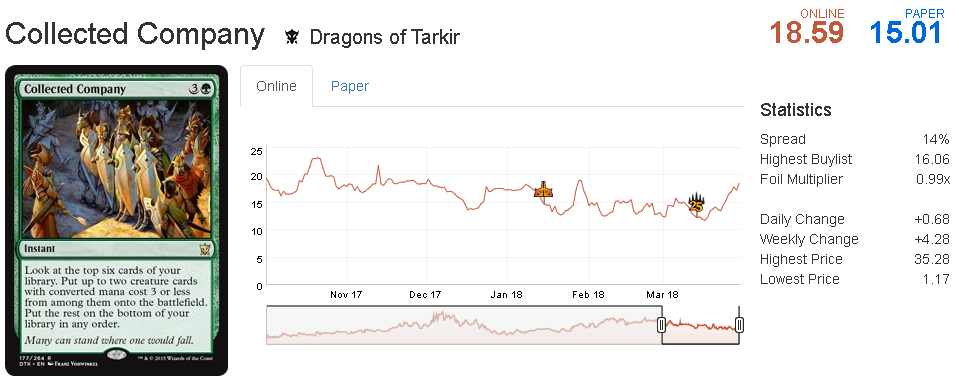
I talked about Collected Company last week. I mentioned that this card got overshadowed by the hype of the Bloodbraid Elf and Jace unbans. It was less than 14 tickets at the time, and has increased by about 5 tickets since then.
Competitive players who have been playing since at least Dragons of Tarkir know how broken Collected Company is. In Modern, Company is a four-of card for both aggro and creature-combo decks. The ability to put six mana worth of creatures into play at instant speed, for just four mana, is insane.
Back when this card was in Standard it was already causing lots of frustration, and certain players were hoping it got banned. Whenever these decks are popular online, the demand for Company will usually spike.
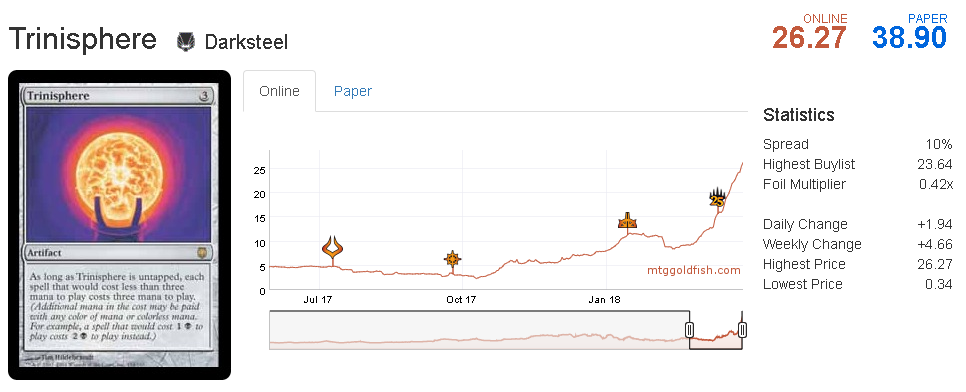
I mentioned Trinisphere two weeks ago. Back then, I only mentioned that this card is played to combat midrange decks but I didn't say how it does that.
First, let's talk about why midrange decks are good: they use cheap, efficient spells to gain control of the game slowly. That alone should make it clear why I picked Trinisphere. This three-mana artifact makes the spells of slow decks less efficient because they will be less likely to cast more than one spell in the early game. Cards like Thoughtseize and Lightning Bolt become a lot less impressive at three mana. By restricting the actions from a midrange deck, it will be easy to beat them.
Now, let's relate this card to the recently unbanned Bloodbraid Elf, where BBE's cascade trigger will no longer be free (it will require three extra mana to cast the revealed spell). This was kind of like secret tech back when the Sphere is still around 16 tickets. So if you were thinking from a competitive player's point of view and bought Trinisphere, today it would have earned you an average of about 8-9 tickets per card.
Surveying the Meta
Before I elaborate more on the topic, let's talk about the decks that popped out on MTGO recently.
From my experience, I've seen lots of aggressive red decks that play Goblin Guide and Eidolon of the Great Revel online, be it traditional Burn, Goblins, or random red creature decks. Eidolon hasn't increased in price because it just got reprinted in Masters 25. If Burn's performance starts to improve I think there's a chance it will increase in price, but I wouldn't suggest buying into Eidolon because it's too risky. I will be suggesting something better to invest in later.
Besides Burn, I've also noticed that many decks are including Bitterblossom as tech to beat midrange decks like Jund. I've seen it in Abzan, BW Eldrazi, and even Affinity. If you're actively playing Modern online, this isn't a new thing for you.
Combining the best decks in the format—Jund and Humans—with the decks I talked about just now, we see some of the most commonly played cards as below:
Trying to think in a competitive player's point of view, what do you see here? Let me share what I can think of from these data.
Many cards cost two or less.
Decks are getting more aggressive.
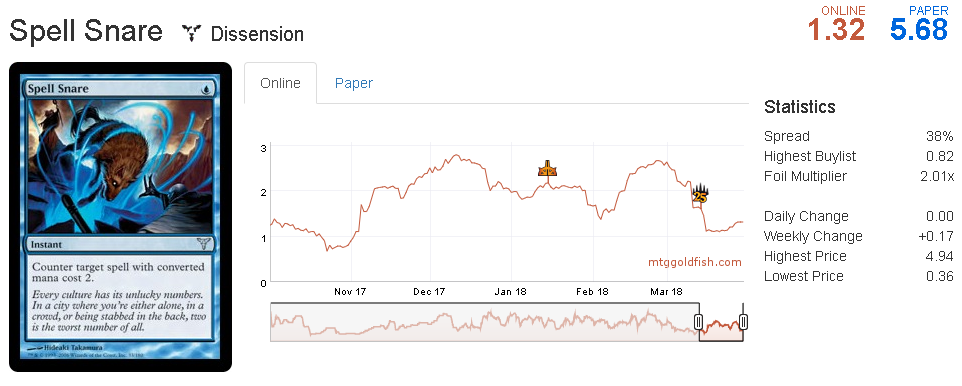
I can directly relate the first point to one card in particular: Spell Snare.
Spell Snare might seem very narrow as it only counters spells with converted mana cost two. But looking at the most powerful cards played in the format right now, it looks like it has a ton of targets.
I could easily see control decks like Grixis and Esper starting to play this as a four-of soon. These decks have cheap tools to gain control of the board, like Lightning Bolt, Fatal Push, Thoughtseize, and various counter spells. With Spell Snare, I feel these decks will get even more competitive as this one-mana counterspell can stop lots of spells in the current meta. Recently Spell Snare dropped from 2.5 to 1.3 tickets, which is a good opportunity to acquire some playsets for investment.
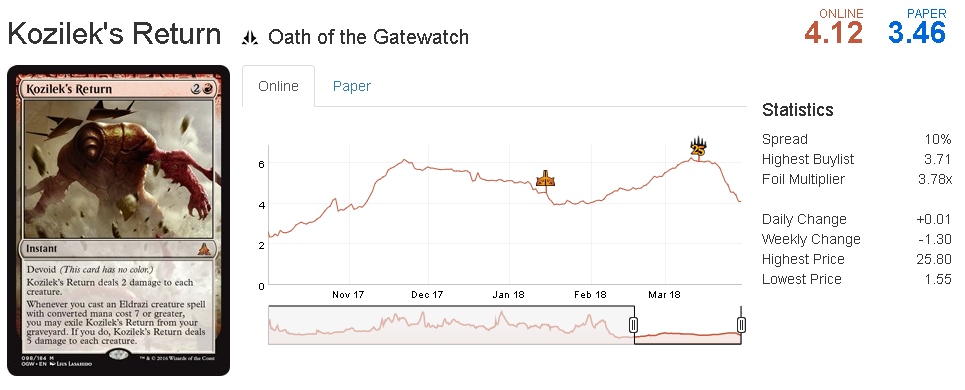
As for the second point about the increase in aggressive decks online, I think the four-mana sweepers like Supreme Verdict and Wrath of God are a little too slow right now, and Anger of the Gods is a little too hard for most decks to cast. So, it's time to get back to some old technology:
The combination of Kozilek's Return and big Eldrazi is the best way to answer all the creatures that our opponent has cast from early to late game. In the current metagame, Tron is the only deck that can employ this combo. Kozilek's Return is able to kill off most early creatures in Humans, Jund, and Burn. In the midgame, the combo might not be able to kill a large Tarmogoyf, but the Tron player should be able to stabilize by then.
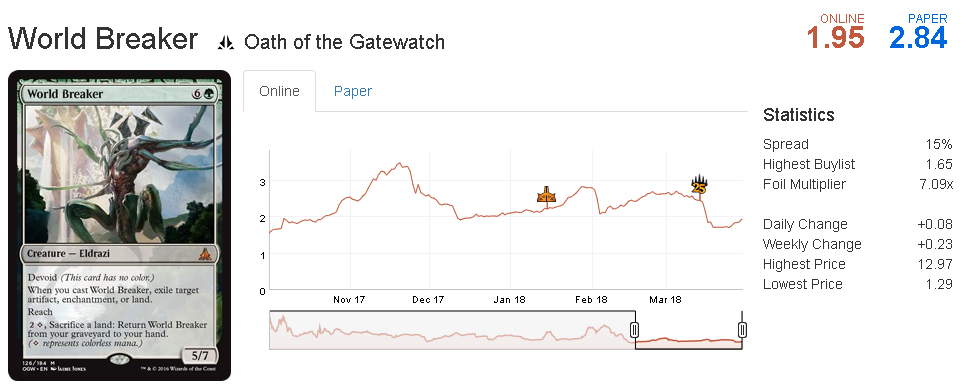
Here I would suggest buying both Kozilek's Return and World Breaker for investment. If you have extra tickets, I would also suggest buying other Eldrazi like Ulamog, the Ceaseless Hunger and Emrakul, the Promised End, as I think Tron will be the next deck-to-beat very soon.
Alright guys, that’s all for this week. I hope my examples are enough to elaborate on the topic. Thanks for reading and I’ll see you again next week.
If not, now is a perfect time to join up! Our powerful tools, breaking-news analysis, and exclusive Discord channel will make sure you stay up to date and ahead of the curve.
Today, I’m going to be looking over some of the more unique possibilities for cards that are currently priced on the lower end, and where they are seeing play.
Occasionally, we have the opportunity as financial observers to gain a large percentage on a singular investment. I use the term percentage specifically because it is far easier to see a percentage increase on a cheaper card than on a more expensive card. For example, if a card is only worth $1, and it spikes to $20, that is a 2,000 percent increase. However, a card spiking from $40 to $80 is "only" a 100 percent increase.
When these cheaper cards see play in competitive decks, particularly in a new potential archetype, the knowledge and observation of all types of players can spark a price increase through heavy purchases made on those cards. With large demand comes limited supply. I’ve referenced Goblin Lore a few times in recent weeks as this example, which continues to increase from its former $0.50 price tag.
There was an error retrieving a chart for Goblin Lore
What lower-end cards have price increase potential? Factors can include limited printings, consistent heavy play in competitive formats, and general potential strength in the future. Here are some recent possibilities!
The miracle mechanic is one of the most polarizing mechanics in Magic history, maybe only second to Storm. The incredible level of variance that spawns from the sheer power level increase of a card’s miracle effect is absurd.
With the recent unbans to Jace, the Mind Sculptor and Bloodbraid Elf in Modern, players are still finding new and exciting ways to utilize other cards with these two powerhouses.
MTGO user Atomic piloted a Simic Control deck to a 5-0 finish recently with some very value-oriented cards. Coiling Oracle, Mystic Snake, and Courser of Kruphix are all present as a value creature base, but the interesting deck manipulation strategy of Jace, the Mind Sculptor and Nissa, Steward of Elements to knowingly get a Revenge of the Hunted on the top of the deck could do massive damage.
Revenge of the Hunted has only been printed one time, in Avacyn Restored, the final set in Innistrad block. While Innistrad was very popular, Dark Ascension was a bit less popular, and the lack of a strong draft format led to a weak amount of product printed for Avacyn Restored. Additionally, much of the Avacyn Restored product was opened during Standard because Bonfire of the Damned was once a $70 card.
All of these factors, and the unlikelihood of miracle cards getting reprints outside of Masters and Commander sets, contribute to a possible $3-$5 spike in this card sometime in the future if this strategy catches on. It is also worth mentioning that foil copies are only a dollar as well.
This card absolutely baffles me from a financial perspective. Once upon a time, when Shadows over Innistrad was spoiled, Thing in the Ice was the next big thing. Everybody seemed to know that the card would see play, and it was well into the $15-$20 price range upon release.
Over the course of its lifespan, it has always seen play. It was mid-level popular in Standard, there were many decks playing around with it as a possibility in Modern—it has even floated around in some strange niche spaces in Legacy at times, albeit without the greatest success in that particular brutal format.
Today, it has a very stout home and an entire archetype named after it, as decks playing it are often listed as “UR Thing in the Ice.” This archetype is also secretly a dual-archetype, as there is a UR Control list that uses Thing in the Ice as a win condition with Snapcaster Mage and a heavy control package. There is also a slightly-less-but-still-relatively-popular version that plays Kiln Fiend and sometimes even Enigma Drake alongside Thing In The Ice with draw spells and cycling spells.
Despite all of the play that the card sees, usually as a four-of but almost never lower than a three-of, it is still somehow under $5 per copy. On top of its popularity, it is also very difficult to reprint the flip mechanic that creates Awoken Horror and wins games, especially given many of the opportunities for a reprint have recently happened.
Blue and red cards, when combined into one deck, have had quite a history of price increases. Blue-red decks are considered among the best decks that have ever existed, and the color combination always tends to find a way to slot right into any format. It might take a bit of time, but I would highly recommend having a playset of these bad boys hidden somewhere in your binders.
Whenever a card says, “Take another turn after this one,” it will often see play in every realm, particularly casual play and Commander games. However, every now and again these cards will bleed over to competitive play as well.
Lately, the Taking Turns archetype in Modern has been an up-and-coming option for players. This has been markedly true with the unbanning of Jace, the Mind Sculptor, which is just one more way for a mono-blue deck to thrive. The recent printing of Search for Azcanta has also been fairly beneficial to the archetype as well.
Part the Waterveil is one of the easiest ways for the deck to win, creating a land that can hit the opponent multiple times in a row while the deck chains together as many turns as necessary. Other cards like Time Warp and Temporal Mastery also allow for multiple turns, but Part the Waterveil is a true win condition.
The card, as of the time that I am writing this article, is under $2 per copy. It is also a mythic rare, and exists in a pretty weak overall set in Battle for Zendikar. If not for the Zendikar Expeditions, Battle for Zendikar essentially would have had only Ulamog, the Ceaseless Hunger as a relevant Magic card.
The biggest danger for Part the Waterveil is that it has a medium probability of being reprinted, which would happen almost certainly in a Commander set if it happened at all. Fortunately, there is about an equivalent chance that the card goes up in price due to casual play alone. If the archetype takes off before a reprint opportunity happens again, then this could easily match the price of Time Warp, which is around $15 despite having five printings in the past.
Possibility #4: Bring to Light
There was an error retrieving a chart for Bring to Light
Okay, I’ll be honest…this one is a bit of a stretch. It only sees play occasionally as part of the Scapeshift archetype and package, and it serves as another way to cast the win condition for an extra mana. The mana base required to play well with the card also requires evading a Blood Moon, which the Scapeshift decks need to do anyway, so it is a natural fit.
On the other hand, this card cannot get any cheaper than it currently is, and it has some interesting possible implications in other Tier 2 and Tier 3 decks. It is also constantly played casually because players who can only afford one or two copies of their favorite card want easy ways to get it into play. Bring to Light offers possibilities on hundreds of casual cards.
The reason that I’m mentioning it briefly is because any increase on the card would be a few hundred percent of an increase. The card has an average market price of a quarter, and is still a rare. From looking around, I’ve been able to find them as cheap as $0.11 per copy. There are pretty good odds that anyone reading this could find enough change in their couch to buy a playset of these…maybe even two!
Conclusion
Magic is full of perpetual possibility, so any one of these cards is only a good showing away from a massive popularity increase. We never know for sure, but we can do our best to be prepared!
Are there any cheap cards that you have your eye on? Let me know in the comments!
If not, now is a perfect time to join up! Our powerful tools, breaking-news analysis, and exclusive Discord channel will make sure you stay up to date and ahead of the curve.
Hello, readers and welcome to another edition of the Daily Stock Watch! I was just talking about recently about good sideboard cards in Modern that are making impact in tier one decks. With three Human decks making it to the top eight of the recently concluded MTGO Modern MOCS, I'd like to feature one of the new cards from those lists on today's segment. I think that it is a very timely meta call that also makes it favorable for the Humans deck in mirror matches, Jund, or even against Hollow One (although I haven't really tested against it yet with this creature in the deck).
From the lists that I'm pertaining to (which I will show you in a little while), a pair of Auriok Champions has made its appearance to give additional firepower to an already prominent deck. It has been a good addition, in my opinion, because the meta has been full of creature-based strategies lately in the likes of BR Hollow One, Aura Hexproof, and the dreaded Creatures Toolbox deck. The life gain could help in the attrition wars while its protection from black and red could help in defending the fort against the likes of Gurmag Angler, Tasigur, the Golden Fang and a pesky hoard of Bloodghasts. It also survives a plethora of popular removals such as Anger of the Gods, Lightning Bolt, and the suddenly popular Izzet Staticaster. The fact that it is also a white creature that fits nicely in the curve of the deck makes it a really good card choice. If the meta tends to shift to a more black and red approach, I don't see any trouble for this card in making it to the main deck and removing Bob from the spotlight.
Just how good is this card again? Let's check out the winning decklist from MTGO's Modern MOCS event.
Humans
Creatures
4 Champion of the Parish
1 Dark Confidant
1 Kessig Malcontents
4 Kitesail Freebooter
4 Mantis Rider
4 Meddling Mage
4 Noble Hierarch
4 Phantasmal Image
4 Reflector Mage
4 Thalia's Lieutenant
3 Thalia, Guardian of Thraben
Other Spells
4 Aether Vial
Lands
4 Ancient Ziggurat
4 Cavern of Souls
4 Horizon Canopy
1 Plains
2 Seachrome Coast
4 Unclaimed Territory
Sideboard
2 Auriok Champion
1 Dismember
2 Izzet Staticaster
2 Kataki, War's Wage
1 Mirran Crusader
2 Reclamation Sage
2 Sin Collector
3 Xathrid Necromancer
Xathrid Necromancer would have been another good spec target if only it consistently makes an appearance in these winning lists. The fact that it is only good in matchups where mass removal is mostly feared makes it a less appealing candidate for a gradual price spike. Nonetheless, I still think that it could be good in the long run if this Humans deck makes it further without getting the banhammer on any of its core pieces. For now, I'd like to focus more on the financial gains that Auriok Champion would be getting from these exposures.
Human Staples
I don't see any of these guys losing their slots in the main deck for the Humans deck anytime soon, but they could definitely use some company. Kessig Malcontents, Phantasmal Image, Dark Confidant, Dire Fleet Daredevil and Thalia, Heretic Cathar have all made cameos in the continuous evolution of this archetype, and Auriok Champion might just make it to the main cast soon. It's also easy to forget how expensive this card was prior to its Iconic Masters reprint, but getting back to that level might take a few more years to happen again -- but we could always make a case of starting out early before that trend begins.
At the moment, you could find lots of copies of Auriok Champion from StarCityGames, TCGPlayer, Card Kingdom and ChannelFireball for anywhere between $3.99 to $4.99 for normal copies from IMA. The Fifth Dawn version has stayed above $10, and should be kept with you if you never let go of them. A consistent dose of this card in the winning Human lists for the coming weeks should help pad its value somehow, so getting them for $3 should be a good thing. It could easily be a $6-$10 card in the future once supplies go dry and Humans become the ultimate alpha deck of the format. It's another one of those cards that's hard to go wrong with.
And that’s it for today's edition of the Daily Stock Watch! See you again next time, as we continue to speculate on cards that might be on the rise, or try to get rid of the ones that are at risk of losing value. As always, feel free to share your opinion in the comments section below. And if you want to keep up with all the market movement, be sure to check in with the QS Discord Channel for real time market information, and stay ahead of the hottest specs!
If not, now is a perfect time to join up! Our powerful tools, breaking-news analysis, and exclusive Discord channel will make sure you stay up to date and ahead of the curve.
The Challenger Deck series (which releases early next month) is a significant moment in MTG finance. The premise behind these decks is that they are basically Standard Preconstructed decks that don't suck. What a novel idea, right?
Basically, Challenger decks are the backbone of actual competitive Standard decks and will include a high concentration of cards that are desirable, retailing for $29.00. Let's take a look:
Hazoret Aggro
Maindeck
1 Chandra, Torch of Defiance
1 Hazoret the Fervent
3 Soul-Scar Mage
4 Bomat Courier
3 Kari Zev, Skyship Raider
3 Harsh Mentor
1 Glorybringer
4 Fanatical Firebrand
4 Ahn-Crop Crasher
4 Shock
4 Lightning Strike
2 Abrade
2 Magma Spray
4 Sunscorched Desert
20 Mountain
Sideboard
2 Magma Spray
2 Key to the City
2 Pia Nalaar
2 Kari Zev's Expertise
3 Sentinel Totem
4 Chandra's Defeat
All things considered, the deck is pretty fantastic value for $29.00. It certainly stretches out $29.00 a lot further than it would have gone toward building the deck without this new product. It's kind of genius on the part of Wizards, as they are able to take $80.00 worth of highly played Standard staples and sell them directly to the consumer for $29.00.
Positives of Challenger Decks for the Market
Wizards has been much more proactive about finding and creating more ways to sell cards to players. They are not just pushing packs of random cards these days! Masters Edition reprint sets, From the Vaults, Commander decks, and now Challenger decks are all ways that Wizards of the Coast has been able to essentially insert themselves into the secondary marketplace. Wizards is not an online store like SCG or CFB where a collector can go and buy any card, but they have certainly become much more interested in finding ways to sell cards outside of new expansions.
The question is whether this trend good or bad for Magic fans?
On the one hand, an obvious pro is that it helps keep the price of Magic staples under control. Sky-high $250 Tarmogoyfs and $150 Scalding Tarns are a relic of the past. All of these reprints have personally cost me money on my Magic investments over the past five years, but I cannot deny that the process has also done a lot of good toward making the game much more accessible to a wider audience.
Seeing $100 Standard singles and $200 Modern singles is bad for Magic as a game. If people don't play Magic, the collectible value also fails. I want Magic to be huge, and the only way for it to grow and expand is to branch out and find new players. Challenger decks provide new players with a way to save some money as they expand their horizons and try out FNM and other tournament formats, and that's a good thing
On the other hand, Wizards throwing its hat into the ring as a discount Standard single retailer has serious consequences for the secondary market. In particular, it is going to have a huge effect on influencing Standard single prices.
Chandra has held a $20- to $40-price tag for most of her stay in Standard, but maintaining that price tag seems impossible when I can buy an entire deck including a copy of Chandra for $29. I think this is an obvious trend that will apply to all chase cards that are printed in current and subsequent Challenger decks.
So anytime that I buy or trade for Standard cards in the here and now, I'll need to take into consideration that there may be a Challenger deck coming down the pipeline that will significantly tank the value of my acquisition. The tradeoff becomes fairly obvious: The Challenger decks will reduce the cost of entry to Standard for newer players by offering a high concentration of staple cards at a discounted rate, but this reduction comes at the cost of diminishing the value of the cards already in circulation.
For me, as a person who does Magic finance, it creates a situation where I now have zero interest in buying or owning Standard cards that I don't explicitly need for tournament play. In fact, I don't even particularly want to own those cards, and I'll likely be looking to borrow from now on. The flipside of the coin is that the format defining cards that do not see reprints in Challenger decks will be apt to gain value. Packs have an established price, $3.99, which means that if the Challenger decks tank the singles that get reprinted, the non-reprint cards are likely to climb. It is not dissimilar to what we see in Modern via Modern Masters reprints.
Once the spoiler for a new Masters set is posted, we can assume two things:
All cards that were reprinted increase in supply and the price dips.
All cards that were not reprinted dramatically increase their likelihood of gains.
There will certainly be a Standard guessing game that is based around betting on which cards will or won't end up in Challenger decks. If your picks are in the Challenger decks – you lost. If your picks don't get reprinted – you won.
So Where Is the Money?
Well, it would appear that the lion's share to be made from this innovation will be channeled from the consumer to retailers and to Wizards. It's hard for secondary investors who are not selling the Challenger decks direct to the consumer to really gain from these new sets, especially when we consider the fact that it is likely to diminish the value of Standard singles. There is clearly potential to "hit" on guessing the cards that won't be reprinted to make a profit, but it also seems likely to miss and lose value.
There was an error retrieving a chart for Bomat Courier
The addition of Challenger decks into the Magic economy leads me to believe that finance becomes even more about being able to quickly turn over cards into spikes and not be left holding the bag when the decklists are released. There is already a fair amount of this phenomenon at play in Standard and Modern, and I expect these new decks reward financiers for continuing to hone their skills at quickly flipping cards.
If you want to know where I think the money is really at, I do have a get-rich-quick scheme that I'm not personally going to initiate because it's too much work and I have a lot on my plate at the moment. That said, I think the conditions are ripe for a "Deck Loaning service" to really take off.
There was an error retrieving a chart for Soul-Scar Mage
I believe this is true because, for the first time in two decades of playing Magic, I'd actually use such a service to play Standard tournaments and believe others would as well. Despite the fact that I don't really enjoy playing Standard compared to other formats of Magic, I still end up playing between two and five Standard Grand Prix per year. I'd rather pay to borrow a deck than actually own it for myself (since the cards are likely to greatly degrade in value over the course of subsequent weeks and months).
For me, Standard cards are a sunk cost. I don't want to buy a $400 deck to play once, and trying to borrow 75 unique cards from friends and stores is a chore. At this point, I'd like to be able to send my list to a lending service and pick it up before round one of the GP.
Long story short, Challenger decks are going to make it even more difficult to find value in investing in Standard cards. While this is good for new players, as it reduces cost to entry, it makes Standard cards an even worse investment than they were before; which isn't to say that there isn't money to be made by buying low and selling into price spikes, but it adds the equivalent of a reprint set (Challenger Decks) into the equation where it didn't exist before. Plan accordingly.
If not, now is a perfect time to join up! Our powerful tools, breaking-news analysis, and exclusive Discord channel will make sure you stay up to date and ahead of the curve.
I've previously done an article covering cash flow analysis. Today I will utilize the method from that article to show an actual, real-world cash flow challenge I gave myself for the month of March.
In past articles I've alluded to creating and running my own online TCGplayer store. For the most part my inventory is cards that I speculated on (like Dictate of Erebos, Mana Confluence, and shocks); cards I've picked up in collection buys; and of course my favorite, cards picked out of bulk. This month I decided to straight-up buy cards from local players.
About two days after posting in some local Facebook groups, one guy contacted me on March 4th. He was moving and needed some extra cash for a moving van. He wasn't desperate, but wanted to liquidate some of his extra cards.
I was happy to look through and make offers using the method I alluded to in my article on buying collections. Luckily, he had a good number of $5-plus cards—these are the only ones I've found worth putting up on TCGplayer if you aren't Direct, a route I haven't gone down.
For my cash flow trial (and to keep track of inventory) I created a simple spreadsheet that looked like this:
Purchase Date
Purchase Info
Purchase Price
Card
Price Sold At
Profit
Profit Percent
Traded
Remaining Inventory Value
Notes
-
-
-
-
-
-
-
-
-
-
I will start off stating that this table actually grew somewhat to become what it is above (I added the "Traded," "Remaining Inventory Value," and "Notes" sections) in order to keep track of things better. For the record, the "Price Sold At" reflects the actual amount of money I received from the sale after all shipping and fees were removed.
There were other things I wanted to track, including how much of my initial investment I'd spent, how much I had recouped, how much inventory I had remaining, and my average profit margin per transaction. I also wanted to give myself some leeway should I accidentally spend too much. The plan was to track how many days I was in the red, and apply a -15% profit per month (as though it were purchased on a credit card).
So this part of my spreadsheet looked like this:
Metric
Value
Description
Total Set Aside
$500.00
Amount dedicated to specs
Total Spent
$541.55
Sum of "Purchase Price" column
Recouped
$390.71
Sum of "Price Sold At" column
Profits Earned
$122.66
Sum of "Profit" column (Price Sold At - Purchase Price)
Spendable
$349.16
Total Set Aside - Total Spent + Recouped
Inventory
$273.50
Sum of "Purchase Price" when there is no equivalent "Price Sold At"
Average Profit Per Transaction
46.21%
Average of "Profit" column, ignoring 0% or blanks
Days in the Red
Manual column in which I track how many days I'm "in the red" or overspent.
The numbers in the table above are accurate to the date I'm writing this (4/2/18), so you can tell I had a pretty solid month with this challenge. Note that I bought from three different sellers, and one accounted for a good bit of the high average profit margin. This seller had posted his sell prices on Facebook, and they were barely above SCG buylist—I purchased almost $80 worth from him and have already sold it all.
One important lesson to draw from this is that Facebook is a fantastic buying/selling platform—in fact, that's pretty much the only reason I use Facebook anymore—and that it can easily be worth your time to scour various groups for good deals on cards. I even created a group for local players in which I list weekly specials, as the fees for selling on Facebook are much smaller. (Basically it's just the PayPal transaction fee, unless it happens to be through friends or family in which case it's 0%—though PayPal does monitor this and you can get in trouble for abusing it).
Recognizing Pitfalls
Back to the sale. After meeting up with my seller, I purchased $154 worth of cards from him and went about putting them up on TCGplayer. My original intent was to put up everything immediately. But over the course of the month I came across some excellent prices on Reserved List cards:
$55 on an MP Taiga
$83 on an HP Italian Invoke Prejudice
$150 each on 2x LP Gaea's Cradle
I didn't want to sell these immediately (I think the Cradles especially will continue to move upward and could easily hit $350-$400 in a year). So in these instances I created a separate tab in the workbook for my "Trade Bait/Speculative" pickups.
There was an error retrieving a chart for Gaea's Cradle
When doing this, I realized that one of the biggest challenges to monitoring and maintaining proper cash flow is to be in tune with what you can sell—if you need to bring cash in you may have to give up on some good speculation targets. After all, very few landlords will give you a free pass on rent or utilities because your money is tied up in non-fungible assets.
I also realized that it's extremely important to be firm in your cash offer price. One of my local sellers was a friend who'd recently lost his job and wanted to liquidate some extra cards he had lying around. I used the method mentioned above, but I was more lenient on grading than usual and paid more than I should have on some cards.
That isn't to say I won't be able to make a profit should I sell them, but it can be dangerous to mix business with charity. I'm not saying one needs to be stone-hearted, but if you greatly overpay because of a sad story, you may end up in a pinch when it comes time to pay your bills.
Along with what I mentioned above, it's extremely important to be strict on grading when buying cards. Sometimes the difference between NM and LP is minor and you may charge the same for either condition on a given card. But keep in mind that most card selling platforms have distinct grading criteria (whether they actually follow it or not is another story) and as a seller you will be held accountable for poor grading. Your profits can potentially be wiped out if you misgrade a card with a low profit margin to begin with.
Lastly, always consider the metagame shifts with regards to card purchases. One of the cards I may end up losing on is Botanical Sanctum. At the beginning of the month, it seemed like a lot of people still thought that Temur Energy might be a deck in Standard (or at least the TCGLow price of around $7 implied that). As the month continued, the low kept dropping and it's now almost down to what I paid for the cards (which means that, should I sell them, after fees and shipping I'll lose out).
I didn't take this into account when I bought them. I used my equations and made an offer that, if I were to sell them quickly, would net me a fair profit. But there's no guarantee anything will sell (even if you're priced to be on the first page or the lowest for that respective condition) and you can watch profits evaporate if you buy into a card on the metagame downturn.
I will state that I didn't buy it for its Standard application—it's also played in a lot of Lantern Control decks in Modern—but I misjudged how much of the price was related to Standard demand. So for Standard-legal cards it's likely wise to be conservative when it comes to buy prices (more so than eternal cards which tend to be far more stable in price).
Conclusion
I will be continuing this experiment in the months ahead, with the goal of showing you (my readers) how to grow your business and hopefully keep track of all the financials. I realize that this might seem trivial to some, but I've come to learn that there are plenty of small business owners who need help or suggestions on how to track their financials, so I think this series will have merit.
I have every intention of staying in the green and not dipping into the red for this challenge. As I stated, I don't want to pigeonhole myself and miss out on a good buying opportunity—but I will definitely be more inclined to sell at a lower price to limit the number of days I need "credit."
Want Prices?
Browse thousands of prices with the first and most comprehensive MTG Finance tool around.
Trader Tools lists both buylist and retail prices for every MTG card, going back a decade.



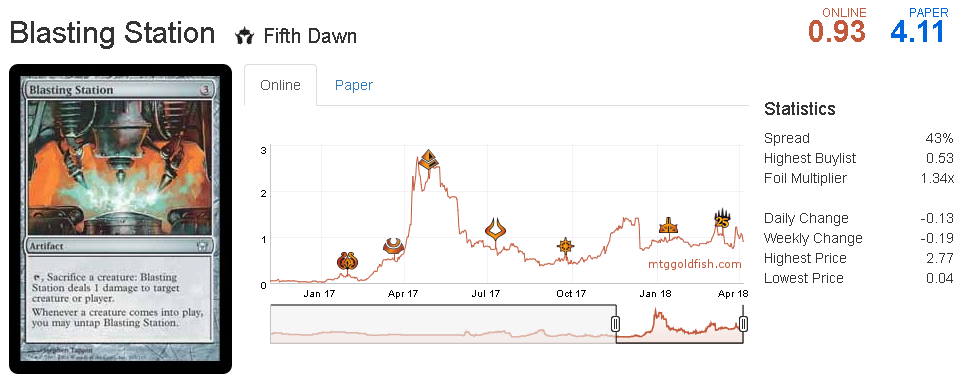
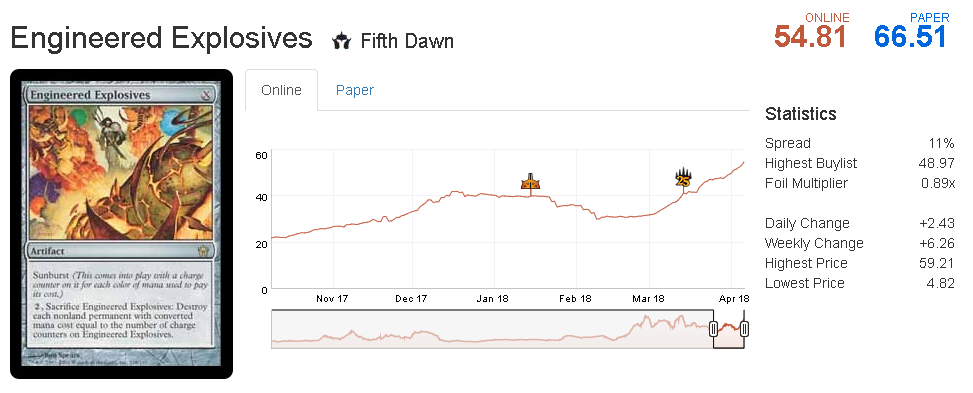
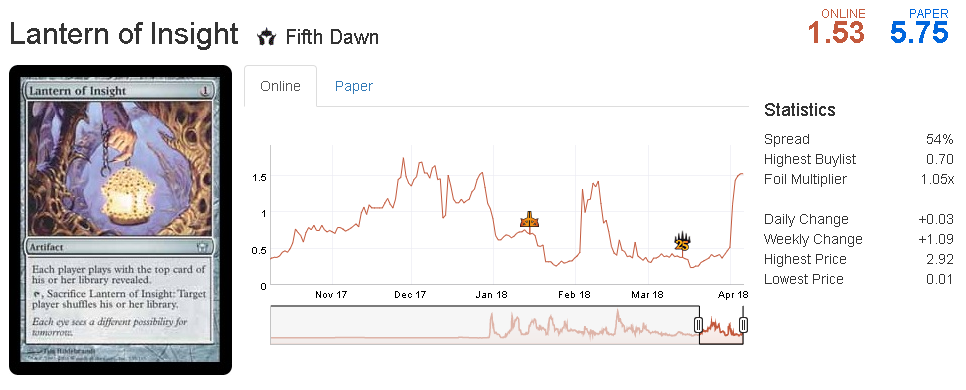
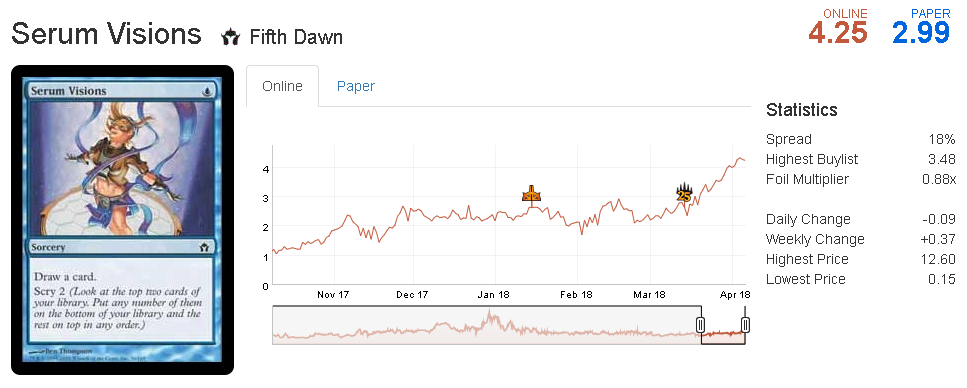
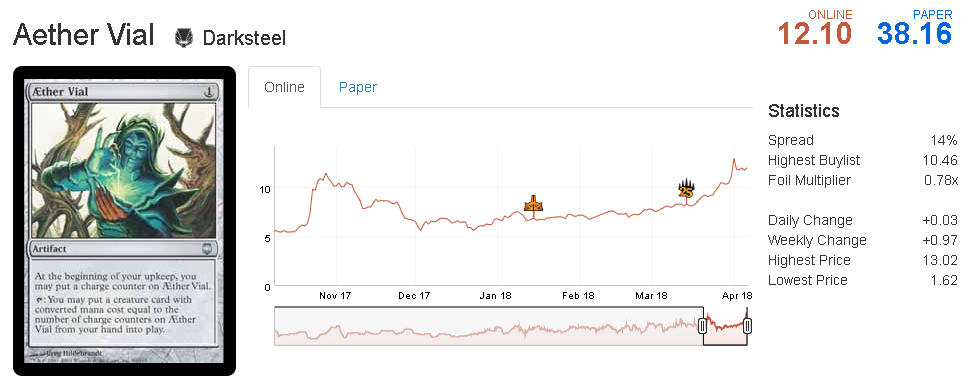
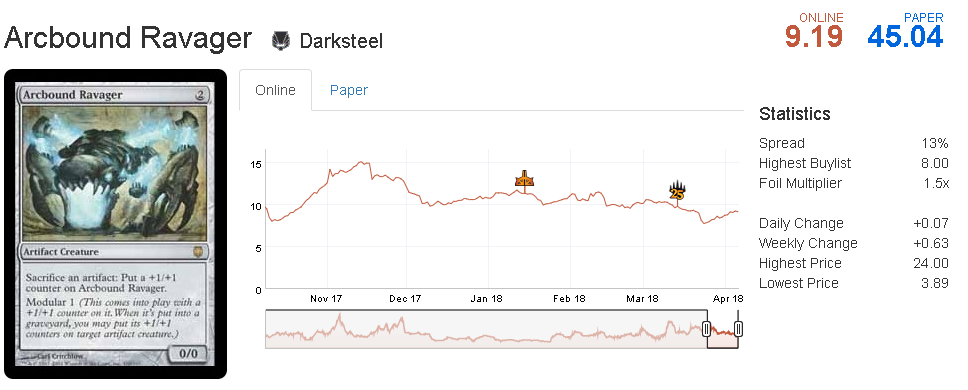
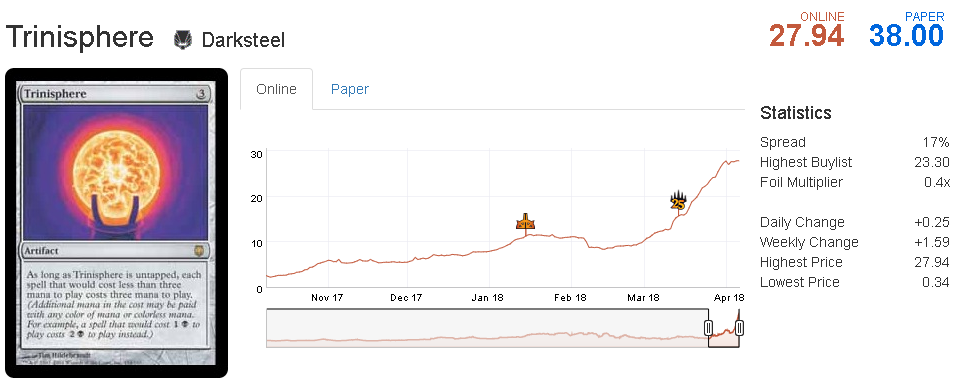
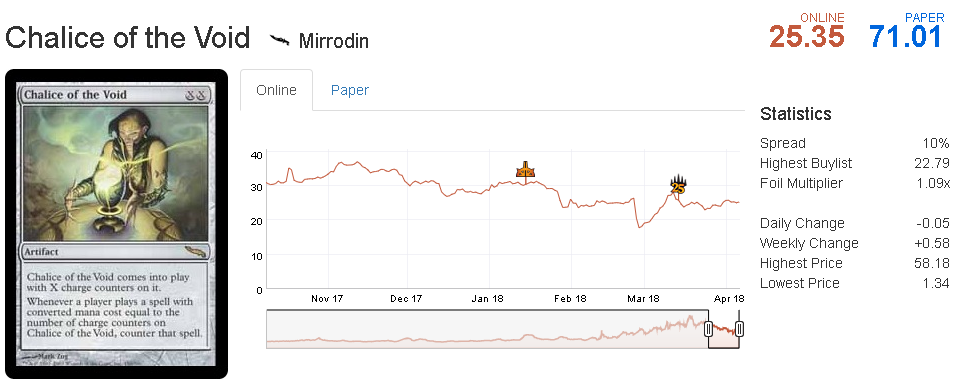
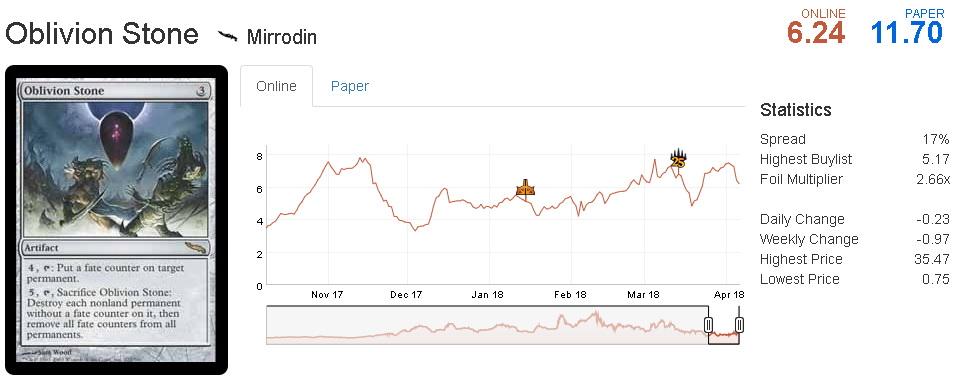

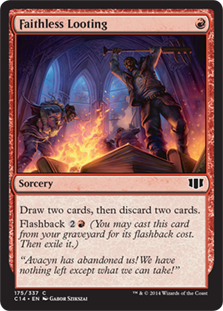 Simply asking around about what local players were on wasn't enough. Local metagames can be very warped or inbred. To combat this, I added in what gets played on MTGO.
 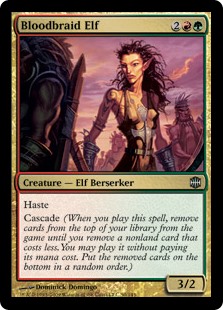 My theory is that Bloodbraid Elf is responsible for the slowdown. It's powerful and flashy, and lots of players want to play that kind of game. However, I have yet to see any kind of aggressive deck featuring Bloodbraid succeed. Decks that are capable of a turn-four or earlier goldfish can't risk hands clogged by four-drops. RG Eldrazi is the closest I've seen, and it's more of a
 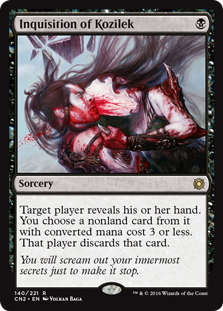 The primary interactive strategy was targeted discard. That's hardly news, considering what I've said about Jund, but there were other culprits too. About three-fourths of the midrange and control decks were black-based, with the rest being either Jeskai or UW
 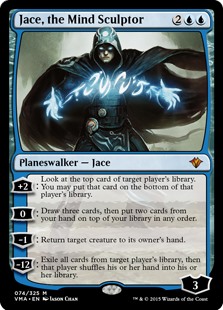 game would come down to at battle waged by impactful libraries and played along.
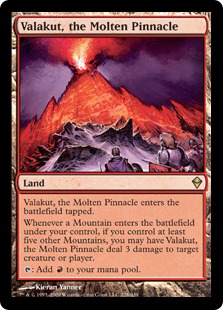 Perhaps it's all of the Humans running around, but I never saw Storm either online or in person. That doesn't mean that combo was non-existent, but all the discard made critical-mass-of-spells-combos unattractive. Instead, combo players were going for the play-out-stuff-then-wait-for-the-critical-card combo decks like
 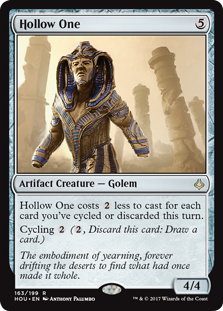 abusive, Dredge deployed multiple Prized Amalgams, Narcomoebas, and Bloodghasts on turn two. Hollow One can theoretically drop four Hollow Ones on turn one. Any sweeper or removal can save you against that Dredge draw. Only multiple Path to Exiles will keep you from dying to those Hollow Ones.
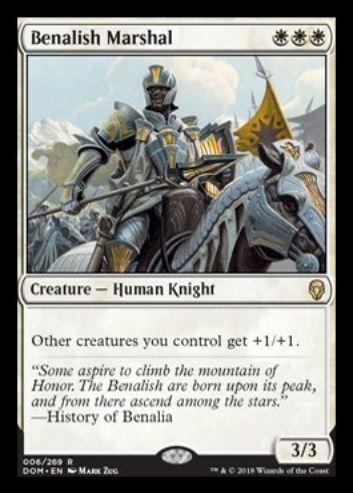
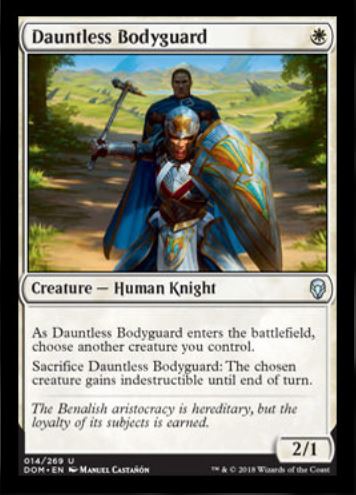
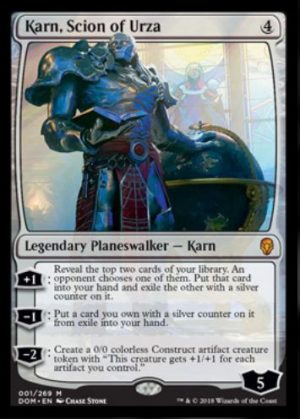
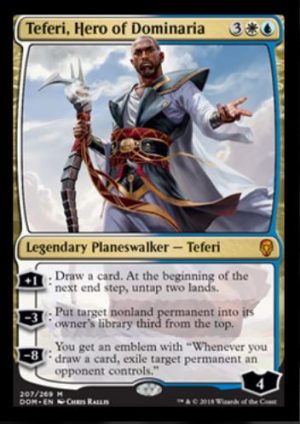
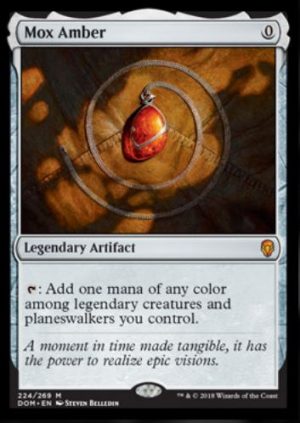


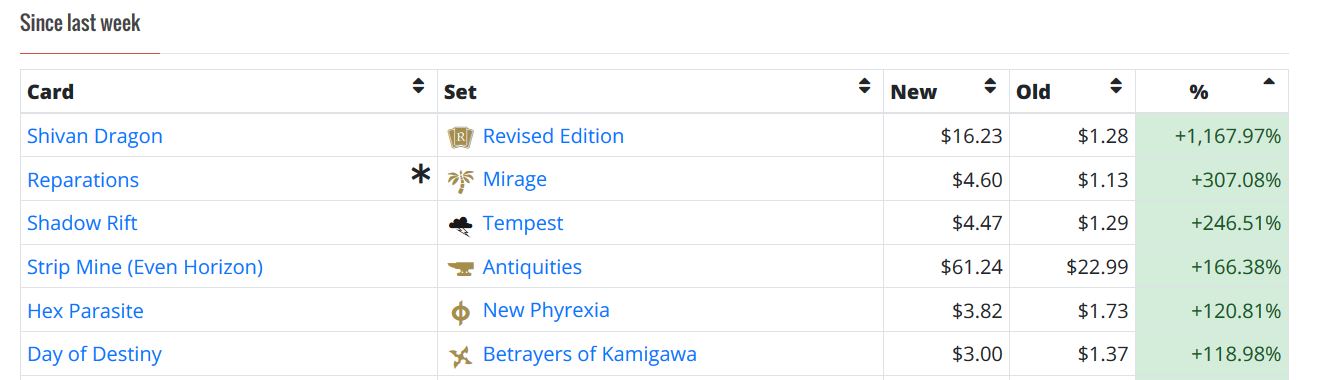
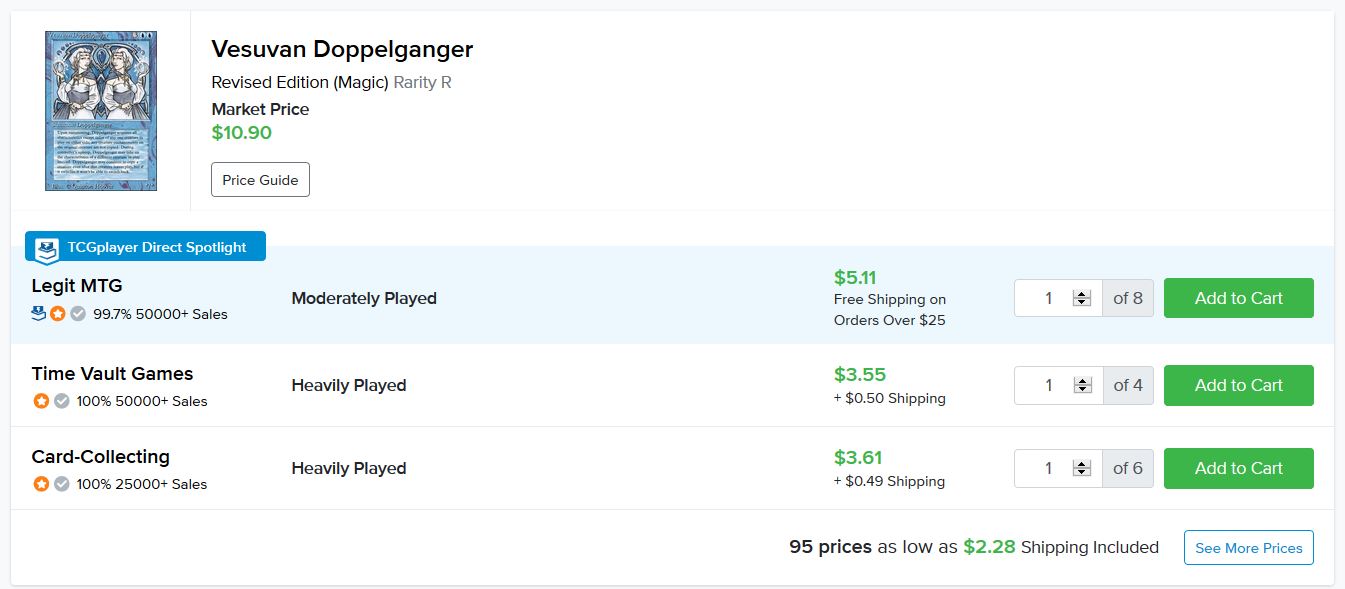

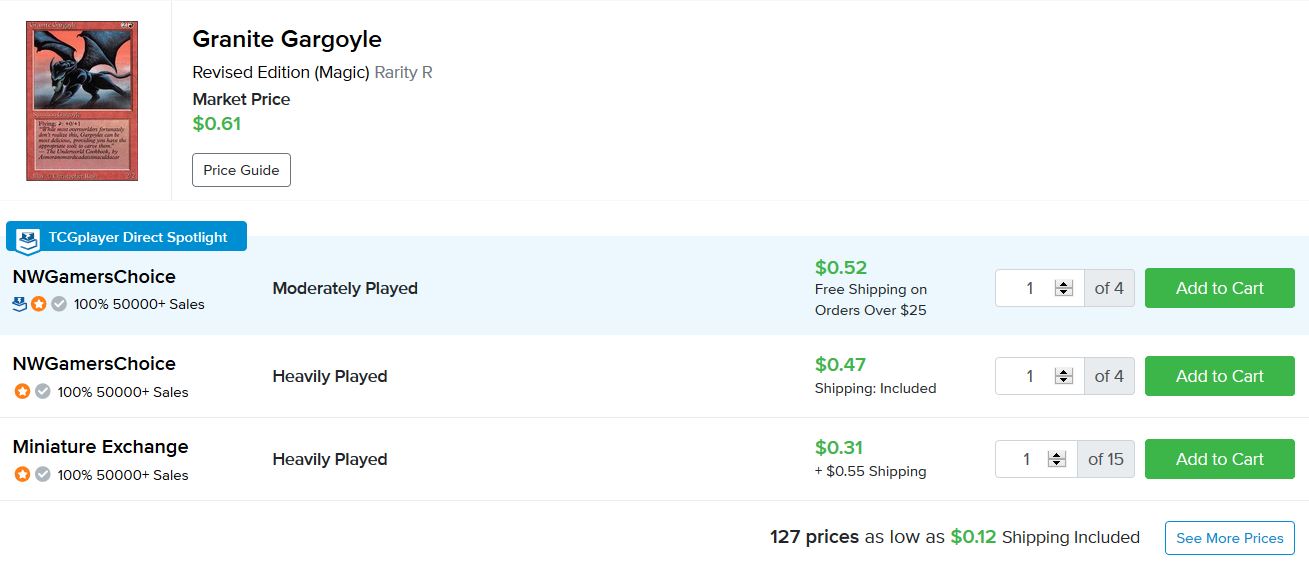
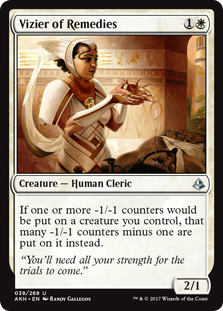 What is tension? Well, let's start by defining what isn't tension. The opposite of tension is synergy, or the cooperation of multiple distinct parts to form a combined effect greater than the raw sum of its parts.
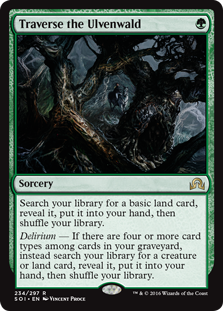 As we move deeper into fair territory, infinite combos disappear to make way for micro-synergies, or small, favorable interactions between cards that snowball into tangible advantage down the road. Micro-synergies are defined by groups of cards that work towards the same goal. Think Street Wraith, Mishra's Bauble, Tarmogoyf, and Traverse the Ulvenwald—a set of cards which, together, yield a product more powerful than the mana spent on them might suggest.
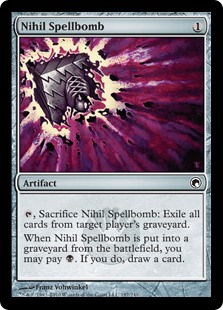 By now, Traverse Shadow has decisively been reigned in. The deck's emphasis on micro-synergies makes it vulnerable to hosers that invalidate those synergies, especially graveyard hate like Rest in Peace and Nihil Spellbomb, despite that same focus generating a terrifying deck when left unchecked.
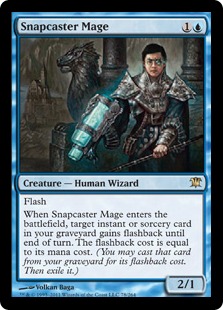 With synergy defined, we can move on to tension. Tension is the strain resulting from ill-fitting pieces being jammed together. Magic players often refer to instances of tension as "non-bos" (cf. "combos").
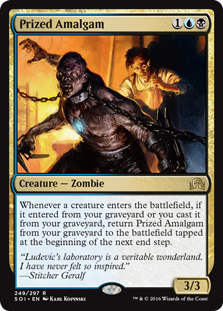 Unfortunately for Shadow, though, the deck only gets to play four copies of the creature, leading it to rely on Traverse the Ulvenwald to search out more. As such, graveyard hate still cripples many Traverse Shadow lines, and the deck's Shadow plan doesn't offer enough coverage to fully insulate the deck against hosers.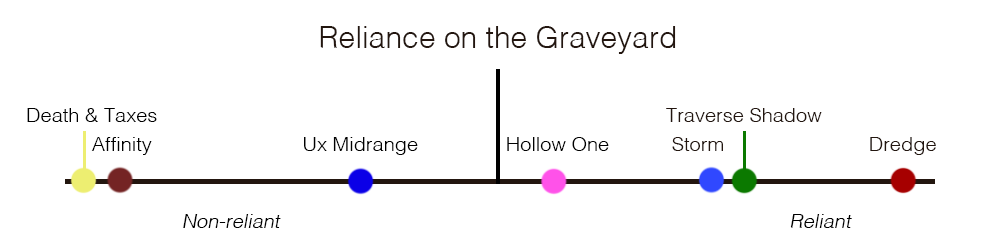
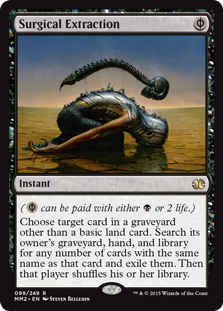 But they also perform different roles, and therefore demand different answers. The former pair goes tall, and fast, demanding heavy-duty spot removal. The latter pair attacks over or around defenders and laughs in the face of that same removal. Anger of the Gods and Surgical Extraction look pretty silly against a pair of on-board 4/4s, just as Ancient Grudge looks silly against everything besides Hollow One.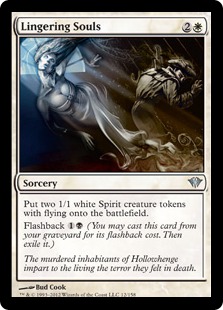
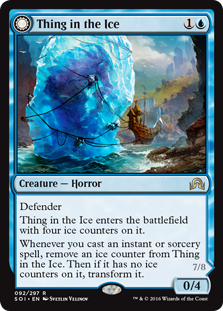 The biggest reason to divest from synergy in Modern, though, is the utter power of the format's spells. If a UR deck doesn't utilize the graveyard at all, but can properly wield the likes of Snapcaster Mage or Bedlam Reveler, it should certainly do so. This example in particular is quietly reshaping the metagame as we speak; we're starting to see the