menu

Daily Stock Watch: Mox Opal

Are you a Quiet Speculation member?

If not, now is a perfect time to join up! Our powerful tools, breaking-news analysis, and exclusive Discord channel will make sure you stay up to date and ahead of the curve.

Hello, readers and welcome to the Thursday edition of the Daily Stock Watch! We will continue with our monitoring of Modern cards that I think would either benefit from the results of the upcoming Pro Tour, or be good enough to let go now while it's being hyped. My pick for today is one of those cards that's really, really good, regardless if there's an upcoming big event or none, but I think should be at its peak by now.

There was an error retrieving a chart for Mox Opal

Mox Opal is without a doubt, a very nasty card. It was designed to be a legendary artifact because of its power level, and it continues to benefit from the continuous printing of low casting artifacts that it could work well with in an artifact-based deck. It's hard to imagine its price going down after catapulting to its all-time high today of $69.58, but I also think that its ceiling is near unless it really breaks through in the upcoming Pro Tour Rivals of Ixalan. Its price started trending upwards early this year, and it has slowly climbed its way up to its current price tag. I'm not so sure how paper stocks are affected by pros who are testing their decks online, but if the supplies are really running low right now, this could only mean that a lot of players are leaning towards playing Affinity or Lantern Control.

Lantern Control by Sam Black

Instants and Sorceries

1 Abrupt Decay
4 Ancient Stirrings
4 Inquisition of Kozilek
3 Thoughtseize
4 Whir of Invention

Other Spells

4 Codex Shredder
3 Ensnaring Bridge
1 Grafdigger's Cage
4 Lantern of Insight
4 Mishra's Bauble
4 Mox Opal
2 Pithing Needle
1 Pyrite Spellbomb
2 Pyxis of Pandemonium
1 Witchbane Orb

Lands

1 Academy Ruins
3 Botanical Sanctum
4 Darkslick Shores
4 Glimmervoid
2 Island
4 Spire of Industry

Sideboard

2 Abrupt Decay
1 Ancient Grudge
1 Grafdigger's Cage
2 Leyline of Sanctity
1 Nature's Claim
1 Pithing Needle
1 Porphyry Nodes
1 Pyroclasm
1 Search for Azcanta
2 Tezzeret, Agent of Bolas
2 Welding Jar

Sam Black brought Lantern Control back to the map using this list that's powered by Whir of Invention. Similar lists started popping up in both paper and online tournaments after his masterful performance, and Mox Opal hasn't looked back since. It plays a vital cog in this deck, as it allows the Lantern player to power out all the cheap artifacts in the early turns, so it could lock out opposing creatures via Ensnaring Bridge with an empty hand, or just manipulate the opponent's next movements using hand disruption, Codex Shredder, and Lantern of Insight.

Mox Opal is also a four-of in Affinity lists, and we might not be seeing a lot of Affinity decks winning tournaments lately, but it could be due for another breakout using a different build that pros have tested, or it could just surprise everyone if the field was primed to combat big mana decks. The Utility Checker states that 8.6% of winning decks last year have utilized a full set of Mox Opal, and it is the third most used artifact in the format behind Expedition Map and Walking Ballista. It is also used in Legacy and Vintage where Affinity and MUD decks are aplenty, so there's no question that this is a legitimate multi-format superstar.

Possible Reprints in Coming Sets

These cards are starting to become absurdly expensive, and it's actually funny when we realize that they've been all part of a Masters set (except for Ensnaring Bridge) over the last couple of years. WotC has a knack for reprinting cards that are worth too much, and I wouldn't be surprised if one or more of these artifacts will be present in Masters 25. I'm not here to scare you, but history tells us that it's very likely to happen. Don't get caught up in a card's financial surge. Always get out of your investments while you're ahead.

Right now, you could still get copies of Mox Opal from TCGPlayer and Channel Fireball for as low as $58.84 (heavily played copies), but near mint copies are all priced between $75-$79.99 from the same stores including Card Kingdom. Star City Games is out of stock for non-foil copies, and they still have a couple of foil copies at $89.99. I promised myself that I would write about this card once it reaches the $75 plateau, and urge people to let go of them once it reaches $80. My mindset hasn't changed, but I wouldn't be surprised to see it reach $100 if 16 or more copies of the card reach the top eight of the upcoming Pro Tour. Plan your purchases and disposals wisely.

And that’s it for the Thursday edition of the Daily Stock Watch! See you again tomorrow, as we check out a new card that should be on the go, or good enough for speculating. As always, feel free to share your opinion in the comments section below. And if you want to keep up with all the market movement, be sure to check in with the QS Discord Channel for real time market information, and stay ahead of the hottest specs!

Walking on Water: Merfolk After Rivals

Are you a Quiet Speculation member?

If not, now is a perfect time to join up! Our powerful tools, breaking-news analysis, and exclusive Discord channel will make sure you stay up to date and ahead of the curve.

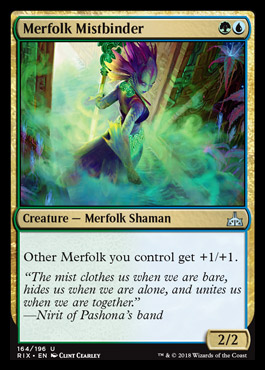
I normally prefer waiting until spoiler season is over to begin publishing think pieces on the upcoming cards, but had to make an exception this week. The announcement of Merfolk Mistbinder in Rivals of Ixalan has profound implications for my Modern deck of choice.

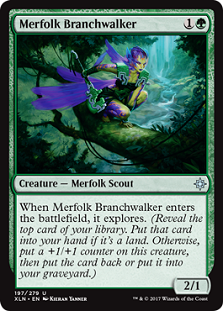
While adding green to Merfolk is something pilots of the deck have experimented with since the release of Kumena's Speaker and Merfolk Branchwalker in Ixalan, this card’s release imparts a degree of legitimacy I believe the splash lacked until now. In this article, I will provide a brief summary of Merfolk’s dalliance with green thus far, cover the splash's strengths and weaknesses, and analyze the boost Mistbinder offers the archetype.

UG's Beginnings

While Merfolk has existed in Modern for most of the format's lifespan, UG Merfolk came about when Ixalan brought us Kumena's Speaker and Merfolk Branchwalker. The support structure afforded to these cards by Merfolk’s lord effects and Aether Vial made the green splash appealing in ways no other variant has been before them; while some players have dipped their toes in white, black, or even red, none of those variants have stuck. With these Merfolk and the promise of further support in green to come, UG oozed with potential.

In order to incorporate Speaker and Branchwalker, UG pilots shaved the top end of the deck’s curve—high-cost cards like Master of Waves and Merrow Reejerey were trimmed or outright cut from the list in order to make room for the green newcomers. The switch streamlined the deck and make it more consistently aggressive in the early game, all while responding to a newfound dissatisfaction with the pricier creatures—Master of Waves especially took a hit when Fatal Push emerged to compete with Lightning Bolt as Modern’s one-mana removal spell of choice, though the extent of how much Push usurped Bolt is debatable. I still consider the Master a very potent card in the Merfolk arsenal, due to Bolt still topping the format staples chart; Jordan's not quite as bullish on the card. Because of this protean landscape, some Merfolk pilots decided to test whether Master would be a necessary component of a winning Merfolk list, as it was prominently featured in the lists of the two Grand Prix winners.

On the subject of high-profile tournaments, UG Merfolk got off to a roaring start, posting Top 8 finishes at the first two major Modern tournaments after Ixalan’s release. Here’s the list that made its way to the top tables at October’s Open in Charlotte, spawned a think piece from longtime Merfolk advocate Corbin Hosler, and set many a Merfolk pilot’s mind racing:

Untitled Deck

Creatures

4 Kumena's Speaker
4 Cursecatcher
4 Silvergill Adept
4 Merfolk Branchwalker
4 Lord of Atlantis
4 Master of the Pearl Trident
3 Harbinger of the Tides
2 Merrow Reejerey
1 Kopala, Warden of Waves

Artifacts

4 Aether Vial
1 Smuggler's Copter

Enchantments

4 Spreading Seas

Instants

2 Spell Pierce

Lands

4 Botanical Sanctum
2 Breeding Pool
3 Flooded Strand
4 Island
3 Mutavault
3 Polluted Delta

Sideboard

3 Ceremonious Rejection
2 Dismember
3 Dispel
3 Natural State
1 Negate
3 Relic of Progenitus

While some of Alan's card choices would eventually be dropped from later iterations of the deck, the list's goal is clear: lower the curve, be more aggressive, and run some sideboard tech for tough matchups that mono-blue Merfolk lacks access to. Swapping three and four drops for Branchwalker and Speaker lower the deck's curve enough that running 19 lands (typically a dicey proposition in Merfolk) is feasible, and Natural State is a sneaky-sweet addition to the deck. It zaps Ensnaring Bridge, Cranial Plating, Ghostly Prison, and other problem cards Merfolk has classically had a hard time with. The fact that this high finish was immediately followed by another Top 8 finish at an SCG Open made a strong case for the variant’s viability.

Troubled Waters

At first glance, the switch from mono-blue to UG seems to have nothing but upside: the gameplan is more streamlined and proactive (important features of Modern decks); the sideboard toolbox got deeper; the early returns were good. So, what’s the catch?

UG Merfolk is a promising variant, but one in need of reinforcements from future sets in order to be considered a legitimate alternative to mono-blue Merfolk. While this view is somewhat controversial, I am far from the only Merfolk pilot to hold it, and consensus has increasingly leaned that way over the past month or so.

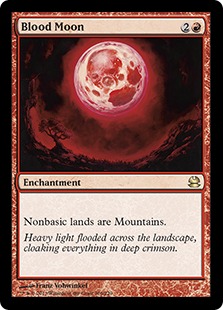
The first problem it faces: the manabase is now more complicated and less reliable. One of the big draws to Merfolk has always been that it takes no damage from its lands, which incidentally hates on decks such as Burn. The lack of reliance on nonbasic lands also buffers the deck against the effects of land disruption like Blood Moon and Ghost Quarter/Leonin Arbiter. These buffers are gone in UG, which means the deck must get off to fast starts to avoid falling prey to hosers.

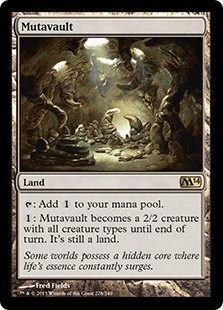
Another problem with the two-colored manabase is that cards like Mutavault become more of a gamble when you’re trying to hit two specific colors of mana. As described by Frank Karsten's seminal article on manabases, you need a certain number of mana sources for a given color in order to see them at a high probability, which is a critical component of getting off to a fast start. Aether Vial helps in this regard, but it does not entirely fix the problem, as we also run noncreature cards, especially in postboard games. Leaning heavily on Vial also forces us to keep it in for midrange matchups, against which siding out Vial was previously optimal and beneficial.

Secondly, Lightning Bolt is far from gone: decks like UR Breach, Titanshift, Jeskai Tempo, and Burn have kept Bolt’s stock high; up-and-comers like BR Discard Aggro and Mardu Reveler also employ it, and even Grixis Shadow occasionally dabbles in Bolt as a way to down Push-proof targets like Mirran Crusader. All these Bolts make for a very welcoming environment for Master of Waves, thus tipping the scales back in favor of the classic version of Merfolk, which also recently received a new toy in Kopala, Warden of Waves.

As an example of a list better-suited to handling the red-heavy field described above, here's a list I've been piloting to good success on Magic Online:

Merfolk, by Roland F. Rivera Santiago

Creatures

4 Cursecatcher
4 Silvergill Adept
4 Master of the Pearl Trident
4 Lord of Atlantis
4 Harbinger of the Tides
4 Merrow Reejerey
2 Kopala, Warden of Waves
4 Master of Waves

Artifacts

4 Aether Vial

Enchantments

4 Spreading Seas

Instants

2 Dismember

Lands

2 Cavern of Souls
12 Island
1 Minamo, School at Water's Edge
4 Mutavault
1 Oboro, Palace in the Clouds

Sideboard

3 Ceremonious Rejection
2 Dispel
2 Echoing Truth
4 Negate
4 Relic of Progenitus

Lastly, UG has proven more susceptible than mono-blue Merfolk to one of the classic weaknesses of Aether Vial decks: running out of gas. Not only does the deck have little use for excess mana outside of Mutavault (which is played in fewer numbers thanks to the new manabase), but it also struggles more than mono-blue when playing from behind. A Master of Waves army-in-a-can is often the perfect tonic to an underwhelming Merfolk board state, and UG has no such haymaker to turn to. Add to that the fact that UG results tailed off pretty quickly after its fast start, and it seems like the variant is close, but not quite there.

Mists of Tomorrow

But enough burying the lede. How does Merfolk Mistbinder figure into all of this? I believe this two-mana lord provides UG with an important advantage, and that is the ability to streamline even further when compared to the mono-blue version. Having access to eight one-drops and 12 two-drop lords makes it very easy to find the adequate numbers of creatures to threaten a Turn 4 kill, thus making the aggro aspect of Merfolk even more dangerous, and perhaps at last making UG a legitimate alternative to classic Merfolk. Increased efficiency and consistency generally lead to good results in Modern, as we most recently saw with the respective emergences of Shadow decks as the premier rock strategies in the format, and of Storm decks after the release of Baral, Chief of Compliance.

Furthermore, this card makes a build of Merfolk that tops out its mana curve at CMC 2 a possibility. Such a build has positive implications for cards like Aether Vial; never needing to add more than two charge counters means that an open Vial on two represents most creatures in the deck, and players will rarely run the risk of ticking Vial up to awkward numbers. That minor but occasionally bothersome detail can sometimes result in hands that stumble out of the gate, which can spell doom for such a tempo-oriented deck. It can also result in less-than-ideal topdecks, such as when Silvergill Adept (otherwise excellent in topdeck situations) is rendered uncastable due to the lack of Merfolk in hand or lands on the battlefield. Capping at CMC 2 also opens up the possibility of lowering the land count even further than most versions of UG do.

The next logical question to ask: what to replace? The first swap I would test is to bring in Mistbinders at the expense of three-drops such as Merrow Reejerey and Kopala, Warden of Waves. While these cards have served me and other Merfolk pilots well for some time now, I don’t believe their ancillary benefits outweigh more consistent early-game pressure. Alternatively, if the effects of something like Reejerey are deemed too important to part from, support cards such as Merfolk Branchwalker, Phantasmal Image, or Smuggler's Copter can be trimmed or cut to make room for Mistbinder. The loss of Branchwalker in particular will affect the deck’s resilience a bit (since it is a conditional source of card advantage), but increase the deck’s explosiveness, as it will now have up to 16 copies of a +1/+1 effect, 12 of which cost two mana. This is the UG list I intend to start testing once Rivals of Ixalan releases:

UG Merfolk, by Roland F. Rivera Santiago

Creatures

4 Master of the Pearl Trident
4 Cursecatcher
4 Kumena's Speaker
4 Silvergill Adept
4 Merfolk Branchwalker
4 Merfolk Mistbinder
4 Lord of Atlantis
4 Harbinger of the Tides

Artifacts

4 Aether Vial

Enchantments

4 Spreading Seas

Instants

2 Dismember

Lands

2 Breeding Pool
2 Cavern of Souls
4 Flooded Strand
4 Botanical Sanctum
4 Island
2 Mutavault

Sideboard

3 Dispel
4 Natural State
4 Negate
4 Relic of Progenitus

Reaching Through Mists

To play devil's advocate to myself, it's possible that Mistbinder fails to make a significant impact in UG, due to the fact that improving the deck’s straight-line aggro speed may not cause a major shift in Merfolk’s matchup profile. Decks like Affinity, Elves, and Storm will still be faster, and the deck will still need to disrupt them in order to win. Slower types such as UW Control will still seek to answer Merfolk's threats and slam win conditions they can't beat. The matchups where goldfishing fast kills more consistently are most likely to benefit the deck are medium-speed combo decks like Ad Nauseam or Titanshift, and the creature pseudo-mirror matches in Death & Taxes or Humans. These decks may not represent enough of the metagame to tangibly reward UG pilots for their deck choice.

It’s also worth noting that Mistbinder provides no means to evade blockers, which can occasionally stymie the deck’s ability to pressure the opponent’s life total. Increased reliance on green mana can make the inclusion of cards like Mutavault more difficult (especially if it’s accompanied by a lower land count), and curving out at two makes the deck more susceptible to hosers such as Engineered Explosives and Ratchet Bomb. Lastly, Mistbinder may simply provide too marginal a boost for UG to outright overtake mono-blue in the Merfolk power rankings.

Despite these concerns, I believe that Mistbinder has the potential to be a net upgrade for UG Merfolk, and bolster it to the point where it’s both a serious Merfolk variant and a player in the Modern metagame. But only testing will tell! If anyone has some thoughts to share on these or other Merfolk spoilers for Rivals of Ixalan (none of which seem particularly attractive to me so far), drop a line in the comments.

Insider: Trade Policy Change at GPs

Are you a Quiet Speculation member?

If not, now is a perfect time to join up! Our powerful tools, breaking-news analysis, and exclusive Discord channel will make sure you stay up to date and ahead of the curve.

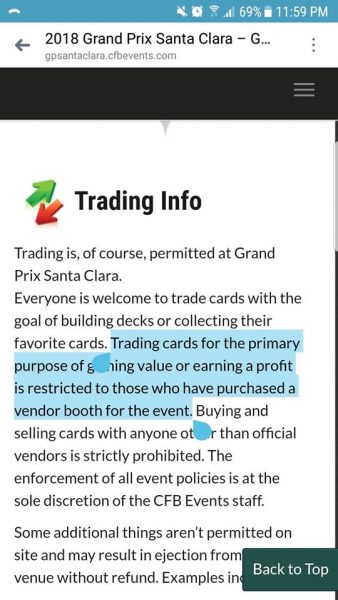
Welcome back, readers! On December 27, Channel Fireball released information on their upcoming GPs. Hidden way at  the bottom of the annoucnement was an updated trading policy that has set off a firestorm in many Magic trading/selling groups on Facebook. The new policy can be seen below:
The highlighted part is the change.
The most widely held belief is that CFB doesn’t want binder grinders or vendors who didn’t pay to have a table be able to set up shop at a GP. While most Tournament Organizers (TOs) have had a no-cash transaction policy for non-vendors in place for some time, this is certainly the most aggressive trading policy I’ve ever seen. That said, I will try to remain as objective as possible when discussing this new policy, though I will state that I used to trade for bulk rares at GPs, meaning this would personally have impacted me. I would bring higher-dollar Legacy/Modern/Commander staples and trade them for bulk rares. I started doing this a couple years after I was on the other side of the trade table (I completed about 50 percent of my dual-land set trading with value traders) as I realized afterwards how profitable it could be. However, I haven’t really made any of these types of trades in quite some time, as nowadays I spend most of my time at GPs buylisting to vendors with ogre’d boxes.
There was an error retrieving a chart for Arms Dealer

The Good

I used to attend GPs to trade (not just for bulk rares, but to get older or obscure cards for my Commander decks) and to talk with other players. I switched over to buylisting to vendors for two reasons: 1) I have acquired a lot of bulk over the years buying collections, and I love filtering through it to sell all those hidden gems; and 2) Trading had gone pretty downhill the last few years, thanks in large part to everyone trying to value-trade everyone else. It used to be that you could attend a GP and find all kinds of different player types (kitchen-table casual, PTQ grinder, store owner, collector,  foil fanatic, cube enthusiast, etc.) at the trade tables, but it seems that a lot of the more casual-style players have shied away from the trade tables because so many players were trying to "gain value" in every trade.

There was an error retrieving a chart for Ruthless Ripper

I'll honestly admit that I will likely check the trade tables out at the next GP I attend and see if things have changed and the "casuals" have returned. It would be nice to do some more trading.

Here's one of the major issues with trading these days: Most people seem to accept that if they are trying to trade a bunch of $3 to $5 cards for a $100 card they need to "overtrade" by some amount simply because the $100 card is likely a lot harder to get and the effort required by the person trading for the low-dollar cards to unload them is a very real "cost". On the other hand, asking for two $7 cards for a single $11 card does seem a bit unfair, given that the $11 card isn't likely all that much rarer than the $7 cards (based on the value) and the "cost of moving" two cards isn't that much higher than moving one card. And yet this is the type of stuff traders are up to in this day and age.

This new policy does clearly benefit the vendors (so if you're a vendor this is good). It will also remove some of the more toxic "value traders" from the environment (specifically the ones who prey on casuals and newer players). It is also hard to argue that it's more difficult to justify the cost of a vendor booth when one could simply be a trade table vendor without paying said fee (and just not being able to buy/sell cards), so eliminating this option may help justify the vendor booth rates.

The Bad

So having been on both sides of the table, I can definitely say that binder grinders/value traders fill a need. Vendors don’t have every card in stock at all times, and their buylist prices and trade-in values differ between them, so sometimes it's much easier to trade in to one entity who intends to separate everything out by vendor at the end of the weekend, so long as they provide fair prices on their trades. For example, say I have three $10 cards I want to trade into one $25 card;

  • Vendor A is offering $6, $7, $8 for the 3 cards
  • Vendor B is offering $8, $5, $9 for the 3 cards
  • Vendor C is offering $7, $8, $7 for the 3 cards

I couldn't trade my three cards for the $25 card at any of those vendors without trading in additional cards (or paying cash). However, one might be able to find a "value trader" that would match the highest trade values in the room, which would be $8, $8, and $9, which equates to $25 and allows one to make the desired trade.

There was an error retrieving a chart for Trade Secrets

Now, that scenario does require a value trader willing to do that and for me to make sure I find the different values around the room to know that I should be able to get that. I'm definitely not saying all value traders would do this (I've seen plenty who don't care if a vendor is offering more on a card than they are), but I have definitely traded with some that do this.

CFB's new policy means there is less competition in the room for vendors, and it may cause some to be less aggressive with their buylist prices or trade-in credit because of this. While we don't know CFB's reasoning for the change; the fact that they jacked up the booth prices for vendors and then issued this policy (which heavily benefits the vendors) does seem like a way to alleviate the vendors anger over the new rates.

Another aspect that I don't know if CFB considered is that there are plenty of "value traders" who would trade all weekend and then head to the dealers before they leave and sell/trade in the cards they picked up. They basically acted like free agents who are only paid on commission (which is great for the vendors because it doesn't cost them anything). So these players won't be able to supply the vendors with a large option on Sundays that many of them might have gotten used to having.

The Ugly

One of the biggest challenges with this policy is it's enforcement. There is no definition for what constitutes "gaining value," so it appears that it's completely subjective and up to the whim of the CFB event staff.

As long as I've been playing Magic, people have been "trading down" more expensive cards for a larger number of cheaper cards with the expectation that the smaller cards will gain additional over time . This was often a great way for store owners to move really expensive cards that their local playerbase didn't want or couldn't afford (like Power) into cards they could move. It was also a great way for players to complete their sets of Power/duals/etc. by providing a clear benefit to the person trading off the Power or dual lands. The ambiguity of CFB's new policy may make these types of trades much more difficult.

There was an error retrieving a chart for Trail of Mystery

I think a good analogy for this policy is like driving on a road on which you see no speed limits posted. If most roads are 45 to 50 MPH, then if you're driving around that limit, you are probably not speeding. If you are driving 100 MPH, then you almost assuredly are speeding, and if you're driving 10 MPH, you're assuredly not speeding. This ambiguity will make trading more difficult, as players will try to get as close to even as possible, which might make some trades fall through, as whoever would come out ahead wouldn't want to get kicked out of the event by CFB event staff.

Conclusion

Reading through numerous comments on various Magic Facebook pages, this new policy has gotten a lot of mixed reviews. Obviously, value traders themselves are very upset (in fact, I know of at least one person whose livelihood was based on this, so I'm not sure what he'll do now). Then there were players who were tired of always trying to get valued traded who applaud the change. And lastly, plenty of players fall in between, seeing both the merits and downsides of this policy. I fall into the latter category currently, though as I stated earlier, I want to actually go to a GP and see the results of this new policy.

What do you think of this turn of events?

Deck of the Week: Gx Eldrazi Aggro

Are you a Quiet Speculation member?

If not, now is a perfect time to join up! Our powerful tools, breaking-news analysis, and exclusive Discord channel will make sure you stay up to date and ahead of the curve.

Hello, Nexites, and welcome to a new edition of Deck of the Week. The new year is upon us, which means that Pro Tour Rivals of Ixalan is coming soon as well. As we gear up for the return to the first Modern Pro Tour in several years, we can expect to see pros exploring new archetypes in an attempt to break the format. MTGO will often be the place these brews make their first appearance. Today we're looking at two green-based Eldrazi decks, piloted by Gold Pro Ben Weitz and Hall of Famer Wily Edel to 5-0 League finishes. One is red-green and the other green-black, but they nonetheless share much in common.

First let's look at the decks side by side, to see where they overlap and diverge.

RG Eldrazi Aggro, by bsweitz (5-0, Competitive League)

Creatures

4 Eldrazi Obligator
4 Endbringer
4 Matter Reshaper
2 Noble Hierarch
4 Reality Smasher
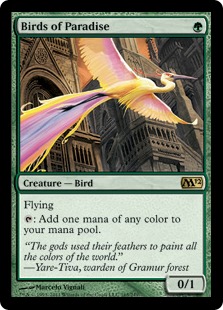
2 Birds of Paradise
3 Scavenging Ooze
4 Thought-Knot Seer

Instants

4 Lightning Bolt

Sorceries

4 Ancient Stirrings
2 Forked Bolt

Lands

3 Cavern of Souls
4 Eldrazi Temple
1 Forest
4 Grove of the Burnwillows
4 Karplusan Forest
1 Mountain
2 Stomping Ground
4 Wooded Foothills

Sideboard

3 Ancient Grudge
2 Chandra, Torch of Defiance
4 Crumble to Dust
1 Engineered Explosives
2 Grafdigger's Cage
1 Pithing Needle
2 Relic of Progenitus

BG Eldrazi Aggro, by edel (5-0, Competitive League)

Creatures

2 Bearer of Silence
4 Birds of Paradise
4 Endbringer
4 Matter Reshaper
4 Reality Smasher
3 Scavenging Ooze
4 Thought-Knot Seer

Instants

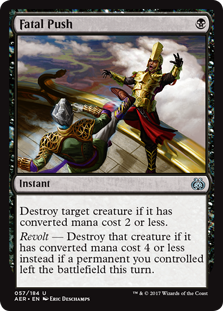
4 Fatal Push

Planeswalkers

2 Liliana of the Veil

Sorceries

4 Ancient Stirrings
2 Thoughtseize

Lands

3 Cavern of Souls
4 Eldrazi Temple
1 Forest
4 Llanowar Wastes
2 Overgrown Tomb
1 Swamp
3 Twilight Mire
1 Urborg, Tomb of Yawgmoth
4 Verdant Catacombs

Sideboard

3 Creeping Corrosion
2 Liliana, the Last Hope
2 Maelstrom Pulse
4 Relic of Progenitus
2 Slaughter Pact
2 Thoughtseize

These two decks bear much in common with the old Bant Eldrazi decks that have largely fallen by the wayside. Eldrazi decks of all stripes generally try to pair the broken acceleration of Eldrazi Temple with some other kind of mana ramp, be it Aether Vial, the Urzatron lands, or mana dorks. Green-based Eldrazi decks like Bant have always opted for the latter, and in these new builds we see something similar. Birds of Paradise and Noble Hierarch help power out the typical package of Eldrazi monsters in Matter Reshaper, Thought-Knot Seer, and Reality Smasher. These are joined by additional heavy-hitting threats Scavenging Ooze and Endbringer, which also play the role of mana sink in the vein of Eldrazi Displacer. Out of the sideboard, both lists run additional planeswalkers—presumably for the grindy matchups—which can come out early thanks to mana dorks.

Playing green also provides access to Modern's most powerful cantrip, Ancient Stirrings. It does the same thing here as in any other deck, smoothing out draws, finding Eldrazi Temple for broken starts, and offering selection and a split creature/land that does wonders for consistency.

Up to now these decks may seem like exact ports of Bant Eldrazi (with Endbringer in lieu of Drowner of Hope as the top end), but the different colors lead to different supporting suites. Weitz opts for red for burn spells and Eldrazi Obligator, both of which can close out games quickly, and which lend the deck a much more aggressive bent. Edel's build tilts a bit more toward midrange, with Liliana of the Veil and Bearer of Silence generating value to grind into the late game.

Of course, in many ways the main difference between these lists will be in their selection of removal spell: Fatal Push or Lightning Bolt. Much like Tron variants before them, perhaps these decks are best understood as "Gx Eldrazi Aggro," into which we can splash any color for additional utility. Which of the two builds is preferable may be more a function of metagame than raw power. The sideboard further accentuates this notion, as high-impact cards like Ancient Grudge, Crumble to Dust, or Thoughtseize will be better or worse depending on your expected matchups.

We've focused more on blue decks lately at Deck of the Week, so it's a cool idea to stray away from them and see how the pros are preparing for the upcoming Pro Tour. We can probably expect new brews to come up in the coming days, but this list is one that looks pretty promising for now. Could this be the new face of our Eldrazi overlords in Modern?

So that’s it for this edition of “Deck of the Week.” Stay posted for our next feature next week. Until then, happy shuffling and thanks for reading!

Daily Stock Watch: Voice of Resurgence

Are you a Quiet Speculation member?

If not, now is a perfect time to join up! Our powerful tools, breaking-news analysis, and exclusive Discord channel will make sure you stay up to date and ahead of the curve.

Hello, everyone and welcome to the Wednesday edition of the Daily Stock Watch! While everyone else is busy looking at Rivals of Ixalan spoilers, I'm more concerned about its namesake Pro Tour that's coming up. In case you're not aware that it's going to be a Modern tournament, now might be the best time to start speculating on what cards could see major ups and downs once a new Pro Tour champion has been crowned. This could happen to any card, and our featured card today might be on the receiving end of some much needed financial gain if it gets enough exposure on a top performing deck.

There was an error retrieving a chart for Voice of Resurgence

Voice of Resurgence just hit its all-time low today of $10.83, and the decline has been steady thru the years, due to the inability of decks that use it to maintain tier one status. We could consider the fact that the metagame has shifted from one that could easily be dominated by blue decks (which Voice of Resurgence usually feasts on) to a different one that is abundant with big mana decks that doesn't really care about what VoR could do. And as a conditional, two-color creature that doesn't really have the killer instincts of a Tarmogoyf or Death's Shadow, it might be really hard for it to find a home in today's battlegrounds.

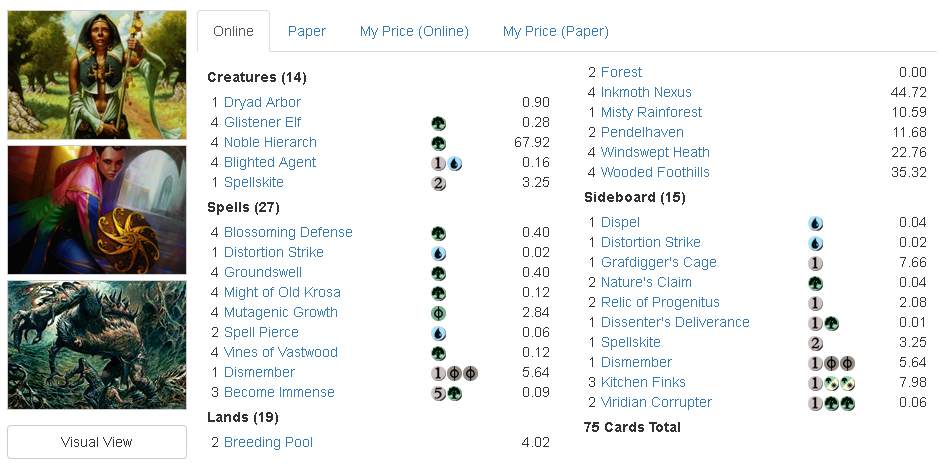
But the strength of VoR is hard to ignore, and this is why GWx decks still end up playing this card whenever they have the chance. At least five decent decks in Modern are considered home to VoR, and let's check this stock GW Aggro deck which has bounced around in the format as a fringe tier one/two deck.

GW Aggro

Creatures

4 Voice of Resurgence
4 Noble Hierarch
1 Eternal Witness
2 Aven Mindcensor
2 Ramunap Excavator
2 Scavenging Ooze
2 Tireless Tracker
3 Birds of Paradise
4 Courser of Kruphix
1 Azusa, Lost but Seeking
4 Knight of the Reliquary

Other Spells

4 Collected Company
4 Path to Exile

Lands

5 Forest
1 Gavony Township
2 Horizon Canopy
2 Plains
2 Temple Garden
3 Verdant Catacombs
4 Ghost Quarter
4 Windswept Heath

Sideboard

1 Eldritch Evolution
1 Elspeth, Sun's Champion
1 Sigarda, Host of Herons
1 Linvala, Keeper of Silence
2 Surgical Extraction
2 Eidolon of Rhetoric
1 Worship
3 Stony Silence
1 Reclamation Sage
2 Engineered Explosives

This is how I would build a deck that utilizes the best GW aggro creatures in the format. It is synergistic, but it doesn't really depend on the combo of Vizier of Remedies and Devoted Druid to win games consistently. Although that list also uses VoR in the main deck, it hasn't really given VoR that time to shine because it's always overshadowed by the combo aspect of the list.

Lost in Transition

Above are some of the cards that have dwindled in popularity as Modern has evolved, and it's not hard to include VoR in that short list. The Utility Checker states that 4.2% of winning decks last year have utilized an average of 2.9 copies of VoR, but this was still not enough to stall its financial decline. However, all is not lost on this card, and we could be in for the surprise of our Magic lives if this skyrockets back to the upper echelon of expensive cards after Pro Tour Rivals of Ixalan. I hope we're not forgetting that this card was worth $50 back in the day.

At the moment, you could get copies of VoR from Star City Games, TCGPlayer, Channel Fireball, and Card Kingdom for anywhere between $8.55 (played copies) up to $11.99 (near mint copies). I like the idea of trading for them for $8 and below because I still have hopes that this card would be worth more than its current price tag once it finds its niche in the format. I'd stay away from the foils because I don't like its spec value, but you could always feel free to pick them up if you feel that you're doing a good trade for it. Just give it a $25-$30 value, and don't force the issue if you can't get it for that price.

And that’s it for the Wednesday edition of the Daily Stock Watch! See you again tomorrow, as we check out a new card that should be on the go, or good enough for speculating. As always, feel free to share your opinion in the comments section below. And if you want to keep up with all the market movement, be sure to check in with the QS Discord Channel for real time market information, and stay ahead of the hottest specs!

Insider: MTGO Market Report for January 3rd, 2018

Are you a Quiet Speculation member?

If not, now is a perfect time to join up! Our powerful tools, breaking-news analysis, and exclusive Discord channel will make sure you stay up to date and ahead of the curve.

Welcome to the MTGO Market Report as compiled by Matthew Lewis. The report will cover a range of topics, including a summary of set prices and price changes for redeemable sets, a look at the major trends in various Constructed formats and a "Trade of the Week" section that highlights a particular speculative strategy with an example and accompanying explanation.

As always, speculators should take into account their own budgets, risk tolerances and current portfolios before buying or selling any digital objects. Please send questions via private message or post below in the article comments.

Redemption

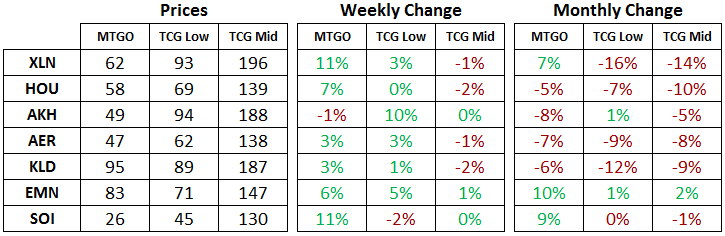
Below are the total set prices for all redeemable sets on MTGO. All prices are current as of January 3, 2018. The TCGplayer low and TCGplayer mid prices are the sum of each set's individual card prices on TCGplayer, either the low price or the mid price respectively.

All MTGO set prices this week are taken from GoatBot's website, and all weekly changes are now calculated relative to GoatBot's "full set" prices from the previous week. All monthly changes are also relative to the previous month's prices, taken from GoatBot's website at that time. Occasionally, full set prices are not available, and so estimated set prices are used instead. Although Hour of Devastation (HOU), Amonkhet (AKH), Aether Revolt (AER), and Kaladesh (KLD) are no longer available for redemption, their prices will continue to be tracked while they are in Standard.


Standard

Rivals of Ixalan (RIX) spoilers are in full swing this week and card images for the full set will be released on Friday. Tribal themes are continuing to be pushed with Merfolk Mistbinder and Legion Lieutenant leading the charge. These new additions to the tribal lord pantheon will be tried extensively in Standard, but the oppressive Energy mechanic is still around and the Modern pro tour event will be the focus for constructed.

Nevertheless, keep an eye out on tribal enablers like Metallic Mimic. This card has been charging higher in recent weeks and does not represent a good opportunity at the moment, but if RIX fizzles in Standard, a round of Standard bans might be just the thing to trigger interest in tribal archetypes again. It's recent low of 2.3 tix is a good buying target, and if prices drift down in early February, it will be worth buying in preparation for potential bans in Standard.

Modern

Modern prices have rebounded in the post holiday period as players look to early February for what the pros will bring to the Modern metagame. RIX spoiler season is also triggering interest in the format as brewers wonder if the flashy new cards are good enough for a larger format. The image below is courtesy of Mythic Spoiler.

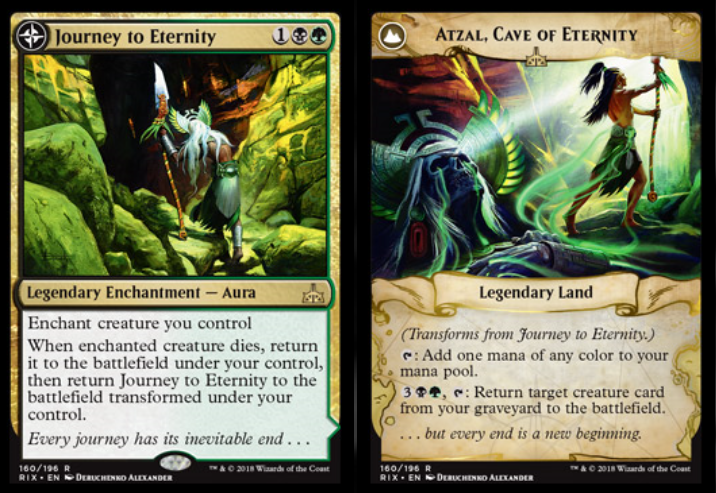
Journey to Eternity can combine with any creature that you can easily get into the graveyard for a quick flip into Atzal, Cave of Eternity. The card to use this with that immediately springs to mind is Sakura-Tribe Elder. On curve, these two cards allow you to ramp to six lands in play on turn four as you can immediately sacrifice the elder for a land, flipping Journey to Eternity and getting another elder for your trouble. With this line of play, you could start the fourth turn with six lands untapped, ready to drop a seventh land in advance of a potentially lethal Scapeshift or throwing down a Primeval Titan.

There was an error retrieving a chart for Sakura-Tribe Elder

The reanimation ability on Atzal is a sweet bonus that will help when you want your deck to grind out a victory. A difficult-to-counter, reusable ability on a land that bolsters your board directly is an interesting angle that ramp decks might be able to use to their advantages.

Journey to Eternity is going to give a shot in the arm to Modern brewers everywhere. Having this stick on a creature will be a little tricky, but being in black means you'll have access to efficient discard to make sure the coast is clear. I'm sure brewers right now are scouring the Modern card pool for other potential use cases – such as Fulminator Mage and Arcbound Ravager.

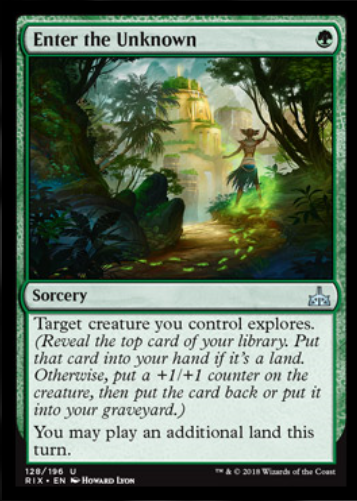
Another green card that caught my attention is Enter the Unknown. As a one-casting-cost spell, it's interesting right out of the gate, since it's the new one- and two-casting-cost spells that can make a big splash in Modern. Check out the card below, image courtesy of Mythic Spoiler again.

Compare this to Explore, a card that currently sees Modern play in Titan Shift and Amulet decks. Enter the Unknown costs only G, a full mana less than Explore's cost of 1G. On mana efficiency alone, that might have been enough for it to replace Explore. Unfortunately, the spell comes with a targeting restriction, meaning you must have a creature in play to cast it. You also give up the cantrip aspect some of the time when the top card of your library is not a land.

There was an error retrieving a chart for Courser of Kruphix

One line of play that the MTGO market seems to have already picked up on is the potential of this card with Courser of Kruphix. Courser has jumped to a six-month high in the last week, now close to 4 tix. Having Courser of Kruphix in play means you'll be hitting the cantrip aspect of Enter the Unknown reliably, with the potential to move two lands off the top of your library directly into play.

Standard Boosters

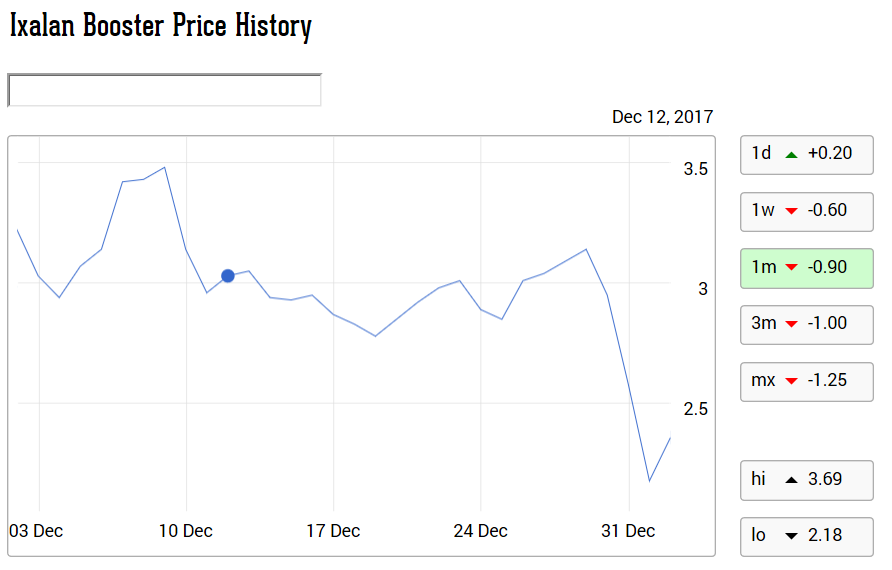
This past weekend was a Magic Online Championship Sealed Deck event that was open to all players. Forty tix or four-hundred play points was the entry fee for a day of Ixalan (XLN) Sealed Deck with a top-eight booster draft to decide the winner. The top prize included a Pro Tour invite, but the overall prize pool handed out to the top 64 players was over two-thousand XLN boosters. This had a dramatic impact on their secondary market price. Check out the impact, courtesy of Goat Bots, in the one-month price chart for XLN boosters.

Prices have started recovering, but this doesn't make it a good idea to be a buyer of these. There will be another open event this weekend, and it's going to be XLN Sealed Deck again. That means another two-thousand boosters are going to be hitting the market, just prior to the release of Rivals of Ixalan (RIX). So not only is there another big influx of supply coming, but the demand for XLN boosters is going to be cut by two-thirds as drafting switches to a RIX-RIX-XLN booster configuration.

I would anticipate that RIX boosters will be somewhat higher than 4 tix when they hit MTGO on January 15. With 10 tix being the equilibrium price for secondary market boosters, that would peg the price of XLN boosters at 2 tix or less. If you are holding any XLN boosters, be sure to dump these before the weekend at any price above 2 tix.

Hour of Devastation (HOU) and Amonkhet (AKH) boosters have been relatively steady at 3.5 tix and 0.9 tix respectively in recent weeks. I anticipate some price weakness heading into the release of RIX, but a renewed push higher at the end of February and into March is likely. Look for these to peak at a total price of around 9 tix in the weeks leading up to the release of Dominaria in April.

Trade of the Week

For a complete look at my recent trades, please check out the portfolio. This week, Saheeli Rai showed up with her old friend Felidar Guardian in a 5-0 Modern list. The market is responding to this, driving the price of Saheeli up to 3 tix. This archetype seems like it will continue to post the odd good result, but it doesn't look like it will ever dominate the format.

There was an error retrieving a chart for Saheeli Rai

With that in mind, I took the opportunity to continue to sell down my stock of Saheeli Rai that I bought when Felidar Guardian was banned in Standard. I think Saheeli will be a great card to pick up when its cheap, with periodic interest in this type of deck spurring the price higher. When this card rotates out of Standard, I'd be an interested buyer in the 0.25 to 0.75 tix range, but for now I am still reducing my position size.

Insider: Picking an Affordable Modern Deck on MTGO

Are you a Quiet Speculation member?

If not, now is a perfect time to join up! Our powerful tools, breaking-news analysis, and exclusive Discord channel will make sure you stay up to date and ahead of the curve.

Hello, guys! Last week, I covered Modern staples and a strategy based on investing in them when they are at relatively low prices based on their price histories.

This week, lets talk about Modern decks as a whole. Have you considered whether you should buy in to one or more decks to play? If you are a competitive player or Magic Online grinder, you probably will just play the best decks in the metagame. However, if you are just a normal player who wants to get the most value out of your money, this article is for you!

Rule #1: Don't Choose One of the Top Four Decks in the Meta

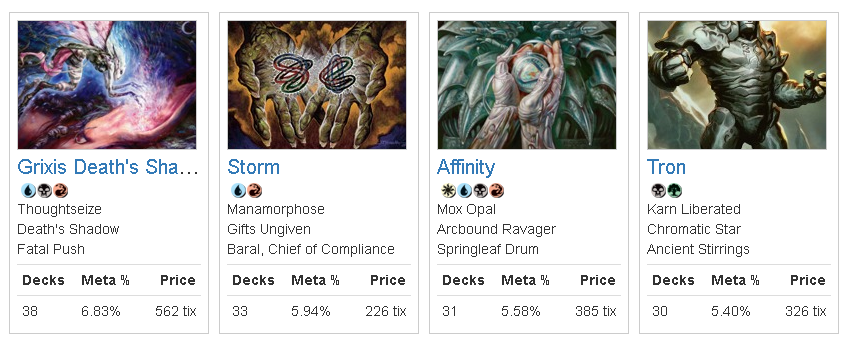
First, to know which decks are the top four, you can go here. It's pretty simple: these decks are the strongest decks currently so their prices are usually at their respective peaks. So even if you are looking at playing Storm, yes, it's true that the deck is cheap, but it will not benefit you in terms of return on investment (except for the value you place on playing the deck and the prizes you win with it, of course).

Take the top four decks this week as an example. Storm and Affinity have been among the format's top four for quite a long time, so these two decks are out as far as buying in affordably goes! As for Grixis Death's Shadow, it just re-entered the top four this week. For Green-Black Tron, I did not see that coming, as Tron has not been good for some time, but we have been seeing variations on the deck more and more in events.

Although I did say not to buy in to decks that are in the top four of the metagame, you can absolutely still look at their lists for underpriced cards. For example:

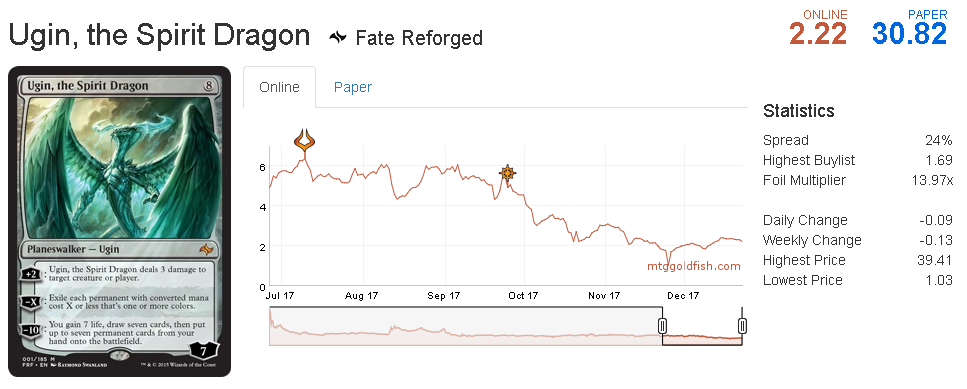
Ugin is a powerful planeswalker that can become expensive when players online start to play a lot of Tron. So I suggest buying playsets of it at its current price.

Rule #2: Don't Pick Expensive Decks

Oftentimes, the most expensive decks are good from a competitive point of view but not from an investment point of view. The reason is very straight forward: expensive cards have a higher possibility to drop price than to increase in price. Let's take a few decks as example:

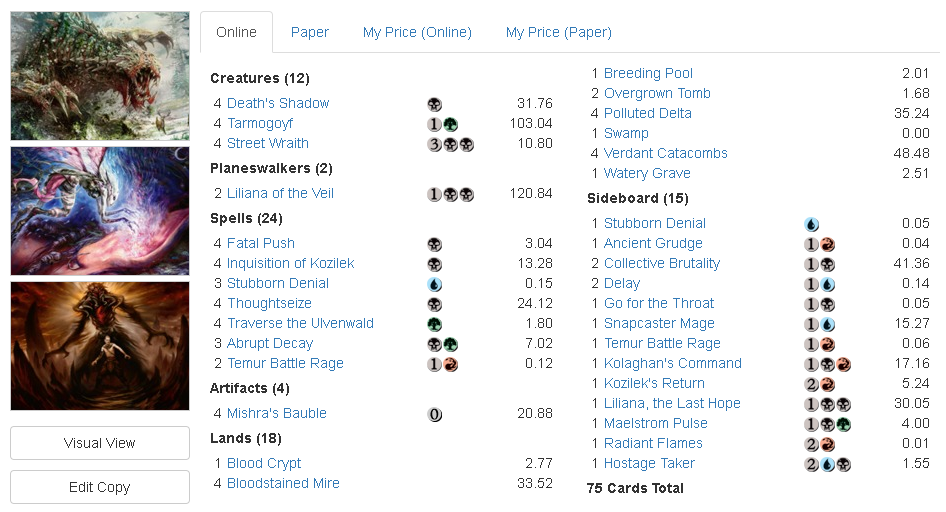
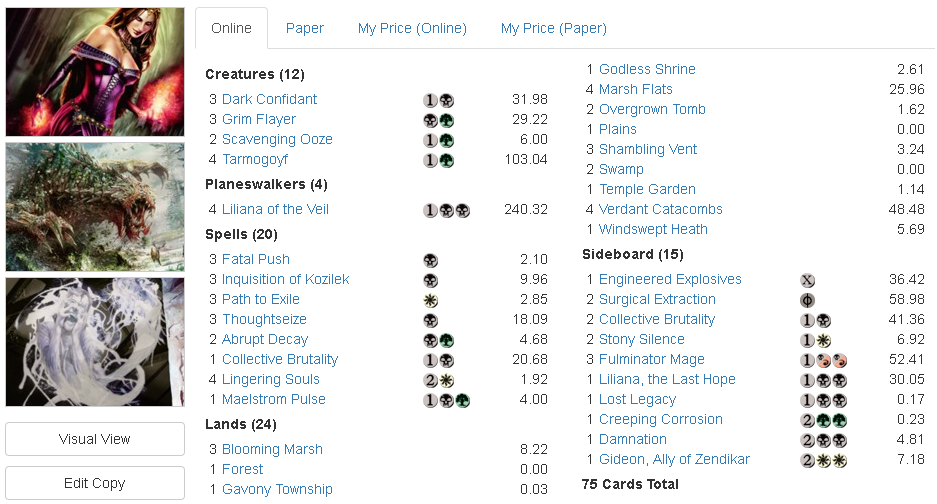
Abzan and Death's Shadow variants are the most expensive decks in the format. They contain the most expensive cards of the format like Tarmogoyf and Liliana of the Veil. Yes, these decks are very stable in competitions, but that's about it – you can only gain profit by winning leagues or events using the deck. The flipside of this rule is also true: while we shouldn't target expensive decks, we should target inexpensive decks. Modern is a format that has many viable strategies, and some decks might lose popularity, but that always might just be temporary.

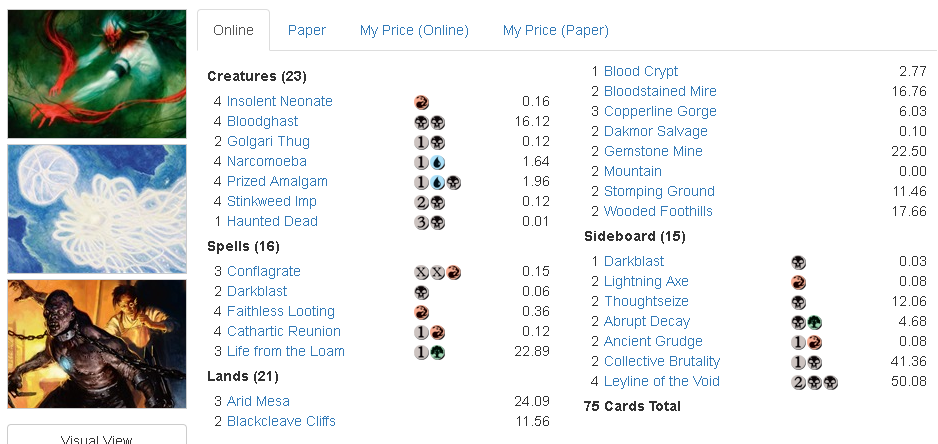
Here's a throwback to the World Magic Cup 2016, when Dredge and Infect were the two best decks that every team would have at least one copy of. And then, this event led to the banning of Gitaxian Probe and Golgari-Grave Troll, which pretty much killed off Infect and greatly weakened Dredge. At one point, a Dredge deck online was only worth about 50 tickets. However, if you catch the correct timing to buy these decks, you would have earned plenty of tickets, as a Dredge deck is worth 200 tickets now.

In summary, Modern decks are like cockroaches: you may be able to kill them, but they will eventually come back. If you haven't yet, make sure you follow every new version of the Infect list online, as I can tell you, Infect players are trying hard to bring back their favorite deck – and they are almost there!

Rule #3: Don't Pick the Week's Hot New Flavor

This is very similar to rule #1, but here I'm talking about rising decks that haven't yet made it to tier one. When a deck gets popular, it will also get more pricey. Also, when a deck appears frequently in games, players online will start to pack more cards to beat it, so picking a deck under this category is bad for two reasons:

  • It's not good from a competitive point of view, because it's not stable enough to be dominant, yet players are targeting it with sideboard hate anyway.
  • Its potential to gain profit is unknown; you are bearing huge risks buying these decks.

Let's look at Green-Red Ponza. This deck might have seemed good when it first won some leagues. But this deck is too dependent on draws, in my opinion, and players can easily learn to play around cards like Blood Moon and any land destruction spells.

Compared to the tier-one decks mentioned in rule #1, decks in this category lack the consistency that a good deck has. So picking decks of this category as investment is a big no-no!

Rule #4: Know When to Sell Out

Alright, now you have picked your Modern deck as a combined tournament deck and investment. What do you do with it besides using it to join events? Obviously, sell the cards when they are at good price.

Let me break down further the different variables that will adjust the situation. Generally, our decision greatly depends on how many tickets can we gain by selling the deck versus tickets we can win through events.

When the deck is popularized and the price eventually goes up, that's the time to decide whether you should let go of your deck or keep grinding with it. Let's say you can grind and get 20 tickets daily or about 150 tickets a week, while the deck only increased by 80 tickets in value – it's probably better to keep the deck and grind the tickets through events. If it's the other way around, where you can earn more tickets by selling the deck, please go ahead and sell into the hype! This will vary based on the deck in question and especially your play skill, so you'll need to make the determination of what is most likely to earn you the most profit.

How about this: if the deck goes down in value from day to day and the deck has no sign of getting more popular? Well, that depends on how good is the deck in the meta. If the deck is weak against most of the decks in the format, you can either sell off the deck to stop the bleed or keep the deck and wait. If the deck continues to be good in the meta, obviously you should keep the deck and grind tickets through events.


Alright, that's all for the week. Thank you all for reading, and I will see you guys again next week!

-Adrian, signing out

Daily Stock Watch: Chameleon Colossus

Are you a Quiet Speculation member?

If not, now is a perfect time to join up! Our powerful tools, breaking-news analysis, and exclusive Discord channel will make sure you stay up to date and ahead of the curve.

Happy new year, everyone, and welcome to 2018's first edition of the Daily Stock Watch! Pro Tour Rivals of Ixalan is just around the corner, so we could expect some movements from Modern staples (and sleepers alike) in the coming weeks. Today, I'll feature one of the cards that could play a vital cog in a deck where it will be one of the best role players off the board. It's also experiencing some monetary gains over the past few days, and we could say that it has something to do with its inclusion in some new brews from Modern deck innovators.

There was an error retrieving a chart for Chameleon Colossus

Chameleon Colossus is one of those cards that could prove to be the game changer in certain Modern matchups after boarding. I think it's a tad bit too slow to be included in the main deck, and Modern hasn't really evolved into a world that's dominated by black decks, so something like this seems farfetched from happening for now. It's worth noting that Death's Shadow variants have made its presence felt in the format at one point, and people have resorted to big mana decks to flip the metagame around to their favor. These big mana decks are almost always green-based, and having a reliable creature that could brick wall a humongous Death's Shadow while evading arguably the format's best removal in Fatal Push is a big plus.

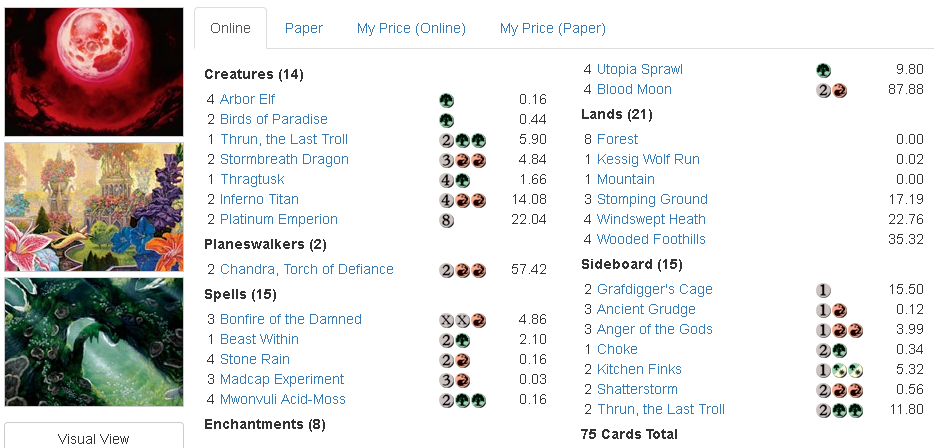
However, we don't have enough data to say that Chameleon Colossus is already a shoo-in for these green decks. What I have here is a funky Land Destruction deck that could certainly use the strength of the Colossus, as it also has the tools to make it a very reliable mana sink that could certainly win games in one unprecedented turn.

RG Land Destruction

Creatures

4 Tireless Tracker
1 Stormbreath Dragon
1 Birds of Paradise
2 Huntmaster of the Fells
2 Inferno Tita
2 Thragtusk
4 Arbor Elf

Other Spells

3 Lightning Bolt
2 Bonfire of the Damned
3 Stone Rain
3 Mwonvuli Acid-Moss
1 Primal Command
4 Utopia Sprawl
4 Blood Moon
2 Chandra, Torch of Defiance

Lands

4 Windswept Heath
10 Forest
4 Wooded Foothills
1 Mountain
3 Stomping Ground

Sideboard

2 Anger of the Gods
2 Natural State
2 Ancient Grudge
1 Abrade
2 Kitchen Finks
2 Chameleon Colossus
2 Relic of Progenitus
2 Grafdigger's Cage

Based on the Utility Checker, 2.4% of winning decks over the past two months have used an average of 1.2 copies of the Colossus on their sideboards, and this is something that should rise if this trend continues. The Commander 2015 printing of this card just reached its all-time high of $3.46 today, which we can again attribute to the presence of the authenticity seal in this version, and the diminishing number of available copies from an already two-year old product in C15. It's no pushover once it hits the field, and it is also starting to get consideration in other Modern decks such as Elves and GW Aggro variants. As a changeling, it is able to fit in nicely to decks that have cards with lord-like effects, which allows it to push harder as a big-bodied threat that has an extra upside if you have the mana to double its attack power.

Sideboard Rivals

There are only so much slots in the sideboard for extra creatures in green decks, and these four crits get the nod more often than Chameleon Colossus based on the Utility Checker. Obstinate Baloth and Thragtusk are most utilized because of their life gain ability, while Tireless Tracker started making its way to decks because of it's size and ability to draw cards. Scavenging Ooze has been a green staple, and this is probably what Colossus would like to establish in the near future. The Modern metagame is ever-evolving, and I like the chances that this card has in being included on the next big deck of the format.

Right now, big online stores such as Star City Games, Card Kingdom, Channel Fireball, and TCGPlayer are either out of stock, or running low on stock of the card. The few remaining copies out there are mostly that of the From the Vault: Twenty edition, and it's a foil so I don't really like the idea of grabbing copies of that card. Try trading in or acquiring this card from other players if it's possible. There's very little room for error on this one, and I have a feeling that this will be one of the most overachieving cards from the upcoming Pro Tour.

And that’s it for the first edition of the Daily Stock Watch for 2018! See you again tomorrow, as we check out a new card that should be on the go, or good enough for speculating. As always, feel free to share your opinion in the comments section below. And if you want to keep up with all the market movement, be sure to check in with the QS Discord Channel for real time market information, and stay ahead of the hottest specs!

Bloodbraid Month, Pt. 1: History of a Ban

Are you a Quiet Speculation member?

If not, now is a perfect time to join up! Our powerful tools, breaking-news analysis, and exclusive Discord channel will make sure you stay up to date and ahead of the curve.

Happy New Year! At least, I'm assuming it's the new year. Hard to say; I'm typing this article from the bottom of what used to be a barrel of eggnog. Anyway, let's not let less-than-optimal writing conditions get in the way---it's Bloodbraid Month! Which is an excuse to hold off revealing the data from the banlist test at the end of the month. Before we get there, there's a lot of history and legwork to discuss. So find your seats and get comfortable: class is now in session.
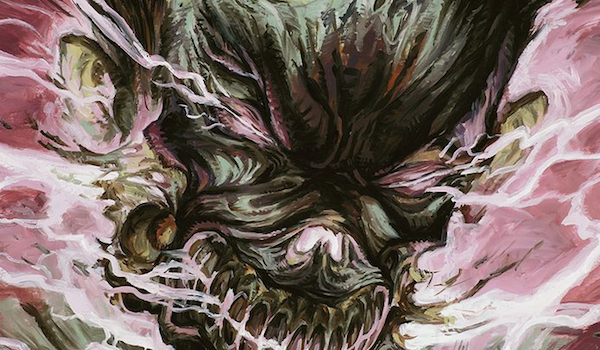
I have an unusual opportunity with this banlist test. Unlike the other cards, Bloodbraid Elf had a good run in Modern. Preordain doesn't count, as it only survived Modern's inauguration. Bloodbraid had roughly a year and a half, from the creation of Modern until February 2013. That's not long in the grand scheme of things, but it's still a lot of time to generate data. Of course, there are complications with this time period. It was Modern's infancy, and with that came a lot of teething bans and adjustments. What I intend to do is focus my inquiry to the relatively stable period before Deathrite Shaman was released. This focus will isolate Bloodbraid Elf's impact on Jund and allow me to investigate how good that Jund deck actually was.

Background

Modern was proposed at the end of May 2011 and formally established by mid-August, partially to create a non-rotating format that Wizards could unabashedly support, unlike Legacy. The other reason was that Extended had become dramatically unpopular thanks to rotation changes, Cawblade dominance, and a general lack of support from the top.

When Modern stepped in to fill void, nobody really knew what to expect. The 2011 Community Cup was the only guidance anyone had going into PT Philadelphia, which wasn't particularly helpful as Hypergenesis was the deck from that event. PT Philadelphia was one of the most broken Pro Tours in history, with blistering combo strategies dominating the tournament. This was followed by Worlds, a tournament dominated by Zoo and Punishing Fire. This imbalance resulted in the densest cluster of bans in Magic history.
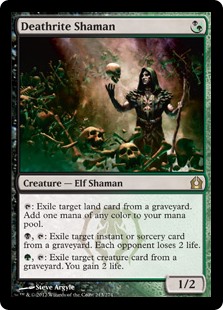
2012 was far more stable, yielding only the unban of Valakut, the Molten Pinnacle in September. Of course, on October 5th, Return to Ravnica released, and with it came arguably the best creature in the game: Deathrite Shaman. The following period led to an incredible surge of Jund wins, prompting Wizards to ban Bloodbraid Elf at the end of January.

Many subsequently pointed to Deathrite as being the real problem with Jund, claiming Bloodbraid was unfairly blamed. Furthermore, it has been argued that Jund was declining in popularity prior to Return to Ravnica's release, and Deathrite boosted the deck's popularity so much it appeared like a problem. These are the claims that I will investigate today. To do so, I will focus on the event data from January to October 2012.

Ancient History

Bloodbraid Elf-powered Jund was the deck of its era. In fact, the only reason it didn't win Worlds that year is because of a quirk of the multi-format event that favored the otherwise unremarkable Naya Lightsaber deck. Naya deck was widely considered a worse Jund list at the time, as the subsequent year of Jund domination supported. The deck technically won its Block Pro Tour, too. And even when it didn't win an event outright, it consistently still put up excellent numbers. A port of the Standard deck used to win in Extended during the Thopter Foundry/Dark Depths era; Bloodbraid-powered Jund was a multi-format all-star even pre-Modern.
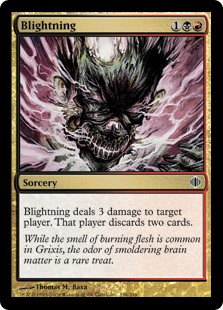
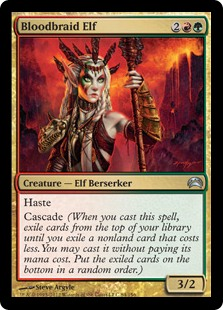
The power of Bloodbraid was always cascade. Getting to play and additional spell off the top of your deck is very good. The key was maximizing the good hits and minimizing misses, and Jund had the highest concentration of good cards at the time. Blightning was usually the best, and the reason that control struggled so hard in that era, but even Putrid Leech made for a solid rip. Elf provided a reliable two-for-one or better plus a tempo boost, outpacing every other deck.

Into Modern

It wasn't clear whether Jund's pre-Modern success would continue in this new format. Combo and Cloudpost were so prevalent early on that Jund struggled. If you think Tron is bad for midrange now, imagine Jund's 12-Post matchup. That said, a few Junds did sneak in. And once the bannings took effect, Jund began to rise, eventually peaking in popularity and power at the end of 2012.

Overall Data

Modern Nexus didn't exist back then, but MTGTop8 did, and they retain their aggregate data from that era. Their metagame data for the entire year (the only way to find it without going through the entire list yourself) shows Jund sitting firmly at the top of Tier 1 at 15%, followed distantly by Affinity (11%), Birthing Pod (9%), Tron (7%), and Twin (6%). Of course, this data does include results with Deathrite legal, but only for two and a half months of the year displayed. Deathrite Shaman doesn't appear until the middle result on page 6 of 14, and there are a page and a half of results just from PT Return to Ravnica. That means that out of 13.5 pages of non-Pro Tour results, 7.5 house only Bloodbraid Jund. Even if you don't remove the PT, those results are more than Tron's total for the entire year. Simply put, Jund was Tier 1 independent of Deathrite Shaman.
The PT results for Affinity begin on page 3 of 10, leaving roughly 7.5 pages of results before the PT, as with Jund. It is reasonable to argue that Jund and Affinity kept pace with each other for the top spot in Modern at that point. Birthing Pod has 6.5 pages of pre-PT results, so it was behind, but close; a solid third. All the other decks were well behind this pace on October 21, 2012, so they were never going to compete for the top slot. Deathrite indeed provided a massive power boost to Jund, but the deck didn't really need it to keep the crown.

Thought Experiment

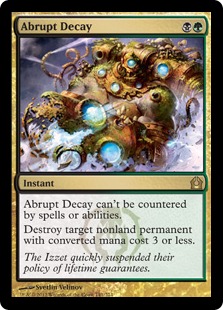
Consider this hypothetical: if Deathrite Shaman had not existed, what might Modern have looked like at the end of 2012? I'd argue that it would have looked nearly the same as it actually did. Jund would have held a metagame share similar to Affinity's, above other challengers. Remember: Jund's most significant non-Deathrite card from Return was Abrupt Decay. Decay was a fine removal spell, but it was always limited and only truly great against Splinter Twin decks. The flexibility was nice against Affinity and Pyromancer Ascension decks, but it doesn't substantially impact those matchups for Jund even today.
The data show that Jund took off after Return, but there is no reason to think that it would not have kept pace with the other established decks without Deathrite. No other deck received a noticeable boost from Return. Jace, Architect of Thought would be great in Twin eventually, but it took a while to be adopted.

By Events

This is a solid result, but it does rely on my interpretation of the MTGTop8 data. Therefore, I will build a separate data set based on the paper results. As far as I can tell, Star City did not support Modern in 2012; just Standard and Legacy. Therefore I will use the results from WoTC's official coverage for pre-Return to Ravnica Modern. This is composed of four Grand Prix, the Magic Cup, and the Player's Championship. I'm separating out the Player's Championship from the rest of the results because they are very weird and would skew the data. Aggregating the Top 8 decklists (which are the only ones available for the most part) yields this result:

DeckTotal
Jund7
RUG Delver6
Birthing Pod6
Affinity5
Jeskai Geist4
Mono-U Faeries2
Storm2
UR Twin2
UW Geist1
Doran, the Siege Tower1
Gr Tron1
WB Tokens1
Soul Sisters1
Esper Gifts1

Jund had the most paper Top 8's prior to October 2012. Not by much, perhaps, but the deck was still solidly Tier 1. At least one Jund deck was in every Top 8, with the earlier tournaments having multiple.  Jund had a solid steady presence before Return, contrary to claims of Jund's decline.

The Player's Championship, being an invitational tournament, had a very weird metagame. Therefore I'm going to treat it separately. The table should make why clear.

DeckTotal #
Zoo6
Jund3
UW Geist2
RUG Delver2
RUG Control1
4 Color Delver1
Affinity1

As you can see, Zoo was inordinately popular here. It shows up nowhere else, and including these results with the rest would have distorted the metagame. It makes Zoo look like a good deck, and it wasn't. That said, Jund was the second most popular deck and arguably the best. Yuuya Wantanabe won with Jund, only losing one match the whole weekend. Bloodbraid Elf was also the coverage team's #1 card of the tournament, for whatever that's worth. In both the Deck Tech videos and conversation surrounding the event, players were singing Elf's praises, pointing to it as the glue and soul of the deck. Its intrinsic two-for-one and tempo boost was as good in Modern as it had been in Standard.

Consequences

It is worth noting that the Player's Champtionship was the last paper Modern event before Return arrived. Jund had not merely won; Yuuya dominated with the deck. In fact, we see a large spike in Jund results following that tournament. Before August, MTGO Daily results for Jund are rare. There are eight Daily/Premier results prior to August, eight in August, and 36 in September. In other words, in August there were as many Jund decks reported from MTGO Daily's as in the rest of the year combined, and 4.5 times that amount in September. That is a significant and rapid increase going into the Pro Tour.
The claim that Jund was declining in popularity before Return is therefore suspect at best, and more likely outright false. The data show clearly that Jund was in fact becoming more successful online and was preforming highly in paper prior to October 2012. Why this surge happened when it did is hard to say. Maybe it was just Pro Tour testing. Perhaps players were just waiting for a break-out performance to pick up the deck. Maybe it was a lack of confidence in Modern as a whole that resolved itself over the course of 2012. Regardless, the bottom line is that Jund was more popular and successful in September than at any point in the earlier data.

Conclusion

It is impossible to say with certainty that Bloodbraid Elf would still have been banned without Deathrite Shaman's printing. However, the data show that Jund was a very strong and successful deck without Shaman. Its popularity and success was increasing prior to the explosion in October, and the trend of Jund winning paper events began in August---a trend which was specifically cited in the banning announcement.

Therefore, in my analysis, the claim that Bloodbraid Elf was only banned because of Deathrite Shaman should be considered suspect. There is evidence and data to show that it was powerful enough to propel the deck to Tier 1 without the one-mana planeswalker's help.

I believe that Jund would have been the top deck in Modern even without Deathrite Shaman. Whether it could maintain its position is hard to say. Dragon's Maze would bring Voice of Resurgence, among other cards, which would prove critical to the Birthing Pod value plan that eventually led to that deck's banning. Maybe Jund would have naturally fallen off; maybe it would have maintained or expanded its position. Who knows? What's unequivocal is that Jund was already a top deck when it was boosted by Deathrite Shaman. Therefore, given Wizards's old bad habit of banning the best decks prior to the Pro Tour, I think that Bloodbraid would have been banned eventually anyway. At most, Deathrite accelerated the timeframe.

Next week, I'll describe the struggle to actually test the elf. Until then, does anyone have suggestions for getting unwedged from the bottom of an eggnog barrel?


Insider: One Stamp’s Worth – Optimal Envelope Size in Shipping

Are you a Quiet Speculation member?

If not, now is a perfect time to join up! Our powerful tools, breaking-news analysis, and exclusive Discord channel will make sure you stay up to date and ahead of the curve.

Welcome back readers!

Today's article was inspired by a Facebook trade I did. The cards included in the trade aren't that relevant (as they were for personal use, not speculative gains). What was interesting was that the shipper managed to get more cards in an envelope with a single stamp than I'd seen before. This got me thinking about how many times I have shipped low-end sales in a bubble mailer simply because I thought that I wouldn't be able to get everything into a single envelope.

The cost difference between these two methods is almost $2.50. For sales under $25 that's a cost reduction of 10% or more, which is pretty substantial. If we can use regular envelopes in more cases, it might open up a lot of trades and/or smaller sales that we'd otherwise have to pass on.

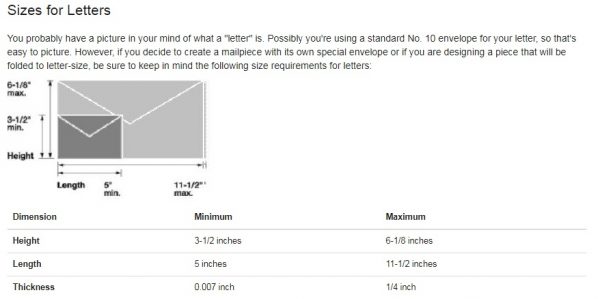
Today I'd like to break down the United States Postal Service's requirements to see if we can optimize shipping options for those here in the US. This will obviously be of more relevance to readers living in the States. However, my intent with this article is to show my methodology so that readers in other countries with other requirements can use it to determine their own optimal strategy.

USPS Standard Envelope Requirements

At first glance this looks pretty simple. A nice and short article… Except, as you'd expect from a government entity, there are a whole bunch of additional rules and regulations.

Machinable Requirements

The USPS uses a lot of automation to help sort the millions of mail items they deliver every day (fun fact, I spent some time working on their Flat Parcel Sorting System in my first job out of college; so I can greatly appreciate these automated systems). As is the case with all automated systems, they require more uniform input than a person doing the same thing. Thus there are additional requirements for one's letter-sized mail to run through these systems.

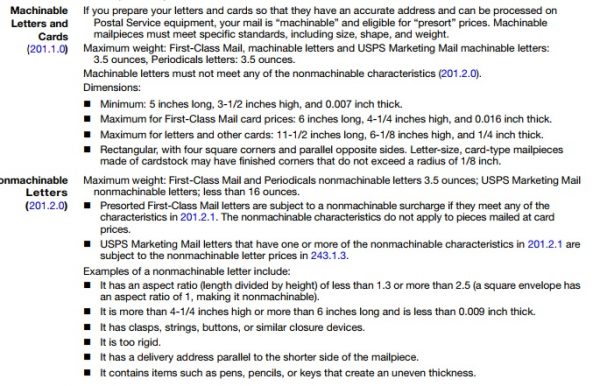
If a letter (or any other package) isn't machinable, it costs extra to ship. We want to make sure all our shipped envelopes satisfy the machinable requirements, which I've copied below.

I realize that looks a bit dry and confusing so I'll break out the key points we want to note. Machinable packages must:

  • Be at least 5 inches long and 3-1/2 inches high.
  • Be at least 0.007 inches, and no more than 0.25 inches thick.
  • Not be of uneven thickness. I'm a bit surprised this isn't defined more in depth with something like a maximum gradient across the envelope. We'll just need to keep it in mind as we may have to add additional packaging to the envelope depending on its size and how many cards we try to fit in it.
  • Not exceed a weight of 3.5 oz.

Now that we have our package requirements, let's look at what sizes of commercially available envelopes exist (we don't want to get custom envelopes when commercially available ones cost pennies). We will ignore all that don't meet the requirements listed above.

It was also extremely difficult to find the weight of each envelope type but what I was able to find is that typically most envelopes weigh around 6.75 grams (or 0.24 oz), obviously though the larger envelopes will weigh a bit more and the smaller ones a bit less.

The major dimensions of a typical Magic card are 63mm (2.48in) x 88mm (3.47in), so ideally we want to make sure our envelope size can accommodate that size of object as many times as possible. So here's a table of the most commonly available envelopes. Included are the typical cost per envelope and the maximum number of cards that can fit on one layer.

Envelope Name Height (in) Length (in) Typical Cost Per Max Cards per Layer
#6 ÂĽ 3.5 6 $0.07 2
#6 Âľ 3.625 6.5 $0.06 2
#8 5/8 3.625 8.625 $0.08 3
4 Bar 3.625 5.125 $0.12 2
#7 3.75 6.75 $0.06 2
#9 3.875 8.875 $0.11 3
# 7 3/4-Monarch 3.875 7.5 $0.08 3
#10 4.125 9.5 $0.09 3
A2 4.375 5.75 $0.09 2
5 ½ Bar 4.375 5.75 $0.16 2
#11 4.5 10.375 $0.12 3
#12 4.75 11 $0.10 3
A6 4.75 6.5 $0.16 2
6 Bar 4.75 6.5 $0.09 2
#14 5 11.5 $0.28 6
A7 5.25 7.25 $0.12 2
Lee Bar 5.25 7.25 $0.26 2
A10 6 9.5 $0.18 4

However, that's just the envelope. We also need to consider the thickness of our packaging materials and potentially the card (if it's not embedded in the packaging materials). I checked my typical single-card top-loaders, and they are 0.06 in. on the edges (which tend to be the thickest part). Each top-loader weights around 0.25 oz (found using my kitchen scale) which will be relevant when we look at weight.

We also need to be concerned about overall thickness as well. The thickness of the envelopes on this list should be pretty uniform (though paper stock may have some slight bearing on it) and most envelopes will be around 0.008 inches thick.

The other packaging material we might want to look at is your typical cereal box cardboard which can be used to create a makeshift top-loader with varying thickness (based on how many cards are inside). If you mail cards and the only protection is from cereal box cardboard they may get bent up or damaged in transit, so I don't personally recommend them. But if you do use them, I discuss the calculations for that method below.

This cardboard is typically 0.01 inches thick. The weight of a rectangle slightly larger than a card is around 0.1 - 0.15 oz. Corrugated cardboard, which provides more support, is much thicker and can range a great deal.

A Magic card itself tends to weigh around 0.06 ounces (1.8 grams).

Optimization

So we have our list of max requirements courtesy of the USPS and we also have the necessary information regarding our packaging materials and the Magic cards themselves. Let's put all that together to see what the optimal packaging options are.

For Top-Loader Protected Packages

Let's define our variables to make sure everything is easy to read.

  • M = Maximum number of top-loaders that will fit in a package
  • L = Maximum number of top-loaders that will fit on one "layer" of an envelope
  • T = Maximum thickness of the package (0.25 in)
  • E = Envelope thickness (0.008 in)
  • A = Top-loader thickness (0.06 in)
  • W = Maximum package weight (3.5 oz)
  • V = Envelope weight (0.125 oz)
  • P = Top-loader weight (0.25 oz)
  • C = Card weight (0.06 oz)
  • X = Number of cards per top-loader

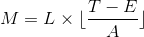
The first step was determining how many top-loaders I could fit into the envelope without exceeding the thickness for each option. I did this with the following equation.

The l-shaped brackets are the mathematical symbol for rounding down to the nearest integer. You'll notice these appearing in lots of the equations below. This is important because we can't have fractions of cards/top-loaders/envelopes, and we want to play it on the safe side.

This gives you the theoretical maximum number of top-loaders you could fit into the various envelopes. If you then multiply by the number of Magic cards you can fit per top-loader (either 2 or 3), you can calculate the maximum number of Magic cards that could safely fit into an envelope.

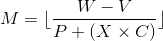
Volume isn't our only requirement; we also have to be concerned about weight. To calculate the maximum allowable weight we use the following equation.

Again we round down because we can't go over. This allows an absolute maximum of eight top-loaders in an envelope.

We can now compare our two limitations and see that they both set a maximum of eight top-loaders per envelope (assuming 2 cards per top loader). That means we can ship up to 16 cards per envelope per the USPS volumetric and weight guidelines.

Unfortunately, there are additional guidelines we want to consider, specifically with regards to "uneven thickness." This means that our top-loader layers need to have an even number of top-loaders per layer. Any envelope with 3 top-loaders per layer would result in two layers with 3 top-loaders and one with 2 (to avoid going over the weight maximum of 8) which would then have an uneven thickness.

Ultimately, this means that our envelop options here in the US are likely the following:

  • #6 ÂĽ
  • #6 Âľ
  • 4 Bar
  • #7
  • A2
  • 5 ½ Bar
  • A6
  • 6 Bar
  • A7
  • Lee Bar
  • A10

The A10 envelope can actually allow a full four top-loaders per layer, which would keep your envelope thickness down. However, the biggest problem with this is that they cost about 2.5-3 times as much as other envelopes and may have issues with smaller numbers of cards.

It might count as uneven if you only send one top-loader with 1-2 cards in it, so that is something to consider. The best solution is probably to give yourself options on envelopes, and keep some of the smaller ones as well as some A10s for orders with larger numbers of cheap cards.

For Cardboard Protected Packages

For this set of equations we will use some of the previously defined variables as well as the following new variables:

  • B = Cardboard thickness (0.01 in)
  • R = Card thickness (0.012 in)
  • A = Weight of cardboard (0.125 oz)
  • D = Maximum number of cards per envelope thickness
  • E = Maximum number of cards per envelope weight

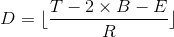
While I want to reassert that I don't really recommend this option (it doesn't protect the cards nearly as well as a top-loader) if you're doing a $5-$10 trade that consists of a lot of cheap cards you may be willing to risk it. As I said earlier, the biggest benefit to this route is that many cardboard options are cheaper than top-loaders. You can make your own by sandwiching two pieces of cardboard around the cards your sending. The cardboard is thinner than top-loaders and could allow you to fit a few extra cards into the envelope.

For this optimization we still want to use the same results for L (max number of top-loaders in one layer). We won't actually be using top-loaders, however, the 2D dimensions for our cardboard end pieces should be similar in size so the number per layer should remain the same.

So for this we calculate the maximum thickness allowable for one of these sandwiches with the following equation. If you want to use thicker cardboard (and thus reduce your risk of damaging the product in the mail) you can include that and recalculate all these numbers.

We can then take that number and multiply it by L to determine the maximum number of Magic cards one could fit into the envelope.

But just like with the top-loaders, this is only one of the necessary equations because it too assumes that there is no "max weight" requirement. If we now want to look at the maximum allowable weight, we calculate using this equation (which again is influenced by the cardboard chosen).

Filling in these variables I see that the maximum number of cards per envelope with only a maximum weight requirement is 46.

So when we compare our two equations we see that the package thickness is actually where we are restricted first (as we are limited to 18 cards via the thickness requirement), which means that the actual maximum number of cards we can fit into an envelope with cereal box protection is 36 cards. Doing so puts our envelope weight at 2.9 oz. which gives us a bit of a safety net with regards to the max weight requirement.

Conclusion

The point behind this article was to review the standard USPS package requirements that allow for a single stamp in order to reduce shipping costs and possibly open up new avenues of lower-cost trades or sales because of this reduced cost. That being said, I would still be weary of trying to ship a large a number of cards in a standard envelope because I know how finicky automated sorting machines can be.

I also realize there are a significant number of other options when it comes to the variables I've chosen. For example, they make four-card top-loaders that can actually hold 5-7 cards, but are thicker than the ones I used in my calculations above.

When I started this article I didn't realize just how many factors there were to consider, nor did I expect that one might be able to ship so many cards via a plain white envelope. I would love to know the highest number of cards any of you have shipped with a plain white envelope and single stamp, as empirical data would be more accurate than these theoretical calculations.

Insider: Financial Predictions for 2018

Are you a Quiet Speculation member?

If not, now is a perfect time to join up! Our powerful tools, breaking-news analysis, and exclusive Discord channel will make sure you stay up to date and ahead of the curve.

Happy New Year! It feels like 2017 started just a few short months ago, yet here we are starting down the path of 2018, a fresh new year. It would seem 2017 was a bit of a split year when it comes to MTG finance. On the one hand, Standard really floundered thanks to the oppression of Energy. Modern apparently stagnated while supply on many Modern staples jumped higher thanks to reprint sets. Legacy and Vintage continue to chug along but those formats haven’t grown in ages.

Then we have the other hand. The land of the casual player. Commander, Cube, Old School, Collectors, and kitchen table Magic all exploded in popularity. This brought us some wild price movement, making for quite the lucrative year if you had the right exposure.

There was an error retrieving a chart for Chromatic Lantern
There was an error retrieving a chart for Mijae Djinn

So where do we go from here? Will we see more of the same trends in 2018, or will the money move elsewhere? Could Standard and Modern make a comeback? In honor of the New Year holiday, I’m going to make a few 2018 predictions for MTG finance.

Resurrecting Standard?

Not long ago Mark Rosewater ran a Twitter poll gauging the interest in the upcoming return to Dominaria in Standard. It would appear the vast majority of Maro’s followers are indeed excited for Standard’s return to Dominaria—even players who are newer, and haven’t enjoyed the world of Dominaria the first time around, are showing some excitement.

This is encouraging news. We will also be welcoming the departure of the energy mechanic from Standard once Kaladesh rotates out of the format. This will eventually lead to a format filled with Dinosaurs, Pirates, and Dominaria! This should attract casual players and nostalgic players while hopefully refreshing the Standard metagame. As a player who focuses solely on older cards, I can confidently say this set has the potential to rekindle my interests in Standard.

I’d never play the format, mind you, but I could be convinced to watch some SCG Opens and GPs on Twitch if people will be battling with the Weatherlight crew. Fingers crossed.

With an improved Standard metagame and a successfully executed set, this could be the jumpstart Standard needs to make it financially relevant again. Wizards has been printing Standard sets into the ground lately, so a very strong demand profile is needed in order to make Standard cards financially interesting. I won't be so bold as to guarantee this will happen. But if Wizards can hit a homerun with our return to Dominaria, we may see Standard increase in relevance in 2018. Let’s face it, it can’t get any less relevant.

Legacy Pro Tour

Pro Tour 25th Anniversary is going to bring us a rare chance to see Legacy played on the professional stage. I haven’t played Legacy for a couple years now, but I still look forward to seeing players cast Brainstorm and fetch dual lands to try and thwart their opponents. It’ll feel like the good old days when Star City Games broadcasted Legacy at their Opens.

This could bode very well for Legacy. We’ve already seen a resurgence in dual land prices after some large online vendors upped their buy prices on the group of cards.

There was an error retrieving a chart for Underground Sea

If Legacy sees the jump in popularity that I anticipate from the Pro Tour—and that jump doesn’t have to be huge—then we will surely see higher dual land prices in 2018. Other Legacy staples on the Reserved List will also see a jump in price. Think $150 Lion's Eye Diamonds are expensive? Just wait until they’re $200. Or $250. The same can be said for any four-of staple on the Reserved List: City of Traitors also comes to mind.

There was an error retrieving a chart for City of Traitors

Can non-Reserved List cards also see a jump in price? Absolutely, but it’s too soon to target these with confidence just yet. We’re about to have another reprint set in Masters 25, and I am confident we’ll see a few big-ticket Legacy reprints in the set. Rishadan Port seems the most obvious, but it wouldn’t surprise me to see another Force of Will and Jace, the Mind Sculptor reprint in this set as well. Such reprints will certainly drop prices on these Legacy cards despite a modest increase in demand from the Pro Tour.

Net, as always, I’d recommend sticking to Reserved List cards when you can. Plenty of opportunity will be out there for non-RL cards too, though; we just need to watch these more closely to avoid getting burned by reprints.

Further Disappearance of Alpha Cards

Pop quiz: How many Alpha cards are completely sold out on TCGplayer as of right now? Answer: 36. That’s 12% of the entire set, sold out! It appears collectors are mobilizing to finish their sets while interest in an all-Alpha format is on the rise. Given how sparse these cards are, there really are only so many players who can enjoy such a format before there are simply no cards left with which to build decks. It’s not even a matter of being priced out. There just won’t be copies for sale on the market that someone wants for their deck.

So now let’s look ahead to 2018. Given the current trend, how many Alpha cards do you think will be sold out on TCGplayer twelve months from now? If I had to guess, I’d predict we’ll see twice as many Alpha cards sold out in 2018 than there are today. Roughly 75 on the low side and 100 on the high side.

Think that’s crazy? Perhaps, but I’ve been selling a few unneeded Alpha cards on eBay this past month and they have been selling. Psychic Venom, Evil Presence, and Bog Wraith are examples of seemingly uninteresting cards that have all been moving for me at good prices on eBay.

There was an error retrieving a chart for Evil Presence

I said it once and I’ll say it again. There will come a time when you will be in the market for an Alpha card for a collection or deck and there just won’t be any reasonably priced copies on the open market. Sure, there will be that random $500 PSA 9 copy of Alpha Evil Presence on eBay. But a copy you could realistically purchase for a deck? They just won’t be available for sale.

That day could come in 2018 if trends continue the way they have been. I’d watch stock very closely, especially at any “secret” sites you shop at. I’d also recommend adjusting your settings on MTG Stocks so that the Interests page shows you Alpha and Beta movement. The volatility can be a nuisance, but it will help keep you on top of trends and give you a leg up in buying cards that are suddenly drying up.

Old School and Pauper: Easy Money in 2018

Old School has been a very lucrative investment for any who got involved before 2017. Hype around Reserved List buyouts has fueled the fire even further, leading to an explosion in prices throughout the year. Now we have useless cards like Spiritual Sanctuary buylisting for over $10 due to this hype.

There was an error retrieving a chart for Spiritual Sanctuary

Is this sustainable? Can this trend continue in 2018? I would wager it will. So as always, any Reserved List or Old School card you want for your collection or deck should be prioritized. Hard stop.

Not only that, I also predict that some low-end budget printings of Old School-playable cards will start to move in 2018. Specifically, I’m referring to Collectors’ Edition cards (which have already moved recently) and foreign black-border printings. In the Old School Discord, many players are reaching for these alternatives to build an affordable deck with which to enjoy the format. It’s only logical that the next lower tier of cards gets a bump, as long as the format remains this popular. And of this, I have no doubt.

I also want to acknowledge Channel Fireball’s recent push for paper Pauper tournaments. If side events at Grands Prix fire with dozens or even a hundred Pauper players, it could start to apply upward pricing pressure on key Pauper staples.

My favorite target is Oubliette, which has already seen a bump in buy price over the past couple weeks since the Channel Fireball Pauper news.

There was an error retrieving a chart for Oubliette

As for other targets, I am afraid I may come up dry here. Not because there are no targets, but because I don’t know the format all that well. Fortunately, we have the internet! MTG Goldfish summarizes the Pauper metagame quite nicely, and we can use these lists to identify older commons that are in short supply. These may not be huge moneymakers, but they are definitely bulk picks and may be worth grabbing on the cheap from your LGS to sit on for a few months as the Pauper hype unfolds.

Wrapping It Up

In hindsight, 2017 was a bit dicey when it came to MTG finance. Investing in the wrong space could have led to some disappointing returns. Meanwhile, focus on Reserved List Old School cards and Legacy staples was a huge financial boon for the year.

I expect the positive trends of 2017 will continue into 2018. That is to say, Reserved List cards will climb higher as Old School grows as a format. Alpha cards seem especially attractive given their extremely low print run and disappearing supply. But there may be some positive turnarounds for a few financial dead zones in 2018 as well.

Standard may get a boost when we return to Dominaria. Modern may even see some appreciation again thanks to the Pro Tour that will showcase the format. Perhaps if nothing else, Wizards will ban or unban cards to refresh Modern, and this will certainly have financial implications.

Even Legacy will get fifteen minutes of fame when it shows up on camera at the Pro Tour this summer. Expect popular Legacy staples to get hot, but watch out for reprint pitfalls. If you want to buy into the trend now, I’d look no further than dual lands. These will always have a strong demand profile and maintain liquidity. If you want to buy into some other Legacy staples that aren’t on the Reserved List, just make sure you tread lightly and diversify to avoid getting destroyed by a reprint.

All in all I expect a lucrative year for Magic in 2018. It keeps me very excited about the game and its financial component. Let’s hope these predictions come true so that we can continue to enjoy this hobby while saving or making a little bit of cash along the way!

…

Sigbits

  • Juzám Djinn. What more can be said about this card? Tarkan predicted this would be a $1000 card someday, but I certainly did not expect it to hit this mark in 2017. Yet here we are. ABU Games’s buy price on NM copies is $800. Star City Games’ sell price is $999.99 but they of course have none in stock. SCG will have to up their price soon enough, as will Card Kingdom and other major vendors. $1500 retail seems to be the right price for NM copies as we head into the new year.
  • Star City Games is completely sold out of Oubliette at $29.99. Whether this was the case simply because collectors and Old School players are scooping these up, or if the recent Pauper news is driving demand, is unclear. But one thing is certain: these will climb higher in 2018 unless they see a reprint—a possibility but very unlikely since Oblivion Ring seems to be the way WotC decided to go with this kind of effect.
  • Star City Games will also need to up their prices on CE and IE Power. For example, they’re completely sold out of all five Moxes from these collector sets. But their prices ($200-$250) are not far from Card Kingdom’s buy prices for the same cards. These need to increase by around $100 to be more consistent with market pricing, and that will likely happen in 2018.

Daily Stock Watch: Year End Report

Are you a Quiet Speculation member?

If not, now is a perfect time to join up! Our powerful tools, breaking-news analysis, and exclusive Discord channel will make sure you stay up to date and ahead of the curve.

Hello, readers and welcome to the last Daily Stock Watch of 2017! After numerous Pro Tours, Grand Prix, new sets, countless price drops, and price spikes, we'll be looking forward to a new year filled with surprises from our favorite card game. I'd like to stray away from featuring a single card today, and would do a recap of the cards that I speculated on (but wasn't able to come up with solid results during my first month end report) since I started writing for Quiet Speculation.

The Holdovers

There was an error retrieving a chart for Tarmogoyf

Tarmogoyf - Goyf has been bottoming out for the latter part of the year, and I wasn't really sure if we should start selling or buying it again. The Future Sight version has dipped from $69 since I wrote about it, and is now sitting at a new all-time low of $66. The copies from the Modern Masters sets have gone down in the same manner as the ones from FS, so just use it as your basis as to when you should start buying in. $60 should be the lowest that it could go, and I'm a buyer at that price.

There was an error retrieving a chart for Jace, Vryn's Prodigy

Jace, Vryn's Prodigy - JVP was printed in From the Vault: Transform along with 14 other flip cards from different expansions, and I pegged the normal version of the card from Magic Origins to be a good buy if it reaches the $12-$15 range. Its average price is still at $21.78, but the low is currently at $14.24. The decline hasn't been drastic, but it has been steady and looking good for spec purposes. I still like the idea of buying in once we hit our target price.

There was an error retrieving a chart for Bloodbraid Elf

Bloodbraid Elf - BBE has been the favorite spec target of a lot of finance junkies for some time since it was banned in Modern. The low price for this card at the time of my writing was $0.52, and it has doubled since, as it now sits at $1.23. If you're one of the people who joined this craze, we'll see how your spec turns out in about two weeks time.

There was an error retrieving a chart for Aether Hub

Aether Hub - I'm not really sure about the direction where Standard is headed as long as this card is around (or for as long as energy variants are the best decks in the format), so I initially thought that this should get banned to balance thing out. Card Kingdom was still willing to pay $1.15 for normal copies and $1.30 for FNM ones when I wrote about it, and it has now dropped to $0.45 and $0.40, respectively. It's looking more and more likely that something crazy will happen to it soon.

Meanwhile....

I'd be creating a follow up on other specs we had, based on what I promised, which is a quarterly review. I'd just like to make a special mention of As Foretold which I wrote about here, as it has now rebounded nicely after seeing some exposure in a unique Living End deck online. The price has more than doubled in a matter of days, and this just goes to show how quickly things could turn around in Magic when something cool or innovative happens. Always keep your eyes and ears open.

And that’s it for the last edition of the Daily Stock Watch for 2017! See you again next year, as we check out new cards that should be on the go, or good enough for speculating. As always, feel free to share your opinion in the comments section below. And if you want to keep up with all the market movement, be sure to check in with the QS Discord Channel for real time market information, and stay ahead of the hottest specs!

Modern Top 5: Year’s End Has-Beens

Are you a Quiet Speculation member?

If not, now is a perfect time to join up! Our powerful tools, breaking-news analysis, and exclusive Discord channel will make sure you stay up to date and ahead of the curve.

Every year has its ups and downs, and so does every card. While this year blessed Modern with untold diversity, a few cards seem to have been left by the wayside. This article explores some of them in detail, reasoning why certain spells are perhaps best left in 2017.

#5: Kalitas, Traitor of Ghet

Amonkhet brought us Vizier of Remedies, which in turn begot a revitalized Collected Company deck in Counters Company. While the Vizier-Devoted Druid combination doesn't interact with the graveyard on its own, early versions of the deck also included Abzan Company's Viscera Seer plus Kitchen Finks package. The rise of Company decks left many BGx midrange players in my circles looking to Kalitas, Traitor of Ghet, a walking [mtg_card]Rest in Peace[/mtg_cawrd] with additional applications, as their curve-topper.

Counters Company pushed on, though, and away went the BGx decks altogether. Their fall from grace is one reason for Kalitas's retirement, but the others are present in its own text box: the creature costs four mana, which is more in Modern than ever thanks to Fatal Push; it doesn't cast a spell upon resolution; and it frankly looks tiny in the face of Tasigur, the Golden Fang and Death's Shadow, the creatures that dominate black midrange decks today.
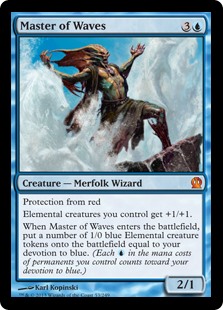
BGx also lost an important showcase for Kalitas in the mirror, which in its time spoke to the Vampire's power during board stalls and attrition wars. Without creature-focused control games playing out as much, Kalitas loses much of its luster. And BGx has more pertinent options, recently employing Goblin Rabblemaster in its haymaker slot to tear through big-mana decks.

All in all, I think Kalitas is due to go the way of the Siege Rhino; that once-ubiquitous four-drop is now little more than a fringe tech choice in certain builds of BGx.

#4: Master of Waves

2017 saw Merfolk carve out a genuine niche for itself for the first time in years, preying on color-hungry Shadow decks and creature-based Tron variants alike. But the deck's always been soft to removal-packed strategies like Jeskai and Mardu, which it can still beat with a critical mass of early beaters.
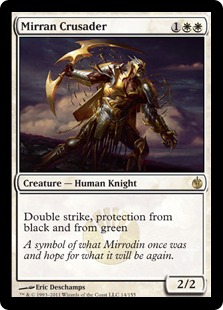
Enter Kumena's Speaker, a second one-drop with which to compliment Cursecatcher, and Merfolk Branchwalker, a close-enough variation on Merfolk's best card, Silvergill Adept. These creatures up the deck's focus by cementing its aggro Plan A, incidentally improving tempo plays like Harbinger of the Tides and Spreading Seas. Plus, Botanical Sanctum renders a green splash rather painless.

These powerful new toys of course demand space, in this case often paid for by trimming Master of Waves. Master's worse now for a lot of reasons: Lightning Bolt sees considerably less play than it used to; Modern players play more heavy-duty removal spells such as Path to Exile to deal with delve threats and Eldrazi creatures; Fatal Push now exists to one-for-one it cleanly. Besides, Master does little on a board opponents have already dismantled, and nothing in matchups too fast for its steep mana cost. Even the matchups it once dominated, like BGx Rock, now boast not just Push, but Liliana, the Last Hope as easy outs.

Master still generates tons of pressure for the one-card investment, and I doubt we'll see it vacate the archetype completely. But Merfolk lists have already begun running the Wizard as just a one-of, and I see that trend stretching into the new year.

#3: Mirran Crusader

One of the year's biggest stories was the breakout success of Mirran Crusader, and to a lesser extent Chameleon Colossus, as Death's Shadow cemented itself as Modern's archetype-to-beat. These cards essentially brickwalled the entire deck, which ran no ways to remove them and generally played to a combo finish with Temur Battle Rage once one hit the table.
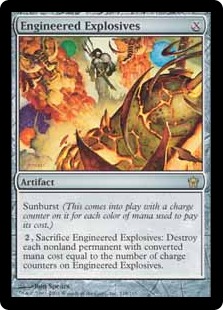
Since Bryan Coval's Invitational win with Death & Taxes, some Grixis Shadow decks have begun packing a Lightning Bolt to deal with Crusader and other random creatures. This change indicates a greater metagame awareness among Modern players, providing a tangible example of format adjustment. This adjustment has not proven kind to Crusader—by now, Modern has figured out how to beat Death's Shadow, driving down the card's meta share; Shadow decks largely migrated from Jund to the more Crusader-resilient Grixis; Crusader kind of sucks against every other deck, ever.

The card still seems popular as a one- to two-of sideboard call in Humans, but old habits die hard, and I doubt the little Knight that could shows his face much in 2018. Chameleon Colossus I'm more optimistic about, as the card combines with Summoner's Pact to efficiently plug a major matchup hole for RG Valakut.

#2: Engineered Explosives

If you happened to be sitting on a bunch of Engineered Explosives heading out of 2016, you done good this year. And on that note, get out now. Explosives exploded in price as midrange decks sought ways to hedge at once against both Jund Shadow and the aggressive Zoo decks that supposedly beat them (hindsight: they didn't). We can't fault them—Explosives is a heck of a flexible removal spell, and its adoption had worked wonders for Bant Eldrazi.

By now, Bant has fallen deeply out of favor compared with Eldrazi Tron. And more importantly, Modern has returned to its tempo-rules business-as-usual, wherein flexibility doesn't hold a candle to raw efficiency. With Push in play, more decks have access to better removal spells, which works against Explosives in two ways: fewer decks need Explosives for coverage alone, and the decks Explosives was played to hate out have sharply decreased in share thanks to the presence of Fatal Push.

#1: Become Immense

The number one spot goes to a card that owes its downfall almost entirely to the Gitaxian Probe ban. Probe both enabled Become Immense directly by filling the graveyard and ensured a clear coast for the pump spell's activation, making the pair a deadly duo, especially in Infect and Death's Shadow Zoo.

Of course, Become Immense generated buzz this year independent of Probe in the RG Hollow One deck. There, it threw back to Death's Shadow Zoo with Monastery Swiftspear and Street Wraith to produce eight or more damage out of nowhere, and combined with Temur Battle Rage to end games on the spot. But as more players began experimenting with Hollow One, Immense's weaknesses in the shell became apparent—it softened the deck to instant-speed removal, for instance, and overall took up too much space as a full package compared with other possible engines.


Immense may pop up from time to time in pump-focused aggro-combo strategies. But I'm not sold on these right now, which goes for Infect as well (although I do think that's the best of the bunch). Without Probe to break it open, I doubt the card ever finds a forever home as a four-of in a Tier 1 deck. That's not all on Immense, either; Temur Battle Rage itself synergizes better with existing shells while providing significantly more bang for buck, leading me to believe it's often just superior when it comes to gracing aggro decks with a combo dimension.

Old 2 New

So that's it for my rundown of the year's biggest losers. In truth, the Modern metagame had a fantastic year—Fatal Push has greatly diversified the number of playable creatures in the format, and with them, the amount of playable decks. Any of the format's fringe-played cards can have a breakout weekend, and most decks inhabit some sort of niche; onlookers have trouble arguing with Wizards's constant stance that Modern is wide-open. It'll be tough to outdo 2017, which saw increased Modern support and acclaim from professional players. But with a format community large enough, who knows what can happen? Happy new year, and see you all in 2018!

Want Prices?

Browse thousands of prices with the first and most comprehensive MTG Finance tool around.


Trader Tools lists both buylist and retail prices for every MTG card, going back a decade.

Quiet Speculation