menu

Insider: The Biggest Pauper Winners This Week

Are you a Quiet Speculation member?

If not, now is a perfect time to join up! Our powerful tools, breaking-news analysis, and exclusive Discord channel will make sure you stay up to date and ahead of the curve.

Channel Fireball’s announcement of adding Pauper side events to Grand Prix, and that Pauper events as large as a Grand Prix under consideration, has revitalized interest in Pauper. There have been local stores holding Pauper events that draw large crowds, and all eyes will be on Grand Prix next month to see how popular the side events are. Last week, I explored the potential impact of the changes, and shared some key cards that are ripe for speculation. Now with a week of buying behind us, there’s a lot more data on what cards are actually moving.

There’s a clear picture forming of what cards the market is buying, and because the movements so far have been very small, there’s still opportunity to buy in on these cards in anticipation of the format exploding in the coming months.

There was an error retrieving a chart for Oubliette

The biggest dollar value winner of the week was Oubliette, which grew from $1 to $23, and with crossover appeal for an Old School card, this is just going to keep growing.

There was an error retrieving a chart for Standard Bearer

In terms of percentage, Standard Bearer grew 15 percent, from $0.50 to over $0.60. A price of $1 at the bare minimum seems inevitable at this point for one of the most important sideboard staples in Pauper that is almost omnipresent in white decks.

There was an error retrieving a chart for Prismatic Strands

Another key white card, whether it is used maindeck or in sideboards, is Prismatic Strands. It has just one printing, and while its price is actually down to $0.50 from its previous high over $0.60 a few weeks ago, its upward trend this week is likely to bring it toward $1. It's notable as one of the biggest Pauper gainers on MTGO this week, where it almost doubled to its current price of 3.5 tix, which could indicate increased Paper demand.

There was an error retrieving a chart for Gleeful Sabotage

Another critical Pauper sideboard card is Gleeful Sabotage, which is the preferred Naturalize effect for green creature decks. Shadowmoor is notorious for its low supply and price spikes, which explains the card's 8-percent growth this week to $1.71, while the Archenemy printing grew from $2 to $2.50. I can’t imagine the card getting too expensive, but it’s certainly possible, and it’s certainly not going to fall anytime soon.

There was an error retrieving a chart for Ash Barrens

One very attractive buy is Ash Barrens, which is a staple of many multicolor decks, and has just one printing in Commander 2016. It’s one of the most expensive Pauper cards online, worth around 8 tickets, an indication of its popularity. Its price has been stable at $3 since spring, but it’s now trending upwards at $3.20 for a 6-percent growth this week. It seems like a safe assumption the price will continue to grow towards $5, and given the relatively small supply, it could outright spike to $10 or more if Pauper Grand Prix come to fruition.

There was an error retrieving a chart for Lava Spike

Lava Spike is one of the pricier Pauper cards, and as a staple in competitive Burn decks, it makes for a target with little downside besides a reprint. This week its price grew 5 percent to almost $4.75. The card is a safe $5 bill now, and it’s only going to grow from there.

There was an error retrieving a chart for Expedition Map

Expedition Map is a key card for Tron decks in Pauper, of which there are numerous builds, and there’s crossover appeal as a Modern staple. The Zendikar printing grew from $2.50 to $2.60 this week, while the Modern Masters 2015 version grew from $2.80 to $2.93. It’s safe to say the card will soon command $3, and is likely heading towards $5.

There was an error retrieving a chart for Crop Rotation

Crop Rotation is another key card for Pauper Urzatron decks, one of the most powerful cards in the format, and is in relatively short supply. Plus, it has crossover appeal as a casual card and Legacy staple, so at just $1.55, it seems like a bargain, and there’s potential in its Duel Deck printing at $2.

There was an error retrieving a chart for Moment's Peace

Another key card for Pauper Tron decks, among many others, is Moment's Peace. This week the price bumped up from $1 to $1.07, and with just one printing, the price is going to continue to appreciate.

There was an error retrieving a chart for Gitaxian Probe

Gitaxian Probe has been banned from Modern, and with its price now as low as it has been in over three years, it’s ripe for growth with new life being breathed into it as a Pauper staple. It's currently at $1.71, up three cents this week for a 2-percent rise, its first significant upward movement since a year ago, so it seems like a safe $2 card with the potential towards its former $4 high if Pauper becomes anywhere near as popular as Modern.

There was an error retrieving a chart for Mutagenic Growth

Another New Phyrexia Pauper staple is Mutagenic Growth, which is used in Stompy decks as well as in Izzet Blitz decks. As an effectively colorless card that has applications in any creature deck, and indeed, we even sometimes see it used in Mono-Blue Delver decks. The price is strong over $1 despite a reprinting, and the original printing trending upwards this week is a positive sign.

There was an error retrieving a chart for Skred

Skred is a key Pauper staple in Blue-Red Delver, one of the top decks, and could potentially be used in all sorts of red decks in the future, so with just one printing in a rare set, it seems like a strong buy. Its price moved up a couple cents to $0.68 this week, and looks to be heading towards $1 with the potential for even more growth.

There was an error retrieving a chart for Kami of False Hope

Kami of False Hope is used in Black-White Pestilence decks to lock out opponents with Grim Harvest, and with just one printing years ago, it's a good candidate for growth. It grew almost 10 percent this week, from $0.40 to $0.43, and will likely just continue to grow.

There was an error retrieving a chart for Sinew Sliver

Slivers is a minor deck in the online Pauper metagame, and as a historic tribe, it's likely to have outsized popularity if Pauper takes off in paper, especially with the return to Dominaria being a potential return of Slivers. There was some notable growth in Pauper Slivers this week, including Sinew Sliver as a critical staple, Sidewinder Sliver as a playable and Spinneret Sliver as an excellent sideboard card that often earns maindeck inclusion.

What Pauper cards are you targeting?

–Adam

Insider: Picks to Capitalize on Pauper’s Popularity

Are you a Quiet Speculation member?

If not, now is a perfect time to join up! Our powerful tools, breaking-news analysis, and exclusive Discord channel will make sure you stay up to date and ahead of the curve.

Magic finance is all about identifying trends, adjusting our strategies, and making moves that make sense. The hottest thing going in Magic right now is the boom of the Pauper format and you'd be a fool not to think about how you can capitalize on the hype.

Channel Fireball has bought into the hype and announced that Pauper will be a supported side-event format at next year's Grand Prixs. That is huge. Also, as a point of reference, my LGS, RIW Hobbies, got 61 players for a Pauper 1K last week. That is an absurd number for a 1K in Michigan.

People are interested. People want to play. Most importantly, people are playing!

Pauper is an up-and-coming format that seems to have finally landed. I think it has a ton of potential to grow. Either you are buying the premise or not. I've seen the hype. I've seen the interest. I'm in on this trend as being real. Now, what do we do with that information?

Pauper Singles Off the Beaten Path

RIW Hobbies has had a growing Pauper scene for the past few months. At that store, I'm largely responsible for sorting and pulling cards for the inventory. Based on the demand, I've had to adjust the cards I pull and buy.

A lot of the singles are already constructed all-stars from Modern or Legacy. However, the format also has a lot of nuance, and cards that are specifically staples of just Pauper.

Today, I'd like to highlight singles that I'm having a difficult time keeping in stock for the store that you might not even realize are the new hotness. These are cards that I could easily see rising in popularity as the format continues to grow and fostering newfound demand as more and more players start buying in.

There was an error retrieving a chart for Ajani's Mantra

Can't keep it in stock. It's basically the only reason to pick Journey into Nyx commons, period. I tend to sell them as quickly as they come in. A card to make sure you don't bulk out!

There was an error retrieving a chart for Artful Dodge

Another weird card that I wouldn't have thought to pull out of bulk if I wasn't aware that we are constantly sold out of it. The card is actually really good in a lot of the grindy mirror matches.

There was an error retrieving a chart for Ash Barrens

I wouldn't be surprised to see this card spike super hard. The spells in Pauper are comparable to Modern power level. The biggest difference between Pauper and other constructed formats is that the mana-fixing kind of stinks. Ash Barrens is one of the best fixers in the format and only appears in Pauper decks. It's also a house with Brainstorm.

There was an error retrieving a chart for Carapace Forger

Two-mana 4/4. That is a great rate by any constructed format standard, and insane in Pauper Affinity. I am always sold out of this card. As soon as I find a few copies they walk out the door as quickly as I put them out.

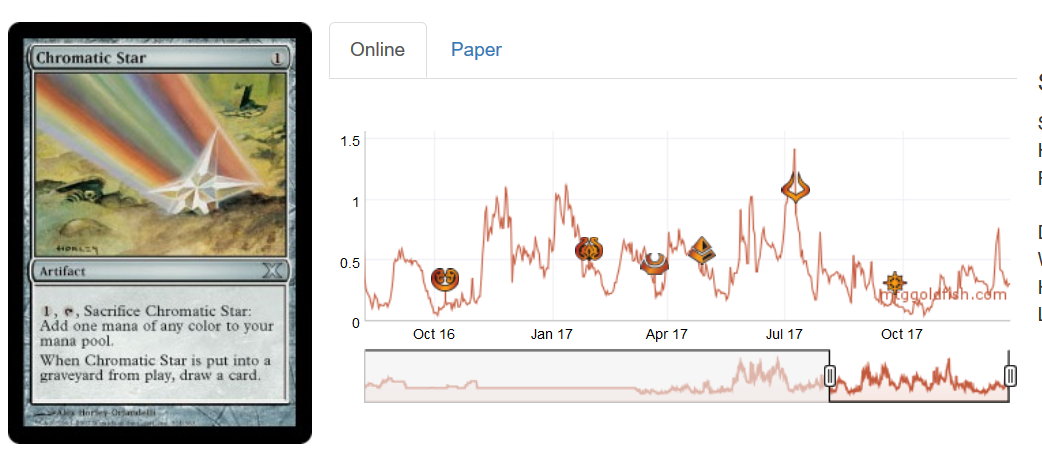
There was an error retrieving a chart for Chromatic Star

Chromatic Star is already good in Modern Tron. However, it is also great in Pauper Affinity. I could see this card spiking up in the coming weeks. It works favorable with the Affinity mechanic and Atog.

There was an error retrieving a chart for Daze

Daze has plummeted in value after the Eternal Masters reprinting. However, it could pick back up now that it is a fairly played Pauper staple. The inventory continues to dwindle down on Dazes despite the reprint.

There was an error retrieving a chart for Delver of Secrets

Delver is just a great card and a format staple of Pauper. I've been collecting these for a while and I'll likely be cashing out if and when a spike comes.

There was an error retrieving a chart for Evincar's Justice

Another unique Pauper staple that I cannot keep in stock to save my life. There are very few sweeper effects printed at common, and this is one of the best. It has a Commander reprint. If Pauper continues to boom these will be tough to get a hold of and keep in stock.

There was an error retrieving a chart for Distant Melody

I didn't even know this card existed but it is a staple of the Elfball deck. They already sell for a decent amount of money. Be sure to pick these out of your bulk commons!

There was an error retrieving a chart for Giant Growth

There are enough printings of this card that I don't think it can really go up, but the store is literally sold out of Giant Growth right now. Absurd. That is the kind of volume we are doing on Pauper staples. Sold of out Giant Growth.

There was an error retrieving a chart for Ghostly Flicker

Another Pauper control deck endgame card. Ghostly Flicker plus Mnemonic Wall allows you to get pretty much infinite card advantage in the late game. Creatures with comes-into-play abilities are abundant in Pauper and this card plays to that strength.

There was an error retrieving a chart for Gush

Gush is a busted card and one of the most inherently powerful cards legal in Pauper. The power of Islands is great when properly harnessed... This is a card that will tick up as the Pauper craze hits full stride.

There was an error retrieving a chart for Ichor Wellspring

Another random card that is very good in Pauper. It is great Atog food. It is also great with Kuldotha Rebirth and Glint Hawk. It's sort of a "value cog" in Affinity and Kuldotha Boros, both of which are tier-one decks. Can't keep 'em in stock.

There was an error retrieving a chart for Lava Spike

The card is a Legacy and Modern staple. Unsurprising, it is also good in Pauper Burn decks. More demand for a card that is already in high demand. Not even a Masters printing can keep this fiery card down.

There was an error retrieving a chart for Quirion Ranger

Another cross-format all-star that really shines in Pauper. I had a difficult time acquiring this card and stocking it before Pauper. Now that Pauper is the buzzy bees knees? Forget about it.

There was an error retrieving a chart for Safehold Elite

Not a great card but an interesting sideboard card. Shadowmoor is a short-printed set already and these are kind of difficult to find. For sure, pull these out of bulk because there are plenty of frustrated kids who can't find copies at the LGS!

There was an error retrieving a chart for Scattershot Archer

Another random card that is worth money. Scattershot is a pretty baller sideboard card for Elves against Delver decks that have plenty of 1/1 flying faeries. Again, I can't keep these in stock now that the store has a thriving Pauper scene.

There was an error retrieving a chart for Spire Golem

Spire Golem is a staple of the mono-blue Delver decks. It is kind of shocking how good the card is in a deck with an all-Island manabase. Also, 2/4 flying is no joke in Pauper! It attacks and blocks with the best of 'em.

Moving Forward

Well, that is my list of Pauper cards not to underestimate! At the very least, these are cards that are difficult for my LGS to keep in stock, which has historically been a fantastic predictor of market trends to come. I never bet against the random casual nonsense cards that the LGS sells through like popcorn at a circus.

From what I've observed, I believe that Pauper is very real and will continue to grow in the coming month(s). It is not too late to be ahead of the curve and find spaces to buy in. However, move quick because the clock is ticking!

Daily Stock Watch: Atraxa, Praetors’ Voice

Are you a Quiet Speculation member?

If not, now is a perfect time to join up! Our powerful tools, breaking-news analysis, and exclusive Discord channel will make sure you stay up to date and ahead of the curve.

Hello, everyone and welcome to the Thursday edition of the Daily Stock Watch! The year's about to end and I'm pretty sure that a lot of us are looking forward to what lies ahead for us in 2018. How did your specs fare so far? Have you made any awesome deals this year that's worth sharing? I hope that you could let us know about that in the comments section, as I might be able to pick up a thing or two from what you've done so far. The learning should never stop in the world of our favorite card game.

Before I get too far ahead, let's check out our featured card that just reached it's all-time high of $23.53 today. It's arguably the best commander to come out of Commander 2016, and is primed to continue rolling upwards as supplies continue to run out.

There was an error retrieving a chart for Atraxa, Praetors' Voice

I'm not a fan of four-color commanders, but this one is very strong and straightforward in what it wants to do. It's either it wants to kill you using infect, or just wallop you with a plethora of planeswalkers. In case you'd like to know how a deck using Atraxa looks like, check out this list.

Atraxa Walkers

Commander

Creatures

1 Archangel of Tithes
1 Captain Sisay
1 Clever Impersonator
1 Deepglow Skate
1 Eternal Witness
1 Ichor Rats
1 Seedborn Muse

Instants and Sorceries

1 All Suns' Dawn
1 Call the Gatewatch
1 Demonic Tutor
1 Deploy the Gatewatch
1 Diabolic Tutor
1 Temporal Mastery
1 Tempt with Discovery
1 Cyclonic Rift
1 Enlightened Tutor

Other Spells

1 Ajani Steadfast
1 Ashiok, Nightmare Weaver
1 Dovin Baan
1 Elspeth, Knight-Errant
1 Elspeth, Sun's Champion
1 Freyalise, Llanowar's Fury
1 Garruk, Apex Predator
1 Gideon, Champion of Justice
1 Jace, the Mind Sculptor
1 Jace, Unraveler of Secrets
1 Karn Liberated
1 Kaya, Ghost Assassin
1 Kiora, the Crashing Wave
1 Liliana of the Veil
1 Narset Transcendent
1 Nissa, Voice of Zendikar
1 Sorin Markov
1 Tamiyo, Field Researcher
1 Tamiyo, the Moon Sage
1 Teferi, Temporal Archmage
1 Tezzeret the Seeker
1 Ugin, the Spirit Dragon
1 Venser, the Sojourner
1 Vraska the Unseen
1 Amulet of Vigor
1 Chromatic Lantern
1 Elixir of Immortality
1 Ensnaring Bridge
1 Gilded Lotus
1 Mana Crypt
1 Mana Vault
1 Norn's Annex
1 Rings of Brighthearth
1 Sensei's Divining Top
1 Sol Ring
1 Strionic Resonator
1 The Chain Veil
1 Vedalken Orrery
1 Bitterblossom
1 Doubling Season
1 Exploration
1 Mana Reflection
1 Oath of Gideon
1 Oath of Nissa
1 Phyrexian Arena
1 Prismatic Omen
1 Rhystic Study

Lands

1 Academy Ruins
1 Arcane Lighthouse
1 Bayou
1 Breeding Pool
1 City of Brass
1 Command Tower
1 Exotic Orchard
1 Flooded Strand
1 Forest
1 Godless Shrine
1 Hallowed Fountain
1 Homeward Path
1 Inkmoth Nexus
1 Island
1 Mana Confluence
1 Marsh Flats
1 Maze of Ith
1 Misty Rainforest
1 Opulent Palace
1 Overgrown Tomb
1 Plains
1 Polluted Delta
1 Reliquary Tower
1 Sandsteppe Citadel
1 Savannah
1 Scrubland
1 Seaside Citadel
1 Swamp
1 Temple Garden
1 Temple of the False God
1 Tropical Island
1 Tundra
1 Underground Sea
1 Verdant Catacombs
1 Watery Grave
1 Windswept Heath

Atraxa, Praetors' Voice just makes every planeswalker in this deck extra powerful. It helps in ramping up their final abilities, and gives your opponents tons of problems to solve. It's also worth noting that it could manipulate the counters on your opponent's permanents, which could hasten the downfall of some of its creatures that already has -1/-1 counters on it. Making sure they have an answer to Atraxa is already as troublesome as it could get, so just imagine how it would be like for them to see it beside an Ugin, the Spirit Dragon that just used it's +2 ability on its previous turn. It will be ready to explode for its ultimate on the next turn.

The challenge in getting Atraxa is that it's only available via the "Breed Lethality" deck from C16, and a complete set of the five decks being sold online are all north of $300. The deck itself where you could get Atraxa is being sold at the $120-$150 range even at eBay, so I'd like the idea of group buying the actual set itself with some friends who might need the other decks. The best way to acquire the card itself might be from buying or trading it from other players via your LGS, or try getting the few remaining copies online from Channel Fireball, Card Kingdom, or TCGPlayer. Star City Games is already out of stock, and I'm not sure if they'll have new ones anytime soon. It should be in the $30 range once it gets refilled, and you could expect that to happen only when everyone else is out of supplies.

The Best of Commander 2016

Above are the four most expensive cards from C16, and only the first three are worth more than $10. I'm not really sure how higher this set's value could go, so I'd like to refrain from the idea of buying the whole thing just for Atraxa. However, the sky's the limit for this commander as it's very unlikely that it will get reprinted soon (unless WotC decides that there's a need to print non-foil copies of the card in a new product) but the demand for it will always be high. Grab a copy now while you could. The card's just really, really good.

And that’s it for the Thursday edition of the Daily Stock Watch! See you again tomorrow for our final Stock Watch of the year, as we check out a new card that should be on the go, or good enough for speculating. As always, feel free to share your opinion in the comments section below. And if you want to keep up with all the market movement, be sure to check in with the QS Discord Channel for real time market information, and stay ahead of the hottest specs!

Insider: MTGO Pauper Market Update

Are you a Quiet Speculation member?

If not, now is a perfect time to join up! Our powerful tools, breaking-news analysis, and exclusive Discord channel will make sure you stay up to date and ahead of the curve.

A very merry Christmas to each of you! In the spirit of Tiny Tim, this week I'd like to take a look at the Pauper format, a format which has become a hot button topic in Magic ever since Channel Fireball announced that it would host Pauper side events at Grands Prix in 2018, with the possibility of having an official Pauper Grand Prix in the future should these side events prove popular. No doubt you already knew that...

“Old Marley was as dead as a doornail. Mind! I don't mean to say that, of my own knowledge, what there is particularly dead about a doornail. I might have been inclined, myself, to regard a coffin-nail as the deadest piece of ironmongery in the trade. But the wisdom of our ancestors is in the simile; and my unhallowed hands shall not disturb it, or the Country's done for. You will therefore permit me to repeat, emphatically, that Marley was as dead as a doornail.”

- Charles Dickens, A Christmas Carol

But what you might not have known is that there are several underlying financial indicators that Pauper is picking up steam, both online and in paper. In paper, a little more than a year ago, several cards used exclusively in Pauper saw dramatic (and heretofore sustained) price spikes. Quirion Ranger, once mired below $1, now holds a value above $2. Standard Bearer, once below $0.20, now rests over $0.50.

There was an error retrieving a chart for Quirion Ranger

These are just two examples, of which there are many more, of cards used exclusively in Pauper, and not in Commander, Legacy, Vintage, or Modern, that have gone up in price over the past one to two years. This can mean only one thing – there is some real demand for Pauper out there. Perhaps the across-the-board price increases of cards like these is what gave Channel Fireball the confidence to undertake such a bold shakeup with their flagship tournament events.

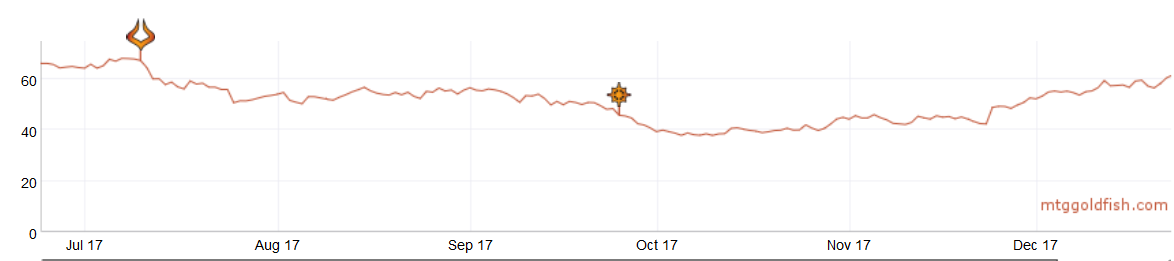
Although it can be hard to profitably speculate on Pauper cards in paper due to the increased cost of doing business (for discussions of speculating on Pauper cards in paper, see Adam Yurchick's QS article and a Youtube video I did with Rogue Deckbuilder), speculating in Pauper on MTGO can be a lucrative practice. Although it takes a little more MTGO-specific knowledge, there is no time like the present to take a look at Pauper and think about investing in the format. Ever since the release of Ixalan, Pauper has been growing in popularity online, and there are now over 850 people in the Pauper League, which I believe constitutes a record high. Further, Pauper staples have seen significant gains in recent months, rising in value from $40 to $60.

What I'd like to do below is arm you with some knowledge necessary to get you started in investing in Pauper. Investing in Pauper is a lot more like investing in Legacy than in Standard or Modern.

“And it was always said of him, that he knew how to keep Christmas well, if any man alive possessed the knowledge. May that be truly said of us, and all of us! And so, as Tiny Tim observed, God bless Us, Every One!”

I. The Treasure Chest Exclusives List

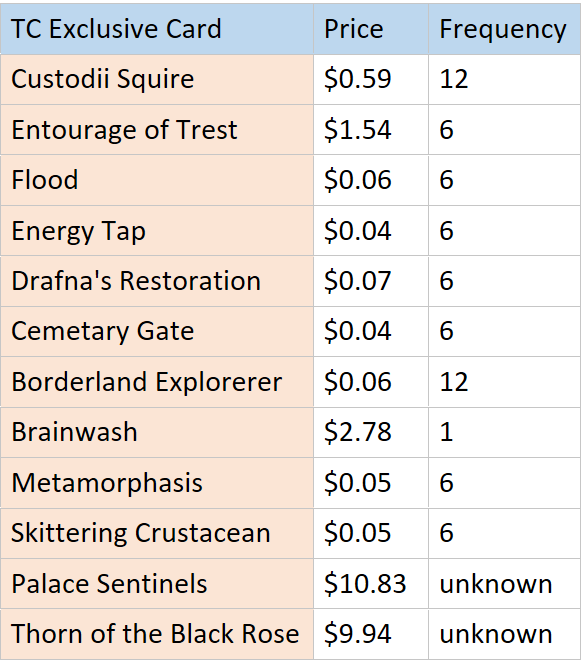
(1) It is very important to know what cards are on these lists, and at what frequencies. Bookmark this page. It is also important to know the difference between these lists. Most have heard of the former but not the latter. The Treasure Chests Exclusives list is composed of cards that have only been released through treasure chests on Magic Online. Most of these are cards that were released in a supplementary product in paper, sets like Conspiracy, Portal: Three Kingdoms, or Commander 2017. Cards on this list are rarer than cards on the Curated Card list, which is why cards like Palace Sentinels are so expensive. The reason cards on this list are rarer is that this list is given a slot in your treasure chest 5.00 percent of the time, compared to 9.83 percent for the Curated Card list. And in general, Pauper cards on this list would have made for great long-term investments.

Investing in Palace Sentinels and Thorn of the Black Rose would have made for great investments back when the Monarch mechanic was still an unproven commodity in Pauper. The Monarch mechanic is the primary way nowadays that non-blue decks grind out value. Last month, Entourage of Trest was released on MTGO, giving green a way to ascend the throne in Pauper.

Although the card has not caught fire yet – it does cost one more than its white and black counterparts – the card will likely reach 10.00 tix if it manages to work its way into the metagame. I'm looking to buy the card under 1.00 tix, but I think anything under 1.75 tix is reasonable. Several other cards on this list intrigue me, notably the following:

At their current prices, I'm very tempted to speculate on Borderland Explorer and Energy Tap. Both are pieces that could enable new archetypes to flourish, and both are at such low supply that their reward potential is astronomical. At minimum, I see no reason not to use excess bot credit to buy a few of them.

II. The Curated Cards List

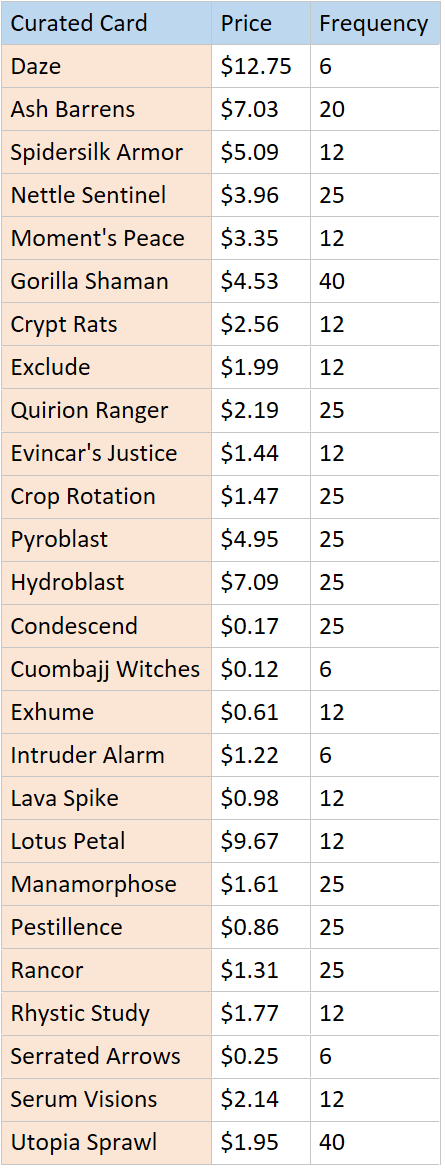
Many Pauper staples are on the Curated Cards list, and many are at extremely high frequencies, so you need to be careful when you invest in these cards. If a card has a curated frequency greater than six or 12, I recommend only short-term speculation. If a card has a curated frequency greater than 20, I recommend avoiding speculation on the card altogether (at that point they are a liability to merely own them, a problem that several articles have recently shed light on, including one by our very own Brian DeMars). Below is a helpful list of Pauper staples on the Curated Cards list. Also ignore Cuombajj Witches and Serrated Arrows, since those cards are in the Player Rewards Packs. Bookmark this page if you plan to invest in Pauper.

I don't love any of these cards at their current prices. However, if the Pauper League reaches 1,000 players in the coming months, some of these begin looking better, so in my mind investing in cards from this list amounts to a vote of confidence in the growth of the format. Daze, in particular, would likely reach the $20 to $25 range. Moment's Peace could continue to rise to $5 to $7.50, and several of the black cards like Pestilence and Evincar's Justice are appealing since black control is no longer a core part of the metagame. At the end of the day, though, there are many Pauper playables and staples not on this list, and in general that's where I'd look to place my bets.

III. Use the Natural Rhythms of Pauper Cards to Your Advantage

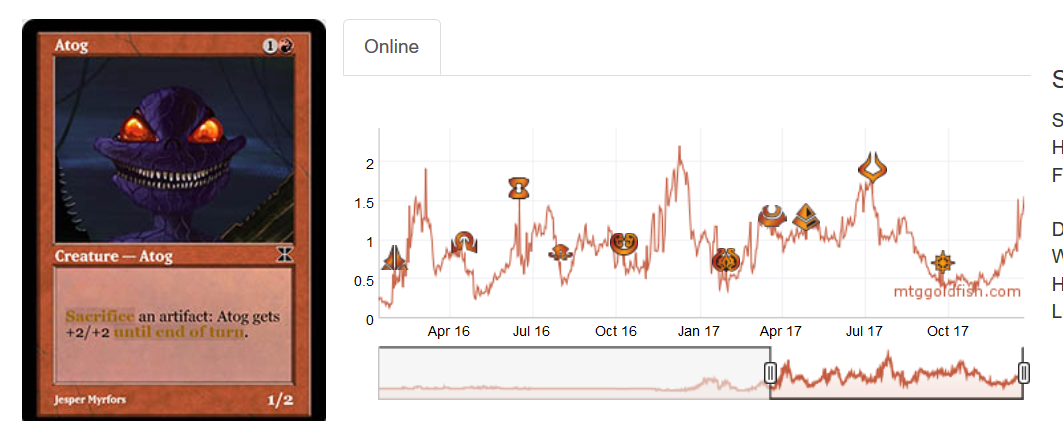
The last piece of knowledge I'd like to give you today is that many Pauper cards exhibit a very cyclical rise and fall. One very simple (and conservative) Pauper investment strategy is to identify and invest in staple cards that are at lows and wait until they go back up to sell them at modest gains. This sounds so simple, but this isn't something you can really do with any consistency in Standard or even in Modern. This is much more of a phenomenon to be cognizant of in Pauper.

Pauper has a healthy metagame, meaning that various decks supplant each other at the top of the food chain, and this reverberates down through the whole format. Thus decks like Affinity fall in and out of favor, which causes prices of cards like Atog to rise and fall with regularity. So the best thing to do is to just browse the metagame on Goldfish and look at cards to familiarize yourself with the format and its cards. And sometimes you'll come across cards that exhibit this cyclical pattern and make a note of it and perhaps set a Goldfish price alert for it. When this article goes live, it is likely I will have invested in Exclude, a card that has exhibited this very pattern and which is at a low point right now.

Signing Off: When to Pull the Trigger?

I think a good time to jump in on appealing Pauper targets will be in the coming weeks once Rivals of Ixalan spoilers begin, and especially once Rivals of Ixalan has been released on MTGO. Especially for expensive cards like Daze, Nettle Sentinels, Hydroblast, and Pyroblast, it is best to wait a few weeks before purchasing them, since those are the very cards that a lot of people will sell in order to draft the new set.

As always, leave your comments and questions below and I'll get back to you. There's a lot of information here, and I'll be happy to field any questions and clarify anything. The current state of my portfolio can be found here.

“But you were always a good man of business, Jacob,' faltered Scrooge, who now began to apply this to himself.

Business!' cried the Ghost, wringing its hands again. "Mankind was my business; charity, mercy, forbearance, and benevolence, were, all, my business. The deals of my trade were but a drop of water in the comprehensive ocean of my business!”

Insider: MTGO Market Report for December 28th, 2017

Are you a Quiet Speculation member?

If not, now is a perfect time to join up! Our powerful tools, breaking-news analysis, and exclusive Discord channel will make sure you stay up to date and ahead of the curve.

Welcome to the MTGO Market Report as compiled by Matthew Lewis. The report will cover a range of topics, including a summary of set prices and price changes for redeemable sets, a look at the major trends in various Constructed formats and a "Trade of the Week" section that highlights a particular speculative strategy with an example and accompanying explanation.

As always, speculators should take into account their own budgets, risk tolerances and current portfolios before buying or selling any digital objects. Please send questions via private message or post below in the article comments.

Redemption

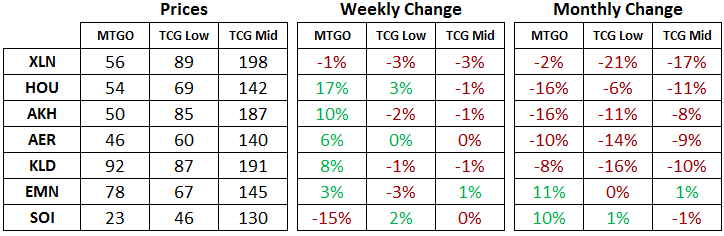
Below are the total set prices for all redeemable sets on MTGO. All prices are current as of December 26, 2017. The TCGplayer low and TCGplayer mid prices are the sum of each set's individual card prices on TCGplayer, either the low price or the mid price respectively.

All MTGO set prices this week are taken from GoatBot's website, and all weekly changes are now calculated relative to GoatBot's "full set" prices from the previous week. All monthly changes are also relative to the previous month's prices, taken from GoatBot's website at that time. Occasionally, full set prices are not available, and so estimated set prices are used instead. Although Hour of Devastation (HOU), Amonkhet (AKH), Aether Revolt (AER), and Kaladesh (KLD) are no longer available for redemption, their prices will continue to be tracked while they are in Standard.

Year in Review

This will be the last MTGO Market Report for 2017, so a few words reflecting on what happened this year feels appropriate.

Treasure Chests Matter

Treasure Chests have been impacting the MTGO economy for over a year now. Initially they were rolled out cautiously as a new type of prize, which happened to mine the secondary market for value. Caution was set aside, though, and we ended up where we are today – with prizes for Constructed events consisting entirely of play points and Treasure Chests.

The initial impact in late 2016 was to usher in a huge bear market in non-Standard cards. There was a steep loss in confidence as the market steadily sold off into early 2017. It was easy to think this was a direct effect of the Treasure Chests, but really it was a secondary effect. The cards entering the market from chests were making an impact, but the main driver of prices were the number of players souring on MTGO a result.

There was an error retrieving a chart for Rishadan Port

A year later now, it's easier to see that the MTGO economy can sustain the price of cards being reprinted in chests. There's a big "but" attached to that statement, though. If it's not a format staple, then the price will come under steady downward pressure as the trickle of supply erodes the value of niche cards. Infernal Tutor and Rishadan Port are two prime examples of cards that have previously held high prices relative to their level of play and have come down in price significantly as a result of being opened in Treasure Chests.

Bookkeeping is Hard (at least for me)

Heading into the fall of 2017, I resolved to reboot the Market Report portfolio and its reporting. The goal of the reboot was to provide more information to readers about what I was doing and to generate a record of my thinking around the trades I was making.

I think this practice is a great one that can help speculators generate insight and discipline in their pursuits. I'm slowly building a base of data to draw from which can directly influence which trades I decide to pursue and which ones I decide to avoid. Increasingly, I am only interested in pursuing trades with a strong economic advantage. This means there is some kind of feature of the MTGO economy that gives a directional bias to the trade; it's not just buying singles and hoping the metagame and the market pushes their price higher – I'm relying on seasonality of player sentiment or redemption.

There was an error retrieving a chart for Goblin Bookie

The downside to this practice of record keeping is that it's been difficult to maintain for me personally. Although I have dutifully logged my trades, generating summary results and keeping tabs on my thinking are two areas of the reboot that need greater attention from me.

Here's an example of how more up-to-date record keeping could have helped. Although I have learned my lesson on speculating on niche cards, it was still a painful one delivered by Tangle Wire. This trade has turned into a complete loss for me, but if I had been keeping up and reviewing my strategies I could have mitigated the loss to some degree.

A Tangle Wire Case Study

For Tangle Wire in particular, I wrote my initial thesis down as the following,

Big drop in 2017 tied to emergence of Monastery Mentor in vintage. Shops decks moved away from Tangle Wire. Recents bans will affect metagame.

This is a reasonable thesis, though it didn't hold up in the end. The big drop was due to multiple factors, including Tangle Wire showing up on the curated card list for Treasure Chests. Also, there was an implicit assumption in the thesis around Shop decks returning to use this card. I think it's "okay" to have ideas that turn out to be wrong, because that is part of the learning process, but the big mistake came in the follow up to the original thesis.

Reevaluate after XLN is released, but so far so good.

There was an initial bump in price in the weeks after the bans were announced, which made me think I was on the right track. However, if I had followed my own advice and reviewed the trade in October, I would have found that the price was in a downtrend and that the Vintage metagame had not developed as anticipated. Although Tangle Wire was showing up in Shop decks, it wasn't ubiquitous. There were plenty of Shop decks doing well that featured zero Tangle Wire.

There was an error retrieving a chart for Tangle Wire

If at the end of October I had properly reviewed this trade, it would have been easy to see that I had made mistakes in my  initial thesis and that selling was warranted. A loss of 75 percent would have been likely, and that's a lot better than my current on-paper loss of 100 percent. I still hold my position in Tangle Wire, and at this point its a complete write-off that is not worth selling for any amount of tix at current prices, even if I can find enough buyers.

My plan now is to book the 100-percent loss and to forget about this position. Maybe down the road Tangle Wire will be removed from the curated list and slowly start to rebuild value, but as of today it will take too much time and effort to offload these cards for a minimal amount of tix. I'm better off absorbing the loss and the lesson, saving the time involved in the transactions and moving on. Better record keeping would have helped to avoid this situation.

Effort Over Time

I have been thinking and writing about the MTGO economy for years. Economics is near and dear to my heart, and exploring economic ideas in the context of MTGO has been a ton of fun. The regular practice of writing this article has been great for firming this all up. And believe it or not, the biggest benefits to this project are only becoming visible years later.

The big thing going on here is that generating knowledge and awareness around applied economics and speculating takes time and effort.  That consistent effort is rewarded in time by absorbing new ideas and strategies, while at the same time minimizing and avoiding weak strategies. It takes time to sort through the good and bad ideas, though, as being lucky can paper over results in the short term. Speculating during a bull market is also a good way to feel like you know what you are doing.

On the flip side, speculating during a bear market will quickly lead to doubt about what you are doing and why. I believe that MTGO went through a bear market up to the release of Modern Masters 2017, and this experience has had a direct effect on what I want to be doing as a speculator.

There was an error retrieving a chart for Bear's Companion

Identifying bull and bear markets is a tricky topic. It's often only clear in hindsight what is happening, but pursuing trades with an economic advantage means that what the market is doing matters a lot less. My current efforts are focusing on these types of strategies while avoiding ones that rely on the overall market direction.

Having applied effort over time on these strategies leads to a high degree of trust and faith in them. I've repeated them multiple times, and the results are now guiding my current choices around which ones to employ and which ones to avoid. The timing of employing these strategies is also critical. The fall/winter window is clearly the best time to be speculating, and it's only through repeated effort over years, backed up with economic reasoning, that has lead me to this conclusion.

Trade of the Week

For a complete look at my recent trades, please check out the portfolio. I've been preparing for Grand Prix Toronto, which features Modern Constructed, and one of the decks I have been testing is an interesting take on the Death and Taxes archetype. Check out the deck in this tweet.

The dip into blue brings counter magic as well as a card that never lived up to its hype while in Standard. Skaab Ruinator is a massive flying body at a seemingly low cost that can be played from the graveyard, but the non mana cost of removing creatures from the graveyard turned out to be too onerous. This deck gets around that restriction by using Aether Vial to flash it in and Smuggler's Copter to put creatures into the graveyard.

There was an error retrieving a chart for Skaab Ruinator

The body on Skaab Ruinator is massive. It's able to block and kill Gurmag Angler, with only a powered up Death's Shadow being truly troublesome. That's where having flying also helps.

It's not clear if this card is an overlooked gem, but in testing it has been performing well in combination with Aether Vial. From time to time, you'll also cast it out of the graveyard for a little extra value. Fortunately, the card is quite cheap at less than 0.1 tix, so taking a shot on this one won't break the bank. It's fun to make long-shot bets, and they are more feasible if they are cheap.

Daily Stock Watch: Weathered Wayfarer

Are you a Quiet Speculation member?

If not, now is a perfect time to join up! Our powerful tools, breaking-news analysis, and exclusive Discord channel will make sure you stay up to date and ahead of the curve.

Hello, readers and welcome to the Wednesday edition of the Daily Stock Watch! I've made features on two cards that are staples in their respective formats for the first two days, but we'll stray away from that for the time being. Although I believe that this card is one of the best utility guys in formats where it is legal, there are still things that's keeping it grounded as it is.

Our card for the day is Weathered Wayfarer

There was an error retrieving a chart for Weathered Wayfarer

This very reliable cleric that was originally printed in Onslaught just reached its all-time high of $11.19 today (although the one from the 9th Edition reached its peak last month) and it should be no surprise that the trend will continue to buck upwards in the coming weeks. This is a casual favorite, and it's actually a very good piece to consider in any deck that plays white, as a competitive Commander player. Just check out this Derevi deck here.

Derevi EDH

Commander

Creatures

1 Arbor Elf
1 Birds of Paradise
1 Caustic Caterpillar
1 Fyndhorn Elves
1 Llanowar Elves
1 Magus of the Candelabra
1 Noble Hierarch
1 Sylvan Safekeeper
1 Weathered Wayfarer
1 Bloom Tender
1 Fauna Shaman
1 Gaddock Teeg
1 Gilded Drake
1 Meddling Mage
1 Qasali Pridemage
1 Scavenging Ooze
1 Thrasios, Triton Hero
1 Voidmage Prodigy
1 Aven Mindcensor
1 Drift of Phantasms
1 Edric, Spymaster of Trest
1 Laboratory Maniac
1 Patron Wizard
1 Sanctum Prelate
1 Stonybrook Schoolmaster
1 Yisan, the Wanderer Bard
1 Linvala, Keeper of Silence
1 Sakashima the Impostor
1 Azami, Lady of Scrolls
1 Seedborn Muse
1 Teferi, Mage of Zhalfir
1 Elesh Norn, Grand Cenobite
1 Galecaster Colossus

Instants and Sorceries

1 Brainstorm
1 Chain of Vapor
1 Crop Rotation
1 Enlightened Tutor
1 Glimpse of Nature
1 Mental Misstep
1 Swords to Plowshares
1 Worldly Tutor
1 Cyclonic Rift
1 Eladamri's Call
1 Uncage the Menagerie
1 Chord of Calling
1 Eldritch Evolution
1 Intuition
1 Force of Will

Other Spells

1 Chrome Mox
1 Sensei's Divining Top
1 Carpet of Flowers
1 Concordant Crossroads
1 Mystic Remora
1 Reconnaissance
1 Root Maze
1 Utopia Sprawl
1 Wild Growth
1 Earthcraft
1 Quest for Renewal
1 Rest in Peace
1 Sterling Grove
1 Stony Silence
1 Survival of the Fittest
1 Sylvan Library
1 Arcane Adaptation
1 Aura Shards
1 Intruder Alarm
1 Kindred Discovery
1 Dowsing Dagger

Lands

1 Arid Mesa
1 Breeding Pool
1 Cavern of Souls
1 Command Tower
1 Flooded Strand
5 Forest
1 Gaea's Cradle
1 Hallowed Fountain
5 Island
1 Marsh Flats
1 Misty Rainforest
1 Nykthos, Shrine to Nyx
1 Polluted Delta
1 Savannah
1 Scalding Tarn
1 Temple Garden
1 Tropical Island
1 Tundra
1 Verdant Catacombs
1 Windswept Heath
1 Wooded Foothills

In a nutshell, this deck looks like a "good stuff deck" that packs all the efficient creatures and spells that Bant has to offer. It creates a synergistic approach that overwhelms your opponents with cheap threats in the form of creatures and enchantments. Drawing Weathered Wayfarer early helps you get an early advantage, as it allows you to fetch a Gaea's Cradle, Cavern of Souls, or Nykthos, Shrine to Nyx to your heart's delight. Although there's a condition to trigger its strong ability, it's very attainable in the format as almost every deck relies on the consistent influx of lands per turn to draw out its resources. With a low curve, you could afford to miss a land drop to initiate its ability and get ahead in the game using its ability. Starting a multiplayer game where you're not playing first will also help your cause in achieving this state.

Permanents that fetch other cards

By taking a look above, we could see that fetching other permanents (creatures, in this case) is something that green is better known at. Weathered Wayfarer is in a class of its own, and WotC has done a good job so far of not creating another card that makes its ability redundant, such as the case with the cards above. This should bode very well in the progress of its financial rise unless it gets reprinted soon.

At the moment, you could pick up copies of Weathered Wayfarer from Star City Games, TCGPlayer, Card Kingdom, and Channel Fireball for as low as $11.99. The foil copies cost at least $30 wherever you check, as this is something that you'd usually see in well-established Commander decks. It should be great if you could pick up copies for less than $10, but it shouldn't hurt to get them now for its current market price.

And that’s it for the Wednesday edition of the Daily Stock Watch! See you again tomorrow, as we check out a new card that should be on the go, or good enough for speculating. As always, feel free to share your opinion in the comments section below. And if you want to keep up with all the market movement, be sure to check in with the QS Discord Channel for real time market information, and stay ahead of the hottest specs!

Testing Preordain: Qualitative & Quantitative Results

Are you a Quiet Speculation member?

If not, now is a perfect time to join up! Our powerful tools, breaking-news analysis, and exclusive Discord channel will make sure you stay up to date and ahead of the curve.

David is out for the holidays until next week. In the meantime, please enjoy his article from earlier this year where he presented results from the Preordain ban test. These results were originally presented in two separate articles (here and here), but I've divided them into parts for the purpose of easier reading.

Part 1: Qualitative Results

Once again, it is time to start rolling out my results from the latest Banlist Test. As usual, I will start with the experimental setup and the unquantifiable results. I know that what most readers care about are the hard numbers, but I'm not done gathering the data yet. That will be coming sometime in September—probably. I'm done with Storm and about halfway through the UW testing. Completion date will depend on how the PPTQ season goes, as I'm splitting my testing time between that and Preordain.

For those who are new to the series, I take a card from the Modern Banned List, put it back into the deck that got it banned (or as close as possible), and see how it fares in the current metagame. My goal is to bring hard data and scientific inquiry into the discussion instead of more opinion and baseless speculation. Therefore, I play a lot of matches with the deck (normally 250 with the banned card, 250 without it) to build a sufficient data set for analysis. I take the test data, compare it to the control data, and from that I hypothesize about the safety of the test card. I laid all this out in more detail in a previous piece. The card that readers voted for me to test this time was Preordain.
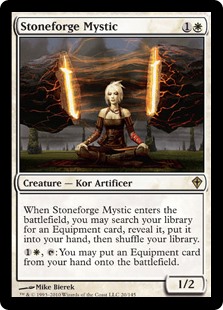
This test was very different from the last several. With both Stoneforge Mystic and Jace, the Mind Sculptor, I just tested a single deck against the gauntlet. While this often took a while, the testing was fairly straightforward. I took the deck, learned the deck enough to be passable, ran the gauntlet. The decks I was using certainly helped. Yes, they were midrange decks, but their gameplan was clear and the decision trees relatively clear and comprehensible.

This time, for reasons explained here, I tested Gifts Storm and UW Control. This complicated things. To get a decent data set for both I'd have to play a lot more games. Doing the usual 500 matches would yield half the data. I made this harder for myself by playing hard decks against hard matchups. These decks require a lot of experience to navigate and Storm is very vulnerable to itself in the face of pressure. I'm not claiming to have played these decks perfectly, but I was at least average with Storm and good enough with UW that I took an updated version to a PPTQ. Thus if you see issues with the results or my data, consider that I am just one man with a few volunteers—in an enormous undertaking like this, exhaustion and deck difficulty are bound to play a part.

Experimental Setup

As always, I would be piloting the test decks against (semi-) willing opponents wielding decks that they are reasonably good with. We'd play match after match at a stretch, with me alternating between the test and control deck to even out the experience and skills I was developing during the tests. Prior to data collection, we always played at least a few practice games to get a feel for things and determine the correct sideboard plans. Previously, my team has used a variety of methods to actually play the games, including MTGO. We did not use MTGO at all this time. This prevented us from losing matches to misclicks and ruining the data set. It was also significantly cheaper. I don't own most of the digital pieces for Storm, couldn't get them, and already dislike MTGO. Playing paper in person or over Skype was much easier. And free. I like free.
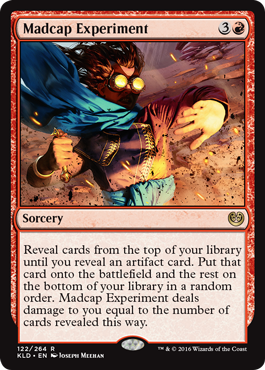
As I mentioned above, my data set is normally 500 matches. That is too small a set for two decks, but it was logistically implausible to just double it. It takes months to get all the data together as is—doubling would push completion into October at the earliest. I'm just not going to put that kind of time in to this project. Therefore, this data set is 640 total matches (160 per deck, and 32 per matchup). Why 640? I didn't have a set target when I started, but I knew that 150 was the bare minimum. Of course, I was testing both decks simultaneously to save time and I was burning out. I decided I'd had enough at 27 matches, but that was an ugly looking number and felt like too big a cop-out so I kept going to 30. And then did two more so we'd get nicer aggregate numbers.

The Test Decks

All of the decks were chosen in mid-May. They are as close to "average" lists as my team could find. Several members were irritated, as they wanted to try out their personal tech during testing, but the whole point is to see how these cards work against a representative metagame. Thus we used the most average build of every deck possible.

Choosing the test decks was harder than actually fitting in Preordain. In previous tests, I actually had to build decks around the test card. Stoneforge Mystic requires six slots minimum, Jace, the Mind Sculptor benefits from and rewards decks that play lots of very cheap spells. This required actual deckbuilding. This time I'm testing a cantrip in decks that already play cantrips. I just replaced the weaker one for Preordain. There is some consideration of adding more, like a Legacy deck would do, but we couldn't agree on how to do that and the clock was ticking. I went with the quick and easy option.

Gifts Storm (Test deck)

Creatures

4 Baral, Chief of Compliance
4 Goblin Electromancer

Instants

4 Pyretic Ritual
4 Desperate Ritual
4 Manamorphose
3 Remand
2 Peer Through Depths
4 Gifts Ungiven

Sorceries

4 Serum Visions
4 Sleight of Hand / Preordain
2 Grapeshot
2 Past in Flames
1 Empty the Warrens

Lands

4 Scalding Tarn
4 Steam Vents
4 Spirebluff Canal
3 Flooded Strand
2 Island
1 Mountain

Sideboard

3 Lightning Bolt
2 Dispel
1 Swan Song
1 Echoing Truth
1 Hurkyl's Recall
1 Negate
1 Pyroclasm
1 Anger of the Gods
1 Empty the Warrens
1 Mindbreak Trap
2 Shatterstorm

The core combo of the deck is very well established, and it's just as powerful and fragile now as it was in 2013. Swapping Pyromancer Ascension for Baral and the banned Gitaxian Probe for Gifts Ungiven is the only new innovation. I saw some lists running Merchant Scroll, but that was very much a fringe choice and didn't make the cut.

The most common sideboards at the time were Gifts packages. I'm not sure they're actually better than more focused boards, particularly because there are no Blood Moons, but this was what saw the most play at the time. I don't know that it made much of a difference. My experience showed that sideboarding was a very delicate thing and I did it at the barest minimum possible to preserve the combo. I doubt that the exact composition of my sideboard would have changed that plan. There was some consideration for the transformative Madcap Experiment/Platinum Emperion combo, but everyone I asked said it was worse than extra Empty the Warrens.

There's a lot more variation in UW Control, and it took awhile to put together a "stock" list. Sphinx's Revelation and Ancestral Vision didn't make the cut in favor of Spreading Seas and Condemn, by a very small margin.

UW Control (Test Deck)

Creatures

3 Snapcaster Mage
1 Vendilion Clique

Enchantments

4 Spreading Seas
1 Detention Sphere

Planeswalkers

1 Elspeth, Sun's Champion
2 Gideon Jura
2 Jace, Architect of Thought

Sorceries

4 Serum Visions / Preordain
3 Supreme Verdict

Instants

4 Path to Exile
2 Condemn
1 Spell Snare
2 Mana Leak
1 Logic Knot
1 Negate
1 Blessed Alliance
3 Cryptic Command

Lands

4 Flooded Strand
4 Hallowed Fountain
4 Celestial Colonnade
2 Glacial Fortress
2 Ghost Quarter
2 Tectonic Edge
4 Island
2 Plains

Sideboard

4 Spell Queller
3 Rest in Peace
2 Stony Silence
2 Dispel
2 Timely Reinforcements
1 Supreme Verdict
1 Negate

The Spell Queller plan was popular at the time, though it has gone away recently. I didn't really like it, but it also didn't have much opportunity to shine.

The Gauntlet

As usual, I chose five decks from all corners of the metagame, giving preference to Tier 1 decks. Again, the point is to test the power of these boosted decks; it makes the most sense to test against the best. This was both easier and harder than before. Every type of deck was represented in Tier 1 in May, but the control deck was UW Control. Which I was already testing by virtue of it being the... erm, control deck.

I needed to use the same gauntlet for both decks so the results were comparable. As such I fudged it to use a Jeskai list. This is not unusual now, with Jeskai ticking up in popularity, but it was unheard of at the time. I'm also fudging a bit by using Counters Company as my combo deck. It's far more combo than Abzan Company was, but it's still not a true combo deck.

#1 - Grixis Shadow (Test Deck)

Creatures

4 Death's Shadow
4 Snapcaster Mage
4 Street Wraith
2 Tasigur, the Golden Fang
2 Gurmag Angler

Instants

4 Thought Scour
3 Fatal Push
2 Lightning Bolt
2 Stubborn Denial
2 Terminate
2 Kolaghan's Command

Sorceries

4 Serum Visions
4 Thoughtseize
2 Inquisition of Kozilek

Lands

4 Bloodstained Mire
4 Flooded Strand
4 Polluted Delta
2 Watery Grave
2 Blood Crypt
1 Steam Vents
1 Swamp
1 Island

Sideboard

1 Engineered Explosives
1 Grafdigger's Cage
1 Nihil Spellbomb
1 Izzet Staticaster
3 Ceremonious Rejection
2 Stubborn Denial
2 Surgical Extraction
1 Liliana, the Last Hope
1 Anger of the Gods
2 Collective Brutality

#2 - Eldrazi Tron (Test Deck)

Creatures

4 Walking Ballista
4 Matter Reshaper
4 Thought-Knot Seer
4 Reality Smasher
2 Endbringer

Artifacts

4 Chalice of the Void
4 Expedition Map
2 Relic of Progenitus
2 Mind Stone

Instants

2 Dismember

Planeswalkers

2 Karn Liberated

Sorceries

2 All is Dust

Lands

4 Urza's Mine
4 Urza's Tower
4 Urza's Power Plant
4 Eldrazi Temple
3 Ghost Quarter
2 Cavern of Souls
2 Wastes
1 Sea Gate Wreckage

Sideboard

2 Hangarback Walker
1 Basilisk Collar
2 Grafdigger's Cage
1 Pithing Needle
2 Relic of Progenitus
2 Surgical Extraction
2 Warping Wail
1 Wurmcoil Engine

#3 - Counters Company (Test Deck)

Creatures

4 Birds of Paradise
3 Noble Hierarch
1 Viscera Seer
1 Walking Ballista
4 Devoted Druid
4 Vizier of Remedies
2 Duskwatch Recruiter
2 Scavenging Ooze
1 Qasali Pridemage
4 Eternal Witness
4 Kitchen Finks
1 Fiend Hunter

Instants

4 Chord of Calling
4 Collected Company

Lands

4 Verdant Catacombs
4 Windswept Heath
2 Temple Garden
2 Razorverge Thicket
2 Forest
2 Gavony Township
1 Godless Shrine
1 Overgrown Tomb
1 Horizon Canopy
1 Plains
1 Swamp

Sideboard

3 Voice of Resurgence
2 Abrupt Decay
2 Path to Exile
1 Anafenza, the Foremost
1 Aven Mindcensor
1 Eidolon of Rhetoric
1 Kataki, War's Wage
1 Linvala, Keeper of Silence
1 Orzhov Pontiff
1 Reclamation Sage
1 Selfless Spirit

#4 - Boros Burn* (Test Deck)

Creatures

4 Goblin Guide
4 Monastery Swiftspear
4 Eidolon of Rhetoric
1 Grim Lavamancer

Instants

4 Lightning Bolt
4 Searing Blaze
4 Skullcrack
4 Lightning Helix
4 Boros Charm

Sorceries

4 Lava Spike
4 Rift Bolt

Lands

4 Arid Mesa
4 Bloodstained Mire
2 Wooded Foothills
3 Sacred Foundry
3 Inspiring Vantage
3 Mountain

Sideboard

3 Ensnaring Bridge
4 Relic of Progenitus
4 Smash to Smithereens
2 Path to Exile
2 Kor Firewalker

[su_spoiler title="* Note on Burn" style="fancy"]Naya Burn appeared to have been pushed out of the mainstream, so we used a Boros list.[/su_spoiler]

#5 - Jeskai Control (Test Deck)

Creatures

4 Snapcaster Mage
4 Spell Queller
2 Vendilion Clique

Instants

4 Lightning Bolt
4 Path to Exile
4 Lightning Helix
3 Mana Leak
2 Remand
2 Electrolyze
3 Cryptic Command

Sorceries

4 Serum Visions

Lands

4 Celestial Colonnade
4 Flooded Strand
4 Scalding Tarn
2 Steam Vents
2 Hallowed Fountain
2 Island
1 Arid Mesa
1 Glacial Fortress
1 Mountain
1 Plains
1 Sacred Foundry
1 Sulfur Falls

Sideboard

3 Ceremonious Rejection
2 Negate
3 Rest in Peace
3 Supreme Verdict
2 Timely Reinforcements
2 Celestial Purge

Preordain, Qualitatively

The initial results are actually very disappointing. At this point I've played over 500 matches (~140 to go!) and I don't have a strong opinion on Preordain. This shouldn't be surprising: it's a cantrip. Cantrips don't have that much impact on a game (unless you play a lot of them), hence the name (it's a D&D reference). They're like the oil in an engine. You notice when they're not there, but otherwise you just don't see the impact. Upgrading your cantrip is like buying higher quality oil. Yes, your engine will run smoother and your mechanic may see some improvement, but you are unlikely to actually notice any difference in normal operation.
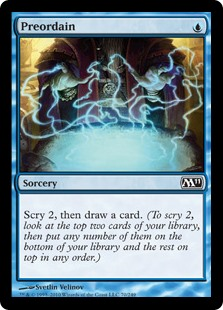
In a way, that is my answer. It didn't really feel special to play with Preordain. It was a definite improvement over the replaced cantrip, but not enough for me to feel strongly about the card. Its value swung wildly based on the situation and stage of the game, but so does that of any cantrip. Part of that may be how I played it, and it is very possible that decks would be built very differently with Preordain in the format. But players may also find that the lengths you have to go to just aren't worthwhile, like putting high-octane gas and racing lubricant in a Civic.

In Storm

I barely noticed any difference between Preordain and Sleight of Hand. This is probably because most of the time Preordain was Sleight of Hand. I will include the actual numbers when I circle back to this, but most of the time I kept one card and bottomed the other. You do get extra value from having options, but I didn't utilize them very often. It is entirely possible that I was wrong about that, but it certainly didn't seem that way to me or my team.
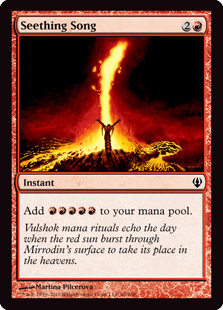
Preordain was swept up in the post-Pro Tour Philadelphia 2011 crackdown on combo. At the time it made sense—not all the combo decks used fast mana but they all used cantrips. Subsequent bannings have further weakened combo. Based on what I experienced, those later bannings made cantrips worse in combo. Games when I had a cost-reducer into Gifts Ungiven were far better than stringing cantrips together. It just didn't feel important to Storm.

In Control

Of course, it really doesn't feel special in UW either. It is unequivocally better than Serum Visions after turn four, but on turns 1-2, it's worse. In the mid- to late-game, you're looking for specific answers and Preordain delivers them right away instead of setting you up for next turn. However, early on you're just looking to get deeper into your deck, and Visions will always show you three cards. You get a random card that you won't play anyway and then set up for the next two turns. It's normally correct to Visions at the first opportunity as a result. Preordain cannot do that, so you don't play it early, saving it to find specific cards when you need them. I suspect that I should have played both, but hindsight is 20/20. I believe that I'm doing better as the game goes long but losing to mana screw early more often. We'll see what happens when the data comes in.

Part 2: Quantitative Results

The time has (finally) come to actually reveal the results of my latest banlist test. Looking back, testing two different decks made this harder than it needed to be. Focusing just on Storm would have yielded more satisfying data, though not a more significant result. As you will see, it appears that Preordain would not have that much impact on the top-tier metagame for a variety of reasons. Some of these I mentioned previously; a few will be explained here. However, this ultimately doesn't matter. Other developments since I began this test ensure that Preordain is never being unbanned.

What I'm going to do is reveal the aggregated result. My questions were, "Is Preordain safe for Modern?", and whether the overall data show if this is true. I'll then break it down by deck and matchup to show how that result was achieved. What you'll see is that Preordain did not significantly impact deck performance for either Storm or UW Control. This suggests that an unban is plausible. However, as I will get to later on, this result will not change Wizards's stance, and I don't anticipate playing Preordain in Modern in the foreseeable future.

Overall Result

I feel the need to start with this disclaimer: this is not a definitive result. The results I'm reporting are my experimental results and are meant to model the impact of unbanning Preordain on the Modern metagame. It would take many more tests with more decks to give a truly definitive result.

As a reminder, there were 640 total matches, or 320 with each deck. Play/draw alternated with each match regardless of result to ensure fairness and prevent bias. They were all typical matches---best of three with sideboarding. Please refer to the previous article for all the decklists.

  • Total Match Wins: 333
  • Total Win Percentage: 52%
  • Total Control Wins: 165
  • Control Win Percentage: 51.6%
  • Total Test Wins: 168
  • Test Win Percentage: 52.5%

As you can see, I didn't have very impressive results. I'll be going into why as I deal with each deck, but having Preordain didn't feel very special. It was very similar to Sleight of Hand in Storm, and was inconsistently good in UW. I think we all know what the statistical test will show, but I'm going to include it anyway for academic honesty.
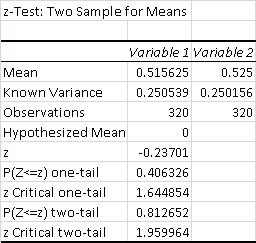
Once again, I'm reporting the z-test result because I think more people are familiar with it. As the P-value is greater than 0.05, we accept the null hypothesis and there is statistically no variation between the results. From this we can infer that Preordain had no real impact on my test decks.

Storm Results

Storm was something of an odd test for me as it really didn't feel like an integral piece of the testing. What I mean is that the matches rarely came down to how I, as the Storm player, played. A few times a poor sequence hurt me, but for the most part the actual combo played itself. I know I wasn't playing it perfectly, but Gifts Ungiven provided enough forgiveness that I didn't need to. If that card resolves, you should always win. My losses were either caused by me mulliganing to death or my opponent's disruption preventing me from comboing in the first place.
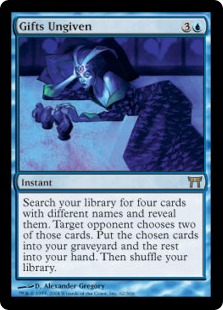
A note on sideboarding: Storm cannot afford to exchange many cards without severely harming its odds of comboing. I remember years ago hearing that Jon Finkel never sideboarded at all with Storm if he could help it, and who am I to argue with Johnny Magic? As a result I boarded as little as possible.

Grixis Shadow

I was told that Shadow was a very hard matchup for Storm. They have lots of relevant disruption and a powerful clock, the classic anti-combo recipe. This proved to be true, though Shadow has a hard time actually sticking a clock I found. They don't have that many threats, so sometimes I was able to play the long game and come back from having my hand shredded.

  • Storm Control Wins: 15
  • Control Win Percentage: 46.9%
  • Storm Test Wins: 16
  • Test Win Percentage: 50%

With only a one-game difference between test and control, there is no chance that the result is statistically significant, which the analysis confirms.
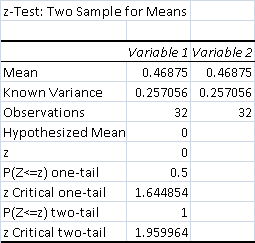
P > 0.05, so accept the null hypothesis, there is no statistical variation in the data.

Sideboarding really didn't change the matchup. Grixis had a pretty good gameplan pre-board, and it was still great after siding. There wasn't much that Storm could do to change that other than go for Empty the Warrens more.

Storm's Sideboarding:

-1 Grapeshot

+1 Empty the Warrens

Grixis Shadow's Sideboarding:

-2 Lightning Bolt -2 Terminate -2 Kolaghan's Command -1 Snapcaster Mage

+1 Grafdigger's Cage +1 Nihil Spellbomb +1 Izzet Staticaster +2 Stubborn Denial +2 Collected Brutality

Eldrazi Tron

I thought this would be a worse matchup than it ended up being. Storm doesn't fail with just one piece of disruption, so a single Thought-Knot Seer is not that bad. E-Tron sometimes just fails to do anything relevant except make a single big threat. Chalice of the Void was ignorable on one and often the game ended before they could put it on two. But when that did happen, it was game over for me.

  • Storm Control Wins: 16
  • Control Win Percentage: 50%
  • Storm Test Wins: 16
  • Test Win Percentage: 50%

Absolutely no change. Again, I don't think the statistical analysis is necessary, but here it is anyway.
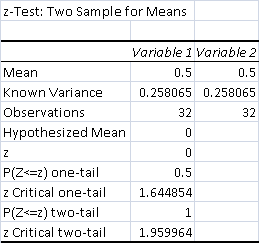
There's no statistical difference between the control and the test.

I suspect that sideboarding had a much larger impact on the matchup than expected. E-Tron brings in a lot of great ways to shut down Past in Flames, meaning you're forced to rely on Empty the Warrens, for which they have All is Dust and lots of creatures. Big Walking Ballistas were a nightmare, as was Wurmcoil Engine. We debated bringing in Shatterstorm for all the artifacts and ultimately decided against it. By the time you'd play it most games, you've already lost.

Storm Sideboarding:

-1 Grapeshot

+1 Empty the Warrens

E-Tron Sideboarding:

-4 Matter Reshaper -2 Karn Liberated -1 Endbringer

+2 Grafdigger's Cage +2 Relic of Progentius +2 Warping Wail +1 Wurmcoil Engine

Counters Company

Counters was a really swingy matchup. Play/draw really mattered because you're both combo decks and can kill on turn three. Game one was just a straight race, and Storm was more consistent. After boarding it got complicated. Counters has decent answers, and Storm does not, but it might just get locked out without Echoing Truth.

  • Storm Control Wins: 17
  • Control Win Percentage: 53.1%
  • Storm Test Wins: 18
  • Test Win Percentage: 56.3%

There's a theme with these results. See if you can spot it.
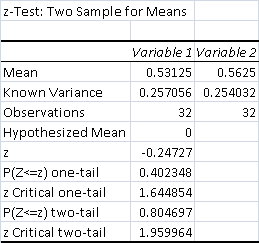
Again, little has changed. Preordain isn't important in a racing situation. It just ensured that you never fizzled, which is pretty rare anyway.

Since the goal was to win turn three, Storm didn't sideboard on the play. On the draw you had to be the control deck, relatively speaking, so there was sideboarding then.

Storm on the draw Sideboarding:

-1 Baral, Chief of Compliance -1 Pyretic Ritual -1 Desperate Ritual -3 Remand

+3 Lightning Bolt +1 Echoing Truth +1 Anger of the Gods +1 Pyroclasm

Counters Company Sideboarding:

-1 Qasali Pridemage -1 Kitchen Finks

+1 Eidolon of Rhetoric +1 Orzhov Pontiff

Burn

I thought Burn would be a better matchup than it actually was. I didn't appreciate how good Searing Blaze actually was against Storm. You're reliant on your cost reducers to go off, and Blaze kills them efficiently. Burn also reliably goldfishes turn four and can turn three you if your mana cooperates, so they can race you. Also, Eidolon of the Great Revel is lights out. The only way to win with that on the field is to Empty the Warrens. And you're probably dead anyway. We always played game one as if we didn't know what we were playing, but for games two and three my Burn pilot aggressively mulliganed for Eidolon.

  • Storm Control Wins: 19
  • Control Win Percentage: 59.4%
  • Storm Test Wins: 17
  • Test Win Percentage: 53.1%

Not a big change again. I believe the difference was the Burn's aggressive mulligans paid off a few more times against the test deck.
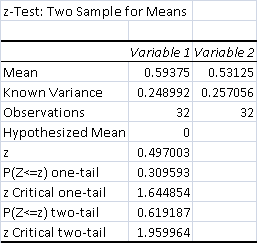
Again, not a significant result. Well within the "noise" of the test. I actually expected this. With a smaller n-value you need really disparate results to achieve statistical significance.

Sideboarding for Storm was hard here. You needed to remove Eidolon and couldn't rely on Empty. In exploratory testing I found that you could Empty for a lot and still die so we decided to stick to the Grapeshot kill as much as possible. On the draw we decided to add more counters.

Storm Sideboarding:

-1 Desperate Ritual -1 Pyretic Ritual -1 Baral, Chief of Compliance

+3 Lightning Bolt

Additionally On the Draw:

-1 Empty the Warrens -1 Gifts Ungiven

+2 Dispel

For Burn we took out the clunkiest burn spell and Lavamancer for relevant disruption. We debated Kor Firewalker for a while and decided against it.

Burn Sideboarding:

-1 Grim Lavamancer -3 Rift Bolt

+4 Relic of Progenitus

Jeskai Control

Jeskai was another swingy matchup, mostly because their clock was what really mattered. Given the time, I would just sculpt to my heart's content and win through their permission. The fact that this version didn't have Geist of Saint Traft helped on that front, but Spell Queller was also a beating combined with all their burn.

  • Storm Control Wins: 14
  • Control Win Percentage: 43.8%
  • Storm Test Wins: 15
  • Test Win Percentage: 46.9%

With a different sideboard on Jeskai's side I can see this matchup becoming much worse.
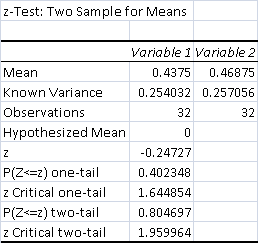
It's very significant how not significant these results are. I really am running out of things to say here; it's only going to get worse for UW.

For sideboarding we adjusted the counter suite for Storm while Jeskai really had the opportunity to adapt. The Empty plan is meant for disruption-heavy decks, but it really hates it when you prepare and have sweepers.

Storm Sideboarding:

-1 Grapeshot -1 Remand -1 Baral, Chief of Compliance

+1 Empty the Warrens +2 Dispel

Jeskai Sideboarding:

-4 Path to Exile -1 Lightning Helix -2 Electrolyze

+2 Negate +3 Rest in Peace +2 Supreme Verdict

Storm Conclusions

Preordain did not excel in Storm. It was simply too like Sleight of Hand, which it replaced, to have any significant effect. Where it was better was post-sideboard when you were digging for pieces and seeing only junk, but that didn't happen too often. Most games I cantripped a few times then attempted to go off. Even against Jeskai the games didn't tend to go very long. The opponent's disruption and clock mattered more than the power of my cantrips. Therefore, I have no evidence here that Preordain would change anything for Storm.

UW Control Results

Testing UW was far harder. A control deck has more decisions and takes longer to finish a game, which is why this took so long, but it also required more of a play adjustment between the control and test decks. Serum Visions and Preordain are better at different things and expecting one to do the other's job was disastrous in exploratory testing. As a result I had a harder time with the deck.

Grixis Shadow

UW has a pretty good matchup thanks to its redundancy. You can't really stop their first few turns, so they will shred you, but you are likely to recover and draw more powerful cards as the game goes on. As long as you don't just die to beefsticks you've got a great shot at out-valuing them.

  • UW Control Wins: 19
  • Control Win Percentage: 59.4%
  • UW Test Wins: 17
  • Test Win Percentage: 53.1%

You know by now where this is going.
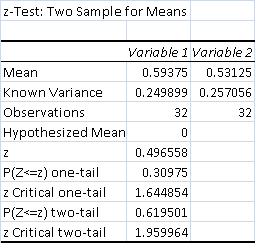
We didn't sideboard very much, both decks are close to where you want them maindeck. The adjustments were based on the assumption the games would go longer.

UW Sideboarding:

-1 Vendilion Clique -1 Spell Snare

+2 Rest in Peace

Grixis Shadow Sideboarding:

-2 Lightning Bolt -2 Terminate -1 Fatal Push

+2 Stubborn Denial +1 Liliana the Last Hope +2 Collective Brutality

Eldrazi Tron

Eldrazi was a weird matchup. Their deck is fairly inconsistent, and when I could use Spreading Seas to capitalize on that, it was easy. Against their good hands and/or Cavern of Souls, it got much harder. Playing only unconditional removal was very good as well. However, sometimes Eldrazi is just Eldrazi, and Chalice can prove backbreaking.

  • UW Control Wins: 15
  • Control Win Percentage: 46.9%
  • UW Test Wins: 16
  • Test Win Percentage: 50%

There's not much to say really, it was just a slugfest.
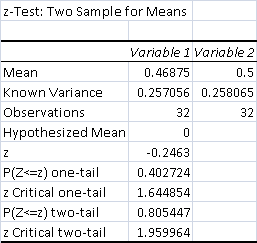
UW is almost pre-sideboarded against Etron. I wished it wasn't, as I would have liked more Detention Spheres for Chalices, but that wasn't an option. I debated Spell Queller but it didn't perform in exploratory.

UW Sideboarding:

-1 Spell Snare

+1 Supreme Verdict

Etron Sideboarding:

-2 Dismember -2 All is Dust

+2 Hangerback Walker +2 Relic of Progenitus

Counters Company

This was a weird matchup. Sometimes Company went for the long-game; sometimes it was just jamming the combo. UW never felt safe and it was a really stressful test.

  • UW Control Wins: 17
  • Control Win Percentage: 53.1%
  • UW Test Wins: 15
  • Test Win Percentage: 46.9%

Collected Company is a hell of a card.
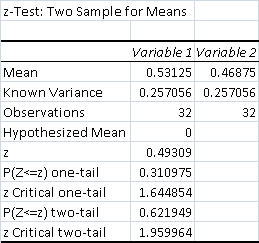
I decided to target the Company value plan with my sideboarding, since that was their best card and I didn't really have more ways to interact with the combo. Spreading Seas is not effective against mana dorks.

Company went for sweeper insurance.

UW Sideboarding:

-4 Spreading Seas -1 Mana Leak -1 Logic Knot

+3 Rest in Peace +2 Dispel +1 Supreme Verdict

Counters Company Sideboarding:

-1 Fiend Hunter -1 Vizier of Remedies -1 Devoted Druid -1 Qasali Pridemage

+3 Voice of Resurgence +1 Selfless Spirit

Burn

This went worse for UW than I thought it would. It plays less lifegain and fewer counterspells so it can be a struggle.

  • UW Control Wins: 17
  • Control Win Percentage: 53.1%
  • UW Test Wins: 18
  • Test Win Percentage: 56.3%

I know the percentage jumps look big but that's just a quirk of small n samples.
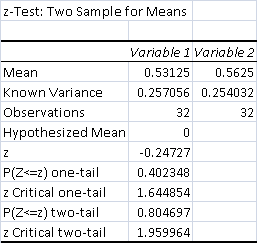
Sideboarding is what you'd expect: dead cards out, counters in. The Quellers were pretty good here as both disruption and a clock. You can't wait forever against Burn. Spreading Seas is too tempo-negative to play early, and late, it's not relevant disruption.

UW Sideboarding:

-4 Spreading Seas -3 Supreme Verdict -2 Jace, Architect of Thought

+4 Spell Queller +2 Dispel +2 Timely Reinforcements +1 Negate

Burn Sideboarding:

-4 Searing Blaze

+4 Relic of Progenitus

Jeskai Control

We played this matchup as a control deck against a midrange deck. Neither I nor my Jeskai pilot were sure that's correct, but nothing else made sense at the time. It was weird because most of their cards aren't good but can still kill you if unopposed. Blessed Alliance was shockingly good as a result.

  • UW Control Wins: 16
  • Control Win Percentage: 50%
  • UW Test Wins: 20
  • Test Win Percentage: 62.5%

This matchup was the closest to actually significant results I got. I think if I had done the usual 50 it would have been significant for reasons I'll describe below.
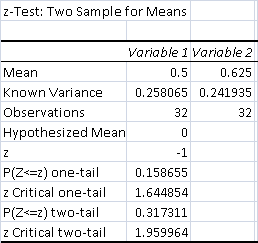
Sideboarding in control mirrors is hard. I decided that his Snapcasters were better than mine and that I wanted to fight on his turn to resolve planeswalkers. I also didn't want to just lose to burn.

UW Sideboarding:

-4 Spreading Seas -3 Supreme Verdict -2 Condemn -1 Blessed Alliance

+4 Spell Queller +3 Rest in Peace +2 Dispel +1 Timely Reinforcements

Jeskai Sideboarding:

-2 Lightning Helix

+2 Negate

UW Conclusions

The Jeskai test revealed why my results didn't change much from control to test. Preordain is a mid-game card, and Serum Visions is an early-game card. What I mean is that during mid-game topdeck wars, Preordain is better, because you can find and cast the card you want right way. Visions gets you deeper, but you get a random card. This is great in the early game where you want to hit land drops and set up your turns. When games end quickly, Preordain doesn't get the chance to shine.
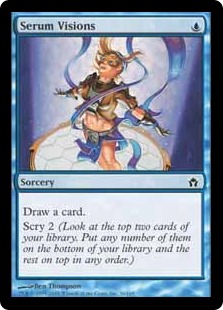
Preordain's Place

Based on my results and experience playing the card, I do not believe that Preordain is unequivocally better than Serum Visions. During the first few turns, the smoothing power of Visions is far superior, and if you want a card to set you up for the long game, you would always choose that card. However, when you need to find something right now, Preordain will be your go-to. As a result, I don't believe that they necessarily fight for space, nor would you always play sets of both. A mix is more likely. With this in mind and my lack of significant results, I believe that Preordain could be unbanned.

Some Caveats

I wasn't testing decks that overload on cantrips. This was a deliberate decision to keep this as scientific as possible. If I start wildly redesigning decks, then the test becomes more about my deckbuilding ability than the actual strength of the cards. As I've said from the beginning, it's better to use an established list and see how the card boosts its power. So I didn't play 12-cantrip Storm or Serum Visions and Preordain in UW Control.
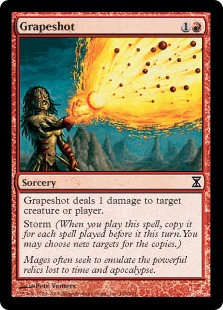
In Storm, I'm certain this was fine. I've played heavy cantrip Storm in Modern before, and the Gifts version feels better. Having a way to search for mana and Past in Flames was very good, and I can't fathom cutting that package. Players have argued that I should just cut the utility spells for extra cantrips, but I'm skeptical. As noted, Chalice and Eidolon win the game against you, and having a few ways to answer them is necessary. The cantrips are still weaker than Legacy's; a single Echoing Truth is not going to cut it.

As for UW, I'm not certain. Finding the room for cantrips requires cutting real cards. Modern is faster than Legacy, so you can't really durdle or fill your deck with air, especially as a control deck. Miracles got away with that thanks to Counterbalance. Maybe it would be correct, but I'm uncertain. In any case, trying to find out adds more variables and is therefore untestable at this time.

It Was All for Opt

The problem is that nothing I've just said really matters. This has nothing to do with its value or the process, but with Magic moving on while I've been working. See, Opt has effectively killed Preordain's chance to be unbanned. The first reason is similarity. Opt is Preordain, adapted for instant speed. The effect is weaker, but it gains speed. Standard Wizards balancing strategy. Yes, I know Opt came first, but it wasn't appreciated in its time. If you have to nitpick, just flip my statement around; it's still true.
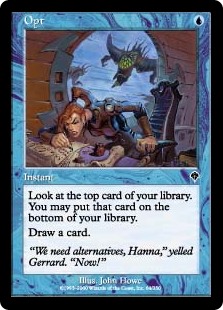
This feeds into the other problem. Wizards has previously said that too many cantrips is a problem. They're worried both about consistent combo and overly consistent control (à la Caw Blade). They're fine with a few weaker cantrips, but add some more power and things get risky. As a result, I think Opt is a definitive statement to the Modern crowd that the cantrips won't be unbanned. Wizards will not risk cantrips killing variance again.

In the end, that's my conclusion. Preordain is not necessarily better than Serum Visions, and would be a worthwhile risk to unban. This will not happen because Opt subsumes Preordain's theoretical place.

See you next week for the results of fitting Ixalan into Merfolk.

Insider: Advice for LGSs – Playing to Your Strengths

Are you a Quiet Speculation member?

If not, now is a perfect time to join up! Our powerful tools, breaking-news analysis, and exclusive Discord channel will make sure you stay up to date and ahead of the curve.

Welcome back, readers!

Today's article is aimed heavily towards game store owners, but should also be useful for any binder grinders (if they still exist, as I haven't seen as many at major events anymore).

First I'd like to look at a way of calculating profits from single sales and buylisting, and discuss what it means for your pricing. Next I'll discuss some of the natural advantages an LGS has over online stores, and how you can take advantage of them.

Transactions

First, let's take a look at the equation for compound interest.

P = C (1 + r / n) ^ (n * t)

where

P = future value
C = current value
r = interest rate
n = number of times compounded per time increment (typically year)
t = number of years

I'm sure you're asking what this has to do with transactions and Magic cards. Well, that equation is very similar to one for inventory growth with regard to trade-ins. An example will illustrate.

Let's say there's a Standard staple retailing for $10, and a hot Commander staple also retailing for $10. In order to trade in for either, players have to trade in $12.50 worth of cards (so we'll say our trade-in rate is 25% above the retail price of the card). Assuming you have a large Standard and Commander playerbase, and that each playerbase has the hot $10 card the other wants (but for some reason always trades into the store), then we fill in for our variables like so:

P = $10 * (1 + 0.25) ^ n

If we get to make this trade 4 times (thus n = 4), then our inventory value (P) has gone up to $24.40. If we can do this type of swap 8 times then P goes up to $59.60. The buylist pricing of 25% is a pretty aggressive (for most stores that percent is higher)—but the point of this exercise is to highlight that by repeating transactions growth becomes exponential.

For fun consider the following options (as a store owner) and guess which one generates the most future value.

  • Trade-in rate is 35% and you get 3 transactions per day.
  • Trade-in rate is 25% and you get 4 transactions per day.
  • Trade-in rate is 20% and you get 5 transactions per day.

The winner is 20% (by a small margin). Now, I'm sure you might be thinking, "Well, the small margin (around $0.2) isn't worth the extra effort of 66% more transactions per day." However, the point here is that you're more likely to increase the number of transactions by being more aggressive/competitive.

Now why did I write this? The honest reason is that I've seen stores that when they start to struggle financially they raise their prices (which in this instance is similar to raising their trade-in rate) to try to increase their profit margin. They are likely dissuading players from buying from them or trading in because it costs them more to do so. I've seen it happen repeatedly in my own area and I've heard it from numerous players at events.

Many major businesses run on much tighter profit margins than most Magic stores' single sales (granted there are a lot of other factors, but the point is still valid) and those businesses are profitable because they make up for small profit margins through massive quantities of transactions. It's absolutely critical as a store owner to understand that, thanks to internet services like TCGplayer and eBay, you are competing with a slew of other sellers when it comes to singles.

Store Growth

This leads into my next subject. While competition in singles sales is very fierce, there are certain areas your brick-and-mortar store has a natural advantage.

First, I'll state that I don't own a store, nor do I want to at this time. (I've run the numbers, and unless I was wildly successful it wouldn't be worth it to me from a financial perspective.) That being said, I've been watching my favorite LGS start to decline. While I've offered suggestions (and many other players have as well) they've been slow to implement any of them. Friends of mine like to discuss buying out the owner and running it as a group. I admit this is an interesting idea, though I imagine it would require a lot more effort than one or two nights a week.
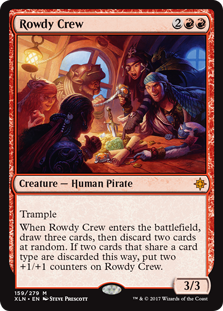
As I stated earlier, Magic singles are an extremely competitive market. Forgetting that can cost you (as it did one of our local stores). One of the most important things to keep in mind is that a local game store is supposed to be a place for players to come together and enjoy spending their free time gaming. In light of this, there are a few things an LGS can provide that internet stores can't.

Tournaments

Only WPN stores can run sanctioned tournaments, so as long as players want to play in sanctioned tournaments there will always be a need for local game stores. That being said, tournaments are often not the best source of income, especially if there is a cash prize. The typical cost of running something like a PPTQ for 24 players is around $420-$450 (if you get a judge) or closer to $320-$350 without one. However, tournaments can create a strong immediate demand for singles as players need the cards to compete.

Your local playerbase is only so big, and while the Standard format may shift somewhat frequently, eternal formats tend to be a bit slower. That means players are often less likely to purchase large swathes of cards over and over unless they are just getting into a format. With that in mind, it can be very profitable to offer tournaments in lots of different formats. Thus you can expand your sales without requiring a ton of new players (though different formats may bring in some new players as well).

Drafts

While these are technically tournaments already, drafts offer additional benefits. They keep a steady supply of singles getting added to the local marketplace (and thus smart owners would aggressively target the ones they can't keep in stock). They tend to offer continual cash flow (as most players will have to pay cash to enter a draft). Finally, they boost your sealed product sales, which is important with some distributors (stores that sell a lot of sealed products and thus buy a lot from distributors can get additional benefits not available to stores that don't).

They can also help sell Magic-related products like sleeves and deck boxes. Drafters often come unprepared to open a valuable card, and they'll want to protect it if they do (I can't tell you the number of times I've been in a draft and heard one of the drafters tell the store owner they needed to buy some sleeves).

Snacks

While players can obviously get snacks from restaurants or grocery stores, the beauty of a game store is that most players will spend a decent amount of time at the store once there, which means you have a semi-captive audience. Snacks can have a very good profit margin and still be cheap thanks to the availability of bulk stores like Costco and Sam's Club. I know my LGS probably makes $10-$15 of profit per night thanks to snacks and drinks.

Comraderie

I know my LGS is one of my favorite places to hang out and talk with fellow gamers and like-minded individuals. I have spent hours at my LGS without playing a game before, and I imagine many of you have done the same. Two of the three guys in my wedding party are people I met playing Magic (the other, my best man, is my brother) and I met both of them at game stores.



Now, one challenge for game store owners is definitely dealing with toxic people. On one hand you don't want to alienate a paying customer, but on the other you can't allow that customer to turn away other customers. In this instance it's important to post the rules you expect everyone to follow out in the open and to hold people accountable to them.

I know one local store that doesn't allow swearing and they will call you out on it if you do (which is usually enough for someone to apologize and be more careful). Other stores don't mind as much, but in doing so they may be sacrificing some of the "family" atmosphere they might have had. However, I also know clientele that avoids the "family friendly" places because they don't want that atmosphere, so it's a balancing act.

Other Games/Products

Stores can also be a "one-stop shop" for all things gaming related. Many of my fellow writers and I advocate for diversification when it comes to speculation—it's just as important to diversify your product offerings to non-Magic items as well.

The most successful game store in my area actually focuses more on board games, and Magic is just an additional source of income. The most recent store to go under did almost exclusively Magic (with a little Dragonball Z, but not a lot). Standard is typically one of the big cash cows for stores, thanks to the constantly shifting metagame and the expiration date of its cards. If the format ends up boring and players grow tired of it, a Magic-only store can easily find itself with dwindling customers.

Conclusion

In the end the purpose of this article was to help stores, especially those who might be struggling financially, with some advice. The first part was mainly to show that increasing your profit margin per transaction may not necessarily be the best path to profitability. The second was aimed to remind stores what they actually do have a monopoly on (as opposed to the singles market, which is arguably over-saturated).

Daily Stock Watch: Chromatic Lantern

Are you a Quiet Speculation member?

If not, now is a perfect time to join up! Our powerful tools, breaking-news analysis, and exclusive Discord channel will make sure you stay up to date and ahead of the curve.

Hello, everyone and welcome to the Tuesday edition of the Daily Stock Watch! If you're still shopping for cards during this holiday season, our card of the day is something that you might be interested in picking up. I have a feeling that it will take a while for this card to be reprinted again, but you know how crazy new sets could be. You never know what you're gonna get.

There was an error retrieving a chart for Chromatic Lantern

I was active in Magic when this came out during Return to Ravnica, and I was pretty sure that it was going to be a great card someday. I didn't really have the funds back then to keep all the cards that I wanted to keep (note that this was a $3 card during its early days) and had to choose between Chromatic Lantern and Desecration Demon. I chose the latter, and was greatly rewarded for a while as it reached the $10 plateau during its prime, but wasn't able to keep copies of the lantern, as it was better to buy and sell shocklands back then. It was a sleeper that was hard to miss, but I'm sure we all have stories like this one.

I think it's safe to say that Chromatic Lantern is a Commander staple today, and in the years to come. It fixes any mana base, and is a very efficient source of mana as well. It could nicely fit in any deck that needs or doesn't need the mana boost, but would benefit more from its fixing prowess. Just check out this MUD list in Vintage that uses a singleton Chromatic Lantern on its list.

MUD

Creatures

1 Triskelion
1 Karn, Silver Golem
1 Sundering Titan
4 Goblin Welder

Instants and Sorceries

2 Thirst for Knowledge
1 Crop Rotation
1 Vampiric Tutor
1 Ancestral Recall
1 Swords to Plowshares
1 Tinker
1 Demonic Tutor
1 Balance

Other Spells

1 Mana Crypt
1 Chromatic Lantern
1 Black Lotus
1 Mox Jet
4 Sphere of Resistance
4 Smokestack
3 Tangle Wire
3 Crucible of Worlds
1 Trinisphere
1 Sol Ring
1 Powder Keg
1 Mox Sapphire
1 Mox Ruby
1 Mox Pearl
1 Mox Emerald

Lands

4 Wasteland
1 Barbarian Ring
1 Spire of Industry
1 Strip Mine
1 Tolarian Academy
3 Gemstone Mine
3 Mana Confluence
4 Mishra's Workshop

Sideboard

2 Choke
1 Wurmcoil Engine
1 Jester's Cap
2 Null Rod
1 Ancient Grudge
1 Abrade
4 Grafdigger's Cage
2 Tormod's Crypt

Vintage is slowly starting to look like a richer man's Commander, as cards that are restricted to one per deck are bountiful in this format. Although Chromatic Lantern is nowhere near the caliber of these power cards, it is vital in fixing this deck's mana base that relies on lands that produce colorless mana, and are only supported by the different types of moxes to produce colored mana. If MUD decks start packing lantern consistently, breaking its current all-time high of $14.99 won't be hard to do.

Super Mana Stones

Above are cards that are in a class of their own (value-wise) and is in a territory that would be hard to enter as a mana stone. It's really hard to tell if Chromatic Lantern would belong in this group in the next couple of years due to supply and power level issues, but it certainly is in the right direction to reach new financial highs. However, I don't think that I would be paying $15 for this card for spec purposes, and would even try bargaining for less if I need one for my deck. There's a fine line that I always consider before I cross when buying EDH cards -- if my deck could make do without you, then I don't think that you're a necessity. This has always been my impression on this card, unless I'm running a big mana Commander that runs three or more colors.

However, this segment isn't about my opinions entirely and when money talks, you listen. Barring any random inclusion in a future supplemental product, Chromatic Lantern should cross the $20 barrier during the first quarter of 2018, and might never look back. At that point, I might say that it would be best to start moving it. For now, hold on to your horses and watch them gallop higher as the new year enters.

At the moment, you could still find a few copies of Chromatic Lantern from Commander 2016 via Star City Games at $14.99. This is selling out more than the Return to Ravnica version probably because it already has the authenticity seal which some players prefer. The RTR versions are available in other sites as well such as TCGPlayer, Channel Fireball, and Card Kingdom for as low as $13.99, and should be good pickups if you need some for utility. I'm not so sure how the Masterpiece version would fare in the future, but it should be good to hold on to your copies. I don't think it's a good idea to buy and sell these Inventions, anyway.

And that’s it for the Tuesday edition of the Daily Stock Watch! See you again tomorrow, as we check out a new card that should be on the go, or good enough for speculating. As always, feel free to share your opinion in the comments section below. And if you want to keep up with all the market movement, be sure to check in with the QS Discord Channel for real time market information, and stay ahead of the hottest specs!

Daily Stock Watch: Celestial Colonnade

Are you a Quiet Speculation member?

If not, now is a perfect time to join up! Our powerful tools, breaking-news analysis, and exclusive Discord channel will make sure you stay up to date and ahead of the curve.

Hello, everyone and welcome to the Christmas edition of the Daily Stock Watch! I hope you're enjoying this day, wherever you might be, and we'll try to add to your wonderful day with some cool Magic news via this segment.

Our card for the day is actually a Modern staple that has been making great strides towards the end of the year, and is poised to enter the new year as one of the more valuable lands in the format, both financially and strategically.

There was an error retrieving a chart for Celestial Colonnade

Celestial Colonnade has positioned itself as one of the biggest threats in any UW shell, and is one of the main reasons why decks such as Blue White Control and Jeskai variants have remained competitive in Modern throughout the years, regardless of the metagame environment that the format is enjoying. It is a "sleeping" threat that lies dormant as the game goes by, and is only animated once board control has been established, or a solution to a troublesome planeswalker is needed.

Today, this card just hit its all-time high of $53.49 for non-foil copies, and it's possible that it has only scratched the surface, as more Jeskai players and decks are showing up in the top eight of recent Modern tournaments. Let's take a look at one of these decks that I'm talking about.

Jeskai Midrange

Creatures

3 Geist of Saint Traft
3 Rattlechains
4 Snapcaster Mage
4 Spell Queller

Instants and Sorceries

4 Cryptic Command
2 Electrolyze
4 Lightning Bolt
3 Lightning Helix
2 Mana Leak
1 Negate
4 Path to Exile
2 Spell Snare

Lands

4 Celestial Colonnade
4 Flooded Strand
2 Hallowed Fountain
3 Island
1 Mountain
1 Plains
1 Sacred Foundry
4 Scalding Tarn
2 Steam Vents
2 Sulfur Falls

Sideboard

3 Ceremonious Rejection
1 Dispel
1 Elspeth, Sun's Champion
1 Izzet Staticaster
1 Lightning Helix
3 Rest in Peace
2 Runed Halo
2 Stony Silence
1 Supreme Verdict

There are a couple of reasons why Celestial Colonnade is quite expensive right now: first, it was only printed in Worldwake, and the only other version out there is its buy-a-box promo; second, almost every player who would use it in their deck would like to have a complete playset, and that alone is enough to drive the demand for it; and lastly, (although this is just my opinion) players are fond of the idea that it has dodged possible reprints from the Masters sets over the last couple of years, and that a return at Masters 25 still seems unlikely for these manlands cycle.

Celestial Colonnade hasn't found its niche yet in Legacy, but the Utility Checker shows us that 7% of winning decks in Modern uses an average of 3.5 copies of this card. That says a lot about this card, as it is the most used manland in the format, and is only overshadowed by fetchlands, shocklands, fastlands, and the old reliables Cavern of Souls and Eldrazi Temple. There will always be a demand for this card, and we've also discounted the fact that this is also an auto-include in Commander decks that are running UW. The rise in its price could continue for at least the next two weeks, unless something really drastic happens on the next announcement of restricted and banned cards. If nothing happens by then, we could be staring at another $60-$70 card by then.

The Zendikar Manlands

If there's something that we learned about Modern and WotC, it's very likely that this cycle of manlands will be reprinted together in a new Masters set (or perhaps in the returning Core Set?) within the coming year(s). Although Lavaclaw Reaches and Stirring Wildwood has found very little to no success at all in Modern, singling them out by adding the other three manlands in a supplemental product could leave a bad taste in the mouth of other players. However, history tells us that crazier things have happened in Magic.

I am a natural UW player, and I love Celestial Colonnade because it's a very good card, but I think that every good run has to end (financially, at least.) Right now, Star City Games is out of stock across the board for all versions of this card, but Channel Fireball has lots of it at $54.99. You could also find copies for the same price via Card Kingdom if you really need them, but I'd like to stay away from these cards for now. I'd usually wait for the next announcement before I make any moves on Modern staples that's as good as this one, but my gut tells me that you could move your copies around if you don't need them, as that will always be the safer play at this point in time.

And that’s it for the Christmas day edition of the Daily Stock Watch! See you again tomorrow, as we check out a new card that should be on the go, or good enough for speculating. As always, feel free to share your opinion in the comments section below. And if you want to keep up with all the market movement, be sure to check in with the QS Discord Channel for real time market information, and stay ahead of the hottest specs!

Insider: Holiday Season Speculation

Are you a Quiet Speculation member?

If not, now is a perfect time to join up! Our powerful tools, breaking-news analysis, and exclusive Discord channel will make sure you stay up to date and ahead of the curve.

Happy Holidays! I hope everyone is enjoying this holiday season with family, friends, or at least a few days off from work. I myself will enjoy eleven consecutive days off from work—probably one of the top five longest times off in my entire career. When this combines with some wintry weather, it truly becomes my favorite time of the year.

But just because I’m off from my day job doesn’t mean I’m taking a break from writing! No way! There is still so much to discuss when it comes to MTG finance. That being said, in light of the holiday spirit I am going to shift topics a bit. I had originally planned on writing a very serious piece about risk tolerance, life circumstances, and why it’s critical to get some other areas of life in order first before going deep on MTG finance. Such a topic, however, seems way too serious given the timing.

So I’m going to table this topic for another time and write something a little more lighthearted this year. I’m going to look at four holiday spec ideas perfect for this time of year. While lighthearted in nature, these are also very viable targets that people may think about a little more frequently over the holidays!

Winter Cards

One of my favorite sets growing up playing Magic was Ice Age. These booster packs were still readily available when I started playing. I love the snowy, wintry theme of the set too because winter is my favorite season of the year.

Sadly there aren’t many cards worth speculating on from the set. It is simply too underpowered. If someone insisted to me that they wanted an Ice Age target, I’d probably pick one of the fifty Reserved List cards from the set. Just look at what’s low in stock on TCGplayer and pick up a few copies.

Fortunately there are far more interesting targets outside of Ice Age block. For starters, did anyone notice the buyout on Winter Mishra's Factory?

The Winter printing of this popular card has always demanded a premium, but it looks like that premium is about to grow even further. This feels like market manipulation to me, but given the rarity and popularity of this card, I do expect the price to linger higher going forward.

Want a more recent winter card that I think has some real potential over the long term? How about the winter version of Extremely Slow Zombie, in foil?

I can’t advocate buying into nonfoils—not yet, anyways. This is just a common, after all. But in time these will likely grab casual collectors’ attention because of the fun seasonal theme of this card. I predict foils of the winter version will be the most valuable in the long run.

Holiday Promos

When the holiday promos initially launched, I thought they were brilliant and exciting. Fun, holiday-themed cards printed in rare quantity? Sign me up!

It all started with Fruitcake Elemental back in 2006.

While a novelty at first, we’ve now seen twelve of these printed, one each year since inception. As you can see in the chart above, some of these would have been dead money had you speculated on numerous copies. Though, I suppose like fruitcake, these specs won’t ever be reprinted and “go bad.”

Bad jokes aside, there is one of these that is a little more in-demand than the rest. My personal favorite (and the only one I own a copy of) is Gifts Given. This is a popular cube card and has crept up from $120 to $150 over the last few years. This is hardly an exciting game to write home about, but the upward momentum is at least there.

Some of the other holiday promos may also be worth looking at, but it appears most of them have seen a downward price trajectory over the past few years. I think with the printing of a new holiday card each year, the allure of these promos is starting to wear off. As usual, Wizards tends to overdo things and this may be yet another example of how they tend to saturate markets after discovering a novel idea.

If you want a Gifts Given or Fruitcake Elemental for your collection, I don’t think you’ll lose money on them. But as for the newer holiday promos, I think you can take your time completing the collection.

Coldsnap Product

Digging a little deeper into obscurity, one idea that I have a personal appreciation for is sealed Coldsnap product. Why, you ask? Because Coldsnap was tremendously unpopular when it was released; it was undersold, and therefore underprinted. The set also came out before Magic’s most recent boom, so the amount of product relative to the player base is way below par.

I would recommend having a look at Coldsnap booster boxes. It’s a steep investment to pay $365 for a box of this set, but take a quick look at the box prices I see on eBay. The curve is very steep:

$365: 1 box
$380: 1 box
$384: 1 box
$390: 2 boxes
$400: 1 box
$408: 3 boxes

Now, looking at eBay completed listings I see only one box has sold over the past few months. So this is going to be an extremely slow mover. Probably not the ideal investment vehicle given the opportunity cost. But you can see that once the cheapest few boxes dry up, you’re looking at some real movement. It’s also worth noting the cheapest box on TCGplayer is $420. If you’re the type who enjoys collecting old product and investing in sealed boxes, don’t overlook this set.

Ice Age Books

Speaking of Coldsnap, here’s a fun fact. Did you know that the Coldsnap Fat Pack came with the first book of the Ice Age series, The Gathering Dark? This book, originally printed in 1999, was essentially reprinted for these Coldnsap Fat Packs.

This was a terrific book written by my favorite Magic author, Jeff Grubb. He did a phenomenal job capturing the feel of the Ice Age lore in Magic. For nostalgic fans of this set, I’d highly recommend it.

But I must warn you of something before you make the commitment. You see, after reading The Gathering Dark you are likely going to want to read books two and three of this series: The Eternal Ice and The Shattered Alliance. Both of these books are also written by Jeff Grubb, and are therefore excellent reads. They even have my all-time favorite Magic character, Jaya Ballard!

Here’s the problem: Wizards may have increased supply on The Gathering Dark by putting these in Coldsnap Fat Packs, but they didn’t reprint the second and third books of the series! Therefore there is far more demand for the books than there is supply, leading to strangely high prices for mass-market paperback books.

The Eternal Ice, the second book in the series, will cost you around $20 for a fairly used copy. Given that most brand-new fantasy paperbacks tend to retail in the $8-$10 range, you're already going to have to hold your nose to purchase this 17-year-old book. But that’s nothing compared to the rarest, third book in the series. Take a look at some recently completed eBay listings for The Shattered Alliance.

That’s right, the third book of the series is worth over $60. In fact I see two copies on eBay in the $60 range, and then the next cheapest jumps to $80. For that price you’d expect to receive a collectible hard-covered copy signed by Jeff Grubb himself! But instead all you get is a used paperback fantasy novel.

Now you may think this is far too niche to speculate on, and you’re probably right. But here’s what I’ll leave you with: check out your local used book stores the next time you have a chance. I have found two copies of The Shattered Alliance at my local Half Price Books in the four years I’ve been going to the used book store.

These books are out there: in moms’ basements, in boxes of old library books, and everywhere in between. Every once in a while one will surface, and being completely ignorant of this market it will be priced at just a few bucks as most used fantasy paperbacks should be. That’s your chance to get a copy, enjoy a wonderful story about Magic’s earliest block, and make a few bucks along the way!

Or you could just buyout the market of this book to prey upon completists who need to know how the series concludes [maniacal laugh].

Wrapping It Up

While lighthearted, the prospect of speculating on winter-themed cards isn’t so far-fetched. After seeing the winter printing of Mishra's Factory get bought out just two days before Christmas, I realized that Magic speculators aren’t taking the holiday season off. Neither am I. I genuinely think investing in some of the ideas presented above will make you money over the long term.

Are these the most exciting targets for 2018? I highly doubt it. There will be plenty of new ideas as next year unfolds, and you won’t want a ton of capital tied up on these slow-moving assets. But if you appreciate the winter and its holiday season as much as I do, you may get some appreciation from these ideas along the way. What better way is there to speculate on something than to enjoy it for a few years first before selling for profits? That’s the way I like to do Magic finance a lot of the time, and it may prove attractive to you as well.

Especially the books. Don’t write those off because they really are quite good.

…

Sigbits

  • I noticed this morning that Star City Games was once again sold out of Library of Alexandria. This card, along with a few other heavy-hitters from Arabian Nights, are very likely to move higher in 2018. If you are still in the market for one of these I’d highly recommend prioritizing them soon. Not because I want to incite panic-buying, but because I think waiting 12 months on this card will result in the need to pay a much higher price.
  • 2018 may also be the year of Legacy. Why? Because for the first time in many years, Legacy will be showcased at a Pro Tour! While admittedly it’s part of a team-based event that includes Standard and Modern, the fact that dual lands will be critical for hundreds of players to win the Pro Tour means demand may spike temporarily. After the recent jump in prices this year, supply hasn’t exactly poured back into the market. For example, Star City Games has just 13 Revised Underground Seas in stock at $499.99.
  • Another trend of 2018 may be related to CE and IE Power. These have spiked lately, and as a result Star City Games is basically sold out of all Power from these collector sets. Their prices are about in line with Card Kingdom’s buy prices, indicating that SCG will have to adjust their prices come the new year. Expect these to climb higher, especially as Unlimited copies continue their relentless climb higher.

Insider: Profiting from Pauper

Are you a Quiet Speculation member?

If not, now is a perfect time to join up! Our powerful tools, breaking-news analysis, and exclusive Discord channel will make sure you stay up to date and ahead of the curve.

From 2018 onward into the foreseeable future, Channel Fireball controls all Grand Prix. The company made a statement last week that they would include Pauper side events at the four events they will be holding in January, and they publicly said that they are testing the waters for a potential Pauper Grand Prix. It’s very likely these Pauper side events will be successful and will become mainstays at all of the CFB events going forward.

Remember when Star City Games seemed to have a stranglehold on the market, and Legacy in particular seemed to live and die on the whims of their Open circuit? Channel Fireball has been vested with incredible power over the market – and on a global scale compared to SCG’s regional focus – so them pushing a format like Pauper could have huge implications. Supporting Pauper with juicy side events, exposure on their website, and ultimately a Grand Prix, would elevate demand for the format tremendously.

Imagine what would happen to the market if CFB announced a Frontier Grand Prix. Many Pauper cards are in much lower supply than Frontier cards, and the impact of it becoming widely played are likely to be significant. It’s certainly speculation at this point to assume Pauper is on the precipice of blowing up as a format, but it would also be foolish to ignore the fact that the format has moved from the casual realm to being taken seriously by the company that now has a monopoly on all Grand Prix and their side events.

Assuming Pauper becoming significantly more played impacts the popularity of all decks and demand for all cards equally, the impact on the prices of cards won’t be equal, given the massive differences in print runs across the sets the format contains. I imagine that every and all staple cards will rise in price, so it seems like almost any commonly played card is a safe bet, but identifying the cards with the most potential to spike will be the path to the most profit. My eyes is on the oldest cards with the least supply, including cards that see casual or competitive demand that already have a strong price. The cards tournament-legal for these Pauper events will correspond with the Magic Online cardpool and banned list, so I’m also paying attention to cards that haven’t seen a common printing in paper and thus are in less supply than commons from the same era.

There was an error retrieving a chart for Oubliette

Oubliette isn’t the most efficient removal spell in Pauper, but the fact that it leaves two black devotion behind means it’s amazing with Gray Merchant of Asphodel, so it’s included in the very competitive Mono-Black Devotion deck. Oubliette is the most expensive card in Pauper, over $20, and its price nudged up about $0.75 last week to make it the biggest gainer since the announcement. With the very oldest cards in Magic seeing great price increases lately, I imagine that it would see a legitimate spike if a Pauper Grand Prix is ever announced.

There was an error retrieving a chart for Gush

Gush isn’t Legal in any competitive format besides Vintage, but it still demands over $2 for its casual appeal, and as one of the very best cards in Pauper, I expect it would see significant gains if the format catches on.

There was an error retrieving a chart for Quirion Ranger

Quirion Ranger is a staple of Elf and Stompy decks, and it’s already in demand from the Legacy and casual crowd, so $2 for this relatively old card in short supply seems like a bargain if Pauper takes off.

There was an error retrieving a chart for Nettle Sentinel

Another cards in Elf and Stompy decks is Nettle Sentinel, which commands a price of almost $3 as a Modern staple, and Pauper seeing more paper play would bring it higher.

There was an error retrieving a chart for Utopia Sprawl

Utopia Sprawl is almost $5 on the back of fringe Modern and casual play, and as a Pauper staple in the White-Green Auras deck as well as any combo decks looking to abuse untapping lands, it will rise along with Pauper.

There was an error retrieving a chart for Chain Lightning

Chain Lightning was one of the very most expensive Pauper cards before being reprinted in Eternal Masters, but it’s still over $3, and it’s a staple in Burn and other red Pauper decks.

There was an error retrieving a chart for Spidersilk Armor

Spidersilk Armor is an important sideboard cards in Pauper decks, where it plays well against fliers and also damage-based removal spells like Electrickery, and at almost $1.50 based on casual play, it’s a good candidate for a price increase.

There was an error retrieving a chart for Gorilla Shaman

Gorilla Shaman is one of the best sideboard cards in Pauper, where it wrecks the artifact lands played by Affinity and Kuldotha Boros. It’s extremely cheap at under a quarter, so it could offer significant gains.

There was an error retrieving a chart for Chainer's Edict

Chainer's Edict is a staple removal spell, and is used in a wide variety of black decks, often as a four-of.

There was an error retrieving a chart for Battle Screech

Battle Screech is a staple of the Kuldotha Boros deck, which is currently one of the very best decks in the metagame, has seen plenty of play in other white decks in the past, and will continue to be heavily played in the future.

There was an error retrieving a chart for Circular Logic

Circular Logic is used in the Inside Out Combo deck, arguably the most broken and powerful deck in the format, and it’s an efficient counterspell for any deck with discard outlets.

There was an error retrieving a chart for Arrogant Wurm

Blue-Green Madness isn’t a popular deck, but Arrogant Wurm is used alongside Tortured Existence, and it has has plenty of future potential.

There was an error retrieving a chart for Tangle

Moment's Peace is the preferred Fog effect in Pauper, but Tangle sees play in the sideboards of Stompy and Elf decks because it’s better for winning races against other aggressive decks, and there are Turbo-Fog decks that include it as a four-of.

There was an error retrieving a chart for Thermokarst

Thermokarst is a key land destruction spell for green decks, where it can destroy Tron lands and bouncelands.

Pauper becoming a tournament format would, somewhat ironically, also have an impact on the foil market, because everyone likes bling, and I imagine some players will revel in piloting their foiled out deck in a format that is supposed to be budget by design.

What do you make of ChannelFireball’s announcement to support Pauper?

Daily Stock Watch: Balefire Dragon

Are you a Quiet Speculation member?

If not, now is a perfect time to join up! Our powerful tools, breaking-news analysis, and exclusive Discord channel will make sure you stay up to date and ahead of the curve.

Hello, readers and welcome to the Friday edition of the Daily Stock Watch! Christmas is just around the corner, so now might be the best time for you to buy presents for your loved ones, enemies, and everyone else. If you have one for me, please message me so that I could provide you with my address. I'm definitely good with a box of Modern Masters 2017 or Eternal Masters..

Just kidding, guys!

Our last card for the week is one that has gained some steam after dodging a reprint in Iconic Masters. This is one of the better dragon cards that's really popular in Commander, so seeing a price increase is not something that's out of the ordinary. It's just that I think that the price is a bit absurd.

There was an error retrieving a chart for Balefire Dragon

Balefire Dragon is one of those big, bad dragons that has only been printed once, and is used in a decent number of multiplayer Commander decks. One swing from this dragon could already elicit a one-sided Wrath of God effect to your opponent and cripple their board state, especially if it's filled with multiple creatures. It's a mythic that's considered by a lot of Commander players as one of the best dragons to include in popular decks such as Kaalia of the Vast, Scion of the Ur-Dragon, or Karrthus, Tyrant of Jund.

For reference, check out this dragon tribal Commander deck:

Scion Dragons

Commander

Creatures

1 Atarka, World Render
1 Balefire Dragon
1 Bladewing the Risen
1 Bladewing's Thrall
1 Dragon Broodmother
1 Dragonlord Atarka
1 Dragonlord Dromoka
1 Dragonlord Ojutai
1 Dragonlord Silumgar
1 Dragonlord's Servant
1 Dragonspeaker Shaman
1 Dromoka, the Eternal
1 Flameblast Dragon
1 Kaalia of the Vast
1 Karrthus, Tyrant of Jund
1 Kilnmouth Dragon
1 Knollspine Dragon
1 Kokusho, the Evening Star
1 Kolaghan, the Storm's Fury
1 Ojutai, Soul of Winter
1 Ryusei, the Falling Star
1 Sheoldred, Whispering One
1 Silumgar, the Drifting Death
1 Utvara Hellkite

Instants and Sorceries

1 Atarka's Command
1 Crackling Doom
1 Cyclonic Rift
1 Rescue from the Underworld
1 Sarkhan's Triumph
1 Crux of Fate
1 Cultivate
1 Dragonstorm
1 Ever After
1 Exsanguinate
1 Farseek
1 Fearsome Awakening
1 Immortal Servitude
1 Stitch Together
1 Torrent of Souls
1 Unburial Rites

Other Spells

1 Chromatic Lantern
1 Commander's Sphere
1 Crucible of Worlds
1 Cultivator's Caravan
1 Darksteel Ingot
1 Door of Destinies
1 Prismatic Geoscope
1 Sol Ring
1 Animate Dead
1 Blind Obedience
1 Crucible of Fire
1 Diabolic Servitude
1 Dragon Roost
1 Dragon Tempest
1 Frontier Siege
1 Maelstrom Nexus
1 Prismatic Omen
1 Strands of Night
1 Nicol Bolas, Planeswalker
1 Sarkhan the Mad
1 Sarkhan Unbroken
1 Tamiyo, Field Researcher
1 Ugin, the Spirit Dragon

Lands

1 Arid Mesa
1 Badlands
1 Bayou
1 Bloodstained Mire
1 Cascading Cataracts
1 Cavern of Souls
1 Command Tower
1 Crucible of the Spirit Dragon
1 Exotic Orchard
1 Forest
1 Gavony Township
1 Haven of the Spirit Dragon
1 Island
1 Marsh Flats
1 Misty Rainforest
1 Mountain
1 Plains
1 Plateau
1 Polluted Delta
1 Rakdos Carnarium
1 Reflecting Pool
1 Savannah
1 Scalding Tarn
1 Scrubland
1 Strip Mine
1 Swamp
1 Taiga
1 Tainted Peak
1 Temple of Malice
1 Tropical Island
1 Tundra
1 Underground Sea
1 Verdant Catacombs
1 Volcanic Island
1 Windswept Heath
1 Wooded Foothills

Dragons... Dragons everywhere! This list is a bit dreamy, but every creature in this deck is a threat to win games if left unanswered. Balefire Dragon is the go-to-guy when a board wipe is needed, as Ryusei, the Falling Star has to die first before it could do what Balefire Dragon does on a regular basis. That is what separates the men from the boys, and this also explains the disparity of the prices between these dragons despite of their relative utility in this deck.

I consulted the Utility Checker to see if this card is being used elsewhere besides Commander, but I wasn't surprised to find out that it's only being used there. I am convinced that its current all-time high price of $15.08 is somehow justified by its mythic status, besides the fact that it's also a dragon which could easily fit in any collector's binder.

Dragon has beens

These dragons were worth at least $30 each during their primes, but never really found their place in Commander after they rotated out of Standard. On the other hand, Balefire Dragon was a bulk mythic during its Standard time, and only enjoyed financial success a few years later as a Commander piece. However, this makes it a very likely target for any reprint in any Masters or Duel Deck in the near future because of its generic ability. I'd probably let go of any loose copies I have while it's valued this much.

At the moment, online stores such as TCGPlayer, Star City Games, Channel Fireball, and Card Kingdom are selling copies of the card from anywhere between $15.99 up to $17.99. The stocks are quite high, so I'm not sure what's driving the price spike, and I'd like to take advantage of this situation to let go of copies that you might have. It's not exactly the kind of card that I'd be willing to pay $20 for, but it's also possible that it could go beyond that wall if it dodges a reprint in the coming months. I suggest that you move your copies if there are takers for $15 and above, as 50% of the price increase just occurred in the latter half of the year. The decrease in its price might be faster once people realize that the demand for it is actually low.

And that’s it for this week's edition of the Daily Stock Watch! See you again on Christmas Day, as we check out a new card that should be on the go, or good enough for speculating. As always, feel free to share your opinion in the comments section below. And if you want to keep up with all the market movement, be sure to check in with the QS Discord Channel for real time market information, and stay ahead of the hottest specs!

Want Prices?

Browse thousands of prices with the first and most comprehensive MTG Finance tool around.


Trader Tools lists both buylist and retail prices for every MTG card, going back a decade.

Quiet Speculation