Are you a Quiet Speculation member?
If not, now is a perfect time to join up! Our powerful tools, breaking-news analysis, and exclusive Discord channel will make sure you stay up to date and ahead of the curve.
For the longest time in Magic finance, only those with international connections and substantial bankrolls seemed to have access to arbitrage. The strategy remained a well-kept secret for quite some time. Then one day I wrote an article describing opportunities that anyone could exploit between the U.S. and Japan. I received a great deal of flack for “revealing” this great secret, but you know what? I am proud to have leveled the playing field by exposing what some had been leveraging for themselves.
Since that article went live a few years ago, many writers have banged the arbitrage drum. Some have even shared their specific pickups from Europe as a way to highlight the opportunity that still remains—even though the “secret” is out. Even today arbitrage between the U.S. and other countries is a steadfast approach to make profit in MTG finance.
In all honesty, I tapered off my arbitrage buying. I made some tremendous purchases in Japan when I realized their Alpha and Beta rares were priced below U.S. buylists. Perhaps the climax of this practice was my acquisition of a NM- Beta Wheel of Fortune.
After that purchase and an article detailing the transaction, it seemed like the opportunities in these sets dried up. Now when I browse all Old School sets on Hareruya and Tokyo MTG websites, I find nothing but overpriced singles. Was this to be the end-all and be-all for my Japanese arbitrage?
The Reserved List Renaissance
Out of the blue, Reserved List cards have all shot up in price. Buyouts begot buyouts, leading to new, higher price plateaus across Magic’s first four expansions: Arabian Nights, Legends, Antiquities, and The Dark. The event sent ripples throughout the entire secondary market, influencing not only player-to-player transactions on sites like eBay and TCGplayer, but also driving changes at major retailers.
When all of this happened, I quickly realized Card Kingdom remained at the top of the heap when it came to offering competitive buy prices on Reserved List cards. Even now they boast some of the best buy prices in the industry, and I have repeatedly sold them some of the “less playable” Reserved List cards that I had trouble moving on eBay. Cards like Sandals of Abdallah and Knowledge Vault are prime candidates to ship Card Kingdom’s way when buying momentum peters out elsewhere.
Even some newer Reserved List cards were suddenly getting new attention and therefore higher buy prices. Chaosphere and Shimmer are both in Mirage—a set with a far higher print run than previous expansions—yet they suddenly attracted buyers and jumped in price. Card Kingdom adjusted their buy prices accordingly, and I took notice of this.
As I repeatedly checked their buy prices, I noticed yet another trend that goes beyond just these first four expansions of Magic. It occurred to me that Card Kingdom had strangely high buy prices on newer Reserved List cards as well. We’re talking about random stuff from Mirage and Visions like Teeka's Dragon and Breathstealer's Crypt. Once again, even “unplayable” stuff could be sold to the vendor for far higher pricing than previously imagined.
The New Arbitrage Opportunity
Thus enters the new arbitrage opportunities I have uncovered. Some $0.50 to $1.50 Reserved List rares have very attractive buy prices on Card Kingdom’s and ABU Games’ website. Got a stack of Political Trickery? Card Kingdom will pay $0.80 for those! Catacomb Dragons galore in your collection? Ship them to Card Kingdom for $0.72! I noticed these cards were selling at Hareruya for under $0.50 each and they had dozens in stock. With enough volume, it becomes worth buying them all (knowing they’ll be in very nice condition) to sell locally here.
I was even able to sell some Kukemssa Pirates on eBay, netting me even better margins!
This seems like pennies compared to the expensive Arabian Nights stuff, sure, but it’s still easy money all the same. It may even be a blessing that the margins are smaller on this stuff because it may remain uninteresting to the traditional arbitrage players who operate with four-figure bankrolls. With just $50 in hand I’ve been able to make profitable purchases from Japan to flip within the U.S.
All I do is browse Card Kingdom’s buylist by set, focusing on Mirage block and Tempest block. I focus on the price range of $0.50 to $2, and I search each match on Hareruya to see if they have copies in stock. Often they’re sold out, but when they have stock it usually is a collection of Near Mint English copies for under a buck. Jackpot!
And just because Card Kingdom has an aggressive buy price doesn’t mean that has to be your out. Nor does it mean you need to sell right away. These are Reserved List cards, after all, and so they offer long-term potential for either a gradual creep up in demand or an artificial hype-driven pop. Either of these occurrences will bring you more profit.
A Forward-Looking Thought
This research has brought something to my attention, and I think it’s worthwhile to mention here. I’ve been actively dealing in Old School cards for over two years now, and so I have developed an understanding of which vendors pay well on these cards and which do not. I also have learned who offers better prices on played stuff, who pays better on mint stuff, who pays best on Arabian Nights cards, and who pays best on Alpha and Beta cards. I’ve been applying this knowledge ongoing for a couple years now.
One trend that leaps out to me specifically involves Card Kingdom. Before all this Reserved List hype, Card Kingdom always had surprisingly high buy prices on these older cards. They were even paying aggressively on non-RL cards from Arabian Nights. I remember selling them an Aladdin for near $10, Aladdin's Rings for $8, and Spirit Links for $5. And of course their prices on the truly desirable classic cards were all best-in-class.
Then the Reserved List buyouts happened, and Card Kingdom got even more aggressive with their pricing. It’s gotten to the point now that when I want to ship some Reserved List cards to a buylist for easy cash, I don’t even shop around anymore—I immediately default to Card Kingdom’s buy list. This is a strategy that has yet to disappoint me.
So now Card Kingdom is paying very high prices on this spiked RL stuff. What’s more—and this is the key observation—they started paying competitively high prices on the “newer” RL cards I mentioned above. Cards from Mirage, Visions, Weatherlight, etc. that you would expect to be near bulk can be sold to Card Kingdom for upwards of a buck. I’ve already explained how this opens the door to international arbitrage, but is there more at play here?
What if this is another trend that Card Kingdom has detected, and so they are buying up these cards aggressively to have a robust stock should the buyouts extend into the later expansion sets? They must have made out very well with their Arabian Nights through The Dark buying, so perhaps they’re taking this to the next logical conclusion. Why else would they pay $0.80 on a card like Political Trickery (they since dropped their price because I sold them 23 copies)? Or $0.85 on Tombstone Stairwell? Or $0.50 on Equipoise?
Even the truly bulk stuff on the Reserved List sells for twice what a normal bulk rare would buylist to most vendors for, at around $0.20. Do they think there will be more buyouts like these with later sets, despite the significantly larger print runs? I believe they might.
If nothing else, any time you can track down any Reserved List rare at bulk pricing I’d suggest you buy them and set them aside. I keep all my bulk RL rares in a separate box now, and every time I sell cards to Card Kingdom I check to see if they are randomly paying $0.50 or higher on them.
Wrapping It Up
Arbitrage was first defined explicitly by the French in 1704 when they were observing that differences in currency exchange impacted amounts owed. Since then it has been applied in numerous circumstances, and MTG finance is no exception. And even though I didn’t discover the potential of this practice in Magic until just a couple years ago, I suspect it’s been a viable strategy for some time well before then.
The issue with arbitrage is if enough people are aware of the opportunity and have the means to exploit the gaps, the opportunity suddenly vanishes. I suspect that’s why I received a lot of criticism for bringing the practice to the forefront when I wrote about arbitrage a while back. You know what? Those on their high horse who think they have some sort of exclusive rights to arbitrage need to move on! This is 2017, and arbitrage is easily done by everyone if they’re willing to put in the time and effort.
While my initial arbitrage well dried up, I have found a new source of profits with newer Reserved List cards. It seems that some vendors within the U.S.—especially Card Kingdom and ABU Games—place a fairly high value on certain semi-useful cards on the list. Teeka's Dragon and Catacomb Dragon may not be the best inclusions in a newly built Dragons Commander deck, but they’re not completely useless either. As such these can be bought from overseas and sold locally for immediate profit.
I would encourage you to keep your eyes peeled for these random cards. Browsing Card Kingdom’s buy price is an effective way of learning what the above-bulk picks are. Even if you don’t want to invest the time to flip cards from Japan or Europe to the U.S. for arbitrage, there is still merit to being aware of the underlying trends occurring in this market. Just like every Reserved List rare from Magic’s first four expansions is no longer bulk, all Reserved List rares will also eventually follow this trend.
It’s the gift that keeps on giving when it comes to MTG finance and investing. Others will continue to exploit and manipulate prices of cards on this list, and you can choose to ignore it, complain about it, or take advantage it. Given my financial goals with this hobby, I have chosen the third option. Think long and hard about where you want to be now so when the next wave of buyouts occurs (when, not if) you will be clear on your strategy and objectives.
…
Sigbits
- I haven’t looked at this pricing in a while now, but I noticed recently that Star City Games is still sold out of Alpha and Beta Hypnotic Specters. Their NM pricing is $149.99 and $99.99 respectively, but I wonder if these numbers are still too low? After all, there is exactly one Beta copy in stock on all of TCGplayer and its price is ridiculously high. But another $50 bump higher seems very reasonable given the demand for this guy in Old School MTG.
- Star City Games is sold out of another heavy-hitter Old School card: Beta Fireball. Their price point is currently $14.99 but I think this should be closer to $20. Fireball was very popular back in the day, so I’d wager many Beta copies of the card were shuffled up without sleeves. So despite being a common, Near Mint copies may be quite difficult to track down…especially as a four-of.
- The other classic common I want to mention this week is Llanowar Elves. Star City Games is sold out of Alpha and Beta copies of this one as well, with pricing at $39.99 and $19.99 respectively. These, too, will probably move higher in the next few months as SCG looks to restock copies…eventually.

 [/tippy] into a Delver of Secrets shell.
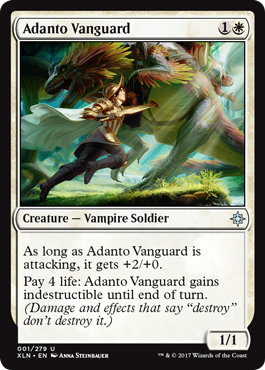
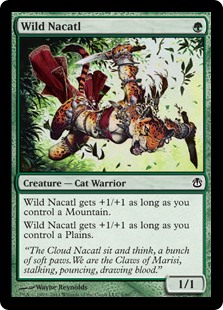 To approach the project, I broke down Counter-Cat by color. Blue was necessary for cantrips and permission, which form its backbone. The other colors played were green, for threats, and white/red, for removal and to support Wild Nacatl. With Nacatl out of the picture, red seemed vestigial, and green was made unnecessary by the idea of the deck in the first place: to transition away from Tarmogoyf. White and black, which I was already in for the threats, enjoy the best removal in Modern. But green was the easiest cut, since Vanguard and Shadow were lined up to replace Nacatl and Goyf anyway. To sub in for Hooting Mandrills, the best creature in the deck, I of course chose Tasigur, the Golden Fang.
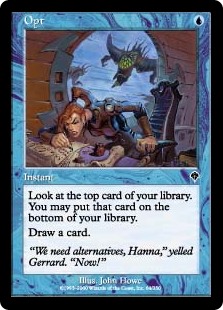 I covered Opt's implications and applications in detail
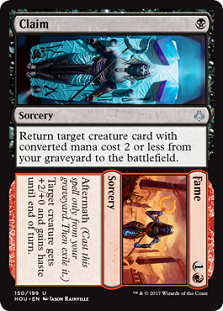 Next, we get Claim // Fame, which I think Counter-Vamp is primed to abuse. The above Esper build didn't use the graveyard enough for my tastes. One mark of successful Modern decks is their ability to
 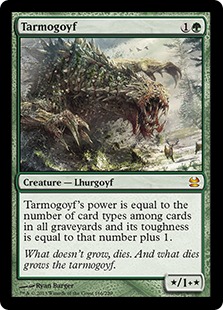 Against noninteractive matchups, two mana is an awful lot for three power. Perhaps the card's combo implications with Death's Shadow make up for this downfall, but in some games, I would draw one and not the other and fail to apply enough pressure. And if opponents prioritize killing Death's Shadow, Vanguard gets even worse.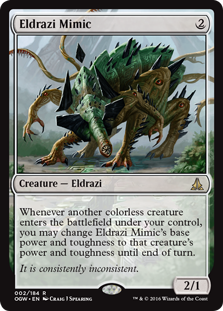

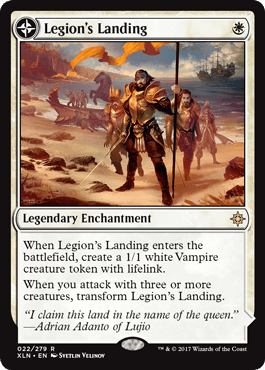
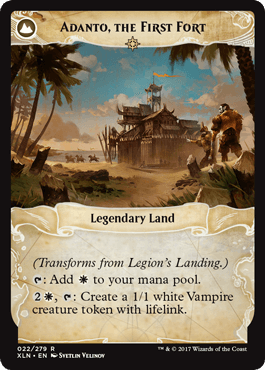

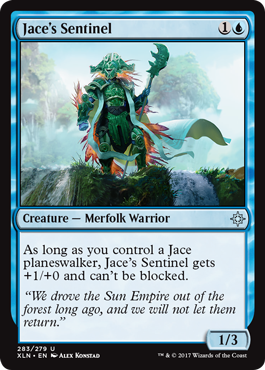
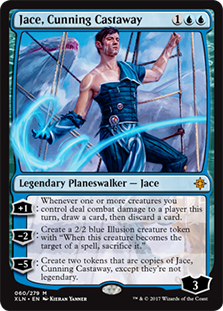 It isn’t better than Jace Beleren (my favorite planeswalker of all time) and Baby Jace doesn’t see play—but for a minute, what would a deck that plays this look like? Naturally, blue decks with creatures that deal damage makes me wish it created Merfolk Illusion tokens, but alas.
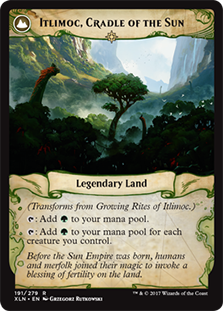 [/tippy].
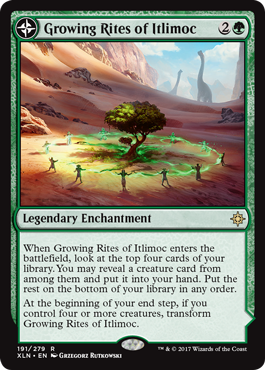
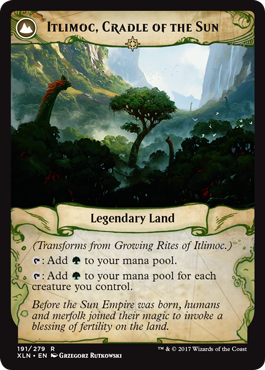
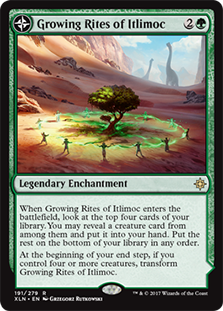 A slower Gaea's Cradle that (probably) replaces itself to give Elves a ton of mana on turn—three?—is interesting, in the sense that it helps their nut draws and provides an extra few ways to generate a bunch of mana for Ezuri outside of Elvish Archdruid. Growing Rites could get powered out and flipped on turn two by a turn-one Llanowar Elves, followed by turn-two Heritage Druid into two Elves into Rites. This gives us four mana on our end step to Collected Company on turn two, which feels real nice for sure.
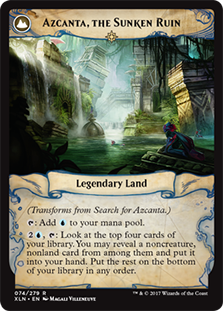 I’ll admit, I’m super excited about [tippy title="Search for Azcanta"]
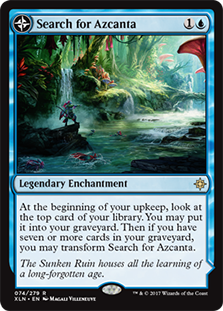 [/tippy] in grindy blue decks, even though I know that the lategame isn’t blue’s problem. Tons of leftover mana isn’t common in Modern unless things are going very badly for our opponent or we drew horribly, in which case we’re probably dead regardless. In addition, a two-mana thing that has the potential to draw us a card for three mana the next turn (and every turn after that) is the very definition of slow.
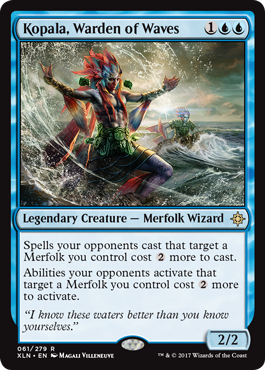
 Essentially a Kira, Great Glass-Spinner-lite effect on a Merfolk. So, awesome. We can play this alongside Kira or instead of it—I’m sure the Merfolk players will gladly tell you which is better, but regardless, this card ramps up the power of the archetype just a bit, which might be all it needs.
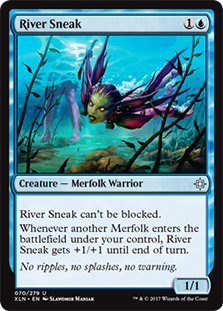 [/tippy] doesn’t make it in a crowded two-drop class, but I applaud it for trying. Two lords, Phantasmal Image, Harbinger of the Tides, and Silvergill Adept are for the most part unbeatable at this point. [tippy title="Deeproot Waters"]
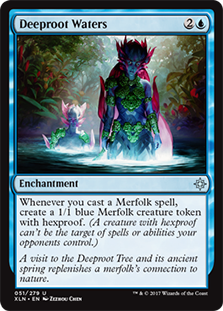 [/tippy] is slow, but it rewards us for filling our deck with a ton of the same effect. Twenty-sixish ways to generate "free" value is fine, and at worst, those tokens can chump as we’re racing. At best, they get pumped to 2/2s or 3/3s and we look like geniuses.
 [/tippy] does most of what we want, while also gaining us a little bit of value along the way? I’m not impressed. The matchups we lose to graveyard decks comes when they answer our answer or power through somehow, and I don’t think 3-5 life at best will save us in those situations. Rest in Peace is just way more impactful, exiling everything forever so that even when they find their answer, they're starting from ground zero.
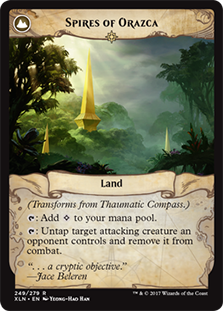 Opt
Opt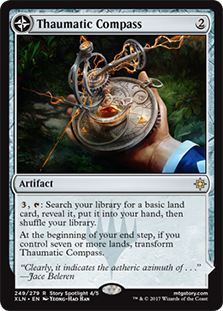 [/tippy], which transforms into [tippy title="Spires of Orazca"]



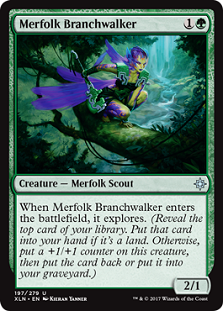 said that it would take a green Cursecatcher and/or Silvergill Adept for me to consider it, and that partially happened. Merfolk Branchwalker is not Adept, but it is similar enough to have me interested.
 The turnout was pretty low; only 25. I don't know if the local scene is really small or if the word didn't get out, but that's way down from every other PPTQ this year. I do know that a lot of the usual crowd including much of the Boulder crew weren't present. Apparently a number of them have been skipping other responsibilities, nerdy and otherwise, to grind PPTQs and were now in trouble. This deprived me of planned-for good matches, but ultimately wasn't a problem as I went 3-0-2 in the Swiss, double drawing into the Top 8. I just got crushed in the finals to end in second place.
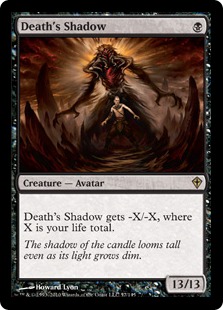 I did start on the play against Grixis Shadow round one, but due to a one-drop-heavy hand I had to delay playing my Chalice for one. This gave my opponent the opportunity to Thought Scour into Tasigur, which came close to racing me. It didn't, as I was free to dump Spirits into play and then counter the Kolaghan's Command that would have gotten him back into the game. Game two he had a great draw with Liliana, the Last Hope and double Death's Shadow and I was crushed. Game three I have the turn-two Chalice, and he has the Tasigur. But I break serve with Reflector Mage and he never catches up. I drew three Chalices that game, discarding one and having the second destroyed by Command, which took his whole turn of mana and let me stick the third one to lock things up.
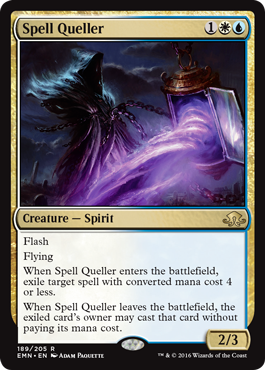 The quarterfinal against Humans went basically the same as the other aggressive matchups. Game one I curve out and have a Spell Queller for his Thalia's Lieutenant. Game two his Champion of the Parish gets huge and I don't see Reflector Mage. Game three I curve out again. Against the Architect deck there is one interesting play where I use Wanderer triggers to trick my opponent into sacrificing his Walking Ballista for no value after dumping his entire hand. This lets me win the race with my 2/1s when I probably should have lost. Game three goes long because I keep a control hand with two Supreme Verdicts and don't see much action, but he's out of it by the second Verdict. My two games against Titan are similarly uninteresting, as I don't really have any relevant interaction for game one and game two I mulliganed to a very mediocre five.