menu

Opting In: Modern Cantrips

Are you a Quiet Speculation member?

If not, now is a perfect time to join up! Our powerful tools, breaking-news analysis, and exclusive Discord channel will make sure you stay up to date and ahead of the curve.

This week marked some big news for Modern: Opt is finally entering our card pool. I've heard some decry the card as a worse Visions that will only see play in draw-go and tempo decks, and others still call Opt a change to our card pool nearly on par with Fatal Push's impact. For me, Opt's arrival means more deckbuilding options in the cantrip-heavy decks I favor when I'm not tapping Eldrazi Temple. Plenty has been written about casting Legacy-level cantrips like Brainstorm and Ponder, but precious few resources exist detailing the intricacies of Serum Visions or Sleight of Hand. Well, never fear—Captain Hooting Mandrills is here!

The Opt reprint has caused me to think hard about Modern's cantrips. This guide assesses where Opt will and won't see play over other options, in addition to providing format newcomers with a crash course on how they can draw a card.

Understanding Cantrips

Cantrips don't influence the board or interact with opponents. So why do people spend mana on them, especially in a format as brutally fast as Modern? Well, cantrips fundamentally affect and positively influence deck design. They also grant players more consistent games. Lastly, cantrips frequently offer additional benefits in decks that play them. Let's explore each of these notions in detail.

Deck Construction: The Turbo Xerox Rule
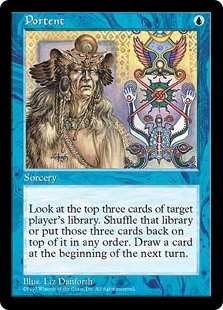
The Turbo Xerox Rule, named for the first true netdeck, states that for every two cheap cantrips in a deck, its land count can be reduced by one. I've got a lot of waxing about cantrips ahead of me, so let's have Patrick Chapin explain this one:

Alan Comer actually singlehandedly invented the concept of using cheap cantrips to fix your mana. In fact Turbo Xerox is the fundamental strategy that most blue Legacy decks are built on! What Comer realized was that even with just seventeen Islands and four Portents he had about an 85% chance of having two Islands by turn two on the play (almost 90% on the draw). This also doesn't take into consideration mulligans which easily pushed him into the mid-90s. [...]

If it sounds like this is a lot of work just to get three Islands by the third turn it is but it is not without a payoff. Once Comer made that initial investment to assemble three Islands by turn three he had a major advantage over every other deck he would face. People with 23 land in their deck draw land 38% of the time. Turbo Xerox draws a land just 28% of the time. This means that more than one out of four times that you would draw a land you don't need you instead draw a spell.

In-Game Allure: Improving Consistency and Velocity

Drawing fewer unneeded lands in the mid- and late-game is already a great payoff for including cantrips, but that payoff is mostly created and accounted for in the deckbuilding stage. Cantrips also provide in-game consistency by smoothing out draws. This consistency effect is the most tangible benefit of resolving cantrips and the first new players tend to grasp.

Taken to its logical extreme, the Turbo Xerox Rule can be applied to nonland cards, too. Cantrips greatly improve the chances of seeing a crucial one-of, such as Secure the Wastes in a highly reactive Weissman deck, in the right game window. Scry effects also allow pilots to tuck a Secure they see too early. With cantrips, sideboard cards are seen more frequently, as are the right cards for any given situation.

A less explicit form of consistency that cantrips provide is velocity, or the motion of cards between zones—specifically, from unknown zones to known zones. Cantrips move a card from the hand to the stack to the graveyard, while also moving one or more cards from the library to the hand or the graveyard. All that movement, especially combined with the hard consistency of card selection effects, works to enable powerful payoff cards. If card selection alone isn't worth the cost, the "negative tempo" of spending mana on cantrips is usually negated by the virtual mana gained from casting a 5/6 for two mana, which makes cantrips deceptively powerful even beyond their more obvious uses.
Icing on the Cake: Promoting Synergy

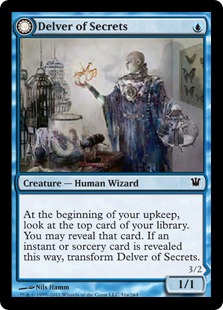
That's not all—in many decks, cantrips do even more than affect deckbuilding and provide consistency. Throw some creatures with prowess or delve into the mix and they become enablers for a uniquely aggressive strategy. Young Pyromancer and Monastery Swiftspear are creatures that slot effortlessly into cantrip-heavy decks; Delver of Secrets practically demands one. Snapcaster Mage, too, gets much stronger in a deck with cantrips, as pilots can rush it out proactively against do-nothing opponents and enjoy extra library manipulation and a card for their trouble.

Some cards still care about graveyard density, such as Bedlam Reveler or Tasigur, the Golden Fang. Others still benefit from a critical mass of cantrips in a deck, like Disrupting Shoal. When many of these elements come together, micro-synergy-laden aggro-control machines known as threshold decks take form.

"Draw a Card" in Modern

By now, you're sold on cantrips. The rest of this article compares the cantrips available in Modern. I've divided the covered cantrips into three categories, based on the type of advantage they're played for: immediate card selection, delayed card selection, and velocity.

I've omitted from this piece cantrips played for their "real" effect, such as Twisted Image and Peek, as well as cantrips that can "miss" like Oath of Nissa and Ancient Stirrings. Also absent are cantrips that cost two or more mana, like Anticipate and Nihil Spellbomb. While these cards are all technically cantrips, they're not cantrips in the Turbo Xerox sense of early-game fixing, mid-game smoothing, and late-game digging; the cards considered here deliberately provide selection or velocity.

Immediate Card Selection

Immediate card selection is the most powerful form of selection, and the cantrips played in eternal formats—Brainstorm, Ponder, and Preordain—all fall into this category. Modern's immediate selection cantrips are notably less powerful than those three, but far from unplayable.
Sleight of Hand

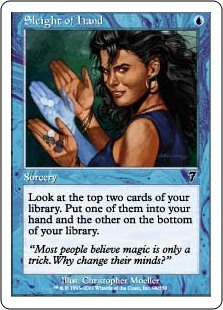
The go-to Serum Visions 5-8, Sleight of Hand usually sees play in combo decks, which need as much selection as they can get. It's also notably better than Serum Visions in decks like Storm, which gains little from delayed selection once it starts going off, and Ad Nauseam, which wants to find and suspend Lotus Bloom on turn one.

In terms of power, Sleight of Hand is a strictly worse Preordain; instead of choosing what to do with the two "scried" cards, casters are forced to top one and bottom the other before drawing. It's so much worse (Serum Visions rests between them on the power scale) because Preordain gives players so many options---they can top top and draw, top bottom and draw, or bottom bottom and draw. That's also why Ponder is leagues ahead of Preordain in a format with fetchlands. With a fetch in play, Ponder casters can choose to take only the first card, the first and the second, all three, or another card altogether, and all while seeing three cards before deciding which come to the hand. Brainstorm operates similarly, although since it also tucks cards from the hand, it gives casters even more options than the already busted Ponder. These two cantrips are blue-chip staples in Legacy and restricted in Vintage for the wealth of options they supply, and Sleight of Hand doesn't offer much in the way of choice.

Most Serum Visions decks don't play Sleight of Hand. The card's effect is simply so small that many decks don't want to spend a mana on it. Many reactive decks, like UW Control, play Serum Visions to help set up their early draws. Sleight is significantly worse at setting up early draws, since it doesn't see as many cards.

Decks with both Serum Visions and Sleight of Hand have cantrip sequencing to worry about. Casting Serum first and then Sleight is ideal for finding an immediate answer, since it sees up to five new cards and ensures the one we want is drawn if among them. Casting Sleight, then Serum also sees a total of five cards, but the last two won't be accessible this turn; that's fine and even preferable if we're out of mana anyway or already have something else to do with our mana this turn cycle, as it smooths out our draws for longer and hides cards from hand disruption. I'm looking forward to seeing how Opt influences cantrip sequencing in decks that run Opt and one or two other cantrips.
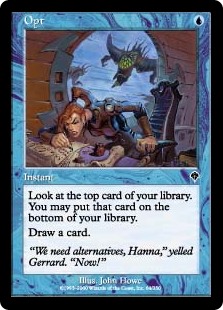
Opt

I've heard people call Opt a "strictly better Sleight of Hand." That it is not. In a topdeck war scenario, Sleight of Hand is the better cantrip to draw. If Sleight reveals two cards of similar relevance, players can choose the better card for the situation. By contrast, if Opt reveals a card less impactful than the majority of the other cards in the deck, players are correct to bottom that card and draw a fresh one. But there's a chance that second card is even worse.

Notably, the same doesn't hold true for good cards: if players take the card they scry, but the next card is even better, they still get to draw that better card next turn (barring something like a fetchland activation). Even a Sleight that reveals two bad cards is productive, since those cards won't have to be drawn for turn; a Sleight that reveals two good cards, though, can be painful, since one will be lost. Either way, pilots draw a good card, and since the point of immediate selection is, well, immediate selection, Sleight trumps Opt in this kind of game state.

It also trumps Opt in the early stages of the game, when players need to make their land drops. Imagine keeping a one-lander in Counter-Cat (to follow this example, click on this link and glance over the decklist), fetching up a Steam Vents, and leading with Delver. Next turn, we draw a nonland card and cast Opt. If Opt reveals Island, we're likely to scry top, draw it, and play it. But what if the next card is a fetch? We often don't want a third land drop in this deck until turn four or five, so we'd rather have put the Island on the bottom and drawn the fetch right away to cast Wild Nacatl. Sleight of Hand allows us to do that. And if both cards are nonlands, the result is the same regardless of whether we have Opt or Sleight—in fact, Sleight ensures we get the best of those two cards despite them both being nonland cards, whereas Opt guarantees we get the second nonland card, which may be worse than the first.
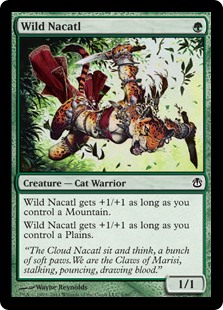
All that to say I don't see Opt totally replacing Sleight in decks that play the latter. But I do see Opt slotting into decks that don't run Sleight of Hand. The main reason is its typing: instant speed is a huge deal for certain decks, especially draw-go ones. Even the mighty Serum Visions has a palpable tension in the Jeskai Tempo lists we've been seeing pop up, which has plays at every turn of the game—Helix turn two, Queller turn three, Command turn four. Casting one-mana sorceries throws a wrench into that curve, forcing players to take a turn off of representing their spell. Opt can come down on the end step when opponents smugly pass the turn without making a move, providing selection and velocity virtually for free.

In this sense, I think Opt is much closer to Think Twice than it is to Sleight of Hand. But it's possible threshold-style decks like Grixis Shadow will end up wanting it, too. It will be fascinating to see which decks adopt Opt as Modern evolves post-Ixalan, and to observe the effects this card has on deckbuilding.
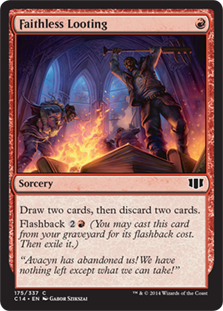
Faithless Looting

Faithless Looting is more of an honorable mention in this list, since it's a -1. The other cards here all replace themselves. To compensate, Looting provides Modern with a pseudo-Brainstorm, helping fix hands that already have bad cards in them. A deck with Looting is a deck that can sit on extra lands without playing them with the knowledge that a "Draw 4 cards" effect exists in the deck somewhere.

The decks that play Looting, though, benefit from its drawback. Hollow One, Vengevine, Stinkweed Imp, and Griselbrand all adore this card, which proactively advances graveyard-based gameplans while providing the many aforementioned benefits of cantrips. Modern is the most card-advantage-centric it's been in a good while, but the more tempo-centric the format pendulum swings, the better Looting will be—and the higher the chances of it showing up in non-graveyard decks.

Delayed Card Selection

While delayed selection is worse than immediate selection, the best cantrip in Modern happens to belong to the former group. The best cantrips in the game elude our legal card pool, and Serum Visions happens to reign supreme among those that remain.
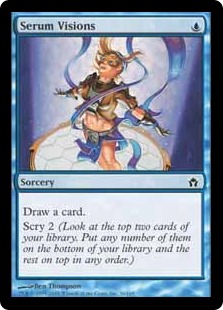
Serum Visions

This oft-reviled cantrip was once ritualistically omitted from Jeskai Control lists because of its damning sorcery typing. Not anymore! Modern has come around on the power of Serum Visions, even if some guys at your FNM keep telling you how bad it is because they've recently played some Legacy. Visions is hard selection that looks further than any other card in the format for its cost.

Serum Visions is uniquely excellent at setting up future turns. When players don't have much mana handy, Visions can even be better than Preordain. It sees the same amount of cards, but the sequencing of its effects hides juicy targets from Inquisition of Kozilek or Thought-Knot Seer. Visions is also a great cantrip to chain, since the second Visions will draw the card found with the first.

Perhaps the biggest strike against Serum Visions is its interaction with fetchlands. Setting up future turns is obviously powerful, but the scry is lost if players crack a fetch. This interaction forces players to fetch in suboptimal ways, sometimes taking damage from untapped shock lands before casting the cantrip and then never spending the mana. But we've all fetched a tapped land and then found a one-drop with Serum's blind draw. I think this factor makes Serum Visions a difficult cantrip to resolve correctly, as its resolution incorporates many aspects of the game state, including life totals, remaining deck contents, and bluffing.
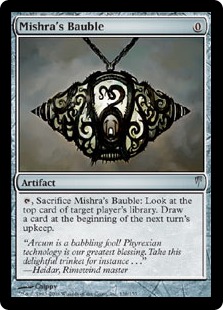
Mishra's Bauble

Mishra's Bauble doesn't provide any selection on its own, but given Modern's high volume of fetchlands, it often reads "0: Scry 1, then draw a card at the beginning of the next turn's upkeep." That "next turn's upkeep" clause makes Bauble a very interesting cantrip to play. Finding removal with it during the main phase ensures pilots have that removal spell on their opponent's next turn, and Bauble can be used to manipulate the library around upkeep triggers like that of Delver of Secrets to gain extra peeks.

Granted, the conditional selection Bauble provides is minute, as it should be for a zero-cost spell. Rather, Bauble is usually played for velocity reasons, as well as for its phenomenal typing; being an artifact, Bauble triggers prowess, grows Tarmogoyf, and enables delirium and metalcraft in addition to providing marginal selection and replacing itself. Talk about role play!

I almost included Bauble in the velocity section below, but it does provide delayed card selection. Consider it a straddler of the selection-velocity cantrip fence.

Velocity

Velocity cantrips don't provide any card selection, instead focusing on moving cards between zones. They're often on the cheaper side, costing one or zero mana while many of Modern's selection cards cost two. They're also frequently niche.
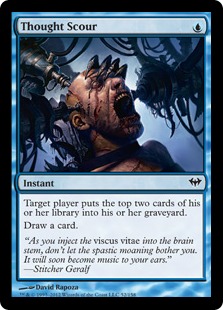
Thought Scour

Thought Scour is the only velocity cantrip to actually cost mana. But its cost is well-deserved, as it dumps a whopping three cards into the graveyard, including two new ones from the deck, and immediately replaces itself. That's a lot of juice for Snapcaster Mage, Grim Lavamancer, Gurmag Angler, or what have you—three cards is the same amount we see with Serum Visions! Of course, Scour offers no control over which card makes it to the hand. But that's not the point. Decks that toolbox out of the graveyard, or can interact with the graveyard in some way, love Thought Scour; it's much easier to squeeze value out of cards in the bin than out of ones in the deck, after all.
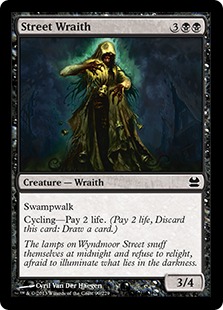
Street Wraith

Like Mishra's Bauble, Street Wraith draws a card for no mana. Instead of providing a little selection and wonky artifact synergies, Wraith costs life and draws the card right away, while enabling some synergies of its own. Death's Shadow turns the life point cost into a benefit and uses Wraith to fuel delve and super-power Serum Visions; Living End reanimates Wraith as part of its primary game plan while using it to dig into its namesake card; Hollow One cares specifically about the word "discard."

Wraith's two-life cost makes it a tough sell in other decks thanks to the format's aggro decks, especially Burn. That's despite its apparent floor as a split card that's one side cantrip, one side 3/4 swampwalker. Modern is too fast for that second side to matter much, so, like Bauble, Wraith finds itself relegated to decks that can abuse it in multiple ways.

Can't R.I.P.

That's right, no peaceful rest for the weary—or rather, for those of us obsessed enough with cantripping to tirelessly test Opt in different shells until Ixalan drops. One thing's for sure, though: despite our inevitable fatigue, we won't be the ones who can't rip the right answer!

Insider: Standard Rotation Targets

Are you a Quiet Speculation member?

If not, now is a perfect time to join up! Our powerful tools, breaking-news analysis, and exclusive Discord channel will make sure you stay up to date and ahead of the curve.

Ixalan is quickly approaching being fully spoiled, and the prerelease is just two weeks away. With Ixalan comes Standard rotation, and as demand for the sets rotating out falls dramatically, demand for other cards will increase to fill the void. Much of this demand will be absorbed by new Ixalan cards, but there will also be increased demand for cards already in the format. Some cards are already seeing play but will see additional demand as they become relatively more important in the metagame, and other cards were off the radar but have suddenly become relevant. There has already been enough of the new set spoiled that we can make some strong assumptions about what the future metagame will look like, so today I’ll share cards that are in position to see increased demand and price after rotation

Cycle Lands

There was an error retrieving a chart for Irrigated Farmland

One of the safest and surest stores of value in Magic is in its real estate, and there’s a history of dual-style lands appreciating into rotation when other dual lands leave. We’re losing a ton of mana with the rotation of the Shadows over Innistrad reveal lands like Port Town and the Battle for Zendikar battle lands like Prairie Stream, and that means the Amonkhet cycle lands like Irrigated Farmland are going to become relatively much more important. At under $4 and as low as under $2, they all look like good buys. Historically, blue lands do the best, especially over the long term, but I think the red lands are particularly attractive given that red is the top color in Standard and is getting great new cards.

Fastlands

There was an error retrieving a chart for Inspiring Vantage

The enemy-colored Oath of the Gatewatch creature lands like Needle Spires are rotating out of Standard, and that puts added pressure on the Kaladesh fastlands like Inspiring Vantage. These lands are also an important part of the Modern landscape and are staples of many enemy-colored decks, so there is even potential for these to rise in price indefinitely.

There was an error retrieving a chart for Aether Hub

Aether Hub is playable in any two-color decks and will be important for any three-color decks, so with the worsening of manabases after rotation I expect Aether Hub will pick up some of the slack. It’s also a staple of any Energy decks, and Energy is one of if not the single most powerful mechanic to be playing in post-rotation Standard, so that means good things for the demand of Aether Hub. $2 seems like a bargain compared to the $4 all-time-high that it could surpass.

There was an error retrieving a chart for Metallic Mimic

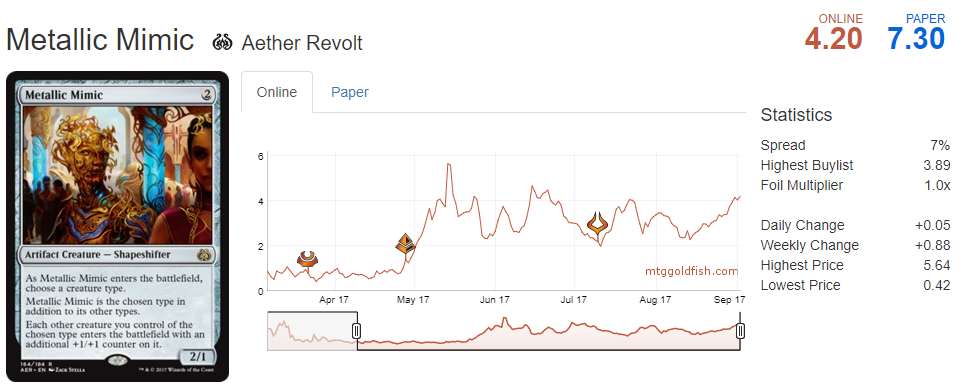
Ixalan has tribal themes, and that brings with it implications for the existing cards in the tribes it includes. The most notable of these is Metallic Mimic, a Shapeshifter that can function in any and all tribes. It’s a good way to shore up the creature counts in a tribe, so it could be especially desirable in tribes like Vampires and Merfolk that don’t have a ton of support, and it may find a home in the marquee tribes of Pirates and Dinosaurs. Its price has been steadily increasing since Hour of Devastation and is on the trajectory towards $10.

There was an error retrieving a chart for Soul-Scar Mage

Another category of cards that improve are cards that were outshined by cards rotating out but take the starring role. A prime example is Soul-Scar Mage, which is now the premier red one-drop creature with the departure of Falkenrath Gorger. Its current pricetag of $2.60 is twice where it sat at the Hour of Devastation release, but I could see it doubling again.

There was an error retrieving a chart for Gideon of the Trials

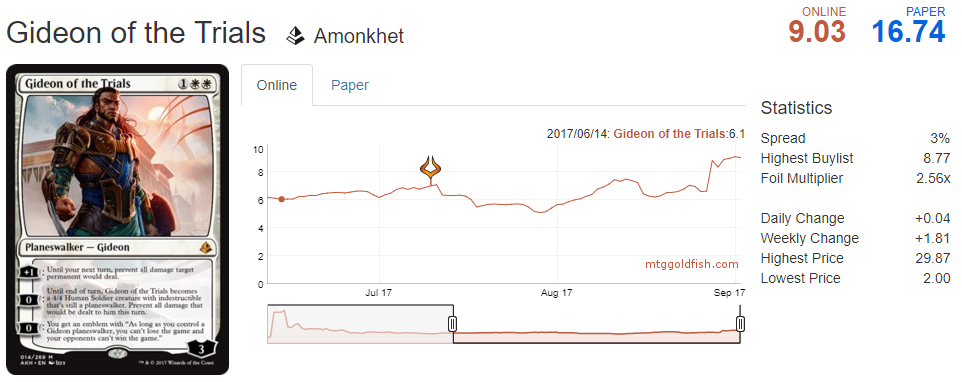
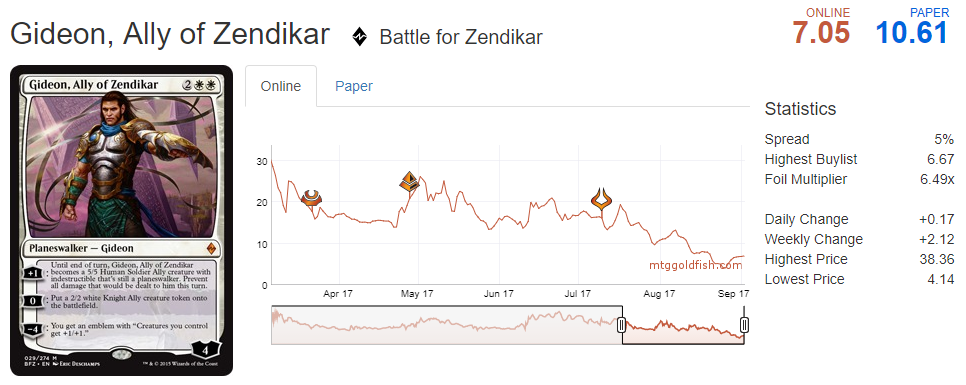
Gideon of the Trials is another card that will fill-in for an important rotating card with the departure of Gideon, Ally of Zendikar. Gideon of the Trials is a perfectly playable aggressive planeswalker in Standard, especially when helping to power Heart of Kiran, but it was simply outclassed by Gideon, Ally of Zendikar. The card has seen a recent price spike to $16, which coincided with the announcement of the removal of the planeswalker uniqueness rule, which makes ‘Gideon Tribal’ much more competitive in Modern. I expect the upcoming increase in playability in Standard can only serve to send the price higher.

There was an error retrieving a chart for Angel of Sanctions

Archangel Avacyn is a huge loss from rotation, and it completely opens up the five-mana slot in white creature decks. Angel of Sanctions is a very powerful card but was always outclassed, but now looks like a fantastic option. Its current price at $7 is actually an all-time low, but I expect the price to turn around by rotation.

There was an error retrieving a chart for Walking Ballista

There are also existing cards that have synergy with new cards, and these can be very attractive if the best new cards rely on them. This may very well be the case with Walking Ballista, which is a perfect way to trigger Enrage on your own Dinosaur creatures. Each Enrage trigger on the best dinosaurs is very valuable, whether it be drawing a card from Ripjaw Raptor or putting a land into play with Ranging Raptors, so Walking Ballista can convert to a ton of value and threaten to generate more of it the longer it remains in play. Its price has been very steady between $11 and $12 for the entirety of the calendar year, and now could be the time for the price to have another breakout.

There was an error retrieving a chart for Channeler Initiate

Drover of the Mighty gives Dinosaur decks the perfect acceleration creature, but the deck looks like it’s in the market for more than just four pieces of acceleration. The next best card for the job is likely Channeler Initiate, which has a similar role of being mana acceleration that can transition into battlefield presence. It’s also quite cheap at just above $1, so some great gains could be had if it does get picked up as a staple in Dinosaurs, and it could have applications in other green decks too.

What Standard cards are you targeting with rotation imminent?

-Adam

Timeless Lists: Reflections on Masterpieces in Deckbuilding

Are you a Quiet Speculation member?

If not, now is a perfect time to join up! Our powerful tools, breaking-news analysis, and exclusive Discord channel will make sure you stay up to date and ahead of the curve.

This week I wanted to do something a little bit different from my past couple articles. Leave it to me to propose a tonal shift to my article topics, and then immediately afterwards break from the mold to do something different. Still, a couple personal/opinion pieces in a row suggests a shift every now and then, and I found myself hesitant to discuss Ixalan spoilers this soon, or MTGO tournament results. Instead, I thought it would be a fun exercise to take a look back at a few archetypes of ages past that have stuck in my mind through the years. Each deck has impacted me personally and spoke to me in one sense or another. I find this interesting as a sequel of sorts to my article about identity in Modern, and I think this is a topic we can all take something from, or at least break from the mold and entertain ourselves for a little bit as we reminisce. For those seeking the ever-elusive "edge," I’ve found success with this before—by breaking outside of the box that is the current Modern landscape, we can often stumble upon something that we can apply to our decklists (or thoughts) today. So, let’s get to it!

As a brief note, these lists are not meant as examples of the "best lists" in Magic, but rather a small collection of decks that impacted me personally. I encourage you to reflect on your own, and let me know in the comments what they are and why you chose them!

UW Blade, by Trevor Holmes (10th, SCG Charlotte 2011)

Creatures

4 Delver of Secrets
4 Snapcaster Mage
1 Spellskite
2 Consecrated Sphinx

Planeswalkers

2 Gideon Jura

Artifacts

2 Sword of Feast and Famine
1 Sword of War and Peace

Instants

4 Mana Leak
2 Dissipate
4 Think Twice
2 Midnight Haunting

Sorceries

3 Day of Judgment
3 Ponder

Lands

1 Moorland Haunt
2 Inkmoth Nexus
4 Seachrome Coast
4 Glacial Fortress
3 Ghost Quarter
7 Island
5 Plains

Sideboard

2 Geist of Saint Traft
1 Azure Mage
3 Timely Reinforcements
1 Batterskull
1 Sword of War and Peace
2 Tumble Magnet
1 Ratchet Bomb
1 Oblivion Ring
3 Flashfreeze

This one is almost six years old at this point, and it’s still one of my favorite decks. This particular Open was my second-ever high-level tournament, fresh off of a stomping at GP Pittsburgh a couple months before. Illusions was all the rage back then, and Delver was the talk of the town. Mono-Black Infect was packing ten removal spells in some lists, and UW Illusions, Tempered Steel and Humans were priced into racing.

I show this list not because it's good, but because this event taught me the value of responding to format perception, beyond just playing a strong list. Illusions players were playing 20 lands and eight one-drop creatures, and their success depended entirely on whether they could overload opposing removal and curve out consistently. Sound familiar? For me, Timely Reinforcements and Day of Judgment were much more interesting spells to be casting, but I was worried that classic UW Control was too slow to succeed against all the tempo-aggro and Wolf Run Ramp running around.

So, I had the bright idea of jamming some token generation, instant-speed tricks, and four copies of Delver of Secrets into a control shell in an effort to "pivot" and disguise my plan against my opponent. Delver of Secrets was public enemy number one on the weekend, and most of my cards suggested I was playing some slightly larger UW Illusions amalgamation, so I thought I had a good chance of confusing some opponents and generating some poor sideboarding decisions in my post-board games.

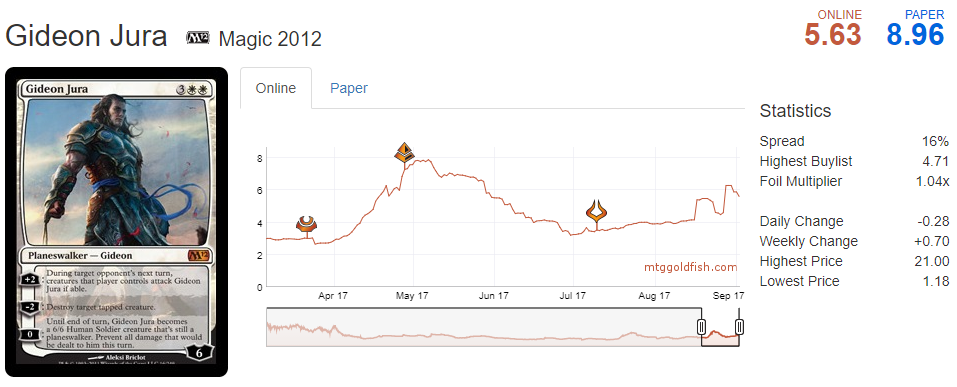
Amazingly, it worked beautifully. Delver of Secrets was killed on sight almost always, but opposing removal was quickly made awkward in the face of Midnight Haunting and Moorland Haunt tokens. This played right into my plan of forcing my opponent to spend time, mana, and resources dealing with my threat instead of playing their own. Swords made every single creature a threat, and my opponent couldn’t afford to tap out to overload my defenses for fear of getting hit with a Sword of Feast and Famine on the backswing. Opponents were forced into slowing down and spending removal on tokens, which played right into my Gideon Jura and Consecrated Sphinx endgame. After board, they had the unenviable decision of keeping in removal for Delver and Sword-wielding tokens, while I could tune to their exact gameplan or blow them out with things like Geist of Saint Traft and Batterskull.

It was a Frankenstein, but it worked. I took 10th, on the back of a ton of misplays (remember, second tournament, and I was very much interested in playing pet cards and archetypes like Consecrated Sphinx over the consensus best option). I won my win-and-in and missed Top 8 on tiebreakers. I was hooked. While the decklist looks like a monster (no one-for-one removal in the maindeck in an Illusions format?!), the thought process behind my decisions were spot on, and I almost got there in a format where playing anything but Delver of Secrets in an aggressive shell was considered a mistake.

The lesson, if I can give one, is that the consensus version of a deck isn’t always the right one, and value can be found in other places than on printed cardboard. This, more than anything, translates directly to Modern, where players spend countless hours tweaking decks and practicing matchups. Looking past the novelty of going rogue, the right list, on the right day and with the proper conditions, can do anything—even in the hands of an inexperienced pilot.

Grixis Control, by Patrick Chapin (2nd, GP Orlando)

Creatures

2 Snapcaster Mage
2 Olivia Voldaren
1 Inferno Titan

Artifacts

1 Batterskull
2 Ratchet Bomb
3 Pristine Talisman

Enchantments

2 Curse of Death's Hold

Instants

3 Mana Leak
1 Ancient Grudge
1 Doom Blade
1 Go for the Throat
4 Desperate Ravings
3 Forbidden Alchemy

Planeswalkers

2 Liliana of the Veil
1 Sorin Markov

Sorceries

2 Ponder
2 Whipflare
1 Black Sun's Zenith
1 Devil's Play

Lands

4 Darkslick Shores
4 Blackcleave Cliffs
4 Sulfur Falls
2 Drowned Catacomb
2 Shimmering Grotto
1 Copperline Gorge
4 Island
2 Mountain
2 Swamp

Sideboard

1 Mana Leak
2 Ancient Grudge
1 Curse of Death's Hold
1 Ratchet Bomb
1 Liliana of the Veil
2 Negate
2 Dissipate
2 Blue Sun's Zenith
1 Karn Liberated
1 Sorin's Vengeance
1 Life's Finale

And then there’s this deck, which taught me to love a collection of 75 cards. GP Orlando in early 2012 was Delver city. Roughly a month after the SCG Open from above, Illusions had shifted away, replaced by Delver/Invisible Stalker/Geist of Saint Traft with Runechanter's Pike and a ton of tempo spells like Gut Shot and the like. I played two maindeck Mental Misstep here—I talked a bit about this event last week—for all the one-drop creatures and removal spells running around, and it was amazing. Patrick Chapin went the other way, playing Pristine Talisman into Curse of Death's Hold. Because, you know, reasons.

Four Desperate Ravings and three Forbidden Alchemy pretty much sums up that format for me. It was insane. The endgame was Sorin Markov and a flashbacked Devil's Play, or just making your opponent concede out of pure boredom. The deck was built to beat up on Delver decks, which were assumed to keep down all of the Wolf Run Ramp titan decks in the field. It’s poetic that Chapin lost in the finals to Conley Woods’ BG Wolf Run Ramp brew, which was packing Grave Titan as an immediate board stabilizer that couldn’t be removed by one card (because only an idiot would play Day of Judgment, right?).

This decklist taught me the lesson of variability at the top tables, and the danger of going too far down the rabbit hole. It’s not entirely fair, as Chapin definitely had a plan for regular Wolf Run Ramp, but Grave Titan was a problem he couldn’t solve. One Life's Finale isn’t enough, and while I love this decklist with all its intricacies (two Blue Sun's Zenith in the board!) this event showed me that you can only control too much (pun definitely intended). For Modern, when I’ve crafted that perfect Spell Queller tempo brew I always look back and remember that in a volatile format, sometimes doing the simple thing is the best thing.

Little Kid Abzan, by Jacob Wilson (7th, PT Fate Reforged)

Creatures

4 Noble Hierarch
4 Birds of Paradise
4 Voice of Resurgence
2 Qasali Pridemage
3 Kitchen Finks
3 Loxodon Smiter
4 Siege Rhino
3 Wilt-Leaf Liege

Instants

4 Path to Exile

Sorceries

4 Lingering Souls
2 Thoughtseize

Lands

3 Gavony Township
3 Forest
1 Swamp
1 Plains
3 Razorverge Thicket
1 Godless Shrine
1 Overgrown Tomb
1 Temple Garden
4 Verdant Catacombs
4 Windswept Heath
1 Marsh Flats

Sideboard

2 Thoughtseize
2 Chalice of the Void
2 Fracturing Gust
1 Relic of Progenitus
1 Stony Silence
1 Zealous Persecution
2 Sword of War and Peace
1 Ajani, Mentor of Heroes
1 Rule of Law
1 Slaughter Pact
1 Leyline of Sanctity

For the last deck of the day, Jacob Wilson’s Little Kid Abzan from Pro Tour Fate Reforged reminds me of what is possible in a card pool as diverse and wide-open as Modern. As has always been the case, the biggest draw for me in Modern has been the varied possibilities and directions you can go in deckbuilding, all while remaining in the same color. BGx has seen every archetype under the sun at this point, from broken combo in Birthing Pod, to pure control like Death Cloud, to midrange strategies like Jund and Junk, to aggressive combo decks like Elves and Abzan Company, to glorified Stompy decks like this one.

I’ve always been one to watch Abzan’s mutations from the sideline, content to play primarily with blue cards, and my view from the outside has given me a clear perspective on the archetype. While it rarely seems to reach the coveted prize, nevertheless it remains an alluring puzzle that players can’t resist picking up. I played Abzan in Standard at Pro Tour Magic Origins, and just playing the deck was tantalizing, to say the least. Spending mana on powerful things, impacting the board with every action you take—in that event, Abzan gave me that feeling of "identity" that I used to feel with blue.

Conclusion

I never was into Yu-Gi-Oh as a kid, but I grew up in the 90's and early 00’s, so I couldn’t avoid it. I know nothing about the game or the lore behind it, but I know about "heart of the cards’" at least, and sometimes I can just about feel that in Magic. I know it’s nothing more than projecting personal feelings of attachment onto the 75 in front of me, but Magic for me has always been about chasing that elusive perfect deck. The one that aligns correctly with proper play and "just right" conditions to dominate a weekend. The one that mutates from a simple collection of cards in sleeves into… something else. Magic, for me, has always been a collection of tools and simple rules, given with trust to me to figure out, like a map towards hidden treasure. I’ve been at it for years, and will continue to be for the foreseeable future, and Magic remains as it was after my 10th place finish at my first SCG Open. The addicting, irresistible allure of a puzzle that can never be solved.

Thanks for reading,

Trevor Holmes

Insider: Ixalan Rotation Finance, Part Two

Are you a Quiet Speculation member?

If not, now is a perfect time to join up! Our powerful tools, breaking-news analysis, and exclusive Discord channel will make sure you stay up to date and ahead of the curve.

This week, we're continuing the series on rotation finance. See part one here. Part two will begin with a focus on the rotating planeswalkers.

The loss of most of Standard's best planeswalkers will dramatically affect the Standard Magic landscape. I feel it is best left up to professional players to tell us what changes to expect from a Standard format without many all-star planeswalkers, but what we do know is that the only all-star planeswalker remaining in Standard is Chandra, Torch of Defiance. We've now seen two of the new three planeswalkers, and both seem like fringe playables at first glance. What we can do, though, is see if we can glean what cards were seeing less play because of the rotating planeswalkers.

(4) Chandra, Flamecaller & Ob Nixilis Reignited

For starters, Chandra, Flamecaller's exodus from the format reaffirms what I said in part one regarding the Ramp archetype: it should die unless we see some insane top-end cards spoiled. This Chandra served both as a board wipe and a win condition, and those are the sorts of threats that Ramp needs to be a competitive deck. As I said last week, I'd wait to speculate on cards in the ramp archetype, in particular on Hour of Promise. I'm still waiting for that card to fall to the 0.25- to 0.50-tix range before investing.

Ob Nixilis Reignited and Sorin, Grim Nemesis are also rotating, shortening the bench of sideboard midrange-value all-stars. Which cards could step up to the plate? The clear favorites are Skysovereign, Consul Flagship and The Scarab God, but both of them sit at all-time highs, and I'd be loathe to invest in either at their current price points. What you, dear reader, should ask yourself is whether Skysovereign and The Scarab God will bury all their competition or whether some other cards that fulfill similar roles could see play. I'm personally skeptical.

Some Potential Targets

What is frustrating is that the market has already begun moving on many of my favorite targets that could increase in price due to rotation, and truth be told, it has been for the whole month of August. This was not the case for my Hour of Devastation series, suggesting that speculators have been focusing more on rotation and less on the normal pattern of a set's value that Matt Lewis and I here at Quiet Speculation like to exploit.

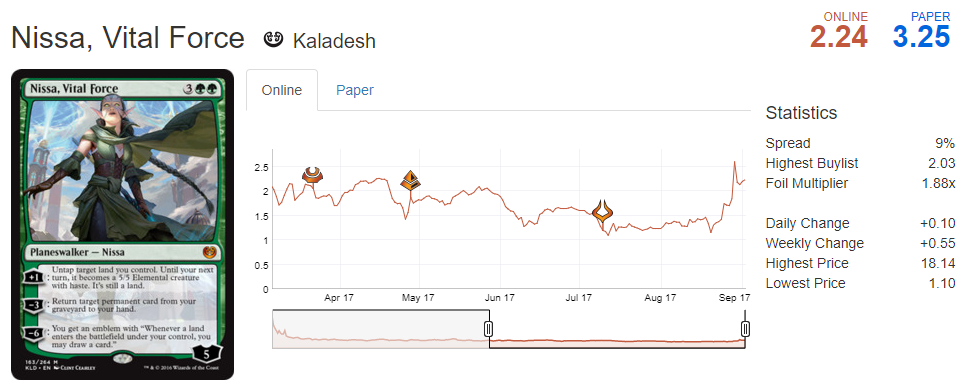
Cards functionally similar to Ob Nixilis will always see play in Standard – drawing cards and removing threats will always be in style. While most might view Liliana, Death's Majesty as his successor, the truth of the matter is that Ajani Unyielding and Noxious Gearhulk bear a stronger resemblance to it. If Ajani returns to 1.00 to 1.25 tix, I think he is worthy of your consideration as a speculation target. Likewise for Noxious Gearhulk below 1.50 tix. Nissa, Vital Force's price movement has mirrored that of Ajani Unyielding; however, I'm less enthusiastic about her since I'm not sure what she can do for you that other options cannot. Don't invest in her unless she is 0.75 tix or below.

(5) Liliana, the Last Hope

Liliana, the Last Hope is a rotating planeswalker that puts a real pressure on the format, discouraging the use of one-toughness creatures. There are a whole host of one-toughness creatures that become better that are worthy of your consideration as speculation targets.

Some Potential Targets

Adorned Pouncer and Syndicate Trafficker are intrinsically powerful cards that have yet to see play. Earthshaker Khenra and Bomat Courier have already proven themselves and stand to get a little bit better. Likewise with Electrostatic Pummeler, Glint-Sleeve Siphoner, Metallic Mimic, and Glory-Bound Initiate.

I have always liked Glory-Bound Initiate as an investment, but the cards that I think get significantly better over the near-term as a result of Liliana leaving the format are Earthshaker Khenra, Glint-Sleeve Siphoner, Metallic Mimic, and  Electrostatic Pummeler. Electorstatic Pummeler has been falling for the past several weeks, and I definitely like speculating on it if it reaches somewhere in the 0.05- to 0.07-tix range; none of the G/R Pummeler deck rotates from Standard at rotation.

Glint-Sleeve Siphoner is a card I really like moving forward. I've invested in many copies already. Although I wouldn't want to invest at the current price of 0.90 tix, I do like it as a speculation target between 0.60 and 0.75 tix. The boat has probably already sailed on Metallic Mimic. Speculators are very high on the card because of the tribal themes in Ixalan, causing its price to rise from 2.00 tix to 4.00 tix during August. I definitely want to avoid speculating on it at 4.00 tix, but if you can buy your playsets for playing between 2.00 and 3.00 tix, then I would. Earthshaker Khenra is a speculation target I still like, and I still recommend buying in between 1.15 to 1.25 tix. The reprint of Lightning Strike goes a long way to ensuring that Red Deck Wins will survive rotation. Now all we need are some red one-drops! Adorned Pouncer is at its lowest price ever, and I'm definitely intrigued to speculate on it now that it's creeping toward the 0.05 to 0.15 tix range.

(6) Ixalan Mechanics and First Impressions


One of the bigger differences between speculation in paper versus online is that there is more room to speculate really early on in a set's life in paper than online. As other writers focused on paper talk about Ixalan, I and others who focus on MTGO talk about Hours of Devastation and other earlier sets. To any of my readers who are new to Magic or to MTGO, please know this: do not do any investing in ditial Ixalan product for the first several weeks of the set's release. Although a practice that in my view has always been bad, the only reason to possibly consider investing early has been taken away – the Pro Tour is being pushed back several weeks. Thus, you're not going to get rewarded for having the prophetic abilities of Jeremiah and Isaiah as you might have in the past. What we can do with Ixalan is see whether the mechanics and early spoilers should incline us to speculate on any older cards.

The mechanics of Ixalan are raid, enrage, and explore. At the moment, I'm reluctant to make any concrete investment action based upon what we have seen thus far. Some important themes in the set are tribalism, artifacts that flip into utility lands, and Treasure artifact tokens.  There are some general things that I can point out that hopefully will help you make sound investment decisions.

First is that Treasure tokens works as well with improvise as Clue tokens did – they don't double up on ramping into improvise payoffs because Treasures require you to sacrifice and tap them. So improvise and artifact all-stars like Inspired Statuary, Herald of Anguish and Tezeret the Schemer are not necessarily going to become competitive staples. In their favor is that improvise payoffs, like the cards that produce Treasure tokens, are in Grixis colors.

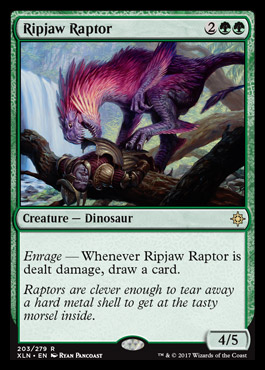
Second is that enrage as a mechanic is one uniquely hostile to red. Thus far, we've only seen one Constructed-worthy card with enrage, Ripjaw Raptor, but if we see more potent green threats with enrage, I'm going to grow more concerned about red remaining a dominant control color. I'm not concerned now about my speculation on Hour of Devastation, but I am definitely keeping my eye out for other playable enrage cards as spoilers roll in.

Third is that, to date, no spoiled card or group of cards has led me to think that we'll be seeing a brand new Standard competitive archetype forged largely out of Ixalan cards. This means that you should be more confident than usual in speculating on older cards, and you should not fret as much about whether your Standard deck is going to lose tons of value as its competitiveness fades.

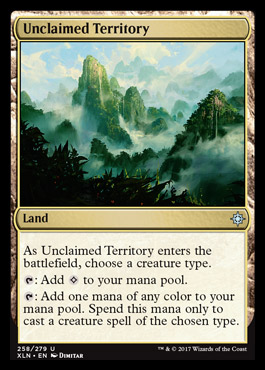
Right now, it looks like the way that Ixalan will most affect Standard is through changes to the Standard mana base. Losing the enemy-colored manlands and getting an allied cycle that plays nicely with the allied-colored Amonkhet cycling lands will definitely affect Standard. Aggressive linear pure-aggro decks will be heavily inclined to be mono-color, tribal to make use of Unclaimed Territory, energy-based to make use of Aether Hub, or artifact-based to make use of Spire of Industry. In general, enemy color combinations will be slightly discouraged, and allied color combinations slightly encouraged.

Signing Off - Iconic Masters Reveal is this Weekend!!

A copy of my investment portfolio can be seen here.

How do y'all feel about Ixalan? Excited for Draft and Standard? Please let me know in the comments below, and as always, I will try to answer all questions posed to me in the comments.

I want to call attention to one thing this week: HASCON is this weekend, and cards found in Iconic Masters will be revealed. In what manner they will be revealed I don't know. However, for those of y'all with investments in Eternal cards, this is a particularly scary time. I have preemptively sold off some cards I had wanted to hold longer (Daze, Pyroblast, Hydroblast, Griselbrand) and am concerned about my fetchlands. I don't necessarily recommend such drastic action, but I do absolutely recommend being more hawkish about checking social media this weekend and having ready access to MTGO so you can fire-sell should one or more of your investments be seeing a reprint.

Going forward, if Wizards continues to pump out multiple Masters sets per year, I don't think I will continue investing in Modern and Eternal staples as I did with Modern Masters 2017. I hope y'all had a good Labor Day Weekend, and I'll see you next time!

Video Series with Ryland: Living End

Are you a Quiet Speculation member?

If not, now is a perfect time to join up! Our powerful tools, breaking-news analysis, and exclusive Discord channel will make sure you stay up to date and ahead of the curve.

Hey, everyone! I'm back with another video series, this time with Living End. Outside of some minor excitement about the printing of new cyclers in Amonkhet, Living End hasn't received a lot of attention of late. Nonetheless, Asger Thorsboe Lundblad was able to secure 19th place at GP Birmingham about a month ago with a few unique tweaks. At this point the added touch of Amonkhet is to be expected, and Lundblad's list is no different. His major innovation is the addition of a white splash for Vault of the Archangel, which also enables (at least in theory) hardcasting Leyline of Sanctity post-board.

The best part about Living End, at least in my opinion, is the consistency. With so many cyclers you see a ton of cards; land-light hands often easily hit their land drops, and hands that are lacking a cascade card can find one without much trouble. This, however, can also be a detriment. With the sheer number of cards you see, finding your namesake card is also not a terribly hard task, and as such has the propensity to punish you. Living End resides in the strange category of decks that never want to draw their namesake card; instead it prefers for cascade to do all the heavy lifting!

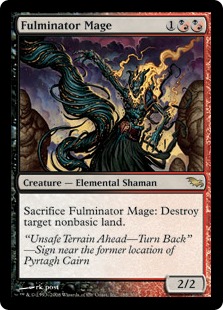
One of Living End's key components is Fulminator Mage, which the deck looks to abuse as much as possible. Not only can its namesake card bring it back sometime after an activation, the deck also has access to Simian Spirit Guide to turn your Fulminator into a Sinkhole! Fulminator is often a key card in the matchups where your opponent can effectively interact with a flood of huge creatures at once, principally Supreme Verdict decks. Restricting your opponent's ability to cast their outs is an integral part of this deck's strategy.
The deck can also be brutally fast. Most of the time you are looking at fourish creatures entering play on turn three (hopefully on your opponent's end step thanks to Violent Outburst), but once again our friendly Ape Spirit can come into play. Coupling the "free" cycle of Street Wraith with the mana acceleration of Spirit Guide we can often have a formidable board state as early as turn two. Most opponents are not equipped to deal with something like that—at least not in game one. Surprise, graveyard hate can be an issue for the deck. Certainly there are outs in Beast Within, Krosan Grip, and Ingot Chewer, but that doesn't mean it isn't irksome. Sometimes you are forced to hold back your cyclers to the best of your ability; sometimes you have to go with Plan B: hardcast your draft chaff.

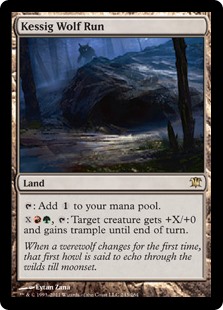
Living End has not performed exceedingly well for me so far, but frankly, I think this list could potentially go through some changes to help alleviate that. I think the white splash is likely to be a hindrance far more often than it is helpful. Traditionally, some lists have looked toward Kessig Wolf Run for a utility land. That said, I'm more inclined to give up on the utility lands altogether and stick with a more solid manabase. In a deck with so few lands, I'm not sure I want to continue taking the risk that a colorless land gets in the way. I've seen some lists experiment with Blood Moon, and I am also interested to see where that might lead. It feels like the archetype could definitely support it when built appropriately.

Those thoughts however, are for the future. For now let's look to the games! As I said last time, I'm interested to hear what kind of content you'd like to see moving forward, so I can continue to evolve and improve my videos. Please let me know your thoughts, and any improvements you would like to see concerning formatting, presentation, or whatever else strikes your fancy. If you'd like to see similar content, check out my Twitch channel for some more live Modern!

[youtube https://www.youtube.com/playlist?list=PL261kJ_cAQC_WYa0JDR6TAtGGGw8aC6pF]

Living End, by Asger Thorsboe Lundblad (19th Place, GP Birmingham)

Creatures

1 Archfiend of Ifnir
2 Architects of Will
4 Desert Cerodon
1 Faerie Macabre
4 Fulminator Mage
4 Horror of the Broken Lands
4 Monstrous Carabid
3 Simian Spirit Guide
4 Street Wraith

Instants

2 Beast Within
4 Violent Outburst

Sorceries

4 Demonic Dread
1 Kari Zev's Expertise
3 Living End

Lands

3 Blackcleave Cliffs
1 Blood Crypt
3 Bloodstained Mire
2 Blooming Marsh
1 Forest
1 Godless Shrine
1 Mountain
1 Overgrown Tomb
1 Sacred Foundry
1 Stomping Ground
1 Swamp
1 Vault of the Archangel
2 Wooded Foothills

Sideboard

1 Beast Within
2 Faerie Macabre
3 Ingot Chewer
1 Krosan Grip
4 Leyline of Sanctity
2 Ricochet Trap
2 Shriekmaw

Insider: MTGO Market Report for September 6th, 2017

Are you a Quiet Speculation member?

If not, now is a perfect time to join up! Our powerful tools, breaking-news analysis, and exclusive Discord channel will make sure you stay up to date and ahead of the curve.

Welcome to the MTGO Market Report as compiled by Matthew Lewis. The report will cover a range of topics, including a summary of set prices and price changes for redeemable sets, a look at the major trends in various Constructed formats and a "Trade of the Week" section that highlights a particular speculative strategy with an example and accompanying explanation.

As always, speculators should take into account their own budgets, risk tolerances and current portfolios before buying or selling any digital objects. Please send questions via private message or post below in the article comments.

Redemption

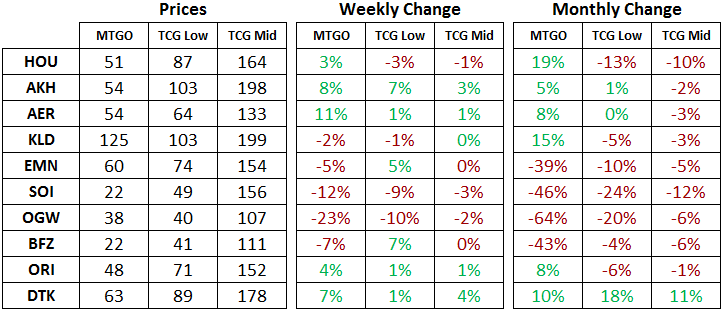
Below are the total set prices for all redeemable sets on MTGO. All prices are current as of September 5, 2017. The TCGplayer low and TCGplayer mid prices are the sum of each set's individual card prices on TCGplayer, either the low price or the mid price respectively.

All MTGO set prices this week are taken from GoatBot's website, and all weekly changes are now calculated relative to GoatBot's "full set" prices from the previous week. All monthly changes are also relative to the previous month's prices, taken from GoatBot's website at that time. Occasionally, full set prices are not available, and so estimated set prices are used instead. Although both Aether Revolt (AER) and Kaladesh (KLD) are no longer available for redemption, their prices will continue to be tracked while they are in Standard.

Standard

Hour of Devestation (HOU) and Amonkeht (AKH) have stuck to around 50 tix in recent weeks. If you have been wondering about speculating on these sets, the two weeks of  drafting leading up to the release of Ixalan (XLN) is a fine time to be picking these up. I have been regularly adding sets of HOU into the market report portfolio in the past week. For AKH, though, I bought over twenty sets earlier this year, and am not adding more at this time.

The rotating sets are continuing to decline, although both Shadows over Innistrad (SOI) and Battle for Zendikar (BFZ) have a hard time dipping below 20 tix. The week-over-week price declines are slowing, but the bottom is not yet completely visible. I'll be begin purchases of all rotating sets over the next two weeks.

Vintage and Treasure Chests

Vintage is not a format where I usually go looking for speculative opportunities. Standard and Modern are big formats, widely covered and widely played on MTGO, while Vintage is still somewhat niche. However, this doesn't mean it's not worthy of Exploration from time to time. Two recent announcements triggered my interest in the format and helped me to solve a question that had been lingering in my mind.

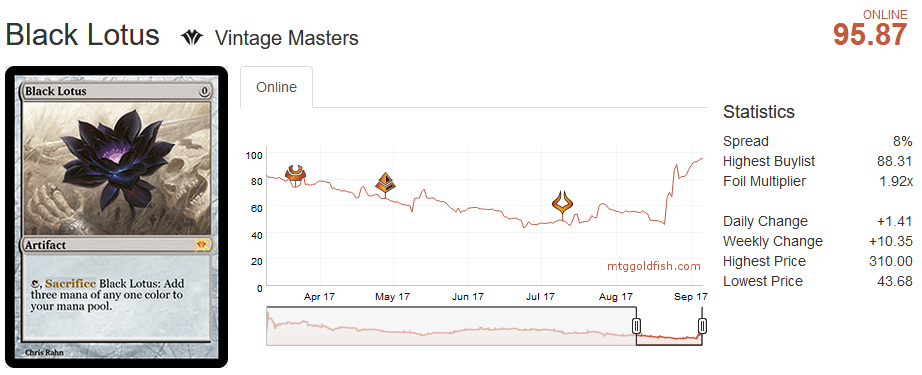
The announcement of Vintage Leagues on August 22 was a result of Vintage events firing regularly on MTGO. The hope is that leagues can support the hardcore aficionados as well as attracting newer players and building the playerbase. The market responded with a massive buying spree of Vintage staples such as Black Lotus, a card that has more than doubled in price in the weeks after the announcement.

The market is clearly bullish on the prospect that MTGO is finally exploring its potential for cultivating niche formats. With affordable prices on all sorts of Vintage staples, no Reserved List, and a central, global hub for organizing games and tournaments, Vintage on MTGO looks like its on its way to realizing this potential.

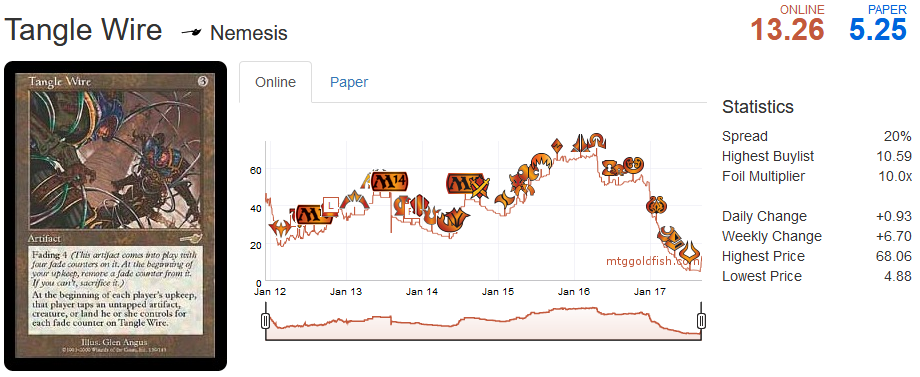
Although I didn't capitalize on this announcement, nor pursue any Vintage specs, I had been watching the price of an old favorite of mine, Tangle Wire.  Since being printed on MTGO in the online-only compiled Mercadian Masques block booster packs, this card has been at least 20 tix with a peak last year at over 60 tix. The recent decline down to below 10 tix coincides neatly with the introduction of Treasure Chests last year and the inclusion of Tangle Wire on the Curated List.

Originally, Treasure Chests were not completely replacing boosters as prizes, but boosters were discontinued as a prizes in Constructed formats with the release of AER. This change seemed to hasten the downtrend on many cards, including Tangle Wire. Over the past six months, my thinking around Treasure Chests and their impact on the market has evolved and I now firmly believe that the steady supply of cards from these prize packs means that speculators can't be long-term holders of  just any card. It's essential that speculative targets are seeing Constructed play and preferably a growing portion of the metagame.

This is all old news, but the recent Banned and Restricted announcement has triggered a shift in the market that has forced me to revise my thinking on Tangle Wire. It's no doubt in my mind that Treasure Chests have exacerbated the downtrend, but the key driver was the coalescing of the Vintage metagame around Ravager Shops and Mentor Control decks.

Last year, Shop decks had been running multiple copies of Tangle Wire, check out the top Shops deck from the Eternal Weekend Championship. The winning deck from that event featured Monastery Mentor, a card that Tangle Wire lines up poorly against. Mentor makes lots of permanents that can be tapped for Tangle Wire's effect and the printing of Walking Ballista gave Shop decks a much better card to help in the fight against Mentor. As you can see from the Vintage Challenge at the end of August, Ravager Shops had moved away from Tangle Wire completely. This shift helps to explain the substantial price decline in this card's price in 2017.

There was an error retrieving a chart for Walking Ballista

Now that Monastery Mentor and Thorn of Amethyst have been restricted, Tangle Wire has started reappearing in Shop decks. Check out these two Shop deck from the latest published league lists; from September 4, the latest Ravager Shops list sports three copies of Tangle Wire, while yesterday's results bring a Goblin Welder variation on the Shops archetype. It sports four copies of Wire.

No longer completely hindered by the token generating Mentor, Tangle Wire is slotting back into Shop decks, replacing the mana disrupting component Thorn of Amethyst. This all became apparent to me this week when I noticed that Tangle Wire had jumped in price from 6 tix to 9 tix. That's when I started revisiting my thinking about this card in particular and the impact of Treasure Chests. If the steep price decline in the past year was partly explained by a shift in the Vintage metagame, then the latest changes will start pushing the price of Tangle Wire back up.

Trade of the Week

For a complete look at my recent trades, please check out the portfolio. With the analysis of Tangle Wire complete, I jumped head first into this spec and bought up a number of playsets. This card is lightly printed online and a continued shift to including it in Shops decks will support the price going forward.

There was an error retrieving a chart for Tangle Wire

Key to this strategy is the matter of price discovery in the MTGO market. Prior to the end of 2016, the market had decided that Tangle Wire was a 20- to 40-tix card, with some extended periods of higher prices. With the changes in the Vintage metagame and the introduction of Treasure Chests, the market had soured on this card, driving it's price down to below 6 tix. But the market is the sum of a whole bunch of actors working together over time. And the way these actors work together is through the bot chains.

The way that the bot chains "discover" the price of a card is by setting their buy and sell prices based off of their buy and sell volumes. The goal for the bots is to maintain an inventory while collecting the buy and sell spread on their transactions with players. If players are selling a lot of a single card, then the bots will reduce their prices, both buy and sell, which is what was observed for Tangle Wire through most of 2017.

There was an error retrieving a chart for Journey of Discovery

It's important to realize here that the bots iterate prices around market activity; they don't set a price, the price evolves over time. The bots do not decide on what the price should or could be based off of metagame results, and this is where speculators have an advantage. Observing a shift in the metagame means a speculator can theorize the true value of a card before the bots can go through the process of price discovery.

If the shift in the Vintage metagame continues, then the upward trend on Tangle Wire will also continue. This means that players will be adding this card into their collection, and the price will continue to rise. The price discovery process will unfold until players get the cards they need and the bots maintain their desired inventory levels. It's my belief that the price discovery process is now under way for Tangle Wire and that the market will end up back in the 20- to 40-tix range over the coming months.

The risk of this strategy is that I can't predict where the Vintage metagame will go in the future. The early signs support the hypothesis that Tangle Wire is back in the mix for Shop decks, but this could change. If the trend stops or reverses, then I'll be stuck with a significant position in an illiquid card that is declining in price. Identifying any potential trend reversal will be key to exiting this position successfully.

Insider: On the Cheap – Picking Up Rotating Cards

Are you a Quiet Speculation member?

If not, now is a perfect time to join up! Our powerful tools, breaking-news analysis, and exclusive Discord channel will make sure you stay up to date and ahead of the curve.

Standard is changing. Rotation is almost upon us which means it's time to start figuring out what to move and what to keep from Battle for Zendikar (BFZ) and Shadows over Innistrad (SOI) blocks.

Traditionally, common knowledge dictates that most rotating cards will lose value. It makes sense, since there will no longer be further demand for these cards by Standard players.

Indeed most rotating cards do drop off sharply in value as we move closer and closer toward rotation. On the one hand, this trend tells us that we should be dumping off rotating cards since we are unlikely to ever get a better deal for them. While true, there are always exceptions to the rule. That's my subject for today.

Allow me to explain. As we start getting closer to Ixalan we are going to see a steep drop-off in the rotating cards. But here's the thing—as people are all looking to dump their rotating cards, we end up with an opportunity where the supply grossly outweighs the demand. There are so many people trying to dump the same cards at the same time that it creates a market with almost zero demand. That's a fantastic buyer's market!

While the vast majority of the rotating cards are headed for the dollar box there are always gems that will have (and have already made) homes for themselves outside of Standard. These are the kinds of cards that I like to target during a Standard rotation dump because people are willing to get rid of them for almost nothing.

Today's list of cards are the cards I'm most interested in buying in on at their rock-bottom, rotation price.

Eldrazi

I've always been super high on the Eldrazi as investment cards and I still am. I think these cards are all very powerful, unique, and interesting from a flavor perspective. They'd be a really popular casual-player draw if they were't so clearly busted enough for all kinds of constructed decks!

Thought-Knot Seer is the Eldrazi that is so good that it sees play outside of Eldrazi decks in various formats. I think it's just a good card and should continue to rise in price.

There was an error retrieving a chart for Thought-Knot Seer

The other three Eldrazi pictured above are role players that have a very low price tag at the moment. If they continue to drop below those prices, it's almost a no-brainer that they will eventually regain value to the point where the investment will make money.

There was an error retrieving a chart for Kozilek, the Great Distortion

I also like Kozilek as a great little "at the buzzer" pick-up card. It's flashy. It's powerful. And flavorful to boot. I think this is a great Commander card with possible applications in various constructed formats. It makes me think of a lot of other "expensive monsters" that tank while in Standard, but become expensive later on after they've rotated because of casual play.

I'd also like to throw this Eldrazi into the casual appeal category:

There was an error retrieving a chart for World Breaker

If World Breaker isn't Commander fun I don't know what it. I think this card will bounce back and become a fairly popular Commander staple for years to come. If it doesn't get reprinted in a deck I think it could be a spicy little investment card.

Modern Staples

The next category of cards that I'm interested in are the ones that are likely to be good in Modern for a long time. The Eldrazi are a slam dunk but they are so unique and interesting that I felt they deserved their own category.

Two cards that have already made a huge impact on Modern: Prized Amalgam and Collective Brutality.

There was an error retrieving a chart for Prized Amalgam
There was an error retrieving a chart for Collective Brutality

Amalgam single-handedly brought Dredge to the Tier 1 and will be great forever.

Meanwhile, Collective Brutality gives the player a ton of great options for a low mana investment. Burn players will be dreading this card for years to come—destroy Goblin Guide, gain two life, and Duress away your best spell for two mana. Feels worth two mana!

There was an error retrieving a chart for Tireless Tracker

Tireless Tracker is a great card in Jund-style decks as well as Collected Company strategies. I would expect its value to continue to plummet as we get closer to rotation (since some of the value is obvious Standard-related) however I think once it hits bottom the value will rebound back. Tracker is a great Magic card and will have a home in fetchland formats for a long time.

Next we have the creature lands. Three in particular have my interest.

There was an error retrieving a chart for Wandering Fumarole
There was an error retrieving a chart for Shambling Vent
There was an error retrieving a chart for Hissing Quagmire


Of the five creature lands from Oath of the Gatewatch, these three seem highly playable in Modern and will continue to be for the foreseeable future. These are staple-type cards and I expect they will come back in value.

There was an error retrieving a chart for Sea Gate Wreckage

Too good to fail! Sea Gate is a good Magic card. It provides a ton of upside at a very low cost of including it in your deck. I'm a firm believer that certain cards are simply too good to ever truly become bulk.

Speculative Goodness

The first two categories are pretty simple. Eldrazi are great and very likely to bounce back after the rotation drop. The same for the second category: cards that already have a solid home in Modern will almost certainly bounce back.

The last category is good old fashioned speculations. These are cards that I think are insanely powerful, but just don't have a home in any format right now. Emphasis on "right now"—I think these cards will eventually find decks and be big gainers down the line. The key is that something needs to change, or be printed, in order for these cards to actually shine.

There was an error retrieving a chart for Oath of Nissa

Oath of Nissa is kind of like a Ponder. Okay, based on that alone I'm willing to incur some risk and bet on this card! It does something unique and extremely good for a very low investment of mana.

There was an error retrieving a chart for Traverse the Ulvenwald

Traverse the Ulvenwald is another highly efficient card that does something we don't often see in Modern: tutor. Once the card is set up it can find any creature or land. I'll always bet on a great tutor finding a home. At the least this is a Commander card forever.

There was an error retrieving a chart for Cryptolith Rite

I think Cryptolith Rite feels like a casual/Commander slam-dunk card. It's so powerful and awesome. It's also very unique. It also does the only thing that matters in EDH: make mana. I believe this is the kind of card that people will be interested in for their casual decks in a couple of years. It feels like a fun card to discover all over again.

Buy Low...

While it is certainly true that the market is rapidly collapsing for cards from BFZ and SOI block, that doesn't mean that we can't also capitalize on the downslide. You have to remember that these cards will be priced at the lowest they have ever been, which makes it a good time to buy in on them for the future. If you can pick the right cards, rock-bottom is the perfect time to buy in.

Good luck! I'm now looking forward to dinosaurs. Onto Ixalan.

Back on the PPTQ Grind: Week Five

Are you a Quiet Speculation member?

If not, now is a perfect time to join up! Our powerful tools, breaking-news analysis, and exclusive Discord channel will make sure you stay up to date and ahead of the curve.

Argh. Falling short of your goals is disheartening enough. Knowing it was because you didn't perform at you best is far worse. Doing so on your home turf is humiliating. This week's PPTQ did not go well; that's the tagline here. Just in case it wasn't immediately apparent.

This week's PPTQ was held at my local shop, Black Gold. I'm there a lot of the week playing weekly Modern tourney's and I definitely consider it my home turf. You can imagine how excited I was at the prospect of winning this for the home team. And my disappointment when that didn't happen. My poor result is directly the result of poor play on my part, but I will also be deflecting some of the blame onto circumstance. I was under the weather last weekend and it impacted my play. I wasn't actually sick, but in that pre-sick phase where you're just lethargic and spacey. Just out of things enough to punt my way out of the tournament.

On a more upbeat note, Ixalan spoilers have begun. I have yet to see any Modern-worthy Merfolk but there's still about 60% of the set to go. Having the tribe in blue-green is interesting, as players have been trying to integrate Collected Company into the deck for some time now. While Company is certainly powerful, it has never been enough to justify distorting the mana base, cutting Aether Vial, or any other compromises necessary to make room. If Ixalan brings a green disruptive Merfolk à la Cursecatcher or a two-mana cantrip like Silvergill Adept, then it might become worthwhile. Things will have to dramatically change course though—current signs are not encouraging. Merfolk already get big so the counters theme is needless and we already had Monastery Siege which wasn't good enough. Giving it fins won't change that.

The Deck

Two weeks ago I nearly got there playing UW Spirits. I kept playing the deck and am overall very happy. I'm doing a lot of individually powerful things and there's very good synergy. Reflector Mage, Spell Queller, and Chalice of the Void are shockingly powerful cards and incidentally synergize well. Clearing a board with Mage and then keeping it clear with Chalice and Queller feels disgusting. The Chalices also really compliment the Spirits theme of untouchable creatures, often acting as pseudo-Drogskol Captains while simultaneously preventing the opponent from advancing their gameplan. It's also nice to have a card that some decks just can't beat. Spirits is still very vulnerable to creature swarms and Chalice isn't effective everywhere, but great in enough places to be very worthwhile. Besides, sometimes you just race them with fliers.

UW Spirits, by David Ernenwein (PPTQ Deck)

Creatures

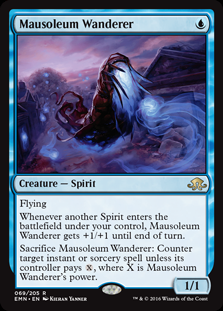
4 Mausoleum Wanderer
4 Selfless Spirit
4 Rattlechains
2 Phantasmal Image
4 Reflector Mage
4 Spell Queller
4 Drogskol Captain
2 Ninja of the Deep Hours

Artifacts

4 Chalice of the Void
4 Aether Vial

Enchantments

2 Detention Sphere

Lands

4 Seachrome Coast
4 Hallowed Fountain
4 Cavern of Souls
2 Glacial Fortress
1 Moorland Haunt
4 Island
3 Plains

Sideboard

4 Unified Will
3 Grafdigger's Cage
3 Supreme Verdict
3 Stony Silence
2 Meddling Mage

The maindeck is largely unchanged. Cryptic Command was very good, but Cavern of Souls occasionally made things awkward. It was easy to get two same-colored mana, but three was proving a stretch. This was fixable by moving away from Plains in the mana, but I found myself wanting something cheaper anyway. This deck is weirdly mana-hungry. Sphere was seeing play as a catch-all anyway; it made sense to promote it to maindeck.

Hibernation had a standout performance two weeks ago, but it just wasn't good enough anymore. Elves and Counters Company have virtually disappeared from my regional meta while white-based creature decks are rising. This necessitates a change to Supreme Verdict. Wrath of God was a serious consideration for quite a while, but Verdict was the clear choice. Yes, I do remember what I said about Cavern making color-intense spells awkward, but that was mostly in relation to triple blue. Double-white, single-blue is easier to manage. Uncounterability was also important because the mono-blue Grand Architect deck has been showing up in force recently and it sucks losing to Judge's Familiar.
Meddling Mage is in Detention Sphere's old slot, mostly because Storm has been popular recently. I've tried a number of cards in that slot, including Runed Halo, and am not really sure what is best. Being a creature for Vial, a human for Cavern, and having applications in many matchups currently wins it for Mage, but that could easily shift.

The Tournament

I had been preparing for and looking forward to this PPTQ for quite some time. On the day of I was no longer optimistic. I just had no energy and it felt like I was thinking through mud. Which might have been less my actual health status than the fact that I woke up really late and had to scramble a bit to get to the site. This didn't leave me much time to actively scout, but I also didn't have to. I recognized most of the faces there and knew that this would be a pretty wide assortment of decks present. I saw part of the Boulder combo collective, the red aggro-loving central Denver crowd, and the usual suspects from the local meta. My assessment was for lots of combo, control, Eldrazi Tron, and Burn. In other words, it was a cross-section of the Denver meta.

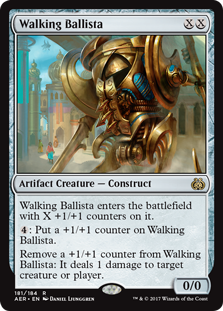
This was good news for Spirits. The deck targets combo and control, and Burn is heavily splash-damaged by Chalice. Etron can be tricky thanks to Walking Ballista but its otherwise very winnable with a fast draw and/or Reflector Mage. While I scrambled to register I was feeling very confident.
The store was very nearly full, but I didn't hear exactly how many players were in the PPTQ. It was six rounds long, and prior to the repair I heard 49. Then a number of players who had called ahead but arrived later than expected, which added I'm not sure how many players. I wasn't unhappy with this; my round one opponent had a UW Control deck that I knew would be a nightmare. It had all of the sweepers and was splashing for Lingering Souls (don't know if it still was). The repair moved me from table three down to eighteen against Grixis Control, a much better matchup.

It doesn't help. He outdraws me by a good margin game one, then I make a series of serious punts to lose game two. This becomes the theme of the day and I drop out of prize contention at 1-2-1. My only win was more about my opponent's deck failing her than anything I did.

What Happened?

I was just not playing well. There's a lot to keep track of in a basic game of Magic. Competitive jacks that up considerably with the additional rules. Couple that with the bookkeeping needed to preserve match integrity and in my case write about afterwards, and Magic is a very mental game. And my mind just wasn't working. On several occasions I just spaced through decision trees, or came to the correct decision only to not execute it properly. Yes, I wasn't at full capacity, but that doesn't excuse the general sloppiness of my play. General spaciness and the odd missed trigger sure, but I really should have been paying more attention.

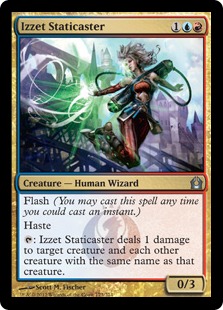
The first example was round one, game two. My opponent has out Izzet Staticaster (yes, she is) which decimated my Mausoleum Wanderers several turns earlier. I have Spell Queller out with an important spell under it and Chalice on one. I've beaten my opponent down quite a bit and he's going for Damnation to get his spell back. I have Rattlechains and Selfless Spirit in hand, so all I have to do is play Rattlechains and give him hexproof. Either that resolves or my opponent goes for Staticaster—either way I then flash in Selfy, save my creatures and two-for-one my opponent. The problem is that when I execute the plan I say "trigger," and immediately play Selfy. Meaning the Rattlechains isn't hexproof yet. Meaning I just feed the Staticaster. And give my opponent the time they need to get back into the game.
Another good example is from my draw. I was against Esper Control at the end of a long game capping off a long, hard-fought match, and we were nearly to time. I'd already missed several Chalice triggers which would have ended things earlier. We needed a judge's clarification on a rule and it took several minutes. Within a few seconds of play resuming, time was called. We tie the game with my opponent at one. During turns I realized I should have asked for a time extension due to the judge call. I didn't even consider it then, but I normally do ask. As a result I get a draw instead of a win. Just wasn't thinking.

Lessons Learned

If you're not 100%, and you're going to play competitive Magic, don't play a complicated deck. Given my mental state I really should have been playing Merfolk. It would not have been as well positioned but it has far less to keep track of or things to screw up. Being 90% instant-speed with lots of odd interaction gives Spirits a lot of power and flexibility but it also makes it easy to screw yourself. Mefolk plays fish and turns them sideways, which is all I was really up to do. Again, don't be too ambitious and play what you are able to play well, not the best deck.

I'm also changing how I play my cards. Normally artifacts and enchantments go on my left side near my deck, but this is a problem when you play Chalice. You can miss those triggers and being relatively new to the card I keep forgetting it exists. I normally put them where they're hard to see, and not having that reminder is making me delete them from memory to make room for all the new stuff that has happened since I cast the card. No longer. From now on Chalice goes right in the very middle of the battlefield where it can always remind me it exists and to counter things. Most players will see Chalice and not play spells that get hit, but some heads-up players will try to sneak stuff past you. When you're as dozy as I was, it works and wins you games. No more!

On the Deck

While I'm generally very happy with the deck I have noticed some problems. First and foremost: I'm tired of Grafdigger's Cage. It was great two weeks ago, but with Company decks falling off and not much Dredge to worry about it's just not very good graveyard hate. Exiling cards is critical against graveyard combos like Storm or Thopter Foundry, delve creatures, and Tarmogoyf. It's been almost two weeks since I've needed Cage but I keep needing Rest in Peace and not having it. That will change for next week.

The other problem, and I don't have a clear solution, is the land count. You have lots of three-drops and often want five or six lands to maximize your spells and protection, so 22 lands is critical. However, flooding is a problem when your only card draw is Ninja of the Deep Hours, and there's really no room to add ways to smooth your draws. It would just change the deck too much.

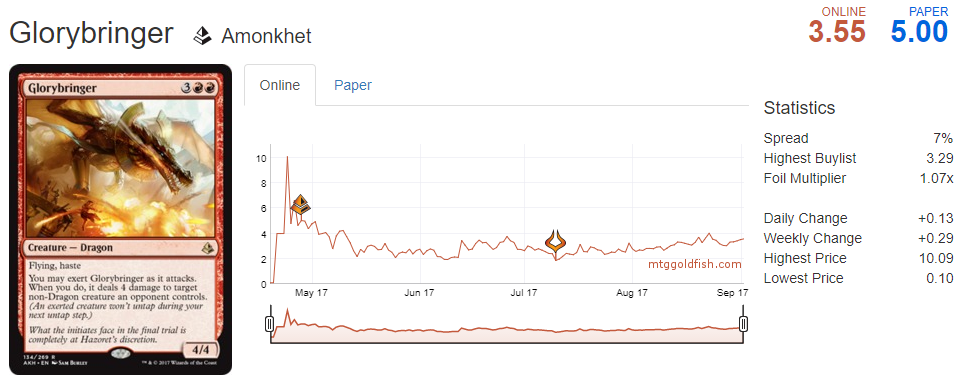
Adding fetchlands has been suggested, and it is a good one, though not without problems. On the one hand you keep the land count but you get to thin the deck of lands. That's good. The problem being that you're doing more damage to yourself in a deck that struggles against creatures. You also have to make cuts. Cut too many basics and you're suddenly dead to Blood Moon. Cut into the dual lands and you weaken your color balance. You also will draw fewer lands, and that is sometimes a problem. That said, I do think this is solvable, and I will be experimenting with new manabases this week.

Moving Forward

I see myself sticking with Spirits since it has so much play against so many decks in the Denver meta. However, I'm going to be bringing along easier decks just in case. This will entail some time dedicated to refamiliarize myself with Merfolk, which I haven't played in months. I may also finally build Little Kid Abzan since I have all the cards and it is straightforward and powerful. You shouldn't expect yourself to be at your peak all the time. You want to be, but I will be hedging in the future.

...And On...

The PPTQ that I'm attending this week is up north again, and while my default remains Spirits I could see myself adjusting back to UW Control if the meta looks like it did the first few PPTQs. Still not giving up! Good grinding, and may you get there before me.

Avatar photo

David Ernenwein

David has been playing Magic since Odyssey block. A dedicated Spike, he's been grinding tournaments for over a decade, including a Pro Tour appearance. A Modern specialist who dabbles in Legacy, his writing is focused on metagame analysis and deck evolution.

View More By David Ernenwein

Posted in Modern, TournamentsTagged , , , , 4 Comments on Back on the PPTQ Grind: Week Five

Have you joined the Quiet Speculation Discord?

If you haven't, you're leaving value on the table! Join our community of experts, enthusiasts, entertainers, and educators and enjoy exclusive podcasts, questions asked and answered, trades, sales, and everything else Discord has to offer.

Want to create content with Quiet Speculation?

All you need to succeed is a passion for Magic: The Gathering, and the ability to write coherently. Share your knowledge of MTG and how you leverage it to win games, get value from your cards – or even turn a profit.

Ixalan and the New Planeswalker Rule

Are you a Quiet Speculation member?

If not, now is a perfect time to join up! Our powerful tools, breaking-news analysis, and exclusive Discord channel will make sure you stay up to date and ahead of the curve.

Hello, everyone.

Last week, we started to study cards that might be good post-rotation. This week, I'll continue to look for cards that are worth investing in on MTGO and will be discussing the new planeswalker rule as well.

Speculating Ixalan Standard – Green-Red Monsters

From the spoilers so far, this is my favorite. Ripjaw Raptor is a huge creature that can defend against aggro decks profitably. Ixalan is showing off a good amount of big creatures, and I especially like the Dinosaurs with enrage (an ability that triggers whenever the creature is dealt damage), which look to support a midrange/ramp strategy well. The cards available seem to support an approximation of Green-Red/Jund Monsters during RTR/Theros Standard, which played a couple of mana dorks and some big creatures such as Polukranos, World Eater and Stormbreath Dragon. If a similar deck like that does appear in the new metagame post-Ixalan release, I think the following cards might make it into the 75.

Channeler Initiate is very underplayed in the current metagame because there are too many aggressive decks like Zombies and Ramunap Red running around. A card that comes into play as a 0/1 on turn two is way too weak compared to other two-drop options like Servant of the Conduit and Sylvan Advocate. With a majority of the early drops from Ramunap Red and Zombies rotating out of Standard, I think Channeler Initiate could see play in the new meta.

  • Channeler Initiate: Current Buy Price: 0.2; Target Sell Price: 2; Profit Per Copy: 1.8

Verdurous Gearhulk used to be a four-of in Black-Green Aggro in the early days of Kaladesh. After rotation, if there's a deck that aims to defeat the opponent with big, trampling creatures, I imagine the green Gearhulk is an auto-inclusion. Besides, despite having multiple components rotating from the black-green decks, we still have Winding Constrictor and Rishkar, Peema Renegade after rotation, meaning that Black-Green Constrictor might still be a thing in some form after the Ixalan release. This makes it possible that we could see multiple decks in the format that play Verdurous Gearhulk in their 75s, thus increasing the demand for this card. If this card drops below four tickets before rotation, I think it's safe to buy a few copies.

  • Verdurous Gearhulk: Target Buy Price: 4; Target Sell Price: 7; Profit Per Copy: 3

Archangel Avacyn will be gone together with SOI block, which means Glorybringer is likely to be the best flyer post-rotation. Its price has been fluctuating between 2 to 4 tickets for quite a long time. I suggest grabbing a couple playsets if the price drops below 2.5 tickets, then selling them when the demand fluctuates up.

  • Glorybringer: Target Buy Price: 2.5 and below; Target Sell Price: 4.5; Profit Per Copy: 2

Speculating Ixalan Standard – Pirates


The Pirates deck is likely to replace Zombies in Standard. From what we can see from the spoilers, this new tribe has cards that can generate card advantage like Cryptbreaker in addition to tribal synergy. I think there can be two versions of Pirates tribal deck:

  • Black-Red hyper-aggressive Pirates
  • Grixis Midrange-Tempo Pirates with Hostage Taker and Admiral Beckett Brass

Again, we are going to target cards that might make it into these new Ixalan-themed brews.

Speaking of tribal synergy, Metallic Mimic is the most obvious choice. However, the current price is already quite high, and I'm not sure whether it will go higher. This is a card that has a high possibility to spike due to tribal decks hype, so I'll put it on my watchlist to see if it goes down in price before rotation happens.

  • Metallic Mimic: Target Buy Price: 3; Target Sell Price: 6; Profit Per Copy: 3

Cut // Ribbons was played in Mardu Vehicles before Ramunap Red emerged as the best aggro deck. I think this card might become popular again in Pirates.  The "Cut" half can remove a majority of the early game creatures in the format, clearing the way for our attackers, especially since there are not many flash creatures left after rotation. The "Ribbons" half then provides some much-needed reach. At its current price below 0.3 ticket, I think this card has a lot of potential to grow in price.

  • Cut // Ribbons: Current Buy Price: 0.25; Target Sell Price: 1.2; Profit Per Copy: 0.95

The New Planeswalker Rule

When Ixalan is released, the new planeswalker rule will apply, quoting text from this page:

Starting with this set, all planeswalkers past, present, and future will have the supertype legendary. They will also be subject to the "legend rule." The "planeswalker uniqueness rule" is going away.

This basically means that as long as your planeswalkers have different card names, they can stay in play at the same time. The problem with most planeswalkers in the current Standard is that they are too slow and weak compared to Gideon, Ally of Zendikar and couldn't protect themselves well against flyers. With Gideon and a majority of the White-Blue Flash components rotating out of Standard, hopefully we can see more planeswalkers being played in Standard again.

In honor of the new rule, let's take a look at some planeswalkers that might become better.

Let's look at the two Nissas in current Standard. Nissa, Steward of Elements is the first X-cost planeswalker ever printed in Magic history, and so far, she has not found her home in Standard. Nissa, Vital Force is usually a one-of when it sees play. If players are to brew around these two planeswalkers, it will most probably be a Simic or Temur value deck with Rogue Refiner and Ripjaw Raptor.

The price of Nissa, Vital Force recently went up a little bit in the past week because a Legacy Elves deck is playing two copies of it, and I've seen it in certain Legacy Stompy decks as well. I'm not very familiar with Legacy, but I think this is a good chance to get some copies of Nissa, Vital Force, because if  a card is played in multiple formats, its price will rarely go lower. As for Nissa, Steward of Elements, this card is very unique and flexible with the X in its mana cost, which means there's a chance where the players will come out with some strong combos in the future.

  • Nissa, Steward of Elements: Current Buy Price: 2.5; Target Sell Price: 8; Profit Per Copy: 5.5
  • Nissa, Vital Force: Current Buy Price: 2.25; Target Sell Price: 5; Profit Per Copy: 2.75

Gideon, Ally of Zendikar was the best card in Standard for quite a long time. With the printing of Gideon of the Trials and the introduction of the new planeswalker legendary rule, "Gideon Tribal" can really be a thing in Modern. Previously, Saffron Olive brewed a deck with all these Gideons that performed pretty well in a video. That was before the planeswalker uniqueness rule applied, so I can't really imagine how insane the deck can become with the new rule. Ever since the new rule was announced, the price of Gideon of the Trials increased by roughly 3 tickets. If you believe the "Gideon Tribal" deck is going to be very good in Modern, you can probably start buying these cards.


Alright, that's all for this week. Thanks for reading, and I'll see you all again soon.

–Adrian, signing out.

Insider: Separating Hunger from Happiness

Are you a Quiet Speculation member?

If not, now is a perfect time to join up! Our powerful tools, breaking-news analysis, and exclusive Discord channel will make sure you stay up to date and ahead of the curve.

There’s a difference between being perpetually hungry and perpetually unhappy. In the MTG finance community, we all have specific goals we strive to achieve day-in and day-out. We buy, sell, and trade cards on a weekly or daily basis in our efforts to fund hobbies, pay tuition, pay rent, or simply make this game a little cheaper. Thus we always have a bit of “hunger” within us because we’re always looking for that next hit.

There’s nothing wrong with being hungry—the lack of complacency drives us to strive for better. However there is a fine line between being hungry and being unhappy. On a recent finance podcast, Jeremy (@MissouriMTG) made a cheeky remark regarding the unhappiness of most MTG financiers. While he was probably half kidding to get a rise out of his co-hosts, there is definitely truth to that statement.

This week I want to step back, acknowledge some elephants in the community, and try to set a more optimistic view on this hobby’s bright future. Don’t worry, there will be plenty of finance content intertwined so this should be worth the read!

A Personal Anecdote

The Reserved List buyouts have been lucrative. While I did not catalyze any buyout individually, I did make sure to grab a copy or two of any card that had low stock and looked interesting to me. As a result, I made large-percentage gains on cards I never even heard of up until last month. Lifeblood, Knowledge Vault, Cleansing, and Damping Field all make that list. Check out how high some of those buylists got, by the way!

There was an error retrieving a chart for Damping Field
There was an error retrieving a chart for Knowledge Vault

After one particularly active night of selling, I thought I would share a few examples with a fellow MTG financier in the community. Many people have been denouncing the Reserved List buyouts stating that the high prices are artificial and will attract no buyers. I looked to provide some evidence to the contrary in a productive and professional way. The response I received was a bit perplexing.

I was promptly told that my results were solid but inferior. As it turns out, in this same timeframe, there may have been other avenues to invest money within Magic that could have offered superior returns. Thus this person suggested my approach was not the optimal strategy.

The exchange left a sour taste in my mouth and a confused look on my face. I certainly felt like I had hit a home run with my recent transactions. I don’t think I could have done what I did any better. The timing was right, the price points were attractive (no one ever sells at the absolute top every time) and the returns got me one step closer to that goal: funding a college education for my son. So why was I unhappy?

Defining Your Happiness

I ruminated on this exchange far longer than I should have. It just kept eating at me inside—I expected a pat on the back and an acknowledgement that these Reserved List cards were indeed worthwhile investments. Instead I was put down condescendingly and offered advice on how to better approach MTG finance. Where was the disconnect?

At last I found what I was missing: I had lost sight of what mattered most to me in Magic. Most of us are involved in the Quiet Speculation community either because we want to make Magic cheaper or because we want to grind money out of the game. But there are secondary and tertiary factors that also motivate us to make certain investing decisions. After all, if we all prioritized making every penny we could out of Magic we would all ultimately end at the exact same strategy. Yet we each seem to find different approaches that work best for ourselves.

For me, I realized that while funding a college education was the primary objective, I had other goals as well. For example, I have always appreciated the Legends multi-colored creatures. They are all so unique and interesting in their artwork, abilities, and overall flavor. So when these started to jump, I put profit margins aside to ensure I had a copy of some of these cards. Now, even with a higher price tag, I’m not tempted to sell my Bartel Runeaxe or Gosta Dirk.

There was an error retrieving a chart for Gosta Dirk

These aren’t getting printed ever again, so even if they retract in value in the short term I know that I will appreciate them in my collection for years, and ultimately I will sell them for more than they are now. I’m okay with that even though it’s not the “optimal” strategy.

I also found a niche within Magic that has truly gripped my interest. I spent a few years making all my decisions in the hobby based solely around making a buck. But Old School MTG has changed my perspective—at last there’s a way I can appreciate Magic that doesn’t revolve around money. I actually enjoy playing the format and collecting the cards.

So now picture this: all of a sudden all of these classic Magic cards start to spike. Each day I’m discovering interesting cards I may one day want to try playing in ‘93/’94. It was only natural for me to follow my instincts and buy a couple copies of key Reserved List cards. Then I sold some for profits to help fund the ones I kept. It was truly the perfect balance for me. If there was a card I couldn’t sell for profit, I had no issues with keeping it because I genuinely enjoyed owning the card! Try saying that about a stack of Standard rares!

Turning Attention Externally

With my priorities clearly in focus, I turned my attention externally once again. First off, I completely wrote off the Twitter discussion I had with that MTG finance community member. Their recommendations were 100% spot on if my goals and priorities were identical to theirs. But in truth they are not. That’s okay. We can all attack this nebulous thing we call “MTG finance” in a variety of ways, custom-fit for our own personal interests. In other words, there can be more than one right way of doing this.

Secondly, I started to view other Twitter and social media debates in a different light. I started to see everyone’s perspective a little more clearly and also grew more confident in my own beliefs.

This was particularly useful during the Reserved List debates that took place during the back half of last week. Some MTG finance people couldn’t handle all the dribble posted to Twitter. But at this point I realize that engaging in such debate is completely fruitless. I have my beliefs and you have yours. We both developed these based off what we believe makes us happy with the hobby, and we use that paradigm to communicate what we think is “right” about the Reserved List. From this lens, there really is no debate to have.

So I am going to try very hard to be less confrontational with social media going forward. I don’t think I was particularly argumentative in the past, but with my newfound appreciation for what I believe is most important, I should engage in the negativity much less often. The MTG finance hashtag is filled with negativity, boasting, humblebrags, and personal insults. Like the Grinch’s heart on Christmas, I don’t know why everyone’s ego grew three sizes overnight but I’m going to try and keep my own in check. Nobody’s perfect, but I’ll do my best.

Where’s the Finance?

I had to get that off my chest. It feels like I’m making a declaration to the community that, “I will be happy!” Seems silly, but if we all take a step back to consider our happiness level at this moment in time, we may be surprised to see that we have replaced happiness with hunger. As long as we’re making money, it doesn’t matter if it’s the fastest way, the most efficient way, or the most effective way. It only matters that we’re enjoying the hobby along the way and we should be content.

So with this in mind, where am I putting money to work nowadays? Let’s start by revisiting the Amonkhet Invocations. I have already flipped a couple for modest profits and I have my eyes set on a few more.

Namely, I like anything with less than 50 sellers on TCGplayer that shows up in at least 3,000 EDH REC lists. Two that meet this criteria that I own are Capsize and Forbid. The former is in over 10,000 EDH REC lists and the latter is very popular with Wizard themes who reward you for playing spells. Make sure you keep these on your radar.

Turning my sights over to the Reserved List hype, it would appear that the craze is finally dying down. There are fewer and fewer Reserved List cards popping each day, and we are left with a small trickle at this point.

But don’t let that deter you from combing through the scraps left behind. This will happen again, after all. The buyouts significantly reduced stock in some The Dark cards including Scarwood Bandits and Exorcist. If you can find a few straggling copies of these in nice condition for under a buck, why not grab a few? I’m quite tempted to try them in Old School myself.

There was an error retrieving a chart for Scarwood Bandits

I’ll point out that these purchases are dual-motivated for me. I don’t have to make money on these older cards to be happy. Make sure you feel the same way before following.

Lastly, I want to make specific mention of the judge foil printing of Morphling. All the Reserved List foils were bought out, causing drastic price jumps. However being printed so recently, this card was left in the dust. It hasn’t been that great in Commander before, but with the printing of Mairsil, the Pretender the iconic creature may see some renewed interest.

Morphling shows up in 70% of Mairsil lists, so if interest in this general increases, the demand for Morphling will rise. It won’t have to rise that much to see the only foil printing of Morphling that will ever exist spike.

Wrapping It Up

I know this is a finance website and you all expect me to write about topics that will make you money every week. But I also view this hobby as a source of happiness, and if we focus solely on our pocketbooks we may lose sight of what truly gets us excited. Are we trying to make money? Of course. But there are dozens of ways to do this and there is no one superior method.

I emphasize this because I don’t know if everyone out there has internalized it. I experienced that firsthand with a one-on-one dialogue, but I also see this in the disgruntled debates on Twitter that have been occurring lately.

Why is everyone so miserable out there? There is plenty of meat on the bone for everyone, especially when we’re all dissecting different parts of the animal that is MTG finance. I like older cards, someone else may like foils, and a third person may prefer Standard metagame fluctuations. If we’re happy and enjoying the journey, then we’re all doing it “right.”

Let’s try to keep that in mind when interacting on social media going forward. I am going to make a very disciplined effort to do so, and I hope people call me out on this if they see me going off track. I am thrilled to be a part of this community, to enjoy a hobby that pays for itself, and to put some money aside for my son’s college tuition. As long as I’m on that path, it doesn’t matter what others are doing to achieve their goals. I’m making progress, and that’s all that matters.

Sigbits

  • The Quiet Speculation Discord channel mentioned An-Zerrin Ruins over the weekend and I immediately bought a few copies. First of all, I love it when people speculate on Homelands because it’s one of my favorite sets in Magic. But second of all, the card seems very meta right now given the likely rise in popularity of tribal Commander decks. Lastly, it’s on the Reserved List… need I say more? Star City Games is sold out of course, but that $0.99 price tag won’t last.
  • I picked up a second Unlimited Chaos Orb over the weekend. I had been wanting another for use in a second Old School MTG deck, and I noticed the supply over in Europe was nearly zero. Star City Games is sold out with a $299.99 price tag but I can see this one going even higher.
  • One Reserved List card that may be under most people’s radar is Lich. I noticed it pop on MTG Stocks over the weekend and it is now at its all-time high. There are just seven sellers of the Unlimited printing on TCGplayer and this equates to around a dozen copies. Interestingly, Star City Games has 16 SP copies in stock at $29.99, well below TCGplayer pricing. I would suggest they up their price, but if they have so many copies at that price point perhaps they would just as soon sell them all. Either way, I am going to pick up a copy or two to see what happens.

Jurassic Plank: Ixalan Spoiler Review

Are you a Quiet Speculation member?

If not, now is a perfect time to join up! Our powerful tools, breaking-news analysis, and exclusive Discord channel will make sure you stay up to date and ahead of the curve.

Two months ago, a foil rare sheet from Ixalan was illegitimately posted online. Most of us glanced over the fuzzy pictures and then returned to the hi-res Hour of Devastation spoilers. But then Hour came out, and the fuzzy pictures beckoned from the abyss.

Fortunately, Wizards didn't make the more patient among us wait too long to get a hold of that sweet information. A mothership article from this week gives some perspective on the leak and officially spoils the cards from the sheet. Today, we'll assess the hits and misses among those spoilers.

The Good

These are the cards I think will surely turn up in Modern, and stick around for a while in some quantity, even if certain metagame shifts cause them to fall out of favor.

Settle the Wreckage

Many are pegging this mass-Path to Exile as the breakout Modern card in Ixalan. I'm not nearly as optimistic. The card is fine and will see play, but not at all on the level some might have you believe.

Settle's "attacking creatures" clause makes it impossible for it to break up combos or synergies; opponents have to play into the instant for you to even cast it. Decks with counterspells or Thoughtseize (Delver, Shadow) can sit around and build a board while they're waiting to draw disruption for Settle. Decks with non-combat-step creature tricks (Company, Elves) can accrue value or simply go off rather than declare any attackers. Settle then looks like it will be best against purer aggro decks like Zoo or Eldrazi. Against Zoo, though, smaller sweepers like Anger of the Gods are generally favored due to their efficiency; for its part, Eldrazi will have no problem sitting on a couple attackers and swinging in with a lone Smasher (or, even worse, Eternal Scourge!).

That's a lot of trash talk for a card that makes my playables list. But playable it is, and I expect Settle to make many Jeskai Control-style lists at one copy. Additional copies incentivize opponents to play around it, while a single copy incentivizes them not to play around it, and therefore maximizes the odds of a blowout. Besides, many decks attacking with multiple creatures won't have enough basics to search up to get full "value" off Settle's drawback, especially since they're likely facing a deck with Path to Exile.

Entrancing Melody

Here's another playable I think was overhyped at first, if mostly in the circles I frequent. When Ixalan was partially leaked, Entrancing Melody looked as though it could be an instant, and an instant-speed, flexible control magic is just what the doctor ordered in Temur Delver. Wizards' official spoiler dispelled that myth, but I nonetheless set out testing Melody as a two-of in the sideboard.

To say I was unimpressed would be an understatement. But Temur Delver is a deck with very specific requirements of its cards, so Melody's failure there doesn't necessarily speak to its viability in Modern generally. I can envision this card becoming a role-player in a number of archetypes, and especially in those without access to efficient removal---in other words, interactive color combinations lacking white and black may want Melody as a way to remove Death's Shadow and Kalitas, Traitor of Ghet alike. That it can't be blanked by commonly-played removal such as Abrupt Decay gives Melody a leg-up over its obvious competition in Threads of Disloyalty, and compatibility with Snapcaster Mage is a plus for reactive strategies like Blue Moon.

Sorcerous Spyglass

I've made no secret of my infatuation with this card, even showcasing it in my Hour of Devastation spoiler review while leaving the other Ixalan cards alone. Well, I'm still excited! Here's a brief review of what the card does in Colorless Eldrazi Stompy, specifically:

  • Comes out proactively against decks with multiple potential targets, turning on Sea Gate Wreckage and helping curve.
  • Gets around Chalice of the Void on one, increasing relevance against bigger Serum Visions decks.
  • Compliments our aggression by sometimes hitting spotted fetchlands and slowing opponents down.

Unlike with Melody, my preliminary tests with Sorcerous Spyglass have proven very fruitful. I wouldn't even be surprised if other decks started packing this card despite it costing more than Pithing Needle.

Kopala, Warden of Waves

There isn't much to say about this guy---he's just an on-tribe Kira, Great Glass-Spinner. Granted, Kira's ability is a bit better, but given Merfolk's level of aggression and tendency to run Cursecatcher, I don't see pilots missing it much. Kopala's "pay 2" clause can be compared to Diffusion Sliver's, and that card is a staple in its respective deck (whenever it shows up).

On-tribe is relevant for a couple of reasons. With UWx control decks now regular players in the metagame, things have become a little more difficult for Merfolk. Kira's something of a trump in that matchup, and Kopala will come in handy, too; notably, Kopala has a far better chance of becoming counter-proof with Cavern of Souls than Kira does. More immediately, Kopala's typing grants it islandwalk and pumps from Merfolk's lords, which for me make it a shoe-in over the clunky Spirit. I believe players may experiment with a 1-1 split before going full-Kopala.

Shaper's Sanctuary

Shaper's Sanctuary, for all intents and purposes, is a one-mana Wild Defiance. With Bolt being largely replaced by Push, it's actually better. I expect this card to fly under the radar without a home for a few months, and eventually be picked up by spell-based aggro-combo decks, which will probably remain Tier 3 but will still appreciate this addition to their arsenal.

Sanctuary punishes opponents for slinging removal spells. The absolute best way to interact with decks like Infect and Turbo Druid is to throw removal spells at their creatures and run them out of threats, so Sanctuary seems poised to make a killing in their sideboards.

I don't see it out of more focused decks like Affinity, though. For one, Sanctuary doesn't help Affinity get going, unlike protective artifacts such as Welding Jar or Spellskite. It's also fairly narrow in its application, unlike Spell Pierce and Thoughtseize. The final nail in the coffin for Sanctuary in Robots is that the best way to beat Affinity isn't with spot removal at all---it's with hosers.

All that said, I'd love me some Sanctuary in the newer BUG Infect lists running around (employing none other than Disrupting Shoal!), or even in the Vengevine decks filling in for aggro-combo's now-missing links. It's certainly excellent against Death's Shadow, the archetype's chief predator.

The Bad

These cards are either outclassed by other options or overly niche. All of them are traps. I won't cover any of the obviously bad cards in the set, but rather focus on ones people have pegged as potential Modern candidates.

Outclassed

Ashes of the Abhorrent: Combines Grafdigger's Cage's ability with a bizarre lifegain clause, and while each are respectable tools for a sideboard, they don't work on one card. At the end of the day, Modern players will always prefer the card that does its job better than one that provides two watered-down effects useful in different matchups. In this case, that card is either Rest in Peace or Grafdigger's Cage, depending on the deck.
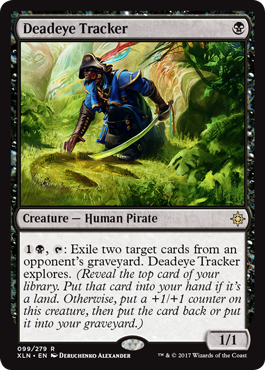
Deadeye Tracker: This gripe is more personal than the others. With the resurgence of Pirates, the Rogue type I love so much has all but been abandoned. And for what? A marginal flavor gain? Pirates are practically rogues, after all. But they don't enable Thieve's Fortune, and therefore are of little use to me; part of the appeal of new sets is perusing the Rogues, and now I have none to peruse!

Deadeye is the Rogue I mourn the most. So much juicy text! (Explore is one of the wordiest, most confusing, and overall worst-designed mechanics I have seen in ages, mind you.) Ixalan admittedly looks great so far, but I'm definitely excited to return to a plane with Rogues. Hopefully, the coming Dominaria block doesn't convert too many of them to swashbucklers in the interest of backwards compatibility with Standard.

Kumena's Omenspeaker: Omenspeaker gets +1/+1 if controllers also control an Island or other Merfolk. I've seem some suggest Omenspeaker as a possible beater in Merfolk, where it might take the place of Cursecatcher. I just don't think the power/toughness increase is worth the latter's utility, or a splash. That said, we've seen Merfolk splash green before, for Collected Company; We're probably just one pushed Simic Merfolk away from the deck going in that direction again. Omenspeaker is not that Merfolk, and I doubt Merfolk runs it if it does end up splashing.
Niche

Old-Growth Dryads: Wild Nacatl is certainly powerful, but ramping opponents by one on the first turn is a cost far too steep to justify playing it in non-Naya decks. Whether it's a cost too steep to justify playing it eight times remains to be seen. If Dryads sees any Modern play, it'll be in a hyper-aggressive Zoo list; I especially like how it improves Hidden Herbalists, which notably can't cast red spells, and sometimes yields awkward draws with Kird Ape (the obvious cut). There's no way Dryads makes it into better-rounded decks like Naya Company or Counter-Cat.
Tocatli Honor Guard: This one will see play if Torpor Orb becomes a playable card again. I just don't see that happening in the near future. Guard is still a welcome addition to Modern's ever-growing toolbox of white hatebears, and lovers of Death and Taxes-style decks should pick up their playset when the card inevitably settles at bulk prices post-prerelease.
Deeproot Waters: Waters is an enchantment that creates a 1/1 hexproof Merfolk token whenever you cast a Merfolk spell. Okay, so spending three mana on something other than a creature is not something Merfolk normally wants to do. Sure. But Waters still has me intrigued, as it gives the deck a unique angle of attack.

Against removal-heavy attrition decks, having a pair of sideboarded Waters in the deck allows Merfolk to play very conservatively and build a gameplan around resolving the enchantment. Once it sticks, those hexproof 1/1s are sure to make short work of an opponent stockpiling Snapcasters and Paths. Waters is similar to Affinity's Ghirapur Aether Grid in this way, and in line with the way I like to build my sideboards, even if I'm totally off-base about Merfolk ever wanting this card.
Jace, Cunning Castaway: The last card on our list strikes me as pretty miserable. Jace's plus is exceedingly narrow, not even hitting enemy creatures like Tamiyo, Field Researcher; his minus is similarly underwhelming, creating a fragile bear by resetting to a single loyalty. And his ultimate is... making copies of himself? Because if one terrible planeswalker is good, three is surely better!

Jace still costs three mana, a magic number for Modern planeswalkers. Liliana, the Last Hope has become a staple, as has Gideon of the Trials, and Liliana of the Veil makes a strong case for being the best card in the format, period. Even Nissa, Voice of Zendikar has enjoyed fringe play in GW Tokens.
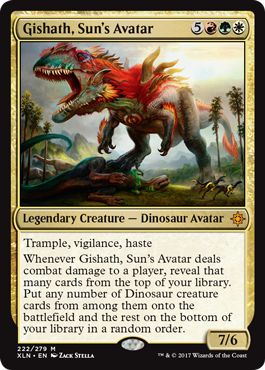
Since Jace costs 1UU, though, we'd do best to compare him to other planeswalkers in that price range. Jace Beleren is all we've got, and that walker sees play exclusively in Taking Turns, a deck that makes great use of his plus and minus abilities. Outlook not-so-good for the Castaway, although a deck may eventually emerge that can use him.

A Note on Planeswalkers

As David mentioned earlier this week, planeswalkers undergo a rules change with Ixalan that allows differently-named walkers of the same type to be on the battlefield at once. Liliana and Gideon are the two characters that stand to benefit from this change, the former in BGx rock decks and the latter in control and prison strategies.

I doubt the change propels any of these archetypes to new heights on its own, but it will definitely be interesting to see how deep midrange decks go into employing planeswalkers over creatures. Should the multi-Lili decks prove a force to be reckoned with, we'll have Sorcerous Spyglass with which to battle them, not to mention Liliana's Defeat!

Planking in Strange Places

Ixalan seems like a great world so far, and I'm loving the colors and design. Hopefully we'll get some Modern-playable dinosaurs so I don't feel like a total chump building around Gishath, Sun's Avatar. As is the case with a foreign land, though, you never know.

Jordan Boisvert

Jordan is Assistant Director of Content at Quiet Speculation and a longtime contributor to Modern Nexus. Best known for his innovations in Temur Delver and Colorless Eldrazi, Jordan favors highly reversible aggro-control decks and is always striving to embrace his biases when playing or brewing.

View More By Jordan Boisvert

Posted in Modern, SpoilersTagged , , , 14 Comments on Jurassic Plank: Ixalan Spoiler Review

Have you joined the Quiet Speculation Discord?

If you haven't, you're leaving value on the table! Join our community of experts, enthusiasts, entertainers, and educators and enjoy exclusive podcasts, questions asked and answered, trades, sales, and everything else Discord has to offer.

Want to create content with Quiet Speculation?

All you need to succeed is a passion for Magic: The Gathering, and the ability to write coherently. Share your knowledge of MTG and how you leverage it to win games, get value from your cards – or even turn a profit.

Insider: Market Movements this Week

Are you a Quiet Speculation member?

If not, now is a perfect time to join up! Our powerful tools, breaking-news analysis, and exclusive Discord channel will make sure you stay up to date and ahead of the curve.

There has been plenty of movement in the Magic market this week, and today I’ll explain some of the trends behind the massive price increases. The way I see it, most of the recent spikes fall into four main categories.

Tribal Spikes

Much demand this week has been driven by the release of Commander 2017 decks, which have increased demand for tribal cards to match their Dragon, Wizard, Vampire, and Cat themes. The start of official Ixalan spoilers – which brings tribal themes of its own, including the beginning of Pirates as a tribe and the return of Merfolk – has only accelerated the demand for tribal cards.

There was an error retrieving a chart for Rishadan Brigand

Pirate tribal is now a casual and Commander thing, and Rishadan Brigand is the most flashy and powerful of any of the existing pirates. Its foil had been moving upwards for weeks, but its non-foil paper price has seen a massive spike from under $2 to $20, and now sits around $17.

There was an error retrieving a chart for Ramirez DePietro

Another pirate on the move is Ramirez DePietro, which makes up with flavor and nostalgia what it lacks in abilities. It has crossover appeal as an old school Reserved List (edit – not on the Reserved List) card, so its spike from $2 to $7 is likely to go even higher.

There was an error retrieving a chart for Coastal Wizard

These movements have led me to believe other Pirates could be good targets. Further examination shows that last week, Coastal Wizard started to see an increase in price.

There was an error retrieving a chart for Talas Warrior

Talas Warrior, another unspectacular Pirate from Portal Second Age, has seen modest gains over the past month from $3 to $4 and is trending upwards.

There was an error retrieving a chart for Talas Researcher

I have high hopes for Talas Researcher, a Portal Second Age rare Wizard with a very useful ability and a bargain price point under $1 that has yet to move upwards.

There was an error retrieving a chart for Kari Zev, Skyship Raider

The Pirate tribe means good things for Kari Zev, Skyship Raider, so I’d be keen to target foil and foreign foil copies in anticipation of the price rising after pirates gain a foothold.

There was an error retrieving a chart for Wanderwine Prophets

Wizard and Merfolk is the perfect crossover between the Wizard Commander deck and Ixalan’s Merfolk, and that has led to a big spike on Wanderwine Prophets this week from around a $1 to nearly $10.

There was an error retrieving a chart for Riptide Director

Riptide Director is a powerful card in a Wizard deck but had been almost completely off the radar up to this point. Wizards being brought to the forefront of tribal play has brought the tribe under the microscope, so this obscure gem from an old set was bound to increase in price, moving under $1 to where it now sits around $6.

There was an error retrieving a chart for Belbe's Portal

Belbe's Portal is great for helping tribes with more expensive cards get creatures into play, and that’s great for the Dinosaur tribe with a huge top end, so I imagine some of this movement is related. It nearly doubled from $5 to $9.

There was an error retrieving a chart for Harsh Mercy

Harsh Mercy is a fantastic sweeper for tribal decks against non-tribal decks, and its former $5 price tag has moved closer to $7.

There was an error retrieving a chart for Shared Triumph

Shared Triumph is an effective anthem for any white tribal deck, and foil copies saw their price nearly double to $6 this week.

Planeswalker Uniqueness Rule Change Spikes

Wizards finally announced they were changing the planeswalker uniqueness rule to making planeswalkers legendary, a change which was unofficially spoiled during the Ixalan cardsheet leak in June, where we saw the Legendary planeswalker type. This has radically changed the playability of many cards, and the market has reacted.

There was an error retrieving a chart for Untaidake, the Cloud Keeper

Untaidake, the Cloud Keeper is a lot more appealing when it can accelerate into planeswalkers, so it has grown from a mere $0.50 to over $10.

There was an error retrieving a chart for Empress Galina

Empress Galina can gain control of legendary permanents, and that now includes planeswalkers, so this increase in utility has led to an increase in price from $10 to $25.

There was an error retrieving a chart for Captain Sisay

Captain Sisay can now search the library for a planeswalker, and that has led its price to double from $20 to $40.

There was an error retrieving a chart for Reki, the History of Kamigawa

Reki, the History of Kamigawa was among the first cards to spike on the rules change leak, but official confirmation has driven the price even higher. Sitting at $1.50 before the leaks, it spiked to a stable price around $5 and has since spiked again to $13.

There was an error retrieving a chart for Mirror Gallery

Another early mover to see further increases is Mirror Gallery, which now allows for multiple copies of the same planeswalker to remain in play. It was around $7 before the leak, and grew to $12 afterwards, and now has now nearly doubled again, to its current price of $23.

There was an error retrieving a chart for Honor-Worn Shaku

Honor-Worn Shaku allows planeswalker to produce mana, so it has become an appealing Commander card. The foil price spiked from $1.50 to $7, and again to over $25, which is likely to settle lower.

Reserved List Spikes

The Reserved List buyout continues, with seemingly no card being left untouched. Now even more recent reserved list cards from Tempest and Urza’s Saga block are moving.

There was an error retrieving a chart for Corpse Dance

Corpse Dance is a very playable Reserved List card with Commander and even Legacy appeal, so the price has seen a large spike from $5 to $20.

There was an error retrieving a chart for Shauku, Endbringer

Shauku, Endbringer is another target of the Reserved List buyouts digging deeper into the pool of possible cards. Its previous price of 60 cents was a bargain, but now it has been driven up to $5.

There was an error retrieving a chart for Masticore

Of particular appeal is foil reserved list cards from Urza’s Legacy and Urza’s Destiny, and thus foil Masticore has tripled to $60.

Banned and Restricted List Update Spikes

There was an error retrieving a chart for Yawgmoth's Bargain

Yawgmoth's Bargain was announced as being unrestricted in Vintage, so along with Reserved List attention, demand has driven the price from under $5 to $20. The foils have seen similarly impressive gains, from around $90 to $350.

–Adam

Insider: My Basic Rules of MTG Finance

Are you a Quiet Speculation member?

If not, now is a perfect time to join up! Our powerful tools, breaking-news analysis, and exclusive Discord channel will make sure you stay up to date and ahead of the curve.

Brian DeMars recently wrote an article also titled "My Basic Rules of MTG Finance" and I felt I could do the same from my point of view. Brian's article is quite interesting and I would certainly recommend giving it a read. I believe we're different enough in how we approach the market that my rules set should be quite different from his. I've come up with the three main things I will consider and have split them further out among different categories of opportunity.

1. If I Don't Understand It: Stay Away!

In December, I will have been playing Magic for 20 years (jay!). I've traded and dealt in just about anything you could imagine, and I've also consistently failed in some areas. What I've realized is that some opportunities just aren't for me and that staying away from them is by far the better move. I realize others do make great profits in these areas, which is absolutely fine – they've got their niches and I've got mine. I want to look into what's not working for me and why so that you can decide for yourself whether you are in the same boat.

Block / Standard / Frontier

I'm grouping these together because in my mind they are incredibly similar in behavior, of course to someone specializing in them they could be worlds apart.
New(er) cards tend to show very high volatility. You need great timing to get in and out when the cards are at their lowest and highest respectively. Generally, the people who do best here are the ones who would follow these formats anyway. I've never cared much for tournament play, and while I like to stay informed on the more popular cards in these formats, I really don't care to keep track on a day-to-day basis. The result is that whenever I move in on cards like this, I inevitably end up holding the bag as they drop.

It wasn't always like this, though – back in the days when Magic was still on its first border design, I would go to a local monthly convention to trade all day. I knew all the prices and would be trading up, down, left, and right, culminating in walking up to the organizer at the end of the day with a stack of Type 2 cards that I had gathered to trade in for something more stable, my best score being an Alpha Ancestral Recall (yeah, that would've been a good hold...). I lost touch with the new(er) cards, though, and I just don't have the time to build up and maintain that knowledge.

Sealed Product

Sealed product is always quite tempting: buy it, stow it away and check in on its price in a couple of years. For some, this has been a great strategy for some time, particularly when the player base was growing hard and older sets turned out to be very under-printed relative to the demand generated by all these new players. These days, though, many people invest in sealed product while little of it actually turns out to grow enough in price to make the investment worthwhile.
I haven't completely avoided holding anything: I found some good deals on the first Modern Masters set, Conspiracy and a couple of the first Planechase decks, and I got 24 Unhinged boosters from a collection. On the whole, though, the payoff tends to be too small for my taste, and I don't know enough about that market to be able to predict what might rise.

Tiny Leaders / Pauper

When I first heard about Tiny Leaders I was confused as to what the benefit of it beyond just regular Commander was. I still have no idea. It feels like an artificial limitation on the format that keeps me from playing cards I'd really want to play, while allowing certain strategies to stay pretty much the same. I like to limit myself in deck building, but I prefer that limit to be self-imposed.
Another example of this would be Pauper, though by its nature it's not as likely to cause interesting price increases. I just can't understand why in paper Magic you would limit yourself to the cards available on MTGO at common rarity: why not just allow all commons and avoid lots of confusion? (With a ban list if you have to, a land base that starts with four Maze of Iths, four Mishra's Factorys and four Strip Mines may not be desirable – yes, versions of those were once found as commons in packs). If I can't see the draw of a format, I will never be able to "sell" a card to a player of that format or predict what such players would like in the future.

Foils

It's all but impossible to avoid gathering some number of foils throughout the years. They tend to just keep stacking up for me, rarely finding anyone who would want them. It's very rare for me to purposely pick up any foils, and then only when I see a very big opportunity. Most of the time those opportunities still fail. I keep coming back to this one though and hopefully one day I'll find a good out for them, because they always look so good (as a prospect). On a personal note, I hate that Wizards is now printing some cards only in foil: it means that if I'd want to play them I can't give my deck a consistent look.
2. If I Do Understand It: Tell Me More!

When I do understand a particular category, I do not necessarily get in on every little investment. However, I will think about prospects and make an informed decision. If something is interesting enough, I'll go for it!

Casual / Commander

I am a casual player at heart. By funny coincidence, I got my DCI number at the Unhinged prerelease, and I've barely attended any other tournaments since. I am a kitchen-table player, though a bit of an atypical one in that I am involved in the finance side of the game and have a collection that would make almost any player jealous. The people I play with are casual players, the Magic I like to read about is casual, the Magic I think about is casual, and I tend to prefer multiplayer and Commander. I believe I know casual players and what they like. In fact, when I speculate on casual cards, I probably have a player I know in mind who would love them.
Old / Reserved List Cards

Old School is deliberately not included here. While there's overlap with what I know, I do not know the format itself. What I do know is a lot of cards, and I can often figure out the interactions casual players will come up with. I also collect, and as a collector, I know the desire for and temptation of old cards. I also just tend to know a lot of cards others have never heard of and whether they have any value. Being on the Reserved List is a pretty nice extra benefit – imagine never having to fear a reprint! If I see opportunities on old cards, I am perfectly happy to consider jumping in. I haven't had any problem moving them.
Bulk / Collections

These aren't as similar to me as they are to most people, but they do have a lot of synergy. Obviously collections contain a lot of bulk, but the bulk I tend to be aiming for specifically are bulk rares. I have a great out for bulk rares and decent out for bulk foils. What I tend to do is offer up cards online to trade for with bulk rares, which I value at about 10 cents each. I then pick them and flip the remaining bulk rares to my out and get more interesting cards for the credit.
Collections, on the other hand, are a very good source for cards to put up for trade, provide some extra bulk rares and tend to be a treasure trove of value. I tend to buy a few collections per year, choosing to cherry pick the ones I want to go for based on content and value (large amount of cards from sets I am still looking to complete, from a good period for value, from a period I know well, a couple hundred or thousand in value so it's worth traveling for, etc.). I've never failed to do well on a collection.

Arbitrage

Sometimes you're just going to run into a discrepancy between different markets. We may all think the Magic market is global, but when you search thoroughly you may still find local differences. If I do spot one of those, I don't really care what category the opportunity falls in, I'll take full advantage of it. These tend to mostly be quick flips for an easy profit, but like with my bulk rares, they can also be long-standing deals. As another example, I have now also found an out that converts bulk commons and uncommons to bulk rares at an acceptable rate, which allows me to get even more value out of collections. The trick here is mostly to watch for things that seem out of the ordinary and find a way to gain an advantage. They may not frequently cross your path, but you better be ready for them.
3. Curiosity Is Important

If you don't try something, you'll never know if it's going to work for you. I bought my first collection one day, not knowing whether it would be worth buying (it was). If I run into a new opportunity, I will always pay attention and consider its merit for me. You have to be flexible in this market. Maybe some day I'll have to reconsider on things I stay away from, maybe another day something new comes along, or perhaps I'll even have to reconsider on the things I do like to get in on right now. Only those who are willing to adjust remain successful.


There you have it, the things I will consider when I come across an opportunity. How about you? Do you have any personal rules for my MTG finance?

Want Prices?

Browse thousands of prices with the first and most comprehensive MTG Finance tool around.


Trader Tools lists both buylist and retail prices for every MTG card, going back a decade.

Quiet Speculation