
menu

Dominaria United Prerelease: Players and Games at Illuminaudi

Are you a Quiet Speculation member?

If not, now is a perfect time to join up! Our powerful tools, breaking-news analysis, and exclusive Discord channel will make sure you stay up to date and ahead of the curve.

So what's better than going to a Magic: the Gathering prerelease? Going to more that one! I actually would've been able to go to a Saturday event as well, but I did have some non-Magic items to attend to. Namely finish building my second card box storage unit as shown in this article, and my pup Gracie would've been very sad that I was gone for three days in a row, no matter the reason.

Like Gracie, Jarod wasn't able to attend either, due to work, but I headed out to the Sunday prerelease event at Illuminaudi. No worries for Jarod, though; he was able to attend two other events on Monday and Thursday.

Sunday, Funday!

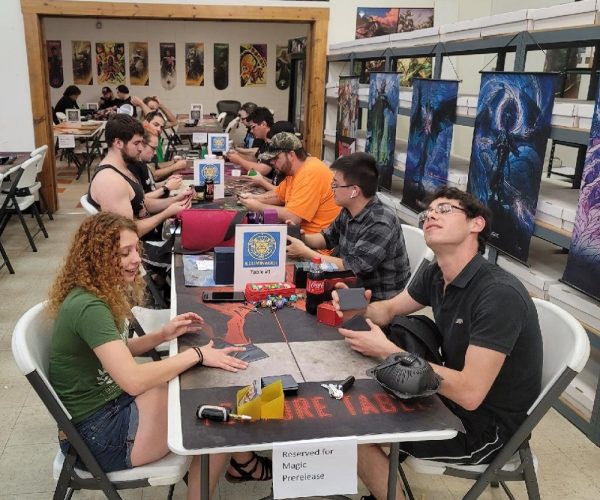
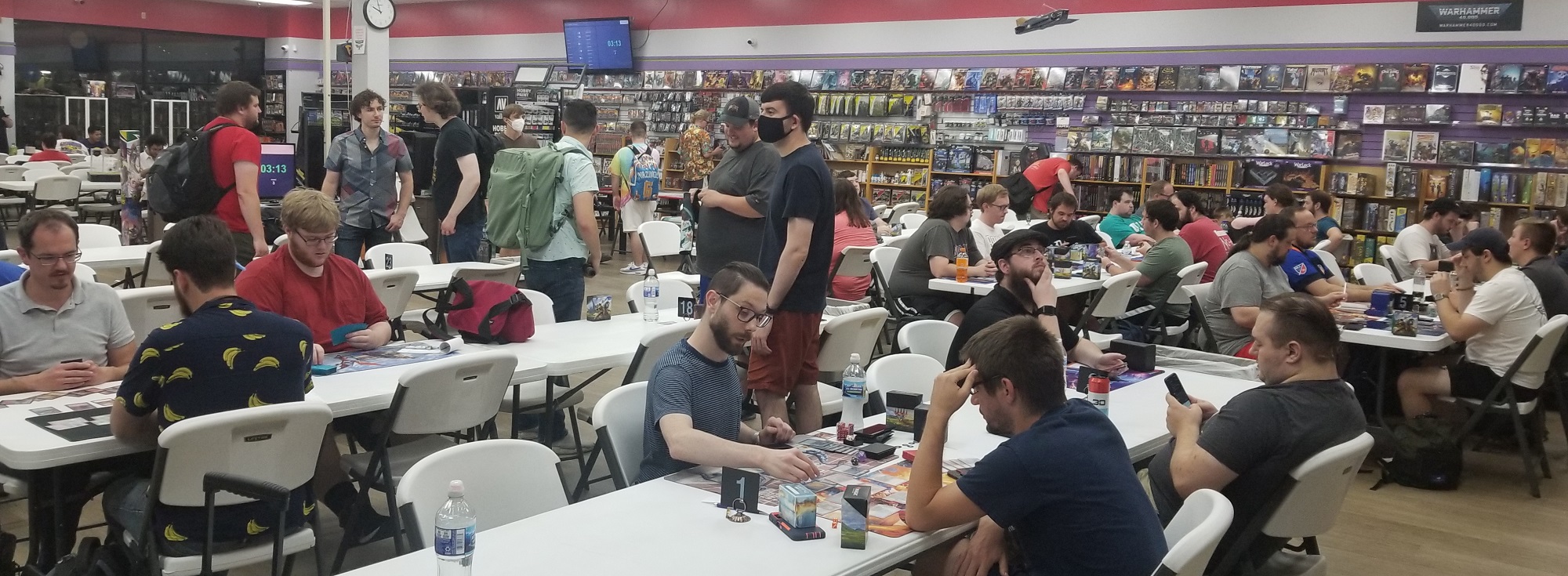
Illuminaudi's prerelease on Monday
(I missed the group picture on Sunday, so my son, Jarod, snagged a similar picture the following day)

I arrived and waited for the sweet, sweet goodness that is a prerelease kit. It's a funny thing, but the feeling of opening loose packs or packs for a draft doesn't really compare to grabbing that kit and hoping for greatness. I would consider it to be like that new car smell (which, of course, is so much better than old car smell). Your first cards of the set. I know, these were the second cards of the set for me, but the feeling was still great.

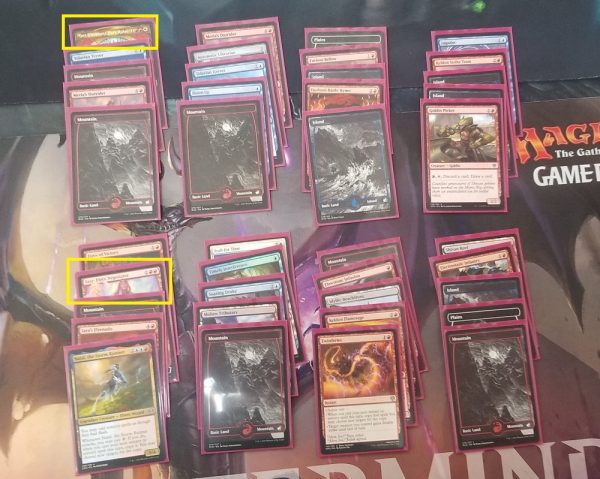
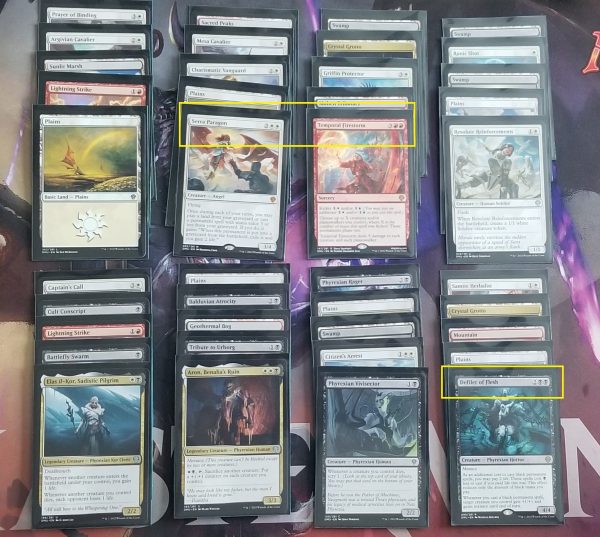
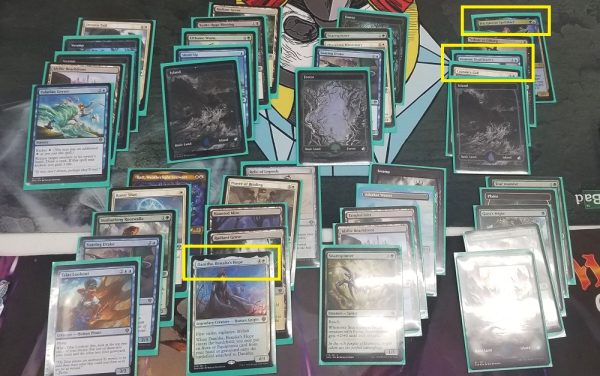
My Illuminaudi Prerelease deck: Bant Defilers

Note: for clarity, I've highlighted key cards in each deck.

Defiler of Faith, Defiler of Dreams, Defiler of Vigor

Yep, THREE Defilers! Defiler of Vigor was my promo, with the other two in one pack, the Defiler of Faith being foil. I knew the potential problem was stretching the mana, but figured by the time I got to five or six mana, I should be able to cast at least two of the three. I had a little bit of fixing and some decent early plays.

I figure this deck would be at least a 3.5, maybe a 4 out of 5. So with a four-round event, I thought I could at least perform as well as my Friday event, right? Yes, that's intentional foreshadowing.

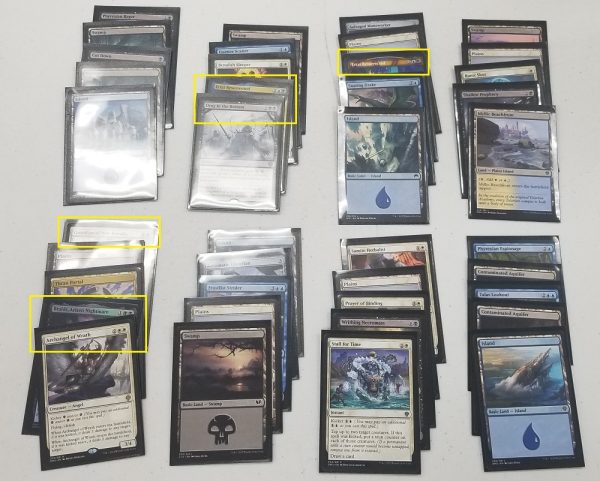
Round 1: Josh, Jeskai Jaya

How long have you played Magic?
I started between Eldritch Moon and Kaladesh, so about six years.

Who or what got you into the game?
It was an ex-girlfriend's brother. He begged me to come with him to the Eldritch Moon prerelease. I knew nothing about the game and he prepped me for a day the week before the event. He paid for my event, built the deck for me, everything, so I would come with him.

Do you still keep in contact with him?
We were in contact for a few years after that, but he moved out of state, so we haven't talked for a while.

What do you enjoy about Magic?
Honestly, the variance. There's just a wild amount of cards involved. That's the main reason I generally stick to prereleases, you never know what you're going to get. I mostly play Commander with friends and attend prereleases. Though I recently entered a couple of Modern RCQs.

Branching out, that's great! What did you play and how did it go?
Esper Reanimator. I didn't win, but I was able to Top 8 in both events.

I'd say that' pretty good for your first venture into the format.

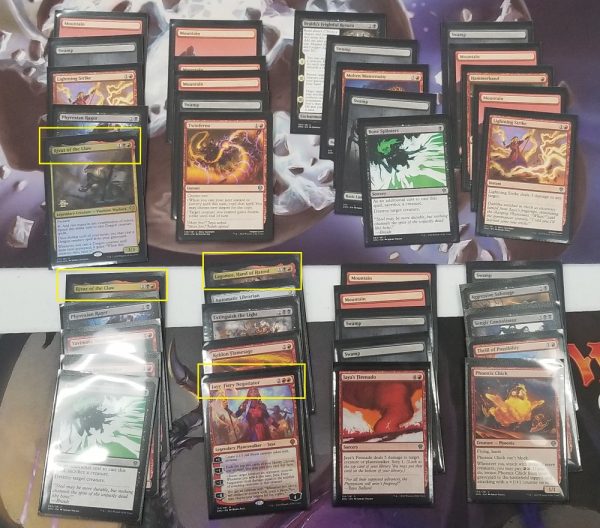
Jaya, Fiery Negotiator, Tori D'Avenant, Fury Rider

So, what is one of your favorite memories involving the game?
Having something to do with my friends every weekend is something I really appreciate.

Have you made friends through Magic?
I moved into the area around the start of 2021 and have been playing every weekend with a group of friends for the past year. One of them moved to Michigan recently, so we started using SpellTable as well to keep in touch.

Keeping in touch through Magic!
Yep, we have a great time.

Any favorite Magic cards?
When I really started to get into the game, right around Aether Revolt, I had many fond memories of Glint-Sleeve Siphoner and Winding Constrictor.

There was an error retrieving a chart for Winding Constrictor

Oh, wait, there's one of my favorite memories!

Awesome, let's hear it!
At my old game store in Mansfield, Ohio, around Guilds of Ravnica, there was a gentleman who would donate a booster box of cards to the store. He would do this once a month to be used for an event of his choosing. For this particular event, it was round robin where you played four different formats with four different decks. The first, Standard; the second, Modern; the third, Tiny Leaders; and the fourth, Commander.

That was the only time before the RCQs that I ever played Modern. I built a Winding Constrictor counters deck, since it had just rotated out of Standard. I actually won the match against someone playing a real Modern deck, with a Blossoming Defense to deal the final blow. That's my favorite Magic memory.

Match Result

The first game started off with both of us exchanging blows. Josh pulled ahead with Jaya, Fiery Negotiator and sealed the deal with a very large and nasty Electrostatic Infantry, supported by Furious Bellow and Twinferno.

In the second game, Josh mulled to five, but still put up a great fight. He played an early Jaya, Fiery Negotiator, but I fortunately had the Prayer of Binding for her. We had both ended up in single digits when he cast Stall for Time on a couple of my guys.

I just smiled, blocked a little, and took a little damage. See, I'd scryed the turn before with Crystal Grotto and knew what was on top of my deck. He only had his two creatures, which were larger than mine, but I proceeded to cast my own Stall for Time and win.

The third game was very anticlimactic. I played the two lands from my starting hand, and didn't get another until about turn seven. Yea, I wasn't coming back from that. 1-2.

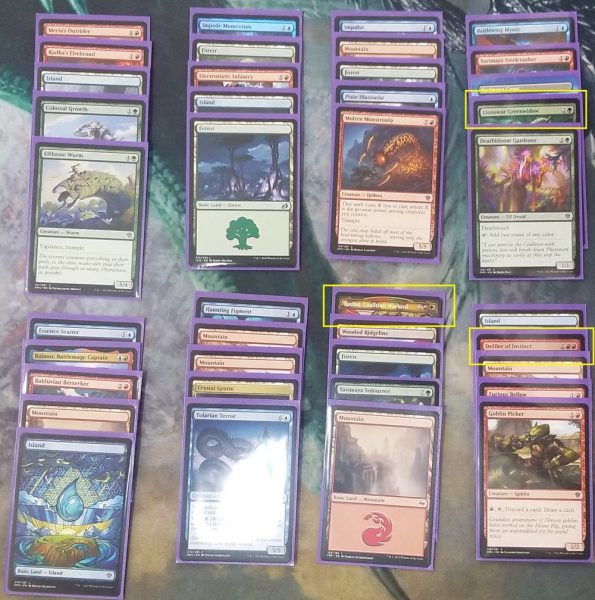
Round 2: Chris, Temur Fun

When did you start playing Magic?
I started during Amonkhet with a few friends, but got out of it until Guilds of Ravnica and have been going ever since.

Who or what got you into the game?
In Boy Scouts. Everyone was playing it at the time, but it was still a little difficult to break into their playgroups, which seemed pretty established.

So, that's what introduced you to the game. What brought you back?
It actually happened when I switched scout troops. This group was easier to get involved with and was having a great time.

What do you enjoy about Magic?
I love the different interactions within the game and the fact that there are so many ways to play. The breadth of Magic is enormous.

Llanowar Greenwidow, Defiler of Instinct, Radha, Coalition Warlord

What is one of your favorite memories involving the game?
Since Boy Scouts is what introduced me to the game, I'd have to say those earliest memories are my foremost ones. My buddy [motions down the table] was in scouts as well, and it's been a great way to stay in touch. That and enjoying Commander with my close friends at their places.

So Commander is your favorite current format, then?
Oh yeah, definitely.

Who's you favorite Commander?
Karlach, Fury of Avernus. Piling on a potentially infinite number of attack steps. I really enjoy Mono-Red decks that utilize the attack step.

Any other favorite Magic cards?
Even though I enjoy Mono-Red, another card I like is Bolas's Citadel. Even when you aren't working to combo out with it, it's still a fun and interesting card. For Commander specifically, it's Lightning Greaves. Need to protect the Commander!

There was an error retrieving a chart for Lightning Greaves

Match Result

My deck decided to start running on all cylinders and Chris's deck blew a tire. He worked to put up a good defense, but had a difficult time landing threats. When I was able to land both Defiler of Faith and Defiler of Dreams in the first game and Defiler of Vigor in the second, the match was over. 2-0.

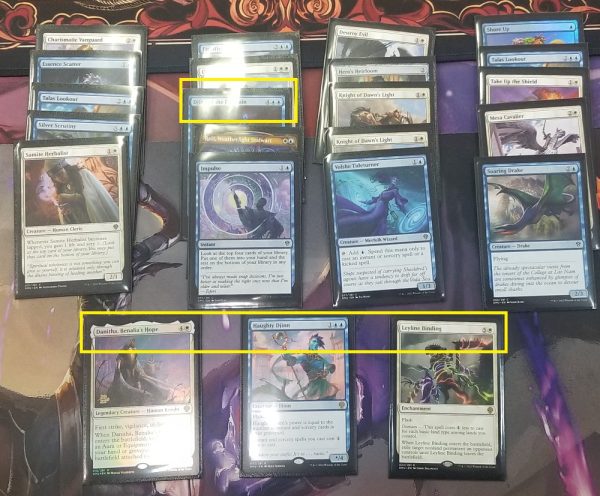
Round 3: Michael, UW Fliers

When did you start playing Magic?
I'm actually entering my third phase of the game. My first phase was in the '90s, from Fourth Edition through Homelands. We weren't serious about it, and it was very typical kitchen table Magic. One thing I remember from then was the difficulty in getting basic lands. Unlike today, where they're everywhere, you had to break open starter decks just get the lands you needed.

Yep, I remember those days!

I had stopped playing while in college, until Return to Ravnica. At that point, I was quite a bit more competitive. I'd be slugging it out in local Standard events three nights a week, grinding in the Grand Prix and various Star City tournaments. I never got too far into the upper levels of play though. My best was at a couple of Star City events where I ended 7-3, with a cash prize of $50.

That's still something. Many others would've liked that!

It was a great time. My friends and I would have super draft nights, where we'd all buy a box and draft all night. I was totally immersed in the game. I believe I stopped again, around Dragons of Tarkir. I'm unsure of the reason, but it probably dealt with being upset with a set rotation. I was strictly a Standard and Limited player.

Until recently, I had always thought to play Magic the "right" way, you had to commit to it. Play multiple nights a week, tournament travel; be dedicated. So when I wasn't able to do that, I'm sure that had an effect. I was also involved in many other games, so there was probably some general overload happening as well.

Now I'm in the third, and hopefully, last phase. Today is the first official event I've played in about seven years. I restarted just a few months ago with some friends who have been playing Commander for a while. They got me into Commander and I'm enjoying the format. So, I think, between casual Commander and events like this prerelease, I can finally enjoy the game without becoming overly serious about it.

Did you happen to keep your cards throughout the phases?
Unfortunately, no. Playing Commander I've seen people playing Cyclonic Rift, and I was thinking, "Hey I remember when that card was $4.00 and I had a bunch of them."

There was an error retrieving a chart for Cyclonic Rift

So, I've told myself that if for some reason I decide to stop playing again, I'll keep the cards! Hopefully though, I'm looking forward to continue playing and enjoying the game from here on.

Who or what got you into the game?
Obviously it was different people at different times. In high school, a good buddy went to a tournament, came back with a few Revised packs, and got our group of friends playing.

I've always been a gamer, so the second time I came back I was ready to play and rip open some packs. I arrived at our local store at the stroke of midnight and bought a box of Return to Ravnica on release night. I don't recall what specifically brought me back in, but I was raring to go.

More recently, my board game buddies played Commander, so my interest was naturally piqued, along with them working on me for a while.

What do you enjoy about Magic?
Winning used to be the goal, for certain; the competition. Now, it's more just enjoying the game and working to achieve what I built my deck to do. If I don't succeed, then I rebuild, and try again. I've been really enjoying the Commander aspect. It's allowed me to focus more on the Gathering part of the game.

Danitha, Benalia's Hope, Haughty Djinn, Leyline Binding, Djinn of the Fountain

What is one of your favorite memories involving the game?
Hitting 7-3 in a few of those Star City tournaments was satisfying. I can't think of anything specific, but I've always enjoyed those come-from-behind moments. Where your opponent believes they have you, and you pull out the win. Yea, those are always great.

Favorite Magic cards?
Oooh.... I would say Falkenrath Aristocrat. I had much success with her during my Standard competitive phase. Another is Sphinx's Revelation. Definitely a favorite of mine during Return to Ravnica.

Match Result

Remember that foreshadowing? Not to dismiss Michael's deck, because it was a very competent deck, but my deck decided to stop at two lands again in the first game. In the second game, it was slightly better, but with a little removal and his fliers, I crashed and burned. 0-2.

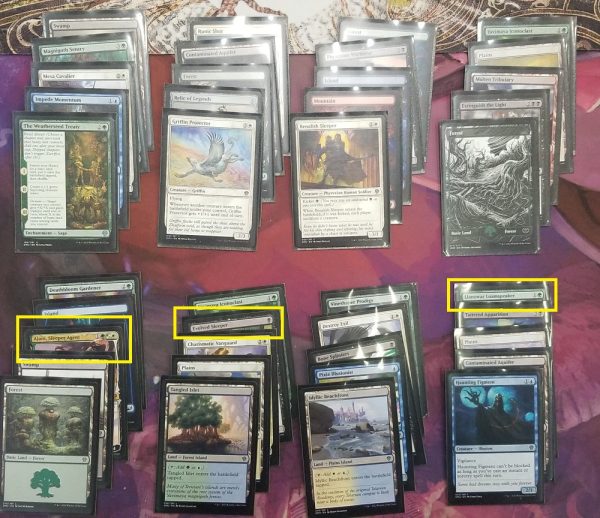
Round 4: Lance, Five Color

When did you start playing Magic?
I don't recall specifically, but I started sometime between Champions of Kamigawa and Time Spiral blocks. I took a break after Zendikar, but got back in with Kaldheim.

Who or what got you into the game?
Boy Scouts. Had a few friends that introduced me to the game. I already played various board and video games, so the interest was already there.

What do you enjoy about Magic?
The challenge. Both in the competition and within deck building. It hits on so many levels.

What kind of formats do you enjoy playing?
In my early days, it was Standard and Draft. Since I've been back, I've been more into Commander, but am looking forward to getting into Modern.

Ajani, Sleeper Agent, Evolved Sleeper, Llanowar Loamspeaker

What is one of your favorite memories involving the game?
Definitely winning my first and second drafts. It was Shards of Alara and I won both with a terrific Naya deck. I love playing those colors and was able to crash through with big beefy boys like Woolly Thoctar. Occasionally I would get to pair him up with Welkin Guide and smash even harder.

Favorite Magic cards?
Llanowar Elves. I love the mana dorks. Being able to ramp or attack. If I had to choose a second, it would be Counterspell. Both cards are useful in many ways and are always solid cards.

There was an error retrieving a chart for Llanowar Elves

Match Result

Sadly, this match was eerily similar to the previous round. Game one, I was stuck on two lands for multiple turns. Game two was better, and we had more of a game. Alas, in the end, he had one more piece of removal in Extinguish the Light and a couple of small guys like Haunting Figment to clean things up. 0-2.

Event Wrap-Up

Well, that's variance poking its head up and saying hi. I'm sure there was the option to mull a couple of those hands, but sometimes it just doesn't go the way you had hoped. Still, in the games I was able to actually play, getting the right colors never seemed to be a problem. The nice thing is that with Illuminaudi, everyone gets at least one pack for playing, so I was able to drown my sorrows by cracking that pack.

As I mentioned, prereleases are always a great time. Win or lose you get to open packs, build a deck, and hang out with your local Magic community. Thanks again to my fellow players at both stores.

How was your prerelease, or by this time, release events? Did you pull some great cards or have a great (or not-so-great) story to share? Were you able to make new Magic friends? I would love to hear about your experience in the comments below or on Twitter.

New Cards, Wallet Fatigue, and Burnout

Are you a Quiet Speculation member?

If not, now is a perfect time to join up! Our powerful tools, breaking-news analysis, and exclusive Discord channel will make sure you stay up to date and ahead of the curve.

Wizards is releasing more sets, more Secret Lairs, more everything than ever before. Warhammer40K, Lord of the Rings, and The Brothers' War are all coming. At a certain point, it's simply impossible to keep up! Or is it? What are some ways to keep expanding your Magic horizons without being overwhelmed mentally or financially?

Focus Your Efforts

There was an error retrieving a chart for refocus

Unless you're a madman trying to build 32 new decks at once, it's much more likely you have one or two decks you are building or improving. When a new set drops, focus your efforts on upgrades or themes for only a deck or two. Just because Dominaria United introduced a Cleric lord and a ton of new Phyrexians does not mean you should be attempting to build both of those decks!

A Decided Lack of Spirit

There was an error retrieving a chart for eerie soultender

At home, we have a Millicent, Restless Revenant Spirit tribal deck. Unfortunately, there was not a single white or blue Spirit in DMU. The most on-theme card turned out to be Runic Shot. Conversely, Crimson Vow, Midnight Hunt, and Neon Dynasty all had a pile of Spirits for consideration. It was overwhelming to say the least, and, the respite is much needed! Not chasing multiple rares and mythics is a nice change of pace, and opening the single uncommon from a pack felt great! The lesson? Knowing exactly what your deck wants helps filter the "noise" from the payoffs.

Of Boats and Gold

There was an error retrieving a chart for Ramirez DePietro, Pillager

But what if you have a ton of decks? Focus even harder. Ramirez can go into my art-based boat deck that now has a (forced) Pirate subtheme. Furthermore, I'm able to juggle themes to such a degree that I can go back over older sets to see if existing cards complete the deck. There are some old cards from Portal Two that received errata during The Grand Creature Type Update which were Ships or Merchants but are now Pirates. Just adding one new card allowed me to add several old cards to round the deck out. Now, I have a very complete deck, and I don't need to add anything but the most exceptional of boat-based cards.

There was an error retrieving a chart for Sheoldred, the Apocalypse

Deathtouch? Deathtouch! However, not going into the Deathtouch deck. I've tinkered with Atraxa, Praetors' Voice so much that it's now named "Midas Deathtouch," with a heavy multi-colored theme and Party sub-theme. So a Mono-Black Phyrexian Praetor deathtoucher, even a potent one like Sheoldred, just does not make the cut. Not only does this spare my wallet, it means I don't need to automatically consider a card just because it says "deathtouch." The theme and subthemes presented are deep enough that a card has to be pretty special to get included.

The Only FOMO Is FOMO Itself

There was an error retrieving a chart for Chun-Li, Countless Kicks

I cannot afford to blow $40 on one card. I asked a few people I knew who ordered Secret Lair x Street Fighter if they were interested in selling just Chun-Li, but that did not pan out. Then I took to eBay and tried every "Best Offer" vendor I could, again to no avail. However, time was on my side as I predicted in July, and her price steadily decreased. I only had to wait about a month and shaved over 50% off her price. Now that I finally have my commander, I can build that deck. Most importantly, I did not miss out! I got the card I wanted for a decent price.

Speaking of Priority...

There was an error retrieving a chart for Priority Avenger

My personal deck building backlog is pretty massive, and sometimes it's difficult to know what concept to work on next. In this case, I've been waiting the longest for Chun-Li, so she's at the front of the line. Once I have the commander, the deck gets built. Period. In this case, my personal deadline is Commander Game Night, where I try to always bring at least one new deck. An important note is to bring your deck as-is and to actually play it. I see too many players put off playing a deck because they feel they do not have all the "perfect" cards for it. Budget cards are a good compromise for this situation.

Fatigue Can Also Be Burnout

There was an error retrieving a chart for Burnout

You may find yourself burned out from seeing too many new cards, acquiring new Commander decks you have no time to play, and just playing too much. There are multiple kinds of play burnout. Mono-Black commanders have been my jam for many, many years. However, playing Arvinox the last couple of weeks and a Mono-Black version of Oona, Queen of the Fae for a store event has given me my fill of Mono-Black Commander goodness for the foreseeable future. I'm benching these decks for the time being and bringing something new to keep my interest up.

Slowing Down

There was an error retrieving a chart for Slow Motion

Playing on Thursdays and Fridays without fail for the last few months has been a bit too much, on top of late night games on SpellTable. So yes, I'm going to cut back, mostly on the SpellTable side of things because playing in person is more fun. Other hobbies and ventures do call from time to time, so it is important to acknowledge them. Did someone say football season? I wonder what a football-themed Commander deck would look like... oh wait, they're doing Secret Lair x Blood Bowl. But no, seriously, moderation is important! If Magic is becoming too demanding or overwhelming, put it down and come back later.

Choose Wisely

There was an error retrieving a chart for Multiple Choice

With so many Magic products coming, I am extremely aware of just how many shiny new cards I can afford. I'm getting the Warhammer stuff and skipping the Lord of the Rings stuff. I'm not getting any more Dominaria United but will get a lot of The Brother's War. It's not only about what I am buying, but what I am not buying. I've scooped up the handful of cards I wanted from DMU, most of which were uncommons, so I get a little bit of "wallet cooldown" until the next big purchase. As far as Commander precons go, I've picked up the ones that looked good and will scoop up the rest for bulk prices later.

Moderation Is Key

There's a lot to love about Magic: The Gathering. Every year they, are churning out more cards, sets, decks, promos, and swag than ever before. If you carefully focus your attention, don't succumb to FOMO, enjoy a moderate amount of play, and make precise purchase decisions, you can stave off analysis paralysis and stretch your budget.

Have you experienced Magic-related FOMO? Burnout? Wallet fatigue? Please share your story in the comments, as well as any tips you may have for keeping the spark alive!

My Favorite Blue Penny Picks for September 2022

Are you a Quiet Speculation member?

If not, now is a perfect time to join up! Our powerful tools, breaking-news analysis, and exclusive Discord channel will make sure you stay up to date and ahead of the curve.

I began this series last month with an article on green penny picks. Today, we'll continue the series with blue, everyone's favorite color to hate!

While most believe that green is the most powerful color in Commander, blue is arguably the best color in Magic. The options of card draw, counter magic, and extra turns makes any counter arguments quite difficult. I bring these specific characteristics up because they also happen to be the ones that make for good speculation targets.

As I mentioned in the last article, to qualify as a penny pick, the card must be available to buy in somewhat large quantities for under $1. So without further ado, let's take a look at the ones I'm most interested in picking up right now.

There was an error retrieving a chart for Cut Your Losses

Mill strategies are a casual favorite. Consider a card that is very similar to Cut Your Losses in Traumatize, which despite six printings is a $3 card. While Cut Your Losses does cost an additional mana, the ability to hit 75% of an opponent's library is very powerful.

It's interesting to me that despite the fact that the mill strategy is rarely viable in a competitive environment, it retains a strong enough following that any cards that either mill a lot of cards or can repeatedly mill opponents automatically make it into my "not bulk" box.

There was an error retrieving a chart for Muse Vortex

UR Spells is a powerful Commander archetype, and this card seems like a must-include there. I honestly hadn't given this card much thought until researching for this article. As I mentioned, one of blue's most powerful abilities is card draw, and while this card doesn't let you draw all the cards you hit off of it, you do get all the relevant ones. Getting to cast an additional spell for free makes it even better.

There was an error retrieving a chart for Venser, Shaper Savant

This card has been a very popular Commander card with occasional Modern play. It's ability can act like a pseudo-Time Walk similar to Remand, except it leaves behind a 2/2 body. Venser was a good $15+ card until its reprint in Modern Masters 2017, which wrecked its price for about a year. It began to creep back up again and hit almost $10 prior to the Double Masters reprinting. Now, copies sit under $1, and I imagine this could easily return to the $3-$4 range barring more reprints.

There was an error retrieving a chart for Wizards of Thay

At first glance, I didn't think a whole lot about this rare, as we have plenty of cards that reduce instant and sorcery costs by one generic mana. The myriad ability has been one that Wizards of the Coast has seemed to be hesitant to really break, as there are only 14 creatures with the ability and one equipment, and none of the creatures sees significant play in Commander.

That being said, Thay does provide the possibility of making instants and sorceries cheaper by one for each opponent if you can make sure the copies live, and thanks to the last ability, you can actually cast any instants or sorceries at the reduced cost prior to combat damage, thus allowing one to cast some big spells a lot earlier than normal.

There was an error retrieving a chart for Endless Evil

While I, like most players, tend to shy away from auras given casting them tends to be dangerous, this one does provide a lot of value. It does cost three mana, which means it can be recurred via cards like Sun Titan and Serra Paragon, and thus could be very abusable in a UWx shell. The biggest issue that I see is that you get no benefit until your next upkeep, which in Commander games can take an eternity.

There was an error retrieving a chart for Robe of the Archmagi

I have a soft spot for equipment since it sticks around when the equipped creature dies. Still, the equip cost on this one is pretty high unless your creatures are Shamans, Warlocks, or Wizards. The fact remains that there are a lot of creatures in blue that have at least one of those creature types, and it doesn't take much imagination to see equipping this to a creature people don't want to block and getting to draw 3+ extra cards every turn.

Another Pick in the Ocean

Thus concludes our list of blue penny picks. I have not personally invested in all of these, but have picked up most of them myself.

It is important to keep in mind that again, all of these are recent printings. With larger print runs, the price ceiling tends to be lower, especially for rares. Still, many of these have extended art variants which are still quite cheap, and of those options, many of the foil extended arts are under $1. A surge in popularity for any of these cards can drive scarcity, which could skyrocket the price of these special versions especially.

Are there any cards you think deserve to be on the list? If so, please comment below.

Magical Creatures: Myr and Slith

Are you a Quiet Speculation member?

If not, now is a perfect time to join up! Our powerful tools, breaking-news analysis, and exclusive Discord channel will make sure you stay up to date and ahead of the curve.

Hello everyone, and welcome to a new installment of Magical Creatures, the series dealing with creatures unique to the Magic universe! If you missed it, the first piece of the series was an introduction to the concept of uniqueness and what I mean with that. As for the last one, it dealt with Kavu and Cephalid, two subtypes introduced respectively with the Invasion and with the Odyssey blocks.

I have anticipated it last week: the following block, namely Onslaught, contained no such creatures at all, despite being packed with creatures (especially Legions). It's still an interesting block, as it gave a crucial boost to the concept of tribal as we know it today. Thus, we'll quickly have a look at it before moving to the core of today's piece.

The Onlsaught Block

Launched in the end of 2002, Onslaught opened a new block, and the next year, Legions and Scourge would follow. It focused heavily on tribal cards, or ones for which creature types matter. The perfect scene for creating some new creatures! Well, it actually did add some, but none of them was unique to Magic. For instance, we had the first Mutant (Mistform Mutant) and Pangolin (although it was not to receive this subtype until many years later).

Typical (and not so typical) tribes

As for the rest, the Onslaught block was full of the typical creatures one would expect from a game based on the fantasy world. Goblins, Elves, Zombies, Clerics, and so on. Nothing for us to discuss, at least not in the present series... so instead, let's get to the heart of today's piece: Mirrodin!

Mirrodin's Supremacy

The Mirrodin block added no less than six new creature types unique to Magic: The Gathering. That's the highest number in the whole history of Magic. The only block coming close was Tempest, adding five unique subtypes. With a notable difference, though: Tempest's Soltari and Thalakos were not creature types back in the day, and were only canonized in the Grand Creature Type Update. On the contrary, all six of Mirrodin's new creatures were actual creature types right from the beginning.

This does not surprise us too much. After all, the plane that was once known as Mirrodin (and is now called New Phyrexia) is an artificial one, mostly made of metal. As such, it is home to many weird beings that were unseen before. Today it's different, since we came back to that plane with the Scars of Mirrodin block between 2010 and 2011, and are now familiar even with those strange creatures. Back in 2004, though, many new creature types needed to see light.

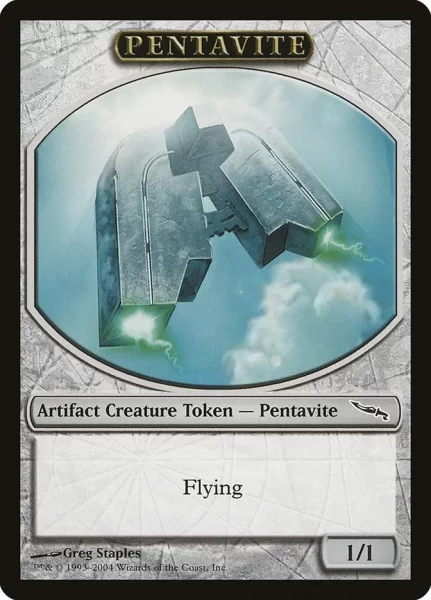
Indeed, we are counting six just because the focus of this series is on subtypes unique to Magic. If we had to count all new creature types, well, the number would be even higher! The six creatures we're talking about are Myr, Pentavite, Slith, Vedalken, Blinkmoth, and Bringer. Most of them come from the first set, Mirrodin itself, whereas the last two come from the next two expansions, Darksteel and Fifth Dawn.

Due to spatial concerns, we'll split the analysis over two pieces. In the present installment, let's discuss one big subtype (Myr) and two minor ones (Pentavite and Slith). Next week's piece will also deal with one major creature type (Vedalken) and two minor ones (Blinkmoth and Bringer).

Not Homunculus, Not Gnome... Myr!

Simplifying things, the concept of Myr is similar to that of the Homunculus, not unlike the Beeble (remember?), with the difference being that myrs are metal automatons. But then again, what isn't metallic on Mirrodin? Myrs are basically servitors, and were originally supposed to be Gnomes. The fact is that Brady Dommermuth, Creative Director at the time of Mirrodin, was not a huge fan of Gnomes, so he made up this new artifact race.

Myr mostly appeared in two limited periods of time during Magic's history: the Mirrodin block and the Scars of Mirrodin block. Some exceptions consist of Sarcomite Myr from Future Sight and a couple more from Modern Horizons (Parcel Myr and Myr Scrapling). Nothing exceptional.

Speaking of tribal, Myr was not complete until the arrival of Scars of Mirrodin, which introduced their first (and only) lord: Myr Galvanizer. That doesn't mean they are now a viable tribe for competitive play, but at least they gained something, right?

Notable Myrs in Competitive Play

As for competitive tournaments, though, the only Myr that saw regular play throughout the years was Myr Enforcer, and it definitely wasn't because of its subtype. If you played during the first Mirrodin age, you'll probably remember with terror the absolute and outrageous power of Affinity decks. And even if you didn't, you'll still know how it works, since it was also a contender in Extended and in Modern. It's no accident that today's Banned & Restricted list still includes Mirrodin's artifact lands... or that the Mirrodin Block format had 10 card banned from tournaments. No other block in Magic ever came close!

Other notable Myrs are Myr Retriever, a card that literally screams "combo," and Ichorclaw Myr, used during the Scars of Mirrodin era in Infect decks. The former managed to get a good result at Grand Prix Vienna, in 2008, piloted by Tomas Lebeda. And what's more, the reason why it performed so well was its synergy with another Myr, Myr Servitor. The latter even made it into the Top 8 of Pro Tour Nagoya 2011, this time in the hands of Gaudenis Vidugiris. Not bad, for a bunch of metallic servants!

Pentavite

We actually mentioned Pentavite a few months ago, in the piece about Atog and Tetravite, and it came to my mind because of its being a direct reference to Tetravite. Actually, the original card was Tetravus from Antiquities. As for Pentavus, it's a very similar creature, and even the name is a clear tribute. "Tetra" is Greek for the number 4, whereas "penta" indicates the number 5. And if you look at the two cards, you'll see that the former enters the battlefield with four +1/+1 counters, and the latter with five.

It's a weird creature type, that's for sure. Not a single creature was ever printed with that subtype, which means it only exists in the form of creature tokens. Or as the umpteenth creature type of Mistform Ultimus and all creatures with the changeling ability, of course...

Slith

The last creature type we're seeing today is Slith. Far from the huge number of Myr, but still more diverse than Pentavite, Slith appear on six cards. All of them come from Mirrodin, except for the last one, Arcbound Slith, introduced in the second expansion, Darksteel. Sliths are humanoid beings with faces similar to skulls, and seem to be made of metal or rock.

Their ability, although it might not seem obvious to newer players, is a tribute to Whirling Dervish, an old card from Legends. It's a weird set, as it includes six creatures instead of the usual five. The reason lies in the very nature of this block. Since artifacts are this crucial, even cycles that would normally be made of one card per color were joined by a sixth, colorless, artifact card.

What Makes a Good Card?

It goes without saying that neither Pentavus nor Slith were good enough to make the cut for competitive play. Myr, however, did. And the funny thing is that it made it for reasons totally unrelated to the creature type. Enforcer was a great 7-drop (actually more like a 2-drop, or total freebie) for Affinity. Retriever and Servitor worked very well together, and Ichorclaw was the perfect extra 2-drop for Mono Black Infect. So, the fact they were all Myr is just a coincidence?

Well, I hate to say it, but the answer is yes. Myr is a fantastic creature type from the point of view of visual design, if you ask me, and one of my all-time favourites. Nevertheless, the main reason why this subtype was seen on so many good cards is not the "Myr" part, but rather the "artifact" part. It's only natural that a colorless card, playable by any deck no matter its color restrictions, has an advantage right from the start against other colored cards.

Anyway, when such creature types are born, capable of being appreciated both by kitchen-table players and professionals, it's undoubtedly a great moment for Magic. What do you think? Can you name any other creatures with that kind of pedigree? Let me know in the comments or on Twitter, and stay tuned for the follow-up article, when we'll discuss Vedalken, Blinkmoth, and Bringer!

Deck Spotlight: RB Scam

Are you a Quiet Speculation member?

If not, now is a perfect time to join up! Our powerful tools, breaking-news analysis, and exclusive Discord channel will make sure you stay up to date and ahead of the curve.

It's time we talk about RB Scam, one of the archetypes made possible by Modern Horizons 2's cycle of evoke elementals. The evocative name comes from the deck's ability to "scam" quick wins by dismantling the opponent's hand or board for only a single mana and leaving behind a powerful creature as early as turn one.

The core concept of the deck is nothing new as players were theory-crafting the interaction even during MH2's spoiler season. A similar play line is even prevalent in Modern by casting Ephemerate on Solitude.

Despite no new or groundbreaking additions to the archetype in recent sets, the deck has rapidly grown in popularity. While I can't track down the exact proliferation point, pro player Andrea Mengucci reported a 13-0 win streak on stream about two weeks ago, which certainly helped put eyes on the deck.

Fast forward to this past weekend, RB Scam put three copies in the top eight of Saturday's Modern Challenge, including a mirror match in the finals. It's clear that scamming players is a powerful strategy and a contender in the current metagame.

How Does it Work?

Step one is to cast Grief or Fury for their evoke cost and resolve the first enters-the-battlefield ability. For step two, cast one of the seven "undying" effects in the deck such as Undying Evil before the sacrifice trigger resolves. This allows the elemental to die, then return to the battlefield, triggering their ability again. In doing so, Fury distributes a total of eight damage or Grief takes the opponent's two best cards, putting them on the back foot.

This interaction is supplemented by other midrange staples like Seasoned Pyromancer, Blood Moon, and even Kroxa, Titan of Death's Hunger whose own sacrifice trigger works well with the "undying" effects.

What I Like

RB Scam offers substantial, low-cost interaction like Lightning Bolt and Thoughtseize backed up by cheap threats like Ragavan, Nimble Pilferer and Dauthi Voidwalker. Thanks to all of the various undying spells, non-exile-based removal isn't reliable from the opponent either.

I'm also a big fan of Voidwalker's interaction with the undying spells, allowing you to use the stolen cards from the opponent while keeping Voidwalker in play. In the event of cards getting clogged in your hand, Seasoned Pyromancer can help turn them into more impactful spells while leaving behind some 1/1 tokens for your trouble.

Of course, the main feature of the deck, the evoke elementals, are the top highlight. Grief punishes opponents for holding cards in hand while Fury punishes them for playing to the board. It's a lose-lose situation for the opponent, which is exactly where I want to be.

What I Don't Like

There are a lot of non-functional hands in this deck. As a result, it mulligans often. Hands with too many undying spells without creatures or too many expensive spells are issues. I'm also apprehensive about an 18-land deck (21 including Agadeem's Awakening and Malakir Rebirth) playing so many three drops. Missing land drops is common and so is the need to tap out for a threat, thus rendering the undying spells useless at saving deployed creatures.

While we're on the subject of the three drops, I have differing opinions on what those slots should be. The singleton Liliana of the Veil is hard to cast for this Blood Moon deck. I'd like to see it and potentially some number of Seasoned Pyromancer as Fable of the Mirror-Breaker instead. Fable does a better job of churning through the air in the deck while also helping to fuel Kroxa's escape cost.

When flipped, Reflection of Kiki-Jiki can soft-lock the opponent by copying Grief in their draw step, or repeatedly killing creatures with Fury. A cute interaction here is an undying effect on the Reflection would return it to play on the front side, gaining tons of added value.

I'm also interested in possibly playing Persist over a copy or two of the undying effects. This offers some late-game functionality at a point where the undying cards start to lose their usefulness.

This may be a bit nit-picky, but I have concerns with Scam being soft to Sanctifier en-Vec. Not only does it shut down any graveyard shenanigans from the deck, but it blocks exceptionally well. Since the deck tends to put a lot of eggs in a single creature's basket, such as an early Fury to win, Sanctifier shuts us down cold. The only answer to it is Engineered Explosives in the sideboard. Fortunately, Sanctifier is on a downward trend right now, but with RB Scam's increased popularity, it's sure to make a resurgence.

The Deck

RB Scam by REAL_ED

Planeswalkers

1 Liliana of the Veil

Creatures

4 Dauthi Voidwalker
4 Fury
4 Grief
2 Kroxa, Titan of Death's Hunger
4 Ragavan, Nimble Pilferer
3 Seasoned Pyromancer

Spells

1 Agadeem's Awakening
1 Night's Whisper
3 Thoughtseize
2 Feign Death
1 Kolaghan's Command
2 Lightning Bolt
2 Malakir Rebirth
3 Terminate
1 Undying Evil
2 Undying Malice

Enchantments

2 Blood Moon

Lands

4 Blackcleave Cliffs
2 Blood Crypt
4 Bloodstained Mire
1 Mountain
1 Polluted Delta
1 Prismatic Vista
1 Shizo, Death's Storehouse
3 Swamp
1 Verdant Catacombs

Sideboard

1 Abrade
2 Collective Brutality
2 Engineered Explosives
2 Fatal Push
1 Hidetsugu Consumes All
1 Magus of the Moon
2 Necromentia
2 Tourach, Dread Cantor
2 Unlicensed Hearse

End Step

And that's a wrap! Overall, RB Scam seems like an excellent contender in a graveyard hate-light environment. Even in the face of Leyline of the Void or Unlicensed Hearse, the deck still presents a strong fair game plan. If you're looking for something novel for FNM or even your next RCQ, this is a very viable option.

As always, if you want to keep up with me, you can follow me on Twitter at @AdamECohen. Catch you all next week!

Fundamentals: When to Playtest vs Goldfish

Are you a Quiet Speculation member?

If not, now is a perfect time to join up! Our powerful tools, breaking-news analysis, and exclusive Discord channel will make sure you stay up to date and ahead of the curve.

Congratulations! A bolt from the blue has struck and left in its wake a great idea for a new deck. It's time now to get turn that idea into reality! Of course, as any player knows, that's only the start. Once built, a deck needs to be tested. This begs the question, how do we actually test a new deck? Most players would answer with "Playtest it, of course."

Which is fair. That's a necessary and invaluable part of deck building at any level. However, what most players actually mean by playtesting is to grab someone to jam games with. Which, again, is great. Magic is a card game after all. However, just playing games isn't really playtesting. In fact, jumping right to games is almost certainly the wrong move. Players at all levels and in all formats tend to skip an important step before playing games.

Don't Neglect to Goldfish

This may be shocking to some players, but goldfishing is an essential part of deckbuilding and testing. Yes, it doesn't replicate games and so doesn't replicate the actual play experience, but it's not supposed to. Goldfishing does serve an important purpose though. If playtesting is learning how a deck performs in a match, then goldfishing is learning if a deck works at all and how to actually play it. Skipping goldfishing is the equivalent of taking an idea right off the drawing board to a full product release. It might work, but it's more likely to be an avoidable disaster.

There was an error retrieving a chart for Test of Endurance

To make sure that everyone is on the same page here, goldfishing is where a player plays a game without an actual opponent. The name (probably) comes from asking if a deck can beat a goldfish, an opponent who does actual nothing. Being able to beat said goldfish is the basic test of competency for any Magic deck, regardless of competitiveness or format.

Ideas Must Be Tested

It is possible that some players can build a deck correctly on the first try. I've neither met one nor heard of one. I'm not one either. I, therefore, feel confident in saying that every newly built deck is an unproven deck. Theorycrafting a deck and building to the theory is great, but when theory and reality conflict, reality always wins. Goldfishing is how to find out if the ideas that went into the deck actually work. Goldfishing reveals answers to these questions:

  1. Does the mana work? Is this deck capable of playing Magic, and what do I need to do to make it happen?
  2. Does the deck do The Thing? Whatever The Thing might be if a deck can't do what it's supposed to do against no opponent, how will it do so against actual resistance?
  3. How quickly does the deck do The Thing? Is it as fast as it's supposed to be?
  4. Do I know how to do The Thing? Do I know what I'm doing?
  5. Is The Thing worthwhile to do? Is this idea dead on arrival because it just isn't very good?

Make no mistake, goldfishing will not provide definitive answers to these questions. That's playtesting's job. Actual games with actual interaction will impact a deck's ability to function. However, goldfishing will reveal the larger flaws in a deck which will make the later playtesting more productive.

#1: Does the Mana Work?

There are all sorts of guides out there for how to build mana bases in all formats. Many players have their own heuristics and guides based on their experiences and preferences. However, none of that matters for a given deck. It may be trying to cast spells that make atypical demands. Or there may be heavy color requirements that force concessions. A deck whose mana cannot cast its spells cannot function.

There was an error retrieving a chart for Omnath, Locus of Creation

As an example, I am spending most of my playtest time working on Modern Merfolk. After I built my first test deck, I started running into a problem casting my spells. Specifically, I had a lot of double blue spells, and Mutavault coupled with Cavern of Souls made it hard to cast them. Cavern was fine for the merfolk themselves, but it was very awkward with sideboard cards. Mutavault was worse and made me mulligan more than I thought necessary. I replaced the 'Vaults with Islands and the problem disappeared. Doing so was heresy once, and maybe playtesting will say it's wrong, but the goldfish test indicates that it's not.

There was an error retrieving a chart for Mutavault

This is also the chance to learn not just if the mana works but how it works. Is there a specific order that lands must be fetched and will I lose if I can't or don't? How important land sequencing is and how many lands the deck needs in play to function are just as important as what lands are in the deck. It's better to figure out how to play the lands when there's no pressure than trying to figure out during a game.

#2: Does the Deck do The Thing?

A deck is built to do The Thing. It doesn't matter what The Thing is, but it does matter whether or not the deck can do what it's been built to do. This can be archetype specific. For example, with combo decks, does that combo come together on purpose? Can an aggro deck present a decent clock? Do the synergies I think work actually work in the deck? If the answer to these questions when playing against no resistance is anything other than a definitive yes, the deck needs more work.

There was an error retrieving a chart for Song of Creation

Control decks can struggle with this one, but I have a solution. How often and how does it need to interact against a given deck? Imagine that scenario and see what happens. Play the control deck against an imaginary opponent. To avoid cheating, before the game begins write an opposing sequence that will win the game and try to stop it. If a control deck struggles to actually present the interaction necessary to survive a theoretical deck, it can't possibly do so against a real one consistently.

There was an error retrieving a chart for Counterspell

Also, this is a chance to find out if the deck does any other Thing. There may be unintended synergies in the deck or alternative ways to win. Goldfish the deck to see what it can do, not what it will do in a game.

#3: How Quickly Does the Deck do The Thing?

Does my combo deck win quickly enough to not die to aggro? Will this aggro deck kill quickly? Kill speed is the quintessential reason to goldfish a deck. It's why players started goldfishing decks in the first place. If an active deck can't win in the timeframe their chosen format demands, they're not going to be viable. For competitive formats, this would be a kill on turns 3-5.

There was an error retrieving a chart for Goblin Guide

Again, for control decks, this question is hard to answer. Control's whole deal is slowing down the game and ending the game after it's already won. Just as with #2, contriving imaginary scenarios is useful here. Against a purely hypothetical opponent, can the control deck actually establish control, turn the corner, and proceed toward winning the game.

#4: Do I Know How to Do The Thing?

Can I play my deck? Not just make normal Magic actions, but carry out my deck's plan. Can I execute the combo or string together 20 damage? I built a deck filled with internal synergies, but can I get them together and maximize their effect? This is a very basic question, but for a surprising number of players, the answer is no.

There was an error retrieving a chart for Flash

For example, Steve Sadin won Grand Prix Columbus in 2007, but didn't actually know how his deck worked until most of the way through Day One. He was playing the Flash/Protean Hulk combo, and expected that when he Flashed in Hulk, his opponents would concede. Which happened the first four rounds. Then, in Round 5 his opponent made him actually play out the combo, which he'd never done before. Steve didn't know what to do, messed up, and lost the match.

There was an error retrieving a chart for Protean Hulk

Had Steve actually tried out the deck before the GP, he would know how the combo worked and how to execute it. In order to learn how to play a deck, we have to actually play it. Goldfishing doesn't reveal how to play every scenario, but at least we'll know how it works. I resent having to spell this out, but I've seen players, even in the past week, lose matches because they didn't understand how to win with their deck beside the opponent conceding. Don't let that be you.

#5: Is The Thing Worthwhile to Do?

This applies more to competitive than casual or Commander decks, but is this new deck a worse version of an existing one? Worse is relative, but if the new aggro deck we've made is similar to but slower than Burn with no compensating value like disruption, why bother? Just play Burn. Playing a worse version of an existing deck is not going to win a tournament.

There was an error retrieving a chart for Lightning Strike

Even for non-competitive play, just because something seems fun, in theory, doesn't mean it actually will be fun in practice. If the deck does the thing it's supposed to, but we'd rather it hadn't, that's a strong sign something's wrong. Better to find out before subjecting ourselves and others to something nobody will enjoy.

A Bonus

As a bonus, goldfishing a deck will make us faster at playing the deck. I noted in my full article on the subject, that practice is the primary way to speed up. Learning how the deck works in a vacuum makes it easier and therefore faster to make those sequencing decisions that aren't dependent on the matchup. Land sequencing in particular should be rote for most decks, so just get the practice in.

Additionally, goldfishing combo decks will make it easier to execute the combo. A new player needs to think through the whole combo. An experienced player knows what needs to happen without having to think about it, which means they shave time off the combo.

Now to Playtest

Having goldfished the deck enough to have worked out the really rough edges and figured out how to play the deck reasonably competently, it's time to actually playtest. After all, it's the actually fun part. Playing games of Magic is the only way to learn and get better at playing Magic. Without playtesting, there's no way to know how a deck will perform in actual games. It's also the only way to learn matchups.

There was an error retrieving a chart for Eye of Ugin

However, be careful. There are many stories of players and entire pro-level teams' playtesting so heavily that their testing became recursive. They convinced themselves that the matchup worked one way based on their testing, but their opponents had gone a completely different direction.

The key in playtesting is to play enough to understand how a matchup works and how to win. Play matches with the starting decks, make some tweaks as needed, but primarily learn what matters in the game. That's far more important than specific details about interactions or how to beat the specific build. Every player will have a slightly different configuration. Preparing too much against a certain version will leave a deck hopelessly inbred and weak.

Seek Answers

The other thing to do during playtesting is to test out various scenarios. If something isn't coming up in normal games, but it could be important, then set it up and find out. For example, one of the hardest things to determine is whether sideboard cards actually work. They're played in small numbers for specific scenarios, so there's just less opportunity to find out if they do what they're supposed to do. Therefore, set up both decks in the best-case scenario for that card and see if it does what's intended. If not, abandon it. If it does work, then start working back to a more typical scenario and see if it's still effective.

There was an error retrieving a chart for Attunement

I know that there will be objections to this on the basis that it isn't a real-world test. So what? Science is all about contriving scenarios that are rare in order to see what happens. Don't get caught up splitting hairs about it being artificial. If there are questions about something in a matchup, answer them. It's better to have the answers than continuously worrying about them.

One Is Good, Two Is Better

Goldfishing and playtesting are both necessary to making good Magic decks, regardless of format. To do one is helpful but doing both is critical. Think of it as the equivalent of lab testing and field testing. Both reveal weaknesses and flaws, but different ones. Doing one without the other is leaving a huge blind spot.

A Flashback to Childhood: Part 2

Are you a Quiet Speculation member?

If not, now is a perfect time to join up! Our powerful tools, breaking-news analysis, and exclusive Discord channel will make sure you stay up to date and ahead of the curve.

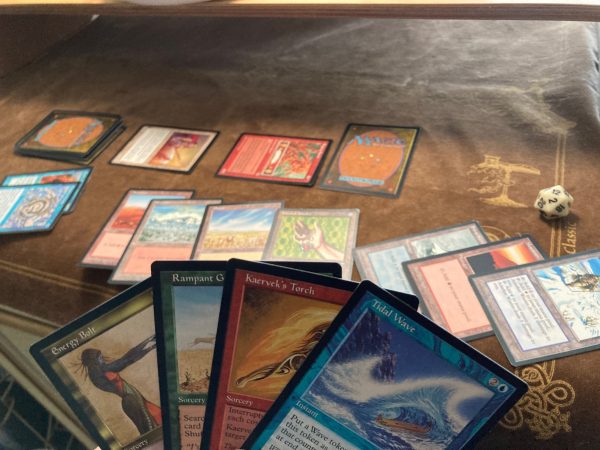
After cracking open Mirage and Fifth Edition starter decks last week, I was eager to try out the decks I built. As a refresher, I crafted a 60-card Jund deck attempting to exploit my bombs Lord of the Pit and Catacomb Dragon. With the remaining cards, I crafted a 40-card control-ish, double-Ray of Command deck just so I could play with the cards in the other two colors in my pool.

Both deck lists can be found in last week’s article.

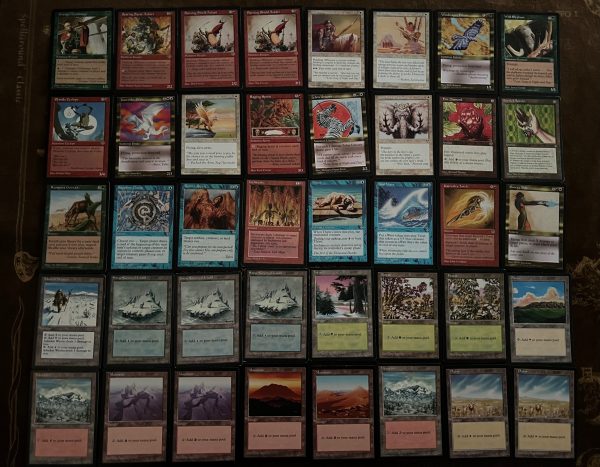
As luck would have it, I had a faraway friend who was willing to build a deck or two in a similar fashion, using Mirage and Ice Age cards from an arbitrarily limited card pool. My friend built a 40-card deck with the ability to expand to 60 cards. Here’s their 40-card deck:

Four-Color Deck

1 Granger Guildmage
1 Searing Spear Askari
2 Burning Shield Askari
1 Zhalfirin Knight
1 Femeref Scout
1 Windreaper Falcon
1 Wild Elephant
1 Ekundu Cyclops
1 Hazerider Drake
1 Ekundu Griffin
1 Raging Spirit
1 Zebra Unicorn
1 Iron Tusk Elephant
1 Fire Diamond
1 Jeweled Amulet
1 Rampant Growth
1 Sapphire Charm
1 Reality Ripple
1 Incinerate
1 Thirst
1 Tidal Wave
1 Kaervek's Torch
1 Energy Bolt
1 Adarkar Wastes
3 Snow-covered Island
3 Forest
3 Plains
6 Mountain

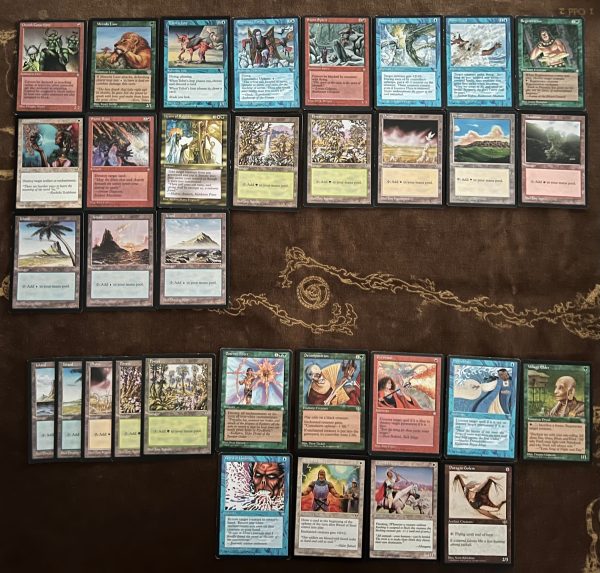
And here is the 60-card expansion package (top) along with a sideboard (bottom):

Expansion Package and Sideboard

Twenty-card Expansion

1 Orcish Conscripts
1 Mtenda Lion
1 Teferi's Imp
1 Illusionary Forces
1 Stone Spirit
1 Essence Flux
1 Snow Devil
1 Regeneration
1 Disenchant
1 Stone Rain
1 Hymn of Rebirth
2 Forest
2 Plains
1 Mountain
4 Island

Sideboard

1 Hydroblast
1 Pyroblast
1 Village Elder
1 Word of Undoing
1 Ritual of Steel
1 Mtenda Herder
1 Decomposition
1 Patagia Golem
1 Essence Filter
2 Island
1 Plains
2 Forest

How the Games Went

I won’t lie: I was somewhat disappointed in the gameplay experience. After reminiscing about the “old days” of Magic and re-reading many classic cards I played as a kid, I was expecting the gameplay to also capture the full experience from childhood. While the cards were certainly fun, the games were hit-or-miss.

First, I had major difficulty getting a competitive game off the ground. My friend started out with the 40-card version of their deck, a four-color pile with Adarkar Wastes, Rampant Growth, and a Fire Diamond to help with fixing. Despite this stretch of the mana base, their deck managed to get to its feet and develop a board fairly quickly.

My 60-card deck, on the other hand, struggled to find all three colors consistently. We had two non-games right off the bat simply because I would open with a hand of three forests and all red and green cards. Then I’d mulligan into a hand of swamps and mountains with all green cards. It was that kind of day.

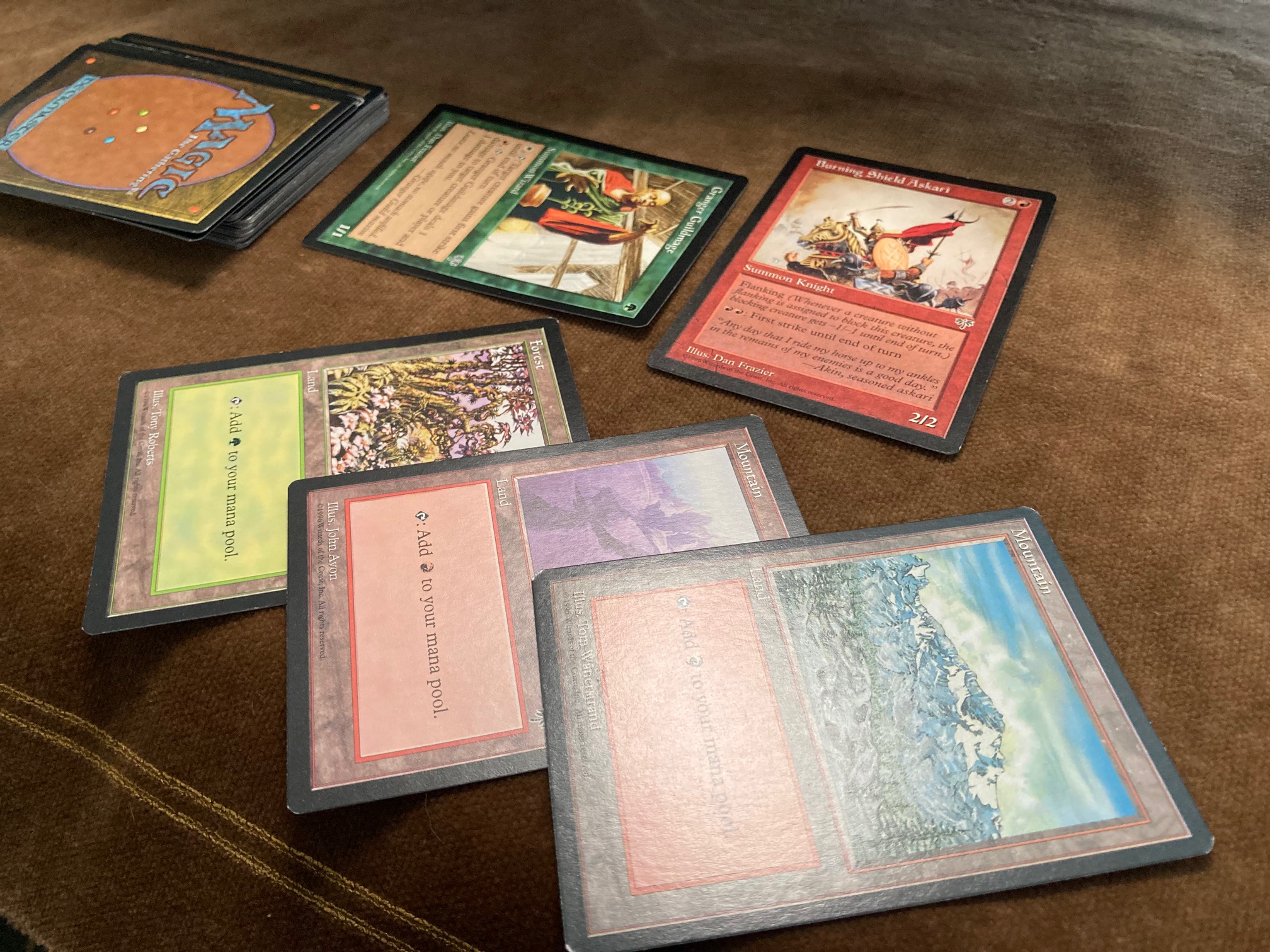
Another challenge was the fact that their Granger Guildmage had numerous one-toughness targets to destroy, which really kept my board clear while my opponent could stomp over me with flanking creatures. For those who may not be familiar with the archaic ability, all creatures without flanking that are assigned to block a creature with flanking receive -1/-1 until end of turn. This means one-toughness creatures can’t effectively block creatures with flanking, as they immediately die before damage.

.

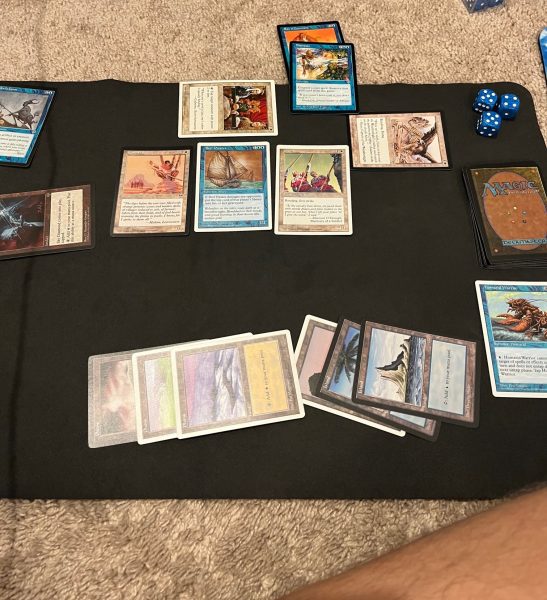
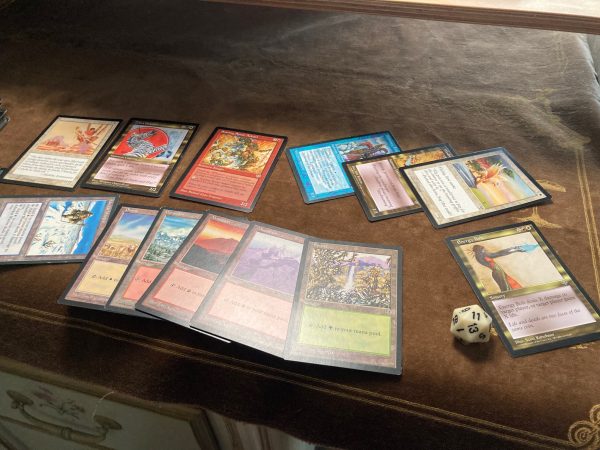
Out of desperation, I switched to the white/blue 40-card deck to see how that felt. The short answer: it was much better! Here’s a shot of my side of the battlefield during the game:

This is what my opponent’s board looked like:

My opponent had attacked me with their Raging Spirit and Zhalfirin Knight, two creatures I had a tough time blocking. Their face-down card was a phased out Hazerider Drake thanks to the Teferi's Curse enchanting it. After my opponent declared their attackers, I cast Ray of Command to take the Raging Spirit with the intent of blocking and trading it off with the flanking Zhalfirin Knight.

In response, my opponent cast Reality Ripple targeting their own Raging Spirit in an attempt to phase out the creature and stop the two-for-one from happening. I had a Dissipate in hand and cast that in response to the Reality Ripple. Out of desperation, my opponent let the Dissipate and Ray of Command resolve and then cast Sapphire Charm to phase out the creature once I took control of it.

That play worked, and the blow-out was averted, but it was probably the most complicated series of plays across all the games. It was also the only game that really felt like a game! I learned that it is possible to recapture the nostalgia of gameplay from 1997—one just needs to be patient as only a fraction of games succeed in this regard.

We played one last game, my opponent, with the 60-card version of their deck, and me with my 60-card Jund deck. My opening hand this time had one forest, one swamp, and one mountain. We were off to the races!

Things started out strong for me. I cast various creatures and started beating down. Things took a turn, however, when my opponent started landing flying creatures. I wasn’t too intimidated by the Windreaper Falcon. The Ekundu Griffin was a little scarier and sped up my clock significantly, but I was still hoping to race. However, when they stuck their copy of Illusionary Forces, I knew my time was up. Yes, they could only attack with it once, but my life total was already precariously low at this point.

Oh, and the one card that was left in my hand at this point was… Lord of the Pit. It was stuck there because I only had one swamp in play. It was such a bummer.

There was an error retrieving a chart for Lord of the Pit

Key Takeaways

I have always looked back fondly on my early days of Magic. I was quick to negatively judge new sets, thinking, “They just don’t make cards like they used to.” While that’s still true, I must say I learned a thing or two about how improved Magic is nowadays.

Beyond this high-level takeaway, there were some specific things I learned through this experience.

First, I remember thinking mana fixing was a waste of a card slot back in the day and that really held back our decks. The reason we didn’t notice this was an issue was because all of us within our play group made the same poor mana base decisions. Many games would occur where we would do nothing to the board for multiple turns while trying to draw the right land or colored spell. During these turns, it was like there would be an unofficial cease-fire. We also played less aggressively in general back then, failing to optimize attacks out of an unjustified fear of retaliation. This inevitably bought time for all players in the game while they could draw the right lands and fill out their board.

Now that I’ve been playing Magic for 25 years, I know a little more about combat strategies and how best to make my attacks. My opponent was similar in experience and skill, so there really wasn’t any mercy between the two of us. This more competitive gameplay led to non-games.

Secondly, I am in awe at how tiny the creatures were! After opening my two starter decks, I basically had to include every creature in my builds just to make sure I had enough. It reminds me why cards like Craw Wurm and Scaled Wurm were such powerhouses back in the day. Without a removal spell, these gigantic creatures would completely warp a game. Forget about cards like Shivan Dragon and Nightmare, which we couldn’t even afford to purchase. With such small creatures at common and uncommon, its no wonder board states would stall so often when playing as a kid.

There was an error retrieving a chart for Nightmare

Thirdly, I can’t believe how lopsided flying creatures could be back in the late 1990s. Any evasion, for that matter, would be problematic in a game back then. When a board state clogs up and nothing can get through on the ground, having a flying attacker (or a creature with a relevant landwalking ability, or a creature with Fear) would be very difficult to stop. I got fresh experience of that first hand.

Finally, on a positive note, I was able to experience a small sliver of the thrill I had as a kid when shuffling up a new deck for the first time. Even though I never drew my Catacomb Dragon and I never cast Lord of the Pit, I was still so excited to show off these bombs to my friend during a game. I had a fantasy inside my head of being nearly dead to a 2/2 flyer when BOOM, I slam down Lord of the Pit and win after attacking twice.

There was an error retrieving a chart for Catacomb Dragon

The real thrill is knowing that you have a sweet, powerful card in your hand that your opponent knows nothing about. Back in 1997, it could be the case that your opponent wouldn’t even know the given card existed, let alone that it was in your deck. The excitement of building something yourself and then “seeing it in action” peaked during this era of Magic. Once netdecking came along and kitchen table Magic evolved to Commander, that thrill evaporated for me. I am thankful to my friend for the opportunity to re-live the feeling once more.

Wrapping It Up

As I reflect on this experience, I ask myself the question, “Would I be willing to do something like this again?” The answer is a muddled “it depends.”

The Fifth Edition starter deck was $199.99 in store credit on Card Kingdom, while the Mirage starter was $299.99. If it had not been gifted to me, I most certainly would not purchase them myself to have this experience again. While it’s hard to put a price on chasing memories, I don’t think this exercise is quite worth the steep entry price.

Instead, I would be more inclined to purchase an already-opened sealed starter. You know, the one where Lion's Eye Diamond is already confirmed to not be in the deck? This would be far less expensive and really wouldn’t sacrifice too much of the experience.

Better, yet, I have another idea that I’ll pitch to my friend. What if we take our 120 or so cards and set them aside as a separate collection of sorts. Then we can buy (sealed or unsealed) booster packs of sets from that same time period to “grow our collection” and improve our decks, just like we would have done back in the 1990s. This would be akin to starting over again and attempting to recapture the same experience we once felt back in the day. Maybe we can even cap our spending at $5 a week, akin to the average income I had as a 13-year-old. Something like this eBay listing could be tempting.

I’ll continue to investigate options. One thing is for sure: it was exciting to recapture the fun childhood experience that Magic once brought, but I learned that achieving the feeling as an adult is no easy (or cheap) feat!

Dominaria Switches Gears: The Evolution of the Format

Are you a Quiet Speculation member?

If not, now is a perfect time to join up! Our powerful tools, breaking-news analysis, and exclusive Discord channel will make sure you stay up to date and ahead of the curve.

Kicker and domain define the deck-building in DMU. The cycle of common nonbasic lands and the modality of kicker cards encourage splashing. In fact, players are splashing a third color in their decks at an unprecedented rate (or at least since the inception of 17lands data).

I Blame Blue

Many of the kicker spells, especially the blue-based ones, are fine unkicked. They are safe to include in our decks with only a few sources of their secondary color. Increased access to those colors is all upside. This incentive leads us to speculate on early dual-lands to facilitate a free splash. Because those lands have basic land types, they also improve the performance of the domain spells.

Low Effort Domain Payoffs

These cards are designed for Domain decks. However, if we splash non-basics for kicker spells, then these cards will over-perform in our decks. This overlapping synergy is the bedrock of the Domain decks. There are different degrees of splashing, but seeing these cards tempts us to err on the side of greed.

The Best Offense Is A Good Defender

One of the best incentives to splash is having access to bombs.

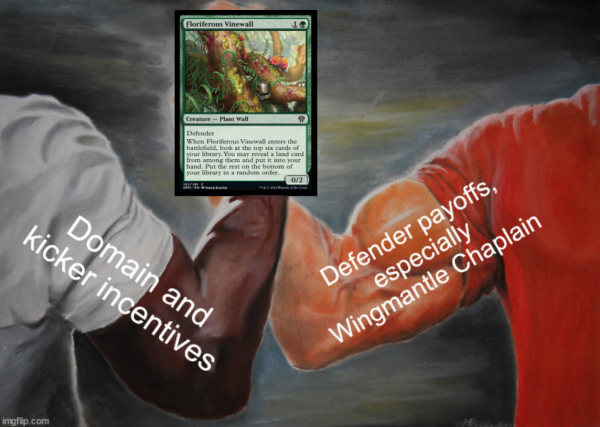
Wingmantle Chaplain is the early nominee for this set's mythic uncommon and one of the biggest bombs in the format. Similar to domain, defender synergies seep into many decks due to the cross-pollination of Floriferous Vinewall.

While Floriferous Vinewall can help set up our gameplan, Gibbering Barricade is a solid blocker, capable of a Skullport Merchant impression in the late game. These two cards are good for any slow deck, and because of this demand, we might need to move them up our pick order in the coming weeks.

Once we have the Chaplain, then Shield-Wall Sentinel becomes a priority. The Sentinel can serve as a tutor for our most powerful win condition, however, the Sentinel can also chain into more Sentinels if we have time. This sets up an even more powerful pay-off.

Additionally, pairing the Chaplain with Tolarian Geyser, Urborg Repossession, or Bortuk Bonerattle, to generate an insurmountable flock of birds. This has been the strongest endgame in the format thus far.

These multi-colored decks are amongst the strongest in the format and were the dominating force in the first days of DMU. However, all good formats evolve over time. The second stage of DMU is marked by the emergence of an underrated cycle, and one deck that seems to stand above the others.

Welcome to Stage Two

Whenever a format decides it's safe to play greedy mana and powerful spells, that's usually a sign it's about to change. A slow format is a declaration of war against aggressive decks. In DMU, they have the tools to fight back.

While the Domain decks are still strong, they can be slow, and sometimes their synergies can be underwhelming. When a deck that's already falling behind has to face an undercosted monster, it can be very punishing.

A Gurmag Angler for Every Color

These cards are all signpost commons. They tell us exactly what each color wants to do in the format. White wants to go wide, so we get a very cheap 4/4 for doing just that. Yavimaya Sojourner is a huge creature to face down on turn three or four if we're in domain. Writhing Necromass can be a strong top-end threat, powered by early trades. Molten Monstrosity... less so.

However, no matter where we get our Magic content, the discourse this week seems focused on the final member of this cycle:

Tolarian Terror is a prime reason to play cantrips, and many of them are outright strong in this format. Timely Interference has a low opportunity cost but leads to some huge blowouts while, Impulse and Joint Exploration punish opponents playing around Essence Scatter. Furthermore, for one blue mana, we can hold up a Shore Up protecting our creature after opponents pay the ward tax. If we build our deck right, this card will cost one or two mana in the late game, but slamming it on four is still a stabilizing force.

UR Spells is the Aggro Deck of the Format

The Terror is a draw to any spell-based Blue deck, but the UR deck optimizes it best. Most decks lack aggressive two-drops, but Haunting Figment and Ghitu Amplifier are dangerous both early and late. Backed by a handful of spells, these cards can pressure opponents even after they feel stable. While UB can also cast an early Tolarian Terror, the control deck doesn't pressure life totals nearly as well. As a result, opponents have time to set up profitable blocks. Against UR, it more closely resembles The Abyss.

The UR deck has become a pillar of the format. Balmor, Battlemage Captain, the suite of blue and red spells, the two-drops, and Tolarian Terror synergize well. Cards like Tolarian Geyser provide tempo and Timely Interference capitalizes on it. Once this deck pulls ahead, it's hard to stop and it can squeeze through the final points of damage with Haunting Figment, burn spells, or the trample from Balmor.

Domain decks still shine, but in the early days of the format, it felt like the best thing to do was collect all the kicker spells and let the rest sort itself out. The UR deck pressures that game plan. Domain decks need to be able to answer this streamlined strategy which is not easy. It has interaction, card advantage, and aggressive creatures.

Draft Chaff

Early data shows that this format is far from solved. It is balanced and complex. The most staggering data point is the success of Wingmantle Chaplain. Personal experience and observations crown Domain and UR spells as the best decks in the format. However, the data points to the white decks slightly outperforming these strategies.

The best quality about this format, though, is that every deck appears to be viable. Next week, we'll look at the white decks and explore the other end of the color pie. What decks have performed best for you? Let us know in the comments.

Dominaria United Prerelease: Players and Games at Mavericks

Are you a Quiet Speculation member?

If not, now is a perfect time to join up! Our powerful tools, breaking-news analysis, and exclusive Discord channel will make sure you stay up to date and ahead of the curve.

Prerelease! One of the best Magic events there is! New set, new mechanics, new characters. An event that is generally laidback, low rules enforcement, and focused on F-U-N. Everyone, inherently, starts at the same level, where anyone can have a great deck or pull awesome cards, as did my friend Doug.

Yep, that's TWO! Phyrexian text mythics. Lucky Doug!

Along with a new Magic experience and valuable cards is the opportunity to get out and play; to see familiar faces and make new friends. I don't have the numbers, but I truly believe prereleases bring out more people overall than the majority of other Magic events.

I've attended every prerelease since Planeshift except the few that weren't available during the pandemic and Apocalypse. I missed that one since my youngest, Jarod, was just about to come into the world.

Back then you only had the large, single-location prereleases to go to. If I remember correctly, it wasn't until Shards of Alara that Wizards started providing prereleases locally. Going to larger events were still a lot of fun, but many times you had to set it up as a whole day or weekend event. Ours was about 2 hours away, and my wife wasn't comfortable with my being that far away. Priorities are important.

Fast-forward to the Dominaria United prerelease, and Jarod and I are ready to go! We both were able to attend the Friday prerelease at Mavericks. Fun times and many packs opened by us both.

While slinging the proverbial cardboard at both locations, I decided to get to know my opponents a little better as well through a few quick-hit Q&A sessions. Making new friends and solidifying existing relationships is healthy, but it's always good to learn more about others. That way you'll have more people to play Magic with!

It's a Good Friday... for a Prerelease!

Maverick's PR on Friday

Once we arrived, Jarod and I had the initial pre-prerelease discussions about cards we'd like to open, what colors are good to get into, and so on. Kits were passed out and we dug in.

My Mavericks Prerelease Deck

Note: for clarity, I've highlighted any pertinent cards in each deck.

Serra Paragon, Temporal Firestorm, Defiler of Flesh

I knew that I was set in WB, but with a little bit of fixing I took the chance and threw in the two Lightning Strikes and Temporal Firestorm, which helped out a lot. I felt comfortable with the deck and knew it could win, but didn't think it was a outright bomb. I would give it a 3.5 out of 5.

Round 1: Eddie, Esper

How long have you played Magic?
For a few years. My first Magic purchase was a Throne of Eldraine planeswalker deck.

Who or what got you into the game?
A friend at school. He said, "Hey, I'm going to teach you how to play." I replied, "Alright." Afterwards, I was like, "This is really cool and I'm in!" It all started from that one conversation.

What do you enjoy about Magic?
Being able to play and hang around with my friends. To meet new people at the game stores and join in some Commander games.

An in-game moment with Eddie

Commander is great, of course. Are there other formats you enjoy?
Pauper. I play it online and have a lot of fun with it.

What is one of your favorite memories involving the game?
Again, hanging out with my friends during lunch and playing a few games. I've also taught a few other friends, helping them learn how to play. That's really what it's about. Having fun with friends.

Have you made friends through Magic?
For certain! I met Parker [points across the store] through a mutual friend, and now we're good Magic buds.

Favorite Magic cards?
Lightning Bolt and Birds of Paradise are two of them.

I see! You like "Bolting the Bird!"
Oh yea, absolutely! They're a couple of old cards that are simple, still relevant in many decks, and very fun.

Match Result

Eddie had a few issues with his cards lining up, and I quickly took the match 2-0.

Round 2: Hunter, Bant tokens

How long have you played Magic?
My involvement started with my dad when I was five. He had been playing since '95 and involved me early on, so I've always been familiar with the game. I got into it on my own during college around the time of Adventures in the Forgotten Realms. Being a poor college student, I didn't have a lot of extra money to build a Standard deck, so I started playing limited.

I wasn't sure how I would perform, but I did have experience with card games through Hearthstone. I was the number one player on the ladder in North America at one point. It's something like hitting the top tiers of Mythic on Magic: Arena.

So your dad alone got you into the game?
Well, it was him and his cousin. They'd play Magic, so whenever the family would get together for a holiday or something, they would play all night. Once my brother, cousins, and I got to a point where we old enough to read the cards, we joined in. I still have the Mono-Blue nonsense deck from when I played back then. Here I am, playing a bunch of horrible chaff cards, while they're playing Elf-Ball or something degenerate.

I'm unfamiliar with Hearthstone, how does it line up with Magic?
One major difference is each player only plays on their turn. There aren't instants or responding to the other player, so you lose that interaction with your opponent.

I see. For an old school Magic player like myself, that is definitely different.
It is. I attended a local limited tournament and came in second out of 42, so I thought to myself, "Ok, great! I can actually play this game!"

Coming from another game, what do you enjoy most about Magic?
Starting as a young Mono-Blue player, it was being able to mess around with the board by bouncing my cousin's stuff or counter an ability he wanted to resolve, like Squelch-ing his Wellwisher. Then they would play something else and I'd send it back.
More recently, it would be interacting with my opponent. Hearthstone doesn't provide that as much, so I've enjoyed Magic a lot more because of it.

Danitha, Benalia's Hope, Vesuvan Duplimancy, Ivy, Gleeful Spellthief

What is one of your favorite memories involving the game?
My first Adventures in the Forgotten Realms sealed event. As I said, I grew up with a Mono-Blue deck, and was always jealous of my brother's Boros soldier deck. Well, in my first sealed pool, I pulled two Adult Gold Dragons, did well with them, and loved it. I enjoyed it enough so I came back the next day and received a sealed pool with two Skeletal Swarming. Both events were just so much fun.

Favorite Magic cards?
Harkening back to AFR, it's Bruenor Battlehammer. I would, of course, pair him up with a bunch of equipment, joining the fight with other Dwarves and Dragons, and swing away!

There was an error retrieving a chart for Bruenor Battlehammer

Match Result

Hunter had a very interesting deck and in the first game he started with a quick Soaring Drake beatdown. I stabilized, and Elas Il-Kor, Sadistic Pilgrim's ability was able to slowly grind him down to Lightning Strike-range.

The second game, we traded off a little early on, but he started pulling ahead with some beaters. I survived until my seventh land drop and was able to cast Temporal Firestorm with one kicker to turn the tide. After that, I had him on the back foot and got him down to four life.

I had used a Lightning Strike on a creature earlier in the game, so he thought he was turning a corner. I did one last attack and he was able to block three of my four attackers by copying his Soaring Drake a couple times through Vesuvan Duplimancy paired with Gaea's Might and Shore Up. I was able to get my little Soldier token through his defenses for one point and zapped him with the second Lightning Strike he didn't know I had to make 2-0.

Round 3: Adam, Esper Ertai

How long have you played Magic?
I started about fifteen years ago, but really started playing around Alara Reborn.

Who or what got you into the game?
I played in high school with a few random cards and decks. I do recall a Mono-White soldier deck I had at the time. I was a sophomore in college around 2010 and saw a couple of my fellow frat brothers playing at the house. I went home, grabbed my bag of cards, and joined in. The following year, I got a couple of my roommates to start playing as well.

That's great! Continuing to share the fun! What do you enjoy about Magic?
Definitely the social aspect of playing. Honestly, the vast majority of my adult friends are people that I used to and sometimes still play Magic with.

Two Ertai Resurrecteds, Drag to the Bottom, Guardian of New Benalia

What is one of your favorite memories involving the game?
I was in a team constructed tournament that was split up into Standard, Modern, and Legacy. I was the Modern player piloting Copy-Cat in a battle against a Tron deck. Our Standard format partner had already lost his match and was assisting me.

I had the combo in hand, but needed my opponent to not exile my land with an Ulamog, the Ceaseless Hunger they were in the middle of casting. While my opponent and his friend are deciding what to exile, my buddy, whose name is also Adam, leans over and quietly, but not too quietly, expresses: "well, they could take out your Spreading Seas."

They took the bait and targeted the Spreading Seas. I untapped, showed them the combo, and won. It was the most savage Jedi mind trick I've ever been a party to.

Favorite Magic cards?
Snapcaster Mage

Match Result

This match was a disparity of games. Our first game took up half of the match. We'd gone back and forth between threats and removal. There wasn't any specific card that ran away with the game, but he pulled into a little more gas at the end and closed things out.

The second game wasn't as eventful since I was stuck on two lands for way too many turns. I held out as best I could and eventually cast Temporal Firestorm again, but with a late Automatic Librarian and a Stall for Time, I had my first loss. Overall record: 2-1.

Round 4: Justin, Rakdos Removal

How long have you played Magic?
I've been playing for about ten years. My first booster pack I opened was Gatecrash, but I truly started playing during Dragon's Maze.

Who or what got you into the game?
I overheard some friends on my robotics team playing and they started me into it. I started to get more involved in the game then they were, so I located a game store, and was hooked from there.

What do you enjoy about Magic?
I enjoy the strategy and build of limited formats. Working out the optimal design within the constraints of what you get. I play constructed formats as well, but I'll usually latch onto one of the popular decks and tweak that a little instead of trying to break the format.

What constructed format and decks are you currently playing?
I've been frequenting Modern. I played Grixis Death's Shadow and Heliod Company for a while, but I've been building Yawgmoth as of late.

Jaya, Fiery Negotiator, Rivaz of the Claw, Lagomos, Hand of Hatred

What is one of your favorite memories involving the game?
The first time I went 5-0 in an FNM. It was the week after Bloodbraid Elf was unbanned in Modern, so I hadn't even previously played the deck. I had Collected Company, Knight of the Reliquary, and other related Naya components. The feeling after winning that event was tremendous!

I know for a while you worked in a game store. Did that change how you approached the game?
It definitely changed me, but as Magic evolved, so did I. While I was working, my individual enjoyment of the game was tempered somewhat. I had fun helping people learn and provide a service, but of course, that took away some of the attention I would normally give myself.

After I no longer worked there, I was able to get back that focus and enjoy the game even more. I did enjoy being a part of the team though. I gained a different perspective on the Magic trends, the cards people said were hot, and which cards actually were.

Interesting. Can you give me an example of a card that you heard people saying was great, but actually wasn't?
The first one that comes to mind is Lightning Helix. It's a fine card, but it never seemed like people were always asking for it, even though everyone said it was always sought after. My guess is because most people already had copies. On the inverse, people were always asking for Altar's Reap. Couldn't have enough of them.

Favorite Magic cards?
Taking into consideration its design, I'd say Raging River. I've never played the card, but the thought of placing half of your opponents creatures on one side, and the other half on the opposing side, is awesome in its concept.

There was an error retrieving a chart for Raging River

What about cards you have played with?
I've got a soft spot for Knight of the Reliquary. Being able to retrieve any land is just great utility.

Match Result

Justin started the first game off fast, with continuous early plays of Yavimaya Steelcrusher, Lagomos, Hand of Hatred, and Rivaz of the Claw. I saw the writing on the wall when Jaya, Fiery Negotiator came out and I'm still trying to keep something on the board.

Fortunately for me, Justin slowed down somewhat on our second and third games. We played a little removal back-and-forth, but he drew more lands than I in the later turns, and I was able to clinch the win with Elas il-Kor, Sadistic Pilgrim and Aron, Benalia's Ruin.

Winning was the difference of one pack, so before we started we went ahead and split the result. We were able to just enjoy playing the game. 2-2 (3-1, in my mind).

Event Wrap-Up

As I mentioned, prereleases are always a great time. Win or lose you get to open packs, build a deck, and hang out with your local Magic community. Come back next week and join me when I take on a second prerelease event at another local game store, the Illuminaudi.

So how was your prerelease event? Did you pull some great cards or have a great (or not so great) story to share? Were you able to make new Magic friends? Feel free to let us know either in the comments below or on Twitter.

August ’22 Metagame Analysis: An Era Ending?

Are you a Quiet Speculation member?

If not, now is a perfect time to join up! Our powerful tools, breaking-news analysis, and exclusive Discord channel will make sure you stay up to date and ahead of the curve.

I'd like to open this month's metagame analysis article with a cliche about the inevitability of change. I leave it to the reader to pick which one. They're all equally applicable. Modern is in a weird position, which means there's a shift in the winds. The metagame doesn't look very different for the average player. However, diving into the data shows that there's considerable change occurring. Whether these particular shifts are indicative of a sustained shift is impossible to say, but given that Dominaria United (DMU) just became legal, Modern should have some churn for the next month.

Time For the Check-Up

First things first, time to check in on the experimental groups. I've been tracking how the top 11 decks from March have been performing, and it revealed a worrying upward trend. I was anticipating August to follow trend and indicate Modern was dangerously concentrated. This did not occur, and the Magic: Online (MTGO) data is quite dramatic.

Deck NameMarch %April %May %June %July %August %
UR Murktide12.92 14.6513.3714.1419.4618.93
Cascade Crashers7.58 7.55 5.495.202.090.79
Hammer Time6.74 10.37.169.3611.0910.06
4-Color Blink6.465.03 10.749.983.771.97
Living End6.18 7.326.683.956.285.92
Amulet Titan4.78 5.034.53 3.535.234.14
Yawgmoth4.21 5.727.165.206.694.34
UW Control3.65 1.833.582.702.093.94
Burn3.37 4.354.06 6.244.605.32
Mono-Green Tron3.37 3.201.682.702.304.34
Grixis Shadow3.37 2.291.685.617.113.35

Modern's outlier best deck, UR Murktide, saw a statistically insignificant drop in August, but runner-up Hammer Time had a meaningful drop-off. This was accompanied by a number of other decks crashing while only a few saw meaningful upticks. This is more obvious on the graph:

What does MTGO have against Grixis Shadow?

The gaps are still quite large between the outlier decks and the rest, but there's clearly been a net decline. What's most strange is how widely these trends differ from the paper results:

Deck NameMarch %April %May %June %July %August %
UR Murktide10.08 7.6412.7511.8813.0212.96
Cascade Crashers6.52 9.207.165.206.266.06
Hammer Time4.15 3.905.306.256.138.25
4-Color Blink0.79 5.777.318.286.394.88
Living End3.95 3.742.583.594.475.22
Amulet Titan6.32 4.993.444.224.985.56
Yawgmoth3.36 3.124.735.006.133.37
UW Control6.72 5.463.873.433.832.52
Burn5.73 4.994.733.285.117.07
Mono-Green Tron1.78 2.812.443.282.301.52
Grixis Shadow4.74 1.404.153.434.092.86

Murktide continues along effectively unchanged but everything else is in chaos. July represented a convergence of sorts but that has gone out the window. Many decks have continued the previous trends, but many others have gone wildly rogue.

And why did Yawgmoth crash in paper?

Also worth noting is that the overall gap between Murktide and the rest of the sampled decks shrunk. In fact, taking Murktide out of the equation makes the overall picture look like a pretty healthy metagame.

An Improvement

Which leads nicely into my main point. Modern appears to have been much healthier in August. In July, I sounded the alarm over metagame concentration when the MTGO sample accounted for 70% of the field. I'm pleased to say that I don't need to do that this month.

March %April %May %June %July %August %
MTGO62.63 67.2766.13 68.6170.7163.1
Paper54.14 53.0254.3157.8462.7160.27

MTGO's concentration fell by 7%, which is statistically enormous. Paper's 2% fall is less impressive, but still meaningful. Given that the only one of these decks which didn't make the tier list is Cascade Crashers and that was only true of MTGO is especially important, indicating a diversification. Even though the total number of decks on the list is lower than some months.

Quite a dramatic fall.

MTGO's concentration has fallen to a level not seen since March, while paper's is still up on net. This might be a sustained trend, or it might not be. It's only one data point. However, it is a good sign that Modern is at least trying to shake itself out of the doldrums and get some fresh blood into the mix.

Be Cautious

So, remember a few paragraphs ago when I said that Modern appears healthier because the sample's concentration is down? Appears is the operative word. Refer back this week's data article. Blink is being replaced by 4-Color Control online, and if I'd switched out Blink's number for Control's, then MTGO's concentration would be substantially higher.

There was an error retrieving a chart for Omnath, Locus of Creation

It's also worth remembering that the surging Indomitable Creativity decks aren't included in the sample. They just weren't played at the start of the study period. At least some of the loss of metagame share that the sampled decks suffered can be placed at Creativity's hands, and I suspect that were this study a comparison of just the top decks rather than a fixed series, the overall concentration would be unchanged at best.

Getting Creative

On the subject of Creativity decks, what's up with the surge? Creativity has been around for quite a while and hasn't performed. There have been several variants hanging around since March, but they've always been in Tier 3. The Temur version cracked Tier 2 and has been on a steady upward trajectory since June, with many other versions starting to filter into Tier 3. What's going on?

There was an error retrieving a chart for Indomitable Creativity

First of all, I don't believe that this is an actual metagame shift. Creativity has been part of Modern for months and is just doing better suddenly. That can just happen as players get bored of decks and move on rather than representing an actual change in viability. This is also my second-best explanation for why Omnath, Locus of Creation players swing between playing Ephemerate or not on a monthly basis.

There was an error retrieving a chart for Archon of Cruelty

Rather, to me this surge smacks of players finally optimizing the deck. There have been a number of different Archon of Cruelty decks since Modern Horizons 2, but none have good enough to maintain metagame presence. The newish Temur Creativity may have solved the puzzle. Whether it can sustain the push is another matter.

Art Criticism

First, to be clear, Archon does not count towards any deck's color identity. It's a payoff to be cheated out rather than cast. Thus, while Temur Creativity has Archon in the deck, all the spells that it intends to cast are red, blue, or green.

When all this began, Creativity was essentially 4-Color Control altered to support Creativity. This always made the deck weirdly unstable, at least in my experience. All the control elements were still there, but unlike the Omnath decks, it didn't drown the opponent in card advantage. It cheated out Archon and hoped that was good enough. The constraints imposed on the manabase to make Dwarven Mine work made it harder than necessary to meet all the color requirements. Consequently, 4-Color Creativity was and continues to be pretty mediocre.

There was an error retrieving a chart for Dwarven Mine

However, the appeal of Creativity into Archon is great enough that players have been trying to fix the problem since it was identified. One of the earliest attempts was effectively hybridizing the deck with Reanimator to get Grixis Creativity. On paper it makes sense. Looting effects find Creativity while setting up Persist, and there are two options to cheat out Archon. Which does work, but not consistently. The data shows that when Creativity wins, it wins big, but those wins are sparse. That's how it goes with split-plan decks.

Successful Artist

Temur Creativity is a relatively recent addition and is demonstrably the most successful. This is partially because getting rid of white makes the mana base far more rational and stable. I argue that a bigger factor is that the Temur variant finally embraces Creativity's identity. From the beginning, I've said that Creativity is the Show and Tell of Modern, and it looks like Temur really gets that.

There was an error retrieving a chart for Show and Tell

Temur versions are playing more cheap, defensive counters like Spell Pierce and Flusterstorm with Veil of Summer in the sideboard to beat other counterspell decks, just like Show used to do. The fact that they're useful against cascade decks is a bonus. They're also playing more on-board interaction than most and have ramp so they don't just get raced. These tweaks help Temur Creativity thrive in a Murktide-heavy metagame.

There was an error retrieving a chart for Wrenn and Six

However, in the near future, this will not last. Leyline Binding is convincing many players to ditch color discipline. Frank Karsten did the math, and it looks convincing. Splashing isn't that hard. Whether this will be successful is unclear, and that might lead to Temur coming back into favor down the line.

The Crash Problem

To slightly circle back, the MTGO concentration drop was so dramatic because of three decks: Grixis Shadow, Cascade Crashers, and 4-Color Blink. All three had severe drops on MTGO with much smaller drops in paper, too. Crasher's specifically is too small to be anything other than statistical noise. While there may be more going on with Shadow's fall, Blink and Crasher's fall on MTGO has an easy explanation: they're really expensive online.

There was an error retrieving a chart for Scalding Tarn

Both decks have pricy manabases and play a lot of rares, which necessarily ups the price. However, one card in particular seems to be pricing players out. Endurance is a highly played, highly in-demand card and retails between $50-$60. However, online it's currently running around 63 tix, which is exorbitant by MTGO standards.

There was an error retrieving a chart for Endurance

In paper, many 4-Color and Crasher decks play at least three Endurance, and many play a full set between maindeck and sideboard, which translates to at least 180 tix. Given that the rental price limit is 900-1200 (depending on service) and the rest of the deck is pretty costly, Endurance appears to be pricing players out of the decks. Their falls started in July, which correlated with a price spike on Endurance, so the link is plausible. Since paper has never been as affected by price, the decline has been lower.

Shadow's Fall

The decline of Grixis Shadow is not so easily explainable. It was on an upswing in July before just cratering in both paper and MTGO. I don't have a great explanation for why. Burn ran hot in August, but Burn isn't exactly a predator of Shadow decks, nor has it ever been. The matchup is quite even in my experience. Creativity being well positioned against it is possible, but that seems counter-intuitive. Shadow's gameplan should be good against Creativity. There must be more nuance to Shadow's metagame positioning to drive this fall. I'm not a Shadow player, but if there are any with insight reading this, please leave a comment.

Incoming Opportunities

The day this article goes live is the same day that Dominaria United becomes legal in paper. This will be the primary driving force in Modern for September, at least as strong as the metagame forces I've been discussing in this article. How it will shake out is impossible to know. However, most of the attention and money are moving towards two cards.

There was an error retrieving a chart for Leyline Binding

The aforementioned Leyline Binding is the big one. It's been legal on MTGO for a week now and is being shoved into everything. It turns out that Oblivion Ring at instant speed is good, and getting it cheaper is even better. However, there are a lot of ways to answer Binding and even punish players trying to rush it out, so I don't know how sustained the push will be. Still, in the near-term, look at 4-color mana bases to move. I just wouldn't make special effort to hold for a long-term price increase.

There was an error retrieving a chart for Rundvelt Hordemaster

The other nexus is Rundvelt Hordemaster. I'm more skeptical of Hordemaster being needed in Goblins than most, but that's irrelevant. Goblins has always been a solid creature-combo deck and Hordemaster highlights that fact. It doesn't really impact Goblins's ability to find and execute any of its combos, but it feels like it should. Consequently, interest in Goblins is higher than ever, and that's already pushing up its play numbers. Expect demand for Goblins to be strong in the short term but to cool as players adjust.

Change Is Here

When next I look at the metagame, Modern will be a different place. How different is an open question. I would be surprised if Murktide or Hammer actually fell off after all this time, but it is possible as interests diversify thanks to DMU. We all have to wait and see if there's an actual metagame shift or just a fluctuation.

How to Win When the Table Unites Against One Player… You!

Are you a Quiet Speculation member?

If not, now is a perfect time to join up! Our powerful tools, breaking-news analysis, and exclusive Discord channel will make sure you stay up to date and ahead of the curve.

Whether you play casually or love competitive games, there will be times Commander will not be a free-for-all. The entire table knows you're ahead, and you're in their sights. How do you win this game? Turns out it may be easier than you think... at least, if you're clever about it!

It's Helpful to Not Start out as the Archenemy

"What is the Archenemy?" you ask. This is different than being the King. The King is merely the player who currently has the most control of the game. The Archenemy, however, is vastly ahead of the table, has unimaginable board presence or is about to combo off and win the game. It's also a term from a particular variant of Magic intended to be a one-versus-many format. When you are the Archenemy, the entire table is doing everything they can to stop you from winning.

Why Are You the Archenemy?

There was an error retrieving a chart for Nicol Bolas

Pre-game, maybe you won the previous game, have a history of winning often, or are one of the better players in your group. This can have an adverse affect, making you the target of group hatred before the game even starts. It would always be better, and easier, to not have that happen. What about during the game? If you've taken a huge lead or are about to win, you have likely become the Archenemy.

A small part of the many reasons I advocate for playing more casual decks is precisely this reason. Playing only to win in casual games hurts your chances of winning by making you a target.

Are You Telling Me to Throw Games?

No, not at all. But I am telling you to consider other factors than "W" and "L." Ultimately, your ability to simply enjoy games of Commander without winning can boost your wins overall and should not be discounted from your general strategy. If anything, it helps when your opponents think you are a "casual Andy" for trying to pull off hard wincons, for example. A table that is in awe of your Triskaidekaphobia win probably won't hold it against you or feel like you "stole" a game off them. However, if you ever win on turn two or three, you will likely be targeted for many games to come.

Switch Decks Often

Some players tend to play the same deck because it is their "best" deck. This can create a situation where other players switch their decks specifically to fight you. Win with the same deck too often and you will see groups and tables start to target you more. Variety is not just the spice of life, but also a winning strategy. If others make meta build decisions around your deck, playing something else ruins their plan.

Perception Is Reality

There was an error retrieving a chart for Sleight of Hand

This is the most classic trick possible, but simply talk about something else. Don't talk about winning last game or how often you've won. Talk about the weather, sports, your favorite boats... anything but the game. If someone else points out that you have taken control of the current game, point out how it's nothing compared to a movie you just saw this weekend, enter synopsis mode, and hope no one notices. There is a significant difference between true board state and player perception of the board state. Since perception is reality, use this to your advantage.

You may well be the Archenemy and, from a table perspective, they should be uniting against you if they want to win. However, just because you notice that it does not mean the entire table does. Don't do anything to ruin their (mis)perception.

Know When to Fight

There was an error retrieving a chart for Fight With Fire

When you get targeted by removal, quickly accept it and move on. Don't struggle, don't question. This appears to be pure psychology. If you "fight back," that means you're a threat. If you're a threat, they were right to destroy your thing, so, you're still likely a threat. But if you accept it and don't fight back, that shows submission. If you submit, it means you're no longer a threat.

Alternatively, if there is a significantly better target that is not yours, you do need to fight. Why? Because you can make a compelling case the other player might agree with. If a player can kill your thing or they can kill another thing someone else controls and draw a card, a third party can claim it's a better move. Getting other players to act on your behalf obfuscates your intentions.

Of course, you likely will reach a point where it's no longer a secret that you are, in fact, the Archenemy and the table is completely united against you. Or are they?

Alliances Are Meant to Be Broken

There was an error retrieving a chart for Memory Lapse

This is when you get to play one of my favorite Magic mini games, "Remember when?"

"Remember when they killed your commander? Remember when I gave you an extra draw?" Decks that are lacking on the diplomacy side will have a tougher time here, which is another reason diplomacy matters a lot in a primarily multiplayer format like Commander.

Even when you don't have a diplomacy angle to work, you can resort to history both recent and ancient. There's also good ol' fashioned lying. Freely recount the fact that player A won the last game, player B will betray the table the second you're dead, or player C is about to combo off, whether any of that is true or not! You don't need to convince the entire table to stop fighting you. Just one fewer player trying to kill you is usually enough to yield a fighting chance.

A Brief Story About a Mind Flail

There was an error retrieving a chart for Arvinox, the mind flail

I finally got a chance to bring this card to a casual Commander night, and it was amazing. I played a fully degenerate version with only Swamps and mana rocks. It was slow, but grindy. Then the moment every theft-based deck dreams of happened. One of my opponents was playing a Tasha, the Witch Queen deck that was full of theft effects, and I had just hit their Gonti, Lord of Luxury. On the following turn, I played their Gonti and hit Praetor's Grasp.

Play the Cards Right...

I could have searched for Demonic Tutor to end the game, but instead audibled to Diluvian Primordial. The most important card that I had access to was from the Tasha player's graveyard, Talent of the Telepath, and I used it to mill them into a Siphon Insight. Siphon then found King Narfi's Betrayal, which could potentially start the chain once again. That's six theft effects chained back-to-back-to-back. Talk about a heist! We all lost three turns later by getting attacked by lots of Spirits, but had a great time. The lesson? I made the right choice.

Everyone will remember my crazy combo. Everyone will remember the insane value I got from doing all the shenanigans. However, I will make sure to also remind them that I didn't win that game. In defeat, I will seek victory another time! When I next reveal Arvinox, it will be a very different version which I hope gives me a much higher chance of winning.

...and Play the Right Cards

There was an error retrieving a chart for Counterspell

When your back is against the wall, the final resort is to have the right cards to solve the situation. Here's where strategy gets a little tricky. If you always play the "best cards," you are training your opponents to correctly evaluate card and deck potential. If you jam EDREC top 100 cards into every deck, you are reinforcing threat recognition against you. It's hard to mislead or surprise other players if you are training them so effectively.

On top of that, playing against someone who usually brings casual, weird decks is completely different than playing against them when they are bringing their best. I know firsthand that it throws players off and that is mostly intentional.

Try not to load your deck for bear all the time. When you do bring your best, it will be a surprise to the table, which helps you win!

It's All in the Timing

It's very difficult to fend off three fully committed players who are working towards your defeat. It is far easier to avoid getting into that situation in the first place. If you do find yourself fighting the entire table at once, hopefully you are far enough ahead that you can quickly end the game. This is the most important concept when moving into an obviously strong position. Typically, the time to execute this kind of power shift is after a board wipe or when the rest of the table is tapped out. In either case, your master stroke generally cannot be stopped.

There was an error retrieving a chart for Court of Cunning

If this fails, however, the table tends to assess you as the biggest threat, and your days can be numbered. Your out at this time? Appeal to one of the players. Offer to be a Kingmaker. If you can convince them to let you live, you might be able to stage a sneaky comeback.

Who to Kingmake?

The player who would be in the lead if you were beaten is the most obvious choice. The alternative is the player who would be the one to finish you off, as only they can grant you that one extra turn. Diplomacy is, of course, the best move here.

This strategy can get you to go from eliminated to second place. Depending on the tournament environment, second place standing can be great, and is always a heck of a lot better than last. Simply not being killed off by the entire table is a victory in itself.

If You Can't Beat Them

Defeat in either case, however, may be inevitable. If you have already effectively lost, you might as well work towards winning the next game. Helping other players in your last desperate moments can be the boost you need to secure their help in the next one.

There was an error retrieving a chart for saving grace

Alternatively...

Well, it may be time to actually play the Archenemy format and deck build specifically for that game instead of regular Commander. The schemes are a really cool mechanic, and the one versus many nature of the format is very fun!

In closing, the number one tip to fight the entire table is very simple. Don't!

Magical Creatures: Kavu, Volver, and Cephalid

Are you a Quiet Speculation member?

If not, now is a perfect time to join up! Our powerful tools, breaking-news analysis, and exclusive Discord channel will make sure you stay up to date and ahead of the curve.

Hello everyone, and welcome back to Magical Creatures. For the past couple of months, every week I've been analyzing some creature types that were invented specifically for Magic. We started with Atog from Antiquities, and recently discussed Spellshaper from the Masques block (one of the most interesting types, if you ask me).

Last article focused on the interesting fact that Spellshaper and Monger are classes and not races. Today, we are going to discuss three new creature types: Kavu, Volver and Cephalid. But first, as usual, let's take a look at the passing of blocks and expansions, and see what happened during those months.

Magic After Masques

Mercadian Masques was the first set of the Masques block, in 1999, which was completed the following year with the arrival of Nemesis and Prophecy. In 2000, two special sets were created: Starter 2000 and Beatdown. Needless to say neither of them contained any new creature types. More importantly, in October it was time for Invasion, opening a new block.

The Invasion block, composed of Invasion, Planeshift and Apocalypse, was released between 2000 and 2001, and was centered on multicolored cards. Two of the subtypes we'll see today come from this block, while the last one comes from the forthcoming Odyssey block. Let's start with the first two, though, and see what they brought to the game.

Kavu from Invasion

We don't know much about kavus, but then again, isn't this the case with most creatures from this series? After all, they are weird, living beings; creatures that don't come directly from the fantasy world, but rather from the R&D of Magic: The Gathering. That being said, we know kavus are reptiles, and we know they are carnivorous. No less than 46 Kavu creatures exist! Surprised? They all come from just three blocks: Invasion, Time Spiral, and Dominaria (excluding Territorial Kavu from Modern Horizons 2).

Kavus of all shapes and sizes

Apart from that, they come in all sizes and shapes. They can be small as dogs or big as elephants, and possess four to six legs. According to the novel Invasion, the term "kavu" means "carved from stone," or "ever watchful." Not that this helps much in understanding their nature, but we should still cherish such rare and specific information.

They're an ancient species, that's for sure, and it's normal to confuse them with a similar creature type in Dinosaur. The latter is clearly not a good fit for our series, but it's still an interesting tribe, and we might get back to them in the future. They, too, have a unique story: the Dinosaur subtype was created at the time of Ice Age, dropped with the Grand Creature Type Update, and brought back with Ixalan. Maybe we'll delve deeper into that another time!

The most pacific of kavus (or Kavu Aggressor)

As for their competitiveness, the only Kavu I could name is Flametongue Kavu. It would never be played today, but in its prime, it had a more-than-decent enters-the-battlefield ability. Removal on a body proved good enough even for decks like Red-Splash Psychatog.

Volver from Apocalypse

What about Volver? Can you name any creature with this subtype? I personally wouldn't find it easy, in part because only five of them exist. All from Apocalypse, the second set in the Invasion block. And since there are five, of course they form a cycle. It's a curious cycle, I must admit that, if not a very powerful one.

The curious cycle of Volver

This cycle of rares is meant to show the weird alliances that became necessary during the Phyrexian Invasion of Dominaria. Nowadays it doesn't seem much, but at that time it was strange to see creatures combining three colors (two allied and one opposite).

Wizards managed to mix these colors via the kicker mechanic. Each creature had two separate kicker costs, or one for each of its enemy colors. You could decide to pay one, both, or none of the kicker costs, and each of them grants the creature +1/+1 counters and abilities typical for that color.

It doesn't surprise us that they didn't see play. This kind of experiment only rarely produces great creatures, and Volver is no exception. Here's why we haven't seen any more Volver, and why we'll most probably never see them again.

The Arrival of Odyssey

We're already done with the Invasion block, and even the Odyssey block won't keep us busy that long. In fact, only one new creature arrived that is interesting for our purposes... Cephalid! It's probably the most renowned creature type from today's piece, mostly thanks to tournament history. But first, let's start from the origins. Have you ever wondered what need was there for Cephalid, when we already had Merfolk? Mark Rosewater (who else?) explains it in this funny article from 2002. In short, "the point" of Odyssey was to specifically not print any Merfolk.

Cephalid

So, what are cephalids, apart from non-merfolk people? Designed for the Odyssey block, they are anthropomorphic creatures similar to the octopus, with tentacles and a flexible body. They are mostly aligned with blue, which is obvious if you take a look at any of them. There are few creatures that close to the blue's color philosophy. Most Cephalids manipulate either the library or the hand, and others interfere with non-flying creatures.

Definitely not merfolks

They are also among the creature types that have been set aside for the longest time before returning. Before the arrival of Streets of New Capenna, in fact, no one saw a new Cephalid for 19 years! Since we are mentioning New Capenna, though, it's worth noting that it contained some black Cephalids as well. Naturally, they are affiliated with the Obscura.

And what about competitive play? I told you this was the only subtype from today's article with some creatures showing up in tournaments. The first we need to mention is Cephalid Illusionist, one of the central pieces of a strong combo deck, back in the days of Extended. I'll add this Cephalid was so central that the name of the deck was Cephalid Breakfast. Shuhei Nakamura famously played it in 2005 at Grand Prix Seattle.

The other one worth mentioning is Llawan, Cephalid Empress, a typical sideboard card used to gain an edge in blue mirrors. Consider how powerful this card is against blue decks. And how important it is to get her into play before the opponent manages to!

A New Era

We're getting really close to one of the most important shifts in Magic history: the layout change occurring with Eighth Edition and Mirrodin. In fact, although there's still a full block to pass first, Onslaught and its two expansion had no new creatures unique to Magic. So next time we'll pass right to the first set with the new layout and unveil its many new creatures.

For now, how do you like these three? Have you ever played any Cephalid? I'm not going to ask about Kavu or Volver, but feel free to post your experiences in the comments or on Twitter, and stay tuned for next week!

August ’22 Metagame Update: Izzet Still Going?

Are you a Quiet Speculation member?

If not, now is a perfect time to join up! Our powerful tools, breaking-news analysis, and exclusive Discord channel will make sure you stay up to date and ahead of the curve.

Since I restarted my Modern metagame updates series, August has typically been a weird month. It's the end of summer, AND right before the fall release. For many players it's the last hoorah before returning to school and/or their deck is invalidated or updated. I've gotten used to seeing oddities, but this year's data has just generally been odd, so that's really nothing new.

It Continues

By this, I mean that the outlier issue that I've mentioned in every update since March continues unabated. Given that the nexus of said problem has primarily been that players just really want to play Izzet Murktide rather than it being an actually superior deck on win-rate, I expect it to continue continuing for the foreseeable future.

There was an error retrieving a chart for Murktide Regent

That said, the scale of the problem is changing. Izzet Murktide is an outlier in both paper and Magic: Online (MTGO) and the margin is absurd on MTGO. However, it is narrowing in paper. Murktide was on track for outlier status pretty much from the start of August on MTGO, it wasn't until August 20th and the large events that weekend that Murktide finally pulled away in paper. Whether that is indicative of a shift in player attitudes or pure chance is unknown, but it is something.

There was an error retrieving a chart for Colossus Hammer

Meanwhile, Hammer Time continues to be an outlier on MTGO but not in paper. I've never been clear why it's so popular online, though its turn three wins have been suspected. Hammer Time usually does perform better than Murktide, so it makes more sense. However, the divergence between paper and MTGO indicates that, again, it's mostly due to personal preference than an actual metagame advantage.

As always, the outliers are excluded from the actual statistical analysis. They’re reported in their correct place on the metagame chart

August Population Metagame

To make the tier list, a given deck has to beat the overall average population for the month. The average is my estimate for how many results a given deck “should” produce in a given month. Being a tiered deck requires being better than “good enough.” Every deck that posts at least the average number of results is "good enough" and makes the tier list. Then we go one standard deviation (STdev) above average to set the limit of Tier 3 and cutoff for Tier 2. This mathematically defines Tier 3 as those decks clustered near the average. Tier 2 goes from the cutoff to the next standard deviation. These are decks that perform well above average. Tier 1 consists of those decks at least 2 standard deviations above the mean result, encompassing the truly exceptional performing decks. 

The MTGO Population Data

In August the adjusted average population was 5.81 setting the Tier 3 cutoff at 6 decks. The average is down relative to previous months. Tier 3, therefore, begins with decks posting 6 results. The STdev was 8.00, which means that Tier 3 runs to 14 results. Again, it's the starting point to the cutoff, then the next whole number for the next Tier. The STdev wasn't exactly 8.00, but it rounded down to that. Therefore Tier 2 starts with 15 results and runs to 23. Subsequently, to make Tier 1, 24 decks are required.

There was an error retrieving a chart for Omnath, Locus of Creation

To recap, January had 502 decks, February had 436 decks, March only hit 356, April was up to 437, May had 419, June had 481, and July was 478 decks. Based on what I've seen in other years, I didn't expect January's total to be surpassed until late fall. Thus, I was quite surprised when August's total decks came out to 507. This was accompanied by an increase in total decks to 64. Which is still down from June but significantly up from July. This was thanks to more non-Wizards events and very large Preliminaries. Of those 64 decks, 18 made the population tier. Which is again, up from July but down from June.

Deck NameTotal #Total %
Tier 1
UR Murktide9618.93
Hammer Time5110.06
Living End305.92
Rakdos Rock275.32
Burn275.32
Tier 2
Temur Creativity234.54
Yawgmoth224.34
Mono-Green Tron224.34
4-Color Control214.14
Amulet Titan214.14
UW Control203.94
Grixis Shadow173.35
Tier 3
4-Color Blink101.97
UW Urza81.58
4-Color Creativity81.58
Glimpse Combo71.38
Belcher61.18
Mill61.18

Murktide and Hammer Time's numbers are statistically tied with July's, indicating no real change for the top decks. However, the rest of Tier 1 has been severely shaken, with only Living End making it between months. It even has the exact same population, which is very strange.

Even stranger is how full Tier 2 is. Because of the way I set the tiers, Tier 2 is rarely more than three decks. This time, MTGO has seven. This is thanks to the decks being tightly clumped together. This indicates that Modern is fairly even, power-wise, which is good. If only the outliers were under control, then I could say Modern is statistically healthy.

The Paper Population Data

The paper tiers are calculated the same way as the MTGO tiers, just with different data. More paper events are reported each month, but they rarely report more than the Top 8 (sometimes less). However, that doesn't mean that the overall population is lower. Indeed, paper Modern is far more popular than online, or at least that was true in previous months. July had 783 decks, while June had 640, but August only recorded 594. This decline can be heavily attributed to many of the larger events being team events that have never counted. There's no way to know if an individual deck actually performed or was backpacked through the event by teammates.

Consequently, the number of unique decks is also down. There were 105 unique decks in July, but August only managed 83. There are still lots of paper events, but team events crowded out individual Modern events.

Deck NameTotal #Total %
Tier 1
UR Murktide7712.96
Hammer Time498.25
Burn427.07
Cascade Crashers366.06
Amulet Titan335.55
Living End315.22
4-Color Blink294.88
Tier 2
4-Color Control223.70
Temur Creativity213.53
Yawgmoth203.37
Tier 3
Grixis Shadow172.86
UW Control152.53
Rakdos Rock132.19
Glimpse Combo101.68
Merfolk101.68
Mono-Green Tron91.52
4-Color Vivien Combo81.35
Hardened Scales71.18
Death and Taxes71.18
Jund71.18

Just as in July, the overall picture is better in paper concerning Murktide's outlier status. The gap is much smaller and has actually shrunk over the past month. There's still a weird polarization between Tiers 1 and 3 which crowds out Tier 2, but that is typical of the whole system.

August Power Metagame

Tracking the metagame in terms of population is standard practice. But how do results actually factor in? Better decks should also have better results. In an effort to measure this, I use a power ranking system in addition to the prevalence list. By doing so, I measure the relative strengths of each deck within the metagame. The population method gives a deck that consistently just squeaks into the Top 32 the same weight as one that Top 8's. Using a power ranking rewards good results and moves the winningest decks to the top of the pile and better reflects their metagame potential. 

The MTGO Power Tiers

For the MTGO data, points are awarded based on the population of the event. Preliminaries award points based on record (1 for 3 wins, 2 for 4 wins, 3 for 5), and Challenges are scored 3 points for Top 8, 2 for Top 16, and 1 for Top 32. If I can find them, non-Wizards events will be awarded points the same as Challenges or Preliminaries depending on what the event in question reports/behaves like. Super Qualifiers and similar higher-level events get an extra point and so do other events if they’re over 200 players, with a fifth point for going over 400 players. No events crossed the threshold to earn four points in August.

There was an error retrieving a chart for Eidolon of the Great Revel

That said, total points are only down slightly, to 831 from 871. The adjusted average points were 9.55. Therefore 10 points makes Tier 3. The STDev was 13.44, which is a bit low, but understandable in context. Thus add 14 to the starting point and Tier 3 runs to 24 points. Tier 2 starts with 25 points and runs to 39. Tier 1 requires at least 40 points.

Belcher and Mill failed to make the power tier. They were replaced by Grixis Creativity and Izzet Breach Combo, keeping the total MTGO tiered decks at 18.

Deck NameTotal PointsTotal %
Tier 1
UR Murktide14917.93
Hammer Time9010.83
Living End485.78
Rakdos Rock475.66
Burn414.93
Temur Creativity414.93
Yawgmoth414.93
Tier 2
4-Color Control384.57
Mono-Green Tron364.33
Amulet Titan344.09
Grixis Shadow273.25
UW Control263.13
Tier 3
4-Color Blink202.41
UW Urza172.05
Grixis Creativity141.68
4-Color Creativity121.44
Glimpse Combo101.20
Izzet Breach Combo101.20

The gap between the two outliers improved slightly, but the gap from the outliers to normal decks got slightly worse. This is probably statistical noise, but it does speak to Murktide's relatively average power compared to Hammer Time's explosive potential.

The Paper Power Tiers

Unlike with population, the paper power data works differently than the equivalent MTGO data. The data reported is usually limited to Top 8 lists, even for big events. Not that I know how big most events are, that number doesn't always get reported. In other cases, decks are missing. Applying the MTGO point system just doesn't work when I don't know how many points to award and there are data gaps. 

There was an error retrieving a chart for Living End

Thus, I award points based on the size of the tournament rather than placement. That way I'm being internally consistent with the paper results. Based on what I've seen actually reported and what I can expect to be reported in the foreseeable future, I'm updating how points are awarded. For events that don't report their starting populations or are under 50 players, I'm giving out 1 point. 51-300 players get 2 points. 301 and above will get 3 points. I chose these levels based on the rarity of events over 300 compared to 100-200 and the fact that events under 300 tend to be local events in large cities. It feels like it should be 300 for truly unique events, despite there being no Grand Prix yet. I am open to reevaluating the point awards as paper Magic play evolves.

There were a huge number of events awarding 2 points in July and several 3-point events as well. Altogether August has a total of 861 points, which is considerably down from July. Again, there were a lot of uncounted team events.

The adjusted average points were 9.08. This sets the cutoff at 9 decks. I do not round up to the next number for averages with decimals less than .20—though it's technically correct to do so—because the feel of it for the really small decimals is off and can be deceptive. The STDev was 14.97, thus adding 15 to the starting point and Tier 3 runs to 24 points. Tier 2 starts with 25 points and runs to 40. Tier 1 requires at least 41 points. These totals are more in line with previous months compared to July. The total decks are up from population to 21, with Death and Taxes failing to make the power tier. Grixis and 4-Color Creativity replaced it along with Esper Reanimator and Primeval Titan Creativity.

Deck NameTotal PointsTotal %
Tier 1
UR Murktide11613.47
Hammer Time799.17
Burn617.08
Cascade Crashers495.69
Amulet Titan465.34
4-Color Blink455.23
Living End445.11
Tier 2
4-Color Control374.30
Yawgmoth323.72
Temur Creativity283.25
Tier 3
Grixis Shadow222.55
UW Control212.44
Rakdos Rock212.44
Glimpse Combo182.09
Merfolk141.63
4-Color Vivien Combo141.63
Mono-Green Tron121.39
Hardened Scales91.04
Jund91.04
Grixis Creativity91.04
4-Color Creativity91.04
Esper Reanimator91.04
Creativity Titan91.04

Average Power Rankings

Finally, we come to the average power rankings. These are found by taking the total points earned and dividing it by total decks, to measure points per deck. I use this to measure strength vs. popularity. Measuring deck strength is hard. There is no Wins-Above-Replacement metric for Magic, and I'm not certain that one could be credibly devised. The game is too complex, and even then, power is very contextual. Using the power rankings certainly helps and serves to show how justified a deck’s popularity is. However, more popular decks will still necessarily earn a lot of points. Which tracks, but also means that the top tier doesn't move much between population and power, and obscures whether they really earned their position. 

There was an error retrieving a chart for Crashing Footfalls

This is where the averaging comes in. Decks that earn a lot of points because they get a lot of results will do worse than decks that win more events, indicating which deck actually performs better. A higher average indicates lots of high finishes, whereas low averages result from mediocre performances and a high population. Lower-tier decks typically do very well here, likely due to their pilots being enthusiasts. Bear this in mind, and be careful about reading too much into these results. However, as a general rule, decks which place above the baseline average are overperforming and vice versa. How far above or below that average determines how "justified" a deck's position is on the power tiers. Decks well above baseline are therefore undervalued while decks well below baseline are very popular but aren't necessarily good. 

The Real Story

When considering the average points, the key is looking at how far-off a deck is from the Baseline stat (the overall average of points/population). The closer a deck’s performance to the Baseline, the more likely it is to be performing close to its “true” potential. A deck that is exactly average would therefore perform exactly as well as expected. The greater the deviation from average, the more a deck under or over-performs. On the low end, a deck’s placing was mainly due to population rather than power, which suggests it’s overrated. A high-scoring deck is the opposite of this. 

I'll begin with the average for MTGO

Deck NameAverage PointsPower Tier
Grixis Creativity2.803
UW Urza2.133
4-Color Blink2.003
Izzet Breach Combo2.003
Yawgmoth1.861
4-Color Control1.812
Temur Creativity1.781
Hammer Time1.761
Rakdos Rock1.741
Mono-Green Tron1.642
Amulet Titan1.622
Living End1.601
Grixis Shadow1.592
Baseline1.57
UR Murktide1.551
Burn1.521
4-Color Creativity1.503
Glimpse Combo1.433
UW Control1.302

Yawgmoth has emerged as the best-performing Tier 1 deck for the second month in a row, likely thanks to its good Murktide matchup. Worth noting that Murktide was just below the Baseline.

Then the average for paper:

Deck NameAverage PointsPower Tier
Creativity Titan2.253
Glimpse Combo1.803
Esper Reanimator1.803
4-Color Vivien Combo1.753
4-Color Control1.682
Hammer Time1.611
Rakdos Rock1.613
Yawgmoth1.602
4-Color Blink1.551
UR Murktide1.511
Grixis Creativity1.503
4-Color Creativity1.503
Burn1.451
Living End1.421
UW Control1.403
Merfolk1.403
Amulet Titan1.391
Cascade Crashers1.361
Baseline1.36
Temur Creativity1.332
Mono-Green Tron1.333
Grixis Shadow1.293
Hardened Scales1.293
Jund1.293

Hammer Time is paper's deck of the month. Murktide performed far better in paper than online, interestingly enough.

Composite Metagame

That's a lot of data, but what does it all mean? When Modern Nexus first started, we had a statistical method to combine the MTGO and paper data, but the math of that system doesn't work without big paper events. I tried. So, I'm using an averaging system to combine the data. I take the MTGO results and average the tier, then separately average the paper results, then average the paper and MTGO results together for final tier placement. 

There was an error retrieving a chart for Indomitable Creativity

This generates a lot of partial Tiers. That's not a bug; it's a feature. The nuance separates the solidly Tiered decks from the more flexible ones and shows the true relative power differences between the decks. Every deck in the paper and MTGO results is on the table, and when they don't appear in a given category they're marked N/A. This is treated as a 4 for averaging purposes. 

Deck NameMTGO Population TierMTGO Population TierMTGO Average TierPaper Population TierPaper Power TierPaper Average TierComposite Tier
Hammer Time1111111.00
UR Murktide1111111.00
Burn1111111.00
Living End1111111.00
Amulet Titan2221111.50
Yawgmoth211.52221.75
Temur Creativity211.52221.75
Rakdos Rock1113332.00
4-Color Control2222222.00
4-Color Blink3331112.00
UW Control2223332.50
Mono-Green Tron2223332.50
Grixis Shadow2223332.50
Cascade CrashersN/AN/AN/A1112.50
Glimpse Combo3333333.00
4-Color Creativity333N/A33.53.25
UW Urza333N/AN/AN/A3.50
4-Color Vivien ComboN/AN/AN/A3333.50
MerfolkN/AN/AN/A3333.50
Hardened ScalesN/AN/AN/A3333.50
JundN/AN/AN/A3333.50
Grixis CreativityN/A33.50N/A33.53.50
Belcher3N/A3.5N/AN/AN/A3.75
Mill3N/A3.5N/AN/AN/A3.75
Death and TaxesN/AN/AN/A3N/A3.53.75
Creativity TitanN/AN/AN/AN/A33.53.75
Esper ReanimatorN/AN/AN/AN/A33.53.75
Izzet Breach ComboN/A33.50N/AN/AN/A3.75

There's some actual movement in August, with Yawgmoth falling out of pure Tier 1 and being replaced by Burn. It is also worth noting that there were far more and far more disparate, divergences between paper and online performances than in other months, with Cascade Crashers being the widest.

A Possible Shakeup?

Modern has been remarkably stable since February. Dominaria United enters the format in September bringing cards certain to find homes in the format. It's possible this will cause sufficient churn to disturb the status quo. However, we will all have to wait and see.

QS Insiders can tune in this Friday when I unpack some of this month's data and share my thoughts on its implications. If you're not an Insider, consider subscribing today!

Want Prices?

Browse thousands of prices with the first and most comprehensive MTG Finance tool around.


Trader Tools lists both buylist and retail prices for every MTG card, going back a decade.

Quiet Speculation