menu

Our OGW Price Guide Cheatsheets Are Out

Are you a Quiet Speculation member?

If not, now is a perfect time to join up! Our powerful tools, breaking-news analysis, and exclusive Discord channel will make sure you stay up to date and ahead of the curve.

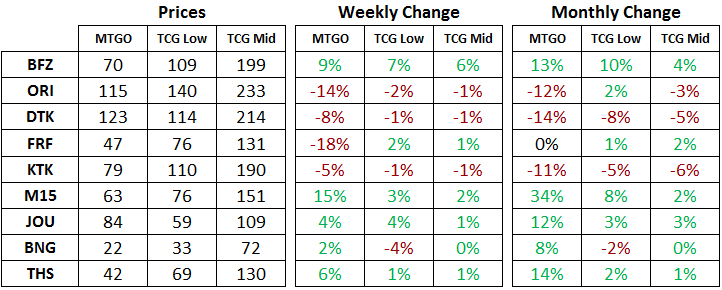
Oath of the Gatewatch is finally here! With prereleases starting up later today, we've released our ever-popular price guide. Everything listed in them is $1 or more. Nothing unlisted is worth anything (except the Expeditions, obviously). OGW is shaping up to be a much more interesting set than BFZ. I'm excited to see playable colorless and devoid cards. We'll see if wacky brews like Pat Chapin's see any success.

Oath of the Gatewatch Spoiler (Alphabetically sorted)


Oath of the Gatewatch Spoiler (Price sorted)

If you're an Insider, I've got a special little treat. I did a recap of the gainers and losers of BFZ. If you want to see what you should have picked up (and what you would have lost big on), check out our recap article here. Also strictly for Insiders, Ryan Overturf has a great article this morning on the best cards to get from OGW (and what to dump).

Douglas Linn

Doug Linn has been playing Magic since 1996 and has had a keen interest in Legacy and Modern. By keeping up closely with emerging trends in the field, Doug is able to predict what cards to buy and when to sell them for a substantial profit. Since the Eternal market follows a routine boom-bust cycle, the time to buy and sell short-term speculative investments is often a narrow window. Because Eternal cards often spike in value once people know why they are good, it is essential for a trader to be connected to the format to get great buys before anyone else. Outside of Magic, Doug is an attorney in the state of Ohio.  Doug is a founding member of Quiet Speculation, and brings with him a tremendous amount of business savvy.

View More By Douglas Linn

Posted in Free, Oath of the GatewatchLeave a Comment on Our OGW Price Guide Cheatsheets Are Out

Have you joined the Quiet Speculation Discord?

If you haven't, you're leaving value on the table! Join our community of experts, enthusiasts, entertainers, and educators and enjoy exclusive podcasts, questions asked and answered, trades, sales, and everything else Discord has to offer.

Want to create content with Quiet Speculation?

All you need to succeed is a passion for Magic: The Gathering, and the ability to write coherently. Share your knowledge of MTG and how you leverage it to win games, get value from your cards – or even turn a profit.

Turn Four Ulamog: Reshaping Modern with Eldrazi Stompy

Are you a Quiet Speculation member?

If not, now is a perfect time to join up! Our powerful tools, breaking-news analysis, and exclusive Discord channel will make sure you stay up to date and ahead of the curve.

Most Magic players identify with a certain strategy. Some people like goldfishing complicated combos. Others enjoy dropping three Lava Spikes on an opponent under ten life. I prefer attacking with efficient creatures while deploying disruption, and manipulating my library to find what I need. Decks that give me this experience are generally blue, green, and red. If you’d told me a month ago I would be playing a monoblack Eldrazi deck in the coming format, I would have laughed in your face.

matter reshaper art

Turns out I’m still laughing in your face. But only because your Tarmogoyf is so small.

[wp_ad_camp_1]

Eldrazi Stompy, by Jordan Boisvert

Creatures

4 Oblivion Sower
4 Matter Reshaper
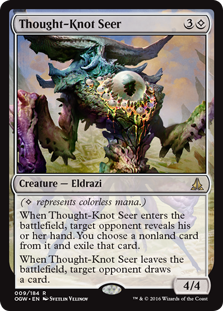
4 Thought-Knot Seer
4 Reality Smasher
4 Conduit of Ruin
2 Ulamog, the Ceaseless Hunger

Artifacts

4 Chalice of the Void
4 Serum Powder

Instants

2 Dismember

Planeswalkers

4 Liliana of the Veil

Lands

4 Eldrazi Temple
4 Eye of Ugin
4 Urborg, Tomb of Yawgmoth
4 Ghost Quarter
3 Gemstone Caverns
4 Swamp
1 Wastes

Sideboard

4 Sun Droplet
2 Drown in Sorrow
2 Cranial Extraction
2 Damping Matrix
2 Fulminator Mage
2 Dismember
1 Night of Souls' Betrayal

The Stompy Archetype in Modern

Stompy has never existed in this format. Dragon Stompy, Legacy's most popular Stompy deck, uses Ancient Tomb and City of Traitors to cast turn one and two Blood Moon and Chalice of the Void. Then, it kills its disrupted opponent with fairly costed threats. Thanks to its Sol lands, these threats resolve earlier than they "should."

I usually put "lands" at the end of my brew articles. Today, I'll lead with this section to explain how absurd the Eldrazi lands are. Eye of Ugin, Eldrazi Temple, and Urborg, Tomb of Yawgmoth allow Bx Eldrazi decks to play Modern one or two turns ahead of everyone else by breaking Magic's fundamental rule of one land per turn.

We'll examine the applications of Sol lands in Bx Eldrazi by comparing them to those of Sol lands in Legacy. In the interest of simplicity, let's consult Drew Levin's previously stock Dragon Stompy list from 2011 for reference (recent versions tend to favor a Moggcatcher package).

Dragon Stompy, by Drew Levin

Creatures

4 Arc-Slogger
3 Gathan Raiders
4 Magus of the Moon
3 Rakdos Pit Dragon
4 Simian Spirit Guide

Artifacts

4 Chalice of the Void
4 Chrome Mox
2 Sword of Body and Mind
2 Umezawa's Jitte
4 Trinisphere

Enchantments

4 Blood Moon

Instants

4 Seething Song

Lands

10 Mountain
4 Ancient Tomb
4 City of Traitors

Sol Lands and Card Advantage

While most players need to spend two cards (two lands, or a land and a Birds of Paradise) achieving two mana, Sol lands produce two mana with one card. Since they remain on the battlefield to act as two lands for the rest of the game, they break even on the card disadvantage of Chrome Mox or Gathan Raiders in Dragon Stompy. Modern houses many decks preoccupied with accruing incremental advantage over longer games (Jund, Abzan, Twin, Grixis, etc.). Getting up on cards by simply making land drops positions Eldrazi decks well against these established interactive decks.

Sol Lands and Speed

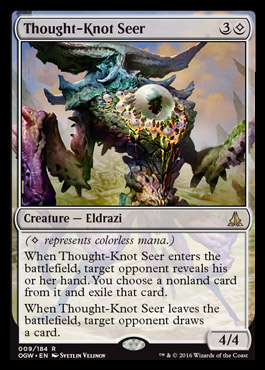
The most obvious draw to Sol lands is the speed they promise. Few fair Legacy decks can tangle with turn two Arc-Slogger. In Eldrazi Stompy, turn two [tippy title="Thought-Knot Seer" width="330" height="330"]Thought-Knot Seer[/tippy] Conduit of Ruininspires a similar brand of terror across the table. So does turn three Conduit of Ruin into turn four Ulamog, the Ceaseless Hunger, and all we need to make that dream a reality is a hand full of Sol lands and a single Conduit. I've even pulled it off after casting Dismember and Chalice of the Void.
Splinter Twin is the only other Modern deck capable of threatening a turn four kill after interacting every other turn of the game, and this claim to fame has kept Twin on top of the format since the very first Modern Pro Tour. Except the pieces of the turn four Ulamog "combo" each pull more weight on their own than the comparatively silly Deceiver Exarch, and Eldrazi decks play a better fair game than Twin - or anything.

More Springleaf Than Sylvan

Some players I know have compared Bx Eldrazi decks to Tron, another strategy that accelerates into huge plays with colorless lands. In Eldrazi Templereality, Tron is a worse Eldrazi deck. When Ghost Quarter hits a Tron land, the deck has to find that specific land all over again before it can make a reasonable amount of mana. Additional Quarters (or Paths) significantly hinder Tron, as the deck plays a single basic Forest. Conversely, we'll happily - err, resignedly search up basic Swamps to replace our destroyed Eldrazi Temples, or just play another legendary Eye of Ugin or Urborg, Tomb of Yawgmoth after one bites the dust. Unlike Urza's Tower, the rest of our Sol lands don’t suddenly become [tippy title="Wastes" width="330" height="330"]Wastes[/tippy] when we lose one. We don’t need to spend time and mana digging for “other” Sol lands, instead casting our spells off the ones we have.
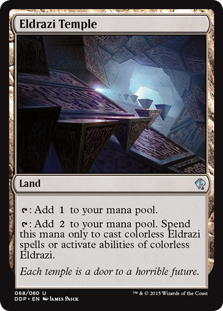
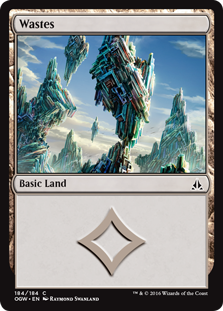
Not only do our threats come down quicker than Tron's, they can be more difficult to interact with. Conduit into Ulamog doesn’t allow opponents much in the way of responses, as both creatures trigger on cast. Anyone can Mana Leak Karn Liberated, or Path to Exile Wurmcoil Engine. Have fun Remanding Ulamog! (For the record, Tron has started playing Ulamog itself to some success. It should be obvious which deck is best equipped to cast it.)

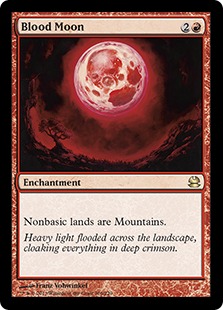
I'd sooner compare Bx Eldrazi decks to Affinity. In Modern, only Affinity has access to acceleration this consistent; until now, nobody else attacks with nine permanent power on turn three. Infect and Atarka Zoo can blitz Blood Moonpretty hard, but at the cost of their cards. By contrast, Affinity repeats the attack, or improves it, every turn after. The deck's speed and power are well-known among Modern players, and impactful hosers like Creeping Corrosion, Hurkyl's Recall, and Stony Silence keep the Robots in check. The only hoser I've found to damage the Eldrazi decks is Blood Moon, which exists in a single color and forces deckbuilders to craft conservative manabases if they want to play it at all. In other words, Eldrazi Stompy is shaping up to be harder to stop than Robots. Perhaps ironically, but not unfittingly, Affinity is our worst matchup.
Other Lands

Unfortunately, we can't play 24 Sol lands. I've picked three colorless lands to compliment my swamps.

Ghost Quarter: A bomb in the mirror and against manlands. Keeps us far ahead of other big mana decks like Amulet Bloom or Tron. Can also catch unwary opponents off-guard as they tap out for Blood Moon, sniping a singleton basic Swamp in response.
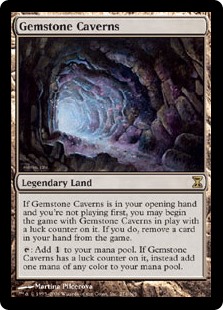
Gemstone CavernsGemstone Caverns: Allows us to take the initiative on the draw, enabling turn one Chalice of the Void and turn two Seer or Smasher. Accelerates into Drown in Sorrow, Sun Droplet, or Liliana of the Veil against aggro decks, and into Cranial Extraction against combo. Serum Powder increases the likelihood of opening Caverns on the draw. Keep in mind it’s sometimes correct not to get the luck counter, so we can cast colorless-specific Eldrazi. Since it's a legend that doesn't attract enemy land destruction, we shouldn't run more than three Caverns to avoid flooding on them.

Wastes: A colorless source we can search off Ghost Quarter or Path to Exile, we don't seem to lose anything from playing [tippy title="Wastes" width="330" height="330"]Wastes[/tippy] over the fifth Swamp.

Meet the Eldrazi

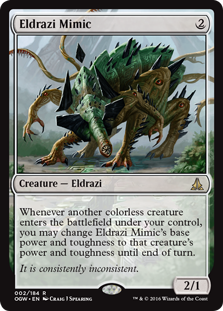
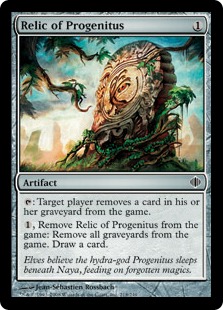
I've omitted Relic of Progenitus, and with it, Wasteland Strangler and Blight Herder; I don't love threats that require another card to function optimally. [tippy title="Eldrazi Mimic" width="330" height="330"]Eldrazi Mimic[/tippy] also requires another card to shine - a card, in fact, per turn.
[tippy title="Matter Reshaper" width="330" height="330"]Matter Reshaper[/tippy]
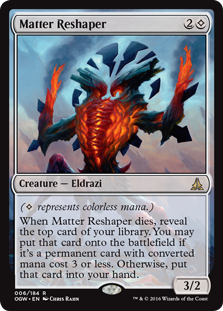
Reshaper almost always comes down on turn two, and with Gemstone Caverns, sometimes on turn one. He mostly wants Matter Reshaperto tangle with enemy attackers, netting us a card in the process (hopefully a mana source, but we'll settle for Liliana of the Veil). Notably, [tippy title="Matter Reshaper" width="330" height="330"]Matter Reshaper[/tippy] trades with every one-mana creature in Modern, as well as every two-drop besides Tarmogoyf.

On his own, Reshaper attacks like a Wild Nacatl. (With Eye of Ugin on the battlefield, he even costs the same as Wild Nacatl.) Reshaper pressures decks that clock us without attacking, like Scapeshift, Twin, and Ad Nauseam. He's a nightmare for grind-em-out midrange decks like Jund and Grixis, since their Bolts essentially put them down a card against us. If he "cascades" into another Reshaper, they're down multiple cards!

[tippy title="Thought-Knot Seer" width="330" height="330"]Thought-Knot Seer[/tippy]

Thought-Knot Seer

When Bx Eldrazi Processors reared its head in Modern, pilots and opponents agreed Oblivion Sower was the best creature in the deck. As of Oath of the Gatewatch, [tippy title="Thought-Knot Seer" width="330" height="330"]Thought-Knot Seer[/tippy] will surely usurp that title. Jund players have been chasing Thoughtseize with Tarmogoyf since Modern was born, and [tippy title="Thought-Knot Seer" width="330" height="330"]Thought-Knot Seer[/tippy] rolls both cards into one. He frequently comes down on turn two, and exiling the card helps keep early-game Tarmogoyfs at 3/4.

Turn two 4/4s are rarely permitted in Modern, with Tarmogoyf being the one exception to this rule. That Seer seizes the opponent's answer brings him from playable to degenerate. His effect disrupts linear combo decks without one-drops like Inquisition of Kozilek, allowing us to run Chalice of the Void and rely less on finding black lands early.

[tippy title="Reality Smasher" width="330" height="330"]Reality Smasher[/tippy]
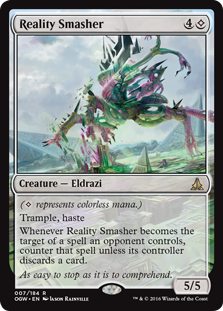
Reality SmasherAfter the three-mana [tippy title="Matter Reshaper" width="330" height="330"]Matter Reshaper[/tippy] and the four-mana [tippy title="Thought-Knot Seer" width="330" height="330"]Thought-Knot Seer[/tippy], [tippy title="Reality Smasher" width="330" height="330"]Reality Smasher[/tippy] plugs the five-mana "curve hole" left by Blight Herder, giving us something highly impactful to do on the third or fourth turn. I evaluate creatures based on ones I know intimately. To me, Smasher plays like some unholy mashup of Hooting Mandrills, Stormbreath Dragon, and Battlegrowth.

Given his bulk, speed, and evasion, [tippy title="Reality Smasher" width="330" height="330"]Reality Smasher[/tippy]'s ability is plain gratuitous. Creatures this fast and large need organic checks so interactive decks can keep them under control - for Smasher to play fair, Terminate, Path to Exile, and even Vapor Snag should answer him without forcing casters to Raven's Crime themselves. Smasher runs interactive decks out of either cards or life points very efficiently, and one often foreshadows the other.

Oblivion Sower
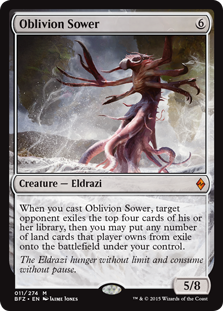
Oblivion SowerSower's ability discourages opponents from responding with Remand, and he does ramp us most of the time, Relic or no. Eye and Urborg eventually turn those humble Windswept Heaths into Ulamogs. But the real reason to play Sower is his size - 5/8 doesn't die to anything! 4/5 Goyf and a Lightning Bolt? Nope. Roast into Pyroclasm? Try again. Gurmag Angler plus Kolaghan's Command? LOL!

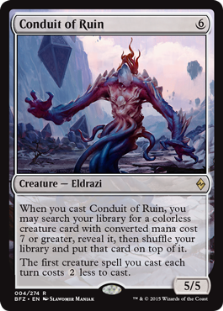
Conduit of Ruin

Conduit comes with a Sol land attached and searches the deck for big boss Ulamog. An Eldrazi Temple in hand guarantees we can cast Ulamog, the Ceaseless Hunger the turn after Conduit resolves. Otherwise, we'll merely wait a few turns, during which time opponents have a 5/5 to kill.

Ulamog, the Ceaseless Hunger

Ulamog's effect triggers on cast, meaning not even Counterflux prevents him from casting double Vindicate. Once he resolves, Ulamog defeats opponents with infinite life or pages of chump blockers with his second ability. One Ulamog suffices in most Eldrazi decks, but I play two so I can Serum Powder away hands with Ulamog and not miss him later.

Noncreature Support

The 'Drazi can't rule the world on their own.

Look, Ma! No Relic!

Many players consider mainboard Relic of Progenitus one of the reason to play Bx Eldrazi in Modern. Once Oath becomes relic of progenituslegal, I don't think this argument holds much ground. Heartless Eldrazi decks have already traded the grave-hate package for speed, and the Eldrazis we get in Oath boast such immense power that we don't need to rely on two-card combinations like Relic plus Blight Herder to fill out our threat suites. [tippy title="Reality Smasher" width="330" height="330"]Reality Smasher[/tippy] attacks through Lingering Souls tokens, and Oblivion Sower dwarfs Tarmogoyf anyway. Our BGx matchup is so favorable I don't miss Relic here. Blanking Path to Exile, Lightning Bolt, and cantrips with Chalice of the Void seems more valuable to me against interactive and linear decks alike.
Chalice of the Void

Two of my favorite hate cards, Blood Moon and Choke, have seen Modern play since the format was announced. A third, Chalice of the Void, never lived up to the precedent it sets for hate cards in Legacy - where it helms the Stompy archetype - or Vintage, where it was recently restricted.
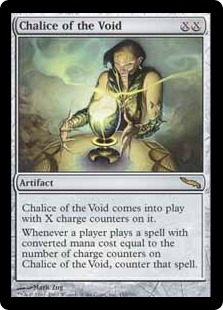
Chalice of the VoidI've tried for years to squeeze Chalice into my Modern decks, but to no avail. Most recently, I flirted with a GRx Moon build revolving around Goblin Rabblemaster before abandoning the Chalices completely and running Lightning Bolt myself. The things we sacrifice to fit them make up the opportunity cost of running lock pieces. Chalice didn't work in that deck because the opportunity cost of running it - playing format-defining, on-color one-drops like Lightning Bolt - proved too steep to justify its inclusion.

In Eldrazi Stompy, this opportunity cost is virtually nonexistent. Modern Eldrazi decks do play a few one-drops, among themInquisition of Kozilek,Relic of Progenitus, and Expedition Map. [tippy title="Thought-Knot Seer" width="330" height="330"]Thought-Knot Seer[/tippy] covers the ground we lose by excluding discard spells, and provides a respectable body to boot. We've already explored Relic, above. And Serum Powder helps the deck find Sol lands, eliminating the need for Expedition Map - more on that card below.

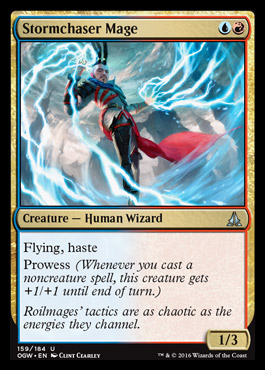
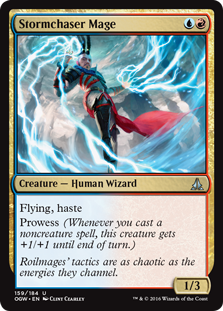
Strategically speaking, Chalice of the Void “solves” this deck’s worst matchups. Bx Eldrazi loses to low-to-the-ground aggro strategies, or decks that ignore fat bodies and go off regardless. These decks include Burn, Infect, Bogles, Storm, and UR Delver (yes, with [tippy title="Stormchaser Mage" width="330" height="330"]Stormchaser Mage[/tippy]!). Incidentally, all of them struggle to win through Chalice.
Serum Powder

Currently, Serum Powder only sees play in two Vintage decks. Espresso Stax, the format's reigning Stompy deck, uses the innocuous Darksteel artifact to aggressively mulligan into Mishra's Workshop; Dredge, to find Bazaar of Baghdad. We use it to assemble an opener with enough Sol lands to power out Eldrazis ahead of schedule.

Wizards has yet to print another card that modifies with mulligans, so the uninitiated may have difficulty evaluating Serum Powder at a glance. I'll introduce Powder with an excerpt from Marius Van Zundert's article on Espresso Stax, which applies perfectly to Eldrazi Stompy:

"Workshop decks, when they are at their best, are incredibly redundant things. Because of the limitations of Workshop, they have to be. They can’t control their draws like a blue deck. Serum Powder would allow the Workshop pilot to see more hands, increasing the chance that they opened with sufficient mana and threats. And what did it really matter if they removed some of their mana, or some of their threats? There were more. I played one game in particular against Nick [Detwiler] where he opened on a hand of seven and then used three Serum Powders, removing 21 cards from the game. As I looked through, I saw that he had removed three of his Smokestacks. I joked with him “Oh man, this is great, you won’t be able to beat me this game.” Nick opened with a Workshop, then a Chalice of the Void at 0 and another Chalice at 1. He dropped a Lodestone Golem and a Sphere of Resistance on turn two. He dropped another Lodestone Golem and another Sphere effect on turn three.

It didn’t matter that the Smokestacks were gone. He hit his mana and he hit his disruption."

Like Nick, I Serum Powder ruthlessly, binning land-light hands with extreme prejudice. I won't hesitate to exile all my Thought-Knots or even boarded-in hate if it means digging for hands that curve out better. At its most consistent, Eldrazi Stompy is a turn-four deck. Powder helps maximize that consistency.
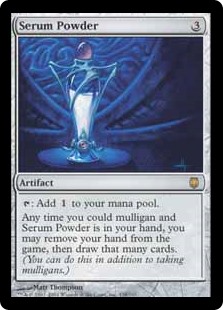
Serum PowderThat said, I don't exile every hand containing Serum Powder. My favorite way to analyze a hand with Powder is to picture it without Powder. If the rest is keepable, I settle. There are plenty of superb four-card hands in this deck (i.e. Temple, Eye, Thought-Knot, Urborg), so even hands with multiple copies of Serum Powder can be keepable.

The primary benefit of digging for Sol lands while we resolve mulligans, and not once the actual game has begun, is that we become faster. The Eldrazi decks I've paired with online spend the first two turns setting up their mana with Expedition Map or Ancient Stirrings. Not only does Chalice of the Void block these plays, if we instead spend those turns casting [tippy title="Matter Reshaper" width="330" height="330"]Matter Reshaper[/tippy] and [tippy title="Thought-Knot Seer" width="330" height="330"]Thought-Knot Seer[/tippy], we gain an edge in the race.

Powder helps hit relevant cards, too. This upside mainly comes in handy during boarded games, when landing a turn three Drown in Sorrow or an on-curve Cranial Extraction can save us from certain doom. I can also name plenty of matchups where I love having multiple shots at turn one Chalice of the Void.

To the naysayers, I'll ask a question: Why don't you want to play Serum Powder? We've discussed Chalice's opportunity cost, and Powder carries a similar drawback. After all, who likes drawing three-mana, colorless-producing artifacts in the mid-game? Um, we do! When it's not setting up unbeatable openers, Powder helps reach ten mana for Ulamog and essentially taps for a color in this deck. It even lets us cast colorless-specific Eldrazi under Blood Moon. As with Chalice, we can run Powder at virtually no cost to our deckbuilding choices. The more I play with Serum Powder, the more I'm impressed by the consistency it brings to Bx Eldrazi.

Dismember
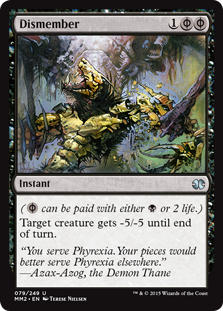
DismemberDismember doesn't charge life with an Urborg out, interacts at instant speed for a single mana of any (or no) color, dodges Chalice of the Void, and kills nearly everything in the format. Paying life ostensibly hurts against aggro decks, but Dismember's potency there more than justifies its inclusion for these matchups. The biggest strike against Dismember in Modern is a given strategy's weakness to a specific kind of aggro deck: the one with Lava Spikes. Fortunately, Chalice of the Void and our fat Eldrazi ground squad make Burn the easiest of our aggro matchups.

Liliana of the Veil

Liliana hassles any aggro deck that doesn't immediately put three bodies onto the battlefield, and gives control and midrange decks a headache. She’s easy to cast with Urborg in play, and otherwise not too challenging between our Swamps and Gemstone Caverns.

The only thing I dislike about Liliana is her anti-synergy with Chalice of the Void; once we resolve the Chalice, opponents have a whole grip of cards to throw away.

The End Is Near

Our Eldrazi overlords are here to stay, though we don’t know what an optimized build will end up looking like. I imagine a few viable versions will crop up, including an aggro variant, a control variant, and something in-between. Peoples’ favorite colors may influence the direction future builds take. For now, I’ll continue playing with this version, which has shown great promise in its first week. I don’t have enough space in this article to cover matchups (in a nutshell: everything is favorable except Affinity, Merfolk, and Grishoalbrand) or land sequencing (which I’d like to call a prerequisite to success with the deck, but realistically this deck wins a lot even with stumbles). I'll address all that another week. In the meantime, consider buying some Blood Moons.

Insider: The Most Overhyped and Underhyped Cards in OGW

Are you a Quiet Speculation member?

If not, now is a perfect time to join up! Our powerful tools, breaking-news analysis, and exclusive Discord channel will make sure you stay up to date and ahead of the curve.

One again, we find ourselves approaching prerelease weekend. Oath of the Gatewatch (OGW) looks to have significantly more impactful spells than Battle for Zendikar, and there's a lot I'm excited for. The set is sure to shake up Standard, and there are definitely cards you'll want to get your hands on quickly.

Pre-order prices are usually at least a little inflated, though a few cards can slip between the cracks. Today I'm going to look at the cards that are significantly overhyped, as well as the ones I believe are poised to increase in value.

Overhyped

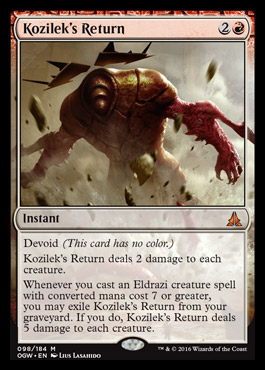
Kozilek's Return

kozileksreturn

This card is guaranteed to see Standard play, and will probably be a four-of in at least one deck. It also shows potential as a sideboard card against token-based decks. That said, buying in at $20 sounds crazy to me.

The card is a good tool for Eldrazi Ramp to beat up on Atarka Red, but its inclusion will either move to push Atarka Red out of the format or just not be good enough to swing the matchup. Either case inevitably leads to a decrease in already limited playability.

If the Ramp deck just ends up being great and absolutely plays four copies all the time then $20 sounds like a reasonable long-term price, but I don't believe this to be the case. Even if it is, I'd be floored if the ceiling was much higher.

Part of the reason people advocate Kozilek's Return is they think it will be a big player in Modern. I'm lukewarm on it in Modern at best, as the only reason you really want it at all is to beat Etched Champion. Such a narrow application does not entail significant demand.

If the Eldrazi deck is great it might take a couple months for the price to cool off, but if it doesn't put up results with 4x Kozilek's Return quickly, then you can fully expect this price to tank.

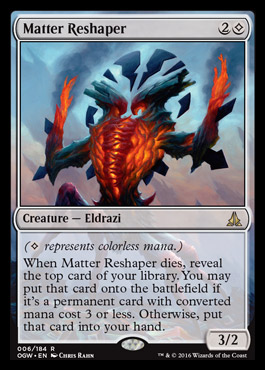
Matter Reshaper

matterreshaper

I feel like Matter Reshaper is being treated like an artifact when it's actually a spell that requires a splash. $8 is a lot to spend on a regular rare, and in the short term there's no way that this card has a ceiling significantly above that.

The card could find a home in multiple decks, but it's not Hangarback Walker. Maybe post-rotation we'll see a significant uptick in this card's presence, but most competitive Standard decks don't want any piece of this at this point in time. I expect this card to cool off significantly as packs are opened, though I would be interested in moving in when it finds a floor.

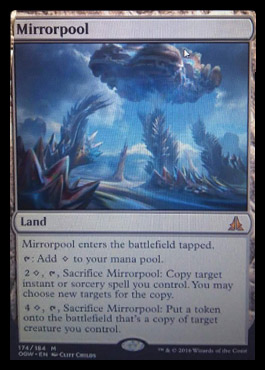
Mirrorpool

mirrorpool

Chaz liked this card when it was $5, and I didn't even like it then. Somebody give me an argument for what this card actually does for Constructed, and why you would play it over the myriad other colorless lands.

I admit the Commander appeal is probably real, but the price is way too high for a new casual card. You should absolutely wait on Mirrorpool.

Underhyped

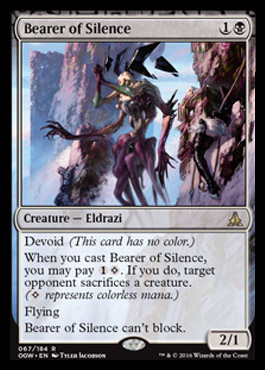
Bearer of Silence

bearerofsilence

What if Gatekeeper of Malakir had flying? Then an already great card would be better! This card is preordering for $1-2, though it could easily be $4-5 with a little tournament success.

I'm curious about the potential of a devoid aggro deck, though without testing I can't say that I'm absolutely confident in its prospects at this point in time. There are a lot of great cards for the deck, but it just might not be well positioned as of now.

I would be amazed if Bearer of Silence didn't see play somewhere post-rotation, though for now it could be one of those great cards that is initially overlooked. I like the idea of picking up a set to hedge, and then investing more if the card doesn't see initial success and makes its way to bulk.

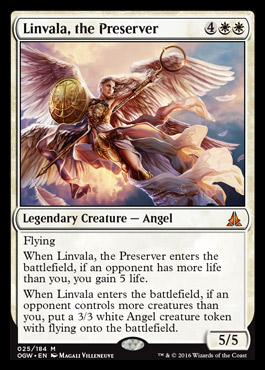
Linvala, the Preserver

linvalathepreserver

I don't know exactly how this card is going to break, but I'm seeing it sell for $5-6 on eBay. That is either slightly too high, or way too low.

If this card is a Standard player, and many believe it will be, then it will minimally double from that. Before Theros rotated there were a bunch of good six-drops, but only one Elspeth, Sun's Champion. As of right now, people aren't really playing six-drops, and an exceptional one could definitely shake things up.

The interaction with Painful Truths, the preferred card draw spell in Standard, is worth paying attention to.

Nothing is certain when it comes to six-mana spells, but there are definitely worse bets to make. This is a mythic rare angel from a small set, so if you pick up a set at $5 each now you really can't miss by much. I wouldn't be surprised if preordering Linvala paid off in a big way.

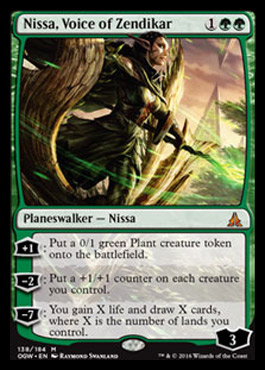
Nissa, Voice of Zendikar

nissavoiceofzendikar

It's strange saying that arguably the most anticipated card of the set is underhyped, yet here we are. I've been saying this is a great pickup at $15 since it was spoiled, and you can still snipe eBay auctions at $15 a pop. Compare that to SCG being "sold out" at $30.

Gideon pre-ordered for $15 for a minute too, and you can still buylist slightly above that. If you were on top of buylisting them, you also had a window to buylist up to 900 copies for $30 each as well. Not to mention that the card is poised to increase in value in the future.

Don't miss on Nissa. If you get a chance to buy them at $15, you will make money. It's a three-mana planeswalker, and it's great. You don't need me to do the math for you. Gideon was profitable for the same price, and he was in the large set. Interestingly, Gideon will help drive the price of Nissa given just how well the two play together.

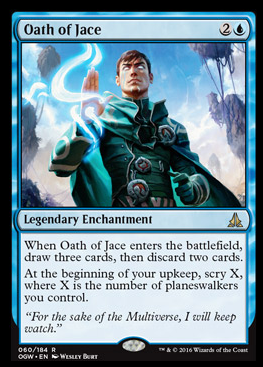
Oath of Jace

Oath_of_Jace

Historically, the Magic community has been great at undervaluing things with "Jace" in the name. Oath of Jace doesn't have a tremendously high ceiling, but the fact that I preordered a set for a couple bucks seems off to me.

Comparisons to Compulsive Research and Painful Truths are the primary factors keeping Oath of Jace down. It's not as good as Compulsive Research, which makes it look bad, and many compare it unfavorably to the available option.

Discarding cards isn't always great, but not paying life generally is. When I first saw Oath of Jace, my biggest complaint was that you had to play a second copy to get the first in the graveyard, as delve was the mechanic immediately on my mind. I don't care about leaving Oath of Jace in play, but I do think that it has a lot of potential as a draw spell for a control deck featuring some delve spells, such as Murderous Cut or Dig Through Time.

Painful Truths provides great card advantage at a cost, whereas Oath of Jace is more of a velocity card for a delve-heavy deck. I definitely expect it to see Standard play, and I recommend picking up at least a set. I definitely like these as trade throw-ins.

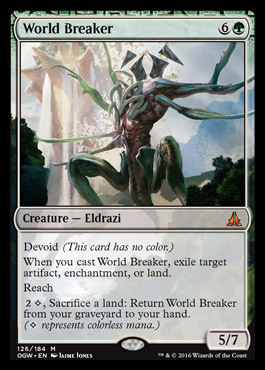
World Breaker

worldbreaker

Finally, we come to what I believe is the biggest card for the ramp decks. As a seven-mana Eldrazi, it triggers both Kozilek's Return and Sanctum of Ugin. Not to mention that it comes with some disruption, brawls with Siege Rhino and Mantis Rider, and even has some built-in recursion.

You have to pay $20 for a Return, yet you can get these for $3-4. These two cards are going to see very similar amounts of play, so there's no way this price differential makes any sense. If you're confident in the Eldrazi Ramp deck, then the best way to invest in your confidence is to pick up World Breakers.

~

Oath of the Gatewatch is an awesome set, and I'm very excited to see what the overall impact it has on Standard will be. Best of luck to everybody at the prerelease!

Thanks for reading.

- Ryan Overturf
@RyanOverdrive on Twitter

Insider: Financial Evaluation of OGW (Mythics)

Are you a Quiet Speculation member?

If not, now is a perfect time to join up! Our powerful tools, breaking-news analysis, and exclusive Discord channel will make sure you stay up to date and ahead of the curve.

Hello, Insiders!

I’m back with another financial evaluation, this time the Oath of the Gatewatch (OGW) edition. As always, I bring to you all my full set review regarding rares and mythics from the set. First up are the mythics.

Like Battle for Zendikar (BFZ), we’ll have to account for Expeditions soaking up some of the overall EV of the set---which leaves us with the mythics of OGW taking up roughly an average of $5 currently. That's a bit lower than normal, but again due in part to Expeditions, so don’t confuse this with immediate upside.

The one caveat I keep talking about is that the Expeditions likely won’t be nearly as coveted overall in comparison to the first batch in BFZ. That might lead to a few more cards maintaining their price or slightly increasing as we go along, which was certainly not the case for BFZ. We saw an overall drop in many of the cards in that set, with a small handful of cards staying flat, and even fewer increasing.

On the contrary Ulamog, the Ceaseless Hunger, has now suddenly picked up interest due to Modern. Which is one of the very few examples.

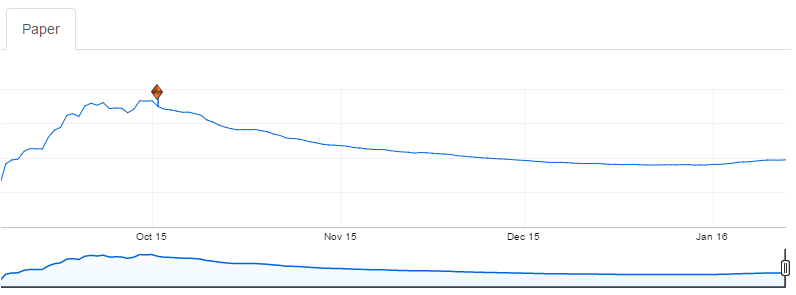
Courtesy of MTGGoldfish

To recap briefly on my Battle for Zendikar analysis, we can see here that the overall set has significantly declined since the time I wrote the article. A few short notes:

  • Gideon, Ally of Zendikar has basically been the lone bright spot in BFZ. The percentage of this card showing up in Standard decks after release was staggering. I placed this as a top tier mythic, and like many others had high praise for the card. Turns out it was all warranted.
  • On the flip side a very hyped mythic in Undergrowth Champion took a nose-dive and is now sitting at a paltry few dollars. A rebound could happen, but it was clearly a missed initial evaluation. I do think it’s still a fine card, and its fate might change. I'm not holding my breath.

Overall my mythic evaluation was spot on, and while basically every price took a drastic decrease, 4 out of the 5 mythics I listed as “Top Tier” ended up being financially relevant.

Now on to Oath of the Gatewatch!

The Tier System

Breaking the cards down into a tiered list makes it easier to determine what will hold the majority of the set's value. I will most likely use this methodology going forward in evaluating future sets. I also wanted to do it this way because I don’t feel like attaching a future value to any of these cards. I feel like that method is a little inefficient and doesn’t take into account future printings that could potentially make these cards better.

So I wouldn’t want to attach a low value to a card that’s potentially powerful like I have in the past. The truth is while a card may look terrible right now, we don’t know the future and how this card could interact with future cards.

So as an avid player of fighting games, the tiered method makes the most sense to me, since it also allows for cards to move around, which undoubtedly will happen as time goes on. This happens all the time in many of the fighting games in their life cycles as well.

This is my explanation for each tier in the list:

  • Top Tier is reserved for the cards that will most likely hold the majority of the value in the set. More commonly known as the “chase cards.”
  • Mid Tier is reserved for the cards that aren’t necessarily bad but may be overshadowed at this current point. These could easily jump to top tier in the future, or vise versa.
  • Low Tier is reserved for the cards that will most likely be near bulk. Like mid tier these cards could easily jump up to higher tiers but the road traveled will be harder. Again, I don’t think these cards are necessarily bad but my analysis is that they will be the cheapest cards in the set.

These tiers are built primarily for Standard, however if a card has clear implications in Modern or beyond, it will also appear in a higher tier. Commander and casual appeal are not factored heavily into these ratings.

Mythic Breakdown

Top Tier

  • Nissa, Voice of Zendikar
  • Kozilek’s Return

Mid Tier

  • Chandra, the Flamecaller
  • Kozilek, the Great Distortion
  • Kalitas, Traitor of Ghet
  • Linvala, the Preserver
  • Mirrorpool
  • World Breaker

Low Tier

  • General Tazri
  • Crush of Tentacles
  • Sphinx of the Final Word
  • Inverter of Truth

Top Tier Mythics

Nissa, Voice of Zendikar

nissavoiceofzendikar

Nissa, Voice of Zendikar makes a very strong case for frontrunner of this set. The small but effective line of three-drop planeswalkers have all made an impact when they were in Standard. Some even beyond that.

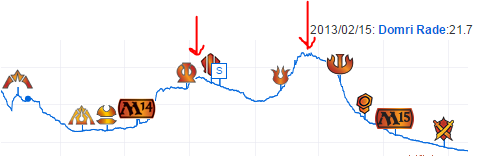
Courtesy of MTGGoldfish

Looking at these planeswalkers, we can bring up some of the pricing history---I like using Domri Rade in this instance.

If we look at Domri Rade’s price history, it also started off high during the pre-order period. It then went on to cool off quite a bit before seeing a drastic surge in price.

An all-time high of $33 was reached as it became a force during its Standard tenure, while seeing some fringe success in Brian Kibler’s Domri-Zoo deck in a large event. This was a planeswalker, mind you, that caught plenty of flack for not directly having a way to protect itself, and for its card advantage ability being too restrictive to build around.

Nissa, Voice of Zendikar doesn’t really have that issue. The card does everything a three-mana cost walker (or any walker for that matter) should do, and does it efficiently enough that it doesn’t directly need other cards to be self sustaining. It can produce creatures, subsequently buff those creatures, or build up into an extremely rewarding ultimate. I think there’s extreme upside here, and it has already increased quite a bit from the initial $14.99 price tag.

Is this the next Narset Transcendent? While it may look that way during pre-orders, I think Nissa's price is entirely justified. She's sold out on SCG at $29.99. You can find copies at other locations for cheaper, but SCG’s sold-out price could well be the going price for the card in the near future.

Many of my fellow QS writers here also have high praise for this card---Ryan Overturf and Mike Lanigan, for example. I trust the writing staff here for evaluations, and I think it's warranted with Nissa.

Pre-order Price: $29.99

Kozilek’s Return

kozileksreturn

This has quickly become a strong candidate to battle Nissa for the most coveted card in OGW. There’s no denying the power level, and instant speed mass removal is extremely good on face value. Volcanic Fallout was a format-defining card in its tenure during Standard, and we're looking at a mythic version of that card.

The main power comes from the second ability. Adding a tacked-on kicker to any large Eldrazi creature is the icing on the cake, often leaving opponents with nothing and you with a giant monster (or two). I'll talk about this more below when we come to World Breaker.

Consider that the "icing" is uncounterable and free, and it's not hard to see this card finding an immediate home amidst the Eldrazi craze sweeping Magic formats right now. This card is a shoe-in and many decks will lean heavily on it in Standard, if nothing else for the second ability which will be easy to trigger in most cases. G/R Tron lists will also appreciate being able to find it off an Ancient Stirrings.

After April, along with Eldrazi Ramp lists, this isn't going anywhere. We will be losing fetchlands, and the metagame will be shifted in a way to really lean on this card going forward. Without four-color manabases to support cards like Radiant Flames, Kozilek’s Return remains an easily splashable card. It might be a stretch to adopt in every archetype, but it will see plenty of action in the plethora of ramp lists, including Modern Eldrazi and Tron.

I think hedging on pre-order prices around $12-14 is a good bet (assuming you can still find those prices) because I don’t see this going much lower. It was apparently a good idea to grab these early on in pre-order period, considering it's already gone up quite a bit since then.

Pre-order Price: $19.99

Mid Tier Mythics

I want to say briefly, this tier for Oath of the Gatewatch is packed. Many cards here could easily shift tiers, and could be commanding higher or lower prices depending on how much play they see.

There are no “bad” mythics here, but room for a lot of potential. Especially in World Breaker, which has my pick for the most promising of the bunch.

I’m going to group most of these mythic together, because by-and-large they all have room to grow or decline based on their integration into Standard or even Modern.

Chandra, Flamecaller

I’ve seen great praise for Chandra, Flamecaller by many who have played the game for a long time. I’m not 100% sold, but I do think it’s a fine card---it's just that the bar for successful six-drop planeswalkers was set really high by Elspeth, Sun's Champion.

That's not to say Chandra won't have success in Standard (although outside of that format it's highly unlikely). I just don't think it will translate into financial success. She's not as good as Elspeth, so don't expect her to reach the same prices.

We will likely re-evaluate this after April, but for now some Dark Jeskai lists might stand to benefit from including Chandra. Or we could see something interesting like this decklist from  Magic League:

Untitled Deck

Creatures

2 Nissa, Vastwood Seer
4 Omnath, Locus of Rage
4 Whisperwood Elemental
4 Rattleclaw Mystic
2 Whisperer of the Wilds
3 Chandra, Flamecaller
4 Dragonlord Atarka

Spells

4 Explosive Vegetation
4 Nissa's Pilgrimage
3 Nissa's Renewal
2 Evolutionary Leap

Lands

1 Cinder Glade
9 Forest
1 Canopy Vista
2 Mountain
1 Plains
4 Wooded Foothills
4 Windswept Heath
2 Haven of the Spirit Dragon

Sideboard

2 Den Protector
3 Gaea's Revenge
3 Radiant Flames
4 Jaddi Offshoot
3 Dragonlord Dromoka

Kozilek, the Great Distortion

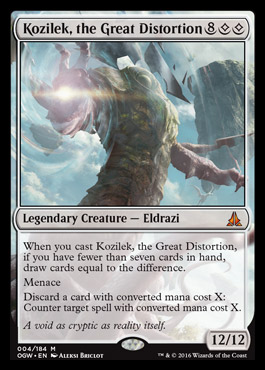
Kozilek, the Great Distortion will likely play second fiddle to the new Ulamog. It’s a powerful and potent card, but from watching SCG Charlotte it was clear that most players asked on coverage are planning to stick with new Ulamog. I think that’s correct, considering Ulamog is easier to cast, and has a better on-cast trigger. Kozilek will have it's uses, and will likely be adopted in some capacity in both Standard and Modern. I just think it will lag behind in play % behind Ulamog, and it's price will reflect that. Foils have great upside here, because it is an Eldrazi Titan.

In the casual sense Kozilek will always be relevant, and will likely hover around the $8-12 mark for quite some time, before beginning to experience longer-term growth like its predecessor.

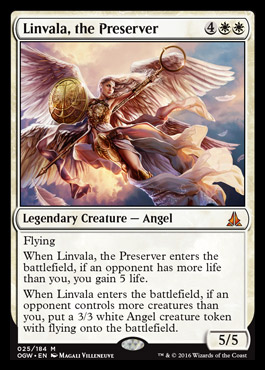
Linvala, the Preserver

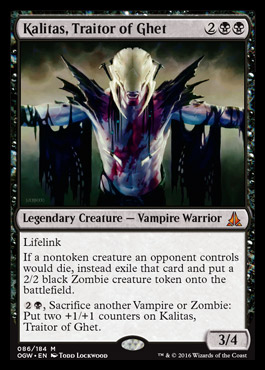
Linvala, the Preserver is no Thragtusk, despite what anyone says. The comparison isn’t relevant and shouldn’t be where players immediately go to evaluate this card. There will be times when one (or both) conditions can’t be met, and it ends up being one mode of a Timely Reinforcements tacked on to a 5/5 flyer. That isn’t terrible, but it isn't great either.

Its current pre-order price is reasonable, and I don’t expect this card to dip much further below $5 just for appeal factor alone. I’m confident it will play some role in Standard, and will likely be a powerful play at six mana. This issue is whether that be good enough when ramp decks are just trying to go over the top with Ulamog.

Solid card overall, but I don’t think this format will suddenly be warped around this card like in the past with Thragtusk.

Pre-Order Prices: $14.99 (Chandra) $19.99 (Kozilek) $9.99 (Linvala)

Here’s what I grouped together as the cards in mid-tier with the higher upside. Each of these cards should be watched very closely, as any of them could make a large impact in various constructed formats.

World Breaker

Firstly, I think World Breaker is the dark horse of OGW. I understand everyone is excited about Kozilek’s Return and Nissa, Voice of Zendikar, and rightfully so. But at its current price, World Breaker offers immense upside in comparison.

Top Level Podcast talked about this card extensively, and I understand why everyone would initially misevaluate it. It’s a key card, not only because it breaks ramp mirror match-ups, but because it will trigger Kozilek's Return very often. Remember how I said I would reference World Breaker again? Well, it’s going to be the frontrunner card in the two-card synergy that will likely be a locked eight slots in ramp lists.

I originally didn’t think World Breaker was any cause for excitement, and I’m fully honest and transparent about it. I have since been able to read more about the card and get lots of feedback about what it will do in Standard. The verdict: a whole lot.

I think its pre-order price is not only great for playing purposes, but has financial upside as well. The fact that it can recur itself is gravy.

Kalitas, Traitor of Ghet

Kalitas, Traitor of Ghet is another interesting card as well.

I’ve been trying to get feedback on this card's prospects of competing with Pia and Kiran Nalaar in Modern. I always come back with mixed reviews. While it might need more testing, or more time to determine if Kalitas is able to snatch any maindeck spots away, I can bet it will be likely sideboard material.

This card just does things efficiently at four mana and provides a much needed solution for decks devoid of any good option against aggressive decks, like Grixis Control. In the meantime, it has also been discussed that it could be a very good mirror-breaker in midrange Modern decks like Junk and Jund. There are already other cards in the format like Huntmaster of the Fells, but I truly think Kalitas can give those options a real run for their money.

Meanwhile in Standard, it’s hard to determine how this card matches up with other high-impact four-drops like Siege Rhino, Gideon, Ally of Zendikar, etc. Once April rolls around, I think this will be a strong candidate, especially assuming Shadows over Innistrad can provide additional zombies on curve before Kalitas drops.

I’m not a fan at $9.99, but if you can find them cheaper I’d say grab your playset. I doubt this will be much lower than $4-5, so it wouldn’t be a significant drop-off if you can find copies in the $6-8 range.

Mirrorpool

Mirrorpool is another mythic rare land in a short list of mythic lands that have been printed in Magic’s history. Looking at its predecessors Eye of Ugin and Maze's End, things can either go really well or really poorly.

Maze’s End saw some fringe play at the tail end of its tenure in Standard with the Maze’s End Fog lists. On the other hand, Eye of Ugin made a big comeback, albeit years later.

My thoughts are I would hold out on the now-inflated price, but around $4 isn't a terrible place to be. What’s interesting is both mythic lands (looking back to when Eye of Ugin was also irrelevant) were able to hold value above bulk on basically no competitive merit.

I think Mirrorpool is one of those cards that somewhere down the line players will be complaining about because it’s a card that “slipped through the crack” with the introduction of the ✧ symbol.

Pre-Order Prices: $9.99 (Kalitas) $9.99 (Mirrorpool) $3.99 (World Breaker)

Low Tier Mythic

Here we round out the bulk mythics of OGW. Honestly, I don’t have much to say, so I’ll just leave some thoughts here in the form of bullet notes:

  • Foil General Tazri are probably the place to be for this bulk mythic. It’s a Commander general that enables a five-color ally archetype. WotC explained the design behind this card was a direct result of players clamoring for something similar, so we know the target market is out there.
  • Sphinx of the Final Word can be a playable card in some control lists as a finisher. Maybe.
  • Crush of Tentacles is playable as well, but I don’t think that translates to financial upside. Maybe a Lands control list based around Magmatic Insight is viable. If only we got Quicken back.
  • Inverter of Truth is one of those weird build-around-me cards. Without an immediate home, it will likely plummet down to bulk status.

Up next, rares! I have discussed these rares and mythics in my spoiler coverage and on QSCast, so if you want to hear additional information and opinions feel free to check those out.

Questions? Comments? Concerns? Feel free to comment below or message me via social media. Hopefully this list is helpful going forward to decide what’s worth trading for or buying at the prerelease and beyond!

If you’ve missed my other financial set reviews you can find them here:

- Chaz @ChazVMTG

Brewing with OGW- Naya Tokens

Are you a Quiet Speculation member?

If not, now is a perfect time to join up! Our powerful tools, breaking-news analysis, and exclusive Discord channel will make sure you stay up to date and ahead of the curve.

From the moment Nissa, Voice of Zendikar was spoiled I have been adamant about the fact that it's probably one of the best, if not the best card in the set. Unsurprisingly, with the full spoiler up this still appears to be true. Nissa plays entirely too well with the best card from Battle for Zendikar.

There was an error retrieving a chart for Gideon, Ally of Zendikar

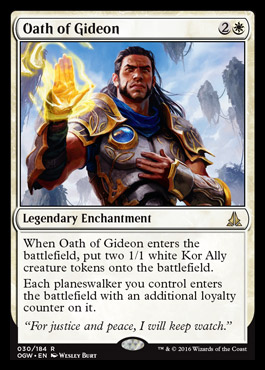
There are a lot of interesting tools to flesh out a deck with these two powerful planeswalkers, and I imagine it will take some time to polish the best list. My gut tells me that I want to curd Dragon Fodder into Nissa into Gideon to maximize the potential power of these anthem effects. In another unsurprising turn of events, I'm quite confident that Oath of both Nissa and Gideon will fit well into this deck.

oathofgideonoathofnissa2

Making sure that we're able to block for Gideon and Nissa seems very important, and I like borrowing Elvish Visionary and Hangarback Walker from Sam Black's token deck. Wingmate Roc will help us glean more value from all of our little creatures, and I'm curious to try the new Chandra to get a feel for it.

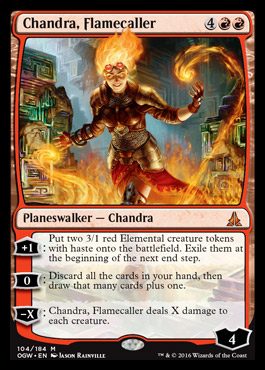
chandraflamecaller

This is the initial list that I would start testing:

Naya Tokens

Creatures

4 Elvish Visionary
4 Hangarback Walker
2 Nissa, Vastwood Seer
3 Wingmate Roc

Spells

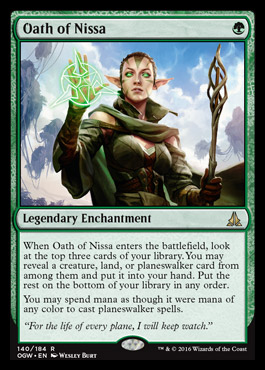
3 Oath of Nissa
2 Oath of Gideon
4 Dragon Fodder
3 Secure the Wastes
4 Nissa, Voice of Zendikar
4 Gideon, Ally of Zendikar
2 Chandra, Flamecaller

Lands

4 Battlefield Forge
1 Bloodstained Mire
1 Flooded Strand
4 Windswept Heath
4 Wooded Foothills
2 Canopy Vista
2 Cinder Glade
4 Forest
2 Plains
1 Mountain

Virulent Plague poses some serious problems for this deck. In the maindeck you have the ability to inevitably get enough Gideon emblems to get around it, but there should probably something in the sideboard that deals with Plague a bit more efficiently. Outside of that weakness, this deck seems quite robust and powerful, and I imagine something similar will shortly become a pillar of Standard, though it's unclear exactly what will be presented to supplement Gideon, Nissa and their Oaths.

Insider: QS Cast 19 – Two Huge Events & Modern Spikes

Are you a Quiet Speculation member?

If not, now is a perfect time to join up! Our powerful tools, breaking-news analysis, and exclusive Discord channel will make sure you stay up to date and ahead of the curve.

Play

This week, the cast talks about the positively massive events in Standard (Oakland) and Modern (Charlotte). You’ll find the cast’s best picks for financial hits in both formats. Doug and Chaz discuss the new rotation schedule and how it might not bring about the lower card prices that we all hoped for.

To reach the cast on social media, check out the page here: www.quietspeculation.com/qscast

Douglas Linn

Doug Linn has been playing Magic since 1996 and has had a keen interest in Legacy and Modern. By keeping up closely with emerging trends in the field, Doug is able to predict what cards to buy and when to sell them for a substantial profit. Since the Eternal market follows a routine boom-bust cycle, the time to buy and sell short-term speculative investments is often a narrow window. Because Eternal cards often spike in value once people know why they are good, it is essential for a trader to be connected to the format to get great buys before anyone else. Outside of Magic, Doug is an attorney in the state of Ohio.  Doug is a founding member of Quiet Speculation, and brings with him a tremendous amount of business savvy.

View More By Douglas Linn

Posted in Free Insider, QS Cast3 Comments on Insider: QS Cast 19 – Two Huge Events & Modern Spikes

Have you joined the Quiet Speculation Discord?

If you haven't, you're leaving value on the table! Join our community of experts, enthusiasts, entertainers, and educators and enjoy exclusive podcasts, questions asked and answered, trades, sales, and everything else Discord has to offer.

Want to create content with Quiet Speculation?

All you need to succeed is a passion for Magic: The Gathering, and the ability to write coherently. Share your knowledge of MTG and how you leverage it to win games, get value from your cards – or even turn a profit.

Awesome Decklists from SCG Charlotte!

Are you a Quiet Speculation member?

If not, now is a perfect time to join up! Our powerful tools, breaking-news analysis, and exclusive Discord channel will make sure you stay up to date and ahead of the curve.

What if I told you there was a high-level Modern Magic tournament in my literal backyard, and I didn’t even go? To my surprise/dismay I woke up late last Saturday morning, threw on some soft pants, tossed some bacon on the burner and cranked up the SCG stream to find…

“Welcome boys and girls, to the Star City Games Open in Charlotte, North Carolina”

…whoops.

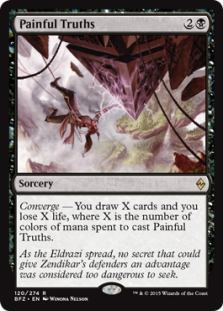
cardart_BFZ_Painful_Truths[1]

Last time the SCG boys came to town, my buddy Joseph Herrera took one for the home team, piloting Jund all the way to the finals and taking down the trophy, defeating notorious SCG grinders looking to come into our house and steal our glory all along the way. I didn’t go to Charlotte, but some awesome players did, and this week I’m going to do something I often try to avoid: tournament results and decklist analysis, complete with relevant information! Pick yourself up off the floor, and hold on to your seat. It’s gonna get wild!

[wp_ad_camp_1]

"Jund, Brian Huffman, 1st – SCG Charlotte"

Creatures

4 Dark Confidant
1 Kitchen Finks
2 Scavenging Ooze
4 Tarmogoyf
1 Olivia Voldaren
1 Pia and Kiran Nalaar

Planeswalkers

3 Liliana of the Veil

Instants

3 Abrupt Decay
2 Kolaghan's Command
4 Lightning Bolt
3 Terminate

Sorceries

4 Inquisition of Kozilek
2 Maelstrom Pulse
2 Thoughtseize

Lands

2 Forest
2 Swamp
4 Blackcleave Cliffs
1 Blood Crypt
3 Bloodstained Mire
1 Ghost Quarter
1 Overgrown Tomb
3 Raging Ravine
1 Stomping Ground
4 Verdant Catacombs
2 Wooded Foothills

Sideboard

4 Fulminator Mage
1 Huntmaster of the Fells
2 Kitchen Finks
1 Obstinate Baloth
1 Ancient Grudge
1 Unravel the Aether
1 Night of Souls' Betrayal
1 Painful Truths
1 Pyroclasm
1 Shatterstorm
1 Thoughtseize

Painful TruthsBrian’s list is as stock as they come, but with Jund that’s often more than enough. Jund functions as an exercise in value; most of its cards are included because they either react favorably with the current metagame in an irreplaceable way or are simply just the best option at that spot on the curve. Lightning Bolt, Tarmogoyf, Terminate, Dark Confidant and friends are for the most part ubiquitous, and it's rare to see any deviation from the standard formula. There's just not much to be gained by wildly deviating from the norm. I’m surprised to see Jund continually performing well in Charlotte specifically, though. The old “local metagame” theory of years past is all but disproven at this point, but I know for a fact Charlotte is packed with R/G Tron players as far as the eye can see. Take it from a local: the “local metagame” doesn’t exist (and probably hasn’t for a while). Five years ago, maybe, but we live in the digital age. Twitter, Snapchat, and Instagram rule the land, and everyone knows everything (except how to keep selfies and duck-faces to themselves) and prepares accordingly.
This list is so boring I find myself actually excited to see a one-of Painful Truths in the board. Is this how far we’ve fallen!? Seriously, though, Painful Truths is slowly creeping into Modern and is probably here to stay. Jund can offset the lifeloss with Scavenging Ooze, Obstinate Baloth, Huntmaster of the Fells, or Thragtusk (not seen above) and I’ve been trying out two Painful Truths (one MB, one SB) in my Grixis Control 75 alongside Jace, Vryn's Prodigy and Tribute to Hunger. Sure, it’s as grindy as can be, but that seems to be where we’re at these days. Make sure you have a plan for Burn and Affinity, and Painful Truths can really beat up everything else. Ok, I spent two paragraphs on the winning list. Obligation fulfilled, lets move on to the good stuff!

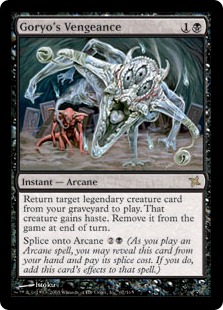
"Goryo’s Vengeance, Bob Huang, 2nd – SCG Charlotte"

Creatures

2 Borborygmos Enraged
4 Griselbrand
4 Simian Spirit Guide
4 Worldspine Wurm

Instants

2 Desperate Ritual
4 Goryo's Vengeance
2 Izzet Charm
1 Manamorphose
4 Nourishing Shoal
4 Through the Breach

Sorceries

4 Faithless Looting
3 Night's Whisper
4 Serum Visions

Lands

1 Island
1 Mountain
1 Swamp
2 Blackcleave Cliffs
1 Blood Crypt
2 Bloodstained Mire
1 Darkslick Shores
3 Polluted Delta
4 Scalding Tarn
1 Steam Vents
1 Watery Grave

Sideboard

3 Pact of Negation
1 Rending Volley
2 Sudden Shock
2 Inquisition of Kozilek
2 Painful Truths
2 Pyroclasm
2 Shatterstorm
1 Boseiju, Who Shelters All

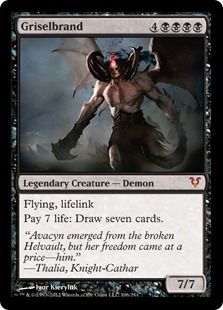
GriselbrandBob’s back from the grave(yard) with his signature Goryo's Vengeance list. You know, the one that he and Zach Jesse (RIP) took Charlotte by Flusterstorm with last June at GP Charlotte. This time, Huang made it all the way to finals, and I’m hoping this strong finish will sponsor a comeback of sorts for the flash-in-the-pan combo deck.
Bob cut a Noxious Revival, a Manamorphose, a Night's Whisper, two Tormenting Voice, and a land from his/Jesse’s GP Charlotte list in favor of a playset of Serum Visions and two Izzet Charm. This obviously butchers the manabase beyond recognition, but overall improves the velocity of the deck and with that its consistency. The more cards you see, the more likely you are to see the cards you need to win. Serum Visions is just an excellent card for anyone looking to combo (or midrange, or draw cards, or play Magic…).

Blood MoonThe sideboard has shifted significantly from the old Charlotte list, but most of that has to do with the move away from Blood Moon. If you remember, back in June Blood Moon was everywhere to fight the Tron and Amulet Bloom decks running around, and the B/R Goryo's Vengeance list was able to leverage a full playset in the board to fight the big mana menaces. Currently, Blood Moon isn’t that great, and Bob can’t afford to play it with the blue splash anyways. Blood Moon often exists in the format as just a mere threat, and often its existence serves to keep decks that die to it out of the field. This creates a situation where Blood Moon is a necessary and powerful card, but doesn't show up in numbers indicative of its power as decks that lose to it either aren't played or built to make Blood Moon poor, which is where the format is right now. Assuming this deck is here to stay, expect a spectrum of B/R Blood Moon versions and the greedier lists with the blue splash we see here in the future.

"B/W Tokens, Josh Cho, 5th – SCG Charlotte"

Creatures

3 Auriok Champion

Planeswalkers

2 Gideon, Ally of Zendikar
1 Sorin, Solemn Visitor

Enchantments

4 Intangible Virtue
4 Bitterblossom

Instants

1 Murderous Cut
4 Path to Exile
1 Slaughter Pact

Sorceries

4 Inquisition of Kozilek
4 Lingering Souls
2 Spectral Procession
2 Thoughtseize
2 Timely Reinforcements

Lands

3 Plains
1 Swamp
3 Arid Mesa
2 Fetid Heath
4 Ghost Quarter
2 Godless Shrine
4 Marsh Flats
2 Shambling Vent
1 Vault of the Archangel
1 Windbrisk Heights
3 Flagstones of Trokair

Sideboard

3 Fulminator Mage
2 Rest in Peace
3 Stony Silence
1 Worship
1 Disenchant
2 Surgical Extraction
1 Kataki, War's Wage
2 Duress

Are we at the point where Josh Cho needs re-introduction? A household name on the SCG circuit when I first was getting into the game, Josh was running the tables back when Squadron Hawks and Delver of Secrets were all the rage. Here he is with a brew, of all things! Maybe I don’t know his range, but I always had typecast him as being on the best deck, especially as he always kept beating me with “best decks” at every other SCG Open I went to. Maybe some Josh Cho fanboys/girls out there can enlighten me.

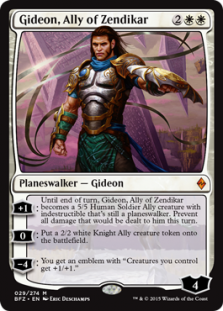
Gideon Ally of ZendikarAnyways, here we see some Gideon, Ally of Zendikar goodness alongside Sorin, Solemn Visitor. I took a lot of heat when I cut Sorin, Solemn Visitor from the deck in favor of Gideon, Ally of Zendikar in my B/W Video Series a while back, but here Cho is favoring the 2-1 Gideon split. I’m going to default to my normal stance (pilot knows best) and say that I think he’s on to something. In the abstract, Gideon seems like the individually more powerful card, but you can’t deny the impact Sorin, Solemn Visitor can have when we have literally any board presence.
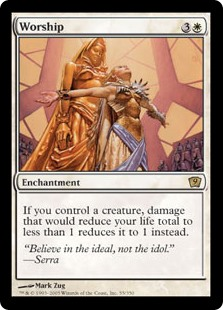
26 lands feels like one too many to me, but he’s got the dual Shambling Vents and a Vault of the Archangel as “spell-lands” in case of flooding. Playing an extra land over one too few is always a better habit to be in, and I wouldn’t change a card until I played at least a few matches with the deck (another good habit to have). In true Jeff Hoogland fashion, I LOVE the one-of Worship in the board. Speaking of…

"Kiki Chord, 8th Place, Jeff Hoogland – SCG Charlotte"

Creatures

1 Kiki-Jiki, Mirror Breaker
1 Spellskite
4 Birds of Paradise
2 Eternal Witness
1 Fulminator Mage
1 Orzhov Pontiff
1 Qasali Pridemage
3 Restoration Angel
1 Reveillark
2 Scavenging Ooze
4 Voice of Resurgence
3 Wall of Omens
1 Wall of Roots
2 Courser of Kruphix
2 Pia and Kiran Nalaar

Instants

4 Chord of Calling
4 Path to Exile

Lands

2 Forest
1 Mountain
1 Plains
1 Fire-Lit Thicket
1 Ghost Quarter
1 Horizon Canopy
1 Overgrown Tomb
1 Raging Ravine
2 Razorverge Thicket
1 Sacred Foundry
2 Stomping Ground
1 Temple Garden
4 Windswept Heath
4 Wooded Foothills

Sideboard

1 Engineered Explosives
1 Spellskite
1 Burrenton Forge-Tender
2 Fulminator Mage
1 Magus of the Moon
1 Reclamation Sage
2 Stony Silence
1 Eidolon of Rhetoric
3 Lightning Helix
1 Linvala, Keeper of Silence
1 Slaughter Games

What, no Worship!? That’s it, I’m out of here.worship

Jeff kept the exact same maindeck from his runner-up Cincinnati list, swapping only a Stony Silence, Obstinate Baloth and Slaughter Games for a Burrenton Forge-Tender, extra Fulminator Mage and Magus of the Moon in the board. Take that, haters! Two Top-8’s in a row with the same 60 really speaks to the staying power of the deck (or at least Hoogland’s proficiency with the archetype) so hopefully we’ll finally see this deck pick up some steam. I’ve been watching from the sidelines hoping to see more Kiki Chord and Goryo's Vengeance in the mix, and it looks like we might finally get there.

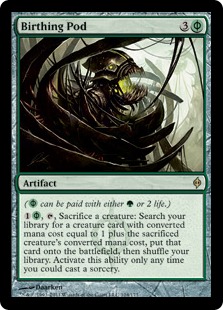
Birthing PodThis deck is Birthing Pod reincarnated, and naturally is just plain sweet. Where the Abzan Company lists look to play sub-par cards like Viscera Seer and hope to get there with Thoughtseize after board, Kiki Chord instead just looks to grind with solid value creatures and gain advantage the fair way (if you consider Restoration Angel blinking Pia and Kiran Nalaar actually fair). The Lightning Helix board plan against Burn and Zoo is solid, but we’re built to beat up on those decks anyway. The Twin matchup seems fine, but it can’t be great. A playset of Path to Exile helps, but with the limited experience I have with this deck I’d hesitate to call it even.

This deck just tickles my value itch in every possible way (yes, that way too) and I love all the interactions I can see, and there’s definitely many that I don’t. If there was ever a format where a deck like this could succeed, this is the one (as Jeff has been politely reminding us). If this is your style of deck, pick it up NOW.

Conclusion

Outside of the Top 8 we see local NC poster-child Ali Aintrazi in 10th with his trustworthy Tron, and another good buddy from the local shop named Dalton Ozmun in 17th with Junk. Besides that, we see a lot of Infect in the Top 32, suggesting a midrange field that’s soft to the combo-aggression it represents, but only one copy in the Top 16 in the hands of Tom Ross. Analytical minds can infer that Infect was the “obvious next-level choice” for the event, and it beat up on the Day One field but lost to those prepared for it and was ultimately pushed out of the Top 8. Take a look at the archetypes and sideboards of the Top 8 lists and you’ll see a collection of cards curated to specifically punish Infect: Lingering Souls, Pia and Kiran Nalaar, and Sudden Shock. While the “local metagame” narrative might be dead, the “beat the deck that beats the field” narrative still holds true. Which brings us to the now. Which deck beats the field next week, and which deck are you going to play?

Thanks for reading!

Trevor Holmes
The_Architect on MTGO
Twitch.tv/Architect_Gaming
Twitter.com/7he4rchitect

Insider: Oath of the Gatewatch Top 10

Are you a Quiet Speculation member?

If not, now is a perfect time to join up! Our powerful tools, breaking-news analysis, and exclusive Discord channel will make sure you stay up to date and ahead of the curve.

As we gaze across the desecrated landscape of Zendikar, our band of heroes stares out pondering what they could possibly do to overcome this ancient evil that has been allowed to break free. They vow to exile the Eldrazi menace from the plane each with their own Oath.

This is how the story unfolds and we’re in the thick of it. The full spoiler has been released and we can immerse ourselves through the cards. The opening of the article stems from Zendikar Resurgent. This enchantment may never see the battlefield of competitive play, but it will litter kitchen tables for years to come.

There are many gems like this hidden within the walls of this set, waiting for eager adventurers like you to find them. Maybe you will journey on an Expedition, or you will take your first, second, or third step into the world to quest for greatness. As for us today, ours is a journey to find the Top 10 cards for Constructed.

Honorable Mention

Kalitas, Traitor of Ghet

kalitastraitorofghet

Our friendly vampire friend Kalitas is back and in his new form he's much more likely to impact Standard than last time around. Once Kalitas became a Traitor of Ghet, he gained some pretty amazing abilities and I think he could be a hidden gem in the set.

A 3/4 body isn’t the best place to be in the format, but it’s not the worst either especially if you follow him up with a removal spell to start making your zombie army. If you can kill a guy, suddenly you threaten sacrificing the newly made creature to make him larger too.

We all know the exile clause can help nail the door shut for Rally the Ancestors but they will probably just bounce him with Sidisi's Faithful as they do to Anafenza, the Foremost. Overall, Kalitas is in the gray area of playability for me. He is definitely a consideration, but there will be many times he gets cut from your deck list.

Linvala, the Preserver

linvalathepreserver

The more I’ve thought about Linvala, the Preserver, the more she’s grown on me. For a six-mana investment you are awarded two flyers, a 5/5 and a 3/3 as well as most likely five additional life.

There are many good late-game threats and Linvala might be put on the back-burner, but she does provide a powerful effect. With Dragons, Eldrazi, and a plethora of powerful six-mana threats to compete against, her time may never arrive, but depending on what happens in the metagame, she may indeed come to rule the skies.

Bearer of Silence

bearerofsilence

I really like this card and have spoken highly of it. We do have Merciless Executioner and Fleshbag Marauder in the format already so I’m not sure how much Bearer of Silence adds to the mix, but the fact that we get a creature that sticks around is a big deal.

The option of playing a bear or doubling up on the mana to get one of their guys allows for some great sequences. If the theoretical Eldrazi Aggro deck exists, this guy might be a key element. Reaver Drone goes a long way to help Aggrodrazi, but I don't know if that will be enough to give Bearer of Silence a spot to shine.

If this guy dips into the bulk rare bin though, start snapping them up for your spec box. The potential is there.

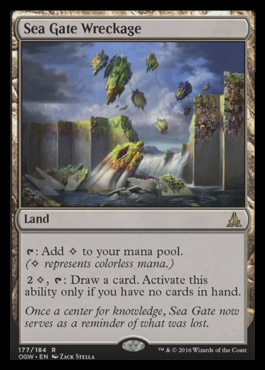
Sea Gate Wreckage

seagatewreckage

In a set with diverse new abilities, determining power level can be tough to do. Inspect this land as an example. Sea Gate Wreckage seems great, but when would we actually be drawing cards from it?

First of all, we need other colorless sources in our deck which means we most likely aren’t playing more than two colors. It may still be possible if there are lots of pain lands involved but that would be purposely creating a weaker mana base than needed. Even if we jump through the hoops with our mana, we still need to have a zero hand size in order to draw.

That seems like a lot of things that need to go right for this card to turn our land into card advantage. If I’m wrong though, this card will shoot up in value.

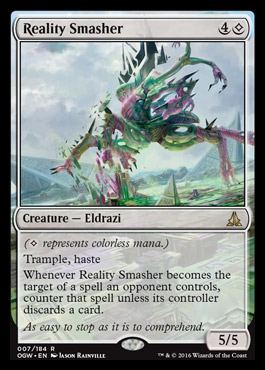
Reality Smasher

realitysmasher

As a midrange Eldrazi beater, Reality Smasher falls in a difficult spot. There’s no question that this card is great. Who wouldn’t love a 5/5 for five that gets haste, trample, and a better protection ability than Frost Titan?

What deck wants this guy though? Five mana is too much of a commitment for any aggro deck and its most likely not impactful enough for a ramp deck, so it’s hard to imagine a deck that would add Reality Smasher. If he does find a home, beware though, because this is not the threat you want to see barreling down on you from the other side of the board.

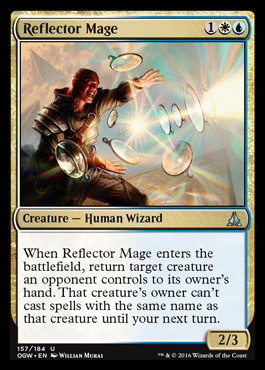
Reflector Mage

reflectormage

If you’re familiar with Dragonball Z, you know how epic it is when two characters do their Fusion dance and combine together to form one powerful being. Reflector Mage reminds me of just that. This card is like a hybrid of Meddling Mage and Aether Adept with all the abilities wrapped into one amazing card.

I’m not sure Reflector Mage has a home in Standard right now, but it nearly made it onto the Top 10 for this set based on power level alone.

Oath of the Gatewatch Top 10!

10. Oath of Gideon

oathofgideon

Surprise, surprise, Oath of Gideon is number ten on the list. Let’s start the list off with a bang, I always say. It wouldn’t be my Top 10 if I didn’t include some controversial picks. I’m sure lots of you will have rebuttals about this particular card and I look forward to the discussion in the comments.

Follow me here for a moment though. I didn’t just include this three-mana enchantment for the wow factor; this card is actually great.

A couple weeks ago in my Evaluating Oath Spoilers series, I noted that chaining Oath of Gideon into Gideon, Ally of Zendikar himself lets you keep Gideon around after he makes an emblem. That is just one of many potent sequences this enchantment enables.

Let’s start with Oath of Gideon in play and see what our follow up plays look like. Ob Nixilis Reignited can kill two creatures two turns in a row since it will start at six loyalty. Sarkhan Unbroken can make two 4/4 dragons two turns in a row. Chandra, Flamecaller, which I spoke about before, can overcome her greatest weakness and kill five-toughness creatures.

Those three aren’t even the most powerful interactions. Sarkhan, the Dragonspeaker, Sorin, Solemn Visitor, and Ugin, the Spirit Dragon can ultimate one turn after you play them!

This overcosted Raise the Alarm has much more to it than meets the eye. It can transform your already powerful planeswalker cards into something even more powerful. This meager enchantment plays out more like Doubling Season does in Commander. If you’ve ever seen that in play when planeswalkers follow it up, you know exactly what I mean.

You think ultimating a planeswalker the turn after it comes into play is powerful, try playing against them when they ultimate the same turn! All this craziness can be yours for the mere price of a three-mana enchantment.

9. Call the Gatewatch

callthegatewatch

If you follow me on Twitter, you know I’ve been pushing this card. Many others in the finance community don’t agree with me on this one but I think Call the Gatewatch has great possibilities. Not only will this tutor see play in Commander as a staple, but I think it has promise as a Standard all-star as well.

Now that Oath of Gideon is known, this card’s value might go down a bit because both cards compete for your three-mana play, but I think there's room for both of them. Oath of Gideon is legendary so you only want so many copies. Call the Gatewatch is great on turn three to ensure you have a planeswalker on turn four, but in the late game extra copies will let you tutor for your walker and play it in the same turn.

These two white cards can form the base of a planeswalker control deck that I think will be very good in Standard. I’m interested to see what more players think of this card, so leave your thoughts in the comments below.

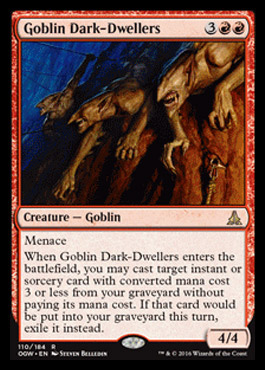
8. Goblin Dark-Dwellers

goblindarkdwellers

I’m very excited about this card to see play in multiple formats. This may seem a little nutty but it reminds me of a five-mana Bloodbraid Elf. Instead of flipping cards from your library though, you get to choose from anything in your graveyard.

Many cards I see through the eyes of my cube and this one seems like a great inclusion. What I’m really excited about though is playing the Dark-Dwellers in Standard. I think flashing back Exquisite Firecraft and Hordeling Outburst will be a hard sequence to combat. Modern may accept this creature as well but its play will most likely be fringe.

7. Stormchaser Mage

stormchasermage

Our first uncommon to make it into the Top 10 for this set is Stormchaser Mage. For two mana, we get a lot of bang for our buck. Apparently when you add a mana to Monastery Swiftspear, you get flying and an additional toughness. Those are some pretty hefty upgrades.

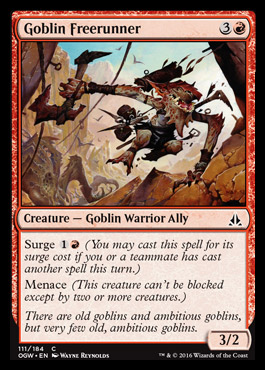
This innocent-looking prowess creature seems poised to find the main stage in Standard and Modern. There is a huge difference between one and two mana in Modern but your turn three should leave this flyer dominating the skies for big chunks of damage. There may even be a blue-red, Jeskai, or Temur tempo deck waiting to be built in Standard with cards like this and Jori En, Ruin Diver.

6. Thought-Knot Seer

thoughtknotseer

For the past week I've been thinking about this card and its potential. What I’ve come to is that it’ll definitely see play in Modern. The new Eldrazi Black deck is the most likely place you will see Thought-Knot Seer.

When you can play a 4/4 that exiles a card from their hand on turn two, it tends to see play and there are multiple ways to pull that off in Modern. You can cast it with Eldrazi Temple, Eye of Ugin and Urborg, Tomb of Yawgmoth. Between those three lands there are several combinations to pull it off.

Before this card, the deck was already decent and it has started making its mark on the format. Once the Seer is legal though, it should increase the power level of the deck dramatically.

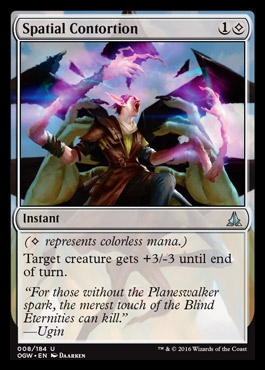
5. Spatial Contortion

spatialcontortion

Play some pain lands and you get access to one of the best new removal spells. Note I didn’t say best removal spells in Standard. Spatial Contortion has the makings of a multi-format power house.

Now all decks have access to a removal spell that won’t cost you life. Decks will still play Dismember but now you can also play Spatial Contortion as long as you can generate colorless mana. I know Tron will be thrilled to jam this into their seventy five. I expect our Nameless Inversion reimagining to find many homes in many formats.

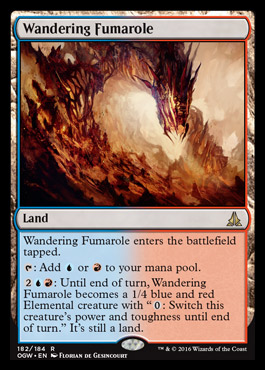
4. Manlands

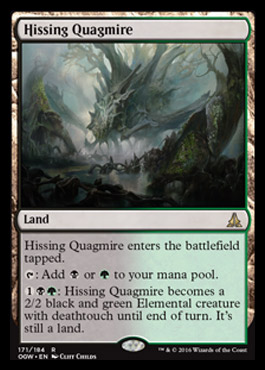
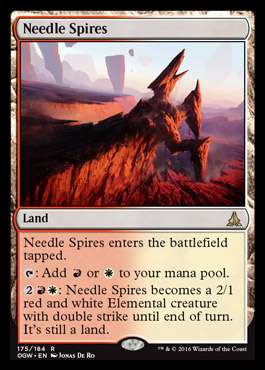
wanderingfumarole hissingquagmire needlespires
Turning your lands into resources is a great way to win games. If there are creature lands available, players will utilize them. Right now in Standard we have access to Lumbering Falls and Shambling Vent and I’ve been super impressed with both.

Everyone knows Shambling Vent is awesome because it sees play in many decks, but not a lot of players are utilizing Lumbering Falls. When I saw the two manlands from Battle, I immediately started brewing decks in those color combinations because decks with a manland are better than those without. Even Lumbering Falls has been amazing for me in my Temur Company deck (which has been wrecking local events, by the way).

I think the same will be said of the rest of the enemy-colored manlands from Oath. We will now have access to Wandering Fumarole, Hissing Quagmire, and Needle Spires. Most importantly this means that if you are playing a three-color combination from Khans block, you can now play two different manlands.

The key will be balancing your mana base so all your lands don’t come into play tapped, while at the same time making as many of your lands into creatures as possible. In the end, I think some decks will play five or six manlands but any more than that and you are pushing your tempo into a slower position.

It may be obvious to say that these three lands will see a lot of play, but nevertheless, they will certainly be integral to the makeup of the format throughout the course of the next year and a half.

3. Oath of Nissa

oathofnissa2

There is joy in my heart to see green reclaim part of its original color identity. If you play Cube, Commander or Legacy, you know Sylvan Library is a powerhouse. Before Sensei's Divining Top was printed, players were setting their draws consistently with an innocent little two-mana enchantment. Many years afterward, there was also the less played, but still powerful, Mirri's Guile.

After those two enchantments, we were given instants and sorceries that oddly specified which cards we could find. Examples of this effect were Ancient Stirrings, Mulch and Lead the Stampede. Even though all of these cards saw some amount of play, they never really captured the original intent of the ability.

Now we have Oath of Nissa as a shout-out to what green was supposed to be able to do. We all know blue is notorious for these cantrip type effects that help make your draws more consistent. This green Oath will be no different.

What I am curious to see is just how many decks will end up running this card. Is this a card that automatically goes in every green deck? Even the Eldrazi Ramp deck, where this seems at its weakest, might benefit from being able to consistently hit land drops as well as occasionally finding a creature. What about in Modern? How many decks would like this type of consistency? It will be an interesting story to follow.

Finally, there will be a non-zero number of decks that want Oath of Nissa for the mana fixing ability. Many players will ignore the bottom text entirely, but a few will use the second ability to cast whatever planeswalker they desire.

I wish Nissa’s Oath allowed you to get enchantments as well so you could search for other Oaths, but that might be asking too much from an already powerful one-mana card. To sum it up, at some point, you will want this card so get your play set and hold onto them. It's going to see plenty of play, and it has a great chance of increasing in value.

2. Kozilek, the Great Distortion

kozilekthegreatdistortion

Kozilek will be distorting many metagames with his bad new self. Ten mana is definitely a lot but we see Ulamog, the Ceaseless Hunger, who’s devouring his current price and eating his way up the ladder, so why not Kozilek, the Great Distortion? I said before we would most likely see the tag team of Kozilek and Ulamog in a variety of decks and I still believe that.

His current price tag of $15 seems low for the effect he offers. With so many great late-game threats, we may not need another one that also draws cards, but I think there’s room for him in Standard and Modern.

1. Nissa, Voice of Zendikar

nissavoiceofzendikar

Number one on the Top 10 for Oath of the Gatewatch is… Nissa, Voice of Zendikar! Rarely are we presented with a three-mana planeswalker and the ones we’ve had so far have all made their mark. Nissa will follow her path to greatness just like her friends before her. She will generate a plant army for you to go into battle with and then pump them up once the charge is sounded.

Combining her with Hardened Scales seems incredibly hard to defeat as well. Adding two +1/+1 counters to your entire squad is nearly Overrun! She may seem innocent, but she is definitely not. Nissa will be teaming up in Standard and Modern, so start brewing.

~

Oath of the Gatewatch is revving up to be quite an impactful small set. There are lots of powerful cards for a variety of formats. It seems like there is something in the set for everyone and I can’t wait to get started playing with these new toys. It will be interesting to see how this set impacts Limited as well.

For more info on these cards and others from OGW, below are the links to my other articles on the set.

Value of Oath Expeditions

Oath Spoilers:

Until next time,
Unleash the Force of the Gatewatch!

Mike Lanigan
MtgJedi on Twitter
Jedicouncilman23@gmail.com

Modern Banlist Predictions for January 18, 2016

Are you a Quiet Speculation member?

If not, now is a perfect time to join up! Our powerful tools, breaking-news analysis, and exclusive Discord channel will make sure you stay up to date and ahead of the curve.

By the time I publish my next article, the Modern collective will already be deep in the throes of rage, elation, shock, and joy after reading the January 18th banlist update. Monday can't come soon enough! The last time I was this excited about a scheduled announcement was the first Force Awakens trailer. As for Magic-themed content, it was last year's January 19th article, and you can rest assured we will Tweet about this year's the moment we see hints of it on the Wizards home page. Until then, it's time to make predictions and lay down stakes about where we think the banlist decisions will fall. Most of you already know how I feel about at least one deck in the banning crosshairs, but there is so much more to discuss!

Banlist-Prediction-Janaury-18

Because banlist consequences feel so weighty this time around, more a function of internet buzz than of the actual cards in question, I'm going to return to the format of our first banlist prediction article and list some ban scenarios. Framing the update this way accounts for the varied approaches Wizards could select on Monday. If last year's timeline is any indication, Wizards has already made their final decision for the 18th, so all we can do is parse the evidence and figure out what is likely to happen when next week rolls around. Based on the data and the state of the format, I envision two possible scenarios for the pending update. I'll also end with cards that are unlikely to be banned/unbanned no matter how much hype surrounds them.

[wp_ad_camp_1]

Scenario 1: The Safe Bet

As I talked about in yesterday's Amulet Bloom article, and my turn four rule piece before that, Wizards tends to set and follow their own precedent on bannings and unbannings. Following that model, and considering the metagame as it stands today, I think this is the likeliest scenario for Monday. It's also one of the most boring.

SCENARIO 1
Summer Bloom is banned
Sword of the Meek is unbanned

Yawwwn. Next scenario please!

In all seriousness, Scenario 1 represents the maximally conservative approach Wizards could take on the 18th. It combines a targeted ban against a known turn four rule violator with a limited unban which boosts an underrepresented archetype. Although Wizards might not follow the examples they've already set, as internet logicians and their "appeal to probability" warnings will remind us, we haven't seen a lot of evidence to suggest they won't follow them. This makes Scenario 1 the safer bet, even if it's definitely not certain.

Summer Bloom is Banned

PonderLet's start with the ban side. By all accounts, Amulet Bloom is a major turn four rule violator, and will probably get treated the same way as UR Storm was in 2012-2013. If you don't think it breaks that rule, read the linked articles and then come back. I'm going to proceed under the assumption it does violate the guideline and Wizards will act accordingly. This means a ban on at least one card from the deck. When would they ban two or more? The only time a combo deck had multiple cards banned in a single update was during Pro Tour Philadelphia, when Rite of Flame and Blazing Shoal got axed alongside Ponder and Preordain. In that case, however, the latter two cards were problematic outside of the Rite and Shoal combo decks. They ate a ban for a mix of factors and not just contributing to a single turn four rule violator.
Based on that, Wizards seems unlikely to ban two cards from Bloom because no other Amulet staple (not even Ancient Stirrings, you ban maniacs!) is part of another problematic deck. This points to an isolated, single-card ban on the combo strategy alone.

Rite of FlameTaking 2011 and 2013 as examples, Wizards appears to prefer banning fast enablers instead of combo killers. The ritual Rite of Flame got banned in 2011. Grapeshot, Pyromancer Ascension, and Pyromancer's Swath were left untouched. Seething Song fell to the ban hammer in 2013. Grapeshot (again) and Epic Experiment escaped unharmed. Following those examples, and admitting the risk in extrapolating from an N=2 precedent, it looks like Wizards will ban one of Amulet Bloom's "rituals". This points squarely to Amulet of Vigor or Summer Bloom, which are the two early-game fast-mana effects which enable the insane turn two and turn three plays.

Between those cards, Summer Bloom seems likelier than Amulet. As Wizards wrote in the Song banning, "The DCI looked for a card that was very important to the turn-three wins but not one of the bloomcards that make this deck unique." Amulet of Vigor is an irreplaceable and "unique" effect that is a staple of the deck. If Amulet is banned, "Amulet Bloom" loses its core identity much in the same way that a Grapeshot ban would have gutted UR Storm. By contrast, Summer Bloom is a Song-esque ritual with ample, albeit worse, replacements in Explore/Journey of Discovery/extra Azusa, Lost but Seeking/etc. Wizards ended their 2013 banlist update by stating "While there are other options for fast mana, none appear as efficient and reliable on turn three as Seething Song." First, replace "Seething Song" with "Summer Bloom". Next, compare all the Explore effects that stay unbanned with the Pyretic Ritual spells left in the wake of the Song ban. This kind of logic leads us directly to the more conservative Bloom ban and not the Amulet of Vigor cut.
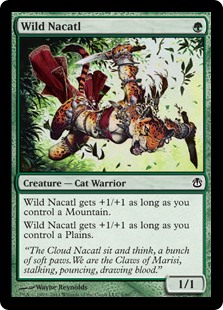
Sword of the Meek is Unbanned

Looking at metagame updates since August, blue-based reactive control has been largely absent from Wild NacatlModern's top-tier. Alternately, depending on how you view the strategy, it has been completely monopolized in URx Twin (Note: this says nothing about Twin being overpowered (it hasn't exceeded 12%-13% since the summer), and everything about how bad other reactive blue strategies are). Meanwhile, we've seen huge metagame shares for aggro decks like Affinity, Burn, Burn Zoo, Gruul Zoo, Naya Company, and the countless Wild Nacatl/Lightning Bolt permutations throughout Modern. These conditions aren't exactly unhealthy, but they also probably aren't as diverse as Wizards wants for the format. Unbanning Sword of the Meek addresses both.
ValakutFrom a historical perspective, every single unban has targeted a low-tier deck. Again, this doesn't mean all subsequent unbans will follow that trend, but it does suggest a pattern we are safer betting on. Valakut's unbanning resurrected the nonexistent Scapeshift combo. Nacatl was aimed at the vanished Zoo species, as Bitterblossom targeted the <.5% Faeries. This was also true of Golgari Grave-Troll, which fit into Dredgevine strategies that had only enjoyed marginal Tier 3 and lower success for years. This conservative unban style does not favor blue-based control cards like Ancestral Vision, Jace, the Mind Sculptor, or Preordain, all of which could have sweeping ramifications. But it does point squarely at Sword.
swordThe Sword of the Meek/Thopter Foundry combo slots into UBx and UWx decks, none of which are tearing through top tables these days. Grixis and Jeskai Twin are certainly prominent, but I've tested the Twin Sword (Sword of the Twin? Thopter Twin?) deck and it's a mess. Grixis and Jeskai Twin gain much more from splashing into discard, removal, manlands, etc. than they gain from jamming eight combo pieces that don't do anything with the rest of the deck. This angles Thopter Sword into Jeskai Control, Esper Teachings, UW Control, and other similarly fringe strategies, not into Tier 1 pillars. We might also see Grixis Control and Midrange strategies adopt the combo, but again, those decks are hardly top-tier. Non-Twin Grixis strategies haven't exceeded 3% of the metagame for months, and I predict the relative benefits of adding the combo to non-Grixis blue decks would more than make up for any possible edge given to Grixis.
Thopter FoundryAs for aggressive strategies, Thopter Sword directly fights against those decks while (more importantly) not pushing them out of the format. My main evidence for this is the improved cardpool since Thopter Foundry reigned in Extended many years ago. Aggro decks have better graveyard hate (Scavenging Ooze), removal (Destructive Revelry, Wear // Tear), and anti-lifegain (Skullcrack, Atarka's Command). They are also much faster today than in the Extended of old. As a related safety measure, the metagame is packed with forces that beat up Thopter Sword decks if they every get too powerful. The biggest player here is, naturally, BGx Midrange and its Abrupt Decays, Scavenging Oozes, and Kolaghan's Commands. Thopter Sword didn't have to deal with these forces back in the day, and will likely struggle against them in 2016.
Final note on Sword of the Meek and other possible unbans: we have no evidence to suggest Wizards rigorously tests every combination of unbanned cards before releasing them to the format. Instead, it appears they make reasonable, common-sense metagame assessments before trying them out. We see this in the Valakut unbanning, where Wizards states "The DCI is unbanning a card to see how that affects the format", suggesting a level of cautious uncertainty that would be present in any unban. Similar language is present in all later unbannings, and would likely also accompany a potential Sword return.

Scenario 2: Crazytown

Let's spice things up a bit.

SCENARIO 2
Amulet of Vigor (or Hive Mind) is banned
Stoneforge Mystic is unbanned

Or should I say, let's spice things up a lot.

Maybe Wizards jumps the shark and decides it's time to go bananas before a Pro Tour. Maybe Wizards ditches past precedent and starts to set a new example. In both those cases, we are unlikely to see the conservative approach in Scenario 1 and are instead plunged into a wonderland of Scenario 2. This would pave new trails in Modern banlist policy actions and would have major implications for the format's future.

Alternate Amulet Bloom Bannings

A Summer Bloom banning is predicated on Wizards following the Seething Song example and conducting a limited strike on Amulet Bloom. What if Wizards goes against these previous turn four rule violation examples and sets a new precedent? This would likely manifest in either a Hive Mind banning on the more conservative end, or a Amulet of Vigor banning on the harsher side.

All things considered, Hive Mind isn't a terrible candidate. It's incredibly unfair, leads to the least interactive Amulet Bloom Hive Mindopenings and wins, is built to do purely degenerate things, and isn't integral to the deck's identity. The big-mana, over-the-top Bloom style of play with Primeval Titan, Hornet Queen, Dragonlord Dromoka, and others isn't nearly as problematic as the Hive Mind kills. They are also much easier to race against and interact with. Following from this and in a slight reinterpretation of the Seething Song ban, Wizards might nix this win condition to preserve the deck's core identity while also jailing its most offensive component. This would be a good ban if Wizards has data suggesting Hive Mind disproportionately participates in the turn three kill, which suggests banning the enchantment would prevent Amulet Bloom from violating the turn four rule. You can beat the Titan opening with good removal. Hive Mind is much more resilient.
amulet of vigorAlternately, Wizards could assault Amulet Bloom from a much more punitive angle and slash Amulet of Vigor itself from the format. This would remove the deck's most iconic and unique element, although (perhaps counter-intuitively) it might not be as destructive as a Summer Bloom ban. Bloom still allows the Amulet player to drop lots of bouncelands on turn two and then open turn three with a Titan or Hive Mind. Amulet of Vigor is only as good as the lands following it, although its synergy with Primeval Titan enter-the-battlefield triggers is also nasty. Ultimately, I think both the Amulet or the Bloom ban would be about equally destructive to the deck, but I can see Wizards blasting the artifact instead just to make a statement.
Outside of these three cards, other Bloom pieces should be safe. Primeval Titan (and Summoner's Pact, to a lesser extent) are used in other decks and don't fit previous ban patterns. They are also the most interactive pieces of the Amulet Bloom engine, and creature-loving Wizards is unlikely to go after them. Similarly, cards like Tolaria West and Slayers' Stronghold are way too niche to be realistic ban options. Since when has Wizards surgically removed such a subtle piece from a combo deck? This leaves the banhammer aimed solidly at Summer Bloom, Hive Mind, and/or Amulet of Vigor when Monday comes around.

Stoneforge Mystic is Unbanned

No, I'm not very optimistic about this either. But with a $1.5 billion powerball jackpot drawn later today, luck and unprecedented outcomes are in the air. Maybe Stoneforge Mystic is due for parole Monday. To be totally honest, a huge contributing factor to this prediction was the Grand Prix promo announcement in December. If Mystic does not get unbanned, this would be the first promo card since Modern's founding that wasn't Modern legal. It would also be odd timing for a Legacy reprint given the reduced focus by both StarCityGames and Wizards on the eternal format in 2016. Add to that the suggestive wording in the article ("I wonder how many promo Batterskulls we'll see next to these new promo Mystics by springtime next year..."), and it's hard not to read into her reprinting!

Stoneforge MysticFrom a more concrete metagame standpoint, I think Mystic is way safer than many allege. Modern is a fairly powerful format and an incredibly hostile one to creatures. They don't call this the Lightning Bolt format for nothing. That said, Deathrite Shaman is totally fine in Legacy but was an unqualified disaster in Modern, so being a creature alone is no guarantee of safety. I still think Mystic is a plausible unban, if not a likely one, just based on the current metagam climate in Modern. For one, white is terrible in Modern. We haven't had a primarily white-based Tier 1 deck for all of 2015. Abzan was the closest, but by all accounts the deck has an ebbing and flowing relationship with fellow BGx staple Jund. Mainstay white strategies are few and far between. Mystic is the exact kind of unban Wizards could use to revitalize interest in white, even if it's potentially a risky one.
BatterskullMore importantly, I think Mystic is less problematic to aggressive decks than many believe. She was totally fine in the Abzan vs. Affinity matchup, and the limited testing I conducted with her against Burn and Zoo decks was also fairly balanced. Batterskull is a great card on turn three, but contemporary aggro strategies have more outs than players often acknowledge. Of course, Wizards initially banned Mystic for fear of Modern becoming a Mystic-dominated format, which is certainly possible if she gets released on Monday. Even if she isn't crushing aggro decks left and right, you can bet players will do everything in their power to fit her into Tier 1 and Tier 2 shells across Modern. Wizards likely expects that, which could be a strike against her potential unbanning.
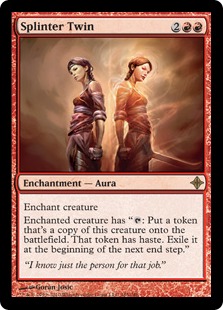
One final worry with Mystic is her power in the so-called Twin Blade lists we have seen theorized across the Modern community. This dual-angled Twin and Mystic threat can be very challenging to handle, although my limited testing with the list has not produced conclusive results. I expect Wizards would do no testing whatsoever on this kind of synergy, so it's more a matter of us speculating about how they will process such a deck and less a matter of them actually piloting it in a test gauntlet. In the end, I expect the dangers of Mystic outweigh her potential benefits, but I still hold on to the promo announcement as a promising sign.

Safe Cards and Unsafe Bans

After jumping down the Mystic rabbit hole, let's wrap up with some more grounded analysis of a few cards that are unlikely to be banned or unbanned on Monday. I won't say too much on each option, but feel free to discuss them more in the comments.

Unlikely Bans

  • TwinSplinter Twin/Deceiver Exarch
    URx Twin doesn't violate the turn four rule and hasn't reached the metagame shares of Pod, TC Delver, DRS/BBE Jund, etc. It polices the format and actually increases diversity by keeping linear decks at bay.
  • Goryo's Vengeance/Nourishing Shoal/Griselbrand
    The Grishoalbrand deck may win a lot before turn four, but it's nowhere close to top-tier. This insulates it from the turn four rule.
  • Blood Moon
    An integral policing card in Modern that discourages certain big-mana strategies and fights back against greedy, homogenized manabases. It doesn't see too much play at top tables and gives more to Modern than it takes away.
  • become immenseBecome Immense
    I actually don't have a lot of data on Infect, so this might be a likelier ban than I give it credit. Infect is definitely top-tier, but I don't have numbers on whether it consistently wins on turn three or earlier. Assuming Sam Stoddard's May article is any indication, Wizards thinks the deck is fair enough for Modern. The hard stats, however, could prove me wrong.
  • Urza's Tower and friends
    RG Tron has only recently solidified its status as a Tier 1 deck, where it still hasn't exceeded an overall 8% metagame share. This is about half of the Pod and Delver-era metagame offenders, so it's pretty clear Tron doesn't warp the format by Wizards' historical metrics.
  • Ancient Stirrings
    Stirrings Could get the Ponder/Preordain treatment for eliminating variance, but the decks using it don't have enough of a metagame share. Tron is a great safety measure against BGx dominance, and removing Stirrings disrupts that equilibrium without any reason: Tron also doesn't take up enough of the format to be a problem worth banning.

Unlikely Unbans

  • BbeBloodbraid Elf
    Jund may be losing ground to Abzan, but it's still Tier 1 and will always probably fluctuate between Tier 1 and Tier 2 depending on metagame context and relative Abzan positioning. Jund just gained Kolaghan's Command this year, so the top-tier deck doesn't need extra help. Maybe it will one day, but that day is not the 18th of January.
  • Ancestral Vision
    Potentially improves Twin too much and Wizards just had problems with efficient card-draw spells pushing BGx Midrange out of the format. This probably won't get unbanned for at least a year or two.
  • Jace, the Mind Sculptor
    Like Elf, Jace is potentially a fair Modern card which could maybe improve the ailing blue-based control decks. Also like Elf, it slots too easily into an existing top-tier deck (we already know how much work Twin puts in with Jace, Architect of Thought), and there's a huge pricing issue which Wizards is surely aware of.

That's all for today! I look forward to seeing the update next Monday and hammering out a piece right after it goes live. Let me know in the comments what you think about the banlist scenarios, the card assessments, and the format's prospects on the 18th. No matter what happens, it promises to be an exciting day.

Insider: MTGO Market Report Reboot

Are you a Quiet Speculation member?

If not, now is a perfect time to join up! Our powerful tools, breaking-news analysis, and exclusive Discord channel will make sure you stay up to date and ahead of the curve.

Welcome to the MTGO Market Report as compiled by Matthew Lewis. This week and into the future, the Market Report will be presented in a modified format compared to the past. Underlying this change is Sylvain Lehoux's departure as a contributor to the Market Report as he pursues other writing projects for Quiet Speculation.

The practical change will be a reshuffling of the content of the report. Regular readers should know that targeted buys and sells will no longer be issued. Full documentation of Matt's trades will be available in a private Google doc spreadsheet and will be an ongoing source to disseminate speculative strategies and ideas.

Any questions about past recommendations or changes to the format of the report will be answered promptly and can be sent via private message or posted in the article comments.

As always, speculators should take into account their own budget, risk tolerance and current portfolio before buying or selling any digital objects.

Redemption

Below are the total set prices for all redeemable sets on MTGO. All  prices are current as of January 11th, 2015. The TCG Low and TCG Mid prices are the sum of each set’s individual card prices on TCG Player, either the low price or the mid price respectively.

All MTGO set prices this week are taken from Goatbot’s website, and all weekly changes are now calculated relative to Goatbot’s ‘Full Set’ prices from the previous week. All monthly changes are also relative to the previous month prices, taken from Goatbot’s website at that time. Occasionally ‘Full Set’ prices are not available, and so estimated set prices are used instead.

Jan11

Flashback Draft of the Week

Triple Mirrodin (MRD) flashback drafts will end this week and then transition to two MRD boosters and one Darksteel booster. It's an excellent time for Pauper players to pick up play sets of the artifact lands as well as other key commons such as Echoing Truth and Chittering Rats.

Modern players and speculators should pay attention to the price on cards like Oblivion Stone and Glimmervoid. Typically flashback drafts don't make a big dent in the price of pre-mythic rares. The most price action occurs as a result of players and speculators fearing a large influx of new copies. As a result, they surmise it's a good idea to sell in advance, which depresses the price. When the influx is smaller than anticipated, the prices bounce back as players have to buy their copies back.

Modern

This week there is a stark divide in the MTGO market. Interest in Modern Constructed is at a fever pitch in the lead-up to Pro Tour Oath of the Gatewach (OGW). This high level of interest is reflected in price increases on many Modern singles, particularly those singles that appear in the new Eldrazi decks. Urborg, Tomb of Yawgmoth has shot up to over 10 tix and is a good example of recent trends.

Speculators should be in the process of unwinding their Modern positions and taking advantage of these high prices. A feverish market is the perfect time to be selling.

Players should also carefully consider which Modern decks they enjoy playing and whether or not they have any underused play sets that they could do without for a minimum of six months.

The short-term price variation on singles is not big enough to consider selling a card one week with an eye to buying it back a week later, but if you have a play set of Scalding Tarn or Inquisition of Kozilek you're not using, then it's not a bad idea to let go of them for a while. Players must know themselves though. If you are just going to buy the card back in a month, then there's no sense in selling it today.

Standard

Unlike Modern, all Standard sets except for Battle for Zendikar (BFZ) came under selling pressure this week. A similar effect was observed last year in January for Theros block and Magic 2015 as these four sets all saw price declines in the lead-up to the release of Fate Reforged (FRF). This price decline will continue for the next month with some recovery when the focus shifts to the new iteration of Standard that includes OGW.

Not only did BFZ escape printing a red number this week, it bounced 6 tix to sit at 70 tix this week. Most of this increase can be attributed to Ulamog, the Ceaseless Hunger as it stretches its legs in Modern, showing up in the new Eldrazi decks as well as R/G Tron.

Since the price increase is tied to interest in Modern, its expected to be a temporary boost only. Look for BFZ to head closer to 60 tix by the end of January. Players looking to fill out their play sets and speculators looking to load up on BFZ should wait for the start of OGW release events.

Standard Boosters

In the aftermath of the introduction of play points to the MTGO economy, boosters from new sets will seek an equilibrium price of 4 tix. The official store will always sell boosters for $3.99 or roughly 4 tix, so any boosters priced below 4 tix on the secondary market will see buying pressure, which tends to push the price closer to 4 tix.

Magic Origins (ORI) and Battle for Zendikar (BFZ) are the two sets that have been released since the introduction of play points back in August. ORI boosters were awarded as prizes up to the release of BFZ in October. Since bottoming at 3.1 tix during BFZ release events, ORI boosters moved upwards to the 3.9 to 4.0 tix range by the first week of November.

BFZ boosters are fluctuating in the 3.2 to 3.4 tix range, which is a fine price to accumulate these with a medium-term outlook. They will go through a similar process as ORI boosters, eventually finding an equilibrium price around 4 tix.

Players should wait until the start of OGW release events to top up their accounts with BFZ boosters, when they will be at their cheapest. If ORI boosters are a good guide to how BFZ boosters will appreciate in price, then it will be only 4 to 6 weeks for them to get close to 4 tix.

FRF and KTK boosters are seeing continuing weakness as they dip below 2.0 tix and 3.1 tix respectively. Both of these boosters have a negative outlook in the short term. However, at some point they will become "too cheap" and thus become a good speculative buy. Like BFZ boosters, look for these to reach their bottom during OGW release events.

Trade of the Week

The Market Report portfolio will start with an initial allocation of 500 tix. Each week I will discuss a particular trade and go over the motivation and other notes for that trade. This will be a mechanism for disseminating speculative strategy. All trades will be recorded on a google doc spreadsheet on the day they occur, and a particular trade will be highlighted here on a weekly basis.

My Top OGW Picks for Standard

Are you a Quiet Speculation member?

If not, now is a perfect time to join up! Our powerful tools, breaking-news analysis, and exclusive Discord channel will make sure you stay up to date and ahead of the curve.

Now that the Oath of the Gatewatch has been fully spoiled, I would like to take a bit of time and talk about some of the cards I'm excited about. For now I will be focusing on Standard decks, as my next two big events will be SCG Atlanta and SCG Columbus, both of which are standard.

I'm going to start us off with two cards that could go into what I think is the best deck in Standard right now, 4-Color Rally.

matterreshaperreflectormage

Matter Reshaper is perfect for the Rally deck.  You can get it off Collected Company, and when it dies its effect is very powerful. It does require a colorless mana to play it, which is a problem.. Luckily you have a few ways to play it without using land, as you can put it into play with Collected Company or use the scion from Catacomb Sifter to cast it. Even though these things are true, you will most likely have to retool the mana base to play Matter Reshaper. Pain lands or using Evolving Wilds to find a Wastes are probably the easiest ways to do this. While it will make the mana a bit less consistent, this card seem powerful enough to warrant the change.

Reflector Mage might not be card one would think of right away when thinking about the Rally deck, as they already have a "better" bounce creature in Sidisi's Faithful, but Reflector Mage is an upgrade when it comes to bouncing Anafenza, the Foremost.  The fact that you can play Reflector Mage and bounce one of the best cards against your strategy and disable them from just replaying it the next turn is huge.  This will not only take pressure off you, but will allow you to make a two turn set up to win a game you otherwise wouldn't be able to.

This is a rough sketch of an updated list:

4-Color Rally

Creatures

4 Catacomb Sifter
3 Elvish Visionary
3 Grim Haruspex
3 Nantuko Husk
3 Sidisi's Faithful
4 Zulaport Cutthroat
4 Jace, Vryn's Prodigy
3 Matter Reshaper
2 Reflection Mage

Spells

4 Collected Company
4 Rally the Ancestors

Lands

1 Forest
1 Island
1 Plains
1 Swamp
1 Wastes
1 Canopy Vista
2 Llanowar Wastes
3 Evolving Wilds
3 Flooded Strand
3 Polluted Delta
1 Prairie Stream
2 Sunken Hollow
3 Windswept Heath

Next up is easily my favorite card from this set.

recklessbushwhacker

Reckless Bushwacker is a card that I think will find a spot in the Atarka Red deck.  It combos well with so many cards that are already great red cards.  It combines with Dragon Fodder or Hordeling Outburst insanely well, and it also plays great with the dash mechanic. If you haven't made this connection you aren't the first, as I have been blowing peoples minds for the last week or so.  Cards like Lightning Berserker and Zurgo Bellstriker don't always stay on the battlefield as they can be dashed in and replayed on later turns.  This is perfect for anything with surge!  Now when you top deck your surge guy you will already have a spell to play.

The last few cards I want to discuss seem great, but they don't have a home just yet.

jorienruindiver stormchasermage expedite

Once again cards with dash will work great with Jori En, Ruin Diver.  Also, Jori is blue, which gives you access to Jace, Vryn's Prodigy.  If you get to flip Jace, then casting two spells a turn shouldn't prove too difficult. Jace also works very well with Expedite, as one of the hardest things to do most of the time is untapping with a Jace. Expedite lets him flip right away, and that line of play will also trigger Jori En, Ruin Diver.  I'm not so sure if Stormchaser Mage fits it's way into this deck, but it's stats are solid and this deck is looking to trigger prowess a lot. It might just be the case taht Stormchaser Mage fits best in a deck with Mantis Rider to apply maximum pressure, and I'm not sure that is something the Jori/Jace deck is interested in doing.

This is my current list for a Jori En deck:

RU Aggro

Creatures

4 Monastery Swiftspear
4 Abbot of Keral Keep
3 Zurgo Bellstriker
3 Jori En, Ruin Diver
4 Jace, Vryn's Prodigy
2 Lightning Berserker
1 Goblin Dark Dwellers

Spells

3 Expedite
4 Titan's Strength
3 Wild Slash
4 Dragon Fodder
2 Exquisite Firecraft

Lands

4 Bloodstained Mire
4 Polluted Delta
1 Smoldering Marsh
1 Sunken Hallow
5 Mountain
2 Island
4 Shivan Reef
2 Wandering Fumarole

This is my short list for now as I start testing for SCG Atlanta.  If there is anything you think I missed, which I'm sure I did, let me know in the comments.  I'm very interested to see you what you are coming up with as we explore the new format.

Once again, thanks for reading!

Follow me on Twitter @conanhawk

[MTGO] 1 Year, 100 Tix – 365 Days Later

Are you a Quiet Speculation member?

If not, now is a perfect time to join up! Our powerful tools, breaking-news analysis, and exclusive Discord channel will make sure you stay up to date and ahead of the curve.

365 days of live and fully transparent MTGO speculations are over! 2015 is gone and with it the "100 Tix, 1 Year" project is now complete. Welcome back for the concluding article of our journey.

First and foremost, thanks to all of you for following, commenting and being part of this adventure. I can’t believe one year has already passed since the first article. I hope you've also been able to enjoy the Nine Months of Portfolio Management series which followed a similar model.

One year ago, I had just opened a fresh new account with only 100 tix on it, with the goal to make as many tix as I could while publishing every single speculative move. I was fairly confident the account would post more tix on January 1st, 2016 than a year before, but I was not exactly sure how things would unfold. I was expecting to be somewhere around 300 to 400 tix today. It ended up being a little more than that…

The final number of tix on the account at the end of the year is one matter. How I got there is also valuable information. Today I’ll review the whole project with data and numbers extracted from my specs, and comment on some aspects I found salient.

The Final Result

You may have seen my tweet on January 1st. If not, here is the official, final value of the "100 Tix, 1 Year" account!

642

The bankroll grew by 13% in the final month of December to finish at a whopping 642 tix after 365 days! This is clearly higher than I anticipated.

Here's a summary of the month-by-month bankroll evolution during 2015.

100t1ygraphfull BB

With his guess of 650 tix, Bertrand Lamarre is the grand winner of the one -ear guess contest. Since I made a mistake when I announced the result for the six-month guess contest I’ll wait one week from today before awarding Bertrand his prize to see if anyone comes forward to point out any errors. You can check your guess here and/or contest the result if needed.

100 Tix, 1 Year in Numbers and Graphs

With more than 632 Twitter followers and 100 tweets, the "100 Tix, 1 Year" was a successful venture for me on social media.

All of speculative moves made with the account were and are still available on Twitter. You could actually go through and recreate the evolution of my portfolio from scratch by adding up the gains and losses reported after each sale. This would probably yield a slightly higher value than 642 tix, considering the bot credits I was not able to recover.

The data and numbers I discuss below are extracted from purchases, sales, dates and account valuation reported on the monthly reports published here at QS. A copy of the spreadsheet I used to track my specs is also available.

141 Speculative Positions

Excluding "real" quick flips and short sales I speculated on 141 positions this past year. This number includes a few positions I targeted more than once, such as Spell Snare and Sunscape Familiar. If the opportunity presents itself there's no reason not to target the same position several times.

More than half of these positions were Modern targets---86 positions or 61% of my portfolio. Modern specs are by far the most reliable and profitable opportunities available on MTGO. Watching out for reprints and flashback drafts are the only two things to worry about with Modern specs. The metagame is diverse and balanced enough that everything goes up and down in turns.

Format repartition40 positions were in Standard---28% of the 141 positions. Standard can sometimes yield great results but is unfortunately far less predictable. Magic Origins (ORI) clearly hasn't paid off here but should improve this coming Spring.
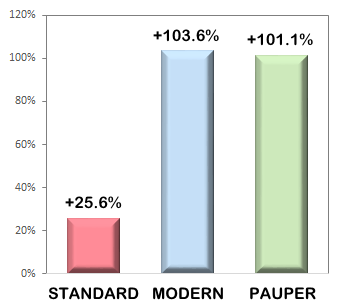
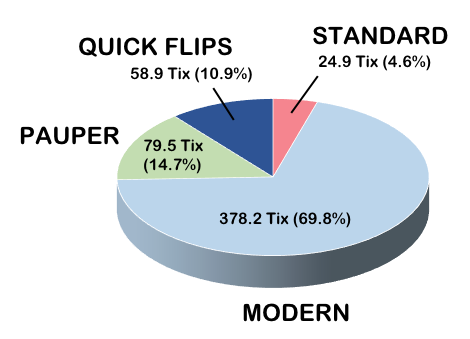
14 Pauper positions---10% of the total---were part of this portfolio. They were perfectly suited for this project as they yielded great returns with a fast turnover. In retrospect I probably should have focused more on that format. Lastly, I had no intention to speculate with Legacy or Vintage positions; Terminus was the only target in these two formats.

25.6%, 103.6% and 101.1%

These are the average percentage gains by format (Standard, Modern and Pauper, respectively).

Avg percent gain format

Even if ORI positions had performed better, or if I had sold my Standard positions with better timing, Modern and Pauper positions were clearly more profitable. Once again, what makes the strength of Modern or Pauper specs is their cyclical aspect. Predictable cycles make it easier to buy and sell closer to the optimal price and at the right time, leading to better and more consistent profit.

24.9 Tix, 378.2 Tix and 79.5 Tix

These are the accumulated tix gains by format (Standard, Modern and Pauper).

cumul Tix gain format

With only about twice as many positions compared to Standard, my Modern picks made over ten times more, generating almost 70% of the tix gained during the project. In comparison, my Standard picks represented 28% of my choices for only a very slim 4.6% of the total returns.

Another interesting number here is the number of tix accumulated through quick flips and short sales (58.9 tix), which represents more than 10% of my total gains. Some quick flips only made a few cents of tix and others way more, such as the 12 tix collected quick-flipping Mystic Gate. Quick flips should not constitute a long-term strategy by themselves but they can add a few extra tix to any bankroll with virtually no risks.

MG

75% Winners, 25% Losers

75.18% and 24.82% to be more accurate. More than three quarters of my specs generated a profit and only a quarter of them ended up costing me. These numbers are slightly worse than those I had after 6 months but in my experience 70% or more of your positions yielding a profit is a great rate.

+80.31% Gain on Average per Position

+80.31% is the average gain across the 141 positions mentioned above. The percentage gains ranked from -87.58% (Rakshasa Deathdealer) to +1,144.23% (Eye of Ugin). If the average gain per position looks impressive, it's mostly the result of speculating with cheap or bulk cards. Even with a bigger spread that can eat some of the potential profit, cheap cards tend to be more volatile---doubling or tripling on bulk or near-bulk specs is common practice.

As you speculate with more expensive cards the average gain per position tends to be lower but results in more tix (assuming you pick correctly) since the total value is higher.

Could points percent gain

If the winning positions alone are taken into account the average percentage gain is +117.8%, while the average percentage loss among the losing positions is -33.4%.

+3.41 Tix Gain on Average per Position

Tix-wise, the average gain among the 141 non-quick flip speculative targets of the "100 Tix, 1 Year" account was +3.41 tix. Here, the spec that cost me the most was Woodland Bellower. The green ORI mythic reduced my bankroll size by 11.03 Tix. On the other hand, my biggest winner was Deceiver Exarch with a profit of 20.25 Tix.

Could points Tix gain

Seen from this angle Rakshasa Deathdealer doesn't appear so bad with a loss of only 1.61 tix. The loss only looks minimal because it was a bulk card spec. Eye of Ugin, a bulk card spec as well, nonetheless ranked third among my biggest gainers.

One interesting stat to consider when looking at the average tix gain is the ratio of total tix gained to tix invested across all positions. For the non-quick flip specs, there were 483.1 tix gained for 1,053.8 tix invested, resulting in a return of 0.458 tix for each ticket spent.

79 Days

That's the average time I held any position in the "100 Tix, 1 Year" portfolio. Percentage and tix profit are two important parameters that measure the success of MTGO speculations. The turnover of your positions is a critical third factor that contributes to growing a bankroll.

Provided the percentage/tix gains remain similar, a faster turnover yields more absolute profits. +500% every six months is indeed far less efficient than +20% every week, which corresponds to more than +1,500% after six months.

For the "100 Tix, 1 Year" project I held my positions for an average time of 79 days, ranging from as little as three days (Spell Snare) to more than eight months (Ghastly Conscription).

Turnover

This means the average turnover for my positions was less than three months for an average profit of +80.31%. As opposed to waiting to maximize every bit of each spec, a rapid turnover is, in my opinion, a good strategy to effectively grow a bankroll. You should not necessarily seek to sell everything as soon as it becomes profitable, but this should be a factor to consider when pondering whether or not to sell a position.

curve

Ideally, with the parameters mentioned above and in the hypothetical case where each ticket is immediately reinvested, one ticket invested on Day 1 would generate somewhere around 14 tix after one year---a gain of 1,300% after four and half leaps of 80%.

2.85%, The Average Size of Any Position in my Portfolio

To get to this number I calculated the size of each position relative to the size of my bankroll at the time of investment. When averaged, the size of any position in my portfolio was 2.85%. What is also important (illustrated below) is that the relative sizes of all my positions were very similar.

size

Each color of this pie represents one position. Positions purchased within the first months involved fewer tix on average than positions purchased towards the end of the project, but their share relative to the bankroll size was a fairly constant number---2.85% on average.

Garza's Assassin, a position that ended up negative, was the largest relative position in my bankroll, representing 6.57% of the total bankroll at the time of purchase.

Only a few positions, including Threads of Disloyalty, Monastery Mentor and Karn Liberated, represented more than 5% of my bankroll at time of purchase. All these positions were purchased during the first six months of the project, when the bankroll was smaller and when it was easier to reach this 5% bar. Keeping a diversified portfolio is an essential tool for constant and lasting success.

12 Tix Worth of Bot Credits

In a previous article I reported somewhere around 7 tix in credits spread out among different bot chains. It turned out to be a little more than that.

Scrapping to get back bot credits is something speculators shouldn't really concern themselves with, unless they intend to quit MTGO. These ongoing credits are used as you come and go to buy and sell cards. But since I wanted to close the "100 Tix, 1 Year" account I needed to get back as many bot credits as possible.

Overall, I was able to scrape 12 full tix off the different bots I used. Considering this left only about 1 tix total across all the bot chains, I figured it was a pretty good recovery rate. Many of these tix were on MtgoLibrary Bots with others on MtgoTraders, GoatBots, DojoTrade and ClanTeam bots.

The strategy was fairly simple but a little tedious---I gathered cards towards bots with more leftover credits and bought more cards. One tool I used was to scour MTGO Traders' Hot List for cheap cards, e.g. under 1 tix and mostly under 0.1 tix. I then bought these cards from bots I still had credits with.

Closing Thoughts

The bankroll activity was geared towards Modern since the beginning. And Modern positions really were the main contributor to the growth of the account. The fact that Modern shined so much is also due to Standard specs yielding poor returns, particularly the Magic Origins ones.

Some of the reasons for these poor performances are my fault---I missed several selling opportunities. Siege Rhino, to start with, posted prices higher than my buying price for many months. I could have even doubled up at some point. In October, its price started declining and never stopped since. I finally sold it with a 47% loss after 253 days, a real waste of time and tix.

A few ORI positions ended up higher than when I bought them; I should have made much more on Liliana, Heretical Healer especially. I sold this spec with only a profit of 16%. Liliana saw its price touching the 15 tix mark during Pro Tour BFZ and I clearly should have sold my copies at that time, for 13 tix or so profit per copy. Did I mention the turnover factor before?

There was an error retrieving a chart for Liliana, Heretical Healer

Selling during a spike without further expectation is not as easy as it seems. It is always tempting to wait for more. Next thing you know you are hoping for a second spike while the price is dropping, then you're hoping for a rebound to occur, then hoping for the price to peak back up a little bit so you can break even, and finally you are just hoping to sell above bulk price.

Remember that turnover of 79 days for +80% profit? Well then my 12 tix invested in Liliana could have been turned into 26-30 tix by October 15th, then turned into 45-48 tix by the end of December. Instead, my 12 tix worth of Liliana got turned into 16 tix mid-December, not really quite the same.

Monastery Mentor is the counterexample. I sold it mid-October for 9.5 tix. If I had waited to the last minute I might have been able to sell for 24 tix or so. 14 tix may seem like a big loss on a single position, but the 9.5 tix I collected from Mentor got reinvested and turned into 17 tix by the end of December. In light of this, the difference isn't as big as it seems at first glance.

The one big difference is that when I sold my copies of Monastery Mentor my profits were locked in, and I also knew I'd make a profit reinvesting those tix. On the other hand, back in October I had a hypothetical situation where, maybe, Monastery Mentor could have risen in price. But it could have lost value as well in the following weeks or months---I'm not a fortune teller after all.

As with Liliana and Rhino, selling the Mentor was the right decision (which I fortunately made in this case) and the decision that ended up making me more "sure" tix.

The same can be said of Eye of Ugin. This land could have made me 200 tix for an initial investment of 1.56 tix. Despite any regrets one could have, I was extremely happy with this spec. When I sold my copies of Eye of Ugin it was a good decision according to what I knew at that time. Modern Eldrazi decks were not on my radar and there was no reason to wait with a spec that had just yielded over 1,000% profit!

There was an error retrieving a chart for Eye of Ugin

Coming back to Magic Origins, I think a lot of these specs will pan out later this year. The five painlands may see more demand after the release of Oath of the Gatewatch with the potential increased need for colorless mana. They should also have an even better spot once Khans of Tarkir and its fetchlands rotate out of Standard later in April.

As we've come to expect each year, the upcoming sets, Oath and Shadows over Innistrad, and the Standard rotation are likely to make other ORI cards (besides Jace, Vryn's Prodigy) playable and valuable. I’m holding all of my ORI targets on my main account at this point.

A few words on Pauper. While volatile, Pauper specs did great in this project. This volatility can actually be great for growing your bankroll if you can pay enough attention to price variations and buy/sell accordingly. With the success of Pauper leagues, prices are up all over the place and appear to be well supported. We might begin to see price cycles such as those observed for Modern.

What's Next?

The "100 Tix, 1 Year" project was really great. Thank you for all the comments and I hope you enjoyed the project and the reports as much as I did. Many asked if there will be a sequel to the "100 Tix, 1 Year" project or if I would keep going with the account in 2016. Unfortunately there won't be a second edition of the "100 Tix, 1 Year" project. But we are working on something similar!

The new project may involve a much bigger bankroll, still with the possibility of following real-time speculations. I intend to launch the new series by the end of January. Stay tuned for more details.


Thank you for following and reading!

Sylvain Lehoux

The Case for an Amulet Bloom Banning

Are you a Quiet Speculation member?

If not, now is a perfect time to join up! Our powerful tools, breaking-news analysis, and exclusive Discord channel will make sure you stay up to date and ahead of the curve.

A reckoning is coming. After months of ban mania, speculation, theorycrafting, and general rage against the Wizards machine, the January 18, 2016 banlist update will decide if Amulet Bloom is an acceptable Modern deck. Many authors players have vehemently opposed the combo strategy since Justin Cohen's February run at Pro Tour Fate Reforged. Others, including the DCI, were more moderate. In the months following February, there have been three banlist updates. All resulted in a resounding "No Changes" despite the frenzied pleas of ban-hungry masses. I correctly predicted and praised Wizards' conservative approach those cases, defending their assessment of Modern health and their execution of the ban policy.

The time for inaction, however, has passed. Today, I will present evidence that Amulet Bloom violates the turn four rule, and agree the time has come to ban one of its staples.

Fall-of-the-Hammer-Bloom

Whether you are a Modern Nexus veteran, or a newcomer who is either thrilled or furious that I'm targeting an article at this deck, know that I have not come to this position lightly. Indeed, I've spent most of 2015 shielding Amulet Bloom from criticism, both here and throughout the online Modern community. That changed when I finished the analysis that I conducted for this article. There is now enough data for me to demonstrate the deck legitimately breaks the turn four rule. This is not kneejerk alarmism to Bobby Fortanely's StarCityGames Cincinnati win. I'm not salty from losing packs at Friday Night Magic, or boarding a ban mania hype train because it's popular. Rather, I've crunched the numbers and concluded that Amulet Bloom is a turn four rule violator in need of banhammering. Read on to see the evidence that led me to this conclusion.

[wp_ad_camp_1]

Qualitative Evidence

Goryo's VengeanceWe're going to start with the loudest and most obvious evidence in favor of an Amulet Bloom ban: the overwhelming player, author, and pro outcry against Bloom decks. To be clear, I don't think Wizards listens to the masses alone. If they did, Bloom and even Goryo's Vengeance would have been banned in the July announcement. Maybe even the March update, in the case of Amulet after Justin Cohen's explosive finish at Pro Tour Fate Reforged. That said, we know Wizards is aware of banlist buzz, and we've heard ample anecdotal evidence to suggest they at least consider it when making decisions. This means we should account for such qualitative evidence too, even if only as a single datapoint in a larger picture.
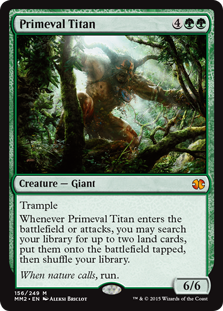
It's hard to find widely publicized sources that don't want Bloom banned. Prime Time specialist Chris VanMeter went on the record to state the Primeval titandeck was unhealthy for the format, largely as a function of its speed. Seth Manfield agreed, explaining that Bloom probably wasn't too powerful for Modern per se, but that it leads to a problematic kind of Magic which Wizards probably discourages. StarCityGames also doubled down on Bloom ban talk in its Thursday, January 7th newsletter, with Cedric Phillips either predicting the deck's death or (get on those tinfoil hats!) hinting at some insider knowledge. Perhaps most notably, these opinions were shared by Bobby Fortanely, the SCG Cincinnati winner whose Amulet Bloom finish kicked off the 2016 discussion. Bobby says the deck is too good, too fast, and overall bad for the format, a line of thought echoed by fellow Top 8er Bill Comminos in his comments on r/spikes. Bobby and Bill were by no means the only Open players to fall on those lines. Seven out of eight players in the Charlotte Top 8 also want a Bloom card banned.

amulet of vigorIn case it wasn't clear, I don't place too much stock in these kinds of opinions alone. To be sure, stances like Bobby's are likely grounded in actual testing. Others, notably anything spouted by the average Twitch chatter or forumgoer, come from a place of hype and ban mania. They also don't cite a whole lot of sources, which is a degree of subjectivity that makes them hard to argue for or argue against. This isn't to say subjective, qualitative evidence is "wrong". It is just to acknowledge that we might have different experiences with a deck, all of which could even be "right" within those isolated experiential spheres. That's why I emphasize using qualitative data as just one piece in the overall puzzle.

Given Wizards' conservative approach to the banlist in past years, I suspect they feel the same way. Popular media should be treated as a single  source of data in larger calculations. So long as we maintain this critical lens, we can leverage opinion pieces to triangulate harder numbers at the core of both my own stance and Wizards' actions.

Reviewing the Turn Four Rule

Opinion pieces are fun and can attract a lot of attention, but many vocal ban proponents often lack (or ignore) the hard evidence underlying their sermons. Following this, it is impossible to have a coherent conversation about Amulet Bloom without understanding Wizards' turn four rule to the best of our ability. I specify "best of our ability" because Wizards has only provided so much concrete evidence on the rule (or any banlist policies) since the format's birth. This lack of communication, a larger issue to address another time, leads to incessant ban speculation, panic, and misunderstanding: we just don't have a lot of information to work from. Conditions like this force Moderners to piece together what little evidence we do have, like Constitutional scholars scouring the Founding Fathers' documents for clues about the Second Amendment's intent. Does this mean we shouldn't try to gather the evidence at all? Certainly not. It just underscores the importance of carefully analyzing existing sources before we can predict and understand Wizards' decisions.

careful study art

If you haven't read my "Understanding the Turn Four Rule" article, do that now before going any further. As far as I have found, this is the most accurate single source that compiles Wizards' turn four rule information and synthesizes it into one definition. The article includes the language we need to grasp to have a discussion about Bloom. Without quoting every section of the article, here is a summary of the turn four rule as I understand it.

The DCI’s other primary goal for Modern is to not have Tier 1 or high-end Tier 2 decks that win on turn three (or earlier) in 24%-30% of games. 

Note the percentage range comes from an analysis conducted in that article, one I'll touch on again today. More conservatively, it includes decks winning pre-turn four 17%-30% of the time, but I focus on the upper-end because that's where Storm fell when Seething Song took the ban axe.

The key to remember is this: the turn four rule includes both the consistency of a pre-turn-four win and the tiering of that deck. Most Modern commentators and players forget this second piece or willfully ignore it. Also notice the definition doesn't mention language around "warping" the metagame, being "unfun", or being "too hard to disrupt". All of this is either subsumed in the other two definitions, or doesn't even matter at all.

With this definition in mind, we can move on to Amulet Bloom and how it violates both aspects of the turn four rule.

 "Top-Tier" Evidence

We know there are two components to the turn four rule: a deck's tiering and a deck's win-turn consistency. I'm going to start with Bloom's "top-tier" status because it goes under-discussed in most Modern conversations. Wizards also opened its Song ban piece with a discussion of Storm's metagame standings, so it's worth doing the same today.

Since the format's birth, Wizards has banned three cards from three separate decks for violating the turn four rule. This doesn't count the initial wave of bannings, which were conducted based on spurious Community Cup-based results, or on no results at all. As such, all three of the post-Pro Tour Philadelphia decks were necessarily considered top-tier at the time one of their pieces got banned. This is our starting point. If we are to accuse Amulet Bloom of being top-tier , we need to do so in comparison to these other decks. This ensures we are comparing apples to apples (turn four violators to turn four violators) and not apples to oranges (turn four violators to random top-tier decks like Jund and Twin).

Blazing ShoalThe first two of our three decks came out of Pro Tour Philadelphia: Shoal Infect and UR Storm. Blazing Shoal and Rite of Flame both got the DCI axe because their home-decks enjoyed excessive metagame shares throughout the tournament. Our third turn four violator was, of course, the infamous UR Seething Song/Epic Experiment Storm from 2012-2013. Wizards cited these decks' tierings in all the updates, most notably the Song announcement.
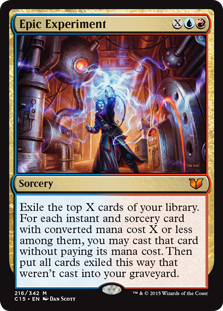
The table below shows different metagame shares in different metagame segments for each of the three decks. Some of the numbers are gathered from the respective ban articles. Others are calculated from Grand Prix/Pro Tour Day 2 listings, along with Top 8/16 standings. Taken together, these stats show us the range of numbers that constitute "top-tier" with regard to banlist decisions.

DeckMTGO %GP/PT
Day2%
GP/PT
Top8s
GP/PT
Top16s
18+ PT
Finishes
SCG Open /
Invitational T8s
SCG Open /
Invitational T16s
2011
Storm
na13.2%125.3%nana
2011 Shoal
Infect
na4.6%106.5%nana
2013
Storm
11.4%4%103.9%nana

Outside of 2012-2013 Storm's MTGO prevalence, these are relatively modest percentages for our top-tier, turn four rule offenders. All of their 18+ point shares are in the 4%-6% range, which is right where we Modern Nexites would put a lot of high Tier 2 or low Tier 1 contenders. Their Top 8 and Top 16 performances are also quite close but, somewhat surprisingly, not too excessive. There are no 28% Abzans to speak of. Of course, Shoal Infect and Rite of Flame Storm were only around for a single tournament, so there's a small-N issue of extrapolation at play in these numbers. Even so, the Shoal Infect and Rite Storm numbers are repeated in the Song Storm case, which suggests they are consistent even if we add more events to the equation.

Now let's drop Amulet Bloom into our table and see where the newcomer stands.

DeckMTGO %GP/PT
Day2%
GP/PT
Top8s
GP/PT
Top16s
18+ PT
Finishes
SCG Open /
Invitational T8s
SCG Open /
Invitational T16s
2011
Storm
na13.2%125.3%nana
2011 Shoal
Infect
na4.6%106.5%nana
2013
Storm
11.4%4%103.9%nana
2015
Bloom
6%4%444.4%52

By all tournament metrics, Bloom lines up very closely with the other decks. Its Day 2 percentage and 18+ Points shares are perfectly matched with the earlier turn four rule violators. Bloom doesn't have the same MTGO numbers as UR Song Storm, but it more than compensates for this Epic Experimentdearth with significantly more T8 and T16 finishes. I added a pair of columns for the SCG Opens and Invitationals (it's unclear how Wizards weighs them but they surely take note), where Bloom also distinguishes itself as a major player.
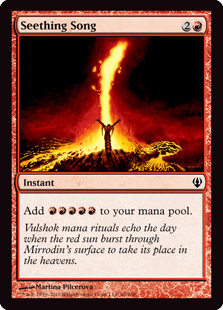
In all these categories, Amulet Bloom either aligns with each of its predecessors, or makes up for a small difference in one area with a huge gain in another. These prevalence-based numbers allow us to clearly identify the combo strategy as a "top-tier" Modern option, which triggers the first prerequisite of the turn four rule. As mentioned in the turn four rule article, and as hinted at earlier today, it doesn't matter that other Modern decks are also top-tier (e.g. Twin, Affinity, Jund, Burn, etc.). Those decks aren't also tripping the next step of the turn four rule, i.e. the consistent T2-T3 win, so the comparison is meaningless. All that matters is that Amulet Bloom's tiering is comparable to the other turn four violators, which the table above clearly shows.

"Consistent Pre-Turn Four Wins" Evidence

Of course, turn four rule breakers aren't only top-tier. They are also consistently winning before the turn four cutoff, which is yet another measure Amulet Bloom qualifies on. Unfortunately, Wizards does not release this kind of win-rate information. This has forced Modern aficionados to estimate Bloom's win-turn percentage based on anecdotal observations or goldfish games. The Seething Song ban update suggests Wizards was looking at something more concrete, namely the real data in real games. In that article, Wizards said they were "looking at the results of games", which points to some kind of MTGO, Grand Prix, and/or Pro Tour analysis to determine how frequently Storm was winning early. If Wizards truly uses this as their standard, we also need to look at real games to see if Bloom is meeting the turn four rule requirements.

First, we need to determine Storm's pre-turn four win-rate so we have a point of reference for Amulet Bloom. For both decks, I watched replays from almost a dozen events during Seething Songthe decks' height of success. For Bloom, this meant starting the sample later in the year, after the deck was a known entity and when people were better at beating it and preparing for it. This resulted in a sample of about 30 games each for both Song Storm and Amulet Bloom, comprising roughly 15 matches at the Grand Prix, Pro Tour, and SCG Open/Invitational level. To account for a lower N, I bootstrapped each of the samples in 10,000 resamples, giving us both an average over the resamplings and a margin of error around that average. This lets us estimate pre-turn four win-rates for both Storm and Bloom in the same kinds of games Wizards likely considers in its own decision making. As a few important notes, the samples do not include matches by known deck-stackers. They also only account for actual kills or scoops by an opponent, but not situations where a turn two or three play led to an insurmountable advantage. Wizards likely looks at matches where a game "ends", so a forfeit is part of that but a strong board position is not.

Using these methods, I calculated the average T2-T3 win-rates as a function of total games (not of total wins). I also calculated a confidence interval around that average. We've seen confidence intervals in previous articles, but as a reminder, the interval captures a range of values in which the "true" average probably lives. It's similar to margin of error and lets us account for variance in our sample. Here are those numbers:

Song Storm (Coverage 10/2012 - 1/2013): 25% (17% - 33%)
Amulet Bloom (Coverage 9/2015 - 1/2016): 23% (15% - 30%)

I repeated a similar analysis looking at replays of a known Amulet Bloom player on MTGO. Analyzing around 70 games spanning 30-some matches, I found the following range for Amulet Bloom's pre-turn four wins.

Amulet Bloom (MTGO 9/2015 - 1/2016): 23% (17% - 29%)

Stated another way, Storm won on turn two or turn three in 25% of the total coverage games, but its "true" range is anywhere between 17% and 33%. For Amulet Bloom, it had the pre-turn four win in 23% of matches on camera, grouped around the 15% and 30% band. On MTGO, the deck averaged 23% in the sample, spread in the 17% to 29% range.

bloomIt doesn't take a statistician to see all these ranges are virtually the same. Although Bloom appears to be winning slightly less frequently than Storm (as seen in the average, high, and low values) there is no real statistical difference between their net rates. Amulet Bloom's and Storm's rates are about as different as a coin flipping heads 48/100 times and another going 52/100: the perceived difference is just a matter of variance. Statistics aside, this means the decks are winning at effectively the same rate, which is bad news for the Amulet Bloom pilots who attested their deck was actually slower than the old Seething Song combo.

Naturally, all of these methods have limitations. We still are only looking at less than 150 games, spread between around 10 players in total. Although bootstrapping helps address the N, if the samples are skewed towards high-skill players to begin with, even the resample might not capture the run-of-the-mill Bloom player and their performance. These samples are also mute to the differences in Game 1 versus Games 2-3 rates, and it's possible Wizards separates out those categories when assessing a deck's consistency.

Despite these limitations, the overall evidence suggests Bloom breaks the turn four rule on both of its critical counts. It's top-tier by the same measures as seen in Rite Storm, Shoal Infect, and Song Storm. It's also winning on turns two or three at the same rate as the Seething Song list. Coupled with the mountain of qualitative and anecdotal evidence, all of this points to Amulet Bloom being a legitimate turn four rule offender, one that Wizards will almost surely act against on the 18th.

Last Call for Amulet Bloom?

I've disclaimed this before and I'll disclaim it again: it's entirely possible Wizards doesn't follow this line of analysis when Monday rolls around. If that happens, I'd definitely want to see where this methodology went wrong. Admitting that possibility, I also think it is incredibly unlikely. The historical precedent and the current data strongly point to Amulet Bloom being a real violator, and I expect Wizards to act on that next week.

We still need to tackle the Primeval Titan lurking in the corner: knowing the deck's violations, what specific card should get banned from Amulet Bloom? I was initially going to write this up today, but it meant repeating about half of this article in tomorrow's banlist prediction piece. Rather than write this all out again I'm bouncing that to tomorrow. Spoiler alert: both Summer Bloom and Amulet of Vigor will feature heavily in the "Bannings" section.

What do you think about the different numbers presented today? Are there any questions left unanswered or points I should clarify? Do you have any other considerations we should take into account when aiming at Amulet Bloom? One thing I didn't get to include was a comparison to and an analysis of Infect, another possible turn four rule violator, and I'm sure some of you have ideas around that deck. Bring your responses down to the comments and join me tomorrow when I give my banlist predictions for January 18!


Correction (1/12): An earlier version of the article incorrect attributed a reddit quote to Bobby Fortanely instead of Bill Comminos.

Want Prices?

Browse thousands of prices with the first and most comprehensive MTG Finance tool around.


Trader Tools lists both buylist and retail prices for every MTG card, going back a decade.

Quiet Speculation