menu

Modern Masters Comes to Magic Online!

Are you a Quiet Speculation member?

If not, now is a perfect time to join up! Our powerful tools, breaking-news analysis, and exclusive Discord channel will make sure you stay up to date and ahead of the curve.

So, as I'm sure everybody was aware, Modern Masters 2015 is now available on Magic Online. One thing that people might not know- I certainly didn't- is that online boosters are $6.99, and have not emulated the price increase of physical packs. More information about the set online can be found here.

There was an error retrieving a chart for Tarmogoyf

One thing that is really cool that they did with Vintage Masters (and possibly Modern Masters proper) is that some constructed events will now be offering Modern Masters 2015 packs as prizes. This is great news for those fed up with the MTGO pack economy.

This change will start after next week's downtime, and will last for two weeks (June 3-17). This stretch will be a bit higher EV than usual events, and will obviously make it easy to turn constructed events into Modern Masters 2015 drafts.

Avatar photo

Ryan Overturf

Ryan has been playing Magic since Legions and playing competitively since Lorwyn. While he fancies himself a Legacy specialist, you'll always find him with strong opinions on every constructed format.

View More By Ryan Overturf

Posted in FreeTagged 1 Comment on Modern Masters Comes to Magic Online!

Have you joined the Quiet Speculation Discord?

If you haven't, you're leaving value on the table! Join our community of experts, enthusiasts, entertainers, and educators and enjoy exclusive podcasts, questions asked and answered, trades, sales, and everything else Discord has to offer.

Want to create content with Quiet Speculation?

All you need to succeed is a passion for Magic: The Gathering, and the ability to write coherently. Share your knowledge of MTG and how you leverage it to win games, get value from your cards – or even turn a profit.

Insider: Creating a Buylist

Are you a Quiet Speculation member?

If not, now is a perfect time to join up! Our powerful tools, breaking-news analysis, and exclusive Discord channel will make sure you stay up to date and ahead of the curve.

Note: I want to thank Target Acquired and Graveyard Games for bringing up the idea for this article in the forums (found here).

The Basics

The goal of a buylist is to acquire cards at the price listed. Sounds obvious right? More pitfalls may be involved than appear at first glance. Let's look at some of the important factors we need to understand before we start listing prices for stuff to buy...

It's critical to understand that you are competing with everyone who sells MTG cards nowadays. In the pre-internet days a store had almost complete control over the prices they set--sure people could open up their copies of Inquest/Scrye and see what the prices should be, but without a large player base chances are your LGS was the only place you could get that card you wanted.

Now there are tons of websites that buy and sell MTG cards and you need to understand that you're competing with those same stores. There are some players who wouldn't even think to look online, but that group is becoming smaller and smaller as MTG grows and new stores push to get their name recognition.

If understanding the amount of competition out there is critical it's even more important to understand what your local players want. If you're an online-only store you get a bit more of a pass on this one because you're population isn't likely to be more skewed one way or another.

What I mean by this is that different areas have player bases that focus on different formats. One area may have a strong Standard player base, whereas another focuses on Modern, or casual/EDH, or Legacy. You don't want to trade a bunch of highly desirable cards that your local player base might want for something they likely won't.

Case in point, I watched my LGS owner at a big GP a year or two ago trade a bunch of liquid Modern staples for a Candelabra of Tawnos (I advised against it when he asked me if he should go for it) because he was "trading up" and felt that was always the way to go.

Meanwhile that Candelabra is still sitting in his case and the cards he traded off likely would have moved. He didn't understand that our local Legacy player base is quite small and none of us (I include myself in this group) were trying to build High Tide or Cloudpost.

Determining Your System

Most stores (and most of us MTG financiers) can't afford to pay someone full time to monitor and adjust our buylists based on daily market fluctuations. For this reason most stores and individuals like to use an existing system, whether that be Trader Tools or TCG Low/Mid times a certain percentage or another store's buylist.

Let's look at the pros and cons of those three systems:

Trader Tools

Pro Con
Gives you a general idea of what you could immediately resell the cards to another store for Doesn't factor in the grading specifications of said store
Gives you a list of multiple store buylists to compare Some stores only want small quantities of a card at the price listed
Allows you to gauge your competition's interest in the card Doesn't include cost to ship to the store


Percentage of TCG Low/Mid

Pro Con
Easy to calculate Has no relation to local demand
Easy for others to calculate Doesn't let you know if you could resell to other stores if you needed to unload quickly
Costs nothing to use


Using Another Store's Buylist

Pro Con
Easy to calculate Has no relation to local demand
Easy for others to calculate Factors in store's local player base bias (which may not match your own)
Costs nothing to use


Those lists aren't all that extensive, but they do highlight the major factors to consider and some of the dangers these strategies entails.

Some of these dangers can be very costly to a store.

When you purchase cards without understanding or ignoring your local player base's wants then you sit on them, and lose out on other potential purchases due to limited cash flow.

When you purchase cards without understanding the grading specifications of the store you plan to send them to, you can lose money if they are downgraded.

When you purchase too many copies of one card you can end up losing money if it starts to drop and you aren't able to unload your copies quickly enough.

Creating Your Own Personalized Buylist

Now that we understand the potential pitfalls of using a rudimentary system, it's time to look at creating one of our own. My system is designed around the idea that I don't have the time or resources to spend constantly monitoring buylists and demand. The basic idea is to divide cards into categories and allow those categories to dictate what you pay.

I am still a big fan of letting someone else (in my case TCG Player) gather all the pricing data and simply using that data to determine what I should be picking cards up at.

For me personally, any equation-based system I use will utilize TCG Player Mid pricing, for the sole reason that TCG Player Low is often heavily manipulated by sellers with high shipping costs. TCG Player Mid is the average price for the card taken over a (usually) large range which means that the really low and really high are basically averaged out of the price. It also seems to be relatively commonly accepted "real value."

Here are the categories I use:

Red - The hottest cards, the most liquid cards that I can get. Right now that would include Khans fetchlands, Thoughtseize, Snapcaster Mage, etc. They aren't likely to be reprinted in the very near future and I can offer more on them because I can resell them with relative ease. They are often sold out of the cases at LGS's and are constantly asked for by other traders/stores.

Orange - Still hot cards, but a bit less liquid than our red category; these may include Standard cards that fit in a proven archetype that has a relatively constant demand. Something like Siege Rhino or Ugin, the Spirit Dragon.

Yellow - These are cards I'm happy to pick up, but accept that they might sit for a month or so. I also tend to put my longer-term speculation targets into this category when I have a low quantity of them (and then move them into a lower category if I've got a decent supply built up). Something like Tasigur fits in this category.

Green - These are cards I have an okay supply on already. I don't have a strong demand to pick more up, but they may have potential moving forward. Something like Crackling Doom might fit here.

Blue - These are cards I have enough supply of that I don't really want to pick up excessive copies, but I still feel like I could probably unload them if I absolutely had to.

Black - These are cards I have a ton of or don't think I can move. Right now, these are things like my Theros temples that proved to be a bust.

The next step is determining what pay rate I want to assign to each category. These are the percentage of TCG Mid that I'd pay on each category.

Category Pay Rate
Red 80%
Orange 70%
Yellow 60%
Green 50%
Blue 35%
Black 0%


Now that I've got my categories and pay rates assigned, the last step is figuring out which cards you want in each category. It's critical to keep your cash flow in mind, so you'll likely want the smallest card pool in the red category, the next smallest in orange, etc.

It's also perfectly reasonable (and almost expected) that cards will move from category to category, based on local player demand, quantity on hand, reprintings, etc.

Insider: Building a Rapport

Are you a Quiet Speculation member?

If not, now is a perfect time to join up! Our powerful tools, breaking-news analysis, and exclusive Discord channel will make sure you stay up to date and ahead of the curve.

Since last writing on here two years ago, I have turned my speculation and trading hobby into a full-fledged business. We sell at a local gaming store with no interest in selling singles itself. I have learned quite a few things from this experience, but the most important thing I've learned is to improve your image.

When I first started trading, I took every deal I could get, and I never offered anyone else a deal. It was very much that I was inflexible, and you had to be flexible. I wouldn't trade Legacy cards into Standard without a premium, but my Standard cards were chase rares, and I needed something good for them. This makes a lot of people prefer to stray from you, and instead trade with others.

Once I started my store, however, things changed. I wasn't walking up to them, I needed them to walk over to me. I started realizing that, even when I was a trader, I should have been getting them to me. So, I started doing what I had never done before–being flexible.

The Fire Sale Method

There was an error retrieving a chart for Goblin Rabblemaster

I remember the first time I tried this. I was sold out of Goblin Rabblemaster. I knew a few people in the room had them, but I couldn't find any with the few people who were nearby.

So, I asked someone if they could tell me who has some for trade. He gave me a name, a player who has been at that store for years. He had never worked with me as a store in the past, but I walked up and said, “Our shop is out of Goblin Rabblemasters. Could I give you a really good offer, and take some off of your hands?”

I offered him trade at 80%, anything in my store for them. It sounds crazy, but I already had buyers lined up. I knew they would move immediately.

I was effectively just selling cards from my binder. But, that wasn't a stopping point for him. He ended up buying cards past those Rabblemasters. To this day, I see him on a regular basis at my table. I have done the same thing with quite a few chase rares since then.

Cards That Have Gained Customers

After that point, I started offering deals to regular customers for things we were out of. And I offer deals to people who have never worked with our store. Sometimes, I offer a zero profit deal, like that first one, and I usually see that person again.

Even if you aren't a store, you can foster this community around yourself. If you got a great deal on something, give someone a great deal on it. If they haven’t traded with you before, they will realize that you have the best stock in the building, and they will work with you again.

Maybe sometimes you need a better deal, but you speak truthfully and explain what you can do, and why. They know you’re making money. But at a small disadvantage, they can get nearly anything they want.

Round It Up!

When people come to you to sell cards, or even to trade cards, there is often a small discrepancy. Some of you make your money this way, and can’t do this. But, if you buy collections, you have a bit more wiggle room. Always round up with new customers.

When you are buying cards, you may price a collection at an odd number, like $146.30. Round it up. That $3.70 shouldn't make a huge difference, but with a new customer, it might. If they are selling you their entire collection, and intend to not play again, it still matters. If they played, they have friends who played. You want to buy their collections, too.

Make a bit of a deal about it. Write the number big on your paper, or leave it up on your calculator. Say, “I've come to 146.30, but I’ll go ahead and round you up to 150.”

I've done this a few times to great success. The most important thing is that people see me doing it regularly. I find them the cards they need. I give them deals. I round up. They see me as a good guy, and in reality, I am a good guy–just one who wants to make a living doing what he loves.

Now, you can’t always round every deal. You have to be flexible, which means cutting them a deal sometimes. If you cut them a deal every time, it won’t seem like you’re cutting them a deal at all.

Lastly, just be a nice person. People like people who are knowledgeable, but a smile and a few jokes can go a long way, too. Making a friendly connection with people can lead to them stopping by to chat, and that often leads to more sales. Always consider whether you’d trade with yourself, if you were just a regular player.

Avatar photo

Jared Elick

Hello all! I'm Jared Elick. I have been a Magic: The Gathering player since the original Ravnica block, and have recently begun trading and speculating for profit. I was born in Ohio, and have lived here all of my life. I love playing Magic in all formats, and I've been able to do that thanks to all I have learned on QS. You may see me at tournaments in the Midwest, slinging a trade binder and playing in a few events.

View More By Jared Elick

Posted in Buying, Finance, Free Insider, Selling, TradingTagged , , , 11 Comments on Insider: Building a Rapport

Have you joined the Quiet Speculation Discord?

If you haven't, you're leaving value on the table! Join our community of experts, enthusiasts, entertainers, and educators and enjoy exclusive podcasts, questions asked and answered, trades, sales, and everything else Discord has to offer.

Want to create content with Quiet Speculation?

All you need to succeed is a passion for Magic: The Gathering, and the ability to write coherently. Share your knowledge of MTG and how you leverage it to win games, get value from your cards – or even turn a profit.

Testing Vampires: Video

Are you a Quiet Speculation member?

If not, now is a perfect time to join up! Our powerful tools, breaking-news analysis, and exclusive Discord channel will make sure you stay up to date and ahead of the curve.

Last week I brewed up a synergistic Vampires list based off Tom Ross'.

vampires nocturnus

Today I put it to the test in the tournament practice room on Magic Online. Here's the list:

[wp_ad_camp_1]

Vampires by Sean Ridgeley

Creatures

4 Bloodghast
4 Gatekeeper of Malakir
4 Kalastria Highborn
4 Vampire Nocturnus
4 Viscera Seer

Spells

4 Sign in Blood
3 Victim of Night
3 Inquisition of Kozilek
3 Thoughtseize
3 Liliana of the Veil

Lands

9 Swamp
4 Bloodstained Mire
4 Polluted Delta
4 Urborg, Tomb of Yawgmoth
3 Mutavault

Sideboard

3 Vampire Nighthawk
1 Leyline of the Void
1 Darkblast
3 Sorin's Thirst
1 Deathmark
3 Duress
1 Bile Blight
1 Cranial Extraction
1 Liliana of the Veil

The matches are Twin, Abzan Company, Burn, and Grixis Delver. See for yourself what happened below.

Company was the only true rough match here. The lesson I'm taking from it is we can't keep weak hands against them, and should shy away from even mediocre ones.

Despite the poor record, I still feel good about Vampires, partly because the testing I did before recording these rounds went better overall (I'd estimate a 60% win rate, with some Abzan Company games included in that), most of the games were close, I misplayed a bit (as it goes with new decks), and I think cutting a Sign in Blood for another Victim of Night could make a fairly big impact.

Bottom line: I'll be taking this to a daily soon. Until then!

Insider: Modern Masters 2015 Box Report

Are you a Quiet Speculation member?

If not, now is a perfect time to join up! Our powerful tools, breaking-news analysis, and exclusive Discord channel will make sure you stay up to date and ahead of the curve.

Have you been wondering if Modern Masters 2015 is worth investing in? Well, here is some real time data to help you make your decision. I opened a case for myself and saved the results to share with the community. This process is something I’ve been doing for a while now which I picked up from Don Wiggins (@TheSundry on Twitter).

Yesterday, I wrote about Don and how actively he helps the community on Twitter. Today, I want to go through that process in a little more detail so you can look behind the curtain a little bit.

Afterwards, let me know what you think about this article. Would you like to see this as a regular installment when a set comes out? Post your thoughts below. Let’s get started with the first box.

Box 1

Mythics

1 Ulamog, the Infinite Gyre
1 Kiki-Jiki, Mirror Breaker

Rares

1 Cryptic Command
1 Noble Hierarch
1 Wilt-Leaf Liege
1 Etched Champion
1 Blinkmoth Nexus
1 Apocalypse Hydra
1 Surgical Extraction
1 Creakwood Liege

Uncommons

Random Foils

1 Precursor Golem
1 Smash to Smithereens
1 Dispatch
1 Mana Leak
1 Izzet Boilerworks
1 Simic Growth Chamber

Approximate Value: $222

With this being my first box, I was definitely disappointed. Luckily in my two-mythic box, I had the support of some of the best rares in the set to back them up. When I calculated the approximate value of the box, I was pleasantly surprised to see that it was higher than expected.

On average, I would expect your foil payout to look something like this box. These foils totaled about $20. Unless you open high end foils, expect them to mirror this layout.

Box 2

Mythics

1 Tarmogoyf
1 Mox Opal
1 Tezzeret the Seeker
1 Comet Storm

Rares

1 Splinter Twin
1 Spellskite
1 Eye of Ugin
1 Creakwood Liege
1 Hurkyl's Recall
1 Leyline of Sanctity
1 Necroskitter

Uncommons

Random Foils

1 Kozilek, Butcher of Truth
1 Swans of Bryn Argoll
1 Midnight Banshee
1 Cranial Plating
1 Gut Shot

Approximate Value: $391

Although this box ended up being sick, it didn’t start out that way. The first five or so packs I opened were all sweet Limited bulk rares and then the follow up was the Comet Storm. Luckily in the pack right after the worst mythic, was the best. Tarmogoyf is here to save the day! That last sentence works best if you say it like you’re referring to Superman, but do what you like.

After opening a couple more packs with decent rares, I was nearing the end of the box and then it happened. I opened the pack and was delighted to see Splinter Twin staring back at me. Hiding behind the Modern combo card was a delightful foil Kozilek, Butcher of Truth waiting to say hello. The box was enough with the Goyf, but the foil Eldrazi pushed it over the top.

Box 3

Mythics

1 Emrakul, the Aeons Torn
1 Iona, Shield of Emeria
1 Primeval Titan

Rares

1 All is Dust
1 Splinter Twin
1 Spellskite
1 Fulminator Mage
1 Eye of Ugin
1 Creakwood Liege
1 Hurkyl's Recall
1 Puppeteer Clique

Uncommons

Random Foils

1 Shadowmage Infiltrator
1 Electrolyze
1 Thoughtcast

Approximate Value: $186

I’m not going to lie; I had to double check the value of this box a couple of times because I couldn’t believe it was so low. I searched through the cards from this box to try to find anything else of value, but alas, there was none. Of course I have the playable commons from this box set aside with the ones from the other boxes, but that’s mostly for personal use.

At first glance, this box didn’t seem that bad. I would have told you my first box was the worst I opened, when in fact it turned out to be this one. This process of cataloging your boxes is quite informative and I recommend it to everyone.

The real problem with this box is that there aren’t enough higher-end rares to hold up the value of the box as a whole. This is a great example of a box where the mythics and rares you open are good, but there just are not enough of them. The foils were unimpressive as well. One good foil can impact the value of your box drastically.

Box 4

Mythics

1 Bitterblossom
1 Kozilek, Butcher of Truth
1 Comet Storm

Rares

2 Daybreak Coronet
1 Blinkmoth Nexus
1 Etched Champion
1 Niv-Mizzet, the Firemind
1 Puppeteer Clique

Uncommons

1 Remand
1 Lightning Bolt
1 Dismember
1 Electrolyze
1 Cranial Plating

Random Foils

1 Iona, Shield of Emeria
1 Boros Garrison
1 Banefire
1 Lodestone Myr

Approximate Value: $201

This was looking on track to surpass my lowest box value until I arrived at the fifty-dollar foil of the box, Iona, Shield of Emeria.

With there being a foil in each pack, you have multiple chances to open something sweet. There are some uncommons that help you out as well, mainly Remand, but the other playables are nice too. Each of my boxes had at least one foil rare and a couple of them had more than that. I was surprised to see that happen in these boxes.

My initial impression of this set was that many times players will struggle to recoup the cost of their box, unless there is a Tarmogoyf present. Since I didn’t open any in my case, I have yet to see what boxes with Dark Confidant, Karn Liberated, or Vendilion Clique look like in person, but other players' boxes seem similar to the ones I opened.

I've seen some boxes with both Confidant and Clique in them. That's a good way to boost the value of your box into the right margin of victory. My boxes averaged in around the $200 mark, but if you include the $400 box I opened that raises the overall average of the case to $250 per box.

Utilizing Don's data posted under his store's Twitter account (@PMGStore), as well as some of my friends' boxes, my calculations seem to be accurate. If you open a box of this set, your expected average value of boxes should be approximately $250. As we have seen though, some of my boxes were in the $200 range, while others can rake in nearly double that! We all know that opening Modern Masters is like looking for your golden ticket, but these numbers suggest that even the worst box won't lose you very much money.

Well, that's all for me today. I hope you enjoyed my first foray into the #boxreport. Please let me know in the comments if you enjoyed this article and what else I could do to improve it. This seems like a great series to continue when a new set comes out. Is this something you would like to see? Let me know.

Until next time,
Unleash the Force!

Mike Lanigan
MtgJedi on Twitter
Jedicouncilman23@gmail.com

Insider: Is Modern Masters 2015 Successful?

Are you a Quiet Speculation member?

If not, now is a perfect time to join up! Our powerful tools, breaking-news analysis, and exclusive Discord channel will make sure you stay up to date and ahead of the curve.

Is that a loaded question? I have asked this question numerous times. While some may jump to answer, others are more reluctant to comment thus far. Let's start by defining success:

  • Lower the barrier to the Modern format--make the cards more accessible (i.e. cheaper).
  • Drive interest in the format.

I think the question will ultimately be multi-faceted and rightly so. There are even more variables to consider than just the two points above. So let’s look at a few of those discussions and how it could impact not only each person’s answer but the overall success of these products or the brand of Modern Masters.

There’s Always a Bottom Line

We know as financiers that Wizards of the Coast (and Hasbro) is a business, and they have a bottom line to please shareholders. That has translated into a few things; the changing in block structure and the inclusion of many new supplemental products, including Modern Masters.

en_schedule

Are these changes good for the game? It's debatable, but I would lean towards yes. Though at the same time these changes mean players will be spending more money, financiers included. As financiers we may lose the luxury of a lot of breathing room in between block rotation, and it may well end the slow decline of current Standard Magic cards. In fact, these changes might even make Standard financing much harder than they are now.

Let’s not digress-This is a topic I can expand on in the near future. I just wanted to highlight this point to remind everyone that Wizards is changing, and may be using other means than just one set to pique Modern interest.

Wizards has stated that they will take chances at reprinting some key cards over the course of the year in this new block structure, and have already done so. Perhaps the alleviation of the issues created by Modern will be more spread out rather than just vested into one supplemental product. Though, with this structure they walk a fine line. They may attract more players to the format by lowering prices, but could negate that growth by driving away potential buyers in fear of their cards losing so much value. Time will tell.

The Modern Masters Brand

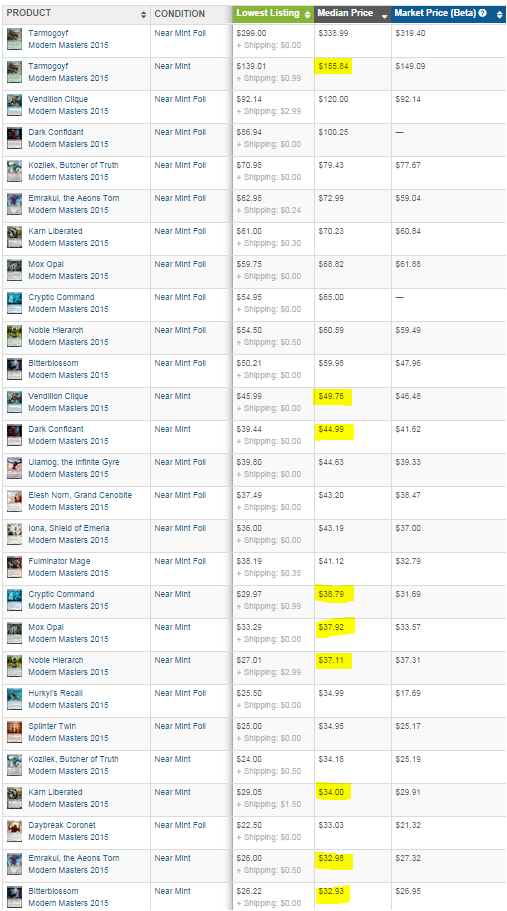
Now that the set is released we have information in our hands about its initial impact. On the surface it looks like Modern Masters 2015 has been lowering prices across the board, sometimes in drastic fashion.

I took the liberty to highlight the median prices of non-foils below, but cards have been posted on all sorts of outlets (including a vendor like TCGPlayer) well below that point. Some have been selling, others are barely moving even at a reduced price.

MM2015decreases

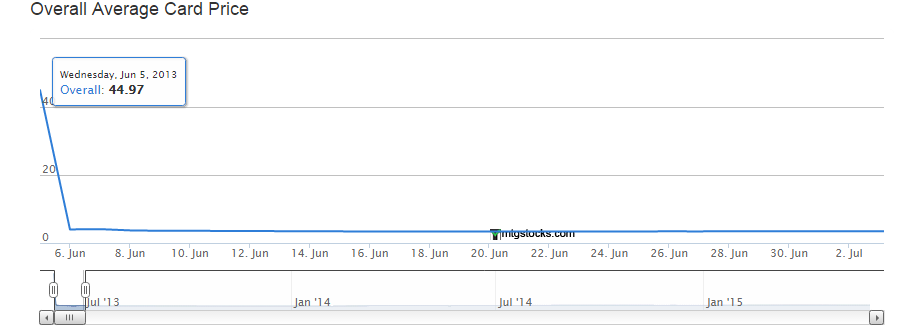
Looks great on paper, but didn't Modern Masters have a similar effect?

ModernMasters1decline
This historical chart shows that the old set drastically brought down the average card prices as well--for a period of time that is. If you continue to monitor the graph, the prices slowly appreciated over the following years to what we see today.

So, what can we expect? Well, that was before, we’re in the here and now. Conversations abound as to what exactly the “damage” is in the wake of this set release and what that could mean for investors. Should we expect similar growth:

So we know that there was a lot of product about to be shipped out, and I highlighted those specific numbers in previous articles as have other writers here on QS. This was a tweet sent out, and it highlighted that retailers could order more product directly from WOTC this week.

Let’s break down the math to make some ballpark estimates about how much product is out there right now and how much the new wave of product will introduce to the market. Keep in mind these numbers don’t take into account the triple GP weekend.

(Roughly 85 stores per state (using Event Locator) * 50 states = 4250 stores) * 3 cases = 12,750 cases or 51,000 boxes just on the re-order.

Here's a more national look at the numbers:

  • Four cases per store initially (a conservative estimate)=
  • Three more cases per store for re-order
  • 4250 Stores
  • 29,750 cases (for both orders)
  • 119,000 total boxes
  • One of each mythic in every 5 boxes (23,800 of each mythic)
  • One of each rare in every 2.5 boxes (47,600 of each rare)

We almost certainly won't see all of those copies show up in online vendors and TCGPlayer. But that doesn’t mean that a lot of demand for these cards isn’t being satisfied. As I already pointed out, there are already many copies being sold even below TCGMid, and we also know that other variables come into play with such a price drop.

Tarmogoyf is really the ubiquitous format-defining staple, with others like Cryptic Command and Daybreak Coronet trailing behind it. So some cards may not reach their previous prices for a very long time, if ever.

So on the premise that these sets generate additional supply, they are a success I think (at least for now). I think that Wizards rectified their mistake in creating a much larger print run than last time, and I think the creation of such a high variance pack was deliberate, to keep boxes regularly circulated rather than tied up in the hands of heavy investors and distributors.

Sure the “feel bads” of opening that Comet Storm or Hellkite Charger are really awful; but maybe their intent is having that “lottery ticket” effect so normal players could readily spend 9.99 on the product and have a shot at getting a solid Modern-playable mythic.

There was an error retrieving a chart for Tarmogoyf

Though one has to question, if they really did care about everyone playing Modern, why make a card like Tarmogoyf a mythic? Why even make the set draftable as opposed to a box set that comes with X reprints at a time.

Is it because that type of product wouldn’t see the light of day, that investors would purchase up copies so fast? Why would Wizards really care, since selling sealed product makes them money regardless, they don’t make money off X person buying from Y vendor/person. Because at the end of the day, they need an incentive to sell the product, something to chase after. So why not let the “golden ticket” be Tarmogoyf? Since that’s what really this all boils down to anyway.

Everyone has been living with the current prices. They grumble and moan (much like with Legacy) but they just can’t accept the fact that Tarmogoyf is expensive! You can’t have it both ways, every card can’t be cheap either. It’s just not good for the long-term health of the game. Remember Chronicles?

If it’s good for Standard, why can’t it be good for Modern? Maybe branding Modern as an eternal format really isn’t the way to go. Maybe just start treating it like “Super Standard”, and people wouldn’t have as much an issue with it.

Now don’t get me wrong, having these drastic price decreases will help the format undoubtedly, but will it really bring in a mass exodus of players as the first Modern Masters did? Maybe the issue isn’t with the card prices at all, but rather the format itself. A lot of people think it’s healthy, but many others think it’s just a worse version of Legacy.

I could see their argument when Serum Visions is the best deck manipulation spell. Though that’s a topic for another time.

Looking to the Future

Doug Linn highlighted some important problems with the new release here. Now, it may not be as widespread as it seems, but this shouldn’t be an issue regardless. Weird printing and oddity boxes do occur in every set.

The packaging, on the other hand, is a bit egregious when charging $9.99 per pack. This could very well limit the growth of this product down the line, which may not mimic the same trends of Modern Masters (now averaging around $325 two years later). Players may forego purchasing out-of-print boxes to crack open for draft if the very cards aren't even packaged in a way to prevent damage. Don’t put experimental packaging on $9.99 boosters next time, Wizards, please!

So what does this all mean? Well, to get back to my original point: Do you think this set will be successful? It looks likely that this may well become a bi-yearly release to keep interest in the format and put staple cards in more players hands.

  • The player in me welcomes the new brand of Modern Masters and what it can potentially do.
  • The financier in me is much more skeptical. Isn’t this just selling to their bottom line and promoting purchasing rather than the format?

It’s an inner conflict, but what I can expect is that for a brief amount of time Modern Masters really can slash prices drastically, and that’s a good thing on all fronts. Gives us a chance at some profits as financiers, and cheaper copies to play with at the same time.

Some of the crude numbers make me believe that this product is far-and-away in higher supply than the first iteration, and it could very well damper prices on most cards for a long time, and others at least a little longer than before (mainly Cryptic Command, Tarmogoyf and Noble Hierarch). Hey, we are almost at the nine-day breaking point for Tarmogoyf aren’t we? That’s a good sign!

So, that’s all for today, just some topics I wanted to reiterate here for everyone about this product line that Wizards will probably stick with for a while. Do you think it’s successful? Should they approach it differently? I’d love to hear everyone’s thoughts.

Until next time!

-Chaz

What’s the Coolest Thing You’ve Ever Opened from a Booster Pack?

Are you a Quiet Speculation member?

If not, now is a perfect time to join up! Our powerful tools, breaking-news analysis, and exclusive Discord channel will make sure you stay up to date and ahead of the curve.

I'm not talking about foil Bitterblossom, I'm talking about things that are really cool. The kind of stuff the missprint and oddities group discusses on Facebook.

Though I've been playing a while, I've never opened anything especially sweet. Best I've gotten is a filler card.

Filler Card

I was pretty excited at the time that I opened it, but these bad boys are relatively common, and are only worth about $20.

Recently, my friend Mike Hawthorne opened something that I imagine very few people have ever seen. It's difficult to describe, even looking at the picture, but I'll leave it here for your viewing pleasure:

This is the type of thing that most people will have no interest in whatsoever, but Mike didn't have much trouble finding some dude who bought this for $100+.

I've already seen quite a few scans of miscuts online from Modern Masters 2015, and I'm curious to see what types of oddities come from that set's quality control.

What's the coolest thing you've ever opened?

Three Cases for Modern Jund

Are you a Quiet Speculation member?

If not, now is a perfect time to join up! Our powerful tools, breaking-news analysis, and exclusive Discord channel will make sure you stay up to date and ahead of the curve.

Jund is back. After months of neglect at the hands of Abzan players everywhere, Jund has returned to the spotlight as a tier 1 deck. We made this official in early May, classifying the deck as tier 1 based on its consistent paper and MTGO performances, and we have continued to see it succeed in events throughout the month. I fully expect this trend to continue into the summer as Abzan continues to decline in popularity and value and Jund continues to prove it doesn't need no stinking Elves (RIP Bloodbraid and Deathrite) to succeed in Modern. But many players are wondering about why Jund is so strong in this current metagame. What is behind its success? Why should you be playing it or fearing it? This article gives you the background on why Jund is so strong in Modern right now and why you should either sleeve it up or get ready to face it in the June GP circuit.
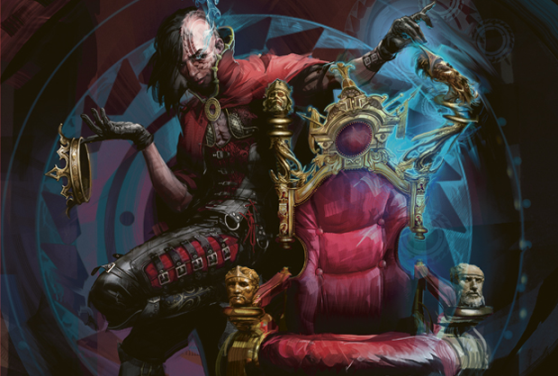
dark confidant art

In this article, I'm going to present three cases for Jund's strengths, both relative to Abzan (the "other" BGx option in the format), and in the general sense of the format. To summarize, these reasons include a less painful manabase, the renewed importance of Bolt, and increased viability of Dark Confidant. All of these factors have been decisive in Jund's return to glory, and you need to understand them whether you are playing with the deck or against it. They also get at the general metagame context of Modern, which is important for every competitive Modern player to understand, particularly if you are translating these lessons to your own deck (e.g. the relevance of Bolt in Jund informs the relevance of Bolt in UWR Control or Grixis Delver). So whether you are sleeving up those Bobs again, opening them and Goyf off your MM2015 weekend, or just getting ready for the upcoming summer Modern season, this article will give you tools you need to understand Jund.

[wp_ad_camp_1]

Sample Decklists

Before we get started, here are two recent Jund lists illustrating the different principles I'm talking about in the article. The first was piloted by Frank Moon to a 4th place finish at SCG Premier IQ Worcester this past weekend. Moon navigated a diverse field of 273 other players en route to his awesome 4th place finish. He was joined in the Top 16 by 3 other Jund players, all playing similar decks.

Jund by Frank Moon (5/24/2015)

Creatures

1 Tasigur, the Golden Fang
2 Olivia Voldaren
3 Scavenging Ooze
4 Tarmogoyf
4 Dark Confidant

Other Spells

4 Liliana of the Veil
3 Terminate
4 Lightning Bolt
4 Inquisition of Kozilek
2 Thoughtseize
1 Maelstrom Pulse
3 Abrupt Decay
1 Kolaghan's Command

Lands

4 Blackcleave Cliffs
1 Blood Crypt
1 Stomping Ground
2 Overgrown Tomb
2 Wooded Foothills
3 Bloodstained Mire
1 Forest
2 Swamp
2 Raging Ravine
1 Tectonic Edge
4 Verdant Catacombs
1 Twilight Mire

Sideboard

2 Feed the Clan
2 Anger of the Gods
2 Golgari Charm
1 Batterskull
2 Fulminator Mage
1 Ancient Grudge
1 Night of Souls' Betrayal
2 Duress
2 Choke

As another Jund example from this last weekend, Gerry Thompson piloted a slick Jund build during the Modern rounds of the Standard Super League. His list shares a number of qualities with Moon's, and he took the deck to a 2nd place finish before losing in the finals to Jund's archenemy, RG Tron, in a 1-2 showdown.

Jund by Gerry Thompson (5/26/2015)

Creatures

4 Tarmogoyf
4 Dark Confidant
2 Scavenging Ooze
1 Grim Lavamancer
1 Kitchen Finks
1 Olivia Voldaren
1 Tasigur, the Golden Fang

Other Spells

3 Liliana of the Veil
3 Terminate
4 Lightning Bolt
4 Inquisition of Kozilek
2 Thoughtseize
1 Maelstrom Pulse
2 Abrupt Decay
2 Kolaghan's Command

Lands

2 Raging Ravine
2 Treetop Village
1 Ghost Quarter
2 Swamp
1 Forest
1 Overgrown Tomb
1 Blood Crypt
1 Stomping Ground
4 Verdant Catacombs
3 Wooded Foothills
1 Bloodstained Mire
2 Twilight Mire
4 Blackcleave Cliffs

Sideboard

2 Kitchen Finks
1 Olivia Voldaren
1 Tasigur, the Golden Fang
3 Leyline of the Void
2 Blood Moon
1 Shatterstorm
1 Ancient Grudge
1 Unravel the Æther
1 Rending Volley
1 Jund Charm
1 Duress

With the lists in mind, now we can turn to the big three reasons explain Jund's success in the current format.

Case #1: Less Painful Manabase

Atarka's Command might not have led to the overwhelming dominance of Burn decks everywhere (as so many in the Magic community feared), but it has definitely solidified Burn's place as a tier 1 deck. Looking at the recent metagame stats, Burn is still a top 3 deck, and although its paper share has declined in recent months, its still at the top of the MTGO charts. When we add Affinity, Grixis Delver, Merfolk, and the many and numerous iterations of Zoo, we are looking at a solid 20%-25% of the tier 1 and tier 2 metagame that's actively trying to smash your lifetotal. These decks are very punishing for Abzan, a deck relying on three-colored manabases packed with fetchlands and shocklands. But Jund has one thing these decks don't have, an ace-in-the-hole so innocuous and yet efficient its one of the big three reasons why Jund is gradually climbing up past Abzan: Blackcleave Cliffs.
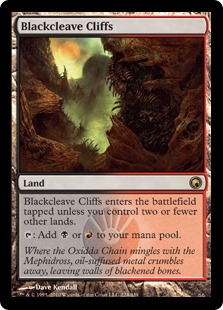
blackcleave cliffsThis isn't the first time we have seen Scars fastlands in rising tier 1 and tier 2 decks. Both Grixis Delver and Abzan Company use them to great effect, ensuring painless turn 1 plays in a format rewarding powerful turn 1 plays. Jund has been using Cliffs longer than both of these decks, but it's only in recent months that Cliffs has seen renewed relevance in a metagame overrun with aggressive, proactive, and linear strategies. Cliffs is also actually BETTER than the other fastlands, both in Jund itself and relative to the rest of the format, because of the turn 1 plays it enables. Jund is the best deck in the format that can abuse the painless turn 1 Lightning Bolt and Inquisition of Kozilek. All other decks either need to spend life to do that (e.g. Grixis Delver), or don't have access to one card or the other (e.g. UWR Control vs. Abzan). But the ability to have these turn 1 plays at no life cost is enormous. It gives you flexibility against all the aggressive decks in the format without trading any manabase development in the less aggressive matchups. Cliffs is also the context that lets you use Confidant (see Case #3 later in the article) with such success. Given how the format has been evolving, with more decks light to Bolt and Bob, Cliffs is really the foundation of why Jund is so successful.
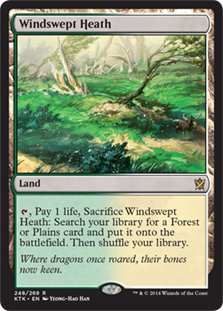
Windswept HeathIn Cliffs, we also see the reason why Abzan's share is declining. Abzan's manabase may have been made more efficient with Windswept Heath out of KTK, and Abzan may still have some anti-aggro measures in turn 3-4 Siege Rhino. But that's just enough to make the deck viable in this format. It's not enough to make it better than Jund when the format is really pressuring your life total and emphasizing the importance of turn 1 Bolt. If Abzan had a fastland like Cliffs, a lot of these pressures would be lightened. Abzan would still struggle with the other issues (no Bolt and no Bob), but it would at least have the lifetotal to bolster those issues. But without such a land, Jund really takes the lead as the frontrunning BGx deck capable of fighting aggressive opponents while still exhibiting the customary strengths of a BGx deck.

Case #2: Renewed Lightning Bolt Relevance

A few weeks ago, I talked about Bolt's increased importance in Modern. This is even more true today than it was then, with the rise of Elves and Abzan Company, the decline in Abzan, and the staying power of Burn, Affinity, and Grixis Delver. Bolt is just really dang good in Modern right now. To some extent, as I talked about in that article, Bolt was always pretty good in Modern, even if the Abzan mages shied away from it around PT Fate Reforged. But in many respects, they were punished for that decision with the return of Infect (also powered by the newly released Become Immense, and the overall saturation of the format with linear strategies. But the results are now in and the verdict is clear: Bolt is very strong in this format and only getting stronger. The decks successfully wielding Bolt will be the decks succeeding in Modern, and Jund is at the top of that pack.
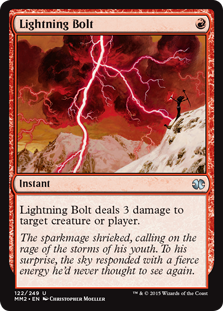
Lightning BoltIf I had to highlight one reason for Jund's recent successes before the rest, it would be Bolt. Affinity, Burn, Elves, Abzan Company, Merfolk, Grixis Delver, Abzan Liege, and a number of other Lightning-rod decks constitute at least 30%+ of the metagame at this point. And of those, Abzan Company and Elves are only poised to keep rising (or are just overhyped, in which case you will still expect to face lots of them). This creates a situation where Bolt is indispensable. Bolt's value is bundled in the concept of removal "parity", i.e. the ability for removal to trade at equal or greater value with opposing threats. Bolt is the litmus test of removal parity in Modern. For one mana and zero drawbacks, you can kill everything from a 1-drop Noble Hierarch to a 3 drop Elvish Archdruid or Pestermite. Not to mention all the Blighted Agents, Inkmoth Nexuses, Anafenza, Kin-Tree Spirits, and Young Pyromancers in between. These creatures are rampant in the format and, particularly in the case of the new Company-powered decks, high value targets that need to be killed immediately. Jund is not the only deck that can do this: any red-based deck, including UWR Control, Blue/Temur Moon, Scapeshift, etc. can do this too. But Jund is the only red-based deck that also has the black disruption arsenal of TS/IoK/Decay, and the efficient beatdown in Goyf and Scooze.
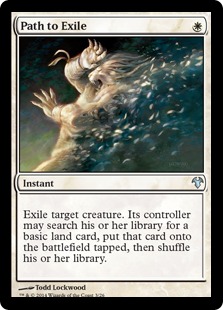
Path to ExileAs with the Cliffs case, the rise of Bolt also hints at the decline of Path. Path is great in a metagame where it's blowing up big fair threats for just one mana. Nothing stinks more than walking your Wurmcoil Engine down the opponent's Path to Exile. But Path is also one of the worst removal spells in the competitive format at trading at parity with low-cost threats. Pathing a Bird or Hierarch is probably one of the worst removal plays you can realistically make in Modern. Sure, you can kill them without drawback for 2 mana using Decay, but now the Abzan mage has spent 2 mana and their entire turn 2 to kill a 1 drop Bird. As someone once said, your removal didn't kill the Bird. Their bird killed your removal. This is particularly true against Company decks, which will happily convert the basic land into a guaranteed turn 3 CoCo flipping 2 creatures. Good luck handling that with poor Lily. Of course, this doesn't mean Path is totally without utility in this current format. Path is great at disrupting Abzan Company and its graveyard-based shenanigans, just as it remains relevant against the fairer decks like Jund and Abzan (Pathing Goyf is always a great exchange, bonus points if it's Tas). Tron is also likely to return with Jund's own rise, which will further shore up Path's relevance in Modern. But despite Path's utility, Bolt just has more utility in the format.

As a final note on this, Jund doesn't find its contextual strengths because it's running Bolt in place of hard removal. Bolt still doesn't kill Goyf today any more than it did 6 months ago. Jund's strength is it can run Bolt alongside the traditional hard removal of Abrupt Decay and Terminate. This gives Jund the flexibility to kill both smaller creatures that need to be addressed on turns 1 and 2 without incurring drawbacks, and then the midgame ability to kill bigger threats Bolt can't hit. Abzan falls short in that category.

Case #3: Bob is Back

They tried to kill you, oh Dark Confidant, but you refused to be silenced! It's very fitting Bob has returned in MM2015 just as Jund has started to make its big 2015 Modern comeback, largely because Bob has played such an important role in the deck's rise. Whenever Bob is gone, I always see questions arise like "Why is Bob gone?" or "When will Bob come back?" The current rise of Jund is a great case study in factors that enable a Bob-friendly metagame. Although I wouldn't go so far as to say this is the most Bob-friendly metagame we have seen (screw you, Burn!), it's still a lot more hospitable for Bob than most metagames we have seen to date. This is largely a function of metagame context.
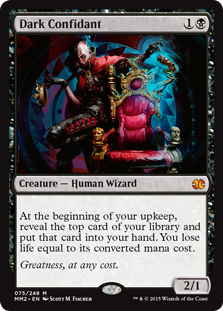
Dark Confidant MM2015From a contextual standpoint, there are two factors influencing Bob's viability in Modern. The first are the decks he plays against, and the second are the cards he pairs with in your own deck. I'm going to start with the first because this larger metagame context is so integral to the rest of Jund's success (see Cases #1 and #2), and it's a great entrypoint to the internal factors. There are a few matchups (and, by extension, metagames) where Bob is bad. These include hyper-aggressive decks that punish life totals, such as Burn or Affinity, and removal-heavy decks that can kill Bob at parity, such as UWR Control or UR Delver. This made Bob absolutely terrible in the Treasure Cruise era of Magic, where you were dealing with a metagame that was almost 25% Burn and Delver alone. You can also flip this metagame context to see situations where Bob is much better: grindier metagames with less efficient removal. Decks like Pod and Abzan Company are terrible against Confidant because they can't reliably remove him and tend to get buried under the card advantage he generates. But even if those decks are present, as they were from October 2014 through January 2015, Bob can still lose relevance if the aggressive and high-removal decks are too common.

The current metagame has a great mix of decks that beat Bob and decks that get beaten by Bob. Burn and Grixis Delver are the decks you really don't want to drop Bob against, but they also make up less than 20% of the metagame, so you can hedge your bets there. Then there are decks which can't do anything about a Bob and get punished hard by their lack of interaction: Infect, Amulet Bloom, Abzan Company, Elves, etc. These matchups are where Bob will shine. Finally, you have decks that can kill Bob, but will also lose to him if they miss removal. This includes Twin and its variants, UWR Control, the Grixis/Temur/Blue Moon variants, etc. Sure, Bob dies in those matchups all the time, but a stuck Bob will probably be game over even if it's just for 2-3 turns. Abzan and Abzan Liege are in special categories here because although they can kill Bob, they can't do so without giving you value. Either they trade straight up with Decay, or they develop the Jund boardstate with Path. Either way, you emerge ahead here, particularly off a Path. All of these are contextual reasons why Bob is so strong right now.

siege rhinoAll of this begs the question: why can't Abzan run Bob too? In turn, this gets at the second set of reasons as to why Bob is so strong in Modern, which are the internal, deck-specific ones. As anyone who has tried to play Bob in Abzan can attest, Bob doesn't play nice with Abzan's expensive spells. Rhino, Tas, Lily, and Souls are all expensive cards that regularly hammer your life total if flipped of Bob. Rhino and Souls are also THE reason to play Abzan in the first place, so you can't just cut those cards if you want to play Bob. By contrast, Jund runs a cheaper curve. with only 1-3 creatures at 4+ mana (typically some combination of Olivia Voldaren, Batterskull, and/or Tas), and most of its spells at 1-2 mana. This means Bob's flips are far less painful, making Bob a much better inclusion in Jund than Abzan. By a similar token, those other cards themselves are worse now than they were back in January and February. Abzan is at its best in grindy metagames where Souls and Rhino are just too much value for most decks to handle. We are not in such a metagame right now, which makes the cards comparatively worse. In turn, this eliminates a need to play these cards, shifting the BGx burden back to Jund and its prince, Mr. Confidant.

Modern Jund in June
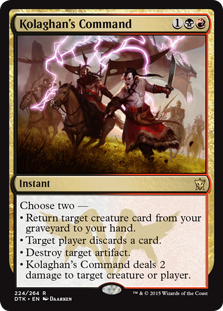
Kolaghans CommandIf I had to pick a "best deck" for the GPs in June, it would definitely be Jund. It's truly a 50/50 style deck, capable of supporting favorable matchups against the broadest selection of decks in the format. Against combo decks, you have hard removal, discard, and a clock. Against aggressive decks, you have efficient removal, defenders, and lifegain. Against grindy decks, you have high-value threats and ultra-efficient interaction. Abzan is better at some of those things than Jund (especially in fairer matchups), but Jund makes up for that in its breadth of strong matchups. It also compensates for those weaknesses through old staples like Confidant and new tech like the awesome Kolaghan's Command. As if Jund needed more value! Command recurs creatures, gives you maindeck game against Tron cards like O-Stone, Affinity, and other random artifacts, and helps you blow up those smaller threats.

Indeed, it's cards like Command, Terminate, Ancient Grudge out of the sideboard, etc. that are other contributing factors to Jund's recent successes. In presenting these three cases, I don't want to underplay the strengths of cards like Command, because these are also decisive in Jund's newfound relevance. But the three factors highlighted in this article are, in my opinion, the biggest three you need to consider when facing Jund or getting ready to sleeve it up. Command and Terminate are important, but you aren't playing Jund for these cards. You are playing it for Bob, Bolt, and Blackcleave.

I'm looking forward to seeing what Modern Jund can do throughout the June GP circuit. As I've said before, never bet against BGx, and right now, it looks like the Bolt, Bob, and Goyf-powered Jund is exactly where you want to be as a BGx mage.


Post-Modern (Masters) Humor at Good Gamery

Are you a Quiet Speculation member?

If not, now is a perfect time to join up! Our powerful tools, breaking-news analysis, and exclusive Discord channel will make sure you stay up to date and ahead of the curve.

While Cardboard Crack has taken off as the most popular source of Magic related humor(an under-explored field, though for good reason in my opinion as one-time college-aged comedy hack), Good Gamery still serves as my preferred source for TCG laughs. It's definitely the cynic in me, but I love me some biting, dry, sarcastic commentary.

This week Good Gamery put up a great piece on Modern Masters 2015. It's short, and it gets right to the point. With all of the quality control concerns about Modern Masters, people are somewhat entitled to be upset, but you simply have to take some time off now and again to have a laugh at the absurdity of this rock we're on.

Good Gamery has put up a lot of great pieces lately. In particular, I strongly recommend Everything is Fuel.

There was an error retrieving a chart for Magmaw
Avatar photo

Ryan Overturf

Ryan has been playing Magic since Legions and playing competitively since Lorwyn. While he fancies himself a Legacy specialist, you'll always find him with strong opinions on every constructed format.

View More By Ryan Overturf

Posted in FreeTagged Leave a Comment on Post-Modern (Masters) Humor at Good Gamery

Have you joined the Quiet Speculation Discord?

If you haven't, you're leaving value on the table! Join our community of experts, enthusiasts, entertainers, and educators and enjoy exclusive podcasts, questions asked and answered, trades, sales, and everything else Discord has to offer.

Want to create content with Quiet Speculation?

All you need to succeed is a passion for Magic: The Gathering, and the ability to write coherently. Share your knowledge of MTG and how you leverage it to win games, get value from your cards – or even turn a profit.

Insider: How to Survive Grand Prix Las Vegas (and its Financial Wake)

Are you a Quiet Speculation member?

If not, now is a perfect time to join up! Our powerful tools, breaking-news analysis, and exclusive Discord channel will make sure you stay up to date and ahead of the curve.

Afters months of anticipation, Grand Prix Las Vegas is finally upon us this weekend. With over 7,300 players already registered, Grand Prix Vegas will be the largest Grand Prix in history; the Grand Prix is so large, in fact, that it will be split into two separate Grand Prix events each with its own prize pool.

Grand Prix Vegas transcends the Grand Prix event itself, and is much more powerful as the largest Magic networking and financial event in history. No event has ever garnered so much attention from players, because no tournament has offered so much. It’s a chance to play a Grand Prix at an exotic location synonymous with playing cards, and synonymous with spending, and hopefully making, money.

For the casual player, Grand Prix Las Vegas represents the ultimate hedonistic Magic vacation, the opportunity to buy anything from any dealer, to meet nearly any Pro player, to get things signed from a huge selection of artists, or simply to play any format against an endless sea of opponents. The Grand Prix showcases Modern Masters 2015, the most exciting set in years, and no one wants to miss out on the action.

I know more than one local player who is making the trip to Grand Prix Las Vegas for the experience, yet passes on events closer to home. I know that many European players are forgoing the more local Grand Prix Utrecht for the chance to experience Grand Prix Las Vegas.

For the competitive player, the Grand Prix offers the chance to play a highly skill-intensive format against what’s logically the softest Grand Prix field in history; while the event will certainly draw the best of the best to compete, the sheer size of the tournament dictates that a huge portion of the field will be around average skill level, and many will be worse.

It’s a great opportunity for someone looking to put together the 13-2 record needed to earn a qualification to Pro Tour Origins this summer in Vancouver. The three Grand Prix this weekend, Las Vegas, Utrecht, and Chiba, are the last opportunities to qualify for this upcoming Pro Tour, so Grand Prix Las Vegas is sure to draw out plenty of players looking to qualify.

Surviving Market Fluctuations

With so many players at the event, Grand Prix Las Vegas is the ultimate opportunity for the financially-minded. There will be more dealers at Grand Prix Las Vegas than any event in history, and they will have more cash than ever.

While they will certainly be peddling their wares, collectively these dealers will have millions upon millions of dollars to spend on cards, especially new Modern Masters 2015 cards, with the aim of acquiring every Tarmogoyf and such in the room. Most of this money will end up in the hands of the players, who will end up using much of it to buy cards from other dealers.

The sheer amount of Magic economy that will occur at the Grand Prix is staggering, and it will have a very tangible impact on the global Magic financial landscape.

I expect the price of rotating Theros block and M15 Standard staples, which have been on a downturn, to see a specifically harsh decline after the Grand Prix, where there is likely to be a massive sell-off to dealers at lower prices. In the aftermath of the Grand Prix, I expect online buylist prices will fall all across the board. I would strongly suggest moving these positions before the Grand Prix begins, and if you're planning to sell at the Grand Prix, sell as early as possible, and certainly not on Sunday afternoon.

After Grand Prix Richmond in 2013, the price of dual lands skyrocketed as players turned their Modern fetchlands into Legacy staples. After Legacy Grand Prix New Jersey last fall, the price of Power 9 rose to new heights as players turned their Legacy staples into Vintage staples.

It’s possible that Grand Prix Las Vegas will also significantly increase the price of Power 9, but I expect we’ll see prices rise across the board on staples further down the totem pole, cards like Moat, The Tabernacle at Pendrell Vale, and others that are in the same pantheon of Eternal staple or casual bling cards, but are not as high-profile nor expensive. It’s possible dual lands themselves will be positively affected. I expect that any large store of value that’s on the Reserved List is likely to be a winner this weekend.

The price of Modern Masters 2015 cards will likely fall next week, given the massive new supply from the Grand Prix entering online stores, but I expect we will see an increase in Modern staples that were not reprinted.

Dealers will be aggressively targeting these cards in binders and longboxes all weekend, and they will relist them next week at higher prices. New players entering Modern after being exposed to Modern Masters 2015 will need to acquire other Modern cards, and this will also increase the price of these non-reprinted cards.

Surviving Crime

It goes without saying that anywhere there is a lot of money at hand, there is opportunity for opportunistic criminals. There is never a large event that passes without someone having something stolen. I can’t say anything about the crime rate in Nevada, nor do I want to scare anyone into thinking Grand Prix are dangerous places, but large events are always magnets for Magic-related crime. I expect that Grand Prix Las Vegas will be filled with those looking to make a dollar the easy way.

The main crime to protect yourself from is card theft, which most often occurs when someone opportunistically takes advantage of someone who absent-mindedly left a deckbox, binder, or bookbag behind on a table and walked away. More daring criminals will snatch things right under the nose of their victims, when they look away or are distracted by a friend or game. It’s all but certain that dedicated criminals will be scouring the tournament hall for opportunities all weekend.

This sort of crime requires constant vigilance to prevent, but it’s not as hard as it sounds. I recommend being a minimalist at events, carrying as little as possible. If you are staying nearby, bring only the necessities, and plan on making many trips.

Having a trade binder with you while you are playing Day One of the Grand Prix is asking for disaster. If you must carry a load, to prevent bag-snatchers simply secure it to your chair while you sit down to play, and make sure it’s not sitting in the aisle. If you have multiple trade binders, I recommend having only one on a trade table at any given time.

I’d strongly recommend keeping constructed decks in your pants pocket, if not a fanny pack of some sort. Carrying cards in a well-protected coat or hoodie pocket is also fine, if not ideal. One can normally be more lax with limited decks, but many Modern Masters sealed pools will be expensive, and from a competitive standpoint it could potentially be very difficult to replace a lost sealed pool in a timely manner--keeping a deck safe will avoid any potential penalties.

It’s possible that more brazen criminals will extend their crimes beyond the tournament hall and target those leaving the event at night, but it’s unlikely and not a concern for the average player. Dealers, who will be carrying lots of cash and cards, are the most likely targets of this sort of pre-meditation.

If you are carrying a lot of cards and/or cash, the best defense is anonymity; don’t broadcast it to the world if it’s not necessary for business. Beyond that, travelling with a group is safety, and with so many players in attendance, it should not be hard to find a friend or make a new one.

The other crime to be aware of this weekend is counterfeit cards. This topic could be an article in itself, and is not a subject I am very familiar with, but beware that there will certainly be fake cards at Grand Prix Las Vegas, and plenty of people will fly home with goods that are, unbeknownst to them, counterfeit.

I would be extremely careful about acquiring high-end cards, specifically in trades or cash deals with other people on the floor, rather than dealers. There are many ways to protect oneself. A jeweler’s loupe is a good tool, as is comparing any card to a genuine copy, either one’s own or that of a friend or dealer. It’s also perfectly reasonable, and in my recommendation a requirement, to politely ask a large dealer or three to check out the authenticity of a high-value card before finalizing any deal. If they are not busy, they will likely gladly help.

I’d also like to point out that the quality of counterfeit cards in increasing, and their scope is increasing from only the most valuable cards to those newer and less valuable, perhaps even Modern Masters 2015 cards themselves. In summary, keep your wits about you, and if a deal is too good to be true, it likely is.

Also, consider that the flow of counterfeit cards in local shops may increase after Grand Prix Las Vegas--maliciously or not--so be aware.

Physical Survival

Las Vegas is an arid desert, so my number one piece of advice is to stay hydrated. Bringing water with you is ideal, but it’s likely that there will be access to water fountains or a water station at the Grand Prix. The best way to take advantage of these is with a high-quality reusable water bottle of your own, which can be refilled and taken to the table. Spare yourself long walks and long lines in the enormous tournament hall, and bring a bottle.

I’d also recommend bringing a modest supply of food for the day. It’s hard to get away from the tournament to eat between rounds, and those there for financial action will not want to miss a minute on the trading floor or dealer wall. Food on-site is likely to be unhealthy and expensive, or simply too slow. Bring some of your own.

Las Vegas will be hot, but it’s a crapshoot whether the tournament hall will be overly hot from the crowd or air conditioned into sub-zero temperatures. I expect the reality is somewhere in between, so I’d recommend dressing lightly, but to have access to an extra layer of clothing in your travel bag just in case.

Finally, be sure to get some sleep. It’s very easy to stay up as late as you want in Las Vegas, and while that’s excellent in its own right, and a very reasonable way to spend the trip if that aligns with your goals, it’s not the ideal strategy if you want to be at your peak at the tournament hall when playing games or wheeling and dealing.

I’d like to hear everyone’s opinion on the potential financial impacts of Grand Prix Las Vegas, and I am always open to hear any practical tournament-survival advice. As always, please turn to the comments with any questions.

Cheers, and I hope to meet some new faces at the Grand Prix this weekend!

-Adam

The #Boxreport

Are you a Quiet Speculation member?

If not, now is a perfect time to join up! Our powerful tools, breaking-news analysis, and exclusive Discord channel will make sure you stay up to date and ahead of the curve.

Social media can be used for so many different things. High school students use it to make it seem like they live in the most epic drama on TV, celebrities use it to promote their latest products, and Magic players like us use it to network and find out what's happening in the community. I love Twitter because I can use it for this purpose. We talk about #mtgfinance, follow events, and it gives us limited access to what the best players in the world are saying about the game.

One thing I always look forward to on Twitter is @TheSundry's #Boxreport. Don is a friendly Magic card dealer who is always active in the Twitterverse. Every time a new set is released, he catalogs what he opens and posts the results for the community to analyze. It's so much fun seeing what other people are opening.

On release day, players gather at their local gaming store to open packs together, look at each other's sick mythics and foils, and then do some trading. If you've haven't started showing up with a trade binder on release day, you're missing out. There is so much potential to trade with players you've never seen before at events. They will happily trade you the new hotness for a pile of Commander staples from your binder or whatever cards they didn't open that they were seeking.

Even competitive players participate in this extravaganza and use it to trade for cards they need immediately. Not every shop has this atmosphere, but check around and you should be able to find a hot spot in your area.

The #Boxreport is like the gathering of players all opening their packs at the same time except it can be accessed while you are at work or out with your girlfriend.

It's a way to see the general layout of what a box will look like. You can take the data and use it as your financial basis to determine your purchases. Not every box will be the same, but once you look at a bunch of boxes and how they are laid out, you will get a sense of what yours might look at. You can be sure when a set is released, Don is there to give us some exciting information.

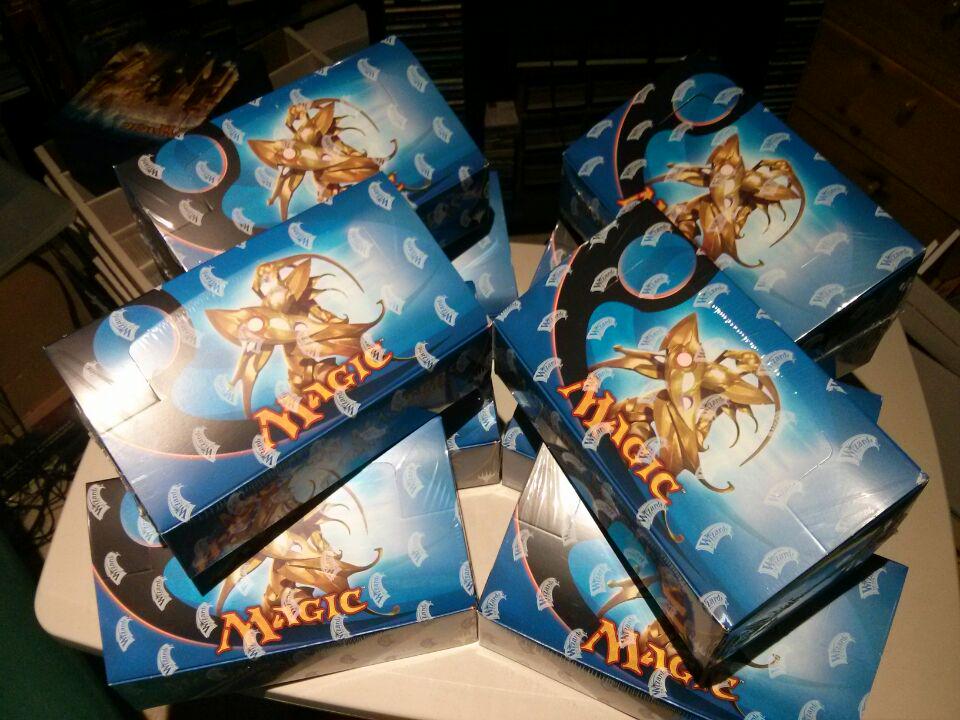
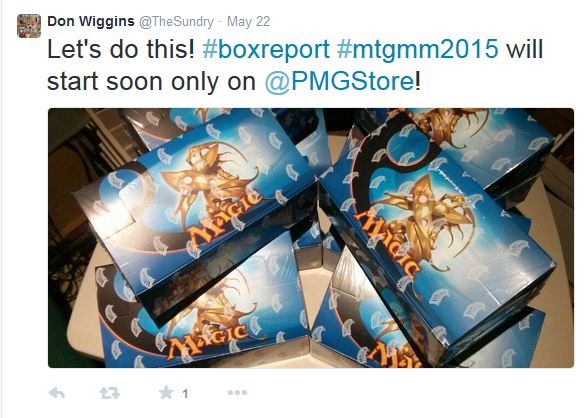
box_report_boxes_pic

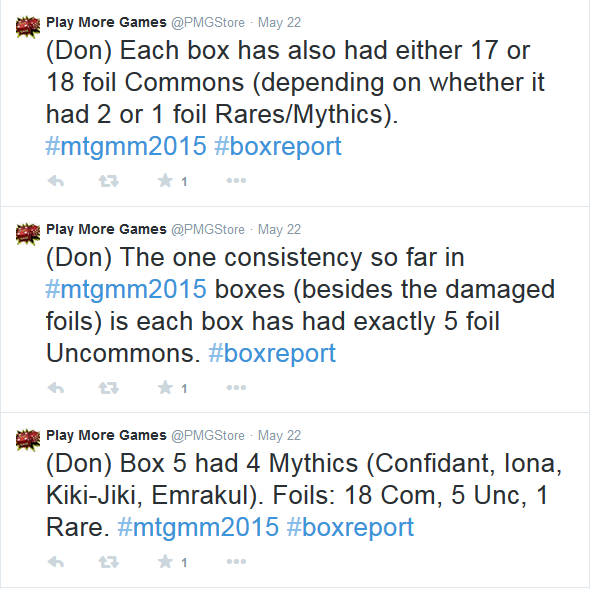
Don is great about giving us all the details. He will show us any patterns he notices and I have a lot of respect for his honest opinions. Take a look at what some of his #boxreport posts look like.

box_report_pic

So, what do you think? Are box reports helpful to you? Would you like to start seeing people posting theirs online too? Will this tool help you decide if Modern Masters 2015 is worth investing in?

I'll be talking about this topic more in depth in my article this week, so be sure to check back for more information and how I've fleshed out his process a little more.

Until next time,
Unleash the Force!

Mike Lanigan
MtgJedi on Twitter
Jedicouncilman23@gmail.com

Avatar photo

Mike Lanigan

Mike Lanigan is high school math teacher by day and a shop owner by night. His tournament grinding may have slowed a little, but his love of the game has not. Mike's goal is to bring you a mix of perspectives from shop-owner insights to finance tips to metagame shifts and everything in between.

View More By Mike Lanigan

Posted in Finance, Free, Free Finance, Modern Masters 2015 EditionTagged 1 Comment on The #Boxreport

Have you joined the Quiet Speculation Discord?

If you haven't, you're leaving value on the table! Join our community of experts, enthusiasts, entertainers, and educators and enjoy exclusive podcasts, questions asked and answered, trades, sales, and everything else Discord has to offer.

Want to create content with Quiet Speculation?

All you need to succeed is a passion for Magic: The Gathering, and the ability to write coherently. Share your knowledge of MTG and how you leverage it to win games, get value from your cards – or even turn a profit.

Insider: MTGO Market Report for May 27th, 2015

Are you a Quiet Speculation member?

If not, now is a perfect time to join up! Our powerful tools, breaking-news analysis, and exclusive Discord channel will make sure you stay up to date and ahead of the curve.

Welcome to the MTGO Market Report as compiled by Sylvain Lehoux and Matthew Lewis. The report is loosely broken down into two perspectives. A broader perspective will be written by Matthew and will focus on recent trends in set prices, taking into account how paper prices and MTGO prices interact. Sylvain will take a closer look at particular opportunities based on various factors such as (but not limited to) set releases, flashback drafts and banned/restricted announcements.

There will be some overlap between the two sections. As always, speculators should take into account their own budget, risk tolerance and current portfolio before taking on any recommended positions.

Redemption

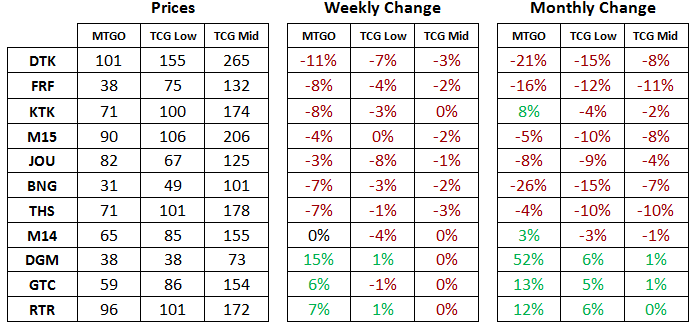
Below are the total set prices for all redeemable sets on MTGO. All prices are current as of May 25th, 2015. The TCG Low and TCG Mid prices are the sum of each set’s individual card prices on TCG Player, either the low price or the mid-price respectively.

All MTGO set prices this week are taken from Goatbot’s website, and all weekly changes are now calculated relative to Goatbot’s ‘Full Set’ prices from last week. All monthly changes are also relative to Goatbot’s prices, except for DTK which is relative to the mid-April set price. Occasionally ‘Full Set’ prices are not available, and so estimated set prices are used instead.

may27

Return to Ravnica Block & M14

Voice of Resurgence has continued to drag up the set price of DGM, with the mythic two-drop hitting 30 tix this week. That price will not be the absolute peak, but it is about double what it was a month ago when this card was originally recommended as a buy at 16 tix.

Further gains on this card are not certain so selling now in advance of MM2 release events will lock in profits. Release events are typically a period of high demand for tix, which puts a strain on prices and makes it more difficult to sell any card at the best price.

RTR and GTC are both up smartly this past week. This change is atypical for a rotated set, and tied to the rise in price of the shocklands. Normally mythic rares on rotated sets tend to accrue value over time through the redemption mechanism, but in this case the recent interest in Modern Constructed is pushing up the price of all sorts of Modern staples, including the shocklands.

What is good for the Modern speculator is bad for the junk mythic rare speculator. With shocklands heading higher, the value in junk mythic rares are heading lower. Higher set prices on MTGO reduces the price differential between MTGO and paper, lowering demand from redeemers. This shift means the outlook for junk mythic rares from these sets is negative as long as interest in Modern keeps the price of shocklands up; in the case of RTR, add Abrupt Decay to the list of valuable rares.

With a strong outlook for Modern continuing well into the summer, only a jump in paper prices will revitalize the short-term outlook for junk mythic rares from GTC and RTR. On the other hand, Modern-playable cards such as Sphinx's Revelation will continue to benefit from the increased interest in the format triggered by the release of MM2 and the announcement of the Modern Festival.

While M14 doesn’t have a cycle of shocklands, it does have two expensive rares in Mutavault and Scavenging Ooze that are currently soaking up value. Thus, the thesis is essentially the same for M14 as it is for GTC and RTR. The outlook for junk mythic rares from this set is negative while interest in Modern is high.

Theros Block & M15

These four sets all shed value this week, with prices dropping between 3% and 7%. Paper prices are also continuing their long and slow march lower in advance of Standard rotation.

The three mythic rares from THS mentioned last week are still currently priced at around 0.4 tix on Goatbot. Hythonia the Cruel, Medomai the Ageless and Underworld Cerberus are at a price level which is considered extremely low risk for long-term speculators. The link to paper prices through redemption will support prices of mythic rares down the road, and these three cards have an excellent chance of seeing future prices of 1 tix.

Khans Block

Similar to THS block, the three sets of Khans block saw broad price declines this past week. As the two sets currently being drafted, DTK and FRF continue to plumb lower depths. In contrast, KTK is still net positive month over month.

MM2 release events will drain liquidity from the MTGO market, so it’s safe to expect lower prices on all of these sets over the next two weeks. On top of the liquidity crunch, paper prices are also falling week over week so there is no support coming from redemption at the moment.

The bottom is not yet in on FRF and DTK, but it’s coming soon so get your tix ready to pick up cards from these two sets. If you missed out on a buying KTK while it was being drafted, the next two weeks will provide a good opportunity to stock up on any cards that your portfolio is missing.

Modern

Modern Masters 2015 hits MTGO this Thursday. After some unexpected price gains over the past two weeks for a few cards reprinted in MM2 (see the prices of Splinter Twin and Spellskite, for example) all cards in the set will see substantial price drops.

The bulk of the price drop is expected to occur within the first two weeks. Based on the behavior of MMA prices when that set was released, prices will rebound as early as mid-June for rare and mythic rare Modern staples and later this summer for Modern-playable uncommons and the rest of the rares and mythics that are less in demand.

The release of MM2 is a great opportunity for players and speculators to acquire Modern cards at very attractive prices. Reprinted Modern staples from older sets will see a substantial price drop. Fulminator Mage was priced at up to 40 Tix in the past and is currently at about 20 tix. Look for it to significantly drop over the course of MM2 release events.

When considering cards to speculate on, all cards that have been in Modern decklists on a regular basis for the past two years is the starting point. Top targets to keep a close eye on are those played as a four-of and in Tier 1 Modern decks or played across several different archetypes. These include Dark Confidant, Vendilion Clique, Fulminator Mage, Remand, Dismember, Mox Opal, Primeval Titan, Leyline of Sanctity, Splinter Twin, Noble Hierarch and Spellskite.

This past weekend the SCG Modern Premier IQ saw a Temur Delver deck take the trophy home. Interestingly enough, the winning deck included a playset of Hooting Mandrills and two copies of Curiosity. A playset of Disrupting Shoal was also in the brew and instantly caused a spike of this card from 4.5 to 6.5 Tix. This also provides a boost to Misty Rainforest.

This week again, Jund showed strong signs of a comeback with four decks among the Top 16 finishers at the SCG Modern event. With only one Abzan-based build, a return to the Jund configurations of BGx decks as seen before the Delver Cruise era is more and more obvious.

As a consequence, Blackcleave Cliffs and Olivia Voldaren are both over 4 Tix now and Dark Confidant definitely looks like a great target in MM2. The release of MM2 will probably be the final blow to a price already in decline over the past six months.

Finally, the Modern Elves deck may not have been a flash in the pan but the hype around the prices was certainly unsustainable. Heritage Druid and Nettle Sentinel have lost about 50% of their value compared to a week ago. It should be obvious over the next six weeks whether or not this deck holds a spot in the Modern metagame.

Legacy & Vintage

Wasteland keeps climbing higher as it’s up another 10 tix in the past week. This may still be a reasonable buying price for players, but the optimal buying window for speculators is over. More price increases are going to come, but the card is not attractive anymore in terms of potential gains--especially considering the other speculative opportunities coming up this summer, starting with Modern Masters 2015 this week.

All the other TPR cards have stabilized in price. Although their future price trends are uncertain they should have reached a solid floor for many months to come.

Speculators interested in investing in these positions should have the Legacy MOCS scheduled for next November in mind when considering the holding period. The most attractive positions to take in TPR include Intuition, City of Traitors, Mox Diamond and Lotus Petal.

Pauper

Pauper’s outlook remains similar to the past weeks and all lights are green. After a big jump up followed by a big plunge, Mental Note has actually reached the 1 Tix mark again. Last time around the ban of Treasure Cruise and the subsequent fall in price may have caught speculators by surprise. If you are still holding onto Mental Note, this is the rebound that was hoped for and this selling opportunity should be strongly considered.

Targeted Speculative Buying Opportunities

None

Targeted Speculative Selling Opportunities

Modern

Voice of Resurgence

Pauper

Mental Note

Insider: The Game Is Rigged

Are you a Quiet Speculation member?

If not, now is a perfect time to join up! Our powerful tools, breaking-news analysis, and exclusive Discord channel will make sure you stay up to date and ahead of the curve.

The arrival of Modern Masters 2015 last weekend provided me with the opportunity to reassess the way that I think and feel about physical, paper Magic cards. Modern Masters mania was impossible to avoid even if you wanted to. I was a hundred miles from nowhere at my family cabin in the woods and I was bombarded with selfies of Magic players posing with their newly opened Tarmogoyfs via social media.

The set is a big deal and an important element of the fabric of the Magic community. It creates a touchstone.

Magic players are gamers and gamers are always going to game. The biggest reason that MM2015 is so popular is that no matter how you slice it, whether you crack packs or horde up boxes, the set creates the illusion that everybody gets to win the lottery. Of course, any intelligent person knows that the biggest winner of the Lottery is the Lottery.

In today's article I'm going to discuss the purpose that reprints serve from the standpoint of Wizards of the Coast. They are the principle way that Wizards stabilizes the prices on non-reserve list cards, cashing in at the same time.

Nostalgia for Staples

It is kind of strange to me (and I suspect for others trying to understand the MTG singles market as well) that people get so nostalgic for Modern cards in the first place. For starters, the cards are specifically tournament staples and geared toward tournament players. If you play Modern already, chances are that you already own most of the cards in MM2015 that you care to own. Not to mention that people who actually play Modern get to play these cards in Modern tournaments pretty much whenever they please.

Let's be honest with one another: Is there any real reason to feel nostalgic about Tarmogoyf? It isn't really that interesting or fun of a card to play with. The reason it commands such a bloated price tag is because it is ubiquitous. Pound for pound, there isn't another card that provides that much board presence for that casting cost--so any deck that wants that effect must play Tarmogoyf or opt for a less effective, less cash-expensive option.

The reason that Tarmogoyf exists isn't to be the most efficient beater of all time--that is what it does--but to be a $200 bill and a symbol for players that they have arrived as a serious competitor. When a player buys into their first set of Goyfs it means they are taking the game seriously enough to make a very large investment in themselves as a tournament player.

Imagine, how seriously would you have to take skiing before you were willing to invest in a $1000 set of skis? $5000? $10,000? Goyf is the most expensive card in Modern and anybody who wants to play with them has made a sizable investment in their future playing the game.

The point is that Wizards of the Coast has never been interested in selling nostalgia (just like Coca Cola isn't in the business of selling happiness)--the entire point is to sell packs. In the case of the Modern Masters series they have essentially created a booster pack that costs two-and-a-half times more than a typical booster pack, that people will line up out the door and beg to purchase.

The big point I'm building to here is that the most effective way for Wizards to sell packs is simply to sell reprints, and they are very good at it. This is paramount to understanding how modern MTG finance works.

All They Want Are Reprints

There is an upper tier of card that everybody needs in order to play the Eternal and Modern formats, primarily lands but other staples as well. Once these cards get a few years removed from their tenure in Standard (when they're still being cracked in packs), the natural law of supply and demand kicks in and they become very desirable and thus very expensive.

All that Wizards ever needs to do is to wait for this natural phenomenon to occur and then repackage these cards over and over again.

Return to Ravnica block brought us shocklands again. Khans of Tarkir block brought us Onslaught fetchlands again. Modern Masters and Modern Masters 2015 brought us, well, most of the desirable Modern staples again.

On top of that there are still dozens of Commander decks, From the Vault sets, and other promo boxed sets that provide the same function.

I doubt anybody who is really tuned into the unfolding of these trends over the past four years could or would make a compelling argument that the Zendikar fetchlands are not coming back to Standard sometime in the next year and a half.

I remember watching a clip from when the fetchlands were revealed to be in Khans of Tarkir and the people in the room were literally behaving like a convention of die-hard Elvis Presley fans who just found out he wasn't really dead. "Oh my God, thank you God, thank you WotC." Seriously, on the verge of tears.

Honestly, fetchlands are among the worst designed Magic cards of all time. I don't mean to say that they are not overpowered, because they certainly are. I've said it a million times and I'll say it again: all they do is make every match of Magic take 15 minutes longer than it ought to because they create a necessity for excessive shuffling and tedious life tracking. Also, if you think that fetchlands being in Standard and an epidemic of cheating taking place in Magic are a coincidence--well, then I'd like to introduce you to my friend Elvis Presley...

Anyways, back to those people who go all "Beatlemania" over fetchlands. First of all, how are people who apparently care so much surprised by the continuation of a well documented and predictable trend? There is likely an element of online one-upmanship going on but honestly I don't think these people understand the joke to begin with.

Whatever the reason, it doesn't actually matter because these die-hards are the reason that Magic cards are worth so much money and the reason that MTG finance exists in the first place.

Adaptive Investing

There was a time when Modern staples were the absolute wild western frontier of MTG finance. Every card that was good was worth a ton and so was every card that might be good some day.

The fact that we can make an educated guess that everything will always continue to be reprinted if it is good or expensive in Modern dramatically affects how I think about investing in Magic cards.

Eternal Cards

The thing that differentiates Modern from Eternal is the existence of the Reserve List. A piece of paper that essentially says, "Does the format you like include dual lands or Power? Yes? Well, sorry we don't care about you or your format." The format basically promises to never reprint these cards ever again which means that as time goes on and the game continues to grow, these cards will continue to get more and more expensive until the vast majority of players will not be able to afford the cards necessary to play.

It also means that investing in cards that are on the Reserve List is extremely smart whenever you have the chance. Unlike Modern staples like Tarmogoyf or Emrakul, the Aeons Torn which will be reprinted as often as WotC can justify, Reserve List cards will never be printed again.

Reserve List cards are 100% the best cards to pick up and hold onto forever because there will never be more of them made. When I'm trading or spending store credit if I have the ability to get a Reserve List card I will always prefer to get that instead of anything else. It just makes sense.

Non-Eternal Cards

The question is how to approach speculating on cards that can and very likely will be reprinted in the future. If we view the equation as such, that if it is good and becomes expensive it will be reprinted, then we cannot simply buy the best cards and hold them forever.

The most successful approach I've found over the course of the past few years is to always think about prices (current and trending) as relative, and to target cards that I think have room to grow in value. I'm only ever interested in picking up cards that I think are at the low end of their price cycle.

For instance, Khans of Tarkir fetchlands likely will not be reprinted for a long time (since they just got a reprinting) which means that over the course of the next few years they will likely increase in value. On the other hand, Zendikar fetchlands have not been reprinted for a long time and are likely going to trend down in value on the heels of a likely reprint in the near future.

I see Modern finance similar to Standard finance. Whereas the prices of Standard cards ebb and flow depending upon metagame developments, Modern prices are dependent principally on reprintings. I actively want to target cards that have been recently reprinted because they will typically be at their lowest possible price and have room to grow for a couple of years before I have to worry about another reprinting injuring their value.

Ideally, I either want to sell off these cards when they mature for a higher value than I acquired them for, or trade them when they are high for dual lands, Power 9, or other Reserve List cards.

Trading into Reserve List cards has become increasingly more difficult lately because more people are clued into what is going on and also because the cards have simply gotten so expensive. A Revised Underground Sea is literally twice as expensive as the NM Unlimited Black Lotus that I bought when I got back into Vintage during Odyssey block!

Foils and Cube

I also really like foil cards as investments. Particularly cards that people tend to play with a lot, and this is not limited to Constructed or Commander. Obviously, popular Constructed staples are great investments because they are sufficiently difficult to obtain and in high demand. Based on how rare they actually are compared to regular versions of cards, I actually believe that foils get undervalued in sales and trades.

I see cube drafting as an offshoot of Magic that is largely underappreciated. A lot of the cards that are really fun to play with and really good in cubes tend to be fairly cheap. I could see this as a category of cards that could seriously make a big jump at some point in the not too distant future--cards like Mulldrifter, Tidings and Bloodbraid Elf in premium versions that tend to be auto-includes in cubes.

People also tend to spare no expense on their cubes which means they are willing to pay for things they want for their collections. If you think about it, people who manage, tune, and perfect their cubes already put so much energy into their stack, it doesn't make much of a difference paying twice as much for some foil common or uncommon that has been out of print for a couple of years.

Sealed Product

I also think that sealed product is a virtual gold mine of value. Every set becomes expensive a couple of years after rotation, no matter how badly people seem to feel about it when it's in Standard. Even terrible sets like Mirrodin Besieged and Dark Ascension sell for a premium by the booster. Sets that are actually good, like Avacyn Restored and New Phyrexia command hefty premiums.

Perhaps stocking up on cheap booster packs and boxes of Khans of Tarkir or Theros right now is a very smart place to be.

-

The point of my article isn't specifically to bash on Modern Masters but to interpret what its release means for us collectors in the long term. The first MMA didn't crash the marketplace or tank the value of singles and this set won't do that either. However, it is interesting that the size of the release is bigger than the first time around and this fact isn't trivial.

The key is that if we know that the game is rigged and that everything will always come back, we can use this information to our advantage when investing in Magic cards. We can look for cards that are trending upward and hold them until they become expensive and we can look for niches like cube cards that have the opportunity to grow as well.

Want Prices?

Browse thousands of prices with the first and most comprehensive MTG Finance tool around.


Trader Tools lists both buylist and retail prices for every MTG card, going back a decade.

Quiet Speculation