menu

Stock Watch: Cavern of Souls, Anticipating Modern Masters 2

Are you a Quiet Speculation member?

If not, now is a perfect time to join up! Our powerful tools, breaking-news analysis, and exclusive Discord channel will make sure you stay up to date and ahead of the curve.

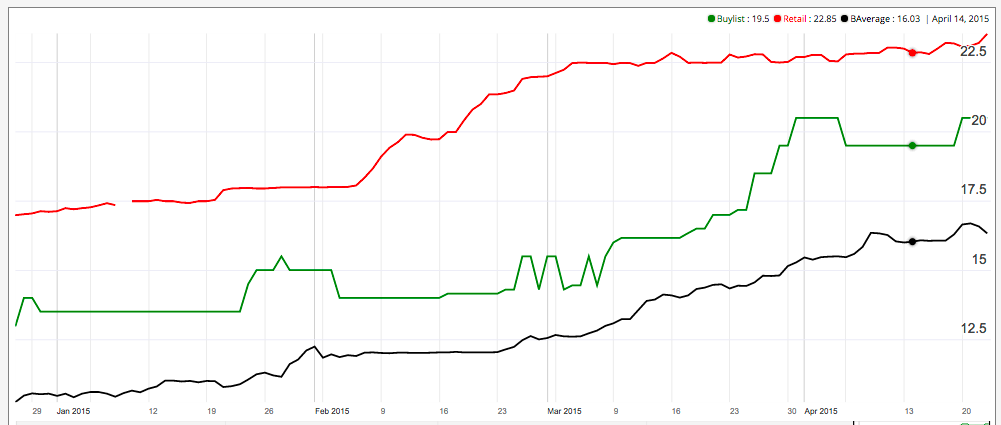
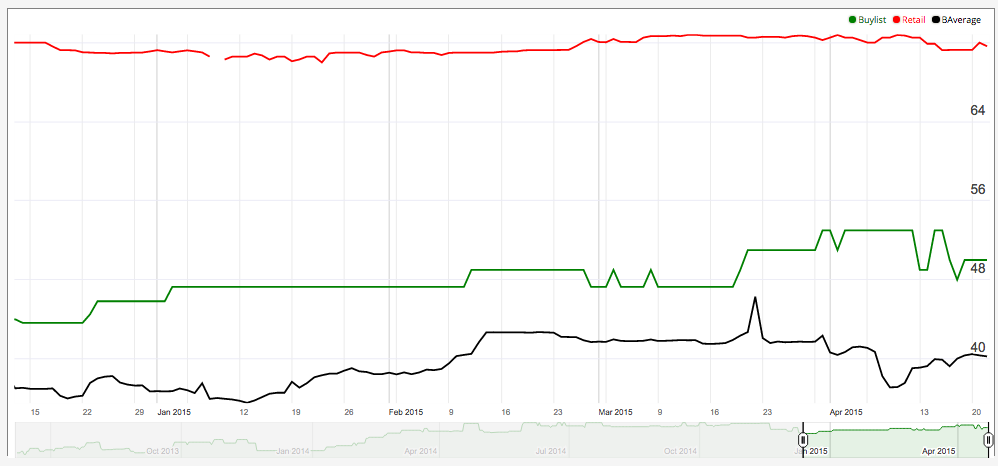
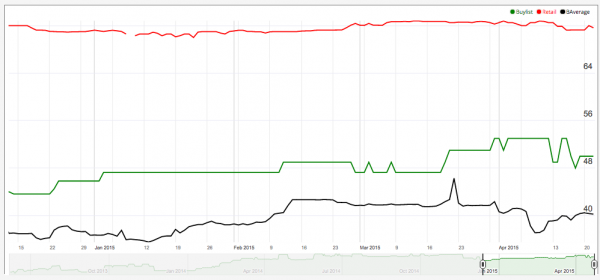
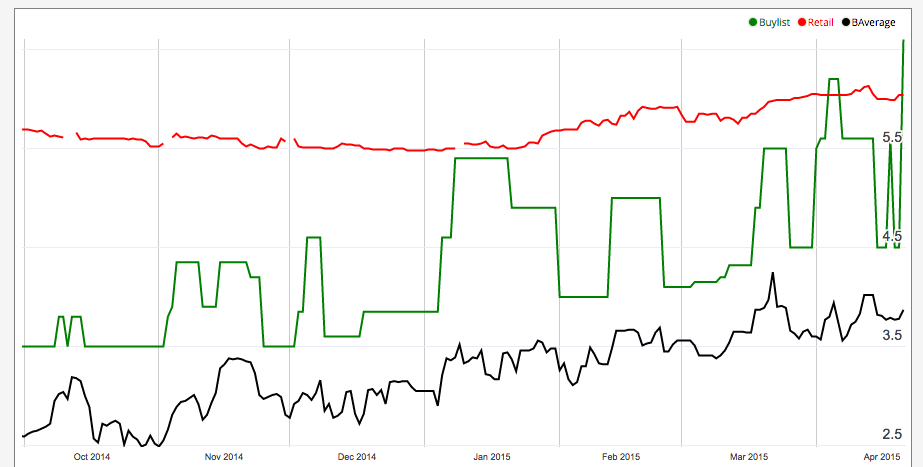
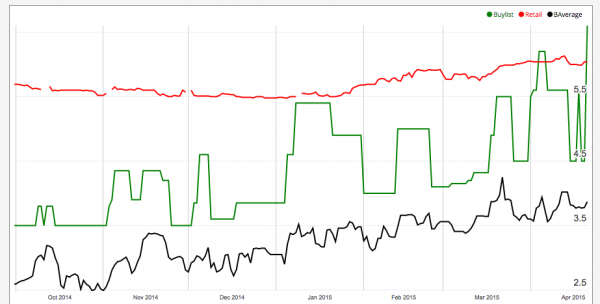
Before February's run-up, Cavern of Souls had been stable for many months. There was really no catalyst for growth, and you can see that neither the buy nor sell prices moved much at all. However, with Modern Masters 2 looming large on the horizon and a guarantee that Cavern won't see a reprint (at least, not in MM2), it seems to have been pegged as a juicy target for speculators.

cavern of souls mtg price historical graph
Cavern of Souls, April 23rd 2015
Though we know AVN won't be in MM2, there's a chance Cavern could appear in other sets, including Magic Origins. Now, I'm not saying there's a high probability that will end up being true, but I would say it's non-zero. The name on the card is generic enough, it's popular in Modern and getting expensive, and it's a fun, unique effect that would surely help sell booster boxes.

I asked QS staff writer Chaz Volpe to share his thoughts on this chart, as I know he'll be writing a bit about Cavern in his upcoming article.

As, I mention in my Insider article, Cavern of Souls will not be included into Modern Masters 2015.  It's spread is something to note, as perhaps buylists are offering an attractive spread for incentive to sell, which may be attractive now,but could be an out-liner of the card to increase in price in a few months time.

The time-frame is never set in stone, but most cards not included in a Modern Masters set usually see an increase across the board. Some increasing drastically, while others a slight bump. That being said, cards left out of these sets usually end up with a reprint in the near future after the set, but that's a chance I'd be willing to take. I'd say hold for now.

In all honestly, it would surprise me to see a non-promo Cavern reprint any time soon. I think your money is safe here. The spread has never been more favorable, but that leads to another question: does a narrow spread mean you should take your profits and cash out, or does it imply upside? In this case, my recommendation is to hold unless you have a better spec target that's cheap to buy into. I just see no downside in the immediate future, and there is a chance at upside. There's no downward pressure on the price whatsoever, and MM2 will certainly increase demand for cards like Cavern that won't be included in the set.

There was an error retrieving a chart for Cavern of Souls

So, if you have some Caverns, are you buying, selling, or just waiting to see what happens?  Let me know; I'm not sure there is a clear right or wrong answer here.

The Future of Sarkhan Unbroken

Are you a Quiet Speculation member?

If not, now is a perfect time to join up! Our powerful tools, breaking-news analysis, and exclusive Discord channel will make sure you stay up to date and ahead of the curve.

I wrote a piece last week about how Narset Transcendent was a very disappointing planeswalker. Currently Narset is in a nosedive towards its price floor. A lot of sellers are still posting her in the $25-$30 range, but don't let that fool you. More and more copies are showing up on TCGPlayer for just over $20.

There was an error retrieving a chart for Narset Transcendent

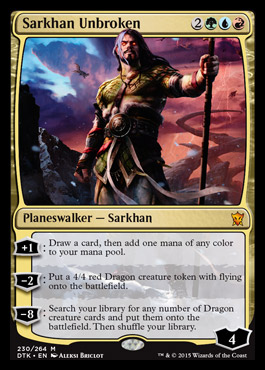
Sarkhan Unbroken is similarly tanking in value, however, his price is worth paying attention to. Gerry T highlighted a sweet Temur brew over on SCG this week that features a full four Sarkhans! While I don't think that this deck will immediately take Standard by storm, seeing four copies of Sarkhan in a deck allowed me to finally see him for what he is...

There was an error retrieving a chart for Sarkhan Unbroken

When you don't care about keeping him around, Sarkhan is literally just a Broodmate Dragon that takes a turn of setup, but also costs one fewer mana. That card once crushed Standard, and recently Wingmate Roc saw a lot of play due to its similarity to the once mighty dragon. Wingmate Roc has seen a steep decline in Standard playability, with both Stormbreath Dragon punishing the birds from the other side of the table as well as Abzan decks having a myriad of other options to explore.

Don't be surprised when curving Rattleclaw Mystic into Savage Knuckleblade (or Thunderbreak Regent) into Sarkhan Unbroken becomes a major player post-rotation. I fully expect getting in at Sarkhan's floor to be lucrative in the same way that Ashiok, Nightmare Weaver and Xenagos, the Reveler were.

Insider: Everything You Need to Know About Selling to Dealers, Pt. 2

Are you a Quiet Speculation member?

If not, now is a perfect time to join up! Our powerful tools, breaking-news analysis, and exclusive Discord channel will make sure you stay up to date and ahead of the curve.

Part 1 of Brian's article discussed the preliminary work you should put in when planning to sell to dealers at a large event. If you haven't gotten a chance to read that yet, check it out here.

Once you've done your homework onsite and have decided which dealers you want to sell to, it comes time to actually sit down and do the deal. Being informed about the value of your cards is an absolute must, but how you conduct yourself can also have a tremendous impact on negotiating the best possible deal.

R-E-S-P-E-C-T, If You Want to Buy From Me

The first and most important thing is to be respectful, pleasant, and polite to the buyer at all times, under all circumstances. He or she is there to do a job and is providing you with a service that is beneficial, so remember that and behave accordingly. Not only is being nice and respectful the "right" thing to do as a good human being, it also works in your best interest for getting yourself the best possible deal. Who do you think a buyer is more inclined to quote better prices to: a person they like or a person who is being condescending?

Respectfulness and pleasantness is a sword that cuts both ways. The buyer should always be treating you in a manner that is courteous and correct as well. Keep in mind that if they are not doing that much, something is probably wrong and you are probably getting a bad deal.

If you ever encounter a buyer who is acting annoyed, bored, gruff, unpleasant, etc., I would not trust that individual. Typically, the "annoyed buyer" is a trick that some people will use in order to strong-arm others into accepting bad prices. It's basic psychology. If two people are doing a deal and one is constantly acting upset, the other person will assume they are doing something wrong and to compensate and resolve the tension they will accept lower prices.

The key thing that everybody needs to understand about buying and selling Magic cards is that it isn't the buyer or the seller's job to make the other "happy." Rather, the point of the interaction is for both parties to come to terms on an agreeable business deal regarding the sale of merchandise.

If a vendor is giving you the "upset buyer" song and dance, thank them for their time and get up and sell to somebody else. Don't ever sit down and try to do business with somebody who is acting unprofessional or disrespectful because only bad things can come of it.

There was an error retrieving a chart for Browbeat

Keep in mind that finding a happy buyer is yet another reason why you want to be onsite early. Being a buyer is a tough gig. At a Grand Prix a booth buyer is working a really long day--often 7 am to 11 pm. That is a 16-hour shift of doing the same redundant thing over and over again!

If you are trying to do a deal after somebody has been working for 14 hours already, they are bound to be a little bit tired and not as enthusiastic as they were two hours in.

There was an error retrieving a chart for Exhaustion

There is certainly a big difference between a disrespectful buyer that is trying to browbeat you into accepting bad prices and an exhausted one who just wants to go to bed. Either way, to maximize your chances of dealing with an individual who is at the top of their game and in the best possible mood you really want to be one of the first people in line at the start of the first day.

One last thing on this topic before I move on: when you sit down at the table to sell cards, always make a proper introduction, shake their hand, and make eye contact. "Hi. I'm Brian and it's nice to meet you. Where are you from?"

I know it sounds hokey and old fashioned but it is important because it demonstrates that you are a person with character and confidence. People respect others with those qualities and will be more likely to deal with you favorably if you carry yourself in that manner.

Negotiating a Price

After a proper introduction the buyer will usually ask to see what you have for sale and whether you are after cash or store credit. The ratio between cash and store credit varies from vendor to vendor but typically a dealer will quote cash prices, with an option to take between a 20%-30% bump in store credit.

For instance, if you got done selling cards and the dealer owed you $100.00 cash, if they had a 25% bump for store credit, you would also have the option to receive $125.00 trade credit instead. It is useful to keep this in mind if you are planning on buying cards anyway since you are essentially getting a discount to take the trade.

One thing I advise is not to offer a direct answer to the question, "Do you want cash or trade?" I typically say, "I'm not sure, it'll depend on how much stuff you find." There is a good reason to do this. Some singles have much higher buylist-to-retail price ratios than others.

For instance, on high-end cards like dual lands dealers typically pay a higher percentage of the retail cost in order to acquire since it is actually worth their time to eBay them. On the other hand lots of Standard rares get bought for a quarter and sold for two bucks. The bread and butter of the card store is to buy low slash sell high on Standard singles, and a vendor loves it when you trade for Standard cards but not as much when you trade for duals or power.

The reason you don't want to tell your buyer that you are trading for an Underground Sea is that he or she may suppress the offers in order to compensate for the 25% trade bump in relation to the small buy-to-sell price ratio. They will be thinking about the trade in terms of "What do I want to get in order to give up an Underground Sea for 25% off" instead of just making you fair offers on your cards.

Saying something like, "I'm not exactly sure, it will depend on what you find," leaves the door open and also suggests that if they find lots of stuff you might spend lots of money with them.

Another thing you can do to make life easier for yourself is to be well organized. For starters, if you have cards that you don't want to sell they should not be present or visible when you are dealing with a buyer. It might be cool to show off your playset of foil Daze to your friends, but the purpose of sitting down with a buyer is not to impress him or her with your swanky collection. It wastes everybody's time, including your own.

Typically, the way that negotiating prices works is the buyer will go through your cards and offer you a price on each one, which you can accept or turn down. The ideal way to negotiate is coming from a position where you know what you want. As I stated earlier I'm always looking to get a price for my cards that is greater than the SCG buylist price. In advance, I know what the buylist price is on all of the cards I have for sale, and I will accept offers that meet my standard and reject offers that don't.

If you don't already have a strong familiarity with online buylist prices I have a couple of tips to help your experience go smoothly. You can bring your own iPad or smart phone with you and simply look up the online buylist prices as the buyer makes their offer. If you don't have access to those resources or don't want to look everything up on the spot, you can look up all of the cards ahead of time and organize them by price point in your binder so that you'll know how much you want for each.

Never feel bad about saying 'no' to an offer. You are not sitting across the table to make a new best friend--you are there to sell your wares. If the price is too low, politely say, "No, thank you," and move on to the next card.

Another thing you should always do when possible is have a copy of the vendor's buylist in your hand while they are quoting you prices and check the list to make sure they are giving you the listed price. If you are not being vigilant you open the door for a buyer to slip a few low-ball prices past you. For the most part buyers don't want to deal with the embarrassment of getting called on misquoting you a price but chances are that if you act like a sucker it will open up the opportunity for somebody to treat you like one.

One last curve ball that I'd like to prepare you for is the SP condition gag. I have encountered some dealers who post and advertise very high buylist prices onsite but when you actually sit down with them they will tell you that all of your cards are slightly played and therefore only worth some lesser percentage of their advertised price.

You'll have to make a judgment decision in this situation to determine whether or not you think your cards are actually played enough to justify the price decrease. Websites tend to be pickier than storefronts because they advertise NM and people can technically return cards if they are unsatisfied with condition.

If your cards are actually in noticeably played condition you can expect a lesser price, but I've definitely gotten up from a deal because I disagreed with the buyer's definition of NM and SP. It is, after all near mint and not PSA 10-graded mint condition!  Sometimes people will use the guise of "condition" unfairly to justify offering a lesser amount on a card than they ought to.

Shake on It

The purpose of this article  isn't to paint all dealers and vendors as opportunistic crooks. I've gotten to know many dealers over the years, some of them bad, some of them good, and some of them great. The great ones care about their reputation and it means everything to them to conduct their business in a fair, honest and respectable manner.

The point is that Magic finance is a business and as is the case whenever money enters the equation it can make people behave strangely. The overarching theme of my advice is that the best possible way to conduct your business is to be organized, prepared, and courteous. If you know what you have and what you want to sell it for, it does not matter who the buyer is or what they say because you are informed and capable of making the decision that's in your best interest.

And remember that after every deal well made you should always shake your buyer's hand, and thank them for taking the time to sit down with you.

Insider: RPTQ Final Preperations

Are you a Quiet Speculation member?

If not, now is a perfect time to join up! Our powerful tools, breaking-news analysis, and exclusive Discord channel will make sure you stay up to date and ahead of the curve.

Time is closing in on me to finish preparations for the first Regional PTQ. Initial numbers indicate that the Chicago event I am attending will likely be the largest event in the U.S., but that should ensure that all members of the Top 8 are qualified for the Pro Tour. Not having to play an elimination match in the Top 8 is definitely a benefit that I hope I can take advantage of.

This past weekend we had some innovations from the Pro Tour burst into the metagame. SCG Providence had the normal compliment of Abzan decks (Aggro, Control, and even Reanimator) as well as Mono-Red, Jeskai Aggro and Sultai Reanimator. This Top 8 is something we have typically been seeing, but there were some standouts. We had Den Protector in Abzan Reanimator, Dragonlord Atarka in Sultai Reanimator, and Goblin Heelcutter in Mono-Red. While those innovations are certainly important, they are not going to cause major metagame shifts or anything.

There were a couple decks in the Top 8 that stood out among the crowded room of decks with only a couple new cards in them. The first one that caught my eye was a deck mistitled as Abzan Control.

Abzan Control by Robert Vaughn (4th place SCG Providence)

Creatures

4 Fleecemane Lion
4 Den Protector
4 Courser of Kruphix
3 Deathmist Raptor
4 Siege Rhino

Spells

1 Duress
2 Thoughtseize
3 Abzan Charm
2 Bile Blight
1 Dromoka's Command
3 Hero's Downfall
2 Ultimate Price
1 Sorin, Solemn Visitor
1 Elspeth, Sun's Champion

Lands

2 Caves of Koilos
2 Llanowar Wastes
4 Sandsteppe Citadel
4 Temple of Malady
3 Temple of Silence
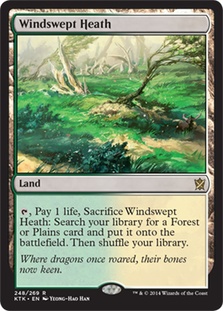
4 Windswept Heath
1 Urborg, Tomb of Yawgmoth
3 Forest
2 Plains

Sideboard

2 Mastery of the Unseen
1 Ultimate Price
1 Sorin, Solemn Visitor
1 Crux of Fate
3 Drown in Sorrow
1 Duress
2 Glare of Heresy
2 Read the Bones
2 Thoughtseize

As I said, the title for the deck is completely wrong. Certainly it does share some cards in common with Abzan Control, but so do Abzan Aggro and even Sultai Reanimator. We need a name for this deck that’s uniquely representative. The creatures in the deck are mighty and morphing so let’s go with something like Power Rangers. It would be sweet if we could start seeing decks with cool names again. At the very least we should have seen this deck listed as something like Abzan Raptor Protector to distinguish it from Abzan Control, which is not at all the same deck.

What’s great about this deck is dual nature of Deathmist Raptor. Everytime a new set comes out with a recursive creature, the first thing I always say is that if the creature could block, control decks would be running it. I said that for Gravecrawler as well as Bloodsoaked Champion, but that is not the case for our out-of-place lizard beast friend here. He can switch from attack to defense mode whenever you choose. That does make the card better than I originally gave it credit for. This line of play seems so good that I think I would immediately make room for a fourth copy, probably cutting the Duress.

A lot of the other cards in the deck are the usual suspects that you see in these colors. With this deck you can play an aggro-control game plan and switch gears to attacking easily once your opponents’ threats are dealt with.

Jeskai Aggro by Noah Walker (7th place SCG Providence)

Creatures

4 Soulfire Grand Master
4 Goblin Rabblemaster
4 Mantis Rider
4 Thunderbreak Regent
2 Stormbreath Dragon

Spells

4 Wild Slash
3 Lightning Strike
3 Valorous Stance
1 Hordeling Outburst
4 Stoke the Flames
2 Dig Through Time

Lands

2 Battlefield Forge
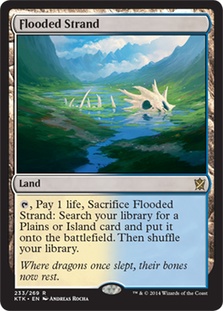
4 Flooded Strand
4 Mystic Monastery
1 Shivan Reef
4 Temple of Epiphany
4 Temple of Triumph
2 Island
2 Mountain
2 Plains

Sideboard

2 Encase in Ice
2 Disdainful Stroke
1 Erase
2 Negate
2 Brimaz, King of Oreskos
1 Dragonlord Ojutai
1 Elspeth, Sun's Champion
2 Anger of the Gods
1 Glare of Heresy
1 Seismic Rupture

Players love their Jeskai decks and anytime there is an opening in the metagame, players will jump on board. This latest iteration involves creature spells, instead of token makers, mainly due to the addition of Thunderbreak Regent from Dragons of Tarkir. I’m not sure I agree with Soulfire Grand Master in place of Seeker of the Way, but it should gain you some life to fight the aggressive decks a little better as well as once or twice in the tournament giving you the ability to buyback a spell.

This deck might be a throwback to the first couple weeks of Khans Standard, but it seems great in this metagame. Players are still not prepared enough to face Mantis Rider and that creature can typically take huge chunks of your opponents’ life total.

My major concern is that Valorous Stance, one of the decks primary removal spells, isn’t as well positioned as it was prior to the release of Dragons. It doesn’t remove Deathmist Raptor or Den Protector for example, in addition to some other important creatures. You do have burn spells to help pull weight though.

The main reason you would play a deck like this is because you like its position in the metagame. The burn spells, for example, provide significant reach against any controlling decks. If your opponent is at a low enough life total, this deck closes the game extremely well. What you need to decide is if this deck has good enough matchups because the cards in the deck are all solid.

The other major event was GP Esper Dragons. I know players didn’t know that when they registered for the event, but anytime you have essentially six copies of the same deck in the Top 8 of the event, things get a bit crazy. I am, of course, referring to GP Krakow this past weekend where control decks dominated the event.

It seemed to me that Esper Dragons was a Pro Tour-only deck that wouldn’t translate over into the normal Standard environment. We see this sometimes when pros create a metagame-dependent deck and then it never shows up at the top tables again due to metagame shift. Mainly because the deck didn’t Top 8, I assumed that this would be the case for the new control deck.

Apparently I was off on that assumption because although it didn’t show up at the SCG Open, it arrived in force at the GP. Here’s the winning list from Alexander Hayne.

Esper Dragons by Alexander Hayne (1st place GP Krakow)

Creatures

3 Dragonlord Ojutai
2 Silumgar, the Drifting Death

Spells

2 Thoughtseize
3 Anticipate
1 Disdainful Stroke
4 Silumgar's Scorn
2 Bile Blight
2 Ultimate Price
3 Hero's Downfall
2 Foul-Tongue Invocation
2 Dissolve
2 Crux of Fate
1 Ugin, the Spirit Dragon
4 Dig Through Time

Lands

2 Haven of the Spirit Dragon
4 Temple of Enlightenment
4 Temple of Deceit
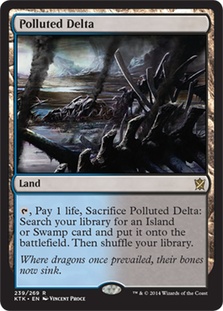
4 Polluted Delta
4 Dismal Backwater
1 Flooded Strand
2 Caves of Koilos
1 Urborg, Tomb of Yawgmoth
3 Island
2 Swamp

Sideboard

2 Thoughtseize
2 Bile Blight
1 Ultimate Price
1 Foul-Tongue Invocation
2 Tasigur, the Golden Fang
1 Ashiok, Nightmare Weaver
2 Dragonlord's Prerogative
2 Drown in Sorrow
2 Dragonlord Silumgar

This deck is cut from the same cloth as our previous control slot in the metagame, U/B Control. The difference is it's much less clunky the majority of the time. It has many ways to interact with decks in the early turns of the game and it does not rely on Perilous Vault to control the board. Against U/B Control it was easy to play around their couple of removal spells and position yourself to kill their Perilous Vault before they wiped your board, or hold back a couple threats to reload once they cracked the Vault.

You cannot play the same way against Esper Dragons. Strategies like these are some of the ways we have been fighting control decks for a long time now, but adaptation needs to occur depending on the menace you are facing. Esper Dragon's goal is to remove some of your creatures and mitigate damage until it can summon a dragonlord. The main three finishers you will see are Dragonlord Ojutai, Silumgar, the Drifting Death, and occasionally Dragonlord Silumgar.

The crux of the deck is not one of fate but rather the scorn of the dragons. Silumgar's Scorn, to be precise, is the fearsome enemy that you need to consider when planning to face this deck.

This deck gaining access to a two-mana Counterspell is crazy and immensely powerful. You can either play around Force Spike, or run your spells out there and hope they don’t have it. My initial testing observations are that it’s better to play around Force Spike, but I’m sure it will depend on the structure of your hand.

I think one-mana threats, like Warden of the First Tree, get much better as well because you can go under what your opponent is doing. Then even if they have a two-mana removal spell, you can get another creature in play once they spend their mana.

No matter what, be prepared to face this deck in your next event. Especially with the RPTQ this weekend, I’m sure lots of players will jump over to this deck.

Ojutai Bant by Sam Pardee (5th place GP Krakow)

Creatures

4 Elvish Mystic
4 Sylvan Caryatid
4 Fleecemane Lion
4 Den Protector
4 Deathmist Raptor
3 Courser of Kruphix
2 Surrak, the Hunt Caller
3 Dragonlord Ojutai

Spells

3 Dromoka's Command
3 Valorous Stance
2 Mastery of the Unseen

Lands

4 Windswept Heath
4 Temple of Plenty
3 Flooded Strand
2 Mana Confluence
4 Yavimaya Coast
4 Forest
2 Plains
1 Island

Sideboard

1 Dromoka's Command
1 Valorous Stance
2 Glare of Heresy
3 Disdainful Stroke
2 Stratus Dancer
1 Negate
2 Arashin Cleric
3 Encase in Ice

Last up today we have one deck that is fun and well positioned. The construction of this deck is geared towards hard-to-deal-with threats that gain you virtual card advantage. My initial impression was that Bant Dragons was an aggro deck, but it really is midrange deck. The list has Elvish Mystic and Sylvan Caryatid to get you to the midgame quicker, but you want to end the game as soon as possible.

Don’t get me wrong, the deck is good, but these aspects of the deck are at odds with each other. At the very least, I would like to see Rattleclaw Mystic in place of Caryatid. Not only does it help with your splash color, but it also helps recur your Raptors. I’m not sure this deck is better than Abzan, but it’s just different. It attacks from multiple angles, which is always important. If you like the green white shell but don’t like pairing that combination with black removal spells, then this may be the deck for you.

My friend has been playing this list and his major adjustment has been squeezing in Dragonlord Dromoka. Anytime I've seen Dromoka in play, I have been extremely impressed. Once it resolves, which we know he will since he's uncounterable, your opponent is locked out of casting spells. That is potent. You can also give him haste with Surrak and create a huge swing in the game.

Costing six mana is a lot for decks that want to run it and it competes with Elspeth, Sun's Champion for a slot, but I think the Dragonlord accomplishes the goal better than Elspeth. Playing against Dromoka can be daunting without black removal spells. In this deck, you will have counters to protect your Dragonlord once you untap with him as well.

That's all for me this week. These have been your metagame updates for the week. This weekend I will most likely be battling with my updated Abzan Aggro list. I will have a tournament report for the long awaited Regional PTQ, so wish me luck.

Until next time,
Unleash the Force!

Mike Lanigan
MtgJedi on Twitter
Jedicouncilman23@gmail.com

Stock Watch: Vendilion Clique Reprinted in Modern Masters 2

Are you a Quiet Speculation member?

If not, now is a perfect time to join up! Our powerful tools, breaking-news analysis, and exclusive Discord channel will make sure you stay up to date and ahead of the curve.

MM1 caused a huge spike in Modern cards despite the reprint because it generated significant interest in the format and reprinted a ton of cards that were previously hard to find.  MM2, however, is not going to have the same effect.  Modern is now a popular and healthy format, so reprints can really only drive prices down.  That's probably a good thing for MTG players, but if you're a financier you might want to start divesting yourself of some of the prime reprint targets.

It seems like they're going to put a lot of the staples right back into MM2.  Dark Confidant and Tarmogoyf are likely inclusions, and as of today, Vendilion Clique is confirmed to be in!

vendilion clique stock chart
Vendilion Clique, April 22nd 2015
You can see from the chart above that the buy price hasn't moved a whole lot yet. This news is still relatively fresh, so it would likely behoove you to move yours right now. It's not that they're about to tank; it's just that there is probably no upside anymore. If you have yours to play, keep them, but this is a good chance to open up some cash for more lucrative specs.

There was an error retrieving a chart for Vendilion Clique

The Rise of Grixis Delver: History and Matchup Analysis

Are you a Quiet Speculation member?

If not, now is a perfect time to join up! Our powerful tools, breaking-news analysis, and exclusive Discord channel will make sure you stay up to date and ahead of the curve.

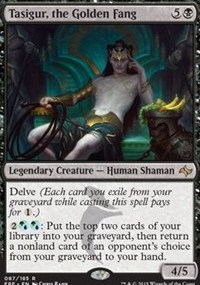
Delver lives. As anyone who has been playing MTGO, following the results of SCG and TCG States events, or reading this site knows, the rumors of Delver's death have been greatly exaggerated. Although the traditional UR Delver deck did fade into obscurity following the (in)famous banning of Treasure Cruise, another Delver and another delve card rose to take its place. If Delver was to remain competitive in Modern, Tasigur, the Golden Fang was the shirtless dude to make sure it happened. And if the MTGO and paper numbers are any indication, Delver's new best friend has been putting in some serious work. Grixis Delver is now Modern's go-to Delver deck and rapidly becoming its go-to tempo deck.
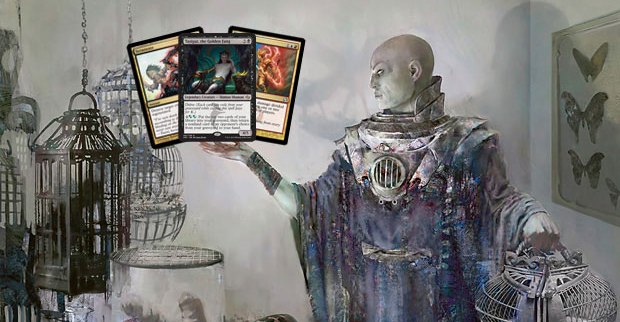
Grixis-Delver-Art

As you can see on the recently updated "Current Metagame" table on the page's sidebar, or on our Top Decks page, Grixis Delver has rapidly risen through the tiers to secure a solid tier 2 status in Modern. This week marks the first time Grixis Delver has been a top 10 deck in the format. It started with a few brews on MTGO, rose into an MTGO staple, and then exploded across the digital/paper divide to cement its standing as a tier 2 deck. In this article, I want to try and explain Delver's rise to prominence and make the case for why this deck is here to stay. Some players have doubted Grixis Delver's longevity in Modern. And why wouldn't they? Flavor of the month decks don't always last, and Delver is supposed to be dead anyway, right? Shouldn't we all be playing Abzan, Twin, or maybe Amulet Bloom? Grixis Delver might not be the most broken deck in the format, but it's a serious contender and a rising star.

Based on that, I want to do two things in this article. First, I want to track Grixis Delver's rise over the past few months. This will take the form of a statistics-driven history of the deck, and will give players important context to consider when talking about Modern's newest powerhouse. Second, I want o use the MTGO Deep Dive data to look at some of Grixis Delver's matchups in an effort to explain why the deck might be rising. This will give us some perspective on where Grixis Delver is coming from and on what might happen with the deck from here.

[wp_ad_camp_1]


Recent History: UR Delver's Fall

One of the most important factors in tracing a deck's rise is its tournament appearances. We can argue theory and statistics until we all get banned from every Modern forum on the internet, but we need to ground ourselves in recent history first. This means understanding Delver's rise from 0% of the Metagame to a solid 2.5%-3% of paper and ~6.5% of paper.
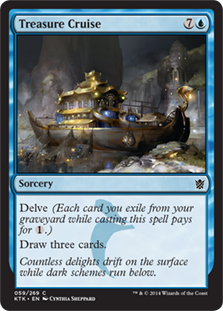
Treasure CruiseGrixis Delver's rise starts with the January 19 ban announcement. Treasure Cruise's death all but guaranteed the death of UR Delver with it, and the Dig Through Time ban sealed its fate. Almost overnight, Delver fell from being the most-played deck in the format to tier 8 oblivion. From 9/22 through 1/19, Delver made up 14% of the metagame. At its highest, it was over 20% of the format. It averaged about a 17%-18% share, and only started to fall in January 2015, when Birthing Pod Abzan decks surpassed it. Meanwhile, Grixis Delver was a complete nonentity. It saw literally two Top 8 showings in the TC era, one at an SCG IQ in Littleton and another in Vidor. Notice that neither deck used Tasigur, only one even used Terminate, and the other was only splashing for the discard spells.
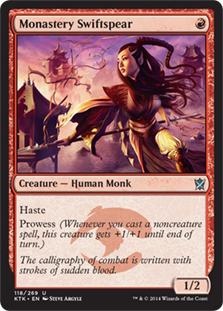
monastery swiftspearOnce the 1/19 bans went into effect in late January, UR Delver crashed in both MTGO and paper. It saw only a handful of finishes online, comprising less than 1% of the MTGO metagame from January through the end of February. The Delver decline took longer in paper, with Delver maintaining exactly 1% of the metagame through the beginning of March, but then falling down to about .6% through April. MTGO's UR Delver share remained steady at around .8%. Interestingly, the deck didn't totally die out, and we still see UR Delver finishes to this day. Two prominent finishes include a T8 appearance at the 237player SCG Premier IQ in Dallas, and a win at the 157 player Premier IQ in LA. But even so, the days of UR Delver glory were clearly a thing of the past. The question is, where did Grixis Delver start to take over?

Recent History: Grixis Delver's Rise

Grixis Delver first appeared in a publicly reported MTGO daily on 2/12, piloted by MouT to a 3-1 finish. MouT's list was significant because it includes numerous cards that ultimately became Grixis Delver staples: Terminate, Tasigur, Murderous Cut, etc. A few other players picked up the deck in the following weeks, but by mid-March the deck was only about 1% of the MTGO metagame, with no significant movement past that initial jump in interest. Grixis Delver was doing even worse in paper, with a measly .5% share through the same time period. Here is that initial list. Other players undoubtedly picked this up before MouT did, but this is the first public record of the deck's post-1/19 rise.

Grixis Delver by MouT (Daily: 2/12/2015)

Creatures

4 Delver of Secrets
4 Snapcaster Mage
3 Tasigur, the Golden Fang
4 Young Pyromancer

Instants

1 Dismember
1 Electrolyze
4 Lightning Bolt
3 Mana Leak
2 Murderous Cut
2 Remand
2 Spell Snare
3 Thought Scour

Sorceries

4 Gitaxian Probe
4 Serum Visions

Lands

1 Blood Crypt
4 Bloodstained Mire
1 Flooded Strand
4 Island
1 Mountain
4 Polluted Delta
2 Steam Vents
1 Swamp
1 Watery Grave

Sideboard

2 Blood Moon
1 Darkblast
3 Dragon's Claw
1 Engineered Explosives
2 Flashfreeze
2 Shatterstorm
2 Slaughter Games
1 Sower of Temptation
1 Vandalblast

Then came the last two weeks of March, when Grixis Delver exploded from cute holdout of the previous era of Modern into a real contender. During the week of 3/16 - 3/22, Delver more than tripled its MTGO from 1% to 3.2%. In the next week, 3/23 - 3/29, Delver's newest form jumped again, this time to 5.2%, From that point on, the momentum was unstoppable. Week three (3/30 - 4/5) saw Delver leap up to 8.5% of MTGO, and although that rise has slowed, the deck still stands at between 6% and 7% of MTGO. All based on a few weeks of explosive growth.
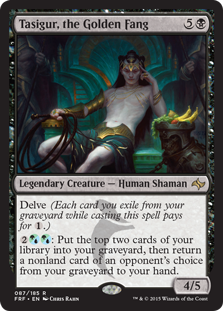
TasigurAs is often the case with breakout Modern decks, there is often a delay between when the deck crosses over from its introduction venue into the broader scene. In this case, paper didn't catch on to Grixis Delver until April. The first time Grixis Delver started to make paper movement was the last week of March. During that period, we noticed a handful of Grixis Delver finishes at a variety of American and European events, but only totaling about 3% of the metagame. This share held steady both during the weekend of TCG States, and again during the SCG States only seven days later. Standout performances include 1st places finishes at TCG States in Iowa and Nebraska, at SCG States in Nebraska (the same as the TCG player!) and Mississippi, and a 16th place finish at the Premier IQ in Providence. Here's the winning list from those two Nebraska lists. I'm showcasing it not because it's the "best" Grixis Delver build, but because it has interesting inclusions, and because it is so rare to have a deck win twice at two separate events within a week. This was the list from the 4/12 event, which has some tiny differences from the 4/5 one.

Grixis Delver by Luke Goodwin (SCG States Nebraska: 4/12/2015)

Creatures

4 Snapcaster Mage
4 Delver of Secrets
3 Young Pyromancer
3 Tasigur, the Golden Fang

Instants

1 Electrolyze
1 Kolaghan's Command
4 Lightning Bolt
3 Mana Leak
2 Murderous Cut
2 Remand
2 Spell Snare
1 Terminate
4 Thought Scour

Sorceries

4 Gitaxian Probe
4 Serum Visions

Lands

2 Island
1 Mountain
1 Swamp
1 Blood Crypt
2 Bloodstained Mire
1 Darkslick Shores
4 Polluted Delta
3 Scalding Tarn
2 Steam Vents
1 Watery Grave

Sideboard

2 Dragon's Claw
2 Spellskite
1 Sower of Temptation
2 Blood Moon
2 Counterflux
1 Flashfreeze
1 Kolaghan's Command
1 Spell Pierce
1 Jace, Architect of Thought
1 Shatterstorm

There are a variety of different Grixis Delver incarnations. Some use Gurmag Angler. Others use Darkblast, and others still use Kolaghan's Command. But their core is very similar to the one shown here and the one showcased in MouT's finish, and this should be considered the starting point for all prospective Grixis Delver pilots.

Recent History: Metagame Context

The Delver decks weren't the only strategies rising and falling through the Modern ranks during this time period. Other decks, including both heavy hitters like Abzan and Twin and some lower-tier players like Abzan Liege and Amulet Bloom, also experienced some metagame fluctuations. This context is obviously important when considering Grixis Delver's rise, so we need to consider it as part of the broader historical picture.

Honestly, the best way to see the metagame evolution in this time period is to check out my last two metagame breakdowns, one from 2/16 - 3/16 and another from 3/1 - 4/1. if you've read them before, this will all be familiar territory. If not, or if you don't eat/breathe metagame data like I do, then you can re-read them for a quick refresher, or just see below for two key factors I believe affected Grixis Delver's rise in this time period.

  • Abzan's persistent decline
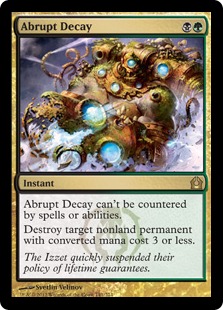
    It's no secret BGx decks are bad news for Delver. This has been true ever since the printing of Abrupt Decay, which was a sort of death knell for blue-based tempo Abrupt Decay(and even midrange/control) strategies everywhere. When BGx was strong (Hello, Deathrite Shaman!), Delver was weak. When Delver was strong (Hello, Cruise and DTT!), it was because it had tools specifically to overcome BGx matchups. After 1/19, however, Delver lost those tools and Abzan picked up some new ones, which was not the hospitable environment Delver players would hope for. But as any one who follows metagame stats can tell, Abzan has gone nowhere but down since those opening days of the post-TC/DTT/Pod Modern. At one point, we were looking at a format that was as much as 25% Abzan, based on the PT Fate Reforged results. But now, we are looking at a format where Abzan keeps falling. Its overall share today is 11.7%, an almost 2% point drop since the last metagame update. MTGO is even lower: the deck is down to a paltry 6.6% there. All of this is good news for aspiring Delver players, at least so long as the trend holds.
  • Twin's entrenchment
    TwinAs much as Delver hates Abzan, Delver also loves Twin. There's a big reason Twin did so poorly relative to other decks in the TC era, and it wasn't because Twin players suddenly got tired of the deck and stopped playing it. Delver was an absolute beating for Twin. The deck fell below a 5% metagame share in that time, a shocking drop for a deck that has almost always stayed over 10% no matter what else is happening in Modern. And with the death of UR Delver, Twin rose again, returning to its previous metagame shares and taking down both PT Fate Reforged and GP Vancouver in the process. Twin may have dropped slightly along with Abzan in the past few weeks, but its overall share is still quite high. It remains the most-played MTGO deck at 9.9%, which is critical given Grixis Delver's success being largely a function of MTGO. So long as Twin remains an MTGO force, Grixis Delver is going to be there to take advantage of this deck. Like UR Delver before it, Grixis Delver is just nasty in the Twin matchup, and the deck will continue to ride those matches to victory so long as Twin remains a Modern contender.

There are almost certainly other factors affecting the rise of Grixis Delver. From a metagame perspective, this might include the rise of Affinity (Grixis Delver has a respectable Affinity matchup) and the continued presence of Burn (Grixis Delver has a relatively painless manabase, which gives it a lot more game against Burn than would a deck like UWR or RUG Delver). But it might also include extra-metagame factors. For instance, it is hard not to notice its cost to power ratio, which is relatively favorable compared to other decks in the format. It's a competitive deck that doesn't require any of the golden (almost literally) staples of Modern, like Goyf, Lily, Hierarch, Cryptic, etc. Another factor is likely that it's plain cool. Delver is supposed to be dead! Didn't you Grixis nerds get the memo? The fact people can keep playing their tempo Delver deck is appealing to many players, and is likely one of the reasons Grixis Delver has enjoyed such popularity.

Matchups and Grixis Delver's Success

All of these historical and metagame observations give us some hints as to why Grixis Delver is succeeding. But they are a little less data-driven than many of us would like. In many respects, they are TOO big picture, without giving a lot of consideration to the Grixis Delver gameplay itself. One way to unpack this gameplay is to analyze the deck on theoretical grounds. Although this is an interesting article idea, and probably one you will all see here one day soon, it's not the approach I want to take right now. Instead, I want to use the MTGO Deep Dive Dataset I've been using in two of my last articles to talk about matchups.
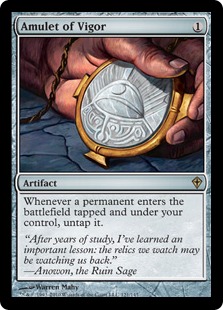
amuletFrom a purely theoretical perspective, we can probably conclude a few things about Grixis Delver. First, it looks like it has a good Twin matchup. That's kind of the whole point to playing a Delver deck in Modern. Second, it appears to have at least a decent matchup against a lot of creature-based decks in the format, particularly aggressive ones, because of its removal and its efficient threats. This would include Infect, Affinity, Abzan Liege, etc. Finally, Grixis Delver is probably weak to the same stuff UR Delver was weak to. This includes Abzan and linear decks that can ignore removal and burn, like Amulet Bloom and Bogles. Those last two decks in particular are just not a lot of fun as a Grixis Delver pilot. It's like we are playing Magic and they are playing something else. Like Solitaire.

How does the matchup data support or challenge these findings? Pulling from about 50 Grixis Delver decks playing over 150 matches, here were some matchup takeaways I found. Bear in mind that the standard Wikipedia statistician objection of "lulz N is small" doesn't necessarily apply here, because we are using a small N dataset to test some broader conclusions we have drawn both from experience with previous decks (e.g. UR Delver) and from our own theoretical understanding of the deck. This kind of mixed-method approach is a great way to shore up a smaller sample size. Additionally, I employ a statistical technique known as bootstrapping to try and estimate the "true" range of MWP values in certain matchups. Bootstrapping suggests it is 95% likely a deck's MWP is somewhere between two values. I will only do this for Twin and Abzan because the interval is too wide to be useful for the other decks.

  • UR Twin: Highly favorable
    Observed MWP: 84.6% (11/13)
    Bootstrapped MWP interval: 63.4% - 100%
  • Affinity: Favorable
    Observed MWP: 61.5% (8/13)
  • Abzan Liege / Infect: Even
    Observed MWP (both): 50% (3-3)
  • Burn: Unfavorable
    Observed MWP: 42% (5-12)
  • Amulet Bloom: Highly unfavorable
    Observed MWP: 16.7% (1/6)
  • Abzan: Nightmare
    Observed MWP: 11.1% (1/9)
    Bootstrapped MWP interval: 0% - 33.3%
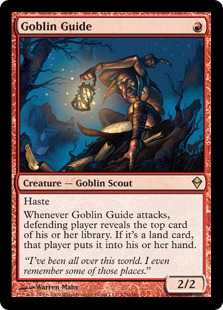
Goblin GuideFor the most part, our theoretical observations on Grixis Delver are supported by the matchup data. This suggests all of the explanations we have looked at so far might in fact be good ones for explaining Grixis Delver's rise. So long as Abzan and Amulet Bloom stay where they are (or lower!), then the deck is likely to keep enjoying its current success. One slight surprise for me was Burn turning out to be a little less favorable than I thought. This makes sense on an in-game micro level (Grixis Delver is playing too interactively against a deck that doesn't want to play fair at all), but it doesn't make much sense on a metagame level. For Grixis Delver to be 6%-7% of MTGO, it needs to have a semi-acceptable Burn matchup. Burn is just too rampant for Grixis Delver to have anything else. This suggests to me Grixis Delver's true Burn MWP is probably a bit higher than is tracking here. That said, the bootstrap suggests Grixis Delver really is a powerhouse versus Twin. It's true MWP in that contest seems to be at least 60% or so. But this works against it in the case of Abzan, where Grixis Delver suffers from an MWP probably worse than 33%.

As a final note, the so-called "Deep Dive Dataset" will get more entries in the near future, which is sure to change MWPs for all the matchups listed above. As those MWPs change, we would expect all of them to normalize closer to 50%. But even with that centralizing effect, the general range of matchup performance would still stay about the same. Abzan would still be a nightmare, but it would be closer to perhaps 30%-40% instead of 11%. Twin would still be very strong, but perhaps closer to 60%-70% instead of over 80%. The boostrap hints at this for Twin and Abzan, but is too wide for other decks to suggest anything. For example, if we bootsrapped this current sample for Burn, we would find the true MWP to be somewhere between 16.7% and 66.7%. That's too wide to tell us anything. And to be honest, more datapoints would probably adjust the width of our bootstrapping, so we shouldn't take those to be definite values. They are just quantitative guideposts to point Grixis Delver players in the right direction.

The Future of Grixis Delver

I fully and completely expect Grixis Delver to remain in tier 2 for months to come. I also think it is very likely we see at least one T8 performance by the deck in the June GPs coming up in a few months. The deck is very well positioned and, although not some broken force of nature lying in wait, has good matchups in areas that count. Add a slight rogue factor, which makes it harder for players to prepare for the deck or even know how to beat it, and you have a strategy poised to make waves at major Modern events.

The future is bright for Delver players and for Grixis Delver brewers across the Modern community. I'm looking forward to seeing this deck evolve even more and to keep highlighting its performance across events. As long as you watch out for those pesky Bogles and Titans, you will enjoy a lot of success with one of Modern's newest competitive powerhouses.


Dragons/Dragons/Fate Limited Analysis

Are you a Quiet Speculation member?

If not, now is a perfect time to join up! Our powerful tools, breaking-news analysis, and exclusive Discord channel will make sure you stay up to date and ahead of the curve.

Interested in some statistics based on MTGO replays? MTGGoldfish has you covered. for every draft format they do a breakdown detailing various statistics of limited matches, and their stats for Dragons/Dragons/Fate can be found here.

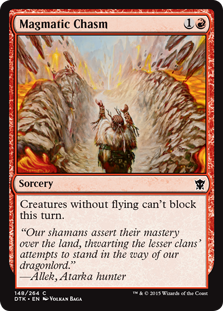
Just looking at the top commons, you can see that there is some bias in the reporting. Replays don't let you see cards in players hands, so if a player loses with a specific card in their hand it doesn't impact the card's record. Naturally, we see some artificial inflation in the win percentage of Magmatic Chasm.

There was an error retrieving a chart for Magmatic Chasm

I think the most interesting stats here are looking at play versus draw. This is always an interesting question for me in draft formats. I'm generally biased towards drawing, though I've chosen to play for every iteration of Khans block limited. The stats here show the win ratio of play draw being razor close around 50%, with players mulligaining winning a considerably high percentage of games when they're on the draw. Interesting food for thought.

Avatar photo

Ryan Overturf

Ryan has been playing Magic since Legions and playing competitively since Lorwyn. While he fancies himself a Legacy specialist, you'll always find him with strong opinions on every constructed format.

View More By Ryan Overturf

Posted in Drafting, FreeTagged 5 Comments on Dragons/Dragons/Fate Limited Analysis

Have you joined the Quiet Speculation Discord?

If you haven't, you're leaving value on the table! Join our community of experts, enthusiasts, entertainers, and educators and enjoy exclusive podcasts, questions asked and answered, trades, sales, and everything else Discord has to offer.

Want to create content with Quiet Speculation?

All you need to succeed is a passion for Magic: The Gathering, and the ability to write coherently. Share your knowledge of MTG and how you leverage it to win games, get value from your cards – or even turn a profit.

Insider: Everything You Need to Know About Selling to Dealers, Pt. 1

Are you a Quiet Speculation member?

If not, now is a perfect time to join up! Our powerful tools, breaking-news analysis, and exclusive Discord channel will make sure you stay up to date and ahead of the curve.

Anybody who has ever collected M:tG can attest that extra "stuff" just seems to pile up. The processes of drafting, taking decks apart, buying collections, and trading culminate in excess cards continuing to grow over time. While the idea of "things piling up" tends to have negative connotations (bills, paperwork, emails...), in the case of extra Magic cards this "piling up" is truly a blessing in disguise.

I like to think of the portion of my collection that isn't cards I'm planning to use or cards I'm looking to hold onto as a long-term investment in a way similar to spare change.

Pennies and nickles are annoying to deal with but if you stack them up for long enough over time they start to add up to a nice sum. Once you've got a bundle of change stored up, the question becomes "how am I going to liquidate it?" You've got options; you can roll it and take it to the bank, you can save yourself time by dumping it into a Coinstar machine and letting them take a small cut, or you can try to spend it bit by bit.

Extra Magic cards are no different. You can list and sell them online, you can sell them at a discounted rate to a dealer , or you can tuck them into your trade binder and try and trade them away one at a time. These are all viable routes depending upon the motivation and amount of work a collector wants to invest into getting rid of their extra stuff.

Today I'm going to focus on tips to ensure that you get the best value if you choose to sell cards to dealers at a Magic tournament such as a Grand Prix or a large convention. While selling to dealers is rarely going to be the most profitable route, it is surely one of the easiest way to quickly liquidate a ton of cards and is certainly a useful tool for M:tG prospectors and investors to have at their disposal.

I've worked extensively on both sides of the dealer booth. There are certainly tricks and tactics a buyer can utilize to ensure a maximum till.

Strike When the Iron Is Hot or Cold

I consider two types of cards prime candidates to unload to dealers. The first class of cards are cards at their peak value and demand.

There was an error retrieving a chart for Narset Transcendent

It is likely that Narset Transcendent has nowhere to go but down moving forward, however there is still a considerable demand for this card and it maintains a reasonably high buylist price. Cards that meet this kind of qualification and are trending downward are great to unload while they still have value going for them.

I like to open product when a new set comes out, and one of the first things on my mind is always to unload singles I don't need immediately that I think will trend downward quickly. If I can't find players who want to trade for them, my next step is usually to sell them to a dealer before they begin their steep decline.

There was an error retrieving a chart for Grim Haruspex

I couldn't find any players who actually wanted to trade for this card but I was able to find a dealer willing to pay $2.50 each. Considering the fact that the card has basically ended up teetering on the edge of bulk, getting out of the copies I opened for a good amount was a nice little deal for me.

If you can hit the right cards at the right time when dealers  really "need" them you can really maximize your value. For instance, at the last SCG Invitational I found a dealer who was paying $2.00 on Roast because they were completely sold out and players who needed them for their decks were willing to pay $4.00 at the last minute. Even if I would have put my Roasts on eBay I would likely not have gotten that much!

The key here is to identify cards that are at their absolute peak of price and popularity and then to strike while the iron is still hot. Another good example of this philosophy is dumping expensive cards right when you find out they are going to get reprinted.

There was an error retrieving a chart for Elspeth, Sun's Champion
There was an error retrieving a chart for Kiora, the crashing wave

Months ago when I first found out that these two popular Standard planeswalkers were going to see a reprint in an upcoming duel deck, I wanted to dump my extra copies as soon as possible because it was pretty clear that their values would inevitably tank. I ended up dumping them to a dealer at a Grand Prix and still getting a very high buylist price for them.

Selling cards like this to dealers is great because if they decrease in price like you anticipate, you end up getting close to face value for them in the long run.

The second type of card that I like to sell to dealers are cards that have literally nowhere to go in the foreseeable future. These are the kinds of cards that are simply too good to be bulk rares but are very difficult to trade or sell because they require a very niche buyer.

There was an error retrieving a chart for Master of the Feast

There was an error retrieving a chart for Bow of Nylea
There was an error retrieving a chart for Jace, the Living Guildpact

These are all interesting cards because they have an audience, but the problem is that the audience for these cards may not be people that you or I would ever routinely encounter in real life. The people who want these cards are folks who get together with a few friends once a week and play at the kitchen table.

I've put in a lot of hours at the card shop and I can tell you that the people who buy these cards (and there are a lot of them) stop in on their lunch breaks and buy four or five singles a week. While this group of players may be nearly invisible to the majority of the tournament community, they spend a lot of money in the Magic economy and their dollars speak loudly.

The casual players and the cards they like can be seen if you look hard enough at a buylist. It isn't that the writer of the buylist is overpaying on a terrible card--rather, that buyer is selling a ton of that terrible card to casual players and needs more copies!

Since it is very unlikely that you'll be able to trade these cards to casual players in person, it's often best to just cut our losses and concede that the big dogs have the market locked up when it comes to selling to casual players.

Also, keep in mind that I specifically mean actual bad cards and not Commander staples. Commander players do attend events and participate in the tournament community and you absolutely can trade with them! In fact, my personal belief is that Commander cards are among the best Magic cards to trade for and speculate on.

The Early Bird Gets the Dollar Bills

When selling at a big event, a greater the number of dealers is better for the sellers. More dealers means more competition between them to earn your business. The price to set up a booth at a large event is ridiculous and the primary reason that dealers pay that amount isn't because they want to sell cards, but rather because they want to have the right to buy your cards.

There was an error retrieving a chart for Stormbreath Dragon

One way to maximize your value when selling is to arrive at the event early and be among the first people selling cards at the site. Nearly every booth will show up to the site depleted or sold out of certain cards that they badly want to restock.

For instance, if a dealer at a Standard GP is sold out of Stormbreath Dragon at the start of Friday morning, they are going to have a ridiculously high buy price on that card because they literally have none to sell. They may be paying $16 just to get a couple back in stock, but once they've bought a couple at that price they will inevitably lower their price since they don't need it as badly anymore.

99% of the time when a vendor booth has a very high price on a card it is because they are sold out and they feel there is a very high demand for the card to justify their high buy price.

It is also significant that at the start of the day dealers have more cash to spend on singles than they do when the event is winding down. Most dealers have a budget for how much money they want to spend on singles, and when it is gone--well, they don't have any money left. It only makes sense that the purse strings are going to start to get tighter once they get down to the last $1000.00 than at the start when they have $10,000.00 to spend.

The Quest for the Best Buylists

There will be a lot of dealers with a lot of different buylists floating around at a Grand Prix, and there are a ton of different ways to sort through this information to find the best deal. It all depends on how much work and energy you want to dedicate to go through each buylist and find the best price possible on each card.

Generally speaking, when I sell cards I'm looking to be as efficient as possible and don't want to turn selling cards into a 18 hour long grind-a-thon. Like I said, the more energy you put in the higher your profits, but when I attend a M:tG tournament I generally want to split my time and attention between making a little bit of cash, hanging out with my friends, and playing cards.

One tip I've found that really helps is to go to the trader table and ask the individuals with the biggest trade binders: "So, which vendor has the best buy list?" It makes sense that the most serious finance people in the room would know this kind of information.

Over time and through lots of trades and conversations I've developed pretty good relationships with a lot of the knowledgeable Magic finance guys and sharing information with these people can really generate a lot of value for both parties. When I figure out a nice little tip I'm always sure to pass it along to the people who share tips with me.

If you haven't developed these kind of connections yet, don't sweat it. One really great way to get this important information is to do a trade with somebody who looks like they would be in the know about which dealers have the best buylists at the event. If you hook them up with a little bit of value on the trade they will typically be pretty cool about passing along that kind of information to you.

I know, I know giving somebody value in a trade?  If you can get somebody to share with you the research they've already put in about which dealers have the best buylists and save yourself the trouble of doing all the leg work it will easily be the best five dollars you spend all weekend long (excluding of course a nice craft beer with dinner after you make Day Two of the GP!).

If you want to go deep on maximizing your profits you can simply pick up a printed copy of everybody's buylist, figure out who is paying the most on each card and then sell each card to whoever has the best price. If you go this route your expected profit margin is probably between 20-30% higher than if you just sell to one person. Not that big of a deal if you are trying to sell $100.00 worth of cards but if you are looking to liquidate a gigantic portion of extra cards worth $3000.00, it is worth the labor.

Online Buylists as a Point of Reference

I like to get all of my buying and selling in with one or two sit-downs with a couple of vendors. I just don't typically have the time to hit up each and every dealer at a Grand Prix to sell my cards. I know that I'm not maximizing the amount of money that I'm getting but I try to get as close as possible without putting in the extra time and energy. Don't forget that your time has value and missing out on playing games and having fun with friends has a cost as well.

No one dealer can ever have the best price in the room on everything because if they did they would be paying too much! Simply put, that isn't how supply and demand and economics work. The key is to isolate the couple of dealers who appear to have 'more aggressive' buylists and get your cards over to them.

I like to use the SCG buylist as a frame of reference when I'm deciding what to sell and how much I want to sell it for. The SCG buylist has a lot of awesome things going for it: it is super easy to use and they basically make an offer on nearly everything of note. However, when there are 30 vendors all competing to buy your cards you can almost always get a better rate for your cards than the prices on the SCG buylist which is why selling to a dealer booth on site is a useful thing to do.

My general goal when I'm selling cards to dealers at a Grand Prix is always to make sure that I'm getting a higher rate than whatever the SCG buylist offers to pay. If you absolutely want to off a bunch of cards you can always keep the SCG buylist in your back pocket as an option because it will always be there as a safety net.

...

Tune in tomorrow for Part 2, where I'll cover the actual logistics of interacting with dealers and how to negotiate for the best offer.

Insider: MTGO Market Report for April 22nd, 2015

Are you a Quiet Speculation member?

If not, now is a perfect time to join up! Our powerful tools, breaking-news analysis, and exclusive Discord channel will make sure you stay up to date and ahead of the curve.

Welcome to the MTGO Market Report as compiled by Sylvain Lehoux and Matthew Lewis. The report is loosely broken down into two perspectives. A broader perspective will be written by Matthew and will focus on recent trends in set prices, taking into account how paper prices and MTGO prices interact. Sylvain will take a closer look at particular opportunities based on various factors such as (but not limited to) set releases, flashback drafts and banned/restricted announcements.

There will be some overlap between the two sections. As always, speculators should take into account their own budget, risk tolerance and current portfolio before taking on any recommended positions.

Redemption

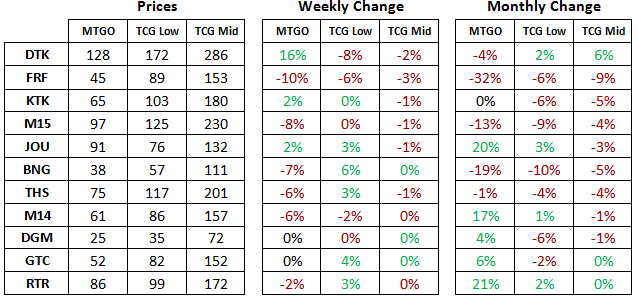
Below are the total set prices for all redeemable sets on MTGO. All prices are current as of April 20th, 2015. The TCG Low and TCG Mid prices are the sum of each set’s individual card prices on TCG Player, either the low price or the mid-price respectively.

All MTGO set prices this week are taken from Goatbot’s website, except for the price of DTK which is the sum of all DTK singles prices from Goatbot. All weekly changes are now calculated relative to Goatbot’s prices from last week. Monthly changes are still relative to Supernova’s prices from last month before their prices started diverging from market prices.

apr22

Return to Ravnica Block & M14

Paper prices on these sets continue to fluctuate with no clear trend, though the TCG Low price for a complete set of RTR is flirting with triple digits and is the highest it’s been since last summer. TCG Low for GTC and M14 are not showing quite the same strength, though both remain within striking distance of a six month high. MTGO prices on these sets remain in a holding pattern and are waiting for some direction from their paper counterparts or renewed interest in Modern.

The end of DTK release events will bring some focus to Modern as players shift their attention away from Limited towards Constructed. Waiting for the next uptrend can try a speculator’s patience, but there’s nothing to suggest another leg up in price isn’t on its way. If you are holding mythic rares from RTR, GTC or M14, holding continues to be correct.

Theros Block & M15

A big move has been made recently by Mana Confluence, which is now priced around 23 tix. But for every big move up in price that a given card makes, there are other format staples such as Courser of Kruphix and Goblin Rabblemaster languishing below their recent price levels.

Coming out of DTK events, it’s natural to see a mild bounce in prices overall, but don’t let a price bump on cards from these sets dictate any speculative decisions. With MM2 and Tempest Remastered coming up, there will be lots of reasons to sell cards that are getting closer to rotation every day. The outlook for these sets is unchanged. Any speculative bets made on cards from these sets should be short-term in nature and should not be undertaken lightly.

Tarkir Block

With Standard's strong adoption of Dragonlord Ojutai and Dragonlord Silumgar, DTK saw a substantial jump in price in the last week. Many of these prices are closer to what one would expect during online prerelease events. The dust is going to have to settle on this set before any speculative bets are made.

FRF is continuing to drift down in price, with no single card priced higher than 10 tix currently. Relative to paper, FRF is the cheapest redeemable set (DTK redemption has yet to start).

For speculators, this presents an interesting question. Is the price of FRF on MTGO too low or is the price of FRF in paper too high? Well, with drafters ready and willing to keep supplying the market with cheap cards from FRF, there’s no strong reason to believe that FRF is priced too low on MTGO. It’s safe to expect this gap to narrow, but with falling prices in paper, not with rising prices on MTGO.

KTK is still at or near its bottom on MTGO, though there are some cards that are moving around in price. Meanwhile paper prices are continuing to slowly drift down. Further speculation on KTK should wait until prices stabilize in paper and clear floors emerge.

Sarkhan, the Dragonspeaker is definitely a card to keep an eye on, as it’s clearly fallen out of favor in Standard and this is reflected in its price reaching an all-time low of around 4 tix.

Modern

As a whole, the Modern format is still on a downward trend which started about a month ago. DTK release events, coupled with a shift of interest to the new Standard format and the looming pressure of potential reprints in MM2 have pushed several Modern staples further down this week.

Noble Hierarch for instance is now around 18 Tix, a 15-month low. Linvala, Keeper of Silence, once over 20 Tix, is now about 6 Tix and plunging to its pre-Modern-era price as if Birthing Pod had never existed. Amulet of Vigor is in the 1.5 Tix range and almost back to its pre-PT Fate Reforged level) and the MMA version of Summoner's Pact is under 1 Tix , an all-time low.

Moving into reprintable Modern positions is certainly a delicate gamble at this point. However, not all current Modern cards present the same likelihood of being reprinted.

Summoner's Pact was in MMA and it would be reasonable to think that the pact cycle is niche enough that it won’t return in MM2. After a recent strong finish at PT Fate Reforged and grumblings of a potential ban, Amulet of Vigor and the Amulet deck are still around. Three months ago this card was barely on the average player’s radar. Amulet of Vigor is clearly not a prime card to reprint in MM2.

At their current price, both Pact and Amulet may be worth the risk and carry a good upside if they don’t show up in MM2. Weighting risks and rewards, speculators ready to take calculated risks may want to consider several Modern positions such as these. At the very least, speculators should get ready a short list of Modern-relevant cards that might avoid getting reprinted--both of these cards should be on that list.

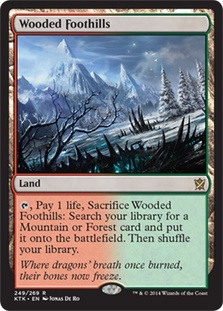
The ZEN fetchlands also seem to have found a new price floor on MTGO and have slightly rebounded in the past week. As a cycle of cards that will guarantee massive sales of any set that they are in, the ZEN fetchlands are probably not going to show up in something like a limited print run set like Modern Masters 2015. It’s not a big stretch to imagine them being included in Battle for Zendikar this fall.

However, they constitute a good short- to medium-term opportunity here. Acquiring them at current prices while they are out of favor, and just before MM2 invigorates interest in Modern, could lead to decent returns. The summer PPTQ season in August will be Modern Constructed as well, which will provide a back stop selling period, just prior to Battle for Zendikar spoilers starting up in September.

Vintage & Legacy

A Legacy Grand Prix was held this past weekend in Kyoto, Japan. Not surprisingly, Delver deck variants were the most represented decks in Day Two and 100% of the Top 8 decks contained blue spells. More interesting is the apparent renewed interest in OmniTell decks, featuring Omniscience or Sneak Attack. These were the second most represented archetype in Day Two, and two competitors piloted it into the Top 8. At the same time (but half a world away) four OmniTell decks made Top 8 at the Legacy SCG Premier IQ event, and one of them took home the top prize.

Several Japanese pros praised the power of cheating Emrakul into play via Omniscience as the Legacy format is adjusting to the banning of Treasure Cruise. Omniscience won’t be in Modern Masters 2015 but is currently sitting at its record high at around 20 Tix, making it a difficult speculative target even with these recent events highlighting Omnitell.

On the other hand, Show and Tell has fallen from a high of almost 100 Tix to a very stable 50 Tix. With Urza’s block flashback drafts held four months ago, the blue sorcery from Urza’s Saga could be an expensive but decent spec with the Legacy MOCS as the targeted selling period in November.

Besides OmniTell, eight copies of Monastery Mentor also showed up in the GP Kyoto Top 8. Along with some appearances in Vintage, the Mentor is more and more making its way into the most powerful formats. This card should really be on your radar now and should be a primary target to pick up prior to the release of Magic Origins.

Another Standard card is getting more and more essential in Legacy blue decks—Dig Through Time. From under 2 Tix at the beginning of the month to more than 3 Tix now and propelled by Standard UBx Control decks, the blue delve instant posted 17 copies in the Top 8 of GP Kyoto this past weekend. Dig Through Time is here to stay in all formats it is legal in and is very likely a sure bet now and for the year to come.

Pauper

In the wake of DTK release events several Pauper staples and Pauper-playable cards have lost value. Similarly to what we observed in other formats, prices are expected to rebound in the coming days. These prices at a depreciated level are indeed creating buying opportunities.

A good example of this is Moment's Peace. This card abruptly dropped in three weeks from 1.6 Tix to 0.3 Tix, basically at an all-time low. With a ceiling over 3 Tix, and despite not being very popular in Pauper right now, this Odyssey common constitutes a very attractive pick up.

Targeted Speculative Buying Opportunities

Standard

Dig Through Time
Sarkhan, the Dragonspeaker

Modern

Misty Rainforest
Scalding Tarn
Arid Mesa
Verdant Catacombs
Marsh Flats

Pauper

Moment's Peace

Legacy

Show and Tell

Targeted Speculative Selling Opportunities

None

Brewing Bant with Ojutai’s Command

Are you a Quiet Speculation member?

If not, now is a perfect time to join up! Our powerful tools, breaking-news analysis, and exclusive Discord channel will make sure you stay up to date and ahead of the curve.

bant rhox war monk

Dragons of Tarkir brought us Avatar of the Resolute to brew Stompy with, and Collected Company to brew Elves with, but there's plenty more work to do. Today I'm going to put together a Bant goodstuff list built in part around Ojutai's Command. If you love powerhouse creatures and versatile instants, this article is for you.

[wp_ad_camp_1]


Bant, You Got It Goin' On

Bant goodstuff has long been a "good, not great" deck in Modern. Its core problem is it lacks the proactiveness and catch-all (almost) quality of Lightning Bolt and Thoughtseize, so you're left with a more straightforward, reactive deck that relies on Path to Exile (which has its own problems at times), and counterspells (which compete with your creatures) for disruption.

However, goodstuff can never be strictly bad regardless of what colours you're in, and it has some unique things going for it -- one more now with the addition of Command. Here are the three cards that only really fit into Bant, and provide compelling reasons to at least try the deck out:

  • Bant Charm is extremely relevant in this format. It's the kind of card many decks would love to play if it was in their colours, but it hasn't been, so it's neglected. The first mode hurts Affinity, the second hurts any creature deck (and makes Wurmcoil Engine sad), and the third shuts down opposing disruption. Sound good? Oh yes.
  • Rhox War Monk may appear underwhelming, but look closer and realize he has 4 toughness, which dodges Bolt and lets him profitably block all kinds of creatures in the format. On top of that, lifelink is fantastic in a meta where 1/5 of the top 10 decks are aggro and cannot get rid of this thing (usually, at least).
  • Ojutai's Command brings back any of our slew of goodstuff creatures for added resilience (including Snapcaster Mage should the game go long, and it will fairly often), gains us life versus aggro, hurts them when trying to mount an offense or defense, and gives us some late game draw power. Great stuff.

The Brew

Onto it, then. Below is the pre-testing list I've come up with. By pre-testing I mean that of course it's not been tested yet (although I have goldfished it with overall decent results), and as such is somewhat rough and subject to potentially lots of tweaking, especially given the open nature of goodstuff decks.

Untitled Deck

Land

2 Breeding Pool
2 Flooded Grove
1 Flooded Strand
2 Forest
2 Gavony Township
1 Hallowed Fountain
1 Island
4 Misty Rainforest
1 Plains
2 Stirring Wildwood
1 Temple Garden
4 Windswept Heath

Creature

4 Birds of Paradise
3 Geist of Saint Traft
4 Loxodon Smiter
4 Noble Hierarch
2 Scavenging Ooze
2 Snapcaster Mage
4 Tarmogoyf

Instant

1 Bant Charm
2 Dromoka's Command
4 Ojutai's Command
4 Path to Exile
2 Spell Snare

Sideboard

1 Engineered Explosives
1 Kataki, War's Wage
1 Meddling Mage
3 Qasali Pridemage
4 Rhox War Monk
2 Spellskite
2 Steel Sabotage
1 Thrun, the Last Troll

For those that can't afford Goyfs or just don't want to pay that much for cardboard, you can use Voice of Resurgence instead. The sideboard is far from well thought out, but I've started with much worse before.

In terms of competitiveness, I believe the list is still "good, not great", but with some testing and fine tuning (which I'll try to get to eventually), it could be closer to great. I've done my best to minimize the inherent problems with Bant and maximize its inherent strengths, but there's definitely still work to do.

Parting Thoughts

You can go in a lot of different directions with this list: you can cut the non-creature spells for more creatures like Voice and add in Collected Company, you can throw in Mana Leakfor additional control,  you can add extra reach with Elspeth, Knight-Errant and/or Sword of Feast and Famine (which makes Birds less bad, among other things), and so on -- the possibilities are extensive.

In the meantime, may this list provide you with a fun shell with which to abuse Ojutai's Command, or inspire you to your own Bant list.

Arbitrage Watch: Forbidden Orchard (CHK) and How I Use Trader Tools

Are you a Quiet Speculation member?

If not, now is a perfect time to join up! Our powerful tools, breaking-news analysis, and exclusive Discord channel will make sure you stay up to date and ahead of the curve.

For the last 4 months, the spread on this oddball land has been getting ever more narrow.  It almost broke through the average retail price in January, and in the last few weeks it's actually exceeded it.  The average buy price has been steadily climbing, and aside from a 50 cent bump since February, the retail price hasn't moved a whole lot.  I will be the first to admit I don't know much about Legacy beyond the fact that this card is allegedly good with Oath of Druids, but I know free money when I see it. The fact that Oath isn't legal in Legacy, however, makes me very confused as to why on earth this card has value. My only guess is that Commander players find it to be a useful political tool.

Forbidden Orchard mtg price, April 21st 2015
Forbidden Orchard, April 21st 2015

Usually, with these Stock Watch posts, I try to identify big movers that have market implications.  I'm using a new feature in the beta version of Trader Tools 4 (which I will open up for Insider beta testing very shortly) called "Big Changes".  We've got a lot of fun reports that we can run on our historical data, and the change report is my favorite.  I've taken to checking it every morning, and it helps me find interesting cards to write about.  This morning, Forbidden Orchard showed up on my list:

A preview from Trader Tools 4's "Big Changes" Report
Buy Change ($), Sell Change ($), Total Change ($), Spread Change (%), Buy Price ($), Sell Price ($)

Good arbitrage opportunities are few and far between, so this one tickled me pink.  Arbs are not always what they seem on paper;  we're citing TCGplayer Mid as our buy-in price, which does not make any guarantees about quantity or condition.  In this case, I found a merchant selling 7x NM @ $5.69 + $0.99 s/h, and a merchant buying up to 17x NM @ 6.60.  Now, I realize this amounts to about $5 in profit.  This is hardly a great example of the power of Trader Tools, but it's a fine case study on how to work the charts and reports to find market oddities.  I've already got another order queued up for this buyer, so any extra stuff I can add to the envelope is pure profit.  In fact, thanks to Trader Tools I'm going to make some cash on a certain KTK fetch land already because an LGS I encountered in my travels was selling them for below buylist.  Cheers, guys!

So, because I'm writing about this, I'm not going to take advantage of this particular arbitrage opportunity.  I want to give Insiders a crack at it.  They can use Trader Tools to see who's got the high buy price here.  It's not big money, but it's something.  Feel free to be the guy who makes an extra $5 or gets some cheap copies of this wacky non-basic land.

Also, don't forget that this was reprinted in FTV:Realms, but the buy price above is for the CHK version!

There was an error retrieving a chart for Forbidden Orchard


Insider: Devil’s Advocate #1

Are you a Quiet Speculation member?

If not, now is a perfect time to join up! Our powerful tools, breaking-news analysis, and exclusive Discord channel will make sure you stay up to date and ahead of the curve.

Welcome back readers and fellow speculators! Today I hope to begin a new article series designed around the idea that while some cards seem like obvious picks, it's important to not just follow the pack and to invest in only what you truly believe in (MTG cards, stocks, bonds, etc.). With that idea in mind, my goal is to challenge you all to possibly rethink your picks and to hopefully find any inherent biases you might have towards certain cards or types of cards. Without further ado, let's begin.

devils advocate

Khans Fetchlands

BloodstainedMire FloodedStrand PollutedDelta WindsweptHeath WoodedFoothills

This one seems so obvious as a speculation target. After all, before reprinting, Polluted Deltas sat at $80-90 and Flooded Strands were $60-70. So surely the Khans ones will grow to be much higher than current prices--except the original ones reached those prices because there were so few of them in supply and the demand had grown rapidly since their printings. More recently, Magic player growth seems to have slowed down dramatically (if not dropping a bit) so why would the price continue to rise?

Currently they are legal in every major format and their prices sit between $8-$15. Without an increase in player base, the demand will drop at rotation as the Standard-only players will no longer need them. The best comparison for the future price of these is to look at the Return to Ravnica shocklands, which despite many expectations, have barely budged after rotating.

My biggest concern here is that even the current price is heavily driven by speculation, which is a form of artificial demand, and means that when some of those speculators get cold feet (or need to free up capital) the supply will increase but the demand won't leading to a drop in prices.

A good comparison is the US housing market, pre-2007, when everyone buying houses assumed they were a safe bet (thanks to AAA ratings by Standard and Poor's, Moody's, and other rating agencies); this led home buyers and house flippers to assume real-estate was one of the safest bets they could make (we've since discovered that almost all the rating agencies were off by a factor of 500-20,000).

If that sounds familiar it's because it's one of the rules of thumb that I (and other vocal MTG speculators) have touted for quite a while: bet on lands because they are typically the most needed cards. However, consider if we reach a Standard format in which one color combination is so dominant that a large majority of the decks in any given format are this color combination only (Caw-Blade is a good example). In that format, the lands of those color combinations would be valuable, but all other lands would not.

It's also important to keep in mind that in these situations one can only have four of the non-basic color fixing lands which is the same max number of any key cards for the deck. In this situation the maximum value of the land may be dependent on what other cards are needed for the deck.

Abrupt Decay

AbruptDecay

Here's a card that is safe from a MM2015 reprint and sees a lot of play in Modern. Its strength is heavily tied to how good black and green are in the format. Blood Moon usage is on the rise because of how much it shuts off a lot of decks and Abrupt Decay is very difficult to cast through a Blood Moon, especially given that the top mana dork in Modern (Noble Hierarch) can't tap for black.

We're also seeing a rise in Tron decks, which are largely immune to Abrupt Decay (by which I mean any viable targets aren't high value) with the release of Ugin, the Spirit Dragon. Due to its uncounterability, the decks that are most weak to Abrupt Decay (mainly Splinter Twin) are adopting other ways around it, namely giving the target hexproof, indestructibility, or protection from black or green. Abrupt Decay can also be swerved to Spellskites, which are seeing a lot of play right now.

Scavenging Ooze

ScavengingOoze

This card is typically the bane of graveyard based strategies in Modern. However, its biggest flaw is that its ability typically gets worse after the first one is in play. Because of this they don't typically get played as a full playset, which limits the demand; my research shows they typically show up as a two- or three-of.

While it was printed in a core set, which would normally limit the number of copies in the supply, being given away as a promo and previously being printed in Commander means there are considerably more copies in supply than one might originally expect. This was a $40 card at one point, prior to its reprinting, but the reduction in Maverick decks in Legacy means that demand from that format has drastically decreased.

It has found a home in several Modern decks, however it's been in these archetypes since its release and its price has remained stagnant since it left Standard.

Chord of Calling

ChordOfCalling

A card that was $40 and is now available for $3.50. What a slam dunk, right? Except the deck that drove its price up had its key component banned (Birthing Pod). Many thought the deck could survive this banning, but while tutoring up bullets is a very powerful effect, this card can not get both components of a combo as Birthing Pod could.

Green-based decks in Modern seem to be shifting away from creature combo decks and more towards cheap/value creatures, so the need to waste deck space on tutors when one could simply play additional powerful threats isn't necessary. The triple green requirement is also somewhat steep in a format dominated by two- and three-drops.

Dragonspeaker Shaman

DragonspeakerShaman

Here we have a casual card that has maintained a pretty impressive price despite two reprints. However, this one is entirely based on the casual market. Any sort of new mass reprint (perhaps a Dragon-themed duel deck) would likely kill its value.

Both previous reprints were in relatively undesireable "sets" (Archenemy and Knights vs Dragons). Should WoTC throw it into any newer duel deck or specialty product its price would take a much larger hit, especially if said product included a desirable chase card that would cause players to buy it en masse and thus leave an abundance of the other cards in supply.

If you want a good comparison, look at Baleful Strix. This card once hit a high of slightly over $22, but with a reprint in another Commander deck (which had a chase rare, True-Name Nemesis) it plummeted and now both copies sit around $4-5. If a similar reprinting for Dragonspeaker occurs it will go from $6.5-$7 down to $1.5-$2.

Tasigur, the Golden Fang

tasigur

Here we have another Standard-legal card with lots of Eternal possibility. Tasigur requires either blue or green in the deck to be anything more than a slightly cheaper Tombstalker. The biggest downside is that you need to fill your graveyard relatively quickly to truly benefit from casting him early, but casting him early may limit the use of his ability.

His ability is also heavily reliant on manipulating your own graveyard and your opponents' decision making skills. If you can't control your graveyard efficiently then you're paying four mana to draw your weakest card. The fact that he can't return lands is both a boon and a bane. It means your opponent is forced to give you a spell of some sort (assuming you have one in your graveyard), but it also means that if you really need a land his ability is actually detrimental. Your opponent can also manipulate your graveyard to limit his usefulness and he has no evasion nor protection from removal spells.

Want Prices?

Browse thousands of prices with the first and most comprehensive MTG Finance tool around.


Trader Tools lists both buylist and retail prices for every MTG card, going back a decade.

Quiet Speculation