menu

The Dark Spikes and Beating the Rudy Effect

Are you a Quiet Speculation member?

If not, now is a perfect time to join up! Our powerful tools, breaking-news analysis, and exclusive Discord channel will make sure you stay up to date and ahead of the curve.

Two weeks ago I had authored an article paying tribute to a flavorful, macabre set out of genuine appreciation. That set, of course, was The Dark.

While the column was generally well received, I noticed some discussion afterwards, on various social media platforms, about a video created by Rudy of Alpha Investments. The title of the video, which was posted on January 17th, is “2022 – The Dark – Leads the Market Higher.” Throughout the video, Rudy touts the investible qualities of the set.

Given his 338K subscribers, it’s no surprise that his video created significant waves in the market, spiking Reserved List The Dark cards left and right. When I wrote my article, I didn’t realize Rudy had posted this influential video—my timing, therefore, was poor. How could I encourage folks to explore this under-appreciated set if it had just received the buyout treatment?

There was an error retrieving a chart for Frankenstein's Monster

Therefore, I would like to double back and clarify a few things.

Be Wary of Rudy-Fueled Buyouts

When Rudy highlights a given set or product, the price moves. You could call it the “Rudy effect.” If you’re already holding cards he’s touting, then you’ve just been given a gift! You can expect to be able to sell those cards for north of their recent market prices. Whether your preferred platform for selling is eBay, TCGplayer, Facebook, or buylists, you will have an opportunity to cash out at a premium. Congrats!

If you don’t have the cards he’s talking about most recently, then the Rudy effect puts you into a bit of a pickle. Do you embrace the FOMO and purchase the trending cards in question despite the price spike? Or, do you have to wait a long time before you can acquire these cards at reasonable prices?

My advice is to stick with the latter. It can be frustrating to wait weeks or even months to obtain cards you want for a deck, but let’s face it—Rudy tends to push cards on the Reserved List, printed before 2000. At this point, you’ve had years to acquire these cards. If you hadn’t prioritized them thus far, then waiting another couple months won’t hurt too badly.

How am I so confident prices will retrace back toward a more normal level? Simple: history repeats itself!

A Couple Previous Examples

We’ve seen this film multiple times before. I vaguely recall (though admittedly can’t track down the video) when Rudy not-so-subtly alluded to City in a Bottle, Golgothian Sylex, and to a lesser extent, Apocalypse Chime for their common ability of destroying all cards from a given set. It wasn’t long afterward when we saw Sylex and Chime both spike on MTG Stocks. This would have been in summer 2020, and you can see from their charts that both cards spiked at the same time.

There was an error retrieving a chart for Golgothian Sylex
There was an error retrieving a chart for Apocalypse Chime

Let’s focus on Golgothian Sylex as our case study. Observe how the card spiked over $150 for a minute, and then declined almost as sharply as it rose. I remember cashing out my copy at this time, selling to Card Kingdom’s ever-dynamic (and aggressive) buylist. I felt a little seller’s remorse at the time, as I really do appreciate the card. However, after the price tumbled back down, I was able to pick up a replacement copy for less than my sale price!

Interestingly, I was able to find another Rudy video where someone wrote him and revealed their attempt to buy out the market of Golgothian Sylex. While they didn’t succeed in clearing out the market, I do have to wonder if their action permanently increased the baseline price for the card. Prior to its spike, the card was worth $15-$20. Nowadays it’s worth nearly $50. Then again, that may have been the natural price appreciation that would have occurred had the buyout not happened.

One thing is for sure, though: buying cards during these spikes can lead to financial losses. Patience prevails.

The shape of the curve for Apocalypse Chime is similar, but the numbers are much smaller. Still, this is a Homelands cards we’re talking about, so the buyout is almost laughable in nature. After spiking from $0.75 to over $10, the card rapidly declined toward $3 or so. It looks like it made another run a few months later, failed to hit new highs, and is once again on the decline.

Shifting Back to The Dark

The examples above were the quickest to come to mind, but I’m sure there are others throughout the years of Alpha Investments content. While the long-term prospects for Magic’s oldest sets remain strong, I remain doubtful that one can artificially short-cut the gradual growth these cards are expected to get (at least, not without a major bankroll).

Shifting focus to The Dark, a couple noteworthy cards are worth discussion.

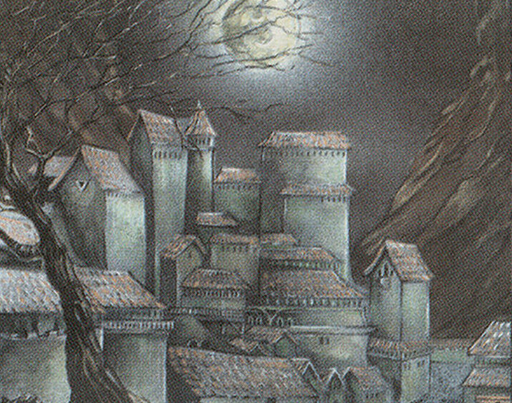
First, there’s City of Shadows, which I mentioned in my article a couple weeks ago. Somehow, this has become the most valuable card from the set. I don’t know if it sees a whole lot of play, but here we are looking at a “$200” land that doesn’t even tap for mana until you sacrifice a creature to it.

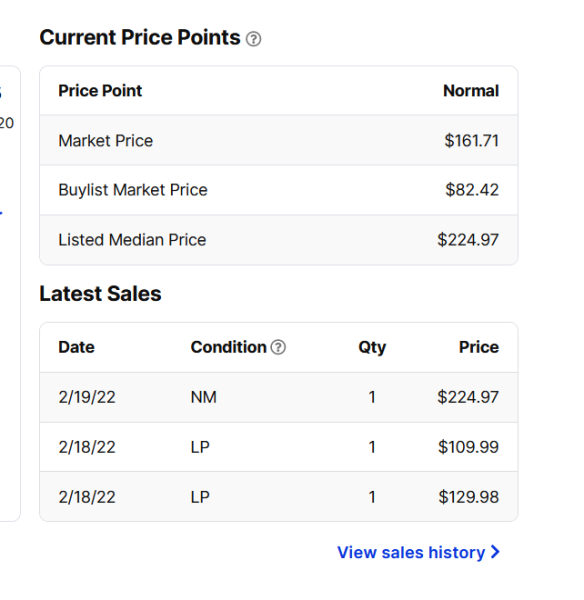
Right off the bat, I question that $200 valuation. That seems to me like some deliberate price manipulation of MTG Stocks’ algorithm. I see a couple lightly played copies sold for around $120 last week, and then the most recently sold was a near mint copy for $224.97.

Call me a skeptic, but this has buyout written all over it, and I wouldn’t pay anything north of $100 for a lightly played to near mint copy. At the very least, you can pick up VG copies from Card Kingdom for $111.99, but even that price point sounds too high. Moderately played copies are in the mid-$70’s on TCGplayer, and if you’re feeling like gambling on the damaged lottery you could always grab that $55 copy.

But your best bet is to hold off on this one. These spikes never stick. This isn’t a tier one Old School playable card from Arabian Nights here. City in a Bottle is the real deal. City of Shadows
 less so.

There was an error retrieving a chart for City of Shadows

The other noteworthy The Dark card on the move is Frankenstein's Monster. I mentioned this one as well in my article from a couple weeks back. I love the real-world literature reference of this card. While it gets a 10/10 for flavor and 10/10 for grotesque art, it gets a much lower rating for playability. That didn’t stop the card from spiking north of $60 recently, however.

Frankenstein's Monster appears to be ahead of City of Shadows in its pricing trend, because this card has already begun its decline on MTG Stocks. I expect a significant reversal on this card’s price. Before the recent spike, this was trending in the mid-$20’s. I don’t think it’ll see numbers that low again simply due to price memory (and people not willing to sell for a loss), but I would not be surprised to see this settle about $10 higher, in the $35 range.

Wrapping It Up

If other cards from The Dark follow suit, make sure you keep your emotions in check and avoid the FOMO. We’ve seen this movie before—Rudy has the power to move markets, but not always permanently. In the case of The Dark, I believe these price increases will be temporary. You’ll just have to wait a couple months before you can enjoy the aesthetic of the set that I shared two weeks ago.

In the meantime, I can highlight a couple trends that are sticky. I’ve noticed the price on many Alpha and Beta rares have climbed—this is reflected in Card Kingdom’s buy prices, which go up almost once per week on any cards of which they remain low our out of stock. Ones I pay particular attention to include Beta Copy Artifact, Braingeyser, and Zombie Master. I also recently picked up a Beta Gaea's Liege, and I had to scramble to catch a Card Kingdom restock because they had been selling out of this one.

There was an error retrieving a chart for Gaea's Liege

A subset of Arabian Nights also remains resilient. Some cards like Aladdin and Aladdin's Lamp have pulled back significantly from their highs. But Mountain currently buylists to Card Kingdom for $295 (near mint)—I don’t remember seeing a number that high on the basic land before. Their buy price on Juzam Djinn, Singing Tree, and Island of Wak-Wak also seem strong. These are places I’d rather be parking my resources instead of over-hyped The Dark un-playables.

Of course it’s a matter of personal preference, but assuming you have a shred of patience, your best bet is to avoid spiking The Dark cards for the time being. Don’t chase the Rudy hype, and you’ll be one step closer to saving or making money from this fantastic collectible card game.

Kamigawa Neon Dynasty Arena Prerelease Sealed

Are you a Quiet Speculation member?

If not, now is a perfect time to join up! Our powerful tools, breaking-news analysis, and exclusive Discord channel will make sure you stay up to date and ahead of the curve.

First Exploration of the New Format

Over the weekend I dove into Kamigawa: Neon Dynasty with my first Sealed event on Arena. In this video, I walk through my process of building a deck for Sealed, including basic card evaluation, settling on colors, making cuts, and tweaking the mana base. I then pilot the finished deck through some games.

Perhaps an obvious observation, but the cycle of mythic dragon spirits are all overwhelmingly powerful. They're large, evasive threats that can close a game out on their own. Moreover, they provide additional value in the event your opponent can deal with them, putting you even further ahead. If you have them in your pool and can feasibly afford to play them, you do so. Unfortunately, I couldn't work Kairi, the Swirling Sky into the final version of the deck, but I certainly tried during my deck construction.

Thankfully, that wasn't the only strong rare in my pool. Ogre-Head Helm does an incredible Skullclamp impression, buffing a creature enough to swing in, and forcing your opponent to either make bad blocks, or let you draw 3 cards. At its base, it enables artifact-matters synergies as well as modified synergies while being particularly pesky to remove. As you'll see, Helm carried me to several victories over the course of the run.

Another card I'd like to highlight is Invigorating Hot Spring. The card is a house, and enables your modified payoffs by disbursing +1/+1 counters to up to four creatures. It also makes for explosive curve-outs, discounting the cost for Walking Skyscraper, then letting you attack with it as a 9/9 haste trampler.

From my first impressions, it seems that a lot of power in this set rests in the commons and uncommons--a welcome change from VOW limited. I'm looking forward to exploring the format more going forward.

The Deck

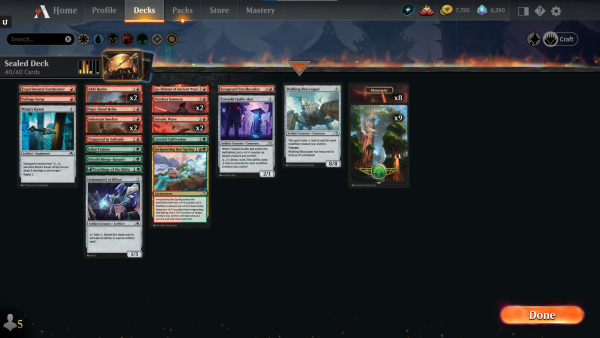
Below is the version of the deck I settled on. In retrospect, I'd probably change my land count to 10 Mountains and seven Forests. It was more essential to have early access to red than green. Overall, I'm happy with how the deck came together.

Untitled Deck

Creatures

2 Akki Ronin
1 Ogre-Head Helm
2 Sokenzan Smelter
1 Jukai Trainee
1 Orochi Merge-Keeper
1 Automated Artificer
1 Go-Shintai of Ancient Wars
2 Peerless Samurai
1 Scrapyard Steelbreaker
1 Towashi Guide-Bot
1 Walking Skyscraper

Artifacts

1 Experimental Synthesizer
1 Ninja's Kunai

Enchantments

1 Tempered in Solitude
1 Teachings of the Kirin
1 Careful Cultivation
1 Invigorating Hot Spring

Spells

1 Voltage Surge
2 Seismic Wave

Lands

8 Mountain
9 Forest

For more on evaluating cards for Limited and building a sealed deck, check out Paul's article from last week. How was your Prerelease? What cards did you enjoy playing in Sealed? Let me know in the comments or on Twitter: @AdamECohen.

An Explanation of the Alta Fox/Hasbro Board Fight

Are you a Quiet Speculation member?

If not, now is a perfect time to join up! Our powerful tools, breaking-news analysis, and exclusive Discord channel will make sure you stay up to date and ahead of the curve.

The Battle to Control Hasbro, Wizards of the Coast, and Magic's Future

This week, Alta Fox Capital released a letter to Hasbro shareholders nominating five candidates to the company's Board of Directors. Alta Fox believes Hasbro "is severely undervalued and a perpetual underperformer due to its ineffective 'Brand Blueprint' strategy, flawed corporate structure and consistent misallocation of capital."

The move comes after what Alta Fox describes in the statement as "Years of disappointing results, poor governance and questionable disclosure practices under the 'Brand Blueprint' strategy."

Who Is Alta Fox Capital?

Alta Fox Capital is an alternative asset management firm that identifies itself as a "top 10 shareholder" in Hasbro. According to CNBC, they have a 2.5% stake in the company worth around $325 million.

What Is Alta Fox's Position?

In addition to its move to put friendly members on the board, Alta Fox is calling for Hasbro to spin off Wizards of the Coast into a separate company. It believes Wizards is the strongest performing part of Hasbro, and has a business model quite different from Hasbro's traditional toy and entertainment segments.

In a 100-page investor presentation, Alta Fox says it is partly this misunderstanding of Wizards' model, combined with what they describe as "poor disclosure and investor messaging" on the part of Hasbro, that has led to Wizards being "significantly undervalued" within the company as a whole. "We believe the Board’s poor financial transparency with investors has resulted in low consolidated multiples being ascribed to Hasbro’s entire business," they write.

Wizards Without Hasbro?

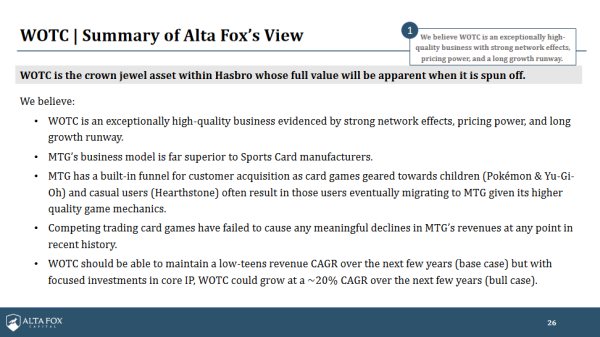
It's almost impossible at this point to imagine Wizards of the Coast without Hasbro. Hasbro purchased the then independent company in September 1999 for $325 million, and has overseen them for more than two decades. In fact, Wizards has become a key verticle of Hasbro's business, one that is arguably propping up the parent company. In their "Hasbro, Let Wizards Go" video, Alta Fox's Connor Haley says that his group estimates Wizards of the Coast makes up approximately 71% of Hasbro's intrinsic value. Alta Fox's Investor presentation sums up their view of Wizards as follows:

We believe WOTC is an exceptionally high-

quality business with strong network effects,

pricing power, and a long growth runway.

Alta Fox "Free The Wizards" Investor Presentation

Why Spin Off Wizards?

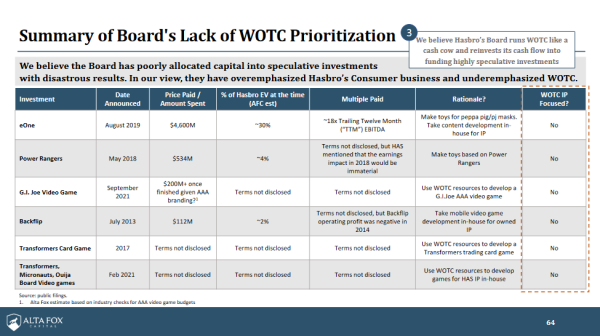
Part of the problem Alta Fox cites as an example of the current Board of Director's mismanagement is their belief that the Board "runs WOTC like a cash cow and reinvests its cash flow into funding highly speculative investments," rather than investing that money back into the company. They provide several examples of these speculative investments in their Investor Presentation. These include the purchase of outside companies and the use of Wizards resources to develop other Hasbro-owned IP projects:

Alta Fox "Free The Wizards" Investor Presentation pg 64

"We believe the Board’s obsession with Hasbro’s lower quality Consumer business has plagued WOTC’s ability to invest in the long-term health of its brands," Alta Fox writes.

Alta Fox argues that in addition to this gross mismanagement, change in leadership is needed at the top to address excessive executive compensation that has come at the expense of the health of the company, and of its shareholders. Alta Fox contends that in the last five years alone, while the company was underperforming, Hasbro "senior leadership and directors
received more than $180 million in compensation
exceed[ing] that paid to the board of directors of Apple, Inc. and many other world-class companies of greater scale and with superior results."

Who Are These Board Nominees?

With the goal of a spin-off of Wizards in mind, Alta Fox seeks to put five nominees on the Hasbro Board. Most notable among these nominees are Matthew Calkins, founder and CEO of enterprise software company Appian and an award-winning board game designer, and another man who perhaps needs no introduction:

There was a time when Jon Finkel was the face of the Magic Pro Tour, and he's immortalized on the original printing of the card Shadowmage Infiltrator. A Hall of Famer, and arguably the best player ever to play the game, Finkel pivoted from his success in Magic into a successful career as a managing partner at an investment firm. Of all the nominees put forth by Alta Fox, Finkel is the clear face of the movement. His involvement is sure to resonate strongly with players.

What Is Alta Fox's Plan?

The primary push from Alta Fox is to spin Wizards off as a separate company. In addition to that stated goal, the rest of their stated goals on their website https://freethewizards.com/our-ideas/ include:

  • Replacing the failed "Brand Blueprint" strategy
  • Improve capital allocation
  • Reinvest in Wizards' core IP
  • Realign compensation to performance
  • Improve disclosure practices

"We believe WOTC’s long-term growth and margin profile would markedly improve as a standalone business," they write.

What Does This Mean for Magic?

According to Alta Fox, "as a standalone entity,...WOTC would be more focused on developing its core IP and have a much clearer path to margin expansion." Alta Fox sees Arena as a central component to achieving these goals. "If executed correctly, we believe Arena could more than double WOTC’s revenues today while continuing to drive growth in paper." In conjunction with a strong focus on Arena, Alta Fox highlights several key areas they see as important to the Wizards customer base. They include:

  • Reinvest significantly into Arena and listen to customers
  • Launch multiplayer functionality
  • Reduce “bugs”
  • Launch subscription offerings that are more cost effective for customers and improve the experience
  • Improve transparency and offer a credible solution to the “Historic issue” posed by Alchemy
  • Improve social functionality, offering chat, streaming, events, and other community-oriented services through Arena
  • Further integrate paper and digital MTG (i.e. notification of physical events happening near you based on geolocation)
  • Revival of competitive MTG through a carefully designed, yet simple in-person & online tournament structure

In addition to these corporate changes, and changes to Wizards core IP products like Magic, Alta Fox has other details and ideas they plan to share closer to Hasbro's annual shareholder meeting, which should take place in May 2022.

Reaction to the News

The news of Alta Fox's board nominations have had mixed reactions in the community.

Response from Hasbro

In a press release acknowledging receipt of Alta Fox's letter to shareholders, Hasbro stated that the company "engages in regular communication with its shareholders and welcomes constructive input to further the best interests of all shareholders." They acknowledge having held meetings with Alta Fox regarding the company's business strategy, and say that "The Board and management team believe Hasbro is on the right path to deliver sustainable growth for shareholders."

Closing Thoughts

This is a developing story, and we will likely have to wait until May to hear more concrete details from Alta Fox about their plans and their intentions. I've tried to keep my own opinions out of this, and focus on the facts at hand, but I'm interested to know your opinion. Do you agree with Alta Fox's assessment? What do you think Hasbro/Wizards should do to improve their profitability, and their products?

I've done my best to distill Alta Fox's letter to investors, their Investor presentation, the details on their website, and Hasbro's response into a single article. I'm interested to hear if you found this article helpful, or what I could do to improve it. I may have a follow up as more details become available, and will update this piece with any corrections, or to fill in any accidental omissions that make have occurred on my part trying to condense all this down into a single article. I look forward to reading your comments here and on Twitter.

Avatar photo

Paul Comeau

Paul is Quiet Speculation's Director of Content. He first started playing Magic in 1994 when he cracked open his first Revised packs. He got interested in Magic Finance in 2000 after being swindled on a trade. As a budget-minded competitive player, he's always looking to improve his knowledge of the metagame and the market to stay competitive and to share that knowledge with those around him so we can all make better decisions. An avid Limited player, his favorite Cube card is Shahrazad. A freelance content creator by day, he is currently writing a book on the ‘90s TCG boom. You can find him on Twitter and LinkedIn.

View More By Paul Comeau

Posted in Analysis, Free, NewsTagged , 3 Comments on An Explanation of the Alta Fox/Hasbro Board Fight

Have you joined the Quiet Speculation Discord?

If you haven't, you're leaving value on the table! Join our community of experts, enthusiasts, entertainers, and educators and enjoy exclusive podcasts, questions asked and answered, trades, sales, and everything else Discord has to offer.

Want to create content with Quiet Speculation?

All you need to succeed is a passion for Magic: The Gathering, and the ability to write coherently. Share your knowledge of MTG and how you leverage it to win games, get value from your cards – or even turn a profit.

Layers, Part Three: Type-Changing Effects

Are you a Quiet Speculation member?

If not, now is a perfect time to join up! Our powerful tools, breaking-news analysis, and exclusive Discord channel will make sure you stay up to date and ahead of the curve.

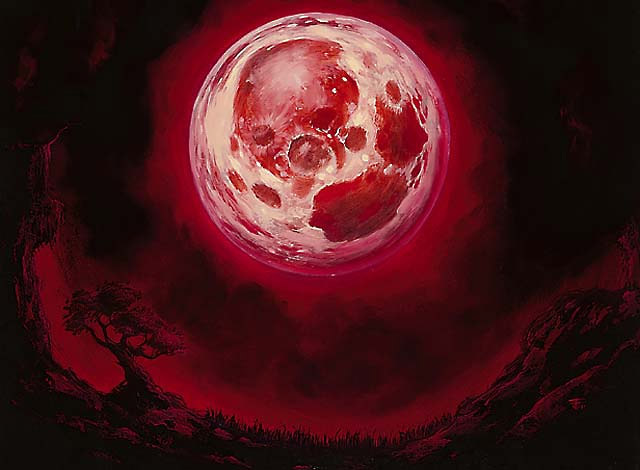
Unlike text-changing effects, type-changing effects are pretty common. Most Modern players have likely dealt with the effect of Blood Moon or Spreading Seas a few times. This week we'll look at what makes types tick and how modifying them works.

I've Got a Type

To identify a card's supertype(s), type(s), or subtype(s), look at the typeline around the middle of the card, to the left of its set symbol. Everything to the left of a long dash is a supertype or type; anything to the right, a subtype. Each card type has its own set of subtypes, with two exceptions. Creatures and tribals share their subtypes, as do instants and sorceries.

For example, Gingerbrute is an Artifact Creature - Food Golem. Food is its artifact subtype, while Golem is its creature subtype. Go-Shintai of Shared Purpose is a Legendary Enchantment Creature - Shrine. Legendary is its supertype. It has two card types: enchantment and creature. Shrine is its enchantment subtype, and it has no creature type. (I've probably said "Shrine is not a creature type" a few hundred times since the Kamigawa: Neon Dynasty Shrines were spoiled.)

Supertypes

Magic has five supertypes. Legendary, snow, and basic are commonly used. Ongoing has so far only appeared on schemes, a card type in Archenemy supplemental products. The last new card printed with the world supertype is old enough to vote... that supertype hasn't been used since 1996!

Adding or removing a supertype from an object only affects that specific supertype. For instance, activating Arcum's Weathervane's first ability targeting Dark Depths makes Depths a legendary land; removing its snow supertype doesn't affect that legendary supertype at all.

Land Ho!

Modern favorites Blood Moon and Spreading Seas set lands' type to a basic land type. While their implications can seem obvious—"It's a Mountain now, so I can tap it for {R}"—there's a bit more going on under the hood.

305.7. If an effect sets a land’s subtype to one or more of the basic land types, the land no longer has its old land type. It loses all abilities generated from its rules text, its old land types, and any copiable effects affecting that land, and it gains the appropriate mana ability for each new basic land type. Note that this doesn’t remove any abilities that were granted to the land by other effects. Setting a land’s subtype doesn’t add or remove any card types (such as creature) or supertypes (such as basic, legendary, and snow) the land may have. If a land gains one or more land types in addition to its own, it keeps its land types and rules text, and it gains the new land types and mana abilities.

Magic Comprehensive Rules

We'll unpack that wall of text with some examples.

Dryad Arbor under a Blood Moon is still a green creature. But since it's a Mountain instead of a Forest, it taps for {R}, not {G}.

If I activate Inkmoth Nexus in response to a Blood Moon, it will be a Mountain that can tap for {R} and won't have its usual abilities. However, since settings its land subtype doesn't remove abilities from other effects, it'll still have flying and infect until end of turn.

If Dark Depths is in play and then Blood Moon enters, Dark Depths loses its usual abilities and can tap for {R}. However, this doesn't affect its supertypes, so it's still a legendary snow land. It works a little differently if Blood Moon is in play first. In that case, Dark Depths would enter with no counters on it. If Blood Moon were to leave play after that, Dark Depths would immediately trigger and unleash Marit Lage.

Urza's No Good Very Bad Day

Modern pillar Urza's Saga hates Blood Moon. Since Blood Moon makes it a Mountain, it loses all its usual abilities, but still retains the Saga subtype. It's now a Saga with no chapter abilities, meaning its final chapter number is 0. Any number of counters (even 0) on the Saga triggers the following rule:

715.4. If the number of lore counters on a Saga permanent is greater than or equal to its final chapter number, and it isn’t the source of a chapter ability that has triggered but not yet left the stack, that Saga’s controller sacrifices it. This state-based action doesn’t use the stack.

Magic Comprehensive Rules

So Saga is sacrificed immediately.

While the underlying mechanics are a little different (it's in layer 6, not layer 4), Alpine Moon has the same general interaction with Urza's Saga. The Saga loses all abilities, and therefore its positive chapter numbers, and so must be sacrificed.

...And Another Thing

Normally, setting a card's type to something makes it become just that type. For example, Song of the Dryads on Grizzly Bears makes the Bears just a land. However, as with many rules in Magic, there are exceptions.

205.1b Some effects change an object’s card type, supertype, or subtype but specify that the object retains a prior card type, supertype, or subtype. In such cases, all the object’s prior card types, supertypes, and subtypes are retained. This rule applies to effects that use the phrase “in addition to its types” or that state that something is “still a [type, supertype, or subtype].” Some effects state that an object becomes an “artifact creature”; these effects also allow the object to retain all of its prior card types and subtypes. Some effects state that an object becomes a “[creature type or types] artifact creature”; these effects also allow the object to retain all of its prior card types and subtypes other than creature types, but replace any existing creature types.

Magic Comprehensive Rules

Like the above lands rule, this one has several different things going on. Why isn't this broken up into separate rules? Who knows. So, let's dissect it ourselves!

Angelic Destiny enchanting Grizzly Bears makes the Bears a Creature - Bear Angel. Since Angelic Destiny makes it an Angel "in addition to its other types," it applies alongside the creature's normal type, not instead of it.

The same is true of a card like Destiny Spinner. If I target a Forest, it becomes a Land Creature - Elemental Forest. "It's still a land" makes it retain all previous land types and subtypes.

Facts About Artifacts

Making something an "artifact creature" has always been a special case, and we added a new one semi-recently with Throne of Eldraine.

Suit Up targeting Nyxborn Courser makes the Courser an Enchantment Creature - Centaur Scout until end of turn. Since Suit Up makes its target an Artifact Creature, it retains its card types and subtypes.

On the other hand, if I enchant the Courser with Darksteel Mutation, Courser becomes an Enchantment Creature - Insect. Since Darksteel Mutation specifies that the enchanted creature become an "Insect artifact creature," it overwrites any existing creature types.

Cleanup

We've now covered basic type interactions and looked at how some of the quirkier rules around them actually work. Next week I'll make a slight detour from the normal rules-heavy stuff. Join me then for some chatter about tournament policy!

As a reminder, feel free to reach out on Twitter or our Insider Discord with any questions.

Question of the week: What's an all-time-great type-changing effect? (I know it's not Arcum's Weathervane.)

Spicing Up Those New Commander Decks

Are you a Quiet Speculation member?

If not, now is a perfect time to join up! Our powerful tools, breaking-news analysis, and exclusive Discord channel will make sure you stay up to date and ahead of the curve.

This is a follow-up to my article from last week here.

Did you all have fun at your pre-release events? I had a blast! Kamigawa: Neon Dynasty is definitely a spicy set full of returning mechanics and some very decent new ones. The new Commander decks are interesting and I've been playing them using some helpful Magic software. Here are a few modifications I think you may want to consider!

Let's Start with Chishiro

Honestly, the deck runs fine as is. Any significant upgrades will bring the power level up to consistently end the game faster so be mindful of your local expectations. Stuffing the deck with Berserk effects, double strike, and extra combat steps is definitely one way you could run it. I also considered making it a Bard Class-based deck, running a ton of legendary creatures like Borborygmos, but that would drastically change the deck makeup and I think there's a more fun way to go. My version is all about keywords: proliferate, evolve, and graft.

Keywords to Add!

Proliferate is definitely a deck archetype that gets a fair amount of love but usually, that love is mostly blue. Here I wanted to make sure I consider a card like Volt Charge just due to that fact. If you're going for more of a token angle consider Plaguemaw Beast who will have a steady stream of sacrifices to fuel the rest of your army. Obviously proliferate is great with Planeswalkers and Domri Rade is an inexpensive potential include if you're going more walker-heavy.

Thematic Ramp vs Generic Ramp

There are several ramp spells I would like to recommend instead of boring, staple cards like Kodama's Reach. I understand that Reach is very good, I rate it very highly, it's definitely a strong ramp spell in green. However, why not try out Grafted Growth from Neon Dynasty instead? It gets you a 2/2 just for casting it if your commander is out, then it gets you a +1/+1 counter to start your modification. Finally, it does not cost full mana. That's a triple threat and it's a common. On the same wavelength are cards like Nature's Embrace and New Horizons which are basically additional copies of Grafted. Each of these cards has tremendous synergy with your commander and ramps you!

Operation Protect Chishiro

Next, to really secure your control of the mid-game you will want to run a few low mana "save Chisiro" style effects. Remember, you're a bit vulnerable to timely disruption. If you wait for one more turn and have a save in hand you're likely to continue growing without issue. Unless there is significant pressure, don't feel the need to go completely all in every turn for acceleration. Chishiro is already breaking the sound barrier, no need to exceed the speed of light as well!

Just More Huge Value

After a board wipe, it's time for you to recover. Not to worry! Not only does Chishiro come stock with cards like Bear Umbra and Genesis Hydra it has tremendous synergy with other cards that help rebuild your board.

A Phylath, World Sculptor, or Avenger of Zendikar both refill your board and can go completely out of control with Chishiro or without. Consider them synergy and stability all in one. Likewise, Halana and Alena, Parners is sort of another copy of your commander. Another haste effect and just a powerful, synergistic card for only four mana. It's almost like I suggested watching out for this card.

Biogenic Ooze likewise rebuilds and grows all on its own or turbo grows with your commander.

A Few Additional Considerations

I found room for these cards depending on how I was shaping the deck. If I was a little more token-heavy, both Curses are insane power. For a little more "one punch man" style, Savageborn Hydra was a huge threat. Did I need a little more value? Scurry Oak could perform two roles at once. While the Curses are extremely good, I have played them a ton in other decks I'm looking for a different experience. This is also why I chose not run Contagion Engine, Contagion Clasp, or Sword of Truth and Justice. I mention them because they are obviously good for a proliferate heavy archetype, but I play them in other decks so I'm trying something a little different.

Still, that's one of the best things I find about this commander. You really can play Upgrades Unleashed in a bunch of different ways and modify the deck to achieve a very specific yet synergistic goal. I know I did not spend much time talking about what to remove and that's the point. Pick a pivot point for your version and you will know what to keep and what to toss.

This is really one of my favorite pre-made decks so I applaud Wizards here. That said, they also made this other one...

Buckle Up, It's Gonna be a Bumpy Ride

Kotori, Pilot Prodigy, on the other hand, is a mess. I took a look at some other deckbuilders' plans for modifying Kotori and I wanted to highlight one particular article by Zach Herwood-Mussen. After reading Zach's article, I can see he did his absolute best at salvaging the situation by suggesting the inclusion of Aetherflux Reservoir, and what I would call a bunch of non-thematic staple cards.

Why This Isn't For Me

So the combo is "simple" - turn Aetherflux into a creature with Cyberdrive Awakener give it lifelink from Kotori, then proceed to activate the deal 50 damage ability of Reservoir - since it has lifelink you gain 50 life each time thus you can machine-gun absolutely everything. Game. Over. While this is devastating in terms of the effect, it's not without problems. It relies on drawing the cards because of the lack of tutoring in the deck and requires gaining 11 life before activating (admittedly, not a difficult feat).

I would suggest you die to any direct damage effect with the damage trigger on the stack, or your hidden wincon is put multiple turns behind by taking any amount of combat damage. Ever. But there is something beyond this just being an extremely awkward combo in the back of your deck's pocket and it relates back to my article on The Heart of Commander.

Why bother playing Kotori if you're going to kill people with Aetherflux Reservoir, a card that has no trouble winning games? Heck, it's the primary wincon in a deck I list here. It's a great card for competitive Commander. Why turn Kotori into a slow combo deck that is not powerful? Props to Zach for creative thinking but in my opinion, it lacks in both the flavor department and the power department. For the same reason, I would not recommend using Test of Endurance or Felidar Sovereign in Kotori decks even though your commander will likely give you enough life to make those wincons live just by casting them.

No, as I said in my original evaluation of these decks, I wanted to give Kotori a fair shot as a primarily Vehicle based deck.

First Things First, Fix the Lack of Haste

On top of fixing the lack of haste effects, you gain a couple of ways to protect Kotori - at least until they pilot something. Furthermore, the deck has an overall lack of Artifacts and this is a solid way to increase your count.

Speaking of Increasing Artifact Count

The fact that not even a single Artifact Land was included with this deck is a major letdown. With keywords like metalcraft, affinity, and improvise you would expect the deck would be jam-packed but it's too light. These lands help.

Why is Consulate Dreadnought NOT in Kotori?

Follow me here. Turn one, Plains, Sol Ring, Consulate Dreadnought, Turn two. Island, cast Kotori, crew Dreadnought oh thank heaven it's a 7/11 with vigilance and lifelink! It is mind-boggling that the card is not included in this deck. There is no advantage to using Kotori as a commander if you cannot get down Vehicles in turn one or two, to then pilot on turn three. The base deck is extremely lacking in this area.

Out of the 15 original Vehicles in the deck, only ONE has an ability with a *large* turn three upside and that would be Colossal Plow. There are only three other two mana or less Vehicles, but two of them have actively bad abilities to use early. Smuggler's Copter might be useful, but because of how early it is you might not need or want to filter yet. Still, if you suggest that the Copter is always worth looting with, especially since the deck has so much graveyard recursion, that's still only two out of 15 Vehicles! Further, since the deck has no means of generating haste, all your larger vehicles are stuck waiting that additional turn before they can activate!

But wait, you might say, are there other Vehicles that should be in this deck? Yes.

Very Rare Vehicles

I understand that Wizards wants to sell more packs but come on. These are perfect includes for a Vehicle-based Kotori deck and instead of them, we get...Access Denied - an extremely expensive sort of on theme counterspell? Yuck, I say! Considering other Vehicles from Kaldheim made the cut, it's baffling that Cosima is missing. It is useful on both sides and was one of the first cards I added to my digital version for testing. It has proven to be excellent for multiplayer. Sometimes the best source of answers and threats is from the decks of your fellow players and this patches holes in this deck.

The Office of Redundancy Office

There are too many redundant cards for effects that you do not want or need. Out of Hanna, Ship's Navigator, Ironsoul Enforcer, Imperial Recovery Unit, Emry, Lurker of the Loch, Teshar, Ancestor's Apostle, and Dance of the Manse, I think the deck has far too much overlap on recursion. On top of that, they are not all Artifacts. I cut Hanna, Apostle, and Dance. There's also the Dermotaxi angle - if I'm going to use that card (I'm trying it out) recursion becomes a little less valuable.

Medium Rare is not Just About Steak

Raff Capashen, Ship's Mage is a way to give your Vehicles pseudo-haste one turn later. It's just so situational I don't understand why it was included in the deck. This was an easy cut for me. Shimmer Myr is the same. Just doing nothing is great if you have a lot of counterspells and a reactive style deck but it does not serve a Vehicle deck that wants to be attacking.

Armed and Armored is already not great in the stock version of Buckle Up. After increasing the Vehicle count to what I consider to be the maximum (about twenty) it still was unneeded.

A Fair Amount of Synergy

Digsite Engineer is great because it's just pure value. It makes pilots for your Vehicles, but also, those pilots will eventually become massive creatures on their own! Cosmos Elixir makes the lifelink feature of Kotori turn into card draw. Pair card draw up with affinity, and you can play a ton of permanents. Drawing lots of cards, gaining life, and making permanents is at least a start. However, that is where it also ends for the Pilot Prodigy.

Shorikai, Genesis Engine

I did not get in as many games as I wanted with Shorikai, Genesis Engine as the commander. Additionally, I wanted to play it as the commander of Buckle Up with no changes. Here, more things in the deck made sense. Since you're using the draw/discard ability of Shorikai, you're putting things into the graveyard to recur later. Also, you're filtering out all the redundant effects you draw. Your commander is a little less vulnerable to random removal because it's not a creature and it has its own strategy.

This was supposed to be the commander. I'm not going to say this made the deck significantly better, but, it had a solution for the "one-third" problem I mentioned previously. Shorikai filters your draws so you're extremely likely to hit Land if you need it, get pilots if you need them, get recursion when you need it, and not draw cards you do not need. I think Shorikai will find itself being used for draw/discard shenanigans. It also has tremendous synergy with some sweet artifacts like Unwinding Clock and Voltaic Key, allowing you to do some really unfair and powerful things like use Dramatic Reversal and Isochron Scepter. It's a completely different deck archetype and doesn't care about the Vehicle angle at all. I would bet that this is how you are going to see Shorikai in Commander. Kotori? Not so much.

Kamigawa Neon Dynasty Commander Decks - Yay or Nay?

I have to say yay. The Chishiro games were worth the price of admission and I'm going to continue to work on that deck as my Gruul Commander. Kotori? No. I played over a dozen games, iterating on it and trying my best to stick to a theme. In the end? I give up. Don't be like me! Try using Shorikai as your commander right out of the box - I bet your games will be a lot more enjoyable and I know that your future additions for Shorikai will be a lot more powerful, thematic, and ultimately fun!

20 Colorless Cards to Mine from Bulk

Are you a Quiet Speculation member?

If not, now is a perfect time to join up! Our powerful tools, breaking-news analysis, and exclusive Discord channel will make sure you stay up to date and ahead of the curve.

My last article focused on some of the gold cards to pull from bulk. I set the rules for this series at TCGMid of more than $1.49, but less than $5. This week's article covers colorless cards.

When I started playing, "colorless" would have exclusively meant artifacts, but ever since Wizards printed Ghostflame, that definition had to change... the Eldrazi really expanded it! As always, this list will not be inclusive of all the cards that match the criteria, but instead focus on the lesser-known ones that do. For instance, many incarnations of Sol Ring meet our requirements, but Ring is a tad obvious. This week's list was bumped up to 20 as we've got tons of juicy targets to explore. Let's get to it!

No Colors, No Problem

1. Soul-Guide Lantern

Soul-Guide Lantern - Given this card only recently rotated out of standard, it is surprising to see it on the list so soon. However, considering that it's mostly an upgraded Relic of Progenitus (which was a $5 common at one point), its price is likely to rise once in-person events begin and people need copies to fetch with Urza's Saga. Unlike Relic, Lantern notably only affects opponents, so players running Tarmogoyf and the like are happy to include it.

There was an error retrieving a chart for Soul-Guide Lantern

2. Talisman of Hierarchy, Conviction, and Creativity

The Mirrodin talisman cycle has been on my bulk pick list for a while, with the Dimir, Rakdos, and Azorius ones being worth a fair amount. It is not surprising that the enemy ones would also quickly rise out of the "bulk" category. They are still technically in print, so there is some risk there. However, I have to imagine we are at the tail end of the overall print run for Modern Horizons 2. None of the green ones made this list because Commander decks that run green tend to not need Talismans (green provides the necessary mana fixing).

There was an error retrieving a chart for Talisman of Hierarchy
There was an error retrieving a chart for Talisman of Conviction
There was an error retrieving a chart for Talisman of Creativity

3. Swiftfoot Boots

Swiftfoot Boots was often considered a budget version of Lightning Greaves. Still, in a format that prizes redundancy but is restricted to singleton copies, even budget versions are destined to become staples.

There was an error retrieving a chart for Swiftfoot Boots

4. Memnite

Memnite's value is often closely tied to whether or not there is a really powerful artifact -hemed deck in Modern, or one that really needs to cast threats quickly. Thanks to Hammertime, we currently meet that requirement. Should the deck fall out of favor, expect Memnite's price to begin a descent.

There was an error retrieving a chart for Memnite

5. Whispersilk Cloak

As with Swiftfoot Boots, many Commander decks need to protect their commanders to operate as intended. Whispersilk Cloak does that and also plays well with commanders intent on attacking. Multiple versions of this card meet our criteria, so pull all of them!

There was an error retrieving a chart for Whispersilk Cloak

6. Colossus Hammer

Arguably the most important card in the Hammertime modern deck, this card has no slightly worse options, and will remain a key card in that archetype until it loses an important card or two or a better equipment is printed.

There was an error retrieving a chart for Colossus Hammer

7. Wayfarer's Bauble

I have been selling copies of Wayfarer's Bauble on TCGPlayer for over 2 years, and have never had to buy a copy at more than bulk. It is pretty inconspicuous for a common, but one of the most efficient land ramp artifacts for decks without green.

There was an error retrieving a chart for Wayfarer's Bauble

8. Springleaf Drum

Another modern card whose price is heavily dependent on the metagame; not surprisingly, this one is also in the Hammertime deck.

There was an error retrieving a chart for Springleaf Drum

9. Grafted Exoskeleton

With so few ways to remove or stop poison, the ability to give any creature infect, especially ones that damage multiple players at once, is extremely powerful and highly desirable in Commander. Given how broken of a mechanic infect it, we don't see many new cards referencing it, so Grafted Exoskeleton is likely going to continue gaining value barring any reprints.

There was an error retrieving a chart for Grafted Exoskeleton

10. Plague Myr

Speaking of infect, Plague Myr is a mediocre mana dork who happens to have infect stapled onto it, which is indeed enough to make the list.

There was an error retrieving a chart for Plague Myr

11. Trailblazer's Boots

Trailblazer's Boots is a pet card of mine that I have run in Commander decks since I started playing the format back in 2009. Given a prevalence of non-basics in most Commander decks, this equipment essentially makes a creature unblockable for very low cost.

There was an error retrieving a chart for Trailblazer's Boots

12. Honor-Worn Shaku

While there are no shortage of mana rocks to choose from in Commander, there are very few that can untap multiple times in a turn, and Honor-Worn Shaku is among them.

There was an error retrieving a chart for Honor-Worn Shaku

13. Not of This World

Free counterspells are free counterspells, and while Not of This World may be limited in scope, it is still plenty powerful.

There was an error retrieving a chart for Not of This World

14. Geth's Grimoire

A must-include in any discard-based Commander deck that happens to spike every time some new one comes out.

There was an error retrieving a chart for Geth's Grimoire

15. Genesis Chamber

While card]Genesis Chamber[/card]'s effect is symmetrical, decks that would play this card tend to find ways to take more advantage of it.

There was an error retrieving a chart for Genesis Chamber

16. Geode Golem

Unlike the others on this list, Geode Golem is a Commander 2018 exclusive and was only included in two of the decks, so one is unlikely to hit a stack of them in bulk. Still, knowing it is almost $3 means finding one copy in a stack of 1000 cards puts you at at break-even.

There was an error retrieving a chart for Geode Golem

17. Pathrazer of Ulamog

While a lot of focus jas always been on the three big Eldrazi from Rise of the Eldrazi, any creature with Annihilator on it has potential simply off the back of how powerful of a mechanic it is.

There was an error retrieving a chart for Pathrazer of Ulamog

18. Coldsteel Heart

There aren't many 2-cost mana rocks to choose from and this one has very little downside. It is also one of very few that provides snow mana, which thanks to Kaldheim and Modern Horizons 2 has some serious upsides.

There was an error retrieving a chart for Coldsteel Heart

19. Cloak and Dagger

We saw the Rogues archetype in standard not too long ago and, with the printing of so many Rogues it isn't surprising that this single-print uncommon from Morningtide holds value.

There was an error retrieving a chart for Cloak and Dagger

20. Pili-Pala

Pili-Pala has a unique ability which can often combo with other cards to create infinite loops in Commander. Originally a common in Shadowmoor, its only other printing is in the Mystery Boosters, so there just aren't a ton floating around.

There was an error retrieving a chart for Pili-Pala

Keep On Pickin'

I feel the need to reiterate that while this list is not all inclusive of colorless cards, it does cover a nice range of random cards one might see digging through bulk. I find expanding my knowledge base on these types of cards prevents me from having to re-dig through bulk I had already been through looking for missed gems. I can certainly say that fatherhood had greatly diminished the time I can devote to picking bulk, so I am very vested in maximizing my efficiency and eliminating wasted time and effort. Happy hunting!

Real-world Flavor. More Horror From Dante, Stoker and Conrad

Are you a Quiet Speculation member?

If not, now is a perfect time to join up! Our powerful tools, breaking-news analysis, and exclusive Discord channel will make sure you stay up to date and ahead of the curve.

Rats, rats, rats! Hundreds, thousands, millions of them, and every one a life.

In the past two articles, we analyzed two English-speaking authors, namely Coleridge and Poe. Despite their differences, both writers share a tendency toward themes of horror and fear. As we discussed, that is why they were mostly quoted on black or dark-feeling Magic cards. However, they are not the only authors of this kind appearing in Magic flavor. In this installment, we are going to discuss a few more cards whose flavor texts range from ominous to purely horrific.

The quotation above comes from Stoker's epistolary novel Dracula, a masterpiece of gothic fiction and one of the most quoted horror works of all time. Before moving to Stoker, however, let's start with a much more ancient author, the father of Italian literature Dante.

Carnophage

And in their blind and unattaining state / their miserable lives have sunk so low / that they must envy every other fate.

First printed in Exodus (1998), Carnophage is an all-star of mono-black aggro decks, and especially of tribal zombie decks. The flavor of its first printing, “Eating is all it knows,” is already memorable. With the card's Friday Night Magic promo reprint (2001), it received an epic quotation from no less than Dante Alighieri.

This is one of my all-time favorite quotations. It also makes for one of the most horrific phrases to appear on a Magic card. from Dante's Inferno 3, 43-45, it's the only quotation of his used on a Magic card. It's also notably one of the few cases where the translator is explicitly mentioned. We are talking about American translator John Ciardi, who published his translation of Dante's Inferno in 1954.

Three verses are quoted on the card. The speaker of the lines is Virgil, Dante's guide through Hell and Purgatory. His guide shows Dante how the souls of the “Ignavi,” those who in life have never taken a side either good or evil, are punished for not choosing. Their punishment is constantly running after a meaningless sign while being poked endlessly by wasps and flies.

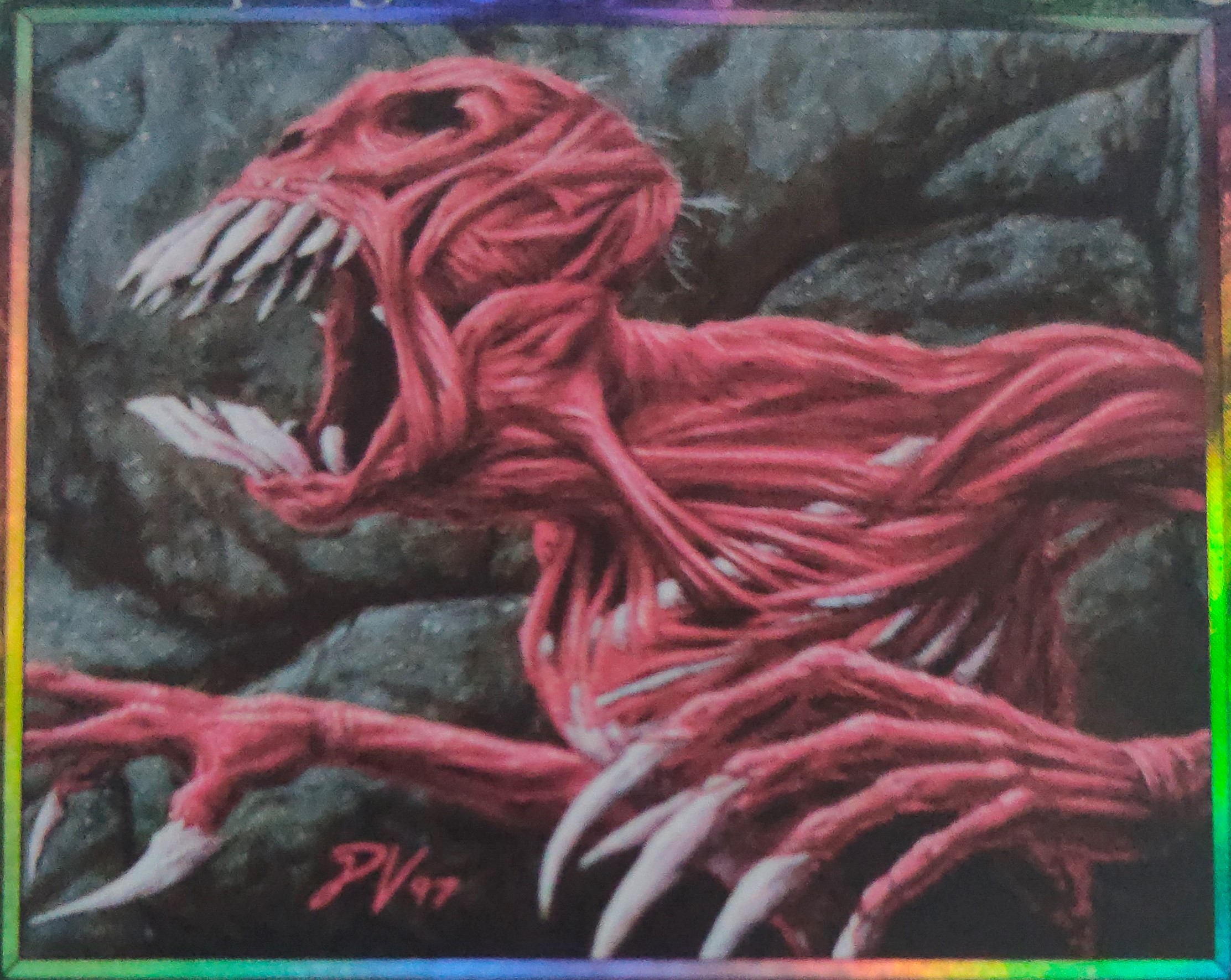
This is not the most spot-on of image-quotation couplings in my opinion. The zombie illustrated by Pete Venters is a solid creature and not a spirit. Even the name Carnophage quite literally means “flesh-eater.” The quotation doesn't make sense in this context even when the souls described by Dante are getting eaten by swarms of insects. Still, I like how both the quotation and the illustration succeed in displaying pure pain and misery.

Swarm of Rats

Rats, rats, rats! Hundreds, thousands, millions of them, and every one a life.

Swarm of Rats first saw print in the beginners set Portal (1997). It was reprinted a few times after that. Starting with Eighth Edition (2003), it got this quotation from Bram Stoker’s Dracula. This rat costs two mana and its power grows depending on the number of rats you control. Its toughness always stays at one, which doesn’t make it particularly reliable. In spite of that, it’s a great kitchen-table card. It surely made many new players try and build a tribal deck based on rats.

Taken out of context, the sentence quoted on this card is not impressive. However, if you know the context, things change a lot. Swarm of Rats might even become the most disturbing card of the game. The excerpt comes from a monologue by Renfield, a psychiatric inmate suffering from delusions. Renfield has the habit of eating insects, spiders, and even birds. Not nice. Van Helsing is interrogating him, and he tells his story. Apparently, he believes that eating living creatures will provide him with more and more life, making him immortal. As you can see, the swarm of rats by itself is not the worst thing.

Taste of Blood

How blessed are some people, whose lives have no fears, no dreads, to whom sleep is a blessing that comes nightly, and brings nothing but sweet dreams.

This is a special case of a dark quotation. In fact, it does not depict anything bad. Instead, it works by subtraction, by opposition. It mentions people who live in peace and whose dreams are good. The effect, however, is to evoke the opposite, especially if you again know the context of the source material.

The person speaking (or rather writing) is 19-year-old Lucy Westenra, the first victim of Dracula in England. Lucy keeps a diary, and in this entry, she describes her sleeping issues. Right before the quotation, we can read: “Oh, the terrible struggle that I have had against sleep". And later on: "The pain of the fear of sleep, and with such unknown horrors as it has for me!”

The choice to quote Dracula on a card called Taste of Blood is a little on the nose, but it works. The illustration portrays a young girl with vampire marks on her throat. At the same time, she seems to be already drawn to the very flavor of blood. Perhaps she is transforming into a vampire herself, just as Lucy in the novel? The flavor text sounds much less reassuring.

Fear

The horror. The horror.

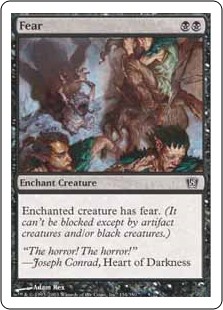
One of the most recognizable quotations in Magic comes from Joseph Conrad’s Heart of Darkness (1899). It’s a brief quote, but it’s effective — especially on a card called Fear. The character pronouncing the sentence is Kurtz, and these are his last words before dying. Here's more of the quote from Conrad:

Anything approaching the change that came over his features I have never seen before, and hope never to see again. He cried in a whisper at some image, at some vision—he cried out twice, a cry that was no more than a breath: “‘The horror! The horror!”

The horror he’s talking about invests his whole life and his destiny. It’s a final, bitter judgment on the evil nature of humankind and colonialism. Nothing specific is mentioned, and still, it evokes every kind of vile and wicked deed. In this case, there is also a nice, additional treat, since most readers will be familiar with Coppola's Apocalypse Now.

The film, from 1979, is an adaptation of Conrad's novella, even though the setting moves from Congo to Vietnam. More importantly, the very character of Colonel Kurtz pronounces the same line, one of the most famous of modern literature and cinema. We can all visualize Marlon Brando's chilling interpretation.

Again, the card's power level and its flavor text are not necessarily on the same level. An aura giving Fear for two mana is not memorable at all. This brief and powerful quote, on the other hand, is sure to have an impression on many players.

Different kinds of Horror

We only analyzed four cards this time around. There is a common thread running through these quotations, though each is somewhat different from the others. The only quote in verse is from Dante's Inferno. The other three come from a novel and a novella, and are in prose. Apart from these matters of stylistic presentation, what I find more interesting is the different shades of horror they deliver.

Carnophage's text directly describes a dreadful scene, whose setting is literally Hell. It shows victims being punished eternally, and it's quite obvious how such a scene affects the viewer. Swarm of Rats is somehow similar, as its text also portrays a concrete scene. What is really frightening here is not the pack of rats. Rather, it's the awareness of what they represent to the (unmentioned) human figure who's speaking.

With Taste of Blood we pass to a slightly less violent kind of horror. The excerpt only evokes nightmares by mentioning sweet dreams. It is up to the reader (or in this case, player) to complete the picture with their own sensibilities. This is, after all, the case with any kind of good literature, is it not? Finally, we have the tragic, mighty briefness of Fear's flavor text, a great example of how to conjure the worst you can think of without even saying it.

Conclusions

In the course of this installment, we moved between different ages and languages, with the only constant element being the emotion of fear. As we've seen, there are several ways of evoking that feeling. This is another reason why I find Magic's flavor texts so captivating. In this series, we are only dealing with real-world quotations, but we all know they only represent a tiny fraction of the full corpus of Magic flavor.

Don’t Overestimate New Cards

Are you a Quiet Speculation member?

If not, now is a perfect time to join up! Our powerful tools, breaking-news analysis, and exclusive Discord channel will make sure you stay up to date and ahead of the curve.

The Prerelease for Kamigawa: Neon Dynasty is over, and the set is fully released on MTGO. That means it's time for testing and brewing. And hot takes. So many hot takes. This is par for the course in Magic, it's only now that the more measured and data driven results begin coming in that the real impact of a set can be measured. However, that comes with an asterisk.

And that asterisk is that nobody is fully immune from hype. It's human nature to jump on bandwagons and fall in line with the group. What's important is to not let that hype continue forever. The longer you buy into the hype, the harder it will be to escape its pull. Which is where I conveniently come in.

I've always enjoyed providing hard reality checks against hype and rhetoric, especially post set-reveal. Today will be no different. Modern got some new and unexpected toys from NEO and while they're good, they're not as good as the hype might have you believe.

A Legendary Group

In case the above linked articles aren't sufficient clue, the new legendary channel lands are the hot cards for... well, every format, frankly. However, Boseiju, Who Endures has been picked to be such a powerhouse that its arrival will be format warping. Which is quite the hot take, but when the card in question is an uncounterable Naturalize mixed with Cleansing Wildfire, I understand where the hype and excitement are coming from.

There was an error retrieving a chart for Boseiju, Who Endures

All the channel lands promise to provide useful and uncounterable effects for many decks at low cost. That's low, not no cost, despite what I've overheard some discussing. Every card that is put into the deck is taking the place of some other card. Economics 101: everything has an opportunity cost. In this case, the cost is a mono-color land (which is usually assumed to be a basic in my experience) but in exchange, decks potentially gain another spell. And that is quite good.

Two Shall Lead

Boseiju has been the most discussed of the cycle for Modern, and for good reason. Destroying artifacts and enchantments is quite important with Urza's Saga and Colossus Hammer being so heavily played. Add on the ability to destroy opposing non-basics and it's yet another nail in Tron's coffin! Which has been said so many times by now that it's lost all meaning. However, the point stands that Boseiju is likely to be relevant across the board.

The other big gain is Otawara, Soaring City. Four mana for kinda-Boomerang is too much to pay. However, when it's uncounterable and critically not a spell, suddenly it becomes a great rate. At least, for one very specific job: removing a resolved Teferi, Time Raveler on the opponent's turn. Otawara will be the first card that can do that as far as I'm aware, and could prove exceptional in control mirrors.

There was an error retrieving a chart for Otawara, Soaring City

However, outside of that, Otawara is unlikely to be channeled often. Four mana is pricey for the effect. I know that all these lands have cost reduction. However, in my testing, that clause just isn't relevant. Ragavan, Nimble Pilferer is the only legendary creature that sees widespread play, so the channels will never be especially cheap, and even at three mana the effect is expensive.

The Problem

Which is foreshadowing for my overarching point today. From what I've seen and heard, most players are heavily overestimating these cards. It's natural to see a new set with beloved effects that have never seen play before and get excited. However, that is a dangerous (and costly) road to walk. The hype is leading to unrealistic expectations and ignores the reality of playing with these lands. Especially the cost of playing them.

Sage's Wisdom

There have been measured takes out there, but the best one comes from Frank Karsten. As Magic's math guru, he worked out the math for these channel lands and drew some conclusions that I agree with and informed my own opinion. I realize that many readers don't have a CFB Pro subscription, so here are the saliant points for this article's purposes:

  1. The cost of including the first channel land is low but not zero. It is also higher than previous legendary lands because the channel lands aren't true spell lands like Pendelhaven; they're closer to MDFC's like Shatterskull Smashing. A choice must be made.
  2. Therefore, they must be played as lands more often than used as spells. This necessity is reduced as more copies are played.
  3. But given that, the risk of drawing multiples increases as more copies are played, just like with any other card. Because they're legendary, the risk of drawing only channel lands increases as a function of the number played and land count.
  4. The effects are solid, but not especially powerful. This reduces their playability and makes their risks more significant.
  5. Two should be the most common number played based on the math and risks involved.

Frank noted that all his work was theory-crafting and that actual experience might alter the conclusions. I have been testing these cards and will largely confirm his conclusions, but there are additional points I want to expand on.

The Karakas Effect

Primarily, Frank mentioned the risk of drawing only the legendary lands, but he didn't go into great detail. It's not something easily quantified, so he simply mentioned it and moved on. I'm here to say that this is the biggest problem with these lands.

I play Legacy Death and Taxes. As such, I've spent years playing with multiple copies of Karakas. Karakas is great in Legacy both as an answer to Emrakul, the Aeons Torn and Griselbrand and to protect Thalia, Guardian of Thraben, and in a format with Wasteland, playing multiples is essential. However, drawing multiples as my only lands happens, and it really hurts. In those circumstances, Karakas is just a bad Lotus Petal. Sometimes that's okay as the first gets Wasted or you have a lot of Aether Vials. However, when you actually need to make land drops to cast expensive spells, it's a nightmare.

There was an error retrieving a chart for Karakas

Given the risks involved, experience suggests that players will want to severely limit how many channel lands they play. Outside of Legacy, there's little risk of losing the first one to enemy fire and Wasting yourself is never good. However, that would mean that there's little chance of ever using the lands for their effect, and players generally hate those kinds of decisions. Thus, there's considerable tension to playing these lands, more than previous legendary lands.

The Basics Problem

On that note, the opportunity cost of these lands is low, but it isn't zero. That's just how opportunity cost works. Replacing a dual land with a channel land is a very high cost because of color requirements. This means that basic lands are the most likely sacrifice as the cost to color access is lower. Which is a fair assessment, but it misses critical extra costs associated with cutting basic lands.

There was an error retrieving a chart for Blood Moon

Namely, losing to Blood Moon. I know that Boseiju answers Moon, but that has a massive asterisk attached. By replacing basics with non-basics, the risk of getting locked out by Moon is increased. Which is the whole point of playing Blood Moon in the first place. However, the other problem with cutting basics for channel lands is that it makes Modern's fetch/shockland manabase unstable. Basics are essential for reducing the life cost of mana and channel lands can't be fetched. Having to fetch a Breeding Pool instead of Forest or Island at low life is very dangerous.

About that asterisk: Boseiju answers Moon if and only if it is in hand and there's 1G available to cast it. Moon's only really dangerous when it catches players tapped out with only non-basics. It follows that Boseiju is no better at saving unprepared players from Moon than Prismatic Ending is. Which is to be expected given Boseiju's reality rather than the expectations.

Boseiju Is Overrated

I would go further and say it is severely overrated. The rest of the cycle appears (to me) to be valued appropriately, but Boseiju gets far more credit than it deserves. It's a fine card and quite playable in Modern, but it can't live up to the hype. It's not the fault of Boseiju so much as that players have unrealistic expectations. The articles I linked in the intro believed that Boseiju will be format defining while I'm here to say that it's just a role player. It has a place in Modern and will see play. It just won't redefine the format.

Severe Limitations

The biggest problem with actually playing Boseiju for its channel effect is that the effect plays worse than expected. Path to Exile has fallen off because turning Ragavan into a mountain is not great, no matter how necessary at times. Boseiju is like Path, but worse because the destroyed artifact, enchantment, or non-basic land is replaced by any land with a basic land type. And if exchanging a creature for a basic is bad, turning Urza's Saga into Stomping Grounds is worse.

There was an error retrieving a chart for Urza's Saga

Not to say that it isn't better than the alternative. Turning a Tron land into Forest at instant speed is good (see also Field of Ruin) and getting Saga off the board may be necessary to survive. However, anything less than that feels very bad. Turning Gruul Turf into Stomping Ground is not much of a downgrade. And then there's the possibility that the opponent searches up a triome and fixes their mana. It is very difficult to color-screw opponents using Boseiju.

Which is very relevant given that many arguments for Boseiju point to it always having targets against every deck. Not every deck has artifacts or enchantments to kill, but almost all have nonbasics to destroy so there's always something to do with extra copies. And Life from the Loam and Wrenn and Six recurision can run decks out of nonbasics. Which may be true, but for that to happen the opponent would have to do nothing for a very long time so you can durdle in peace. If that's the case, you were never losing that game in the first place.

A Hostile Metagame

The other question is whether the land is more relevant than the artifact or enchantment being destroyed. Most of the ones being played right now are really cheap, easily replaceable, and recurrable via Lurrus of the Dream-Den. Again, turning Colossus Hammer into Plains may be necessary to survive, but it also accelerates the opponent toward Lurrus and getting the Hammer back. Against most artifact decks, Boseiju should be regarded as a stopgap, nothing more.

If more decks were playing more expensive artifacts or enchantments, it would be a different story. Killing a Krark-Clan Ironworks or similar would be very good, but that isn't a thing in Modern anymore. It's different in sideboard games since powerful enchantments are popular sideboard cards. Turning Rest in Peace or Ensnaring Bridge into a land sounds excellent. However, those types of cards don't see much play right now either, leaving Boseiju as a good card in the wrong metagame.

Realistic Expectations

The bottom line is that the channel lands are playable, but have an unexpected amount of baggage attached to said playability. Especially compared to older legendary lands. Therefore, while they will see play, it won't be as widespread as the hype suggests. Otawara seems like it will be quite important in control decks where I'd start with two copies. The other channel lands will likely be one-ofs in the maindeck and Boseiju will likely see more copies in the sideboard. However, they're hardly going to be format redefining. Read the cards that actually exist, not the cards in your head.

On Magic and Elvis Memorabilia

Are you a Quiet Speculation member?

If not, now is a perfect time to join up! Our powerful tools, breaking-news analysis, and exclusive Discord channel will make sure you stay up to date and ahead of the curve.

Inspiration for this week’s article came from a Facebook chat with Magic collector Philipp Shary. While I prefer Twitter (@sigfig8), I’m always eager to engage with folks in the community to talk all things Magic and Magic Finance.

“When is the best time to buy a collectible, Reserved List / Old School card?”

In traditional cheeky response, the best answer to this question is “yesterday.” While there’s your typical week-to-week and month-to-month variation, these classic cards have done nothing but appreciate over the past decade. The most iconic have been increasing in price for even longer—Black Lotus’s steady incline can basically be traced back towards the game’s inception.

There was an error retrieving a chart for Black Lotus

In terms of investment returns, there is very little that rivals iconic Magic cards.

How long can this trend really last? If a played Unlimited Black Lotus climbed from $100 to $10,000+ over the course of nearly 3 decades, does that mean we should expect another two orders of magnitude—$1,000,000—by 2050? I don’t think so. I suspect things will flatten and perhaps even reverse by then.

What’s my supporting data for such a prediction? I’m not so sure I have compelling evidence, but I can start with a comparison to the King of Rock and Roll himself.

Elvis Presley Memorabilia

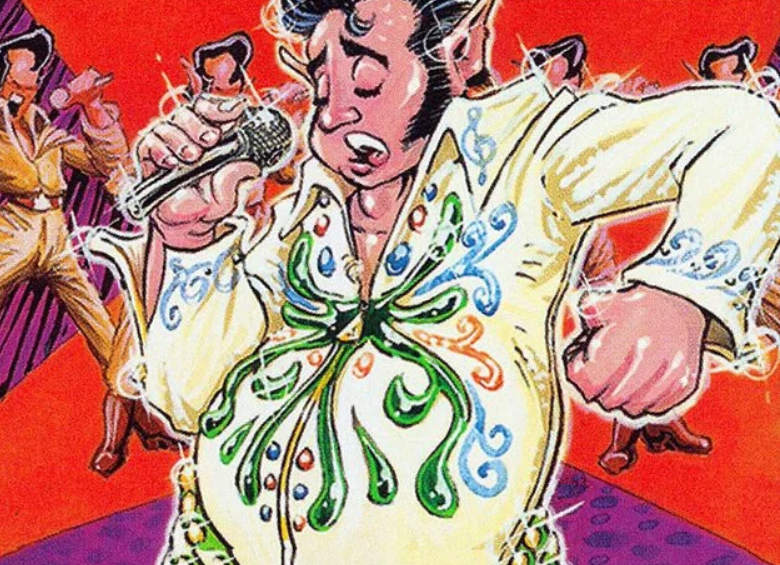
Elvis Presley, deemed the “King of Rock and Roll,” was a popular singer, actor, personality, etc. throughout the 1950’s, 1960’s, and into the early 1970’s before his unfortunate death in 1977. He is by far one of the most iconic people of the 20th century. He’s got all sorts of records and awards from his musical career, and he was even posthumously awarded the Presidential Medal of Freedom back in 2018.

In other words, this man was and still is a legend.

For years after his death, fans and collectors cherished (i.e. highly valued) all sorts of Elvis memorabilia. Ticket stubs, posters, signatures, worn clothes, pens, records, cuff links
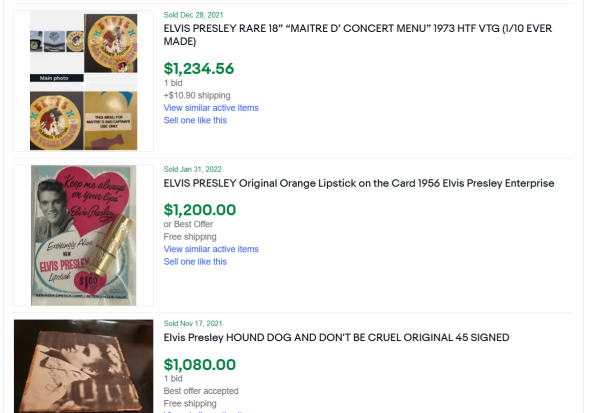
 you name it, if it is associated with Elvis Presley, it could be worth good money. A quick search on eBay reveals dozens of sold items worth over $1000.

While it’s true these items still hold significant value—the Elvis Presley estate brought in roughly $1.5 million of memorabilia sales in 2019—collectors have observed the value of their items dropping over the past decade. As recently as 2017, memorabilia sales were more than double, at near $4 million. What gives?

A strong hypothesis is that the die hard fans of Elvis are aging, and with that their interest may be fading. Or in an extreme case, people with collections of memorabilia are passing away and their items are flooding the market. Since Elvis was most popular about 60 years ago, those with nostalgia for the singer are going to be aging in step. The new generations have only heard of Elvis—many may not even be able to name a single song he recorded.

With a lack of interest from younger generations, the luster of Elvis collectibles has started to fade.

Magic’s Place in the Timeline

This paints a dire picture for Magic fans. Eventually, the players and collectors with the greatest nostalgia for old Magic sets will age in similar fashion to Elvis fans. Fortunately, Magic is 20-30 years behind Elvis. So while die hard Elvis collectors are probably in their 60’s and 70’s, the super-collectors of Magic are still in their 30’s and 40’s (I myself am a thirty-something). In this age range, we’re still raising kids, teaching them the joys of Magic, and re-living our childhood by slinging spells first created in 1993 and 1994.

For this reason, Magic as an investment should still have at least 20 more years of health, before collectors decide to liquidate their collections en masse. What’s more, Magic is far from dead. You could argue the game is still in its peak, receiving significant attention from players, collectors, investors, and Hasbro shareholders. With this kind of attention, it’s not likely the game will be going away any time soon.

This means there’s a chance for newer generations to engage in the game and develop a bond with it. So while today’s thirty-somethings and forty-somethings are heavy collectors, there’s hope that a similar sense of nostalgia will reach players in their twenties about ten years from now. Only, their nostalgia may be for original Mirrodin and Champions of Kamigawa, rather than Arabian Nights and Revised.

There was an error retrieving a chart for Umezawa's Jitte

I don’t think this means the older stuff will fade away altogether—it may just receive less focus.

External Factors

There are other factors to keep in mind when attempting to extrapolate Magic card values years away from now.

First, there’s the overall health of the game. Magic is thriving today as players continue to feel hype with each new set release—Kamigawa: Neon Dynasty is no exception. As long as the game remains popular and the player base robust in size, the collectability of the game’s older cards will remain a worthwhile financial endeavor. Given the now 29-year history of the game, I don’t think it would suddenly die overnight, either. Chances are we the players will see the writing on the wall well before the game’s eventual death. As of today, I see no such signs.

Second, we need to consider the broader economy. The last couple years led to significant price appreciation in many asset classes, including Magic, cryptocurrency, stocks, and other collectibles. But nothing moves up in a straight line forever. We have already begun to see some cracks in America’s economy as inflation rears its ugly head, forcing the Fed to react with raising rates. This will act like a wet blanket on the market, and it could lead to some softness in Magic prices. It wouldn’t be the first time Magic prices took a pause and pulled back in price.

There was an error retrieving a chart for Underground Sea

From 2018 to 2020 there was a significant pullback in card prices after notching all-time highs in June 2018. It wasn’t until about February of 2021 before prices started seeing new records (depending on the card). We’ve even been in a consolidation phase for the past few months as prices bounce around without significant moves (with some exceptions). If we see a large drop in stock prices and cryptocurrency prices, it could have a short-term impact on Magic prices too. From there, it’s difficult to predict when everything will rebound, though I have to believe it all will rebound eventually.

Third, there’s the simple fact that card prices just can’t go up forever. Eventually, things have to level out, almost like an asymptote. Where that asymptote lies on the scale is difficult for me to predict. But I think it’s safe to say Unlimited Black Lotuses will never reach $1,000,000 in my lifetime (probably not ever). Some of the rarest, most collectible pieces of artwork never reach that level, so why would an Unlimited rare with over 10,000 copies in circulation? I just don’t see it.

I have a very difficult time imagining $100,000 Unlimited Black Lotuses, too. At some point, the opportunity cost is simply too great. Would you rather have a piece of cardboard or a down payment on a house? A piece of cardboard, or your child’s college tuition fully covered? At some point, the equation stops making sense.

If we embrace this theory, then prices must peak eventually. They may not peak and then sell off drastically, but they could peak and then drift sideways for years, with a slow and steady decay as the collector population ages. Are Old School players going to be so focused on their Erhnam and Burn-em and “The Deck” decks into their 60’s? Perhaps by then, they'll have other priorities in life, though it’s difficult to say for sure.

Wrapping It Up

All these factors introduce uncertainty. With this uncertainty in mind, I’m creating a plan. It’s not fully cooked, so I’m not ready to share it just yet. But, with the end goal of raising funds from Magic to fund my two children’s college educations, I recognize that I have a timeline to work against. I will absolutely need to have most of my collection sold in the next 10-ish years.

What I haven’t figured out yet is the best way to sell everything. Should I find a large vendor looking for a significant boost in Old School inventory, and sell it to them at once? I don’t love that idea because it likely implies taking a hit on value. The most cost-effective approach would probably be to sell it all, gradually, a couple cards at a time. If I’m going to do that, however, I almost need to start now; an example, hypothetical cash-out target date of 2030 doesn’t leave me as much time as you’d think to sell this whole collection piece by piece.

As I compare Magic to Elvis, my confidence in card price stability remains strong. While it could offer some foreshadowing for what may happen to card prices twenty years from now, the player base with maximum Magic nostalgia is still young enough to remain engaged in the hobby. This “Suspicious Mind” sees plenty of “Shake, Rattle, and Roll” left in Old School prices—at least for the next decade!

Quiet Conversations Episode 2 – “Kamigawa Neon Dynasty”

Are you a Quiet Speculation member?

If not, now is a perfect time to join up! Our powerful tools, breaking-news analysis, and exclusive Discord channel will make sure you stay up to date and ahead of the curve.

An Exciting and Powerful New Set

In this episode of Quiet Conversations, five members of the Quiet Speculation team discuss a few of the cards they're most excited about from the new set and share their overall impressions.

Show Notes

  1. Introductions
  2. Kamigawa Neon Dynasty General Impressions
  3. Standard – Adam
  4. Modern – Jordan, David E.
  5. Legacy – David E., Beardy
  6. Commander (Main Set cards) – Beardy
  7. Alchemy/Historic – Adam
  8. Open Comments: Panel
  9. Wrap

Pannel Members

Limited Preparation Beyond The Basics

Are you a Quiet Speculation member?

If not, now is a perfect time to join up! Our powerful tools, breaking-news analysis, and exclusive Discord channel will make sure you stay up to date and ahead of the curve.

Deeper Limited Preparation and Deckbuilding

It's Kamigawa: Neon Dynasty prerelease time! In a previous article, I looked at some of the basics of preparing for prerelease, with tips on how to make your prerelease experience the most enjoyable. This week, we're going to delve a little deeper and look at a few preparation tips that can help you win your event, or at least help you build a better deck. These tips will help you with any Limited event you're playing, whether preparing for prerelease at your Local Game Store (LGS), for a Grand Prix, or for Game Day in March if your LGS is running Sealed for their Game Day.

Limited Archetypes and Key Cards

Limited archetypes matter a little less in Sealed than Draft. In Draft, you have more of an opportunity to craft your deck. This allows you to lean into the synergies of the cards you open and are passed by other players. In Sealed, you are confined to building your deck from what you open in your packs. It is still important to be familiar with the limited archetypes, as that knowledge can speed up your deckbuilding process. The easiest way to familiarize yourself with the archetypes is to learn the signpost uncommons in the format. These powerful, two-color uncommons do a good job of representing what a color combintion is all about strategically.

In Sealed, knowing the signpost uncommons, and having a familiarity with the synergies around them, can help steer you during deckbuilding. This is especially true in pools where the rares opened are weak or unplayable. As an example, let's say you opened one or more Enthusiastic Mechanauts. This would be a good indication to look at blue/red, especially leaning on artifacts and artifact synergies. We'll go into this in more depth when we get to how to approach deckbuilding.

As I mentioned in my How to Prepare for Prerelease article, I use Scryfall to study a set in preparation for playing any Limited format. Scryfall makes it easy to learn the signpost uncommons because they've tagged them for every set going back the last several years. You can find the ones for Kamigawa Neon Dynasty here:

https://scryfall.com/search?q=oracletag%3Acycle-neo-draft-signpost

From the Scryfall search bar, you can type in "oracletag:cycle-neo-draft-signpost" for the same result. You can change this to quickly look at the signpost uncommons for other sets by changing the three-letter set code to the set of your choice. "mid" for Innistrad Midnight Hunt for example.

Common/Uncommon Removal and Combat Tricks

Once you've familiarized yourself with the signpost uncommons and have an understanding of the archetypes, the next step is to get to know the common and uncommon removal spells and combat tricks. These are the tricks you'll most frequently encounter in Limited. Having an awareness of them will give you an advantage over your opponents, by helping you figure out what they could have, and what you might need to play around. A quick Scryfall search reveals 61 instants, sorceries, and enchantments at common and uncommon in Neon Dynasty. This is a large list and doesn't even cover cards with channel abilities, which we'll address in the next section.

To keep things simple, let's focus on one-mana value spells which could affect combat or impact our board. Those criteria leave us seven cards to consider. The more we play the format, the more we will pick up on the two mana, or three mana spells our opponents could have, but let's take this as our starting point.

One-Mana-Value Tricks and Removal

These one-mana tricks are all very good for their rate, and they are all at common, meaning the chances are very good your opponents will have at least one of these in their decks if they're in the respective color. White, black, and red each have two, green has one, and blue has zero, though blue does get Spell Pierce to try and fight back.

Of the seven spells, only one — Clawing Torment — isn't an instant. However, it can give -1/-1 to a blocker after combat to take it out, allowing you to trade up, or sit on the creature or artifact it enchants as a repeated source of damage. We also cannot discount its ability to make the enchanted creature unable to block, allowing you to push through damage, and keep a repeating source of damage on board that your opponent can't just suicide into one of your threats.

As we will see in the next section, Neon Dynasty has a higher density of tricks than the average set, thanks in part to an ability unique to Kamigawa.

A Quick Note About Channel

Channel is an ability word found on 23 cards in Neon Dynasty. It adds versatility to a number of cards of a variety of card types. Part of what makes the channel ability so good is it can be activated at instant speed. The most powerful channel cards for Limited are the ones that have strong primary modes in addition to their channel abilities.

These are two of the strongest channel cards for Limited. If the opponent is in either of these colors, it's a safe bet to assume they have these cards somewhere in their deck and to plan your plays appropriately.

The high density of interaction, including cards with the channel ability, has me thinking Neon Dynasty is an aggressive format where tempo is very important. How do we take this knowledge, and our familiarity with the tricks and archetypes of the set, and apply it to our deckbuilding?

A Straightforward Approach to Sealed Deck Building

I approach deckbuilding in Sealed with the goal of building a deck that strikes a balance between raw power and consistency. Often, especially at prerelease, I will err on the side of building the deck that has the most raw power, with the option of siding into a more consistent deck if possible, and if needed. These are the steps I take, and the questions I ask along the way. The end result should be a playable deck, and a sideboard plan if the pool supports it.

  • Open packs and sort all the cards into WUBRG order. Put colorless artifacts, gold cards, and multi-color-producing lands in their own separate piles.
  • Move cards I don't see myself playing under any circumstances to the back of each pile.
  • Move the playable rares, followed by other playable cards in their color, to the front of each pile.
  • Identify the tricks and removal spells, and which colors have the greatest density of each.
  • Determine which of the rares I want to play. Are their colors well-supported?
  • Consider the signpost uncommons in the pool. Is there overlap between the synergies of the signpost uncommons and cards in their color in my pool?
  • Which color pair provides the greatest number of tricks and removal?
  • Which color pair provides the most consistency and synergy?
  • Choose the 2-3 colors I intend to play, that allow me to play the most rares, the most tricks/removal, and have the most consistency and synergy (in that order of priority).
  • Lay out by mana value the cards in the colors I've selected. Keep creatures and non-creatures separate.
  • Look at the curve. Is there an even spread of mana values, especially in creatures, allowing me to play something every turn? (If not, I might need to reevaluate my color choices).
  • Start making cuts until I narrow down to the 23 best cards for my deck.
  • Set aside any cards I've cut that have sideboard potential.
  • Figure out my manabase, and start sleeving.

Once I've built my primary deck, I reexamine the rest of my pool, essentially repeating the steps above. The goal for the second pass is twofold: first, it's to make sure there are no cards I'm overlooking. Second, it's to look for a possible second build, or a sideboarded version of my primary deck prioritizing consistency over raw power. This also acts as a check on my process. Is there a better configuration of my first deck that I've overlooked? Perhaps that third color is unnecessary, or I should have a different splash? How's my fixing?

I'm constantly asking questions through the deckbuilding process and attempting to find answers for them in my pool. The end result is hopefully a deck I'm confident playing, and a sideboard plan if things don't shake out as intended.

Additional Preparation Ideas

These are the preparations I make, and the deckbuilding process I follow for most prereleases. Some of these steps might not be for everyone. Others might want additional preparation beyond these steps. Time permitting, I'd recommend building a couple of practice sealed pools, either using a simulator like DraftSim, or building and playing on Arena. It's a great way to get a head start on the format before sitting down to play in paper.

If preparing for a larger event like a Grand Prix, or perhaps your LGS's Sealed Game Day in March, I'd recommend enlisting the aid of a friend to go over sealed pools with and evaluate cards together. No two players see Magic in the same way. Having a friend to bounce ideas off of, and share preparation will help both of you improve the quality of your deckbuilding.

How do you prepare for prerelease and other Limited events? What's your deckbuilding process? Let me know in the comments or on Twitter.

Three Simple Steps For Dealing With Bulk

Are you a Quiet Speculation member?

If not, now is a perfect time to join up! Our powerful tools, breaking-news analysis, and exclusive Discord channel will make sure you stay up to date and ahead of the curve.

TLDR: Sort, Sort, Sort. Well, dealing with bulk is actually a lot more complicated than that... but it doesn't have to be!

What Is Bulk?

Every single collection starts as bulk. Each pack you open contains a minimum of ten bulk cards. The wrinkle here, though, is that bulk varies from individual to individual. I promise that's not a cop out answer; it's the truth. If you're a mad scientist deck builder type and have three decks for each day of the week, there are very few bulk cards for you. If you're a classic tournament grinder Spike, then almost every card is bulk for you. Bulk varies if you're a high volume or low volume seller. However, there are a couple of easy guidelines that lead to what we can all agree constitutes true bulk, and from here on out that is what I mean when I refer to "bulk".

So, True Bulk, Then

Cards that are desirable to nearly no Magic player are true bulk. My favorite example is Grizzly Bears. This card is, was, and always will be a direct side effect of the fact that Magic was always intended to have a Draft game type, one which absolutely requires vanilla bodies and other extremely bad cards to facilitate limited play. Of course, once the draft is over, a lot of players dump their cards into the local draft bin, where they languish until a new player decides to give them a home.

"But what about someone building an Ayula, Queen Among Bears Commander deck? Surely they want Grizzly Bears!" Yes, I'm sure they do. However, that kind of deck builder is generally looking for an Alpha/Beta/Unlimited or otherwise unique printing or foil, and is sure to be less excited about a readily available Revised or 4th Edition bear. And, again, it's not about a card having zero desirability; it's about a card having too limited an appeal.

Maintaining inventory and stock of bulk cards takes the same time, effort, and physical space as maintaining inventory of much more valuable cards. Thus, bulk cards have a very high opportunity cost. It is not worth holding onto them because they damage your bottom line.

So, About Those Steps

I have developed a system to maintain a decent inventory while also not being inundated with bulk cards. If you have been playing, trading, buying, and selling Magic for years, then you probably already have a decent idea of what cards are *not bulk,* and thus everything else *is bulk,* right? While that is a method which is extremely time-efficient, you may be throwing out the baby with the bathwater in this case. I'll recount two recent bulk outs I've done to illustrate this point.

Collection One

This collection was entirely Standard-legal cards, and is great when we're talking about bulk. Many Standard players do not buy the absolute top decks that cost the most money, but improvise with a lot of picks. The result of this strategy is that when a card is in Standard, it's a lot less likely to be bulk. In this particular collection of 10K cards, I buylisted 600 cards to Card Kingdom for over $140. Even though it's a vendor, they were paying on average 23 cents per card.

Historically, I pay around one-third of one penny per single card. Getting 70x that value back is a tremendous gain. Singles that are $2 or so are not bulk, but they are rarely worth my time to sell to an individual. I would rather get $1 from a vendor and pay for shipping once. Remember what I said about bulk cards costing you time? The same goes here—I'd much rather go to the post office once than 600 times. Not to mention protection: I'm using zero toploaders and zero envelopes. Not spending money is the same as making money.

Collection Two

Actually a conglomerate of four collections I purchased in January, this collection was explored in detail here and here. It spanned from Modern to Standard with few "old" cards. The great thing about these collections were the massive number of higher-dollar Modern staples and many highly-playable, in-demand low-dollar cards. It was fairly easy to scoop out a dozen copies of Rhythm of the Wild for example, which I am selling in playsets.

What was left over? In over 8K cards, I only managed to hit $110 on the buylist, and that by throwing in some additional cards from my previous inventory. Further, unlike the first collection which had only near mint cards, these cards were in much rougher shape. At the time of writing, I don't know how much it's going to sting, but I am sending in a lot of cards that are nowhere near NM/LP. The thing is, imagine trying to sell 1000 low-end cards that aren't in good shape to extract as much value per possible, per card. It's just a huge waste of time.

What's Left Over

Out of the nearly 20K cards collected here, there are about 13,000 that I consider to be bulk. The 3,000 rares, mythics and foils, along with the 2,000 valuable and playable cards, will give me more than enough inventory for future sales. The value has been separated from the bulk.

What If I Don't Know Cards That Well?

It's true that buying and selling bulk is much easier the more game knowledge you have. But if knowledge is lacking, the easiest shortcut is to get a general idea of the sets of the cards. Once you know that your inventory is mostly Standard or Modern or Legacy, you can check decklists at several different sites. Go over cards in those decks for an idea of what you should be setting aside. Obviously there will be a lot of rares and mythics, but this will give you an idea of what types of cards are seeing play right now, and thus are not bulk at any rarity.

Also, any cards that get reprinted in Commander decks tend to not qualify as bulk even if they have been reprinted dozens of times, so pull all of those as well. There really is no shortcut here, but at least there are tools to aid you somewhat. You can also take another approach which is just to scan everything, and that is definitely effective. Even if you're scanning everything, you can still use those sessions to build up your knowledge of cards to make future sessions quicker, as not scanning a card you know is bulk saves time.

Would You Buy 24 of These?

There was an error retrieving a chart for Unsummon

Well Card Kingdom did, at .05 each. Having $1.20 in my pocket right now is way better than having an inventory of 24x 2013 Unsummon, and I still have other copies to sell if I needed to for any reason. Will there suddenly be a run on 2013 Unsummon? No. There are so many different printings which are vastly more desirable that this card definitely would qualify as bulk. However, rather than throw it in a bulk bin, we've gotten a lot of its value with minimal effort. What I am willing to sell a card for is integrally related to what I am willing to pay to acquire said card. I am willing to pay bulk prices to get 2013 Unsummon, and I'm extremely happy to get 15x my money back for it. This is yet another test for "Is it bulk?" If you would pay even a penny for a card, it's unlikely to be bulk.

Ahem, I Was Promised Steps

Yes, you were. But you were also told: "Sort, Sort, Sort." Indeed, the promised steps have everything to do with sorting.

The very first step is to separate rares, mythics, and anything you recognize as highly playable or valuable commons/uncommons. The second, then, is to pull everything else for buylists. That leaves the final step which is the most important of the three.

Step Three Is Also Sort Three

Here is where you get to determine what is going into your long-term inventory and what you are going to bulk off. As noted above, this is different for different situations. Maybe your current inventory level is low and you need to keep a lot. Or maybe your inventory level is high and you've been keeping too much. Anything not buylisted here is true bulk for me, and they are no longer what I consider to be cards—they are fractions of a penny that I want to make into whole pennies.

Taking Out the Trash

The primary way I've sold bulk at this stage is Craigslist and Facebook Marketplace. Unfortunately, shipping has only grown more and more expensive—prohibitively so, in some cases—such that selling locally makes the most sense for me. To the vendors who are making money selling bulk on eBay that is clearly marked as bulk, I applaud you. Unfortunately, I feel like there are a lot of bad faith actors who are selling bulk but labeling it as potentially something better when we all know there is no value there. That is the primary reason I do not purchase anonymous bulk. In local marketplaces, I typically sell for between $10-$20/1K which I feel is fair based on condition. Plus, I'm always ready to negotiate, and will generally accept any offer over $5/1K.

Secondarily, I contact local FLGS and ask them if they are buying bulk and if so, what they are paying. I've had the opportunity to sell for $10/1K a few times. Make sure to ask if you can get extra for store credit, then turn that credit into a valuable card for further gains.

Finally, if I am going to a convention and want to make grab bags, I will often utilize bulk for those purposes. As you can see, I'm extremely against shipping true bulk—for me, it's just too costly.

Final Thoughts

Remember: bulk makes up the vast majority of all cards that will ever pass through your hands. It's important to min-max, and to really understand that no matter how many extra hours you throw at selling Grizzly Bears, the payoff just isn't there. Sort, Sort and Sort again, and you'll know that you have not missed any value.

Avatar photo

Joe Mauri

Joe has been an avid MTG player and collector since the summer of 1994 when he started his collection with a booster box of Revised. Millions of cards later he still enjoys tapping lands and slinging spells at the kitchen table, LGS, or digital Arena. Commander followed by Draft are his favorite formats, but, he absolutely loves tournaments with unique build restrictions and alternate rules. A lover of all things feline, he currently resides with no less than five majestic creatures who are never allowed anywhere near his cards. When not Gathering the Magic, Joe loves streaming a variety of games on Twitch(https://www.twitch.tv/beardymagics) both card and other.

View More By Joe Mauri

Posted in Bulk, Business, Buylist, Card Kingdom, Collection Buying, Insider, Selling, ShippingTagged , , , Leave a Comment on Three Simple Steps For Dealing With Bulk

Have you joined the Quiet Speculation Discord?

If you haven't, you're leaving value on the table! Join our community of experts, enthusiasts, entertainers, and educators and enjoy exclusive podcasts, questions asked and answered, trades, sales, and everything else Discord has to offer.

Want to create content with Quiet Speculation?

All you need to succeed is a passion for Magic: The Gathering, and the ability to write coherently. Share your knowledge of MTG and how you leverage it to win games, get value from your cards – or even turn a profit.

Handling Triggered Abilities

Are you a Quiet Speculation member?

If not, now is a perfect time to join up! Our powerful tools, breaking-news analysis, and exclusive Discord channel will make sure you stay up to date and ahead of the curve.

You Know What These Are

If you've played Magic for longer than a week, you've run into a triggered ability. Some of them provide an incredible benefit, like Dark Confidant's; others punish their controllers, like Leveler's. Today we'll dive into the guts of triggered abilities, how they work, and how we judges fix them when things go wrong.

The Basics

Triggered abilities always include one of the words "when," "whenever," or "at," either directly on the card or in the rules text of an ability (as with cascade: "when you cast this spell"). Generally, that crucial word comes at the start of the trigger condition. Omnath, Locus of Creation, for example, has two triggered abilities: "When Omnath enters the battlefield[...]" and "Whenever a land enters the battlefield under your control[...]."

Most triggered abilities follow a similar structure: "[When/Whenever/At] [trigger condition or event], [effect]" -- though we'll cover some exceptions in just a bit.

Triggered abilities go on the stack the next time a player would receive priority. If different players both have triggers that need to go on the stack simultaneously, they go on the stack in active player, nonactive player order, with each player choosing the relative order of their own triggers. For example, if active player Abby controls Sylvan Library and Midnight Oil, and nonactive player Nick controls Teferi's Puzzle Box, Abby can choose the order her two triggers go on the stack, while Nick's trigger will always go on the stack after hers.

To put a triggered ability on the stack, think of it a bit like a spell. Players must choose a trigger's modes and targets as part of this process. Note that if a mode has no legal targets, it can't be chosen. For instance, if a player casts Charming Prince and controls no other creatures, they can't choose the third mode of its enters the battlefield triggered ability. Similarly, if a trigger necessitates making a choice and there's no legal choice to make, the ability is removed from the stack without doing anything.

Delayed and Reflexive and Mana Triggered Abilities, Oh My!

Of course, for each rule, there must be exceptions. And, yes, they're called "triggered mana abilities," but that wouldn't work with the goofy section title I wanted.

As you may have guessed from the name, delayed triggers tell players to do something later. They still use "when," "whenever," or "at" to identify themselves, but not usually at the start of the ability. For those older Modern players, Geist of Saint Traft's "Exile that token at end of combat" is a delayed trigger set up by the original attack trigger. Delayed triggers are usually created by a resolving spell or ability, but can also be the result of a replacement effect (like Cosmic Intervention) or a static ability that lets a player take an action (like Chancellor of the Tangle).

Reflexive triggers are triggers inside other spells or abilities, and they come with one very important caveat: if the reflexive trigger has a target, players only choose that target when the reflexive trigger goes on the stack. For instance, Hypothesizzle doesn't require a target to cast it. If, however, a player chooses to discard a nonland card, the reflexive trigger to deal 4 damage to a creature does require a target. That trigger goes on the stack after Hypothesizzle has fully resolved.

Triggered mana abilities look like normal triggered abilities, but are different in that they resolve immediately and don't use the stack. To qualify as a triggered mana ability, one must:

  1. not require a target (sorry, Deathrite Shaman)
  2. trigger on the activation or resolution of an activated mana ability (think Utopia Sprawl)
  3. potentially add mana when it resolves

Double the Triggers, Double the Fun

Magic has given us a fair few cards in the past few years that let us double up on triggers. Panharmonicon has been a standout Commander card since its release, and the Mardu commander Isshin, Two Heavens as One coming out in Kamigawa: Neon Dynasty has already caused quite a lot of chatter.

Alongside that, Wizards has also introduced some new phrases: "Do this only once each turn" (e.g. Donal, Herald of Wings) and "this ability triggers only once each turn" (e.g. Jin-Gitaxias, Progress Tyrant). The latter ability simply can't be doubled, while the former can be. While we currently don't have any "do this only once each turn" abilities that can really benefit from being doubled, it may become relevant later on.

Triggers which trigger an additional time exist entirely separate from one another. For instance, if a player controls Panharmonicon and resolves Charming Prince, they can choose different modes for each trigger. If they copied that trigger instead (say with Strionic Resonator), they wouldn't be able to then change the chosen mode.

Missed Me (Regular REL)

Most games involve a lot of triggers. Modern is crawling with Mishra's Baubles, Eidolon of the Great Revels, and Dragon's Rage Channelers all over the place. With everything going on, sometimes things get missed. How do we resolve that?

The answer changes a bit between Regular Rules Enforcement Level (REL) like Friday Night Magic and Competitive REL like a Grand Prix. However, step one does not: call a judge!

The Judging at Regular REL document governs Regular REL and has this to say on the matter:

[Triggered] abilities are considered missed if the player did not acknowledge the ability in any way at the point that it requires choices or had a visible in-game effect. If the ability includes the word "may," assume the player chose not to perform it. Otherwise, put the ability on the stack unless you think it would be too disruptive - don't add it to the stack if significant decisions have been made based on the effect not happening! Unlike other illegal actions (which must be pointed out), players may choose whether or not to point out their opponent's missed triggers.

Judging At Regular REL

Judge discretion plays a big role at Regular REL. I would consider a "significant decision" something like a player paying 2 life to have their Watery Grave enter untapped after their opponent missed an Eidolon of the Great Revel trigger.

Missed Me (Competitive REL)

The Magic Infraction Procedure Guide applies to Competitive and Professional REL. It defines Missed Trigger thusly:

A triggered ability triggers, but the player controlling the ability doesn't demonstrate awareness of the trigger's existence by the first time that it would affect the game in a visible fashion.

Magic Infraction Procedure Guide

Want more info on how exactly to determine whether a trigger has been missed? Smarter people than I have written the Annotated IPG. There's also Dave Elden's Judging FTW video on missed triggers:

Instead, we'll focus on how to resolve those missed triggers. First, we have a few special cases.

If the triggered ability is an enters-the-battlefield trigger of an Aura that affects only the enchanted permanent and causes a visible change to that permanent, resolve the ability immediately.

Magic Infraction Procedure Guide

Did you put Charmed Sleep on a creature and forget to tap it? Cool. We can tap it now.

If the triggered ability is a delayed triggered ability that undoes a zone change (including token creation) caused by the effect that created the delayed triggered ability, the opponent chooses whether to resolve the ability the next time a player would get priority or when a player would get priority at the start of the next phase. The new zone does not need to be the same as the one the card was originally moved from.

Magic Infraction Procedure Guide

This excerpt covers a couple of things. If a player forgot to return The Scarab God to their hand, that fits here. We return it to their hand either next time a player would get priority or the start of the next phase. The fix also handles situations in the vein of "oops, I forgot to exile my Angel token from Geist of Saint Traft."

For all other triggered abilities, if the ability was missed prior to the current phase in the previous turn, instruct the players to continue playing. If the triggered ability created an effect whose duration has already expired, instruct the players to continue playing.

Magic Infraction Procedure Guide

If the trigger doesn't fit into one of the two previously mentioned categories, it has a one-turn shelf life. After that, we don't fix it.

Otherwise, the opponent chooses if the trigger goes on the stack now. A player can't make any choices for the trigger that wouldn't have been a legal choice at the time. For instance, if they missed a Fleshbag Marauder trigger, played a Grizzly Bears, and then noticed, they couldn't sacrifice the Bears.

We don't assign Warnings for Missed Triggers by default. However, if a trigger is detrimental to the same player who owns the card that created the trigger, they will receive a Warning. That "card" clause is significant pretty much entirely because of The Tabernacle at Pendrell Vale. Before the clause was added, players could get Warnings for forgetting their own creatures' Tabernacle triggers, even if Tabernacle wasn't their card.

Cleanup

Hopefully, this helped clear up the convoluted world of triggered abilities some. Did I write this mostly to talk about Geist of Saint Traft? Maybe. Do I lie awake most nights pining for him to be playable in Modern again? Don't judge me.

Join me next week for another entry in the Layers series! And as a reminder, If you have any topics you'd like to see covered, you can reach me on Twitter or our Insider Discord.

Question of the week: Do you have any tips or tricks to remember triggered abilities?

Want Prices?

Browse thousands of prices with the first and most comprehensive MTG Finance tool around.


Trader Tools lists both buylist and retail prices for every MTG card, going back a decade.

Quiet Speculation