menu

5 Important Sideboard Cards in Modern for GP: Richmond

Are you a Quiet Speculation member?

If not, now is a perfect time to join up! Our powerful tools, breaking-news analysis, and exclusive Discord channel will make sure you stay up to date and ahead of the curve.

Historically, the most useful sideboard cards are silver bullets. These cards are narrow in scope but incredibly powerful, and they occupy sideboard slots dedicated to beat the hardest opponents. Silver bullet sideboard cards are found everywhere formats with large card pools like Legacy and Modern. Ā These formats feature older sets with powerful color-hosers and hate cards not often printed today. These formats also breed powerful combo decks, which forces other decks to play specific answers. Modern sideboards are defined by these narrow but powerful answers, and they are going to play a huge role in the outcome of Grand Prix: Richmond.

Torpor Orb

[cardimage gid='233069']

Modern is filled with enter-the-battlefield abilities. The most notable is Snapcaster Mage, but Ā Torpor Orb is played specifically as a hate card for combo decks. The Splinter Twin combo relies on the abilities of Pestermite and Deceiver Exarch, while the Melira Pod Ā combo relies on the abilities of persist creatures. Torpor Orb stops both combos, making this artifact one of the most effective and universal sideboard options in the format.

Choke

[cardimage gid='45431']

Ā Choke Ā is one of the most oppressive sideboard cards in the format, along with its vicious red cousin Boil. The banned list changes were great for blue, and as blue gets better, so does blue hate. Choke has applications against everyone playing Island and blue shocklands, including Splinter Twin combo, Storm combo, and UWR Control. Ā If a blue deck makes the mistake of tapping out, Choke starts to look as good as, if not better than, Blood Moon.

Stony Silence

[cardimage gid='247425']

Ā Stony Silence is the premier artifact hoser in the format. It does incredible work against Affinity, which is still the fastest aggressive deck in the format. Stony Silence also punishes the Urza Tron deck, which relies on artifacts to fix its mana. While these two archetypes were not hugely popular at the Pro Tour, they are going to be a significant presence in the Grand Prix metagame.

Rest in Peace

[cardimage gid='277995']

Rest in Peace is to the graveyard as Stony Silence is to artifacts. It removes both graveyards when it hits play and prevents cards from ever entering the graveyard. It turns off everything related to the graveyard, including Tarmogoyf, Snapcaster Mage, Scavenging Ooze, Past in Flames, persist creatures, Voice of Resurgence, Ā Knight of the Reliquary, Living End, and Life from the Loam. Stony Silence is one of the most underplayed cards in the entire format and one of the best options for the sideboard of white decks.

Rule of Law

[cardimage gid='136291']

Storm combo is probably the most inherently broken deck in Modern, Ā While Splinter Twin doesn't always aim to play a fair game, it at leastĀ hasĀ a fair game plan. Ā Storm does not; either it combos, or it loses.Ā Ā It is minimally interactive, one-dimensional, singularly focused, and fast. It is also the deck most vulnerable to dedicated hate. The best hate card against Storm combo in Modern is Rule of Law. This eliminates both of their main paths to victory, Grapeshot and Empty the Warrens. Rule of Law will require a dedicated answer like Echoing Truth to be beat, which puts the burden on the combo player. A creature-oriented option is Ethersworn Canonist, which is faster but vulnerable to a commonly played Storm sideboard card, Lightning Bolt.

Ā 

Insider: Will the Spikes Ever Stop?

Are you a Quiet Speculation member?

If not, now is a perfect time to join up! Our powerful tools, breaking-news analysis, and exclusive Discord channel will make sure you stay up to date and ahead of the curve.

One hundred dollars. That’s what a Scalding Tarn retails for these days at SCG. Insane, right?

Maybe not.

No Precedent

We have never seen growth like this before. Even with Legacy, the format that’s ā€œalwaysā€ going up, prices tend to move in fits and starts rather than the sustained growth exhibited by Modern.

Such would make the case that the price rises across the board are unsustainable. After all, if we’ve never seen this in Magic history, than surely it won’t keep going this way?

On the other hand, we’ve never seen anything like this. Magic’s player base has continued to grow in the last 12 months, which makes runs on even weird, fringe cards like Fracturing Gust slightly more understandable.

Is Gust going to stay $10+ after being bought out at $2-3? Of course not, but it is going to settle over $5. That’s a card that barely sees sideboard play but with GP Richmond threatening to be the largest card tournament in history--one that will feature the Modern format--there’s really no precedent here.

So how do we react to that?

I’ve talked over the past few weeks about the best pickups in Modern, and many of them are already hitting. A few, like Thrun, are still working their way up. But Modern cards as a whole are up insane amounts.

Current Strategy

The tried-and-true method of ā€œfind the undervalued cardsā€ is a little out of whack at the moment. While there are some still left, the truth is most have already moved, leaving fewer opportunities now.

So instead of rehashing some picks, I want to talk about how to handle Modern in general right now.

The first rule has to be to hold anything that hasn’t spiked. Cards like Fracturing Gust that see only a little sideboard play and randomly spike are the exception, not the rule. For these (which are typically easy enough to spot as buyouts), I advocate selling into the hype.

But for everything else? Be patient. Cards like Birthing Pod and Splinter Twin and Geist of Saint Traft are going to stay at the new price. Stuff like Razorverge Thicket will continue to climb.

It’s kind of a sucky position to be in where the right call is ā€œholdā€ rather than ā€œbuy,ā€ but I believe the ship has sailed financially on a lot of the goodies in the format. This stuff will continue to rise and having it in stock will be good for you as a player, trader or dealer, but the days of easy calls that spike 200 percent are behind us.

What, When to Sell

With that in mind, this becomes probably the most pressing question. While it’s one that varies from card to card, I think the safest bet is to say ā€œnot yet.ā€

GP Richmond is creating a fever pitch, but I don’t think cards will drop any lower right after the event. PTQ season is just a few months away, and there’s no reason to expect decreases any time before then.

That said, there are some basic truths about Magic finance that hold true, even in an age of unparalleled growth. The most basic of these is that prices will be highest in-season. Of course, Modern is an eternal format so prices aren’t going to fall off like they used to with Extended. One of the easiest ways to make money on that format was to buy out-of-season and sell in-season, but to an extent Modern is different.

Look, people are beginning to treat Modern more and more like Legacy: they want to keep their decks forever. But Modern is not Legacy, and it’s important to remember that. Sure, Modern may be closer to Legacy than Extended in terms of prices trends, but there are a few things that set it apart--things that make the ā€œbuy and hold everythingā€ approach dangerous.

Legacy is a format that Wizards is happy exists, and they occasionally print cards for it. Rarely do they reprint cards for the format.

Modern is a format that Wizards is happy exists, and they’re committed to reprinting cards en masse for the format to thrive.

Anticipating Reprints

So, $100 fetchlands. If you have some, hold onto them until Modern season, when they could actually push above $100. If you don’t have any but want them to play, try desperately to borrow them instead of buying them.

Because the reprint is coming. It may not be this season, this summer or even next fall. But it’s coming, and it’s going to be big. Because while they may satisfied having some chase cards like Karn or Liliana be expensive and only see a limited, Modern Masters-type reprint, I don’t think anyone wants manabases to keep players from playing Magic.

They’ve already shown us that much with shocklands, which have stubbornly refused to go to $5 despite the huge printings. That includes the gimmick extra ones thrown in Dragon’s Maze.

So if you have these super-expensive Modern staples, there is a strong argument to sell, which is what I recommend in a few months. The only thing that’s realistically going to tank any one price between now and then is Conspiracy. We’ve seen what to expect (for the most part) in Journey into Nyx, and as a small set it’s unlikely to shake up any of the big movers (outside of some weird Eldrazi tie-in, maybe?)

So that’s where I stand. I’m enjoying the run-up in prices as much as the next guy, but be careful not trick yourself into thinking it’ll last forever. There’s not really any good money to be made buying into fetchlands outside of maybe Verdant Catacombs, Marsh Flats and Arid Mesa, which haven’t moved as much yet. But even with those the upside is very limited.

Sometimes the only way to win is by not playing. And sometimes the best way to make money is by not spending it. That’s where we’re at with a lot of Modern cards right now. It’s not that they won’t hold prices for the foreseeable future (because they will), but they don’t have as much upside as they did a few months ago when you should have been picking everything up.

Now it’s time to lock in our profits over the next two or three months, and wait for the reprints to roll in. The summer product and the Fall set will tell us what we need to know to identify new targets moving forward, and speculating heavily into Modern is now a bit late.

Final Thoughts

So, to summarize my thoughts here:

  • The ship has sailed on most Modern staples. Current prices will be stable or grow a little, but the opportunity cost is very real at this point.
  • I’d be looking to lock in profits by Modern season with some of the most important reprint targets, like fetchlands.
  • This is an exciting time to be in the finance game, because it’s when we get to cash in on all the work we’ve been doing in the last few months. Enjoy it!

Thanks for reading,

Corbin Hosler

@Chosler88 on Twitter

Insider: So You Want to Play Modern

Are you a Quiet Speculation member?

If not, now is a perfect time to join up! Our powerful tools, breaking-news analysis, and exclusive Discord channel will make sure you stay up to date and ahead of the curve.

ā€œThe Wheel of Time turns, and Ages come and pass, leaving memories that become legend. Legend fades to myth, and even myth is long forgotten when the Age that gave it birth comes again. In one Age, called the Third Age by some, an Age yet to come, an Age long past, a wind rose in the Mountains of Mist. The wind was not the beginning. There are neither beginnings nor endings to the turning of the Wheel of Time. But it was a beginning.ā€

Today is the first of many articles you will see from me as an Insider writer here on Quiet Speculation. For the last three years, I have been writing every week on the free side. Throughout this time, I have written about competitive decks, tumultuous journeys, a plethora of Magic scandals, as well as some Magic finance woven in here and there. I love Magic and it’s a true pleasure to be able to share that with everyone through my writing.

This switch begins another step in my journey towards qualifying for the Pro Tour, but first let me share a little about where I have been. For a while, I’ve been doing well at PTQs. There have been some Top 8’s and many last round losses to miss out, but after not winning many of them I decided the key to improving my game lies on the Grand Prix circuit. At the beginning of 2012, my New Year’s resolution was to start attending Grand Prix tournaments in order to test this theory and break through to the next level of competitive play.

My 2012 GP Record

GP Nash 2012 Sealed: Day 2, but no cash
GP Columbus 2012 Modern: Failed to make Day 2
GP Philly 2012 Sealed: Lost last round to miss Day 2
GP Chicago 2012 Modern: Barely missed Day 2

For my first year, making it to four Grand Prix was a great way to gain some experience playing at a higher level. A Grand Prix is a different experience than a Star City event or a PTQ and they are definitely worth your time to prepare for and travel to. Despite doing decently well, I knew I could do better. Although missing Day 2 by a narrow margin was decent for my first year of Grand Prix competition, it was not good enough. For 2013, I resolved to be more successful by consistently making Day 2 of each Grand Prix I attended.

My 2013 GP Record

GP Pittsburgh 2013 Sealed: Day 2 but missed cash on breakers
GP Detroit 2013 Modern: Day 2 but missed cash on breakers

In 2013 I was only able to attend two Grand Prix but making Day 2 at both of them was a big step for me. Throughout this past year I saw my game continue to improve as I crushed many cash tournaments like the TCG Invitational, and almost Top 8’d a handful of PTQs. For 2014 I have three goals. The first is to travel to more Grand Prix tournaments. Only making it to two events last year left me itching for more high level play and I want to correct that this year. The second goal is continue my rate of progress and break through at a Grand Prix. Finally, my ultimate goal is always to win a PTQ so I can compete on the Pro Tour.

Speaking of Grand Prix, there is one coming up this weekend over in Richmond, Virginia. I don’t know if you’ve heard or not, but this event is making a run at the largest Magic tournament of all time. This comes as quite a surprise to me because the featured format is Modern. I guess Wizards can check the "Modern is a success" box on their evaluation forms now. This format is getting tons of attention right now. We just finished a Modern Pro Tour, a Modern Grand Prix is coming up, and the summer PTQ season is also Modern. There are also ample local events that are beginning to support this format. If you’re not playing Modern yet, it’s an awesome format and I feel confidant saying that the future will hold even more opportunities to play it. Breaking into this format may be harder than Standard, but it’s well worth your effort.

Last week, I wrote a full article about why you should be playing Modern so take a look at that one if you missed it. This week, I want to talk about how to be successful in this high powered, non-rotating format. Modern spans a long list of sets and boasts a robust amount of playable decks. With so many decks to choose from that could actually win an event, there are two main ways that I have found to be successful in Modern.

Method 1: Be a Workhorse

As with any format, the decks will change from event to event. Wizards sees to that by banning or unbanning cards at least once a year. This trend will likely continue in order to keep it fresh and interesting for players. Despite the regular shake-ups in the format, most of the same decks are viable. This means that experience is highly rewarded. Skill is still king of course, but experience with a deck is invaluable. For this reason, the MTGO grinders are achieving a higher success rate than most players because they have access to this format online. They are able to log game after game against an unending stream of opponents to practice with their weapon of choice.

This is easily applied to each person. If you are a "play the best deck" type of player, you can probably identify one deck that appeals to you more than the rest after even a brief foray into Modern. By sticking with your deck for an extended period of time, you will learn the nuances of it and be able to identify correct plays even in new and uncertain game state scenarios. Some pros are known for playing certain decks because they have repeated success with the same archetype. Through hard work and dedication, you too can become one of those players.

Method 2: Innovation

As with any format, innovation can be the key that unlocks victory for an event. The problem with this outlook on Modern is that the format has been explored deeply and repeatedly by the professionals. I’m not saying there isn't some undiscovered deck archetype hidden beneath the dust of years past, but it is unlikely. More likely, either a new card comes out to add something fundamentally important to the format, or an existing archetype mutates or evolves in a novel way, in reaction to the current environment. Jund type decks have been doing this since Modern was stabilized by the bannings. There are many versions of Jund that have been successful, adding cards like Ajani Vengeant, Lingering Souls, Lotus Cobra, and Thundermaw Hellkite. Bringing a fresh new look on a tournament-tested strategy can be a great way to take an event by storm. We saw this method in action at Pro Tour: Born of the Gods.

Knight Pod

Untitled Deck

Creatures

1 Archangel of Thune
4 Birds of Paradise
1 Eternal Witness
4 Kitchen Finks
2 Knight of the Reliquary
1 Linvala, Keeper of Silence
1 Melira, Sylvok Outcast
1 Murderous Redcap
1 Nekrataal
2 Noble Hierarch
1 Qasali Pridemage
1 Ranger of Eos
1 Reveillark
1 Scavenging Ooze
1 Spellskite
1 Spike Feeder
1 Viscera Seer
1 Voice of Resurgence
1 Wall of Roots

Spells

3 Abrupt Decay
3 Birthing Pod
4 Chord of Calling

Lands

1 Bojuka Bog
3 Forest
1 Gavony Township
1 Ghost Quarter
1 Godless Shrine
1 Horizon Canopy
1 Marsh Flats
4 Misty Rainforest
2 Overgrown Tomb
2 Razorverge Thicket
1 Swamp
1 Temple Garden
4 Verdant Catacombs

Sideboard

1 Abrupt Decay
1 Aven Mindcensor
1 Cloudthresher
1 Entomber Exarch
1 Ethersworn Canonist
1 Harmonic Sliver
1 Kataki, War's Wage
1 Obstinate Baloth
1 Orzhov Pontiff
1 Shriekmaw
4 Thoughtseize
1 Voice of Resurgence

To the glancing eye, this may seem yet another boring Melira Pod deck list, but look closely. There are a few things that make it stand out from the stock lists. Knight of the Reliquary is not a typical inclusion in Melira Pod, but it adds an interesting dimension to the deck. Birthing Pod decks epitomize the "toolbox" approach with their creatures, so unlocking an entirely separate toolbox with the inclusion of just another Pod target opens up an entirely new set of proactive and reactive options.

Secondly, Knight is great for bringing the beats or accelerating you to be able to cast your entire hand sooner. All of these aspects bring depth to an already deep archetype. Although Conley Woods did not succeed in Valencia, this seems like a great innovation for Pod-baesd strategies. Due to the expected surge in Zoo decks, Nekrataal seems like a great addition. Switching the numbers on Chord of Calling and Birthing Pod back may need to happen though. Overall, this innovation is exactly the type of decision that can catch opponents off guard enough to win close matches against the unprepared. This is hardly a breakthrough new archetype, but even a few key changes to an existing competitor can bring a strategy to an entirely new level.

Another great example of advancing a strategy is the addition of Tarmogoyf to the Splinter Twin deck.

Tarmotwin

Untitled Deck

Creatures

3 Deceiver Exarch
3 Pestermite
2 Scavenging Ooze
4 Snapcaster Mage
4 Tarmogoyf

Spells

2 Cryptic Command
1 Electrolyze
2 Flame Slash
2 Gitaxian Probe
4 Lightning Bolt
4 Remand
4 Serum Visions
4 Splinter Twin

Lands

1 Breeding Pool
1 Forest
2 Hinterland Harbor
2 Island
4 Misty Rainforest
1 Mountain
4 Scalding Tarn
3 Steam Vents
1 Stomping Ground
2 Sulfur Falls

Sideboard

2 Ancient Grudge
2 Anger of the Gods
1 Batterskull
1 Combust
1 Counterflux
1 Dismember
1 Dispel
1 Engineered Explosives
1 Nature's Claim
1 Negate
1 Scavenging Ooze
1 Spellskite
1 Sword of Feast and Famine

The Splinter Twin combo deck has been a staple in Modern since the format's inception and it took many tournaments for players to innovate at all. At first we were calling the addition of cards like Mizzium Skin "innovation" because it allowed the deck to fight through Abrupt Decay. A while after that, we reached the next level of the deck when players started utilizing Snapcaster Mage and Lightning Bolt in order to play a fair, tempo-style deck when it needed to, and a combo deck when the opportunity presented itself. Recently, we saw this tempo idea come to full fruition with the emergence of TarmoTwin.

When I saw this deck I was awestruck for a few moments at the brilliance of this deck design. By adding the powerhouse Tarmogoyf to the deck, the ability to play like a RUG Tempo deck becomes a true game plan rather than one that "just happens" once in a while. This deck constantly reminds me of RUG Delver, except it packs a game-ending combo instead of cards designed to keep you alive long enough to attack with Delver of Secrets. Watching this deck live, I could tell that it was the real deal and I was surprised it didn’t take down the whole event. Moving forward, I would expect many players to adopt this strategy.

Sometimes a new deck emerges that is different enough from any previous versions that it becomes its own deck.

Blue Moon

Untitled Deck

Creatures

2 Master of Waves
3 Snapcaster Mage

Spells

2 Batterskull
4 Blood Moon
2 Cryptic Command
4 Lightning Bolt
2 Mana Leak
3 Remand
4 Serum Visions
4 Spell Snare
2 Spreading Seas
2 Threads of Disloyalty
2 Vapor Snag
2 Vedalken Shackles

Lands

10 Island
4 Misty Rainforest
1 Mountain
4 Scalding Tarn
3 Steam Vents

Sideboard

3 Anger of the Gods
1 Combust
1 Counterflux
1 Flame Slash
1 Negate
2 Spreading Seas
1 Teferi, Mage of Zhalfir
2 Vandalblast
3 Vendilion Clique

The Blue Moon deck has taken many players off guard because of its unique interactions in the format. Not only does it have many of the same tools that tempo and midrange decks possess, but it also can utilize a powerful mana denial strategy. Creature decks have to fight through Control Magic effects while Combo decks are forced into running their spells into potential Counterspells. Blue Moon is well positioned against the majority of the metagame, but doesn't stand up to a true control deck. Against creature-heavy strategies that rely on greedy mana bases, it can get easy wins because of Blood Moon and Vedalken Shackles though it will sometimes fail to manifest a threat and thus struggle to win the game. This deck takes a hybrid approach, combining elements of control with elements of semi-aggressive tempo.

Amulet Combo

Untitled Deck

Creatures

4 Azusa, Lost but Seeking
4 Primeval Titan
3 Simian Spirit Guide

Spells

4 Amulet of Vigor
2 Hive Mind
2 Pact of Negation
4 Serum Visions
1 Slaughter Pact
4 Summer Bloom
4 Summoner's Pact

Lands

1 Boros Garrison
1 Cavern of Souls
3 City of Brass
1 Forest
4 Gemstone Mine
2 Glimmerpost
1 Golgari Rot Farm
3 Gruul Turf
1 Selesnya Sanctuary
4 Simic Growth Chamber
1 Slayers' Stronghold
1 Sunhome, Fortress of the Legion
1 Tendo Ice Bridge
3 Tolaria West
1 Vesuva

Sideboard

1 Bojuka Bog
1 Chalice of the Void
3 Firespout
1 Ghost Quarter
3 Leyline of Sanctity
4 Seal of Primordium
1 Slaughter Pact
1 Thragtusk

Sometimes, it takes a team effort to take a deck to the next level. Amulet of Vigor breaks the rules of the game in a unique way that combines well with cards from a previous era. A variety of players have played different versions of this deck, but none of them were as developed or tweaked as this particular list. When I watched this deck play, I became a believer. Amulet Combo is capable of some blisteringly fast openers featuring possible turn three wins. Although these sequences do not happen consistently, this deck is faster than what the metagame can handle. The main aspect of the deck that blew me away was how refined this list was from previous versions. Mathias Hunt dedicated a tremendous amount of time in building and learning this deck. The coverage team reported that he actually wrote his own personal "deck primer" which he continually referenced while testing with the deck. Eventually, he had so many mental shortcuts (heuristics) that he had reduced the deck down to "counting to six", as he himself put it. Before this last Pro Tour, this was a widely dismissed strategy. Now, it is a potent weapon ready for players to wield.

Many of the details in Modern don't change, but when they do, tournaments are won. What will the next innovation be? Will you be the one to discover it? Will I? Come back next week to see how one Magic player took Grand Prix: Richmond by force.

Financial Quick Stop

Real estate in Modern is rare and expensive. I'm not sure if you've seen the price lately, but Celestial Colonnade is rapidly approaching twenty dollars. Once players figure out how to build Jund to attack the format once again, I expect Raging Ravine to follow a similar trajectory. In other recent news, Fetch lands continue their ascension to original dual land heights. Finally, Sulfur Falls is quietly creeping through the shadows to five dollars and above. Become a real estate agent. It's a profitable business.

Until Next Time,

Unleash the Force on Modern!

Mike Lanigan
MtgJedi on Twitter
Jedicouncilman23@gmail.com

I'm active on Twitter so if you have a question, hit me up there and leave a comment here!

Insider: Cleanin’ Out My Closet

Are you a Quiet Speculation member?

If not, now is a perfect time to join up! Our powerful tools, breaking-news analysis, and exclusive Discord channel will make sure you stay up to date and ahead of the curve.

Welcome back speculators!

"Cleanin' Out My Closet" is not just a song by Eminem (and an old adage before that), it's also the idea of looking back at your spec calls that failed. At work we call this a "lesson learned" and it's critical to do these every once in a while so we don't repeat the same mistakes we made previously.

With that being said, it's time to look at my biggest mistakes, the specs that haven't panned out or failed altogether. It's important to note why we picked the card in the first place, but it's even more important to take a step back and assess why it hasn't panned out.

92x Sylvan Primordial (5x Foil)

Reason for the spec: This card proved it was by far the most powerful of the Primordial cycle from Gatecrash. It was the only one guaranteed to hit a target from each player during a multiplayer game because it could hit so many different targets. Ramping in addition catapulted it to a ridiculous power level. It quickly became a "must play" in any EDH deck with green.

Reason it failed: The writing was on the wall with this one. While it didn't let you get any land (like Primeval Titan) it still proved too powerful for any deck that could cast it to omit. Our local play group banned this card prior to the official banning and I've heard of house bannings in numerous other places.

Being a regular rare in a heavily opened set also makes his potential for growth outside of EDH very limited. Unless he ever gets unbanned, I expect he'll just sit in my box or I'll bulk him out (at a considerable loss).

12x Spitting Image

Reason for the spec: This card paired well with Sylvan Primordial (though it goes well with any creature with an ETB effect) and Primeval Titan. I picked these up before either was banned. The logic was that if you copy creatures that fetch lands then any land you draw can be turned into copies of said creatures. The fact that you can copy other people's creatures puts it over the top.

Reason it failed: This card has yet to pan out (though I still feel like it has a lot of potential). The green-blue hybrid cost limits the number of decks it can go into, two of which--RUG and BUG--have few options for generals. I expected there to be more demand for this card, but by failing to understand the restrictions imposed by its mana cost I overestimated the amount of play it would see.

86x Mental Misstep

Reason for the spec: This card, which was briefly legal in Legacy was potentially the next Force of Will. During its legality it was a must-play in blue decks and even was run in non-blue decks as an answer to problematic cards. It was guaranteed to get better as more one-drops were printed and being an answer to opposing copies meant that almost every deck would consider including it.

Reason it failed: This card was banned in Legacy and Modern, though it still sees a lot of play in Vintage (sadly the prohibitive cost of this format keeps out a lot of potential players). I still like it as a long-term spec (remaining optimistic that it will get unbanned in Modern). If it doesn't its price has hit a plateau (I didn't pick these up until after they were banned in legacy and the price plummeted). However, this card will likely remain at its current price indefinitely (unless it does get unbanned), thus I have money tied up for an indefinite period of time.

64x Misthollow Griffin

Reason for the spec: The card does something truly unique, it's blue, and it has great synergy with one of the most played cards in Legacy, Force of Will. It can recur itself even in the face of graveyard removal. And it combos with Food Chain to create infinite colored mana (only for creatures, but there are lots of creature-based combos).

Reason it failed: The cards that combo with Griffin aren't heavily played outside of Force of Will and it isn't that powerful without those cards.

I got tunnel vision, seeing all the cool combinations the card worked well with and failed to remember the most important part--it's a 3/3 flyer for four mana. The same four mana could be used to cast Jace, the Mind Sculptor.

32x Skaab Ruinator

Reason for the spec: This card was hyped up by numerous pros before it was released. People believed that a recurable 5/6 with flying for a mere three mana would be far more powerful than it ended up being. When Modern was announced there was a lot of talk on The Source about the potential for a dredge-based deck in Legacy, where this guy would likely be a good fit.

Reason it failed: The removal of three creatures from the graveyard proved a more insurmountable requirement than many originally believed.

This is actually the only card I specced on without believing in it personally. Many pros were hyping it up while it was plummeting from lack of play. I figured they had good reasons and everyone else was wrong, so I kept picking up copies. I'm now sitting on eight playsets and seeing no demand anywhere.

16x Drogskol Reaver

Reason for the spec: This blue-white card was released at a time when those colors dominated Standard. It provided both life and card advantage and it had double strike and evasion, two very powerful abilities. It pre-ordered at $15-20 before release and people figured it was the "finisher" U/W decks were looking for. It was a mythic from a smaller second set with the potential to be a hit in casual formats, as again, it provides life and cards...two things EDH decks really enjoy.

Reason it failed: Unfortunately, the Standard U/W decks just decided to play Delver of Secrets, Geist of Saint Traft and Phantasmal Image to tempo you out before they hit the seven lands necessary to even cast this guy. The casual players settled on Consecrated Sphinx as the "card drawer" of choice for big blue creatures and Drogskol fell by the wayside.

WoTC continues to push the edge when it comes to creature power levels (see Emrakul and Griselbrand). This means that we need to constantly update and re-evaluate how we view new creatures--one that would have been ridiculously powerful five years ago might be barely playable now.

When comparing creatures to previous powerhouses we need to account for the power creep--just look at Ravenous Baloth (a house in his hayday) and Deadbridge Goliath (who piles up in my bulk binder).

13x Black Vise

Reason for the spec: This card has been banned in Legacy for quite some time. Its power level back in the day was ridiculous and led to some quick and uninteractive games. However, with the speed of many Legacy combo decks nowadays a card that at best acts as a free Lightning Bolt seems like it might warrant unbanning. My thinking was that in the event of an unbanning, it would immediately jump in value (a la Land tax) and later drop if it wasn't adopted.

Reason it failed: This card is still powerful and even worse it's difficult to remove. I think of it as more of a Delver that can't be plowed, bolted, or liliana'd away. This card would make RUG Delver decks even more counter-heavy, except now they'd have a threat as easy to stick as a Delver, but much harder to get rid of and unblockable.

It's still banned in Legacy and while it's always on the border, it won't go up unless it's unbanned. My investment will just sit there not gaining value and taking up space.

12x Falkenrath Aristocrat

Reason for the spec: This was a potential four-drop finisher in an aggressive Modern Jund build. It has semi-protection from all Modern removal spells (except Path) and haste. The buy-in was low (sub $2) and as a mythic from a small second set I felt potential upside was large. It could also find a home in a R/B hyper aggro deck with a lot of haste creature and burn.

Reason it failed: Jund took a huge hit with the banning of Deathrite and for the most part seems to have adopted a lower curve to make up for the reduced mana ramp. To make matters worse the four-drop slot is a tough one to fill and there are a lot of potential candidates (Thrun, the Last Troll, Olivia Voldaren, Huntmaster of the Fells, Chandra, etc.). A R/B hyper aggro deck has yet to really jump out (though I remain optimistic of the possibility) and sadly Falkenrath sits idly by.

Wrap-Up

I can't re-iterate how important it is to review one's past failures in order to eliminate the chances of them recurring.

Looking forward I plan on considering a card's potential for banning, its potential for unbanning (when relevant), if it actually has a home in an existing deck, whether it would require a new archetype to find a home, its power level in comparison with other options, and whether I'm considering the card's power level as it exists today or with an eye to the past.

More on Modern – Minnesota Wild Nacatl and Grixis Updates

Are you a Quiet Speculation member?

If not, now is a perfect time to join up! Our powerful tools, breaking-news analysis, and exclusive Discord channel will make sure you stay up to date and ahead of the curve.

With the Modern PT in the books, the internets are currently saturated with articles on the format. While most players won't have a relevant Modern event until the next Modern PTQ season (And who knows when that will be?!) this is a great time for me to kick things into gear on my GP Minneapolis preparation. A couple weeks ago I posted a Delver Nacatl deck and a bit of insight, and between then and now I've jammed a decent amount of games with it on Magic Online, which brought me to this updated list:

Minnesota Wild Nacatl

spells

4 Wild Nacatl
4 Delver of Secrets
4 Tarmogoyf
4 Snapcaster Mage
4 Lightning Bolt
4 Spell Snare
4 Mana Leak
4 Lightning Helix
4 Path to Exile
3 Serum Visions

lands

4 Misty Rainforest
4 Scalding Tarn
4 Arid Mesa
1 Stomping Ground
1 Hallowed Fountain
1 Island
1 Mountain
1 Temple Garden
1 Steam Vents
1 Breeding Pool
1 Sacred Foundry
1 Forest

sideboard

4 Ancient Grudge
3 Spellskite
1 Dispel
2 Negate
1 Counterflux
2 Combust
2 Enchantment Hate

For the last sideboard slot I either want Ray of Revelation or Back to Nature, but I'm not entirely sure which is better. It's probably Back to Nature, but with I'm not ready to make that call as of yet.

Thoughts on the Deck

From the games that I've played, this definitely feels like the best list of this deck. We're at peak efficiency and we have tremendous redundancy. The only thing the deck is potentially lacking is some sideboard graveyard hate, but for the most part the counter suite can handle all the dedicated graveyard decks I've seen while Path to Exile and Tarmogoyf handily outclass Vengevine.

Since I first wrote about this deck I adopted Serum Visions over Gitaxian Probe primarily because this deck can rarely pay life for Probe, but also for the fact that hand information doesn't especially matter. This deck is so many efficient that it can either interact or it can't. If you're new to the format and need a crutch, then Probe is fine, but the scry is slightly better than seeing the opponent's hand, even though you'll usually end up shuffling anything that was scried to the bottom back into the deck with all the fetchlands. Either way, the single sorcery slot is essential to making your Tarmogoyfs 4/5s, and I've most often wanted to draw the card in this slot for this bit of utility and for no other reason.

[cardimage gid='227676']

Being threat-light looks like it might be an issue, but any time I've found myself out of creatures and drawing dead I was just completely out of spells entirely. While I've definitely had many creatures die in many games, I've generally been able to win those games by just playing to Lightning Bolts and Snapcaster Mages off the top. Speaking of, whatever I end up playing in Minneapolis I can't imagine that it won't feature both of those cards. Snapcaster Mage is likely the most powerful card in Modern due to the redundancy that it adds to any game plan and Snapcasting a Lightning Bolt will either remove a problematic threat or significantly alter your clock. I can't say enough good things about Snapcaster in Modern.

I enjoy this deck, but I'll admit that my enjoyment is likely somewhat stemmed in the intentional similarities to RUG Delver. I've had a solid win percentage with the deck, and I'd be happy to sleeve it up for a local Modern event. The sideboard gives the deck a plan in every matchup, and despite appearances to the contrary I've been able to win a lot of long games.

On the Format at Large

But that brings me to a peculiar dilemma. A very high percentage of my games with this deck end up going long, and I believe this to be true of the format at large. This makes me wonder, if my games are lasting 10+ turns, why do I want to play one mana creatures? A lot of games end on the back of Lightning Bolts off the top, so it seems to me that I'd rather have the ability to draw extra cards than to just carve a path for topdecks.

The initial motivation to even build a Wild Nacatl deck stemmed from the fact that I wanted to beat Bitterblossom, but the Pro Tour metagame didn't show much in the way of non-Splinter Twin token generators. This all makes me more inclined to give Dark Confidant another shot.

The Grixis list that I posted when last I wrote about Modern was definitely a few cards off, and with a few revisions I could see it being a real player in Modern. The biggest blunder on my part was thinking that Spell Pierce was playable in Modern. Maybe it is in a combo deck, but it has tested abysmally for me in fair decks.

To update the deck, I would definitely stick with everything that is working for the Nacatl deck. These four-ofs have definitely proved their worth to me:

The Lightning Bolts and Snapcaster Mages are self-explanatory. The Mana Leaks get boarded out every time against aggressive decks, and get quite a bit weaker the longer the game goes, but they're the most efficient counter that permanently deals with a spell. I could see four Spell Snares being an unpopular choice, and Pro Tour champion Shaun McLaren is content to only play one, but they've more than carried their weight for me. They counter Snapcaster Mage at any stage in the game, which is invaluable. They're also excellent for winning shootouts against Lightning Helix decks, and are live if not excellent against non-Tron decks in general.

The most relevant change that I would make to the deck, in my opinion, is adding a Batterskull to the mix. I've played against a lot of UW decks that have implemented this technology, and assuming it doesn't get countered it's an awesome source of inevitability. Not to mention that it outclasses several Wild Nacatls. This is what my updated list would look like:

From Nothing Came Teeth

spells

1 Batterskull
1 Geth's Verdict
1 Vendilion Clique
4 Dark Confidant
4 Snapcaster Mage
3 Sedraxis Specter
1 Thoughtseize
4 Inquisition of Kozilek
4 Lightning Bolt
4 Terminate
4 Mana Leak
4 Spell Snare

lands

4 Creeping Tar Pit
4 Scalding Tarn
1 Verdant Catacombs
2 Steam Vents
1 Blood Crypt
1 Watery Grave
2 Island
1 Mountain
1 Swamp
4 Blackcleave Cliffs
2 Darkslick Shores
2 Misty Rainforest

Hashing out a sideboard is on my to do list, and a likely starting point will be to just steal the Nacatl sideboard with Vandalblast replacing Ancient Grudge and Engineered Explosives playing the role of enchantment hate. Some more Thoughtseize also sound good.
[cardimage gid='174838']
More importantly, I need to test to the point where I can say it is correct to play Sedraxis Specter. Barring Anger of the Gods it's usually some form of two-for-one at worst, but I can't help that the endless laughter of every other Magic player gets to me whenever the topic of Sedraxis Specter comes up. I'll admit readily that it's far from ideal to have a three mana sorcery-speed spell against Twin and Storm decks, but Specter has always performed admirably against fair decks in my experience. The plan then, is to gain more experience.

One Last Thing

On the same consideration that brought me to Dark Confidant, the notion that games tend to go long makes me feel that there is potential in Modern for a dedicated Thirst for Knowledge deck to just crush. Spellskite has proven itself to be stellar in multiple matchups, and Engineered Explosives is also a sweet one, but I haven't been able to really flesh a deck out yet. Maybe there's nothing there, but part of me thinks that there has to be something.

[cardimage gid='370525']

That's what I have on Modern for now. This weekend I have a Standard PTQ to attend to follow up my 5-2 performance at the Fargo PTQ last weekend. Next week I'll have a consolidated tournament report as well as a follow-up on Standard Burn. Hopefully I'll have a top 8 to report on.

Thanks for reading.
-Ryan Overturf

Jason’s Alticle: Reading Is for Suckers

Are you a Quiet Speculation member?

If not, now is a perfect time to join up! Our powerful tools, breaking-news analysis, and exclusive Discord channel will make sure you stay up to date and ahead of the curve.

Greetings, Spectators!

I have used "Spectators" before, but I think it's even more fitting this week because I want to talk about passive knowledge acquisition. Reading is for suckers.

Being Read to Is the Coolest

Okay, so obviously as someone whose main aspiration in life is to have an article to write on some site seven days a week, it's not a good long-term strategy to talk people out of reading entirely. But what I am up to has influenced my column a lot lately and being in the midst of a huge buylisting project has had me on a hunt for distractions.

For the first bit of it I had Netflix open in one window and Trader Tools in the other. Netflix can be a bit of a liability if it becomes so much more interesting than buylisting that you get distracted and your productivity suffers.

I thought I had found the perfect solution in the old FX drama "Rescue Me" in which Dennis Leary plays an alcoholic firefighter whose PTSD has him seeing the ghost of his dead partner. I watched five seasons of it in the background while I buylisted until I had an epiphany one day.

IĀ hate "Rescue Me". It's not a distraction because it isn't interesting. Sure it pushed the envelope for FX a bit back in the day, but it still consists of PG-13 swearing, simulated sex scenes where the participants leave their underwear on and contrived dramatic scenes where people do things they would never actually do in real life.

If I wanted something mildly entertaining that I didn't have to look at, I was going to have to go back to the drawing board.

It took way longer to occur to me than it should have. I want to stay on top of my game and that requires spending a lot of time reading articles and forums to see what the players are up to. Being behind the game in finance isn't making anyone any money so I'm constantly having to pay attention to what's going on so I can warn people. When I am spending lots of time buylisting I can't be reading articles.

But I can have them read to me.

Listen and Learn

Spending time doing other things like boring office or lab jobs or buylisting frees you up to be distracted. I chose mindless entertainment for a while, but it occurred to me that spending that time listening to Magic podcasts was a great way to optimize the time I was wasting before.

I can keep my eyes on what I am doing and still listen and absorb the information in the podcasts the way I was with a godawful piece of garbage of a television program before.

Listening to podcasts isn't exactly "having articles read to you" but it is a way to get information into your head without having to read it. With Magic podcasts bringing you Magic news, strategy and brews, you can see what players are up to and that will help you stay ahead of the finance game and improve your play.

So which podcasts are valuable to listen to and what can they teach us?

The "Eh" Team

Who They Are - This plucky group of Canadians is still the gold standard in Magic podcasting. With the departure of Jon Medina, they have abandoned all pretense of having any finance content, but that is not a problem given the depth of their competitive content. Entertaining, professional and established, The Eh Team should be in your rotation.

Pros - These guys know podcasting and the show is incredibly entertaining and informative.

Cons - Canadian.

Heavy Meta

Who They Are - A group that talks about finance a lot more than even they would like to admit. Ferret and Matty are dedicated MODO speculators and their insights are very good. As much as their fanbase who tunes in to hear dick jokes and stories about drinking roll their eyes when a financier is a guest on the program, there is a lot of good MODO finance information here, and when they talk about brews it's good to listen to what they're thinking.

Pros - Very good finance insights hidden in each episode, superlatively entertaining.

Cons - Superlatively entertaining but not to everyone. If you don't particularly enjoy their style, it's a lot of content to mine for a few nuggets of finance wisdom.

Limited Resources

Who They Are - Dedicated MODO grinders, concerned with going infinite, stepping up their game and solving the various Limited archetypes. They also have quite a bit of knowledge about MODO management--redemption, bankroll management and bot interfacing are all discussed. The people who don't think The Eh Team is the best Magic podcast will almost always say Limited Resources is their number one.

Pros - If you want to know anything about Limited, this is your one-stop shop.

Cons - Limited Applicability. This is a phenomenal podcast and sets the bar for all other casts. However, there isn't as much finance knowledge here as you might find in a cast where they talk about upcoming Constructed tech, but I can't advocate keeping this out of your rotation.

Commander Cast

Who They Are - Commander Players. I am firmly of the belief that if you don't understand at least the basics of Commander and you care about finance, you're doing it wrong. Lots of people misevaluate spoiled cards because they don't understand what Commander is actually about, and predicting what that format will actually want to pick cards like Black Market, Phyrexian Altar and No Mercy out of bulk or binders without having to look up prices has made me hundreds. If you're not inclined to play the format, let Commander players tell you about it.

Pros - These guys know a lot about Commander.

Cons - These guys know a lot about Commander. They don't necessarily rehash basics all the time so you will need to listen to a lot of episodes to pick it up, but if you invest the time, it's worth it.

So Many Insane Plays

Who They Are - The Limited Resources of Vintage. Are you sensing a pattern? I am recommending what I feel like are the best example casts for each format. If you listen to one Vintage cast, have it be this one.

Pros - This is the best Vintage podcast in my opinion.

Cons - Vintage makes ten cards like Slash Panther spike for every card like Null Rod. Unless you have a way to get a ton of Japanese foil Vandalblast quickly while the Vintage community is still testing, you don't stand to make a ton of money. Still, Vintage is awesome and this podcast is time better spent than watching bad television. You stand to learn a lot about an interesting format.

Brainstorm Brewery

Who They Are - The only finance podcast.

Pros - By definition, the best MTG finance podcast.

Cons - By the same definition, the worst MTG finance podcast.

Keeping Up

This list of casts has helped me keep all of my bases covered. Listening to podcasts about a variety of Magic topics has helped me stay on top of what is going on out there and I'm not surprised when new developments occur. Being forewarned is being forearmed in the finance game and I have plenty of warning.

Are there other good casts out there? Yep! MTGCast has quite a few and more are being added every week. Give a few a listen and see what you like.

These are the ideal way to pass the time in the car driving to work or to events where you'd normally listen to music, time spent doing data entry or inventory management on your computer when you'd ordinarily watch netflix, or time spent at work when you should be pretending to be productive when your boss isn't around. Anything beats reading.

Reading is for suckers.

GP Melbourne

Happened. I'll be honest, if you want people to care about a Standard GP that is 12 hours' different from the USA, don't schedule it on the same weekend as a Team event. I don't care that it's Limited, Team events are vastly superior to Standard GPs in every way.

900 players made the trip, which would disappoint a North American TO, but this was Australia's largest event ever, which is pretty cool. I guess what I am trying to say is that I didn't watch coverage because there was a Team event.

GP Melbourne Top 8

The Mothership must have seen my comment where I told them putting the Top 8 deck lists on a separate page that I can link to instead of having it in the middle of a giant wall of text was very convenient and I liked it, because they went right back to their old way of doing it.

I didn't watch coverage so I got to be surprised when I checked and saw what won. I bet you'll be surprised, too.

Nam Sung-Wook managed to win in a field of R/G Monsters with Mono-Black Devotion. Monsters became a popular choice after so many people saw Bile Blight as the new go-to removal spell. R/G lists where Elvish Mystic was the only target for Bile Blight dominated the meta last weekend. Nam's list cut down to two Blights and increased the amount of "hard" removal a bit.

An interesting move was his inclusion of two Watery Grave, seemingly just to cast his one-of Notion Thief out of the board. Although in the match-up against Mono-Blue, I wouldn't hate a Watery Grave in play when I am flipping up hot cards with my Nightveil Specter (although if you're hitting them with Nightveil, you're probably in OK shape).

Fated Retribution is actually heating up a bit, but with it capped at two in all likelihood, there isn't a ton of money to be made here.

Did you buy Courser of Kruphix at $5ish? I didn't like the card in a vacuum and I certainly didn't like it in Oracle of Mul Daya's shadow, but this card appears to be what Standard wants right now and it's headed to $9 and above. I think it will settle below there long-term, but if you wanted them to play with in the meantime, I hope you bought in around $5.

I can't even rule it out as a card that will see play in Modern as four toughness is actually a bit of a benefit when people are inclined to try and get you with Wild Nacatl (so far they aren't) and Lightning Bolt (so far they are). Copies under $6 are all but gone from TCG Player and $6 seems about right for a card that is sold out on Star City for $12.

Honestly, this Top 8 is pretty boring and all the changes made were pretty minimal over the last few weeks. The Standard results from the Open will tell us more.

SCG Open Results

SCG Atlanta Standard Top 8

Nope. Guess not. Nearly the same maindeck 60, complete with the reduced number of Bile Blights, won the Open, too. Boring.

This deck is fun! I don't know if there is room for anything to grow besides the underplayed Witchstalker, but this is a deck I would build and play with. It got Top 8 and it looks like fun, and it's not stupid Mono-Black, Esper, Mono-Blue or Monsters, so I like it.

The 8th place R/W deck jammed Legion's Initiative. In a format with an instant-speed wrath, maybe that's the play. In any case, I don't hate its power boost with Assemble the Legion, either. Ash Zealot is getting there despite no one flashing anything back, a testament to how good its skillset is.

Look, a "burn" deck with 14 creatures and 17 instants.

This is not an exciting week for Standard, I'm sorry.

SCG Atlanta Legacy Top 8

Boring old RUG Delver shows it's a dependable choice that has few atrocious matchups and can draw itself out of bad situations with its cantrips.

It looks like there is no clear winner in the "best Stoneforge Mystic-TNN deck" race and I like it. I have had some success with the Bant version trotted out by Sam Black and this version with Lightning Bolt main and Grim Lavamancer in the board seems fine. Meddling Mage is starting to shoot up--get these while you can. It's Modern- and Legacy-legal and a good way to deal with unfair cards proactively.

Blah, BUG Delver. We've seen this exact 75.

I love this infect list. People have been trying this kind of deck since they spoiled the infect mechanic. This and decks like it are the reason Might of Old Krosa and Invigorate are picks. Casuals like it, and the deck is capable of a Top 8 finish at an SCG Open. When you get unlucky, you just eat it, but when you're lucky you get free wins, and faster than anyone anticipated.

I would get heartburn running what is essentially a combo deck with eight copies of the key component, but with blue to draw cantrips and lots of matchups eschewing blockers, this seems okay. The game can go long, and you're no less explosive on turn ten if you can keep them from thwarting you entirely. One big swing is all you need and you have counterspell backup.

Someone should tell Brian Braun-Duin that no one plays Jace in Legacy. I love Thopter-Sword in Legacy a whole bunch, and in this deck is seems right at home.

Remember when Vendilion Clique was only $30? I anticipate a future installment of my alticle to say "Remember when Vendilion Clique was only $60?" If you want these to play with, don't delay.

Someone should tell Bobby McCollough that Esper Stoneblade has fallen by the wayside. He'll be as surprised as I was to hear it.

11th place finisher Reuben Bresler was remarking to an attendee that "no one is playing Goblins" right before someone pulled his pants down with Tin Street Hooligan. James Miller and his goblin pile managed a Top 8, hooligans and all.

Shardless BUG is a fine deck and its results bear that out.

We have a Legacy Top 8 with eight different decks. I don't know about you, but I think that's a pretty healthy format, and there haven't been any bannings lately despite some people calling for bannings of components of Sneak and Show, a deck with zero Top 16 finishes.

There was quite a bit of Reanimator, but I attribute that to the geopgraphical region where the tournament was held.

Poor Reuben. He had to scramble to find four Gaea's Cradle so he could give them to the person that needed them to build a different deck so Reuben could borrow Painter's Stone. 11th is bad beats, but it's a non-zero amount of money, and one of his losses was to BBD, and I hear that happens from time to time.

I liked that there is a Punishing Jund deck in the Top 16.

I guess Infect gets the "Pet Deck of the Week" award. I am happy for its pilot getting there. Jamming a deck like this until you get the right amount of skill, preparedness and luck going is a grind, but it pays off.

Most of the Top 16 is comprised of people playing decks that they have played in the past to great effect which goes to show you that Legacy allows you to play a deck long enough to get good at it. This Top 16 was pretty impressive, made up of some of the best Legacy minds in the game and Alex Bertoncini.

That does it for me this week. Buy Meddling Mage if you can still find them cheap, get your Magic news piped directly into your head by listening to podcasts and cut back on the number of Bile Blight you run. I don't care how tempting it is to play it on that Sylvan Caryatid, it won't go your way, I promise.


Insider: [MTGO] Potential Vintage Targets on MTGO

Are you a Quiet Speculation member?

If not, now is a perfect time to join up! Our powerful tools, breaking-news analysis, and exclusive Discord channel will make sure you stay up to date and ahead of the curve.

Today, I'm writing about some potential positions for the future Vintage format on MTGO. Born of the Gods release events have lowered the price on several cards across many formats, with the exception of the Modern cards that shined during PT Valencia. Therefore, this time of year might be a good moment to consider investing in potential Vintage cards.

Last October, Vintage Masters (VMA) was announced, promising the long-awaited arrival of the Vintage format to MTGO. So far, we only have access to Classic, which is basically Vintage without the Power Nine (P9).Ā Expected to be as good asĀ Modern Masters, VMA is set to be released just before summer 2014, less than four months from now.

Your oldest new toys!

I'm frankly not an expert in these exotic formats, but as far as I understand, the inclusion/exclusion of the P9, in addition to other B&R differences, makes Classic and Vintage two substantially different formats.

For instance, cards such as Lotus Petal and Gifts Ungiven are legal as four-ofs in Classic, whereas they are limited to one-of in the Vintage format. Alternatively, cards such as Lodestone Golem andĀ Sphere of Resistance are restricted in Classic, but a full playset is authorized in Vintage.

For players and/or speculators, a few things are unclear at this point. Will the online Vintage format attract people? How affordable will it be, i.e. how expensive will the P9 cards be? And the question that interests us for our speculation purposes, which cards will be reprinted?

In addition to the "mythic" P9 cards, the remaining cards in VMA can come from the entire pool of Magic: the Gathering.

WotC made clear that they don't want Black Lotus and colleagues to be less valuable than other cards currently online. To reduce the price of several very expensive cards online, such as Wasteland,Ā Force of Will,Ā Lion's Eye Diamond orĀ Show and Tell, a couple of such reprints are expected in VMA.

However, there's absolutely no certainty at the moment. Other moderately priced Vintage cards such asĀ Mana Crypt,Ā Mishra's Workshop, and the Alpha dual lands could also be reprinted in VMA.

Low-Value Targets

First, some low-value suggested picks. These cards appear in several popular Vintage deck lists. Their current prices make them pretty attractive with low risks and high potential.

All these cards appear in several decks in Vintage. Lodestone Golem, a key card of the MUD decks, is of particular interest. As mentioned before this card is restricted in the current Classic format. Its demand could simply quadruple as it will become a four-of in the new Vintage format.

Thalia, Guardian of ThrabenĀ andĀ Master of the Pearl Trident appear again in my card picks this week. They are both unique creatures with playability in Modern, Legacy and Vintage.

Online, the only two available versions ofĀ Lord of Atlantis are around 10 tix now. Merfolk decks play eight copies of their lords, and I think it's only a matter of time beforeĀ Master of the Pearl Trident reaches such heights.

Also, Merfolk will certainly be one of the most effective, popular and cheapest decks to triumph in Vintage. With long-term perspectives, Master of the Pearl Trident is a must-buy at 1 tix or so.

Goblin Welder, which sees some fringe play in Legacy, is at its historical low right now. In the long run, independently of the success of Vintage, this goblin is also probably a sure bet.

High-Value Targets

These cards are a different deal. Not only they are more expensive and involve more inherent risks, most of them also have a fair chance of being reprinted in VMA. However, they are all recurrent cards of the Vintage format (or at least of the idea I have of the Vintage format). If Vintage takes off online, these cards should see an increase, provided they are not reprinted.

A good pick here is probably Bazaar of Baghdad. At 12 tix, its price is still okay and the Bazaar is an absolute four-of in Vintage Dredge, which, with the exception of the Arabian Nights land and Ichorid, is a fairly cheap deck that doesn't require any P9 cards.

Similar toĀ Lodestone Golem, Sphere of Resistance is restricted in Classic and authorized as a four-of in Vintage. MUD is a pretty easy and popular deck--four Sphere of Resistance are mandatory for this deck.

Keeping an Eye on VMA Spoilers

All the picks I suggest here remain valid with our current, and limited, information about the cards in VMA. As spoilers are revealed, I would sell with no second thought any reprints of the cards mentioned here.

For Modern Masters, the announcement of reprints of popular cards dramatically affected the original version of the cards. Modern Masters reprints finally rebounded because of the popularity of the format. I expect Vintage to have a much more narrow popularity.

Alternatively, other cards could become potential targets once the full spoiler of VMA is available. Once again, it will depend on how popular you think Vintage will be online.

Other Picks of the Week

Innistrad Mythics

As suggested by Matt Lewis here and here, digital junk mythics from ISD may benefit from the increase of paper ISD prices.

Mirror-Mad Phantasm, Angelic Overseer, Tree of Redemption, Essence of the Wild, Skaab Ruinator, Grimoire of the Dead and Reaper from the Abyss are likely to be good mid-term investments.

Under-the-Radar Modern Specs

Tron decks were kind of silenced at the Modern PT last weekend. However, they are still fairly popular online. Two of their key cards have been under-appreciated at this point. Oblivion Stone is low now and played as three- or four-of in every Tron deck. Similarly,Ā Karn Liberated has seen some decrease recently to its price from more than half a year ago.

Phyrexian Metamorph is also back to its previous lowest and may constitute a good opportunity for the Modern season, or even in anticipation of Vintage.

Selling Positions

Some cards have reached a price I was waiting for to cash out. Among them, Rakdos's Return seems to have climbed to a small peak at around 11.5 tix. Time to get rid of my few copies bought several months ago (after I missed the two previous peaks).

Despite having the Modern season ahead of us, some cards have already exceeded my goals.Ā Lotus Bloom sits at a nice 2.5-3 tix that I'm totally happy to sell them for. I have also sold my Daybreak Coronet at 18 tix each--they have met my expectations, time to move on.

Thank you for reading, see you next week!

Sylvain Lehoux

Zero to Draft: Navigating a New Format

Are you a Quiet Speculation member?

If not, now is a perfect time to join up! Our powerful tools, breaking-news analysis, and exclusive Discord channel will make sure you stay up to date and ahead of the curve.

I've draftedĀ tripleĀ TherosĀ so many times I've almost forgotten what it feels like to draft an unfamiliar format.Ā Born of the GodsĀ was kind enough to come along and offer a reminder, so now it's time to deal with the fallout.Ā If you're anything like me, you're planning to do 50 to 100 BNG-THS-THS drafts. When you're planning to do that many drafts, you're likely to reach your best results by learning the format quickly. But how?

When I'm trying to learn a format, I consciously make slightly different decisions, even ones that are "wrong," than in formats with which I am very familiar. There are three main things I do in new formats to help me learn more quickly.

1. Play Swiss queues:Ā I'm trying to see as many new cards in action as possible, so I play Swiss drafts in new formats to ensure I get to play three matches no matter what. Getting mana-screwed in round one of an 8-4 doesn't tell me anything about the new cards. EV is important to me, but when a format is new, I'm more concerned with the number of games I'm playing.

2. Prioritize higher-rarity cards:Ā I can be pretty certain a common is better than a rare, but in many cases, I won't know for sure until I try them both. I simply won't get as many chances to draft particular rares, so I tend to prioritize them early in a format so I know exactly what I'm dealing with in later drafts. The same concept also applies to uncommons versus commons. In some cases, however, I may have not have played with a certain common. In a sense, more than rarity, I like to prioritize cards I haven't yet played.

3. Place value on card diversity:Ā When a format is mature, I'm all too happy to draft several copies of the same good commons. This makes decks more redundant and thus more consistent. But early in formats, I think it's better to have one or two copies of a greater diversity of cards. This way, I can see more of them in action, have the opportunity to sideboard in and out where appropriate, and have actual experience when I say one card is more powerful than another.

I've drafted BNG-THS-THS thrice at my LGS and only twice online, so I am indeed still learning the format. Today, I'd like to go through the BNG pack of my two MTGO drafts to give some practical examples of the points above. Let's get on with it.

Draft One

Pack 1 pick 1:

My Pick:

With none of the uncommons or the rare being particularly bomby, this pack was fairly average. Pheres-Band Tromper may have actually been the best pick, since there were two playable cards in each color besides green. I also probably put my neighbor into red by passing Bolt of Keranos.

But I haven't played with Fall of the Hammer yet. On top of that, instant-speed removal is hard to find inĀ Theros. A big part of learning a new format is getting experienced with the good cards, and there's some real buzz about Fall of the Hammer being the best red common. I need to test that theory for myself, so I picked it.

Pack 1 pick 2:

My Pick:

It would have been defensible to double down on Fall of the Hammer, but Siren of the Fanged Coast is another good-looking card that I haven't yet enjoyed the opportunity to play.Ā Siren is also an uncommon, which means I will have fewer opportunities to draft it than any given common. I often use rarity to decide between two otherwise close picks, but especially when learning a new format. I need to know as soon as possible which cards are bombs and major signals, so I prioritize uncommons and rares early in the format, even if I think they're worse than certain commons.

Pack 1 pick 3:

My Pick:

This is a little embarrassing. I had to step away from my computer for a moment, and when I got back I didn't have much time for my pick. I didn't evenĀ seeĀ the Ornitharch until now. It obviously would have been the right choice, but on the bright side, I already had a five-drop tribute card at this point. I'm not necessarily sold on the mechanic, so I'm not sure I want to have two high-drop tribute cards in my deck, even if they are probably the two best uncommon ones in the set.Ā Ā On the other hand, Skyguard is basically Wingsteed Rider-lite, and IĀ knowĀ that I want that. Since I'm still open on my colors, picking the card with an easier mana cost cost was also a happy accident. But ultimately, I'm trying to learn this format, and Ornitharch is a higher rarity, so I would have liked the chance to play with it. The card looks really powerful, but also seems like the type of card you need to play with and against to truly know how good it is. Oh well, sometimes real-life distractions are a thing. I'll get another chance.

Pack 1 pick 4:

My Pick:

This was very close choice between Elite Skirmisher and Nyyborn Triton, but I stuck to a mantra I lived by during tripleĀ Theros: when a pick between two cards is close, always take the one with bestow. I also think that cutting the only blue card in the pack is advantageous, giving me a better chance to wheel the Skirmisher or Sun Guide.

Pack 1 pick 5:

My Pick:

There wasn't anything exciting in this pack, but Oracle's Insight looks like it's worth a try at some point. It doesn't really fit in the deck that's coming together here, but it obviously has a remarkable ceiling. As an uncommon, it's easy to take it over Sphinx's Disciple.

Pack 1 pick 6:

My Pick:

A heroic trigger plus bounce effect seems powerful in this block, and I'm not nearly as interested in trying Mortal's Ardor or Pillar of War.

Pack 1 pick 7:

My Pick:

Deepwater Hypnotist and Oreskos Sun Guide are both tempting picks here, but I once again chose the card with bestow. I have a sneaking suspicion that Nyxborn Shieldmate is less good than those other two, but I've played with both of the two-drops and not the Shieldmate. Again, it's important to me to play with all the cards as soon as possible, so I prioritize unfamiliar cards in new formats.

Pack 1 pick 8:

My Pick:

Cue the Handel!

Pack 1 pick 9:

My Pick:

I'm 99% sure that Retraction Helix is the best card in this pack, but I already have one, as well as a Nyxborn Shieldmate. I'm once again emphasizing a diversity of cards over the "right" pick. I might be giving something up in these early drafts, but learning the format will pay off in the long run, so it's worth it to me.

Pack 1 pick 10:

My Pick:

Hooray for late two-drops! For the record, I will never play Ephara's Radiance. Not even once. Some cards you don't have to play to know they are unplayable.

Pack 1 pick 11:

My Pick:

Sideboard cards are cool.

Pack 1 pick 12:

My Pick:

Maindeck cards areĀ cooler. And look! I wheeled theĀ betterĀ of the two white cards from this pack.

Pack 1 pick 13:

My Pick:

In a situation like this, I'll often Ā take the basic andĀ pass the last two off-color cards in order to send signals of what's open. In this case, these two cards are fringe playable, so I took the instant-speed one to avoid getting blown out.

Pack 1 pick 14:

My Pick:

Lightning Volley is not even fringle playable, but it's uncommon. $0.003 may not seem like much, but Magic and MTG finance are games of incremental advantage.

Pack 1 pick 15:

My Pick:

I could go through the rest of the draft, butĀ TherosĀ is old news at this point. Just for fun, here was the deck I submitted (and took to a 3-0 finish):

BNG UW Heroic

Creatures

*
2 Akroan Skyguard
*
2 Vaporkin
*
1 Oreskos Sun Guide
*
1 Leonin Snarecaster
*
1 Daxos of Melitis
*
2 Observant Alseid
*
1 Nyxborn Triton
*
1 Nimbus Naiad
*
1 Lagonna-Band Elder
*
1 Elite Skirmisher
*
1 Hundred-Handed One
*
1 Hopeful Eidolon
*
1 Thassa's Emissary
*
1 Siren of the Fanged Coast

Spells

*
1 Gods Willing
*
1 Retraction Helix
*
2 Voyage's End
*
1 Fate Foretold
*
1 Chosen by Heliod

Land

*
9 Plains
*
8 Island

Notable Cuts

*
1 Mortal's Ardor
*
1 Nyxborn Shieldmate
*
1 Oracle's Insight
*
1 Leonin Snarecaster
*
1 Last Breath
*
1 Fate Foretold
*
1 Revoke Existence

Note that while I was willing to pick some questionable cards during the draft, I was much less willing to run those overĀ TherosĀ cards that are known quantities. I place an early emphasis on learning, but that doesn't mean I am not still interested in winning. When it comes to deck building, I'm going to build the strongest deck I can with my pool.

Draft Two

Pack 1 pick 1:

My Pick:

Siren of the Silent Song is probably the best card in this pack, but I'm not willing to commit to two colors this early. Spirit of the Labyrinth is an aggressive two-drop, but not really first-pickable. Interestingly, its ability could be upside but it could also just as easily be downside, so I think it's easiest just to consider it flavor text. Nyxborn Wolf is good, but Ghostblade Eidolon is an uncommon with bestow, so yeah. I'm still completely ignoring tribute cards in favor of more predictable ones.

Pack 1 pick 2:

My Pick:

Baleful Eidolon and Sedge Scorpion were high picks for a reason, and this card just allows all of your creatures to perform in that role. It doesn't trigger heroic, which is a bummer, but it goes any deck, which is awesome! I'm pretty sure it's better than a seven-drop rare or a conditional, sorcery-speed removal spell.

Pack 1 pick 3:

My Pick:

This goes with my first pick and is aggressively-costed. There wasn't much to choose from in this pack, although Retraction Helix may have been fine. I chose to stay on color.

Pack 1 pick 4:

My Pick:

For a second, I stared at the Whelming Wave, trying to figure out if it's better than all the other blue cards. Then I suddenly noticed this pick-four Akroan Conscriptor, and my choice was made for me. This card isĀ nuts, especially with instant-speed tricks. Guess what just moved up in my pick order?

Pack 1 pick 5:

My Pick:

So do you want a 4/3 with downside (the Limited Resources description for Kragma Warcaller) or a 3/1 with upside? I think these are just about 50/50, so I let color be the tiebreaker: at this point I had two white cards and one red card, so I chose to build up a main color to stay open on my second color.

Pack 1 pick 6:

My Pick:

This pack is bad, so I took a two-drop. It's hard to go wrong with that philosophy.

Pack 1 pick 7:

My Pick:

I'm pretty sure this card is fringe playable at best, but there's only one way to find out, right?

Pack 1 pick 8:

My Pick:

With no on-color cards, I took the card with the removal, because duh. I could have gone with the "value" play of taking the two-cent rare, but in this case, 1.97 cents isn't worth as much to me as dodging a removal spell.

Pack 1 pick 9:

My Pick:

I guess I'm dedicated to finding out if this card is good.

Pack 1 pick 10:

My Pick:

A bad two-drop creature is better than a bad two-drop trick, in my opinion.

Pack 1 pick 11:

My Pick:

If I'm red/white, I'm going to be aggressive, so I'm taking the cheaper of the two fringe picks here.

Pack 1 pick 12:

My Pick:

At least I will avoid getting blown out, even if I will never play this.

Pack 1 pick 13:

My Pick:

Bad removal > bad creatures > bad combat tricks

Pack 1 pick 14:

My Pick:

I don't know if this card is good, but I suspect it might be decent, so I'd rather cut it than send a signal.

Pack 1 pick 15:

My Pick:

(This draft converter created by Benjamin Peebles-Mundy.Ā Visit the draft converter today!)

Again, I'm going to skip theĀ TherosĀ packs and just get right to the deck. I managed a 3-0 with this one too, despite lacking basically all the best commons. The deck lived and died based on its rares and uncommons.

BNG RW Heroic

Creatures

*
1 Firedrinker Satyr
*
2 Akroan Crusader
*
1 Arena Athlete
*
1 Deathbellow Raider
*
1 Reckless Reveler
*
1 Satyr Rambler
*
1 Traveling Philosopher
*
2 Elite Skirmisher
*
1 Ghostblade Eidolon
*
1 Observant Alseid
*
1 Anax and Cymede
*
1 Heliod's Emissary
*
1 Akroan Conscriptor

Spells

*
1 Gordon's Head
*
1 Titan's Strength
*
1 Coordinated Assault
*
1 Gods Willing
*
1 Chained to the Rocks
*
2 Nyxborn Rollicker
*
2 Chosen by Heliod

Land

*
8 Mountain
*
8 Plains

Notable Cuts

*
2 Spearpoint Oread
*
2 Reckless Reveler
*
1 Borderland Minotaur
*
1 Lagonna-Band Elder

This deck was notably worse than the first, but I managed to get there. Note that Nyxborn Rollicker is listed as a spell—please don't play this guy as a creature in anything but the most dire circumstances. Each match went to three games, all were close, and two of the three ended with Ghostblade Eidolon being bestowed on Anax and Cymede. Akroan Conscriptors single-handedly won the finals after my opponent used all his removal on my early drops. Like I said, that card is really good.

Zero to Draft Update

I'm currently batting 1.000 in BNG-THS-THS MTGO draft matches, so my word should be taken as law at this point. That's not actually true, but it certainly has had a positive influence on my mood. I started with similar success in tripleĀ Theros,Ā but found myself losing more often as the rest of the community learned the format. My goal forĀ Born of the GodsĀ is to adjust with the community as the metagame evolves, keeping my win percentage consistent even as the format gets solved. FiguringĀ howĀ is the issue. Let me know if you have any tips.

As I mentioned, I've done three drafts at my LGS since BNG was released, two since the last Zero to Draft update. The first of these two I lost in the first round, and it was entirely my fault—I kept a bad seven in game one. If I would have mulliganed to even an average six, I would have won the game easily.Ā The second draft went better and I managed to split the finals.

Trading just isn't happening these days.Ā TherosĀ cards are starting to bottom out, and I'd honestly just prefer to hold almost all of them until after rotation. Modern cards just keep going up, and every time I sell or trade some, I find myself regretting it a few weeks later. The only cards I want to trade out right now areĀ Return to Ravnica-blockĀ Standard staples, but I don't have any of those for this project (and my personal stock has all been sold).

So that's where the project stands. I decided I should be including my intentional draws in my record, so I've added that to the stats below. Have comments? Please let me know below or on Twitter!

Events played: 18 total – 15 Draft, one Sealed, two 2HG Sealed
Money spent: $164
Money received from card sales/buylisting: $111.32
Buylist value of trade binder: $149.12
Net money spent: -$96.44
Packs held: 10
Draft record: 28-6-10
Sealed record: 3-1
2HG Sealed record: 5-2-1

Insider: Casual Specs from RTR Block

Are you a Quiet Speculation member?

If not, now is a perfect time to join up! Our powerful tools, breaking-news analysis, and exclusive Discord channel will make sure you stay up to date and ahead of the curve.


So I’m in a situation right now where I have very, very few Return to Ravnica block staples left in my inventory. Modern cards just keep going up, and any time I trade or sell a staple, even at significant profit, I find myself regretting that sale a few weeks later. I’m not convinced Theros cards have bottomed out—in fact, I think many are priced surprisingly high relative to the amount of play they see.

I don’t think it makes any sense to acquire cards for Standard at this time. In fact, with only a few days left in Standard PTQ season, I’m feeling pretty good about my decision to sell out of the format last month. If you’re not an FNM grinder looking to play Standard up until rotation, I think you have a few weeks to buylist or trade out your collection before prices crash. With the way the market has been going these days, acquiring Modern staples is obviously best if possible, even if you have to pay a premium when trading Standard cards.

But I’ve written a lot about acquiring Modern staples, as have most other MTG finance writers. I’d like to hit a different note today—casual staples. Casual cards routinely behave differently than tournament cards. Rotation often has little to no effect on their prices. If a card is rare enough, it can jump exponentially, although not usually overnight. Casual staples tend to grow over time, often making them good long-term holds.

Today, I’d like to discuss a few mythics from Return to Ravnica block that I think are good trade targets during the next few months. If you can’t turn your Standard cards into Modern staples, you’ll probably have an easier time turning them into casual goodies that are currently undervalued.

Angel of Serenity

angelofserenity

Here’s a card that peaked at $30, albeit from Standard demand during Junk Rites’s heyday. However, this card has a lot going for it. It’s an angel, which is well-known as one of the most popular casual tribes. It’ a mythic, and thus in short supply relative to other cards from the set, assisted even more by the fact that Return to Ravnica wasn’t opened as frequently as other recent fall sets (at least as far as drafts go).

The card has a potent and flexible effect, and is definitely powerful enough for EDH and Cube shenanigans. It’s unlikely it ever breaks into Modern, but it could be worth considering for a reanimator shell in creature-oriented metagames. Regardless of Modern play, Avacyn, Angel of Hope, shows us that a high-cost mythic angel doesn’t need to be played in anything but casual formats to justify a very large price tag.

At less than $4, with its price history, rarity, tribe, and power-level, this seems like a slam dunk to be $10 or more within a couple years. I wouldn’t go buying out TCGplayer, but I think picking these up in exchange for soon-to-plummet Standard staples is an excellent plan.

Aurelia, the Warleader

aureliathewarleader

Unlike the first angel on this list, Aurelia has seen barely any Standard play. Its price has plummeted from the hype-inflated levels of the preorder period and is currently at its all-time low. But again, we’re looking at a mythic angel with major casual appeal, at or near its floor.

Aurelia’s appeal is more limited than Angel of Serenity’s, given its more restrictive colors and the likelihood that it probably isn’t quite good enough for Cube. Still, it’s one of the premier choices for a red-white Commander deck. There’s no way Gatecrash sold as much as Return to Ravnica, so it’s also in shorter supply.

I think there’s a chance this card comes down another dollar or so before it hits its floor, but I also think it’s an easy $10 a year or so after rotation. I won’t be aggressively targeting these, but I will be keeping a close eye on the price and picking up any that I can get for cards I’m actively looking to out.

Prime Speaker Zegana

primespeakerzegana

The Simic’s guild leader has always been on the fringe of being a sweet Standard card, even seeing occasional play in Bant control decks. I think those days are behind Zegana, as I don’t anticipate many new decks in Standard before RTR block rotates out. The card is also just not as good without Thragtusk in the format.

But dangit, this card is sweet. Green-blue is one of the most popular and powerful color combinations in Commander, and Zegana is an excellent general for such a strategy. She’s also a perfect addition to RUG decks, and is easily one of my favorite cards in my Maelstrom Wanderer EDH deck. As a commander, Zegana offers repeatable and efficient card draw, which is always a welcome thing to have on hand.

I’m honestly not sure where to predict the price going over the next couple years, but I’m pretty confident this will be a popular card moving forward. I’ve got some copies in my long-term-hold box and wouldn’t mind picking more up. If the recent spike is due to Standard potential and not the beginning of the inevitable slow casual growth, I could see this getting pretty inexpensive as we approach rotation. Keep an eye on the price the next few weeks to see if we’re on an upward or downward trajectory.

Something from Dragon’s Maze

I haven’t been alone in suggesting that Dragon’s Maze cards are eventually likely to be more expensive than their power level dictates, given how poorly the set was received and how briefly it was drafted. Unfortunately, this really hasn’t come to pass except with Voice of Resurgence and, to a lesser extent, Blood Baron of Vizkopa. Will the set eventually be filled with expensive cards? I still think so! Short supply is short supply—we just need some demand.

Ral Zarek was long in demand by Vorthoses and fans of Duels of the Planeswalkers. The buildup and eventual printing of the card is probably at least somewhat responsible for its $10 price tag today. Ral is not hugely powerful, but the character is popular, as is the color combination. Its current price might not make it a great trade target (and certainly not a good purchase), but if the Dragon’s Maze effect does eventually extend past Voice of Resurgence, this card could be more expensive than it truly deserves.

I like Progenitor Mimic even more, though. Again we have a card that is in one of the most popular EDH color combinations. It’s extremely powerful and really just plain cool. It’s currently available for less than $4 with literally no Standard play. This is a trade target I really like, and if it ever dips to less than $2, I’ll likely be buying in.

Finally, Deadbridge Chant is long past the days of making Brainstorm Brewery listeners an easy buck, and after peaking as high as $8, is now available for under $2. While this card’s Standard days are likely behind it, it’s a cool, abusable effect that is perfect for EDH. I’d be surprised if this wasn’t at least $5 next year, which makes it an easy pick up for just above bulk mythic prices.

Casual Profit

Everyone’s looking at Modern these days, and for good reason. The opportunities there are awesome, but they’re also getting pretty expensive. Hopefully I’ve pointed out some easier-to-acquire options to make you some money during these next uncertain months. If you have any comments or your own picks to make money off of casual cards, please share below!


Insider: Modern Growth Continues

Are you a Quiet Speculation member?

If not, now is a perfect time to join up! Our powerful tools, breaking-news analysis, and exclusive Discord channel will make sure you stay up to date and ahead of the curve.

The dust is finally settling from the Pro Tour last weekend, with one sweeping conclusion to be made: Modern cards are all getting more expensive.

Wait a second. That’s a major understatement. We’re talking major shifts here. We’re talking every playable card in the format (and some unplayable cards as well) continuously rising in price. We’re talking about deck lists rapidly approaching the price of their Legacy counterparts, with dual lands really being the only difference.

It’s madness.

Goyf

The Train Isn’t Stopping

Pre-registration for GP Richmond is through the roof. It is likely to be the largest Constructed Magic tournament ever.

There are two major factors driving this. First, Star City Games is hosting the event and offering many side event perks (Modern Masters packs!) including an awesome array of meet-and-greets, artist sightings, etc. Second, the format is Modern and after the Pro Tour, Modern is more popular than ever.

New players are entering the format every day. Anecdotally, I know for a fact that my LGS has greater turnouts for Modern Thursdays than for Friday Standard FNM! That’s definitely saying something! Standard’s staleness also helps to drive interest in Modern. Let’s see…play a format that’s already been solved or an ever-evolving format with tons of value to be earned in the process? No brainer.

The combination of an excellent, highly supported format, Standard stagnation, and the largest player base of all time have yielded astronomically high prices for the format.

I did not foresee this type of jump. To be fair, I have as many shocklands as the next guy hoping to make significant bank from the format. But if you had told me a year ago my Inkmoth Nexus would go from $4 to $10, I may have been a bit skeptical.

Inkmoth

It’s become too easy to profit on Modern. This in turn makes the market all the more ridiculous. Everyone is making money on this format. Thus, more people flock to speculate on Modern staples which only drives prices higher and higher.

I admit I have sold some Modern cards in the past couple weeks to test the waters. Mainly a set of Inkmoths here, a set of Splinter Twins there. And while risk mitigation was achieved by selling into some of this hype, I fear I have missed the Modern season peak. By a lot.

Nick Becvar’s recent tweet sums up my strategy going forward.

Tweet

When Should We Sell?

This is the million-dollar question on my mind. Wizards of the Coast wants Modern to be an ā€œaffordableā€ format. Modern Masters, Modern Event Decks, random reprints like Mutavault and Thoughtseize are all in line with this goal. In a few cases, they did manage to drive prices of Modern staples down.

Thoughtseize

For each Thoughtseize, however, there are ten new cards that shot up in price because they were not reprinted.

The problem for WOTC is that the format is growing in popularity far faster than they can react with reprints. Short of a massive printing of Modern Masters II, I don’t think they can do much to stop the Modern train. Even occasional reprints in major sets won’t offset the overall cost of entry into the format. Hence it’s best not to sell any Modern cards right now--even if some are reprinted.

My traditional speculation strategy would suggest I sell out of Modern come this summer, during the middle of PTQ season, and begin investing in the floundering Standard format. Standard staples like Nykthos, Shrine to Nyx are bottoming out now, but are poised to drive higher once Return to Ravnica block rotates out of Standard.

Nykthos

Devotion decks will likely become all the rage--in fact many devotion decks are already Tier 1 despite RTR’s guild theme. Yet Thassa, God of the Sea continues to flatline in price. This will eventually change--if blue devotion strategies remain powerful in Standard, copies of Theros block staples will eventually disappear from trade binders and prices will rise.

But my traditional thesis may not be correct this time. Modern has become very popular--even when the PTQ season ends, I don’t know how many players will bail on the format in favor of a stagnant Standard metagame. Modern may have become more like Legacy--a true eternal format with year-round interest.

If this is the case, normal price fluctuations will occur but the net value of the format will continue to rise and rise and rise again. Should this be the case, then there may not be a good time to sell Modern.

Even if WOTC inevitably announces a Modern Masters II, the overall impact on the format may still be net positive--more players will pick up Modern after drafting MMA2 and prices of non-reprinted cards will rise, offsetting small drops in reprinted staples.

While I’ve historically been very risk-averse, this may be a gamble I’m willing to make. I bought into Legacy just before the Legacy boom, which yielded me significant, unexpected profits. Similarly I bought into Modern over the past couple years just as the format gained traction. While I incorrectly sold out of some staples, I still maintain a decent Modern collection. I may let it ride this time, only selling into obvious hype like Amulet of Vigor.

If I go this route, selling some Modern this summer would be okay, but I’d largely continue to sit on the collection.

Time Will Tell

I wish I had the answer. I wish I could predict the exact peak of Modern. But if Modern continues current trends and evolves into Legacy 2: Another Expensive Format, there may not be a peak. The reality is that this format may become as expensive as Legacy, but with many, many more players able to enter the format. Quantities are much higher.

Modern can support a much larger player base, and it is being tested right now. If players enjoy the format enough, they’ll maintain their Modern collections year-round just like Legacy. Reprints will only enable more players to enter the format. This may have short-term effects on price, but the end results will be that prices inevitably go higher.

In this scenario, prices continue to rise indefinitely. Wizards will do what they can to reprint cards a few at a time, but new cards will take their place. Reprint Thoughtseize? Now fetchlands get expensive. They’ll reprint fetches. But then shocklands and manlands will jump up in price.

This vicious cycle may be the future for Modern. I sure hope it's the case, because it means significant opportunities to profit by jumping from one set of Modern staples to another depending on which ones dodge reprints.

Either way, I suspect the Modern boom is only beginning. If true, prices are nowhere near their ceilings. Invest correctly, and you’ll be profiting on the greatest format boom since Legacy.

…

Sigbits

I’ve noticed some wild price jumps on Modern stuff lately. Have you?

  • Remember when Modern Masters booster boxes seemed plentiful, and could be purchased for sub-$250 even from retailers? No more. Try $350 and rising. The chance at opening a $200 (yes, retail is $199.99) Tarmogoyf is very enticing. And even if you open a ā€œboringā€ rare like Cryptic Command, you’re still doing quite well. Even Cryptic is nearly sold out at $49.99!
  • Jund was weakened by the banning of Deathrite Shaman in Modern. Guess what. Liliana of the Veil doesn’t care. She’s still $79.99 at retail, and SCG has one foil copy in stock for $249.99!
  • Star City Games is sold out of many other Modern staples. Inkmoth Nexus: sold out at $9.99. Past in Flames: sold out at $5.99. Scalding Tarn: sold out at $79.99. Noble Hierarch: almost sold out at $59.99. The list goes on. If you think Modern staples are done rising, just look at how low SCG is on their stock and think about how they’ll restock on these cards. By raising their buy prices, much as they did on Legacy staples a few years ago.

Standard Deck Primer: R/G Monsters

Are you a Quiet Speculation member?

If not, now is a perfect time to join up! Our powerful tools, breaking-news analysis, and exclusive Discord channel will make sure you stay up to date and ahead of the curve.

Today I would like to provide a primer on playing Red/Green Monsters in Standard. This deck has had a string of strong yet underrated finishes, dating back to Brad Nelson at Pro Tour Theros. This has been my favorite choice in Standard for several months now, partly due to the fact that it is incredibly fun to play. Since the release of Born of the Gods the deck has started to pick up some steam as people begin to realize its potential.

Since there is some healthy variation in the high-finishing decklists for this archetype, I would like to provide an analysis of each card on an individual basis. For reference, my current decklist is as follows:

Untitled Deck

Creatures

4 Elvish Mystic
4 Ghor-Clan Rampager
2 Scavenging Ooze
2 Courser of Kruphix
4 Stormbreath Dragon
4 Sylvan Caryatid
4 Polukranos, World Eater

Planeswalkers

4 Domri Rade
3 Xenagos, the Reveler

Spells

2 Flesh // Blood
3 Mizzium Mortars

Lands

9 Forest
5 Mountain
2 Blood Crypt
4 Stomping Ground
4 Temple of Abandon

Sideboard

4 Mistcutter Hydra
1 Mizzium Mortars
1 Arbor Colossus
2 Destructive Revelry
2 Ruric Thar, the Unbowed
1 Hammer of Purphoros
2 Flames of the Firebrand
2 Wasteland Viper

The Core

The backbone of the deck that is present in nearly every build of the archetype includes the following twenty cards:

4 Elvish Mystic
4 Sylvan Caryatid
4 Polukranos, World Eater
4 Stormbreath Dragon
4 Domri Rade

In addition to being an extremely efficient threat, Polukranos is the best answer to Master of Waves. Many decks struggle to interact with Stormbreath Dragon, and even those that can will sometimes just die or take too much damage from it to recover. The monstrous abilities on both are very relevant and help reduce the risk of flood that is inherent to ramp strategies.

Domri Rade is one of the most powerful Standard-legal cards and fits in this deck perfectly. Elvish Mystic enables it as early as turn 2, and Sylvan Caryatid provides decent protection against Mutavault and other small creatures. Against control strategies it will be a card-advantage machine for which they will need to quickly find a Hero’s Downfall or Detention Sphere. Against aggressive strategies, Domri is usually a removal spell that threatens to take over a stalled game and at worst soaks up some damage. It is important to keep the creature count in the deck as high as possible in order to make the +1 ability worth about half of a card, though it does receive some help in the form of Temple of Abandonment and Courser of Kruphix.

The Rest

4 Ghor-Clan Rampager

Few would argue against the power of Ghor-Clan Rampager. There were a few sweet weeks where this deck’s popularity was low and people had forgotten to play around it, often leading to ridiculous blowouts. It’s not always that easy, but even if they are aware of the coming Bloodrush it can make blocking very awkward. You obviously have to be careful against opponents with open mana, but against the sort of decks that have instant-speed removal, Rampager is often good enough as a simple 4-mana creature. It is also your best way to punch through Desecration Demons and Elspeth tokens. It's also worth noting that, even if you don’t have a Rampager in your hand, bluffing one can allow you to sneak through extra damage since the opponent will not want to risk a dangerous block.

2 Scavenging Ooze

Scavenging Ooze is not specifically needed in this deck; it is simply a good card. It can be helpful as another early-game spell just to trade off with creatures that would threaten your Planeswalkers, yet it is a great topdeck in the late game. Your opponent is often incentivized to try to trade off their early creatures for your Ooze, since it threatens to become a brick wall in the late game. This is directly in conflict with the existence of Ghor-Clan Rampager, which can be exiled immediately to get the Ooze going. Ooze becomes worse in multiples since they want to feed on the same things, so 2 copies seems like the perfect amount. Ooze is also a fine mana sink in case of a glut of lands, much like the Monstrous creatures.

2 Courser of Kruphix

This is the new kid on the block, and so far it certainly seems like it deserves its place. It doesn’t pack an aggressive punch on its own, but it gets you to your monsters and fills a sweet spot in the curve that was previously lacking. While it can be quite awkward to let your opponent know that you have a combat trick or a hasty dragon coming on the following turn, it also greatly mitigates the risk of flood and becomes insane when paired with Domri.

3 Xenagos, the Reveler

The non-creature slots in this deck are highly prized since Domri requires the deck to be built in a certain way, but Xenagos has so much raw power that I like including three in the maindeck. Planeswalkers 5-7 mean that opponents relying on Detention Sphere will be overloaded, and it’s an excellent threat to stick against anyone trying to use Supreme Verdict. If left unchecked, it wins a fight against a Desecration Demon. The +1 is occasionally relevant, allowing you to activate monstrous and cast a large spell in the same turn. It also contributes to a critical mass of haste creatures, which can be very helpful against opposing planeswalkers.

3 Mizzium Mortars

This is just another in the long list of ā€œsplitā€ cards that has modes for the early game and late game. It is great at picking off an early Pack Rat or taking out three of them. It can clear Elspeth or Master of Waves tokens if you don’t have a Polukranos, and it makes people playing Blood Baron of Vizkopa feel silly. As mentioned earlier, non-creature cards are kept to a minimum in this deck, but the ability to protect your Planeswalkers and your life total when you don’t have a fast start is invaluable.

2 Flesh // Blood

I actually play 3 copies of this card when I play local tournaments, just because it is the most fun card in the deck. It combos with Ghor-Clan Rampager to deal 16 damage to an opponent out of nowhere who has conveniently already taken 4 damage from your Stormbreath Dragon. If they’ve played a shock-land and don’t block your Polukranos, they can simply die on turn 4. When you don’t get the combo, it is still useful as another removal spell and counts as a haste creature of sorts when you are racing.

This card is also the reason for the inclusion of 2 Blood Crypts in the deck, as sometimes you will find yourself able to fuse the Flesh half of the card. Sylvan Caryatid gives you 4 free sources of black mana, and it tends to stay in play due to hexproof. I have not yet experimented with the manabase since the release of Born of the Gods. It is quite possible that Temple of Malice is more desirable. This deck values the scry effect very highly, though it is also very hungry for mana in the early turns. This is something I’ll be testing in the coming weeks.

Flesh // Blood tends to get sideboarded out against opponents who have lots of instant-speed removal, though if I haven’t revealed it to them yet I may keep at least 1 copy in since it can win games out of nowhere. This might become less relevant if it starts showing up in more decklists, but until recently people have largely ignored the card.

Sideboard

4 Mistcutter Hydra

This card gives us a lot of percentage points against Mono Blue Devotion and U/W/x control decks. Mono Blue is forced to race it or chump block with Mutavault, and against control it contributes to the gameplan of making their removal awkward and grinding them out with incremental damage.

1 Mizzium Mortars

It’s the best at what it does, and in some matchups you just want as many as you can get.

1 Arbor Colossus

I haven’t actually cast this card very many times yet, but it’s there as a way to increase threat density against Thoughtseize decks that is also effective against Desecration Demon.

2 Destructive Revelry

This card is worth bringing in against any Detention Sphere deck. Typically it is not a good idea to dilute your aggression with narrow reactive cards, but resolving Destructive Revelry can greatly disrupt your opponent's math. Additionally, they often have a few copies of Pithing Needle, which would otherwise be extremely good against your Planeswalkers.

2 Ruric Thar, the Unbowed

I probably have too many cards geared towards beating control decks, but honestly, this card usually just means game over when it hits.

1 Hammer of Purphoros

Another card that is very effective in grindy matchups. You never want to see multiples though, so 1 copy is plenty.

2 Wasteland Viper

I see a lot of players running Shock in their sideboard, but this card is a much better speed bump. It contributes to both of Domri’s abilities, it can trade up for larger creatures, and it can even attack. The Bloodrush is rarely relevant since your opponents are already playing with Rampager in mind, but it can occasionally do nasty things with a Polukranos.

2 Flames of the Firebrand

This card was better when White Weenie was more popular, but it is still effective against several decks. It is less powerful than Anger of the Gods, but you don’t want to board out your mana creatures in the matchups where you want this effect.

Notable cards that I’m not playing

Mutavault

Many lists run 2 copies of Mutavault. To be honest I don’t know whether zero, one, or two of these is best. I tend to err on the side of being able to cast my spells, especially since this deck has so many built-in ways to reduce the effects of flooding. This deck prefers to go way over the top of opposing strategies rather than grinding it out with a 2/2. However, I will be experimenting with one copy of Mutavault in the coming weeks as I tweak the manabase with Temple of Malice.

Boon Satyr

Three copies of this card were included in Jonathan Habel’s winning list from St. Louis last weekend. It is certainly a powerful card, and I included it in my initial builds of the deck. However, I dislike how it occupies some of the same territory as Ghor-Clan Rampager, and I don’t like it better than any of the cards in my maindeck.

Xenagos, God of Revels

I do plan to experiment with this card a a one-of, though I think it is bad. The creature clause is irrelevant, since if you have that much devotion on the table your opponent is pretty dead anyway. The ability is just a situational effect that replicates a different creature, so why not just have a different creature in the first place?

Garruk, Caller of Beasts

This card is often a one-of, and it’s not a terrible choice. However, this deck already does a fine job at going over the top once it gets enough mana, but unlike the other cards in this deck it doesn’t do anything before you get to that point.

Fanatic of Xenagos

This card does not fit in this type of strategy. It is aggressively costed, but I’d look to play this card in a deck sporting Burning-Tree Emissary before putting it in a midrange deck.

Plummet

This card sees some play in sideboards as an answer to Desecration Demon and Nightveil Specter, though I believe that they should be boarding some number of Specters out after game 1. Mono Black is the toughest matchup for this deck, largely due to the threat of dying to a Demon while they deal with your initial threats. However, this card is too situational for my tastes. Death from above is only one of the ways to lose to Mono Black. It is very easy to lose to a Pack Rat if you do not keep in Mortars. With Mortars in your deck, you can just accept the fact that sometimes you have to 2-for-1 yourself against a Demon. Sometimes, though, you will just have enough small creatures to race it or a Rampager to brute force through it. Suffice it to say that it is a tight matchup.

Chandra, Pyromaster

I initially had this card in my sideboard, and I certainly love the card after having played with it in Modern. However, I just found that I never wanted to board it in. It was fine against control just because it is a Planeswalker, but we have plenty of other cards that are more effective.

Dreadbore and other black cards

Cedric Phillips has recently been championing a more Jund-y version of this deck as a way to address the Demon problem. I think that this weakens the power level of the deck, but I will be experimenting with it.

Please feel free to voice all of your thoughts, disagreements or criticisms in the comments. I’m hoping to provide some videos with this deck in the near future, so be on the lookout for that!

Mike Schuller
@BlackLotusGo on twitter

Insider: Excel for Fun and Profit

Are you a Quiet Speculation member?

If not, now is a perfect time to join up! Our powerful tools, breaking-news analysis, and exclusive Discord channel will make sure you stay up to date and ahead of the curve.

Collecting data used to be a time-consuming chore. Today we’ll go over how to use your computer and Microsoft Excel to do some basic data collection.

You don’t have to be a whiz at computer programming to use Excel for this purpose, but it certainly helps to have some technical skills in your pocket. For the purposes of this article, I’m going to assume readers have no computer programming experience, but can use Excel and are keen to learn.

My own background in computer programming is limited to a course in Visual Basic while I was working on my undergraduate degree. That’s it. However, in my present line of work there are copious amounts of data to sift through. In order to deal with it all in an efficient manner, some shortcuts are definitely handy.

Initial Steps

First of all, you’ll have to load up a new workbook in Microsoft Excel. Then add a bunch of sheets and rename them. For each set I am interested in, I use a new worksheet, named using the three-letter code for that set. I also arrange them chronologically.

In this case, I started with SOM, MBS, NPH, M12, ISD, DKA, AVR, M13, RTR, GTC, DGM, M14, THS, and then BNG. All told, that’s 14 sheets. Select all of these sheets together, and then put ā€˜Date’ into cell A1, and ā€˜Nova’ into cell B1.

Next, there are three more sheets to add in, which is where the macro will work from. The first is ā€˜Back End’, the second is ā€˜Nova’ and the third is ā€˜Nova2’.

Now there should be 17 worksheets total, with the first 14 being each set back to Scars of Mirrodin (SOM). These sheets are where your data will show up, which you’ll be able to review over time. The last three sheets are where the macro does its work.

Next, go to the ā€˜Back End’ worksheet which you just added in. This is where we enter some data that the macro will use. Copy and paste the following onto the ā€˜Back End’ worksheet. ā€˜Set’ should be in cell A1 with the three-letter set abbreviations beneath it in A2, A3, etc. ā€˜Nova Name’ should be in cell B1 with the set names beneath it.

Set Nova Name
SOM Scars of Mirrodin
MBS Mirrodin Besieged
NPH New Phyrexia
M12 Magic 2012
ISD Innistrad
DKA Dark Ascension
AVR Avacyn Restored
M13 Magic 2013
RTR Return to Ravnica
GTC Gatecrash
DGM Dragon's Maze
M14 Magic 2014
THS Theros
BNG Born of the Gods


The macro will be using a simple numbered loop to go through each of the sets in turn. This is an unsophisticated approach to keep track of everything, but it works for me!

The Macro

After the workbook is properly set up, we can then copy-and-paste in the macro. Below is a computer program I have written made up of one main chunk of code, and then four other smaller chunks of code. It’s a good practice when writing a computer program to make simple, flexible bits of code. Trying to jam everything together in one long piece of code makes it much harder to debug and update.

Also, when writing macros for Excel, words and symbols that appear after a single quote will be ignored. These are called comments and are used by good programmers to help make a program understandable. For more complex programs, it’s also useful to remind yourself what you were trying to do!

Copy and paste the chunk of code found below into the macro editor in Excel.

Sub Start()

'this is the main part of the macro
'all the other functions are called from here

Application.ScreenUpdating = False

Dim SetName As String
Dim i As Integer
Dim LastRow As Long

i = 2

Do
Sheets("Back End").Select
SetName = Range("A" & i).Value
Sheets(SetName).Select
LastRow = (ActiveSheet.UsedRange.Rows.Count + 1)

With Range("A" & LastRow)
.Value = Date
.NumberFormat = "mm/dd/yy"
End With

i = i + 1

Loop Until i = 16

Call GetNova

Call SearchNova

Call LoadNova

End Sub

Public Function GetNova()

'this function loads the supernova prices into the Nova sheet in Excel

ActiveWorkbook.Sheets("Nova").Select
Cells.Select
Selection.Delete Shift:=xlUp

With ActiveSheet.QueryTables.Add(Connection:= _
"URL;http://www.supernovabots.com/prices_0.txt", Destination:= _
Range("$A$1"))
.Name = "set"
.FieldNames = True
.RowNumbers = False
.FillAdjacentFormulas = False
.PreserveFormatting = True
.RefreshOnFileOpen = False
.BackgroundQuery = True
.RefreshStyle = xlInsertDeleteCells
.SavePassword = False
.SaveData = True
.AdjustColumnWidth = True
.RefreshPeriod = 0
.WebSelectionType = xlEntirePage
.WebFormatting = xlWebFormattingNone
.WebPreFormattedTextToColumns = True
.WebConsecutiveDelimitersAsOne = True
.WebSingleBlockTextImport = False
.WebDisableDateRecognition = False
.WebDisableRedirections = False
.Refresh BackgroundQuery:=False
End With

End Function

Public Function LoadNova()

'This function loads the set prices into Nova2

Dim SetName, NovaSetName, Price As String
Dim EndPriceInt, RowNumber, NovaPrice As Integer
Dim LineNo As Range

i = 2

Do

ActiveWorkbook.Sheets("Back End").Select
NovaSetName = Range("B" & i).Value
Sheets("Nova2").Select
EndPriceInt = InStr(1, ActiveSheet.Range("A:A").Find(NovaSetName), "]")
Columns("A").Find(NovaSetName).Select

RowNumber = ActiveCell.Row
Price = Left(Range("A" & RowNumber).Value, EndPriceInt)
Price = Right(Price, 4)
Price = OnlyDigits(Price)
NovaPrice = CInt(Price)

Sheets("Back End").Select
SetName = Range("A" & i).Value
Sheets(SetName).Select
Range("B" & ActiveSheet.UsedRange.Rows.Count).Value = NovaPrice

i = i + 1

Loop Until i = 16

Sheets("Nova2").Select
Cells.ClearContents

End Function

Public Function SearchNova()

'this function goes through the web data and finds the
'entries with set prices

Dim i, j As Integer

j = 2
ActiveWorkbook.Sheets("Nova").Select
For i = 2 To ActiveSheet.UsedRange.Rows.Count
If InStr(1, Range("A" & i), "=") = 1 Then
Range("A" & i).EntireRow.Copy Sheets("Nova2").Range("A" & j)
i = i + 1
j = j + 1
End If

Next i

'the next is to delete Mirrodin Pure vs New Phyrexia, it screws up looking up NPH's price
'note, as new sets are added, need to adjust this

Sheets("Nova2").Select
Rows("23:23").Select
Selection.Delete Shift:=xlUp

End Function

Public Function OnlyDigits(s As String) As String

Dim retval As String ' This is the return string.
Dim k As Integer ' Counter for character position.

' Initialise return string to empty
retval = ""

' For every character in input string, copy digits to
' return string.
For i = 1 To Len(s)
If Mid(s, i, 1) >= "0" And Mid(s, i, 1) <= "9" Then
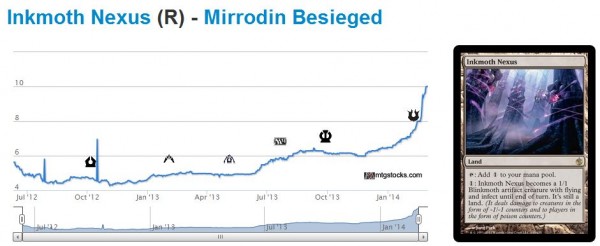
retval = retval + Mid(s, i, 1)
End If
Next

' Then return thestring.
OnlyDigits = retval
End Function

After cutting and pasting the chunk of code into the Excel macro editor, be sure to save it. I called my macro 'Start'. When you are ready to run the macro, click on the Macros button in the tool bar, then View Macros, then select ā€˜Start’ in the window that opens and click ā€˜Run’.

The macro will now do its work. After about 30 seconds, it should be done. Now you can click on each of the worksheets and see the data you have collected.

I try to use this macro on a daily basis in order to track data that I can look at and analyze on my own. It should be quite easy to set up, but I recommend working through it to try and understand what is happening in each block of computer code. The code that I have provided here could easily be adapted to track booster prices, for example.

Matthew Lewis

Matt Lewis currently lives in Ottawa, Canada and is a long time player and PTQ grinder who now speculates and plays exclusively on MTGO. He's always ready to discuss ideas and investment strategies, so drop him a line in the comments, the forums or on modo, username mattlewis.

View More By Matthew Lewis

Posted in Finance, Free Insider, MTGO38 Comments on Insider: Excel for Fun and Profit

Have you joined the Quiet Speculation Discord?

If you haven't, you're leaving value on the table! Join our community of experts, enthusiasts, entertainers, and educators and enjoy exclusive podcasts, questions asked and answered, trades, sales, and everything else Discord has to offer.

Want to create content with Quiet Speculation?

All you need to succeed is a passion for Magic: The Gathering, and the ability to write coherently. Share your knowledge of MTG and how you leverage it to win games, get value from your cards – or even turn a profit.

Insider: Week In Review

Are you a Quiet Speculation member?

If not, now is a perfect time to join up! Our powerful tools, breaking-news analysis, and exclusive Discord channel will make sure you stay up to date and ahead of the curve.

Welcome back -

Last week, I talked at length about what to expect from the Pro Tour. Now that it's come and gone, how close did we come? More importantly - let's take a look at what the ripples will be. Magic: The Financing is not just about reacting before anyone else has the information. The positioning of all your pieces on the board with the right angles of attack and retreat are even more important than acting quickly before anyone else. Time is something that is more on your side than not.

1) Jund still made an impact

Following the trend of Modern having the best cards available - Jund was still one of the top representations at PT BNG. The deck tech Willy Edel did showed where Modern Jund is heading, and how it's adapting to the change in formats. Reid Duke also adapted Phyrexian Obliterator to a B/G shell to great effect. While I believe Jund is not where it wants to be just yet, now Jund knows what to prepare for. Jund is not an aggro deck, as many feel it straddles the Aggro/Control line. Jund is a pure control deck. Blue-based control typically can just respond with counterspells. Jund, however, has to make sure it has the correct threat/reaction ratio to be able to handle whatever is thrown it's way. Jund components are still a hold in my opinion moving forward, with the most important ripple being Anger of the Gods. As Brian Kibler pointed out - this PT was all about who knew about Anger of the Gods and who didn't.

2) UWR represented 10% of the field

Snapcaster + __________ has become one of the most powerful things you can do in this format. After the recent news of UWR success, I was seeing a bevy of trades during SCG St. Louis of Snapcaster Mages coming and going. Snapcaster has once again returned to form, renewing everyone's hopes pre-Deathrite Shaman's printing. Before the banning, I felt the clear position on Snapcaster Mage was to sell. Now, I'm backpedaling. This upcoming Modern season should probably be renamed "Pro Tour Snapcaster Qualifier." It's going to be the pillar of this upcoming format, and probably the next target on WotC's radar. We'll see how far they decide to go with it.

3) Scapeshift placed 4 players in contention

Out of the 14 players that played it, Scapeshift placed 4 of them in the top performers category. That's a decent representation, and moving forward there might be some niche speculation targets. Steam Vents still seems to be the land that this whole format revolves around. Scapeshift itself has been on seen a slight 25% increase in price since placing well at the Tour. Other hits like Cryptic Command, Snapcaster Mage, and Misty Rainforest will continue to see the spoils of high demand. This deck will present an alternative for Twin or UWR decks if they feel the need to attack the metagame from a different angle.

4) Zoo

As I mentioned, Brian Kibler labeled this Pro Tour as the "Ones in the know, or not." In my personal testing, I had been moving away from Liliana of the Veil and replacing her with Anger of the Gods as the sweeper is just pulling it's weight in pure gold at the moment. I'm curious to see why this card was printed with the text it has. Something tells me there is less impact on Standard for that extra "Remove From Game" wording than for other formats, but if itĀ does manage to affect Standard, I feel extrapolating a price of $7-$9 on Anger is not unreasonable. When the card was first released it garnered that type of price tag shortly, and with renewed demand that could easily happen again.

Zoo itself performed well, too. Representing over 16% of the field. It ran into the interesting problem of being the Paper to many Scissors. Once again though, it came down to who planned for Anger of the Gods or not. It appears that with the high amount of representation, most of the Zoo decks fed on themselves sometime in the mid rounds, which later hurt the deck's final standing. I still believe this will be many players' go-to archetype of choice moving forward with some adjustments. Ā There also might be an additional move to include more Snapcaster Mages, possibly driving that price even more.

5) Pod came within (1) game of winning the Pro Tour

I came very close in calling this, but the widespread adoption of Anger of the Gods seemed to put this as a longer shot than I originally anticipated. Still, being represented in the finals of the biggest stage is exactly what Jacob Wilson wasĀ envisioning when he chose it. It appears that the list itself hasn't changed much, and while the breakout of Voice of Resurgence is still waiting, Birthing Pod itself is still a potential format mover. While this card still hasn't cracked over $10 -Ā it will soon.Ā I envision Birthing Pod hitting the $20 range before the end of the season. This isĀ the format defining card, along with Snapcaster Mage. This is what I'm beginning to classify as a "slow burn" card. Why this is still under the radar, as far as players and traders looking for it, is still unknown to me. That's the only key that I think is holding this back. Stores are reacting slowly to an uptick in price for this which makes me believe that the widespread belief still holds that Scars Block is widely available. Soon enough, this will change dramatically.

6) The Dark Horse

Bogles hit a home run in this Pro Tour in my opinion. While easily able to race the mass appearance of Combo decks, dodge the removal of the Control decks, and go bigger than the Aggressive decks - the only thing left to do was win the tournament. On this, it fell just short. Bogles still has the issue of being a horribly bad deck in terms of mulligans. When it hits - it hits for contact and power. But if it doesn't, it can be depressing.......

Poison also enjoyed a little bit of the spotlight, Affinity reminded us why manlands can still carry a deck, and Faeries let us know that the price correction for Bitterblossom will be coming soon.

7) Profit

Blood Moon, Teferi, Mage of Zhalfir, Pyromancer Ascension, and Past in Flames are the financial winners of this tournament. All except Teferi feel like the real long term winners as the Blue Moon deck itself just feels like UWR without the weakness to Blood Moon itself. As far as overall results though, if you've been following along - it was pretty much what you should have been expecting.

The next step is to figure out what the reaction is going to be. Now that the format knows just how scary Blood Moon can be, what's the next reaction? More basic lands? More ways to "answer it"? Rely more on Red? This weakness though has been truly exposed and the market will adjust, in time. In the meantime, there's still the feeling that "I'll just dodge Blood Moon." Except for just "play more basics" there are ways for these three color decks to truly not blink when their opponent casts it. Abrupt Decay, more Mana Leaks, Deglamer, Seal of Primordium, and other solutions could potentially be a target. But as most already have Decay in their portfolios, there does not "feel" like a good target to follow up with.

-Till Next Time

Want Prices?

Browse thousands of prices with the first and most comprehensive MTG Finance tool around.


Trader Tools lists both buylist and retail prices for every MTG card, going back a decade.

Quiet Speculation