menu

Insider: Short-Term Trading on MTGO

Are you a Quiet Speculation member?

If not, now is a perfect time to join up! Our powerful tools, breaking-news analysis, and exclusive Discord channel will make sure you stay up to date and ahead of the curve.

The Wide Beta Spotlight: Update

As you are no doubt aware, the Wide Beta Spotlight was cancelled. This removed a unique opportunity to observe how the MTGO's secondary market would work without at least some of the major bots operating. While a bit disappointing, speculators should always be making plans and executing strategies with the best available knowledge, adapting to inevitable surprises and learning from mistakes.

Fortunately WoTC seems to be adopting the same philosophy. Forcing a half baked client on MTGO users looked like it was going to be an error. The process of transitioning to the new client will be interesting as a premature move will cause a market crash. Cancelling the spotlight indicates WoTC is wary of repeating past mistakes.

Short Term Trading

My philosophy when it comes to speculating is usually dominated by the fundamentals of the MTGO market. Redemption, rotation and seasonality are the top of my list for trends to stick to. They are straight forward, and trading strategies based around these major themes don't require a ton of analysis or time to implement. They do require patience though, with some trades needing a number of months to bear fruit.

But it can be profitable to deviate from this type of fundamental investing. The price movements on MTGO can be sudden and large, so having a feel for short-term trades is a good skill to develop once you have the hang of the basics.

Thought Process

From now until the Fall, the set values for Innistrad (ISD), Dark Ascension (DKA), Avacyn Restored (AVR) and M13 are all destined to drop. But individual cards will still fluctuate in value depending on their utility in constructed formats. Essentially this is engaging in stock picking in a bear market. The overall trend is bad, so for casual speculators it's best to pay attention to the broader trend and steer clear of this strategy. But for more sophisticated speculators, there's still opportunity for profits.

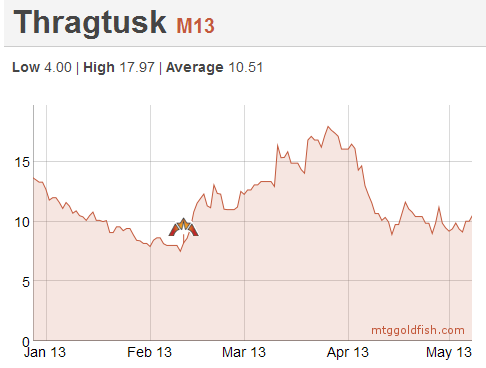
Reading the results and commentary from the first SCG Open of Dragon's Maze Standard gave me some ideas. With Jund and Reanimator still on top, it looked like Thragtusk's reign as the top creature in Standard was set to continue. This is where I went to mtggoldfish to examine the recent price history of Thragtusk and determine if there was an opportunity.

The chart looked favorable. Thragtusk had some price weakness prior to the release of Gatecrash (GTC), when it hit the 8-9 tix range. Following that, there was a period of price strength until the start of April.

It looked like 9 tix was a short-term price floor and with the renewal of interest in Constructed that always occurs with a set release, the price should go higher in the short term. With the early results coming in for Standard, Thragtusk being at a short-term price floor, and the preoccupation of MTGO users with Cube draft, all signs pointed to a favorable short-term trade with low risk and the potential for 4+ tix in profit per card.

Taking a Position

After getting interested in Thragtusk, the next step was to examine the state of the market. This involved scouring the classifieds to get a sense for the depth of the market. If there were a ton of humans selling it for 8 tix, then it was probable that the 9 tix posted at most bots was too high and that a price drop was looming.

This is not what I found. There were relatively few humans selling Thragtusk, and most were trying to sell in the 9 to 10 tix range. This indicated to me that players were not actively willing to sell this card at market prices. Once this became apparent, I felt it was time to start buying. It looked like there was a good opportunity available and I set my buy price at 9 tix or less.

In order to start buying, I do a search for 'Thragtusk' and then buy any listing I see that matches or beats my buy price. Goatbots was selling at 8.75 tix, so I bought a bunch from them. Nova also had a few copies for less than 9 tix. Various other bots had them around 9 tix, including cardbot, but I only bought one play set from them.

Cardbot deserves special attention because it is one of the longest running smart bots around and has introduced numerous innovations to the MTGO secondary market. More importantly though, many other bots (and humans) rely on them for pricing in some form or another. By electing not to clean Cardbot out of Thragtusk, I was able to accumulate a substantial position without alerting the broader market to what I was doing. This extends the period in which making speculative purchases is possible. After I had taken my position, I posted to the QS forums.

Next Steps

After confidently going deep on Thragtusk, I started thinking about other short-term opportunities. Similar thinking suggested that Geist of Saint Traft was also a good short-term buy, especially since Pat Chapin examined Bant Hexproof in his article from Monday. Mike Flores was also playing Bant Hexproof in the SCG Open. Both of these writers can move the market to some degree by influencing what decks players adopt and try out. A resurgence in hexproof strategies aided by the printing of Unflinching Courage seemed to be in the offering.

Going deep on Geist, for similar reasons to Thragtusk, was an easy decision. Geist of Saint Traft also has the added benefit of being a Modern staple, and interest in Modern should be stoked by the release of Modern Masters. Adding this all up suggested a short-term window of opportunity clearly laid out for this card.

This type of short-term speculating is somewhat riskier and requires more attention be paid to the market. With the effects of rotation looming, the window to potentially sell cards at a profit is smaller, and a distracted speculator might miss out on a price spike. Know your risk tolerance and your ability to pay attention to the market before engaging in short-term opportunities such as the ones described here.

Portfolio Update

This is a brief rundown of what I am buying, selling and watching in the market.

Selling:

  • Nothing to sell this week.

Buying:

  • Gatecrash (GTC) boosters have been bouncing up and down in the 2.9 to 3.0 range, and I continue to buy these every day in order to build my stock. I expect prices to rebound in the second half of May and packs are liquid enough that I have no qualms about buying these at the moment. There's no upper limit to how many I would buy at prices less than 3 tix.
  • Restoration Angel, Geist of Saint Traft and Thragtusk have all seen recent price dips. All are Standard staples and when they hit or came close to short-term price floors, I couldn't resist wading in and buying up a bunch with a short-term flip in mind. Each of these were mentioned in the forums.

Watching:

  • I'll be paying attention to paper tournament results now that DGM has hit Standard, in order to get a sense for future metagame shifts.
  • Thundermaw Hellkite, Huntmaster of the Fells and Hellrider are all cards with short-term potential. Similar to my three buying targets from this week, they are all close to a short-term price floor and are played in Standard.

Pauper MUC Delver Updates

Are you a Quiet Speculation member?

If not, now is a perfect time to join up! Our powerful tools, breaking-news analysis, and exclusive Discord channel will make sure you stay up to date and ahead of the curve.

I know, I know. We have a new Standard set and we're all very excited. I have nothing to report on that front. Thus far it seems pretty clear that Sire of Insanity is shaking things up but I imagine that for the next couple weeks things are going to be changing rapidly, and I personally have zero upcoming Standard events, so I don't really have anything prepared for Standard. Instead I've been jamming Pauper on MTGO.

Keeping up with Pauper is always an interesting exercise for me, because save for a brief stint with Saprazzan Skerry Storm I've always jammed some form of MUC. It hasn't always been the best choice, mind you, but it has always been viable. That's something that I find endearing about eternal formats. A person can be a "MUC player" or a "goblins player" and their deck serves as an extension of themselves. Standard and Modern decks are tools adapted for given weeks. Legacy and Pauper decks are more like old friends. They change with time, but there is always something familiar about them. Speaking of changes, let's go ahead and take a look at my current list:

MUC Delver

spells

4 Delver of Secrets
4 Spire Golem
4 Think Twice
2 Serrated Arrows
4 Ponder
4 Preordain
2 Gush
2 Daze
4 Counterspell
1 Deprive
2 Dispel
4 Vapor Snag
2 Echoing Truth
1 Curse of Chains

lands

16 Island
4 Quicksand

sideboard

3 Coral Net
3 Hydroblast
2 Steel Sabotage
2 Relic of Progenitus
1 Deprive
1 Curse of Chains
3 Stormbound Geist

What's Out?

Phantasmal Bear

After about a month's hiatus, when I picked up my last list again Phantasmal Bear just wasn't carrying his weight. I ran into a lot of mirrors right away and he was never able to block Ninja of the Deep Hours, which proved quite problematic. When that guy hits you twice it's pretty close to lights out. Bear also just wasn't that good at making me the aggressor. I'd rather find a way to play slower with more resilient cards than to force myself into races that I can't win.

Gitaxian Probe

After playing with Probe a good amount I saw two negative trends pushing me away from the card. The first was that the life loss and the mana were both proving prohibitive. There were games where I just couldn't pay either cost reasonably at sorcery speed. The other thing that I was noticing is that just by playing more Pauper again I didn't really have to care about what was in my opponent's hand. I knew my lines, I knew their decks, Probe had become just a crutch. I'd rather have something higher impact.

What's In?

Quicksand

It took me much longer to remember Quicksand than I would like to admit. I was sitting there, losing to Ninja after Ninja and pulling my hair out. I remembered boarding it out in the mirror because of how miserable it was in the pre-Delver days, but I just couldn't piece together what had changed. That thing was the presence of Quicksand. Let me tell you, this card outright destroys opponents on the Faerie-Ninja plan. Cloud of Faeries already just sucks because it's a 1/1 that does nothing and Ninja is supposed to be your card that makes wasting that slot worth your while. When you play a Quicksand suddenly their deck is filled with more dead cards. You have to be mindful of the fact that they can Ninja in a second copy if they have four mana and two Ninjas against your one Quicksand, but this will take some set up on their part and this should give you a window to slam a haymaker like Serrated Arrows or Spire Golem.

Quicksand also has the added bonus of being an actual removal spell against basically every aggressive deck. It kills most everything out of the mono-red decks and the mono-green decks and it does alright against Affinity. Typically against Affinity you'll need a Spire Golem to back up your Quicksands, but I'd much rather have them than not have them.

Think Twice

I imagine that many will at first glance believe the decision to play Think Twice over Accumulated Knowledge is of a budgetary nature. I may be wrong, but I actually see it as the right call. The way that MUC Delver plays out you don't end up spending a lot of mana at sorcery speed, so I don't see the extra mana tacked onto Think Twice as too dramatic of a flashback. I see it as more pertinent to weight cards drawn per number of TT/AK drawn.

Assuming that every copy of each card resolves, Accumulated Knowledge only draws ahead of Think Twice when the fourth copy resolves. Granted, you'll have spent less than half the mana on AKs, but we're trying to grind most of our opponents out so, again, I'm not giving a ton of weight to the difference in cost. The difference that I would like to give weight to is that in the matchups where we really want to draw a lot of cards, the particularly grindy ones, it's a lot hard to protect the third and fourth AK than it is to run either side of a Think Twice out. A singular Dispel is much more powerful against an AK deck than a TT deck. And don't even get me started on AK mirrors. I want no part of that.

Matchups

I think I did a pretty good job of going over matchups here, and while changes have been made to the list all of the deck's matchups have basically only gotten better. Not having Phantasmal Bear can make Temporal Fissure decks a little tougher sometimes, but they were already very good at blocking him and aggression was already something you had to factor into mulligan decisions.

The Aura matchup has gotten somewhat better with the addition of the second Echoing Truth, which in general migth look a bit strange in this post-Empty world. Bouncing Ethereal Armor or some other such Aura and making a good block is very solid game-plan against them, and the bounce supplements MUC's game plan in most matchups pretty well anyhow. I see a lot of Curfews in sideboards for dealing with the Aura deck but I typically run into the problem of them just playing two creatures.

One deck that I am a little concerned about is loucifer's UB control deck that has been popping up in some dailies, this being his most recent 4-0. I ran into the deck in a couple two-mans and the games I played all felt close but he 2-1'd me in both of our encounters. I believe with tighter play and more experience in the matchup it could be favorable. One thing that sticks out in my mind is that I was blowing Counterspells on Chittering Rats, which is usually fine against MBC but loucifer's deck has higher impact cards than they do. Saving them for Mulldrifters or something similar could possibly have tipped everything in my favor.

All things considered I'm of the belief that MUC is both very rewarding to play and well-positioned in the current Pauper metagame. The deck is very good at interacting relevantly with the aggressive decks ala bounce spells and Quicksands, and also does a great job of maintaining power into the long game. It takes quite a bit of patience to pilot, which can be frustrating for some, but if you like a good chess match then I couldn't recommend the deck enough.

Yesterday, when I was enjoying the lovely Spring weather and a beer I came up with a pretty interesting idea about limited decks and fundamental turns that I will hopefully have hashed out for next week. I know, I know, it's still not Standard, but I'm excited. I hope you are too.

Thanks for reading,
-Ryan Overturf
@RyanOverdrive on Twitter

Insider: Casual Hits from Dragon’s Maze

Are you a Quiet Speculation member?

If not, now is a perfect time to join up! Our powerful tools, breaking-news analysis, and exclusive Discord channel will make sure you stay up to date and ahead of the curve.

This is one of my favorite pieces to write every time a new set comes out because casual cards are something like my forte when trading. I love targeting these cards for a few reasons, which I’ve detailed in the past. In a nutshell, they buylist for more than their Standard counterparts and you’re more likely to get them undervalued in a deal.

Anyway, that’s one of the reasons why I enjoy the “Casual Hits” series, because it helps me formulate the longer-term casual targets I’m angling for. For Gatecrash it was all about Mind Grind, a card that hasn’t even dropped as far as I would have expected, which says good things about its future.

Anyway, we’re not looking for the Boros Reckoners here, but rather the Parallel Lives or Asceticisms. And remember, because this is a third set, which is traditionally under-opened, combined with the fact that Modern Masters will cut its draft time even shorter, the supply side will be limited and we could see higher prices down the road than you might otherwise expect.

So let’s dig in.

[card Breaking&Entering]Breaking // Entering[/card]

This is far and away the breakout casual card of the set. It doesn’t matter that there’s a promo version out, you can’t have enough of these because casual players love mill strategies like no one’s business. Look at Glimpse the Unthinkable and get back to me. I’m picking up all these I can find, and it’s going to be cheap enough over the next month to be worth it.

Deadbridge Chant

I’ve talked about this enough in competitive play, and it jumped as I predicted it would.

That said, the real benefit of this thing is in casual play, where it will be a big EDH card. At the current $6-8 there’s not much opportunity yet, but chances are it will be cheap at some point again during its Standard run, and at that point I’ll be going in hard. Foils of this should hold especially well once we hit that point.

Debt to the Deathless

X mana and “each opponent” are good things to read when it comes to casual cards. Things like this are always popular in Commander, kitchen tables and even some cubes. As an uncommon, I suspect that means we pretty much only want to look at foils.

Emmara Tandris

I know people have pooh-poohed this card since it came out and we learned its art and rarity switched with Voice of Resurgence at the last moment.

But under a dollar? It’s a legendary elf with a unique effect. I’m not saying this will light the world on fire, but I am pretty certain it’s not bulk 18 months from now.

Master of Cruelties

This just has such a unique effect that I can see it gathering a following. Not to mention that as a mythic the ceiling is higher. Even stuff like Apocalypse Hydra becomes worth money down the line, and this shouldn’t be an exception.

Obzedat's Aid

This seems like a fairly innocuous card design, but one that I’m sure will find a home in plenty of casual decks. B/W has always been a popular casual color combination, and this will probably continue the line.

Progenitor Mimic

Another card that’s a good target because it’s a mythic. This seems like the kind of card that will sneakily be $5 in a few years after falling to near-bulk status while in Standard. It’s got a good EDH effect and it has a powerful repeated effect. I’m sure this will find its way into many kitchen table decks.

Vorel of the Hull Clade

See Gilder Bairn. This type of effect is always popular casually, and as a legendary creature capable of doing this, I see no reason why it won’t do well over time. Of course, excluding planeswalkers does hurt it quite a bit, though exactly how much remains to be seen.

Zhur-Taa Ancient

I’m certain this will see EDH play. Believe it or not, those who play the game less seriously don’t mind giving their opponents some extra mana, because the goodwill allows them to keep it for themselves. Definitely a solid pickup.

Picking Up Throw-Ins

That’s about it. Remember, I’m not telling you to go out and buy every one of these you can. What I am telling you is that picking them up as the throw-in to complete a trade will for the most part be easy, and your ROI over the next few years will be very good. Even if a couple don’t pan out, the number of Asceticisms, Gilded Lotuses and Parallel Lives will make you much more than you “lose.” I don’t expect Dragon’s Maze to be any different.

Thanks for reading,

Corbin Hosler

@Chosler88 on Twitter

Rolled by Varolz

Are you a Quiet Speculation member?

If not, now is a perfect time to join up! Our powerful tools, breaking-news analysis, and exclusive Discord channel will make sure you stay up to date and ahead of the curve.

Standard right now is being dominated once again by midrange decks. This past weekend there were three Jund control decks and three Junk Reanimator decks in the top eight of the first big Standard tournament with Dragon’s Maze legal. Both decks added a card or two from the new set, but they largely were unchanged from their previous dominating lists. Since there are so many players that are continuing this trend of midrange madness, other decks have a second to breathe and set up their game plans. Until Naya Blitz (or some other fast aggro deck) makes a comeback, Standard is a midrange format. Because we are granted a little more setup time than we are used to, certain strategies have to be playable that would not normally be, right?

Last week, I wrote my recurring top ten article for Dragon’s Maze. In it I discussed a neat and powerful interaction that I want to elaborate on today. This “combo” is not going to change your world like waking up one morning to find out they are making more Star Wars movies or anything. It’s more like finding an awesome movie in the five dollar bin. Let me put it another way. This deck concept is not like finding a Force of Will in a bulk box, it’s more like finding Goblin Lackey. In all of those cases you end up with a great story and have fun in the process. That’s exactly what this deck is like. As it happens, it also seems to be fairly competitive. Here’s the concept.

The deck topic today is Varolz Jund and this interaction is the primary motivation for the deck. Again, this is not exactly a game winning combo or anything, but putting four +1/+1 counters on any of your creatures will be cause for concern for any opponent.

The thing you need to realize is just how good Varolz, the Scar-Striped is in this deck. Obviously if you build your deck around a creature and then name the deck after him, he is going to do something unique, powerful, or both. Varolz is no different. What's nice is that once you have built your deck by considering the natural power and toughness printed on the card rather than other abilities, Varolz is good on his own. You cannot sleeve up some copies of this legendary creature and stick them in every deck you have with green and black mana because the other creatures in the deck won't mesh well with his abilities. Once you make this a priority in deck building though, playing Varolz is a powerful thing you can do in every game.

After starting the deck list out with Varolz and Vexing Devil, the next logical progression is to add other aggressively costed creatures to take advantage of the powerful early game state you are trying to create. I and many others arrived at the same conclusion that a zombie tribal shell would meld best with what the rest of the deck was trying to do. A card like Diregraf Ghoul is perfect for this deck because not only does it provide early aggression, it also has a high power-to-mana-cost ratio. With Varolz in play, you can pay one black mana for two +1/+1 counters on him or another creature.

Bear with my next statement because it's going to sound a little crazy. Playing with Varolz reminds me of Snapcaster Mage.

Certainly there are enormous differences and a Gray Ogre isn't going to change Modern and Legacy, but stay with me for a moment. When you have Snapcaster in your deck, your graveyard becomes another resource to exploit. Varolz opens up that same space, just in a different way than Snapcaster. Varolz turns all of your deceased creatures into additional damage later in the game. If you find yourself in a long game (like Standard often creates) you will have many resources to draw from.

Ready for the decklist?

Untitled Deck

Creatures

4 Diregraf Ghoul
4 Gravecrawler
4 Vexing Devil
4 Lotleth Troll
4 Spike Jester
4 Varolz, the Scar-Striped
3 Falkenrath Aristocrat
3 Ghor-Clan Rampager
1 Zealous Conscripts

Spells

1 Pillar of Flame
1 Tragic Slip
1 Searing Spear
1 Abrupt Decay
1 Mark of Mutiny

Lands

4 Blood Crypt
4 Overgrown Tomb
4 Stomping Ground
4 Dragonskull Summit
3 Woodland Cemetery
1 Rootbound Crag
1 Kessig Wolf Run
2 Swamp
1 Mountain

Sideboard

3 Deathrite Shaman
2 Abrupt Decay
2 Golgari Charm
1 Dreadbore
1 Mark of Mutiny
1 Zealous Conscripts
3 Duress
2 Thragtusk

The deck's removal package:

  • 1 Pillar of Flame
  • 1 Tragic Slip
  • 1 Searing Spear
  • 1 Abrupt Decay
  • 1 Mark of Mutiny
  • 1 Zealous Conscripts
  • 3 Ghor-Clan Rampager

It's important to consider the removal package as a whole rather than as a seemingly-random list of one-ofs.

Is Ghor-Clan Rampager actual removal? The answer is sort of, not really, but ultimately yes. When your opponent flashes in Restoration Angel, you are going to use bloodrush to save your creature and get through some damage. If that was a Doom Blade you played instead of the blood rush ability, your attack would have had virtually the same effect. Because of this, I consider Rampager not quite a removal spell, but more like a burn spell that you can also cast as a creature if you really need one.

As far as the other six cards, don't see them as individuals, see them as groups. When constructing decks in Standard, there are so many diverse threats you want to answer. One way to prepare for every angle of attack is by playing similar cards that function the same way most of the time. The benefit to this is when their other effects come into play, they can alter the course of a game.

Take Pillar of Flame and Tragic Slip for example. In many ways, they are quite similar. They also have their alternate effects like -13/-13 when morbid is active or removing a creature from the game instead of sending it to the graveyard and triggering some crazy effect. Many games they will kill the same creatures, but other times they can be more powerful.

The downside is that when you use this strategy, situations can arise where the card you have in hand does not quite solve the situation. There are definitely benefits and downfalls of crafting a deck list like this so if you don't need to be prepared for everything, make a decision about which one you think is best in the format and stick with it.

I've seen lists with four Searing Spears for example because it is an efficient burn spell that can also function as removal if you need it to. I chose to play one Searing Spear and one Abrupt Decay because they affect the game in different ways. Mark of Mutiny and Zealous Conscripts are grouped together as well because they have the same effect but at different mana costs. Diversifying your removal package can win you games you would not have normally been able to win and in this case at minimal cost.

Falkenrath Aristocrat

Taking time to explain this card selection may seem unnecessary, but this spot is the one my friend and I debated the most. This aristocrat gives the deck a lot of synergy and evasion, both of which are extremely important. Playing this creature allows cards like Mark of Mutiny and Zealous Conscripts to shine as well.

The problem lies in how bad it is against the aggressive decks. If you play against Naya Blitz or any similar deck, you will find that Falkenrath Aristocrat is the worst card in your deck. The other choice is to play Hellrider in this spot. By including Hellrider, you not only add the same amount of pressure to your opponent but you also get a little better against aggro. This of course comes at the cost of the synergy and evasion Falkenrath Aristocrat grants you. In addition, I feel that the double red mana cost on Hellrider is more prohibitive than the card is helpful. If you are on a budget, you could play Hellrider, but otherwise I would stick to Aristocrat.

Blood Scrivener

My initial version had three copies of Blood Scrivener. The logic was that if I had Lotleth Troll and Blood Scrivener, I would be able to discard the rest of my hand and start drawing extra cards. This proved a false assumption. Over the course of my test event, I drew a total of two extra cards. Most of the time he was a bear that I didn't want to attack with that also happened to be a zombie to recur Gravecrawler.

In the Blood Scrivener three spot I added more copies of cards that I wanted, such as the third Ghor-Clan Rampager, the fourth Spike Jester and the fourth Varolz. All of those cards performed very well in testing. I was particularly impressed with Spike Jester. Better opponents may have blocked with their Arbor Elf, but the ones I played against did not.

Varolz Jund vs. Junk Reanimator

This is the matchup I played the most and I was extremely pleased with my sideboard plan against them. Here was the plan that lead me to victory against the best deck in the format.

-1 Abrupt Decay
-1 Searing Spear
-1 Pillar of Flame
-1 Tragic Slip
-1 Spike Jester
-1 Ghor-Clan Rampager
-1 Varolz, the Scar-Striped

+3 Deathrite Shaman
+2 Golgari Charm
+1 Mark of Mutiny
+1 Zealous Conscripts

Overall I had a ton of fun with the deck and won some store credit at a local event. This shell provides a fast clock with a midrange end game to close out games that you don't win by turn four.

Until I played this deck, I never considered scavenge a very good mechanic. On its own, it still is not that good, but Varolz strips the cost down from a million mana to something manageable. I am not quite sure this deck is capable of taking down a large event, but you can definitely take some local opponents down with it. What are your thoughts on improving the list? Do you think Varolz Jund has what it takes to do well at a major event? Post your answers below.

Until Next Time,

Unleash the Scavenging Force!

Mike Lanigan
MtgJedi on Twitter
Jedicouncilman23@gmail.com

TT2 Update: Expansion Set Lists Suck Less!

Are you a Quiet Speculation member?

If not, now is a perfect time to join up! Our powerful tools, breaking-news analysis, and exclusive Discord channel will make sure you stay up to date and ahead of the curve.

Today's update polished the UI of the Expansion Set feature a great deal.  Users are now only shown the top price for each card, and a summary of the buy/sell spread at the bottom of the list.!

Click to test it out with Dragon's Maze!

Extensive sorting abilities will be added soon, the library we are using to enable dynamic table sorting is not working correctly..but when it IS, every table on the site will be sortable any way you want!

You can access the new expansion set lists from the TT2 home page or menu.  Click the button below to give it a try


Insider: Where to Begin — Part 2

Are you a Quiet Speculation member?

If not, now is a perfect time to join up! Our powerful tools, breaking-news analysis, and exclusive Discord channel will make sure you stay up to date and ahead of the curve.

This week we bring you the second part of our article, which aims to cover mistakes that we are all likely to make when speculating. Namely, we will take a look at some psychological factors that might distract you from making the optimal choices. We will also try to provide concrete examples from our experience, to show how important it is to follow a set of guidelines.

The Rules to Follow

Listed below are a bunch of strategies that are both economically and emotionally suitable. These guidelines should help you properly diversify your portfolio. It should also prevent you from becoming impatient or panic-prone when things don't go the way you expected.

The 5% Rule

This one is all about bankroll management. The rule states that you should not, at any given time, invest more than 5% of your bankroll on a single target. This is inspired by poker theory, but you should apply it while trading Magic. We believe investing too much on a single spec is one of the biggest mistakes you can make. First of all, if anything goes wrong, you might never be able to recover. Second, humans act differently when under stress. You’ll be able to stay cool headed if you have only 5% of your bankroll at stake, but can you if it’s 50%?

There is a poker story about an extremely rich man (Andy Beal) who came to the casino and was able to beat poker pros only by raising the stakes. He was playing at such high stakes that even if the pros were actually better than him, they would make different decisions than usual because they were uncomfortable with the money they put in the pot.

The story ends well for the pros though; they decided to regroup all their money and to form a big bankroll. They played against Beal, but as a team. Each person invested the amount of money he was comfortable to invest in the group and they shared the profits proportionally. Once they felt more comfortable, their edge on strategy reversed the steam and they finally won millions out of Beal.

So what can we learn here? Even if you’re the best trader of the world, if you put yourself under too much pressure, you’ll make bad decisions and lose money.

Normally, the 5% rule is perfect to absorb variations. If you have under 1000 tix, 5% is less than 50$ per spec, which is somewhat low for a proper diversification. In fact, diversification is such a crucial concept that we will have to devote an entire article to cover it.

Support Your Calls with a Rationale

Let’s take the example of Cavern of Souls. At one point, the card was available at 4.5-5 tix. Control wasn't making significant showings in Daily Events, so nobody needed the land to avoid counters. A switch in the meta was likely to occur eventually. We had a price memory of roughly 13-14 tix for this land, and sooner or later it would see play again. Buying into this card was showing little risk, given it was at its all-time low, with a full year ahead for a probable spike.

That’s the rationale behind the call. It has to be developed and analysed, but that’s not enough. It also has to be marked down and detailed enough so that you can refer to it in the future. The main things to record are the entry point (buying in the 4.5 to 6 ticket price range), the expected sell point (I would sell at 12 or above), the expected timeline (current season, less than three months) and what should create demand (the metagame shifting towards control).

This brings us to our next point.

The Use of Spreadsheets

The spreadsheet is another way to protect yourself from losing sight of what your mindset was when you committed to a spec. The more details regarding your call, the better. Always make sure to include what supported your decision in your spreadsheet.

You can adapt your files as you wish, but the important thing is to make use of this tool, and to stick to it over time (remember, discipline is key). Our spreadsheet looks something like this: Card Name / Price Paid / Qty / Selling Target / Timeline / Rationale / Price sold.

Stay Liquid

To maximize profits on MTGO, you have to move rapidly when you detect a spike. A significant portion of our profits originated from short-term investments that were unplanned or unforeseen. Many times in our early days, we ended up with insufficient liquidity to buy early into an ongoing spike. Given our decision not to input additional money repeatedly, we had to either pass on the opportunity or struggle with hard-to-make decisions about selling other targets at sub-optimal prices. The MTGO market is sometimes evolving so fast that by the time you free some tickets, a spike is well underway and it is no longer correct to get in, since the risks have increased and the profit margin got narrower.

To make it very clear, you should have no less than 20-25% of your portfolio in loose tickets, or in the form of boosters. If you have exceeding tickets floating around at the moment, follow Matt Lewis's recommendation and park a few tix in GTC boosters.

The Pitfalls

Let’s now turn to some costly mistakes one can make.

Mistake 1: Disobey the Rules

It's obvious. Whether you get overconfident with a card, or whether you simply can't resist the temptation to use all of your tickets to buy everything being discussed on the forums, you are managing your account in a sub-optimal fashion. You also increase your level of stress by adding pressure on a single spec. Locking all your tickets on MTGO means that you will have to pass on the short-term flips, which is one of the major sources of profits online.

Adding liquidity by buying extra tickets is not always the best solution, since you are likely to make two big mistakes: 1) getting out of your comfort zone and therefore putting your nerves under stress, and 2) reinforcing your lack of discipline, which might lead to facing the same problem later and having to add even more tickets into your account.

Mistake 2: Targeting the Absolute

Trying to buy at bottom and to sell at ceiling at all costs is one habit that is hard to get rid of. It might sound weird, but you should actually be more flexible about buying or selling at the perfect time. Jeff has a friend who is a stock trader. He says that the most common mistake among new traders is precisely to try to buy at rock bottom and then aim to sell at ceiling. He also said that every trader who tries to achieve this is in fact losing more money than others. While trying to reach the absolute, the new trader tries to anticipate the market variations too much and will end up passing on good opportunities or will buy and sell at bad times.

Many times, we have waited too long to buy our cards. We should have accepted buying the card directly from bots at 0.5 or 1 ticket higher, to take our position appropriately. Knowing that the price is really near the bottom is enough to start buying. Last rotation, we found a good opportunity in Karn Liberated. We knew Modern season was coming up and that Tron would be part of the meta. Karn was 13.5 on cardbot, so we decided to post at 13 on the Classifieds just to make sure we were buying at a lower cost. We knew that at 13.5 tix, Karn was a still a good target, but we wanted to buy at the lowest possible price. What a mistake! We ended up with a sheer total of 5 copies, which we eventually sold at 27 tix each. If we would have simply bought from the bots (our bankroll was high enough to do so), we would have been able to buy an extra 20-25 copies. We would have paid an additional 25 tixs to grab them, but we would have made so much more money in the process!

When determining a buy price, you should target a price range rather than a specific number. Paying a little more for your stronger specs is a fine decision.

Mistake 3: Selling Out of Fear (Panic Sell)

For many reasons, we can overestimate a card's floor price and buy into it too early. Or one card is being reprinted because of Cube events, and you find out about it only after the card has already lost 30% of its initial value. In both situations, the price drop is temporary. Don't resort to panic selling. Refer back to your rationale when you acquired the card. It is almost certainly still valid. You should wait it out and stick to your plan. For instance, we bought shocklands at 3 tix each. Some of them are available now on the market at 2.5 or 2.75 and DGM drafts are ahead of us. But next year, we expect them to be worth at least twice that much, so we'll simply hold onto them, as we intended to do with this long-term spec anyway.

Mistake 4: Buying Late into a Spike

We'll devote an article to this next week. For now, let's just say this: When you calculate the risk involved in a spec, you must consider the difference between the actual card value and its all-time low or expected floor (the downside), and calculate its expected value or its ceiling price (the upside). If the price is increasing, the later you buy into the card, the more risks you take (more downside, less upside). Since the future is unpredictable, there is a breaking point where you have to decide against trying to profit from a spike, pass until the next one and hope for a better timing.

Mistake 5: Investing in a Market You Don’t Know

Try to know the metagame you are investing in. We studied the market and diverse formats closely before investing in earnest. Still, we have a lot to study before entering another niche, such as promos or foils. We know there is money to be made with these, but a big mistake would be to simply dive into this market without assessing its pros and cons. We had problems in the past trying to sell some foils, even while offering a decent discount. Since then, we try to stay away from this market, until we figure things out.

Mistake 6: Dismissing Your Rationale Too Easily

Someday, you will have to decide whether you should talk yourself out of a spec, based on others’ opinions. It can be good to reconsider your positions based on other players’ comments, but we realized over time that the thinking we put into a spec was better supported than some of the more spontaneous reactions we received in the forums. Several times we stopped buying after becoming convinced our reasoning was flawed in some way we hadn’t anticipated.

Even though we agreed on a perceived opportunity, we were letting doubt affect our confidence. Other traders' opinions, albeit valid and well-intended, kept us from buying into profitable targets. Our mistake was to accept these opinions without challenging them, and not defending our views with enough Vigor.

This brings us to our final point.

The Ultimate Test

The ultimate test is to come up with your own speculation targets and personalized portfolio. Buying blindly into specs discussed by others on QS will cause you many headaches. Some specs are too long-term oriented for your bankroll, or too risky because you already have dedicated a good amount of money into that sector of activity. Other specs are derived from formats you may be unfamiliar with, so selling out of them might be awkward.

Ultimately, we hope you will learn to trust your instincts. To the point of saying, "This is my call; it will not go wrong because I thought it through, and I know enough about this aspect of the market to write an article myself."

Avatar photo

Sebastien Morin

Jeff and Sebastien have known each other for close to 25 years now. They have played Magic as kids, and then played Online poker for a few years. They got back into the world of Magic through the Online client. About a year ago, they decided to invest more seriously into the MTGO market. They will share their experience, the good and bad moves they made, and their strategy to successfully manage a growing bankroll.

View More By Sebastien Morin

Posted in Finance, Free Insider, Magic Card Market Theory, MTGOTagged , , 11 Comments on Insider: Where to Begin — Part 2

Have you joined the Quiet Speculation Discord?

If you haven't, you're leaving value on the table! Join our community of experts, enthusiasts, entertainers, and educators and enjoy exclusive podcasts, questions asked and answered, trades, sales, and everything else Discord has to offer.

Want to create content with Quiet Speculation?

All you need to succeed is a passion for Magic: The Gathering, and the ability to write coherently. Share your knowledge of MTG and how you leverage it to win games, get value from your cards – or even turn a profit.

Jason’s Archives: Why Not Waste Your Time?

Are you a Quiet Speculation member?

If not, now is a perfect time to join up! Our powerful tools, breaking-news analysis, and exclusive Discord channel will make sure you stay up to date and ahead of the curve.

Greetings, Spittons!

So, Sigmund wrote an article.

A Weekly Occurrence

Sigmund writes lots of articles. This one in particular gave me an idea for what I wanted to write about today before we get to the part of the article people actually read.

Here is the article in question.

If you're not an Insider, that's too bad because there is a lot of decent info available to Insiders. If you are, you've likely read this already because why would you not read one of Sigmund's articles? The only thing more fun than reading them is pretending you don't.

Get it? Because the title is "Don't waste your time" so I pretended I didn't read it because I implied reading it would have been a waste of time and you got the joke so let's move on. If you haven't read the article, read it now.

I'll wait.

All done? For those among you incapable of reading Insider content, Sigmund told a story of his time spent digging through a bulk box and using the Trader Tools app (love it!) to find the highest buylist prices and then realizing he was making about $4 an hour and his time was more valuable than that. I absolutely agree that if you have to look up the price of every single card, it's going to be time-consuming and probably not worth the payoff. What if I told you that the only way you'd make $4 an hour was by doing it laboriously and that I make significant money pricing out stuff at buylist prices? Would you like to know how I'd suggest doing it?

When Is a Waste of Time Not a Waste of Time?

I agree with Sig. If you're going to look up the price of every card on Trader Tools, you're going to have a bad time. With it taking around 10-20 seconds to look up each card, if you're not finding a dollar bill every tenth card, it's probably not going to end up being worth it. But I think about cards a bit differently because I have hundreds of thousands of the damn things in my basement.

I get unpicked bulk at $5/thousand on the ins because it's almost always worth my time to pick it (for $^%&'s sake, look what Corbin found in a collection a guy shipped him that was all 'bulk').

Yes, in real life someone shipped a Loyal Retainers as "bulk" because he couldn't read the card, saw a silver expansion symbol and just wanted rid of the card. Is this an outlier? Yeah, but it helps illustrate my point. If you buy unpicked bulk and collections, you're going to find a ton of money picking.

I pull Imperious Perfects out of bulk that I got buying a collection from someone who looked up the price of every single rare. I don't even look through the stuff when I buy it anymore, I just count it, tell the seller I'm paying $5/k sight unseen and have myself a ball picking through it later. You'll pull older cards that didn't have colored expansion symbols, 4th edition rares like Laces (a dime's a dime) or even stuff like Sylvan Library. Or, the best thing I ever pulled out of a bulk box, a foil Daze and four foil Cabal Therapy. But once the obvious huge stuff is out, you're left with piles and piles of "picks".

There are two extreme views to take with regard to "picks".

  1. Igor Shapiro (@IgorFinance on twitter) once said "only pick nickels if you hate yourself". One extreme is to disregard picking carefully and bulk out most of the stuff since it's not worth your time to pick nickels out of bulk once all of the foil Dazes are in your binder.
  2. Sigmund's example of doing it wrong is spending an inordinate amount of time picking super carefully and then looking up every price in a time-consuming manner. If you're spending 20 seconds to verify that a nickel is indeed a nickel, the amount of time you'll take to get through even one of the 5 1k boxes you got in a collection that afternoon will reduce the amount you're making below minimum wage, and it will feel like work.

I see these two extreme views (don't look anything up, look everything up) as both accomplishing the same goal -- reducing the amount of money you should be making from collections you buy and cards you have lying around. Even though they're opposing views, they have the same poor outcome. I see the viewpoints like this.
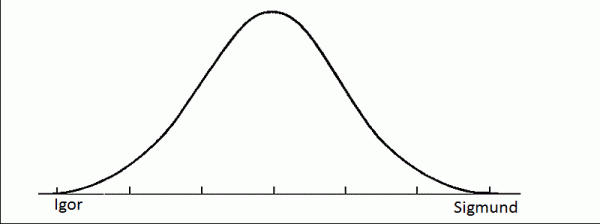
If you don't pick any of the cards that are low value but add up then you're not optimizing how much you make per collection. If you waste too much time over-scrutinizing buylists, you're not optimizing how much you make per hour.

You're Sure Talking a Lot of Smack About Igor and Sigmund

See, I wanted to address this point before we went further so I invented this rhetorical device to pretend you're asking me the question. I can do that.

Neither of these views are actually espoused by these two gentlemen. I simply took two opposing ideas that one could extrapolate from things they said and took them to their extreme logical conclusion so I could have an excuse to include a graph. I labeled them with their names because I used their names in the numbered list above. Make sense? In reality, Sigmund cautioned against wasting too much time buylisting and Igor taught me the trick of separating commons from uncommons and selling just the uncommons to CoolStuffInc. He may not pick nickels, but he's not leaving dimes lying around.

Back to the Graph

We have a nice bell curve here with two extreme views represented by the ends of the graph. I think in order to make it worth your while you should stake yourself a position in the middle.
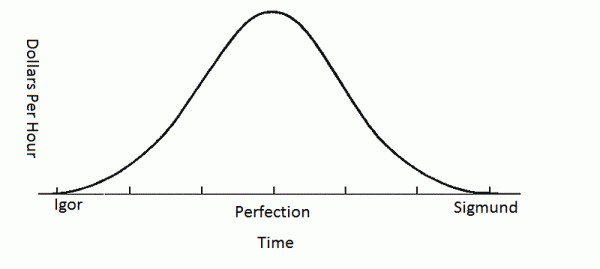
If you don't spend zero time or infinite time, but rather a moderate amount of time working effectively, you'll maximize your profit per hour and wring all of the money you can from the collection, leaving less on the table. You'll do this by employing a few key shortcuts.

1. Ogre

In this case, Ogre is a verb, not a noun. When you take a pile of cards that are all the same buylist price and put them in boxes with other cards organized by price, this is known as Ogreing, named for the floor trader-turned-dealer who popularized the practice.

Most of the time buyers at a GP don't want to spend a million years pricing a bunch of commons and uncommons, but they still need that stuff. What you do is say "Everything in this stack buylists for a nickel" and let them pick out everything they want from that pile. It saves everyone a ton of time, you get paid what you can live with getting paid on the cards, they don't have to look anything up and you don't have to mail a million packages to a million buylists.

Sure, Trader Tools can reveal that Troll and Toad is paying 25 cents randomly on four copies of Fleshbag Marauder for one week only, but if every dealer is paying a dime on them, and you know this, why take the time to type "Fleshbag Marauder" into Trader Tools? Why not quickly throw it in the 10 cent pile and get ten cards priced in twenty seconds instead of one? Ogreing allows you to save a lot of time on the floor of a GP, which keeps your "dollars per hour" number in the black.

This is by far the best way to get rid of stuff. You don't have to mail it, no one person has to take all of it and occasionally a dealer will pay 15 cents for something they pay 25 cents on because everyone else is paying 15 cents and this will make them happy to see you in the future.

2. Guess

Guess sometimes. If Stronghold Mana Leak sells for 50 cents, how much would you want to pay as a dealer? Probably not 50 cents. Probably not even a quarter. Would you be OK paying 15 cents? Maybe, but the dealer would be elated to pay a dime, and you should be elated to get a dime. If you can do that calculation in your head in around a second just by going with your gut you can save some time. You want them to take stuff from you next time you bring them a box. Even if you don't get the maximum amount from the card by finding the exact dealer that's paying more than everyone else, you're making way more than the half a cent you'd get bulking the card, and more than the zero cents you'll get letting it sit in a box.

Some stuff you'll have to look up. Do you know how much Tainted Peak buylists for? Probably not, so look stuff like that up. I do, because I looked it up one time, which brings me to my next point.

3. Remember Stuff

It takes ten to twenty seconds to look up the price of Tainted Peak. But that's not to say it will take you ten minutes for a pile of thirty Tainted Peaks. Your time cost to look up stuff is divided by the total number of copies of that card as long as you remember. The nice thing about putting the cards in piles is that it's quicker to check a pile for the same card if you can't remember than it is to look it up in Trader Tools. If you're at this for a few hours, you'll see cards you've seen before and you won't have to look them up again.

The point of Sigmund's article was as you go too far to the right side of the graph above, it stops being worth it. I'm advocating using a few simple time-saving tips to keep yourself right in the middle of that bell curve so you can watch your dimes turn into dollars. This assumes you have a GP to go to, but really any event where multiple dealers are buying will do. Even people who sell on eBay and TCGPlayer like buying Ogred boxes because no one has to look anything up and they know they'll make a profit.

If you err on the side of underpricing so people are happy to take the Ogred boxes from you in the future and are willing to haggle, you're going to make much more than the half a cent per card you'll get for true bulk. Getting $1 for an Invisible Stalker feels really good, and if you take a few seconds to jam a stack of them in a box, you're making $100,000 an hour for a few seconds, and even averaging that out over the whole night puts you above $4 an hour.

I'm suggesting you don't throw the baby out with the bathwater. Absolutely don't spend too much time messing around with different buylists. That's insane. But if you can make money from your bulk by employing a few simple tricks, heading too far toward the origin on that bell curve is equally bad when there's so much money to be made in the middle.

I'm Not Even Mad

Sure, they didn't play Legacy in Somerset, New Jersey. But they did play Team Sealed, so how can you be mad? Sure, I don't want Legacy to die, but if we get to play the occasional awesome format on a Sunday, I can't complain (sometimes I still do). But no point in protracted discussion of Team Sealed, it tells us nothing of the meta. And we need to know all about how the new cards affected the meta.

SCG Somerset Standard Top Decks

Three Jund in the Top 8. Three Reanimator in the Top 8.

Jund did what everyone thought it would and jammed a bunch of Sire of Insanity. The card gives slower decks fits and hampers their ability to make you miserable with [card Prime Speaker Zegana]Zegana[/card] and Sphinx's Revelation. Jund decks typically topdeck a bit better, so making everyone topdeck seems fine. Did you buy Sire at $2 when I suggested it on Twitter? If you did, you'll be glad they're $6 now.

Owen Turtenwald made me smile by jamming a Deadbridge Chant in his sideboard to hose the mirror and control matchups. I never considered running Chant and Sire at the same time, but the more I think about it, the more Chant seems busted. If both players are topdecking, the guy who draws two a turn usually wins, especially if he can access some of the stuff he was forced to discard. I think Blood Scrivener plus Sire is cute. I think Chant plus Sire is potent.

A brief aside about Deadbridge Chant. I was really afraid this card was going to turn into another Seance. The card seemed potent and underpriced, and when we tested it, it outperformed even lofty expectations. But every time I tried to tell someone how good it was in testing I heard a lot of "herp, derp, random sucks."

Yes, the card drawn or reanimated is random. So is the card you draw each turn off the top of your deck. What if you use Harvest Pyre so the only card in your yard is a Griselbrand? What if your yard is empty and you get back the same copy of Abrupt Decay three turns in a row? What if, worst case scenario, you have a Phyrexian Arena and best case scenario you have a Debtor's Knell?

A lot of this community has made up their mind about Deadbridge Chant already and I think that's too bad. Use your imagination a little. This card draws you cards, gets around Ground Seal, dredges (I hear there is a certain troll that dredges for 10) and costs an amount of mana that would draw you three cards ever if it came in the form of Sphinx's Revelation.

Test the stupid card. Don't say "oh, it went from $2 to $8 because of speculators," test it. Don't say "It's a Staff of Nin" because you thought it was cool when someone on StarCity said that, test it. If you test it and still don't like it, fine. But don't let your limited perception of a card you barely read stop you the next time someone tells you to buy a card at $2 and it's $8 a week later and you have 0 copies. I think the endless possibilities for a powerful card like this will help it maintain its $8 price tag -- mitigating the increased supply as weeks go on with an equally increased demand. But don't take my word for it -- test it.

Jund also got Putrefy. Not Mortify to make a potential Esper deck better. No, Wizards decided to reprint a card to improve the most dominant and least imaginative deck in the format. I wonder why Wizards hates people who don't play Jund. They can say they don't, but it sure feels that way.

Reanimator added Sin Collector. If this is the degree to which the format changes, I may as well just wait until June to write this portion of the article again.

Bant Hexproof added Armadillo Cloak Unflinching Courage which I kind of like. Trample on a Fencing Ace is the last thing the deck needed. It also got one of the big cards of the weekend, Voice of Resurgence. Even though Voice went from $22 to $30 very quickly, I am glad I didn't buy in at $22. I think the decks that want this card will want four. I just don't think any decks will want fewer and not that many decks can run it without changing the rest of the deck entirely. I don't know if this card will maintain its high status (currently outpricing even Ral Zarek), but a lot of influential people can't speak highly enough of this card. My advice is to pack it and sell while it's high. I wouldn't trade for these at $30.

Advent of the Wurm had a big weekend, but not as big as some hoped. Still, this Bant flash deck looks techy and fun, and it beats playing stupid Jund. Jeff Hoogland was talking about all the Flash variants he tested and I'm betting a lot of people tried Plasm Capture in the spot currently occupied by Rewind. Flash decks can't use all that much mana mainphase anyway.

I think the only intelligent thing anyone has said about Plasm Capture was Frank Lepore's suggestion to use the extra mana mainphase to cast dudes and your lands EOT to play threats and other Plasm Captures. But ultimately I think Rewind on their turn then EOT Sphinx's Revelation or Advent is probably better. That was what Jeff Hoogland said after he tested, anyway. Don't take my word for it. If you took my word for it, you'd be rolling around on a pile of money you made when Deadbridge Chant hit $8.

Finally, Ral Zarek got a test drive in the U/W/R deck. (The next mouth-breather who calls U/W/R decks "American" is going to repeat their high school geography class at gunpoint). I didn't have any faith in Ral being good in anything, but he must have done some work because William Eades got third with the deck. Still, the deck was pretty good before. I don't see any obvious prima facie utility for Ral but I'll jam a few games and see whether I want to out the Rals I have now or wait for a repeat of the ridiculous $50 weekend [card Jace, Architect of Thought]Architect of Thought[/card] experienced. I'd recommend trying to pack these or pay buylist in cash if someone opens them in your shop. Retail is likely too high.

There you have it. I think the metagame will shift more dramatically when people have more time to test. I think Deadbridge Chant is worth building around. I think Sire is here to stay but it should probably be in the board since it's a Sivitri Scarzam against half of the field. I think Zarek warrants testing, Voice is probably overpriced and I can't wait for everything Jund loves to rotate completely.

Join me next week when we'll have lots more Jund decks to analyze.

Insider: Trading to Different Playgroups

Are you a Quiet Speculation member?

If not, now is a perfect time to join up! Our powerful tools, breaking-news analysis, and exclusive Discord channel will make sure you stay up to date and ahead of the curve.

Welcome back, readers. I hope everyone enjoyed the release of Dragon's Maze. The subject of this week's article is the idea of trading among different playgroups. I've found that trading becomes more lucrative if you have different playgroups to shop for. Different groups are happy to give up certain types of cards and eager to obtain others. Mediating between these different groups allows you to trade into cards at a discount and out others at the highest possible value.

I've broken the playgroups I typically come across into the following categories:

Standard-Competitive

These guys play the best Standard decks. They are constantly evolving their decks based on the current metagame and results from MODO or the latest major tournament. They want the high-value mythics and the latest "tech" cards. They will tend to value casual stuff lower, but for the most part understand the value of staples in other formats.

Trade For: Casual/Commander cards
Trade Away: High-dollar Standard staples and foils

Standard FNM Players

These guys aren't quite casual players; they like to play FNMs and want to win, but ideally with a deck of their own creation. They are likely to know some of the top-tier decks from the last few major tournaments, but they probably won't know every card in those decks. These guys aren't quite in the Standard-Competitive camp, but have the desire to get there. They may go to some major tournaments, but typically they are content with just winning their local FNMs. They are the type that will pick a deck archetype and try to make it competitive, but aren't likely to switch decks; so when you play them you tend to know what they are bringing to the table. It will be good, but it may not be tier 1.

Trade For: Casual/Commander/Legacy/Modern
Trade Away: High-dollar Standard staples or whatever they need to upgrade their deck

Legacy-Competitive

These guys are more rare than the Standard-Competitive. They enjoy playing Legacy and are the most likely to pay the full amount for high-dollar foils to pimp out their decks. They will most likely gloss over any non-Legacy cards. They typically understand the "Legacy tax" concept that you should request when trading away Legacy staples. These guys often seek out foreign copies of the cards as another form of pimping their decks.

Trade For: High-dollar Standard cards or Casual/Commander staples
Trade Away: High-dollar Legacy staples and foils (at value)

Modern-Competitive

These guys are hard to find. They tend to be players who have played for several years but don't have the desire or money to invest into Legacy, so they default to Modern. They may actually prefer Modern if they enjoy a deck that thrives in Modern but not Legacy, like Eggs. They will probably have a good mix of Legacy, Modern and Standard cards to trade for.

Unfortunately, most high-dollar Legacy staples are also Modern staples so it's difficult to get Legacy cards off this demographic unless they have extras. However, the good news is there are plenty of medium-value ($5-15) Modern staples that see little to no play in Legacy, such as Prismatic Omen, Chord of Calling and Spellskite. Ideally these are the types of cards they will want to trade for. You can use the "Legacy" tax concept with Modern as well, trading away medium-dollar Modern cards for Standard cards and get some value. Whenever using this trade technique it's a good idea to have an out for the cards you receive, as you're assuming all the risk of the amorphous pricing that accompanies Standard staples.

Trade For: High-dollar Standard cards, Casual/Commander cards
Trade Away: Medium-value Modern staples and foils

Casual

These guys just want to have fun. They are more likely to value the obvious casual cards (hydras, angels, dragons, etc.) These are my favorite players to trade with, not because they undervalue high-dollar staples, but simply because they are easy to trade with. They get excited about your foil copy of the newest dragon (you know, the one worth maybe $3 that you were disappointed to open in the box you cracked). These are the players who will trade one expensive rare for several low-dollar ones. They are perfectly content trading straight across at TCG mid, when there is little chance that most others would give you that much value for your bulk rares.

Trade For: Format Staples
Trade Away: Casual/Commander cards

Commander-Casual

These guys are a subgroup of the casual players. They love to play Commander and they want the Commander cards. These are the people who get thrilled about that Avatar of Woe in your binder and as soon as they see it, their eyes light up and they "have to" have it. They typically will value Commander cards at face value or higher and like the casual players are easy to trade with. The only thing that separates them from the casual group is that they typically only want one copy of any given card. Commander players tend to avoid foreign cards whenever possible, as they might have to explain what the card does over and over.

Trade For: Format Staples
Trade Away: Commander cards

Commander-Competitive

These guys love Commander, but are often former competitive players or people who are sick of losing to the sharky Commander decks and have decided to step up their game. Similar to the Commander-Casual they typically only want one copy of a card, however they are more likely to want a foil version. These are the players who pimp out their EDH decks and are more likely to play high-dollar, hard-to-find cards.

Trade For: Standard and Legacy Staples (with little to no use in Commander)
Trade Away: Foil Commander staples, rarer Commander staples

Cubers

These guys are harder to find because cubes are often expensive. These are the players who only want one copy of a card, and typically the most prestigious or "bling" version (similar to Legacy-Competitive). These guys will often be picky about condition and are the most likely to require foils or black-bordered cards only. The good news is that their pickiness makes them more willing to pay for what they want. If you have what they've been looking for, they will often overvalue it because they understand how difficult it is to find another copy.

Trade For: Anything you want; if it isn't in their cube it's typically for trade.
Trade Away: Whatever they want.

Insider: Don’t Waste Your Time

Are you a Quiet Speculation member?

If not, now is a perfect time to join up! Our powerful tools, breaking-news analysis, and exclusive Discord channel will make sure you stay up to date and ahead of the curve.

Last week one of my eBay purchases arrived in the mail alongside a handful of freebies. Some generous seller decided to give me a dozen free cards with my order, including two bulk foils, two Door to Nothingness (random, but I'll take it), and two Thought Scours. For kicks, I looked up Thought Scour on mtg.gg.

This is pretty sweet. For $29 I received the card I actually purchased -- a foil Abrupt Decay -- plus almost a buck in buy-list value. After all, I’ll take $0.23 for almost any Standard Common. Add on the $0.58 in eBay bucks and the deal just keeps getting sweeter.

What Do You Mean “There’s no such thing as a free lunch”?

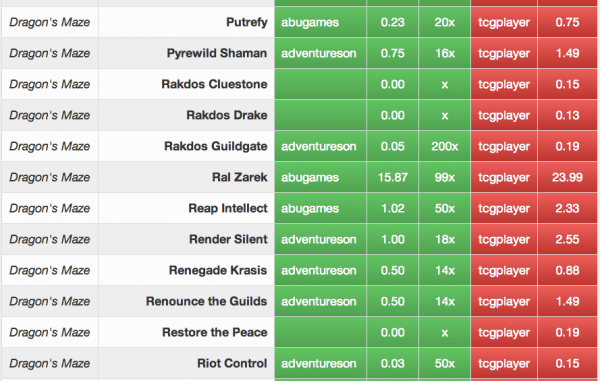
After seeing how simple Standard Commons can buylist for nearly a quarter, I dashed into the other room to find my bulk from recent sets. I began to find value left and right! Noxious Revival sells to AdventuresON.com for $0.25 each, ABU games will give me $0.11 each on my Avacyns Pilgrims, and for some reason Troll and Toad will buy three copies of Alloy Myr for $0.44!

I was on a roll! I was already getting excited to submit my buylist orders to all these vendors, which would surely net me the figurative “free lunch”.

Then reality set in.

Thirty minutes had past and I had a small pile of $0.25 cards, each of which would require separate buylist submissions. Because I don’t own dozens of copies of these Commons, the actual value I was discovering just couldn’t justify the time it was taking. Even if I could keep the pace up, I was approaching around four bucks an hour. I don’t know about you, but my time seems much more valuable than that!

Time Is Money

This old saying is surely overused, but one cannot argue with the importance of this equation. It is amazing that I can go through my boxes of useless cards and find dollars hidden inside. We are all likely sitting on cash we don’t know about simply because vendors randomly need to re-stock.

The problem is that it takes a lot of time to find said cards.

Some stores can afford to find these hidden gems because they have a ton of bulk copies. Finding that ABU Games will pay $0.23 for Thought Scour may be more useful because a store would likely have twelve copies to sell at once. This adds up much more quickly and justifies the pay. However, even this becomes questionable when dealers are only looking to buy a couple copies of a card.

The unfortunate conclusion is that dealers want to have sufficient copies of these cards in stock, but many players do not have the time to find it for them. This leads to discrepancy between the “bid” and “ask” price for these cards, and the transactions don’t trigger.

From Wikipedia:

“The bid–offer spread (also known as bid–ask or buy–sell spread, and their equivalents using slashes in place of the dashes) for securities (such as stocks, futures contracts, options, or currency pairs) is the difference between the prices quoted (either by a single market maker or in a limit order book) for an immediate sale (offer) and an immediate purchase (bid). The size of the bid-offer spread in a security is one measure of the liquidity of the market and of the size of the transaction cost.[1] If the spread is 0 then it is a frictionless asset.”

Since some dealers have strange equations in place to automatically calculate what price they’ll pay on a given quantity of cards, this results in some truly strange outcomes
such as Alloy Myr buylisting for $0.44!

More Time-Wasting

There are a ton of places to buy Magic Cards from nowadays. Sites like TCGPlayer, Card Shark, eBay, MOTL, and Amazon have dozens of sellers peddling their cards at competitive prices. But often times, the same vendor isn’t always selling the cheapest card. Vendor A may sell Card X for $0.30 less than Vendor B, but Vendor B in turn sells card Y for $0.35 less than Vendor A. Plus these vendors may have different shipping costs! When dozens of sellers are involved, this becomes terribly complex.

To help us navigate through these headache-inducing calculations, TCPlayer and Card Shark have provided us with tools.

These tools are a step in the right direction, both these websites have acknowledged that there is still a need. They are imperfect and incomplete. For one, I would like to optimize my purchases across multiple sites. Before checking out from Card Shark, I want a tool that will point me towards TCGPlayer and eBay Buy-It-Now listings for possible savings.

This doesn’t exist... yet, and so we are once again faced with that time vs value equation. One could easily spend an hour attempting to optimize a larger purchase with perfection – believe me, I’ve been there before. But in reality, saving that extra buck just isn’t worth the twenty minutes’ investment.

80 For The 20

My recommended approach for these and other time-wasters: follow an 80-for-the-20 approach. Often times we can reach approximately 80% optimization with 20% of the work – it’s the remaining 20% optimization that takes up so much additional time. Going 80% of the way and stopping may be the optimal balance of time and money for the time being.

In the case of buylisting bulk, I’d suggest doing this in increments. Every time you submit a buylist order, browse their buylist prices for one or two sets to identify if they are paying oddly high amounts for bulk singles. You may end up settling for $0.12 on a given common rather than $0.23, but the time and postage saved by sticking with one vendor will likely balance this out. I find this also helps me feel better when I get my cards downgraded on condition – I may lose $6 on value due to condition downgrades, but selling $2 in random bulk helps balance this out within my head at least.

In the case of cart optimization, the brute force approach is too impractical. I would instead suggest a quick search at each website for sanity checking, but little more. For example, let’s say I’m purchasing a few cards from a single seller. Then I see they also have Breeding Pools, which I wouldn’t mind investing further in.

I may do a quick look at a different website to see if any vendor is selling Breeding Pool for less after adding shipping. Sometimes this is the case, but other times it is not. Other times, a vendor has cheaper Breeding Pools before shipping, and I’m left wondering if I need to instead consider buying all my cards from this seller instead.

A vicious, self-propagating cycle has begun. Going this deep on cart optimization can add stress without adding significant value. Time to stop the loop.

Time – A Precious Resource

We all have a limited amount of time, but the resource has a different value for everybody. For some, MTG is a major part of their life or even their source of income, so grinding out every buck is needed for survival. For others, MTG is a fun hobby that can possibly pay for itself. The time vs money equation may differ between the two groups.

My suggestion is to proactively consider which equation you want to use. As you find yourself beginning an exercise of optimization which may take a significant amount of time, think about how much you are willing to invest up front. You may even want to go as far as to set a timer for 15 or 30 minutes. When the timer goes off, do some quick math to see how much value you’ve saved and decide if it is worth continuing.

During my activity, I quickly realized how much time I’d have to sink to maximize profits. With a wife and young toddler at home, this was an equation I simply could not overcome.


Sigbits – Dragon’s Maze

We saw Dragon’s Maze’s impact on Standard for the first time this past weekend. Looking at some of the outcomes from SCGNJ, I thought it would be worthwhile to point out some price changes (note these prices are as of 9:00am Sunday
 it’ll be interesting to see how much this changes before Monday).

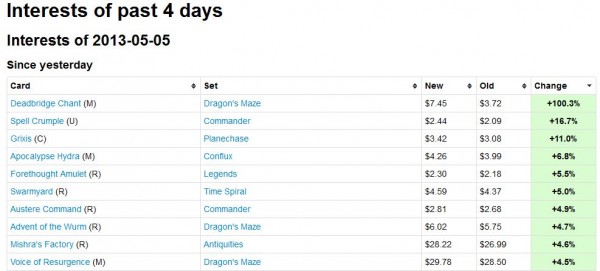
For starters, here’s the Top 10 Interests on mtgstocks.com for Sunday:

  • The number one card is the first one I want to touch on: Deadbridge Chant. This card has doubled in price overnight thanks to its appearance as a 1-of in some Jund decklists. I bought a few myself, but I am left to question how high this card can go. It was a 1-of in the sideboard of many decks, but if the card catches on it could jump much higher, especially now that people understand how powerful the Enchantment is. Being a Mythic Rare also adds to the upside potential.
  • Advent of the Wurm is the next card worth discussing. This spell appeared frequently throughout SCG’s live coverage of feature matches, and I really came to appreciate its power. A 5/5 for four mana that can come down at instant speed is pretty solid. Add in the fact that Snapcaster Mage can help you double down and you’ve got a potent spell. I’ve got my eye on these.
  • Finally, we have what some considered was the money card of the set: Voice of Resurgence. Contrary to Advent of the Wurm, I did NOT see this card throughout SCG’s live coverage. Perhaps I just missed the matches where it showed up
 or perhaps the rumors buzzing on Twitter are accurate – this card is overhyped. That being said, it did show up as a 4-of in at least one Top-8 decklist, and a 3-of in another Top 8 deck’s sideboard. At $30, I’m not a buyer.

-Sigmund Ausfresser
@sigfig8

Insider: The Wide Beta Spotlight

Are you a Quiet Speculation member?

If not, now is a perfect time to join up! Our powerful tools, breaking-news analysis, and exclusive Discord channel will make sure you stay up to date and ahead of the curve.

A Brief History of the Magic Online Client

Magic: The Gathering Online (MTGO or MODO) was released in 2002, developed by Leaping Lizard Software for Wizards of the Coast (WoTC). The original motivation behind MTGO was to give players access to the game who otherwise would not have it, primarily with the goal of coaxing lapsed players back into playing Magic. But, being able to draft at any time of day proved to be a big hit with many active players as well.

Eventually WoTC relieved Leaping Lizard of development and maintenance responsibilities and took on the job in-house. This was prior to the release of 8th Edition in Summer of 2003. The transition to Version 2 of the client was problematic as crashes became frequent, especially around release events when large numbers of players would log on.

An aside for a brief personal anecdote. Making it through a Mirrodin release event (released in Fall of 2003) without a server crash and with a sufficient number of wins would yield prizes which included a Platinum Angel avatar. Crashes occurred often enough that not many events actually finished and thus the awarded avatar was quite rare. I happened to make it through one and eventually sold my awarded avatar for 42 tix on the classifieds. The premium on angel cards has been around a long time it seems!

The release of Darksteel heralded an even higher frequency of crashes and it was obvious that the client had become more unstable over time. Eventually the WoTC programmers got the client working more smoothly and a relatively stable period resulted. But, development had begun on Version 3 which was promised to be a complete redesign of the client in order to produce a more stable and maintainable piece of software. They also intended to create a brand new user interface.

Approximately three years later, Version 3 was released in the Spring of 2008 and it was a disaster. The redesigned user interface was (and still is) terrible, and the promised stability was not a hallmark of the early days of this client. Additionally, a significant piece of functionality was missing from Version 3 with the removal of Leagues.

This was a popular version of Limited where you would get to play sealed deck for a month. Each week you could add a pack to your pool, subtly changing your card pool week to week. Leagues were a low cost way to play Limited and offered decent prize support to boot. WoTC continues to promise the return of Leagues, but as of yet there is no firm date for their return.

This brings us basically up to the present, where most of the stability issues of Version 3 have been ironed out, the user base continues to grow, and another complete redesign is in the works. The Wide Beta client (Version 4) can be run currently as an alternate client and WoTC has stated that a complete transition to Version 4 will occur in July with Version 3 going dark at that time. If history is any guide and WoTC sticks to their timeline regardless of how stable or usable Version 4 is, the transition will not go well.

The Wide Beta Spotlight

The Wide Beta Spotlight is a two day period where MTGO will only be available through the new client. It will begin next week after the downtime and it will be at that time that Dragon's Maze (DGM) online prereleases will begin. This means that the initial wave of prereleases on Thursday will only be available to those using the new client. On Friday Version 3 will come back online in parallel with Version 4.

For speculators, this period of only being able to use Version 4 should be very interesting. First of all, if the system suffers a decrease in stability, this would be a huge warning sign moving forward. If the servers are not stable and frequent crashes occur, this drives users away from MTGO and will simultaneously reduce demand for cards in general and reduce the supply of cards from the most current draft format.

Although these are competing effects, my experience suggests frequent crashes depress prices in the short term, but will inflate prices in the long term. This pattern occurs because prices eventually recover when WoTC restores stability to the client and players return. But, available supply of the current draft format is permanently reduced, meaning that future price increases can be very rapid and large. The transition to Version 3 occurred right around the release of Shadowmoor so cards from that set (and it's sequel, Eventide) offer a good guide as to how persistent client issues can affect prices.

Have a look at the price history of the filter lands from Shadowmoor compared to the first iteration of filter lands from Odyssey. Cards like Rugged Prairie from Eventide are practically never used in competitive Magic, but regularly carry a price tag in the 2-4 ticket range (chart here). Meanwhile, the older Odyssey filter lands such as Sungrass Prairie can be had for 1 ticket (chart here). Although not a perfect comparison since the lands are functionally different, this indicates what effect an unstable client can have on the supply of cards and thus prices in the long term. The bottom line is that if Version 4 is unstable, be on the lookout for cards from DGM to stockpile cheaply in anticipation of a future, more stable iteration of the client software.

The Wild West

Another potential opportunity with the Wide Beta Spotlight could be found on the classifieds when Version 3 goes temporarily dark next Wednesday. The early reports on the trading interface of Version 4 is that it's riddled with bugs and thus difficult for bot owners to program for. It's possible that the regularly available bots will simply not be present on the classifieds during the Wide Beta Spotlight. If this turns out to be the case, it presents a strong short-term opportunity for speculators.

One of the functions of the larger bot chains is to provide a reference for prices on singles. Although mtgotraders or cardbot might not have the best prices at times, they are large bot chains that give a good approximate price for every card available online. Informed players use this as a benchmark to guide their actions on what price to buy and sell cards at. With the possibility of no bots on the classifieds combined with the release of DGM, a speculator with an eye for value could post a competitive buy price on the classifieds and accumulate some of the new cards at low prices. Once the bots return with Version 3 on Friday, prices will become more predictable and there will be some short term inflation as they buy up cards in order to gather stock.

Profiting on this strategy will require a speculator to dedicate some time to studying the classifieds and identifying cards that are underpriced. This is a skill that builds up with experience and so there is no current recommended target for this strategy. On the evening of Thursday, May 9th, 2013, if you message me in-game, I will let you know in which cards I see value and at what price. My user name on MTGO is 'mattlewis'.

A second strategy which is a bit more predictable is to step into the void created by the lack of bots and sell cards on the classifieds. Players and brewers typically don't do much buying of the cards they will need in advance, so those players who are looking to break Obzedat's Aid will be looking to buy cards like Omniscience and Nicol Bolas, Planeswalker. When they are looking to buy, a good speculator should be looking to sell. Ordinarily for me this means selling to bots once demand increases have triggered price spikes, but this time there might not be any bots. One should be able to charge a premium on these cards when the bots are not online. Without a benchmark to refer to, players will have to pay whatever the market is selling for in order to play with their new toys.

If you are new to speculating, taking advantage of the Wide Beta Spotlight and the potential lack of bots is a somewhat advanced and short-term strategy. It's less predictable than other strategies and so should be approached with some caution. But, there is an easy way to speculate on this if you are interested. I'll be posting an ad to the classifieds on Thursday night, selling Putrefy for 1 ticket each or a play set for 3 tix. Currently these can be bought for 0.25 tix from cardbot, and I think I'll be able to sell a few play sets that night for a small profit.

Portfolio Update

This is a brief rundown of what I am buying, selling and watching in the market.

Selling:

  • Nothing to sell this week as I have gotten rid of everything worth selling from Return to Ravnica (RTR) and Scars of Mirrodin (SOM) blocks.

Buying:

  • Gatecrash (GTC) boosters have drifted down to around 2.95 and I restarted buying these every day in order to build my stock. I expect prices to rebound in the second half of May and packs are liquid enough that I have no qualms about buying these at the moment. There's no upper limit to how many I would buy at prices less than 3 tix.

Watching:

  • I'll be paying attention to paper tournament results once DGM hits to get a sense for how the Standard metagame might shift.
  • And of course I'll be watching how the Wide Beta Spotlight goes.

Dragon’s Maze Top 10!

Are you a Quiet Speculation member?

If not, now is a perfect time to join up! Our powerful tools, breaking-news analysis, and exclusive Discord channel will make sure you stay up to date and ahead of the curve.

This week, I am excited to bring you my regularly scheduled top 10 article! Thinking about the set in this manner helps me to determine what cards are powerful and likely to impact Standard the most. You are likely to see my normal controversial picks as well. Some of them have been flops, like Hellraiser Goblin, but I have picked some hidden gems as well.

The most important thing this article does is to help you see someone else’s perspective on the best cards in the set. These types of articles can help you identify financially profitable prospects and underappreciated new cards. This set is particularly difficult to analyze so additional perspectives are more helpful than in the past. One reason the cards are so tricky is because many of them have brand new, unique effects. These types of cards are always hard to decipher. In addition, many of the best cards in the set are so powerful because their application is so narrow. Will they be relegated to the sideboard or can they find a home in someone’s main deck? Continue reading to find out!

Overrated

This is a new section that I thought I would add to my top 10 article. So often, there are cards players think will be good, but not everyone agrees. In this section, I will highlight some of the cards that don’t seem like they will pan out for constructed play. These can be cards that don’t have a home or ones that just aren’t up to Standard’s level of playability. Either way, hopefully I will help you avoid some possible FNM disasters with this list.

The number one offender on my overrated list is Spike Jester. Why is this card overrated? One toughness is a liability for an aggro deck in today’s Standard. Between Lingering Souls tokens, Arbor Elf, and every cheap removal spell, this power-creeped creature will underperform in this format. If that were not enough, Red Black Zombies (the most natural fit for this card) is not a playable deck at the moment. It’s possible that once Standard rotates, we will need to reevaluate this card for that format, but that is a while away.

Notion Thief. I almost typed Nothing Thief and that is quite a funny Freudian slip. Your thief of nothing will show up more times than you want to see him. Main deck seems unfitting for a 3/1 flash for four mana. In most matchups, his text box will be irrelevant. In the matchups where he shines, you will find yourself with more than a measly Notion Thief, you will have a Brilliance Thief! Players will cast this inefficient 3/1 on the prospect alone of stealing their opponents expensive Ancestral Recall. While this new blue dude will impact older formats, his applications in Standard are limited. This may be the type of card you see as a two-of in decklists though because of how good it is against certain strategies.

Finally, also getting the overrated stamp is Plasm Capture. Despite being broken in half in Commander, this clunky Counterspell is unlikely to provide major contribution to Constructed. Mana Drain is a ban-worthy card, but doubling its mana cost by adding green green doesn’t seem like the way to make the effect more balanced. If the mana cost was geared towards hybrid mana, it might find a home more easily, but alas that is not the case.

Honorable Mention

In this section were a number of close calls. There are more cards in this section than normal because there are more impactful cards in this set than previous ones.

Blood Scrivener

Recently Zombies has not been good enough to compete at a high level. The version of Zombies I have seen players working on to some success is Black White. It is unclear if this card will be the punch Zombie decks need in order to succeed, but it is enough to explore the question. The natural way this card causes you to play can prove problematic though. For example, if this creature is in play, you should be trying to empty your hand as fast as possible so that you can take advantage of his ability. This type of play can be dangerous against many decks so beware of that tendency.

Unflinching Courage

Armadillo Cloak is one of the best auras of all time so it’s no stretch to say this time around will be too much different. If you have doubts, start thinking about rebuilding a Bant aura deck with this classic reprint included.

Warleaders Helix

Doubling the mana cost of Lightning Helix may not be enough to keep it out of the hands of tournament players. Four mana is a lot for a removal spell but since it is an instant that helps matters. This is no four-of, but it could still see play, especially once Thragtusk is no more.

Exava, Rakdos Blood Witch

This is at the top of my list of long-term impact. Right now, we have better cards like Hellrider, but once we have a new format, this seems perfect for the top of a Rakdos curve.

Obzedat's Aid

Will the possibility of reanimating Nicol Bolas, Planeswalker be enough for this card to see play? That is a powerful interaction to be sure, but it’s more likely that players want additional copies of Unburial Rites before that happens.

Renegade Krasis

Many players want evolve to be a competitive deck archetype but the inherent weakness of each creature on its own is holding it back. This three-drop could be the key to success, but because he is only good if you follow up an already strong draw, I doubt he is the missing piece.

Tajic, Blade of the Legion

Four mana for a 2/2 isn’t good enough unless your name is Huntmaster of the Fells. By the time you get this guy in play, either your opponent should be dead or they have manipulated you into a game state where he will not be effective. His battalion seems like one that will never trigger and when it does won’t do damage because he will get chumped all day.

Varolz, the Scar-Striped

Think about this line of play. First turn you play Vexing Devil and they take four damage because that’s the right play. Then turn three you play my friend Varolz here. Fourth turn, for one red mana, you can add four +1/+1 counters to any of your creatures in play. That interaction is good enough to brew around him and past that, we will see. The fact that he is a sacrifice outlet may prove important as well.

Top 10 Constructed Cards

10. Putrefy

Is it better to stab someone in an alley or to instantly make their flesh and bones decay? Obviously instant decomposition is way cooler than being a murderer. Thus, Putrefy is better than Murder. More information you say? OK, if you played Putrefy when it was legal the last time we visited Ravnica, this explanation is not for you. For the rest of you, come join the Golgari side. Murder is decent, but it cannot kill an artifact nor a regenerating creature. Murder is already a playable card. Putrefy is just a better version of the same effect. It is not the powerhouse it used to be, but for the cost, you certainly get your mana's worth.

9. Sin Collector

Three mana is probably the most reasonable cost for Duress plus a body. I would much prefer this human cleric to cost two mana and provide you with a 1/1, but we don’t get a choice in the matter. In most Standard formats, it would be reasonable to play this as a four-of because every deck has spells. Unfortunately, Naya Blitz won’t be having any of their sins collected anytime soon. 40 creatures and 20 lands is the opposite of what you want to be playing Sin Collector against. Because he is so solid against other decks, it’s hard to believe that this card will go unplayed, even if only as a sideboard special. Not only can he be combined with Cavern of Souls, he can also be reused with Restoration Angel.

8. Blood Baron of Vizkopa

Unlike other players, I don’t have strong opinions about this card yet. At the moment, it seems decent and like it will most likely see some play while it is legal in Standard. The Baron of Blood has a lot going for him. Not only does he have a reasonable power and toughness to start off with, but he also has three keywords to support him.

Protection is not something we get as often as we used to. Because of that, I’ve noticed how undervalued those abilities are. More than one protection leaves the creature vulnerable to so few spells. The Baron is weak to Mizzium Mortars, but other than that, protection from white and black protect from the rest of the removal seeing play. By adding in lifelink to the equation, we arrive at a creature that can have a large impact on matchups. The rest of the text is just a bonus on top of an already solid combination of abilities. It seems like if you arrive at a game state where you are at 30 or more life and your opponent is at 10 or less, you have already won that game, but just in case, your Blood Baron will kill a turn faster than before, all the while performing an aerial stunt show for the audience.

7. Legion's Initiative

This is my sleeper pick for the set even though a ten dollar sleeper is a stretch. Other writers have compared this enchantment to Honor of the Pure, but I think Fires of Yavimaya is a better comparison. Both provide static effects for your creatures and then additional effects if you give up the enchantment. When I read Legion's Initiative the first time, it seemed like it would come back into play with the creatures you exiled, but that is not the case. For me to grasp the effect of the card, I pretend it says sacrifice Legion's Initiative to have this effect.

For this card to impact the game enough, your deck would need to contain red creatures or red/white creatures. This implies to me that the best home for it would be mono-red splashing white. With some initiative in addition to your Boros Charms, you are safe from all of the board wiping effects your opponent can muster. The mana cost seems misleading as well because it has more than one option. Not only can you play it for two mana and get in some early extra damage, but you can also play it for four mana and start protecting your team from disaster.

6. Aetherling

The more I think about Morphling’s new family member, the higher it moves up my list of great cards from this set. First things first, this is a seven-drop nearly every time you will cast it. Unless you are getting ready to die and desperately need a blocker, you will wait until you can protect it from whatever shenanigans your opponent has devised for your finisher. As far as the abilities go, unblockable is the best type of evasion and Otherworldly Journey is the best type of protection. I don’t know if existing in the same format as Sire of Insanity will allow this ‘ling to be as playable as it otherwise would, but it is a powerful addition to the lineage.

5. Advent of the Wurm

Despite talking about bringing the Tremors experience to Standard last week, I have some more tid bits to share. One of the main points against the instant speed 5/5 is the mere fact that Azorius Charm exists. Throughout the time since I wrote my last article I have been thinking if that was enough to barricade it from entering Standard playability. To decide this point, I tried to compare the charm’s effect to another card.

A comparable spell came to mind almost immediately once I set out down this path. Paying two mana to kill a creature is not an uncommon cost or effect spells have in Standard. Long ago, we had Terror which was upgraded to Doom Blade, sidestepped by Go for the Throat, and downgraded by Ultimate Price. Even if all the cards not legal currently would see tons of play, that doesn’t make them overpowered. Two mana to kill a creature is a common effect and even though blue-white shouldn’t typically get this effect, that doesn’t change the fact that it is a balanced card. Upon further reflection, I settled on the situation being ultimately better than if they were able to put the card back on top of my library as the text reads because that loss of a card can spiral out of control quickly. Adventing the wurm is going to be populating your Standard metagame all year so pack those charms or find another before the Tremors get you.

4. Sire of Insanity

Despite having both this card and Cavern of Souls to cast it counter free, players still think they are going to be successful with their typical Esper Control decks. How can this be possible when this one card single handedly defeats that strategy? As is, Esper Control must adapt to survive. Is this Craw Wurm impersonator good enough against the majority of other decks? The answer to that is a resounding no. I think this is a card much more suited to the sideboard, but the two copies players are trying to fit into their Jund control builds doesn’t seem crazy. Even Naya Blitz occasionally tries to hold a couple cards to recover from board wipe spells.

The existence of this demon will cause a metagame shift all by himself though. He would be higher on the list if not for the number three card.

3. Warped Physique

In the past, cards dependent on hand size have not been reliable enough for tournament play. It seems like this one might be the actual gold rather than the fool’s property though. Early in the game it is extremely good at taking care of anything your opponent can throw at you. Late game, you can draw more cards with Sphinx's Revelation or Think Twice so that your hand size is big enough to deal with larger threats. It is unclear whether warping the physique of a Sire of Insanity will become a reality but demoting a Champion of the Parish is probably enough for this solid removal spell to see play. Esper Control has been looking for an instant removal spell that can interact with a number of decks and this might be exactly what the control doctor ordered. This may not be the best card in the set, but it will be one that sees a lot of play.

2. Ral Zarek

The main place I’ve been thinking about using the Izzet planeswalker in is a Delver of Secrets deck. This seems like the perfect card for keeping tempo on your side. Not only can you kill one of their creatures, you could also tap one the next turn to continue getting into the red zone. If you have a clear path, you can always Lightning Bolt them. I actually think about his -2 ability as Searing Spear because you must spend two loyalty to use it and that’s Searing Spear’s converted mana cost. Whichever spell you are mimicking, the ability is solid. This is a planeswalker with applications in all types of decks. Aggro decks can utilize him as described above, control decks will lean on the removal aspect but also appreciate the untap ability to gain more mana or grant pseudo vigilance, and combo decks can use the untap ability to do crazy things like untap Gilded Lotus or maybe an even more broken permanent.

1. Voice of Resurgence

If you read my article from last week, it should come as no surprise that I placed Voice of Resurgence at the top of the list. This card is powerful enough to see play not just in Standard, but in Modern and Legacy as well. One aspect of this hate bear that is not emphasized enough is that the power and toughness of the tokens changes.

If it wasn't clear, the token works like Soulless One, or if that’s too old school for you, Wayfaring Temple. What this means is that you can follow up your block or their removal spell with more creatures and the token will grow. It also means that if you populate that token, it becomes an exact copy of it that will grow according to the number of creatures you control. This new mythic is a great response to aggressive and controlling decks alike and because of that, it should see play in multiple archetypes.

Tournament Tips

Every time a new set comes out, I am reminded how important building sealed decks and drafting is to your overall game. Don’t undervalue the impact playing Limited can have on improving your skills. Both draft and sealed require skills that carry over to constructed formats. These ever changing formats don’t allow you to rely on professionals to build your decks for you, they make you do all the work. You can’t buy wins in these formats buy handing over cash for the newest shiny mythic rare or hot new tech.

Limited forces you to learn how to evaluate cards and form your own opinions about their strengths and weaknesses. You might talk to your friends between rounds about the deck you built, but ultimately all of the decisions rest with you. Limited helps you find the hidden synergies between cards that normally wouldn’t see play in Constructed. There are many opportunities to grow as a player because you are constantly trying to outplay your opponent with 2/2’s for two mana or something similar.

If you are having some problems being successful in Constructed or you think your game is stagnant, spend some time drafting or building sealed decks. In addition to the massive amounts of fun you’ll have, you will help yourself improve in areas you didn’t know needed improvement.

What are your thoughts on the top 10? Post your list below!

Until Next Time,

Unleash the Force of the Maze!

Mike Lanigan
MtgJedi on Twitter
Jedicouncilman23@gmail.com

Insider: Finishing the Maze

Are you a Quiet Speculation member?

If not, now is a perfect time to join up! Our powerful tools, breaking-news analysis, and exclusive Discord channel will make sure you stay up to date and ahead of the curve.

Let’s start with a brief aside. You’d think that after three years of Magic writing for several websites (and a weekly podcast) one could run out of things to say, and I guess some people do. I won’t deny lacking for inspiration from time to time, but a lot of the time, in this column in particular, I feel like I don’t have enough time or space to say everything I want.

Last week was an example of this. I did my Dragon’s Maze Prerelease Primer, a tradition before every new set. In many ways it’s a set review, but more than that it’s also a game plan for the prerelease event, which can mean more than just putting a price on every card. I try to talk only about hyped cards or ones I feel strongly about, and due to space constraints that means some stuff can be left off.

In the comments of last week’s articles multiple people listed some other cards that I didn’t get a chance to talk about, so I want to use this week to address some of those cards. I’ll round up my Dragon’s Maze coverage the week after that with the “Casual Hits from
” series, and then follow that up with my retrospective on the Gatecrash review.

That’s my plan, at least. Let me know what you all think of that outline. I’ve followed a loose path similar to it in the past, but the reflection I opened this column with above made me decide that a little more structure could be useful to normalize things moving forward. What I’m most unsure about is whether the previous set retrospective (in this case Gatecrash) should be done the week before the prerelease or several weeks after as we’re doing this time around. Let me know what you prefer.

Anyway, enough housekeeping. Let’s get to it!

Deadbridge Chant

When I talked about this card last week I said it was one of my favorite targets, and it could be had for around $2-3 online. Since then it’s crept more toward $4 in many places, and I think it’s one of two cards to watch closely in the next few weeks.

Based on my testing, I’ve actually cooled just a little to the card, at least in Standard. I feel like it occupies the same space Sphinxs Revelation does in that it’s your big “take control” card in the Control decks where you turn the corner. I understand that they aren’t played in the same decks, but in my testing I’ve felt like if you’re playing the control deck you’d rather just have Revelation since you want to be in Supreme Verdict colors anyway.

That’s certainly not a death knell for the Chant. What it does mean is that it likely fits better as the top-end of a strong midrange deck like Jund along with the next card on this list. I still think this is a great trade target at $3 or so and a good weekend in the next 2-3 weeks could cause a big spike.

Sire of Insanity

Another way that Chant could become the go-to control finisher is if enough Revelation hate becomes played. Notion Thief, Frontline Medic and this card all fit the bill.

Sire has an extremely powerful effect and plays great with Chant, leading me to think a control-ish version of Jund with both of these could become a player. If such a deck happens in the next week or two, this could also experience a spike from the dollar you can pick them up at now in trade.

Skylasher

Where was this thing a year ago? This is basically the perfect anti-Delver card and had it been printed instead of Thragtusk we’d have a much-less warped format than we do now.

With that said, this card is basically just a Geist-stopper now, and while it’s good at that role, it is a bit narrow. This is also good sideboard material in older formats, but it’s narrow there too so I don’t expect much of it moving forward. Look at the near-bulk Great Sable Stag for context.

Obzedat's Aid

I think this is a great financial play once it gets cheap. I don’t expect much Standard play, and it’s a very long way from Unburial Rites. That said, I do expect a fair amount of EDH and casual play, and some fringe Standard play is possible, so this is an attractive target for me once it gets below $2.

Renegade Krasis

This is about a buck now, and I don’t expect it to really ever be more. Sure, it’s a really powerful effect, but there’s just not a ton that works with it for constructed play. Experiment One and Cloudfin Raptor are good and all, but I don’t think the dedicated evolve deck is going to break out in Standard any time soon. That means this isn’t going anywhere.

Exava, Rakdos Blood Witch

I think chances are high this becomes cheap, at which point we pick them up, and then next year doubles or triples in price to hit $4-5, which is easy if unexciting money.

Commons/Uncommons/Foils

This is a major reason why I’m wanting to make this “second-week” column part of the regular rotation, because the C/U/Foil section is an important one to have, and one that is usually clearer after seeing the cards in action.

Gruul War Chant

I don’t think this is exactly Fires of Yavimaya, but it’s a powerful top end. It’s possible an all-out Zoo blitz deck could make use of this at the top end after rotation, so it’s worth grabbing off draft tables if not much more.

Putrefy

This card doesn’t really see much Eternal play anymore, but foils are still probably a good choice for this do-it-all removal spell.

Another note about this card is that digging up your old copies is suddenly worth it, because there is a real percentage of players who like to have the original printings.

Spike Jester

I mean, this guy does bring the beats. Attacks for five on turn two with Rakdos Cackler, which is something you can’t ignore. You’ll find these all day in draft leftovers.

Turn // Burn

One of very few cards, if not the only one, that can keep a Thragtusk from leaving behind a buddy. Even without fusing, both halves of this are acceptable, so this is a prime target for keeping in the binder and foiling out.

The same goes for Wear // Tear, which is likely playable in older formats.

Debt to the Deathless

So this says “each opponent” and has an X in the casting cost. EDH fodder here folks, foils are the play.

Guildgates/Cluestones

I’m leaning towards not even boxing away the regulars because I don’t think they’re ever really going to get there financially, but foils are a very solid play. These have several advantages over similar dual lands in cubes, and cubers love these in foil. These are a safe bet to be worth more than you’d expect a ways down the road. The same goes for the cluestones.

And That's All

That should do it! Let me know if there’s anything I missed and I’ll be sure to address it in the comments, and I appreciate any feedback you guys have about the rest of the stuff I discussed.

And, as always, thanks for reading,

Corbin Hosler

@Chosler88 on Twitter

A Few Thoughts from the Prerelease

Are you a Quiet Speculation member?

If not, now is a perfect time to join up! Our powerful tools, breaking-news analysis, and exclusive Discord channel will make sure you stay up to date and ahead of the curve.

Somewhere in the middle of my deep-seated hatred for everything lies a soft spot for small card shops. I can say with a high degree of confidence that I've spent more time in such stores than any other business. Growing up as a socially inept nerd they were always my best bet for meeting new people that wanted to talk about the things that I was interested in talking about.

That soft spot has endured with me to this day, but my visits to such shops have become less and less frequent as time has passed and I have become more firm in my opinions. When I was 15 I was very excited to hear what everybody had to say about the new set and to compare what sweet-action rares everybody had opened. Now I'm most interested in what manner of deck my commons can support and less-inclined to say anything to the guy asserting his belief that Zhur-Taa Druid will be a five-dollar common. Even still, I found myself giving up one of the first days of actually tolerable Minnesota weather to sling spells with a bunch of strangers.

I chose Azorius because I am the most boring and got paired with Boros, which was kind of a whammy in terms of my sealed-deck philosophy. You know, take the draw every time. Luckily for me I didn't open a ton of red cards in my pool. Less luckily, this was because the majority of my Dragon's Maze cards were black and green. Awkward.

I did open an Aurelia and a Ral Zarek, so I figured that I'd be able to pull something off, but my most exciting commons were three copies of Opal Lake Gatekeepers. Don't get me wrong, I'm a huge fan of cantrips, but my pool was pretty far from ideal. This is the deck I ended up playing:

Dragon's Mazed Sealed Act I

spells

3 Opal Lake Gatekeepers
2 Haazda Snare Squad

lands

3 Mountain
4 Island
4 Plains

So yeah, basically my deck was bad creatures, bad spells, two mythics and a Skymark Roc. My sideboard consisted of other four+ costing creatures and three copies of Levy Decree. I made the mistake of boarding the Levy Decrees in against a very aggressive deck that I was sure I was very unfavored against anyway and saw what I had suspected very clearly- they're only going to be good in a deck that's good at attacking.

I ended up going 3-2 and my matches weren't particularly interesting. My round five opponent seemed to think that our match was close for some reason as he bemoaned his draws as he rolled me, but I'm not convinced that he was all there. My pool's general lack of 2-3 drop creatures made me quite cold to good aggressive decks and Opal Lake Gatekeepers was actually an insane breaker against other slow decks. Relevant bodies that generate card advantage, to the surprise of no one, are good.

So What Did We Learn

Well, I confirmed that for the most part the format is going to be slow and that jamming a bunch of gates really isn't going to be too detrimental. Further, the upside on "kicked" gatekeepers is going to be a lot better than the average common in this format. When the stars line up the aggressive decks are potent, but I'd rather have a deck with strong removal ala Street Spasm and One-Thousand Lashes than one full of Rakdos Cacklers.

Cluestones Suck

When I first saw the Cluestones spoiled I thought it was neat that we were going to have more manafixing but them costing three is just not going to cut it, even with the format being as slow as it is. Jumping from three to five just isn't a thing. The four drops are very comparable to the fives and you don't want to have a huge quantity of either. Alternatively, the B-plan of six mana draw a card is just plain bad. I pumped my fist every time somebody played one of these against me and I never noticed them making a positive difference. It is far more relevant to build one's deck in a way that emphasizes one color over the others for consistency than to have some clunky rock to attempt to go greedier.

Split Cards are Insane

Hey look, more obvious information. If you played against Turn/Burn there is a reasonable chance that you got worked. It happens. It's Magic. Personally I learned a lot from playing with Far/Away. The card very clearly does a lot of work when "kicked" but I found myself most commonly casting it strictly as an Unsummon. This provided tempo swings that let me win from under some oppressive rares and cards like Unflinching Courage.

The ease of splashing the back end of these cards in conjunction with the relevance that many of them have as singular cards illustrates that they will be very good in my "force five color" type draft decks. I'm quite excited to sling these ones.

Our Work is Only Just Beginning

Basically all of my thought son this limited format start from the basis of "I really like being on the draw" and build from there. There is a ton more to learn and I'm pretty excited to get into DGR in a big way. Of course, we have a bit of a lull before it launches on MTGO so next week I will likely be giving updates on Pauper MUC Delver- something that I've been putting some reps in with and think that I have a very strong edge against the format with right now.

Thanks for reading.
-Ryan Overturf
@RyanOverdrive on Twitter

Want Prices?

Browse thousands of prices with the first and most comprehensive MTG Finance tool around.


Trader Tools lists both buylist and retail prices for every MTG card, going back a decade.

Quiet Speculation