
menu

Performance Review: MH2 Edition

Are you a Quiet Speculation member?

If not, now is a perfect time to join up! Our powerful tools, breaking-news analysis, and exclusive Discord channel will make sure you stay up to date and ahead of the curve.

Nobody enjoys performance reviews. Even if they're positive. There's just something existentially distressing that comes with being assessed, aside from any professional implications stemming from said review. And they're also frequently boring for everyone involved. (From personal experience.) However, they can be useful for fostering improvement. Especially when they're self-administered in a public setting, so there's no weaselling out of self-criticism.

It's been long enough since the release of Modern Horizons 2 for the set to be reasonably explored and integrated into the metagame. There's always cards that get overlooked for years or need help to make the grade, but it looks like things are settling down. Relatively speaking, anyway. Therefore, this is an opportunity to revisit my periodic reflections on how spoiler predictions have played out. However, this time rather than trying to explain or excuse misses, I'm looking for the lessons from MH2 spoiler season. What did we miss, where did we miss, and why did we miss it? I'll also point out what we got right because criticism is easier to take when praise is mixed in.

The Top 5

The hardest part of evaluations is figuring out where to start. It's also quite hard to decided how to evaluate something, and criteria setting tends to eat up a lot of time. So I've decided to start as objectively as possible. And that will be working comparatively from a list. Jordan culminated the spoiler season with a Top 5 list, so it's fairly easy to compare that list to the most played cards list on MTGGoldfish and see how he did (According to that list as of Monday, 8/16).

PlaceJordan's RankMTGGoldfish Rank
1Ragavan, Nimble Pilferer Prismatic Ending
2Abundant HarvestEndurance
3Prismatic EndingRagavan, Nimble Pilferer
4Urza's SagaUnholy Heat
5Sudden EdictDragon's Rage Channeler

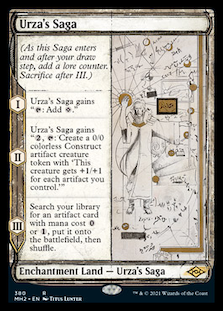
Well, that's quite some variation, but Jordan did get 2/5 which isn't bad considering that these were evaluated without being tested in any tournament settings. That the two that Jordan got right are #1 and #3 is significant, even if they are in reverse order. That said, two out of five is not a passing grade, so shame on Jordan, right? Wrong. I'll admit, Sudden Edict is a huge whiff and has seen play in exactly one deck since release; everyone was high on Urza's Saga and yet it just hasn't worked out. It doesn't even make the MTGGoldfish's Top 50 list. Why? I'd say that the complete lack of splashability Jordan identified is the key. Saga is quite powerful, but accessing that power requires a commitment to artifacts that few decks can muster.

While Harvest hasn't really panned out either, that doesn't make Jordan wrong there either. Abundant Harvest has seen plenty of play since release. The catch is that it's been in a deck that has severely fallen off. Couple that with UR taking all the space for cantrips in the metagame, and there's no place for Harvest. That doesn't mean that Jordan's rating is wrong about what the card is capable of or its power in a vacuum. Things didn't work out the way that we expected.

It's Elementary

Another easy measurement should be the Incarnations list. There were five elemental incarnations and they had obvious power differences, which lent themselves well to ranking. And we weren't the only ones. StarCityGames recently did their Exit Interview for MH2 and ranked the incarnations based on how they've actually played. Averaging their scores yields a consensus place for each. Should be simple to just compare Jordan's list (which I agreed with at the time) to the SCG consensus and see how we did, right? Well, that's one way. However, it's also fair to ask how SCG's commentators did based on their initial impressions. But again, there's the MTGGoldfish ranking based on actual play frequency. Which is the most accurate? How about I sidestep that question and compare our list to all the options?

PlaceJordan's Ranking SCG Initial RankingSCG Current RankingMTGGolfish Ranking
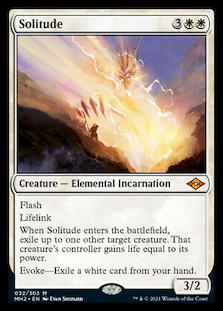
1SolitudeSolitudeSolitudeEndurance
2Subtlety GriefFuryFury
3EnduranceSubtlety EnduranceSolitude
4FuryFuryGriefSubtlety
5GriefEnduranceSubtletyGrief

Jordan and SCG are in lockstep over Solitude as the most powerful. Swords to Plowshares is incredibly strong and having it as a pitch spell is invaluable. Jordan and SCG also agree that Endurance was third strongest. However, the only other point of agreement is with MTGGoldfish that Grief is the worst incarnation. Even the SCG guys were down on Grief compared to their initial impressions, and many admitted to rating it more on the basis on objective power than actual performance. It turns out that perspective and methodology really affect the evaluative process.

What it Means

The point here is that trying to measure spoiler season success in an objective way is quite hard if not impossible. Everything depends more on how the question is asked and what criteria that question is evaluated with. It's especially unfair since all jokes aside, we're not clairvoyant. There's no way to know how things will actually turn out without practical experience. So there's no objective criteria for success in these things.
However, that doesn't mean that we can't still learn and evaluate our performance. It just won't be in a nice list. This is about looking at what we actually wrote about the cards and whether we did a good job evaluating their potential. Again, did we totally miss on any played cards? What did we overestimate, and why? And what were we on the money about?

What Went Wrong

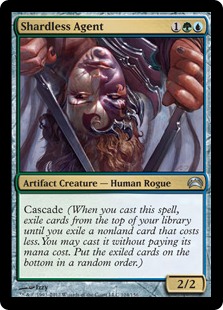
As I see things, it doesn't much matter if we got a card exactly right. Did we evaluate it correctly is what matters. We can't know how anything will play out until the set's released. The final value of a card is not the card's inherent power but contextual power once it finds a home. And we can only guess at that. Who saw Shardless Agent making Crashing Footfalls into a Tier 1 card? However, as long as we said the right things about the card I'm going to count it as a pass. Reading the future is hard, okay? Assess us on the things we could control. Thus, after going through everything that we both said about MH2, here's my evaluation of our performance.

Did We Miss Something Playable?

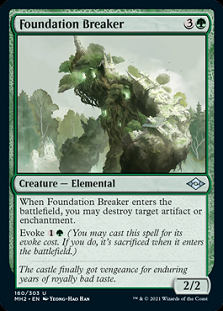
The biggest thing is was anything overlooked? That's easy to determine and also the biggest mistake we could make. And on that front I have good news. According to MTGGoldfish, the only commonly played MH2 card that we didn't talk about at all is Foundation Breaker. It turns out that Living End really likes having an evoke Naturalize to fight through hate cards. And I think we missed it thanks to fatigue. Every time there've been cycling creatures or sacrifice effect creatures we've said something to the effect of "it may find a home in Living End." And we're often right. However, having done this for so many years, it just slipped our minds. We'd said it so often that it started losing meaning to us and we overlooked a key card in a popular deck.
Missing a role player in what was at the time a newly resurgent deck is not that big a deal. We did at least identify all the potential playable cards from MH2 and were in the ballpark about how and why they'd see play. Overall, a good performance.

What Was Underestimated and Why?

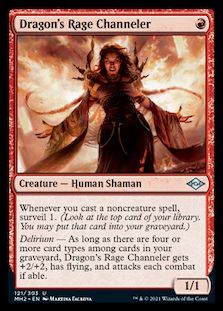
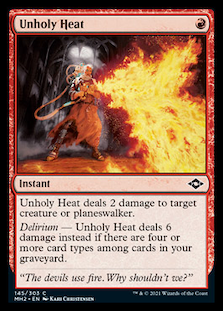
We underestimated Dragon's Rage Channeler and to a lesser extent Unholy Heat and Murktide Regent. The problem on our end was experience. Jordan had tried years ago to make Delirium Zoo a thing. He found that Gnarlwood Dryad was great with delirium and terrible without, and had to contort his deck to make Dryad work. DRC looks a lot like Dryad stat-wise, so Jordan's experience said that DRC would only be great sometimes, which cooled our expectations. What we missed was how powerful repeatable surveil would prove in an UR shell and that it would synergize so well with Heat and Regent that UR Thresh would supplant UR Prowess. Jordan was right about what they would do and how they'd play, but they're all far more playable than expected. This is a case of experience leaving us gun-shy.

Meanwhile, I was too cool on Prismatic Ending in retrospect. Jordan was totally right about how splashable it's proven to be. I thought that it would see a lot of play (and it has) but only in control decks. Instead, the opportunity cost is so low and the flexibility so high that it sees play in basically every multicolor deck with white in it.

What Was Overestimated and Why?

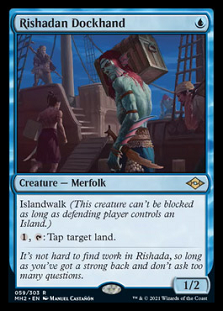
I was too hot on Rishadan Dockhand in my initial review. Dockhand really hasn't played out well in Modern. A lot of that comes down to how the format has shaken out, but I also gushed too early. Tide Shaper was spoiled after I wrote that article and did what Merfolk needed much better. There was no way I could have seen that coming and nothing that made me expect that Dockhand would be superseded. And I did walk my assessment back a few weeks later.
Abundant Harvest has seen less play than expected, but I've covered it and Sudden Edict already. However, we did think that all the anti-Tron cards would see more play. That hasn't happened, though whether that's the fault of the cards being worse than expected or metagame considerations isn't clear. Tron fell off massively along with MH2 and it may not be related. Thus this may be a case of waiting for the right meta rather than an overestimated power level. On a similar note, Domain Zoo hasn't lasted. It did well initially, but has fallen away as Living End and UR Thresh have risen. The cards did what we expected in the deck, but the deck itself didn't work out. Or maybe just not yet.

The Big Picture

Overall, I'm happy with how our predictions shook out. We didn't get everything exactly right, but most of that is how the metagame has evolved, which is out of our control. When we made mistakes it was a combination of jumping the gun and relying too much on history to make judgement calls. Experience informs how a card will play, but it isn't deterministic. Let the cards speak for themselves rather than be spoken for by pervious cards.

What Went Right

I feel as though our greatest strength this spoiler season was card evaluation. We were very good at assessing where cards fit into Modern. We didn't always get their contextual power right nor do we know if the deck will succeed, but we succeeded at evaluating a card's role.

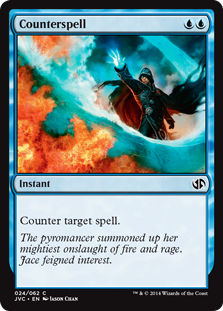
For example, I said that Counterspell largely replace the cheap counters but leave the expensive ones alone, and that's what's happened. I've also been proven right about the problems I identified with Grief, despite players desperately trying anyway. Jordan's evaluation of Urza's Saga and Prismatic Ending was right on the money (despite their places on his list). He also called out Fire // Ice and Suspend as playable cards when I didn't think either would see any play. We're good at understanding the cards. The metagame's the issue.

Lessons for Next Time

My lessons from MH2 spoilers are as follows:

  1. Focus on the cards themselves. The metagame is certain to shift and decks will fall and rise. We can't predict that, so focus on our strength and evaluate the cards.
  2. Focus on the cards in the current context. Circumstances and metagames change. Experience isn't always predictive, so don't let past experience dictate everything.
  3. Remember that everything is relative. We don't know what we don't know. Don't sweat getting it exactly right. Instead, if you're retrospectively wrong, be wrong for the right reasons.

Sooner Than Later

And this is timely because the teasers for the Innistrad split set are already starting. I get wanting to do multiple themes and having parallel stories, but splitting the fall set in two is a bit extreme. I guess we'll just have to see how this plays out. While wondering why they couldn't just do this as an old-school block.

Why To Invest In Magic: The Gathering Cards and Why It Matters

Are you a Quiet Speculation member?

If not, now is a perfect time to join up! Our powerful tools, breaking-news analysis, and exclusive Discord channel will make sure you stay up to date and ahead of the curve.

Whether it's to play the game, to make a profit, or something else entirely, people invest in Magic: The Gathering cards for a variety of reasons. The reason you get into investing in Magic can and should steer you in a clear direction of how to spend your money. Let's look at two reasons to invest, and how that shapes where your money goes.

Investing To Play The Game

The most common reason people invest in Magic is to play the game and with good reason. Magic is one of the greatest, if not the greatest, games ever created. It offers a variety of formats and levels of competition to suit any player and any budget. This is true whether you're investing in packs and entry fees to play Limited, buying into a format like Modern, or just want to make tweaks to the Commander deck that brought you into the game.

When investing to play the game, part of the goal is to maximize one's enjoyment. Minimizing our expenses by being smart about how we invest our money is a great way to stretch those Magic dollars into more cards, and lead to further enjoyment. Here are a couple of ways you can make that money go further and build your collection at the same time.

Play More Limited

Not only is Limited a lot of fun, but it is also a great way to quickly help you get better at Magic and add cards to your collection. Limited forces players to work on the fundamentals of Magic, from deckbuilding to mulligans, to the ins and outs of the combat phase. Playing a lot of Limited will improve your skills at Magic for every other format you play. It's also a good bang for your buck, allowing you to add cards to your collection while doing something you want to do anyways: play more Magic!

When a new set comes around, try to attend every prerelease event possible at your Local Game Store (LGS) within your budget, and for the first month after the set comes out, try to draft as frequently as possible. Between the mass opening of sealed product during prereleases and some smart drafting and good playing throughout the month the set is first available, you can add a lot of cards to your collection, and with an average performance can also put some store credit or other prizes in your pocket to use to buy singles. By waiting a month to buy singles, you're also allowing cards to hit peak supply and prices to stabilize.

Playtest Decks/Cards Before You Buy Them

When thinking about building a new deck or adding a new card to an existing deck, don't hesitate to proxy up a couple of copies of whatever you're thinking of purchasing and run a few practice games with friends. You'd be surprised how quickly you can figure out whether a new deck or a new card is going to work for you. Then when you do go to invest in the cards, you already know how the card or deck is going to play and there's no learning curve, or worse, the realization that the card or strategy you spent money on is actually terrible.

Don't fall into the endless cycle of this guy – playtest your ideas before you invest in them and you'll be happier in the long run with every purchase you do make.

Don't Hesitate To Trade Or Sell Cards You're Not Using

We're all guilty of sitting on extra copies of cards, or cards that don't have homes in decks, cubes, or elsewhere. It's part of the collectible aspect of a trading-card game. If something's been sitting in your box or your binder for a while though, it's time to put the T in TCG and Trade (or sell) that unused card away.

This is especially true of Standard cards, which have a short shelf-life. If they've been sitting around your house for six months, put them in your trade binder and move them along. If you are going to hold onto cards in your collection, try to make sure they are relevant for non-rotating formats like Modern, or Commander, so that if they end up sitting around, they don't suddenly rotate and become irrelevant. For more ideas on what to acquire and hold, check out the article Collecting For The Long Term.

Investing To Make A Profit

Up to this point in the article, we've been using the word investment quite loosely. When it comes to Magic finance, we all tend to use the word investment colloquially, to mean virtually any money an individual spends on their Magic cards, regardless of their reason for doing so. When profit and not gameplay is the motivating factor, most of what we call investing in Magic is not investment – rather, it's speculation.

Speculation Vs. Investment

While investment and speculation have overlapping definitions in a number of ways, it's their differences that matter to our understanding, and the key to where we will put our dollars when it comes to Magic: The Gathering.

The Oxford English Dictionary on Google defines investment as "expend[ing] money with the expectation of achieving a profit or material result." Speculation they describe as a type of investment, "...in stocks, property, or other ventures in the hope of gain but with the risk of loss."

The risk of loss is key here when understanding the differences between investment and speculation. For our purposes, when distinguishing between investment and speculation, we are going to look at three factors: the timeframe, the level of risk involved, and our overall outlook or involvement in the market. These factors will then direct us towards where our money should be spent.

Magic Investments

When it comes to Magic investments, I'm thinking of items that are picked up with the intention of being held on a timeframe of at least two to five years, and more at times. This allows ample time for the card or sealed product to ride the waves of speculation that occur, in the case of Reserved List cards, in roughly 18-month cycles.

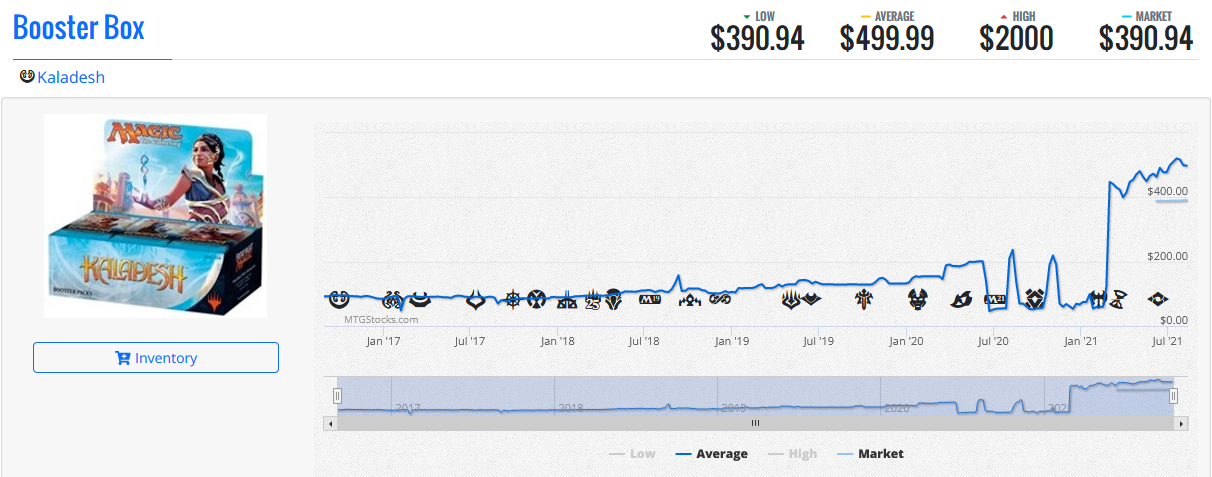
For non-Reserved List cards, the item should be something unique enough that a reprint in two or three years won't tank its value. The old-border variant fetch lands from Modern Horizons 2, are a possibility, but being subject to reprint at WotC's whim, have a bit more risk involved than what we are looking for. Instead, if in 2017 say, you had bought and put away several sealed booster boxes of Kaladesh at $99 each, you'd be looking at potentially cashing out for five times that amount or more when the five-year mark rolls around in 2022.

Kaladesh Booster Graph

This is more in line with our goals on a long-term investment. Even if the cards from Kaladesh itself are reprinted, it's the unique lottery ticket-style Inventions series potentially hiding in Kaladesh boxes that drives their prices, and provides some price-protection from reprints.

From the graph, we can see plenty of bumps in the road along the way, but as we get closer to that five-year mark, the price appears to be stabilizing. If we were heavily involved in the market, buying and selling regularly, we might have sold these into the first major spike that allowed us to double-up our money around May/June 2020. The goal though, with a long-term keep like this, is the ability to check out on the market trends, and only check back in about the five-year point, having ridden out the waves, where we can then make a decision to reinvest or to continue holding.

Magic Speculations

Where investments for Magic are about long-term gains, speculations are all about the quick money. Here, the timeframe is more about following the shifts of the metagame and the market, to get the timing right. High risk, but potentially high reward. A great example to look at for this is the card Archmage's Charm.

There was an error retrieving a chart for Archmage's Charm

If you had purchased Archmage's Charms prior to Counterspell being spoiled for Modern on May 6th, you'd have been able to pick them up for $5 or less. In fact, if you'd picked this up as a spec between September 2019 and the middle of March 2021, you could have snagged them for between $2 and $4 each. With Counterspell and other cards revitalizing blue-based strategies in Modern, Archmage's Charm spiked to just under $20 and has been holding consistently since for around $15 each.

We can only be successful at speculation like this if we are staying constantly tuned to the market, identifying cards that may be undervalued, and picking up those cards before circumstances in the market or the metagame drive up their prices.

Where To Put Our Money

Now that we've defined our parameters, where should we put our money? For investing, we want a long-term prospect, with the best possible chance of a return for minimal risk. The buy-in might be high, but the overall stability of Reserved List cards and Reserved List-era sealed products is where I would park my money if I wasn't looking to actively play my cards or pay attention to the short-term pendulum swings of the market. The up-front cost is higher and may be a barrier to entry for some, but for those with the means, this is the most stable sector of the Magic market for long-term investment goals.

For speculating, I'd have my eyes on cards that could potentially play well with future-Standard or future-Modern once Innistrad: Midnight Hunt and its sequel come into the mix. This means having an eye on cards with graveyard-centric mechanics like Demilich, cards like Wight, which have creature type Zombie to play well with the already-spoiled Champion of the Perished, and every other Werewolf, Vampire, Skeleton, or graveyard-based card that could be relevant with two horror-themed sets added to the mix. We also can't discount the Human tribe from Innistrad, which has proven relevant in Standard and Modern in the past.

While trying to decode the market is one of the things that makes speculation fun and thrilling, the risk of not making a return on our investment is something we have to be comfortable with when playing in the market in this fashion.

Investment Vs. Speculation
Investment
Speculation
Long-Term Short Term
Moderate risk High Level of risk
Cautious/conservative outlook Aggressive outlook
Graded high-end Reserve List or
Reserve List era-sealed
Modern-era cards
(anything not subject to the Reserve List)

The Price Of Enjoyment

Whether investing long-term or speculating in the short term, having access to years of pricing data through being a QS Insider, can help guide you in making decisions on where to put your money. Check out the link at the bottom of the article for details.

Regardless of the reasons you are putting money into Magic, whether to play the game or as an alternative investment vehicle, I hope that you derive some pleasure from the experience, as enjoyment is ultimately what Magic is all about.

Do you agree with my assessment of the differences between investment and speculation? How would you compare the two as it relates to putting money into Magic? What cards are you speculating on in anticipation of Innistrad: Midnight Hunt and Innistrad: Crimson Vow? Send me an email or post your answer in the comments.

Magic Is Expensive: A Reminder

Are you a Quiet Speculation member?

If not, now is a perfect time to join up! Our powerful tools, breaking-news analysis, and exclusive Discord channel will make sure you stay up to date and ahead of the curve.

The other night I was lying in the comfort of my bed browsing websites when I decided I wanted to purchase some clothes. I added the items to my cart and was ready to check out when a sudden sensation occurred in the pit of my stomach: I didn’t have my credit card with me and I don’t have the information memorized!

I really had no desire to climb out of my bed and walk downstairs just to complete the purchase. About to give up, I noticed there were alternate payment methods accepted by this website. One of those methods was PayPal. I was back in business!

I finished checking out and received my confirmation email, patting myself on the back for averting that “crisis.” However, this transaction introduced a new dilemma. For those who don’t know, I use my PayPal account strictly for my Magic transactions—I do this because I am deliberately keeping MTG money separate from the rest of my personal finances. That way, as I slowly grind out value and save money, I can put chunks aside for the college fund, where I can confidently claim, “Magic is responsible for covering my kids’ college cost.” One day, anyways.

Now that I had purchased some clothes with PayPal funds, I had to reconcile by transferring money from my personal checking account to the “Magic” (i.e. PayPal) account. That’s when a sudden realization hit me, and I knew I had a topic worthy of an article.

Magic is EXPENSIVE!

By keeping my Magic hobby financially self-contained, I have become desensitized to how expensive the hobby truly is. Buying something practical/tangible with money from my Magic account is a stark reminder of what I could be purchasing with this money if I wasn’t spending it on cards.

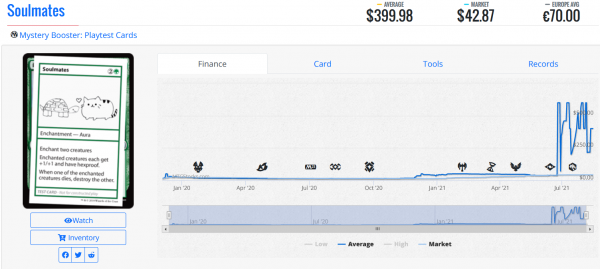
For example, I just recently flipped a copy of the original art Soulmates card on eBay. I purchased the card for $45 plus tax and sold it on eBay for something north of $120. After fees and shipping, I banked a cool $50 with minimal effort.

Without relative context, this feels like a small number if I’m honest. Since I mostly deal in Old School cards nowadays, I’m used to prices soaring well north of $100 and, in some cases, even above $500. Even if I think about new sets, $50 isn’t even enough for a booster box—I guess I could purchase a bundle with those profits, but that seems underwhelming.

Taking the lens away from Magic and comparing to other products and services in life, however, helps me realize just how much money we’re talking about here. I sold this single piece of cardboard for $120! As I ponder my monthly expenses, I am quickly amazed at what that $120 could also have bought. Here are some examples off the top of my head:

  • A week of groceries
  • My electricity bill for the month
  • My cell phone bill for the month
  • An outfit for work (slacks, shirt, tie)
  • At least a dozen pieces of clothing for my kids
  • An oil change, tire rotation, and a tank of gas
  • A monthly payment of car insurance
  • A couple meals ordering out for the family

I could go on and on with this list, but hopefully, this conveys my point. Because I keep Magic money in its own separate world, separate from the rest of my expenses, I’ve become numb to the numbers. Not long ago I sold enough cards to raise money to purchase a Mox Sapphire—it is heavily played and cost me $1975 (this was before the spike in Power).

There was an error retrieving a chart for Mox Sapphire

I spent the money without really considering the magnitude of the purchase because I paid for the card by selling other cards. To me, that meant the card was virtually acquired via “trade” and I didn’t have to tap into my personal funds at all. But if I step away from Magic for just a couple minutes, it is baffling to me what I could have purchased with that kind of money. And don’t even get me started on something like Black Lotus!

Eye on the Prize

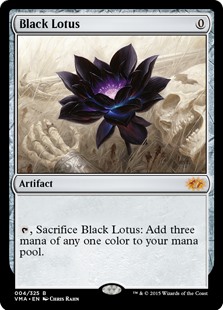
As I wrote the above section, I couldn’t help but fantasize about selling my Black Lotus to fund a first-class trip to Disney World for my family of four (COVID-19 aside). The fungibility of Magic makes such options extremely tempting—literally speaking, a replacement Black Lotus could be purchased to do the same thing. (In reality, I don’t expect I’ll be purchasing any Black Lotuses again now that they start north of $10,000).

There was an error retrieving a chart for Black Lotus

But I need to stay focused on my end goal: funding my two kids’ college educations. Many distractions in the form of bills will continue to pop up along the way: repairing my backyard deck, replacing an appliance, and the occasional spontaneous PayPal purchase. But while I see Magic cards as fungible (with few exceptions), I try my hardest to view my Magic money as non-fungible. That is, I regard that money as sacred and keep it within the realm of Magic and the college account. I maintain this artificial mindset in order to drive discipline and keep me honest about how I’m accumulating resources for those first college bills 9 years from now.

If college savings isn’t on your mind, perhaps you have another long-term goal with regards to Magic? I know at least a couple of people who told me they were hoping to sell their collection one day to pay off their home mortgage. Others may identify a dream car they’ve always wanted and can justify the purchase only after selling so many cards.

As card prices climb, these goals become more and more realistic. I think I first made the “college savings” declaration about eight years ago. Back then, my collection was worth only one-tenth of what it is today, and the prospect seemed far-fetched. Thanks to multiple buyouts and booms in Reserved List collecting, the goal has never seen more possible.

After all, you can sell one single Beta Black Lotus to purchase a brand new Black Lotus car like the one above!

A Call To Action

Not everyone looks at Magic as a source of savings. It is a game after all, and also deserves to be cherished as such. Even if you don’t look to Magic to fund a large purchase of the future, I still urge you to at least stop and consider your opportunity costs when it comes to the hobby.

I’m not telling you to question every tournament entry and every purchase. To do so would be unhealthy (and likely create unnecessary anxiety). But next time you reach for your wallet to purchase that foil copy of a card—you know, the card in your deck that you already own in non-foil alt-art but not the foil version—think about the utility you’re going to get from that purchase and weigh it against other options inside and outside of Magic.

Do you really need the judge promo version of Force of Will, which will run you $450, when you could purchase a non-foil copy for under $100? In terms of play, you’d get the same utility guaranteed—so you’re really only paying that extra $350 for the “wow” factor of foiling out your deck. Before dropping the coin, just think about what else you could buy for $350.

There was an error retrieving a chart for Force Of Will

That single piece of cardboard could pay for a lot of real-life things! And even if you want to splurge and spend the money on a luxury item (paying for groceries is hardly glamorous, I get it), you could spend that money on some super-premium durable goods. A nice, brand-name handbag or wallet, a dressy watch, some high-quality clothes, a high-end golf club
these are just some of the other items you could look into as an alternative to the judge foil Force of Will.

Don’t forget, these aren’t in lieu of purchasing that Force of Will. It’s just in lieu of purchasing the most expensive version of the card. You can still counter your opponents' spells while being tapped out by casting a non-foil version of the card, and then go out to the driving ranges with your brand new Calloway driver to boot!

Wrapping It Up

It’s easy to become desensitized to how expensive Magic really can be, especially if you’re into Old School and Vintage as I am. Prices of older cardboard has grown exponentially, far outpacing inflation. Thus, a card purchased five years ago for $30 can now create $100 of purchasing power. I keep this kind of financial gain within the hobby of Magic (or, tangentially, in my college savings account). But it’s valuable to step back and consider what that money can purchase me outside of the game.

If you are like me and hoping to cash out of Magic one day to fund a major purchase, then stay the course and do not get distracted. But if you’re into the game for the game’s sake, and are reading Quiet Speculation to make your hobby a little cheaper, then I’d urge you to consider alternatives to your premium Magic purchases.

If you weigh the enjoyment you’re likely to get from a card against the utility of another durable good you could buy with that money, you may shock yourself. I know I was recently surprised when I bought some clothes from my PayPal account and realized just how inexpensive clothes can be relative to this cardboard. A booster box will cost you $100; that can buy you a piece or two of some very high-quality, brand name clothes. You could buy your groceries for the week. You could buy a very high-end bottle of Bourbon. The list goes on and on.

I’m not telling you you have to pick up these other hobbies. I’m just taking this moment to remind you about the rest of life, and the fact that Magic is very expensive, relatively speaking. Next time you’re trading cards or selling to a store, think twice before using your proceeds to buy more cardboard. You just may find your next hobby or passion by branching out, all without dropping a dime of your personal savings.

Avatar photo

Sigmund Ausfresser

Sigmund first started playing Magic when Visions was the newest set, back in 1997. Things were simpler back then. After playing casual Magic for about ten years, he tried his hand at competitive play. It took about two years before Sigmund starting taking down drafts. Since then, he moved his focus towards Legacy and MTG finance. Now that he's married and works full-time, Sigmund enjoys the game by reading up on trends and using this knowledge in buying/selling cards.

View More By Sigmund Ausfresser

Posted in Business, Buying, Cash Flow, Finance, OpinionTagged , , , Leave a Comment on Magic Is Expensive: A Reminder

Have you joined the Quiet Speculation Discord?

If you haven't, you're leaving value on the table! Join our community of experts, enthusiasts, entertainers, and educators and enjoy exclusive podcasts, questions asked and answered, trades, sales, and everything else Discord has to offer.

Want to create content with Quiet Speculation?

All you need to succeed is a passion for Magic: The Gathering, and the ability to write coherently. Share your knowledge of MTG and how you leverage it to win games, get value from your cards – or even turn a profit.

We’re #1! Modern’s Popularity Investigated

Are you a Quiet Speculation member?

If not, now is a perfect time to join up! Our powerful tools, breaking-news analysis, and exclusive Discord channel will make sure you stay up to date and ahead of the curve.

What's Magic's most popular format? I realize this is the sort of question most ask around the gaming table just to have an argument, but I'm actually curious. The problem is that I can ask 100 players and get 100 different answers. It will frequently come down to what they last played and how much they enjoyed it. Opinions will further shift as sets are released and formats evolve. However, there is a clear and objective way to measure relative format popularity: What format do players actually play?

As with all things Magic data, Wizards of the Coast holds the true answer. But if Mark Rosewater is any indication, asking them won't do much good. Wizards will be vague and evasive, only saying that Standard is the most popular digital format and the vast majority of paper play is casual, kitchen table Magic followed by Commander. And he's only said Standard is most popular online when asked about Arena (as far as I could find, anyway). It's just not good business to make any segment of your customer base feel that their playstyle is invalid. Alienated customers stop buying your product. So getting a definitive answer is probably impossible.

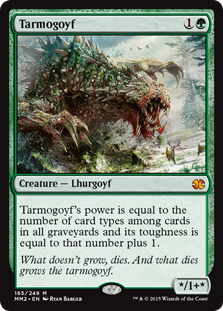
However, a relative answer is within my reach. Players proverbially vote for their favorite formats with their time, and that can be measured with tournament participation. And so today I'm going to use tournament turnout to determine which competitive constructed format is the most popular. I hypothesize that it's Modern, but I'll find out.

Parameters

When I bet on Modern, I'm betting on it being most popular format on MTGO. And only on MTGO. The simple fact is that it's the only way to measure Modern's popularity relative to other formats. Arena only has Standard and Historic and so can't answer wider question of most popular format when given a choice. Also, Arena's playerbase will be quite different from MTGO's thanks to Arena being free-to-play. (And yet somehow more expensive to build decks on.) It's critical to compare like-to-like and by excluding Arena, I don't risk comparing very different population compositions. Saying that Standard is the most popular because it's the main option on the most played digital Magic produc, since it's one of two options and cheaper than Historic, really isn't fair to Standard or other formats.
I'm also not going to compare the constructed formats to limited. It really isn't a fair comparison. In my experience, most competitive players will say their favorite format is booster draft, with a caveat. In said experience, players tend to extoll booster draft the concept as the most skill-intensive format and also most fun. Winning requires format knowledge, deck building skill, play skill, and luck more than other formats because you're building your deck as you go. However, the more this general opinion is investigated, the more exceptions, exclusions, and complications arise. Certain sets are more popular to draft than others. Draft participation also swings wildly from introduction to rotation. Thus, the exact timing of a study will wildly affect the data on limited, and it makes sense to cut it.
What About Paper?

This study is limited to data from MTGO. Sadly, there aren't enough paper results to draw any real conclusions. The few events that are out there don't really compare well to each other and they're not distributed evenly. Pre-pandemic, this whole project would have been easy since there were plenty of events of all levels in all formats. Plus, these events usually published their attendance numbers so comparing that would have fairly definitively answered the question. That isn't possible now.
A possibility exists to survey local game stores now that in-store play has resumed. However that would require a staff and a research grant. There are a lot of game stores in the Denver area, and I'm not sure who's doing what anymore. Pre-pandemic, Modern was the most popular format in the area and had more events per week than anything else. These days I have no clue. The various social media pages that kept track of weekly events have not been updated, and a number of stores went bust while others opened during the pandemic. Finding all the stores doing in-person events and asking them about attendance is far more work than I'm able and willing to do on my own. (With the right funding, on the other hand....)
What I am sure about is that Modern is still the most popular format at my LGS, Mythic Games. Pre-pandemic there were two weekly events that averaged 15 players per night and a 30+ FNM. Sunday Legacy averaged 10 players while Monday and FNM Standard events struggled to fire. FNM draft swung wildly. These days there are only five events per week: Sunday Legacy which is still around 10 players, Thursday Pioneer which rarely gets above 8, a Saturday Standard that never fires (as of last Friday, anyway), and then FNM, which is split between Modern and Draft. Due to space restrictions, Draft is capped at two pods and Modern is capped at 32. Modern has sold out every week it's been back while MH2 draft sold out, and AFR draft doesn't quite. Which is a solid win for Modern, but Mythic was the biggest Modern store in city to begin with.

What About Standard?

Thus my study will include only MTGO results. But not all the constructed MTGO results. After some investigation, I decided to exclude both Standard and Vintage from the study. The only data I can collect requires tournament support, and the specialty and online-only formats don't provide that so they're out. Standard was cut because far more is played on Arena than MTGO. A look at Standard streamers basically always using Arena was strong evidence, as was Wizards and Star City Games running their Standard tournaments on Arena. So I assumed that the MTGO data would be lacking (and it was, I checked).
With Vintage, it was purely a judgement call. Vintage has accessibility issues which keep newer players out. The cost of Vintage cards is so high that it really can't be played in paper. Thus, Vintage players have mostly moved online. However, the lack of overlap between Vintage decks other formats means that it's hard to transition to Vintage naturally. There's more overlap between Standard and Modern cards than Legacy and Vintage, for example. It's an enthusiast's format, and I was told by several sources that the community is quite static. While it'd be a reasonable comparison point for the other, more variable formats to compare to the old-timer, I decided that the extra effort wasn't worthwhile just to learn that Vintage is a fairly insular and stable group compared to other formats.
Methodology

I am going to measure the relative popularity of the tournament-supported constructed formats on MTGO. These are Pioneer, Modern, Pauper, and Legacy. To accomplish this, I gathered three sources of data. The first is from each formats Tournament Practice room. Over last Sunday afternoon, I watched each room for 10 minutes apiece, recording each time a match fired. This source indicates the relative number of players in each format by measuring how quickly a match could be found. More matches means more players means more popular.
The second source are Preliminaries. Wizards schedules a number of Preliminaries each week for each format. Pioneer and Modern each get 8, Legacy gets 6, and Pauper 3 according to the schedule. Not every Preliminary fires every week. Therefore, I can measure relative popularity by going to the decklist page and seeing how many of each format's Preliminaries fired each week. The sample included each complete week in July and the first week of August. I'll then compare the average Preliminaries per week to the theoretical max to indicate the most popular Preliminary format.
Finally, I sampled the Challenges for the same time period. Only the Challenges, not Super Qualifiers or Showcase Challenges so as to keep things consistent. There are two Challenges per week per format and as far as I know they always fire unless replaced by another event. Which happened in my sample period. I cannot compare their starting populations since Wizards doesn't post those and watching the events to find out was logistically prohibitive. However, Wizards does report the match points for Top 32 of each event, and more match points means bigger events. So I added the total points up for each event and the highest average over the sample period is the most popular format.

The Data

Standard disclaimer: this is my data. Another study using different methods or at a different time could produce different data and thus different results. This is not the only way to measure format popularity, just the way that I did it. It's also possible that external factors affected the results, particularly other events distracting from the Practice room data. I chose the time specifically to avoid conflicts, but anything is possible.

Tournament Practice

The only place where more MTGO Magic happens than the Tournament Practice rooms are the Leagues, and I have no idea how to measure that activity. Thus this is the best measure of the number of willing players available for each format.

PioneerModernPauperLegacy
Total Matches23779

The answer is Modern. By quite a large margin. And I'm fairly certain that I missed a few Modern matches as at several points there were multiple players creating and then closing matches to join someone else's. So it should be a higher blowout. The Pioneer room was practically dead, saved because there was some kind of non-Wizards tournament happening and the players were starting their matches. Pauper and Legacy were quite comparable, which was surprising. I'd been told Pauper was in a very bad place and wasn't seeing play, but that seems to have been inaccurate.
Preliminaries

I was very surprised to learn that Modern has 8 Preliminaries per week. I never see more than 5 listed when I'm doing the metagame data. I'm guessing the missing 3 are the early morning ones. They're intended to be for non-North American players, which I'd guess are a relatively small part of the MTGO playerbase from my experiences. I have no way of knowing, however.

WeekPioneerModernPauperLegacy
7/40502
7/111504
7/181400
7/253403
8/14505
Average1.84.602.8

That's another point in Modern's column. It not only had the highest average in absolute terms with 4.8, but the highest percentage. Both Modern and Pioneer had 8 Preliminaries scheduled, so 4.8/8=60% of Modern Preliminaries fired versus 1.8/8=22.5% for Pioneer. Legacy records 2.8/6=46.7% for a strong second place.
Pauper didn't record a single Preliminary in the sample period. I guess what I heard about its recent unpopularity was true after all. For the record, MTGO Standard didn't record a single Preliminary firing either.

Challenge Points

Every format but Pauper had Showcase Challenges that replaced two normal Challenges in the sample period. As the real comparison is the average size, this doesn't affect the data. It is worth noting the vast differences in size between the first and second Challenges each week for each format. The Saturday Challenge is the first result, the Sunday the second on the table. The replaced Challenges are dashes.

WeekPioneerModernPauperLegacy
7/4450, --, 480327, 369375, 459
7/11360, 375561, 486351, 369365, 453
7/18453, 369561, 465345, 369447, -
7/25372, 381549, 429324, 351-, 375
8/1372, --, 465327, 363438, 453
Average391.5499.5349.5420.6

Modern has the largest Challenges, followed by Legacy. Pauper has the least, with 150 points separating it from Modern. It's clearly not a highly played format right now. Though I'd actually argue Pauper is actually the best value for entry. It only took 6 points to make Top 32 of several of these events, which is two match wins. That's not a very big hill to climb to get prizes. I thought Legacy would be higher since the Legacy crowd tend to be vocal, but the stats don't lie, it's just above Pioneer and well below Modern.


Conclusions

In all my samples, Modern was the most popular format and it wasn't even close. I'm happy to conclude that Modern is the most popular constructed format on MTGO. Which is great news for those who write Modern articles. It also indicates that Modern is in a very good place and players like the format. Again, if you accept the notion that players vote with their time and won't play something they don't enjoy, there's a strong indication that Modern satisfaction is high, and therefore Modern's health must also be high. Reason enough to celebrate!

The Mental Mindset for Buylisting

Are you a Quiet Speculation member?

If not, now is a perfect time to join up! Our powerful tools, breaking-news analysis, and exclusive Discord channel will make sure you stay up to date and ahead of the curve.

I try to monitor pricing trends closely when it comes to the cards in my collection. This is especially important when values are volatile and the market is adjusting to rising or falling demand. As I’ve written in the past, I tend to use Card Kingdom’s buylist, sell prices, and inventory as my guide for predicting trends. If Card Kingdom sells out of a card, they’ll up their buy price, and this usually correlates to a general increase in market price.

This obsession I have with Card Kingdom’s prices can be a double-edged sword. It’s obviously helpful to know what my cards are worth and what direction their prices are heading. But there’s a tortuous component to the perpetual monitoring of trends. Beyond the time sink this activity entails, I also experience a roller coaster of emotions each time I see a change. I’ve been trying hard to keep certain mantras in mind to calm my nerves.

If this sounds melodramatic, allow me to explain further.

A Tale of Two Cards

Because card prices are so dynamic, it is nearly impossible to identify the best time to sell a card—particularly to Card Kingdom. This is even more relevant as a card climbs to new all-time highs, and there is no price memory to help inform a “good price”. Sell too soon, and you miss out on further gains. Hold a card too long, and you may end up getting less for the card after a sudden price adjustment lower.

I’ll illustrate this point with two personal examples.

A year or so ago I picked up a lightly played Acid Rain, a Reserved List card with niche utility (mostly out of the sideboard) and not much else to boast.

There was an error retrieving a chart for Acid Rain

Like most Reserved List cards, this one had thinning inventory and I was starting to feel the sense of FOMO kicking in. While I didn’t have any immediate uses for the card, I appreciate the artwork and the card’s color-shifting of Tsunami. I found a copy near the “old price” (I want to say it cost me about $50-$60) and I snatched it up.

The card sat in my collection for months as it slowly ticked higher in price. It seemed like each time I browsed Card Kingdom’s Legends buy prices, Acid Rain was slightly higher. When its buy price hit $100 I thought to myself, “Surely this is it. The peak.” But I still cherished the card’s flavor and artwork enough to hold onto it. I’m fortunate I did, because the card kept climbing and now buylists for $195! At this price point, I couldn’t justify holding the card anymore (especially in a market environment where card prices have gone a little soft). I was rewarded for holding tight to the card.

On the other hand, let’s talk briefly about that Alpha Nether Shadow that has plagued me of late. If you missed my previous article, I sold this card on eBay for about $800 only to have it returned to me because the buyer claimed it was clipped Beta and not genuinely Alpha. Upon further inspection and after checking with an Alpha expert, I concluded the card is in fact from Alpha.

There was an error retrieving a chart for Nether Shadow

Anyways, a few months ago I was very close to selling the card to Card Kingdom’s buylist—they were paying $1200 for near mint copies, so I expected to get $720 for my copy if it was to be graded very good. A very nice exit point for the card. But I was still attached to it and I noticed how Alpha rares had been disappearing from the market, so I hung onto it. Then Card Kingdom restocked a copy of the card, and they dropped their buy price to $1000. Then they dropped it to $950. Then $900. Now a very good copy of the card would fetch me $540, which is $180 less than before!

In this case, I was punished for waiting (and even more so for trying to sell it on eBay first). Patience was the wrong choice, and I should have acted more opportunistically by realizing Card Kingdom’s buy price was temporarily too high.

But How Can You Tell?!

This is the ultimate question. How can you tell that a card’s buy price, particularly on Card Kingdom’s site (though this also works for ABUGames on a slower time scale), is a little too aggressive? I don’t have the ultimate answer because I don’t know the algorithms these large vendors use to price their cards. But I do have a couple of ideas.

First and foremost, we need to put the emotions of the situation aside. Trying to sell a card at the absolute peak is akin to trying to time the stock market—it just doesn’t work. As long as you’re happy with the price you’re getting on a card, you should sell with confidence. Always remember that missed gains are not the same as a loss, and should not be interpreted as such. I know this is easier said than done, but it’s a fundamental mindset one should keep when dealing in any sort of asset trading/investing.

Once this mindset is established, the next step is to decipher if a card’s buy price is indeed aggressive. To do this, I leverage the data available to me on other websites. I start with TCGplayer, checking out recently sold listings and current listings. If I can sell a card to Card Kingdom for the same amount it costs me to buy a copy on TCGplayer, then the sale is a no-brainer.

This doesn’t occur so often; in reality, I’m even content to sell a card for 20% below TCGplayer’s price point (for a given condition). For one, there are no fees selling this way. But also, your sale is guaranteed and instantaneous—no need to wait impatiently for that email indicating you’ve made a sale. In cases where data on TCGplayer is spotty, I also research eBay’s completed listings and other buylists to make a similar comparison. Again, if the data looks like selling to Card Kingdom gets me to within 20% of what selling elsewhere would net me, I’m tempted to cash out.

This isn’t just about getting the same amount buylisting versus selling on eBay or TCGplayer. The other reason I make this comparison is because, as Card Kingdom’s buy price approaches market price, there’s a higher chance of them restocking copies and dropping their buy price. As market price and Card Kingdom’s buy price get closer, someone is bound to cash out, even if you decide not to.

In a way, this is almost like a game of chicken: the first person to blink cashes out, sells their copies to Card Kingdom, and they drop their buy price accordingly. An example of this (admittedly on a much smaller scale) is what happened recently with Ruin Crab.

There was an error retrieving a chart for Ruin Crab

I had about 60 copies of the card that I bought for around $0.25 to $0.50 each when Zendikar Rising first came out. I had a feeling it would be a money uncommon from the set, much like Hedron Crab. I watched Card Kingdom’s buylist closely, and one day they upped their offer to $1 a copy. That was my exit price target, and I shipped them every last copy before anyone else could jump on the opportunity.

After receiving so many copies of the card, Card Kingdom rightfully dropped their buy price. Even now, a couple months later, they are still only offering $0.33 a copy ($0.60 for the showcase variant). Their buy price became so attractive that someone took advantage (in this case it was me), and their buy price hasn’t recovered since.

This underscores the importance of acting quickly when you decide to sell out to a buylist. If a buy price looks too good to be true, it probably is. If you don’t sell the vendor copies, someone else will, and that attractive buy price will correct lower again.

There was an error retrieving a chart for Opportunity

This is why, all things considered, I tend to err on the side of selling. If I’m happy with a buy price, I take my cash and move on even if the card’s price has potential to climb higher. I try to keep an exit price point in my mind for a card I’m looking to sell, and if that price target is met, I ship the card without looking back.

Actually, that’s not completely true. I do look back. I still browse Card Kingdom’s buy prices and I can’t help but notice when a card I ship climbs even higher. But with the mindset I mentioned earlier, I calm my frustrated inner voice and remind myself that nobody ever went bankrupt selling for a profit. I should appreciate the money I made and move on.

Wrapping It Up

It can be rewarding to earn that profit on a Magic card after holding it for a period of time. After some suboptimal experiences with selling on eBay, I prefer selling my cards to buylists more than ever before. The hassle-free, instant sales are hard to pass up, especially when a vendor’s buy price is so close to what I can get on a card after fees anyway.

Since I choose buylists as my primary method of selling, it’s critical I monitor trends, picking my exit points deliberately. This leads to inevitable situations where I cash out of a card only to see its buy price climb farther and farther. It can be frustrating, but this is where I need to keep my emotions in check. If I’m happy with the price I exited at, I must not look at a missed gain as a source of disappointment. Timing the market is a fool’s errand—if you’re only happy cashing out at the peak, you’re going to be a miserable investor.

Believe me: it’s much worse to hold onto a card and watch its buy price drop than it is to sell a card and then watch its buy price climb. In the latter scenario, you still exited at a price you were presumably happy with. With the former, you’re left holding the back wondering why you didn’t make the sale. That happened to me many times before and it’s a much worse feeling.

This is why it’s so important to pick your price points, leverage other sources of pricing data, and make your decision to cash out when it makes sense to you. That’s the best advice I can give, and I hope it stays in the back of your mind as you navigate the dynamic environment that is Card Kingdom’s buylist!

Avatar photo

Sigmund Ausfresser

Sigmund first started playing Magic when Visions was the newest set, back in 1997. Things were simpler back then. After playing casual Magic for about ten years, he tried his hand at competitive play. It took about two years before Sigmund starting taking down drafts. Since then, he moved his focus towards Legacy and MTG finance. Now that he's married and works full-time, Sigmund enjoys the game by reading up on trends and using this knowledge in buying/selling cards.

View More By Sigmund Ausfresser

Posted in Alpha, Behavior, Buylist, Finance, Reserved List, riskTagged , , , , 1 Comment on The Mental Mindset for Buylisting

Have you joined the Quiet Speculation Discord?

If you haven't, you're leaving value on the table! Join our community of experts, enthusiasts, entertainers, and educators and enjoy exclusive podcasts, questions asked and answered, trades, sales, and everything else Discord has to offer.

Want to create content with Quiet Speculation?

All you need to succeed is a passion for Magic: The Gathering, and the ability to write coherently. Share your knowledge of MTG and how you leverage it to win games, get value from your cards – or even turn a profit.

The Truth is Out There: What The X-Files CCG has Taught Me about Magic Finance

Are you a Quiet Speculation member?

If not, now is a perfect time to join up! Our powerful tools, breaking-news analysis, and exclusive Discord channel will make sure you stay up to date and ahead of the curve.

Recently I had the chance to participate in the X-Files CCG 25th Anniversary Online Tournament presented by the MM XFILESCCG YouTube channel. You can watch the full video of my first match here. Preparing for this tournament reiterated four lessons of Magic finance that bear repeating.

I was introduced to the MM XFILESCCG channel while doing research for a book on '90s TCGs I'm writing. My wife and I were rewatching the TV series at the time, and the combination of the two rekindled my interest in the game. I dug out my old cards, taking stock of what I still had, what I'd lost, and what I should track down in order to start playing again. When I watched the announcement video for the tournament, I was interested but on the fence about taking part. It had been 20 years since I last played. I still had a good part of my collection from back in the day, but I didn't exactly have a tournament-caliber deck ready to dust off and battle with. Where would I begin?

Understand What You're Buying Into

When making any sort of decision, it is important to understand what you are getting yourself into. This is especially the case with financial decisions. When buying into a new game or a new format, it's important to understand how the game or the format plays. For examples of understanding and buying into a new Magic format, check out my articles Buying Into Modern and Understanding Metagames for Success and Profit. I approached diving back into the X-Files CCG with the same mindset.

X-Files CCG Agents

For those without the proper security clearances, The X-Files CCG, based on the hit television show, was first published by USPC Games in November 1996, as the show's popularity was reaching its peak. Players take on the roles of operatives of the Syndicate, a shadow government organization from the show, each with a secret X-File they are trying to protect (there are 41 to choose from). As the puppet-master behind the scenes, each player controls a team of FBI Agents investigating cases trying to uncover clues to expose the identity of the opponent's X-File.

The Cigarette Smoking Man, X-Files CCG

The gameplay is dynamic, like a much more strategic version of Clue, with plenty of opportunities for interaction by both players. Everything about the design of the game from the visual layout and images of the cards, to the gameplay itself, evocatively captures the flavor of the show.

Shutting Down The X-Files

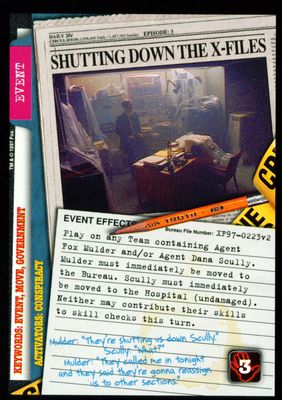
After bursting onto the TCG/CCG market at the tail end of 1996, the X-Files CCG only lasted one expansion, 101361 (commonly referred to as Mulder's Birthday), and a reprinted core set, The Truth Is Out There, reprinting cards from both Premiere and Mulder's Birthday, as well as introducing some new rares and ultra-rares (rarer than Magic mythic rares) to the mix. The promised 22364 (Scully's Birthday) set was designed and ready to be printed, but never inked to card stock as USPC Games pulled the plug, killing the game at the height of its popularity.

X-Files Research

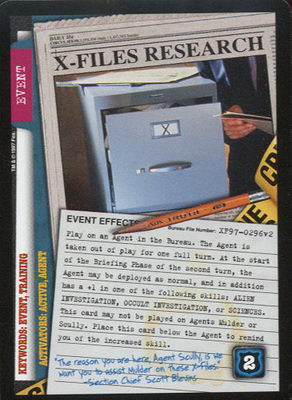
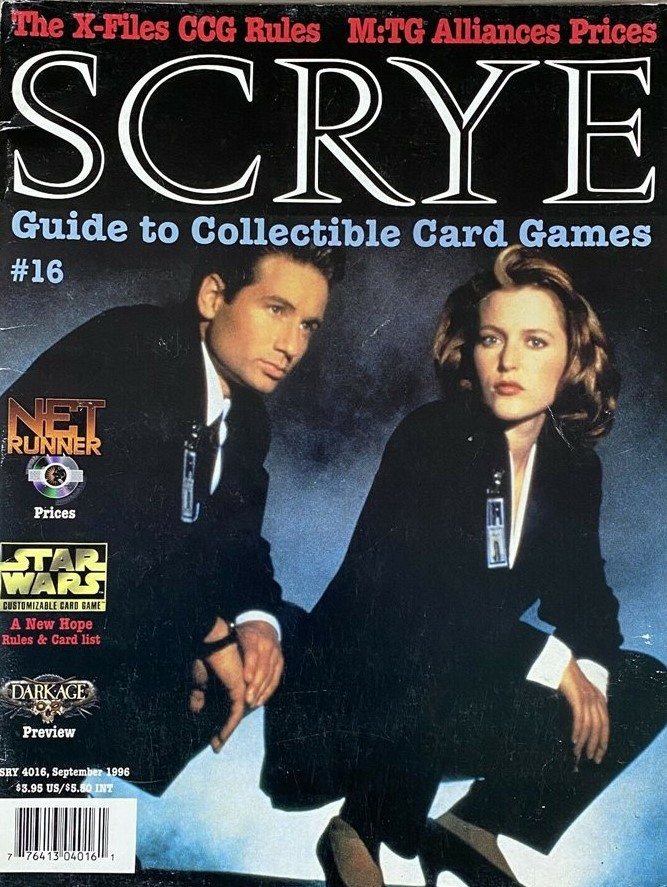
Because there has not been an active metagame in 20 years, I needed to do some research on what decks had been popular or powerful back in the game's heyday, to form a picture of what a potential metagame could look like. To that end, I scoured the internet and my collection of InQuest and Scrye magazines for decklists and strategy guides.

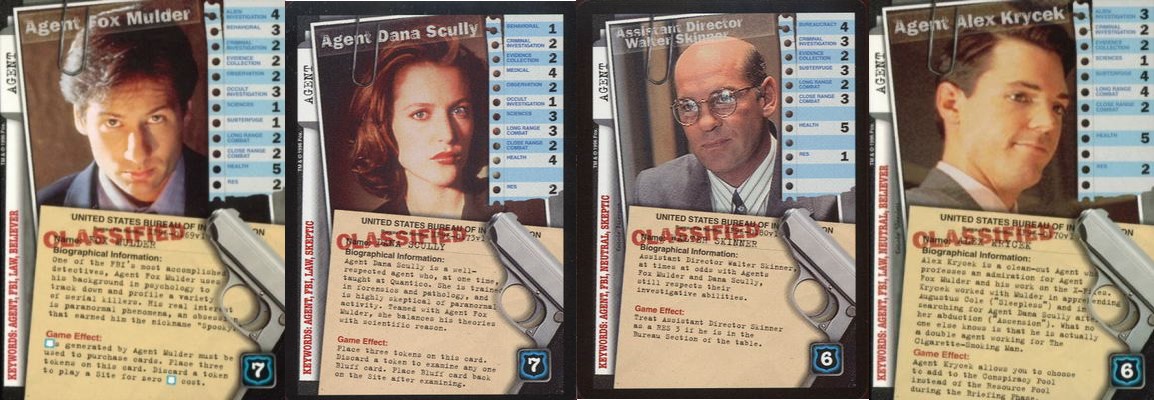
Under the Advanced Tournament rules, players construct a 60-card deck with no more than two of any particular card, not counting Agents or their X-File. Agents are chosen based on their abilities and their Resource Value, found in the lower righthand corner of the card. A player's agent team cannot exceed 20 RES points. For example, if choosing to have Mulder and Scully as agents, each with a RES value of seven, you'd have six points of Agents left to add to your starting team. There were 24 agents in the Premiere set alone, including ultra-rare alternate image versions of the main cast, giving players plenty of options for deck construction. You can check out a gallery of Agents and other cards from Premiere here.

X-Files CCG Card Types

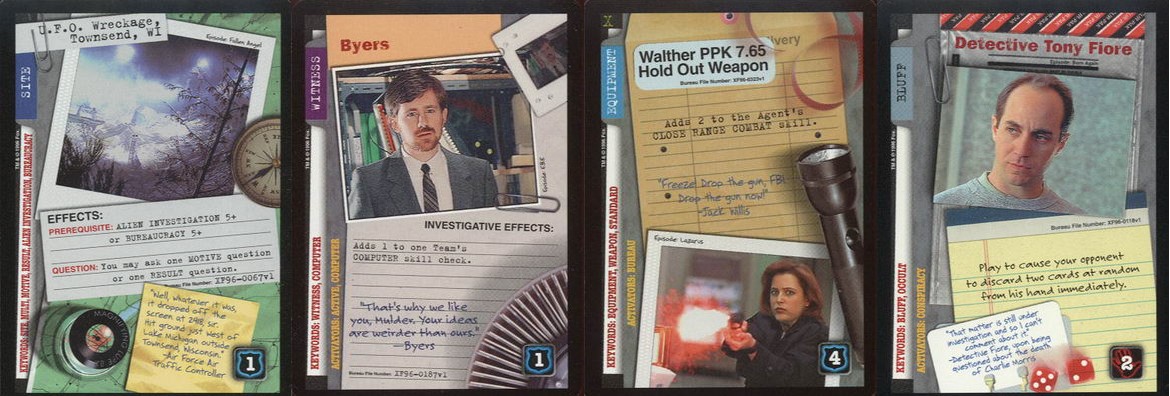
The rest of the deck is stocked with Site cards, which you investigate to unlock clues about your opponent's X-File, Witness and Equipment cards which can aid in your investigation, Events and Bluffs, which can aid you or hinder your opponent depending on the card, as well as Adversaries and Combat cards. Adversaries can hinder or harm an opponent's Agents, sending them to the Hospital zone and out of action. Combat cards are used to help or hinder Agents in combat against Adversaries. In a typical game, opposing players' Agent teams never engage one another in combat, with only a couple rare cards from the 101361 expansion allowing Agent vs. Agent combat. This is part of the flavorful design of the game, as opposing players can have copies of the same Agent, representing the conflicting webs of power, loyalty, and deceit the characters find themselves in throughout the course of the show.

Scrye Magazine Issue 16

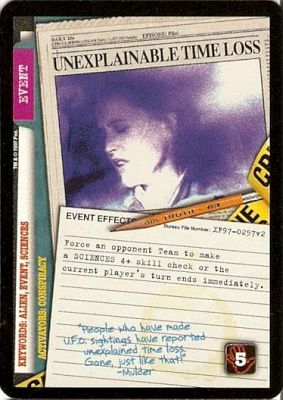
Looking at the decklists and strategy articles I could find, and watching some of the games broadcast on the MM XFILESCCG channel, I realized many of the competitive decks included a number of cards from the Mulder's Birthday expansion, and powerful Haymaker cards like Unexplainable Time Loss, Deep Throat, Limited Choices, and Believe The Lie, which are almost all ultra-rares or limited-run promo cards. I was uncertain I had everything I needed, but I had two resources at my disposal: a massive collection of dead CCG product from the '90s, and access to the Dead CCG Collectors group on Facebook.

Don't Hesitate To Move Something Not Helping Advance Your Goals

Over the winter, I began going through my dead CCG collection. In the process, I unearthed nearly two booster boxes worth of Middle Earth: CCG cards, including 45 rares, a promo, and 554 common and uncommon cards in a 70/30 split. Though a huge Tolkien fan, I've never played Middle Earth. From what I remember, the price at the time I acquired all of the product was too good to pass up, but it had been sitting in a box in my closet for decades. I posted a listing up, looking to trade for equal value in X-Files cards, and within a few days was able to work out a deal for four of each common and uncommon card from Mulder's Birthday, and an equal number of rares, including Unexplainable Time Losses.

Unexplainable Time Loss Event Card

At the same time, I also made a sale of some sealed boxes of Galactic Empires, another dead CCG, and rolled that money into buying a second collection of X-Files cards from an opened booster box of Mulder's Birthday. The collection included an ultra-rare Alien Stilleto card at a good price.

Alien Stiletto Ultra Rare

These acquisitions bridged a huge gap in my X-Files collection, bringing me closer than I realized to having a viable deck until I dug into the deckbuilding process. Had I not been willing to let go of the Middle Earth and Galactic Empires cards in the winter, I would not have been in a position to build a deck for the X-Files tournament in the summer.

Look For Cards That Have Similar Functions

After settling on a decklist that suited my playstyle, I realized I was still a handful of rares and ultra-rares short of the most optimal list, and I would likely be foregoing some of the most potent Ultra-Rares and promos due to market scarcity. For everything else I needed to finish the deck, I had a couple of options: reach out to my network to try and trade or buy the cards I needed, buy the cards I needed from a dealer if I could find one, or alter the decklist.

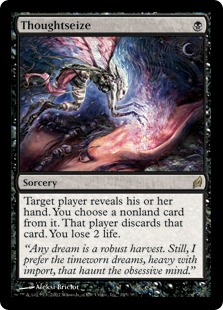
In Magic, the card Thoughtseize is a staple of the Modern format, seeing play in virtually every deck which has the mana to cast it. Sometimes though, a deck wants more than just the four copies of a given card in a deck, which is why Inquisition of Kozilek is another popular card in the format, performing a similar though narrower function.

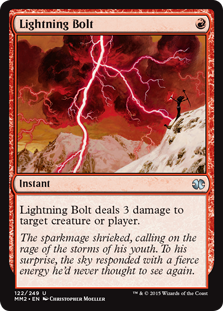
Or look at Modern Burn, which plays all of the one-mana spells which do three damage, including Lightning Bolt, Lava Spike, Rift Bolt, and Skewer The Critics. In Burn, redundancy is crucial to having the combination of cards necessary to kill the opponent as quickly as possible.

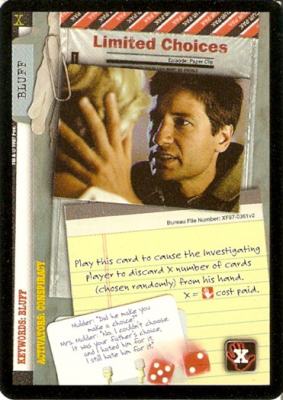
In the X-Files game, because the card limit is only two, if you want more copies of cards that have a similar effect, you're forced to do some deep-diving into the card pool to come up with options. The best example of this is the X-Files card Limited Choices, an ultra-rare from The Truth Is Out There which I had wanted to include in my deck.

Limited Choices Bluff

Limited Choices is one of the most powerful cards in The X-Files CCG. It is the equivalent of Magic's Mind Twist if you only needed to pay the X value of the card and not one additional black mana. It's very easy to force your opponent to discard their entire hand with this card with only a minimal investment in resources. Because of the card's scarcity, I've yet to be able to track down a set of them. Thinking I wanted a similar effect in my deck, I looked at the card list and found two other discard cards, Detective Tony Fiore, and This Is Not Happening, which were both more like Mind Rot effects. While lacking in raw power, these were the only options available to me if I wanted to include discard effects in my deck. Talk about limited choices.

Make Use Of All The Resources At Your Disposal

I quickly exhausted the possibility of buying cards I needed from a dealer, as there are few dealers that even sell cards for this game. I made some concessions in my list, but still needed a couple of sites and an equipment card that were non-negotiable for my strategy. I posted my want list on The X-Files Facebook group, and one of the tournament organizers actually reached out to get me the last few cards I needed. Had I not explored all avenues, and used all the resources at my disposal, it's likely I would not have been able to assemble a viable deck. While lacking some of the power cards means I don't think I have the deck to beat, I think my deck still has a viable strategy, and I hope to be able to convert that into a deep run in the event.

What have you learned from playing other games that has aided you in your understanding of Magic? Has this article inspired you to check out The X-Files CCG? Let me know your thoughts in the comments.

Insider – Uncommon Report #1 – Kaladesh Block

Are you a Quiet Speculation member?

If not, now is a perfect time to join up! Our powerful tools, breaking-news analysis, and exclusive Discord channel will make sure you stay up to date and ahead of the curve.

Today's article was inspired by the recent price movement of Ovalchase Daredevil. I'll delve more into that card in a bit, but for those who buy up large amount of bulk, there are a lot of cards that often fly under the radar. I am a huge fan of buying up bulk as the price per card tends to be between $0.003 and $0.004, which is almost nothing. When you consider that a typical box of MTG cards retails for between $95-$110 and that in that box you will get; 32x rares, 4x mythics, 108x Uncommons, 360x Commons, and 36x lands per booster box, it means that it takes a little over two booster boxes to get 1000 bulk cards – not bad value for something that is often purchased at $3 to $4 per 1000.

Kaladesh

There was an error retrieving a chart for Ovalchase Daredevil

This card went from a bulk uncommon to around $1 thanks largely to the new Urza's Kitchen decks in modern. This U/B deck gets to utilize a food engine using both Asmoranomardicadaistinaculdacar and Urza's Saga  to tutor up The Underworld Cookbook, which allows you to discard Ovalchase Daredevil to get a food, which then brings the Daredevil back to your hand. These food tokens allow the construct token created by Urza, Lord High Artificer to be extremely large and also serve as a way to keep the player alive against heavy aggro decks.

There was an error retrieving a chart for Diabolic Tutor

Despite numerous reprintings and the fact that this card isn't actually played in more competitive Commander decks, it still tutors up anything just like a Demonic Tutor, but it only costs $1 instead of $20+. It's a great budget option for less competitive or cost-restricted decks.

Interestingly these are the only two uncommons from Kaladesh worth more than $0.75 on average. Blossoming Defense used to be the most valuable uncommon from the set, but a four-of printing in the Counter Surge challenger deck, obliterated its price. That being said, I do have a few uncommons from this set on my "watch list", which means I pull them from bulk when I see them and set them aside in a box.

Watch List-Kaladesh

There was an error retrieving a chart for Refurbish

The additional printing in the Mystery Booster set definitely hurt this one's potential; however, it's one of those cards that just gets better the bigger the card pool is, as its options continue to grow. This is the type of card that should some ridiculously broken artifact be printed that can easily be dumped into the graveyard, it could easily jump to $2.

There was an error retrieving a chart for Glint-Nest Crane

While I don't think this card has anywhere near the upside of Refurbish, the fact that it's a well-costed flyer that can often net you a card means it is better than a good number of other 2 drops. The new artifact lands introduced in MH2 means it can now find lands outside of Darksteel Citadel, which is a significant boost to its potential playability.

There was an error retrieving a chart for Aether Hub

Aether Hub ended up in 2 different challenger decks; a 4 of in Counter Surge and a 3 of in Vehicle Rush; which really hurts potential growth. However, a one-use rainbow land that can be refilled with any card that provides energy and doesn't come into play tapped can still be a powerful option for many decks. In addition to the challenger prints there also happens to be an FNM promo card with different art which is currently sitting under $0.5. While this article is meant to focus on Kaladesh block, I think the best option for Aether Hub would be the FNM promos as there are likely far fewer of them in the wild and the new artwork looks good.


Aether Revolt

There was an error retrieving a chart for Gifted Aetherborn

I'd say this card surprises me, simply because it's already been reprinted 3 times and still sits around $1; but Vampire Nighthawk was buylistable for $0.5-$0.75 for several years until it finally got reprinted into oblivion. Casual players love the combination of Deathtouch and Lifelink because it plays really well against aggro strategies with the constant lifelink and the ability to trade with any creature.

Watch List-Aether Revolt

There was an error retrieving a chart for Felidar Guardian

This card was good enough it was banned in Standard and it just gets better with every Planeswalker or permanent with an ETB ability. It has already been reprinted once in Mystery Boosters, so sadly the ceiling is lower than it could have been. Still, it's important to remember that Aether Revolt was a relatively unimpressive set. It's also good to know that because it was banned in standard it never made it into any Challenger decks, which have been the bane of Kaladesh uncommon price ceilings.

There was an error retrieving a chart for Winding Constrictor

Unfortunately, for us speculators Winding Constrictor was reprinted as a 4 of in the Counter Surge challenger deck. It was also included in the Mystery Booster cards, so again the price ceiling is pretty low for this one. All that being said, passive "adding counters" abilities on cards can be very powerful and this archetype also tends to have a strong casual following.

A Modern Split: July ’21 Metagame Update

Are you a Quiet Speculation member?

If not, now is a perfect time to join up! Our powerful tools, breaking-news analysis, and exclusive Discord channel will make sure you stay up to date and ahead of the curve.

New month, new metagame update. It is the way. And I'd like to kick this one off by tempering expectations. The near-perpetual spoiler season we now inhabit did spit out another set. However, Adventures in the Forgotten Realms is no Modern Horizons 2, and did not have that much impact on Modern. The resulting July metagame is an evolution of June's rather than another big shakeup. MTGO is also settling into its usual routine of follow-the-leader and piling into the same deck. I'm wishing for more data sources and paper events to return more and more.

Also, there's going to be a policy change for these articles. I've been a bit all over the place as far as deck names are concerned. This is made worse by Wizards constantly making new factions to use as color-pair names. This was driven home for me recently hearing new players refer to WR Burn as Lorehold Burn rather than Boros Burn. As such to avoid ambiguity I'll be dropping guild names and instead spell out the color pairs.  I'll keep using the shard names because they're well established and I've never actually heard anyone use the Ikoria shard names. Of course, when possible I'll use actual deck names but there is some ambiguity there too. Thus I'll be referring to the various tempo and midrange decks that are mostly similar using the naming conventions Jordan outlined here.

July Metagame

To make the tier list, a given deck has to beat the overall average population for the month. The average is my estimate for how many results a given deck “should” produce on MTGO. Being a tiered deck requires being better than “good enough;” in July the average population was 6.75, meaning a deck needed 7 results to beat the average and make Tier 3. This up from June, but about average for the past year. Wow, I just realized it's been a year since I brought the monthly update back. How time flies.

Anyway, it makes sense for July to be closer to average than June. June was a huge set release and a brewing paradise while July showed some settling. Then we go one standard deviation above average to set the limit of Tier 3 and cutoff for Tier 2. The STdev was 11.24, so that means Tier 3 runs to 19, and Tier 2 starts with 20 results and runs to 32. Subsequently, to make Tier 1, 33 decks are required. This is also pretty typical for MTGO metagame updates.

The Tier Data

The total number of unique decks was down for July from June's 87 to 60. Again, it makes sense as June was very experimental. However, July also had an extremely low deck count, just 405 to June's 457. Some of that is down to smaller Preliminaries, but far more impactful was that July had fewer events. There were a few Preliminaries that never got posted, and there were fewer non-Premier events posted to MTGMelee. I'm not sure why that happened, but it's what I have to work with. Consequently, the higher average and STDev mean that the tier list has shrunk significantly. June boasted the highest number of tiered decks ever with 28. There are only 14 deck in July's tier list. I'm pretty sure that's the lowest total for a full month since I restarted this project. It also means that the MTGO inbreeding problem is back. Most of the players placing in Challenges are there every week, and so the sample is less about the overal meta and more about that group of grinders. But an analysist must work with the data available.

Deck NameTotal #Total %
Tier 1
Hammer Time5814.32
UR Threshold5613.83
Tier 2
Cascade Crashers286.91
Blue Living End266.42
Tier 3
UR Prowess194.69
BR Stompy194.69
Channeler Control174.20
Elementals153.70
Lorehold Turns143.46
Jund122.96
Amulet Titan112.72
4-Color Bring to Light92.22
Death and Taxes81.98
Urza's Kitchen71.73

And July is rather weird. Tier 1 is split between Hammer Time and UR Thresh. And they're twice as popular as the next deck. I have a theory on why, but more on that later. To clarify, UR Thresh is not actually deck that cares about achieving threshold, but delirium is quite similar. Rather, it's the more specific name for the UR Tempo deck from June. Thresh decks historically are about a small number of early-deployed threats backed up by lots of non-creature spells, particularly counterspells. That is exactly the strategy most UR Ragavan/Channeler/Murktide Regent decks follow. Similarly, there are versions of BR Ragavan/Channeler decks with more or fewer creatures, and the decks with more get called Stompy.

A New Pillar?

Given how skewed the metagame appears it is natural to assume that Modern is being pulled towards a dual pillar system between Channeler and Urza's Saga. Certainly, I've heard that theory thrown around a lot. There are those that say Ragavan, Nimble Pilferer is the pillar, but Channeler shows up in more decks and is more important to the opperation of said decks. Ragavan seems to get thrown in "just because" a lot, but Channeler requires some build around and to me that's defining of being a pillar more than just seeing lots of play. Also, I'm on board with considering Channeler a new Modern pillar for that very reason.

Saga, on the other hand, I'm skeptical of. Outside of Hammer Time, Saga decks were pretty poor performers in July. The play pattern is a rolling snowball of advantage, but it comes at a significant tempo cost. All the Underworld Cookbook decks and incidental Saga decks took a beating, so I'm not convinced Saga is that good in general. It's extremely good in Hammer Time because that deck only needs a few lands and Saga fills a number of holes in the deck. Older versions struggled with running out of threats in general but particularly suffered when they didn't hit Stoneforge Mystic to find their hammers. Saga makes threats and then Mystics for a Hammer. Or other bullet if necessary. Being good in a specific deck doesn't make a card a pillar.
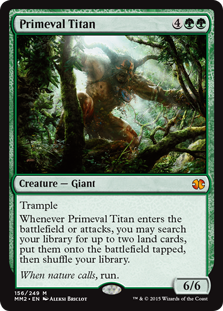
Shardless Agent, on the other hand, is making a case for itself. Tier 2 is just decks that are only really playable thanks to Agent, and it shows up in plenty of other cascade decks and even occasionally as a value play in creature decks. Widespread success in many decks is more pillar-like to me, so watch out for Agent.

The Pattern Repeats

Remember a few weeks ago when I begged MTGO to get help for its focusing problems? Well, the phenomenon I commented on there did in fact repeat again. June's top deck was Amulet Titan. I predicted that Titan would immediately fall off because that's what had happened the last three months. Make it four for four because Titan is at the bottom of Tier 3. And I'm not saying that I'm magic, but after I complained, Amulet picked up just enough to make the Tier list, preventing the worst swing ever from happening. But I'm also not saying that I'm not magic. Thus I'm going to predict that the pattern will continue and Hammer Time and UR Thresh will fall off substantially in August. Hammer Time is the top deck, but there's so little space between them I'm calling it a tie. So both decks must weather the curse.

Power Rankings

Tracking the metagame in terms of population is standard practice. However, how do results actually factor in? Better decks should also have better results. In an effort to measure this, I use a power ranking system in addition to the prevalence list. By doing so I measure the relative strengths of each deck within the metagame. The population method gives a decks that consistently just squeaks into Top 32 the same weight as one that Top 8’s. Using a power ranking rewards good results and moves the winningest decks to the top of the pile and better reflects its metagame potential.
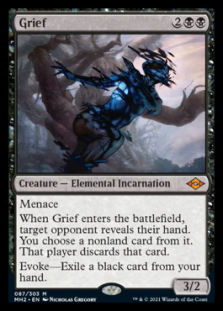
Points are awarded based on the population of the event. Preliminaries award points for record (1 for 3 wins, 2 for 4 wins) and Challenges are scored 3 points for Top 8, 2 for Top 16, 1 for Top 32. If I can find them, non-Wizards events will be awarded points according to how similar they are to Challenges or Preliminaries. Super Qualifiers and similar level events get an extra point if they’re over 200 players, and a fifth for over 400 players. There was one Super Qualifiers awarding 4 points in July and a Showcase Challenge that awarded 5 points.

The Power Tiers

The total points in July were actually up from June. This tracks given bigger events, though is surprising given the smaller population. June had 706 total points while July has 741. That's still pretty low for a full month, but it is closer to the normal average. Had there been more usable events from MTGMelee, July would have been a more normal month points-wise. The few events I saw were too small to use, and I didn't see usable events anywhere else either. The average points were 12.35, so 13 makes Tier 3. The STDev was 21.76, which is on the higher end, so add 22 and Tier 3 runs to 35 points. Tier 2 starts with 36 points and runs to 58. Tier 1 requires at least 59 points.

There are 15 decks in the power tiers, which is up one from population. Urza's Kitchen didn't make the transition from population to power, which in my mind cements Saga's decline. It's just not as good as everyone thought. In Kitchen's place are Mill and a resurgent Heliod Company. Both did pretty poorly overall in population, but in the events they did place, they placed very high. This strongly suggests that they're out of the mainstream and are being held up by enthusiasts and specialists. However, both also seem like good choices in a metagame defined by Hammer Time and UR Thresh.

Deck NameTotal #Total %
Tier 1
Hammer Time10914.71
UR Threshold10614.30
Cascade Crashers638.50
Tier 2
Blue Living End486.48
BR Stompy405.40
UR Prowess364.86
Tier 3
Grixis Channeler344.59
Lorehold Turns253.37
Elementals243.24
Jund202.70
4-Color Bring to Light192.56
Heliod Company162.16
Amulet Titan152.02
Mill141.89
Death and Taxes131.75

The top two tiers have expanded and overall this looks more like the typical tier list. I did check for outliers, and neither Tier 1 deck were over the line. Cascade Crashers moves up to Tier 1 thanks to many high finishes and is replaced by BR Stompy and UR Prowess. The latter has fallen a lot from its glory days, but remains a very strong contender in the metagame. Grixis Channeler is a blanket term for very similar not-quite-midrange, not-quite-tempo, definitely not control or aggro decks build around Channeler and Kolaghan's Command. And given its move up the rankings late in the month is my pick for where the renters will move to for August. We'll see how psychic I am in 42 days.

Average Power Rankings

Finally, we come to the average power rankings. These are found by taking total points earned and dividing it by total decks, which measures points per deck. I use this to measure strength vs. popularity. Measuring deck strength is hard. There is no Wins-Above-Replacement metric for Magic, and I'm not certain that one could be credibly devised. The game is too complex and power is very contextual. Using the power rankings certainly helps, and serves to show how justified a deck’s popularity is. However, more popular decks will still necessarily earn a lot of points. Which tracks, but also means that the top tier doesn't move much between population and power, and obscures whether they really earned their position.
This is where the averaging comes in. Decks that earn a lot of points because they get a lot of results will do worse than decks that win more events, indicating which deck actually performs better. A higher average indicates lots of high finishes, where low averages result from mediocre performances and high population. Lower-tier decks typically do very well here, likely due to their pilots being enthusiasts. So be careful about reading too much into the results.

The Real Story

When considering the average points, the key is to look at how far-off a deck is from the baseline stat (the overall average of points/population). The closer a deck’s performance to the baseline, the more likely it is to be performing close to its “true” potential. A deck that is exactly average would therefore perform exactly as well as expected. The further away the greater the deviation from average, the more a deck under- or over-performs. On the low end, the deck’s placing was mainly due to population rather than power, which suggests it’s overrated. A high-scoring deck is the opposite.

Deck NameAverage PointsPower Tier
Heliod Company2.673
Mill2.333
Cascade Crashers2.251
BR Stompy2.112
4-Color Bring to Light2.113
Grixis Channeler2.003
UR Threshold1.891
UR Prowess1.892
Hammer Time1.881
Blue Living End1.852
Lorehold Turns1.793
Baseline1.68
Jund1.673
Death and Taxes1.633
Elementals1.603
Amulet Titan1.363

The baseline was pretty average as these go, but appears very low in the standings. That's what happens when there are events awarding extra points. It's easier for decks to beat the average but it's rare to see many unique decks get more than one point, which really kills the average.

As previously mentioned, Heliod Company did perform very often. But when it does, it does very well and took the top slot, indicated that it was quite underplayed in July. Thresh and Hammer Time appearing in the middle of the pack is actually fairly worrying for them, as it again suggests that they were more popular than actually good. However, they're enough above baseline to say that their population is justified.

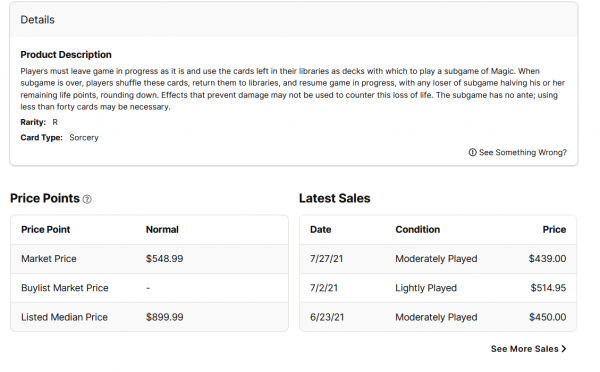
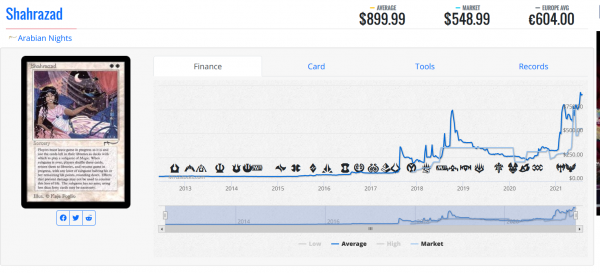
Amulet Titan, on the other hand, had an abysmal showing. That is really weird, since it's normally in the upper third of the standings. It's been an enthusiast deck for a long time, and that meant specialists doing well with their special deck. I wonder where they went to allow Amulet to fall this hard. Elementals appears to be the new It Deck, gaining a lot of attention, but its position on this list says that's the wrong choice. This is down to a surge of interest following Kanister winning a Challenge with Elementals and players copying him.

All for Now

And Modern rolls on. The MTGO metagame continues to churn violently, and I will continue to observe and record. And hopefully refine my psychic powers.

A New Way to Track Collection Values?

Are you a Quiet Speculation member?

If not, now is a perfect time to join up! Our powerful tools, breaking-news analysis, and exclusive Discord channel will make sure you stay up to date and ahead of the curve.

One of my favorite personal trips was one I took a few years ago when I visited Quiet Speculation member pi in Amsterdam. Not only was he a gracious host, but we also saw all the sites and immersed ourselves in Dutch culture—I even had a chance to ride a bicycle throughout the city (it had been a decade or more since my last bike ride
it’s a good thing riding a bike is like, well, riding a bike!).

While I was there, I had a rare opportunity to meet an influential member of the Magic community: the creator of MTGStocks. We talked all things MTG finance and data management, and have since kept in contact to engage on Twitter. Over the past week, he and I have had a discourse on calculating the values of Magic cards. While it sounds trivial, this is no easy feat—it requires a boatload of accurate data and a smart-enough algorithm to pick up on outliers and imposters.

In fact, determining the value of one’s collection has always been a bit nebulous


My History with Card Valuation

When I first started playing Magic back in 1997, there were a couple ways to look up card prices. I suspect the internet was an option, but this was before many households (including my own) had internet. So I had to rely on the latest issue of InQuest or Scrye magazine I had in my possession, or else I had to literally phone a hobby shop and ask them for a price. My step-brother and I have made multiple trades using the latter, by the way. It’s not efficient!

I have to imagine trading and buying/selling during this time before widespread internet was a bit like the wild west. Without access to hard data, cards had relative value more than absolute value. In other words, I knew I valued Shivan Dragon higher than Serra Angel, so a trade involving those two cards would have to be balanced out with additional cards. If there was a card we desperately wanted, we would give up whatever we’d have to in order to obtain it.

There was an error retrieving a chart for Shivan Dragon

Fast forwarding some  years, the internet revolutionized trading and card valuation. Before TCGplayer and eBay’s completed listings, I relied heavily on FindMagicCards.com for my pricing data; some of my earliest articles may have even used graphs from the site to highlight pricing trends. Then I was lucky enough to receive an invite to Apathy House, where you could enter cards for a trade and quickly determine the values of each side. I have no clue where these sites got their data from, but we made huge trading decisions based on them all the same.

It wasn’t for another couple years when TCGplayer came along and revolutionized the industry.

TCGplayer’s Influence on Card Values

TCGplayer: a site dedicated to buying and selling trading cards. Once this site became widespread and opened up to individual sellers (not just large stores), TCGplayer suddenly gained access to boatloads of pricing data. They could track what cards were being sold for, what conditions, how often, and how quickly. With this information, they could calculate a value for every card.

TCGplayer isn’t shy about this information. They boldly claim on their site that they are “harnessing the power of hundreds of brick and mortar stores, online stores, and individual sellers” to “put together the most comprehensive Price Guide available anywhere.” They go on to claim they “serve up over four million pages of pricing data each day through [their] popular marketplace and via partner websites and mobile applications.”

With access to so much data, they truly have become the place for pricing information. Then we have sites like MTGStocks accumulating the data TCGplayer provides to offer different trends, analyses, etc. The flow of data is like a well-oiled machine at this point, and these sites have proven accurate and reliable for the vast majority of cards.

It Works Except For When It Doesn’t

I wish this was the end of the article, and everyone could live happily ever after, knowing precisely what their collection is worth and when. But if you’re reading this article, you’ve probably been around long enough to know that’s not the case—especially when dealing in Reserved List cards as I am wont to do. When dealing in cards with low volume or a buyout (or both), the pricing data becomes a little
questionable.

Consider, for example, the top mover of the day when cards from The List are toggled on for display:

Are The List copies of Rest in Peace truly worth nearly $4000 now? Of course not. Visiting TCGplayer directly, we can readily see that there’s currently only one copy in stock listed at this ridiculous price point, while recently sold copies have gone for $6-$8

Thus, the “listed median price” is being manipulated by the lone seller with inventory, creating this artificial spike. The “market price” on the other hand, is a mysteriously proprietary calculation TCGplayer performs to estimate a card’s value based on recent sales data. So is “market price” the de facto source for accurate pricing data?

Not exactly.

When sales volume is low, or when a card spikes, the market price can lag the true market value significantly. For example, I just looked up Alpha Northern Paladin, one of many Alpha rares that shot up in price over the past year.

There was an error retrieving a chart for Northern Paladin

That $499.00 market price was probably correct a year ago, but today it is way off. Ironically, the listed median price is much closer to the card’s true current value—Card Kingdom pays $1260 for near mint copies on their buylist, more than double “market price”. If you look at the “Latest Sales” section, you can see why the market price is so far off. There is no data there, probably because a copy of this card hasn’t sold on TCGplayer in quite a while.

Because TCGplayer keeps their algorithms confidential, it’s impossible to look at these data and decipher the source of error. But the fact remains: while the data is extremely useful in most cases, there are situations where there’s room for improvement.

eBay’s Entry to this Space

TCGplayer is a website with enough data to provide reliable pricing. But it’s not the only one. eBay also has access to a ton of collectible card price data through its platform, and they recently begun harvesting that data to provide a service much like TCGplayer. Check out this email I received from eBay last week:

Track card prices over time? Track my collection’s value? Obtain reliable pricing information for cards? Can you think of any other sites that offer these services?

It really looks like eBay is going after the collectible card market that TCGplayer has dominated for years. I’m not sure if they’ll succeed, but eBay is a publicly-traded company with a market cap of $46 billion—they must be significantly larger than TCGplayer. Therefore, they at least have access to more resources (whether or not they apply sufficient resources to this endeavor is yet to be seen). There’s certainly potential for eBay to bring some much-needed competition to this space.

Since I was invited to beta test this new service, I thought I’d give it a whirl to see what the interface looked like. Currently, most of the features are available only on mobile, so I shared a couple screenshots from my cell phone below.

It looks like eBay is pulling pricing for cards I purchased from the site over some period of time. I think it’s been over a year since I bought the cards pictured though, so I’m not sure how far back the site is going. What’s more, of course, the site doesn’t automatically remove cards from inventory if I sell them on a different platform, so the collection would have to be manually maintained.

Still, I see some potential. eBay is using their own proprietary calculation to determine a card’s value. However, I’m concerned that their calculation will fall into the same trap as TCGplayer’s when it comes to sparsely sold cards. For example, I wonder how eBay’s pricing feature would estimate the value of an Alpha Northern Paladin, given the variation in completed listings on the site:

By the way, whoever purchased that $340 copy got an absolute steal! They could flip that card to Card Kingdom immediately and likely double their money. But I digress


What will eBay do with this data? Average the three listings? Report the most recently sold (which would undershoot the card’s true worth)? Judge by conditions inputted? This is one of the shortcomings of eBay relative to TCGplayer. On TCGplayer, critical data such as set name and condition is structured. That is, there are a set number of options to choose form and every listing must include these selections. On eBay, anything goes. A card can be listed as “EX” or “SP” or “lightly played” and they could all mean the same thing. On the other hand, a card could be listed with a picture and no condition or set name in the actual text. How will eBay handle such freeform, unstructured data? This is yet to be seen, but they certainly have the resources to do it.

Wrapping It Up

Competition is great for the market, because it forces innovation and drives down prices. If eBay truly attempts to create a collection tracker to compete with TCGplayer (and other sites), this could bode very well for the player base. But I am not truly convinced this will be successful. The data is available, and eBay definitely has enough to provide something of value. But the lack of structure to some of the necessary variables makes me weary of the end product’s fidelity.

I imagine that cards that sell in a more consistent range, such as cards printed in the past decade, will be robust and accurate in eBay’s tracker tool. But for older cards with sparser sales and larger spreads across conditions, I don’t know how eBay’s algorithm will perform. If the calculator struggles, I don’t see this being any better than TCGplayer.

This is why my go-to source for values on older cards remains Card Kingdom. They are just a single vendor, so of course, this skews data. But their algorithm that tracks their own sales has proven robust and agile enough for me. Their buylist changes every day, their pricing is constantly updated based on their inventory and sales, and their price isn’t easily manipulated by sellers who list $6 cards for $1000.

What’s more, their buylist is immediately available to me. If I want to convert a card for cash, I know I can do so by selling to Card Kingdom and I can calculate precisely what I will earn. With eBay and TCGplayer, there’s no guaranteed sale like there is with a buylist. I can try listing a card at the “market price” or the “last sold eBay price”, but the card could sit there and rot for weeks or months without a sale. A buylist price may be lower, but it’s virtually guaranteed and I put a lot of stock in this fact.

Will eBay’s new tool revolutionize the CCG industry as they advertise? I’m skeptical. But I do think see it as a huge positive that they’re trying. We’ve come a long way from the days of calling up local game stores or using monthly magazines to determine pricing. At the same time, I feel like we’ve been fairly stagnant in this space over the past few years. It’s probably time for another disruptor to come in and change the game once again. Maybe it’ll be eBay. Maybe it’ll be someone else. Either way, there’s room for improvement and I’m excited to see a heavy hitter like eBay take a stab at making card pricing easier and more accurate than ever before.

Avatar photo

Sigmund Ausfresser

Sigmund first started playing Magic when Visions was the newest set, back in 1997. Things were simpler back then. After playing casual Magic for about ten years, he tried his hand at competitive play. It took about two years before Sigmund starting taking down drafts. Since then, he moved his focus towards Legacy and MTG finance. Now that he's married and works full-time, Sigmund enjoys the game by reading up on trends and using this knowledge in buying/selling cards.

View More By Sigmund Ausfresser

Posted in Alpha, Analysis, Collecting, eBay, Finance, Finance HistoryTagged , , , 2 Comments on A New Way to Track Collection Values?

Have you joined the Quiet Speculation Discord?

If you haven't, you're leaving value on the table! Join our community of experts, enthusiasts, entertainers, and educators and enjoy exclusive podcasts, questions asked and answered, trades, sales, and everything else Discord has to offer.

Want to create content with Quiet Speculation?

All you need to succeed is a passion for Magic: The Gathering, and the ability to write coherently. Share your knowledge of MTG and how you leverage it to win games, get value from your cards – or even turn a profit.

Collecting For The Long Term: Investing In Your Mana Base

Are you a Quiet Speculation member?

If not, now is a perfect time to join up! Our powerful tools, breaking-news analysis, and exclusive Discord channel will make sure you stay up to date and ahead of the curve.

There comes a point in every Magic player's journey where they want to invest deeper into the game. Whether they're a Commander player who wants to have the tools to build around whatever commander strikes their fancy, or they're a player who got into Modern after reading our Buying Into Modern article and is now looking to expand their horizons to new decks, the best place to start as a player when investing in Magic for the long term is in your mana base.

Personalize Your Basic Lands

While usually not as flashy as their non-basic cousins, basic lands are the soul of Magic, played in every format of the game. Basic lands are more than essential components of the game, they are fundamental to the essence of what is Magic: the Gathering, helping to add identity to each of the five colors. Spending a few dollars to personalize the basic lands in your favorite decks not only adds some flair but also allows you to add an individual stamp to your deck. Whether you're a fan of the classic Alpha lands, or you love the borderless John Avon lands from Unstable, whatever basic lands you choose to personalize your decks with will add value both to the experience of playing and to your collection.

Non-basic Lands: What To Buy, And When

If basic lands are the soul of Magic, non-basic lands are the blood and guts holding the game together and making it run. The non-basic lands we are looking to invest in to grow our mana base will depend on what formats we are looking to play. the two most playable types of non-basic lands across multiple formats are shock lands and fetch lands. Of these two non-basic land cycles, shock lands have the most versatility, being legal in all constructed formats except Standard and Pauper. Multiple printings of the shock lands over the years have helped to keep their prices down, around $20 each for non-foils in most cases, with the most expensive being Breeding Pool, at $28.

There was an error retrieving a chart for Breeding Pool

Historically speaking, Wizards has reprinted the shock lands every time the story setting of the game has returned to the plane of Ravnica for a standard set. The duration the cards are in standard is usually the ideal time to buy in, when the prices typically hover around $10 each. With the Magic rumor mill making it sound like we will not be returning to Ravnica in 2022, it wouldn't hurt to be picking these up slowly now for specific decks as they will only trend upwards in price until they are reprinted again. You'll want to hold off on buying anything you don't immediately need until these see a Standard reprint in 2023 or later.

While not legal in Standard or Pioneer, fetch lands are mandatory staples of all the formats in which they are legal, including Commander, Vintage, Legacy, and Modern. The recent reprinting of the enemy-color fetch lands in Modern Horizons 2, has brought these cards down to historic low prices not seen since their initial printing in Zendikar more than ten years ago.

There was an error retrieving a chart for Misty Rainforest

If you have not already, now is a fantastic time to be acquiring all the enemy fetch lands you need for your decks and to fill out your playsets. The price is so low, that it's even reasonable to be putting aside a few extra of these for speculation purposes. These will only go up over time as new sets release and Modern Horizons 2 fades from memory. Note that if speculating, the old border variants while approximately twice the price of the regular printings, stand to have the best long-term value because of their uniqueness and desirability, especially among players of eternal formats.

Utility Lands

The demand for utility lands varies by format and by deck. Where Reliquary Tower is a staple in numerous decks in Commander, it hardly sees play in any other format. Karakas and Wasteland are Legacy staples, but in Commander, Karakas is banned and Wasteland is seldom played. Of all the utility lands available in Commander, these are the top four of EDHREC's Top 100 Utility Lands for Commander in the past month:

EDHREC Top 4 Utility Lands

Further down this list is a cycle of utility lands that have seen play in Standard, Pioneer, and Modern as well as Commander: the castle cycle from Throne Of Eldraine.

Throne Of Eldranine Castles

Ranging from $7 to $0.50 each per card, these are affordable and probably the most useful cycle of utility lands across multiple formats which you could pick up right now. When in-person Pioneer events return these lands could even see an uptick in price depending on what the future of that metagame looks like.

Creature-lands

Creature-lands are a versatile addition to any mage's arsenal. The ability of the dual-colored creature lands to fix mana, as well as turn into a late-game threat or a surprise blocker make them useful at all stages of the game. With the exception of Inkmoth Nexus, the power of creature lands has diminished slightly in Modern in recent years due to the speed of the format. Their ability to close out a long game should not be discounted though, and Creeping Tar Pit, Celestial Colonnade, Raging Ravine, and friends still see play in control and Jund archetypes. Thanks to reprints, versions of many of the creature-lands can be found for around $5, with only Inkmoth Nexus carrying a more hefty price tag.

There was an error retrieving a chart for Inkmoth Nexus
There was an error retrieving a chart for Celestial Colonnade

Triomes

Since their appearance in Ikoria: Lair of Behemoths, Triomes have gone on to become an integral part of numerous tri-color decks in several formats. Their prices, especially for the ones that produce blue, have steadily climbed since their release. These are still standard legal for another month or so, and will likely see a slight dip in price when they rotate out of Standard, making rotation an excellent time to pick up a handful.

Revised Dual Lands

We'd be remiss in talking about long-term collecting and investing in mana bases without briefly discussing Revised dual lands. Because of their prices, dual lands are a serious investment for any Magic player. Staples of the Legacy and Vintage formats, dual lands in conjunction with fetch lands are the basis for the majority of mana bases in those formats. dual lands can also power up Commander decks to a more reliable mana base with less drawback, making them highly desirable there as well. 2021 saw Revised duals hit all-time high prices. Those prices have retraced slightly since the early part of the year and there is still a possibility of them declining further over the next year or so, but it's uncertain if they will return to pre-pandemic price levels.

There was an error retrieving a chart for Underground Sea

If looking to finish a Legacy deck, or quickly improve the mana of your Commander deck, there isn't a wrong time to buy dual lands if you're going to put them to immediate use. If however, you're trying to time buying into dual lands to get the best price, keep tuned here to Sig's articles, where he has his finger on the pulse of the Reserve List market, and subscribe to QS Insider for access to trade tools and pricing data allowing you to figure out the best time to buy.

What lands do you have on your radar for long-term collecting/investing? Have you picked up all your enemy-color fetch lands yet? When do you think we will see a shock land reprint? Post your answers in the comments.

Modern Top 5: Overplayed Cards

Are you a Quiet Speculation member?

If not, now is a perfect time to join up! Our powerful tools, breaking-news analysis, and exclusive Discord channel will make sure you stay up to date and ahead of the curve.

There's a reason that stories tend to follow a certain structure. And similarly why studios seem to favor reboots and retreads over actually new movies. Humans are creatures of expectation and habit. We are used to certain things happening a certain way, especially once they've been socially reinforced, and when those expectations aren't met it creates tension and anxiety. Which is a long-winded way of saying that since I implied that this article could exist, I've created an expectation for it to exist. And will now follow through.

What Is Overplayed?

By arguing that certain cards are underplayed in the current metagame, I implied that there are also some being overplayed. Which is true. However, it's a problem for me. Explaining the underplayed cards is relatively easy: there are specific problems in Modern that have solutions which are seeing reduced or nonexistent play. An overplayed card requires more defining. Seeing a lot of play doesn't make a card overplayed. That's just popular. Rather, there needs to be a mismatch between the card's expectations and performance. And that is quite subjective. Everyone has have different expectations and thus how they evaluate a card will be different. Which is my cue to remind everyone that this is my list. These are the cards that I think are most underwhelming and consequently overplayed.

Definitions

And for me, the key is whether a card does what it's supposed to do. What I mean is whether an answer card actually answers the thing it's supposed to answer in the needed way. For example, playing Remand in a control strategy would be an inappropriate use, since it kicks the can down the road. Lots of true control running Remand would therefore constitute overplaying. A tempo deck using Remand is appropriate since all it wants is to delay the opponent. Lots of fish style decks with Remand is not overplaying.

With creatures it's a little harder. Most decks need to attack for the win and so a creature is never fully useless. Stats are also a really great way to manage expectations about what a card can actually do. Thus, an overplayed creature needs to be showing up where it doesn't belong. If something seems to be played everywhere because "it's too good not to be," "for value," or is otherwise "a free include" (actual explanations I've received) but doesn't really fit with the strategy. Or it doesn't actually do the thing it's hyped up to do. Or even worse, there are other cards that do its specific job better. If a creature is supposed to be overpowering and has to be played to be competitive, it had better actually be game ending in all contexts rather than just above average or a good rate.

Standards

Now that I've established how I define an overplayed card, I need to set out actual standards for evaluating the cards. This is particularly important given the subjective nature of this topic. However, it's also important to keep everything in context. I'm not evaluating these cards in a vacuum. Were that the case, this list would be quite different. Instead, we'll focus on which cards are currently seeing play in the decks that also see play and don't make sense to me. To make my list, the card needs to be a combination of out of place and ineffective in the metagame as it's developing. My perception is based on what I'm seeing in the metagame data, watching others explore Modern, and my own experiences.

The July metagame update is out next week, and unless something changes dramatically this week, the meta will be split between Hammer Time and UR decks. The largest grouping of said UR decks is UR Thresh, using counterspells, removal, and cantrips to support a small number of cheap threats plus Murktide Regent. BR Stompy decks built around Lurrus of the Dream-Den are another big player, while most of the combo space is cascade decks. There's a few control decks making a case, but for the most part, right now Modern looks like the fairer side of Legacy. This is the reality that I'm establishing and evaluating my standards under.

Inefficacy in Context

How easily does a card do what it's supposed to in the current deck/metagame? Last time I was just looking at how effective a card was at its job. No ifs, ands, or buts; simply, does it do what players want and expect it to do? However, to evaluate an overplayed card requires additional context. Given how the metagame is working and what is seeing play, does the card actually do what it's supposed to do? Will the card's intended primary function actually come up during games often enough to justify playing the card? And if it does, can the deck playing it make use of the effect to full impact? If the answer isn't yes to all those questions, the card needs to be questioned.

For example, Lightning Bolt has arguably been the defining card of Modern since the format's inception. It is the best there is at what it does for its price, and Modern has always had use for three damage to anything for one red mana. However, its relative stock has risen and fallen over the years as the metagame has changed. For example, in 2016 37% of decks played Bolt, but in 2017 if fell to 27%. That was the year that Eldrazi Tron and Death's Shadow took over Modern and Bolt was no longer effective removal. In 2018 Humans was the top deck; Bolt was effective again, and 35% of decks played Bolt. The inherent power of Bolt never changed, just its contextual power. A card being ineffective in context doesn't make it bad, just not the right call.

Parasitism

Does the card stand on its own or require help? A card that is good by itself in a wide variety of contexts is no parasite. However, if a card absolutely needs others to be good, let alone playable, then it is one. This isn't a problem by itself, as tribal cards are inherently parasitic and there's no issue with their playability. The problem comes when a card is a parasite but the parasitism isn't obvious. Champion of the Parish is highly parasitic but nobody would ever run it without support, meaning it will only see play in the right context. Thus, it wouldn't meet my definition of overplayed.

Conversely, Chalice of the Void doesn't need much support from its own deck to do its thing. However, its only meaningful in the context of the opponent's deck, which is still parasitic in the technical sense. This is where problems can arise. If a card is only good against a certain card or deck and does nothing by itself, it has parasitic qualities.

Another example: Authority of the Consuls is highly parasitic in this regard, since it does absolutely nothing against creatureless decks. Even against decks with creatures, its main ability only really matters against decks with haste creatures. Unless you intended to use Authority to sneak damage through new blockers, it's a negatively parasitic card. These can very easily be overplayed because they need the opponent to play ball to be good. And what if said opponent says no?

Opportunity Cost

What alternative is being sacrificed for this card? Simply put, how is the selected card better than the alternative? No card is ever actually a free include. There's always an alternative that could be played and therefore there is always an opportunity cost to every card. However, a card with a low opportunity cost will either have few alternatives or be significantly better than said alternatives. For a high one, the opposite is true. To wit: the opportunity cost of Lightning Bolt is its alternative, Lightning Strike (same effect, different cost). As Bolt is cheaper, that opportunity cost is very low. However, in the context of removal spells, Bolt may be quite high, as there are a wide range of one-mana kill spells and depending on metagame context, it may prove expensive to include Bolt over something else.

Force of Negation: 9/15

Force of Negation is a good card, and at times it has been a necessary card. It's the most flexible free counterspell in Modern. Disrupting Shoal never saw much play because it's hard to use. So Force is the only means most decks have of protecting themselves against opponent's the turn they tap out. This is very important against control and combo decks. The problem is that Force is only actually free on the opponent's turn. Even then, you only want to counter really important spells, and only if absolutely necessary. There's a reason that Force of Will gets cut in fair matchups in Legacy.

Inefficacy in Context: 3

The ideal Force targets are planeswalkers or combo pieces, preferably ones that cost three or more to offset Force's mana cost or card disadvantage. The most played noncreature spells at the moment are all cheap instants and sorceries. Sometimes Forcing an Expressive Iteration or Prismatic Ending is necessary. Doesn't feel very good, though. Forcing Chalice of the Void is a valid and good use of Force, and Ad Nauseam and Tron are still seeing play. However, Force is fairly mediocre against the cascade combo decks because Violent Outburst lets them combo off on end step when Force isn't free. It does what it does, it just doesn't happen as much as it used to, and Force's limitations are an issue.

Parasitism: 3

Answer cards are naturally parasitic. They're answers, so they need questions to have meaning. Force is a Negate variant, which makes it more parasitic because it's more narrow. It gets worse since casting Force for free (the reason to play the card) requires another blue card in hand. Doing what's necessary is necessary, but that does also create deckbuilding and gameplay requirements.

Opportunity Cost: 3

The fact that Modern has few free counters brings down Force's opportunity cost. Having to hold another blue card in hand raises the cost since that card can't be used for its intended purpose. However, the real problem with Force is the deckspace cost. There are many alternatives if the only goal is to protect against noncreature spells on the opposing turns for cheap, including Veil of Summer and Spell Pierce. That being the main intention raises the cost. Additionally, playing Force means less space for cards that answer creatures in a Modern, where answering creatures is far more important than answering spells.

Sanctifier en-Vec: 10/15

I like Sanctifier en-Vec. However, players have taken to playing it instead of Rest in Peace in decks that formerly ran Rest. The thinking is that all the cards that most decks want to exile are red, because they're thinking of Dragon's Rage Channeler decks. Having a protection from red creature is really good against those decks, so Sanctifier does the job of Rest and Auriok Champion, freeing up sideboard space. The catch is that Sanctifier doesn't actually answer Dragon's Rage Channeler because it can't exile artifacts, lands, or blue cards. And that's not even considering white and green decks.

Inefficacy in Context: 3

Against the decks that most players are thinking about, Sanctifier is quite strong. The problem is that they're not the whole metagame and Sanctifier is worthless against Emry, Lurker in the Loch, Lurrus, and Living End decks. Decks which are as prevalent in aggregate as the DRC decks.

Parasitism: 3

Sanctifier is a color hoser. Those are very parasitic, even when attached to reasonable stats on a good creature type. It's also a graveyard hate card, which is relevant often but not always.

Opportunity Cost: 4

The cost of playing Sanctifier is Rest in Peace. Sanctifier being overplayed is in fact the reason that Rest is being underplayed. In a deck like Humans, the cost is low because Humans never ran Rest. For the Stoneblade and control decks I've seen running Sanctifier, it is a high cost. Particularly because the majority I've seen aren't running any graveyard synergies themselves.

Ragavan, Nimble Pilferer: 10/15

The most hyped red one-drop from MH2 was Ragavan, Nimble Pilferer. The most played one has proved to be DRC. It may be this hype and the dream of stealing opposing cards which has led many players to run Ragavan in decks that cannot support him. And Ragavan needs a lot of support.

Inefficacy in Context: 2

If the statlines and dash were the only metric, then Ragavan would be worse than Zurgo Bellstriker, because Zurgo doesn't die to Lava Dart, Wrenn and Six, and Gut Shot. Zurgo seeing no play would indicate Ragavan would be very ineffective. However, making treasure is a very useful ability, and is the real reason that Ragavan sees play. Getting to play opposing spells is more of an occasional reward than a point in Rags's favor.

Parasitism: 5

However, dying to everything and needing to successfully deal combat damage is Rags's failing. He's very strong in decks that play lots of removal, disruption, and/or other cheap creatures to clear a lane to actually connect. If that isn't the case, he's just removal bait, and that's the problem: I'm increasingly seeing decks that can't actually protect or clear space for Rags play him. Rags is very bad without a lot of help.

Opportunity Cost: 3

On the one hand, cheap aggressive creatures is very low cost because winning the game is good. However, in the slower decks I see Rags infiltrating, he's taking the place of removal, bigger threats, and/or reliable card advantage, all things these decks absolutely need and must closely monitor their budget for.

Grief: 13/15

I've been skeptical of Grief since it was spoiled. Modern as a whole seems to agree with my skepticism. Where initially Grief saw widespread play, it has drastically narrowed to WB Stoneblade and Living End. The Stoneblade decks are contorting themselves silly to make Grief work and still floundering in the metagame standings.

Inefficacy in Context: 3

In Living End, Grief is a good card because it protects and opens a road for the combo while synergizing with the payoff. Everywhere else, Grief is a free but card disadvantageous Thoughtseize, a card whose own stock has fallen relative to past years (and not, I would guess, because it's too expensive to cast).

Parasitism: 5

Grief is only good when its card disadvantage gets made up. This is why it doesn't see play in tribal Elementals very much. This is no problem for Living End. However, every other deck is going to ridiculous lengths to try and live the dream of turn 1 Ephemerate on Grief. The card is making decks warp themselves to better serve it, but doesn't reward them with Challenge or Preliminary results. Making a host serve its interests and not the hosts is textbook parasitism.

Opportunity Cost: 5

Stoneblade has been cutting Thoughtseize and Inquisition of Kozilek to run Grief. Those cards don't put the same pressure on deckbuilding as Grief, have lower mana costs, and don't generate card disadvantage early. That's a max-cost situation there.

Aether Gust: 15/15

It was watching a UW Control deck Aether Gust a Primeval Titan three times and then die once it resolved that got me thinking about overplayed cards in the first place. Gust is a tempo card that somehow mostly sees play in non-tempo decks, primarily control decks. Which want to permanently remove things, not delay them to be answered again. Were Gust seeing play in UR, there'd be no problem. But it's the high control play that earns Gust it's spot.

Inefficacy in Context: 5

Unless the opponent is stupid, they're not Gusting that Titan to the bottom of their library. This is the main way I've seen players use Gust in Modern for the past two years. The best use is Gusting a resolved Dryad of the Ilysian Grove to fizzle Valakut, the Molten Pinnacle triggers. However, that need is at a low ebb, and instead I see a lot of control players Gusting against cantrip-heavy red decks. Control is all about buying time, but it also cares about card economy and having to spend several spells answering one is very suboptimal.

Parasitism: 5

To actually remove something important for good, Gust needs the opponent to put it on the bottom of their library. That's a parasitic line. Alternatively, the card could be removed from immediate concern via Field of Ruin, Thought Scour, or Ashiok, Dream Render. For an answer card to need other cards to actually answer something is highly parasitic.

Opportunity Cost: 5

By running Gust, control is deciding not to run a card that actually answers a red or green spell. The only reason they're doing that is Cavern of Souls naming Giant. Given how rarely the plan works out in my experience, it's as big a cost as possible. Pathing Titan and Dryad is almost always a better line than Gusting and hoping to... what exactly? Suddenly win in one turn?

Value Impact over Effect

The main thrust of these cards is players valuing a card effects or perceived effects over proven impact. We all get distracted by cool things, but that's a trap. Focus on what actually works in context, not just what you think works, or worse, what you want to work.

Are Reserved List Cards Rebounding Already?

Are you a Quiet Speculation member?

If not, now is a perfect time to join up! Our powerful tools, breaking-news analysis, and exclusive Discord channel will make sure you stay up to date and ahead of the curve.

I have an update in the saga that is the alleged clipped Beta card I had sold on eBay. The return was completed safely and without incident and I have the card back in my possession. I quickly sent pictures to a European contact I know who deals heavily in Alpha cards to ask his assessment of the card’s authenticity.

He quickly identified the card as a genuine Alpha. How did he determine this? It had nothing to do with the corners, in which I had put so much stock. Instead, he pointed out a distinguishing feature on the face of the card. Take a look at the pictures below—left is Beta and right is Alpha.

They look identical, right? Besides being slightly lighter, there is one distinct difference I can see and it comes down to the print line that drops down from the black mana symbols in the card’s mana cost. In the Beta version, the lines are dark on the left but white on the right. On Alpha, there’s less of a white component to the lines. Here’s a close up of my card:

The line coming down from the left black mana symbol has no white component. Thus, the card was assessed as true Alpha despite the corners. When I asked about the suspicious corners, my contact replied, “Corners are never a good indicator for legitimate Alpha, if you stack 100 Alphas, basically none will match exactly others.”

Clearly I still have more to learn about this space. The bottom line is, if you’re going to deal in Alpha I’d suggest reading up on the differences between Beta and Alpha or else have a reliable contact who can help! Because this deviated some from what I suggested last week, I wanted to confess my error.

In Other MTG Finance News


Now that I’ve corrected myself, I want to shift gears and comment on some of the very recent activity I’ve observed in Magic finance, particularly related to Reserved List / Old School cards.

Yes, I know, I talk about this subject frequently. Since 99.9% of my collection’s value consists of cards from these categories, you can’t possibly blame me for monitoring their market so closely. And it is that close observation that has led me to this new development.

In many cases, Reserved List / Old School card prices have stabilized and even begun a modest climb higher. This is noteworthy because these cards have all seen a retracement in price over the past couple months, and I think many in the MTG finance community expected there was still more room to go. Chris Martin, a former Quiet Speculation writer and well-known member of the community, has been on top of the sell-off and vocal about the momentum.

You can see in his reply that I challenged Chris on his choice of words in the original tweet. I was expecting prices to drop further too, but I felt his rhetoric was a touch too bearish. He responded well to the feedback, and we both agreed that the sell-off was completely healthy for the game and its financial component.

Now I’m looking at some cards on Card Kingdom’s site and I’m seeing increases in buy prices. One example is Gaea's Cradle:

There was an error retrieving a chart for Gaea's Cradle

This card’s buy price was on the decline; Card Kingdom was paying around $600 for near mint copies of the card. Then I noticed the buy price at $660. Right now the card is on Card Kingdom’s hotlist with a $720 buy price. The card’s average price hasn’t really budged on MTG Stocks, but check out the graph for its market price:

Notice how the card had leveled out for a while but is once again climbing higher. This indicates to me that the card is selling for higher prices than before.

Beyond Gaea's Cradle, a number of other noteworthy cards are suddenly showing up on Card Kingdom’s hotlist. Here are a few that are surprisingly robust:

Bazaar of Baghdad - $2470
Volcanic Island - $535
Underground Sea - $505
Tropical Island - $480
Eureka - $480
Mox Diamond - $420
Bayou - $355
Tundra - $325

A couple of the non-blue Dual Lands also show up on the hotlist, as does Gilded Drake, Sliver Queen, and Grim Monolith. While none of these numbers are all-time high buy prices, they are all very respectable. More importantly, the fact that Card Kingdom includes all these Reserved List cards on their hotlist tells me maybe this market isn’t as soft as I believed.

Granted, not all cards are bouncing. Library of Alexandria had a peak buy price north of $2000, and now Card Kingdom’s buy price is down to $1290 with no sign of imminent movement higher. But other Arabian Nights cards have seen recent bumps higher, including Guardian Beast ($780) and Serendib Efreet ($715). I’m not sure if there’s a certain trend that can be identified that explains why some cards are rebounding and others aren’t. It could be locally isolated to Card Kingdom’s individual stock; but their dynamic buylist has made their site pretty reliable when it comes to finding the pulse of the overall market.

And right now, that pulse is starting to strengthen.

What Is Driving This Trend?

As I mentioned earlier, this modest rebound in Reserved List prices is admittedly unexpected. Many of the factors attributed to the climbing prices (e.g. government stimulus checks, elimination of large in-person events, few alternatives for discretionary income) have faded away. As the world opens up, a sense of normalcy is gradually returning, and with it I expected a retracement in Magic prices as people find different ways to spend their money.

But something is happening and I’m trying to decipher why. I can think of a couple possibilities, but none of them are all too convincing.

First, while it’s true the government hasn’t issued a check to the majority of the nation in a while, they have started paying out the child tax credit in the form of monthly checks. This is a few hundred bucks a month directly deposited into the accounts of qualifying families. This could be motivating some purchases recently. But at the same time, I’d hypothesize that a parent with young children is less likely to be spending excess cash on Magic cards.

Though, I suppose it’s possible that they are. And if that’s the case, then it stands to reason that an older generation of Magic players are more likely to spend on Old School cards relative to a younger player new to the game.

There was an error retrieving a chart for Black Lotus

Another hypothesis stems from the rampant speculation in the cryptocurrency market.

Over the winter, crypto prices (Bitcoin’s graph is above as an example) soared to new heights. Prices flattened and then started a healthy decline (much like Magic). But the downward trend may be breaking over the past couple weeks. Could a potential bounce in the crypto market be catalyzing a commensurate bounce in the Reserved List market? I’m not so sure there’s a direct causation, but the speculative nature of both markets could indicate correlation.

I suppose it’s not impossible that the catalyst is simply a modest climb in Magic’s popularity. The new Adventures in the Forgotten Realms set directly ties to Dungeons & Dragons—perhaps older players who appreciate D&D are the same group who prefer the nostalgia of Magic’s earliest sets? It feels like a stretch, but if Magic is growing, then some proportion of the growing player base could hypothetically be buying older cards. Let’s face it: it doesn’t take many new entrants to Old School to move the needle on prices. These cards are quite sparse!

Another possibility is that the “return to normalcy” feels on hold, or at least less assured, given the recent rebound in COVID cases and the spreading of the delta variant. Does this mean large Magic events will be delayed further? Probably. If people are still nervous about spending money on travel and experiential activities (e.g. concerts, sporting events, shows) then maybe discretionary income is still best funneled towards at-home hobbies, such as Magic.

Lastly, this could be a textbook “dead cat bounce”. According to Investopedia, this grotesque turn of phrase means a “temporary, short-lived recovery of asset prices from a prolonged decline or a bear market”. That could be an adequate description of what’s happening. There’s a certain psychology to it—after seeing inflated prices for a period of time, a sudden selloff makes prices look like a bargain, triggering a bout of buying.

Such a rally in prices is not sustained. If this is a traditional dead cat bounce, then the recent rebound in prices will be temporary, indicating that this bounce is an opportunity to sell rather than an “all clear” signal to buy.

Wrapping It Up

Clearly, something is going on in this market. This is evidenced by reappearances of Reserved List cards on Card Kingdom’s hotlist, something they wouldn’t do if they weren’t looking to restock on these cards. But what does this short-term recovery mean? Is the sell-off over? Are there new catalysts that are driving the return of speculation, lifting prices on collectibles even further?

I’m not sold on this thesis just yet. Personally, I’m considering this recent rebound as a dead cat bounce. Rather than scramble to buy “before prices go back to all-time highs”, I’m more inclined to sell into the recent rally. Of course, I don’t intend to sell everything, nor would I consider selling any sizable percentage of my Magic portfolio. I’m merely thinking of trimming certain cards that are approaching new highs. Many of my Old School cards are nowhere near their previous highs (indicating this rebound isn’t broad and sustainable). Those cards I’ll likely sit on and wait for the next round of rampant Reserved List speculation, which probably won’t happen until next year.

I’ll only look at selling stuff that’s rebounding most significantly.

There was an error retrieving a chart for Acid Rain

An Acid Rain here, a Guardian Beast there. Just a couple cards as they seem to rebound. If the rebound starts to accelerate and less popular Reserved List cards follow suit, I may pause and reconsider my strategy. But until that happens, I’ll stay the course and largely ignore this latest rebound in prices. I just don’t believe we’re at a point where card prices will hit new highs
not yet, at least.

Understanding Metagames for Success and Profit

Are you a Quiet Speculation member?

If not, now is a perfect time to join up! Our powerful tools, breaking-news analysis, and exclusive Discord channel will make sure you stay up to date and ahead of the curve.

The creator of Magic: the Gathering, Richard Garfield, speaking at the 2000 Game Developers Conference, described a metagame as "How a game interfaces with life." This is a beautiful philosophical definition but is much broader than what players generally think of when they think of metagames. For most Magic players, a metagame refers to the cards, decks, and general strategies that define a given format. The Modern metagame for example is comprised of all the viable decks made from cards legal in the Modern format. Let's explore both the more narrow player-understood meaning of metagame and Garfield's more broad definition. In doing so, we will discover how related they are, especially when we approach the secondary market.

Top-Tier Decks And Strategies

When thinking about metagames, one of the first things players think about is the top decks, the most powerful or most played strategies in a given format. While many decks may be viable in a format like Modern, the top ten decks are the decks you are most likely to encounter in a given event. Here's a sampling of the top ten decks in the Modern format from MTGGoldfish from the last seven days, at the time of this writing:

MTGGoldfish Modern Metagame Pic

We choose our deck for a format based on many criteria: format viability, financial constraints, playstyle, and other reasons. You can see more on choosing a deck to play in the article Buying Into Modern. Once we've selected a deck, it is important to understand the deck's strengths & weaknesses against the top decks in the field. This is called metagaming. The act of metagaming is the process of examining the metagame of a given format, and choosing to include cards in your main deck or sideboard which you can use specifically to aid in thwarting the common strategies you expect your opponents to bring to the table. Sometimes this can even determine what deck we choose to play. Assuming we've chosen a deck for some number of the reasons previously discussed, let's look at where metagaming is most relevant: the sideboard.

Sideboards And Silver Bullets

Once you understand your deck and its strengths and weaknesses, the sideboard is the place to have specific cards to fight the strategies of your opponents. The first cards players think about when looking for sideboard options are the so-called "silver bullets," narrow but powerful cards that exist in a given format and can be used specifically to aid in thwarting common strategies you could expect your opponents to bring to the table. Silver bullets have existed in Magic as far back as Limited Edition Alpha, the very first Magic set.

Alpha Silver Bullets

Developing these narrow answers was a conscious decision made during the two years of playtesting done by Garfield and his playtest group. "The original plan was to include cards that thwarted every obvious simple strategy," Garfield wrote in his piece on the creation of Magic in the 1994 Magic: the Gathering Pocket Player's Guide, one of the first major publications written on the strategy of the game. The article was reprinted on the Magic: the Gathering website for the game's 10th anniversary in 2013. The goal over time, Garfield continued was "to add new cards which would defeat the most current ploys and keep the strategic environment dynamic." The power of silver bullets has risen and fallen over the years. In Modern, cards like Surgical Extraction, Relic of Progenitus, and Stony Silence are staples which consistently see play. The first two are answers to graveyard-based strategies, perennially powerful strategies which can otherwise be difficult to interact with, hence the necessity for these powerful answers.

MTG Pocket Player's Guide

"The original plan was to include cards that thwarted every obvious simple strategy" - Richard Garfield, discussing "silver bullet" cards in Limited Edition Alpha, "The Creation of Magic: the Gathering," Magic: the Gathering Pocket Player's Guide

Flexible Answers

Another class of sideboard cards are what can be dubbed "Flexible Answers." These include cards like Abrade, Spell Pierce, and Engineered Explosives. Because of their flexible nature, these cards are often included in the maindeck in one and two-ofs, as well as in the sideboard for their ability to answer multiple kinds of threats. The most open-ended of these cards, like Engineered Explosives, are often called "catch-alls." While not as powerful as the silver bullets, the increased utility of these cards makes them valuable even when not facing the deck they were included primarily to fight against.

There was an error retrieving a chart for Engineered Explosives

Most Played Modern Sideboard Cards

Based on metagame data from MTGTop8.com, these are the top 20 most played sideboard cards in Modern:

MTGTop8 Most Played Sideboard Cards

It's not surprising to see a flexible card like Engineered Explosives in the top slot. Aether Gust and Mystical Dispute in the second and third slots also make sense at the top of the list given that Izzet Blitz, and Izzet Tempo are two of the top decks, wanting Mystical Dispute for the pseudo-mirror matches, and Aether Gust against Amulet Titan, the Crashing Footfalls deck, and anything else playing green/red.

As a player, it's a good idea to have some number of these cards in your collection, if not one or two of every card on the list, regardless of what deck you are currently playing. This is especially true of the colorless artifacts on the list. Doing so will allow you to have tools in your collection for whatever direction the metagame may shift, and be ready to include them in your sideboard or deck as necessary.

As a trader or speculator, these are all fine cards to have in your binder. Their steady demand means they will be relatively easy to move if you're ready to unload, and their prices remain relatively stable but can spike as the metagame shifts in a direction in which they are strongly positioned. Speaking of prices leads us to revisit Richard Garfield's quote describing metagames: "How a game interfaces with life." Nowhere does Magic interface with life so frequently as in the secondary market.

The Metagame Of The Secondary Market

The secondary market is its own kind of metagame of Magic. Whether you are acting in the secondary market looking to acquire cards to play or looking to make a profit when you engage in the secondary market you are a player in the game. The rules of the secondary market vary depending on your goals. Without diving too deep into ECON 101, let's say that there are generally two main goals: to obtain the best price, or to make the most profit. Regardless of which goal we have, an understanding of format metagames like the Modern metagame can allow us to win on the secondary market. Let's look at a recent example in Crime // Punishment.

If you were paying attention to Magic finance news earlier this month, you would have seen the sudden jump in the price of this little-known rare from Dissension. Why did the card spike? Savvy Modern players, looking for additional answers to Urza's Saga, and other artifact-based strategies, identified the card as a possible sideboard inclusion. According to the data, if you bought in between June 22nd, and June 29th, you were still buying in at close to the bulk price the card has been at for years, around $1.00. If you were looking to obtain the best price, anytime before the 29th was a good time to do so.

If your goal was to make the most profit, Crime // Punishment shot up to an all-time high price of $19.84 on July 5th. The card fell to $16.99 on July 6th, before spiking back up just under its all-time high, and has slowly crept down since, settling at its current price of around $13.99. If you bought in before the 29th, between the 5th and 7th of July was the best time to cash out. Even selling now at $13.99 is still a solid return on your investment if you were among those who read the metagame and identified the card early before the price spike.

We can see similar stories playing out with cards like Shattering Spree, and Kataki, War's Wage, both of which also spiked around this time, and for similar reasons.

There was an error retrieving a chart for Shattering Spree
There was an error retrieving a chart for Kataki, War's Wage

Another card with a more recent price spike is Alpine Moon, which has also jumped because of its use in Modern sideboards.

There was an error retrieving a chart for Alpine Moon

In all of these cases, we see how understanding the Modern metagame, and acting on the knowledge can also have an effect on the secondary market, leading to wins at the table, and profits in the wallet. As the Modern format continues to evolve, other tools will need to be identified to maintain that winning record. What sleeper cards will players uncover as they plumb the depths of the format? What cards do you have on your radar? Share your answers in the comments.

Want Prices?

Browse thousands of prices with the first and most comprehensive MTG Finance tool around.


Trader Tools lists both buylist and retail prices for every MTG card, going back a decade.

Quiet Speculation