
menu

Defining Our Terms

Are you a Quiet Speculation member?

If not, now is a perfect time to join up! Our powerful tools, breaking-news analysis, and exclusive Discord channel will make sure you stay up to date and ahead of the curve.

Nowadays there are a lot of potential investment opportunities, so I think it's important to look at them in relation to Magic: The Gathering. Just 10 years ago, if you'd told someone that you invested in Magic cards, they most likely would have looked at you quizzically or just outright laughed at you. But thanks to collectibles becoming more mainstream, we have seen a resurgence in Reserved List spikes in the past 12 months that can only really be logically tied to people investing in these cards.

I understand it might come off as a bit cliché to start an article with a definition of a term, but with all that's going on in the financial world right now, I think it's important to define key terms upfront so that all can understand where I'm coming from.

Investment

Investment (n): Property or another possession acquired for future financial return or benefit.


I have a friend who speculated on Kuzdu and has already made 6x his investment while still holding onto a majority of his copies so far, despite it not seeing play in any format and not comboing with anything that has recently come out.

There was an error retrieving a chart for Kudzu

In fact, for several months the front page of MTGStocks was littered with random Reserved List (RL) cards quadrupling overnight. As expected we are seeing many of these prices creep back down, but many are unlikely to ever return to their original price which means that those who bought up these cards may still consider it a good investment even if it takes quite some time to actually turn the cards back into cash and make a profit. This has died down somewhat and I believe the reason is that many who jumped onto that train bought in without knowing a whole lot about the game and understanding card demand. This leads us to our next definition.

Value

Value (n): Worth in usefulness or importance to the possessor.

A card's value stems from multiple properties such as:

  • Playability - how often the card is played in a given deck.
  • Rarity - how rare the card is compared to other cards.
  • Collectibility - how collectible or iconic the card is compared to other cards. This may include the set it's from, its artwork, the artist who did the artwork, or other factors.
  • Personal Attachment - how personally attached to a given card a player or players are. This one tends to be more subjective than the others, but there is a reason that Alpha Animate Wall is more valuable than other bulk Alpha rares and it's because one person started collecting them a long time ago, so there are far fewer in the marketplace than others.

The market price of a card is dictated by these values because these values will determine the demand for the card. When someone buys up all the copies of an old obscure card they may make the market react in such a way that some people who fear missing out (FOMO) will purchase copies at new inflated prices, but overall these properties have not changed just because Person A buys up the lowest 200 copies of some obscure card and suddenly the TCGplayer market price moves up by 50%. If the rest of the player population wasn't interested in buying the card at $0.5, few will now be interested to buy it at $5.

Despite the clear-cut definition of the term "value", nowadays it does seem to have a fair amount of ambiguity. Every day we see multiple types of cryptocurrency rise and drop in price.

I have often repeated a wise Warren Buffet quote: "price is what you pay, value is what you get." I repeat it because it is incredibly important to understand. We typically view the terms as interchangeable because they are so closely linked, however, doing so misses an important distinction. The price is determined by the seller, but the value is determined by the buyer. If you are finishing up your decklist for a major event and realize you are missing a key sideboard card, you are willing to pay over market price at the venue because the value of having access to it is worth it. However, if you walk into your LGS and they have the same card priced the same, but you don't need it immediately, it is easy to simply pass on purchasing it.
I have a foil Shadowmage Infiltrator I opened in an Odyssey pack long ago. It has plummeted in price since I cracked that pack, but its price is irrelevant to me because I greatly value the memory of playing it in standard and winning an FNM with it and it reminds me of the time I got to meet Johnny Magic himself when I covered PT Guilds of Ravnica.
There was an error retrieving a chart for Shadowmage Infiltrator

Conclusion

The reason for this article is that I have seen a lot of people using these terms, oftentimes incorrectly. I have heard of numerous investment opportunities, be it, cryptocurrency, stocks, index funds, real estate, or Magic cards as a "good value" which obviously implies the speaker believes the current price is below what they believe the price should be or will become. There are plenty of analysts on many of those subjects with a lot more knowledge than me, every time I hear those words I ask myself by what standards do they think that. I encourage you all to do the same, regardless of the source.

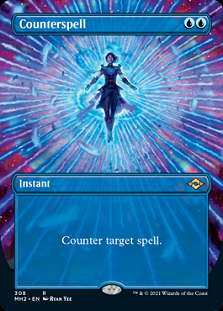
Counterspell and Sanctum Prelate in Horizons 2

Are you a Quiet Speculation member?

If not, now is a perfect time to join up! Our powerful tools, breaking-news analysis, and exclusive Discord channel will make sure you stay up to date and ahead of the curve.

It would seem that Wizards is growing impatient. The stated beginning of Modern Horizons 2 previews was next week. However, as part of their announcement of the "Summer of Legend" (which trips my marketing gag reflex), Wizards gave us some early spoilers. Clearly intended to whet player appetites for what is to come, the spoilers were mainly a showcase for new-to-Modern reprints. Very significant new-to-Modern reprints which are expected to have a big impact on Modern. However, if their home formats are instructive, players are overreacting.

Following the reveal, I was struck by Wizards' decision to use the pre-Eighth Edition borders for some of the alternate frames. I forgot how nostalgic that old border is for me and that it has a great fantasy vibe. It's not as functional due to smaller text boxes, but that's not a concern for me as an experienced, enfranchised player. I was subsequently horrified to realize that my reaction is exactly what Wizards is going for and a naked ploy to push sales. I hate falling for marketing. I'm still buying a box, maybe two, but I want it on record and in writing that it's not because of the blatant pandering. I'm overjoyed that Organized Play in the US is set to resume May 28, my LGS is going to host events again, and I have plans. Plans which require...cards.

At Last, Counterspell!

I'm going to start with the announcement that is least noteworthy. Not because it isn't a huge or exciting addition, but because it's been expected since original Modern Horizons. Counterspell, the proper named card not the spell mechanic, is in MH2. Which is huge, and I'm certain that (if the old paper crowd returns in June, anyway) I'll be facing numerous decks rocking full sets of the definitive way to say NO! I know a lot of dedicated control players, and they'll be overjoyed to use Counterspell in Modern. However, it's not entirely news.
I, and I remember many others, assumed that the "long asked for blue card in Modern" Wizards teased in their marketing was Counterspell. This being the year after Mark Rosewater revealed that Counterspell was considered for Standard, it made perfect sense. If Wizards thinks that Counterspell is almost fine for Standard, it's definitely fine for Modern. I, and I imagine everyone else too, was very surprised when instead it was Flusterstorm. Since then, I've just assumed that it was only a matter of time before it happened. And now it has.

Expectations

And to listen to the community reaction, the singular addition of Counterspell will make Modern into a Control Format. Modern finally getting a cheap, universal counter that is actually relevant at all points in the game means that it doesn't have to make due with underpowered conditional answers. Instead, it can actually keep up with the threats. This is significant because Standard tends to get specialized answers rather than general purpose ones.

It's a deliberate choice by Wizards, since they want creatures to matter and don't want Standard to have removal that's too good compared to creatures. Which means that Modern control must rely on picking exactly the right tools for the job rather than rely on a few very strong ones. When all the answers answer everything, decks naturally converge. Making answers niche means that control must pick a variety of spells for any situation, which makes the decks more interesting and matches more dynamic.

However, Modern's control players have long complained that this was why the archetype has floundered in Modern. The logic is that Modern is too diverse, and it is impossible for control decks to pack all the right answers because there has been a lack of general answers. Thus, pure control has been a rarity, particularly in two-color combinations. This is especially true given how strong threats have been getting relative to answers. The addition of Counterspell will even the playing field, which will be good in the long run, as control is an important piece of healthy metagames.

Legacy Says?

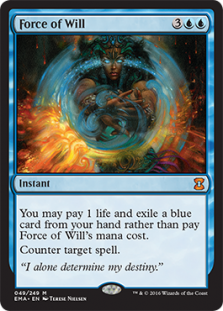
While it is important to remember that Modern is not Legacy, we can at least use Counterspell's place in that format to make educated guesses about Modern. And the news is not good. Counterspell is a one- or two-of in Legacy decks. This has been true since at least the Miracles era. While having an unequivocal answer to anything is potent, it really isn't necessary in Legacy control decks. Part of this is that Force of Will is essential in Legacy and takes up the space for pure counterspells. There's not much space left over for all the cantrips, removal spells, and win conditions particularly since Force of Negation became a maindeck card. The other problem is that Counterspell costs UU all the time. Legacy runs so lean that two mana is a huge investment. Relying on Counterspell risks losing a counter war on efficiency.
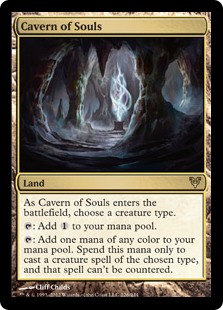
Modern's mana is not as constrained as Legacy's, but the point is still relevant. UU may not be a dealbreaker cost- or even color-wise, but playing Counterspell does mean forgoing other options. No control deck can just pack all of the counterspells and plan to completely control the game. Or ever beat Cavern of Souls, for that matter. Given how Modern's hard control decks are built, I can't imagine that it will ever be less than a three-of in Modern because there's already typically a slot for four two-mana counters. They're just split between multiple counters. It's outside of Esper and UW Control that I'm skeptical. Do tempo decks or aggro-control want to hold up double blue? Plus, even in the control decks, there are the utility spells to consider, and a lot of them overlap with Counterspell.
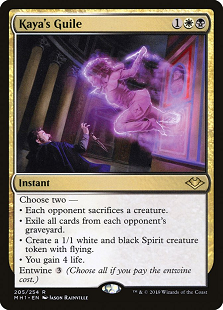
This strongly suggests that Counterspell is not going to be a four-of once initial excitement dies down. It's powerful and cheap relative to other counters, but it still doesn't answer on-board threats or do anything else when you don't need a counter.   Modern doesn't have Force of Will, after all. However, it's important to remember that Counterspell is only a tool, and over-reliance on one tool is not a recipe for success.

My Prediction

First things first: the addition of Counterspell does not uniquely make control viable. It already is, as constantly evidenced by the metagame data. The problem, especially over the past year, is MTGO. I've won matches against control thanks to them timing out more times than I can count. I had lost the game, unequivocally, but my opponent couldn't present an actual win condition quickly enough to beat the client's clock as well as their opponent. If you can't win in 25 minutes, I feel no sympathy despite knowing that I would have lost the match if it was paper Magic. Consequently, control doesn't hit its "true" metagame numbers thanks to time-out match losses. Thus I don't think there will be any change to control's metagame potential, even if it definitely will see more play.
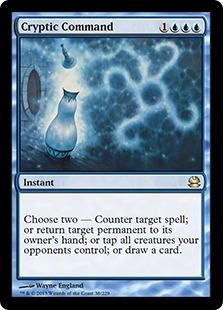
As for Counterspell itself, I expect it to replace Mana Leak. There is no reason that a deck that could cast a 1U counterspell can't make a UU spell on turn two; just look at the Bring to Light decks. Counterspell will not completely replace the other counters, however. The more expensive ones (Cryptic Command and Archmage's Charm) have too much flexibility to drop. Force of Negation is free, and that will keep it in rotation. Remand will also stay, as it's too potent a tempo tool and doesn't see play in hard control much anyway.
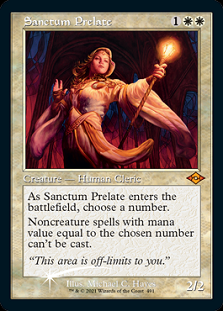
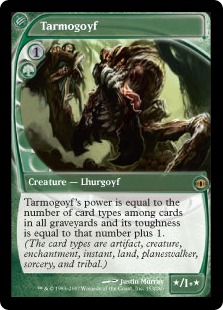
The other niche counters will drop off, but probably won't disappear. Deprive still has value for landfall triggers, especially if something similar to Mystic Sanctuary comes along. Logic Knot loses its place as the best two-mana counter, but it won't disappear entirely. It's still the best two-mana counter that isn't Counterspell, and it has additional value. Delve means that Knot lets control sculpt its graveyard, such as proactively for Inverter of Truth or defensively against Tarmogoyf and Drown in the Loch. I also expect Spell Snare to resurface as an answer to Counterspell, but Veil of Summer is probably just better in that role.

The Prowess Killer?

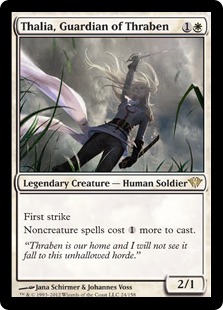
Next is a card that is very near and dear to my Legacy deck, Sanctum Prelate. This is a card that players have speculated about ever since Containment Priest was reprinted in Core 2021. If one Death and Taxes creature from a Commander set was fine in Modern, why not two? Especially one with symmetrical disruption abilities rather than an annoying card advantage mechanic (*cough* Palace Jailer). In fact, I thought that Prelate was such an eventual shoe-in for Modern, I didn't even really consider it when I was speculating on MH2 back in December. It just makes sense as a disruptive white creature against noncreature spells that isn't just another taxing effect would eventually make its way to Modern. Especially in light of Elite Spellbinder.
Expectations

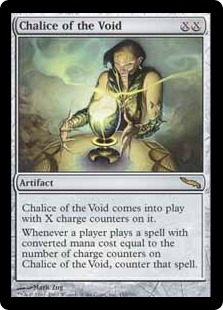
The title of this section really gives it away, doesn't it? Yes, the conversations about Prelate's arrival in Modern are primarily focused on its use against Prowess. And it makes perfect sense. The vast majority of Prowess' spells, particularly Boros but Izzet too, cost one mana. Mono-Red is less affected and could more easily escape Prelate lock thanks to Bonecrusher Giant. Given that Prowess variants are the most popular decks in Modern and Chalice of the Void isn't exactly keeping them down, more help is welcome. And Prelate has the big advantage of preventing Prowess from throwing spells away just to get prowess triggers. A very solid addition to Modern.
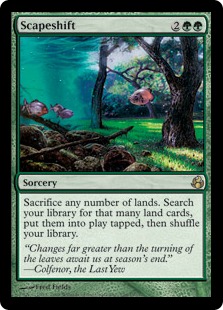
Of course, that's not the only application. Shutting off critical mana costs against control and combo (sweeper and engine cards respectively) also sounds good. Naming four against control decks and two against Storm will be Very Big Game, as well as four against Scapeshift decks. One deck I've heard discussed as targeted is Tron, but I expect that will just lead to grief. There was a time when naming seven would have been lights out for Tron, but that was five years ago. These days Tron has too many haymakers at different costs, and too many of them are creatures for that to be effective.
However, it is also worth remembering that Prelate can be used in a defensive way rather than the mentioned proactive manner. Should Prelate make its way into Heliod Company (a big ask, given how full the three-drop slot already is), it would use Prelate on one to protect against removal, allowing Heliod to combo off unmolested. I can't imagine this working out for any other deck, but it's important to remember the utility exists.

Legacy Says?

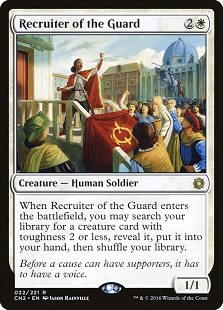
All that being said and from personal experience, the only way that Sanctum Prelate sees play in Legacy is a maindeck one-of as part of Recruiter of the Guard packages. Death and Taxes is most common, but Humans and Esper Vial also run that package. Depending on the metagame and other sideboard pressures, there will be another Prelate in the sideboard. Back in the Miracles era, it was usually correct to maindeck both Prelates, but that hasn't been necessary since that time. Two Prelates were essential in the grindfest which was Death and Taxes vs Miracles because you wanted the first set to one against Swords to Plowshares and the second on six against Terminus. Since then, the only real usage has been naming one against Delver or two against Lands.
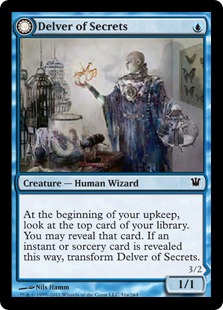
The issue with Prelate in Legacy is that it costs three. That is far too much against most combo decks. Most Storm variants aim for a turn 2-3 combo and are capable of turn 1 kills, while Reanimator usually goes for it turn 1-2. That means that Prelate just closes the door on an already locked out opponent. I usually name four with Prelate against combo as a result. Against Delver, shutting off the cantrips and removal at any time is good, but after that Prelate is just a 2/2. That's very bad if you're already behind on board because now Swords is dead too.
Modern doesn't have anything like Recruiter, so Prelate will have to stand on its own. Fortunately, Modern combo is not fast enough to outpace Prelate, so it remains a viable anti-combo card. The small body is still a problem, but Humans has repeatedly proven that it can be overcome.

My Prediction

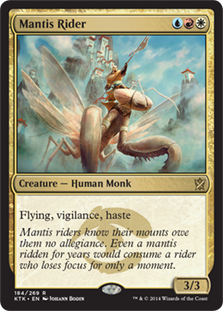
Prelate will definitely see at least some sideboard play. The effect is too strong against certain types of decks. However, I'm very skeptical of Prelate making any maindecks without a major and likely unhealthy metagame shift. Three mana is a lot, and more importantly, that is a very crowded mana cost in white creature decks. I don't think Prelate is sufficiently better than the existing options against sufficiently many decks for it to beat Mantis Rider, Archon of Emeria, or Spike Feeder any time soon. However, as a two-of in the sideboard for combo and control matchups, I think Prelate will be an excellent addition to Modern.


As for its impact, the overall impact will be muted. That's just how it goes with a sideboard card. However, the fear of getting Prelate locked, especially for Prowess, may drive them to diversify their spells. Bonecrusher is likely to get a lot more time in Modern, and I imagine sideboard answers will diversify as well just to keep from being beaten by a single card. However, Prowess may also just go more in on Kozilek's Return rather than worry about Prelate. Chatter indicates the former is likely, but I suspect the latter is more efficient.

Modern's Changing, Again

After a few calm sets, Modern is about to get shaken up again. Everything is now crossed for nothing even remotely Hogaak-esque. I'm just about to get paper back, and I want to be able to enjoy it.

A Dichotomy in Old Card Prices

Are you a Quiet Speculation member?

If not, now is a perfect time to join up! Our powerful tools, breaking-news analysis, and exclusive Discord channel will make sure you stay up to date and ahead of the curve.

“It was the best of times, it was the worst of times.”  - Charles Dickens

After months of aggressive buying and supply shortage, some cards have finally settled into their “new price points”—not quite as high as their peak, but also off their lows. Some cards have retraced harder than others, as expected. What wasn’t expected, however, is how robustly some cards are continuing to trade. In fact, a couple cards are at or near their all-time highs on Card Kingdom’s buylist.

This dichotomy reminded me of the famous opening to Charles Dickens’ A Tale of Two Cities. For some cards, we’re still in the best of times. For others…well it’s hardly the “worst of times” but it’s certainly not as good. This week I’ll share updates on what cards remain hot and which ones have not.

Still Flying High

As I browse Card Kingdom’s hotlist, I see right off the bat some of the hottest cards on the market. Many are Reserved List cards, and while they may not be an “all-time high” buy price, I’ve noticed these buy prices have been on the climb rather than a decline.

For example, Mox Diamond shows up on the hotlist. The Stronghold printing has a buy price of $450—that’s not the peak, but it’s a good bit higher than the $400 offer Card Kingdom had posted just a week ago. They pay even more aggressively on the From the Vaults version, $650.

There was an error retrieving a chart for Mox Diamond

Gaea's Cradle tops the hotlist with a buy price of $720, which has got to be near its high. Then we have the Dual Lands, which rallied to highs before pulling back significantly. Well, that pullback may be temporarily suspended because Card Kingdom is paying quite well on Revised duals once again:

Underground Sea: $660
Volcanic Island: $540
Tropical Island: $480
Bayou: $360
Badlands: $230
Taiga: $270
Scrubland: $260
Plateau: $250

Again, these prices aren’t their highest, but they are significantly off the lows they saw last month. Plateau’s number seems particularly strong—they were paying as low as $200 just over a week ago. The only two Revised Dual Lands not on their hotlist are Tundra and Savannah.

There was an error retrieving a chart for Plateau

Other cards with still-high buy list prices include Island of Wak-Wak (jumped from mid-$200’s to $325 before dropping back to $300), Old Man of the Sea, Mana Crypt, Moat, Rasputin Dreamweaver, and Guardian Beast. Each of these are probably off all-time high buy prices, but not by as much as you’d think.

Lastly, I’d be remiss if I didn’t mention Unlimited Power, which remains at their highs. Card Kingdom has been able to restock a smattering of copies, and when they do they drop their buy price significantly. But the reality is, they often sell out of the copies they receive and when they do, they jack up their buy price all over again. Black Lotus currently sports a Card Kingdom high of $19,800. Their buy price on Timetwister is also very strong, $6,600. Compare this to Ancestral Recall, where they’re “only” offering $4,000 because they have two near mint copies in stock currently.

Cooling Off

Not every Reserved List card has faired so robustly. It’s obvious if a card that sees minimal play cools off, but some of these pullbacks aren’t on less desirable cards, so I can’t quite pinpoint why they’re not selling as well for Card Kingdom. Perhaps Card Kingdom simply overshot on their pricing to the upside, and now have to reduce inventory of these cards.

For example, currently Card Kingdom doesn’t have Eureka on their buylist at all. They simply aren’t buying the card. When I visit their site, I see that they have 21 copies currently listed, across all conditions, ranging from $1149.99 for Near Mint down to $804.99 for Good copies. These prices are about 10-15% above TCGplayer, which isn’t completely unreasonable for a retailer that offers trade credit bonuses. Something just must have cooled off on this card.

There was an error retrieving a chart for Eureka

What perplexes me more is that Card Kingdom has plenty of Moats and The Tabernacle at Pendrell Vales in stock, 15 and 12 respectively, yet they keep these two cards posted on their buylist with very attractive buy prices. I guess there’s a threshold between 15 copies and 21 copies where Card Kingdom’s algorithm puts a halt on things.

Speaking of halting buying, Card Kingdom took down their buy prices on a bunch of Unlimited Dual Lands. While Revised copies are returning to Card Kingdom’s hotlist, they have cooled off significantly on Unlimited copies. They currently don’t buy Unlimited Underground Sea, Volcanic Island, Tropical Island, Scrubland, Badlands, Taiga, and Plateau! When you view their stock of these cards, it’s no surprise. They have plenty of copies of Unlimited Dual Lands in stock now, and their prices aren’t exactly tempting. Something tells me these cards, along with some other Unlimited cards, are still cooling off pretty aggressively and have a ways to drop.

There was an error retrieving a chart for Volcanic Island

Lastly, I want to touch on The Dark, which has its fair share of cards that have cooled off significantly. At one point, Card Kingdom was paying $100 on Goblin Wizard—now they don’t buy the card at all. They have 14 copies in stock, which isn’t as high as some others, so I’m not sure why the algorithm pulled this one off their list. In any event, the card’s TCGplayer market price went from $18 to $130—a 622% increase—in less than two years. So a cooldown is long overdue.

From The Dark, Mana Vortex is another one that’s off Card Kingdom’s buylist altogether for the time being, even though their inventory is only 11 copies. Other less-than-playable The Dark cards are also not on Card Kingdom’s buylist currently, including Cleansing and Grave Robbers. Even in cases where Card Kingdom doesn’t have dozens of copies in stock, I suspect their selling velocity on these cards is probably lower.

Interestingly, you can’t find a similar story with Antiquities, which also contains a bunch of little-played Reserved List cards with suddenly higher price tags. It seems Card Kingdom hasn’t been satisfied with their inventory on this set, as they still offer most noteworthy cards on their buylist.

There was an error retrieving a chart for Tetravus

Wrapping It Up

In the early stages of the recent round of Reserved List buyouts, anything old seemed to be worth buying. The rising tide lifted all ships and lifted them all drastically. Now that the bull market is much more mature, not everything is still experiencing growth—many cards are retracing, as expected.

But what I didn’t expect was the split between the haves and have-nots. Some cards are still selling robustly even at new highs, while others have already seen their prices slashed in recent weeks.

For example, Unlimited cards are definitely cooling off whereas Antiquities cards apparently remain pretty strong. Revised Dual Lands had cooled off, but are now making a modest rebound whereas Unlimited Dual Lands remain soft. And within Legends and Arabian Nights, some cards are trading near highs whereas others are cooling off as Card Kingdom becomes satisfied with their inventory.

I can’t quite pinpoint any rhyme or reason for the dichotomy. It is probably a combination of a couple factors specific to Card Kingdom’s pricing practices. If Card Kingdom overshot on a price increase, they probably overstocked the card and now have to bleed out inventory before they’re willing to re-buy. On the other hand, if they upped their buy price too modestly, it would mean they still haven’t been able to restock sufficiently, so their buy price remains near highs.

At the end of the day, this probably is a local phenomenon…for the most part. But I always view Card Kingdom as at the forefront of pricing trends because of how dynamic their prices are. They aren’t always leaders, but they do react to trends with enough agility that I trust the fluctuations I see on their site. To that end, I’m going to be keeping an eye on the cards that are still climbing because there may still be a chance to pick up a few key cards before they reach their peak. Meanwhile, if you’re looking to trim, you could do worse than selling some of the cards that have cooled off most on Card Kingdom’s site as these likely overshot the most.

As we approach the re-opening of Magic events, it’ll be very interesting to see where prices go from here. One thing is for certain: I’ll be watching prices on these older cards very closely as trends unfold!

These Don’t Look Like Magic Cards: The Value of Funk

Are you a Quiet Speculation member?

If not, now is a perfect time to join up! Our powerful tools, breaking-news analysis, and exclusive Discord channel will make sure you stay up to date and ahead of the curve.

I've been hearing some variation of the phrase, "well these new cards don't really look anything like real Magic cards" almost since I started playing the game. Whether it was a change to how the frame looked, a full art promotional card, or something more extreme like the much likened to Yugioh (Amonket Expeditions), it seems players couldn't help but make the comparison to the default standard they had been raised on. In my experience, the player base I interacted with seemed to be torn: they either welcomed changes with open arms or they despised anything outside the norm.

More recently, Wizards has found the opportunity through Secret Lairs to really have fun with card design, pushing the limits of what people considered to be "Magic Cards" and developing some rather interesting pieces of art. When Kaldheim debuted, the Party Hard, Shred Harder Secret Lair announcement dropped jaws all over the Twittersphere with their metal imagery and lack of traditional well... anything really.

With the most recent Secret Lair drop, the Dr. Lair's Secretorium Superdrop, Wizards is continuing their experimentation with card form in several bundles from the drop with a play on full art lands that is just full text and a drop called Our Show Is On Friday, Can You Make It? in the same vein as the Party Hard drop that contains a handful of cards in bright, band poster-esque treatments that had some people on Twitter wondering who the audience for cards like that really was.

It's me. I'm the audience. That Preordain makes me salivate.

I've always been a huge fan of experimentation with Magic Art, and drops like this really push all my buttons. They're fun, funky, and scratch that "collector" itch something fierce. But, as a MTG Finance-minded person, I have to stop and wonder - is there any value to cards like these? How popular will they be? Is opening up my poor, poor wallet for yet another Secret Lair going to pay off down the line?

Well, you can never know for sure, but today we're going to look at the Party Hard, Shred Harder Secret Lair drop and see where the value of the singles is lying, how they compare to their original printings, and whether we think the Our Show Is On Friday, Can You Make It? drop will follow a similar pattern.

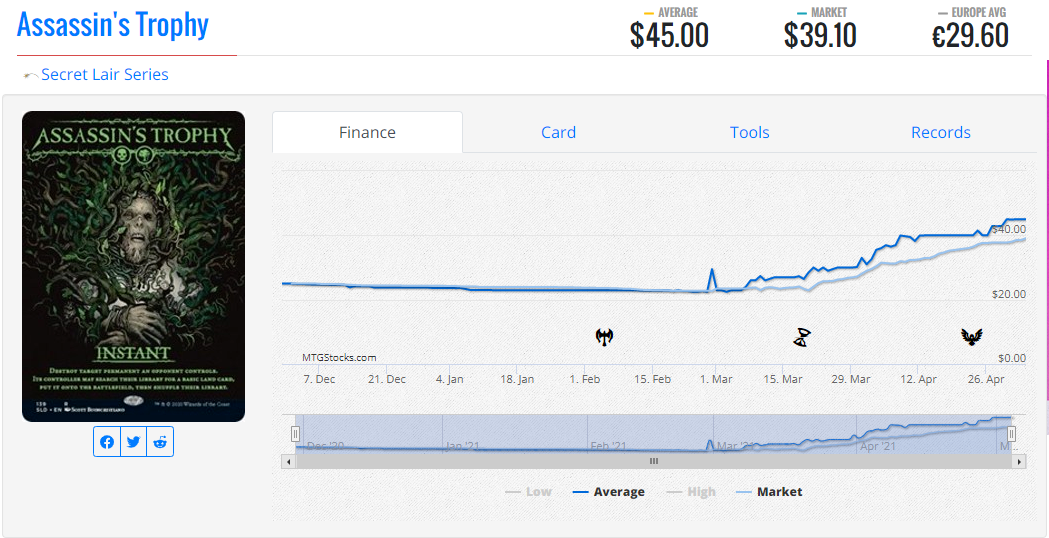
1. Assassin's Trophy

We're starting with the breakout card of the drop, Assassin's Trophy. A popular removal spell from Guilds of Ravnica, this particular Secret Lair printing is so popular that this alone pays for the whole drop, which originally retailed for $29.99.

There was an error retrieving a chart for Assassin's Trophy

The original printing is also managing to hold onto a fairly decent price, with non-foil set printings fetching around $16 in most places. This is a great removal spell in several formats, and the morbid art of the Secret Lair version is proving to be pretty popular with the Golgari players out there. Not every Secret Lair is going to have a banger like this inside, but I'm feeling pretty good about the copies I ordered from that particular batch.

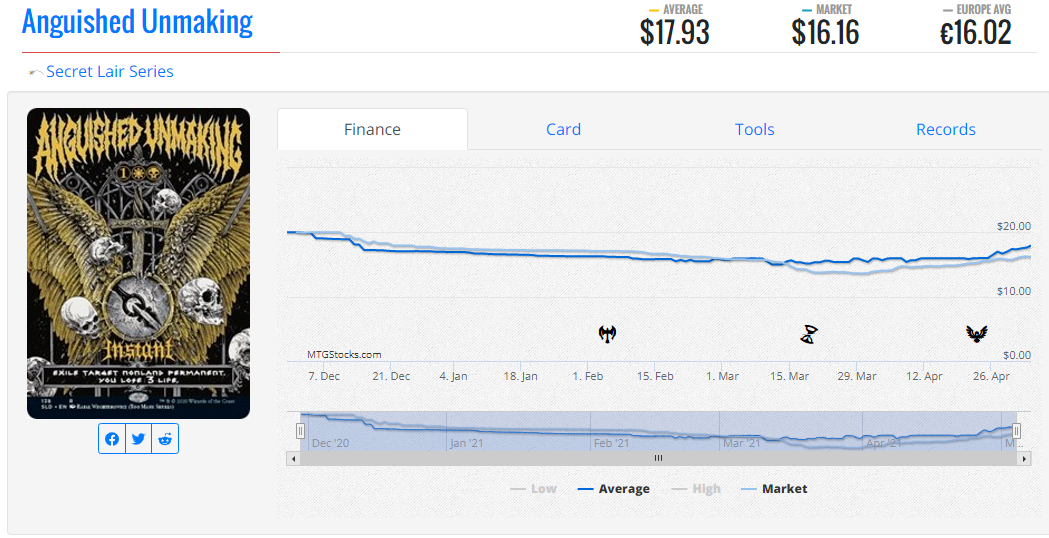
2. Anguished Unmaking

Somehow I had missed how popular of a removal spell Anguished Unmaking had become, and was glad to find I'd kept my copies from that particular Standard season!

There was an error retrieving a chart for Anguished Unmaking

There have been several "special" printings of the card, but the non-foil set printing is still fetching around $10 which is pretty decent for a card from that block, especially considering paper Magic is still forbidden in many places due to the Pandemic. The Secret Lair version fetches a premium though, hovering around the $17 dollar mark. I absolutely love the art on this one and can see why people would want it!

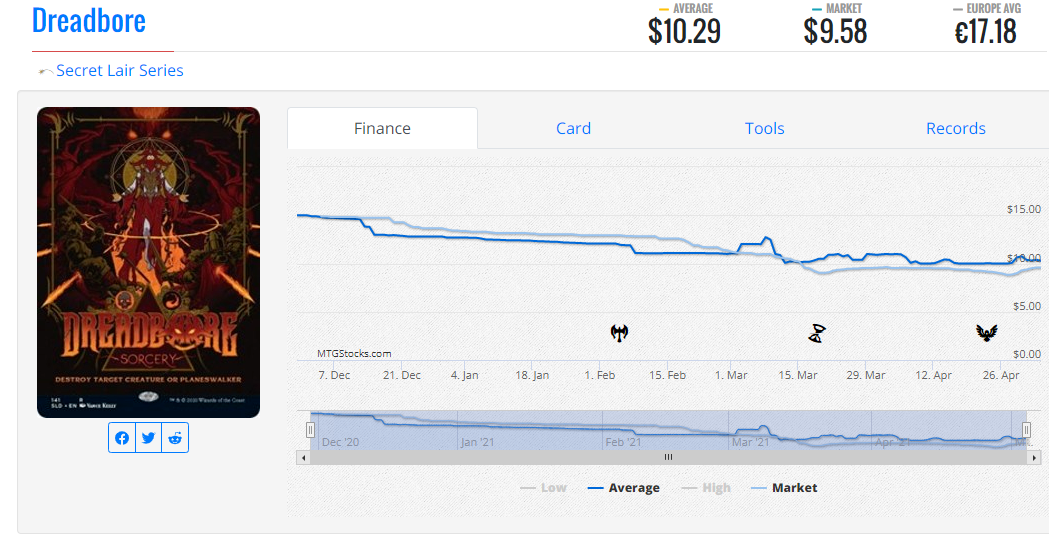
3. Dreadbore

We start to see much lower prices when we get to the rest of the cards from the drop, but they're still nothing to scoff at! The Secret Lair Dreadbore for instance, fetches a much higher price than any of its other printings!

There was an error retrieving a chart for Dreadbore

Dreadbore was one of my favorite removal spells back in Return to Ravnica days, and its usefulness in Commander still has its original printing fetching around $3. However, I'm swapping out my original copies in my Commander decks for the Secret Lair one because WOW LOOK AT IT. There's a reason the fancy version is around $7 more expensive!

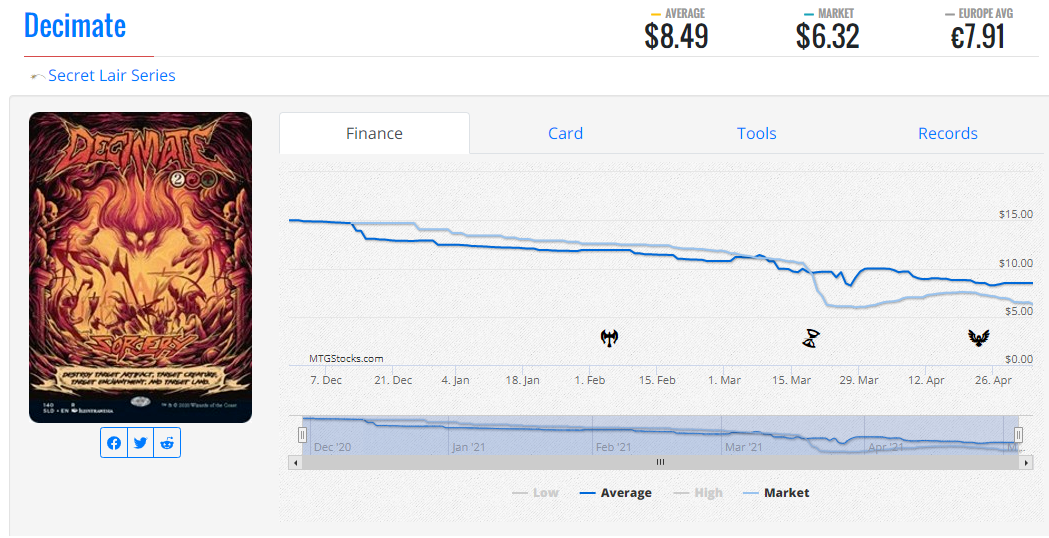
4. Decimate

Decimate was definitely the art from this Secret Lair that I desperately wanted on a t-shirt (it's not too late to give any of these a decent shirt printing Wizards! Please!) but also one of the ones I've played the least copies of its older printings.

There was an error retrieving a chart for Decimate

No earlier version of this card averages over $4 on TCGplayer, but plenty of Gruul Commander players find it to be a useful tool and the Secret Lair printing still commands almost double the price of its original printing!

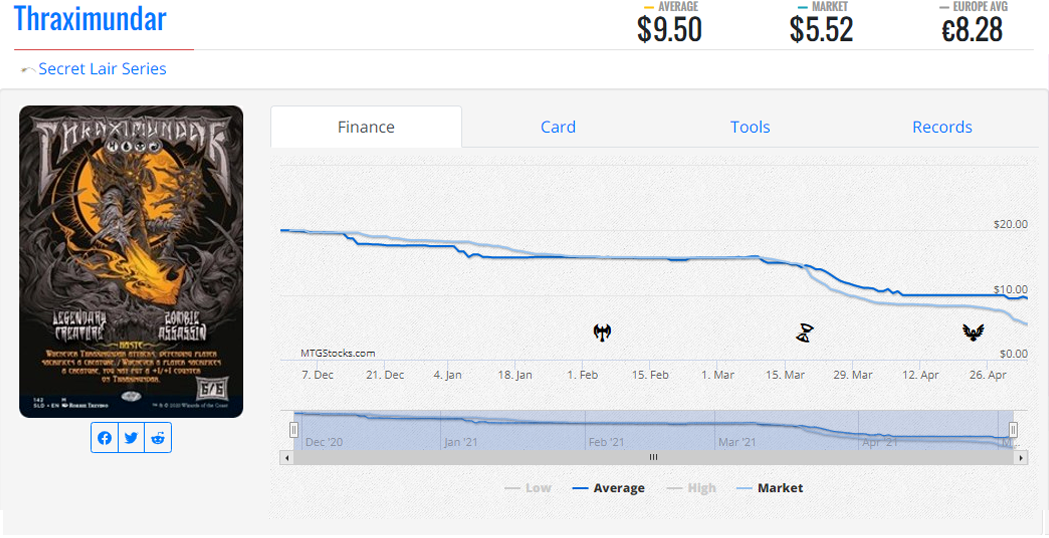
5. Thraximundar

Thraximundar, a classic commander near and dear to many players' hearts (and the only one to get even a lame t-shirt printing) carries the lowest market price of the bunch.

There was an error retrieving a chart for Thraximundar

Even though Thraximundar is a fun commander, none of its older printings fetch much more than a dollar - if that. Which, in context, makes the value of the Secret Lair printing fairly impressive I guess? The art is fantastic, and if I ever put together Thraximundar again I'm definitely going to be reaching for my copy from the Secret Lair I decided to let myself open. (I have to say, the quality of these was super impressive, by the way.)

So, Our Show Is On Friday, Can You Make It?

So, will the dramatic increase in singles value over original printings continue with the latest wild Secret Lair? Well, even though Party Hard ended up being pretty bonkers value, I'm not so sure. I don't think Decree of Pain, Gamble, Nature's Lore, Preordain, or Wrath of God have quite the following that all of the metal removal spells did, but I'd say it's close enough for me to think pretty seriously about picking more than one copy of the Lair up (and I guarantee I'll be trying to assemble at least one playset of the Preordains for my personal collection.) I'd say this is a pretty decent buy (so are the shock lands, but for different reasons) and would be worth taking a look at adding to your Secret Lair stash!

Also, I know I'm ignoring the full-text lands. I just... have no idea how to feel about them and whether or not the ridiculous novelty will attract any value.

Take care out there friends, I’ll catch you next week! Feel free to hit me up on Twitter, Twitch, YouTube, or in the QS Discord if you’d like to chat Magic!

A Building Wildfire: April ’21 Metagame Update

Are you a Quiet Speculation member?

If not, now is a perfect time to join up! Our powerful tools, breaking-news analysis, and exclusive Discord channel will make sure you stay up to date and ahead of the curve.

The new month brings a new metagame update. And this time, there's nothing disruptive to report. No bannings, no weird and still-unexplained data gaps; just a perfectly normal bit of data gathering. Which means that I'll be delivering a straightforward metagame update. Which will be nice, since there's another Modern Horizons coming, and that might throw everything into chaos. It also may not, but doomsaying gets more hits than caution.

The data’s down from January, but significantly up from March. There were 515 decks in April, almost 100 more than March's 420 but down from January's 552. Which is still a respectable size, but nothing spectacular. However, it feels very odd, as this was the first month since December to feature a Preliminary with 5 rounds. I believe that the Showcase Challenge pushed out at least one normal Challenge, leading to the lower total, but I can't prove this. It's the only thing I've got since April was another All-Access month, which should have increased MTGO play. On the other hand, there may be nothing wrong and MTGO play is simply down, either due to fatigue or something happening on Arena.

I'll also note that I didn't include any non-Wizards events this month. I didn't need them, unlike in March, and I also didn't see any that appeared to be equivalent to a Challenge or even a Preliminary. If I missed something, do let me know. I don't know what I don't know, after all.

April Metagame

To make the tier list, a given deck has to beat the overall average population for the month. The average is my estimate for how many results a given deck “should” produce on MTGO. Being a tiered deck requires being better than “good enough;” in April the average population was 7.92, meaning a deck needed 8 results to beat the average and make Tier 3. This is a pretty standard average as these go. Then we go one standard deviation above average to set the limit of Tier 3 and cutoff for Tier 2. The STdev was 10.85, so that means Tier 3 runs to 19, and Tier 2 starts with 20 results and runs to 31. Subsequently, to make Tier 1, 32 decks are required.

I've been approached a few times about using a confidence interval instead. That's what the old system used, and it is somewhat more statistical. I'm not opposed in theory, and will probably have to use the confidence interval once paper events come back. For now though, it's a bit more work for no real gain. A couple extra decks may sneak into Tier 3 depending on the data, and the exact tier composition will likely change, but the order of the decks will not, and that's more important.

The Tier Data

April's data being more complete than March's means that the individual decks were up from 61 to 65. Not a large increase, but the data isn't back to January's level, much less earlier months. Along with the total archetypes increasing, the tiered decks are up from 17 to 20, again just shy of January's mark. I'm constantly wondering if the wild swings in the number of archetypes are indicative of actual metagame shifts or player bias. I'm hoping it's the former because that's the whole point of this exercise. However, I can't discount players simply preferring certain decks regardless of the metagame nor that they're recursively metagaming. MTGO's competitive players are a pretty small and self-selecting group, after all. Not at all impossible that this is just measuring the biases of a small population. But there's nothing better at the moment. Hopefully that will change soon.

Deck NameTotal #Total %
Tier 1
Heliod Company5911.46
Izzet Prowess377.18
Jund Death Shadow346.60
Eldrazi Tron326.21
Tier 2
Mono-Green Tron295.63
Burn254.85
UW Control203.88
Tier 3
Mono-Red Prowess173.30
Amulet Titan173.30
Niv 2 Light163.11
Boros Prowess152.91
5-Color Scapeshift152.91
Dredge142.72
Esper Control132.52
Ponza122.33
Hammer Time122.33
Yawgmoth122.33
4-Color Omnath91.74
Jund91.74
Jeskai Breach81.55

So, yeah, Heliod Company was on top. By a lot. Enough to be statistically and convincingly Tier 0. I actually checked to see if it qualified as an outlier, and the results were inconclusive. The typical mathematical measurements put all of Tier 1 into outlier territory, the more narrow ones put Heliod right on the edge, and the regressions said yes or no depending on how I entered the data. The best-fit lines had Heliod pegged as a clear outlier, but on a hunch I checked, and it was right on the exponential decay line. When I removed Heliod Company from the data, the average and STDev didn't change enough to make a difference. I want to say that yes, Heliod Company is an outlier in April based on intuition more than anything else. But that doesn't mean anything. However, I also have evidence of something odd about Heliod from the other metagame measurements.

Elsewhere in Modern

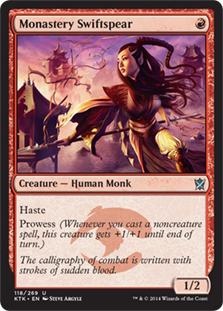
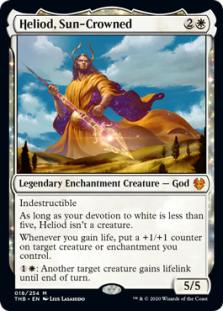
So, what's happening with the decks that aren't Heliod Company? Prowess, primarily. Izzet Prowess was the second best deck, followed closely by Jund Shadow, a deck with many Prowess elements. In Tier 3 there's Mono-Red Prowess and the newly minted Boros Prowess. There were also a few Rakdos and Grixis versions that didn't make the list. Put all the Prowess together and they'd exceed even Heliod Company by quite a bit. I'm inclined to think that the real power in the metagame is Monastery Swiftspear, not Heliod, Sun Crowned. Prowess being so popular means that Eldrazi Tron is back in a big way. The central deck strategy isn't particularly good against Prowess, but E-Tron is the only deck maindecking Chalice of the Void, which is very good against Prowess. This is a typical fluctuation; E-Tron always does well when Prowess is up and falls as soon as Chalice stops being good.
Speaking of aggregating decks, if I put the 5-Color decks together they would have just missed Tier 1 with 31 results. This is not an entirely ridiculous thing to do as 5-Color Scapeshift is Niv 2 Light, but without Niv-Mizzet Reborn, 80 cards, and Yorion, the Sky Nomad. And there was a very sudden switch between the decks. Up until the 16th, Niv was on track for Tier 1 placement. Then it seems players just got tired of playing 80 cards and dropped down to a more streamlined Bring to Light package serving Scapeshift. By the 22nd, Niv stopped appearing at all, and only Scapeshift remained. Had Niv remained the 5-Color deck or the diet begun earlier, then one of the decks would have been more than mid-Tier 3. Something to watch.

Power Rankings

Tracking the metagame in terms of population is standard practice. However, how do results actually factor in? Better decks should also have better results. In an effort to measure this, I use a power ranking system in addition to the prevalence list. By doing so I measure the relative strengths of each deck within the metagame. The population method gives a decks that consistently just squeaks into Top 32 the same weight as one that Top 8’s. Using a power ranking rewards good results and moves the winningest decks to the top of the pile and better reflects its metagame potential. Of course, the more popular decks will necessarily earn more points, but the difference in scale between the
Points are awarded based on the population of the event. Preliminaries award points for record (1 for 3 wins, 2 for 4 wins) and Challenges are scored 3 points for Top 8, 2 for Top 16, 1 for Top 32. If I can find them, non-Wizards events will be awarded points according to how similar they are to Challenges or Preliminaries. Super Qualifiers and similar level events get an extra point if they’re over 200 players, and a fifth for over 400 players. There were 2 events that awarded 4 points in April and one which awarded 5 points. And that Super Qualifier had an outsized impact on the data.

The Power Tiers

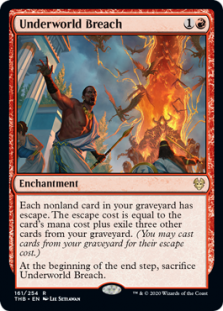
The total points in April were up from March as I'd expect, from 760 to 928. Just like the population data, that's pretty average. The average points were 14.28, so 15 makes Tier 3. The STDev was 20.29, up noticeably from March, so Tier 3 runs to 36 points. Tier 2 starts with 37 points and runs to 58. Tier 1 requires at least 59 points. The new Jeskai Underworld Breach deck, Mentor Breach, which snuck onto the population tier was mainly a 3-1 Preliminary deck and so didn't get the points necessary to make the power tier. There was nothing to replace it, so this tier list is smaller.

Deck NameTotal PointsTotal %
Tier 1
Heliod Company10711.53
Izzet Prowess707.54
Jund Death Shadow667.11
Tier 2
Eldrazi Tron555.93
Mono-Green Tron535.71
Burn535.71
Tier 3
UW Control363.88
Niv 2 Light343.66
Amulet Titan333.55
Mono-Red Prowess313.34
5-Color Scapeshift272.91
Dredge262.80
Esper Control262.80
Yawgmoth232.48
Boros Prowess212.26
Ponza202.16
Hammer Time192.05
Jund192.05
4-Color Omnath171.83

I'm tempted to copy-paste everything I said about Heliod's absurd lead from the population section. It's to be expected that the most popular deck by a lot would also win the most points by a lot.

What's more interesting is how the rest of the list has changed. E-Tron was kicked out of Tier 1 and UW fell into Tier 3, indicating decks that are popular but not especially successful. UW is just under the cut to Tier 2, but considering that it was just over the line for Tier 2 in population I think the point stands. These are predatory decks and when their prey is sparse, they don't do well.

There was so much turmoil in Tier 3 that I can't really track it all. However, I find it interesting that Niv 2 Light has substantially more points than 5-Color Scapeshift considering that Niv only had one more deck place in April. This suggests that it was the more powerful deck or at least the deck that more rewarded gifted or dedicated pilots, which does muddy the waters for me about it being replaced. I will note that Niv is much harder to pilot than the newer version.

Average Power Rankings

Finally, we come to the average power rankings. These are found by taking total points earned and dividing it by total decks, which measures points per deck. I use this to measure strength vs. popularity. Measuring deck strength is hard. Using the power rankings certainly helps, and serves to show how justified a deck’s popularity is.

However, more popular decks will still necessarily earn a lot of points. This is where the averaging comes in. Decks that earn a lot of points because they get a lot of results will do worse than decks that win more events, indicating which deck actually performs better. A higher average indicates lots of high finishes, where low averages result from mediocre performances and high population. Lower-tier decks typically do very well here, likely due to their pilots being enthusiasts. So be careful about reading too much into the results.

The Real Story

When considering the average points, the key is to look at how far-off a deck is from the baseline stat (the overall average of points/population). The closer a deck’s performance to the baseline, the more likely it is to be performing close to its “true” potential. A deck that is exactly average would therefore perform exactly as well as expected. The further away the greater the deviation from average, the more a deck under- or over-performs. On the low end, the deck’s placing was mainly due to population rather than power, which suggests it’s overrated. A high-scoring deck is the opposite.

Deck NameAverage PointsTier
Niv 2 Light2.133
Burn2.122
Jund2.113
Esper Control2.003
Jund Death Shadow1.941
Amulet Titan1.943
Yawgmoth1.923
Izzet Prowess1.891
4-Color Omnath1.893
Dredge1.863
Mono-Green Tron1.832
Mono-Red Prowess1.823
Heliod Company1.811
UW Control1.803
5-Color Scapeshift1.803
Baseline1.74
Eldrazi Tron1.722
Ponza1.673
Hammer Time1.583
Boros Prowess1.43

The baseline is up from March, which is consistent with the higher population and point totals. As usual, the top slots are occupied mainly by Tier 3 decks. However, Niv 2 Light was very close to Tier 2, which further muddies the waters of it apparently being replaced, especially when 5-Color Scapeshift is just above baseline. Burn being the second-best deck was also surprising, but makes sense in retrospect since Eidolon of the Great Revel is quite strong against Prowess. I'd also like to call attention to Boros Prowess's utterly abysmal showing. The deck is not living up to its hype.
The Truth about Heliod

However, the big story is the one I've been building up to this entire article. Heliod Company, the deck that I suspected to be an outlier from the population and power rankings, didn't make the first page of the average power chart. It's a thoroughly medium performance, and it slotted in just above the baseline. By itself, this would indicate that Heliod was only on top due to insane popularity. However, I had a hunch to investigate, and it proved correct: the April 5 Super Qualifier had an outsized influence on Heliod Company's performance.

Heliod Company put three pilots into the Top 8 of that tournament, one more into Top 16, and two in Top 32. That's 25 points from one event, and is by far the best single day performance for a deck since I started this new system. And it was also the absolute high point of the month for Heliod Company. After that it lost a lot of steam and average points began falling. Rather than lots of 3-point performances, it was gathering single points. I don't know why that happened, but it absolutely happened. This made me suspect that Heliod isn't really an outlier so much as that event was.

So I tested my theory by making a copy of the overall data but removing every result from the April 5 Super Qualifier. And my suspicions were confirmed. All the top decks are impacted by the fall, but at 82 points, Company's points stop being a potential outlier. Izzet Prowess is still number 2 with 65 points, which remains a big gap, though not necessarily an atypical one. The more significant finding was that average power. Every deck lost a few points and the baseline fell to 1.71, but Heliod's average power fell to 1.54, the second worst result in the data. It's clear that Heliod is a winners' deck and that a lot of its success comes down not to the deck, but to who's been playing it. As such, I'd worry more about the high performances of Jund Shadow or Izzet Prowess.

A Snapshot in Time

That's it for April's update. MTGO's metagame continues to churn, but I'm starting to tease out the evidence that it isn't actually representative. Hopefully, the pandemic will be sufficiently under control that paper Magic can start to return in May, just in time for Modern Horizons 2. And then we get to see how different the metagame truly is.

April ’21 Brew Report: Little Guys Rule

Are you a Quiet Speculation member?

If not, now is a perfect time to join up! Our powerful tools, breaking-news analysis, and exclusive Discord channel will make sure you stay up to date and ahead of the curve.

The month after a new set release is always an exciting time in the 5-0 dumps: full of churn, upheaval, and of course, ideas! In these periods, players are far less concerned with identifying metagame direction and innovating solutions to emerging trends; indeed, attempting to do so this early might prove a fool's errand anyway. Instead, their focus becomes consumed by the allure of the new, spurring them to test out any and every crazy idea they had during spoiler season against established Modern stalwarts and, most exciting of all, other players following their own crazy intuition.

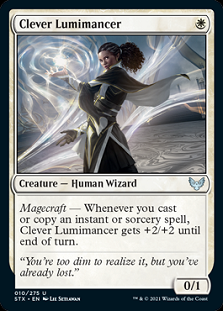
By now, the dust around Strixhaven has begun to settle, with hyped uncommon Clever Lumimancer ending up falling short of initial expectations. So the piles April successful enough to earn publication on Wizards's site all merit at least a closer look.

Token Trouble

First on our agenda are the myriad strategies wielding the littlest guys (tokens) in novel or unpredictable ways.

Time Warp Polymorph, FJ_RODMAN (5-0)

Creatures

2 Velomachus Lorehold

Planeswalkers

2 Jace, the Mind Sculptor
4 Tamiyo, Collector of Tales
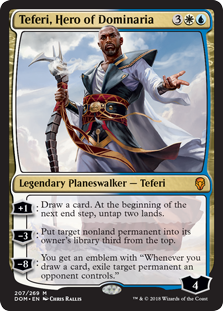
4 Teferi, Time Raveler
4 Wrenn and Six

Sorceries

4 Explore
4 Farseek
2 Polymorph
4 Savor the Moment
4 Time Warp
4 Transmogrify

Instants

2 Valakut Awakening

Enchantments

4 Fires of Invention
4 Omen of the Sea

Lands

4 Arid Mesa
4 Bloodstained Mire
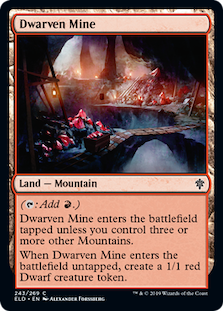
4 Dwarven Mine
1 Ketria Triome
1 Mountain
1 Raugrin Triome
2 Sacred Foundry
4 Scalding Tarn
1 Snow-Covered Mountain
4 Steam Vents
2 Stomping Ground
4 Wooded Foothills

Sideboard

4 Chalice of the Void
3 Cleansing Wildfire
3 Timely Reinforcements
4 Veil of Summer
1 Yorion, Sky Nomad

Time Warp Polymorph takes that old Dwarven Mine-into-Polymorph idea from February 2020 a step further, ditching Emrakul, the Aeons Torn for the brand-new Velomachus Lorehold. The million-dollar question: how come? Emrakul has long been considered the premier creature to cheat into play, and Polymorph, which sifts through the entire deck in search of any creature, one of the most reliable ways to do so.

For one, Time Warp Polymorph has the option of playing like a regular Taking Turns deck, albeit one focused on generating value by stacking different planeswalker activations. Savor the Moment is perfect in this kind of shell, as untapping lands doesn't affect the ability of planeswalkers to activate each turn.

Then there's the combo element, which casts Polymorph or Transmogrify on a token made by Dwarven Mine to cheat out Velomachus Lorehold. Barring interaction from the opponent, the deck then wins on the spot. Lorehold swings and finds a Time Warp to cast in the top seven cards. Then, the deck takes its next turn and repeats the process until the opponent has lost! Again, Savor the Moment doesn't interfere with the plan, as Lorehold's vigilance prevents the untap phase from mattering too much during the combo.

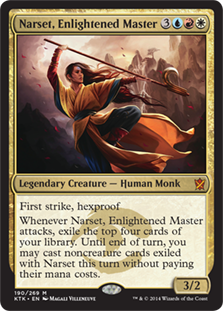
This combo is similar to one we've seen in the past utilizing Narset, Enlightened Master. But Narset only looked at the top four cards, not seven, making fizzling out a very real possibility. Lorehold is much more consistent, and can even be hard-cast for seven mana after Turns has grinded out enough land drops with its namesake effects and Wrenn and Six, making the deck less dependent on assembling the Polymorph combo or dodging small removal spells like Bolt and Push. The deck can and has also been built using Indomitable Creativity, so an optimal version has yet to be established.

Mentor Breach, OURANOS139 (3-1, Preliminary #12289682)

Creatures

4 Emry, Lurker of the Loch
3 Monastery Mentor
1 Thassa's Oracle

Planeswalkers

4 Teferi, Time Raveler

Enchantments

4 Underworld Breach

Sorceries

4 Serum Visions

Instants

3 Lightning Bolt
2 Opt
2 Path to Exile

Artifacts

1 Aether Spellbomb
1 Chromatic Star
2 Engineered Explosives
3 Grinding Station
4 Mishra's Bauble
3 Mox Amber

Lands

4 Flooded Strand
1 Hallowed Fountain
1 Island
1 Mountain
1 Plains
1 Raugrin Triome
1 Sacred Foundry
4 Scalding Tarn
2 Seachrome Coast
2 Spirebluff Canal
1 Steam Vents

Sideboard

1 Aether Gust
2 Ceremonious Rejection
1 Dispel
3 Lightning Helix
3 Mystical Dispute
2 Rip Apart
2 Tormod's Crypt
1 Wear // Tear

Mentor Breach is a deck that combines the combo potential of Underworld Breach and Emry, Lurker of the Loch with a Monastery Mentor plan for when opponents interact with the graveyard. The two plans mesh well, as they attack from separate angles, often requiring different kinds of hate, but also make good use of the same resource: cheap artifacts. This version seems particularly resilient, boasting a full set of Teferi, Time Raveler to ensure the combo materializes safely on the critical turn. And if all else fails, we should well know by now that 1-power prowess creatures are the real deal in Modern, especially alongside like-minded creatures!

So Monastery Mentor is good enough to splash as an engine. Why doesn't Rakdos play it? Oh yeah! Because it's white! But... what if it wasn't?

Rakdos Pyromancer, CAPIN_AHAB (5-0)

Creatures

4 Young Pyromancer
4 Dreadhorde Arcanist
4 Sedgemoor Witch
2 Kroxa, Titan of Death's Hunger
2 Bedlam Reveler

Sorceries

2 Dreadbore
4 Inquisition of Kozilek
4 Thoughtseize

Instants

2 Cling to Dust
2 Fatal Push
2 Kolaghan's Command
4 Lightning Bolt
4 Village Rites

Lands

4 Blackcleave Cliffs
2 Blightstep Pathway
2 Blood Crypt
4 Bloodstained Mire
4 Marsh Flats
1 Mountain
3 Swamp

Sideboard

2 Cling to Dust
1 Kolaghan's Command
4 Cleansing Wildfire
2 Collective Brutality
1 Deathmark
2 Grim Lavamancer
2 Infernal Reckoning
1 Plague Engineer

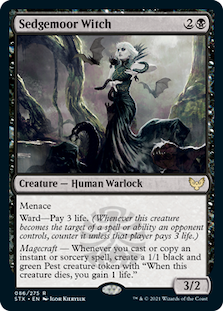
Cue this new build of Rakdos Pyromancer, which utilizes Sedgemoor Witch as a makeshift Mentor. Sure, Witch doesn't trigger off Baubles. But neither does Young Pyromancer, which gives the pairing some cohesion. Additionally, Witch covers for one of Mentor's historically deal-breaking Modern drawbacks: it costs three and dies to Lightning Bolt. For that to happen with Witch, opponents are forced to first Bolt themselves, a condition that meshes exceedingly well with an aggressive strategy in Modern's most aggressive colors. Tack on the repeated damage from Kroxa, Titan of Death's Hunger and Bolt, and opponents may have a tough time staying in the game even if they deal with Rakdos's actual attackers.

To further isolate against removal, Village Rites turns a doomed Pyromancer or other threat into a couple of cards, and can also be used proactively to "Skullclamp" those tokens. If it's all in the luck of the draw, who can argue with more draws?

Spelling Doom

The next couple decks cast a flurry of spells to take their small fries to the big leagues.

“Grixis Grow, EDHPLAYER (5-0)"

Creatures

4 Sprite Dragon
3 Snapcaster Mage

Artifacts

4 Mishra's Bauble

Sorceries

2 Angrath's Rampage
1 Unearth

Instants

3 Archmage's Charm
1 Cling to Dust
3 Cryptic Command
4 Drown in the Loch
2 Fatal Push
1 Into the Story
1 Kolaghan's Command
3 Lightning Bolt
1 Logic Knot
4 Thought Scour

Lands

1 Blood Crypt
1 Bloodstained Mire
1 Cascade Bluffs
1 Drowned Catacomb
4 Island
4 Polluted Delta
1 Prismatic Vista
4 Scalding Tarn
2 Steam Vents
1 Sunken Ruins
1 Swamp
2 Watery Grave

Sideboard

2 Aether Gust
4 Cleansing Wildfire
2 Grim Lavamancer
1 Lurrus of the Dream-Den
2 Pithing Needle
4 Thoughtseize

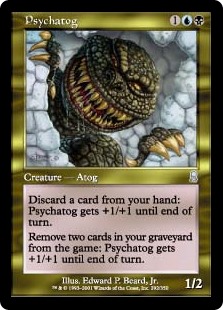
For a long while, I called my brand of Delver of Secrets decks "grow" decks; the name was retired in favor of "thresh" as I noticed an increasing disparity between what my decks were doing and what the original Gro-a-Tog and Miracle Grow strategies had in mind, which was more to control the pace of the game with instants and sorceries before using 1-2 highly efficient threats (such as Querion Dryad, Tarmogoyf, Psychatog) to close out the game in short order. In the creature-centric Modern format, such a deck has never really existed outside of some fringe-ish Dig/Cruise decks leveraging Young Pyromancer (the kind playing 8 or fewer threats).

Preamble terminated! What we have here is Grixis Grow, a bonafide control deck with some reversibility. Depending on the matchup, it can stick a quick Sprite Dragon and then trade on resources until the opponent's dead, or trade on reseources until the opponent's out of steam, then stick a quick Sprite Dragon to put things away. This reversibility gives it an edge in the current metagame, where it can function as a midrange deck against the hyper-aggressive prowess and Shadow strategies or as a tempo deck against the big mana and combo decks.
Grow decks traditionally rely on card advantage to put them ahead while trading resources, and this deck turns to control staples like Cryptic Command and Archmage's Charm to fill that role. It's also got Lurrus as a commander and 3 Snapcaster Mages in the main, making grinding with creatures a possibility.

Magecraft Blitz, KOKEMEN47 (5-0)

Creatures

4 Clever Lumimancer
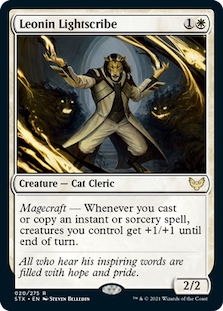
4 Leonin Lightscribe
2 Monastery Swiftspear
4 Nivmagus Elemental

Sorceries

4 Ground Rift

Instants

4 Flusterstorm
4 Gut Shot
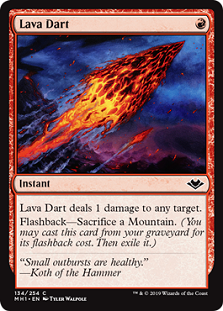
4 Lava Dart
4 Lightning Bolt
4 Manamorphose
4 Mutagenic Growth

Lands

2 Arid Mesa
3 Bloodstained Mire
4 Inspiring Vantage
3 Mountain
2 Sacred Foundry
2 Steam Vents
2 Wooded Foothills

Sideboard

3 Kor Firewalker
1 Lurrus of the Dream-Den
3 Path to Exile
2 Postmortem Lunge
3 Rip Apart
2 Shattering Spree
1 Soul-Guide Lantern

I'd be remiss to totally snub Clever Lumimancer, clearly the big story coming into the Strixhaven metagame. But as David penned last month, players soon found themselves divided over sinking too much into Lumimancer to make it work, and were finding that it wasn't necessarily worth running at all without some amount of shell redesign. Which brings us to Magecraft Blitz, a deck that stocks up on similar creatures (other buffing magecraft guys) to make that extra effort pay off.

Like Lumimancer, both Leonin Lightscribe and Nivmagus Elemental generate big swings with cheap storm spells, in this case Ground Rift and Flusterstorm. The pricier Lightscribe buffs all the creatures, while Nivmagus stays big in future turns, giving each its niche in the deck and bringing the functional number of Lumimancers to 12.


After all, Lumimancer isn't just some all-around-good prowess creature; it requires a specific shell to shine, and that's exactly what's been created here. Nonetheless, Monastery Swiftspear does make the cut, as it's way too efficient for this kind of spell-based aggressive strategy to leave out.

Size Ain't Nothing But a Measurement

There's plenty bubbling under Modern's surface; the little guys are just one such party ready for their shrieks and squeaks to be heard by the plenty. Which post-Strixhaven decks have you tickled?

How Could Magic Go Mainstream?

Are you a Quiet Speculation member?

If not, now is a perfect time to join up! Our powerful tools, breaking-news analysis, and exclusive Discord channel will make sure you stay up to date and ahead of the curve.

In 2021, I suspect nearly everyone has heard of Pokémon. Sure, everyone’s awareness of the franchise is going to vary greatly. Some may be intimately familiar with the card game, various Game Boy games, and cartoon series. Others may only have heard of Pikachu and not much else. When I was a kid, Pokémon was a cartoon and Game Boy game to be played by nerds. Nowadays, the franchise has gone mainstream.

Perhaps this is why Pokémon cards are sold out all over the place, and my local Meijer grocery limits Pokémon purchases on a per-customer basis. They don’t even put the products on their CCG shelves anymore—to purchase Pokémon cards, you need to ask an employee to get you your allocation from some hidden location.

When I’m browsing the CCG section now, all I basically see on the shelves are Magic cards. Apparently, Magic cards aren’t selling as briskly and don’t demand the same protocols. But why is that?

Well for one, Magic, while a popular game, still doesn’t have the same broad reach and familiarity as Pokémon. But could this change? It’s possible, but not as easy as you’d think. Allow me to explain.

The Pharma Bro: An Anecdote

Back in 2016, Martin Shkreli, known colloquially as “Pharma Bro”, made a Reddit post that shook the Magic world.

"Hi everyone. I'm new to the game. I'm looking to acquire some rare cards. I am a collector of wine, art and other goods. Can someone give me some resources on collecting rare cards? Specifically I've been told black lotus cards are very valuable. Also has anyone had any insight on Hasbro's intention for the company?

Thanks, Martin"

Once this post went live, Twitter and Reddit replied en masse with attempts to help. Everyone wanted their fifteen minutes of fame, and share suggestions on which Magic cards to invest in. Martin proceeded to claim he had already purchased five Black Lotuses and was on the hunt for more.

There was an error retrieving a chart for Black Lotus

Because of his infamy, many speculators and investors thought this could be a catalyst to help Magic make the leap into the mainstream, sending card prices much higher. Any such hopes did not last long, however. Martin had many legal issues to attend to, and he couldn’t maintain the trolling façade for very long. I haven’t even heard the guy’s name in the news since 2016. Perhaps that’s because he’s currently detained in a Federal Correctional Complex (aka prison), serving a seven-year term.

The hype was there, it was fleeting, and then it disappeared.

Fast Forward to Today

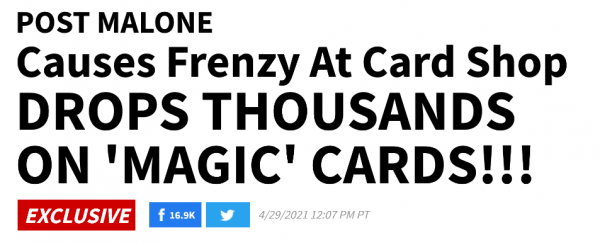
Last week, Magic finance once again broke into mainstream media via an exclusive article written by TMZ. The headline says it all:

It’s pretty clear the authors of this article are not intimately familiar with MTG finance. If they were, they probably wouldn’t have been so impressed that a person spent thousands on Magic cards…anyone who plays Vintage knows this feeling. Nowadays it’s fairly commonplace to see a four-figure Magic card, and Black Lotuses are pretty much cemented as five-figures in price.

That aside, it’s certainly impressive that a mainstream music artist is hanging around Magic card shops buying singles for decks. Post Malone has had multiple number one hits, and his Twitter following numbers 6.9 million. For comparison, the official Wizards of the Coast Magic: The Gathering Twitter account has 287.6 thousand, or roughly 4% of Post Malone’s. With this kind of following, Magic is surely to get broader exposure.

There are other famous people who are known to play Magic. Hunter Pence, an outfielder for the San Francisco Giants (Major League Baseball team) is one of the most well-known. As recently as a couple weeks ago, Hunter was playing Magic on Twitch for charity.

This will also surely increase visibility for Magic.

Crossover Sets

In all honesty, I don’t think Hunter Pence and Post Malone can make Magic go mainstream—not by themselves. The game is still simply too complicated and the game pieces are a bit too niche. Everyone recognizes Pokémon and many collectors are interested in the game’s cards even though they don’t play the game itself. Pikachu or Charizard cards are still widely recognizable even without any in-depth knowledge of the game.

In Magic, it’s not so straightforward…yet. Up until now, 99% of cards depict a fantasy world. With few exceptions (e.g. Arabian Nights, Walking Dead cards, My Little Pony cards), people outside of Magic simply won’t have heard of the names and places cited on cards. Sure, a card like Jace, the Mind Sculptor is iconic, but there’s no mainstream crossover for people unfamiliar with the card game to want a “Jace card” in the same way they’d chase after a “Pikachu card.”

There was an error retrieving a chart for Jace, the Mind Sculptor

But this is all about to change as Wizards of the Coast works on full crossover sets. In July 2021, Wizards will drop a Dungeons & Dragons crossover Magic set, called Dungeons & Dragons: Adventures in the Forgotten Realms. This set will contain classic D&D elements on Magic cards. So if there was a D&D character or theme that got its own Magic card, it could be an instance where people could want to collect certain cards without being interested in playing the game itself.

It’s possible, but I don’t think it’s likely. Dungeons & Dragons isn’t exactly mainstream either…not on the same order of magnitude as Pokémon, at least.

There will also be a Lord of the Rings-themed Magic set. Lord of the Rings has major reach given the success of its movies. But will it be enough to send Magic into the mainstream? I’m still skeptical.

What Will It Take?

You can sense my skepticism in the paragraphs above, right? Despite Post Malone’s posts, and Hunter Pence’s streaming, and full-blown crossover fantasy sets in Magic, I still don’t see the game going “mainstream” in the same way Pokémon…or even Chess…has gone. The game is just so complex and difficult to penetrate, and the game’s characters and imagery aren’t well-known and understood enough to make it a mainstream collectible à la Pokémon.

What would it take, in my opinion, to have Magic make it to mainstream? I believe a couple of major catalysts would be required for this to happen.

There was an error retrieving a chart for Jaya Ballard, Task Mage

For instance, a hit miniseries on Netflix, Hulu, etc. would do the trick. The pandemic has already been a major boon to chess, but the popularity of The Queen’s Gambit on Netflix was a major factor in boosting chess’s popularity recently. A similarly popular show about Magic in any capacity—even if it was just a minor subtheme about the main character—would drive Magic’s popularity significantly. It’s similar with Dungeons & Dragons’ rise in popularity due to the show Stranger Things. Magic wouldn’t have to be the primary focus, just featured enough to spark interest in mainstream media.

Another route would be if famous people who enjoy the game started integrating it further into their daily social media outreach. A TMZ article about Post Malone buying Magic cards is certainly cool, but it’s going to be a flash in the pan for Magic. However, if Post Malone started playing regularly, maybe posted some pictures of himself playing other famous artists on social media, then the game would start to gain traction. In a facetious, more extreme circumstance, a Post Malone song about Black Lotus would drastically increase the world’s awareness of at least that card within the world of Magic.

There was an error retrieving a chart for Seething Song

The other route I can think of is if Hasbro can take Magic, manipulate it somehow, and create a simpler, faster spinoff of the game that a broader audience can enjoy. They already tried this once with the Magic board game, and it was an utter failure (I remember seeing this game marked down significantly on clearance). I don’t know how Hasbro can achieve success with this approach, but their innovation with Monopoly tells me it’s possible. The game wouldn’t even have to feature complex Magic rules—even if it just featured some of the IP of the game, it could be enough to boost interest in collecting certain cards.

Wrapping It Up

Magic cards have been soaring in value throughout this pandemic. I don’t think this is necessarily due to a sudden surge in demand (outside of FOMO). Rather, I think there are some major supply constraints because of the pandemic and the shutdown of large events. When the world reopens, a new equilibrium will be found and prices will settle.

One way Magic prices could surge again would be if the game went mainstream, akin to chess or Pokémon. It’s not there yet, and I don’t think recent events and sets on the horizon will be sufficient to get it there. As influential as Post Malone and Hunter Pence can be, they aren’t sufficiently integrated into the game’s social network.

Therefore, I believe it will require a greater catalyst for the card game to “make it” to the big times. A hit series on Netflix, more frequent involvement of famous players, and a successful spin-off game could be a few ways for Magic to explode into mainstream. But it’s not quite there yet.

Of course, given the fragility of Magic’s supply—particularly of cards from Magic’s earliest sets (1993-1994), we really don’t need a catalyst to send prices higher in the long term. And it doesn’t take a famous person to put a dent in the market. Anyone with deeper pockets and an appreciation for Magic can make waves from a financial perspective. If someone decided to spend a million bucks on Magic cards, they could really impact the market…the supply is that sparse, especially on Alpha and Beta cards.

Because of this, I don’t think a mainstream catalyst is even necessary to drive prices higher. It would accelerate such a move, but it’s not necessary. Prices will continue to climb on their own volition, as long as Magic maintains its current popularity. Any mainstream exposure is strictly upside.

Core Set 2019: The Sleeper

Are you a Quiet Speculation member?

If not, now is a perfect time to join up! Our powerful tools, breaking-news analysis, and exclusive Discord channel will make sure you stay up to date and ahead of the curve.

Core Set 2019 has always felt to me as a generally underwhelming product. With mythics taking up so much of the value of the box, and not particularly that much of the value either, it seemed to be pretty... meh. As a sealed product, the prices were that of a sub-par Standard box, even over a year after its initial release. The main hits were always mythics, and the rares just took up space, with the occasional inclusion in an odd Commander deck here and there.

Taking a look at the current value of the set, and specifically, the cards that make up that value is jarring. The cards themselves have found recognition for the often subtle use cases and the ones with more overt use gaining value day over day. With this gradual rise in value, some investors are surprised by the prices coming about recently. Let's take a look at the set as a whole and see what we can gather from the information we have.

The Uncommon Value

One of the most surprising facts about the current market of Core 2019 is that an astounding amount of commons and uncommons hold value over $2.00. Some prime examples include Stitcher's Supplier, Psychic Corrosion, Reliquary Tower and Ajani's Welcome to name a few. Stitcher's Supplier is holding $4-5 on any given day, and with it being out of Standard for a while now, it begs the question of why? It seems that the reliable self mill for a low, low cost of one black mana is simply too good to pass up for some players of formats that it is legal in, and the demand seems to be enough to hold the price.

With Psychic Corrosion holding $3, and not seeming to see much play in traditional 60 card formats, it leaves only Commander left on the table for possible uses for this odd card. With other alternative versions of this card being few and far between, it would make sense that Commander decks utilizing those cards would be quick to grab alternatives, even if they are slightly worse, to provide higher and higher redundancy. Reliquary Tower and Ajani's Welcome seem to be just good enough to see some play in Commander, and that might just be enough.

There was an error retrieving a chart for Stitcher's Supplier
There was an error retrieving a chart for Psychic Corrosion

The Rare Redemption

The two main rares for the set are Goreclaw, Terror of Qal Sisma, and Dragon's Hoard. Nothing too crazy, just some good cards, and both see decent amounts of play in Commander. I personally played both in casual Commander decks in the past. Both are a bit below five dollars, but the value, especially in normal rares, adds up. With 32 or so rares in the box, even having 10 of those be worth around five bucks can make up over half the price you pay at retail. Good rares make a good set, and while these two are the most valuable, plenty are worth your while and make it a very worthwhile product.

There was an error retrieving a chart for Goreclaw, Terror of Qal Sisma
There was an error retrieving a chart for Dragon's Hoard

The Mythics

The mythics are the real powerhouse of this set. With the five most expensive being above $20, the top three being all above $30, and the most expensive card in the set is $45. With heavy-hitters like Omniscience, Crucible of Worlds, and Nicol Bolas, the Ravager being at the top of the list. Most if not all of these are very well played in Commander, and have no reason to not be! All of them are iconic cards from a flavor perspective and have very high power implications, if not at a cost.

With Crucible of Worlds being very powerful in lands matter, Omniscience being well played in decks favoring lots of high mana cost spells, and part of a few low-efficiency combos, overall, the mythics in the set hold a lot of value, and if you pull the right ones, make returns well worth it. Foil mythics included make this package pack quite a punch.

Sealed Perspective

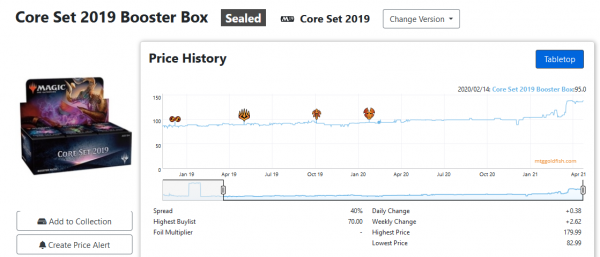
For the three years that this product has been in circulation, the sealed price hasn't been above $100 often. With a price trend similar to that of Zendikar Rising or Kaldheim, it didn't make much sense. With the value held, even at the time, being well worth more than that. Over the past several months, the prices have been steadily rising, as if the market itself was slowing correcting the prices, but not quite as rapidly. The demand wasn't really there, but the value was. Now with sealed prices at an all-time high of $140, people are starting to take note. Sealed is performing incredibly well right now, and demand is steadily rising, as more and more people noticing the potential for growth, and trying to get a slice of that sweet cardboard pie.

The Lesson

An important lesson to learn is that high demand does not always equal high prices. The basic principles of supply and demand have implications that people overlook. When the demand is high, the supply is very important, that is a given, but when the supply of singles goes up, because of high demand for sealed correlates to higher amounts of box openings, and thus a higher supply of singles, which means less demand for sealed boxes to open for singles. In some cases, this may lead to sealed prices rising, particularly in cases where the supply is so low, that the scarcity matters to the people creating the demand that remains, or with sets with an enjoyable draft experience, a certain novelty, collectability, or scarcity of specific singles needed to create value with a lower quantity of potential customers.

When a set does not have an overwhelming demand, the singles are more scarce. When singles are scarce, and people want more, the one place to look is inside sealed boxes. With the demand for sealed rising, prices rise along with it, as supply is mostly entrenched with investors or stores with leftover supply, and these increases in sealed further reinforce single prices, leading to a subtle feedback loop of increasing prices, and demand along with it. This is consistent with the slow and steady trend we have seen. This is also consistent with several other poorly received sets, like Theros Beyond Death, whose price little by little has been increasing.

Farewell

To the victors go the spoils, but in the game of finance, the victors aren't always as clear as they seem. It may seem easy to take the big rewards, but in this current financial climate, especially in the MTG community, it may be better to settle for stability. With every movement, an equal and opposite movement must exist, and where massive swings for the positive exist, so do massive swings for the negative.

We must begin to question whether the market at its current point is sustainable, as the more flashy things become, the more hype we gather around these things, and the higher we drive these prices, we must ask ourselves if we are able to sustain this growth, or have we bitten off more than we can chew. For now, support your LGS, be smart, have a great week, and invest in cardboard (responsibly).

What Was Once Undesirable is Now Hot

Are you a Quiet Speculation member?

If not, now is a perfect time to join up! Our powerful tools, breaking-news analysis, and exclusive Discord channel will make sure you stay up to date and ahead of the curve.

Remember the good old days, when everyone was excited to draft the beautiful reprint set, Chronicles, eager to open those gorgeous white-bordered cards and play an exciting Limited format?

Yeah, me neither. But that hasn’t stopped the price of Chronicles booster boxes from climbing. In fact, the same trend can be said for any older sealed product. Of course the Four Horsemen sets are on the rise, as are sealed boxes from sets like Revised and Mirage. These sets all contain Reserved List cards, and many players have nostalgia for these classic sets. But that doesn’t quite explain why a reprint set like Chronicles has soaring booster box prices.

Fallen Empires and Homelands boxes are also surprisingly expensive. Yes, these sets technically do have Reserved List cards but…none of the good ones, right? What gives?

A Look at Some Data

I first wrote about investing in Magic booster boxes back on April 10th, 2012. In that article, I specifically encourage players to focus on sets with desirable cards, calling out Tarmogoyf as a reason to invest in Future Sight boxes as an example.

There was an error retrieving a chart for Tarmogoyf

I also mentioned investments I had made in Unhinged booster boxes at $144 a box and Coldsnap booster boxes (no price cited, but I seem to recall a similar price point on those as well). I never pulled the trigger on a Future Sight booster box, but at the time they were sold out at Star City Games at $249.99. Let’s take a quick look at what these boxes sell for on eBay as of April 25th, 2021, just over nine years later.

Set: April 2012 Price -> April 2021 Price

Coldsnap: $150 -> $850
Future Sight: $250 -> $1500
Unhinged: $144 -> $700
Fallen Empires: $100 -> $850

The trend of older set booster boxes climbing in price is universal across the board. But in this week’s article I want to focus on the head scratching data on Fallen Empires, Homelands, and Chronicles.

As you can quickly see from the data, recently completed eBay listings put these boxes at roughly $850 for Fallen Empires and well north of $1,000 for Chronicles and Homelands. While I haven’t been following the market on sealed product in years, I’m pretty sure these sets in particular have exploded only in the past year or two. I remember buying a booster box of Fallen Empires a couple years ago for under $200. In fact, I shared a picture of a couple eBay listings for such boxes in an April 2018 article (it seems like I write about this topic only in April!). Here’s the picture from that article:

So now I have documented proof that, at least for Fallen Empires, sealed booster boxes have gone from $175 or so to over $800 in just three years. I posit that Homelands and Chronicles similarly rallied over the same time period.

Why the Higher Prices?

Here comes the crux of this week’s article: trying to understand why prices of booster boxes from some of Magic’s most underpowered sets have taken off in the past three years. I don’t have a precise answer, but I can offer a couple theories. Unfortunately, none of them alone explain everything; allow me to explain.

You could argue that, with the recent surge in Reserved List prices, booster boxes with Reserved List cards would have followed suit. This is plausible, and certainly would explain any recent surges in booster box prices for sets like Mirage, Weatherlight, and Visions—that is, sets with a bunch of Reserved List cards that recently shot up in price.

There was an error retrieving a chart for Debt of Loyalty

But this doesn’t really explain why Chronicles booster boxes are so expensive. The set is a reprint set, for crying out loud! There’s not a single Reserved List card in the set. What’s more, the only card worth more than $50 according to TCGplayer’s market price is Concordant Crossroads, worth around $50. Next is City of Brass worth $25 and third is Blood Moon, worth a pitiful $12. No other card from Chronicles is worth over $10.

One could make the argument that these three sets in particular are different from traditional Magic sets—their booster boxes don’t contain 36 booster packs each with 15 cards. Fallen Empires and Homelands boxes contain 60 booster packs, albeit with fewer cards per pack. Chronicles booster boxes contain 45 booster packs, also with less than 15 cards per pack. So does the larger number of booster packs increase the set EV enough to justify higher prices?

Well, according to Dawnglare the booster box EV’s for these three sets are as follows:

Fallen Empires: $174.29
Homelands: $293.52 (this surprised me, actually)
Chronicles: $235.82

Clearly, people aren’t purchasing these booster boxes for their value in individual singles. You could probably open a Merchant Scroll in all 60 Homelands boosters and still not get your money back from purchasing the sealed booster box.

There was an error retrieving a chart for Merchant Scroll

Even with the rapid climb in Reserved List prices, nearly all the “value” in Fallen Empires lies within the rares, and it would take opening 60 Rainbow Vales for you to get your money back from a booster box. The numbers just don’t add up.

Another hypothesis people throw out when advocating an investment in booster boxes is the opportunity to draft sets years after they are discontinued. This would be a compelling reason to sink money in Innistrad booster boxes, for example. I personally enjoyed original Time Spiral block (though it was very controversial due to its elevated complexity), and I could imagine a world where I’d be willing to pay up to draft that set again. It was the first set I ever drafted!

But who is out there longing for the days when they could draft Fallen Empires and Homelands? Chronicles was meant more as a reprint set, and not like the reprint sets of the past decade. New reprint sets like Modern Masters were designed to also be fun draftable sets. That was not the case with Chronicles.

I think we can confidently say these booster boxes aren’t climbing in price because people are cracking the boxes for drafts. Maybe in the Old School community, there’s a little bit of interest in drafting Fallen Empires because the set is legal with many player groups. But I still don’t think that explains such a high rise in price over the past three years.

My Take on This Trend

Looking at the data and all the factors at play, I believe the primary two factors driving the growth in these booster boxes are nostalgia and FOMO. As awful as these sets were, many players remember these as being the first sets readily available at their local game stores—many of the sets that came out prior often sold out. And I will always look back at the time period where booster packs of Mirage and Ice Age were $2.95 while Fallen Empires and Homelands were marked down to $0.50 and $1.75, respectively. Thus, I became good at dividing the money into my wallet by three (as in $3 per pack) and determining how many packs of Fallen Empires I could purchase with the remainder.

I cite FOMO as the second factor because, just like with the Reserved List market, people are acting like they’ll never have a chance to own these booster boxes again. It has little or nothing to do with the actual EV of these boxes. It all boils down to an overheated collectibles market, combined with rarity of such old sets, and you have people panic buying “while they still can.”

If you ask me, this is a silly reason to purchase booster boxes of Homelands or Chronicles but that’s just me. At least Fallen Empires has the feel of being an “old set”, as it was from 1994 and used the older packaging (you can still “search” these boosters to see what’s inside without actually opening them). But with all three sets, if you didn’t want to buy their sealed boxes for $150 to $200 three years ago, I’m not sure why there’s suddenly an urge to buy them for $1000 today, beyond the simple fear that they may not be available on the market one day.

While this is probably the case, do people really want to own a box of Homelands that badly?

There was an error retrieving a chart for Timmerian Fiends

My advice on the whole trend: I’d cash out on any sealed product from these sets you may be owning. And if you’re on the same side as me, wishing you had bought the boxes a few years ago and now regretting you did not. I have very simple advice: ignore this trend and move on. FOMO may drive up their prices even further, but I’d much rather spend the money on individual cards with greater potential, such as Beta cards (as I discussed in last week’s article).

Wrapping It Up

Let’s face it: very few people are buying booster boxes of old sets with the intent of re-living their favorite draft experiences. Set EV is also only a tiny factor, as these boxes are selling for a few times their estimated value.

I love to see the value of older Magic sets and products rise as it reflects a healthy market. But if you’re left scratching your head like I am, the best advice I can offer is to simply be aware of the trend but not buy into the hype. I suppose, despite their relatively large print runs, even these sets will one day be old enough to be seen as rare and valuable. Fallen Empires is already 27 years old, after all.

But there are just better places to park funds for the long-term investment, and I cannot advocate booster boxes from these sets as a justifiable place to invest. The opportunity cost at this point is too great. Obviously hindsight would suggest that these were great purchases a couple years ago. But as of today, April 2021, these don’t seem like great places to invest given their relative risk/reward profile. Chalk it up as a missed opportunity, get passed the FOMO, and find the next big trend.

After all, there’s always another area about to climb in price. Always.

March ’21 Brew Report, Pt. 2: Storm’s a-Brewing

Are you a Quiet Speculation member?

If not, now is a perfect time to join up! Our powerful tools, breaking-news analysis, and exclusive Discord channel will make sure you stay up to date and ahead of the curve.

Just before Strixhaven dropped, we observed some intriguing developments among Modern's top decks in Jund Shadow and Omnath piles. While all the talk's been focused around Clever Lumimancer latelty, with the card showing promise (and also, floundering) depending on the shell, I'd like to remind us all that some players were breaking the mold before the set dropped with the likes of Slivers, Storm Herald, and a very splashy Scapeshift deck. Today, we'll look at all three off-the-wall strategies and figure how they might fare in the newly shaken-up metagame.

Sliver Me Timbers!

When we talk about tribal aggro in Modern, we're usually thinking of a couple specific decks: Humans, or keepers of the ground, and Spirits, which rule the skies. Then there's the less played tribal aggro decks, Eldrazi (RIP) and Merfolk, as well as Elemental. And then there's an even lower tier occupied solely by Slivers.

This most tribal of tribes has never been big in Modern, although it has experienced blips here and there. But for some reason, the deck put up multiple finishes in March, with each achieved by a different pilot.

Slivers, JUSTBURN420 (10th, Challenge #12266376)

Creatures

4 Cloudshredder Sliver
2 Dregscape Sliver
3 Frenetic Sliver
4 Galerider Sliver
4 Leeching Sliver
4 Predatory Sliver
2 Realmwalker
2 Sidewinder Sliver
4 Sinew Sliver
3 Striking Sliver
4 Unsettled Mariner

Artifacts

4 Aether Vial

Lands

4 Cavern of Souls
2 Fiery Islet
3 Mutavault
1 Plains
2 Silent Clearing
4 Sliver Hive
4 Unclaimed Territory

Sideboard

4 Chalice of the Void
3 Dismember
1 Grafdigger's Cage
3 Harmonic Sliver
4 Leyline of the Void

The strength of Slivers lies with the abilities of its lords, which rather than ubiquitously pumping (something that's served Humans well) or ubiquitously pumping and granting Islandwalk (native to Merfolk), grant a plethora of different keywords and abilities to each Sliver on the battlefield. The numbers tell the whole story: any Sliver that's maxed offers the most important abilities, which here are +1/+1 (big surprise), flying and haste (a significant upgrade to Islandwalk), and Leeching Sliver's drain ability (a rather roundabout way of saying "+1/+1").

New to the tribe are Unsettled Mariner, coming in at the full four copies, and Realmwalker. Mariner's been seen in Merfolk, Humans, and Spirits, so it's no big surprise to see the changeling supporting this tribe. Slivers used to play Diffusion Sliver, which asks a higher tax of opponents at the cost of weaker stats and less relevance overall; Mariner also deals with spells targeting the player, including discard and direct damage, and that extra size really matters in a world of Lava Dart and Wrenn and Six. As for Realmwalker, this newer changeling offers the tribe a card advantage engine stapled to a body—look, Ma! No Collected Company!


Slivers also scored 3-1 in a preliminary last month with a different pilot, making me wonder if the squiggly little guys have legs. To their credit, Slivers can painlessly run Chalice of the Void out of the sideboard, which is huge against the Lumimancer decks and other prowess strains.

Storm... Herald

You've heard of Storm. But have you heard of... Storm Herald? You mean that creature that does something? Yes, that was also my reaction! So scroll over the card tag and feast your eyes!

Storm Herald, ZANMAN (5-0)

Creatures

4 Storm Herald
4 Hedron Crab
4 Jace, Vryn's Prodigy

Sorceries

4 Collective Brutality
4 Glimpse the Unthinkable
4 Unearth

Instants

4 Izzet Charm

Enchantments

2 Battle Mastery
4 Eldrazi Conscription
4 Prodigious Growth

Lands

2 Blood Crypt
4 Bloodstained Mire
2 Island
1 Mountain
4 Polluted Delta
4 Scalding Tarn
2 Steam Vents
1 Swamp
2 Watery Grave

Sideboard

4 Archive Trap
3 Crypt Incursion
4 Jace's Phantasm
4 Ruin Crab

Storm Herald is a self-mill combo deck that aims to dump an "Enchantment Fatty" (Battle Mastery, Eldrazi Conscription, or Prodigious Growth) and then "reanimate" it with Storm Herald for a hefty, hasty swing. Clearly, the enchantments in the mix are worse than the available creature reanimation targets in Modern, such as Griselbrand and Emrakul, the Aeons Torn. So why play Herald over something like Goryo's Vengeance?

The idea is that Storm Herald itself offers one key degree of resilience: it can be Unearthed, meaning that lone sorcery in hand can kick-start the entire combo chain if both pieces are milled. And Unearth is a fine card in its own rite, working together with Jace, Vryn's Prodigy to offer a card advantage package.

Beyond that neat trick, though, there's not much to this one-trick pony. Just another testament to "anything can happen in Modern!"

Scapeshift: With a Twist (or Three)

The opposite is true of the following deck, which mashes together a ton of different themes into one whopper of a list:

Treasure Hunt Bring to Light Scapeshift, MELTIIN (5-0)

Creatures

4 Dryad of the Ilysian Grove
4 Elvish Reclaimer
1 Omnath, Locus of Creation
1 Valki, God of Lies

Planeswalkers

2 Teferi, Time Raveler

Sorceries

4 Bring to Light
2 Scapeshift
1 Supreme Verdict
3 Treasure Hunt

Instants

3 Lightning Bolt
4 Remand

Lands

1 Bojuka Bog
1 Breeding Pool
4 Flagstones of Trokair
1 Forest
1 Island
3 Ketria Triome
3 Misty Rainforest
1 Mountain
1 Overgrown Tomb
1 Plains
2 Raugrin Triome
1 Sacred Foundry
1 Savai Triome
1 Steam Vents
1 Stomping Ground
1 Temple Garden
4 Valakut, the Molten Pinnacle
3 Windswept Heath

Sideboard

1 Anger of the Gods
2 Celestial Purge
1 Chandra, Awakened Inferno
1 Crumble to Dust
1 Eidolon of Rhetoric
1 Hallowed Burial
1 Knight of Autumn
1 Madcap Experiment
1 Platinum Angel
1 Platinum Emperion
1 Sigarda, Host of Herons
1 Slaughter Games
2 Veil of Summer

It's Scapeshift, but it's also Lands—both decks play Valakut win conditions, after all, and having Dryad in play does accelerate the Scapeshift clock. What else is in the deck? Almost nothing, which in turn enables Treasure Hunt!

These types of combo decks can prove soft to disruption, a challenge Hunt meets head-on by offering pilots as little as one, but probably something more like three or four, cards off the top for a two-mana investment. Since many of these lands function as spells, that card advantage boost can keep Scapeshift's head above water when opponents are banking on setting up a clock and then countering or stripping the payoff spells. Previously, most similar builds would pack the deck full of multicolored costs and lean on Niv Mizzet to recoup card advantage; the problem with that line is that Niv itself occupied the same price point as most of the payoff spells, making it rather clunky once things got to the point where Scapeshift was casting real spells. Conversely, Hunt can be played as early as turn two, or before opponents get Cryptic Command online.

Also note the Bring to Light—while it can fish out Scapeshift as intended to end the game, should that option fail, it can also grab Valki (both halves!) for some good ol' cheaty fun. Granted, paying five for the walker is a lot less cheaty than paying three, but hey.

An Illuminating Month

Modern's wild a-brewing over the new set, but let's not forget that it was just the same way a few weeks ago. Soon, we'll dive into Strixhaven's impact on MODO's deckbuilding coalition!

A Dim Light: Examining Boros Lumimancer

Are you a Quiet Speculation member?

If not, now is a perfect time to join up! Our powerful tools, breaking-news analysis, and exclusive Discord channel will make sure you stay up to date and ahead of the curve.

By the time you read this, Strixhaven: School of Mages will have been available on MTGO for six days. And some people even have it in paper. Consequently, results are beginning to trickle in which include the new cards. Which means that I can start seeing how well my psychic abilities are developing. And maybe get some insight into what's going on in Modern now. That'd be a nice, but entirely secondary, objective.

With all eyes on presumptive Modern All-Star Clever Lumimancer, I certainly thought that this first week would be the Boros Prowess show. It's just the way these things normally go: the new and hyped card is adopted by everyone online. It has good results thanks to the Law of Large Numbers and simple population density ensuring high results. However, it quickly fades as the other decks adapt and/or streamer interest wanes. At least, that's what I was expecting as I pulled the data from Strixhaven's first week. Spoiler alert: that didn't happen. And I'm not sure why, which makes the examination all the more interesting.

Tale of the Tape

Instead, it looks like Lumimancer is starting slow, at least in comparison to the hype. It's doing better than the MDFC's after Zendikar Rising in a similar timeframe. If that sounds vaguely like I'm damning Lumimancer with faint praise it's because I am. Lumimancer has the advantage of a readymade archetype while it took time for Oops, All Spells to get worked out. It's an especially weak statement considering that Thrilling Discovery is hot on Lumimancer's heels results-wise, and only fits into one deck. And most of Lumimancer's results came from the same event. This isn't like Hogaak levels of immediate saturation, and Lumimancer has the advantage of extra MTGO events during its release weekend.

Which is not to say that the results are poor by any stretch of the imagination. However, given the chatter surrounding the card, it is well below my expectations for a first weekend. And, unfortunately for Lumimancer, I haven't seen anything to contradict the MTGO results. While it is still early, the results that streamers and YouTubers are putting out about Lumimancer doesn't point to a busted card. It is logistically impossible for me to watch every piece of content currently out there, but a strategic audit indicates that for every 5-0, completely busted League run which matches the hype, there's another 0-5 where the deck simply implodes. And the vast majority are 3-2 struggles. Which is... perfectly fine. It's how an average card should do in Modern. But given the hype, it makes me wonder what makes Lumimancer only an average card?

Observations

Obviously, it's still very early. Literally the first weekend. The decks being early drafts and the pilots being inexperienced is certainly a factor. It might already be turning around, but the lag in data reporting doesn't show it. However, if a card is truly busted, then I'd expect that its raw power would make up for suboptimal play and deck building. And I'm not seeing that.

From what I've seen, the issue with Lumimancer decks is Lumimancer. With no help, it's a 0/1 and dies to a weak breeze. At least Monastery Swiftspear is a 1/2 with haste. If the opponent provides any resistance, Lumimancer suddenly becomes a liability. Again, without magecraft triggers, Lumimancer is a 0/1. To save it from a Lightning Bolt requires expending two spells or a Mutagenic Growth. If the opponent is smart and Bolts on their turn, then those resources are expended for no value. And that's not getting into what happens when you dump a bunch of spells into an attack and Lumimancer gets Fatal Pushed orPath to Exiled. Which gives me strong Infect vibes, and that deck doesn't perform well, either.

However, sometimes the opponent offers no resistance. In those cases Lumimancer... is still a bit underwhelming. It seems to offer a single enormous hit followed up by not much. While +2/+2 per instant or sorcery is better than the prowess rate, Lumimancer still starts from 0, so it takes a lot of spells to produce a reasonable, Modern-level hit, but rarely a lethal one. After which, the typical Prowess list won't have much follow-up. Lumimancer requires a surprising amount of help to be good.

The Logical Solution

Naturally, this makes me think that the correct solution is to go all-in on Lumimancer. I thought that this would lead players down the road to filling their decks with Apostle's Blessing, Gods Willing, and/or Blossoming Defense to protect Lumimancer while trying to dump Mutagenic Growth and Gut Shot alongside Assault Strobe to kill on turn two. However, that isn't happening. In the available data, only one deck's seriously going for the early kill.

Mardu Lumimancer, benchsummer (Modern League 5-0)

Creatures

4 Kiln Fiend
4 Clever Lumimancer
4 Monastery Swiftspear

Sorceries

3 Assault Strobe
2 Crash Through
4 Ground Rift

Instants

2 Emerge Unscathed
4 Gut Shot
4 Lightning Bolt
4 Mutagenic Growth
3 Tainted Strike
4 Manamorphose

Sideboard

1 Lurrus of the Dream-Den
4 Path to Exile
3 Postmortem Lunge
3 Shattering Spree
4 Cleansing Wildfire

This deck not only goes for that quick kill with Assault Strobe, Manamorphose, and Ground Rift, it has Tainted Strike to as redundancy for Strobe. However, it's missing the protection elements that I expected. Yes, there's Emerge Unscathed, but that's a two-of when I was expecting multiple fours. I'm guessing that's because there just isn't room and it's insane to not run Bolt. Alternatively and surprisingly (because I didn't even consider it) Flusterstorm not only protects a big turn, but serves to make that turn more absurd.

Jeskai Lumimancer, unagieel (27th Place, Modern Challenge)

Creatures

4 Clever Lumimancer
4 Monastery Swiftspear
4 Nivmagus Elemental
4 Leonin Lightscribe

Sorceries

2 Ground Rift
3 Light Up the Stage

Instants

4 Lava Dart
4 Lightning Bolt
3 Flusterstorm
3 Gut Shot
3 Mutagenic Growth
4 Manamorphose

Lands

4 Arid Mesa
4 Bloodstained Mire
3 Wooded Foothills
2 Mountain
2 Sacred Foundry
2 Steam Vents
1 Sunbaked Canyon

Sideboard

2 Path to Exile
2 Shattering Spree
3 Surgical Extraction
4 Kor Firewalker
3 Bedlam Reveler
1 Lurrus of the Dream-Den

I like this version more than the previous Mardu version. The former has so few creatures that it will have to mulligan a lot, and there's no plan for when things go wrong. The Jeskai version's higher creature count means more (potentially) keepable hands. It can also come back from a failed kill shot thanks to Light Up the Stage's card advantage. I imagine that it also has a huge advantage over other Lumimancer decks thanks to Lava Dart. I anticipate that this is the direction to go with dedicated Lumimancer decks.

The Catch

However, these decks are the exception. Of the seven results for Lumimancer (as of Monday 4/19) these two decks were the only ones even trying to be dedicated All-In Lumimancer decks. The rest were Boros Prowess variants. This is also the direction that the vast majority of content creators have gone. I suspect that, despite claims to the contrary, it's so hard to actually pull off that early kill that it just isn't worthwhile to try. This is something that Prowess players figured out some time ago and have been adapting, but the lesson frequently needs reiteration apparently.

I'm not surprised that players came to this conclusion. It's why, despite favorable metagame positioning, Infect hasn't thrived in years. Any deck can beat one that doesn't provide resistance. However, if the only way to survive even slight pressure is to throw non-recoverable resources at it, resources you need to win the game, then the strategy is doomed to grind down. This being something known, I did anticipate players to move away from All-In Lumimancer, but not for at least another week. I thought that streamers particularly would want to have their fun and roll the dice. That doesn't appear to have happened.

In Comparison

However, it is possible that things will pick up if another lesson from the past gets learned. All-In decks hit their heyday at the end of 2016, which led to Gitaxian Probe being banned. It's been commonly claimed that the lack of Probe is what did the archetype in, but I think that's only part of the equation. Probe was critical for figuring out when to go for the kill, not for getting to the kill. Those decks, particularly the Kiln Fiend decks that are Lumimancer's direct ancestor, had to navigate the game very carefully because they couldn't really protect their threats. At least Infect could spend spells and still win thanks to Become Immense. And I think the way that UR Fiend solved the problem back then should guide Lumimancer players today.

UR Kiln Fiend, NJ4U1 (1st, Modern Competitive League 1/12/2017)

Creatures

2 Monastery Swiftspear
4 Kiln Fiend
4 Thing in the Ice
3 Bedlam Reveler

Sorceries

4 Gitaxian Probe
2 Sleight of Hand
2 Faithless Looting
4 Serum Visions

Instants

4 Mutagenic Growth
3 Lightning Bolt
3 Apostle's Blessing
4 Temur Battle Rage
4 Manamorphose

Land

4 Polluted Delta
4 Spirebluff Canal
3 Steam Vents
3 Island
2 Mountain
1 Blood Crypt

Sideboard

1 Bedlam Reveler
1 Apostle's Blessing
1 Spell Pierce
2 Ceremonious Rejection
2 Death's Shadow
2 Tormod's Crypt
3 Stubborn Denial
3 Young Pyromancer

Right before the ban, UR Fiend had moved away from a single-shot deck towards a midrange deck. Earlier versions had little recourse but to slam down their threat and hope it survived to serve as a cannon to funnel their hand into damage. And that it would be lethal. These later versions could sit back and let Thing in the Ice do the work for them. This was before Fatal Push, meaning that a 0/4 was fairly hard to kill and a 7/9 was vulnerable only to Path to Exile. As the game went longer, Bedlam Reveler would refuel the deck and be a very dangerous threat. All while the threat of sudden death by Kiln Fiend was maintained.

It's possible that Lumimancer might make a similar adjustment. Thing in the Ice probably isn't on the menu anymore, but the similar plan of threaten the swift kill and actually win via creature card advantage has expanded since 2017. The question is whether the metagame is favorable to a deck deliberately slowing down. And if such a decision is better than the alternative.

Boros Prowess

That is especially important given that the default choice has been to just splash white for Lumimancer in mono-red Prowess. I've seen some attempts to make it fully integrated Boros Prowess, but they seem to be doing worse than just adjusting some of the Prowess trigger cards and adding Lumimancer. Frankly, I'm a little mystified, as many of the card choices look more like 2019 Prowess, but here we are.

Boros Prowess, _Tia93_ (22nd Place, Modern Challenge)

Creatures

4 Soul-Scar Mage
4 Clever Lumimancer
4 Monastery Swiftspear
2 Abbot of Keral Keep

Artifacts

4 Mishra's Bauble

Sorceries

4 Crash Through
4 Light Up the Stage

Instants

4 Lava Dart
4 Lightning Bolt
4 Mutagenic Growth
2 Gut Shot
4 Manamorphose

Lands

4 Inspiring Vantage
2 Arid Mesa
2 Bloodstained Mire
2 Sacred Foundry
3 Mountain
3 Sunbaked Canyon
2 Wooded Foothills

Sideboard

1 Lurrus of the Dream-Den
3 Tormod's Crypt
1 Chained to the Rocks
4 Path to Exile
3 Kor Firewalker
2 Revoke Existence
1 Rip Apart

What is typically happening is players start with a typical Mono-Red Prowess deck, remove Blood Moon and Bonecrusher Giant, and replace them with Lumimancer and Crash Through, followed by some tweaks to card numbers and the mana. This version I shared went a bit further, lowering the curve and switching out Seasoned Pyromancer for Abbot of Keral Keep to use Lurrus as a companion. And it seems to be working, so I can't really begrudge this choice.

However, if it wasn't obvious from my tone, this does come off as rather lazy. It's clearly working much better than the dedicated shells, but it's not doing better than any other Prowess deck. Which might mean that Boros Prowess will simply slide into the constellation of Prowess builds. However, it feels like with some actual work, this could be a real contender. Boros Charm is a little expensive by Prowess standards, but it does a lot of damage and can make Lumimancer lethal with double strike. Which makes it far more confusing that those decks that have tried it do worse than these lower-work versions.

What Does it Mean?

It is still very early in Strixhaven's Modern life, and it's possible that I'm being premature. However, going off the hype, I would have expected far more from Clever Lumimancer right out of the gate. More results, more convincing wins, more innovation, and more work being done on the actual decks. That isn't happening. It might be that these decks might need more time in the oven to reach their potential. It may also be that Lumimancer's high ceiling doesn't justify its appallingly low floor.

Shifting Focus to Beta

Are you a Quiet Speculation member?

If not, now is a perfect time to join up! Our powerful tools, breaking-news analysis, and exclusive Discord channel will make sure you stay up to date and ahead of the curve.

Last week’s article on the explosion of Alpha cards was well received. As always, I greatly appreciate all comments and feedback on my articles. One of the most common replies to my coverage of Alpha can be summarized in a simple question: “What about Beta?”

Basically, while Alpha cards sell out across the internet, Beta cards have lagged in their response. Typically, the two sets follow in step, but recently the gap between the value of Magic’s first two print runs has grown. Could that spell opportunity? Does this mean a Beta price adjustment is imminent? What Beta cards are attractive and where should one shop around for Beta rares?

Let’s investigate!

Beta’s Inventory

It’s well-established by now that the print run of Alpha was extremely tiny relative to the size of today’s Magic player base. The estimated number of any Alpha rare is between 1,008 and 1,100. Relative to the millions of players over the 28 year history of the game, this is extremely tiny. It should not come as a surprise that many Alpha cards out basically sold out across the internet, except for a few overpriced listings and the occasional copy in Europe.

But what about Beta? Beta’s print run was nearly triple the size of Alpha’s. That sounds like it’s much larger, but in mathematical reality, three times a tiny number is still a tiny number. The estimates put the number of each Beta rare at about 3,200. That’s still awfully sparse, isn’t it?

So why are Beta cards not virtually sold out across the internet like most Alpha cards? As of the morning of April 18th, there were 23 Beta rares out of stock on Card Kingdom’s site (not counting Crusade, which Card Kingdom doesn’t sell). For Alpha, I counted 96 rares out of stock completely on the site! That’s a huge difference!

There was an error retrieving a chart for Royal Assassin

Can the difference be explained by the differences in print run alone? That may be a small part of it, but we just established that three times a tiny number is still a relatively tiny number.

I have two other hypotheses for this discrepancy (by the way, the same trend of Alpha vs. Beta rare availability exists on TCGplayer). First, Alpha is not only rarer but it also represents the first printing of Magic ever. There’s something to be said for the iconic nature of being first on the market, and I believe this makes Alpha cards a bit more special than Beta. While opinions may differ, I believe there is something attractive from a collectability standpoint when looking at a stack of rounded-corner cards from Alpha.

Speaking of stacking Alpha cards, this brings me to the second hypothesis. There’s a group of players who participate in the ultimate enfranchised format: Alpha 40. This is a format that adheres to the deckbuilding rules during the time of Magic’s initial Limited Edition Alpha release—there’s no four card limit (hello Plague Rats.dec!) and decks are 40 cards instead of 60. And of course, every single card in your deck has to be from Alpha.

There was an error retrieving a chart for Plague Rats

There currently is no parallel, Beta 40 format (at least not one I’m aware of). The number of players who engage in Alpha 40 can’t be huge—the print run itself is extremely self-limiting. However, it only takes a couple dozen interested parties globally to significantly impact the market.

Think about it: if 25 players pick up Alpha 40 and want a certain rare for their deck, it’s effectively absorbing a couple percent of the world’s print run! What’s more, I doubt there are 25 available copies of any given Alpha rare on the market at any point in time. This can really put a strain on Alpha’s inventory. This is strain that is not currently placed on Beta’s inventory.

Perhaps these two factors are combining to create greater pricing pressure on Alpha as compared to Beta. But the discrepancy may soon correct itself.

Shopping for Beta

Given the absolute rarity of Beta rares, it would not surprise me to see their prices climb higher in step with Alpha. In a world where collectibles are hot investments, Beta has got to be an attractive set to own. There’s no Beta 40 format to drive demand for Beta cards in particular, but it only takes a few folks who are priced out of Alpha 40 to get together and play Beta 40 to dent market inventory.

The relative availability of Beta cards is pretty high as compared to Alpha, making it an attractive alternative. Can’t find that Alpha Granite Gargoyle you’re looking for? The cheapest on TCGplayer is over $1000 at this point. But there are currently seven listings for the Beta printing, starting at $250. You could basically purchase a play set of Beta copies for the same price as a single Alpha copy.

There was an error retrieving a chart for Granite Gargoyle

This trend is common across many rares in the set…for now.

Personally, I believe this is likely to correct. While it’s true that Alpha is technically three times rarer than Beta, I don’t know if Alpha’s price should be more than three times its Beta counterpart. I definitely believe Alpha cards deserve some premium over Beta—I just don’t know if that premium should be 300%!

If you’re OK with moderately or heavily played copies, there are some surprisingly reasonable Beta cards out there still on the open market. As much as I love Alpha, I must admit I’ve begun shopping around for Beta cards as an alternative because they’re still relatively easy to find.

Here’s another example: I love the artwork on Verduran Enchantress. It’s not the most powerful card, it’s not on the Reserved List, but it’s not completely unplayable in Old School. Enchantress can be a thing.

There was an error retrieving a chart for Verduran Enchantress

I would love an Alpha card as part of the collection. But TCGplayer is sold out, there’s just one $10,000 listing on eBay, and Card Kingdom has one EX copy in stock for $1039.99. That’s too rich for my blood! Fortunately, there are a smattering of Beta copies available for as low as $250. Once again, you can basically purchase a heavily played set of four Beta rares for the same price as a single Alpha copy.

Other Beta cards I found to be relatively inexpensive as compared to their Alpha counterparts include Cyclopean Tomb, Raging River, and Serra Angel (granted the latter isn’t a rare). There are so many available for still-reasonable prices, and I’ve had to prioritize the cards I wanted most due to my limited Magic budget.

Looking Ahead

The relative availability of Beta cards won’t last forever. It may not even last through 2021. With the rate Alpha cards have been disappearing, it wouldn’t surprise me to see Beta move in step this year. I admittedly made it sound like there are more than enough copies of a given Beta rare to go around. But the reality is these are still exceptionally rare, relatively speaking. It would only take a few people buying a playset of Beta Granite Gargoyle or Verduran Enchantress to suck market inventory dry, at least temporarily.

Of course the number of people who actually want a playset of a mediocre Beta rare may not be huge. But it doesn’t have to be! Just like with Alpha 40, just a few folks buying these cards globally is enough to move the needle in a material way. These cards are truly that rare.

So as I look ahead, I am bullish on Beta cards—rares in particular. Their overall print run may be nearly three times that of Alpha, but on the grand scale of Magic’s player base, that number is still miniscule. As much as I’d prefer Alpha rares in my collection for their novelty, I am going to start looking for Beta copies as a cheaper alternative (for now).

There was an error retrieving a chart for Raging River

As long as Magic remains a healthy, popular game—something Hasbro has demonstrated their commitment towards ensuring—then I remain steadfastly confident that Alpha and Beta rares will slowly increase in rarity, decrease in availability, and increase in price. It seems inevitable to me.

Wrapping It Up

First editions of a given collectible are often more desirable than any subsequent printings—especially if the original edition’s print run was smaller than the next. This holds true with comic books, Pokémon cards, books, coins, etc. Magic is no exception to this trend.

That being said, I think collectors should open their mind up to Beta rares as a reasonable alternative to the super-expensive Alpha counterparts. The market is very high on Alpha right now, and it has left a large gap in pricing between that and Beta. Granted the print runs were significantly different, but looking at their numbers relative to the player base in Magic, both are extremely small.

Therefore, Beta offers an attractive alternative when collecting some of Magic’s earliest cards. I have adopted this mindset recently, and shifted focus away from Alpha (which appears mostly sold out across the board) to Beta (where inventory is still relatively stable). If you’re in a similar boat as me—you enjoy Magic’s earliest cards but have limited budget for purchasing cards—you may also benefit to shifting focus toward Beta.

A time will likely come when Beta copies are similarly cleared out of the internet like Alpha. With the way things are going, this feels inevitable. But we’re not there yet, and hopefully there will be enough time for us to pick up the cards we want for our collections before inventory dries up. Like I often say, it all comes down to prioritization. I’m not advocating you rush out and buy up all the Beta rares you can afford this week. But I do strongly recommend you prioritize any Beta cards you’ve been thinking of acquiring for your collections. You just never know when a few players / collectors may decide to pick up some playsets and putting a stranglehold on the market.

Given Beta’s tiny print run, it doesn’t take much demand to do so. The sooner we accept this reality, the better.

Section 9674: How the Stimulus Bill Will Impact Your Online Magic Card Sales

Are you a Quiet Speculation member?

If not, now is a perfect time to join up! Our powerful tools, breaking-news analysis, and exclusive Discord channel will make sure you stay up to date and ahead of the curve.

Today's topic is quite honestly only relevant to the QS members who live in the United States, but it's an important one. H.R. 1319 otherwise known as the "American Rescue Plan Act of 2021" had one late addition to it that is extremely relevant to many of us who sell online. Section 9674 amended the minimum value of transactions that required third party organizations to report to the IRS. It used to be $20,000 and now it is $600.

This means that anyone selling online should have been including their profits in any tax returns that they submit to their relevant government. That being said, there are likely plenty of people who don't. (Quiet Speculation strongly encourages its readers to follow all applicable local laws.)

Many small-time sellers have been able to fly under the radar up until now. This provision becomes active starting January 1, 2022, and I imagine it will have large ramifications throughout the online sales realm.

It's important to note that this change affects far more than just collectible card games. I know plenty of non-Magic players who have some small side income from selling things online, and they too will be affected by this law. It is also very important to understand that the taxable income is only on the actual profits one makes, not on one's total sale value.

Let's take a look at the ramifications of this law and how it pertains to Magic finance.

The Good

This change is not bad for everyone. It is actually very good for anyone who regularly sells more than $20,000 online every year. As they are already getting hit with taxes on that income, this change won't cost them any additional money.

What it does do is put a potentially new burden on many of these larger's vendor's smaller competitors. One challenge many of the larger retailers have always had versus the "backpack grinders" is that they have overhead costs that have to be accounted for that just won't apply to the small-time seller. They have employees, building costs, utilities, and taxes – which all have to be priced into their buy and sell prices.

Smaller sellers often don't have all or any of these costs and thus they can typically afford to buy cards for a little more and sell them for a little less. While many smaller sellers still will not have the employees, building costs, or utilities, they now will have taxes that must be accounted for. For higher-volume sellers, this likely means less competition to buy and that they can buy at lower prices than before.

While I would absolutely suggest talking with an accountant before going deep on deductions, it is worth noting that you can deduct your business expenses from your overall profits before taking taxes into account. These deductions may include things like envelopes, stamps, top loaders, penny sleeves, bubble envelopes, and other incidental costs of doing business.

This law is also likely good news for anyone in the personal accounting field, as they are likely to see a significant uptick in business from a whole lot of new small businesses all of a sudden existing.

The Bad

While this change may be good for larger sellers, it is bad for the smaller ones who have not been claiming their side income on their income taxes. They won't be able to fly under the radar anymore, and the $600 maximum is something many can hit within the first month or two of the year.

I imagine we will see a lot fewer store names on TCGplayer in 2022, as many of these sellers may decide to close up shop rather than perform accounting operations. I also suspect that TCGplayer as a whole will likely see a significant drop in revenue next year because of this, as one of its bigger draws is that one can obtain cards at lower prices than many major retail outlets. This also means one can expect the average price of cards to increase as the cheapest sellers stop selling or have to add the tax burden into their prices.

This is also bad news for those who need to cash out of their collections, as those collections will now be worth less money than before, if only due to the reduction in competition for buying and lower buy prices.

The Ugly

For those who continue to operate their online stores and have sales exceeding $60,0 a significant amount of record keeping will likely be required.

While previously many might simply lump transactions together – "purchased collection for $1200", "sold $800 to a buylist", etc. – as taxes are due on the profit derived from each sale, small-time sellers will need to track their individual sales far more diligently. It is also important to note that inventory gains at the end of each year are also subject to taxation; so if you start the year with $14,000 in inventory and end it with $20,000 than you will be taxed on the $6000 increase.

I know many people buying collections off of Facebook already request TCGplayer collection trackers, which provide an itemized list. If you use some method of determining your offer based on this type of list, then you likely have an itemized purchase price; however, for those who don't, you may want to start determining a method to do so.

It is also important to note that those operating these stores may now be considered small businesses, so beware of any local or state laws that specifically pertain to small businesses.

Conclusion

The change to the online selling landscape will be a major one. I have no doubt that this will lead to a not-insignificant boost in tax revenues for the U.S. government and a whole lot of people struggling to understand all the ramifications of "owning a small business." In the end this change is bad for small online sellers and people who buy their cards online and good for the larger online sellers who already had to deal with all of the tax challenges and now will have less competition over buying and selling cards.

I'm the first to admit that this is a complicated subject, and I would love to hear from anyone who works in accounting, tax law, or another related field who may have additional details or a different perspective.

Want Prices?

Browse thousands of prices with the first and most comprehensive MTG Finance tool around.


Trader Tools lists both buylist and retail prices for every MTG card, going back a decade.

Quiet Speculation