menu

Three Significant Changes at ABUGames

Are you a Quiet Speculation member?

If not, now is a perfect time to join up! Our powerful tools, breaking-news analysis, and exclusive Discord channel will make sure you stay up to date and ahead of the curve.

By now, I’ve thoroughly documented my store credit arbitrage process using ABUGames. For over a year, ABUGames had offered elevated multipliers when receiving trade credit for buylists. The numbers were especially attractive when shipping them Old School cards ranging from Alpha to Arabian Nights.

I wrote about how one could purchase cards from other sites such as TCGPlayer and eBay (sometimes even from ABUGames’ eBay store) and ship them to ABUGames’ buylist for double the store credit. This credit could then be spent on their least overpriced cards, netting a modest, yet reliable profit.

Now it looks like ABUGames has taken measures to severely limit these opportunities. Because of their recent, drastic moves, I want to spend this week sharing my impression of their changes and how I’m still trying my best to leverage this strategy to make a little more money.

Update 1: ABUGames’ Grading System

Their website makes the grading system update sound like the best idea since sliced bread.

In short, ABUGames has modified their grading system as follows:

Near Mint -> Mint or Near Mint
Slightly Played -> Near Mint or Played
Played -> Played or Heavily Played
Heavily Played -> Heavily Played

So there are still four levels of condition (especially on the older cards) but now cards will either be mint, near mint, played, or heavily played. This grading system is reminiscent of Hareruya, who I’ve also seen use a system with Mint, NM+, NM-, etc. on their high-end cards.

At face value, this sounds like a long-overdue change. I’m tired of acquiring “near mint” cards from ABUGames, only to receive slightly played copies that wouldn’t be graded as “near mint” by any other vendor. Now if I want to be assured my copy will be “near mint”, I can purchase their “mint” copies. Collectors will be especially pleased with this update. After all, does this "near mint" Transmute Artifact look near mint to you? No thanks.
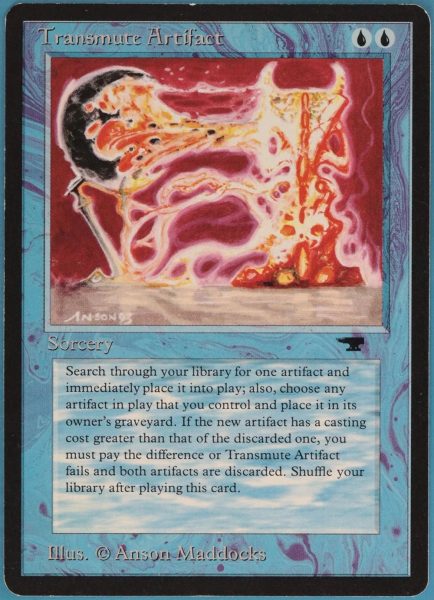
Unfortunately, there are also financial implications to this change. It used to be that a near mint card would get you the high premium offered by ABUGames. Often times the near mint grade would net you the most profits. Now that value is relegated to the “mint” grading.
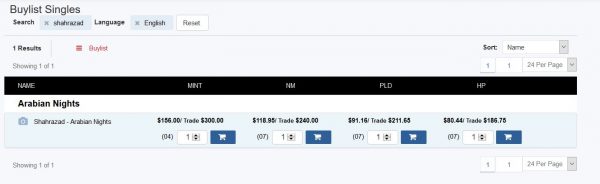
Because the drop-off from mint to near mint can be sizable, I am no longer motivated to purchase near mint cards to flip for trade credit. The risk of downgrade to near mint is too great, and profits can immediately be erased if I planned on receiving $300 in trade credit for a card, only to instead receive 80% of that.

In addition, I’m nervous about shipping SP cards as near mint out of fear for downgrade to played condition. It used to be that I was fairly confident when shipping a slightly played card for trade credit. Now, if there’s a little bit too much wear, the card could be downgraded to played with no in-between. And looking at ABU’s grading guide, a scratch and a couple edge nicks relegate the card to “played”. This is a very fine line ABUGames is going to walk.

Update 2: Cratering Buy Prices

The party is over. The dream is nearly dead. While ABUGames offered inflated trade credit on even the most unplayable Old School cards, profiting from credit arbitrage was like shooting fish in a barrel. The price declines are pretty much all-inclusive and across the board, but here are a couple examples.

Two months ago I submitted a trade-in to ABUGames and received $285 in singles credit for a heavily played Alpha Juggernaut. Today that same card would net me $237.50 in credit.

There was an error retrieving a chart for Juggernaut

Back in May I traded a heavily played Jihad to ABUGames for $160 in-store credit. Today, that card would net me $84 in-store credit! In that same buylist I also shipped a near mint Unlimited Earthquake for $108.75 in trade credit. Today, ABUGames offers $48.75 for that same card—that’s a 55% decrease!

There was an error retrieving a chart for Earthquake

These decreases do not indicate that ABUGames has suddenly become greedier, or that they are necessarily having liquidity issues. I wouldn’t read that deeply into this trend. Instead, I believe this is simply an adjustment to reflect the softness in the Old School market. At one point these cards were overheated, and players and speculators alike were buying aggressively. Now the market has cooled significantly, and these cards are now rotting in vendors’ inventories.

Then again, I just checked and I see ABUGames has only 5 Unlimited Earthquakes in stock (3 HP and 2 Mint). And they’re not likely to take many new copies in offering such a low buy price on the card. So maybe these price drops do reflect something deeper? One can only speculate!

Update 3: Prices Are Dropping!

As I said before, ABUGames isn’t a greedy corporation aiming to suck all value out of the market. They’ve been dropping their buy prices significantly on Old School cards, but they’ve also been dropping their sell prices in kind!

Remember their 55% drop in Unlimited Earthquake? Well, that drop is also reflected in their sell prices! In fact, you can acquire a heavily played copy for $23.09 from ABUGames. Is that a good price? Well, Card Kingdom has 0 Good copies in stock, but if they did their price would be $17.20. So while obviously $23.09 is a premium, it’s a modest one.

ABUGames has near mint copies of Jihad in stock with a price tag of $139.99. Card Kingdom’s near mint price is $109.99. But remember, “near mint” could mean “slightly played”—this is a good demonstration of why the new grading system can be tricky. Still, this used to be a card that ABUGames would charge 2x the price for vs. the rest of the market. Now their pricing is much closer to reasonable.

There was an error retrieving a chart for Jihad

Back when it was easy to acquire trade credit at a 50% discount by buying cards from other sites and flipping to ABUGames, cards like Jihad were so overpriced that even a 50% discount made for an unattractive entry point. Today, if a 50% discount of trade credit would be attainable, it would mean a $70 cash price for a near mint Jihad. That would be an incredible price!

That brings me to the ultimate question: can ABU trade credit still be had at 50-60%? If so, there’s a great deal of profit to be had. In fact, the options for cashing out trade credit used to be thin and difficult to find. Now there are many ways to cash out trade credit for profit…if you can still acquire any at the deep discount that used to be readily available.

Because ABUGames has dropped their trade numbers so much, the opportunities to grind out credit at a steep discount are far reduced. It’s like the challenge to ABUGames arbitrage has been reversed. It used to be easy to acquire credit and difficult to spend it profitably. Now it’s easy to spend credit but difficult to acquire it profitably.

In the long run, this adjustment will greatly reduce the trade credit inflation problem that has been plaguing ABUGames for the past couple years. Suddenly, $100 in ABUGames store credit is worth more than $50 or $55. Even $60 may be an attractive price for $100 in-store credit. Could we actually be seeing the value of the ABU buck appreciate? It’s a real possibility, and something worth monitoring going forward.

Wrapping It Up

I want to wrap up this week by touching briefly on the newest challenge: acquiring ABU credit. If you’re convinced (as I am) that the ABU buck stretches farther than it did before, you may be interested in trying to find some discounted ABU trade credit. Fortunately, I have a couple ideas to share.

First, you could try to purchase the credit directly from others. Back when ABU credit was easily acquired on the cheap, it seemed like no one wanted the inflated currency. Even though things have been changing, there may be a lingering effect whereby ABU credit can still be acquired at a steep discount. If you find folks selling their ABUGames trade credit on social media at a 50-60% rate, you may consider jumping on the opportunity.

If that doesn’t work, do not despair. There is still one other way to acquire cheap credit, although it’s more time consuming: you can browse TCGPlayer, Card Kingdom, and Cool Stuff Inc for cards to flip for 2x the trade credit. I’d recommend sticking to played and heavily played stuff to avoid disagreements on what is “mint” versus what is “near mint”. The opportunities are greatly reduced, but they’re still out there.

Recently I made a $100 purchase from Cool Stuff Inc’s website—I grabbed a couple Old School cards that could be flipped to ABUGames for roughly 2x in trade credit. Included was a heavily played Unlimited Fork for $19.99. ABUGames offers $40 in trade credit for HP copies of the card.

There was an error retrieving a chart for Fork

The opportunities are out there, if you’re willing to put in the work. This kind of grind isn’t for everyone; some people shiver at the thought of browsing sites endlessly, comparing prices with ABUGames’ trade credit numbers. Personally, I find the practice relaxing in some ways. Even when I fail to find a deal, I still feel encouraged knowing the possibilities to profit are out there, for the taking, if I’m willing to put some time into it.

…

Sigbits

  • Topping Card Kingdom’s hotlist today is Unlimited Tundra, which is somewhat surprising since it encompasses two arguably weak facets of the Magic market: Old School and Legacy. That said, they’re still offering $390 for near mint copies of the Dual Land. Then again, ABUGames offers $507 cash for “mint” copies…if you can actually find one.
  • Card Kingdom also added a couple other high-end Old School cards to their hotlist recently: Candelabra of Tawnos ($340) and Moat ($330). These numbers are of course far from their highs, but it’s encouraging to see Card Kingdom expressing at least some interest in these left-for-dead staples. ABU’s “mint” numbers for these two cards are $390 and $307.12, respectively. It’s interesting to see CK go after Moat more aggressively than ABUGames.
  • A few weeks ago I mentioned the oddly low number that Card Kingdom offered on Judge Foil Mana Crypt. Since then, they've upped their buy price from $95 to $120. It seems like at least one printing of Mana Crypt is perpetually on Card Kingdom’s hotlist. They pay better than ABUGames now ($99.90).

Should the London Mulligan Be Banned?

Are you a Quiet Speculation member?

If not, now is a perfect time to join up! Our powerful tools, breaking-news analysis, and exclusive Discord channel will make sure you stay up to date and ahead of the curve.

The London mulligan has been with us now for four months, and players are speaking up on what they think of it. As a lover of the London mulligan and of mulligans in general, I've followed this topic with particular interest. One piece that recently caught my attention was Zvi Mowshowitz's article "Ban the London Mulligan" from earlier this week (guess how he feels about the rules change!). Zvi's sentiments reflect different arguments I've heard from players since the rule was first suggested by Wizards.

While Zvi's article was written chiefly with Standard in mind, he mentions that his arguments hold for constructed play generally. Today, I'll address his concerns one-by-one and reveal the degree to which I think they do or don't apply to Modern.

The Theory of Messed-Up Relativity

Early on in his piece, Zvi establishes the power dynamic at work between cards of differing quality.
You are not going to succeed in Standard, for a long time, no matter what is banned, without building around at least one messed up [sic] Magic card from Throne of Eldraine. If design does not make large adjustments, and likely even if they do, every good Standard deck for a long time is going to have a key messed up Magic card.

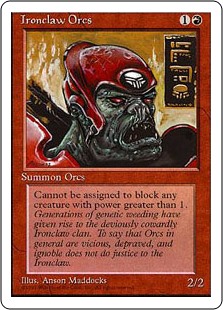
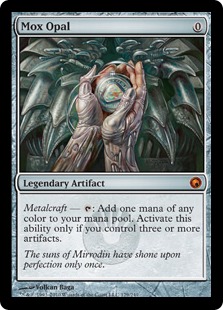
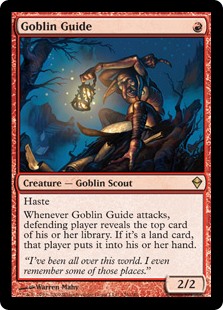
"Messed-up" is a stand-in for "broken," "busted," "warping," or any preferred buzzword. I find that such terminology can be useful so long as it's clearly defined; otherwise, it remains a buzzword. One aspect these words all share: they cannot exist without context (or, to use another buzzy phrase, "in a vacuum"). Even "good" and "bad" cards are only so because of their power relative to the other options. For instance, if every creature was a two-mana 1/1, the first-ever one-mana 1/1 would indeed be broken. There was indeed a time in Magic's history when Ironclaw Orcs was to Sligh decks what Goblin Guide is now.

"Messed-Up" as Goodstuff

In this case, the adjective "messed-up" is applied to the noun "cards." So we're not only talking about powerful things happening, but powerful things happening by virtue of a single card resolving or being drawn. In Magic lingo, we can summarize this concept as "goodstuff," the alternative being "synergy" (or when multiple cards come together to yield a powerful effect).
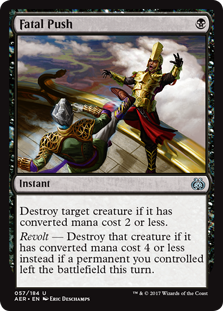
Modern used to be more goodstuff-oriented than it is currently. For a time, players were sleeving up Tarmogoyf or Lightning Bolt or just losing; the cards were better than everything else by a degree that invalidated most strategies trying to string together some other gameplan. Now, things have changed. In one sense, the arrival of Fatal Push both drastically decreased Goyf's relative strength and diversified playable removal options. But more pertinently, Modern's rich card pool has benefited from recent printings; the format's available synergies are now far stronger than the individual power level of its most "messed-up" cards.

"Messed-Up" as Synergy

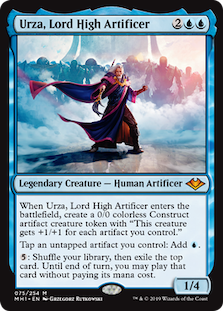
Another interpretation of the term does away with the notion of cards holding their own independently. When it comes to synergy, we're working with enablers and payoffs. A "messed-up" card could very well be an extremely efficient enabler (in Modern's case, something like Faithless Looting), or payoff (think Urza, Lord High Artificer).
Zvi seems to grasp this concept:

Even more than a single messed up Magic card, these decks have central play patterns.

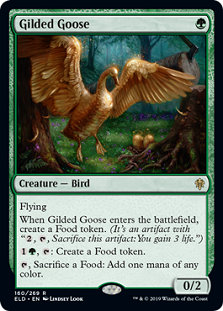
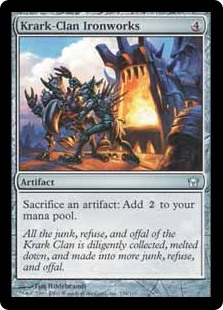
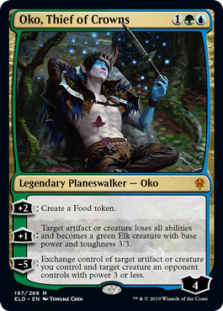
A goodstuff deck, like Jund, is content to slam whatever individually powerful cards it draws and hope they're good enough. But the more a deck trends towards the synergy end of the spectrum, the more it becomes reliant on central play patterns. Such patterns can be as explicit as assembling a two-card combo (e.g. Sword of the Meek and Thopter Foundry) or as mundane as curving out properly (e.g. Gilded Goose into Oko, Thief of Crowns).

One Game? I'll Show You One Game!

Put another way, I detect a tension between Zvi's railing against "messed-up cards" and his identification of powerful synergies as driving players to mulligan so much. It seems that goodstuff cards are the fall guy here; it's the allure of synergy that keeps players going back for new hands. And his thesis is that the London mulligan makes those powerful synergies too consistent.

Every game looks the same. Both players do their thing, or else one player fails to do it, is likely also down cards, and never has a chance. Lots of time is spent shuffling, and going through the same motions over and over again.

"Looks the same" is—you guessed it!—relative. But in any case, the more consistent the game gets, the more alike games come to look. This particular complaint is one often leveraged against Yu-Gi-Oh!, a manaless game I've written about before that's leaps and bounds more consistent than Magic. There, extremely lenient combo requirements (or in brickier decks, one-card starters) all but ensure that players successfully "do their thing" on turn one, leaving it up to opponents to "break the board." And since that board-breaking card may well be sitting on top of the deck, pilots can't really concede to their opponents, since they technically have a chance to win. They're forced to sit through 5-10 minutes of enemy combos before checking to see if they can clear the field of what are basically walking counterspells and do their own thing.
That description may sound horrible to you, in which case I'd advise against ever playing Yu-Gi-Oh! But it's fine with the game's many players, including myself. And Magic, even with the London mulligan, is much, much less consistent than Yu-Gi-Oh!

My experience playing that game has taught me that such happenings are due to not individually powerful cards, but synergy. Whenever Yu-Gi-Oh! bans a combo starter, other, slightly-less-efficient ones take its place; if payoffs are banned, other, slightly-less-impactful ones rear their heads.
Death of the (Planned) Plan B

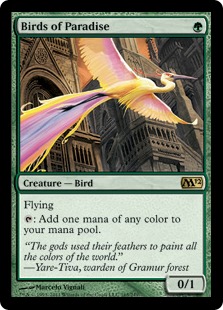
When a deck fails to assemble its core components in the right way, and therefore to execute its key play pattern, it falls back on a secondary path to victory, or "Plan B." That plan can be as cohesive as going wide with 3/3 Elks or as strung-together as beating down with an exalted Birds of Paradise. Zvi seems to be lamenting the loss of the former, more deliberate Plan B that occurs when a game becomes more consistent; as he notes, there's little reason to invest precious deckbuilding space in a Plan B when the Plan A comes together so reliably, which then makes the deck more anemic in the rare instances that it doesn't.

Magic is great because it continuously presents unique situations to its players. Decks and players are forced to be flexible and roll with the punches, to plan for not having access to their key cards. When instead decks and players are rewarded for relying on their central repetitive play patterns, because fallback sequences would lose anyway, Magic loses much of its appeal.

Although I can't speak for Standard, I'd argue that Plan Bs are actually alive and well in Modern. That's one reason Oko has enjoyed so much popularity here, even in decks where he just barely contributes to the Plan A—he offers players novel angles of attack, an attractive option in a world with hate cards so efficient that Modern players expect to be disrupted. Here, leaning too heavily on one gameplan is asking for trouble, as opponents are well-versed in how to disrupt linear strategies. "So Wrong It's Right: Accepting Tension" covers this idea in depth, suggesting that Modern players have much to gain from diversifying their strategy.
If anything, the London mulligan contributes to that line of defense. Players can run fewer copies of each hoser, and therefore a more diverse array of bullets, with the understanding that they can better find those cards at the beginning of a game. Granted, if the hoser in question doesn't exist in a certain format (as in Standard), all that falls apart.

Living in the Past

The "theory of messed-up relativity" fleshed out above also applies to synergy, the now-established culprit behind excessive mulliganing.

Thus, the first player is forced to mulligan hands that look perfectly good, but which cannot pull off their key play pattern.

If everyone is pulling off their key plays with greater consistency, a hand that cannot do so is, relative to most other hands, bad. So why does this bad hand "look perfectly good?" Perhaps because it contains a payoff or an enabler, and either of those may be perceived as "messed-up" based on how efficient they are in that role relative to other cards legal in the format. But as we've touched on, opening one of those cards doesn't guarantee victory; decks must combine both payoffs and enablers to successfully assemble synergy.
While it's theoretically possible that Zvi wants to keep every awful hand featuring Oko and feels bitter about shipping them back, I think a more realistic assessment is that the hands he's describing fulfill now-outdated requirements of playability, i.e. they contain "lands and spells." In contemporary Magic, though, those hands aren't good enough. If they "look perfectly good," maybe we just need more practice; losing with those hands enough times should teach us, brute-force style, that our perception is skewed. Identifying when a "good-looking hand" will actually win us the game has been a cornerstone of mulligan decisions since the system was invented, and while the London changes the parameters of what constitutes a good hand, it doesn't change the fact that mulligans are about doing that kind of assessment.

A Question of Taste

Which brings us to the agenda on the table. Why should a hand that may be fine by antiquated standards, but unplayable by current standards, need to work now? As I see it, Zvi's argument is akin to expecting Modern Red Deck Wins decks to run Ironclaw Orcs. Naturally, they can't, as there are much stronger options. But does that mean Wizards has mismanaged the game, or simply drive home that outdated standards don't necessarily apply past their expiration date? That question is for every player to answer for themselves, the reason being that as power cannot exist in a vacuum, taste cannot be universalized. It's personal.
Let's review the points laid out and dissected with Modern in mind.

  • London increases reliance on messed-up cards: FICTION. It increases the reliability of synergy-based deckbuilding, which leads more players to build and play with those synergies in mind.
  • Every game looks the same: FACT, in that games look more similar to each other now than they did pre-London, since everyone is doing their respective thing more often.
  • Plan Bs are dead: FICTION, at least in Modern. The hate cards are just too strong and prevalent for decks to go all-in on one strategy unless they're broken in their own rite (think Hogaak). This issue has less to do with the London mulligan and more to do with which disruptive cards are legal in a different format.
  • We have to mulligan hands that we shouldn't have to mulligan: FICTION. We have to learn to mulligan effectively under the new system, and refine our impressions of what constitutes a keepable hand, as players have done since the mulligan's introduction to Magic.

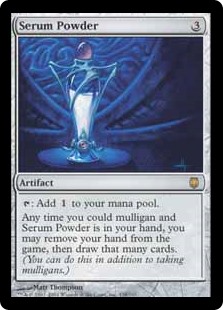
With the logic parsed, Zvi's only Modern-relevant argument for banning the London Mulligan is the same as the one for keeping Preordain out of the format: it adds too much consistency to the game for his tastes. As a lover of consistency in Magic (to the extent that I ran Serum Powder in my GP Detroit Eldrazi deck) and longtime advocate for freeing Preordain, I feel the opposite way, and quite like what the London has done for Modern deckbuilding. As I understand it, whether you are for or against the London at this point depends on your preferences in Magic, which I'm all about players developing.
So how consistent do you like your games? Which effects of the mulligan do you most relish or resent? Let me know in the comments!

Insider: Mining Pioneer for Future Gains

Are you a Quiet Speculation member?

If not, now is a perfect time to join up! Our powerful tools, breaking-news analysis, and exclusive Discord channel will make sure you stay up to date and ahead of the curve.

Pioneer is the new hot format.

We have seen tons of cards spike in price thanks to the massive new influx of demand created with a new format. The biggest risk right now is going deep on something powerful and then having WoTC ban a card or multiple key cards in the deck.

Whereas the recent addition of Pauper as a playable format caused some price spikes but has all but died off completely, Pioneer seems to be the gift that keeps on giving. I've recently had a lot of success selling previously bulk uncommons like these

There was an error retrieving a chart for Lightning Axe
There was an error retrieving a chart for Izzet Charm
There was an error retrieving a chart for Wild Slash

When these cards are acquired in piles of bulk they have massive profit margins, especially when sold in playsets. The purpose of this article is to try and pluck the cards you might often find in bulk that are currently seeing play in Pioneer that have significant potential to grow. Without further ado, let's begin.

There was an error retrieving a chart for Searing Blood

As we can see by the graph, this card actually jumped up way back in 2018 from its all-time low but hasn't moved much since Pioneer was announced as a format. We always seem to have a good red aggro deck in most formats; it may not always be tier 1, but it's rarely completely unplayable and it's often a budget-friendly option for players with limited expendable income. Currently, it only has a single major printing back in Born of the Gods, which for those who recall was a set with very little money cards so little reason for stores or players to crack packs and frankly not the most fun draft environment.

When it comes to Pioneer specs all the sets will have had large print runs, but there were still sets like Born of the Gods which were opened a lot less than other sets. This is the perfect storm for a potentially high value uncommon. It's double red mana cost means it's not as splashable as other burn options like Wild Slash, but decks that often want this card are likely mostly red to begin with.

There was an error retrieving a chart for Dovin's Veto

While copies of this card are likely still being opened at LGS's across the country, we have now had two sets printed after War of the Spark and new supply is likely to begin drying up. This card does have an FNM promo which may be the better option from a speculative standpoint, but supply is still high on both versions currently. However, this is one of the premier counterspells in the format and is good enough to see play in other eternal formats.

Pioneer has a UW Flash deck as one of the better decks in the current format and players who enjoy playing control will be sleeving up some number of Dovin's Veto's when they play Pioneer.

There was an error retrieving a chart for Aether Hub

There are still plenty of people who expect an Aetherworks marvel ban, it's important to keep in mind that Aether Hub plays perfectly well in a non-energy shell as a one-shot, pain-free mana fixing option on turn 1 that still adds colorless later on. This works especially well with Eldrazi that often require specifically colorless mana be spent on them or their abilities. There was an FNM promo available whose market price has doubled since Pioneer was announced.

There was an error retrieving a chart for Reflector Mage

Reflector Mage has a slightly higher buy-in compared to other cards on this list, but it's important to note that the price on Reflector Mage has gone up since Pioneer was announced it had stabilized around $1 for months prior to this announcement. It sees play in Modern Humans builds and is a fantastic hit off of Collected Company against most decks.

There was an error retrieving a chart for Stoke the Flames

This M15 uncommon was almost $5 at its heyday and maintained that price for several months. Core sets often tend to be opened a lot less than block sets as they often have more reprints and tend to be less desirable to draft. This card also has an FNM promo which is currently going for only about double the regular version and neither have seen any price growth since Pioneer was announced.

It is especially good when decks running Goblin Rabblemaster and Legion Warboss are good, because of the ability to remove the "must attack" clause on the tokens by tapping them pre-combat makes the previously mentioned cards even more powerful.

There was an error retrieving a chart for Unclaimed Territory

While there are a lot of copies of this card floating around, again we see no discernible price increase after the Pioneer announcement. This is a pain-free multi-color mana fixing land that is usable on turn 1. Obviously, the fact that it only helps with one specific creature type means it doesn't fit in any 3+ color deck that isn't heavily focused on a specific creature type, however, similar to the previously mentioned Reflector Mage, Unclaimed Territory has a home in multiple eternal archetypes and naturally fits into any non-mono colored creature type-specific archetype.

There are a significant number of powerful creature archetypal deck options that exist and as is usually the case, it often only takes one or new additions before one becomes playable.

There was an error retrieving a chart for Reckless Bushwhacker

Last but not least is another card destined to be an auto-include in any aggressive red creature-based deck. It's price breached the $1 mark long before Pioneer was announced as a key card in the 8-Whack decks of Modern. While Pioneer doesn't have the other 4 whacks (Goblin Bushwhacker) it does still have the powerful sidekick of Burning-Tree Emissary and unlike many other cards I mentioned there is no promo or other version, just the Oath of the Gatewatch option.

Conclusion

These appear to be some of the top uncommons in the Pioneer format that haven't really moved much in price and thus have the most potential upside. It's important to keep in mind that WoTC's desire to cull the format almost weekly via bans does mean there is inherently a lot more risk in any Pioneer speculation at this time, but there is likely high reward potential with these types of specs.

Profile of a Thief: Oko in Modern

Are you a Quiet Speculation member?

If not, now is a perfect time to join up! Our powerful tools, breaking-news analysis, and exclusive Discord channel will make sure you stay up to date and ahead of the curve.

It's been an odd year for Magic. Modern struggled through a series of bans while Standard was doing well. Once things started looking up for Modern, Standard began its collapse under the weight of Throne of Eldraine. Some of those effects are now leaking into Modern, with uncertain implications.

Urza may be the talk of the town in this format, but Oko, Thief of Crowns is the talk of Magic. He's been ruling Standard since Eldraine was sanctioned, and dominated the last Mythic Championship to such an extent he'll almost certainly be banned next week. Thus far, his impact on Modern has been negligible, but that may not continue. A number of decks are attempting to make Oko work either as a primary plan or a backup. The results so far are intriguing, but it's not clear that any will actually work out. Today, I'll be examining Oko and the decks trying to wield him in closer detail.

The Thief in Detail

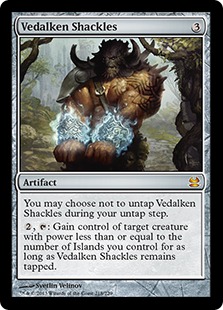
Cheap planeswalkers are always worth considering for Modern, but Oko doesn't look like much on face. Food really doesn't do anything Modern-worthy, 3/3's aren't so impressive here, and stealing creatures isn't a thing in Modern. There are plenty of options that have seen play like Threads of Disloyalty and Vedalken Shackles, but they've been too inefficient or easily answered to see more than fringe play. However, Oko is far more than the sum of his parts, and in the right context he's an incredibly powerful planeswalker. The only catch: this sort of power isn't very common in Magic, and definitely not in Modern. Oko's abilities take on unique properties depending on whether players are playing as the beatdown or the control in a given game.

Oko on Offense

While Oko has high loyalty and a +2 ability, they're not what makes him playable. In Standard the main way to kill planeswalkers is to attack them, but Modern has Abrupt Decay and similar removal. Making food is okay against Burn, but a bit slow. This ability should be regarded as the backup plan for when there aren't targets for the +1.

The primary purpose of Oko is to make 3/3 Elks. We've seen many ways to make noncreature artifacts into creatures, with Tezzert the Seeker, Karn, the Great Creator, and March of the Machines being the most prominent. However, they're either much slower or only make the creatures as strong as their CMC. That's not great for a deck built around 0-1-cost artifacts. Since Oko comes out fast, permanently alters the target, and can just keep going, he is an army in a can. The fact that the ability is a +1 is key here: there's no limit to Oko's Elk-making, which is means there's never a trade-off or a risk of running out of activations.

I've only seen Oko's -5 used to steal mana dorks, and even then only twice. Modern just doesn't have many cheap, weak creatures that a deck would want to steal. Those that do often have ways to pump them. In a pinch, this ability could certainly be used to clear a path for attackers, but that is niche at best. The times I've observed it in action, the Oko deck was mana starved and slightly desperate, so I consider it a minor bonus rather than a primary consideration.

Thief in Retreat

However, I'll argue that Oko's real power is turning opposing creatures and artifacts into Elk. There have been many ways to shrink creatures and/or make them lose their abilities, with Humility being the most famous and Lignify being Modern accessible. However, these methods tend to be temporary, and I couldn't find an instance of artifacts being affected. Again, Oko's transformation persists if he's removed, which is unprecedented. This means that Oko is a near-universal answer to an opposing board, a fact Wizards apparently didn't notice.

Turning Wurmcoil Engine or Death's Shadow into 3/3 vanilla Elk is incredibly powerful. So is "Elking" Drokskol Captain or Devoted Druid. Decks with creatures bigger than 3/3 don't tend to have many of them, so transforming them ends up being quite similar to outright removing them. Meanwhile, those with smaller creatures play ones with tribal synergies or abilities where removing their creature types and/or abilities is worth the stat upgrade.
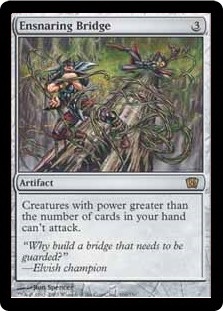
However, the real power is hitting opposing artifacts. Specifically, Oko wrecks prison cards by stripping away their abilities. Ensnaring Bridge can't stop creatures when its an Elk; Mind Stone won't make mana; Amulet of Vigor doesn't untap lands. Thus, Oko becomes not only disruptive to opposing plans, but a counter to opposing answers.

One Gameplan

With a strong offensive plan and the option to switch seamlessly to defense and back, Oko has the same entire-deck-in-one-card power as Urza, Lord High Artificer. But Oko isn't on the same power level as Urza, since he's not a combo piece. Instead, Oko is a disruptive planeswalker that can actually win the game as well. Liliana of the Veil is far more obviously disruptive and can shut out opponents, but she can't actually turn the corner. Oko sniping critical creatures or artifacts and then re-growing a board can be tremendously potent.

A Primary Plan

The problem with adopting Oko as a primary plan is that there's really only one way to go, and it's been done. In Standard he's everywhere because Standard's gameplay is about snowballing advantage until it overwhelms the opponent. Oko naturally fits in by generating several types of advantage for its controller and taking some away from opponents. That style of gameplay hasn't worked so well in Modern, as the answers and threats are better; take Tron, for instance. There isn't the time or space for decks to quietly build up and crash down like a tsunami. However, there does exist one deck that was already blitzing out raw material, featured acceleration, and really needed something else to do with it all.

Oko Urza, Jeremy Bertarioni (3rd Place, SCG Atlanta)

Creatures

4 Gilded Goose
4 Emry, Lurker of the Loch
4 Urza, Lord High Artificer

Instants

2 Metallic Rebuke
2 Whir of Invention
3 Cryptic Command

Planeswalkers

4 Oko, Thief of Crowns

Artifacts

4 Mishra's Bauble
4 Mox Opal
3 Engineered Explosives
4 Arcum's Astrolabe
1 Aether Spellbomb
1 Sword of the Meek
1 Thopter Foundry

Lands

4 Misty Rainforest
2 Polluted Delta
2 Scalding Tarn
2 Mystic Sanctuary
1 Breeding Pool
1 Watery Grave
4 Snow-Covered Island
1 Snow-Covered Forest

Sideboard

3 Damping Sphere
2 Fatal Push
2 Thoughtseize
2 Nihil Spellbomb
1 Assassin's Trophy
1 Collective Brutality
1 Drown in the Loch
1 Ensnaring Bridge
1 Pithing Needle
1 Plague Engineer

Oko Urza is not the only version of this deck that could exist. However, I can't imagine that any deck with Oko as a primary plan would do much differently. Urza already floods the board with do-nothing artifacts, hoping to turn them into a win with Urza. It's also very likely to have prison cards played against it, which gives Oko's defensive utility a chance to shine. The walker also dodges graveyard and artifact hate. Oko is slower, but nonetheless synergizes with the main plan perfectly, all while not being dead to otherwise relevant hate.

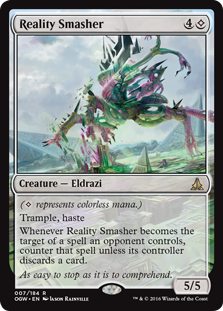
An interesting case is Eldrazi decks running maindeck Oko. Sure, Reality Smasher is much better than a 3/3 Elk. However, Smasher isn't better than Ensnaring Bridge or Wurmcoil. From what I can tell, Oko makes up most of the interaction and disruption present in these decks, while the rest of the deck commits to beatdown. Anything that can potentially stop the Eldrazi attack gets shrunken out of the way (it's not like a 3/3 can stand up to Eldrazi creatures). Oko can also turn mana dorks and Scion tokens into Wild Nacatls.

This Oko plan performed admirably in its debut, but whether that was due to the deck or the pilots is up in the air. I haven't seen it do especially well online or in paper since then, but most of Magic's focus has been on Standard recently. Oko's viability as a primary strategy is therefore unlikely to be decided until next year.

The Fallback Plan

I'm skeptical that Oko will prove to be a true keystone of Modern like Primeval Titan or Liliana of the Veil. The sacrifices needed to make him a deck's lynchpin seem steep, and the decks that would make them are of the type that attract bans. There's also the issue of the non-Oko and Urza components not doing anything. Mishra's Bauble and Moxen are great and creating a critical mass of artifacts, but they don't do anything to actually win the game. Without Urza or Oko to give them meaning, all the artifacts in the deck are just air.

Instead, I think that Oko will endure as a backup plan. The most common non-Urza home appears to be Bant creature decks. These decks, from Ephemerate-based builds to Counters Company, are filled with extremely anemic creatures and mana dorks. If the primary value/combo plan is disrupted, the creatures do nothing. Oko offers an alternative, turning those useless dorks or defunct combo pieces into more useful Elks.

Some decks employing this strategy have Oko maindeck, and others sided. The former are acknowledging their inherent weakness and assuming something will go wrong, while the latter plan to only use Oko against control and Jund. I favor maindecking Oko if going this route. The flaws in these decks are well-known, and it's not like Value-Creatures.dec is tearing up Modern. So why not plan to get the enters-the-battlefield value and then make those spell-carriers into reasonable threats? As a particular bonus for Bant Ephemerate, there's no need to keep the Elk. Coiling Oracle is a pathetic creature in combat. So, turn it into an elk for an attack step. Afterward, flicker it with Soulherder and get value again.

Counter-Counter-Tribal

The most intriguing application of Oko as a secondary plan has been in tribal decks. I've seen Merfolk running Oko maindeck, and while I don't agree, I understand. I've played a lot of tribal decks and I know as well as anyone how weak the creatures are individually or in the face of removal. Thus, the idea is to use Oko to turn the remaining 2/2 dorks into superior 3/3 dorks and keep up the pressure.
The route isn't a bad idea against removal-heavy decks when lords are unlikely to survive. The problem I have is that Oko is counterproductive to the main point of the deck once he gets going. Yes, a 3/3 is better than a 2/2. However, taking away the tribe from the 2/2 means that when you those synergy cards are drawn, the new creatures are also just 2/2's. This creates a downward spiral of the deck not working as intended. Making food into elk is again a fine backup plan, but if all that's missing is token generation, there are lots of ways to do that on-theme like Deeproot Waters for Merfolk or Moorland Haunt for Spirits.

Oko's a useful way to answer Plague Engineer, but I don't think he'll catch on in tribal decks; he's just too medium as an offensive option.

Changing the Battlefield

The other option is to use Oko to shift gears altogether. I've mostly seen this happen out of the sideboard for decks that have strong Game 1s, but are very vulnerable to sideboard cards. Oko provides a completely different angle of attack for these decks and negates the opponent's plan. Consider Infect: there are few things more terrifying than Glistener Elf on the play. However, it's still a 1/1 that dies to everything, especially once all the removal is brought in game two. Instead of fighting this, Infect is leaning in, letting opponents board for the Infect fight and then playing the go-wide game with Oko.

If All Else Fails, Audible to Standard

Amulet Titan appears to be increasingly embracing this use, and going somewhat beyond. Titan has always had a very solid Game 1, but could struggle post-sideboard as opponents shifted to fight big creatures. A common answer was to sideboard out of the pure combo version into more creatures and go wide. Increasingly, decks are adopting Oko as part of that strategy. The change adds a value engine and option to turn dead artifacts and Sakura-Tribe Scouts, as well as food into an army, trumping the anti-Primeval Titan hate.

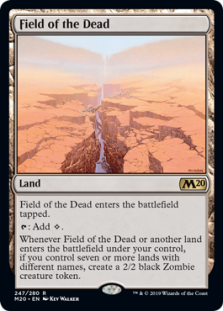
However, that's a surface-level change. I'm increasingly seeing Amulet decks go deep with Oko. In a sense, they're starting to change formats: Field of the Dead alongside Oko dominated Mythic Championship 5, and Titan decks are starting to resemble those Standard decks. Plenty of Modern players are well-prepared to fight a Titan. They're not necessarily ready for an endless stream of Zombie tokens, and especially for them to be 3/3s. It's a brilliant example of repositioning.

The Fae's Place

There's a lot of utility and power attached to Oko. The question is whether Modern can wield it effectively. I'm certain that Oko has a place as a sideboard card and as a way to circumvent hate. Time will tell whether he can carry an archetype or maintain his current momentum.

Gearing Up for SCG Con Winter

Are you a Quiet Speculation member?

If not, now is a perfect time to join up! Our powerful tools, breaking-news analysis, and exclusive Discord channel will make sure you stay up to date and ahead of the curve.

SCG Con Winter is right around the corner (This weekend, in fact), which can only mean one thing: snow.

It’s been snowing heavily for the last 12 hours as I write this, and it’s supposed to continue for another 12. For those of you that aren’t in the know, the last SCG Con Winter yielded an epic snowpocalypse the likes of which lands as far south as Virginia seldom see. All events outside of the main event top 8 on Sunday were canceled for safety reasons, which allowed me to make it back to work in time for my shift the next day. The drive home took an extra 5 hours longer than normal, thanks to the Corolla I purchased when I lived 700 miles south of where I live now.

My favorite memory was having to scale a massive hill that was littered with cars and semi-trailer trucks that had failed the test. On our first attempt, we got halfway up the hill and eventually had to stop due to one of the trucks being trapped in the middle of the lane. We hadn’t maintained enough speed to handbrake hero our way around him. So we did the sensible thing and reversed all the way back down this half-mile hill, and made another attempt. On the second try, a helpful cop got out of his cruiser to push us after we slowed down to pass the truck. We made it, which means we got to continue the joy of driving 5-10 MPH for the next couple hours, stopping every 30 minutes to chop snow off my tires, until we hit a state that had salt trucks.

Despite the snow nonsense, the weekend was awesome. I got top 64 in the main event, which was a big accomplishment for me as I’d never day 2’d an Invitational before. I’m trying to brand inclement weather as my good luck charm, and I’ve been preparing like crazy to back it up. Modern is an easy lock; I’m just going to play Amulet Titan and pray. People will be prepared for it, but the deck is good enough that I should be able to salvage wins against the field and maybe get a little lucky to beat the better-prepared players. Pioneer… well if any of us already have this format figured out, then we have the tools to make a lot of money!

That’s the beauty of mixing tournament preparation with MTG Finance. Those who are paying close attention to the metagame and noticed that Wild Slash is one of the premier removal spells of the format were able to pick up tons of copies for pennies and flip them for $4+ per. I write this article before the Pioneer ban announcement on 11/11/19, so hopefully Aaron doesn’t make me out to be a fool, but I’m hoping for no bans. The StarCityGames Invitational is just a few scant days away, and I can’t wait until 6PM EST to start writing an article!

What Does Pioneer Look Like Now?

So, as of today, the most recent spikes were visible from a mile away, and we’re nowhere near done with this phenomenon. Nissa, Voice of Zendikar and Hardened Scales were cheap, low-risk, high-reward plays. What’s next though? Well, as always, the PTQ Decklists are very useful. Todd Anderson has somehow top 8’d the only two pioneer PTQs to have occurred to date, so that’s nuts. We also have the Pioneer Challenge decklists for information.

Green devotion strategies are very clearly too powerful, taking 5 of the top 8 slots in the Challenge. Guess it was unreasonable for me to hope for no bans earlier. I guess some combination of Once Upon a Time and Nykthos, Shrine to Nyx will be gone by the publication of this article. If I’m lucky, it’ll just be those two, and I can continue to prepare against a relatively-known metagame. Other decks performing well, and some obvious future gainers respectively:

UR Emerge

UW Flash

Mono Black Aggro

Ghalta Gang!

There are a lot of other good strategies seeing play right now, but these are the ones I want to touch on for now. Smuggler's Copter feels a little too good and is basically an auto-include in any aggressive creature strategy. It’s a great pick if you want to play the format, but it is very likely to get banned at some point over the next month. As someone who has been attacked on Turn 3 by a Ghalta, Primal Hunger with haste, I can say that the card is very scary.

Bloodsoaked Champion, Ghalta, Primal Hunger, and Hour of Promise are certainly under-priced currently, along with all the staples mentioned from UR Emerge and UW Flash. I imagine that you'll be pretty satisfied if you just buy all of these cards in the next couple days for current retail.

Goodbye, Veil

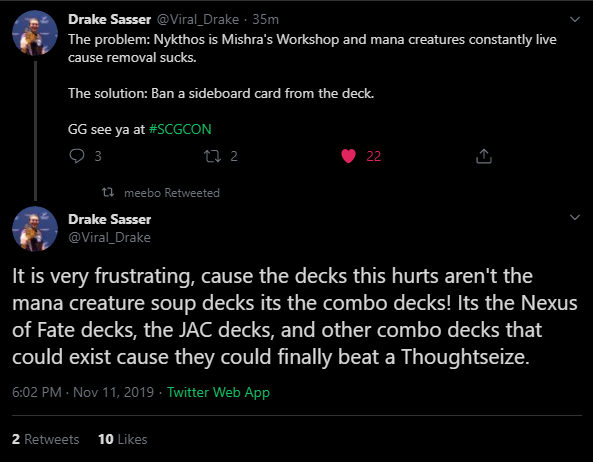
As I write this paragraph, the Pioneer bannings have gone live. Veil of Summer has been slain, which seems like a pretty egregious call. The ever-eloquent Drake Sasser put it best:

These green devotion ramp decks do not lose to Thoughtseize or a single counterspell. Veil of Summer is not the source of their power. It's probably the 4th most important card in the deck, behind Nykthos, Shrine to Nyx, Once Upon a Time, and Nissa, Who Shakes the World. This may very well mean that Mono-Green Devotion will dominate SCG Con Winter's Pioneer portion, but without Veil, it is possible that the deck's weaknesses are more exploitable. Thoughtseize/Counterspell for the planeswalker/threat, sweep away the dorks, and maybe we're playing some Magic.

It will likely be several days before we know just how lopsided the metagame will be. That said, the close proximity of the event, coupled with card availability issues from this brand-new format, will likely prevent Mono-Green Devotion from being too greatly represented, even if it's the best deck in the room by far. I paid top dollar for expedited shipping for a playset of Vivien, Arkbow Ranger today, and I'm hoping they make it in time. I expect these bad boys to move steadily at $20-25 at the Con if this deck is the best, although I don't recommend buying your own for fear of a ban.

What I'm On

If the Invitational started tomorrow, I'd play Dylan Hovey's UW Flash:

UW Flash

Planeswalkers

4 Gideon, Ally of Zendikar
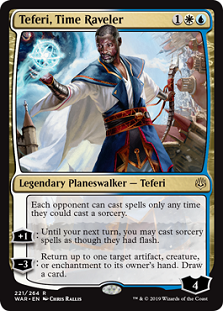
4 Teferi, Time Raveler

Creatures

3 Archangel Avacyn
4 Brazen Borrower
4 Reflector Mage
3 Selfless Spirit
4 Spell Queller
4 Thraben Inspector

Artifacts

4 Smuggler's Copter

Lands

2 Castle Ardenvale
4 Glacial Fortress
4 Hallowed Fountain
2 Irrigated Farmland
4 Island
7 Plains
3 Port Town

Sideboard

2 Deputy of Detention
2 Disdainful Stroke
2 Mystical Dispute
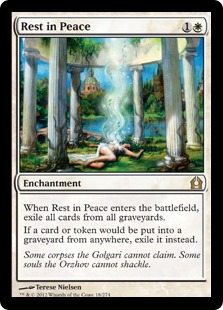
2 Rest in Peace
4 Supreme Verdict
3 Surge of Righteousness

The Invitational Awaits

Wish me luck; I have a lot of Pioneer testing ahead before I brave the snow to do battle this weekend. My findings over the next few days will be posted to my Twitter, as I'll likely already have plenty to cover in my post-Invitational article without bogging it down with more testing and pre-Invi thoughts. Keep paying attention to Pioneer, as it's going to continue to drive MTGFinance in a big way for the foreseeable future.

Many of my peers have mentioned that the window to sell may be smaller for Pioneer than other formats due to deep pockets of supply for RTR and beyond sets. I'm inclined to agree with them, so be sure to sell fast into those spikes unless you're holding out for a deeper one!

MTGO: Speculating in the Wake of Pioneer

Are you a Quiet Speculation member?

If not, now is a perfect time to join up! Our powerful tools, breaking-news analysis, and exclusive Discord channel will make sure you stay up to date and ahead of the curve.

Last week I discussed how Pioneer would be an overall boon to Magic Online and to Magic Online finance. Today I'd like to look at the fun stuff - how investors and speculators can take advantage of Pioneer's introduction to MTGO.

Before we begin, I should say that if you want to get into MTGO to play Pioneer, or if you are already on MTGO and are wondering whether now is a good time to jump in and play Pioneer, I would encourage you to go ahead and jump in and get a deck. Pioneer is going to be a supported and popular format. It fills a very real need in the Magic community and provides gameplay more reminiscent of Standard than of Modern or Legacy, so it will carve out a nice niche for itself. While prices will settle eventually as hype dies down, you should not expect a crash, so the investment you make now will be worth it.

I. Avoid Investing in Pioneer Staples

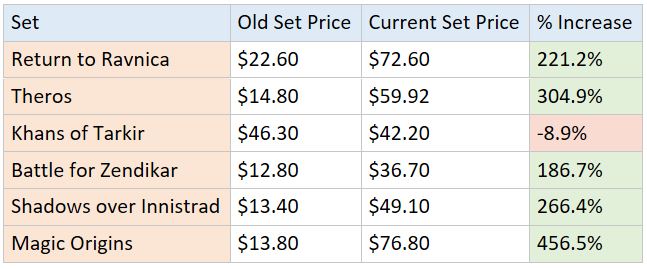
Within a few hours of Wizards' Pioneer announcement, many of the most powerful cards from Return to Ravnica forward experienced a major price spike that has been sustained by high demand. While these cards would have been good investments, they no longer are. Most Pioneer sets' values have more than doubled since the format's announcement, and most are still trending up as more and more people try out the format.

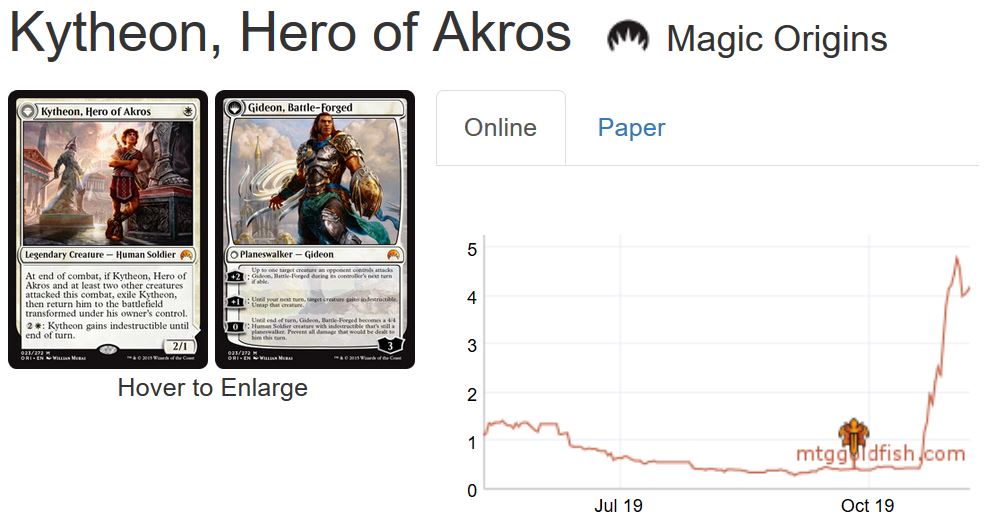
When investing, you never want to buy high, and this graph shows that that's what you'd be doing by investing into Pioneer staples. I think that these prices will hold or dip slightly (so it's okay to buy now if you want to play), but investors should steer clear.

Basically, avoid speculating on cards whose price graphs look like this; there are a lot of them:

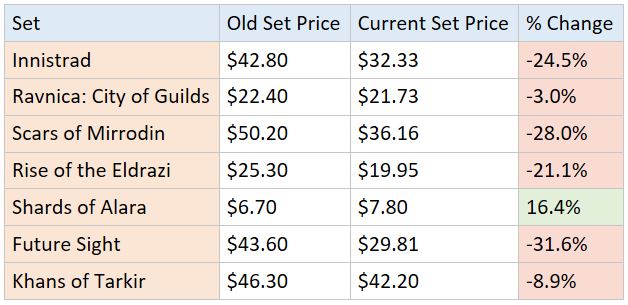
That Khans of Tarkir is the only set legal in Pioneer to see a dip in value is itself telling. Because of the fetchlands, Khans of Tarkir's set value is more closely aligned to Modern than to Pioneer. The dip in value we see with Khans of Tarkir is happening to most Modern sets pre-Return to Ravnica. To capitalize on Pioneer's introduction to MTGO, then, we probably need to look to invest in Modern cards.

II. Why Invest in Modern Cards?

Fall is the Best Time to Buy Modern Cards

Modern is most popular as a format between March and August, when many grow tired of Standard and they want to play a different format. This is reflected in league participation numbers and card prices on MTGO, where Modern staples tend to be low during the fall and winter months and then rebound in the spring.

Prices on Modern cards already started dipping in September, especially once Throne of Eldraine was released. Even before Pioneer was announced, Modern prices were down about 10%. We might have seen a larger dip in Modern prices, but the historic terribleness of Standard has likely kept Modern demand higher than usual.

Players should look to buy their preferred Modern deck between now and Christmas. Investors should know that between now and Christmas is the ideal time to make your Modern specs. Investors will have to sit on these cards for several months, but these are relatively safe specs. As longtime QS readers know, I prefer investing in singles only if the underlying fundamentals will naturally push cards like it up in price; this is a great way to mitigate risk when investing in singles.

People are Selling Modern Cards to Buy Into Pioneer

All of the price charts for Modern sets make one thing clear. While prices were already declining thanks to seasonal renewed interest in Standard, it was the Pioneer announcement that really sent Modern prices plummeting. As the Goldfish price graphs show, Modern set values generally declined by an average of 15% to 20% after the Pioneer announcement. Here's a summary snapshot, which shows how the set values of various large Modern sets today compare to what they were the day before Pioneer was announced.

This significant dip across the board presents us with an opportunity, but also a risk. Will Modern not be as popular as it once was? Will Pioneer become the new Modern? Will we be seeing less Modern on Twitch than we have in the past?

This is a legitimate fear, but there are three big reasons to accept the risk and invest. (i) First is that Modern has always been an immensely popular format, and remains so to this day. It is still the #1 format on MTGO, it still garners the most twitch views at Pro Tours and other major tournaments. It was always more popular than Legacy. (ii) Perhaps even more importantly, all Modern cards can be reprinted, so Wizards can still make money off of the format.

As we saw in the SCG letter about why SCG is no longer supporting Legacy as a major format, one of the problems with Legacy is that the Legacy community couldn't really grow or expand because Reserved List cards got too expensive. Modern will not have that problem. (iii) Third is that Modern is a unique format that feels different both from Pioneer and from Legacy. Folks worried that Pioneer would feel like Modern can rest easy. Modern is fast and powerful. Pioneer is a grindy, powered-up version of Standard. And as we've seen from the first wave of bans, Wizards wants to keep it that way.

The reason for the Modern price drop, then, is likely more superficial and innocent. People were excited about playing Pioneer, and they needed to sell their Modern cards so that they could afford to play Pioneer. These people will buy back into Modern, as will many of the people who have returned to the MTGO platform over the past few months. Still others will buy in to test for major Modern tournaments.

III. Good Modern Speculation Targets

To be frank, there are too many to count. I've been investing broadly into various Pauper and Modern cards, and I will share a few of them here today. In general, I've been looking for cards that took a big dip alongside the Pioneer announcement, and those that have not been declining for years and suffering under the weight of treasure chests and reprints. If you want to see everything I've been investing in, hit me up on Discord.


Y'all are dead to me

1. Primeval Titan

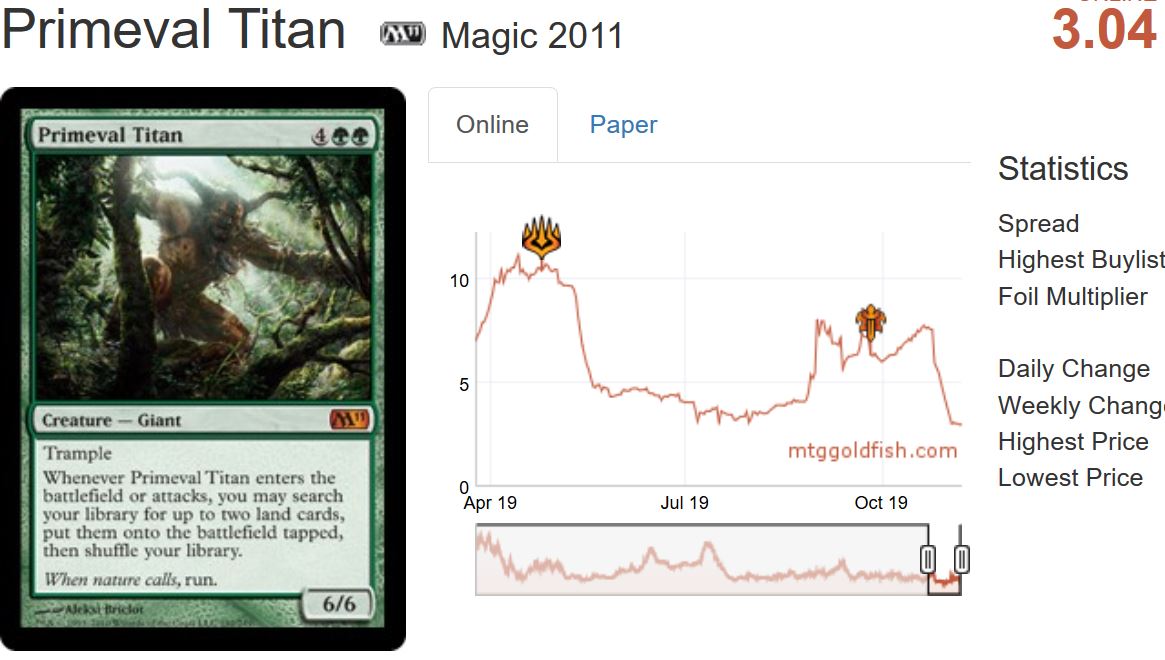
Primetime is exactly the type of card I want to invest in. It is a tier-one staple with applications in lesser archetypes as well. It is a card that sometimes experiences spikes upwards to $10 and is currently sitting at $3. And it is a card that the price graph makes clear was obviously being sold to buy Pioneer cards.

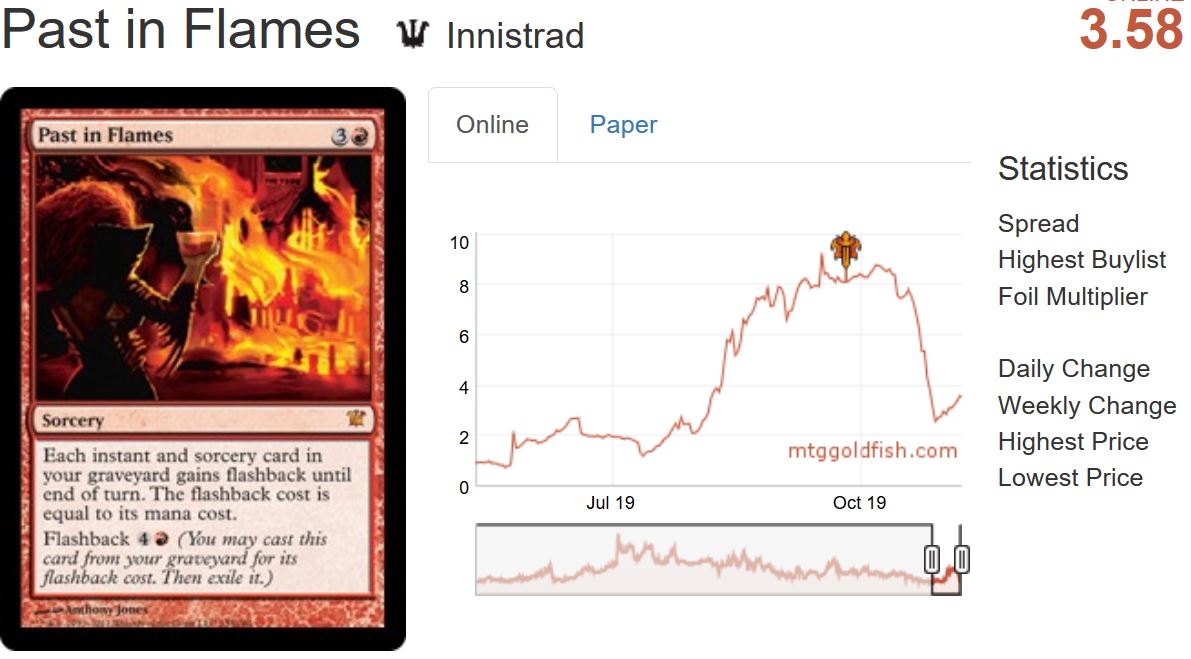
2. Past in Flames

Past in Flames is one of many cards that lost 75% of its value in one day. This is a powerful card integral for a popular archetype (Storm). Expect Past in Flames to be at least $5 come Spring, with the potential to spike into the $8 to $10 range should Storm find itself atop the metagame pyramid for a time.

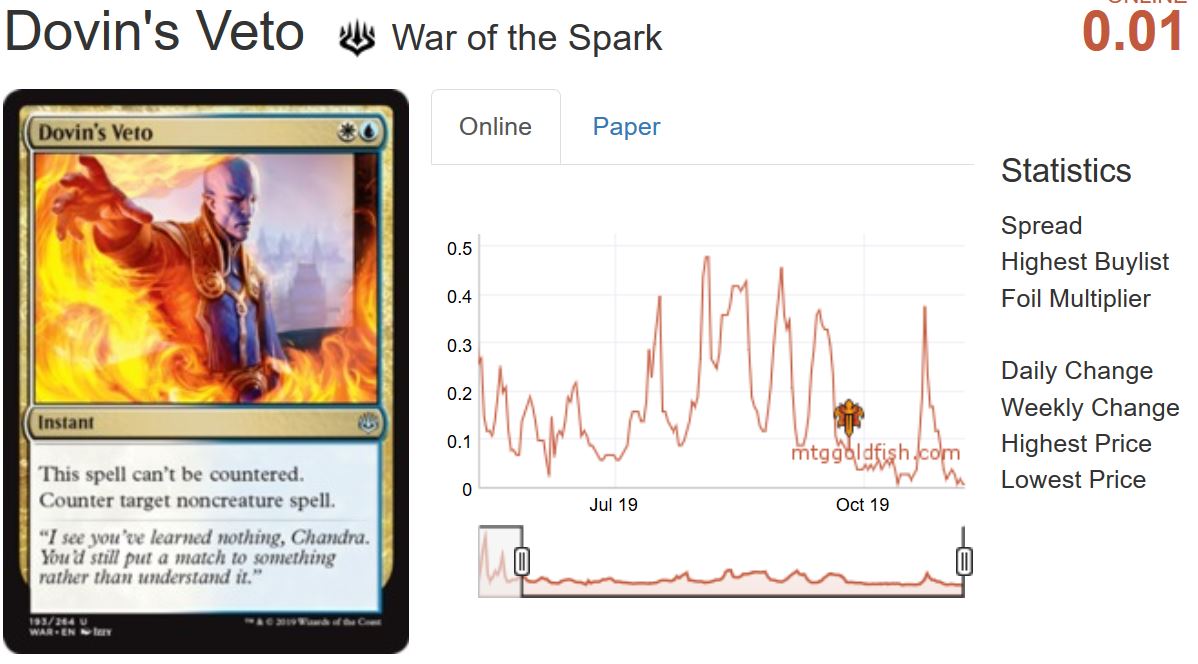
3. Dovin's Veto

This is one of the rare cards legal in both Pioneer and Modern that is currently a good investment opportunity. Dovin's Veto is just a superior Negate and sees play in Standard, Pioneer, and Modern. Its supply is low for an uncommon because War of the Spark was released during Arena's honeymoon period, and it already has experienced frequent spikes up to $0.40 or $0.50. I plan on buying at least 100 of them.

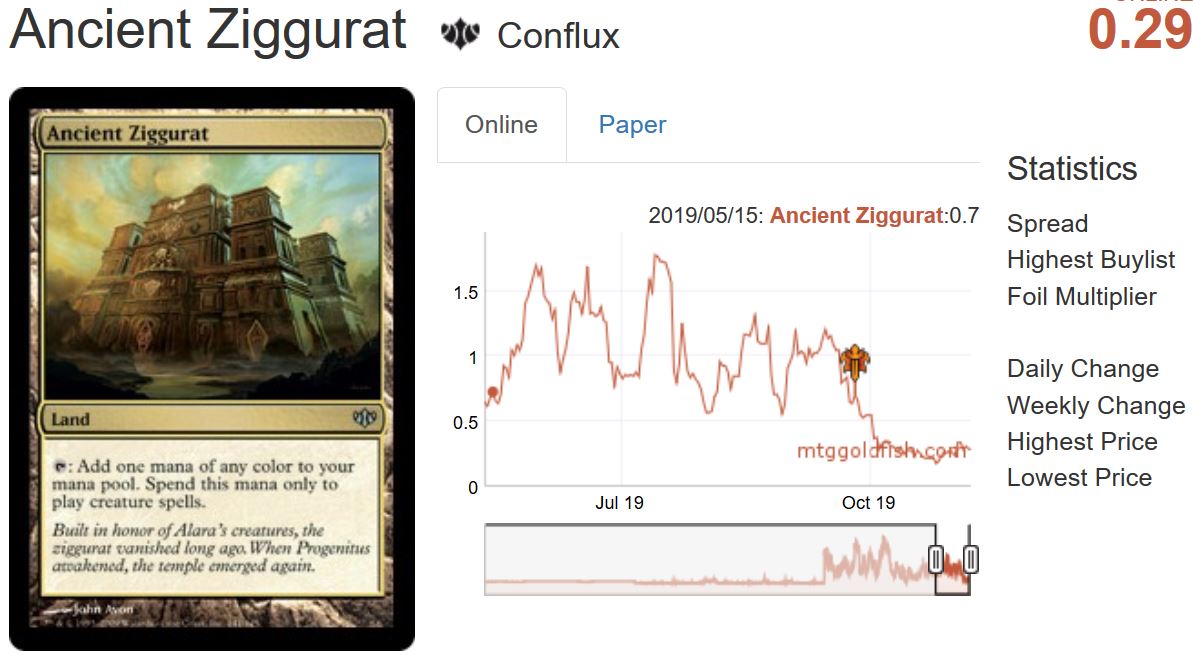
4. Ancient Ziggurat

Perhaps saving the best for last. Ancient Ziggurat is an ideal spec. It has shown the ability to maintain a price between $0.50 and $1.50 ever since Humans emerged as a tier one deck, yet right now its price is significantly lower than that. When scouring through Modern specs, the more it shares in common with Ancient Ziggurat's price history, the better a spec it will be. I'm a buyer.

IV. Signing Off

Thanks for reading! If you have any questions, leave a comment or hit me up on Discord. Consider these four speculation targets as examples of what to look for when looking at Modern cards; these are but four of many that would make smart investment choices. Next week I believe I'll be looking at Standard speculation opportunities in the future wake of an expected Oko ban. Stay tuned!

Last Week’s Top Headlines

Are you a Quiet Speculation member?

If not, now is a perfect time to join up! Our powerful tools, breaking-news analysis, and exclusive Discord channel will make sure you stay up to date and ahead of the curve.

Years ago, a Pro Tour would catalyze massive movement in the Magic market. I would cover all the major movers and shakers, possibly review the metagame and share my reactions. I would also include a screenshot of the MTG Stocks Interests page to highlight the disruptiveness to the financial world that is the Pro Tour.

Not so much this time.

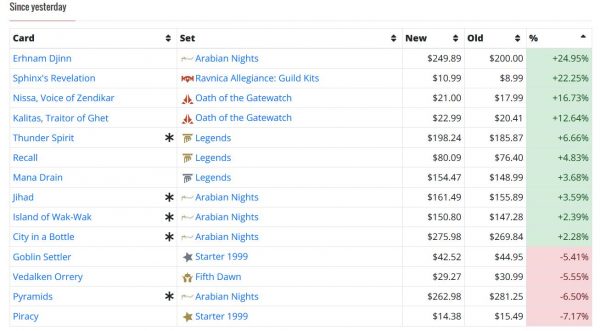
That’s it. The entire Interests page for nonfoils from Sunday, November 9th. Let’s count the Standard cards that appear on the list: zero. In fact, I see three cards moving due to Pioneer, and then the usual noise that is the Old School market (prices fluctuate, but never go anywhere).

Clearly, there’s no news here, other than Oko’s impending banning. But there is news from last week, with important implications. Allow me to elaborate.

Mystery Packs: The Good News and Bad News

The Mystery Booster Packs generated more hype than any set in recent memory, and the mysteriousness of it was rivaled only by Ultimate Masters. The production WOTC put on in revealing the product was even well-thought-out and elaborate.

Unfortunately, the greater the hype, the greater potential for disappointment. And that’s precisely how the Magic community reacted (as if there was any other possibility?). I’ve gone from never using memes in my articles to now using one in back to back columns, but this was so fitting I could not resist its inclusion.

This pretty much sums up the experience that is the Mystery Booster Packs. They’re “like a box of chocolates…you never know what you’re gonna get,” as Forest Gump so eloquently put it. That also means the set is clearly designed for a one-time, entertaining sealed event. Finance was not a consideration (other than the obvious Reserved List exclusion).

The community is so focused on value that a cold reaction to this product release was inevitable. While it’s possible to open value from these boosters (I saw one person open a Mana Crypt), more often than not a pack will contain a hodgepodge of inexpensive cards. Since the set is so large I have no clue what the EV of the set is. But at first glance, it looks meager.

But it’s not all doom and gloom. There’s one component to this set that has me seeing dollar signs:

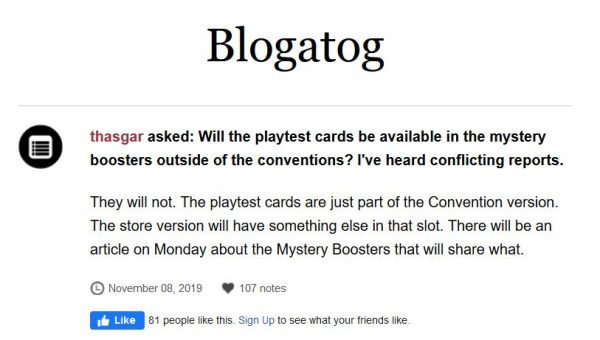
It seems the playtest cards included in the Mystery Boosters will only appear in conventions. Local game shops will have different versions of the boosters. While we won’t know what the replacement will be until Monday, it leaves me wondering just how rare these playtest cards will be. Considering there are at least 121 one of them (the number listed on Scryfall), it’s extremely difficult to open a particular card.

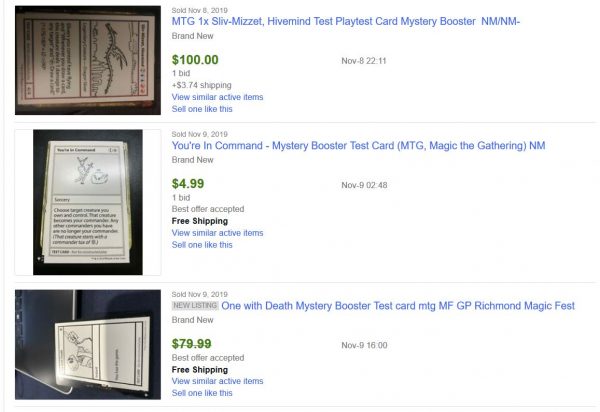
Even though these cards aren’t legal in constructed events, the most hilarious, iconic, or playable playtest cards will inevitably find their ways into Commander decks and cubes. The result: some of these playtest cards will be very valuable!

Of course the less desirable playtest cards will remain inexpensive, but these may be rare and novel enough that even the least interesting ones will be worth a few bucks. I don’t know how many conventions will have this tournament, but the overall market supply for these will have to be fairly small. If there are 121 unique playtest cards, a 2400 player convention would introduce about 20 copies of each per convention. Assuming this will last even 50 conventions means total supply numbers around 1000. That’s rarer than an Alpha rare card.

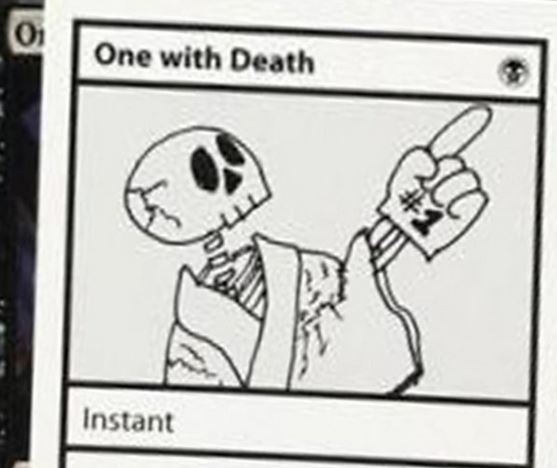
I’ll be watching these closely, and will definitely hope to acquire a few that are most interesting to me. I think these will have some potential to appreciate. Supply will continue to bombard the market over the course of these events, but a time will come when the supply faucet will be turned off. That’ll be it, then. No more copies of One with Death, or any of the other playtest cards. And even beforehand, there will likely be an opportunity to buy and sell these playtest cards while the market tries to figure out the appropriate value.

These playtest cards (and, possibly, their replacement in the LGS boosters) are going to be what makes these packs worth opening for value!

Legacy Is Dead, Long Live Legacy

On November 7th, Star City Games announced the end to Legacy tournaments on the SCG Tour. SCG gave life to Legacy many years ago when they started their SCG Tour. The result was an explosion in values for Dual Lands, Mox Diamond, Lion's Eye Diamond, and an array of other Reserved List Legacy cards.

There was an error retrieving a chart for Mox Diamond

Naturally, people are concluding that this announcement spells doom for Legacy. Jim Davis wrote an article on Cool Stuff Inc’s site pronouncing Legacy dead, going as far as to say “good riddance” to the format.

While this announcement certainly bodes poorly for the format, I’m not sure if Legacy prices rely that heavily on demand for SCG Open play anymore. Star City Games hosted very few Legacy Opens in 2019 anyway. I see they had a couple legacy Opens in Syracuse, NY and they may have included Legacy in the Team Opens. But I can’t imagine this catalyzed much demand for cards.

My hunch is that Legacy has gone the way of Vintage. There don’t need to be large events—the players who love the format will find ways to play. There will continue to be smaller-scale Legacy events all around the world. And since the Legacy metagame evolves so slowly, I suspect prices will remain largely unimpacted by this news.

However, to avoid risk of a pullback, I would recommend ensuring your Legacy exposure (beyond a deck you play) is limited to cards that see play in other formats. Dual Lands likely see more demand from Commander than from Legacy nowadays given the difference in the player base. Grim Monolith is another example of a card with utility outside Legacy.

There was an error retrieving a chart for Grim Monolith

On the other hand, Sneak Attack and Exploration would be two cards I wouldn’t want to own right now. The same goes for any Legacy cards not on the Reserved List that see the most demand coming out of Legacy play. This is indeed a relatively small pool of cards. All the more reason I don’t think the end of Legacy SCG Opens is all that important to the speculator/investor. Legacy cards have been rather uninteresting investments for years already, anyways.

And again, the end of SCG Legacy Opens will not mean the end of Legacy altogether. It will still exist, there will still be events with hundreds of players, but it’ll happen a little less often. This difference just doesn’t matter all that much, financially.

Pioneer Shake-Ups

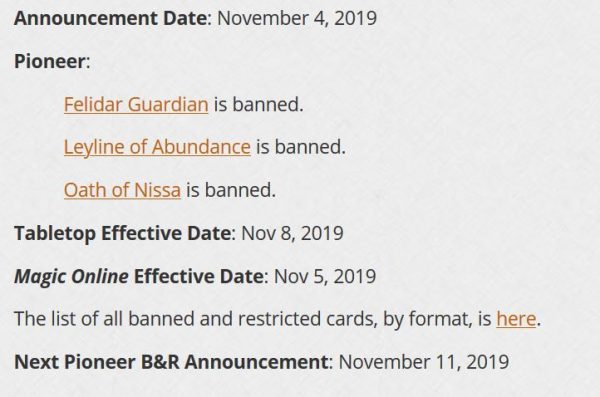
The last headline I want to touch upon is the recent Pioneer bannings.

The most important line in the announcement isn’t the banning of any cards. It isn’t that it’s effective online before it’s effective in tabletop play. The most important line of that announcement, in my opinion, is the very last one: another B&R announcement to come one week later.

Wizards is clearly taking a “wait and see” approach when it comes to managing Pioneer. Rather than beginning with a huge ban-list, they prefer to let the metagame unfold, tweaking along the way. This approach has its pros and cons. But if I had any interest in playing this format, I’d be inclined to wait a month or two before committing to a deck. There’s just too much uncertainty about what will be legal and illegal in the coming weeks.

There was an error retrieving a chart for Oath of Nissa

This could hamper the growth of Pioneer out the gate, and it makes me want to remain hands-off as a speculator (I already got burned on a few Oath of Nissas. I’m not in the business of buying popular cards only to have their utility squelched during a weekly banning. I expect this will leave some sour tastes in players’ mouths, and it’ll be interesting to see if there are any longer-lasting implications.

Wrapping It Up

While Standard continues to languish under Oko’s dominance, there’s plenty of other news to keep Magic interesting. Pioneer is going through rapid changes as it finds footing in the tournament world. Legacy is under attack in its exclusion from the SCG Tour. And Mystery Boosters do in fact have financially relevant cards…albeit only in convention packs.

These three headlines are plenty to keep me engaged in the hobby for the time being. Even though my focus remains on Old School and Reserved List cards, I still have an appreciation for the ever-changing environment the game offers. It’s what makes the hobby so fresh and different, day in and day out. Without such changes, the game really would stagnate.

So even though some of these changes/releases may frustrate us, it’s important to appreciate that the dynamic environment is critical in keeping the game refreshed. To stagnate is to die in this environment. Magic may have been inducted into the Toy Hall of Fame, but it’s not because of Alpha. It’s because of the consistent reinvention the game has been able to undergo over the course of 26 successful years. That’s what makes Magic one of the greatest games ever created, and it’s what will keep me interested in the hobby, hopefully for years to come.

…

Sigbits

  • I just submitted a new buylist order to Card Kingdom when I noticed they were offering $305 on Guardian Beast. This is a stellar price considering the softness in the Old School market. I don’t suspect this high of a buy price will last long.
  • I thought Sword of Fire and Ice’s price would have dropped with the introduction of Pioneer. The unbanning of Stoneforge Mystic in Modern catalyzed a jump in price, but Modern is expected to be a bit soft in coming months as Pioneer receives an overweight amount of attention. But Card Kingdom must still be selling copies because they have a $70 buy price for Modern Masters copies of the card.
  • Card Kingdom also has Iconic Masters and Legends copies of Mana Drain on their hotlist. They’re only offering $80 for the Legends copies, well off their highest offer to-date. But that $60 buy price on the reprinted version seems to be relatively good, and climbing! Since this card is banned in Legacy, it’s safe to say none of the recent headlines will be negatively impacting this card’s value, and it should offer upside for the foreseeable future (barring a new reprint).

October Brew Report, Pt. 1: Melting Pot

Are you a Quiet Speculation member?

If not, now is a perfect time to join up! Our powerful tools, breaking-news analysis, and exclusive Discord channel will make sure you stay up to date and ahead of the curve.

Why do I write a Brew Report every month? Because Modern is brimming with innovation every month! While many of the decks featured in this column may not go on to win a GP, or even to carve out a sustainable metagame share, they all performed well at least once; it’s not always a cakewalk to 5-0 a competitive online league in this knowledge-rewarding format. And that success, however brief, can often serve as a launching pad for further iterations. So let’s get down to business and see which tech slapped the hardest in October.

Lil' Splashes

Of the many existing decks seamlessly integrating new tech, the following pair stood out to me most.

Gwixis Shadow, BENCHSUMMER (5-0)

Creatures

4 Death's Shadow
2 Giver of Runes
4 Ranger-Captain of Eos
3 Snapcaster Mage
4 Tidehollow Sculler

Planeswalkers

2 The Royal Scions

Sorceries

2 Inquisition of Kozilek
4 Thoughtseize
2 Unearth

Instants

1 Dismember
3 Drown in the Loch
2 Fatal Push
2 Path to Exile
1 Temur Battle Rage
4 Thought Scour

Lands

1 Arid Mesa
1 Blood Crypt
2 Godless Shrine
1 Hallowed Fountain
4 Marsh Flats
1 Plains
3 Polluted Delta
3 Silent Clearing
1 Steam Vents
1 Swamp
2 Watery Grave

Sideboard

1 Ashiok, Dream Render
1 Celestial Purge
2 Ceremonious Rejection
2 Collective Brutality
3 Fulminator Mage
2 Geist of Saint Traft
2 Kaya's Guile
2 Plague Engineer

Gwixis Shadow gets its name from my own failed experiments in the color combination, in which I ran Delver of Secrets alongside Monastery Swiftspear and Lingering Souls. This Shadow list, though, doesn't try to reinvent the wheel, nor does it seem to favor either the existing Grixis or Mardu Shadow decks over the other. Rather, it seamlessly integrates aspects of both.

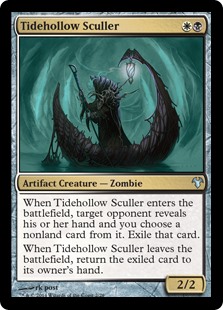
Here’s Ranger-Captain of Eos, the Mardu all-star that tutors the deck’s namesake and turns Unearth into a heap of value; there’s Drown in the Loch and The Royal Scions, new and promising adoptions of Grixis. Tying it all together is Tidehollow Sculler, which increases hand disruption density to ensure the deck has ample disruption to stop opponents in their tracks and enough protection to push its own plays.

Faeburrow Reborn, NUKELAUNCH (5-0)

Creatures

4 Faeburrow Elder
3 Birds of Paradise
2 Bloodbraid Elf
3 Niv-Mizzet Reborn
4 Tidehollow Sculler

Planeswalkers

2 Oko, Thief of Crowns
1 Teferi, Time Raveler
1 The Royal Scions
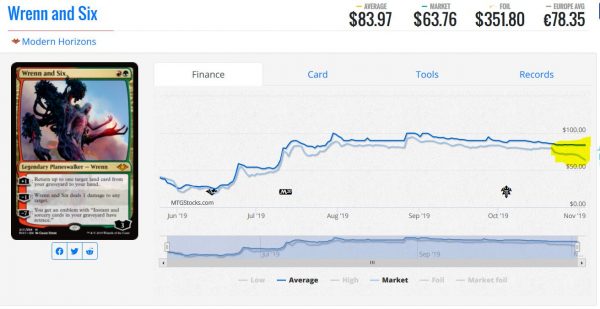
2 Wrenn and Six

Artifacts

4 Arcum's Astrolabe

Instants

2 Assassin's Trophy
1 Kolaghan's Command
4 Lightning Helix

Sorceries

2 Bring to Light
2 Safewright Quest

Lands

1 Breeding Pool
1 Irrigated Farmland
1 Overgrown Tomb
4 Pillar of the Paruns
4 Prismatic Vista
1 Sacred Foundry
1 Snow-Covered Forest
1 Snow-Covered Island
1 Snow-Covered Mountain
1 Snow-Covered Plains
1 Snow-Covered Swamp
1 Stomping Ground
4 Windswept Heath
1 Wooded Foothills

Sideboard

1 Alpine Moon
1 Ashiok, Dream Render
1 Crumble to Dust
1 Dovin's Veto
1 Fracturing Gust
1 Kambal, Consul of Allocation
1 Kaya's Guile
1 Knight of Autumn
2 Lavinia, Azorius Renegade
3 Rest in Peace
1 Supreme Verdict
1 Unmoored Ego

Faeburrow Reborn offers a novel take on the five-color Niv-Mizzet Reborn lists that have become commonplace in Modern since Arcum's Astrolabe turned the color pie on its head.

My main qualm with that deck is that once up to ten cards are drawn with the Dragon, pilots sometimes have trouble casting everything in time to not lose; in other words, early-game clunk finds itself multiplied in the game’s later stages. Faeburrow Elder, while growing to impressive size itself, mitigates this problem by functioning as an Aether Vial of sorts; players can tap it for 2-5 mana and cast whatever they want, Dragons included. Difficult as planeswalkers are to remove, Faeburrow is likely to have many colors to draw from after players untap with it.

One Is Always Enough

Also significant this month were the mono-colored strategies putting up results with the help of some Throne goodies.

Mono-White Titan, FINCOWN (5-0)

Creatures

4 Charming Prince
4 Wall of Omens
4 Thraben Inspector
1 Kami of False Hope
4 Flickerwisp
4 Ranger-Captain of Eos
3 Sun Titan

Artifacts

1 Crucible of Worlds

Instants

3 Brought Back
4 Path to Exile

Sorceries

2 Winds of Abandon
2 Wrath of God

Lands

1 Arid Mesa
1 Blast Zone
3 Emeria, the Sky Ruin
4 Field of Ruin
1 Flooded Strand
1 Marsh Flats
3 Prismatic Vista
9 Snow-Covered Plains
1 Windswept Heath
60 Cards

Sideboard

1 Burrenton Forge-Tender
2 Cleansing Nova
2 Damping Sphere
2 Generous Gift
1 Ghost Quarter
4 Remorseful Cleric
1 Sorcerous Spyglass
2 Stony Silence

During spoiler season, David doubted Charming Prince’s staple status in Blink, Humans, and Death & Taxes. Neither of us predicted the Noble would up and create his own archetype. Mono-White Titan combines a slew of restricted reanimation effects to get the most out of Prince and its ilk, which include the searchable, blinking-unfriendly Kami of False Hope as well as a full four pre-Princes in Wall of Omens. At the top of the curve rests Sun Titan, a recursive reborn effect that buries opponents in value.

Mono-Green Stompy, FLUFFYWOLF2 (5-0)

Creatures

4 Pelt Collector
4 Experiment One
4 Hexdrinker
4 Noble Hierarch
4 Avatar of the Resolute
4 Strangleroot Geist
4 Steel Leaf Champion
2 Questing Beast

Instants

4 Aspect of Hydra
1 Blossoming Defense
4 Vines of Vastwood

Lands

13 Forest
4 Nurturing Peatland
2 Treetop Village
2 Waterlogged Grove

Sideboard

1 Choke
3 Collector Ouphe
4 Damping Sphere
2 Dismember
2 Reclamation Sage
3 Scavenging Ooze

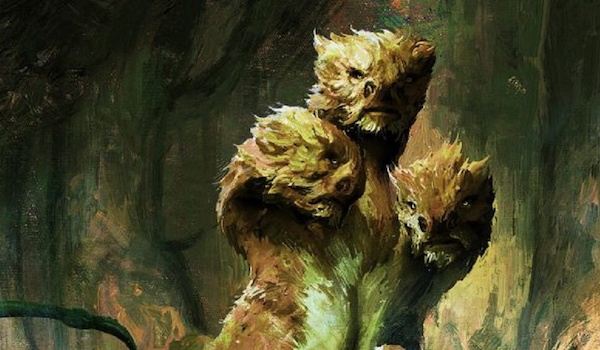
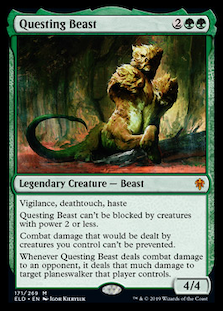
Mono-Green Stompy has received a number of buffs in the last year: Pelt Collector increases the consistency of explosive starts, while Steel-Leaf Champion and Hexdrinker improve the late-game. Payoffs like Avatar of the Resolute remain constant. The deck’s newest addition comes in the form of Questing Beast, a value-charged beater even making waves in Jund. In a metagame full of cheap planeswalkers, including the ubiquitous Oko, powerful haste creatures are a deckbuilding godsend, and this one seems tailor-made for sniping the card type.

Midrange Never Dies

Nor does it apparently ever stop regrouping. These three decks employ the timeless "disrupt, then commit" strategy in ways we've seldom seen.

Bant Mentor, ALTNICCOLO (5-0)

Creatures

4 Monastery Mentor
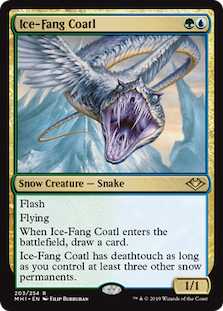
4 Ice-Fang Coatl
4 Snapcaster Mage

Planeswalkers

2 Jace, the Mind Sculptor
3 Oko, Thief of Crowns
3 Teferi, Time Raveler

Artifacts

4 Arcum's Astrolabe

Instants

4 Force of Negation
4 Opt
4 Path to Exile

Sorceries

4 Serum Visions

Lands

1 Breeding Pool
3 Flooded Strand
1 Hallowed Fountain
3 Misty Rainforest
3 Prismatic Vista
1 Snow-Covered Forest
6 Snow-Covered Island
1 Snow-Covered Plains
1 Temple Garden

Sideboard

2 Celestial Purge
3 Disdainful Stroke
3 Rest in Peace
3 Spell Queller
2 Supreme Verdict
2 Timely Reinforcements

Speaking of cheap planeswalkers, Bant Mentor packs plenty; Oko aids the shard’s previously untenable trouble with creatures, for which they once only had Path to Exile, while Teferi, Time Raveler lets the deck untap, slam Mentor, and “go off” with an army-causing cantrip chain (Force of Negation also plays to this gameplan by fronting a turn’s worth of protection for the squishy creature). As for Jace, its role seems mainly to ensure a secondary win condition: should opponents answer the Mentor Plan A, they’ll still have the blue juggernaut’s card advantage waterfall to deal with.

The sideboard is jam-packed with effective answers, ranging from catch-all floodgates Rest in Peace and Damping Sphere to macro-archetype-hosers like Spell Queller and Supreme Verdict.

BUG Ninjas, CAVEDAN (5-0)

Creatures

4 Faerie Seer
3 Gilded Goose
2 Birds of Paradise
1 Brazen Borrower
4 Ice-Fang Coatl
4 Ingenious Infiltrator
4 Spellstutter Sprite
2 Vendilion Clique

Planeswalkers

3 Oko, Thief of Crowns

Enchantments

2 Bitterblossom

Instants

1 Cryptic Command
1 Drown in the Loch
4 Fatal Push
2 Force of Negation
1 Spell Snare

Lands

3 Botanical Sanctum
1 Breeding Pool
4 Misty Rainforest
1 Overgrown Tomb
4 Polluted Delta
1 Prismatic Vista
1 Snow-Covered Forest
3 Snow-Covered Island
1 Snow-Covered Swamp
2 Verdant Catacombs
1 Watery Grave

Sideboard

2 Drown in the Loch
1 Spell Snare
1 Assassin's Trophy
2 Collective Brutality
2 Collector Ouphe
2 Damping Sphere
1 Disdainful Stroke
1 Grafdigger's Cage
1 Plague Engineer
1 Surgical Extraction
1 Thoughtseize

BUG Ninjas is yet another Oko-touter. The walker’s partner-in-crime, Gilded Goose, also makes an unlikely appearance for its synergy with the ninjutsu mechanic. BUG Ninjas is without a doubt the most creature-heavy I’ve ever seen the tribe get, and I have to admit I like where it’s headed. Only two Bitterblossoms? What’s to hate?

GRx Walker Moon, CAVEDAN (5-0)

Creatures

4 Arbor Elf
4 Birds of Paradise
4 Tireless Tracker
4 Bonecrusher Giant
4 Glorybringer
1 Gruul Spellbreaker
1 Questing Beast
1 Stormbreath Dragon

Planeswalkers

1 Domri, Anarch of Bolas
3 Kiora, Behemoth Beckoner
3 Oko, Thief of Crowns
1 The Royal Scions

Enchantments

2 Blood Moon
4 Utopia Sprawl

Instants

2 Lightning Bolt

Lands

1 Breeding Pool
4 Misty Rainforest
7 Snow-Covered Forest
1 Snow-Covered Island
1 Snow-Covered Mountain
1 Steam Vents
2 Stomping Ground
4 Wooded Foothills

Sideboard

1 Blood Moon
2 Abrade
2 Ancient Grudge
1 Anger of the Gods
1 Chameleon Colossus
1 Crumble to Dust
1 Grafdigger's Cage
3 Obstinate Baloth
2 Scavenging Ooze
1 Shatterstorm

CAVEDAN's second straight list in this feature, GRx Walker Moon, also makes use of Oko. This deck is similar in construction to GRx Moon builds I’ve flag-flown for over the last however many years, but there’s no Tarmogoyf; rather, it goes all-in on the mana dork survivng, and replaces Goyf with Tireless Tracker. Blood Moon also has its numbers slashed, this time in favor of cheap planeswalkers. Resolving these a turn early indeed puts the game away versus many opponents.

Combo's Other Twist

Modern's combo decks seem to be enjoying the new cards as well.

Copy-Cat, SPIDERSPACE (5-0)

Creatures

4 Felidar Guardian
4 Arbor Elf
4 Ice-Fang Coatl

Planeswalkers

4 Karn, the Great Creator
4 Saheeli Rai
3 Teferi, Time Raveler
2 Wrenn and Six

Artifacts

4 Arcum's Astrolabe

Enchantments

4 Oath of Nissa
4 Utopia Sprawl

Instants

3 Once Upon a Time

Lands

1 Breeding Pool
1 Hallowed Fountain
4 Misty Rainforest
4 Prismatic Vista
3 Snow-Covered Forest
1 Snow-Covered Island
1 Snow-Covered Mountain
1 Snow-Covered Plains
1 Steam Vents
1 Stomping Ground
1 Temple Garden
1 Tranquil Thicket

Sideboard

2 Collector Ouphe
1 Damping Sphere
1 Engineered Explosives
1 Ensnaring Bridge
2 Knight of Autumn
1 Mycosynth Lattice
1 Pithing Needle
1 Thragtusk
1 Tormod's Crypt
3 Veil of Summer
1 Wurmcoil Engine

Copy-Cat has existed in Modern since its ban-addressed stint in Standard. But it's never looked like this. Saheeli Rai now has plenty of company as a strategy-appropriate planeswalker; so much so, in fact, that Oko doesn't even make the cut. Rather, it's Karn, the Great Creator who comes out in numbers, offering a standalone Plan B to the combo dimension the deck is named for and giving players something to funnel their Arbor-Sprawl mana into.

Time Raveler also earns its stripes here by protecting the combo, as does Wrenn for helping build towards Felidar's four-mana price tag. Ice Fang Coatl is also a significant upgrade for the deck; while it can be blinked for cards like Wall of Omens, the Snake plays double-duty as critical defensive against Modern’s huge creatures.

Lazav Urza, HAUBIDTRAN (5-0)

Creatures

2 Lazav, the Multifarious
4 Emry, Lurker of the Loch
4 Urza, Lord High Artificer
2 Sai, Master Thopterist

Artifacts

4 Arcum's Astrolabe
2 Chromatic Sphere
4 Chromatic Star
4 Mox Amber
4 Mox Opal
1 Pithing Needle
2 Sword of the Meek
4 Thopter Foundry
2 Welding Jar
4 Wishclaw Talisman

Lands

3 Darksteel Citadel
4 Polluted Delta
5 Snow-Covered Island
2 Snow-Covered Swamp
2 Spire of Industry
1 Watery Grave

Sideboard

2 Ashiok, Dream Render
4 Collective Brutality
2 Damping Sphere
3 Fatal Push
2 Tezzeret, Agent of Bolas
2 Thoughtseize

In "Dismantling the Bomb: How to Fight Urza," David commented on the archetype’s different builds and their respective strenghts and weaknesses. One feature the decks shared was their inability to do anything with an Emry or Urza that wound up in the graveyard. Lazav Urza seeks to change that predicament with its namesake legend. Not only does Lazav turn on Mox Amber early in lieu of another creature and gently dig for combo pieces, the Shapeshifter can become a copy of any creature opponents have already killed or pilots have incidentally milled.

In the scope of David’s article, relying on Lazav further exposes Urza to graveyard hate, though I’d assume not to the extent of a full Goblin Engineer package.

Tempo Twin, KAHLUAH777 (5-0)

Creatures

4 Brineborn Cutthroat
4 Snapcaster Mage
4 Pestermite
2 Kiki-Jiki, Mirror Breaker
2 Brazen Borrower

Instants

3 Cryptic Command
2 Force of Negation
4 Lightning Bolt
1 Magmatic Sinkhole
4 Opt
2 Peek
4 Remand
2 Spell Snare

Lands

1 Cascade Bluffs
1 Fiery Islet
5 Island
4 Misty Rainforest
1 Mountain
1 Mystic Sanctuary
4 Scalding Tarn
3 Steam Vents
2 Sulfur Falls

Sideboard

1 Force of Negation
1 Magmatic Sinkhole
2 Abrade
3 Anger of the Gods
2 Blood Moon
3 Crackling Drake
2 Spell Pierce
1 Vendilion Clique

Rounding things out today is Tempo-Twin, an oldie-but-goodie declared dead after the banning of its namesake enchantment. Twin-in-spirit decks employing the Kiki-Exarch combination have cropped up in Modern from time to time since then, but they’ve always been on the metagame’s fringes, and they’ve never returned to packing Tarmogoyf to bolster the aggro-control plan.

This build of Tempo Twin also refuses to dip into green, but nonetheless ascribes to the older deck’s philosophy via Brineborn Cutthroat. Brineborn’s flash plays to the deck’s predilection for end-step threat deployment, but its counters clause doesn’t sacrifice the potential for bulk. Brazen Borrower makes yet another appearance in this dump, reinforcing its worth as a utility option, while Blood Moon and Crackling Drake provide secondary plans from the sideboard.

And the Month Rolls On

That does it for the first half of October, a month that features as diverse a set of Modern innovations as ever. Join me next week as we flesh out the rest of the decklists.

Pioneer Picks and Predictions

Are you a Quiet Speculation member?

If not, now is a perfect time to join up! Our powerful tools, breaking-news analysis, and exclusive Discord channel will make sure you stay up to date and ahead of the curve.

I’ve written about my process of using QuietSpeculation’s TraderTools to study buylist spreads, and with the rise of Pioneer, I got curious about what the spread numbers look like for its many sets. These numbers give a real snapshot of what players are demanding, and low spread numbers indicate a card with tight supply and demand, which has the potential to spike with an increase in demand. With Pioneer set to be in flux over the coming weeks and months as the banned list is hammered out, there will be a lot of metagame changes that will inevitably impact the market in a big way.

I went deep looking into the spread of all Pioneer sets, and I gained a few very useful insights.

Painlands are Premium

Among all the cards in Pioneer, painlands stood out as having some of the lowest spreads, many of them actually slightly negative on CardKingdom’s buylist, so they surely have been selling lots of them over the past few weeks. Without fetchlands taking a large part of manabases, players have to branch out, and painlands are in the highest tier of quality in available Pioneer lands.


There was an error retrieving a chart for Llanowar Wastes

What’s interesting is that these lands didn’t see much play in Modern, compared to things like the fastlands that did, so the relative change in demand is much higher, and over time I see this leading to higher prices for them across the board, but keep in mind multiple printings will keep them from ever getting truly out of hand.

Commons and Uncommons Are Critical

I was quite surprised to see that some of the lowest-spread cards in the format are actually uncommons and even commons, which points to them being among the true staples of the format. For example, Temur Battle Rage is the lowest-spread card in all of Fate Reforged, Modern and Pauper staple that represents one of the more powerful cards in the format, and one I’ve already seen in multiple decks, including with its partner in crime Become Immense.

A closer look shows that Temur Battle Rage has indeed been slowly creeping up over the past couple weeks, and could turn into a true spike if a deck using it really breaks out in the format.

There was an error retrieving a chart for Temur Battle Rage

An uncommon of note is Ensoul Artifact, which has a low spread and is on the rise in the metagame as part of a Blue-Red “Affinity” deck. It was the centerpiece of a Standard deck during its tenure, and it’s one of the better artifact payoffs in Pioneer. It has a very similar price pattern to Temur Battle Rage, rising to around $0.60 from $0.50 in the past two weeks, and showing every sign of continuing that trajectory. I’ve seen a lot of talk about the deck on social media lately, so at this point, I’m just waiting for a high-profile breakout finish to bring the deck to the masses. 

There was an error retrieving a chart for Ensoul Artifact

Bet on Red

The lowest spread card in Born of the Gods is Searing Blood at 15%. It was a staple of Standard red decks and has seen play as a Modern sideboard card, and it’s becoming a staple of Pioneer in that role. Last weekend, Mono-Red gained a ton of traction when an MPL Pro and popular deck-brewer top 8'd the Pioneer Challenge along with another player on the deck, and things have only gotten more promising after the bans nerfed some of its biggest competition.

There was an error retrieving a chart for Searing Blood

Another staple of the burn archetype in Modern and one of its important tools in Pioneer is Skullcrack, another sideboard staple with some maindeck potential. I wasn’t too surprised to see that at 10% it is one of the lowest spread cards in Gatecrash, one of the oldest sets in Pioneer. It’s another example of a card showing steady growth in the past two weeks since the announcement, up from $1.6 to nearly $2 and heading higher.

There was an error retrieving a chart for Skullcrack

A slightly more obscure red card but one I see having a great future in Pioneer is Abbot of Keral Keep, which was a major staple of the archetype during its time in Standard. I took note of it when I saw it was one of the lowest spread cards in Magic Origins at 6%, behind just painlands, and on further inspection see it’s being commonly used as a two-of in red sideboards. It’s already showing clear growth this month, and if that’s just on relatively little demand from red decks I could see it really exploding if it becomes a maindeck staple of a top-tier red deck. 

There was an error retrieving a chart for Abbot Of Keral Keep

Tribal Tendencies

Tribal decks are an obvious place to start in any format, and the best among them tend to naturally coalesce together into real archetypes. Pioneer has fewer options than larger cardpools, and that means tribal decks will try to “cheat” on type when they can with cards like Metallic Mimic, a player in any tribal deck and surprisingly one of the lowest spread cards in Aether Revolt at 15%, behind just the negative spread mythic rare Angelic Archangel, which looks like a nice Commander spec. 

There was an error retrieving a chart for Metallic Mimic

A specific tribal card to watch is Relentless Dead, which at a 20% spread has one of the lowest spreads in Shadows over Innistrad, but came onto my radar initially because of its spike on MTGO this week. At least two variations of Mono-Black Zombies have posted 5-0 trophies, so there’s potential for it to become a part of the metagame. Under $8 before the Pioneer announcement, it’s now nearly $9.

There was an error retrieving a chart for Relentless Dead

Most Cards Are in High Supply

One factor behind the creation of Pioneer is the high-accessibility of cards relative to Modern, which goes back 16 years to Mirrodin and includes sets with a much lower supply than now. Pioneer only goes back 7 years, and its sets are all in very high supply. As such, I found that many sets didn’t have cards with low spreads, and showed dealers have plenty in stock.

Most cards are minor players, so even the best cards from sets like Khans of Tarkir, Theros, and even its oldest set Return to Ravnica have plenty to go around. This effect is especially pronounced in these large first-sets, so the best bets will be from second and third sets and core sets, which nearly all of the cards I shared today are from. 

Dismantling the Bomb: How to Fight Urza

Are you a Quiet Speculation member?

If not, now is a perfect time to join up! Our powerful tools, breaking-news analysis, and exclusive Discord channel will make sure you stay up to date and ahead of the curve.

Urza is everywhere. As the latest it deck in Modern, it's getting most of the attention when eyes can be torn away from Magic's new baby, Pioneer. The deck's impressive results do recall the banned Krark-Clan Ironworks deck. Today we'll examining how to fight Urza, starting with the overall archetype and then looking at specific tactics against the various versions.

Why Urza?

Compared to other Modern decks, the Urza family of decks isn't very impressive on paper. They're primarily made up of cheap, do-nothing artifacts which can draw cards and make mana, but durdling isn't viable in Modern. The Thopter-Sword combo is better here than in any other shell, but that's not really saying much. Even with Saheeli, Sublime Artificer and Sai, Master Thopterist to make the air useful, it all looks too slow and empty to be a force in Modern.

The lynchpin is Urza, Lord High Artificer. Simply put, he features a huge amount of absurdly powerful text, which may be appropriate flavor-wise given his importance to Magic's history and storyline, but does nothing for game balance. Urza generates a threat upon entering the battlefield, makes every artifact into Mox Saphire, and offers a card advantage engine for good measure. It's a chilling thought, but if Urza had Tolarian Academy's ability rather than his current mana ability, he'd be far less powerful, since he could only generate mana once. As-is, his mana generation is on par with that of Krark-Clan Ironworks, and he doesn't need outside help to find more artifacts to keep it all rolling. Urza can just keep flipping random cards off the top. He also goes infinite with Thopter-Sword.
To summarize, the addition of a self-contained engine has supercharged an otherwise mediocre archetype into a very powerful force in Modern. This is made worse by Urza decks lacking genuinely bad matchups. Thanks to tutoring engines and intrinsic lifegain, Urza has the means to overcome most decks given the time. However, since its cards are lackluster on their own, it doesn't have any truly great matchups either. Rather, Urza decks aim to execute their powerful plan and see if the opponent can stop them... which sounds very familiar, and provides a strong clue for fighting the deck.

What to Do

My philosophy is to treat Urza decks like they're Splinter Twin, but worse. Like Twin, Urza presents a turn four-ish win based on a four-mana spell. It has alternative routes to victory that are cheaper, but the main threat of the deck costs four and is sorcery-speed. However, Twin was built to be a tempo deck with a combo kill, and played mostly at instant speed. Urza decks are built like sorcery speed artifact combo decks first, and have non-combo elements secondary, if at all. Thus, it is highly effective to just target Urza, Lord High Artificer and let the deck fall apart on its own. As previously mentioned, that one card is what makes the archetype viable at all. As against Twin, if you can't race, then you must interact.

Another tip is to never, ever, get complacent. No matter how thoroughly Urza's hand has been shredded, or how many threats have been countered, so long as a single Urza is left in the deck, you can just lose. On that note, it is imperative to start pressuring Urza as quickly as possible. Sitting back will not win the game. Pure control isn't doing so well because Urza plays counters, Teferi, Time Raveler, and sometimes Veil of Summer out of the sideboard, negating counterspell walls; control lacks the early clock necessary to lay the smack down while Urza is kept off its win conditions.

The final strategy I'll mention is employing graveyard hate. All Urza decks rely on their graveyards. Exactly why and how shifts from deck to deck, but they all get worse when denied that resource. Lasting hate like Leyline of the Void, Rest in Peace, and Scavenging Ooze are better than one shots like Tormod's Crypt and Surgical Extraction, since Urza players are aware of the their weakness and have adapted their play to mitigate one-shot effects.

What to Avoid

My emphasis on targeting Urza may make it seem like Surgical Extraction is a good plan against Urza. But I don't think it is. Every deck has Mox Opal, and most now have Mox Amber, too. In other words, Urza drops the same turn or sooner than the fastest proactive extraction effect, Lost Legacy, frequently rendering that sort of card moot. If Urza comes out slowly, it is unlikely savvy opponents will have lost in the first place. Thoughtseize into Surgical is fast enough, but is not consistent. Killing Urza then Extracting is viable, but runs the risk of Urza generating value first. I won't begrudge using Surgical if there's nothing better available, but it will leave players wanting as a primary plan.

In terms of hate, artifact destruction is similarly mediocre against Urza decks. The only worthwhile targets are prison pieces and Thopter Foundry, each a dwindling part of the strategy. Abrade and company are still valuable in that respect, but should be regarded as speed bumps rather than an actual solution. In that vein, Stony Silence and Collector Ouphe are decent, but not exceptional; shutting down the Thopter-Sword combo is good, and turning off Engineered Explosives negates their main interaction, but most of the artifacts are just setting up the non-artifact spells. Urza cares about the quantity, not the utility, of its artifacts. Going deep in attacking artifacts is a good way to die with a hand full of dead cards.
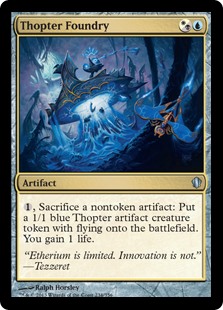
Prison cards, particularly Chalice of the Void, are extremely volatile. Certain hate proves very effective against some versions and utterly dead versus others. I regard Chalice as a high-risk, high-reward card against Urza. Blood Moon is an odd case. Urza decks play a lot of basics and Arcum's Astrolabe, which in theory moots Moon. However, every deck is very dependent on fetchlands to make it all work. They need many colors but primarily play Island and thus need to aggressively fetch to hit their color requirements. As a result an accelerated Blood Moon can be lethal where an on curve one is wasted mana.

Classic Whirza

At the start of the year, pure Whir Prison was the talk of the town. As time wore on, it fell from favor; players learned how to fight back, and the deck's inherent weaknesses became prominent. The additions of Goblin Engineer and Urza, Lord High Artificer reinvigorated the deck.

Urza Thopter-Sword, Sean Belisle (1st Place, Modern PTQ GP Atlanta)

Creatures

3 Goblin Engineer
1 Sai, Master Thopterist
4 Urza, Lord High Artificer

Instants

2 Galvanic Blast
3 Whir of Invention

Artifacts

4 Mishra's Bauble
4 Mox Opal
1 Welding Jar
4 Arcum's Astrolabe
2 Chromatic Star
1 Nihil Spellbomb
1 Pithing Needle
1 Pyrite Spellbomb
1 Damping Sphere
1 Ichor Wellspring
2 Sword of the Meek
4 Thopter Foundry
1 Ensnaring Bridge

Lands

4 Polluted Delta
4 Scalding Tarn
1 Steam Vents
1 Inventor's Fair
1 Breeding Pool
1 Watery Grave
1 Hallowed Fountain
5 Snow-Covered Island
1 Snow-Covered Swamp
1 Snow-Covered Mountain

Sideboard

3 Thoughtseize
2 Collective Brutality
2 Tezzeret, Agent of Bolas
2 Assassin's Trophy
2 Tireless Tracker
1 Ashok, Dream Render
1 Dead of Winter
1 Fatal Push
1 Magus of the Moon

No longer restricted to pure prison, Whirza is a hybrid prison/toolbox/combo deck with a beatdown backup plan courtesy of the construct token. Additional tutoring means the prison package can be streamlined in favor of more ways to actually win the game and space for extra disruption post-board.

Strengths

Whirza's greatest strength is its flexibility. It has the ability to assume any role in any matchup, and to quickly switch gears thanks to the numerous interlocking plans in its maindeck. There's also the fact that sometimes Ensnaring Bridge just wins games. Goblin Engineer is not only a tutor, but it can act as a card-draw engine with Mishra's Bauble and a mana accelerant. It's also relatively easy to assemble Thopter-Sword on turn three thanks to Engineer.

Weaknesses

Whirza is particularly vulnerable to graveyard hate thanks to Goblin Engineer. Having additional tutors is a solid Game 1 plan, but Game 2, Engineer is unlikely to pan out; opponents will specifically target the graveyard, which doubly hurts, as Whirza depends on its tutors more than other versions. Hate also neuters the Thopter-Sword combo, which Whirza is especially invested in. Thopter Foundry isn't entirely dead without a graveyard, but it's very hard to keep enough artifacts flowing to turn them into a win, especially in the face of pressure. Relying on Foundry also means that Whirza can't run Engineered Explosives, increasing its vulnerability to creature decks and hate cards.
This build also runs the risk of clunking out. Part of that is the higher land count, but it's mostly a trade-off of the deck. Being a toolbox deck means having an answer for anything. That doesn't mean the tools are useful for everything. Silver bullets are narrow by nature, and drawing one means not drawing a more generally useful card.

Whirza plays more tutors than the other versions so it can fix its frequently awkward draws. A frequent problem for Whirza is needing to find both a combo piece and a way to survive the turn cycle while only having one tutor. I've seen lots of Whirza players fight mightily to not die, only to subsequently durdle to the grave in lieu of Lord High Artificer.

Urza Ascendancy

The next deck to make waves was the pure combo version. When Emry, Lurker of the Loch was printed, players quickly realized that she went infinite looping legendary Moxen with Jeskai Ascendancy in play: every Mox cast via Emry triggers Ascendancy, then replaces the current version, which in turn can be recast an arbitrary number of times. Players then win by attacking with a huge Emry or with a combo of their choice.

Urza Ascendancy, Robert Hayes (Top 8, SCG Regionals Columbus)

Creatures

4 Emry, Lurker of the Loch
1 Sai, Master Thopterist
4 Urza, Lord High Artificer

Instants

3 Paradoxical Outcome

Planeswalkers

2 Saheeli, Sublime Artificer
1 Oko, Thief of Crowns

Enchantments

4 Jeskai Ascendancy
1 Mirrodin Beseiged

Artifacts

4 Engineered Explosives
4 Mishra's Bauble
4 Mox Opal
3 Mox Amber
4 Arcum's Astrolabe
3 Witching Well

Lands

4 Flooded Strand
4 Scalding Tarn
1 Prismatic Vista
1 Breeding Pool
1 Sacred Foundry
1 Steam Vents
4 Snow-Covered Island
1 Snow-Covered Mountain
1 Snow-Covered Plains

Sideboard

3 Mystical Dispute
2 Galvanic Blast
2 Lavinia, Azorius Renegade
2 Oko, Thief of Crowns
2 Teferi, Time Raveler
2 Veil of Summer
1 Weather the Storm
1 Path to Exile

It's the dream that so many have had since Jeskai Ascendancy first became a thing in Modern. The best part is that Chalice doesn't stop anything. Ascendancy doesn't care if spells resolve, just that they're cast.

Strengths

I don't think this deck has special strengths or better matchups than the other versions. Instead it has busted hands. Turn one Emry followed by turn two Ascendancy is a seriously fast kill, and more reliable than Neobrand thanks to the Moxen. Ascendancy is a more pure combo deck than the other versions, and is thus far less vulnerable to being disrupted or raced.

Weaknesses

As a combo deck, Urza Ascendency is more vulnerable to anti-Storm hate and taxing, as well as crumbling when the plan doesn't combo together. Jeskai Ascendancy, Mirrodin Besieged, and Urza, Lord High Artificer can't be tutored for or brought back if Emry mills them. Witching Well goes a long way, but can be excruciatingly slow, which erodes any advantage it had over more reliable versions in the first place. Having to run all the non-artifacts also increases the likelihood of too many payoffs, too few enablers. As expensive payoffs, those cards also contribute to clunky hands.

This problem is exacerbated by how finicky the combo is. The pieces must be assembled in the right order, and if one is out of place, there is no combo. Without exactly Emry on the field, Jeskai Ascendancy doesn't combo off (though it can potentially generate a lot of value). Without Mirrodin Besieged, there is no instant win. It is possible to make the pieces decent on their own, but if Emry gets Bolted before Ascendancy lands, the combo fails.
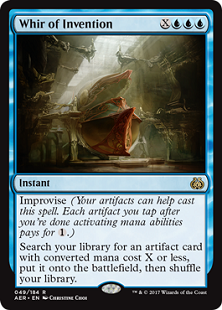
When the combo kill doesn't come together, Urza Ascendancy is kind of stuck. It has the means to generate a massive board with Sai and Saheeli like the other versions, but Ascendancy plays fewer copies of those threats, making it harder to pull off. The enchantment itself can make huge creatures, but won't generate mana without Urza around. It's also hard to cast the card early without a fast Emry to turn on Amber. And there's no room for Thopter-Sword. The problems of actually pulling off the included combo appear to have turned players off this pure combo version, and it has dropped off recently.

Paradoxical Urza

The Paradoxical Outcome version of Urza looks and plays startlingly similarly to Vintage Outcome. I began noticing this deck after Ascendancy starting making waves, and at the time, it was billed as a more reliable version of that deck.

Paradoxical Urza, Luis Scott-Vargas (Test Deck)

Creatures

2 Sai, Master Thopterist
3 Emry, Lurker of the Loch
4 Urza, Lord High Artificer

Planeswalkers

2 Saheeli, Sublime Artificer
1 Jace, the Mind Sculptor

Instants

4 Paradoxical Outcome

Artifacts

4 Engineered Explosives
4 Mishra's Bauble
4 Mox Opal
4 Mox Amber
1 Everflowing Chalice
4 Arcum's Astrolabe
3 Witching Well
1 Pithing Needle
1 Blasting Station

Lands

4 Prismatic Vista
3 Polluted Delta
1 Hallowed Fountain
1 Watery Grave
7 Snow-Covered Island
1 Snow-Covered Plains
1 Snow-Covered Swamp

Sideboard

1 Timely Reinforcements
2 Mystical Dispute
1 Ceremonious Rejection
1 Spell Pierce
4 Fatal Push
2 Thoughtseize
2 Teferi, Time Raveler
2 Tezzeret, Agent of Bolas

Strengths

Unlike Ascendancy, Outcome doesn't need to draw the right spells in the right order, have anything in particular on the battlefield, or do any special setup at all. All that needs to happen is for the board to be full of artifacts when Paradoxical Outcome resolves. From there, it's just a matter of getting enough mana out to resolve Urza and/or a win condition. There's no real need to actually combo off: just drawing lots of cards is enough. Therefore, it's far simpler to pilot.

This decks is also less vulnerable to graveyard hate than the other versions.

Weaknesses

This deck has a lot of four-mana spells that it must resolve to do anything special. It doesn't have room for any maindeck protection for those spells. Thus, it is more vulnerable to disruption than other versions. Outcome has also given up on Thopter-Sword to make room; like Ascendancy, its backup plan is subsequently unimpressive.

Oko Urza

The final and newest version is still a bit of a mystery in Modern. With only one event's data to work with, I don't know how it fits into the wider picture of the metagame or the Urza family. It feels very weird both to play against and to pilot.

Oko Urza, Jeremy Bertarioni (3rd Place, SCG Atlanta)

Creatures

4 Gilded Goose
4 Emry, Lurker of the Loch
4 Urza, Lord High Artificer

Instants

2 Metallic Rebuke
2 Whir of Invention
3 Cryptic Command

Planeswalkers

4 Oko, Thief of Crowns

Artifacts

4 Mishra's Bauble
4 Mox Opal
3 Engineered Explosives
4 Arcum's Astrolabe
1 Aether Spellbomb
1 Sword of the Meek
1 Thopter Foundry

Lands

4 Misty Rainforest
2 Polluted Delta
2 Scalding Tarn
2 Mystic Sanctuary
1 Breeding Pool
1 Watery Grave
4 Snow-Covered Island
1 Snow-Covered Forest

Sideboard

3 Damping Sphere
2 Fatal Push
2 Thoughtseize
2 Nihil Spellbomb
1 Assassin's Trophy
1 Collective Brutality
1 Drown in the Loch
1 Ensnaring Bridge
1 Pithing Needle
1 Plague Engineer

Oko Urza doesn't try to be anything other than an artifact deck, and endeavors to make the artifacts as good as they can be. It plays more mainboard protection than other versions, and fewer artifacts. To make up for this change, it generates a constant stream of food with Oko and Gilded Goose, hoping to bury the opponent under life and Elks. Thopter-Sword is still present, but fairly incidental. The deck feels more midrange than anything else, but without most of the hallmarks of classic midrange.

Strengths

At time of writing, the greatest strength is that this deck is new. Players aren't experienced enough to understand how to attack Oko Urza, boosting its win rate. Additionally, it attacks from a weird angle and doesn't feel like a typical Modern deck. Oko is also a significantly undercosted planeswalker and easily takes over games. Leaving Urza himself aside, the unique part of the deck is Oko generating a constant stream of food and/or elk, which are individually unimpressive in Modern. However, the utility of each activation snowballs and a tipping point is reached where the game just slips away. It's Standard style gameplay that's viable in Modern for the first time and hard to fight if you're not ready for it.

Weaknesses

In a flip of the script, I'm not sure this deck does anything without Oko, to the point I'd target him over Urza. There's even less utility for the enabler artifacts than a typical Urza deck without Oko around. Urza has far more artifacts to work with, but without Oko around to turn that into an army, the Artificer is stuck generating purposeless value. A single Foundry as additional token generation leaves no wiggle room should something go wrong. Despite feeling like a midrange deck, Oko Urza is soft to disruption like a combo deck.

Where Goes Modern?

Unless Urza eats a ban, which is unlikely anytime soon given the recent spate of bannings and the relatively few Modern events for the next few months, the Urza archetype is here to stay. What form it will actually take is unclear. The combo versions have more weaknesses than the other versions. However, it isn't clear whether Oko or Whirza is the way forward. There may even be other versions to come. I think that Whirza's flexibility is a greater asset than Oko's value, but I wouldn't count out a forthcoming hybrid version that melds the best of both worlds.

QS Flash Cast: Pioneer’s First Bannings

Are you a Quiet Speculation member?

If not, now is a perfect time to join up! Our powerful tools, breaking-news analysis, and exclusive Discord channel will make sure you stay up to date and ahead of the curve.

Welcome back to the QS Cast! Join Chris O’Berry and Sam Lowe as they talk about the new non-rotating format, Pioneer and its first Banned & Restricted announcement. This cast was originally broadcasted live to Insiders in the QS Insider Discord, November 4th, 2019. Chris Martin was out on leave after corrective surgery. Wish him a speedy recovery!

Show Notes

Show notes provided by Sam Lowe
Brief recap:
- think carefully about potential pioneer bans before buying/selling -Teferi, Time Raveler, Oko, Thief of Crowns, Field of the Dead, Treasure Cruise, Dig Through Time, Nexus of Fate, Nykthos, Shrine to Nyx, are all on the watchlist
- sealed product from traditionally low-impact sets is likely undervalued due to future pioneer staples
- buy metagame staples before it's obvious that they're staples
- Right now that means Enter the Infinite and Possibility Storm -don't forget about Commander Finance because it's still king

Wanna chat? Find us on Twitter or in the QS Discord

Chroberry – @chroberry
Chris Martin – @ChiStyleGaming
Sam Lowe – @MahouManSam

Modern Horizons: Investment Opportunity or Trap?

Are you a Quiet Speculation member?

If not, now is a perfect time to join up! Our powerful tools, breaking-news analysis, and exclusive Discord channel will make sure you stay up to date and ahead of the curve.

Pioneer continues to make headlines in the world of Magic. Players and speculators alike are both watching events closely, monitoring the unfolding of the metagame and identifying the cards they most want to purchase.

Even though I’ve largely avoided Pioneer speculation, even I have picked up a few copies of Oath of Nissa. This card is appearing in a few different decklists and at $3.50, the entry point was attractive enough to take a shot. I wasn’t really quick enough to pick up any of the other hot Pioneer specs, unfortunately. With so much uncertainty around the upcoming Pioneer B&R announcement, I wasn’t too eager to go deep.

There was an error retrieving a chart for Oath of Nissa

Instead, I’m wondering if we should be paying closer attention to a particular bucket of underappreciated cards. These cards were at one point the talk of the community. Many believed their prices had bottomed, and speculated accordingly. Now, after the Pioneer announcement, many of these cards are finding their all-time low prices.

What set am I talking about? None other than Modern Horizons.

Horizons: A New Low

There was once a tremendous amount of hype around Modern Horizons. The set was a gold mine, and one could not do wrong to speculate on these unique cards. Every time one showed up in a new Modern decklist, the card would spike. That’s how a card like Giver of Runes spiked from $5 to $13 in short order.

There was an error retrieving a chart for Giver of Runes

However, the landscape for this set has changed dramatically thanks to recent events. Modern, which was once the favored format for many who were tired of Standard but couldn’t justify buying into Legacy, could be facing a decline in popularity. Pioneer is the talk of the town—unfortunately, that leaves out most cards in Modern Horizons.

The result: Modern Horizons demand is bottoming out. While "MSRP" on booster packs remains in the $7 range, consider this retweet from Card Kingdom out of Command Fest:

Amazing pricing on Alliances boosters aside, check out that Modern Horizons booster pack price tag! It’s still a little more expensive than Standard boosters, but it’s shocking to see such a premium product sell at this discounted of a price. If you purchase an entire box from TCGPlayer, you could pay even less—the cheapest price there right now is $194.85 and falling.

Then you have the expected value of the set, as calculated by MTG Stocks. Check out that declining graph—it looks like it is most recently taking a new leg lower, notching all-time lows.

While things look dire for the set, I have to wonder…is there any opportunity in this trend?

A Case for Speculating

Rather than chasing Pioneer buyouts in a world of so much uncertainty, it may be wiser to speculate on discounted Modern Horizons cards. These cards are better understood in terms of their utility. Despite the current Pioneer hype, it’s doubtful Modern disappears from the tournament scene altogether. After all, we still get the occasional Legacy tournament, right? And the Modern player base has to be far larger than Legacy’s.

Which Modern Horizons cards are most attractive? I can think of a few groups of cards that should maintain a robust demand profile despite Pioneer headlines.

First, there are the Commander staples. How about something like Altar of Dementia, a $1 rare that is listed in nearly 10,000 lists on EDH REC. Mill is always a popular strategy amongst casual players, and the card was only printed in Horizons, Conspiracy, and Tempest. Along these same lines is Eladamri's Call, which is also sub-$2 and played in around 10,000 EDH REC lists. Everyone loves their tutors, right?

There was an error retrieving a chart for Eladamri's Call

Other cards with Commander and casual demand include the slivers, such as The First Sliver, and the two Swords. These cards have prices well off their highs, yet will always have a steady stream of demand from formats outside of Modern. Therefore, these cards should be immune to Pioneer’s surge in popularity. One day the demand will soak up the supply and prices will stabilize.

If you really wanted to avoid losses, you could speculate on Commander playables that are also near bulk. My personal favorite is Genesis, of which I have about 150 copies and counting. Every time I make a trade with ABUGames or purchase from Card Kingdom, I grab the eight copies of Genesis they have listed because their pricing is so low. This used to be a $12 card. Obviously that high price was due to scarcity more so than demand, but $0.35 seems way too low for this card. Don’t forget, Modern Horizons copies pre-sold for $6.99!

There was an error retrieving a chart for Genesis

Another basis for speculation is if the cards see play in Legacy and Vintage while also being a prominent force in Modern. Perhaps their popularity in Modern is robust enough to withstand a slight recession in Modern cards. I’m thinking of staples such as Wrenn and Six, Force of Negation, and Urza, Lord High Artificer. These are all still priced robustly, though I’ve noticed a small divergence in sell prices and “market” prices that could indicate a pending drop.

Lastly, there are the rare lands of Modern Horizons. You have Prismatic Vista at $30 and the five Horizon Canopy lands. These will all experience sustainable demand in time, but are suffering from soft demand in the short term. Eventually these will be a buy—you just need to pick the price you’re comfortable paying and be content to wait a while.

A Case for Caution

My advice on all of these potential specs is to stay on the sidelines a bit longer—I think these will be cheaper in a month than they are now. In fact, that probably goes for all Modern Horizons cards beyond the bulk. A card like Force of Negation seems like it’ll be a timeless staple, but even this card has dropped 5% from its highs and will continue its declines. The most in-demand staples will still fall.

The thing is, Pioneer is just now ramping up. The format is in its infancy, and players and speculators alike will continue to shower the format with their attention (and dollars) for months yet. Modern Horizons cards will one day be an attractive buy, mark my word. There’s enough going for this set to sustain a premium once the supply has had a chance to bleed off a little bit.

This is underscored by the list of all-time lows showing up on MTG Stocks’ site. Check out these Modern Horizons cards notching their all-time lows over the weekend:

That’s a list of cards I would be thrilled to open from a Modern Horizons booster pack. Yet each one is rapidly selling off. How low can these go, I wonder?

If you want to get more aggressive, you could focus on foils. Foil supply is sure to be far less than their non-foil counterparts, and this may lead to an earlier stabilization of prices. Commander staples, for example, should carry a higher foil premium regardless of Modern’s popularity.

But be careful—foils also carry with them a higher buy-in. Modern Horizons has been around long enough now that the high foil multipliers on Commander staples are already in place. There are no hidden gems out there any longer, so you’ll still need to wait for demand to outpace supply before prices can rise further.

A popular meme comes to mind, and it was so fitting that I couldn’t resist its inclusion.

That about sums it up.

Wrapping It Up

Overused memes aside, Pioneer is going to do a toll on Modern prices. This has already manifested itself in Modern Horizons’ weakness, and will likely continue for a couple months. If Pioneer takes off, then Modern prices could become very soft. Don’t forget, we had so many reprints of cards in Masters sets—if demand were to soften, prices could tank significantly.

During this time of uncertainty, there may be some opportunities. Modern Horizons cards that see most their demand from other formats will eventually become attractive buys. This week I highlighted a few of my favorites.

But I’m not buying anything just yet. It’s too early, and Modern Horizons cards are just now making all-time lows. This will likely continue for some time, yet. Other Modern staples will likely pull back drastically as well. Even Fetch Lands—one of Magic’s blue chips—have drifted downward over the past few months. These won’t hit their lows, mind you, but they still have plenty of room to fall.

While we wait, we watch. Keep an eye out for deals, maybe acquire cards here and there using ABUGames credit, and be patient. There’s an opportunity here, given enough time. And you won’t have to deal with Pioneer hype and speculator competition, an added benefit!

…

Sigbits

  • There has been some interesting turnover on Card Kingdom’s hotlist of late. I noticed Gaea's Cradle made its return to the list, though its buy price is far off the highs ($215). Still, this card will always have a robust demand profile. Perhaps the recent sell-off is an opportunity to acquire that copy you’ve been waiting on.
  • Here’s an obscure one: Eighth Edition foil Urza's Power Plant is now on Card Kingdom’s hotlist with a $66 buy price. I’m not sure how that compares to other sites, but it does seem out there, especially given the recent fade in Modern’s popularity. Perhaps these would be noteworthy cards to unload in case Modern continues to falter?
  • Vampiric Tutor has been on Card Kingdom’s hotlist for some time now. They currently offer $47 on Sixth Edition copies, $51 on Eternal Masters, $48 on Judge Promos, and $44 on Visions Why they pay more for white-bordered copies than Visions copies is beyond me, but there you go.

How Cheap Planeswalkers Are Warping Modern

Are you a Quiet Speculation member?

If not, now is a perfect time to join up! Our powerful tools, breaking-news analysis, and exclusive Discord channel will make sure you stay up to date and ahead of the curve.

To me, the breakout Modern development of 2019 wasn't the long-awaited Stoneforge Mystic unban, the rise and fall of Arclight Phoenix, or the frightening flash of Hogaak, Arisen Necropolis. Rather, it was the introduction of cheap planeswalkers on a massive scale. Beginning with War of the Spark, Wizards unleashed on the format gameplay the likes of which we'd never seen: matches decided by hard-to-answer value machines with relevant static abilities resolving, sticking, and grinding opponents to a halt.

The trend continued with Modern Horizons, whose printing of Wrenn and Six single-handedly revived Jund while enabling a host of lesser decks; now, the cheap-walker tradition extends to Throne of Eldraine, which brings Oko, Thief of Crowns to the fray.

Today, we'll look at how cheap walkers came to define the format.

Pre-Game: Liliana of the Veil

Of course, cheap walkers weren't entirely new to Modern when War rolled around; Liliana of the Veil had spent many years representing for the card type. But it was pretty much just her. These days, despite still ranking as one of the format's better black cards, the walker has quite the competition.
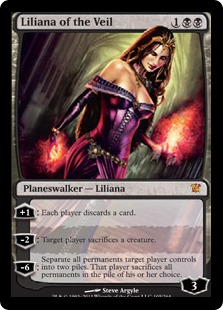
As a standalone card, Liliana interacted with the board at an unprecedented rate, not only offering players a then-unprinted Edict effect but an upticking value machine that promised even more removal down the road, all while heavily disrupting critical-mass and control-slanted decks.

Planeswalkers as a card type reward players boasting enough interaction to resolve and protect them; in other words, midrange decks. Liliana's double-black requirement joined with Thoughtseize's color identity to make black-based midrange the dominant flavor throughout the format's history. Fatal Push proved the nail in the coffin for that battle—while we do occasionally see, say, Temur-colored midrange decks rear their heads, the strategy is overwhelmingly black-dominated, something I don't expect to change any time soon.
With that being said, printing cheap walkers in other colors is a definitive first step to diversifying the color profiles of midrange strategies.

First Wave: War of the Spark

War brought numerous three-mana walkers into Modern, shaking Liliana's standing as one of the format's lynchpins.

Narset, Parter of Veils

Narset, Parter of Veils was an early hit from War thanks to the then-stifling presence of Arclight Phoenix. The walker's static ability shut down not just Phoenix, but other Faithless Looting decks, completely debilitating cantrip-heavy strategies while simply peeving less-reliant shells.
Format effects: gives blue-heavy decks a mainboardable way to hose velocity strategies

Winners: UW Control, blue-based aggro-control

Even against decks without cantrips, though, Narset won her weight as a card, immediately digging for a spell and then doing so again the following turn should she not eat a Bolt. That super-Divination would leave behind the static ability. Even if she was answered in the following turn cycle, Narset ended up plussing, as her removal still cost opponents a card if they didn't have threats ready to swing at her. UW Control, a deck great at keeping the board clear, ended up being Narset's forever home.

UW Control, by Patrick Wu (5th, Face to Face Quebec Open

Creatures

4 Snapcaster Mage

Planeswalkers

3 Narset, Parter of Veils
1 Teferi, Hero of Dominaria
2 Teferi, Time Raveler
3 Jace, the Mind Sculptor

Instants

1 Shadow of Doubt
3 Cryptic Command
3 Force of Negation
4 Opt
4 Path to Exile
1 Logic Knot
3 Mana Leak

Sorceries

2 Supreme Verdict
1 Timely Reinforcements

Sideboard (15)

2 Ashiok, Dream Render
2 Celestial Purge
2 Disdainful Stroke
1 Dovin's Veto
1 Gideon, Ally of Zendikar
1 Hour of Revelation
2 Mystical Dispute
1 Surgical Extraction
2 Timely Reinforcements
1 Vendilion Clique

Lands

2 Celestial Colonnade
4 Field of Ruin
4 Flooded Strand
1 Geier Reach Sanitarium
2 Hallowed Fountain
5 Island
1 Misty Rainforest
1 Mystic Gate
2 Mystic Sanctuary
2 Plains
1 Prairie Stream

Teferi, Time Raveler

Another UW standby, Teferi, Time Raveler offers similar benefits: the walker presents a card advantage engine as it disrupts opponents with a static ability. While great at pushing through threats in control mirrors, Teferi's found more success as a self-replacing piece of soft-disruption in tribal aggro strategies like Spirits, or a wall of insulation against enemy disruption in combo decks such as the ubiquitous Urza.

Format effects: lets combo-based decks happy to splash it employ a proactive floodgate plan against instant-speed disruption, all while staying even on cards

Winners: Urza, Infect, Spirits

Jeskai Urza, by Jidden (5-0)

Creatures

4 Emry, Lurker of the Loch
4 Urza, Lord High Artificer
3 Goblin Engineer
1 Sai, Master Thopterist

Planeswalkers

2 Saheeli, Sublime Artificer
2 Teferi, Time Raveler

Artifacts

4 Arcum's Astrolabe
2 Chromatic Star
4 Mishra's Bauble
3 Mox Amber
4 Mox Opal
1 Pyrite Spellbomb
1 Sword of the Meek
3 Thopter Foundry

Enchantments

4 Jeskai Ascendancy

Lands

4 Flooded Strand
1 Hallowed Fountain
1 Sacred Foundry
4 Scalding Tarn
5 Snow-Covered Island
1 Snow-Covered Mountain
1 Snow-Covered Plains
1 Steam Vents

Sideboard

1 Damping Sphere
2 Galvanic Blast
2 Lightning Helix
3 Metallic Rebuke
2 Monastery Mentor
1 Pithing Needle
2 Timely Reinforcements
1 Tormod's Crypt
1 Wear / Tear

Saheeli, Sublime Artificer

Continuing the daisy chain is Saheeli, Sublime Artificer, another player in Urza decks. Saheeli provides a Plan B to anyone casting noncreature spells, be they artifacts or instants and sorceries—indeed, we've seen this walker make a splash in decks as diverse as Mardu Midrange and Arclight Phoenix.
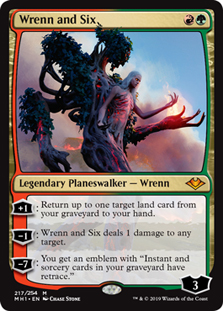
Format effects: forces opponents of blue or red decks with access to Saheeli to remember their sweepers after sideboard

Winners: Mardu, Phoenix, Delver, Urza

Ashiok, Dream Render

Finally, we land on Ashiok, Dream Render, the last of War's walkers to make a lasting impact. Ashiok has by and large been a sideboard card since its printing, but it remains one of the top-played walkers in the format for the many types of hate it provides. Between nuking the graveyard, preventing enemy searches, and potentially removing key cards from the opponent's deck, Ashiok poses a nightmare for plenty of strategies. As it doesn't impact the board, though, it's often too risky to run in the maindeck; nobody wants to be aggro food!

Format effects: Makes search-heavy and grave-synergy decks more cautious against blue and black midrange decks

Winners: Ux and Bx midrange/control strategies

Shakeup: Modern Horizons

Horizons isn't known for its planeswalkers per se, but it did drop into circulation what I'd call the most powerful planeswalker in Modern: Wrenn and Six. At just two mana, Wrenn promises to snowball card advantage for any fetch-heavy deck (read: most of them) if not dealt with posthaste. And rapidly killing a 4-loyalty walker isn't very easy for anyone to do, making Wrenn an ideal follow-up to a deceased mana dork or other play on an empty board.
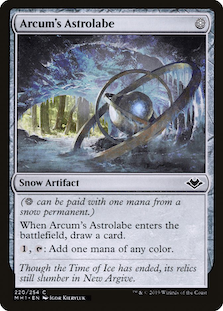
Format effects: Adds an early-game dimension to games featuring x/1s, incidentally hating on those decks, and provides players with a Dark Confidant-esque card-advantage engine during the early stages

Winners: multicolor midrange decks

That's not to mention Wrenn's -1 ability, which I'd argue has impacted the kinds of creatures Modernites can safely sleeve up. x/1s now need to pass an even higher bar to meet playability standards. Gone are the days of futzing around with synergy-creating 1/1s; Wrenn plays like a super-Liliana when it comes to dealing with those. Here it is in Jund:

Jund, by Manoah (2nd, Modern PTQ #11995292)

Creatures

4 Tarmogoyf
4 Bloodbraid Elf
2 Dark Confidant
2 Scavenging Ooze

Planeswalkers

4 Liliana of the Veil
3 Wrenn and Six

Instants

1 Abrupt Decay
2 Fatal Push
3 Kolaghan's Command
4 Lightning Bolt

Sorceryies

4 Inquisition of Kozilek
1 Maelstrom Pulse
2 Thoughtseize

Lands

1 Barren Moor
3 Blackcleave Cliffs
1 Blood Crypt
4 Bloodstained Mire
1 Forest
1 Mountain
1 Nurturing Peatland
2 Overgrown Tomb
2 Raging Ravine
1 Stomping Ground
2 Swamp
1 Treetop Village
4 Verdant Catacombs

Sideboard

2 Alpine Moon
1 Ancient Grudge
2 Collective Brutality
1 Collector Ouphe
3 Fulminator Mage
1 Huntmaster of the Fells
3 Leyline of the Void
2 Plague Engineer

Wrenn has also enabled plenty of multi-colored decks, including the 4-Color Snow lists wielding Arcum's Astrolabe. Hitting a land drop each turn, and especially a fetchland, ensures that these decks have the colors they need, and in the right amount.

4-Color Snow, by Peter Strauch (1st, Eternal Series: Modern)

Creatures

4 Ice-Fang Coatl
4 Snapcaster Mage
1 Tasigur, the Golden Fang

Planeswalkers

2 Jace, the Mind Sculptor
3 Wrenn and Six

Artifacts

4 Arcum's Astrolabe

Instants

2 Assassin's Trophy
1 Cryptic Command
2 Fatal Push
3 Force of Negation
3 Kolaghan's Command
2 Lightning Bolt
2 Opt
2 Spell Snare
3 Thought Scour

Lands

1 Blood Crypt
1 Breeding Pool
1 Field of Ruin
1 Lonely Sandbar
2 Misty Rainforest
1 Overgrown Tomb
2 Polluted Delta
2 Prismatic Vista
3 Scalding Tarn
1 Snow-Covered Forest
3 Snow-Covered Island
1 Snow-Covered Mountain
1 Snow-Covered Swamp
1 Steam Vents
1 Watery Grave

Sideboard

2 Alpine Moon
2 Ancient Grudge
1 Ashiok, Dream Render
2 Collective Brutality
3 Disdainful Stroke
1 Engineered Explosives
1 Huntmaster of the Fells
2 Plague Engineer
1 Weather the Storm

Belle of the Ball: Throne of Eldraine

Our last stop is Throne of Eldraine, Magic's newest expansion. Throne has already begun to significantly impact Modern, not least of all because of one, maybe-Standard-bannable planeswalker: Oko, Thief of Crowns.

Oko gives the Simic combination something it's never had access to in a solid removal option. While turning fatties into Elks doesn't exactly remove them, it might as well when it comes to abilities. Besides, a 3/3 is much easier to deal with than, say, a 6/6. After just one full turn cycle on the battlefield, Oko can also steal enemy creatures with its ultimate, trading away a nigh-useless Food token for whatever Goyf opponents are hiding behind.

This combination of abilities makes Oko attractive even in low-curve strategies such as Traverse Shadow. We're also seeing it in Bant Company, a deck beginning to enjoy an abundance of attack angles thanks to its other recent addition in Stoneforge Mystic. Heck, even UG Merfolk is making a comeback with Oko in its ranks, and UG Eldrazi don't look too shabby, either.

Format effects: Grants UGx decks a solid, on-color removal plan doubling as a value train

Winners: Anything in those colors

Traverse Shadow, by jled (5-0)

Creatures

4 Death's Shadow
1 Snapcaster Mage
4 Street Wraith
4 Tarmogoyf
2 Windcaller Aven

Planeswalkers

2 Oko, Thief of Crowns

Artifacts

4 Mishra's Bauble

Instants

1 Assassin's Trophy
1 Dismember
3 Fatal Push
3 Once Upon a Time
4 Stubborn Denial

Sorceries

4 Thoughtseize
2 Inquisition of Kozilek
4 Traverse the Ulvenwald

Lands

1 Breeding Pool
1 Island
2 Nurturing Peatland
2 Overgrown Tomb
4 Polluted Delta
1 Swamp
4 Verdant Catacombs
2 Watery Grave

Sideboard

1 Assassin's Trophy
1 Ceremonious Rejection
2 Collective Brutality
1 Collector Ouphe
2 Disdainful Stroke
1 Duress
1 Fatal Push
1 Jace, Vryn's Prodigy
1 Plague Engineer
1 Spell Snare
2 Veil of Summer
1 Yixlid Jailer

But these uses aren't what's got most of the format's attention right now. That honor goes to Oko's newfound role alongside Urza, Lord High Artificer. With Emry, Lurker of the Loch looping cheap artifacts and Oko turning them into 3/3s, the deck is beginning to resemble Hogaak in its ability to pump out bodies nonstop and resist targeted hate (in this case, Collector Ouphe).


It seems a bit early to tell if Oko Urza will retain its title as the go-to Urza build in the future, but it is a force to be reckoned with currently.

Now What?

Wizards's apparent willingness to print great, cheap walkers bodes well for Modern's future. Walkers are unique enough in their individual design that most cheap ones with decent abilities should find a home somewhere, keeping the format from getting too stale. But if the company does decide to ban Oko from Standard, perhaps they'll decide (also informed by Teferi's performance) to tone back the power level of these permanents. They are indeed divisive, with Jon Finkel going so far as to claim planeswalkers in general ruined Magic.

Either way, I wonder if surgical answers like Abrupt Decay and Fry will start seeing more play now that cheap walkers have become a cornerstone of Modern. How are you beating the Elks?

Want Prices?

Browse thousands of prices with the first and most comprehensive MTG Finance tool around.


Trader Tools lists both buylist and retail prices for every MTG card, going back a decade.

Quiet Speculation