menu

Daily Stock Watch: Whir of Invention

Are you a Quiet Speculation member?

If not, now is a perfect time to join up! Our powerful tools, breaking-news analysis, and exclusive Discord channel will make sure you stay up to date and ahead of the curve.

Hello, readers and welcome to the Tuesday special edition of the Daily Stock Watch! I'll continue what I've started this week by making a pick of what I think could be good cards to buy (or sell) before Pro Tour Rivals of Ixalan on the weekend. Today, I'd like to make another "budget" call on another Standard card that's making an impact in Modern.

There was an error retrieving a chart for Whir of Invention

Lantern Control returned to Modern prominence late last year in the aftermath of Sam Black's unprecedented run to the finals of SCG Invitational Roanoke using the deck. It was the same old strategy for the control deck, but it found itself a very useful tool in Whir of Invention. Using the same list, other players have tried it on separate online tournaments and also found some success with the addition of Whir of Invention.

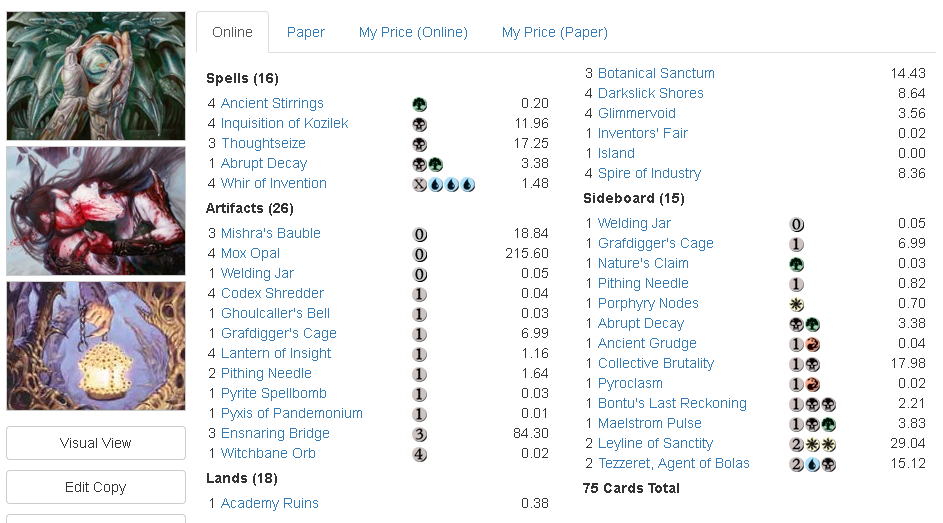
For further reference of how the list looks like, take a look at this:

Lantern Control by Sam Black

Instants and Sorceries

1 Abrupt Decay
4 Ancient Stirrings
4 Inquisition of Kozilek
3 Thoughtseize
4 Whir of Invention

Other Spells

4 Codex Shredder
3 Ensnaring Bridge
1 Grafdigger's Cage
4 Lantern of Insight
4 Mishra's Bauble
4 Mox Opal
2 Pithing Needle
1 Pyrite Spellbomb
2 Pyxis of Pandemonium
1 Witchbane Orb

Lands

1 Academy Ruins
3 Botanical Sanctum
4 Darkslick Shores
4 Glimmervoid
2 Island
4 Spire of Industry

Sideboard

2 Abrupt Decay
1 Ancient Grudge
1 Grafdigger's Cage
2 Leyline of Sanctity
1 Nature's Claim
1 Pithing Needle
1 Porphyry Nodes
1 Pyroclasm
1 Search for Azcanta
2 Tezzeret, Agent of Bolas
2 Welding Jar

Whir of Invention is an instant-speed tutor in this deck which could basically fetch any artifact that you need, given that you have three blue mana and a plethora of artifacts in play. It grants the Lantern Control player access to powerful cards such as Ensnaring Bridge, Witchbane Orb, and the ever-reliable Lantern of Insight. This also gives its pilot the ability to dictate the pace of the game, may it be against aggressive, combo, or control decks.

Instant Speed Tutors in Modern

Instant speed cards that nets you another card is a rarity in Modern, and you could see that the cards above are all part of a tier one or two deck in the format. It's not hard to see Lantern Control propelling itself to tier one territory with a win over the weekend, and this would definitely mean that Whir of Invention would be one of the sought after cards by those who would like to try the deck, or just initiate a buyout. The Utility Checker states that over the past two months, 1.6% of winning decks in Modern have utilized a full playset of Whir of Invention, which is actually a decent amount of exposure for a card that's rather limited to only one deck. It should be fair to say that this number will definitely increase if Sam Black or some other pro decides to use the deck again and have another virtuoso performance at the event.

At the moment, Whir of Invention is pretty easy to find for a little over a dollar from Star City Games, Card Kingdom, Channel Fireball, or TCGPlayer. I once again recommend that you check your LGS for bulk copies which could net you better discounts, or just simply try trading for a few sets of it at below a dollar. The foil copies are being sold at $5-$8 from the said stores, so this could be another great spec target now that would pay off going forward. There won't be any shortage of decks that would require you to use artifacts and a blue base in any format. I don't think it would do us any harm to grab a few sets for safekeeping.

And that’s it for the Tuesday special edition of the Daily Stock Watch! See you again tomorrow, as I continue this week’s Pro Tour special edition. As always, feel free to share your opinion in the comments section below. And if you want to keep up with all the market movement, be sure to check in with the QS Discord Channel for real time market information, and stay ahead of the hottest specs!

Insider: Another Look at Standard Metagame (RIX Week 2)

Are you a Quiet Speculation member?

If not, now is a perfect time to join up! Our powerful tools, breaking-news analysis, and exclusive Discord channel will make sure you stay up to date and ahead of the curve.

Hi guys, welcome to another article.

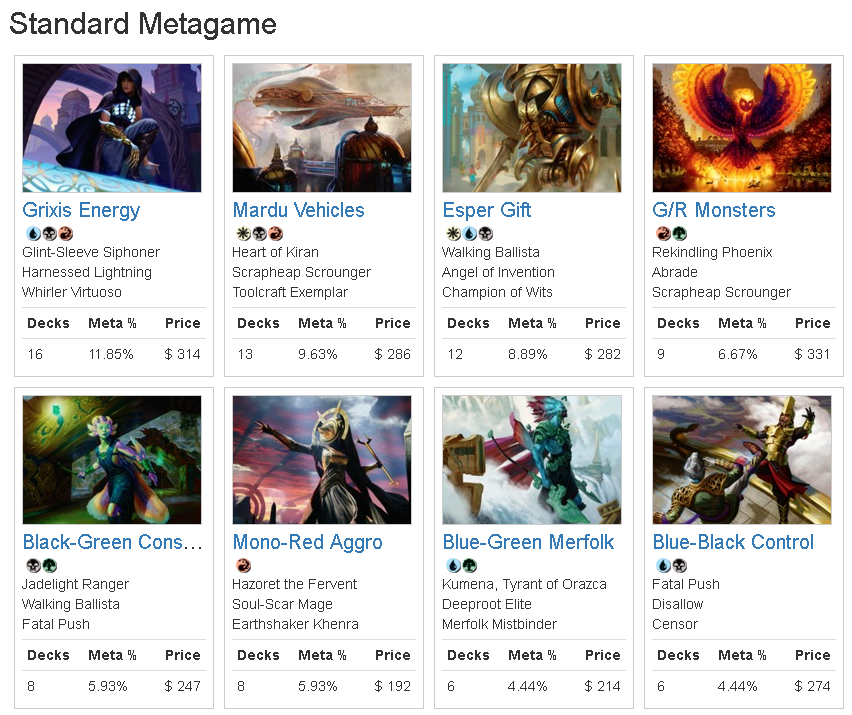
Last week, Grixis Midrange and Esper Approach were the decks occupying the largest portion of the metagame. However, many things have changed in a week's time. If you look at the Standard metagame from MTGGoldfish, here's roughly what you will see:

This was predictable based on previous sets. Control and midrange decks tend to dominate during the early days of the new release, and then aggro decks will rise after players figure out the right combination of cards that they need to beat the slower decks. After that midrange and control decks will take turns to come back, and these will basically form a metagame change cycle (midrange -> control -> aggro -> midrange -> repeat).

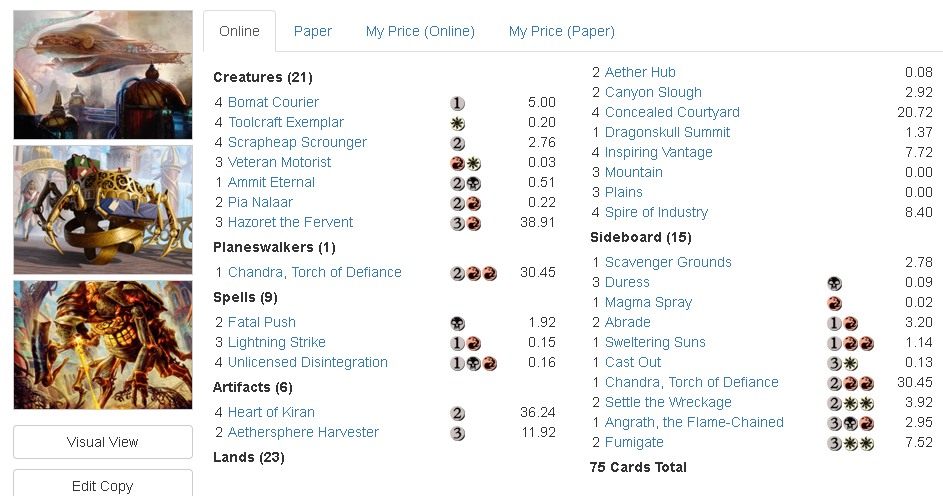
A rough overview of the meta right now: UG Merfolk and GR Monsters are the new aggro deck additions to Standard after quite a long time (mostly because the Energy decks were dominating). Mardu Vehicles came back as the best aggro deck, while Grixis remains as the best midrange deck. If you followed my article last week, Hazoret the Fervent did actually increase about 2 to 3 tickets in price due to Mardu Vehicles.

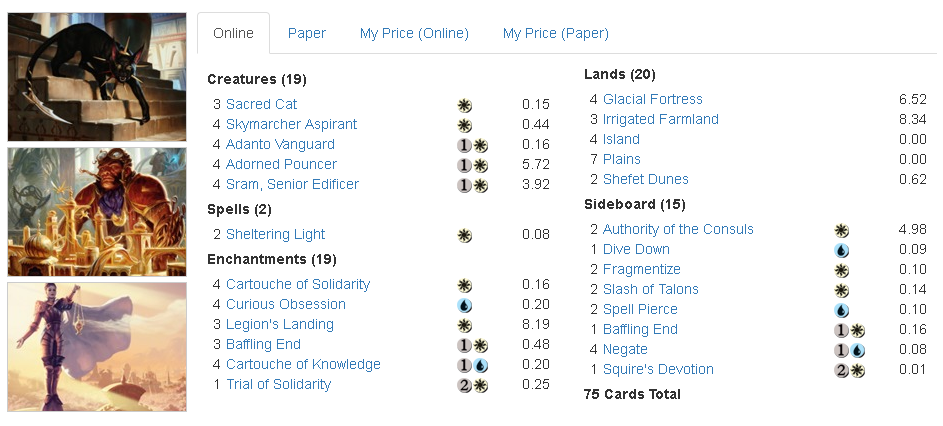
As always, I will find some underrated decks to talk about. At the first week's RIX Standard Star City Games events, I found the deck by Jim Davis quite interesting and surprisingly budget-friendly.

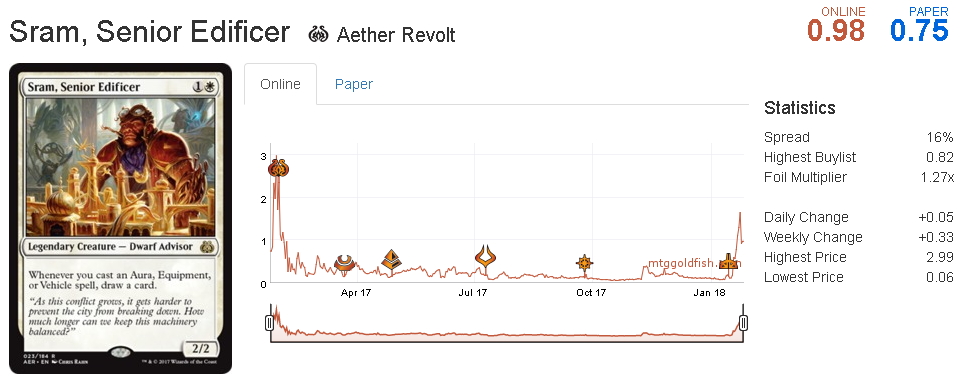
There are only five rares in the deck including the two white-blue dual lands. This deck is very similar to the white-blue auras deck during Theros block, with the Heroic theme. The current version abuses Sram, Senior Edificer's ability to draw a bunch of cards, and mostly depends on Adanto Vanguard's ability to steal wins.

This deck is cheap but in my opinion not easy to beat if you are playing a midrange or control deck. I think we should give this deck another chance even though it didn't make it to the online metagame.

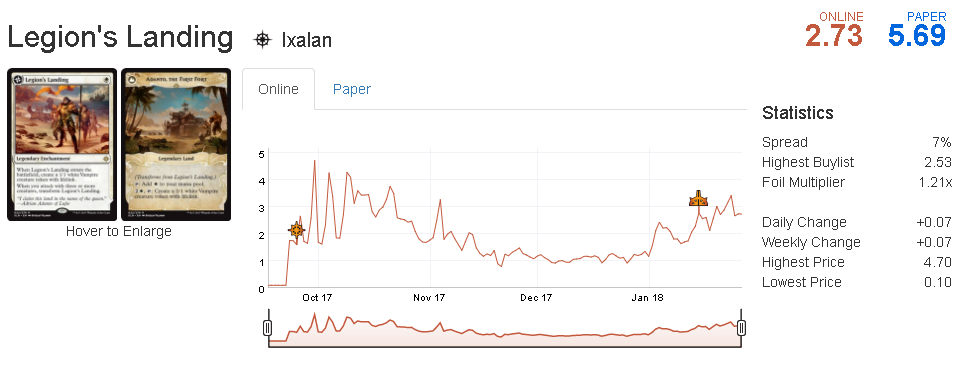
Legion's Landing is a good card to beat Mono-Red and Mardu Vehicles, in my opinion. Most of the aggressive creatures have very low toughness so the 1/1 token can trade profitably with them, and if it sticks around lifelink is very annoying for the aggressive players.

Besides, the Tokens deck in Standard also plays this card mainboard. Although these decks might not look impressive on paper, in theory token strategies are good against midrange and control decks because of the go-wide strategy. For this card, since the decks that play it are not popular right now, I suggest putting it on your watchlist and buying into playsets whenever it reaches a low point.

Sram, Senior Edificer was played in an artifact combo deck in Modern but its price never went up before. However, this time, its price went up by about 1.5 tix when Jim Davis got third place in the SCG Classic. What I would do is observe how good this white-blue auras deck is online, and buy playsets if I think players will have a hard game against it with the top decks in the format like Mardu Vehicles and Grixis Energy. If this deck is good, it will only be a matter of time before it wins some leagues.

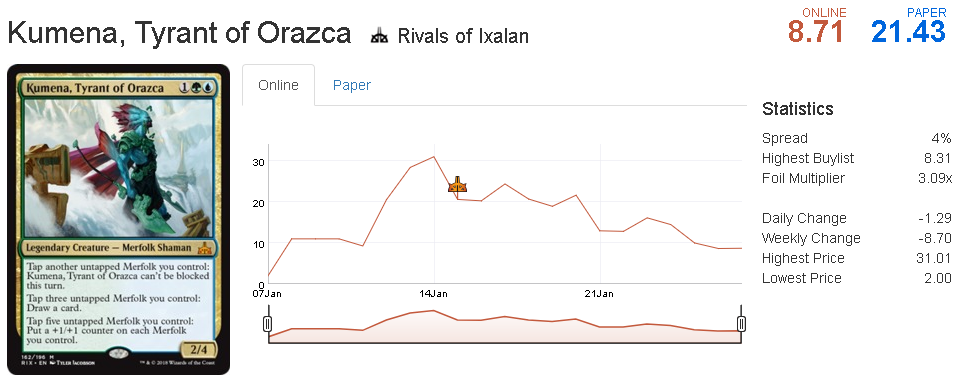
Last week I mentioned that I wouldn't buy into Kumena, Tyrant of Orazca because it was overpriced at that moment. However, because this deck didn't perform well in the last SCG event, and players online didn't 5-0 many leagues with this deck, Kumena dropped in price drastically.

I think this card will still drop a bit until it reaches 6 tix. Based on price lists online, playable mythics will hardly drop below 5 tix and Kumena is a four-of in Standard UG Merfolk. We still haven't seen this card in Modern yet, but if Kumena is really good there I predict the price of this mythic creature will go up to 10 tix. In conclusion, if Kumena's price does go down a little bit lower, buy playsets of them as investments.

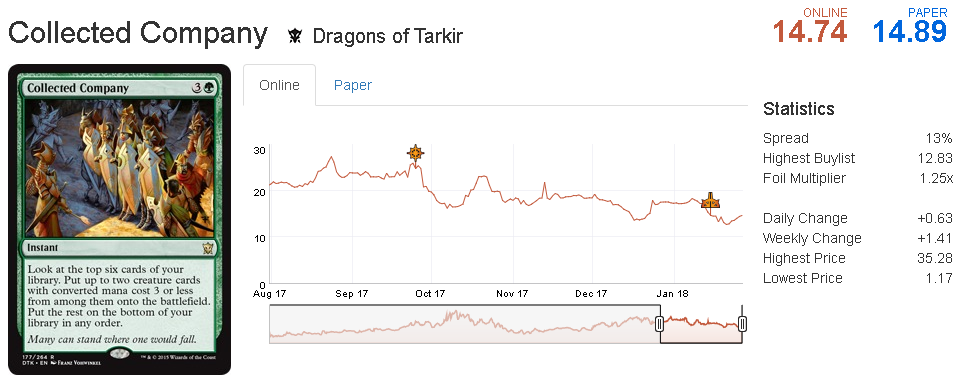
On a side note, Collected Company from Modern seems to be increasing in price lately, if you are speculating on Modern Collected Company Merfolk, you should have bought copies of the spell by now.

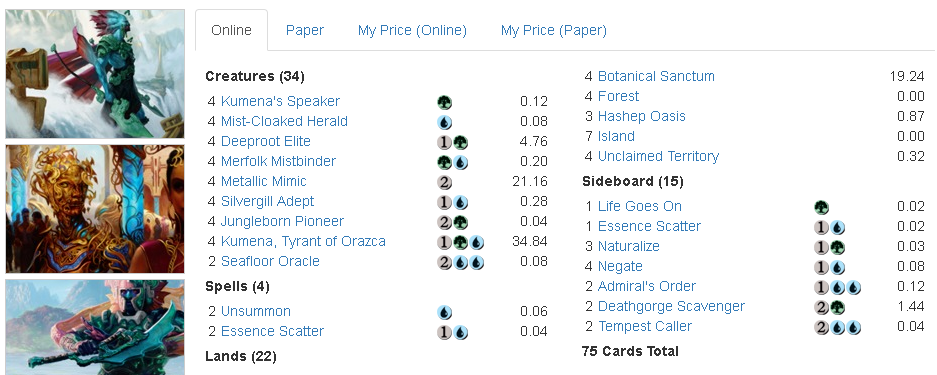
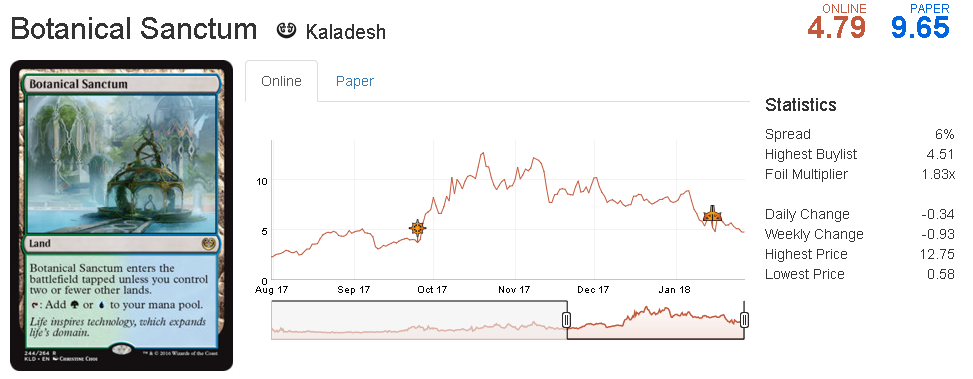
Back to Standard UG Merfolk, another card I suggest keeping your eyes on is Botanical Sanctum. This card, as most of you know, dropped price a lot due to the recent B&R announcement.

A bit more findings about Botanical Sanctum: This card is played in the latest Lantern Control list which mainboards four copies of Whir of Invention. Past experience tells me that online players seldom pick slow deck that might cause a timeout in games but if this version with Whir can end game faster, I think its advisable to have a look at the list.

Besides Lantern Control, Botanical Sanctum is also played in many other decks like Standard Sultai Midrange, Temur Monsters, and the various versions of Bant Company decks in Modern. Currently I assume the supply for this card in the market is very high and I see that as a good opportunity to stock up on this card when it touches the 3.5-ticket mark.

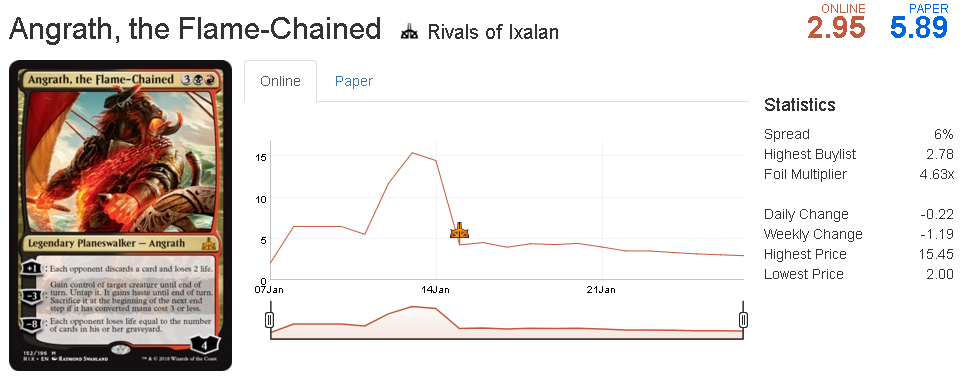
Aside from these two decks, I think the new planeswalker Angrath, the Flame-Chained has good potential:

This card will probably be a sideboard card at the moment. But as I said, the metagame will shift soon, once the midrange players find the correct removal suite to beat the fast decks. Therefore, every deck needs to get prepared for the weeks where the scene will be flooded with midrange decks.

Let's take the top two decks currently as example: Grixis and Mardu. Grixis Energy, as a midrange deck itself, needs something to be the "mirror-breaker" and Angrath is what they're looking for. Then, for Mardu Vehicles, in order to fight against midrange decks with plenty of removal, they need to "out-midrange" their opponent by switching gears into a slower deck. Thus, I suggest buying in to playsets of Angrath as investment as it's so cheap right now.


Alright, that’s all for the week. Thank you all for reading, and I will see you guys again soon!

–Adrian, signing out

Insider: Investment Level Up – Cheap Mythics, Part II

Are you a Quiet Speculation member?

If not, now is a perfect time to join up! Our powerful tools, breaking-news analysis, and exclusive Discord channel will make sure you stay up to date and ahead of the curve.

Welcome back, folks. This week I aim to conclude our discussion of low-converted-mana-cost (hereafter referred to as "cheap") mythics. Last week we covered the two extremes—the instant standouts ($10 and above) and the ones that were quickly scorned ($2 and below). We identified some broad rules that can be applied to help you make good investment decisions into cards in this category:

1) Cards whose investment lows don't dip below $10 before the release of the next set are very likely to increase in value. The average rate of increase has been 65.0% for the mythics in this category printed in the past four years.

2) Cards whose investment lows fall into the $1 to $2 range before the release of the next set will rarely increase in price or undergo a price spike. Depending on your cutoff date for selling, the average rate of increase has been roughly 0.0%, if not a tad lower, for the mythics in this category printed in the past four years.

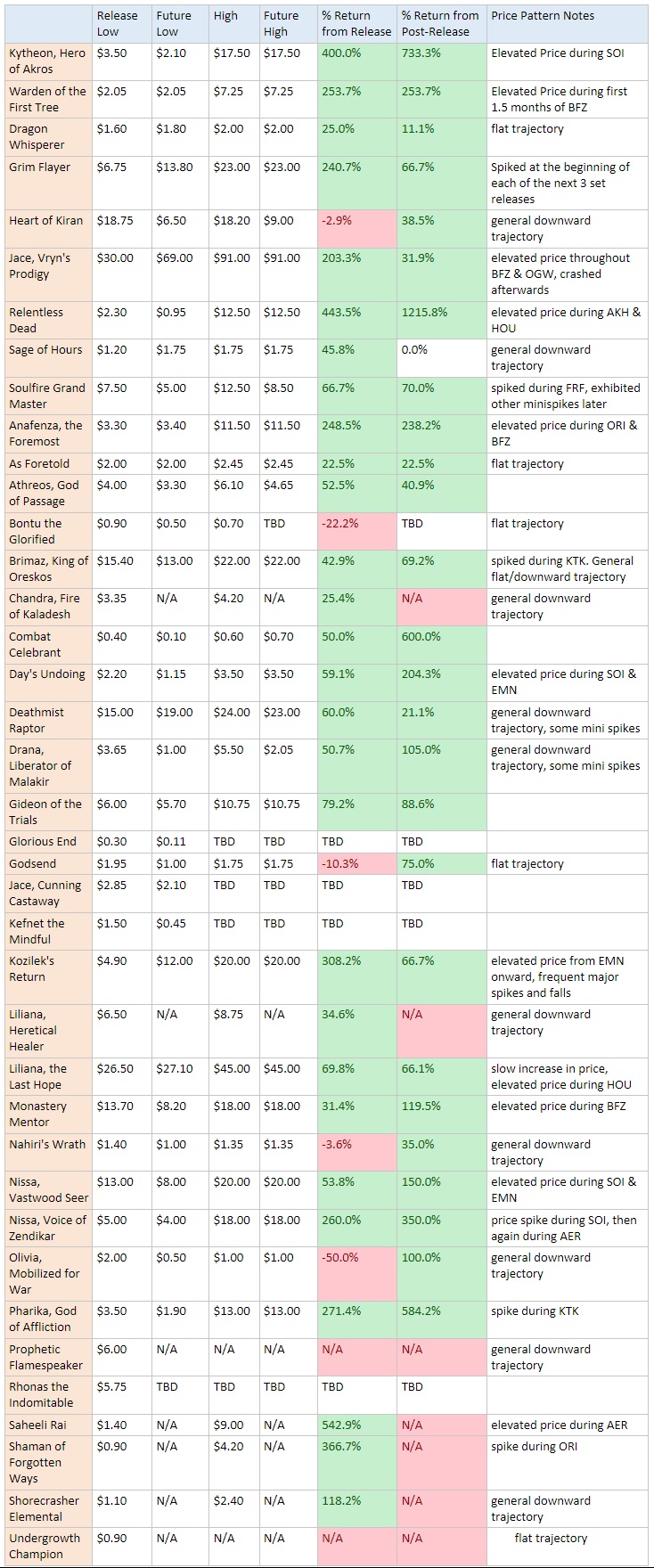
But what about those in between? While half of cheap mythics fall into one of the two above categories, the other half fall between $2 and $10, indicating either that the card is seeing a non-zero amount of play or that the card has been deemed by speculators to have a lot of potential power that the current card pool has not yet unlocked.

Can we discern anything about this category of card in this price range? Will we be able to create hard and fast rules for them like we could for those at the two extremes? Let's dig in! And click the spoiler below to see the data sheet we are working with.

Cheap Mythics Between $2 and $10: Surprisingly High Returns!

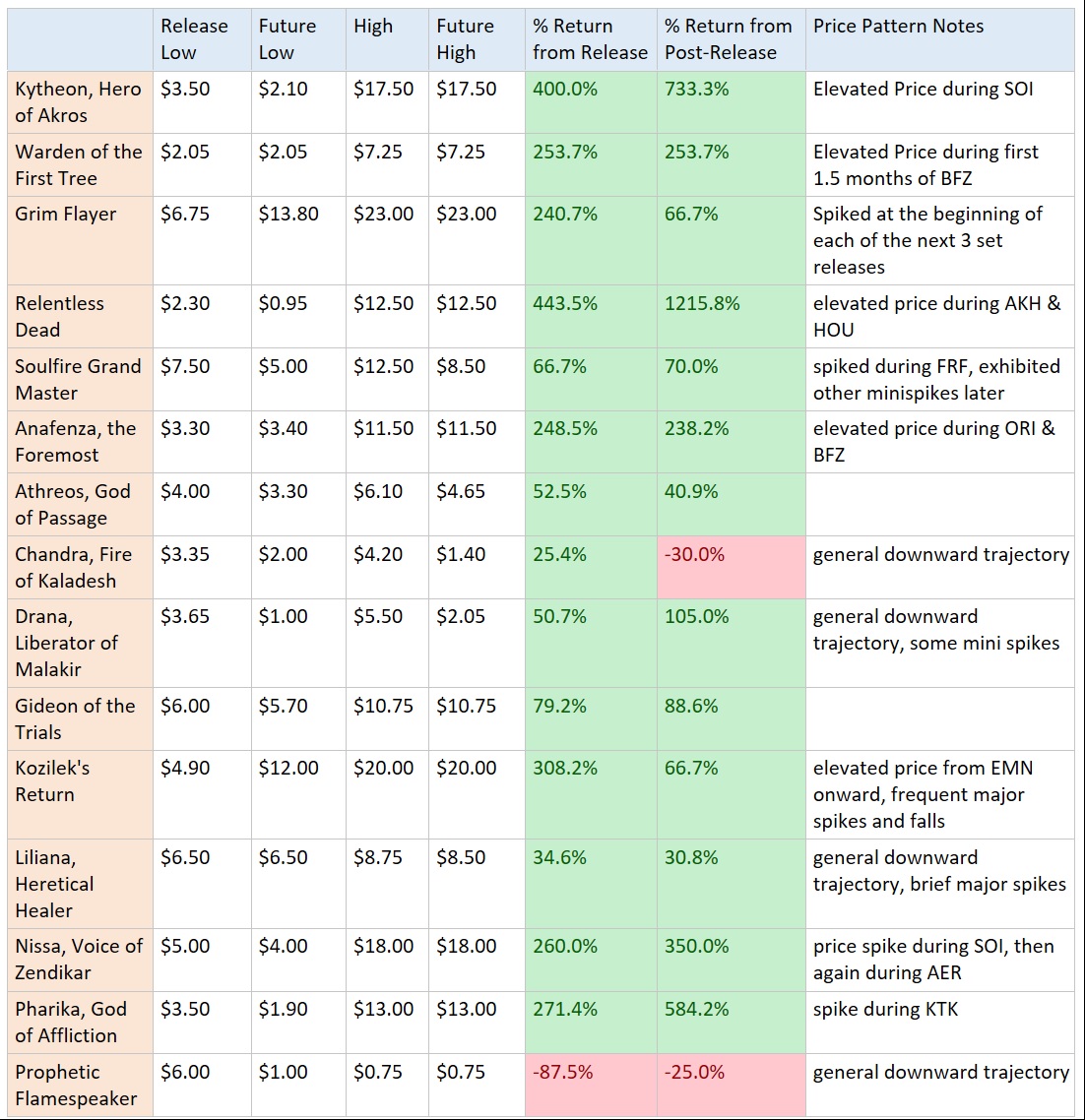
After conducting my research, I was surprised that the cheap mythics in this middle price range proved to have the highest overall returns. And it's not even close. Compared to the 65% returns for cheap mythics above $10, these mythics have had returns of a staggering 176.5% during the past four years! Let's take a closer look at the chart below.

1) Although the rates of return exhibit high variance, they are almost all positive.

Thirteen of these 15 cards exhibited substantial growth or significant price spikes during their time in Standard. Eight of these 15 cards exhibited release growth between 200% and 400%, and the majority of those that didn't still grew by about 50%. That suggests that investing in these cards is well worth the financial risk.

Unlike cards that settled below $2, the vast majority of these cards managed to see substantial play in Standard eventually, even if they didn't find an immediate home. I was surprised to find that even more niche cards like Liliana, Heretical Healer and Athreos, God of Passage saw a sell window wide enough for casual or amateur investors to turn a nice profit.

2) On average, you will maximize your profits if you exercise patience.

Although you would have garnered a marginally higher rate of return with the $10 mythics by waiting (71% compared to 67%), the rewards for waiting in this category were substantial (252.6% compared to 176.5%).

I suspect much of the reason has to do with precisely the category of card we are dealing with here—cheap mythics that aren't seeing much play or have garnered substantial investor interest. In order to even be in this category, these cards can't have blossomed in Standard, and usually it takes more than one new set release to vault these cards to tier-one status.

Sometimes that is not the case (Grim Flayer and Soulfire Grandmaster), but usually mythics in this category dip lower before spiking upward at some point in the future. Buying a month or two after the next set's release is usually a wise move for those wishing to maximize returns.

3) Be prepared to hold these investments for a while.

There is one downside to investing into cards in this category—the time to exit your holdings is open-ended. Oftentimes you won't be holding these cards for more than a month or two, but sometimes you will be stuck holding them for a year or more.

Relentless Dead is an extreme case but one you should be prepared for, a card that sunk all the way to $1 until Amonkhet's release. A good exemplar for the average-case scenario for this category of card is Warden of the First Tree, both in terms of expected returns (250%) and in terms of the length of time you will have your capital tied up in the card (six months).

Applications to Today's Mythics

Some of the recent mythics in this category are a bit odd in that they are fairly narrow cards. Jace, Cunning Castaway demands an aggressive blue shell. So long as Heart of Kiran is in the format, I think Jace has a shot at seeing a major price spike. I took a major gamble with Jace (I wanted to invest before the release of Rivals of Ixalan), and so far I've lost bigly. His price is now 1.77 tix, which strikes me as a good buy for those wanting to take the risk (now that Rivals has come and gone, my recommendation is not to invest in Jace).

Kumana, Tyrant of Orazca, like Jace, is extremely narrow. His price will depend solely upon how successful the Merfolk deck is in Standard. And, since that is but one deck, I don't think his ceiling is all that high.

Rhonas the Indomitable is one that I do believe is worth investing in, and he stands to benefit from the recent Standard bans. I bought about ten copies when his price was below 3.00 tix, and I think anything under 3.50 tix will see a positive return. I plan to sell Rhonas if and when his price reaches 5.00 tix.

More so than anything else, though, this article is about giving us historical awareness to inform our investment decisions moving forward.

Signing Off

I'd love to hear your comments and questions about the articles in this series. Do you like them? Do you find them insightful? Did you notice something important I missed? Do you have any additional perspective on this class of mythic rare?

Here is a copy of my portfolio. I've begun to slowly sell off some of my positions of Vraska's Contempt and the Rakdos duals which have risen in value due to the rise of Grixis Energy Midrange. Based upon the research I did for the Ixalan lands in September, I think that selling Dragonskull Summit for anything higher than 1.25 tix is acceptable, and anything above 1.75 tix is excellent.

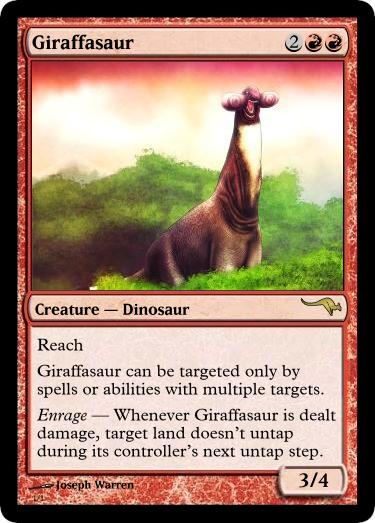
This week I'd like to share a cute dinosaur creature card I designed for a design competition. Although I had to scrap it because I couldn't get it to meet the strict confines of the design challenge, I like the way that it enables fight spells in a competitive environment.

Bloodbraid Month, Pt. 5: Evaluation

Are you a Quiet Speculation member?

If not, now is a perfect time to join up! Our powerful tools, breaking-news analysis, and exclusive Discord channel will make sure you stay up to date and ahead of the curve.

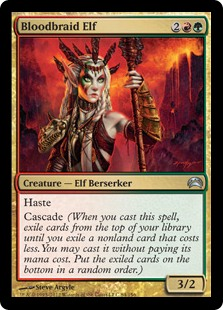
This is the big one. It's time to answer the question I've been dancing around all month: Is Bloodbraid Elf safe for Modern? Ought Wizards to rescind its banishment, to the delight of many? Or should Elf remain locked away, to the delight of many others? There have been a number of narratives running through this series, and the truth is complicated. I'm expecting a... lively comment section as a result.

To reiterate, I'm personally against unbanning Bloodbraid Elf. I've been upfront about that all month. I have a long negative history with the card and I never want to face it again. This is personal bias. It's also irrelevant.

Instead, this article looks back on the month to see what conclusions can be drawn. From those conclusions, I will extrapolate on the impact of an unban. The test will be whether you think the impacts are positive or negative. Let's go through my results in reverse order.

The Data's Story

As last week showed, Bloodbraid has a substantial and significant positive impact on Jund's win rate. This is to be expected: add a relevant, powerful card to a strong deck, and it gets better. This result strongly suggests Jund will return to being a metagame force. Jund has fallen into Tier 2 for a number of reasons, so receiving a power boost could get it back into Tier 1.

Individually speaking, there are a few weakly significant results. The strongest single result was against Jeskai Tempo. Jeskai is a reactive midrange strategy that wins via incremental advantage. Jund is very similar. Bloodbraid provides an important source of card advantage, virtual advantage, and tempo, surging Jund over Jeskai in the midgame. Jeskai lacks a similar midgame-breaker. Late-game cards are available but were not tested. This result indicates that Bloody Jund would be heavily advantaged in grindy matchups, and that incremental advantage-based decks would suffer.

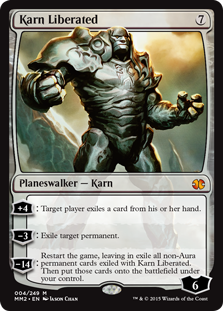
The other weakly significant result was against GB Tron. Jund was heavily unfavored, but Bloody Jund made the matchup even. While Tron was still able to completely shut down Jund by attacking its mana with Karn Liberated, if Jund was able to avoid that fate, it could overwhelm Tron with the extra spells from cascade. Admittedly, the Tron deck wasn't optimized against Jund, but Tron's never really needed to be in the past. Its default plan of seven-mana haymakers has always been good enough. The fact that it may not work anymore is interesting.

The other matchups failed to make the significance thresholds, but they still hold lessons. There was movement in the matchups where tempo and card advantage are important, and against Grixis a better strategy was discovered during testing that most likely would have improved Jund's matchup to significant levels. Taken into consideration with the total result, it is safe to conclude that Bloodbraid Elf does have a positive impact on Jund's performance in Modern and that the impact will be felt across a large number of matchups.

The Testing Experience

The primary conclusion of the qualitative data from the testing process was continuity. Bloodbraid does today what it did back in 2009. If you've played with or against the card before, your conclusions are still valid. This means that lessons of past formats reasonably model the end result of unbanning Bloodbraid Elf. This will allow us to predict future results with some accuracy.

Historical Perspective

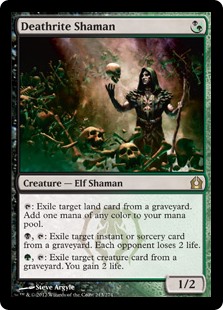
The historical narrative has been that Bloodbraid Elf paid for the sins of Deathrite Shaman. However, closer examination brought this into question. Jund was already on top of the metagame prior to Return to Ravnica, and arguably the best deck. Shaman definitely pushed the deck over the top of its closest rival, Affinity, but did not change its position in the overall metagame. Therefore, the claim that Bloodbraid's banning was unjust is questionable at best. What this indicates is that Bloodbraid alone was powerful enough to push Jund to the top of the metagame. It is also worth noting that the metagme of 2012 was similar to today's. Jund, Affinity, Tron, and Pod (now Company) were Tier 1; Storm, UWx, and Burn were Tier 2. Cards have changed for all of those strategies, but the strategies themselves remain. The same is true of Jund. This indicates that Bloodbraid will have a similar impact now as before.

What to Expect

What would this mean for Modern if Bloodbraid was unleashed today? The data show the effect on current Tier 1 decks, but that doesn't necessarily encompass the entire metagame. Such a thing is very hard to do experimentally. However, given the overall power boost and the lessons from history, there are reasonable conclusions that can be drawn about the impact on the archetypes which will suggest an impact on the metagame.

Aggro

Affinity was unaffected by Bloodbraid in my testing, which backs up history. The deck has all the tempo, and incremental card advantage only matters if it's attached to removal, which is why Electrolyze is brutal. It is unlikely to be any different for other true aggro decks. The matchup is about density of relevant removal, and Bloodbraid's impact is just a function of that aspect: the more removal you play, the more likely you see it and the more likely Bloodbraid is to hit some. All other considerations are comparatively minor, and I suspect aggro will be relatively unaffected.

Midrange

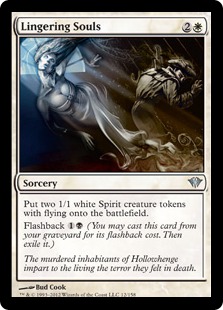
Jund historically pushed all other midrange decks out of every format except for the Brainstorm-dominated Legacy. Naya may have started out strong after Alara Reborn, but it did not survive long, and other midrange strategies were inferior to both Naya and Jund. Bloodbraid does so much for these decks in the midgame that if you're not doing something at least as powerful, you cannot compete along the same axis. Abzan traditionally preys on Jund, but it is not really doing better than Jund right now. Siege Rhino doesn't compare, and as good as Lingering Souls is in the matchup, it's not going to do enough. I cannot imagine that Jund won't become the sole non-Shadow midrange deck in Modern.

Exactly what will happen to Death's Shadow decks is hard to determine. My data indicated Jund could be boosted over Grixis Death's Shadow, and I think that if I'd understood the matchup better from the beginning, it would have clearly been favorable. This may knock Grixis out of Tier 1, but hybridization is a distinct possibility. I still believe that Death's Shadow could be made to work with Bloodbraid. If that's true, the deck would be terrifying and there would be no reason not to play Bloody Shadow Jund to the exclusion of other versions.

Control

Jeskai Tempo will not survive Bloodbraid's unbanning. My data was very clear on that front; it had a terrible matchup. Perhaps it could adapt to be more of a value creature deck, similar to the Restoration Angel decks from PT Return to Ravnica. Of course, those decks didn't do particularly well prior to the tournament or afterwards. I played something similar at the time, and Jund was an even match at best. Considering that the strategy has largely disappeared from Modern, I doubt it would actually be viable in any case. Jeskai will have to either speed up or slow down to survive. Speeding up may work, Jeskai Aggro was Tier 2 in 2012; however, Fatal Push has largely driven Delver strategies out of Modern. This makes me skeptical that such a readjustment will succeed.

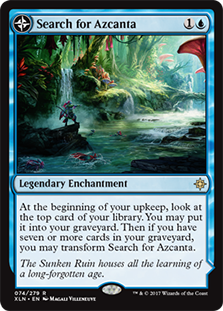
However, if you go slower, I'm not certain the result would be better. After Lorwyn block and 5-Color Control rotated, no control deck could really compete with Jund and the blistering red decks from Zendikar block. You could beat one or the other if you wanted to, but beating both was a tall order. Control didn't disappear by any means, but it had to become either tap-out control or ramp. Most UWx decks went the big mana route with Lotus Cobra and Noble Hierarch to power out Jace, the Mind Sculptor, Gideon Jura, and Sovereigns of Lost Alara. Yes, these days you have Ancestral Vision and Search for Azcanta to catch up on card advantage, but both are glacial in the face of cascade's tempo bursts. True UWx control is nothing special now, and if the past is any indication, that won't change with Bloodbraid loose.

Big Mana

Gx Tron will be less of a problem for Jund than before. Bloodbraid provides card advantage, tempo, and a hasty threat to blast past Tron's haymakers. Tron has been tuned for combo and Burn decks with Collected Brutality, and not for beating Jund. A resurgent and boosted Jund will force a reevaluation and possible changes, though of what kind remains unclear. Tron may accept an even matchup against Jund in exchange for percentage elsewhere.

Other big mana decks are unlikely to be affected. The many variants of GR Valakut currently have a very good matchup against Jund, which shouldn't change. Jund has a lot of dead cards game one, not much sideboard, and difficulty racing Valakut. Discard is minimally effective since the key cards are lands, and any impact card off the top is lethal. It really comes down to Jund's clock, which will slightly increase thanks to Bloodbraid's haste, but not enough to dramatically change the game.

Combo

Storm and other spell-based combo decks won't be dramatically affected. These matchups depend on whether Jund's early discard can slow them down, which Bloodbraid doesn't affect. The clock is the other component, and while again Bloodbraid does improve the clock, it doesn't by enough to significantly shift percentages. The game should be decided by the time you'd play the Elf.

Creature combo is another story. Jund traditionally picks apart small creature decks, and current Counters Company decks are weak to Jund. It's not an unwinnable matchup by any means, and Collected Company makes up for the creatures' individual weakness. However, Bloodbraid will cause many players to pick up Jund, and the increase in a bad matchup will negatively affect Company decks. They may adapt and be fine; Pod was Tier 1 back in 2012. Or maybe the combo-heavy versions may not be viable at all, and the value-based Abzan Company will reemerge.

Overall

The way I see this playing out is for Jund to act like a wedge in the metagame. You will have to be faster or slower than Jund; trying to be similar will not work out. This has never worked since 2009 and I've seen nothing to indicate this would not continue to happen. Midrange players will be forced to either play Bloody Jund or find a new deck.

Control will be forced out of the proactive tempo role that Jeskai has successfully taken over the last year and back towards slow control. Whether this is a viable strategy is hard to say. Tron is likely to readjust in light of Jund's return and resurgence. Meanwhile, Valakut decks have good matchup against Jund and will not be negatively affected by the unban. This will incentivize players to pick up the deck, much to the chagrin of control decks. It could be a solvable problem, but I know I dread playing UW control against Breach Titan.

On the faster side of things, aggro looks to be minimally impacted, which may draw in displaced midrange players. Spell-based combo will be relatively unaffected, but creature combo may take a big hit. This may drive them out or force them out of combo and into value. The impact on format speed is indeterminate, but I believe that diversity will be negatively affected. You can't kill off other midrange decks and Jeskai Tempo and expect diversity to stay the same.

The Bottom Line

Let me simplify things by giving you the primary listed pro and con for unbanning Bloodbraid Elf.

  • Pro - Midrange Jund will be Tier 1, at or near the top of the metagame.
  • Con - Midrange Jund will be Tier 1, at or near the top of the metagame.

That's it. At the end of the day, the decision on this card comes down to whether or not you want Jund back to its old, format-dominating glory. That is the extent of its effect. Bloodbraid has never had as great an impact in any other deck, and there is no reason to believe that it ever will. If we unban Bloodbraid Elf, it will boost Jund. If that's what you want, then you support an unbanning. However, I urge everyone to consider the impact of the unban before picking a side.

The end result will be a Modern unrecognizable from the current one. If you want such a change, you support an unban. If you prefer the current dynamic, you oppose.

And that's it for Bloodbraid month. It will be a relief not to type that word for a while. I need a palate cleanser, so next week will be about PT Rivals of Ixalan. See you then!

Daily Stock Watch: Hollow One

Are you a Quiet Speculation member?

If not, now is a perfect time to join up! Our powerful tools, breaking-news analysis, and exclusive Discord channel will make sure you stay up to date and ahead of the curve.

Cheers to a new week, everyone and welcome to the Monday edition of the Daily Stock Watch! This weekend, Bilbao will be host to Pro Tour Rivals of Ixalan, the premier Modern event of the year that will feature some of the biggest names in the Magic world. I will be making personal picks everyday for this week's segment of what I think will benefit or suffer the most in the aftermath of the Pro Tour. Today, I'll be wedging my bet on a cheap card that could see some great movement if its namesake deck wins it all.

There was an error retrieving a chart for Hollow One

The deck BR Hollow One has all the tools to be great; it is explosive, has some really nasty draws that could consistently threaten the opponent all throughout the game, and has resilience which is important in a deck that feels more like a combo variant than an aggro one. What makes this deck tick is the element of luck via cards like Burning Inquiry (which could ruin your opponent's hand on turn one and fine tune yours) and Goblin Lore (which helps you cast free Hollow Ones while you bury your Bloodghast and Flamewake Phoenix), and the power of delve cards such as Gurmag Angler and Tasigur, the Golden Fang. But more importantly, this deck won't run as smoothly as it should if you don't power out an early Hollow One (or a pair, if you're really lucky) or Gurmag Angler.

For the record, this is how a stock BR Hollow One deck looks like:

BR Hollow One

Creatures

4 Bloodghast
4 Flameblade Adept
3 Flamewake Phoenix
4 Gurmag Angler
4 Hollow One
4 Street Wraith

Other Spells

4 Burning Inquiry
1 Call to the Netherworld
1 Cathartic Reunion
3 Edge of Autumn
4 Faithless Looting
2 Goblin Lore
4 Lightning Bolt

Lands

2 Blackcleave Cliffs
3 Blood Crypt
4 Bloodstained Mire
3 Mountain
1 Stomping Ground
1 Swamp
4 Wooded Foothills

Sideboard

2 Ancient Grudge
2 Big Game Hunter
2 Blood Moon
1 Engineered Explosives
2 Fatal Push
1 Lightning Axe
3 Nihil Spellbomb
2 Thoughtseize

I like this deck a lot for many reasons, and I like Hollow One because it is a cheap spec that could have some great rewards if the gamble pays off. The foil copies of this card was something that I actually wanted to focus on, but the urge to resist writing about normal copies is kind of hard to do. Standard sets have been performing particularly bad since WotC decided to remove the Masterpiece inserts, and this card came from one of the few remnants of the sets that had them. I don't think people would actually buy Hour of Devastation booster boxes to crack and try to get a Thoughtseize Invocation, so holding on to copies of Hollow One could still pay off in the near future if it doesn't succeed now. As a key piece to a concept that's actually working, there's very little room for error in keeping this card.

The Friends

Some of these cards are suddenly relevant in multiple formats, thanks to Hollow one, and they could still go a long way if it gets some significant air time during the weekend's event. Some players have already tried incorporating it in lists in both Vintage and Legacy, as the card is really something that's quite broken given the correct sequence of plays and decks where you'll use it. Although the Utility Tracker doesn't have that much data to support its claim to success during the latter part of last year and the early part of this year, a lot of Modern tournament's top eight lists are already home to the BR Hollow One deck. One more good card in the coming sets could get this deck over the top. I'd love to take the risk now while it's still cheap.

At the moment, you won't have trouble finding copies of Hollow One for under a dollar from Star City Games, Card Kingdom, Channel Fireball, or TCGPlayer. Even your LGS should have HOD binders that are still full to the brim with copies of the card. But just like what I've said earlier, try getting foil copies now while you can. There's a lot of potential for growth in that investment, and it's one that I'll more likely try to get at the same pace as the normal ones whenever the opportunity presents itself.

And that’s it for the Monday edition of the Daily Stock Watch! See you again tomorrow, as I continue this week's Pro Tour special edition. As always, feel free to share your opinion in the comments section below. And if you want to keep up with all the market movement, be sure to check in with the QS Discord Channel for real time market information, and stay ahead of the hottest specs!

Insider: Paper Pauper Purchasing Pros & Pitfalls

Are you a Quiet Speculation member?

If not, now is a perfect time to join up! Our powerful tools, breaking-news analysis, and exclusive Discord channel will make sure you stay up to date and ahead of the curve.

Despite being a supported MTGO format, Pauper was a format with only modest support in paper. That is, until recently.

Under the tutelage of Tolarian Community on Twitter, the format has risen to a new level of hype as Channel Fireball began hosting Pauper side events at Grands Prix. In London, they hit 302 players. In Houston, they were around 600 players. That’s a lot of commons!

Any time a new format leaps onto people’s radar speculators swoop in and buy up key cards. This happened in the past with Tiny Leaders, it’s been happening with 93/94, and it is happening again with Pauper. This is leading to some substantial gains, at least from a percentage basis. This could be perceived as an attractive prospect, leading to further speculative buying.

There was an error retrieving a chart for Tortured Existence

But I fear some people are diving into this deeply without considering all factors involved with this hype. This week I want to share some pros and cons to Pauper speculation, and offer some advice on where to focus your resources.

The Positives

Any time a new format takes off, cards that were once not even worth listing for sale suddenly become in high demand. Only so many stores take the time to bother listing all their old commons on sites like TCGplayer, so the online inventory represents only a fraction of the total copies out there. That said, it takes time for all these old cards to be dug out of bulk and this window is your opportunity. The older the card, the more profits to be made.

Tortured Existence is a great example. A common from Stronghold, it’s tough to estimate how many copies are going to be readily located now that the card is worth something. Buylists will likely jump too if newer shops weren’t around when Stronghold was open in significant quantity. This means if you’re able to dig copies out of bulk at your LGS or within your own collections, you essentially uncover free money. Minimal investment with positive returns? Sign me up!

Gorilla Shaman is another cool Pauper card that hasn’t been printed in ages. Even older shops may not have a ton of Alliances bulk lying around. As a result, any copies you can dig out of your collections or find for five cents at an LGS can easily be flipped for a buck or two to buylists.

There was an error retrieving a chart for Gorilla Shaman

What’s more, as the format continues to soar in popularity we will see more and more of these spikes. Even though more copies exist, it will take some work for people to find all their copies. I suspect the momentum is far from over, especially if these side events grow in participation rate! With some vocal supporters within the community, I don’t see Pauper dying out quickly like Tiny Leaders did. This format already has a following and who doesn’t like playing decks for cheap?

One last positive to Pauper speculation is the fact that this trend is so new. Why is that important? Because it usually takes Wizards years to plant reprints in response to the secondary market. While there will be some reprints in sets like Iconic Masters and the next Commander decks, it’s not like Wizards would have seen a buyout of Oubliette or Gorilla Shaman in time to include these cards. They may be included by random chance, but there will be no Pauper-oriented reprints to keep prices reasonable for some time yet. This gives you ample time to flip cards for profit.

The Negatives

Pauper is inexpensive for a reason: it’s a format that only allows commons! What does that mean? It means there’s no Reserved List, no chase mythic rares, and no shortage of supply of cards for the format. There are no publicly available print run numbers for sets beyond 1995, but we can do some extrapolation based on Crystal Keep’s Ice Age numbers for an estimate.

Consider this: there are an estimated 2,047,000 copies of any Ice Age common printed. I would argue that just about every set afterwards will have at least the same size printing if not higher. That would mean at least two million Tortured Existences, two million Gorilla Shamans, and likely well over two million Gushes thanks to its reprint.

There was an error retrieving a chart for Gush

Let’s say Pauper really takes off, and 10,000 new Pauper players build a couple new decks. Even if every single one of those players decided to grab a playset of Gush, the total copies purchased would barely put a dent in the total supply. We’re talking 40,000 copies out of over two million, or 2%. While 2% seems like a huge number on this scale, I’m not sure it’s enough to merit the price jump that Gush experienced recently. I suspect that movement is largely due to speculative buying.

If that’s the case, then there are probably hundreds if not thousands of copies sitting in speculators’ hands just waiting for that buylist to pop to sell copies. This means as soon as a buylist increases, people will ship copies, knocking the buylist back down again. In addition, collection buyers and bulk pickers will start prioritizing these Pauper picks, increasing market supply drastically.

But let’s say you don’t want to buylist. Perhaps you have already had success selling these on eBay or TCGplayer. This sounds great, but let me ask you: is it really worth selling Gorilla Shamans on eBay at $2.25 each? I estimate you get about a buck after shipping and fees. I guess that’s a huge profit if you got these cards in bulk or bought them from your LGS for a nickel, but how miserable is it going to be to ship these out one at a time?

I wouldn’t hate doing this with a couple copies, but I sure wouldn’t want to sell 100 of these that way. Making money on $2 cards is very doable, but it’s not the most glamorous side of MTG finance. I’d rather buy a $60 MP Serendib Djinn and ship to Card Kingdom for $75 with that money and save myself the headache of shipping 100 PWE’s.

Some Advice

I’ll preface my Pauper advice by disclaiming my minimal involvement in Pauper speculation to-date. At this point, in reaction to the Pauper side event news, I literally bought one additional Oubliette and a few Battle Screech. That’s it. I considered buying some five-cent cards from Card Shark but the high shipping costs combined with my lack of confidence turned me away. I love making a buck as much as the next person, but I have so much going on with Old School and Alpha buying that I don’t need to be distracted by another format.

That said, I recognize that many of you are interested in Pauper speculation. So with that in mind, I do have a few suggestions/rules of thumb to consider when doing your buying.

1. Stick to Older Cards

The older the card, the lower the print run numbers, the lower the supply. In addition, older cards will be less likely found in newly purchased collections and store bulk, which means it’ll take longer for copies to resurface and hit the market. This should maximize your potential profit while giving you the most amount of time to out your copies before the inevitable price wars begin.

2. Favor Non-Common Paper Cards

Because Pauper started as an MTGO format, the MTGO list of legal cards are what paper players currently use. This leads to some anomalies where cards are not common on paper but are on MTGO because of some MTGO-unique product. I speculated on Battle Screech because it’s an uncommon from Judgment but Pauper-legal due to its common printing in MTGO’s Vintage Masters. If you want some other ideas, consider the list here.

There was an error retrieving a chart for Battle Screech

3. Watch Buylists Closely

Buylists are going to be the easiest out for these commons. Because of shipping and fees, your time can be saved by shipping to buylists all at once. Therefore I encourage you to monitor buylists closely as cards jump in price.

Card Kingdom, for example, will vary their buy prices almost daily and you can check their site often to pounce on an opportunity to cash out. When CK upped their buy price on Battle Screech, I immediately took the easy out. I didn’t want to sell these one at a time on eBay and playsets were selling for around CK’s buy price. Use those indicators when deciding what to speculate on in Pauper.

4. Leverage Scale

In Old School, I discourage massive buyouts because they manipulate prices and can make for very illiquid inventory. My sentiment on Pauper speculation is the exact opposite. In order to make this endeavor worth your while, you need to buy up enough copies to justify shipping costs.

This was another reason I passed on buying some Pauper stuff on Card Shark—I could only get a few copies of a single card. That’s not enough to make it worth my while, and it means shipping costs really eat into any potential profits. Try to stick to targets where you can get 20+ copies so that when buylists go from $0.10 to $0.60, you can ship enough to make it worth your while.

There was an error retrieving a chart for Diabolic Edict

Wrapping It Up

Pauper is the next new and exciting format grabbing the attention of the MTG community. Unlike Tiny Leaders, this format is likely here to stay for a while, which means buying into it now at the ground level could lead to some very attractive profits. Wizards will not nearly be agile enough to reprint key cards and keep prices low. So old cards from the 90’s likely have some runway ahead of them.

All that said, I still recommend some caution when you’re speculating on paper Pauper cards. There are some major downsides to speculating on a format full of commons. You don’t want to be left holding cards that appreciated significantly on paper but are unable to be sold for much profit because of shipping and fees. And with so many copies of all these cards printed, there’s likely to be some steep competition from other speculators.

If you follow my advice and pick your targets strategically, you will avoid some of the worst Pauper pitfalls. I think there are some cool pick-ups worth buying into, and of course it’s always fun to have your bulk worth more money suddenly. But going too deep could lead to some logistical nightmares.

For me personally, I’m just going to enjoy selling more bulk cards for money. I don’t own a ton of bulk, but every so often Card Kingdom is willing to throw me a nickel for a card I have no money in. So while I’m shipping some other stuff to their buylist, I like to add in a buck or two worth of this bulk. Since I’m shipping them stuff anyway, why not?

I may decide to buy into other Pauper picks in the future, but for now my attention remains on Alpha and Old School, not to mention the two-day Vintage event recently announced by Star City Games. A pseudo-Vintage Grand Prix?! Better get your Power now, that’s all I’ll say about that! This is where my attention will be focused for the next few months!

…

Sigbits

  • I did a cursory look at Black Lotus prices at major vendors. ABU Games only had Near Mint copies in stock for some exorbitant price ($7500). Cool Stuff Inc had a really nice copy for around $4800. But Star City Games actually had the cheapest one I could find, an HP copy for $4000. I wish their buy prices weren’t so terrible because that would be a great pickup with store credit.
  • Speaking of cards worth buying from SCG with store credit, consider their “PL” Juzám Djinn for $850, which looks like it’s Slightly Played based on the images. That’s a really good price for an SP Juzám. Add in store credit bonuses, and you have a card at a steal. Once that one is gone, I suspect they will have to increase their prices to be more in-line with other major vendors.
  • Lastly, I just want to point out that Star City Games is completely sold out of Oubliettes at $34.99. These are on the verge of jumping higher, so if you want any copies I’d encourage you to buy them ASAP. It’s a black Oblivion Ring, but its oracle text is so odd that I’m not sure Wizards is eager to reprint the card in paper. This will make the Arabian Nights card all the more attractive for speculation.

Insider: TCGplayer Store – A Year in Review

Are you a Quiet Speculation member?

If not, now is a perfect time to join up! Our powerful tools, breaking-news analysis, and exclusive Discord channel will make sure you stay up to date and ahead of the curve.

Welcome back, readers!

I began my TCGplayer store on March 12th, 2017. You can read about my initial setup here. It's been about 10 months since I made my first sale. Since then I have had a lot of sales (which is great, because I paid for an engagement ring and am in the process of paying for a wedding with said money) and I've learned quite a bit.

In my initial article I showed the percentage return from each sale based on the actual sale cost (which factored in the TCGplayer fee, shipping cost, and PayPal fees) and concluded that I didn't want to put up anything under $5. Throughout the year I learned a good number of lessons—hopefully by reading this you don't make the same mistakes I did.

The $5 Rule

I initially set this rule in place because I didn't like the percentage returns below $5.

Sale Price TCGplayer Fee Shipping Net Income Return
$1.00 $0.61 $0.51 -$0.12 -12.00%
$2.00 $0.72 $0.51 $0.77 38.50%
$3.00 $0.83 $0.51 $1.66 55.33%
$4.00 $0.94 $0.51 $2.55 63.75%
$5.00 $1.05 $0.51 $3.44 68.80%

I've included the table from my initial article (up to the $5 mark) to serve as a good reminder. A lot of buylists offer 55-65% on many cards, so at the $4 mark you can guarantee a sale (out to a buylist). Shipping a bunch of cards this way will likely do better than outing them on TCGplayer since you'll be able to combine shipping costs.

One important lesson to keep in mind here is that this calculation is based on the total transaction. If you were able to sell three $3 cards you would get more than $1.66 on each (they actually total $7, which equates to a 77% return—very respectable). However, the problem here is that you can't really guarantee players will buy multiple cards from you.

I even tested this out by putting up cards in the $2-$3 range that were typically played in playsets like Expedition Map. I had some luck selling multiple copies to players, but just as often I'd have a player buy a single copy, which often netted me less than the buylist price. This dilemma really heightened when I changed to free shipping.

There was an error retrieving a chart for Expedition Map

It is important to point out though that one reason to break this rule is if cards are more played. Most buylist prices are dramatically lower for MP and HP cards, and while you need to price below NM/LP on TCGplayer to hope for a sale, you don't have to take nearly as big of a hit as the buylist penalty would be.

Free Shipping

There are pros and cons to free shipping. This is definitely something anyone starting or running an online store should review and determine what is best for them.

Pros

  • You can set more competitive prices. Say you have a card you think you can sell for $6. If you have $2.99 shipping, then in order to have any real chance of selling the card you need to charge $3. If someone bought just that card from you they would pay $3 + $2.99 shipping = $5.99.

This incentivizes players to buy more cards from you, but the problem is that they will all be underpriced. Imagine I had five different $6 cards in my inventory but I priced them all like I did above. One player could buy them all and only pay the $2.99 shipping fee one time and thus get $30 in cards for $17.99. That’s a great deal for them, but you could likely have gotten more money using Trader Tools and shipping the cards off to a buylist.

On a side note,’ if you're buying off TCGplayer, this can be a great way to pick up a bunch of cards and save a lot of money if you find a vendor who has high shipping costs and underprices their inventory because of it.

  • Number of sales go up. I actually can't explain this very well, because in theory you tend to sell more cards per transaction when customers have to pay for shipping. However, I noticed a significant uptick in my sales numbers when I switched over to free shipping, after adjusting my inventory prices to account for the shipping change (which you can see in the next section). So the end cost to the customer was exactly the same if they bought one card and paid for shipping versus the increased card price with free shipping.

Cons

  • Most orders are single cards. Smaller transactions can mean less return/profit.
  • Shipping costs go up as you have to purchase more stamps/envelopes/packaging materials because the number of transactions went up.
  • You have to spend more time packaging cards for shipment.

Sales by Month

I tracked my sales each month and wanted to show you some of the numbers. Some of this information I consider proprietary, but I will be as open as I can.

The number of sales is the actual number of orders I got in a given month. Sales Percent of Year ($) is how much money I made that month when compared to my total yearly income. Sales Percent of Year (Volume) is simply the percentage of transactions that occurred in the month compared to the total number of transactions in the year. I didn't start selling on TCGplayer until March 2017, so the first two months were zeros across the board.

Month Number of Sales Sales % of Year ($) Sales % of Year (Volume)
January 0 0.00% 0.00%
February 0 0.00% 0.00%
March 4 1.35% 2.52%
April 15 12.46% 9.43%
May 12 12.43% 7.55%
June 12 30.64% 7.55%
July 9 6.15% 5.66%
August 6 3.06% 3.77%
September 44 10.40% 27.67%
October 26 7.89% 16.35%
November 14 8.17% 8.81%
December 17 7.46% 10.69%
Total 159 100.00% 100.00%

There are a few important points to keep in mind. TCGplayer limits your inventory when you initially get started. So sales in your first month or two may be less than you hoped for. As you rise in seller levels, your inventory allowed goes up, along with your likelihood of increased sales (as you now have more inventory to sell).

If you hadn't guessed, I switched over to free shipping in September and saw a major rise in my number of transactions. However, if you look at the actual sales as a percentage of yearly income, it wasn't that much higher than other months with fewer transactions. That means I sold many more little things in that month. September was the first month I tried selling cards under $5 with the hope that they would be purchased in multiples.

I should also point out that I don't really deal a lot in Standard cards, so I don't really have any in my inventory. One major reason behind this is that Standard cards as a whole tend to be more volatile. Thus they require a strong understanding and dedication to market movements which, at this time, I don't care to invest the time needed to monitor.

I point this out because I'd expect that stores that do deal a lot with Standard cards would expect to see more transactions right after banning announcements and rotations. For example, when Ixalan came out and Battle for Zendikar and Shadows over Innistrad blocks rotated out this September, I would expect a subsequent spike in the number of transactions in October.

While I don't always know my buyers' intentions behind a card, I still try to assign whether the card is most likely for Commander/casual, Modern, or Legacy. I'll also admit that most of my inventory is for Modern and Commander cards, so I expected the most number of transactions for these formats. As a whole my totals were:

Format Count
Modern 70
Legacy 13
Commander 76

They go pretty much hand in hand with my inventory when segmented by format. I wanted to dig a bit deeper as I was curious if the number of Commander transactions went up after the latest Commander decks were released by Wizards of the Coast on August 25th, 2017. (I expected to see an increase in September, though obviously the change to free shipping could also play a role here).

We do see this trend as the number of transactions in the month of September went up dramatically, representing almost 28% of the total number of transactions on the year. However, the dollar amount of those transactions compared to the rest of the year was pretty ordinary, which means they weren't all that valuable and most were one-ofs (which tends to indicate Commander).

A bit of conflicting data does show, however, that my count for the month of September had 19 Commander cards out of 44 sales, or only around 43%. So honestly the jury is still out on that one. I imagine with a larger inventory and more data points I'll have a clearer picture, when I can compare 2017 and 2018 data around this time next year.

Card Condition

I am a pretty strict grader and I tend to err on the side of cautious when cards aren't obviously NM (in which case I put them up as LP). I only had a single grading discrepancy all year and that occurred on cards in which the damage was only obvious under very good lighting (which unfortunately my office doesn't have except in the mornings).

I'd rather sell a card as LP with a minor loss on potential profit than to have complaints pile up against me, which can harm your feedback rating and scare off potential customers.

Conclusion

The purpose of this article was to provide readers with a window into a TCGplayer store and some of the lessons I've learned along the way. I definitely encourage people to open up their own stores if they have the time to devote to filling out orders, as it is a great way to move cards that might otherwise rot in trade binders.

It's just one more great way to reduce the cost of Magic as a hobby and/or help offset the ridiculous costs of an upcoming wedding and honeymoon.

Insider: State of the Meta – Week of January 25, 2018

Are you a Quiet Speculation member?

If not, now is a perfect time to join up! Our powerful tools, breaking-news analysis, and exclusive Discord channel will make sure you stay up to date and ahead of the curve.

Welcome to State of the Meta, a review of the changes to stock lists and other oddities in both Standard and Modern format following the previous weekend’s events. My goal is to look at as many performing lists as possible in order to try and spot the new tech and changes in play trends – before the information spreads too much.

There was an error retrieving a chart for Spreading Flames

To that end, I will be reviewing all 5-0 lists made public by WotC from Sunday to Thursday, as well as looking into what decks have been showcased on Twitch by popular streamers. Without further ado, let’s dive in!

Standard

Here is the list of all posted 5-0 decklists:

  • MonoRed x3
  • BG Constrictor x3 (2 Glint-Sleeve, 1 Rishkar)
  • UW Tokens x3
  • Esper GPG x2
  • UB Midrange x2
  • GR Monsters x2
  • Grixis Energy
  • Sultai Midrange
  • UW Control
  • UB Control
  • WU Auras
  • BR Aggro
  • BW Tokens
  • BR
  • Vehicles
  • RB Aggro

Out of 25 decklists, we get 16 different archetypes, with some of the usual suspects at the very top: MonoRed and BG Constrictor posted three 5-0 copies each.

While the Mono Red lists all have pretty much the same core, it is the sideboarding options that are interesting to look at: Dire Fleet Daredevil is one of the new toys brought in by Rivals of Ixalan, and is often included as a two- or three-of. In other SB experiments, one list features four copies of Harsh Mentor, while another includes two Rekindling Phoenix, a card that is featured in another emerging archetype I will address in a bit.

As for BG Constrictor, there were two variants made public from MODO Leagues: Energy (Glint-Sleeve Siphoner, Aethersphere Harvester), and Counters (Rishkar, Peema Renegade, Merfolk Branchwalker). Both lists are similar to their pre-Rivals Standard iterations, and both have added the new midrange wonders that are Jadelight Ranger and Ravenous Chupacabra.

Still, one card that piqued my interest in the Energy build is Lifecrafter's Bestiary, showing up as a full four-of in the sideboard. This is definitely a card I will be keeping an eye on, and would recommend picking up once supply starts getting low (side note: the Bestiary was featured in the early days of Rivals on MODO in some UG Merfolk builds, and provided fantastic value to that particular deck).

There was an error retrieving a chart for Lifecrafter's Bestiary

A newcomer joins the three-peat achievement, a UW Tokens strategy which banks on Anointed Procession to grind the maximum value out of various embalm/eternalize creatures like Champion of Wits, Angel of Sanctions or Glyph Keeper. One player, Xenodor, appears twice while piloting this archetype, and is riding Anointer Priest along with the Procession. A notable inclusion in Xenodor’s lists is Legion's Landing, similar to what is done in the BW Tokens deck that became famous early this Standard season.

Otherwise, the rest of the build is very much being tinkered with: notable inclusions range from Gideon of the Trials to Baffling End in the maindeck, and from Vizier of Many Faces to Solemnity in the sideboard, making this an archetype that is clearly still evolving.

Three decklists managed to place two copies each in the 25 listed by WotC. First, the known quantity, Esper God-Pharaoh's Gift: even though it is the UW version of the deck that posted the highest finish, with Pascal Maynard at the helm during Pro Tour Ixalan, the Esper variant has shown some promising results thanks to the addition of Seekers' Squire and Hostage Taker. At some point, Ravenous Chupacabra felt like an auto-include as soon as it was spoiled, but it is a change to the sideboarding options that drew my attention, having piloted Esper GPG myself as my Standard deck of choice: Dreamstealer, which is a decent threat on its own without needing to be reanimated. It also appears in the sideboard of some versions of UB Control – and if it is good enough for a control player, it is good for me.

UB Midrange is on the rise too, having “publicly” 5-0’ed twice this week: the core package includes Gifted Aetherborn, Glint-Sleeve Siphoner, Hostage Taker and The Scarab God in the maindeck, with support from Gonti, Lord of Luxury out of the sideboard. A user by the name of Clops916 went a bit further and decided to add two copies of Tetzimoc, Primal Death, one of the new Elder Dinosaurs from Rivals of Ixalan. It is an interesting take on the midrange approach, although its sorcery speed Prey Upon ability is not favored when facing a deck like Mono Red and its swarm of small, aggressive creatures.

There was an error retrieving a chart for Tetzimoc, Primal Death

And then there is this brand new archetype, popularized first by Brennan DeCandio on stream (9-1 record on 2 consecutive competitve leagues) a couple of days before SCG Dallas: RG Monsters. This deck can wrap up a match pretty fast, with draws like turn-two Heart of Kiran, turn-three Rhonas the Indomitable, turn-four Scrapheap Scrounger, attack for 9, play Ghalta, Primal Hunger for two green mana. A more “classic” curve of Scrapheap, Rhonas, Rekindling Phoenix, Glorybringer is also quite terrifying to face if you do not hold Settle the Wreckage.

The Phoenix is actually one of the key new pieces of the build, filling the four-CMC slot with a recursive threat with evasion, when only Chandra, Torch of Defiance and Hazoret the Fervent were available in that spot previously. The removal package is pretty small, with two to three Magma Spray and four Abrade, but the deck is designed to run over the opponent anyway, so it is best kept to a minimum.

Between this new archetype and the demand from the red-based builds (Mono Red or BR), it would not be surprising to see Rekindling Phoenix maintain its current price point for the foreseeable future. Out of the sideboard, the most notable card is Deathgorge Scavenger, whose ability is a great answer to both graveyard-based strategies (I’m looking at you, The Scarab God and God-Pharaoh’s Gift) and aggro builds (the lifegain bringing some relief). And at the very least, it can crew Heart of Kiran on turn three.

There was an error retrieving a chart for Rekindling Phoenix

As for the best of the rest

  • UW Auras feels like a real thing, at least online; Sram, Senior Edificer and Legion's Landing are the most notable inclusion in this Bogles-like list;
  • Aethersphere Harvester and Glorybringer can be spotted in a lot of the red-based decks, as are Liliana, Death's Majesty and Ravenous Chupacabra in builds supporting black;
  • The lone Vehicles list to show up in the top-25 decklists of the week is featuring a whole gang of new faces for that build: Relentless Raptor and Rekindling Phoenix are found maindeck, while Settle the Wreckage (two copies) and Regal Caracal (three copies) are part of the revamped sideboard;
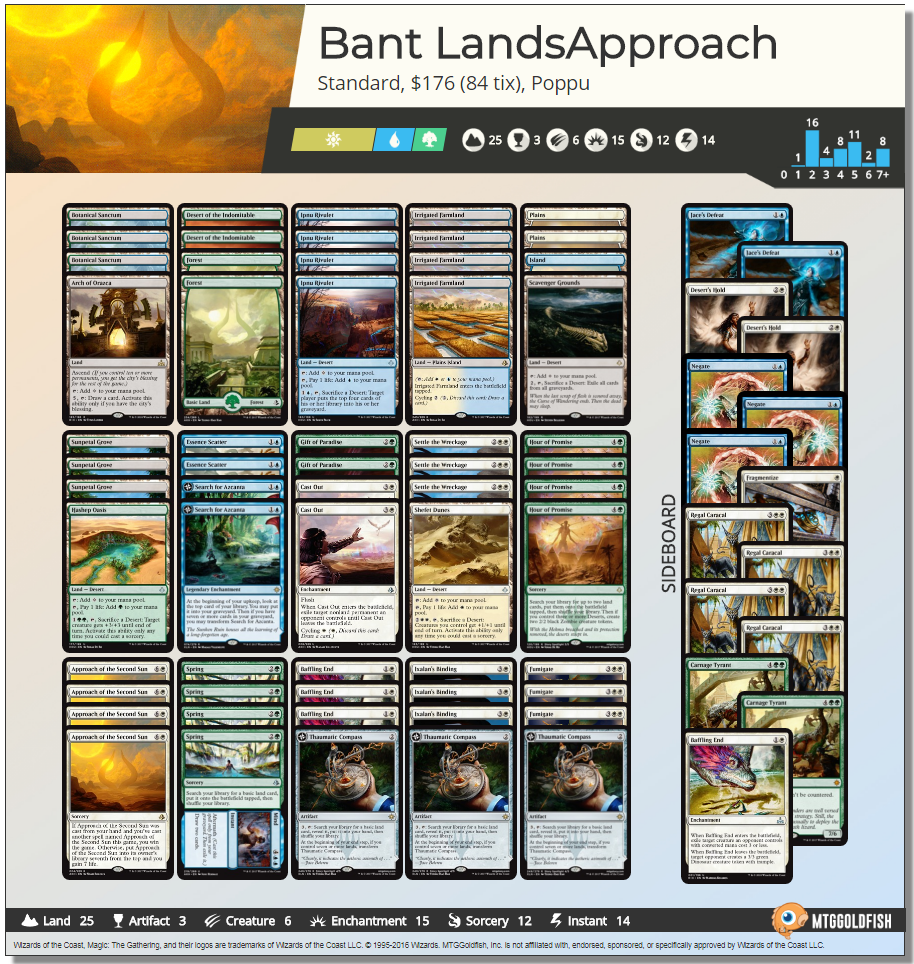
  • On the streamers side, Jim Davis piloted a Bant Ramp/Approach list to a 4-1 finish. Below is the list in visual view; the notable inclusions are Thaumatic Compass, Settle the Wreckage (turning out to very often be the wrath effect of choice), Hour of Promise and Spring/Mind.

Modern

Here is the list of all posted 5-0 decklists:

  • UR Gifts Storm x3
  • Affinity x2
  • Bogles x2
  • Dredge x2
  • Eldrazi & Taxes x2
  • BR HollowVine x2
  • Eldrazi Tron
  • Naya Company
  • Abzan
  • Ad Nauseam
  • BG Midrange
  • Simic Evolve
  • Traverse DS
  • Lantern
  • MonoG Tron
  • Burn
  • Sultai Midrange
  • Jeskai Control

In Modern, the top-25 stats are pretty close to Standard: 18 different archetypes, with UR Gifts Storm standing along at the top with three copies posting a 5-0 record. The stock list is pretty well known at this point of the Modern metagame, although there is a noticeable increase in representation of the fetchless variety. One of the new ideas over the past couple of months has been to increase the number or Remand effects, in particular via Unsubstantiate: this toolbox spell allows Storm to not completely fold to Meddling Mage in game one, all while providing another win condition by bouncing a Grapeshot back to your hand after a storm count of 9.

There was an error retrieving a chart for Unsubstantiate

As usual with Modern, most of the changes in decklists are found in the Sideboard, however there are three lists that featured new additions to their core: one of the two Dredge lists featured this week incorporated Driven//Despair, a move adopted by frequent Dredge streamer HolyShamgar (who also packed 3 copies of Failure//Comply in his SB); and in Naya Company, the fetching effects were four Chord of Calling, only one Collected Company, but with four Eldritch Evolution as a complement.

While on the subject of the Company list, Whisperwood Elemental is now part of the menagerie as a single copy – it is only one 5-0 deck, but it makes sense as it brings some resiliency to a deck full of creatures, and the manifest mechanic allows it to potentially stumble into its Druid/Vizier combo. Finally, there is the case of Bogles, which now appears to be running one or two copies of Triclopean Sight: as an aura with flash, it provides a new combat trick that not many opponents will be expecting, and adds vigilance to your hexproof beast if you missed out on Daybreak Coronet or Cartouche of Solidarity. Bogles lists are usually pretty tight, so I will be looking out to see if that addition sticks.

There was an error retrieving a chart for Driven

There was an error retrieving a chart for Eldritch Evolution

There was an error retrieving a chart for Triclopean Sight

Other relevant changes that I noted out of these lists

  • Affinity is now playing Rule of Law out of the sideboard, a solid answer to Storm that cannot be bolted like Ethersworn Canonist could (making Unsubstantiate and other bounce spells even more relevant in the matchup);
  • Liliana, the Last Hope is consolidating its status as Modern playable, appearing in four different archetypes this week (Abzan, Golgari and Sultai Midrange, as well as Traverse Death’s Shadow);
  • With Storm and Dredge still predominant in the metagame, Zendikar’s traps are back on some players’ radar: both Ravenous Trap and Mindbreak Trap (a full four-of in one of the BR HollowVine lists) are used to help against these matchups;
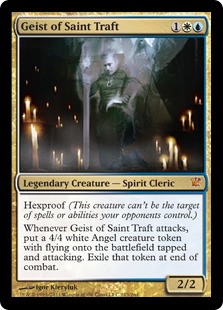
  • The Jeskai Control list featured on this week’s 5-0 list packed a lot of punch, with both Geist of Saint Traft and Vendilion Clique in the Main Deck – that Jeskai list also had Crumble to Dust in the SB, most likely as an answer to Tron strategies;
  • One of the Eldrazi & Taxes list was definitely on the aggressive side, with a full lineup of Thought-Knot Seer and Reality Smasher to go with two Smuggler's Copter – and it also had two copies of Worship in the Sideboard!

Wrapping Up

That is it for this week! With another Team Trio SCG Open as the only Constructed event of the weekend, I am expecting to see some reactionary changes in Standard based on this very young metagame. UW Auras and RG Monsters are new archetypes that players will have to adapt to, while Mono Red, BG Constrictor and Grixis Energy know they have the biggest targets on their backs.

Modern should see few changes for now. The format is diverse and healthy, as seen in the variety of lists that 5-0’ed this past week. With Pro Tour Rivals of Ixalan only a week away, and another Banned & Restricted Update announcement looming soon after, it leaves little room for financial gains – at least in the short term.

Insider: Underrated Commander Standouts in RIX

Are you a Quiet Speculation member?

If not, now is a perfect time to join up! Our powerful tools, breaking-news analysis, and exclusive Discord channel will make sure you stay up to date and ahead of the curve.

Week one is in the bag, to predictable results. The first week is always the same—99% of cards are way overpriced because demand significantly outweighs demand. The best move you could have made was to trade away most of the Rivals of Ixalan you opened and avoid trading for new cards (unless you had a really nice outside-the-box hunch). It's almost always that way.

Now that we've got the first week under our belt, cards have begun to return to what normal prices should look like. Most cards will have proven not to be broken must-own staples, and people will have cracked some packs and have cards to trade. Now that the market is settling down we can begin to plot our moves.

I think that Commander has a big stake in rounding out how the prices go. The price of Standard cards has been miserably low for a while. Sure, some cards spike hard and can hold a big price tag for a while (The Scarab God, Chandra, Torch of Defiance) but these are a kind of anomaly that corrects itself as the format evolves.

Most of the value of the vast majority of cards comes from somewhere other than Standard demand. Legacy, Modern, Commander, Cube, whatever... When I'm looking for investment cards I'm typically thinking about cards with potential outside of Standard. Obviously, if I have a strong hunch about Standard I'm happy to go with it—but I'm often looking to other formats such as Commander and thinking about where cards might make an impact.

Today, I'm going to talk about the Rivals of Ixalan cards that I think have the best shot at becoming staple Commander cards, and which thus have some room to grow as investments over time.

I'm really proud of this first pick from last week, so I'm going to run it back:

#8. Twilight Prophet

There was an error retrieving a chart for Twilight Prophet

I'm proud of this pick because of how perfectly I nailed the mythics before release weekend:

"As far as mythic rares were concerned, nothing was really calling to me. Most of the mythics felt like they were priced as though they had already hit and are destined to drop when they don’t.

Of all the mythics the one that I thought had the most potential was Twilight Prophet."

That was from my article last week. Not only was Twilight Prophet the only mythic that didn't lose significant value, it went up $0.50! Not bad when a week-one card holds a stable price tag.

As far as Commander cards go, I'm fairly certain that ascend is going to be great. The games go long and getting ten permanents into play is something that will always happen, meaning that we can assume we'll eventually get the city's blessing.

Twilight Prophet takes advantage of ascend but also of multiplayer. Its ability causes loss of life to all opponents which means that its got some real teeth. Gains life, deals damage, draws cards, and flies. What more do you want for 2BB? I think the card will be a staple of most black decks. I could even see it holding a price tag greater than $8.00.

#7. Arch of Orazca

There was an error retrieving a chart for Arch of Orazca

There is a correlation between cards having ascend and being good in multiplayer Commander...

Arch of Orazca is a nice little value land that any deck can play. Keep in mind that the colorless decks will for sure play a copy. It's basically settled into bulk rare territory but I think the card has the potential for some value down the road.

It's not an exciting pick but I love picks that can't really lose. If it's a bulk rare and it never goes up, you broke even. If it goes up you won. I think the card is very likely to have some value at some point down the road, but just not right now because everybody is cracking packs.

#6. Mastermind's Acquisition

There was an error retrieving a chart for Mastermind's Acquisition

The cost of 2BB is real. However, I think the utility the card provides is just so high, especially in variants of Commander that allow a sideboard. To be clear, I'm a huge fan of playing Commander with the sideboard because I think its just a better game of Magic and it helps fix some of the problems I see with the format (i.e. people playing linear combo decks in a multiplayer setting).

The card is great. I wouldn't play a control deck with access to black mana without this card. I feel strongly about the fact that I would always play with this card. I would play this in a fair deck, however the more "unfair" my deck became the more likely I would be to use the card. High praise.

#5. Vona's Hunger

There was an error retrieving a chart for Vona's Hunger

An edict effect that doesn't target, hits each opponent, and scales up with ascend to force everyone to sacrifice half of their creatures rounded up? How is this card not simply amazing?

Also, it's an instant. This card is very good in multiplayer and will be sought out by Commander players for years.

#4. Timestream Navigator

There was an error retrieving a chart for Timestream Navigator

I didn't like mythic rares last week when they were all bloated but now that nobody wants them I'm interested. When demand shrinks so does the price. It's time to buy!

It isn't that I think the cards suck. It's more an issue that I think the price sucks for what the card is. Timestream Navigator for $10.00 last week was dumb. At $2.00, I'm interested.

It's a Time Walk that shuffles back in. That is unique and powerful in and of itself. Assuming that you have a bunch of mana, a way to give Timestream Navigator haste (Lightning Greaves) and a recurring tutor (Planar Portal, Planar Bridge), the game is yours.

Also, it provides a unique ability to insert a Time Walk at instant speed during a multiplayer game. Not all Time Walks are created equally, but the one you get to insert whenever you please is well stacked.

#3. The Immortal Sun

There was an error retrieving a chart for The Immortal Sun

The Immortal Sun is a generic "powerful card." It costs six but it does a ton of stuff, basically everything you could ever want. I actually think this card will see some play in Mishra's Workshop decks in Vintage. I've played Coercive Portal before, and this is in a similar vein.

This is the kind of card that Commander players will gravitate toward. It's a powerful card that any deck can (and often will) play. Foils of this will also be great value down the line.

#2. Azor's Gateway

There was an error retrieving a chart for Azor's Gateway

Another mythic! What a difference a week (and half the price tag) makes!

Azor's Gateway is serious business in a Commander game. I like that it allows you to loot early in the game and can help you smooth draws. It's hard to flip, but if you flip it, you probably win the game. So, its basically like a reasonable little "looter rock" that will help you smooth through the early game and double as a gigantic "win the game" type of threat later.

Any deck can play it too. Especially in a format where players start with 40 life, I think this card is pretty busted.

#1. Nezahal, Primal Tide

There was an error retrieving a chart for Nezahal, Primal Tide

I seriously wonder if this is just a card that needs to be banned in Commander. It's so clearly insane!

Can't be countered. We're off to a good start. I always like it when my unbeatable haymaker can't be countered.

For my trouble, I get a gigantic monster that allows me to draw a card whenever any opponent casts a noncreature spell? Wow, seems amazing. However, I'd be worried that it would be a lightning rod for removal… No worries, it has an ability to discard three cards (no mana required) to exile itself until the beginning of the next end step. Oh, can't wrath it either!

Also, just because they needed to make sure the card was good (rolling my eyes), the card has Reliquary Tower tacked on for good measure. I mean, wouldn't want anybody to feel bad about drawing 20 cards and then having to discard half of them before they could all be cast!

The card is insane. It'll be a nice money maker if it doesn't get banned.

Conclusion

All things considered, Rivals of Ixalan has a lot of really fun Commander and multiplayer cards. I love ascend in multiplayer. I'm also a fan of all the "each opponent" moded cards. There are some nice ones to pick up from the scrapheap this time around.

Also, keep in mind (as is always the case with Commander cards) that the foil versions tend to be even better value.

Daily Stock Watch: Knollspine Dragon

Are you a Quiet Speculation member?

If not, now is a perfect time to join up! Our powerful tools, breaking-news analysis, and exclusive Discord channel will make sure you stay up to date and ahead of the curve.

Hello, everyone and welcome to the Friday edition of the Daily Stock Watch! I'll be going back to speculating on Modern pieces that could benefit or hurt its stock in the aftermath of Pro Tour Rivals of Ixalan next week, so I'll tackle a card from a different format today. It's another one of those cards that's not really game changing at all times even in Commander, but has gained so much steam due to the low number of supplies out there in the market.

There was an error retrieving a chart for Knollspine Dragon

Knollspine Dragon reached its all-time high today of $6.28, and we could say that this happened because this has only been printed once (Shadowmoor), and that dragons are, well, really popular crits in the world of Magic. It has this rich casual appeal that attracts players to just randomly insert it in their big mana Commander decks, or just be a fodder for collection purposes. The card's ability is something that's very enticing to use at the point of the game where it is castable, although the condition required to achieve its full potential is something that would usually make a pro's face turn sour due to disgust. In a format where all you have to do is deal 20 damage to win, the extra card draw from that one turn when Knollspine Dragon enters play could go a long way into dictating where the game is headed, albeit you should be in a winning position on the next turn if you've drawn enough cards to end the game sooner than later.

I've double checked with the Utility Checker if this card is seeing play elsewhere besides dungeon cages or Commander decks and to no one's surprise, this card is nowhere to be found in competitive decks' lists. If you're not really building a deck on a budget, check out this list where Knollspine Dragon makes an appearance among the more expensive and efficient dragons of Magic.

Scion Dragons

Commander

Creatures

1 Atarka, World Render
1 Balefire Dragon
1 Bladewing the Risen
1 Bladewing's Thrall
1 Dragon Broodmother
1 Dragonlord Atarka
1 Dragonlord Dromoka
1 Dragonlord Ojutai
1 Dragonlord Silumgar
1 Dragonlord's Servant
1 Dragonspeaker Shaman
1 Dromoka, the Eternal
1 Flameblast Dragon
1 Kaalia of the Vast
1 Karrthus, Tyrant of Jund
1 Kilnmouth Dragon
1 Knollspine Dragon
1 Kokusho, the Evening Star
1 Kolaghan, the Storm's Fury
1 Ojutai, Soul of Winter
1 Ryusei, the Falling Star
1 Sheoldred, Whispering One
1 Silumgar, the Drifting Death
1 Utvara Hellkite

Instants and Sorceries

1 Atarka's Command
1 Crackling Doom
1 Cyclonic Rift
1 Rescue from the Underworld
1 Sarkhan's Triumph
1 Crux of Fate
1 Cultivate
1 Dragonstorm
1 Ever After
1 Exsanguinate
1 Farseek
1 Fearsome Awakening
1 Immortal Servitude
1 Stitch Together
1 Torrent of Souls
1 Unburial Rites

Other Spells

1 Chromatic Lantern
1 Commander's Sphere
1 Crucible of Worlds
1 Cultivator's Caravan
1 Darksteel Ingot
1 Door of Destinies
1 Prismatic Geoscope
1 Sol Ring
1 Animate Dead
1 Blind Obedience
1 Crucible of Fire
1 Diabolic Servitude
1 Dragon Roost
1 Dragon Tempest
1 Frontier Siege
1 Maelstrom Nexus
1 Prismatic Omen
1 Strands of Night
1 Nicol Bolas, Planeswalker
1 Sarkhan the Mad
1 Sarkhan Unbroken
1 Tamiyo, Field Researcher
1 Ugin, the Spirit Dragon

Lands

1 Arid Mesa
1 Badlands
1 Bayou
1 Bloodstained Mire
1 Cascading Cataracts
1 Cavern of Souls
1 Command Tower
1 Crucible of the Spirit Dragon
1 Exotic Orchard
1 Forest
1 Gavony Township
1 Haven of the Spirit Dragon
1 Island
1 Marsh Flats
1 Misty Rainforest
1 Mountain
1 Plains
1 Plateau
1 Polluted Delta
1 Rakdos Carnarium
1 Reflecting Pool
1 Savannah
1 Scalding Tarn
1 Scrubland
1 Strip Mine
1 Swamp
1 Taiga
1 Tainted Peak
1 Temple of Malice
1 Tropical Island
1 Tundra
1 Underground Sea
1 Verdant Catacombs
1 Volcanic Island
1 Windswept Heath
1 Wooded Foothills

Playing with dragons and its kin gives me extra cool vibes, especially if I get to ransack my opponent on one fell swoop. This is the kind of feeling that I get whenever I win Commander games back in the day by abusing a role player's ability to snatch a win out of nowhere, and players won't have a shortage of that upon resolving a successful Knollspine Dragon. However, this isn't enough to convince me that this card is worth more than $5 today and in the near future.

At the moment, Star City Games, Card Kingdom, Channel Fireball, and TCGPlayer have a few stocks left of the card from anywhere between $5.33-$6.99. I'm not really into spec buying of this card, but I think it should be good to buy your personal pieces now while it's cheaper than what it's expected to reach in the future, barring any immediate reprints. I'd stay away from foil copies if I were you, but it doesn't hurt to get some of them in lopsided trades that makes you give up second stringers that you barely need at all.

And that’s it for this week's edition of the Daily Stock Watch! See you again next week, as we check out a new card that should be on the go, or good enough for speculating. As always, feel free to share your opinion in the comments section below. And if you want to keep up with all the market movement, be sure to check in with the QS Discord Channel for real time market information, and stay ahead of the hottest specs!

Melding Mayhem: Innovation in Dallas

Are you a Quiet Speculation member?

If not, now is a perfect time to join up! Our powerful tools, breaking-news analysis, and exclusive Discord channel will make sure you stay up to date and ahead of the curve.

Last weekend was SCG Dallas, a Team Constructed Open that again featured Modern experts duking it out on the big stage. As one of the last datapoints before the upcoming Pro Tour, Dallas gives us a few interesting bits of information to work with.
Today, we'll focus on the cooler deckbuilding choices made by some of the tournament's top players, as well as a few techs chosen by Top 8 competitors from the neighboring Classic tournament.

Open Developments

Let's start with the Open. This tournament featured a routinely diverse Top 8, with only Burn claiming two copies. Humans, Counters Company, and Eggs yield the most riveting decklists.

Malcontent Humans

Jonathan Rosum's 1st-place Humans deck features a new shift I'm positive we'll be seeing more of: a singleton Kessig Malcontents in the main. I had to look up this AVR common during the stream, but then marveled at the genius of its inclusion. Indeed, Rosum put a few games away with the extra reach.

Humans, by Jonathan Rosum (1st, SCG Dallas Open)

Creatures

4 Champion of the Parish
1 Kessig Malcontents
4 Kitesail Freebooter
4 Mantis Rider
4 Meddling Mage
4 Noble Hierarch
4 Phantasmal Image
4 Reflector Mage
4 Thalia's Lieutenant
4 Thalia, Guardian of Thraben

Artifacts

4 Aether Vial

Lands

4 Ancient Ziggurat
4 Cavern of Souls
4 Horizon Canopy
1 Plains
2 Seachrome Coast
4 Unclaimed Territory

Sideboard

2 Dismember
2 Grafdigger's Cage
2 Izzet Staticaster
1 Kessig Malcontents
2 Mirran Crusader
3 Sin Collector
2 Vithian Renegades
1 Xathrid Necromancer
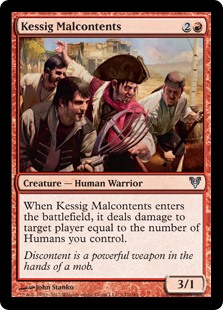
Death by reach probably won't emerge as a primary plan for Humans. For one, there's no space to include a heavier suite of Malcontents—the other creatures are all less expendable. It also doesn't help that Malcontents mainly comes in handy when Humans already has a significant board presence. But I love the single copy as a way to close out games when battlefields get tricky. Malcontents also gives Humans something of a "Blood Moon effect"—now that it's on everyone's radar, players are likely to play around some degree of reach from Humans, which makes the deck better whether or not Malcontents occupies that flex spot.

Quelling Counters

Just behind Rosum's team, Michael Cortez brought a creature concoction of his own to the fray: Counters Company, but with a blue splash for Spell Queller.

Counters Company, by Michael Cortez (2nd, SCG Dallas Open)

Creatures

4 Noble Hierarch
3 Birds of Paradise
1 Courser of Kruphix
4 Devoted Druid
3 Duskwatch Recruiter
3 Eternal Witness
2 Fauna Shaman
1 Meddling Mage
1 Reflector Mage
1 Selfless Spirit
4 Spell Queller
3 Vizier of Remedies
1 Walking Ballista

Instants

4 Chord of Calling
4 Collected Company

Lands

1 Botanical Sanctum
1 Breeding Pool
3 Forest
2 Gavony Township
1 Hallowed Fountain
2 Horizon Canopy
4 Misty Rainforest
1 Plains
2 Temple Garden
4 Windswept Heath

Sideboard

1 Aven Mindcensor
1 Burrenton Forge-Tender
1 Eidolon of Rhetoric
3 Geist of Saint Traft
1 Kataki, War's Wage
1 Kor Firewalker
3 Path to Exile
1 Qasali Pridemage
1 Reflector Mage
2 Unified Will
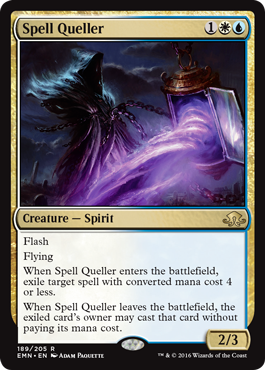
Michael wasn't about to lose to Storm this tournament—Spell Queller joins the requisite Eidolon of Rhetoric here, as well as a single Meddling Mage in the mainboard to add insult to injury. Beyond these cards, Unified Will and Geist of Saint Traft complete the blue splash: the former wins even more points against the linear combo decks that can race Company as well as insurance for sweeper effects, while the latter provides the deck with another angle of attack entirely. Reflector Mage also makes an appearance to annoy big creature decks.

Going forward, I'm a huge fan of this splash. Queller shines against the removal-light decks that have the luxury of ignoring Counters Company in the first place. It's even fine against the removal-heavy decks that can hassle the deck—they're unlikely to have removal for the combo and for the Spirit, and Queller pressures removal suites even more by, well, countering the kill spells in the first place.

Egg on the Face

Finally, Jeremy Frye's team Top 8ed with the Modern player on none other than Eggs, one of the format's longest-hated combo piles.

Eggs, by Jeremy Frye (5-8th, SCG Dallas Open)

Creatures

4 Scrap Trawler
1 Emrakul, the Aeons Torn
2 Glint-Nest Crane
2 Hangarback Walker
1 Myr Retriever

Artifacts

2 Chromatic Sphere
4 Chromatic Star
2 Engineered Explosives
4 Ichor Wellspring
4 Krark-Clan Ironworks
2 Mind Stone
3 Mishra's Bauble
4 Mox Opal
1 Pyrite Spellbomb
3 Terrarion

Sorceries

4 Ancient Stirrings

Lands

4 Darksteel Citadel
1 Forest
2 Glimmervoid
2 Inventors' Fair
4 Sanctum of Ugin
4 Spire of Industry

Sideboard

3 Defense Grid
2 Fatal Push
2 Grafdigger's Cage
2 Kozilek's Return
3 Lingering Souls
3 Nature's Claim

Jeremy's no stranger to Eggs—it's apparently one of his favorite decks. I know a guy in Montreal who loves playing the deck, too. Their motivations are beyond me, but hey, that's Modern!
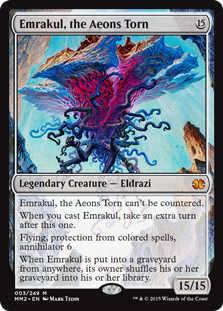
This isn't the same Eggs that got Second Sunrise banned. Today's build seeks to generate a ton of mana by sacrificing artifacts to Krark-Clan Ironworks and retrieving them with Scrap Trawler. Eventually, the deck has enough mana to cast a large Engineered Explosives and trigger Sanctum of Ugin, which searches up Emrakul, the Aeons Torn. In Dallas, Jeremy favored this Emrakul/Sanctum win condition over just Pyrite Spellbomb looping for resilience against graveyard hate. For more on the deck's strategy, check out Jeremy's tournament report.

As for the deck itself, I think Eggs has some glaring issues in this metagame. It's clunkier and less consistent than Storm, for instance, and doesn't punish stumbles or shaky keeps as well. Storm is also equally resistant to graveyard hate after sideboarding thanks to its Empty the Warrens plan, and of course Stony Silence is lights out for Eggs barring a natural draw into Nature's Claim.

Jeremy probably got by on two factors: the element of surprise (everyone was gunning for Storm as the top combo deck; lo and behold, zero copies made Top 8) and his own mastery of the deck. It's no secret that Modern rewards reps with one deck and format knowledge, things Jeremy had in spades for this tournament.

Classic Notables

The Classic in Dallas, while a smaller event, also saw players experimenting with novel choices.

Pyroclasm and Pia in Shadow

Gabriel Womack made Top 8 with a fairly stock Grixis Shadow list. Not-so-stock was his choice to run Pyroclasm, a card that's almost never been played in the deck. Most pilots opt for Kozilek's Return in this slot, since it hits Etched Champion thanks to devoid and disrupts Company combos with its instant typing. Also of note, Gabriel ran Pia and Kiran Nalaar as an alternate threat.

Grixis Shadow, by Gabriel Womack (5th, SCG Dallas Classic)

Creatures

4 Death's Shadow
4 Gurmag Angler
4 Snapcaster Mage
4 Street Wraith

Planeswalkers

2 Liliana of the Veil

Instants

2 Dismember
4 Fatal Push
2 Kolaghan's Command
2 Stubborn Denial
4 Thought Scour

Sorceries

2 Inquisition of Kozilek
4 Serum Visions
4 Thoughtseize

Lands

1 Island
1 Swamp
2 Blood Crypt
4 Bloodstained Mire
4 Polluted Delta
3 Scalding Tarn
1 Steam Vents
2 Watery Grave

Sideboard

1 Engineered Explosives
2 Fulminator Mage
3 Ceremonious Rejection
1 Stubborn Denial
1 Temur Battle Rage
2 Pia and Kiran Nalaar
1 Liliana, the Last Hope
2 Collective Brutality
2 Pyroclasm

Pyroclasm

Besides Return, Izzet Staticaster and Engineered Explosives are popular Grixis Shadow sideboard cards that handle go-wide strategies. All three options, though, lose out to Pyroclasm when it comes to brutal efficiency: at two mana, the sweeper offers an unparalleled rate given a board of weak creatures.
Gabriel isn't blazing an entirely new trail here—indeed, Luca Van Deun split Return and Pyroclasm 1-1 in his Grixis sideboard from GP Madrid back in October. But I personally like his all-in move toward Pyroclasm. I've long run Pyroclasm myself, in just about every red-featuring fair deck I design: I swore by a pair in Temur Delver, still run them in Counter-Cat, and ensured ways to pack them into my recent brews. So I'm of course happy to extoll its virtues.

At two mana, Pyroclasm gives casters plenty of choice. It can kill a couple dorks on-curve; be paced to sweep a larger field; combine with one-shot removal spells to dismantle boards of lords. Sure, instant speed gives Return and Staticaster their own elements of choice, too. But when I'm thinking about carefully partitioning my limited mana each turn cycle, allocating an extra mana to a sweeper effect is huge.

Grixis Shadow is also a prime candidate to run the card: it's tight on mana, has no problem casting cards at sorcery speed, and disruption-heavy enough to stomp opponents out despite the turn they get to rebuild. It also applies lots of pressure, a must for decks looking to conditional removal spells like damage-based sweepers.

Pia and Kiran Nalaar

Pyroclasm might be rare out of Grixis Shadow, but Pia and Kiran Nalaar is practically unheard of. And two copies! Chandra's parents are a real plan for Gabriel's deck, and occupy the slot generally filled by Young Pyromancer if not just additional disruption. The card is far more common in Jeskai Tempo sideboards, where it immediately goes wide with evasive bodies while presenting an element of reach—all things that help Jeskai attack from extra angles after siding.
In Grixis Shadow, the card does the same thing. Except the reach dimension isn't something Grixis is particularly good at to begin with. In this way, it's more of an "extra plan" than it is out of Jeskai, since opponents will likely monitor their life total while keeping in mind that reach from Grixis is unlikely. When Pia and Kiran comes down and presents four to eight damage right away, the math is changed significantly.

That said, I'm less optimistic about Pia and Kiran than I am about Pyroclasm. Of course, bias plays a part here; Pyroclasm is a pet card of mine, while Pia and Kiran is something I would just always splash green and play Huntmaster of the Fells over. But the most reasonable beef I have with the card is its mana cost. Four mana is quite a lot for Grixis Shadow, even for a late-game card. I wonder if something like another Liliana, the Last Hope or good ol' Young Pyromancer (blech, but numbers don't lie) wouldn't serve the deck better.

Return and Sun in Tron

Michael Chapman's GR Tron bested Gabriel to take 4th at the Classic. The go-to Tron variants this season are GB (splashing for Collective Brutality, Fatal Push, or both) and Mono-Green (trading away removal for stabler mana and compensating with Thragtusk), so it's refreshing to see a red splash perform. Michael made two eyebrow-raising choices with this list: Kozilek's Return and Blood Sun.

GR Tron, by Michael Chapman (4th, SCG Dallas Classic)

Creatures

3 Wurmcoil Engine
2 World Breaker
2 Ulamog, the Ceaseless Hunger

Planeswalkers

4 Karn Liberated
2 Ugin, the Spirit Dragon

Artifacts

4 Chromatic Sphere
4 Chromatic Star
4 Expedition Map
4 Oblivion Stone

Instants

3 Kozilek's Return

Sorceries

4 Ancient Stirrings
4 Sylvan Scrying

Lands

2 Forest
1 Ghost Quarter
4 Grove of the Burnwillows
1 Sanctum of Ugin
4 Urza's Mine
4 Urza's Power Plant
4 Urza's Tower

Sideboard

2 Grafdigger's Cage
1 Pithing Needle
1 Relic of Progenitus
2 Trinisphere
2 Thragtusk
2 Blood Sun
3 Nature's Claim
2 Warping Wail

Kozilek's Return
It has long been the standard in GR Tron to run Pyroclasm as the removal spell of choice. In fact, Gx Tron is the main deck that's kept Pyroclasm on the map in Modern for so long. Joe Losset first flipped the script by trading in the sweeper for one-shot interaction in Lightning Bolt as a way to fight Infect (a card entirely outclassed by Fatal Push in this deck, as evidenced by Losset's own switch to black last year). Without Bolt, the only removal spells worth red in Tron become sweepers.

Kozilek's Return again ups the ante. Pyroclasm, in a vacuum, seems like a better card for the strategy; Tron likes to spend all its mana each turn cycle, either cantripping and setting up or casting its haymakers, so the price tag bump matters a lot here. I assume Michael opted for Return because of the card's synergy with World Breaker and Ulamog, the Ceaseless Hunger. These top-end threats milk extra value from the removal spell, especially in a climate full of 5/5s. Return's also superior against Affinity, traditionally one of Tron's harder matchups, by killing Etched Champion and attacking manlands.

Blood Sun

Lastly on the agenda, we have Michael's decision to run Blood Sun in the sideboard. I gave my first impressions on this card a couple weeks ago, where I pegged Sun as a possible include for the big mana strategy.

Needless to say, I was pleasantly surprised to see a Tron list running Sun so early, especially since red is an out-of-favor splash for the archetype currently. I hope we hear more about the card in Tron, and how it may impact which splash is chosen by top players, in the coming weeks.

Heating Up

The pressure's on for Pro Tour competitors, as the big day now rapidly approaches. If these smaller tournaments are any indication, there's still plenty left to discover in Modern. We'll soon see if these Dallas developments exhibit staying power in a week or if a next-big-thing overshadows them.


Insider: Encountering Counterfeits and Other Grand Prix Stories

Are you a Quiet Speculation member?

If not, now is a perfect time to join up! Our powerful tools, breaking-news analysis, and exclusive Discord channel will make sure you stay up to date and ahead of the curve.

Last weekend, I attended Grand Prix Indianapolis, and losing in the final round of day one to miss day two left me plenty of time to explore other aspects of the GP experience on Sunday, including watching the Pauper side event and working the trade tables, where I encountered some counterfeit cards. Today, I’ll recount what I did, and more importantly, what I learned.

Pauper

Channel Fireball announced that they would host Pauper side events at their Grand Prix in January, and by all accounts the format’s first run at GP Santa Clara was a big success, bringing in 120 players for the three-round tournament. All eyes were on Indianapolis to see the results of the followup, and the attendance of 215 players surely got the attention of CFB, who has gone on record that they are viewing these events as test-runs for a potential Pauper Grand Prix in the future.

Hearsay from Indianapolis is that CFB have said that if one of their Pauper side events gets 500 players, they will schedule a Pauper Grand Prix. Nearly doubling the attendance from the first event to the second was significant, and although it’s going to be a much bigger hurdle to double again, it’s clear there is huge demand for the format, and it’s only going to grow in popularity, so at this point, the format hitting the mainstream seems inevitable.

With so much momentum behind it, it seems foolish to ignore the format from a financial perspective, because prices have been moving nowhere but up over the past month. A few cards in particular have seen significant gains this week, so I’d have them on your radar.

The most significant price gainer this week was Tortured Existence, which is used to abuse madness and the graveyard in Rock-style decks, and has the ability to lock out the opponent by recurring Spore Frog or Crypt Rats. It’s relatively old and in short supply compared to the rest of the Pauper cardpool, which explains its rise from $0.50 to over $2, and it shows no signs of stopping.

Standard Bearer was bought out on TCGplayer over the weekend, which I noticed while checking prices at the trade tables on Sunday, so I immediately turned to eBay to pick up a couple sets at $2 a copy. The TCGplayer price moved up to $10 after the buyout, but after being restocked, it's now available for around $3 a copy. It’s one of the very best sideboard cards in the format, and will only continue to appreciate.

There was an error retrieving a chart for Prismatic Strands

Another key sideboard card to pay attention to is Prismatic Strands, which is a staple of white creature decks and often makes its way into maindecks. Its price has grown from $0.50 to over $2.50 this month, with over half of that gain coming in the past week.

There was an error retrieving a chart for Moment's Peace

Another Fog-style card to pay attention to is Moment's Peace, which has doubled from $1 to $2 this month, with over a quarter of the growth coming this week.

The Trade Tables

I used to be an avid trader, but it has been a few years since I’ve spent time doing it at the local shop, and even longer since I traded at large events like Grand Prix, but recently I put together a trade binder to try to turn some of my cards into some Reserved List and Old-School cards, or anything else that I felt would be a better store of value than what I currently held. CFB’s recent ban on floor trading for profit meant I may have picked a poor time to start, but if anything, I figured it would be a good way to test the trading climate for myself.

There was an error retrieving a chart for Trade Routes

Word from veteran floor traders was that the trade floor was mostly dead, and CFB was indeed actively targeting known traders-for-profit, or “backpackers,” and some had turned to working behind the booth of retailers in order to make a living. From my perspective as a casual trader that spent a few hours trading on Sunday, there was plenty of trading to be done, and perhaps the waters having fewer sharks swimming made things easier for me.

That said, there wasn’t exactly a wealth of great cards floating around, and there were no real notable high-end or old-school cards to be found during my short foray, but there was ample opportunity to trade into Standard staples had I wanted them, and I did pick up a few Horizon Canopys that I needed to round out my Modern playsets. I also actively targeted Pauper staples, and picked up the entirety of a Mono-Black Devotion deck, including Oubliette and Chainer's Edict, in anticipation of price increases.

Counterfeits

The biggest story from the trade tables, however, and perhaps a symptom of the lack of experienced floor traders keeping people honest, was the discovery of a binder full of counterfeit Modern staples.

While trading at a table with a handful of traders, my trade partner, who had a low-value binder and was admittedly a new player, announced that another guy at the table had a ton of Modern staples. I planned on trading with him next, but someone else got to him first, and I got into another trade with someone across the table.

The had-a-ton-of-Modern-staples guy was working out a trade for one of his Snapcaster Mages, but when his trade partner pulled out the card, he announced that he thought the card was fake. By this time, a recognizable floor trader had joined the table, and he quickly confirmed that the card was a fake, and in fact was poorly done, and didn’t hold a candle to high-quality Chinese fakes. He said that he could immediately tell because of its glossiness, and after feeling it myself, it was too thick and heavy, and the colors, especially on the back, seemed muddy.

There was an error retrieving a chart for Counterbore

Attention was then turned to the rest of his binder, and it soon became evident that every single one of his Modern staples – including Tarmogoyfs, Dark Confidants and Noble Hierarchs – were fakes. It was almost as if the entirety of a box of fake Modern staples had been placed in the binder. He acted upset, and when asked where he got the cards, he said from eBay, but in retrospect it seems very unlikely that so many fakes were acquired, and that it was more likely malicious.

The trader said that he wanted to go find his past trade partners that day to tell them about the fakes, but it’s more likely that he wanted to extricate himself from the situation so he could run from the event and escape any sort of punishment. I should have told Channel Fireball about what was going on, but at the time in my post- tournament sleep-deprived state, I wasn’t sure if he was being malicious or was himself the victim of fraud, and I didn’t think it was my place.

Looking back, though, I dropped the ball. I could have helped catch a scumbag and hopefully stopped him from doing it in the future, although after being found out once, I am sure he will give a second thought to trying his ploy again. The incident occurred right before I was set to leave with my friends, so I didn’t investigate further, but I hope that one of the other people at the table did report him.

There was an error retrieving a chart for Ratcatcher

The moral of this story is to stay vigilant, because people really are out there trading fakes – and next time, they might not be so easy to spot.

Do you have a story of encountering counterfeit cards, trading at Grand Prix, or Pauper? I'd love to hear about it below.

–Adam

Daily Stock Watch: Oracle of Mul Daya

Are you a Quiet Speculation member?

If not, now is a perfect time to join up! Our powerful tools, breaking-news analysis, and exclusive Discord channel will make sure you stay up to date and ahead of the curve.

Hello, everyone and welcome to the Thursday edition of the Daily Stock Watch! I've been doing a lot of trading lately, and I've noticed that a lot of cards are slowly increasing in price despite the high number of stocks that are still available online, and the relative lack of demand for it. One that caught my eye today was this card from Zendikar, which I think could play a vital role in one of the best decks in Modern today if it could get going.

There was an error retrieving a chart for Oracle of Mul Daya

Oracle of Mul Daya just peaked today at $23.42, and I must say that it's a hefty price tag for a card that doesn't even see competitive Modern or Legacy play. The Utility Checker confirmed this fact although we don't have enough data to support the notion that every casual, green Commander deck out there is using it. However, Titanshift has been making a lot of noise lately, and I think that it could fit in as one-of in the deck to replace the slot that's usually occupied by Wood Elves. Here's my take on the deck that could use extra firepower in the form of Oracle of Mul Daya.

Titanshift

Creatures

4 Primeval Titan
4 Sakura-Tribe Elder
1 Oracle of Mul Daya

Other Spells

2 Explore
4 Farseek
2 Hour of Promise
3 Lightning Bolt
4 Scapeshift
4 Search for Tomorrow
2 Summoner's Pact
2 Sweltering Suns
2 Prismatic Omen

Lands

3 Cinder Glade
2 Forest
6 Mountain
4 Stomping Ground
4 Valakut, the Molten Pinnacle
3 Windswept Heath
4 Wooded Foothills

Sideboard

1 Ancient Grudge
2 Anger of the Gods
2 Beast Within
2 Chameleon Colossus
1 Engineered Explosives
1 Nature's Claim
2 Obstinate Baloth
1 Reclamation Sage
3 Relic of Progenitus

I've played this deck for a while, and it was actually responsible for my best finish in any major tournament over the course of my Magic career. The extra information, along with the privilege to play an additional land on your turn, could go a long way in deciding mirror matches or control matchups. The same could be said for Commander matches where having more resources is always an advantage. In this case, why isn't Oracle of Mul Daya getting the chance to be slotted in on any Titanshift lists in recent memory?

Consistency is the Key in Ramping

A turn-two Farseek, Sakura-Tribe Elder, or Explore gives you early access to Oracle of Mul Daya for an explosive start in Modern. I'm starting to wonder why I'm not seeing more of this, but I've figured that games in that format are decided by decks that are efficient in every turn that they could get. The ramp creatures above have all done their duties once they hit the battlefield, whereas Oracle of Mul Daya will need to be present in the battlefield to be fully utilized by the Valakut player. This is enough reason for pros to not even try fitting it in on their lists, but I still love the idea of having it there anyway.

Having said all this, I think it's time to let go of this card at this price at every chance that you could get. Star City Games is currenly out of stock for near mint copies of the card (they have lots of played ones at $17), but you could find lots of it via Channel Fireball, TCGPlayer, and Card Kingdom for anywhere between $23-$26. I'd encourage you to trade away any spare pieces that you may have, because this card is ripe for the picking for a reprint at any point in the future. The same should be done to the foil copies if you ask me, as I have a feeling that this will appear in a Duel Deck product in the near future.

And that’s it for the Thursday edition of the Daily Stock Watch! See you again tomorrow, as we check out a new card that should be on the go, or good enough for speculating. As always, feel free to share your opinion in the comments section below. And if you want to keep up with all the market movement, be sure to check in with the QS Discord Channel for real time market information, and stay ahead of the hottest specs!

Want Prices?

Browse thousands of prices with the first and most comprehensive MTG Finance tool around.


Trader Tools lists both buylist and retail prices for every MTG card, going back a decade.

Quiet Speculation