menu

Walk Hard: Brewing with Temporal Mastery

Are you a Quiet Speculation member?

If not, now is a perfect time to join up! Our powerful tools, breaking-news analysis, and exclusive Discord channel will make sure you stay up to date and ahead of the curve.

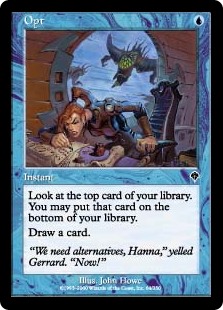
When Opt was spoiled for Modern, I wrote a piece about how I didn't think the card would see much play. That didn't stop me from putting together a bunch of decks with the card. During those experiments, I took a literal "walk" on the wild side, following a tangent deep down the rabbit hole of Magic's most iconic new-frame keywords: miracle.

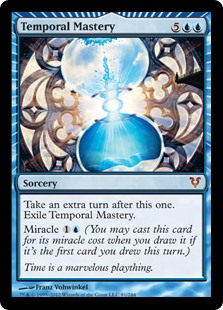
"Scry 1; draw a card" isn't a very exciting effect. Tacking on "take an extra turn after this one" certainly changes that. We can cast Temporal Mastery for its miracle cost after Opt finds it on our opponent's turn, giving us multiple shots to get extra turns on the cheap between their end step and our draw step. But can the card work in Modern? Read on to find out!

What's in a Turn?

Okay, level zero. We're building a deck around taking extra turns. So what are the things we only get to do once per turn? If we manage to construct a deck that does many of those things, the extra turns we take might actually reward our efforts.
  • Drawing for turn
  • Spending mana
  • Combat
  • Making a land drop
  • Activating planeswalkers
  • Using cards with a "once per turn" clause

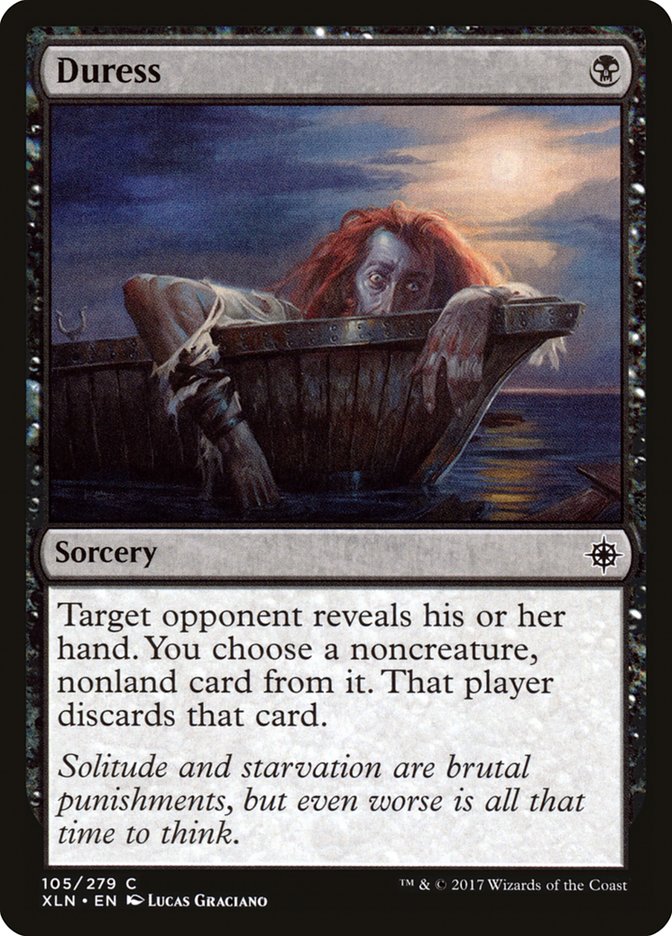
The first two aren't tough to build around at all—every deck enjoys drawing for turn and spending its mana. Next! Combat is something certain decks avoid entirely (Ad Nauseam), or at least functionally (Valakut); others would love an extra attack step (Zoo). We're on to something with this one. Making a land drop falls into a similar boat: there are decks that play fine off three lands, like Grixis Shadow, and others that simply won't beat you unless they can pay to activate their Celestial Colonnades.

"Once per turn" clauses are rare in Magic, compared with, say, Yu-Gi-Oh!; the reason is that tacking mana costs onto activated abilities keeps them from being abused too often in a turn. But Magic still has cards that tap to activate their costs. One card type that does so functionally is planeswalker, which I do think is worth exploring with Temporal Mastery. I couldn't find any explicit "tap" cards in the Modern pool that are worth building around Mastery for.

Version 1: Temur Delver

The first place I started was with old faithful, Temur Delver. Since I already wanted to run plenty of cantrips, including Mishra's Bauble, Temur seemed like a great launch pad—Bauble synergizes well with many of the cards here, and if any deck wants to take extra turns on the cheap, it's the one with low-cost threats. Referring to our list above, Temur maximizes the second combat step and free-mana dimensions of an extra turn.

Temur Temporal, by Jordan Boisvert

Creatures

4 Delver of Secrets
4 Monastery Swiftspear
4 Tarmogoyf
3 Hooting Mandrills

Artifacts

4 Mishra's Bauble

Instants

4 Opt
2 Thought Scour
2 Vapor Snag
4 Lightning Bolt
2 Spell Pierce

Sorceries

4 Serum Visions
4 Temporal Mastery
2 Faithless Looting

Lands

4 Misty Rainforest
4 Scalding Tarn
1 Stomping Ground
2 Steam Vents
1 Breeding Pool
3 Island
1 Forest
1 Wooded Foothills

Sideboard

1 Pithing Needle
1 Grafdigger's Cage
2 Huntmaster of the Fells
3 Blood Moon
1 Search for Azcanta
1 Dismember
2 Ancient Grudge
2 Stubborn Denial
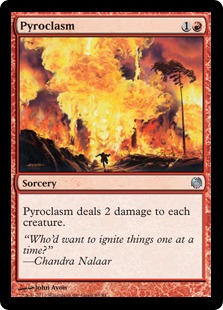
2 Pyroclasm

The Good

I built the deck with eight one-drops to maximize the impact of an early Temporal Mastery. Leading with Delver, Swiftspear, or Tarmogoyf and then happening to draw the miracle on turn three would pile damage on to the tempo gained from an extra land drop or free mana for a cantrip, putting us even farther ahead.

Mishra's Bauble also plays tons of roles in this deck, as it did in my original Bauble-featuring Temur shell, Banana Phone. On the surface, the artifact allows us to draw a card on the opponent's turn, potentially triggering miracle. But it does more, too. Bauble triggers prowess on Swiftspear, fills the graveyard for Tarmogoyf and Hooting Mandrills, helps flip Delver by giving us multiple looks at our top card, and of course offers incidental deck manipulation with Scour and fetchlands.
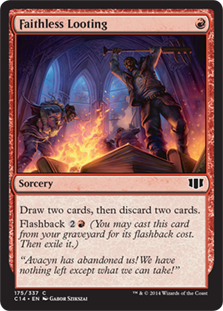
Faithless Looting is a card that might seem weird at first, but my love for this oddball cantrip knows few bounds. It seems like the best option for dumping Temporal Masterys we open or accidentally draw into during our main phase, as it's cost-efficient and we can flash it back after milling one with Thought Scour. Looting can also grow Goyf astronomically in non-interactive matchups like Valakut or Tron, making a quick 5/6 with which to beat some face, or power out Hooting Mandrills in a pinch.

While it doesn't pertain specifically to a Temporal Mastery-wielding build of Temur Delver, Hooting Mandrills is also just the stone nuts right now. It's nearly impossible for many decks to remove, comes down quickly, and ignores chump blockers on offense. I'd say it's the best creature in Counter-Cat and one of the better-positioned creatures in the format generally, beating out even Tasigur, the Golden Fang and Gurmag Angler thanks to trample.

The Bad

One problem with Temporal Mastery in this deck is that we don't get to play a lot of cards integral to the Temur Delver strategy because we lack room. Mana Leak is crucial to our plan against big mana, for instance; Disrupting Shoal and Spell Snare work wonders against linear aggro decks. Mastery is a high-variance card that doesn't address any specific problems, and playing it forces us to abandon the answers we run out of necessity.
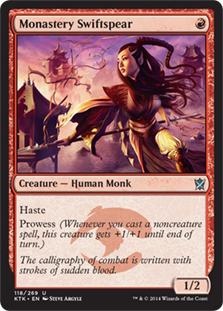
I ran into a lot of tension between miracle and Monastery Swiftspear. The prowess creature incentivizes us to cantrip as much as possible during the main phase, which we are happy to do since we don't play two-mana counterspells. But cantripping in the main phase makes Temporal Mastery a lot worse, as we're likelier to draw it. I think Serum Visions is something of a necessary evil when it comes to miracle—after all, it sets up a trigger better than anything else in the format. But the other cards we use to draw on the main phase—Opt, Scour, and Looting—increase our odds of drawing a dead miracle. Of course, the alternative is to attack for almost no damage. Neither plan is very appealing.

A solution I toyed with was to simply run Wild Nacatl over Monastery Swiftspear. But every build I tried ended up being a worse Counter-Cat. No matter what I cut to make room for the Mastery package, I missed it: Shoals, Paths, Leaks, Snares, Sleights, you name it. Not to mention Opt is quite bad for Counter-Cat, and for strategies that want to cantrip on the main phase in general (one of the main reasons I don't expect it to see much play).

Version 2: Jeskai Tempo

I decided to try Opt-Mastery in a deck lighter on attack steps, but which could take advantage of another benefit of extra turns: making more land drops. The burn-heavy Jeskai Tempo lists running around operate primarily at instant speed, making them intriguing as possible homes for the package.

Jeskai Temporal, by Jordan Boisvert

Creatures

4 Spell Queller
4 Snapcaster Mage

Instants

4 Opt
4 Lightning Bolt
4 Path to Exile
2 Lightning Helix
2 Electrolyze
4 Remand
2 Cryptic Command

Sorceries

4 Serum Visions
4 Temporal Mastery

Lands

4 Celestial Colonnade
4 Scalding Tarn
1 Mountain
3 Island
1 Plains
1 Hallowed Fountain
2 Steam Vents
1 Sacred Foundry
3 Flooded Strand
1 Desolate Lighthouse
1 Sulfur Falls

Sideboard

1 Relic of Progenitus
1 Vendilion Clique
1 Rest in Peace
2 Stony Silence
2 Kozilek's Return
1 Surgical Extraction
1 Negate
2 Spell Pierce
1 Elspeth, Sun's Champion
2 Supreme Verdict
1 Dusk // Dawn

The Good

Once we open a hand without Masteries, the opportunity cost of having them in the deck is very small. Sure, we need to sequence our cantrips a little differently with knowledge of the sorcery, but it's common to get an extra turn or two in longer games for virtually no cost. When we have lots of lands to play, or mana lying around to cast more cantrips or removal spells before untapping again, that extra turn does put us far ahead. I also once had the pleasure of ripping Mastery on eight lands, which translated to a free Colonnade attack that allowed me to deal a lethal 11 damage more or less on the spot thanks to a sandbagged Lightning Bolt.
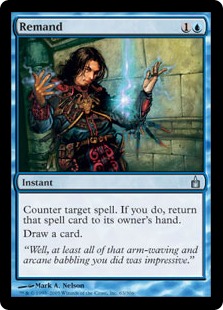
Besides Opt, this deck runs Remand and Cryptic Command to set up draws on the opponent's turn. Both of these spells are sometimes clunky with miracle, as it happens that we need to counter something and won't have the mana to Temporal should we draw it. But this problem mostly comes up with Command, and even then, the odds are against it occurring; once we stabilize the board around turn four, it's generally easy to cast the Masteries we draw as we find them.

Unlike Temur Delver, Jeskai Tempo can actually hardcast Temporal Mastery in the late-game it often aspires to, making Faithless Looting unnecessary.

The weirdo card in the sideboard is Spell Pierce, which I love in all my controlling Ux decks these days. It's just nutty against spell-based anything, where it retains targets deep into the game; even lol-I'm-flooding piles like, uh, the Jeskai mirror have turns where they animate Colonnade and tap out for Logic Knot, or try to Snap-Command something. Pierce is also super good against Collected Company, where it often catches them off guard and frequently lets us lock up the game (CoCo players are quick to cast their namesake card in the main phase if we don't have two mana up, since we might just have Dispel anyway and leave that up for the whole game; even once they learn of Pierce, I haven't found that they play around it).

The Bad
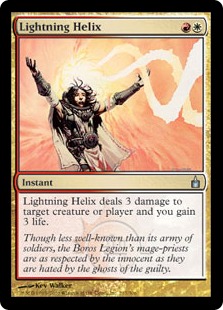
Land drops are all well and fine, but losing out on attack steps is seriously saddening. I took a good deal of extra turns with this deck where all I'd net out of Mastery was a free land drop or draw, which was not what I needed. Queller and Snap simply weren't around enough to let me reliably extract damage from the miracle.

What I did often need was removal or a win condition, and burn spells provide both. I went down to 2 Electrolyze and 2 Lightning Helix to make room for new cards here. Adding Mastery isn't mostly "free" after all, since it cramps Jeskai's critical-mass control-combo aspect of, "End Step, burn you out."

It's interesting that something like Time Walk really is more broken in Vintage than it would be in another format, since Vintage players actually have enough mana and efficient spells as of turn one to make good use of an extra turn as soon as they can resolve it.

Version 3: Esper Midrange

At this point, there was a once-per-turn resource I hadn't yet tried to abuse with Temporal Mastery: planeswalker activations. My stab at an Esper shell sought to combine Delver's combat steps and Jeskai's land drops with a band of up-ticking superfriends.

Esper Temporal, by Jordan Boisvert

Creatures

4 Jace, Vryn's Prodigy
4 Snapcaster Mage
3 Tasigur, the Golden Fang

Artifacts

4 Mishra's Bauble

Enchantments

1 Search for Azcanta

Planeswalkers

4 Liliana of the Veil
1 Liliana, the Last Hope

Instants

2 Opt
4 Fatal Push
2 Path to Exile

Sorceries

2 Lingering Souls
3 Temporal Mastery
4 Serum Visions
2 Collective Brutality

Lands

2 Marsh Flats
2 Watery Grave
1 Godless Shrine
1 Hallowed Fountain
1 Plains
2 Swamp
2 Island
4 Polluted Delta
3 Flooded Strand
2 Creeping Tar Pit

Sideboard

4 Thoughtseize
2 Collective Brutality
2 Surgical Extraction
2 Flaying Tendrils
2 Stony Silence
3 Spreading Seas

The Good

This deck did an okay job of addressing the problems of the last two—Lingering Souls, Snapcaster, and Tasigur form the "combat" squad, and Esper Midrange is, well, midrange-y enough to want to make its land drops.
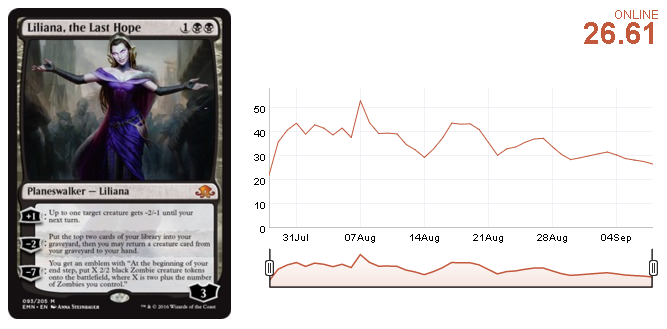
Esper also afforded me the opportunity to try the new planeswalker rule, although, with just one spare Liliana, it didn't come up often. I wanted that Liliana to reliably recur a creature, but don't play enough to justify multiples. The Last Hope still plugs holes in of the Veil's approach to board control, and I love having the two on the board together against creature decks.

The deck's most exciting planeswalker, though, is Jace, Vryn's Prodigy. Jace's looting effect is very relevant here: it dumps extra Masteries, or Souls for a cheap flashback cost; recurs our important spells; and draws a card on the opponent's turn, potentially triggering miracle! Maxing out on Jace lets us finally trim some copies of Opt, which I still believe is a pretty sorry cantrip.

As with my Esper Vehicles list, this deck really wants to have multiple planeswalkers in play. It's hard for fair decks to beat us when we can pull that off. But I skipped out on Gideon of the Trials here, which is definitely a great card. Trials excels in a shell with sweepers, which would clash with this deck's gameplan. I also didn't want to stretch my mana too thing, and was therefore wary of anything costing double blue or white (Liliana of the Veil is insane enough to earn an inclusion regardless).

The Bad

Esper Midrange runs into the same problems other non-Shadow midrange decks have in Modern: it's too inefficient and clunky to keep up with Tron and some of the more linear decks in the format. Abzan, the best of the bunch, has made up for this shortcoming enough with its positive Shadow matchup to retain a respectable metagame share hovering around 4%. But the same can't be said for other black decks of its ilk. Since this deck is more focused on synergy with its walkers and Masteries, and especially soft to Fatal Push thanks to Jace, Vryn's Prodigy, I don't anticipate it even having a great Shadow matchup, which combines with Esper's other issues to make the whole shard kind of unplayable.
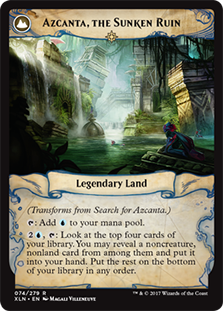
Search for Azcanta is another once-per-turn effect that increases the value we get from extra turns. I only even transformed it once, thanks to Tasigur eating up the graveyard, and even then its three-mana Impulse mode is a bit slow for Modern. Scrying once per turn and dumping cards is okay, and synergizes with Mastery, but it's not worth two mana. I pegged this card during spoiler season (but, out of doubt, omitted it at the last minute from my spoiler review) as a possible include in decks looking to go longer that are strapped on mana, such as this one. After testing, I think both its sides are too low-impact for the cost.

Maybe Next Turn

As always, hindsight's 20/20—why would Temporal Mastery make it in Modern if it never saw play in Legacy, a format that for years was dominated by a miracles deck packing enablers as potent as Sensei's Divining Top, Ponder, and Brainstorm? That deck gets its name from Terminus, a card that plugs a hole in the Counterbalance-Top strategy.
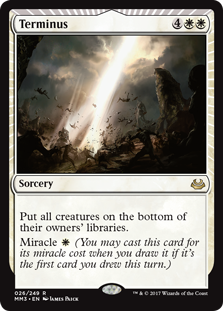
My brewing mistake with these Mastery decks is that I set out to build around a specific card, without giving much thought to the archetypes I slotted the card into—whether those decks wanted such a card in the first place; what problems, if any, the card remedied; which threats, if any, Mastery posed to their integrity. Brewing in this way does have one major benefit: it helps us find an ideal shell (or close) for a certain card, which allows us to say with the certainty of experience why a certain card, or decks built around it, aren't playable in the format.

I've learned the hard way that Temporal Mastery just isn't right for Modern. But best of all, I know why. Are there any cards you think might work in the format, but are virtually unplayed? Let me know in the comments, and if the card piques my interest, it might get a case study of its own!


Insider: Jake and Joel’s Friday Night with Quiet Speculation

Are you a Quiet Speculation member?

If not, now is a perfect time to join up! Our powerful tools, breaking-news analysis, and exclusive Discord channel will make sure you stay up to date and ahead of the curve.


Insider: Cubing with Ixalan (as Inexpensively as Possible)

Are you a Quiet Speculation member?

If not, now is a perfect time to join up! Our powerful tools, breaking-news analysis, and exclusive Discord channel will make sure you stay up to date and ahead of the curve.

Hey there! Let's not waste a ton of time on the intro. As established previously, my goal is to create a cube including the best cards over the history of Magic: The Gathering, but at the lowest possible cost to myself. We're not talking about foils today, folks – we'll be looking at the least expensive version of each card in question.

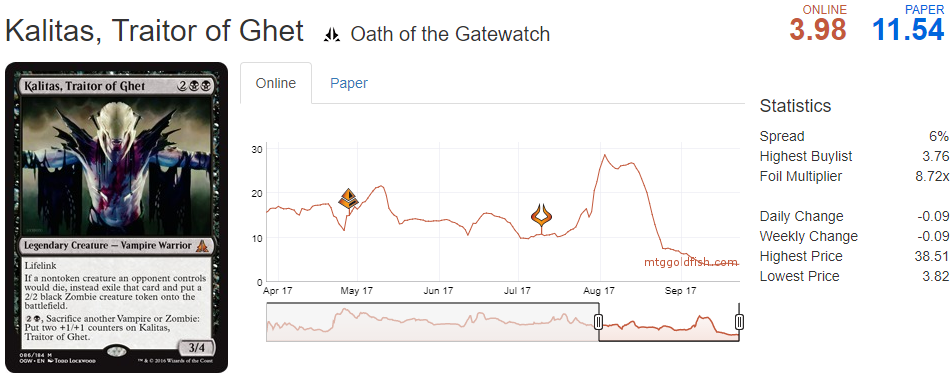
Cubing inexpensively while still trying to pick up the best cards means early identification, periodic price checking, and lots of patience. Cards from Shadows over Innistrad block that have been expensive due to Standard play (Archangel Avacyn, Kalitas, Traitor of Ghet, etc.) are finally primed for pickup. In some cases, a card is fine to pick up while still in Standard, either because it sees no Standard play or not enough to greatly impact its price. That's why early identification is important – why wait to pick up a card if you don't have to?

To that end, let's take a look at Ixalan. For reference, this is my current cube list. I'm not touching on reprints today, as they are probably already in tuned lists if they deserve to be. Onward!

White

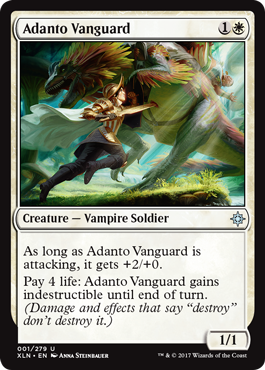
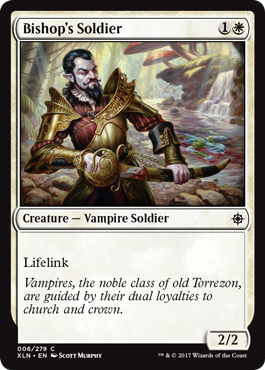
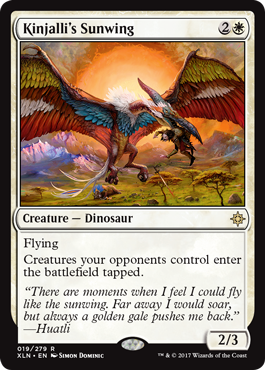
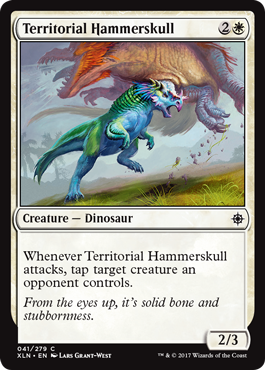
Adanto Vanguard Bishop’s Soldier Kinjalli’s Sunwing  Territorial Hammerskull

We've got a few cards here that in a developing cube, a pauper/peasant cube, or a budget cube might be good for aggressive white decks. All of these cards could be good enough in the right list, but none will be making powered or well-tuned lists. Cost shouldn't be any concern with these, including Kinjalli's Sunwing, which should be a bulk rare or slightly above at best.

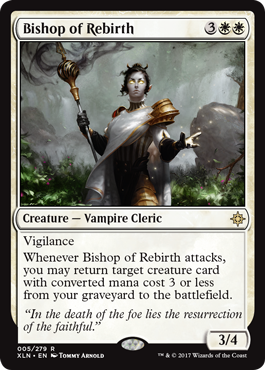
Bishop of Rebirth

A mini Sun Titan is pretty spicy, but again, I think this will be more for developing cubes than tuned ones. This is going to have to compete with the likes of Cloudgoat Ranger, Angel of Sanctions, Wingmate Roc, Baneslayer Angel, Reveillark and more at its mana cost. And let's not forget: Cube has access to actual Sun Titan. As a bulk rare to fill out a growing cube, though, I don't hate it.

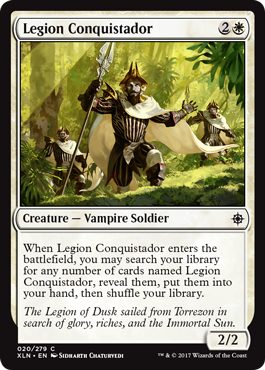
Legion Conquistador

If you're one of those cube designers who has three or four copies of Squadron Hawk as a single pick in the cube, here's another option for you.

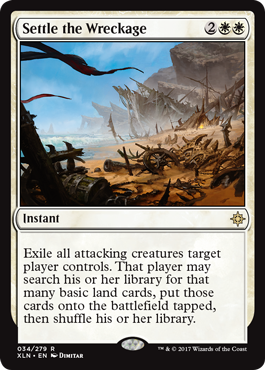
Settle the Wreckage

Wow. It's an instant-speed Wrath of God that's also kind of a hit-everything Path to Exile. In practice, I could see this not being as good as either card, due to the clause requiring the creatures to be attacking. Is it good enough for Cube? I can't say for sure. It's on my watchlist, but as a rare from a large fall set, the supply on this card is going to be huge, and sweepers never go over a few bucks anyway. With a current market price around $2.50, there's a good chance you could save a buck or two by waiting on this, and I consider there to be little chance of getting blown out by it going above $5.

Not a lot going on for white. None of the above cards are must-includes in my list, but maybe you feel differently.

Blue

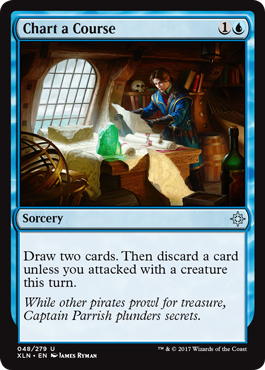
Chart a Course

I don't hate this at all. It's best if your cube supports aggro in blue, but I think it's an arguable inclusion even if you're not planning to attack often. Finding a slot in blue, as always, is the difficult part. I was expecting this to be starting at $1 and it's half that, so there's no shame in buying early if you want a copy.

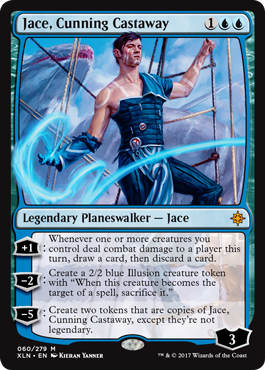
Jace, Cunning Castaway

Pirate Jace is pretty cool. I don't like to overreact to planeswalkers, and frankly, there's so many these days that they're not auto-includes just on the basis of being printed like they used to be. But at this mana cost, I'm not counting this card out. That said, planeswalkers are exactly the kind of card I prefer to wait until rotating out of Standard to buy – any kind of Standard play will make a huge difference between a planeswalker's Standard price and non-Standard price. It's on my watchlist; I'd buy for $5 or so while in Standard, or just wait for a couple years and get it for even less than that.

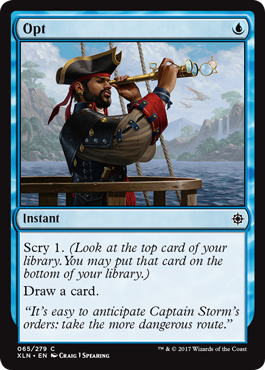
Opt

This is an automatic include. Did you know that it's an instant? Holy crap. It's common so you should have no trouble finding a copy, even though it will be a Standard staple for sure.

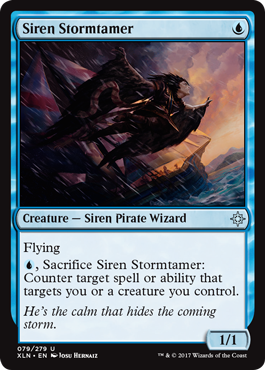
Siren Stormtamer

It's good in aggro; it's good in control. Yeah, this is very likely getting a slot. At a little more than a $1, you could risk waiting, but if this catches on in an Eternal format, that $1 price tag could look like a bargain in the future.

Blue got better cards than white, that's for sure. Other than Jace, the standouts are not flashy, but they are going to slot in to many a deck.

Black

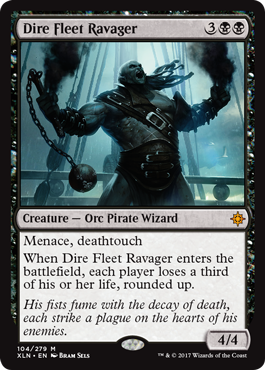
Dire Fleet Ravager

Flashy? Sure. Good? I don't think enough so for Cube. I'm not really interested, but black isn't offering much this set.

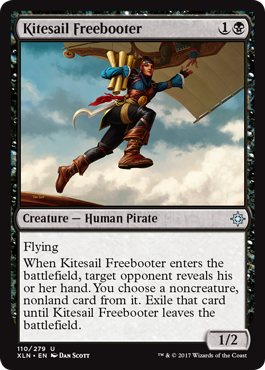
Kitesail Freebooter

I saw this card for the first time at the prerelease, and at first I missed the "noncreature" clause, and I was blown away that Mesmeric Fiend and Brain Maggot had been so outclassed. Now that I see what it actually does, it's still quite a good card. Flying gives it a good chance to ping for a lot more damage than Fiend or Maggot ever did, and in a Powered Cube environment, you're often most happy to take the non-creature anyway. This is generating no buzz as an uncommon, so pick it up at your leisure.

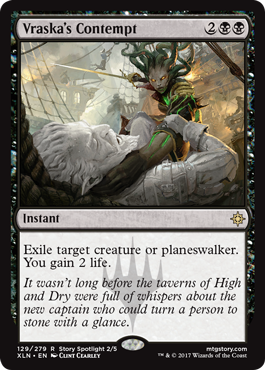
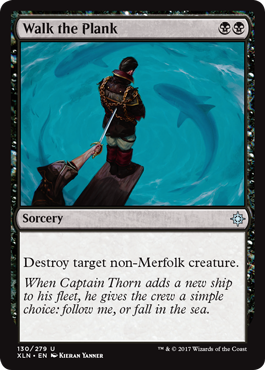
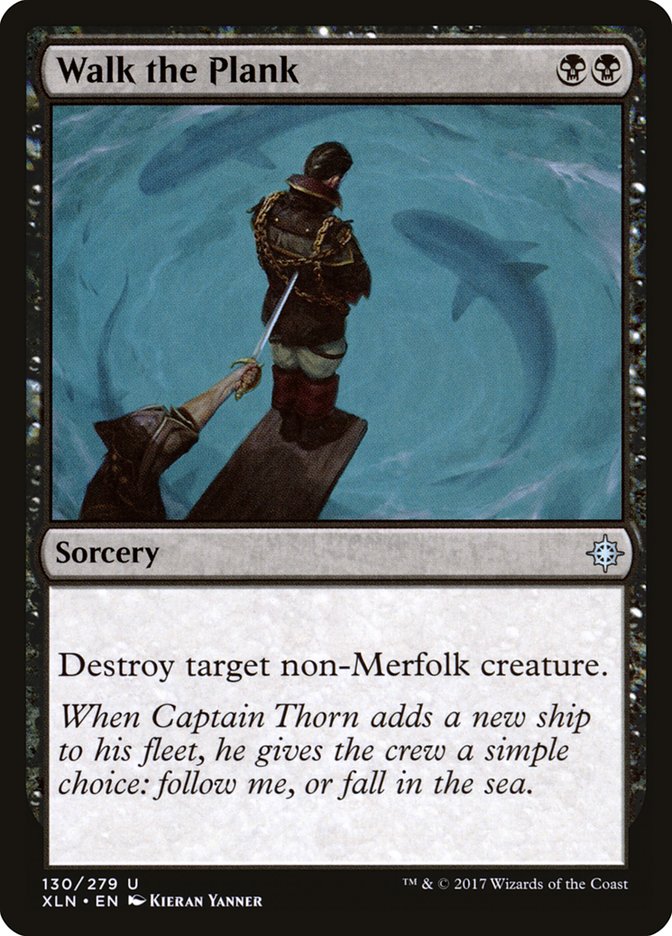
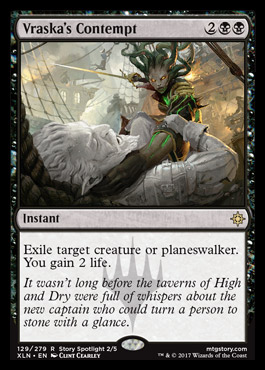
Vraska’s Contempt Walk the Plank

You could use these as placeholders in a developing cube, but neither has a place in a well-tuned list. Compare Vraska's Contempt to Hero's Downfall and Walk the Plank to every other two-cost black removal spell from history (hint: most of the good ones are instants and cost 1B).

It's too bad that black didn't give us much at all this set, because it's perhaps the color in Cube that needs the most help. Oh well.

Red

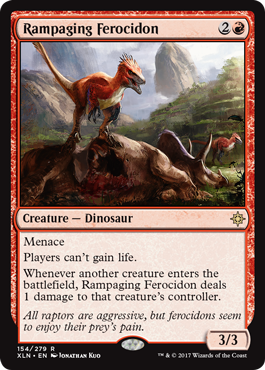
Rampaging Ferocidon

This isn't an auto-include, but it's definitely a worthy consideration for cubes that support red aggro. It doesn't displace Goblin Rabblemaster or Manic Vandal, but there's an argument to be made that it's better than Chandra, Fire of Kaladesh or Sin Prodder. The "players can't gain life" clause may push it over the edge of Sin Prodder in particular – I think I just convinced myself to make the switch. At nearly $3, it looks like people are taking a look at this for Ramunap Red or Standard Dinosaurs. It could push up a little higher in the short term, but if you're a long-term planner, this is a card that will be a bulk rare someday, guaranteed.

As a side note: two or three years ago, Chandra's Phoenix and Manic Vandal were the best three-drops red had to offer – now it seems like there is a borderline Cube-playable red three-drop in every single set. Craziness.

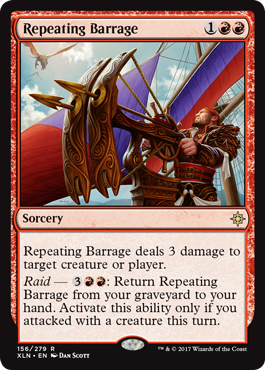
Repeating Barrage

As someone with a deep love of Hammer of Bogardan, I can't help but love this card. As someone who has played a lot of Cube, I can't help but know that an improved Hammer is still not good enough.

Red has even less than black. I'm starting to think this set isn't offering a lot for Cube – at least in the mono-color section.

Green

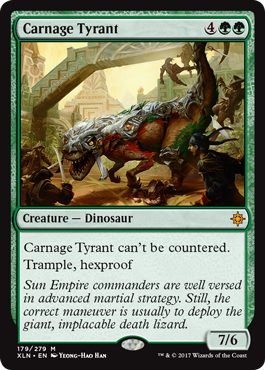
Carnage Tyrant

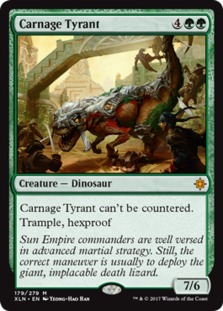
I have to talk about this guy given that he's by far the most expensive card in the set. That being the case, I don't think he's remotely close to good enough. We're talking Cube here. Primeval Titan is available. Woodland Bellower. Greenwarden of Murasa. And let's consider that six isn't even hard to reach for green. If you're building a green deck with fatties in Cube, you want Avenger of Zendikar, Craterhoof Behemoth, Woodfall Primus, or Terastodon. To me, Carnage Tyrant is just a big, dumb, vanilla fatty. Yeah, he'll give blue decks a hell of a time, but that's not enough to devote a whole slot to this. I'm passing, especially at its current price. This card will be around $2 after it rotates. How could it possibly maintain this price or anything close in the face of all of Magic's cardpool?

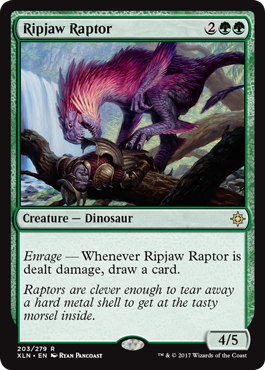
Ripjaw Raptor

Now here is a green card worth a slot. Green has an abundance of four-drops, and this strikes me as better than Thrun, the Last Troll, but not better than Master of the Wild Hunt or Oracle of Mul Daya. The hard part will be deciding whether I want the Raptor or Polukranos, World Eater. That said, this is a rare that is currently near $10. Even if it becomes a Standard staple, and it probably will, it should be $5 before too long. Whether you want to buy at that price or for $1 in a couple years is totally up to you.

That's it for green. Slim pickings, man.

Multicolor

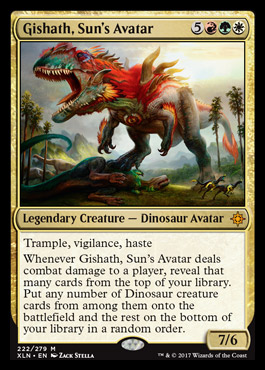
Let's be real. Unless you're going to completely warp your cube around Pirates or Dinosaurs, you're just not going to play cards that care about them. That makes Admiral Beckett Brass and Gishath, Sun's Avatar overwhelmingly "meh" for our purposes here. What would be good in Cube from this section?

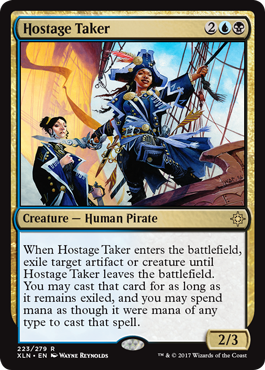
Hostage Taker

This is pretty borderline. Dimir has lots of good cards available to it in Cube and finding a slot is going to be difficult. That said, this offers a potential three-for-one if you're able to cast the card you exile. It's just that one of those three is a vanilla 2/3. It's worth a look, but not a purchase at $5. This is a rare; target it at $1 or less.

Huatli, Warrior Poet

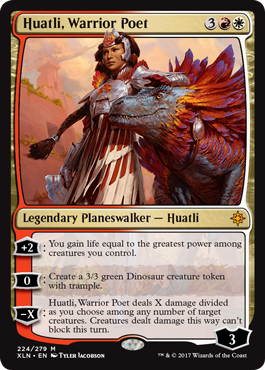
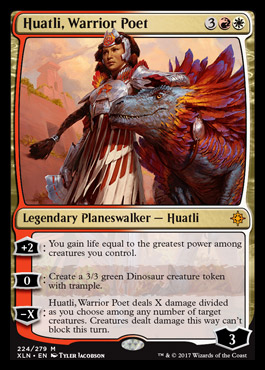
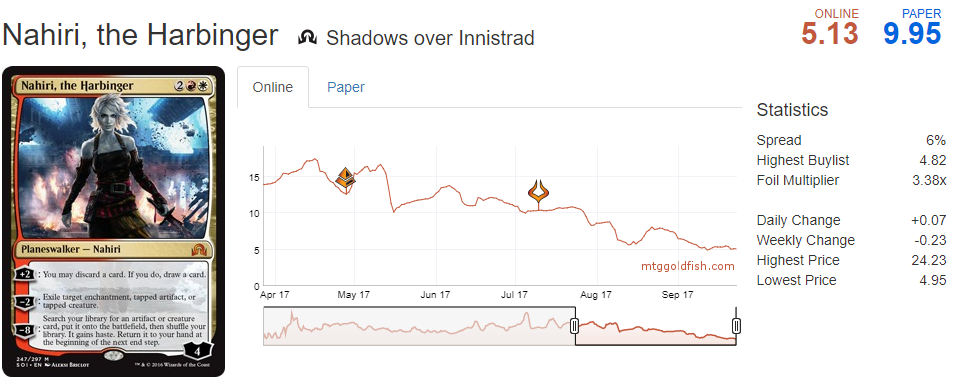
I don't have a problem with what this card does, and at $10, it could even be a worse price. But might I suggest that for an even lower price (money and mana cost), you can purchase the freshly rotated Nahiri, the Harbinger, a better card by far that has seen Modern play. For even less money than that, you could get a copy of Ajani Vengeant, one of the coolest and arguably most powerful planeswalkers of all time. If you've got both of those in your list, and you still want a Huatli, by all means, pick one up. This should be easily available for $5 unless it catches on in Standard, which doesn't seem especially likely to me.

Vraska, Relic Seeker

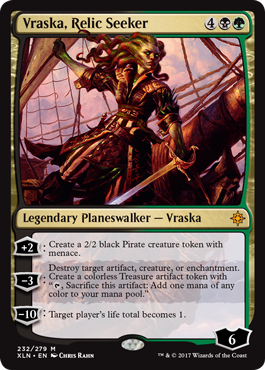
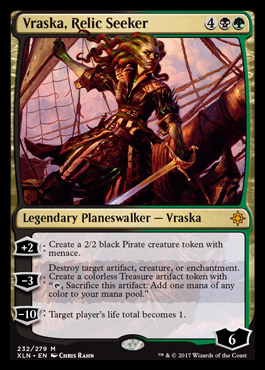
Golgari has, in my opinion, some of the weaker offerings among multicolor cards in Cube. Vraska, Relic Seeker does a nice job of adding to the color pair's playable cards. Coming down and either adding to your board or subtracting from your opponent's is just what you need for a six-cost planeswalker. I don't think this is displacing Garruk, Apex Predator, but I do think it will be a nice companion. Before you go paying $14 for this card, may I suggest first thinking about which six-cost planeswalkers have actually seen Standard play (or were anticipated to), and their current prices today as well as over their Standard lifetimes:

There was an error retrieving a chart for Elspeth, Sun's Champion
There was an error retrieving a chart for Sorin, Grim Nemesis
There was an error retrieving a chart for Chandra, Flamecaller

Double-Face

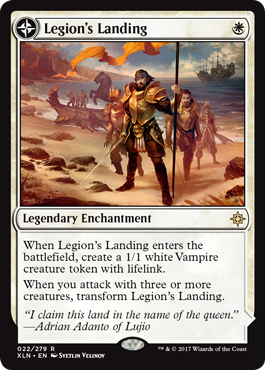
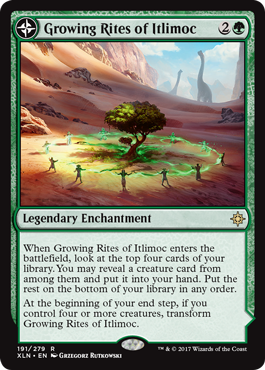
It's honestly really hard to evaluate these double-faced cards. They're not super great on the front, but on the back, oh man, they are also absolutely gorgeous land designs, and I wish we could have face-up lands with those designs. Maybe I'll just do that. Just play them as absolutely overpowered lands that make the Power Nine get relegated to later picks. ... Yeah, maybe not.

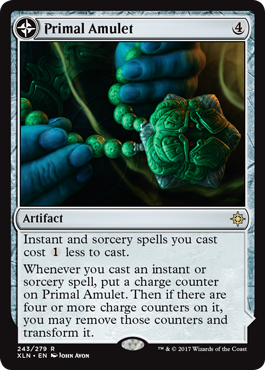
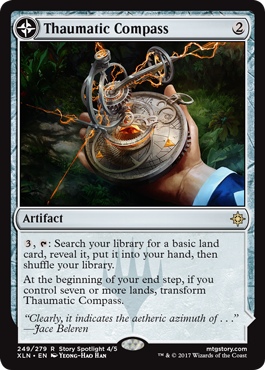
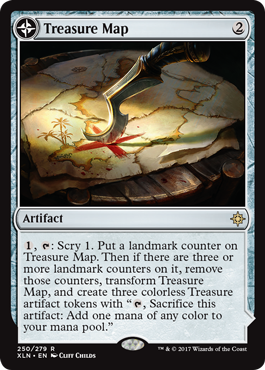
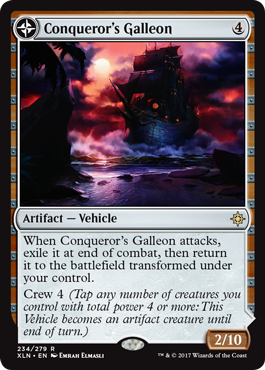
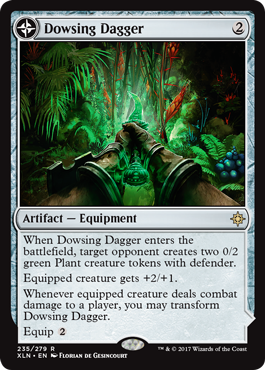
Legion’s Landing Growing Rites of Itlimoc Primal Amulet Thaumatic Compass Treasure Map Conqueror’s Galleon Dowsing Dagger

The above seven cards I think are so underwhelming on the front half that they're not really worth considering for the back half. (Primal Amulet could very easily be good enough in a cube that supports Storm, though.)

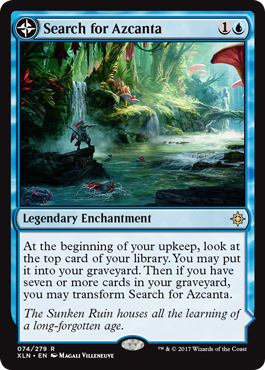
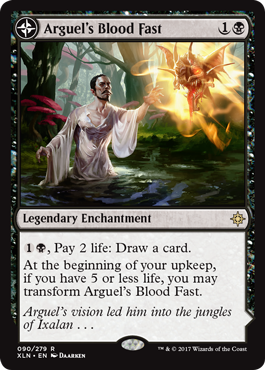
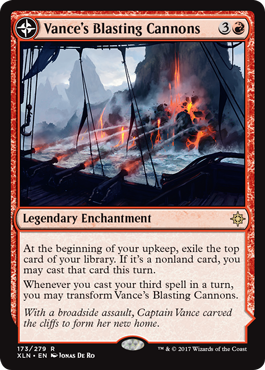
Search for Azcanta Arguel’s Blood Fast Vance’s Blasting Cannons

These three are kind of interesting on the front, and being able to flip into overpowered lands makes them quite interesting in my opinion. Unless they turn out to be even better than they look or people just love the land designs on the back, I don't see why these won't be available for $1 to $2 before long. I wouldn't call any of them auto-includes, but they're definitely worth some testing.

Artifact

Whoa. There's nothing in the artifact section worth discussing. Maybe you could play Vanquisher's Banner in a tribal cube, but the card seems more suited to Commander based on its mana cost.

Land

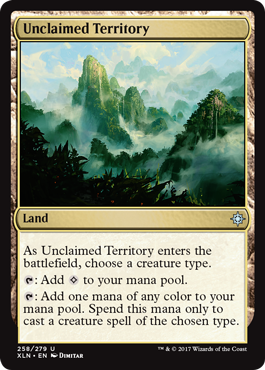
Unclaimed Territory

Even if your cube isn't tribal by design, if your individual colors have a plethora of one or two particular creature types, this can absolutely be good enough. Bonus if you're trying to support Oath of the Gatewatch colorless cards. Casual demand should keep the price of this card up, I expect. Paying $2 might not be so bad if you really want a copy.


That's it! Ixalan is honestly pretty underwhelming when it comes to Cube, but every set has a piece or two that's worth considering. As a player who usually picks Ponder and Preordain highly, I'm most excited for Opt.

What's got you most excited for cubing with Ixalan? Did I omit a card you think is great? Let it be known below. Thanks for reading!

Deep Dives: Understanding Death’s Shadow

Are you a Quiet Speculation member?

If not, now is a perfect time to join up! Our powerful tools, breaking-news analysis, and exclusive Discord channel will make sure you stay up to date and ahead of the curve.

This past week I found myself looking back at some of the first articles I wrote here at Nexus, for some reason or another, and discovered something interesting about my writing. No, it’s not that I love control, or have a tendency to play tempo-oriented decks, or really really like to talk about context in Magic, though all of that is of course true. Interestingly enough, I haven’t done many primers in my life (or at least  my Magic content career), which both surprised me and made complete sense at the same time, if that’s possible. It might come from my firm belief that sideboarding should be a fluid process, and part of me feels that primers tend to fall into the "basic level info" camp for a format where most players learn the intricacies of one deck and tend not to switch, but I just haven’t felt the draw to that style of writing compared to other topics I’ve explored.

Still, something in me felt the desire to branch out a little bit. Looking back at my content, I discovered that my old Video Series were, in a sense, brief primers I used to do on a weekly basis. In the lull period between a potentially outdated format and one where Ixalan is out in full force, it seemed like the perfect time to try my hand at something new(old). Since I also noticed that my first article was on Grixis Control, and my second article was on Suicide Zoo, it seems fitting (and perhaps overdue) that this primer be on Grixis Death’s Shadow.

Cue the audible groans! See, I can imagine most of you already aren’t too excited about an article all about Grixis Death’s Shadow, and I get it. Nobody likes paying their taxes either. On one hand, some of you are Grixis players yourselves, which means most of the content here might be information you might already know. For the rest of you, you’re probably tired of seeing Grixis Death’s Shadow in matches at this point, so the mere thought of reading about the deck probably inspires nightmares of painful fingernail extraction while Justin Bieber prunes his facial hair in your direct line of vision.

Therein lies the rub. I’m banking on the assumption that you’re a diligent, tax-paying, law-abiding citizen: one that takes their licks when they're given; one that grits his teeth and puts his nose to the grindstone, doing the dirty work that needs to be done to achieve everlasting success and a better life for generations to come. It’s not glamorous. It’s not sexy. It’s the inner workings of Grixis Death’s Shadow, how it runs, and how to beat it.

The Basics

Grixis Death’s Shadow, at its core, is a resource-driven value engine that combines disruption and cheap threats in a synergistic package with game against just about everything. So, basically, a sickening package of aggression, value, and flexibility. Shadow decks are hard to fight because they are hard to pin down, and can pivot and adapt to just about any role or situation it's required to take in a given matchup. As evidenced by its long history in Modern, Death’s Shadow is cheap, fast, and powerful enough to make it difficult to race or fight fair, and going unfair plays right into the disruption game Death’s Shadow decks can play so well.

The core revolves around eight (sometimes one more or fewer) cheap threats, in the form of Death's Shadow itself and delve creatures like Tasigur, the Golden Fang and Gurmag Angler. I say "cheap" in the sense that both creatures carry restrictions regarding when they can be played, with Death's Shadow requiring us to drop below a certain life threshold and delve creatures requiring cards in the graveyard to pay their exorbitant mana costs.

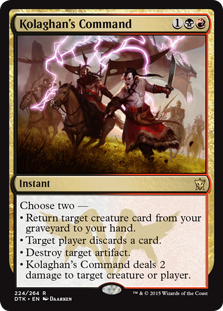
This is basic info, of course, but it’s important to put into words because this oft-overlooked fact is one of the few ways to fight the deck. For all its strengths, eight threats is a very low number if we can stop them on the way down. By that, I mean removing the recursion engine of Kolaghan's Command chained with Snapcaster Mage, or taking away the graveyard as a resource to cast the delve spells. Cards like Surgical Extraction to take away all Death's Shadows immediately halves the threats Grixis has to deploy, and bombs like Leyline of the Void can shut down the deck's engine entirely.

The Rest

Beyond the self-explanatory cards like Serum Visions, Thought Scour, and Street Wraith, Grixis Death’s Shadow employs a midrange value package, disruption, removal, and protection in varying numbers. We’ll take them one at a time, and discuss briefly what these cards do for the strategy.

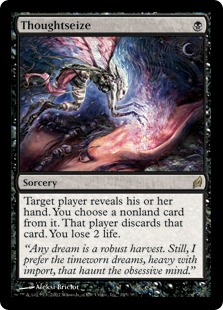
First up is proactive disruption, which usually takes the form of six or seven one cost discard spells like Thoughtseize and Inquisition of Kozilek. Grixis Death’s Shadow tends to play threats for one mana, but almost never on the first turn, which allows them to take advantage of targeted discard as a form of disruption that can be used for both offense and defense. Stripping a removal spell that could answer Death's Shadow can often be all that’s needed to win, as our creatures hit so hard, and removing opposing threats can give us time to get our engine going or dig for threats should we be missing them in hand.

Trading a card in hand and a resource for a card in our opponent’s hand often puts us at a disadvantage as far as rate is concerned, in the sense that we are exchanging an ‘even’ effect (both players losing a card from hand) but we are spending a resource (one mana) and our opponent is not. This fact, again something that might be basic info, still gives a clue towards a weakness of the deck, which is that it leans heavily on using that first turn to push its opponent off their game and give it time to bring its engine online. Quick, aggressive strategies that can make discard a liability, in the sense that sometimes the Death’s Shadow player can’t afford to spend a resource on something that doesn’t interact with the board. A quick start from the enemy can knock the archetype out of its lane and put it on the back foot.

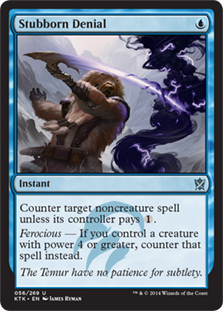
This notion of playing on the "back foot," or on defense, is one that players might remember from the days of tempo-aggro, epitomized by Delver of Secrets decks. Delver decks always experienced a wide discrepancy in terms of power level depending on whether those archetypes had their namesake card in play or not. Tempo-generating spells like Vapor Snag and Spell Pierce gain value when the opponent is forced to play into them, which happens most often when we have a creature out applying pressure. In the same way, Death’s Shadow decks rely on playing and keeping a threat on the field; otherwise, Stubborn Denial becomes useless, and discard in high numbers becomes a liability in the lategame.

Unfortunately for the field, Grixis Death’s Shadow plays like a supercharged Delver deck, in the sense that we turned our Spell Pierce into a (relatively) unconditional counterspell in Stubborn Denial, and traded our 1/1 that sometimes became a 3/2 flier for a 4/5, or an X/X that sometimes grows into 8/8 or larger. This is what those of us in the business call power creep, boys and girls.

When our threats hit so hard, Stubborn Denial to gain us another turn of uninterrupted combat phases becomes that much more powerful, and recursion effects like Kolaghan's Command get compounded as well. The power level of just about everything gets ramped up when we improve our core threat base, which is why Delver of Secrets decks could never make that final push into the top tier while Death’s Shadow decks could, even though they play most of the same cards.

As for the sideboard, I hesitate to give too much information, as I'm a firm believer in personalized sideboards that fit the player, and not the deck. Besides, with how quickly things can move in Modern (looking at you, Geist of Saint Traft), including sideboard information in a primer that hopes to remain a reference for the future seems presumptuous at best, and dangerous at worst. Who knows what the meta will look like two months, or even two weeks from now? Probably a lot like this one, but my point remains!

Conclusion

This might not have read like a traditional primer, which was actually by design. Hopefully, my experiment was successful, and this primer successfully discusses how a deck is built, how it works, and how best to attack it, while dodging the traditional “these are the creatures, these are the draw spells, this is the sideboard” method in which primers are usually written. If you liked this approach, let me know in the comments below, and I can expand to other decks in the format in a similar manner. If you didn’t like this approach, obviously let me know as well, so I can work to improve in the future! Primers are a tool in my repertoire that haven’t gotten much use, and I plan for that to change moving forward, but with a signature twist, of course. Thanks for reading, and I’ll see you next week!

Trevor Holmes

The_Architect on MTGO

Insider: Reevaluating Ixalan After the Prerelease

Are you a Quiet Speculation member?

If not, now is a perfect time to join up! Our powerful tools, breaking-news analysis, and exclusive Discord channel will make sure you stay up to date and ahead of the curve.

The prerelease has come and gone, and Ixalan is going to release this week. The preorder hype is past and now we’re getting into some real prices for these new cards. I wanted to share with everyone some things I learned about the set from this weekend. If you’re interested in a more visual recap of the info, take a look at my YouTube channel for a sweet prerelease vlog.

Dinosaurs

First up, the main thing on my mind is about Dinosaurs. I’ve seen them be amazing this past weekend but I’ve also watched them struggle. One thing to keep in mind is that there are going to be many ways to build around this tribe. There will most likely be a couple different green-red builds, but there will also be Naya iterations, as well as straight red-white.

The biggest draw to white is Kinjalli's Caller, but Goring Ceratops is nutty also. Caller is like a one-mana Wall of Roots for this new tribe and the three toughness helps gum up the ground in the early game. Neither of these are hugely relevant financially but they should be pretty cheap so getting some copies to have available seems like a great idea.

The big man on campus is Carnage Tyrant. As far as I can tell, every card in the set has dropped in price except this dude. If you’ve been reading my articles on this set, you know I don’t have a huge opinion about him. After actually playing with him this weekend—yeah, I had a sealed pool with two of them—I still think he’s not all he’s cracked up to be. I’d much rather be buying new Jace than Carnage Tyrants.

There was an error retrieving a chart for Carnage Tyrant

Even though there is less removal in Sealed than Standard, I think blocking will be a perfectly fine way to remove the Tyrant. There were plenty of boardstates where my Tyrant couldn’t attack because they could just block and kill it. That will likely happen in Standard as well, but especially so with Dinosaur mirror matches. I’d much rather pay an extra mana for Goring Ceratops or deal with the triple red for Burning Sun's Avatar.

Regisaur Alpha impressed me much more, or rather, it lived up to my high expectations of the card. Seven power for five mana is great. The 3/3 is vulnerable to basically every removal spell but the main body of Regisaur is pretty sturdy. Additionally, if they remove the token, sure that’s less power on the board, but the haste that Regisaur grants might be the strongest part about the card and they still have to deal with that.

There was an error retrieving a chart for Regisaur Alpha

I love Gishath, Sun's Avatar and maybe I’m living in Magical Christmasland thinking he can ever enter the battlefield in Standard, but I’m sure going to try. He seems like a great ramp target or even a sideboard plan in the Dinosaur mirror match. At $6 he’s more likely to go down than up though.

Pirates

Mana Leak is just as good as ever, and the fact that the Pirate tribe is the only one that gets to play Lookout's Dispersal means that Pirates will be played. Without this new Mana Leak variant, I think Pirates would be overlooked. But with it, they are probably the strongest of the tribes. How is Dinosaurs supposed to get a foothold if their big spells get counted easily? Pick up and move this uncommon as frequently as possible while it’s in Standard.

As far as actual Pirates, there aren’t a ton that are financially relevant or even that great. Most of the ones that will be played are commons or uncommons and shouldn’t be worth much. One I have held onto is Kari Zev, Skyship Raider. She was definitely a plant in Aether Revolt and she’s already above a dollar from her previous bulk status. I think Blue-Red Pirates is going to be the way to go with the archetype and if so, she should shoot up even more.

There was an error retrieving a chart for Kari Zev, Skyship Raider

The other Pirate I like is also not from Ixalan. Skyship Plunderer seems like the best blue Pirate. I think proliferating your Jace, Cunning Castaway or Chandra, Torch of Defiance seems like a crazy powerful thing to do. Skyship Plunderer allows Jace to ultimate the second turn he’s in play. Just tick up Jace and add a counter after Plunderer attacks and you’re at the five loyalty needed for the ultimate. That’s crazy!

With Chandra, she can ultimate the turn after she comes into play as long as you can add two counters by attacking twice. That’s a little harder to pull off but still easily doable.

One Pirate from this set did stand out to me, though, and that’s Fathom Fleet Captain. I’m not sure how well black fits with Pirates, but just making one 2/2 is a big deal and can swing games. I like this guy as one of the best pickups from the set. He’s currently just over a buck and that seems like a great deal.

Lastly for Pirates, Hostage Taker seems busted. Maybe it’s just because I was watching her get played in Sealed, but removing their creature and then casting it for yourself is crazy powerful. Her three toughness most likely makes her nothing more than a speed bump, but if you can keep her alive you’ll likely win that game. Think about risking it by stealing a Regisaur Alpha and then casting it for yourself the following turn. How much would that swing the game!

Vampires

The only time I saw Vampires be successful this weekend was by spamming tokens backed up by Sanctum Seeker. That might be a viable strategy in Standard too. I think that makes the dollar-rare Vampire a great pickup as well. I think we are missing some good reasons to play Vampires though.

One thought I keep coming back to is giving the Vampires horses to ride. Crested Sunmare seems to pair well with all of the life gain the Vampires are capable of, and that could be a great reason to play the tribe. Sunmare is already a popular seller for me—if there was a Standard home for him, I think his price would double from $4 to $8.

There was an error retrieving a chart for Crested Sunmare

Merfolk

Merfolk are the low men on the totem pole. There just doesn’t seem to be much reason to play them competitively. In Sealed they were great and I went undefeated with them in one of my flights. I think that Lookout's Dispersal should have said "Pirate or Merfolk," but since it doesn’t we are left without much reason for Merfolk to matter.

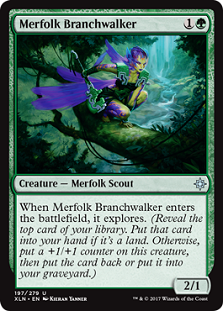
Curving out with Kumena's Speaker, into Merfolk Branchwalker, and getting the payoff of Vineshaper Mystic and Herald of Secret Streams seems like one possibility. That line of play seems likely to be disrupted by any removal spell though, so I’m not sure it will stand up.

One interesting card we could play in blue-green is Nissa, Steward of Elements. She seems like she could pair well with the Merfolk and she’s double on-color too. That might be a card worth caring about Merfolk for.

Her scry allows you to set up your best draws and the zero ability works well with all the Merfolk you'll likely have in your deck. I don't think any Merfolk help you ramp, but some of them have explore to provide extra lands. That could help make Nissa's ultimate more relevant if you're able to get there.

There was an error retrieving a chart for Nissa, Steward of Elements

If the deck doesn't pan out, then holding onto the cheap Merfolk rares in preparation for the next set seems like a great plan. That might be the best we can do financially for this tribe right now.

Spells

Oh boy did I have some blowout plays with Settle the Wreckage. I got three- and four-for-one’s with Settle and even though they get a pile of basic lands, it’s a huge blowout. Just like how Path to Exile is amazing despite the fact your opponent gets a basic land, multi-Path is just as busted.

At $2 I think this is a great buy. I know I'll be sleeving it up in control deck to try and fight against the tribal aggressiveness the format will be throwing around.

There was an error retrieving a chart for Settle the Wreckage

Treasure Map seems great too. You can scry for a couple of turns and then get a huge mana boost as well as the potential to draw extra cards. A non-blue control deck might want this as a source of card advantage.

There was an error retrieving a chart for Treasure Map

The main reason I bring card up, though, is because of the insane foil multiplier. The foil mid price is almost $12! I picked up one myself this weekend. I think the other flip-card foils might also follow the higher foil price trend too, so be on the lookout.

Here’s one final note about this set in general. Even if none of these tribal strategies are actually playable now, all of that could change once the next set comes out this winter. All of the tribes could and most likely will shift in power depending on what happens with the next set.

That means that when tribal cards bottom out in a month or two, start picking them up in case they break out with the next set. I’m sure lots of writers will talk about which cards specifically to target, but just in case, here’s your two-months-ahead-of-time reminder.

Until next time,
Unleash the Force!

Mike Lanigan
MtgJedi on Twitter
MtgJedi on YouTube

Insider: Keeping a Portfolio

Are you a Quiet Speculation member?

If not, now is a perfect time to join up! Our powerful tools, breaking-news analysis, and exclusive Discord channel will make sure you stay up to date and ahead of the curve.

Welcome back, friends. If you didn't catch my discussion of Arena last week, have a look here. Also, be wary about selling your older cards this week. Prices across the board will be about 10 percent lower because everyone is selling their excess cards so they can draft the new set. With prices so volatile, this week, I want to share a little bit about why we should keep an investment portfolio, why I have designed my portfolio the way I have, and how it can help you make smart investment decisions.

Here is a current copy of my portfolio. I also want to stress that there is no singular best way to keep a portfolio.

The overriding reason for keeping an investment portfolio is to help you (i) make smart investment decisions and (ii) keep up with and manage your investment collection. Your portfolio should help you attain those two goals without detracting from those two goals. Above all else, keeping a portfolio should not gobble up tons of your time. It should be easy to add to, should make things clear to you when you look at it, and should not be cluttered with information you don't find useful. Ultimately, you have to adapt your portfolio to suit your investment style, investment strategy, and personal taste.

(1) Keeping a portfolio is essential for managing a large amount of speculations and investments.

I have a friend who keeps track of his speculations on Magic Online by writing them down on a StickyNote and putting that on his computer screen. This method can work... as long as you're speculating only on one or two things and check those two things religiously, as he does. Once those one or two stocks become five or six, and those five or six becomes fifteen or twenty, however, keeping a portfolio becomes essential.  Otherwise, you won't sell your stocks at the right time, and you'll lose value in the process. Sometimes you might even forget about them, only to discover months later that you still had them. If you're going to spend time and money investing on MTGO, even if you're keeping track of just a handful of cards, the best thing you can do is to keep a portfolio. Keeping a portfolio enables you to keep track of the financial data of your past and present investments to an extent that you couldn't otherwise.  It can be as simple as creating a collection on MTGGoldfish.

There was an error retrieving a chart for Information Dealer

As I have mentioned before, I keep track of all my transactions in an Excel spreadsheet (on One Note) which I call my portfolio. But I also use MTGGoldfish's collection tool to keep up with the financial value of all the cards in my collection. Formally speaking, I would consider both my excel spreadsheet together with my MTGGoldfish Collection Tool as my portfolio, because together they constitute the outside work I do to help me invest on MTGO and manage my collection. In the MTGGoldfish Collection Tool, I mark all of my contemporary investments as "Favorites," which groups them all together under the same tab. This tab I check roughly once per day. I also keep track of my other valuable cards using this Collection Tool, but I don't mark them as favorites. Thus, when I click the "All Cards" tab, I can see financial information for every valuable card in my collection. This is where I keep track of my playsets of Bitterblossom and Snapcaster Mage, for example. This tab I check once every few weeks, more as a precaution than anything else.

Why did I go above and beyond that to create my spreadsheet a year ago? Mainly because I wanted to become a better speculator and investor, and I perceived that the only way to get better and develop a better acumen for MTGO investing would be to record my investments and chart my results, be they good or bad. It turned out that making and maintaining this page had other benefits I hadn't recognized when I began over a year ago. Some of those will be discussed below, starting with...

(2) Keeping a portfolio helps you organize your MTG year.

Just as we organize our year into different seasons, seasons which have definitive attributes, which follow one another in a predictable way, so too does Magic have its own cycles of activity that follow regular patterns. It took me a while to figure out a way of organizing the Magic year into seasons that helped me break down my larger investment portfolio into pieces that my brain could better digest.

There was an error retrieving a chart for Defender of the Order

After a while it hit me – I should divide the cards in my investment portfolio into blocks that would be at roughly their same life cycle in Standard, often exhibiting the same trends and needing to be bought and sold at roughly the same time. That is, I should structure my portfolio by "Magic time," which is arranged in blocks! Dividing my portfolio in this manner has been great for organization as my collection has expanded, and now I am beginning to use this season to look at how much capital I am using to invest in every season.

For example, in the Kaladesh season, I invested $1,000 and in the Amonkhet season, I invested $900. Had I been conscious of this earlier, I would have rather invested closer to $750 during the Amonkhet season, because I was less certain about Amonkhet block specs than Kaladesh block ones.

This is a good place to say: don't be intimidated by the voluminous amount of data I have on my portfolio spreadsheet (especially if you "unhide" the columns that I keep hidden so it doesn't become too cluttered). Start simple, and you'll intuit at your own pace various improvements you can make to your portfolio.

(3) Keeping a portfolio helps ground you in the reasonable.

I don't necessarily recommend that you become a full-on Kantian, but one of the pitfalls into which all of us sometimes fall is making buy and sell decisions off of fear, relief, excitement, and emotion. Keeping a portfolio can help you make sound speculation decisions, both with respect to buying and selling. Writing down a target sell price when you make a speculation target helps you not to get too caught up in what can be an emotional experience. Being able to look at your target sell price to give yourself a reminder about how you felt several weeks or months ago when you were making any given speculation is a valuable tool for extricating yourself from making snap decisions and getting too caught up in the moment.

There was an error retrieving a chart for Merchant Scroll

When I set a target sell price in my portfolio, I interpret that as a price at which I should be happy selling it at, a sort of memento to my future self prompting me to sell and not get too greedy. When a card of mine reaches that sell price, I've made it a habit of always selling at least some of my holdings of that card and then reevaluating.

A few months ago, when I asked what QS readers wanted to see a discussion of, one response was a discussion about how to know when to sell a card. How do you know when a card is peaking? How do you know what a reasonable price at which to sell is? Related to the above, how do you know what to write down as a target price when you make a speculation?

The answer may be a bit frustrating, but it is just as true now as it was 2,500 years ago when Plato broached this issue in multiple dialogues: you simply need to have an intuitive sense for it, a sense that you build up the longer you play on MTGO and the longer you pay attention to card prices on MTGO. Just as a blacksmith needs to gain experience using a hammer and an anvil to adequately learn how to make good weaponry, so too do you need to experience the MTGO market to have a good sense for what prices a card might go for in the future. Simply reading a book on blacksmithing does not make one a good blacksmith. There are no sets of theoretical principles that are adequate. There is only past experience and an intuition developed from engaging with that past experience that can guide you. Speculation is an art and a science; it is not a theoretical practice like math or philosophy.

There was an error retrieving a chart for Hyperion Blacksmith

Two articles of mine – the two-part series on Tiny Stocks here and here – can give you a sense for how one ought to think when approaching speculation. When I see Censor or Doomfall, I also see Blessed Alliance and Transgress the Mind in the background behind them. Just as we look to past cards to judge the power level of new cards, we also look to the past performance of cards with similar profiles to anticipate future performance of today's cards.

In my articles going forward, I will begin to include my perception of a card's future price when discussing speculation opportunity. The other place to look will be at my portfolio spreadsheet where I list (for my own benefit) a price at which I'd like to definitely sell some of my holdings. Use my perspective on individual cards, along with the perspectives of the other MTGO writers at QS, to help inform your own perception about the future price of potential speculation targets.

What you should try to avoid doing is feeling bad about selling when the card is going up in price. Aiming for the peak price might seem good in principle, but doing so requires that you live at your computer and spend all of your free time worrying about your speculations. It is virtually impossible to always sell your cards at peak price – what matters in the long run is selling your cards at good prices, roughly around what you believe will be a high, or roughly around a price that you are satisfied with. Writing down a target sell price when you make a speculation will remind you what you had hoped to get for it when making the investment.

Signing Off

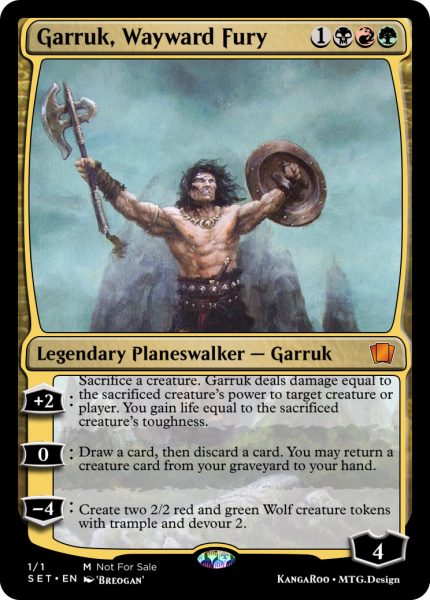
How are you all enjoying Ixalan? Let me know in the comments below, and also feel free to ask me any questions regarding designing or maintaining a portfolio. Today, I'd like to share with you the first planeswalker card I ever submitted to a design competition.

Avatar photo

Kyle Rusciano

Kyle started playing Magic with his little brother when they saw some other kids at a baseball camp playing. His grandma bought them some Portal: Second Age decks, and a hobby was born. Kyle played from Weatherlight through Invasion, then took a lengthy break until 2013. Now a PhD student in the humanities, the Greek mythology component of Theros compelled Kyle to return to the game. He enjoys playing Pauper and Limited as well as focusing on MTGO finance and card design. Follow him on Twitter at @KangaMage!

View More By Kyle Rusciano

Posted in Analysis, Finance, Free Insider, MTGOTagged , , , , , Leave a Comment on Insider: Keeping a Portfolio

Have you joined the Quiet Speculation Discord?

If you haven't, you're leaving value on the table! Join our community of experts, enthusiasts, entertainers, and educators and enjoy exclusive podcasts, questions asked and answered, trades, sales, and everything else Discord has to offer.

Want to create content with Quiet Speculation?

All you need to succeed is a passion for Magic: The Gathering, and the ability to write coherently. Share your knowledge of MTG and how you leverage it to win games, get value from your cards – or even turn a profit.

Insider: MTGO Market Report for September 27th, 2017

Are you a Quiet Speculation member?

If not, now is a perfect time to join up! Our powerful tools, breaking-news analysis, and exclusive Discord channel will make sure you stay up to date and ahead of the curve.

Welcome to the MTGO Market Report as compiled by Matthew Lewis. The report will cover a range of topics, including a summary of set prices and price changes for redeemable sets, a look at the major trends in various Constructed formats and a "Trade of the Week" section that highlights a particular speculative strategy with an example and accompanying explanation.

As always, speculators should take into account their own budgets, risk tolerances and current portfolios before buying or selling any digital objects. Please send questions via private message or post below in the article comments.

Redemption

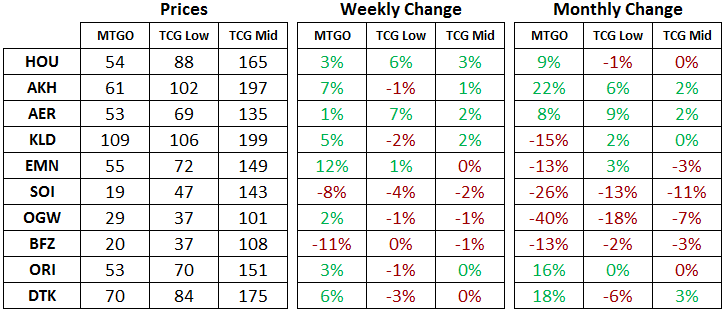
Below are the total set prices for all redeemable sets on MTGO. All prices are current as of September 25, 2017. The TCGplayer low and TCGplayer mid prices are the sum of each set's individual card prices on TCGplayer, either the low price or the mid price respectively.

All MTGO set prices this week are taken from GoatBot's website, and all weekly changes are now calculated relative to GoatBot's "full set" prices from the previous week. All monthly changes are also relative to the previous month's prices, taken from GoatBot's website at that time. Occasionally, full set prices are not available, and so estimated set prices are used instead. Although both Aether Revolt (AER) and Kaladesh (KLD) are no longer available for redemption, their prices will continue to be tracked while they are in Standard.

Standard

Ixalan (XLN) was released on Monday with an initial price of over 120 tix for a complete set and with Carnage Tyrant as the most expensive card at 18 tix. The most expensive rare was Growing Rites of Itlimoc at 14 tix, but that didn't last, as this card's price has plummeted all the way down to 2.6 tix. This type of volatility is completely normal for a new set as the market goes through the process of price discovery.

Novice speculators should steer clear of XLN for the moment, as there is very little economic advantage to be had in speculating on cards from the newest set. With a flood of supply coming in from Draft and Sealed Leagues, any speculative position is going to be hard to maintain for very long. Prices will inevitably come down for all the new cards, and particularly so for cards that aren't seeing any Standard play.

This is not a time for picking a pet card from XLN to speculate on; one will need a clear signal or testing data to verify that a card is underpriced and due for a price jump. With no economic advantage, I will be steering clear of stock picking from the new set for the time being. The only buys I would make would be to get a play set of foil mythic rares into my collection, which is guaranteed to at least preserve its value. For more on the foil mythic rare strategy and why it works, read up on it here.

There was an error retrieving a chart for The Scarab God

On the mover and shake front, The Scarab God was sold out on GoatBots early Tuesday morning with a buy price of 20 tix. MTGOtraders had only four in stock in their online store, with a sell price of 20.68 tix. It looks like the best card in HOU is on its way to 25 tix at least. Once decklists from Standard leagues start rolling in, a clearer picture of the online metagame will form. Verdurous Gearhulk and Blooming Marsh are two other cards that have seen some buying pressure in the past two days.

Modern

XLN's release also heralds the rotation of Battle for Zendikar (BFZ), Oath of the Gatewatch (OGW), Shadows over Innistrad (SOI), and Eldritch Moon (EMN). All of these sets represent good value at the moment. After players and dealers alike turn their eyes to Modern this winter, the paper prices of these sets will stabilize and redeemers will start draining supply from MTGO. It's difficult to predict which sets will see the most gains, but both SOI and EMN have higher TCGplayer mid prices due to not having a Masterpiece series. Relative to the TCGplayer mid price, SOI is the cheapest of the four sets, though a relative lack of Modern staples might mean it's cheap for a reason.

Standard Boosters and Treasure Chests

AKH and HOU boosters went on sale on the Monday morning of XLN's MTGO release. A draft set was 6.1 tix when I checked the price originally, though by Tuesday morning the price had declined even further, hitting as low as 5.6 tix. A price of 6 tix or below is an excellent price to be a buyer, and I have added AKH block draft sets into the portfolio this week. This is a classic case of players getting rid of their extra boosters in order to draft with the new set. This type of short-term thinking is easy to profit off of for the patient speculator.

Consider that the tix-only entry fee for a draft is set at 12 tix. This means that entering an AKH block draft queue using secondary market boosters carries a substantial discount at the moment. As long as you can buy a draft set for less than 10 tix, players have an economic incentive to use the secondary market for draft entry. The current price of 6.0 tix for a draft set means that the total entry cost of boosters plus 2 tix is 8 tix, a 33-percent discount on the tix only entry fee.

There was an error retrieving a chart for The Locust God

Although there will be very little interest in AKH block draft in the next month, eventually there will be bargain hunters and players who just love AKH block draft who will be entering this draft queue again. With cheap draft sets available on the secondary market, players will have an economic incentive to buy these boosters to draft with. This will gradually push up the price over time. For speculators to benefit from this, all they have to do is to give up their tix today for these boosters and with a little patience, the tix you give up today will turn into 8 to 9 tix by the end of January. Players who love to draft AKH block should also take advantage of current prices in order to sock a few cheap draft sets away for the winter.

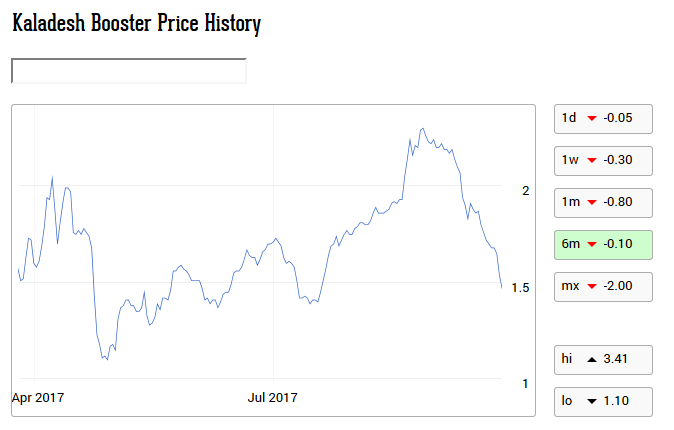
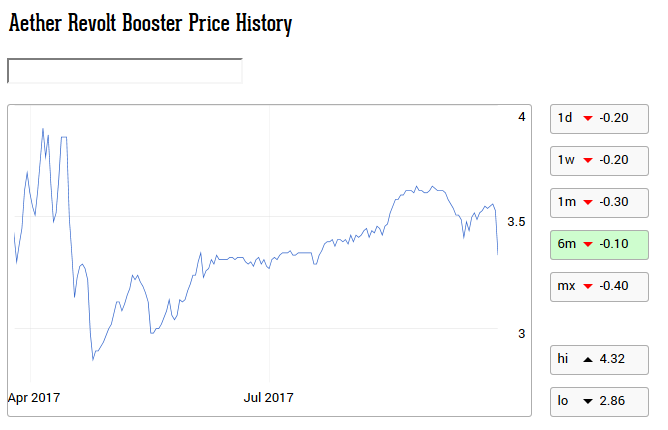
The news is not so good for AER and KLD boosters. There are no longer draft queues to support this format, so the utility from being able to draft with these boosters has been eliminated. As a result, they have started falling in price. Only the expected value (EV) of the booster contents will now provide price support.

Speaking of EV, the reshuffling of the Treasure Chest contents boosted their EV substantially between Sunday and Monday. For more on these changes, check out Chas Andres' analysis at the MTGOtraders YouTube channel. The price has responded since Monday, but the it's still below the EV as calculated by GoatBots. If there's a big reshuffling of the Treasure Chests contents in the future, it will be good to keep in mind the price action observed this week as a potential speculative strategy.

Trade of the Week

For a complete look at my recent trades, please check out the portfolio. With AKH and HOU boosters on sale, it's an easy strategy to buy these today in order to grind some tix over the next six months. All it takes is the legwork to buy and sell the boosters and the willingness to sink tix into a relatively unexciting spec.

For an idea of what to expect, KLD boosters went from 1.1 tix to 2.2 tix by the end of September, a 100-percent increase, while AER boosters went from 2.9 tix at the end of April to 3.6 tix in the same time frame, a 24-percent increase. In the portfolio, I managed to get a 25-percent return on 100 draft sets, after fees.

This time around, the price of draft set has fallen much lower. Whereas a KLD block draft set bottomed at 6.9 tix, two HOU boosters and one AKH booster has reached a total price of less than 6 tix. It's not clear to me yet how this lower price bottom will affect the end result. If a similar price peak of 9.4 tix is reached, then it will have yielded a gain of more than 50 percent. Speculators and players alike should rest assured though that this strategy is proven and has a strong economic angle to ensure a good result. As long as two HOU boosters and one AKH booster costs 7 tix or less, I will be a buyer this week.

Insider: Tiers of Value in Old School Magic

Are you a Quiet Speculation member?

If not, now is a perfect time to join up! Our powerful tools, breaking-news analysis, and exclusive Discord channel will make sure you stay up to date and ahead of the curve.

Everybody else may be talking about the Dinosaurs of Ixalan this week, but I want to talk about the actual dinosuars of Magic. I'm all about the Beta, Arabian Nights, and Legends.

A few weeks ago I hinted at really liking some of the fringe Old School cards as investments, after stumbling across a really sweet haul at a Canadian card shop. There I was able to purchase several Old School staples that had spiked at roughly 20% of retail.

The economics of how this happened is fairly straightforward. I was purchasing Old School Alpha and Beta staple cards like White Knight, Black Knight, Sengir Vampire, and Sedge Troll from a store that hadn't repriced their tags on old cards in several months. Those cards have all made significant jumps (doubling or even quadrupling up) in the past six to ten months.

But first things first—I have a little bit of theory to run through before I get to my actual picks. Here goes.

Value Tiers in Old Cards

There is sort of a tier system to the old cards. At the top of the heap are what I'd consider to be the Tier 1 of eternal Constructed cards.

  1. Dual lands
  2. Power 9
  3. Swords to Plowshares, Lightning Bolt and Counterspell
  4. The Tabernacle at Pendrell Vale, Mishra's Workshop, and Library of Alexandria

There are obviously more, but you get the idea. These are cards that are obviously great in Constructed Magic, and among the most powerful cards ever printed. They are expensive because they are a double threat of being the best cards ever printed and residing on on the Reserved List. They hit every level of supply and demand. Everybody wants them and they are scarce.

The second tier of Old School cards are the ones that are sort of iconic and played in actual Old School Magic:

  1. Juzám Djinn, Drop of Honey, Ali from Cairo
  2. Serra Angel and Sengir Vampire
  3. White Knight/Black Knight
  4. Shivan Dragon
  5. Rasputin Dreamweaver, Serendib Efreet

These are cards that you'd know, and some of them are a lot more expensive than you might expect!

These cards ruled the board in the olden days of Magic, and once again have a role in the Old School format. The Reserved List applies in most cases, and when it doesn't, it simply doesn't matter. WotC can print a million Shivan Dragons but they'll never be Beta ones.

There was an error retrieving a chart for Shivan Dragon

Note that I didn't put Juzám or Shivan into my tier one because they don't fit the qualification of seeing actual constructed play. However, as you can clearly see, the iconic nostalgic quality can push cards into the stratosphere in terms of retail price.

Here is my basic theory. These tiers constitute a kind of "breakpoint" between cards that determines their possible range of value. The price of tier-one cards (even commons and uncommons like Lightning Bolt or Counterspell) is pretty much guaranteed to go over $100, and all the way into the "choose your own adventure" price rangeThe tier-two cards start around the $50 range and can max out around $1000 (more for Alpha).

The Third Tier?

Looking at how this breaks down for Beta cards, we notice a pretty large jump up from bulk to the first tier.

  • The baseline price for a bulk Beta uncommon is about $5-8 bucks.
  • The baseline price for an Old School-staple Beta uncommon is around $75+ (Serra, Knights, etc.).
  • The baseline price for an eternal-staple Beta uncommon is around $150+ (Counterspell, Swords to Plowshares).

How is there not a more consistent third category between bulk ($5) and Old School-playable ($75)? I'm interested in thinking about what this next level might look like, and investing into it before it spikes.

If you look at the first two tiers, it is obvious that tier one spiked first. Old copies of constructed cards quickly separated themselves from the pack.

The next big spike came with the innovation of Old School Magic as a format. Old School Magic created a demand for a chunk of cards that were considered unplayable until that point. It is also worth noting that the current financial climate of Magic has helped foster the growth of the second tier of cards. Modern and Eternal Masters make investing in anything off the Reserved List a risky proposition.

Old cards at least have the nostalgia and collectibility aspect in their favor. Even though Karakas has been reprinted, people still like the Legends version, which helps it maintain a premium. It's worth noting the reason Karakas was so expensive to begin with was card availability. There is a medium common ground where old cards (despite reprints) will always maintain a premium.

There was an error retrieving a chart for Karakas

The gap between the original and reprint Karakas is smaller than I would have guessed. Over time, I predict that we'll see the Eternal Masters version decrease in price while the Legends version will continue to rebound and grow.

When New Formats Arise

In the coming week, I'll be publishing an article about my Old School Battle Box that I've been working on for the past few weeks. For those of you familiar with Battle Box, it's a big stack that only contains cards from Beta, Arabian Nights, Legends, Antiquities, The Dark, Fallen Empires, Ice Age, and Homelands.

I decided to go with Fallen Empires to Homelands because I felt the stack was a little short on playables without them, but I'm sure some purists will take the stack in a purely 1995 direction.

If you don't know about Battle Box yet, I encourage you to look it up. I invented the format back in 2011, and Doug Linn published the first primer on the format right here on QS.

The creation of a new format tends to create demand in cards that were previously considered unplayable and irrelevant. My thesis here is that if Old School Battle Box or Old School Cube catch on in the imagination of some part of the community, it will create demand for cards that didn't exist before. This could create separation between the bulk dregs and a third tier of Old School cards.

Thus my third tier consists of cards that are great in Old School Limited formats like Battle Box but not quite good enough to be Old School staples. This makes a lot of sense when you consider that the gap between a Beta Lance and a Beta Black Knight is so tremendous.

Populating the Third Tier

Here are some of my picks for cards that are actively awesome and fun in Old School Battle Box, but don't currently have a large home in Old School Constructed.

10. Air Elemental

There was an error retrieving a chart for Air Elemental

Air Elemental is the perfect card to demonstrate the space I'm looking for. It is outclassed by Serra in Old School Constructed but is a really good card in the Battle Box. It has iconic art. It is clearly a better and more iconic card than the baseline, although its current price tag doesn't reflect it.

9. Bog Wraith

There was an error retrieving a chart for Bog Wraith

Another card that is great and iconic. It was even on one of the rule books! It is actively great in the Battle Box and better than an unplayable bulk card.

Starting to get the idea of what I'm looking for here? Old Magic cards that could be played somewhere but haven't changed in price, despite the huge gains of the higher-tier Old School cards.

8. Dragon Whelp

There was an error retrieving a chart for Dragon Whelp

It's hard not to fall in love with this card. The art is brilliant and the flavor amazing. It's a beautiful card that happens to really shine in the Battle Box.

7. Lure

There was an error retrieving a chart for Lure

Lure is a mainstay in my Battle Box. It is one of the most impactful combat-related tricks in the stack and a must-play in the format. It is also such an iconic card. I mean, who hasn't Lured up a Thicket Basilisk?

There are other Old School Beta uncommons but I think this is enough to give you the gist of what I'm talking about. Cards that haven't separated themselves from the baseline despite clearly being better and more iconic Magic cards than the rest of the pack.

Let's look at a couple of Beta rares.

6. Northern Paladin

There was an error retrieving a chart for Northern Paladin

Northern Paladin is at the baseline of cheapest Beta rares but it is actually a pretty powerful Magic card by Old School standards. I'd expect this one to gravitate to the space in the middle between baseline and Tier 2.

5. Pirate Ship

There was an error retrieving a chart for Pirate Ship

Another card that sits as a baseline card that is more interesting, flavorful, and cool than the rest. It's a bomb in Old School Battle Box and a beautiful card. I'd expect this one to have room to grow.

4. Arcades Sabboth

There was an error retrieving a chart for Arcades Sabboth

Although the Elder Dragons are not on the Reserved List they are amazing in Battle Box and beautiful, iconic Magic cards. It's true you can get a Chronicles version for a buck, but who'd want one when the Legends ones pop so hard?

I was surprised by how cheap these were and was happy to snap off all the Legends Elder Dragons. I think these have a lot of room to grow for iconic and playability reasons.

3. Preacher

There was an error retrieving a chart for Preacher

Another all-time iconic card. The Preacher is not to be messed with and it has flavor to spare. It's a house in the Battle Box and is a card that has room to grow, despite being from The Dark.

2. Firestorm Phoenix

There was an error retrieving a chart for Firestorm Phoenix

Reserved List and cheap. The card is actively great in the Battle Box as a threat that won't go away. These are precisely the kinds of finds that I believe have room to create a new tiered price point.

1. Master of the Hunt

There was an error retrieving a chart for Master of the Hunt

Everything I said about Phoenix applies here. It's a cool card. It's a fun card. It's a flavorful card. And, it's an iconic card. It's on the Reserved List and is totally playable in a niche Old School format like Battle Box.

For Posterity

I'll also admit that finding all of the Old School Cards for my Battle Box really got me into the idea of collecting the Old School cards so I have them to play with in the future. I could see battling Old School Battle Box with my family and friends as something I'd do 30 years from now in the future. The original game is so good and so fun that it would probably still be fresh and worthwhile all those years from now.

However, in the here and now it might be a really good time to jump on some of these cards while there is still time. My guess is that a third tiered price point is coming, and it makes a lot of sense to try and get ahead of it.

Testing Ixalan: Exploring Traps

Are you a Quiet Speculation member?

If not, now is a perfect time to join up! Our powerful tools, breaking-news analysis, and exclusive Discord channel will make sure you stay up to date and ahead of the curve.

With a new set comes new speculation, new brews, and new bold declarations. Archetypes are revived, archetypes are doomed, new decks exist, the new decks are terrible—we've heard it all before. I try not to speculate and only talk about cards once I've actually played with them. This means I'm pretty late to the party in terms of new releases, but I like to think that my data makes up for that. It is considered polite to let me keep that illusion, thank you very much.

Last week I shared my intention to bring you the data on Preordain this week. Unfortunately, intent does not translate into reality. Magic takes quite a bit of time to play, and control takes even more. As a result I didn't finish testing UW Control until it was too late to make this week's article. That's just how it goes when you're coordinating a massive volunteer project. You only work when you can sync schedules. Instead, this week will be about my exploration of Ixalan. I've been testing some new cards while waiting to complete Preordain and it has not been encouraging. Better than I thought, but much worse than you may hope.

I should also preemptively mention that I'm not talking about any Merfolk this week. That deserves its own article which I'll be writing after the Preordain results. There's a lot more to discuss there, and I want more time to actually try out my ideas. The preliminary results are...complicated. I need more data to really address that topic.

The Mechanics

While Ixalan has a lot of interesting cards and creative world-building, it's fairly boring mechanically. We've seen Treasures before as Gold tokens from Theros block, though the only notable card that made them was Gild. I know that Wizards insists that the tokens are different, but changing the name does not a different effect make, Rosewater! The main difference is that the Treasure mechanic gets supported in the set. Enrage is fine, but not very interesting. You get a cookie when your creature gets hurt. So what? Also it came directly from Hearthstone. Not innovative, and not really worth testing. If you'd play it without enrage, it's a playable card. If you'd only play it because of enrage triggers, don't bother. Explore is the most interesting. Cantrips are good, and explore is very similar. Maybe it's good enough?

Lost in the Jungle

As I'm going to detail more when I do the Merfolk article, explore is really hard to evaluate. Not because of what it does, mind you. It's a weird blend of scrying and drawing a card with creature buffing thrown in. It's almost always worse than just drawing a random card, but it's better than scry 1. The problem is making that work in Constructed. Cantrip creatures are good. Creatures that provide +1/+1 counters are occasionally good. Self-mill is very good in the right deck. Explore has parts of all of these. When you see a land, you draw a card. When you don't, you get a small buff and the option to bin the card. On its face, having parts of mechanics is not good. It will never be as good at buffing as an actual buff card, cantripping as a cantrip, or milling as Thought Scour or dredge.

However, flexibility adds a lot to a card's playability. I didn't think that Collected Brutality was good enough for Modern because none of its modes is Modern-worthy. I was completely wrong, Brutality is fantastic, even when you're not taking advantage of the discarded cards. As a result, maybe explore is good enough. I'll have a better answer soon.

Keep Track of Your Valuables

Just so everyone is perfectly clear, Lotus Petal is a fairly busted Magic card. Not Mox-level busted, but pretty up there. The Treasures are Lotus Petals. One would think they would also be busted. I did, and I tried to make them work. They're not. Yet, anyway. Treasure generation is tied to some fairly unimpressive Constructed cards. They tend to be just barely Standard-playable and I can't imagine any of them making the jump into Modern. However, this is Wizards of the Coast, and messing up free mana is their thing. Energy may not have made it into Modern, but it was very busted in Standard, as I predicted it would be. This makes me wary of treasures.

There's nothing that really strikes me right now as dangerous about Treasure. The best idea I've had for making them involves Revel in Riches, Night of Souls' Betrayal, and Forbidden Orchard to generate extra mana. And that's much, too slow for any Constructed format. Maybe you can make the alternate win work, but that seems unlikely. Any other Treasure-generating loop I've come up with makes mana on its own, so they're superfluous. It's not broken. But again, this is Wizards. There could be some monstrosity lurking in Rivals of Ixalan that makes these Lotus Petals good. So watch for that.

Looking for a Home

This section is for the other tested cards that I can't find a home for. One of them is a very powerful card that is useful almost anywhere but I don't know if any deck actually wants it. The other is just a worse alternative that plenty of players will gravitate towards, but end up disappointed in. They're fine cards on the spoiler sheet, and they play out just fine. The problem is actually dedicating deck space to them. One is an interesting problem to continue working on but the other is a dead end. You've been warned. I'll also cover Opt, which is a good card that you need to be careful with.

Can't See it from Here

The first one is the card that has generated the most buzz for the longest time: Sorcerous Spyglass. I love this card. Combining Pithing Needle and Peek just sounds fantastic. Blind-naming with Needle can be incredibly frustrating. If your opponent has something to hit, you always know with Spyglass. You even get information on their hand. Consensus puts that at not quite worth a card, but as a bonus to another effect it's fine. Needle is a fine sideboard card and has been on the edge of maindeck-playable for some time now. Since Spyglass proves a bonus, it stands to reason that it is a maindeck card.

The problem is that I cannot determine which deck wants to maindeck Spyglass. The fundamental problem with Needle has always been that it doesn't do much on its own. Only when you combine it with lots of pressure or other lock pieces is it anything more than annoying. Needle shuts down one card-name's non-mana activated abilities. It does nothing else. That leaves the remaining 56 cards to kill you. Needle has always been at its best shutting down planeswalkers and non-mana combo engines. If it can't do that, it's worthless. It's also a soft answer, in that it can be removed and the target turns back on. This is why it's relegated to the sideboard.

Some players don't realize this, but Needle, and now Spyglass, can hit lands. They can't stop them from making mana, but they can name them. The fact that Phyrexian Revoker does stop mana abilities is why it can't name lands. For the most part this is just used to shut down utility lands. But you can also name fetchlands and turn Needle into, effectively, land destruction. Against some decks this is huge—think Death's Shadow's mana base. The problem has always been that unless you know exactly which lands are in your opponent's hand, they could sequence around the Needle, limiting it's effectiveness. Spyglass solves this problem for an additional mana. It was this use for the card that I decided to test.

Since I was planning to try the card as a land destruction spell with upside, it made the most sense to try it in Death and Taxes. I just took my PPTQ list and changed the Selfless Spirits and Revoker to Spyglass and tried it out. It was...okay. The kind of card that did what you wanted, but you're not thrilled about. You're fine playing it but left asking if there's something better. It overlapped with Leonin Arbiter, but I was often okay with that thanks to the greater flexibility. The real problem was that it didn't add to the clock, which is already a problem for DnT.

The other problem is that I don't know if any other deck wants this maindeck. There are plenty of prison decks that already use Needle, but the Peek is largely superfluous. Sun and Moon, the deck I tried, didn't care about the opponent's hand because they either invalidated it already or couldn't do anything with the information. Turns are fairly scripted with that deck, I found. It will also never replace Needle in sideboards. Needle is cheaper and if you want to side in this effect, you already know what you're naming. The card is good, I just haven't found its home yet.

Naught But Ruins

There have been flurries of conversation swirling around Field of Ruin. It's clearly a "fixed" Ghost Quarter that won't set you back on mana. Theoretically, anyway. You still spent most of a turn of mana to kill your opponent's land. Ultimately, this is the problem with Field. It seems good, but it's too inefficient.

Outside of combining with Leonin Arbiter to become Strip Mine, the big draw of Ghost Quarter is that it has no cost. You just fling it at a Tron piece and are done. They get a basic land, but that's much better for you than letting them have that Tron piece. This leaves you free to use the rest of your mana to do something else. This efficiency is invaluable. Land destruction is a tempo tool. It creates a temporary hiccup in your opponent's plan that you then exploit. If you fail to do so quickly, they'll recover and probably crush you. They're playing real cards; you have land destruction. It's only when you hard-lock them with recurring LD, like looping Quarter with Crucible of Worlds, that it actually wins the game on its own.

Therefore, despite appearances, Field of Ruin will not make it in Death and Taxes. I know some writers on big sites talked about how good it was alongside Arbiter, but I think they just forgot that his effect is symmetrical. Paying four mana to destroy their land is really bad. It has been suggested that control might play it against Tron. I tested this usage and found it very poor. UW Control already has Spreading Seas, whose net effect is pretty similar and hits a turn earlier. Having Field as a backup was okay but not great. On turn three against Tron you really need to have a clock out or you'll just lose to all the bombs. Spending that turn turning lands into basics wasn't of much use. After turn three, Tectonic Edge is just better. There's no reason to play this card.

Don't Opt in Automatically

Finally, don't just jam Opt because it's instant speed. It's not appropriate for every deck that want cantrips. It is a fine card, but the effect isn't quite big enough for it to actually replace Serum Visions. See, Opt only shows you one card. That's not what you want from a cantrip, especially in a control deck. When you need to dig, you need to dig, and one card doesn't qualify.

I tested Opt in UW Control and it was very poor. UW is more of a tap-out control deck these days than classic permission control. As such, you really don't care about Serum Visions being a sorcery. What you do care about is it seeing three cards, even if you don't have control over which one you draw. Later in the game you usually don't use all your mana during your opponent's turn anyway, so there's no real cost. I've also found that optimal play is somewhat inflexible in the deck (your actual answers at a given time are limited) so the flexibility of instant speed is kind of wasted.

Where Opt belongs is in decks that play primarily at instant speed, like the Jeskai Midrange list that won SCG Louisville. That deck already plays primarily at instant speed so it could use the additional flexibility. Whether Opt is actually good enough there I haven't tested yet, but it will be better than in the slow control decks. Before, if you wanted to Serum Visions turn one you had to give up on Lightning Bolting a turn one play. Now you can do either. That seems pretty good.

Seek the Unknown

Ixalan may not have much that is unequivocally Modern, but there are plenty of almost-there's that something is bound to shake out. At minimum, Siren Stormtamer will have a home in that mono-blue Favorable Winds deck. It's just a question of determining whether there's anything for the actually good decks. Next week, definitely time to evaluate Preordain.

Insider: QS Cast #78: Vendor Series- AdventuresON Part 2

Are you a Quiet Speculation member?

If not, now is a perfect time to join up! Our powerful tools, breaking-news analysis, and exclusive Discord channel will make sure you stay up to date and ahead of the curve.

The QS Cast returns! Chaz Volpe, and Tarkan Dospil come together as the new panel – and in this episode they discuss the following:

  • Vendor Series - Avrom Oliver, Owner/CEO of AdventuresON joins the cast!
  • Discussing resolution of issues with recent buy-list orders and payments.
  • State of Magic, types of investment - health of the game
  • Iconic Masters, Ixalan - how new sets and reprint sets continue to effect the market.
  • Magic Arena, Meta perspective of MTG and growth


Enjoy!

Find us on Twitter: @ChazVMTG @the_tark

Avatar photo

Chaz V

Started playing during Invasion block at the age of 13. Always a competitive person by nature, he continues playing to this day. Got into the financial aspect of the game as a method to pay for the hobby and now writes, Podcasts, and covers all aspects of the game, always trying to contribute to the community and create great content for readers and listeners.

View More By Chaz V

Posted in Free Insider, QS CastLeave a Comment on Insider: QS Cast #78: Vendor Series- AdventuresON Part 2

Have you joined the Quiet Speculation Discord?

If you haven't, you're leaving value on the table! Join our community of experts, enthusiasts, entertainers, and educators and enjoy exclusive podcasts, questions asked and answered, trades, sales, and everything else Discord has to offer.

Want to create content with Quiet Speculation?

All you need to succeed is a passion for Magic: The Gathering, and the ability to write coherently. Share your knowledge of MTG and how you leverage it to win games, get value from your cards – or even turn a profit.

Insider: QS Cast Infographics – Episodes 37-74

Are you a Quiet Speculation member?

If not, now is a perfect time to join up! Our powerful tools, breaking-news analysis, and exclusive Discord channel will make sure you stay up to date and ahead of the curve.

Insiders, I’m ecstatic to continue our segment: QS Cast Infographics!

Part of our recent growth and additions to the site is the recruitment of some amazing people – in this instance Guillaume (@poppu_mtg) our new data analyst and Diego Fumagalli (Visualizing Magic) our resident graphic artist.

They came together and produced some amazing Infographics that have tracked the QS Cast and provided the numbers, and data, to track both Tarkan and myself since we’ve been duo-hosts. In this update they tracked Episodes 37-74 and provided graphics spanning from Overall to 30, 60, and 90 days.

You can be sure that we will provide monthly updates to reflect recent data. I have the great pleasure of showing these off and providing a statement from Guillaume to give us some context behind these numbers and providing some additional clarity. Let’s see how the QS Cast has fared for this update!

This month was quite the ride for the QS Cast's picks: Chaz doubled up last month's gains for the 30 day period, from $262 to $550, mostly thanks to Judge Promo copies of Wheel of Fortune (+$46.82, +21%) and a Reserved List target in Knowledge Vault (+$14.27, +249%). Still, his biggest winner over that interval of time remains Saheeli Rai, with a tough to top +388% at the time people were copying Cats left and right. Tarkan was only present for a handful of casts, and was limited to 5 additional picks since last month's checkpoint, netting him just $10 more via foil copies of Cover of Darkness (+$3.06, +29%).

Looking at the picks through the 3 month investment lens, both our casters tripled up into the $100 range ($106 for Chaz, $95 for Tarkan), doing so using their trademark style of picking cards. Chaz's largest gains are driven by EDH cards, specifically aimed at Atraxa builds: Dusk Urchins (+$4.64, +587%) but predominantly Harbinger of Night (+$7.50, +1531%), which has the added feature of belonging on the Reserved List.

Speaking of, being the RL aficionado that he is, Tarkan fully benefited from the recent buyout frenzy - if you excuse my use of the B word - via Preacher (+$6.20, +55%) and Imprison (+$8.64, +188%). The cast's numbers could be even better if not handicapped by their attempts at Modern picks, with Damnation (-$12.45, -24%) and Noble Hierarch (-$4.08, -6%) really weighing the totals down - thanks a lot, Modern Masters 2017!

And then, there is the long term evaluation- It did not get better for Chaz: from -$60 last month to a staggering -$105 this month. So, yes, Fiery Confluence quadrupled up (+$8.26, +326%), and yes, Saffi Eriksdotter (+$6.43, +180%) and Grasp of Fate (+$5.4, +210%) tripled up; but at the same time, Damnation plummeted (-$22.29, -43%), and Nissa, Vital Force remains a clunker (-$15.1, -76%) despite seeing play in some Legacy and Vintage lists. Meanwhile, Tarkan netted a decent 20% gain overall for that period, from $150 to $184, again thanks to Imprison (+$8.53, +156%) but also Wheel of Fortune (+$5.28, +14%).

In the most Tarkan-ian fashion ever, the only cards losing value over 180 days are mostly Standard cards, as Mindwrack Demon (-$2.40, -63%), Panharmonicon (-$1.12, -31%) and Aetherstorm Roc (-$0.18, -38%) are hit with the biggest relative losses.

In conclusion, both Chaz and Tarkan are following the trends we noticed last time, each of them fitting a different "financier" profile: Chaz is very succesful with quick flips for large profits, while Tarkan is more selective but will hardly lose value overall on the long term. With another major reprint set coming up early next year, I am already curious to see if and how our casters compensate.

In conclusion, both Chaz and Tarkan are following the trends we noticed last time, each of them fitting a different "financier" profile: Chaz is very successful with quick flips for large profits, while Tarkan is more selective but will hardly lose value overall on the long term. With another major reprint set coming up early next year, I am already curious to see if and how our casters will change their way.

 (click to enlarge)

Insider: Standard Rotation Means Opportunity, Part II

Are you a Quiet Speculation member?

If not, now is a perfect time to join up! Our powerful tools, breaking-news analysis, and exclusive Discord channel will make sure you stay up to date and ahead of the curve.

Hello, guys.

About a month ago, I wrote about Standard rotation and the opportunities that come along with it. Now, Ixalan Standard is upon us, and I'm pretty sure everyone has been testing on the new cards with proxies or Cockatrice software etc.

First off, here's a brief summary on the decks that you will be expecting in the new Standard:

  • Green-Red-X Dinosaurs with Ripjaw Raptor, Regisaur Alpha and Carnage Tyrant is the most straightforward creatures beatdown deck
  • Blue-White Approach of the Second Sun
  • Black-Green (potential splash blue) +1/+1 Counters/Energy
  • Black-Red-X midrange/control decks
  • God-Pharaoh's Gift variants
  • Merfolks variants
  • Pirates variants
  • Ramunap Red (potential update with Vance's Blasting Cannons

Dinosaurs vs Sweepers

Carnage Tyrant Regisaur Alpha Ripjaw Raptor

Let's talk about Dinosaurs first. These are the obvious best dinos from Ixalan with which everyone who is testing this deck will start with four of each. Carnage Tyrant is insane if the player gets to curve up into it. There are very few ways to deal with this uncounterable threat in the new format; six-toughness on the six-mana dinosaur is relevant, as it can't die to Hour of Devastation. Players will need to pack a few Fumigates or Hour of Revelations in order to deal with the Tyrant. Let's look at the sweepers available in the format.

The white sweepers are strictly better than the rest. Hour of Revelation is a card that has huge potential to increase in price in the future, the reason being its ability to deal with non-land permanents that can deal with artifacts (vehicles), enchantments (double-sided lands) and planeswalkers, especially when there's a new planeswalker legendary rule effective with the Ixalan release.

Bontu's Last Reckoning is slightly worst than the white sweepers because of its side-effect, but black decks will need to add something into their 75s to handle Dinosaurs. As for Hour of Devastatoin, certain red-based control decks might still use them, but it's not quite effective, as I said.

  • Hour of Revelation: Current Buy Price: 0.1; Target Sell Price: 1.5; Profit Per copy: 1.4
  • Fumigate: Current Buy Price: 2.6: Target Sell Price: 4.5; Profit Per Copy: 1.9
  • Bontu's Last Reckoning: Current Buy Price: 0.7; Target Sell Price: 2; Profit Per Copy: 1.3

However, even if players pack the best sweepers, each have their weaknesses as well. Green creatures decks can have the following cards in their deck to counter or to follow up with after the sweep.

Heroic Intervention is an efficient way to psuedo-counter the sweepers from control decks. This card has seen play in some Black-Green Energy decks before, and its price has been fluctuating between 0.3 and 1 tickets. At its current price, I think its opportunity to stock up some copies as speculations.


Chandra, Torch of Defiance Glorybringer

Usually, the decks that play big creatures will have some amount of powerful one-ofs or planeswalkers that can help the pilot come back from sweepers. These big threats can resolve safely, because casting a sweeper requires most of the opposing player's mana to do so, and they typically can't have counterspell backup afterwards. The above are some of examples of potential includes from the Dinosaur decks post-rotation. Nissa, Vital Force is actually a very good card in the post-sweeper situation, as she can immediately deal five damage with her +1 ability, or return a Carnage Tyrant from the graveyard, which is a big problem for an opposing control player if they can't find another solution to the board.

  • Nissa, Vital Force: Current Buy Price: 2.3; Target Sell Price: 5; Profit Per Copy: 2.7


Black-Red-X Midrange Decks


The new set provides midrange lovers some powerful tools to take control of the game. Duress is one of the best card being reprinted in Ixalan, in part because Spell Pierce is also being reprinted. Being able to strip a counterspell, clearing the way for your planeswalker, is very important. Let's look at some of the removal and disruption spells from Kaladesh and Amonkhet blocks that we can possibly investing in:

These cards are the most commonly used cards in black and red decks. Currently, they are all very cheap on MTGO. Harnessed Lightning is an interesting card in terms of investing on online singles, as the price fluctuates a lot depending on popularity of energy decks even though it's only an uncommon card. Its price has reached 0.8 tickets multiple times in the past six months. My suggestion on this card is: whenever you have leftover credits on any of the bots online, just pick up a few copies of Harnessed Lightning and put them into your speculation binder.

For Never // Return, I predict it will go up in popularity if there are more black decks post-rotation. This is a card that I think will be included as a "hit all" card during the first and second weeks of Ixalan Standard, with a little bit of graveyard hate on the aftermath side.

  • Cut // Ribbons: Current Buy Price: 0.17; Target Sell Price: 0.75; Profit Per Copy: 0.58
  • Harnessed Lightning: Current Buy Price: 0.14; Target Sell Price: 0.75: Profit Per Copy: 0.61
  • Never // Return: Current Buy Price: 0.4; Target Sell Price: 1.2; Profit Per copy: 0.8


Rotating Cards

Nahiri, the Harbinger is sometimes played in Modern decks that want to cheat Emrakul into play. With its price at about 5 tix right now, I think we can start putting this card on our watch list just in case she drops some more.

  • Nahiri, the Harbinger: Target Buy Price: 3.5; Target Sell Price: 10; Profit Per Copy: 6.5

Liliana, the Last Hope is currently at her low point. I'm not sure whether this card will go lower than 21 tickets, but now is a good chance to buy some copies for investment. The Last Hope is usually played in midrange decks like Jund and Grixis to deal with one-toughness creatures like Lingering Souls tokens, Noble Hierarch and Birds of Paradise. With the new planeswalker legendary rule, she can pair with Liliana of the Veil to deal with almost every creature threat in the format.

  • Liliana, the Last Hope: Current Buy Price: 20.8; Target Sell Price: 40; Profit Per Copy: 19.2

Now let's look at some cards that we discussed before. One of the card is Kalitas, Traitor of Ghet. The last time I wrote about Kalitas, he was about 8 tix. Now it's half its previous price and has hit the target price mentioned in my previous write up:

Consistent with my earlier comments, I now suggest to investing in Kalitas on the basis of his play in Modern. The target sell price remains the same.

  • Kalitas, Traitor of Ghet: Target Buy Price: 4; Target Sell Price: 10; Profit Per Copy: 6

Traverse the Ulvenwald was 0.45 ticket the last time I talked about it. Now, it's even lower, so if you haven't picked up any of these, I think you should get some just in case. A one-mana creature/land tutor can be really good in Modern.

  • Traverse the Ulvenwald: Current Buy Price: 0.34; Target Sell Price 3; Profit Per Copy: 2.66

World Breaker has reached its all-time low point. This card is seen in some version of Tron decks in Modern. The ability to exile a land from the opponent's board while having the Tron-lands' mana advantage is something very broken in Modern. I think the price of this card has not reached it's absolute bottom yet, so let's set a target for this card. Once the price hits our target, we can probably buy some for long-term specs.

  • World Breaker: Target Buy Price: 0.5; Target Sell Price: 3; Profit Per Copy: 2.5

Similar to World Breaker, this card sometimes see play in Modern Tron, or even Jund Midrange sideboards, to deal with Etched Champion. It will probably be useful in Modern at some point in the future.

  • Kozilek's Return: Target Buy Price: 1.2; Target Sell Price: 5; Profit Per Copy: 3.8

Alright, that's all for this week. Hope you all have nice prerelease and release weekends. I'll see you guys again next time!

–Adrian, signing out.

Video Series with Ryland: Amulet Titan #2

Are you a Quiet Speculation member?

If not, now is a perfect time to join up! Our powerful tools, breaking-news analysis, and exclusive Discord channel will make sure you stay up to date and ahead of the curve.

Hey everyone! I'm back again with Amulet Titan. Many of you had requested I return to this deck once again and considering how much I love it, I'm happy to oblige. I've been back at it on my stream and thought this would be a good opportunity to return to titaning people in the most exciting way. Much of this write-up will be familiar to you if you saw my last Amulet series, but I will try to highlight some of the small differences in the list and meta.

A quick recap for those unfamiliar: Amulet is a combo deck trying to cast Primeval Titan as quickly as possible. Often, Titan appears on turn three, and while unlikely, there is the potential for a turn-two Titan. The deck largely accomplishes this by abusing the power of its namesake card, Amulet of Vigor, in combination with the bounce lands from Ravnica, such as Simic Growth Chamber.

Currently, not much has changed since last time. The sideboard has some very minor changes, the biggest of which is cutting the three-mana sweepers for two copies of Pyroclasm. Frankly, I cannot definitively vouch for the validity of this change, but it is something I want to continue to test. Yes, Kozilek's Return can be very powerful against Affinity, but so can clasm. Costing two mana is a huge drop from three and can really help you in double-spelling sooner. In addition, sometimes you need to be able to reliably kill things on turn two (see Devoted Druid and Steel Overseer) and Kozilek's Return will do that job much less frequently.

In addition, the Bojuka Bog has moved to the maindeck, replacing the fourth Explore. This has largely been to make room for more sideboard threats, such as Ruric Thar, the Unbowed. Admittedly though, I'm not sure he's the additional threat I want. Certainly he is powerful against Storm, and there are other matchups he is reasonable against (Burn, Control, etc.). That said, I'd like to have a more rounded threat that is reasonable in just about every slower matchup; something like an additional Tireless Tracker.

I mention this because you will see me employ a near "transitional" sideboard plan, as you have likely seen me do in the past. This plan involves cutting our namesake in Amulet (no, not Titan, I'm not that crazy) and adding in all of our additional threats. When this plan is effective, you will end up playing a slower, more traditional ramp-style game, where you find ways to make extra land drops and begin casting fatty after fatty. This plan is particularly potent against any deck with heavy disruption of any variety, be it discard or removal. As such, I will almost always cut Amulet in matchups where speed is not essential.

I hope you enjoy the matches as much as I always do! As usual, I'm interested to hear what kind of content you'd like to see moving forward, so I can continue to evolve and improve my videos. Please let me know your thoughts, and any improvements you would like to see concerning formatting, presentation, or whatever else strikes your fancy. If you'd like to see similar content, check out my Twitch channel for some more live Modern!
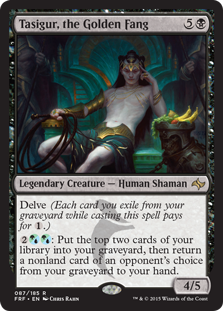
[youtube https://www.youtube.com/playlist?list=PL261kJ_cAQC--3xRXfKK6TELSIGQ32EPe]

Amulet Titan, by Ryland Taliaferro

Creatures

3 Azusa, Lost but Seeking
4 Primeval Titan
4 Sakura-Tribe Scout
1 Walking Ballista

Artifacts

4 Amulet of Vigor
1 Engineered Explosives
3 Relic of Progenitus

Instants

1 Pact of Negation
4 Summoner's Pact

Sorceries

4 Ancient Stirrings
3 Explore

Lands

1 Bojuka Bog
1 Boros Garrison
1 Cavern of Souls
2 Forest
4 Gemstone Mine
1 Ghost Quarter
2 Grove of the Burnwillows
3 Gruul Turf
1 Khalni Garden
1 Radiant Fountain
1 Selesnya Sanctuary
4 Simic Growth Chamber
1 Slayers' Stronghold
1 Sunhome, Fortress of the Legion
3 Tolaria West
1 Vesuva

Sideboard

2 Dismember
1 Engineered Explosives
2 Pyroclasm
2 Swan Song
1 Hornet Queen
1 Chameleon Colossus
1 Ruric Thar, the Unbowed
1 Thragtusk
2 Tireless Tracker
1 Reclamation Sage
1 Seal of Primordium

Want Prices?

Browse thousands of prices with the first and most comprehensive MTG Finance tool around.


Trader Tools lists both buylist and retail prices for every MTG card, going back a decade.

Quiet Speculation