menu

Insider: Amonkhet Box Report

Are you a Quiet Speculation member?

If not, now is a perfect time to join up! Our powerful tools, breaking-news analysis, and exclusive Discord channel will make sure you stay up to date and ahead of the curve.

Welcome back to another edition of the Box Report. If you’ve been reading any of my content about Amonkhet, you know I love this set. The flavor is amazing and the way Wizards incorporated the gods works so well. All the key words in the set are actually Constructed playable too, which we don’t see very often.

There was an error retrieving a chart for Promise of Power

To check out some videos of the prerelease and other cool things going on, check out my YouTube channel. I’ll also be uploading an unboxing video for prerelease packs and the boxes discussed in this article, so check those out too.

My concern with the set is that because the Invocations are present, the value of the set will be too depressed to be worth opening. Doing these box reports always gives me a better perspective on each set, and I hope it does for you guys as well. Let’s dive in and take a look at what each box has to offer.

There was an error retrieving a chart for Glorybringer

The first things I want to mention are a couple cards that have drastically increased during the first week of release. Glorybringer was barely more than a dollar when preorders started, but it has since bumped up to $9! This is a case where I thought I had more time to spec. I was planning on grabbing all of the copies I could through my stores buylist after release, but apparently that was too long to wait.

The other card that caught my eye was Cut // Ribbons which is currently $3. Honestly, I’m not sure what the appeal of this new style split card is. I didn’t think it would be good because it’s a sorcery. Sure, being able to flash back a removal spell for something else later in the game is great and all, but I thought players would look past Cut // Ribbons to another spell.

Lastly, some of the uncommons in this set surprised me with their value. Here are the ones you need to watch for in those draft leftovers, sealed pools, or prize packs.

Bone Picker $1
Censor $1
Cast Out $1
Lord of the Accursed $0.75

Lord of the Accursed makes sense because zombies are a hugely popular tribe and the card is Standard playable. The same goes for Cast Out. Versatile removal spells that deal with lots of problematic permanents are usually great, and although Cast Out costs four mana, the utility it provides is amazing. Bone Picker and Censor, though, those two surprised me greatly. We’ve had Force Spike type effects like Censor before and they’ve never gotten any traction in Standard.

Censor is two mana and you can cycle it if you need to, so maybe that will be good enough. I think the cost of the card is mostly speculation right now, though. The last uncommon, Bone Picker is a card I love, but I’m not sure why everyone else does as well to the point that it has actual value. A creature has to die for the cost to be reduced. Maybe that will happen more frequently than I imagine, but there aren’t good enablers other than your opponent’s removal spells.

So, what’s in those boxes already?! I’m so glad you asked.

Box 1

Box 1

Mythics

Rares

Foils

Lands

2 Canyon Slough

Total Value: $51

Well this is not a good sign. The typical retail price for a booster box is around $100, but if you can open an Amonkhet box worth this low of an amount, it’s going to be hard to justify opening boxes. Even as a dealer, I’m disappointed opening this box because we pay more than $51 for each box. At first glance, this box doesn’t even look too bad. It has three mythics and two of the best rares in the set. After calculating the value, though, this set seems a bit disappointing.

Box 2

Box 2

Mythics

Rares

Foils

Lands

Total Value: $130.50

Well then, apparently some boxes are the complete opposite of box one. Opening a box like this feels great. We got an Invocation, Counterspell, but even without that low-end super mythic, this box would be solid. Planeswalkers, gods, and lots of solid rares, this box should be your target for what you want to open.

Box 3

Box 3

Mythics

Rares

Foils

Uncommons

2 Cast Out
2 Censor

Lands

Total Value: $64

Wow, we have a five-mythic box – and that doesn’t even cover the cost of the box! It’s sad that such an awesome set has such terrible value. Have you guys been disappointed with the boxes you’ve opened or seen other players open? I know I only have a small sample size here, but this isn’t looking good.

One important note about this box, though: the foil full-art lands are still worth something, even with Battle for Zendikar providing foil full arts to everyone. I thought this set of lands would be worth more money because there will be many less of them, but they are only worth about $5 each. Still worth caring about, but not as valuable as I’d expected.

Box 4

Box 4

Mythics

Rares

Foils

Lands

Total Value: $75

Lastly, we have another five-mythic box and another loss of value. Myself and other dealers are going to keep opening boxes to provide singles for players to purchase, but the value in this set is disappointing, for sure.

Wrap Up

So, after inspecting some boxes, I’d have to suggest saving your money for only the singles you need. With possibilities for such low values, we’re all better off buying what we need instead of trying to pull it from packs.

I want to add one caveat to this recommendation. We are nearing the Pro Tour for this set, and that could change everything. Depending on what strategies the pros bring to battle, we could see some drastic price shifts like we have in the past. That could help the value of this set.

With Invocations driving the rest of the set's prices down, even the pro tour price spikes may not be enough to make this set worth cracking packs. Force of Will’s Invocation is worth nearly $200, but even the other invocations are worth much less than the other Masterpiece series cards. After Force, the prices drop down to $60 or less, so there are not many chase Invocations to be searching for.

Cards to Watch

There was an error retrieving a chart for Honored Hydra

I really like Roar of the Wurm, I mean Honored Hydra. Back in the day, when madness was a tier-one deck, Roar of the Wurm was a house. It could be good again, especially if this Red-Green Gods deck is real. Right now, this card is super cheap. I didn’t think that was true. When I was pulling cards for this box report and separating the good from the chaff, I added Honored Hydra to the good pile. So my gut tells me this card is solid and playable. At 50 cents, you’re not risking much by buying a playset or two. Who knows, maybe this will follow the same path as Glorybringer.

Until next time,
Unleash the Force!

Mike Lanigan
MtgJedi on Twitter
MtgJedi on YouTube

Financial Deck Tech: Eldrazi Tron

Are you a Quiet Speculation member?

If not, now is a perfect time to join up! Our powerful tools, breaking-news analysis, and exclusive Discord channel will make sure you stay up to date and ahead of the curve.

Back-to-back deck techs!? You betcha! I've been putting some more thinking into what Iconic Masters means for Magic, and how Wizards of the Coast could have approached it. I think there could be some pretty important reprints in that set that will help Eldrazi Tron the most, and I want to talk with you about them!

Overview

Eldrazi Tron is the newest flavor of Eldrazi decks that revolve around the bulky beaters printed in Oath of the Gatewatch. It's a flexible deck that avoids most of the pitfalls of a traditional Tron deck, and has access to more explosive starts than Bant Eldrazi. Eldrazi Tron fuses those two decks, playing to their respective strengths without really adopting their weaknesses.

Eldrazi Tron, by Anont Friend (8th, SCG Modern Classic Atlanta)

Creatures

4 Walking Ballista
1 Hangarback Walker
4 Matter Reshaper
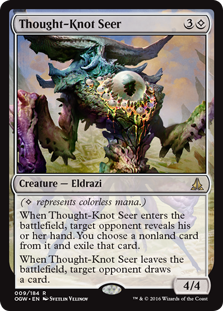
4 Thought-Knot Seer
4 Reality Smasher
3 Endbringer

Artifacts

2 Basilisk Collar
2 Mind Stone
4 Expedition Map

Instants

3 Dismember

Planeswalkers

1 Karn Liberated
1 Ugin, The Spirit Dragon

Sorceries

2 All Is Dust

Lands

2 Cavern of Souls
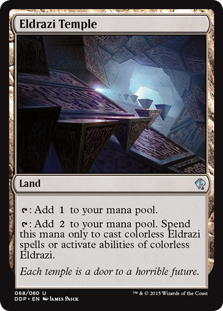
4 Eldrazi Temple
4 Ghost Quarter
1 Sea Gate Wreckage
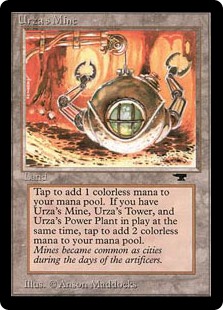
4 Urza's Mine
4 Urza's Power Plant
4 Urza's Tower
2 Wastes

Sideboard

4 Chalice of the Void
1 Grafdigger's Cage
2 Pithing Needle
2 Relic of Progenitus
3 Surgical Extraction
2 Ratchet Bomb
1 Trinisphere

Note: This decklist was slightly modified, as the sideboard only included 2 Chalice of the Void and 13 cards. I assume there was a mistake during decklist translation and it should be 4 Chalice of the Void.

Who Is Eldrazi Tron for?

Eldrazi Tron best suits players who don't mind getting their hands dirty with some brutally efficient creatures at the cost of giving up colored spells. It interacts better when it's the aggressor, which it can do by just playing big threats and not actually having to disrupt opponents much. It's easy to pick up and play for beginners, but also produces some tough lines that reward more experienced players. I'd say it's one of few decks with both a high skill floor and skill ceiling. In other words you don't need tons of experience to pilot it competently, but there are still plenty of edges to be gained as you learn the deck better.

Why not Bant Eldrazi?

This deck is very similar to Bant Eldrazi, so it's hard not to compare the two. Due to its access to colored mana, Bant Eldrazi gives you more card selection (Ancient Stirrings) and more sideboard options (Rest in Peace, Stony Silence, Engineered Explosives, etc.). The downside is that the colored mana often reduces your starting life total to 17 or 15 due to fetches, shocks, and pain lands. Losing life proves especially problematic against aggressive decks like Burn and Affinity. On the other hand, Bant Eldrazi also has Eldrazi Displacer and Drowner of Hope, each of which can dominate creature matchups single-handedly.

Eldrazi Tron is slightly less expensive to build. It doesn't need as many Cavern of Souls, and the other lands are also generally much cheaper. In terms of strategy, Eldrazi Tron is less sensitive to the land destruction cards used to disrupt Bant Eldrazi and regular Tron decks. Since all of its lands make colorless mana, it doesn't really care about getting hit by the now-ubiquitous Ghost Quarter.

The Future of Eldrazi Tron

I don't expect Eldrazi decks in general to get a lot of love in the near future. We got four whole sets of them in a row in Standard, and I think that players are pretty sick of them, so they may be retired for a while. It's possible we get an Eldrazi Commander deck, since it's a pretty well-supported tribe, but any new cards there won't be Modern-legal.

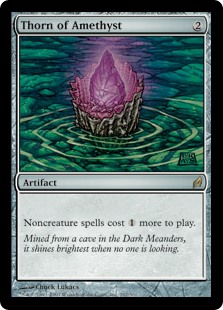
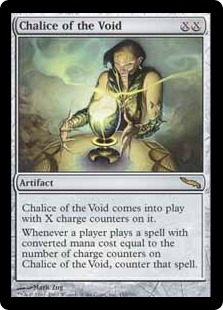
The most impactful improvements I can foresee in the future are to the colorless hate cards. Right now, Eldrazi Tron leans heavily on Chalice of the Void to interact meaningfully with creature-light, spell-heavy decks. I don't see a future where we necessary get a card that is better than Chalice at that job, but maybe we'll get cards that interact with the graveyard better, or Wizards will decide to slap Thorn of Amethyst's ability onto an artifact creature. Thorn is already played in the similarly-built Eldrazi decks in Legacy, which need extra interaction for noncreature spells.

The Core

Looking over lists, it appears Eldrazi Tron is in a feeling-out phase at the moment. While it's not hard to identify the cards that form the true core, numbers sometimes vary between lists. In addition, certain core cards, while always appearing the 75, are alternately relegated to the sideboard. I can't think of another deck for which so many players have come to the conclusion that a card is necessary, but are in disagreement about where to put it.

That being said, I think the core of non-land cards is definitely Matter Reshaper, Thought-Knot Seer, Reality Smasher, Walking Ballista, Endbringer, Karn Liberated, All Is Dust, Expedition Map, Mind Stone, and Chalice of the Void. Chalice is the oddest card, because there is often disagreement about where it should end up. In any case, it is extremely important to the deck.

The lands in this deck also form an important part of the core. I would not play the deck without Wastes, Eldrazi Temple, Cavern of Souls, Urza's Mine, Urza's Power Plant, or Urza's Tower. Wastes stops you from randomly getting hosed by Ghost Quarters and Blood Moons (remember, you need colorless sources to cast your creatures!).

Which Purchases to Prioritize

The first order of business should be getting the creatures from Oath of the Gatewatch squared away. They are insanely cheap for what are basically Legacy and Modern staples. About $50 is all it will set you back for Thought-Knot Seer, Reality Smasher, Matter Reshaper, and Endbringer. Just do yourself the favor and grab 'em now, because they're really not going to get much cheaper. While it is true that they rotate out of Standard this fall, they basically see no play in competitive Standard decks—their price tag is held up almost entirely by demand from Modern and Legacy players.

After these cards, it's a little harder to decide which purchases to make. I'd recommend getting Expedition Map and Mind Stone, as their price is also influenced by Commander players. If there's anything I've learned about the financial dynamics of Commander cards, it's that you often don't know they're going to spike until it's too late to do anything.

Next, you should bite the bullet and buy the cards that were recently reprinted in Modern Masters 2017. Cavern of Souls and Basilisk Collar are the highlights here. While I think it's pretty unlikely that we get an Eldrazi Commander deck, I wouldn't fault you for waiting on All Is Dust and Eldrazi Temple next. Those two cards are most likely to be inclusions in that style of deck, which would lead to a significant price decrease, like the Merfolk cards I talked about last week. That being said, I think an Eldrazi Commander this soon is unlikely, since we already have five to choose from.

What's left? The cards I think might be part of Iconic Masters. It's really hard to put a finger on what is "iconic" in Wizards of the Coast's eyes, but I think there is an argument to be made for a few cards in particular. Is Urza's Tower an iconic land? I think so. Why does it matter? Well, the Tron lands themselves are not particularly expensive. You can find all 12 for around $15 if you buy the cheapest ones. Things get interesting when we look at people's preferred Tron lands, which are sometimes quite expensive. Your options for black-bordered Tron lands are foreign black-bordered 9th Edition (Russian), Antiquities (~$8-10), or Foil 8th or 9th Edition (~$40 if you can find them). If the Tron lands are reprinted in Iconic Masters, the market would be flooded with these desirable cards, alleviating some of the foil price if that's your thing.

Along a similar vein, I think that you are good to wait on Karn Liberated and Chalice of the Void to see if they're included in Iconic Masters, because you don't really have much to lose. If they don't get reprinted, they might be up a few bucks per copy. If they do get reprinted, you might end up spending half as much on them.

The card I want to wait the longest for is Walking Ballista. It's a cornerstone of so many Standard decks that you can really save yourself a lot of money if you wait for it to fall out of favor. That might not be for a year and a half until it rotates, but it certainly won't get terribly more expensive in the meantime.

Subsequent Upgrades

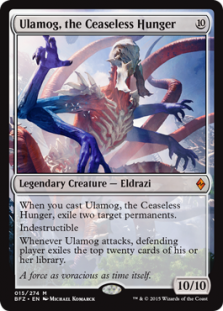
Hey, maybe you don't care if you have to use Chronicles or 5th Edition Tron lands. If it's fine with you, it's fine with the DCI. You can always upgrade to some less grotesque-looking lands later. Jokes aside, I would spend most of my money buying into sideboard options so I can customize my deck and adapt to shifting metagame. If you see a lot of Storm or Dredge, then maybe you want some Surgical Extractions in your sideboard. If you have a lot of Jund players in your area, maybe you'd rather play more Hangarback Walkers and Ulamog, the Ceaseless Hunger.

While it isn't an upgrade per se, I would probably invest in a playset of Endless One and Eldrazi Mimic. They were once an important part of the deck, and I can see some scenarios where you're going to wish you had bought them for about $1 each (which you can do now) instead of having to spend $4-5 on them should they break out in a weekend.

Final Thoughts

Eldrazi Tron is likely here to stay and will be a powerful deck for the future. It's relatively inexpensive to build, and with a few more reprint opportunities in the wings, you might find yourself spending a lot less for a new Modern deck than you originally anticipated.

Insider: MTGO Market Report for May 3rd, 2017

Are you a Quiet Speculation member?

If not, now is a perfect time to join up! Our powerful tools, breaking-news analysis, and exclusive Discord channel will make sure you stay up to date and ahead of the curve.

Welcome to the MTGO Market Report as compiled by Matthew Lewis. The report will cover a range of topics, including a summary of set prices and price changes for redeemable sets, a look at the major trends in various Constructed formats and a "Trade of the Week" section that highlights a particular speculative strategy with an example and accompanying explanation.

As always, speculators should take into account their own budgets, risk tolerance and current portfolios before buying or selling any digital objects. Please send questions via private message or post below in the article comments.

Redemption

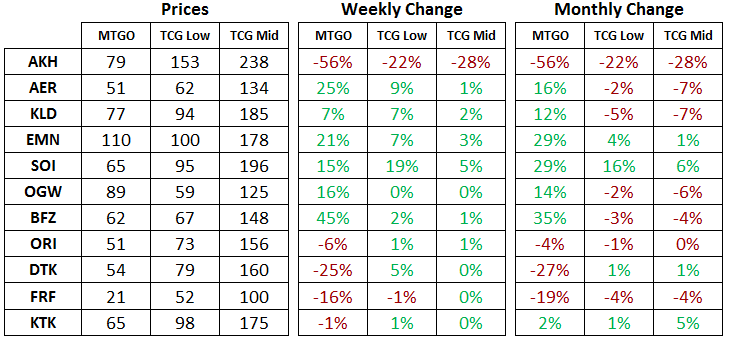
Below are the total set prices for all redeemable sets on MTGO. All prices are current as of May 1, 2017. The TCGplayer low and TCGplayer mid prices are the sum of each set's individual card prices on TCGplayer, either the low price or the mid price respectively.

All MTGO set prices this week are taken from GoatBot's website, and all weekly changes are now calculated relative to GoatBot's "full set" prices from the previous week. All monthly changes are also relative to the previous month's prices, taken from GoatBot's website at that time. Occasionally, full set prices are not available, and so estimated set prices are used instead.

may1

Standard

Every set in Standard prior to Amonkhet (AKH) flashed green this week in both paper and digital. This is a ringing endorsement of the decision to ban Felidar Guardian as players got excited about brewing with the new set amid a metagame in flux. This is a great time to be a seller with high demand for many Standard cards just prior to Pro Tour Amonkhet in less than two weeks.

There was an error retrieving a chart for Felidar Guardian

At the individual card level, the price turmoil of the past week was phenomenal. Saheeli Rai and Oath of Nissa both dropped like a rock and went below 2 tix after the addendum to the banned and restricted announcement was made. Although Oath of Nissa has recovered in price, at less than 3 tix it still sits below its average price from the last six months.

Saheeli Rai now looks like it's close to junk as it sits at 1.5 tix. Keep in mind that the Copy Cat combo does appear to be playable in Modern, so this is an excellent price to get in on a Modern-playable planeswalker that has well over a year left to go in Standard. Although redemption for Kaladesh (KLD) will be ending in June, this card represents excellent long-term value at current prices. I was a heavy buyer of this card for the Market Report Portfolio in the past week.

There was an error retrieving a chart for Saheeli Rai

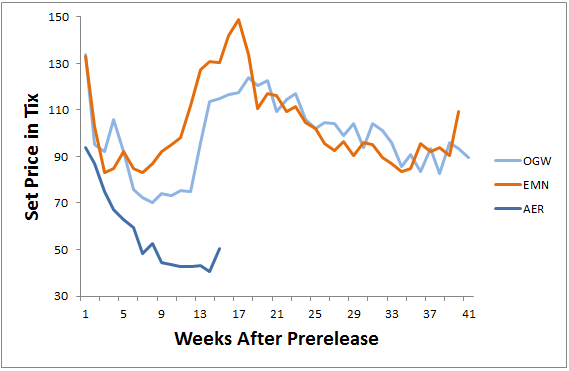
Aether Revolt (AER) was one of the big gainers in the past week with a 25-percent increase in price. With it no longer being heavily drafted, it's got room to run higher. If we look at how the prices of the last three small sets have evolved in the chart below, its easy to see we are in a period of high upside potential for AER. Although it's doubtful that it will reach similar heights as Oath of the Gatewatch (OGW) and Eldritch Moon (EMN), there's a good reason to think AER sets will get into the 60 to 70 tix range over the next month.

AER weeks after

Regular readers will know that I have been testing the waters with AER set purchases in the last month. This trade is on a good footing at the moment, and I'll be looking to sell down my position by the end of the month. Remember that redemption for AER and KLD will end in June, so don't be a long-term holder of complete sets. Once the connection to paper sets is severed, only Standard- and Modern-playable cards will hold value. Without redemption, a complete set will only be as valuable as the sum of the cards within that set, and since most card on MTGO are worthless, the set value will follow suit.

There was an error retrieving a chart for Fatal Push

On the singles front, the multi-format staple uncommon Fatal Push has quickly breached 4 tix. I was anticipating this card would reach 4 tix sometime next winter, but the influx of demand for Standard staples has had a big short-term impact. If you are holding extra of these cards, there's no reason not to sell into the recent buying as there are plenty of other opportunities to put tix into at the moment.

Modern

It's important to note that Fate Reforged (FRF) and Khans of Tarkir (KTK) will both go offline for redemption at the end of month. You can see the complete list of redemption related dates here. These two sets rotated out of Standard last spring, so that's why their cut off date is a little different from the other sets. If you are holding cards from these sets, it would be best to get rid of your junk mythic rares and even to pare down any Modern playable cards you are holding, and this includes the fetchlands.

There was an error retrieving a chart for Polluted Delta

There is always some value in online sets tied to being able to redeem that set for a paper version, so when redemption ends there's an inevitable price decline. When KTK went briefly offline for redemption in the fall, the prices of the fetchlands dropped due to the fear that WotC had run out of paper redemption sets. Trim your holdings and sell any cards you are not using over the next months from FRF and KTK.

Rares or mythic rares priced at bulk levels are fine to hold for the long term if you think they have some chance to break out in Modern. A card like Jeskai Ascendency would fit this bill. It's priced too low to be worth selling, considering there is some non zero chance it breaks out in Modern as a top deck.

With all eyes on Standard, it's a great time to be scanning the ranks of Modern playable cards for value. A card like Mox Opal is down by over 8 tix in the last week. Did Affinity or Lantern Control take a big hit as a result of the release of AKH? I don't think so! It makes more sense that players have been selling their Modern cards in order to draft AKH and to buy into Standard constructed. Good speculators and patient players will take advantage of this short term thinking and start picking up cheap Modern staples.

There was an error retrieving a chart for Kolaghan's Command

On this note, Dragons of Tarkir (DTK) and Magic Origins (ORI) are two prime hunting grounds for value seekers. Their set prices have fallen substantially in the last week, but they are still available for redemption into November. Cards like Kolaghan's Command and Collected Company are staples in Modern and have an excellent chance at rising above 20 tix again prior the Fall. Although they are not at rock bottom prices, players should feel free to pick up their playset and speculators should be paying attention.

Trade of the Week

For a complete look at my recent purchases, please check out the portfolio. There will be no surprise to regular readers of this column as I bought foil mythic rares from AKH. The strategy is straightforward. Redemption drives value to mythic rares since they are the redemption bottleneck. Foils amplify this effect, and as redemption removes cards from the system, mythic rares become scarcer and scarcer relative to the other rarities. This process drives value out of the commons and uncommons into the rares and mythic rares. This is true for both regular sets and foil sets, but foils amplify the effect because paper foil sets are much higher in price and more stable in price.

There was an error retrieving a chart for Rhonas the Indomitable

Ultimately this makes foil mythic rares a store of value. While it's safe to say regular sets and singles from AKH are going to be cheaper in a month and cheaper than that in two months, it's just as safe to say that foil mythic rares from AKH will be just as valuable in a month and even more valuable in two months. The only caveat to this is that we are talking about a pool of value for all the foil mythic rares together. Individual cards can fluctuate in price as a result of player preferences and metagame reasons.

As a direct result of this insight, I have no fear in buying foil mythic rares from AKH. Overcoming this fear was a challenge but a little experience with the matter can go a long way. For this, I went back to my experiment with Battle for Zendikar (BFZ) foil mythic rares. That was the first time I experimented with the foil mythic rare strategy, so I regularly recorded the price of these cards while the set was being drafted. The first week the set was available online, I bought four of every foil mythic rare for an average of 12.5 tix per card. Following the release of BFZ, the average sell price per foil mythic rare would fluctuate between 14 and 18 tix over the next twelve months.

When I counted up the purchase price of the AKH foil mythic rares, I came to an average of 10.5 tix per card. Between my analysis and the previous experience with this strategy, it was easy to pull the trigger on 8 copies of each foil mythic rare. For a complete list of the purchase price by card, please refer to the portfolio.

There was an error retrieving a chart for Hazoret the Fervent

The beauty of this strategy is that I don't need to know which cards from AKH will be good in Standard or Modern or any format. The basket of foil mythic rares will just slowly accumulate value over time as a result of the underlying economics of redemption. I will look to sell these cards in August or September, as this will be a prime selling window prior to redemption closing on AKH in the fall. I will repeat this strategy for Hour of Devastation (HOU) later this summer.

Insider: Speculating on Legacy After Miracles

Are you a Quiet Speculation member?

If not, now is a perfect time to join up! Our powerful tools, breaking-news analysis, and exclusive Discord channel will make sure you stay up to date and ahead of the curve.

It is a sad time indeed for us Legacy Miracle diehards. Last Monday, on April 24, WoTC announced that they were banning Sensei's Divining Top in Legacy, thus effectively killing the Miracles deck. Their arguments are 1) that it proved to be too dominant a deck for too long; and 2) that Top caused a lot of slower games and thus made tournament rounds go to time.

We will discuss both those points and, more importantly, the financial impact caused by the death of arguably the best deck in the format. WoTC hasn't killed a top deck in Legacy since they banned Survival of the Fittest way back in 2010.

So let's unpack their reasoning:

1) It was too dominant for too long. Personally, I find this argument pretty weak. The deck has evolved and shifted due to metagame changes, and while it has always been good it isn't winning every event. (In fact, looking over the last six SCG Legacy events, it only won once.)

Legacy as a format rewards players for knowing the ins and outs of their decks, so decks that have existed for a long time are likely to have very skilled pilots. It isn't surprising to see the deck perform well consistently (after all, part of the beauty of it was that you could tweak it for respective metagames). Miracles also had some pretty bad matchups—12-Post comes to mind, but there are a lot of others too.

2) Top slowed down games and tended to drag out rounds. This argument is actually fair. I've been playing Miracles for over three years now and I definitely had a lot of long rounds (and plenty of draws), despite knowing my deck very well. It is the nature of control decks to play longer games. We will likely see a lot fewer rounds go to time now, which is a clear plus.

Financial Implications

The most obvious financial implication is that cards whose demand came heavily from the Miracles archetype will drop.

But what goes up? This is where any potential money will be made. The easiest thing to look at are Miracles' best matchups:

  • Heavy creature-based decks (Elves/Maverick)
  • Storm
  • Death and Taxes
  • Reanimator (with the reduction in white and Rest in Peace)
  • Lands (again due to the reduction in white and Rest in Peace)
  • High Tide (the Counterbalance lock easily shut this deck down)

Each of these archetypes has been kept down due to Miracles' dominance. We'll look at each in turn to see how it appears positioned in the new environment, and which cards are the best targets for speculation.

Elves

This is actually one of the cheaper Legacy options, with the most expensive card being Gaea's Cradle. Currently we have Cradles sitting in the $200 range (having skyrocketed nearly 25% since Shadows over Innistrad), which makes it less appealing. However, it's a perennial powerhouse in both Legacy and Commander and on the Reserved List. I've always found Cradle to be one of the most requested and easily moved of the high-dollar Reserved List cards (even more so than dual lands).

That being said, the only deck in Legacy that does play it is Elves, and while the little green men are thrilled to see Terminus and Counterbalance gone, they tend to have limited interaction and are weak to fast combo decks like storm. I wouldn't be surprised to see an uptick in Elves, but rather than Cradle, my focus would be on Glimpse of Nature.

There was an error retrieving a chart for Glimpse of Nature

Glimpse, a four-of in the deck, currently sits at under $20. It has maintained that price despite being banned in Modern and seeing marginal Commander play (meaning all the demand comes from casual and Legacy players). It's also from Champions of Kamigawa and hasn't been reprinted.

Maverick

Poor Maverick was my first Legacy deck, which sadly fell by the wayside once Sneak and Show became popular (and then Miracles came out). Now Maverick has Containment Priest as an option to help against Sneak and Show, and Sanctum Prelate to help shore up the non-interactive matchups, so it might actually see a resurgence.

The key, though, is that both of those are white creatures which means you can't Green Sun's Zenith for them. Luckily, you can Collected Company for them, along with pretty much every other creature in the deck—so don't be surprised to see CoCo Maverick in the near future.

Newer versions have adopted the Dark Depths/Thespian's Stage combo as a way to help close out games faster, and with Dark Depths's recent printing in From the Vault: Lore, its price is far lower than it has been in a long time.

There was an error retrieving a chart for Dark Depths

Storm

The removal of the Counter/Top lock from Legacy means that a deck like Storm that is heavily based around casting a lot of one-drop spells just got a whole lot better. That being said, the deck consists of a lot of cheap commons, so the options to target are a lot fewer than you'd think.

Your best target here is probably Infernal Tutor. It is sitting at a near all-time high of around $18, but it's a four-of staple in the archetype, and one of the few rares besides fetchlands to be run in so many copies.

There was an error retrieving a chart for Infernal Tutor

Death and Taxes

This deck has remained competitive despite the fact that it's a creature-based deck in a format dominated by one-mana wraths. The reason is because it plays much closer to Goblins than a traditional aggro deck, using Rishadan Port and Wasteland to keep the opponent's mana in check while beating face. The benefit of D&T was that it had Thalia as another taxing effect that also happened to be an efficient beater.

The biggest challenge of this deck was that it didn't have any good ways to gain card advantage, outside of Stoneforge Mystic, which happens to be my pick. SFM provides tutoring, mana cheating, and card advantage. It also happens to be a four-of in both this deck and Stoneblade variants (which will also be on the uptick thanks to sharing most of their manabase with Miracles).

There was an error retrieving a chart for Stoneforge Mystic

Reanimator

We've already seen a resurgence in this archetype with the shift to the black-red version, which provides good ways to cheat fatties into play without relying on the graveyard (a necessity when Miracles ran Rest in Peace in the board). We will likely see a shift back to the blue-black version because it's a bit faster and more consistent (thanks to the cantrips).

Regardless, in either version you need the black. And thanks to Eternal Masters, Entomb is at an all-time low. As a four-of in the deck and a card with high past prices, it is my pick for best spec target for this deck.

There was an error retrieving a chart for Entomb

Lands

This matchup was a lot easier with the old Rest in Peace/Energy Field versions of Miracles (from oh-so long ago), because Lands as a deck utilizes its graveyard quite a bit. That being said, the deck is extremely slow and had to rely on recursion of Wasteland or a quick Dark Depths/Thespian's Stage to win. Miracles played tons of basic lands to get around Wasteland, and has both Swords to Plowshares and Terminus to answer Marit Lage.

If Lands becomes more popular, my spec choice mirrors that of Maverick in Dark Depths.

High Tide

Looking over results, it appears that there are two versions of High Tide: those with Candlesticks and those without. Unfortunately, my pick for spec target usually only finds a home in the non-Candlestick version. But given the cost of Candelabra of Tawnos, players who want to try this deck out will likely try the version without them first.

Of the cards in this deck, my pick is Meditate, a Tempest (and Reserved List) rare that also sees occasional play in combo-centric Commander decks.

There was an error retrieving a chart for Meditate

Conclusion

While I'm not happy with WoTC's decision to obliterate my deck of choice for the past three-plus years, I do enjoy brewing so now I may get a chance to try some new ideas out in Legacy. I also expect we'll see a significant number of price jumps for cards that have been kept in check thanks to Miracles' dominant run the past few years.

We will also likely see some movement on Stoneblade cards simply because it's now likely the closest thing we have to a control deck in Legacy. Former Miracles players will need to shift over to something like that (and again, it shares a manabase with Miracles so at least they don't have to go out and buy a whole bunch of dual lands).

The Circle Is Complete: Testing Updates

Are you a Quiet Speculation member?

If not, now is a perfect time to join up! Our powerful tools, breaking-news analysis, and exclusive Discord channel will make sure you stay up to date and ahead of the curve.

Publication does not mean that an experiment is complete. Oftentimes readers see trends or have insights that never occurred to the author. Other times feedback leads to epiphanies which requires additional investigation. As a result, in academia it is important to revisit old papers and reexamine conclusions. Therefore, I'm going to spend today following up on my previously reported projects. I've had time to do the additional testing I've alluded to previously, so it makes sense to report on the new results.

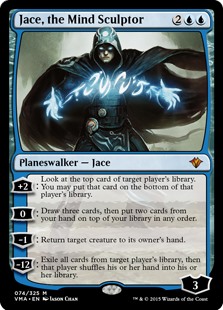
These are not new results or tests. Rather, these results are refinements of the previous two weeks of testing and some additional data collection. The big change comes from reexamining one of my results from the Jace test—I better understand now what the Bant Eldrazi results actually mean. The result was not statistically significant but it showed a large improvement, and I have a better handle on why. This also has additional implications for the viability of Jace, the Mind Sculptor in Modern.

A disclaimer before we begin: I stand by all my previous conclusions. All that data and the conclusions I drew from them are still correct. What my retests have done is refine those conclusions. I understand my data and what it all means far better now than when I published. Therefore it makes sense to pass this along to all of you. I will do so in reverse chronological order, starting with the bicycle lands.

Slow Ride

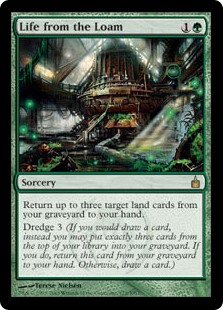
Last week I concluded that the new Life from the Loam engine was worse than normal Dredge. Despite being potent tools to dig through your deck or simply smooth out your draws, the bicyclers were too slow and mana-intensive to be worthwhile. Everything the deck was doing was simply more inefficient and slower than Dredge without a sufficient upside. This is still true—with a caveat I will get to below—but what I could not explain was why the decks I tried felt so wrong. I couldn't put my finger on any one thing at the time, but I just felt bad playing Loam decks. True, I don't like them as a strategy but that is not normally a problem. I test a lot of decks I don't enjoy playing because it's called testing. There was something else about Loam that made it uncomfortable to test, especially compared to the original versions.

It wasn't until I was helping another player test their version of a Loam engine deck last week that I understood my problem. I wasn't doing anything. It wasn't just that the Loam engine is inherently durdly. I've played UW Control for years. The problem is that the durdling wasn't accomplishing anything. I know that sounds contradictory, so let me explain. Durdling is generally defined as doing a lot of things without advancing your boardstate. Typically this is accomplished by drawing cards and not doing anything with them. This is not necessarily a problem as long as you're not under pressure and/or you are drawing cards that will eventually push you towards victory. That wasn't happening in my Loam decks. If normal durdling is spinning your wheels then what I was doing was driving a wheelless car. I had the gas pedal to the floor, stuff was happening, but I wasn't going anywhere.

Failure to Start

The problem with the Loam engine is that it does nothing slowly. All of the problems I already knew about contributed to this. But what I didn't appreciate until I was skating to victory unmolested with UW Control was how much air Loam decks required. There just weren't many cards that did anything. Loam drew lots of cards and gained plenty of card advantage, but it didn't mean anything. At least when you draw cards and do nothing in UW Control you're building the resources to lock up the game. Here? Loam was using air to find more air. My opponent was many, many draws up on UW and was still behind in cards.

Consider the problem of building around the bicyclers. You need the bicyclers obviously, and they're pretty bad on their own in Modern. You need Loam, which doesn't really do anything on its own. And then you need the rest of the land base, the payoff spells and finally some enablers to help set it all up. It was a very slow and awkward combo deck, and they were ultimately terrible. So few cards matter in a vacuum that when you cannot find them fast enough in a real game your deck is blank.

This problem could be fixed, but I don't think it's worthwhile. The older Loam decks were really Dredge decks before dedicated Dredge was good. Any attempt to build around the bicyclers would necessarily be clunky, slow, and lead you down the road to terrible combo decks. They are clunky and slow cantrips after all. As such I don't see anything coming from these cards.

A Long Shadow

That said, there may still be hope for a Loam combo deck. Shadow of the Grave is very potent and if the right shell can be found it might be good. It won't be found by me—my attempts have all been total failures—but I'm sure a list exists. A true combo Loam deck would use the titular card to find the lands so that you kill in one turn with Shadow. There's still the problem of Loam being slow, but if the rest of the deck is streamlined and fast enough, it may not matter. At the very least a deck like that would have no reason to slow down and pointlessly draw cards.

Tried and True

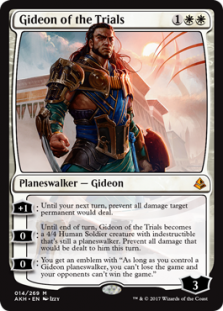
Next, lets go back two weeks to Gideon of the Trials in Ad Nauseam. I found that Gideon was a competitor with Phyrexian Unlife since it played better with Pacts and offered the potential to "gain" more life against certain aggro decks. At the time I speculated that being on the draw in my test games reduced Gideon's impact. Subsequent testing has confirmed that result. The more quickly that Gideon hits the board, the greater his impact. I stated in the comments of that article that Gideon vs. Unlife would come down to whether players valued Gideon's variable impact or Unlife's certainty more. I can confirm this—Gideon has a lower minimum value than Unlife but a much higher maximum.

Additional testing, both with the original test decks and additional decks, showed that Unlife does effectively the same thing against every deck. You don't die from lethal damage and have an additional ten life as long as Unlife stays on the board. Nothing surprising. Gideon has many different outcomes. Against creature decks he represents a minimum of five life up to infinity. It is very unlikely that any deck will ever hit Gideon for exactly four, as the math of Modern threats and burn means they will almost certainly overkill him. Add to that the damage that Gideon's +1 directly prevents and the upside starts getting larger and larger, especially against decks that play few threats at a time. This impact grows larger when you're on the play rather than the draw. Unlife doesn't really care about die rolls.

Furthermore, against UW, Unlife did very little while Gideon had some impact. When Boseiju, Who Shelters All wasn't a factor (most of the time) UW could sit back on its counters and Vendilion Clique, and Ad Nauseam would never resolve. Unlife's extra time really didn't matter. Gideon was an actual threat that had to be answered at some point. Because Gideon threatened your life total he couldn't be ignored, which helped Ad Naus find windows to go off. I had to leave in Paths against Ad Naus because of Gideon during testing. In my valuation, that's a good reason to make the switch.

The Question of Placement

The question that I cannot answer is how many Gideons and where. I think Ad Naus wants at least a few, but I don't know if they're maindeck or sideboard. His value is inherently swingy, dependent on both play/draw and the matchup. Thus I don't know if you just want him against control out of the sideboard or if you want a maindeck split. Even the actual Ad Naus player I was testing with who agreed with my conclusion isn't sure. It will be interesting to see, in any case, and players should prepare accordingly.

Clarity in Colorlessness

I was never happy with the Bant Eldrazi section from my Jace testing. I don't mean with the results or conclusions—experimental data is experimental data and it says what it says. I mean in the actual games. The regular Jeskai results were exactly in line with what we both expected, and we played the matchup well enough to be satisfied. But when it came to Jacekai (with Jace), neither I nor my opponent thought we played well.

I don't think I utilized Jace correctly. For my opponent's part, he decided midway through testing that he was playing suboptimally and that a different strategy was in order. However, it was far too late into testing to make the adjustments he wanted. He wanted to change so much about his playstyle that it would have invalidated everything we'd already done and that was not acceptable. Neither of us was willing or able to redo weeks of work.

We both felt that we needed to mulligan more aggressively. Most of Jacekai's cards were relatively low impact, so I could give up some number of them to find the really important cards. I know that UW has a better matchup than Jeskai due to more hard removal, so I should have used my mulligans to try and see more UW cards rather than burn. My opponent felt that post-board he needed to be a prison-aggro deck and so had to mulligan for Chalice of the Void and/or Cavern of Souls. During the game he needed to be more judicious with his threats.

Additionally, both of us wanted to change how we played with Jace. I realized too late that I was too passive, Brainstorming all the time, when it would have been better to aggressively Unsummon monsters to crawl back some tempo. My opponent realized he was wrong about not attacking Jace since I was digging to Supreme Verdict, which is the best card I had against him. It was also very hard for me to win when I didn't have Jace on the board.

Finally, we both wanted to change our sideboarding. I should have been playing the Spreading Seas. Clique proved to be less impactful than I thought and the burn was bad. My opponent realized that he wanted Elspeth, Sun's Champion rather than Drowner of Hope.

Different Approach, Same Result

So, we made our changes, and tried a few matches to see if there was a difference. The total match wins would have been different, but I don't believe that my conclusions would have changed. We played seven full matches and Jacekai won four. There were a number of practice games beforehand. Seas was a big factor in many games, keeping Eldrazi off colorless mana, while Elspeth was a far more dangerous threat than the other non-Reality Smasher cards. My opponent went harder for the Chalice plan than before, but we didn't see a measurable impact. It is likely, had we the time and desire to do another hundred matches, that the result would be a few points lower than the original results, but not by much.

Implications

What really stood out for both of us and what prompted me to report this in the first place was how much better the games felt for Jacekai when I pretended I was really UW Control. Path to Exile and Blessed Alliance into Supreme Verdict with Cryptic Command was a monstrous beating for Eldrazi. Deliberately filtering through burn with Jace was a much better strategy than I gave it credit for, meaning I actually didn't need to -1 Jace as much as planned. This leads me to believe that a repeat of the test with an UW Control deck would be a much clearer favorable result for Jace and a stronger case against an unban.

I initially thought that Jace would be favored in decks that want to see lots of cards. It made sense, Legacy decks that play him look to filter though lots of cards and that was my basis for comparison. During my testing I started questioning this assumption and this retest confirmed my doubts. Jace is good with lots of cards, but as individual card impact increases, the value of Jace also rises. Finding some burn is okay, but finding the sweeper you need is much better. I think that against the current meta, a UW deck with Jace would be overpowering. As such I'm more skeptical of unbanning Jace now than I was last month.

Looking Ahead

Next, I'm going to do something I might regret. I'm going to ask you what you want to see from the next banned card test. No restrictions. This won't directly determine the card I actually end up testing like last time. I'm just—interested isn't the right word—curious about what you want. Cards, decks, methods, whatever. I've mentioned my opinions on the banlist before, but I think it is important to get a feel for what the community believes. Of course, everyone's random opinions aren't as rigorous as actual testing. But at this time I need them to improve the series. At minimum, it will tell me what your pet cards and decks are, useful information for unrelated and more sinister plots. Go nuts comment section, I'll be lurking.

Insider: A Stable Modern Format

Are you a Quiet Speculation member?

If not, now is a perfect time to join up! Our powerful tools, breaking-news analysis, and exclusive Discord channel will make sure you stay up to date and ahead of the curve.

I can only beat the “Old School / Reserved List / Alpha and Beta” drum so many times. I recognize these are the main focus of my articles frequently, and that’s for two good reasons. First, it’s where I keep the vast majority of my MTG resources allocated—I try not to advocate chasing cards I would not be willing to buy myself. It seems poor practice to me. Second, these cards fit my risk profile—given my goals for MTG finance, I cannot take on high-risk positions often. Put the two together, and you have a fairly consistent message.

This week I thought I’d try something a bit different. Thanks to yesterday’s emergency ban of Felidar Guardian, every major format was changed in some way with the Amonkhet Banned & Restricted list change except one: Modern. Legacy had a major banning, Vintage had two restrictions, and Commander had some shake-ups as well. Modern remained untouched.

While there may be a ton of new opportunities in Standard with Copy Cat’s banning, I don’t know the format well enough to write an informed article about it. Best we read others’ work and follow the metagame closely these next couple weeks to take advantage of the shifts there.

Wizards must be content with the Modern metagame, at least for now. To me this indicates there may be some relative stability within Modern cards. Not to the extreme of Reserved List cards, mind you, but more so than previously. This starts to attract my attention as a result. The only issue is all those darned reprints that keep flaring up. However Wizards can’t reprint everything all the time. There are simply too many staples.

So let’s take a look at what is played frequently in Modern that hasn’t been reprinted recently to see if there are some attractive targets out there.

The Data

To organize things, I’m going to search for the most played cards using MTG Stock’s data. Then while scrolling through the list of fifty cards, I will identify the cards that haven’t been (re)printed in the most time. We’ll look at the price chart and see if by the end we can draw some conclusions. Ready? Here we go!

There was an error retrieving a chart for Thoughtseize

We don’t have to browse far down the list before finding something worth discussing. While the Theros reprint of Thoughtseize was devastating to its value, we haven’t seen a new printing of the black sorcery in almost four years! Theros block is indeed getting quite old. After finally bottoming at $11 at the beginning of this year, this card has since gained traction and has moved up.

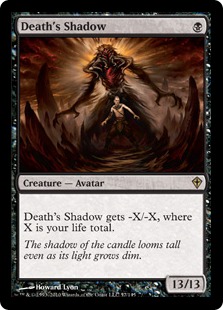
This is driven by the rise in popularity of the Death's Shadow deck, which runs the card. With that deck pushing Thoughtseize up to the number two most played card in Modern, and with Thoughtseize getting relatively “old” as compared to other cards on the list, this card is almost guaranteed to surpass $20 in the near future.

There was an error retrieving a chart for Bloodstained Mire

Khans of Tarkir is a full one year newer than Theros, but this isn’t enough to overcome the overwhelming demand for the set’s fetch lands. Bloodstained Mire is currently the sixth most played card in Modern thanks to the Death's Shadow deck, and its recent surge in price is symptomatic of that fact. It also bottomed in early 2017 and has since gone on a tear, jumping from $12.50 up to $18 in just a couple months.

With no reprint on the horizon, this is another $20+ card in the making. The other Khans fetches merit the same scrutiny, as they all have upside potential once the metagame inevitably shifts again.

There was an error retrieving a chart for Street Wraith

I have to mention this one because it’s the 33rd most played card in Modern and hasn’t been printed since Modern Masters in 2013. Despite being a common in that reprint set, the card has surged lately on the heels of the Death's Shadow deck (noticing a trend here?). I can’t advocate buying in here at $7, though I suppose $10 is not out of the question. There are better places to put money than a $7 common.

There was an error retrieving a chart for Ancient Stirrings

Speaking of money commons, this one seems far more attractive to me. It’s played in a more broad selection of decks and has continuously improving synergy as more colorless cards are printed. Like Street Wraith, this is also a common, but the big difference is the date of latest printing. The wraith was last printed in 2013 while Ancient Stirrings has only one printing in Rise of the Eldrazi, seven years ago!

This card has recently settled in the $5 range but another year of no reprint will easily drive it up towards $10. This very well may be the oldest card on the entire Top 50 list!

There was an error retrieving a chart for Thought Scour

Last and least we have Thought Scour, a lowly common out of Dark Ascension. This card is still selling for under a buck, likely due to the reprinting it had in Duel Decks: Jace vs. Vraska. That said, this Duel Deck came out over three years ago. I’m guessing the product didn’t sell well, and we’re a long ways off from Thought Scour being worth enough to motivate players to crack additional sets.

Therefore, I’d wager the supply is still fairly low. As the 46th most played card in Modern, this card isn’t exactly dominating the top tables. There are fewer and fewer sets to be found for under a buck a copy, and the open-ended synergy this card offers makes it an attractive pickup.

Underlying Trends

This research has led me to three definitive conclusions. All of which can be combined to make us more savvy Modern speculators going forward.

First, there are very few Modern staples in Tier 1 decks that haven’t been reprinted yet. The fact that nearly 90% of the top 50 most played cards in the format have been reprinted since 2014 is saying quite a lot. Ancient Stirrings was the only card in the top 50 that has yet to see a reprint. There are some Tier 2 cards that haven’t been reprinted yet, such as Scapeshift, Lantern of Insight, and Krark-Clan Ironworks. But the list is thin and you have to reach pretty deep into the well to find more.

That said, if you want to speculate on something for a Modern breakout, finding cards that haven’t been reprinted yet offers significant upside. This is evidenced by the crazy price tags on the cards mentioned above. And if any of these cards truly break into Tier 1, you can make some real profits. Just look at the ideal scenario in the form of Mishra's Bauble for instance!

There was an error retrieving a chart for Mishra's Bauble

The second trend I noticed and already alluded to earlier is the financial impact of Death's Shadow’s namesake deck. Shortly after breaking out, many of the deck’s cards saw significant gains. This indicates to me that shifts in the Modern metagame can still generate opportunity. While the ship has sailed on this one, there are new cards entering the format on a regular basis. My goal is to stay better in-touch with the Modern metagame, making sure to jump on trends as soon as they begin to surface rather than drag my feet.

The third and final observation I want to make involves the rarity of the cards I shared above. I never used to pay close attention to commons and uncommons when speculating on cards. To me, all the opportunity was in the rare slot (this was before the mythic was added). Times have definitely changed, and with the 2012 renaissance of Magic, the player base surged significantly. This makes cards printed in Return to Ravnica or after far more plentiful than cards printed earlier. Even commons and uncommons from pre-2012 sets have shown the ability to surge in price despite their rarity.

Therefore, it’s unwise of me to stick my nose up at Modern-playable commons and uncommons as worthwhile speculation targets. In fact, many of the best profits have been made from commons and uncommons, and this is likely to continue. Therefore when something like Ancient Stirrings comes up, I pay closer attention. This is why I like Thought Scour here as a potential buy. Something I already have a position in is the Planar Chaos common Mana Tithe.

There was an error retrieving a chart for Mana Tithe

The card only has one printing from an older set, is fairly inexpensive, and sees occasional fringe play in Modern. With a little luck and some traction, this could be the next $5 common for all I know. It’s even older than Ancient Stirrings, after all!

Wrapping It Up

Modern appears to be fairly stable for now given Wizards decided to leave the format alone during this season’s banned and restricted update. While I tend to stick to Reserved List and Old School investments, I will admit I’m attracted to the stability offered by Modern at this moment. With Modern Masters 2017 released, it’s fairly safe to invest in some cards knowing a reprint is unlikely now for a couple years.

By digging through some of the format’s hottest cards, and focusing in on cards that haven’t been (re)printed in a few years, we may be able to uncover some worthwhile targets. It seems many components of the Death's Shadow archetype have already jumped, but perhaps there will be new decks that surface once As Foretold enters the format. Maybe new strategies will emerge as well? Sometimes it only takes the printing of a support card to make a deck viable in the format, and these shifts can generate a lot of profit.

In the meantime, I’m content to bet on a few low-risk, older cards. Even commons and uncommons are starting to get my attention, as evidenced by my recent bet on Mana Tithe. Despite their rarity, it is their age that make these cards attractive speculation targets. In some cases a card’s age, plus the fact that it hasn’t been reprinted, makes it just as juicy a target as the hottest mythic in Modern.

…

Sigbits

  • After hearing DJ talk about this one I immediately started tracking it: Nix. When you search on TCG Player for playsets, there aren’t many sellers with this many available. There are plenty of sellers with one or two copies, but you can’t even buy those unless you add other stuff to your cart from those sellers. Supply is smaller than it appears—it would only take one breakout card to make this suddenly playable in Modern sideboards. Star City Games has a bunch of SP copies in stock ($0.79), so this isn’t going to pop just yet. But it’s a low-risk / high-reward proposition.
  • Another card that Death's Shadow impacted is the more-recently printed Traverse the Ulvenwald. This rare from Shadows over Innistrad is a four-of in many versions of the Modern strategy. If Traverse was printed five years ago, this would be a $40 card by now. However its recent printing makes this card much more available. I like foils most here, and SCG is sold out of them at $7.99.
  • Collective Brutality is another card that shows up in the Modern Death's Shadow list, though not usually as a four-of. This one was printed in the less-opened Eldritch Moon, so copies are not as available. This is evidenced by the fact that Star City Games is completely sold out of all versions, with non-foils listed at $9.99 and foils at $17.99!

Insider: Reacting to Iconic Masters

Are you a Quiet Speculation member?

If not, now is a perfect time to join up! Our powerful tools, breaking-news analysis, and exclusive Discord channel will make sure you stay up to date and ahead of the curve.

Welcome back, readers!

This week we got a bit of a premature spoiling of the next Masters set, Iconic Masters, due out November 17, 2017. Rumors had already come out about this set, so it seems WoTC was forced to play their hand a bit earlier than anticipated—hence the brevity of their announcement. While it may be brief there is still plenty of information to glean from it.

  • They are releasing two Masters sets this year; this is unprecedented.
  • MSRP per pack is still $9.99.
  • There will be one premium card (aka foil) per pack.
  • The set size is 249 cards. This matches up with Eternal Masters, which had the following rarity breakdown:
    • 15 mythics
    • 53 rares
    • 80 uncommons
    • 101 commons
  • They are sticking with the 24-packs-per-box system for Iconic Masters.
  • It will include some of Magic's "most memorable" spells. More below on what that means.
  • It will include iconic Angels, Demons, Dragons, Hydras, and Sphinxes.

Let's see what we can learn from all this. I'll start with the last bullet point first, because it gives us the most new information.

The Iconic Tribes

Here's every card with one of those iconic creature types that's worth over $10 (equivalent to the MSRP of the packs).

That's not many. Breaking them down by type:

  • Angels - Just four Angels whose value exceeds $10, after you ignore the versions that are valuable solely due to extreme rarity (like Beta Serra Angel). All four were printed as mythics in their respective initial printing.
  • Sphinxes - Sphinxes only get one card over $10, Consecrated Sphinx.
  • Demons - Thanks to his recent reprinting in Modern Masters 2017, even poor Griselbrand is below $10, leaving this category entirely blank.
  • Dragons - Unsurprisingly, Dragons are the biggest category with 7 cards. Two (Brimstone Dragon and Zodiac Dragon) are only valuable due to extreme scarcity. The first one was the result of the highly underprinted Portal: Second Age, and any reprinting will dump this guy to the bulk bin. Zodiac Dragon is more interesting. It has a unique ability and is commanding a $300 price tag despite seeing no competitive play in any format. It appears this one has more natural demand, which means it may stay over $10 with a reprint (though it will still drop considerably).
  • Hydras - Khalni Hydra would drop dramatically with a reprinting as its value is due principally to age and mythic rarity. I imagine a reprinting of this card drops it to $2. Progenitus, who has already been reprinted in From the Vault: Legends and the original Modern Masters, is the GP promo of 2017, so some versions are already below $10.

All in all, the list is pretty depressing, especially when you consider that a reprinting will likely drop the value of most of them to below $10. Assuming a reprint at mythic, the only ones I would expect to maintain a $10 price tag are Archangel of Thune, Avacyn, Angel of Hope, Consecrated Sphinx, Skithiryx, the Blight Dragon, and Zodiac Dragon.

There was an error retrieving a chart for Consecrated Sphinx

That doesn't bode well for Iconic Masters if these are to be the key draws to the set. However, we need to consider the other important comment, the "memorable spells." This is where WoTC will need to bring their "A" game if they want the product to sell well.

Doubling Up in 2017

If this set is like the other Masters sets, they'll find a way to cram lots of value in while satisfying players of multiple different formats. That's nothing new. What is unprecedented is to see a second all-reprint release like this in one year.

I remember the concerns many players had when WoTC announced the original Modern Masters set way back in 2013. While many of those players weren't playing when Chronicles was released, it's not hard to grasp the concept that mass reprints kill card values and thus reduce the value of one's own collection. Our fears were assuaged by the tiny print run, which led to price rebounds relatively quickly.

Modern Masters 2015 saw a larger print run. While some of the key cards rebounded (like Noble Hierarch and Fulminator Mage) many did not (like Apocalypse Hydra, Daybreak Coronet, and Wilt-Leaf Liege).

There was an error retrieving a chart for Fulminator Mage

Then we got Eternal Masters, which tanked the price of cards like Sneak Attack and Show and Tell. Most recently we got Modern Masters 2017 with an even larger print run than any before, which has obliterated prices on cards like Zur the Enchanter, Restoration Angel, and Venser, Shaper Savant.

There was an error retrieving a chart for Zur the Enchanter

Now, in the same year that we got Modern Masters 2017 with its massive print run (at this time there are only 15 non-foil cards in the set worth more than the MSRP), we get a second Masters set. That's a whole lot of $10-a-pack product in one year.

Too Much of a Good Thing?

I know my LGS is still trying to fire MM3 drafts as often as they can just to help move the product, because they are sitting on tons of it. I'm also seeing online retailers selling MM3 boxes for under $200, Massdrop with an option to purchase boxes in the $180 range as recently as April 8th, and stores selling the boxes on Facebook in the $175 range.

The point is that there is a ton of this product still floating around, and demand seems to be slowly dropping. MM3 is chock full of good cards, of course, so I don't know how much has to be thrown into Iconic Masters to compete with it.

The other concerning aspect about this is that it's not hard to see the reason for pushing these sets from WoTC's standpoint. Each set requires far less design work, as the cards are all reprints. There are no concerns about introducing broken new mechanics, messing up Standard, or interactions with past cards—just the need to provide at least a semi-enjoyable Limited experience. Each set can have a higher MSRP and has a good sales track record.

However, there's one factor that Wizards (or Hasbro) may be overlooking. Magic players' wallets are not endless, and you can easily overload the playerbase with product options.

Psychologists and economists have studied the concept of "too much choice" when it comes to products (you can see one such study here). This can result in players receding away from the game and choosing other hobbies due to the continual growing costs of the game and the barrage of new products they are expected to gobble up en masse. Even as I write this article, I'm drawn away from discussing the set itself, and more to the implications of WoTC's timing decisions.

If there is one thing directly related to this set to take away, it's to unload any extra copies of those iconic creatures over $10. I know I'm going to actively try to sell or trade off any copies I have, as reprints will seriously drop the prices of all of them (and likely crush most of them).

Analyzing the April 24th Banlist Announcement

Are you a Quiet Speculation member?

If not, now is a perfect time to join up! Our powerful tools, breaking-news analysis, and exclusive Discord channel will make sure you stay up to date and ahead of the curve.

April 24th came and went, and besides some misguided grumbling about Death's Shadow, most Modern players were content. Without one deck consistently surpassing 10% of the metagame, a "no changes" banlist announcement was easy to predict. But Wizards went the extra mile with this particular announcement, including a blurb about Modern despite choosing not to shake it up. The information present in that blurb and its implications deserve a closer look.

Today's article breaks down Wizards' most recent banlist announcement and considers what it means for Modern.

Analyzing the Announcement

Let's begin by looking at the announcement itself. Here's Aaron Forsythe's paragraph on Modern, in its entirety:

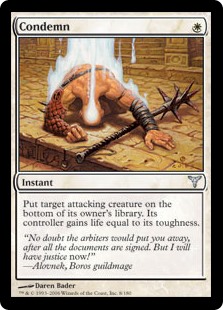
In Modern, Death's Shadow continues to be the best deck, but technology like Condemn is starting to emerge, and the format appears to be in a safe spot at the moment. While deck diversity is good, we're keeping an eye on color balance. If there's an easy change to the banned list that could open up more decks in the future, we will examine it when other formats have less pressing needs.

It's unprecedented for Modern players to receive banlist information in an official announcement when the format in question doesn't experience any changes. This section closely examines each juicy bit of the above blurb.

"Technology like Condemn"

The specific presence of Condemn may not have done much to stop Modern's Death's Shadow decks, which, as indicated in the announcement, do indeed still rule the format. But there's no arguing against the fact that Condemn has seen much more play over the last couple months than ever before. It's dreamy against Death's Shadow, where it removes an attacking fatty (i.e. Tarmogoyf) while shrinking (or outright killing) any Death's Shadows. Condemn currently sees play in UW Control, where it helped Greg Orange and his team take first at GP San Antonio, and as a sideboard staple in synergy-driven creature strategies like BW Eldrazi, Soul Sisters, Tokens, and GW Hatebears.

Of course, Condemn's applications pretty much stop there, leaving some to question whether Wizards truly believes the still-fringe Dissension uncommon will solve Death's Shadow Modern all by itself. But I think when Aaron refers to "technology like Condemn" (emphasis mine), he means that the format is beginning to find effective ways of attacking its best deck. Spreading Seas, Engineered Explosives, and Fatal Push have all seen play increases, too, in no small part due to their strength against Death's Shadow Jund.

"Deck Diversity Is Good"

I think this quote has a lot more meaning than it's currently getting credit for. Aaron acknowledges that Death's Shadow is the best deck, but when he goes on to say that "deck diversity is good," he essentially says the deck is safe at these representation levels. That means Wizards isn't necessarily waiting for more data with which to justify a Death's Shadow ban (as they were with Felidar Guardian)—they're okay with the current metagame share of Death's Shadow decks.

A couple of scenarios may change their mind. Death's Shadow could rise in popularity, which would lower deck diversity. Alternatively, other decks like Dredge and Affinity could climb high enough to push more decks out of Modern's lower tiers, which would also lower diversity. If neither of these things happen, though, this quote suggests to me that we don't need to worry about a Death's Shadow ban anytime soon.

"Color Balance"

Aaron goes on to acknowledge a color imbalance in Modern. It doesn't take a genius to figure out that blue and white are the format's two colors most desperately in need of some help—green sees plenty of representation between Goyf, Hierarch, Company, and Stirrings; red gets love thanks to Bolt, Anger, Moon, and Guide (either one); and black, perhaps now Modern's best color, has Shadow, Push, Thoughtseize, and Liliana (also either one, but mostly the Innistrad version).

The announcement communicates that Wizards will look for "an easy change" to the banlist that addresses this color imbalance. Luckily for Wizards, they won't have to look too hard; I can see a couple from here.

Of the blue and white cards on the banlist, the only ones that I think fulfill Wizards' color diversity goals are those that fit into fair decks, and not combo pieces. In other words, Jace, the Mind Sculptor and Stoneforge Mystic seem to me like the most obvious candidates for an unbanning. Combo cards don't necessarily improve color diversity, since they're frequently used with little regard for their color—think Manamorphose in Storm, Simian Spirit Guide in Ad Nauseam, or Nourishing Shoal in Grishoalbrand.

I also believe Preordain is safe for the format, but it does slot easily into combo decks. UR Storm has been on an upswing since Baral, Chief of Compliance was printed, so I doubt Wizards would start here. After all, Preordain's applications in unfair decks are more immediately obvious than its roles in fair decks.

It's also possible, at least on paper, that the preferred "easy change" is a ban, and not an unban. Removing color-defining staples from the format, though, is likely to incite a serious player fallout. Imagine the reactions if Tarmogoyf, Lightning Bolt, or Thoughtseize ate a ban to give blue or white some breathing room. Not only have we seen that "opening space" bans rarely have a desired effect (see Splinter Twin being banned to increase URx diversity, and ending up making reactive blue decks unplayable altogether), there are more palatable options available (like unbanning Jace or Stoneforge). Also, you know, the fallout!

This "color balance" clause also makes it seem like Death's Shadow is safe from a ban. After all, banning a piece from Death's Shadow would do very little to help with color balance. After the Probe and Grave-Troll bans, but before Death's Shadow Jund started to catch on, BGx midrange decks (Jund and Abzan) combined for an 11% metagame share. Now, Death's Shadow Jund, Abzan, and traditional Jund (which wallows in Tier 2 at 3%) all combine for a comparable 15% share.

I think Wizards is very unlikely to ban a card unique to Death's Shadow for color diversity reasons (examples include Bauble, Wraith, Traverse, and Shadow itself), since blue and white already struggled in the post-Probe-ban metagame. A Shadow-specific ban would probably reset the format to again have an 11% BGx share and few, if any, blue- or white-based interactive contenders. In fact, I think there's a case to be made for Death's Shadow's presence bolstering removal-stocked strategies like UW Control, which prey on Death's Shadow and saw practically no play before the deck took off.

"Less Pressing Needs"

Lastly, Aaron comments on the timing of such an unban, stressing that it won't occur until "other formats have less pressing needs."

This quote seems to reinforce the narrative that Wizard's doesn't care too much about Modern. In actuality, Wizards just has a lot on their plate. Like any company, it needs to properly allocate its resources to achieve its bottom line: financial growth.

Right now, that means focusing on Standard. Wizards used to pay more attention to Modern, sure. But Modern was a fledgling format at the time. Now that it's popular enough to actually cannibalize attendance records at Standard events, I don't think it would be fair of us to fault Wizards for spending extra energy on its smaller, more lucrative format.

I also think a policy of waiting best befits a diverse environment like Modern. In a format with such a deep card pool, I think it's usually wise to let things try to iron themselves out (so long as the format isn't in complete shambles in the meantime). After all, Death's Shadow itself was only recently discovered in a competitive capacity. Wizards hates bans as much as we do.

Many of us had assumed Wizards spends less time on Modern than it does on Standard and Limited, but it's still nice to hear them come out and say it explicitly every once in a while. I'm happy Aaron included this bit in the announcement; given "no changes," most Modern readers probably weren't even expecting to be acknowledged. The mention makes good on Wizards' apparent understanding that what the playerbase thinks matters, and continues their recent trend of increasing transparency and openness with players (things we were once starved for).

Wrapping Up

There are a few key points Modern players can reasonably draw from this banlist announcement:

  • At its current metagame representation, Death's Shadow Jund is safe from a ban.
  • Bans are only liable to happen if deck diversity suddenly plummets.
  • A blue or white unban is likely if fair decks featuring the colors continue to post results similar to those they've had recently.

A larger takeaway: Wizards does care about Modern, and about its players. It was awesome of them to pair the "no changes" announcement with so much information. I hope they continue touching in with the playerbase in future banlist updates, whether changes are made or not.

Insider: Emergency Bans and the Impact on Amonkhet

Are you a Quiet Speculation member?

If not, now is a perfect time to join up! Our powerful tools, breaking-news analysis, and exclusive Discord channel will make sure you stay up to date and ahead of the curve.

On Wednesday afternoon, Wizards of the Coast put out a statement announcing that Felidar Guardian would be banned, making it the first emergency ban since Memory Jar. This “addendum” to Monday’s announcement of no changes in Standard was made in part because of the outpouring of disgust on social media about the decision, but the official reason for the change is a different one.

Amonkhet was the first set with an online prerelease coinciding with the paper prereleases, and it meant that the new cards were actually legal for Standard play online before the set was ever released and legal in paper. The result was a wealth of data from just a couple days of events, and Wizards used it to determine that the Saheeli Rai combo was actually more prevalent after Amonkhet than before its release. This was enough to warrant a ban, they said, so Felidar Guardian was banned in favor of diversity.

There was an error retrieving a chart for Saheeli Rai

This change will have the effect of making Amonkhet relatively more important in the Standard metagame, and it will surely be higher profile at the Pro Tour and beyond, so it’s a benefit to Wizards in terms of marketing their new product. Amonkhet being relatively better in the metagame is good for its playability and thus demand, so it’s going to increase the value of the set going forward. Now is a great time to make a bet on what Amonkhet cards are the biggest winners from the decisions, and what cards are still undervalued compared to their future playability. Early online results have given some insight into what cards are already performing and might be good bets, so today I’ll lay out what’s out there.

There was an error retrieving a chart for Rhonas the Indomitable

Rhonas the Indomitable put up a 5-0 finish in a Black-Green Energy deck, where it works well with Verdurous Gearhulk and Rishakar, Peema Renegade, pumping creatures like Greenbelt Rampager or Longtusk Cub. Its ability to pump creatures and push through damage is very valuable in such a combat-oriented deck, and it’s another mana sink when Walking Ballista isn’t available.

There was an error retrieving a chart for Kefnet the Mindful

Kefnet the Mindful has already had success by putting up a 5-0 finish as a three-of in a Temur Control deck. Dynavolt Tower isn’t necessary when there’s no Saheeli Rai to destroy and Magma Spray deals with Scrapheap Scrounger, so control can explore alternative options. Kefnet the Mindful fills the same role as a card advantage engine and threat, but it’s a higher-powered option that’s capable of winning the game more quickly.

There was an error retrieving a chart for Commit

Commit // Memory is a deceptively powerful blue disruption spell with very few comparable cards, and it’s already seeing success in Blue-Red Control with Torrential Gearhulk. It’s very telling that the player who finished 5-0 with a single copy played two in his 5-0 list the following day.

There was an error retrieving a chart for Sweltering Suns

Sweltering Suns is a board sweeper that’s superior to current options, dealing more damage than Kozilek's Return and requiring only one color compared to Radiant Flames’s three. Cycling means it’s never dead, so it’s a very strong card from all perspectives and Standard’s new premier battlefield sweeper. Blue-Red Control has taken an early lead as one of the best new decks in the metagame, and Sweltering Suns being part of it means it’s likely to rise in price.

There was an error retrieving a chart for Pull from Tomorrow

The early success of blue-red decks is a positive sign that the rise of control decks is more than dream but a reality, and one of the biggest drivers behind their success is Pull from Tomorrow. It give blue control decks a powerful dose of card advantage that’s functional early in the game and game-ending later on, and it has the potential to make control the best it has been since Sphinx's Revelation was in Standard.

There was an error retrieving a chart for Censor

Censor is a key element to the rise of blue control, and it’s perfect with Pull from Tomorrow because it’s ideal for slowing down the opponent and buying time or cycling to help hit land drops. It’s even seeing play in Modern, like the two in a blue control deck using As Foretold that finished 5-0 in a league. It’s likely the most relevant Constructed uncommon in the set and it has a long life ahead of it, so I think its price is due to rise. I especially like foil copies, and any foreign foils are likely to be steals at the current price compared to what they can potentially be worth down the road.

There was an error retrieving a chart for Never

Never // Return could be found in the sideboard of black-green decks, where it replaces Ruinous Path and even To the Slaughter as the best way for black decks to deal with planeswalkers. Doubling as graveyard hate makes it even better, but the real value is the 2/2 creature it creates.

There was an error retrieving a chart for Prowling Serpopard

Prowling Serpopard was used in the sideboard of a Temur Control deck as a mirror breaker. It looks great in general in a metagame where control is going to be on the rise and where combo is dead, so I expect it to be used in all variety of green decks going forward.

Beyond Amonkhet, the demand for cards in previous Standard sets is going to change because of the Saheeli combo being banned, so there is a ton of opportunity for savvy investors to get ahead of the trends. It’s certainly good news for Gideon, Ally of Zendikar, which now sits as the undisputed king of Standard. One place to focus attention is Aetherworks Marvel, which proved itself as the third or fourth best deck in the metagame before the banning, but is now squarely in contention as a competitive deck. In the void left by Felidar Guardian, it’s now the premier combo-style card in the metagame. It’s likely to present itself as a foil to Mardu Vehicles, but it may struggle against blue control.

There was an error retrieving a chart for Aetherworks Marvel

The decisions by Wizards to reverse their earlier decision not to ban the Saheeli combo has restored some level of consumer confidence, though others have lambasted the company for not getting such an obvious call right the first time, citing that there’s no reason a combo that is too good for Modern in Splinter Twin should exist in Standard. That said, the majority is in strong support of Wizards, and it’s going to lead to an exciting Standard format and Pro Tour Amonkhet, which will settle once and for all what new Standard cards are the best and which are flashes in the pan.

Insider: Picks in the Post-Top Legacy

Are you a Quiet Speculation member?

If not, now is a perfect time to join up! Our powerful tools, breaking-news analysis, and exclusive Discord channel will make sure you stay up to date and ahead of the curve.

Hello, all. Long-time Miracles fan here, slightly sad these days...

Sensei's Divining Top was banned from Legacy this Monday. I'm not going to say that I'm not a little bit sad. I love me some Top, and Miracles is probably my favorite deck to play. I'm also pretty darn good with it, having put in thousands of hours worth of reps.

Top Rotation

All things considered, I'm not surprised nor particularly angry about the banning. Miracles needed to go. It has needed to go for a year. For starters, I don't think there is any other deck in any other format that is even close to as dominant as Miracles has been in Legacy. I would go so far as to say that Miracles is tier one and everything else is a distant second place.

Not only is Miracles the best deck by a wide margin, it isn't a particularly "fun" best deck. Rather, Miracles is kind of the fun police. It sits back, rearranges the top three cards of its library, and just grinds an opponent into submission with instant-speed Wrath of Gods (wow, fun!) and a Counterbalance plus Sensei's Divining Top soft lock (also, fun!) that renders the opponent unable to continue playing Magic.

Sensei's Divining Top is also a tedious card to operate both on MTGO and in paper games. There is a lot of doing the same thing over and over again going on. It adds significant time to rounds and events. It is undesirable for tournament play. It is banned in Modern for the "time constraints" reason and it doesn't make much sense that it would be acceptable for Legacy if the same is true there.

It needed to go and is going, going, gone!

There are really no good reasons why Top should be legal in Legacy and now it isn't. I'm sad but I'm looking forward to playing new decks and watching a new metagame unfold.

Key Cards and Strategies to Target

With Top leaving the format, there is certainly room for new decks to rise up and take Miracle's place at the top of the heap. Today's picks are directly related to the types of strategies that I believe dramatically improve in a metagame where Miracles has left the building.

The biggest thing that Miracles has always done is to keep creature decks in check. Obviously, in a format where Miracles is the Divining Top Dog, committing a hoard of creatures to the board is an exercise in futility. One-mana, instant-speed Wraths are not fun.

Now we are free to do what we want any old time!

There was an error retrieving a chart for Glimpse of Nature

I think that Elves is easily one of the big winners now that Miracles has gone bye-bye. For starters, Elves has always had a rancid Miracles match-up. I don't think I've lost a tournament match to an Elf deck in two years from the Miracles side. The match-up is that bad.

However, Elves is very strong against decks like Delver and BUG. They don't have enough board control or permission to out-slog Elves, which is great at just doing elf stuff and going over the top. I anticipate that Elves will quickly become a bigger player in the Legacy metagame.

Glimpse seems like a great card to look into at the moment because it is relatively difficult to get a hold of.

There was an error retrieving a chart for Green Sun's Zenith

Green Sun's Zenith is also a super cheap card that is relatively great right now. Not only is GSZ a staple in Elves but it is also a mainstay in various Naya Maverick decks. Maverick is traditionally weak to Miracles but great against Delver decks, which seems like an ideal place to be right now.

The biggest thing to consider is that the format has gone wrathless for the time being, so we can anticipate that creatures will come surging back.

There was an error retrieving a chart for Wasteland

Another card that has become increasingly better with Miracles out of the way is Wasteland. The powerful Tempest uncommon has always been a defining card of the format but has taken a backseat in some ways because the best deck, Miracles, plays exclusively basic lands. Not so much anymore.

Look for battles over Wasteland and struggles to keep lands in play to be a thing moving forward. I could certainly see this card gaining a lot of Legacy popularity in the coming weeks.

There was an error retrieving a chart for Stoneforge Mystic

Stoneforge Mystic could also make a resurgence as the premier Legacy control deck of choice. Stoneblade was sort of weeded out of the format because it was a "bad Miracles deck." Why play UW Blade when you could just play Miracles?

Well, now that it isn't an option, I predict that UW and Esper Stoneblade are likely to be players moving forward. Also, we should never rule out Death and Taxes which is another option where Stoneforge Mystic really shines. Death and Taxes was always a slight dog to Miracles but fought it closely. However, I've always liked Death and Taxes against various Delver decks. Better mana, Vial, and better threats. Game on!

There was an error retrieving a chart for Umezawa's Jitte

This Jitte is Bananas, B-A-N-A-N-A-S!

Jitte is also a card that becomes significantly better in the coming weeks. If we consider that the most direct impact Miracles' departure will have is that it opens up space for creature decks, then it makes a lot of sense that Jitte is better than ever. Jitte is a devastating tool in creature-based mirror matches.

It is also worth noting that Jitte is one of the best tools that various blue-based creature tempo decks have to fight against Elves. The problem Delver has with Elves is that it can't generate enough removal and board control to keep Elves from eventually hitting critical mass. Jitte is the card that generates recursive removal and takes control of the game. Jitte is going to be a big game moving forward.

There was an error retrieving a chart for True-Name Nemesis

If you want to carry a Jitte in style (and who doesn't...) you've got to seriously consider TNN in Legacy. The card gets better without Terminus and Council's Judgment floating around. A TNN with a Jitte is tough to answer.

It also feels like a lot of Miracles players looking for new decks are going to naturally gravitate toward Stoneblade or BUG, which means more demand for True-Name. It's a great card and it will grow its Legacy market share in the absence of Terminus decks. Get in on these early because they are likely to gain in the near future.

There was an error retrieving a chart for Leovold, Emissary of Trest

Leovold is another card that is going to become a bigger player moving forward. It is already the premier finisher for the BUG decks that I've long felt were the best non-Miracle Brainstorm deck in the format. Leovold does a lot of interesting things, including the fact that it keeps Elvish Visionary and Glimpse of Nature in check.

It's just a good card, and it is already difficult to acquire and highly coveted. I think demand is going to shoot up considerably. I don't think it is out of the question to see a 25-35% spike in the next month on this card—if it hasn't already happened by the time this article goes live. Move quick!

There was an error retrieving a chart for Rishadan Port

Port is another card that likely improves in the Legacy stock market. Two major reasons: Death and Taxes and Lands. I've already discussed why Death and Taxes becomes better (good against Delver and unfavorable against Miracles) but Lands may quickly become the best deck in Legacy.

First of all, Lands also punishes random creature decks with cards like Punishing Fire and The Tabernacle at Pendrell Vale. Secondly, the Dark Depths plus Thespian's Stage combo is very good against decks that don't pack Terminus and Swords to Plowshares. It's just a problematic little interaction that punishes Delver decks.

I feel like the default deck that people will play is likely to be RUG or BUG tempo or midrange, and Lands is very good against these decks in the abstract. Wasteland plus Port is so strong against land-light blue decks. Miracles always shined here with basics and lands in abundance, but I fear tempo blue is not well equipped to fight the Lands fight.

Port is a great card and I think that we will almost certainly see more play.

There was an error retrieving a chart for Deathrite Shaman

Deathrite Shaman is dirt cheap right now. The reprint and dwindling interest for the card has left it in a fairly undesirable position. With that being said, one of the major reasons the card wasn't great in Legacy was the dominance of Terminus. It was inevitable that the early DRS was going to get swept up in the Wrath and the clock was too slow to really close.

The BUG control decks really just matched up awkwardly against Terminus decks. However, now Shaman will demand a removal spell and play very nicely in a resurgent Wasteland metagame. The reprints probably put a cap on the amount the card can gain but I would expect it to see some upward trending in the near future.

Conclusion

In summary, here are the decks with an upward trajectory:

  • Blue-based creature decks. Most obviously, the various Delver and BUG midrange decks should improve in popularity. People are not going to stop playing Brainstorms, and these are the crème de la crème of the Brainstorm and Ponder archetypes.
  • Creature decks that beat Delver. Elves, Naya Maverick, and Death and Taxes are all decks that have good game against the "fish" style decks that will improve in market share. I like looking through these lists for potential gainers right now. Legacy is safer for creatures than it has ever been.
  • Stoneblade decks. Tundra is never dead. It always reinvents itself. Look for SFM to carry the weight (and by the weight, I mean the Jitte!).
  • Give me lands—lots of lands. Lands is a busted Legacy deck that heavily punishes creature and midrange strategies. It is the default control deck with Miracles gone. Mox Diamond in the rough!

I'm looking forward to jamming some Legacy. I guess I have some work to do on the format now that Miracles is gone! I'm planning on doing the Team Open, and I'm my team's Legacy guy—so, guess it's time to pick up a new deck. For now I'm heavily leaning towards Death and Taxes or Lands.

The Dangers of Over-Sideboarding in Modern

Are you a Quiet Speculation member?

If not, now is a perfect time to join up! Our powerful tools, breaking-news analysis, and exclusive Discord channel will make sure you stay up to date and ahead of the curve.

Sideboarding is without a doubt one of the most essential and difficult-to-master skills in Magic: The Gathering. In tournament Magic, you play more sideboard games than pre-sideboard games by a wide margin, and the difference between sideboarding well and sideboarding poorly will frequently be a deciding factor in your eventual match result. In a format as wide and open-ended as Modern, this effect is compounded; you need to be prepared for far more decks than you would in Standard, for example. Not only that, but the depth of the card pool requires you to be prepared for a variety of lists even within a single established archetype. Does your opponent playing a RG Valakut deck have Scapeshift in their 75? Do they have Through the Breach? Chalice of the Void? Any one of these small differences can have a huge impact on your sideboarding plan.

So far, all of this is likely obvious to you; however, you also need to be aware of how the large card pool affects the construction of your own deck, a point that eludes many. What do I mean by this? Many of the archetypes within Modern are high enough in power level and consistency that sideboarding can quickly become more of a hindrance than a privilege. Sideboarding too many cards, or simply the incorrect cards, will disrupt the overarching strategy of your deck.

I would like to explore a couple different ways that sideboarding can hurt you, and how to avoid those scenarios. In Modern I've found there are two primary difficulties: one concerning quantity (sideboarding in too many cards), and one concerning quality (sideboarding in cards that are too narrow). That is certainly a little vague, so let's dive in!

Sideboarding with an "Engine" Deck

The delicate balance that sideboarding creates is more apparent when playing with particular strategies. It's a lot harder to disrupt the general flow of your own Jund deck than it is to neuter the consistency of your Krark-Clan Ironworks Combo deck.

For instance, take a look at the following list of Krark-Clan Ironworks Combo:

Krark-Clan Ironworks Combo, by Ryland Taliaferro (Test Deck)

Creatures

4 Scrap Trawler
2 Hangarback Walker
1 Emrakul, the Aeons Torn

Artifacts

4 Chromatic Sphere
4 Chromatic Star
2 Engineered Explosives
4 Everflowing Chalice
4 Ichor Wellspring
4 Krark-Clan Ironworks
2 Mind Stone
4 Mox Opal
4 Terrarion

Sorceries

4 Ancient Stirrings

Lands

1 Academy Ruins
1 Aether Hub
4 Darksteel Citadel
1 Forest
4 Grove of the Burnwillows
2 Inventors' Fair
4 Sanctum of Ugin

Sideboard

3 Defense Grid
1 Grafdigger's Cage
3 Leyline of Sanctity
4 Nature's Claim
2 Nihil Spellbomb
2 Padeem, Consul of Innovation

For those of you who may be unfamiliar, Krark-Clan Ironworks (KCI) is a combo deck that utilizes the mana-making ability of KCI in combination with Modern's "Eggs"—Chromatic Sphere, Chromatic Star, and Terrarion. The goal of the deck is to abuse this synergy to draw cards at a rapid rate while generating mana, which you will use to hardcast an Emrakul, the Aeons Torn.

Putting the List to the Test

Keeping the above list in mind, imagine that you are playing against an Abzan Midrange deck. How would you sideboard? This particular list has a lot to offer that you might be interested in: Leyline of Sanctity to fight against discard; Nihil Spellbomb to weaken the power of Tarmogoyf, Lingering Souls, and Grim Flayer; Padeem, Consul of Innovation to protect your artifacts from targeted removal; and last but not least, Nature's Claim to destroy an opposing Stony Silence. All of these cards have good utility in the matchup, but at what cost?
Here is how I would sideboard:

+3 Leyline of Sanctity
+4 Nature's Claim

-2 Chromatic Sphere
-3 Everflowing Chalice
-2 Terrarion

In an engine deck such as KCI combo, you can only afford to take so many crucial pieces out of the deck before the machine stops working. It is very possible to brick while comboing, and over-sideboarding will only make that more likely. Frankly, bringing in 7 cards with this strategy is already pushing it—any more would be far too detrimental to the overall consistency of the deck. Considering this, I'm unfortunately compelled to leave the Spellbombs and the Padeems at home.

When facing a situation like this one, you are forced to prioritize. You simply cannot bring in 11 cards, so which spells will make the cut? In this matchup Stony Silence is without a doubt the largest concern. It is incredibly hard to win through a Stony without answering it, so Nature's Claim is definitely coming in. In addition, the average Abzan Midrange deck will be packing around 7 discard spells between Thoughtsieze and Inquisition of Kozilek. Like any combo deck, KCI is not particularly fond of having its hand ripped to shreds. There are a few essential pieces that are generally required to win the game, and having these cards persistently discarded is not a good recipe for success. Having hexproof essentially requires your opponent to answer your threats on board rather than removing them from your hand.

Sideboarding with Hate Cards

While there is more risk of over-sideboarding with an engine deck like KCI, there are other ways of making this mistake that do not involve sheer card quantity. Sideboard cards that are too narrow can dilute your strategy in the very same way. However, this risk will certainly vary from card to card. Stony Silence is one of the most striking examples of a card that is very difficult to over-sideboard with. When you feel compelled to side in Stony, it is typically because your opponent is leaning heavily on artifacts with activated abilities that are essential to their utility. Decks like Affinity and KCI are some prominent cases. In these situations Stony is absolutely going to be worth the slot in your deck considering how disruptive it can be to your opponent's strategy.
However, I would be remiss if I didn't mention that even hate cards as pointed and specific as Stony Silence do have their moments where they cross into the realm of over-sideboarding. Consider the situation when you are playing against Eldrazi and Taxes, or Merfolk. Sure, your opponent has Aether Vial, and sure, the card is outstanding in their deck. It is rare however, that it is correct to bring in Stony Silence in these cases. 90% of the time, your opponent will be quite happy to see you put a Stony Silence on the table when A) they might not even have a Vial, and B) Stony Silencedoesn't affect the current board state.

You will continue to get beat down by your opponent's rag-tag band of fish or hate bears without batting an eye. You certainly don't want to be in this situation and draw a second Stony Silence—having to see the smug look on your opponent's face as you play Stony number two the turn before you die to their pile of bears is an unpleasant circumstance to say the least. All this goes without even mentioning the fact that Vials already have diminishing returns in a game of Magic. They are largely bad top-decks and are often worse in multiples.

Extracting a Plan

Compare this to a card like Surgical Extraction. Surgical is also a card that appears in many sideboards, and rightfully so—sitting down to play some Modern without graveyard hate in your 75 is far too dangerous. There are countless decks that utilize their graveyard to execute their primary game plan: Storm, Dredge, Goryo's Vengeance...the list goes on. Whether brewing or net-decking, you will often find yourself with Surgical in your board for these reasons, and others—but when should you bring it in?

Much like Stony Silence, some of the answers seem obvious. If you find yourself seated across from Dredge or a Reanimator deck, you will quickly pull Surgical to the front when thumbing through your board—but what about a much closer case?

Imagine now that you are playing the following list of Death's Shadow Aggro and are up a game against a GW Tron opponent:

Death's Shadow Jund, by David Ochoa (3rd, Grand Prix San Antonio)

Creatures

4 Death's Shadow
4 Street Wraith
4 Tarmogoyf

Artifacts

4 Mishra's Bauble

Instants

1 Abrupt Decay
3 Fatal Push
2 Kolaghan's Command
1 Tarfire
2 Temur Battle Rage
2 Terminate

Planeswalkers

2 Liliana of the Veil
1 Liliana, the Last Hope

Sorceries

4 Inquisition of Kozilek
4 Thoughtseize
4 Traverse the Ulvenwald

Lands

1 Blood Crypt
4 Bloodstained Mire
1 Forest
1 Godless Shrine
1 Overgrown Tomb
2 Polluted Delta
1 Stomping Ground
1 Swamp
4 Verdant Catacombs
2 Wooded Foothills

Sideboard

1 Anger of the Gods
2 Collective Brutality
1 Fatal Push
2 Fulminator Mage
1 Liliana, the Last Hope
3 Lingering Souls
1 Maelstrom Pulse
2 Nihil Spellbomb
1 Ranger of Eos
1 Surgical Extraction

Weighing your Options

How do you board? Obviously the 2 Fulminator Mage are excellent in the matchup and should certainly come in. In addition, Maelstrom Pulse is a good way to deal with a threat that slips through the cracks, such as a Karn Liberated. But what about this singleton Surgical Extraction? If my stream's Twitch chat is any indication, many of you would bring it in. Here is what I would do:
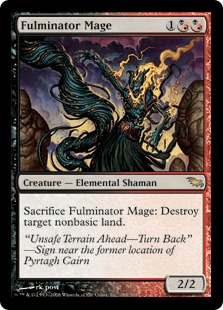
+2 Fulminator Mage
+1 Maelstrom Pulse
+1 Liliana, the Last Hope

-3 Fatal Push
-1 Terminate

This particular board doesn't really have that much for this matchup. I would prefer to have more Fulminators and likely wouldn't be opposed to some form of additional threat, or even perhaps an Ancient Grudge. That said, I would not bring in the Surgical.

Why? Certainly I understand the appeal—you constantly get to take a peek at your opponent's hand when you are playing 8 one-mana discard spells, and who doesn't want to Surgical an Urza land blown up by a previous Fulminator Mage? I don't deny that Surgical can have some power in the matchup—however, it does not ultimately assist you in your primary game plan, and will often rot in your hand with no good target. On top of that, your opponent is likely bringing in some number of Rest in Peace that could cause Surgical to be dead altogether.

Considering Your Game Plan

How would you expect the average game in this match-up to play out? Ideally, you will be leading on early discard spells and then following up with some threat, either Death's Shadow or Tarmogoyf. You will be looking to destroy your opponent's Urza lands with Fulminator Mage as quickly as possible, then hopefully repeating the process by utilizing Kolaghan's Command or Liliana the Last Hope's second ability.
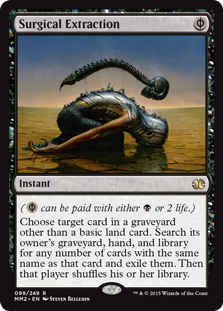
At this point in the game, if you have sided in Surgical Extraction, drawn it, and also drawn Fulminator Mage, you will find yourself with a good target: an Urza land in your opponents graveyard. Not having to worry about your opponent assembling Tron will give you some extra breathing room and help buy you plenty of time to finish the game—but was it necessary?

In this hypothetical situation, you have most likely already played some number of discard spells, landed a threat, and used a Fulminator Mage to destroy an opponent's Urza land. During this period, you've also been attacking with your threat(s); how much more time do you really need? You won't be able to accomplish every angle of disruption each game, but your primary game plan relies on some combination of these different angles of attack to buy you enough time for your Goyfs and Shadows to get the job done. Surgical only helps buy you additional time when drawn in combination with the Fulminator, or in combination with discard spells. Otherwise, it serves no purpose.

Everything is Situational

Consider the following alternate reality where your Death Shadow Jund list is slightly different. Your maindeck is identical to the previous list excepting the following changes:
+1 Fatal Push
+1 Lingering Souls

-1 Abrupt Decay
-1 Terminate

Sideboard remains unchanged.

Is siding in Surgical in this instance more reasonable, or is it still over the top? Personally, this configuration would push me over the edge and cause me to side in Surgical. The Fatal Pushes cannot remain for postboard games, and the maindeck Souls (an unusual choice, to be sure) are far too slow to make a relevant impact. Nothing else in the board is particularly productive, and as such, I'm left with the Surgical. I mention this instance to illustrate how situational each sideboarding decision can be. I stand by the claim that Surgical Extraction should not be brought in for this particular matchup, when you have reasonable alternatives or don't need to cut many cards. However, sometimes you simply need to get more cards out of your maindeck—for those instances, Surgical has some merit and can definitely do the job.

Surgical Extraction is just one example of a card like this in Modern. Many "cranial" effects are similar culprits: Stain the Mind, Slaughter Games, and others. Blood Moon can often offer a comparable temptation, just as the previously mentioned Stony Silence can.

Resist the Temptation

Why as Magic players are we so often tempted to make something work even if it might be a stretch? The answer is simple: it's human nature. We often look at cards in our opening hand, cards in our sideboard, or cards available to us when constructing a deck, and we think about the ways we can make those cards work. We think about all the possible applications, the situations where they can be good, and we spend significantly less time thinking about the ways in which we can get punished for keeping a close hand or siding in a card with a very narrow application. Learning to reign in this impulse and tighten up our sideboarding decisions will ultimately lead to a higher win percentage, especially in Modern.


 

Modern’s Removal: Blessing or Curse?

Are you a Quiet Speculation member?

If not, now is a perfect time to join up! Our powerful tools, breaking-news analysis, and exclusive Discord channel will make sure you stay up to date and ahead of the curve.

You sit down to fill out the last few slots of your generic three-color midrange brew. You’ve responsibly dedicated seven slots to removal; now what? You’ve heard Lightning Bolt is good, but is it really the best option in 2017? What’s a mage to do?

Today, we’ll be using theory and analysis in combination to frame a fresh discussion around one of the most influential tenets of Modern Magic: removal. With Amonkhet set to shake things up as we speak, I figured now is as good a time as any to talk about ever-present, unchanging Magic principles. As we all know by now, a particular spell’s success or failure is just as dependent on context as it is on rate or power. As Modern remains primarily a format where you die by being dealt 20 damage, a summary and discussion on the best means to prevent said damage sounds appropriate. Let’s get to it!

Chicken or the Egg?

Wild Nacatl is a powerful creature, which pushes opponents to play Lightning Bolt to fight it. Lightning Bolt is a fine answer to Wild Nacatl, which discourages opponents from playing Wild Nacatl. This is the circle of life in Modern; a symbiotic relationship between creature and kill spell. Both options are powerful enough on rate alone to see play regardless of context, but their relative worth can rise and fall depending on multiple factors. If Lightning Bolt is all over the format, Wild Nacatl’s relative strength worsens (slightly) while other options get better. Monastery Swiftspear, Goblin Guide, Strangleroot Geist, and Experiment One (to an extent) all perform similar functions, but in slightly different ways that have cascading repercussions (or benefits) depending on how they align with the format.

The most recent example of this philosophy in practice is the mismatch between Tasigur, the Golden Fang and Fatal Push. Fatal Push has had three months to affect Modern, and is the primary reason why manlands are down, delve creatures are up, and Death's Shadow aggro is kept in check. The card is powerful, so it sees heavy play—in return the format shifts organically to respond to its effects. Tasigur, the Golden Fang, Reality Smasher, Gideon Jura, and Lingering Souls are some of the best ways to fight Push.

Now, all of these cards saw play before Fatal Push, and Fatal Push is still seeing play despite their presence. Great cards stay great; it’s the cascading effects we need to watch out for. This is a game of inches, one where Esper Control is a slightly better metagame choice than UW Control based on the specific cards that other archetypes are employing to adjust into a better position against the field. Intricacies, also known as the absolute best part of Magic.

A Summary of Options

Here are the most popular, unique and effective non-sweeper options to handle creatures in Modern. By no means is this list exhaustive, but for the most part there should be a comp here for whatever spell you might need in a certain situation.

Path to Exile
Condemn
Oust
Vapor Snag
Fatal Push
Devour Flesh
Lightning Bolt
Dismember
Terminate
Abrupt Decay
Azorius Charm
Detention Sphere
Maelstrom Pulse
Engineered Explosives

Modern is defined by mana efficiency, so for the most part one-mana removal spells are conditional, two-mana unconditional, and three-mana unconditional with a chance for some value attached. For more on this, refer to my first article ever written on this site for 1500 words on this topic alone. As a good rule of thumb, most creatures in Modern follow a similar pattern; one mana for a weak threat, two mana for a threat with some resiliency, three mana for value. A creature that can “trade up” across the chart is considered strongly positioned, while one that trades down is relatively weak.

The best way to illustrate this is through examples. Knight of the Reliquary is actually a strong option in a Lightning Bolt-dominated format, but lines up poorly against Terminate (two-mana answer for a three-mana threat). One-mana threats are baseline neutral because, worst case, they will always generate at least a mana’s worth response from the opponent (unless you play into a sweeper, which is why sweepers are awesome). Until a couple months ago, Tarmogoyf was the gold standard for two-mana threats because a good one-mana solution to the threat that didn’t give back some form of value just didn’t exist. Path to Exile gave a land, Dismember gave it haste, Condemn and Oust were too conditional to be played. Playing a threat with the security that it would at least be answered evenly was for a long time the closest thing to a safe bet, like that one time I doubled $50 on 11 playing blackjack. I lost that hand, and Tarmogoyf has as well, thanks to Fatal Push.

Among these options, the best, cheapest, mono-color option that reliably trades up the chart is surprisingly Strangleroot Geist. Thanks to haste, it is always generating some form of value in every situation that doesn’t involve Path to Exile. Unfortunately, it’s in the worst color. Voice of Resurgence is more powerful, and probably just as playable, as every deck that plays green usually plays white as well.

Remember, the idea here isn’t to "blank" removal; that’s impossible for the most part. We don’t play Wild Nacatl in the hopes that our opponent just "doesn’t have it" and we get to hit for four turns un-impeded. We play Wild Nacatl because (before) it put our opponent on a four-outer: have Lightning Bolt or take some damage. Even if they do have it, we have more creatures to play. It’s a numbers game; if we wanted to overload removal we’d play Young Pyromancer in every red deck. The goal is to attempt to line up our threats as awkwardly as possible to our opponent’s answers, and vice versa.

As is the case with every rule that doesn’t involve mathematics, outliers exist. Detention Sphere on paper is bad; unless we’re getting multiple cards' worth of value out of the spell, we’re at a disadvantage. Detention Sphere’s true strength is latent—it gives us flexibility, often in archetypes that need it the most. UW can handle all the creatures you can throw at it; you can’t say the same about Blood Moon, Keranos, God of Storms, and Liliana of the Veil. Three mana might be “overpaying” 80% of the time, but if it gets us to our lategame or solves the issue at hand, it’s worth it every time. This is why Jund plays Maelstrom Pulse, and why Grixis would as well if it were on-color. No, we’re not packing four and beaming about it to our mothers, but we’ll play a copy or two to get the job done.

Cause and Effect

Contrary to popular belief, Condemn is great against Death's Shadow. It answers every creature they have, can strand future Death's Shadows, and can even two-for-one. It dodges placing the creature in the graveyard to be returned later with various synergies. Still, it falls behind Path to Exile and Fatal Push. They will always be attacking, obviously, but there are narrow windows when we can’t Condemn, and Death’s Shadow’s numerous discard spells can take it away. Death’s Shadow is normally leading with a discard spell to start the game, which means they're taking whatever removal spell we have in hand before a creature hits the board regardless, so in that scenario, Condemn and Path to Exile are the same. The issue, of course, is when they play discard before attacking, after they have a creature on the board. We could have drawn the Condemn that turn, we could have had it in hand—regardless, if they have a discard spell at their disposal, they will get a chance to take our Condemn before we have a chance to use it.

How it usually plays out in games is slightly different, but it’s important to recognize what’s happening under the surface. Often we have more than one piece of removal in hand, just like they often have more than one piece of discard. Still, it’s these sorts of intricacies that can often be the difference between winning and losing games.

Burn is pretty much the only archetype utilizing haste at this point. Oust is something to consider, but only as a worst-case scenario. Second from the top is just two turns away, which places Oust somewhere between Terminate and Vapor Snag. Both of those spells are on this list, but that’s not where I want to be while Condemn is still a strong option.

Azorius Charm has seen minor play before, but that was in a format dominated by Tarmogoyf, where the only playable on-color answers were Path to Exile and Spell Snare. Currently, it’s a more expensive Condemn that can draw us a card if we need it. Were the format to get more diverse and less creature-based, I could see this pop up as a less efficient option that isn’t dead in non-creature matchups. But for now, its still pretty far away from the radar.

Conclusions

With all this information, where do we go from here? Everyone knows about Tasigur to fight Fatal Push by now. What happens as a result of this change? Generating tokens has always been one of the best ways to answer one-for-one removal. Black decks now have a one-mana option that can boast efficiency with the likes of Path to Exile and Lightning Bolt, and against 80% of the creatures in Modern Fatal Push is probably better. That’s a big deal, so I would expect these “shifts” we’re seeing to be relatively permanent unless something big changes things up.

Keep an eye out for "strange" options like Kird Ape or Geist of Saint Traft that are obvious responses to fight the removal people are playing. Fatal Push is too resilient to blank completely, but minor changes to creature bases can result in drastic positional shifts.

When removal becomes too much for creature decks, the next logical step is for creatures to stop coming out to play like the cowards they are. We are seeing Dredge come back into the light, and it looks like Ad Nauseam might be getting a boost as well. It’s possible, but perhaps Fatal Push might be “too strong” and cause creature decks to decline across the board in favor of combo. Time will tell, and part of the blame should definitely be given to Dredge itself, but we might look back on this period in a few months and point to Fatal Push as the culprit that pushed Modern further into combo-land.

So, for the foreseeable future, Modern will continue to be manipulated by Fatal Push and those trying to next-level it. Tasigur, the Golden Fang and Lingering Souls will remain the primary means to fight the removal spell, which in turn will keep creature decks from becoming obsolete. That’s slightly tongue in cheek, but it isn’t difficult to imagine a format without delve and flashback, where the reactive decks can play four Lightning Bolt and four Fatal Push and keep creatures decks pinned. While aggro and midrange are looking to level each other on card choice, keep an eye out for combo to go over the top of both.

Thanks for reading,

Trevor Holmes

Insider: Picking Bulk Without Picking Bulk

Are you a Quiet Speculation member?

If not, now is a perfect time to join up! Our powerful tools, breaking-news analysis, and exclusive Discord channel will make sure you stay up to date and ahead of the curve.


The Business of Bulk

It's been a little while since we talked about the metrics and "how-to" of sorting bulk, if we exclude my set reviews. I've been taking a couple days each week to visit the bulk lair that is my father's basement where I store all the commons and uncommons I've accrued over the past year (my apartment in Utica is just too small and on the fourth floor with no elevator). Now that my internship is over and my schedule is freed up a lot more, I've had some extra time to delve into the stuff that I've sort of dropped off without, well, sorting.

I've found a lot of juicy stuff, and it hasn't really taken me that long to skim through the boxes for picks. I've been doing this a long time, and again, I've sort of become desensitized to exactly what kind of work I'm putting in. My dad came down to see how I was doing at one point, and he was shocked at the size of the "done" pile in the few hours that I had been chugging along at bulk picks. I had gone through over 20,000 bulk commons and uncommons in only a few hours, and he was curious at how I had managed to do that while still actually looking at the cards and pulling out the ones I wanted to keep.

What I explained to my dad that day is what I'm about to explain to all of you, and relates to the title of the article.

When you buy bulk, it's usually already organized in some shape or fashion. Sometimes it's color sorted (usually it's color sorted), sometimes it's carefully set sorted. Sometimes the bulk is unintentionally set sorted (usually when it's the remnants of several booster boxes, with lands and token cards left in). I've been picking a decent chunk of bulk that's been parsed out by rarity; all of the commons are in X boxes, and the uncommons are separate. Once you understand which box you're going through, you can start to make hypothesis about the remainder of the cards in the box without having to go through every box of bulk equally.

BULK12

Take the above picture as an example. After thumbing through a couple hundred upside-down cards in each row, we can see that it's all commons. This is bulk that someone has already gone through (although when that happened is unknown), and they separated it into boxes of all commons, and all uncommons. According to the fistful of cards that I pulled from the artifact section (they also color-sorted it, lucky us), we can figure out that it's mostly Scars of Mirrodin block. Those of you in class that did their  homework know that SOM bulk is just juicy with picks, even when it's simmered down to just commons. While there won't be any Palladium Myrs or Exsanguinates in the box, this block still has some powerful picks with a black symbol. Ichorclaw Myr, Grasp of Darkness and Galvanic Blast in SOM itself make this box worth pulling through; the former two are especially unlikely to be previously picked by a competitive player.

SOM Bulk Common Picks

bulkSOM

NPH Bulk Common Picks

BulkNPH

This strategy can be applied to most bulk that has been "sorted" by color and/or rarity to an extent, and you can use your own judgment to determine whether or not it's even worth picking through. Let's look at a couple more fistfuls of bulk.

BULK13

Alright, so this looks promising in terms of sets. Time Spiral, Mirrodin, Zendikar, and I even see a Shadowmoor symbol in there on the back of a Devoted Druid spiking. I guess this box will be worth my time, especially those insane TSP commons.

BULK14

Do you see the relevance in this pic? It's hard to catch because of the poor lighting, but there's a small batch of uncommons in this one. When I realized that the grey and black symbols were clustered, it became a lot easier to piece out for the grey symbols and look for the actual relevant uncommons in Rise of the Eldrazi. Hint: there's a lot of them.

Unfortunately, there are some sets that might not be worth your time to pick through if you're hoping for haymakers like Hada Freeblade and Soul's Attendant. Many of the recent fall sets that have been released in the past four years are simply lacking in common picks, making it easy for you to skim through them at lightning speed. No uncommons? It's probably safe to ignore KTK or BFZ. I'll show you those two sets on Trader Tools, with uncommons hidden.

BulkKTK

BulkBFZ

As you can see, KTK pretty much only has the common dual lands to pick from. While that's fine for some, not everyone will be satisfied when they're hunting for Monastery Swiftspear and Vampire tokens. This is obviously not a perfect practice if you're trying to get blood from a stone and drain every ounce of value from your bulk, but it does give you an alternate tool in your arsenal if you have 400k bulk to pick through in a limited amount of time, especially if you realize that some of your bulk is already sorted by rarity or color.

End Step

I have one more little tip that didn't really fit in with the rest of the article, but still could save you time in the long run for those of you who really want to go through bulk like it's a speed run, and don't care as much about pulling out every nickel. I don't have any physical evidence to support this, so you'll just have to take my word for it as the bulk guru.

In my experience, there's a tier list to the five colors in Magic and how many pickable cards each color has. I'm sure this would be a fascinating article if I had a decent way to process the data from a spreadsheet like the Blueprint or Cardkingdom's buylist, but that can be tackled another day. I've noticed over the past several years that some colors have more pickable commons than others. The following list goes from weakest to strongest.

5. White: Most sets just don't have strong white pickable commons. I think part of that has to do with white's role as the second weakest color in Commander, and some of it has to do with the fact most of the high-powered weenie creatures that give white its trademark identity are uncommon. While white gets Path to Exile, Swords to Plowshares and Mother of Runes at uncommon, these are all also very old cards and really rare to find in bulk. White doesn't have universal powerhouse commons like Lightning Bolt, Cultivate, Preordain, or Ponder.

4. Black: Again, black just doesn't have as much in the common slot. Shadowborn Apostle and the previously mentioned Grasp of Darkness, sure, but nobody is picking out Doom Blade. Go for the Throat is uncommon, and while Viscera Seers are welcome, they're harder to come by. (I repeat: this is just a hypothesis based on my own experience.)

3. Red: Red gets some of the good old Modern/Legacy playable burn spells at common, which helps a lot. Lava Spike, Faithless Looting, Searing Blaze, and Insolate Neonate make red more appealing than the two previous colors.

2. Blue: For some reason, I feel like blue has a lot more playable commons than people give it credit for. The various one-mana cantrips all hold value extremely well (Brainstorm, Preordain, Ponder, Thought Scour, etc.), and it also gets Spell Pierce and Vapor Snag. Spreading Seas at common is fine, and the list goes on. When I pick bulk, I very rarely pass over a box of "blue commons," where white often gets dismissed entirely unless it's from a select few sets.

1. Green: I find it hard to guess whether blue or green takes the crown here, but the variety in common ramp really pulls through here. Green just has so many common Commander staples that pull the color together, from the dynamic duo of Cultivate/Kodama's Reach to Modern pump spells like Mutagenic Growth and Groundswell at common. Lastly, elves do a huge amount of work here. When you pick nickels and dimes, a box of green commons can yield massive gains from just Elvish Visionary and Nissa's Chosen. Don't even get me started on Lorwyn block elves.

Cleanup Step

Okay, I guess that's it for now. Hopefully I saved some of you some time in picking bulk. My dad thought I was picking at superhuman speed, but in reality I just knew that the EV of digging through a box of white commons from 2012 onward was basically zero. I had a 5k of BFZ commons, and knew that skipping it was worthwhile because there would be no Zulaport Cutthroat or Sylvan Scrying. Let me know what you think of this strategy in the comments, or if you have your own secret techniques for picking bulk!

Want Prices?

Browse thousands of prices with the first and most comprehensive MTG Finance tool around.


Trader Tools lists both buylist and retail prices for every MTG card, going back a decade.

Quiet Speculation