menu

October ’24 Metagame Update: Energetic Evolution

Are you a Quiet Speculation member?

If not, now is a perfect time to join up! Our powerful tools, breaking-news analysis, and exclusive Discord channel will make sure you stay up to date and ahead of the curve.

The Modern RCQ season is nearing its end, so Modern's metagame will shift into waiting mode. At least we'll get another one next year. Everyone assumes that at least one card will be banned on December 16th, and, given the data this month, we know which deck will be targeted. Which card(s) will be targeted, however, is anyone's guess.

The Obvious Outlier

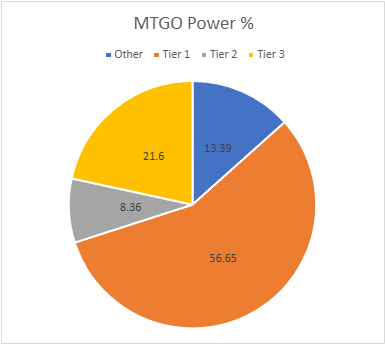
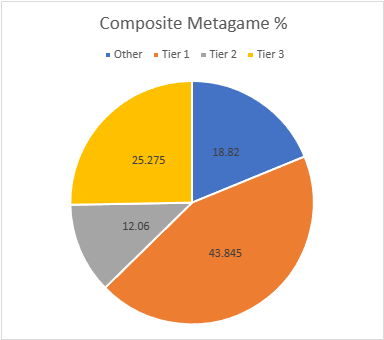
As I and I assume everyone else expected, Boros Energy is a massive outlier in October's data across Magic Online and paper. The outlier tests were just due diligence to see if anything else would be joining it. Everything else on MTGO were solidly safe, though both Amulet Titan and the Domain Zoo piles were borderline. The most restrictive test had them as outliers, but none of the other ones did, so they stayed in the data set. As always, outliers are removed from the statistical analysis but are reported on their correct place on the Tier List.

There was an error retrieving a chart for Ocelot Pride

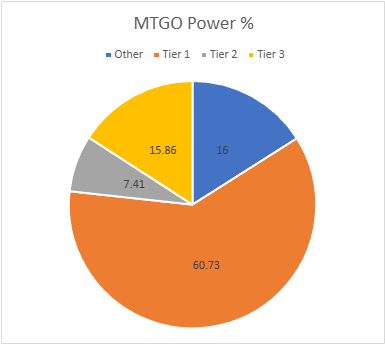
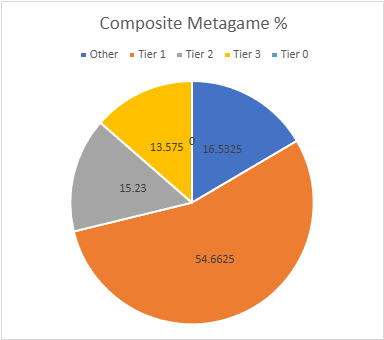
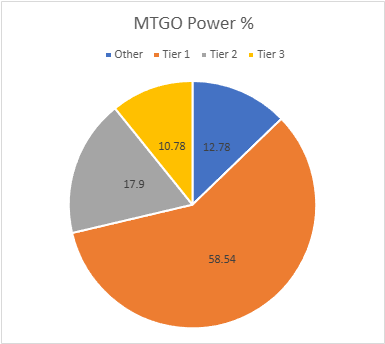
Despite its metagame percentage, Boros Energy is not a Tier 0 deck. It has the massive metagame percentage down on MTGO, but its average points are too low in both play-mediums. In fact, if I was only looking at RCQ results, Boros Energy would have severely underperformed on average points at 1.44.

For comparison, if I do that to Titan it'd fall to 1.67 but remain above Baseline while decks like Tameshi Belcher are unaffected. Boros did very well in three early 3-point events, but performed poorly in the medium range, 2-point events. As the majority of paper events are small 1-pointers, it's critical for decks to show up to those medium events to keep their totals up, especially a deck as popular as Boros.

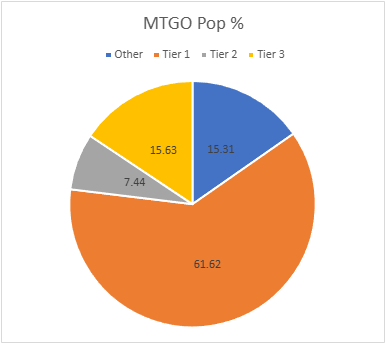
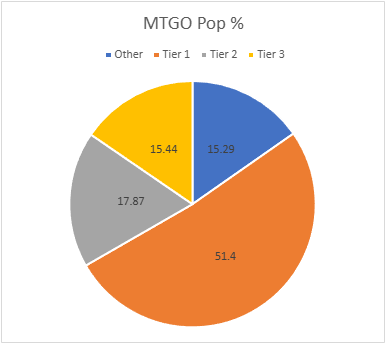
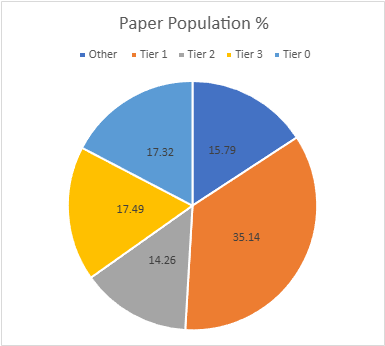
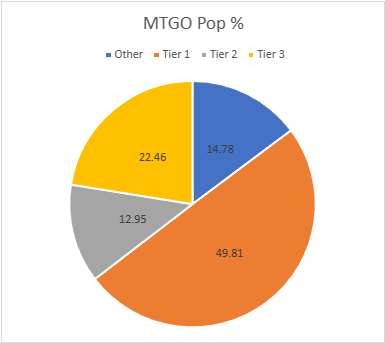
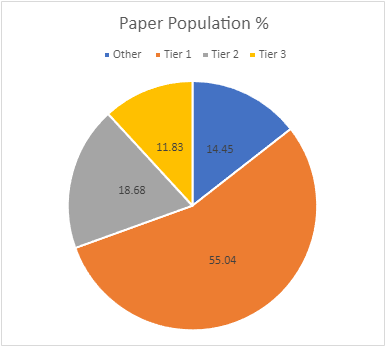
October Population Metagame

To make the tier list, a given deck has to beat the overall average population for the month. The average is my estimate for how many results a given deck "should" produce in a given month. To be considered a tiered deck, it must perform better than "good enough". Every deck that posts at least the average number of results is "good enough" and makes the tier list.

Then we go one standard deviation (STdev) above average to set the limit of Tier 3 and the cutoff for Tier 2. This mathematically defines Tier 3 as those decks clustered near the average. Tier 2 goes from the cutoff to the next standard deviation. These are decks that perform well above average. Tier 1 consists of those decks at least two standard deviations above the mean result, encompassing the truly exceptional performing decks.

There was an error retrieving a chart for Lotus Field

The MTGO data nearly exclusively comes from official Preliminary and Challenge results. Leagues are excluded, as they add analytically useless bulk data to both the population and power tiers. The paper data comes from any source I can find, with all reported events being counted.

While the MTGO events report predictable numbers, paper events can report anything from only the winner to all the results. In the latter case, if match results aren't included, I'll take as much of the Top 32 as possible. If match results are reported, I'll take winning record up to Top 32, and then any additional decks tied with 32nd place, as tiebreakers are a magic most foul and black.

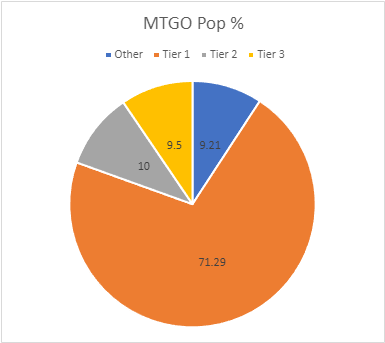
The MTGO Population Data

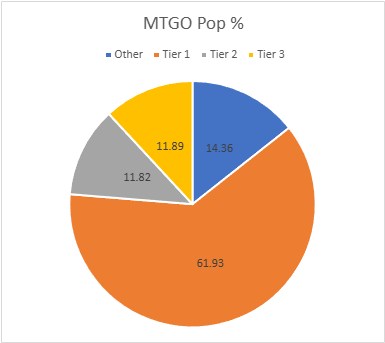
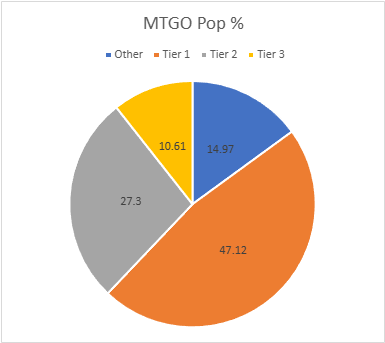
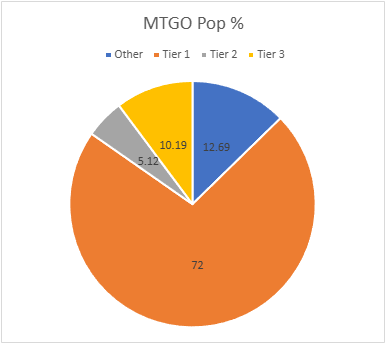
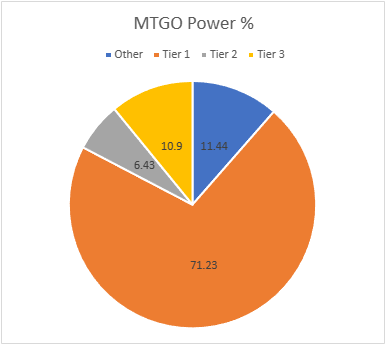
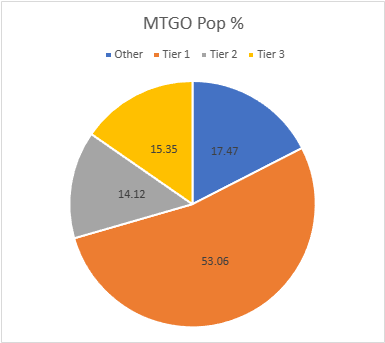
October's adjusted average population for MTGO is 10.04. I always round down if the decimal is less than .20. Tier 3, therefore, begins with decks posting 10 results. The adjusted STdev was 16.97, so add 17 and that means Tier 3 runs to 27 results. Again, it's the starting point to the cutoff, then the next whole number for the next Tier. Therefore Tier 2 starts with 28 results and runs to 45. Subsequently, to make Tier 1, 46 decks are required.

There was an error retrieving a chart for Psychic Frog

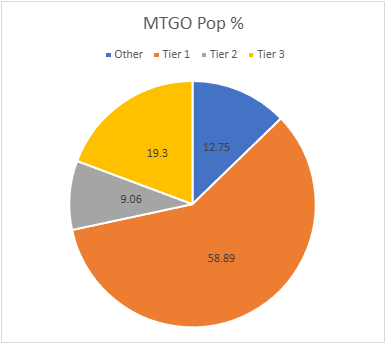
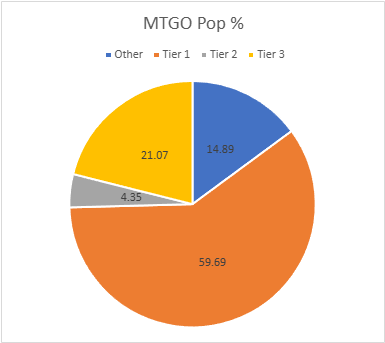
The sample population fell, and while I know the mechanics I don't know the reason. Challenge size was down, with some barely making 32 players, which meant I only took those decks with winning records. I'm told that the prize support's been decreased, which makes Challenges less appealing. October's population is 1192, down from1360 in September. The number of unique decks fell to 88, so the unique deck ratio is 0.074, functionally the same as in September. The number of tiered decks rose from 23 to 27. The data's horribly warped, but at least diversity is holding steady.

Deck NameTotal #Total %
Tier 1
Boros Energy31826.68
Tameshi Belcher897.47
Mardu Energy675.62
Domain Zoo635.28
MG Eldrazi625.20
Ruby Storm524.36
Abhorent Frogtide514.28
Tier 2
Living End433.61
Temur Breach Combo373.10
RG Eldrazi282.35
Tier 3
Goryo Blink231.93
Frogtide211.76
Amulet Titan191.59
Jeskai Energy171.43
Oculus Frog161.34
UW and Phlage Control131.09
Hollow One121.01
Kappa121.01
Belcher121.01
Broodscale Combo121.01
Jeskai Control110.92
Lotus Field110.92
Necro110.92
4-C Elementals100.84
Mill100.84
Jund Delirium100.84
Yawgmoth100.84
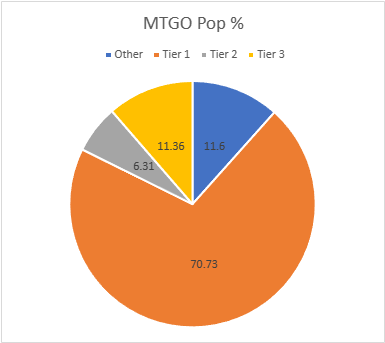
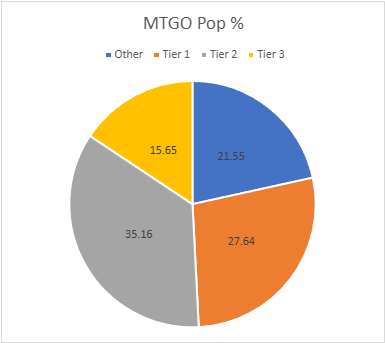
I'm gradually accepting that MTGO just isn't going to produce anything similar to a normal metagame.

While Boros continues to blow every other deck away, I remain unimpressed. It surged to the top spot on the basis of the first two weeks of data. After that, it fell off and Mardu Energy began making a comeback. I was never clear why Mardu fell off in the first place, but MTGO's playerbase is notoriously arbitrary and capricious, turning on successful decks for no apparent reason.

The resurgence is likely due to October's Big Story: combo has arrived! Boros Energy is not a very fast aggro deck, primarily dealing chip damage before a big turn involving Ajani, Nacatl Avenger and/or Goblin Bombardment. It was vulnerable to racing if you could dodge its removal and blockers, which is where pure combo decks come in. Ruby Storm has put up solid numbers as a result, but the real winner has been Goblin Charbelcher.

Wizards' love of MDFC's like Sink Into Stupor have allowed the deck to go mono-blue. In turn, they're now running as many free counterspells as possible, meaning they can defend the combo while answering hate. The version using Lotus Bloom and Tameshi, Reality Architect is by far the most successful version, as drawing lots of cards and making lots of mana is always good in combo decks. We'll see if it can sustain this success. Mardu has a much better matchup against combo than Boros, which is likely driving its resurgence.

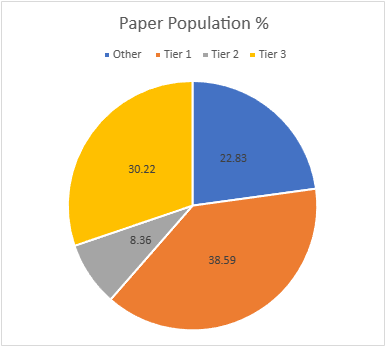
The Paper Population Data

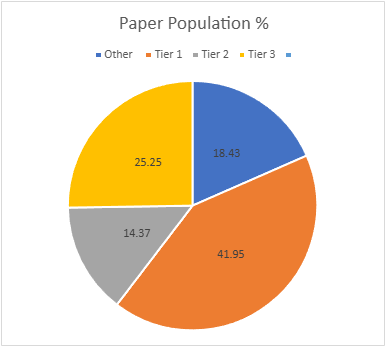
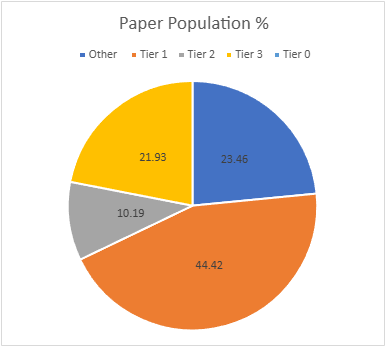
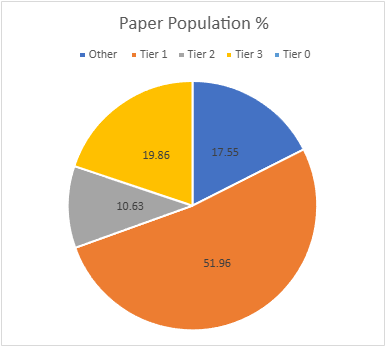
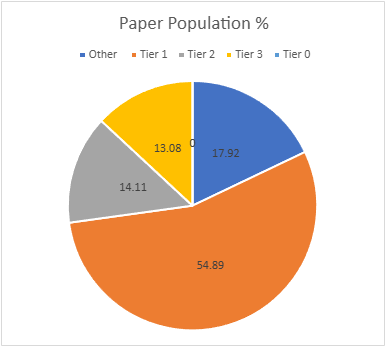
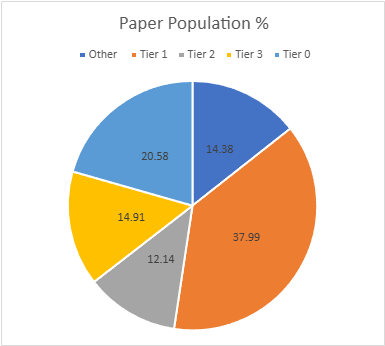
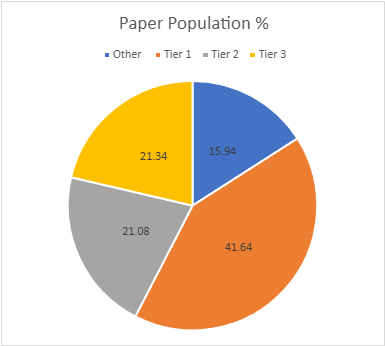
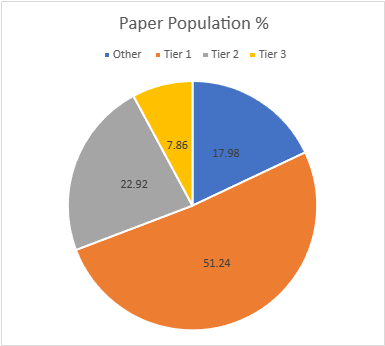
The RCQ season is winding down, and events were generally smaller than in September. That said, paper's population is still high for the year. January had 803 decks, February 890, March had 311, April hit 559, May fell to 389, June had 536, July rose to 589, August hit 758, September surged to 1155, and October is down to 997. Diversity has recovered slightly, with 97 unique decks and a ratio of 0.97. up from September's .093.

The population decrease is countered by the diversity increase, and 27 decks made the tier list. The adjusted average population was 8.60, so 9 results make the list. The adjusted STDev was 13.09, so the increment is 13. Therefore, Tier 3 runs from 9 to 22, Tier 2 is 23 to 36, and Tier 1 is 37 and over.

Deck NameTotal #Total %
Tier 1
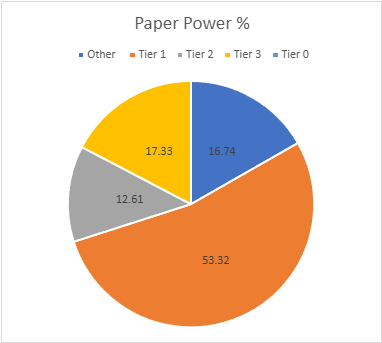
Boros Energy17117.15
Domain Zoo585.82
Amulet Titan575.72
Frogtide484.81
Abhorent Frogtide484.81
Ruby Storm464.61
Mardu Energy464.61
Goryo Blink444.41
Tier 2
Jeskai Control272.71
Yawgmoth272.71
Tameshi Belcher272.71
MG Eldrazi252.51
Tier 3
MG Etron171.70
Living End171.70
Temur Breach Combo161.60
Necro131.30
Izzet Wizards131.30
UW and Phlage121.20
Merfolk121.20
RG Eldrazi121.20
Izzet Murktide111.10
Belcher101.00
Jund Saga101.00
4-C Elementals101.00
Mill90.90
Burn90.90
Jeskai Dress Down90.90
Hardened Scales90.90
Naya Ritual Energy90.90
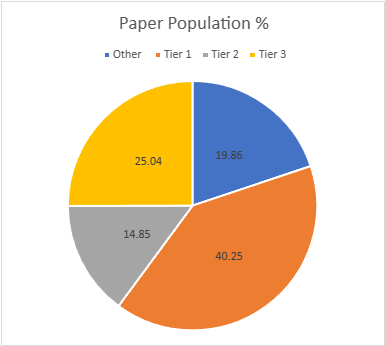
At least paper tries to be normal.

As I've alluded to, Boros wasn't the force in paper that it was online. It's still a massive outlier, just not as massive. We also didn't see the massive adoption of Belcher in paper as online. Part of this is simply that it's easier to switch decks on MTGO than in paper. However, Amulet Titan never dies because that's all its players want to do. I believe that Titan is taking up most of the available combo space and the other decks aren't able to compete, especially since Titan's going even harder on comboing with Lotus Field and Aftermath Analyst.

Eye, Aye?

The other big story is Abhorrent Oculus. Alongside Unearth, the eye was hailed as a deck redefining card. I'd dispute that conclusion, as the number of cards that have been changed to accommodate Oculus pushes it to being a totally new deck. It also plays more forwardly than Frogtide did. However, it appears that it doesn't matter if you play Oculus or not in paper. Abhorrent Frogtide did exactly as well as the older, eyeless version.

There was an error retrieving a chart for Abhorrent Oculus

In my experience, Eye isn't an across-the-board improvement. Rather, it moves the deck from tempo/midrange towards tempo/combo. Essentially, it's hoping to get lucky reanimating Oculus on turn 2 and ride it to victory before the opponent can react. Psychic Frog plays similarly but is more vulnerable to removal. This comes at the price of having to play Thought Scour and Unearth, cards that aren't particularly useful outside of Oculus interactions. Normal Frog just plays interaction in those slots. Thus, the decks have different matchup spreads and one version isn't unequivocally better than the other.

Why then, did Abhorrent outperform normal Frogtide online? Again, I'd answer that it's just MTGO being MTGO. They'll jump on new tech instantly because it's new tech, regardless of the tech being good or not. Since a lot of players rent, they can switch easily. Paper players need more evidence to make the jump because they have to buy cards. As a result, online piled onto Oculus and performed overall worse than normal Frogtide did in September.

September Power Metagame

Tracking the metagame in terms of population is standard practice. But how do results actually factor in? Better decks should also have better results. In an effort to measure this, I use a power ranking system in addition to the prevalence list. By doing so, I measure the relative strengths of each deck within the metagame so that a deck that just squeaks into Top 32 isn't valued the same as one that Top 8's. This better reflects metagame potential.

There was an error retrieving a chart for Amped Raptor

For the MTGO data, points are awarded based on the population of the event. Preliminaries award points based on record (1 for 3 wins, 2 for 4 wins, 3 for 5), and Challenges are scored 3 points for the Top 8, 2 for Top 16, and 1 for Top 32. If I can find them, non-Wizards events will be awarded points the same as Challenges or Preliminaries depending on what the event in question reports/behaves like. Super Qualifiers and similar higher-level events get an extra point and so do other events if they’re over 200 players, with a fifth point for going over 400 players.

Due to paper reporting being inconsistent and frequently full of data gaps compared to MTGO, its points work differently. I award points based on the size of the tournament rather than placement. For events with no reported starting population or up to 32 players, one point is awarded to every deck. Events with 33 players up to 128 players get two points. From 129 players up to 512 players get three. Above 512 is four points, and five points is reserved for Modern Pro Tours. When paper reports more than the Top 8, which is rare, I take all the decks with a winning record or tied for Top 32, whichever is pertinent.

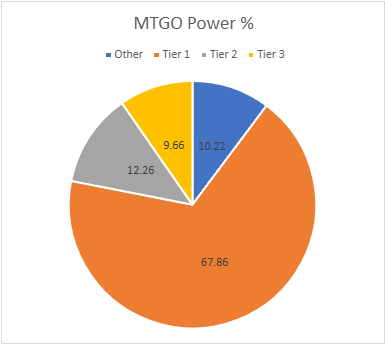
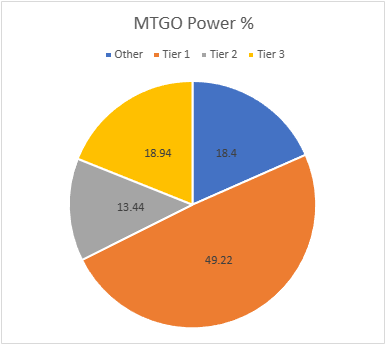
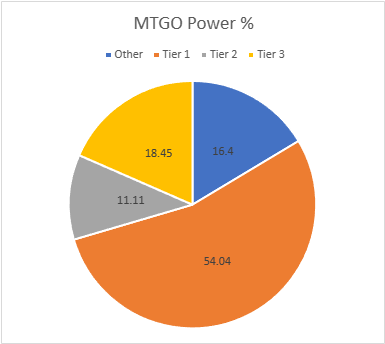
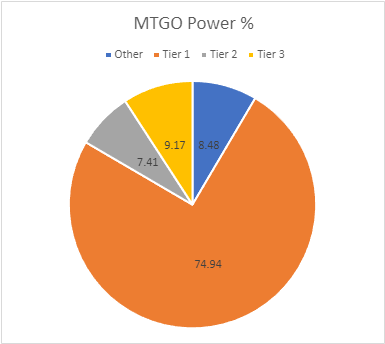
The MTGO Power Tiers

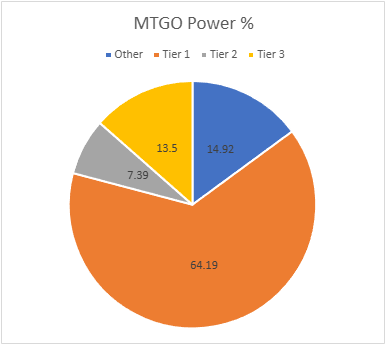
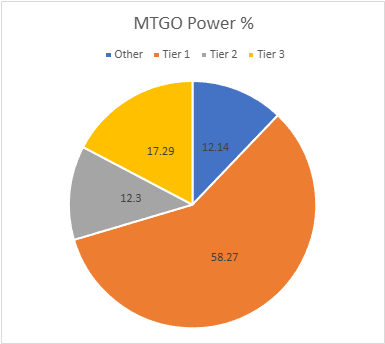
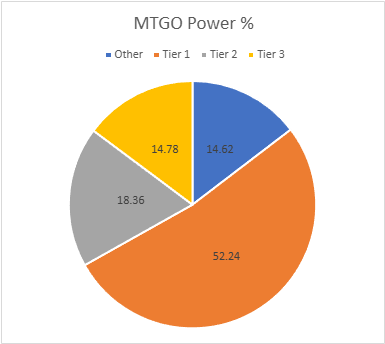
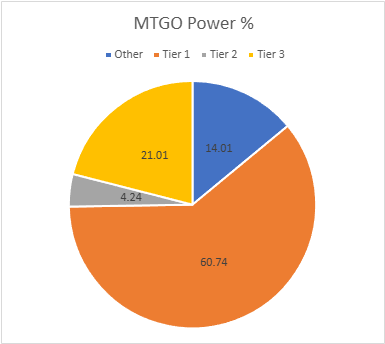
As with the population numbers, total points are down from 2456 to 2106. The adjusted average points were 17.29, therefore 18 points made Tier 3. The STDev was 30.92, so add 31 to the starting point, and Tier 3 runs to 49 points. Tier 2 starts with 50 points and runs to 81. Tier 1 requires at least 82 points. The bottom end of Tier 3 saw a lot of decks fall off and a few take their place, yielding a net decrease of 4 decks.

Deck NameTotal PointsTotal %
Tier 1
Boros Energy60228.58
Tameshi Belcher1778.40
Mardu Energy1195.65
MG Eldrazi1095.18
Domain Zoo1014.80
Abhorent Frogtide864.08
Ruby Storm854.04
Tier 2
Temur Breach Combo813.85
Living End753.56
Tier 3
RG Eldrazi472.23
Amulet Titan371.76
Goryo Blink361.71
Jeskai Energy331.57
Frogtide311.47
Oculus Frog261.23
Broodscale Combo241.14
UW and Phlage Control231.09
Lotus Field231.09
Hollow One211.00
Belcher211.00
4-C Elementals211.00
Necro200.95
Yawgmoth180.85
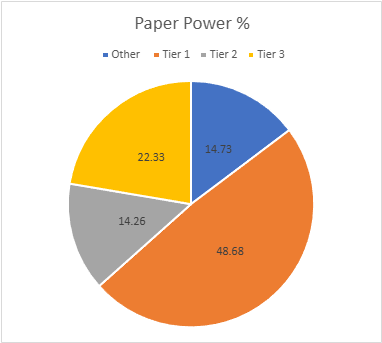
This is what happens when a deck average 50% of Top 8 finishes for weeks.

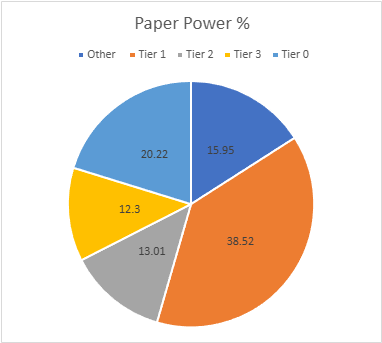
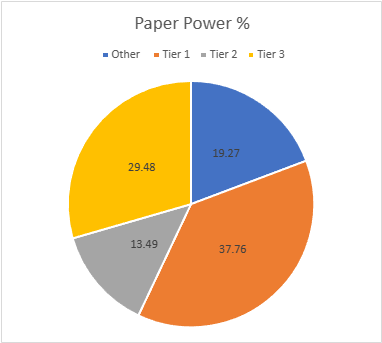
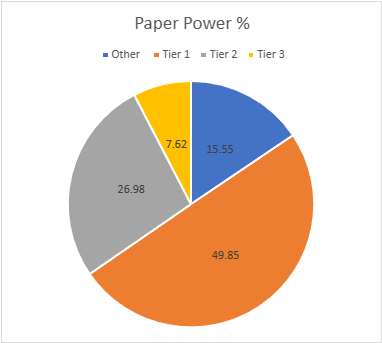
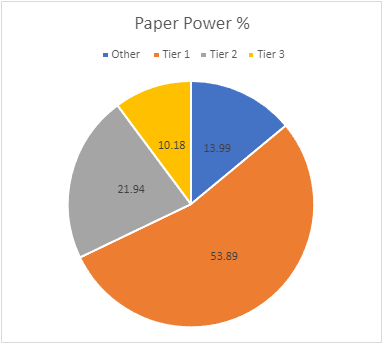
The Paper Power Tiers

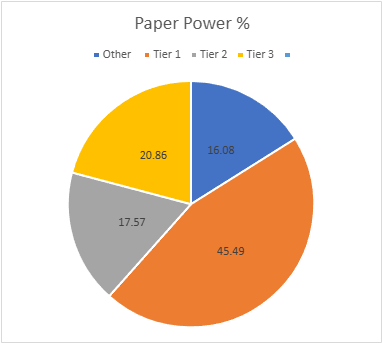
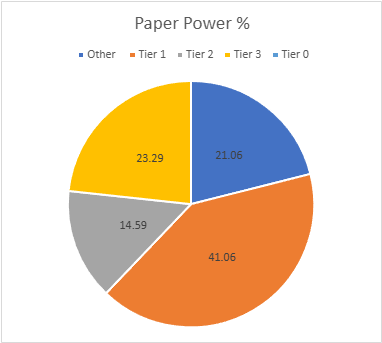
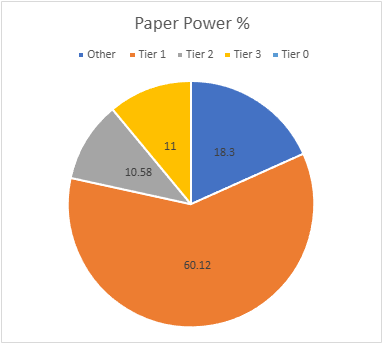
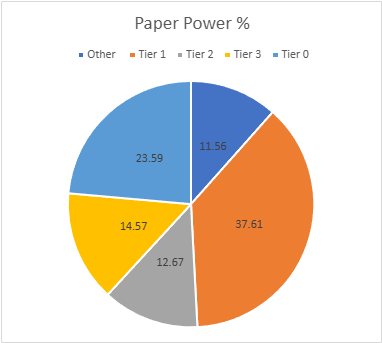
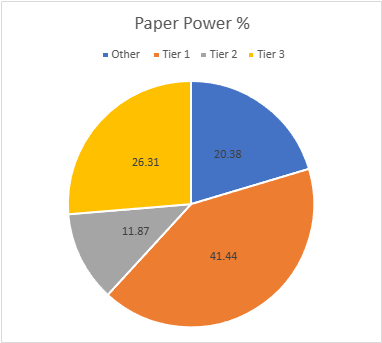
Paper's total points are down from 1863 to 1673. The adjusted average points were 14.40, setting the cutoff at 15 points. The STDev was 22.89, thus add 23 to the starting point and Tier 3 runs to 38 points. Tier 2 starts with 39 points and runs to 62. Tier 1 requires at least 63 points. Like the online data, a number of decks on the bottom end fell off and some were replaced, meaning paper's down one deck on net.

Deck NameTotal PointsTotal %
Tier 1
Boros Energy29117.39
Amulet Titan1156.87
Domain Zoo935.56
Ruby Storm814.84
Mardu Energy804.78
Goryo Blink784.66
Frogtide774.60
Abhorent Frogtide774.60
Tier 2
Tameshi Belcher513.05
Jeskai Control432.57
Yawgmoth392.33
MG Eldrazi392.33
MG Etron392.33
Tier 3
Living End291.73
Necro251.49
Merfolk221.31
Temur Breach Combo211.25
Izzet Murktide201.19
Izzet Wizards191.14
UW and Phlage191.14
RG Eldrazi191.14
Belcher191.14
Mill191.14
4-C Elementals171.02
Naya Ritual Energy160.96
Burn150.90
Domain Rhinos150.90
Esper Control150.90
The increase is down to the influence of a few big events. Otherwise, the metagame share would be entirely unchanged from the population numbers.

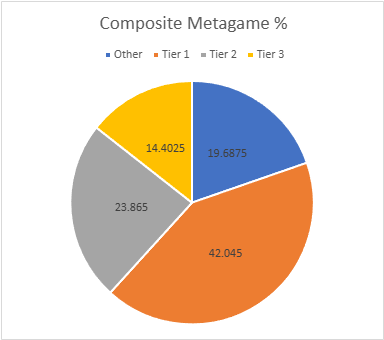
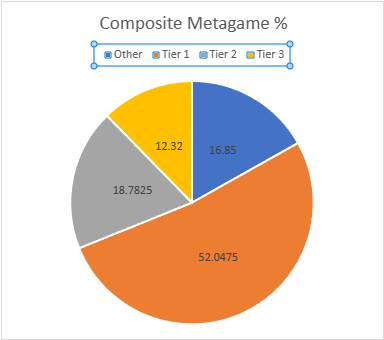
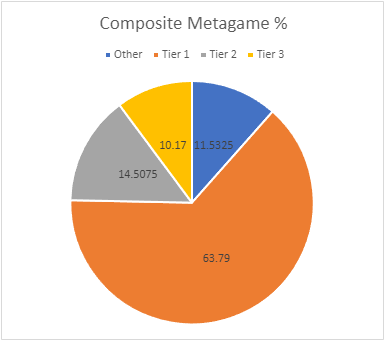
Composite Metagame

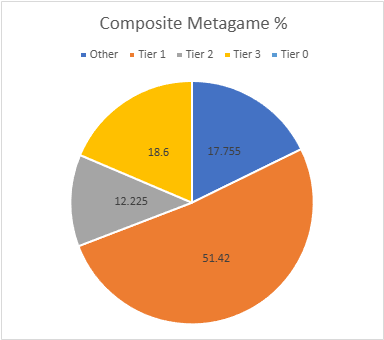
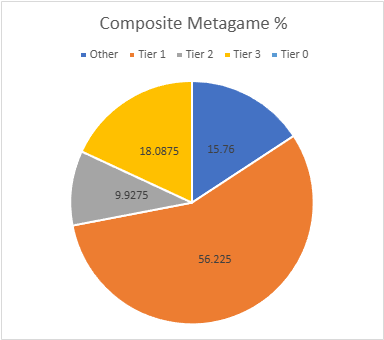
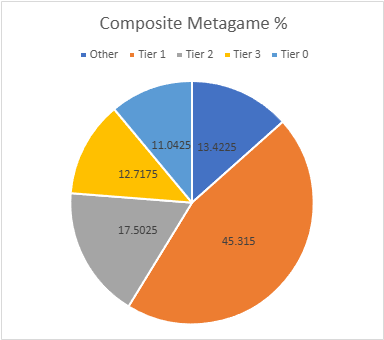
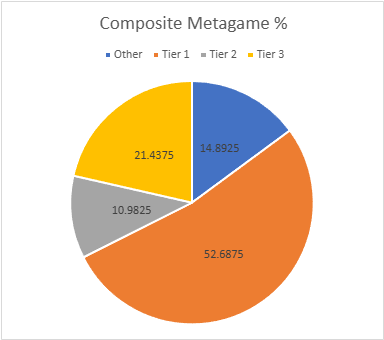
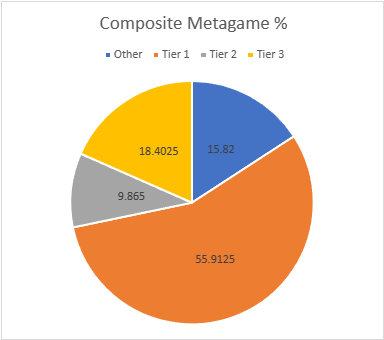
That's a lot of data, but what does it all mean? When Modern Nexus was first started, we had a statistical method to combine the MTGO and paper data, but the math of that system doesn't work without big paper events. I tried. Instead, I'm using an averaging system to combine the data. I take the MTGO results and average the tier, then separately average the paper results, then average the paper and MTGO results together for final tier placement.

This generates a lot of partial Tiers. That's not a bug, but a feature. The nuance separates the solidly Tiered decks from the more flexible ones and shows the true relative power differences between the decks. Every deck in the paper and MTGO results is on the table, and when they don't appear in a given category, they're marked N/A. This is treated as a 4 for averaging purposes.

Deck NameMTGO Pop TierMTGO Power TierMTGO Average TierPaper Pop TierPaper Power TierPaper Average TierComposite Tier
Boros Energy1111111.00
Mardu Energy1111111.00
Domain Zoo1111111.00
Ruby Storm1111111.00
Abhorent Frogtide1111111.00
Tameshi Belcher1112221.50
Mono-Green Eldrazi1112221.50
Goryo Blink3331112.00
Frogtide3331112.00
Amulet Titan3331112.00
Living End2223332.50
Temur Breach Combo2223332.50
Yawgmoth3332222.50
RG Eldrazi232.53332.75
Jeskai Control3N/A3.52222.75
UW and Phlage Control3333333.00
Belcher3333333.00
Necro3333333.00
4-C Elementals3333333.00
Mill3N/A3.53333.25
Mono-Green EtronN/AN/AN/A322.53.25
Jeskai Energy333N/AN/AN/A3.50
Oculus Frog333N/AN/AN/A3.50
Hollow One333N/AN/AN/A3.50
Broodscale Combo333N/AN/AN/A3.50
Lotus Field333N/AN/AN/A3.50
Izzet WizardsN/AN/AN/A3333.50
MerfolkN/AN/AN/A3333.50
Izzet MurktideN/AN/AN/A3333.50
BurnN/AN/AN/A3333.50
Naya Energy RitualN/AN/AN/A3333.50
Kappa3N/A3.5N/AN/AN/A3.75
Jund Delirium3N/A3.5N/AN/AN/A3.75
Jund SagaN/AN/AN/A3N/A3.53.75
Jeskai Dress DownN/AN/AN/A3N/A3.53.75
Hardened ScalesN/AN/AN/A3N/A3.53.75
Domain RhinosN/AN/AN/AN/A33.53.75
Esper ControlN/AN/AN/AN/A33.53.75

Average Power Rankings

Finally, we come to the average power rankings. These are found by taking the total points earned and dividing them by total decks, to measure points per deck. I use this to measure strength vs. popularity. Measuring deck strength is hard. There is no Wins-Above-Replacement metric for Magic, and I'm not certain that one could be credibly devised. The game is too complex, and even then, power is very contextual.

Using the power rankings helps to show how justified a deck’s popularity is. However, more popular decks will still necessarily earn a lot of points. Therefore, the top tier doesn't move much between population and power and obscures whether its decks really earned their position. 

There was an error retrieving a chart for The One Ring

This is where the averaging comes in. Decks that earn a lot of points because they get a lot of results will do worse than decks that win more events, indicating which deck actually performs better.

A higher average indicates lots of high finishes, whereas low averages result from mediocre performances and a high population. Lower-tier decks typically do very well here, likely due to their pilots being enthusiasts. Bear this in mind and be careful about reading too much into these results. However, as a general rule, decks that place above the baseline average are over-performing, and vice versa.

How far above or below that average a deck sits justifies its position on the power tiers. Decks well above baseline are undervalued, while decks well below baseline are very popular, but aren't necessarily good.

The Real Story

When considering the average points, the key is looking at how far off a deck is from the Baseline stat (the overall average of points/population). The closer a deck’s performance to the Baseline, the more likely it is to be performing close to its "true" potential.

A deck that is exactly average would therefore perform exactly as well as expected. The greater the deviation from the average, the more a deck under or over-performs. On the low end, a deck’s placing was mainly due to population rather than power, which suggests it’s overrated. A high-scoring deck is the opposite of this.

I'll begin with the averages for MTGO

Deck NameAverage PointsPower Tier
Temur Breach Combo2.192
4-C Elementals2.103
Lotus Field2.093
Broodscale Combo2.003
Tameshi Belcher1.991
Amulet Titan1.953
Jeskai Energy1.943
Boros Energy1.891
Necro1.823
Yawgmoth1.803
Mardu Energy1.781
UW and Phlage Control1.773
MG Eldrazi1.761
Hollow One1.753
Belcher1.753
Living End1.742
Jund Delirium1.70N/A
Abhorent Frogtide1.691
RG Eldrazi1.683
Ruby Storm1.631
Oculus Frog1.623
Domain Zoo1.601
Goryo Blink1.563
Baseline1.56
Jeskai Control1.50N/A
Frogtide1.483
Kappa1.42N/A
Mill1.20N/A

Tameshi wins MTGO Deck of September by good margin.

Now the paper averages:

Deck NameAverage PointsPower Tier
MG Etron2.292
Esper Control2.143
Mill2.113
Amulet Titan2.021
Necro1.923
Belcher1.903
Tameshi Belcher1.892
Domain Rhinos1.873
Merfolk1.833
Izzet Murktide1.823
Naya Ritual Energy1.783
Goryo Blink1.771
Ruby Storm1.761
Mardu Energy1.741
Living End1.713
Boros Energy1.701
4-C Elementals1.703
Burn1.673
Frogtide1.601
Abhorent Frogtide1.601
Domain Zoo1.601
Jeskai Control1.592
UW and Phlage1.583
RG Eldrazi1.583
MG Eldrazi1.562
Baseline1.55
Izzet Wizards1.463
Yawgmoth1.442
Jeskai Dress Down1.44N/A
Jund Saga1.40N/A
Hardened Scales1.33N/A
Temur Breach Combo1.313

Another month, another Deck of the Month (Paper) trophy for Amulet Titan. The couple of maindeck Blood Moon effects aren't working, people. Step it up.

Analysis

The RCQ season's data stands at odds with MTGO's conclusion about Boros Energy. As previously mentioned, Boros was saved from underperforming by the points from three big events in early October. Its subsequent point gathering was limited to small events. Meanwhile, it's been performing well online, though even that has been changing. At the start of the month, Top 8's were 50%+ Boros Energy. Increasingly, there are 1 or 2. Energy as whole continues to define the online metagame, but increasingly it's split between Boros, Mardu, and Jeskai variants.

There was an error retrieving a chart for Consign to Memory

The simplest explanation is that the online community has mysteriously changed its mind about Boros. However, I think that this is actually evidence of metagame adaptation. Jeskai Energy is only playing blue for Expressive Iteration and sideboard cards, primarily Consign to Memory to answer the combo decks. Boros remains the most popular by far, but it's losing ground and is less well positioned than before.

Metagame Health

Metagame adaptation is good, and generally a sign of metagame health. However, it's occurring in the context of Energy being the most popular deck by an incredible margin. Boros alone has an average share of 21.91%, while Nadu only managed 17.81%. The last time Modern was this overrun by one deck was back in Eldrazi Winter. That isn't great.

There was an error retrieving a chart for Guide of Souls

The problem is that it's not clear if Boros and by extension all energy decks earned their place through actually being the best or taking advantage of metagame complacency and player laziness. Wizards printed that deck into existence. As we said back in the old days, if Wizards is going to make decks for us, we might as well play them. Why dig through the card pile when you can just play the good preconstructed deck? We're moving past that phase, and the flaws are being exploited.

It is possible that natural metagame forces will eventually drive Energy down to reasonable numbers. It's equally possible that the core is simply too good. I don't think the players want to find out. There's a lot of frustration with this metagame. Challenge numbers are noticeably down. Paper is all over the board, and since it generally falls in September before rising rapidly in December, there may be nothing to see there. However, the complaining on all forums is very real. I think this will force Wizards to take action in December.

Financial Implications

Therefore, the big investment question is what cards will be banned.

Everyone assumes that The One Ring is gone. It's in 50%+ of Modern decks, and Wizards already said they're watching it carefully. Players are also generally bored of opponents chaining Rings to stall out the game and win. Ironically, it'd be much fairer if it weren't legendary as burden counters would be more dangerous.

I think Wizards has to pull the trigger. If you haven't sold out of excess Rings, do so quickly. The price will fall, though Legacy and Commander play should keep the floor respectable.

There was an error retrieving a chart for Ajani, Nacatl Pariah

As for Energy specifically, my experience says that the aggro core isn't the problem. Guide, Raptor, and Ocelot Pride aren't that hard to answer with removal and/or bigger creatures.

The problem is the reach from Bombardment, Ajani, and Phlage, Titan of Fire's Fury makes it impossible to stabilize. Phlage is the fairest one and the easiest to answer in my experience, so I'd ban Bombardment and/or Ajani. However, we have a month to see what Wizards does.

In any case, I'd move out of Energy cards in favor of Frogtide and Belcher staples.

September ’24 Metagame Update: Energized Frog

Are you a Quiet Speculation member?

If not, now is a perfect time to join up! Our powerful tools, breaking-news analysis, and exclusive Discord channel will make sure you stay up to date and ahead of the curve.

It's the first full month since the last ban and Modern has moved as expected. Magic Online (MTGO) has consolidated around its favored energy deck. Paper has taken a different route and the RCQ metagame looks far more dynamic. This should last through the end of the RCQ season in November, though I expect MTGO to exert more influence. On a more positive note, no deck fit the definition of Tier 0, so that era seems to be over.

The Expected Outliers

At the end of last month's update, I predicted that MTGO would decide on the best energy deck and warp the metagame around that deck. And it happened. My money was on the Mardu Bombardment variant winning, as I expected the additional removal to be critical. However, that didn't happen, and Boros Bombardment with The One Ring won by a lot. It is consequently an outlier.

There was an error retrieving a chart for Goblin Bombardment

Meanwhile in paper, Boros Bombardment and UB Murktide are tied for first and are both outliers. Murktide was actually beating everything else by a decent margin until the last weekend of September when Boros made a surge. I place the blame for that on recent MTGO results being overrun by Boros decks. It kinda worked out for them but dragged down their average points considerably.

As always, outliers are removed from the data analysis but are reported in their correct place on the Tier List.

September Population Metagame

To make the tier list, a given deck has to beat the overall average population for the month. The average is my estimate for how many results a given deck "should" produce in a given month. To be considered a tiered deck, it must perform better than "good enough". Every deck that posts at least the average number of results is "good enough" and makes the tier list.

Then we go one standard deviation (STdev) above average to set the limit of Tier 3 and the cutoff for Tier 2. This mathematically defines Tier 3 as those decks clustered near the average. Tier 2 goes from the cutoff to the next standard deviation. These are decks that perform well above average. Tier 1 consists of those decks at least two standard deviations above the mean result, encompassing the truly exceptional performing decks.

There was an error retrieving a chart for Ocelot Pride

The MTGO data nearly exclusively comes from official Preliminary and Challenge results. Leagues are excluded, as they add analytically useless bulk data to both the population and power tiers. The paper data comes from any source I can find, with all reported events being counted.

While the MTGO events report predictable numbers, paper events can report anything from only the winner to all the results. In the latter case, if match results aren't included, I'll take as much of the Top 32 as possible. If match results are reported, I'll take winning record up to Top 32, and then any additional decks tied with 32nd place, as tiebreakers are a magic most foul and black.

The MTGO Population Data

September's adjusted average population for MTGO was 11.09. I always round down if the decimal is less than .20. Tier 3, therefore, begins with decks posting 11 results. The adjusted STdev was 21.83, so add 22 and that means Tier 3 runs to 33 results. Again, it's the starting point to the cutoff, then the next whole number for the next Tier. Therefore Tier 2 starts with 34 results and runs to 56. Subsequently, to make Tier 1, 57 decks are required.

There was an error retrieving a chart for Psychic Frog

The population stats are up, but not as far up as I expected. September's population is 1360, up from 1216 in August. There were a number of really small Challenges where I included only the Top 16 because the rest of the reported results didn't have a winning record, which I've never had to do before. That's a very bad sign. The number of unique decks rose to 102, raising the unique deck ratio to 0.075, which is still really bad. The number of tiered decks marginally from 22 to 23. As usual, MTGO prefers established decks and optimization rather than experimentation.

Deck NameTotal #Total %
Tier 1
Boros Bombardment (Ring)24017.65
Mardu Bombardment1168.53
UB Murktide967.06
Ruby Storm956.98
Living End815.96
Mono-Green Eldrazi715.22
Tier 2
Domain Zoo543.97
Mono-Green Etron523.82
RG Eldrazi503.68
Jeskai Control493.60
Amulet Titan382.79
Tier 3
Goryo Blink261.91
Hollow One231.69
Necro221.62
Mardu Bombardment (Ring)201.47
Temur Breach Combo181.32
Yawgmoth181.32
Lotus Field171.25
Belcher161.18
Jeskai Dress Down141.03
Mill130.96
Soultrader Ritual120.88
Boros Bombardment110.81
The Tier 0 menace is gone but that doesn't mean that we'll see equity between the tiers.

I did separate out the energy decks based on card choices as much as possible for this update. I wanted to see which version did best, and the data has very clear answers, and it's consistent between paper and online. Therefore, I won't be doing that again for October. The best energy decks all play Goblin Bombardment, and Boros version need The Ring. Mardu is better off not playing The Ring, according to the data.

I'll take this opportunity to complain that Domain Zoo is misnamed. It's a dump category for all the decks featuring full sets of Leyline of the Guildpact, Leyline Binding, Tribal Flames, Scion of Draco, and Territorial Kavu. Every other card is wildly variable. Some cling to the Counter Cat template, others are more midrange, and then there are the wildcards. It's not really Zoo anymore, but there's nothing else to call it. We need a better name.

The Paper Population Data

The RCQ season has brought paper's population heights usually only seen on MTGO. January had 803 decks, February 890, March had 311, April hit 559, May fell to 389, June had 536, July rose to 589, August hit 758, and September surged to 1155. Players turned out in force once Nadu was gone. However, diversity is relatively down despite being better than MTGO's. August had 94 unique decks and a ratio of .124, but September has 107 and a ratio of .093. I suspect that many RCQ players are taking the MTGO results as canon, forgetting that the online player base is tiny and its metagame is inbred.

The population increase means that 25 decks made the tier list. The adjusted average population was 8.45, so 7 results make the list. The adjusted STDev was 14.37, so the increment is 15. Therefore, Tier 3 runs from 9 to 24, Tier 2 is 25 to 40, and Tier 1 is 41 and over.

Deck NameTotal #Total %
Tier 1
Boros Bombardment (Ring)13411.60
UB Murktide13411.60
Jeskai Control716.15
Mardu Bombardment706.06
Ruby Storm534.59
Amulet Titan463.98
Goryo Blink443.81
RG Eldrazi413.55
Domain Zoo413.55
Tier 2
MG Etron403.46
MG Eldrazi403.46
Necro292.51
Merfolk282.42
Yawgmoth262.25
Tier 3
Boros Bombardment231.99
Living End221.90
Temur Breach Combo211.82
Izzet Wizards171.47
Hollow One110.95
Jeskai Dress Down110.95
4-Color Control100.87
Boros Energy (Ring)90.78
UR Murktide90.78
Jeskai Bombardment (Ring)90.78
Hardened Scales90.78
While paper normally has a more equitable distribution than MTGO, the RCQ season is being influenced by MTGO results and Energy surged towards the end of September.

September Power Metagame

Tracking the metagame in terms of population is standard practice. But how do results actually factor in? Better decks should also have better results. In an effort to measure this, I use a power ranking system in addition to the prevalence list. By doing so, I measure the relative strengths of each deck within the metagame so that a deck that just squeaks into Top 32 isn't valued the same as one that Top 8's. This better reflects metagame potential.

There was an error retrieving a chart for The One Ring

For the MTGO data, points are awarded based on the population of the event. Preliminaries award points based on record (1 for 3 wins, 2 for 4 wins, 3 for 5), and Challenges are scored 3 points for the Top 8, 2 for Top 16, and 1 for Top 32. If I can find them, non-Wizards events will be awarded points the same as Challenges or Preliminaries depending on what the event in question reports/behaves like. Super Qualifiers and similar higher-level events get an extra point and so do other events if they’re over 200 players, with a fifth point for going over 400 players.

Due to paper reporting being inconsistent and frequently full of data gaps compared to MTGO, its points work differently. I award points based on the size of the tournament rather than placement. For events with no reported starting population or up to 32 players, one point is awarded to every deck. Events with 33 players up to 128 players get two points. From 129 players up to 512 players get three. Above 512 is four points, and five points is reserved for Modern Pro Tours. When paper reports more than the Top 8, which is rare, I take all the decks with a winning record or tied for Top 32, whichever is pertinent.

The MTGO Power Tiers

As with the population numbers, total points are up from 2190 to 2456. The adjusted average points were 19.85, therefore 20 points made Tier 3. The STDev was 40.13, so add 40 to the starting point, and Tier 3 runs to 60 points. Tier 2 starts with 61 points and runs to 101. Tier 1 requires at least 102 points. There's not much movement in the tiers though non-Ring Boros Bombardment fell off list.

Deck NameTotal PointsTotal %
Tier 1
Boros Bombardment (Ring)45118.36
Mardu Bombardment2208.96
Ruby Storm1807.33
UB Murktide1656.72
Living End1365.54
Mono-Green Eldrazi1315.33
Tier 2
Domain Zoo1004.07
Mono-Green Etron953.87
Jeskai Control943.83
RG Eldrazi933.79
Amulet Titan692.81
Tier 3
Goryo Blink502.04
Necro461.87
Hollow One401.63
Lotus Field361.47
Mardu Bombardment (Ring)351.42
Belcher311.26
Temur Breach Combo291.18
Yawgmoth281.14
Jeskai Dress Down230.94
Soultrader Ritual230.94
Mill220.90
There's less difference than normal from population to power for MTGO.

The Paper Power Tiers

Paper's total points are up in September from 984 to 1863. There was a 4-point event for the first time in a while. The adjusted average points were 13.45, setting the cutoff at 14 points. The STDev was 23.37, thus add 24 to the starting point and Tier 3 runs to 38 points. Tier 2 starts with 39 points and runs to 63. Tier 1 requires at least 64 points. While there's some movement inside the tiers, they're ultimately unchanged.

Deck NameTotal PointsTotal %
Tier 1
UB Murktide22612.13
Boros Bombardment (Ring)22512.08
Mardu Bombardment1126.01
Jeskai Control1095.85
Ruby Storm864.61
Amulet Titan834.45
Goryo Blink754.03
Domain Zoo693.70
MG Eldrazi693.70
MG Etron663.54
Tier 2
RG Eldrazi613.27
Necro522.79
Merfolk452.41
Temur Breach Combo392.09
Tier 3
Yawgmoth331.77
Boros Bombardment331.77
Living End321.72
Izzet Wizards241.29
Jeskai Dress Down201.07
Hollow One191.02
Ritual Yawgmoth160.86
Boros Energy (Ring)140.75
Lotus Field140.75
This looks quite bad, but that's what happens when two decks jump into Tier 1.

Composite Metagame

That's a lot of data, but what does it all mean? When Modern Nexus was first started, we had a statistical method to combine the MTGO and paper data, but the math of that system doesn't work without big paper events. I tried. Instead, I'm using an averaging system to combine the data. I take the MTGO results and average the tier, then separately average the paper results, then average the paper and MTGO results together for final tier placement.

This generates a lot of partial Tiers. That's not a bug, but a feature. The nuance separates the solidly Tiered decks from the more flexible ones and shows the true relative power differences between the decks. Every deck in the paper and MTGO results is on the table, and when they don't appear in a given category, they're marked N/A. This is treated as a 4 for averaging purposes.

Deck NameMTGO Pop TierMTGO Power TierMTGO Average TierPaper Pop TierPaper Power TierPaper Average TierComposite Tier
Boros Bombardment (Ring)1111111.00
Mardu Bombardment1111111.00
UB Murktide1111111.00
Ruby Storm1111111.00
Mono-Green Eldrazi111211.51.25
Domain Zoo2221111.50
Jeskai Control2221111.50
Amulet Titan2221111.50
Mono-Green Etron222211.51.75
RG Eldrazi222121.51.75
Living End1113332.00
Goryo Blink3331112.00
Necro3332222.50
Temur Breach Combo333322.52.75
Yawgmoth333232.52.75
Hollow One3333333.00
Jeskai Dress Down3333333.00
MerfolkN/AN/AN/A2223.00
Lotus Field333N/A33.53.25
Boros Bombardment3N/A3.53333.25
Mardu Bombardment (Ring)333N/AN/AN/A3.50
Belcher333N/AN/AN/A3.50
Mill333N/AN/AN/A3.50
Soultrader Ritual333N/AN/AN/A3.50
Izzet WizardsN/AN/AN/A3333.50
Boros Energy (Ring)N/AN/AN/A3333.50
4-Color ControlN/AN/AN/A3N/A3.53.75
UR MurktideN/AN/AN/A3N/A3.53.75
Jeskai Bombardment (Ring)N/AN/AN/A3N/A3.53.75
Hardened ScalesN/AN/AN/A3N/A3.53.75
Ritual YawgmothN/AN/AN/AN/A33.53.75

Average Power Rankings

Finally, we come to the average power rankings. These are found by taking the total points earned and dividing them by total decks, to measure points per deck. I use this to measure strength vs. popularity. Measuring deck strength is hard. There is no Wins-Above-Replacement metric for Magic, and I'm not certain that one could be credibly devised. The game is too complex, and even then, power is very contextual.

Using the power rankings helps to show how justified a deck’s popularity is. However, more popular decks will still necessarily earn a lot of points. Therefore, the top tier doesn't move much between population and power and obscures whether its decks really earned their position. 

There was an error retrieving a chart for Orcish Bowmasters

This is where the averaging comes in. Decks that earn a lot of points because they get a lot of results will do worse than decks that win more events, indicating which deck actually performs better.

A higher average indicates lots of high finishes, whereas low averages result from mediocre performances and a high population. Lower-tier decks typically do very well here, likely due to their pilots being enthusiasts. Bear this in mind and be careful about reading too much into these results. However, as a general rule, decks that place above the baseline average are over-performing, and vice versa.

How far above or below that average a deck sits justifies its position on the power tiers. Decks well above baseline are undervalued, while decks well below baseline are very popular, but aren't necessarily good.

The Real Story

When considering the average points, the key is looking at how far off a deck is from the Baseline stat (the overall average of points/population). The closer a deck’s performance to the Baseline, the more likely it is to be performing close to its "true" potential.

A deck that is exactly average would therefore perform exactly as well as expected. The greater the deviation from the average, the more a deck under or over-performs. On the low end, a deck’s placing was mainly due to population rather than power, which suggests it’s overrated. A high-scoring deck is the opposite of this.

I'll begin with the averages for MTGO

Deck NameAverage PointsPower Tier
Lotus Field2.123
Necro2.093
Belcher1.943
Jeskai Control1.922
Goryo Blink1.923
Soultrader Ritual1.923
Mardu Bombardment1.901
Ruby Storm1.891
Boros Bombardment (Ring)1.881
RG Eldrazi1.862
Domain Zoo1.852
Mono-Green Eldrazi1.841
Mono-Green Etron1.832
Amulet Titan1.822
Mardu Bombardment (Ring)1.753
Hollow One1.743
UB Murktide1.721
Mill1.693
Living End1.681
Jeskai Dress Down1.643
Boros Bombardment1.64N/A
Baseline1.63
Temur Breach Combo1.613
Yawgmoth1.563

Mardu Bombardment wins MTGO Deck of September. It was actually ahead of Boros by a good margin early on, but around the middle of the month they stopped playing Mardu and switched to Boros. I have no idea why, Mardu was putting up really good results before it was unceremoniously dropped.

Now the paper averages:

Deck NameTotal PointsPower Tier
Ritual Yawgmoth2.293
Temur Breach Combo1.862
Jeskai Dress Down1.823
Amulet Titan1.801
Necro1.792
Lotus Field1.753
MG Eldrazi1.731
Hollow One1.733
Goryo Blink1.701
UB Murktide1.691
Boros Bombardment (Ring)1.681
Domain Zoo1.681
MG Etron1.651
Ruby Storm1.621
Merfolk1.612
Mardu Bombardment1.601
Baseline1.58
Boros Energy (Ring)1.563
Jeskai Control1.531
RG Eldrazi1.492
Living End1.453
UR Murktide1.44N/A
Boros Bombardment1.433
Izzet Wizards1.413
Jeskai Bombardment (Ring)1.33N/A
Yawgmoth1.273
Hardened Scales1.22N/A
4-Color Control1.10N/A

Amulet Titan, the deck that will not die, wins Deck of September in paper. We're clearly not playing enough Harbinger of the Seas.

Analysis

The energy players did adopt The Ring, as I feared they would. It's only paying off in Boros Bombardment builds, but it is working well. This started the weekend before Ban Day, which is fortunate as I suspect that had it happened earlier it wouldn't have escaped being banned in August. As it is, per Wizards' policy it has until December. The Ring is now the most played card in Modern, including lands. That can't be acceptable much longer by itself, but the fact that an aggro deck is adopting it is decidedly bad.

There was an error retrieving a chart for Phlage, Titan of Fire's Fury

However, the numbers don't tell the full story. The MTGO crowd appears to have adopted an "If you can't beat 'em, join 'em" attitude and have mass migrated towards Boros Energy and are focused on tuning it for the mirror. The Ring shines in the mirror, but since Energy rarely plays more than two, it's underwhelming in most other matchups.

I've been told, to my great surprise, that The Ring isn't actually very important against control decks. On paper, control should be able to crush Energy as the deck is incredibly weak to sweepers. However, Bombardment has changed the game. The strategy now plans to do as much early chip damage as possible, then burn the opponent out with Bombardment, Phlage, and Ajani, Nacatl Avenger. The game is increasingly about keeping the reach off the table.

Control's Problem

This plan is hardly foolproof, but Jeskai Control isn't doing itself any favors. Until very recently, it was far more vulnerable to Suncleanser than Energy itself. As the only way to remove it if it slipped past counterspells was a singleton Supreme Verdict. It also struggled to close games because its only finisher was Phlage. It handily dominated game 1, but if the opponent brought in graveyard hate Jeskai frequently couldn't win. Pilots are finally fixing these weaknesses by playing more evoke elementals, but it hasn't reversed Jeskai's decline.

There was an error retrieving a chart for Suncleanser

The problem is that Energy's central plan is deceptive. Going after the creatures is good, but it's far more important to go after the reach cards. Rather than just sideboarding in Pyroclasm, players should have that plus something for Phlage while holding counters for Bombardment. The pressure from the creatures usually tricks players into thinking they're more important, and Energy is skating by on the misconception.

UB Murktide doesn't have these problems. It can kill from nowhere thanks to Psychic Frog and there's no silver bullet against it. The paper players are embracing this and tuning their sideboards against Energy far more effectively than the online players.

Adaptations

Players are trying to adapt, but it's been an uneven process. On paper, Solemnity blanks energy, The One Ring, Murktide Regent and Frog. Most of the metagame, in short. However, there's no deck out there that runs it because it's fairly dead otherwise. The various combos that have been tried with it just don't work. I've seen a lot of chatter about players trying to make it work, but so far, it's gone nowhere.

There was an error retrieving a chart for Tameshi, Reality Architect

Going over Energy is working much better. Energy decks are built more to grind opponents out than to blitz wins. They certainly can win quickly, but it's not reliable. Their sideboard options against non-creature spells are fairly limited as well. Consequently, combo decks of all types are making a comeback. Ruby Storm was already a fine deck, but we're seeing more Belcher decks too. Combo's goldfish speed is slightly faster than Energy's, and the very specific hate needed to fight combo is often lacking from Boros Energy. Mardu is better positioned, so perhaps a rise in combo will shift focus away from Boros.

Financial Implications

If you're holding The One Ring, I would advise selling before the end of RCQ season. Demand and therefore price will fall naturally by November, and since most expect Wizards to ban the Ring in December, I suspect the price will begin to rapidly decline. I'd get out while the getting's good.

There was an error retrieving a chart for Fear of Missing Out

On the buying side, Fear of Missing Out has generated a new Delirium-centric deck. I have doubts about that particular deck's longevity, however, Magic players being how they are, I do expect FOMO itself to see considerable play long-term, if not in Modern then certainly in Standard and Pioneer. It's a velocity card that generates new attack steps, so it will always be brewed around. I expect it to hold value for the foreseeable future, and might see a gradual increase.

August ’24 Metagame Update: Wings Clipped

Are you a Quiet Speculation member?

If not, now is a perfect time to join up! Our powerful tools, breaking-news analysis, and exclusive Discord channel will make sure you stay up to date and ahead of the curve.

The long-expected ban has finally happened. And another, unexpected one. Therefore, there's no reason to hold the August Metagame Update any longer. Let it stand as a memorial to the first Tier 0 metagame I've evaluated. Also, I'll go ahead and admit that I didn't include all the results from before the ban. Anything posted after Saturday evening isn't in this data set. It was unlikely to change the conclusions, and there's no real value waiting for all the paper results to trickle in.

The End of Tier 0

As with July, Nadu Breakfast was a Tier 0 deck in paper. As a (hopefully) final reminder, a deck is Tier 0 if it is a statistical outlier above other Tier 1 decks (including other outliers) and has average points far in excess of the rest of Tier 1. It's okay to be lower than Tier 2-3 decks. Nadu is the only outlier in either play medium in August, but didn't have the best average points on Magic Online (MTGO) so it remains just Tier 1 there.

There was an error retrieving a chart for Shuko

As an outlier, Nadu was removed from the statistical analysis for both paper and MTGO. It's reported in its correct position on the Tier List for the final time.

August Population Metagame

To make the tier list, a given deck has to beat the overall average population for the month. The average is my estimate for how many results a given deck "should" produce in a given month. To be considered a tiered deck, it must perform better than "good enough". Every deck that posts at least the average number of results is "good enough" and makes the tier list.

Then we go one standard deviation (STdev) above average to set the limit of Tier 3 and the cutoff for Tier 2. This mathematically defines Tier 3 as those decks clustered near the average. Tier 2 goes from the cutoff to the next standard deviation. These are decks that perform well above average. Tier 1 consists of those decks at least two standard deviations above the mean result, encompassing the truly exceptional performing decks.

There was an error retrieving a chart for Ruby Medallion

The MTGO data nearly exclusively comes from official Preliminary and Challenge results. Leagues are excluded, as they add analytically useless bulk data to both the population and power tiers. The paper data comes from any source I can find, with all reported events being counted.

While the MTGO events report predictable numbers, paper events can report anything from only the winner to all the results. In the latter case, if match results aren't included, I'll take as much of the Top 32 as possible. If match results are reported, I'll take winning record up to Top 32, and then any additional decks tied with 32nd place, as tiebreakers are a magic most foul and black.

The MTGO Population Data

August's adjusted average population for MTGO was 11.6. I always round down if the decimal is less than .20. Tier 3, therefore, begins with decks posting 12 results. The adjusted STdev was 21.02, so add 21 and that means Tier 3 runs to 33 results. Again, it's the starting point to the cutoff, then the next whole number for the next Tier. Therefore Tier 2 starts with 34 results and runs to 55. Subsequently, to make Tier 1, 56 decks are required.

There was an error retrieving a chart for Necrodominance

The population stats are down, as I'm not taking the data for the full month. MTGO therefore has an August population of 1216, down from July's 1600. The number of unique decks fell to 90 but the unique deck ratio stayed the same at 0.07, which is still really bad. The number of tiered decks is down to 19 from 22. There wasn't much reason to experiment in July and even less than August with the expected Nadu ban.

Deck Name Total #Total %
Tier 1
Nadu Breakfast18315.05
Boros Energy977.98
Jeskai Control867.07
Ruby Storm776.33
Boros Bombardment665.43
Mardu Bombardment645.26
Tier 2
MG Etron554.52
Mardu Energy544.44
RG Eldrazi514.19
Necro Scam463.78
UB Murktide433.53
Goryo Blink423.45
Necro413.37
Tier 3
Colorless Tron292.38
Living End282.30
Izzet Wizards221.81
Mill191.56
Amulet Titan161.32
MG Eldrazi151.23
At least these ratios were better than in July.

It's worth noting that if I wasn't separating the energy decks based on if they're playing Goblin Bombardment or not, they'd be up there with Nadu. They'd still not eclipse it, but it'd be much closer. I'd advise against reading into that too much, as this was not the case in paper and the MTGO metagame was...constrained, I'll say. There was very low innovation incentive as everyone knew the metagame was temporary. Nadu also wasn't at its full potential as it had to play Thassa's Oracle thanks to the chess clock. We don't know what will happen now that Nadu's gone.

The Paper Population Data

Despite only having data through the 24th, August's population is the highest since February. RCQ season will do that, even when players are less enthusiastic than normal. January had 803 decks, February 890, March had 311, April hit 559, May fell to 389, June had 536, July rose to 589, and August hit 758. However, that's at the cost of diversity. August has 94 unique decks and a ratio of .124, considerably down from July's has 96 unique decks and a ratio of .163. Again, everyone knew Nadu was getting banned and so there's little reason to innovate. At least it's better than MTGO.

The population increase means that 24 decks made the tier list. The adjusted average population was 6.47, so 7 results make the list. The adjusted STDev was 11.32, so the increment is 12. Therefore, Tier 3 runs from 7 to 19, Tier 2 is 20 to 32, and Tier 1 is 33 and over.

Deck NameTotal #Total %
Tier 0
Nadu Breakfast15620.58
Tier 1
Jeskai Control526.86
Goryo Blink455.94
UB Murktide445.80
Mardu Bombardment395.14
Boros Energy395.14
MG Etron364.75
Necro Scam334.35
Tier 2
Ruby Storm253.30
Mardu Energy253.30
Boros Bombardment222.90
Merfolk202.64
Tier 3
Amulet Titan151.98
RG Eldrazi141.85
Colorless Tron131.71
Living End111.45
Izzet Murktide111.45
Izzet Wizards91.19
MR Prowess91.19
Breakfast Breach Combo91.19
Burn81.05
Mill70.92
Necro70.92
Funny how removing the top deck from Tier 1 makes the pie chart look more equitable.

August Power Metagame

Tracking the metagame in terms of population is standard practice. But how do results actually factor in? Better decks should also have better results. In an effort to measure this, I use a power ranking system in addition to the prevalence list. By doing so, I measure the relative strengths of each deck within the metagame so that a deck that just squeaks into Top 32 isn't valued the same as one that Top 8's. This better reflects metagame potential.

There was an error retrieving a chart for Guide of Souls

For the MTGO data, points are awarded based on the population of the event. Preliminaries award points based on record (1 for 3 wins, 2 for 4 wins, 3 for 5), and Challenges are scored 3 points for the Top 8, 2 for Top 16, and 1 for Top 32. If I can find them, non-Wizards events will be awarded points the same as Challenges or Preliminaries depending on what the event in question reports/behaves like. Super Qualifiers and similar higher-level events get an extra point and so do other events if they’re over 200 players, with a fifth point for going over 400 players.

Due to paper reporting being inconsistent and frequently full of data gaps compared to MTGO, its points work differently. I award points based on the size of the tournament rather than placement. For events with no reported starting population or up to 32 players, one point is awarded to every deck. Events with 33 players up to 128 players get two points. From 129 players up to 512 players get three. Above 512 is four points, and five points is reserved for Modern Pro Tours. When paper reports more than the Top 8, which is rare, I take all the decks with a winning record or tied for Top 32, whichever is pertinent.

The MTGO Power Tiers

As with the population numbers, total points are down from 2856 to 2190. The adjusted average points were 20.72, therefore 21 points made Tier 3. The STDev was 38.96, so add 39 to the starting point, and Tier 3 runs to 60 points. Tier 2 starts with 61 points and runs to 100. Tier 1 requires at least 101 points. There's some movement in the upper tiers and Lotus Field joined the tier list.

Deck Name Total PointsTotal %
Tier 1
Nadu Breakfast34515.75
Boros Energy1768.04
Ruby Storm1557.08
Jeskai Control1536.99
Mardu Bombardment1265.75
Boros Bombardment1165.30
RG Eldrazi1084.93
Mardu Energy1034.70
Tier 2
MG Etron954.34
Necro793.61
UB Murktide773.52
Necro Scam753.42
Goryo Blink663.01
Tier 3
Colorless Tron552.51
Living End371.69
Izzet Wizards351.60
Amulet Titan331.51
MG Eldrazi281.28
Mill261.19
Lotus Field221.00
Power's always much worse for equity than population.

The new Lotus Field combo deck is the perfect encapsulation of the specialist effect. There are only three players actually putting up results with it, but they're so dedicated that they've accrued 22 points on 9 appearances. I have no idea if that kind of success is replicable, and suspect that they're getting away with players being unfamiliar with their deck. However, it is still an impressive result.

The Paper Power Tiers

Paper's total points are up in August, 1263 to 984. There were a lot of events in August, including a number of 3 pointers. The adjusted average points were 10.37, setting the cutoff at 11 points. The STDev was 19.09, thus add 19 to the starting point and Tier 3 runs to 30 points. Tier 2 starts with 31 points and runs to 50. Tier 1 requires at least 51 points. While there's some movement inside the tiers, they're ultimately unchanged.

Deck NameTotal PointsTotal %
Tier 0
Nadu Breakfast29823.59
Tier 1
Jeskai Control937.36
Goryo Blink735.78
UB Murktide705.54
Boros Energy675.30
Mardu Bombardment645.07
MG Etron564.43
Necro Scam524.12
Tier 2
Ruby Storm443.48
Mardu Energy443.48
Boros Bombardment403.17
Merfolk322.53
Tier 3
RG Eldrazi262.06
Colorless Tron221.74
Amulet Titan211.66
Izzet Murktide181.42
MR Prowess171.35
Living End151.19
Izzet Wizards151.19
Breakfast Breach Combo141.11
Burn131.03
Mill120.95
Necro110.87
As reflected in power's metagame distribution being extremely similar to the population's.

Composite Metagame

That's a lot of data, but what does it all mean? When Modern Nexus was first started, we had a statistical method to combine the MTGO and paper data, but the math of that system doesn't work without big paper events. I tried. Instead, I'm using an averaging system to combine the data. I take the MTGO results and average the tier, then separately average the paper results, then average the paper and MTGO results together for final tier placement.

This generates a lot of partial Tiers. That's not a bug, but a feature. The nuance separates the solidly Tiered decks from the more flexible ones and shows the true relative power differences between the decks. Every deck in the paper and MTGO results is on the table, and when they don't appear in a given category, they're marked N/A. This is treated as a 4 for averaging purposes.

Deck Name MTGO Pop TierMTGO Power TierMTGO Average TierPaper Pop TierPaper Power TierPaper Average TierComposite Tier
Nadu Breakfast1110000.50
Boros Energy1111111.00
Jeskai Control1111111.00
Mardu Bombardment1111111.00
Ruby Storm1112221.50
Boros Bombardment1112221.50
MG Etron2221111.50
Necro Scam2221111.50
UB Murktide2221111.50
Goryo Blink2221111.50
Mardu Energy211.52221.75
RG Eldrazi211.53332.25
Necro2223332.50
Colorless Tron3333333.00
Living End3333333.00
Izzet Wizards3333333.00
Mill3333333.00
Amulet Titan3333333.00
MerfolkN/AN/AN/A2223.00
MG Eldrazi333N/AN/AN/A3.50
Izzet MurktideN/AN/AN/A3333.50
MR ProwessN/AN/AN/A3333.50
Breakfast Breach ComboN/AN/AN/A3333.50
BurnN/AN/AN/A3333.50
Lotus FieldN/A33.5N/AN/AN/A3.75

Average Power Rankings

Finally, we come to the average power rankings. These are found by taking the total points earned and dividing them by total decks, to measure points per deck. I use this to measure strength vs. popularity. Measuring deck strength is hard. There is no Wins-Above-Replacement metric for Magic, and I'm not certain that one could be credibly devised. The game is too complex, and even then, power is very contextual.

Using the power rankings helps to show how justified a deck’s popularity is. However, more popular decks will still necessarily earn a lot of points. Therefore, the top tier doesn't move much between population and power and obscures whether its decks really earned their position. 

There was an error retrieving a chart for Through the Breach

This is where the averaging comes in. Decks that earn a lot of points because they get a lot of results will do worse than decks that win more events, indicating which deck actually performs better.

A higher average indicates lots of high finishes, whereas low averages result from mediocre performances and a high population. Lower-tier decks typically do very well here, likely due to their pilots being enthusiasts. Bear this in mind and be careful about reading too much into these results. However, as a general rule, decks that place above the baseline average are over-performing, and vice versa.

How far above or below that average a deck sits justifies its position on the power tiers. Decks well above baseline are undervalued, while decks well below baseline are very popular, but aren't necessarily good.

The Real Story

When considering the average points, the key is looking at how far off a deck is from the Baseline stat (the overall average of points/population). The closer a deck’s performance to the Baseline, the more likely it is to be performing close to its "true" potential.

A deck that is exactly average would therefore perform exactly as well as expected. The greater the deviation from the average, the more a deck under or over-performs. On the low end, a deck’s placing was mainly due to population rather than power, which suggests it’s overrated. A high-scoring deck is the opposite of this.

As Nadu is Tier 0 in paper, it's out of the running for Deck of the Month.

I'll begin with the averages for MTGO

Deck Name Average PointsPower Tier
Lotus Field2.443
RG Eldrazi2.121
Amulet Titan2.063
Ruby Storm2.011
Mardu Bombardment1.971
Necro1.922
Mardu Energy1.911
Colorless Tron1.903
Nadu Breakfast1.881
MG Eldrazi1.873
Boros Energy1.811
UB Murktide1.792
Jeskai Control1.781
Boros Bombardment1.761
MG Etron1.732
Baseline1.63
Necro Scam1.632
Izzet Wizards1.593
Goryo Blink1.572
Mill1.373
Living End1.323

Not that Nadu's disqualification matters. RG Eldrazi ran away with the average points and wins MTGO Deck of August.

Now the paper averages:

Deck NameTotal PointsPower Tier
Nadu Breakfast1.910
MR Prowess1.893
RG Eldrazi1.863
Boros Bombardment1.822
Jeskai Control1.791
Ruby Storm1.762
Mardu Energy1.762
Boros Energy1.721
Mill1.713
Colorless Tron1.693
Izzet Wizards1.673
Mardu Bombardment1.641
Izzet Murktide1.643
Goryo Blink1.621
Burn1.623
Merfolk1.602
UB Murktide1.591
Necro Scam1.581
Necro1.573
MG Etron1.551
Breakfast Breach Combo1.553
Baseline1.40
Amulet Titan1.403
Living End1.363

As the top finishing Tier 1 deck, Jeskai Control is paper's Deck of August.

Analysis

The big story here is the ban. As expected, Nadu, Winged Wisdom has been banned. Well done, Wizards, you learned from Bridge from Below. I was right, the card was made with Commander in mind. However, I thought it was explicitly made for the Commander decks and jumped files at the last minute. I was wrong, it was just changed at the last second to be more appealing for Commander. Wizards, please finally learn to never release cards you haven't tested already. I thought Skullclamp was lesson enough, but evidently not.

There was an error retrieving a chart for Nadu, Winged Wisdom

What I didn't expect was for Grief to also get the ax. I had 50/50 odds of The One Ring going. They considered it, but they think The Ring is fun gameplay. Which is certainly an interesting peek inside their heads, and makes other decisions start to make more sense. I don't agree, but that doesn't matter to the ones making these decisions.
Instead, they decided to kill off Scamming. Which I get. It is aggressively unfun to lose two cards on turn 1 and then have to deal with a 4/3 menace. However, banning Grief now is really weird. While it appears in a number of decks, none of those are top tier decks. It strikes me as a decision they made right after the Pro Tour and just stuck with it, despite metagame changes.

Deck Adjustments

If only the Tier 0 deck was gone, Modern would have gone through a period of reshuffling rather than outright change. The rest of the decks aren't directly affected, but the maindeck and sideboard answer packages will be able to change away from anti-Nadu answers towards the rest of the metagame. Thus, the decks would reshuffle and adjust but the metagame wouldn't be fundamentally altered.

There was an error retrieving a chart for Grief

However, losing Grief is another story. It was an integral piece of both the Scam and non-Scam versions of Necro, as well as Goryo Blink and Living End. These decks will have to adapt. The Necro decks will have little trouble replacing Grief with additional copies of Thoughtseize or Inquisition of Kozilek. However, Living End is likely living over. It was still hanging on pre-ban, but was hardly thriving, surviving mostly off Grief and other free interaction. While it may be able to retool around Flare of Denial, I think Enders will need to seriously rethink their decks and I'm skeptical of it surviving.

Goryo is more complicated. It's the only deck with sustained success that casts Ephemerate on Grief. Remember how everyone feared that would be omnipresent in Modern? While Goryo hasn't lost its ability to quickly cheat in Atraxa, Grand Unifier, losing Grief removes its ability to proactively defend against counters and graveyard hate. It also pushes it more towards being a dedicated reanimator deck instead of the midrange/reanimator thing it had going. The deck should survive but will look and play differently.

There was an error retrieving a chart for Goryo's Vengeance

Then there's the impact on all non-Grief decks. For the past two years, decks have been built with the knowledge that they could be Scammed, pushing them towards resiliency and robustness over sheer power. Now that the threat of a forced double mulligan is gone, this might push players to push their decks harder.

The New Modern

While it's impossible to tell what exactly will happen, I firmly believe that by September the questions around The One Ring will be answered. I can't foresee a reason for it to lose metagame share. It was already at 30-40% metagame saturation (depending on your source), mostly off control and Tron decks. At FNM last week, Boros Energy dropped one turn 2 off Amped Raptor on me. It's extremely concerning when an ostensibly aggro deck is playing an ostensibly control card.

There was an error retrieving a chart for The One Ring

The energy decks were thriving off of racing Nadu before the ban. They're answered neatly by sweepers, but most sweepers weren't good enough in a Nadu metagame. More of them can be played, but if Boros fully throws in with the Ring, then attrition becomes a less viable option. On the other hand, it also loses a lot of its aggro punch by playing such a card. Thus, in the near future energy is the presumed deck to beat, but that could quickly change. I suspect that MTGO assume it is and stop there, though paper may show more innovation.

Financial Implications

Banning fears put downward pressure on The One Ring's price, but now that it's safe until December 16, the price is rising again. If you haven't sold them, I'd plan to hold until at least November. I have serious doubts of The Ring surviving December, so play them through the RCQ season then look to sell high.

With a horror-themed set coming out, there's considerable speculation surrounding Necrodominance on the assumption that there will be pushed black cards. I feel like many are reading too much into the set theme, but investing in Necro-adjacent cards is a solid bet in a vacuum.

July ’24 Metagame Update: Bird’s the Word

Are you a Quiet Speculation member?

If not, now is a perfect time to join up! Our powerful tools, breaking-news analysis, and exclusive Discord channel will make sure you stay up to date and ahead of the curve.

July's data is here. Unfortunately, it confirms what most of us feared in June's data. Nadu Breakfast is in fact as good as it appears. So good that I've finally had to define Tier 0. However, it's a bit more complex than previous Tier 0 metagames. Nadu is impressive, but there are a number of other decks to watch. It will be interesting to see what happens on August 26.

Missing Data Update

June's data hole has been resolved, but we still lack an official resolution. Daybreak started posting Magic Online (MTGO) results again on July 8, including everything that they'd skipped during the outage. However, they no longer post all the results. They're back to only releasing curated lists of League 5-0's and the Top 32 of Challenges, and they've stopped posting Preliminary results all together. They haven't said why to the best of my knowledge.

However, the actual reason is obvious. When any business suddenly ceases operations without explanation or communication, it's always due to some legal threat. Initially, I thought it could be a vulnerability exposed by their API, but the duration of the communication blackout is consistent with what would appear to be a lawsuit threat.

There was an error retrieving a chart for Rules Lawyer

Given that Daybreak has clamped down on data releases, it's clear that for some reason, Hasbro's lawyers may have threatened threatened them and that this is the compromise reached. It's well known that Hasbro hates sharing data and Wizards believes that too much data causes formats to be solved too quickly, so it fits.

I'm feeling fortunate I never tried to incorporate all the data Daybreak was throwing around into these updates. It's have been a lot of effort thrown away. However, only having access to Challenge data will make future updates interesting. Preliminaries added a lot of flavor and texture to the data but Challenges were the meat, so we're losing some context and vision on Modern.

However, July's MTGO population is the highest I've had this year. There's give and take.

Tier 0 Defined

Nadu Breakfast has finally forced me to define Tier 0. I wasn't doing these stats during Eldrazi Winter or Hogaak Summer, and therefore couldn't compare their stats to anything I saw over the past three years. I always said I'd know it when I see it and cross the bridge when it came. We're over the bridge thanks to Nadu, so Nadu gets to define what it means to be Tier 0.

Based on Nadu's stats in mid-July, I define a Tier 0 deck thusly: A Tier 0 deck is a statistical outlier above the rest of Tier 1, and its average points are substantially above the rest of Tier 1. It has to be the top of the top decks and be doing much better than all of them. It doesn't matter if Tier 2 or 3 decks outperform the Tier 0 deck on average points, that's normal and expected. Tier 1 is what matters.

There was an error retrieving a chart for Nadu, Winged Wisdom

However, Nadu won't be listed as Tier 0 for the MTGO stats. It no longer meets the definition. What happened is that starting around July 20, Nadu started appearing more in the Top 32 than Top 16, which slowly dragged down its average points. At the same time, Jeskai Control started only appearing in the Top 16, pulling up its average. The two averages are now close enough that Nadu doesn't qualify as Tier 0 anymore. There's no contest in paper though.

Other Outliers

Nadu is joined as an outlier in both play mediums by Jeskai Control and Boros Energy. Necro Scam is also an outlier on MTGO. As always, outliers are removed from the statistical analysis though they're reported in their correct positions on the Tier Lists.

July Population Metagame

To make the tier list, a given deck has to beat the overall average population for the month. The average is my estimate for how many results a given deck "should" produce in a given month. To be considered a tiered deck, it must perform better than "good enough". Every deck that posts at least the average number of results is "good enough" and makes the tier list.

Then we go one standard deviation (STdev) above average to set the limit of Tier 3 and the cutoff for Tier 2. This mathematically defines Tier 3 as those decks clustered near the average. Tier 2 goes from the cutoff to the next standard deviation. These are decks that perform well above average. Tier 1 consists of those decks at least two standard deviations above the mean result, encompassing the truly exceptional performing decks.

There was an error retrieving a chart for Ruby Medallion

The MTGO data nearly exclusively comes from official Preliminary and Challenge results. Leagues are excluded, as they add analytically useless bulk data to both the population and power tiers. The paper data comes from any source I can find, with all reported events being counted.

While the MTGO events report predictable numbers, paper events can report anything from only the winner to all the results. In the latter case, if match results aren't included, I'll take as much of the Top 32 as possible. If match results are reported, I'll take winning record up to Top 32, and then any additional decks tied with 32nd place, as tiebreakers are a magic most foul and black.

The MTGO Population Data

May's adjusted average population for MTGO was 8.33. I always round down if the decimal is less than .20. Tier 3, therefore, begins with decks posting 9 results. The adjusted STdev was 18.51, so add 19 and that means Tier 3 runs to 28 results. Again, it's the starting point to the cutoff, then the next whole number for the next Tier. Therefore Tier 2 starts with 29 results and runs to 48. Subsequently, to make Tier 1, 49 decks are required.

There was an error retrieving a chart for Necrodominance

As mentioned, MTGO's population exploded in July. There are 1600 decks in the sample from 50 Challenges, the highest sample ever. The next closest was last January at 1400. I have no idea if this is a new normal or not. The number of unique decks rose to 111 but the unique deck ratio is a paltry 0.07, down from .16 in June. Lots of decks means more unique lists, but not proportionately. The number of tiered decks is 22, exactly the same as June's. There wasn't much reason to experiment in July.

Deck NameTotal #Total %
Tier 1
Nadu Breakfast24015.00
Boros Energy16210.12
Necro Scam16110.06
Jeskai Control1469.12
Mardu Energy1137.06
Goryo Blink1036.44
Colorless Tron754.69
RG Eldrazi533.31
Living End503.12
UB Murktide493.06
Tier 2
Mono-Green Etron432.69
Ruby Storm392.44
Tier 3
Izzet Wizards251.56
Mono-Black Nightmare211.31
Mono-Red Prowess191.19
Ritual Yawgmoth161.00
Izzet Murktide161.00
Mill161.00
Mardu Bombardment140.87
Amulet Titan130.81
Lotus Field130.81
Burn100.62
There's the wildly unbalanced distribution I'd grown accustomed to.

So, yeah. Nadu blasted everything else out of the water. Not even close.

That said, I think the thing to really focus on is all the energy decks. Jeskai Control only sort of counts as energy. Both the general purpose Boros and Mardu Energy decks made the tier list, but so did the more specialized Mardu Bombardment decks and Mono-Black Nightmare. Wizards wanted energy to be relevant again, and they've succeeded.

Meanwhile, some Yawgmoth decks remained virtually unchanged from pre-MH3 while some have embraced Birthing Ritual. The Ritual versions gradually gained ground over July and they're the only ones that made the tier list. Having played against it, I get why. Ritual is a much better value engine than Agatha's Soul Cauldron.

The Paper Population Data

June had a solid paper population. January had 803 decks, February 890, March had 311, April hit 559, May fell to 389, June had 536, while July rose to 589. Paper's diversity is down slightly, though it's not as dramatic. July has 96 unique decks and a ratio of .163, while June had 97 decks and a ratio of .169. Statistically, diversity and population have not meaningfully changed.

The population increase means that 30 decks made the tier list. The adjusted average population was 4.15, so 4 results make the list. The adjusted STDev was 6.05, so the increment is 6. Therefore, Tier 3 runs from 4 to 10, Tier 2 is 11 to 17, and Tier 1 is 18 and over.

Deck NameTotal #Total %
Tier 0
Nadu Breakfast10217.32
Tier 1
Jeskai Control569.51
Boros Energy457.64
Goryo Blink315.26
Mardu Energy315.26
Necro Scam254.24
UB Murktide193.23
Tier 2
Merfolk172.89
Mono-Green Etron162.72
Living End162.72
Colorless Eldrazi122.04
Izzet Wizards122.04
GR Eldrazi111.87
Tier 3
Ruby Storm101.70
Ritual Yawgmoth101.70
Domain Cats81.36
Mono-Red Prowess71.19
Burn71.19
Rack Scam71.19
Jund Saga71.19
Izzet Murktide61.02
UR Eldrazi50.85
Jeskai Wizards50.85
4-C Control50.85
Amulet Titan50.85
Mardu Bombardment50.85
Hammer Time40.68
MG Eldrazi40.68
Mono-Blue Tron40.68
Dimir Shadow40.68
Don't get used to having Tier 0 here, I expect it to be gone in August.

There are a lot of differences in deck positions between MTGO and paper, with Necro Scam not being an outlier being the most prominent. To go from outlier #3 to barely on Tier 1 is quite significant. There's also the fact that the Eldrazi decks all performed worse in paper than online. It's too early to tell if that means anything other beyond the fact that the player bases are so different. I know that the MTGO crowd were going nuts over a solved metagame only for it to not work as expected.

I'll take this opportunity to call out the Lotus Field deck. It making the Tier List is down to the work of three players on MTGO. Nobody else seems to be winning with this deck. Just the three. When I talk about specialists and the effect they have on the data, this is what I'm talking about.

July Power Metagame

Tracking the metagame in terms of population is standard practice. But how do results actually factor in? Better decks should also have better results. In an effort to measure this, I use a power ranking system in addition to the prevalence list. By doing so, I measure the relative strengths of each deck within the metagame so that a deck that just squeaks into Top 32 isn't valued the same as one that Top 8's. This better reflects metagame potential.

There was an error retrieving a chart for Guide of Souls

For the MTGO data, points are awarded based on the population of the event. Preliminaries award points based on record (1 for 3 wins, 2 for 4 wins, 3 for 5), and Challenges are scored 3 points for the Top 8, 2 for Top 16, and 1 for Top 32. If I can find them, non-Wizards events will be awarded points the same as Challenges or Preliminaries depending on what the event in question reports/behaves like. Super Qualifiers and similar higher-level events get an extra point and so do other events if they’re over 200 players, with a fifth point for going over 400 players.

Due to paper reporting being inconsistent and frequently full of data gaps compared to MTGO, its points work differently. I award points based on the size of the tournament rather than placement. For events with no reported starting population or up to 32 players, one point is awarded to every deck. Events with 33 players up to 128 players get two points. From 129 players up to 512 players get three. Above 512 is four points, and five points is reserved for Modern Pro Tours. When paper reports more than the Top 8, which is rare, I take all the decks with a winning record or tied for Top 32, whichever is pertinent.

The MTGO Power Tiers

As with the population numbers, total points are up, from 820 to 2856. The adjusted average points were 14.09, therefore 14 points made Tier 3. The STDev was 32.06, so add 32 to the starting point, and Tier 3 runs to 46 points. Tier 2 starts with 47 points and runs to 79. Tier 1 requires at least 80 points. Mono-Green Eldrazi (the non-Tron version) and UR Eldrazi joined the list.

Deck NameTotal PointsTotal %
Tier 1
Nadu Breakfast47216.53
Necro Scam30210.57
Boros Energy28910.12
Jeskai Control2859.98
Mardu Energy2087.28
Goryo Blink1736.06
Colorless Tron1234.31
RG Eldrazi863.01
Tier 2
Living End782.73
UB Murktide772.70
Mono-Green Etron772.70
Ruby Storm672.35
Izzet Wizards511.79
Tier 3
Mono-Black Nightmare401.40
Mono-Red Prowess331.15
Izzet Murktide311.08
Mill291.01
Lotus Field270.94
Ritual Yawgmoth260.91
Amulet Titan230.80
Mardu Bombardment220.77
Burn160.56
Mono-Green Eldrazi150.52
UR Eldrazi140.49
At least Tier 2 exists again.

There's quite a lot of movement between and within the tiers. This will make perfect sense once we get to the average power.

The Paper Power Tiers

Paper's total points are actually down in July, 1256 to 984. There were more events in July, but none of them were a Pro Tour, which boosted June's points far above what they should have been. The adjusted average points were 6.54, setting the cutoff at 7 points. The STDev was 9.90, thus add 10 to the starting point and Tier 3 runs to 17 points. Tier 2 starts with 18 points and runs to 28. Tier 1 requires at least 29 points. The bottom four decks from the population tier fell off on power, as did Jeskai Wizards. Jeskai Combo Breach made the population tier in their place.

Deck NameTotal PointsTotal %
Tier 0
Nadu Breakfast19920.22
Tier 1
Jeskai Control10210.37
Boros Energy757.62
Necro Scam474.78
Goryo Blink464.67
Mardu Energy454.57
UB Murktide353.56
Merfolk292.95
Tier 2
Mono-Green Etron272.74
Living End242.44
Izzet Wizards202.03
Colorless Eldrazi191.93
GR Eldrazi191.93
Ruby Storm191.93
Tier 3
Ritual Yawgmoth161.63
Domain Cats141.42
Mono-Red Prowess111.12
Burn111.12
Rack Scam101.02
Izzet Murktide101.02
UR Eldrazi90.91
4-C Control90.91
Jund Saga80.81
Amulet Titan80.81
Mardu Bombardment80.81
Izzet Breach70.71
This looks better than it actually is because of the Tier 0 deck.

Again, there's a lot of dynamism in these tiers. The Tier 0 deck is quite oppressive, but not enough to prevent metagame dynamism beneath it. I assume that this is thanks to everyone assuming that it will be banned.

Composite Metagame

That's a lot of data, but what does it all mean? When Modern Nexus was first started, we had a statistical method to combine the MTGO and paper data, but the math of that system doesn't work without big paper events. I tried. Instead, I'm using an averaging system to combine the data. I take the MTGO results and average the tier, then separately average the paper results, then average the paper and MTGO results together for final tier placement.

This generates a lot of partial Tiers. That's not a bug, but a feature. The nuance separates the solidly Tiered decks from the more flexible ones and shows the true relative power differences between the decks. Every deck in the paper and MTGO results is on the table, and when they don't appear in a given category, they're marked N/A. This is treated as a 4 for averaging purposes.

Deck NameMTGO Pop TierMTGO Power TierMTGO Average TierPaper Pop TierPaper Power TierPaper Average TierComposite Tier
Nadu Breakfast1110000.50
Boros Energy1111111.00
Necro Scam1111111.00
Jeskai Control1111111.00
Mardu Energy1111111.00
Goryo Blink1111111.00
UB Murktide121.51111.25
Colorless Tron1112221.50
RG Eldrazi1112221.50
Living End121.52221.75
Mono-Green Etron2222222.00
Ruby Storm222322.52.25
Izzet Wizards322.52222.25
MerfolkN/AN/AN/A211.52.75
Mono-Red Prowess3333333.00
Ritual Yawgmoth3333333.00
Izzet Murktide3333333.00
Mardu Bombardment3333333.00
Amulet Titan3333333.00
Burn3333333.00
UR EldraziN/A33.53333.25
Mono-Black Nightmare333N/AN/AN/A3.50
Mill333N/AN/AN/A3.50
Lotus Field333N/AN/AN/A3.50
Mono-Green Eldrazi
N/A33.53N/A3.53.50
Domain CatsN/AN/AN/A3333.50
Rack ScamN/AN/AN/A3333.50
Jund SagaN/AN/AN/A3333.50
4-Color ControlN/AN/AN/A3333.50
Jeskai WizardsN/AN/AN/A3N/A3.53.75
Hammer TimeN/AN/AN/A3N/A3.53.75
Mono-Blue TronN/AN/AN/A3N/A3.53.75
Dimir ShadowN/AN/AN/A3N/A3.53.75
Izzet Breach ComboN/AN/AN/AN/A33.53.75

Average Power Rankings

Finally, we come to the average power rankings. These are found by taking the total points earned and dividing them by total decks, to measure points per deck. I use this to measure strength vs. popularity. Measuring deck strength is hard. There is no Wins-Above-Replacement metric for Magic, and I'm not certain that one could be credibly devised. The game is too complex, and even then, power is very contextual.

Using the power rankings helps to show how justified a deck’s popularity is. However, more popular decks will still necessarily earn a lot of points. Therefore, the top tier doesn't move much between population and power and obscures whether its decks really earned their position. 

There was an error retrieving a chart for Phlage, Titan of Fire's Fury

This is where the averaging comes in. Decks that earn a lot of points because they get a lot of results will do worse than decks that win more events, indicating which deck actually performs better.

A higher average indicates lots of high finishes, whereas low averages result from mediocre performances and a high population. Lower-tier decks typically do very well here, likely due to their pilots being enthusiasts. Bear this in mind and be careful about reading too much into these results. However, as a general rule, decks that place above the baseline average are over-performing, and vice versa.

How far above or below that average a deck sits justifies its position on the power tiers. Decks well above baseline are undervalued, while decks well below baseline are very popular, but aren't necessarily good.

The Real Story

When considering the average points, the key is looking at how far off a deck is from the Baseline stat (the overall average of points/population). The closer a deck’s performance to the Baseline, the more likely it is to be performing close to its "true" potential.

A deck that is exactly average would therefore perform exactly as well as expected. The greater the deviation from the average, the more a deck under or over-performs. On the low end, a deck’s placing was mainly due to population rather than power, which suggests it’s overrated. A high-scoring deck is the opposite of this.

I'll begin with the averages for MTGO

Deck NameAverage PointsPower Tier
Lotus Field2.083
Izzet Wizards2.042
UR Eldrazi2.003
Nadu Breakfast1.971
Jeskai Control1.951
Izzet Murktide1.943
Mono-Black Nightmare1.903
Necro Scam1.881
Mono-Green Eldrazi1.873
Mardu Energy1.841
Mill1.813
Mono-Green Etron1.792
Boros Energy1.781
Amulet Titan1.773
Mono-Red Prowess1.743
Ruby Storm1.722
Goryo Blink1.681
Colorless Tron1.641
Ritual Yawgmoth1.623
RG Eldrazi1.621
Burn1.603
Baseline1.59
UB Murktide1.572
Mardu Bombardment1.573
Living End1.562

As Nadu is the top Tier 1 deck on MTGO, it would normally get Deck of the Month. However, as it's Tier 0 in paper, I'm disqualifying Nadu from the running in both mediums. Instead, Jeskai Control gets to be MTGO Deck of July.

Now the paper averages:

Deck NameAverage PointsPower Tier
Izzet Breach2.333
Nadu Breakfast1.950
Ruby Storm1.902
Necro Scam1.881
UB Murktide1.841
Jeskai Control1.821
UR Eldrazi1.803
4-C Control1.803
Merfolk1.761
Domain Cats1.753
GR Eldrazi1.732
Mono-Green Etron1.692
Boros Energy1.671
Izzet Wizards1.672
Izzet Murktide1.673
Ritual Yawgmoth1.603
Amulet Titan1.603
Mardu Bombardment1.603
Colorless Eldrazi1.582
Mono-Red Prowess1.573
Burn1.573
Living End1.502
Baseline1.50
Mono-Green Eldrazi1.50N/A
Goryo Blink1.481
Mardu Energy1.451
Rack Scam1.433
Hammer Time1.25N/A
Mono-Blue Tron1.25N/A
Jund Saga1.143
Dimir Shadow1.00N/A

As the top finishing Tier 1 deck, Necro Scam is paper's Deck of July.

Analysis

Alright Nadu, time to be real with you. You're a Tier 0 deck. The early results from August indicate that will continue. Tier 0 decks that don't get answered get banned. Your days should be numbered. It is my firm and fervent hope that Wizards has learned from Bridge from Below and will just ban the problematic card. There's no universe where what Nadu does, even if all the combo enablers get banned. There are a lot of those, so it's quite unlikely that Wizards would ban many cards than just one. There's a reason the best card in Modern is so cheap; no thinks it will be legal after Wizards next Ban Day, August 26.

Cheap Energy

Assuming that Nadu does fully and completely die, what happens next? It's easy to assume that Jeskai and Necro will take over, but that's ignoring that both are reactive decks built with Nadu in mind. They may significantly change as the metagame changes post-Nadu and/or the metagame may make them significantly better or worse. That's the problem with reactive decks, you never know.

There was an error retrieving a chart for Ocelot Pride

However, what I'm certain of is that the energy decks will remain a significant force. Guide of Souls into Amped Raptor and/or Ocelot Pride is too strong a start to just disappear. That's not a bad thing. It's been quite a while since go-wide, small-creature flood the board aggro was a major metagame force. The trend has been for burn spells and big creatures or disruption to carry aggro.

There was an error retrieving a chart for Amped Raptor

Additionally, energy decks aren't that hard to answer. Spot removal into sweeper still works really well against this style of deck. The fact that Pride floods the board with 1/1's makes Pyroclasm Modern playable for the first time in nearly 10 years. Additionally, none of the energy decks in paper or online were showing particularly high win rates, so I'm not worried if they do grow in popularity. If Wizards disagrees, it will most likely target Guide as it's the key to the engine.

More Bans Possible?

I know that players are generally frustrated with more than just Nadu. The One Ring and Grief are the usual targets for that frustration. I understand. I certainly wouldn't be sad to see either or both go. However, I do think it's unlikely to happen. I suspect that Wizards will find an excuse to avoid banning anything unrelated to Nadu this time around. It will be justified by saying that they don't know the real post-MH3 metagame and want to give that a chance to emerge before any additional changes.

There was an error retrieving a chart for The One Ring

Whether that's the correct move is a judgement call. I can't analyze player's fun. On the stats, Grief probably doesn't deserve a ban. The percentage of decks using Grief is fairly high, the odds of successfully Scamming it in have decreased. Very few decks are running more than one Feign Death effect anymore, so the most egregious use has fallen. The flip side of that is that Grief is being Ephemerated more than it used to be, though still not as much as everyone thought it'd be after MH2.

The Ring is trickier. It is currently the most played nonland card in Modern. By a wide margin. It is also one of the only reasons that slower decks are viable in the current metagame, and also the previous one. Removing The Ring would speed up a lot of games and force the slower decks to play interactive cards rather than getting to blank opposing turns while drawing cards. However, that may also be a death sentence in the face of energy decks.

Financial Implications

There have been two set releases since my last article, and because of Nadu and MH3 more generally, nothing's made much impact on Modern. However, everyone is holding their breath, waiting for August 26th. Therefore, I'd prepare to pick up cheaper staples now anticipating higher demand as players rebuild their decks or buy into new ones.

There was an error retrieving a chart for Dour Port-Mage

As a speculative venture, Dour Port-Mage has some promise. Players like to draw cards, and they're jonesing for another Up the Beanstalk-like engine. Given how hyped Aspiringspike is for the card, it wouldn't surprise me to see considerable brewing happening around it, so I'd pick it up while it's still cheap before it becomes Suncleanser.

June ’24 Metagame Update: The New Horizon

Are you a Quiet Speculation member?

If not, now is a perfect time to join up! Our powerful tools, breaking-news analysis, and exclusive Discord channel will make sure you stay up to date and ahead of the curve.

Modern Horizons 3 released June 11 online and June 14 in paper and has overhauled the metagame, though perhaps not as completely as feared/hoped. I do caution that we're still in the honeymoon phase. There are a ton of new, playable cards and everyone's so excited to play with them. Obviously. As such, just because an older deck has fallen off, don't declare it dead. Give it a month, and then we'll see where things sit once the shine rubs off the new cards.

Data Problems

June's data is strange. For reasons unknown, Daybreak stopped publishing any Magic Online (MTGO) deck lists on June 20. I'd wager that Wizards wasn't happy about how open Daybreak was being with the data, given Wizards' belief that more data leads to formats being solved too easily. I'm writing this on July 5, and at this time there's been no communication about when or if decklists will be published again. This complete silence would tend to corroborate lawyers being involved. As such, the MTGO data only covers June 11-20, showing where things stood before the Pro Tour but not how the whole month went.

On the paper side, Pro Tour Modern Horizons 3 had a massive impact on the data. There are a number of outliers in paper, and they're all the decks that did well in Amsterdam. That said, this matters less than I expected. If you remove the PT data from the rest, the Tier list is shorter but not significantly changed. The top deck is still an outlier, but the others aren't and so the bottom moves up slightly. However, the list's order and tier composition are otherwise unchanged. There's a warp, but the warp barely matters.

There was an error retrieving a chart for Nadu, Winged Wisdom

I suspect this is down to the spread in paper's data. About 2/3 of the unique decks are singletons or duos, which created a massive skew in the data. Consequently, regardless of how the top turned out, paper's stats were always going to be quite low. Huzzah for diversity?

The Outliers

On that note, there are four outliers in the paper data this month. It's basically what you'd expect; the top four decks from the Pro Tour are statistical outliers because of the Pro Tour's effect on the data. To be clear, they'd still have been the top four decks without the PT, but not by enough to be outliers except for maybe Nadu Breakfast.

There was an error retrieving a chart for Ruby Medallion

The lower than typical population for MTGO made me think that it wouldn't have any outliers, but the tests showed Ruby Storm very clearly was the only online outlier. Since the data ends the week before the PT, it makes sense. Nadu was threatening, but its earlier incarnations were fairly clunky. Meanwhile, Storm just shot out of the gates.

June Population Metagame

To make the tier list, a given deck has to beat the overall average population for the month. The average is my estimate for how many results a given deck "should" produce in a given month. To be considered a tiered deck, it must perform better than "good enough". Every deck that posts at least the average number of results is "good enough" and makes the tier list.

Then we go one standard deviation (STdev) above average to set the limit of Tier 3 and the cutoff for Tier 2. This mathematically defines Tier 3 as those decks clustered near the average. Tier 2 goes from the cutoff to the next standard deviation. These are decks that perform well above average. Tier 1 consists of those decks at least two standard deviations above the mean result, encompassing the truly exceptional performing decks.

There was an error retrieving a chart for Soul Spike

The MTGO data nearly exclusively comes from official Preliminary and Challenge results. Leagues are excluded, as they add analytically useless bulk data to both the population and power tiers. The paper data comes from any source I can find, with all reported events being counted.

While the MTGO events report predictable numbers, paper events can report anything from only the winner to all the results. In the latter case, if match results aren't included, I'll take as much of the Top 32 as possible. If match results are reported, I'll take winning record up to Top 32, and then any additional decks tied with 32nd place, as tiebreakers are a magic most foul and black.

The MTGO Population Data

May's adjusted average population for MTGO was 5.70. I always round down if the decimal is less than .20. Tier 3, therefore, begins with decks posting 6 results. The adjusted STdev was 7.67, so add 8 and that means Tier 3 runs to 14 results. Again, it's the starting point to the cutoff, then the next whole number for the next Tier. Therefore Tier 2 starts with 15 results and runs to 23. Subsequently, to make Tier 1, 24 decks are required.

There was an error retrieving a chart for Eidolon of the Great Revel

The aforementioned data cutoff means that June's population is down significantly. There are only 492 decks in the sample population, less than half of the next lowest population from March. That said, the fall in sample size didn't presage a fall in diversity. The total number of decks in my data set matched May's total of 79. This means that the unique deck ratio rose from .055 to .16, which is the highest I've seen since I started doing this stat. The number of tiered decks rose to 22, reflective of the exploration that was happening on MTGO when the data was taken away.

Deck NameTotal #Total %
Tier 1
Ruby Storm479.55
Nadu Breakfast357.11
Living End285.69
Burn265.28
Tier 2
Mono-Red Prowess224.47
Colorless Tron224.47
Necro Scam214.27
Jeskai Control214.27
Izzet Wizards204.06
RG Eldrazi183.66
Izzet Murktide173.45
Boros Energy173.45
Yawgmoth153.05
Tier 3
Goryo Blink142.84
Rakdos Scam112.24
UW Control91.83
Mardu Blink91.83
Jeskai Wizards91.83
Jund Saga71.42
Rock Saga61.22
Merfolk61.22
Amulet Titan61.22
This is the first time in a very long time that the tiers are reasonably distributed. It's shocking to see Tier 2 being largest.

There are a wide range of new and old decks in the metagame. I'll be talking about Nadu more in the analysis section. Living End persists despite the Violent Outburst ban, which I just realized is a major flavor win. Burn surged into Tier 1 thanks to a phenomenal matchup against Ruby Storm. It's not Storm's worst matchup, but it's up there. Meanwhile, Prowess has been redesigned around Amped Raptor and Unstable Amulet.

Meanwhile, Tron's gone colorless to leverage Devourer of Destiny. I hesitate to call it Prison Tron as this is what Prison Tron looks like. That deck was a true hard lockdown prison deck. The current versions are more like the Legacy Mono-Red Stompy decks which use prison cards to disrupt the opponent before dropping large, accelerated threats. Rakdos Scam has massively fallen, but its niche has been taken by mono-black Necrodominance decks.

Tamiyo, Inquisitive Student // Tamiyo, Seasoned Scholar has driven a huge resurgence in blue control decks. Many are going the Wizards route to utilize Flame of Anor, with Izzet being the most popular configuration. However, the most successful control deck by far has been Phlage, Titan of Fire's Fury control. There are a wide range of Jeskai decks built around Phlage, though I'm grouping them all together. They're insufficiently differentiated to individually classify.

The Paper Population Data

Despite losing the first two weeks of the month, June had a solid paper population. January had 803 decks, February 890, March had 311, April hit 559, May fell to 389, and now June has 536. As with MTGO, paper's diversity is up, though it's not as dramatic. May has 66 unique decks and a ratio of .169, while June has 97 decks and a ratio of .181.

I'll note here that I didn't take the PT results from the final standings. The draft portion plays such a huge factor in the final standings that it feels wrong. Instead, I used the list of best constructed performances.

The population increase means that 29 decks made the tier list. The adjusted average population was 3.75, so 4 results make the list. The adjusted STDev was 4.64, so the increment is 5. Therefore, Tier 3 runs from 4 to 9, Tier 2 is 10 to 15, and Tier 1 is 16 and over.

Deck NameTotal #Total %
Tier 1
Nadu Breakfast8014.92
Jeskai Control417.65
Boros Energy356.53
Colorless Tron315.78
Ruby Storm224.10
Necro Scam203.73
Merfolk173.17
Izzet Wizards162.98
Tier 2
Burn142.61
Domain Zoo132.42
Rakdos Scam122.24
Living End122.24
Jeskai Wizards122.24
Mono-Red Prowess112.05
Izzet Murktide112.05
Goryo Blink112.05
Tier 3
Amulet Titan91.68
Mill81.49
Jund Saga81.49
Dimir Murktide81.49
Yawgmoth71.31
GR Prowess71.31
4-Color Control61.12
Eldrazi Tron61.12
Affinity50.93
Death and Taxes50.93
UW Control40.75
Izzet Prowess40.75
Dimir Shadow40.75
Ok, so. This is more in line with the trend over the past 18 months. I blame the Pro Tour.

The most notable difference between the paper and online results is that Domain Zoo is on the paper tier list. This is not referring to any one deck but the whole archetype. So swift, the Leyline falls. Based on what I was seeing on MTGO, I wasn't expecting any Domain decks to remain in paper, but the Ragavan Counterspell Domain...thing is still hanging around alongside Cat decks, which have turned away from counters and towards more cats to synergize with Ajani, Nacatl Pariah. There currently aren't enough of these decks to be make separating them worth my time, but we'll see how it develops.

May Power Metagame

Tracking the metagame in terms of population is standard practice. But how do results actually factor in? Better decks should also have better results. In an effort to measure this, I use a power ranking system in addition to the prevalence list. By doing so, I measure the relative strengths of each deck within the metagame so that a deck that just squeaks into Top 32 isn't valued the same as one that Top 8's. This better reflects metagame potential.

There was an error retrieving a chart for Necrodominance

For the MTGO data, points are awarded based on the population of the event. Preliminaries award points based on record (1 for 3 wins, 2 for 4 wins, 3 for 5), and Challenges are scored 3 points for the Top 8, 2 for Top 16, and 1 for Top 32. If I can find them, non-Wizards events will be awarded points the same as Challenges or Preliminaries depending on what the event in question reports/behaves like. Super Qualifiers and similar higher-level events get an extra point and so do other events if they’re over 200 players, with a fifth point for going over 400 players.

Due to paper reporting being inconsistent and frequently full of data gaps compared to MTGO, its points work differently. I award points based on the size of the tournament rather than placement. For events with no reported starting population or up to 32 players, one point is awarded to every deck. Events with 33 players up to 128 players get two points. From 129 players up to 512 players get three. Above 512 is four points, and five points is reserved for Modern Pro Tours. When paper reports more than the Top 8, which is rare, I take all the decks with a winning record or tied for Top 32, whichever is pertinent.

The MTGO Power Tiers

As with the population numbers, total points are down, from 2499 to 820. The adjusted average points were 9.53, therefore 10 points made Tier 3. The STDev was 13.10, so add 13 to the starting point, and Tier 3 runs to 23 points. Tier 2 starts with 24 points and runs to 37. Tier 1 requires at least 38 points. Both Amulet Titan and Merfolk fell off and weren't replaced.

Deck NameTotal PointsTotal %
Tier 1
Ruby Storm769.27
Nadu Breakfast576.95
Living End475.73
Burn435.24
Mono-Red Prowess435.24
Jeskai Control435.24
Tier 2
Colorless Tron364.39
Izzet Wizards334.02
Necro Scam323.90
Izzet Murktide313.78
RG Eldrazi303.66
Boros Energy283.41
Goryo Blink273.29
Tier 3
Yawgmoth222.68
UW Control151.83
Rakdos Scam141.71
Mardu Blink141.71
Jeskai Wizards141.71
Rock Saga131.58
Jund Saga121.46
Not surprisingly, power shifts back towards Tier 1.

It might come as no surprise that two decks using the most played non-Nadu MH3 cards managed to move up from Tier 2 to Tier 1. If that is the case, you are very cynical.

The Paper Power Tiers

As with the population, total paper points are up from 645 to 1256. The adjusted average points were 7.92, setting the cutoff at 8 points. The STDev was 11.37, thus add 12 to the starting point and Tier 3 runs to 20 points. Tier 2 starts with 21 points and runs to 33. Tier 1 requires at least 34 points. Affinity and Izzet Prowess fell off the tier list and weren't replaced.

Deck NameTotal PointsTotal %
Tier 1
Nadu Breakfast25320.14
Jeskai Control1028.12
Colorless Tron866.85
Boros Energy786.21
Necro Scam635.02
Ruby Storm483.82
Merfolk483.82
Tier 2
Domain Zoo312.47
Izzet Wizards302.39
Jeskai Wizards302.39
Living End292.31
Goryo Blink292.31
Burn282.23
Mono-Red Prowess231.83
Tier 3
Izzet Murktide201.59
Rakdos Scam181.43
Dimir Murktide171.35
GR Prowess171.35
Jund Saga161.27
Eldrazi Tron151.19
Amulet Titan131.03
UW Control120.95
Mill110.88
Yawgmoth110.88
4-Color Control100.80
Death and Taxes100.80
Dimir Shadow80.64
It's impressive that Tier 1 gained percentage on the power charts despite a deck falling to Tier 2.

If nothing else, MH3 has made these tier lists far more dynamic than they've been in quite a while. Decks are rising and falling between tiers more often than any other month this year.

Composite Metagame

That's a lot of data, but what does it all mean? When Modern Nexus was first started, we had a statistical method to combine the MTGO and paper data, but the math of that system doesn't work without big paper events. I tried. Instead, I'm using an averaging system to combine the data. I take the MTGO results and average the tier, then separately average the paper results, then average the paper and MTGO results together for final tier placement.

This generates a lot of partial Tiers. That's not a bug, but a feature. The nuance separates the solidly Tiered decks from the more flexible ones and shows the true relative power differences between the decks. Every deck in the paper and MTGO results is on the table, and when they don't appear in a given category, they're marked N/A. This is treated as a 4 for averaging purposes.

Deck NameMTGO Pop TierMTGO Power TierMTGO Average TierPaper Pop TierPaper Power TierPaper Average TierComposite Tier
Ruby Storm1111111.00
Nadu Breakfast1111111.00
Jeskai Control211.51111.25
Living End1112221.50
Burn1112221.50
Colorless Tron2221111.50
Necro Scam2221111.50
Boros Energy2221111.50
Mono-Red Prowess211.52221.75
Izzet Wizards222121.51.75
Izzet Murktide222232.52.25
Goryo Blink322.52222.25
Merfolk3N/A3.51112.25
Yawgmoth232.53332.75
Rakdos Scam333232.52.75
RG Eldrazi222N/AN/AN/A3.00
UW Control3333333.00
Jund Saga3333333.00
Domain ZooN/AN/AN/A2223.00
Amulet Titan3N/A3.53333.25
Mardu Blink333N/AN/AN/A3.50
Jeskai Wizards333N/AN/AN/A3.50
Rock Saga333N/AN/AN/A3.50
MillN/AN/AN/A3333.50
Dimir MurktideN/AN/AN/A3333.50
GR ProwessN/AN/AN/A3333.50
4-Color ControlN/AN/AN/A3333.50
Eldrazi TronN/AN/AN/A3333.50
Death and TaxesN/AN/AN/A3333.50
Dimir ShadowN/AN/AN/A3333.50
Izzet ProwessN/AN/AN/A3N/A3.53.75
AffinityN/AN/AN/A3N/A3.53.75

Average Power Rankings

Finally, we come to the average power rankings. These are found by taking the total points earned and dividing them by total decks, to measure points per deck. I use this to measure strength vs. popularity. Measuring deck strength is hard. There is no Wins-Above-Replacement metric for Magic, and I'm not certain that one could be credibly devised. The game is too complex, and even then, power is very contextual.

Using the power rankings helps to show how justified a deck’s popularity is. However, more popular decks will still necessarily earn a lot of points. Therefore, the top tier doesn't move much between population and power and obscures whether its decks really earned their position. 

There was an error retrieving a chart for Phlage, Titan of Fire's Fury

This is where the averaging comes in. Decks that earn a lot of points because they get a lot of results will do worse than decks that win more events, indicating which deck actually performs better.

A higher average indicates lots of high finishes, whereas low averages result from mediocre performances and a high population. Lower-tier decks typically do very well here, likely due to their pilots being enthusiasts. Bear this in mind and be careful about reading too much into these results. However, as a general rule, decks that place above the baseline average are over-performing, and vice versa.

How far above or below that average a deck sits justifies its position on the power tiers. Decks well above baseline are undervalued, while decks well below baseline are very popular, but aren't necessarily good.

The Real Story

When considering the average points, the key is looking at how far off a deck is from the Baseline stat (the overall average of points/population). The closer a deck’s performance to the Baseline, the more likely it is to be performing close to its "true" potential.

A deck that is exactly average would therefore perform exactly as well as expected. The greater the deviation from the average, the more a deck under or over-performs. On the low end, a deck’s placing was mainly due to population rather than power, which suggests it’s overrated. A high-scoring deck is the opposite of this.

I'll begin with the averages for MTGO

Deck NameAverage PointsPower Tier
Rock Saga2.173
Jeskai Control2.051
Mono-Red Prowess1.951
Goryo Blink1.932
Izzet Murktide1.822
Jund Saga1.713
Baseline1.70
Living End1.681
RG Eldrazi1.672
UW Control1.673
Burn1.651
Izzet Wizards1.652
Boros Energy1.652
Colorless Tron1.642
Nadu Breakfast1.631
Ruby Storm1.621
Mardu Blink1.563
Jeskai Wizards1.563
MB Necro1.522
Yawgmoth1.473
Amulet Titan1.33N/A
Rakdos Scam1.273
Merfolk1.17N/A

The amalgamated Jeskai Control deck wins June's MTGO Deck of the Month. Nadu and Storm performed fairly badly all things considered.

Now the paper averages:

Deck NameAverage PointsPower Tier
Nadu Breakfast3.161
Necro Scam3.151
UW Control3.003
Merfolk2.821
Colorless Tron2.77 1
Goryo Blink2.642
Jeskai Wizards2.502
Eldrazi Tron2.503
Jeskai Control2.491
GR Prowess2.433
Living end2.422
Domain Zoo2.38 2
Boros Energy2.231
Ruby Storm2.18 1
Dimir Murktide2.123
Mono-Red Prowess2.09 2
Burn2.002
Jund Saga2.003
Death and Taxes2.003
Dimir Shadow2.003
Baseline1.99
Izzet Wizards1.87 2
Izzet Murktide1.823
4-C Control1.673
Yawgmoth1.57 3
Rakdos Scam1.503
Izzet Prowess1.50N/A
Amulet Titan1.44 3
Affinity1.40N/A
Mill1.373

While Nadu runs away with the average in paper, I don't think it actually deserves to win Deck of the Month. Both it and Necro owe their positions to being way overrepresented in Amsterdam. If not for those points, they'd be in the middle of the pack. Merfolk didn't show up there, but still put up an impressive average. Therefore, Merfolk wins June's Paper Deck of the Month.

Analysis

So, we need to talk about Nadu, Winged Wisdom. It did ridiculously well in Amsterdam. The stats make it look like it's better than Hogaak, Arisen Necropolis. Everyone expects it to be banned at the next opportunity in August. I'm not going to dispute those stats or the expectation.

However, I will dispute the feeling that Nadu is invincible. I don't know how widespread this sentiment actually is, but I heard it after the Pro Tour a lot and I'm going to vent. Looking at the event's sideboards, players were well prepared for Storm, but didn't seem to be playing hate against Nadu specifically. This meant that it didn't face as stiff of resistance as it should have, and consequently its win rate was boosted.

There was an error retrieving a chart for Urza's Saga

Nadu's winrate shouldn't be surprising then. Hogaak was affected by commonly played graveyard hate but Nadu needs more specialized answers. Just playing creature removal was provably insufficient. My observation is that succeeding against Nadu requires a different approach. The best way is to keep Nadu from hitting the board. The deck doesn't work and becomes aggressively mediocre without the namesake bird.

Thus, targeting the manabase is the best option. Bolting Delighted Halfling is good, but Blook Moon is better. After Nadu the best win condition in the deck is Urza's Saga, which also finds Shuko. Moon effects and killing mana dorks shuts Nadu down. There also the fact that the deck can be incredibly clunky and plays negligible (at best) amounts of interaction. Just winning first is always an option.

Banning Chance

Despite my belief that Nadu is perfectly beatable once taken seriously and understood, I do believe that something will be banned in August. Even if the power is overblown, Nadu's Breakfast combo is problematic for tournament logistics. It's a non-deterministic, non-shortcutable combo. There were a lot of Nadu games going to time then taking forever to win during extra turns in Amsterdam. Eggs and Miracles were banned for that, I can't fathom Wizards will let Nadu slide.

There was an error retrieving a chart for Sensei's Divining Top

I hope Wizards just takes the hit and bans Nadu himself. We don't want to redo Bridge from Below, but more importantly, I think Nadu is a straight up mistake for Modern. To me the card reads like something intended to be in the Commander set which go emergency moved to Modern. Correcting the mistake is the optimal response.

The Rest of the Metagame

It is clear that MH3's additions put a premium on threats. MH2 slowed Modern down, but MH3 sped it back up. Amped Raptor is emblematic of this change, but the most important card in this is Guide of Souls. Guide is shockingly powerful and is the actual keystone of the new, more aggressive Modern. Unlike most energy cards, it even works well in decks that don't play any other energy cards.

There was an error retrieving a chart for Amped Raptor

It can even be seen in the control decks. Phlage ends games very quickly, and the best control decks are built to knock down whatever the opponent is doing before escaping Phlage to win. Which is quite welcome. This is a card to watch as it isn't as overwhelming as Uro, Titan of Nature's Wrath was, but it's far more powerful than Kroxa, Titan of Death's Hunger.

What surprised me is that there aren't more Eldrazi decks. I always assumed that fear of Meltdown and Wrath of the Skies would keep out artifact decks, but the only Eldrazi doing well is Colorless Tron. Eldrazi Tron and other smaller Eldrazi decks aren't doing much. I don't know why.

Finance Corner

Since everyone expects Nadu to be banned, its price and the price of the associated combo pieces are gently declining. I don't foresee this trend to reverse, so move any undesired pieces sooner rather than later. In fact, most MH3 prices outside of Phlage have been on a downward trend since the PT. Supply is increasing quickly as drafted cards move onto the market. This should stabilize in the next few weeks.

On that note, the Assassin's Creed set is out this week to the indifference of Modern players. The only card that might be Modern worthy is Senu, Keen-Eyed Protector, and it's a pretty longshot. Thus, I wouldn't buy it for Modern cards. There may be something valuable for Commander or Legacy in there, but that's not my area of expertise. Stay away from the set except to sell to rabid Creed fans.

May ’24 Metagame Update: Waiting for Horizons

Are you a Quiet Speculation member?

If not, now is a perfect time to join up! Our powerful tools, breaking-news analysis, and exclusive Discord channel will make sure you stay up to date and ahead of the curve.

The last metagame update before Modern is once again permanently changed by a Horizons set. While Modern Horizons 3 looks tamer than its forebearers, looks are often deceiving and players are famously bad at cold reading new cards. We'll see just how tame this actually is next month.

The Outliers

As has been normal, there are statistical outliers in the data. The top deck for both Magic Online (MTGO) and top two in paper (Rakdos Scam, Yawgmoth and Amulet Titan, respectively), are statistical outliers and, per policy, were removed from the data analysis though they're reported in their correct place on the tier lists. This completely defies my expectations prior to performing the tests.

In the case of MTGO, I thought there'd be more outliers than there actually were. The gap between the top decks and the rest is so massive I expected a repeat of April's outliers, or even more. However, the tests all pointed to just Scam. Everything else was close enough to the trend line, apparently. In paper, things played out as I expected. The gap between the top decks and the rest was pretty definitive, but I always confirm rather than assume.

May Population Metagame

To make the tier list, a given deck has to beat the overall average population for the month. The average is my estimate for how many results a given deck "should" produce in a given month. To be considered a tiered deck, it must perform better than "good enough". Every deck that posts at least the average number of results is "good enough" and makes the tier list.

Then we go one standard deviation (STdev) above average to set the limit of Tier 3 and the cutoff for Tier 2. This mathematically defines Tier 3 as those decks clustered near the average. Tier 2 goes from the cutoff to the next standard deviation. These are decks that perform well above average. Tier 1 consists of those decks at least two standard deviations above the mean result, encompassing the truly exceptional performing decks.

There was an error retrieving a chart for Thoughtseize

The MTGO data nearly exclusively comes from official Preliminary and Challenge results. Leagues are excluded, as they add analytically useless bulk data to both the population and power tiers. The paper data comes from any source I can find, with all reported events being counted.

While the MTGO events report predictable numbers, paper events can report anything from only the winner to all the results. In the latter case, if match results aren't included, I'll take as much of the Top 32 as possible. If match results are reported, I'll take winning record up to Top 32, and then any additional decks tied with 32nd place, as tiebreakers are a magic most foul and black.

A Note on the Data

Daybreak is now releasing the total results from every MTGO Preliminary, Challenge, and League 5-0. After some experimentation, I'm sticking to just using the Challenge Top 32 results and 3-1 or better from the Preliminaries. The first reason is that, ultimately, nothing changed. The population metagame list didn't change between my normal method and the experimental versions. Various treatments for the power metagame did change the order of the tier list, but the composition varied only marginally.

There was an error retrieving a chart for Primeval Titan

The second reason was that dealing with all that data is significantly more work, even with automation. I'm not a great programmer, and setting up and training the bots, then auditing the results, took significantly longer than my current system, plus I'd have to redo it monthly. Since it made little difference, I'm not going to make more work for myself. There are other sites that put together winrates with all the new data anyway, so I don't feel that anything's being lost. It also means that comparing the paper to MTGO results is easier.

The MTGO Population Data

May's adjusted average population for MTGO was 15.44. I always round down if the decimal is less than .20. Tier 3, therefore, begins with decks posting 16 results. The STdev was 31.57, so add 32 and that means Tier 3 runs to 48 results. Again, it's the starting point to the cutoff, then the next whole number for the next Tier. Therefore Tier 2 starts with 49 results and runs to 81 Subsequently, to make Tier 1, 82 decks are required.

There was an error retrieving a chart for Yawgmoth, Thran Physician

May's population is down from April's yearly high. January had 1,400 decks, February was 1225, March hit 1042, April hit 1664, but may was down to 1424. This was despite there being a number of extra super qualifiers on the schedule, but the Preliminaries were much smaller than normal, and it looks like some didn't fire. I'm pretty sure that's what caused the drop, and that it's down to players waiting for MH3.

The fall in sample size is accompanied by a fall in diversity. The total number of decks in my data set fell from 103 to 79. This means that the unique deck ratio also fell from .062 to .055, the worst I've measured this year. The number of tiered decks fell as well. There are only 18 decks on the list, down from 26 decks in April.

Deck NameTotal #Total %
Tier 1
Rakdos Scam22015.45
Yawgmoth14510.18
Living End1419.90
Amulet Titan1288.99
Counter Cat1198.36
Izzet Prowess976.81
Tier 2
UW Control624.35
Tier 3
Izzet Murktide453.16
Jund Creativity422.95
Burn372.60
Hardened Scales271.90
Rack Scam261.83
Temur Prowess241.68
Coffers241.68
Jund Saga241.68
Goryo Blink191.33
Mono-Green Tron161.12
Mono-White Emeria161.12
Smallest Tier 2 I've had in quite a while. Unlike previous times, I don't think this actually means anything.

I put a lot of the blame for the state of these statistics on MH3. Players are just waiting for the new set rather than putting work into the current format, and as such they've crawled back to their known decks. It's an understandably rational decision. However, when coupled with MTGO's small player base, it means that events quickly start to look recursive. I understand players being bored and/or frustrated with the online metagame, but this is what happens when everyone is waiting for a big change to happen in a few weeks. At least Prowess is back?

Classifying deck variants was considerably harder this month than previous months. Around the middle of May, some Rakdos Scam players cut their Ragavan, Nimble Pilferers for Caustic Bronco. Moving around numbers usually doesn't represent a change in gameplay, requiring a deck to be reclassified, but cutting cards entirely can be. The Rags made a comeback around the 20th, but I'll be watching this one.

Meanwhile, the indistinct blob of decks lazily lumped together as Domain Zoo grew some new offshoots. The primary configuration remains Counter Cat by a lot, with Domain Murktide, Domain No-Murktide, and Domain Scam as frequent alternatives, despite all being listed in the same database. May saw some more variants branch off, such as this one that cuts Wild Nacatl for Caustic Bronco and Orcish Bowmasters and this variant that utilizes Break Out and plays more like classic Zoo. These decks play very differently, and should not be classified together, but I seem to be the only one who cares.

The Paper Population Data

Paper's dataset continues its rollercoaster ride. January had 803 decks, February 890, March had 311, April was up to 559, and now May is down to 389. The real diversity is holding steady, which is positive news. April had 88 unique decks and a unique deck ratio of .160. May has 66 decks and a ratio of .169. The ratio's up a bit, but that doesn't really mean much in context.

The number of tiered decks fell insignificantly from 24 to 23, which is quite good given the low population. The adjusted average population was 4.64, so 5 results make the list. The adjusted STDev was 5.82, so the increment is 6. Therefore, Tier 3 runs from 5 to 11, Tier 2 is 12 to 18, and Tier 1 is 19 and over.

Deck NameTotal #Total %
Tier 1
Yawgmoth4712.08
Amulet Titan4511.57
Rakdos Scam276.94
Izzet Prowess235.91
Counter Cat205.14
Tier 2
UW Control174.37
Living End153.86
Izzet Murktide133.34
Goryo Blink133.34
Coffers123.08
Jund Creativity123.08
Tier 3
4-C Creativity102.57
Hammer Time92.31
Wrenn White Blue82.06
Bant Rhinos82.06
Domain Rhinos71.80
Jund Saga71.80
Merfolk71.80
Burn61.54
Mono-Green Tron61.54
Wishshift51.28
Rack Scam51.28
Domain Murktide51.28
As usual, the paper distribution looks better than MTGO's but the low population means we have to take this with a grain of salt.

While the composition of Tier 1 is pretty similar to MTGO, there's vastly different conclusions to be drawn. Looking at MTGO would lead one to believe that Scam is oppressing Modern, while the paper results make it look like a fairly middling deck. The average power statistics are revealing and point to the paper conclusion being more accurate, as will be seen below.

May Power Metagame

Tracking the metagame in terms of population is standard practice. But how do results actually factor in? Better decks should also have better results. In an effort to measure this, I use a power ranking system in addition to the prevalence list. By doing so, I measure the relative strengths of each deck within the metagame so that a deck that just squeaks into Top 32 isn't valued the same as one that Top 8's. This better reflects metagame potential.

There was an error retrieving a chart for Crashing Footfalls

For the MTGO data, points are awarded based on the population of the event. Preliminaries award points based on record (1 for 3 wins, 2 for 4 wins, 3 for 5), and Challenges are scored 3 points for the Top 8, 2 for Top 16, and 1 for Top 32. If I can find them, non-Wizards events will be awarded points the same as Challenges or Preliminaries depending on what the event in question reports/behaves like. Super Qualifiers and similar higher-level events get an extra point and so do other events if they’re over 200 players, with a fifth point for going over 400 players.

Due to paper reporting being inconsistent and frequently full of data gaps compared to MTGO, its points work differently. I award points based on the size of the tournament rather than placement. For events with no reported starting population or up to 32 players, one point is awarded to every deck. Events with 33 players up to 128 players get two points. From 129 players up to 512 players get three. Above 512 is four points, and five points will be reserved for Modern Pro Tours. When paper reports more than the Top 8, which is rare, I take all the decks with a winning record or tied for Top 32, whichever is pertinent.

The MTGO Power Tiers

As with the population numbers, total points are down, from 2770 to 2499. The adjusted average points were 27.11, therefore 27 points made Tier 3. The STDev was 56.83, so add 57 to the starting point, and Tier 3 runs to 84 points. Tier 2 starts with 85 points and runs to 142. Tier 1 requires at least 143 points. Bant Rhinos took Mono-Green Tron's place on the power tier.

Deck NameTotal PointsTotal %
Tier 1
Rakdos Scam38415.37
Yawgmoth27310.92
Living End2499.96
Amulet Titan2359.40
Counter Cat2088.32
Izzet Prowess1696.76
Tier 2
UW Control1064.24
Tier 3
Izzet Murktide712.84
Jund Creativity652.60
Burn592.36
Hardened Scales552.20
Rack Scam522.08
Jund Saga502.00
Coffers441.76
Temur Prowess381.52
Goryo Blink331.32
Mono-White Emeria311.24
Bant Rhinos271.08
Not much has changed from the population tier.

There's a lot of movement inside the tiers but no movement between them. Given the huge gaps that's not surprising. I've noticed that big gaps are quite common on MTGO but not so much in paper. While the usual suspects of groupthink and small playerbase could be the entire problem, I do wonder how much to blame the rental services. Players get a deck for a month and play them constantly, far more than you usually see in paper. I wonder how much they're locked into their deck for the whole month and if that is a reason you see huge swings and gaps all the time in the MTGO data.

The Paper Power Tiers

As with the population, total paper points are down from 1163 to 645. The adjusted average points were 7.52, setting the cutoff at 8 points. The STDev was 9.98, thus add 10 to the starting point and Tier 3 runs to 18 points. Tier 2 starts with 19 points and runs to 29. Tier 1 requires at least 30 points. There's a lot of movement between the tiers, while Domain Murktide fell off the list.

Deck NameTotal PointsTotal %
Tier 1
Yawgmoth8513.18
Amulet Titan7912.25
Rakdos Scam416.36
Izzet Prowess375.74
UW Control375.74
Counter Cat355.43
Tier 2
Living End264.03
Jund Creativity243.72
Izzet Murktide213.26
Goryo Blink213.26
Tier 3
Coffers162.48
Wrenn White Blue162.48
Bant Rhinos162.48
Hammer Time152.33
4-C Creativity132.02
Domain Rhinos111.70
Jund Saga111.70
Merfolk101.55
Mono-Green Tron101.55
Burn91.39
Rack Scam91.39
Wishshift81.24

Composite Metagame

That's a lot of data, but what does it all mean? When Modern Nexus was first started, we had a statistical method to combine the MTGO and paper data, but the math of that system doesn't work without big paper events. I tried. Instead, I'm using an averaging system to combine the data. I take the MTGO results and average the tier, then separately average the paper results, then average the paper and MTGO results together for final tier placement.

This generates a lot of partial Tiers. That's not a bug, but a feature. The nuance separates the solidly Tiered decks from the more flexible ones and shows the true relative power differences between the decks. Every deck in the paper and MTGO results is on the table, and when they don't appear in a given category, they're marked N/A. This is treated as a 4 for averaging purposes.

Deck NameMTGO Pop TierMTGO Power TierMTGO Average TierPaper Pop TierPaper Power TierPaper Average TierComposite Tier
Rakdos Scam1111111.00
Yawgmoth1111111.00
Amulet Titan1111111.00
Counter Cat1111111.00
Izzet Prowess1111111.00
Living End1112221.50
UW Control222211.51.75
Izzet Murktide3332222.50
Jund Creativity3332222.50
Goryo Blink3332222.50
Coffers333232.52.75
Burn3333333.00
Rack Scam3333333.00
Jund Saga3333333.00
Mono-Green Tron3N/A3.53333.25
Bant RhinosN/A33.53333.25
Hardened Scales333N/AN/AN/A3.50
Temur Prowess333N/AN/AN/A3.50
Mono White Emeria333N/AN/AN/A3.50
4-Color CreativityN/AN/AN/A3333.50
Hammer TimeN/AN/AN/A3333.50
Wrenn White BlueN/AN/AN/A3333.50
Domain RhinosN/AN/AN/A3333.50
MerfolkN/AN/AN/A3333.50
WishshiftN/AN/AN/A3333.50
Domain MurktideN/AN/AN/A3N/A3.53.75

Average Power Rankings

Finally, we come to the average power rankings. These are found by taking the total points earned and dividing them by total decks, to measure points per deck. I use this to measure strength vs. popularity. Measuring deck strength is hard. There is no Wins-Above-Replacement metric for Magic, and I'm not certain that one could be credibly devised. The game is too complex, and even then, power is very contextual.

Using the power rankings helps to show how justified a deck’s popularity is. However, more popular decks will still necessarily earn a lot of points. Therefore, the top tier doesn't move much between population and power and obscures whether its decks really earned their position. 

There was an error retrieving a chart for Ragavan, Nimble Pilferer

This is where the averaging comes in. Decks that earn a lot of points because they get a lot of results will do worse than decks that win more events, indicating which deck actually performs better.

A higher average indicates lots of high finishes, whereas low averages result from mediocre performances and a high population. Lower-tier decks typically do very well here, likely due to their pilots being enthusiasts. Bear this in mind and be careful about reading too much into these results. However, as a general rule, decks that place above the baseline average are over-performing, and vice versa.

How far above or below that average a deck sits justifies its position on the power tiers. Decks well above baseline are undervalued, while decks well below baseline are very popular, but aren't necessarily good.

The Real Story

When considering the average points, the key is looking at how far off a deck is from the Baseline stat (the overall average of points/population). The closer a deck’s performance to the Baseline, the more likely it is to be performing close to its "true" potential.

A deck that is exactly average would therefore perform exactly as well as expected. The greater the deviation from the average, the more a deck under or over-performs. On the low end, a deck’s placing was mainly due to population rather than power, which suggests it’s overrated. A high-scoring deck is the opposite of this.

I'll begin with the averages for MTGO

Deck NameAverage PointsPower Tier
Jund Saga2.083
Bant Rhinos2.083
Hardened Scales2.043
Rack Scam2.003
Mono-White Emeria1.943
Yawgmoth1.881
Amulet Titan1.841
Coffers1.833
Living End1.771
Counter Cat1.751
Rakdos Scam1.741
Izzet Prowess1.741
Goryo Blink1.743
UW Control1.712
Tier 11.68
Burn1.593
Izzet Murktide1.583
Temur Prowess1.583
Jund Creativity1.553

Yawgmoth held off Amulet Titan to be April's MTGO Deck of the Month. Scam was the worst performer of the Tier 1 decks.

Now the paper averages:

Deck NameAverage PointsPower Tier
UW Control2.181
Jund Creativity2.002
Wrenn White Blue2.003
Bant Rhinos2.003
Yawgmoth1.811
Rack Scam1.803
Amulet Titan1.761
Counter Cat1.751
Living End1.732
Hammer Time1.673
Mono-Green Tron1.673
Izzet Prowess1.611
Izzet Murktide1.612
Goryo Blink1.612
Wishshift1.603
Domain Rhinos1.573
Jund Saga1.573
Baseline1.54
Rakdos Scam1.521
Burn1.503
Merfolk1.433
Coffers1.333
4-C Creativity1.303

In a shocker, UW Control wins Deck of the Month in paper and is the overall best performer. Never would have called that, but there it is. Meanwhile, Scam underperformed in paper.

Analysis

Actual change in this metagame is on hold until after MH3 releases. MTGO's players aren't putting much effort into tuning their decks and instead went back to old favorites to just wait for the new cards. I say this confidently because Living End did quite well all month, yet the amount of graveyard hate didn't measurably change online. It looked to me like players were more interested in maindeck tweaks than sideboard changes, which strongly points to everyone coasting to the finish of this particular metagame.

The New Horizon

With that in mind, the long-term impact of MH3 remains unknown. There is nothing obviously format-redefining like the evoke elementals from MH2 or obviously broken like Hogaak, Arisen Necropolis in MH1. There are certainly many powerful cards and others with a ton of potential, but nothing that will obviously heavily change Modern forever. Things are going to change, but not as much as before.

There was an error retrieving a chart for Wirewood Symbiote

In the short term, Affinity, Elves, Colorless Eldrazi, and Energy decks will be everywhere once MH3 releases. Those decks all received obvious pieces and players will be eager to build around them. Probably too eager, and I'd expect that many of these decks will fail quickly as players discover that many of the cards are overhyped. My bet for greatest disappointment is Ugin's Labyrinth, as the price to make it work is filling a deck with 7-drops which will just clog the hand most of the time. Remember, the odds of opening a given 4-of is under 40%.

There was an error retrieving a chart for Leveler

The other area to watch is graveyard decks. There will be many players looking for a combo-win with Buried Alive for Thassa's Oracle and Leveler into Victimize for the win. Leveler has already seen one speculative price spike. I have doubts that this can be sustained, but we'll wait and see.

Financial Considerations

As with any new set release, the prerelease prices reflect hype and excitement rather than any sustained demand. Those with MH3 inventory should look to move their stock quickly while those looking to buy should hold off until after the release day to see where prices stabilize. I'd freely speculate on selling the hyped reprinted cards, as those with high prices will not hold once the new supply becomes available.

April ’24 Metagame Update: Holding Pattern

Are you a Quiet Speculation member?

If not, now is a perfect time to join up! Our powerful tools, breaking-news analysis, and exclusive Discord channel will make sure you stay up to date and ahead of the curve.

April was a weird month for Modern. On the one hand, it remains the most popular competitive format on Magic Online (MTGO) by a very wide margin. On the other hand, it's Pioneer RCQ season and most of the paper attention is away. The data reflects this dichotomy, as the online results are far greater than paper. However, as always, one needs to take the online results with a grain of salt. There are only a few thousand total players, and the events are dominated by a very small number of players. Their results are therefore heavily affected by groupthink.

Outliers Return

The March ban and the ensuing chaos and uncertainty prevented MTGO from having any outliers. Now that the chaos has largely subsided, the outliers are back in force with the top four decks being clear outliers. When you see the data, it won't be very surprising. Per my longstanding policy, outliers are removed from the data analysis but reported in their correct position on the Tier List. I almost wish this wasn't the case, as when you include the MTGO outliers the data looks more even and normalized.

There was an error retrieving a chart for Leyline Binding

As for the paper results, I've removed Yawgmoth as an outlier, but this one is less clear. I run a number of different outlier tests on the data and remove the ones the majority agree on. Normally the tests are quite clear and completely agree with each other. This time, none of them agreed. I could have removed between 0 and 4 decks, depending on the test. As Yawgmoth was the only one that the tests that identified as outliers agreed on, I removed it. However, this data set is clearly a weird one.

March Population Metagame

To make the tier list, a given deck has to beat the overall average population for the month. The average is my estimate for how many results a given deck "should" produce in a given month. Being a tiered deck requires being better than "good enough". Every deck that posts at least the average number of results is "good enough" and makes the tier list.

Then we go one standard deviation (STdev) above average to set the limit of Tier 3 and the cutoff for Tier 2. This mathematically defines Tier 3 as those decks clustered near the average. Tier 2 goes from the cutoff to the next standard deviation. These are decks that perform well above average. Tier 1 consists of those decks at least two standard deviations above the mean result, encompassing the truly exceptional performing decks.

There was an error retrieving a chart for Goryo's Vengeance

The MTGO data nearly exclusively comes from official Preliminary and Challenge results. Leagues are excluded, as they add analytically useless bulk data to both the population and power tiers. The paper data comes from any source I can find, with all reported events being counted.

While the MTGO events report predictable numbers, paper events can report anything from only the winner to all the results. In the latter case, if match results aren't included, I'll take as much of the Top 32 as possible. If match results are reported, I'll take winning record up to Top 32, and then any additional decks tied with 32nd place, as tiebreakers are a magic most foul and black.

A Note on the Data

Daybreak is now releasing the total results from every MTGO Preliminary, Challenge, and League 5-0. After some experimentation, I'm sticking to just using the Challenge Top 32 results and 3-1 or better from the Preliminaries. The first reason is that, ultimately, nothing changed. The population metagame list didn't change between my normal method and the experimental versions. Various treatments for the power metagame did change the order of the tier list, but the composition varied only marginally.

There was an error retrieving a chart for Yawgmoth, Thran Physician

The second reason was that dealing with all that data is significantly more work, even with automation. I'm not a great programmer but setting up and training the bots and then auditing the results took significantly longer than my current system, and I'd have to redo it monthly. Since it made little difference, I'm not going to make more work for myself. There are other sites that put together winrates with all the new data anyway, so I don't feel that anything's being lost. It also means that comparing the paper to MTGO results is easier.

The MTGO Population Data

March's adjusted average population for MTGO was 10.43, setting the Tier 3 cutoff at 12 decks. I always round down if the decimal is less than .20. Tier 3, therefore, begins with decks posting 11 results. The STdev was 18.04, so add 18 and that means Tier 3 runs to 29 results. Again, it's the starting point to the cutoff, then the next whole number for the next Tier. Therefore Tier 2 starts with 30 results and runs to 48. Subsequently, to make Tier 1, 49 decks are required.

There was an error retrieving a chart for Grief

April is the largest MTGO sample this year. January had 1,400 decks, February was 1225, March hit 1042, but April is a whopping 1664. Daybreak continues to add events, so the numbers continue to rise. I'm now taking bets on when MTGO's sample size hits 2,000.

However, that high sample size did not translate to real diversity. The total number of decks in my data set is up from 86 to 103, but the unique deck ratio fell from .082 to .062. The number of decks is therefore relatively down compared to March. 26 decks made the Tier List up from 21 in March, which again isn't a great increase given the higher overall population.

Deck NameTotal #Total %
Tier 1
Rakdos Scam21813.10
Counter Cat17110.28
Yawgmoth1448.65
Amulet Titan1408.41
Living End875.23
Mono-Green Tron744.45
4-Color Creativity684.09
Izzet Prowess603.61
Izzet Murktide573.43
Jund Creativity543.25
Coffers533.19
Goryo Blink513.06
Tier 2
UW Control402.40
Rack Scam342.04
Domain Zoo311.86
Tier 3
Bant Rhinos261.56
Temur Prowess241.44
Hardened Scales211.26
Wrenn White Blue191.14
Domain Murktide181.08
Mono-White Emeria181.08
Mill171.02
Wishshift120.72
Jund Saga120.72
UW Urzablade110.66
Affinity110.66
This is the worst distribution ever, but then again, there are four outliers. Don't read into this one too much.

If I was as lazy as the other sites and lumped together Counter Cat, Domain Murktide, Domain Zoo, and everything else under the Domain Zoo banner, then that deck would be #1 by quite a large margin. Despite keeping the Murktide and Counter Cat categories separate, there were so many hard to classify similar decks that I gave up and dumped them in Domain Zoo this month. Despite this, Counter Cat remains the most popular variant by far, and many players seem to be abandoning the Murktide variant for Counter Cat, as I predicted in March.

Rakdos Scam regained the top spot on MTGO, though I think that's a fluke. The pattern I saw for MTGO was players falling back on their old warhorses, as witnessed by the return of Creativity decks. MTGO's spikes don't have a clear Best Deck anymore, so they're seeking familiarity. We'll see if this lasts until Modern Horizons 3.

The Paper Population Data

Paper's dataset is recovering but is still down. January had 803 decks, February 890, March had 311, and April is up to 559. The real diversity is also solid, though because of the weirdness of March it looks bad. March had 63 unique decks and a ratio of .203 while April has 88 and .16. This doesn't represent an actual fall in diversity since March's numbers were a reflection of low population.

Tiered decks rose from 17 to 24, which is where I'd expect a healthy metagame of this size to be. The adjusted average population was 5.84, so 6 results make the list. The adjusted STDev was 9.75, so the increment is 10. Therefore, Tier 3 runs from 6 to 16, Tier 2 is 17 to 27, and Tier 1 is 28 and over.

Deck NameTotal #Total %
Tier 1
Yawgmoth519.12
Amulet Titan498.77
Counter Cat478.41
Rakdos Scam468.23
Goryo Blink325.72
Tier 2
4-Color Creativity244.29
Izzet Murktide223.94
UW Control193.40
Coffers183.22
Tier 3
Hammer Time132.32
Jund Creativity132.32
Mono-Green Tron122.15
Mono-White Emeria111.97
Living End111.97
Bant Rhinos101.79
Hardened Scales101.79
Domain Zoo91.61
Wrenn White Blue91.61
Izzet Prowess91.61
Burn81.43
Domain Murktide71.25
Bring to Light61.07
Mono-Black Scam61.07
4-Color Control61.07
This is a more typical distribution, highlighting the outlier problem on MTGO.

I didn't expect the outlier tests to have any outliers pop out. However, only one had no outliers. Stats can be wild, yo. Goryo Blink is rapidly falling from Tier 1 in both play mediums and I expect that to continue. Its most powerful plan is easy prey for graveyard hate and the Ephemerate elementals plan isn't enough to carry a deck. Bant Blink and/or Griefblade would have been top tier decks by now if it were.

March Power Metagame

Tracking the metagame in terms of population is standard practice. But how do results actually factor in? Better decks should also have better results. In an effort to measure this, I use a power ranking system in addition to the prevalence list. By doing so, I measure the relative strengths of each deck within the metagame so that a deck that just squeaks into Top 32 isn't valued the same as one that Top 8's. This better reflects metagame potential.

There was an error retrieving a chart for Murktide Regent

For the MTGO data, points are awarded based on the population of the event. Preliminaries award points based on record (1 for 3 wins, 2 for 4 wins, 3 for 5), and Challenges are scored 3 points for the Top 8, 2 for Top 16, and 1 for Top 32. If I can find them, non-Wizards events will be awarded points the same as Challenges or Preliminaries depending on what the event in question reports/behaves like. Super Qualifiers and similar higher-level events get an extra point and so do other events if they’re over 200 players, with a fifth point for going over 400 players.

Due to paper reporting being inconsistent and frequently full of data gaps compared to MTGO, its points work differently. I award points based on the size of the tournament rather than placement. For events with no reported starting population or up to 32 players, one point is awarded to every deck. Events with 33 players up to 128 players get two points. From 129 players up to 512 players get three. Above 512 is four points, and five points will be reserved for Modern Pro Tours.

The MTGO Power Tiers

As with the population numbers, total points are up, from 1674 in March to 2770. The adjusted average points were 17.05, therefore 17 points made Tier 3. The STDev was 29.80, so add 30 to the starting point, and Tier 3 runs to 47 points. Tier 2 starts with 48 points and runs to 78. Tier 1 requires at least 79 points. Jund Saga failed to make the power tier and wasn't replaced.

Deck NameTotal PointsTotal %
Tier 1
Rakdos Scam38213.79
Counter Cat2769.96
Yawgmoth2549.17
Amulet Titan2358.48
Living End1475.31
Mono-Green Tron1144.12
Izzet Prowess1053.79
4-Color Creativity1033.72
Izzet Murktide983.54
Coffers903.25
Goryo Blink853.07
Jund Creativity843.03
Tier 2
UW Control652.35
Rack Scam592.13
Domain Zoo541.95
Tier 3
Temur Prowess451.62
Bant Rhinos441.59
Hardened Scales341.23
Domain Murktide311.12
Wrenn White Blue301.08
Mono-White Emeria270.97
Mill270.97
Wishshift250.90
UW Urzablade210.76
Affinity180.65
As usual, the distribution gets worse when points are considered, but again, four outliers.

There's a lot of movement inside the tiers but no movement between them. Given the huge gaps that's not surprising. I've noticed that big gaps are quite common on MTGO but not so much in paper. While the usual suspects of groupthink and small playerbase could be the entire problem, I do wonder how much to blame the rental services. Players get a deck for a month and play them constantly, far more than you usually see in paper. I wonder how much they're locked into their deck for the whole month and if that is a reason you see huge swings and gaps all the time in the MTGO data.

The Paper Power Tiers

Points are massively up from 519 to 1163. There were a lot of 3-point events in April. The adjusted average points were 12.23, setting the cutoff at 13 points. The STDev was 21.14, thus add 21 to the starting point and Tier 3 runs to 34 points. Tier 2 starts with 35 points and runs to 56. Tier 1 requires at least 57 points. There's a lot of movement in the tiers, while Bring to Light and 4-Color Control fell off the list.

Deck NameTotal PointsTotal %
Tier 1
Amulet Titan1099.37
Yawgmoth1089.29
Counter Cat1079.20
Rakdos Scam958.17
Goryo Blink635.42
Tier 2
4-Color Creativity534.56
Izzet Murktide474.04
UW Control383.27
Tier 3
Coffers322.75
Jund Creativity312.67
Hammer Time302.58
Mono-White Emeria231.98
Domain Zoo231.98
Hardened Scales221.89
Izzet Prowess221.89
Wrenn White Blue221.89
Living End201.72
Bant Rhinos201.72
Mono-Green Tron161.38
Burn161.38
Mono-Black Scam151.29
Domain Murktide141.20
Ok, low tiers: if you're going to grow, do so at Tier 1's expense, not Tier 2's.

Composite Metagame

That's a lot of data, but what does it all mean? When Modern Nexus was first started, we had a statistical method to combine the MTGO and paper data, but the math of that system doesn't work without big paper events. I tried. Instead, I'm using an averaging system to combine the data. I take the MTGO results and average the tier, then separately average the paper results, then average the paper and MTGO results together for final tier placement.

This generates a lot of partial Tiers. That's not a bug, but a feature. The nuance separates the solidly Tiered decks from the more flexible ones and shows the true relative power differences between the decks. Every deck in the paper and MTGO results is on the table, and when they don't appear in a given category, they're marked N/A. This is treated as a 4 for averaging purposes.

Deck NameMTGO Pop TierMTGO Power TierMTGO Average TierPaper Pop TierPaper Power TierPaper Average TierComposite Tier
Rakdos Scam1111111.00
Counter Cat1111111.00
Yawgmoth1111111.00
Amulet Titan1111111.00
Goryo Blink1111111.00
4-Color Creativity1112221.50
Izzet Murktide1112221.50
Coffers111232.51.75
Living End1113332.00
Mono-Green Tron1113332.00
Izzet Prowess1113332.00
Jund Creativity1113332.00
UW Control2222222.00
Domain Zoo2223332.50
Rack Scam222N/AN/AN/A3.00
Bant Rhinos3333333.00
Hardened Scales3333333.00
Wrenn White Blue3333333.00
Domain Murktide3333333.00
Mono-White Emeria3333333.00
Temur Prowess333N/AN/AN/A3.50
Mill333N/AN/AN/A3.50
Wishshift333N/AN/AN/A3.50
UW Urzablade333N/AN/AN/A3.50
Affinity333N/AN/AN/A3.50
Hammer TimeN/AN/AN/A3333.50
BurnN/AN/AN/A3333.50
Bring to LightN/AN/AN/A3333.50
Jund Saga3N/A3.5N/AN/AN/A3.75
Mono-Black ScamN/AN/AN/A3N/A3.53.75
4-Color ControlN/AN/AN/A3N/A3.53.75

Average Power Rankings

Finally, we come to the average power rankings. These are found by taking the total points earned and dividing them by total decks, to measure points per deck. I use this to measure strength vs. popularity. Measuring deck strength is hard. There is no Wins-Above-Replacement metric for Magic, and I'm not certain that one could be credibly devised. The game is too complex, and even then, power is very contextual.

Using the power rankings certainly helps and serves to show how justified a deck’s popularity is. However, more popular decks will still necessarily earn a lot of points. Therefore, the top tier doesn't move much between population and power and obscures whether its decks really earned their position. 

There was an error retrieving a chart for Ragavan, Nimble Pilferer

This is where the averaging comes in. Decks that earn a lot of points because they get a lot of results will do worse than decks that win more events, indicating which deck actually performs better.

A higher average indicates lots of high finishes, whereas low averages result from mediocre performances and a high population. Lower-tier decks typically do very well here, likely due to their pilots being enthusiasts. Bear this in mind and be careful about reading too much into these results. However, as a general rule, decks that place above the baseline average are over-performing, and vice versa.

How far above or below that average a deck sits justifies its position on the power tiers. Decks well above baseline are undervalued, while decks well below baseline are very popular, but aren't necessarily good.

The Real Story

When considering the average points, the key is looking at how far off a deck is from the Baseline stat (the overall average of points/population). The closer a deck’s performance to the Baseline, the more likely it is to be performing close to its "true" potential.

A deck that is exactly average would therefore perform exactly as well as expected. The greater the deviation from the average, the more a deck under or over-performs. On the low end, a deck’s placing was mainly due to population rather than power, which suggests it’s overrated. A high-scoring deck is the opposite of this.

I'll begin with the averages for MTGO

Deck NameTotal PointsPower Tier
Wishshift2.083
UW Urzablade1.913
Temur Prowess1.883
Yawgmoth1.761
Rakdos Scam1.751
Izzet Prowess1.751
Domain Zoo1.742
Rack Scam1.732
Izzet Murktide1.721
Domain Murktide1.723
Coffers1.701
Living End1.691
Bant Rhinos1.693
Amulet Titan1.681
Goryo Blink1.671
Affinity1.633
UW Control1.622
Hardened Scales1.623
Counter Cat1.611
Mill1.593
Wrenn White Blue1.583
Jund Creativity1.561
Mono-Green Tron1.541
Baseline1.54
4-Color Creativity1.511
Mono-White Emeria1.503
Jund Saga1.33N/A

Yawgmoth just barely beats Scam to be April's MTGO Deck of the Month.

Now the paper averages:

Deck NameAverage PointsPower Tier
Domain Zoo2.563
Mono-Black Scam2.503
Izzet Prowess2.443
Wrenn White Blue2.443
Jund Creativity2.383
Hammer Time2.313
Counter Cat2.281
Amulet Titan2.221
4-Color Creativity2.212
Hardened Scales2.203
Izzet Murktide2.142
Yawgmoth2.121
Mono-White Emeria2.093
Rakdos Scam2.061
UW Control2.002
Bant Rhinos2.003
Burn2.003
Domain Murktide2.003
Goryo Blink1.971
Baseline1.97
Bring to Light1.83N/A
Living End1.823
Coffers1.783
4-Color Control1.50N/A
Mono-Green Tron1.333

Counter Cat takes home the crown for paper for the second month running. I thought that was a Living End thing, but here we are.

Analysis

April's metagame appears to me to be a holding pattern. MTGO moved back to old favorites while with less competitive pressure, players in paper branched out and were more experimental. This is no bad thing. However, it does mean that the utility of this data is a bit limited. The bottom line is that Modern is on hold until MH3 comes out, and so I expect metagame stagnation until then.

The most significant development is the return of Prowess to prominence. Slickshot Show-Off drove a lot of players back to the deck and is probably behind the fall-off in Izzet Murktide numbers. There were a number of variants, but Izzet Prowess outperformed them by a wide margin. Ignore how Goldfish lists the deck, a sideboard card and Jegantha, the Wellspring don't count as a color identity.

I wouldn't expect Prowess to gain the place it held prior to MH2. All the new removal that was responsible for its downfall then is still around, and once players adjust to the deck's new playstyle it will lose some ground. However, the deck's best plot turns are sufficiently broken that I don't think it will be a flash in the pan, though again we'll have to wait and see what MH3 does.

The Leaks

On that note, Wizards had to acknowledge a number of MH3 leaks recently. There's been a ton of speculation already, but it's important to temper expectations. We've only seen about two dozen confirmed cards, and there's plenty of room for something far more interesting to drop. That said, we have confirmation of a strong Eldrazi and artifact theme in the set. This will cause a major shakeup and a lot of brewing to happen, which is why current Modern players are apparently twiddling their thumbs.

Financial Considerations

Obviously, any Modern finance decisions must be made with an eye towards MH3. The aren't a lot of opportunities in taking advantage of the current metagame. With Kappa Cannoneer confirmed, players are understandably focused on Affinity-type decks. Thus, any staple for that deck is a good speculative buy before the big rush around MH3's release. However, I would also make sure to stock Shatterstorm and Kataki, War's Wage as they're the best counters to that theoretical deck.

There was an error retrieving a chart for Kappa Cannoneer

The other big opportunity is Isochron Scepter. Orim's Chant was its best friend back in Extended and is coming to Modern in MH3. With the band back together, old-timers will be wanting to relive the glory days. I don't think it will work out well for them, as there are more answers now than in the bygone days. However, it will certainly be a sought-after card in the near future. Pick up some while the price is stable and be ready to move them quickly. I think the bubble on Scepter will burst quickly post release.

March ’24 Metagame Update: The Cascade Crash

Are you a Quiet Speculation member?

If not, now is a perfect time to join up! Our powerful tools, breaking-news analysis, and exclusive Discord channel will make sure you stay up to date and ahead of the curve.

The latest banning has shaken Modern up dramatically. The cascade decks have all fallen but have not vanished completely. In their wake, players are readjusting and experimenting, which in turn means that a number of new decks have arisen. The Tier List has changed a lot, and given the performance of many of those decks, I expect April's list to be dramatically different as well.

The Anomalous Outlier

After months of outliers in all play mediums thanks, there's only one in March. Yawgmoth was flagged as an outlier in the paper results, and so per policy, was removed from the analysis. It remains in its proper position on the Tier list. However, I'm not sure that it actually counts.

There was an error retrieving a chart for Yawgmoth, Thran Physician

Due to the mid-month ban and Easter, March's paper data is quite low. Had paper's data been more in line with other months, the gap that is present would have been insufficient for Yawgmoth to be considered an outlier. However, as the population is so low, the stats are clear. I'm bringing this up so the Yawg players don't get a big head and/or players freak out about its numbers.

March Population Metagame

To make the tier list, a given deck has to beat the overall average population for the month. The average is my estimate for how many results a given deck "should" produce in a given month. Being a tiered deck requires being better than "good enough". Every deck that posts at least the average number of results is "good enough" and makes the tier list.

Then we go one standard deviation (STdev) above average to set the limit of Tier 3 and the cutoff for Tier 2. This mathematically defines Tier 3 as those decks clustered near the average. Tier 2 goes from the cutoff to the next standard deviation. These are decks that perform well above average. Tier 1 consists of those decks at least two standard deviations above the mean result, encompassing the truly exceptional performing decks.

There was an error retrieving a chart for Leyline Binding

The MTGO data nearly exclusively comes from official Preliminary and Challenge results. Leagues are excluded, as they add analytically useless bulk data to both the population and power tiers. The paper data comes from any source I can find, with all reported events being counted.

While the MTGO events report predictable numbers, paper events can report anything from only the winner to all the results. In the latter case, if match results aren't included, I'll take as much of the Top 32 as possible. If match results are reported, I'll take winning record up to Top 32, and then any additional decks tied with 32nd place, as tiebreakers are a magic most foul and black.

A Note on the Data

Daybreak is now releasing the total results from every MTGO Preliminary, Challenge, and League 5-0. After some experimentation, I'm sticking to just using the Challenge Top 32 results and 3-1 or better from the Preliminaries. The first reason is that, ultimately, nothing changed. The population metagame list didn't change between my normal method and the experimental versions. Various treatments for the power metagame did change the order of the tier list, but the composition varied only marginally.

There was an error retrieving a chart for Leyline of the Guildpact

The second reason was that dealing with all that data is significantly more work, even with automation. I'm not a great programmer but setting up and training the bots and then auditing the results took significantly longer than my current system, and I'd have to redo it monthly. Since it made little difference, I'm not going to make more work for myself. There are other sites that put together winrates with all the new data anyway, so I don't feel that anything's being lost. It also means that comparing the paper to MTGO results is easier.

The MTGO Population Data

March's average population for MTGO was 12.11, setting the Tier 3 cutoff at 12 decks. I always round down if the decimal is less than .20. Tier 3, therefore, begins with decks posting 12 results. The STdev was 23.97, so add 23 and that means Tier 3 runs to 35 results. Again, it's the starting point to the cutoff, then the next whole number for the next Tier. Therefore Tier 2 starts with 36 results and runs to 59. Subsequently, to make Tier 1, 60 decks are required.

There was an error retrieving a chart for Atraxa, Grand Unifier

Despite losing almost two weeks of data, the MTGO sample is still quite robust. It was Last Chance Qualifier time again, and all those events propped up the numbers. January had 1,400 decks, February was 1225, and March tops out at 1042. Turns out, if you schedule more events players will turn out. Take notes, Wizards Organized Play. Assuming you still exist.
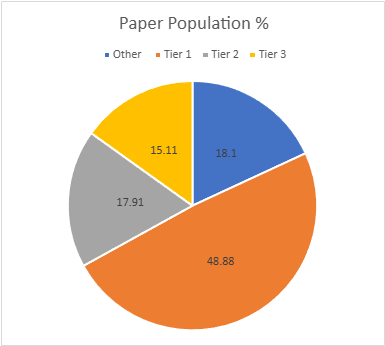
The death of the default best deck has brought more diversity, if only because players are actually willing to experiment now. The total number of decks in my data set is down from 88 to 86, but with the lower population this means an increase in the unique deck ratio from .071 to .082. 21 decks made the Tier List up from 18 in February.

Deck NameTotal #Total %
Tier 1
Goryo Blink1019.69
Mono-Green Tron949.02
Yawgmoth918.73
Rakdos Scam868.25
Counter Cat757.20
Amulet Titan726.91
Tier 2
Izzet Murktide555.28
Domain Murktide444.22
4-C Creativity363.45
Tier 3
Rack Scam333.17
Mill272.59
Bant Rhinos272.59
UW Control222.11
Hardened Scales222.11
Coffers212.01
Living End161.53
Wrenn White Blue151.44
Hammer Time141.34
Burn131.25
Wishshift121.15
Domain Zoo121.15
While the distribution between Tier 1 and everything else is better than in previous months, I'd still prefer seeing Tier 2 larger.

If I was as lazy as MTGGoldfish and the other sites and lumped Counter Cat, Domain Murktide, Domain Zoo, and everything else that gets lumped together under the Domain Zoo banner then that deck would be #1 by quite a large margin. However, I have professional pride. Domain Murktide came on quite strong in the last two weekends and is on trajectory to replace Counter Cat as the top performer. Keep an eye on this deck.

Goryo Blink takes the top slot thanks to the first week after Violent Outburst was banned. About half of its total results came between March 11 and March 17. Apparently, the online grinders assumed that it was the new best deck and mass adopted it, only to discover they were wrong. As will be apparent in the power and average power tiers, Goryo Blink did not perform up to expectations. I wouldn't expect it to disappear from Modern, but it should fall down the Tier List in April.

The Paper Population Data

As previously mentioned, March has a tiny paper dataset. Where January had 803 decks and February 890, March only managed 311. Losing the first two weekends to the ban really hurt. Couple that with Easter the last weekend and there just weren't that many events. It just do be like that sometimes.

There was an error retrieving a chart for Violent Outburst

With the tiny dataset, diversity appears to be up, but much like with the outlier that's a function more of the dataset's size than a reflection of reality. February has 102 unique decks and a ratio of .114, while March has 63 and a ratio of .203. Tiered decks fell slightly from 19 to 17, which is honestly really good all things considered. The adjusted average population was 4.48, so 5 results make the list. The adjusted STDev was 5.66, so the increment is 6. Therefore, Tier 3 runs from 5 to 11, Tier 2 is 12 to 18, and Tier 1 is 19 and over.

Deck NameTotal #Total %
Tier 1
Yawgmoth3310.61
Amulet Titan258.04
Counter Cat237.39
Goryo Blink206.43
Izzet Murktide196.11
Tier 2
Rakdos Scam144.50
Coffers123.86
Tier 3
4-C Creativity113.54
UW Control113.54
Hammer Time103.21
Merfolk92.89
Bant Rhinos92.89
MG Tron92.89
Hardened Scales72.25
Burn72.25
Living End61.93
Jund Saga51.61
Wrenn White Blue51.61
Domain Murktide51.61
...I gotta stop wishing on the Monkey's Paw. The overall distribution is in line with what I want at the cost of a negligible Tier 2.

I wouldn't read too much into the paper data, as again, the tiny dataset exaggerates certain things and minimizes others that probably shouldn't be. However, I do want to address Yawgmoth's position. As far as I could tell, the number of Yawgmoth players hasn't actually changed, as it was showing up in events at a similar pace to what it was pre-ban. I think that the only reason it hit outlier numbers (besides the small sample size) is that everyone else was switching their decks. Yawg players just kept on keeping on.

Also, Burn is falling out of the metagame in both paper and online. While it's tempting to place it on Scion of Draco's combo with Leyline of the Guildpact, it's actually the Leyline itself more than Draco. Yes, a 4/4 untargetable flying lifelinker is bad news. However, that doesn't come up that often compared to just having Leyline and never taking any damage from lands. Players fetching and shocking is really important to Burns plan and with that down, it's much harder for Burn to thrive.

March Power Metagame

Tracking the metagame in terms of population is standard practice. But how do results actually factor in? Better decks should also have better results. In an effort to measure this, I use a power ranking system in addition to the prevalence list. By doing so, I measure the relative strengths of each deck within the metagame so that a deck that just squeaks into Top 32 isn't valued the same as one that Top 8's. This better reflects metagame potential.

There was an error retrieving a chart for Murktide Regent

For the MTGO data, points are awarded based on the population of the event. Preliminaries award points based on record (1 for 3 wins, 2 for 4 wins, 3 for 5), and Challenges are scored 3 points for the Top 8, 2 for Top 16, and 1 for Top 32. If I can find them, non-Wizards events will be awarded points the same as Challenges or Preliminaries depending on what the event in question reports/behaves like. Super Qualifiers and similar higher-level events get an extra point and so do other events if they’re over 200 players, with a fifth point for going over 400 players.

Due to paper reporting being inconsistent and frequently full of data gaps compared to MTGO, its points work differently. I award points based on the size of the tournament rather than placement. For events with no reported starting population or up to 32 players, one point is awarded to every deck. Events with 33 players up to 128 players get two points. From 129 players up to 512 players get three. Above 512 is four points, and five points will be reserved for Modern Pro Tours.

The MTGO Power Tiers

As with the population numbers, total points are down, from 1908 in February to 1674. The average points were 19.47, therefore 20 points made Tier 3. The STDev was 36.53, so add 37 to the starting point, and Tier 3 runs to 57 points. Tier 2 starts with 58 points and runs to 95. Tier 1 requires at least 96 points. The bottom three decks failed to make the power tier and weren't replaced.

Deck NameTotal PointsTotal #
Tier 1
Yawgmoth499.44
Amulet Titan428.09
Counter Cat417.90
Goryo Blink336.36
Izzet Murktide315.97
Tier 2
Coffers265.01
Rakdos Scam244.62
UW Control203.85
Tier 3
4-C Creativity183.47
Hammer Time173.27
Merfolk173.27
MG Tron173.27
Bant Rhinos163.08
Hardened Scales163.08
Burn101.93
Domain Murktide91.73
Jund Creativity91.73
Living End81.54
Jund Saga81.54
Wrenn White Blue81.54
Bit unusual for MTGO's Power and Population distributions to be this close.

It's weird to see Mono-Green Tron at the top of the tier list. I've got the sneaking suspicion that it got the nod simply because it can maindeck a set of Relic of Progenitus against Goryo Blink and then sweep the board with Oblivion Stone against Leyline decks. With no clear best deck, the online players decided that was good enough and flocked to Tron, which will always be around to do Tron things.

The Paper Power Tiers

Points are massively down from 1653 to 519. The adjusted average points were 7.58, setting the cutoff at 8 points. The STDev was 9.99, thus add 10 to the starting point and Tier 3 runs to 18 points. Tier 2 starts with 19 points and runs to 29. Tier 1 requires at least 30 points. There's a lot of movement in the tiers and Jund Saga joined the power tier.

Deck NameTotal PointsTotal %
Tier 1
Temur Rhinos29017.54
Amulet Titan1317.92
Living End1237.44
Yawgmoth1146.70
Rakdos Scam925.57
Izzet Murktide744.48
Tier 2
Hammer Time653.93
Counter Cat633.81
Burn603.63
4-Color Rhinos603.63
4-Color Control593.57
UW Control492.96
Hardened Scales472.84
Mono-Green Tron432.60
Tier 3
4-Color Creativity402.42
Merfolk261.57
Mill231.39
Coffers231.39
Temur Prowess140.85
Well, that's a little better. Only a little. But still better.

Composite Metagame

That's a lot of data, but what does it all mean? When Modern Nexus was first started, we had a statistical method to combine the MTGO and paper data, but the math of that system doesn't work without big paper events. I tried. Instead, I'm using an averaging system to combine the data. I take the MTGO results and average the tier, then separately average the paper results, then average the paper and MTGO results together for final tier placement.

This generates a lot of partial Tiers. That's not a bug, but a feature. The nuance separates the solidly Tiered decks from the more flexible ones and shows the true relative power differences between the decks. Every deck in the paper and MTGO results is on the table, and when they don't appear in a given category, they're marked N/A. This is treated as a 4 for averaging purposes.

Deck NameMTGO Pop TierMTGO Power TierMTGO Average TierPaper Pop TierPaper Power TierPaper Average TierComposite Tier
Goryo Blink1111111.00
Yawgmoth1111111.00
Counter Cat1111111.00
Amulet Titan1111111.00
Rakdos Scam1112221.50
Izzet Murktide2221111.50
Mono-Green Tron1113332.00
Domain Murktide2223332.50
Coffers3332222.50
4-C Creativity232.53332.75
UW Control333322.52.75
Bant Rhinos3333333.00
Hardened Scales3333333.00
Living End3333333.00
Wrenn White Blue3333333.00
Hammer Time3333333.00
Rack Scam322.5N/AN/AN/A3.25
Burn3N/A3.53333.25
Mill333N/AN/AN/A3.50
MerfolkN/AN/AN/A3333.50
Jund SagaN/AN/AN/A3333.50
Wishshift3N/A3.5N/AN/AN/A3.75
Domain Zoo3N/A3.5N/AN/AN/A3.75
Jund CreativityN/AN/AN/AN/A33.53.75

Average Power Rankings

Finally, we come to the average power rankings. These are found by taking the total points earned and dividing them by total decks, to measure points per deck. I use this to measure strength vs. popularity. Measuring deck strength is hard. There is no Wins-Above-Replacement metric for Magic, and I'm not certain that one could be credibly devised. The game is too complex, and even then, power is very contextual.

Using the power rankings certainly helps and serves to show how justified a deck’s popularity is. However, more popular decks will still necessarily earn a lot of points. Therefore, the top tier doesn't move much between population and power and obscures whether its decks really earned their position. 

There was an error retrieving a chart for Ragavan, Nimble Pilferer

This is where the averaging comes in. Decks that earn a lot of points because they get a lot of results will do worse than decks that win more events, indicating which deck actually performs better.

A higher average indicates lots of high finishes, whereas low averages result from mediocre performances and a high population. Lower-tier decks typically do very well here, likely due to their pilots being enthusiasts. Bear this in mind and be careful about reading too much into these results. However, as a general rule, decks that place above the baseline average are over-performing, and vice versa.

How far above or below that average a deck sits justifies its position on the power tiers. Decks well above baseline are undervalued, while decks well below baseline are very popular, but aren't necessarily good.

The Real Story

When considering the average points, the key is looking at how far off a deck is from the Baseline stat (the overall average of points/population). The closer a deck’s performance to the Baseline, the more likely it is to be performing close to its "true" potential.

A deck that is exactly average would therefore perform exactly as well as expected. The greater the deviation from the average, the more a deck under or over-performs. On the low end, a deck’s placing was mainly due to population rather than power, which suggests it’s overrated. A high-scoring deck is the opposite of this.

I'll begin with the averages for MTGO

Deck NameAverage PointsPower Tier
UW Control1.823
Rack Scam1.792
Hardened Scales1.773
Amulet Titan1.721
Domain Murktide1.702
Counter Cat1.671
Wrenn White Blue1.673
Baseline1.66
Izzet Murktide1.652
Hammer Time1.643
MG Tron1.631
Living End1.633
4-C Creativity1.583
Yawgmoth1.561
Rakdos Scam1.521
Goryo Blink1.471
Mill1.443
Bant Rhinos1.443
Coffers1.383

Amulet Titan is MTGO's Deck of the Month. Not that there was much competition. This is the worst overall performance by Tier 1 decks on the average power tier ever.

Now the paper averages:

Deck NameAverage PowerPower Tier
Hardened Scales2.293
Jund Creativity2.253
Coffers2.172
Merfolk1.893
MG Tron1.893
UW Control1.822
Domain Murktide1.803
Counter Cat1.781
Bant Rhinos1.783
Rakdos Scam1.712
Hammer Time1.703
Amulet Titan1.681
Goryo Blink1.651
4-C Creativity1.643
Izzet Murktide1.631
Jund Saga1.603
Wrenn White Blue1.603
Baseline1.55
Yawgmoth1.481
Burn1.433
Living End1.333

Meanwhile, Counter Cat takes home the crown for paper. Though again, not a great overall showing for the Tier 1 decks, with Yawgmoth in a similar position to Blink from MTGO.

Analysis

While the Outburst ban has not outright killed either Rhinos or Living End, they are both clearly struggling. I suspect, but can't prove, that this is mostly a perception problem. Moving Rhinos in a more controlling direction by going Bant has been a solid move as far I as I can tell, and while the deck has lost a step it's still quite powerful. I think that the difference in power from Violent Outburst to Ardent Plea turned a lot of players off the deck, thinking it unplayable when that really isn't the case.

There was an error retrieving a chart for Ardent Plea

Living End is having a harder time. It can't use Plea as easily and maintain any kind of mana stability. I've seen a lot of different versions so far, and they've all clearly lost a step. However, there's also a lot of interesting brewing happening. Some have moved in a controlling direction and some are going for broken with Bloodbraid Marauder. There's still a lot of power in the suspend cards, so I think those declaring either deck dead will be disproven.

The Guildpact's World

The fear in the wake of the ban was that Leyline/Draco would be everywhere and take over Modern. The former fear was realized, but the latter has been frustrated. While I have seen those cards and often Leyline Binding in every conceivable deck, just because those 12 cards can go anywhere doesn't mean that they should. The only Leyline/Draco deck that are really thriving are Counter Cat and Domain Murktide. Everything else only shows up in very small numbers, and don't do too well.

There was an error retrieving a chart for Scion of Draco

The simple fact is that while the combo is quite powerful, it's also quite unlikely. The odds of having both in the opening hand is just under 20%, with the odds of having both out before turn 4 being about 25%. If that doesn't happen, there has to be some justification for having the constituent cards in the deck and outside of decks that were already 4+ color creature decks, there's negligible benefit to either card. I'd consequently expect to see the Domain players giving up on the random decks and converging on either Murktide or Cat builds.

Financial Implications

With Modern Horizons 3 approaching, most players are playing it safe on the financial side. The (perfectly fair) expectation is that Modern's going to have another earthshaking upheaval. Thus, they don't want to speculate on buying a new deck when it may just be invalidated in a few months. Thus, the overall demand in the market is down.

Staple prices remain stable, and the price spikes from the ban have cooled but not disappeared. I expect this to be the norm for the next few months. Thus, my advice is to avoid speculation and simply circle the financial wagons and wait to see what's coming down the pipe. Given what I've seen from Outlaws of Thunder Junction, there's not much to worry about.

February ’24 Metagame Update: Championship Changes

Are you a Quiet Speculation member?

If not, now is a perfect time to join up! Our powerful tools, breaking-news analysis, and exclusive Discord channel will make sure you stay up to date and ahead of the curve.

I haven't had to do that many metagame updates for February, it being the month where bans tend to happen. That wasn't the case this month, though I suspect that the data will add fuel to the banning call fires. I understand, but I'd caution everyone to consider the context before jumping to conclusions. February's data is defined by the Regional Championships and that created a localized warp.

The Lone Exception

Unfortunately I've gotten used to outliers in the Modern metagame data, especially Magic Online's data. It's what happens with an aggressively small playerbase (I've heard there are only 8000-9000 active accounts at a given time). I'd also thought I could tell when the data would produce an outlier. I was wrong, as despite my expectations, there are no outliers in the MTGO data and for the first time in a while it will be presented unadjusted. It was quite the surprise to me.

There was an error retrieving a chart for Crashing Footfalls

What absolutely wasn't surprising is that there is an outlier in the paper data. It was glaringly obvious, and you'll see why in roughly five paragraphs. Temur Rhinos is an outlier among outliers, but there is a reason beyond it being too good. As mentioned, there were several Regional Championships, and Rhinos showed up to them in huge numbers. This is common to large events, and since they were concentrated early in the month, there was nothing to balance against them. It's worth discussing, but don't read too much into this localized warp.

As always, statistical outliers are removed from the analysis but are reported on their correct position on the tier list, but there are weird stats behind these outliers.

February Population Metagame

To make the tier list, a given deck has to beat the overall average population for the month. The average is my estimate for how many results a given deck "should" produce in a given month. Being a tiered deck requires being better than "good enough". Every deck that posts at least the average number of results is "good enough" and makes the tier list.

Then we go one standard deviation (STdev) above average to set the limit of Tier 3 and the cutoff for Tier 2. This mathematically defines Tier 3 as those decks clustered near the average. Tier 2 goes from the cutoff to the next standard deviation. These are decks that perform well above average. Tier 1 consists of those decks at least two standard deviations above the mean result, encompassing the truly exceptional performing decks.

There was an error retrieving a chart for Yawgmoth, Thran Physician

The MTGO data nearly exclusively comes from official Preliminary and Challenge results. Leagues are excluded, as they are curated lists and thus invalid. The paper data comes from any source I can find, with all reported events being counted.

While the MTGO events report predictable numbers, paper events can report anything from only the winner to all the results. In the latter case, if match results aren't included, I'll take as much of the Top 32 as possible. If match results are reported, I'll take winning record up to Top 32, and then any additional decks tied with 32nd place, as tiebreakers are a magic most foul and black.

A Note on the Data

Daybreak is now releasing the total results from every MTGO Preliminary and Challenge. After some experimentation, I'm sticking to just using the Challenge Top 32 results and 3-1 or better from the Preliminaries. The first reason is that, ultimately, nothing changed. The population metagame list didn't change between my normal method and the experimental versions. Various treatments for the power metagame did change the order of the tier list, but the composition varied only marginally.

There was an error retrieving a chart for Leyline of the Guildpact

The second reason was that dealing with all that data is significantly more work, even with automation. I'm not a great programmer but setting up and training the bots and then auditing the results took significantly longer than my current system, and I'd have to redo it monthly. Since it made little difference, I'm not going to make more work for myself. There are other sites that put together winrates with all the new data anyway, so I don't feel that anything's being lost. It also means that comparing the paper to MTGO results is easier.

The MTGO Population Data

February's average population for MTGO was 13.92, setting the Tier 3 cutoff at 14 decks. I always round down if the decimal is less than .20. Tier 3, therefore, begins with decks posting 14 results. The STdev was 27.05, so add 27 and that means Tier 3 runs to 41 results. Again, it's the starting point to the cutoff, then the next whole number for the next Tier. Therefore Tier 2 starts with 42 results and runs to 69. Subsequently, to make Tier 1, 70 decks are required.

There was an error retrieving a chart for Primeval Titan

I thought that January's population would be hard to top and I was correct. However, it wasn't by much and February is a short month even with leap year. January had 1,400 decks, while February is just 1225. Turns out, if you schedule more events players will turn out. Take notes, Wizards Organized Play if you still exist.

Again, the high population came with didn't actually come with more true diversity. The total number of decks in my data set is down from 93 to 88. This improves the the ratio of unique decks to total sample actually fell .066 to .071, which is still low compared to 2023's average of .09. Fewer decks made the Tier List too, just 18 compared to January's 23.

Deck NameTotal #Total %
Tier 1
Living End14411.76
Temur Rhinos1028.33
Yawgmoth998.08
Rakdos Scam836.77
4-Color Rhinos776.29
Amulet Titan735.96
Izzet Murktide725.88
Tier 2
Counter Cat695.63
Mono-Green Tron625.06
UW Control423.43
Tier 3
4-Color Creativity342.78
Hardened Scales332.69
Mill312.53
Burn231.88
4-Color Control201.63
Hammer Time181.47
Goryo Blink151.22
Merfolk141.14
Good news is the Tier 1 concentration is far lower than in January.

I thought that Living End would qualify as an outlier due to the gap between it and Rhinos. However, the heavy skew in the data coupled with the STdev meant that it was just under the line as an outlier. If I were lazily grouping Temur and 4-Color Rhinos together, they would certainly have been an outlier, but I hold myself to higher standards.

On the subject of Leyline of the Guildpact, it has had an undeniable impact on MTGO's metagame, but I'm not convinced it will be sustained. New tech always gets eagerly adopted in huge numbers online but tapers off after about 2.5 weeks, and I am starting to see the fall-off. We've walked the path of 4-Color Rhinos before and it lost out to Temur before, I have little doubt it will do so again. Given that 4-Color was statistically tied in average points while Counter Cat's aren't spectacular, I expect both to fall off in March.

The Paper Population Data

February's paper data is higher than January's, though not by much. January reported 803 while February has 890. Given the number of events surrounding the RC's, even when taking into account the shorter month I expected the total population to be higher. I do know that a number of events that fired didn't report their results, as far as my Google-fu could find anyway.
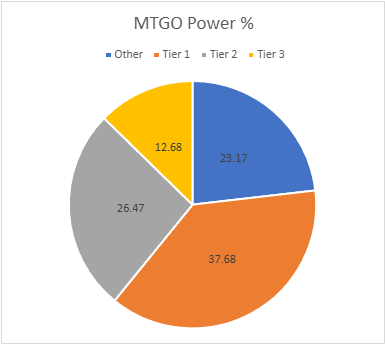
There was an error retrieving a chart for Violent Outburst

That said, diversity hasn't changed. February has 102 unique decks and a ratio of .114, while January had 88 and a ratio of .110. It not falling is a good sign but only being higher without rounding isn't optimal. I can forgive it this time due to the RC warp, but I hope it's higher in March. Tiered decks stayed the same at 19. The adjusted average population was 7.61, so 8 results make the list. The adjusted STDev was 13.91, so the increment is 14. Therefore, Tier 3 runs from 8 to 22, Tier 2 is 23 to 37, and Tier 1 is 38 and over.

Deck NameTotal #Total %
Tier 1
Temur Rhinos14416.18
Amulet Titan637.08
Yawgmoth626.97
Living End616.85
Rakdos Scam495.51
Izzet Murktide394.38
Counter Cat384.27
Tier 2
Hammer Time364.04
Burn323.60
Hardened Scales293.26
4-Color Rhinos283.15
Mono-Green Tron273.03
4-Color Control273.03
UW Control252.81
Tier 3
4-Color Creativity192.13
Mill141.57
Merfolk141.57
Coffers141.57
Temur Prowess91.01
It's a strange month where Tier 2 is more populated than Tier 3.

As previously mentioned, Rhinos jumped out to a massive lead thanks to the RC's and associated events and just kept running away. I'm willing to write that off as a localized anomaly, but we really need to keep an eye on this with the March banning window approaching.
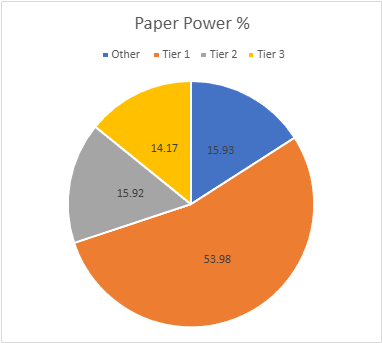

It's really unusual to see Tier 3 being so small. I'd not bat an eye if it was Tier 2, but February is an exception. Again, the RC's are to blame. If a deck showed up there, it showed up in multiple events and got carried for the rest of the month. Everything else fell behind.

February Power Metagame

Tracking the metagame in terms of population is standard practice. But how do results actually factor in? Better decks should also have better results. In an effort to measure this, I use a power ranking system in addition to the prevalence list. By doing so, I measure the relative strengths of each deck within the metagame so that a deck that just squeaks into Top 32 isn't valued the same as one that Top 8's. This better reflects metagame potential.

There was an error retrieving a chart for Murktide Regent

For the MTGO data, points are awarded based on the population of the event. Preliminaries award points based on record (1 for 3 wins, 2 for 4 wins, 3 for 5), and Challenges are scored 3 points for the Top 8, 2 for Top 16, and 1 for Top 32. If I can find them, non-Wizards events will be awarded points the same as Challenges or Preliminaries depending on what the event in question reports/behaves like. Super Qualifiers and similar higher-level events get an extra point and so do other events if they’re over 200 players, with a fifth point for going over 400 players.

Due to paper reporting being inconsistent and frequently full of data gaps compared to MTGO, its points work differently. I award points based on the size of the tournament rather than placement. For events with no reported starting population or up to 32 players, one point is awarded to every deck. Events with 33 players up to 128 players get two points. From 129 players up to 512 players get three. Above 512 is four points, and five points will be reserved for Modern Pro Tours.

The MTGO Power Tiers

Unlike the population numbers, total points are slightly down, from 2051 in January to 1908. The disparity is due to there being only one 4-point event in February. The average points were 21.68, therefore 22 points made Tier 3. The STDev was 43.06, so add 43 to the starting point, and Tier 3 runs to 65 points. Tier 2 starts with 66 points and runs to 109. Tier 1 requires at least 110 points. The composition of the list has not changed, though there's been significant movement inside the tiers.

Deck NameTotal PointsTotal %
Tier 1
Living End22811.95
Temur Rhinos1638.54
Yawgmoth1618.44
Rakdos Scam1246.50
4-Color Rhinos1246.50
Izzet Murktide1186.18
Amulet Titan1135.92
Tier 2
Mono-Green Tron1075.61
Counter Cat1055.50
Tier 3
UW Control613.20
Hardened Scales572.99
4-Color Creativity502.62
Mill452.36
Burn351.83
4-Color Control321.68
Goryo Blink281,47
Hammer Time221.15
Merfolk221.15
MTGO's power is always marginally more concentrated than population, which has allegorical implications.

I had some hope that the reemergence of Assault Loam and Kitchen last month would get some more brewing and innovation happening on MTGO, but alas, it seems they've already been discarded.

The Paper Power Tiers

Despite the RC's, February has fewer total points than January 1653 to 1709. There were fewer total events and they were concentrated in the first few weeks. The adjusted average points were 13.87, setting the cutoff at 14 points. The STDev was 26.98, thus add 27 to the starting point and Tier 3 runs to 41 points. Tier 2 starts with 42 points and runs to 69. Tier 1 requires at least 70 points. Again, the composition of the tiers hasn't changed despite movement inside them.

Deck NameTotal PointsTotal %
Tier 1
Temur Rhinos29017.54
Amulet Titan1317.92
Living End1237.44
Yawgmoth1146.70
Rakdos Scam925.57
Izzet Murktide744.48
Tier 2
Hammer Time653.93
Counter Cat633.81
Burn603.63
4-Color Rhinos603.63
4-Color Control593.57
UW Control492.96
Hardened Scales472.84
Mono-Green Tron432.60
Tier 3
4-Color Creativity402.42
Merfolk261.57
Mill231.39
Coffers231.39
Temur Prowess140.85
Meanwhile, paper has seen power be less concentrated than population for a few months now. I suspect it's down to paper being diffuse while MTGO is concentrated.

Composite Metagame

That's a lot of data, but what does it all mean? When Modern Nexus was first started, we had a statistical method to combine the MTGO and paper data, but the math of that system doesn't work without big paper events. I tried. Instead, I'm using an averaging system to combine the data. I take the MTGO results and average the tier, then separately average the paper results, then average the paper and MTGO results together for final tier placement.

This generates a lot of partial Tiers. That's not a bug, but a feature. The nuance separates the solidly Tiered decks from the more flexible ones and shows the true relative power differences between the decks. Every deck in the paper and MTGO results is on the table, and when they don't appear in a given category, they're marked N/A. This is treated as a 4 for averaging purposes.

Deck NameMTGO Pop TierMTGO Power TierMTGO Average TierPaper Pop TierPaper Power TierPaper Average TierComposite Tier
Living End1111111.00
Temur Rhinos1111111.00
Yawgmoth1111111.00
Rakdos Scam1111111.00
Amulet Titan1111111.00
Izzet Murktide1111111.00
4-Color Rhinos1112221.50
Counter Cat222121.51.75
Mono-Green Tron2222222.00
UW Control232.52222.25
Hardened Scales3332222.50
Burn3332222.50
4-Color Control3332222.50
Hammer Time3332222.50
4-Color Creativity3333333.00
Mill3333333.00
Merfolk3333333.00
Goryo Blink333N/AN/AN/A3.50
CoffersN/AN/AN/A3333.50
Temur ProwessN/AN/AN/A3333.50
Not a bad distribution by the standards of this series, but not what I'd prefer to see.

Average Power Rankings

Finally, we come to the average power rankings. These are found by taking the total points earned and dividing them by total decks, to measure points per deck. I use this to measure strength vs. popularity. Measuring deck strength is hard. There is no Wins-Above-Replacement metric for Magic, and I'm not certain that one could be credibly devised. The game is too complex, and even then, power is very contextual.

Using the power rankings certainly helps and serves to show how justified a deck’s popularity is. However, more popular decks will still necessarily earn a lot of points. Therefore, the top tier doesn't move much between population and power and obscures whether its decks really earned their position. 

There was an error retrieving a chart for Ragavan, Nimble Pilferer

This is where the averaging comes in. Decks that earn a lot of points because they get a lot of results will do worse than decks that win more events, indicating which deck actually performs better.

A higher average indicates lots of high finishes, whereas low averages result from mediocre performances and a high population. Lower-tier decks typically do very well here, likely due to their pilots being enthusiasts. Bear this in mind and be careful about reading too much into these results. However, as a general rule, decks that place above the baseline average are over-performing, and vice versa.

How far above or below that average a deck sits justifies its position on the power tiers. Decks well above baseline are undervalued, while decks well below baseline are very popular, but aren't necessarily good.

The Real Story

When considering the average points, the key is looking at how far off a deck is from the Baseline stat (the overall average of points/population). The closer a deck’s performance to the Baseline, the more likely it is to be performing close to its "true" potential.

A deck that is exactly average would therefore perform exactly as well as expected. The greater the deviation from the average, the more a deck under or over-performs. On the low end, a deck’s placing was mainly due to population rather than power, which suggests it’s overrated. A high-scoring deck is the opposite of this.

I'll begin with the averages for MTGO

Deck NameAverage PointsPower Tier
Goryo Blink1.873
Mono-Green Tron1.732
Hardened Scales1.723
Izzet Murktide1.641
Yawgmoth1.631
4-Color Rhinos1.611
Temur Rhinos1.601
4-Color Control1.603
Living End1.581
Merfolk1.573
Amulet Titan1.551
Counter Cat1.522
Burn1.523
Rakdos Scam1.491
4-Color Creativity1.473
UW Control1.453
Mill1.453
Baseline1.41
Hammer Time1.223

Well done Izzet Murktide, February's MTGO Deck of the Month. No longer king, but always a threat.

Now the paper averages:

Deck NameAverage PointsPower Tier
4-Color Control2.182
4-Color Rhinos2.142
4-Color Creativity2.103
Amulet Titan2.081
Living End2.021
Temur Rhinos2.011
UW Control1.962
Izzet Murktide1.901
Rakdos Scam1.881
Burn1.882
Merfolk1.863
Yawgmoth1.841
Hammer Time1.802
Counter Cat1.662
Mill1.643
Baseline1.64
Coffers1.643
Hardened Scales1.622
Mono-Green Tron1.592
Temur Prowess1.563

Amulet Titan is paper's Deck of the Month, not for the first time.

Analysis

The big story for February is the arrival of Murders at Markov Manor. While it came with a number of interesting role players, the unexpected headliner has been the new Leyline. There was a brief period where everyone was jamming it into every deck, but that has largely subsided. Instead, it has steady work in 4-Color Rhinos and Zoo deck, primarily Counter Cat variants, and has caused a stir in the metagame.

There was an error retrieving a chart for Scion of Draco

However, I haven't been too impressed. The driving force behind Leyline is actually Scion of Draco making itself into an unkillable and unraceable clock. It's quite good when it comes together, but we've been down this road before in multiple formats. It was called Soulflayer then, and much like Draco/Leyline, when Soulflayer comes together it's ridiculous but at all other times it's a bad joke. Given that the odds of the combo coming together on time are only about 20%, and Leyline is a very dead draw, I wouldn't hold out hope for the card.

Banning Risks

At time of writing, there's been no announcement concerning bannings in the March window. Wizards is still figuring out how this all works, so I can't predict if the lack of announcement means anything. However, given the observed data makes ban discussions reasonable, especially given how they talked about the goals of the last ban.

There was an error retrieving a chart for Fury

Specifically, banning Fury was supposed to open up the metagame and reduce the prevalence of Rakdos Scam. The latter goal was achieved; Scam is substantially down from its height. I know the deck gets a lot of hate, but it has unequivocally been successfully depowered. The former goal is far more ambiguous. The only previously top deck to have fallen off is 4-Color Control, but it was hit with two bans. Reducing Scam is correlated with Rhinos overtaking everything, and not many new decks have stuck.

I don't think that's enough for Wizards to justify intervening again. They Officially Hate banning cards and won't do so without a very strong reason. They can write off the lack of diversification as players being stubborn or that it will change naturally with Modern Horizons 3 coming this summer. Thus, the only way I see a ban coming to Modern is if the cascade decks have too-high win rates, which I didn't gather the data to evaluate.

Financial Implications

I believe that whatever opportunities arose in the wake of Leyline of the Guildpact have run their course. Whatever large-scale adoption that was going to happen has, and any further converts will be a relative trickle. If you've invested into those decks with the intention to flip the cards, I'd watch the price trends very carefully and be ready to bail. If the combo with Scion isn't good enough, then the only non-Valakut, the Molten Pinnacle reason to run Leyline is painless mana fixing, and that's not really good enough in Modern. Again, just like what happened with 4-Color Rhinos last year.

As for a potential banning, the only card that makes sense to ban from the cascade decks is one of the cascaders, not a namesake card. Wizards doesn't like to outright kill decks. If Wizards wants to disrupt the decks without really nerfing them, they'd hit Shardless Agent, but that doesn't make sense. They'd just go for more colors and be about the same power-wise. Thus, I'd be watching for Violent Outburst to get banned instead.

January ’24 Metagame Update: Convergent Consensus

Are you a Quiet Speculation member?

If not, now is a perfect time to join up! Our powerful tools, breaking-news analysis, and exclusive Discord channel will make sure you stay up to date and ahead of the curve.

It's the first metagame update of the new year! It's not an entirely new metagame, but it is at least notably different from the last one. The forces within Modern that create the metagame don't just subside when the calendar changes, after all. That said, there's innovation present and a changeover at the top of the metagame showing that the effects of the last ban are still working themselves out.

An Odd Occurrence

As has been the standard for two years now, there are outliers in the data, and in both play mediums. In defiance of December's decline, Modern is back to having multiple statistical outliers in both paper and Magic Online (MTGO). However, there's some oddness to the result this time.

MTGO has four outliers: Rakdos Scam, Yawgmoth, Temur Rhinos, and Izzet Murktide. Paper has two, Rhinos and Scam. As always, statistical outliers are removed from the analysis but are reported on their correct position on the tier list, but there are weird stats behind these outliers.

There was an error retrieving a chart for Orcish Bowmasters

How to find outliers and when to remove them from a data set is something that statisticians argue about relentlessly. Everyone agrees that true outliers must be removed, but what constitutes a true outlier has no clear answer. Rather than get lost in the weeds, I do four different outlier tests and I always remove the decks that are consistently shown to be outliers. I want to include the maximum number of decks on the Tier List.

Normally there's broad agreement between the tests on which decks are outliers with only the borderline ones being disputed. This month was weird as the three tests which use variants on the Interquartile Range all returned the aforementioned outliers, but the z-test one didn't return any outliers. That's never happened before. I'm not a good enough statistical theorist to know what that means, if there's one out there who does know, please explain.

January Population Metagame

To make the tier list, a given deck has to beat the overall average population for the month. The average is my estimate for how many results a given deck "should" produce in a given month. Being a tiered deck requires being better than "good enough". Every deck that posts at least the average number of results is "good enough" and makes the tier list.

Then we go one standard deviation (STdev) above average to set the limit of Tier 3 and the cutoff for Tier 2. This mathematically defines Tier 3 as those decks clustered near the average. Tier 2 goes from the cutoff to the next standard deviation. These are decks that perform well above average. Tier 1 consists of those decks at least two standard deviations above the mean result, encompassing the truly exceptional performing decks.

There was an error retrieving a chart for Yawgmoth, Thran Physician

The MTGO data nearly exclusively comes from official Preliminary and Challenge results. Leagues are excluded, as they are curated lists and thus invalid. The paper data comes from any source I can find, with all reported events being counted.

While the MTGO events report predictable numbers, paper events can report anything from only the winner to all the results. In the latter case, if match results aren't included, I'll take as much of the Top 32 as possible. If match results are reported, I'll take winning record up to Top 32, and then any additional decks tied with 32nd place, as tiebreakers are a magic most foul and black.

A Note on the Data

Daybreak is now releasing the total results from every MTGO Preliminary and Challenge. After some experimentation, I'm sticking to just using the Challenge Top 32 results and 3-1 or better from the Preliminaries. The first reason is that, ultimately, nothing changed. The population metagame list didn't change between my normal method and the experimental versions. Various treatments for the power metagame did change the order of the tier list, but the composition varied only marginally.

There was an error retrieving a chart for Solitude

The second reason was that dealing with all that data is significantly more work, even with automation. I'm not a great programmer but setting up and training the bots and then auditing the results took significantly longer than my current system, and I'd have to redo it monthly. Since it made little difference, I'm not going to make more work for myself. There are other sites that put together winrates with all the new data anyway, so I don't feel that anything's being lost. It also means that comparing the paper to MTGO results is easier.

The MTGO Population Data

January's adjusted average population for MTGO was 6.80, setting the Tier 3 cutoff at 7 decks. I always round down if the decimal is less than .20. Tier 3, therefore, begins with decks posting 7 results. The adjusted STdev was 13.80, so add 14 and that means Tier 3 runs to 21 results. Again, it's the starting point to the cutoff, then the next whole number for the next Tier. Therefore Tier 2 starts with 22 results and runs to 36. Subsequently, to make Tier 1, 37 decks are required.

There was an error retrieving a chart for Primeval Titan

Even though I'm not using all the new data, January 2024's population still blows every other month out of the water. The highest population from 2023 was 1,003, while January has 1,400 decks, 500 more than December. I can't say if this is just the result of more events or if Modern's gained popularity recently, but it is definitely the largest sample since 2021.

However, the high population came with didn't actually come with more true diversity. The total number of decks in my data set is up from 69 to 93. However, given the total population, the ratio of unique decks to total sample actually fell from .072 to .066. 2023's average was .09, so 2024 is not starting out well. 23 decks made the Tier List.

Deck Name Total #Total %
Tier 1
Rakdos Scam24817.71
Yawgmoth19814.14
Temur Rhinos19213.71
UR Murktide15711.21
Amulet Titan886.29
Living End715.07
Hardened Scales443.14
Tier 2
4-Color Control352.50
UW Control312.21
4-Color Creativity251.79
Burn251.79
Coffers241.71
Tier 3
Counter Cat191.36
Mono-Green Tron171.21
Hammer Time171.21
Merfolk151.07
Rakdos Kitchen120.86
Jund Saga100.71
Mill100.71
Assault Loam100.71
Wrenn White and Blue90.64
Temur Prowess70.50
Twiddle Breach70.50
That's the highest Tier 1 concentration I've ever recorded.

There's a clear reason for the four outliers I previously mentioned. The top decks hold an absurd metagame share. The comfort is that this isn't like pre-December Modern where Scam was crushing everything else, but it still isn't optimal or desirable. However, I offer this crumb of comfort: the paper results tell a very different story. I believe that this massive warp in the MTGO results is the result of players chasing their tails more than a fully unhealthy metagame.

The Paper Population Data

January's paper data also saw a huge increase, though that's not unusual. December only managed 429 decks because events always taper off for the holidays. January always brings a large resurgence and 2024 was no different, as 803 decks were recorded, well above the norm for 2023. Good sign.

There was an error retrieving a chart for Crashing Footfalls

Diversity increased absolute terms but not relative ones. December had 67 unique decks and a ratio of .16, while January has 88 and a ratio of .11, which was incidentally 2023's average. Not as good as it was, but much better than MTGO. Tiered decks rose from 17 to 19. The adjusted average population was 6.96, so 7 results make the list. The adjusted STDev was 14.10, so the increment is 14. Therefore, Tier 3 runs from 7 to 21, Tier 2 is 22 to 36, and Tier 1 is 37 and over, just like MTGO which is unusual.

Deck Name Total PointsTotal %
Tier 1
Temur Rhinos11013.70
Rakdos Scam9411.71
Yawgmoth759.34
Amulet Titan647.97
UR Murktide617.60
Mono-Green Tron384.73
Tier 2
Hammer Time354.36
Living End334.11
Hardened Scales334.11
Burn273.36
4-Color Control222.74
Tier 3
Merfolk182.24
Counter Cat182.24
UW Control141.74
Coffers131.62
Izzet Wizards101.24
4-Color Creativity81.00
Jund Saga70.87
Mill70.87
Far more equitable than MTGO. It's not a great distribution compared to December but is in line with the norm from 2023.

Paper's concentration is back in line with the norm from 2023. That's not a great place to be, but it is better than what's happening on MTGO. Interestingly, up until the European Championship in Ghent at the end of the month, the top five decks weren't ahead of the rest of the pack by much. It was that event and associated side events that made paper's top look closer to MTGO's and created the outliers.

October Power Metagame

Tracking the metagame in terms of population is standard practice. But how do results actually factor in? Better decks should also have better results. In an effort to measure this, I use a power ranking system in addition to the prevalence list. By doing so, I measure the relative strengths of each deck within the metagame so that a deck that just squeaks into Top 32 isn't valued the same as one that Top 8's. This better reflects metagame potential.

There was an error retrieving a chart for Murktide Regent

For the MTGO data, points are awarded based on the population of the event. Preliminaries award points based on record (1 for 3 wins, 2 for 4 wins, 3 for 5), and Challenges are scored 3 points for the Top 8, 2 for Top 16, and 1 for Top 32. If I can find them, non-Wizards events will be awarded points the same as Challenges or Preliminaries depending on what the event in question reports/behaves like. Super Qualifiers and similar higher-level events get an extra point and so do other events if they’re over 200 players, with a fifth point for going over 400 players.

Due to paper reporting being inconsistent and frequently full of data gaps compared to MTGO, its points work differently. I award points based on the size of the tournament rather than placement. For events with no reported starting population or up to 32 players, one point is awarded to every deck. Events with 33 players up to 128 players get two points. From 129 players up to 512 players get three. Above 512 is four points, and five points will be reserved for Modern Pro Tours.

The MTGO Power Tiers

As with population, total points are significantly up, from 1528 in December to 2051. Multiple 4-point events will do that. The adjusted average points were 9.68, therefore 10 points made Tier 3. The adjusted STDev was 19.81, so add 20 to the starting point, and Tier 3 runs to 30 points. Tier 2 starts with 31 points and runs to 51. Tier 1 requires at least 52 points. Temur Prowess fell off and was replaced by Dimir Shadow.

Deck Name Total PointsTotal %
Tier 1
Rakdos Scam36617.84
Temur Rhinos30414.82
Yawgmoth29214.24
UR Murktide22911.17
Amulet Titan1256.09
Living End984.78
Hardened Scales643.12
4-Color Control592.88
Tier 2
UW Control401.95
4-Color Creativity381.85
Burn381.85
Coffers361.76
Tier 3
Counter Cat291.41
Hammer Time241.17
Merfolk231.12
Mono-Green Tron211.02
Assault Loam170.83
Rakdos Kitchen150.73
Wrenn White and Blue140.68
Mill130.63
Jund Saga110.54
Twiddle Breach110.54
Dimir Shadow100.49
Ok, no. This is the worst Tier 1 concentration ever.

As with the population, the population totals are wildly unbalanced, but that's what happens when the small MTGO player base has groupthought that Modern is solved. The evidence of the reemergence of Assault Loam and Kitchen decks apparently doing little to change their minds.

The Paper Power Tiers

Thanks to the return of large events, January's point total is quite high. December only hit 758 but January has 1709. The adjusted average points were 14.27, setting the cutoff at 15 points. The STDev was 30.42, thus add 31 to the starting point and Tier 3 runs to 46 points. Tier 2 starts with 47 points and runs to 78. Tier 1 requires at least 79 points. Both Jund Saga and Mill fell off the list and weren't replaced.

Deck Name Total PointsTotal %
Tier 1
Temur Rhinos27015.80
Rakdos Scam21212.40
Yawgmoth17410.18
Amulet Titan1337.78
UR Murktide1327.72
Tier 2
Hammer Time754.39
Hardened Scales683.98
Living End643.74
Mono-Green Tron633.69
Burn533.10
4-Color Control523.04
Tier 3
Counter Cat452.63
Merfolk341.99
Coffers321.87
UW Control281.64
Izzet Wizards191.11
4-Color Creativity160.94
In an unusual twist, paper's power is more equitable than population.

Composite Metagame

That's a lot of data, but what does it all mean? When Modern Nexus was first started, we had a statistical method to combine the MTGO and paper data, but the math of that system doesn't work without big paper events. I tried. Instead, I'm using an averaging system to combine the data. I take the MTGO results and average the tier, then separately average the paper results, then average the paper and MTGO results together for final tier placement.

This generates a lot of partial Tiers. That's not a bug, but a feature. The nuance separates the solidly Tiered decks from the more flexible ones and shows the true relative power differences between the decks. Every deck in the paper and MTGO results is on the table, and when they don't appear in a given category, they're marked N/A. This is treated as a 4 for averaging purposes.

Deck Name MTGO Pop TierMTGO Power TierMTGO Average TierPaper Pop TierPaper Power TierPaper Average TierComposite Tier
Rakdos Scam1111111.00
Yawgmoth1111111.00
Temur Rhinos1111111.00
UR Murktide1111111.00
Amulet Titan1111111.00
Living End1112221.50
Hardened Scales1112221.50
4-Color Control211.52221.75
Burn2222222.00
Mono-Green Tron333121.52.25
UW Control2223332.50
4-Color Creativity2223332.50
Coffers2223332.50
Hammer Time3332222.50
Counter Cat3333333.00
Merfolk3333333.00
Jund Saga3333N/A3.53.25
Mill3333N/A3.53.25
Rakdos Kitchen333N/AN/AN/A3.50
Assault Loam333N/AN/AN/A3.50
Wrenn White and Blue333N/AN/AN/A3.50
Twiddle Breach333N/AN/AN/A3.50
Izzet WizardsN/AN/AN/A3333.50
Temur Prowess3N/A3.5N/AN/AN/A3.75
While metagame share between tiers is never going to be perfectly balanced, this is clearly extreme.

Average Power Rankings

Finally, we come to the average power rankings. These are found by taking the total points earned and dividing them by total decks, to measure points per deck. I use this to measure strength vs. popularity. Measuring deck strength is hard. There is no Wins-Above-Replacement metric for Magic, and I'm not certain that one could be credibly devised. The game is too complex, and even then, power is very contextual.

Using the power rankings certainly helps and serves to show how justified a deck’s popularity is. However, more popular decks will still necessarily earn a lot of points. Therefore, the top tier doesn't move much between population and power and obscures whether its decks really earned their position. 

There was an error retrieving a chart for Ragavan, Nimble Pilferer

This is where the averaging comes in. Decks that earn a lot of points because they get a lot of results will do worse than decks that win more events, indicating which deck actually performs better.

A higher average indicates lots of high finishes, whereas low averages result from mediocre performances and a high population. Lower-tier decks typically do very well here, likely due to their pilots being enthusiasts. Bear this in mind and be careful about reading too much into these results. However, as a general rule, decks that place above the baseline average are over-performing, and vice versa.

How far above or below that average a deck sits justifies its position on the power tiers. Decks well above baseline are undervalued, while decks well below baseline are very popular, but aren't necessarily good.

The Real Story

When considering the average points, the key is looking at how far off a deck is from the Baseline stat (the overall average of points/population). The closer a deck’s performance to the Baseline, the more likely it is to be performing close to its "true" potential.

A deck that is exactly average would therefore perform exactly as well as expected. The greater the deviation from the average, the more a deck under or over-performs. On the low end, a deck’s placing was mainly due to population rather than power, which suggests it’s overrated. A high-scoring deck is the opposite of this.

I'll begin with the averages for MTGO

Deck Name Average PointsPower Tier
Dimir Shadow2.003
Assault Loam1.703
4-Color Control1.691
Temur Rhinos1.581
Twiddle Breach1.573
Wrenn White and Blue1.563
Counter Cat1.533
Merfolk1.533
4-Color Creativity1.522
Burn1.522
Coffers1.502
Rakdos Scam1.481
Yawgmoth1.471
UR Murktide1.461
Hardened Scales1.451
Amulet Titan1.421
Hammer Time1.413
Baseline1.40
Living End1.381
Mill1.303
UW Control1.292
Rakdos Kitchen1.253
Mono-Green Tron1.243
Jund Saga1.103

Despite all the chatter about its death, 4-Color Control managed to take January's MTGO Deck of the Month. Impressive work.

Now the paper averages:

Deck Name Average pointsPower Tier
Rakdos Scam2.551
Counter Cat2.503
Coffers2.463
Temur Rhinos2.451
4-Color Control2.362
Yawgmoth2.321
UR Murktide2.161
Hammer Time2.142
Amulet Titan2.081
Hardened Scales2.062
UW Control2.003
4-Color Creativity2.003
Burn1.962
Living End1.942
Izzet Wizards1.903
Baseline1.90
Merfolk1.893
Mono-Green Tron1.662

Annoyingly, Rakdos Scam takes home paper's Deck of the Month. Well, it just gives the haters more ammunition, I guess.

Analysis

January's headline is the huge warp in MTGO's data and how the same warp isn't really reflected in paper. While there's a clear sign that the top five decks are the top decks in Modern, there's a big asterisk. I've repeatedly mentioned the problem of MTGO's data being driven by a small group, but it goes further when Ghent is considered. The gap between Tier 2 and Tier 1 didn't emerge until that event, which strongly suggests that a self-fulfilling prophecy is in effect.

There was an error retrieving a chart for Living End

Every competitive player wants to win the whole event. Therefore, they want to play the strongest deck to maximize their chances. There are many ways that can go and in a healthy metagame there's no clear answer and players are incentivized to play a variety of decks with many strengths and weaknesses. However, if players become convinced that there are only a small number of viable decks, they'll only play them ensuring that only a small number seem viable and the prophecy is fulfilled, regardless of it being true.

It is far easier for this to happen online than in reality. However, really big events will bring out the Spikiest of Spikes, many of whom will test online and thus be susceptible to the groupthink. Thus, I saw the paper data suddenly turn towards looking like the online data thanks to one event where it hadn't previously. This is likely to be true for February too thanks to the Regional Championships (RCs).

Financial Implications

Magic card prices have been on a general downward trend thanks to wallet burnout and player fatigue. Modern prices have seen a minor spike over the past few weeks thanks to players buying for the RCs, but that will be over soon. I'd advise a short-term inventory reduction and look to restock once prices bottom out in a month or two. Modern Horizons 3 is coming this summer and will lead to another buying spree, so prepare for the long-term.

December ’23 Metagame Update: Holiday Hangover

Are you a Quiet Speculation member?

If not, now is a perfect time to join up! Our powerful tools, breaking-news analysis, and exclusive Discord channel will make sure you stay up to date and ahead of the curve.

Time to close the books on 2023. It's been quite a year. We saw two of the biggest sustained warps in Modern's history, banned and restricted policy reverted to an earlier form, and we had the first unban since 2019.

As 2024 begins, Modern is looking to recover from its tumult, but that isn't going to happen right away.

They're Still Here

I was hoping that the latest bans were the end of Modern's statistical outliers. This is not the case. Both the paper and Magic Online (MTGO) results have outliers. The culprit online is Yawgmoth, while paper's problem child is Temur Rhinos.

That Yawgmoth is an outlier isn't entirely surprising given the context. MTGO's smaller player base is legendarily sharky, which combines to create the perfect situation for metagaming and groupthink to take over. The chatter I heard immediately following the ban was that Yawgmoth was about to be unleashed as the best deck in Modern. It was played in high numbers immediately thereafter, and thus the prophecy self-fulfilled.

There was an error retrieving a chart for Yawgmoth, Thran Physician

As for Rhinos, that's a statistical mystery. I knew that Yawgmoth was going to be an outlier before I did the tests. It was quite obvious. However, paper's data didn't look like it would produce an outlier. I was shocked but that's what due diligence is for. That said, I don't think that Rhinos is a typical outlier. There are a lot of gaps in the data that make it weirdly skewed and broken. I think that those gaps warped the stats enough to produce the outlier.

As always, statistical outliers are removed from the analysis but are reported on their correct position on the tier list.

December Population Metagame

To make the tier list, a given deck has to beat the overall average population for the month. The average is my estimate for how many results a given deck "should" produce in a given month. Being a tiered deck requires being better than "good enough". Every deck that posts at least the average number of results is "good enough" and makes the tier list.

There was an error retrieving a chart for Solitude

Then we go one standard deviation (STdev) above average to set the limit of Tier 3 and the cutoff for Tier 2. This mathematically defines Tier 3 as those decks clustered near the average. Tier 2 goes from the cutoff to the next standard deviation. These are decks that perform well above average. Tier 1 consists of those decks at least two standard deviations above the mean result, encompassing the truly exceptional performing decks.

The MTGO data nearly exclusively comes from official Preliminary and Challenge results. Leagues are excluded, as they are curated lists and thus invalid. The paper data comes from any source I can find, with all reported events being counted.

While the MTGO events report predictable numbers, paper events can report anything from only the winner to all the results. In the latter case, if match results aren't included, I'll take as much of the Top 32 as possible. If match results are reported, I'll take winning record up to Top 32, and then any additional decks tied with 32nd place, as tiebreakers are a magic most foul and black.

The MTGO Population Data

October's adjusted average population for MTGO was 12.06, setting the Tier 3 cutoff at 12 decks. I always round down if the decimal is less than .20. Tier 3, therefore, begins with decks posting 12 results. The adjusted STdev was 22.97, so add 23 and that means Tier 3 runs to 35 results. Again, it's the starting point to the cutoff, then the next whole number for the next Tier. Therefore Tier 2 starts with 36 results and runs to 59. Subsequently, to make Tier 1, 60 decks are required.

There was an error retrieving a chart for Agatha's Soul Cauldron

Despite missing out on a weekend of Challenges thanks to the ban, December's population is still up significantly. January 2023 had 840 decks, February had 876, and March had a staggering 1,003 decks. April fell to 949 decks, May plummeted to 770 decks, and June surged to 918, while July topped out at 1086, August fell to 724 decks, and September hit 837 decks, and October hit 935, and November only hit 892. December is up to 959 total decks. The pre-ban events would have put population close to 1200.

However, the high population came with reduced diversity. January had 74 unique decks, February had 84, and March mustered 88. April, May, June had 82 decks, July had 87 decks, August crashed to 71, September was up to 75, October made 78, and November had 88. December has fallen to just 69, with 16 decks on the Tier List.

Deck NameTotal #Total %
Tier 1
Yawgmoth13914.49
Rakdos Scam949.80
Amulet Titan939.70
UR Murktide909.38
Temur Rhinos879.07
Living End676.99
Tier 2
Mono-Green Tron434.48
Coffers373.86
Tier 3
Burn333.44
Hardened Scales303.13
Hammer Time222.29
Counter Cat171.77
4-Color Creativity161.67
UW Control161.67
4-Color Control161.67
Merfolk121.25
MTGO's metagame distribution remains tilted towards the extremes.

While there are going to be some egregious knee-jerk reactions to this data, I'll argue that this isn't to be taken seriously. MTGO's penchant for chasing its own tail notwithstanding, December also enjoyed a Mythic Token holiday event. Diversity always falls during these, defying my expectations. The tale of the tape clearly shows that when given the opportunity to play anything, most players won't experiment and instead only play the perceived best decks. There's an economics and/or psychology dissertation in that observation, if anyone's looking.

The other confounding factor is that there were a number of RCQ's and Super Qualifiers on MTGO this month. These types of events always feature low diversity as all the sharks gravitate towards known top decks over everything else. If this lower diversity and high concentration continues in January's data, then I'd start to worry, but right now I'll just write it off.

The Paper Population Data

The end of RCQ season and the banning severely impacted paper's population. Fewer events are held in December thanks to the holidays anyway, so losing a weekend of RCQ's really hurt. January saw 667 decks, February up to 807, March hit 962, April plunged to 551, May was up to 581, June was down 547, July surged to 671 decks, and August fell to 558, September hit 775 decks, October had a record 1,102 decks, while November was down to 917 decks. December only has 429, the lowest mark for 2023. Way to end on a whimper.

There was an error retrieving a chart for Crashing Footfalls

While in numerical terms, diversity is down in paper, in relative terms it's up. January had 101 decks, February 108, March just 103, April down to 89, May was up to 102, June and July sat at 79, August made 77, and September hit 82, October recorded 109, with November at just 87. December has 67 unique decks, which is proportionately higher than the rest of the year. The fact that it's almost the same mark as MTGO's is a scathing indictment of the online players. Tiered decks fell inconsequentially from 18 to 17. The adjusted average population was 5.8, so 6 results make the list. The adjusted STDev was 9.05, so the increment is 9. Therefore, Tier 3 runs from 6 to 15, Tier 2 is 16 to 25, and Tier 1 is 26 and over.

Deck NameTotal #Total %
Tier 1
Temur Rhinos4610.72
UR Murktide399.09
Amulet Titan388.85
Yawgmoth358.16
Living End317.23
Tier 2
MG Tron225.13
Hammer Time194.43
Merfolk184.20
Tier 3
Burn153.50
Rakdos Scam143.26
Hardened Scales133.03
Coffers102.33
Counter Cat102.33
4-Color Control92.10
UW Control71.63
Jund Saga71.63
4-Color Creativity61.40
This is better, but I'd like to see more in Tier 2.

October Power Metagame

Tracking the metagame in terms of population is standard practice. But how do results actually factor in? Better decks should also have better results. In an effort to measure this, I use a power ranking system in addition to the prevalence list. By doing so, I measure the relative strengths of each deck within the metagame so that a deck that just squeaks into Top 32 isn't valued the same as one that Top 8's. This better reflects metagame potential.

There was an error retrieving a chart for Primeval Titan

For the MTGO data, points are awarded based on the population of the event. Preliminaries award points based on record (1 for 3 wins, 2 for 4 wins, 3 for 5), and Challenges are scored 3 points for the Top 8, 2 for Top 16, and 1 for Top 32. If I can find them, non-Wizards events will be awarded points the same as Challenges or Preliminaries depending on what the event in question reports/behaves like. Super Qualifiers and similar higher-level events get an extra point and so do other events if they’re over 200 players, with a fifth point for going over 400 players.

Due to paper reporting being inconsistent and frequently full of data gaps compared to MTGO, its points work differently. I award points based on the size of the tournament rather than placement. For events with no reported starting population or up to 32 players, one point is awarded to every deck. Events with 33 players up to 128 players get two points. From 129 players up to 512 players get three. Above 512 is four points, and five points will be reserved for Modern Pro Tours.

The MTGO Power Tiers

As with population, total points are up, from 1436 in November to 1528 in December. Multiple 4-point events will do that. The adjusted average points were 19.01, therefore 19 points made Tier 3. The adjusted STDev was 37.82, so add 38 to the starting point, and Tier 3 runs to 57 points. Tier 2 starts with 58 points and runs to 96. Tier 1 requires at least 97 points.

Deck NameTotal PointsTotal %
Tier 1
Yawgmoth23515.38
Rakdos Scam17011.13
Amulet Titan16110.54
Temur Rhinos1439.36
UR Murktide1318.57
Living End986.41
Tier 2
Mono-Green Tron744.84
Tier 3
Burn553.60
Coffers513.34
Hardened Scales483.14
Hammer Time291.90
Counter Cat241.57
UW Control241.57
4-Color Control221.44
4-Color Creativity201.31
Merfolk201.31
And players wonder why I'm always down on reading into MTGO results too much.

While the rest of MTGO's players flock towards the extremes, Tron just keeps Tronning along. Can't help but respect them.

The Paper Power Tiers

As with the population, paper's points fell considerably. November had 1724, but December only hit 758. Only one weekend of RCQ's and few big events. The adjusted average points were 10.17, setting the cutoff at 10 points. The STDev was 17.12, thus adding 17 to the starting point and Tier 3 runs to 27 points. Tier 2 starts with 28 points and runs to 45. Tier 1 requires at least 46 points. 4-Color Creativity fell off from the population tier and wasn't replaced.

Deck NameTotal PointsTotal %
Tier 1
Temur Rhinos8711.48
Amulet Titan759.89
UR Murktide709.23
Yawgmoth638.31
Living End638.31
Tier 2
MG Tron415.41
Hammer Time303.96
Merfolk303.96
Burn293.83
Tier 3
Rakdos Scam253.30
Hardened Scales222.90
Counter Cat222.90
Coffers172.24
4-Color Control172.24
UW Control141.85
Jund Saga101.32
The gain for Tier 2 is ok, but it should come at Tier 1's expense, not everyone else. Get it together.

Composite Metagame

That's a lot of data, but what does it all mean? When Modern Nexus was first started, we had a statistical method to combine the MTGO and paper data, but the math of that system doesn't work without big paper events. I tried. Instead, I'm using an averaging system to combine the data. I take the MTGO results and average the tier, then separately average the paper results, then average the paper and MTGO results together for final tier placement.

This generates a lot of partial Tiers. That's not a bug, but a feature. The nuance separates the solidly Tiered decks from the more flexible ones and shows the true relative power differences between the decks. Every deck in the paper and MTGO results is on the table, and when they don't appear in a given category, they're marked N/A. This is treated as a 4 for averaging purposes.

Deck NameMTGO Pop TierMTGO Power TierMTGO Average TierPaper Pop TierPaper Power TierPaper Average Tier Composite Tier
Yawgmoth1111111.00
Amulet Titan1111111.00
UR Murktide1111111.00
Temur Rhinos1111111.00
Living End1111111.00
Rakdos Scam1113332.00
Mono-Green Tron2222222.00
Hammer Time3332222.50
Merfolk3332222.50
Coffers232.53332.75
Burn333322.52.75
Hardened Scales3333333.00
Counter Cat3333333.00
4-Color Creativity3333333.00
UW Control3333333.00
4-Color Control3333333.00
Jund SagaN/AN/AN/A3N/A3.53.75
The distribution is much better than before the ban, though still not great.

Average Power Rankings

Finally, we come to the average power rankings. These are found by taking the total points earned and dividing them by total decks, to measure points per deck. I use this to measure strength vs. popularity. Measuring deck strength is hard. There is no Wins-Above-Replacement metric for Magic, and I'm not certain that one could be credibly devised. The game is too complex, and even then, power is very contextual.

Using the power rankings certainly helps and serves to show how justified a deck’s popularity is. However, more popular decks will still necessarily earn a lot of points. Therefore, the top tier doesn't move much between population and power and obscures whether its decks really earned their position. 

There was an error retrieving a chart for Ragavan, Nimble Pilferer

This is where the averaging comes in. Decks that earn a lot of points because they get a lot of results will do worse than decks that win more events, indicating which deck actually performs better.

A higher average indicates lots of high finishes, whereas low averages result from mediocre performances and a high population. Lower-tier decks typically do very well here, likely due to their pilots being enthusiasts. Bear this in mind and be careful about reading too much into these results. However, as a general rule, decks that place above the baseline average are over-performing, and vice versa.

How far above or below that average a deck sits justifies its position on the power tiers. Decks well above baseline are undervalued, while decks well below baseline are very popular, but aren't necessarily good.

The Real Story

When considering the average points, the key is looking at how far off a deck is from the Baseline stat (the overall average of points/population). The closer a deck’s performance to the Baseline, the more likely it is to be performing close to its "true" potential.

A deck that is exactly average would therefore perform exactly as well as expected. The greater the deviation from the average, the more a deck under or over-performs. On the low end, a deck’s placing was mainly due to population rather than power, which suggests it’s overrated. A high-scoring deck is the opposite of this.

I'll begin with the averages for MTGO

Deck NameAverage PointsPower Tier
Rakdos Scam1.811
Amulet Titan1.731
Mono-Green Tron1.722
Yawgmoth1.691
Burn1.673
Merfolk1.673
Temur Rhinos1.641
Hardened Scales1.603
Baseline1.52
UW Control1.503
Living End1.461
UR Murktide1.451
Counter Cat1.413
Coffers1.383
4-Color Control1.383
Hammer Time1.323
4-Color Creativity1.253

Rakdos Scam has been depowered, but apparently the Challenge players still really love the deck as it takes home MTGO Deck of December. Impressive, though quite annoying.

Now the paper averages:

Deck NameAverage PointsPower Tier
Counter Cat2.203
Living End2.031
UW Control2.003
Amulet Titan1.971
Burn1.932
Temur Rhinos1.891
4-Color Control1.893
MG Tron1.862
Yawgmoth1.801
UR Murktide1.791
Rakdos Scam1.783
Coffers1.703
Hardened Scales1.693
Merfolk1.672
Hammer Time1.582
Baseline1.54
Jund Saga1.433

Living End made something of a career of winning Paper Deck of the Month during 2023 and finishes the year out strong.

Financial Implications

With the Modern RCQ season ending, some of the demand pressure on Modern staples will be easing. The actual RC in February will keep the prices from falling significantly but be prepared to move if prices start falling. There's been general downward price pressure in the Magic market since late 2022 and nothing in Modern looks to change that trend. Unless a new deck suddenly emerges, which is very unlikely, I expect no shocks until the next set release in February.

Metagame Implications

Modern appears to have stabilized into a familiar pattern, but I think that's deceptive. As previously mentioned, there were a lot of confounding variables in December which lead me to believe that the metagame picture I have is skewed. January will either refute December's conclusions or confirm them, at which point we can start reevaluating.

November ’23 Metagame Update: A New World

Are you a Quiet Speculation member?

If not, now is a perfect time to join up! Our powerful tools, breaking-news analysis, and exclusive Discord channel will make sure you stay up to date and ahead of the curve.

It's finally over. Wizards has finally taken action to address the problems I've been identifying in this column since June. Now we all have to wait and see how it shakes out. It also renders the metagame data moot, as that metagame is now dead. However, I was 99% done with it when the ban was announced, so I'm not going to just throw away all that work. Let this therefore stand as a historical record for why the bans were necessary.

Maybe They'll be Gone Next Time

For what is hopefully (probably isn't) the final month, the data has an outlier. It is exactly the outlier everyone is expecting, Rakdos Scam. By the worst margins yet. Interestingly, Yawgmoth was right on the outlier line in Magic Online's data. A few tests had it as an outlier by a miniscule amount, and most said it was fine. I left in for the analysis as doing so didn't substantively change anything.

As always, outliers are reported in their proper place on the metagame standings but are removed from the statistical analysis.

October Population Metagame

To make the tier list, a given deck has to beat the overall average population for the month. The average is my estimate for how many results a given deck "should" produce in a given month. Being a tiered deck requires being better than "good enough". Every deck that posts at least the average number of results is "good enough" and makes the tier list.

There was an error retrieving a chart for Grief

Then we go one standard deviation (STdev) above average to set the limit of Tier 3 and the cutoff for Tier 2. This mathematically defines Tier 3 as those decks clustered near the average. Tier 2 goes from the cutoff to the next standard deviation. These are decks that perform well above average. Tier 1 consists of those decks at least two standard deviations above the mean result, encompassing the truly exceptional performing decks.

The MTGO data nearly exclusively comes from official Preliminary and Challenge results. Leagues are excluded, as they are curated lists and thus invalid. The paper data comes from any source I can find, with all reported events being counted.

While the MTGO events report predictable numbers, paper events can report anything from only the winner to all the results. In the latter case, if match results aren't included, I'll take as much of the Top 32 as possible. If match results are reported, I'll take winning record up to Top 32, and then any additional decks tied with 32nd place, as tiebreakers are a magic most foul and black.

The MTGO Population Data

October's adjusted average population for MTGO was 9.55, setting the Tier 3 cutoff at 10 decks. I always round down if the decimal is less than .20. Tier 3, therefore, begins with decks posting 10 results. The adjusted STdev was 15.87, so add 16 and that means Tier 3 runs to 26 results. Again, it's the starting point to the cutoff, then the next whole number for the next Tier. Therefore Tier 2 starts with 27 results and runs to 43. Subsequently, to make Tier 1, 44 decks are required.

There was an error retrieving a chart for Yawgmoth, Thran Physician

The population is down in November, despite the Last Chance Qualifiers. January 2023 had 840 decks, February had 876, and March had a staggering 1,003 decks. April fell to 949 decks, May plummeted to 770 decks, and June surged to 918, while July topped out at 1086, August fell to 724 decks, and September hit 837 decks, and October hit 935. November only hit 892, good for the year, but it reverses the trend.

Diversity crashed in November, out of proportion to the population dropoff. January had 74 unique decks, February had 84, and March mustered 88. April, May, June had 82 decks, July had 87 decks, August crashed to 71, and September was up to 75, October made 78. I'm not surprised given the table directly below this sentence.

Deck NameTotal #Total %
Tier 1
Rakdos Scam25228.25
Yawgmoth657.29
Living End626.95
4-Color Bean Cascade606.73
Temur Rhinos586.50
Amulet Titan495.49
Tier 2
Hardened Scales313.48
Coffers303.36
Tier 3
UR Murktide262.91
Mono-Green Tron252.80
Burn222.47
Hammer Time222.47
4-Color Rhinos141.57
4-Color Control121.35
Jund Saga111.23
Belcher101.12
This is the most unbalanced I've ever seen any Magic format.

For the record, Scam was sitting at 30% or higher for most of November. It was only in the final week that it disappeared from the Preliminaries and let other decks have some space. I'm not excusing the deck or what happened, but it's worth noting.

The Paper Population Data

Paper's population also fell thanks to RCQ season winding down. January saw 667 decks, February up to 807, March hit 962, April plunged to 551, May was up to 581, June was down 547, July surged to 671 decks, and August fell to 558, September hit 775 decks, while October surged to a record 1,102 decks. November couldn't match that mark at 917 decks.

There was an error retrieving a chart for Questing Druid

Like MTGO, paper's diversity fell considerably. January had 101 decks, February 108, March just 103, April down to 89, May was up to 102, June and July sat at 79, August made 77, and September hit 82, and October had a record 109. November is just 87, average for the year. Tiered decks consequently fell from 22 to 18. The adjusted average population was 8.65, so 9 results make the list. The adjusted STDev was 15.04, so the increment is 15. Therefore, Tier 3 runs from 9 to 24, Tier 2 is 25 to 40, and Tier 1 is 41 and over.

Deck NameTotal #Total %
Tier 1
Rakdos Scam17318.87
Temur Rhinos677.31
Yawgmoth576.22
Amulet Titan525.67
4-Color Bean Cascade495.34
Hammer Time495.34
Living End454.91
Burn434.69
Hardened Scales424.58
Tier 2
Mono-Green Tron353.82
Coffers343.71
UR Murktide242.62
Tier 3
4-Color Control192.07
Merfolk171.85
Counter Cat141.53
Jund Saga131.42
Heliod Company90.98
Temur Murktide90.98
Despite Tier 1 having a slightly higher share, the fact that Other is larger makes the paper metagame feel better than MTGO's.

October Power Metagame

Tracking the metagame in terms of population is standard practice. But how do results actually factor in? Better decks should also have better results. In an effort to measure this, I use a power ranking system in addition to the prevalence list. By doing so, I measure the relative strengths of each deck within the metagame so that a deck that just squeaks into Top 32 isn't valued the same as one that Top 8's. This better reflects metagame potential.

There was an error retrieving a chart for Primeval Titan

For the MTGO data, points are awarded based on the population of the event. Preliminaries award points based on record (1 for 3 wins, 2 for 4 wins, 3 for 5), and Challenges are scored 3 points for the Top 8, 2 for Top 16, and 1 for Top 32. If I can find them, non-Wizards events will be awarded points the same as Challenges or Preliminaries depending on what the event in question reports/behaves like. Super Qualifiers and similar higher-level events get an extra point and so do other events if they’re over 200 players, with a fifth point for going over 400 players.

Due to paper reporting being inconsistent and frequently full of data gaps compared to MTGO, its points work differently. I award points based on the size of the tournament rather than placement. For events with no reported starting population or up to 32 players, one point is awarded to every deck. Events with 33 players up to 128 players get two points. From 129 players up to 512 players get three. Above 512 is four points, and five points will be reserved for Modern Pro Tours.

The MTGO Power Tiers

As with population, total points are down slightly, from 1490 in October to 1436 in November. The adjusted average points were 15.19, therefore 15 points made Tier 3. The adjusted STDev was 25.89, so add 26 to the starting point, and Tier 3 runs to 41 points. Tier 2 starts with 42 points and runs to 68. Tier 1 requires at least 69 points.

There was some movement between tiers but no deck fell off or made it from population to power.

Deck NameTotal PointsTotal %
Tier 1
Rakdos Scam41829.11
Yawgmoth1087.52
Living End986.82
4-Color Bean Cascade986.82
Amulet Titan896.20
Temur Rhinos886.13
Tier 2
Hardened Scales503.48
Coffers483.34
Mono-Green Tron422.92
Tier 3
Burn392.72
UR Murktide352.44
Hammer Time322.23
4-Color Rhinos211.46
Jund Saga211.46
4-Color Control161.11
Belcher151.04
As usual, power is a little more evenly distributed between the lower tiers.

The Paper Power Tiers

As with the population, paper's points fell considerably. November failed to match October's 1829 points, only managing 1724. There were more large events, but far fewer RCQs to boost the data. The adjusted average points were 15.94, setting the cutoff at 16 points. The STDev was 28.11, thus adding 28 to the starting point and Tier 3 runs to 44 points. Tier 2 starts with 45 points and runs to 73. Tier 1 requires at least 74 points. 4-Color Rhinos managed to make the power tier after missing on population.

Deck NameTotal #Total %
Tier 1
Rakdos Scam35320.48
Temur Rhinos1227.08
Yawgmoth1066.15
Amulet Titan995.74
4-Color Bean Cascade965.57
Hammer Time955.51
Burn814.70
Living End804.64
Hardened Scales794.58
Tier 2
Coffers623.60
Mono-Green Tron613.54
Tier 3
UR Murktide442.55
4-Color Control362.09
Merfolk271.57
Jund Saga261.51
Counter Cat231.33
Heliod Company170.99
Temur Murktide160.93
4-Color Rhinos160.93
Here's the high-water mark for format concentration.

Composite Metagame

That's a lot of data, but what does it all mean? When Modern Nexus was first started, we had a statistical method to combine the MTGO and paper data, but the math of that system doesn't work without big paper events. I tried. Instead, I'm using an averaging system to combine the data. I take the MTGO results and average the tier, then separately average the paper results, then average the paper and MTGO results together for final tier placement.

This generates a lot of partial Tiers. That's not a bug, but a feature. The nuance separates the solidly Tiered decks from the more flexible ones and shows the true relative power differences between the decks. Every deck in the paper and MTGO results is on the table, and when they don't appear in a given category, they're marked N/A. This is treated as a 4 for averaging purposes.

Deck NameMTGO Pop TierMTGO Power TierMTGO Average TierPaper Pop TierPaper Power TierPaper Average TierComposite Tier
Rakdos Scam1111111.00
Yawgmoth1111111.00
Living End1111111.00
4-Color Bean Cascade1111111.00
Temur Rhinos1111111.00
Amulet Titan1111111.00
Hardened Scales2221111.50
Burn3331112.00
Hammer Time3331112.00
Coffers2222222.00
Mono-Green Tron322.52222.25
UR Murktide333232.52.75
4-Color Control3333333.00
Jund Saga3333333.00
4-Color Rhinos333N/A33.53.25
Belcher333N/AN/AN/A3.50
MerfolkN/AN/AN/A3333.50
Counter CatN/AN/AN/A3333.50
Heliod CompanyN/AN/AN/A3333.50
Temur MurktideN/AN/AN/A3333.50
And so ends the most poorly distributed metagames I've ever recorded. Hopefully next month is better.

Average Power Rankings

Finally, we come to the average power rankings. These are found by taking the total points earned and dividing them by total decks, to measure points per deck. I use this to measure strength vs. popularity. Measuring deck strength is hard. There is no Wins-Above-Replacement metric for Magic, and I'm not certain that one could be credibly devised. The game is too complex, and even then, power is very contextual.

Using the power rankings certainly helps and serves to show how justified a deck’s popularity is. However, more popular decks will still necessarily earn a lot of points. Therefore, the top tier doesn't move much between population and power and obscures whether its decks really earned their position. 

There was an error retrieving a chart for Ragavan, Nimble Pilferer

This is where the averaging comes in. Decks that earn a lot of points because they get a lot of results will do worse than decks that win more events, indicating which deck actually performs better.

A higher average indicates lots of high finishes, whereas low averages result from mediocre performances and a high population. Lower-tier decks typically do very well here, likely due to their pilots being enthusiasts. Bear this in mind and be careful about reading too much into these results. However, as a general rule, decks that place above the baseline average are over-performing, and vice versa.

How far above or below that average a deck sits justifies its position on the power tiers. Decks well above baseline are undervalued, while decks well below baseline are very popular, but aren't necessarily good.

The Real Story

When considering the average points, the key is looking at how far off a deck is from the Baseline stat (the overall average of points/population). The closer a deck’s performance to the Baseline, the more likely it is to be performing close to its "true" potential.

A deck that is exactly average would therefore perform exactly as well as expected. The greater the deviation from the average, the more a deck under or over-performs. On the low end, a deck’s placing was mainly due to population rather than power, which suggests it’s overrated. A high-scoring deck is the opposite of this.

I'll begin with the averages for MTGO

Deck NameAverage PointsPower Tier
Jund Saga1.913
Amulet Titan1.821
Burn1.773
Mono-Green Tron1.682
Rakdos Scam1.661
Yawgmoth1.661
4-Color Bean Cascade1.631
Hardened Scales1.612
Coffers1.602
Living End1.581
Baseline
1.52
Temur Rhinos1.521
4-Color Rhinos1.503
Belcher1.503
Hammer Time1.453
UR Murktide1.353
4-Color Control1.333

As the highest placing Tier 1 deck, Amulet Titan is the MTGO Deck of November. Being mostly lands is apparently good against discard.

Now the paper averages:

Deck NameAverage PowerPower Tier
Rakdos Scam2.041
Jund Saga2.003
4-Color Rhinos2.003
4-Color Bean Cascade1.961
Hammer Time1.941
Amulet Titan1.901
4-Color Control1.893
Heliod Company1.893
Burn1.881
Hardened Scales1.881
Yawgmoth1.861
UR Murktide1.832
Temur Rhinos1.821
Coffers1.822
Baseline1.79
Living End1.781
Temur Murktide1.783
Mono-Green Tron1.742
Counter Cat1.643
Merfolk1.593

Well done, Scam. With your last dying breath, you claim the title of Paper's Deck of November. Now go away.

Financial Analysis

I'll give Wizards the credit that its due: when forced to, it can be quite transparent. Their weekly stream last week focused on the controversies surrounding their banlist policy as it pertains to older formats. In it they finally spelled out how things are going to work going forward and apologized for the debacle back in September. This should have happened a lot earlier, but progress should always be encouraged.

With Fury and Up the Beanstalk now banned, Modern is going to be in a state of flux. For at least the next week, players are going to try to make their janky brews (that they were convinced Fury suppressed) work, only to find that they're still just bad. This is a chance to move product that is otherwise unmovable, if the opportunity arises.

There was an error retrieving a chart for Solitude

Wizards could not have telegraphed the Fury ban any harder during their stream without outright stating that it would be banned. Anyone taking a bath on it has only themselves to blame, and Beanstalk sees enough play elsewhere to hold on to. Grief and the other pitch elementals also saw price decreases, but that was more market panic than anything. If Grief scamming was good enough, then a Grief/Ephemerate deck would have succeeded by now. Those prices should rise again soon, and as the new metagame arises there will be more opportunities.

Metagame Implications

How the bannings will shake out long-term are impossible to say. A deck's place in any format is a function not just of its own merits and power but of the metagame it inhabits. Movements among the other decks can strongly impact a deck's playability even when it is otherwise unaffected by change. Thus, I can't know the end result, but there are certain impacts that can be seen immediately.

The Fury Ban

Fury's ban doesn't kill any deck outright, but it changes play patterns enough that it will significantly change the metagame. Fury allowed any deck to win the tempo war against creatures by being a free sweeper. There was simply no chance for a deck with Fury to ever fall too far behind on board against small creatures. Without Fury, they're far more vulnerable.

There was an error retrieving a chart for Fury

While the only deck I think Fury actively kept from playability was Humans, it did exert undeniable pressure on the metagame as a whole and certainly decreased the attractiveness of go-wide creature strategies. They will be making a return in the immediate future. Whether they're actually still viable or not is another matter. There's still plenty of spot removal available to replace Fury, though no sweepers.

Scam takes a big hit, and I'm not certain that the strategy will survive. As stated above, scamming Grief is very annoying, but it isn't actually good. What made Scam such a force was scammed Fury, and I believe that it isn't good enough anymore. Instead, Rakdos will either move more aggro or midrange value and cut the Feign Death effects. The skeleton of the deck is too good to simply die.

The Bean Ban

Losing Beanstalk is simultaneously very impactful, and no loss. Unlike Fury, banning Beanstalk kills a deck. 4-Color Bean Cascade was entirely dedicated to maximizing Beanstalk. The point of the deck is gone, so now it's pointless to continue playing the deck. No ifs, ands, or buts, it's dead. There are a number of other decks that will be hurting without that draw engine, too.

There was an error retrieving a chart for Up the Beanstalk

However, there's a clear path to adapt. 4-Color players will simply revert their builds back to pre-Beanstalk form and continue on. The One Ring will return to being the best draw engine in Modern, but now there's a strong answer in Tishana's Tidebinder. I doubt that 4-Color will be as dominating this time around as it was pre-Lost Cavern's of Ixalan as a result. However, The Ring's seat remains uncomfortably warm, going by Wizards' statements.

October ’23 Metagame Update: It Got Worse

Are you a Quiet Speculation member?

If not, now is a perfect time to join up! Our powerful tools, breaking-news analysis, and exclusive Discord channel will make sure you stay up to date and ahead of the curve.

I'm not the type to bury the lede. Modern's metagame picture got worse in October. How much worse depends on the specific play-medium and perspective, but the data has a very clear story that a lot of players are not going to like. One that I don't expect is going to get better in November.

Went Without Saying

Rakdos Scam is a massive outlier. Again. To the point that, just like in September, the only reason to do any statistical tests was due diligence for any other anomalies. There were none. I don't think there's enough free space left for anyone to rise high enough to become an outlier at this point. Scam's that big.

As always, outliers are reported in their correct place on the metagame charts but were not included in the statistical analysis.

October Population Metagame

To make the tier list, a given deck has to beat the overall average population for the month. The average is my estimate for how many results a given deck "should" produce in a given month. Being a tiered deck requires being better than "good enough". Every deck that posts at least the average number of results is "good enough" and makes the tier list.

There was an error retrieving a chart for Grief

Then we go one standard deviation (STdev) above average to set the limit of Tier 3 and the cutoff for Tier 2. This mathematically defines Tier 3 as those decks clustered near the average. Tier 2 goes from the cutoff to the next standard deviation. These are decks that perform well above average. Tier 1 consists of those decks at least two standard deviations above the mean result, encompassing the truly exceptional performing decks.

The MTGO data nearly exclusively comes from official Preliminary and Challenge results. Leagues are excluded, as they are curated lists and thus invalid. The paper data comes from any source I can find, with all reported events being counted.

While the MTGO events report predictable numbers, paper events can report anything from only the winner to all the results. In the latter case, if match results aren't included, I'll take as much of the Top 32 as possible. If match results are reported, I'll take winning record up to Top 32, and then any additional decks tied with 32nd place, as tiebreakers are a magic most foul and black.

The MTGO Population Data

October's adjusted average population for MTGO was 9.08, setting the Tier 3 cutoff at 9 decks. I always round down if the decimal is less than .20. Tier 3, therefore, begins with decks posting 10 results. The adjusted STdev was 14.04, so add 14 and that means Tier 3 runs to 23 results. Again, it's the starting point to the cutoff, then the next whole number for the next Tier. Therefore Tier 2 starts with 24 results and runs to 38. Subsequently, to make Tier 1, 39 decks are required.

There was an error retrieving a chart for Yawgmoth, Thran Physician

Data was up significantly across the board in October. January 2023 had 840 decks, February had 876, and March had a staggering 1,003 decks. April fell to 949 decks, May plummeted to 770 decks, and June surged to 918, while July topped out at 1086, August fell to 724 decks, and September hit 837 decks. October is up to 935. Whatever else can be said, Daybreak is quite good at keeping players on MTGO.

A higher population did yield more unique decks, but not by much. January had 74 unique decks, February had 84, and March mustered 88. April, May, June had 82 decks, July had 87 decks, August crashed to 71, and September was up to 75. Despite having almost 100 more decks, October only had three more decks at 78. I'm not surprised given the table directly below this sentence.

Deck NameTotal #Total %
Tier 1
Rakdos Scam23625.24
Yawgmoth656.95
Amulet Titan454.81
Burn454.81
Mono-Green Tron434.60
4-Color Control414.39
Tier 2
Hardened Scales384.06
Coffers373.96
4-Color Bean Cascade363.85
Living End353.74
UR Murktide303.21
Temur Rhinos293.10
Hammer Time262.78
Tier 3
Counter Cat181.92
Bring to Light161.71
4-Color Bean Scam141.50
UW Control131.39
UB Murktide101.07
Temur Druid101.07
Wishshift101.07
This looks pretty bad, but I assure you it gets worse.

Scam's metagame share is the largest I've ever recorded in these metagame updates. I wasn't doing this type of data during Hogaak, Arisen Necropolis' reign, and I didn't do the updates during Eldrazi Winter. Worth noting that we called Eldrazi Tier 0 and it held 35% of the metagame. The total percentage is pretty bad, but that enormity of the gap makes it much worse. I checked; UR Murktide never pulled this far away during its run.

The Paper Population Data

Paper's population is also up considerably. January saw 667 decks, February up to 807, March hit 962, April plunged to 551, May was up to 581, June was down 547, July surged to 671 decks, and August fell to 558, September shot up to 775 decks. Thanks to a lot more RCQ's happening, paper's data skyrocketed to 1,102 decks, the highest I've ever had. Tons of smaller events do that, though it makes gathering the data quite annoying.

There was an error retrieving a chart for Murktide Regent

Unlike the online data, paper's higher population did translate into more unique decks. A lot more. January had 101 decks, February 108, March just 103, April down to 89, May was up to 102, June and July sat at 79, August made 77, and September hit 82. October is up to 109, the most unique decks ever. That didn't translate into significantly more decks on the tier list, which is just 22 up from 19. That's not a great sign. The adjusted average population was 9.28, so 10 results make the list. The adjusted STDev was 16.45, so the increment is 17. Therefore, Tier 3 runs from 10 to 27, Tier 2 is 28 to 45, and Tier 1 is 46 and over.

Deck NameTotal #Total %
Tier 1
Rakdos Scam19217.42
Temur Rhinos716.44
Amulet Titan635.72
Yawgmoth625.63
UR Murktide575.17
Mono-Green Tron554.99
Burn514.63
Hammer Time494.45
4-Color Control484.36
Hardened Scales474.26
Tier 2
Coffers393.54
Living End373.36
4-Color Bean Cascade282.54
Tier 3
Jund Saga181.63
Counter Cat161.45
UW Bean Control141.27
Esper Control131.18
4-Color Rhinos121.09
UB Murktide111.00
Bring to Light100.91
4-Color Creativity100.91
Merfolk100.91
This is where it gets really bad.

While Scam isn't quite as overpowering in paper as it was online, I wouldn't assume anything about that. MTGO's data always covers a wider spread of data from each event where paper rarely reports more than the Top 8. As such, we get a better look at what's happening in the Swiss from online than in paper. I suspect that Scam is just as prevalent overall in paper as online, but we can't actually see if that's true.

October Power Metagame

Tracking the metagame in terms of population is standard practice. But how do results actually factor in? Better decks should also have better results. In an effort to measure this, I use a power ranking system in addition to the prevalence list. By doing so, I measure the relative strengths of each deck within the metagame so that a deck that just squeaks into Top 32 isn't valued the same as one that Top 8's. This better reflects metagame potential.

There was an error retrieving a chart for Primeval Titan

For the MTGO data, points are awarded based on the population of the event. Preliminaries award points based on record (1 for 3 wins, 2 for 4 wins, 3 for 5), and Challenges are scored 3 points for the Top 8, 2 for Top 16, and 1 for Top 32. If I can find them, non-Wizards events will be awarded points the same as Challenges or Preliminaries depending on what the event in question reports/behaves like. Super Qualifiers and similar higher-level events get an extra point and so do other events if they’re over 200 players, with a fifth point for going over 400 players.

Due to paper reporting being inconsistent and frequently full of data gaps compared to MTGO, its points work differently. I award points based on the size of the tournament rather than placement. For events with no reported starting population or up to 32 players, one point is awarded to every deck. Events with 33 players up to 128 players get two points. From 129 players up to 512 players get three. Above 512 is four points, and five points will be reserved for Modern Pro Tours.

The MTGO Power Tiers

The higher population did yield more total points, though not many more. Total points rose from 1404 to 1490 in October. The adjusted average points were 14.42, therefore 15 points made Tier 3. The adjusted STDev was 23.59, so add 24 to the starting point, and Tier 3 runs to 39 points. Tier 2 starts with 40 points and runs to 64. Tier 1 requires at least 65 points.

A lot of decks fell in tier from paper to power, mostly out of Tier 1. Meanwhile, the new Temur Druid deck dropped off the tier list to be replaced by 4-Color Rhinos.

Deck NameTotal PointsTotal %
Tier 1
Rakdos Scam38025.50
Yawgmoth1177.85
Amulet Titan855.70
Burn815.44
Tier 2
Mono-Green Tron644.36
Living End593.96
4-Color Control583.89
Coffers583.89
Hardened Scales573.83
UR Murktide523.49
4-Color Bean Cascade503.56
Temur Rhinos493.29
Tier 3
Hammer Time352.35
Counter Cat271.81
Bring to Light241.61
4-Color Bean Scam231.54
UW Control211.41
Wishshift181.21
UB Murktide161.07
4-Color Rhinos161.07
This is a false sense of safety.

The concentration here isn't as bad as on population but is far from healthy. The increases in Tier 2 are entirely down to decks failing to make Tier 1.

The Paper Power Tiers

As with the population, paper's points are up, and this time it's considerably higher. September saw 1412, but October surged to 1829. There weren't many large events, just tons of RCQs driving the increase. The adjusted average points were 15.26, setting the cutoff at 16 points. The STDev was 28.04, thus adding 28 to the starting point and Tier 3 runs to 44 points. Tier 2 starts with 45 points and runs to 73. Tier 1 requires at least 74 points. 4-Color Rhinos fell off and wasn't replaced by anything.

Deck NameTotal #Total %
Tier 1
Rakdos Scam33018.04
Temur Rhinos1226.67
Amulet Titan1095.96
Yawgmoth1025.58
Burn975.30
UR Murktide914.97
Mono-Green Tron874.76
Hardened Scales864.70
Hammer Time774.21
4-Color Control754.10
Tier 2
Coffers683.72
Living End683.72
4-Color Bean Cascade492.68
Tier 3
Jund Saga301.64
4-Color Rhinos271.48
Counter Cat241.31
UW Bean Control211.15
Esper Control191.04
Bring to Light180.98
4-Color Creativity170.93
UB Murktide160.87
And now it's a bit worse.

Composite Metagame

That's a lot of data, but what does it all mean? When Modern Nexus was first started, we had a statistical method to combine the MTGO and paper data, but the math of that system doesn't work without big paper events. I tried. Instead, I'm using an averaging system to combine the data. I take the MTGO results and average the tier, then separately average the paper results, then average the paper and MTGO results together for final tier placement.

This generates a lot of partial Tiers. That's not a bug, but a feature. The nuance separates the solidly Tiered decks from the more flexible ones and shows the true relative power differences between the decks. Every deck in the paper and MTGO results is on the table, and when they don't appear in a given category, they're marked N/A. This is treated as a 4 for averaging purposes.

Deck NameMTGO pop TierMTGO power TierMTGO Average TierPaper pop TierPaper Power TierPaper Average TierComposite Tier
Rakdos Scam1111111.00
Yawgmoth1111111.00
Amulet Titan1111111.00
Burn1111111.00
Mono-Green Tron121.51111.25
4-Color Control121.51111.25
Hardened Scales2221111.50
UR Murktide2221111.50
Temur Rhinos2221111.50
Hammer Time232.51111.75
Coffers2222222.00
4-Color Bean Cascade2222222.00
Living End2222222.00
Counter Cat3333333.00
Bring to Light3333333.00
UB Murktide3333333.00
4-Color RhinosN/A33.53333.25
4-Color Bean Scam333N/AN/AN/A3.50
UW Control333N/AN/AN/A3.50
Wishshift333N/AN/AN/A3.50
Jund SagaN/AN/AN/A3333.50
UW Bean ControlN/AN/AN/A3333.50
Esper ControlN/AN/AN/A3333.50
4-Color CreativityN/AN/AN/A3333.50
Temur Druid3N/A3.5N/AN/AN/A3.75
MerfolkN/AN/AN/A3N/A3.53.75
This is not a sustainable distribution.

Average Power Rankings

Finally, we come to the average power rankings. These are found by taking the total points earned and dividing them by total decks, to measure points per deck. I use this to measure strength vs. popularity. Measuring deck strength is hard. There is no Wins-Above-Replacement metric for Magic, and I'm not certain that one could be credibly devised. The game is too complex, and even then, power is very contextual.

Using the power rankings certainly helps and serves to show how justified a deck’s popularity is. However, more popular decks will still necessarily earn a lot of points. Therefore, the top tier doesn't move much between population and power and obscures whether its decks really earned their position. 

There was an error retrieving a chart for Ragavan, Nimble Pilferer

This is where the averaging comes in. Decks that earn a lot of points because they get a lot of results will do worse than decks that win more events, indicating which deck actually performs better.

A higher average indicates lots of high finishes, whereas low averages result from mediocre performances and a high population. Lower-tier decks typically do very well here, likely due to their pilots being enthusiasts. Bear this in mind and be careful about reading too much into these results. However, as a general rule, decks that place above the baseline average are over-performing, and vice versa.

How far above or below that average a deck sits justifies its position on the power tiers. Decks well above baseline are undervalued, while decks well below baseline are very popular, but aren't necessarily good.

The Real Story

When considering the average points, the key is looking at how far off a deck is from the Baseline stat (the overall average of points/population). The closer a deck’s performance to the Baseline, the more likely it is to be performing close to its "true" potential.

A deck that is exactly average would therefore perform exactly as well as expected. The greater the deviation from the average, the more a deck under or over-performs. On the low end, a deck’s placing was mainly due to population rather than power, which suggests it’s overrated. A high-scoring deck is the opposite of this.

I'll begin with the averages for MTGO

Deck NameAverage PointsPower Tier
4-Color Rhinos2.003
Amulet Titan1.891
Yawgmoth1.801
Burn1.801
Wishshift1.803
UR Murktide1.732
Living End1.692
Temur Rhinos1.692
4-Color Bean Scam1.643
Rakdos Scam1.611
UW Control1.613
UB Murktide1.603
Coffers1.572
Mono-Green Tron1.512
Hardened Scales1.502
Baseline1.50
Counter Cat1.503
Bring to Light1.503
4-Color Control1.422
4-Color Bean Cascade1.392
Hammer Time1.353

Thanks to its tendency to Top 16 without putting up many Top 32 results, Amulet Titan is the MTGO Deck of October.

Now the paper averages:

Deck NameAverage PowerPower Tier
4-Color Rhinos2.253
Burn1.901
Living End1.842
Hardened Scales1.831
Bring to Light1.803
4-Color Bean Cascade1.752
Coffers1.742
Amulet Titan1.731
Rakdos Scam1.721
Temur Rhinos1.721
4-Color Creativity1.703
Jund Saga1.673
Yawgmoth1.641
UR Murktide1.601
Mono-Green Tron1.581
Hammer Time1.571
4-Color Control1.561
Counter Cat1.503
UW Bean Control1.503
Baseline1.48
Esper Control1.463
UB Murktide1.453

There really is something to be said for consistency as Burn takes the Paper Deck of October.

Analysis

So, Wizards. How's that No Changes working out for you then? There's nothing in Lost Caverns of Ixalan that looks able to disrupt Modern enough to dethrone or even simply mitigate Scam's metagame dominance. As a result, I'm looking to the next ban window in December for relief.

This does ask the question of what constitutes a Tier 0 deck. I've never defined it before because other than Eldrazi Winter we've never really had to. The definitions used for the normal tiers don't work as there'd always be a Tier 0 deck by the numbers. In the past it's been so obvious when that situation arose that it wasn't needed. Eldrazi and Hogaak were not only showing up in huge numbers but were also winning everything. Neither Scam nor Murktide before it has crossed that particular threshold.

There was an error retrieving a chart for Eye of Ugin

Other than not winning enough, Scam's metagame share isn't quite high enough to match previous Tier 0 decks. Eldrazi had a higher metagame percentage than all of Tier 1 at its height. Though Scam accounts for ~25% of MTGO's data and ~20% overall, that ~25% of Tier 1 that isn't Scam. Thus, this situation feels very bad, but I wouldn't say that this is a Tier 0 situation yet. But I am preparing for it to move that direction.

Silver Linings

The good news in all this mess is that there is still innovation happening in Modern. The new Temur Druid deck is a hybrid deck held together by Questing Druid. It takes the gameplay style of Izzet Prowess and marries it to Murktide's creatures to make a deck very reminiscent of old-school Growth decks. The deck seems to live or die on its ability to just bury opponents under all the cards it churns through. I expect it to stick around for no other reason than such gameplay is quite popular.

There was an error retrieving a chart for Questing Druid

The other development I'm tracking is a resurgence of combo decks. I realize that the only combo deck to make the tier list was Wishshift, but there were a surprising number of combo decks below the tiers, far more than normal. This is almost certainly the fault of all the Up the Beanstalk decks. They're punishing for fair decks to play against but have very few ways to disrupt combo decks (or Burn, for that matter). Assuming trends continue, I suspect more combo decks to make the list in November.

Market Movements

The market driver in November will be Lost Caverns. There are some interesting role-players for Modern, but nothing that I'd expect to have much opportunity for growth. The big mover is likely to be demand for Cavern of Souls in Pioneer. It's an automatic 4-of in Humans and will see at least some play in Spirits. There are likely to be more decks that will try Cavern as well, so it should be easy to move.

That being said, I would advise caution. Outside of the new sets, there's persistent downward price pressure in the market. Players are getting overwhelmed with all the product releases and there's fatigue in the market. Keep that in mind.

Want Prices?

Browse thousands of prices with the first and most comprehensive MTG Finance tool around.


Trader Tools lists both buylist and retail prices for every MTG card, going back a decade.

Quiet Speculation