menu

Insider: MTGO Market Report for February 15th, 2017

Are you a Quiet Speculation member?

If not, now is a perfect time to join up! Our powerful tools, breaking-news analysis, and exclusive Discord channel will make sure you stay up to date and ahead of the curve.

Welcome to the MTGO Market Report as compiled by Matthew Lewis. The report will cover a range of topics, including a summary of set prices and price changes for redeemable sets, a look at the major trends in various Constructed formats and a "Trade of the Week" section that highlights a particular speculative strategy with an example and accompanying explanation.

As always, speculators should take into account their own budgets, risk tolerance and current portfolios before buying or selling any digital objects. Please send questions via private message or post below in the article comments.

Redemption

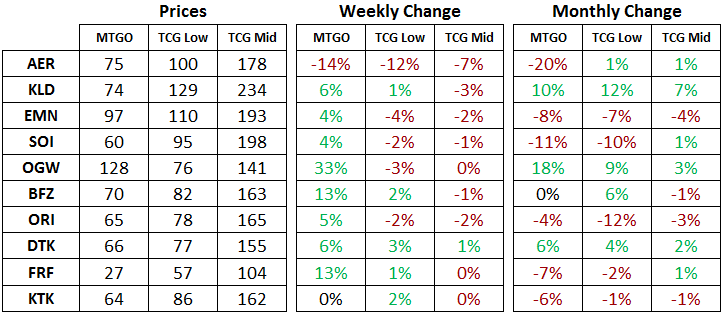
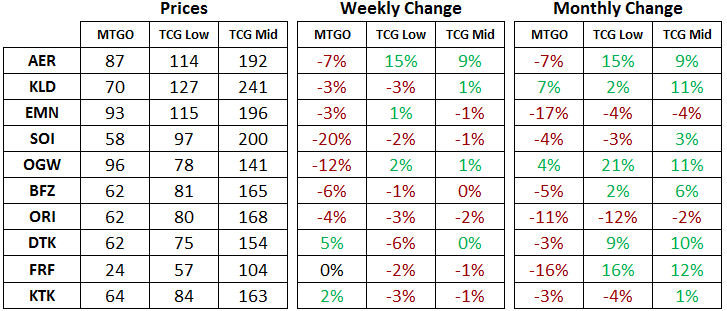
Below are the total set prices for all redeemable sets on MTGO. All prices are current as of February 13, 2017. The TCGplayer low and TCGplayer mid prices are the sum of each set's individual card prices on TCGplayer, either the low price or the mid price respectively.

All MTGO set prices this week are taken from GoatBot's website, and all weekly changes are now calculated relative to GoatBot's "full set" prices from the previous week. All monthly changes are also relative to the previous month's prices, taken from GoatBot's website at that time. Occasionally, full set prices are not available, and so estimated set prices are used instead.

feb13

Standard

Grand Prix Pittsburgh was the first stop in the post Pro Tour metagame. You can check out the top eight decks here and the rest of the top 32 decks here. A quick scan reveals that B/G decks with Winding Constrictor and Walking Ballista hold a veritable stranglehold on Standard at the moment. Mardu vehicles and Copy Cat decks make up the rest of the archetypes that finished in the top 32.

There was an error retrieving a chart for Winding Constrictor

The shifts that this represent have filtered into the MTGO economy. Prices on almost all redeemable sets were up this week, with Oath of the Gatewatch (OGW) leading the charge, up by 33 percent.  The appearance of Nissa, Voice of Zendikar in some of the B/G builds has pushed it up to a new all-time high just shy of 20 tix. Oath of Nissa is now an 8-tix card, and alongside gains from  Kalitas, Traitor of Ghet and Kozilek's Return from the mythic slot, it's no wonder that OGW had a big week.

Looking at Kozilek's Return in particular, this card went up to as high as 17 tix earlier in the weekend before drifting down to 13 tix. It showed up in sideboards of the Temur Aetherworks list from Pro Tour Aether Revolt, but that deck didn't have a strong showing at that event, with only two 6-4 records.

There was an error retrieving a chart for Aetherworks Marvel

To my eyes, the list looks like it needs tuning, but the bane of B/G decks in Kaladesh (KLD) Standard had been Aetherworks Marvel decks. We'll see if a retooled build of this archetype can make a showing over the coming weeks.

Shadows Over Innistrad (SOI) at 60 tix is cheap relative to other large sets and is the cheapest large set relative to its respective paper price. With Archangel Avacyn having fallen below 10 tix, only Nahiri, the Harbinger carries a higher price tag at the moment. If I was looking for a set to rebound in price, this would be my pick, although it would be better if the paper prices stabilized.

There was an error retrieving a chart for Archangel Avacyn

Modern

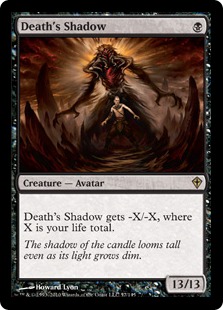
The list of Modern decks performing well is familiar terrain these days, although Infect has fallen out of favor with the banning of Gitaxian Probe. Death's Shadow-based decks have proven more resilient, and a modified Jund list featuring this card has emerged. The emphasis on quick kills from Temur Battle Rage is reduced, and there is more emphasis on disrupting the opponent with discard spells like Inquisition of Kozilek and Thoughseize.

There was an error retrieving a chart for Mishra's Bauble

Mishra's Bauble from Coldsnap (CSP) has benefited as a result and is now back up over 7 tix. It's also been showing up in the Abzan decks that want delirium enablers for Grim Flayer. The B/G/x package is a powerful selection of cards, and if Liliana of the Veil gets reprinted in Modern Masters 2017 (MM3), the components of these decks could benefit if the cost of the deck comes down. Remember that MM3 previews begin at the end of the month.

There was an error retrieving a chart for Liliana of the Veil

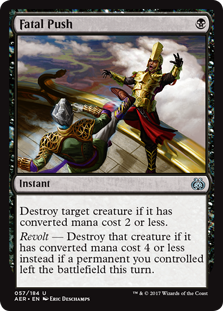
This weekend is Grand Prix Vancouver featuring Modern Constructed. It will give the a chance for Modern to show what kind of an impact Aether Revolt (AER) has had on the metagame, outside of Fatal Push.

Standard Boosters

Boosters of KLD look to have established a price bottom at around 1.7 tix and have now rebounded to 1.9 tix. These look like a safe bet to rise to over 2 tix over the coming weeks. With the noted discrepancy in payouts that favor AER boosters over KLD boosters, this trend should continue until the prize structure is changed or Amonkhet is released. Further monitoring is needed but KLD boosters look poised for further gains.

I've put a few dozen into the Market Report portfolio as a test purchase. If this price rises to 2.0 tix or 2.1 tix by the weekend, this will be a signal the trade is heading in the right direction. The release of Modern Masters 2017 (MM3) in March and the release of Amonkhet in April will interrupt any uptrend on these, so keep those events in the back of your mind if you are speculating on KLD boosters.

AER boosters are above their equilibrium price at close to 4 tix at the moment. There is no upside at this price and these should be sold if they are not expected to be used.

Trade of the Week

For a complete look at my recent purchases, please check out the portfolio. This week I added a trio of white mythic rares to the portfolio. Elspeth, Sun's Champion is a 3-tix mythic rare that has cycled up over 6 tix on two occasions since rotating out of Standard. The first time was last winter to combat the Eldrazi that were running rampant in Modern, and more recently it was likely related to speculation around the Frontier format.

There was an error retrieving a chart for Elspeth, Sun's Champion

I think this card is a safe bet to head back up to 6 tix at some point over the next 12 to 24 months. It's possible it drifts down further before a metagame shift in Modern brings it to the fore, so I'm not in a rush to stock the portfolio with this card. I've bought a dozen copies and will add to this total if the price stays below 3 tix.

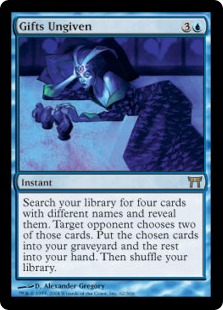
The other two cards are Elesh Norn, Grand Cenobite and Iona, Shield of Emeria. These two cards come out of the sideboard of  Gifts Ungiven decks in Modern. Alongside Unburial Rites, it's a potent reanimation package that a storm deck can move towards.

There was an error retrieving a chart for Elesh Norn, Grand Cenobite

Both cards have seen multiple printings and were both featured as mythic rares in Modern Masters 2015 (MM2). Multiple printings makes it easy to quickly acquire a large position in a card, which is nice for a time-constrained speculator. The fact that they both showed up in MM2 also makes me confident they will not be reprinted in MM3, since neither is a flagship card. This is another long-term position that will need a Gifts Ungiven deck to establish itself in the Modern metagame for it to pan out.

Insider: Playing It Smart in Standard

Are you a Quiet Speculation member?

If not, now is a perfect time to join up! Our powerful tools, breaking-news analysis, and exclusive Discord channel will make sure you stay up to date and ahead of the curve.

Over the past three weeks we've seen some decisive tournament results. The SCG Open was dominated by Jeskai. The Pro Tour was decimated by Mardu Vehicles. Last weekend, BG Constrictor wrapped its coils around Grand Prix Pittsburgh and squeezed.

The interesting part of all this is that these three decks form a classic rock-paper-scissors metagame. Jeskai beats GB Constrictor. GB Constrictor beats Mardu Vehicles. Mardu Vehicles beats Jeskai.

Since each week's result has ended with a particular deck being so dominant, the following week players are wildly compensating by playing the foil to the previous week's rout.

The truth of the matter is that all three of these decks are good and playable moving forward, and they are likely going to remain the best options until the next set rolls out. While GB put up the big numbers in GP Pittsburgh (five Top 8 and 17 Top 32) it is worth noting that Mardu and Jeskai also made Top 8 and combined were able to make up the other half of the Top 32.

It is also worth noting that no other archetype breached the Top 32, which tells us another important piece of information: the best decks are the best decks.

So, what do we do with this information? Well, I'm willing to draw a couple of inferences. First of all, if a Standard card isn't in one of these decks it likely has very little non-speculative Standard value. Secondly, the cards in these decks will likely remain highly chased-after until spoilers for the next set begin to pop up.

For every player on the planet that desires to play a Standard event, acquiring one of these decks is likely a requirement. Let's take a walk through the best decks and look for where the current value cards reside—these are the Standard cards that players will be buying and trading for in the foreseeable future.

BG Constrictor

BG Aggro was the hottest deck on the planet last weekend. I attended GP Pittsburgh and went 10-5 for a pro point, playing a Golgari deck. I also played against BG Constrictor 10 of the 13 rounds. I have never played the same deck that many times and I was at Grand Prix Flash, Grand Prix Mental Misstep, and Grand Prix Jund.

Of the three tier-one decks, I think GB Constrictor will be the most popular for a variety of reasons. First of all, it's the kind of deck people naturally gravitate toward. For some reason, people trend towards their favorite archetypes more than what data might suggest is actually the best. GB supposedly has a favorable matchup against Mardu Vehicles, but it is likely only about 55%. The margin is narrow. My friend and teammate Max McVety played Mardu Vehicles at the GP and went 5-3 against BG. Some favorable matchup, right?

The slim margin of BG may have been enticing considering Mardu's big day at the PT but the poor matchup against Jeskai is likely to bite it on the rear in the future. While BG may earn points because it is fun and gives you a lot of play, it is likely the worst positioned deck among the big three in the long-term. Especially, if we expect the Jeskai decks to make a rebound performance on the heels of BG being so popular last weekend.

Nevertheless, the deck is still one of the three best decks in the format and a viable choice for any player. Let's think about the cards in the deck that will continue to have a high demand and potential to maintain or gain value over the next month.

There was an error retrieving a chart for Winding Constrictor

Winding Constrictor is the lynch pin for all of the BG decks in Standard. It is the Bloodbraid Elf of Standard Jund. It is the cog through which all of the broken draws and combos run through. It is also relatively cheap when you think about it in those kind of terms. I could see it doubling in value as people stop cracking packs and drafting Aether Revolt.

I'd also like to note that I've been brewing with the card in Modern and Frontier. The card in concert with Hardened Scales is a pretty absurd beating. In fact, I wrote about such a deck on CFB this week! Once a deck starts to have access to multiple of that effect things get nutty pretty fast.

There was an error retrieving a chart for Walking Ballista

Walking Ballista is a card that I really missed the boat on. I thought it was a "good card" but not a money card. I was obviously interested in playing this in my Mishra's Workshop decks in Vintage and Affinity decks in Modern but I figured that was where the applications stopped. The piece of technology that I dramatically undervalued was the interaction between Walking Ballista and Constrictor.

Sure, having it come into play with an extra counter is cute, but is it good? I'd say that it is fine. The real absurdity comes when you start paying four mana to add two counters to the Walker. I hadn't really considered that when I was looking at the spoiler and reviewing cards for Standard.

Umezawa's Jitte is a dominant effect in an aggro or midrange mirror and these two cards together essentially build a better Jitte (assuming an opponent cannot break it up). However, when the opponent ends up without the critical kill spell and the combo goes unanswered, the game ends in very short order and nothing else matters.

Based on the applications of Walker in every format under the sun, I've flip-flopped and now think it is a strong hold card right now.

There was an error retrieving a chart for Tireless Tracker

Tireless Tracker may be my favorite Magic card right now. I play four in my Modern and Standard decks. It is extremely powerful (especially when combined with fetchlands or Evolving Wilds). The fact that it generates obscene card advantage while also becoming a gigantic threat makes the card very unique. Especially unique when one considers that it has such a small mana-investment cost.

In terms of positioning one's BG Constrictor deck, a version that plays the maximum number of Tireless Trackers between the main and sideboard gives itself the best chance against Jeskai. It is a cheap, efficient threat that also generates card advantage. At Pittsburgh I played three Tracker main and one in the board and always boarded in the fourth.

There are cards that do similar things in terms of generating gross card advantage, but they are typically unplayable in older formats because they cost five or six mana (Consecrated Sphinx, Mulldrifter, Sun Titan) and tend to be "blue deck cards."

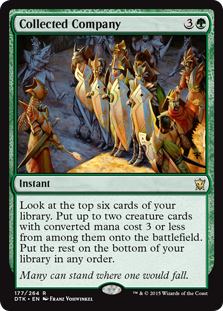
You can't Collected Company into a Mulldrifter—which is a big part of why I love Tracker so darn much.

With that being said, the card is so unique, versatile, and powerful that I think it will be a coveted card not only in this Standard format but in older formats as well. Get your copies now.

There was an error retrieving a chart for Gonti, Lord of Luxury

The Luxurious Lord is one of the coolest cards in Standard and very well positioned right now. It is a little lackluster against Mardu Vehicles but passable and great against the mirror or Jeskai. The deathtouch body allows it to rumble with creatures that have been "gearhulked up" as well as attack freely into Torrential Gearhulk mana.

The triggered ability is a lot better than advertised. Getting to steal the best out of four cards (Impulse the top of an opponent's deck) is a pretty big deal. Stealing a counterspell from Jeskai is gross. In the mirror, the option to choose between a haymaker like Gearhulk or a cheap removal spell depending on your hand has a lot of value.

I also really like this card as a Cube or Danger Room staple. It really is a fun and unique card that people seem to enjoy casting. Card advantage, selection, and removal body? Wow. Foil ones seem like a particularly savvy pick-up.

There was an error retrieving a chart for Lifecrafter's Bestiary

I have continued to be impressed with Bestiary the more I play with it. I wrote about it as a Standard speculation target based on my experience with it at the prerelease. I wrote about it as a sideboard option right off the bat for Delirium. I was right about all of it. The card is wonderful.

When it comes to playing grindy Jeskai or BG matchups, the player with the active Bestiary always wins the long game. I had one match where I had Bestiary and my opponent was able to draw five cards off of Ob Nixilis Reignited before I could kill it—yet I was always in control, and won the game. My Ob Nixilis only cost three, and scryed, and didn't deal damage to me, and didn't die.

I think the card is also maindeckable. It could be a way for BG to gain percentage against Jeskai moving forward. There is also a good shot that there could be an actual Bestiary deck at some point that cantrips cheap creatures into one another.

Last but not least, Bestiary may also be a viable Modern sideboard card, or at the very least will be a Commander staple. I like foil ones right now while they are still cheap and under the radar.

There was an error retrieving a chart for Heroic Intervention

Heroic Intervention is another spicy dollar-box card. It does something very unique out of the GB sideboard, which is to counter Fumigate and Radiant Flames. Often the Jeskai player will tap out for Fumigate on five—Heroic Intervention saves the team, and then you can untap and Gearhulk for the win.

With Mardu also packing sideboard Fumigates the card has even more value. Not to mention it can counter an Unlicensed Disintegration.

It is also worth noting that I was boarding it in the mirror as well. So many boards arrive to a stall full of giant creatures and deathtouchers. In these situations you can alpha strike (or block if they are ahead and attacking you) and cast Intervention, eating most of their board without losing a soul.

There was an error retrieving a chart for Blossoming Defense

Blossoming Defense is the best of this effect ever made and likely the best we will ever get for a long time. It is a card people will be playing in Modern forever. It is also a Cube card. I think picking these up now and holding onto them will yield nice dividends in the future. Foils especially, since they can be had for less than $5.

Mardu Vehicles

I believe deep in my heart that Mardu is actually the best deck in Standard. I regret not playing it last weekend because I'm certain I would have finished with a better record.

The ability to generate so much damage for so little mana is gross. The synergies are real. It doesn't roll over to a pile of shocks like other aggro decks.

With all of that being said, it isn't really a hot bed of sick value. The expensive cards, Gideon, Ally of Zendikar and Heart of Kiran, are likely as high as they can go in the wake of the PT. Scrapheap Scrounger has also already spiked and doesn't feel like a good place to get one's money in.

There was an error retrieving a chart for Fatal Push

Fatal Push has been steady as she goes. The Standard format is more about Push than ever and I could see the card steadily ticking up. Also, there is a good possibility that all the Modern events in the coming weeks will further showcase the card and lead to gains.

There was an error retrieving a chart for Depala, Pilot Exemplar

If I had to pick one card that could gain its way out of the dollar box from Mardu it would be Depala. The card is very good in the deck. Max McVety (our resident aggro genius) started three copies in his Mardu deck that he piloted to an impressive 11-4 cash finish in Pittsburgh.

There was an error retrieving a chart for Pia Nalaar

Pia is a great card and very strong in the Vehicles deck. I feel like it is always the card I lose to with BG. It either makes just enough bodies to block me down or is able to sacrifice an extra clue to keep my creatures from blocking on a critical turn.

I love the card in the Danger Room as well. My opinion: too good a card to be a $1 rare. I love foil ones as a long-term hold. It is the kind of card people like to play with in their fun decks and stacks that they want to bling out.

Jeskai Copycat or Control

To cat, or not to cat? that is the question...

Whether players opt to combo or just grind hard, the fact is that Jeskai is very real and here to stay. I anticipate it making a comeback next week with the success of BG Constrictor in Pittsburgh last weekend.

There was an error retrieving a chart for Fumigate

Fumigate is a really good card in Standard right now. It is insane against BG which has become the most-played deck. I've noticed that Fumigate is sold out at my LGS. Typically, when cards sell out at the store it means they are hot and likely to see a value gain.

There was an error retrieving a chart for Quarantine Field

It isn't easy to pick winners from the Jeskai deck because most of the cards are already beefed up to maximum value. If you didn't pick up Torrential Gearhulks and Saheelis before they spiked, they are likely only going to trickle down from here.

Field is a good card that is kind of a bulk mythic. I think it is a powerful and unique effect that could be worth owning and holding onto for the future. Foil ones seem like a nice Cube or Danger Room addition.

Trading into Staples

Standard is a three-headed monster: Jeskai, Golgari, and Mardu. Using that information to our advantage and trading for the highest-demand/highest-potential singles is a great way to turn extra trade fodder into cards likely to sustain value in our collections. Obviously, the prices are starting to settle in, but there are still nice investments to be made to the old Standard portfolio.

Fair Combo: A Beginner’s Guide

Are you a Quiet Speculation member?

If not, now is a perfect time to join up! Our powerful tools, breaking-news analysis, and exclusive Discord channel will make sure you stay up to date and ahead of the curve.

Welcome, once again, to the Beginner's Guide. My quest to explain the general deck types in Modern is winding down, with only the Ramp and unusual archetypes to come. As you no doubt surmised either through pattern recognition or just reading the title, this week is about the fair combo decks.

Hopefully this will not come as a surprise, but not every combo deck is unfair. in fact, unfair combos are far more rare in Magic than fair ones. Some of this is the result of design policy from Wizards, but a lot comes from the nature of the decks. Wizards prefers to avoid making unfair combos viable because players tend to dislike them. They've experimented with enabling combos like that and consistently end up regretting it. Furthermore, it is relatively uncommon for the right mix of enablers, engines, and payoff cards to exist to allow truly unfair combos to work competitively. You can always find ways to do something broken, but the question is whether it's fast or consistent enough to actually win games. These are not problems for the fair combo decks.

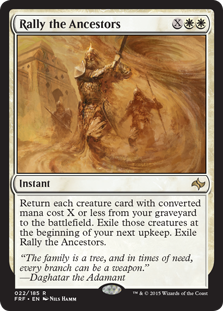
Wizards has shied away from any form of combo for years, but now some fair ones are starting to return to Standard. One of the most prominent from recent years was Rally the Ancestors. This is not always on purpose, but Sam Stoddard is on record saying that Wizards was deliberately keeping combo out of Standard and is now softening its stance. They are allowing some back in, so new Modern converts have at least some experience with this type of deck. To put it simply, fair combos win like a combo deck, but they don't have to enable their combo in any kind of special way. They play a reasonably fair game of Magic and win in one turn.

Occasionally I have been asked what deck type is most powerful. I usually prevaricate using the Socratic Method until the inquirer goes away. This is partly because I hate answering these types of questions, and partly because the correct answer is, "It depends," which no one finds satisfying. All the archetypes have had their moments in the sun and any can be "best" depending on what the rest of the room expected to face. That said, if you look over the history of Magic, the most powerful and dominating decks in multiple eras were fair combo decks. They're not the definitive best of all time, but they are where I'd start the conversation.

[wp_ad_camp_1]

What Is a Fair Combo?

Last week we defined unfair combo as those decks "that [are] built to break the rules." In contrast, fair combo doesn't center around degenerate mana generation or card draw—at least not when it comes to the win condition. There have been a number of fair combo decks that were remarkably unfair, even though the combo itself was fair. What defines a fair combo is that it doesn't require enabling. You may need to do some work before it will win, but the resource commitment is very low. A typical fair combo consists of 2-3 cards that do something on their own, but when put together they (nearly) instantly win the game. There's no need to generate absurd amounts of mana or draw your deck. You just play your cards like a normal deck and if you play the right ones in the right order you win. Simple.

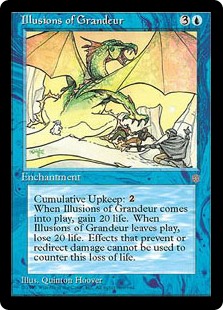
Fair combos are often described and understood in terms of unfair ones but that isn't really, um, fair. They may look similar but like walruses and manatees they have very different lineages. The true competitive lineage of fair combos goes back not to Prosbloom but to Trix. For those who don't know, Trix was a cross-format powerhouse from the Urza block era that won by using Donate on Illusions of Grandeur and killing the opponent when they couldn't pay the cumulative upkeep. The original Trix deck relied on some fantastically broken cards to find the combo, namely Necropotence and Demonic Consultation, but it was also one of the best control decks of the day. Where the other decks of the era had to blitz out the gate and win with a broken sequence, Trix would accelerate out Necro, judiciously use Force of Will and Duress to not-lose, and then assemble their combo and win just like a control deck. This was more obvious in later UR incarnations when the broken cards were either banned or rotated and the deck slowed down.

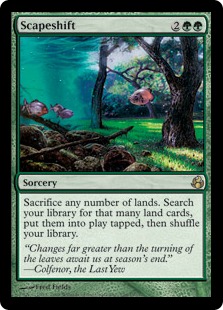
This is the common thread among all fair combo decks. They have a fair plan that includes a combo win. The fair plan may be a win condition on its own, as in Abzan Company, but it doesn't have to be. It was said of Trix that it was such a good control deck that it had to win by combo, and this is true of its many Modern descendants, most notably Scapeshift. Simply put, fair combos play fair Magic until they just win.

Strengths and Weaknesses

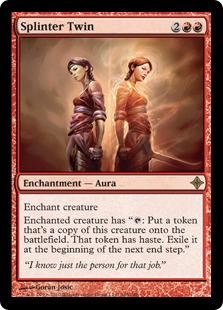
Fair combo decks have a number of strengths stemming from their hybrid nature. The sudden combo win ensures that your opponent is always on the clock while the fair plan allows you to fight through or ignore dedicated combo hate. You can attack from multiple angles and at varying speeds, and this means that you dictate the pace and length of the game. This was Splinter Twin's greatest strength—its combo was instant speed (effectively) and as a result your opponent could never comfortably tap out. The combination of fair cards and a combo win translates into control of the game.

The second great strength is that these are very robust combos. An unfair combo requires a chain of cards to go off and if the chain breaks they fail. Unfair combos are also so dedicated to the combo that they have no backup plan if the combo fails to come together. Fair combos make or buy the time they need with their fair plan. They're either answering their opponent or presenting non-combo threats to force the opponent onto the back foot, which keeps them from disrupting the combo kill. Furthermore, once the combo is assembled it just wins. There is no risk of fizzling. Storm can fizzle. Cheerios can fizzle. If Scapeshift resolves the combo cannot fizzle (unless you've made a mistake and fetched all your Mountains). As such, these are far scarier combos. You might not be dead if Eggs or Storm goes off, but you are definitely dead if Splinter Twin goes off. And there's a good chance that they went off through disruption because fair combos pack answers and interaction.

The third, and underappreciated, strength is their simplicity. It takes effort to mess up a fair combo. Poor sequencing, lapses in concentration, and miscounted mana have doomed many Storm players. All you need to do is enchant Deceiver Exarch with Splinter Twin to win. I know how dismissive and condescending this sounds, but over a long tournament playing a combo that plays itself will save you losses from fatigue.

For all these reasons, fair combos are some of the most successful decks in Magic's history. Splinter Twin has a long history of high-level wins, just like Trix before it. These decks' versatility, power, and robustness make them arguably the best combo decks in the history of the game. These decks have the disruption to beat more unfair combos and the resilience to power through fair decks. Furthermore, they can win out of nowhere. Against unfair decks this creates a potent clock (go off now or I kill you) while letting them dodge a losing attrition fight against fair decks. Other archetypes may look more threatening, but history is on fair combo's side.

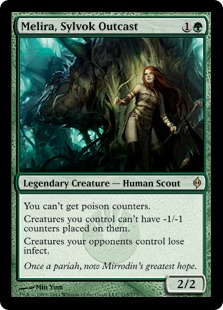
However, the hybrid nature of these decks is also a weakness. Most of the time their fair plan isn't actually good in comparison to decks dedicated to that plan. Abzan Company can win either via the Melira combo or by being a Gavony Township beatdown deck. However, GW Hatebears is much better at Gavony Township beatdown than Company. RUG Scapeshift plays like a RUG control deck until it is time to go off, but it isn't as good at being a control deck as dedicated Jeskai or Esper Control.

Similarly, the fair combo decks are slower than dedicated unfair combos. Twin could not win before turn four. Cheerios can win on turn two. The inclusion of a fair plan necessarily slows down the kill speed. Trying to speed up the fair combo often distorts the deck and it doesn't work as well. You have to recognize that your deck is made of compromises—good ones, mind—but you're never going to do any one thing as well as a specialist.

Play Fair, Win Suddenly

The key to correctly playing fair decks is to play on your opponent's fear. You can win at any time, so threaten to do so. Splinter Twin was a house for years because the mere threat of the combo ensured that opponents would play around it, disrupting their own gameplans just to ensure they didn't die. Opponents never wanted to tap out, unless they had looked at your hand first, so they couldn't curve out efficiently and thus slowed down their own gameplans. Once you're at the critical turn when you could win, it is important to always act like you can win and you're just looking to play around your opponent. Even if you don't actually have the win, you must make your opponent respect it.

It is not, however, enough to just threaten the combo and wait to go off. If you just wait around until you have your combo in hand, the opponent will have plenty of time to sculpt their own hand and/or build their board state. While you do play answers and protection, you will never have enough cards in hand to beat an opponent with a hand full of answers. Or you might just die while waiting for your combo to materialize. You need to do something to make the opponent expend resources so that they're depleted when you go off.

This can be actively searching or building to the combo, like Scapeshift, or it can be presenting other threats and attacking your opponent, like Abzan Company. Twin's main game was as a Snapcaster Mage deck that out-valued and out-tempoed opponents until they could not stop the combo. Your goal is to set the tone and pace of the game to force the opponent to play on your terms until your combo comes online. When you let your opponent dictate the game, you will fall behind, which puts you into go-off-or-die territory, and unlike unfair combos you can't exactly start going off and hope to get there. You either have it or you don't, and there aren't enough cantrips or tutors in Modern to help you.

Finally, it is important to recognize whether your opponent can disrupt you, and how. This determines what kind of game you will play. An opponent that cannot actually stop you will try to race your combo kill. Depending on your combo this will either dictate that you go all-in on comboing as quickly as possible or that you fall back on the fair plan, take control of the game, and win at your leisure. An opponent that can answer your combo with certainty will play relatively fearlessly. This may force you to try to combo multiple times, which is unlikely in these kinds of decks, or necessitate complete abandonment of your combo. As long as Jund had Abrupt Decay in hand it could never lose to Splinter Twin. This meant that Twin players had to fight an attrition battle either to get the Abrupt Decay out of Jund's hand or invalidate the answer by chip-shotting them to death. Your deck is adaptable, so you have to learn to adapt to the situation you face.

Beating Fair Combo

Fair combos tend to win relatively conventionally. They're resolving a single spell or winning with a combo based around creatures. As a result they can usually be disrupted by normal means. Kill the important creature, counter or discard the important spell and you beat the combo. In contrast to unfair combos, it will be fairly obvious which piece you need to stop to break up the combo.

The real challenge is whether you can disrupt the combo while still winning the game. These decks have ways to keep you from winning while they find their combo, and if you ignore their combo you may just lose. The key is to recognize that they are jacks of all trades, but masters of none. Use your unique power to win before they do. Fast decks can get under the fair combo win before they can threaten the combo. True control decks can win the attrition fight against the combo deck. Respect the instant win, but don't let it dominate the game. The best strategy I've found is to make the combo deck combo before they feel safe doing so. Then the fight will be on your terms, and that is a fight you can win.

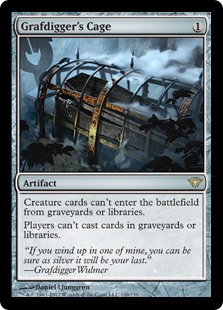
It's also important to note that hate cards aren't as effective as you might think against fair combos. Yes, they can slow down or even prevent the combo, but a fair combo can ignore their own combo if necessary and win around hate. They can also answer hate more easily than unfair combo, since they're already planning to interact well into the late game. As a result, I recommend against targeted hate for fair combos. Instead play cards that impact the fair gameplan. The deck is mostly fair, so if you have something that attacks that dimension you'll be far better off. Bonus points if it also harms the combo, as Grafdigger's Cage does against Abzan Company. It stops the tutor engine, the main fair plan, and the combo kill. Efficient and effective.

Suddenly, It's Over!

Fair combo decks have an illustrious pedigree for a very good reason. These decks are versatile, powerful, and surprisingly fast. If you do not respect them, you will pay the price. However, this power comes at the price of compromise. They're simply not as good at anything as specialized decks. The whole is greater than the sum of the parts, however. Complacency is fatal.

Next week, Ramp decks.

Modern Metagame Breakdown: 1/1/2017 – 2/5/2017

Are you a Quiet Speculation member?

If not, now is a perfect time to join up! Our powerful tools, breaking-news analysis, and exclusive Discord channel will make sure you stay up to date and ahead of the curve.

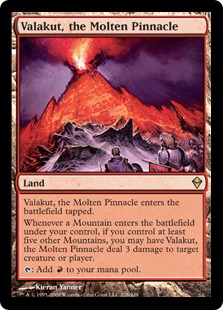
On January 9th, Wizards of the Coast brought the heavy weight of the banhammer down upon Modern, attempting to target several linear decks that ranked among the best-performing archetypes during 2016. On the one hand we had the aggressive, explosive creature combos with a gotcha! element, headlined by Infect. On the other hand we had Dredge, taxing sideboards and punishing anyone who was trying to play normal Magic. Together these archetypes put enormous pressure on the format—interactive decks needed to begin disrupting immediately in the first three turns of the game, but the very strategies suited to this task tended to fold to Dredge's late-game engine. We saw Jund and Bant Eldrazi rise to the task, but few other fair decks were able to navigate the crucible. It's no surprise that this environment favored the non-interactive, with Affinity, Burn, and RG Valakut taking larger-than-normal shares and the slower decks like Tron and Jeskai falling by the wayside. Meanwhile, control players did their best unfair impression, turning to prison strategies like Lantern Control and RW Prison that could cheese out the linear decks with haymakers like Ensnaring Bridge or Chalice of the Void.

Early indications of the post-banning environment seem to show that Wizards was assiduous in its application of their stated ban policy. The January data bridges the date the bans went into effect, but we can already see the linear decks relaxing their stranglehold. Things appear to be becoming more diverse too—although it's hard to say if this is merely an effect of a metagame in flux, or if we've truly returned to the glory days of a brewer's Modern paradise. My money's on the former—but we shall see.

[wp_ad_camp_1]

Data Collection Methods

First, a note on the data set we're working with. The bans went into effect on MTGO on January 11, while the paper format didn't switch over until the 20th. All told, this means the January data is split about half between the pre- and post-banning environments. Since this was likely to show a pretty muddled picture, we decided to extend the period out one more week. That gives us a few more MTGO Leagues and paper events after the bannings, but more importantly the Top 8 finishes from Star City Games Regionals. For many players this would have been the first large tournament they targeted for post-ban testing. Regionals most likely is the best indicator of the new Modern, and it already shows some pretty big shifts (just one Infect deck across all the Top 8s!) Tune in for Trevor's article later in the week where he'll tackle those results more specifically.

Major paper events were pretty sparse in January, with just two SCG Classics in Columbus and Richmond. The Modern component of the 2017 Super Sunday Series Championship could also be considered a high-profile event, but it suffers from the typical issues related to split-format events. Thus we've included the 3-1-or-better Modern decks as regular paper data points. Finally, with no Grand Prix or SCG Opens since November, our Day 2 metagame data is starting to get pretty stale. Normally we weight that data at 1/3 of the metagame, but given its extreme age in this update I assigned it a weight of 1/8. Altogether our paper data total 643 decks across 85 events.

Regarding the MTGO data, this month I've made a slight tweak. As far as I can tell, Wizards chooses a random sampling of 5-0 League finishes to publish each day. Whatever algorithm they use doesn't preclude duplicate decks, which appear semi-regularly throughout the data. This corresponds to a broader phenomenon whereby in any given month certain usernames tend to dominate the data set, appearing repeatedly across days. These names start to become familiar to anyone who reads the results regularly—they belong, of course, to the grinders and pros who are playing one (or more) events daily, and who thus appear disproportionately in the finishes.

To some extent this bias is warranted, if our goal is to measure the metagame as it stands empirically—you are, in fact, more likely to face these opponents during the month(s) in question. That said, to minimize the skewing effect, moving forward I'll be limiting each username to one finish per day, per archetype. (In January there was one instance of a pilot playing two different decks to 5-0 finishes, both of which were included.)

In addition to Leagues, we have a MOCS monthly and a MOCS playoff to draw from. Together the MTGO data comprise 416 decks across 38 events.

Tier 1

Tier 1 decks are the ones you should expect to face at every Modern tournament. Make sure you show up to your local events and Grand Prix alike with a well thought-out plan to beat these decks—you’re going to face them often, and each one is resilient enough to fight through a lackluster counterplan. Of course another avenue is to pick one of these up yourself, which I generally suggest for anyone not well-versed in a lower-tier deck. Whether you know one of these archetypes inside-out and can tune a killer sideboard for the field, or you want to pick up something new and wing it, these decks certainly have the chops to get the job done.

Tier 1: 1/1/17 - 2/5/17

DeckOverall
Metagame %
Paper %MTGO %
Affinity6.6%6.7%6.0%
Jund6.1%7.2%4.1%
RG Valakut5.6%5.1%6.5%
Burn5.4%5.4%5.0%
Gx Tron5.4%5.9%5.8%
Abzan5.0%4.2%8.2%
Bant Eldrazi4.8%5.1%3.6%
Infect4.5%3.7%1.9%
Dredge4.1%2.8%5.5%

A cursory glance at the archetypes that comprise our Tier 1 for January implies that little has changed in Modern early after the bannings. Most of these decks were well-represented throughout the year of 2016, and with the exception of Abzan, all were Tier 1 in the December standings. (Note that the appearance of RG Valakut in Tier 1 is not a new development, but rather a function of rolling Titan Breach and Titan Shift together.) Notwithstanding the departure of Gitaxian Probe and Golgari Grave-Troll and the arrival of Fatal Push, Modern appears to be the same format we've always known. However, digging deeper we start to see some pretty striking elements that are indicative of major shifts.

This first appears in the wider-than-normal differentials between MTGO and paper shares for several archetypes. This is nothing new of course. We've often seen the MTGO metagame adapt faster than its paper counterpart, for a variety of reasons like card availability and event frequency. But these discrepancies are usually limited to a reduced number of archetypes, and the gulf is usually just a few percentage points. Here we see four Tier 1 archetypes (Jund, Infect, Dredge, and Abzan) with marked differences between MTGO and paper share. Looked at proportionally, these gaps become even more striking—each of these archetypes is about twice or half as prevalent in one environment as the other. Abzan doubles from 4.2% to 8.2%; Infect loses nearly half its paper share of 3.7% for 1.9% on MTGO; and so on.

Remember that the cutoff for bannings went into effect earlier on MTGO, so in addition to its traditional propensity for faster movement the online community got a week-long head start. All in all, these data clearly show a metagame in rapid flux. As we get more data during 2017, I hope to take a comparative look at the pre- and post-banning metagames to get a clearer picture, but for now we're still in a period of conjecture. The weirdest thing here is definitely the way Dredge is posting better MTGO results—my working theory for now is that rumors of the deck's demise have been exaggerated, and that Golgari Thug is an acceptable replacement for Grave-Troll.

Tier 1 Changes: December to January

Deck% Change
December to January
Overall Meta %
1/1 - 2/5
Overall Meta %
12/1 - 12/31
Affinity+1.3%6.6%5.3%
Jund-1.4%6.1%7.5%
RG Valakut+1.1%5.6%4.5%
Burn-1.5%5.4%6.9%
Gx Tron+1.6%5.4%3.8%
Abzan+1.3%5.0%3.7%
Bant Eldrazi+0.5%4.8%4.3%
Infect-5.7%4.5%10.2%
Dredge-2.7%4.1%6.8%

Wowzers. Here again we see changes way more plentiful and bigger than is typical. Perhaps predictably, the two decks targeted most directly by the bans (Dredge and Infect) dropped by a good chunk—but that 5.7% drop is enormous. This is the largest change to any archetype I've seen since I began managing the metagame reports last year (although it is the first B&R change I've overseen). The banned decks' loss of share is flanked by a flurry of relatively large movements in virtually every other Tier 1 deck, with the sole exception of Bant Eldrazi. Let's go through each briefly.

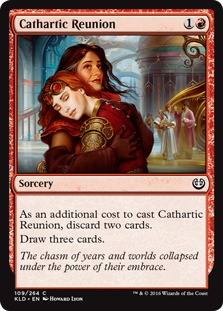
  • Dredge persists in nerfed form. As I alluded to above, Dredge is still posting a healthy 5.5% of the MTGO metagame, where players have basically switched out Grave-Trolls one-for-one for Golgari Thugs. That's obviously a big downgrade—not only are we dredging for much smaller values, we've lost a major late-game grinding component in the hard-to-kill 10/10 beatstick. These aspects were enough to drop Dredge almost 3 percentage points to 4.1%. That said, Cathartic Reunion is still one hell of an enabler, and in most opening hands a Stinkweed Imp will fare just fine. I think we'll see Dredge settle into a more reasonable role in the new Modern, much like Bant Eldrazi did after the departure of Eye of Ugin. Dredge's days of warping sideboards are likely at an end, but the deck may fall into the characteristic cycling pattern it has exhibited in other formats. All in all, early data shows that Wizards made a good call returning the nefarious Skeleton Troll to his prison cell (that guy always recidivates).
  • Infect takes a big hit. My poor, embattled Phyrexians. What did they ever do to you people? All they wanted was to compleat the multiverse so you could live up to your potential and be the best you could be. And look how they're rewarded. A drop by more than half their share in December, bringing them from top deck down to 4.5% of the metagame. The naive interpretation here is of course that Infect can't function without its blue Praetor's invasive Probes, but as a committed pilot of the deck I think that's actually a red herring. In my opinion the loss of Probe is far less important to Infect's fall than the surrounding metagame shifts that the bans engendered.

It starts with Golgari Grave-Troll, strangely enough. Dredge terrorized a large number of archetypes during its reign, warping sideboards and deck choices alike. The Phyrexians, however, apparently must have a highly effective zombie-removal system—Infect was one of the few archetypes that generally posted a positive matchup against Dredge. While Dredge could get odds close to 50% with liberal use of sideboard space, this was not a matchup they could ignore. Infect, on the other hand, got to add Distortion Strike and extra Spell Pierces and largely continue on its merry way. So one of our good matchups fell in numbers.

Second, while Infect can survive just fine without the free cantrip (Probe was probably the card I sided out more than anything else) the same couldn't really be said for UR Prowess and Death's Shadow Zoo. At minimum, these decks will have to adjust greatly to continue functioning, and their characteristic explosive starts will be far less frequent. That combined with Dredge's nerfing puts fair decks like Jeskai, Jund, Abzan, and Grixis in much better positioning. These decks have always been the bane of little infecters everywhere, and they recently got access to Fatal Push to boot. To some extent, this is an effect we haven't seen play out yet (see below in the section on BGx). That does lead me to believe some of Infect's drop is self-policing by the Modern community, where players (right or wrong) assume their old deck choice should be sidelined.

  • Affinity and Burn switch places. At 6.6%, the robots have surpassed the other two aggro archetypes that outperformed them last month (Burn and Infect), rising to the top position overall. The next largest archetypes are nipping at Affinity's heels, but for now it appears to be an early winner of the bannings. Compared to Infect, it's easy to see why it would be advantaged—both have been premier aggressive archetypes since time immemorial, and Affinity didn't lose any tools. Looking to Burn, which shed about the same amount of metagame share Affinity gained, we can see some secondary cascades of the new environment. Infect was a bad matchup for Affinity and a good one for Burn. As the Phyrexians appear in lower numbers, these archetypes are benefited and punished accordingly. Dredge is yet another unfavorable matchup the robots have to contend with less now. And finally, Burn is itself unfavored against Affinity, and will be negatively impacted by an increase in that deck's share.
  • Abzan is up, Jund is down. Abzan took a chunk out of Jund's shares, but the total representation of BGx is about the same as in December. Honestly, I and other commentators had anticipated an increase due to Fatal Push, but we're still in the early weeks of Aether Revolt Modern. The set was released a few weeks after the bannings, so the presence of the new premier kill spell is probably still underrepresented in our data. As for why Abzan would be better than Jund, I can only speculate. If BGx had increased more generally, it would make sense as a foil to the pseudo-mirror, but that wasn't the case. Abzan with its Lingering Souls and Path to Exiles is certainly scarier for Infect, but the slightly durdlier BGx variant was probably just disadvantaged due to general format speed.
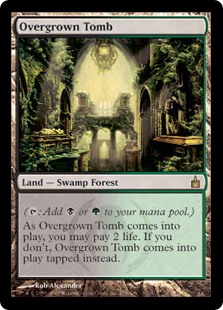
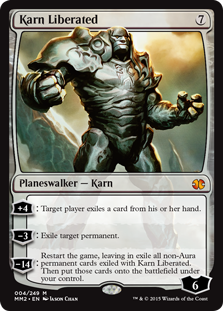
  • Gx Tron rises to the challenge. We're reporting the green-based Tron decks together because they largely fill the same metagame position and differ in little more than the removal of choice and a few sideboard options. Breaking it down into parts, RG, GW, and BG Tron were all about evenly represented, with BG's shares increasing the most since December. As many people suspected, Tron is another major beneficiary of the new environment. Infect and Dredge were nightmare matchups for the ponderous big-mana deck. At the same time that both were knocked down a peg, Tron's preferred matchup got a shot in the arm in Fatal Push. An increase in Overgrown Tomb alongside fewer Inkmoth Nexuses and Prized Amalgams is good news for Karn et.al. Tron has also benefited immensely from some smart deckbuilding and innovation in its removal suite, that saw a shift to white and black splashes improve its traditional bad matchups. As if that weren't enough, the black versions can themselves use the new tool Fatal Push printed in Aether Revolt.
  • RG Valakut pushes higher. RG Valakut was another major story of 2016, when it rose from obscure fringe status (usually under the name of "Summoning Trap") to become one of the premier archetypes. As I explained in past updates, this archetype can be broken into two distinct builds, Titan Breach and Titan Shift. For this update, we've decided to just start listing them as one archetype, as that does a better job of representing how they fit into a given metagame. These decks tend to struggle against the more linear aggressive strategies like Infect, and excel against fair strategies and Tron, so the bannings were probably a boost. The Valakut archetypes together grew by 1.1%, with most of that attributable to the Through the Breach variants.

Tier 2

Tier 2 decks are not as omnipresent as the Tier 1 crop, but they still show up in hearty numbers at the typical tournament. In many ways this tier is the lifeblood of Modern, whence its diversity and “play anything” reputation stems. If these decks aren’t dominating at the moment, they’re still capable of crushing a tournament on any given day—and many of them have been Tier 1 at some point in the past or will in the future. The better acquainted you are with any one of these archetypes, the better choice it represents, and if one of them is your specialty there’s a strong argument to stay the course and keep sleeving it up.

As for preparing to beat Tier 2 decks, you don’t need to dedicate specific sideboard space or do backflips to make your matchups favorable, but at minimum have a plan. You won’t face all of these decks in a tournament, but you’re all but certain to face at least some of them. Welcome to Modern!

Tier 2: 1/1/17 - 2/5/17

DeckOverall
Metagame %
Paper %MTGO %
Death's Shadow Zoo2.9%1.1%6.5%
Grixis Control/Midrange2.7%2.3%3.4%
Ad Nauseam2.4%2.6%3.1%
Grixis Delver2.4%3.4%0.7%
Abzan Company/Evolution2.4%3.7%0.2%
Eldrazi Tron2.1%1.4%3.8%
UW Control/Midrange1.9%1.4%3.6%
Eldrazi and Taxes1.8%1.7%2.2%
Elves1.6%2.5%0.2%
Merfolk1.6%1.6%1.2%
Lantern Control1.6%1.1%1.2%
Griselbrand1.3%0.9%2.2%
Amulet Titan1.3%0.3%3.4%
RW Prison1.3%0.6%2.2%

While the changes to Tier 1 happened mostly in share percentage, Tier 2 saw more substantial changes to its roster. New in January are Abzan Company/Evolution, Amulet Titan, Eldrazi and Taxes, Elves, Griselbrand, and UW Midrange, while two archetypes, Jeskai Control and UR Prowess, fell down to Tier 3. Of these archetypes, the one that changed the most was Abzan toolbox strategies, which gained about 1.5%. Again we see a greater-than-normal number of archetypes with significant differences between paper and MTGO showings, which reinforces my narrative about the metagame in transition.

In case you didn't notice above, the total loss of percentage in Tier 1 decks was 11.3%, compared to just 5.8% gains. That means a full 5.5% of the Tier 1 metagame share was redistributed down to Tier 2 and 3 archetypes. That's a good sign that the bannings are working as intended and increasing diversity. We see this diversity present in the Tier 2 metagame shares, with no deck claiming 3% (compared to three decks during December). All of this could be due to adjustments as the Modern community figures out what the best strategies are, but for now it seems a less rarefied metagame is taking form.

There are too many changes here to go over every single one, but I'll try to touch on the most salient ones.

  • Prison recedes into the background again. Prison strategies enjoyed an uncharacteristically large presence on the 2016 stage. It began with Eldrazi Winter, when Lantern Control was one of the only decks capable of keeping up with the broken and soon-to-be-banned deck. Lantern was later joined by RW Prison as two viable avenues for control-minded players who needed to respond to the linear environment. If you can't play fair and kill/counter all their cards the good-old-fashioned way, perhaps you should just invalidate entire swaths of their deck in a fell swoop. Ensnaring Bridge, Chalice of the Void, Blood Moon, Anger of the Gods—the marquee cards in these decks have the linear metagame written all over them, and they tend to be less impressive against interactive decks. With the linear creature-based decks dropping off somewhat, these decks have lost some of their raison d'être, and we'll probably see them return to a less prominent spot. Lantern Control and RW Prison are still holding on in Tier 2, but they fell by 1.5% and 1%, respectively.
  • Company's back, baby! Abzan Company has had a wild ride. It ranked among the privileged few able to survive the harsh Eldrazi winter, only to fall almost completely off the map as the subsequent linear metagame took form. As Dredge rose in prominence, poor Abzan Company got hammered by splash damage off of Rest in Peace and Grafdigger's Cage. Now the stage is set for this archetype to return to being a normal part of the meta. Notice that absurd difference in MTGO and paper shares; we've talked about this before, but there's a good chance the difficulty of executing the combo on the online client is to blame. In any case, 3.7% of the paper metagame is a healthy share for a deck that until recently was drifting around the bottom of Tier 3.
  • Death's Shadow undergoes a lateral shift. So what gives with Death's Shadow, which was supposed to meet its untimely demise at the end of Wizards' banhammer? It lost 0.7% since December, but the MTGO shares of 6.5% point to a deeper story. Death's Shadow pilots were explicit in saying that the old deck was very dependent on Gitaxian Probe, and that the banning would prove quite unkind to the archetype. In a sense it has—the old Death's Shadow build is all but completely dead—but a new replacement was found pretty quickly. I covered this innovation in a Deck of the Week feature, where I called it Death's Shadow Jund. This build foregoes some of the explosiveness for more consistency in a Traverse the Ulvenwald package. For now it appears the cat isn't out of the bag among the paper Modern crowd, but the MTGO grinders have certainly registered their conviction in the archetype's competitiveness, and it's performing admirably there.

Tier 3

Tier 3 in Modern houses the decks with fringe potential, or those which are simply in a poor position in the current metagame. These decks range from relatively strong decks with scant adoption in the player base, to fragile decks that crumble to variance while mainstays like Burn or Jund draw consistently round after round. That said, Modern draws from an absurd well of card power, and each of these decks can give you a run for your money. You don’t need perfect knowledge of everything they’re doing, but the difference between familiarity and complete ignorance can definitely determine the outcome of a match.

Playing these decks isn’t advised, unless you know them inside-out or have some specific reason why you think they’re underrepresented. Of course, they are also worth a look as fun decks to battle if you’re less concerned about winning and want to delve into the deeper end of the Modern pool.

Tier 3: 1/1/17 - 2/5/17

DeckOverall
Metagame %
Paper %MTGO %
UR Prowess1.1%0.6%1.9%
Kiki Chord1.0%1.4%0.2%
Living End1.0%1.1%1.0%
Jeskai Control1.0%1.1%0.7%
Knightfall1.0%0.9%1.2%
Esper Control1.0%1.1%1.0%
Blue Moon1.0%0.8%0.7%
Skred Red0.9%1.1%0.7%
Scapeshift0.8%1.1%0.2%
Bushwhacker Zoo0.7%0.8%0.2%
Faeries0.7%0.9%0.5%
Jeskai Midrange0.7%0.6%0.5%
Bogles0.7%0.8%0.7%
Death and Taxes0.6%0.6%1.0%
Gifts Storm0.6%0.5%1.2%
Mardu Control/Midrange0.6%0.6%0.2%

If the upsets in Tier 1 and 2 were clear indicators of the seismic impact of the Probe and Grave-Troll bannings, Tier 3 changed pretty much exactly as we might expect. There were a larger number of decks that sublimated one rung up to Tier 2, but some number of these shifts do happen every month. A few decks fell off entirely, while other surfaced after some time off the radar. The percentage changes in the lower decks are too small to reliably say whether they're related to the bannings per se. Skred Red, for example, seems to have enjoyed a minor bump from the GP Dallas publicity, but who knows if this deck will stick around. There are, however, three more noticeable changes.

The first is just that UR Prowess lost half its share, dropping from Tier 2 in December. As with Death's Shadow, this deck's aficionados may yet find a way to resuscitate the archetype, but Probe was a pretty central piece. Second, we see Esper Control hit 1% of the metagame. Control strategies without access to red were the biggest gainers in the printing of Fatal Push, and Esper Control may finally be viable. That said, I'm not confident Push is exactly the reason here—UW Control/Midrange strategies have been on the rise for several months as well. This month the UW control strategies pushed into Tier 2 with a 0.5% bump. It could be that a less linear metagame simply favors these fair midrangey decks, outside of any particular card considerations.

Finally, we have a new deck in Modern, sort of. I originally planned to roll all the "Gifts Storm" decks into the same category of Storm, but as I entered the data I discovered it had enough of a showing to reach Tier 3 by itself! While Storm pilots bemoaned the banning of Gitaxian Probe as unfair punishment to a deck that was already struggling, they were quietly gifted with a new tool in Aether Revolt: Baral, Chief of Compliance. As with many things Modern, simply jamming the card into old builds may have proved lackluster, but a slight shift in deck construction bore fruit. Gifts Ungiven has generally been a little too slow for Modern, but this deck has a full eight ways to make it cost three mana. If you can untap after doing that (especially if your Medallion is still in play) you're virtually guaranteed to kill the opponent on turn four. To make room, they've cut the Pyromancer Ascensions. This may indeed be the new face of a Probeless Storm.

Predicting the Metagame

I'd like to begin offering up my views of where the metagame might move in future updates, but for now I'm pretty beat. This was obviously a pretty important month for metagame changes, and it will be interesting to see how they are reinforced or attenuated in the coming months.

In the meantime, we have another article from Sheridan set to run this week, and the Merfolk Primer is almost ready to roll out. Rather than delay that while all the others are finished, I will probably be pushing it live sometime this month before setting to work on the next one. Hopefully you'll find them worth the wait. For now, thanks for reading, and I'll see you next Monday.

Insider: Investing in a Long-Forgotten Set

Are you a Quiet Speculation member?

If not, now is a perfect time to join up! Our powerful tools, breaking-news analysis, and exclusive Discord channel will make sure you stay up to date and ahead of the curve.

It’s time to play a guessing game. I am going to rattle off some characteristics of a set and I want you to try and guess which set I’m referring to. Trust me, this has financial implications, so just stick with me for a moment.

Hint 1: It is the set with the most all-time highs on MTGStocks.com (18 in the past five days).
Hint 2: The set is nearly sold out of every relevant card on TCG Player and eBay.
Hint 3: The print run for rares is larger than Alpha and Beta but far less than Unlimited.
Hint 4: The set was released in December 1993.
Hint 5: About 15,000 of each card in the set were printed, though I suspect a good amount have been lost/damaged over the years.

Did you guess it yet? The answer is…

Collectors’ Edition / International Edition

Worth a Second Look

According to MTG Salvation Wiki, “The Collectors’ Edition of Magic: the Gathering was released in December 1993. Approximately 9000 sets were printed for the U.S. and Canada (CE) and another 5000 were printed for international release (ICE)…The faces are identical to the Beta printing, but have square corners. The Reverse side has golden borders around the edges and gold printing saying either “Collector’s Edition” [sic] or International Edition.”

You may be thinking, “Wait a second…do you really expect me to read an entire article dedicated to a set that isn’t tournament-legal?”

Yes. At least I hope you will read it all because there are some financially relevant things going on with this set that merit a closer look. I posted about this in the QS forums and not many people responded. That’s okay. I didn’t expect a lot of interest in this post at first. I even indicated in the post that I would do some more digging to report back on whether or not this set should be looked at more closely.

It is.

Over the past week I began searching the internet for Collectors’ Edition and International Edition cards and I discovered a pretty relevant fact: there are very few out there! I mean, extremely few. Often times there would be one or two copies on eBay, one or two on TCG Player, a few across the largest Magic vendors, and that’s it.

Let’s use Disrupting Scepter as an example.

How much do you think this card is worth? How many are on the market? Here are the quantities I could find between CE and IE:

TCG Player: 0
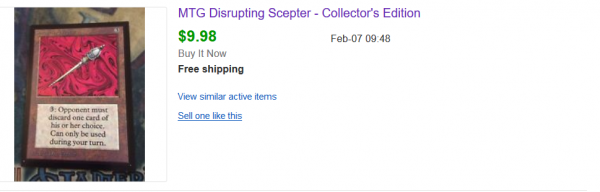
eBay: 18 (All from a single seller with a $9.98 price tag)
Star City Games: 0
Card Kingdom: 0
ABU Games: 15 ($6.49 for CE, $11.50 for IE)
Card Shark: 0

It appears only two sellers have copies available, at price tags far higher than the other vendors. Want to know why? It’s because all the cheaper copies have sold! This isn’t just laziness on a few vendors’ parts here. There is real demand for these, hence the nonzero buylists and the eBay completed listing from last week.

Sold

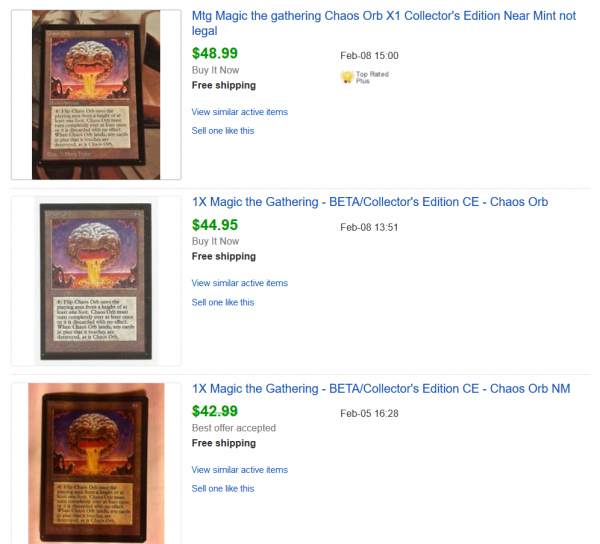
If only one recent completed listing isn’t inspiring, then check out what shows up for Chaos Orb. (Disclaimer: one of these completed listings is a copy I purchased.)

Sold2

Did you expect to see such high prices on non-tournament-playable cards? I sure didn’t.

Now I understand why Star City Games is paying $30 on Near Mint CE Chaos Orbs and $40 on Near Mint IE copies. There is real demand here.

Where is this Demand Coming From?

One answer, two words: Old School. While the format’s founders never supported the use of Collectors’ Edition and International Edition cards in ‘93/’94, many play circles have relaxed the card set restrictions to enable more players to get involved. It would appear that some communities stateside formally allow the use of these square-cut cards.

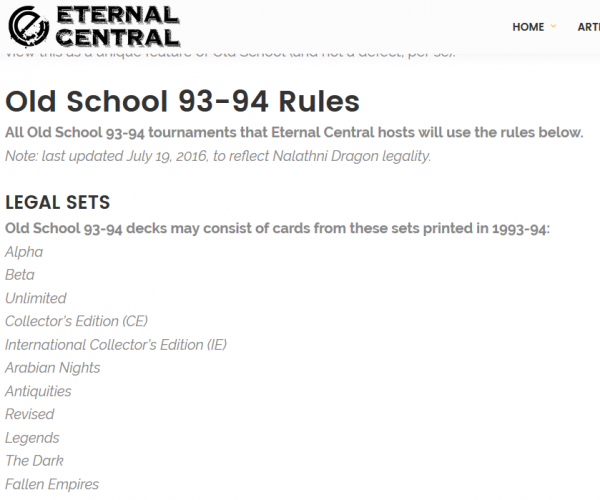
Technically speaking, the official Old School site states that Eternal Central rules allow for CE and IE cards.

Eternal Central

At last, there’s a reason to sleeve up CE and IE cards. And honestly, when double sleeved these cards are sufficiently indistinguishable that it really doesn’t matter. And if you follow the honor system and shuffle as usual, a card’s corners are irrelevant. Will these ever be allowed in a WOTC sanctioned event? Perhaps not. But the goal of the Old School player isn’t to play in sanctioned tournaments anyway so this doesn’t factor into the equation.

Bottom line: these are playable. By the way, I personally would rather play a CE/IE copy of a card than a Revised copy. Aesthetically speaking the black border and bold colors are far more attractive than the white border and washed-out look of Revised. I’m sure many would agree.

OK… So What?

My usual PSA for buying Old School cards holds true here. Please do not go and buy the market out of CE and IE cards. For one, it’ll take you forever to move them for profit (buylists have been increasing over time but the movement has been extremely slow).  The one seller with 18 eBay copies is experiencing this firsthand. I don’t know where they got that many copies, but it looks like they’ve sold five so far over the last month or so. I’m sure if he dropped his price 50% he’d see faster velocity, but I’m guessing it won’t leave him with much profit.

Secondly, we really want these cards in the hands of players and collectors, not speculators. If you buy up CE and IE cards it prevents players from entering the format in a budget-friendly manner. That said, I definitely encourage buying up copies that will be useful for play now or down the road. They’re not printing more of these things, and as long as Magic remains healthy these cards should gradually increase in value over time, just like any collectible card from around Magic’s inception.

Those disclaimers aside, let me flag a trend worth noting. Everyone already knew that CE and IE Power and dual lands were already expensive. Many players use these in their cubes as budget replacements for the real thing, so the fact that Moxen are already $100 isn’t surprising. What is surprising is that many Old School-playable cards have moved quite a bit as well.

I already mentioned Disrupting Scepter and Chaos Orb, but Jayemdae Tome has also moved quite a bit lately.

You’ll also see noteworthy price movement on Birds of Paradise, Wheel of Fortune, and Sol Ring. Naturally the more overlap between Old School and Cube, the more demand there will be for the card. But just because a card isn’t used in Cube doesn’t mean it can’t be valuable. Even Disenchant buylists for above bulk prices because of its utility in ‘93/’94.

Basically, anything that has gotten very expensive in Alpha and Beta is worth looking at in Collectors’ Edition and International Edition printings. They offer up attractive alternatives to their far more expensive black-bordered counterparts. Those square borders are unfortunate, but they aren’t completely prohibitive to play. You can detect cards with more ‘93/’94 demand because the A/B/U printings will be vastly more expensive than any other printing.

Whereas budget cubes have used these for the longest time, I believe the incremental buyer comes in the form of the Old School player. If you’ve felt that Old School was too expensive to get into, I strongly encourage you to consider picking up some CE cards as a way to get into the format in an affordable way.

I myself am picking up some CE and IE cards for a second semi-competitive deck so that I can share the format with a friend if they’re interested. These forgotten sets open up these doors to players who enjoy variety but don’t want to spend an arm and a leg on a second, third, or fourth decks.

Wrapping It Up

Well, was it worth reading through the whole article? Are you better off now knowing that a non-tournament-legal CE card such as Copy Artifact buylists to Star City Games for $6 and that copies start at $9ish on TCG Player? I suppose if you had zero interest in classic formats then perhaps not.

But if you ever buy up older collections or trade with older players at your LGS, it may be worth knowing a thing or two about this. If nothing else, the information will help round out your MTG finance knowledge and make you a better trader.

But I hope something here resonated with you. Personally, I’m inspired by these price movements. Think about it: these cards, which have historically had no utility other than at kitchen tables, can finally have their chance at being shuffled up for play. That’s the beauty of Old School---those cards we used to play as kids can finally become relevant again. What once was simply a collectible set has become a real source of playable cards at a discounted price. This sounds to me like quite the boon.

So next time you have some store credit or you are looking at picking up an older card for investment or play, consider the CE and IE printings. They will offer you the same beautiful aesthetic, playability in Old School, and a budget price versus their Alpha and Beta counterparts.

To me, this is an ideal combination. I suspect others will start to discover this as well, so I plan on acting on this instinct and buying up what I want to play with now. I would strongly encourage you do the same---just don’t go overboard.

Sigbits

  • Since managing to dodge numerous reprint opportunities, Leyline of Anticipation has recently notched new all-time highs. Years ago Star City Games liquidated numerous copies as part of a $1 sale. Now this enchantment is listed at $9.99 and Star City has just one SP and one MP copy in stock. Foils are even more impressive, retailing for $24.99!
  • The new BR Legacy Reanimator deck is still driving demand for once-forgotten cards. Reanimate just hit its all-time high and Star City Games has zero Near Mint copies in stock from either Tempest or Archenemy with a $17.99 and $19.99 price tag, respectively. Between played copies from both sets they have only seven total copies available, so it seems they’ve been having a tough time with getting new copies back in stock. I suspect a price adjustment may be on the horizon.
  • All classic printings of Balance have really gotten a bid lately. SCG has just one MP Alpha copy in stock for $299.99, one SP Beta copy for $199.99, three Unlimited copies for $49.99 (NM) or $29.99 (MP), and zero CE/IE copies at $2.99. Of all these printings, the CE/IE copies are most likely to go up in price in the near future. But this is an iconic Magic card with a lot of utility in Cube or Old School, so I don’t expect price drops any time soon!

Seeing the Light: Top 4 at Regionals with Colorless Eldrazi Stompy

Are you a Quiet Speculation member?

If not, now is a perfect time to join up! Our powerful tools, breaking-news analysis, and exclusive Discord channel will make sure you stay up to date and ahead of the curve.

A couple months ago, I took Counter-Cat to an RPTQ and had my ass handed to me on a silver Shriekhorn. The lesson I learned: bring only a deck you're intimately familiar with to an event you want to do well in. While I've put in plenty of games with Counter-Cat during my Modern career, I hadn't been playing the deck leading up to the RPTQ, and conjectured after the tournament that I'd have been much better served by sleeving up Colorless Eldrazi Stompy for that event. But I'd never brought Colorless Eldrazi Stompy to a Competitive REL tournament before, and the terrifying prospect of relying on something without Serum Visions bullied me into bringing a deck I hadn't tested enough for the current metagame.

But the RPTQ didn't leave me with a bad taste in my mouth. Instead, it left me full of optimism, confident that if I used my brain and played what I knew, success would be mine. I put this lesson to the test at Star City Games' Massachusetts Regionals tournament last Saturday, registering Colorless Eldrazi Stompy on an official decklist for the first time and piloting the deck to a 4th-place finish.

[wp_ad_camp_1]

Notes on the Deck

I sleeved up the exact list from last week's article:

Colorless Eldrazi Stompy, by Jordan Boisvert (4th, SCG Regionals Acton, MA)

Creatures

4 Simian Spirit Guide
4 Eldrazi Mimic
4 Eternal Scourge
4 Thought-Knot Seer
4 Reality Smasher
2 Endless One
1 Matter Reshaper

Artifacts

4 Chalice of the Void
4 Serum Powder
2 Smuggler's Copter

Instants

4 Dismember

Lands

4 Eldrazi Temple
3 Gemstone Caverns
4 Ghost Quarter
4 Blinkmoth Nexus
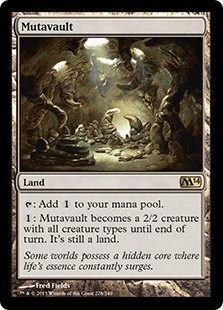
2 Mutavault
3 Sea Gate Wreckage
1 Urborg, Tomb of Yawgmoth
2 Wastes

Sideboard

4 Relic of Progenitus
4 Spatial Contortion
3 Ratchet Bomb
2 Pithing Needle
2 Gut Shot

For starters, I'll say that this deck is worse in the new metagame than it was in the old one. With Infect gone, linear combo decks that aim to win on turn four have made a comeback. These decks are the hardest for Colorless Eldrazi Stompy to beat, especially when they play Through the Breach. I knew I'd have some natural predators in the room between Grishoalbrand and RG Valakut. There's no way to hedge against Through the Breach strategies in colorless; we kind of have to pray we open Temple and Thought-Knot.

Midrange decks also seem to have picked up, especially Jund. BGx is a great matchup for us, but things can get a little rocky if they draw multiple copies of Kolaghan's Command in the first few turns and we fail to stick an Eldrazi Temple. Command is especially dangerous with Fulminator Mage. As for Abzan, a lucky Stony Silence can blow some of our openers out of the water (although it notably does nothing against others).

I still like this deck's midrange matchups, but they're definitely harder to win than matches against Gitaxian Probe Infect and Grave-Troll Dredge, which were practically byes. Either way, I felt great about my odds going into the event—even better, I knew my matchups.

Tournament Report: SCG Regionals, MA
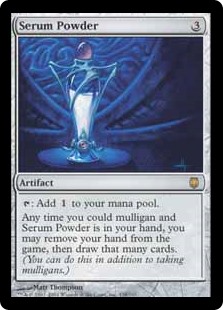
Colorless Eldrazi Stompy doesn't just mulligan a lot, it Serum Powders a lot. At the beginning of every game, I'll use a key to simplify relaying die rolls and the mulligans taken by each player. Some examples:

(Play; MPM 5 - 7): I'm on the play. I mull to 6, Powder for 6, and then mull to 5; my opponent does not mulligan.
(Draw): I'm on the draw. Nobody mulligans or Powders.
(Play; P 7 - MM 5): I Powder for 7. My opponent mulligans twice.

Round 1 vs. Burn (2-1)

Game 1, L (Play; MPMMM 3 - 7): I dig deep for Eldrazi Temple but come up short, keeping a three of Simian Spirit Guide, Reality Smasher, and Blinkmoth Nexus. My opponent leads with Goblin Guide and promptly finishes me with some Lava Spikes after I fail to make a third land drop.

Sideboarding:
-2 Smuggler's Copter
-2 Dismember

+4 Spatial Contortion

Game 2, W (Play): I keep a hand of Eldrazi Temples, Chalice of the Void, Sea Gate Wreckage, two Blinkmoth Nexi, and Spatial Contortion. My opponent casts Goblin Guide, and I resolve a turn-two Chalice before taking a second hit. Spatial Contortion resolves on his third battle phase and my opponent suspends a pair of Rift Bolts. I can't stop drawing lands and begin beating him down with Blinkmoth Nexus.

The Bolts resolve and put me down to 10; an Atarka's Command brings me to 7; a Boros Charm brings me to 3. In the meantime, I draw Mutavault with my opponent at 13, and start to seriously get my beats on. The three manlands take him all the way to zero and I'm left assuring my opponent this deck contains Eldrazi creatures.
Game 3, W (Draw): My opponent leads with Monastery Swiftspear, and I pitch Simian Spirit Guide for a turn-one Chalice. The artifact eats Destructive Revelry, and I take four more damage. I manage to Contortion the Swiftspear, but I'm now stuck on two Blinkmoths for lands. My opponent resolves Goblin Guide and reveals Eldrazi Temple on its second attack. I resolve Thought-Knot Seer, then draw another land and cast Smasher. My opponent drops me down to three and has me next turn, but I pitch Simian Guide and make a land drop so I can animate Mutavault and both Nexi to attack for an exactly lethal 9 after he chumps the Seer.

Round 2 vs. Eldrazi Tron (0-2)

Game 1, L (Play; M 6 - 7): We both play Eldrazi Temple and Matter Reshaper, but I don't have nearly enough pressure. Kozilek, the Great Distortion comes down for my opponent on turn five and I scoop.

Sideboarding:
-1 Simian Spirit Guide
-4 Eternal Scourge
-4 Chalice of the Void

+4 Spatial Contortion
+3 Ratchet Bomb
+2 Pithing Needle

Game 2, L (Play; M 6 - 7): I Quarter a Power Plant on my opponent's draw step, since I know he has the third piece in hand from an Expedition Map. Next, I land a turn-four Thought-Knot Seer, which exiles Reality Smasher over two Warping Wails and an Ulamog. He rips another one off the top, casts it with Eldrazi Temple, and hits me for 5. I crack back with Thought-Knot and play Eldrazi Mimic, which my opponent Wails before following up with Endbringer to put away the game.

If I could play this round again, I would keep Guide and the Scourges over Contortion and Bomb. I tested this matchup extensively with a friend who swears by Eldrazi Tron and had good results. Unfortunately, Eldrazi mirrors often come down to who draws more Temples.

Round 3 vs. Affinity (2-1)
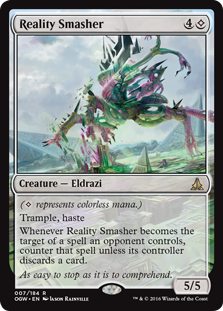
Game 1, L (Draw; P 7 - 7): Powder grants me a hand with two Temples and I get a little cocky with a pair of Reality Smashers. Somehow forgetting my opponent can chump Eternal Scourge at 13 life, I make an all-in attack and lose to Signal Pest, a pair of Blinkmoths, and Cranial Plating on the crack-back.

Sideboarding:
-4 Simian Spirit Guide
-4 Eternal Scourge
-2 Endless One
-1 Matter Reshaper

+4 Spatial Contortion
+3 Ratchet Bomb
+2 Pithing Needle
+2 Gut Shot

Game 2, W (Play; PP 7 - 7): After two Powders, I settle on Dismember, Thought-Knot Seer, two Temples, and some more lands. I manage to trade Blinkmoth for a Vault Skirge, and Dismember a Ravager after taking Plating from my opponent's hand with Thought-Knot. Reality Smasher comes down and cleans up the mess.

Game 3, W (Draw): I keep my opener of 2 Dismember, Temple, Smuggler's Copter, Chalice, and 2 Quarter. My opponent starts us off with two Vault Skirges off a Mox Opal. I land Chalice on zero and pass. My opponent hits for two and passes back, so I kill one of the Skirges on his end step, then resolve Copter. Next turn I play Mimic and start looting through the deck, finding Needle that turn to shut off my opponent's two Inkmoth Nexi even though I have drawn all four Ghost Quarters at this point.

Like clockwork, my opponent topdecks a third Inkmoth. Copter keeps my hand full of removal, allowing me to kill off Ravager and other creatures that can wear the Plating he managed to resolve. My opponent concedes when I draw Smasher and attack him down to 2, showing me a hand full of Ornithopters.

Round 4 vs. Mardu Tokens (2-0)

Game 1, W (Draw; M 6 - 7): I keep two Temples on six, and Young Pyromancer and Dark Confidant are no match for Chalice of the Void and Reality Smasher. My opponent Thoughtseizes away the first Smasher before I can Chalice, but I draw a second one and resolve it turn three, copying his stats with my first-turn Mimic. Sea Gate Wreckage threatens to pull me back into the game if my opponent can neutralize the board, but he can't.
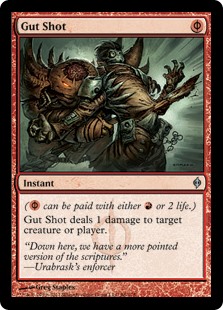
Sideboarding:
-4 Simian Spirit Guide
-4 Eldrazi Mimic
-4 Chalice of the Void
-3 Serum Powder

+15

Game 2, W (Draw): I open a seven of Quarter, Temple, Endless One, Gut Shot, Thought-Knot, Wastes, and Relic. My opponent Inquisitions me and inexplicably takes Endless One, then follows up with a dead-on-arrival Pyromancer. I manage to draw Eternal Scourge and take over the game with Scourge and Relic, forcing my opponent to throw removal at my unkillable attacker. I drop my hand of stockpiled fatties once he gets low on cards.

Round 5 vs. Burn (2-1)

Game 1, W (Draw; P 7 - M 6): My opponent leads with Lava Spike. Powder hands me a seven with two Temples and a Simian Guide, which gives me a blazing fast start: turn one Scourge from exile; turn two Thought-Knot; turn three Smasher. Our neighbors have each made one land drop by the time we start sideboarding.

Sideboarding:
-2 Smuggler's Copter
-2 Dismember

+4 Spatial Contortion

Game 2, L (Draw): I start with two Temples again, but my opponent opens much better than before. He leads with Goblin Guide and I don't have a turn one play. By the time I stabilize and prepare for a lethal attack, I'm down to four life; I shuffle my opponent's deck after he fetches instead of simply cutting it, joking that I'm bound to put Boros Charm on top if I don't mix up his cards properly. Alas, I leave Boros Charm on top anyway.
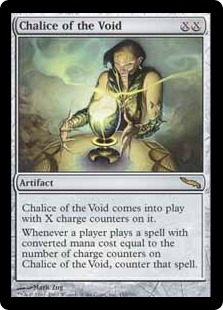
Game 3, W (Draw; PM 6 - M 6): I land turn-one Chalice with a Guide, then Mimic, then Powder, then Thought-Knot Seer, all without seeing a Temple. My opponent keeps a one-lander, and Thought-Knot shows me Boros Charm, Searing Blaze, Shard Volley, Grim Lavamancer, two Bolts, and Eidolon (which I take). He then makes a second land drop but I kill him two turns later with my Eldrazi and a Mutavault.

Round 6 vs. Ad Nauseam (2-0)

Game 1, W (Play; P 7 - 7): I was afraid of this deck going into the tournament, but it seems much easier to beat than I initially thought, in large part thanks to Chalice pulling a ton of weight. I lead with Mimic off a Temple, then play Chalice on one, then Reshaper, and then Thought-Knot. I see Simian, Pact of Negation, Seachrome Coast, Gemstone Mine, Ad Nauseam, and a pair of Angel's Grace, and take the deck's namesake spell. My opponent makes a couple more land drops and dies.

Sideboarding:
-4 Dismember

+1 Spatial Contortion
+3 Ratchet Bomb

Game 2, W (Draw; M 6 - 7): My opponent leads with Serum Visions and suspends a pair of Lotus Blooms, and I play another Chalice on one off a turn-zero Gemstone Caverns. I have another Chalice in tow for the Blooms, and put that one on zero with the Blooms at two counters each. In the meantime, I cast a pair of Simian Guides and start clocking as my opponent resolves Phyrexian Unlife.

Soon enough I draw a third Chalice and stick it for two, afraid of Peer Through Depths finding Ad Nauseam and Echoing Truth bouncing my artifacts. (After the match, I wondered if Chalice on two would have taken away my opponent's ability to win at all.) Thought-Knot finally comes down and helps the Apes deliver my opponent 10 poison counters.

Round 7 vs. Death's Shadow Jund (2-1)

Game 1, L (Play; 7 - M 6): My opponent Traverses for three Death's Shadows, halting my assault. I foolishly play around Mutagenic Growth, forgetting Death's Shadow Jund doesn't play it anymore. He brings himself all the way down to 2 life, but my Smashers can never pierce his defense, and he takes the game with a Temur Battle Rage.

Sideboarding:
-4 Eldrazi Mimic
-1 Eternal Scourge
-2 Endless One

+4 Relic of Progenitus
+3 Ratchet Bomb
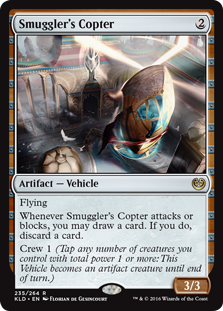
Game 2, W (Play; PMMPPM 4 - M 6): Things look bleak as I end up at four cards: Blinkmoth, Quarter, and two Dismembers. My opponent fetches Tomb and Traverses for a Swamp, and I miraculously rip Chalice of the Void off the top and stick it for one. Ratchet Bomb's up next, followed by Smuggler's Copter, which connects a few times with Blinkmoth in the driver's seat and provides me with some much-needed filtering. I fight through a Fulminator Mage and eventually get to three lands, allowing me to cast one of my many exiled Scourges and crew the Copter with that. My opponent shows me a grip full of one-drops and lands.

Game 3, W (Draw; PP 7 - 7): I Powder away a pair of Scourges in search of my dream hand, which I hit on the third try: Temple, Guide, Copter, Gemstone, Blinkmoth, Smasher, Relic. I pitch Copter to the Gemstone, and my opponent spends his first turn Traversing for a basic. I land a turn-one Scourge and he follows up with a 2/3 Goyf. I play Relic and swing, impervious even to a Mutagenic Growth. Smasher comes down soon after to further embarrass my opponent's measly Goyf and quickly take him to 0.

Round 8 vs. Abzan Company (2-1)

Game 1, W (Play; M 6 - M 6): I keep a six of two Temples, Simian, Mutavault, and two more lands, scrying Endless One to the top. My opponent starts us off with a mana dork and I land a 5/5 on turn two. Thought-Knot Seer follows, and my fatties get there with some help from Mutavault despite my opponent resolving two Companies.

Sideboarding:
-4 Simian Spirit Guide
-2 Eternal Scourge
-1 Endless One
-4 Chalice of the Void
-4 Serum Powder

+15

Game 2, L (Draw; M 6 - M 6): I keep a sketchy one-lander with Relic, Bomb, Needle, and a pair of Dismembers, and don't make a second land drop until way too late. My opponent beats me up with Pridemage and Melira. I should have gone to 5, but chickened out with the Powders in the side.
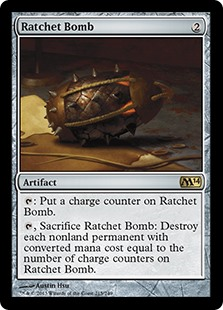
Game 3, W (Play; M 6 - M 6): My six cards have Eldrazi Temple and Blinkmoth, and I resolve Smuggler's Copter turn one with Gemstone Caverns. Then I suffer for pitching Wastes and am choked for mana, using Copter to look for more lands as my opponent resolves Pridemage and Melira again and starts hitting me. Pridemage trades for my Ratchet Bomb, but he can't answer a second Bomb, which ends up eating the Witnessed-back Pridemage and Melira as well as my Copter.

I lose Gemstone Caverns to a second copy to cast Thought-Knot Seer, which takes Chord of Calling and leaves my opponent with Gavony Township. After having looted away one of my Smashers, I topdeck a second Eldrazi Temple and play another Smasher to close out the game.

Round 9 vs. Jeskai Control (2-0)

I'm eighth seed at this point but need a win to guarantee a Top 8 spot. Luckily, I'd scouted the top tables after last round, and end up pairing with a player on Jeskai Control.

Game 1, W (Draw; PM 6 - 7): I pitch Ghost Quarter to Gemstone Caverns, my other four cards being Thought-Knot, Temple, Mutavault, and Chalice. My opponent leads with Colonnade and is shut out by my Chalice at one, missing his third land drop. I swing with Mutavault and cast Mimic to bait a counterspell (it gets Remanded), then cast Thought-Knot next turn. My opponent finally lands Flooded Strand, but I animate my lands and attack him down to one, rendering it unusable.

Sideboarding:
-4 Simian Spirit Guide
-4 Eldrazi Mimic
-2 Dismember

+4 Relic of Progenitus
+4 Spatial Contortion
+2 Pithing Needle
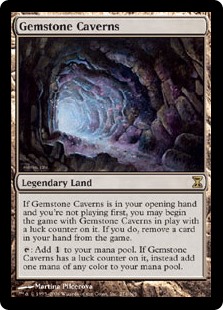
Game 2, W (Draw; P 6 - 7): Another turn-zero Gemstone Caverns pitches Needle this time and ensures a strong curve from me: turn one Chalice, turn two Scourge from exile, turn three Thought-Knot, turn four Thought-Knot. I get Electrolyzed in response to the second one and take Supreme Verdict with its ability. My opponent, caught with a grip of Snare, Path, Snapcaster, and Elspeth, Sun's Champion, never makes a fourth land drop. Smasher comes down the turn after to finish him off.

Top 8: Quarterfinals vs. Ad Nauseam (2-0)

Going into Top 8, I hold the second seed, meaning I get to play first in my matches.

Game 1, W (Play; PMP 6 - 7): My third hand has turn one Chalice, so I keep it. I follow that play up with Smuggler's Copter as my opponent suspends Lotus Bloom and casts Pentad Prism. Next, I cast Eternal Scourge from exile to start hitting with Copter and look for Smashers or more disruption. Phyrexian Unlife resolves just before Thought-Knot comes down to take Ad Nauseam, and I loot away my one land in hand, forgetting that Lightning Storm actually does things besides win the game. My opponent Storms the Seer and I don't have a land to redirect with, but he still fails to draw another Ad Nauseam, and I manage to pile on 10 poison.

Sideboarding:
-4 Dismember

+1 Spatial Contortion
+3 Ratchet Bomb

Game 2, W (Draw; M 6 - 7): My opponent leads with Serum Visions, and I resolve turn-one Chalice again. Copter comes down on turn two to give everyone deja vu. I draw a second Copter instead of a creature and feel bad, and then two Seers in a row get countered by Pact of Negation. Finally, Eldrazi Mimic resolves, and I start looting. Ratchet Bomb comes down and ticks up to 3, ready to blow up Phyrexian Unlife should my opponent try any funny business. Smasher seals the deal.

Top 8: Semifinals vs. Breach Titan (0-2)
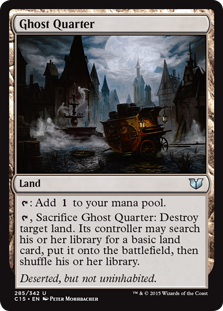
Game 1, L (Play; PMM 5 - 7): I keep an unexciting (for the matchup) five of Temple, Smasher, and three more lands. Smasher comes down turn four, but gets Bolted and Angered after one attack. I end up casting a pair of Scourges that can't compete with a Breached-in Titan. Ghost Quarter hits a Valakut in response to the Giant's activation, but two new Kuts clear my board and kill me the turn after.

Sideboarding:
-1 Matter Reshaper
-2 Chalice of the Void
-2 Dismember

+3 Spatial Contortion
+2 Gut Shot

Game 2, L (Play; MPPMM 4 - 7): I open double Temple and cast turn three Smasher. I also land Chalice for zero before my opponent gets to Pact mana, and my Thought-Knot shows me two Pacts and a Forest—score! My opponent lands a Titan to kill Smasher, but I have him with next turn's attack whether he swings or not (Valakut triggers included) so long as my top card is Spatial Contortion, Smasher, or Gut Shot. Unfortunately, my opponent topdecks Reclamation Sage, blows up Chalice, Pacts for Baloth, casts it, gains 4 life, and kills me. My next card? Gut Shot!

This matchup is brutal, and way tougher to win than matches against Scapeshift variants. I might have had a better shot if Chris had lost to Scapeshift in his quarterfinal match, but truthfully, I was hoping to pair with one of the Jund or Company decks at our table. Breach Titan seems like one of this deck's absolute worst matchups.

A Different Kind of Serum
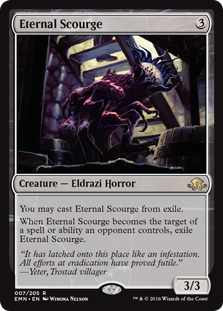
Although I was a little bummed to pair with Breach in the Top 8, and completely lost my voice after 11 rounds of chatting while getting over a cold, I had an exhilarating tournament. Colorless Eldrazi Stompy performed admirably all day; I felt like I had the best deck in the room.

I was also glad to do so well with the deck I had practiced so diligently. Who needs Serum Visions when you have Serum Powder? I took a total of 25 mulligans and used Powder 19 times over the course of the tournament, averaging four new hands per match.

I'm also sold on Smuggler's Copter for now. The card continues to impress me in interactive and linear matchups alike, and I'm excited to see the card work its way into more Modern decks as time passes.

Until next time, may you find your Temples!

Insider: Planning for Operating Costs

Are you a Quiet Speculation member?

If not, now is a perfect time to join up! Our powerful tools, breaking-news analysis, and exclusive Discord channel will make sure you stay up to date and ahead of the curve.

Welcome back, readers! Today's article is happening because one of the popular local games stores (LGS) in my town is closing down this month, which took a lot of players by surprise.

It's a pretty common misconception that Magic is a wildly profitable business. I keep meeting people who want to open up a store and think they'll make a killing. The fallacy begins with the idea that good profit margins on singles translate directly to a lot of money to be made. While that isn't necessarily wrong, the biggest oversight I see a lot of people making is failing to account for operating expenses.

Operating Expenses (n).
The expenditures that a business incurs to engage in any activities not directly associated with the production of goods or services.

Practically, we can break this down into several categories:

  • Rent
  • Utilities
  • Internet
  • Phone
  • Insurance
  • Employee Wages/Benefits
  • Garbage

These are monthly expenses (or weekly, in the case of wages) that take away from your bottom line...and they add up.

The first thing we need to do is establish a baseline for these costs. The baseline should be as realistic as possible. I will discuss where my estimates come from (as your costs may vary), as well as any calculations I do.

Rental/Lease Cost

As the biggest aspect of these costs is the monthly rental or lease costs it's critical that these be accurate. For this I suggest you check out a website like LoopNet or something similar that has commercial property listings in your area. While rent is often negotiable, there are some typical baselines based on the area you're looking at (same with personal housing) and for this article we'll look at those baselines.

In this case I'll assume I wanted to open a shop near the old LGS mentioned above (area code: 29607). Searching the typical retail lease prices, I see that they are broken down into dollars per square foot per year. So to calculate our yearly lease price we take that number, multiply it by the total number of square feet of the location, and then divide it by 12 to get a monthly lease cost. In the case of this LGS we can see prices around $12/square foot/year.

Say I found a nice retail space of 1500 square feet. That would equate to a room 25 ft. wide by 60 ft. long, providing me adequate play space and room for a nice counter.

Then my rental price would be: $12 x 1500 sq. ft. / 12 mo. = $1500 a month.

Utilities

These costs may vary a good bit as well, given that each area will have different power and water rates. But you can typically look this information up online, and hopefully you can find something like this (again I'm using this LGS's rates).

The good news is that many game stores have shifted hours, and the most demand will often comes at non-peak times (M-F 8am to 5pm) which means you get lower rates. Now we do have to estimate our power usage. Keep in mind that it will likely differ based on the season, with summer tending to be the most demanding.

It's difficult to find information regarding the typical power usage of a small business or micro business (one with less than five employees that isn't running a lot of power-hungry equipment). What I could find is that a lot of small businesses use around 15,000-25,000 kWh per year. If we go with the middle (20,000 kWh), then our monthly average is around 1667 kWh per month. Say your store is open from 2 pm to 10 pm. This means your power rate breakdown will be 37.5% peak hours and 62.5% off peak.

So our equation is:

(1667 kWh * 0.375 * $0.245/kWh) + (1667 kWh * 0.625 * $0.098/kWh) = $255.26 per month in electricity.

Internet/Phone

Around here we only have Charter for internet. Their current prices for internet are phone are:

  • Internet - $39.99
  • Phone - $29.99

Insurance

This is another difficult one to calculate. According to Google, a small business may pay something like $500 a year for general liability. This would equate to $42.50 per month.

Employee Wages/Benefits

So I'll estimate that one would pay US federal minimum wage (though it is important to note that some states/cities have differing minimum wage laws). That is $7.25 per hour. Current federal laws dictate that an employee who works more than 30 hours in a week is legally entitled to employee benefits, specifically healthcare. So assuming you don't want to pay for healthcare coverage (which will likely be upwards of $200-$300 per month) we'll assume your sole employee only works 27 hours per week.

This means your cost is:

$7.25 / hr * 27 hrs/week * 4 weeks/month (on average) = $783 per month

Garbage

Garbage collection can be an optional (or may be included with the rent), but if it isn't it will typically run around $20/month.

Total Monthly Operating Costs

If we add up everything above we get a total monthly operating cost of $2,670.26.

Taxes

One last important expense to keep in mind is taxes. We can find a chart for small business tax rates here. Note this will be based on your actual Taxable Income (your total income minus any deductions). Looking at this chart, the smallest tax rate you would have is 15% (assuming you make less than $50,000 in taxable income per year).

Income Generation

Now let's look at the "fun" part, the income generators. As you have to buy all the things that you sell (save for tournaments) you will likely have varying profit margins. For this we want to take a weighted average of said profit margins to create an overall "generic profit margin" and simplify the math a bit. With that, I've taken some guesstimates based on information I've seen dealing with various dealers and stores.

Product Profit Margin Percent of Total
Singles 45% 40%
Sealed Product 30% 30%
Snacks 50% 5%
Tournament Fees 25% 25%
Average 35.71%  

So basically your typical profit margin for a sale is a little under 36%, which to be honest is very good (as many industries operate on significantly lower profit margins).

Sales Required to Cover Operating Costs

To calculate the sales required to cover our operating costs, we use the following equation:

Operating Expenses * (1 - Tax Rate) / Profit Margin = Sales required to cover operating costs

In our case, this amounts to: $2670.26 * (1 - 0.15) / 35.71 = $6,356.99.

So this means that one must sell $6356.99 worth of products just to keep a store open. If you don't have another employee, this number drops to $4,493.28, however, that means you will have to give up a lot of time to run your business.

Conclusion

The purpose of this article wasn't to dissuade anyone from opening up a store. However, it serves as a strong reminder that the costs of keeping a business open (let alone profitable) are often much higher than many realize.

Besides one of our LGS's shutting down, I've heard of a few other store owners closing up shop (mainly on Facebook, but some on QS). I know personally how much money many of these owners pour into their stores—seeing one close down is very disheartening, both for the local players and the owner(s) themselves.

So for anyone contemplating opening up a store, I simply suggest that you do some research and run the numbers ahead of time. If you don't think you can consistently sell this much product in a month (and again that doesn't include paying yourself), then you really should rethink putting up all the money and time needed to open a business.

A New Format! – Post-Aether Revolt Decklists

Are you a Quiet Speculation member?

If not, now is a perfect time to join up! Our powerful tools, breaking-news analysis, and exclusive Discord channel will make sure you stay up to date and ahead of the curve.

With so many new changes to Modern recently, every assumption we’ve previously held regarding the format as we know it is suspect to change. Mono-Green Stompy is back, Zur the Enchanter is finally poised to take the format by storm, so prepare yourself for Vexing Devil mirror matches every third round.

Now that we’re all awake, hi, how's it going. I'm Trevor, I work here. No, for the most part the good cards in Modern will stay good, but under the surface, things have changed. Archetypes that were once strong will find their value diminished, and strategies that were once held in check could suddenly find themselves unshackled from the bonds of the “rogue” denomination. We’ve talked about what the new Modern landscape could look like for the past couple weeks, but the time for conjecture and speculation has passed. Results are rolling in, and by now most of the SCG Regionals data is available. In preparation for analysis on larger scale, today we’ll be diving into what this new Modern is starting to look like. It’s decklist time.

[wp_ad_camp_1]

Cheeri0s, by finalnub (5-0 Modern League)

Creatures

4 Puresteel Paladin
4 Sram, Senior Edificer

Artifacts

4 Accorder's Shield
2 Bone Saw
4 Cathar's Shield
4 Mox Opal
4 Paradise Mantle
2 Sigil of Distinction
4 Spidersilk Net

Instants

4 Retract
2 Noxious Revival
2 Swan Song

Sorceries

4 Serum Visions
1 Grapeshot

Lands

2 Plains
1 Sacred Foundry
2 Seachrome Coast
2 Hallowed Fountain
1 Horizon Canopy
4 Marsh Flats
3 Windswept Heath

Sideboard

3 Bastion Inventor
3 Echoing Truth
4 Leyline of Sanctity
2 Paradoxical Outcome
3 Silence

Cheeri0s has been the “mini-Eggs” deck of choice on the fringe of the format for as long as I can remember. The strategy is simple; play Puresteel Paladin, dump your hand, chain as many eggs onto the battlefield as possible, Retract with a Mox Opal (or Paradise Mantle in a pinch) and repeat. Draw to your Grapeshot and win. The deck loses to removal and does nothing without Puresteel Paladin…until now.

Sram, Senior Edificer gives us 4 more copies of our best card, to the point where we’re starting to approach something resembling consistency. When things are working, we’re casting Puresteel Paladin or Sram, Senior Edificer on turn two, and immediately dropping every egg we have in hand in search for a copy of both Retract and Paradise Mantle/Mox Opal. We can win on turn two. Often. In Modern. In a turn-four format.

This is assuming our opponent plays along, of course. Lightning Bolt at the ready ruins our day, but assuming our opponent doesn’t have it immediately we can equip either of our Shields to put us out of range. Of course, we can always slow down a bit to protect our guy with Swan Song or Silence out of the sideboard, and Silence in particular is a great way to pressure our opponent with just the threat of killing them through all resistance. When they know we have it, they can’t afford to play slow, which often means they’re tapping out when they have pieces of interaction in hand because they feel the need to apply pressure. That’s the sort of "free value" that comes with being priced into playing a particular way (think keeping in removal against the Gurmag Angler/Dispel control deck).

Bastion Inventor seems to be the go-to “panic mode” option of choice for when things go badly (e.g. Stony Silence). Stony Silence doesn’t stop the Paladin/Edificer triggers, or Paradise Mantle if it's already equipped, but it does stop Mox Opal. This makes it a poor option to fight us, but they will probably still play it against us. The good combo decks (and we are a combo deck) by nature invalidate a lot of our opponent’s normal methods of interaction. They’ll be scrambling for stuff to bring in, and, “kill Mox Opal, turn our Lightning Bolt back on,” is good enough for two mana.
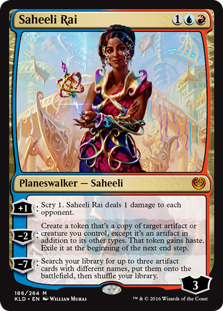
Back to Bastion Inventor, a 4/4 hexproof seems poor in a Tarmogoyf format, but we have Bone Saw! How lucky for us. A Bone Saw and Accorder's Shield to push us over their 4/5 sounds delicious—just watch out for Liliana of the Veil! Which, of course, is where Leyline of Sanctity comes in. I’m bringing this in against every black deck, and against Burn and Ad Nauseam (though we should be much, much faster that Ad Nauseam).

Overall, Cheeri0s gained four more copies of its best card, and a solid sideboard option to attack from an alternate angle. I still feel like this deck is fragile, and can just whiff sometimes, but the power level has definitely been kicked up a notch post-Aether Revolt. It’s time to start getting some matches in against this thing—you will face it sooner or later.

Jeskai Saheeli, by lluck (5-0 Modern League)

Creatures

2 Pia and Kiran Nalaar
4 Felidar Guardian
2 Wall of Omens
3 Snapcaster Mage

Enchantments

3 Spreading Seas

Instants

2 Remand
2 Spell Snare
1 Cryptic Command
1 Dispel
4 Lightning Bolt
3 Path to Exile
1 Lightning Helix
1 Logic Knot

Planeswalkers

4 Saheeli Rai

Sorceries

4 Serum Visions

Lands

1 Arid Mesa
2 Celestial Colonnade
4 Flooded Strand
1 Glacial Fortress
1 Hallowed Fountain
3 Island
1 Mountain
1 Plains
1 Sacred Foundry
2 Scalding Tarn
2 Spirebluff Canal
2 Steam Vents
2 Sulfur Falls

Sideboard

2 Anger of the Gods
2 Celestial Purge
1 Flashfreeze
1 Lightning Helix
1 Negate
1 Runed Halo
1 Shadow of Doubt
2 Stony Silence
1 Teferi, Mage of Zhalfir
2 Vendilion Clique
1 Wear // Tear

Splinter Twin is back baby! But it’s worse, and not Splinter Twin, which is why you see random things like Spreading Seas and Pia and Kiran Nalaar in place. Not being able to combo at instant speed is a good thing for the format, but absolutely horrible for us. As a result, we’re torn between going Wall of Omens, Saheeli Rai, Felidar Guardian or actually holding up mana for the other half of our deck, which is at odds with all these sorcery-speed threats. Now, I’m not dismissing this deck just because you can’t end-step Deceiver Exarch, I’m just tempering expectations a bit by bringing to light the fact that this strategy will feel clunky at times.

The good news is that the core of this archetype is strong enough that it can play around 8 cards short and function relatively well. We saw it before with Splinter Twin and it remains true here: Snapcaster Mage plus counterspells/removal are strong enough that we can hold opponents at bay long enough to find either our missing pieces or protection to go off.

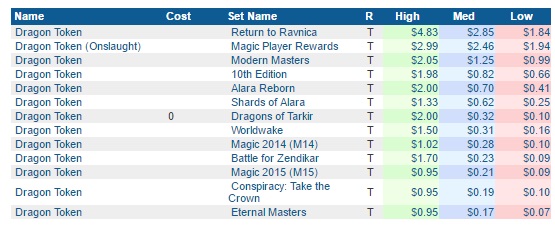
The bad news, however, is that with no combo piece on the field, along with the knowledge that it takes two full turns to get there (until we have seven mana) our opponent can play as fast as they wish until we drop half of our combo. At that point they’ve got enough warning to switch gears. This might sound minor, but a lot of the strength of Twin came from the fact that opponents were forced into playing slow, lest they just died on the spot. As anyone familiar with that archetype can attest to, more games are won based on the threat of the combo than the actual combo itself. Not having access to that here really hurts our strategy.

Still, the core is solid, and the combo pieces are serviceable. Saheeli Rai does just enough for three mana to be fine on her own (think copying Snapcaster Mage to gain a Lightning Bolt or Serum Visions) to the point where I’m not groaning when this card is in my hand. That in and of itself is actually better than Splinter Twin, which did absolutely nothing until it won the game for you. That’s definitely worth more than I’m giving it credit for, so keep that in mind. This deck can play better than Twin ever did and not have to combo at all.

I wouldn’t mind trying to squeeze a Vendilion Clique and maybe another Lightning Helix in to try and play the tempo game, but I understand where this list is going in terms of value. Play some games with Spreading Seas before you cut it, but depending on how strong it is against the field that’s probably the first change I would make.

BG Midrange, by ToddTheWraith (5-0 Modern League)

Creatures

3 Courser of Kruphix
4 Tarmogoyf
3 Scavenging Ooze
2 Kalitas, Traitor of Ghet
4 Dark Confidant

Artifacts

1 Sword of Light and Shadow

Instants

1 Dismember
4 Fatal Push
2 Abrupt Decay

Planeswalkers

4 Liliana of the Veil

Sorceries

1 Maelstrom Pulse
3 Thoughtseize
4 Inquisition of Kozilek

Lands

2 Bloodstained Mire
4 Blooming Marsh
2 Forest
1 Ghost Quarter
1 Hissing Quagmire
2 Overgrown Tomb
2 Swamp
4 Treetop Village
1 Urborg, Tomb of Yawgmoth
4 Verdant Catacombs
1 Wooded Foothills

Sideboard

4 Fulminator Mage
3 Kitchen Finks
1 Nature's Claim
1 Night of Souls' Betrayal
2 Obstinate Baloth
1 Phyrexian Arena
1 Slaughter Pact
2 Thrun, the Last Troll

We all knew Fatal Push would be good—what I’m excited for here is the power it provides to decks not playing Lightning Bolt and Terminate. Upgrading our Terminate is nothing to laugh at by any means, but it's fairly minor when compared to the value gained from upgrading from Dismember.

The question on my mind remains, as it has for as long as I can remember: “why are we not playing Jund”? The answer, for now, lies in our manabase. Traditionally, straight BG decks took a hit in terms of power level in exchange for smoother mana, fewer tapped lands and the ability to play Treetop Village. This really helped in the Burn department, but you can argue for Jund being better against Affinity because Kolaghan's Command is still the absolute nuts. Courser of Kruphix is a fine value card if the metagame lines up correctly for it, and there are numerous other small differences, but for the most part that’s the line these two decks draw in the sand. More power, or more consistency? Fatal Push just dove headfirst over that line.

We are reaching the point where BG isn’t losing out on much compared to Jund, and that’s definitely an interesting place to be. Now, the question of “which BGx midrange deck should I play” comes down almost entirely to sideboard decisions and minor metagame shifts, rather than just stubborn refusal not to play Jund, the widely accepted “best version.” It’s still a little early to pass judgment, but if printing another powerful black removal spell results in more diversity among the black decks, then color me impressed.

Conclusion

Just a quick look at the recent top-performing decks shows old archetypes made better and new archetypes made possible, thanks in large part to Aether Revolt. Yes, Dredge and Infect getting the cut is more responsible for making these results happen, but without Aether Revolt we would just be rewinding time to a period long ago when Dredge was banned before (you know, like a year). We’re still barely baby steps into this new format, but Modern is looking better than ever.

Thanks for reading,

Trevor Holmes

Insider: The GTOAT

Are you a Quiet Speculation member?

If not, now is a perfect time to join up! Our powerful tools, breaking-news analysis, and exclusive Discord channel will make sure you stay up to date and ahead of the curve.

Okay, so that article title is kind of a misnomer, and there's not a typo in there either. It works with the featured thumbnail image of a goat though, so just roll with it.

boab38_goatSplash

For those unaware, the acronym "GOAT" has been around for many years, and typically means "Greatest Of All Time." The featured card image is a goat token, because we're going to be talking about tokens and Magic finance.

Though in the spirit of this column, we won't exactly be talking about the most expensive tokens to ever exist in Magic. I'm going to be showing you some tokens that you should be looking out for in bulk, and how to best profit off of them once you've pulled them and set them aside to sell. Here to help us through this discussion is a collection that I conveniently bought the day before writing this article, which had a stockpile of well-organized tokens from a wide range of sets. I took a few minutes to pull out the best value that I know I can probably list on TCGplayer, so go ahead and take a look before we continue.

20170208_173648

From the beginning, we can see a lot of casual tribes in full attendance. While this collection unfortunately lacked the Voice of Resurgence and Wurmcoil tokens that most players have come to recognize as having significant value, we've still got a lot of gems that are criminally underrated. I'll ask you this right now: which token out of all these visible do you think is the most expensive, and what do you price it at? Is it the Elves or Rat from the gold mine that is Shadowmoor? We know even commons from that set can be ridiculous due to the petite print run, and Rhys the Redeemed is an obvious Commander that, due to the nature of the card, requires a significant number of Warriors. What about the O.G. Bitterblossom Fae? Astute readers and those who cracked a bunch of Modern Masters 2015 know to scratch that one off the list Fruit Ninja-style because of the MM15 reprint.

Any other guesses? A separate category of Commander-savvy readers might have known the answer from the start. It's the Dragon token. Oh, sorry, are there multiple kinds of Dragon tokens in that picture? So how do you know which one is the best one?

dragontokens

Interestingly enough, Utvara Hellkite has never been reprinted. Its effect is similar to Rhys the Redeemed in a way: every time your turn comes around, you effectively double your dragon count. This one surprises most people I talk to at the shop while buying collections and making small talk, because we've seen pretty much every other six-plus cost red dragon get a reprint at some point, so I get some quizzical looks when I pay nearly the same amount in cash on Utvara Hellkite and its own token. Mark Rosewater has stated and shown us that dragons are the most popular creature type and have been since the dawn of the game. That Dragon token is worth more than half of the individual mythics in Return to Ravnica.

So what's the metric I use for picking which tokens are worth pulling, and which ones should be left in the box to bulk out by the thousand? Well, a lot of it comes down to experience – and reading articles like these. It's similar to picking bulk commons and uncommons, where you just have to get a feel for what a non-competitive or Commander player would need a lot of, while also being aware of a low supply and overall art preference. Let's talk about another type of red token that gets used a lot, in both casual and Commander settings: Goblin tokens.

goblintokens

Here we have nineteen freaking different Goblin tokens. That's not really surprising, goblins are pretty much everywhere in the Multiverse (except Kaladesh, incidentally). But do you know the different arts of all these goblin tokens? Of course you don't. Most goblins look pretty similar from plane to plane: short, ugly, aggressive, gross, mischievous. Most of those words get sent from the art director to the artist when figuring out what WotC wants their goblins on plane X to look like. So when we see a goblin that breaks that mold, it can get... expensive.

goblin

Holy hell, what is that thing? The New Phyrexia goblin is something straight out of a horror movie, and players love it. Its $2.50 price tag proves that much, because it was only in NPH. No Duel Deck printing, no Commander reprint with identical art, nothing. Add some unique art, toss in a little bit of a low print run, and you've got yourself a tasty, tasty token.

So how are we making money off these again? Well, we can always audible to the good old SCG buylist.

(Before going any further, here's a quick aside. You know how Magic players use "audible" as a slang for "changing one's mind at the last minute"? I finally looked up the context behind that because I wanted to use it in an article, and apparently it's a football term for a substitution play. I don't follow any traditional sports, so I had no idea where the term originated. If you're like me, now you finally have your answer. That's not really Magic finance tech, but man I had been hearing, "Oh, I audibled to Blue-Black Mill at the last minute before the Grand Prix...," and now I know where the term comes from. Anyway, where were we?)

Oh, right, the SCG buylist. So they actually offer decent prices on tokens, which is helpful if you happen to ship cards to them regularly or felt like bringing a few boxes to an SCG event. I'm sure, however, that most of my readers are here to squeeze every penny possible out of their cards, so most of you aren't just constantly lighting money on fire by selling your staples to SCG. I hear you. What if I told you that you could list tokens on TCGplayer and still profit?

If you listened to the Brainstorm Brewery a couple weeks ago where my pick of the week was the Vampire token from Innistrad, you know where I'm going with this. You can get most of the full value on tokens if you list them on TCGplayer with their namesake card, or even similar cards that make that variety of token.

It's kind of difficult in our goblin token example, because the original beast that creates those hellspawn creatures is Chancellor of the Forge. Yeah, not exactly TCGplayer material. It takes approximately 25 copies of Chancellor of the Forge to even equal one of that dinosaur fossil. This example still holds true relatively well for other mythic and rare token producers that create "unique" tokens.

There was an error retrieving a chart for Chancellor of the Forge

If you have a relatively deep inventory and have some Rhys the Redeemed at a reasonable rate, you can pull off some really strong margins by throwing up those green-white Elf Warriors at 99 cents each. Because TCGplayer takes a flat 50-cent fee in addition to the 10.5 percent cut (not counting the cost of your shipping materials), you make more money when people buy more cards at once. When Timmy the token player is filling his cart for the Rhys deck, he's more likely to grab your $1 tokens to save on the hassle of ordering several from individual stores one or two at a time. The same holds true for several of the other tokens in the original picture: Sorin, Lord of Innistrad and his blood suckers, Utvara Hellkite and the fleet of $2 6/6s and those gold dragons created by Dragon Broodmother.

End Step

I don't really buy "specs" anymore. I usually only find one or two cards every year that I want to buy in any large quantity, and that will be from SCG or someplace I can get 40 or more copies at once. This week, I went a bit strong on my pick of the week from Brainstorm Brewery, which you can find if you listen to the cast. I think it's a strong Commander card with very low reprint possibility, that fits in decks the same way Primal Vigor does. Those are all the hints I'll give without you listening to the episode, though!

I hope you enjoyed my little token rant, and I'm happy to talk tokens further @Rose0fthorns on Twitter!

Insider: Pro Tour Aether Revolt’s Hidden Secrets

Are you a Quiet Speculation member?

If not, now is a perfect time to join up! Our powerful tools, breaking-news analysis, and exclusive Discord channel will make sure you stay up to date and ahead of the curve.

One of the coolest parts about the Pro Tour for viewers is that it gathers the best players from around the world, and for players it's getting to travel the world to play ("play the game, see the world"). I know I’ve seen a lot of the U.S. just from playing Magic, but I think it’s awesome that some players are afforded the opportunity to fly to other countries to play. That’s a big part of why I’ve tried so hard to qualify for the Pro Tour. One of these times, I’ll spike an important tournament and not just a fun one like the Legacy Eternal Weekend. That event was a blast, but they need to work on the prize structure a lot.

Pro Tour Aether Revolt took place in one of my favorite countries in the world, the land of my heritage, Ireland. I went to Ireland a couple of years ago, and it was one of the best experiences of my life. Dublin, where the PT was held, is a really cool city with tons of interesting things to do and see. I highly recommend going if you ever have the chance.

If we don’t qualify to play on the Pro Tour, at least we can watch from home. The coverage of this event was great. They had a great selection of matches for us to watch, and they didn’t throw the same matchups on camera every round. The Wizards coverage team made some excellent calls with their feature matches, and I definitely noticed.

In addition to the great adventures you can have traveling the world, the innovation the pros bring to the game helps form the metagame and show us more possibilities in the format. Looking at the top results from the tournament, you wouldn’t even know there was innovation in the format at all. In fact, just the opposite. The last two weeks, GB and Saheeli have dominated the meta, but the pros proved that Mardu Vehicles is, in fact, not dead and dominated the event with the archetype.

I hope you weren’t excited about me breaking down an already-existing strategy because I have much cooler info to share with you. After poring over the results from the tournament, I have gathered up the best of the rest of the results. I boiled it down into the best alternative choices for the meta. So, if you’re looking for a great option that’s not one of the big three decks, you’ve found the right place. If not, I’ll still share some financial info too, so take a look.

BR Aggro

Creatures

3 Bomat Courier
4 Inventor's Apprentice
3 Forerunner of Slaughter
4 Scrapheap Scrounger
3 Pia Nalaar
4 Weldfast Engineer

Spells

3 Shock
2 Incendiary Flow
4 Unlicensed Disintegration
3 Chandra, Torch of Defiance
4 Heart of Kiran

Lands

4 Foreboding Ruins
4 Smoldering Marsh
10 Mountain
5 Swamp

Sideboard

2 Aethersphere Harvester
4 Fatal Push
1 Goblin Dark-Dwellers
2 Kalitas, Traitor of Ghet
2 Ob Nixilis Reignited
1 Swamp
3 Transgress the Mind

First up, we have the most exciting deck of the tournament, and the one I pegged as the breakout deck of the weekend. Black-Red Aggro helped two players achieve 8-2 records and another player reach 6-4. This blisteringly fast deck features two of the format’s most prominent two-drops, Heart of Kiran and Scrapheap Scrounger. Both of these format all-stars have seen price bumps thanks mainly to the success of Vehicles, but I’m sure this deck helps a little too. My favorite part about this deck is that it goes under the rest of the format. Anytime you can go faster than the pace of everyone else, you’ll be in a good spot, and that’s definitely the case here as well.

One other card in this deck that sticks out is Chandra, Torch of Defiance. I still think she is underrated, but she’s finally seeing play in multiple archetypes. I think this level of play will only increase over time, as will her price. I’ve been playing her since she was released. and she does so many good things. Her price is down to $18, and I think that’s a great number to get in at. If she dips lower, definitely get some copies to sit on for a little while.

Jund Energy Aggro by Martin Juza (8th Place PTAER)

Creatures

4 Greenbelt Rampager
4 Voltaic Brawler
4 Scrapheap Scrounger
4 Longtusk Cub
2 Tireless Tracker
1 Rishkar, Peema Renegade

Spells

4 Attune with Aether
2 Shock
2 Harnessed Lightning
4 Unlicensed Disintegration
3 Chandra, Torch of Defiance
1 Nissa, Vital Force
3 Heart of Kiran
2 Fleetwheel Cruiser

Lands

4 Aether Hub
4 Blooming Marsh
4 Game Trail
1 Cinder Glade
4 Forest
2 Mountain
1 Swamp

Sideboard

1 Chandra, Torch of Defiance
4 Fatal Push
2 Nissa, Vital Force
1 Shock
2 Skysovereign, Consul Flagship
2 Tireless Tracker
3 Verdurous Gearhulk

Up next we have another Chandra, Torch of Defiance deck. Neither of these decks seem like they will utilize her to full effect and yet she still earns a maindeck slot. That just goes to show you her power.

I’ve spoken about the popularity of the GR Energy deck as a budget option for Standard, but Martin Juza included black mana and improved the deck. With a top eight appearance, I’d say this archetype won’t be under the radar any longer.

Still under $2, I think Greenbelt Rampager looks like a good trade option. Pick these up for cheap and trade them into bigger and better things to players building the deck. Old finance tricks still improve your collection.

I like the combination of removal spells over pump spells in the archetype, but the pump spells drastically increase your kill speed, so there are pros and cons.

Sultai Delirium Control

Creatures

2 Tireless Tracker
2 Ishkanah, Grafwidow
1 Noxious Gearhulk
3 Torrential Gearhulk

Spells

2 Fatal Push
4 Traverse the Ulvenwald
3 Vessel of Nascency
1 Negate
3 Glimmer of Genius
3 Grapple with the Past
3 Grasp of Darkness
2 Disallow
2 Liliana, the Last Hope
2 To the Slaughter
1 Overwhelming Denial
2 Pick the Brain

Lands

2 Aether Hub
4 Blooming Marsh
2 Botanical Sanctum
2 Lumbering Falls
4 Sunken Hollow
4 Evolving Wilds
3 Swamp
2 Island
1 Forest

Sideboard

1 Appetite for the Unnatural
2 Fatal Push
4 Grim Flayer
1 Ishkanah, Grafwidow
1 Kalitas, Traitor of Ghet
1 Negate
1 Overwhelming Denial
1 Pick the Brain
1 To the Slaughter
1 Transgress the Mind
1 Yahenni's Expertise

If you’re looking for a more controlling route to victory in the format, check out this 8-2 deck, Sultai Delirium Control. What we have here is basically Black-Green Delirium but splashing blue for the semi-valuable Disallow as well as Torrential Gearhulk, who continues to stay strong at $20. I like the aggressive sideboard plan with the Grim Flayers as well as Tireless Tracker in the maindeck to provide a threat and some much-needed card advantage.

Although I thought Yahenni's Expertise would be a bigger part of the meta, it’s nice at least to see a copy in the sideboard as an option. It has some cool synergy with Kalitas, Traitor of Ghet to generate an army for you while still getting to keep your finisher.

GW Tokens

Creatures

4 Thraben Inspector
4 Toolcraft Exemplar
4 Walking Ballista
4 Lambholt Pacifist
3 Rishkar, Peema Renegade
3 Archangel Avacyn

Spells

4 Heart of Kiran
3 Nissa, Voice of Zendikar
3 Stasis Snare
4 Gideon, Ally of Zendikar

Lands

4 Canopy Vista
4 Fortified Village
9 Plains
7 Forest

Sideboard

2 Ajani Unyielding
1 Authority of the Consuls
3 Declaration in Stone
2 Fragmentize
2 Fumigate
2 Quarantine Field
2 Tireless Tracker
1 Westvale Abbey

Pascal Maynard and his team certainly brewed up an interesting version of GW Tokens for the Pro Tour. This more aggressive version supports Toolcraft Exemplar! That isn’t a direction I expected this deck to go, but with Thraben Inspector, Walking Ballista and Heart of Kiran to turn it on, you should have an artifact available to make your 3-2 fight early in the game. I figured this archetype would find a home, but this iteration is more interesting than what I expected.

This Tokens brew helped one player achieve an 8-2 record, two 7-3 and one 6-4. If you needed more of a reason to believe in Toolcraft Exemplar outside of Vehicles, this deck's success makes it clear that it has game outside of Mardu.

Don’t forget about Archangel Avacyn in the format either. She’ll flash into combat and wreck your day if you aren’t preparing for her instant-speed ability. The combo between her and Walking Ballista is incredibly powerful as well, and one I think could fit into more than one archetype.

Most players might be jamming mirror matches between the big three in Standard, but they aren’t the only options. Keep on brewing or searching for viable archetypes and you’ll find some hidden financial treasures along the way too.

Until next time,
Unleash the Brewing Force!

Mike Lanigan
MtgJedi on Twitter

Financial Deck Tech: Cheeri0s

Are you a Quiet Speculation member?

If not, now is a perfect time to join up! Our powerful tools, breaking-news analysis, and exclusive Discord channel will make sure you stay up to date and ahead of the curve.

Magic cards don't take much to catch fire, huh? If you've been following along online, a bunch of people have been working on a new version of a combo deck called "Cheeri0s." If not, let's take a look at why this is one of the hottest new decks in Modern and what the most optimal way to build it is. With few expensive cards and a new angle of attack, it could see a big rise in popularity soon.

Overview

Results for this deck are just trickling in, and while a lot of Magic content creators have covered the deck in some capacity, tournament results speak so much louder than words. Lists are still evolving and data is short, but to start with I've chosen this list by Caleb Durward which went 5-0 in a Modern Competitive League on Magic Online.

[wp_ad_camp_1]

Cheeri0s, by Caleb Durward (5-0 MTGO Competitive League)

Creatures

4 Sram, Senior Edificer
4 Puresteel Paladin

Artifacts

4 Accorder's Shield
4 Cathar's Shield
4 Spidersilk Net
4 Mox Opal
4 Paradise Mantle
2 Sigil of Distinction
2 Kite Shield
1 Bone Saw

Instants

4 Retract
4 Noxious Revival
2 Swan Song

Sorceries

3 Serum Visions
1 Grapeshot

Lands

2 Arid Mesa
2 Flooded Strand
2 Hallowed Fountain
1 Horizon Canopy
2 Marsh Flats
2 Plains
2 Seachrome Coast
2 Windswept Heath

Sideboard

3 Path to Exile
4 Silence
3 Echoing Truth
1 Grapeshot
4 Leyline of Sanctity

Who is Cheeri0s for?

Let's start with a history lesson. Why is it even called Cheeri0s to begin with? I'm not exactly sure who coined the name of this deck, but I do know where the origins are from. Way back in the day, when decks had names that didn't include the colors of the mana and the cards contained within, combo decks had a weird naming scheme. Trix and Fruity Pebbles are two of the earliest decks that adopted the breakfast cereal naming scheme. Later, the much better iteration of Fruity Pebbles was called Cocoa Pebbles to loosely connect it to the original combo (plus it added black). Later combo decks adopted more loosely breakfast-themed deck names including Full English Breakfast, Cephalid Breakfast, and Eggs (a deck you're probably familiar with if you've played Modern for a few years). Cheeri0s is another cereal that emphasizes the zero-casting-cost cards with the zero in the name.

That being said, Cheeri0s is a deck that is pretty simple to explain and reasonably easy to play. The play patterns stay pretty similar and it's fairly resilient to most hate cards. The most effective and popular hate cards like Chalice of the Void, Leyline of Sanctity, and Stony Silence are significant roadblocks, but they're beatable. This is a deck that can be probably taught to any player relatively easily so I would definitely recommend it to someone who wants to start playing Modern, as well as a player that is more well established.

The Future of Cheeri0s

Cheeri0s is the kind of deck that could get too good and get something banned, which is bleak for its future. While on paper it looks like it's pretty easy to interact with a bunch of two-mana 2/2s, it doesn't always boil down that way. Mox Opal is the most expensive card in the deck and also the most likely to get banned. To be clear, I don't know if it will get banned, but it's definitely on my radar as the type of card that they could go after. If Cheeri0s takes off, it will be the third Mox Opal deck sitting around the top tables (along with Affinity and Lantern Control). That being said, Opal is also the card most likely to be reprinted in a Modern Masters set at some point.

With that in mind, there is unlikely to be much help for this deck coming in the near future. Sram was an unpredictable but welcome addition to the deck but it's hard to see what kind of cards might improve it without pushing it into ban territory. Unless there is a new zero-mana equipment that has an unreasonable equip cost that can be subverted by Puresteel Paladin, we are unlikely to see any more cards that fundamentally change the deck like Sram has.

The Core

The core of a deck are those cards you absolutely need to play, where substitutions are likely impossible. Copies of these cards are included almost universally across decklists. This deck is a little different than average because while zero-cost equipment is part of the core, the particular ones you use doesn't matter that much. Cheeri0s is comprised largely of the some unplayable zero-mana equipment, Mox Opal, and a bunch of low-print-run rares.

Due to the fact that this is a combo deck you really can't play an "unfinished" version because there are just no substitutes for the key cards. At a bare minimum you must purchase Sram, Senior Edificer, Puresteel Paladin, Retract, and Mox Opal. Due to the popularity of the deck right now I don't want to quote exact prices because they're likely to be incorrect by the time you read this, but as of right now these total approximately $335. If you are interested in this deck and thinking about buying in, I would recommend doing so as soon as you can because as SCG Regionals decklists are revealed it may cause price fluctuations.

While the core of the deck is more than the four cards I listed above, the rest of the core is pretty interchangeable. Zero-mana equipment make up about a third of the deck and the only one with a functional need is Paradise Mantle. This one is frequently used to provide red mana for the kill condition (Grapeshot) and your deck will suffer from not playing it. Most of the rest of the equipment are pretty cheap and mostly don't matter. I would recommend, since it's cheap to do so, to keep the ones Caleb is playing as the toughness-increasing equipment helps much more than the power-increasing equipment. That's why the deck is maxed out on Accorder's Shields, Cathar's Shields, and Spidersilk Nets before Kite Shield and Bone Saw.

The last equipment that Caleb plays is Sigil of Distinction, which is theoretically much better than a Bone Saw when you're on the embarrassing creatures beatdown plan. That being said, I haven't seen many lists playing it and I don't think you lose too many percentage points playing more Kite Shields or whatever your equipment du jour is.

At a minimum, you want to purchase the cards listed as the core above before going forward. The mana base in this deck is overly expensive on paper because most players are using the most diverse fetchlands instead of just 4 Flooded Strand and 4 Windswept Heath. The reality is outside of some bluffing tactics it really doesn't matter which ones you play as long as they can fetch Plains. Horizon Canopy is also an optional land which you won't need often and it can just be a basic Plains for budget reasons.

Which Purchases to Prioritize

I mentioned above that the deck really doesn't function without the core 16 cards in the deck. I would recommend getting Puresteel Paladin and Retract first because they have the least likely chance of being reprinted in Modern Masters 2017 and are irreplaceable for this deck. Next I would work on the Mox Opals because they are played in multiple decks and command the highest price tag, but also because Sram is in the newest Standard set and is likely to see decreases.

After that, I would recommend buying Swan Song, Paradise Mantle, and Noxious Revival. While they're not particularly expensive right now and probably won't increase a lot in the near future, they're the kind of card that people don't carry on them. So they're hard to trade for and stores with low or inconsistent stock may not have them. If the deck catches on in your area your only option may to purchase them online and getting them sooner rather than later makes sure you aren't missing them the day of the tournament. Compared to a card like Serum Visions, which everyone uses and knows is popular in Modern, you could run into trouble finding a store that has more than one Noxious Revival.

After you've got some of the weird, albeit important, cards for the deck, you should work on the o's part of Cheeri0s and grab the rest of the zero-mana equipment. You can't play the deck without them so the only benefit of waiting this long is to make sure you're not wasting your $5 before you can actually play the deck. There is no significant strategic advantage to buying them earlier or later because this is the only type of deck that might want them and they're all pretty easy-to-find commons (with the exception of the earlier mentioned Paradise Mantle).

The last few cards are things you might already own if you play Modern but should be relatively easy to find in stores and you can buy last. Serum Visions and Grapeshot are the last two important ones before getting to the lands. Of the sideboard cards, I would recommend getting the Leyline of Sanctity and Echoing Truth as those are fairly irreplaceable effects. The rest of the cards I assume can be changed to some degree. Silence is played instead of counter spells because you're unlikely to really be able to win a counter war and a single Silence can stop interaction spells for the whole turn.

The last thing I recommend is getting at least the Hallowed Fountains and white fetchlands for this deck. They're pretty important for the consistency of the mana but also you don't want to draw too many actual lands because it makes it harder to chain Retracts.

Subsequent Upgrades

The manabase is definitely the biggest compromise you can make while building the deck. Seachrome Coast is a filler land and could just be more Hallowed Fountains. The 2-2-2-2 split on fetches is technically most correct but in reality doesn't matter that much. The Horizon Canopy is the land that adds the most to the deck but is also the least likely to be drawn. The reality of the deck is there just really aren't any budget options for a lot of the more expensive cards because the value of them is so concentrated and the effects are so irreplaceable.

After Assembling the First 60

The first thing to think about is what kind of sideboard you need for the tournaments you're planning to play in. Most people don't travel for Star City Games Opens or Grand Prix, so a lot of what your sideboard looks like usually will be dependent on the popular decks in your area. With this deck however, there are not a ton of cards that you care about that your opponents can play. It's a straight-forward combo deck like Ad Nauseam and Dredge, where your sideboard is a bunch of reactive cards targeted against hate cards rather than against opposing threats.

Caleb's sideboard choices are, I think, currently as close to perfect as they can be. Echoing Truth is good against permanents that stop you from comboing (including but not limited to Stony Silence, Chalice of the Void, Leyline of Sanctity, etc.). Silence is best against decks trying to interact with you (usually via counter spells) on your turn. Leyline of Sanctity is best against decks trying to beat you with discard and pressure but it also protects you from other combo decks to some degree. The Path to Exiles I assume are for faster decks where Echoing Truth is unnecessary and too slow (like Death's Shadow, Primeval Titan, Griselbrand, etc.). I'm not exactly sure what the extra Grapeshot is for, but my assumption is that this can be a flex slot.

Movers and Shakers

For this week, I'll start by mentioning what isn't moving, which is Fatal Push. It's still hard to find under $4 and I think a little bit of that is player's reluctance to sell it. It's a fine card for sure, but in this day and age it's too hard for uncommons to stay over $1 for very long. If you're patiently waiting to purchase some, I continue to recommend that.

As for the biggest gainers this week, most of them are part of this deck. Retract, Mox Opal, and Puresteel Paladin are at all-time highs due to the popularity of the deck. I bought 10 copies of Retract for about $2.50 with the thought that the deck would get popular and it certainly has. I don't have them anymore, as I sold them during their first spike, but I think this low-print-run rare can still grow some more if Cheeri0s starts winning big tournaments.

Unrelated to Cheeri0s (or maybe related tangentially) is a recent increase in the cost of Runed Halo. It's hard to pinpoint why this card would change because its age and sole printing mean it's in extremely short supply. It's a niche card that probably won't be in Modern Masters 2017, but not much has changed to warrant a price increase. It's possible that it is an inclusion in some Esper decks as a way to hose Valakut and similar combos, but I don't know what to tell you. It's odd and if I had any copies I would sell them.

Final Thoughts

With Pro Tour Aether Revolt and SCG Regionals in the books, I am excited to see what happens in Standard and Modern. Last week's SCG Modern Classic was won by a Goryo's Vengeance deck, which is both confusing and unsurprising at the same time. The Top 16 decks are really all over the place so I'm not sure if it's the product of a new metagame or just a weird circumstance in that area. We will get some of the largest data dumps as the SCG Regionals decklists start coming in, and get a clearer picture of how the bans have influenced the creeping Modern metagame.

Insider: MTGO Market Report for February 8th, 2017

Are you a Quiet Speculation member?

If not, now is a perfect time to join up! Our powerful tools, breaking-news analysis, and exclusive Discord channel will make sure you stay up to date and ahead of the curve.

Welcome to the MTGO Market Report as compiled by Matthew Lewis. The report will cover a range of topics, including a summary of set prices and price changes for redeemable sets, a look at the major trends in various Constructed formats and a "Trade of the Week" section that highlights a particular speculative strategy with an example and accompanying explanation.

As always, speculators should take into account their own budgets, risk tolerance and current portfolios before buying or selling any digital objects. Please send questions via private message or post below in the article comments.

Redemption

Below are the total set prices for all redeemable sets on MTGO. All prices are current as of February 6 2017. The TCGplayer low and TCGplayer mid prices are the sum of each set's individual card prices on TCGplayer, either the low price or the mid price respectively.

All MTGO set prices this week are taken from GoatBot's website, and all weekly changes are now calculated relative to GoatBot's "full set" prices from the previous week. All monthly changes are also relative to the previous month's prices, taken from GoatBot's website at that time. Occasionally, full set prices are not available, and so estimated set prices are used instead.

feb6

Modern

Modern is in a bear-market period with prices on multiple staples in a long-term decline. For an example of this, have a look at the chart of Scalding Tarn since the release of Oath of the Gatewatch (OGW). It's fallen from 55 tix all the way down to the 20-tix level in recent weeks.

tarn2

For comparison, here's another chart of Scalding Tarn from the recent past. In it, we can see a similar decline over a shorter time frame; it moved from 45 tix all the way down to 19 tix just after the release of Dragons of Tarkir (DTK). The next part of the chart is the rise from this level back up to over 40 tix. The reason for the fall was the fear around a reprint in MM2. It was only after that full spoiler was released on May 8th that the price of Scalding Tarn began to rise into the release of MM2.

tarn

I believe the fear of being reprinted in MM3 is weighing on the price of many Modern staples, of which Scalding Tarn is an obvious example. This fear will only be lifted (or fulfilled) once previews start and the full spoiler is confirmed. Previews are set to begin at the end of the month on February 27, with the full set reveal expected on March 3.

Speculators should circle this date on their calendars as an important moment. Depending on what is in the set and what is not, prices will oscillate greatly. Just know that the fear of reprints greatly outweighs the reality of what will get reprinted. I do not expect the Zendikar fetchlands to be reprinted, and I will be holding my copies into the release of MM3.

Standard Boosters and Treasure Chests

With the end of prerelease events, there was no short term-selloff in KLD boosters as the draft format moved from triple KLD to AER-AER-KLD. Checking in on the price for KLD boosters, they have drifted down from 2 tix to 1.7 tix in the past week. A falling price is always indicative of more sellers than buyers, but as speculators, we are interested in when this might shift to favor the buyers. We'd like to catch the point when prices stop falling and start to rise, and then profit on a rebound in the price.

There was an error retrieving a chart for Saheeli Rai

I see two possibilities for what is happening to the price of KLD boosters. First, instead of the weekend selloff that the prerelease events encouraged in the past, we are getting a selloff spread out over time. At some point, the selling will end and the price will start rising. I'll be watching for a leveling off in price over the coming weeks, which would be a buying opportunity.

The other possibility is that prizes awarded from the various league options are skewing the supply of KLD boosters and that this is helping to drive the price lower. Looking at the Constructed leagues, all boosters awarded are given out in the 2-1 ratio that a draft requires. This prize structure is safe and will not affect the relative price of boosters.

The available Sealed and Draft leagues are another story. Although the competitive Draft leagues maintain the 2-1 ratio, the Swiss Draft leagues skew the payouts to AER boosters. On top of that, the popular Sealed leagues (both friendly and competitive) also skew the prizes awarded to favor more AER boosters than KLD boosters. This suggests that, all things being equal, KLD boosters are the relatively scarce prize of the two – and this will encourage rising prices over time.

There was an error retrieving a chart for Friendly Fire

Unfortunately, all things are not equal. There is still a large overhang of supply on KLD boosters as a result of the switch from triple KLD Draft and from being awarded in Treasure Chests. The market has to work through this extra supply before prices can rise.

It's impossible to tell how big this overhang is, so we'll just have to keep watching to see when prices stabilize on KLD boosters. Unfortunately, we are going to run into the release of Modern Masters 2017 and then Amonkhet over the next few months, so if this waiting period extends too long. demand for KLD boosters could evaporate, sending prices much lower. If you have been a buyer in recent weeks, you might consider cutting your losses instead of holding out, as the turnaround might come too late to save your spec.

There was an error retrieving a chart for Treasure Hunt

Elsewhere, Treasure Chests are seeing lower average prices since the switch to Play Points. This was not what I expected, so there must have been a portion of the market that really enjoyed getting their boosters from these. At this time, I don't think these are worth speculating on, but that might change with the release of Amonkhet.

Trade of the Week

For a complete look at my recent purchases, please check out the portfolio. This week I bought and sold AER mythic rares around the Pro Tour as I outlined last week. This trade was a total flop as I lost over 300 tix over two days. Mistakes were made!

At the top of the list of mistakes was not listening to my own advice. In order to catch the windfall of the breakout cards, you have to buy the correct basket of cards. In this case, I overthought it and avoided the breakout card of the weekend in Heart of Kiran. Having this card in my basket would have shifted the trade from a big loss to a small net profit as the card nearly doubled in price over night.

There was an error retrieving a chart for Heart of Kiran

The justification I gave to avoid this card was to consider its legendary status as a detriment. In the long term, this is probably correct, but in the short term, we are trying to capture hype and a supply crunch. Here I had confused my timing priorities, which contributed to my mistake. If you are confusing short- and long-term perspectives and making speculative purchases, you are bound to make a mistake.

The part of the trade that did work out well was successfully avoiding buying some bad mythic rares. I'm going to maintain this strategy in the future, but I will implement further refinements and checks in order to avoid another short-term disaster like this.

Insider: Magic Economy Observations

Are you a Quiet Speculation member?

If not, now is a perfect time to join up! Our powerful tools, breaking-news analysis, and exclusive Discord channel will make sure you stay up to date and ahead of the curve.

Last week I had an interesting experience that I've been reflecting on for the past few days. I repriced the entire Magic inventory at RIW Hobbies, the local game store where I manage the singles stock. The store is preparing to set up a booth at an upcoming Grand Prix, so making sure all of the prices are current and proper becomes increasingly important, since anything overpriced has no chance of selling and anything priced too low will sell at lower than the going rate.

The store has a huge display of singles, and merely to look up and reprice every card in the case is a four-to-five-hour endeavor. It simply isn't practical to do on a weekly or bi-weekly basis. Which isn't to say that cards aren't regularly repriced, because they are. It is pretty easy to track when a card spikes in value by a wide margin and reprice it. Yet, aside from large gains or losses on a particular card, the case tends to stay the same until a concerted effort to update all prices takes place.

Aside from the monetary investment of having somebody physically reprice everything, there are other reasons why constantly updating prices is impractical. One philosophy I've adopted after decades of buying, selling, and collecting Magic cards is that singles don't actually have a finite price until the moment of sale. It is sort of counterintuitive, so let me explain.

Price Is Fluid and Never Static

You need look no further than any random trade to understand that cards don't have a set price. "Hey, do you want to trade?" "Sure." "Do you go by TCG prices or SCG prices?" Which price is it? When you look at TCG Player there is a whole range of sellers that may be selling a particular card for a range of prices.

One thing I've learned from pricing cards over the years is that even on large seller websites, prices bounce up and down from day to day. The price of a particular card can bounce around across a 20% range multiple times over the course of a month. Constantly changing a price between $4 to $6 every few days becomes an exercise in futility. I'd rather hang the card out there at $5 and be content that I'm in the correct range over a long period of time.

Staple Prices in a Downward Spiral

Another interesting tidbit that I'd like to share about my experience was that there was a tremendous downslide in the overall prices of Magic cards that I noticed. The last time I did a complete repricing of the collection was around Thanksgiving (two and a half months ago). I was surprised to find that, overall, the complete value of the cards I repriced (tournament staples and foils) lost around 10-15% of their overall value.

Foils, in particular, saw significant losses. It was rare to encounter foils that had appreciated, but the losers were quite numerous. I'm comfortable attributing some of this decline to patrons paying closer attention to foil price movements, and being attracted to the ones that had appreciated but whose prices hadn't been adjusted.

The real dagger were the case cards, which took a tumble consistently across the board. Even if there is some explaining away the drop in foil prices, I observed that the constructed staples also reflected the trend.

The concerning part about all of this is that winter has traditionally been a time when Modern and eternal staples tend to creep up in value. It's cold outside, school is in session, and the indoors nature of the cold months tend to facilitate more Magic being played. Summer tends to be the time when interest and prices wane—not December and January when people have holiday money to spend on luxury items.

The one area where this trend didn't apply were lands. Whereas every color and type of spell saw losses unilaterally across the board, the Modern and eternal land section of the case saw small gains on average. Land cards tended to hold their value or see modest gains. A land-heavy portfolio was one area that performed well in a staple-based economy.

The other saving grace over the last few months have been the creeping value of Frontier singles. Cards like Goblin Rabblemaster and Hangarback Walker (albeit great cards and playable in a variety of formats) have risen from the ashes of the $1 box to become desirable money cards.

The Myth of Perpetual Growth

Assuming that you are willing to buy my observation that singles overall have trended downward over the past three months, let's think about where the good investments might be hidden.

Lets try a quick thought exercise. The case cards at my LGS are comprised of every rare or mythic rare worth $7 or more, and every uncommon worth $3 or more, dating from The Dark forward (older cards have their own binders and display case). If I had bought one of every card at retail three months ago, the value of that collection would have lost approximately 10%. I would interpret that observation to mean that diversity for diversity's sake is not a strategy for success. We cannot buy anything and everything and necessarily have the totality of our collection appreciate in value.

However, if I had limited my purchase solely to lands I would have seen a significant gain in value. Meaning that in the current marketplace there are observable upward trends. Shocks and fetches ticked up across the board. The Scars of Mirrodin fast lands and creature lands ticked up. A variety of Modern-based utility lands (Cavern of Souls, Academy Ruins, Gavony Township, etc.) crept up.

I'm not telling you anything that you don't know, but I'm hoping to provide a slightly modified framework with which to think about MTG investing here. The key has always been to buy and trade for cards that have speculative value for growth. It is the reason why we don't speculate at random. There needs to be a system or thought process that enlightens our process for picking winners.

Earlier times have left us with a lingering theory of Magic finance that essentially states everything will eventually go up. Traditionally, this has held true.

The Legacy and Modern booms are two prime examples of this coming to fruition. Once cards have been out of print for an extended period of time suddenly find new demand, there's a surge in price. Cards that were complete and utter junk suddenly spike 500% and make you glad you didn't sell your Through the Breaches and Dark Depths off for ten cents apiece as bulk rares six years ago.

I'm very selective about bulk cards for exactly this reason. You never get value selling cards at bottom-basement prices, and the largest percentage gains in MTG finance come from these very cheap cards suddenly acquiring value.

But it's easy to get sucked into irrational thinking based on past events. People look back at their collection from 10 years ago and imagine how much they could have made if they held onto those "worthless" cards at the time. They're less likely to remember all the cards that tanked in value due to a reprint.

Remember those $40.00 Scavenging Oozes? $100 Snapcaster Mages? $120 Polluted Deltas? $100 Wastelands? $200 Jace, the Mind Sculptor? $100 Dark Confidant? $60 Baneslayer Angels? $35 Breeding Pools?

There was an error retrieving a chart for Scavenging Ooze

There is certainly money to be made by holding onto cards, but there is also money left on the table by holding onto everything forever. This concern becomes increasingly relevant at a time when Wizards is seriously pushing reprints via the Modern and Eternal Masters sets and Commander products.

I've become increasingly worried about instability in the market over the past six months, and have been steadily liquidating much of my extra Modern and Eternal staples. Don't get me wrong, I'm still all about making money on Magic finance, but I think the game has gotten a lot trickier now that we've seen the rippling effects that the flow of reprints has created in the market.

Another trend that I've been considering is the declining numbers of new players, coupled with the larger print runs of the newer sets.

One of the reasons the Modern and Legacy boom times occurred was because Magic as a game was rapidly growing between Zendikar through Theros. The influx of new players created tremendous demand for Modern and Eternal staples from sets that had much smaller print runs than the sets from the past four years. From RTR forward the production of cards increased dramatically to reflect the growing player base.

Simply put, the newer cards are not nearly as scarce as staples from Mirrodin to Lorwyn block. Let's be honest with ourselves: is Through the Breach really a good investment card? It is one Modern Masters reprint away from losing 60% of its retail value. The same can be said for a ton of Modern staples.

I believe that the game has shifted away from a collector/hoarder's paradise, where simply accumulating a card was guaranteed to produce long-term profits. In the new marketplace, constantly selling pieces off is essential to making money.

Places Where the Good Value Resides

At this point in the article, as we near the end, I may have thoroughly depressed you by spouting so much doom and gloom. Don't worry, because I saved the upbeat parts for the end.

The financial aspect of the game is definitely changing, as a reflection of growth slowing down, larger print runs, and the reprint policies. With that being said, Magic is still an unstoppable juggernaut of a game with a legion of fanatical devotees, and there is plenty of money to be made.

I imagine that most of the people who read this column here on QS are individuals who are passionate about the game and take pride in cultivating and crafting a collection they are proud of. I imagine there's a large contingent of readers who love playing the game but have a certain budget they need to work within. We want to play Magic, acquire the cards we love, and essentially mitigate the cost of playing and collecting by managing our collections in a heads-up way.

We put effort into trading for good value prospects, and use those profits to facilitate getting the cards we want to own or need to play in tournaments.

As you can tell from the previous paragraphs in today's offering, I'm not particularly high on Modern staples in a world where reprints have become a frightening reality. The key is that you've got to change and adapt with the times. Here is where I'm looking to get my money in right now in order to earn future gains:

1. Commander Supplemental Cards

One trend that I've noticed from the game store is that the unique singles from the various Commander decks are cheap, difficult to come by, and in higher demand than most people realize.

There was an error retrieving a chart for Conqueror's Flail

There are literally dozens of Commander cards currently between $1-$4 that have tremendous potential for gain. The fact is that these are "good cards" and you all know how I feel about good cards: there is always a growing demand.

There was an error retrieving a chart for Mazirek, Kraul Death Priest

The list goes on and on. People have picked up on the obvious bonkers cards like Mystic Confluence, but there are plenty of other cards that are great for causal play that are becoming increasingly difficult to scavenge from trade binders. I'm always happy to pick up the unique Commander cards on the cheap in a trade or buy.

It is also worth noting that from the perspective of a store, we are always sold out of these cards. People are not fond of selling them and there is a large contingent of people looking to purchase.

2. Old School and Reserved List Cards

The Reserved List is a unique element in MTG finance. In a world of instability created by an increasing reprint marketplace, these are cards that are very safe as long-term investments. They are highly collectible and play into the history of the game. It also helps that many of these cards are bonafide tournament staples in Vintage, Legacy, and now Old School Magic.

There was an error retrieving a chart for Plateau

In particular, I'm a huge fan of the non-blue Revised dual lands. First of all, consider this: a Volcanic Island or Underground Sea is four to five times the price of most non-blue dual lands. It shows that there is clearly opportunity for growth depending upon demand.

The blue dual lands have obvious advantages to non-blue currently: Force of Will, Ancestral Recall, and Brainstorm, among others. However, it only takes a handful of new printings to shake up Eternal and bring a new combination of colors into the forefront.

Obviously this is all speculative, but Wizards has proven that they are committed to printing powerful Legacy staples. There has been a concerted effort to level the playing field and bring some semblance of balance to the color pie in Eternal. Will the other colors ever catch blue? Unlikely, but as the gap closes it certainly makes other combination dual lands better.

Think about Bayou as an example. Sultai and Jund decks have gotten a lot of help in the past few years, and the price of Bayou has nearly tripled over that time. Imagine if a Jeskai or Temur deck was given impactful new tools in the next few years and Plateau or Taiga suddenly started seeing more tournament play.

Even assuming that never happens, these lands will always have a place in the imaginations of collectors and in casual kitchen table and Commander decks all around the world. Seeing as they will never see another printing and are relatively cheap considering their power and pedigree, I've been picking them up whenever I have the chance.

There was an error retrieving a chart for Disenchant
There was an error retrieving a chart for Power Sink

While not Reserved List cards, I'm a big fan of these good staple cards. We've already seen tournament staples like Counterspell, Lightning Bolt, and Swords to Plowshares rise to such great heights that it makes some of these lesser tier commons and uncommons feel enticing.

The demand from Old School alone makes these cards feel like a great investment. Also, they are cool and a piece of history. People want them for their Cube or Danger Room. They are readily available on the internet but I've noticed they are becoming a less and less common sight at the LGS.

3. Original Foil Versions of Staples

Foils suffer from reprints like any card. But the original foil version tends to retain a higher percentage of its value (and sometimes even increases). This is increasingly true when the original foil version has the old card face. These are like the "rookie cards" of Magic collecting, and they are in high demand.

There was an error retrieving a chart for Dust Bowl

If you need proof, look no further than a Mercadian Masques foil version of Dust Bowl, which is roughly twice the price of a premium Masterpiece version.

There was an error retrieving a chart for Wood Elves

Although not the original printing, the 7th Edition version of Wood Elves strikes me as a card that has potential to become more expensive. It is the only old-card-face foil version, and comes from a set that is notoriously difficult to find foils from. There are dozens of other examples of tournament and casual staple foils in old card face that will surely tick up as time goes by.

4. Junk Rares with Room to Grow

One of the primary places that I invest in Magic is in junk boxes at Grand Prix and Opens. Perhaps your LGS even has a box of random rares sitting on the counter marked two or three for a buck. It's a great place to find good deals. The obvious reason is that the cost to invest is so low.

If the card is good enough that I'm willing to pay between a quarter and fifty cents up front to stash it away, there very little chance that I can lose in the long run. Right after Kaladesh released I purchased a stack of Panharmonicons out of a three-for-a-buck box before people caught on to the card in Standard. I didn't see it as a constructed card, but I certainly saw the Commander appeal. I did the same thing with Lifecrafter's Bestiary when Aether Revolt came out.

If you have an imagination, there is a lot of value hidden in those boxes. All you have to do is envision a world where a card you are paying between 33 cents and a buck for could become a three-dollar card, and you've made some spending money.

The landscape of Magic finance is becoming increasingly tricky. We largely have reprints to thank for that, but with good judgment and savvy there are still plenty of ways to build our collections and make some extra cash on the side. Good luck!

Want Prices?

Browse thousands of prices with the first and most comprehensive MTG Finance tool around.


Trader Tools lists both buylist and retail prices for every MTG card, going back a decade.

Quiet Speculation