menu

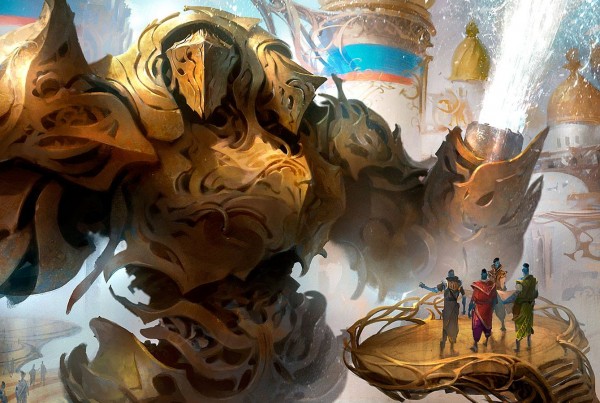
Stock Watch- Torrential Gearhulk

Are you a Quiet Speculation member?

If not, now is a perfect time to join up! Our powerful tools, breaking-news analysis, and exclusive Discord channel will make sure you stay up to date and ahead of the curve.

Don't call it a comeback.

Torrential Gearhulk saw significant growth on Magic Online in the immediate wake of the bannings, and paper copies grew a few bucks in value leading up to the Columbus Open. The deck didn't show up in the Top 8 of that event as much as the hype would lead one to believe, but the week one Open after Kaladesh was won by an aggressive deck as well. I think we all remember what the finals of that Pro Tour looked like.

There was an error retrieving a chart for Torrential Gearhulk

Control decks simply take a bit more work and context to refine, and while Torrential Gearhulk's performance last weekend has caused the card to stay on the low side of the $20 range, I expect it to see heavier play, more success, and a steep increase in demand in the coming weeks.

DeCandio's week one deck was great, and the Jeskai Saheeli combo is strong, but I'm not seeing anything that a highly interactive Torrential Gearhulk deck couldn't take to task. Metalwork Colossus did give me a beating at the Open, but the consensus seems to be that, minimally, those decks need a lot of work. I like Torrential Gearhulk's spot, and could easily see dominating the Pro Tour and possibly next week's Open. I wouldn't be the least bit surprised to see growth between 50-75% in the coming weeks.

Avatar photo

Ryan Overturf

Ryan has been playing Magic since Legions and playing competitively since Lorwyn. While he fancies himself a Legacy specialist, you'll always find him with strong opinions on every constructed format.

View More By Ryan Overturf

Posted in FreeTagged , 2 Comments on Stock Watch- Torrential Gearhulk

Have you joined the Quiet Speculation Discord?

If you haven't, you're leaving value on the table! Join our community of experts, enthusiasts, entertainers, and educators and enjoy exclusive podcasts, questions asked and answered, trades, sales, and everything else Discord has to offer.

Want to create content with Quiet Speculation?

All you need to succeed is a passion for Magic: The Gathering, and the ability to write coherently. Share your knowledge of MTG and how you leverage it to win games, get value from your cards – or even turn a profit.

A First Glance at Aether Revolt Modern

Are you a Quiet Speculation member?

If not, now is a perfect time to join up! Our powerful tools, breaking-news analysis, and exclusive Discord channel will make sure you stay up to date and ahead of the curve.

The first major event after a new set is released is both very significant, and yet worthless for the analyst. On the one hand, this is the first glimpse the world gets at where the wider metagame is heading. On the other, it is a single data point in an entirely new experimental condition. In plain English, the early tournaments are not indicative of where the metagame actually is, but they do indicate where it is going to go. They're useful to judge how people have reacted to the expected new metagame and serve as the starting point for the new meta.

What I'm saying, as Modern Nexus has said many times before, is that when we look at the results from the SCG Classic in Columbus we should temper our expectations and be careful about our conclusions. Players were trying out new ideas in hopes that they would work, without significant testing or evidence to back them up. This was just the first iteration of the experiment; it will take a lot more to actually have something useful analytically. As a result, the data the event generates will be unusual compared to where we were prior to the set release and where we will be in a few months. This will be doubly true because of the recent bannings.

With that disclaimer out of the way, the results are very interesting in and of themselves. What they suggest is that the bans worked and many decks that were afraid of Dredge were able to return. The relative lack of Infect and complete absence of any other Gitaxian Probe deck add additional evidence. At the very least, it means players thought that the bans worked, and adapted to the perceived reality. Whether that will continue to be the case remains to be seen.

[wp_ad_camp_1]

The SCG Columbus Top 16

Before we go any further, lets take a look at the data set in question.

DeckTotal NumberNumber in Top 8
Bant Eldrazi32
Abzan Company21
Affinity21
Ad Nauseam11
Griselbrand11
Grixis Delver11
Jund11
Death and Taxes1-
Dredge1-
Esper Control1-
Infect1-
Titan Breach1-

That is quite the collection of decks. I count 12 distinct archetypes. Star City has listed Jermol Jupiter's and Brian Demars's decks as separate but they're only superficially different from each other. In reality they're both Abzan Company. Bant Eldrazi was the only deck with two members in the Top 8, with another deck in the Top 16. Affinity and the aforementioned Abzan Company also had representatives on both sides of the cut. Whether these numbers are a function of their population at the tournament or actual strength is indeterminate, except for Bant Eldrazi, which at this point has a proven track record. It really is that powerful, despite its flaws. Always be vigilant.

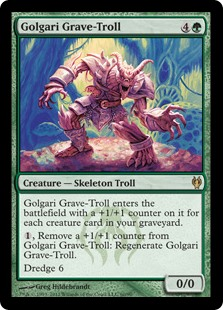
What is most interesting is the number of graveyard decks in this Top 16. Abzan Company, Grishoalbrand, and Dredge are graveyard-based combo decks while Grixis Delver and Esper Control utilize their graveyards as secondary resources to fuel their gameplans. This suggests to me that some players were aware of the Dredge Cycle and took advantage. The banning of Golgari Grave-Troll was expected to reduce the prevalence of Dredge. Therefore players expected that they could cut graveyard hate. This in turn provided an opportunity to those decks that had suffered splash damage from the Dredge hate.

Abzan Company was hit particularly hard, losing about half its metagame share and dropping from solid Tier 1 status post-Eldrazi banning down to Tier 2. There is far less dedicated graveyard hate in the Top 16 than we saw in previous tournaments, which means less splash damage and thus a return to relevance for these archetypes. That helps explain the appearance of Abzan Company and Griselbrand Reanimator, but may similarly affect decks like Living End. Whether this trend will hold has yet to be seen.

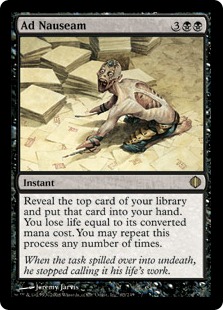
It is also instructive that the winner was Ad Nauseam. A powerful combo deck in a vacuum, it struggled mightily against Infect, which just ignores Angel's Grace and Phyrexian Unlife. Last year we saw a number of decks that overloaded their sideboards against Infect and still lost. With Infect hit by a ban, it makes sense that Ad Naus would be boosted. This could signal a metagame shift toward Jund, a common foil, and Ad Naus. It's difficult for many decks to race Ad Naus and most don't interact with the combo. Jund is a notable exception thanks to its discard spells and Liliana of the Veil locking Ad Naus out of topdecking into their two-card combo. Again, too early to tell, but it stands to reason given the weakening of the predator. Keep your ears open.

I don't want to extrapolate beyond that due to the ambiguity caused by our lack of data, so instead let's look into the Top 16 and examine some interesting developments present.

Ad Nauseam Ascendant

The winning decklist has a very standard maindeck. Unsurprising considering that it's a well-established combo deck. In fact, I suspect that any deviation from this standard is actively wrong. What is more interesting is the sideboard.

Another facet of being an established, tight list is inflexibility in the sideboard. You know your bad matchups and what they'll use against you, and the best tools to fight back are well known, which is why Ad Naus plays Leyline of Sanctity against Jund. Infect has traditionally been fought with Darkness and additional spot removal, but Danny Spencer completely changed the game by playing Crovax, Ascendant Hero. All of Infect's creatures have one toughness, meaning that Crovax fairly neatly beats their entire deck. Infect normally only runs Spell Pierce and Dismember as answers, neither of which is effective when Crovax can bounce himself. An absolutely brilliant piece of tech. I told you the cardpool has plenty of surprises!

Abzan Company: A Return to Form

Most players won't remember this, but Abzan players have been gaining infinite life since long before Melira, Sylvok Outcast was printed. It was just a more complicated process. Back in the day it was accomplished with Essence Warden, Saffi Eriksdotter and Crypt Champion in a Standard deck called Project X. The way it worked was Champion would die when it entered the battlefield. In response to the sacrifice trigger, you use Saffi on Champion. Champion will be sacrificed and then returned, and then both its abilities trigger, returning Saffi to play. Repeat until bored, in the presence of Warden, for infinite life.

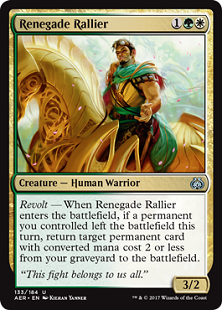
When Melira came out the combo was greatly simplified, with fewer opportunities to misclick on MTGO, and Saffi hasn't seen play since. However, Renegade Rallier stands to change all that. Rallier is a very solid value creature for Abzan Company and can incidentally combo off with Saffi and a sacrifice outlet. The inclusion of this combo is the only major difference between Jupiter's and Demars' lists.

Abzan Company, by Jermol Jupiter (2nd, SCG Columbus Classic)

Creatures

3 Birds of Paradise
4 Noble Hierarch
2 Eternal Witness
3 Kitchen Finks
3 Renegade Rallier
1 Scavenging Ooze
1 Tireless Tracker
2 Viscera Seer
3 Voice of Resurgence
2 Wall of Roots
2 Anafenza, Kin-Tree Spirit
2 Melira, Sylvok Outcast
1 Saffi Eriksdotter

Instants

4 Chord of Calling
4 Collected Company

Lands

4 Verdant Catacombs
4 Windswept Heath
2 Temple Garden
2 Overgrown Tomb
2 Misty Rainforest
2 Gavony Township
2 Forest
1 Plains
1 Swamp
1 Arid Mesa
1 Godless Shrine
1 Horizon Canopy

Sideboard

4 Tidehollow Sculler
2 Path to Exile
2 Abrupt Decay
2 Qasali Pridemage
1 Spellskite
1 Burrenton Forge-Tender
1 Kitchen Finks
1 Orzhov Pontif
1 Selfless Spirit

Rather than being used to gain infinite life, in this list Saffi, Seer, and Rallier combine with Anafenza to produce infinite bolster triggers. Note that you can stack all these triggers below the combo iterations proper, and then sacrifice any extra creatures to ensure the counters go on an attacker that isn't summoning sick. A bit complicated I'll admit, but effective. I doubt that the combo is good enough on its own, but as a backup plan it has merit. Surgical Extraction is the most popular graveyard hate outside of Dredge-fearing metagames, and it's not uncommon for the Abzan player to get their Finks extracted. The Saffi package provides an additional way to combo out. Rallier is also a respectable card in its own right, in this deck effectively an Eternal Witness that hits harder and saves mana.

The question is whether this additional combo build is actually the path for Company moving forward. Brian Demars didn't use Rallier and finished lower than Jupiter, but in its place he had more value engines like Tireless Tracker. This makes his deck more fair and less vulnerable to graveyard hate. Abzan was hated out because of Dredge, and Jupiter's deck is quite vulnerable to Rest in Peace. Most of his cards depend on the graveyard to be good and he doesn't really have a backup plan except the ubiquitous Gavony Township. Demars can more easily ignore the enchantment by playing a clue-based value and growth game. Which version becomes more common will likely depend on how prevalent general hate like RiP remains. If it remains common then Demars's list will be better. If not, I think that the additional combo has considerable value. More potential combos means more surprise wins from Company.

Control Is Back

Jeskai Control has really fallen off over the past year. Dredge was one factor but it had been in decline before the undead menace arose. I was never sure why—possibly Nahiri wasn't as good as expected? In any case, control appears to have returned in Columbus in very different form.

Esper Control, by Ryan Hovis (9th, SCG Columbus Classic)

Creatures

4 Snapcaster Mage

Instants

4 Fatal Push
2 Path to Exile
2 Secure the Wastes
4 Think Twice
3 Logic Knot
2 Negate
4 Esper Charm
2 Sphinx's Revelation
4 Cryptic Command

Sorceries

3 Supreme Verdict

Lands

4 Celestial Colonnade
4 Flooded Strand
4 Polluted Delta
3 Island
2 Hallowed Fountain
2 Watery Grave
1 Godless Shrine
1 Marsh Flats
1 Mystic Gate
1 Steam Vents
1 Sunken Ruins
1 Plains
1 Swamp

Sideboard

3 Runed Halo
2 Stony Silence
2 Path to Exile
2 Crumble to Dust
2 Thoughtseize
2 Timely Reinforcements
1 Relic of Progenitus
1 Negate

Now this is a deck to warm Shaheen Soorani's heart! The purest Modern control deck I've seen in quite a while. No planeswalkers, no targeted discard. Just reactive answers, card draw, land, and a win condition. We saw this archetype appear in the hands of Guillaume Wafo-Tapa some months ago, and this list is quite similar. I heartily approve of the Supreme Verdicts and I expect you'll be seeing more of these decks in the not-too-distant future. I knew control was viable if you tried hard enough! And Dredge took a hit so that you could ignore it!

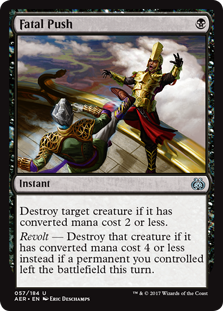
Fatal Push is the main draw to Esper rather than Jeskai. Push kills most things Bolt does and some more besides. It doesn't go to the face, but in such a dedicated control deck I don't think you care. For this reason I expect that Esper will replace Jeskai in the short run. How this will fare in the long term is less certain. This is not a deck that cares about chiseling away at an opponent, it just shuts you down and wins (figuratively) with card advantage. Full sets of Push, Path to Exile, and Snapcaster Mage combine with Verdict to grind through creature decks, while Cryptic answers everything else. That said, the humbling of Dredge has greatly benefited this deck. I can't imagine that was a good matchup, and graveyard hate also really hurts as dedicated a Snapcaster deck as this one. I suspect the maindeck Negates had RiP and Grafdigger's Cage in mind.

Secure the Wastes is an interesting win condition. It makes sense with the high land count, and the fact that it can be deployed at instant speed is attractive, but I can't help feeling like there are better options. I wonder if, given a better instant-speed creature, Hovis would have used that instead. The deck is clearly designed to never tap out on its own turn, and Secure plays into that plan nicely. However, it's far easier to answer or race 1/1 Warriors than a dragon or angel. Still, this is an impressive list and will be inspiring many frustrated control mages for some time to come.

Quick Hits

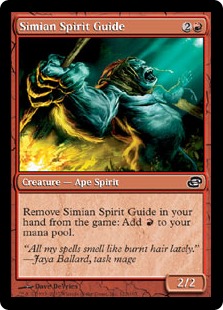
I want to begin by disputing the name of the RG Valakut deck, listed by Star City as "RG Breach." Not because it isn't a Breach deck, but because it is definitely missing the adjective "Turbo" on the front! Why? Simian Spirit Guide. Logan Hoberty is using SSG to blitz out his Breaches. The least fair mana accelerant alongside the most broken Titan. That's just unfair. Oath of Nissa is exceptional in this deck, finding either business, lands, or your accelerant. Just absurd.

Finally, I want to draw your attention to Elliot Smith's Death and Taxes list. I've been working on my own list for some time now, so it takes a lot to get me excited about a new list. Smith succeeded, though you may be surprised why. While it's only a one-of in this list, Weathered Wayfarer is a brilliant find. Decks like this use their lands like spells, and Wayfarer tutors for any land. One special piece of value is to sacrifice Ghost Quarter or Tectonic Edge and before they resolve use Wayfarer, finding a replacement while your opponent has more lands than you do. In DnT that's almost Demonic Tutor. I had completely forgotten Wayfarer existed and am really looking forward to testing it to see if it's as good as I just claimed it was.

Just the Start

I really appreciate the innovation that was on display in this Top 16. The question is whether this will be sustained as the format begins to mature. The format is still getting sorted from the recent upheaval, and we only have this one data point to draw any conclusions. My advice is to limit yourself to looking at this tournament in a vacuum and refrain from drawing any major conclusions. Once the results from Regionals begin to roll in, then we can talk about more in-depth analysis.

Stock Watch- Walking Ballista

Are you a Quiet Speculation member?

If not, now is a perfect time to join up! Our powerful tools, breaking-news analysis, and exclusive Discord channel will make sure you stay up to date and ahead of the curve.

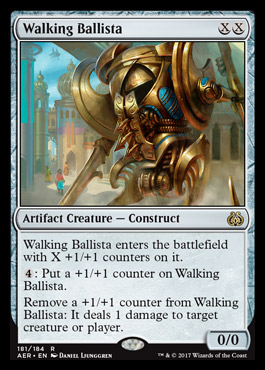
Walking Ballista had a great first week in Standard, and as such has more than doubled in price. In many ways, the card is very reminiscent of Hangarback Walker. They're both artifacts cost at XX, they both use +1/+1 counters for some effect, and they were both initially underpriced.

There was an error retrieving a chart for Walking Ballista

People played it safe pre-ordering Walking Ballista at $5-6, though its week one performance has turned it into a $12-$13 card. Not only is the card powerful in Standard, but it's also being discussed with regard to Modern implications. I played against multiple Tron players casting the card in the SCG Classic this weekend, and I've heard rumblings about utilizing it in a new version of Affinity. Modern play is generally going to impact foil prices much more than non-foils though.

All that said, I expect Walking Ballista is at or near its price ceiling. Aether Revolt will be more opened than Magic Origins as is a set with Masterpieces. Should the Ballista see play in multiple Standard decks it could theoretically hold steady around $10, though over time I couldn't see it holding at $15-20. I'd be happy owning a set, but would be looking to sell off extra copies in the next couple weeks.

Avatar photo

Ryan Overturf

Ryan has been playing Magic since Legions and playing competitively since Lorwyn. While he fancies himself a Legacy specialist, you'll always find him with strong opinions on every constructed format.

View More By Ryan Overturf

Posted in FreeTagged , 1 Comment on Stock Watch- Walking Ballista

Have you joined the Quiet Speculation Discord?

If you haven't, you're leaving value on the table! Join our community of experts, enthusiasts, entertainers, and educators and enjoy exclusive podcasts, questions asked and answered, trades, sales, and everything else Discord has to offer.

Want to create content with Quiet Speculation?

All you need to succeed is a passion for Magic: The Gathering, and the ability to write coherently. Share your knowledge of MTG and how you leverage it to win games, get value from your cards – or even turn a profit.

Insider: Standard & Modern Predictions After SCG Columbus

Are you a Quiet Speculation member?

If not, now is a perfect time to join up! Our powerful tools, breaking-news analysis, and exclusive Discord channel will make sure you stay up to date and ahead of the curve.

Last Friday the landscape of constructed Magic changed dramatically. Five cards were banned and an entire new set became legal for tournament play. If those two factors don't constitute a shake-up, I don't know what does.

I made the trek to Columbus for the SCG Open, where I got a chance to play nine rounds of Standard (lost my win and in for Day 2) and then nine rounds of Modern in the 250-player Classic (7-2, 12th). With nine rounds of high-level tournament matches under my belt in each format post-release, I feel like I've learned a lot about where things are likely heading.

Let's start with Standard.

Standard Speculation Targets

It is amazing how fast the world adjusts to tournament results these days. The results of the Open weren't even in the bag yet and cards were already starting to move in value. I'm not going to bore you with useless information about cards that have already begun to move: blue and green Gearhulks, etc.

The cards that have already gained 20% or more in value are likely close to, or at, their peak value. That makes them poor investments at this point. Remember, you only get credit for investing wisely in the right cards while they were low if you actually get out of them while they are high. Remember, Standard cards almost always trend downward. Trading those Gearhulks, and especially Aether Revolt singles, while they are holding value is a must for any serious collector.

So if I'm not going to bore you retelling what has already happened, what exactly is there to discuss? Today I'm going to share where I think the actual value may be hiding.

I did really well with my overrated picks last week: Heart of Kiran, Aethersphere Harvester, Disallow, Walking Ballista, Paradox Engine, Baral, Chief of Compliance, Tezzeret the Schemer, and Ajani Unyielding. Combined, these cards lost 21% of their value.

I missed pretty hard on Walking Ballista; it has gained 38% since I wrote the article. The Ballista is actively good in the GB Aggro deck that performed well in Columbus. However, I still maintain that it is not sustainable as a $10 card, let alone a $16 card. People need it for decks and are buying into the spike and this is the absolute perfect time to get out of Ballistas, as far as I'm concerned.

My underrated picks actually all stayed exactly the same—so, no gains—but I want to wait until after the Pro Tour to decide whether or not they count as hits or misses. Week one is all about obvious decks and synergies, which all came out of the gate high—the subtle stuff takes a while to pick up steam.

It is hard to pick winners out of the gate because everything starts so high, a response to demand for cards nobody owns yet. Now that people have opened product and demand has cooled off, it becomes easier to start looking for undervalued cards to target.

There was an error retrieving a chart for Release the Gremlins

I have a strong inkling that Release the Gremlins will be a very strong Standard sideboard card moving forward. All three people in my car lamented that our biggest mistake of the event was not sideboarding multiple copies of this card. Most decks have a lot of artifacts and some decks are all artifacts, which makes this card flexible enough to be good but devastating enough to be absurd.

If a lot of PT decks are auto-including Release the Gremlins in the sideboard it will spike this puppy from a bulk rare into the few-bucks range.

There was an error retrieving a chart for Paradox Engine

It is funny how one week a card can be on my list of most overrated and the next week I'm all about picking it up. Well, that is what happens when a card loses roughly 50% of its value in a week. I was right to say overrated then—but now, at $4-5, it is an enticing card.

So, here is my thought process behind why I'm willing to spec on this card at $4. First of all, I think it is one of those zany Commander/casual "Johnny combo player" cards which means it will hold some value. I'd actually guess that it can't really go less than $2.99.

However, it certainly has room to grow, especially if somebody breaks it at the PT. And Paradox Engine is exactly the kind of card that "gets broke." If somebody builds a competitive deck around Engine it could very well be the breakout card of Dublin, sort of like how Aetherworks Marvel spiked in Honolulu up into the $20 range.

Seize the day!

There was an error retrieving a chart for Gonti's Aether Heart

Gonti's Aether Heart is a mythic that has dropped down below $2.99 and has some potential both long- and short-term. First of all, I could see this being a card that could go into a Paradox Engine deck that could allow you to "go off" by taking a bunch of turns. The short-term gain would be that the card could spike.

However, the risk feels low on a card like this because it has some obvious Commander appeal as a Time Warp effect that literally every deck is allowed to play. Time Warp is obviously the best thing you can do in a multiplayer game (since it essentially skips everybody else's turn) and now a mono-artifact or mono-black deck will have access to an effect that typically only blue decks can run.

Recurring the Aether Heart will prove challenging as it exiles itself on use and is legendary so it can't be copied. Barring some sort of Mirror Gallery shenanigans, you would have to use something like Prototype Portal to go off. There may be other ways to abuse it, though, and in any case casual players will enjoy building around this card for years.

There was an error retrieving a chart for Mechanized Production

I think Mechanized Production has a lot of promise in Constructed, and I have already picked up some copies. I watched a friend of mine crushing at the Open by using Mechanized Production in concert with Deadlock Trap to lock up all the opponent's permanents.

It was funny because he actually won multiple games via the alternate win condition, when he made the eighth Deadlock Trap.

There was an error retrieving a chart for Metalwork Colossus

I can't completely endorse this pick because I don't 100% understand it but I'm going to share anyways. I went around to all the dealers at the Open on Sunday evening and asked what cards were hot sellers on the weekend. Obviously, they said they sold a bunch of Felidar Guardians, Fatal Pushes, and Gearhulks, but multiple dealers told me that Metalwork Colossus was a hot seller as well.

I certainly got crushed by Joel Larson's Metalwork Colossus at PT Honolulu last year, so I'm willing to believe just about anything when it comes to crazy combos. I could certainly see the deck being a player in Dublin now that the field has been watered down by both bannings and a second full artifacts-matter set.

These are probably worth trading for if you get the chance.

Modern Speculation Targets

I much prefer Modern to Standard, and had a blast playing my Abzan Company deck to a 12th-place finish in the Classic. Ironically, the "tech" I brought to the table turned out to be worse than what I had before! I played two Fatal Push in my sideboard instead of Path to Exile and was sorely disappointed when I realized I had no way to kill gigantic delve creatures against Grixis Delver. Frowny face.

Based on my experience in Columbus, a few cards stand out to me right now as well positioned in Modern.

There was an error retrieving a chart for Tasigur, the Golden Fang

Speaking of delve creatures, I feel very strongly that Tasigur, the Golden Fang is an excellent speculation target right now. The card is really cheap and it is scary good in Modern. The printing of Fatal Push is really interesting because it makes cards like Tarmogoyf worse. Goyf's biggest strength is that it isn't efficiently answered by 1cc removal like Lightning Bolt or Path. Push, on the other hand, is very efficient at goofing up a Goyf.

Tasigur, the Golden Fang (as I quickly learned) was invulnerable to my ill-devised sideboard removal plan of all Abrupt Decays and Fatal Pushes. I also think that Tasigur is likely a card that plays nice with Fatal Push. An insane black control card just got printed; Tasigur is an insane black control card. I fully expect decks that use both to be a big part of Modern moving forward.

There was an error retrieving a chart for Voice of Resurgence

Do you know what else is good against people who want to Fatal Push? Yeah, you guessed it: Voice!

Voice of Resurgence also benefits from the printing of Renegade Rallier, which can buy it back and create a ton of incidental value over the course of a game. In particular, Rallier, Saffi Eriksdotter, and Voice of Resurgence were all featured as prominent maindeck features of another Abzan Company deck that took second in the SCG Classic.

There was an error retrieving a chart for Reality Smasher

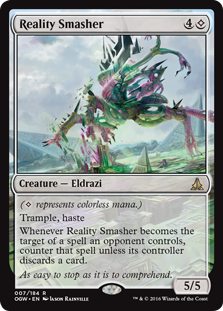
Guess what? The Fatal Push decks really struggle against Bant Eldrazi. I guess a bunch of gigantic creatures that all generate value and don't die to Fatal Push or Bolt are good against Jund and Grixis... Who would have ever believed that?

Reality Smasher has all the hallmarks of a money card except the high price tag, which makes me believe it is an excellent investment card at the moment. The card is even a current Legacy staple.

I have a strong feeling that Bant Eldrazi will grow in popularity in the new Modern format with Fatal Push decks on the upswing. All of these factors are potentially great for Eldrazi cards. People also love Eldrazi from a thematic, tribal perspective—and by now we all know the perils of ignoring the potential for casual demand.

There was an error retrieving a chart for Drowner of Hope

Here's another major player in the Bant Eldrazi deck that's posting an incongruous price tag. I will never understand how a card that's a straight staple four-of in one of the best decks in Modern can be a bulk rare. It blows my mind.

I can't tell you how many copies of Drowner of Hope I have bought for a quarter or less over the past year. I am just hanging on for when they start to creep up in value. The buy-in price is so low and the reward feels so obvious. Unless there's something I'm missing here, I feel like it's no exaggeration to call this free value down the road.

Making Predictions

I feel very strongly about my Modern picks. All are cards that I believe got dramatically better, either as a result of the bannings or the printing of Aether Revolt. I expect them to see increased play and thus increased demand.

The Standard picks are a little bit riskier (as Standard picks always are) but what else is there to do with Standard cards besides bet on or against them? The PT is coming up and it is always the decks that people don't see coming that spike things up. My suggestions for Standard are the types of cards that could (and likely would) go into some artifact-based combo deck—and even if they don't find a competitive home immediately, most will hold close to their current value because of casual play.

I apologize if you traded off Walking Ballistas because I said they were overrated at $10—but to be fair, I still think they are overrated at $10. Don't worry, they'll be $6 in a month.

Whew. Well, it was one heck of a weekend playing and learning about two new formats in Columbus. Eighteen rounds of Magic in 36 hours is a marathon! Enjoy the new formats and make some money.

Insider: Evaluating Aether Revolt for Eternal

Are you a Quiet Speculation member?

If not, now is a perfect time to join up! Our powerful tools, breaking-news analysis, and exclusive Discord channel will make sure you stay up to date and ahead of the curve.

Welcome back readers! Today's article goes back to my roots here on QS. I originally came on board with a focus solely on eternal formats. I've written a number of set reviews focused on eternal playability, which you can find here, here, and here (there's a few of them).

The card pools in Modern, Legacy, and Vintage are extremely large, which means cards have a difficult chance of finding a home in these formats. This difficulty increases as you move from the smaller to the larger formats.

However, there are a few key characteristics that help highlight a potential card's promise. These are some of the questions I ask when evaluating a new card for potential adoption in Eternal.

  1. Does it fit into an existing archetype?
  2. Does it create a new archetype?
  3. Does it pitch to Force of Will? (Blue as a color tends to be overpowered and thus played disproportionately in Legacy and Vintage.)

For each of our picks today, I'll be evaluating them on these criteria, and adding some additional thoughts about their general playability.

Fatal Push

There was an error retrieving a chart for Fatal Push

Let's get the most obvious one out of the way first. Fatal Push is an extremely cost-effective removal spell with minimal downside in any format with fetchlands (as they can trigger revolt very easily). We haven't seen a removal spell with this much eternal potential since Abrupt Decay, which, along with Deathrite Shaman, spawned two new Legacy archetypes (BUG Delver and Shardless BUG).

Efficient removal has been around since the game first began with Swords to Plowshares, but its importance has been more and more appreciated as the game has grown and Wizards has shied away from printing it.

Wizards eventually realized that one-mana removal should have a downside, since the worst you can ever get is mana parity, and usually you're trading up on mana. The downside on Fatal Push is particularly negligible in eternal formats, since the high value placed on mana efficiency means most creatures cost less than three anyway. The one blind spot Fatal Push has in these formats is against decks whose sole goal is to cheat large powerful creatures into play (Reanimator, Sneak and Show, etc.).

If we look at my first question above we see that Fatal Push can slot into a ton of existing archetypes (anything that runs black will likely find room for this card). It is especially good in Modern as there are very few "cheat giant fatty into play" decks.

Black is typically used for either hand disruption, reanimation, or some kill spells, but it's usually the minor color in a deck. I think Fatal Push has the power level to push black into a major color of a deck.

It also may allow an Esper Control deck to move into Tier 1 status in Modern. The biggest problem for Esper decks was that they lacked access to effective one-drop removal in the early game. Path to Exile is excellent, of course, but in the early turns of the game has a pretty serious drawback. Disfigure and Vendetta were other options, but carry with them their own drawbacks too.

Push gives these decks something they never had before: a Lightning Bolt-like card that could help stabilize early and still be relevant late. Being able to play eight one-drop kill spells in a BWx deck (alongside Path), or potentially 12 in Mardu, is extremely powerful and could very well lead to a new archetype.

Baral, Chief of Compliance

There was an error retrieving a chart for Baral, Chief of Compliance

While I can't say I'm nearly as excited about Baral, Chief of Compliance as I am about Fatal Push, I can recognize that a two-drop that reduces the cost of instants and sorceries, loots when you counter, and happens to be a Human Wizard, has a lot of potential.

As for the looting, remember that in eternal formats card filtering can easily run away with a game. When you need to answer your opponent's threats or find some of your own, replacing dead or semi-dead cards with live ones is very close to just flat out drawing a card.

I can see him being useful in decks that want cards in the graveyard, perhaps some form of Reanimator deck. You could play him on turn two, counter the opponent's turn-three play (discarding a fatty) and then cast a reanimation spell with counter backup (both of which may cost less as well).

Greenwheel Liberator

There was an error retrieving a chart for Greenwheel Liberator

Here's another card that I'm honestly surprised hasn't gotten more attention. In a format with fetches, this can easily be a 4/3 for two mana. That's pretty impressive. While I don't think it's the next Tarmogoyf, I do think that it would do very well in the various Zoo archetypes.

It does die to Lightning Bolt, but to be fair almost everything in Zoo does. It also pairs extremely well with another card slightly farther down on this list (Hidden Herbalists) and can be cast off of a Burning-Tree Emissary, which goes into the same type of decks. It is also an Elf which is a tribe with a long and strong history in Magic.

Heroic Intervention

There was an error retrieving a chart for Heroic Intervention

This is another fantastic support card that is far more likely to find a home in the sideboard of Zoo or Elf decks than to end up maindeck. It's a two-drop that essentially counters any wrath effects (save something like Languish) and also counters targeted removal.

Note the ability is not limited to creatures, so it could be used to protect lands in something like Modern Tron, which can struggle when one of their Tron pieces gets hit with a Crumble to Dust.

Hidden Herbalists

There was an error retrieving a chart for Hidden Herbalists

As I mentioned above, this card is awesome for Zoo decks. They already tend to play a lot of fetchlands anyways (so revolt is easy to trigger) and Modern already had a straight RG Zoo deck built off of Burning-Tree Emissary, Goblin Bushwhacker and Reckless Bushwhacker. While Herbalist can't help cast either Bushwhacker, it can cast an Emissary to filter for red mana.

This can lead to extremely explosive turn-two plays. Imagine:

Turn 1: Kird Ape or Wild Nacatl.

Turn 2: Fetch, Hidden Herbalist, Burning-Tree Emissary, Reckless Bushwhacker, attack for 12 or 13 (depending on your turn-one play). If you have another Herbalist or Emissary in there, you're at 15-16 damage on turn two. That's pretty insane.

Hope of Ghirapur

There was an error retrieving a chart for Hope of Ghirapur

We finally have a Modern-legal Xantid Swarm effect, which is a powerful sideboard card for Legacy Storm. The beauty of Hope of Ghirapur is that it doesn't require green, which is one of Swarm's biggest downsides (fetching up a green source in Legacy Storm is rarely ideal since most of your spells are blue or black). This type of effect is typically only needed once anyway (when you're comboing off post-combat) so its one-shot use isn't nearly as big of a deal as it might seem.

It is interesting to note that Hope also stops your opponent from casting noncreature spells on their following turn as well, so it can prevent one's opponent from going off should you just need to stall. I can easily see this card finding a home in any eternal combo deck that doesn't require the attack step (like the Splinter Twin decks of old did).

Metallic Mimic

There was an error retrieving a chart for Metallic Mimic

I could see Metallic Mimic being tested out in a tribal deck like Merfolk as yet another lord. The downside (it must come down before whatever it pumps) is mitigated somewhat by the fact that the bonus is permanent.

Merfolk is the obvious place to look here, as it's the prototypical "all-lords" deck, but other tribes could want this effect too. Some strange tribes have seen sporadic play in Modern, including Allies, Humans, Slivers, and Spirits. Perhaps this is what one of those decks needed to get off the ground.

This is another of the "could find a home" cards that I want to highlight but not dig too deep into, as I know that eternal formats tend to ignore cards that are "pretty good" and only focus on the ones that are amazing.

Narnam Renegade

There was an error retrieving a chart for Narnam Renegade

Here we have another solid Zoo card. Again this one utilizes the powerful interaction between revolt and fetchlands.

I realize that Kird Ape quickly got outclassed by Wild Nacatl when the cat was unbanned in Modern, but the deathtouch here is pretty clutch. One-drops tend to get stonewalled by big blockers like Tarmogoyf and serve for poor defense. Narnam Renegade will trade with anything that blocks it, and can play defense in a pinch (though to be fair Zoo decks rarely find themselves in this role).

What I love most about this set so far is that it's making Zoo a very solid archetype. This is one of the cheaper decks in Modern, since everything but the land base and Tarmogoyf are commons or uncommons.

Pia's Revolution

There was an error retrieving a chart for Pia's Revolution

I'll admit when I first saw this card, it screamed "bulk rare" to me and I just kept going. However, I've since had some additional time to review it, and it seems like it might fit into Ravager Affinity.

Some versions of the deck already play red for Galvanic Blast, so it's not requiring any additional colors. With a Ravager out, every artifact sacrificed leaves the opponent with a difficult choice. If it's a zero-drop like Mox Opal or Memnite, they're basically forced into taking the three damage, as you could go infinite otherwise. All in all, this adds up to a ton of damage.

I'm not saying this will change Affinity, but it's worth keeping an eye on. As this card fits somewhat into an existing archetype I see it making it better, but I don't know if the mana cost is too high for an ability that doesn't immediately effect the battlefield.

I may be going out on a limb here, but it is possible that this could spawn a new archetype. We do have Atog, Arcbound Ravager, Greater Gargadon, Krark-Clan Ironworks, and a few other cards that provide a continual manaless sacrifice outlet. I don't know how good this would be, but I want to highlight the potential.

Renegade Rallier

There was an error retrieving a chart for Renegade Rallier

This card's potential lies in three factors. 1) It returns any permanent (so you could return the fetchland you use to trigger revolt in the first place for a ramp effect). 2) It has a decent body for a three-drop (not spectacular, but not terrible). 3) It's a green creature that can be cheated in via Collected Company.

I've been pretty impressed with this set's uncommons (as you can tell by this list including so many). This is another one I'd watch out for. It appears that the MTG community has picked up on its power level as foils are already in the $6 range.

Finally, this card does create another "Melira-type" infinite combo with Saffi Eriksdotter. This is more likely to appear in existing Abzan Company and Chord decks than spawn a new archetype, but it's something to keep in mind.

Rishkar, Peema Renegade

There was an error retrieving a chart for Rishkar, Peema Renegade

Rishkar, Peema Renegade could have an important role to play in Modern Elf decks. Basically I see it as a potential Heritage Druid number 5-6. It's not a terrible follow-up to a turn two Dwynen's Elite, as you could put counters on both the token and the Elite and immediately tap them for mana. And putting a counter on a Nettle Sentinel lets you drop all your one-drop Elves onto the battlefield.

I don't know for sure whether this is just too slow, or too little bang for your buck. But assuming Rishkar can make two mana the turn you play him, he costs an effective one mana, and the potential for explosiveness is real.

Spire of Industry

There was an error retrieving a chart for Spire of Industry

This seems like a slightly worse Glimmervoid for artifact-based decks, which means it's still an easy include in said decks. This could easily allow Affinity decks to splash additional colors for answers to common hate cards by giving the deck eight rainbow lands. It's also been suggested as a potential card for Lantern Control.

Sram, Senior Edificer

There was an error retrieving a chart for Sram, Senior Edificer

As someone who has Puresteel Storm built in Modern, I can tell you the deck is powerful and lightning fast. Its biggest problem has always been that it relies heavily on Puresteel Paladin to do anything. I personally tried using Paradoxical Outcome to act as slower/more expensive Puresteels (they really are that critical to the deck's function), and now Wizards has given me four more.

I think this may knock Puresteel Storm up a notch in Modern to Tier 2 (if not Tier 1). Its power level (and thus playability) has always stemmed so heavily on the fact that without its namesake card it really does nothing.

Another application for Sram may be in Bogles, where he can act like additional Kor Spiritdancers. I don't think another archetype built around him will pop up, as the only one not accounted for is a vehicle deck, which I don't see happening in Modern.

Whir of Invention

There was an error retrieving a chart for Whir of Invention

Chord of Calling has been a staple in Modern almost since the format's inception. Unlike Chord, Whir of Invention can never be cast with no mana. But artifacts have proven to be some of the most powerful cards in the game (see the Power 9) and there are plenty that cost zero or produce more than one mana. It's possible that Whir decks could power out their namesake card even faster than Chord.

This is the type of card I want to keep on my radar even if nothing pans out immediately. Tutoring things directly into play is an extremely powerful ability, especially at instant speed.

People are already trying to slot Whir into the old Eggs and Krark-Clan Ironworks decks, but I think its power will be predicated on whether it can spawn a new deck. If this card ever drops to bulk, I'll likely pick up a few playsets to store away.

Conclusion

I realize this one was a bit longer than usual, but I honestly think there's a lot for eternal players to brew with in this set. If you think I missed anything, please comment and let me know your thoughts.


Insider: Pro Tour Aether Revolt – Place Your Bets

Are you a Quiet Speculation member?

If not, now is a perfect time to join up! Our powerful tools, breaking-news analysis, and exclusive Discord channel will make sure you stay up to date and ahead of the curve.

Well done, Wizards. I must confess I showed interest in a Standard format for the first time in over a year. And it wasn’t even strictly financial gains that motivated my desire to watch Star City Games Open coverage in Columbus. I was genuinely curious to see how the format would unfold post-bannings.

I suspect others felt the same way. Therefore I will make the bold claim that Wizards’ new banning schedule will be a boon for Magic because it will allow for another “refresh” cycle. As long as they don’t abuse this power, I firmly believe banning things is a great way to keep players brewing, pros testing, and people speculating. Financially speaking, as long as we avoid the banned cards we should have more opportunities to profit from Standard going forward.

Coming from someone who usually doesn’t touch Standard with a ten-foot pole, this means quite a bit. And it is why I actually made a couple small purchases last weekend.

There was an error retrieving a chart for Walking Ballista
There was an error retrieving a chart for Metalwork Colossus

While the ship has sailed on these two rares already, it doesn’t mean profitable opportunities are gone. However if you do plan on betting on Standard, the best chances for profit are nearly gone. Consider this your two-minute warning.

Innovations

Usually the first couple Standard events after a new set’s release showcase some innovation. A while back we saw the rise of the Rally the Ancestors deck during an SCG Open right before the Pro Tour. This was an example where some of the best innovation was already discovered.

It doesn’t always work out this way though. Sometimes we see generic, aggressive decks in a new Standard during the first couple tournaments. I will always remember how hot Contested War Zone was on the weekend of Mirrodin Besieged’s release. Not only did I get beat by the aggressive deck, but I also got burnt trading for a couple copies on the floor. I don’t think they ever touched that $5 price point again.

So let’s look at this weekend’s popular decks in Columbus. We saw a tremendous amount of Saheeli decks. To me, this isn’t really “innovation”—everyone expected this deck to show up in full force at the Open, and many players built their decks around the ability to beat this combo.

There was an error retrieving a chart for Saheeli Rai

In my opinion, the real innovation came in the form of the BG Aggro deck that married Walking Ballista, one of my Aether Revolt favorites, with Winding Constrictor. In fact Walking Ballista synergizes well with numerous cards in Standard, including Nissa, Voice of Zendikar and Verdurous Gearhulk. These two green cards showed modest jumps recently, but both are a far cry from their all-time highs.

There was an error retrieving a chart for Nissa, Voice of Zendikar
There was an error retrieving a chart for Verdurous Gearhulk

I also found some control decks pretty interesting. I have always been a fan of draw-go strategies in Standard (although it makes for poor live coverage), and the decks based around Torrential Gearhulk and Wandering Fumarole as win conditions look pretty fun to me. I suspect these decks can be refined based on local metagames to be very competitive going forward.

It was also really exciting to see the Metalwork Colossus deck from PT Kaldesh resurface---perhaps the bannings helped make this strategy viable again. When was the last time 10/10 creatures were playable in Standard? The deck certainly is a delight for Timmy players everywhere.

Place Your Bets

Despite the fact that we did see some creative deck strategies in Columbus, I will go out on a limb and state that the innovation for the new Standard format isn’t finished. There were quite a few Saheeli Cat decks, and this came as no surprise. I think this deck can be beat once people have enough time to test. Enter the Pro Tour.

Historically, the Pro Tour has been one of the best opportunities to make money from MTG speculation. It is during the Pro Tour that we see numerous price spikes as players buy up cards they see in action on camera. Sometimes there are fewer spikes and sometimes the spikes are more plentiful; for Aether Revolt, I believe the bannings have created enough wide-open development space to enable multiple new strategies to surface. For this reason, I think the best chance to profit from Standard comes in two weeks.

What does this mean? It means you have about one week to place your final bets on the format. Do you think the Saheeli deck is going to be the only cat in town? You may do well to pick up some Inspiring Vantages or Spirebluff Canals. (I can’t advocate buying Saheeli Rai herself because she’s already so expensive). Do you feel Baral, Chief of Compliance didn’t get a fair showing? Now’s the time to be picking these up. Will green-white strategies dominate the Pro Tour? Perhaps Oath of Ajani and Ajani Unyielding should be in your binder before the main event.

My point is, in order to maximize profits from the Pro Tour you need to follow a straight-forward yet difficult two-step process:

  1. Purchase cards you think will break out during the Pro Tour at least one week before the main event.
  2. Sell cards Pro Tour weekend once they spike.

This is what I mean when I say “place your bets.” The time to speculate on Standard is now—Wizards of the Coast gave us speculators a gift when they banned cards in Standard. It caused a massive upheaval of the metagame, and players will need to adjust accordingly. During this period of uncertainty, prices are going to be extremely volatile, allowing us to profit handily if we are betting on the right spots. This shake-up will hit its peak during the Pro Tour.

After that event, the new format will be more defined and start to settle out. You have two weeks before that happens. Given that it takes about a week for cards to arrive in the mail, you have about one week to make your purchases in advance of the Pro Tour. Use the time wisely.

Can’t I Buy During the Pro Tour?

Of course you can. It’ll just mean you end up paying higher prices to build your position. What’s more, you also run the risk of your card crashing in price if the deck just misses the Top 8. This happened with Demonic Pact during Pro Tour Origins. The card spiked on Friday and Saturday, but when the deck failed to make Top 8 it quickly sold off in the days that followed. If you had bought into the spike—even before it reached its peak—you may not have had enough time to sell for realizable gains.

There was an error retrieving a chart for Demonic Pact

It is trivial, but the fact that it is easier to sell into a pop than it is to sell into a race to the bottom needs to be stated. Emotions often get the best of us, and it causes us to make suboptimal financial decisions.

When we chase a spike, we fall into the trap of expecting the card to rise higher and higher. But it’s impossible to predict the exact peak and the exact duration of that peak. So while it’s certainly possible to buy cards on Pro Tour weekend to sell for profit, it’s definitely easier to do so when you already have the cards in hand.

Wrapping It Up

You may ask what my bets are for Pro Tour Aether Revolt. This is where I come up short as a Standard speculator. I simply do not know enough about the format to offer up actionable suggestions. I would just be guessing.

However, I can offer some advice: follow key players on Twitter to see what they’re talking about. Read up on other MTG finance articles—there are multiple writers on this site who know much more about Standard than I do. Read up on tournament results on MTGO over the next week. Gather as much data as possible so you can make informed bets on the Pro Tour.

As for me, I’m probably going to leverage my typical Pro Tour strategy: buy cards on Friday as soon as they show up on camera and hope to get the cards in the mail soon enough to sell for profit. This isn’t the best approach to make profits, but it can be an effective way to make a few bucks while not being good at predicting what the metagame will look like. It’s basically the way to play the Pro Tour for people who don’t know enough about Standard to make bets in advance.

In the meantime, I’ve been focusing my resources on Commander and Old School cards. No matter how interesting Standard becomes, I will always prioritize investing in Commander and Old School because I like the long-term prospects for growth. Standard is fine for making a quick buck, but the real appreciative growth happens in casual and fan-supported formats.

For those who crave specific ideas, I really like Garruk, Apex Predator right now.

There was an error retrieving a chart for Garruk, Apex Predator

This card buylists for nearly $10, but occasional copies are listed on eBay in the $9-$10 range. To me this is one of the safest pickups—the card isn’t likely to be reprinted in Modern Masters 2017 and it still sees significant play in Atraxa Commander decks. If you prefer penny stock ideas, check out the chart on Thopter Assembly: does it get much more attractive than this? I am in for a few playsets on this one.

There was an error retrieving a chart for Thopter Assembly

Standard bannings are a nice distraction to keep me interested in MTG finance, but nothing trumps a solid buy-and-hold strategy. Combining the two, however, is truly the best of both worlds. We can make a few bucks on Standard metagame shifts and hype while reinvesting profits into long-term holds. This is my favorite strategy of all, and it’s exactly why I am more bullish on MTG now than I was throughout all of 2016. Let’s hope that momentum continues!

…

Sigbits

  • Lotus Bloom is hitting all time highs and the card is completely sold out on Star City’s website. It’s listed at $9.99 but it wouldn’t surprise me to see a modest bump higher when it comes back in stock. This hype is probably driven by Modern speculation surrounding the new tools Eggs is getting in AER like Whir of Invention.
  • Keep an eye on Collector's Edition and International Edition cards. I know they’re not tournament-legal and therefore are boring to some, but they have been creeping higher, likely from Old School demand. Just this weekend we saw Bayou, Illusionary Mask, Savannah, Tundra, Cyclopean Tomb and Nevinyrral's Disk from CE each hit all-time highs. I believe there is genuinely traction here, and I know Star City Games has been aggressive with their CE/IE buylists for quite some time now.
  • Here’s some low-hanging fruit for patient readers. Check out the price chart on Heartwood Storyteller. The card just hit an all-time high, and the chart shows a real inflection point taking place over recent weeks. This will surely climb higher—if you’re looking for an easy entry point, I see SCG has seven SP copies in stock well below TCG pricing, at $3.39. My only request is that if you buy those copies, post it in the comments so everyone else knows they’re gone. And if you miss out, don’t worry, it looks like copies are cheaper on eBay than TCG Player so there’s still some room to buy in cheaply.

Free: Shark Tales – The Tales of the Clone and the Stroke of Genius

Are you a Quiet Speculation member?

If not, now is a perfect time to join up! Our powerful tools, breaking-news analysis, and exclusive Discord channel will make sure you stay up to date and ahead of the curve.

I am going to be tackling a controversial topic today. I was taught Magic late in 1997 by two friends of mine as I got curious what all that gibberish they were talking was about. Both of them were very active traders and at least one of them was what we call a shark these days. Naturally I copied some of their habits when it came to Magic, among them their trading ethics (the distinct lack of them to be more precise). I was a shark, and I was good at it.

Quiet Speculation and I do not condone sharking, we have published this article on the free side to make sure it's available for everyone to learn from. If you cannot do well in the market without ripping people off, then you really shouldn't be into MTG finance. I am not proud of my past as a shark and have left it behind me, but I do believe there might be some lessons to be learned from it. I am writing this article for that reason.

Everybody can make a deal that is to their advantage: add up the numbers, make sure that what you're getting is worth more than what you're giving away and close the deal. The toughest part might be to keep a straight face. Repeat this a few times and you're quickly increasing your binder's value. (Un)fortunately, unless you're very good at it, people are bound to recognize you for what you are, and your reputation will start preceding you.

I'm sure we've all come across people with reputations like this, and they are usually easily recognized and avoided. At this point they actually start making fewer deals and everything they say and do will be scrutinized.

The more successful and thus dangerous sharks are the ones who manages to convince you of their honesty. Everyone can make a mistake when it comes to card pricing. The subtlest sharks may even make use of your mistakes rather than "accidentally" making their own. This shark will play mind games, manipulate you and is always capable of giving you a plausible excuse if caught.

You should understand that my examples come from a time long past. My sharking was done over 10 years ago. Prices were different back then and we did not have smartphones. However, we did have magazines and people often used those for guidance.

There was also MOTL that gave you an overview of going eBay prices for cards (and before MOTL there was Cloister's Trading Card Price Lists). I am nearsighted, so I would print up a MOTL pricelist at a size unreadable by others to gain an advantage. As printing was still fairly expensive, being frugal and reducing the number of pages actually made sense.

There was an error retrieving a chart for Cheatyface

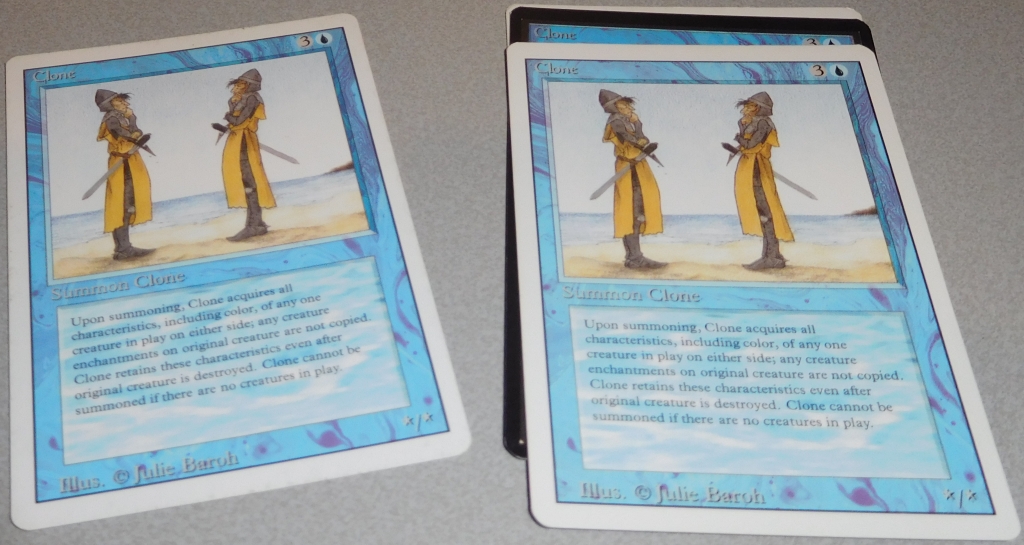
The Beta Clone

There was a monthly convention in the city of Purmerend, which was a long cycle away from my parents' place. This convention was organized by a local dealer and would usually draw around 50 people. Many were casual players, just there to have a good time. Every other event had a weird format, such as Rainbow Stairwell, All Common or Chaos Draft. Trading was very common.

I made many trades there that were to my advantage. I remember this one trade that among other things included a Revised Clone on their side. Back then Clone was worth more than we're used to now, comparable to a decent Standard rare these days. The deal I put on the table was fine as it was, a little skewed in my favor, but the Clone had some wear, and when I took it out I could see that there were more Clones behind it in the binder. I told my trading partner that I wanted to look at the other Clones to see if one was perhaps better looking and he considered that a reasonable request.

One Clone down I found a Beta copy and I (jokingly) remarked that I would make the trade with that one in its place. The other guy agreed and we closed the deal. I ended up with a Clone worth about six to seven times the one originally included in a deal already in my favor.

Clones
Clones (reconstruction)

Tactics used:

  • Identified the trading partner as somebody who is not a regular at the event.
  • Made casual chit-chat to figure out what kind of player he was.
  • Took charge of putting together the deal: I like to put things down on the table to visualize what I am thinking about and this leaves a lot to the trading partner's imagination.
  • Was picky on condition and made a fair request to look for a better copy of a card (remembering they were in the binder), which suggested I thought the deal could use a tad extra on their side without explaining where the difference lies or how much it is.
  • Made a remark that could easily be explained as a joke, but that would make me a great deal if successful and would still leave me able to set up another good deal if it was taken as a joke.
  • Kept a straight face through all of this.

Looking back on this trade, I am pretty sure I came across as knowledgeable to a player who was not very aware of prices. As I seemed to know what I was doing, he just went along with whatever I suggested, probably to seem more knowledgeable himself. Because he was not a regular, even if he figured it out later, it likely wouldn't come back to me (and never did). All in all, this was a very good situation for me as the shark.

So what could my trading partner have done better?

  • Prepare: He didn't have to know all prices, but some general knowledge like Beta being worth far more than Revised would've been helpful. He also could have brought his own pricelist to check against, as even an outdated one would have told him that.
  • Ask questions: He did not ask me how I figured the prices lined up; I would not have lied straight to his face.
  • Get a second opinion: He could have asked somebody else to give their view. If a trading partner is being fair then they shouldn't mind; if they do, it's probably a good idea to step away.
  • Most importantly, he should have realized that he wasn't knowledgeable on prices and come up with a plan for trading that would leave him less vulnerable

I later traded that Clone for a Beta Kudzu that I still own. This wasn't the greatest deal at the time because I lost a lot on liquidity and probably even a bit on value: you win some, you lose some. I guess in the end it paid off, as today the Kudzu is worth more.

There was an error retrieving a chart for Clone

There was an error retrieving a chart for Kudzu

The Stroke of Genius

When Urza's Saga came out, one of the hottest cards in the set was Stroke of Genius. Yes, it exceeded cards like Yawgmoth's Will and Tolarian Academy, while Exploration was little more than bulk and Serra Avatar was among the most expensive cards. Different times, for sure, I recommend checking out the picture to the right that shows an Inquest pricelist from that time. Check out City of Traitors...!

Magazine price guides were based on store prices in the US. Naturally it would take a while for prices to settle, so we would only find out the prices a month after release. This meant that you would be in the dark for quite some time, unless you had access to an online price guide like I did (Cloister was not well known). Of course, this led to a great situation for sharks.

A friend of mine opened a Stroke of Genius and didn't really see how it was any better than Braingeyser, a card that had some value due to age and nostalgia, but not very much. I ended up trading for it for three uncommons (one an Overrun, an above average uncommon at the time). When we spoke about it later, the friend commented that there was no way we could have known where the price would end up, so he didn't really blame me, figuring next time it would be him coming out ahead (like that was going to happen).

There was an error retrieving a chart for Stroke of Genius

Tactics used:

  • Abused a knowledge gap.
  • Kept information to myself.
  • Had a plausible excuse.
  • Kept a straight face.

Of course, these days we don't have a month of delay before we know prices, but there is still a large knowledge gap between those in the know and outsiders. We know where to look, how to use different prices sources to our advantage and have a better idea of what to expect for the future of a card's price. Especially knowing the different price sources and their particularities still allows for a lot of abuse by unscrupulous traders.

So what could my trading partner have done better:

  • Waited: This guy knew prices would become known in a month. These days we have a similar situation with preorder pricing that tends to be very high where many people would be better off waiting for prices to drop.
  • Paying attention: I was pushing him a little on making the deal. I think he could have picked up on that if he was paying attention (I remember him being surprised at me putting in an Overrun).
  • Asked questions: When pressed, I would have told him that to me the card seemed pretty good. If he was persistent, I may have even told him I had seen some online pricing that was quite high.

I did ultimately develop a reputation with my friends that I was always trying to make gains on trades. I told them that I was happy to make any deal that was not to my disadvantage. That was honest; what I did not add was that they never pressed me enough to make the deal fair. If they did have concerns on a trade, I would take out a card that didn't really matter and still get a very good deal.

Around 2007, I started playing again with one of the people from those days, and they expressed quite some surprise at me being fair in trades. They still approached me with caution, but a few trades in they let go of that too. If I was to shark again, they would be sure to fall for it. Instead, these days I tend to donate to this guy just about every token and German card I happen to come across, as he likes them and they're almost impossible for me to move in any kind of profitable way.

There was an error retrieving a chart for The Unspeakable

Conclusion

I've wanted to show you both how far a shark might go as well as the tactics they might use. I realize that some suggestions to counter these tactics may not work all the time. Specifically, there are sharks out there who will straight-up lie to you, and some can be quite good at it. To avoid being sharked, you really need to make sure you have at least some knowledge of prices and tactics, but unfortunately, there is no way you can be 100 percent successful at it: even I've been sharked. I hope I've at least been able to make you aware of some of the tactics.

Off the Rails: Brewing UR Improvise

Are you a Quiet Speculation member?

If not, now is a perfect time to join up! Our powerful tools, breaking-news analysis, and exclusive Discord channel will make sure you stay up to date and ahead of the curve.

Cost reduction mechanics are among Magic's most powerful—delve and affinity have terrorized many a constructed format, and the legendary moxen remain among Magic's most fabled examples of "Power" to this day. Granted, Enraged Giant is no Black Lotus. But improvise may very well be Modern-playable.

This article is the one I had planned to write last week, before Wizards announced its bans seven days early. With my requisite Temur Delver article out of the way, we can at last get to my experiments with improvise.

[wp_ad_camp_1]

Cheating On Mana

Ever since Modern's inception, cheating on mana has been one of the primary ways to succeed in the format. From Storm, to 12Post, to Birthing Pod, Modern has never suffered a shortage of ways to ramp up on tempo. The decks I just mentioned have all been banned by now. The format's only remaining OG mana-cheat deck is Affinity, named for a mechanic that reduces the cost of spells with affinity by one generic mana for each artifact the card's caster controls. Even affinity is a far cry from improvise. When it comes to mana-cheat mechanics, it's safe to say Wizards doesn't make 'em like they used to.

A Fair Way to Cheat

Storm, 12Post, and Pod all represent methods of mana-cheat that Wizards no longer endorses. So does Dredge, a deck the company recently had to nerf for its tendency to force players into sideboard wars. But R&D seems aware that some portion of the playerbase likes getting a bargain deal on mana costs, and they haven't simply stopped printing cards that cheat on mana.

These days, mana-cheat cards are otherwise reasonably costed spells that allow players to cast them for cheaper by drawing from a given non-mana resource. The obvious epitome of this concept is delve. Cards in the graveyard are a finite resource, but they're built up over time like mana.
Treasure Cruise and Dig Through Time, the most broken delve spells, hit the Modern banlist long ago. But other cards with delve continue to excel in the format. Notably, those cards are fair, reasonably costed creatures. The kind of stuff we might play in limited even if it didn't have delve—5G for a 4/4 Trample, or 5B for a 4/5 with a grindy ability. It's important to note that in decks that have easy access to the resource required by a mana reduction mechanic, these reasonably costed, fair cards become extremely powerful.

Take the Eldrazi. Eldrazi Temple gives the deck a reason to play cards that might otherwise make the cut in Limited or Standard formats, but are far from Modern-playable on their own. Including a narrow card like Eldrazi Temple happens to be an acceptable sacrifice for some decks, such as Bant Eldrazi and WB Eldrazi and Taxes.

The difference between delve creatures and the Eldrazi: the Eldrazi are clearly more powerful. Since Wizards designs principally for Standard, that should come as no surprise; after all, Standard has no built-in way to reduce the costs of Eldrazi spells.

Back to Modern. Running Eldrazi Temple is a much more serious cost than simply playing Magic. Filling the graveyard for delve occurs naturally in many decks, whereas Eldrazi-featuring strategies must not only weaken themselves to Blood Moon and land destruction effects, but actually draw Eldrazi Temple to enjoy a mana reduction on their spells.

Analyzing Improvise

Weaknesses

Improvise is functionally a "fixed" affinity. In practice, Affinity lets us cast multiple spells with improvise mana, while improvise limits us to one per turn.

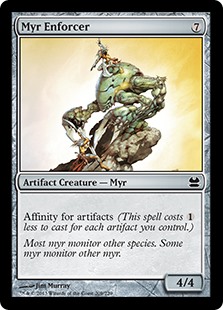
Cards with improvise hold an on-paper power level much closer to that of delve spells than to that of Oath of the Gatewatch's Eldrazi haymakers. Since untapped permanents are a finite resource each turn, like cards in the graveyard (although less finite), improvise cards get to be stronger than affinity cards. The improvise Myr Enforcer, for example, costs one less mana and has trample and haste.
The mechanic's main deckbuilding constraint is that it can't be splashed into anything. Improvise demands a deck with a high count of artifacts that work while tapped to function optimally, whereas delve works pretty much everywhere.

Synergies

Improvise happens to work very well with a wide array of playable cards. The existence of lockdown permanents like Chalice of the Void and Relic of Progenitus, as well as easy engine-grease options, had me very excited during spoiler season.

The best grease cards are Relic of Progenitus, Pyrite Spellbomb, and Mishra's Bauble. The former two cost one mana, so they can't be played in builds with Chalice of the Void. But they both "replace" themselves in terms of mana, making for easy ramp, and can be traded for another card at any point in the game (ideally once the field is full of other artifacts). Spellbomb has the added benefit of interacting with aggro-combo as we set up; Relic slows certain strategies way down while annoying three-color midrange decks to no end.

Bauble's status as a zero-mana artifact gives it a special role in improvise decks. Here, Bauble is literally a Mox when it comes to casting improvise spells. Tormod's Crypt and Welding Jar are examples of more situational zero-mana artifacts that can work in improvise decks. But Bauble remains a cut above the rest, as it cycles once we don't care about adding to the artifact count.

Another option for turning on improvise is equipment. It's rare that equipment needs to tap to function, so assuming we find an equipment spell worth running, it can slot into an improvise deck painlessly.

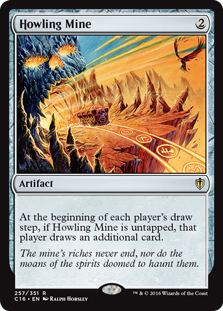
Improvise also has a special interaction with Howling Mine. Mine only draws each player an extra card when it's untapped. I have been looking for a way to turn the Mine sideways before passing to opponents forever, but all my fruitless Gatherer searches ever returned was Lodestone Myr. When I read the improvise mechanic, my mind immediately went to Howling Mine.
The new mechanic and Mine are best buds. In builds with multiple Mines, it's not uncommon to draw 2-3 cards each turn, tap down all the mines for an improvise card, play a bunch of cheaper artifacts, make an attack, and pass the turn to repeat again later, all while keeping opponents off Mine's extra draws. Mines draw into more Mines, and the card advantage snowballs.

When I played four Mines, though, I lamented how bad it could be early against linear aggro and combo decks. Modern has no shortage of these strategies. Even though Mine stomps the slower interactive decks, Infect, Burn, and even Tron could care less about the extra cards and would often leverage free cards pulled early into an insurmountable advantage. Or worse, an Oblivion Stone!

Brewing UR Improvise

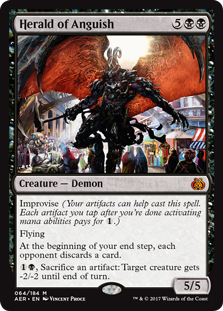
I started in blue-red because they're the colors I like to play, and the most appealing improvise cards were blue or red (barring Herald of Anguish, but more on him later). Bastion Inventor was my favorite of the bunch, followed closely by the hasty Hooting Mandrills, Enraged Giant. Simple creatures with buff bods—my kind of Magic!

The First Attempt

UR Improvise 1.0, by Jordan Boisvert

Creatures

3 Bastion Inventor
4 Enraged Giant
4 Maverick Thopterist
4 Simian Spirit Guide

Artifacts

4 Howling Mine
4 Mox Opal
4 Mishra's Bauble
4 Chalice of the Void
2 Accorder's Shield
2 Tormod's Crypt

Enchantments

3 Blood Moon

Sorceries

4 Reverse Engineer

Lands

4 Darksteel Citadel
4 Scalding Tarn
1 Misty Rainforest
2 Spirebluff Canal
2 Steam Vents
4 Island
1 Mountain

Sideboard

2 Ancient Grudge
1 Blood Moon
4 Dismember
3 Metallic Rebuke
2 Negate
3 Anger of the Gods

The first decision I made was to run Chalice of the Void, which heavily informed the rest of my shell. I also wanted to play some number of equipment spells for the costless improvise boost. After some tinkering and goldfishing, I realized how busted some draws were: Citadel, Bauble, Opal into Mine on turn one let me cast an improvise threat every turn as of turn two while drawing multiple cards and excluding my opponent. This build ran an additional 4 zero-cost artifacts to maximize that kind of sequence.

Rushing out lock pieces with Simian Spirit Guide, I soon found, was not where I wanted to be. My pieces were ineffective too often against some decks, and didn't give me the speed I needed to pressure opponents who could ignore them. It also proved easier than I'd expected to spend the cards in my hand with a Mine or two active, further decreasing the need for Guides. Turn-one Chalice is possible in this deck even without the mana monkey.

Bastion Inventor also underwhelmed me. While a solid threat against midrange, Inventor was decidedly terrible against decks that don't pack Terminates in the first place.

Accorder's Shield was nice in some cases, but usually just sat around. I frequently had better things to do with my mana than pay three to equip the Shield. It turns out having a 4/7 vigilance is only relevant in a few matchups, and even then, in a few game states.

On to the positives. Besides the occasionally explosives draws and the Mine interactions, I loved Maverick Thopterist and Enraged Giant. These cards demonstrated the power of cheating on reasonably costed creatures. Thopterist was often a two-mana Pia and Kiran Nalar, playing roles similar to those of Lingering Souls in a variety of matchups. Giant just applied a ton of pressure very quickly. I rarely missed hexproof on the red beater, as a 4/4 six-drop is already pretty tough to kill in Modern. It also benefited from the Slash Panther/Reality Smasher effect, making it difficult for opponents to lay a planeswalker, plus it, and pass hoping to keep their permanent. Reverse Engineer made it tough to run out of steam against attrition decks and helped find crucial cards in postboard games, although I generally sided a couple out against the faster linear decks.

Puzzles and Plates

UR Improvise 2.0, by Jordan Boisvert

Creatures

4 Enraged Giant
4 Maverick Thopterist

Artifacts

4 Mox Opal
4 Mishra's Bauble
4 Chalice of the Void
4 Cranial Plating
4 Cogworker's Puzzleknot
3 Howling Mine

Instants

2 Dismember

Sorceries

4 Reverse Engineer
4 Thoughtcast

Lands

4 Darksteel Citadel
2 Spirebluff Canal
4 Scalding Tarn
2 Misty Rainforest
4 Island
1 Mountain
2 Steam Vents

Sideboard

3 Pithing Needle
2 Bastion Inventor
3 Blood Moon
2 Dismember
3 Metallic Rebuke
2 Anger of the Gods

This version marked a dramatic improvement. While looking for cards that could accelerate my gameplan, I stumbled upon Cogworker's Puzzleknot, which costs two but then adds two mana back for improvise. Puzzleknot has another benefit: it puts a body on the board as early as turn one. Combined with Cranial Plating, Puzzleknot's 1/1 Servo provides a real plan against Tron and other decks that aimed to go over us. Even fair decks are forced to burn removal on the 1/1 when we have a Plating in play, and Mox Opal can produce white to sacrifice Puzzleknot and make another body if needed.

Cranial Plating also helped the build. Besides synergizing with Puzzleknot, Plating works very well with both Maverick Thopterist (which puts fliers into play) and Enraged Giant (which has haste and trample). I won multiple games out of nowhere by casting Enraged Giant, equipping it, and swinging for 10 damage. Threatening this play gives UR Improvise a bluffing aspect reminiscent of Twin, wherein opponents want to hold up mana when possible to interact with a sudden lethal attack.

I also added four Thoughtcasts, which should have been in the deck from the start—I had just forgotten the card existed! Thoughtcast helps us get going when we open a slower opener, and keeps the gas coming once we set up.

A pair of Dismembers made their way to the mainboard too. Dismember represents the most efficient way to interact with creatures in a Chalice deck. We can't play too many in the main because the life loss becomes an issue, and because I'm not sure we need that much creature interaction in the dark. For what it's worth, though, Mox Opal can produce black to help pay for Dismember.

After a few days of matches with this build, I realized what a nightmare Oblivion Stone was for us. The three Needles in the side, as well as the copies of Metallic Rebuke, seek to address this problem.

Losing the Chalice

UR Improvise 3.0, by Jordan Boisvert

Creatures

4 Maverick Thopterist
4 Enraged Giant

Artifacts

4 Mox Opal
4 Mishra's Bauble
3 Cranial Plating
3 Cogworker's Puzzleknot
3 Howling Mine
4 Pyrite Spellbomb
4 Relic of Progenitus

Sorceries

4 Reverse Engineer
4 Thoughtcast

Lands

4 Darksteel Citadel
2 Spirebluff Canal
4 Scalding Tarn
2 Misty Rainforest
4 Island
1 Mountain
2 Steam Vents

Sideboard

3 Pithing Needle
1 Bastion Inventor
3 Blood Moon
3 Dismember
3 Metallic Rebuke
2 Anger of the Gods

This is a newer build that I'm not entirely sold on yet. It gives up Chalice of the Void for more early interaction in the form of Pyrite Spellbomb and Relic of Progenitus. It gets going faster than the Chalice version, but it has fewer free wins. I'm not sure it's worth transitioning to this sort of build, since despite superb options like Galvanic Blast being available to us without Chalice, we still probably don't want them over the nuts and bolts that make improvise tick. I started with four copies of Blast, quickly trimmed them down to two, and eventually just cut them altogether.

Other Variations

For all three iterations of the deck, I stayed in blue-red colors. This might strike some readers as strange, since the nastiest improvise card—Herald of Anguish—is black. But Herald costs double black, quite an investment considering the other black improvise cards are hardly Modern-playable. Committing to Herald would mean giving up Blood Moon and crafting a more painful manabase.

I'm also not convinced the seven-drop is fast enough for Modern. Sure, it's great in midrange matchups, but so is Bastion Inventor. Against linear combo and ramp decks, Herald does next to nothing.

Maverick Thopterist, for its ability to ramp up the artifact count, put wide pressure on the board with Cranial Plating, and trump efficient removal spells like Lightning Bolt, seems better suited to Modern. Running Herald incentivizes us to drop Cogworker's Puzzleknot for Ichor Wellspring or Mycosynth Wellspring, which makes Cranial Plating barely defensible. But losing Thopterist is the nail in the coffin for Plating. I think the ability to win games out of nowhere with Plating and apply pressure to goldfishy opponents with otherwise lowly Servo tokens gives UR a huge edge over other color combinations right now.

Gotta Tap 'Em All!

At this stage, I'm still unsure whether Version 2 (with Chalice) or Version 3 (with Spellbomb and Relic) is better. I'll have to do some grinding and take some notes to figure that out. What I am confident of at this stage is that improvise has legs. Whether it makes waves in build-around shells like mine, UB Tezzeret decks, or somewhere else, I believe we'll be seeing the newest mana-cheat mechanic in Modern.

Jordan Boisvert

Jordan is Assistant Director of Content at Quiet Speculation and a longtime contributor to Modern Nexus. Best known for his innovations in Temur Delver and Colorless Eldrazi, Jordan favors highly reversible aggro-control decks and is always striving to embrace his biases when playing or brewing.

View More By Jordan Boisvert

Posted in Brewing, ModernTagged , , , , 27 Comments on Off the Rails: Brewing UR Improvise

Have you joined the Quiet Speculation Discord?

If you haven't, you're leaving value on the table! Join our community of experts, enthusiasts, entertainers, and educators and enjoy exclusive podcasts, questions asked and answered, trades, sales, and everything else Discord has to offer.

Want to create content with Quiet Speculation?

All you need to succeed is a passion for Magic: The Gathering, and the ability to write coherently. Share your knowledge of MTG and how you leverage it to win games, get value from your cards – or even turn a profit.

Stock Watch – Narset Transcendent

Are you a Quiet Speculation member?

If not, now is a perfect time to join up! Our powerful tools, breaking-news analysis, and exclusive Discord channel will make sure you stay up to date and ahead of the curve.

Recently Narset Transcendent exploded from being about a $5 card to a $12+ card. I had thought that this was another move based on Commander, or perhaps it was simply that Narset was a popular character and a planeswalker, though this turned out to not necessarily be the reason for the spike.

There was an error retrieving a chart for Narset Transcendent

As it turns out, Narset is starting to show up as a 3 of in a Modern Esper Control deck. As Modern slows down, a Lingering Souls shell with some planeswalkers could definitely be a powerful option, especially with Fatal Push entering the format. I would be concerned about this deck's Tron matchup though. Presumably that's what the sideboard Geist of Saint Trafts are for, but even with them I would expect that matchup to be extremely unfavorable.

While I like a lot of what is going on with this deck, I have never been terribly impressed by Narset Transcendent in constructed Magic. This seems to be a flavor of the week thing in much the same way that Zur the Enchanter was previously, and the real strength of the deck is Lingering Souls and Snapcaster Mage. I also imagine that Gideon, Ally of Zendikar is going a lot of the heavy lifting.

I expect that it will be some time before we see a Narset reprint, and the card also presumably has a sizeable casual following. That said, I wouldn't expect more immediate growth, and I also wouldn't recommend this buy to Modern players. I would be happy to sell off Narsets at the current price point.

Insider: Modern Market Movements after the Bannings and Aether Revolt

Are you a Quiet Speculation member?

If not, now is a perfect time to join up! Our powerful tools, breaking-news analysis, and exclusive Discord channel will make sure you stay up to date and ahead of the curve.

The big Magic news last week was the early Aether Revolt banning announcement that brought Standard to its knees. The announcement also included Modern bannings. These have been somewhat overshadowed by Standard discussion but are no less important.

There was an error retrieving a chart for Blasted Landscape

The Modern landscape has been significantly changed, and that has big implications for the market. There have now been almost two weeks since the announcement, and there have been some important price changes to take note of during the interim. Most importantly, there is indication that there are more price shifts to follow.

The banning of Gitaxian Probe in Modern will lead to a decline of unfair creature decks. Death's Shadow Zoo is dead until proven otherwise, and so are the Blue-Red Temur Battle Rage decks. Infect was arguably the best deck in Modern, and this banning has kicked it down a notch. It loses an intangibly important part of its strategy, which will make it less consistent, and it removes Become Immense's best enabler. This change is going to make life easier for the decks that struggles against these aggressive decks, which has implications for the market.

A natural result in the decline of Infect and other Gitaxian Probe decks is that other aggressive decks now have opportunity to fill the niche. An obvious winner from this is Affinity, which is now the de facto best aggressive creature deck.

There was an error retrieving a chart for Arcbound Ravager

The announcement has also ticked up the price of Mox Opal, which many have on the top of their shortlists as a Modern card that should be banned, on the news that it’s safe for at least another few months.

The bannings also seem to bode well for Aether Vial decks like Merfolk and W/G Hatebears, which can prey on midrange decks in the relatively slower new metagame.

There was an error retrieving a chart for Aether Vial

Land strategies, which are slow and fall prey to the fastest decks, are the biggest gainers on Magic Online since the announcement. One of the top gainers is Scapeshift, which could reemerge in the metagame.

There was an error retrieving a chart for Scapeshift

Another card to keep in mind is Primeval Titan, which is played in some versions of Scapeshift and has crossover from other decks that improve from the bannings, like Through the Breach decks and even Amulet of Vigor decks.

There was an error retrieving a chart for Primeval Titan

When Scapeshift and Primeval Titan are on the rise, that means Valakut, the Molten Pinnacle won’t be far behind.

There was an error retrieving a chart for Valakut, the Molten Pinnacle

Take note of Urzatron, which has seen all of its staples appreciate on Magic Online since the bannings, and has seen paper staples like Karn Liberated begin to follow suit.

There was an error retrieving a chart for Karn Liberated

Ugin, the Spirit Dragon is another Tron staple on the rise, but crossover appeal from the Frontier crowd has driven its price up significantly.

There was an error retrieving a chart for Ugin, the Spirit Dragon

As land strategies rise to prominence, so do hosers against lands. Modern’s staple land destruction is Fulminator Mage, but Boom/Bust is also receiving attention.

There was an error retrieving a chart for Fulminator Mage

The banning of Golgari Grave-Troll is a major hit to Dredge, and as its use rate declines in the metagame, so too will graveyard hate. That opens up room for other graveyard strategies to succeed, which explains the growth of Goryo's Vengeance on Magic Online.

There was an error retrieving a chart for Goryo's Vengeance

There’s a renewed interest in other graveyard strategies as well, so Living End has seen growth online.

There was an error retrieving a chart for Living End

So has Gifts Ungiven for its versatile ability to enable the graveyard for cards like Unburial Rites.

There was an error retrieving a chart for Gifts Ungiven

Aether Revolt is also quite influential in Modern. The biggest standout is Fatal Push, which now contends with Lightning Bolt and Path to Exile as the best removal spell in the format – and it's arguably the best of all. That’s a boon to black decks of all sorts. Grixis Control has been a second-tier contender in Modern for the past year, driven by the unbanning of Ancestral Vision, and Fatal Push could push the deck to the top.

A natural gainer from the new world where black is the best control color is that Watery Grave becomes a premier shockland, and the price is rising accordingly. There’s a great opportunity to get in on this relatively cheap shockland before it begins to appreciate relative to the others.

There was an error retrieving a chart for Watery Grave

I’m also a fan of Darkslick Shores, which is more desirable when black is more important

There was an error retrieving a chart for Darkslick Shores

A somewhat surprising winner recently has been Countersquall, a staple of Grixis Control, which has now spiked over $5.

There was an error retrieving a chart for Countersquall

One deck that’s back on the radar is Faeries, which would be a perfect home for Fatal Push. That has begun to move the price of Bitterblossom upwards online.

There was an error retrieving a chart for Bitterblossom

The new Sram, Senior Edificer offers an ability similar to Puresteel Paladin in its ability to draw cards from equipment. There is already a casual Modern deck built around going off with Puresteel Paladin, but now with another draw engine, it could become a legitimate contender. The price of Puresteel Paladin has spiked hard, and it doesn’t have more room to grow unless the deck becomes a true top-tier contender. There are other pieces of the deck, however, like Retract, that could provide some return.

There was an error retrieving a chart for Retract

The new cycle of Expertise cards, particularly the cheapest, Kari Zev's Expertise, opens up the possibility for a new style of combo deck that seeks to play split cards for free. It’s not clear whether or not this is a novelty or a new broken strategy, but at the very least it’s a great interaction that I expect we will see plenty of in casual formats if it doesn’t prove competitive, and it’s nothing but great for the prices of split cards.

Aether Revolt brings a renewed focus on counters with the powerful Winding Constrictor, which has increased interest in other cards that could benefit from it. I assume most of this interest is from a casual and EDH crowd, but there is certainly plenty of Modern crossover, with players like Tom Ross saying publicly that he wanted to break Winding Constrictor in the format. Lux Cannon has seen gains, but more surprising is Inexorable Tide, as proliferate can get out of hand with Winding Constrictor.

There was an error retrieving a chart for Lux Cannon
There was an error retrieving a chart for Inexorable Tide

What do you make of these Modern market movements?

--Adam

Insider: Vending a Prerelease for the First Time

Are you a Quiet Speculation member?

If not, now is a perfect time to join up! Our powerful tools, breaking-news analysis, and exclusive Discord channel will make sure you stay up to date and ahead of the curve.

Welcome back!

I hope everyone reading was able to play in the Aether Revolt prerelease and open a Masterpiece. For those of you who were unlucky enough to go without slamming a Sword of Fire and Ice in Limited, I hope you at least have some bad beat stories to compensate for your loss.

I spent the Darkest Hour of January 14th at my favorite store in upstate New York: Legacy Gaming Company. I had the privilege of vending the midnight event and managed to squeeze it in between working at the college on Friday night and Saturday at midday. The thought of writing this recap didn't cross my mind at 2:00 a.m., so this article will be less of a pictorial than it might otherwise have been. Instead, I'll go over my thoughts of what I can do in the future to improve. While not every reader is looking to vend events, I had several requests to write this from Twitter followers, and all players can benefit from understanding how vendors think.

There was an error retrieving a chart for Scrabbling Claws

Let's start off with a guessing game. Throw out a number and guess how many Aether Revolt cards I bought during the midnight prerelease? A few dozen? Hundreds, even? Nope. The answer I was looking for is zero.

Don't get me wrong, it was a pretty great weekend. I bought a decent pile of Modern and EDH cards, both foil and nonfoil. I pulled casual cards out of a couple binders and sold the usual number of cards as well. It was profitable, and I wasn't unhappy when I arrived back home at 4:00 a.m. I was just kind of surprised that nobody sold me any cards from the new set. We had a couple Masterpieces opened that I price checked for them and almost bought, but the lucky fellows both decided to hold onto the cards for personal use or to try and trade to another player.

jeskai
Some of the foil Modern cards I bought on Saturday

What gives? We capped out the event at 40 players, so why didn't I go home with any Aether Revolt? 

Well, I thought about it during some downtime behind the counter while I watched everyone else play. I recognized maybe half of the people in the store. I've been going there for several months now, but these were the "prerelease and then back to the shadows" crowd who only come out once every few months to play with the new set. These players weren't interested in cashing out on cards from the new set; quite the opposite, in fact.

This niche group shows up to play casually, leave with their casual cards, and build casual decks combined with packs from Wal-mart and Target a week from now. These are the players who don't bring trade binders or Modern decks to sell. For the most part, they don't know or even care about the dollar values of the cards they open; I even had a couple people decline an offer for an Aether Revolt Quiet Speculation price cheat sheet, which was surprising at first. Learning from hindsight, I'm thinking about how I can help make the buy prices on these cards more visible in the future.

20160506_143511-300x169

Pretty much every vendor at every Grand Prix nowadays has a whiteboard similar to this. Some vendors like WizardTower and ChannelFireball go as far as bringing several monitors and equipment to the event to hook up a constantly updating electronic buylist, which certainly is more flashy and visible. I'm obviously nowhere near that level, but I think a small whiteboard like one of the old Hareruya ones above could have helped a bit. If a casual player saw how much I was paying on Heart of Kiran, it might have at least gotten a foot in the door for me to peek at their prerelease pool and see if there was anything they weren't planning on using. I looked on Amazon to see if there were any standalone whiteboards that don't take up too much room, and I might settle on this little one in the future, just to cover the  hot stuff from Hour of Devastation or maybe some Masterpieces.

whiteboard

There's a couple other factors that probably contributed to the relatively "slow" traffic at the midnight prerelease, and that was that it was a midnight prerelease. People are tired and just want to exhaustedly jam cards against each other before they go to Taco Bell on the way to passing out on the couch. Selling cards is not at the forefront of their mind. Unfortunately, my work schedule prevented me from attending the 2:00 p.m. prerelease at the same store, but I'm confident I would have had more luck while the sun was shining.

There was an error retrieving a chart for Legacy's Allure

Lastly, I mentioned earlier in this article that I've only had a working relationship with the store owner at Legacy Gaming Co. for a couple of months. Prior to me showing up, the store's singles selection was pretty weak, but it was the only weak point that anyone ever mentioned about the store. My friend who worked at the shop introduced me to the owner, and now we stock singles of all shapes and sizes.

Other than the people who knew me from previous transactions, I'm still a new face behind the counter. Up until I showed up, players were less confident that the store would have the random set of Anger of the Gods or Manamorphose they needed for their Modern decks. This is still a budding relationship for both me and the store owner, but my prerelease endeavors will hopefully improve over time as we bring in more people who know that it can be a one-stop shop for deck building in addition to great events.

End Step

sram

While I was sorting and posting sales on Twitter, I realized that the Reshapes I had been holding onto for a while were double what they were when I last checked. While I doubt that card goes in the finalized version of the Cheerios deck in Modern (Puresteel Paladin plus a bunch of zero-mana equipment into Grapeshot), it's still an artifact tutor from 14 years ago with no reprints, with an artifact set being printed following an artifact Commander deck.

While I doubt theinternet will have time to buy into it, there might still be an opportunity to grab some of the equally scarce Retract. That's the one-mana combo piece that allows the deck to actually go off with some level of consistency. It could easily hit $7 or $8 off the Puresteel deck being a cheap tier-three entry point into what is continuously berated as a format with too high an entry cost. If there are still copies of Retract available for less than $3, I highly recommend picking up a set if you plan on playing the deck.

There was an error retrieving a chart for Retract
There was an error retrieving a chart for Reshape
There was an error retrieving a chart for Puresteel Paladin

Stock Watch- Puresteel Paladin

Are you a Quiet Speculation member?

If not, now is a perfect time to join up! Our powerful tools, breaking-news analysis, and exclusive Discord channel will make sure you stay up to date and ahead of the curve.

With the printing of Sram, Senior Edificer, some people are excited to play "Cheerios" in Modern. It's a combo deck that has existed though has never been terribly competitive for some time that wins by casting a lot of 0-mana equipment and drawing tons of cards. It has consistency issues, and was seriously vulnerable, though Sram at least gives you eight copies of Puresteel Paladin.

There was an error retrieving a chart for Puresteel Paladin

Make no mistake- this deck loses to removal, counterspells, discard, and even slight gusts of wind. It's just a cool thing with a casual following. The hype around Sram has caused Puresteel Paladin to jump from $5 to $10+, though I wouldn't be concerned about not owning these as a Modern player.

I don't expect any further immediate growth on this card, and would expect more copies to be put up for sale with the new inflated price point. Now is a great time to sell before too many Modern tournaments occur and the deck continues to do nothing of note.

Avatar photo

Ryan Overturf

Ryan has been playing Magic since Legions and playing competitively since Lorwyn. While he fancies himself a Legacy specialist, you'll always find him with strong opinions on every constructed format.

View More By Ryan Overturf

Posted in FreeTagged , 1 Comment on Stock Watch- Puresteel Paladin

Have you joined the Quiet Speculation Discord?

If you haven't, you're leaving value on the table! Join our community of experts, enthusiasts, entertainers, and educators and enjoy exclusive podcasts, questions asked and answered, trades, sales, and everything else Discord has to offer.

Want to create content with Quiet Speculation?

All you need to succeed is a passion for Magic: The Gathering, and the ability to write coherently. Share your knowledge of MTG and how you leverage it to win games, get value from your cards – or even turn a profit.

Insider: Finding Value in Conspiracy 2

Are you a Quiet Speculation member?

If not, now is a perfect time to join up! Our powerful tools, breaking-news analysis, and exclusive Discord channel will make sure you stay up to date and ahead of the curve.

The real conspiracy of this past summer was that Wizards tried to fit three sets into a three-month period.

In June, we had Eternal Masters. That set was reasonably designed to include some great reprints as well as being a fun draft format. So far, all the Masters sets have been really fun to play with, and I hope that continues.

Before we could even get a grip on this Legacy-, Vintage-, and Commander-focused set, they released Eldritch Moon in July. Second sets have been doing much better in sales and playability lately than in previous years, and Eldritch Moon is a good example. All of the Emrakul-based cards, including the newly banned queen herself, were interesting and powerful. The problem was that players were still recovering from funding their $10-plus packs.

Then in August came the casual-favorite set Conspiracy: Take the Crown, or as we like to call it around here, Conspiracy 2.

There was an error retrieving a chart for Ring of Three Wishes

With three summer sets, what ended up happening is that none of these sets sold as well as they should have. Players were simply stretched too thin from the releases bunched together at that time of the year. Were these products more spread out, I think all three of them would have been more successful. Because Conspiracy 2 was the last of the three released, I think it was hit the hardest.

One of the other factors that contributed to its low sales total was the target audience. This set draws the attention of a more casual crowd, but most of the reprints are aimed at the Legacy crowd. Even with the sequencing of summer releases, I would have though the inclusion of Legacy-playable cards would have generated more sales. Because the set didn’t sell as well as it should have, the prices of cards from this set are creeping steadily upward. The price of boxes couldn’t be lower, but the value of the cards in the set has continued to increase since its release.

The other day, I was thinking about all of these puzzle pieces and fitting them together. I decided to act upon these thoughts and open a box of the set to see how much information its contents would contain. Here’s what I pulled.

The first pack started off with Show and Tell, and I was pumped. As I opened more and more packs, I got some decent cards and some of the more expensive ones in the set. I didn’t get either of the two most expensive cards in the set, though, and there were no high-end foils either. One of the most valuable parts about these types of sets is that their foils have insane multipliers. Some cards in sets like these will have multipliers of three, four, or five (or more!) for the foils.

Take Council's Judgment, from original Conspiracy. I actually opened this card in a draft at my friend’s bachelor party. Right now, the normal printing is $5 and the foil is $30! When I opened it, the card was as high as $60. I may not have opened any high-end foils in this particular box, but many boxes out there contain foils that will drastically help pay for your investment.

My box ended up worth under what I paid for it. I only opened one box, so that’s not a lot of information to go off of. It seems like unless you open one of the two highest-value cards in the set or a high-end foil, you may be out of luck with your investment.

What about singles, though? Let’s break down the value in the set and go from there.

There was an error retrieving a chart for Serum Visions

You’ll note I included uncommons in my list of good cards above. Sets like this always have great uncommons to help boost the price of packs. Conspiracy: Take the Crown gave us a much-needed Serum Visions reprint for Modern players. Additionally, it also contains Beast Within, Ghostly Prison and Explosive Vegetation. All of which are worth nearly a dollar or more. These uncommons really help boost the value of your boxes.

There was an error retrieving a chart for Inquisition of Kozilek

The other uncommon that should stick out is Inquisition of Kozilek. This black hand-hate card is another Modern Staple and is worth more than most rares in the set. The fact that I opened zero in my box is disconcerting, but this uncommon slot should help raise the return on a box of this set. Even with the reprint, Inquisition still goes for $7-plus each.

There was an error retrieving a chart for Show and Tell

As I stated above, the first pack I opened had a Show and Tell, and I was ecstatic. I had no clue that this reprint had this drastically altered the price, however. Under $15 for this Legacy staple seems crazy to me. I guess not that many players are building Sneak and Show these days. This seems like a great long-term investment, though. Who knows if this card will ever be reprinted? Nearly every cube wants one, some Commander decks will play it, and Legacy players will need it as well.

There was an error retrieving a chart for Berserk

Berserk may not be a highly sought after card, but its effect pairs so well with Wizards's card-printing philosophy that casual players should start looking for copies of this pump spell. Even the Standard format these days seems like it usually has a linear aggressive strategy that utilizes pump spells to make a giant dude to kill your opponent quickly. Right now we have GR Energy to fill this role, and previously we had UW Heroic as well as many others of the same ilk.

There was an error retrieving a chart for Daretti, Ingenious Iconoclast

Sitting at $10 right now, I love this card. It makes tokens, interacts with artifacts, and its ultimate is so cool! What other time do you get to make multiple copies of artifacts? I doubt this version of Daretti will drop lower than this price point, and as a casual favorite, I think he could generate some future value.

There was an error retrieving a chart for Kaya, Ghost Assassin

In addition to the sick, extremely limited alternate art foil, this planeswalker is new and different than any other we’ve seen before. The closest we’ve seen to something like this is Sarkhan the Mad. I don’t think that Kaya’s abilities are potent enough for most Commander players to want her in their deck. Even with 100 cards that all have to be different, her effect seems minimal. Sure, you can drain your opponents for some life and then gain two yourself. Sure you can make everyone discard a card and then you draw one. How much is that really helping you, though? A $10 price tag is good for Kaya, but I don’t expect her to increase in value anytime soon.

There was an error retrieving a chart for Recruiter of the Guard

Recruiter of the Guard is another sweet Legacy-playable card. The red counterpart, Imperial Recruiter is $200 to $400! Even though the effect isn’t used that much in Legacy, the printing of this creature opens up some really interesting deck design space. No innovations have happened just yet, but this is a card that could double or quadruple overnight if a deck gets made that is viable in these older formats. I like this card a lot in the long term.

There was an error retrieving a chart for Selvala, Heart of the Wilds

Selvala, Heart of the Wilds is definitely not a Legacy-playable card, but it sure is a casual favorite. Most of the time, cards that make multiplayer games more fun like this, also carry a decent price along with them. Selvala follows that model because players want this card to be good, so they keep playing it. The mana ability is no joke. You can add insane amounts of mana pretty easily with a Commander deck. Even if she’s the only creature you control, you still get a normal plus-one mana each turn. I’d say with such a unique card design, this creature is a safe investment, but I don’t know if casual demand will be a great enough factor here.

There was an error retrieving a chart for Expropriate

The main reason I included Expropriate on this list is because I had no idea this card was in the set or that it was valuable at all. This nine-mana mythic at minimum grants you another turn or steals a permanent. It may be extremely expensive, but what you get out of it is crazy powerful. Think about when it’s copied too, like in a Riku of Two Reflections deck. Expropriate might have an awkward name and mana cost, but it’s well worth your investment.

There was an error retrieving a chart for Sanctum Prelate

We’re getting down to the best of the best with Sanctum Prelate. This white creature has given Death and Taxes another playable creature. Most players name one on its trigger, but with knowledge of the format and your opponent’s deck, you can more specifically name the number that does them the most damage. We don’t see effects like this very often. You can shut down Legacy’s best one-drops like Brainstorm and Swords to Plowshares, or hose a combo deck by choosing their win condition's mana cost. Either way, the price of this card isn’t going down anytime soon. I’d say $15 is cheap for this card. I need a copy of this guy for my cube before it goes up, frankly. Almost $80 for the foil shouldn’t surprise me at this point.

There was an error retrieving a chart for Leovold, Emissary of Trest

Lastly in our value exploration is Leovold, Emissary of Trest. Some players think this guy was printed on the demand of the Tiny Leaders format that fizzled, but it could just be to give Legacy Sultai some more potent creatures to choose from. There are many players who have adopted Leovold into their Legacy strategies – and with good reason. He shuts down opponents and generates value when they try to disrupt what you are doing. This creature perfectly fits with what Sultai is trying to do in the format. He is already up to almost $50 and is single-handedly making the price of packs worth more and more. He hasn’t affected the value of boxes just yet, but in time I think that increase will happen too.

To close, I want to call out a couple groups of cards that are worth a little money but aren’t really worth talking about individually. All of these cards will help, at least in some small way, towards whatever you invest in this set.

$3

$1.5

That’s all for me this week. Hopefully you’ve enjoyed this look into what’s going on with Conspiracy: Take the Crown. The finance community may be focusing on Leovold, but there’s a lot more going on with this set than just his insane increase in price. Stay tuned next week, when we'll dive into the new Standard and see what’s happening in the competitive and financial aspects of this format.

Until next time,
Unleash the Conspiracy Force!

Mike Lanigan
MtgJedi on Twitter

Want Prices?

Browse thousands of prices with the first and most comprehensive MTG Finance tool around.


Trader Tools lists both buylist and retail prices for every MTG card, going back a decade.

Quiet Speculation