menu

Insider: The First Step of My Portfolio Reconfiguration

Are you a Quiet Speculation member?

If not, now is a perfect time to join up! Our powerful tools, breaking-news analysis, and exclusive Discord channel will make sure you stay up to date and ahead of the curve.

The Thanksgiving holiday in the U.S. has come and gone—four-day weekends off of work always seem to fly by, don’t they? In the spirit of the holiday, I want to begin this week’s column by taking a step back and acknowledging how grateful I am.

Lately my articles have had a negative spin to them, especially when it comes to the health of MTG finance and my outlook on MTG investments going forward. But I need to admit that, being in this circumstance and having the choices to make of what to sell and what to keep, makes me a very lucky person. Especially given the fact that my decisions are driven by the upcoming birth of my second child means there will be no regrets no matter what decision I make. For this I am truly thankful.

With that said, I did want to spend some time this week updating loyal readers on some of the decisions I’ve made regarding my collection. It’s been a struggle determining what to keep and what to sell, and I am happy to report some progress. I’ll also make sure to share my rationale as well as what is holding me back from selling further just yet.

Legacy, Fare Thee Well

Last week I sold the first components of my Legacy deck. Those who have known me for a long time know I have had a long history with this format. I began playing Legacy in 2009 after I was inspired by the card Ad Nauseam.

There was an error retrieving a chart for Ad Nauseam

The premise of drawing the vast majority of my deck in a single turn really got me excited, and I began brewing. In fact, before I even knew there was such a thing as Ad Nauseam Tendrils, I had my own suboptimal build of the deck in order. Quickly, I discovered the optimal lists and started tweaking from there.

The Legacy format proceeded to win me many local events and make me significant money as the format went through a renaissance thanks to the Star City Games Open Series. Force of Wills rapidly rose from $20 to $75, and Wastelands from $20 to $60 and beyond. Dual lands jumped like crazy and the Onslaught fetches followed.

There was an error retrieving a chart for Tundra

Shortly after my son was born I sold out of the format, locking in gains and giving thanks for the opportunity to enjoy such a run. But just a couple short years later I started getting the itch to play again. I never replaced Legacy with anything in the MTG world, and I started to miss the broken combos offered by the format. I ended up buying back one deck for a final hurrah.

Now that I’m about to have a second child, I’m feeling the same burnout with Legacy as before. But there’s a major difference this time: I’m not sitting on mounds of gains. The Legacy format had a final rush in 2014 but has done very little since. Sure, certain cards have performed very well like Infect favorite Noble Hierarch. But many Legacy powerhouses have actually dropped in price since peaking two years ago, and I’m not sure I see that trend reversing in the near term.

There was an error retrieving a chart for Counterbalance

Star City Games is reducing their Legacy support and even Wizards of the Coast seems to be working the format into extinction. Modern has taken a firm hold on the player base, and it seems Legacy chatter has all but evaporated from my Twitter feed.

Summing it all up, we have a format that has become stagnant in financial growth, offers little opportunity to play regularly, and requires significant opportunity cost to maintain. With these factors in play, it was the right decision for me to sell out. That may not mean this is the right decision for everyone, but if you’re in a similar place as me I strongly encourage you to consider your own set of priorities and decide for yourself.

Since making this decision I’ve sold my Italian Karakas, my set of Infernal Tutors, and one dual land out of the deck. The Karakas and Tutors are not on the Reserved List, so I fully expect them to drop in price through eventual reprints (Karakas has already gotten smacked by a recent reprint and I don’t see the trend reversing).

There was an error retrieving a chart for Karakas

While dual lands will always have steady demand, I also see the merits to trimming exposure back—I still own the ones I need so I didn’t mind cashing out of a couple.

Why Old School Differs

With the decision to sell Legacy made, I’m shifting focus towards Vintage and Old School. So far I’ve decided to hold onto these cards for differing reasons.

In the case of Old School, card values have seen significant appreciation since I started buying into the format over a year ago. The format has gained a lot of traction lately, and there’s still a “freshness” component for me as I continue to learn about its fundamental interactions.

There was an error retrieving a chart for Chaos Orb

Therefore I am essentially being paid to sit on these cards despite infrequent play. Even though recently many of the Old School staples have leveled off, there are still pockets of growth as the format matures. As long as there are large Old School tournaments at major events, these cards should hold their value well. The best part of all: there’s no chance of meaningful reprints to hurt the value of the format’s cards.

Additionally, while Legacy has become overwhelmed with newer cards such as Eldrazi and Infect creatures, there’s absolutely zero risk of the same trend happening in Old School. Seeing as I haven’t enjoyed new sets of Magic since Zendikar block, this fits well with my own interests of the game. Also, while I technically started playing in 1997 and not 1993, I still have fond memories of older cards. The ability to competitively cast a Hypnotic Specter off a Dark Ritual fulfills one of my long-time aspirations in Magic.

There was an error retrieving a chart for Hypnotic Specter

Why Vintage Differs

In the case of Vintage, the circumstances are a bit different. The format is certainly not growing like Old School, and there isn't as much financial appreciation relative to Old School. So why keep the cards for the time being? I can explain with one word: Power.

The Power Nine continue to be one of the safest blue-chip investments in Magic. No matter what Wizards reprints, no matter what formats they choose to support, no matter what quantity of new sets they print, it all has the least impact on Power.

That doesn’t mean Power will remain immune, mind you. My article last week presents a reasonable argument as to why even the highest echelon of cards can still stumble from recent decisions made in the C-suite of Hasbro. But in a world where many Magic cards are in secular decline, Power should remain most immune.

Also, should Magic truly fade away as a competitive game, the most iconic cards from the game’s history should maintain the most value.

Smaller factors I’ve been considering are the fact that my Vintage Storm deck is heavily made up of Reserved List cards (Tolarian Academy, Yawgmoth's Will, Wheel of Fortune). Luckily the non-Reserved List cards in my deck aren’t that expensive, so there’s minimal threat from reprints as well.

The largest offender may be the set of Ancient Tombs in my sideboard—these I may decide to sell after playing in a couple Vintage side events at GP Louisville since my casual thrice-per-year forays into Vintage usually don’t even use sideboards.

There was an error retrieving a chart for Ancient Tomb

Wrapping It Up

Looking ahead, I still have a few decisions in front of me. Now that I’ve chosen to sell out of Legacy, I have a few distractions ahead as I seek to maximize value from the deck’s cards. However once that is completed, I can’t let passiveness preclude me from making conscious decisions in Old School and Vintage. While they both offer more attractive prospects going forward, I need to take into consideration that these cards make up the vast majority of my collection’s value.

Chances are I won’t make any other major decisions until Grand Prix Louisville in early January. With any luck I’ll find some aggressive vendors at the event, giving me an optimal time to cash out of either Vintage or Old School (or both). Even though I haven’t decided to sell either yet, I still see some cracks in their long-term integrity from a pricing standpoint.

Vintage may seem like a steadfast rock, but even Power has crept a little lower recently and supply seems to have steadied on the open market. Could Vintage be hitting an unofficial price ceiling as players burn out on spending so much money? Old School is the booming format for sure, but with significant growth already realized, is it time to take profits?

No matter what I decide, my approach to MTG finance will certainly look very different a couple months from now than it looks today. I think my decisions to consolidate the collection to Legacy, Vintage and Old School were very well-placed. One look at the state of Modern and Standard solidifies this view. For those who have made similar choices, I hope you are also thankful for the consolidation. But looking ahead, I believe we need to be even more scrutinizing when determining what cards to keep.

The slow decay of Legacy is the first factor that is necessitating action. We will need to monitor the market closely to see what comes next. No matter what we choose, one thing is for certain: this is not a time for passiveness. The market feels unsteady at best, and to avoid significant losses we will need to remain in front of trends. By working together, hopefully we can achieve this while still maximizing enjoyment out of these cards.

Sigbits

  • Remember a few months back I wrote a whole column about Commander 2014? Well, it seems something has happened to drive some prices drastically higher, far sooner than I would have ever predicted. Teferi, Temporal Archmage has really spiked recently, and Star City Games is sold out at $11.99. Even the sealed Commander 2014 decks have jumped up in price, making me kick myself for not taking my own advice and purchasing the set of five when they were so obviously underpriced on TCG Player.
  • On the flip side (pun intended), it’s incredible to watch how far Jace, Vryn's Prodigy has fallen. This card once fetched nearly $100 in Standard, and now copies can be had from Star City Games for around $20. I’d watch this one closely as it bottoms out—the card is difficult to reprint, Origins probably wasn’t opened nearly as much as Khans of Tarkir or Battle for Zendikar, and Jace is still very powerful in non-rotating formats.
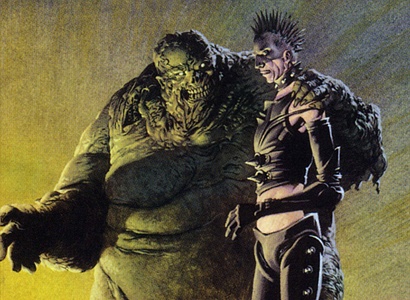
  • Is Old School still a strong format? I like to look at Chaos Orb as my ultimate gauge of the format’s health. The reason is simple: it’s the only format I know of where the card is legal! So, let’s see…Star City Games has zero Alpha copies ($899.99), zero Beta copies ($499.99), and one Unlimited MP copy ($174.99). Conclusion: yes, Old School is alive and well! Based on this data, it’s very possible that I forego Vintage and keep Old School as my major MTG investment. But again, if much of the growth is already priced in, then perhaps this is the perfect time to sell rather than hold. I need to think on this some more.

chaos-orb

Stock Watch- Arcum Dagsson

Are you a Quiet Speculation member?

If not, now is a perfect time to join up! Our powerful tools, breaking-news analysis, and exclusive Discord channel will make sure you stay up to date and ahead of the curve.

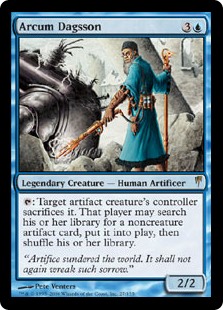
Arcum Dagsson was among the first Commander cards to have a very high foil multiplier, and his power is well known to players of the format. Non-foils have been relatively cheap for the most part, though this week they saw a significant spike.

There was an error retrieving a chart for Arcum Dagsson

As more artifact synergies enter the format, Arcum only gets better over time. I'm sure many players are excited to pair him with Breya, Etherium Shaper. This isn't the first spike around the latest Commander release, and it won't be the last.

Keep your ear to the ground for good Commander specs. This is a great time to absorb popular Commander content in search of cards poised to spike. The new Commander release coupled with the holiday season and general disinterest in Standard all points to players spending money on their favorite casual format.

Avatar photo

Ryan Overturf

Ryan has been playing Magic since Legions and playing competitively since Lorwyn. While he fancies himself a Legacy specialist, you'll always find him with strong opinions on every constructed format.

View More By Ryan Overturf

Posted in FreeTagged , Leave a Comment on Stock Watch- Arcum Dagsson

Have you joined the Quiet Speculation Discord?

If you haven't, you're leaving value on the table! Join our community of experts, enthusiasts, entertainers, and educators and enjoy exclusive podcasts, questions asked and answered, trades, sales, and everything else Discord has to offer.

Want to create content with Quiet Speculation?

All you need to succeed is a passion for Magic: The Gathering, and the ability to write coherently. Share your knowledge of MTG and how you leverage it to win games, get value from your cards – or even turn a profit.

Regarding Server Issues This Weekend (Fixed Now!)

Are you a Quiet Speculation member?

If not, now is a perfect time to join up! Our powerful tools, breaking-news analysis, and exclusive Discord channel will make sure you stay up to date and ahead of the curve.

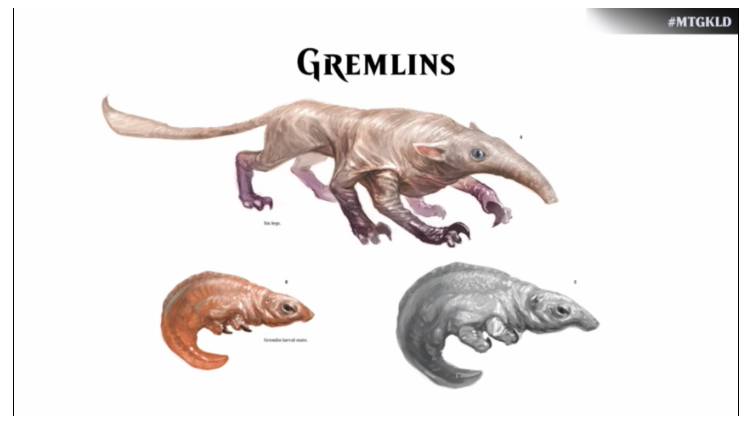
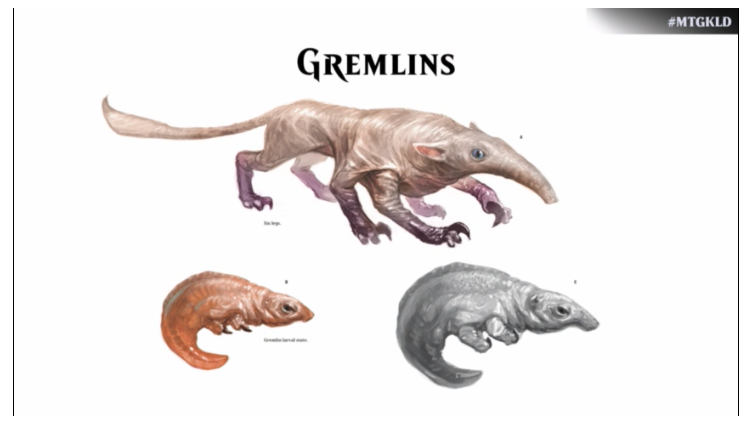
These. These are why things were broken.

Hi QS readers!   I'm writing to let you know that we've fixed the server issues that had been plaguing the site for the past few days.  Many of you experienced delays and disruptions while the site was undergoing some routine upgrades and maintenance.   For some of you, the site was brought to an outright standstill.  I personally recoil in horror when the site is working at anything less than rapid fire speed.

We probed our servers and discovered the issue;  there were horrible little gremlins eating up all our Aether.  Once we found them, they were exiled with great prejudice and zealous persecution.   After careful study, this quagmire of an issue seems to have dissipateed.

We know you depend on QS for financial news, data and tools and when we don't hold up our end of the bargain, your business suffers as a result.  As the CTO and managing director of our company, I wanted to personally apologize for whatever pain and suffering we caused due to these awful gremlins.

Tyler and I took personal responsibility for fixing the issues that came down like a pestilence upon our service over the holiday weekend, and worked to exhaustion for many sleepless hours under the blanket of night to ensure that we got you all back online in time for the work week to start.  We do not expect to be greeted with a hero's return for our mobilization during a holiday weekend; when the call to arms rings out, we always attempt to deploy timely reinforcements.

We owe a debt of loyalty to our clients for their support throughout the years, so I want to personally thank you all for your patience during this upheaval.   We appreciate it, so don't have any hesitation in reaching out to us to report further observations.

We understand that, at day's end, it's about profit and loss.  To that end, we took this opportunity to rebuild some of our underlying infrastructure and quicken load times in key areas of the service.

Again, let me reiterate my gratitude for your patience and understanding.   Such is the price of progress; sometimes you have to go back to basics to make a mighty leap forward.

In solidarity,

Kelly & Tyler,

The QS Tech Team


p.s.  You may be thinking "their automatic card-tagging script has gone a bit greedy."  Our card-tagger isn't automatic 😉

Insider: QS Cast #42: Re-Partnered for Commander 2016

Are you a Quiet Speculation member?

If not, now is a perfect time to join up! Our powerful tools, breaking-news analysis, and exclusive Discord channel will make sure you stay up to date and ahead of the curve.

Play

The QS Cast has returned and has now shuffled once again: Chaz Volpe, and Tarkan Dospil continue on with where the cast left off and in this episode they discuss the following:

  • Stephen Reslewic joins the cast to discuss Commander 2016! @vGR33DYv
  • Are the Partner Commanders a good reason to purchase sealed product? Could foil inserts become more problematic as this product continues to be released? We discuss the possibility of entirely foiled Commander products, to aditional randomized foil insterts going forward.
  • We discuss specific Commander 2016 singles such as Steve’s favorite: Kydele, Chosen of Kruphix and reactionary cards. Master Transmuter is a low multiplier, The Chain Veil could be an Atraxa inspired Superfriends pickup.
  • Interests of the week: Teferi, Temporal Archmage, Deranged Hermit *foil*, Anowon, the Ruin Sage *foil*

Find the Facebook group here: https://www.facebook.com/groups/mtgfinance/

As always, please comment and leave questions for us to address on the next cast! We will be making QS Insider questions a priority, and we want to know what you want covered.

Enjoy! We’re glad to be back.

Find us on Twitter: @ChazVMTG  @the_tark

High Stakes MTGO – Nov 13th to Nov 19th

Are you a Quiet Speculation member?

If not, now is a perfect time to join up! Our powerful tools, breaking-news analysis, and exclusive Discord channel will make sure you stay up to date and ahead of the curve.

Hello, and welcome back for another High Stakes MTGO article!

My portfolio didn't see a lot of action this past week but it was a great week nonetheless. Modern prices keep trending up, and it feels good to be positive again with my Modern positions and choices. The Treasure Chest end-of-the-world storm is a thing of the past and resilient speculators should be happy about the current trend of prices. It may offer even more rewards to those of us who were in a buying mode while everyone else was selling—as usual, I should say.

Standard is also doing good for me. I'm slowly selling anything profitable as I'm trying to stick to a more careful and short-term investing strategy these days, even if all lights are green. There's nothing like a rapid turnover of profitable positions to grow a bankroll anyway.

Let's see how things went this past week! The latest snapshot of my portfolio is accessible here.

Buys This Week

du

Along with Magic Origins and Dragons of Tarkir full sets, I previously mentioned that I would try to target a few mythics that, in my opinion, may have a decent chance to rise on their own within the next six to ten months.

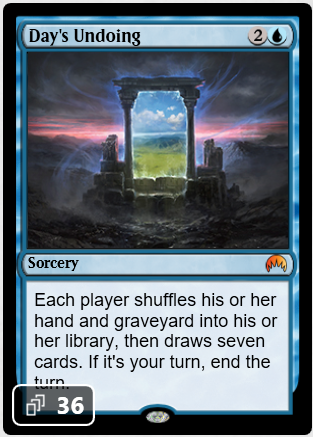
Here is a pick I like in ORI. Day's Undoing is as close to Timetwister as you can get, and has already made appearances in Vintage. Despite the drawback of ending your turn, drawing seven cards for three mana is not something to neglect in any eternal format.

The two possible scenarios I’m expecting here are either a slow rise in price, paralleling the slow rise of ORI full sets, or a possible spike if this card manages to find its way into a somewhat competitive Modern deck. Alternatively, considering Day's Undoing's uniqueness and current price, its inclusion in one of Saffron Olive's Modern Budget decks would also probably propel Day's Undoing into the 5-tix range.

drag

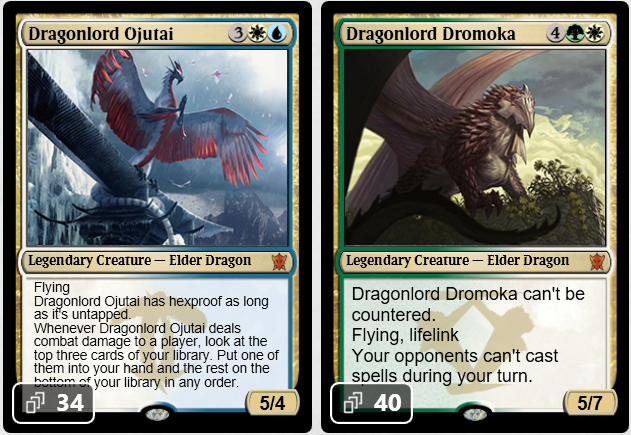
Same reasoning here with these two dragonlords. Among the five mythic dragonlords from Dragons of Tarkir, I consider these two to have the best chance of seeing a significant price increase over the next few months. They are dragons, mythics, from a third large set, and have a good chance of appearing in competitive decks in one or more eternal formats. To me, that’s a good list of ingredients for two successful specs.

Sales This Week

I have been holding these for a long time without much success thus far. The spec is not terrible, but Path to Exile never went beyond 4 tix, cycling up and down between 2 and 4 tix for a long period. With the price strengthening between 3.5 and 4 tix now that Modern is picking up a bit, I’m looking to sell my copies around 3 tix whenever possible. That’s not a huge profit margin, but I’m satisfied with it and happy to move on to another spec.

bfzlog

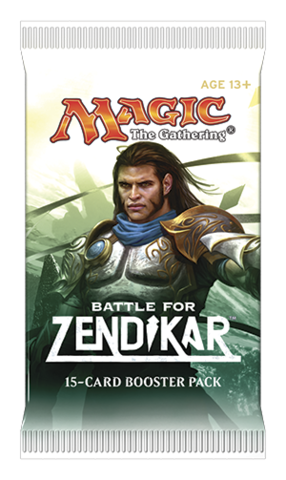
A few more Battle for Zendikar full sets sold with a profit this past week! Okay, I’m only talking about a laughable 1-2% here, but I'll take it. These BFZ full sets have held too many tix hostage over the past eight months, and I'm simply excited to sell them without losses. I think I’ll be done with my BFZ full sets before the end of the month.

mtgbfz_en_bstr_01_01

Although still posting a loss, the price of BFZ boosters cranked up to 1.2 tix this past week. I’ll keep selling these a little bit every day, whenever I think about it while on MTGO. I have no intention of waiting to see if the price can get better, and I’m perfectly resolved to the losses here. I just want to get these out and reinvest my tix elsewhere.

On My Radar

Most of the things I'm looking to do these days are no different from the previous weeks. I'm looking to close as many Modern positions as possible at the best possible selling price in November and December. I will also try to exit all of my BFZ full sets sooner rather than later.

In the buying department, I'll still be on the hunt for possible speculative opportunities with DTK and ORI mythics and rares. I'm happy with three pickups so far, but there might be more for fast gains as the value of these two sets rise, now that they have hit a floor after their rotation.

One last thing I'm going to try to pay attention to is the Commander 2016 and Conspiracy: Take the Crown singles now made available through the Treasure Chests. Commander and Conspiracy cards always occupied a particular position in the MTGO economy and the playable Legacy and singles Vintage could see moderate but steady price increases.


- Sylvain

Avatar photo

Sylvain Lehoux

Sylvain started playing Mtg in 1998 and played at competitive level for more than 10 years including several GP and 3 PT. When he moved to Atlanta in 2010 for his job he sold all his cards and stopped "playing". In 2011 he turned to Mtg Online and he experimented whether it was possible to successfully speculate on this platform. Two years later and with the help of the QS community his experience has grown tremendously and investing on MTGO has proven to be greatly successful. He is now sharing the knowledge he acquired during his MTGO journey! @Lepongemagique on Twitter

View More By Sylvain Lehoux

Posted in Buying, Finance, Free, MTGO, SellingTagged , , 4 Comments on High Stakes MTGO – Nov 13th to Nov 19th

Have you joined the Quiet Speculation Discord?

If you haven't, you're leaving value on the table! Join our community of experts, enthusiasts, entertainers, and educators and enjoy exclusive podcasts, questions asked and answered, trades, sales, and everything else Discord has to offer.

Want to create content with Quiet Speculation?

All you need to succeed is a passion for Magic: The Gathering, and the ability to write coherently. Share your knowledge of MTG and how you leverage it to win games, get value from your cards – or even turn a profit.

Keeping Up With the Karpathians: Tuning For a Linear Metagame

Are you a Quiet Speculation member?

If not, now is a perfect time to join up! Our powerful tools, breaking-news analysis, and exclusive Discord channel will make sure you stay up to date and ahead of the curve.

Looking solely at the Top 16s of recent events, observers might argue that Modern has become shockingly interactive. Todd Stevens' Sun and Moon, a white-red prison deck with a midrange slant, just won a Star City Games Open in Knoxville, headlining a Top 16 packed with more Sun and Moon, Skred Red, and Jund. Earlier this month, Skred Red beat out Grixis Control in the finals of GP Dallas. That tournament's Top 8 even housed a Jeskai Control deck. Given these results, is Modern is as linear and aggressive as people like to claim?

tasigur-banner-cropped

Well, yes. When we look at the decks that did well over the course of the latest GP, the format's true colors reveal themselves. In terms of representation, Infect dominated GP Knoxville, closely followed by Bant Eldrazi, Dredge, Burn, Death's Shadow Zoo, and RG Titan decks. Sun and Moon, Grixis Control, and Skred Red were able to rise to the top of these metagames because they interact efficiently from the standpoint of both mana and card economy—two keys to dismantling linear aggro strategies.

[wp_ad_camp_1]

How to Interact

There are two ways to interact efficiently in Modern. One involves playing the cheapest, most effective spells the format has to offer, including Lightning Bolt, Path to Exile, and Inquisition of Kozilek. The other employs highly relevant lock pieces to stop a large number of an opponent's cards with a single play.

Lock Pieces

We'll start with the elephant in the room. Modern has at last become a format that welcomes Chalice of the Void. With BGx decks relaxing their historic stranglehold on the format as more linear aggro decks are inducted into Modern, Chalice is making its rounds as a mainboard and sideboard hoser found in decks as diverse as Bant Eldrazi, RG Titan decks, and certain control builds.

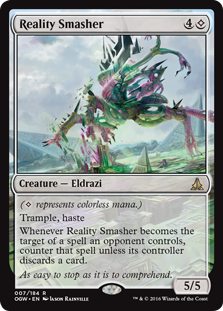
Reality SmasherThe meteoric rise of Bant Eldrazi to Modern's forefront has also created prime conditions for Blood Moon, a card that already hassles interactive three-color decks and can be splashed into a variety of archetypes itself (among them Affinity, Grixis, Temur, Zoo). Moon also leads the disruption suite in a few decks, including the rarely seen Blue Moon, the more present RG Ponza, and Stevens' Sun and Moon, a deck now exploding in popularity.

The main draw to Sun and Moon is its ability to run both Blood Moon and Chalice of the Void. Sun and Moon threatens to power either piece out a turn early with Simian Spirit Guide, potentially locking opponents out of the game on turn one.

Lightning Helix and Journey to Nowhere, clunkier versions of Bolt and Path, evade Chalice themselves and give the deck cheap creature removal for those that slip past its lock pieces. Sun and Moon also plays multiple sweeper effects, including Anger of the Gods, and can even interact with its win conditions, Nahiri, the Harbinger and Chandra, Torch of Defiance.

The deck's ability to play as a functioning midrange strategy when it isn't free-winning off of lock pieces makes it more robust than traditional prison decks like Lantern Control. With Dredge a known quantity now, I expect we'll see tons of Sun and Moon in the near future as more players pick up the relatively cheap deck to take back those wins from Infect.

Cheap Answers and Threats

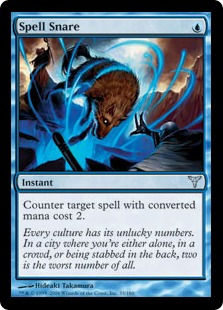
Spell SnareThe preferred method of interacting efficiently in Modern is to run a suite of the format's consensus best cards. Corey Burkhart's Grixis Control deck from GP Dallas exemplifies this principle. While Corey ran more expensive answers like Cryptic Command, Kolaghan's Command, and even Terminate, he compensated for these with a wealth of early-game plays, including Lightning Bolt and Spell Snare. Corey also ran Engineered Explosives in the main to have access to a cheap sweeper against decks full of one-drops.
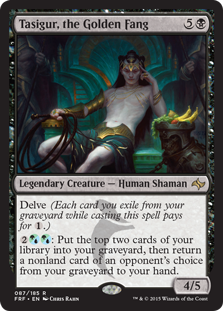
His most interesting decision, though, was to max out on Thought Scour despite only running three copies of Tasigur, the Golden Fang as delve spells. Grixis Control decks have been known to dip into Gurmag Angler, but Corey forewent the Zombie Fish in favor of a leaner threat suite. Without Gitaxian Probe, Corey was sure to need a little extra help when it came to rushing out Tasigur on turn two, a crucial play against board-blitz decks like Burn and Zoo. The four copies of Scour all but ensured his success on that front, allowing him to impact the board sooner and for less mana.

Kevin Mackie's Skred Red happens to straddle both sides of the coin, running Lightning Bolt and Skred (a Path to Exile upgrade in a deck full of Snow-Covered Mountains) in addition to lock pieces Relic of Progenitus and Blood Moon. This combination makes the unassuming deck a serious contender in a metagame so soft to spot removal and lock pieces.

The Importance of Pressure

TasigurOpponents do draw out of lock pieces eventually. They draw out of removal spells even quicker. It's crucial to put pressure on opponents if cheap interaction is to actually beat them.
Burkhart's super-reliable Tasigurs fits the bill here, complimented by Snapcaster Mage who makes ending games with reach par for the course. Kolaghan's Command can recycle both creatures in the Grixis Control list, explaining why Corey didn't run more threats at GP Dallas than he did.

Both Skred Red and Sun and Moon rely on planeswalkers to take the game, the former powering out turn-three Koths with Mind Stone and the latter slamming Nahiri on curve after crippling an opponent's options with a lock piece. Simian Spirit Guide can also help get the deck's planeswalkers ticking up a turn early. Skred Red even has a recurring Wild Nacatl in the form of Eternal Scourge.

Pawing It All Together

The way Modern's been heading over the last couple months has made me miss Path to Exile. I sleeved the card back up and have been putting in rounds with an updated build of Counter-Cat, which I think is very well-positioned in this metagame. Here's the list:

Counter-Cat, by Jordan Boisvert

Creatures

4 Wild Nacatl
4 Delver of Secrets
4 Tarmogoyf
3 Hooting Mandrills
2 Snapcaster Mage

Instants

3 Mutagenic Growth
4 Path to Exile
4 Lightning Bolt
2 Lightning Helix
2 Spell Pierce
2 Spell Snare
2 Mana Leak

Sorceries

2 Gitaxian Probe
4 Serum Visions

Lands

4 Misty Rainforest
3 Arid Mesa
2 Flooded Strand
2 Scalding Tarn
1 Wooded Foothills
1 Steam Vents
1 Stomping Ground
1 Temple Garden
1 Hallowed Fountain
1 Island
1 Forest

Sideboard

2 Isochron Scepter
2 Huntmaster of the Fells
2 Pyroclasm
2 Lightning Helix
2 Surgical Extraction
2 Negate
2 Destructive Revelry
1 Ancient Grudge

Counter-Cat packs a ton of efficient interaction and front-loads a lot of pressure, making it a strong contestant in such a linear metagame. Creature-based matchups like Zoo, Infect, Death & Taxes, and Merfolk are practically byes for this deck.

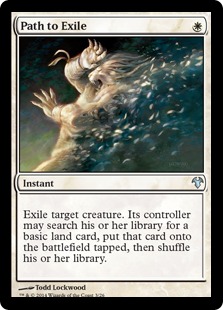
Path to ExileI've been considering taking Counter-Cat to the RPTQ next month over Temur Delver for these reasons. The deck is also more resilient to removal than Monkey Grow, since it plays more threats. With hard kill spells like Terminate and Path to Exile showing up in large numbers again, as well as graveyard hate for Dredge like Rest in Peace, I'd rather have a grip of Nacatls than a single Tarmogoyf.
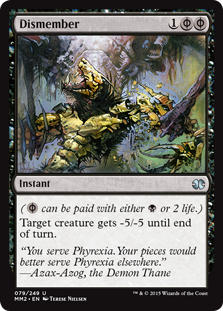
The points we lose against linear decks by giving up Disrupting Shoal are mitigated by adding Path to Exile and Lightning Helix, since most linear decks in Modern are currently creature-based. Countering Insolent Neonate or Expedition Map on turn zero is less important when we can reliably "go Zoo" and race the degenerate decks the old fashioned way instead of spending a turn or two digging into pressure.

Unfortunately, Counter-Cat is very weak to Sun and Moon. Chalice and Blood Moon both give the deck a hard time, and planeswalkers only add insult to injury. It's draw Spell Pierce or bust in this kind of matchup, and the degree to which players adopt the new strategy will influence my final choice for December.

Digging Deeper

DismemberModern has a vast card pool and in most cases can, I believe, police itself. I like to think that if Wizards had left Twin or Bloom in the format, Delver decks would eventually have surfaced in larger numbers to combat them. It's still just a matter of time, but it will take longer than it might have.
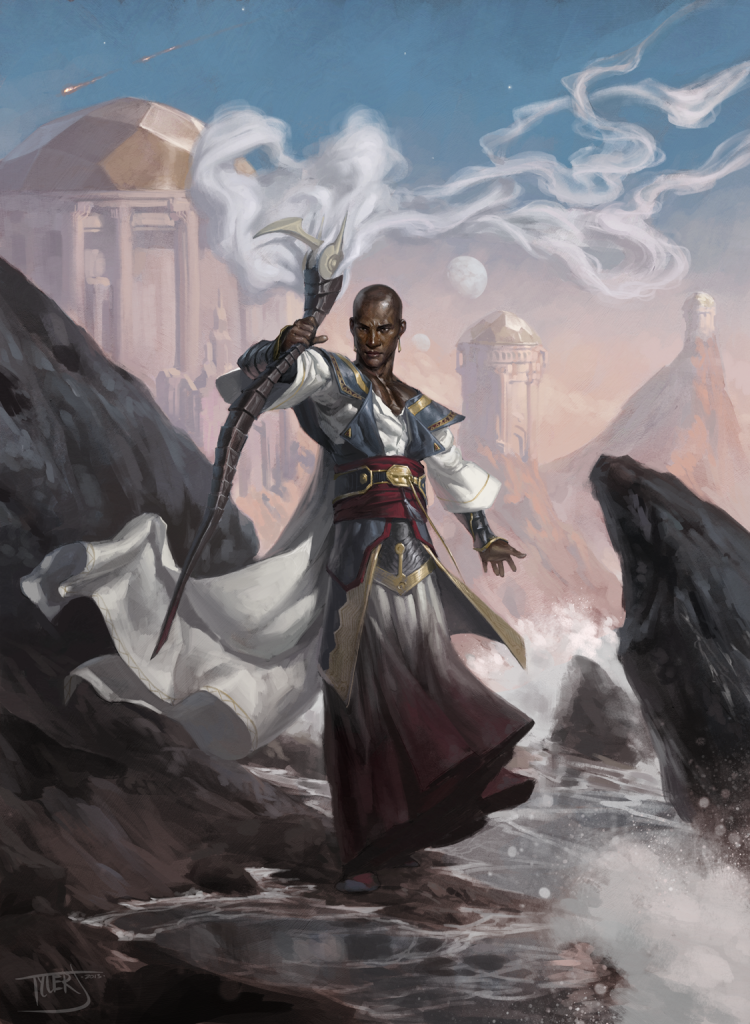
In the meantime, I think one card in particular deserves a lot more play than it has seen: Dismember. It's a freeroll removal spell against Infect, and stellar against any creature deck outside of Burn. On top of all that, any deck can play it—even colorless ones, or decks with Chalice of the Void!

Stock Watch- Teferi, Temporal Archmage

Are you a Quiet Speculation member?

If not, now is a perfect time to join up! Our powerful tools, breaking-news analysis, and exclusive Discord channel will make sure you stay up to date and ahead of the curve.

I'm sure that most readers at Quiet Speculation are familiar with MTG Stocks. If you headed over there today, you would see a substantial spike for Teferi, Temporal Archmage.

There was an error retrieving a chart for Teferi, Temporal Archmage

The card was about $10 and now there are only four listing on TCG Player, with the lowest listing being $16. I don't believe this card to have terribly high demand, and this looks to be a buyout that took advantage of low supply. If you look around you can find some $10-11 copies online, though it doesn't seem worth the effort.

The highest buylist price that I've seen is $5, which is half of the former market price. These aren't the easiest cards to move, and while the value has technically increased and the supply is likely to stay the same for some time, this just isn't a particularly sought after item.

Avatar photo

Ryan Overturf

Ryan has been playing Magic since Legions and playing competitively since Lorwyn. While he fancies himself a Legacy specialist, you'll always find him with strong opinions on every constructed format.

View More By Ryan Overturf

Posted in FreeTagged 1 Comment on Stock Watch- Teferi, Temporal Archmage

Have you joined the Quiet Speculation Discord?

If you haven't, you're leaving value on the table! Join our community of experts, enthusiasts, entertainers, and educators and enjoy exclusive podcasts, questions asked and answered, trades, sales, and everything else Discord has to offer.

Want to create content with Quiet Speculation?

All you need to succeed is a passion for Magic: The Gathering, and the ability to write coherently. Share your knowledge of MTG and how you leverage it to win games, get value from your cards – or even turn a profit.

Insider: Selling Cards at the Dealer’s Table

Are you a Quiet Speculation member?

If not, now is a perfect time to join up! Our powerful tools, breaking-news analysis, and exclusive Discord channel will make sure you stay up to date and ahead of the curve.

I’ve shared my experiences using Quiet Speculation’s Ion Scanner to sort the extra cards in my collection for sale to online buylists, but this process left me with many significantly played cards that I still had to move.

What's the Plan?


My plan was to use the scanner to enact the method that David Schumann laid out in his article Buylisting - Nickels, Dimes, and Quarters, first sorting my cards by my desired priced, which I based on the buylist offers available in Trader Tools, and then offering them to dealers to peruse and buy the cards of their liking. I later learned this process is often referred to by dealers as an “Ogre’d” box or binder, named for the trader who popularized the process. Knowing exactly what I wanted to be paid for my cards would allow me to confidently navigate the trading tables and extract the most value from my cards.

There was an error retrieving a chart for Gray Ogre

The cards I had remaining were low-priced, ranging in value from a nickel to a few dollars – a couple thousand cards in total. I also had an unsorted and unpriced binder of various cards, most of them priced significantly higher. Finally, I brought various bulk cards, including foils, rares, and even bulk common/uncommons. I loaded up my car and hauled these down to Eternal Weekend to sell them among the eight or so dealers there. This was my first time sitting down to sell cards to dealers at an event, so it was a learning opportunity that left me with some valuable experiences and lessons to share.

Valuable Experiences and Lessons

My biggest takeaway from the weekend is to give yourself time. Selling everything I brought meant sitting down and letting many different people look through my cards, and it took a lot of time. I expected buyers to know the prices of cards, and most did know some, but all of them were assisted by a computer in some form – in most cases Trader Tools and the Ion Pro Scanner itself – and it meant extra time. Also keep in mind that many players want to sell to dealers, but they have limited buying space and personnel, so lines can form, and it means more time is spent waiting. I started my process sometime after 3:00 p.m. in the afternoon, and I wasn’t finished until after 10:00 p.m., which put me at around an hour per dealer.

There was an error retrieving a chart for Time Warp

On that note, another takeaway is to talk to everyone. I spent time talking to each dealer in the event, and everyone found something to buy. My reception was varied, most of it ranging from welcome to lukewarm. One dealer responded with what felt like ridicule, and bought just one card because he said he felt he had to, while another dealer remarked that he would gladly do nothing but go through Ogre’d boxes all weekend. It may be time-consuming, but it’s good value for the dealers: they buy only what they want, and because I am setting the price, they can easily take advantage of price discrepancies and potentially buy cards at a discount.

It wasn’t until I approached a dealer for a second time that I sold the remainder of my Ogre’d boxes. They had purchased the entirety of my nickel and dime box, so I approached them with the remainder of my second box and offered to make a deal. After a look through he offered half value, which at that point was a good deal on a scoured box of played cards.

Selling my bulk cards was a matter of asking all of the dealers for their prices and then selling to the one with the best offer. I took 12 cents each for my stack of played bulk rares that I had already used the Ion Scanner to extract value from, and I was excited to sell my bulk foils for 6 cents each. I left my bulk commons/uncommons in the car, and was going to make a trip to sell them if a dealer wanted them, but I ended up leaving without selling them.

There was an error retrieving a chart for Common Bond

Another Event, Another Dollar

I didn’t have much time to sell the cards in my binder at Eternal Weekend, and I also found myself feeling unprepared and unknowledgeable about prices. At home I prepared my binder for the following weekend, Modern Grand Prix DFW, where I knew there would be lots of dealers looking to buy. I filled my binder with cards I wanted to sell, and I familiarized myself with some prices.

I set out to the dealer tables at the GP late Sunday morning, and the crowds were out in full force. There were tons of dealers to choose from, but most still had lines of people forming to sell cards. My approach was to move through the various vendors and take offers on the cards in my binder. I hadn’t done the legwork to price every card, but I used my smartphone at the table to look up the price of many cards. I used Trader Tools to look at buylist prices, and prices on TCGplayer to see what played copies could be had for. I some cases I was receiving great prices comparable to the low on TCGplayer.

There was an error retrieving a chart for Arbiter of the Ideal

It would have been more efficient at the buy table to look up prices at home and Ogre my binder, but I did save a lot of wasted time overall because I only priced cards dealers were interested in, as many cards in my binder remained untouched. That being said, I recommend pricing your cards beforehand, because it will save a lot of time at events where your time is limited, and it will help you get the most value from your cards because you’ll know what they are worth in advance. It’s also no certainty you will have cell service to look up prices. Card prices do change, so ideally you should price cards immediately before an event, and then be willing to re-price any remaining before your next event.

Do you have any advice for someone planning to sell their extra cards?

--Adam

Avatar photo

Adam Yurchick

Adam started playing Magic in 1999 at age 12, and soon afterwards he was working his trade binder at school, the mall food court, FNM, and the Junior Super Series circuit. He's a long-time Pro Tour gravy-trainer who has competed in 26 Pro Tours, a former US National Team member, Grand Prix champion, and magic.tcgplayer.com columnist. Follow him at: http://twitter.com/adamyurchick

View More By Adam Yurchick

Posted in Buylist, Finance, Free Insider, ION, Ogre, Ogreing, Selling2 Comments on Insider: Selling Cards at the Dealer’s Table

Have you joined the Quiet Speculation Discord?

If you haven't, you're leaving value on the table! Join our community of experts, enthusiasts, entertainers, and educators and enjoy exclusive podcasts, questions asked and answered, trades, sales, and everything else Discord has to offer.

Want to create content with Quiet Speculation?

All you need to succeed is a passion for Magic: The Gathering, and the ability to write coherently. Share your knowledge of MTG and how you leverage it to win games, get value from your cards – or even turn a profit.

Examining Team Unified: The 2016 World Magic Cup

Are you a Quiet Speculation member?

If not, now is a perfect time to join up! Our powerful tools, breaking-news analysis, and exclusive Discord channel will make sure you stay up to date and ahead of the curve.

Last weekend, top players from nations worldwide gathered in Rotterdam to wage war for their respective countries. The battlefield? Team Unified Modern, with a little Limited thrown in. With so many players from every corner of the world turning their eyes to Modern, the results of this tournament were anticipated to have a larger effect on our Modern metagame than anything else excluding bannings. But can we trust the World Magic Cup results to reflect "real life" metagame trends?

apostles-blessing-banner

Hierarchy of Information

When we begin to analyze event results, the first thing we must do is determine the accuracy of the results we are analyzing. This is done naturally, almost subconsciously, every time we look at a decklist where the origin is known. FNM results are weighted less than SCG IQs, which are weighted less than Opens, which are weighted less than Grand Prix, and so on. In a perfect world, we would have nothing but Pro Tour results and Grand Prix influencing our metagame, leaving us a "pure" influx of sources where only the best of the best rise to the top.

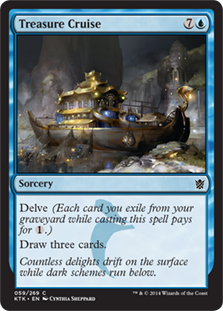
The reality, as those of us familiar with Modern know all too well, is that Modern experiences peaks and valleys of popularity, which I'll refer to hereafter as "seasons." Treasure CruiseA season of closely spaced events featuring Modern results in a period of (potentially) sweeping changes to the context of the format, while a season of weeks with nothing but MTGO Modern League results can sometimes result in apparent format stagnation. In addition, set releases can play into this ebb and flow as well, with a dud release bringing about no transformation in the format, while a Khans of Tarkir-like set can throw everything into disarray.
So where do unusual events fall into this hierarchy? The World Magic Cup is one example, as is the Star City Games Invitational, which is often split-format Standard/Modern. When archetypes can reach top tables based on factors other than individual deck composition and play alone, results carry with them an inherent danger of misinterpretation.

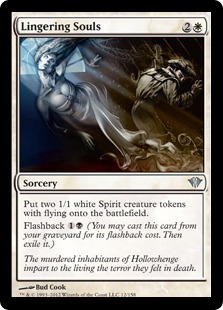
For example, we all have seen cases where a rogue Modern deck made Top 8 of an Invitational on the back of a perfect Standard performance, and vice-versa. How should we treat that information, especially considering the fact that others will be looking at that information as well? A solid example of this is the BW Tokens deck Eric Froehlich (and others) piloted at Worlds 2015. In that specific event, four different formats were highlighted, with Modern only seeing play in four out of 14 swiss rounds. Clearly, Modern only contributed a small percentage towards a given player’s Top 4 performance. Lingering SoulsBut regardless, those decklists were still published under a "Top 4" heading, whether the deck itself went 4-0, 0-4, or anything in between.
The takeaway here is that we have to take split-format results with a grain of salt, but can’t ignore them entirely. Even if the information is problematic, that won't stop other players from drawing immediate conclusions without analyzing the results as fully as we have. Looking back to the 2015 World Championships, I remember being flooded with questions regarding BW Tokens as the next "best deck" in Modern, regardless of the fact that information on how that archetype performed in-event was difficult to come by. Nobody really knew, but it didn’t matter. BW Tokens was the next big fad, and whether it did well at the World Championships or not wasn’t relevant. Eric Froehlich and others played it, which meant it "had to be good." Queue the sheep building it for themselves on MTGO (and I’m including myself in their number) only to find out later that the deck fell short of having what it takes to succeed.

[wp_ad_camp_1]

The Effect of Unified Constructed

With that, we come to the present. Teams from around the world gather to compete under the umbrella of Team Unified Modern. Four players compose a team that plays three matches, with two out of three wins taking the "team match" win. In my opinion, the team element of the tournament is irrelevant, as far as our analysis goes—what we really care about are the decklists. The big asterisk next to these results is the decklist restriction of no shared cards between the three archetypes.

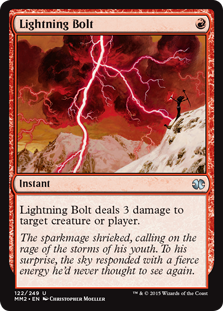
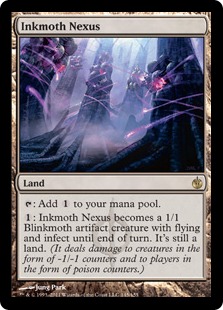
Lightning BoltThat means potentially one third the number of Lightning Bolts in the room, no Infect alongside Affinity (unless Affinity chooses to forego Inkmoth Nexus), etc. This seems like a modest twist, but in reality the implications and resulting cascades from this constriction are insane. With fewer Lightning Bolts around, is aggro suddenly the best and only choice? If players are going to be bringing aggro exclusively to the table, should we instead find a way to play Jund, even though it’s hogging all the best cards? What about decks that play a bunch of random chaff, like Dredge, Living End, and Lantern Control?
Clearly, the unique aspect of the World Magic Cup is deckbuilding, archetype selection, and positioning with this constraint in mind. This puts us (normal Modern players) in an interesting position, as essentially we are analyzing results influenced and molded by a constraint that doesn’t apply to us. A potential Top 4 of twelve archetypes might only contain at maximum four Infect lists. Card-hogging archetypes like Jund Midrange might not even show up at all. Linear strategies that employ unique effects will probably be overrepresented. All of this combines to create a prime opportunity for misinformation and analysis based on shaky foundations, but we still can’t ignore it! Other players will react this information as well—it doesn’t matter if Merfolk is a horrible deck if it takes a ton of top spots and everyone at FNM and on MTGO picks up the deck. So, let us proceed, but tread lightly.

The Results

PlaceDeck
1stAbzan
1stDredge
1stInfect
2ndGriselbrand
2ndInfect
2ndBurn
3rdAd Nauseam
3rdInfect
3rdLantern Control
4thAffinity
4thBant Eldrazi
4thJund
5thDredge
5thLantern Control
5thUR Prowess
6thBant Eldrazi
6thUR Prowess
6thDredge
7thBant Eldrazi
7thMerfolk
7thRG Titan Breach
8thAffinity
8thBant Eldrazi
8thUR Prowess

As an immediate takeaway, the first big piece of information are the archetypes that reached the final table. Abzan, Dredge, Grishoalbrand, Naya Burn, and two copies of Infect will be the first lists players look at to get a quick read of the event. In my experience, we can expect the general reaction to these results to be along the lines of, “Grishoalbrand is interesting, Lingering Souls may be back, Dredge is still great, and I need to start packing some Infect hate.”

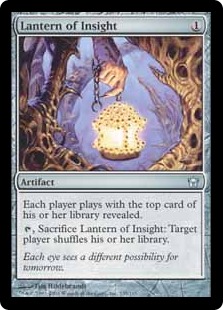
Through my time analyzing results, I’ve become more and more convinced that it’s the major takeaways, the morsels of information that can be subconsciously gleaned within seconds of looking at event results, that have the most effect on week-to-week metagame shifts. Lantern of InsightMagic players are good when it comes to doing their homework, but the majority of us won’t spend a couple hours poring over lists, comparing sideboard numbers against format hypotheses to inform our next moves. No, most people will have some snap reactions—"Infect is good," "Lantern Control?!?!" and "Oh, maybe I might try out UR Prowess"—and move on.
Digging a little deeper, the next most apparent piece of information here is the weighted performance of Infect compared to other archetypes like Lantern Control and UR Prowess. I find it telling that of the three teams that chose to play Infect, those teams took 1st through 3rd place, while Lantern Control took 5th and 3rd (with the third-place finish possibly due to Infect being on the team) and UR Prowess took 5th, 6th and 8th. The waters are murky here, but I’m drawing comparisons to Top 16 conversion rates in normal events, where we see an archetype doing well in the Top 16 but failing to cross the threshold into Top 8. It’s too early to call, but this kind of information has me putting flags next to Lantern Control and UR Prowess. The representation is there, but they couldn’t cross the threshold into the winner’s circle. Was the format ready for them and they ran into opposition? Or were they good, but not quite good enough? More information is necessary.

Let’s look at the information through a filter other than finish, weighted by representation:

ArchetypeCopies in Top 8
Bant Eldrazi4
Dredge3
UR Prowess3
Infect3
Affinity2
Lantern Control2
Abzan1
Ad Nauseam1
Burn1
Griselbrand1
Jund1
Merfolk1
RG Titan Breach1

Again, from an entry level, it’s easy to see that three of the top pre-Worlds decks show up here as most-represented (Eldrazi, Dredge, and Infect). Each deck enjoys relatively minor crossover with other archetypes, so playing them was essentially free, outside of the Inkmoth Nexus scenario we outlined above. Bant Eldrazi taking Path to Exile means we can’t play any midrange strategy that might want it like Abzan or Jeskai, but Bant Eldrazi plays that midrange role itself, so the loss isn’t that great.

Thought-Knot SeerAnother telling piece of information is the lack of dedicated midrange among the top tables. One copy of Jund and one copy of Abzan is curious, especially considering the plentiful amount of juicy aggro targets for the removal-heavy midrange lists to beat up on. Here it’s clear to see that the "unified" constraint pushed an already combo-focused format even more so, as players struggled to find strategies that didn’t compete for cards. Almost every team had two of three players fighting with some sort of linear aggro or combo strategy, be it Burn, Lantern Control, Dredge, Affinity, etc. Against a field that diverse, Jund, Abzan, and other reactive midrange strategies struggled against the variance of the field. When Terminate is good against half the field but dead against the rest, natural attrition is bound to wear these archetypes down.
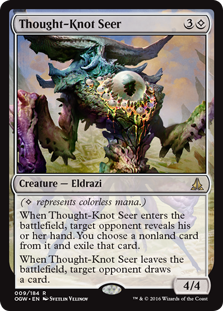
It’s significant, then, to seen Bant Eldrazi perform so well. Against most of the aggressive decks in the field, Bant Eldrazi is the de facto control role in the matchup, looking to trade ahead with Matter Reshaper and control the board with fatties like Thought-Knot Seer and Reality Smasher. Against combo decks, Eldrazi still has a proactive, fast gameplan that allows them to pressure the opponent and end the game quickly. It’s clear to me that in a diverse format made even more diverse by the "unified" constraint, Bant Eldrazi was the right midrange deck of choice.

A Closer Look at Decks

Abzan, by Petros Tziotis (1st, World Magic Cup 2016)

Creatures

4 Tarmogoyf
3 Scavenging Ooze
3 Siege Rhino
4 Dark Confidant

Instants

3 Abrupt Decay
4 Path to Exile

Planeswalkers

3 Liliana of the Veil
1 Liliana, the Last Hope

Sorceries

3 Thoughtseize
3 Inquisition of Kozilek
4 Lingering Souls
1 Maelstrom Pulse

Lands

1 Godless Shrine
2 Overgrown Tomb
1 Temple Garden
1 Forest
1 Plains
2 Swamp
4 Verdant Catacombs
4 Marsh Flats
2 Blooming Marsh
1 Gavony Township
2 Twilight Mire
3 Shambling Vent

Sideboard

1 Maelstrom Pulse
1 Liliana, the Last Hope
2 Nihil Spellbomb
1 Zealous Persecution
1 Damnation
1 Engineered Explosives
2 Lost Legacy
2 Stony Silence
1 Seal of Primordium
2 Collective Brutality
1 Ravenous Trap

With that being said, Abzan came out on top! Even with all the talk of Bant Eldrazi being the better midrange deck, Abzan still took home first, while teams that played Bant Eldrazi could only manage 4th, 6th, 7th, and 8th place.

Everything up to this point has been informed speculation, and here I can't offer anything different, but I’m choosing to look at this result similarly to the Infect/Affinity results. With shared cards, players could choose Infect or Affinity, but not both. Inkmoth NexusThe fact that Infect took 1st through 3rd while Affinity placed 4th and 8th suggests that either Infect is better, or players were better prepared for Affinity. As far as Abzan vs. Eldrazi goes, I’m imagining the same thing happened. Most people in the field came to similar conclusions regarding the strength of Eldrazi on the weekend, so they planned accordingly to be ready for it come Top 8 time. Abzan, on the other hand, did similar things as Eldrazi but attacked from an unsuspecting angle. While other decks were busy trying to go under Eldrazi, Abzan was instead ripping apart their hand and flooding the board with Lingering Souls tokens.
So why Abzan and not Jund? For me, it comes down to threats. The ability to play Lingering Souls, alongside the albeit expensive Siege Rhino, gives Abzan the threat density to apply pressure to combo opponents, while at the same time disrupting them with discard. Abrupt Decay is much better at dealing with problematic permanents like Ensnaring Bridge, and can still hit Thing in the Ice and all the aggressive things in the format. Terminate, at the end of the day, is still just Terminate.

Engineered ExplosivesI could highlight a couple other decks, but I’m running a little long here and I want to talk a bit about deck selection strategy before we head out. For those looking for more decklists, I’d like to point you in a couple directions, with some notes on what I found interesting:
  • Infect with a 2/2 Apostle's Blessing/Blossoming Defense split, and Ravenous Trap in the board for Dredge!
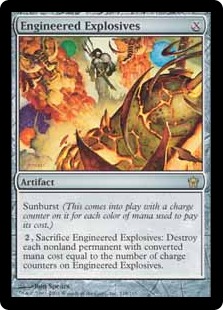
  • Bant Eldrazi with maindeck Engineered Explosives! Not bad against all the Infect, Affinity, UR Prowess, and Ensnaring Bridges running around.
  • I’m of the opinion that UR Prowess was played because Dredge decks needed the Jund lands. Two of the teams that played UR Prowess also played Dredge, but one didn’t, so who knows. I still think Death's Shadow Zoo is a better version of this archetype, but both have their merits. Maybe we’ll explore this more if the deck puts up results post-World Championships.

Final Points

With all this talk about midrange being bad, it’s clear to me there was an apparent effort by teams to put at least one midrange list into the team composition. If we’re counting Bant Eldrazi among their number, five of eight teams played at least one midrange strategy, with one team fitting in both Jund and Eldrazi. Path to ExileIt appears like a concerted effort on the competitors' behalf to "play the field," bringing a midrange deck to the table that could disrupt and attack all the aggro and combo.

This might not seem that relevant post-event, but it suggests a higher representation of midrange (particularly Bant Eldrazi) than I think we would have seen given normal conditions. Be careful when looking at Bant Eldrazi as the most-played deck, and react accordingly. Then again, others might do just that, so do we prepare for an uptick in Bant Eldrazi? Or will players avoid it because they think it’s in the format’s sights? Therein lies the eternal dilemma.

Moving forward, it’s difficult to gauge the sort of fallout that will come from results like these. It’s hard to have any concrete takeaways from the event because almost everything is predicated on the "unified" constraint and the gamesmanship that comes with competitors looking to play the field. The World Championships were absolutely more "combo-y" than normal, but what does that mean for next week? Will the midrange players stay home in the face of this apparently hostile field? That would allow combo to take over even more...

I’ll certainly be dwelling on this over turkey. Thanks for reading, and happy Thanksgiving!

Trevor Holmes

The_Architect on MTGO

Twitch.tv/Architect_Gaming

Twitter.com/7he4rchitect

Examining the Banlist: Complaints, Clarifications & Suggestions

Are you a Quiet Speculation member?

If not, now is a perfect time to join up! Our powerful tools, breaking-news analysis, and exclusive Discord channel will make sure you stay up to date and ahead of the curve.

Banlist discussion has become all the rage in recent years. The people who manage the banlist understand that changes should be made rarely and with good reason, though as we all know you can’t please everybody. Players still complain about the banning of Splinter Twin, and there is plenty of discussion over what could be banned or unbanned from week to week in Modern. Personally I am mindful of the overall health of the format, though I try to focus on playing what I am allowed to play.

preordain-banner

That said, after several iterations of “no changes” to the banlist it has become an increasingly popular point of conversation. Articulating one’s thoughts are difficult enough given the restrictions language places upon us, and this is only made more difficult by the hyperbole that's rampant in the Magic community. Often you’ll see the word “need” used in place of “want,” as subjective preferences are used in place of objective measures of quality. Personally I would love to play with Treasure Cruise for at least another year, but that’s a bad direction for the format.

Today I’m going to go over my thoughts on many of the more-discussed cards for banning or unbanning in Modern. My goal is to offer a clear and objective analysis of what these cards mean for format health. Obviously I’m human and I can’t eliminate all bias, but I’ll do my best to cover both sides.

[wp_ad_camp_1]

Legal Cards That Should Remain Legal

Gitaxian Probe

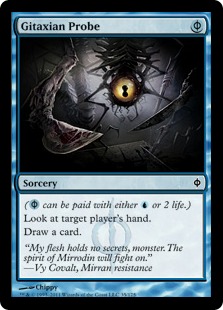
Let’s start with a hard one, eh? People hate Gitaxian Probe. In my experience, Gitaxian Probe is great training wheels for newer players who don’t always respect interaction if they can’t see it, though most commonly in the hands of more experienced players only green-lights fast kills against bad hands. Gitaxian ProbePerhaps this green light pushes things, though mostly this only comes into play when you have a deck that can’t consistently interact with the combo decks in the first place.
My bias here is that Grixis Delver is favored against literally every Gitaxian Probe deck whether they can see my hand or not. Modern definitely doesn’t need more cards like this, and the printing of Probe is one that I would certainly chock up in the “mistake” column, though its legality is one of few things that combo decks have going for them in Modern. We’ve already banned all of the most powerful card selection, so it makes sense to at least let them have this one way to efficiently churn through their deck a little bit. We give so many amazing tools to combat the combo decks that I would like to leave them with at least a short list of cards that keep these decks on the high side of competitive. Getting this much information for no mana is very powerful, but if your opponent has the relevant tools to interact then knowing about them doesn’t amount to much. It’s not like Cabal Therapy is Modern-legal.

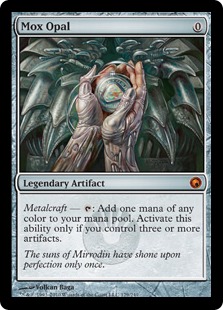
Mox Opal

Mox Opal would be a completely heinous card for Modern combo decks, and the reason that it remains legal is because a combo deck that could exploit it doesn’t exist. Affinity and Lantern Control are relatively easy to beat if you put your mind to it, and they have plenty of bad matchups even without hate. It looks weird to see that Chrome Mox is (very justifiably) banned while Mox Opal remains legal, and really it’s just the lack of a Mox Opal combo deck that makes this so.

Mox OpalI definitely would have been on board with a Mox Opal ban during Eldrazi Winter seeing as Affinity remained great during such a degenerate time, but since the Eye of Ugin banning Affinity has been far from dominant. I think that Mox Opal will inevitably be featured in a deck that merits a ban, though for now I believe it is merely very good and is only featured in decks that are fine to allow in the format.
The Eighth Edition Dilemma

Listen, Eighth Edition would hardly be printable as a Standard-legal set in 2016. That said, Modern has plenty of other stuff that fails this same test. Do I like Blood Moon? Hell no! Do I despise Tron? Absolutely! But the hosers and oddballs from Eighth and Ninth are things that increase the diversity of Modern, and the bannings of these things would fracture the player base.

A format as large as Modern will inevitably feature lopsided matchups. Hosers draw a lot of attention due to how blatant they are in this regard, but banning them just shifts the format to have different lopsided matchups. Enough of the player base is giddy about the opportunity to Tron or Blood Moon people, and these decks are a small enough percentage of the metagame that a ban here strikes me as very heavy-handed. Yes, these cards lead to feel-bads. That said, if you can generate a format with zero feel-bads, then you have a million-dollar idea in your pocket that you are wasting.

Cards of Dubious Legality

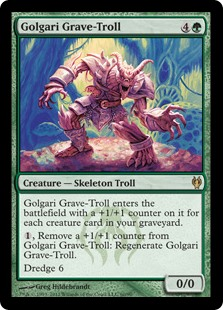
Golgari Grave-Troll

Golgari Grave-Troll’s legality leads to one of two things. It is either another legal card that nobody cares about, or one that pushes the format to need some graveyard hate. While Dredge does have more bad game-one matchups than it ever had in its heyday in other formats, it’s difficult to ignore the impact that Dredge has had on Modern as of late.

Golgari Grave-TrollThis one is difficult to manage from a business perspective. It is a horrible image to ban something that you unbanned in recent memory, and there really isn’t another ban that would prevent some form of Dredge from being a big player in Modern.
Given that Modern has plenty of matchups where one player is leaning on sideboard cards as it is, Dredge’s presence in the format is something that has to be monitored but isn’t necessarily ban-worthy. Dredge’s results have not been indicative of format dominance, and Modern remains incredibly popular despite the deck rearing its ugly head. Should the format’s popularity decrease and/or the deck’s popularity increase, then I would expect some action. I expect the deck to remain legal for the foreseeable future.

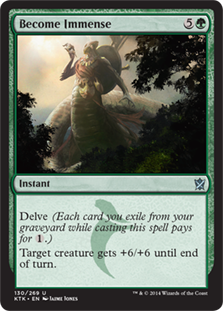
Become Immense

I see plenty of very intelligent people saying that this is an obvious ban, though I put it in the maybe column. If your argument is that Infect is a turn-three deck and deserves a ban, then your position falls a little flat. Infect was a turn-three deck before the printing of Become Immense.

become immenseBecome Immense’s legality likely has more to do with Death’s Shadow Zoo than Infect. Death's Shadow gets much higher access to fast kills due to the presence of Become Immense than Infect, and is also generally more difficult to interact with using red removal spells.
Mutagenic Growth strikes me as the more blatantly degenerate card in the impact-to-cost department, though both Mutagenic Growth and Become Immense are tough cards to approach from a ban perspective. Wizards doesn’t like just killing decks in a general sense, and banning either of these cards would have a very heavy impact on one or both of these decks. Like Grave-Troll, I feel that these cards are more cards to watch than things requiring immediate bans. A ban on either of these pump spells is likely to draw a split reaction similar to when Splinter Twin got the axe, which strikes me as the reason why WotC would be slow to act.

Cards That I Would Ban

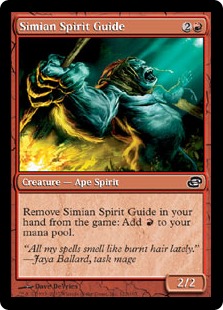
Simian Spirit Guide

One of the most fair decks that Simian Spirit Guide enables is a non-interactive combo deck that kills on turn four with Ad Nauseam. That’s not a good starting point. Outside of that, the card is used to power out early Chalice of the Voids and Blood Moons, once again on the spectrum of “more reasonable” things that the card does.

Simian Spirit GuideSimian Spirit Guide has shown up recently in both Valakut, the Molten Pinnacle and Dredge decks to facilitate a higher volume of turn-three kills. It was part of Colorless Eldrazi during Eldrazi Winter, and no deck that's trying to play interactive games touches it. It's a Modern-legal Lotus Petal, and its legality is something of a farce.
Simian Spirit Guide isn’t dominating Modern, but it is problematic and it falls on the opposite side of the comparison to Chrome Mox as Mox Opal. It is being used to facilitate fast kills, and probably should have been banned earlier. I already feel that Modern is a great format as is, though this ban is the shakeup that makes the most sense with regard to the stated philosophy of the format, and is consistent with regard to cards that are already banned.

There are other cards that I would like to see banned, but they’re all matters of preference. Some people hate Blood Moon, while I hate Cavern of Souls. Ancient Stirrings being far and away the format’s most powerful cantrip is something that I’m not on board with, but it would be hypocritical for me to defend Blood Moon while attacking these cards at length. Simian Spirit Guide is the one card that is currently legal that is the most detrimental to Modern.

Cards That Should Remain Banned

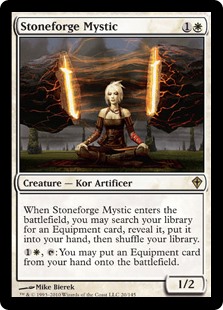
Stoneforge Mystic

Yeah, yeah. There’s a lot of artifact hate and Stoneforge Mystic is fragile. That’s not what this ban is about. White decks need a reason not to play Stoneforge Mystic in a format where it’s legal, and that is why several of the green cards on the banlist are there. Stoneforge MysticSome decks are good against Stoneforge Mystic. Some decks are also good against Punishing Fire. I’m pretty on board with this card being banned.
The position that Stoneforge should be unbanned and Batterskull should be banned is also just bizarre to me. “Why don’t we put the less individually powerful card on the banlist? That’s a good look!” There are decks that play Batterskull currently and it plays an interesting role and offers lifegain to decks that wouldn’t otherwise have it. It also comes down late enough in the game not to be oppressive. Stoneforge Mystic functionally ends some number of games on turn two, and that is not the direction that Modern should head.

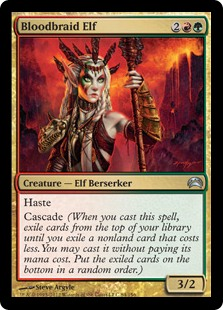
Bloodbraid Elf

Deathrite Shaman was a villain, but the position that Bloodbraid Elf isn’t messed up as well is ill-founded. Currently Jund decks have very powerful cards in the one-through-three slot that make interaction with much of the format easy, and then a four-slot that's awkward and fluctuating. Assuming that the rest of your deck is good, Bloodbraid Elf is great everywhere. It adds consistency and card advantage plus free mana at the top of the curve.

Bloodbraid elfJund is already a very powerful interactive deck, but if you want it to be the only interactive deck then I strongly recommend unbanning Bloodbraid Elf. With Liliana, the Last Hope and Kolaghan's Command as back up, the notion of grinding out Bloodbraid Elf Jund sounds impossible. Unbanning cards that specifically benefit decks that are already performing well is a very bizarre policy, and one that I do not support.
Splinter Twin

Control has some significant barriers to success in Modern, it’s true. That said, combo-control is a very oppressive archetype, and while I was surprised at the Splinter Twin banning, I do support it. Playing a non-Splinter Twin blue deck was ill-advised when the card was legal. The deck’s general power level in the format, coupled with its sideboarding advantage since opponents have to guess if they'll leave in the combo, was a little much.

It is often cited that Splinter Twin would keep deck X in check—given the frequency that this position is stated the logical conclusion seems to be that the deck is too good against too many things. It’s hard to argue that the banning of Twin didn’t open up the format. Maybe you don’t like the way the format opened since then, though the format is very diverse and that drives its general popularity. And yes, popularity isn’t a measure of quality, but it’s paramount from a business perspective.

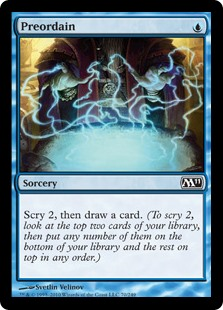
Preordain

It’s very odd to me that this card is a common consideration among players for an unban. The game has moved away from cantrips on this power level, and for good reason. I would love to sleeve up Preordain again, because it makes my deck better than your deck. This card simply offers too much consistency for too little cost. PreordainIt’s really a non-starter for a discussion of unbanning, though I’m not really sure how to illustrate that if you don’t already agree with this position. The official statements from WotC also don’t help me much here.
What I will say is this: if you’re playing off the top of your deck, and I get to look at two extra cards on some number of my draws, I’m going to execute my deck's plan more consistently than you. I will draw fewer lands and more spells that matter. Whether I’m a combo, control, or tempo deck, I’m simply going to find my relevant things more than you'll find yours, and that enables me to beat you even if your average power level is higher than mine. You will draw more lands and ill-timed spells over time than I will. Serum Visions is widely played despite awkward templating. Preordain would make every Serum Visions deck better by a lot, and would also show up in most if not all of the blue non-Serum Visions decks.

Reasonable Unbans

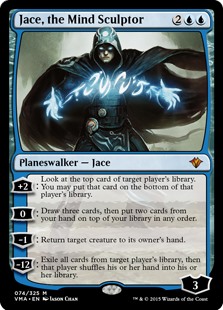
Jace, the Mind Sculptor

No, I don’t think that they are going to unban Jace, the Mind Sculptor. But I do think that if it were legal it would not be overly format-warping, and would not dominate by any stretch of the imagination. Jace the Mind SculptorTurn four is pretty late by Modern Standards, and Jace doesn’t suddenly make control decks good against the Urza's Towers and Valakut, the Molten Pinnacles that have been crushing them.


The fear that Jace might be too good will keep him on the banlist. There’s really no pressure to unban Jace outside of the fact that some players would like to cast him. Jace would more than likely be totally fine, though the fact that Jace was banned in Standard makes the fallout from unbanning and needing to reban too big of a risk from the perspective of the people who manage the format. I understand the position, even if I disagree.

A Healthy Modern

Changes to the banlist have understandably slowed since the removal of the Modern Pro Tour, which I think was absolutely a positive change. The fact that I currently enjoy playing Modern definitely colors my opinion, but I believe from a game-design and business perspective that the format is doing great. From that perspective I’m on board with Simian Spirit Guide being unceremoniously banned, though it wouldn’t surprised me in the least to see no changes to the banlist with the Aether Revolt update.

Thanks for reading.

-Ryan Overturf
@RyanOverdrive on Twitter

Insider: Seeking New Frontiers – Standard’s Decline

Are you a Quiet Speculation member?

If not, now is a perfect time to join up! Our powerful tools, breaking-news analysis, and exclusive Discord channel will make sure you stay up to date and ahead of the curve.

For a few months now I've had a sneaking suspicion that Standard speculation is a dying practice, but the point was really drilled home for me last week.

I wanted to practice Standard in paper for a local ICQ last week and had difficulty finding events that could even attract enough players to fire. Never, in my entire time playing Magic, have I ever found myself in a position where it was difficult to find a Standard tournament on a weeknight that could get eight players.

Yesterday I wrote about some of the reasons for Standard's lack of popularity on Channel Fireball. I get that Standard kind of sucks right now, but it certainly isn't the worst Standard format that I've ever played. There is no oppressive Collected Company or Rally the Ancestors. There is no Affinity, Faeries, or Bloodbraid Elf. Yet, the fact remains that people just don't seem enthusiastic to sleeve up B/G Delirium vs. U/W Flash and actually play Standard.

I want to play, but only because I have tournaments to practice for coming up. If I had a choice between formats to play, I certainly wouldn't choose Standard. I'm not alone. I see Modern as a format that people actively want to play, whereas Standard is a format people play because they sort of have to.

The New Frontier

There's another factor that I find troubling when it comes to Standard finance. The Hareruya guys have been putting a lot of resources into supporting a new format called "Frontier." The rules for Frontier deck construction are simple: Magic 2015 forward.

Frontier would be a non-rotating format like Modern, except it would shave off a huge portion of the older cardpool and focus on newer printings. When we consider that the majority of problematic Modern cards predate 2015, it makes sense that Frontier could be an easy-peasy format from the development/balancing perspective.

It reminds me of Extended, back when Extended was a rotating format that was meant to feel like the greatest hits of Standard from the past three or so years.

If you are looking for great Frontier cards, you need only use common sense about what has been great recently.

There was an error retrieving a chart for Collected Company

Collected Company is a great card and would certainly live on in Frontier.

There was an error retrieving a chart for Siege Rhino

Yeah, there will certainly be Rhinos in the frontier. They are cheap right now and could be a great little investment card in case the format takes off.

There was an error retrieving a chart for Dig Through Time

Dig may be banned in Modern and basically a bulk rare, but it could be a great staple for Frontier. You can get these for about fifty cents a pop right now.

There was an error retrieving a chart for Sylvan Caryatid

Another great card that doesn't have a home right now but could be a big player in Frontier. I really like this card as a cheap pick-up, and I hope that the format sticks.

There was an error retrieving a chart for Jeskai Ascendancy

Another cool combo card that also plays nicely with Sylvan Caryatid and Dig Through Time in Frontier. I think Jeskai Ascendancy is also underrated in Modern right now. I keep losing to it on MTGO which tells me it's better than I've given it credit for.

If you want to buy in on the possibility of Frontier, I wouldn't blame you in the slightest. Tomoharu Saito is a smart business man, and if he's pumping money into tournament support for the format, I'm game to follow suit and pick up staples. Also, I really like the idea of the format. Modern is great, but it feels too big, and it's starting to get too broken and kind of boring to the average player.

There's a reason random formats like Pauper, Highlander, and Tiny Leaders pick up steam with players: people want to try something new. Frontier feels like the kind of "something new" that players would really enjoy picking up and playing. It says a lot that as a tournament player I would infinitely prefer to play a format like Frontier over Standard—I feel like a lot of other players would feel the same way.

Overpriced Standard Singles

There are not nearly as many people playing Standard now as there used to be. I used to buy a couple of boxes with every new set and keep a playset of Standard on hand to build decks with. I haven't bought Standard cards in a year now since Shadows over Innistrad.

I've noticed a trend where people just don't want to buy Standard cards because they're such a bad investment. You buy the cards, you have them for a few years, and then they're worth literally nothing. It's a poor return on investment.

It also turns out that with fewer players buying into Standard and playing the format, it's a lot more difficult to flip Standard cards when they break out. When demand is depressed compared to past years, those "hot" cards are comparatively less hot, and any price spikes may be shallower and less likely to sustain.

My theory is that Standard singles are overpriced based on the demand. There has always been a sort of formula that predicts how much Standard singles ought to be worth. "It feels like a $10 card, etc." However, if Standard is being played less, it makes sense that the format staples should be worth less too.

We also need to factor Masterpieces into the equation. If every third box automatically has a $30-plus card, that should drive the cost of rares and mythics down by some amount.

Alternatives to Standard Finance

My current trading agenda involves getting out of all the Standard cards I own at face value, and turning them into eternal and Modern staples. Reserved List cards are the gold standard because there's no chance for a reprint.

Subsequent Modern Masters sets can affect the price of Modern singles, but dual lands, Legends, and Arabian Nights rares have no chance of coming back, which makes them the ultimate MTG investment opportunities.

To touch once again on the Frontier format, I also love that the majority of those cards won't be ripe for Modern Masters 2017 reprintings, which makes them fairly solid. My investment policy is always to buy low and sell high, and many of these Khans of Tarkir and M15 staples are about as low as they can be from a casual perspective, with nowhere to go but up.

While the Reserved List is obviously the best place to park one's money, it's often difficult to find people who are willing to trade Arabian Nights cards for Standard staples. I'm intrigued by the prospect of turning my potentially overvalued Standard singles into bottom-of-the-barrel Frontier staples that have a lot of room for growth.

Imagine how valuable junk cards like Mantis Rider could become if Frontier takes off and becomes a sanctioned format. It could be a bust, but if it ends up happening there is a lot of opportunity for getting in on the ground floor. Happy hunting!

Insider: MTGO Market Report for November 23rd, 2016

Are you a Quiet Speculation member?

If not, now is a perfect time to join up! Our powerful tools, breaking-news analysis, and exclusive Discord channel will make sure you stay up to date and ahead of the curve.

Welcome to the MTGO Market Report as compiled by Matthew Lewis. The report will cover a range of topics, including a summary of set prices and price changes for redeemable sets, a look at the major trends in various Constructed formats and a "Trade of the Week" section that highlights a particular speculative strategy with an example and accompanying explanation.

As always, speculators should take into account their own budgets, risk tolerance and current portfolios before buying or selling any digital objects. Please send questions via private message or post below in the article comments.

Redemption

Below are the total set prices for all redeemable sets on MTGO. All prices are current as of November 22, 2016. The TCGplayer low and TCGplayer mid prices are the sum of each set's individual card prices on TCGplayer, either the low price or the mid price respectively.

All MTGO set prices this week are taken from GoatBot's website, and all weekly changes are now calculated relative to GoatBot's "full set" prices from the previous week. All monthly changes are also relative to the previous month's prices, taken from GoatBot's website at that time. Occasionally, full set prices are not available, and so estimated set prices are used instead.

nov22

Flashback Draft of the Week

This week the flashback draft queue returns to a core set with Magic 2013 (M13). The titans have left the core set at this point, though Thragtusk makes an appearance as a mini titan in the rare slot. This card still shows up in Modern from time to time as life gain and a persistent board threat, so it goes for 4 tix at the moment. Omniscience is the most expensive card in the set due to its application in Legacy.

There was an error retrieving a chart for Omniscience

Rancor deserves special mention as an expensive uncommon at 0.8 tix. It's a staple of Pauper Constructed, as it was originally printed as a common in Urza's Legacy. As a result, it consistently fluctuates between 0.5 and 2 tix. If it takes a dip closer to the bottom end of this range, don't be afraid to accumulate these for the long term.

Two under-the-radar cards to consider from this set are Thundermaw Hellkite and Master of the Pearl Trident. Both cards have niche applications in Modern. The dragon is excellent at mopping up tokens from Lingering Souls, a card that shows up to help battle Infect and Affinity strategies. Merfolk is a fringe playable deck, but it shines in a combo-heavy environment. The time is not right for Merfolk decks nor for Thundermaw Hellkite, but the Modern metagame evolves in such a way that old strategies and ideas eventually come back to the fore.

Standard

This past weekend, Brad Nelson piloted Black-Green Delirium to first place at the Star City Games Standard Open in Knoxville. Click the link and you can check out the rest of the top decks. BG Delirium and the WU Flash strategies dominated once again, taking 12 of the top 16 slots. With Eldritch Moon (EMN) being a small summer set and having key components to both of these archetypes, it posted another price increase this week and sits at a lofty 142 tix on MTGO.

There was an error retrieving a chart for Grim Flayer

Sets in Standard typically have one or two cards that cost over 10 tix. EMN currently has three cards priced at over 20 tix, an unusual situation to be sure. It's been a fantastic set for speculators, but it's difficult to see how it could go higher from here. Remember that EMN and Shadows Over Innistrad (SOI) are still available for draft, meaning cards from these sets are still trickling into the market and will continue to do so into 2017.

Kaladesh (KLD) continues its decline in both paper and on MTGO this week. There's a very real possibility that KLD will set a record for the lowest priced large set in Standard, ever. Going below 40 tix would be quite the accomplishment, but with a shortened redemption window and the presence of Masterpieces in paper, there won't be much to support the price of this set going forward.

Modern

The 2016 World Magic Cup was won by Team Greece this past weekend. The event featured unified Modern constructed which means that each team had to build three separate Modern decks, with any one card (other than basic land) appearing in only one of the decks. Here are the top 8 team decks from the event. The top performing deck from the World Magic Cup this year was unimaginatively dubbed Blue-Red Kiln Fiend by the coverage team. This deck got its start in Pauper constructed with the Rise of the Eldrazi common Kiln Fiend, though I much prefer the moniker MTGgoldfish uses in Suicide Bloo. This name echoes the evolution of the Suicide Zoo archetype that this deck appears to be, swapping out the raw power of Death's Shadow for more card selection and interaction with blue cantrips for Thing In The Ice.

There was an error retrieving a chart for Thing In The Ice

In a limited gauge of the strength of the Modern market on MTGO, Ensnaring Bridge and Blood Moon both hit all-time highs this week. Ensnaring Bridge shows up in Lantern Control decks, which got a boost from KLD with Glint-Nest Crane and Inventors' Fair, while Blood Moon shows up in a variety of decks, including the aforementioned Suicide Bloo.

Standard Boosters and Treasure Chests

Last week Treasure Chests were updated to include cards from Commander 2016, a revised curated list, and the exchange of play points for KLD boosters. They were also made tradable. The result of all these changes was an increase in the expected value of chests to over 3 tix and a market price of over 4 tix. The price of KLD boosters has also gone on a bit of a ride as a result, initially dipping down to 2.35 tix once the changes went into place. They rebounded to over 2.7 tix this weekend, before settling back down to 2.4 tix today.

With these changes being announced in advance, many players ended up holding onto the chests they had won rather than crack them right away. Once the changes were in place, there was a big push of product from chests being opened, which caused the initial crash in the price of KLD boosters. It's possible that we are through the initial, pent-up wave of chest opening, but now we are seeing a steady stream of opened chests from Constructed players who got an unexpected bump in the value of their prizes. This means a steady stream of KLD boosters onto the market which results in a steadily declining price.

Down the road, this price action will be instructive for any future changes to the composition of treasure chests. For instance, if Aether Revolt (AER) boosters will eventually replace KLD boosters, then there might be opportunity in buying and holding chests in advance of a change.

Trade of the Week

As usual, the portfolio is available at this link. This week I took the time to do some pruning of old positions that I wasn't tracking closely. There were a number of small acquisitions made earlier in the year, such as Serum Visions and Monastery Mentor. In advance of the end of the calendar year, I am looking to revamp how the portfolio is presented in order to better keep track of all the positions on the book. Cleaning up old, almost forgotten positions is a good practice to get liquid and to refocus on current opportunities.


Stock Watch – Chancellor of the Annex

Are you a Quiet Speculation member?

If not, now is a perfect time to join up! Our powerful tools, breaking-news analysis, and exclusive Discord channel will make sure you stay up to date and ahead of the curve.

Chancellor of the Annex has been hot and cold in degenerate decks in Legacy basically since it has been printed, though it has never really been the stock option for a convincingly powerful archetype. As of late though, Rakdos Reanimator has been making waves in Legacy.

Reanimator

Creatures

4 Chancellor of the Annex
1 Sire of Insanity
1 Tidespout Tyrant
1 Elesh Norn, Grand Cenobite
3 Griselbrand
1 Iona, Shield of Emeria

Spells

4 Lotus Petal
3 Animate Dead
4 Dark Ritual
4 Entomb
4 Unmake
4 Exhume
4 Faithless Looting
4 Reanimate
4 Thoughtseize

Lands

3 Swamp
3 Badlands
1 Bayou
4 Bloodstained Mire
3 Polluted Delta

Sideboard

1 Blazing Archon
1 Archetype of Endurance
3 Abrupt Decay
2 Collective Brutality
2 Massacre
3 Reverent Silence
3 Stronghold Gambit

This deck is committed hard to just going off on turn one or two instead of using blue cards for consistency. As such, Chancellor of the Annex takes the place of Force of Will while also being a reasonable creature to reanimate. This deck doesn't offer a lot of play, but it is pretty good at ending the game very quickly.

As of this writing, foil Chancellors have basically disappeared from the internet, and cheap copies of non-foils are being swept up. The card was only a buck or two, and is likely to be at least $5-6 before too long, and could ever settle higher. Scooping up some cheap copies or digging up a foil to sell into the hype would be a good move.

There was an error retrieving a chart for Chancellor of the Annex

Want Prices?

Browse thousands of prices with the first and most comprehensive MTG Finance tool around.


Trader Tools lists both buylist and retail prices for every MTG card, going back a decade.

Quiet Speculation