Are you a Quiet Speculation member?
If not, now is a perfect time to join up! Our powerful tools, breaking-news analysis, and exclusive Discord channel will make sure you stay up to date and ahead of the curve.
In between acing some online leagues with Ad Nauseam and running into back-to-back Infect rounds in others, I've been watching and playing more Legacy than usual. Last weekend's Grand Prix Prague and Columbus led to such an uptick in Legacy coverage that I couldn't help it. How else am I supposed to get value out of my old Dredge and Ad Nauseam Tendrils decks? Also, is anyone really surprised I'd be playing Ad Nauseam in Legacy given my Modern preferences? Speaking of which, I loved watching Rodrigo Togores take down Prague with the newest iteration of Legacy Storm, proud to see the Modern Ad Nauseam pilot (Togores is a frequent contributor to the deck's MTGSalvation thread) get the win. Don't worry---I'm not jumping ship to a format held hostage by the Reserved List. Even so, all that Legacy did get me wondering: could we apply Legacy principles, tech, and cards to our beloved Modern?
Modern obviously lacks defining Legacy staples like Force of Will, Brainstorm, Wasteland, Ancient Tomb, Cabal Therapy, and others. We've also determined that some otherwise acceptable Legacy cards are way outside acceptable Modern power levels: Deathrite Shaman, Jace, the Mind Sculptor, and Dark Depths come to mind. These obvious differences aside, Legacy strategies and games do contain numerous cards that are legal in Modern, whether sluggers like Tarmogoyf and Delver of Secrets or support cards like Lightning Bolt and Aether Vial. Modern also contains possible analogs to Legacy mainstays, such as Disrupting Shoal versus Force of Will. Today, I want to analyze a few such Legacy cards and concepts to see if they can find homes in Modern. I also promise this sentence is the last you'll hear of Ad Nauseam for the day.
[wp_ad_camp_1]
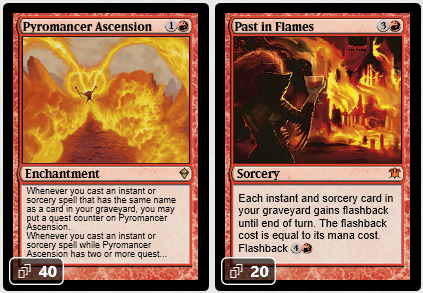
Young Pyromancer
Jordan, our resident tempo specialist, has already documented some of his attempts to get Young Pyromancer working in Modern. Unfortunately for Jordan and his Mandrills, the Shaman has historically struggled to stay relevant in a format both clogged with removal and without free countermagic like Force and Daze as protection.
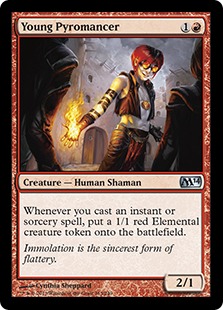 This is in sharp contrast to Legacy where Pyromancer and, to a lesser extent, his bigger white brother Monastery Mentor have solidified their status as top-tier players. Take Noah Walker's and Alexander Hayne's 3rd and 4th place Grixis Delver lists at Columbus and Prague respectively, or Grixis Delver's top positioning in Columbus's and Prague's Day 2 standings. Cheap cantrips and free countermagic are plentiful in Legacy, along with busted Pyromancer synergies like the hallmark Gitaxian Probe/Cabal Therapy combo. The Elemental tokens can also have a higher impact in a generally slower, more interactive format. Add in Legacy's relative lack of removal, certainly as compared with Modern, and it's not hard to see why Pyromancer shines in one format and wallows on the fringe in the other.
Legacy fans and diehards needed no introduction to Pyromancer, but the above discussion helps orient Moderners and newer players to the creature's impressive pedigree. To be fair, many Modern regulars have probably seen the infamous 1/1 Elementals in action before. Examples range from Grixis Delver's prominent finishes from spring 2015 to UR Delver's as recently as April. Mardu has even adopted Red Bob, with Joe Jancuk packing the full Pyro playset en route to his 8th place finish at the mid-April SCG Columbus Classic. Scattered performances aside, Young Pyromancer has not come close to matching his Legacy success in Modern.
We know Modern history hasn't been very kind to the Pyro, but could that change with different deckbuilding approaches?
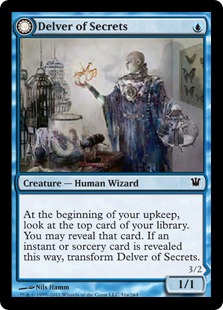 If Pyromancer is to enjoy time in the Modern spotlight, the first thing that needs to change is deckbuilder fixation on directly importing Legacy builds. Especially Delver Legacy builds. Since the post-Eldrazi April metagame has unfolded, Delver decks have been consistently mediocre to terrible. May was no exception, with Grixis Delver not even hitting 1% of the metagame and no other Delver decks appearing at all. In other formats, Delver and Pyromancer fit together like a Kitchen Finks and Melira, Sylvok Outcast in a (Birthing) Pod, but those lessons are being misapplied here because Modern is frequently inhospitable to these cards. Both the theories and the numbers attest to that, and although isolated Delver pilots like Jordan can put up wins, the deck can't currently cut it on a larger scale.
This suggests moving away from the so-called "Delver trap" with Pyromancer and treating the Shaman as a free agent. We could tolerate Modern's abundance of removal, lack of powerful cantrips, and other contextual miscues if we had some decent Force or Daze substitute to fill the gaps. We don't and blue-based Pyromancer is basically off the table because of it. Where do we go instead? I'd start back with Jancuk's Mardu list from SCG Columbus:
Mardu Tempo, Joe Jancuk (8th, SCG Columbus Classic 4/2016)"
Creatures
4 Dark Confidant
3 Monastery Mentor
4 Young Pyromancer
Instants
3 Kolaghan's Command
4 Lightning Bolt
2 Lightning Helix
4 Path to Exile
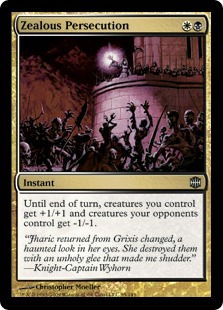
2 Zealous Persecution
Sorceries
4 Inquisition of Kozilek
3 Lingering Souls
2 Painful Truths
2 Thoughtseize
Lands
1 Mountain
2 Plains
2 Swamp
2 Arid Mesa
2 Blackcleave Cliffs
2 Blood Crypt
3 Bloodstained Mire
1 Godless Shrine
3 Marsh Flats
2 Needle Spires
2 Sacred Foundry
1 Vault of the Archangel
Sideboard
2 Kor Firewalker
2 Stony Silence
2 Crackling Doom
1 Murderous Cut
2 Rakdos Charm
2 Obzedat, Ghost Council
2 Damnation
1 Duress
1 Painful Truths
Without Force of Will or Daze to protect our Pyromancer and serve as catch-all answers for other threats, Modern players need to turn to a different set of generic solutions. Enter Thoughtseize and Inquisition of Kozilek. Although not the same quality as catch-all staple Force of Will, these cards passably and proactively dispatch Pyromancer removal and opposing win conditions, clearing the way for your Shamans.
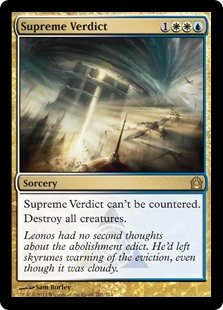
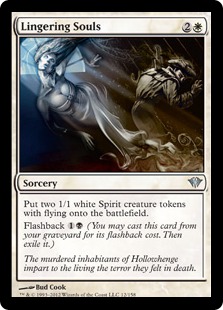 Because both discard spells are black, it's tempting to switch right to Grixis and ditch white entirely. Beware the Delver trap! We move to Mardu over Grixis for two cards. First is Path to Exile, the best catch-all removal spell in Modern (even if not its most versatile, Bolt, which we incidentally also keep). Second, we get Lingering Souls to push our "go wide" angle. This is a huge addition, alleviating the traditional Modern Delver problem of being unable to defend a flipped Insect. The Souls swarm is virtually immune to spot removal and, especially in tandem with Zealous Persecution, can quickly close a game an indefensible Delver would flub.
Theoretical strengths aside, it's worth noting that Grixis Delver at .9% in May still trounced Mardu's paltry .3%. Does this mean Grixis Delver is the better deck, as my earlier arguments about low percentages may suggest? Not necessarily. Mardu suffers from having no established list and little top-player advocacy. Just check out the muddled 75s in these Mardu standouts from the last few months:
 Mardu Tokens, Grant Mitchell (SCG IQ O'Fallon 4/2016)
- Mardu Midrange, Kyle Carruthers (SCG IQ Littleton 4/2016)
- Mardu Midrange, Donovan Lachney (SCG IQ Littleton 3/2016)
- Mardu, Ben Stark (Pro Tour Oath of the Gatewatch 2/2016)
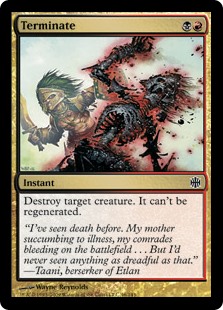
What a mess! Some decks use Terminates and others use planeswakers. Some use Painful Truths and others prefer their (horrible) Soulfire Grand Masters. Until these lists crystallize around a more established core, it's no wonder Mardu lingers beneath Tier 3 in recent metagame updates.
With their current tools, neither Mardu nor Pyromancer are going to be Tier 1 material any time soon. But they could certainly solidify Tier 3 status with intermittent Tier 2 appearances, and I believe further Nahiri, the Harbinger experimentation will be just the thing to get Mardu where it needs to be. The difference between a .3% and a .9% deck is far more surmountable than a .9% deck and a 4% deck, and I fully expect Mardu and Legacy immigrant Young Pyromancer to make it in Modern before the year is out. Just remember: avoid the Delver trap and play to Pyromancer's token generation with synergies like Souls and Persecution.
Free Spells
I spent more time on Pyromancer than I will on these next sections because so many Modern players ask about transferring their Pyro strategies from other formats. That said, there are plenty of Modern players who would forever trade the possibility of a Splinter Twin unban if it meant adding free countermagic such as Force of Will and Daze to the format. Although these cards pose an interesting testing question that could be tackled in a future article, for now it's enough to say these cards aren't legal and we don't have many replacements.
Thankfully, some hidden Modern gems can fill the free spells void, even if they can't supplant Force of Will for its status as the glue that holds Legacy together.
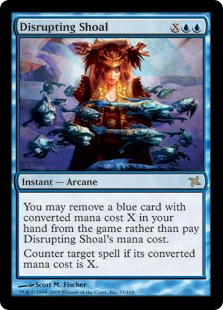 Of course, the most obvious of the bunch is Disrupting Shoal, a card Jordan has written more articles about than I have written metagame updates. I mostly agree with his assessments of Shoal and am consistently surprised to see this card in so few lists. Many Modern decks are hyper-concentrated in the one-mana and two-mana range, and if anything can help make Legacy Delver fanatics live the Modern dream, it's dropping the turn one Wizard with Shoal backup on the play. Despite a plethora of Shoal targets in Affinity, Burn, Infect, Merfolk, Abzan Company, and many other decks, Shoal's mechanical restrictions have justifiably limited its play. Only certain blue-heavy decks can use it to begin with, and an even smaller subset of those decks can benefit from it (i.e. decks that are tapping out early to deploy threats). All of this makes Shoal more roleplayer than definer, although I'll keep looking for this card to make its Grand Prix breakout.
A lesser-known but equally interesting piece of forgotten free technology is Snapback.
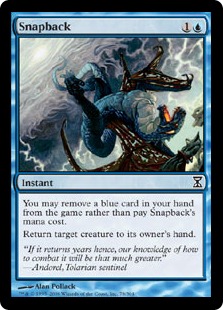 The free Unsummon from Time Spiral is even more tempo-oriented than Shoal, temporarily removing opposing threats or protecting your own clocks. At least Shoal permanently rids you of a problematic target. Tempo predispositions aside, Snapback has far fewer cost restrictions than Shoal, allowing you to pitch any blue card à la Force of Will. Also unlike Shoal, Snapback deals with a wider range of creature threats in a format defined by creatures. Notable targets include Inkmoth Nexus in both Affinity and Infect, Tasigur the Golden Fang and Gurmag Angler in Jund, Grixis, and Abzan strategies, and both sides of Kiki Chord's combo. It even disrupts Abzan Company persist loops that sneak through off four-mana Collected Company, an instant Shoal seldom hits.
All of these scenarios make Snapback a tempting inclusion for the right deck, especially in the sideboard. Modern's current top-tier strategies are overwhelmingly creature-based, creating numerous opportunities for tapped out Snapback surprises.
Of course, no discussion of free spells would be complete without touching on one of Modern's most broken mechanics: Phyrexian mana. We can't experience Mental Misstep in our format, a reality everyone who already played with the card is grateful for, but we can definitely enjoy another blue card with a deceptive power level.
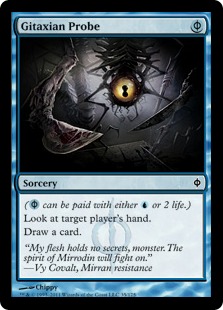 Normally reserved for Delver, Infect, delve-creature decks, and anyone still playing Storm, Gitaxian Probe helps you play a 56 card deck if you have the life total to maximize the sorcery. Fitting our article's theme, it's also a Legacy standout alongside the Modern-legal Pyromancer, and the Modern-illegal Cabal Therapy. Probe provides something none of the other free cards can offer, an invaluable resource that isn't always directly reflected on a board-state: information. Information to know what to counter and remove and what to ignore. Information to know when to commit and when to hold back. Information to know whether to play the Tarmogoyf or hold up the Remand. A resolved Probe feels like cheating and with good reason. In a format as diverse as Modern, knowing an opposing deck is critical to getting wins, whether for an interactive strategy or a goldfish one figuring out when to pull the combo trigger.
If your metagame isn't too Burn- and Gruul Zoo-heavy, Probe is a spectacular 1-2 card inclusion in your blue deck of choice. This is doubly true for Jeskai decks which must often decide whether to commit to turn four Nahiri or turn five Kiki-Jiki, Mirror Breaker. Probe also unlocks a secret cantrip mode on Snapcaster Mage, which ordinarily can't be deployed for value until turn three at earliest. Of course, Probe is even better in Games 2-3 when strange sideboard cards come in and you need to know what to play around. We may not have Therapy in Modern, but Probe's information is just as good here as in Legacy.
There are many other free spells worth considering in your Modern deck. Gut Shot is a personal favorite, as is the powerful delve fueler Mishra's Bauble. Whatever free spell you go with, take a leaf out of the Legacy playbook and look how you can use these unfair effects into your decks. They are often worth the slots.
Chalice of the Void
If you've played Legacy before, you're familiar with one of the fastest Game 1 losses in the format: on the play, turn one Ancient Tomb, Chalice of the Void at X=1, and pass. Game over, especially if you're one of those poor Delver decks packed with cantrips and one-drops waiting to topdeck an Angler. By no means do all Legacy decks fold to the Chalice play, a line reminiscent of Vintage for anyone familiar with Mishra's Workshop, but for those that do the experience is a brutal one.
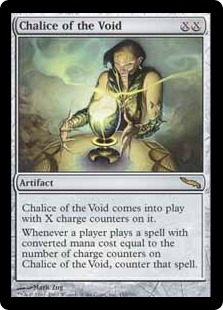 Chalice has been around in Modern for years, but it made its highest-tier debut during the nightmarish Pro Tour Oath of the Gatewatch, where a Simian Spirit Guide-powered Colorless Eldrazi monstrosity opened the floodgates for eldritch domination through April 4. The Eldrazi are gone, at least in their most warping form, and with them went the threat of a Tier 1 Chalice at X=1 on the play. Of course, Modern doesn't have the same one-drop quality of Legacy, which can make the turn one Chalice significantly less debilitating. Modern also has no City of Traitors or Ancient Tombs to regularly power out the Chalice, and the one-and-done Guide comes at significant card disadvantage costs. That said, Modern is still a format where one-drops can be critical to certain strategies, and that's where Chalice still has the potential to shine.
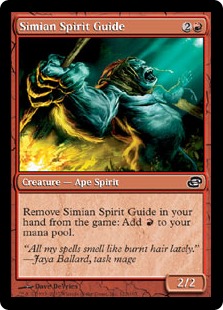 Taking Team Channel Fireball's Colorless Eldrazi as an example, we had a deck that could crush any midrange, control, or slower aggressive decks past turn three, but could also get outraced by Infect, Affinity, and Burn pilots looking to count to 10 or 20. Guide and Chalice addressed this specific weakness while not being irrelevant in other matchups. Here, it wasn't about Chalice shutting down a broad subset of the format, which is exactly what the X=0 Chalice might do in powered Vintage contests. Instead, Chalice/Guide plugged a particular aggro vulnerability while the rest of the deck handily crushed the remainder of the format.
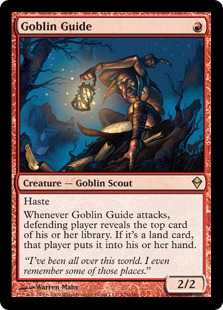
Eldrazi ultimately shifted towards UW, RG, and UR pairings, ditching Guide and Chalice in favor of something even more broken. Those decks have largely gone the way of the Eye of Ugin, but Chalice and Guide still remain as potent inclusions for any deck looking to shore up a bad aggro matchup. You can even pull the Dismember page from Colorless Eldrazi's playbook to keep access to an effective one-mana removal spell!
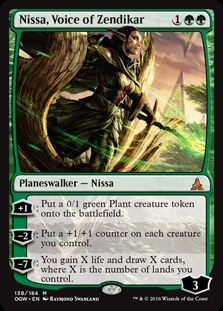
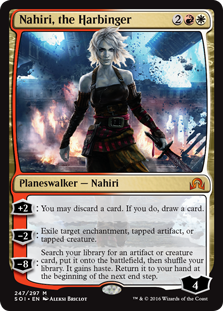 I'd love to see more midrange and prison decks use this combo as a catchall proactive solution to Modern's varied aggressive and linear strategies. As with Mardu and Pyromancer, I see this as another area where Nahiri can really help, hitting play a turn early via Guide on a cleared board and looting through excess Apes and artifacts after a lock is established. This doesn't need to be as prison-centric as John Pellman's notorious RW Lockdown deck from May's SCG Indianapolis Open, but Nahiri and Blood Moon could definitely deserve a home alongside the Guide and Chalice pairing.
Modern may not have the Ponders, Preordains, or Deathrite Shamans of Legacy, but it has plenty of decks that virtually or literally scoop to the X=1 Chalice on turn one. Hopefully we see more of this duo in the future, although given my unmentionable deck preferences lately, perhaps I should be polling against the Chalice.
Thanks for joining me on this romp through some key Legacy cards and concepts and how they might apply to Modern. What other cards do you think could make the jump? Any you are working with already or have interest in developing? Any big ones you think I missed? I'll catch you all in the comments and be back next week to talk about some card evaluation principles in the leadup to Eldritch Moon previews. Keep those fingers crossed for Innocent Blood and see you soon!




 decks he expected to face in their anticipated configurations. He was going into a Block Constructed Pro Tour, a format that had just been completed with the release of Dragon's Maze and was largely unknown. Zvi was trusting his team's ability to read the field, identify the good cards, and pick the good decks so that he could tune his deck correctly. How well this worked will be discussed below. The takeaway is that when you decide to do The Elephant you are at the mercy of your data and experience. Your deck will be very tightly constructed by the end and unless you can simply overpower them you may not have a good plan for something unexpected.
 What I want you to understand from
  are well defined and tested with lots of data on their nuances and card choices, and you are playing a midrange "good-stuff" deck.
 GBx and arguably URx qualify as midrange goodstuff decks but the format is not well defined in the same way Standard is. The cardpool is massive and while you can expect that each archetype will have certain commonly played cards there is no guarantee. There is massive variation between decklists within archetypes so trying to Elephant for them is risky. The deck you choose to test against might be the Next Big Thing, or it might be a case where the pilot got lucky with a suboptimal deck. Data uncertainty and instability is far greater in Modern than in Standard, so trying to use data-specific strategies is risky.
 it's very hard. I once again refer you to our
 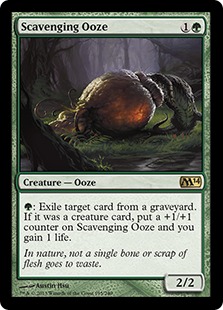 For example, Scavenging Ooze is a mediocre hate card against Dredge but is very good against Snapcaster Mage and decks with lots of creatures. This allows it to sit in for more specialized cards and free up sideboard space.
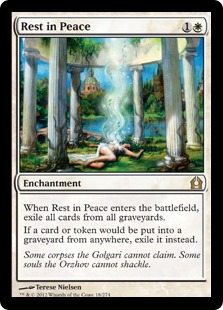 This is incidentally why I advocated
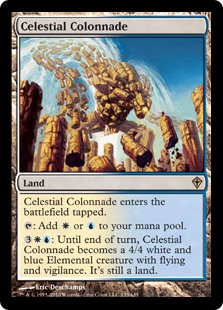
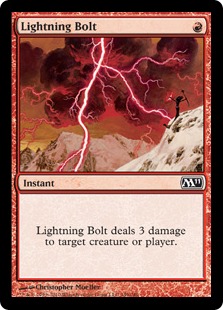 What I wasn't respecting was the percentage of the field that is good to great against a reactive Lightning Bolt deck. Many of the linear decks will struggle immensely against the Ancestral Vision decks, though decks like Bogles, Living End, Tron, Valakut, and various combo decks will make it so that most of your cards don't matter. In these matchups, waiting four turns to draw three cards will rarely be game-breaking.
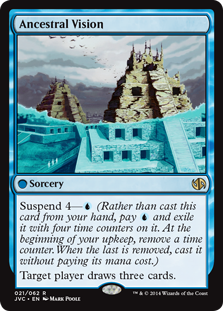 In a format where being able to win the game by turn four is nearly essential, Ancestral Vision will commonly be a liability.
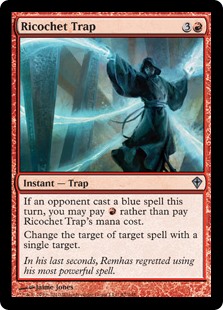
 Treasure Cruise advantage quickly snowballed, and a countered Treasure Cruise was just fuel for the next Cruise or a top-decked one. A countered Ancestral Vision means at least four turns before a copy that has not yet been suspended could resolve. My plan in blue mirrors already involved being heavy on countermagic. Since removing Ancestral from the sideboard of Grixis Delver I have concluded that being able to consistently fight counter wars, while also having fewer topdecks that can't be cast immediately, has left me feeling favored.
 With Ancestrals in my sideboard the plan I was committing to was keeping up on cards, though ultimately my cards were on average worse than theirs, which left me trying to play their game.
 given that double/triple black isn't always a given, though Countersquall is better enough that it gets the nod for now.
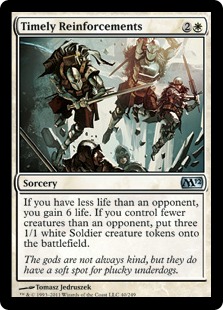 The biggest drawback to both cards is the potential to die before they matter, and Timely Reinforcements is great at diminishing this drawback in many matchups. I haven't seen a Grixis deck that I'm happy to play Ancestrals in yet, though Gerry's Jeskai build does a tremendous job of capitalizing on the deck's game one strengths with a good selection of hammers to combat the bad matchups out of the sideboard.
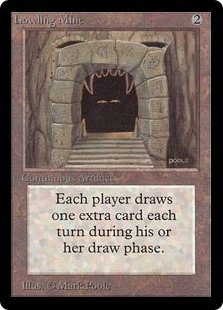 and for this deck's purposes it is a significant upgrade. Removing Howling Mine from the deck means giving your opponent fewer free cards, but it also gives you more game against slower blue decks. Ancestral is a must-counter, whereas Howling Mine is a card they're happy to let resolve to draw them into more counterspells.