menu

Deck Overview- Standard Izzet Tempo

Are you a Quiet Speculation member?

If not, now is a perfect time to join up! Our powerful tools, breaking-news analysis, and exclusive Discord channel will make sure you stay up to date and ahead of the curve.

Fevered Visions initially showed up in Standard as a sideboard card in Goggles control, and has seen some maindeck play in the same archetype. I don't care for the card as a maindeck inclusion in a control deck, though Tomoharu Saito came up with an awesome deck that capitalizes on the card's damage dealing ability in an aggressive shell. Some of the card's may look questionable, though his 12-3 record at Grand Prix Minneapolis demonstrates the list's potential.

Izzet Tempo

Creatures

4 Stratus Dancer
4 Dimensional Infiltrator
4 Rattlechains
4 Goldnight Castigator

Spells

4 Fevered Visions
4 Exquisite Firecraft
4 Fiery Impulse
4 Spell Shrivel
4 Clash of Wills

Lands

4 Shivan Reef
4 Wandering Fumarole
9 Mountain
7 Island

Sideboard

4 Negate
4 Roast
4 Goblin Dark-Dwellers
3 Seismic Rupture

A critical mass of 2/1 fliers for two doesn't seem like a solid base for a constructed deck, though the red spells help convert chip shots from these creatures into game wins. I've been playing Stratus Dancer in Standard, and that one is actually a powerful card in its own right independent of this deck's tempo game plan.

The 2/1 fliers aren't exceptional cards, but they don't have to be. They're basically picking up the slack for the fact that there aren't red spells in Standard that provide the early game necessary to close games with Exquisite Firecraft and Goldnight Castigator.

There was an error retrieving a chart for Goldnight Castigator

Goldnight Castigator is a card that I identified early on as being very powerful despite the drawback, and Saito's inclusion of the full four in the maindeck supports this claim. It's unclear at this point whether this will continue to be a deck, though I don't think this is the last we'll see of Castigator, and I like picking some up at the current price of a $1-2.

Insider: Hunting for Treasure While Out of Town

Are you a Quiet Speculation member?

If not, now is a perfect time to join up! Our powerful tools, breaking-news analysis, and exclusive Discord channel will make sure you stay up to date and ahead of the curve.

Welcome back, readers!

This past Memorial Day weekend I went to one of my favorite places in the US: Hilton Head Island, here in the beautiful state of South Carolina. This trip reminded me that many of us will be traveling about in the next couple of months, as school gets out for some, and others just like to take some sort of summer vacation from work. These trips are often few and far between for many of us, and they offer us a unique opportunity to go hunting for treasure.

treasure map

Not that type of treasure... Well, you can also go hunting for that type, but I'm referring of course to the Magic: The Gathering type.

Magic has been around for a long time, and is sold by a wide variety of businesses---you never know where valuable singles or collections might pop up. Finding the random places where Magic cards and collections have been lost to time is a skill like anything else.

Today I'll discuss how to do this, starting with the most basic hunting techniques and moving forward.

Level 1 - Wizards Stores

This is the most basic MTG treasure hunting technique. You simply go to Wizards Store Locator, put in your destination and look for stores nearby. Easy peezy.

treasure huntAs these stores typically sell Magic as part of their core business model, it behooves them to carefully examine their own stock. So your likelihood of striking gold is low---but that isn't to say it doesn't exist.

One of my favorite things to do is ask shop owners if they have a $0.5 box or $1 box (or whatever amount). These beautiful boxes more often than not contain the remainders of collections they purchased but didn't have the time or inclination to thoroughly review.

Sometimes you find decent stuff in these types of boxes, like cards that were bulky for a while and recently spiked, or unassuming cards that are rare enough to command a higher price than it might seem at first glance.

Level 2 - Non-Magic Stores

This is a more advanced local search. It will take up more time and has a lower probability of finding Magic cards, but when you do hit you have a higher chance of finding good stuff. For this type of search we want to try and think of places where Magic cards could be sold. These stores usually fall into a few categories.

1. Sports Card Stores

Believe it or not, Magic stores didn't exist in the early days of the game. Many Magic players in the early and mid 90's were introduced to the game at their local sports card store.

If you weren't around in those days (or were too young to remember), sports cards used to be the big collectible for many young kids (and often many adults), and sport card stores were plentiful. I know that my first introduction to Magic came from my local sports cards store (Shelby County Collectibles in Sidney, Ohio).

2. Comic Book Stores

treasure hunterThese stores are more likely to carry Magic: The Gathering cards than others on this list because of the common love of fantasy and heroism shared by comic book collectors and Magic players.

Many of these stores still carry Magic as a core product and thus show up in your Level 1 search. But there are definitely some that gave up on the game or didn't have the necessary space to support tournaments and extensive singles cases. This likely means space is at a premium, so if they do have Magic cards lying around they may be happy to be rid of them to free up space.

3. Flea Markets

Flea Markets are places where people go to get rid of stuff they no longer want. Sometimes (if you're lucky) that includes Magic cards. I've been to quite a few of them and only gotten lucky a handful of times, but when I do I tend to get my biggest wins.

Many flea market vendors have only a single table to move their merchandise and things that take up a lot of space but are only valued by a niche market (like Magic the Gathering players/collectors) are typically not desirable to have around. Should you come across some, you have a better chance making an offer on the whole lot and sorting it out later.

That isn't to say you shouldn't see what you're getting into before making an offer, but most of the dealers I've run into will accept the standard bulk rates (around $3/1000) just to be rid of it. You can't really lose out with that as a starting offer. If they say no or counter much higher, you might want to dig a bit deeper into what they have to make sure you aren't overpaying for bulk.

4. Thrift Stores

These stores are particularly near and dear to me as I love visiting them when down in Hilton Head. Finding Magic cards at these types of stores is a very rare occurrence (it's yet to happen for me), but you can find all other kinds of great deals at them (I've found a good many pairs of very nice khaki pants and jeans for a steal).

If you do find Magic cards, they are most likely only there because the original owner didn't want them anymore (or because a kid's parents were tired of seeing them and shipped them off). This usually means people who weren't heavily invested or knowledgeable about the game, or relapsed players with older collections. In both cases, you're more likely to find valuable prospects.

5. Collectibles Stores

These are very similar to sports cards stores (and many sports cards stores sell other collectibles as well), but some stores specialize in non-sports collectibles only. You may find old records, statues, or any number of other things at these types of stores.

Given that Magic is advertised as a collectible card game it's entirely possible for some of these stores to carry it. I know I personally found one store owner that claimed he had a ton of Magic cards (but wasn't able to get to them easily as they were in storage). I kept his business card and plan to call him a week or two in advance the next time I make a trip to his location.

Level 3 - Doing Your Research

If you ever watch the treasure hunter shows on TV, they often downplay the time spent researching ahead of time (it doesn't tend to make for exciting television). But in order to find treasure, a lot of the treasure hunters spend months, if not years, doing proper research before they ever take their first step on the actual expedition. The same goes when hunting for Magic cards.

Level 3 is actually a more detailed take on Levels 1 and 2. The Level 3 approach is to research the options available throughout your trip. This requires you to look up the zip codes that you'll be traveling through and do a thorough search for all the previously mentioned stores or markets that fall along your journey's path.

This can be very time consuming (especially if you're taking a longer drive). If you're flying you're much more limited on options but you're also not going to have a shot at whatever treasure lies between you and your final destination.

Now, obviously you may be limited if your significant other and/or children don't enjoy this type of searching---driving eight hours in a car with children in the back can be tumultuous to say the least. So don't add 3-4 additional hours searching for Magic cards if it's going to lead to you getting papers from a lawyer. But if you're a cash-strapped student off on a road trip adventure this is exactly the type of searching you and your buddies may want to do.

When True-Name Nemesis first came out and was in high demand, I heard of some players who paid for their entire trip to Grand Prix DC by stopping at every Wal-Mart and Target they came across and buying up all the "Mind Seize" decks. Dealers were paying $50 for True-Name Nemesis alone, so the players were able to make an easy $15 profit immediately (and then buylist off the rest of the deck for another $10 or $15).

There was an error retrieving a chart for True-Name Nemesis

So if you have the time and want the adventure, the more detailed Level 3 approach can cover the trip costs if you're just a bit lucky.

Good luck hunting!

General Archetypes and Developing a Cohesive Game Plan

Are you a Quiet Speculation member?

If not, now is a perfect time to join up! Our powerful tools, breaking-news analysis, and exclusive Discord channel will make sure you stay up to date and ahead of the curve.

Modern is often referred to as a "wide open" format, where deck choice is based more on preference than the "correct metagame choice." This mentality can at times lead to poor decisions based around pet cards, favorite strategies, or simply stubbornness. It can overwhelm any player looking to prepare for tournaments without a preset idea of what they want to play. And for new players who are unfamiliar with the format, it can be downright daunting.

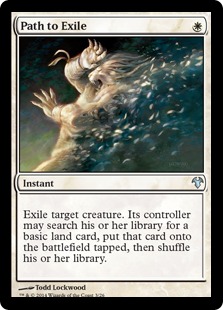
Path to Exile Banner-cropped

But there's more structure to Modern than appears at first glance. There are a ton of decks in Modern, it's true, but nearly all of them can be thought about in the context of more general archetypes. At the end of the day Modern follows the same basic patterns as the rest of Magic, and can be broken into controlling, aggressive and combo-based strategies.

In a format with so much depth these strategies are bound to splinter into innumerable combinations and slight gradations, and certainly there's a lot of nuance when approaching any individual deck with a plan to beat it. But there isn't enough mainboard or sideboard space to just jam one silver bullet against every deck---if we include all the Tier 3 decks from Sheridan's latest Top Decks metagame breakdown, there are 35 different ones to prepare for! In this context it's crucial to craft a broad-strokes game plan for each overarching strategy. Your card choices, both in the main and sideboard, need to be useful against a wide range of specific archetypes.

Today I'm going to break down each of the overarching pillars of Modern and discuss how to exploit their weak points. I'll offer advice on general approaches to beating them, and use my Grixis Delver deck (posted below for reference) for a more concrete example. I'll try to touch on some of the details regarding specific decks, though not exhaustively given the raw volume out there. Here we go!

[wp_ad_camp_1]

Grixis Delver, by Ryan Overturf (5th, SCG Indianapolis, 5/14/2016)

Creatures

4 Delver of Secrets
4 Snapcaster Mage
3 Tasigur, the Golden Fang
1 Gurmag Angler

Instants

1 Pillar of Flame
1 Kolaghan's Command
4 Lightning Bolt
4 Mana Leak
2 Remand
4 Spell Snare
4 Terminate
4 Thought Scour

Sorceries

4 Serum Visions

Lands

2 Island
1 Mountain
1 Swamp
1 Blood Crypt
3 Bloodstained Mire
4 Polluted Delta
4 Scalding Tarn
2 Steam Vents
2 Watery Grave

Sideboard

2 Engineered Explosives
3 Countersquall
1 Dispel
2 Magma Spray
2 Spell Pierce
4 Ancestral Vision
1 Go for the Throat

Control Decks

Here I'm including midrange decks, and this group forms a spectrum from more midrange (Jund) to full-on control (Jeskai Harbinger). What this class of decks share in common is the intention to kill or neutralize most or everything the opponent does. 1_nahiriBGx certainly gets to turn the corner real fast, and sometimes comes out of the gates on the beatdown plan, but it's still largely an answer-based deck that looks to disrupt and control.

There have been many windows when control simply wasn't viable in Modern, though that is not the case currently. From Grixis and Jeskai Ancestral Vision decks, to the aforementioned BGx, to Ghostly Prison/Blood Moon decks and Lantern Control, there are many options available in this camp. I would even consider Grixis Delver to be somewhere on the controlling spectrum, though in a position where it's generally disadvantaged against other controlling blue decks.

When it comes to beating control decks, what you want are resilient win conditions, ways to stop them from burying you in card advantage, and reach to win outside of combat. Things like Bogles can put these decks in a position where their conventional answers look silly, though Grixis is forced to play the game on their terms.

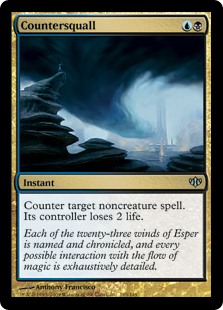
Tasigur, the Golden Fang is the primary reason to play black in Grixis Delver, because it dodges Abrupt Decay and Lightning Bolt (though it does easily succumb to Path to Exile and Terminate). countersquallCountersquall is a huge upgrade in three-game sets against these decks, as it not only enables me to stifle their gameplan, but also provides some reach. Countersquall is a perfect example of a multipurpose tool that earns its sideboard slot over one-dimensional cards like Dragon's Claw.

My build of Grixis Delver makes a major concession to the controlling matchup with Ancestral Vision. I just can't beat an Ancestral Vision deck without being able to board Delver out into something great, and these decks are pretty popular right now. As such, I am currently using four sideboard slots just for these decks. This is a significant commitment of resources, one I wouldn't make if I felt my game one matchup against these decks were close.

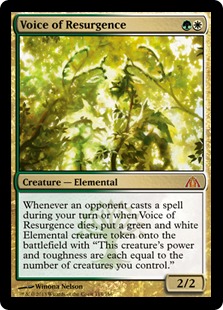
So-called "sticky" creatures also excel against the controlling decks of the format. While Voice of Resurgence doesn't take up as many maindeck slots as it once did, it and Kitchen Finks will force your control opponents to draw specific answers or end up behind on cards. Realistically any creature that generates card advantage will be great in these matchups, and you'll often Voice of Resurgencesee Chord of Calling decks play to Reveillark and Eternal Witness rather than going all-in on the combo in the face of removal spells.

Big Mana Decks

Tron, Valakut, and Eldrazi are the most prominent examples of the big mana decks. While they come in many flavors the principle is the same---these decks go "over the top" of the rest of the Modern format with the biggest, most powerful plays. Given recent printings, these things also frequently end up being more resilient. World Breaker and Ulamog, the Ceaseless Hunger have made trying to interact with these decks nearly impossible, and Valakut, the Molten Pinnacle has always been great at winning longer games when both lands and spells are good topdecks.

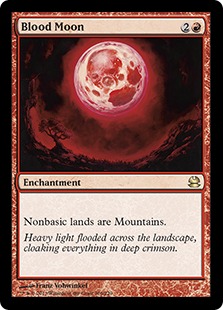
A lot of players gravitate towards Blood Moon for these matchups, though for a narrow haymaker it's surprisingly ineffective. Realistically, outside of quick wins these decks don't struggle against much. Tron can build up to casting Wurmcoil Engine and World Breaker relatively easily unless you're Blood Moonactually destroying lands or winning the game.

Land destruction spells are so narrow, and my deck chooses to focus on the "winning the game" side of things. I have cards that I bring in against these decks to slow them down, like Spell Pierce, though mostly these are the decks that cause me to maindeck Delver of Secrets. These decks can draw out of a lot of bad situations and their end-game tends to be difficult to interact with. The only surefire way to get out alive is to deal them lethal damage. Speed is by far the most important factor battling big mana decks, and if you're casting things like Blighted Agent you don't have to worry about any dedicated slots for these matchups.

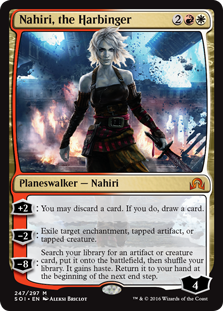
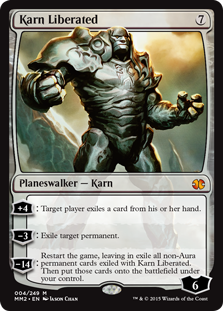
Stony Silence is surprisingly effective against Tron while also hosing Lantern Control and Affinity, though unless your deck is good at killing the other big mana decks or is also weak against the other artifact decks, it may not be what you're looking for. This is actually a spot where Nahiri, the Harbinger has given some slower decks more play, as Nahiri will enable you Karn Liberatedto cheese a game with Emrakul when backed by minor disruption.

You'll often see Crumble to Dust in sideboards, and in decks that also feature more efficient disruption it can be a back-breaker. Just remember that tossing Crumble in your board doesn't solve these matchups on its own. It does cost four, after all, and sometimes you're already getting hit by Primeval Titan or Karn Liberated at that point. It's in these big mana matchups more than anywhere else in Modern where a haymaker realistically won't win you the game, and the coherence of your game plan will be all that matters.

Aggressive Decks

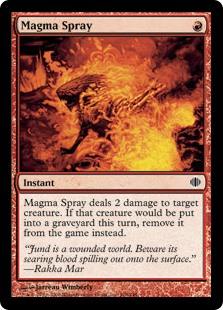
This is easily the broadest category, and there's little overlap when it comes to beating Affinity, Zoo, Burn, Infect, Merfolk, and Bogles. There are ways to cheese a couple of these decks, such as having Ancient Grudge for Affinity or Kor Firewalker for Burn, though this is a group of decks where keeping things as generic as possible gives you the most Magma Sprayequity against the field. The most obvious tools for this purpose are the omnipresent Path to Exile and Lightning Bolt.

Short of Bogles, Magma Spray is a solid card to have against all of these decks. It's primarily in my sideboard because of Voice of Resurgence, but against any of these decks efficiently one-for-oneing them while you set up your gameplan is your best bet. Grixis Delver has enough game against these decks that I don't need any committed slots here, though for the most part you'll want to find a way to make your deck as lean as possible so as not to just get run over. Remember, if you worry too much about just beating Affinity, you may leave yourself with the wrong tools to beat Merfolk. Keep it generic unless one of these archetypes specifically gives you fits.

The one aggressive deck that my 75 makes a specific concession to is Bogles. I would not have Engineered Explosives in my sideboard if not for Slippery Bogle. Even still, I picked a card that has other applications. Something like Self-Inflicted Wound might be the best card just for this matchup, but Explosives can also randomly tag an Ensnaring Bridge or a token army to offer the most overall utility.

DarknessWhen approaching these matchups, you need to identify how much time you need to buy in order to win. For Grixis, you just need to one-for-one them constantly. For a deck like Ad Nauseam, your Angel's Graces will be able to buy you all the time you need, possibly supplemented by some sideboard Darknesses. Timely Reinforcements is another powerful option against many of these decks, though it all comes down to how quickly your deck is able to win and how much you need to disrupt your opponent to accomplish this. For example, Darkness wouldn't make any sense in Grixis as it wins the game slowly and cares about card advantage, and Lightning Bolt wouldn't make any sense in Ad Nauseam as it can leverage Fogs to stay alive just long enough to combo.

Combo Decks

These decks come at you from a lot of different angles: Scapeshift, Abzan Company, Ad Nauseam, Storm, etc. Counters and discard spells will serve as generic answers to most combo decks and your removal for the aggressive decks should be good against Abzan Company, though mostly you'll want to remove your opponent from the game in the same vein as big mana decks.

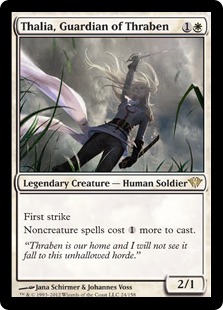
thaliaThe combo decks in Modern attack from too many angles, so unless you're a blue or black deck you won't really have easy ways to adapt. This is one category where you really need to know which combo decks, if any, are bad matchups for you and decide where to commit full sideboard slots. As mentioned above, my Magma Sprays are for Abzan Company, though they conveniently play well against the aggressive decks.

Thalia, Guardian of Thraben is likely the most broad white card for hating on combo decks, though she is typically featured in the maindeck. The green and red options mostly just boil down to killing your opponent before you die to things like Become Immense and burn spells.

On the topic of sideboarding with Burn, you want to make sure you don't go overboard in assessing your matchup against combo decks, or really any deck in the field. The number one way I see red decks lose in Modern is when they draw excessive sideboard cards that don't deal damage to their opponent. The only time you should consider going deep on sideboarding is when you're heavily unfavored to burn them out before they kill you. Otherwise your sideboard cards are going to hurt you more than your opponent.

An anecdote. The other day Merfolk aficionado Corbin Hosler tweeted asking about the rules interaction between Lightning Storm and Kira, Great Glass-Spinner.

Turns out the answer is yes. This is a really awesome way to utilize a sideboard slot to beat both control decks and that one specific combo deck. Finding cards with cross applications like this can be a huge boon.

On Not Beating Everything

There's one matchup for Grixis where I currently shrug my shoulders: the graveyard decks. These fall somewhere on the aggro-to-combo spectrum. I haven't played against the new Dredge lists with Delver yet, but I'm sure they're bad matchups.

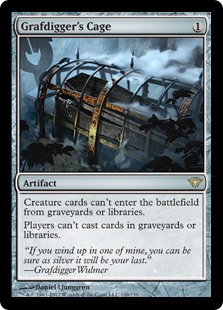
Grafdiggers CageI didn't expect them to be popular in Indianapolis, and given that I had no idea if tossing a couple graveyard hate spells in my sideboard would matter---or if I'd even play against these decks---I just didn't bother. Sometimes you just have to commit to dodging a matchup, and if you don't expect to play against a specific deck there's no reason to specifically target it with your sideboard when the slots are at a premium.

There are some sideboard slots against these decks that apply slightly more broadly. Grafdigger's Cage, for example, is quite good against Collected Company. Relic of Progenitus can also be reasonable against decks with a small number of graveyard uses while also replacing itself. Just be careful not to do something foolish like bring in Rest in Peace against a deck just because it has Snapcaster Mage. I can't tell you how many times my opponents have cast a sideboard card and it felt more like they mulliganed.

There's a lot going on in Modern, and it's unlikely that you'll be prepared for every deck in the format. But with clever building and by thinking of your sideboard as a way to craft gameplans rather than a spot for some generic haymakers, you can be prepared for most of it.

Thanks for reading.

-Ryan Overturf

@RyanOverdrive on Twitter

Fake Day 2 at Grand Prix Minneapolis

Are you a Quiet Speculation member?

If not, now is a perfect time to join up! Our powerful tools, breaking-news analysis, and exclusive Discord channel will make sure you stay up to date and ahead of the curve.

I've been working on a Standard brew for about a month, and after taking it to a top 4 finish of a local even last Saturday, I was pretty excited to take the deck to GP Minneapolis. During the week in-between, I got beat up a lot in matches that I was generally winning before, though my draws were pretty poor and it would be too much work to audible if I wanted to. I would let last minute reps discourage me a lot in my college days, and it only ever resulted in picking up something worse unless I was deeply experienced with the format, and that's just not true for me and Standard right now. I still liked my deck, and I knew I had a fighting chance against anything with a few matchups that were pretty heavily skewed in my favor. This is what I took to the event:

Azorius Eldrazi

Creatures

4 Stratus Dancer
4 Eldrazi Displacer
4 Reflector Mage
4 Eldrazi Skyspawner
4 Thought-Knot Seer
4 Archangel Avacyn

Spells

2 Anticipate
4 Declaration in Stone
4 Gideon, Ally of Zendikar

Lands

4 Prairie Stream
4 Evolving Wilds
4 Shivan Reef
4 Battlefield Forge
1 Yavimaya Coast
1 Foundry of the Consuls
5 Plains
2 Island
1 Wastes

Sideboard

4 Spatial Contortion
4 Negate
2 Scatter to the Winds
1 Silkwrap
1 Tragic Arrogance
2 Drowner of Hope
1 Linvala, the Preserver

The deck is built to abuse Eldrazi Displacer and Archangel Avacyn, and is capable of generating unbeatable draws in any matchup, though the curve does sometimes feel a bit clunky. I don't believe I'd go up to 27 lands, but it seems like I've kept a lot of two landers where I bricked on my third land and just lost. I'd consider subbing a second Foundry of the Consuls for an Anticipate then probably making the Anticipate something else like a maindeck Drowner of Hope, though I haven't experimented with this at all. The Anticipate slot was previously Hedron Crawler, and before that was Knight of the White Orchid, and for weeks has been the only slot that I have consistently been unhappy with.

I haven't accrued many planeswalker points this year, though the byes I "earned" the year before were still in play, so I had two for the event. I think that my deck is actually very good at beating up random decks, though byes are definitely preferred, and they enabled me to grab a decent breakfast, which I very rarely get before an event. I wasn't feeling especially "on" for the tournament, but I was in decent shape.

Round 3 vs. Monowhite Humans

This matchup basically only generates lopsided games, though they go in both directions. In this instance, I was on the receiving end of the beatdowns. Had I drawn an Avacyn in game one I probably would have won, though instead I drew four Skyspawner, which is great unless they have Always Watching. He did, and frankly I needed Avacyn exactly, so losing that game is reasonable. Game two was decided when my opponent had a Stasis Snare for the Avacyn that I did draw, and the game was actually otherwise somewhat close with him dying on four. I didn't respect the possibility of the Snare and don't believe that I could have won by playing differently, though it felt pretty terrible as it happened.

0-2
2-1 overall

Round 4 vs. Boros Eldrazi

I like my deck a lot against the other midrange Eldrazi decks. The red ones get Chandra, which is a very good card, though Reflector Mage and four Avacyn are huge here. I get a little jealous of Secure the Wastes plus Westvale Abbey from these decks, though I actually have a good number of answers to both.

2-0
3-1 overall

Round 5 vs. Esper Dragons

A lot of stuff went wrong in this match. In game one, I'm slightly unfavored, and drawing too many Reflector Mage and Declaration in Stone can just lose the game. The game actually ended up being a drawn out affair, though after I saw an empty hand with a Thought-Knot Seer my opponent draw Ob-Nixilis to kill the Seer into Dragonlord Silumgar which he also had mana to cast that turn... Game two I won very easily, and then in game three I kept a two lander on the draw that was exceptional but I bricked on the third land for several turns.

1-2
3-2 overall

Round 6 vs. Monowhite Humans

This time I got to do the crushing. In game one my opponent got very far ahead, and by that I mean they committed four creatures while I did some chump blocking with some creatures including a Skyspawner. On turn five I cast Avacyn, sacrificed the scion to Plague Wind him, and cleaning up from there was pretty easy. In game two my opponent stalled on one land.

2-0
4-2 overall

Round 7 vs. GW Tokens

If you know your opponent is on tokens, you're often supposed to just play Stratus Dancer face up on turn two to pressure their planeswalkers. Both decks have Avacyn, and you need to mitigate the "oops, I win" factor of their other cards while maintaining the status of your Avacyns as such a card. Play-draw is pretty important game one, and just casting the Dancer after getting a read from their first land can make all the difference. Post-board the Negates are huge, and can break serve against Nissa on the draw. Their deck is just kind of great, though if you play well you mostly only have to worry about getting blown out by Avacyn.

2-0
5-2 overall

Round 8 vs. GW Tokens

My opponent mulligained to five in game two of this match, which definitely helped, though the biggest swing was when I Negated his turn three Nissa when I was on the draw after mulling in game three. Having four Negates in the sideboard looks a little lazy, but they serve their purpose.

2-1
6-2 overall

Round 9 vs. Gruul Ramp

I had a bit of a rocky start, though I would have been happy to come out on top in round nine. Instead, I played against two draws from a Ramp deck that I don't believe I could have realistically beaten. Sometimes these games can be won with some crafty managing of counters, Thought-Knot Seer, and displacing Seer on their draw step. This time, my opponent's draws were just too good to disrupt.

0-2
6-3 overall

Over 400 players made two, and the payout is only to top 64. I was planning on just sleeping in and skipping day two, because starting from 249th place just isn't something that I'm very interested in. The birds were chirping early in the morning though, so I came out to battle. With some good luck I'd be able to win $250, and if I'm up anyway I could always drop if I wasn't feeling it at any point.

Round 10 vs. Bant Company

The nice thing about my deck, is that while it doesn't draw extra card, it does have ways of generating card advantage as well as large tempo swings. It may not look it on paper, though my deck shrugs off Tireless Tracker pretty well, and with the help of Gideon and Avacyn I won game one while my opponent had like, five uncracked clues. In game two I got to put on a clinic with Displacer, Avacyn, and Drowner of Hope. In case that doesn't sound absurd at first blush, it's kind of completely unbeatable. You sacrifice a scion to tap something or make a mana, flip Avacyn on the next turn, when Avacyn flips and triggers to damage creatures you displace her back to make your creatures indestructible, and your opponent can never control small creatures. Further, you can displace your Drowner to perpetually tap down their large creatures.

2-0

7-3 overall

There was an error retrieving a chart for Drowner of Hope

Round 11 vs. Goggles Ramp

I made a mistake in game two that allowed my opponent to resolve Pyromancer's Goggles which was just dumb, though given the cards I drew in games two and three I think I was just going to lose. My opponent wasn't casting anything out of respect for counterspells in game three, and I tried to play into his fear and draw out of the fact that my hand was actually terrible, though I never found anything and just got crushed as soon as he started doing stuff.

1-2
7-4 overall, and dropped

A lot of 11-4s didn't cash this tournament, so dropping here just makes sense if you don't need pro points and aren't feeling playing Standard anymore. The current Grand Prix structure of 6-3s making day two and only paying out to top 64 is flawed in at least one way, though I'm sure you've heard enough griping about this before. I think it's a net positive that players are happy to make day 2 at 6-3, though it's a huge negative that such a small percentage of the day 2 field gets anything. I'm especially unhappy that Eric Hawkins missed cash in 65th place by a .007% tiebreaker. I'm actually pretty happy that I never committed to making it to GP Columbus, even though the opportunity to play Legacy does excite me somewhat.

I like my deck quite a lot, though it could be possible that despite the powerful synergies of my deck it's just a worse choice than the one-dimensional Tokens deck which has more avenues for easy wins. I have definitely been guilty of biasing against such decks in favor of trying to interact more when it was incorrect to do so, though if I had to choose between tokens and my deck I'd just run my deck back.

I think this deck is very good, it has free wins, and it allows you to outplay your opponent. That said, the fact that I have two cards sitting in a slot where everything just feels terrible is problematic. If you want to pick this deck up, I recommend putting in work to fix the Anticipate slot. Other than that I like the deck quite a bit, and if I end up playing and Standard before Eldritch Moon it's likely that this will be my weapon of choice.

Thanks for reading.

-Ryan Overturf
@RyanOverdrive on Twitter

Insider: High Stakes MTGO – May 22nd to May 28th

Are you a Quiet Speculation member?

If not, now is a perfect time to join up! Our powerful tools, breaking-news analysis, and exclusive Discord channel will make sure you stay up to date and ahead of the curve.

Welcome back to another High Stakes MTGO report!

No doubt this past week saw a lot of movements. Not all of them resulted in buys or sales for me but with two GPs featuring Modern Constructed and an entire set spoiled there were a ton of speculative opportunities for MTGO speculators.

The two Modern GPs didn't revolutionize the format but at least proved once again that Modern is constantly evolving with dozens of viable archetypes. Who would have bet on Merfolk and Ad Nauseam for the two winning decks few weeks ago? Modern is a speculator's best friend and any good card will eventually go up in price at some point. I took advantage of the recent price movements and proceeded to sell a few cards while they were profitable. I also tried to keep up with the pace of Modern flashback drafts with the sale of some Lorwyn block positions.

For those who were able to keep up minute by minute with the release of Eternal Masters spoilers, there were certainly a lot of great specs to jump on. As for other full reprint sets such as the Modern Masters series, when a highly played card is confirmed not being in the set its price spiked in no time. The spoilers list of EMA was of interest for all of Modern, Legacy, Vintage and even Pauper.

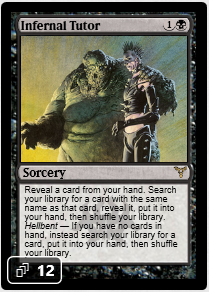
My current life schedule is not exactly compatible with split second reactions to spoilers so I had to rely on my bets prior to this past week. We knew Modern-only staples had only a little chance to be reprinted so I had very few positions exposed to a reprint risk. In the end Chrome Mox is my only loser and Infernal Tutor and Counterbalance my big winners. When I heard about Mox it was too late to sell without a significant loss. Since Chrome Mox is reprinted as a mythic I think I'll be better waiting and, most likely, buying fresh copies during EMA release events. I hit a little bit of luck on the tutor and Counterbalance, as I was actually very close to restocking some Counterbalance when the price dropped back to 8.5 tix on Tuesday with just one card left to be reveal between Control Magic and Daze.

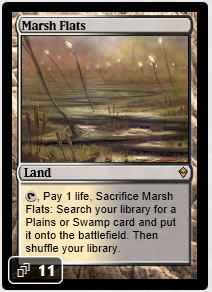
Now, and here luck has little to do with it, several Modern staples benefited from their non-surprising absence from the EMA set. Most of the fetchlands (from Zendikar or Onslaught/Khans of Tarkir), Cavern of Souls, Omniscience, Griselbrand and Inkmoth Nexus are among the cards that have benefited from their absence from EMA, and which should have been bought days or even weeks ago. They are likely to shine during the incoming Legacy events but they are also likely to rebound for Modern purposes.

One last thought related to the price movements due to EMA. Prices have spiked and these initial spikes are mostly due to speculators. Some cards have already dropped a bit and I don't think there's anything to worry about. The demand should be slowly replaced by players and valuable Legacy staples not reprinted in EMA have nowhere to go but up in the short term. This being said I would not try to test the limit of prices past the end of Legacy events at the end of July.

Lets see now how I did this past week. As usual, the live spreadsheet is here.

Buys This Week

LE

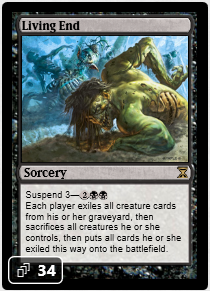
During Time Spiral flashback drafts the price of Living End rapidly dropped below 3 tix before stabilizing around 4 tix and finally climbing to 5 tix. At that point I thought I had missed the good buying window for good and was about to forget about this spec. But the price unexpectedly fell below 4 tix again and I went in for a small pile of 34 copies. At 3.85 tix on average per copy I have much more potential with a card that has reached 10 tix four times in the past ten months.

EoU

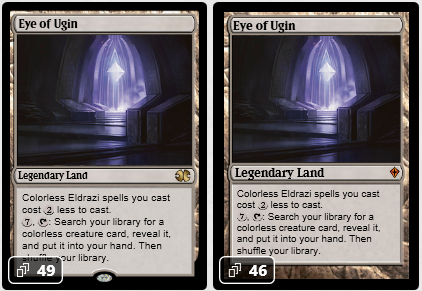
As Matthew Lewis published in the MTGO Market Report this past Wednesday, I was thinking the night before that there might be something to do with Eye of Ugin. Clearly the Eldrazis are able to stomp over Legacy and even Vintage with several copies of the land banned in Modern only a couple months ago. Although 1.9 tix is not really the absolute bottom, the potential is here. Let's try not to be too greedy here but this is a short-term spec that can pay off big.

LF

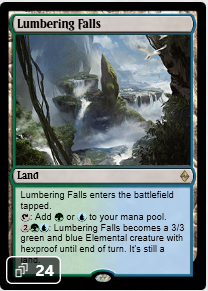
I was chasing this blue-green land from Battle for Zendikar around 0.5 tix. Like a lot of cheap or near-bulk cards, Lumbering Falls oscillates frequently and with a price amplitude equivalent to its own price, between 0.5 and 1 tix in this case. Taking advantage of another dip below the 0.5 tix bar I grabbed six more playsets.

Bg

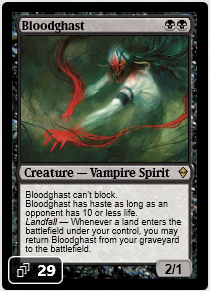
Another decent Modern/Legacy/Vintage card that dodged a reprint in EMA. Bloodghast is played in dredge decks in all of the three eternal formats just mentioned. With recent price heights at 14 tix and 20 tix and with a potential regain in interest trickling down from the release of EMA, I'm betting this vampire could see some gains soon. It's not a slam dunk but it could be an easy 50% profit in only a few weeks.

Sales This Week

Cheating a titan or a flying spaghetti monster into play regained some interest in Modern a few weeks ago. However the hype didn't really last long and the number of Through the Breaches in the top finishers in both GP LA and GP Charlotte was nothing to brag about. Certainly nothing to make me want to hold a spec that was close to doubling. As the card is not a model of price stability the timing was great here. Actually it might almost be time to buy again!

A little round of Modern Masters 2015 sales. Since its release Clique kept oscillating between 15 and 20 tix and never seemed to find a good spot in solid Modern decks. With an expected little dip with Morningtide flashback drafts approaching I thought I would be better with some tix than the actual card.

I had picked up the titans in the wake of the ban of Summer Bloom last January. That was certainly a good entry point for Primeval Titan but finding another home was not easy. With the little resurgence of Titan Shift decks the price bumped two weeks ago to the 8-9 tix price range. That was a good opportunity to close that spec with a respectable 50% gain.

Although the global trend since its MM2 release is up, I never really found the good timing to sell Noble Hierarch. Down to 12 tix at the very end of April, the Hierarch moved up to 18 tix this past week and I decided to use that opportunity to sell my copies of Noble Hierarch.

Another spec that never panned out the way I had hopped for. With Lorwyn flashback drafts in the starting blocks I don't want to be holding cards from flashbacked sets. With a bump slightly under 6 tix a week ago I could not miss this chance to sell this land with minimal losses. See you during again Lorwyn drafts!

This leyline got trendy lately. Leyline of the Void might do more but as it was approaching the 5 tix my target price was met so I saw no reason not to take my profit and moved on. Despite a slight regain of interest for Dredge decks (which may have caused this little price hike recently) and a potential additional demand from Legacy/Vintage in the coming weeks I'm inclined to let specs that are rather metagame dependent go before they cycle down without notice.

PZ1 packs

My stock is almost gone here. Another week and another round of sales for the Legendary Cube Prize Packs.

These ones too are regulars in my selling department and I'm far from being done except for Caves of Koilos. The painlands are not increasing as much as I wanted but the demand is still constant, which is rather fortunate considering the stock I have to liquidate.

I should have certainly sold these guys before Shadows over Innistrad release although I was not in a rush with this near-bulk spec. The big plunge that occurred earlier this month reminded me that any potential profit can totally collapse in a matter of days. Luckily the Ad Nauseam winning deck from GP Charlotte played a full playset of this temple and most likely caused the recent spike over 1 tix. I still have some copies to sell but I didn't let this spike go without selling two thirds of my stock.

I had bet that the red-black command would keep cycling up next when I bought it. Missed. With not enough demand from Standard notably this card is clearly heading down with its rotation only four months away. Selling now with some losses seemed more appropriate than selling later with even more losses.

On My Radar

As mentioned in the introduction EMA shook a lot of things around. Speculators went full throttle into anything and everything leaving a lot of cards with a double-digit percentage growth this past week. Now that the storm of speculators has passed we'll see where the real demand is situated and if players actually want to play Legacy.

We know that if an increased demand for Legacy staples really exists we should see it materializing withing a month of the Legacy Festival events, so we have our selling window. Legacy staples that are also Modern staples, such as the ZEN fetchlands, could see prices sustaining after July. Nonetheless selling into hype is always a good idea and here again this is what I intend to do. Cards such as Counterbalance and Infernal Tutor could see new record highs but consistent with my speculating philosophy I'm not in the business of breaking new price records with my specs. This whole EMA craze created a perfect storm to generate great profit in few weeks from good specs that would have otherwise taken months to get there.

For the next few weeks with all of my specs concerned by the recent events I'll try to be extra vigilant about price movements. Misty Rainforest for instance is about to top its 18-month price ceiling around 29 Tix. I'm certainly not going to wait and see if this fetchland can match its pre-KTK price in the 50s and I'll actually be considering selling my rainforests sooner rather than later. Selling positions like this sooner also allow my tix to rotate toward discounted cards opened during EMA release events.


Thank you for reading,

Sylvain

Insider: Hot Modern Picks with Taking Turns

Are you a Quiet Speculation member?

If not, now is a perfect time to join up! Our powerful tools, breaking-news analysis, and exclusive Discord channel will make sure you stay up to date and ahead of the curve.

First, Modern got a jolt of excitement in the dual Eye of Ugin ban and Ancestral Vision / Sword of the Meek unban. Next, Modern developed one of the most diverse and open metagames in years, culminating in a Grand Prix weekend packed with new technology and comeback stories alike. What's next for Modern in such an exciting and dynamic year?

Sadly, what's next is an off-season spanning from last weekend through the late-August Grand Prix weekend, with only a pair of Star City Games Opens in between. Just when things were getting good again!

New and old in 2016 Modern

Although I'm as disappointed as you are with the lack of major Modern events in the next few months, I'm also looking forward to an off-season that will let players experiment with new cards, sharpen existing builds, and finish building their deck-of-choice. It's a particularly good time for those in the latter category: card prices tend to retreat during the off-season, which gives Modern veterans and newcomers space to pick up missing staples.

Modern finance changes dramatically during the off-season. With fewer high-profile events, performance- and hype-based spikes are significantly less common. Players also switch decks during this time period, converting old product into cash for new strategies (or just to fund a relaxing summer vacation). Add in the lack of Magic media coverage surrounding Modern, and you have an environment where markets are more stable, prices are lower, and opportunities for profit are riper.

In today's article, I'm looking at a low-tier Modern deck with a cult following and some Tier 2 potential: Taking Turns.

We'll think about some of the bigshot staples like Kolaghan's Command and Collected Company next week (both look to drop as the current Standard rotation winds to a close this summer), but for now, it's time to dig deep for more Modern gems. Whether you're looking to make some money this off-season or just get into a cool new strategy, Taking Turns and its staples are ready and waiting.

Taking Turns Overview

Mono-colored decks aren't really a thing in Modern. Even the archetypically red Burn has branched into Naya or Mardu for an added edge. Similarly, the traditional "Draw-Go" style of blue-based control has also been largely absent from Modern, with the proactive URx Twin hogging the spotlight for years and Jeskai Nahiri picking up slack in recent weeks courtesy of Emrakul, the Aeons Torn.

As is often the case, Modern often has an exception to every pattern and today's exception is Taking Turns.

Taking Turns to victory

Taking Turns, aka "Extra Turns," "Time Walk," and "Holy-Crap-You're-Maindecking-Elixer of Immortality?" is a mono-blue deck with an engine combo finish. Using Howling Mine effects to fill its hand and Cryptic Command-style defenses to stay alive, Taking Turns locks down the game before stringing together Time Warp effects to draw into a win condition and lock the opponent out of taking their own turn again.

Jace Beleren is the customary win condition, but other pilots have splashed colors and other elements to personalize the strategy. The MTG Salvation forums are home to the oldest and most active Taking Turns primer online, and you can browse the first page for all the strategy, history, and variations you need to get started on the strategy.

There was an error retrieving a chart for Jace Beleren

Although Taking Turns hasn't enjoyed the same kind of top-tier or even Tier 3 success as many other Modern decks (even U/R Storm has more results), it's put up a few impressive finishes in the past month. This has included Mcrae Hott, whose list won a pre-Charlotte Grand Prix Trial just last weekend, and Russ Jeffey, who earned Top 8 honors at the popular and expertly-covered Face to Face Open Series in Toronto.

Between Jeskai Nahiri, Grixis, and blue-based Scapeshift, Modern control is undergoing a renaissance even brighter than the post-Kolaghan's Command and Tasigur, the Golden Fang months of Summer 2015. Taking Turns is poised to capitalize on this momentum and break into the more competitive Modern levels.

Next, we'll talk about the deck's overall positioning and format potential before moving into its financial prospects. I'm always leery of investing into hype-traps, so when betting on a relative Modern unknown like Taking Turns, it's prudent to have an understanding of the strategy's metagame context before opening up your wallets.

Taking Turns Positioning

There's a common misconception in Modern that a deck needs to be a Tier 1, Grand Prix and SCG Open regular for a deck to be worth playing. That's a metagame statistics misreading. For one, most players don't do Modern events at this level: they play at Friday Night Magic, SCG Invitational Qualifiers, weekend Modern at a local game store, or some other smaller, regional offering. Almost any deck can succeed in this context, so don't worry about playing a Tier 1 choice instead of a Tier 2 or 3 one.

Second, and more importantly, Tier 2 decks regularly take down major events. Just look at the recent Grand Prix for an example, with solidly Tier 2 Merfolk and Ad Nauseam winning both. Tier 2 decks have serious legs in Modern, and many of our current Tier 3 decks were in Tier 2 at one point or another: see Bogles, Naya Company, Grishoalbrand, Living End, and more.

Tier 2 and Tier 3 Modern mainstays

Overall, just because a deck isn't Jund, Affinity, or the other big names, doesn't mean the deck isn't a major power. Enter Taking Turns, which I believe has everything it needs to make it to Tier 2 in the future. It won't be a BGx Midrange or even a Jeskai Control, but it has potential to land comfortably in Tier 2.

Taking Turns is at its best in metagames where linear aggro players aren't all playing Burn and where grindier decks are trying to stave off unfair turn three decks and prepare for a midrange slugfest. Gruul Zoo, Affinity, Infect, and other aggressive strategies have divided up the Burn players, which were already struggling against increased Abzan Company and Jeskai shares to begin with. As Burn keeps dropping, Taking Turns can capitalize in a metagame where reciprocal Howling Mine effects don't fuel a spell-based clock.

There was an error retrieving a chart for Howling Mine

Burn also didn't do a great job at the Grand Prix, converting 0% of its Day 2 share into the Top 16 of either event. This further points to some underlying Burn weakness that Taking Turns can capitalize on.

If Burn's absence is a lowered barrier to Taking Turns' success, the uptick in fair decks is an added enabler to incentivize the strategy. Jeskai Control, Jund, blue-based Scapeshift, the slower Bant and R/G Eldrazi, and a variety of other strategies have all built names for themselves in fair contests. They pack the removal and interaction needed to beat unfair decks early, and the grinding clocks and engines to win later. Taking Turns can freely ignore both.

Tarmogoyf and Reality Smasher? Meet Gigadrowse. Removal? Meet zero creatures. Taking Turns' ability to blank Modern's abundance of Lightning Bolts and other economical removal staples is particularly strong in this removal-clogged metagame (where even Tron runs Bolt!). The legendary Lantern Control strategy which Zac Elsik piloted at 2015's GP Oklahoma City, leveraged a similar strength in its race to the gold.

There was an error retrieving a chart for Gigadrowse

In addition to these contextual strengths, Taking Turns also relies on a decidedly proactive gameplan, which has always been a key prerequisite for success in most Modern strategies. It meets the Modern speed requirements, comboing out about when Scapeshift can make it, but notably benefits from lack of exposure. Few players recognize the deck and even fewer would understand how to beat it, which is the exact combination decks like Lantern and Ad Nauseam rode to victory at past Grand Prix.

Taken together, all these stars align to suggest a potential opening for Taking Turns to fill. At best, it's a regular Tier 2 run. At worst, it could take the form of alternating Tier 2 and Tier 3 status like decks such as the Delver decks. Either way, a successful Taking Turns presents considerable opportunity to control players and investors alike. We'll now turn to the staples you'll want to scope out sooner rather than later.

Picking and Buying in Taking Turns

Because Taking Turns contains so many underappreciated and underutilized cards, almost anything in the deck is ripe for the picking. Want to play the deck? Get it now while it's reasonable. Want to make money from it? Same advice.

Most cards in the deck are very unlikely to see reprinting in the near future, and even if the deck's Tier 2 odds don't pan out, all of its cards are likely to rise just a little with time alone. Of course, a Tier 2 success would rocket these into the financial stratosphere, so it's a win-win either way.

Where better to start the Taking Turns investments than the Time Walk family members themselves.

There was an error retrieving a chart for Time Warp

Despite a few printings, the Tempest favorite of Time Warp retains a healthy $15-$18 price range due to its Casual and Commander appeal. It's also one of the few Modern-legal cards currently pushing the $15+ range while also seeing basically zero high-profile Modern play (Taking Turns is hardly a household name).

All of this could easily push Warp into Glimpse the Unthinkable territory, another Casual favorite with minimal Modern applicability. There isn't a Taking Turns version not rocking a Warp playset, so it's a key starting point for any investor gambling on the deck.

All the different Modern Warp effects have potential upside after a Taking Turns success, but few moreso than the single-printing mythic rare of Temporal Mastery.

There was an error retrieving a chart for Temporal Mastery

At just around $9, Masteries could easily launch beyond Craterhoof Behemoth levels off a major success. As with most breakout performances, the early post-hype spike rarely matches the final resting place, but a mythic like Mastery could easily double or even triple your profits if you got out at the right time.

Just like Taking Turns is incapable of playing the Power Nine standout Time Walk, so too can the control deck not enjoy iconic Counterspell. Or rather, most control decks can't but Taking Turns basically can.

There was an error retrieving a chart for Delay

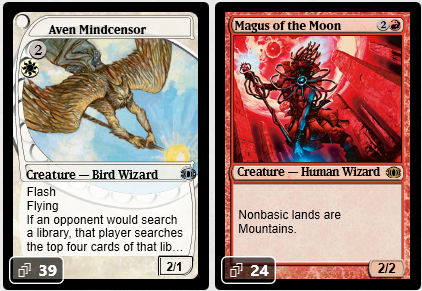
The $2-$3 Future Sight uncommon does a strong Counterspell imitation in a deck that never lets opponents enjoy three upkeeps, which makes it an indispensable part of the strategy and a great pickup. Future Sight cards have a storied record of breaking financial records (see Modern Masters poster-child) Tarmogoyf), and even the uncommons like Dryad Arbor, Aven Mindcensor, and Tolaria West all command prices ranging from $5 to $15 or higher.

Delay is not the kind of attractive speculation target that explodes from $2 to $20 overnight, but a Taking Turns win could quickly see you double your investment. Don't delay on this one if you see the deck start to move.

Although all these cards are great investment targets, any of the Tsaking Turns staples look great and make great money in foil. Think foil Time Warp is pricey at $30 in its Magic 2010 printing? Wait until Taking Turns makes it to a Grand Prix Top 8. Same goes for the relatively cheap $10 Walk the Aeons from the appropriatley-named Time Spiral.

There was an error retrieving a chart for Walk the Aeons

If you're a player interested in trying out the strategy, you can get the entire list for between $250 and $350 depending on what list you run (or more if you're keen on Snapcaster Mages). If you're an investor, that same $250 to $350 could get you a healthy stock of Taking Turns staples to make money on the deck's possible success.

Next week, we'll think of some more mainstream Modern staples to scope out in the off-season, but as I wrap up the end-of-month metagame calculations and get ready for the summer, I'm always tempted to write on these under-the-radar strategies. Taking Turns has the trappings of a Tier 2 pedigree, and I'm hoping we see it soon in Modern's unprecedentedly diverse environment.

Thanks for joining us today as we explored this exciting and time-honored Modern strategy just waiting for its moment in the spotlight. Let me know in the comments if you have any questions about the deck, its cards, or Modern generally, and I'll see you all soon.




Forget-Me-Knots: Eldrazi in an Eyeless World

Are you a Quiet Speculation member?

If not, now is a perfect time to join up! Our powerful tools, breaking-news analysis, and exclusive Discord channel will make sure you stay up to date and ahead of the curve.

Someone who was maybe Ghandi once said, "An eye for an eye leaves the whole world blind." If Modern were a person, it would probably ascribe to this inspiring motto. When Wizards of the Coast took Modern's Eye, the format repaid them with a beautiful metagame they're happy to take credit for. The story doesn't end there, and neither does this desperate analogy; after all, blind men can still speak. And walk. And... CRUNCH!

World Breaker art crop

Eldrazi might be disfigured, but it's far from dead. In today's article, we'll consider the effects bannings have on archetype diversity, review Eldrazi's format history, and examine where our pal Thought-Knot Seer is headed in the next few months.

[wp_ad_camp_1]

Card Pool and Power Level

As they move into older non-rotating formats, players often find that despite great increases in card pool size, fewer cards become playable. Did your Standard deck last season play Wild Slash or Lightning Strike? Such limited formats often force deckbuilders to make painful decisions. In Modern, we can just sleeve up the strictly better Lightning Bolt and call it a day. Another example: Modern is shaped by the relative power of midrange fatties. Legacy, a much faster format, doesn't usually accommodate Siege Rhino. In Vintage, an even smaller amount of legal cards see regular play.

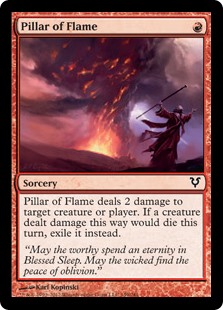
Pillar of FlameBanning powerful cards shrinks a format's playable card pool, and generally has positive effects on diversity. If Lightning Bolt were banned from Modern today, players would dust off their Pillar of Flames, Flame Slashes, and Tarfires. That doesn't mean a Bolt ban is good for Modern; it just means that previous under-performers get a chance to shine when a format's card pool gets smaller.
Taking this theory one step further, archetypes also get more diverse with bannings. Although some bans can render archetypes unplayable (see: Hypergenesis), others merely create the space for splintered versions of the old archetype to thrive. In the wake of the Splinter Twin ban, many blue midrange decks began popping up, including Grixis Control and most recently Jeskai Harbinger. After the Treasure Cruise ban, Delver of Secrets lovers broke off into cliques championing either Grixis, Temur, or UR. This push towards archetype diversity is one of the intended effects of bannings in Modern.

Eldrazi History X

Eldrazi's history supports this theory. With Eye of Ugin legal, the deck rapidly evolved into its optimal build---UW Aggro. With Eye gone, the deck's pieces are finding homes across Modern's archetype spectrum. Here's a brief overview of the archetype's metamorphoses while Eye of Ugin ran rampant.

Phase One: Bx Processors

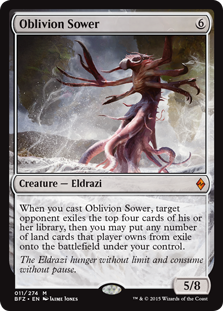
Oblivion SowerThe first wave of Eldrazi decks made its rounds in Modern after Battle for Zendikar's release. The expansion was panned by players and Modern Nexus writers alike, but it wasn't long before Eldrazi Temple and Eye of Ugin were discovered to play very nicely with the new, cheaper Eldrazi.
Phase Two: Eldrazi Stompy

At Pro Tour Oath of the Gatewatch, Team Channel Fireball and Team Face to Face collaborated on what went down in history as the deck that would go on to ruin Modern. Despite only boasting 8% overall representation, the Eldrazi deck yielded a completely colorless Top 8, with just two Affinity pilots left defending the Gatewatch from Kozilek's brood. Team East West Bowl's UR Eldrazi deck ended up securing the trophy, but this event will forever be remembered for the nightmarish consistency of Eldrazi Stompy's turn-one Chalices.

Phase Three: UW Eldrazi

Star City Games' Louisville Open some weeks later saw the deck take its final form. The hyper-aggressive UW Eldrazi deck was perfectly optimized. It terrorized Modern through the subsequent triple GP weekend and promptly got Eye of Ugin banned.

Kozilek's Return

In terms of diversity, that Eye ban worked wonders for both Modern and the Eldrazi archetype. Last weekend gave us a pair of tremendously dynamic GPs, each with a few flavors of Eldrazi sprinkled among the top seats. Bravo, Wizards! Here are Modern's currently viable Eldrazi strategies as I see them.

Aggro: Bant Eldrazi

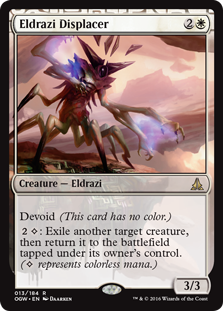
I consider Bant Eldrazi the natural evolution of UW. Even in terms of card choices, the deck looks extremely similar to its predecessor. Bant splashes green for some extra acceleration, running Noble Hierarch and Birds of Paradise to power out turn-two Thought-Knot Seers like in the good ol' days. It also runs UW's going-long combo of Eldrazi Displacer and Drowner of Hope. The deck is highly streamlined, and unlikely to change drastically in the coming months.

Tempo: Eldrazi Hatebears

Eldrazi DisplacerAlso known as Eldrazi & Taxes, Eldrazi Hatebears splashes spaghetti monsters into the Wx Aether Vial/Leonin Arbiter deck. Who'd have thought we'd ever see a fish strategy cast Reality Smasher?

"El Drizzly Bears" might not have been viable with Eye of Ugin shoving all Eldrazi strategies towards the maximally efficient UW machine, but in today's Modern Eldrazi Temple finally gives players a convincing reason to play the historically fringe Death & Taxes. Until recently, the deck could never dream of swinging with nine power on turn three while disrupting opponents. The Eldrazi package offers this enticing possibility to any deck willing to play colorless-producing lands.

Ramp: GR Eldrazi

GR Eldrazi was around when Eye of Ugin was legal, and the late-game versatility of World Breaker kept it in the game. This variant ramps up to seven mana with Talisman of Impulse or Mind Stone, and finishes the game with a horde of beefier Eldrazi. Eldrazi Ramp strategies sit somewhere between Eldrazi Midrange and UrzaTron on the archetype spectrum, usually going bigger faster than fetch-shock midrange decks until the very late game. (In my experience, interactive lynchpins like Jund and Jeskai can take over that late game with cards like Dark Confidant and Sphinx's Revelation.)

Midrange: TarmoDrazi

A few weeks ago, I unveiled TarmoDrazi, an interaction-heavy midrange deck with 12 cantrips, various Lightning Bolts, and of course, king-size Lhurgoyfs. I've since improved on the original build, cutting Serum Powder entirely (commenters: you were right!) and integrating a set of Mishra's Bauble to make Traverse the Ulvenwald into a reliable Sylvan Scrying early on.

Here's what the deck looks like now:

TarmoDrazi, by Jordan Boisvert

Creatures

4 Tarmogoyf
4 Matter Reshaper
4 Thought-Knot Seer
4 Reality Smasher
1 World Breaker

Artifacts

4 Mishra's Bauble

Enchantments

4 Oath of Nissa

Instants

4 Lightning Bolt
2 Tarfire

Sorceries

4 Traverse the Ulvenwald
4 Ancient Stirrings

Lands

4 Eldrazi Temple
4 Wooded Foothills
3 Windswept Heath
2 Stomping Ground
2 Ghost Quarter
1 Sea Gate Wreckage
1 Cavern of Souls
2 Forest
1 Mountain
1 Wastes

Sideboard

3 Kozilek's Return
1 Grafdigger's Cage
2 Pithing Needle
2 Ancient Grudge
1 Spellskite
2 Dismember
1 Choke
1 Reclamation Sage
1 Kozilek, the Great Distortion
1 Magus of the Moon

One thing you'll notice about this deck: it's not established. The list is still changing, and nobody's put up any results with it. I think there's plenty of room for brewers to fiddle around with Eldrazi Midrange variants until an optimal build is found, if one ever is. Other midrange decks like Blue Tron have integrated some Eldrazi components successfully, and the journey doesn't stop there.

Lately, I've turned my attention away from TarmoDrazi to check out the much-talked-about Nahiri hype-train for myself. And I don't mean by breaking out my Snapcaster Mages. Once you go Thought-Knot, you never go back.

Emrakul? In My Eldrazi Deck?

It's more likely than you think. Nine out of ten pro players agree: you're not really winning in Modern unless you're flavor-winning. What better way to succeed on that front than to act out Wizards' Shadows over Innistrad storyline in real-time for your captivated opponent?

Eldrazi Harbinger, by Jordan Boisvert

Planeswalkers

4 Nahiri, the Harbinger

Creatures

4 Tarmogoyf
4 Matter Reshaper
4 Thought-Knot Seer
4 Reality Smasher
1 World Breaker
1 Emrakul, the Aeons Torn

Enchantments

4 Oath of Nissa

Instants

4 Lightning Bolt
4 Path to Exile

Sorceries

4 Ancient Stirrings

Lands

4 Eldrazi Temple
4 Wooded Foothills
4 Windswept Heath
2 Stomping Ground
1 Sacred Foundry
1 Temple Garden
1 Sea Gate Wreckage
2 Forest
1 Mountain
1 Plains
1 Wastes

Sideboard

3 Kozilek's Return
2 Pithing Needle
2 Ancient Grudge
1 Spellskite
2 Dismember
2 Choke
1 Reclamation Sage
1 Stony Silence
1 World Breaker

We've seen Nahiri be phenomenal in a midrange shell. She removes problematic permanents (I sniped a Worship this afternoon), slows down assaults by exiling creatures, loots through lands to find business, attracts opposing resources, and rapidly ticks up to a (generally) game-breaking swing. But I also think Nahiri can be great in a more creature-centric deck than Jeskai Harbinger. She's great on an empty board, but even better on a favorable one.

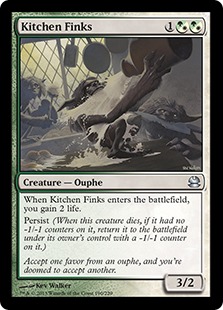
Kitchen FinksEven before last weekend, Nahiri made a splash in Modern Kiki-Chord. Fatties like Tarmogoyf, or even career blockers like Kitchen Finks and Wall of Roots, do a great job of playing bodyguard for the planeswalker. The Eldrazi fit this bill nicely, while also turning sideways themselves. If opponents want to attack our unprotected Nahiri, they leave themselves open to another hit from Reality Smasher.

In this deck, Nahiri provides an elegant answer to Blood Moon, which can cripple our manabase. All we need to do to ensure protection from the enchantment is fetch up a Plains. Or even a Forest---resolving Oath of Nissa (and seriously, who wants to destroy Oath of Nissa?) lets us land Nahiri worry-free with a bunch of Mountains.

Lastly, I want to touch on the importance of Nahiri's ultimate. In a deck full of Reality Smashers, it's tempting to cut Emrakul altogether. But her very presence makes Nahiri much better, even when she isn't counting on summoning her. Knowing that Emrakul is in our deck, opponents will do everything in their power to keep us from untapping with eight or more loyalty counters on Nahiri. She puts enormous strain on players to commit resources to dealing with her when they have other problems on their plate. You know, Reality Smasher problems. And sometimes, Reality Smasher won't be good enough. (And sometimes, your opponent has Manic Scribe.)

So there's the idea behind this deck, in a nutshell. The other reason to play Eldrazi Harbinger is that it plays so many tried-and-true Modern all-stars.

The Best Removal

Path to ExileBGx, the face of Modern's interactive alliance, has long altered between one of two strains: Jund, which splashes red for Lightning Bolt, and Abzan, which goes into white for Path to Exile. Granted, there are other reasons to consider red or white in BGx, among them Terminate, Siege Rhino, and Lingering Souls. But I think the strength of these decks relies on their ability to play one of the two most-played spells in Modern.
Bolt and Path kill creatures more efficiently than anything else the format has to offer, and Nahiri, the Harbinger happens to incorporate both spells' colors into her casting cost. That means just about any deck running Nahiri should run the full eight removal spells, especially in a format as creature-dominated as Modern. Eldrazi Harbinger is no exception.

The Best Eldrazi

UW and Bant Eldrazi have a high threat density, allowing them to drop creatures almost every turn of the game. That's par for the course in an aggro deck. Midrange strategies generally play fewer creatures to bulk up on disruption, be it Bolt and Abrupt Decay or Path and Mana Leak. What that means for Eldrazi Midrange decks is we need to play the best of breed, and nothing else. I've been very happy with a core of Matter Reshaper, Thought-Knot Seer, Reality Smasher, and Tarmogoyf in these decks, and I've re-employed that core for Eldrazi Harbinger.

The (Second) Best Selection

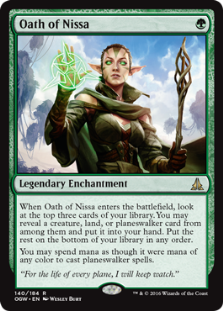
Oath of NissaJust as Jeskai Harbinger runs a set of Serum Visions to grease the gears, Eldrazi Harbinger packs some cantrips of its own. TarmoDrazi went to great lengths to abuse Traverse the Ulvenwald package, which dominated midrange mirrors but underperformed against linear decks.
Lacking the space necessary to enable it, I cut that cantrip in this build, but kept Oath of Nissa and Ancient Stirrings. The former finds Eldrazi Temple, any of our threats, and Nahiri herself; the latter excels at fixing our mana and finding colorless bullets like Pithing Needle and Kozilek's Return from the sideboard.

(Not) the Best Mana

To play all those sweet Eldrazi, removal spells, and cantrips, our manabase unfortunately suffers from minor consistency issues. Oath of Nissa and Ancient Stirrings pull a ton of weight when it comes to finding the right mix of lands, but some dreamy double-Temple hands can lack the green source needed to cast them.

Since those are double-Temple hands, missing green shouldn't prove too much of an issue. I've found I often need to choose either red or white to supplement my green early on, and sometimes don't find the other color for a few turns. A mix of removal spells, then, isn't what we want in an early-game hand. I don't consider this too troublesome---we search for red if we have Bolt in hand, or for white when we have Path. Sometimes, colors aren't an issue at all, as we naturally draw or open multiple colored lands. Our occasional inability to hit RW also doesn't affect Nahiri much, since Oath of Nissa's "hidden mode" lets us cast the planeswalker off any four lands. But should the problem grow in seriousness, options like Rugged Prairie exist to lighten the load.

An Exciting Future

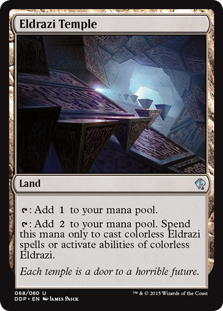
Eldrazi TempleThe Eldrazi might not have the Tier 0 representation of their heyday, but the archetype has never been more alive, at least in the protean sense of the word. Modern is all but guaranteed to see interesting evolutions of Eldrazi Midrange in the coming months, as well as a sustained Bant Eldrazi presence and the continued existence of GR Eldrazi Ramp.

You can quote me on all of that. Unfortunately, I also can't promise this section's header will be the last of my series of predictable puns on Eldrazi Temple's hilarious flavor text.

Jordan Boisvert

Jordan is Assistant Director of Content at Quiet Speculation and a longtime contributor to Modern Nexus. Best known for his innovations in Temur Delver and Colorless Eldrazi, Jordan favors highly reversible aggro-control decks and is always striving to embrace his biases when playing or brewing.

View More By Jordan Boisvert

Posted in Brewing, Modern, TechTagged , , , , 18 Comments on Forget-Me-Knots: Eldrazi in an Eyeless World

Have you joined the Quiet Speculation Discord?

If you haven't, you're leaving value on the table! Join our community of experts, enthusiasts, entertainers, and educators and enjoy exclusive podcasts, questions asked and answered, trades, sales, and everything else Discord has to offer.

Want to create content with Quiet Speculation?

All you need to succeed is a passion for Magic: The Gathering, and the ability to write coherently. Share your knowledge of MTG and how you leverage it to win games, get value from your cards – or even turn a profit.

Winter Orb Errata

Are you a Quiet Speculation member?

If not, now is a perfect time to join up! Our powerful tools, breaking-news analysis, and exclusive Discord channel will make sure you stay up to date and ahead of the curve.

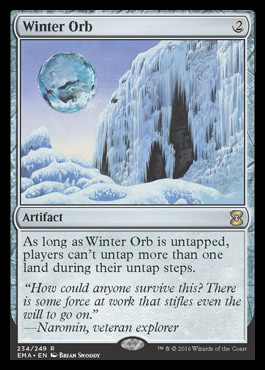
With Eternal Masters being a set designed with nostalgia in mind, a decision was made to change the functionality of one of the cards. Rather, to change back that functionality. Once upon a time, years before I would crack my first pack, there was something called a "continuous artifact", which meant that the artifact didn't do what it does when tapped. If you look at the Alpha printing of Winter Orb, you'll note that it was one such continuous artifact. With the removal of this line of text, the functionality of Winter Orb changed, and leading up to Eternal Masters the card just "worked" regardless of whether it was tapped or not.

As of the EMA printing, Winter Orb will now have the additional text "As long as Winter Orb is untapped..." This means that if you're able to tap the Orb on your opponent's turn that all of your lands will untap while their's will be restricted.

Winter Orb isn't currently Modern legal, and it's been a minute since you'd want it in your Legacy deck, though this errata could have some Commander applications. Surely there are still plenty of griefer Commander players, and I imagine some of them play decks that would benefit from a Winter Orb that only impacted the rest of the table. While the Orb itself isn't a great speculation target given that it's about to be reprinted, cards that fit into such a deck could be solid pickups right now.

I'm the wrong person to ask about Commander, though I happened upon a Reddit thread where somebody suggested Ring of Gix as a pickup in light of this errata. The card is not what I'd call good, and the application is niche, though I can think of worse ways to spend a couple bucks than on a handful of bulk rares that are on the Reserve List. You'll get better returns than a lottery ticket, anyway.

Avatar photo

Ryan Overturf

Ryan has been playing Magic since Legions and playing competitively since Lorwyn. While he fancies himself a Legacy specialist, you'll always find him with strong opinions on every constructed format.

View More By Ryan Overturf

Posted in FreeTagged , 13 Comments on Winter Orb Errata

Have you joined the Quiet Speculation Discord?

If you haven't, you're leaving value on the table! Join our community of experts, enthusiasts, entertainers, and educators and enjoy exclusive podcasts, questions asked and answered, trades, sales, and everything else Discord has to offer.

Want to create content with Quiet Speculation?

All you need to succeed is a passion for Magic: The Gathering, and the ability to write coherently. Share your knowledge of MTG and how you leverage it to win games, get value from your cards – or even turn a profit.

High Stakes MTGO – May 15th to May 21st

Are you a Quiet Speculation member?

If not, now is a perfect time to join up! Our powerful tools, breaking-news analysis, and exclusive Discord channel will make sure you stay up to date and ahead of the curve.

Welcome back for another High Stakes MTGO article!

This week in speculation was a very predictable one. I reinforced my positions on several Standard and Modern specs and tried to take advantage of the flashback draft of the moment---Time Spiral block---to secure good speculative candidates.

With the Legacy Festival and the release of Eternal Masters coming up I also tried to look for "easy" profitable specs. This is not an easy task since just about everything not on the Reserved List can be reprinted in EMA, and many of the cards on the RL don't have great speculative appeal. With all these parameters to satisfy, Infernal Tutor was the only target I found reasonable.

No more Modern Pro Tour, but the format is still very hot and dynamic. Decks and prices are constantly evolving which is great for both players and speculators. As you can see, Modern is a big part of my portfolio and selling whenever the opportunity arises is essential.

Even top Modern staples such as Grove of the Burnwillows, Celestial Colonnade, Scapeshift and Voice of Resurgence keep fluctuating, with price variations of up to 100% that can be exploited for profit. On average, a 50% gain is my goal and I seriously consider selling any spec that reaches that limit. This weekend's dual Modern GPs will certainly create several selling opportunities speculators may want to take advantage of.

The snapshot of the portfolio as of last Saturday is here.

Buys This Week

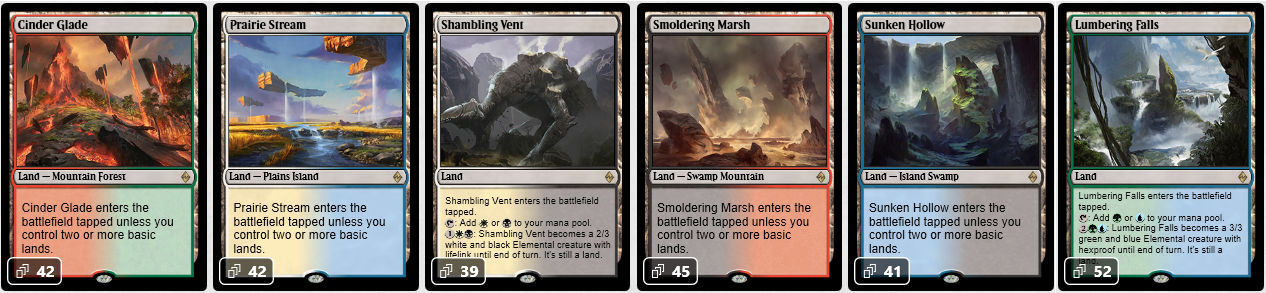
BFZlands

Following the logic from my recent articles, I increased my stock on several of these lands. Any change in the metagame, or new set release, is an opportunity for different color combinations to come in vogue and demand on lands to increase. With two Standard rotations per year, this process will be accelerated.

Battle for Zendikar is not being massively opened anymore and supplies should remain stable while demand only grows from now on. Doubling up is my goal with these lands and I’m ready to sell anytime, whether next week or next year.

LoATR

These bets coincide with the end of Time Spiral flashback drafts in two days. All three picks have the potential to double or more from my buying prices.

I’m counting on the hype around Legacy and Eternal Masters to see Lord of Atlantis rising in price very soon. You can see that I accidentally bought a playset of the promo version. Hopefully the buying and selling prices of the two versions will evolve closely without the bigger spread sometimes observed with promos.

IT

As mentioned above, the one opportunity I found to benefit from the Legacy Festival was Infernal Tutor. It's a good fit essentially because of its price tag. With only 12 copies, a minimal 25-30% price increase would be enough to generate ~120 tix of profit.

MF

About two months ago I bought 22 copies of Marsh Flats, averaging 12.5 tix per copy. I decided to reload on extra copies of the fetchland when it fell further to a six-month floor at 10 tix. Without a strong reprint (which I don't expect in EMA), the ZEN fetchlands will always be in demand. The ceiling on Marsh Flats is above 20 tix---plenty of room to grow.

AMMotM

Two Future Sight cards that dipped a bit thanks to flashback drafts. They show up from time to time in Modern decks and when they do the price inevitably rises. They are currently (or at least when I bought them) sitting at their respective long-term floors so the risk is pretty low here. If their price drops further this week I’ll be buying more copies.

Sales This Week

Following Golgari Grave-Troll last week, Vengevine is another of my positions that benefited from the momentary resurgence of Dredge decks in Modern. The spike as not really pronounced but from my buying price of 3.87 tix, selling at 7.55 tix on average is actually very decent. The hype didn't even last more than a week, and Vengevine is already back to around 6 tix.

This Dragonlord was one of my long-shot speculative picks in Standard. Nothing exciting ever happened with Kolaghan so when the price finally spiked to almost 3 tix last week I thought it was now or never. In the end I'm happy to walk away from this spec with a profit.

PZ1 packs

Another little wave of sales on Legendary Cube Prize Packs. Always above 2.8 tix, which is my target selling price these days. I have 80 copies to go before the end of my best booster spec so far.

On My Radar

EMA spoilers should start any time now. This might create some market movements but I'm not sure we'll see great buying opportunities. Once the set is fully spoiled, non-Reserved List staples that didn't make the list may be reasonable targets, but if prices are already high this will be little more than pure speculation.

It is equally important to watch for any Modern-relevant cards in the set. These cards might plunge very quickly and could lead to some losses.

Finally, I'll be paying attention to the repercussions of this weekend's Modern GPs and making sure to sell my top Modern gainers. The goal will be to recycle the profits into other Modern positions, those left out this past weekend.

Thank you for reading,

Sylvain

Insider: Finding Your Niche – Specialization in the Magic Market

Are you a Quiet Speculation member?

If not, now is a perfect time to join up! Our powerful tools, breaking-news analysis, and exclusive Discord channel will make sure you stay up to date and ahead of the curve.

Hi!

This is my first time writing an article for QS, but you've likely seen me around on the forums where I'm one of the administrators. I've been playing Magic since December '97, when I learned the game from two guys who mostly traded and who would certainly be considered sharks these days. I took over some of their habits and became an avid trader and have remained in touch with the Magic market ever since.

If you'd like a little more on my history I recommend checking out the forum topic in which I introduce myself (make sure to read the later posts too for the full story).

I decided to write this article as I found myself regularly recommending people to look for their own niche in Magic finance. A niche is a distinct segment of the market that suits your particular goals or expertise well---signed cards, for example. Today I'll talk about niches and why finding one is beneficial to you.

The Value of a Niche

Who What When Where WhyThere are about 16,000 unique Magic cards. Many of them have been printed in multiple languages, different sets, and in foil. Cards can have different conditions, be signed or misprinted. Some people have very particular tastes, caring for nicely-centered holograms, foil lines or cards that were never officially released. Do you know the price for all possible combinations of characteristics?
Most likely not. Likely you know about the cards most commonly seen in binders. There is nothing wrong with that, but remember---the next guy knows this stuff too.

When everybody is targeting the same cards, you are actively competing with each other and nobody is likely to get a good deal. Some still manage to make this work for them; I have chosen to take a different approach.

I have managed to find myself several niches that work together synergistically. It's not uncommon for people to approach me to make the specific kind of deals I offer. I know exactly what I need to value cards at when I buy or trade to make my setup work and I know how much time I can expect to spend on it. I can freely choose to ignore other parts of Magic. How did I get here, though?

An Example: My Niches

Avatar of MeI know the range of my Magic knowledge. I know about old cards and grading them. I'm a casual player and understand the casual mindset. I have an excellent memory and I'm good at dealing with people, so I can both value collections accurately and negotiate well. These are my strengths.
I know the limits of my Magic knowledge too. I just don't have the time to keep up with recent releases. If I pick up recent cards they'd better come cheap, as I know I won't be likely to move them before rotation when they take a deep dive. I've never cared for foils or misprints or pretty much anything besides regular English and non-foil. These are (some of) my weaknesses.

Given my characteristics, and after researching the market a bit, I've chosen to focus my Magic dealings on bulk rares, collections and the occasional older card that holds interest from the casual perspective. I have found myself a good shop to deal with that gives me a good-to-amazing price on just about anything if I am willing to take credit, and a pretty decent price in cash.

As an avid collector I'm already looking to pick up a lot of cards. Trading for them at bulk is just about the cheapest way to do this, with the one exception of taking them from the collections I buy. Anything I don't want from these large-scale deals I can trade in for cards I want. The casual player in me loves having a lot of cards to choose from and is glad to pick up those occasional casual gems. Finally, the trader in me can see the long-term gains accumulating, so he's happy to work together with the collector and player. It's not perfect synergy I suppose, but it works well for me.

Finding the Right Niche for You

Question ElementalEverybody has strengths and weaknesses when it comes to trading Magic cards. Spend some time to list yours. What are you particularly good at? What do traders ask you for specifically? What are you interested in? Which markets do you know better than other people? Do you have a large budget or more time? Et cetera. Just write down whatever comes to mind and take your time. It might help to get a friend's input too, if they know you and your preferences well enough.
Take a little time to reflect on the list you've come up with. Maybe you can already see a niche shaping up. Regardless, it's important to think about your weaknesses too, so let's make another list.

Take your time and be honest with yourself. Is your time limited? Are you bad at certain formats? Are there particular groups of cards you know little about? In which areas of MTG finance have you failed in the past? Et cetera. Again help could be welcome, but make sure to ask someone who will be honest with you and knows enough about you.

What you want to do now is review the two lists and look for synergy. For example, if your time is limited, what are you good at that requires little time? You can probably find a few areas that work particularly well for you.

Finally, think about the competition in your area. What niche is open or unclaimed? Is there a particular category of cards or role in the marketplace that you can become the go-to guy or girl for?

Hopefully this exercise helps you zero in on a viable niche. But there's a good chance you've identified competition in your chosen areas---quite possibly competition with more experience and/or greater resources. Magic has, after all, been around for a long time and it attracts smart people. Chances are you won't find a unique niche on the first try.

In this case it's time to change perspective. What is lacking in your local area? Does anybody have the foil market cornered? How about casual? Collections, sealed product, bulk? Or, if everything is covered, which competitor is the weakest link? Talking with the community about what's lacking can be beneficial here, too. Market research is sometimes as easy as heading down to your local game store and getting the pulse of players.

Of course you can't just blindly go for whatever market seems open at first glance or suits your fancy. But knowing your own strengths and weaknesses gives you a starting point to look for a good match. If you do find something that works, the rewards can be huge. Being indispensable to a specific market carries obvious competitive advantages.

The Online Market

Super Secret TechStill no luck? Perhaps your local area is dense with well-established traders and competition is tough for just about every market. Or perhaps some markets just don't exist in your area.
Fortunately we're not limited to local markets. In the case of my financial dealings, in fact, I barely interact with my local market at all.

Online trading is common. Shipping costs can be annoying, but many still manage to make it work for them. Are there any online platforms you like to use? Is a certain market on that site underrepresented? Are there other platforms where you might be able to do something that matches your strengths? Can you leverage an arbitrage opportunity between different platforms?

Many people make an online-only approach work for them. As I said above, this includes me.

Good Luck!

Now I Know My ABCsUltimately, you know your abilities and the opportunities available to you better than I do. Hopefully this article has given you some things to think about when trying to identify that niche.


If you have any questions about this whole process, or would like to know more about my personal trajectory, ask in the comments. Otherwise good luck, and may you find the perfect niche for you!

Thanks for reading.

Insider: Virtually Infinite – Responding to Eternal Masters

Are you a Quiet Speculation member?

If not, now is a perfect time to join up! Our powerful tools, breaking-news analysis, and exclusive Discord channel will make sure you stay up to date and ahead of the curve.

I write this on Thursday night, with nearly the full set of Eternal Masters (EMA) spoiled. By Friday morning we should have filled in most of the gaps. It's been a busy week, and I've been doing my best in the forums to keep a pulse on what's in, what's out, and what to do about it.

As the final set list nears, try to be at your laptop, as things will move quickly. As I mentioned in my initial article on EMA, we can employ two basic rules:

  • Anything confirmed in the set (and over half a tix) is worth selling ASAP.
  • Any Legacy staples confirmed not in the set are worth buying ASAP.

Taking Stock

Eternal Masters is shaping up to be quite a set, value-wise. Our predictions have largely been on point: in order to retain reprint equity, they have focused on pre-Modern cards, including just a sprinkling of newer cards as the mortar to make draft archetypes work. And they haven't been shy about reprinting high-price cornerstones of the Legacy format.

My first article on EMA drew on various online forums and David Schumann's excellent piece to posit a watch list. We added to this list over the course of our subsequent articles. If you went ahead and sold most of those cards you have done well.

I went ahead and split the list into four categories: confirmed in, confirmed out, unlikely, and pending.

Confirmed In

These are cards you don't want to be caught holding. For some, the window to sell has passed, but for others it still makes sense to unload, even at a loss. They will only continue to fall, as I expect this set to be very heavily drafted starting in three weeks.

Confirmed Out

The number crunch makes the inclusion of these cards impossible. They have already gone up 50% or more but will continue to rise in the coming weeks. I recommend getting in if you can find a reasonable price; I missed the floor but still bought a few playsets of each. Not everyone is yet aware these have been crunched out so there will be a second wave of buyers tomorrow.

Infernal Tutor was not on our initial watch list but seemed plausible given the likely presence of a Storm archetype. The number crunch shows it will not be reprinted and will become one of the key gatekeeper cards to the new format. A buy at 40-50 tix should yield strong returns in the coming weeks.

There was an error retrieving a chart for Infernal Tutor

Unlikely

First off, the market is already betting that Show and Tell won't be in, based on the assumption that they would not print it at rare. This seems like a good bet, but there's a nonzero chance it does show up at rare, which would kill the value. High risk, high reward.

There was an error retrieving a chart for Show and Tell

The same applies to Craterhoof Behemoth---they would have to print this at rare, which seems out of character, and they already included Regal Force. I bought a few playsets of the Behemoth and listed it as my pick of the day on Twitter, so I'm hoping it doesn't crater.

I also think a Zendikar fetchland reprint is highly unlikely and these are a safe buy at a depressed price. They have already seen a rise, but Marsh Flats remains nicely priced.

There was an error retrieving a chart for Marsh Flats

Next we come to some cards that are unlikely based on what's already in the set. Each of the cards below would occupy a similar space in the set as another card that's already been spoiled. For the sake of Limited play and keeping the set varied and interesting, their appearance would be surprising.

Again, these have not been crunched out so anything is possible.

Redundant Effects

Based on what we've seen, it also seems safe to speculate on Modern-legal rares, as Wizards seems committed to printing cards that would be difficult to print in a future Modern Masters set. Of course, they could throw us a curve ball, but sometimes speculation involves playing the percentages. Cards that are probably safe include:

Modern-Legal Cards

No guarantees, but they seem determined not to burn reprint equity on cards like these...

Pending

The last category of cards are those many people expected to be in EMA. As a result, their prices have remained artificially suppressed. The moment they are confirmed not to be in EMA, expect them to shoot up. These are the cards you'll want to keep an eye out for tomorrow.

The big hitters are Rishadan Port and Show and Tell. Most people expected them to be in the set but now it's looking rather unlikely.

Port could show up as the 15th mythic if Karakas is treated as a white card (there is precedent for that with Urborg.) Show and Tell could only show up as a rare, which is odd but possible---and would allow for a Sneak and Show deck in Limited. A guy can dream...

There was an error retrieving a chart for Rishadan Port

For what it's worth, I think we'll see Lotus Petal, Birthing Pod and Dark Depths join the list, in part because they would be a nice addition to the limited format. True-Name Nemesis would seem too brutal at rare so that's unlikely. There is a nice spot on the card list for Zur to slot in between Wee Dragonauts and Call the Skybreaker and its price has already dropped.

All of these cards are depressed because of expectations. If you see they are not reprinted, you should leap on the opportunity.

Happy hunting!

-Alexander Carl
@thoughtlaced

Insider: Preparing for Eternal Masters on MTGO

Are you a Quiet Speculation member?

If not, now is a perfect time to join up! Our powerful tools, breaking-news analysis, and exclusive Discord channel will make sure you stay up to date and ahead of the curve.

A couple months ago I wrote about the prospect of low-supply Pauper staples showing up in Eternal Masters and tanking the price of cards like Daze, Hydroblast and Cuombajj Witches. Witches is not yet confirmed in EMA, though my advice to sell off of Daze and Blasts has proven wise, even if not losing money isn't quite on the level of making money.

I don't know that EMA will impact paper Legacy all that much with regard to making the format more accessible, though I do know that when it comes to digital Legacy and Pauper the set will have dramatic impact on the accessibility of these formats.

As we approach the full spoiler we can watch prices decrease for cards that will be reprinted, though now is the time we're starting to get information on what won't be in the set. As of now, Zendikar fetches are confirmed out mathematically/alphabetically, though speculating on those would have more to do with Modern than Legacy.

If Legacy is going to grow online, then the most obvious place to start is the same place we've seen exclusionary growth in the paper game---dual lands. Vintage Masters introduced a ton of these duals to Magic Online, though we are getting further from that release and we know they won't be in EMA because of the Reserved List. There are very few options to play Legacy without original duals, and I can think of many worse places to park some tix if this set leads players to try out Legacy online.

There are a ton of Legacy (and Vintage) staples showing up in the set already, though some major players are sure to be left out. It's important to remember that things like flashback drafts can increase the supply of cards like Tarmogoyf at any given time on Magic Online. Thus more obscure cards or cards that have recently been part of a flashback format are a good place to look.

Counterbalance was just part of a flashback draft, for example, and if and when it is confirmed not to be in EMA I would expect some significant growth on that card. Realistically, Counterbalance could even be a good paper buy without a reprint given the fact that Miracles continues to dodge bans.

There was an error retrieving a chart for Counterbalance

The Impact on Pauper

As somebody who really enjoyed Legacy for a long time, I never cared much for Legacy on MTGO. I may be in the minority here, though given the general popularity of the format and my personal feelings, I expect the boost in Pauper popularity to be more significant than Legacy. Pauper has in general been seeing an increase in support and exposure, while that for Legacy has been diminished. As such, I'll personally be keeping a closer eye on the Pauper market.

I don't expect Pyroblast and Hydroblast to rebound very well after the EMA printing, though Daze is a special card that I'd keep an eye on. It's already tanking, and EMA copies will be pretty cheap as the set is drafted---though given just how few were previously available, it will still feel like there's only one print run for Daze.

Depending on just how much EMA is drafted online and how far Daze drops, I expect it to be a good card to buy into when the dust settles. It's already a Legacy staple and a fringe Pauper staple that likely won't be printed for some time after EMA drafts stop.

Daze

If flashback drafts slow growth in Legacy, they outright cripple growth in Pauper. Something to keep in mind when investing in Pauper is that the format is supposed to be cheap by definition.

The Daze reprint was definitely a when, not an if. As an uncommon, Sensei's Divining Top appearing in a flashback format kept the card under five tix even without EMA. In Pauper flashback drafts prevent cards like Delver of Secrets from really being worth anything.

With Daze being the go-to example of an actually expensive Pauper staple, most of the "expensive" cards are closer to the 1-5 tix range, with reprints basically killing the value of any of them. The following cards are about to be worth nothing given their inclusion in EMA:

The blasts might recover the way that Daze is likely to, but there's a big difference between tanking from 20 tix and tanking from 6 tix. As the days pass, more and more cards that were once of some value due to Pauper are spoiled and will be worth very little in short order.

This is great for the format, and as somebody who sold out of Pauper entirely as a player, I welcome these reprints so that more people will be able to play. As somebody who enjoys flipping cards, there will be some opportunities here for sure.

I'd wait until cards are confirmed out, though there are two ways to potentially profit on Pauper with Eternal Masters. The first is by low-supply cards being left out of the set. Basically, this makes prime targets of cards in oddball sets that don't have Modern implications and are therefore unlikely to see flashback drafts.

Here's a short list of cards to look out for in case they are left out of EMA:


Fireblast is a little loose due to the VMA printing, though the Legacy implications make it tempting and the card is actually seeing growth right now. Gush was also in VMA, though it isn't seeing much growth currently. The Masques copies are still worth over a ticket though, and barring another reprint I could see that version seeing solid growth.

Fireblast

The other way that cards could gain value in Pauper is by more indirect means. We are seeing some cards bumped down to common from higher rarities, specifically Werebear and Emperor Crocodile confirmed in EMA. I don't see either of these cards being impactful to Pauper, though if a "new" common shows up in EMA and spawns a new archetype featuring a more obscure common, then you can expect growth in that obscure card.

While I'm not very confident in Nimble Mongoose, you'll notice that Mental Note is on my short list above. This is due to the popularly of the card in Dimir graveyard-based decks, though some random demand from people trying out Mongoose wouldn't hurt the price.

~

Right now, it's all about what's not in the set, which is the best way to approach these all reprint releases. Until we have the full spoiler we'll just have to play things by ear, though in this piece I highlighted important guidelines and some specific cards worth paying attention to.

As cards are mathematically eliminated from the set, and when we have the full spoiler, there will be a short window to act on these positions. Remember that the MTGO market moves very quickly---to capitalize on these opportunities you'll have to act fast.

Thanks for reading.

-Ryan Overturf
@RyanOverdrive on Twitter

Breakout Archetypes and Metagame Lessons from GP Charlotte

Are you a Quiet Speculation member?

If not, now is a perfect time to join up! Our powerful tools, breaking-news analysis, and exclusive Discord channel will make sure you stay up to date and ahead of the curve.

This week in Magic, everything is freakin’ awesome. Seriously, I have not been this excited about a Modern metagame since before Splinter Twin was a deck (so, like the format’s conception). Recently, Modern has experienced a roller-coaster of shifts, with Amulet Bloom/Splinter Twin’s bannings and Eldrazi’s swift rise and fall. Today, we’ll look over the results of last weekend’s Grand Prix in Charlotte, analyze some decklists, and talk about exactly why Modern is so awesome right now.

Retreat-to-Coralhelm-banner-cropped

[wp_ad_camp_1]

The Top 8

  • Ad Nauseum
  • Naya Company
  • Jund (2)
  • Kiki Chord
  • Bant Knightfall Company
  • Scapeshift
  • Suicide Zoo

With seven different archetypes in the Top 8, GP Charlotte starts off strong with an A+ on the diversity front. Once again, the old-guard format mainstays such as Affinity and Burn are nowhere to be found. While these archetypes have too strong of a pedigree to disappear entirely, for the moment it appears that they have successfully been pushed out of the picture. In their place, various fast combo archetypes and aggressive strategies have risen to combat the increase in control and midrange reactive strategies. Balance in Modern rests on shaky ground; the reactive control and midrange strategies fight to contain the blisteringly fast combo decks and more tricky aggressive archetypes.

As always, when analyzing Top 8s it is prudent to look at the information multiple ways, both by unique archetype and by general classification. Sorted into macro-archetypes, GP Charlotte’s Top 8 looks like this:

  • Value Midrange - 3
  • Fast Combo - 2
  • Midrange - 2
  • Combo-Control - 1

While Ad Nauseum won the event, overall the top-performing macro-archetype was clearly Value Midrange. Naya Company, Bant Knightfall and Kiki Chord each worked to blur the line between “aggressive” and “midrange,” incorporating combo elements and value-generating effects to present alternate angles of attack. We’ll get to the champion’s list later on, but this week I’d like to break tradition by starting with these lists instead.

"Naya Company, by Jon Bolding (2nd, GP Charlotte)"

Creatures

4 Wild Nacatl
4 Tarmogoyf
4 Noble Hierarch
4 Loxodon Smiter
4 Knight of the Reliquary
3 Scavenging Ooze
2 Qasali Pridemage
1 Birds of Paradise
1 Tireless Tracker

Instants

4 Lightning Bolt
3 Path to Exile
3 Collected Company

Planeswalkers

1 Domri Rade

Lands

4 Wooded Foothills
4 Windswept Heath
3 Arid Mesa
2 Stomping Ground
1 Temple Garden
1 Sacred Foundry
1 Kessig Wolf Run
1 Ghost Quarter
1 Horizon Canopy
2 Forest
1 Plains
1 Mountain

Sideboard

1 Valorous Stance
2 Blood Moon
2 Stony Silence
2 Thalia, Guardian of Thraben
2 Spellskite
1 Thrun, the Last Troll
1 Bonfire of the Damned
1 Ancient Grudge
1 Kataki, War's Wage
2 Kor Firewalker

A green-white creature deck splashing Lightning Bolt at its core, Naya Company is traditionally built with a few straightforward goals in mind. Common Naya Company lines aim to take advantage of mana creatures to accelerate out high-impact, undercosted three-drops on Turn 2 and Collected Company to refuel on Turn 3. collected companyCollected Company serves multiple functions in this archetype, and can offer the deck a lot of strength and flexibility in every matchup. Rather than focusing on assembling combo pieces, Naya Company is just focused on generating value, with the best reveals being three-drops and Tarmogoyf. Collected Company can help dig for sideboard bullets like Kataki, War's Wage and Kor Firewalker, and can provide an alternate angle of attack against control decks (casting at end of turn, then untapping into a Blood Moon or other threat).
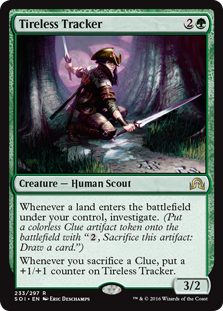
Most Naya Company lists stay fairly close to the “stock” options, varying between high-impact sideboard options depending on the metagame. Collected Company pressures the archetype to maximize creatures, leaving most lists to play a mixture of 22-23 lands, 12 spells (Collected Company, Lightning Bolt, Path to Exile) and around 25-26 creatures (9-11 of which are mana creatures). Archetype staples like Tarmogoyf, Knight of the Reliquary, and Loxodon Smiter leave only a few maindeck slots for customization. While some lists opt for Voice of Resurgence or Wall of Roots, Jon instead chose to play 3 Scavenging Ooze, 2 Qasali Pridemage and a singleton Tireless Tracker.

Tireless Tracker might seem unassuming at first, but imagine a Turn 3 scenario where we are untapping with a mana creature in play. Resolving Tireless Tracker lets us play a fetchland, granting an immediate Clue trigger to gain us a card later when we have extra mana to spend. Tireless TrackerEven if they attempt to remove the Tracker immediately, we can still crack the fetchland and get another Clue trigger, building our own Divination basically for free. The longer Tireless Tracker remains on the battlefield, the more value he generates for us, and as a result he can become a big lightning rod to clear the way for our Tarmogoyf and Knight of the Reliquary to stick around.
Tireless Tracker is a solid addition, but Jon’s finals performance is due more to archetype choice than specific list modifications. Naya Company enjoys strong matchups against graveyard strategies with its three maindeck Scavenging Ooze, and Collected Company ensures Naya will be able to promptly find Spellskite, Kor Firewalker, and Kataki, War's Wage in post-board games. Naya Company has traditionally struggled against midrange and control strategies that are able to effectively combat its card advantage effects, but Jon’s list looks like it has found a way to improve those matchups as well.

Bant Knightfall, by Eli Kassis (8th, GP Charlotte)

Creatures

4 Voice of Resurgence
4 Noble Hierarch
4 Birds of Paradise
2 Scavenging Ooze
2 Eternal Witness
2 Courser of Kruphix
3 Qasali Pridemage
4 Knight of the Reliquary
1 Spellskite
1 Tarmogoyf
1 Kitchen Finks

Enchantments

3 Retreat to Coralhelm

Instants

2 Path to Exile
1 Chord of Calling
4 Collected Company

Lands

4 Windswept Heath
4 Misty Rainforest
4 Forest
2 Plains
1 Horizon Canopy
1 Temple Garden
1 Hallowed Fountain
1 Breeding Pool
1 Westvale Abbey
1 Gavony Township
2 Ghost Quarter

Sideboard

2 Pithing Needle
1 Kataki, War's Wage
2 Twisted Image
1 Eidolon of Rhetoric
1 Melira, Sylvok Outcast
1 Linvala, Keeper of Silence
1 Gaddock Teeg
1 Dispel
1 Burrenton Forge-Tender
2 Surgical Extraction
2 Negate

Knightfall is an archetype that has popped up here and there occasionally for the past few months, but has never put up any significant results. Eli Kassis finally broke through with a Top 8 performance with this list. Knightfall decks have landed all over the spectrum, from tempo-oriented lists with Remand and Steppe Lynx, to Geist of Saint Traft-focused strategies with Snapcaster Mage, and everything else in between.

Retreat to CoralhelmEli kept things relatively simple, opting for a base green-white Collected Company deck with the Retreat Combo “thrown in” to keep opponents honest. Sound familiar? Like Jon, Eli was clearly convinced that a base green-white aggressive deck with additional flexible elements was the best place to be this weekend, and his gamble paid off. Collected Company again shines through as an all-star---both against reactive strategies as a source of card advantage, and against combo strategies as a source of disruption.
Looking past the Retreat to Coralhelm combo aspect of the archetype, Eli takes much greater advantage of the blue splash in his archetype than the red splash in the Naya Company list. While he has less removal to deal with opposing creatures, access to blue gives him counterspells in the sideboard to fight other midrange and control strategies, while giving him a ton of play against combo. As a result, we see the inclusion of defensive-oriented creatures like Courser of Kruphix, Spellskite, Kitchen Finks, and Voice of Resurgence over aggressive options like Qasali Pridemage or Loxodon Smiter. While I still think room should be made for a playset of Tarmogoyf (he is the gold standard of Modern, by the way) overall I think Eli’s list is really tight and focused on his primary objective while giving him flexibility and play in matchups across the format.

Kiki Chord, by Robert Graves (3rd, GP Charlotte)

Creatures

4 Birds of Paradise
1 Noble Hierarch
1 Lone Missionary
1 Qasali Pridemage
1 Scavenging Ooze
1 Spellskite
3 Voice of Resurgence
2 Wall of Omens
2 Wall of Roots
1 Aven Mindcensor
2 Eternal Witness
1 Fulminator Mage
1 Orzhov Pontiff
1 Pia and Kiran Nalaar
3 Restoration Angel
1 Kiki-Jiki, Mirror Breaker
1 Reveillark

Instants

4 Path to Exile
4 Chord of Calling

Planeswalkers

2 Nahiri, the Harbinger

Lands

1 Fire-Lit Thicket
1 Horizon Canopy
1 Overgrown Tomb
1 Raging Ravine
2 Razorverge Thicket
1 Sacred Foundry
2 Stomping Ground
1 Temple Garden
2 Forest
1 Mountain
1 Plains
1 Ghost Quarter
4 Windswept Heath
4 Wooded Foothills

Sideboard

1 Spellskite
1 Fulminator Mage
1 Burrenton Forge-Tender
1 Kataki, War's Wage
1 Phyrexian Revoker
1 Eidolon of Rhetoric
1 Reclamation Sage
1 Sin Collector
1 Linvala, Keeper of Silence
1 Thragtusk
3 Lightning Helix
1 Slaughter Games
1 Engineered Explosives

A much “bigger” Naya Company deck (albeit without Collected Company itself), Kiki Chord seeks to present a similar aggressive strategy alongside an alternate angle of attack in the form of its own infinite combo potential. Restoration AngelThis archetype has seen middling success in the past few months. While it's definitely not as popular as Naya Company, it is proven in a way that Bant Knightfall has yet to accomplish.
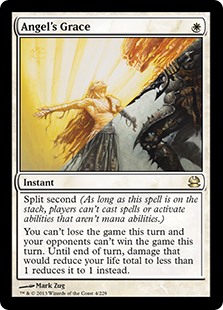
Here, Nahiri, the Harbinger makes a gratuitous appearance, proving with her inclusion that she’s powerful enough to exist in Modern on rate alone---this list contains no Emrakul, the Aeons Torn to “instant-win” with the ultimate. However, her ultimate can still find one half of the infinite Kiki Jiki-Restoration Angel combo, which should often be enough to win with any sort of existing board state. Even her normal +2 works to help discard extra mana creatures or dead spells, and dig further for combo elements or action in general.

Ad Nauseam, by Andreas Ganz (1st, GP Charlotte)

Creatures

1 Laboratory Maniac
4 Simian Spirit Guide

Artifacts

4 Lotus Bloom
4 Pentad Prism

Enchantments

4 Phyrexian Unlife

Instants

3 Pact of Negation
4 Angel's Grace
3 Spoils of the Vault
1 Lightning Storm
4 Ad Nauseam

Sorceries

4 Serum Visions
4 Sleight of Hand

Lands

4 Darkslick Shores
4 Gemstone Mine
1 Island
1 Plains
4 Seachrome Coast
4 Temple of Deceit
4 Temple of Enlightenment

Sideboard

1 Pact of Negation
1 Boseiju, Who Shelters All
1 Slaughter Pact
2 Thoughtseize
3 Hurkyl's Recall
3 Spellskite
4 Leyline of Sanctity

Ad Nauseam taking home the trophy completely blows me away. I won’t go into the details of how the combo operates (as it should be pretty straightforward) and instead focus on the game flow.

Angel's GraceWithout a Lotus Bloom, the archetype must reach six mana before it can combo with Angel's Grace, which means Turn 4 at the earliest with a Pentad Prism in play. With Phyrexian Unlife on the battlefield, Ad Nauseam can simply just cast its namesake card once it hits the requisite five mana, but this is still Turn 3 at the earliest (and assuming a really good draw).
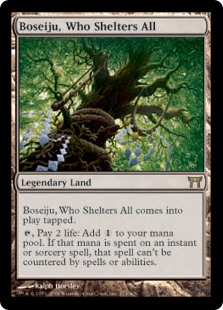
Now, I know Simian Spirit Guide can often speed up the clock a bit, but this is still a relatively slow combo compared to something like Living End, Infect, or Tron. And Ad Nauseam can’t afford to devote many (if any) slots to removal or board control.

Clearly, all the midrange and semi-aggressive decks have pushed the low end out of the metagame, culturing an environment where a middle-of-the-road archetype like Ad Nauseam can thrive. In my experience, Ad Nauseam is built to beat up on the midrange Company decks, yet struggles against aggressive strategies, control strategies, and strategies with disruption alike. Boseiju, Who Shelters AllYes, Boseiju, Who Shelters All and Pact of Negation are solid against control, but Dispel and Inquisition of Kozilek alongside a quick Tasigur, the Golden Fang to apply pressure will still give you fits.


Nevertheless, Andreas took home the trophy on the back of some exceptional play (Ad Nauseam requires really tight play to take deep into an event). These tricky aggro-midrange lists might be riding the line aggressive decks have to take to compete in this metagame, but if they continue to show up in strong numbers I expect Ad Nauseam to be well positioned to take advantage.

Conclusion

While Ad Nauseam fought through a favorable Top 8 to take home the trophy, the clear winners on the weekend (in my mind) were the various flavors of aggro-midrange designed to spread the true midrange and control lists thin. What do you think? Was Ad Nauseam’s result a flash in the pan? Do you expect it to put up strong results moving forward? Let me know in the comments, and I’ll see you next week!

Want Prices?

Browse thousands of prices with the first and most comprehensive MTG Finance tool around.


Trader Tools lists both buylist and retail prices for every MTG card, going back a decade.

Quiet Speculation