
menu

Insider: A Strong Foundation – Risk

Are you a Quiet Speculation member?

If not, now is a perfect time to join up! Our powerful tools, breaking-news analysis, and exclusive Discord channel will make sure you stay up to date and ahead of the curve.

Welcome back, readers! Every once in awhile, I feel it's important to write an article dedicated to the fundamentals of Magic finance, or of investment in general.

With that in mind I'm debuting a series on what it takes to build a strong foundation for your foray into Magic: The Gathering speculation. The "Strong Foundation" articles will not focus on specific picks or recent market movements, but instead help our newer members get a better grasp on some of these fundamentals. If you began that particular journey a while ago, hopefully these articles will serve as a reminder and to strengthen your understanding.

Today I'll be discussing the concept of risk. What it is, why it matters, and how it applies to the world of Magic finance.

Risk

"Risk comes from not knowing what you're doing."

-Warren Buffet

warren buffet

For those who don't know who Warren Buffet is, he's an American investor who started with a humble beginning and became one of the world's wealthiest men. He is often cited as the epitome of the "American Dream." He's often known for his long-term investment approach which, while often not as glamorous as other approaches, has proven itself time and time again. His quote above is incredibly important and one that even MTG finance veterans may need to remind themselves of, especially when they are entering a new market or environment.

Risk (noun): a situation involving exposure to danger.

Above is the literal definition of risk, but what does it mean to MTG finance? Well, there are two types of risks; those we can control and those we can't control. Lets examine what these look like in the specific context of Magic.

Controllable Risks

  • How many copies of a card we have. Every time a card goes up, our profits are multiplied by the number of copies of said card and because of this we are often tempted to "go deep" when we think we've identified a promising speculation target. It's easy to get blinded by potential dollar signs. However, every copy you pick up has some amount of risk attached to it. Besides potential profit, every copy also carries with it potential loss; so the more copies you have the harder you're hit if the card drops.
  • How diverse our portfolio is. There is a reason most financial advisers advise clients to diversify their investments. We know there are uncontrollable risks and events that can occur that could devastate a specific industry. If you were only invested in the internet industry in the late 90's/early 2000's then you might have seen some huge gains early on only to get obliterated when the dot-com bubble finally burst. In Magic terms, this means it's wise to invest in multiple decks and/or multiple formats, so you don't end up holding hundreds of copies of Splinter Twin after they announce a banning.
  • How much we have invested in MTG finance. We've seen spectacular growth in the MTG finance realm over the past few years, which has yielded solid profits for those of us who got in early. It's natural to focus on what has done well and continue to invest in that, but sometimes the relative success of the Magic market can give us tunnel vision. Remember the potential for losses is always present. Past success doesn't guarantee future success.

As a result, one major investment rule of thumb is to risk only what you can afford to lose. If you have $400 to make rent at the end of the month, and spend it picking up 40 copies of some hot $10 Standard staple that might go to $12 by next week, you risk becoming homeless to potentially make some money. It isn't hard to see why this is a bad idea.

Uncontrollable Risks

  • What Wizards of the Coast reprints. I've previously done an analysis on the typical price drop due to reprints. The average drop was around 28%, but the range varied considerably from about 10% to 70%. (A small few actually went up, usually because of a bump in rarity, or because older copies were considered "nicer.") We speculators don't know what WoTC will reprint; the best we can do is make educated guesses based on past trends.
  • What WoTC bans/unbans. Similar to what they reprint, WoTC doesn't leak what they will be banning or unbanning. As we saw with Splinter Twin and Summer Bloom, this can cause massive drops in value of not only the banned cards but any that are specifically played because of said cards. When Twin got banned, Deceiver Exarch went from $3.50 to its current price of $1.84, a 52.5% drop in value, though even now that price seems high as demand for those is very low.

The same goes for unbans. While the potential for significant overnight gains is appealing, demand is always limited on a card that's currently banned---investing in them can tie up money that isn't easy to cash out for an indefinite period of time.

  • What deck becomes the "new hot tech." The Magic metagame changes, in Standard quite often, in eternal formats a bit slower. As MTG speculators we can jump on the train when we see a deck that looks like it will take off (that's why we sent Kelly and Doug to Pro Tour Shadows over Innistrad), or do our research into what's doing well on MTGO (where a lot of new technology comes from thanks to the high volume of play).

However, we still have no direct control over the success of these decks (unless you're the actual creator of the deck and do well with it at a major event). We also have no control over how the playerbase, as a collection of individuals with their own views, will react to any new decks or technology. So while we can invest in a good card at a good price, we can't guarantee that it will see more play and thus see an increase in demand.

  • What WoTC prints. While this is similar to my first point about reprints, there's another dynamic at play in a card game that constantly evolves. Over the past 20 years we've seen the power level of Magic cards shift from spells to creatures. Assuming this trend continues, "pushed" creatures in new sets may outclass or entirely obsolete old staples. WotC has been pretty good about not outclassing a staple they just printed in the next set, but that's no guarantee they won't (whether on purpose or by accident.)

WoTC can also print hosers that devalue traditionally dominant strategies, new tools for an archetype that predates on another, and so on. Really the possibilities are as endless as Magic itself, which constitutes a constant risk the Magic speculator must be aware of.

  • What major vendors will do. When Star City Games announced that they were cutting back the number of Legacy Opens, many Legacy staples took a hit. While many saw this as inevitable, the timing was unknown and those of us who had a good bit invested in the format had to re-evaluate our positions.

Many peoples' worlds were turned upside down and a lot of money was suddenly lost as players jumped off the Legacy ship and in turn prices took a plunge. The adage of always trading into Legacy staples suddenly switched from rule-of-thumb to trap-to-avoid, as one could easily be left with expensive cards that would continually drift downward as players left the format.

Luckily, WoTC has recently given us Legacy aficionados hope with Eternal Masters and Reserved List Legacy cards actually spiked back hard (specifically dual lands). However, the point here is that many speculators couldn't look past the ability to "lock in" profits by trading elastically-priced cards for stable ones. Then that stability went away.

Conclusion

Understanding the fundamentals of risk generally, and the types associated with Magic speculation, is key to a strong foundation in the MTG finance realm. By understanding that there are two types of risk, only one of which we have any control over, we can best mitigate the amount of risk we take with any particular speculation target.

The quote from Mr. Buffet reminds us that we can't know everything, so there will always be some risk. But being well versed in the risks associated with any target will allow us to decide how much we are willing to take on and when we need to hold off. Sometimes the best MTG finance decision we can make is choosing not to act because the risk is too high.

Holding Grudges: Temur Delver at SCG States, Part II

Are you a Quiet Speculation member?

If not, now is a perfect time to join up! Our powerful tools, breaking-news analysis, and exclusive Discord channel will make sure you stay up to date and ahead of the curve.

Play mistakes often amount to a lack of experience. Barring an FNM the day before, SCG States marked my first event with Temur Delver since Oath of the Gatewatch, which had me gleefully---and, soon enough, disinterestedly---casting two-mana, Thoughtseizeing Tarmogoyfs. I'm not unexperienced with Temur Delver; I've been playing it in various forms since 2012, and with Hooting Mandrills since the Treasure Cruise ban. But time away from a deck, especially one so decision-intensive, can leave me a little cloudy.

ancient grudge art crop

Despite my mistakes, I had a great time at States and placed 6th. Today's article completes the tournament report. If you didn't read Part I, check that out first.

[wp_ad_camp_1]

SCG States Report, Part II

Round 4: Elves (2-1, win roll)

After GP Charlotte, I tested this matchup extensively. Like most tricky aggro matchups, reps made all the difference, and I now consider Elves highly favorable for Temur Delver. The deck is decidedly more linear than Abzan Company, and the more linear decks get, the better Delver tends to fare against them.

mirror entityGame 1

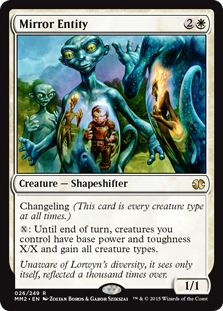
I keep a one-lander with two Delvers and a pair of Shoals. My opponent has a slow start, but manages to Decay a Delver. The other blind-flips off a Lightning Bolt, and I try to hold off the army of Elves with my humble, single-mana disruption. I never make another land drop, but I do Deny a Collected Company and beat my opponent down to one life. Before I can crash in for the win, he topdecks Chord of Calling and grabs Mirror Entity to take me exactly from 17 to 0.

Sideboarding:
-2 Hooting Mandrills
-2 Gitaxian Probe
-3 Thought Scour

+4 Huntmaster of the Fells
+2 Pyroclasm
+1 Mountain

Game 2

My opponent goes really big this game, landing double Elvish Archdruid and a Spellskite to watch over his team of Dwynen's Elite tokens and dorks. I keep the Elves from attacking with a pair of 2/3 Tarmogoyfs and a Mandrills, and we pass the turns back and forth trying to break the board stall.

I manage to sneak in three attacks with the trampling Mandrills before my opponent resolves Choke. By this point, I've amassed enough removal in my hand to close out the game. I try bouncing an Archdruid with Simic Charm on the end step, and my opponent redirects to Spellskite, going from 10 life to 8. His play lets me Bolt one Archdruid and cast Pyroclasm to wipe out the other blockers before swinging for lethal.

Additional sideboarding:
-1 Gitaxian Probe
+1 Natural State

Game 3

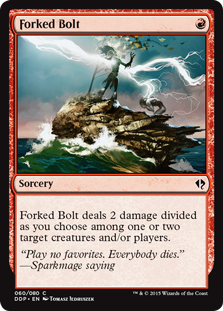
My turn one Delver blind-flips off a Pyroclasm, but my opponent casts a pair of Llanowar Elves regardless. I Forked Bolt them, and fearing my board wipe, he takes his time developing again. Meanwhile, I keep attacking in the air and resolve a Tarmogoyf. My opponent makes another board, and I Pyro it away after getting in with Delver and Goyf, losing Insectile Aberration in the process. I get in another attack and then reach him out with two Bolts.

Forked BoltIn my testing against Elves last summer, I learned the following lessons:

  • Pace Pyroclasm/Forked Bolt to maximize blowouts.
  • Always Bolt the turn one dork unless you have wipes in hand and expect a second.
  • Keep in Shoal---countering a turn one dork is still removing it. Once we get to our Huntmaster stage, Shoal can be cast for mana to counter bombs like Ezuri, Renegade Leader.
  • Know when to "switch gears" from killing mana dorks to saving removal for lords.
  • Hold up Denial/Leak for CoCo once they have the mana to cast it.
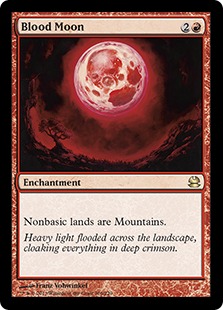
  • Bring in Blood Moon on the play.

I knew I was forgetting something! At States, I didn't bring in Blood Moon. I didn't even bring in Natural State until Game 3, since I forgot this deck (or any deck in Modern since the Twin ban) plays Choke.

Round 5: Infect (2-0, win roll)

Infect might be this deck's best matchup, so I can't complain when my Round 5 opponent starts us off with a Glistener Elf. I imagine I'm in a similar boat here as Soul Sisters enthusiasts when it comes to Burn.

Game 1

My opener blesses me with tons of interaction. I Bolt that Glistener Elf, Shoal a Blighted Agent, and then Leak a Hierarch. My opponent fails to make a third land drop and I start to set up with Serum Visions, holding up Leak and looking for threats. He plays Dryad Arbor and passes, and I Snap-Bolt it. Soon I find Tarmogoyf, and the game ends a few attacks later.

Sideboarding:
-4 Gitaxian Probe
-3 Thought Scour
-3 Stubborn Denial

+2 Blood Moon
+2 Ancient Grudge
+1 Natural State
+1 Destructive Revelry
+2 Pyroclasm
+1 Curiosity
+1 Mountain

Blood MoonGame 2

I Shoal a Hierarch, and my opponent finds himself mana-screwed for a couple of turns. He Probes me to see Ancient Grudge, two Leaks, and another Shoal, then lands Glistener Elf. I play an untapped Steam Vents after casting Serum Visions, bluffing a Lightning Bolt although I only have Simic Charm. My opponent takes the bait, cautiously poking me for two straight attacks.

In the meantime, I scry Delver to the top to get a clock going, and manage to remove the Elf after it hits me for five thanks to Might of Old Krosa. Delver flips and I stay at seven infect for the rest of the game, Grudging a Spellskite and then scaring my opponent into not animating his Inkmoth Nexus with the threat of flashback. Delver starts attacking with my opponent at 15, and eventually brings him down to 1. I'm forced to Grudge an Inkmoth when he finds another one and goes for an attack. Blood Moon cuts him off the blocker and I attack for lethal.

Can you spot my sideboarding mistake? It's a big one. I cut Gitaxian Probe! Probe is phenomenal in this matchup since it's basically free to cast, pitches to Shoal to counter crucial one-drops (including a kicked Vines of Vastwood), and gives us very useful information, since Infect plays out of its hand. That's what I get for abandoning Delver all winter. Luckily, I'm favored enough in this matchup to enjoy a really large margin of error.

Round 6: Amalgam Dredge (Intentional Draw)

A quick aside: I was doing some Yu-Gi-Oh! reading last week and stumbled upon a piece by a "Pro" player about intentional draws, which are illegal in that game's competitive circuit. ID's have always been an integral part of competitive play for me, so I found it interesting that some CCG players never get to do it.

Top 8, Round 1: UW Control (1-2, lose roll)

I may have managed to dodge my buddy on EldraziTron this tournament (who also made Top 8), but the other two decks I'd hoped to evade tracked me down.

Ancestral VisionGame 1

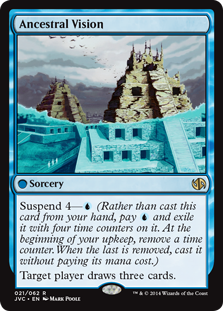
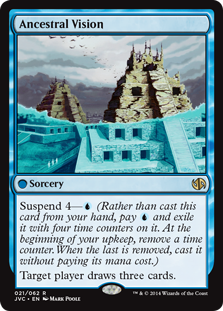
My two Goyfs meet Spell Snares, and Delver gets Pathed. My new threats get Snap-removed, and I Bolt the Snaps when they come on board. Soon, a pair of Ancestral Visions resolve and put victory out of reach.

Sideboarding:
-4 Gitaxian Probe
-3 Thought Scour
-3 Lightning Bolt
-1 Forked Bolt

+4 Huntmaster of the Fells
+3 Blood Moon
+2 Ancient Grudge
+1 Curiosity
+1 Mountain

Game 2

I come out blazing with a Delver and a Tarmogoyf. The latter gets Snared and the Delver eats a Path, which allows me to resolve Huntmaster of the Fells on turn three. My opponent passes on an empty board, and I attack for two with the Wolf token (holding back Huntmaster in case he has Snapcaster Mage) and pass the turn back.

On my opponent's upkeep, he responds to Huntmaster's flip trigger by casting Snapcaster to flash back Path to Exile. I let the Snap resolve, and Path goes on the stack. I answer the Path with Stubborn Denial. My opponent has one mana up, so he smugly pays, thinking I misread the card. I cast my own Snapcaster Mage and Stubborn again, countering the Path. He asks, "draw step?" and I say okay, forgetting after the flurry of interaction to actually resolve the Huntmaster trigger, which would have killed the Snapcaster Mage. Luckily, it doesn't cost me the game. My opponent resolves Rest in Peace, which ruins my in-hand Tarmogoyf, but Huntmaster flips a turn later and I get in a big attack. Simic Charm saves Huntmaster from another Path, and a Bolt to the face seals the deal.

Additional sideboarding:
-1 Ancient Grudge

+1 Destructive Revelry

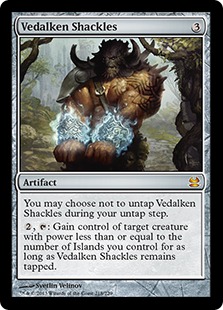
Vedalken ShacklesGame 3

In sideboarding, I cut a Grudge for Revelry to deal with Rest in Peace. This game goes very long. I hold threats in hand and try to find answers to a pair of Vedalken Shackles. My opponent has a Rest in Peace on the board, invalidating my two in-hand Goyfs. Blood Moon resolves with my opponent at just three Islands, and I tap six lands for Mandrills to start hitting him. He gets Pathed after I deal 8 points of damage, and I try a second one, only to have it countered with Cryptic Command. Command also bounces my Moon, and my opponent finds a window before I resolve it again to Quarter himself into a fourth Island, stranding the Mandrills back in my hand as I search for outs to Shackles.

I eventually find Ancient Grudge, but also need to draw Revelry so I can blow up Rest in Peace and get my flashback. I keep waiting, giving my opponent the time to play Spellskite and effectively lock me out of the game. My only hope is to double-Bolt the Horror, which I try doing when I see an opportunity, but one Bolt meets Dispel and my plan is ruined.

Another round, another sideboarding mistake. I meant to trade Mountain for Breeding Pool to improve my Blood Moons. Instead, I forgot to remove the Pool, ending up with an 18-land deck! 18 lands really isn't where this deck wants to be against midrange strategies. I even go so far as to cut my 17th land against Abzan and just run 16, and may have benefited from the same move against UW Control, another attrition deck featuring Path to Exile. Mountain was still good for me here, as I fetched it off a Path in both post-board games. But the deck would definitely have been better without the Breeding Pool.

The most glaring mistake I made with my sideboarding was cutting an Ancient Grudge. Vedalken Shackles lost me the match, and it had no business doing so. My opponent wasn't aware that I knew he had it in his deck (I had seen him cast it earlier in the day against someone else), so he was almost sure to keep them mained. Most importantly, Shackles is a card that will beat me singlehandedly if I can't remove it, especially when I'm boarding out Lightning Bolts for more threats.

It's crucial to have answers to these kinds of cards in sideboard games, and I should have not only kept the second Grudge, but brought in both Natural State and Destructive Revelry to hedge against the artifact. I also knew he played Engineered Explosives, and could have assumed he ran Spellskite, although those are cherry-on-top reasons to go all-in on artifact removal.

Growing With Grow

I'll never know if cleaning up now-obvious missteps like boarding out Probes against Infect, or forgetting to remove Breeding Pool against UW Control, would have won me the tournament. All I know is I won't make those mistakes again. Magic doesn't reward us for holding grudges, against ourselves or anyone else. In my experience, players improve at the fastest rate when they own their mistakes and learn from errors. We'll see how my three favorite creatures fare next time around!

Insider: Modern Finance After the SCG Milwaukee Open

Are you a Quiet Speculation member?

If not, now is a perfect time to join up! Our powerful tools, breaking-news analysis, and exclusive Discord channel will make sure you stay up to date and ahead of the curve.

As I'm writing this, we're still wrapping up the Top 8 portion of the Star City Games Milwaukee Modern Open. Whether Abzan Company triumphs, or one of the faster, aggressive decks claws its way to gold, the Open was an exciting event that showcased Modern's considerable diversity in a post-April 4 world. I was particularly excited to see the Open's Day 2 standings---nothing says "open format" more than a breakdown with no single deck over a 10% share.

Add in all the results from SCG States and Modern is shaping up to be the post-Eldrazi, post-Twin utopia many hoped it would become.

Top Day 2 decks at SCG Milwaukee

We have about 20 days between today and all the Modern action of Modern Grand Prix Weekend (#GPLA, #GPCHARLOTTE, #Modern4life), which is enough time to innovate outside of the current metagame but not enough time for it to shift substantially. If you're serious about winning tournaments at Grand Prix Weekend, or winning the market in May, you'll need to pay attention to this current metagame climate.

It's the first time we're really seeing a Twinless world without the interfering influence of the Eldrazi menace, and the findings are huge for where Modern goes from here. You've heard all the myths of this new environment: Tron is dead, BGx is no longer viable, blue is still weak, combo and aggro is the only place to be. As today's results show, the format is much more favorable to all these strategies (and many more!) than the detractors would have you believe.

Today, we'll identify some high-level financial themes in the Modern metagame before turning to the deck-specific takeaways. All these changes might be upended during the approaching Grand Prix Weekend, but this is where you need to start to prepare yourself for the Modern mayhem.

Markets in the New Metagame

Soon after this article goes to press, I'll be updating the Modern Nexus Top Decks standings to reflect both the results from SCG Champs and from SCG Milwaukee. A full metagame breakdown article will follow on Modern Nexus on Wednesday morning. My Monday Quiet Speculation articles often risk stealing my own thunder, and I'm taking that gamble again today to show a quick cross-section of the format.

It's easy to make reactive investments in spikes as you see them arise. It's much harder to really know a metagame and get ahead of price jumps through format knowledge. In reviewing the format-wide numbers, we'll take a shot at the latter. How else are you supposed to buy those foil Reckless Bushwhackers before they're out of stock?

There was an error retrieving a chart for Reckless Bushwhacker

Here are the Top 12 decks in Modern right now, using adjusted metagame shares aggregating paper, Magic: The Gathering Online, and Open Day 2 numbers to predict a metagame-wide percentage. We're looking at the Top 12 because these decks represent all the strategies with a 3%+ prevalence. Tune into Modern Nexus on Wednesday for the full tier-by-tier breakdown of at least 30 Modern decks!

Top 12 Modern Decks (4/8/16 - 5/1/16)

  1. Jund (9.4%)
  2. Burn (7%)
  3. Affinity (6%)
  4. Abzan Company (5.7%)
  5. Infect (5.5%)
  6. Jeskai Control (3.7%)
  7. Gruul Zoo (3.7%)
  8. Scapeshift (3.6%)
  9. Merfolk (3.6%)
  10. Abzan (3.5%)
  11. R/G Tron (3.3%)
  12. Kiki Chord (3%)

Because these percentages reflect an adjusted, metagame-wide share across different Magic platforms, you're likely to see some variation at the local and even regional level. For instance, that crazy dude who brings Norin the Wary Soul Sisters to your Friday Night Magic every week is still going to bring his Norins even though he's not cracking the Modern Top 50.

You'll also want to be careful about differences between MTGO and paper. Eldrazi Death & Taxes and Gruul Zoo have a huge MTGO presence that gets halved once you look at paper.

There was an error retrieving a chart for Norin the Wary

These differences are important at your game store's Sunday afternoon Modern 15-man, but negligible at the Grand Prix or Magic market level. If you're preparing for Modern Weekend or looking to move product on the Magic-wide economy scale, these Top 12 numbers are an excellent guide to ensuring smart decisions.

Three Metagame Themes

Following from that, here are the metagame-level themes you'll want to focus on and how those affect your financial moves throughout May:

1. Jund, Abzan Company, and the Big Aggro Three are the decks to beat.

With one notable exception, these five decks have enjoyed consistent success from April 8 all the way to May 1, including at the SCG States and SCG Open levels. Do not bet against these decks going into the May Grand Prix. As a player, you'll need a gameplan against all of them. As an investor, any staples in these decks should hold value well past May as these decks stay relevant.

That said, keep an eye on Affinity. Despite having a great SCG Champs showing, Affinity sent a piddly two players to Milwaukee's Day 2. This could be a one-time anomaly, or it could indicate a major shift against Affinity.

I'm leaning more towards the latter---as players expect Thopter decks and Affinity in equal measure, they pack Ancient Grudges and Stony Silences in spades. Once this Dredge/Affinity-effect subsides, expect Affinity to be waiting to capitalize.

2. Blue-based control is promising but still needs work.

Before SCG Champs Sunday, Grixis Control and Midrange variants looked like they were taking Ancestral Vision all the way to the Modern Top 5. Fast forward to the end of SCG Milwaukee where these decks were present but by no means established.

Looking at the metagame-wide numbers, we see blue-based control decks (i.e. the Vision, Cryptic, and/or Snapcaster decks) at around 13% of the format. This includes the vaunted Sword of the Meek decks which are still looking for a foothold. SCG Milwaukee saw similar numbers in the 12%-13% range.

All of this means you can expect blue-based control to stick around in Modern, but also that it has a long way to go. Top-dollar staples such as Ancestral Vision are likely to fall in the coming months unless they get a breakout performance at the Grand Prix. Same goes for all the optimistic spiking around Thopter Foundry, Gifts Ungiven, Muddle the Mixture and others---the metagame just hasn't taken to these cards the same way speculators have.

3. Linear and aggressive upstarts always surprise.

When Wizards R&D crumbled that evil Eye of Ugin to dust on April 4, many players predicted the death of both R/G Tron and Eldrazi decks with it. Similarly, when Thopter Foundry and Sword of the Meek came online in the same announcement, skeptical Moderners decried it as the death knell for aggressive decks. Both SCG States and the SCG Open blew these naysaying predictions out of the water, which should have surprised absolutely no one who paid serious attention to Modern metagame cycles.

Over the last weekend alone, we saw Joe Lossett go to the finals with his R/G Tron deck and Gerry Thompson just miss out on the top tables with his R/G Eldrazi. We also saw a number of inspired performances by the Reckless Bushwhackered Gruul Zoo strategies, and a renegade Top 8 bid by Will Drescher's Suicide Zoo. SCG States offered similar results the weekend before.

All of this shows that these strategies are alive and well. From a metagame perspective, you'll want to pack all the sweepers, removal and land interaction to handle these menaces---don't forget your Fulminator Mages, Crumble to Dusts and Anger of the Gods in the sideboard! Financially speaking, look to move into these strategies as they continue to carve out a niche in Modern, or maintain the one they already had.

Getting Ahead of Trends

It's hard to enjoy big profit margins if you're reacting to everyone else. The big bucks lie in getting ahead of metagame trends, and small datasets like this are a great way to achieve that financial grail. Thinking about Modern's current state, there are a number of ways this might pan out in May.

One of the biggest areas for development is in blue-based control. Abzan Company is huge right now, and the deck has historically struggled with Snapcaster-Bolt decks. Although those decks are still struggling to solidify Tier 1 status, it doesn't mean they can't get there by the Grand Prix Weekend.

If you can figure out the breakout blue-based deck, you might be able to secure a sizable profit. For instance, Michael Majors ran three Kalitas this weekend in his Grixis deck. If Kalitas Grixis catches on, the Modern and Standard crossover is going to get even pricier.

There was an error retrieving a chart for Kalitas, Traitor of Ghet

Another excellent example is Fulminator Mage, an already expensive staple that is going to get even pricier if the Abzan Company players start adopting it to combat R/G Tron. Grixis Control decks, if blue mages go in that direction, will also run their Mages alongside Kolaghan's Command. So will Jund! The sky is the limit on a card like this, and the only reason we're seeing Mage at a more stable $25-$30 range is the supposed drop in Tron and big mana decks.

SCG Milwaukee showed that drop was mightily exaggerated, so we're likely to see Mage return to sideboards and maindecks everywhere starting in May.

There was an error retrieving a chart for Fulminator Mage

These are just two examples of where you can sneak ahead of a metagame trend to ramp up your bottom line. The key isn't just to invest in the top decks, but rather to invest in the decks which beat those decks, or the cards which help the current top-tier decks maintain that status. Hit me up in the comments if you have specific cards in mind!

Cards and Decks to Watch

In the lead-up to Grand Prix Weekend, Modern-wide themes are more important than individual strategies. Most Grand Prix induce changes to the Modern landscape, but although decks may come and go, the bigger context is unlikely to change substantially. This makes the themes safer investment guidelines than individual spotlights.

That said, there are a few important speculation targets savvy buyers will want to know about going into May. We saw some of these on camera during SCG Milwaukee, we saw others over SCG States, and others still are lurking in the background ready for a breakout day in May.

Ancient Stirrings

The only reason Ancient Stirrings hasn't hit $5.00 yet is because people thought Tron and Eldrazi were dead. Both R/G Tron and R/G Eldrazi used the immensely powerful Stirrings, and that's on top of its staple status in Lantern Control decks.

There was an error retrieving a chart for Ancient Stirrings

I expect we'll see all three of these decks succeed in May, luring more players back to their ramp roots as they realize these decks were much more viable than many predicted. Even if the bubble bursts over Grand Prix Weekend, Stirrings is still a safe bet just on its Tron and Eldrazi finishes. If the ramp bug catches, however, then its integral cantrip will keep stirring up dollars.

Jeskai Control

Although Michael Majors and many online Modern communities gravitated towards Grixis in the past weeks, Jeskai is where I see the most control potential. Potent removal options line up nicely against Abzan Company and the aggressive hordes. Although ramp decks are still an issue for Jeskai decks, Crumble to Dust out of the board is a decisive answer, and the loss of Eye of Ugin means the long game goes to Snapcaster decks and not just Tron inevitability.

There was an error retrieving a chart for Restoration Angel

Angel is the big winner here due to her joint viability in both the Jeskai decks, which are still battling their way to the top, and the Kiki Chord decks, which enjoyed some strong successes in the past two weeks. Her supply is low relative to her possible demand, and I wouldn't be surprised to see her fly past $20 or $25 if either of these decks enjoy success in May.

Noble Hierarch

It's always dangerous to invest in expensive cards like Noble Hierarch. Unless you have a lot of dollars behind your purchases, it's hard to accumulate stock on these cards without putting your bank account in the hole. That said, if you have Hierarchs lying around, have the money to back a big purchase, or are just a player who wants to play a Hierarch deck, this is a great time to buy.

Between Abzan Company and Infect, Noble Hierarch continues to make a splash in Modern's Tier 1 decks. May is likely to see those Tier 1 decks stay Tier 1, which means Hierarch will only go up from here as more players hop on the Infect and Abzan Company trains.

There was an error retrieving a chart for Noble Hierarch

Barring an Eternal Masters reprint (and Hierarch is hardly a Vintage and Legacy all-star), the dork is on her way to Snapcaster-status in a hurry. Even if you can't get the capital together to move a huge quantity of Hierarchs, you should still buy this card now if you want to play a Hierarch deck. The ceiling is much higher than Hierarch's current price tag, and you don't want to be left behind if Abzan Company takes off any more.

Gearing Up for Modern MAY-hem

Get used to that pun because there are four more Mondays in May and I got plenty of Modern to write about. Modern Nexus readers will have to expect it doubly. Bad wordplay aside, I'm very excited to play Modern right now and heartened by an incredibly diverse and interesting metagame. Remember to stay in dialogue with the metagame standings when confronted with deck, financial, or format decisions.

This is especially true when busting some of Modern's most persistent and annoying myths. General rule: if someone says a strategy is dead, you just have to wait a few weeks for it to rear its head again. I'm happy to decry Modern as unhealthy when it's warranted, but this time around Modern doesn't deserve the flak it's gotten online and in articles. The format is very open and the May Grand Prix should reflect that.

Thanks to all of you for joining me and I look forward to seeing how the format keeps developing over the month. I'll be conducting a fuller metagame breakdown on Modern Nexus for my Wednesday piece, but until then, feel free to jump down to the comments with any Modern questions, observations or ideas you have. See you all soon!

Insider: High Stakes MTGO – Apr 24 to Apr 30

Are you a Quiet Speculation member?

If not, now is a perfect time to join up! Our powerful tools, breaking-news analysis, and exclusive Discord channel will make sure you stay up to date and ahead of the curve.

Editor’s note: Sylvain Lehoux is taking a three-week break from writing due to other commitments. In the meantime he’s promised to keep us abreast of any changes to his portfolio via emails to the Quiet Speculation staff. We’ll present these purchases/sales in a shortened form along with Sylvain’s explanation so you don’t miss a beat. Join us back on May 9 when he returns in full form!

Here is the link to the High Stakes MTGO live portfolio.

Buys

Oath of the Gatewatch and Battle for Zendikar Boosters: With the release of Shadows over Innistrad the price of these two packs took a hit but they seem to have stabilized since. With extra tix ready to deploy, these seemed like a reasonable and low-risk investment. I'm betting on them returning around 3.5 tix sometime before the release of Eldrich Moon.

Dismember: From almost 5 tix, Dismember dropped to 2 tix about two weeks ago. Nonetheless this instant remains one of the best removal spells in Modern and playable in many decks. I'm expecting an easy comeback in the 3.5-4 tix range fairly soon.

Grove of the Burnwillows: Dropping below 18 tix was pretty much a one-year low from a very high 50 tix in mid-February. The ban of Eye of Ugin impaired R/G Tron decks, the principal consumers of Grove of the Burnwillows, but this land remains unique in the sense that it produces two colored mana without any conditions and a very small drawback. R/G can surely survive post-Eye of Ugin and a lot of other decks in Modern or Legacy will keep using this land. The imminent Future Sight flashback drafts don't worry me that much since it is the third set of Time Spiral block and if the Grove drops below 20 tix again I will actually reinforce my position.

Monastery Mentor: Fate Reforged is officially out of Standard and if Monastery Mentor topped 13 tix right after the release of SOI it went back to 10 tix this past week. That seems to be a solid floor for a card with a lot of potential but which still has yet to prove itself in Modern. I'm betting here on a push from redemption and its possible incorporation in more Modern decks.

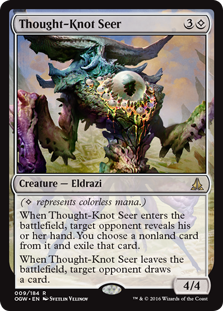
Thought-Knot Seer and Reality Smasher: These two OGW rares have proven to be powerful in all formats. They haven't seen much play in Standard but I bet that will change. Now that SOI is up and OGW is being drafted less, hopefully these two Eldrazi will start climbing from the long-term bottom they reached during these past few weeks. I hope to see them raise up to 10 tix for Thought-Knot Seer and 5 tix for Reality Smasher.

Sales

Languish, Liliana and Demonic Pact: Following Pro Tour results I sold these three Magic Origins positions. let's face it: I was a little off tempo with all of them, which is what happens when you don't have a lot of time to monitor your positions and put everything in the same basket. I was a little bit too late for Demonic Pact but was clearly too early for Liliana, Heretical Healer and Languish Along with Nissa, Vastwood Seer, that's a decent number of tix I've left on the table for being in too much of a hurry.

Dragon Whisperer: The right time to sell this guy was...seven months ago. Since last September the price of Dragon Whisperer kept going down. With no apparence at PT SOI it was really time to let go, near the absolute bottom for a mythic. You can't win every time...

Elesh Norn, Grand Cenobite: On a gradual upward trend since October 2015, the legendary preator peaked to 4 tix a week ago, most likely due to a resurgence in popularity of the Gifts Ungiven-Unburial Rites combo. I was unsure I would get a better opportunity anytime soon so I decided to sell this position with a decent 77% profit.

Insider: QS Cast #31: The New Standard

Are you a Quiet Speculation member?

If not, now is a perfect time to join up! Our powerful tools, breaking-news analysis, and exclusive Discord channel will make sure you stay up to date and ahead of the curve.

Play

This week, the cast talks about the phenomenal results from the Pro Tour and the face of new Standard!

Douglas Linn

Doug Linn has been playing Magic since 1996 and has had a keen interest in Legacy and Modern. By keeping up closely with emerging trends in the field, Doug is able to predict what cards to buy and when to sell them for a substantial profit. Since the Eternal market follows a routine boom-bust cycle, the time to buy and sell short-term speculative investments is often a narrow window. Because Eternal cards often spike in value once people know why they are good, it is essential for a trader to be connected to the format to get great buys before anyone else. Outside of Magic, Doug is an attorney in the state of Ohio.  Doug is a founding member of Quiet Speculation, and brings with him a tremendous amount of business savvy.

View More By Douglas Linn

Posted in Free Insider, QS CastLeave a Comment on Insider: QS Cast #31: The New Standard

Have you joined the Quiet Speculation Discord?

If you haven't, you're leaving value on the table! Join our community of experts, enthusiasts, entertainers, and educators and enjoy exclusive podcasts, questions asked and answered, trades, sales, and everything else Discord has to offer.

Want to create content with Quiet Speculation?

All you need to succeed is a passion for Magic: The Gathering, and the ability to write coherently. Share your knowledge of MTG and how you leverage it to win games, get value from your cards – or even turn a profit.

Back to Basics: Temur Delver at SCG States, Part I

Are you a Quiet Speculation member?

If not, now is a perfect time to join up! Our powerful tools, breaking-news analysis, and exclusive Discord channel will make sure you stay up to date and ahead of the curve.

Sometimes I marinate for minutes (no, tens of minutes) on clever article titles, but today's came naturally. After months of turning Eldrazi Temple sideways, I've returned to my beloved Temur Delver, and fetching out basic Island has never felt more right. I guess you don't know how dirty some things are until you stop doing them. To me, Delver of Secrets epitomizes clean, honest Magic, sitting—or, hovering—firmly across from Eye of Ugin and Goryo's Vengeance on Modern's fairness spectrum.

stubborn denial art crop

An audibled, awakening FNM with Monkey Grow inspired me to take the deck to SCG States. I was told the Montreal event marked Star City's official foray into the snowy wilderness of Canadian magic, and in retrospect, I would have felt guilty playing anything but my longtime favorite deck at the inaugural tournament. Tarmogoyf and pals didn't bring home a trophy, but I placed sixth and had a blast. Hopefully, this tournament inspires other dormant Delver lovers to join me in coming out of hibernation and playing Magic to its fullest.

[wp_ad_camp_1]

Daddy Hooty's Home

It's hard to dissect a decklist without actually inspecting it, so here's what I played last weekend:

Temur Delver, by Jordan Boisvert

Creatures

4 Delver of Secrets
4 Tarmogoyf
4 Hooting Mandrills
1 Snapcaster Mage

Sorceries

4 Gitaxian Probe
4 Serum Visions
1 Forked Bolt

Instants

4 Lightning Bolt
1 Tarfire
3 Thought Scour
4 Disrupting Shoal
3 Mana Leak
3 Stubborn Denial
3 Simic Charm

Lands

4 Misty Rainforest
4 Scalding Tarn
1 Wooded Foothills
2 Steam Vents
1 Stomping Ground
1 Breeding Pool
3 Island
1 Forest

Sideboard

4 Huntmaster of the Fells
3 Blood Moon
2 Ancient Grudge
1 Destructive Revelry
1 Natural State
2 Pyroclasm
1 Curiosity
1 Mountain

Build Notes

This build closely follows my (now only slightly outdated) guidelines for building Temur Delver in Modern. To keep things interesting, I also tried out some new tech, including the best card in Magic—basic Mountain!

More Bolts: I expected heaps of Collected Company decks at this tournament, and maybe some Affinity. Zero players sleeved up the latter, stranding my Grudges in the sideboard, but I saw some Birds of Paradise. Modern seems to be getting increasingly friendly to dork-fueled fast-mana decks. Forked Bolt is an all-star in these matchups, and Tarfire’s Battlegrowth effect for Tarmogoyf makes it the favorite against linear combo or black delve strategies.

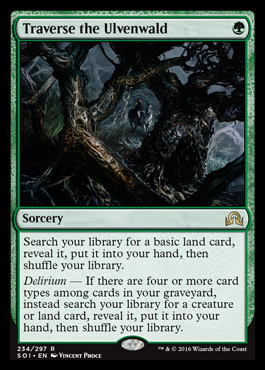
traversetheulvenwaldNo Traverse the Ulvenwald: Last month, I explored the possible applications of Traverse the Ulvenwald in Temur Delver. I’ve been excited to integrate delirium cards into the archetype ever since Invasive Surgery was first spoiled, but some more testing has led me to conclude that Traverse doesn’t exactly fit into this deck. Here’s why:

1. It butts heads with delve. Sometimes, we want to cast Mandrills before Traversing for another threat. Delve and delirium curdle so much that enacting that fantasy is almost never possible. Especially with a Blood Moon on board, we usually have to choose between casting Mandrills or casting Traverse in even moderately-paced games, meaning Traverse can only effectively come in for grindy matches.

2. It doesn’t get to Blood Moon fast enough. One of Traverse’s major upsides is its ability to find a Moon effect on command via Magus of the Moon. Unfortunately, paying four mana for Blood Moon really isn’t something Temur Delver can afford to do. Our other option is to Traverse for Magus now, and cast it next turn, but that alerts opponents to our game plan and gives them an opportunity to fetch a basic land. I found that in the matches we want Blood Moon for, we want to dig for it privately and play it on-curve.

3. We can’t make great use of a creature toolbox. The bullets I experimented with included Magus of the Moon, Izzet Staticaster, and Thrun, the Last Troll. Of the three, only Thrun panned out. Can you guess why? I only wanted him against grindy decks like UW Control. These matchups guarantee we’ll have delirium and delve food for Hooting Mandrills. But if we only bring Traverse in for attrition decks, why not simply run answers to attrition decks instead? By cutting the Traverses for hard copies of Thrun, for instance, we dodge disruption like Muddle the Mixture, Spellstutter Sprite, or Rest in Peace, all while paying one less mana to cast our creatures. In a deck that mostly exists because of the relevance of a one-mana Negate, Traverse's single-mana tax hurts more than it would in a midrange shell like Temur Toolbox.

Modified Revelry package: Before choosing flex spots, I recommend Monkey Grow newcomers stock their sideboard with a few tried-and-true packages. My three go-to’s include a Huntmaster package, running 3-4 copies of the Werewolf haymaker for aggro and midrange matchups alike; a Blood Moon package, playing no less than two of the powerful hoser; and a Revelry package, or a suite of versatile hate for Affinity.

Only the Revelry package got a revisit this weekend. I’d settled on a 2/2 Destructive Revelry and Ancient Grudge split after GP Charlotte, but currently, I like running Natural State over the mountainsecond Revelry. State gains us points against Affinity, but loses them versus random bombs like Worship or Form of the Dragon. Since Modern is so fast, and Temur Delver often forces opponents to play quickly, I think Natural State fits into the package well.
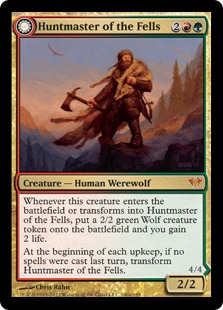
Mountain: I had fun showing this card to opponents after matches and watching their faces contort in bewilderment. Some friends who’ve tried the deck have told me they sometimes experience difficulty casting Huntmaster of the Fells on time against aggressive decks. This issue definitely comes up sometimes, and that’s what the Mountain is for.

Against hyper-aggressive strategies, we don’t necessarily have the time or the disruption to sit around and wait for land drops to magically appear off the top of our library. Nothing’s more embarrassing than eating hits from Master of Etherium and a Plating-equipped Vault Skirge with a pair of clunky Ancient Grudges in hand. Mountain comes in for Burn, Infect, Affinity, Tron, Grishoalbrand, and other decks that punish us for missing land drops. Against the decks we want Moon for, it can also replace Breeding Pool, which threatens to delay Moon’s resolution a turn if drawn.

SCG States Report, Part I

Round 1: Gruul Zoo (2-0, win roll)

Of Modern’s many Zoo decks, Gruul is the easiest to beat. In other variants, Knight of the Reliquary and Scavenging Ooze can give us a hard time, but Gruul Zoo runs neither of these cards. We can usually force bad trades with our green creatures, and blow out Ghor-Clan Rampager tricks with Simic Charm.

Game 1

I lead with a Scalding Tarn, which I crack for Steam Vents to Bolt a Goblin Guide. I follow up by fetching a Forest and resolving Tarmogoyf. My opponent responds with Kird Ape. I start swinging, Denying a Rancor and then Forked Bolting a Goblin Guide as my opponent fails to ever make a land drop beyond his first Stomping Ground. He concedes to a Hooting Mandrills.

Sideboarding:
-4 Gitaxian Probe
-3 Thought Scour

+4 Huntmaster of the Fells
+2 Pyroclasm
+1 Mountain

Huntmaster of the FellsGame 2

We both mulligan, and I keep a one-lander with two Serum Visions, Bolt, Tarfire, and Mandrills. My opponent starts things off with a turn one Vexing Devil. I pay four life to kill it, and draw a second Steam Vents for turn. I shock myself and play the first one to Serum into a green source, drawing Island and seeing Scalding Tarn, Huntmaster. I scry both to the top, with Tarn first in case my opponent plays Goblin Guide. He doesn’t, instead opting for Burning-Tree Emissary and a Rancor. I play my Island, cast the second Visions, and Tarfire the emissary. My opponent plays Wild Nacatl, and I fetch-shock-Bolt it on my turn and cast Hooting Mandrills. He plays Experiment One and passes, leaving mana up to Bolt Huntmaster on my end step. I draw another one, though, and beat my opponent with Shoal in hand.

Even though it doesn't touch Ape and Nacatl, I like Pyroclasm in this matchup, since it answers boards full of Burning-Tree Emissary, Goblin Guide, and Experiment One. Blood Moon can occasionally screw Gruul Zoo, but I think it's a trap to bring it in against land-light decks that can easily fetch basics if they want to.

Round 2: Jund (1-2, win roll)

Jund is one of the decks I was hoping to dodge today, the others being Eldrazi Tron and UW Control. The deck asks us to have all the right answers at all the right times and is historically one of Temur Delver's worst matchups.

Game 1

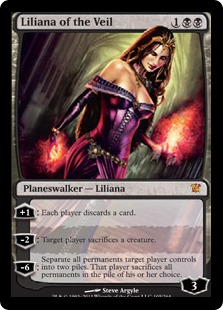
My opponent remembers me from the Super Series and correctly puts me on Temur Delver. He also keeps a magnificent hand, dismantling my own handsome seven effortlessly. He Bolts my Delver, Decays my Goyf, Terminates my Mandrills, and makes me sacrifice my second Tarmogoyf with Liliana of the Veil. I Bolt his Confidant, but a Scavenging Ooze takes the game away.

Sideboarding:
-4 Gitaxian Probe
-3 Thought Scour
-1 Disrupting Shoal

+4 Huntmaster of the Fells
+3 Blood Moon
+1 Curiosity

Game 2

I mulligan into a slow hand with Disrupting Shoal, Curiosity, Blood Moon, and three lands. I play a land and pass, and my opponent tries Blackcleave Cliffs into Inquisition of Kozilek. I pitch Curiosity to Shoal so he doesn’t find out about the Moon, which I’m counting on to win me this game.

I play another land and pass, and my opponent plays a second Cliffs and Dark Confidant. Moon comes down and locks him out of the game, and we laugh as he flips Kolaghan's Command and then Kalitas, Traitor of Ghet to the awkward 2/1. My eventual Huntmaster eats Lightning Bolt, but his Wolf pal and a Hooting Mandrills secure the win.

Game 3

Liliana of the VeilI keep a one-lander with two Visions, a Goyf, Blood Moon, Mandrills, and Mana Leak. The first Visions doesn’t find me any lands, and the second gets Inquisitioned away. My opponent casts Liliana of the Veil and a Huntmaster while I take a shame bath in a lone Breeding Pool.
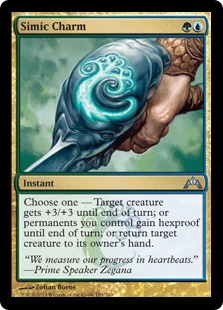
I learned at Charlotte to keep some number of Disrupting Shoal against Jund, since their removal spells and two-drop threats will outpace us if they can get the upper hand. Scour comes out here since they fill the graveyard for us, and Probe gets the axe since Jund frequently operates hellbent and I’d rather have a higher threat density than more air. The costs of these cantrips becomes troublesome with a Moon on the table, too, since I often only have one blue source in play.

Three Moons might seem like a lot, but Jund likes to Inquisition or Thoughtseize them away when they get the chance, making Moon sometimes function like an “extra threat”—that’s one less creature they’re stripping from our hand. They also Decay the Moon when they have shocks up to pay for the removal spell after the enchantment resolves, so I like boarding in the full three copies.

Round 3: Blue Moon (2-0, lose roll)

I play against this person almost every time I go to Face to Face, which admittedly isn’t that often anymore. The last time we dueled, she narrowly beat my Delvers in the finals of a monthly Modern tournament with UR Twin. I assumed she'd be on some sort of Snap-Bolt deck, and her turn one Scalding Tarn confirmed my suspicion.

Game 1

Delver blind-flips off a Lightning Bolt and lives, but my Tarmogoyf eats a Mana Leak. Probe shows me Keranos, Snapcaster Mage, Remand, and Steam Vents, and soon my opponent starts chaining four-drops. Jace, Architect of Thought and Cryptic Command both get Leaked, and two Bolts to the head finish what the Aberration started.

Sideboarding:
-2 Thought Scour
-4 Disrupting Shoal
-1 Forked Bolt

+4 Huntmaster of the Fells
+2 Ancient Grudge
+1 Curiosity

Game 2

This game doesn’t prove more fruitful for Modern’s castrated UR boogeyman. Delver gets Bolted this time after failing to flip, but my Probe shows no answer for this Tarmogoyf, who comes down with a Mandrills to start terrorizing my opponent. She has Dispel, Vendilion Clique, Simic CharmBatterskull, Engineered Explosives, Spreading Seas, and Harvest Pyre in hand, and manages to turn off my green source before snatching a Huntmaster with the Clique. I crack in for 8 and end the game next turn by bouncing Clique before blocks with Simic Charm.


Some familiarity between my opponent and I meant tensions were low, and we laughingly joked about how bad Blue Moon is. But seriously, it’s very bad. Do not play this deck. Remember how Twin couldn’t remove Tarmogoyf? Okay, now imagine that same deck trying to remove Tarmogoyf after getting Cranial Extractioned for the combo. That’s Blue Moon.

Next Time, on Hooty's House...

As with my Super Series report, great detail leaves little room on the page. Tune in next time for explosive matches against Elves, Infect, and UW Control. And if you have biting questions about my build, the tournament, or anything else, drop them in the comments and expect a formal response early next week!

Read part II here.

Insider: Standard After PT SOI

Are you a Quiet Speculation member?

If not, now is a perfect time to join up! Our powerful tools, breaking-news analysis, and exclusive Discord channel will make sure you stay up to date and ahead of the curve.

Price movement during Pro Tour Shadows over Innistrad has undoubtedly been impacted by the diversity of the Top 8. When a clear best deck emerges, players clamor in droves to pick up the pieces. You'll recall the $7 price tag on Endless One when Eldrazi dominated PT Oath of the Gatewatch.

Price movement did occur during PT Shadows, though mostly the movement was based on hype and we haven't seen much based on actual results. Seasons Past showing up on camera caused an immediate hype spike, though not much has happened in the week following the event.

There was an error retrieving a chart for Seasons Past

When eight different decks make up your Top 8, how do you know what will be the best going forward? In many ways, it makes sense not to see much post-PT movement. That said, as the metagame settles I imagine we'll see more market movement. As for how things will break, I have some predictions.

Top 8 Breakdown

Let's start by taking a look at what made the Top 8, and the relative merits of these decks.

Boros Eldroggles

Eldroggles by Luis Salvatto

Creatures

2 Eldrazi Displacer
2 Goblin Dark-Dwellers
2 Matter Reshaper
4 Thought-Knot Seer

Spells

3 Chandra, Flamecaller
1 Nahiri, the Harbinger
2 Magmatic Insight
4 Tormenting Voice
2 Fall of the Titans
3 Fiery Impulse
3 Fiery Temper
3 Lightning Axe
3 Pyromancer's Goggles

Lands

4 Battlefield Forge
2 Caves of Koilos
3 Drownyard Temple
8 Mountain
4 Needle Spires
2 Plains
1 Shivan Reef
2 Westvale Abbey

Sideboard

1 Nahiri, the Harbinger
2 Eldrazi Obligator
2 Linvala, the Preserver
1 Avacyn's Judgment
1 Dual Shot
2 Hallowed Moonlight
1 Planar Outburst
2 Rending Volley
3 Secure the Wastes

I don't have much to say on this deck. Salvatto posted a 6-4 record in the Standard portion of the swiss, and his deck doesn't look all that great to me. This is compounded by the fact that I think Goggles Ramp is just a better version of the same deck. I wouldn't make any moves based on this one.

Goggles Ramp

Goggles Ramp by Brad Nelson

Creatures

1 Dragonlord Atarka
3 World Breaker

Spells

2 Chandra, Flamecaller
3 Magmatic Insight
4 Nissa's Pilgrimage
4 Tormenting Voice
3 Traverse the Ulvenwald
3 Fall of the Titans
4 Fiery Impulse
4 Kozilek's Return
2 Hedron Archive
3 Pyromancer's Goggles

Lands

3 Cinder Glade
4 Drownyard Temple
8 Forest
4 Game Trail
5 Mountain

Sideboard

1 Chandra, Flamecaller
1 Dragonlord Atarka
3 Den Protector
2 Goblin Dark-Dwellers
3 Tireless Tracker
2 Draconic Roar
3 Rending Volley

This deck is a beautiful juxtaposition of Goggles Control and green-based ramp. Using Magmatic Insight and Drownyard Temple as a "ramp spell" fits right in here, and Nissa's Pilgrimage's ability to "enable" Insight is really cool as well. Both Goggles Control and other builds of Ramp are seemingly invalidated by this deck, which I believe has serious staying power.

I have to wonder, if this deck put two copies into the Top 8 would Kozilek's Return and World Breaker still be sub-$7? I really don't think so.

I like both of these positions quite a lot right now. Both have very small spreads and could explode at a moments notice. Decks featuring these cards will continue to show up until Oath of the Gatewatch rotates, they can't realistically go lower, and they easily have the potential to at least double with a good weekend.

There was an error retrieving a chart for Kozilek's Return

Seasons Past Control

Seasons Past Control by Jon Finkel

Creatures

2 Kalitas, Traitor of Ghet
2 Nissa, Vastwood Seer

Spells

4 Dark Petition
2 Duress
1 Infinite Obliteration
4 Languish
1 Nissa's Renewal
4 Read the Bones
3 Ruinous Path
2 Seasons Past
2 Transgress the Mind
4 Grasp of Darkness
2 Ultimate Price
1 Dead Weight

Lands

3 Evolving Wilds
5 Forest
4 Hissing Quagmire
2 Llanowar Wastes
12 Swamp

Sideboard

1 Kalitas, Traitor of Ghet
3 Dead Weight
2 Duress
1 Infinite Obliteration
1 Ultimate Price
1 Clip Wings
3 Naturalize
1 Orbs of Warding
2 Virulent Plague

I expect many players to strongly misevaluate the power level of this deck. It's tricky, because it looks unbeatable when it wins, and unplayable when it loses. If you watch a game where a player starts looping Seasons Past and Dark Petition on an empty board, your first impression will be that this deck is just great. That's why we saw Dark Petition and Seasons Past spike.

The issue is, this deck can really struggle to get there. If we had Thoughtseize and Hero's Downfall it would take very specific tools to beat this deck. With Duress and Ruinous Path, we're just not quite there.

At the Pro Tour, the Pantheon knew they wouldn't play against a ton of Bant Company. Even with it being the most popular deck, with only ten of the swiss rounds being Standard you're still only likely to play against the deck once or twice. In something like an SCG Open or Grand Prix I expect you'll get paired against the deck much more often, and that matchup is quite bad for this deck. I also can't imagine this deck being especially good against G/W Tokens, but we'll get to that one later.

One thing I will say for this deck is that it shows us Ruinous Path is a Constructed-playable Magic card. I wouldn't bet too aggressively on rares from the Expedition sets, but picking some of these up as trade throw-ins is something I can definitely advocate. You'll note the low spread, which is far from a given on a cheap card.

There was an error retrieving a chart for Ruinous Path

Cryptolithstocrats

Golgari Aristocrats by Luis Scott-Vargas

Creatures

4 Blisterpod
4 Catacomb Sifter
4 Duskwatch Recruiter
4 Elvish Visionary
2 Liliana, Heretical Healer
4 Loam Dryad
4 Nantuko Husk
4 Zulaport Cutthroat

Spells

4 Collected Company
3 Cryptolith Rite

Lands

8 Forest
4 Hissing Quagmire
4 Llanowar Wastes
4 Swamp
3 Westvale Abbey

Sideboard

1 Fleshbag Marauder
2 Kalitas, Traitor of Ghet
2 Tireless Tracker
4 Transgress the Mind
4 Ultimate Price
2 Ulvenwald Mysteries

Throughout the event, there were multiple games Luis went from chump-blocking on turn two to winning convincingly on turn five. Cryptolith Rite and Westvale Abbey are the defining cards of the deck, and Duskwatch Recruiter is the glue that holds everything together.

Cryptolith Rite has shot up to $5 due to exposure during the PT, and I wouldn't advise buying in at that number. This deck is quite good, though I don't believe it has what it takes to be dominant. This is a really awesome deck to play, though I just don't see any of the cards being positioned as strong investments. In fact, the biggest advice on this deck is that Liliana, Heretical Healer is most likely a sell at this point.

Esper Super Friends

Esper Control by Seth Manfield

Creatures

1 Sphinx of the Final Word

Spells

2 Jace, Unraveler of Secrets
3 Narset Transcendent
1 Ob Nixilis Reignited
2 Sorin, Grim Nemesis
2 Dark Petition
4 Languish
1 Planar Outburst
2 Ruinous Path
4 Anticipate
4 Grasp of Darkness
1 Silumgar's Command
2 Spell Shrivel
4 Ultimate Price

Lands

1 Choked Estuary
4 Evolving Wilds
3 Island
1 Plains
4 Prairie Stream
4 Shambling Vent
4 Sunken Hollow
6 Swamp

Sideboard

2 Dragonlord Ojutai
3 Jace, Vryn's Prodigy
2 Kalitas, Traitor of Ghet
2 Anguished Unmaking
2 Duress
1 Infinite Obliteration
2 Negate
1 Transgress the Mind

Never in my life have I thought it a great idea to sleeve up Narset Transcendent. With her seeing a small bump from the PT I'd be interested in unloaded any copies I have and then buying them back later, because planeswalkers (#planeswalkerfinance).

This is one of the decks that contributed to a good week for Languish, though at this point in time I don't see much room for growth for the Magic Origins rare. There will be one more Pro Tour with Origins remaining Standard-legal, though that PT signifies what is more or less the last-chance-to-sell point.

I don't particularly believe in this specific deck, and don't expect it to put up tremendous results going forward. There's not anything here that I'm excited to buy.

Esper Dragons

Esper Dragons by Shota Yasooka

Creatures

4 Dragonlord Ojutai
2 Dragonlord Silumgar
4 Jace, Vryn's Prodigy

Spells

1 Ob Nixilis Reignited
3 Languish
2 Painful Truths
1 Read the Bones
2 Transgress the Mind
2 Clash of Wills
3 Foul-Tongue Invocation
2 Grasp of Darkness
4 Silumgar's Scorn
3 Ultimate Price

Lands

3 Caves of Koilos
4 Choked Estuary
4 Island
2 Port Town
3 Prairie Stream
2 Shambling Vent
1 Submerged Boneyard
4 Sunken Hollow
4 Swamp

Sideboard

1 Sorin, Grim Nemesis
2 Kalitas, Traitor of Ghet
1 Anguished Unmaking
1 Dark Petition
2 Dead Weight
1 Dragonlord's Prerogative
3 Duress
1 Infinite Obliteration
2 Negate
1 Virulent Plague

Everybody thought this deck was awful going in. Everybody knew Yasooka was great going in. Shota's still great, deck is probably still bad? I haven't seen really any talk of this deck after the PT, and don't have a reason to believe players are excited about it going forward. There are a lot of great cards here; I'm just hesitant both to invest in Dragons and Origins cards and reluctant to believe that just because Shota can win with something that anybody else can.

Bant Company

Bant Company by Andrea Mengucci

Creatures

4 Duskwatch Recruiter
4 Jace, Vryn's Prodigy
4 Sylvan Advocate
4 Bounding Krasis
2 Nissa, Vastwood Seer
4 Reflector Mage
2 Tireless Tracker
2 Archangel Avacyn

Spells

4 Dromoka's Command
4 Collected Company
1 Ojutai's Command

Lands

3 Canopy Vista
4 Evolving Wilds
4 Forest
2 Island
3 Lumbering Falls
3 Plains
4 Prairie Stream
2 Yavimaya Coast

Sideboard

2 Dispel
2 Invasive Surgery
2 Declaration in Stone
3 Negate
2 Surrak, the Hunt Caller
3 Tragic Arrogance
1 Dragonlord Dromoka

There's nothing remotely exciting about our second place list. This is something that we've seen every week of new Standard with some minor changes. The sideboard Invasive Surgery to tag Languish is spicy, though not really financially actionable. Collected Company has seen some slight growth, though it's looking like the card will be sticking close to $20 for the duration of its time in Standard---unless it just becomes completely dominant with the release of Eldritch Moon.

Lumbering Falls still seems cheap to me. It has doubled to about $2, though it's generally the preferred partner in crime for Sylvan Advocate. Maybe there are just too many copies out there, but I expect to see more growth on this card.

There was an error retrieving a chart for Lumbering Falls

Selesnya Tokens

Selesnya Tokens by Steve Rubin

Creatures

4 Archangel Avacyn
4 Hangarback Walker
4 Sylvan Advocate
4 Thraben Inspector

Spells

4 Gideon, Ally of Zendikar
4 Nissa, Voice of Zendikar
4 Dromoka's Command
2 Secure the Wastes
1 Evolutionary Leap
3 Oath of Nissa
1 Stasis Snare

Lands

4 Canopy Vista
7 Forest
4 Fortified Village
7 Plains
3 Westvale Abbey

Sideboard

1 Evolutionary Leap
1 Secure the Wastes
2 Lambholt Pacifist
1 Linvala, the Preserver
1 Sigarda, Heron's Grace
2 Clip Wings
3 Declaration in Stone
1 Quarantine Field
3 Tragic Arrogance

It's pretty lazy to call the winning deck the best deck from the Pro Tour, though in this circumstance I believe it to be true. Many prominent figures have claimed as much, including Shaun McLaren and Mike Sigrist.

It's about freaking time that we saw a four-of Nissa, Voice of Zendikar deck on top. I've been saying that she's great since she was spoiled, and I can all but guarantee if another copy of this deck cracked the Top 8 we'd have already seen more growth on her. As Tokens gains a higher share of the winning metagame she'll get pricier, and I fully expect this deck to continue to put up results. It's the new deck to beat going into GP Toronto.

There was an error retrieving a chart for Nissa, Voice of Zendikar

What I like most about this deck is that it's not messing around with Archangel Avacyn. Four copies. Maindeck. About. Time. She's easily in contention for the best card in Standard, and while $35 isn't an inviting price tag, she's not going anywhere.

A card with more room for growth is Gideon, Ally of Zendikar. Remember when Khans rotated and people said Gideon wasn't as good anymore? Because they were crazy? Yeah, that notion didn't last. Four Gideons here, and Gideon is showing up in builds of Humans as well. To quote Michael Majors, "It's bizarre to say that a month ago I was talking about how Gideon, Ally of Zendikar felt 'unplayable,' but in reality it was likely the best card in my deck..."

People are playing Languish in force now. I can tell you from experience that these players are not happy when Gideon punches them for five or makes 2/2s the turn after that sweeper resolves.

Gideon is great, and will continue to be great as long as it's in Standard. Gideon has retained value by virtue of being far and away the best card in Battle for Zendikar, one of very few great cards from that set. As we get further removed from BFZ draft, and as this tokens deck rises in terms of percentage of winning Standard decks, we will see growth here.

There was an error retrieving a chart for Gideon, Ally of Zendikar

One for the Road

The last thing I'd like to highlight, is that despite missing Top 8, Humans had a strong showing at PT Shadows. Four players posted 8-2 records with decks playing the full four Thalia's Lieutenant.

Lieutenant and its BFF Always Watching have cooled off slightly in the wake of the PT, but they're still very real Standard forces. The Origins cards raise the barrier for entry for this deck to a point that makes investing in these Shadows rares less appealing, though there is certainly room for growth on both. That said, they're likely better trade targets than buys.

There was an error retrieving a chart for Always Watching

~

As we move away from this amazingly diverse Pro Tour, you can fully expect the metagame to cool down some. My pick for Tokens being the best deck may be boring and safe, but boring and safe often enough pays the bills. I wish that I had picked Seasons Past going into the Pro Tour, but planeswalkers and big dumb angels appear to be the pick for now.

Thanks for reading.

-Ryan Overturf
@RyanOverdrive on Twitter

High Stakes MTGO – Apr 17 to Apr 23rd

Are you a Quiet Speculation member?

If not, now is a perfect time to join up! Our powerful tools, breaking-news analysis, and exclusive Discord channel will make sure you stay up to date and ahead of the curve.

Editor’s note: Sylvain Lehoux is taking a three-week break from writing due to other commitments. In the meantime he’s promised to keep us abreast of any changes to his portfolio via emails to the Quiet Speculation staff. We’ll present these purchases/sales in a shortened form along with Sylvain’s explanation so you don’t miss a beat. Join us back on May 9 when he returns in full form!

Here is the link to the Snapshot of the account as of April 23rd.

Buys

Khans and Fate Reforged full sets: Prices dropped a little bit during Shadows over Innistrad release events and I stocked up a few more playsets. I'm probably done with KTK but I might try to grab a few more FRF playsets. Like any other full sets, my primary goal is a 30%+ increase.

World Breaker & Ugin, the Spirit Dragon: Positions I already held with some room for more copies. With prices down this past week during release events I completed my positions on the two mythics.

Oath of the Gatewatch full sets: OGW full sets never had the dip I expected during SOI release events. They actually moved quickly from sub-80 tix to 90 tix earlier last week. I only squeezed in 11 full sets, which is much less than I wanted, but now that the price is flirting with the 90's I don't want to commit further.

Through the Breach: This card slipped below 9 tix, as cheating big fatties into play is not the flavor of the day in Modern. I reloaded on two playsets to complete my position here, waiting for Grishoalbrand to strike again in Modern.

The five KTK fetchlands: The fetchlands had rebounded earlier, most markedly the blue ones due to the unban of Ancestral Vision. But the increase didn't stick and prices were back down last week. At more reasonable prices I'm all for solid investments like fetchlands. Nonetheless I'm expecting a fluctuating and chaotic price trend for the year to come. My goal here is therefore modest: 50% profit and I'm out.

Sales

Craterhoof Behemoth: This big guy reached my selling target after a very linear upward trend. Modern doesn't seem ready for Elves or Green Devotion decks so I don't have any incentive to keep riding a trend that could end anytime.

Caves of Koilos: Painlands are on the rise again and Caves is the strongest one in the new Standard metagame. I'm continuing to sell them at my 2.5 tix mark for now. Depending on PT SOI results I might raise my selling price a bit but either way I still have a lot of copies to liquidate.

Nissa, Vastwood Seer: From an 8 tix low, Nissa's price went back to 14 tix with the rise of Bant Company decks. I took advantage of that trend to sell my copies now in order to at least break even on this spec. Bant's popularity right now gave Nissa a 50% boost but nothing guarantees that will be the case tomorrow. Additionally, Magic Origins is entering its last period in Standard and I want to get rid of my ORI positions sooner rather than later.

Hangarback Walker: This spec didn't go anywhere and the Walker was nowhere at PT SOI. Time to bite the bullet on move on.

Scapeshift: The recent change in the B&R list caused this green sorcery to top its previous record high. That's about the best I could reasonably hope for so I'm selling while winds are favorable.

Thrun, the Last Troll: This one may have more potential to grow but I would rather leave that for the next person. I recently reloaded a few copies of the Troll and now it's paying off with a solid 50% return.

Tracking Ancestral Vision at SCG States

Are you a Quiet Speculation member?

If not, now is a perfect time to join up! Our powerful tools, breaking-news analysis, and exclusive Discord channel will make sure you stay up to date and ahead of the curve.

The month of April has brought about a bevy of changes to the Modern format. Between the banishing of the Eldrazi back to from whence they came, to two notable unbannings, to the announcement that the Modern Pro Tour is no more, there has been plenty to discuss and ruminate over. While some big questions are definitely at the heart of some of these changes---What is Wizards' philosophy regarding bans? What is the fundamental purpose of the Modern format---some are more mundanely tied to the metagame itself. Namely, since Ancestral Vision and Sword of the Meek were released from the banlist, Moderners everywhere have been theorizing and brewing nonstop to solve the puzzle they present. As a community we're all but certain there is a place somewhere for these historical powerhouses, but the million-dollar question is where.

alt-art-Vendilion Clique-cropped


This question essentially comprises two components. The first is what archetypes these cards may fit into, whether existing established ones, or completely new archetype(s) made viable by the new cards. The second is how the adoption of these cards changes the surrounding shell---what cards are no longer necessary, what cards have increased in stock, if new strategic axes can be incorporated into the deck's game plan, etc.

Ancestral VisionToday I'm going to look at the data coming out of Star City Games' States and Provincials last weekend to see if we can get a bead on Ancestral Vision's place in the metagame. I'll be breaking down all of its appearances in the Top 8 of any of these events, and discussing which shells and archetypes seem best suited for it at this juncture. For now I'll table discussion of Sword and just focus on Vision (admittedly, this may relate somewhat to my bias towards drawing cards), but as you'll see, many lists have adopted both.
First, a note on methods and sample size. Right now 53 US states and Canadian provinces are showing results on SCG's website. Among these Top 8s, a total of 39 decks running Ancestral Vision in some capacity made an appearance, about 9% of the total Top 8 competitors. This is a pretty small sample size. Several states are obviously missing (including my home state of Minnesota, which I know for a fact ran States) and there are a few duplicate entries as well.

I've tried to eliminate these flaws from the data to the best of my ability, but we won't be delving into confidence intervals, statistical significance or any other in-depth quantitative analyses. I'll leave that to Sheridan for his metagame updates and top deck pieces, and focus today on more qualitative questions about the possible directions Vision can be taken in Modern.

[wp_ad_camp_1]

So with those caveats, below are all the decks running at least one copy of Ancestral Vision that made Top 8 in an SCG States or Provincial tournament on April 24th, 2016.

Deck# CopiesPercentage
Grixis Control923.08%
Jeskai Control923.08%
Scapeshift615.38%
UB Faeries410.26%
Blue Moon25.13%
Sultai Control25.13%
Abzan Blue12.56%
Esper Tokens12.56%
Mono-Blue Turns12.56%
Temur Twinless Twin12.56%
Through the Breach12.56%
UR Delver12.56%
UW Control12.56%

The overall picture gets a little clearer if we group together similar decks. Blue-based control shells of some variety, including Jeskai, Grixis, Sultai, UW, and Blue Moon, together account for 59% of all the decks running Vision. This probably comes as a surprise to nobody, although the sheer variety of different builds is impressive. The next two major players were Scapeshift and UB Faeries, occupying 15% and 10% of the total Vision decks respectively. After these three major archetypes (all of which have benefited from extensive speculation and discussion following the Ancestral unban) there's a smattering of one-off decklists like Esper Tokens, Through the Breach, and Mono-Blue Turns (!).

Today I'll be focusing mainly on the three best-represented archetypes, Ux Control, Scapeshift, and UB Faeries. Let's see how Ancestral Vision was incorporated in these decks, and look at the possible avenues it opens up.

Blue Control

When it comes to drawing three cards for the low cost of U and four turns, no one gets more excited than the control mage. The obvious place to start was with Grixis Control, which has cemented itself as a Tier 1-2 deck for the better part of a year now, and seemed ready-made for the release of Ancestral Vision. A little under half of the control builds went this route, while an equal number elected to resurrect the old Jeskai Control deck using the power of the new card draw spell. Rounding it out we have a few copies of Sultai, Blue Moon, and UW. With just a few exceptions, all of these decks ran the full playset of Ancestral Vision in the maindeck.

First lets look at the Grixis lists. These largely resembled what we've come to expect from the archetype over the last year or so. They ran a gamut from midrangey to more controlling, although the vast majority did include Kolaghan's Command and Mana Leak in some numbers. Every Grixis list ran at least one Goblin Dark-Dwellers to rebuy Ancestral Visions or start the Kolaghan's Command chain. This list is typical of the batch:

Grixis Control, by Connor Davies (4th, SCG Alberta Provincials)

Creatures

1 Goblin Dark-Dwellers
3 Snapcaster Mage
3 Jace, Vryn's Prodigy
1 Kalitas, Traitor of Ghet
2 Pia and Kiran Nalaar
2 Tasigur, the Golden Fang

Instants

1 Dismember
3 Kolaghan's Command
4 Lightning Bolt
2 Mana Leak
3 Terminate
1 Thought Scour

Sorceries

4 Ancestral Vision
4 Inquisition of Kozilek
3 Serum Visions

Lands

2 Island
1 Mountain
1 Swamp
1 Blood Crypt
3 Bloodstained Mire
1 Creeping Tar Pit
1 Darkslick Shores
1 Drowned Catacomb
4 Polluted Delta
3 Scalding Tarn
2 Steam Vents
2 Sulfur Falls
1 Watery Grave

Sideboard

1 Engineered Explosives
1 Spellskite
2 Fulminator Mage
1 Izzet Staticaster
1 Countersquall
2 Dispel
1 Kalitas, Traitor of Ghet
1 Keranos, God of Storms
1 Jace, Architect of Thought
1 Anger of the Gods
1 Damnation
1 Shatterstorm
1 Vandalblast

Ancestral Vision is basically a perfect fit here. While it doesn't combo with Jace, Vryn's Prodigy or Snapcaster Mage technically, it does complement the same strategy and supporting cast of cards. It's particularly insane alongside Jace and Goblin Dark-Dwellers, which together let you loot away and cast any drawn Visions immediately.

Goblin Dark-DwellersThis deck is great at playing the tap-out control role; it will slowly and inexorably amass card advantage every turn with a constant stream of two-for-ones, then refuel when Ancestral comes off suspend or Goblin Dark-Dwellers successfully flashes it back. Resolved Ancestrals can't really hit any bricks---just more kill spells, more card draw, more interaction.
About a third of the Grixis players (again, warning about sample size here---we're talking just three decks) included 2-3 copies of Thing in the Ice. Thing seems like an excellent way to leverage the large number of cheap spells that Grixis naturally casts during a game, and helps gain back whatever tempo is lost waiting for Ancestral to unsuspend. Thing in the Ice also provides the deck with a Splinter Twin-like kill switch, which while not immediately lethal, does allow the Grixis player to pivot quickly and end the game before an opponent in the explosive Modern format can topdeck that final burn spell or combo piece. This technology was adopted by one of the Blue Moon players as well.

While Grixis players seemed to play around with Thing in the Ice, Jeskai players were more keen to experiment with Thopter-Sword combo. The lion's share of Jeskai decks were basically just the old lists from years past with four Ancestral Visions thrown in for good measure. For most of them the game plan seemed about the same as always, to stall long enough to find 9-12 points of burn and finish off with motley Snapcaster and Colonnade beats.

Certainly it may be the case that Ancestral Vision is the push these decks needed to bring them back into the Tier 1 or 2 limelight, but the Thopter-Sword package adds an intriguing element. In addition to providing some incremental life gain to pull out of burn range after stabilizing, Sword gives these Jeskai decks an actual honest-to-god resilient wincon outside of planeswalkers.

Jeskai Thopter-Sword, by Mark Stanton (3rd, SCG South Carolina States)

Creatures

4 Snapcaster Mage
1 Vendilion Clique

Artifacts

1 Crucible Of Worlds
2 Engineered Explosives
2 Sword of the Meek
3 Thopter Foundry

Instants

2 Cryptic Command
4 Lightning Bolt
2 Lightning Helix
4 Path to Exile
2 Remand
1 Spell Snare
1 Sphinx's Revelation

Sorceries

4 Ancestral Vision
1 Supreme Verdict

Planeswalkers

1 Ajani Vengeant
1 Gideon Jura

Lands

2 Island
1 Mountain
1 Plains
4 Celestial Colonnade
4 Flooded Strand
2 Ghost Quarter
2 Hallowed Fountain
1 Sacred Foundry
4 Scalding Tarn
2 Steam Vents
1 Academy Ruins

Sideboard

1 Vedalken Shackles
1 Izzet Staticaster
1 Wheel of Sun and Moon
2 Celestial Flare
1 Dispel
2 Negate
1 Wear
1 Jace, Architect of Thought
1 Supreme Verdict
2 Timely Reinforcements
2 Vandalblast

On the scale from controlling to aggressive, the Jeskai builds are much closer to "real" control decks than the Grixis decks. With a larger average number of counterspells, fewer creatures, and Cryptic Commands, Jeskai plays a mean draw-go game in contrast to Grixis' tap-out style. This might be why more chose to adopt the Thopter-Sword combo over Thing in the Ice, as a true control deck is more interested in the life gain and inevitability than a 7/8 beatstick. Grixis, on the other hand, can play a pseudo-Jund style game with some beefy creatures that hit hard like Pia and Kiran Nalaar and Tasigur, the Golden Fang. In that world, the Awoken Horror is a little more on plan.

Either way, there's no reason why these developments can't be adopted by either builds, and indeed two players did buck the trend with a Jeskai Thing deck and a Grixis Thopter deck. Right now it looks like control can be built in a myriad of ways, but it seems safe to say 4x Ancestral Vision is a good start.

Scapeshift

bring-to-lightWhereas the control shells were basically built around Ancestral Vision, Scapeshift decks in the Top 8 used them as more of a roleplayer. There were two basic approaches: the first was as a singleton copy to fetch off of Bring to Light, the second as a sideboard plan to transform into a more controlling role. These two approaches were divided evenly among the six Top 8 competitors.
I'm a little skeptical of the Bring to Light into Ancestral tech, mostly because I feel like in Modern we can do better than Brilliant Plan. That being said, three players made it work for them. It is nice to have a card draw spell that's near-busted in the opening hand, but which can still be reliably cast when "drawn" later in the form of Bring to Light. One of these three decks ran two copies of Vision, which I could see becoming more commonplace. That increases your chance of seeing it in the opener, and extra or late-drawn copies can be pitched to Izzet Charm.

The other plan may seem to highlight Ancestral less, as it has relegated them to the board. But it's actually more of an Ancestral Vision deck:

Scapeshift, by Carlo Fevretto (4th, SCG New Jersey States)

Creatures

4 Sakura-Tribe Elder

Enchantments

4 Prismatic Omen

Instants

4 Cryptic Command
4 Lightning Bolt
4 Remand
4 Explore

Sorceries

2 Farseek
4 Scapeshift
4 Serum Visions

Lands

1 Forest
3 Island
1 Mountain
1 Breeding Pool
4 Flooded Grove
4 Scalding Tarn
4 Steam Vents
4 Stomping Ground
4 Valakut, the Molten Pinnacle

Sideboard

2 Obstinate Baloth
4 Tarmogoyf
1 Dispel
2 Nature's Claim
2 Sudden Shock
3 Ancestral Vision
1 Shatterstorm

TarmogoyfThis list was a typical implementation of the Ancestral sideboard plan. Scapeshift has always been a secret control deck capable of grinding with the best of them, especially the Prismatic Omen builds. Ancestral out of the board gives the deck more inevitability against decks who can't Nacatl, Memnite, or combo-kill them to death in the early turns. Do you counter the Ancestral and leave yourself vulnerable to a Scapeshift? Do you let it resolve and hope they can't find enough land drops to trigger Valakut naturally? Good luck.
I really like the sideboarded Tarmogoyfs here too. They can come in to pressure fast combo or stonewall Zoo, and along with Visions allow Fevretto to turn into a kind of Temur Tempo deck post-board. Overall this deck looks really flexible in its plan of attack, and the sideboard allows for some good-old fashioned misdirection to mess up opposing board plans.

UB Faeries

Finally, we have the old bogeyman of Standard (and Extended) past. UB Faeries has skirted on the edge of Tier 3 in Modern since the unbanning of Bitterblossom, and the hive mind was collectively excited to see if Ancestral Vision could push it into full-on Tier 1 competition. The variety in Faeries builds from last weekend was pretty large, even with just four decks, which probably reflects the relative lack of development in the archetype. What they all shared in common was the inclusion of 3-4 Ancestral Vision (although one player put them in the sideboard). Note that no Faeries builds that eschewed Ancestral entirely appeared in the States Top 8s at all.

UB Faeries, by Jacob Daniel (4th, SCG Utah States)

Creatures

3 Mistbind Clique
4 Spellstutter Sprite
3 Vendilion Clique

Enchantments

4 Bitterblossom

Instants

4 Cryptic Command
2 Dismember
2 Go for the Throat
3 Mana Leak
2 Spell Snare

Sorceries

4 Ancestral Vision
2 Inquisition of Kozilek
2 Thoughtseize

Lands

5 Island
1 Swamp
3 Creeping Tar Pit
4 Darkslick Shores
4 Mutavault
4 Polluted Delta
3 Secluded Glen
1 Watery Grave

Sideboard

2 Engineered Explosives
2 Relic of Progenitus
3 Sower of Temptation
2 Disfigure
2 Hurkyl's Recall
2 Negate
1 Spell Snare
1 Thoughtseize

Mistbind CliqueThis was the cleanest-looking list, with nothing fancy in the creature or spell base. Daniel cut Snapcaster Mages entirely, which were a two- or three-of in the other three lists. Ancestral Vision pretty obviously does here what it has in Faeries builds since the beginning---reload on Thoughtseizes, counterspells, and Mistbind Cliques to put them in the ol' Faeries squeeze. Welcome to Modern, Ancestral-into-Bitterblossom fix! We've missed you.

While Ancestral is certainly a great addition here, it doesn't seem to shore up Faeries' traditional problems. You're still heavily reliant on Bitterblossom. You're still an aggro deck with mediocre bodies that struggles against the meatier white and green creature bases. You're still a synergy-based deck in a format defined by raw power and brokenness. You're still struggling in the early game without Lightning Bolt to beat back aggressive starts.

It's interesting to note that Faeries doesn't really get any new tricks to do with its Ancestrals. Where Grixis gets to Dark-Dwellers it back, and Scapeshift can use it for toolbox tutoring or post-board positioning, all Faeries can do is just stick it in the 75. That's another way of saying that Faeries is probably not the best Ancestral Vision deck, but it does seem to be nipping at the other ones' heels.

Conclusion

While Faeries may have the reputation of most-busted Ancestral Vision deck, the numbers here don't bear that out. It appears pretty solidly outclassed by control variants, and slightly outranked by Scapeshift. It stands to reason that if all the blue decks get the same new tools to play with, the best archetypes leading up to the change will be advantaged (meaning Grixis and Scapeshift). That being said, the return of Jeskai Control in what appears to be full force belies that idea. It may be that the dual additions of Ancestral and Sword were enough to push this deck back to the metagame-defining monster it once was---only time will tell.

There are some other really cool Ancestral builds from States/Provincials that I'd love to try out, like the Esper Tokens deck that makes heavy use of Monastery Mentor, or the Abzan Blue deck that uses Ancestral to fuel up on Siege Rhinos and other haymakers. There's still a ton to explore with this card, and it will be interesting to see what the community comes up with.

At 9% of the total Top 8 decklists, it's clear that Ancestral has made its impact felt, but it's not so ubiquitous as to bowl over everything in its wake. We might see more copies as people figure out better shells and tune existing lists (or locate copies of the now hyper-expensive card). But don't underestimate Modern's eternal diversity, nor its ability to punish opponents trying to durdle around. Ancestral is here to stay, but it's not the only kid on the block.

How do these lists line up with your testing and theorizing around Ancestral Vision? How do you see these archetypes evolving as people get in more reps and iterate them? Any groundbreaking new Vision shells that you think will break everything open?

Let us know in the comments, and thanks for reading.

Jason Schousboe

Insider: The 5 W’s of Buylisting in 2016

Are you a Quiet Speculation member?

If not, now is a perfect time to join up! Our powerful tools, breaking-news analysis, and exclusive Discord channel will make sure you stay up to date and ahead of the curve.

There has been some great content on QS this week! Tuesday had Brian DeMars exhaustively breaking down every financially relevant card from the Pro Tour. These quick hits allowed Brian to get a ton of information out to the readers in a quick manner. Then Wednesday David Schumann broke down the Top 8 decklists from the PT, their pros and cons in Constructed and their financial takeaways. If you want to know what’s going on in Magic finance, you definitely chose the right place.

There was only one downside from this awesome writing---I had to scrap my article and start over. If you didn’t ready those two articles yet, make sure to check them out. They contain everything I was planning to discuss this week.

Onto today’s topic: mulligans. Just kidding, but that would be an ironic topic to discuss after scrapping my original article that was halfway completed. Our topic today is buylisting. This is a subject that has been on my mind a ton lately because it’s something that I do frequently.

It’s rare that I go to an event without a stack of cards to move while I’m there. Usually I consider a trip unsuccessful only if I don’t come back with more money than I left with. If you’re selling while you’re competing, it can help soften the blow when the tournament doesn’t go your way.

I’m going to tear a page out from your high school English text book and go through the 5 W’s for this topic. This grammar example will help us thoroughly cover the topic and bring back some fun memories from your former days all at the same time.

Who Should Buylist?

This is the first and most basic question. Decide whether or not you should be buylisting your cards. I think this should apply to everyone these days. Unless you have an active trading scene in your area, what are you doing with all those extra cards laying around?

Everyone has random prerelease promos, draft leftovers and undesirables from packs they bought or won. If they are serving no purpose, don’t let them collect dust; get the most out of your hobby. There are plenty of reasons to hold onto your cards. The writers here on QS highlight cards you should be seeking out or holding all the time so keep up with the recommendations, but ultimately you have to decide how to handle your collection.

There are many types of players. Some never get rid of anything while others unload every card they aren’t currently using and everything in between. If you are a person who holds all their cards, consider moving some once you accumulate more than a playset.

What Should You Buylist?

These days, most Standard cards are great to buylist. Prices are so competitive that buyers have to offer hefty sums in order to appeal to players. Let’s do a little case study from Trader Tools to help illustrate this point.

There was an error retrieving a chart for Always Watching

The first card I looked up was Always Watching. This was just the first card that came to my mind because the white aggressive decks have been so popular in Standard lately. We can see the spread, or difference between the buy and sell prices, is 35%. This is a good percentage, especially on a low-cost Standard rare. Usually I would expect the buy price for this card to be double that percent.

There was an error retrieving a chart for Sorin, Grim Nemesis

The next card I searched for was Sorin, Grim Nemesis. My thinking was that the cards at the low end would be better to buylist, but Sorin was an example where one of the more expensive cards in Standard had a small spread. In fact, this card had a buy price even closer to the sell price. At 30% spread, I was thinking about a trend but wanted to confirm my suspicions.

There was an error retrieving a chart for Jace, Vryn's Prodigy

To follow Sorin up, I chose Jace, Vryn's Prodigy because it’s the most expensive card in Standard. Surely it wouldn’t be a good idea to buylist this type of a card. Yet again though, we see a 30% spread.

There was an error retrieving a chart for Archangel of Tithes

What about a card that has fallen out of favor with players as of late? Archangel of Tithes had a 42% spread. That makes more sense. You see, a more desirable card, one with a high current demand, is likely to have a smaller spread. The less popular a card, the higher the percent should be.

Chandra, Fire of Kaladesh, Hangarback Walker, and Liliana, Heretical Healer all had similar price layouts.

There was an error retrieving a chart for Abbot of Keral Keep

Those cards are popular with some competitive players though as well as casual players so I searched Abbot of Keral Keep. This card ended up with a 50% spread. It’s out of favor right now but it’s still a great card for competitive play and it still had at least 50%.

What I found though is that many, if not most, cards in Standard seemed to be at a healthy percentage in terms of getting most of your investment back out of the card you obtained.

Spiking cards are great to buylist. I know that seems counterintuitive because spiking cards should be easier to sell online, but the race to the bottom is real and hard to keep up with. You can catch the timing right occasionally, but if you miss the window you'll be caught holding cards that are coming down the other side of the spike.

Let’s take Seasons Past or Dark Petition, for example. These two cards jumped in price this past weekend due to a lot of camera time at the Pro Tour. Right now, the price info for these cards is still off due to the recent and drastic change to their prices but the spread should be about 50%. Many stores had lots of copies of these cards sitting around and so the buy prices won’t be as competitive. But even at that percent, you might get more out of your spec than listing them online. More on that topic later.

What you don't want to buylist are usually desirable foils and many eternal format cards. Check into the card before you decide what you want to do with it though because sometimes stores offer crazy high numbers on Modern cards because they have a hard time obtaining them. As for foils, some places value them much higher than others. Don't be content with just one opinion. Feel free to shop around for your harder-to-come-by cards so you get the best price.

When Should You Buylist?

The short answer is two times a year at minimum. Before, we got into a nice groove unloading our rotating Standard cards before the Summer in order to maximize their value. That is still the case; we are just adding a second time to replicate that procedure.

This fall, the set that enters Standard will kick out Dragons of Tarkir and Magic Origins and we will truly be on the two-set block schedule. Our process of clearing out excess cards before rotation won’t change at all. We should be readying ourselves for that process quite soon actually. It may be right to wait and see what happens with Eldrich Moon before you start thinking about rotation, but tread lightly.

Next Winter, we should be preparing for the April release and get on track for this schedule of two rotations per year. I think the optimal time to buylist your cards is a couple weeks or a month after the last set releases. So this past year, that would have been Oath and this summer it will be Eldrich Moon. By following this process, you will maximize your value.

Where Should You Buylist?

There are tons of great vendors out there, but QS can help you out with our aggregate search on Trader Tools. This isn’t a comprehensive list, but it should help give you an idea of what companies are paying for certain cards. If you buylist regularly, you will develop your own opinions about which stores you prefer to deal with.

Don’t forget about local shops too. Many local stores offer better numbers because they have access to fewer players selling to them. Take note of these good prices and use every advantage you can find.

My favorite place to buylist is in person at big events like Grand Prix or even Star City Games Tour stops. SCG has opened their venues up to other dealers and depending on the weekend, there could be some good options for you there as well.

At a Grand Prix, you are likely to have your choice of up to a dozen different dealers to sell to. These dealers compete with each other for buy prices and you can reap the rewards from this competition.

Why Should You Buylist?

The why of the matter is the true reason for this article. I can show you examples and tell you all about the topic but why you should buylist is what many of you will take away as the most important aspect I’ve written here.

Let’s take a look back at our Trader Tools examples of spread. We are looking at the market value of a card, and that ends up being quite similar to the TCG Mid value. Most of the time that is the price you will pay if you want to acquire a card, but occasionally there will be the appropriate number of copies that you need down towards TCG Low.

What price would you need to sell at though if you wanted to compete on TCG Player? You would need to list your card(s) close to that Low value if you want to be seen. Otherwise, you end up multiple pages into the list and are sometimes forgotten.

If you are listing your cards near the bottom so they sell, then the spread is going to be completely different than what is listed. It’s going to be much smaller. Let’s take a look at what happens when we replace the Mid number with the Low number and see how that affects our spread.

  • Always Watching’s price plus shipping is $3, with a buylist value of $2.25 so that makes your spread 17%.
  • Sorin, Grim Nemesis’s low is $16, with his buylist being $14.58 and giving you a spread of 9%.
  • Jace, Vryn's Prodigy is $65, buylist $57.75, and spread 12%.
  • Archangel of Tithes $15, $12, and 20%.
  • And even Abbot of Keral Keep is $3.5, $3, and 15%!

I rounded the TCG Low value to an even increment and took condition into consideration with the numbers I chose there and look at the results! So, you can spend all your time listing these cards online, but most of the time you will only be achieving the best buylist value out there.

Certainly no one can get the best buylist value for every card, so you would still make a little more on TCG, eBay, etc, but after you pay the fees for those sites, your profit will be hovering right around buylist numbers for many cards.

For me, I buylist often because I don’t have time in my busy schedule to list every card. I’m a shop owner and I’m telling you I buylist to other stores. I think that should be a big sign on its own. You may not know, but dealers do this relatively frequently. They just don’t do it where it’s visible most of the time.

How Should You Buylist?

In person or online are your two options. Most of that has been discussed previously but I wanted to caution everyone about buylisting online. There is a huge reason why I and others prefer to buylist in person: condition matters less than if you send your cards off in the mail.

When you are sitting down with a buyer, he is on a time schedule. He doesn’t need to spend tons of time differentiating between Light Play and Near Mint. You will still get graded for Moderate or Heavy Play cards, but most of the time Light Play is treated the same as Near Mint.

If you are sending away your cards in the mail, you know how much the grading process can detract from your profit margin. I have stopped mailing buylisted cards for the most part because of this very reason. Some of the companies we have listed in Trader Tools I have still not tried mailing cards to, so I can’t say for certain about every company, but from my lengthy experience, most companies are much pickier from the mail than they would be in person.

To finish up, I have found buylisting to be an invaluable part of my hobby. It gives me spending money at events, helps cover a trip's cost, and lets fewer cards sit around gathering dust. No matter what you decide to do with your extra cards, make a plan and don't miss out on your value.

Until next time,
Unleash the Force!

Mike Lanigan
MtgJedi on Twitter

In Case You Haven’t Entered the Battlefield

Are you a Quiet Speculation member?

If not, now is a perfect time to join up! Our powerful tools, breaking-news analysis, and exclusive Discord channel will make sure you stay up to date and ahead of the curve.

As we all know, it has been a very odd week for professional Magic. WotC made a horrible change, mostly reversed that change, and we're slightly behind where we started. A week that should have been a celebration of the 100th Pro Tour with a stacked Top 8 and a great variety of decks, just ended up being awkward.

The day following the Pro Tour and the initial terrible announcement marked the release date of the much anticipated Magic documentary Enter the Battlefield. I can't help but feel bad for Nathan Holt and Shawn Kornhauser, as this announcement definitely took some of the wind out of the sails of this release.

maxresdefault

I've watched the documentary a few times at this point, and it is now available on YouTube and Netflix. The documentary highlights several prominent figures from the competitive Magic scene as well as the scope of professional Magic. I can't recommend the documentary enough as a player, and it's also a great tool to use to introduce those unfamiliar with Magic to your hobby- or for some us, lifestyle.

It's clear how deeply this community cares for its members with the success of #paythepros on Twitter, and now I hope that Nathan and Shawn receive the exposure that they deserve for the hard work and dedication that went into this piece. My only complaint is that I wish the film were longer.

Avatar photo

Ryan Overturf

Ryan has been playing Magic since Legions and playing competitively since Lorwyn. While he fancies himself a Legacy specialist, you'll always find him with strong opinions on every constructed format.

View More By Ryan Overturf

Posted in Free3 Comments on In Case You Haven’t Entered the Battlefield

Have you joined the Quiet Speculation Discord?

If you haven't, you're leaving value on the table! Join our community of experts, enthusiasts, entertainers, and educators and enjoy exclusive podcasts, questions asked and answered, trades, sales, and everything else Discord has to offer.

Want to create content with Quiet Speculation?

All you need to succeed is a passion for Magic: The Gathering, and the ability to write coherently. Share your knowledge of MTG and how you leverage it to win games, get value from your cards – or even turn a profit.

Architecture & Magic – Taking Advantage of Constraints

Are you a Quiet Speculation member?

If not, now is a perfect time to join up! Our powerful tools, breaking-news analysis, and exclusive Discord channel will make sure you stay up to date and ahead of the curve.

This week, I feel like branching out. Metagame analysis and decklist discussion is fun and all, but sometimes a change of pace is in order. In Magic, and also just life in general, whenever things get a little too routine, drastic steps are often required. Some individuals get tattoos. Others purchase motorcycles. A few brave souls try out Jeskai Ascendancy. To each their own.

For those waiting with bated breath, this is not a Jeskai Ascendancy article. Sorry to disappoint. As I write this, I am furiously preparing for my semester studio review for my architecture program, up to my neck in floor plans, section cuts, basswood, matboard, and tacky glue. Among the many requirements are architectural diagrams, which are basically the gold standard when it comes to theoretical design representation. Today, I plan on discussing architectural diagrams (their function, their purpose) and relating the thought process behind them to “our world,” to begin to evaluate how we can approach Magic thinking from a new perspective.

Denmark Pavilion-cropped

[wp_ad_camp_1]

Diagrams in Architecture

In their most basic form, architectural diagrams are visual representations of some idea or thought meant to filter information and communicate specific aspects of a whole. Similar to a sketch, diagrams are used primarily to graphically communicate an idea or a portion of an idea quickly and clearly. Architectural models (not finish models, but rather study models and diagram models) are three-dimensional representations of this almost exclusively two-dimensional form of expression. Diagrams can be used to communicate formal characteristics (the physical look/shape of a building or program) and also forces and flows (concepts such as sun path, circulation, procession, grain).

My favorite examples of architectural diagrams come from a “young” Danish architect, Bjarke Ingels. With a background in graphic design and an interest in comic books, Bjarke’s diagrams are clear, bright, attention-grabbing, and informative. Through a series of vignette diagrams, complex forms are explained, step by step, from a simple origin all the way through to completion. His firm, B.I.G. (Bjarke Ingels Group), approaches architectural design with a deceptively simple, easy to follow methodology. “BIG’s design process always starts by identifying the key criteria of a project: What is the biggest problem---what is the greatest potential? Rather than arbitrary aesthetic or stylistic prejudice, all decisions are based on project specific information---Information Driven Design.”

Often, design projects are influenced more by an architect’s pre-existing motivations and presumptions than by what is actually “right” for the project (think Frank Gehry or the late Zaha Hadid). Nothing is necessarily “wrong” with their work, but designing in this way leads to an iteration of the Bilbao Guggenheim in Chicago (the Jay Pritzker Pavilion in Millenium Park) or Zaha Hadid’s failed Olympics Stadium in Tokyo.

Architecture has often been called the skillful manipulation of a ridiculously unfair set of constraints. Site setbacks, zoning, budget, client wishes, sustainability, and more combine to craft an environment that often successfully squeezes out all good ideas and happiness, replacing them with misery and value-engineered decisions. Rather than fighting these constraints (as much of the field often tries to do) Bjarke Ingels embraces them, using them as tools to create memorable projects that fit perfectly into the unique context they are built in. (Look at this video of Vancouver House for an example.)

As a student, I have been applying this design methodology to my own projects and drawings, and slowly I’ve come to realize that I’ve adapted this thinking to Magic as well.

Magic & Constraints

I’ve spoken at length in previous articles about context, the collective set of pressures and characteristics of the surrounding environment that we call the metagame. Some of these characteristics can be defined further as constraints, and thus a clear parallel can be drawn to architectural design thinking. In the Vancouver House project, BIG struggled with a constricting set of site setbacks and ground conditions that directly influenced the final project. In Magic, we see this every day with the “Deck to Beat.”

Thought-Knot Seer

Just recently, Eldrazi dominating the metagame forced every deck to “Deal With It or Die,” creating in essence a constraint on the format that could not be avoided. While the downsides to this constraint were clear (Eldrazi was broken/couldn’t be beat), positives existed as well (people built better decks). There is nothing like a constraint to guide design decisions, in Magic or in architecture, to where they “need to be.”

Most Magic players, like most architecture professionals and students, view constraints as an issue. "Why can't I just design what I want!?" they cry. Or the Magic equivalent, "Why can't I just play the cards I like?" Rather than this approach, we should see constraints for what they are: guidelines that provide a clear starting point to frame subsequent decisions. If our goal is to build better decks, then starting from a clear point and understanding our moves along the way will result in a more successful end result.

So how do we relate architectural diagrams back to Magic? Physically, it might seem like diagrams have no place in Magic, as we are not communicating ideas visually to a client or iterating the physical characteristics of a form. Or are we? After all, in architecture the final result is the “building” (though architects would hesitate to use that term), whereas in Magic the final result is our deck, a carefully composed list of 75 lands and spells. Where architects use diagrams to represent specific aspects of a project, Magic players use…lists! Think about it analytically; lists communicate key interactions and highlight relationships and comparisons between groups. Lists organize and disseminate key information, and above all else filter large amounts of data into manageable, analyzable chunks.

Carrion FeederIn the same way I admire Bjarke Ingels for his successful architectural diagrams, Sam Black and Gerry Thompson are two players that come to mind when thinking about organizing data in Magic: The Gathering.


Gerry Thompson is notorious as one of the best tuners in the game, and while most of this is due to his play skill, a lot of his success can be attributed to preparation. In many of his articles he has discussed his brewing/tuning process, which involves sketching out lists in a notebook, organizing cards, and searching for key packages/interaction. It is truly impossible to achieve his level of format knowledge and awareness without constantly studying decklist variation after variation.

Similarly, Sam Black is noted as one of the best brewers in Magic, due to his ability to take seemingly underpowered individual cards and pair them with others, creating synergy out of apparent thin air that culminates in a strong, defined archetype. He sketches and studies lists as well, both to find and explore these combinations and just to present a visual representation of his process to himself.

My goal, as an individual striving to get better at Magic, is to learn from these individuals (from both fields) and find some way of adapting their process to my own uses, that fits my interests and the way I learn.

Trevor Holmes
The_Architect on MTGO
Twitch.tv/Architect_Gaming
Twitter.com/7he4rchitect

Insider: The Next Big Thing – PT Decklist Overview

Are you a Quiet Speculation member?

If not, now is a perfect time to join up! Our powerful tools, breaking-news analysis, and exclusive Discord channel will make sure you stay up to date and ahead of the curve.

Welcome back, readers! I was listening to the finals of Pro Tour Shadows Over Innistrad as I began to write this and it's an exciting G/W Tokens vs. Bant Company finals. Editor's note: By the time you read this, you'll know Rubin's Tokens list defeated Mengucci's Bant list to win the Pro Tour.

Today I'm going to look at some of the exciting new decks to come out of the Pro Tour. I'll go over pros and cons and explain where I see them fitting in the metagame moving forward.

Seasons Past

Thanks to Doug and Kelly's Insider alerts at this Pro Tour, I'm sure a lot of QSers made some good money with Seasons Past and Dark Petition. Ironically, I got it as I was getting my oil changed at a dealer and waited to buy. When I got home about 45 minutes later, my options were to buy single copies from three different sellers with inflated shipping.

Now they are sitting at around $5 (Dark Petition) and $9 (Seasons Past). While the deck didn't win the PT, it was piloted by Magic's greatest player, Jon Finkel. Despite not being heavily involved in the competitive scene Finkel still shows a mastery of the game, picking up right where he left off to make another PT Top 8. His name obviously carries a lot of weight and you can bet scores of fans will try to pick this deck up in the coming weeks.

Seasons Past, by Jon Finkel (5th, PT SOI)

Creatures

2 Kalitas, Traitor of Ghet
2 Nissa, Vastwood Seer

Spells

4 Dark Petition
2 Duress
1 Infinite Obliteration
4 Languish
1 Nissa's Renewal
4 Read the Bones
3 Ruinous Path
2 Seasons Past
2 Transgress the Mind
4 Grasp of Darkness
2 Ultimate Price
1 Dead Weight
3 Evolving Wilds
5 Forest
4 Hissing Quagmire
2 Llanowar Wastes
12 Swamp

Sideboard

1 Kalitas, Traitor of Ghet
3 Dead Weight
2 Duress
1 Infinite Obliteration
1 Ultimate Price
1 Clip Wings
3 Naturalize
1 Orbs of Warding
2 Virulent Plague

The Pros

  • This deck has some really awesome synergy. I love the use of Dead Weight as a one-drop removal spell that can be rebought with Seasons Past. While this didn't matter in Finkel's deck, it also helps turn on delirium.
  • It plays a decent "toolbox" package maindeck, which I personally have always been a fan of, as it allows you to play powerful answers to more specific problems rather than weaker answers to more general problems.
  • It doesn't include white, so no Archangel Avacyn or Declaration in Stone, which at the time are big hold-ups for any less competitive/more casual player.
  • It's actually not insanely expensive. The most expensive cards in it are Kalitas, Traitor of Ghet at around $25, followed by Nissa, Vastwood Seer at around $15.

The Cons

  • Toolbox decks can suffer from inconsistency issues (usually drawing the wrong answer at the wrong time, due to the answers being more specific).
  • Because it's so new, it's unknown whether it was an amazing metagame call or a truly powerful deck. Only time will tell on this one.
  • It honestly seems like it heavily relies on getting its engine going, so in a counterspell-heavy metagame I think this deck would flop pretty hard. It has a few key "must resolve" spells and a lot more situationally good cards.

Goggles Ramp

Brad Nelson also took an interesting out-of-the-box approach to the PT and was rewarded with a Top 8 as well. He converted the U/R Goggles deck Todd Anderson has been successful with recently on the SCG circuit to a ramp shell, cutting the blue (which appears to be mainly for a few creatures and sideboard options) for green.

Goggles Ramp, by Brad Nelson (6th, PT SOI)

Planeswalkers

2 Chandra, Flamecaller

Creatures

1 Dragonlord Atarka
3 World Breaker

Spells

3 Magmatic Insight
4 Nissa's Pilgrimage
4 Tormenting Voice
3 Traverse the Ulvenwald
3 Fall of the Titans
4 Fiery Impulse
4 Kozilek's Return
2 Hedron Archive
3 Pyromancer's Goggles

Lands

3 Cinder Glade
4 Drownyard Temple
8 Forest
4 Game Trail
5 Mountain

Sideboard

1 Chandra, Flamecaller
1 Dragonlord Atarka
3 Den Protector
2 Goblin Dark-Dwellers
3 Tireless Tracker
2 Draconic Roar
3 Rending Volley

The Pros

  • The deck cut down its top end. By eliminating Ulamog, the Ceaseless Hunger, the deck now tops out at 7, allowing it to start dropping decent threats faster. With Declaration in Stone being so prevalent in the format now, Ulamog's indestructibility is nowhere near as powerful. The re-addition of Dragonlord Atarka is likely another nod to Declaration, as thanks to Atarka's enters-the-battlefield ability you get a mini-wrath immediately regardless of whether your opponent can kill Atarka or not.
  • The addition of the draw cards Tormenting Voice and Magmatic Insight not only help set up delirium for Traverse the Ulvenwald but can also filter out dead ramp spells late-game or large threats (when you need lands) early-game. The current ramp decks are already lacking solid two-drop ramp spells (Ruin in their Wake is too situational), so taking a turn to filter your draw doesn't seem like a terrible idea.
  • This deck can either play as a traditional ramp deck or start dropping large x-damage spells off of Pyromancer's Goggles, the power of which Todd Anderson showed us at SCG Columbus.
  • As in Todd's list, we see the power level of Drownyard Temple which allows you to pitch a land that you then get back, at instant speed, whenever you have three mana and nothing to do with it. I expect we'll continue to see Temple find more and more homes.

The Cons

  • While the deck can do some powerful things, because it's a hybrid it tends to sacrifice power in order to accomplish either objective. On one hand, it only plays nine actual ramp spells so it doesn't get to drop threats as quickly as a dedicated ramp deck. On the other hand it plays fewer red spells to abuse with the Goggles to make room for the ramp spells and creatures.
  • Even though the deck runs Traverse the Ulvenwald, I'm curious how often it actually achieves delirium. With only two planeswalkers, four creatures and five artifacts, it's not super efficient at getting that fourth card type in the bin unless it discards one using the draw spells. But doing so sacrifices one of the few win conditions. Now, I can easily see Brad using Traverse mainly to trigger the surge cost for Fall of the Titans as you could cast it for one green, go get your land for turn and end up with the same amount of overall mana for Fall.
  • The sideboard looks very specific and has little in the way of dealing with a heavy control deck (though to be fair, I haven't really seen any pop up yet).

B/G Aristocrats

LSV took a Matt Nass creation to a Top 8 berth. This deck actually looks a lot like the Rally decks of old Standard without the recursion engine.

B/G Aristocrats, by Luis Scott-Vargas (7th, PT SOI)

Creatures

4 Blisterpod
4 Catacomb Sifter
4 Duskwatch Recruiter
4 Elvish Visionary
2 Liliana, Heretical Healer
4 Loam Dryad
4 Nantuko Husk
4 Zulaport Cutthroat

Spells

4 Collected Company
3 Cryptolith Rite

Lands

8 Forest
4 Hissing Quagmire
4 Llanowar Wastes
4 Swamp
3 Westvale Abbey

Sideboard

1 Fleshbag Marauder
2 Kalitas, Traitor of Ghet
2 Tireless Tracker
4 Transgress the Mind
4 Ultimate Price
2 Ulvenwald Mysteries

The Pros

  • This is another deck that came out of left field. Most thought with the loss of Rally the Ancestors the archetype was dead, so there was likely some surprise factor. It also looks like a lot of fun to play.
  • The use of Cryptolith Rite to turn all those dinky 1/1's and tokens into mana producers is really clever. The use of Duskwatch Recruiter as a card engine (putting all that mana to good use) is really powerful. We saw the Recruiter put in a lot of work all weekend and this is likely one of the most premier uncommons from Shadows. I can easily see this card finding a home in any green aggro or creature-heavy Commander decks, so foil copies will likely command a good price moving forward (the fact that it's a flip card also helps).
  • The full playset of Ultimate Price in the sideboard goes to show how powerful the kill spell is in this much more monochromatic (creature) format.
  • This deck abuses synergy and has some very explosive plays.
  • This deck is still quite affordable and will likely draw the interest of casual/less competitive players.

The Cons

  • The power level of almost every creature individually is very low. The danger is that against midrange decks with good pinpoint removal, the opponent merely has to kill specific creatures to stop the G/B Aristocrat's player in their tracks. I can also see the G/B player getting some very unimpressive Collected Company hits.
  • This deck seems like it could be very poorly situated against a timely Languish, which is sure to pick up after this PT.
  • The deck seems to heavily rely on Zulaport Cutthroat or Westvale Abbey to actually win games.

Esper Dragons

Next up we have Shota Yasooka's Esper Dragons list.

Esper Dragons, by Shota Yasooka (4th, PT SOI)

Planeswalkers

1 Ob Nixilis Reignited

Creatures

4 Dragonlord Ojutai
2 Dragonlord Silumgar
4 Jace, Vryn's Prodigy

Spells

3 Languish
2 Painful Truths
1 Read the Bones
2 Transgress the Mind
2 Clash of Wills
3 Foul-Tongue Invocation
2 Grasp of Darkness
4 Silumgar's Scorn
3 Ultimate Price

Lands

3 Caves of Koilos
4 Choked Estuary
4 Island
2 Port Town
3 Prairie Stream
2 Shambling Vent
1 Submerged Boneyard
4 Sunken Hollow
4 Swamp

Sideboard

1 Sorin, Grim Nemesis
2 Kalitas, Traitor of Ghet
1 Anguished Unmaking
1 Dark Petition
2 Dead Weight
1 Dragonlord's Prerogative
3 Duress
1 Infinite Obliteration
2 Negate
1 Virulent Plague

The Pros

  • While an established archetype, this was one many pros pushed aside as a lower-tier deck. Thus there may have been a small surprise factor for his opponents, though there isn't a whole lot in the deck that's "new technology."
  • The threats in the deck are very powerful and all provide some form of card advantage.
  • The maindeck Ultimate Price is yet more indication that this may be one of our premier removal spells going forward.

The Cons

  • Shota was unable to find room for (or choose not to) add Always Watching which has proven to ratchet up Dragonlord Ojutai from powerful card to absolute beating.
  • While it appears this deck is heavily blue-black, with the white more of a splash, only running two Shambling Vent to mitigate life loss is risky. This land has overperformed for me in many decks, and there's a good bit of life loss in the deck itself.

Esper Control

Seth Manfield brought the following Esper Control deck to his Top 8 performance.

Esper Control, by Seth Manfield (3rd, PT SOI)

Planeswalkers

2 Jace, Unraveler of Secrets
3 Narset Transcendent
1 Ob Nixilis Reignited
2 Sorin, Grim Nemesis

Creatures

1 Sphinx of the Final Word

Spells

2 Dark Petition
4 Languish
1 Planar Outburst
2 Ruinous Path
4 Anticipate
4 Grasp of Darkness
1 Silumgar's Command
2 Spell Shrivel
4 Ultimate Price

Lands

1 Choked Estuary
4 Evolving Wilds
3 Island
1 Plains
4 Prairie Stream
4 Shambling Vent
4 Sunken Hollow
6 Swamp

Sideboard

2 Dragonlord Ojutai
3 Jace, Vryn's Prodigy
2 Kalitas, Traitor of Ghet
2 Anguished Unmaking
2 Duress
1 Infinite Obliteration
2 Negate
1 Transgress the Mind

The Pros

  • This is the only Top 8 deck that runs Jace, Unraveler of Secrets. While often overshadowed by his younger self, the new Jace provides continual filtered card advantage, protects himself, and has a decent ultimate against any deck playing "big" spells. In fact it's really interesting that Seth decided to maindeck this Jace and sideboard Jace, Vryn's Prodigy, despite having a decent number of maindeck spells worth flashing back.
  • The one-of Sphinx of the Final Word serves as a trump card to any other control decks, doesn't die to his own Languishs and is extremely difficult to deal with. It also trades with Dragonlord Ojutai, whether they happen to have an Always Watching or not.
  • This deck has card advantage all over the place and gets to really abuse Narset Transcendent.

The Cons

  • The choice of Spell Shrivel over its more powerful brother Void Shatter implies that double blue mana by turn three may be quite a bit more difficult in this new fetch-less Standard. The four maindeck Grasp of Darkness also puts a heavy emphasis on getting early black mana.
  • Seth didn't feel that the new Shadows lands could really cut it and chose to run only one copy of Choked Estuary and zero copies of Port Town. These lands were designed to help smooth mana development in the early game at the cost of constantly coming in tapped in the mid/late game.
  • The deck only runs seven Shadows over Innistrad cards, counting both maindeck and sideboard.

G/W Tokens

Next we have the deck that took it all down, piloted by Steve Rubin.

G/W Tokens, by Steve Rubin (1st, PT SOI)

Planeswalkers

4 Gideon, Ally of Zendikar
4 Nissa, Voice of Zendikar

Creatures

4 Archangel Avacyn
4 Hangarback Walker
4 Sylvan Advocate
4 Thraben Inspector

Spells

4 Dromoka's Command
2 Secure the Wastes
1 Evolutionary Leap
3 Oath of Nissa
1 Stasis Snare

Lands

4 Canopy Vista
7 Forest
4 Fortified Village
7 Plains
3 Westvale Abbey

Sideboard

1 Evolutionary Leap
1 Secure the Wastes
2 Lambholt Pacifist
1 Linvala, the Preserver
1 Sigarda, Heron's Grace
2 Clip Wings
3 Declaration in Stone
1 Quarantine Field
3 Tragic Arrogance

The Pros

  • The deck won the Pro Tour, so it's definitely strong.
  • It runs the full four copies of Nissa, Voice of Zendikar, which is really powerful in a token deck trying to gum up the board. She allows you to create continual blockers and eventually "pump up" the team to break stalemates.
  • This was the only deck in the Top 8 to run the full four copies of Archangel Avacyn, arguably the most powerful card from SOI.
  • It uses Evolutionary Leap to protect Hangarback Walkers from Declaration in Stone and nerf spot removal by replacing targeted creatures. There are 12 to 16 good "hits" for Leap.

The Cons

  • The deck relies heavily on Dromoka's Command as its removal of choice, which works well when you have slightly bigger creatures than your opponent, but becomes severely outclassed against any larger creatures.

Bant Company

Andrea Mengucci brought the bogeyman of the format with some minor tweaks.

Bant Company, by Andrea Mengucci (2nd, PT SOI)

Creatures

2 Archangel Avacyn
4 Bounding Krasis
4 Duskwatch Recruiter
4 Jace, Vryn's Prodigy
2 Nissa, Vastwood Seer
4 Reflector Mage
4 Sylvan Advocate
2 Tireless Tracker

Spells

4 Collected Company
4 Dromoka's Command
1 Ojutai's Command

Lands

3 Canopy Vista
4 Evolving Wilds
4 Forest
2 Island
3 Lumbering Falls
3 Plains
4 Prairie Stream
2 Yavimaya Coast

Sideboard

1 Dragonlord Dromoka
2 Surrak, the Hunt Caller
2 Declaration in Stone
2 Dispel
2 Invasive Surgery
3 Negate
3 Tragic Arrogance

The Pros

  • The deck has shown it's consistantly powerful.
  • Mengucci cut some of the cuter one-ofs that other versions had been trying out (at SCG Opens). No more Hidden Dragonslayer, no more Den Protector. By eliminating creatures whose biggest draw is an unmorph trigger, he gets more consistent Collected Companys.
  • The three copies of Tragic Arrogance did a ton of work in the finals. Unfortunately for Andrea, Secure the Wastes is a card that can quickly counteract a sweeper. Still, Tragic Arrogance will likely see an uptick in play as it's good against heavy planeswalker and creature swarm decks alike. It can also get rid of pesky Stasis Snares and [card]Silk Wrap[card]s, providing an enormous swing on the board.

The Cons

  • It was not a deck people were surprised by.
  • He kept the full four-of Jaces in the deck despite only having eight potential maindeck targets for it. Though this may honestly just say more about the power level of Collected Company than anything else.
  • He plays a full seven BFZ duals and only nine basic lands to help them come into play untapped. This ratio seems a bit too close to 1:1 to allow for consistently untapped lands.

R/W Eldrazi Goggles

Last but not least, we have Luis Salvatto's R/W Brew.

R/W Eldrazi Goggles, by Luis Salvatto (8th, PT SOI)

Planeswalkers

3 Chandra, Flamecaller
1 Nahiri, the Harbinger

Creatures

2 Eldrazi Displacer
2 Goblin Dark-Dwellers
2 Matter Reshaper
4 Thought-Knot Seer

Spells

2 Magmatic Insight
4 Tormenting Voice
2 Fall of the Titans
3 Fiery Impulse
3 Fiery Temper
3 Lightning Axe

Artifacts

3 Pyromancer's Goggles

Lands

4 Battlefield Forge
2 Caves of Koilos
3 Drownyard Temple
8 Mountain
4 Needle Spires
2 Plains
1 Shivan Reef
2 Westvale Abbey

Sideboard

1 Nahiri, the Harbinger
2 Eldrazi Obligator
2 Linvala, the Preserver
1 Avacyn's Judgment
1 Dual Shot
2 Hallowed Moonlight
1 Planar Outburst
2 Rending Volley
3 Secure the Wastes

The Pros

  • This deck takes two different archetypes, R/W Eldrazi and R/x Goggles, and combines them. This allows it to attack from two different angles.
  • Every instant and sorcery in the maindeck can be doubled up with Pyromancer's Goggles.
  • Every creature in the deck is fantastic with Eldrazi Displacer (save additional copies of itself).
  • Thanks to the colorless Eldrazi, he effectively played a three-color deck, but only four of his lands always came into play tapped (unless you count cheating in Drownyard Temple).

The Cons

  • Because the deck attacks from two different angles each strategy is individually weaker.
  • He lacked any early sweeper effects like Kozilek's Return and likely had to rely heavily on Chandra, Flamecaller and the one-of Planar Outburst. Hitting them on time is critical against fast aggro/weenie strategies like W/x Humans.

Financial Conclusions

Many of us have viewed the Shadows over Innistrad dual lands (Choked Estuary, Port Town, Game Trail, Fortified Village and Foreboding Ruins) as "lesser" duals. Many mana bases I've seen previously would run a 4/2 split between a BFZ dual and the respective SOI dual.

The pros, however, typically ran either the full 4/4 split (or in Brad Nelson's case a 3/4 split) or avoided them altogether, like Manfield. This implies there are two distinct trains of thought on their power level and usefulness. I personally fall more into the 4/x split (where I'd rather max out on BFZ duals than SOI ones).

None of the decks covered today were heavily made up of any SOI cards. Though you could argue the Seasons Past deck obviously wouldn't exist without SOI, the implication is that the cards themselves are sub-par compared to previous blocks.

Only five copies of Declaration in Stone in all the Top 8 decks (and all in the sideboard) implies the pros didn't find this latest and greatest "all-inclusive" removal spell as impressive as many on the SCG circuit. Only three of the Top 8 decks weren't playing white, so the fact that three players chose not to run it was significant. This included the two controlling Esper decks. It would seem Declaration is more of an aggro-vs.-aggro removal spell, as giving your opponent a clue is not ideal when they have time to cash it in.

It's also important to note what marquee SOI cards didn't show up in the Top 8---these cards are likely to begin to trend downward:

Additionally, some major players from past sets were also no-shows. Some of these cards did appear on camera, but none made the Top 8:

Dromoka's Command and Sylvan Advocate were the only two cards to appear as four-ofs in both the winning and second place decks. Sylvan Advocate has already jumped by almost 25% since the PT (and over 40% in the past two weeks). Dromoka's Command has been on a steady climb the past few weeks, but is still sitting right under $4.50. There may be some concerns that DTK and ORI are the next sets to rotate, but Command has potential in Modern, so its current price seems underpriced by a bit.

With a heavy push towards Collected Company and/or Secure the Wastes, Hallowed Moonlight might see a bit of a resurgence in demand thanks to hosing both strategies. Note, however, that it does not work against Westvale Abbey.

No "delirium" style decks appeared to do well on camera at the PT. While I don't want to write off the mechanic as a whole, if the pros couldn't figure something out, I don't know if anyone else will anytime soon. If you spec'd on this mechanic, now might be the time to unload as prices are likely to continue to fall.

Want Prices?

Browse thousands of prices with the first and most comprehensive MTG Finance tool around.


Trader Tools lists both buylist and retail prices for every MTG card, going back a decade.

Quiet Speculation