menu

One Zombie to Rule Them All! – Balthor the Defiled EDH

Are you a Quiet Speculation member?

If not, now is a perfect time to join up! Our powerful tools, breaking-news analysis, and exclusive Discord channel will make sure you stay up to date and ahead of the curve.

In one of my previous articles I went on to talk about what a devoted black player I am. On top of that I love zombies--I have since I was a kid. With all this being said, it was only a matter of time after being introduced to EDH for me to build a zombie tribal deck.

There were some decent options for the leader of these decaying, ravenous pests. I looked at Grimgrin, Corpse-Born, Jarad, Golgari Lich Lord, Sedris, the Traitor King, and even Dralnu, Lich Lord. These choices I felt were all good contenders to lead my undead army but I wanted to take it back to my roots, mono-black.

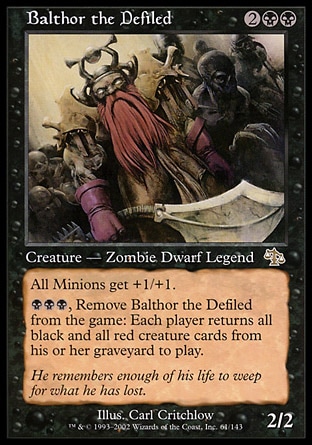
Balthor the Defiled would be my man...dwarf...zombie...whatever. His ability to place your graveyard back into play over and over again keeps the horde coming, board wipe after board wipe. Feast you eyes upon his army, in hopes they won't feast upon your eyes first.

Balthor the Defiled Mono-Black Zombie Tribal EDH by (Julian Biondillo)

Commander

Creatures

Spells

Lands

31 Snow-Covered Swamp  Bojuka Bog  Cabal Coffers  Lake of the Dead  Phyrexian Tower  Nykthos, Shrine to Nyx  Unholy Grotto  Dakmor Salvage  Crypt of Agadeem  Scrying Sheets

So yes, if one of the players at the table jams something like Leyline of the Void, Planar Void, Rest in Peace or Grafdigger's Cage this deck isn't very fun or powerful. Like most of my EDH/Commander decks this is meant to be a fun and casual thing.

It can be very powerful though, so don't sell it short. Having an army of zombies with a lord effect from Death Baron, Lord of the Undead, or an artifact like Caged Sun or Gauntlet of Power, can be very hard to deal with. Fill up your graveyard with zombies, pop Balthor the Defiled and watch the fun start over, especially with a Gray Merchant of Asphodel triggering off all that devotion to back.

For a lot of my readers it may seem obvious why we're playing Snow-Covered Swamps but for those who are scratching their brain-pans here's why. Extraplanar Lens looks at the exact land imprinted, not just a Swamp, but a Snow-Covered Swamp. So it only doubles your mana, assuming no one else is playing snow-covered lands.

Like any good black deck there's a masochistic element in it. Graveborn Muse can just kill you from drawing a ton of cards. Luckily we have sac outlets to off our rotting muse if she starts getting out of control. Nightmare Incursion is the deck's best way to get rid of problematic elements in our opponent's libraries. The greedy player in me really wanted to run a Mirari To fork it along with a few other sorceries in the deck but I felt there wasn't enough to warrant it.

I know in my last article I mentioned writing my next article about a suggested general or a budget deck. I've been busy and life has been a bit chaotic, but no one gave me any suggestions! So I'll open up the comments for that again. If I don't get any takers I'll be following up next week with another EDH/Commander deck from my bag of tricks.

Until next time!!

Thanks for checking out my article!

x Julian Biondillo x
Julian, AKA hardcoreniceguy on Twitter
biondillodesign@gmail.com

Insider: Origins of the Format

Are you a Quiet Speculation member?

If not, now is a perfect time to join up! Our powerful tools, breaking-news analysis, and exclusive Discord channel will make sure you stay up to date and ahead of the curve.

When the first weekend of a set jumbles up the format and creates interesting new situations, it's my favorite time to play Magic. Wizards provided a stellar finale to the core set model with a beautifully designed set. Long is the list of not only playable but also intriguing cards from the set.

Most of SCG Chicago this past weekend consisted of established decks, but many of them used at least a couple new cards. G/R Devotion took advantage of the sideboard powerhouse finisher Gaea's Revenge as well as a Sword of the Animist and a Nissa's Revelation. These are minor changes but important ones that will prod the shift in the metagame along.

One of the biggest changes to the metagame is the inclusion of new cards in Abzan. As I mentioned would likely happen last week, players quickly adopted Nissa, Vastwood Seer as well as maindeck Languish. One version used a couple Elvish Visionarys and another added a Tragic Arrogance in the sideboard, but for the most part the Abzan decks got some more tools while still taking advantage of their already powerful lineup. This archetype was the largest percentage of players to make Day 2 of this event.

I also noted a couple different decks utilizing Jace, Vryn's Prodigy, like Jeskai Tokens. That same deck also added Sphinx's Tutelage in the sideboard as well. Other than those minor changes to pre-established archetypes, the other known decks didn’t change at all. Some decks, like U/W Heroic, didn’t swap any new cards into their decks and opted for their already streamlined lists.

The main avenue for new cards was through the new decks they brought to life.

Last week I talked about some of these sweet new decks that were obviously possible based on the card pool. Although they were straightforward in viability, they are nuanced in deck design. Let’s take a look at the archetypes from last week that found success on opening weekend.

Goblins

Goblins by Michael Bernat (24th Place SCG Chicago)

Creatures

1 Zurgo Bellstriker
2 Monastery Swiftspear
4 Foundry Street Denizen
3 Frenzied Goblin
4 Goblin Piledriver
4 Goblin Rabblemaster
3 Goblin Heelcutter

Spells

4 Dragon Fodder
3 Exquisite Firecraft
2 Hordeling Outburst
4 Lightning Strike
1 Searing Blood
4 Stoke the Flames

Lands

21 Mountain

Sideboard

1 Goblin Heelcutter
2 Mardu Scout
3 Searing Blood
3 Wild Slash
1 Arc Lightning
4 Roast
1 Scouring Sands

R/g Goblins by Jason Kohnert (18th Place SCG Chicago)

Creatures

4 Monastery Swiftspear
4 Foundry Street Denizen
1 Frenzied Goblin
4 Goblin Piledriver
4 Goblin Rabblemaster
1 Goblin Heelcutter

Spells

3 Wild Slash
3 Searing Blood
4 Atarka's Command
4 Dragon Fodder
3 Hordeling Outburst
4 Stoke the Flames
1 Become Immense

Lands

4 Mana Confluence
4 Wooded Foothills
1 Forest
11 Mountain

Sideboard

2 Hornet Nest
3 Eidolon of the Great Revel
3 Destructive Revelry
1 Twin Bolt
1 Hall of Triumph
2 Arc Lightning
1 Harness by Force
2 Roast

First up, we have Goblins. This archetype posted a few good results in these two main configurations. Although it’s not a goblin, both decks still included the potent Monastery Swiftspear instead of the new Goblin Glory Chaser. They also both utilized Goblin Heelcutter in place of the slimmer Subterranean Scout, but they did have the can't block effect in some capacity.

Goblins is going to be lurking at tournaments for the next couple of months but it needs to come prepared for the horde of Arashin Clerics hiding in every white deck's sideboard. There is some room for adaptation, but most of the spots are almost irreplaceable. Maindeck Languish is like a giant moat that your little critters need to swim across before you can defeat your black opponents. Only time will tell if Languish is enough to send the goblins back to their caves or not.

Elves

G/b Elves by John Ostrem (41st Place SCG Chicago)

Creatures

4 Elvish Mystic
4 Gnarlroot Trapper
4 Dwynen's Elite
4 Elvish Visionary
4 Leaf Gilder
1 Reclamation Sage
4 Shaman of the Pack
4 Sylvan Messenger
2 Dwynen, Gilt-Leaf Daen

Spells

4 Chord of Calling
4 Collected Company

Lands

4 Llanowar Wastes
2 Mana Confluence
12 Forest
3 Swamp

Sideboard

2 Gilt-Leaf Winnower
1 Reclamation Sage
2 Display of Dominance
2 Plummet
1 Bow of Nylea
2 Eyeblight Massacre
2 Self-Inflicted Wound
3 Thoughtseize

One of the main aspects of Elves that I discussed last week was the dilemma of the four-drop in the deck. John Ostrem, the only Elf player to crack the Top 64, decided that they were all too good to leave at home! He played a whopping ten four-cost cards as well as the full set of Chord of Calling!

I imagine there are a lot of hands with an odd assortment of clunky parts, but this does provide you with the most powerful tools available. To offset the bottlenecking at your top end, he included the Lorwyn block reprint, Leaf Gilder. Although I don’t feel secure with this many high-cost spells, this deck is certainly capable of recovering from a board wipe which is a positive quality to possess.

Constellation

G/B Constellation by Ross Isley (29th Place SCG Chicago)

Creatures

4 Herald of the Pantheon
2 Brain Maggot
2 Den Protector
4 Courser of Kruphix
2 Herald of Torment
2 Boon Satyr
4 Eidolon of Blossoms
4 Doomwake Giant
1 Erebos, God of the Dead
1 Nylea, God of the Hunt
1 Pharika, God of Affliction
1 Tasigur, the Golden Fang

Spells

2 Kruphix's Insight
2 Hero's Downfall
2 Murderous Cut
1 Whip of Erebos
1 Extinguish All Hope

Lands

4 Jungle Hollow
4 Llanowar Wastes
4 Temple of Malady
1 Nykthos, Shrine to Nyx
1 Urborg, Tomb of Yawgmoth
6 Forest
4 Swamp

Sideboard

1 Archfiend of Depravity
2 Rakshasa Deathdealer
2 Virulent Plague
2 Agent of Erebos
4 Master of the Feast
2 Bile Blight
1 Bow of Nylea
1 Whip of Erebos

This unique take on an enchantment deck gives up on the wonderful new white cards so it can focus on green and black. A deck like this is not something most of us would brew up on our own. Herald of the Pantheon certainly enables this deck to spit out enchantment creatures more quickly, but that is the only new card the deck is sporting.

If this deck was well positioned in the meta, I would have thought that the same configuration but with Golden Hind or Sylvan Caryatid would have been present previously.

It is still my belief that a white-based enchantment deck will surface, but it’s possible that the mana costs of that version make the deck too inefficient. I know I will be working on the deck as I’m sure other deck builders will as well. With the Pro Tour coming up soon, I’m hoping to see the pro hive mind create something wonderful with these cards.

Mono-White Devotion

Mono-White Devotion by Jordan Haukereid (14th Place SCG Chicago)

Creatures

1 Kytheon, Hero of Akros
4 Soldier of the Pantheon
3 Anafenza, Kin-Tree Spirit
4 Knight of the White Orchid
2 Hidden Dragonslayer
3 Brimaz, King of Oreskos
2 Heliod, God of the Sun
4 Archangel of Tithes
3 Wingmate Roc

Spells

2 Mastery of the Unseen
4 Valorous Stance
2 Spear of Heliod
1 Ajani Steadfast

Lands

3 Nykthos, Shrine to Nyx
2 Foundry of the Consuls
20 Plains

Sideboard

2 Arashin Cleric
2 Banishing Light
2 Celestial Flare
2 Secure the Wastes
3 Surge of Righteousness
2 Elspeth, Sun's Champion
2 Tragic Arrogance

Mono-White Devotion by Dennis Bogdanov (64th Place SCG Chicago)

Creatures

4 Kytheon, Hero of Akros
4 Soldier of the Pantheon
4 Anafenza, Kin-Tree Spirit
4 Knight of the White Orchid
3 Brimaz, King of Oreskos
4 Archangel of Tithes
3 Wingmate Roc

Spells

2 Mastery of the Unseen
2 Celestial Flare
3 Valorous Stance
1 Spear of Heliod
2 Elspeth, Sun's Champion

Lands

4 Nykthos, Shrine to Nyx
2 Temple of Enlightenment
18 Plains

Sideboard

1 Hidden Dragonslayer
2 Banishing Light
2 Mastery of the Unseen
2 Abzan Advantage
2 Celestial Flare
1 Valorous Stance
1 Brimaz, King of Oreskos
1 Ajani Steadfast
1 Elspeth, Sun's Champion
2 Glare of Heresy

Surprise! Mono-White is back. If you’re like me, seeing this deck being mentioned truly is surprising. There was an inkling in the back of my mind about building a white aggressive deck, but I didn’t think others would grab onto the idea and certainly not this quickly. New metagames evolve much faster than they used to thanks to so many players writing about new cards and social media spreading the word.

As far as these two decks are concerned, there are parts I like about both of them. In the first one, Heliod, God of the Sun and Archangel of Tithes to enable it seem quite strong. The second deck offers much more opportunity to take advantage of Kytheon, Hero of Akros. Kytheon seems like a potent weapon in decks designed to take advantage of him.

One thing both decks have in common is they both start out with aggressive white creatures with powerful abilities and finish strong with the often forgotten Wingmate Roc. Nykthos can power Wingmate out a turn early or it can churn out Mastery of the Unseen manifests later in the game.

I love this archetype but I don’t love the breakdown of either version because I think they can be improved upon. There are so many decks I want to develop further! This is definitely one of them on my list.

Jace Decks

Jeskai Aggro by Gerry Thompson (31st Place SCG Chicago)

Creatures

4 Soulfire Grand Master
2 Harbinger of the Tides
4 Jace, Vryn's Prodigy
4 Goblin Rabblemaster
4 Mantis Rider

Spells

1 Clash of Wills
2 Dig Through Time
1 Disdainful Stroke
4 Lightning Strike
3 Ojutai's Command
2 Stoke the Flames
2 Valorous Stance
2 Wild Slash

Lands

2 Battlefield Forge
4 Flooded Strand
4 Mystic Monastery
4 Shivan Reef
3 Temple of Epiphany
3 Temple of Triumph
2 Island
1 Mountain
2 Plains

Sideboard

3 Arashin Cleric
3 Disdainful Stroke
2 Elspeth, Sun's Champion
3 Anger of the Gods
2 End Hostilities
2 Glare of Heresy

Gerry Thompson has been working on this deck for a little while. He and Adam Varner played nearly identical deck lists and finished next to each other in the standings, which is quite impressive. This deck seems more like Jeskai Tempo but some of the cards seem out of place for that type of strategy.

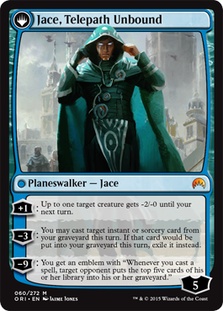
Take our new buddy Jace, Vryn's Prodigy for example. What exactly is his function in this deck? He can filter your draws to hopefully find more of what you need instead of what you have and he can flip in the midgame thanks to all of the cheap interactive spells. Maybe what makes new Jace work in this deck is the ability to imitate Snapcaster Mage once he has flipped. Flashing back your removal or burn seems like a great line of play.

Ojutai's Command might be the biggest hidden gem in the format and it’s no surprise that Gerry included some in this deck. All of the modes are great against every deck. If this spell could counter anything and not just creatures, it would be dominating the metagame. There are some great two-cost creatures to get back so all the modes are turned on in this deck. I think we’ll be seeing more of this deck in the coming weeks.

Five-Color Rally by Matthew Tickal (34th Place SCG Chicago)

Creatures

4 Elvish Mystic
4 Satyr Wayfinder
3 Sylvan Caryatid
4 Jace, Vryn's Prodigy
1 Liliana, Heretical Healer
3 Deathmist Raptor
2 Den Protector
3 Grim Haruspex
2 Mogis's Marauder
4 Nantuko Husk

Spells

4 Gather the Pack
2 Chord of Calling
4 Rally the Ancestors

Lands

1 Frontier Bivouac
4 Mana Confluence
1 Mystic Monastery
3 Opulent Palace
2 Sandsteppe Citadel
3 Windswept Heath
2 Yavimaya Coast
1 Urborg, Tomb of Yawgmoth
2 Forest
1 Plains

Sideboard

4 Cleric of the Forward Order
1 Den Protector
1 Hidden Dragonslayer
1 Reclamation Sage
1 Stratus Dancer
2 Hero's Downfall
2 Kolaghan's Command
3 Thoughtseize

I’m sure you’ve heard about this crazy concoction by now but it definitely merits mention in this article. This deck utilizes some interesting cards to fuel its strategy. We are also starting out with new Jace but quickly proceeding into new territory with Gather the Pack into Rally the Ancestors.

This deck definitely seems fun but I’m not so sure it will be sticking around. With no removal spells, it seems easy to overwhelm with threats backed up by a couple removal spells. If you get lucky with your flips, you could be returning a bunch of creatures with a midgame Rally though.

5c Rally is trying to do a dredge impersonation, but the accent is off. The green cards are the backbone of the deck and maybe they will be enough to carry this deck into the future.

Hangarback Decks

U/W Control by Jeff Hoogland (7th Place SCG Chicago)

Creatures

4 Hangarback Walker

Spells

3 Clash of Wills
1 Disdainful Stroke
1 Last Breath
2 Valorous Stance
2 Swift Reckoning
4 Dissolve
3 Artificer's Epiphany
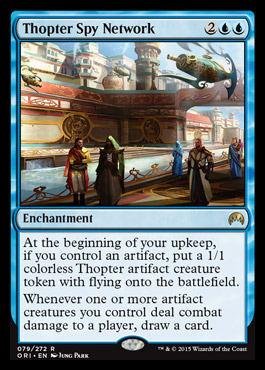
2 Thopter Spy Network
3 End Hostilities
3 Elspeth, Sun's Champion
4 Dig Through Time
1 Ugin, the Spirit Dragon

Lands

4 Flooded Strand
2 Mystic Monastery
1 Polluted Delta
1 Radiant Fountain
4 Temple of Enlightenment
4 Tranquil Cove
3 Darksteel Citadel
6 Island
2 Plains

Sideboard

1 Perilous Vault
1 Hidden Dragonslayer
2 Stratus Dancer
1 Disdainful Stroke
1 Fated Retribution
3 Last Breath
2 Negate
1 Raise the Alarm
1 Valorous Stance
2 Displacement Wave

Next up, we have the Hangarback Walker decks. That phrase is not something I ever thought I’d be writing in one of my articles. Jeff Hoogland is a brewmeister like myself and he’s been working long hours in the factory to build this contraption. I am definitely not a Blue-White Control player but a version like this with Thopter Spy Network makes me think about giving it a go.

Not many other control decks did well at this event so that leads me to believe that this deck is well positioned in the metagame. It’s unclear to me how many control players will be able to stomach this odd of a control deck, so I think it would be impossible to predict how much of the metagame this deck will take up.

Most games playing against this deck will feel like typical control matchups where they kill your guys, draw cards, and play a big finisher. The distinguishing factor is that many times after they clear the board, they will end up with thopter tokens in play from Thopter Spy Network or Hangarback Walker. With these cards, the deck can pressure its adversaries into overextending regularly. This is the hidden strength of this deck.

There was an error retrieving a chart for Hangarback Walker

W/R Aggro by Ryan Hipp (11th Place SCG Chicago)

Creatures

4 Hangarback Walker
4 Knight of the White Orchid
3 Seeker of the Way
4 Brimaz, King of Oreskos
2 Pia and Kiran Nalaar
2 Stormbreath Dragon

Spells

4 Chained to the Rocks
2 Wild Slash
2 Secure the Wastes
1 Roast
1 Valorous Stance
2 Chandra, Pyromaster
2 Outpost Siege
3 Dictate of Heliod

Lands

4 Battlefield Forge
4 Evolving Wilds
4 Temple of Triumph
1 Wind-Scarred Crag
4 Mountain
7 Plains

Sideboard

1 Ashcloud Phoenix
3 Flamewake Phoenix
1 Mastery of the Unseen
1 Fate Forgotten
2 Surge of Righteousness
2 Valorous Stance
1 Elspeth, Sun's Champion
1 Crater's Claws
2 End Hostilities
1 Roast

Onto our second Hangarback Walker deck of the event. This curious red-white deck appears more like a token deck than a typical aggressive deck. It even curves all the way up to Dictate of Heliod! Our red-white oddball here intrigues me because the card choices are well outside the normal iteration of similar decks.

I’m uncertain that four Chained to the Rocks is a great idea with only an effective eight mountains in the deck. It is cheap and that seems important in this midrangey deck, but there are not many other removal spells to rely on if you can’t locate a mountain.

Pia and Kiran Nalaar, as well as Foundry of the Consuls, was also found in another midrange red deck, so it seems like that card is the real deal.

There were a lot of interesting advances in the format this weekend. I can’t wait to see what happens next weekend! Share your thoughts on these decks or others in the comments.

Until next time,
Unleash the Force!

Mike Lanigan
MtgJedi on Twitter
Jedicouncilman23@gmail.com

Deck of the Week – 5C Humans

Are you a Quiet Speculation member?

If not, now is a perfect time to join up! Our powerful tools, breaking-news analysis, and exclusive Discord channel will make sure you stay up to date and ahead of the curve.

I've always been a fan of Gerry Thompson's Daily Digest column on StarCityGames, especially when he highlights a Modern deck. Because most Modern players don't sit at their computer spamming F5 to refresh the MTGO Daily at noon every day, Gerry's articles are a great way to get the scoop on cool new Modern decks. Unfortunately, probably due to editorial guidelines, the Digests are often quite short and don't go into the level of detail many Modern players might be looking for. Enter our new "Deck of the Week" column. This series will spotlight an interesting and innovative Modern list from recent tournaments, and you can expect a new one every week.

falkenrath-aristocrat art

"Deck of the Week" will feature a combination of successful rogue strategies, brave new brews, and unique technology in old Modern staples. Some decks will be more competitive than others, but in the spirit of our Undying Pongify deck spotlight from last week, I'll always relate the specific list back to broader deckbuilding principles and the overall Modern metagame. Even if you aren't interested in the deck itself, hopefully you'll find something useful in the analytic methods and deck evaluation approach: these are universals that can help you with any deck. Let's kick off the new column with a tribal archetype we've all heard about, especially if you started playing around Innistrad block: Humans.

[wp_ad_camp_1]

The List and Strategy

If you browse MTGO results as much as I do, you've seen some version of the 5C Humans list before. These creature-heavy lists combine an aggressive gameplan with some "hatebear" style creatures to pressure an opponent's win conditions. In a recent daily, iLoveShimakaze piloted his 5C Humans deck to a 3-1 finish:

5C Humans, by iLoveShimakaze (MTGO Daily 7/19/2015, 3-1)

Creatures

2 Anafenza, the Foremost
4 Champion of the Parish
4 Experiment One
4 Falkenrath Aristocrat
4 Huntmaster of the Fells
1 Knight of New Alara
3 Lyev Skyknight
4 Mantis Rider
4 Meddling Mage
2 Saffi Eriksdotter
3 Thalia, Guardian of Thraben

Lands

4 Ancient Ziggurat
2 Brushland
2 Cavern of Souls
4 City of Brass
2 Copperline Gorge
2 Darkslick Shores
4 Pillar of the Paruns
1 Plains
2 Reflecting Pool
2 Seachrome Coast

Sideboard

2 Fiend Hunter
2 Kataki, War's Wage
1 Orzhov Pontiff
2 Sin Collector
1 Vithian Renegades
1 Izzet Staticaster
2 Lavinia of the Tenth
2 Qasali Pridemage
1 Spellskite
1 Wilt-Leaf Liege

Before we even get to the "Improvements" section, it's clear this deck needs a lot of tuning: Knight of New Alara has no business winning anything in Modern. Despite several deficiencies, the deck features some core synergies and card choices which are worth our attention. These strengths are shared by many of the other Humans lists we have seen in MTGO Dailies, suggesting common themes that have made Humans successful in the past.

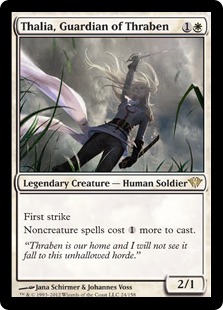
  • thaliaThalia, Guardian of Thraben is a driving force behind Legacy's Maverick and Death and Taxes decks. Unfortunately for D&T fans, Thalia hasn't made as big an impact in Modern, despite her presence in our own D&T lists along with Hatebears. Humans is probably not the deck to push her to top-tier play, but the deck does showcase her power. Looking at the current tier 1 decks in Modern, we see a lot that are going to struggle against an active Thalia. Burn, Grixis/UR Twin, Grixis Control, and RG Tron do not want to face down a turn two Thalia, especially if they are on the draw. Although many of these decks can answer her in some way, it will often set them back a turn, both because they had to commit resources to killing Thalia and because they spent an additional mana to do so. Humans is aggressive enough to capitalize on that lost turn, which makes the deck a perfect home for Thalia.
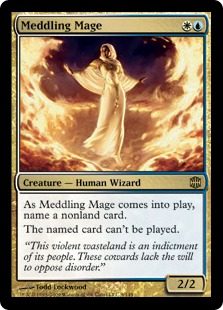
  • Meddling MageMeddling Mage is one of those Modern cards everyone wants to work, but no one can seem to use effectively. It's in the same category as Shadowmage Infiltrator and Solemn Simulacrum: cards that used to be good in old Standard and Extended seasons that can't cut it in Modern. Incidentally, all of them are Invitational cards (Dark Confidant gets a pass here). Thankfully for Chris Pikula fans everywhere, Humans gives renewed hope to Mage fans in Modern. Two of Modern's defining characteristics are 1) its diversity and 2) the importance of having specific answers to narrow threats. Mage directly addresses both these issues, giving Humans players a maindecked, proactive solution to some of Modern's most problematic cards. Most Modern players are able to identify decks within the first 1-2 turns, which makes Mage a great way to screw up an opponent's plans. Of course, another defining Modern characteristic is the prevalence of cheap removal (i.e. the Bolt test), which remains a problem for Mage. Thanks to an aggressive gameplan coupled together with other interactive tools, like Thalia, Mage is able to overcome some of these challenges and remain relevant in the Humans shell.
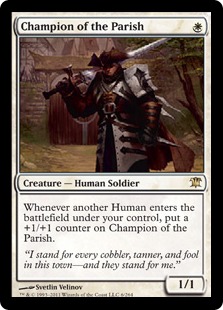
  • champion of the parishTribal synergies usually aren't good enough in Modern (with the historic exception of Merfolk and the recent results from Elves). In many cases, you are better off throwing Nacatls and Goyfs at an opponent than trying to build off synergies between your creatures. Even better still is throwing Ravagers/Inkmoths or Bolts/Spikes at the opponent. Humans challenges this paradigm with a variety of micro-synergies between its different cards. The key term here is micro-synergies: interactions that are incidental to the cards you are already playing. For instance, because you're already playing Mage and Thalia, you might as well add both Experiment One and Champion of the Parish as your aggressive one-drops. Now that you are so deep into Humans, Cavern of Souls and Falkenrath Aristocrat fit in nicely. These kinds of micro-synergies give Humans some added firepower in fairer matchups (Abzan, Jund, Grixis Control, etc.), where your average board state is much stronger than in a Zoo or Burn deck. Affinity is the king of micro-synergies, but Humans is another great example of it in action.

Of course, 5C Humans isn't without some big weaknesses. For one, this particular list lacks any removal or spell-based interaction. This can be very risky in a format full of remove-or-die threats like Exarch, Primeval Titan, Blighted Agent, and Inkmoth Nexus. The manabase is also obscenely vulnerable to Blood Moon, although it's surprisingly painless compared to other 3+ color decks. With so many decks running Moon in the board, Ancient Ziggurat and Pillar of the Paruns aren't exactly what you want to be dropping on turns one and two. Finally, the deck is a little "too fair" for Modern. Curving turn one Champion into Thalia, followed by Anafenza, then Huntmaster feels too cute when compared to other decks' plays on turns one through four. Humans has enough going for it that I think we can work through these shortcomings, but we'll need to focus on addressing them.

5C Humans in Context

It's always risky to look for successful decks on MTGO because of the nature of events. With so many tournaments every day, especially with many finishes decided on byes, no-shows, intentional draws, and other extra-game methods, we can't always tell if a deck is finishing because it's good or lucky. Also, as the old adage goes: "If you throw enough darts at a board you'll get a bulls-eye eventually". MTGO has a lot of random decks appearing in the Daily listings; just because they go 3-1 doesn't make them a real consideration for a PPTQ. This worry is very much present in 5C Humans. One way to address this is to look at the historical and metagame context for the deck, checking our theories around Humans against the hard data. This is a great tool for confirming any deck's viability, so whether you love or hate Humans, this approach can be valuable in your own testing, brewing, and deck development.

siege rhinoHumans may not be Grixis Delver or even Stompy or Smallpox Loam, but the deck has seen a number of MTGO finishes since March 2015. With six appearances in that time, Humans' MTGO share is comparable to Esper Gifts (5), Goblins (8), 8Rack (8), and GW Hatebears (9). Three of those finishes were accomplished by one player, FeedMe, who took a red-heavy Humans list to 3-1 showings on 3/25, 5/3, and 5/20. We also saw a lot of 5C Humans action during the end of the 2014 Modern season. MTGO player Meltiin took his own list, one very similar to the deck featured in this article, to a 4-0 finish in an 11/14 Daily, on top of three other finishes in the following months. Meltiin added in the non-human Siege Rhino to his four lists, an addition later Humans players dropped on MTGO. The similarities between these lists do not necessarily mean the deck is the next big thing, but they are encouraging datapoints for those looking to replicate Humans' success.

Perhaps more important than Humans' prevalence is the overall metagame in which the deck lives. Humans doesn't need to reach 5%+ of the metagame to be successful; it simply needs to match up favorably against the decks you are likely to encounter. In Humans, this means leveraging the three strengths I mentioned above and converting them to wins: Thalia, Mage, and your aggressive tribal synergies. Looking over the current tier 1 decks, we see a number of decks that are weak to this Humans core. This includes Grixis Control, RG Tron, and Jund. Thalia alone is a beating against these decks, and she gets even nastier when paired with pressure from Champion, Experiment, and Aristocrat. Mage is also a strong bullet in all of those matchups, eliminating an opponent's access to key cards like Cryptic Command or Pyroclasm. Other tier 1 decks are better against Humans, including both Grixis and UR Twin. Although these decks are likely to lose the midrange game, Humans is very weak to their combo plan. A similar problem is at play with Burn and Affinity. Thalia puts in work against the former and Huntmaster stabilizes against the latter, but both matchups return to the core problem with Humans: the deck is a bit too fair. Even so, with a little more interaction and improved card choices, it seems possible to get Humans to the point where it has decent matchups against at least five of the top seven decks in the format. That's a great place for a brewer to start, and it's how we'll kick off our next section.

Improvements

To get the creative energies flowing, here's a quick rundown of the different ways we could improve this Humans list. All of these cards and approaches could easily be deck techs of their own, so instead of going into too much depth on most of them, I'll present them all here to inspire the deckbuilders out there:

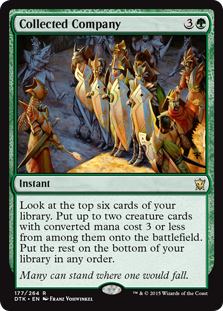
  • collected companyCollected Company
    Company has already done a lot of work for other tribal strategies (see GP Charlotte), and Humans could probably benefit from it as well. To accommodate Company, you'd have to drop most of the four-mana cards including the powerful Huntmaster and Aristocrat, but you'd gain a card advantage tool Humans is currently lacking. Company also has synergy with Champion and Experiment, even if it has some anti-synergy with your own Thalia. Add Chord of Calling for a toolbox approach (Orzhov Pontiff, Lyev Skyknight, Fiend Hunter, etc.) and you might have a much more powerful deck. Noble Hierarch and Avacyn's Pilgrim fit nicely into this strategy too, as does the Company staple Eternal Witness. Of course, you might end up playing a worse version of Abzan Company, so keep that in mind if you decide to go this route.
  • Aether Vial
    Bringing us back in touch with our Death and Taxes roots, Vial puts another one-drop into your curve while giving you many of the same benefits as the instant-speed Company. You don't get to run the same kind of toolbox approach as with Company and Chord, but you do get to ditch your dorks in favor of powerful hate creatures. Most creatures that synergize with Company also play nicely with Vial, especially the interactive ones like the undervalued Skyknight and Pontiff. Also, Vial doesn't impose the same kind of deckbuilding restrictions that Company does, which gives you space for interactive cards such as Path to Exile and Spreading Seas. Vial also plays nice with Thalia, which can't be said for Company.
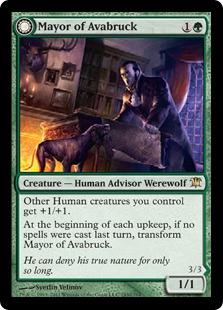
  • Mayor of AvabruckMayor of Avabruck and Hamlet Captain
    When most players hear "tribal", they think of lords like Goblin King and Lord of Atlantis. Mayor and Captain fill those role in Humans, putting you into a much more aggressive role. One big danger with this approach is becoming a worse version of Merfolk: it doesn't get much better than the redundant blue lords. You can overcome this by leaning on Thalia and Mage, effects Merfolk doesn't have access to, using your lords to exert pressure while opponents play around your static abilities.
  • Magus of the Moon
    I've always been interested in the "8Moon" space available to Modern players in Blood Moon and its Magus. Humans might be a great shell to take advantage of this, especially in a red-white or Jeskai-colored build that includes Champion, Thalia, and Mage. This presents your opponents with multiple pressures they need to overcome before they can win, all while being beaten down with creatures like Mantis Rider and Mirran Crusader. This seems like the least viable of the Human options, but it's an interesting one for metagames with many Moon-vulnerable decks.

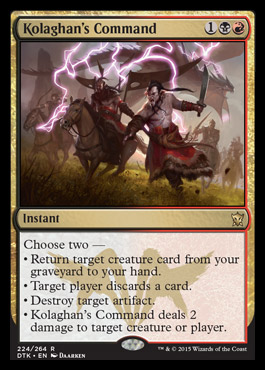
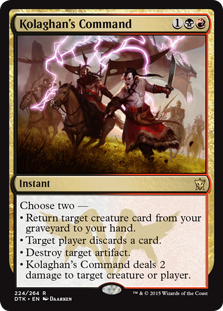
If we are going to play interactive pieces like Lyev Skyknight and Aether Adept, then we also need a way to get them into the action at instant speed. This pushes us towards either Company or Vial. Personally, I'm leaning towards Vial because it's better with Thalia and is more discriminate than the random Company flips: when I need to bounce Deceiver Exarch, I can't hope for an answer in the top six cards. Running Vial makes us vulnerable to some nasty two-for-ones from Kolaghan's Command, but we have a few ways to handle that including Thalia herself. Once we are running Vial, we want to run cards that work well with the artifact. Borrowing from our D&T playbook, Blade Splicer jumps out, as does Noble Hierarch from the green-white version (see the recent 14th place SCG Chicago list for an example). Flickerwisp isn't a Human, but the Elemental is strong enough to include on its own merits and for its synergy with the rest of the deck. That leaves us with something like this:

Vial Humans, by Sheridan Lardner

Creatures

3 Blade Splicer
2 Eternal Witness
3 Lyev Skyknight
4 Meddling Mage
4 Flickerwisp
4 Noble Hierarch
3 Thalia, Guardian of Thraben
4 Champion of the Parish
2 Restoration Angel

Instants

4 Path to Exile
1 Dromoka's Command

Artifacts

4 Aether Vial

Lands

1 Gavony Township
2 Horizon Canopy
1 Breeding Pool
2 Razorverge Thicket
2 Hallowed Fountain
1 Forest
4 Windswept Heath
2 Temple Garden
4 Misty Rainforest
1 Plains
1 Cavern of Souls
1 Flooded Strand

Sideboard

1 Dromoka's Command
1 Kataki, War's Wage
2 Mirran Crusader
1 Rest in Peace
2 Kor Firewalker
2 Stony Silence
1 Engineered Explosives
2 Ethersworn Canonist
2 Qasali Pridemage
1 Cavern of Souls

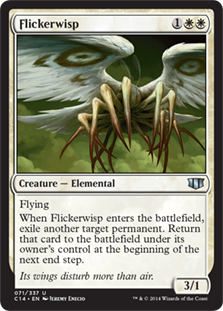
FlickerwispVial Humans goes down to three colors from the original list's five, tightening the deck around a Bant core. Because Champion is the only Human that really cares about other Humans, we can safely use both Flickerwisp and Restoration Angel. These cards synergize with Splicer and Eternal Witness, not to mention retriggering Champion when targeting a Human. I also like the idea of flickering Mages depending on what cards you need to turn off. Flickerwisp and Skyknight combine with Vial to give us instant-speed interaction, with additional support  from Path to Exile and Dromoka's Command. A bunch of Humans and powerful white hosers round out the board. I ran a few games with this against Grixis Control, Grixis/UR Twin, and Jund, all with fairly favorable results. Thalia and Mage are strong in these matchups, as is the combination of exalted with our flyers and first strikers.

Conclusion

Hopefully this in-depth analysis gave you some ideas about building Humans in Modern and about deck development in general. The final Vial Humans list is a far cry from the original 5C Humans build, but sometimes you have to jettison old concepts to make something better.

What do you you think about the "Deck of the Week" article and approach? Anything you would like to see more or less of in future articles? Until the next time, keep the great Modern ideas coming and don't be afraid to step outside of the deckbuilding box!

Changes to Magic Online Prize Structure

Are you a Quiet Speculation member?

If not, now is a perfect time to join up! Our powerful tools, breaking-news analysis, and exclusive Discord channel will make sure you stay up to date and ahead of the curve.

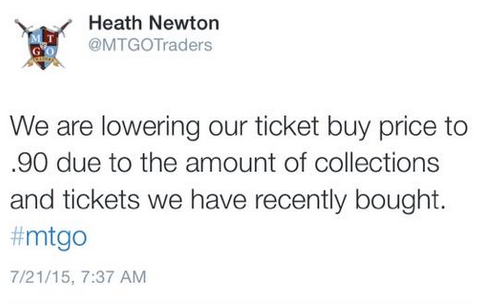
If you missed it, Magic Online made a pretty big announcement this week. Like nearly every change that has ever happened to Magic- online or otherwise- there has been a loud, negative response. In fact, many players seem to be selling out of Magic Online, as evidenced by this:

mtgo

With fewer packs being awarded as prizes and Play Points being non-transferable, this is being heralded as a death knell for those who grind MTGO for profit beyond just playing infinite- if this was even a reasonable thing to attempt doing given the recent MTGO economy.

The negative feedback seems to come mostly from constructed players. With so little of the prize pool being trade-able, acquiring new cards by playing constructed is quite difficult. Alternatively, players who only use MTGO to draft don't seem to be impacted at all.

As somebody who uses MTGO for some constructed and periodic drafts, these changes actually appear good to me, and by this I mean for the type of experience that I derive from MTGO. I like MTGO for testing Modern, and mostly only play brews in Standard. This structure allows me to play more games with a smaller investment. This is clearly not the case if you're buying a lot of new cards, so again, there's definite downside when it comes to grinding and building decks if you're not using MTGO to draft.

Now, if you're into Daily Events, this change is ostensibly terrible. There's very little incentive to play a Daily Event with the increase in entry fee with what is decidedly poor prize support. Daily Events haven't worked with my schedule for some time, so again, this doesn't effect me but I can see where that would upset others.

I do think that being able to use Play Points to draft is great, and this looks to address the concern of low pack prices. Of course, the counter to that is that constructed players will just have fewer packs. I would like to see some manner of Play Point redemption introduced so that it's not just impossible to cash out, but I stand by that these changes are good with the goal of just using the client to play.

A link for providing feedback is provided in Lee's announcement, and I recommend contacting WotC through that medium instead of decrying that the sky is falling.

Avatar photo

Ryan Overturf

Ryan has been playing Magic since Legions and playing competitively since Lorwyn. While he fancies himself a Legacy specialist, you'll always find him with strong opinions on every constructed format.

View More By Ryan Overturf

Posted in Free19 Comments on Changes to Magic Online Prize Structure

Have you joined the Quiet Speculation Discord?

If you haven't, you're leaving value on the table! Join our community of experts, enthusiasts, entertainers, and educators and enjoy exclusive podcasts, questions asked and answered, trades, sales, and everything else Discord has to offer.

Want to create content with Quiet Speculation?

All you need to succeed is a passion for Magic: The Gathering, and the ability to write coherently. Share your knowledge of MTG and how you leverage it to win games, get value from your cards – or even turn a profit.

Insider: MTGO Market Report for July 22th, 2015

Are you a Quiet Speculation member?

If not, now is a perfect time to join up! Our powerful tools, breaking-news analysis, and exclusive Discord channel will make sure you stay up to date and ahead of the curve.

Welcome to the MTGO Market Report as compiled by Sylvain Lehoux and Matthew Lewis. The report is loosely broken down into two perspectives. A broader perspective will be written by Matthew and will focus on recent trends in set prices, taking into account how paper prices and MTGO prices interact. Sylvain will take a closer look at particular opportunities based on various factors such as (but not limited to) set releases, flashback drafts and banned/restricted announcements.

There will be some overlap between the two sections. As always, speculators should take into account their own budget, risk tolerance and current portfolio before taking on any recommended positions.

MTGO Sanctioned Tournament Changes

This Monday Lee Sharpe announced some big changes concerning sanctioned tournaments on MTGO. Play Points (PP) were introduced as a new prize and as a new way to enter all sorts of online sanctioned events. The idea behind the PP is to make sure that some of the awarded prizes hold a constant value (unlike the fluctuating value of boosters) and to facilitate the entry of sanctioned events for players looking to chain events (such as two-players queues). These changes will come into effect August 12th.

It is still too early to say what will be the short- and long-term effects of these changes. On Twitter, the MTGO community reacted quickly and rather negatively to this news. Louder voices are not necessarily representative of the majority of MTGO players and are also not always right about the possible implications of such changes. These PPs are a new type of product on MTGO and will probably have an impact, positive or negative, on all levels of the current MTGO economy, including booster and single prices as well as the dollar value of Tix; it is just too early to draw definitive and stark conclusions.

As always with such announcements, some people impulsively reacted by selling their collection and pledging to quit playing MTGO. There's certainly no need for such dramatic measures at this point. Previous big changes such as the increase of redemption costs, the suspension of large sanctioned events and the switch to different MTGO versions have proven to only momentarily affect the MTGO economy. MTGO didn't crash, players kept playing and speculators kept speculating.

We'll try to cover more about the potential impacts of these changes as they are implemented in the coming weeks. Also, remember that WotC's paper and MTGO teams has shown the ability to respond to comments and criticisms from the community, even as new changes take place.

Redemption

Below are the total set prices for all redeemable sets on MTGO. All prices are current as of July 20th, 2015. The TCG Low and TCG Mid prices are the sum of each set’s individual card prices on TCG Player, either the low price or the mid-price respectively.

All MTGO set prices this week are taken from Goatbot’s website, and all weekly changes are now calculated relative to Goatbot’s ‘Full Set’ prices from the previous week. All monthly changes are also relative to the previous month prices, taken from Goatbot’s website at that time. Occasionally ‘Full Set’ prices are not available, and so estimated set prices are used instead.

Return to Ravnica Block & M14

Very little has changed since last week. The value of all four of these redeemable sets remained mostly flat with no significant change in the most valuable cards.

After the hype triggered by the reprint of Goblin Piledriver, Mutavault has dropped from its 9-Tix peak and stabilized slightly under 7 Tix. With or without Goblins in Modern, Mutavault remains a valuable position especially since Merfolk proved a couple of weeks ago to be a serious contender in this format.

Legion Loyalist on the other hand hasn't lost much of its recent price increase. However it would take Goblins to really take off in Modern in order for the hasty GTC goblin to push higher prices. If Goblins doesn't make a splash in Modern by the end of the redemption period for Return to Ravnica block (this Fall), Legion Loyalist could be back under the 0.5 Tix bar.

At that price it would become an interesting speculative target as the Loyalist is not only playable in Goblins decks, but has already seen fringe play in Red Aggro decks in Modern.

Theros Block & M15

The release of Magic Origins will momentarily revitalize Theros block and M15 prices. G/R Devotion, Jeskai Aggro and Abzan Control decks remained the most popular decks for the first SCG Standard event post-ORI. With this past weekend's finish, several cards, including Mana Confluence, Temple of Enlightenment, Polukranos, World Eater, Sylvan Caryatid and Hero of Iroas, regained some of the value they had lost over the past two months.

With Standard rotation approaching, these price increases are certainly not here to stay. However, after the global price depreciation initiated since the release of Modern Masters 2015, the release of Magic Origins and its subsequent Pro Tour may trigger short-term but strong rebounds on some Theros block and M15 cards.

This is the last opportunity for speculators to generate profits with positions from sets about to rotate out of Standard. Any speculations here should be consider short-term.

Tarkir Block

Now that Magic Origins is released, several cards form this block are likely to increase in price just after ORI release events and until the release of Battle for Zendikar. Although the impact of ORI on the current Standard metagame will be moderate, the exploration of new strategies may potentially cause the price of any KTK block card to spike.

At this past weekend's SCG Standard OpenMatthew Tickal piloted a novel 5-Color Rally deck to 34th place. Incorporating several cards from ORI, his deck took advantage of Rally the Ancestors in an aggro/combo shell.

The white instant from FRF jumped from bulk rare to 0.4 Tix over the weekend and while this card is likely to go back to bulk soon, this is definitely a card to keep an eye on. The deck uses a fair share of Tarkir block and ORI cards that could form a viable base post-Standard rotation.

Magic Origins

A large number of ORI cards were incorporated in several decks this past weekend. Jace, Vryn's Prodigy probably made the strongest impression and was incorporated in different deck strategies including 5-Color Rally and Jeskai decks.

Jeff Hoogland brought a UW control deck featuring a full playset of Hangarback Walker (also seen in a WR aggro deck) alongside Thopter Spy Network. The walker also made a strong impression and helped Jeff made it to the Top 8.

In total, more than 30 ORI cards including Languish, Pia and Kiran Nalaar, Goblin Piledriver, Archangel of Tithes, Knight of the White Orchid, Gather the Pack and Day's Undoing were also seen among the Top 64 decklists of this event.

All of these cards might not see play in future events but ORI has clearly already influenced the Standard environment, which is rather encouraging for both players and speculators.

Modern

Modern prices as a whole flattened out this past week, seen notably in the Modern Total Format Price index and also in the more dynamic Modern Masters 2015 price index.

This doesn't mean, however, that gains didn't occur. While several non-MM2-reprinted staples, such as the ZEN fetch lands, Blood Moon, Snapcaster Mage and Azusa, Lost but Seeking, lost some value over the past two weeks, gains were still recorded this week by at least two dozen MM2 Modern staples.

On the one hand top mythics and rares added up another 10 to 20% and some have nearly doubled up since mid-June. On the other hand some uncommons and rares that were at bulk price only two or three weeks ago such as Mutagenic Growth, Spectral Procession, Swans of Bryn Argoll, Mirran Crusader and Eye of Ugin saw strong percentage increases.

With cheaper prices comes higher volatility and speculators should expect such cards to swing frequently, with the general trend nonetheless being upward until the release of BFZ.

One should also always keep in mind the price of the original prints before MM2 release for an approximation of the potential ceiling of the MM2 version of these cards. For bulk positions, moving from 0.05 Tix to 1 Tix represents a great percentage increase and it would be reasonable to exit such positions regardless of the time left to go until September. These positions may grow fast but they also may plunge fast. Taking your profit after a 500% return is always a good move.

Legacy & Vintage

Day's Undoing was also seen in Legacy this past weekend. At the Legacy SCG Premier IQ Scott Muir's Affinity deck finished 6th with two copies of the newest iteration of Timetwister. Of note, not less than four Elves deck were found in the top 17 of this same tournament with Mike Rekow's Elves taking the trophy home with the inclusion of one ORI Shaman of the Pack as a win condition that doesn't require an attack step.

Legacy appeal is limited on MTGO and finding speculative opportunities in this format is rare and uncertain. Nevertheless, Natural Order is at an all-time low since its price was recorded by Mtggoldfish and Glimpse of Nature slipped from 11 Tix last October to 3 Tix, an almost 2-year low.

These are certainly very attractive prices for players, but as speculative targets these cards have limited upside compared to Modern or Standard specs. The potential big advantage here comes from a rather limited supply of Visions and Champions of Kamigawa cards on MTGO. As an example, the release of VMA last year showed us what the impact of a sudden demand can have on Legacy and Vintage prices.

Pauper

Familiar has always been a fairly popular deck in the Pauper metagame. This UWb storm deck relies on familiars, namely Sunscape Familiar and Nightscape Familiar, to play spells such as Snap and Cloud of Faeries to untap lands (Ravnica bounce lands if possible) in order to generate mana and storm count.

Sunscape Familiar is a key card of this deck and has been only printed in Planeshift, one of the very first sets released on MTGO. Its price peaked to 4 Tix last month and is now back just under 2 Tix. Considering the recent cyclical price movements in Pauper and the extremely limited supply of the white familiar, this might be a nice speculative target.

Targeted Speculative Buying Opportunities

Legacy

Glimpse of Nature

Pauper

Sunscape Familiar

Targeted Speculative Selling Opportunities

None

Magic Origins – Early Hits and Misses

Are you a Quiet Speculation member?

If not, now is a perfect time to join up! Our powerful tools, breaking-news analysis, and exclusive Discord channel will make sure you stay up to date and ahead of the curve.

Magic Origins hit tournament floors this past weekend with mixed results across multiple formats. Although cards like Hangarback Walker, Jace, Vryn's Prodigy, and Thopter Spy Network made a big impression in Standard events like SCG's Premier Qualifier in Chicago, Origins' Modern impact was much more modest. We'll need more time to see how Origins performs in our format (it's not even MTGO-legal yet), but this article identifies some of the early frontrunners and stragglers in Modern's newest set.

Liliana Heretical Healer Art

I already gave some early impressions of Magic Origins after the full set was spoiled, and it's important to check back in on those cards and see how they are doing in the format. The big datapoints in this article will be the Top 32 of the SCG Chicago Modern event, along with some smaller PPTQs in Italy and the Netherlands. These datapoints may be limited in scope, but they provide a great starting point to see how Modern players are using their new tools.

[wp_ad_camp_1]

Early Playables

Tarkir block is a hard act to follow. With so many playables (some that were too playable...), the block will go down in history as one of Modern's most formative additions. Tasigur, the Golden Fang alone fundamentally changed the Modern balance. Add to that cards like Kolaghan's Command, Collected Company, Monastery Swiftspear, Become Immense, allied fetchlands, and a host of other cards, and Magic Origins has a high bar to reach. So far, Origins is not living up to that lofty precedent, even though the set has a few cards which are well-positioned to make some Modern impact. Looking at the SCG Chicago Top 32, only 19% of the Top 32 decks actually played Origins cards, with zero copies of any in the Top 8. That said, a few cards are emerging as Modern-playable frontrunners, and they deserve special recognition here.

Harbinger of the Tides

Harbinger of the TidesHarbinger is the real deal. Both the 9th and 10th place decks at SCG Chicago were Merfolk, and both lists ran three Harbinger of the Tides in the maindeck. The 18th place player, Jason Crumb, used four. This was by far my most confident prediction in the Modern Playables article I wrote a few weeks ago, and I'm not surprised to see Harbinger make such a splash in his core deck. The Merfolk Wizard is one of the most pushed tribal cards I have ever seen, representing a significant evolution over cards like Tidebinder Mage and even Master of Waves. It's aggressive, provides a badly-needed effect, and fits right into the Merfolk game plan. I wrote about the importance of catchall disruption, specifically related to Merfolk, in my GP Copenhagen retrospective: Harbinger fits perfectly into that context. So you can see Harbinger in his new home, here's Michael Fitza's 9th place list from SCG Chicago.

Merfolk, by Michael Fitza (SCG Premier IQ Chicago 2015, 9th place)

Creatures

4 Cursecatcher
3 Harbinger of the Tides
4 Lord of Atlantis
4 Master of the Pearl Trident
3 Master of Waves
3 Merrow Reejerey
4 Silvergill Adept

Instants

3 Dismember
2 Vapor Snag

Artifacts

4 Aether Vial
2 Relic of Progenitus

Enchantments

4 Spreading Seas

Lands

12 Island
1 Cavern of Souls
4 Mutavault
1 Wanderwine Hub
1 Minamo, School at Water's Edge
1 Oboro, Palace in the Clouds

Sideboard

2 Tidebinder Mage
1 Dispel
2 Hibernation
2 Remand
3 Spell Pierce
1 Kira, Great Glass-Spinner
4 Tectonic Edge

Merfolk already had a scary combination of aggression and interactivity, but Harbinger pushes that to a whole new level. Between Snag, Dismember, and Harbinger, creature-based strategies have a lot to worry about when facing Merfolk. Take Twin as an example; Harbinger shuts down both Dispel and Negate as Twin defensive options. With an active Aether Vial, not even Remand will save Twin from the virtual two-for-one Harbinger forces. Add to that Harbinger's utility against pumped Agents in Infect, counter-stacked Inkmoths in Affinity, or delve creatures in Grixis and BGx, and you have a truly dynamic addition to Merfolk's lineup. I fully expect Harbinger to help Merfolk become one of the most-played tier 2 decks in Modern and, potentially, swim up to tier 1 by the end of September.

Liliana, Heretical Healer
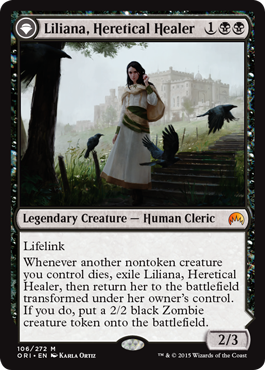
Liliana Heretical HealerThere's a pretty big gap between Harbinger's playability and Liliana's. Although Liliana, Heretical Healer saw some success this weekend, it was much less convincing than Harbinger's. The only SCG deck to use the card was Sage Sanchez's 31st place Abzan Company list. In fact, the 8th place list by Cameron Gray didn't touch Lily and finished much higher. Thankfully for Liliana fans, Tobt Hazes took the Heretical Healer to a 2nd place finish at the (admittedly smaller) monthly Modern event in the Netherlands. This suggests new Lily still has potential to be a decent addition to Abzan Company, and I expect to see more of her in the weeks to come. Indeed, Abzan Company as a deck has struggled since its promising finishes at GP Charlotte: perhaps new Liliana will give it some added juice in the upcoming PPTQ season? Here's Hazes' list for reference:

Abzan Company, by Tobt Hazes

Creatures

2 Melira, Sylvok Outcast
2 Anafenza, Kin-Tree Spirit
3 Viscera Seer
4 Kitchen Finks
1 Murderous Redcap
2 Eternal Witness
2 Liliana, Heretical Healer
2 Voice of Resurgence
1 Spellskite
1 Anafenza, the Foremost
1 Scavenging Ooze
1 Fiend Hunter
1 Qasali Pridemage
4 Birds of Paradise
3 Noble Hierarch

Instants

4 Collected Company
2 Chord of Calling
1 Abrupt Decay
1 Path to Exile

Lands

2 Gavony Township
1 Horizon Canopy
1 Razorverge Thicket
4 Windswept Heath
4 Verdant Catacombs
1 Marsh Flats
2 Temple Garden
2 Overgrown Tomb
1 Godless Shrine
2 Forest
1 Plains
1 Swamp

Sideboard

1 Linvala, Keeper of Silence
1 Kataki, War's Wage
1 Stony Silence
1 Choke
1 Path to Exile
1 Orzhov Pontiff
4 Fulminator Mage
1 Burrenton Forge-Tender
1 Auriok Champion
2 Evolutionary Leap
1 Voice of Resurgence

I'm a big fan of the double maindecked Lily's alongside the four copies of Fulminator Mage in the sideboard. Combined with the deck's seven dorks, that sets the Abzan Company player up for an insane turn three play. Turn one Birds into turn two Mage can already be scary; follow it with a turn three Liliana and even the least fair decks in the format will struggle to recover. Sacrifice the Mage to blow up a land, flip Lily, and create a 2/2 Zombie. You can then either sacrifice Lily to recur the Mage and destroy a second land, or +2 her and recur the Mage next turn. That's in addition to all of the maindeck synergy with Viscera Seer and Kitchen Finks/Voice of Resurgence. I expect Lily to make Abzan Company more viable in the format, solidifying its status as a tier 2 deck and ensuring it takes down a few more events in the future. Also, huge bonus points to Hazes for those Evolutionary Leaps in the board. I'm not sure how much they add to a deck that is already hard to beat in a grindfest, but in a metagame full of control and midrange, Leap seems incredible. It even combos with Lily!

Hallowed Moonlight
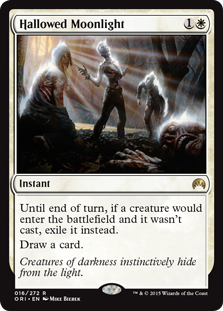
Hallowed MoonlightIn my initial review of Hallowed Moonlight, I identified two problems with the pushed Modern instant. First, it's a bit narrow. Shadow of Doubt hits a huge subsection of decks because almost everyone (except Affinity) is playing fetchlands. Not so much with Moonlight. It stalls Twin for just a turn, only shuts down Huntmaster of the Fells tokens in Jund, and stops RG Tron's Wurmcoil Engine tokens. It doesn't do anything against Affinity, Burn, or Grixis Control. Sure, it hits some tier 2 decks like Grishoalbrand, Elves, and Abzan Company, but for every deck it hits there's another it misses (Grixis Delver, Infect, Scapeshift, Amulet Bloom, etc.). Even when it does hit, opponents can often choose to find or do nothing (e.g. flipping nothing off Company, not dropping a creature off Vial or Breach, etc.). All of this counts against Moonlight. As for the second strike against the card, white isn't exactly the strongest color in Modern. The only tier 1 deck playing white is Burn, which suggests bigger problems with the color than Moonlight can solve on its own.

However, Joey Wittebol apparently missed the Moonlight memo this weekend, using one in the main and one in the board of his UWR Control list. Wittebol took the deck to a 4th place finish at the same event where Hazes' Abzan Company enjoyed success. Moonlight also appeared in the sideboard of Ryan Uttke's GW Death and Taxes list, accompanying a lone Vryn Wingmare to a 14th place finish. Wittebol's list is below:

UWR Control, by Joey Wittebol

Creatures

4 Snapcaster Mage
3 Kitchen Finks
2 Restoration Angel

Sorceries

1 Supreme Verdict

Planeswalkers

1 Ajani Vengeant

Instants

1 Hallowed Moonlight
4 Lightning Bolt
4 Path to Exile
3 Cryptic Command
2 Electrolyze
2 Lightning Helix
2 Spell Snare
1 Shadow of Doubt
1 Logic Knot
1 Sphinx's Revelation
1 Dispel
1 Think Twice
1 Jeskai Charm

Lands

4 Celestial Colonnade
4 Flooded Strand
4 Scalding Tarn
3 Ghost Quarter
2 Steam Vents
2 Hallowed Fountain
2 Island
1 Sacred Foundry
1 Sulfur Falls
1 Plains
1 Mountain

Sideboard

2 Stony Silence
2 Celestial Purge
2 Relic of Progenitus
1 Wear // Tear
1 Keranos, God of Storms
1 Porphyry Nodes
1 Anger of the Gods
1 Dispel
1 Wrath of God
1 Hallowed Moonlight
1 Jace, Architect of Thought
1 Elspeth, Sun's Champion

I'm not sure how much we can extrapolate from this finish: the event itself was small (only 16 players, although many of them were very experienced), this UWR Control list is a bit weird (Jeskai Charm?), and it's only our first example of Moonlight in action. Indeed, I still think that the fundamental problem with Moonlight holds true: white just isn't the best color in Modern right now. If you do lean towards white, Wittebol's list is a great way to use Moonlight.

One place where Moonlight really shines is in a metagame that shifts back to Abzan. Lingering Souls is probably the biggest reason to play Abzan (yes, even bigger than Siege Rhino), and Moonlight is insane against Souls. Add in more creature-cheating decks like Grishoalbrand, Living End, Company, etc., and the card starts to look even better. I don't expect the metagame to shift this dramatically for a while, and I don't think UWR Control is the optimal home for Moonlight (4C Control seems better here), but I am happy to admit I may have been wrong about Moonlight. Maybe we will see more of this card in the coming months?

Possible Misses

The history of card evaluation consists of far more misses than hits. One need only look at Narset, Transcendent to see this in action. Origins will be no exception to this, both for my own predictions and for predictions across the internet. As longtime Modern or Legacy players know, it takes a lot for a card to make an impact on nonrotating formats. If we are naturally optimistic with card evaluation (i.e. we don't want to be that one nitwit who misses a bomb), then we are going to overestimate card power more than we get it right. Here are three instances where we might have missed the mark on card power, at least judging from the results this weekend.

Languish
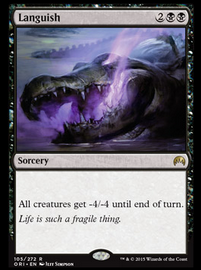
LanguishI'm still holding out hope that Languish is going to make an impact on Modern, but this weekend was not promising for that prediction. Two Abzan lists placed in the Top 32 at SCG Chicago, one in 15th and another in 25th, and neither ran Languish out of the sideboard. Remember that the rationale for running Languish is to have an Anger of the Gods-style sweeper for aggressive decks, one that hits the enemy creatures but misses your Goyfs, Rhinos, and Tasigurs. These two lists placed decently without the card, so maybe it's not needed: Engineered Explosives, Curse of Death's Hold, and ample spot removal might be enough? It's totally possible we need to be in the right metagame for Languish to matter. If you are just playing against aggro decks like Affinity and Burn, Abzan is already well-equipped with cards such as Stony Silence, Feed the Clan, Kitchen Finks, and Duress. It's only against an aggro metagame with Merfolk, Zoo, Abzan Liege, and other "bigger" decks where Languish will be strong. Who knows, with Harbinger making waves, perhaps that's coming around the corner?

Pia and Kiran Nalaar

Pia and Kiran NalaarMama and papa Chandra have a similar issue to Languish. Two Jund mages made Top 32 at SCG Chicago, but neither the 12th place nor the 24th place list wanted anything to do with Pia and Kiran Nalaar. Both decks, however, were very happy to run Olivia Voldaren and Huntmaster of the Fells respectively in their four-drop creature slots. This forces us to consider the possibility that the Nalaars don't fit into Jund in place of either Huntmaster or Olivia. Or, it's equally possible, that the Nalaars are just not very good in Modern?

I still think Pia and Kiran give Jund a bit of aggression and range that neither Huntmaster nor Olivia gives, but I also acknowledge that Jund doesn't need that added aggression as much as it needs Huntmaster and Olivia. Even if Pia and Kiran helped out in, say, 15% of matchups, my guess is that Huntmaster and Olivia will almost always help out in more (20%-25%+ in both cases). This puts the Nalaars in an awkward position. It's possible some enterprising Jund mages will turn to the Artificers in the upcoming months, but with Reid Duke already leaning towards Avaricious Dragon, it's possible the four-drop slot is too clogged for Chandra's folks.

Goblin Piledriver
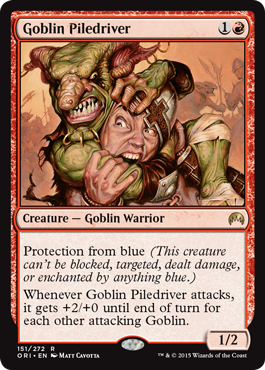
Goblin PiledriverSay it ain't so! Goblin Piledriver was by far the coolest reprint in recent Modern history, let alone in Origins, and our community was very excited to see its entrance to the format. Unfortunately, Piledriver was not joined by Goblin Ringleader (even though those silly tree huggers got Sylvan Messenger), which means Modern Goblins still has the same problems today as it did in the past. Without the interactive gameplan of Legacy Goblins (or Modern Merfolk, for that matter), and without the refueling tools such as Ringleader or even Patriarch's Bidding, Goblins becomes a worse aggro deck than Burn, Affinity, and Merfolk for many different reasons.

Goblins may have won a 37 player PPTQ in Udine, Italy this past weekend, but the list in question only used two Piledrivers in the main and one in the board. This suggests the list is not much different than the other random Goblins lists we have seen in Modern over the years: sometimes it can win a small event, but it's not a competitive force. Hopefully we will see a reprint of cards like Matron or Ringleader change this in the future (or, my personal preference, Gempalm Incinerator).

The Question Marks

Before we close for today, I want to look at two cards that have big question marks surrounding them. Although they didn't see a lot of play during the 7/18-7/19 weekend, these cards might have the potential to succeed in Modern. Don't bet against them and keep up the brewing because we haven't seen the end of these cards yet.

Hangarback Walker
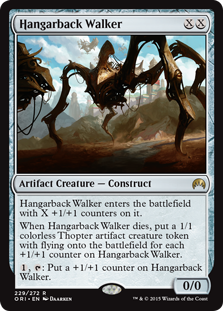
Hangarback WalkerThis was a card I missed in my initial Magic Origins review, much to the dismay of both Affinity players and brewers who wanted to see the Walker in action. On paper, Hangarback Walker doesn't seem like it has what it takes to be Modern playable. At two mana, you get a 1/1 that replaces itself with a flyer, which is also to say you get a colorless and more expensive Doomed Traveler. Walker can grow with each turn, but that doesn't necessarily seem like an ability Affinity wants to sink mana into. At four mana, Walker becomes more potent, but are you really spending four mana on a 2/2 in Affinity? Harrison Fang evidently thought Walker was worth the Affinity slot, running a singleton in his 60 en route to a 19th place finish at SCG Chicago. Although I haven't discussed it with Fang (badass name, by the way), the online consensus is that Walker fills a few important roles in Affinity. It insulates you from sweepers like that nasty Shatterstorm, lets you outgrind opponents if the game gets bogged down, and gives you the ability to go wide without too much card investment. It's unclear if Affinity needs these tools when it already has so much direct firepower, but it makes Hangarback a strong consideration in certain metagames. I think we haven't seen the last of Walker, and it is likely to creep into Affinity lists as a one or two-of throughout the PPTQ season. If nothing else, its synergy with Arcbound Ravager and Steel Overseer should encourage players to give it a try.

Day's Undoing
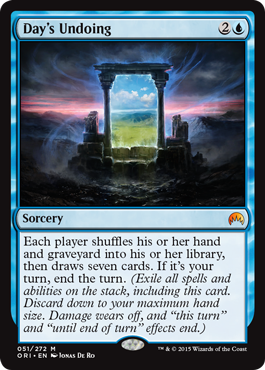
Day's UndoingBy far the biggest question mark from the weekend is around Day's Undoing. Zero decks in the SCG Top 32 used the card, including two Affinity lists and a Top 8 Burn strategy. For a card that many viewed as the second coming of Treasure Cruise, or a near contender for that throne, this was a big disappointment. For those who were worried about Jordan Boisvert's predictions of a Modern metagame homogenized with linear decks, this was probably a huge relief. Maybe Undoing really was just the second coming of Time Reversal?

As is often the case, I'm somewhere in the middle on this card. On one hand, I never thought Undoing was quite as broken as many players made it out to be, especially because the symmetry really is symmetrical in the linear matchups (as opposed to Cruise which was as asymmetric as it gets). This makes the card less maindeckable and more risky than many first gave credit. On the other hand, I love the synergy between Undoing and Disrupting Shoal in tempo decks, and have experienced some promising results with Undoing in Burn over the past few weeks. Don't bet against Undoing just yet; there is a good chance players are still trying to figure out the best way to use it, both in terms of their own deck and the overall metagame context. I don't expect to see this card breaking Modern in quite the same way as Dig or Cruise, but I fully expect it to show up in big events over the next few months once someone figures out the best home for it.

Magic Origins' Future in Modern

The true testing ground for Magic Origins will be MTGO, and we are all eagerly awaiting its legalization date towards the end of the month. Risk-averse players are unlikely to "waste" their paper tournament entry on some Origins-powered brew, but it's a much lower investment to play in random MTGO Daily, so I expect we will get a better test of Origins' power in the coming weeks. As a personal prediction, I expect to see a lot of Merfolk: that deck has been swimming right under the surface for a while and Harbinger gives it a big boost.

What other Origins cards do you have on your radar? Where else do you expect the cards to succeed? Let me know in the comments and I look forward to brainstorming with you there!


Modern Matchup Analysis

Are you a Quiet Speculation member?

If not, now is a perfect time to join up! Our powerful tools, breaking-news analysis, and exclusive Discord channel will make sure you stay up to date and ahead of the curve.

The good folks at MTGGoldfish have once again released some great data by analyzing MTGO replays. From watching thousands of Modern matches, they've made a helpful chart showing the matchups between the ten most popular decks in Modern. You can find a write-up from their findings here.

The first instinct of a newer player would be to say that the winningest deck, Bant Company, is the best deck per this evidence. Given the high diversity of Modern, this is a dramatic under-utilization of these data. The real value here comes from the matchup percentages. As SaffronOlive cites in his write-up, the Grixis control versus Affinity matchup reports in stark contrast to what many might believe. It has been said that Kolaghan's Command was a death knell for Affinity, but the deck continues to see success and even boasts a near-60% win-rate against Grixis control.

There was an error retrieving a chart for Kolaghan's Command

Taking a look at where a particular deck struggles will help you identify what matchups you should spend more time on and trying to make adjustments for. For example, Infect is a scant 32% against Grixis Control. This means that as an Infect player, you don't really have a margin for error in your play. Being aware of and avoiding any common mistakes will be crucial in this matchup, and developing sideboard technology will help you salvage a poor matchup against a relatively popular deck.

Another interesting piece of data is that players on the play win more than 7% more of the games. This isn't a surprising notion by any means, but it's good to have a more exact idea of the relevance of play-draw. It's unlikely that many people are thinking about drawing first in Modern, but it might be worth playing for position in something like a PPTQ to have the play in Top 8 knowing the extent that the play will help you.

Avatar photo

Ryan Overturf

Ryan has been playing Magic since Legions and playing competitively since Lorwyn. While he fancies himself a Legacy specialist, you'll always find him with strong opinions on every constructed format.

View More By Ryan Overturf

Posted in FreeTagged 1 Comment on Modern Matchup Analysis

Have you joined the Quiet Speculation Discord?

If you haven't, you're leaving value on the table! Join our community of experts, enthusiasts, entertainers, and educators and enjoy exclusive podcasts, questions asked and answered, trades, sales, and everything else Discord has to offer.

Want to create content with Quiet Speculation?

All you need to succeed is a passion for Magic: The Gathering, and the ability to write coherently. Share your knowledge of MTG and how you leverage it to win games, get value from your cards – or even turn a profit.

Insider: Analyzing Annual Reports

Are you a Quiet Speculation member?

If not, now is a perfect time to join up! Our powerful tools, breaking-news analysis, and exclusive Discord channel will make sure you stay up to date and ahead of the curve.

Welcome back, readers!

The goal of this article is to review the annual reports that Hasbro and WoTC puts out and isolate relevant information that could have an impact on MTG finance. Unfortunately, WoTC is a small part of the Hasbro empire, so financial information on WoTC is typically buried deep in the Hasbro annual reports, which you can find here.

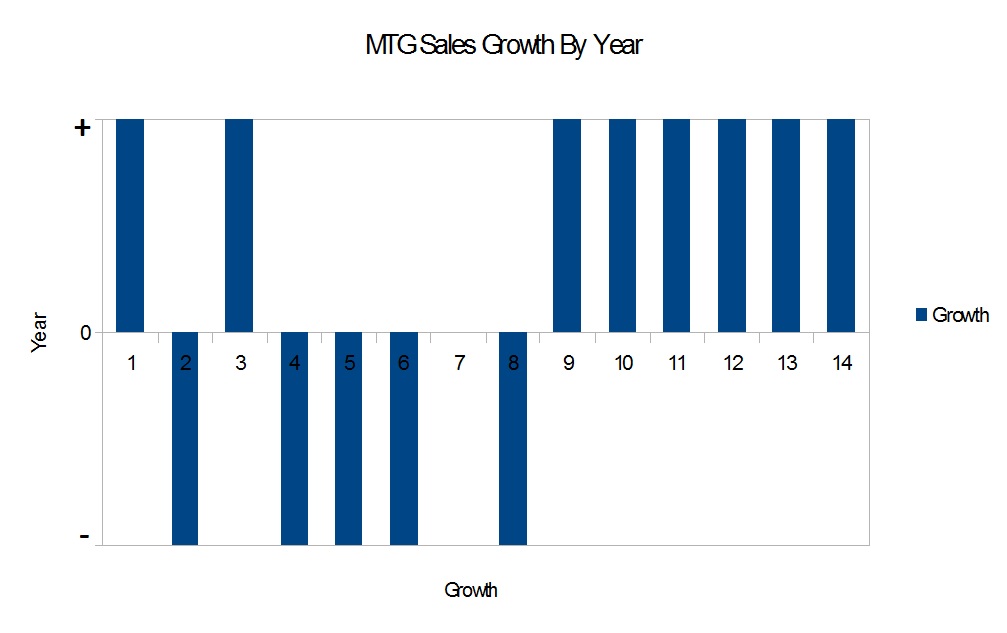
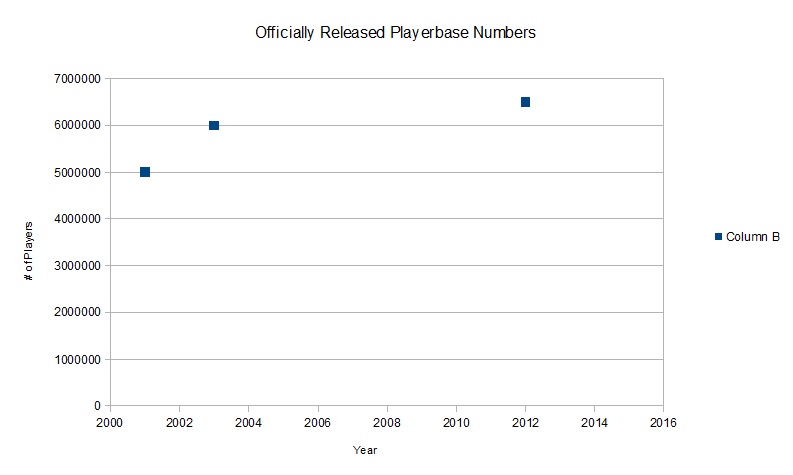
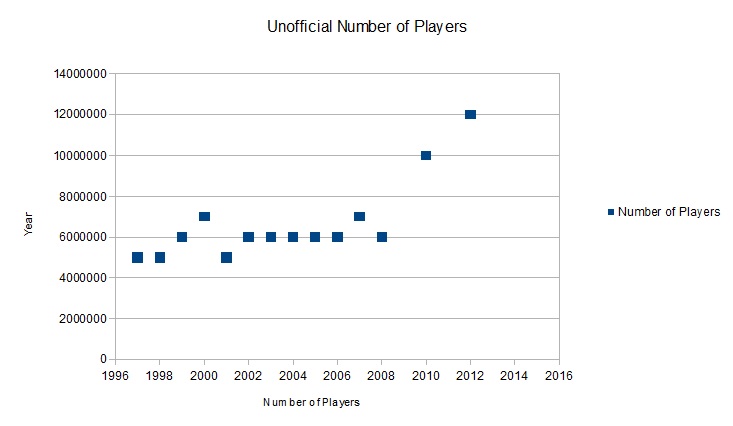
Hasbro bought WoTC September 30, 1999, so the annual reports are likely only going to contain Magic data starting in 2010. I will post the data I've found by year below (along with any additional sources) and then we'll delve into the data (I will highlight playerbase related data in green and financial data in red).

But first,

Why Bother to Analyze Annual Reports?

This is a valid question. Like all businesses, you can learn a lot by following the money (and the playerbase growth).

If we assume that Magic: the Gathering print runs are correlated with the playerbase and sales (it seems a smart business like Hasbro/WoTC would do this), then we can also get an idea of which print runs might be smaller (as it makes no sense for a business to print the same number of cards when sales of said cards are down then when sales are up). We aren't likely to come up with a quantitative data set, but we can at least get an idea of likely trends.

Now for the good stuff.

1993 - 2000

  • No relevant data

2001

  • WoTC sales up 23%.
  • 5,000,000 players

2002

  • TCG sales declined 8% (includes Magic: the Gathering, but mainly Pokemon).

2003

  • 6,000,000+ players
  • 140,000 MTGO Accounts
  • Game segments revenue up 40% (includes MTG, but also includes board games, etc.)

2004

  • 6,000,000+ players
  • Game segments had a decline in sales of 1%.
  • Magic had a decline in sales overall.
  • International MTG sales increased.

2005

  • Game segments had a new revenue decline of 8%.
  • Magic had a decline in revnue (both in the US and internationally).

2006

  • Magic had a decline in sales overall.

2007

  • No relevant data

2008

  • Magic had a decline in revenue.
  • Revenues under 100 million.

2009

  • US and Canada sales revenues for Magic were up.
  • International sales revenues for Magic were down.

2010

  • US and Canada sales for Magic were up.
  • International sales revenues for Magic were up.

2011

  • Doubled in size since 2008.
  • Increased US and Canada sales.
  • Increased international sales.

2012

WoTC Annual Report states:

  • 500,000 registered players
  • 6,000,000 unregistered players
  • 30,000,000 inactive players

Hasbro Annual Report states:

  • Magic grew 30%.
  • 4th straight year of 25% or more growth.
  • Increase in net revenues for US and Canada.
  • Increase in net revenues internationally.

2013

  • Increased net revenues for US and Canada.
  • Increased net revenues internationally.

2014

  • 6th straight year of revenue growth.
  • Product development has increased 5.2% (of which Magic accounted for at least some of this expense).
  • Increase in selling, distributive, and administrative expenses primarily due to MTG.
  • Increased net revenues for US and Canada.
  • Increased net revenues internationally.

2015

  • Annual report not released.

Looking at the Financial Side of Things

Below is a bar graph showing the years MTG had positive growth and the years it had negative growth. (Note the years are abbreviated to just the tens digit, so 1 is 2001, and so on.)

mtg growth

Looking at this growth chart we can now isolate the good years from the bad and more importantly we can determine which sets came out on good years vs. bad years.

If our original assumption is correct, then there are likely fewer cards from bad years than good years (as players didn't buy as much product.) So a card from a bad year that shows sudden demand might hold more potential as a spec. At the same time it's also important to keep in mind that the playerbase growth also likely affects the print run size.

Year Set 1 Set 2 Set 3 Set 4
2001 Planeshift 7th Edition Apocalypse Odyssey
2002 Torment Judgement Onslaught  
2003 Legions Scourge 8th Edition Mirrodin
2004 Darksteel Fifth Dawn Champions of Kamigawa  
2005 Betrayers of Kamigawa Saviors of Kamigawa 9th Edition Ravnica: City of Guilds
2006 Guildpact Dissension Time Spiral  
2007 Planar Chaos Future Sight Tenth Edition Lorwyn
2008 Morningtide Shadowmoor Eventide Shards of Alara
2009 Conflux Alara Reborn Magic 2010 Zendikar
2010 Worldwake Rise of the Eldrazi Magic 2011 Scars of Mirrodin
2011 Mirrodin Besieged New Phyrexia Magic 2012 Innistrad
2012 Dark Ascension Avacyn Restored Magic 2013 Return to Ravnica
2013 Gatecrash Dragon's Maze Magic 2014 Theros
2014 Born of the Gods Journey into Nyx Magic 2015 Khans of Tarkir

The bad years are highlighted in red above. It's important to note that both 2002 and 2004 were bad years, but they also only had three sets releases (which may be a contributing factor). It's not surprising to see 2004 was bad though, given the fact that Mirrodin block, and specifically the affinity mechanic, pushed a lot of players away from the game.

2005 followed it up with a much weaker Kamigawa block (to tone down Standard) which didn't seem to go over so well with the playerbase. What is surprising was that 2006 with the Ravnica block (which is often hailed by many players as one of the funnest blocks in Magic's history) was still a down year for the game, though this could be due to the fact that the Kamigawa block was weak enough that it didn't stop hurting the game until after it rotated out (this also would explain why 2007 was a good year).

Again for 2008, it's not surprising it was a bad year, as the Faerie menace was running amok in Standard--I remember a lot of local players talking about boycotting Standard until it rotated out.

As you can see from the chart, since 2008 Magic has had all positive revenue growth, which is a great sign.

Playerbase Growth

Unfortunately, we get a lot less information when it comes to the Magic playerbase from Hasbro or WoTC. What we do have is a meager chart that looks like this (note for 2012, I added the registered and active player numbers listed on the annual report):

official playerbase

However, from other sources we get additional numbers to help fill in the gaps. Note the difference in the numbers for 2012.

unofficial playerbase

From these charts we get a slightly different picture compared to our sales chart. Going by playerbase alone it would appear that 2001 and 2008 were bad years and everything in between was either positive or stayed the same.

What we can pull from the playerbase growth chart is that if the unofficial one is accurate than rares before 2010 are likely at least twice as rare as ones post-2012. This implies that any demand increases from these years will likely cause a higher price increase than the same demand from a post-2012 set.

Mythics are another interesting factor to consider. They didn't appear before 2008 (specifically Shards of Alara), but given the playerbase started to really explode post-2008, the fact that mythics were eight times rarer than regular rares would imply they're much rarer than even post-2008 rares. While the playerbase doubled in size, the rarity of these specific cards octupled. However, that is still based on our earlier assumption that the playerbase size directly impacts the print run size set by WoTC.

Because of the turning point in 2008 (when we saw both mythics appear and a rapid expansion of the playerbase), looking at the early mythics for financial opportunities doesn't seem like a bad idea.

Below is a list of those mythics, with the single-print ones in bold. Many of them already sit at a decent price, but there are some which are still decently cheap.

Mythics

Shards of Alara

Conflux

Alara Reborn

Magic 2010

Zendikar

Ajani Vengeant Apocalypse Hydra Defiler of Souls Ajani Goldmane Chandra Ablaze
Elspeth, Knight-Errant Child of Alara Dragon Broodmother Baneslayer Angel Eldrazi Monument
Empyrial Archangel Conflux Jenara, Asura of War Bogardan Hellkite Eternity Vessel
Godsire Ethersworn Adjucator Karrthus, Tyrant of Jund Chandra Nalaar Felidar Sovereign
Hellkite Overlord Maelstrom Archangel Lord of Extinction Darksteel Colossus Iona, Shield of Emeria
Kresh the Bloodbraided Malfegor Maelstrom Nexus Garruk Wildspeaker Kalitas, Bloodchief of Ghet
Lich's Mirror Mirror-Sigil Sergeant Sen Triplets Jace Beleren Lorthos, the Tidemaker
Mayael the Anima Nicol Bolas, Planeswalker Sphinx of the Steel Wind Liliana Vess Lotus Cobra
Prince of Thralls Progenitus Thraximundar Master of the Wild Hunt Mindbreak Trap
Rafiq of the Many Thornling Uril, the Miststalker Platinum Angel Nissa Revane
Sarkhan Vol Protean Hydra Ob Nixilis, the Fallen
Sedris, the Traitor King Sphinx Ambassador Obsidian Fireheart
Sharuum the Hegemon Time Warp Rampaging Baloths
Sphinx Sovereign Vampire Nocturnus Sorin Markov
Tezzeret the Seeker Xathrid Demon Warren Instigator

Insider: MTGO Market Report – Magic Origins Special

Are you a Quiet Speculation member?

If not, now is a perfect time to join up! Our powerful tools, breaking-news analysis, and exclusive Discord channel will make sure you stay up to date and ahead of the curve.

The main factor that contributes to successful speculation on MTGO is to target cards that are currently being opened in draft. Cards from the current draft set tend to be priced too low relative to their long-term value. However, low prices following the debut of a new Standard usually last several months. Buying these cards just prior to the introduction of the next draft format generally generates speculative gains when Standard is rotating.

This is true for block sets. For core sets, the deal is remarkably different. Magic Origins prerelease events start this Friday and present one of best opportunities of the year for MTGO speculators.

maxresdefault

Core sets are only drafted for about two months, which is a short drafting window for a large set, in an environment where demand for Standard cards is low and players are waiting for rotation. By comparison, Fall sets such as KTK are drafted for four months before the winter set (FRF in this case) is introduced into the mix. With a shorter drafting window comes a much smaller overall supply. A smaller supply creates a higher volatility for prices.

The timing of the core set release is also peculiar. It comes at the end of a Standard format, so the card pool is quite large when it’s released. Although every new set shakes up Standard to some degree, a larger card pool means that additions to the format will have a smaller impact, all things being equal. Once Battle for Zendikar (BFZ) is released and Standard rotates in October, ORI will then occupy a relatively larger chunk of the Standard format.

The release of the Fall set and the subsequent first Standard Pro Tour of the Magic year then trigger a high demand for core set cards. The demand will keep up during the winter and prices will rise according to metagame shifts.

Between August and October Magic Origins price variations will summarize in two months what usually occur over twelve months for Fall sets. With a short drafting window and Fall rotation just a couple of months down the road, core set speculations are a great speculative vehicle. Here are our general guidelines for speculative purposes with boosters, singles and complete set positions with Magic Origins.

Magic Origins Boosters

Core set boosters are a way to speculate on ORI without having to target individual cards. The buy and sell spread on boosters also tends to be very small, so the haircut on transactions is smaller than for singles.

Boosters enter the MTGO economy in two ways. They can be purchased at the store at full retail (there are no bulk discounts available), and they can be won through sanctioned events.

Having boosters available for purchase at the store means that boosters should never have a secondary market price higher than $4, which is roughly 4.2 tix. If prices in the MTGO economy were higher than this, people could buy boosters from the store and resell them for a profit. This rule of thumb can vary somewhat due to consumer taxes on store purchases and other transaction costs involved with the MTGO economy.

The other side to consider are boosters awarded through sanctioned events. Both drafts and constructed events award boosters, but due to being a net consumer of boosters, drafts drive the price of boosters up while constructed events drive the price down.

When a draft format is brand new, demand from drafters dominates and prices on boosters tend to stay high. Over time though, boosters awarded to Constructed players will start to dominate and prices on boosters will fall. The absolute bottom will occur in the week of the next set's release. This happens as drafters entirely shift their attention to the new set, while Constructed players are still being awarded the old set in prizes.

Core set boosters have the added benefit of a relatively small supply of singles and thus higher prices. Once interest in the new draft format dies down, some drafters will look to get the best value out of their drafts, and so sets with higher singles prices will attract these drafters. Core sets are also geared towards newer players with simpler and resonant cards. One of MTGO's target audiences is lapsed players, so core sets also appeal to this demographic. All together, this contributes to a consistent level of interest for core set Limited on MTGO, much more so than in paper.

Our Recommendation

The strategy for speculating on ORI boosters is to buy them during the first week of BFZ release events. Last year, M15 boosters bottomed at 2.2 tix on October 7th, although buying at any price below 3 tix would have yielded a nice return, as they went to 4 tix by the end of January.

Speculators with plenty of capital and time to devote to this trade should be confident that this strategy will be profitable again this year. Buying ORI boosters at 3 tix or less in September and October will yield a profit of 0.5 tix or more per booster over the winter. With a high degree of liquidity, a guaranteed market, and a low spread, core set boosters are ideal for speculators that don't want to be concerned about the Standard metagame or any other secondary market fluctuations.

Singles

Mythics and rares are the individual cards speculators should focus on. Uncommons have extremely limited upside. Stoke the Flames in M15 was one of a kind and the only uncommon in recent core set history to be constantly priced over 1 Tix.

As mentioned in the introduction, the vast majority of Magic Origins cards are expected to decrease in price during the first two to six weeks after release while being heavily drafted. Depending on Pro Tour Magic Origins results some cards, mostly mythics, may actually trend up very early and resist this downward pressure without establishing a floor. Such cards would be in demand, and therefore expensive, in a Standard metagame about to disappear. Mythics or rares in this situation may therefore not really reach a low point in August/September and should be avoided as speculative targets.

Last year, due to a strong result at PT M15, Nissa, Worldwaker was immediately priced above 20 Tix , peaked at 30 Tix mid-September, but slowly declined thereafter to 15 Tix in December. The new Standard environment after the release of Khans of Tarkir didn’t favor the green planeswalker. Buying Nissa at 20 or 25 Tix in September would have been a mistake.

Mythics

The speculative strategy with core set mythics is highly predictable and fairly straightforward. Apart from exceptions influenced by PT results, buying any, if not all, mythics two to three weeks after the release of Magic Origins is a strategy likely to yield a profit. Sylvain discussed and successfully applied this strategy with M14 and M15 mythics.

In the case of core set mythics, buying a basket, e.g. buying most if not all of the mythics, is highly recommended. History has proven time and again that it is difficult to determined in advance valuable mythics, especially as the format is about to be changed dramatically with four sets leaving (THS, BNG, JOU and M15) and two freshly released (ORI and BFZ).

Thundermaw Hellkite, M14 Garruk, Caller of Beasts and Perilous Vault started out relatively low before exploding in October-November. A basket of ORI mythics is the optimum strategy for speculators who don’t want to miss the next Perilous Vault.

Due to a relatively low supply of core sets (only two summer months of active drafts) any mythic that sees play is susceptible to a big price increase. Out of the 14 mythics eligible for the M15 mythic basket (Nissa, Worldwaker was not considered), all got more expensive at some point between September and May than they were in August. Six of these doubled or more in price, with Perilous Vault, Soul of Theros and Soul of Innistrad quadrupling or more their price. The benefits of a basket definitely outweigh the risks and the losses generated by few loser positions.

Although prices rise and fall according to metagame changes, the prices of mythics are not as volatile as the prices of rares. Redemption is also another factor that weighs more for mythics than for rares in supporting prices.

A pattern often observed for core set mythics is a rise in price from early September to November, which may be enhanced by PT performances in October. From there, mythics appearing in the top decks are likely to sustain or increase their price while mythics not favored by the Standard metagame will start slowly declining as Winter approaches. December could actually be a good period to acquire discounted mythics that may increase in price in February, or later in May, with the release of two more sets.

Rares

A similar basket approach is also highly recommended with rares, although unlike mythics not all rares will be a good pick up. Based on previous core set rare trends the vast majority of ORI rares are expected to hit a floor around mid-September. By that time, bulk rares should be priced at 0.1 Tix or below and the more valuable rares should have stabilized. Past that point in time the first spoilers of BFZ will be known and some ORI cards may consequently start rising.

The prices of rares are much more volatile than the prices of mythics. Price variations are also much more metagame-dependent. In this context it is almost impossible to predict the average good period to sell ORI rares. Most rares will see a boost in price from October to March. Some rares can reach their peak in value early in the season, such as Hornet Queen and Genesis Hydra, later in the winter like Hushwing Gryff and Shivan Reef, or later in the summer like Caves of Koilos and Obelisk of Urd.

The difficulty for speculators is to estimate to ideal selling time. Generally speaking, 5 to 7 Tix is a decent cap for any core set rare. Some exceptions exist but breaking the 10 Tix mark as Mutavault, Goblin Rabblemaster and Thragtusk did is unique and definitely not the norm.

Although we will share our opinions in future MTGO Market Reports, every speculator should use their own judgment to decide the appropriate action with their own portfolio. Being attentive to metagame changes is, as often, key.

Our Recommendation

Speculators should be acquiring mythics within the first two to three weeks after release. Mythics whose prices would be significantly affected by Pro Tour Origins should probably be ignored. Bulk mythics should not be acquired at more than 0.5 Tix and are likely to hit 0.3-0.4 Tix sooner or later. The selling period should be adjusted to the Standard metagame orientations with November to December being an general good selling window.

The optimal buying period for ORI rares should be situated between mid-August and mid-September. Any rares with a slim chance of Constructed applications may rise in price. This has been the case for many core set rares in the past. Despite a fifth reprint, the five painlands are a must for any portfolio--they will be part of the Standard metagame independently of its changes and will certainly see a price increase.

Complete Set

Complete set speculation is a bit of a mix of booster speculation and single card speculation. You have to buy cards, all of the 272 cards (including basic lands) of ORI to be exact, but with whole sets the bet is on the global price trend, similarly to boosters.

Investing in full sets has its own advantages and disadvantages. Expected returns are in the order of +30 to +50%; speculators should not expect higher percentages here. The strength of whole set speculations is the possibility of investing several thousands of Tix at once in extremely safe positions since the trends of complete sets are highly predictable.

The average value of an online set tends to be low while the set is drafted. Individual card prices may see spikes and drops but the average full set value is very stable and easy to anticipate. Starting next week, ORI will be the newest Standard set to be drafted until October with the release of BFZ.

The value of the ORI set will probably decline until September, with a bottom likely to be found between mid-August to mid-September. M15 complete set value hit its bottom around mid-August and started rising late August. M14 hit its lowest value mid-September and started rising right after. M13 was different as the first Standard Pro Tour following the release of M13 was held only in Februrary--PT Gatecrash.

This year, and after several changes in the Pro Tour calendar over the past couple of years, the Pro Tour calendar for this Summer and Fall is identical to last year's calendar at the same period. We'll have a Standard PT Core Set in August followed by another Standard PT Fall Set in October. For full set price trends and speculative purposes, M15 price variations should serve as a blueprint for Magic Origins full set investment.

M15 reached its highest value early in November and then again at the very end of the year late in December. This pattern was also observed for M14, making the November-December window likely the optimal selling point for ORI full sets as well. No significant further gains were observed after the release of the second block set (in February), so there's little incentive for speculators to wait two to three more months for no or very little additional profit.

Our Recommendation

ORI full sets should be acquired mid-August to early September for optimal buying prices. The price of a Magic Origins full set should be slightly below 100 Tix at that time. Full set speculation is a unique opportunity for speculators with big bankrolls to easily invest a large amount of Tix. Full set speculations require very little time commitment during the length of the investment.

ORI full sets are likely to reach their maximum value between November and December. Speculators should probably sell their ORI sets during that time and should consider a +50% profit in less than four months a great investment. Full sets can be purchased through the Classifieds on MTGO and via bot chains selling full sets such as Goatbots and Clanteam.

ORI

Answering Four Modern Banlist Questions

Are you a Quiet Speculation member?

If not, now is a perfect time to join up! Our powerful tools, breaking-news analysis, and exclusive Discord channel will make sure you stay up to date and ahead of the curve.

I don't remember the last time a "no changes" banlist announcement was met with so much contention and disagreement. Although some players have expressed satisfaction and relief at Wizards' decision last week, others have done the opposite, questioning Wizards' understanding of Modern, challenging the banning of some cards and not others, and overall doubting Wizards' ability to manage the format. I may have been on vacation last week, but I've still seen a lot of this discussion in communities and articles all across the internet. In today's article, I want to take a little time to respond to some of the most common questions and arguments about both the banlist and the 7/13 announcement.

Seething Song Art

In my last two banlist articles, the prediction article from a few weeks ago and my retrospective from last Monday, I emphasized the importance of historical and metagame context in making banlist assessments. This includes understanding the current metagame, understanding past banlist decisions, and (perhaps most importantly) citing sources and evidence on both those points. Banlist discussion often takes place without any evidence or, worse, with "evidence" that is flat out wrong. In that spirit, this article tries to give some evidence and context to the most common banlist questions.

[wp_ad_camp_1]

1. Why Analyze Modern Banlist Decisions Anyway?

Behind all this banlist discussion is the big Griselbrand in the room: can we even discuss the banlist without knowing all the ins and outs of Wizards and the DCI? Because none of us have special insight into their decisionmaking process (if you do, please email!), and Wizards often comes off as quite opaque in their ban approach, it seems like we just don't have enough information to discuss bannings. It can come off as groundless speculation and theorizing, and we might end up questioning both our thought process (which could lack important evidence) and our conclusions (which might be totally misinformed).

Birthing PodThere are three reasons I don't subscribe to this interpretation and why you shouldn't either. First, we actually do have a lot of information from Wizards, including their many banlist announcements, articles discussing the format, and the intersection between community-collected metagame data and Wizards' management of the format. I wrote about a lot of these datapoints in my March 23 banlist prediction article, and you can browse the quotes in that piece to see just how many datapoints we really have. For instance, when Birthing Pod was banned, Wizards' explicitly cited the deck's high metagame share and the fact that Pod decks won the most GPs in the past year. This gives us a precedent for analyzing future decks: when decks reach Pod levels, we know they might be in danger. And when they aren't quite there, we know they are probably safe from being banned for reasons of metagame dominance/diversity. This approach is applicable to other bans (Bloodbraid Elf and Seething Song), and gives us a wealth of case examples to draw in in future ban analysis.

The second reason we should keep predicting and analyzing banlist decisions is because people will be doing it anyway. If Modern players are going to keep speculating about the banlist at kitchen tables, in game stores, and throughout forums, we need authors to try and synthesize those opinions and address certain claims directly. The discussion is happening anyway: we are just trying to dig deeper than most people get in a single r/spikes post. That's a collective responsibility by all Magic authors, not just the ones on this site. This brings me to the third reason we should theorize and analyze the banlist: responsibility to Modern. I love Modern and want to do what I can to make it the best format it can be. A part of that is helping to gather information and evidence and present it to readers, adding in my own analysis and opinion where it is helpful and relevant. This is the same approach taken by hundreds of other Magic authors (with varying degrees of success, especially with evidence). So long as we continue to love our format and game, we will also continue to give readers knowledge and frameworks to help them make informed decisions and opinions about Modern.

2. If Seething Song Is Banned, How Did Amulet Bloom/Grishoalbrand Escape Bans?

This question and claim takes a lot of forms, including "Wizards doesn't care about the turn four rule anymore", "Modern is a turn 2-3 format now", "Wizards is inconsistent in its bans", and a variety of other comments about Modern's (in)famous turn four rule. The big one I see is about Seething Song, wondering how the old Storm staple could be banned under the turn four rule if Nourishing Shoal, Amulet of Vigor, Summer Bloom, and a bunch of other cards can roam free. I wrote extensively on the turn four rule in my 7/13 banlist prediction article, but I want to highlight two key points from that here. These should be your go-to arguments when anyone talks about Storm, Song, the turn four rule, or any cards banned under the turn four rule.

  • Decks are only banned under the turn four rule IF they are "top-tier"
    When Wizards inaugurated Modern, the turn four rule initially included all decks, not just top-tier ones. But after 2011's Pro Tour Philadelphia, Wizards modified the rule: "Before Pro Tour Philadelphia, the DCI's stated guideline for the Modern format was to avoid having decks that consistently win the game on turn three. With the results of the Pro Tour in, we are tweaking that goal to not having top-tier decks that consistently win on turn three (or earlier)." This means a deck must be top-tier, as defined by Wizards, to fall victim to a turn four rule banning. Note that the deck also has to "consistently" win the game before turn four, which is a whole separate question.
  • Seething SongWhen Song was banned, Wizards defined Storm as "top-tier"
    Seething Song took the ban-axe in January 2013, falling alongside everyone's favorite Bloodbraid Elf. When Song got banned, it was under the exact same turn four rule that Wizards defined after PT Philly: no top-tier decks that consistent win on turn three or earlier. As Wizards stated in their decision, "Looking at the results of the recent tournaments, Storm is not the most played deck, but it is among the top tier of decks. Four of the players to get at least 18 points at Pro Tour Return to Ravnica were playing Storm, and Olivier Ruel had a Top 8 performance at Grand Prix Lyon playing Storm. On Magic Online, Storm is the second-most-frequent high-finishing deck in Modern events, at 11.42%, behind only Jund. These results indicate that, while far from dominant, Storm is a top tier deck." We can argue about why Storm was top-tier (it was cheap, it was good in that metagame, etc.), but the point still remains that at the time of its banning, Storm fit numerous prevalence-based criteria for top-tier status.

bloomTo be clear, this isn't an exhaustive list of turn four rule considerations (the other article is more comprehensive). But these are the most important two points in this current timeframe, and the ones you need to be aware of whenever people bring this question (and its variations) up in conversation. Once we understand these two rules, it becomes a lot clearer as to why neither Amulet Bloom nor Grishoalbrand ate bans: the decks are either not consistent and/or not top-tier. I am leaning heavily towards "not top-tier" based on their metagame prevalence. Amulet Bloom has less than 5% of the format, and only around 3% in paper as compared to 5% on MTGO. Grishoalbrand is even lower, with just a 2% metagame share and sub-2% shares in both paper and MTGO (it got the most play at GPs). All of which is to say, Wizards cannot ban any cards from these decks under the prevalence-based rationale for which they banned Song.

Goblin ElectromancerA common objection to this rationale, or at least a complicating explanation, is that Storm was only 11.42% of the MTGO metagame because it was cheap. There is certainly truth to this. While Jund mages had to spend over $1000 to get all the Tarmogoyfs and Liliana of the Veils they needed, Storm players were spending well under $300 on bargain-bin specials like Goblin Electromancer and Epic Experiment. This made Storm the cheapest tier 1 deck in Modern (by far) during the height of its power. But should the deck's price matter in determining its bannability? Modern's history is full of decks that are prevalent because they are cheap: Burn is the biggest one today, with Merfolk close behind. But neither of these decks are both top-tier and consistently winning before turn four.

Wizards' internal data suggested Storm was winning before turn four in some large percentage of games, and that percentage was apparently too high given Storm's format-wide prevalence. This puts Storm in a separate category from other cheap decks like Burn and Merfolk. It also points to a big factor underlying the turn four rule which is format enjoyability. Unlike Legacy, we don't have the police cards to combat fast, non-interactive turn three wins. If a deck is 11% of the MTGO format and winning on turn three in some large percentage of games, that's a big hit on format enjoyment. Of course, this returns to the problem of Wizards' transparency because we don't know what that actual turn three win cutoff is. But whatever it was, Storm was violating it in a way that no other deck did (and no other deck currently does). That was happening independent of its price and that's why Song ate the ban. Note again that neither Grishoalbrand nor Amulet Bloom have the metagame prevalence to justify top-tier status in the eyes of Wizards, which is why the Song rationale doesn't apply to them.

3. If the Format Is Healthy, Why Not Unban Cards?

ValakutSome Modern players criticized the announcement for the lack of bannings. Others were fine with no bannings but disappointed that nothing was unbanned instead. One of their key arguments is that healthy formats represent an ideal time to unban a card. Modern is quite healthy right now, with no single deck making up more than 10% of the metagame, and a ton of color and archetype diversity among the top-tier. This suggests the format is quite stable and ready for a limited-means unban like Sword of the Meek. A key datapoint here is the September 2012 unbanning of Valakut, the Molten Pinnacle. In that announcement, Wizards explained "Recent Modern tournaments have been diverse, with no deck dominating the metagame. Since Modern is a non-rotating format, banned cards never rotate out. The DCI is unbanning a card to see how that affects the format." For many players, this perfectly described the current state of Modern, and they were looking forward to the Valakut-equivalent unban today.

Of course, no unbannings happened on July 13, leading some players to accuse Wizards of inconsistency, and others to believe Wizards only unbans around Pro Tours (we'll table that until the next section). But there are other explanations for the lack of unbans and we need to understand those before we make other claims. For me, the biggest sticking point is in the difference between a "diverse metagame" and an "evolving metagame". A "diverse metagame" is trend-agnostic. Maybe decks are moving up and down the metagame charts, or maybe they have been stable for months. "Diverse" just suggests that there is some baseline of diversity among the top decks, but not how that diversity has changed over time (or is currently changing). I often call metagames "diverse", but in doing so I don't always account for what trends are informing that diversity or how that diversity might be changing even as it is being described.

Kolaghans CommandThat leads us right into the concept of an "evolving metagame", where the format may or may not be diverse, but it is definitely changing. Our current metagame is a great illustration of an evolving metagame in action. Grixis Control shot up from basically a < 1% metagame share to be one of the most-played decks in Modern. Abzan crashed from a 13% metagame share to a 3% share, with Jund rising from about 1% to 9% in the same time frame. All of this has happened in the last 4-5 months since just February, not to mention all the other changes around decks like Tron, Merfolk, Affinity, Burn, Grixis Delver, Company decks, etc. When you introduce powerful cards like Kolaghan's Command and Collected Company into a format, it can take time for the metagame to shape around them. Until that happens, the metagame is still evolving and it's hard to know what decks will come out on top and what will fall to the bottom.

Because we are in an evolving metagame, we should not have expected a single unban. Unbans necessarily help certain archetypes and hurt others. It's hard enough to predict that effect in a stable metagame, but much harder to do so in an evolving one. Take Ancestral Vision as an example. Vision ostensibly helps control decks and hurts BGx decks, which might make it a great unban in a metagame where control is flagging and Jund/Abzan is on top. But right now, Jund is only a few percentage points ahead of Grixis Control. Abzan is way behind and Grixis Control is still on the rise. Unbanning Vision in this environment would be very risk. Maybe Grixis Control settles at a 10% metagame share. That's healthy on its own but with Vision added, maybe that goes up to 15%: much riskier from a metagame health perspective. Maybe Jund is at about 10% now with Abzan at 3%-4%. Add Vision and maybe Abzan stays where it is and Jund falls down to 5%. It's impossible to predict because the metagame is fluctuating as it is even before a card is unbanned. This is why you should never expect unbans in evolving metagames: it's too hard to predict their impact.

4. Do Bans/Unbans Only Happen Around Pro Tours?

One of the most popular banlist theories floating around the Modern community is that Wizards only changes the banlist around Pro Tours. There is certainly precedent to suggest this, with every unban coming in the announcement immediately before a Pro Tour, and many of the post-2011 bans falling in the same time frame. Although Wizards has never openly admitted to this logic in its announcements or articles, the timing seems very convenient when comparing banlist updates to Pro Tour dates. Implicit in all this is a veiled accusation that Wizards only cares about the larger, pro-based metagame. Because the Pro Tour (read: Promotional Tour, not Professional Tour) is all about drumming up the game and the hosted format, Wizards has a lot of economic incentive to make them awesome. But this often leaves the everyman player in the dust, because Pro Tour event timing is valued more heavily than GPs or other smaller tournaments. Also, if this claim were true, we would never want to expect bans or unbans unless a Modern Pro Tour was right around the corner.

BbeLet's look at the "no bans" side of this argument first. Based on the evidence we have, this seems patently unsupportable to me. Bloodbraid Elf, Seething Song, and Second Sunrise were all banned in 2013 when there wasn't even a Modern Pro Tour on the schedule. Although one could argue that 2013 was an exception specifically because there was no Modern PT on deck, this doesn't make sense given the context of banlist updates. We already know that a key evidence point for this argument is the unbanning of Valakut, which happened a month before Pro Tour Return to Ravnica in October 2012. If that is evidence in favor of the theory, the subsequent bannings only 4-6 months later must also be included as evidence against the theory: they are all within the same timeframe. It seems much likelier that bans happen on an annual basis, except in the case of an emergency like Second Sunrise and Eggs. This year-long timeframe gives Wizards enough datapoints to consider if a ban is necessary. That's why we have seen major banlist changes three times in January 2013, 2014, and then 2015: that's just the schedule Wizards has locked itself into, starting with the Bloodbraid and Song bans. So in answer to the question, no, bans do not necessarily happen only around Pro Tours, although they are likely to happen in January of any given year).

BitterblossomThe unban side is much more open. Unlike the bannings, where we have three counterexamples, all format unbannings have occurred within a month of the next Modern Pro Tour. This includes Valakut, Wild Nacatl and Bitterblossom, and the throw-away unban of Golgari Grave-Troll. Although that's hardly a commanding sample size, it's still 100% of the unbans since the format's creation. Despite this, I am much more inclined to think it relates to the general banlist cycle I described above and not explicitly to Pro Tours. It takes about a year of data for Wizards to figure out if a deck is broken or fair. Ever since the Bloodbraid and Song banning, Wizards might have locked itself into an annual, January-based banlist cycle. If that's when bans need to occur, then that might also be when unbans need to occur as well. This would be both to cushion the impact of a banning (and appease the unhappy masses), and because you need that year of data to know the unban is safe. If that is true, then the Pro Tour timing is just incidental to the January timing of banlist announcements. An exception to this would be a deck that was overtly broken even without a years-worth of data behind it. Treasure Cruise was broken just 3-4 months in, and I suspect it would have been banned regardless of the Pro Tours timing in February 2015. So overall, the ban cycle appears to be tied to Januaries and not to Pro Tours, although Pro Tours themselves are now based around a January-February cycle.

Hopefully this answered some of the big questions around the bannings and unbannings, or at least gave some new perspective on these issues. Anything you think I missed? Alternate theories and explanations? New evidence and data I didn't consider? Let me know in the comments and I look forward to talking about it there.

Deck Overview- Jaceskai Tokens

Are you a Quiet Speculation member?

If not, now is a perfect time to join up! Our powerful tools, breaking-news analysis, and exclusive Discord channel will make sure you stay up to date and ahead of the curve.

While most players seemed to be more excited about Nissa, Vastwood Seer, Jace, Vryn's Prodigy also had a strong showing at the SCG Open in Chicago this weekend. There were quite a few decks in the Top 64 featuring 3-4 Jace, with the most successful being Kevin McLesky's 6th place token list:

Jaceskai Tokens

creatures

4 Seeker of the Way
4 Jace, Vryn's Prodigy

spells

4 Jeskai Ascendancy
2 Lightning Strike
2 Ojutai's Command
3 Raise the Alarm
1 Secure the Wastes
4 Stoke the Flames
3 Wild Slash
1 Dragon Fodder
4 Hordeling Outburst
4 Treasure Cruise

lands

2 Island
2 Mountain
1 Plains
3 Battlefield Forge
3 Flooded Strand
4 Mystic Monastery
3 Shivan Reef
2 Temple of Epiphany
4 Temple of Triumph

sideboard

3 Sphinx's Tutelage
4 Disdainful Stroke
2 Negate
2 Valorous Stance
1 Dragonlord Ojutai
2 Anger of the Gods
1 Roast

Dragon Fodder and Hordeling Outburst have been taking over games for some time, and completely dominating the games when they're followed up with a Jeskai Ascendancy. The downside of Jeskai decks has been that they don't pack as much punch as a deck like Abzan and that it's difficult for them to catch up from behind. The great thing about Kevin's deck is that it solidly supports a playset of Treasure Cruise. Jace acts as both a value engine on its own and a way to fuel Treasure Cruise, which enables Kevin's build to power back into games, or to just really press any advantages that the deck gains in the early game.

There was an error retrieving a chart for Jace, Vryn's Prodigy

I'm curious about the Sphinx's Tutelage in Kevin's sideboard. Presumably they're there as a non-creature way to beat control decks. It would be interesting to hear if this is a strategy that Kevin has had success with.

There was an error retrieving a chart for Sphinx's Tutelage

Insider: Origins, Week One

Are you a Quiet Speculation member?

If not, now is a perfect time to join up! Our powerful tools, breaking-news analysis, and exclusive Discord channel will make sure you stay up to date and ahead of the curve.

Magic Origins officially became legal for constructed play last Friday and the set looks pretty great. As far as core sets go, Origins looks like a fantastic offering with a lot of really cool and interesting cards.

One of the first things I noticed when I was opening packs is that all of the mythics and most of the rares are new printings, which goes a long way to making the set feel better. Even if you open an undesirable rare at least it isn’t that same undesirable rare you already opened last year. There is no adventure in the reprinted bad rare: if it wasn’t worth anything last year the chances are that it won’t be worth anything the second time around either.

In Origins the reprints are actually good cards with some real value. Stuff like Goblin Piledriver and Gaea's Revenge that are actually cool and will see play in constructed Magic.

Honestly, Origins didn’t change a ton in Standard so far after week one. I was talking to Kyle Boggemes a lot about the new set on our drive down to the SCG Open and we reached the realization that Standard currently has eight sets in it. It takes a lot for a card to actually see play in any Standard deck. So, in most cases decks are only going to be able to utilize a card or two. Core sets also have the drawback where the cards are not really mechanic-driven so there are not a ton of synergies to build around.

In fact, I didn’t play a single new card from Magic Origins in my deck at the Open this weekend. I ended up going 6-3 with Esper Dragons and missing the cut for Day Two because the event was so large.

The most hyped card going into the event for Standard was pretty clearly:

There was an error retrieving a chart for

Finally a 4cc sweeper that isn’t terrible and lets you keep Siege Rhinos around. How can that be bad? Languish proved its worth this weekend and showed up in the Abzan Control decks that were doing well at the top tables all weekend long. There were only a couple of Abzan Control that made Top 8 but the Top 32 was completely loaded with the archetype.

I was going to replace my Crux of Fate with the new Languish but I eventually decided against it. It seemed like everybody going into the event was jamming Languish in everything or building to be more resilient against the card. So, I figured that I might as well just keep jamming Crux. I also noted that casting Dragonlord Ojutai and then following up with a Crux of fate is pretty sweet.

Esper Dragons by Brian DeMars

Creatures

4 Dragonlord Ojutai
1 Dragonlord Silumgar
1 Silumgar, the Drifting Death

Spells

4 Thoughtseize
4 Silumgar's Scorn
3 Bile Blight
4 Foul-Tongue Invocation
3 Hero's Downfall
2 Dissolve
2 Crux of Fate
4 Dig Through Time

Land

4 Temple of Silence
4 Temple of Enlightenment
1 Temple of Silence
4 Polluted Delta
4 Island
2 Swamp
1 Urborg, Tomb of Yawgmoth
3 Haven of the Spirit Dragon
1 Caves of Koilos
4 Dismal Backwater

Sideboard

4 Ultimate Price
3 Drown in Sorrow
1 Ugin, the Spirit Dragon
2 Perilous Vault
2 Duress
2 Tasigur, the Golden Fang
1 Dragonlord's Prerogative

I still think that the deck is really solid. The biggest problem that I ran into over the course of the event was a powerful reprint that I mentioned earlier in the article:

There was an error retrieving a chart for Gaea's Revenge

The card is extremely difficult for an Esper deck to interact with and is probably one of the most important printings in all of Origins. It may not enable any new decks but it is a card that lots of different decks will be able to utilize. The cool thing about Gaea’s Revenge is that it can be used by a lot of different decks. Basically, any deck that is playing green can potentially use the card.

It was also one of the most played cards from the new set in the tournament overall. As of Sunday evening, the card is basically a dollar rare. A lot of people don’t know that it was originally a mythic rare so there are not a ton of old copies actually floating around. I like this card as one to be trading for as I believe it is currently undervalued.

It reminds me a lot of Mistcutter Hydra, which at its peak hit the $5-$6 range as a sideboard card for Esper Control two years ago. Obviously, the card is at its lowest right now because people are cracking packs like crazy, but at some point over the next two years I think Gaea’s Revenge will have a solid peak.

Aside from Gaea’s Revenge out of the sideboard of G/R Devotion and Abzan Control decks, quite a few other cards made notable showings this weekend.

There was an error retrieving a chart for Exquisite Firecraft
There was an error retrieving a chart for Abbot of Keral Keep

My non-Gaea’s Revenge-related loss was to the card Exquisite Firecraft.

I played against a Mono-Red deck that I had almost no chance of beating as it was all burn spells and it was just a pile of awesome. I don’t know the guy’s deck or anything but here is how I would probably try to build it.

Burn by Brian DeMars

Creatures

2 Zurgo Bellstriker
4 Monastery Swiftspear
4 Eidolon of the Great Revel
4 Abbot of Keral Keep

Spells

4 Wild Slash
4 Searing Blood
4 Lightning Strike
4 Atarka's Command
4 Exquisite Firecraft
4 Stoke the Flames

Land

4 Wooded Foothills
4 Temple of Abandon
4 Rugged Highlands
1 Forest
9 Mountain

I couldn’t beat this deck because my primary way of interacting with red aggro is kill their creatures. This deck is not very creature-heavy so all the Drown in Sorrow in the world isn’t going to help that much. I easily crushed a Goblins player but this match up went laughably bad.

There was an error retrieving a chart for Hangarback Walker

The biggest gainer of the tournament was pretty clearly Hangarback Walker, which jumped from a dollar rare up past five bucks. I think this card is absolutely fantastic and it was the one card that I was trading pretty heavily for all last week.

Jeff Hoogland made good use of the card in his U/W Thopter Control deck that he used to Top 8 SCG Chicago. It is just a fantastic value creature that can produce lots of blockers or grow to great size over time.

I actually have been pretty seriously thinking about playing Hangerback Walker in Modern Affinity as well. It seems pretty awesome that it can gain counters from Arcbound Ravager or Steel Overseer. The card is just a really solid creature overall and especially in Standard. There are not many two-drops that are particularly powerful and this one has a lot of options built into it.

There was an error retrieving a chart for Day's Undoing

Personally, I think that Day’s Undoing is a really powerful Magic card and that it is going to see a lot of play over multiple formats. With that being said, I think that $20 is a lot of money on this card even with it being a mythic.

There were quite a few Turbo Fog brews at SCG Chicago that were doing alright playing the card, but other than that I think it will be difficult for the card to see a lot of Standard play. There are simply not enough ways to play cards quickly to get value out of the draw-seven.

The one place where I could see this card shining in Standard would be a really aggressive U/R Burn Aggro deck where you try to dump all of your cards as fast as possible and then reload with Undoing before your opponent can cast their more expensive spells.

With this theory in mind, I also think the card may be super good in Modern Affinity because the deck has the ability to dump all of its cards in the first few turns.

Undoing Affinity by Brian DeMars

Creatures

3 Memnite
4 Ornithopter
4 Vault Skirge
4 Signal Pest
2 Hangarback Walker
4 Arcbound Ravager
4 Steel Overseer

Spells

4 Mox Opal
2 Welding Jar
3 Galvanic Blast
4 Springleaf Drum
4 Cranial Plating
2 Day's Undoing

Land

4 Glimmervoid
4 Blinkmoth Nexus
4 Inkmoth Nexus
4 Darksteel Citadel

Sideboard

2 Blood Moon
2 Dismember
2 Torpor Orb
2 Ghost Quarter
2 Hurkyl's Recall
2 Spellskite
3 Whipflare

It’s also pretty cool that Day’s Undoing gives Affinity access to some maindeck graveyard hate (since it shuffles your opponent’s graveyard away). This is pretty awesome against decks like Living End or dedicated delve decks. It’s incidental but it can certainly make a difference.

I also think the card could be a pretty sweet Burning Wish target for various combo decks in Legacy. I had a couple of people tell me that it’s good in the Omni-Tell deck.

Also, it is worth noting that this card is pretty outstanding with Notion Thief. Mind Twist + draw 14?

There was an error retrieving a chart for Jace, Vryn's Prodigy

Another real breakout card from the tournament was the 2CC Jace. As it turns out a two-mana planeswalker is pretty powerful in lots of different decks.

I had a really hard time assessing how good this card was because it is so completely bizarre. There was a lot of discussion about how good the planeswalker abilities themselves actually are (or aren’t). On the surface none of the non-ultimate abilities seem mind-blowing. Shrinking a creature or giving a spell flashback? Meh.

The thing that people failed to realize at first is that the card is actually really hard to kill once it flips because it has a ton of loyalty. So, it isn’t that it does one of those abilities but rather that you are likely to activate the card lots of times over the course of the game.

The card is also awesome at not dying and grinding incremental advantage over the game. The great thing about it is how little you have to invest. The cost is only two mana. Which is very small.

There are very few proactive cards in Standard that cost two mana. Fleecemane Lion, Sylvan Caryatid and Rakshasa Deathdealer all come to mind.

For the most part the cards that cost 3, 4, and 5 mana very quickly outclass most of the cards that cost two which makes it difficult to play these cards. Jace is clearly going to be an exception because you can get it down early and basically have a looter to smooth out your draws, which then flips into a planeswalker that will rebuy spells and shrink opposing creatures.

Another attribute that most people don’t think about until they actually see the card being played, is that it is really good in a deck that is trying to be aggressive. Imagine that you have a flipped Jace and then cast a Goblin Rabblemaster onto a board where an opponent has a Courser of Kruphix sitting back on defense. When you use the +1 ability to shrink the Coursers power it is shrunk on your turn so you can attack into it and it won’t deal damage on defense--and it won’t be able to attack on their turn either. So, using Jace in decks that are attacking makes the +1 ability even more valuable since it will hinder their creatures on offense and defense.

The other cool thing that I saw people doing with Jace at the Open was to play him in Rally the Ancestors combo decks. Basically the card is just another “draw and discard” effect to beef up the graveyard. However, once flipped it allows you to rebuy extra copies of Rally the Ancestors that get milled or countered. Another cool interaction is that if you return Jace to play with Rally you can immediately tap it and flip it into a planeswalker, which you get to keep at the end of turn.

There was an error retrieving a chart for Nissa, Vastwood Seer

The last “good card” from this weekend was pretty clearly Nissa. I think this was the obvious best card from the set based on people’s perceptions of the set from spoiler season. It showed up in Abzan and Green Devotion. The card is exactly the kind of card that people like to play with and is one of the most spiky feeling cards in a while.

It does so much stuff for so little mana! For three you get a 2/2 body and can tutor up a basic Forest. Then as the game progresses it flips into a big planeswalker that draws cards by plussing and makes 4/4s.

Cliff Notes Version

Crème de la Crème

These are the Constructed staple cards that should hold a fair amount of value and sustain high demand.

Wait on These

This next group is comprised of fine cards that can’t hold their high out-of-the-gate prices. People are not going to pay $25 for new Gideon and $20 for the mythic angel to play white weenie.

I think all of the planeswalkers are good cards and have a pushed power level so they will each likely have their day in Constructed. However, I would advise waiting until the price falls off before buying in unless you absolutely want to play with one of them.

The Abbot, Firecraft, and Day’s Undoing are the same kind of card. Wait and you’ll get them much cheaper later on and they may go back up after that.

The Steals

I think the best cards to be picking up from the set right now are actually Gaea’s Revenge and the Apocalypse lands. At $2 a pop, the lands are a great value and they are going to be a defining part of Standard for a long time.

You can never go wrong trading for as many of the weird unplayed unique-effect-type dollar rares. If they feel like good cards at bottom barrel price I’ll almost always take a risk on them.

I still like Pia and Kiran Nalaar at $3. I traded for like five copies at the SCG Open. I just feel like this card is too good not to be awesome.

I'm excited to see where things go from here. All things considered Origins has had a pretty exciting impact here in week one. It's only a core set so I wasn't expecting it to set the world on fire or anything but it does have a lot of depth and complexity.

Stock Watch- Thopter Spy Network

Are you a Quiet Speculation member?

If not, now is a perfect time to join up! Our powerful tools, breaking-news analysis, and exclusive Discord channel will make sure you stay up to date and ahead of the curve.

The Magic Origins release date is here! As such, people have been playing more with the cards and have a better feel for what they want to play in Standard. Over the course of this week, people decided that they like Thopter Spy Network.

There was an error retrieving a chart for Thopter Spy Network

Spy Networks could be preordered for a little under a buck, and now retail for $3+. It's not to the point where you really would have made money preordering, but this is a price to be aware of as packs are being cracked.

The $3 looks more appropriate to me than $1, as if there is an artifact deck this and Pia and Kiran Nalaar are the two cards that would allow the deck to play long games and come back from Languish.

There was an error retrieving a chart for Pia and Kiran Nalaar
Avatar photo

Ryan Overturf

Ryan has been playing Magic since Legions and playing competitively since Lorwyn. While he fancies himself a Legacy specialist, you'll always find him with strong opinions on every constructed format.

View More By Ryan Overturf

Posted in FreeTagged , , 10 Comments on Stock Watch- Thopter Spy Network

Have you joined the Quiet Speculation Discord?

If you haven't, you're leaving value on the table! Join our community of experts, enthusiasts, entertainers, and educators and enjoy exclusive podcasts, questions asked and answered, trades, sales, and everything else Discord has to offer.

Want to create content with Quiet Speculation?

All you need to succeed is a passion for Magic: The Gathering, and the ability to write coherently. Share your knowledge of MTG and how you leverage it to win games, get value from your cards – or even turn a profit.

Want Prices?

Browse thousands of prices with the first and most comprehensive MTG Finance tool around.


Trader Tools lists both buylist and retail prices for every MTG card, going back a decade.

Quiet Speculation