menu

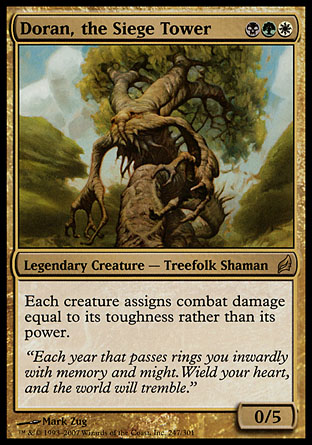
Tiny Leaders – Doran the Siege Tower

Are you a Quiet Speculation member?

If not, now is a perfect time to join up! Our powerful tools, breaking-news analysis, and exclusive Discord channel will make sure you stay up to date and ahead of the curve.

Sir Mix A Lot said it once; one of my favorite hardcore bands, Throwdown, said it better: but I can’t deny, I like big butts and I cannot lie.

Back in the days of Lorwyn I loved Doran, the Siege Tower. He had an awesome ability, was aggressively costed and was my favorite three-color combination. When EDH was first brought to my attention as a format, Doran was my snap-general. Once the Commander set was released back in 2011 it was obvious to have Doran step down to let Karador, Ghost Chieftain take his place.

I still wanted Doran to have his day in the sun again. When Tiny Leaders was first making it’s waves in my play group I was hesitant. A friend of mine saw a custom-made 3D Doran that Mike Lanigan had made for me one year for our Christmas gift exchange. He said is that going to be your general for Tiny Leaders?

I swore at him for putting the idea in my mind and started gathering up cards. That list is as follows.

Doran, the Siege Tower Tiny Leader

Commander

Creatures

Spells

Lands

1 Forest 
3 Swamp 
1 Plains 

Sideboard

Starting off, I wanted to build this list as I used to play GBW Rock in a casual Legacy environment. Control, board wipes, spot removal and strong finishers. Limiting myself to a 3-CMC arsenal of spells was a fun challenging requirement that once again made mediocre cards very powerful.

The first three cards, Abrupt Decay, Smother, and Inquisition of Kozilek, are, within green and black, auto includes in every TL deck. They deal with any card in hand and any virtually any creature or permanent once it’s in play. If you’re playing TL, casual or competitive, playing green, black and anything else and not including these cards, you’re doing it wrong.

Pernicious Deed has been one of my favorite cards in the history of Magic since Apocalypse came out back in 2001. Putting it in play as an insurance policy creates complex board states and just jamming it and blowing it in the same turn can reset and spring you back into the game.

Gaze of Granite is of the same caliber but was a bit too mana hungry for tournament constructed play. I feel like it finds a perfect home in this deck along with its predecessor, Pernicious Deed. Other obvious choices in here are, of course, Swords to Plowshares, Hymn to Tourach, and Chainer's Edict.

Taking a look at the creature base, the amount of creatures with larger toughness isn’t as high as I’d like. In my first draft of this deck I had more one-drop vanilla creatures but it became underwhelming even spending one mana on a virtual 4/4 late game.

Stoneforge Mystic has only two targets, Slagwurm Armor and Behemoth Sledge. The sledge is just a solid piece of equipment, but the armor coupled with Doran is nuts. Giving a creature virtual +6/+6 is a huge bonus. Land the Kin-Tree Invocation while the armor is on a 0/5 and you stick an 11/11 creature.

Tiny Leaders, as a format, was really an awesome find for me. It took the creative challenge of EDH deck building and removed the politics and ganging up factors. I still look at it as a casual variant of Magic so this deck will probably be the most aggressive build I put together. As a player of over 15 years I really do like to separate my competitive tournament play from my “kitchen table” type casual play.

As always, thank you for checking out my article, I’m always open to comments or suggestions. Until next article!

x Julian Biondillo x

Julian, AKA hardcoreniceguy on Twitter

biondillodesign@gmail.com

BBD’s Collected Company Legacy IQ List

Are you a Quiet Speculation member?

If not, now is a perfect time to join up! Our powerful tools, breaking-news analysis, and exclusive Discord channel will make sure you stay up to date and ahead of the curve.

Readers, welcome back!

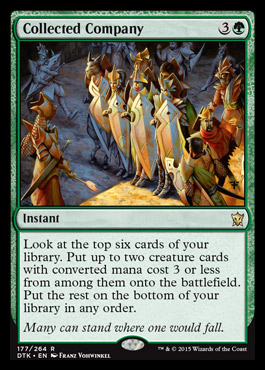
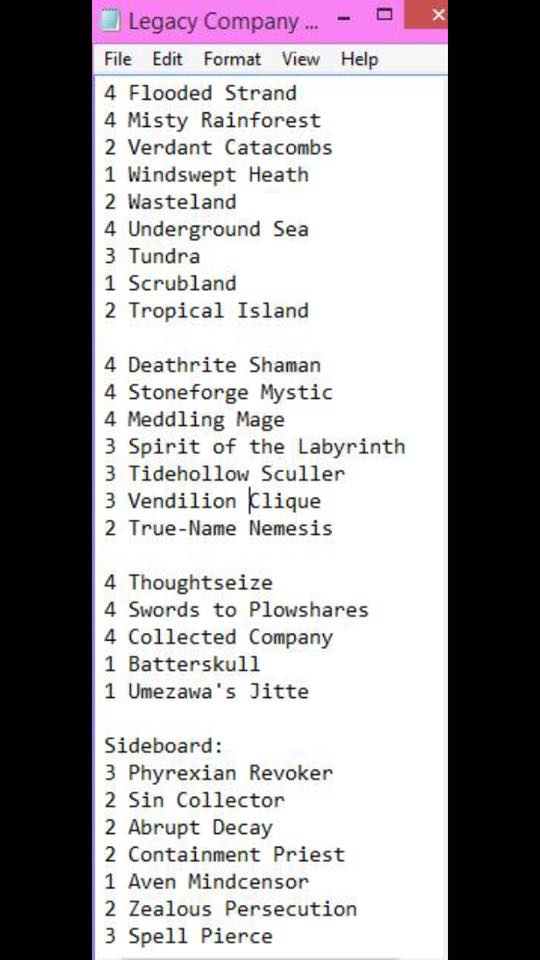
I wanted to write a shorter article dissecting an interesting Legacy list that Brian Braun-Duin played during a Legacy IQ event, breaking down what this could mean for a card like Collected Company going forward.

The card has obviously been popular in Standard and Modern, but I don’t think anyone guessed that it would be viable in Legacy. BBD showing confidence in the card is a telling sign, and could be promising for its potential as a multi-format all-star.

Let’s break down the list:

BBD's Legacy Collected Company IQ List.
BBD's Legacy Collected Company IQ List

This decklist actually looks really sweet. Being able to play these colors and utilize cards like Stoneforge Mystic and True-Name Nemesis at instant speed is quite amazing.

What’s a little confusing is the high amount of “naming” cards in Meddling Mage and Phyrexian Revoker out of the sideboard. As I discussed the list with others better versed in the format, they expressed with explicit detail how vital those cards are for avoiding troublesome match-ups. Namely combo-oriented decks such as OmniTell/Storm/Reanimator where this deck would be dead in the water without somehow disrupting their combo-pieces with the aforementioned cards, or stripping them from the hand with a Thoughtseize.

I also brought up the discussion about the deck functioning with or in spite of Collected Company, and I had varying replies about whether the deck simply didn’t need it, or the fact that instant speed threats and disruption could very much contend with most of the metagame right now.

While this is the first venture into the archetype (in Legacy that is) it seems to have access to a wide array of tools for various match-ups, and lends itself to be used with multiple colors. What I kept hearing though is that the first thing that should/could be cut from this list is Tidehollow Sculler.

The glaring weakness of this deck is its susceptibility to Wasteland, and the deck is very hard to pilot correctly. Playing cards like Meddling Mage and Phyrexian Revoker require an immense knowledge of not only the format, but the specific metagame one is playing at. You need to know exactly what deck will be played across from you, and which cards are vital to beating your strategy. There isn’t just one set plan with the deck, it’s reactionary in nature to what your opponent is doing, much akin to the play style of Death and Taxes.

Deathrite Shaman is also vital to the deck's plan. Relying on it is not the safest of bets in the Legacy format as it's often a lightning rod for removal. So, most of the time Collected Company is going to be cast fairly, and the turns leading up to playing the card have to be error free.

From a financial perspective, the card with the most potential that jumps out is:

There was an error retrieving a chart for Spirit of the Labyrinth
Foil Buylist on the Sweet new Trader Tools!
Foil buylist on the sweet new Trader Tools!

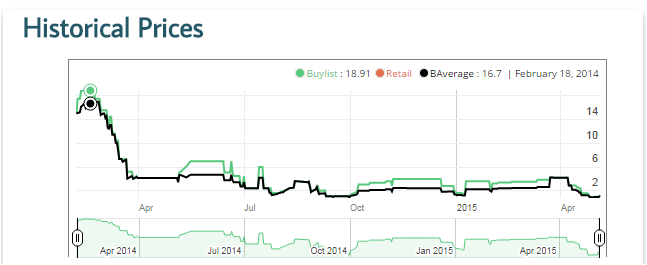
Remember this card? Well, it fell off into obscurity since April 2014, but back then it was buylisting for nearly 20$ in February. Right now, the current spread percentage (for foils) is low--although CoolstuffInc is offering $5.00 at the time of writing this article--but this card has dropped drastically in a year.

Not only could this card see play in Legacy, but is also an option for further Collected Company-based decklists in Modern. Any new attention brought to this card could change its pricing drastically from its now all-time low.

It could be a great “buy and stash” as time goes on, because it still has all the same good points as it once had, it just didn’t have a viable home for the past year. BNG was considered an under-opened set, so it’s worth noting that it may not have as much supply as a card from a set like Khans of Tarkir.

Future cards to think about:

Legacy-Viable CoCompany Targets

I took the liberty to sift through all the potential cards currently used in Legacy that work with Collected Company. Now, this is just skimming the surface, but I wanted to specifically highlight cards that are already working in the format. A lot of the most successful creatures were included in BBD's list, but it was interesting to see which other cards could work.

As it stands, BBD showing confidence in the card is a really good sign. It’s a first iteration, and could potentially be expanded with time. For now, it’s just a good pilot winning an IQ one time with a deck. But it’s not like the deck doesn’t have any game; it has some extremely potent plays.

For now, I never thought Collected Company would be a viable Modern card, and just showing the slightest interest from a player like BBD leaves me excited to see what could come of it. If a deck focused on this card gains traction in a format like Legacy, we could all be looking back at foil copies these days as “cheap”, even sitting at 25$.

There was an error retrieving a chart for Collected Company

Some things to consider moving forward:

  • How is this deck better than what's currently being played (in terms of fair decks)?
  • With a limited number of viable creatures in Legacy, will there be room for a lot of innovation?
  • Will the adoption of Collected Company threaten current archetypes?
  • How popular could this deck be?

I think these questions are vital to documenting a sudden new archetype, especially in a format like Legacy. There will be a good amount of skepticism, and rightly so. Only the best cutthroat ideas and deck-building survive the test of time in Legacy.

I will re-iterate again that Collected Company does get better as time goes on. While there is some limitation to the creatures that are viable in Legacy, they do change from time to time. I only highlighted what's currently successful, but there could be more obscure or fringe creatures waiting on the outside looking through the window of opportunity that is Collected Company.

Perhaps they can be given a chance, or perhaps this deck is a flash in the pan that just ran good "that one time at an IQ." We shall see.

Well, that’s a look into BBD’s spicey Legacy IQ deck, and more fuel to add to the spread of “CoCo” in Magic.

-Chaz

Modern Investment: Deck Win Rate to Cost Analysis

Are you a Quiet Speculation member?

If not, now is a perfect time to join up! Our powerful tools, breaking-news analysis, and exclusive Discord channel will make sure you stay up to date and ahead of the curve.

Life is full of big investment choices. Should you buy or rent? Save in a 401(k) or Roth IRA? Matriculate on in-state tuition or take on out-of-state debt? Magic and Modern are supposed to be our hobbies and our break from all the real-world weight of the workplace and your bank account. But when it comes to investing in a deck, it doesn't always feel that way. In fact, with a format as complex and potentially expensive as Modern, it can sometimes be more stressful than all those non-Magic financial decisions. No one wants to spend too much money on their Modern deck, especially if the deck is in danger of a ban, not fun to play, or worst of all, just plain bad. Today, I want to introduce a strategy that can help you make smart financial decisions in Modern to save your bank account, your tournament performances, and potentially your relationships (because spending $800 on 4 "pieces of cardboard" can be hard to justify to the Mr./Mrs. in your life).

Bang For Buck Image Cropped
Modern investment is partially an inexact science. When selecting a deck, you need to follow your gut, your playstyle, and what "feels" right to you. But like with most things on Modern Nexus, there's a method and data-driven approach that can underlie your decision. In this article, I compare the cost of key tier 1 and tier 2 Modern decks with their win rates as calculated in our MTGO Deep Dive dataset. Our goal is to see which decks have the most favorable cost to win-rate ratio. That is, which decks will take your money the furthest in tournaments / what gets you the best return on your investment. Although this should not be your only approach to Modern investment, it's a great starting point if you aren't sure where to start or where to go next in the format. It's also an interesting exercise in how to make financial decisions in Magic. Since Magic started, many players have suggested you need to buy your way to victory. Let's actually put that to the test in Modern.

[wp_ad_camp_1]

The Decks

Just because a player is budget-minded, doesn't mean they want to, or even need to, play a "budget" deck. To some extent, "budget" has an unnecessary stigma to it suggesting budget Twindecks can't be good. There's some fact and fiction to this, but for this article, it's important to consider affordability as just one piece of the puzzle. Deck performance needs to be another. People don't just want to enter Modern to win their local FNM or take down a Daily every now and then, they want a deck they can bring to PPTQs and GPs, a deck they can grind into the digital dust on MTGO. So I don't want to focus on the historically "budget" decks, things like Mono Green Stompy or Mono Black Midrange, or really anything without Goyf. I want to focus on the real tier 1 and tier 2 decks of the format. These are the heavy-hitters players need to choose from whether they are new to Modern or are Modern veterans just looking to switch decks; these are also the first decks new Modern players see (think Twin, not Slivers), and the ones they are most likely to investigate when gearing up to make the big purchase.

Looking at the recently updated Top Decks page, i selected a number of decks that are both tier 1 and tier 2, and also have sufficiently large representation in the MTGO Deep Dive dataset. This dataset draws MTGO data from the client to calculate the "true" Match Win Percentages (MWPs) of decks. It doesn't look at just the publicly published 4-0/3-1 finishes. Instead, it looks at all finishes from a sample of dailies over a time frame. Although it's just a sample and not the full population, that dataset still gives us access to the best (to my knowledge) estimators of deck's MWPs in Modern. Because we are ultimately comparing price to MWP, we need to only look at the decks with a big enough N in the dataset to give a robust MWP calculation.

With that in mind, here are the decks we will be looking at today. I'm breaking them out by their current tier, and then giving a few key data points on each deck. First, I'll give the TCGPlayer NM/Lightly Played cost of that deck (including sideboard! Never forget the sideboard!!). Costs were computed using the TCGPlayer mass product entry tool and their cart optimizer and then rounded to the $.50. Then I'll link to a representative decklist from the past 1.5 months (the highest finish at the largest event in the range). Finally, I'll end with their metagame share.

TarmogoyfTier 1

Tier 2

Note the awesome Abzan Company was excluded from this analysis for lack of datapoints in the Deep Dive dataset. Hopefully we'll have more on that soon! Otherwise, this is a pretty comprehensive cross-section of the metagame. With the costs all laid out, let's plug those into the second part of our analysis and see how the decks stack up.

Cost to Win Rate Analysis

One thing we always talk about in fundraising is showing the impact of your dollar. This "return on investment" applies just as much to funding a social service program or other nonprofit as it does with Magic decks. Now that we know how much each deck costs, we can compare those prices to the MWPs of those decks. We can use this analysis to see which deck has the most favorable ratio of MWP to cost, i.e. the best return on investment (ROI). Instead of expressing the deck value as just the MWP divided by the cost, I want us to think of it in terms of these ROI-style numbers. That is, when you invest in a deck, what is the MWP return on your dollar investment? I'm going to show this in two ways. The first is as a straight ROI calculation: how much MWP does your $10 buy in that deck (I'm using $10 instead of $1 because it makes the percentages larger and clearer)? The second is as a kind of reverse ROI calculation: how much do you need to spend on the deck in order to buy 1% point of MWP? These two parallel numbers give you two different ways of understanding the cost to MWP ratio for each deck.

Let's see  how this works out with our tier 1 and tier 2 decks! Again, MWP values are taken from the Deep Dive dataset, which you can read more about in this article.

DeckMWPPriceMWP Return
on $10 Investment
$ Cost of
1% MWP
Merfolk55.2%$446.00
1.24%
$8.1
Burn
53.8%
$504.00
1.07%
$9.4
Amulet Bloom
60.6%
$573.00
1.06%
$9.5
Infect
55.2%
$609.00
0.91%
$11.0
Affinity
52.7%
$646.50
0.82%
$12.3
Scapeshift
47.2%
$657.00
0.72%
$13.9
Grixis Delver
48.4%
$679.50
0.71%
$14.1
RG Tron
44.3%
$627.00
0.71%
$14.2
Abzan Liege
56.8%
$808.50
0.70%
$14.2
UR Twin52.1%$997.500.52%$19.2
Jund
52.2%
$1,530.50
0.34%
$29.3
Abzan53.3%
$1,691.00
0.32%
$31.7

Just to check our understanding, here's how to read each entry in the sortable table. Affinity costs $646 and has an MWP of 52.7%. That means for every $10.00 you invest in Affinity, you are "buying" .82% points of MWP. Or stated differently, the cost of a single % point of MWP is $12.30. By contrast, Abzan costs a walloping $1,691 and has a slightly higher MWP of 53.3%. So for every $10.00 you invest in Abzan, you "buy" just .32% points of MWP. The cost of a single % point of MWP in Abzan is $31.70. Purely based on these numbers (and again, there are other factors in deck investment beyond these numbers), your Affinity investment has a higher ROI.

The interesting thing in this analysis is the relative narrowness of MWPs and the huge range of costs. Most decks are hovering around an MWP of 50%, with some outliers on the lower and and the higher end (get 'em Amulet!). But costs are all over the place. Merfolk is cheaper than many Standard decks with a pricetag under $450. Abzan and Jund cost more than 2 months rent in many cities, at $1500+ each. So it makes sense as price climbs, the investment becomes a lot worse in terms of MWP.

The Top 3 Modern Investments

Before wrapping up, I want to highlight the decks with the top 3 ROI values in this analysis. You can see them in the table above, but I want to say a few words on them, why they are good investments, and what you should consider before investing in them just based on the MWP/Cost analysis we did here. In many respects, this gets at all the other considerations that need to go into deck investment beyond just MWP and cost.

3. Amulet Bloom: $573 ($10 / 1.06% points of MWP)

amuletI've made it no secret in the past: I think Amulet Bloom is the "best" deck in the format. It has the highest MWP by a huge margin, had the highest MWP at the Pro Tour, has an insane ratio of T8 finishes to Day 1 showings at major events, and in practice, is one of the hardest decks to play against and interact with. It's a really, really good deck. As this analysis shows, Amulet is also a really, really good investment. For just $573, you get to play the "best" deck in the format. Take that, you $1,500+ Abzan/Goyf/Lily players!

Before you hop onto your vendor of choice and add this baby to your cart, there are a few important Amulet Bloom issues to keep in mind. First, the cards have very little overlap with other decks. If you spend $573 on Amulet Bloom, you really are just spending $573 on Amulet Bloom alone: it's not like you can sleeve up your cards in some other deck, as opposed to something like Twin or Scapeshift. Moreover, and this brings us to the second consideration, your investment is going to tank if Amulet Bloom ever eats a ban (which will probably be on Summer Bloom. Although the deck probably survives without Bloom, it will definitely be worse, which can make this a high-risk, high-reward investment on its own. As a final consideration, Amulet Bloom is as dedicated a combo deck as they come in Modern. Be ready to commit time to practicing the deck and learning how to win with it. Also, to knowing how to play it in various matchups. With a deck like Burn, you will need some practice, but to a greater extent you can just sleeve it up and launch headlong into a tournament. Do that with Amulet Bloom and you will be lucky to be up one match by four rounds in. That is also to say, Amulet comes with a time investment on top of a monetary one, so bear that in mind when making your purchase.

2. Burn: $504 ($10 / 1.07% points of MWP)

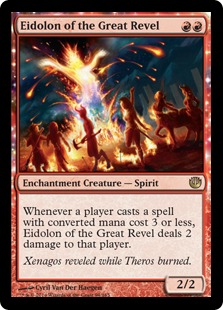
Eidolon of the Great RevelI would have been worried about the validity of this analysis if Burn didn't make the cut. Burn has made a name for itself largely because players believe it has the best tier/performance to cost ratio. This analysis basically confirms that. When you invest in Twin, Abzan, and Jund, you are spending lots of money for a pretty decent deck. When you invest in Burn, you are spending way less money for a slightly better deck. Burn is as linear as it gets, and that's reflected in its slightly higher MWP relative to the other tier 1 decks. Proactive strategies are where you want to be in Modern, and Burn wrote the playbook on being proactive in any format, let alone this one.

Unlike Amulet, Burn is a "safer" investment in terms of time commitment, bannability, and playstyle. You don't have the same crazy MWP as Amulet, but you have a deck that's much easier to play (not "easy", but "easier" than Amulet), and a deck likely to be around for as long as there's Magic. Your Burn investment will even overlap to other decks (and formats, e.g. Legacy), both in the fetchlands and some of your burn spells and creatures. Even if the overlap isn't as much as a deck like Twin, you're still getting cards like Helix, Bolt, fetchlands, shocklands, etc. that will apply elsewhere. It's possible, but unlikely, Burn eventually eats a banning for being too efficient, or gets slapped down with some scary new hate card printed in an upcoming set. But the deck will still be viable and you will still be playing Modern's premier aggro deck. It's also a deck that should be relevant in most metagames, because you can almost always catch opponents by surprise if they are under-prepared for your speed. Overall, Burn is just as good an investment in this analysis as many players believe it to be.

1. Merfolk: $446 ($10 / 1.24% points of MWP)

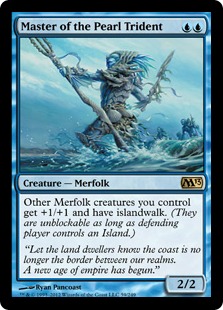
Master of the Pearl TridentI always knew Merfolk had a favorable cost to performance ratio, but it wasn't until after I conducted the analysis I saw how good it really was. At an easy $446 investment, Merfolk is the hand's down winner of the ROI analysis. Merfolk has no fetchlands, no shocklands, no expensive staples, and no fancy niche cards that weren't reprinted by those Wizards jerks in MM2015. It's just pure, old-fashioned Fishy beatdown goodness at a discount.

Like Burn and Amulet, Merfolk is as proactive as decks get in Modern (I hope you are sensing a pattern here). Unlike Amulet, the deck takes way less time to familiarize yourself with, and doesn't require a love for potentially less-interactive combos and Magic. And unlike Burn, there is absolutely no chance Merfolk ever eats a ban, and absolutely no chance you get beaten up behind your gamestore for being the scumbag who wins with Burn every FNM. There is very little overlap between Merfolk and other decks, so that's something to consider when shelling out your $450 for the blue men group. That said, Merfolk has always been present in Modern, either leaping into tier 1 or swimming around in tier 2. This makes it an extremely safe investment, regardless of the metagame context. The deck is also pretty easy to modify, splashing (bahaha) for different off-color bullets (e.g. Path to Exile and Thoughtseize), or for non-blue synergies (e.g. Collected Company). This ensure you have plenty of room to grow into your deck and stay relevant as the format expands. So if you are pressed for cash or just want your dollar to go a long way, it doesn't get better than then $10/1.24% MWP ratio of time-tested Merfolk.

Other Investment Considerations

As I've said more than a few times in this article, the MWP:Cost ratio is just one of many datapoints you need to consider when making your Modern investment. In particular, here are three other important concepts you need to think about before spending money.

Playstyle: Astute readers will notice all of the best investments are aggro or combo decks. Where's the midrange? Where's the control? Indeed, the absence of control is a much larger issue in Modern (depending on what perspective you approach it from), and this investment analysis just reinforces that divide. When investing in a deck, make sure it's something you can see yourself playing for at least a year. If you have more disposable income than the average player, you can probably discard it sooner than that. Adults with stable jobs will find Magic is a lot cheaper after college than before or during it. And even if you are operating on a smaller budget, it just takes a few months of saving to get your dream deck. But even so, always playtest a deck before buying it to make sure you actually enjoy what you are playing.

Banning: I know a lot of Modern players who are scared to invest in decks for fear of a banning. This is mostly Wizards fault for having bad communication on their ban policy, and for mismanaging collected companyexpectations around the format. It's a real disappointment this is even a factor in investing, and Wizards needs to do something about this for the long-term health of Modern. I could write a whole series of articles on this mismanagement, how to fix it, and how it affects player decision making (particularly around deck purchases). But for now, I will only say this: don't worry about bans. Magic is a game and if you are reading this article, you are probably playing Modern because you love the format. Invest in the deck that gives you the most enjoyment and you will always win, even if the deck is ultimately banned. Besides, as both the rise of Grixis Delver and Abzan Company attest, a banned deck is almost never a dead deck. Pod never died, it just took a break. Even if Twin got banned tomorrow, you would still have a UR core that would translate into plenty of other viable decks. So never be afraid to invest based on ban danger. Between the other cards you buy and the fun you have, it will always be worth the investment.

Card overlap: Sean touched on this in an earlier article, but I want to reinforce this point here. When you invest in a deck like Merfolk, you are going all-in on that deck. But when you invest in a much more expensive deck like Abzan or Twin, you are obtaining a wealth of staples crossing over between decks and even formats. If you are the kind of player who sticks to a deck until Wizards pries it from your cold, dead hands, then don't worry about card overlap. But if you are the kind of player who shops around and switches things up depending on metagame context, look for deck/card overlap.

There are plenty of other investment considerations out there (metagame context, making a long-term profit, cross-format applicability, etc.), but these are great entry points to get you thinking about all the different factors affecting your investments. This includes the MWP analysis, which is just one data point you should consider in making your Modern purchases. So get out there, put down some cash, and buy into the Modern deck of your dreams.

What’s the Ceiling on Collected Company?

Are you a Quiet Speculation member?

If not, now is a perfect time to join up! Our powerful tools, breaking-news analysis, and exclusive Discord channel will make sure you stay up to date and ahead of the curve.

A very important aspect of MTG finance is have a good estimate for a given card's price floor and price ceiling. The basic economic principle here being the idea that you want to buy low and sell high. For Collected Company, the window to buy low has certainly passed.

There was an error retrieving a chart for Collected Company

The question is, how high do we expect Collected Company to go? It's currently $11+ in the set being drafted right now that is about to be drafted a bit less with Modern Masters 2015 coming out this week and Magic Origins on the horizon.

With the card seeing success in both Standard and Modern, the demand is certainly there. BBD was even crazy enough to play the card in Legacy. He split a Legacy IQ with the following list:

Legacy CoCo

creatures

4 Deathrite Shaman
4 Stoneforge Mystic
4 Meddling Mage
3 Spirit of the Labyrinth
3 Tidehollow Sculler
3 Vendilion Clique
2 True-Name Nemesis

spells

4 Thoughtseize
4 Swords to Plowshares
4 Collected Company
1 Batterskull
1 Umezawa's Jitte

lands

4 Flooded Strand
4 Misty Rainforest
2 Verdant Catacombs
1 Windswept Heath
2 Wasteland
4 Underground Sea
3 Tundra
1 Scrubland
2 Tropical Island

sideboard

3 Phyrexian Revoker
2 Sin Collector
2 Abrupt Decay
2 Containment Priest
1 Aven Mindcensor
2 Zealous Persecution
3 Spell Pierce

This build is wonky and unrefined, but that really helps to illustrate the card's power. Even without a good list, it fits the bill in this pile of mish-mashed good cards.

It's worth noting that the MTGO price of Collected Company is only about 6.5 tix, which is a little disconcerting when you factor in that Dragons of Tarkir is the one booster from Tarkir block worth more than 3 tix at this point in time. Alternatively, the spread for paper copies is a scant 22%. That is to say that you could literally buylist 81 copies to Card Kingdom for $9 each at the time of this writing.

As you can see, there are a lot of factors at play when trying to determine a card's ceiling. Ultimately, you have to take some risk in your decision to invest or avoid any given card, otherwise finance just wouldn't work.

When it comes to Collected Company, are you bullish or bearish?

Insider: MTGO Market Report for May 20th, 2015

Are you a Quiet Speculation member?

If not, now is a perfect time to join up! Our powerful tools, breaking-news analysis, and exclusive Discord channel will make sure you stay up to date and ahead of the curve.

Welcome to the MTGO Market Report as compiled by Sylvain Lehoux and Matthew Lewis. The report is loosely broken down into two perspectives. A broader perspective will be written by Matthew and will focus on recent trends in set prices, taking into account how paper prices and MTGO prices interact. Sylvain will take a closer look at particular opportunities based on various factors such as (but not limited to) set releases, flashback drafts and banned/restricted announcements.

There will be some overlap between the two sections. As always, speculators should take into account their own budget, risk tolerance and current portfolio before taking on any recommended positions.

May20

Redemption

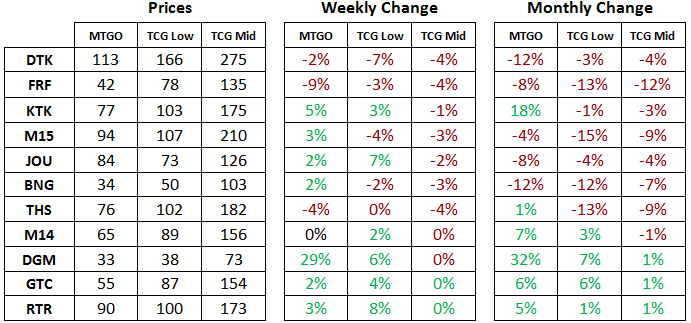
Below are the total set prices for all redeemable sets on MTGO. All prices are current as of May 19th, 2015. The TCG Low and TCG Mid prices are the sum of each set’s individual card prices on TCG Player, either the low price or the mid-price respectively.

All MTGO set prices this week are taken from Goatbot’s website, and all weekly changes are now calculated relative to Goatbot’s ‘Full Set’ prices from last week. All monthly changes are also relative to Goatbot’s prices, except for DTK which is relative to the mid-April set price.

Return to Ravnica Block & M14

The big move this week in these sets was the jump in the price of Voice of Resurgence, which has dragged the set price of DGM up by almost 30%. This particular trend should continue over the coming weeks as it does not appear that the market is close to equilibrium yet. Only when more ‘for sale’ copies of this card are visible will the trend level off.

If you are holding copies of this card, it appears to be headed to around 30 tix in the near term. As always, the link between the digital and paper versions of DGM is extremely tenuous, so no consideration is necessary for cards beyond this Modern-playable mythic rare.

Elsewhere in Return to Ravnica block, prices are largely stable for RTR and GTC and both sets are now priced at new, post-rotation highs for both TCG Low and TCG Mid. There’s no change on the speculative potential of any cards from these sets from a redemption perspective. Any rapid price increases in a given card should be considered a good selling opportunity, and the interest in Modern over the coming months should provide ample support for prices more broadly.

M14 is slightly off its post-rotation highs but has a similar outlook. The bulk of the price moves on cards from these sets have come and gone. There might be some minor flow of value between individual cards, and there could be a metagame related price spike, but at this point, the die has been cast.

Speculators should be looking to exit any positions in these cards over the summer, particularly in advance of the release of Magic Origins. Speculating on core sets on MTGO has been consistently profitable over the years, and so speculators should be getting liquid in advance of the release of the last core set.

Theros Block & M15

Although there is room for individual cards and set prices to move up, paper prices continue to move down as a whole. Each of these sets in paper has basically been declining in price, week over week, for over two months now. Only short-term speculations should be considered, and signs of price weakness should not be ignored.

The time to speculate on THS block and M15 is over, and only mythic rares at a discount to their long-term value should be considered for purchase.

On that note, three mythic rares from THS block are currently priced below 0.4 tix at Goatbots. Hythonia the Cruel, Medomai the Ageless and Underworld Cerberus are all priced below a level which is considered extremely low risk for long-term speculators. The link to paper prices through redemption will support prices of mythic rares down the road, and these three cards have an excellent chance of seeing prices of 1 tix or more.

If you are new to speculating on MTGO or are trying to understand some of the long-term price trends, putting a few of these cards away for next year should be a good, practical lesson. Patient speculators will reap the benefits of having a long-term perspective on cards like these.

Tarkir Block

It’s no surprise but the marked downward move this week for paper DTK sets coincides with the opening of redemption. At the same time that redemption supports a set’s price on MTGO, it erodes the price of the paper version. The gap between paper and MTGO will narrow as this process unfolds, but for speculators, there is no real action to take in response. Merely observing the impact of redemption is enough to trust that an unmeasurable process has an important effect on the MTGO economy.

The time to be accumulating cards from this set will be in and around the release of ORI in July; this will be the approximate peak of supply from drafters and broadly the best time to be acquiring cards from DTK.

FRF has broken down from 45 tix to sit at 42 tix this week, and this is a signal to expect further price declines over the coming weeks. With paper prices continuing to fall, support from redemption has evaporated and speculators should refrain from targeting this set until prices have stabilized in both paper and on MTGO. Similar to DTK, the release of Magic Origins will be a good time to pick up cards from this set.

KTK is up again this week with a 5% increase to 77 tix for a complete set. In the near term, changes in the Standard metagame will dominate price changes, but the overall trend is favorable for speculators who accumulated positions in this set in past weeks.

Going forward, there will be periods of price weakness during set release events for MM2 and ORI. If you are looking to fill out your playsets or think you should expand a speculative position, those would be the times to look for good prices on cards from this set.

Modern

It’s now one and a half weeks since the full list of Modern Masters 2015 was unveiled and many Modern prices are still rising.

Of note, a little glitch is affecting some of the price indices at Mtggoldfish. The foil value of several cards is taken into account instead of the regular version to calculate the Modern Total Format Price Index, for instance. With some of these foil cards being valued less than their regular counterparts an artificial drop of 25% of this index has appeared when in fact prices are actually on the rise.

In the wake of this general price increase, the prices of several Modern staples that were not reprinted in MM2 are stabilizing this week. Inkmoth Nexus, Amulet of Vigor, Melira, Sylvok Outcast, Serum Visions and Path to Exile have each established new price records. Outside of the cards appearing in MM2, prices are expected to continue rising as we get closer to the release of that set and all of the Modern events later this summer.

The Modern part of this past week’s Magic Online Championship gave us a strong sense of what to expect next with this format: just about everything. No less than 12 different decks were played, out of 16 players in total. Burn is still a major contender and Collected Company decks made a big splash in the first high profile Modern event since the release of DTK.

Three players brought two different builds of Company decks, Elves and “Pod-less” Melira, and all had a full playset of Collected Company. Key cards of these decks such as Heritage Druid, Fauna Shaman, Nettle Sentinel, Eternal Witness, Kitchen Finks and Ezuri, Renegade Leader have now seen their prices rise totally off the charts. After such a strong showing and prices going crazy, selling into this hype may very well be the best move with these cards.

The Top 16 at this past weekend’s SCG Modern Premier IQ included a Restore Balance deck, a surprising Slivers Deck (running Collected Company), and three Jund lists, marking a return of Dark Confidant and the color red in the Modern GBx midrange builds. Olivia Voldaren (already on a steady rise for the past three months), Blackcleave Cliffs and Raging Ravine will be strong gainers if Jund’s return to the Modern metagame persists.

Legacy & Vintage

Prices on cards from Tempest Remastered are stabilizing or slightly decreasing at the moment with the exception of Wasteland.

This land has been on a steady rise since the release of the set and the upward trend only seems to have slowed down this past weekend. By Sunday, Goatbots had up to four playsets of Wasteland in stock at around 40 Tix per land. By Tuesday, all these copies were gone with a price now in the 45 Tix range.

If waiting for cheaper prices is likely to be the best strategy for TPR cards in general, the price of Wasteland definitely didn’t act according to expectations. Two weeks into TPR release events and the price of Wasteland is merely half of its average price of the past two years. Expect that gap between the long-term average price and the current price to be filled sooner rather than later, with a price tag expected to rise to 100 Tix again.

Pauper

Pauper prices, for the most part, are again this week continuing the upward trend initiated several weeks ago. According to the Mtggoldfish Pauper metagame stats, Affinity is the second most played deck in the current environment. With the exception of expensive sideboard cards such as Pyroblast, Hydroblast and Gorilla Shaman, the deck costs around 10 Tix.

Affinity lists are very similar and the only valuable cards in here are the artifact lands. Ancient Den, Seat of the Synod and Great Furnace all show signs of cyclical price fluctuations, oscillating between 0.1 and 1 Tix. As the metagame changes, speculators interested in Pauper may want to keep a close look at these cards for potentially decent returns in this corner of the market.

Targeted Speculative Buying Opportunities

None

Targeted Speculative Selling Opportunities

Modern

Fauna Shaman

Thanks to the hype triggered by the Collected Company decks, Fauna Shaman’s price has surged from about 1 Tix to more than 4 Tix now. Elves and Melira Company decks are the hot decks of the moment and we believe this may not last as the Modern metagame adapts to these new decks. With strong gains in a short period of time and an uncertain future, we recommend selling now.

Insider: Theros – Land of Hidden Value

Are you a Quiet Speculation member?

If not, now is a perfect time to join up! Our powerful tools, breaking-news analysis, and exclusive Discord channel will make sure you stay up to date and ahead of the curve.

Everybody is sick of Theros. It was fun for a while and introduced some cool cards and mechanics but nowadays all anybody cares about is Modern Masters, Magic Origins, and making a return trek to Zendikar in the fall. What have you done for me lately, right?

The summer lull is just around the bend and anybody who is anybody knows that Standard cards are going to take a dip in price as interest wanes and players try to "get out" of their rotating cards in preparation for the launch of a new block. While it may not be exciting to pick up the dregs that everybody else is looking to dump, for us savvy hawks of opportunity this is where we make investments that will pay off later down the road.

I have always advocated a long-term approach to MTG investing based on concrete principles of buying into cards with nowhere to go but up down the road. Buying into cards that are about to rotate is among the most surefire ways to find deals on singles when they absolutely bottom out, thus creating opportunity for future growth.

We are at the edge where Theros block singles have either already bottomed out or are nearing their low price points and so it is the perfect time to get our chips in on these unloved, unwanted singles.

For the purposes of today's article I'm going to break what I would consider to be the "desirable" Theros singles down into three general categories: Legacy/Modern Gems, Commander Gems, and Kitchen Table mainstays. I'll give you the scoop on which cards to seek out and why I think these cards will likely rebound in value in the long term.

Legacy & Modern Staples

Theros has brought us several cards that are going to see play in Modern and Legacy tournaments for years down the line. Old format staples don't pick up "premium" value while they are still in Standard because there are so many copies floating around in the hands of Standard players that they are too easily accessible.

However, a year or two down the road after all of these cards have found their way out of the hands of players, these cards tend to pick up steam and become more expensive.

There was an error retrieving a chart for Thoughtseize

Thoughtseize is easily the "best" card in Theros block from a playability perspective. It goes into a million different decks in every format it's legal in.

I typically don't advocate buying into cards that are already in the $15-$20 range because its hard for cards that are already expensive to make tremendous gains. People are only really willing to pay so much for cards and it takes a lot to justify paying $30+ for a single card for a deck.

Thoughtseize is the kind of card that is so good and widely played that players are basically forced to pay whatever the cost in order to acquire it. The decks (and there are a ton of them) that play Thoughtseize really have no other choice because the card is versatile and part of what makes the deck work.

Reprints are always an issue when speculating and if the price ever gets too high it will see another reprinting. Yet, I still have no problem trading for and picking up as many copies of the card as possible. It is among the most expensive cards in the block, even though it isn't even a mythic and is a reprint. That is how good this card is.

Especially if foolish Standard players are looking to get out of their Thoughtseizes and the price dips, Thoughtseize is always money. There is no doubt in my mind that the price will be higher at some point down the line than it is now.

There was an error retrieving a chart for Mana Confluence

Aside from Thoughtseize, Mana Confluence is the best "original card" in Theros block. It is a better version of a card that was already an insanely powerful and iconic card.

I've already played Mana Confluence in multiple Vintage and Legacy decks: Steel City Vault, Tendrils, Burning Oath, Jeskai Ascendancy, and Affinity in Vintage, Legacy and Modern and it is an auto include in every five-color Commander deck--It's the best land in my five-color Sliver Overlord deck for sure!

Every block has a few cards that are just amazing Magic cards and Mana Confluence is for Theros block the objective best original card. It hasn't dipped yet, but when it does I'm going to be looking to acquire as many copies as I can.

There was an error retrieving a chart for Spirit of the Labyrinth

As long as Brainstorm is a thing in Legacy, Spirit of the Labyrinth will be a solid option for white decks.

Two mana for three power and a very hateful ability is nothing to scoff at. By Constructed standards, in any format where people try to draw cards early and often the Spirit is going to have a home. Since drawing cards is basically the best thing in the game I predict that this card will be good for a long, long time.

In Legacy, Death and Taxes is a staple deck and Spirit of the Labyrinth is a very serious option for that deck--I can see this little critter steadily gaining in the coming year.

There are also a bunch of nifty combos that make other cards even better. Mikokoro, Center of the Sea and Vendilion Clique are both options that come to mind.

Also, I love the way that in decks with Aether Vial the ability to drop Spirit of the Labyrinth into play uncounterable and at instant speed in response to a Brainstorm or Jace, the Mind Sculptor activation has the potential to simply end the game on the spot!

There was an error retrieving a chart for Swan Song

Swan Song is easily the most undervalued and underrated card in Theros block from a Constructed perspective. I've played the card in at least seven different archetypes in Vintage, Legacy, and Modern and it does what it does better than any other card in Magic.

For one mana you can stop any counterspell, any hate enchantment, or any Thoughtseize. Few cards have that kind of flexibility. Since it is almost always going to be in a deck trying to win all at once, the drawback of giving your opponent a bird is negligible.

It reminds me a lot of Pact of Negation (which is a $15 card, by the way) in that the drawback doesn't matter because the point is to play it and then win immediately. Obviously, costing zero instead of one is a big deal against counterspells, but the ability for combo decks to counter something like Eidolon of the Great Revel or Mystic Remora is very, very real.

Also, I sort of intuitively feel like it is a weird card which makes it less likely to see a reprinting. We all know the true long-term winners are simply cards that never get reprinted.

There was an error retrieving a chart for Anger of the Gods

Kitchen Finks, Voice of Resurgence and Affinity are all reasons why Anger of the Gods is a card that will likely forever have a home in Modern. It is unique in the sense that it exiles the things that it kills, which has become increasingly important in Modern.

It is a Modern staple in abundance. When the card becomes a little more difficult to acquire now that people are no longer cracking packs of Theros it seems obvious that it will see a surge. The fact that it has consistently maintained some value is a testament to how good the card actually is.

It probably won't get much cheaper since people already know it is a great card. Take this opportunity to stock up for sure.

God Commanders

There was an error retrieving a chart for Phenax, God of Deception
There was an error retrieving a chart for Kruphix, God of Horizons

There was an error retrieving a chart for Karametra, God of Harvests
There was an error retrieving a chart for Erebos, God of the Dead

One of the most unique apsects of Theros was the printing of the legendary indestructible god cards. They are creatures, which means they can technically be your Commander in EDH but they are basically immune to all of the things that traditionally kill creatures.

They are unique and quite good, which is always the the hallmark of a card that will gain value down the road. They are also tailor-made to be commanders and EDH staples.

Unique cards are always the ones with the most staying power in the imaginations of players and deckbuilders, and these cards are absolutely unique in every way possible. I'm not going to say that people exclusively build decks from a flavor perspective or anything, but how cool is it to have your personal commander as a literal god?

I think that it also goes without saying that since these are commander cards that the foil versions will also command a nice premium. I really like picking up foils of these cards (and generally speaking any Commander staple) as a long-term investment.

Tiny Leaders God & Generals

There was an error retrieving a chart for Pharika, God of Affliction
There was an error retrieving a chart for Thassa, God of the Sea

There was an error retrieving a chart for Anax and Cymede
There was an error retrieving a chart for Daxos of Meletis

Same genearl sentiment about why cards are good in Commander goes for Tiny Leaders (the Commander format where you can only use cards with C.M.C. of three or less.)

Foils are a great pick up, especially at rock bottom prices as players are simply looking to dump cards. There have already been a bunch of older cards that have seen spikes (especially foils) because of Tiny Leaders, and these cards are simply too new to have peaked yet--but they will eventually.

The upside is big and the downside is basically non-existent here.

Commander Singles

There was an error retrieving a chart for Prophet of Kruphix

People don't even understand how incredibly insane this card and Seedborn Muse are in Commander. Aside from cards that say "take another turn," there is no stronger effect. These cards that let you untap your stuff during everybody else's turn are actually just broken.

I know that Prophet saw a reprinting in a deck. I don't actually care. The card is so good that I almost can't imagine playing any blue-green deck that doesn't also include this card.

I know for a fact that Prophet of Kruphix is the best card in my budget Slivers Commander deck. In fact, he is so good that I added multiple tutors simply to find the card! Not only does he make massive amounts of mana, but he has a secondary ability to give all creatures flash and we all know how insane instant speed flexibility is in multiplayer!

I'm even in a picking up the foil cards. Simply put, Prophet is one of the better cards in Theros block for Commander play.

There was an error retrieving a chart for Worst Fears

I wouldn't even play a Commander deck without a copy of this powerful black mythic rare. Mindslaver is the best threat in Commander and Worst Fears is just another Mindslaver in any deck that is allowed to field black spells.

I know I said "take an extra turn" is the best thing in Commander, but actually "take control of somebody else's turn" is even better. There is no doubt in my mind that as this card becomes increasingly difficult to find in the next year or so it will gain considerable value.

Personally, I pull this card out of every single trade binder I look through and always get every copy. My goal is to just keep hoarding them up until they mature in price.

There was an error retrieving a chart for Dictate of Erebos

Here is another clear example of a fantastic Commander card. We already know that Grave Pact is a quality staple card and in many ways Dictate of Erebos is even better.

We've already established that in multiplayer the flash mechanic is fantastic but the true awesomeness of this card is that it is Grave Pact that doesn't cost triple black, which means that it can be much more easily splashed into two- and three-color decks.

The fact that you can snap it down in response to an opponent's kill spell is also quite spicy!

Kitchen Table Staples

There was an error retrieving a chart for Whip of Erebos

Whip of Erebos has been a card that dominated on and off while it was in Standard and simply put it is a super impactful Magic card. When the Whip hits the table there is no doubt that it is an important tactical point in the game!

I think this card is going to hold a lot of casual clout in the years to come. Rewind back in time and remember when Whip of Erebos and Gray Merchant were dominating standard.

Various versions of Mono-Black have always been a casual favorite of the year and whether the kitchen table commandos are pairing their Whip of Erebos with Order of the Ebon Hand or Ravenous Rats, everybody is going to include the Whip of Erebos.

Here is a pro tip: I have built, tuned, and sold roughly 50 Mono-Black kitchen table decks from the local game store and every single one includes Necropotence and Whip of Erebos. It is simply a card that there is a ton of demand for so look for it to gain momentum quickly after the summer lull subsides.

There was an error retrieving a chart for Ashen Rider

How can one argue with Angel of Despair on steroids? I kind of feel like this card is primed for a Commander deck reprinting at some point down the line. Nonetheless, it is cheap and super powerful.

It also sees play on and off in Sneak and Show decks as a sideboard card for dealing with hateful permanents and getting around Karakas. It is one of those cards that is really powerful and really flashy and people seem to latch onto those kinds of cards and want to play with them in casual Magic.

At the current price point I can't really see any way that things can go bad picking up this card. It is bound to rise in value and even if it sees a reprinting it won't settle any lower than it is right now.

I really like foils of this card as a long-term acquistion. Even if it gets a Commander reprint it will still be difficult to find foils.

There was an error retrieving a chart for Hydra Broodmaster

Hydra Broodmaster is a card that I'm going to give you the "gamestore downlow" on. I can't keep them in stock, no matter how hard I try.

I've actually bought them for face value online and sold them at a double mark-up in the store because there is such a high demand for them. Any time there is a card that people are happy to pay double the retail price to get for their decks it is typically a very good sign that the card is worth its weight in gold.

I know it had a deck printing, which simply doesn't matter because the demand is so high with casual players. Just look at the card: it is huge and has a huge ability. Remember the days of being impressed by a Craw Wurm? Well, just imagine seeing the stats on this monster!

It is really appealing to casual players because it is such a cool card and I anticipate that any time kitchen players do a Gatherer search and find this card they will be looking to pick them up. Over time, this fact equates to stores having to raise their buylist price on the card in order to satisfy demand.

Pick them up and hold onto them to wait for the tide to rise.

The Non-Entrenched Perspective

It's kind of funny to think about Theros block because as a savvy player most of the cards seem kind of unexciting from a pro player perspective. I don't feel like "lifer" players are going to think back on the block with any kind of particular fondness--rather the sets are kind of dull and boring.

However, everything in perspective. You and I lived through the block for two years. Two years from now when new players are discovering the cards for the first time their perspective will be very different.

Gods!? Whip!? Giant Hydra Mommy!?

Just because cards don't fit into a specific mold for Constructed doesn't mean they are not exciting cards for players to discover and play with in their decks.

Theros is a very flavorful block and has a lot of really unique mechanics. All sets have lots of cards that pick up steam and gain value down the line. I think that players' stigma for Theros is going to lead to a lower rock bottom and a bigger upside in the future. Get in now while the getting is good.

Tiny Tuesday- Glissa, the Traitor

Are you a Quiet Speculation member?

If not, now is a perfect time to join up! Our powerful tools, breaking-news analysis, and exclusive Discord channel will make sure you stay up to date and ahead of the curve.

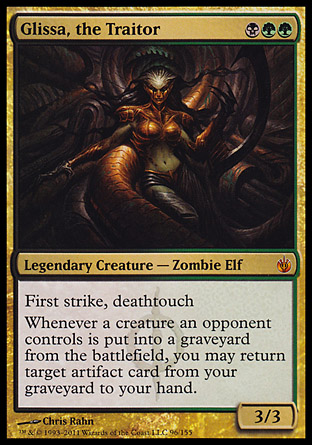
Back when I was an EDH player (back when they called it EDH) Glissa, the Traitor was one of my favorite generals (back when we called them generals). While the fun part for me was cycling a bunch of nonsense like Chromatic Star, the games that I won always came down to Mindslaver. The deck wasn't powerful enough without it, and the games felt stale with it.

There was an error retrieving a chart for Mindslaver

Tiny Glissa benefits a lot more from just playing some nonsense cantrips, and gets way more value out of sweepers like Powder Keg. Being Golgari also provides access to some of the more objectively powerful cards in the format in the form of Abrupt Decay and Liliana of the Veil. This is the build that I like for Glissa:

Tiny Glissa

creatures

1 Perilous Myr
1 Arcbound Ravager
1 Eternal Witness
1 Moriok Rigger
1 Moriok Replica
1 Vault Skirge

spells

1 Viridian Longbow
1 Engineered Explosives
1 Inquisition of Kozilek
1 Thoughtseize
1 Abrupt Decay
1 Executioner's Capsule
1 Lotus Petal
1 Cranial Plating
1 Chromatic Star
1 Chromatic Sphere
1 Sword of Fire and Ice
1 Grisly Salvage
1 Liliana of the Veil
1 Sensei's Divining Top
1 Lightning Greaves
1 Powder Keg
1 Ratchet Bomb
1 Scrabbling Claws
1 Nihil Spellbomb
1 Toxic Deluge
1 Sword of Light and Shadow
1 Terrarion
1 Maelstrom Pulse

lands

1 Wasteland
1 Bloodstained Mire
1 Polluted Delta
1 Misty Rainforest
2 Forest
2 Swamp
1 Bayou
1 Vault of Whispers
1 Tree of Tales
1 Inkmoth Nexus
1 Verdant Catacombs
1 Overgrown Tomb
1 Blinkmoth Nexus
1 Okina, Temple to the Grandfathers
1 Shizo, Death's Storehouse
1 Marsh Flats
1 Wooded Foothills
1 Windswept Heath

Arcbound Ravager might look a little weak here, but it's a great creature to have around to cycle through Chromatic Star/Terrarior faster in addition to being a sacrifice outlet for Perilous Myr. There aren't a lot of creatures to stick the extra modular counters on if Ravager dies, but even still I think the beast deserves a slot.

There was an error retrieving a chart for Arcbound Ravager

Insider: Weekend Hype – GP Shanghai, MOCS Finals

Are you a Quiet Speculation member?

If not, now is a perfect time to join up! Our powerful tools, breaking-news analysis, and exclusive Discord channel will make sure you stay up to date and ahead of the curve.

There were many interesting developments last weekend, and the results of these tournaments have financial implications.

One great storyline is from the Magic Online Championship Finals. This event was televised to the masses, the decks were widely publicized, and the market has reacted.

MOCS Standard Decklists
MOCS Modern Decklists

There was an error retrieving a chart for Collected Company

The tournament featured a Modern portion, and Collected Company was at the forefront. It appeared in both the Abzan combo deck with Anafenza, Kin-Tree Spirit that reached the Top 4 of the MOCS, and the Elf deck that ultimately won the event. Both of these decks threaten to become major players in the metagame.

Collected Company has serious legs in Modern and perhaps even Legacy, so it’s a good long-term bet.

There was an error retrieving a chart for Chord of Calling

Chord of Calling, a key component of both decks, was a big winner over the weekend. The price was just 0.7 tix at the beginning of the month, and was double that by last Monday. By Saturday afternoon the price had peaked over 2.3 tix, but has since fallen to just under 2 tix.

The price fell as some hype faded, but it’s not going any lower. This card is among the best possible long-term targets going forward, and should be a target for anyone in trades and buys. This was the marquee reprint of Magic 2015, like the Mutavault reprint in Magic 2014, a $30 card before the reprint. It’s going to slowly head back up towards that number.

There was an error retrieving a chart for Fauna Shaman

Fauna Shaman was a part of both strategies, and as such the online price has already seen a price surge in response. The price approximately doubled over the weekend, from over 2 tix to over 4 tix. The paper price, which has been sitting steady at $9, is now ticking upwards towards $10, and is likely to steadily grow higher as time goes on.

Other parts of the Elf deck have also seen an increase, none more apparent than Heritage Druid which has spiked to an astronomical 13 tix and growing. I would sell into the hype. The paper price, which sat around $6, is approaching $7, and there may be a another dollar or two to gain in the near-term.

There was an error retrieving a chart for Den Protector
There was an error retrieving a chart for Deathmist Raptor

Den Protector and Deathmist Raptor currently dominate the Standard metagame.

The paper price of the mythic Deathmist Raptor saw a 15% price jump in the first week of May, from under $20 to $23, and has steadily crept up since then to its current price of $25.

Its price has stayed steady over the weekend, but more telling is the online price, which actually fell a fraction of a ticket over the weekend. Deathmist Raptor saw its high of over 28 tix a week ago, and it’s clear the increase in supply is outpacing new Standard players. The price should continue to slowly fall.

Similar laws of supply and demand govern paper prices, so I wouldn’t expect the paper price of Deathmist Raptor to go any higher. Both paper and online prices are likely to remain stagnant until the release of Magic Origins takes drafters away from Dragons of Tarkir.

Den Protector’s online price has followed a similar trajectory to Deathmist Raptor. It reached its peak, 6.5 tix, a week ago, and has now begun a downturn. The effects of new supply are magnified in this rare card, so the price has fallen earlier and more sharply. I would expect it to continue to fall into the summer.

Interestingly, the paper price of Den Protector continues to grow higher, now at a peak of $9, which indicates that from a demand perspective, the paper player base has yet to adjust to the new card and incorporate it into their own decks. In this case, it’s not clear if the price can continue to grow higher, or if the card is now saturated through the metagame. As new supply enters the market the price will face downward pressure, so I’d err on the side of caution.

The megamorph package is part of the GP Shanghai-winning Abzan Control deck by Yuuki Ichikawa. This deck is likely to change the way people build Abzan decks going forward.

But the hype of this week is dragons, and much like Flores' Dragon Control deck, Makihito Mihara’s Five-Color Dragons Midrange deck plays all five colors of them. This 5-Color Dragons deck was played to the Top 16 by Makihito Mihara and Yuuya Watanabe, and it represents a paradigm shift in the approach to Standard.

GP Shanghai Top 8 Decklists
GP Shanghai Top 16 Decklists

The Dragonlords are sure to garner a lot of attention this week, so take note. Haven of the Spirit Dragon is a four-of in the deck, so it will see some increased demand.

There was an error retrieving a chart for Dragonlord Atarka

Dragonlord Atarka has already seen a nearly 20% increase online, up to over 6.25 tix, but this is mostly due to the massive successes of G/R Dragons and G/R Devotion, both of which play Dragonlord Atarka in large numbers. The paper price has fallen steadily, down over 20% to $15 from its high of $19 a month ago, but perhaps recent results will buoy demand and keep the price stable.

In other news, the online price of Anafenza, the Foremost continues to grow, now over 9 tix, and is approaching its former peak of over 10 tix. I expect the price will grow no further.

There was an error retrieving a chart for Tasigur, the Golden Fang

Tasigur, the Golden Fang has seen a modest price gain in the wake of success this past weekend, and it’s a solid pick for some small gains this week.

The paper price is nearly down to $6, and now is a good time to stock up for the long term before Fate Reforged becomes drafted less as new sets are released this year. This card is a clear staple in Modern and Legacy, and it’s going to be pricey one day.

Brewing Vampires

Are you a Quiet Speculation member?

If not, now is a perfect time to join up! Our powerful tools, breaking-news analysis, and exclusive Discord channel will make sure you stay up to date and ahead of the curve.

vampires bloodghast

If you haven't been able to tell by now, I have a deep love for synergistic decks (few things get me going more than chaining together multiple copies of Collected Company), and with that comes a natural love for tribal decks. Today I'll be straying away from the green tribal decks I've covered previously and venturing into the bloodsucking world of Vampires.

[wp_ad_camp_1]


Aggro is the natural draw for people who begin to brew Vampires in Modern, but Starcity Games' Tom Ross figured out a different, clever approach last year founded much more on value, synergy, and resilience. Below is his recently updated version.

Vampires by Tom Ross

Creatures

4 Bloodghast
4 Gatekeeper of Malakir
4 Kalastria Highborn
4 Vampire Nocturnus
4 Viscera Seer

Spells

1 Dismember
2 Murderous Cut
4 Inquisition of Kozilek
4 Sign in Blood
1 Thoughtseize

Lands

10 Swamp
4 Bloodstained Mire
4 Mutavault
4 Polluted Delta
2 Urborg, Tomb of Yawgmoth

Sideboard

2 Vampire Nighthawk
4 Leyline of the Void
1 Darkblast
2 Disfigure
2 Deathmark
1 Feast of Blood
3 Thoughtseize

Tweaking Vampires

I like the core of Tom's list a lot, but there are a number of changes I would make outside of that core.

1) 3 Mutavault, 4 Urborg. I've tested the interaction between these two in 8Rack extensively (also a monoblack deck with a lot of black heavy costs) and done the math (well, someone smarter did it for me), and found this is the correct combination to ensure you're rarely screwed on mana while still getting a lot of use out of Mutavault. Going to 3 Mutavault doesn't really hurt much since you're not going to want to activate it all the time anyway.

2) No Dismember. Cheap is nice, but this is going to feel horrible a lot of the time against Burn, Affinity, and Delver, among other decks, even just as a 1-of. Let's swap this for Victim of Night (which has bonus flavour).

3) No Cut. This is generally used as a 1-of in three colour decks with a slow pace and a bajillion answers, none of which is the case here. Our removal is limited, which means we need it to be extremely reliable -- not being able to kill a turn 1 Delver or Goblin Guide or turn 2 Eidolon or Pyromancer is going to suck a lot more and a lot more often than the 2cmc of Victim will.

4) Revert to tried and true 3 Thoughtseize, 3 Inquisiton package. I like versatility and reliability, and the life loss shouldn't be too much of an issue, especially with our sideboard, and after cutting Dismember.

5) Cut a Lily for a third Victim (kill spells are lacking). Junk often does it, so we should be fine to as well.

6) The sideboard I'm not a big fan of: 4 Leyline is overkill (especially since only a few fringe decks need the yard to win), the Disfigure slot is better served by the more versatile Sorin's Thirst (more flavour!), Feast can't kill turn 1-2 Burn and Infect creatures, and Thoughtseize should be main or not at all. So we overhaul that.

That brings us to...

Vampires by Sean Ridgeley

Creatures

4 Bloodghast
4 Gatekeeper of Malakir
4 Kalastria Highborn
4 Vampire Nocturnus
4 Viscera Seer

Spells

4 Sign in Blood
3 Victim of Night
3 Inquisition of Kozilek
3 Thoughtseize
3 Liliana of the Veil

Lands

9 Swamp
4 Bloodstained Mire
4 Polluted Delta
4 Urborg, Tomb of Yawgmoth
3 Mutavault

Sideboard

3 Vampire Nighthawk
1 Leyline of the Void
1 Darkblast
3 Sorin's Thirst
1 Deathmark
3 Duress
1 Bile Blight
1 Cranial Extraction
1 Liliana of the Veil

Life Total? What's That?

Next is my own aggro Vampires list, built on the old "Suicide Black" premise wherein you throw all caution to the wind and lose a ton of life in an effort to win as fast as possible. Because we take this approach and because Burn and Affinity are so popular, it's possible we should show some caution and maindeck some amount of Vampire Nighthawk, or put a playset sideboard (instead of just the two copies).

Suicide Vampires by Sean Ridgeley

Creatures

4 Bloodghast
4 Dark Confidant
4 Guul Draz Vampire
4 Stromkirk Captain
4 Vampire Lacerator
4 Captivating Vampire

Spells

4 Bump in the Night
3 Inquisition of Kozilek
3 Thoughtseize
4 Lightning Bolt

Lands

3 Blackcleave Cliffs
2 Blood Crypt
4 Bloodstained Mire
2 Mutavault
2 Polluted Delta
3 Urborg, Tomb of Yawgmoth
6 Swamp

Sideboard

1 Darkblast
2 Deathmark
3 Duress
1 Grim Lavamancer
2 Magus of the Moon
2 Rakdos Charm
2 Terminate
2 Vampire Nighthawk

Breaking it Down

Unlike the list above, this one is built on a very smooth curve that caps out at 3cmc. Two creatures (four copies of each) are made much better when the opponent has 10 or less life, so we pack plenty of Lightning Bolt and Bump in the Night to help with this (Bolt of course helps get rid of troublesome creatures, too, and Bump offers reach in fringe situations). Our other maindeck red card is the wonderful Stromkirk Captain. Because we're more aggressive and because we run a total of eight red cards, we cut Vampire Nocturnus and a couple land.

The manabase is tuned around Magus of the Moon (which we use over Blood Moon because we're aggro), and also to be a little conservative toward our life total, since we take enough from our spells (Urborg means we'll fetch less, while helping with Mutavault; only two shocks and six fetches alongside 14 painless lands means we won't be too hurt). It could maybe be improved slightly, but this feels like a strong starting point.

vampires nighthawk

Besides the aforementioned Magus, red gives us access to the potent Lavamancer, the ever-versatile Rakdos Charm (which covers all kinds of bases), and unconditional removal in the form of Terminate for things we really need to kill that don't die to Bolt. The board almost definitely needs tuning, but it's a decent first iteration.

So, while we give up Nocturnus and some synergy, value, and resilience, we gain more creatures, a more aggressive gameplan, some different abilities, and a few sweet sideboard cards.

While I lean toward the list above being the best of all these, this one should give it a run for its money. Good stuff.

Closing Thoughts

These aren't meant to be extremely competitive decks, of course, but rather, something fun you can use to mix it up at FNM with or at the kitchen table with friends. That said, you will win often enough to enjoy yourself. Happy bloodsucking!

Introducing Abzan Collected Company

Are you a Quiet Speculation member?

If not, now is a perfect time to join up! Our powerful tools, breaking-news analysis, and exclusive Discord channel will make sure you stay up to date and ahead of the curve.

When Birthing Pod got the axe back in January, many Pod players sold their decks, quit the format, or generally lost hope that they would ever see Melira and friends back in Modern. Collected Company wasn't going to let her die. Company has been making waves in Modern since it first appeared, and although we haven't had any major events to decide what deck will be the "best" home for the card, it's clear that Company is living up to the hype. But if there's one thing we've learned from past Modern seasons, it's that the Melira Pod BGW shell is just as strong in a toolbox deck as it is in Abzan Midrange. Never bet against BGx, and never bet against Pod. So it comes as little surprise to many Modern players that Abzan Collected Company is rapidly emerging as the home for Collected Company. Melira is back, and this time, she's bringing some new friends.

Anafenza Cropped

If I had to make a prediction about which Collected Company deck makes it to the top, I'd tentatively lean towards Abzan Company. It's had the most paper successes so far, has started to see a big uptick in MTGO activity, and has all the building blocks we would expect of a next-big-thing style deck. This article is an introduction to the deck, its cards, its core strategy, and how it plays out in the format. Whether you are looking for the hot new Midrange/Combo hybrid deck in Modern, curious to deepen your understanding of the deck, or dust off those old Pod staples, this article has something for you. No matter what you call the deck (Podless Pod, Abzan CoCo, Melira Company, etc.), the Abzan toolbox deck is back in a big way and Modern players everywhere need to pay attention.

[wp_ad_camp_1]

Sample Decklists

At the time of its (un)timely demise, Birthing Pod decks had a lot of variations. To understand Abzan Company, it's important to acknowledge these predecessor builds. Kiki Pod style decks had Birthing Podmore or less vanished by the time Siege Rhino hit the scene, so Abzan-style decks were making up the majority of Pod decks we saw. Included in those were the venerable Melira, Sylvok Outcast/Kitchen Finks/Viscera Seer/Murderous Redcap combo decks that had been part of Modern for years. More common, however, were  Spike Feeder and Archangel of Thune engines, a switch made to combat increasing graveyard hate. Rhino saw the explosion of more midrange oriented Pod lists, decks that drastically reduced, or outright abandoned, the combo in favor of more interaction and a more value-driven toolbox. Abzan Company might be a new deck, but already we are seeing lists emerge in all of these older traditions. The lists have more restrictions because of the deck's namesake (Company's 3 CMC requirements affect deck building to some extent), but they still include many familiar faces.
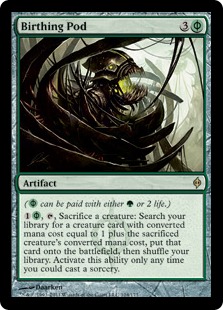
The first list is a March 29 finish from the Arcanis Deluxe event, a 209-player Spanish tournament that saw the first big Abzan Company finish in Modern. Its pilot, Ivan de Castro, mixed the Melira combo plan with a more aggressive Goyf, Voice, and Knight of the Reliquary strategy. His list also had none of the traditional BGx interaction, namely Abrupt Decay and a very low land count (Two cards are missing from the original list).

Abzan Company by Ivan de Castro (3/29/2015)

Creatures

2 Melira, Sylvok Outcast
1 Blood Artist
1 Cartel Aristocrat
1 Dryad Arbor
1 Qasali Pridemage
1 Scavenging Ooze
2 Eternal Witness
2 Knight of the Reliquary
2 Noble Hierarch
2 Spellskite
2 Tarmogoyf
2 Voice of Resurgence
3 Viscera Seer
4 Birds of Paradise
4 Kitchen Finks

Spells

1 Congregation at Dawn
3 Chord of Calling
4 Collected Company

Lands

1 Gavony Township
1 Godless Shrine
1 Swamp
1 Tectonic Edge
1 Temple Garden
2 Forest
2 Overgrown Tomb
3 Razorverge Thicket
4 Verdant Catacombs
4 Windswept Heath

Sideboard

2 Abrupt Decay
2 Path to Exile
3 Thoughtseize
2 Stain the Mind
1 Aven Mindcensor
1 Reclamation Sage
1 Big Game Hunter
1 Fulminator Mage
1 Eidolon of Rhetoric
1 Orzhov Pontiff

I'm not willing to go so far as to call this a sub-optimal decklist, because it clearly has results and there's a lot of interesting decisions made here. But I also think it doesn't quite line up with the later Company decks we see after a month of tinkering. The low land count is alarming, as is the relative lack of combo pieces. The deck isn't "bad", per se, but it's probably "immature" relative to later versions.

Abzan Company made a few showings during the SCG/TCG States blitz of early April, including a a 2nd place finish at TCG Mississippi, another 2nd place finish at TCG Iowa, and a 3rd place at SCG Puerto Rico. But it wasn't until early May that it got its first big North American appearance at the SCG Premier IQ in Portland. Brad Rutherford piloted his list to a 1st place finish at Portland, combining some of the earlier tech from de Castro's list with some older elements of Melira Pod lists: maindecked Decay, more combo pieces, more mana producers, etc.

Abzan Company by Brad Rutherford (5/3/2015)

Creatures

1 Archangel of Thune
4 Anafenza, Kin-Tree Spirit
4 Birds of Paradise
2 Eternal Witness
4 Kitchen Finks
1 Murderous Redcap
1 Scavenging Ooze
1 Spike Feeder
3 Tarmogoyf
2 Viscera Seer
3 Wall of Roots
1 Melira, Sylvok Outcast
1 Varolz, the Scar-Striped

Spells

2 Abrupt Decay
4 Chord of Calling
4 Collected Company

Lands

3 Snow-Covered Forest
1 Snow-Covered Plains
1 Snow-Covered Swamp
2 Gavony Township
1 Godless Shrine
2 Marsh Flats
1 Overgrown Tomb
1 Sunpetal Grove
2 Temple Garden
3 Verdant Catacombs
4 Windswept Heath
1 Wooded Bastion

Sideboard

1 Spellskite
3 Kor Firewalker
1 Orzhov Pontiff
1 Reclamation Sage
1 Reveillark
1 Scavenging Ooze
1 Sin Collector
1 Path to Exile
1 Slaughter Pact
1 Kataki, War's Wage
3 Thoughtseize

Rutherford's list represents a much more focused approach around the combo. Between Anafenza, Melira, Finks, Seer, Feeder, Redcap, and Archangel, 50% of the creatures relate to the life/persist/damage combo in some way. Rutherford hasn't completely eliminated alternate gameplans, keeping 3 Goyfs and 2 Oozes in for an aggro option and adding Decay for interaction. A lot of MTGO lists have taken after this model, although we've seen Goyf as an interchangeable slot with Voice.

The final list I want us to consider is a more traditional Goyfless combo list. Sam Pardee brought this to Channelfireball's video series, modifying Rutherford's initial list as only a Pod veteran could do. This included improvements to the manabase, adding more toolbox options to the maindeck, and committing more heavily to the Melira/Anafenza combo.

Abzan Company by Sam Pardee (5/12/2015)

Creatures

4 Anafenza, Kin-Tree Spirit
4 Birds of Paradise
2 Eternal Witness
4 Kitchen Finks
1 Murderous Redcap
2 Scavenging Ooze
2 Viscera Seer
3 Wall of Roots
2 Melira, Sylvok Outcast
1 Varolz, the Scar-Striped
1 Spellskite
1 Orzhov Pontiff

Spells

2 Abrupt Decay
4 Chord of Calling
4 Collected Company

Lands

3 Gavony Township
1 Godless Shrine
1 Overgrown Tomb
2 Razorverge Thicket
3 Snow-Covered Forest
1 Snow-Covered Plains
1 Snow-Covered Swamp
1 Sunpetal Grove
2 Temple Garden
4 Verdant Catacombs
4 Windswept Heath

Sideboard

1 Path to Exile
1 Kataki, War's Wage
3 Kor Firewalker
1 Reveillark
1 Slaughter Pact
4 Thoughtseize
1 Maelstrom Pulse
1 Scavenging Ooze
1 Reclamation Sage
1 Sin Collector

Pardee's list strikes me as very clean, and cleanliness is important in decks like Abzan Company that can easily become a mess. The grind is much better in this deck, courtesy of the increased Township and Scooze count, which is important if you need to break stalemates. In many respects, this makes the deck similar to the more midrangey Pods we saw at the end of the previous season. Adding Spellskite and Pontiff give you way more toolbox options that we saw in Rutherford's build. I do think the Company math is lacking here (only 26 flippable creatures), but it's not far off.

These lists have a lot of similarities, but the differences give you some sense of the various ways you can take the deck. In this next section, I want to dive into these individual cards to highlight some of the choices and synergies in the deck, as well as how you can pick one set of cards over another.

Collected Company Core Card Choices

As with all new and newer decks, it's hard to identify the "core" of Abzan Company. It's even harder when we are slogging through an offseason period without major Modern events. So all of this is based on the lists we have seen so far and how those cards appear to be faring in the format. With that in mind, here are the main players in Abzan Company, why they are important, and how their synergies work in practice. These synergies and cards should apply equally to more value-oriented Abzan Company builds as with combo-focused ones.

Collected Company
collected companyThere are a few important differences between Company and its obvious comparison, the late Pod. The first is cost restriction. Pod decks made a name for themselves not just in cheating mana costs, but also in ramping to bigger creatures. Rhino was a big contributor to the card's eventual banning, and that kind of monster isn't a great fit with Company . Although you will see cards higher along the curve here (Reveilark and Archangel are big examples), this will be the exception rather than the norm. Company needs to flip two creatures to generate value, and you can't run too many cards that interferes with that. This imposes important deckbuilding restrictions on Company players.

The second critical difference between Pod and Company is instant-speed. Pod was a mainphase-only activation. Company is an instant, which opens up options that Pod players could only dream of. Play during combat to ambush creatures and screw with math. Play at EOT to breach counterspell walls. Play in response to removal to combo off on the spot. Company might not have the same precision/selectivity as Pod, but being instant speed is a great trade. Also, Pod always had issues against sweepers, and it doesn't get better than instant speed Company when recovering from something like a turn 3 Anger of the Gods from Jund. As a related point, and perhaps a third difference between Company and Pod, Company is a great topdeck on an empty boardstate. Pod? Not so much. This gives you better topdecking in some situations, which can be a solid edge that Abzan Company has over its predecessor.

When playing Company itself, be aware of different synergies between your cards. The biggest one, which I'll get to later, is with Eternal Witness: that kind of recursion is just too much value for most fair decks to handle. But you can also use it to chain into a Chord in your hand, get your combo online, mess with an opponent's combo (Skite to stop Twin, Melira to beat Infect, etc.), or set up for a big attack of your own. Also, be aware that Company is random. It is not just Pod 2.0, and I have in fact probably oversold some of its strengths in comparing the two (hint: the better card is banned). But its unique strengths do keep it viable in the format and do drive the deck.

Chord of Calling
Chord of CallingAbzan Company's Chord serves the same function as it did in Pod. It gets you the exact bullet you want when you want it. The big difference now is we no longer have Pod itself, which makes Chord's selectivity even more valuable than it was before. This affects how you play the card and how you sequence your Company and Chord castings. For instance, in a deck with 4 Melira and 2 Anafenza (interchangeable combo pieces for your lifegain engine) you probably don't want to "waste" your Chord fetching these cards unless you desperately need them right now (e.g. if lethal Infect is on the way and you need Melira). You should probably just bank on flipping these off Company. When Chording, Seer or Varolz would often turn out to be better options, because your deck only plays 3 of the sac outlets (Finks, by contrast, has 4 copies). Or just save Chord to get the lone Redcap, in case you are playing against decks that can theoretically win through the life combo (RG Tron, Amulet, and Twin come to mind). In general, you will want to Chord after a Company, but still always ask yourself if that's the right choice to make.

Another big strength of Chord is its synergy with Company flips. All those creatures you reveal off Company are happy contributors to convoke. Even better if you get Wall of Roots in there which effectively doubles its contribution to the Chord. This enables some really explosive end of turn plays, whether for a giant attack or just to get the combo during the opponent's end phase. Remember that none of your combo engines require tapping, so living the dream of Company into Chord into combo is totally possible with this deck, and all at instant speed.

Anafenza, Kin-Tree Spirit
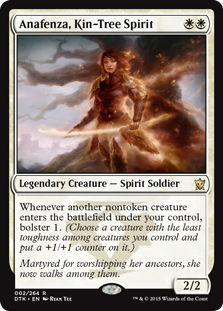
Anafenza, Kin-Tree SpiritAnafenza is not a strict upgrade to Melira in a metagame where Infect was tier 1 for so long. But outside of that matchup, she's a huge boost over Melira to Abzan Company's gameplan. Starting with the obvious, she's a substitute combo engine for Melira in the persist chain: Finks will come back with 1 toughness which makes it a viable bolster option no matter what other cards are on the field. Rinse and repeat until you have as much life as you want. This is a nice boost to the deck's combo, particularly because Company needs redundant combo pieces to work, and you'd rather run 4 Anafenza instead of 4 Melira But the real win is in Anafenza's contributions to your midrange and aggressive win routes. She puts a LOT of power on your side of the table, which is not something you can say for Melira. This includes double bolsters off Company as well as bolstering herself for a 3 damage swing off a turn 3 Finks or Wall. Pod decks were always good at switching from combo to beadown, and Anafenza really makes that possible in these new Rhinoless decks.

Melira, Sylvok Outcast
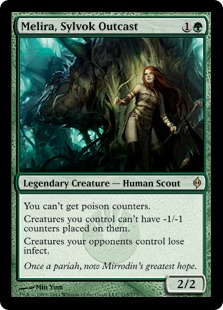
MeliraI have heard arguments in favor of ditching Melira entirely in favor of just 4 Anafenza and 2 freed slots. If Infect's metagame share keeps dropping, this isn't necessarily the worst plan, especially if this deck keeps taking on a more toolbox approach. But if you want combo consistency and in most metagames, it's a bad one. Don't just think of Anafenza as a better Melira. Think of Melira as Anafenza's 5-6 but with an upside in one matchup. Even without the sac engine online, Melira (and Anafenza) are still important in keeping your Finks going and going and going. Never underestimate the power of immortal Finks, whether or not you have the sacrifice outlet to accompany it. Also, it really is nice to have even more ways to mess with Infect in game 1.

Kitchen Finks
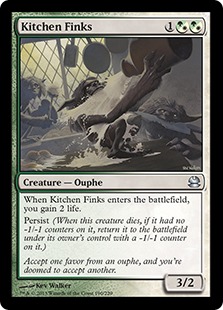
Kitchen FinksSpeaking of the immortal Finks, the Ouphe is just as good today as it was in the past. In fact, it's probably better, given the prevalence of Burn. There's not much more to say on Finks except it's highly relevant in this current metagame and Finks is still very strong even if the combo isn't online. Or, better yet, if only the Anafenza/Melira side of the combo is online. Unkillable 3/2 creatures are still very strong, even if they only gain you 2 life each time they "die". It's this sort of grinding pressure that gives you a lot of game in the fair matchups. The Township/Finks synergy is even better today than it used to be, because we are seeing an uptick in these kind of grindy Jund, Abzan, Grixis Control, UW Control, and otherwise "fair" style decks that don't want to screw around with an unkillable 3/2 clock. There will be many matchups where you want to play beatdown and not combo, and in those matchups, Finks is your workhorse.

Eternal Witness
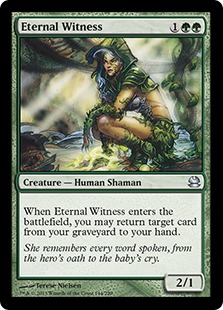
Eternal WitnessWitness is probably my favorite creature in Abzan Company, and also the creature gaining the most in the shift from Pod to Company. Before the ban, Witness was much more a recovery tool or a grinding tool. After it, Witness has retained these qualities but added an explosive dimension to her skillset. Company into Witness is as amazing in practice as it sounds on paper. So is Chord into Witness into Company, or even just the classic Pod line of Chord into Witness into Chord. One thing to be aware of with Witness is its vulnerability to graveyard hate. Indeed, this is a big thing to keep in mind with the deck generally. The pre-banning Value Pod decks managed to get around this weakness to some extent with stuff like Rhino, so even if an opponent shut down your recursion engines, you still could deploy high value midrange monsters. But Company imposes restrictions on your deck that don't allow this kind of flexibility, which means graveyard hate is better against Abzan Company than it was against the later incarnations of Pod. Witness will suffer accordingly in any matchup where stuff like Rest In Peace, opposing Scavenging Oozes, and/or Relic of Progenitus start to appear.

Birds of Paradise
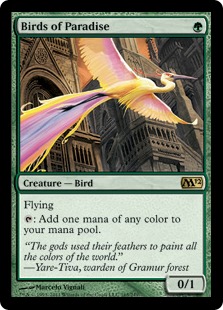
Birds of ParadiseNo Modern deck is more responsible for the continued relevance of "Bolt The Bird!" than Birthing Pod decks. Abzan Pod continues that storied tradition. People will try and negotiate this slot between BoP and Noble Hierarch, but Abzan Company is a place where you really want Bird. The key factor for me is Anafenza. Bolster creates more situations where you want to swing en-masse, especially on top of those 3 Townships. Hierarch doesn't do anything to contribute to that gameplan. You can't even go turn 1 Hierarch into turn 2 Anafenza into turn 3 Finks and swing with a bolstered Anafanza, because Hierarch steals her trigger. These situations are much more favorable to Hierarch over BoP, and that's why you want to give Birdy the nod over Abzan's default stalemate breaker. You just don't need Hierarch because her stalemate cracking ability is worse than, and anti-synergistic with, that of Anafenza and Township. And let's not forget all the trouble Hierarch can get you into with your black mana, especially in games 2/3 if you bring in Thoughtseize.

Wall of Roots
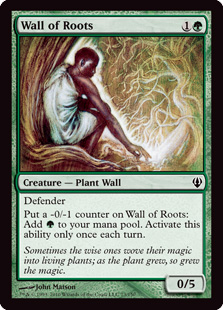
Wall of RootsWall is another one of those Pod ex-patriots that found both a new home in Abzan Company and also newfound synergies. One of Wall's biggest limitations is its once-per-turn clause on the mana generation. Pod could abuse cross-turn activations, but not like Company can. Company and Chord are both castable at instant-speed, which lets you put double or, in the case of Chord, TRIPLE duty into just a single Wall. You can add a token to the Wall on your turn for +1 mana, and then do it a second time on your opponent's turn. Don't forget to convoke it too if you are casting Chord. You can also make similar plays off Company, where Wall is effectively a hasted manadork. Flipping a Wall and one other creature is an immediate +3 mana towards Chord. These kinds of synergies were also at play in Pod decks, but with Pod stuck at sorcery speed, you didn't see as much cross-turn activation, and Wall wasn't as explosive as it is with Company. As one last endorsement of the plant, it's a serious roadblock against Burn, either forcing them to waste an attack and a valuable spell to kill it, or soaking up 2-3 damage per turn.

Viscera Seer
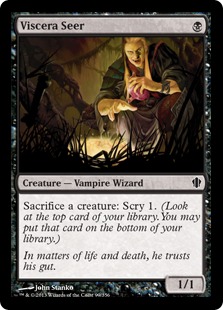
Viscera SeerSeer might be Modern's cheapest and most efficient creature sacrifice outlet, but it's also not the most interesting card in the deck. It's one of the few cards in Abzan Company that doesn't change much from before the Pod banning to after. Yeah, you need to be aware of when you want to Chord for Seer versus Chording for something else, but those were the same decisions you had to make back in the Pod days. When you are running Seer, the biggest thing to keep in mind is not how Seer has changed in the new metagame, but rather how he has stayed the same. This means using him to generate some value from removed creatures, manipulating your draws during a combo execution (stack the deck!), not playing him into needless danger, etc. Just remember that sacrifice outlets are the least common part of your engine, so plan Company/Chord accordingly.

Gavony Township
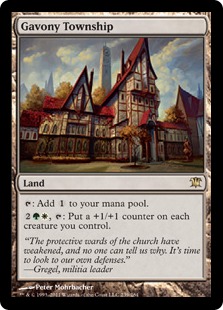
Gavony TownshipTownship was the unsung (depending on which circles you ran in) hero of Pod before the ban. There are few cards in Modern, perhaps no cards at all, that are better at breaking open fair games than Township. It's the ultimate grindhouse (although who knew the "ultimate grindhouse" looked so quaint and medieval!). It's basically unjustifiable to run fewer than 2 Townships, and you need a very good reason to not be running 3. If we learned anything from the Pod decks of last season it's that Township is everything it's cracked up to be. It turns any creature into a win condition. It makes Finks into a gamechanging monster. It makes combat math much worse for opponents, and expedites your own clock. It's also probably the best manasink in Modern, both for converting your manaflood into value, and for transforming otherwise useless mana dorks into win conditions. Unlike typical Abzan Midrange, a deck that also sometimes runs Township to break stalemates, Abzan Company has the creature density to make this into a real monster. Don't leave home without it.

Abrupt Decay
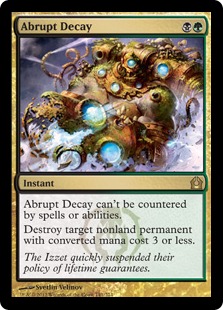
Abrupt DecayElves is a Collected Company deck that can just race opponents without any interactive aspirations. We are not Elves. The Abzan Company combo is not nearly as fast and not nearly as consistent as the Elves engines, and for some decks it won't even spell the end of the game (Twin, RG Tron, Amulet Bloom, and Infect/Affinity if you can't stick a Melira). This means we want some degree of interactivity, particularly because our toolbox creatures can't be as reliable as we might like. Pod was able to run these kinds of maindecked bullets like Reclamation Sage and Qasali Pridemage. We can do this, but it's not nearly as effective because we can't get them as consistently. This increases the need for catchall answers like Decay. Indeed, one of the biggest weaknesses of Abzan Company is the need for more combo redundany (hence 4 Anafenza and 2 Melira) instead of a more silver-bullet approach. This forces you away from interaction like maindecked Thoughtseize and +1-2 Decay, because these cards screw with your Company flips. Rhino Pod lists were notorious for this maindecked interactivity, and Abzan Company can't support it as well. None of this is to knock Abzan Company too much, or to suggest the toolbox approach can't work at all here (it can). It's just to emphasize the importance of those 2+ Decays and why those need to be in the deck.

Toolbox and Alternate Card Choices

Even if you go all-in on the core cards above, you are still left with basically a dozen slots for other, nonland options in your deck. These cards, and the ratios of the above cards, are going to determine where your Abzan Company list falls on the continuum of combo to value, and all the options in between. Here are some ideas in those categories, whether to help protect/enable/find your combo, promote a more aggressive gameplan, or just give you more utility in the metagame.

Voice of Resurgence 
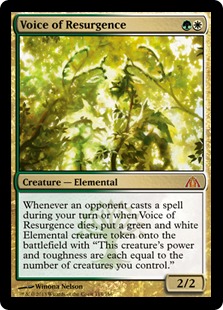
Voice of ResurgenceThe first three cards on this list, particularly Goyf, are all in competition with one another for this two-drop beatdown slot. I'm starting with Voice because it's the biggest throwback to the Value Pod lists of last season, and probably the most obvious go-to for an Abzan Company player who wants to fill this slot. Voice's biggest advantages are a) its resilience and b) its strength against Twin and other decks with control elements. This is a hard creature to kill and a harder creature to interact profitably with. It's also almost impossible for control decks to beat this card in a fair fight, so they either need to combo out (e.g. Twin), or topdeck those Paths to clear away a Voice. Then again, Voice's biggest disadvantage is by far its speed. Some decks will actually just treat this as a Grizzly Bear. Meanwhile, something like Goyf or Scooze could deal real damage. Voice is a metagame call, plain and simple. Facing lots of Burn, Infect, Amulet, Affinity, and other minimally-interactive fast decks? Voice is not going to cut it. Facing decks that try to play fair, particularly URx ones? Say hello to your not-so-little friend.

Tarmogoyf
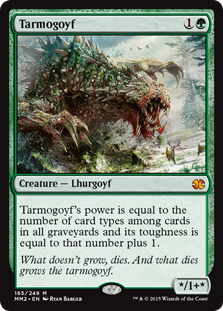
TarmogoyfGoyf needs no introduction, which is one reason I kind of want to exclude this card on principle: Pod used to be a standout green deck because it didn't need Goyf. And now some players have to go and screw everything up by suggesting it's a good inclusion. Goyf's biggest strength here is speed. It's an easy 3 power on turn 3, probably 4 against most decks in the format, which gives you more racing power over the much meeker Voice. Also, nothing beats Goyf stalemates like Township, and Abzan Company supports that card much better than does the more conventional Abzan. That said, Goyf runs into two huge issues that I think limit its effectiveness in this deck. The first is our relative lightness on instants and outright lack of sorceries. This puts us in awkward positions where Goyf never grows beyond a 3/4, or is even stuck at 2/3 on turn 3. At that point, I'd much rather be playing Voice. Goyf's second issue is that it gets totally invalidated by the graveyard hate opponent's are liable to bring in anyway. Unless that hate is Rest in Peace, Voice will at least get around that. Besides, Goyf has more anti-synergy with  card in this deck that I actually think is better than BOTH Voice and Modern's green posterchild...

Scavenging Ooze
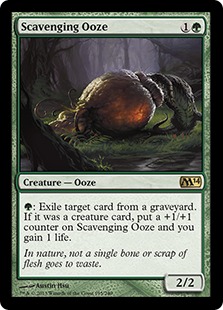
Scavenging OozeIf I were playing Abzan Company tomorrow, I'd sleeve up 2-3 Oozes and call my two-drop beatdown slot finished. Ooze is the perfect balance between the power of Goyf and the anti-control elements of Voice (there isn't a decent control deck in the format that isn't playing Souls and/or Snapcaster). Ooze also gives you recovery power against Burn, maindeck graveyard hate against a variety of decks (don't forget the mirror!), and another manasink when games go long and you need to enter the grind. There will be some games where Goyf's 3-4 power on turns 3-5 is more economic than Ooze's 2-4 power in that same  window, especially given the mana investment that needs to go into Ooze to get it there. But when you weigh all the variables, you will find that most metagames are diverse enough that you don't just want to race. You also want interaction, grind-power, and lifegain. Ooze gives you all of that, which is one reason to include it over Goyf. I wouldn't run both because then you are too heavily into beatdown slots and won't have enough room for toolbox creatures and/or interaction like Decay.

Fauna Shaman
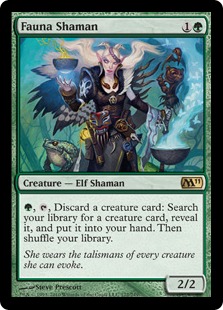
Fauna ShamanShaman solves a lot of problems the Company deck would otherwise have. But this comes at the steep price of being very slow. In exchange for the unparalleled selectivity from Shaman activations, you need to play a "summoning sick" Pod that dies to the most-played removal spell in the format. That's great against decks like Abzan (Pathing a Shaman just sets you up for a turn 3 Company), but terrible against Jund, Grixis Delver, Twin, Grixis Control, UWR Control, and all the red-based control decks that are emerging to bring Bolt back to the forefront of Modern after a brief vacation. Shaman is also just too slow against fast decks like Burn, Affinity, Amulet, and Infect. I think she's a viable one-of in a durdly metagame where people are trying to be too fair, especially one with less red. But that isn't the metagame we are in now, and it's one reason I would suggest Company lists shy away from the card for the time being.

Spellskite
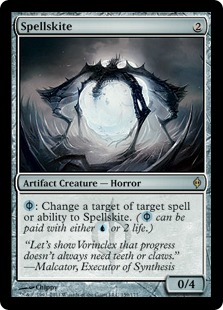
SpellskiteIf you include no other toolbox creatures in your deck, you still need to make room for Spellskite. The card is just too powerful at protecting your own creatures (relevant against Grixis Delver, Jund, Abzan, etc.) and in screwing with an opponent's gameplan (Twin, Infect, Burn, etc.). Starting around turn 3, particularly if you have an active Wall, you will almost always be able to threaten a Chord into Spellskite, and opponents will have to respect this or pay the price. As an added bonus, Skite will almost never steal bolster triggers because of the 4 toughness, which is something you have to worry more about with other low-toughness toolbox creatures like Pontiff or Sage.

Orzhov Pontiff
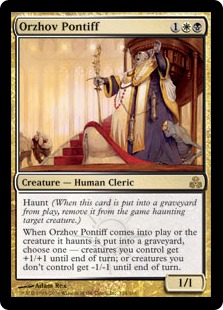
Orzhov PontiffAbzan Company is tight on toolbox slots, and if Spellskite is one of your non-negotiables, Pontiff is probably the second. He's cheap, mass removal that doubles as a clock and is flippable off Company. You'll find him a go-to Chord target in the Infect, Affinity, and Elves matchup (the latter a common one on MTGO). He's also great at clearing out those pesky Souls tokens, and a really scary sweeper in the Grixis Delver match when facing down Pyromancer and his minions. Bonus points for using it to stop a lethal Exarch attack (hard to win with a million 0/3s!) or outright killing Mites. This kind of flexibility is rare in a toolbox slot, and it's one of the big reasons to run Pontiff as your Spellskite backup.

Archangel of Thune / Spike Feeder

Last season, we saw the slow abandonment of Melira's combo package in favor of the much more compact Archangel package. I don't think this is the way you want Company to go, because it's just one more slot you need to include that makes your Company slots worse. Feeder is also basically just a Kitchen Finks that doesn't combo well with Melira/Anafenza, so going up to an effective 5 Finks just dilutes the other toolbox options you could put in that slot. Sure, you can Chord for Archangel, and the combo is still a good way to avoid graveyard hate, but that comes at the steep cost of making your deck less efficient, and I just don't think that's where you want to be with Company as your main reason for playing the deck at all.

Although these are the biggest entries on the toolbox and alternate card list, here is a more complete selection (but still not exhaustive) listing of all the different options at your disposal. Company might not give you the same selectivity as Pod, but it doesn't mean you can't play the same toolbox approach and either snipe them off Chord or gamble on them off Company.

  • Reclamation Sage (Utility bullet)
  • Harmonic Sliver (Utility bullet: great in multiples off Company)
  • Aven Mindcensor (Utility bullet)
  • Qasali Pridemage (Utility bullet)
  • Sin Collector (Utility bullet)
  • Blood Artist (Combo engine: Redcap-lite off a Company)
  • Cartel Aristocrat (Combo engine)
  • Varolz, the Scar-Striped (Combo engine, grinder)
  • Knight of the Reliquary (Aggressive option)
  • Flickerwisp (Value generator)
  • Reveillark (Grinder, value generator)
  • Fulminator Mage (Grinder)
  • Kataki, War's Wage (Matchup-specific: Affinity)
  • Kor Firewalker (Matchup-specific: Burn)
  • Eidolon of Rhetoric (Matchup-specific: Storm, Living End)

Looking Ahead

The metagame jury is still out on which Company deck will emerge at the top of the heap. My money is currently on Abzan Company because I don't want to bet against anything remotely related to Pod, and because it's easier to convert paper success (of which Company has lots) into MTGO and major event success. Decks like Elves might have the MTGO success, but it's generally harder to translate that into a GP T8. And who knows? Maybe both decks can happily coexist in the format's top tiers, each doing their own thing.

Overall, I am excited to see Abzan Company rise in Modern, and look forward to seeing what it will do in the coming months. It's a cool deck, fills important metagame gaps, and provides a home for all those disenfranchised Pod players of the previous season. Sleeve up those old Pod staples and go show your local Modern scene that Melira and Company can't be kept down!


EDIT: (5/18) Changed some wording in the Melira paragraph because an important point wasn't clear.


Deck Overview- Standard Tormenting Abzan

Are you a Quiet Speculation member?

If not, now is a perfect time to join up! Our powerful tools, breaking-news analysis, and exclusive Discord channel will make sure you stay up to date and ahead of the curve.

A lot of Magic happened this weekend, though that doesn't always mean a lot of exciting decks. Unless of course seeing green/red decks take the lion's share of Top 8 slots this weekend is something you consider exciting. While there wasn't a ton of innovation on the GP or SCG circuit, I did come across a pretty spicy Abzan build from the MTGO PTQ on Saturday:

Tormenting Abzan

creatures

3 Anafenza, the Foremost
4 Fleecemane Lion
4 Herald of Torment
4 Rakshasa Deathdealer
4 Siege Rhino
4 Warden of the First Tree

spells

2 Self-Inflicted Wound
3 Thoughtseize
4 Abzan Charm
2 Dromoka's Command

lands

2 Caves of Koilos
3 Forest
4 Llanowar Wastes
1 Plains
4 Sandsteppe Citadel
4 Temple of Malady
4 Temple of Silence
4 Windswept Heath

sideboard

2 Self-Inflicted Wound
1 Thoughtseize
4 Drown in Sorrow
4 Duress
4 Ultimate Price

The maindeck Self-Inflicted Wounds are some combination of insanity and genius. Having a removal spell that tags Dragonlord Ojutai in addition to being live against almost every other deck sounds pretty solid. It's clearly not the droid you're looking for against Atarka Red, but the sideboard Drown in Sorrows will help fix that problem.

It's really interesting seeing four Herald of Torment here. Herald isn't a card that's really seen a ton of play at any point of its Standard legality, but I can see the merit of playing it right now. Flying over all of the Deathmist Raptors out there is a pretty big game.

There was an error retrieving a chart for Herald of Torment

I would be concerned about the weakness that Herald has to Dromoka's Command in addition to it being another card that's pretty poor against the red decks, but outside of those factors there are some pretty clever plays on the metagame here. This isn't the kind of build that's just going to be good week in and week out, but this is a nice example of creative metagaming.

Insider: GP Shanghai – Is Esper Dragons Dead?

Are you a Quiet Speculation member?

If not, now is a perfect time to join up! Our powerful tools, breaking-news analysis, and exclusive Discord channel will make sure you stay up to date and ahead of the curve.

Grand Prix: Shanghai has concluded this weekend, bringing a varied and interesting Top 8 for us to digest. First, though, let's recap from last week.

  • I talked about an innovative bigger mono-red aggro deck that could be great post-rotation.
  • We saw a host of Den Protectors and Deathmist Raptors, the most of any event so far.
  • Esper Dragons didn't place in the Top 8.
  • Mardu Dragons saw some high-profile attention.
  • Collected Company gained $3 as people played it alongside both their Raptors and Den Protectors.

Let's see how that stacks up to this week. The decks to beat last week used near-infinite recursion of Den Protector to bring back Raptors. The natural way to beat that is by flying over top, and that's what many successful players ended up doing. Our Raptors only showed up in one deck--the winning one. Let's dive into this Top 8 and mine it for finance.

R/G Devotion Is a Natural Foil to Raptors

What's the best way to deal with small, deadly lizards? Bigger ones that fly! Three R/G Devotion decks managed to Top 8. Their common goal was to gum up the ground, ramp and eventually land one of the three-of Dragonlord Atarka to cruise to victory. An 8/8 flier puts things away pretty fast. The decks could also fall back on Ugin, the Spirit Dragon and other assorted planeswalkers.

One big theme I picked up on was that each of these decks ran a full set of Whisperwood Elemental. That card originally caught on fire with the G/W Devotion deck sporting Mastery of the Unseen. Well, the Elemental is still a great card in a world full of Crux of Fate.

It's $7.50 now, down from about $14 at its high and $11 more recently. I had not expected it to drop below $10, so I am happy to see it affordable right now. The Elemental is going to still be great going forward, and 12 copies across the three Devotion decks is pretty good. Interestingly, one Abzan Aggro deck even packed one on the sideboard!

Actions: I've talked about Whisperwood Elemental because I think it can live beyond a R/G Devotion deck. Unfortunately, most of the rest of the deck rotates. It's got great acceleration and even a stellar dump for mana in Polukranos. Pumping 24 mana into that guy is satisfying.

Aside from that, though, what's worth ramping to? In the fall, will we even have the tools to hit See the Unwritten? Will we have the time to cast Ugin? I'm recommending that you avoid the other cards in here, which isn't exactly a cutting-edge controversial position.

Dragons Are Still Everywhere

I want to talk now about three cards: Thunderbreak Regent, Haven of the Spirit Dragon and Crux of Fate. We can understand a great deal of our metagame with these three cards.

The Regent has been a potent monster since printing. When we were first looking for value in DTK, he was an easy one. Even an event deck printing hasn't done much to dampen his luster. I'm seeing him in Mardu Dragons and R/G Dragons, among other concepts.

The format is shifting to sacrifice-based removal, so his "Bolt you in response" ability isn't as great. On the other hand, the ramping decks can toss out a ton of Elves and Caryatids to die to an edict.

Haven of the Spirit Dragon has started enabling downright crazy strategies. Makihito Mihara posted a perfect record of 9-0 on Day One with a four-color Dragons list. He went on to an astounding 10th place finish. Yuuya Watanabe made 11th with the same deck. If either had done a little better, this would have been a totally different Top 8.

It was through Havens that Mihara could cast and recast his monsters. It allowed him to run Silumgar in a deck that preferred to be Bant, for instance. Haven is such a low-cost land to run that players are packing them anywhere they have dragons. The reason is clear: dragons are hard enough to kill the first time, much less on the rebound.

It has made cards like Silumgar's Scorn a bit worse, for instance. If you countered my Ugin once, you better be able to hit him again. It was at PT:DTK that we first started seeing Havens show up and I'd wager most of the control decks at that event wouldn't be able to handle the number of Havens that are around now.

Finally, Crux of Fate has been popping up in non-dragon decks. Abzan is often sporting two copies of Crux in the 75 as a reset button and a way to kill hexproof dragons. Abzan is the deck to beat and little elements of tech like this are good to watch.

Crux has been trending downward and is about $3.15 right now. I'm going to wait for it to hit about $3. This is that card that people will groan about paying $5 for later in the year.

Actions: To make a bet on Haven or Crux is to make a bet on whether you think Dragonlords and Thunderbreak Regent will continue to define the metagame. If you're not confident that this (frankly rare) era of big gold creatures will continue, then divest those cards. If you see them playing a role down the road, invest.

I'm fascinated by how much we still have left to explore with the dragons. Dromoka is a Baneslayer Angel of sorts, for example. She is $7.50 and is the next Dragonlord to hit $15. Silumgar was Mihara's favorite removal spell. It's a good chance in my mind that this hodgepodge of dragons will be hard to beat for the next year.

Esper Dragons Is Pretty Close to Dead

Out of 900 competitors, five Esper Dragons players made Day Two. I was surprised it was that many. The deck of Silumgar's Scorn and Dissolve has sat back for awhile. It could shred Jeskai Tokens decks with its Drown in Sorrow but cannot compete with Deathmist Raptor recursion. Even simple Den Protectors or Havens pulling back countered spells have proved enough to overwhelm the one-for-one based deck.

What Esper Dragons wants is a better comes-into-play ability on its finishers. It's got things like Silumgar and Ojutai and even Pearl Lake Ancient, so it's not bereft of a good killer. The deck needs something that will draw four cards or nuke a bunch of lands or something else swingy.

As it is, those dragons are dying to crappy little Den Protectors bringing back spare copies. When everything must be countered, something will always get through.

Quick Hits

Let's roll through some important things that need not merit a paragraph of explanation.

  • It's always wise to look at what the Japanese players are running. They often think differently with list building and four-color Dragons is no exception. Haven of the Spirit Dragon is a four-of in that deck and at $4.50 right now. It's far more abundant than Mana Confluence is print-wise but I could still see Haven run up closer to $10. It's played in similar numbers.
  • Mono-Red is on the fringes, in part because it has such a rough time beating 3/3's like the Raptor.
  • The winning deck has 61 cards. If you were sitting next to me, you'd see my eyes rolling right now.
  • Hornet Queen is the natural answer to most of this dragon foolishness.
  • Elspeth, Sun's Champion continues to do solid work in this metagame. She blocks Raptors, blows up dragons and more. It's a shame we're losing her so soon.

Until next week--if something happens, you'll read about it here!

-Doug

Insider: Artful Maneuvers – Black Is Black? (Revisited)

Are you a Quiet Speculation member?

If not, now is a perfect time to join up! Our powerful tools, breaking-news analysis, and exclusive Discord channel will make sure you stay up to date and ahead of the curve.

This week I start my article with an apology. I had stated that I would be altering a Rattleclaw Mystic and creating a guide for you. Work and an ever changing life situation have caused me to alter this week's article instead of altering a Magic card. If you were very excited about the Rattleclaw Mystic, I apologize. It will be coming next week.

This week’s article will be a break from the practical applications of painting. Those of you who have been members on this site for more than five years (thank you) will remember that I once wrote a similar article series for this site. One of those classic articles was about color theory. I'd like to reprise it here.

I will discuss some of the color theory that goes into matching colors and ultimately creating better alters. It would be easy to blow this article off as filler, but any kind of artist needs to know the theory of color. Understanding the theory behind what we see is the biggest step towards eliminating the need for a guide to paint cards. Those of you who have been having trouble matching color will want to study this article closely.

The Color Wheel

ColorWheel-300x300
Tool number one in your problem solving toolbox.

To understand anything about color, we must familiarize ourselves with the color wheel. We all remember this from high school art class, but it is easy to lose touch with just how fundamentally important this tool is.

The three primary colors or hues (Red, Blue, Yellow) and the three secondary hues (Purple, Green, Orange) make up its basis. All of the other colors exist as a mixture of any of these six colors. Adding white or black to any color will change its value, thus creating a different version of that color.

On the more practical side, we can use the color wheel to help us find exactly which colors we need to mix to achieve a certain hue or value. Additionally, this tool is free from the effects of light and shadow within a composition and therefore gives us a more accurate reading of color than just looking at the picture we are trying to match.

It’s All an Illusion…

Color is a very tricky subject. There are illusions that are created by light, shadow, and even adjacent colors.

Take a look at the checkerboard image below. Our brains will apply logic to this picture and tell us that “A” cannot possibly be the same color as “B” because one is a black square and one is a white square. The reality of the situation is that both squares are the exact same color.

Square “B” looks lighter than “A” because of the light and shadow of the squares around it. This is an example of the Color Constancy Illusion, and people far more learned than myself study it.

Checker-Board-300x232
Color Constancy
DSCN0874
Other factors in color change can be attributed to dust, crumbs and Popsicle spills. Refined artist indeed!

The color of the light you are using will also affect how you perceive the color. You can see examples of this anywhere there is shadow.

Take a look at the surface of my desk, and note the colors. This desk is white. It has a standard incandescent desk lamp that is giving off yellow light. The part of the desk that is illuminated by the yellow light is turned yellow. It is also partially lit by an open window. The natural light is giving parts of this desk a blue tone.

If we are to re-create this image accurately we must use blue and yellow tones to do so. Painting a white desk using only white will not get the job done.

Furthermore, as shown in these color cubes, we see that it is not only light that can change our perception of color, but the hues and values around that color as well. Notice that a dominance of one complimentary color can mute the appearance of the other.

Color-Cube-300x172
Context is very important.

When images become more complex, our brain still strives to maintain its opinion of the color we see, and illusions like the ones shown here are the result. Once we have grasped this concept, we understand that logic plays almost no role in color theory.

Putting It All Together

Now that we have a basic understanding of the theory, we can observe it in action.

Look at the picture of the Aether Vial that I altered. The trees that grow behind the woman appear brown, but as I painted it, I realized that I needed a value so light, that it was almost tan on my palette. It appears brown due to its proximity to the very light background and the deep shadows portrayed on the tree.

Similarly, the green highlights on the tree are actually a dark shade of green that appear light due to the apparent darkness of the wood. The green on the trees is the same as on the woman's shoulder pad. This card shows a dark color made to appear light by a light color made to appear dark. Does your brain hurt yet? Mine does.

Aether-Vial-219x300
Aether Vial is still one of my favorite cards to work on!
We established earlier that logic plays a small role in color. What then do we use to replace logic? We must turn to our observations and trust what we see. I quote The Hitchhikers Guide to the Galaxy series:

"If he sees a thing, he must say that he sees it, whether it was what he thought he was going to see or not. See first, think later, then test. Otherwise you will only see what you were expecting." (Life, the Universe, and Everything, by Douglass Adams)

Allowing yourself to believe that these examples are possible is the first step to being able to create these illusions yourself. Utilizing this information in practice will help you train your eye to recognize exact colors sooner. This will help you save yourself a lot of paint and frustration, but most importantly time, as you continue with your painting.

A Giveaway!

Before I leave you to your painting I'd like to announce that when I do complete the Rattleclaw Mystic I will be giving it away to one lucky Twitter follower. All you have to do for a chance to win is follow me @PaintersServant. Additional chances to win will be given to those who tweet some of their own altered cards to me.

Those who already follow me may remember that I give away an alter every time a set is released. This one will be a little late, but nevertheless a free card will be had by one of my followers! Good Luck!

Want Prices?

Browse thousands of prices with the first and most comprehensive MTG Finance tool around.


Trader Tools lists both buylist and retail prices for every MTG card, going back a decade.

Quiet Speculation