menu

Modern Metagame Breakdown: 4/1 – 5/1

Are you a Quiet Speculation member?

If not, now is a perfect time to join up! Our powerful tools, breaking-news analysis, and exclusive Discord channel will make sure you stay up to date and ahead of the curve.

May is here and that means we are a few weeks closer to Modern Masters 2015, a month closer to the sweet GP blitz of June, and ready for another metagame update from Modern Nexus. My last metagame update, covering the 3/1-4/1 period, saw subtle metagame changes including downticks in Abzan, Twin, and Burn, the beginning of Grixis Delver's rise to glory, and a few predictions about what was coming on the Modern horizon.
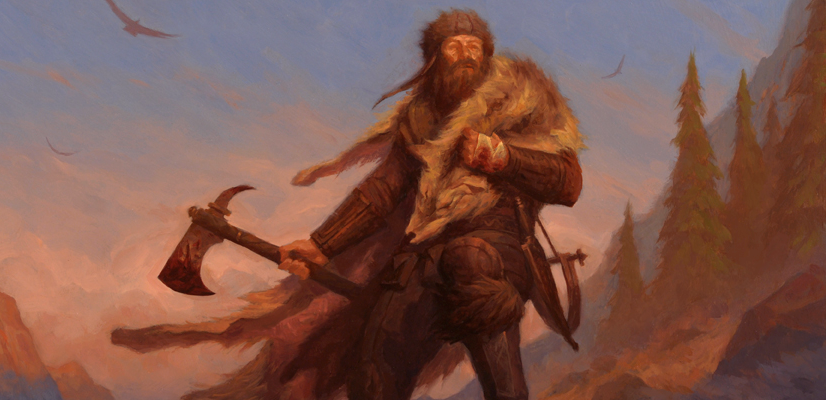
Huntmaster of the Fells art cropped

Although we still haven't had any GP-style Modern events since then, this metagame update is much more significant than my last one. Looking at the Top Decks page, we see a new tier 1 deck, an explosion in a tier 2 deck's popularity, and some major drops in some of the format's longtime tier 1 staples. This is about as exciting as it gets for a metagame update in a month without a Grand Prix.

[wp_ad_camp_1]


Top 10 Decks and Trends

We've had some big movement in our top 10 decks over the past month. TCG States and SCG States both happened in early April, as did the Dragons of Tarkir legalization. The end result was about as big a Modern metagame shakeup as we could expect for a nonrotating format during the offseason. Here are the top 10 decks as of this update.

Deck nameOverall
rank (3/1 - 4/1)
Overall
Metagame %
MTGO %Paper %Major Event
Day 2 %
UR Twin19.2%8.1%9.1%10.5%
Burn29.2%9%8.7%9.9%
Abzan39%4.9%9.1%12.9%
Affinity47.1%6.9%8.8%5.5%
Grixis Delver54.8%8.4%2.5%3.5%
Infect64.5%2.1%5%6.5%
Jund74.1%3.6%3.8%5%
RG Tron83.1%3%3.1%3.1%
Amulet Bloom92.9%4.1%2.1%2.3%
Merfolk102.6%3.5%4.2%0%

Quick data note: you will notice the major paper event prevalences have changed. This is because we are now 2+ months out from the last major event in February. As a result of this, I have started to apply an adjustment to those numbers based on the deck's prevalence in the metagame. The new major event column reflects an average between the old value and the new MTGO/Paper share.
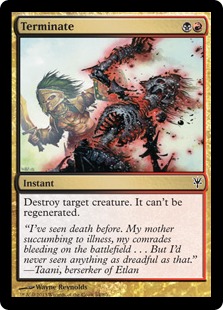
TerminateIt's Modern as we always knew it... plus Grixis Delver. Grixis Delver's rise, which I discuss in greater depth in another article, is one of the most interesting trends I have seen in Modern since the format started in 2011. It is not that rare for a new deck to explode on the scene because a new card was printed. One need only look to Treasure Cruise to see that in action. It's also not that rare for a deck to explode in popularity after winning a GP or getting some high-profile pro coverage. But Grixis Delver has exploded without either of those preconditions. It's not like this card even got anything new in DTK. And it wasn't as if any pros picked up the deck and started trumpeting its power. This was a pretty bottom-up, independently-innovated, MTGO "crowdsourced" deck that went from zero to hero in just 1-2 months. It's now over 8% of the MTGO metagame and the second most-played deck behind Burn. This is a testament to how strong the deck is. Cards like Terminate, Tasigur, and Gurmag Angler have made a big difference in this current metagame, and Grixis Delver has really taken advantage of its positioning in the past months.

The other big Modern decks are basically the same, although Infect continues to decline from its earlier glory. This shift makes perfect sense: more players understand the deck's weaknesses, and more players are moving to decks like Grixis Delver (and decks with Bolt) that have stronger Infect matchups. In fact, ALL of the big decks declined from their 3/1-4/1 prevalences to now. This movement is made clearer when we look at the different data periods side by side and how metagame shares have changed from period to period.

Deck nameRanking
(4/1-5/1)
Meta%
(2/16-3/16)
Meta%
(3/1-4/1)
Meta%
(4/1-5/1)
%change
(from last)
UR Twin112.3%11.8%9.2%-2.8%
Burn210.6%10.2%9.2%-1%
Abzan313.4%13.2%9%-4.2%
Affinity47.8%7%7.1%+.1%
Grixis Delver51%1.9%4.8%+2.9%
Infect67%6%4.5%-1.5%
Jund82.3%4.2%4.1%-.1%
RG Tron92.9%3%3.1%+.1%
Amulet Bloom112.7%2.7%2.9%+.2%
Merfolk103.3%2.9%2.6%-.3%
Abzan Liege73.3%3.1%2.5%-.6%

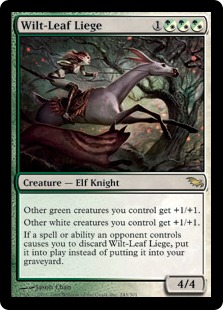
Wilt-Leaf LiegeThe last article showcased a relatively stable metagame. This time, we see a metagame that is pretty far from stable. All three of the biggest decks in Modern took a pretty serious hit to their shares, with Abzan falling a massive 4.2% in the dataset. Although this makes sense as more players try to metagame against the format's well-known best decks, it's still interesting to see these kings dethroned. I didn't think I would ever see Twin fall below 10% in any period of time barring some insane new cards (poor TC). On that note, we actually don't see a single deck here with >10% of the metagame. That's extremely rare in Modern. Rarer still is that the only deck in the top 10 to see any sizable gains was Grixis Delver. Basically every other deck fell a few points or stayed right where it was in March-April. Abzan Liege is the big loser here, falling out of the top 10 for the first time since the deck debuted. Given the fall of the deck this deck was designed to beat, this trend makes a lot of sense.

All of that said, there's a very important metagame condition underlying these changes that we need to be aware of. We are going on month two without a major Modern paper event, and that has big implications for the Modern metagame. In short, no one knows what's "good" anymore. We haven't had big events to "prove" it, or at least to steer people to certain decks. There also isn't a lot of incentive to just stick with some top-tier "best deck" like Abzan and Twin because the events have much lower-stakes. There's a lot of incentive, however, to jump around archetypes and try to figure out new ideas and play new decks. As a result of this, the metagame distribution is normalizing more than we would ordinarily see from metagame period to metagame period. In the last two updates, the top 10-11 decks made up about 66% of the format both times. Today, they only make up 59%, with that remaining 7% distributed across a bunch of new decks in lower tiers. This is only surprising when you forget about the lack of major Modern events.

Tier 1 and Tier 2 Decks

Tier 1 decks represent the most-played decks in the format. Although these decks are not necessarily those with the highest win rates (see my most recent article on win rates here), they are definitely decks with above-average win rates in a large sample of games. These decks always perform and have fairly low variance in how well they can do at events. You can safely expect these decks to show up at tournaments, and safely expect do pretty well with them at events, even in unknown metagames. In this most recent update, we have made one addition to tier 1 based on data from the past month. You can see more about how decks get tiered on our Top Decks page.

Deck nameOverall
Metagame %
MTGO %Paper %Major Event
Day 2 %
UR Twin9.2%8.1%9.1%10.5%
Burn9.2%9%8.7%9.9%
Abzan9%4.9%9.1%12.9%
Affinity7.1%6.9%8.8%5.5%
Infect4.5%2.1%5%3.5%
Jund4.1%3.6%3.8%5%

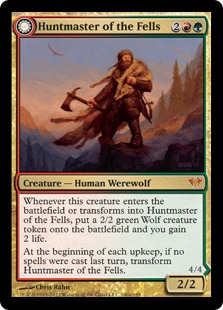
Huntmaster of the FellsThe biggest things happening in tier 1 are the return of Jund (yay!) and the absence of Grixis Delver (whaaat?). We'll talk about why Grixis Delver doesn't make the cut in a moment, but first let's focus on Jund. From a purely quantitative perspective, Jund sneaks into tier 1 not on any single metric, but rather on its consistent showings. Of all the decks that weren't already tier 1, Jund was the only deck to have success at our last major paper event (SCG Baltimore), and to enjoy consistent metagame gains since then. If Jund was showing up at events like SCG Baltimore before it started getting bigger online and in paper, it should be an even better choice today now that it has proven itself a bit more. I admit that if we had one of those June GPs tomorrow, Jund might not be there. But in the absence of those major paper events, our adjusted "major event day 2 %" column shows that Jund is still doing quite well in the format. This makes sense from a more experience-based perspective too. Abzan is falling and it stands to reason that another BGx deck will rise to takes its place. Jund has a better Burn matchup than Abzan, as well as a better Infect matchup. In a Burn dominated metagame, this is one reason we are seeing more Jund today than before, and I expect that number to rise as long as Burn keeps where it is.
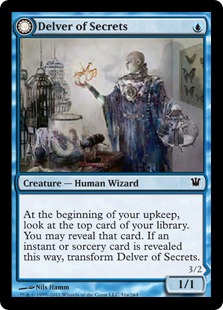
DelverNow let's talk about Grixis Delver. It might come as a surprise that a deck with a higher overall metagame share than Jund is not yet tier 1, especially given how much I personally love the deck and have been playing up its potential for week. But a closer look at those numbers gives some sense as to why the deck isn't quite tier 1 yet. For one, Grixis Delver is disproportionately driven by MTGO success. It's 2.5% of the paper metagame and...8.4% (!!) of the MTGO metagame. That's a six percentage point difference between the two, or an almost 300%-400% difference as a percent. When a deck has that kind of wild imbalance between MTGO and paper, we need to pause and ask why. It's not like Grixis Delver hasn't had a chance to shine in paper. TCG and SCG States saw basically 100 events in early April, and although Grixis Delver definitely made showings, it wasn't the same kind of commanding performance we saw on MTGO. So it's too early to responsibly call the deck tier 1, even though I still think it is going to get there by the summer. The second reason Grixis Delver I don't want to take the risk and call the deck tier 1 is because the imbalance is on the MTGO side of its numbers, not the paper side. When a deck has a lot of paper success, it's often just a matter of time before that translates to MTGO. But the reverse is not always true. With 4 round structures, different gameplay, and a different economy, MTGO has enough unique characteristics that we can easily envision a deck succeeding there and not translating that to a GP. So we need to play the tiering conservatively and keep Grixis Delver in tier 2 for now.

Speaking of which, here's our current tier 2 over the 4/1-5/1 period. Some interesting new faces show up in this update, along with many old ones.

Deck nameOverall
Metagame %
MTGO %Paper %Major Event
Day 2 %
Grixis Delver4.8%8.4%2.5%3.5%
RG Tron3.1%3%3.1%3.1%
Amulet Bloom2.9%4.1%2.1%2.3%
Merfolk2.6%3.5%4.2%0%
Abzan Liege2.5%2.8%2%2.8%
Scapeshift2.3%3%1.8%2%
UWR Midrange1.7%1.4%1.9%1.6%
Bogles1.6%1.6%1%2.2%
UWR Control1.4%.9%1.9%1.5%
Temur Twin1.3%1%1.4%1.4%
Grixis Twin1.3%.8%1.1%2%
Esper Mentor1%1.7%1.2%0%
Blue/Temur
Moon
.9%.4%.4%1.8%

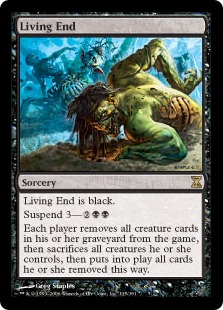
Living EndComparing the table to last month's update, we see Living End falling out of tier 2 and Esper Mentor and Grixis Twin taking its place. Living End just had a very disappointing showing at the TCG/SCG states events, and wasn't making a lot of headway in MTGO either. That said, some players (about .2%-.3% of both metagames) have shifted over to Living Twin/Twinning End, a hybrid Splinter Twin/Living End deck that started making some showings in late March and early April (thank Gerry T and LSV for the boost). So it's not as if the deck has totally disappeared. Meanwhile, Esper Mentor continues to be a strong deck, although Grixis Delver has definitely surpassed it as the neat new strategy of choice. Esper Mentor is more midrangey anyway, and would be better suited to a metagame with more Abzan than we currently see (Souls does serious work in that matchup). Grixis Twin also made a number of high profile appearances over the States events, further solidifying Grixis colors as strong choices for Modern and looking to compete with Temur Twin for the tempo Twin deck of choice. Also note the return of UWR Midrange after a brief trip out of tier 2 last month.

Most of the other decks in tier 2 retained their position from the previous update. Apart from Grixis Delver, the only deck worth special notice is Amulet Bloom, which enjoyed some additional paper success during TCG/SCG States. That said, it still isn't quite the top-tier monster where you would start to worry about undue banning attention (I'm sure people will worry anyway). If that prevalence keeps rising, however, its win rate is going to start looking even scarier than it is already.

Metagame Predictions

The 5/1 - 6/1 period promises to be much less eventful than 4/1 - 5/1, with Modern Masters 2015 Limited taking the spotlight over Constructed. It's still more than 5-6 weeks until our next big Modern GP, so don't expect to see that many changes in our next update. That doesn't mean we can't make some predictions about what might or might not happen, nor does it mean we can't check back in on predictions I made in the last article.

  • Jund on the rise? Yes!
    Here's the thing: It wasn't so much that Jund rose during the update. Rather, a bunch of other tier 1 decks fell while Jund stayed about the same. This made room for Jund to rise into tier 1 based on its past performance. I expect this deck to stay there for a while because Bolt is just really dang good, people are over-metagamed against Abzan, and there will always be room for some kind of BGx deck to succeed.
  • en_y0RqTG56GaAffinity replacing Burn? Nope.
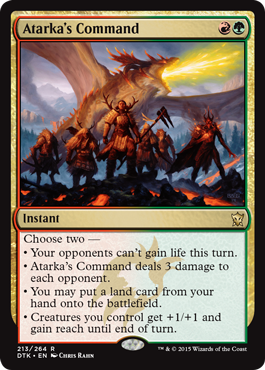
    This was a sad one for me. We had some promising pre-trends that suggested Affinity would replace Burn as the format's premier aggro deck, but this was not to be. There were two problems here. The first was Atarka's Command, which is now a staple of most Burn strategies and has made up for some of its weaknesses that Burn suffered in March. Meanwhile, Affinity didn't gain much, and although it has maintained a strong paper metagame share, its MTGO share has really dropped. This leads to the second problem which is Grixis Delver. Burn has a great Grixis Delver matchup. Affinity? Not so much. With Grixis Delver all over MTGO, it makes sense that Affinity has taken an online hit while Burn has soldiered on.
  • Collected Company homeless? Sort of...
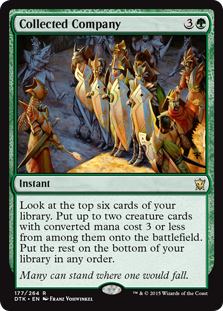
    On the one hand, Company has found a home in the so-called Podless Pod style deck that recently won SCG Portland. We have seen this deck in a number of other paper events over the past few months and it's already at about 2.5% of the paper metagame, and I expect this to be Company's eventual home. So why isn't it tier 2? For some reason, none of this has migrated to MTGO. On MTGO, the Company home of choice is Elves, a deck that absolutely exploded from about 0% for years to 1.8% in the past month. I think Podless Pod will probably win this out in the end, with the GPs sealing the deal, but right now, we are in a situation where MTGO and paper are split on which deck is better. It's going to take a major event to sort that out.

So we were 1.5 for 3 last time, which really isn't that great. I'm bummed by the Affinity situation, but totally see where I went wrong with that one. And as they say, hindsight is always 20/20. Let's try again with two new predictions. I'm only doing two this time around because I honestly think this next month will be a bit slow (that's a prediction in itself!) and don't want to overstate a case.

  • Grixis Delver will still be a top 2 MTGO deck
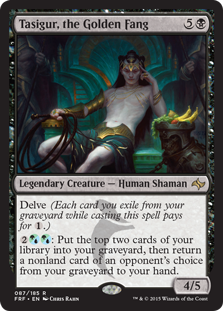
    Tasigur
    This deck needs a bit more time to attain tier 1 status, but it's position on MTGO is all but assured at this point. The only thing that's going to kick Grixis Delver down a few notches is an underwhelming GP performance, and the deck is just one T8 away from totally exploding. I expect to see Grixis Delver's numbers remain steady or even rise in the next month as more people try out the deck and see what all the noise is about. Hint: that Twin matchup is just as awesome in practice as it sounds on paper. This might seem like a "safe" prediction, but sometimes Modern players can get caught up in a craze that overrepresents the true viability of a deck. This happened a lot during the early days of KTK Modern, when Burn was about 20% of the metagame for a month before crashing back down to where it belonged. I don't think this is the case with Grixis Delver and I think Modern players are going to realize this deck is the real deal.
  • Podless Pod will become tier 2
    collected company
    I still think we need a GP to really decide the Collected Company issue, but it's much easier for decks to transition from paper to MTGO than MTGO to paper. We have seen this before and I think we will see it again with Podless Pod. The deck is definitely there with its paper prevalence. All it needs are a few sustained showings on MTGO to get to that 1%-2% threshold needed for tier 2 status. I also think this is the "best" of the different Company-based decks, and MTGO players are going to figure this out sooner or later. Expect to see this deck follow Esper Mentor in its transition from paper to MTGO, at which point it will have enough showings to justify tier 2 status. Besides, this deck is basically a [mtg_card]Birthing Pod[/mtg_deck], or at least the fairer version thereof. Never bet against a Birthing Pod deck, even if it is a less broken variation.

As a final metagame note before we end today, you can now find the metagame tables in this article presented on the Top Decks page. I love the Google spreadsheet we have embedded, but acknowledge that it displays badly on mobile screens and can be a bit complicated. So these new tables should help people access the metagame information and overall make it more useful.
Shenanigans!

Are you a Quiet Speculation member?

If not, now is a perfect time to join up! Our powerful tools, breaking-news analysis, and exclusive Discord channel will make sure you stay up to date and ahead of the curve.

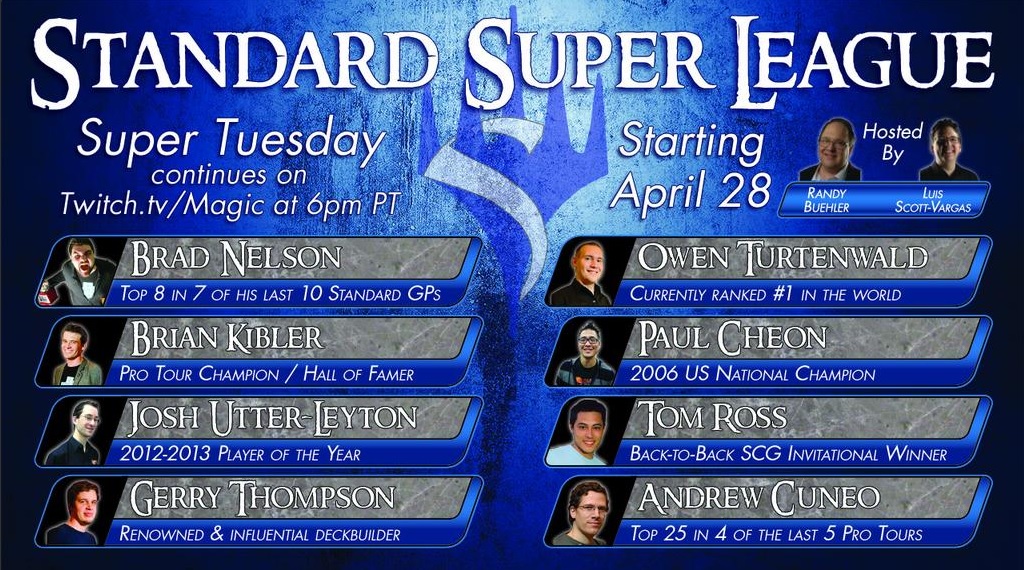
There was never any doubt in my mind that Standard Super League was going to be sweet. Even if all that happened was great players playing stock decks I'd still enjoy watching it. As things have developed, Standard Super League actually consists of great players playing nonsense, which is also great!

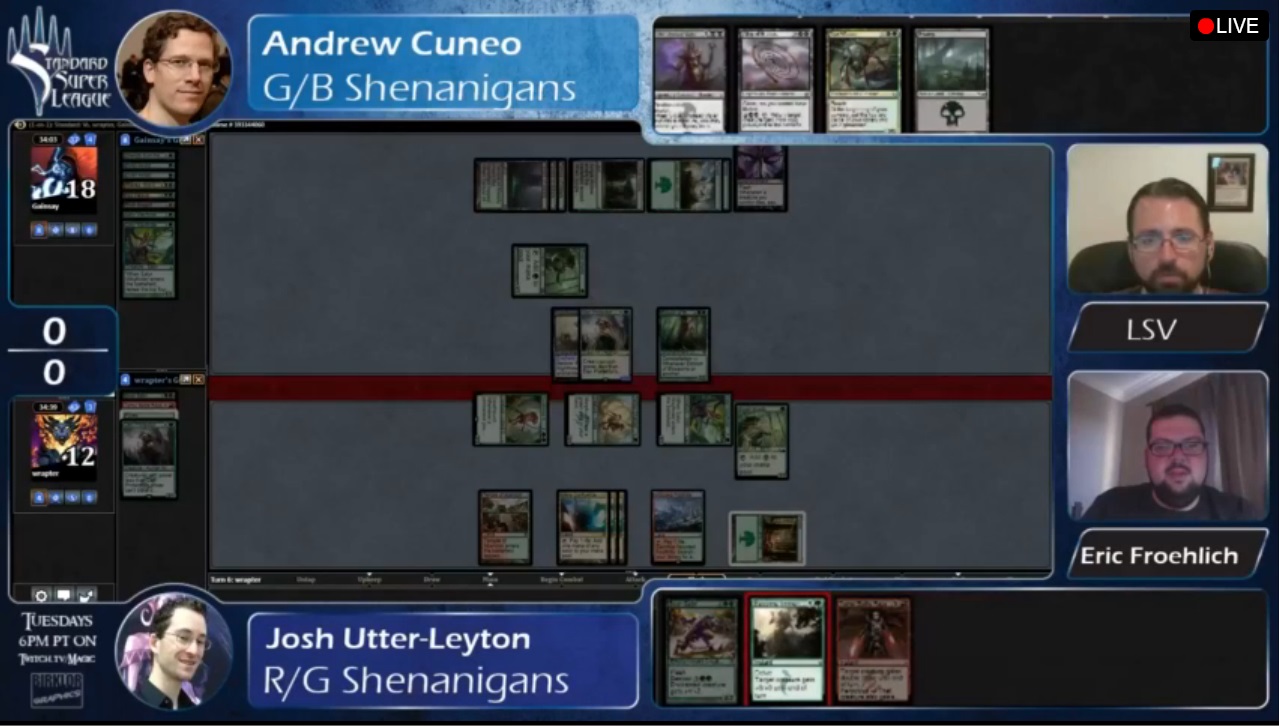
Here's a screenshot from last night's stream:

Shenanigans!

That's Josh Utter-Leyton assembling the Become Immense + Temur Battle-Rage combo most commonly reserved for limited. You haven't seen this one on camera before.

This was mere moments after watching Gerry Thompson battle with a Dragons + mana sources brew against Brad Nelson showcasing the new Mardu Dragons deck. While the first week was won by Owen Turtenwald playing Abzan, Standard Super League is turning out to be a lot more than just a Rhino show.

There was an error retrieving a chart for Siege Rhino

The show happens Tuesday nights starting at 6 PM PT. I promise that it's worth your time.

Avatar photo

Ryan Overturf

Ryan has been playing Magic since Legions and playing competitively since Lorwyn. While he fancies himself a Legacy specialist, you'll always find him with strong opinions on every constructed format.

View More By Ryan Overturf

Posted in FreeTagged , , Leave a Comment on Shenanigans!

Have you joined the Quiet Speculation Discord?

If you haven't, you're leaving value on the table! Join our community of experts, enthusiasts, entertainers, and educators and enjoy exclusive podcasts, questions asked and answered, trades, sales, and everything else Discord has to offer.

Want to create content with Quiet Speculation?

All you need to succeed is a passion for Magic: The Gathering, and the ability to write coherently. Share your knowledge of MTG and how you leverage it to win games, get value from your cards – or even turn a profit.

Insider: Prospecting on Standard Morphs

Are you a Quiet Speculation member?

If not, now is a perfect time to join up! Our powerful tools, breaking-news analysis, and exclusive Discord channel will make sure you stay up to date and ahead of the curve.

In a short amount of time Dragons of Tarkir has radically altered the landscape of the Standard metagame. The set is wildly powerful and very deep with regard to Constructed-playable cards. It is already apparent that the heavy hitters of the set, Dragonlord Ojutai, Deathmist Raptor and Den Protector, have completely changed the lay of the land in Standard.

In today's article I'm going to take a look at some of the emergent trends going on as Standard shifts, and identify some of the cards that have a solid chance of gaining value in the coming weeks. The key to speculating on Standard cards in a metagame that is beginning to settle down is to identify cards that may become useful in combating strategies as they become popular.

I got a chance to play Standard at Grand Prix Toronto this past weekend and ended up finishing 107th place after conceding in the last round to a friend who needed the Pro Points to help lock up silver. I was pretty excited to play the tournament because I had a pretty spicy brew that I was very anxious to unleash upon the world.  Here is the 75 that I sleeved up for the event:

4-Color Morph Control by Brian DeMars

Creatures

4 Satyr Wayfinder
4 Sylvan Caryatid
4 Den Protector
2 Stratus Dancer
4 Deathmist Raptor
4 Siege Rhino
2 Dragonlord Ojutai

Spells

4 Thoughtseize
2 Abzan Charm
3 Hero's Downfall
1 Murderous Cut
2 Treasure Cruise

Land

4 Opulent Palace
4 Sandsteppe Citadel
1 Polluted Delta
2 Windswept Heath
2 Forest
1 Island
1 Plains
1 Swamp
2 Caves of Koilos
1 Yavimaya Coast
1 Llanowar Wastes
1 Temple of Malady
1 Temple of Mystery
1 Temple of Deceit
1 Urborg, Tomb of Yawgmoth

Sideboard

3 Duress
2 Bile Blight
2 Ultimate Price
1 Self-Inflicted Wound
1 Foul-Tongue Invocation
1 Sorin, Solemn Visitor
1 Hidden Dragonslayer
1 Mastery of the Unseen
1 Dragonlord Silumgur
2 Disdainful Stroke

Basically, my goal with this deck was to attack the Raptor recursion axis as hard as possible. I had Wayfinders to dig for mana and to dump the powerful creature into the graveyard and plenty of morph creatures to rebuy them over and over again.

From a financial speculation perspective both Den Protector and Deathmist Raptor have already surged up in price. Both cards, particularly in tandem, are quickly becoming one of the cornerstones of the current Standard metagame. The near infinite recursion of "Den Protector, bring back Raptor to the battlefield and return another Den Protector to my hand" is very difficult for most decks to beat once the game reaches the middle stages. Not to mention that both cards are extremely pushed in power level in their own right!

Nonetheless, just because Raptors and Protectors have hit high prices doesn't mean that we can't take this information and apply it to what may be comming next for Standard.

Joining Them

There was an error retrieving a chart for Stratus Dancer

Stratus Dancer has been a card that I've really fallen in love with in the current Standard metagame. It is exactly the kind of card that players tend to classify as a "sideboard card," because it appears to be kind of narrow. However, as I went through multiple versions of my deck I pretty quickly discovered that Dancer was much better than just a cute narrow card and was actively great.

I wanted to draw it in basically every single matchup I played as every deck in the format has important instants and sorceries that need to get countered. In particular, it is a great little surprise counter against Crux of Fate, Crater's Claws, and Dig Through Time.

Another interaction that I absolutely love in this deck is to drop Dragonlord Ojutai and then morph Stratus Dancer precombat. I can then attack with the Ojutai and when they predictably cast their removal spell on my dragon I can unmorph the Dancer and get my hit in. The sequencing works out pretty awesome since they essentially need to spend two turns trying to kill the dragon and even if they have two kill spells I'm still left with a 3/2 flier.

It's just really awesome to have a counterspell creature that is also a morph for the purpose of recurring Raptor. It's also really infuriating for opponents to have to play around multiple different morph creatures. For instance, at the GP nearly every one of my opponents got blown out by Dancer the first time that I unmorphed it because they didn't think I would play it in the maindeck.

I think this card is actually much better than people currently seem to think it is and that it is likely underpriced at the moment. I've been trading for as many as possible based on my experience and how good I think the card is likely to be moving forward. Basically any blue-green Raptor/Protector shell is going to be playing at least two copies of this card in the 75. It was also pretty hot tech in Tornoto for the Esper Dragons deck to be playing Dancer out of the sideboard for the mirror.

Speaking of confounding Morphs...

There was an error retrieving a chart for Hidden Dragonslayer

The best card in my entire sideboard was my singleton Hidden Dragonslayer. I'm fairly certain that I sideboarded it in every single round that I played which makes me think it should have just been in my maindeck. The card was absolute gas and killed everything from Siege Rhino to Dragonlord Atarka.

It's also a very reasonable card against Mono-Red because it has lifelink and can just come down on the second turn to block a Zurgo Bellstriker or Foundry Street Denizen and gain a few hit points. I really enjoyed having a wide array of morphs because it made life very difficult for my opponents. I almost always just played everything face down, even my Raptors. It's a pretty filthy feeling when you cast a morph on turn three and your opponent counters it and you happily put a Deathmist Raptor into the bin.

It is also very relevant that it kills Dragonlord Ojutai even when the opponent has mana available to cast counterspells during their attack phase.

However, it is the fact that some of your morphs are counterspells, regrowths, or removal that puts an opponent in this precarious position. After having played a bunch with the card I think it will likely be a staple card in any Raptor deck with access to white mana.

Like Dancer, the Hidden Dragonslayer is super cheap right now and has a good chance of turning a nice profit. Also of note, most of the local game stores in my area are straight up sold out of both of these powerful and versatile morph creatures, which tells me the demand is high.

Another interesting morph card that I didn't actually play with but wish I had:

There was an error retrieving a chart for Grim Haruspex

On the way home from the tournament I was talking with my friends in the car about which cards get significantly better in a metagame where "protecting the den" is a cornerstone tier one strategy. Kyle Boggemes threw out Grim Haruspex and I really wished he had mentioned this card on the way down because I would have played one in my 75 for sure.

The card gives these decks an awesome way to make use out of extra mana dorks and Satyr Wayfinders by turning them into cards. It also gives morph decks a great way to punish people for trying to play sweepers. It is also interesting that it is one of the better morph creatures to flip for only a single black mana. So, in sequencing you can play a Raptor on turn three and then morph Haruspex and flip it on four.

I've always thought Haruspex was a very good Magic card and have had very positive experiences playing with it in my Danger Room and in limited. Once again, copies of this card are super cheap so if it gets played at all it will likely be worth having picked a few copies up in trades.

There was an error retrieving a chart for Trail of Mystery

Right now Trail of Mystery is basically just a bulk rare but if morphing becomes a thing and people are trying to "outmorph" each other I could see Trail of Mystery being the "next level." It generates card advantage and fixes your mana but people also seem to forget that it pumps your creatures when you flip them!

If you unmorph a Den Protector it suddenly has five power and can swing past nearly everything, or it can just block and kill a Siege Rhino which is pretty baller.

I had Trail of Mystery in my "bulk rares" pile and I pulled them all back out just in case. It is also one of those cards that I'm now kind of looking to have people throw into a trade when the value is off by just a little bit. Chances are that it won't happen but even if it goes up to a buck or two it's worth having a few copies on hand to trade away.

There was an error retrieving a chart for Sidisi, Brood Tyrant

I bought a playset of Japanese Sidisi's for $10 in Toronto and English ones are currently selling for about three bucks a piece. I honestly just think this is way too low for this card. It is a powerful mythic and it just so happens to play really nicely with Den Protector and Deathmist Raptor.

I think that as the metagame evolves one way or another Sidisi will likely have a place. I haven't had a ton of success with Whip of Erebos decks lately, but maybe adding Deathmist Raptor to the mix would help things out a bit.

I also like the fact that this card will be sticking around in Standard for another year. I think it has a ton of room to grow and is at the lowest it will be for some time. All things considered, I'm looking to trade for every copy of this card that I can get my hands on right now.

Beating Them

Obviously, the morph decks being good will open up the opportunity for the cards that go in those decks to rise in price, but the cards that are good against these decks are also going to benefit from an increase in value.

Two of the best cards against the "protect the den" strategy are ones that I think are really good "quick flip" cards to target.

There was an error retrieving a chart for Ashiok, Nightmare Weaver
There was an error retrieving a chart for Perilous Vault

These are legitimately two of the best cards against the morph strategy and are genearlly played in U/B or Esper Control decks. The upside is that they are two of the very best cards against Raptors and Protectors but the downside is that they will be rotating out with the rest of Theros and M15 in the fall.

I think there will be a high demand from players for these cards in the coming week or two and an increase in value on both. However this increase will likely be short-lived as rotation pressure forces players and collectors to dump these cards before losing value.

The next month or so will likely be the last best opportunity to dump these cards off before they take a nose dive when the "summer lull" kicks in. However, trading for them now and then quickly trading them to players who need them to adapt their decks to the changing times could be a great way to make some value.

The card that I think probably benefits the most with regard to having a high ceiling for price increase on the heels of the Den decks:

There was an error retrieving a chart for Anafenza, the Foremost

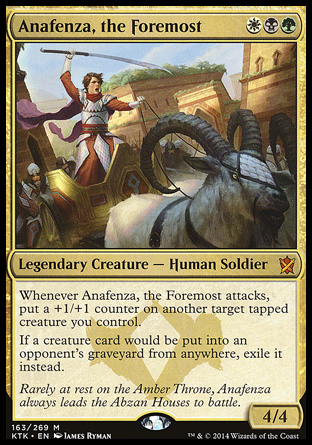
Anafenza is awesome at shutting down graveyard decks and is one of the few ways to really shut down the den engine. It is also one of the few cards that just straight up trades with a Raptor for good. Not to mention it is a 3cc 4/4 with multiple relevant abilities...

The card is a mythic rare and gets played as a four-of in one of the tier-one decks in Standard.

Anafenza has also been showing up in some Modern lists lately which shows that she has the stuff to be a competitive card outside of just Standard. For what she is, what she does, and how much she gets played, the card seems pretty underpriced to me. I also really like the fact that like Sidisi, Anafenza has another full year of life in Standard before she rotates.

Right now, Anafenza, the Foremost is the number one Standard card that I'm targeting to trade and/or buy, because I think it is at its low point and has a lot of room to grow in the coming year.

The new Standard metagame is really interesting and the games are really complex and fun to play. To be honest, I don't remember a Standard format in recent memory that I've enjoyed playing more than this one. I also think that people seem to really be embracing this new Dragons format and are enjoying innovating and being creative.

It's just like anything else, if you stay on top of things and look to where they might be heading next you can get a big jump on the competition. In today's article I've tried to lay out some of the places I could see Standard going to and some of the cards that would really benefit from these shifts. As always, I'm looking to find cards that are at the lowest price they can realistically be and have a large ceiling to grow into.

Insider: MTGO Market Report for May 6th, 2015

Are you a Quiet Speculation member?

If not, now is a perfect time to join up! Our powerful tools, breaking-news analysis, and exclusive Discord channel will make sure you stay up to date and ahead of the curve.

Welcome to the MTGO Market Report as compiled by Sylvain Lehoux and Matthew Lewis. The report is loosely broken down into two perspectives. A broader perspective will be written by Matthew and will focus on recent trends in set prices, taking into account how paper prices and MTGO prices interact. Sylvain will take a closer look at particular opportunities based on various factors such as (but not limited to) set releases, flashback drafts and banned/restricted announcements.

There will be some overlap between the two sections. As always, speculators should take into account their own budget, risk tolerance and current portfolio before taking on any recommended positions.

Redemption

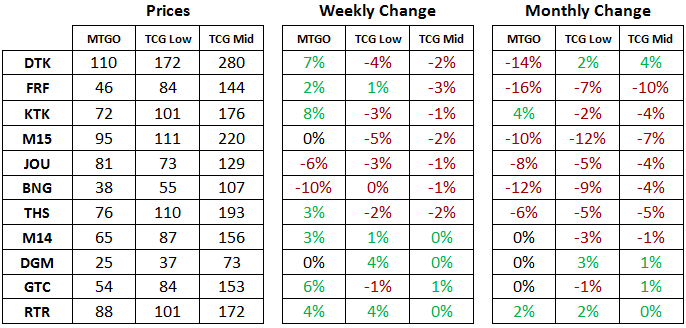
Below are the total set prices for all redeemable sets on MTGO. All prices are current as of May 4th, 2015. The TCG Low and TCG Mid prices are the sum of each set’s individual card prices on TCG Player, either the low price or the mid-price respectively.

All MTGO set prices this week are taken from Goatbot’s website, and all weekly changes are now calculated relative to Goatbot’s ‘Full Set’ prices from last week. All monthly changes are also relative to Goatbot’s prices, except for DTK which is relative to the mid-April set price. At this point, Supernova prices will still be collected for possible use in longer-term comparisons, but all weekly and monthly price changes will be developed from the full set MTGO prices listed on Goatbot’s website going forward.

Prices have generally moved up this past week, partly as a result of the continuing normalization of the MTGO economy as the DTK release event window gets further and further into the rear view mirror.

The going rate for tix has come down from nearly $1.00 to about $0.90 again. This move down means that the value of cards has gone up. This is why it is generally a mistake to be selling cards around release events; when tix are priced closed to $1.00, the value of cards is necessarily lower due to tix being the medium of exchange in the MTGO economy.

May6

Return to Ravnica Block & M14

Paper prices for these sets showed some signs of strength this past week, with almost all TCG prices either flat or positive. TCG Low prices can be volatile, but RTR broke into triple digits for the first time since last summer, while GTC edged down slightly in the weekly change. The rotated sets are looking primed for higher prices as interest in Modern ramps up and the redemption system slowly eats away at the available supply.

Theros Block & M15

Soul of Shandalar came down to 0.21 tix on MTGOtraders website on May 4th, and Goatbots was selling these at 0.33 tix. This temporary price dip was an excellent buying opportunity, but as of writing prices have rebounded to 0.40 tix and 0.37 tix at the two bots respectively. This card has very little play value and it should be considered only for its value due to redemption.

Buying this card at 0.40 or up to 0.50 tix will be profitable in the long term as most core set mythic rares tend to sell for 1+ tix after they rotate out of Standard. If you are willing to hold this card into 2016, at buy prices at or below 0.40 tix, this card has good value and excellent prospects for profit.

Keep an eye out for any mythic rares from THS or M15 that drop below 0.40 tix, and don’t be afraid to pick them up for a long-term hold. The Standard-unplayable mythic rares tend to bottom in the summer before rotation as opposed to in the fall for most rotated cards. However, there’s no strict timeline when junk mythic rares will find their particular price low.

Paying attention to the junk mythic rares when they dip to a low level is a nice, under-the-radar speculative strategy that pays off with slow, but steady, long-term gains. Do not apply this strategy to small set mythic rares as their price floor is much lower and the strategy is much riskier with unclear prospects.

Tarkir Block

KTK saw a nice price increase this week, so it’s safe to say that the bottom for KTK is in, at least until it rotates out of Standard. The period to blindly buy KTK sets for value is coming to a close. Future speculative purchases from this set should be restricted to cards that are undervalued for some reason, or whose prospects have improved due to changes in Standard.

On the other hand, it looks like FRF has found a price floor of around 45 tix. Don’t be afraid to slowly accumulate mythic rares from this set over the coming months, as they have probably found their individual price floor.

On the regular rare side of things, Tasigur, the Golden Fang has dipped below 3 tix and Crux of Fate has been lingering in the 1.5 to 2.0 tix range. It’s not time to be actively targeting these cards, but if Tasigur fell to around 2 tix or the black sweeper fell to around 1 tix, these are good prices to pick up these cards at.

DTK is the most expensive set in the block at the moment, and there’s no expectation of this changing anytime soon. Third sets in a block generally have higher prices due to being opened less, and DTK should not interrupt this trend. With TPR and MM2 both drawing interest away from DDF limited queues, it might not be until the summer starts that we see DTK dip into the 90 tix range.

Dragonlord Kolaghan is seeing some fringe Standard play at this point, and the price has rebounded from around 1 tix to about 1.5 tix. Accumulating at these prices seems like a fine long-term strategy, particularly with DTK sticking around in Standard after the next two rotations. Remember, there will be a normal Standard rotation this October when THS block and M15 leave, and then one of the new rotations will occur in the spring of 2016.

Modern

Official spoilers for MM2 began this week, and Mark Rosewater confirmed in his column that infect will not be a theme in MM2. This has put a charge back into the price of Inkmoth Nexus. With no reprint looming, this Modern staple should be in high demand as the overall price of Affinity decks takes a tumble with the reprint of Mox Opal.

Although the short-term opportunity on the Affinity man land has passed, QS forum user Coopes has pointed out that Arcbound Ravager has a strong chance of dodging a reprint now. With metalcraft looking like the artifact theme of MM2, this staple creature of Affinity decks should see a nice price bump when the full set is spoiled and it’s not on the list. Keep an eye on spoilers, but so far, the price of Ravager still looks like it is mildly expecting a reprint, despite the available evidence that modular will not be back as a mechanic.

Other big MM2 reprints that have been spoiled or confirmed this week include Splinter Twin as a rare (not a mythic), suggesting that the red enchantment will not be banned anytime soon. Noble Hierarch, Spellskite, Daybreak Coronet, Eye of Ugin, Leyline of Sanctity and Hurkyl's Recall have all been spoiled as this article goes to print.

Each of these rares is highly playable and an expensive Modern staple on MTGO . The reprint of Hurkyl's Recall is very interesting in the sense that the card doesn’t really belong to any particular theme, is pretty cheap in paper, and is absurdly expensive on MTGO. One may interpret this as a sign that WotC is considering online prices when thinking about cards to reprint.

On the mythic front, Mox Opal, Bitterblossom and Primeval Titan will be reprinted. By only reprinting the green titan, the most playable and expensive of all, WotC also tells us here that they don’t need to reprint a full cycle of specific cards. Leyline of Sanctity showing up without the other leylines is a real possibility.

Tezzeret, Agent of Bolas is all but confirmed with the revealing of the awarded avatars for MTGO events (Dark Confidant was the other revealed avatar). Ajani Vengeant would therefore represent a decent pick up now as its price is at a one-year low and the white-red planeswalker has seen play in Modern in the past. This is more of a long-term target though as not showing up as a reprint will probably not move the price very much.

Finally, and especially for MTGO speculators, Dismember has been spoiled as an uncommon. If the reprint of Path to Exile in MMA is any example, we would expect Dismember to easily drop below 1.5-2 Tix, and to be a very good speculative target during MM2 release events.

Vintage & Legacy

Although quite stable for the past year or so, the price indices of these two formats is going to head lower due to the combined reprints of Modern Masters 2015 and Tempest Remastered.

TPR drafts start today and we should be able to see the impact of these drafts on Wasteland and City of Traitors this weekend. The two lands are likely to be very coveted, both by players and speculators. Prices might be hitting their lows during this first weekend, post-release.

Besides this, others Legacy and Vintages staples remain mostly flat. VMA P9 and mythic indices are at similar levels to five months ago. These formats aren’t usually very attractive for speculators due to lack of popularity from the player base. We will see in the coming weeks if reduced prices on Wasteland and City of Traitors attract more players. Next November is the Legacy MOCS and should correspond to a period of higher demand for Legacy staples.

Pauper

The outlook for Pauper cards remains unchanged from last week and most prices are stable or down. With TPR drafts opening today, Lotus Petal, Diabolic Edict and Rolling Thunder are cards to keep an eye on. Especially for the Petal as it is Legacy-, Vintage- and Pauper-playable and had kept a price between 2 and 4 Tix for years until recently.

Targeted Speculative Buying Opportunities

Standard

Soul of Shandalar

Modern

Restoration Angel
Arcbound Ravager

Restoration Angel doesn’t currently have a home in top Modern decks. The ban of Birthing Pod and the fact that UWR midrange decks are out of favor allowed the price of this angel to drop to 4 tix. However this card is safe from reprint in MM2 and is certainly a powerful creature and combo enabler in Modern.

We recommended it in January and we are recommending it again now that the price has fallen and is more stable just at the outset of a period of heavier interest in Modern.

Targeted Speculative Selling Opportunities

Standard

Battlefield Forge
Llanowar Wastes
Temple of Triumph
Elspeth, Sun's Champion
Goblin Rabblemaster
Courser of Kruphix
Temple of Malady

This basket of Standard positions hasn’t been very successful. Furthermore it seems that we have passed the mini rebound that occurred after PT Dragons of Tarkir. With Standard rotation on the horizon there's not much to expect from these specs--selling now and cutting losses for most of them is the only reasonable move.
The Many Variations of Stompy

Are you a Quiet Speculation member?

If not, now is a perfect time to join up! Our powerful tools, breaking-news analysis, and exclusive Discord channel will make sure you stay up to date and ahead of the curve.

stompy spire tracer

Stompy, like Elves, is one of those archetypes that lends itself extremely well to variation. Sure, it's (mostly) just a dumb aggro deck, but with it you can go 1-2cmc only, go all in on counters, go all in on speed, and try many other things. Today I'll be exploring a few of the routes that can be taken.

To be clear, you might be lucky to do well with these decks in a real tournament. At least one of the ideas here has been implemented in a tournament setting and done well, but the primary goal is provide you with ways to play Stompy with your preferred twist, whether because the stock list doesn't interest you much, or because you want to mix it up for awhile. If any those ways happen to be competitive (and they do try to be, within their means), so be it. Onto it!

(Disclaimer: none of these lists have sideboards. Use the stock list sideboard as a starting point and go from there.)

[wp_ad_camp_1]


Evasion Stompy by Sean Ridgeley

Creatures

4 Skarrgan Pit-Skulk
4 Avatar of the Resolute
4 Garruk's Companion
4 Silhana Ledgewalker
4 Spire Tracer
4 Sheltering Ancient

Instants

4 Mutagenic Growth
4 Giant Growth
4 Vines of Vastwood

Enchantments

4 Rancor

Land

12 Forest
2 Pendelhaven
2 Treetop Village

This version values evasive creatures above all else, and sports a low curve, the idea being to get the absolute maximum amount of damage in as quickly as possible -- no grinding or creature wars, here, just running a load of creatures at your opponent's face and pumping them up a ton.

Sheltering Ancient adds some risky but potentially very explosive fun -- his downside matters less since we're very quick and their guys won't be able to chump block basically ever. Turn 3 kills are possible with this version, although likely rare.

The major downside of this list is all of your dudes excepting Ancient are vulnerable to every red removal spell in the format, though this is offset some by the high amount of pump spells (one of which is "free"), and the cheap cost of the creatures, meaning you can just keep cranking out dudes quickly and not be hurt so much by removal.

stompy aether vial

Vial Stompy by Sean Ridgeley

Creatures

4 Kalonian Tusker
4 Garruk's Companion
4 Avatar of the Resolute
4 Strangleroot Geist
2 Sheltering Ancient
2 Talara's Battalion

Instants

4 Aspect of Hydra
4 Giant Growth
4 Vines of Vastwood

Enchantments

4 Rancor

Artifacts

4 Æther Vial

Land

18 Forest
2 Treetop Village

This is similar to the Evasion list in that it sports a very low curve. The difference is it excludes 1-drops in favor of more double green creatures, which means Aspect of Hydra is much better here. Also, it drops a couple of Ancient (which is less good in this version) for a couple of Battalion (which is better in this version). Finally, we use Aether Vial for added speed turn 3 and beyond and improved game versus removal and counterspells.

stompy Slaughterhorn

Hyper Stompy by Sean Ridgeley

Creatures

4 Charging Badger
4 Spire Tracer
4 Skarrgan Pit-Skulk
4 Sheltering Ancient
4 Strangleroot Geist
4 Slaughterhorn

Instants

4 Giant Growth
4 Mutagenic Growth
4 Vines of Vastwood

Enchantments

4 Rancor

Land

16 Forest
2 Pendelhaven
2 Treetop Village

This is the "balls to the wall" aggro approach in effect. If you like Burn or those Izzet Blitz decks, this operates quite similarly. It's basically the same as the Evasion list, except it values speed and raw damage a little more than evasion.

stompy phyrexian soulgorger

Persist Stompy by Sean Ridgeley

Creatures

4 Experiment One
4 Young Wolf
4 Strangleroot Geist
4 Safehold Elite
4 Kitchen Finks
4 Phyrexian Soulgorger

Instants

3 Predator's Strike
3 Prey Upon

Sorceries

4 Life's Legacy

Enchantments

4 Rancor

Land

20 Forest
2 Treetop Village

Persist Stompy aims to maximize resilience while exploiting Life's Legacy and Phyrexian Soulgorger as much as possible. Incidentally, we get some added game versus aggro decks (particularly Burn), by running a playset of Finks.

More Incarnations of Stompy

The fun doesn't stop there: you can try exploring counters, the graveyard, hexproof, and many more aspects of Magic to produce other Stompy lists. I believe the ones above are likely the most competitive out of what you can do, but who knows -- Modern is so large, there's always more ground to cover. Enjoy!

Insider: Cards to Watch This Week

Are you a Quiet Speculation member?

If not, now is a perfect time to join up! Our powerful tools, breaking-news analysis, and exclusive Discord channel will make sure you stay up to date and ahead of the curve.

Two Standard Grand Prix were held this past weekend, in Toronto, Canada and São Paulo, Brazil. These events drew large crowds filled with players from all edges of the Western Hemisphere.

The wake of Grand Prix tends to have big impact on global metagames, so understanding the results of these tournaments is crucial for predicting financial trends and the metagame of future events alike.

There was also a SCG Standard Open in Portland, Oregon, which drew many eyes to coverage over the weekend, and decklists from this event are also important to the financial landscape.

The Top 16 decklists from each event are available, so there is a lot of great information available.

GP Toronto

Top 8, Top 16

The headline archetype of GP Toronto was Abzan Midrange, which put two copies into the Top 8 and ultimately hoisted the trophy. Champion Lucas Siow's decklist incorporates three maindeck Den Protector, which has officially brought Den Protector into its own, without Deathmist Raptor, as a value creature for midrange decks. Den Protector is a Standard staple and will be a huge factor in the metagame until it leaves the format.

There was an error retrieving a chart for Den Protector

Online, Den Protector rose from 6 tix on Saturday to 8.4 on Sunday, but it has since fallen to 7.9. The demand on this card is real. I expect many will sell extra copies now that the price is so high, so it's likely to stay below 8 tix. New supply should keep the price of this card stable, even as it's increasingly incorporated into archetype over the coming months.

The paper price has spiked from under $5 to over $7. The win in Toronto has spurred players to acquire their playsets, and the price has jumped accordingly. As with online, new supply should keep the price from exploding, but I expect the paper price still has room to rise, perhaps approaching $10.

Another card from Toronto that has garnered attention is Collected Company from Craig Wescoe's G/W Aggro deck. This deck is full of powerful aggressive creatures, including the Deathmist Raptor and Den Protector combo, supported by a set of Dromoka's Command.

Collected Company was also spotlighted at SCG Portland, where it played a keyrole in a Blue Devotion deck splashing the powerful instant, which finished in the Top 4.

There was an error retrieving a chart for Collected Company

The online price of Collected Company has grown from 2.2 tix on Saturday to around 4 tix today. This card is revealing itself to be the real deal, and it's likely to play a growing role in Standard as time passes. The price was too low, and I would expect this card will continue to grow before settling in the 5-6 tix range in the near future.

The paper price of Collected Company has ticked up from $4.1 to $4.4, and I expect it will continue to grow to $6 or more by this weekend.

Mardu Dragons reached the finals, but this doesn't tell the entire story. Ben Stark also piloted the archetype to a 12-3 finish. Given the exposure and its strong position in the metagame, this deck is the real thing and will likely be a part of the metagame going forward.

Crackling Doom is incredibly well positioned in this format, where it shines as a removal spell against nearly every archetype. Stormbreath Dragon is perhaps the single best card against the two Bant Megamorph decks that reached the Top 8, and it's also devastating against Wescoe's deck. It's also an excellent threat against Abzan Aggro and Bant Heroic.

There was an error retrieving a chart for Soulfire Grand Master

All of the cards in this archetype are liable to increase in price, but nothing stands out in particular as a big gainer. It certainly puts Soulfire Grand Master back on the map, and in his Top 8 interview, the pilot said it was his MVP and he would play another copy.

Notable from GP Toronto was the relatively poor performances of Esper Dragons and Atarka Red. Both of these decks were reasonably popular at the Grand Prix; I personally played against two Esper decks and four four Red decks, and saw plenty of others in the field, yet neither archetype cracked the Top 8. The Top 16 holds one Red deck and two Esper Dragons deck. The metagame has adjusted, and I expect the hype around these archetypes will fade going forward.

GP São Paulo

Top 8, Top 16

Paulo Vitor Damo da Rosa took the crown in São Paulo with Esper Dragons, a testament to his skill and experience. Particularly interesting is his inclusion of three Ashiok, Nightmare Weaver, which if imitated is likely to increase the price of this planeswalker.

There was an error retrieving a chart for Ashiok, Nightmare Weaver

The online price of Ashiok, Nightmare Weaver has grown from 6 tix to over 9 in the past two weeks, but I expect it has peaked.

The paper price has fallen steadily in this same period, from around $14 to $12, and it will continue to fall. The downward price pressure of the impending rotation this fall is real, and while increased popularity of a card may slow price descent, it cannot prevent it.

The Esper Dragons archetype did well in Brazil, putting three copies into the Top 8. Time will reveal how the archetype fares as a whole going forward. It's certain to be a player in the metagame, but it's likely to fall in popularity overall.

SCG Portland

Standard Top 32, Modern Top 32, Legacy Top 32

U/G Devotion reaching Top 4 of the SCG Standard open was a surprise to many, and it has brought renewed attention to the Blue Devotion archetype.

There was an error retrieving a chart for Shorecrasher Elemental

The finish has done big things for the Shorecrasher Elemental, which online has grown from 1 ticket to over 2.4 tix since Sunday. As a mythic, this price could skyrocket much higher if the deck grows in popularity and reaches the top tier of the metagame.

There was an error retrieving a chart for Thassa, God of the Sea

Thassa, God of the Sea was also a winner, growing from 3 tix to 4.5 tix since Sunday. The paper price remains stable just under $8, and this new hype will help it to maintain this price point into the summer.

Master of Waves, which had already grown considerably partly due to its inclusion last week as a sideboard card in Mike Flores' Dragon Control deck, has only increased modestly, from around 7% since the weekend up to 9.3 tix. The paper price has fallen to $6 from $7 in the last month, but the downward trajectory will be slowed.

The Legacy IQ featured two Miracles decks meeting in the finals, with Joe Lossett taking the crown. With the banning of Treasure Cruise, Miracles is now the best archetype in the format and will force others to adjust.

I am particularly taken by the Modern IQ, which showcased a range of innovative decklists throughout its top finishers. I recommend that everyone checks them out to get a feel.

There was an error retrieving a chart for Anafenza, Kin-Tree Spirit

Standing out to me most is the winning Collected Company Abzan deck that threatens to fill the creature-combo niche left behind by Birthing Pod. Anafenza, Kin-Tree Spirit is the headliner here, so pay attention to that card going forward.

Paul Pagatpagan's 12th-place U/W Control deck is particularly fascinating for its inclusion of Silumgar's Scorn, which combines very well with an activated Mutavault to serve as a hard counter. This deck also marks Dragonlord Ojutai's arrival in Modern.

-Adam

Insider: Pricing and Trading Your Work

Are you a Quiet Speculation member?

If not, now is a perfect time to join up! Our powerful tools, breaking-news analysis, and exclusive Discord channel will make sure you stay up to date and ahead of the curve.

Now that you have an altered card (or two) we can discuss how to move it. There are really only two options here: trading and selling. As you may have guessed from the title today I am going to discuss trading altered cards.

Pricing Your Work

Before you go anywhere or trade with anyone, it is important that you know how to price your work. I use a simple formula to price my cards. I take the price of the card and add it to my labor cost (hourly rate multiplied by hours worked) to find my final value. I always round up to the nearest dollar.

Card + (HR*HW) = Price

In the case of our altered [cards]Plains[/card] the card is worth $1.50. It took me roughly an hour to finish and I pay myself $10 an hour. Therefore this card is worth $12 after you round up from $11.50. I also try to make sure that my price is less than that of the foil version of the card. Of course there are exceptions to this rule, but it is a good guideline to keep in mind. With the cost of certain foils many people will look to altered cards to get a unique version of a card at a discount. Reminding people of this possibility helps when negotiating.

Ugin-Price
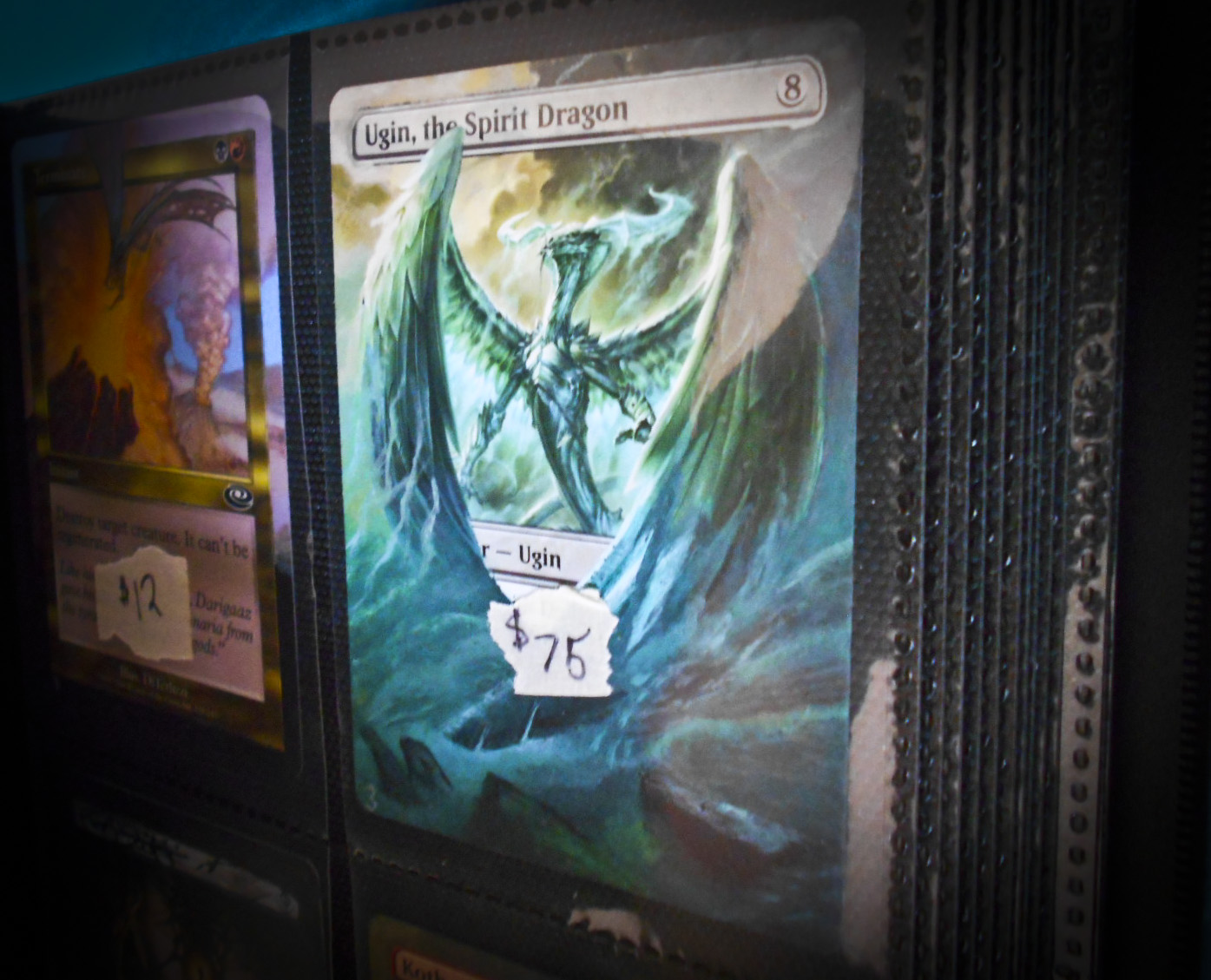
Ugin, the Spirit Dragon priced and in his natural habitat!
If you are just starting out then your first few cards will have taken you a lot longer to finish. This is to be expected while you refine your craft, but it doesn't mean that your Plains should cost $40 either. This is a concession to be made whilst rolling along the learning curve.

On the flip side, you hurt yourself and the altering community as a whole if you undervalue your work. Yes, you will likely get your sale but you will also be short-changing yourself on profits. This will force you to either cut corners on your work to make it worth your time or create a situation where painting is simply not worth it. If you take pride in your work, then show it in your prices.*

I have one final note about prices. They should be clearly visible within your trade binder. I use small pieces of masking tape and a pen to write my prices on the pages of my binder.

People almost always know how much Ugin, the Spirit Dragon is worth, but they may not know how much you are asking for your altered version. Marking your prices will eliminate the obvious question. It lets your buyer know that you are not just making prices up on the spot. In this way pricing your work helps to give your buyer a sense of security as well as a starting point for negotiations.

Finding Your Buyer

The number of people interested in altered cards is growing rapidly, but it is still just a fragment of the player base. In my experience, seven out of ten Magic players are interested in altered cards and three out of ten are motivated to buy. Even though these numbers will vary given your local player base, for the sake of this article let's assume that they're true across the board.

In order to reach these three motivated buyers we have to advertise to all ten. In our case advertising does not necessarily mean purchasing ad space on the wall of your local game store.

Popular Commanders are always very easy to move.
Popular commanders are always very easy to move.

I keep my alters in the very front pages of my trade binder to ensure that everybody who opens it gets a look at them. I also make sure that I show my binder to everybody that I possibly can.

This is where the seven people who are interested (but not necessarily willing to buy) come in. They do all of the advertising for you by asking questions like "Did you do this artwork?" and saying things like "These are so cool!". It is word of mouth in a literal sense. Anybody who is interested in buying now knows where to go.

When you do come to these inevitable comments, you should always make sure to remind them that you do commission work. As an additional follow up, I like to remind people that EDH generals look amazing when altered.

This instantly gets your trade partner's mind working on who or what they would like altered, regardless of whether they intended to do so before opening your binder. If you get one commission job at FNM then you have paid for your draft.

Trading to Your Buyer

Once you have found your trading partner then you should proceed as normal through the trading process. It is important to know the prices that you have set beforehand and remain firm on them. If you value your altered Plains from $12 to $15 (as you should) then treat it as though it were a Polluted Delta.

Feel free to be a little flexible, but never let anyone talk you into reducing the price of your work. There are always more buyers for your card. Don't be afraid to walk away.

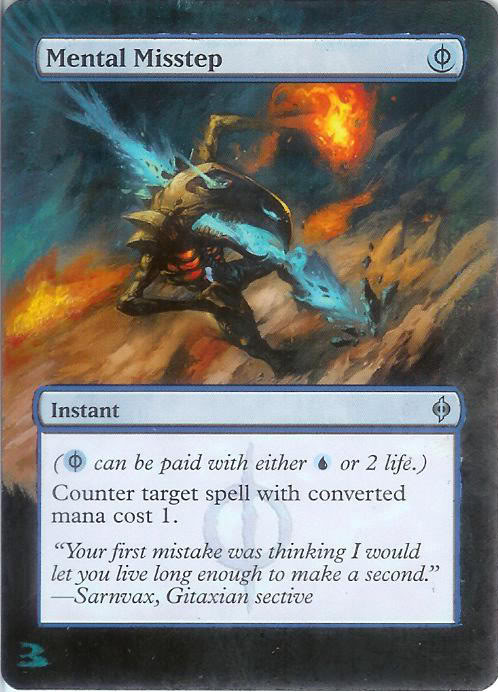
To me, this is way cooler than a foil Mental Misstep.
Next week I'll delve into how to sell your work for cash. Until then, keep working on your alters and share them with me on Twitter @PaintersServant.


*Pro Tip: ALWAYS take pride in your work!

Insider: MTG Stock Watch for 5/3/2015

Are you a Quiet Speculation member?

If not, now is a perfect time to join up! Our powerful tools, breaking-news analysis, and exclusive Discord channel will make sure you stay up to date and ahead of the curve.

Welcome back, readers! I realize this series has missed an article, but I wanted to get my last one out before all the MM2015 spoilers started to hit so people could look at unloading cards before they started dropping in value. That being said, I know a lot of people like this series so I'm happy to provide another installment.

Penny Stocks

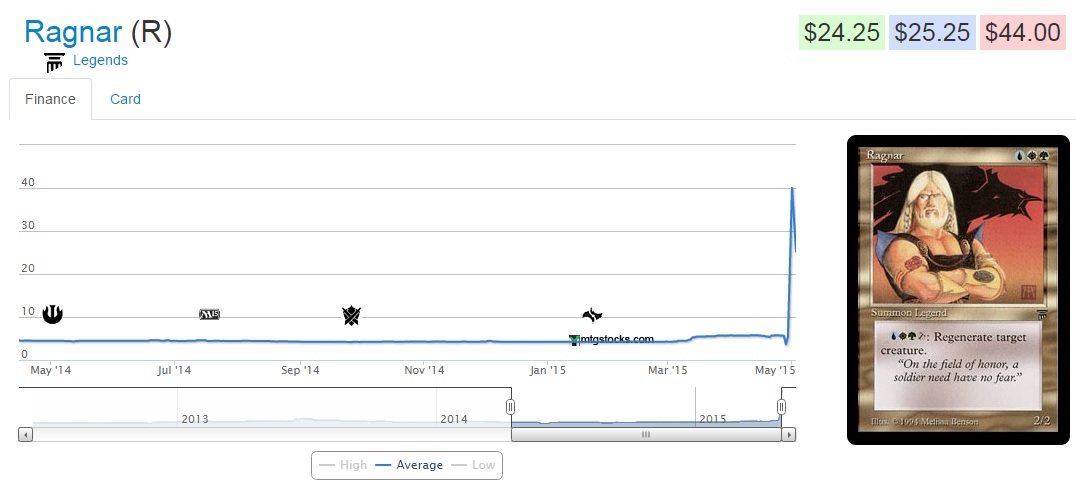
1. Ragnar (+342.2%) - This Legends rare can serve as an okay tiny leader in the bant colors, although there are two stronger ones available in the same colors. This movement really looks like a buyout (with a constant price for a long time and a sudden jump in a two-day time span) and as of typing this there are only 16 copies remaining on TCG Player, all at the "new" price.

This is not a card I'd invest in. It had little to no demand for years and then all of a sudden someone thinks it's too cheap, buys out all the copies they can and tries to set a new price. The problem is this isn't real demand and people can set the card at the current price all they want, but that doesn't mean it'll stick. If you have them, sell/trade them now as I expect we'll see a nice steady decline (though price memory will likely keep it above its previous $5-$6 price tag).

Ragnar

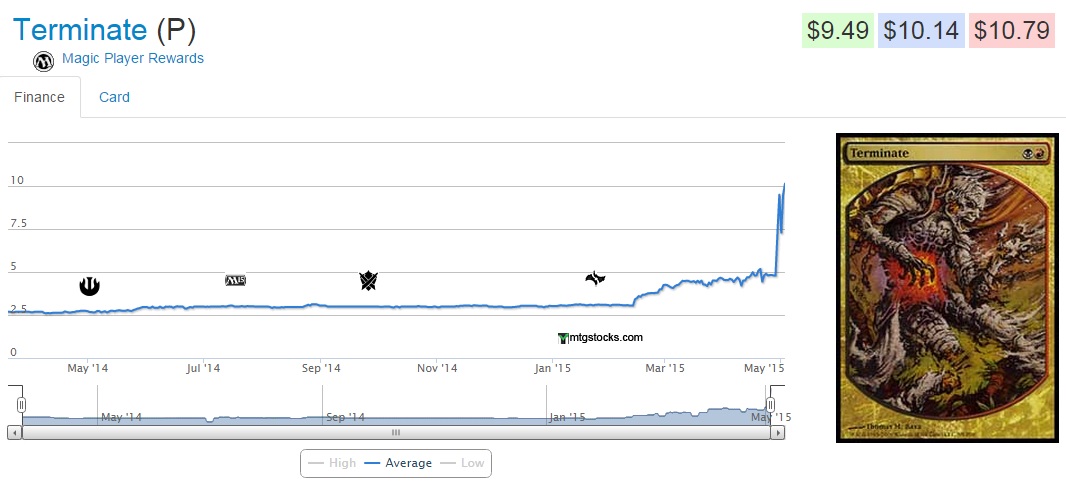
2. Terminate (Player Rewards) (+109.9%) - This jump is also indicative of a buyout (with only about five copies currently on TCG Player as of this writing), but Terminate has proven itself to be a solid Modern staple and its time out of the limelight is primarily due to the fact that the red-black color combination hasn't seen a lot of love since Deathrite Shaman and Bloodbraid Elf got axed and Jund took a back seat to Junk.

It's still the cheapest (CMC-wise) kill spell in Modern with no caveats (Lightning Bolt can't kill 4 toughness, Go for the Throat can't hit anything in Affinity, Doom Blade can't kill any black creatures). This one likely has had a new price point set, though from a personal perspective, I think the Player Rewards art is horrendous.

terminate

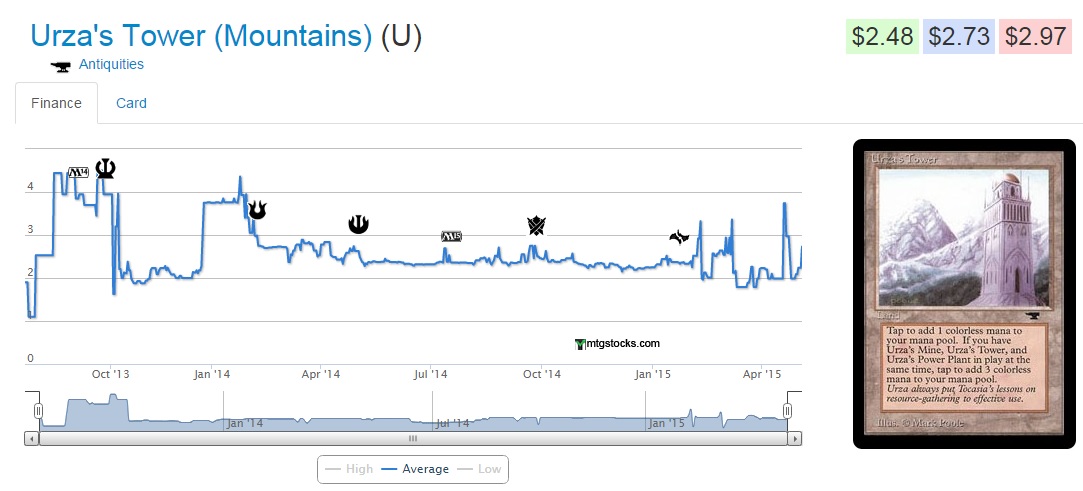
3. Urza's Tower (Mountains - Antiquities) (+37.2%) - Several times in this series we've seen an older Antiquities Urzatron land experience a significant gain in a single week. The implication is that the new price will likely hold and that any ones that haven't jumped yet will likely have their day to shine. The extreme age of the Antiquities set, coupled with a much smaller print run (compared to modern ones), means that modern Tron players are more than happy to "pimp" out their decks with the originals. I honestly imagine that if Tron decks ever regain a foothold in the tier 1 status of Modern, we can expect another jump on these Antiquities versions.

urzas tower

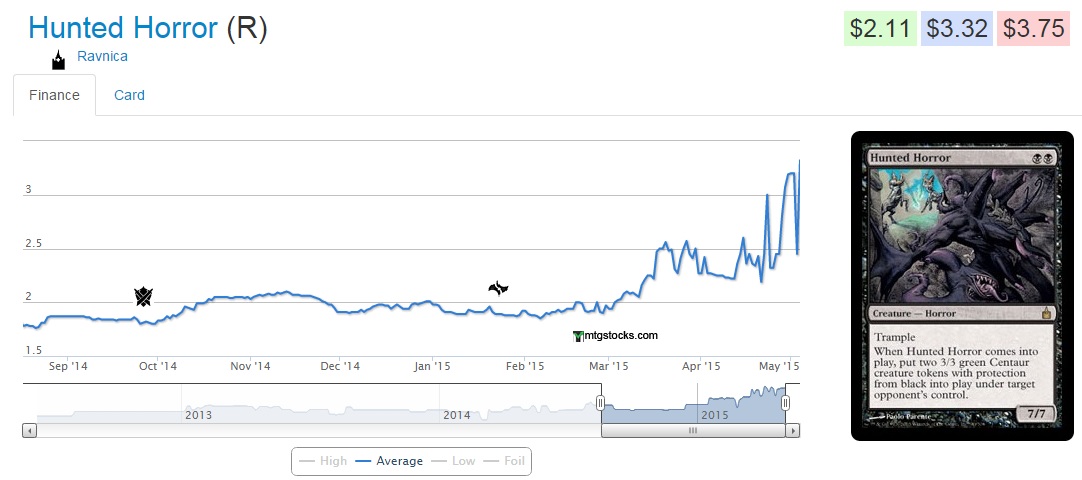
4. Hunted Horror (+35.5%) - To be honest, I don't really understand this jump. Travis Woo's latest "Bees" deck does run Forbidden Orchard and it might be that Hunted Horror is a solid creature that works in the deck or maybe someone is pushing for the modern Torpor Orb deck. I don't see a lot of upside in holding on to these, so if you have them and someone is interested in them I'd move them.

Hunted Horror

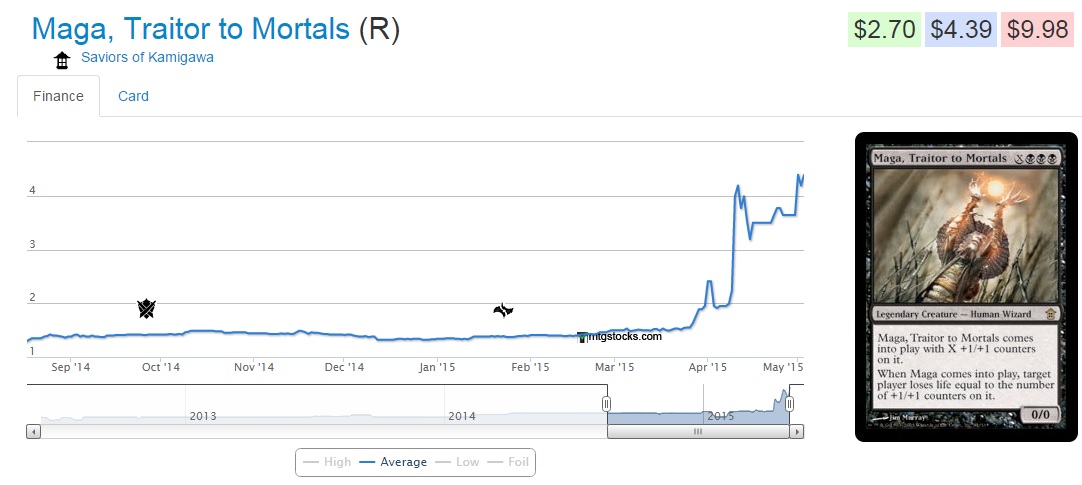
5. Maga, Traitor to Mortals (+20.6%) - Another powerful Tiny Leader, Maga has always been a solid EDH general for "big mana" mono-black decks and thanks to Cabal Coffers/Magus of the Coffers he's always been a good "one-shot" general. He's a legal general in the Tiny Leaders format, which while it seems to be waning at the moment still carries some weight. It's easy to see that "X" spells in the format can be some of the most powerful cards, thanks to the fact that all the other cards are only as powerful as WoTC wanted to push them at 0, 1, 2 or 3 mana.

maga

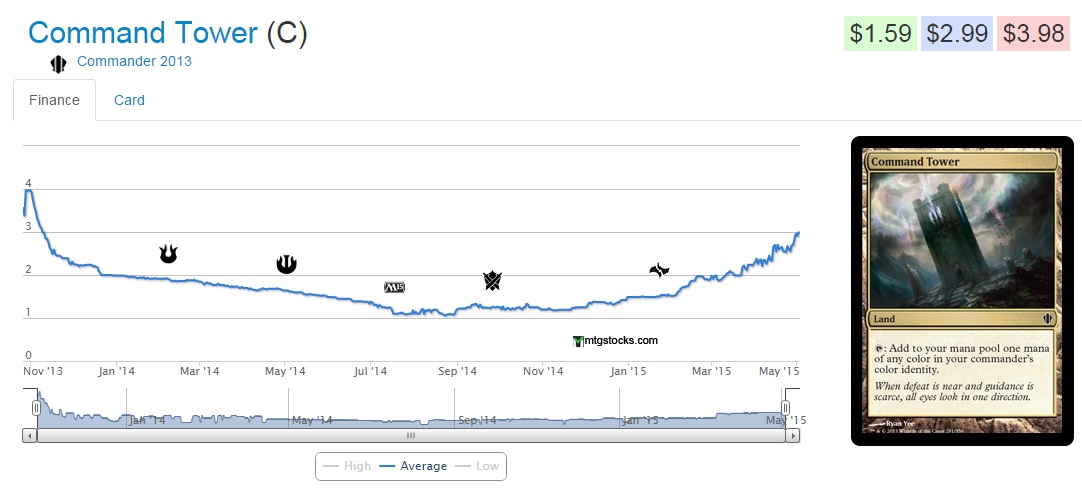
6. Command Tower (Commander 2013) (+17.3%) - This EDH staple didn't make the cut in the Commander 2014 product (thanks to it being mono-colored). This means that as these get picked up and placed into decks they are leaving circulation (likely for a long time) so the price is naturally going to rise. It also helps that while the MTG playerbase growth rate has slowed compared to a few years ago, it is still going up and this is one of those Commander staples (like Sol Ring) that can go into just about any deck. In terms of mana-fixing in EDH, there really isn't a better land you can play.

Command Tower

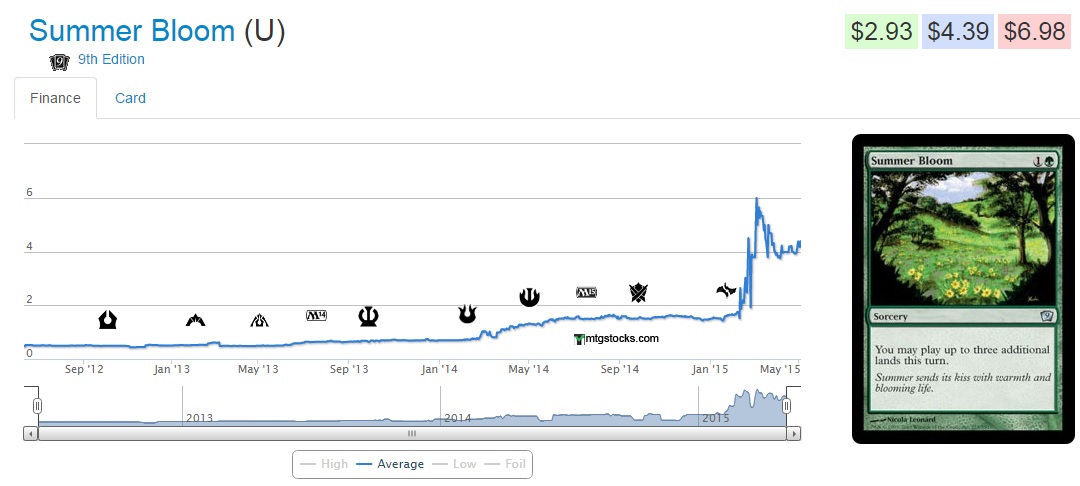
7. Summer Bloom (Visions) (+11.7%) - The announcement of Primeval Titan being reprinted in MM2015 has likely driven some more interest into the Titan Bloom deck. This is the type of card that casual players tend to love and this is a very powerful ability on a low CMC card. It's also not the type of card you'd expect WoTC to throw into MM2015, simply because it feels really out of place and isn't synergistic with a whole lot else.

summer bloom

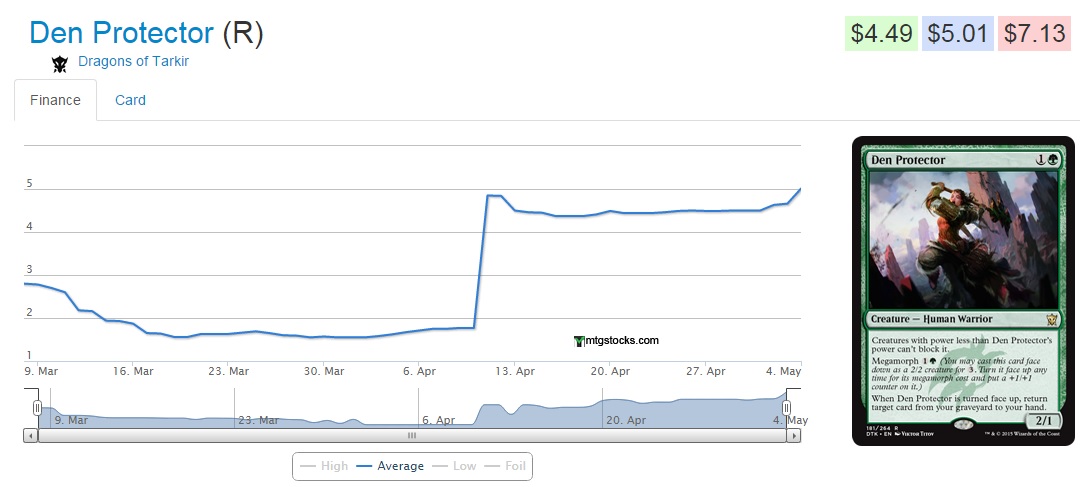
8. Den Protector (+11.6%) - Den Protector/Deathmist Raptor strategies seem to be very popular in Standard right now. And running Den Protector on its own to recur powerful cards is just as acceptable. A lot of Standard players weren't playing the last time we had Eternal Witness in Standard, so it's no surprise that this powerhouse took a bit of time to really catch on. While not as good as Eternal Witness (as a whole), the fact that you can only run one Witness in EDH means that any card similar enough to it can easily find a home.

den protector

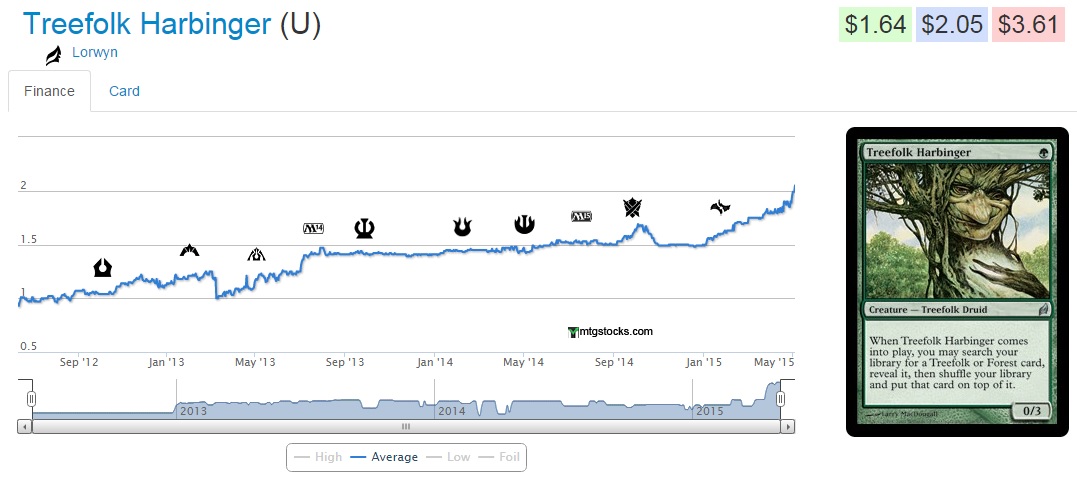
9. Treefolk Harbinger (+10.8%) - This is an interesting move simply because this card tends to reside in Doran decks (whether they be EDH, casual, or even the Modern variants). With the printing of Assault Formation, these Doran decks now get another four copies of the ability they really need to function (and it's even attached to a plain enchantment, so it can't be pathed). This guy also gets any Forest (including Temple Garden and Overgrown Tomb) so it's a decent mana fixer with wall potential.

treefolk harbinger

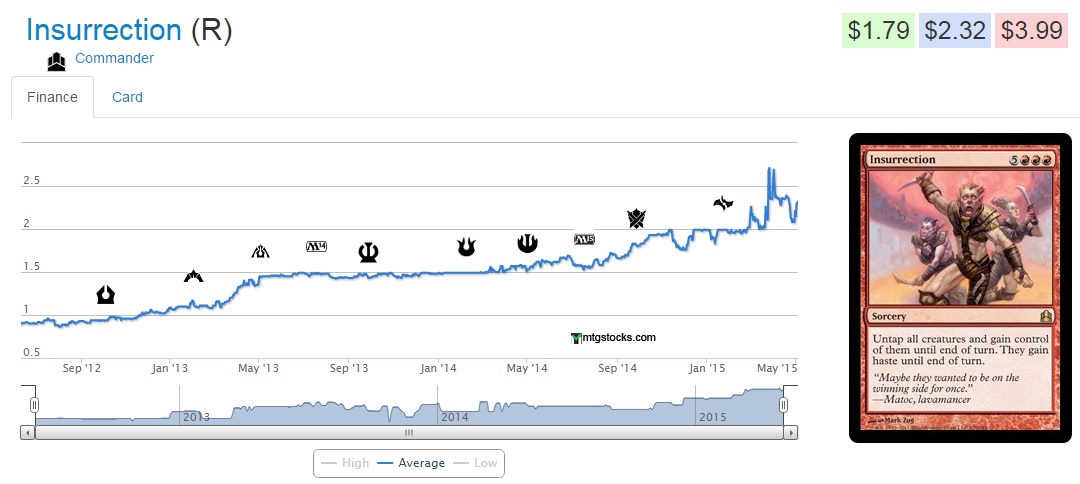
10. Insurrection (Commander) (+10.0%) - This is a Commander all-star and one that goes in just about any EDH deck that's more than just a splash of red--it's often 8 mana, I win the game. I always enjoy playing with this card, and with only three printings from smaller/older sets (Onslaught, Planechase, and Commander), the number in supply is likely not that high.

insurrection

Blue Chip Stocks

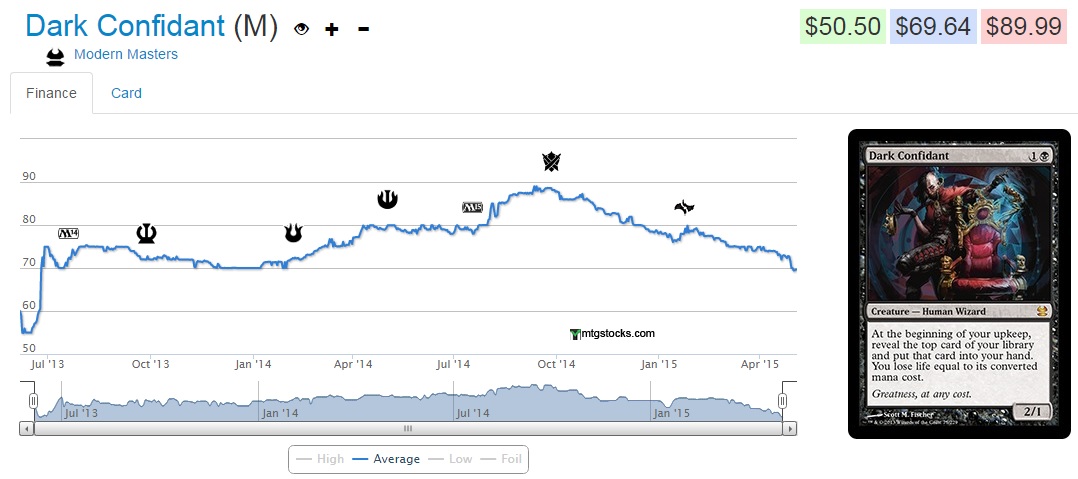
1. Dark Confidant (-9.58%) - It seems like every two weeks I talk about how the once mighty card draw engine continues to fall from grace and this week is no exception. The worst part is, he was only spoiled for MM2015 release 5/4/15, so he hasn't even really suffered the true "reprint" drop yet. Even if WoTC keeps him at the rare spot, the fact that he's seeing little to no play in any eternal formats anymore implies that he'll continue to drop.

In fact, if we just base it on demand, he should already be much lower; but I imagine the price memory on him is still pretty high and people who picked him up at $70+ won't be wanting to trade him off if he hits $45-50 very easily. He is making a comeback in Legacy Abzan-Blade (Dark Maverick to the purist), so his decline may slow down a bit even with a reprinting.

dark confidant

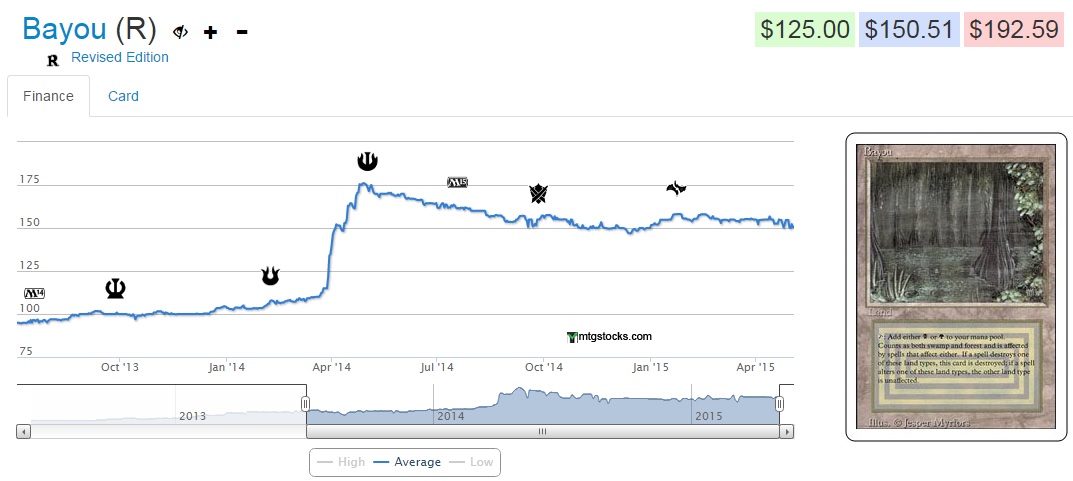
2. Bayou (-4.13%) - We just aren't seeing a ton of Elves in Legacy anymore (with only one copy making it into an SCG Top 8 in the month of April). Interestingly enough we are (as of recently) starting to see a resurgence in this new version of Maverick, which does run a Bayou, so we might see a reversal of this trend in the near future (at least I hope so, given how much I loved playing Maverick back in the day).

bayou

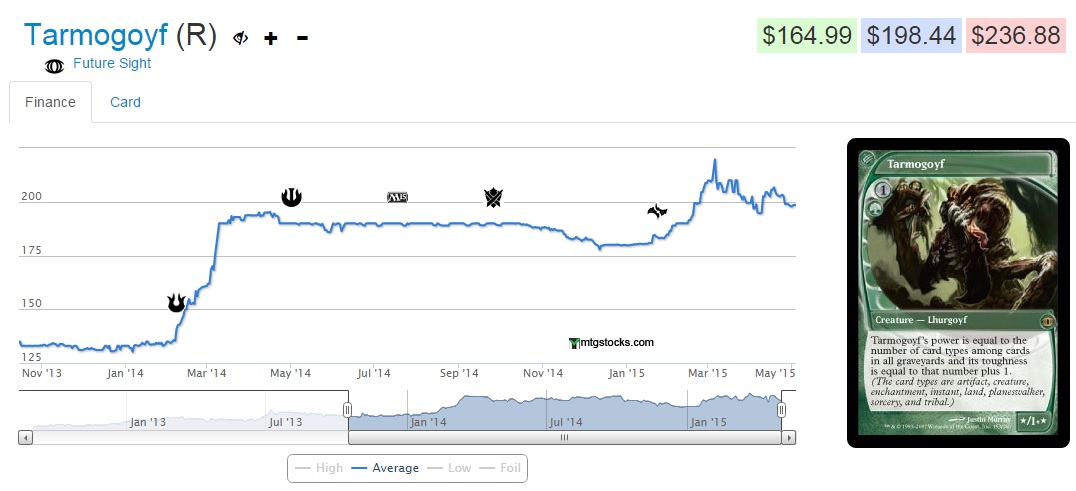
3. Tarmogoyf (-3.01%) - As expected, the closer we get to the release of MM2015, even the mighty Tarmogoyf starts to dip as players realize that more will soon be in the supply. I don't expect him to take a huge hit with MM2015 overall. Last time he got bumped upwards because a few dealers at GP Vegas were buying them at their current retail price, whereas it will be much more difficult to do that again given how much more expensive he is now (almost double).

tarmogoyf

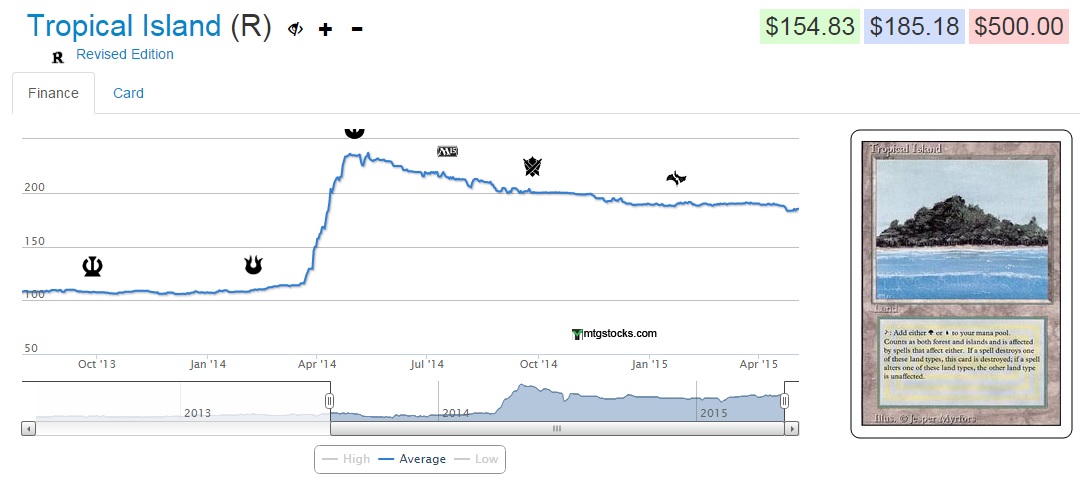
4. Tropical Island (-2.6%) - Despite its power level, the Infect deck seems to be a bit on the decline recently. This might be due to the return of Maverick, which plays plenty of creatures to chump block with and then go over the top via card advantage provided by Sword of Fire and Ice and Dark Confidant.

Tropical island

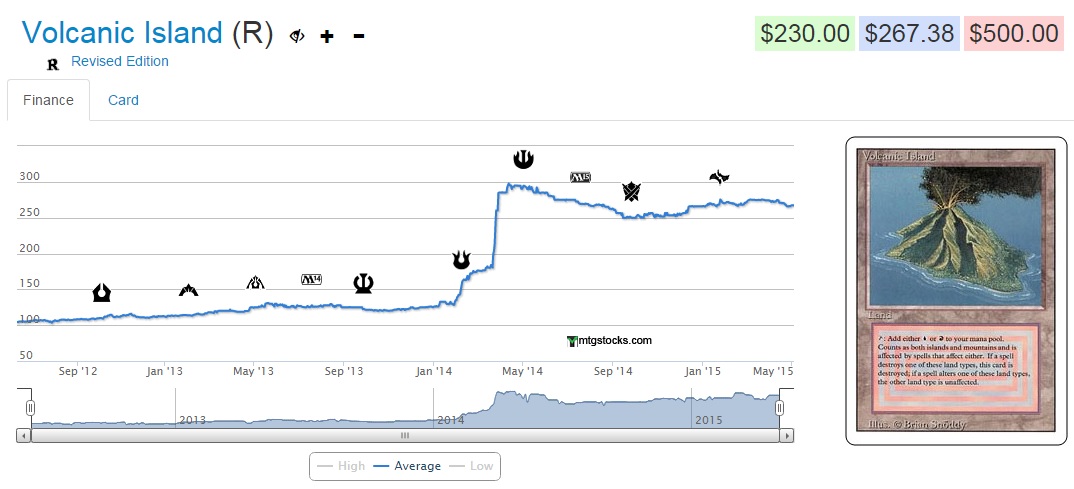
5. Volcanic Island (-2.44%) - It looks like Volcanic won't surpass Underground Sea this week (though it got really close during the Treasure Cruise/Young Pyromancer days of Legacy). Despite showing up in most Miracles builds and in Jeskai Blade (and an interesting Grixis Control deck in Portland) it's on the decline.

volcanic island

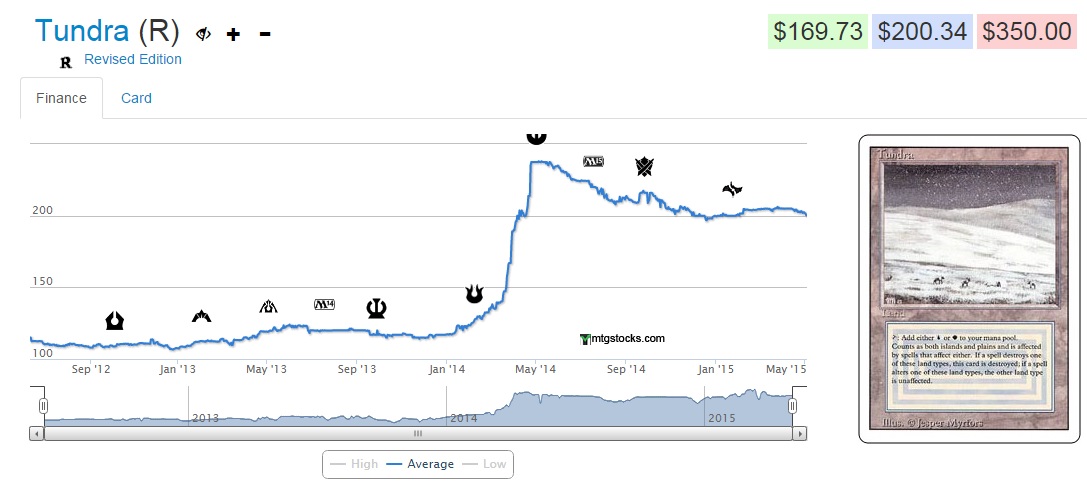
6. Tundra (-2.32%) - Boy, this is an abysmal week for Legacy staples, as everything seems to be trending downward. Despite UWr Miracles taking both first and second place at the SCG event in Portland, it seems that enough players aren't willing to pony up $205 for what was once the second most expensive dual land (by quite a bit).

Tundra

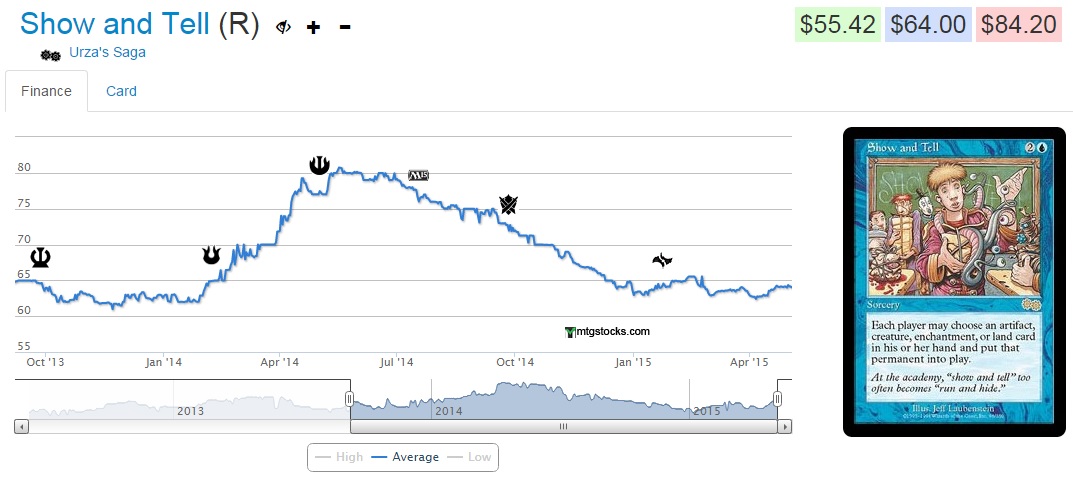
7. Show and Tell (+1.81%) - Finally, a positive increase this week (well at least for those who are trying to trade/sell Show and Tells, rather than those of us trying to play fair Magic). Show and Tell has proven itself a tier 1 deck ever since the printing of Griselbrand gave it a nice jab to go with the wicked cross that is Emrakul. I expect this deck to start seeing more play (especially with a rise in Maverick style decks, as the rise of Show and Tell was what pushed Maverick into the back seat). Hopefully we'll see more Containment Priests in sideboards to combat the return of this menace.
show and tell

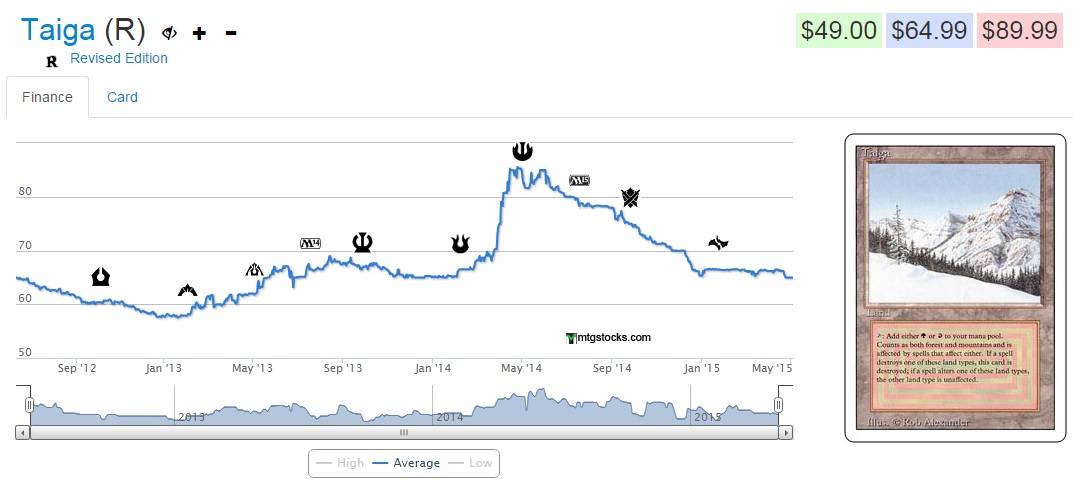
8. Taiga (-2.24%) - And we're back to negatives after our brief stint in the sunlight. Taiga is very unfortunately positioned in the Legacy metagame as it doesn't tap for blue mana and isn't played in any decks that do (even RUG Delver doesn't bother running it anymore).

Taiga

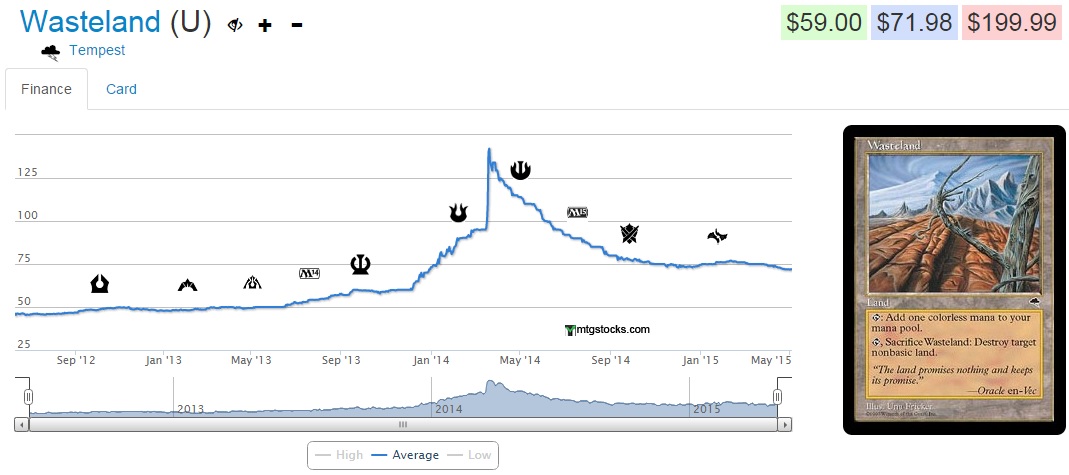
9. Wasteland (-1.77%) - The drop in Wasteland is more likely due to the announcement of yet another judge foil printing (as opposed to a reduction in actual play). We're actually seeing Wastelands pop up more in decklists. Even U/G infect tends to run one to combat Glacial Chasm (which it just flat out can't beat), as well as a good answer to opposing Inkmoth Nexus.

wasteland

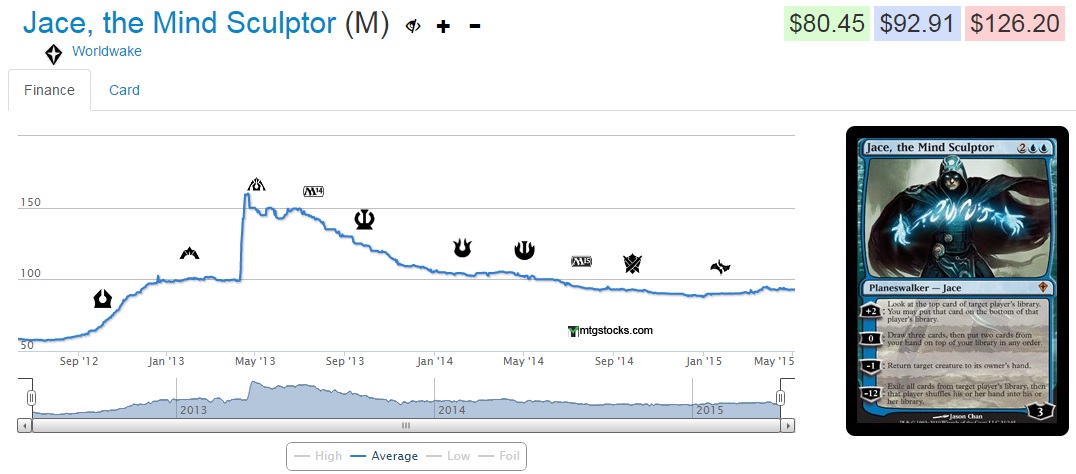
10. Jace, the Mind Sculptor (-1.16%) - Jace is now taking a back seat in many of the Miracle builds because it's a slower way to win the game, and despite the deck often locking the opponent out with Counter-Top, it's often just a blue card to pitch to FoW in some matchups (like Infect). He gets even worse when the metagame is full of cheap taxing counterspells, as it's difficult to resolve a four-drop against decks with a ton of super cheap counter magic.

Jace

Tiny Tuesday- Anafenza Maverick

Are you a Quiet Speculation member?

If not, now is a perfect time to join up! Our powerful tools, breaking-news analysis, and exclusive Discord channel will make sure you stay up to date and ahead of the curve.

Today's list is 100% John McCain approved. If you're not familiar with Legacy Maverick, it's a strategy dedicated to grinding opponents out with green and white cards, with a few extremely powerful metagame choices such as Karakas to shut down Show and Tell/reanimator and Thalia, Guardian of Thraben to capitalize on all of the Brainstorms in the format. Some people mistakenly categorize Maverick as a beatdown deck, but the real story is that nothing is in the deck strictly because it attacks well, though some of the creatures certainly do.

There really aren't enough cards available in Tiny Leaders to make a strong Selesnya Maverick deck, but there is a lot to be gained by going into Abzan. It just so happens that there is an Abzan Tiny Leader that has a random graveyard hosing ability, which give the deck some random percentages against things like Varolz, the Scar-Striped.

There was an error retrieving a chart for Anafenza, the Foremost

One of the big incentives to playing Anafenza is access to Knight of the Reliquary. There are a ton of non-basics that you can play to power up Knight, with the aforementioned Karakas being extremely powerful against some leaders. Tutoring for Wasteland is also quite powerful, and a miser's Gavony Township goes a long way as well.

There was an error retrieving a chart for Knight of the Reliquary

There are a number of other powerful options for tutor-able lands, such as Dark Depths, Thespian's Stage and The Tabernacle at Pendrell Vale, but for the direction that I took the deck these were all omitted. This is my preferred list:
Anafenza Maverick

creatures

1 Saffi Eriksdotter
1 Mother of Runes
1 Deathrite Shaman
1 Dark Confidant
1 Stoneforge Mystic
1 Knight of the Reliquary
1 Birds of Paradise
1 Eternal Witness
1 Den Protector
1 Courser of Kruphix
1 Sin Collector
1 Voice of Resurgence
1 Kitchen Finks
1 Scavenging Ooze
1 Genesis Hydra

spells

1 Bitterblossom
1 Sword of Fire and Ice
1 Sword of Light and Shadow
1 Phyrexian Arena
1 Recurring Nightmare
1 Maelstrom Pulse
1 Abrupt Decay
1 Thoughtseize
1 Abzan Charm
1 Vindicate
1 Green Sun's Zenith
1 Lingering Souls
1 Liliana of the Veil
1 Swords to Plowshares

lands

1 Bayou
1 Overgrown Tomb
1 Scrubland
1 Godless Shrine
1 Temple Garden
1 Savannah
1 Windswept Heath
1 Wooded Foothills
1 Misty Rainforest
1 Verdant Catacombs
1 Marsh Flats
1 Gavony Township
1 Wasteland
1 Command Tower
1 Stirring Wildwood
1 Swamp
1 Forest
1 Plains
1 Dryad Arbor
1 Karakas

The power of this deck lies in the resiliency and the versatility. There are a ton of ways to recycle cards in the graveyard, with Recurring Nightmare + Eternal Witness being an absurd engine, and that's only the plan if the opponent can even survive your initial onslaught of Stoneforge Mystic of Dark Confidant into Anafenza.

The biggest downside to the deck is the mana, and it might even be right to just not run any basics. You'll find yourself losing to some random Blood Moons, but if the deck's mana doesn't otherwise perform, then the downside of being randomly hosed isn't as bad as the downside of the deck just not performing under normal conditions. Notably, there are a few black and white fetchlands currently omitted, and filling them in might just be the play.

Insider: Sorting Out Two Grands Prix – Toronto and Sao Paulo’s T8s

Are you a Quiet Speculation member?

If not, now is a perfect time to join up! Our powerful tools, breaking-news analysis, and exclusive Discord channel will make sure you stay up to date and ahead of the curve.

Though we’ve seen the first version of this format’s “Geist of Saint Traft” deck, or “Restoration Angel” deck, we’ve yet to find that dominant, finished deck we all look back on. -Brad Nelson

Spoiled. That's the only way I can put it. Last weekend, we had no Grands Prix, but this weekend brought us one in Toronto and another in Brazil. There's a wealth of info in that and we'll sort it today. First off, here were the T8s:

Toronto T8:

  • 3 Abzan Midrange (Elspeth maindecked)
  • 2 Bant Megamorph
  • 1 G/W Collected Company
  • 1 Abzan Aggro
  • 1 Mardu Dragons

Contrast that with the much more conventional Sao Paulo T8:

  • 3 Esper Dragons
  • 2 Abzan Aggro
  • 1 R/G Dragons
  • 1 R/G Devotion
  • 1 Monored w/ Atarka's Command

Toronto's T8 is a brewer's paradise, Sao Paulo was a gauntlet from hell

I look at these two T8s and think that the guys from Toronto could get in a lot of good testing from the tuned lists of the Brazilian GP.

Which one was the more evolved GP? I'm inclined to say Toronto, based on the lack of Esper Dragons, Monored or things like Bant Heroic. Dragons were hated out all weekend, leaving zero copies of the marquee control deck in the final cut.

That's not to say that Sao Paulo was a let-down or less competitive or anything like that. It looks like what I'd expect to face down in the final rounds of a PTQ--tuned decks played by solid players. The Devotion deck was the only deviation from the norm and it's not an unexpected deck. People have been powering out Dragonlord Atarka as long as it's been legal.

There was an error retrieving a chart for Dragonlord Atarka

Den Protector is turning the corner in Abzan Midrange

So much of the midgame and lategame with Abzan hinges around getting a little more card advantage. That's why they run a few Whips or pack Elspeth, Sun's Champion to get repeatable board effects.

Den Protector is a stalwart companion to the Rock-style deck, buying back removal even without a Deathmist Raptor around getting cute. I remember Eternal Witness in Extended Rock--you'd play a Thoughtseize and then get it back to slam the opponent again. Similar thing here, though Den Protector is much slower than Witness ever was.

Whether you're trading into Den Protector to hold is a decision based on whether you think Abzan will persist after the summer. The deck loses a great deal of its core, though it keeps Siege Rhino around. That, plus the Bant decks floating around (we'll get to them) mean that Den Protector can have a reasonably long life in Standard after Theros takes its Fleecemane Lions away.

Actions: Even after being hyped up, Den Protector is still up 11% over last week. There are modest gains to be had with the card. Remember that MTGO redemption for DTK starts this week, which should drop the prices on a lot of chase cards. My suggestion: wait two weeks to get your Den Protectors and, by that point, enough redemption will be going on to drop the prices.

There was an error retrieving a chart for Den Protector

Bant Megamorph is the next Dromoka's Command Deck

When the new command cycle was spoiled, Ojutai's Command was brought up as the most like our old friend Cryptic Command. The most playable one has got to be Dromoka's Command, though.

There was an error retrieving a chart for Dromoka's Command

What a machine of unfairness that card is. It's typically a two-for-one and almost never blank.

The Bant Megamorph deck plays a strategy of Den Protector and Deathmist Raptor, creating a lot of value with cards like Courser of Kruphix. Combined with a few counterspells and Ojutai to round things out, the deck had two showings in the T8.

I like the emphasis on Den Protector doing solid card advantage work here, as a second Ojutai seems like such a pain to kill again. I still don't love Deathmist Raptor (who rose about 5% in the past week to $20). That said, this deck is solidly Khans-centric and will live past rotation.

The weakness of this deck is fliers. The objective is to fight with a Deathmist Raptor, but Hexproof often turns that off. There's an outside chance something like a Dragonlord Dromoka is playable here due to lifelink. It's a Baneslayer in the format at the moment. The Bant deck has Disdainful Stroke, Plummet and Glare of Heresy to fight fliers, so the sideboard recognizes its weakness to Ojutai.

Actions: I'm paying particular attention to the mana dudes in this deck. If it survives past Courser and Caryatid rotating (with the hope of Elvish Mystic staying around), then Rattleclaw Mystic is the natural replacement. It's $1.80 right now, so definitely above bulk. Rattleclaw is the best of a slim bunch and people are addicted to Carytids. If Birds of Paradise is in Magic: Origins this summer, Rattleclaw is a junk rare. If it's not, then Rattleclaw will still be an excellent mana accelerant going forward. Stick this on your calendar to revisit after Origins spoilers are complete.

Craig Wescoe's Got a new G/W Brew

Craig did what he does best by bringing a creature-centric Collected Company brew all the way to the T8.

Green-White Collected Company

Creature

4 Den Protector
4 Deathmist Raptor
4 Courser of Kruphix
3 Brimaz, King of Oreskos
4 Fleecemane Lion
3 Seeker of the Way
1 Warden of the First Tree
3 Elvish Mystic

Instant

4 Collected Company
4 Dromoka's Command
2 Valorous Stance

Land

4 Windswept Heath
2 Flooded Strand
5 Plains
7 Forest
4 Temple of Plenty
2 Mana Confluence

Sideboard

2 Valorous Stance
2 Radiant Purge
2 Mastery of the Unseen
3 Arashin Cleric
4 Windstorm
2 Boon Satyr

His plan is simple: play the best 3-drops and find them with Company. While the Dragon decks sling cards like Haven of the Spirit Dragon to go long, he is content with Den Protector rebuying a Company and bringing a Deathmist Raptor back from beyond.

Craig's sideboard gives away his secret: he needs four Windstorm to tackle fliers. The deck looks extraordinarily soft to a Stormbreath Dragon, especially with a little bit of removal along the way to mop up his guys.

In the end, I don't expect this deck to change the metagame. Craig's decks often do best in his hands and sometimes are only correct for one or two events. It's nice to see some interest in Collected Company, though.

Mardu Dragons Looks Awesome

I'm on the hunt for new and interesting decks all the time, ones that have a certain cool quality that semi-casual players crave. Mardu Dragons is the top pick for me right now because it obviously has Dragons in it! It is also uniquely positioned to fight all these Dragons because it has so many Diabolic Edict effects.

Mardu Dragons

Creature

4 Seeker of the Way
2 Soulfire Grand Master
4 Goblin Rabblemaster
4 Thunderbreak Regent
4 Stormbreath Dragon
2 Kolaghan, the Storm's Fury

Sorcery

3 Thoughtseize

Instant

4 Draconic Roar
4 Crackling Doom
2 Foul-Tongue Invocation
1 Kolaghan's Command
1 Murderous Cut

Land

2 Haven of the Spirit Dragon
4 Bloodstained Mire
3 Temple of Triumph
1 Temple of Malice
1 Temple of Silence
4 Caves of Koilos
2 Battlefield Forge
3 Mountain
1 Swamp
4 Nomad Outpost

Sideboard

1 Thoughtseize
1 Kolaghan's Command
2 Read the Bones
2 Outpost Siege
2 Crux of Fate
4 Anger of the Gods
1 Mastery of the Unseen
1 Dragonlord Kolaghan
1 Elspeth, Sun's Champion

In the next few weeks, we'll be asking ourselves whether we want to dragon-charge Silumgar's Scorn or Draconic Roar. This deck gives a fascinating chance for the latter. With so much cheap removal, the deck can handle the mono-red aggro decks better. Its Roars can kill Den Protectors and Raptors. It can go over the top very quickly. It even has Soulfire Grand Master for long-shot "oops recursive burn" plans.

Actions: It's no mistake that this deck got so far and I think Crackling Doom was the reason why. This $1 rare from Khans is deadly potent against all manner of Dragons and Siege Rhinos. Mardu has been looking for a shot and cards like Thunderbreak Regent and Roar are giving it that critical mass. This is also really important: the deck is Khans-centric, so it will retain most of its devastating elements after rotation. I'm calling Crackling Doom as a phenomenal and underpriced card and I'll be picking up a few sets myself.

There was an error retrieving a chart for Crackling Doom

Elspeth has a had a very good week

The on-again, off-again Planeswalker has put up great results at both Grands Prix. At PT: DTK, she made the jump into Abzan Midrange's maindeck. Last week, she was almost nowhere to be seen. She's in the maindecks or sideboards of a great deal of the format at this point. I attribute that to the grinding nature of the game right now. Den Protector and Haven are fueling long games and that makes a repeatable ability great. Further, Hero's Downfall is being trimmed out of decks for Foul-Tongue Invocation. It's absolutely the right card to stake your late game on for the next few weeks.

Actions: Elspeth is a Theros card and rotates soon. It's such a drag to see a staple card like this have a great week and then know that she'll be gone in a few months. It's not cheap to pick up by any stretch right now, either. My best advice is to trade yours away for good long-term value and don't pick one up that you're not willing to flip soon.

Quick Hits

Since GP: Sao Paulo was a much more traditional T8, I'll be including it in the Quick Hits section.

  • PVDDR's Esper deck had Ashiok, Nightmare Weaver for the mirror, but Monastery Mentor was a 4x maindecked card in another Esper Dragons deck - and it gave PV fits to deal with. Ashiok proved up due to being hard to kill, but its financial lifespan is almost over.
  • Stratus Dancer is playing a very minor role in Esper Dragons off the sideboard.
  • This was Foul-Tongue Invocation's week. I was impressed that people would pay 2B for the effect, and it makes me look at Self-Inflicted Wound as a great standout sideboard piece of tech.
  • Esper Dragons players should be praying for good mana in the next block. Temples and painlands will go, making an already-miserable manabase even worse.
  • Nobody brought Mike Flores' 5c Dragons deck to the T8, which is a bummer. That deck looks cool.
  • This was not a great week for Ugin, with only two copies floating around.

I'll see you again next week. If something happens, you'll read about it here.

-Doug


Matchups and Win Rates: Top Tier Decks (Part 1)

Are you a Quiet Speculation member?

If not, now is a perfect time to join up! Our powerful tools, breaking-news analysis, and exclusive Discord channel will make sure you stay up to date and ahead of the curve.

One of the more frustrating limitations of Wizards-published dailies is the lack of matchup information. You get lists, you get standings, you get win percentages, but you don't actually know which decks beat which decks en route to their finish. This is fine if you just want to describe the Modern metagame, but far less helpful if you are actually trying to figure out what decks are good. That's where the "MTGO Deep Dive" dataset comes in. I've focused on this project (recording dailies from the client in their entirety) in two of my last articles, the first showing overall match win percentages (MWPs) for different top decks, and the second highlighting some overperforming decks that were not necessarily top-tier. Now it's time to take the analysis one step further and see how decks matchup against each other. Is Abzan truly strong against Twin? Is Affinity vs. Burn just a race? The data will give us some answer to these questions and more.

AD Resized

This article uses the MTGO Deep Dive dataset to get the win rates of different decks in different matchups. This is very much in line with a similar analysis done by reddit user dafrk3in, who calculated matchups using data from Pro Tour Fate Reforged. Using data from MTGO, I run a similar analysis of matchups in our current March-April metagame. In the interest of space and of only presenting reliable results, I'm only going to discuss matchups among the top decks of MTGO. These decks are both pillars of Modern and have suitably high Ns for us to make conclusions from. This analysis will give us a sense as to how decks succeed or fail against each other, and how that knowledge can be used to make informed decisions going into events.

[wp_ad_camp_1]


Dataset and Methods

As in past articles, I'm using the so-called MTGO Deep Dive dataset I used in my last two articles. This project is the result of collaboration between me and a few other MTG friends from the MTGSalvation community. In essence, it's a set of 16 dailies recorded in their entirety. It includes not just the 4-0/3-1 matches we see online, but also the 2-2 or worse finishes that do not get published. And, of course, it also includes the matchups between decks. Although 16 may seem like a small N, these events span dozens of decks, hundreds of players, and thousands of games. The end result is a wealth of matchup data we can use to calculate the "true" MWPs of various decks in Modern.

In calculating MWPs, I have already adjusted for all byes, mirror matches, drops, draws, and other elements that could affect the accuracy of an MWP. This applies both to the overall MWP of any given deck, but also its MWP in relation to another matchup. All overall MWPs have also been compared to the "average" MWP of all MTGO decks in the sample, a weighted average that is also adjusted for all those elements above. Based on their values relative to the average, all deck MWPs receive a P value to indicate whether it is likely or unlikely to be an above average deck. A high P value (>.1) would indicate the deck is probably within expected variance and not truly above or below average. A low P value (< .1) starts to suggest a deck is above or below the average MTGO performance.

Finally, as is always the case with statistics in these articles, all other data disclaimers about the perils and pitfalls of statistics apply!

Matchups and Win Rates: Top-Tier decks

Today's article focuses on the top-tier decks of MTGO as defined and shown on the Top Decks page. For each deck, I give its prevalence in both the Top Decks and Deep Dive datasets, along with its overall MWP and the the significance of that MWP. After that, it's all matchup win-loss rates for the different top-tier decks. I'll end each section with some summary of the stats and takeaways I view as important.

It is important to NOT use these numbers as set-in-stone benchmarks for matchups. Rather, they should be checked against your own testing and game experience to see how they can confirm or challenge your own conclusions. This is the mix of quantitative and qualitative methods we want to see when looking at this kind of data. Remember: a lot of these MWPs could well be higher or lower than the "true" MWP if we had a much larger N, so we need to view this as a starting point rather than an ending one. Some of these numbers will make perfect sense (e.g. UR Twin vs. Grixis Delver). Others seem odd and demand further investigation (e.g. UR Twin vs. Abzan). Either way, it is up to us to interpret the data, not to just categorically accept or reject it based on a few datapoints.

As one last point of reference, the average MTGO-wide MWP is 49.25%. Use this as a point of reference when thinking about the different decks below.

Deceiver ExarchUR Twin

  • Top Decks prevalence: 8.1%
  • Deep Dive prevalence: 8% (76)
    Deep Dive matches: 242
  • MWP: 52.1% (p=.38)

vs. Abzan: 75% (6/8)
vs. Affinity: 58.3% (14/24)
vs. Burn: 50% (16/32)
vs. Jund: 50% (4/8)
vs. Amulet Bloom: 36.4% (4/11)
vs. Grixis Delver: 18.8% (3/16)

Twin has been called Modern's best deck, and although there is reason to suspect that is true, we don't really see it in the numbers. I think this is due in large part to the popularity of Twin. It's the third most-played deck on MTGO, but it's also the most expensive of the top three decks. This suggests you have players gravitating towards Twin just because they think it is "good", not because it is cheap (i.e. Burn) or the hot new thing (i.e. Grixis Delver). This is why Twin's MWP of 52.1% is probably lower than it would otherwise be in the hands of a skilled pilot. Moreso than Burn or Grixis Delver, Twin rewards tight play and punishes bad pilots, which explains why Twin's MWP is one of the lowest of the top-tier decks (while still being above average).

As for matchups, I am surprised the Abzan matchup is so heavily in Twin's favor. To me, this suggests player inexperience more than any other result: Twin is by no means a "good" Abzan matchup, but it's also not quite this bad. The Grixis Delver MWP is very interesting, because if true, it would go a long way to explaining why Grixis Delver is so successful right now on MTGO. The rest are about expected, although I was curious to see such an even Burn matchup. My guess is Burn wins this in any game where Twin is on the draw or misses the turn 4 combo, and Twin wins on the play and if it can go Exarch/Twin on t3/t4.

Eidolon of the Great RevelBurn

  • Top Decks prevalence: 9%
  • Deep Dive prevalence: 10.4% (99)
    Deep Dive matches: 299
  • MWP: 53.9% (p=.11)

vs. Abzan: 63.6% (14/22)
vs. Affinity: 50% (13/26)
vs. Jund: 28.6% (4/14)
vs. UR Twin: 50% (16/32)
vs. Amulet Bloom: 36.4% (4/11)
vs. Grixis Delver: 81.8% (9/11)

Twin may be Modern's "best" deck, but Burn is its most-played. It's prevalence is actually higher in the Deep Dive dataset than the Top Decks one, which suggests there is even more Burn out there online than we see on public dailies. That said, the Deep Dive also shows Burn might have more going for it than just prevalence. With a P of .11 on its 53.9% MWP, Burn is actually pushing the upper edge of the expected variance of MTGO MWPs. Indeed, of all the tier 1 decks, Burn is the only deck that gets this close (although not quite making it). So Burn isn't just popular: it's also very strong. This makes sense to me because Burn is so dang linear, which is going to give you a lot of random wins against opponents who are too slow or too interactive.

Turning to matchups, neither the Abzan, Twin, or Affinity matchup should surprise anyone: the latter two are a race and the first is the matchup that put Burn on the map to begin with. I am very interested by Burn's apparent strength against Grixis Delver and weakness against Jund, two decks rising up for very different reasons. We know two big reasons for Jund seeing more play are because it is less painful than Abzan (thanks, Blackcleave Cliffs) and because it can use Lightning Bolt to stave off early threats. As for Grixis Delver, this also makes a lot of sense. Terminate is just awful against Burn, Gitaxian Probe is often free damage, and the deck has lots of fetches/shocks with no lifegain. So these are two more numbers supported by our theoretical understanding of the matchups.

Cranial PlatingAffinity

  • Top Decks prevalence: 6.9%
  • Deep Dive prevalence: 7.7% (73)
    Deep Dive matches: 220
  • MWP: 52.7% (p=.31)

vs. Abzan: 40% (4/10)
vs. Burn: 50% (13/26)
vs. Jund: 60% (3/5)
vs. UR Twin: 41.7% (10/24)
vs. Amulet Bloom: 50% (4/8)
vs. Grixis Delver: 37.5% (6/16)

Like both Twin and Burn, Affinity does push the upper edge of the MWP range, but not with any degree of significance. And like Burn, the true prevalence of Affinity might be higher than the observed prevalence in the published dailies, which makes sense given the enduring popularity of Affinity in Modern. When I look at matchups, almost all the numbers above are in line with our expectations. Abzan is rough because of Stony Silence, and although 10 matches isn't the big N I would like to see, 40/60 seems about right for this matchup given all the factors. Burn makes perfect sense as a straight up 50/50 race, and Twin seems right at about 40/60 due to the dual pressures of efficient red removal (including the powerful Electrolyze) and a combo finish Affinity can't interact with in game 1 short of 3-4 Galvanic Blast. Of course, the Grixis Delver matchup is the most interesting, because it suggests a further reason as to why Grixis Delver is doing so well in this current metagame. Not only is the deck beating Twin, but it's also killing it against Affinity. This also makes sense from a theoretical perspective: Affinity would definitely struggle with the efficient removal of Grixis Delver, the efficient countermagic to stop cards like Plating/Thoughtcast, and fast and durable clocks they can't kill. This would only get worse in games 2/3 after Grixis Delver brought in anti-artifact effects.

Siege RhinoAbzan

  • Top Decks prevalence: 4.9%
  • Deep Dive prevalence: 5.2% (49)
    Deep Dive matches: 152
  • MWP: 53.3% (p=.324)

vs. Affinity: 60% (6/10)
vs. Burn: 36.4% (8/22)
vs. Jund: 71.4% (5/7)
vs. UR Twin: 25% (2/8)
vs. Amulet Bloom: 80% (4/5)
vs. Grixis Delver: 90% (9/10)

To me, the most interesting Abzan fact is not the win rates, but rather the metagame share. This deck has completely tanked across MTGO, a trend shared in paper but not nearly to the same extent. How did a deck that was 25% of the recent PT fall down to about 5% of the MTGO metagame in less than 3 months? The MWP doesn't explain it. 53.3% is at the upper end of top-tier deck performance, and although it's not quite statistically significant, it's still exactly where the so-called 50-50 "police deck" of Modern should be performing. So why is Abzan's share dropping if its overall performance is basically fine?

The matchup data gives us two possible explanations for this. The first is Burn. Burn is rampant on MTGO, and you don't want to be the deck with a bad Burn matchup. You also don't want to be spending about $2000 on a deck that has a bad Burn matchup either. It gets even worse when you are losing to Twin, a deck Abzan is supposed to beat. To be fair, I don't think the actual matchup between Twin/Abzan is this lopsided. Yes, there are reasons to believe Twin is actually favored in this matchup (or it is close to even), but this number doesn't make a lot of sense. Even so, assuming Abzan's true Twin matchup is closer to 40/60 or 50/50, that's still not enough to buoy a crappy Burn matchup. About the only saving grace for Abzan is its Grixis Delver matchup, which is exactly what we would expect of a BGx deck against a Delver deck. This number just has to be overrepresented, but even if it's just a 60/40 or 70/30 matchup, that's a big boost in Abzan's favor.

Huntmaster of the FellsJund

  • Top Decks prevalence: 3.6%
  • Deep Dive prevalence: 3.6% (34)
    Deep Dive matches: 115
  • MWP: 52.2% (p=.54)

vs. Abzan: 29% (2/7)
vs. Affinity:
 40% (2/5)
vs. Burn: 71.4% (10/14)
vs. UR Twin: 50% (4/8)
vs. Amulet Bloom:  66% (4/6)
vs. Grixis Delver: 50% (4/8)

As Abzan has fallen across Modern, Jund has gradually risen to take its place. Jund went from basically 0% at the time of the TC banning to about 4%-5% of paper and MTGO. The current MTGO prevalence is a little lower now than before, but Jund is still a very viable deck that is showing up everywhere. Indeed, it's getting the tier 1 bump in this most recent metagame update, and these MTGO stats give some explanation about why. From an MWP perspective, Jund is pretty average for the top-tier decks, which suggests it's not the overall deck MWP driving its rise. To see where Jund is successful, we need to look at matchups.

Our N is a bit small for some of these matchups, so I am hesitant to draw strong conclusions from much of this data. Two exceptions to this are Abzan and Burn. It makes a lot of sense Jund is weak to Abzan: Jund can't do anything about Spirit swarms, Path gives Abzan the midrange edge, and Bolt isn't very useful as removal. Dark Confidant is an easy way to improve this matchup, and my guess is if we controlled for Jund decks running Bob and those not running it, we would see bad Abzan matchups mostly in Bobless decks. But Bob himself is at odds with Jund's best matchup: Burn. I think this is one of the big reasons the deck is enjoying success these days, for similar reasons as to why Abzan is declining. A less painful manabase and Bolt go a long way to keeping Burn at bay. Expect to see more Jund as the format keeps evolving, based largely on this Burn matchup.

amuletAmulet Bloom

  • Top Decks prevalence: 4.1%
  • Deep Dive prevalence: 3.3% (31)
    Deep Dive matches: 104
  • MWP: 60.6% (p=.03**)

vs. Abzan: 20% (1/5)
vs. Affinity:
 50% (4/8) 
vs. Burn: 63.6% (7/11)
vs. Jund: 33% (2/6)
vs. UR Twin: 63.6% (7/11)
vs. Grixis Delver: 71.4% (5/7)

I don't really care too much about these specific matchups. The positive Twin matchup is nice, the unfavorable Abzan/Jund matchup makes sense (but seems overstated based on my own experience with the decks), and the strong Grixis Delver/Burn matchups are totally in line with Amulet Bloom's gameplan. But again, the most interesting data here is not in the matchup section. The real takeaway is that MWP and its corresponding P value. Of every deck in the dataset, Amulet Bloom is the only deck with more than 20 matches to have a P value so low. The .03 means it is 97% likely that Amulet Bloom has an MWP truly above average relative to the average MTGO performance. And boy, is it above average! 60% is well over the 49% average and even the expected variance. It's also well over what other decks are doing. Yes, this data has a lot of limitations, both statistical (e.g. the size of N) and contextual (e.g. it's MTGO data). But this MWP is still so far above and beyond other MWPs that it's impossible to ignore. If someone were to ask what the best deck in Modern is, I'd probably have to say Amulet Bloom. We had reasons to suspect this in the past, and this is yet another datapoint confirming the theory. This still leads to questions about its relatively small metagame share if its MWP is so high, but those questions don't undercut the MWP and its significance.

TasigurGrixis Delver

  • Top Decks prevalence: 8.4%
  • Deep Dive prevalence: 7.2% (68)
    Deep Dive matches: 213
  • MWP: 48.4% (p=.79)

vs. Abzan: 10% (1/10)
vs. Affinity:
63.5% (10/16)
vs. Burn: 18.2% (2/11)
vs. Jund: 50% (4/8)
vs. UR Twin: 81.2% (13/16)
vs. Amulet Bloom: 28.5% (2/7)

I could write a whole article on how awesome this deck is. Oh wait... Grixis Delver is one of Modern's hottest new decks and these stats give some context to its rise. The prevalence is obviously striking: this is a deck that went from 0% to 7%-8% in about 2-3 months without a single pro player or major paper event driving that rise. This is an MTGO community special, developed more or less independently by players across the community. This homespun approach is reflected in the MWP, which is solidly average and one of the lowest of all the different top-tier deck MWPs. To me, this is expected behavior. For one, there is no established Grixis Delver baseline list for players to use. Two, because the deck has such a flavor-of-the-month feel, lots of players are picking it up without necessarily much experience. Both of these factors will bring down the deck's "true" MWP.

Grixis Delver's matchups are probably the most interesting of all the different matchups we have seen so far. If you want to know why the deck is successful, look no further than the Affinity and Twin matchup. Beating Affinity is good, but absolutely trouncing Twin is something special. Few decks can do this, and I think this is a huge reason for Grixis Delver's success and popularity. By contrast, the Abzan and Burn matchups are just terrible, which presents an odd metagame tension when deciding whether or not to play this deck. When comparing these quantitative measures to our qualitative theories for why Grixis Delver might be good or bad, we see a lot of overlap. For example, the deck's disruption is awesome against Twin and Affinity but (with the exception of Terminate) totally underwhelming against Abzan and just plain bad against Burn. Although I think all of these numbers are on the higher end of their actual range, their general thrust is about accurate, so you can adjust them by +/- 10% or so and probably be closer to accurate.

Next Steps

For all you MTGO and Modern regulars, you are probably wondering about decks like Merfolk, Scapeshift, RG Tron, and other decks we would expect to see matchup data about. I'll discuss these matchups, and some additional takeaways from today's article, when I revisit the Deep Dive dataset next week. Just considering the numbers today, I can't emphasize enough that these are not immovable benchmarks. We should not read these numbers and say "Grixis Delver has an 80% win rate against Twin". That's both a misuse of the dataset and a misunderstanding of how Modern matchups work. Rather, we should say "Grixis Delver seems strongly favored in Twin. What are some interactions and cards that could explain this on both sides of the table? Does this line up with my experience with the decks?" This is the way to use matchup data like we looked at today.

Join me on Wednesday when I give some metagame updates and talk about some new changes coming to the Top Decks page. Until then, enjoy those new MM2015 previews (Noble Hierarch confirmed at RARE!!).

Deck Overview- Standard Naya Heroic

Are you a Quiet Speculation member?

If not, now is a perfect time to join up! Our powerful tools, breaking-news analysis, and exclusive Discord channel will make sure you stay up to date and ahead of the curve.

With two Standard GPs and an SCG Open, there were a lot of sweet decks to look through for this weekend's results. The one that caught my eye more than most was James Wray's Naya Heroic deck, which he used to 9-0 day 1 of GP Toronto.

Naya Heroic

creatures

4 Satyr Hoplite
4 Lagonna-Band Trailblazer
4 Favored Hoplite

spells

3 Titan's Strength
3 Ajani's Presence
4 Dromoka's Command
4 Defiant Strike
4 Gods Willing
2 Warriors' Lesson
3 Temur Battle Rage
2 Become Immense
1 Center Soul
2 Ordeal of Heliod

lands

1 Forest
2 Plains
4 Battlefield Forge
4 Mana Confluence
3 Temple of Triumph
3 Windswept Heath
3 Temple of Plenty

sideboard

2 Ordeal of Heliod
3 Aegis of the Gods
2 Valorous Stance
2 Mortal's Ardor
3 Myth Realized
3 Xenagos, the Reveler

Wray was only able to win two matches on day 2 after an amazing start, which is unfortunate, though 38th at a GP is a pretty good result. Regardless of the final result, there are some very interesting strategic choices in this build of heroic.

The first thing that I noticed was that not having Ordeal of Thassa or Treasure Cruise makes it more difficult to win long games. This downside is addressed by the way that Wray designed the deck's curve. All 12 creatures in the deck cost 1. The idea here is to get the opponent dead fast.

Become Immense and Temur Battle Rage are also great ways for the deck to make high-impact plays without really caring about card advantage. Access to Dromoka's Command is also extremely important, as outside of potentially Ordeal of Thassa it's the most high-impact and flexible card available to heroic strategies.

There was an error retrieving a chart for Dromoka's Command

Myth Realized is some pretty good tech out of the sideboard, and it's a plan that I like a lot against control decks. It's technically a one-drop, so it plays on-pace with the rest of the deck, and it enables you to build up one creature against control until they inevitably cast Crux of Fate/End Hostilities and then you get to clock them with your enchantment that had just been hanging out to that point.

There was an error retrieving a chart for Myth Realized

Insider: Qualifying at the RPTQ

Are you a Quiet Speculation member?

If not, now is a perfect time to join up! Our powerful tools, breaking-news analysis, and exclusive Discord channel will make sure you stay up to date and ahead of the curve.

The Thursday night before the Regional PTQ in Lenexa, Kansas I found myself trying to get some matches in on MTGO. The Esper Dragons deck was popping up everywhere, and my testing had not yet accounted for the new kid on the block. Despite most of the rest of the world discounting the choice, I was still battling with my Chromanticore deck.

Chromanticore Delve

Creatures

2 Tasigur, the Golden Fang
4 Satyr Wayfinder
4 Soulflayer
4 Sylvan Caryatid
4 Chromanticore
4 Sagu Mauler

Spells

4 Murderous Cut
4 Commune with the Gods
4 Tormenting Voice
2 Sultai Charm

Lands

2 Forest
2 Mountain
2 Swamp
1 Island
1 Polluted Delta
1 Bloodstained Mire
4 Mana Confluence
4 Opulent Palace
2 Sandsteppe Citadel
4 Wooded Foothills
1 Urborg, Tomb of Yawgmoth

Sideboard

4 Thoughtseize
4 Drown in Sorrow
1 Bile Blight
2 Ultimate Price
3 Flamewake Phoenix
1 Torrent Elemental

I played three 8-mans that night, and lost all of them in Round 1. Two of these matches were against Esper Dragons. There was a time in my Magic career when this result would tilt me right off the deck. I was mulliganing a bunch and losing to the de facto best deck, which in practice played dramatically different from the control matchups that I had solved.

I've audibled enough in my life to know that the night before I jumped in the car was too late to end up on a different good deck. The best that I could do was play with the flex slots in the deck I had prepared with.

Sultai Charm no longer made a ton of sense in the maindeck with Whisperwood Elemental on the decline. The best plan that I could come up with was to maindeck two Thoughtseize to make my game one better against control and toss a couple Duress in the sideboard to enhance this plan in a three-game match.

Updated Chromanticore Delve

Creatures

2 Tasigur, the Golden Fang
4 Satyr Wayfinder
4 Soulflayer
4 Sylvan Caryatid
4 Chromanticore
4 Sagu Mauler

Spells

4 Murderous Cut
4 Commune with the Gods
4 Tormenting Voice
2 Thoughtseize

Lands

2 Forest
2 Mountain
2 Swamp
3 Bloodstained Mire
4 Mana Confluence
4 Opulent Palace
2 Sandsteppe Citadel
4 Wooded Foothills
1 Urborg, Tomb of Yawgmoth

Sideboard

2 Thoughtseize
2 Duress
4 Drown in Sorrow
1 Bile Blight
2 Ultimate Price
3 Flamewake Phoenix
1 Torrent Elemental

Rather than test the changes, I got some sleep so that I could be a good carmate, and possibly do some of the driving. It's important to not just leach off of your car, but to contribute positively to the trip. Being on a good sleep schedule is also extremely important.

While the changes that I made were untested, I had played the portion of the deck that remained unchanged so much that I wasn't too worried--even in light of my Thursday night beatings. This was the deck that I had won my PPTQ with, the deck that I scooped up random QPs with in my down time, and the deck that I was 70-80% with across several months of live events. I channeled the timeless lesson of Tomfidence and made my way to Lenexa.

Speck

Friday morning Jon Puffer and Nic Balega picked me up from my apartment bright and early to make the seven hour drive to Lenexa. I had met both at events but this was my first time traveling with them. Getting into a car with people you've never traveled with for the first time can be a little nerve racking, but they're good guys and unlike my regular travel mates I was hearing all of their stories for the first time. You can never have too many friends.

Friday consisted of receiving very poor customer service from both our hotel and the bar next to the event site. On top of that, Jon snores like a dying bear and Nic is a blanket hog. If not for melatonin, I wouldn't have gotten any sleep at all.

On our way to the site Saturday morning I picked up a NOS energy drink which I nursed between rounds so as not to take in too much of...literally any of the ingredients in a NOS energy drink at one time.

Named for the consumer's inability to distinguish the taste from that of the puddles of fluid in their garage.
Named so for consumer's inability to distinguish the taste from the puddles of liquid in their garage.

The Tournament

With 71 players in attendance, that meant that seven rounds of swiss and a Top 8 match stood between me and a PT invite. Jason Schousboe sacked into the bye in round one, while I started battling it out.

Round 1 vs. G/R Devotion

Remember how I said that there were fewer Whisperwood Elementals in Standard? Well, my Round 1 opponent was likely packing four. Thoughtseize is great in these matchups though, and the Ultimate Prices in the board make a huge difference. This matchup is quite favorable, and outside of them casting a couple unanswered Whisperwood Elementals there's not much they can do if the Chromanticore deck is performing.

My opponent had at least two copies of Ugin, the Spirit Dragon, which is kind of a problem. Thoughtseize helped me play around Ugin in meaningful ways though, and I came out on top of a resolved Ugin in one of the games. Morphing Sagu Mauler gives you a huge edge against potential Ugins.

2-1
1-0

Round 2 vs. Esper Dragons

After winning game one of this match I was feeling very good, but then I lost both sideboard games, in which I'm supposed to get a lot better in the matchup. Ultimately, what the match came down to was how I sequenced Duress and Thoughtseize.

There was an error retrieving a chart for Thoughtseize

Going into the match I thought that I wanted to Thoughtseize first, because if they had a dragon and I took it I would turn off any Silumgar's Scorns.

The reality of the matter is that sometimes the first discard spell just takes something crappy like an Anticipate to slow them down, while the later discard spells are needed to hit actual gas. The deck leans so heavily on Dragonlord Ojutai that it's imperative that Thoughtseize hits this card, and waiting as long as possible to play the discard spell that hits creatures will have the highest upside.

1-2
1-1

Round 3 vs. Abzan Aggro

Abzan Aggro is among my deck's best matchups, as they have all the Abzan-y things that I don't really care about in Fleecemane Lion and Siege Rhino with none or fewer of the backbreaking cards like Elspeth, Sun's Champion and End Hostilities. Anafenza, the Foremost is a problem, but milling gas before it comes in and/or Murderous Cut make that kind of a wash.

2-1
2-1

Round 4 vs. Esper Dragons

Once again I win game one, leveraging the fact that my opponent's maindeck is likely out of Crux of Fate after he cast the second copy, leaving me only to worry about Foul-Tongue Invocation. I was pretty convincingly destroyed in game two, and game three largely came down to luck.

We both mulliganed, and my manabase consisted of more Sylvan Caryatids than lands for the duration of the game. If either of my opponent's Dig Through Times yielded a Crux of Fate, I would probably just lose. There's not much to say here. Sometimes you run good.

2-1
3-1

There was an error retrieving a chart for Dig Through Time

Round 5 vs. Abzan Control

Abzan Control is tougher than Aggro, but still favorable. I kept a one-lander on the draw in game one that was great if I saw a second land quickly. I didn't and I died. Games two and three went much more the way that I would script them, and I took the match. The bottom line is that Sagu Mauler is larger than Siege Rhino.

There was an error retrieving a chart for Sagu Mauler

2-1
4-1

Round 6 vs. Atarka Red

Game one is rough, because you're playing a Standard deck against Mono-Red. In games two and three I came out of the gates just as fast or faster than my opponent, and never fell below 15 life. The green dorks are great at blocking here, the removal out of the board is great, and Chromanticore is often unbeatable even without hexproof.

2-1
5-1

Round 7 ID vs. U/W Control

In round seven I drew with Ryan Hipp, who was playing a wonky blue-white deck with Monastery Mentor, Secure the Wastes, Brimaz, King of Oreskos, Dragonlord Ojutai, and Elspeth, Sun's Champion as win conditions. I'm not sure how the matchup would have played out, but more importantly Hipp's deck isn't exactly something that you can expect to play against.

There was an error retrieving a chart for Secure the Wastes

5-1-1

Top 8 vs. Mono-Red

I know that my opponent is Mono-Red, and by virtue of seeding, I get to play first. I keep this hand (or something close) in game one:

This hand is on the weak side, but when you have this hand, the best possible scenario is that your opponent is playing Mono-Red. Wayfinder trades for a lot of stuff, and you have a decent chance of setting up an early Chromantiflayer, which if you succeed in doing you just can't lose.

I stumbled a little in game one, but more importantly my opponent missed his second land drop for a while, and I snuck out with a win, which left me feeling very confident. In game two I got straight run over, and never really had a shot.

Game three was a clinic both on my deck performing and my opponent's deck not performing. Once again, he stumbled on lands, but either way I had an early Drown in Sorrow which I soon followed up with a Chromanticore, which ended up exiled with a Soulflayer immediately after it died. At this point in time, losing wasn't a possible outcome.

2-1
6-1-1 and q'd for Pro Tour Origins!

Going Forward

The decklists have been published, and people still likely won't view Soulmanticore as a "real" deck. That's fine. This article isn't for the closed-minded. I win with this deck a ton, and I believe that if the flex slots are tuned correctly that it can win in any metagame.

Esper Dragons is definitely the scariest boogeyman to date, and if I were picking up Soulmanticore for the first time I would make sure that I understood what was important and how to play this matchup.

Their cards that matter are Ojutai and Foul-Tongue Invocation, with Crux of Fate being strong, but much less important than the other two. Phoenix beatdown and Torrent Elemental help you keep up on cards, though Thoughtseize is your most important weapon.

There was an error retrieving a chart for Flamewake Phoenix

I like where the maindeck is at right now, though it's probably true that a copy or two of Hero's Downfall belong on the sideboard. Even with Ojutai being the card that Dragons plays for, you still want to board Murderous Cut out against them due to it being dead so often. Downfall at least kills random Ashioks and Ugins. As of this writing, I'd turn the Ultimate Prices into Downfalls and call it a day.

There was an error retrieving a chart for Hero's Downfall

Major props to everybody who has supported me over the past year as my results have gotten more consistent. I finally no longer feel like I peaked at Magic in college. Biggest thanks to Dan Skoglund for being the only person dumb enough to play my deck regularly and being a great partner to bounce ideas around with. Props to my girlfriend Kari for supporting me in my pursuit of extreme nerdage, and to Nic and Jon for being fun travel partners.

Slops: Dragonlord Ojutai

Thanks for reading!

-Ryan Overturf
@RyanOverdrive on Twitter

Speck

Want Prices?

Browse thousands of prices with the first and most comprehensive MTG Finance tool around.


Trader Tools lists both buylist and retail prices for every MTG card, going back a decade.

Quiet Speculation