menu

Insider: The Puzzling Case of the Diverging Prices – Determining If Doomwake Giant Is Due for a Correction in Paper

Are you a Quiet Speculation member?

If not, now is a perfect time to join up! Our powerful tools, breaking-news analysis, and exclusive Discord channel will make sure you stay up to date and ahead of the curve.

Greetings, Extrapolators!

Sure does feel good to identify a price discrepancy, doesn't it?

What Feels Even Better

What feels even better is seeing someone else identify a price discrepancy and share it with you. I don't really put in enough hours analyzing all possible data to catch everything, and when a deck is not on coverage a ton, it's easy to forget about the need to track the prices. But MODO and paper have different metagames, don't they? Luckily, people in this community are super sharp and on the ball. That sounds like a dangerous place for someone sharp to be, but it appears to be working out okay so far.

Untitled


This is a pretty huge discrepancy for sure. We've talked about the difference between MODO and paper prices and how a price jump in MODO is likely to be followed by a price jump in paper if you control for other variables. There are several reasons for the "lag" in between the two prices moving and why MODO is sometimes a good herald of things to come in paper.

MODO Never Sleeps

While there is usually a week between Standard tournaments with the events being held on the weekends and analysis and punditry filling the intervening days until the next event, MODO fires a lot more events a lot faster. With dailies occurring, well, daily, small bits of tech can proliferate much faster. Daily events may seem small, but with pro players and other notable deck brewers innovating and showing off their tech every day, MODO moves a lot faster.

Not only that, multiple events in a week will showcase how everyone is adapting to the metagame better than paper events where players may show up with decks that are ill-equipped to deal with last week's decks. While MODO certainly informs the paper meta, paper still moves slower. If you showed up perfectly tuned to beat the next new thing on MODO at the expense of losing to the deck that got Top 8 at a PTQ last weekend, how well do you think you will do? Metagaming is tough, and paying more attention than everyone else doesn't always guarantee good results. With the paper meta updating slower, it's no wonder prices can lag behind the MODO prices sometimes.

But lagging behind means they will usually follow the same trend. If the MODO price is ticking up, paper will tick up, but maybe at a faster rate (as people notice there is a big discrepancy and a buyout happens) a few days or weeks behind. That just makes sense. Prices are sticky in paper because selling is not quite as efficient as it is on MODO, so price decreases on MODO are much faster as well.

While TCG Player sellers aren't in a gigantic hurry to race to the bottom and they encounter few buyers when the price is decreasing because that is tied to a decrease in demand, selling out of MODO cards is as quick and easy as going to a bot. The cards are gone immediately with no waiting for funds to clear, no shipping costs and no delay while the order is processed and shipped.

Cards are conveyed instantaneously which means cards tailing down on MODO will tail more quickly on MODO. A precipitous MODO decline can be, but isn't always, a harbinger of a decline in paper prices due to the stickiness of paper pricing and the many disparate sellers, but it can herald a decrease in demand, which is useful for people who buylist as an out and can expect to see an increase in the spread when buylists lower their prices.

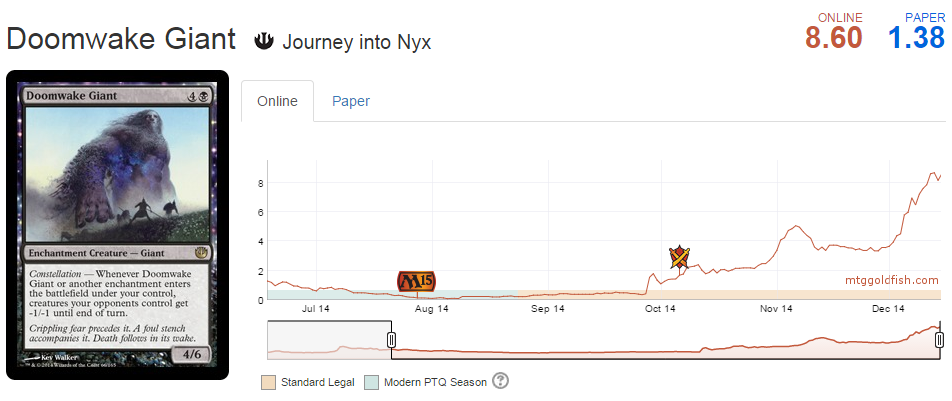
All of that helps illustrate the fact that we should see the prices travel in the same direction. What, then, do we make of the case we see now with Doomwake Giant?
Untitled

Untitled

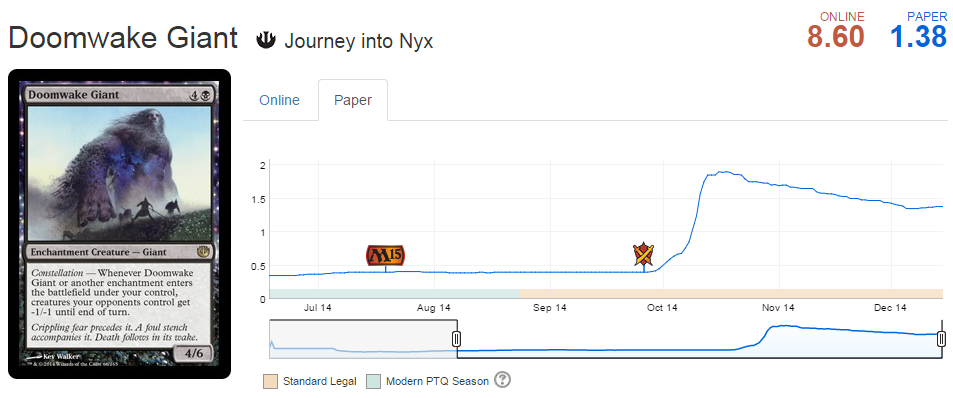
There are two important things to note here. The first one is the obvious one.

Untitled

Yep. That's a discrepancy all right. With the MODO card costing six times as much as the paper copy when MODO cards are typically cheaper, this looks like a card poised to go up.

But we're not seeing exactly what we're used to, looking at the graphs, are we? Let's look at another example of where a paper card rose to catch up to a soaring MODO price and what those graphs looked like side by side.
Untitled

Untitled

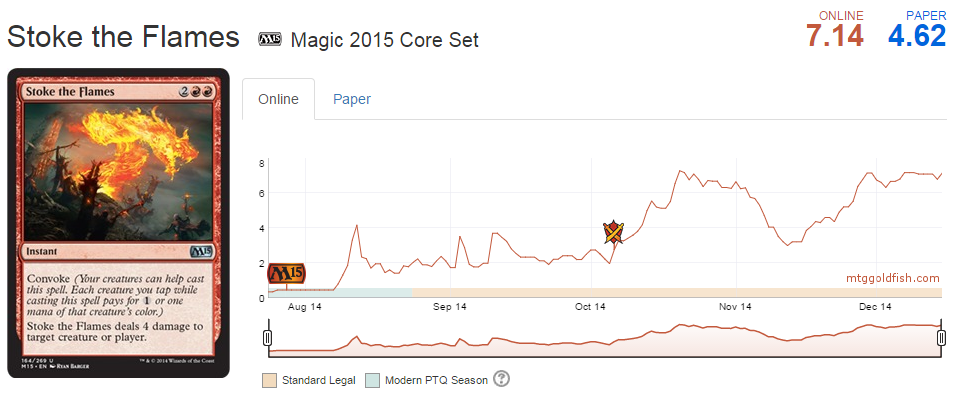
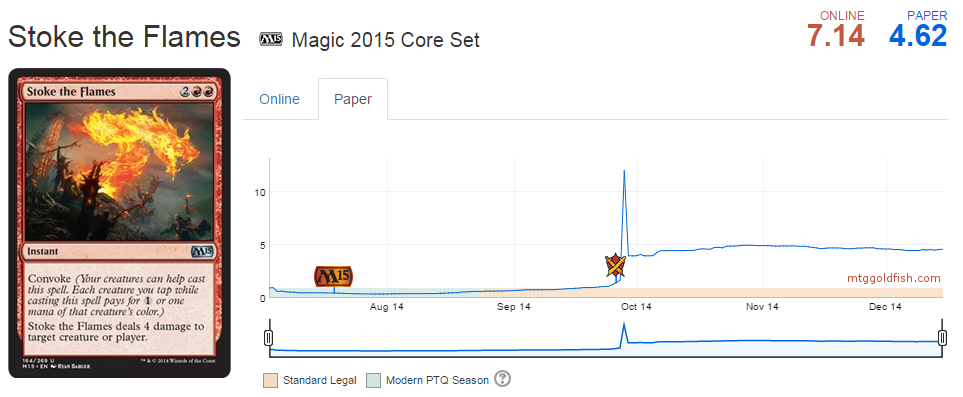
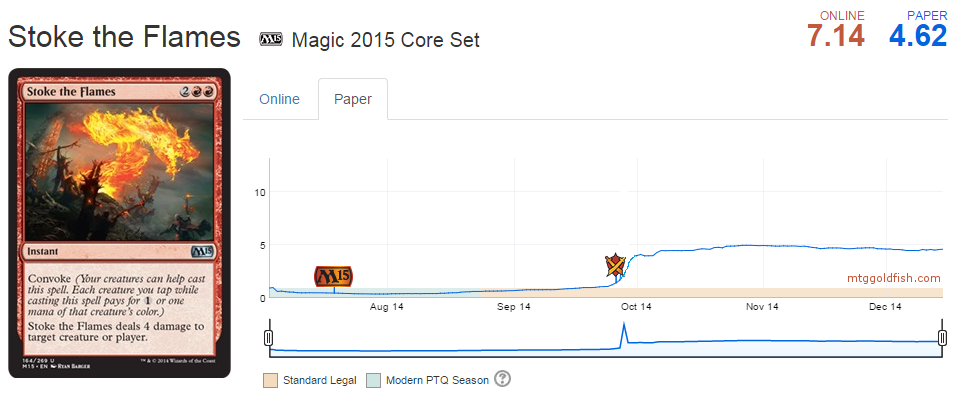
Ignore the prices now, but look what happened in Mid October. I'm pretty sure Stoke never sold for $12 - what's more likely is that it sold out and one jackwagon listed them for $12 each because, in his words "#YOLO". Let's pretend my doctored version of the graph is the real one because it illustrates our point better with a ridiculous outlier data point that doesn't reflect actual reality thrown out.
Untitled

The result is the same. The MODO price of this card (an uncommon no less!) flirted with 4 whole tix several times in the leadup to Khans of Tarkir. It would come back down, probably because the set was still being heavily drafted and when people noticed an uncommon cost more than a booster, they would ship them to dealers for close to 3 tix and freewheel some more drats.

However, Goblin Rabblemaster was a real breakout card from M15, and its success coupled with how well it looked like it would integrate into post-Khans Standard (something reality eventually failed to bear out) pushed red to the forefront where Standard had been dominated by black and blue for months. Khans coming in meant Ravnica leaving, and with it a new era of Magical cards dawning.

The jump doesn't look entirely precipitous in the graph of paper prices, but the price of Stoke the Flames actually quadrupled. Over the same timeframe, the price of the MODO card, one that had flirted with 4 tix before, roughly tripled. Paper players were much more surprised by a $4 Stoke than MODO players were by an 8 tix Stoke as insane as 8 tix for an uncommon sounds.

While the price in MODO fluctuated a bit, the trend was overall upward. A line of best fit would have a positive slope, if you're picking up what I'm putting down. A positive overall trend despite micro-fluctuations fits with the narrative told by the paper price, which is a slow, meandering upward trajectory punctuated by an insane period of explosive growth when people finally got wise to how good Stoke was, how little M15 was really floating around, and how easy it is to wreck an entire economy by spending $200 buying out a card on TCG Player.

We're not really seeing the same trend with Doomwake Giant, are we? What's going on?

An Odd Case of Divergence

When we see a MODO card inching up (at least with respect to the slope of a line of best fit, which price fluctuations or checking prices only periodically can do a good job of obfuscating), and we expect a similar amount of play in paper, it's probably a good buy, especially if there is a perceptible increase in the slope of the paper price. Speculators buy a store inventory at a time but Standard players buy a playset at a time, and if tech is heating up the slope of the price graph will increase based on the degree of acceptance. Innovators aren't going to move the needle much at all with their 4 copies and it could take a week or two for their tech to get noticed.

It's harder to dump paper cards, so it takes a card being basically abandoned or due a price correction for the price to go down, which means you won't see those same micro-fluctuations in paper prices. What causes a paper price to go down?

And why do I ask what it takes to make a paper price go down? Well, let's take a look at the graph of Doomwake Giant in paper again, because if we can't explain why the paper price is diverging with the MODO price (whereas Stoke the Flames' graph converged with the MODO graph right before it went up) then we can't say Doomwake is a good buy.

Why Do Paper Prices Go Down?

The way I see it, there are two main reasons, one is the obvious one that is a major factor and the other is...I guess it's also obvious but it's a different thing because it's a smaller factor? Look, I have to get through this if we're going to figure out what happened with Doomwake, so let's just buckle in and get this done.

1) A Race to the Bottom

Prices are determined by supply and demand. If the demand is low or people simply won't pay the higher price, sellers will lower their prices in an attempt to get the merchandise clear. As no one buys at those lower prices, someone else lists even lower in the hope of being the first person to have their copies purchased.

When the price gets to the right level, the cheaper copies get bought up before another seller notices that someone else is selling for cheap so the price stays at the level where people are buying. When people aren't buying, the price will continue to fall as people undercut each other. A card falling out of favor, approaching rotation or becoming obsolete due to a better card in its role being reprinted will hurt its demand and therefore its price.

2) A Price Correction

If a card is inflated artificially due to a temporary shortage caused by the card being very new or some artificial buyout or some other reason for a shortage of supply irrespective of demand, the card could be due a price correction. Failed buyout operations tend to lower supply but can't always affect demand without a playability component.

Which do we think happened here?

Well, to me it seems like Doomwake's price is going down more to the second aspect than the first one. The price is down only because it's coming off of a very precipitous increase. Graph shapes matter in cases like this, and if we see a "sharp" uptick but a "dull" downtick, that means the price went up unnaturally and down naturally.

It's meandering down to a lower price and I think that means that people who had their copies at a high price from the last time Doomwake tech was in vogue and didn't see the sustained demand necessary to keep the price high are undercutting each other in a race to the bottom in an attempt to still get out at a profit. However, is this enough to explain why the MODO price is going up and the paper price is going down?

Verdict

I think the cycle of a card's use can be cyclical. Doomwake tech wasn't necessarily the greatest at every point in its legality. However, I think Doomwake is in a good spot right now for several reasons.

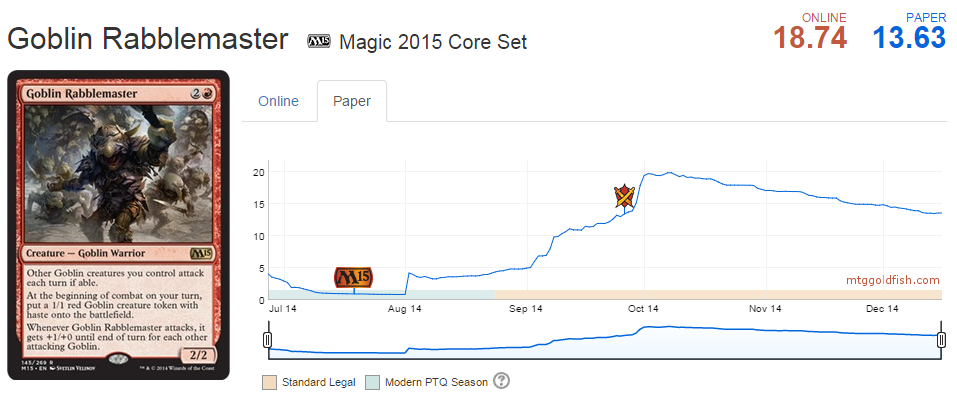
First of all, I think its height of usage was to combat Goblin Rabblemaster decks. The price decline of Rabblemaster likely corresponds to the same event that saw Doomwake go up, but the graphical data won't bear that out because, as we've said, it takes a lot longer for prices to go down than it does for them to go up. Let's still look at Rabblemaster's graph anyway.
Untitled

Boom. Look at that. Right at the same time Doomwake's price peaked sharply, Rabblemaster's price began to tail off. Rabblemaster is still a great card, but it's not the Tarmogoyf of Standard it appeared to be when everyone was discussing splashing red into decks that had no business having red just to jam Rabblemaster in. As Rabblemaster's share of the metagame fell, so did Doomwake's because it was less of a wipe against decks that didn't spit out a bunch of small tokens.

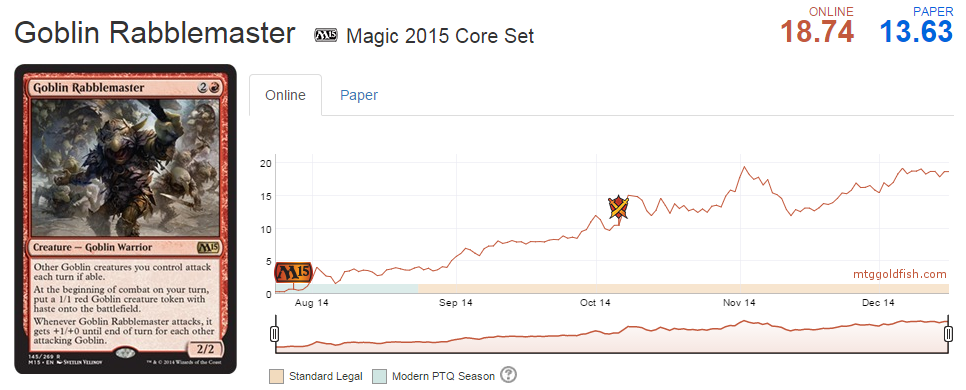
Could there be a reason why we'd see Doomwake high online? One reason is that Rabblemaster has fallen out of favor on MODO to a lesser extent.
Untitled

Rabble's still a real thing on MODO, and that could be because red decks are cheap, except for the Rabblemaster and Stoke, I guess. That's a funny irony of "cheap" decks on MODO. The cheaper the components are, the more appealing the deck is and the more expensive certain key cards can be as people scramble to find 4 Rabblemasters to buy a "cheap" deck.

The other reason that Doomwake could be headed up on MODO?
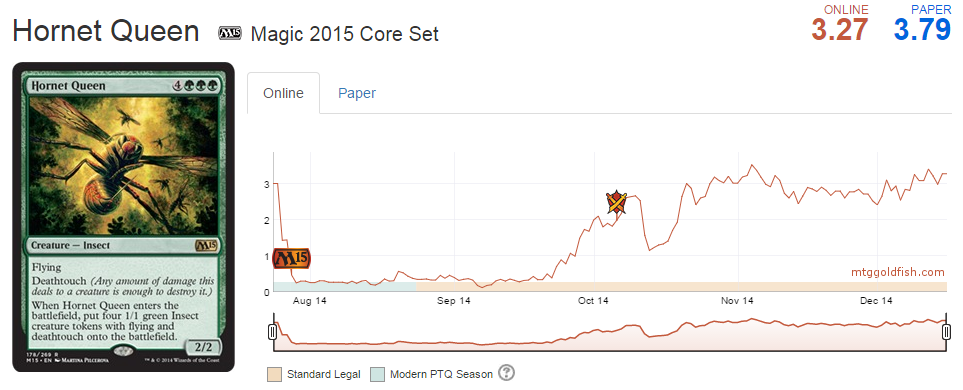
Untitled

Hornet Queen farts out tokens, too. Doomwake is getting a lot of play in Sidisi Whip decks, and since other Whip decks are running Hornet Queen, Doomwake seems like it would be great tech against Queen shenanigans.

So earlier in the season we saw that Doomwake's price was pegged to Rabblemaster's price. Does that means late in the season in paper we could see the paper copies of Doomwake pegged to the paper price of Hornet Queen?
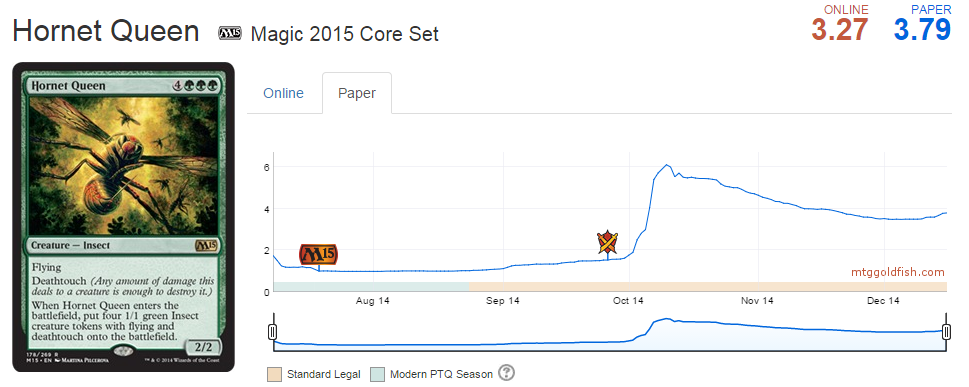
Untitled

Could be. If that's the case, that little upturn at the end on a paper graph that seems devoid of micro-fluctuations indicates Queen is on the upswing. With Doomwake six times the paper price and Hornet Queen on the way up, I think we may be able to explain the divergence in the price of Doomwake, and maybe it's not such a bad pickup after all.
The New Affinity is… Old Affinity?

Are you a Quiet Speculation member?

If not, now is a perfect time to join up! Our powerful tools, breaking-news analysis, and exclusive Discord channel will make sure you stay up to date and ahead of the curve.

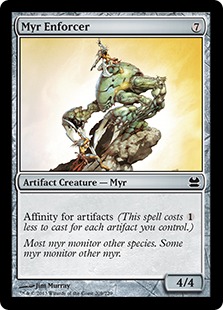
Frogmite. Myr Enforcer. Meet the face of Affinity.

At least, it's the face of Affinity five years ago.

Image.ashx

As we all know, the actually "Affinity" deck mostly stopped running cards with the mechanic on them a while ago. It became a slew of early drops, Ravagers and Cranial Platings.

Everything old is new again, I guess. With the advent of the Treasure Cruise, Dig Through Time or Birthing Pod format that is current Modern, a shakeup was needed to keep Affinity relevant. Dario Parazzoli provided it, going back to Affinity's roots with Frogmite and Myr Enforcer and even Scale of Chiss-Goria, a card I admit I had never seen in my life before. His deck could explode on Turn 1 and then "go off" with Contested War Zone for brutally fast starts.

Of course, I don't have much faith for the deck to stick around in the current meta, but it was a nice shakeup at the Grand Prix. The current three-deck (or at least, three pillars) format will likely continue to stick around, just with more Shatterstorm and Creeping Corrosion. At least, that's my pessimistic take on it. What do you think?

Cardmageddon’s Low Attendance

Are you a Quiet Speculation member?

If not, now is a perfect time to join up! Our powerful tools, breaking-news analysis, and exclusive Discord channel will make sure you stay up to date and ahead of the curve.

I was pretty excited by the Cardmageddon announcement, as I wrote about here. A tournament with scaling prizes is a big deal in a community that almost never sees such a thing.

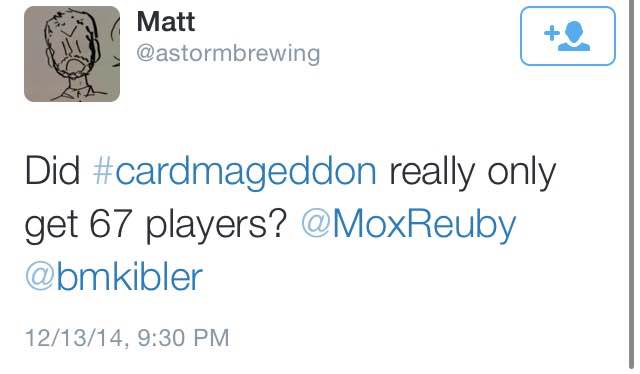
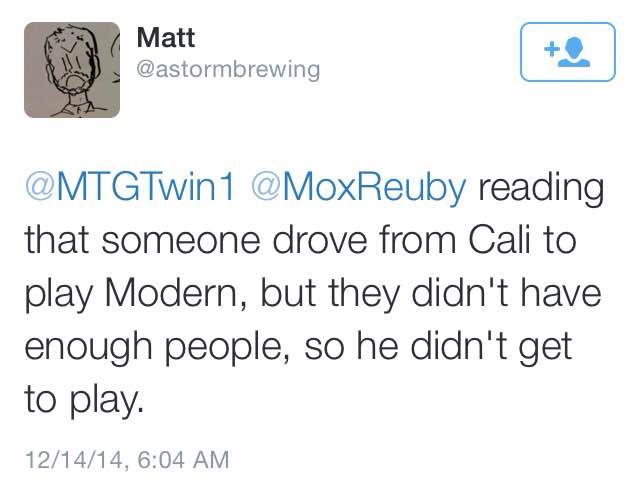
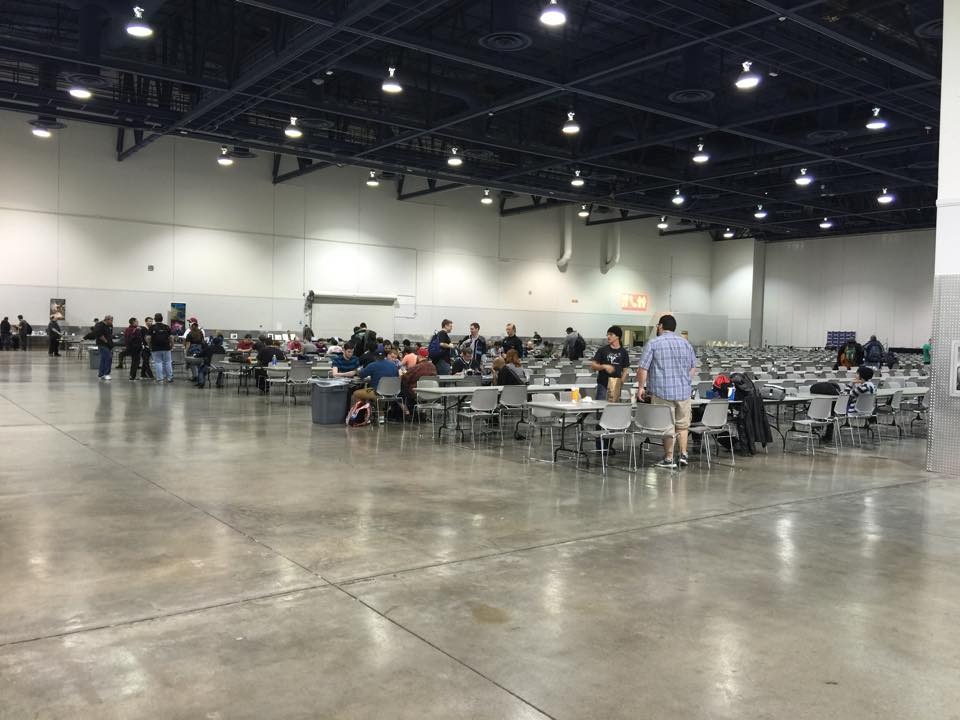
Unfortunately, the event had to compete with other tournaments over the weekend, and the turnout was reportedly not fantastic.

IMG_3749

IMG_3750

For the record, Reuben Bresler replied that it was more than 67 people, but didn't provide an actual number. Still, the photos of the event look pretty depressing for a $25,000 tournament:

cardmageddon
Imgur

So what went wrong? For starters, competing with the SCG Invitational and Grand Prix were problematic. Some Twitter users indicated that the advertising for the tournament gave them the impression it was a by-invitation-only event, which surely kept at least a few potential attendees at home.

But most of all, it's hard to start a new brand. People attend SCG events in part because of SCG's sterling reputation for organizing excellent tournaments. A reputation like that is not something you can buy, and it's not something that comes overnight.

Reddit user rubeerubin, who claims to be the CEO of tournament organizer CardAgain, is upbeat about the situation:

CEO of CardAgain (sponsor) here.

Obviously attendance was low, but many positive things happened at Day 1 of this event! We pulled off a revolutionary format without any major hitches. The tournament software we wrote worked fantastically and was wonderfully scalable (as was the payout).

Did we lose money? Of course. We weren't expecting or trying to make money. We were trying to get some exposure, get people to know of our existence, to use our (again revolutionary) website and to give players a cool twist on the way tournaments can be run.

By allowing multiple formats (on day 1), we allowed all walks of magic players to qualify for Day 2 with their strength. By allowing people to rebuy (cheaply), it gives people an opportunity to change their deck around, or even switch formats mid day. By having smaller mini tournaments, we allowed players to have breaks where they could actually eat, drink, use the restroom, etc. comfortably.

On marketing, since you guys seem to have hammered it pretty hard, we spent over $40k. This included contacting about 1500 card shops about sending a free packet to them, which included a free voucher for CardMagedon for the winner of a tournament to be held in their store. There were (oddly enough) quite a large number of stores who refused to receive the packet, another contingency of them who failed to hold a tournament (it was simply offered as extra prize for an already existing tournament, or hold a new one, either way), and then quite a large number who took advantage of the free opportunity and reported fantastic success. All of this was dwarfed by massive budgets for ads on Facebook, Google, twitter and reddit.

On timing: a company who wants to host an event has to schedule things way in advance. We contacted Wizards to find out their GP schedule (I mean, we promote people to play their game), and we were told there would not be a GP that weekend. On SCG invitational, losing a couple mid level pros wasn't too bad, compared to other weekends where there were other major concerns, like having a good venue in a great city (these places book up sometimes years in advance). And the bottom line is that as a startup, you cannot sit around and wait for years to try to make a splash.

All in all, we learned a lot, have a lot of great feedback and ideas for next time and had a TON of fun putting this on for the players.

Day 2 is going to be a real treat, with many HUGE names competing for the title (Shahar, Kibler, EFro, Justin Gary, David Williams to name a few). And yes, that was part of our marketing budget as well. Oh and coverage by the fantastic team of Reuben Breslar, Tannon Grace and Michelle Roberson (www.twitch.tv/cardmageddon).

tl;dr We are doing lots of great things for the community and sometimes that costs a lot of money. Hopefully people appreciate it. If not, then hey, we tried. Try out our website. We think you will like it. www.cardagain.com

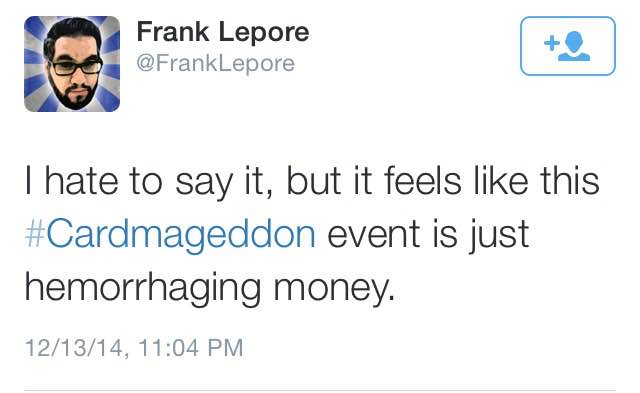
That's some serious optimism right there, and it explains some of the apparently poor decisions made by the company. If CardAgain holds more of these events, I expect improvements to come incremently—but I also expect the minimum payout to be lower for a while. Frank Karsten Lepore said it most succinctly:

IMG_3748 (1)


Avatar photo

Danny Brown

Danny is a Cube enthusiast and the former Director of Content for Quiet Speculation.

View More By Danny Brown

Posted in Free15 Comments on Cardmageddon’s Low Attendance

Have you joined the Quiet Speculation Discord?

If you haven't, you're leaving value on the table! Join our community of experts, enthusiasts, entertainers, and educators and enjoy exclusive podcasts, questions asked and answered, trades, sales, and everything else Discord has to offer.

Want to create content with Quiet Speculation?

All you need to succeed is a passion for Magic: The Gathering, and the ability to write coherently. Share your knowledge of MTG and how you leverage it to win games, get value from your cards – or even turn a profit.

Insider: Anticipating New Treasure Cruise Hate – Speculating Ahead of the Curve

Are you a Quiet Speculation member?

If not, now is a perfect time to join up! Our powerful tools, breaking-news analysis, and exclusive Discord channel will make sure you stay up to date and ahead of the curve.

It’s no surprise that Treasure Cruise and Dig Through Time have made a substantial impact on Modern and Legacy. When combined with fetch lands, endless cantrips and the like, dredging a few cards for a turn three or turn four Treasure Cruise has become the norm.

I cannot begin to comment on banning either or both of these cards in any format. I simply do not have the expertise and experience to make such a judgment call. For this reason my opinion must remain withheld.

But just because I plead the fifth on this matter does not mean I won’t divulge some speculative ideas that recently came to mind. The old saying “if you can’t beat ‘em, join ‘em” makes me wonder which path players are striving to adopt here? Are they dropping their current decks only to jam their own Treasure Cruises, or are they modifying their sideboards and strategies to combat the new card-drawing engine in eternal formats?

Data is murky, but perhaps we can still learn something. Let’s take a closer look.

A Couple Data Points

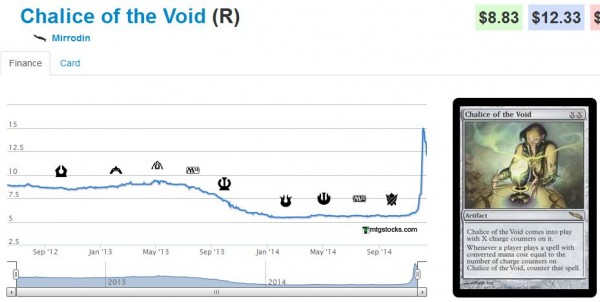
Not long ago I noticed the sudden resurgence of Chalice of the Void in Legacy. What’s more, the card also appeared in the GP Madrid Top 8, which was a Modern event. The card doesn’t stop Treasure Cruise itself, but it sure hinders decks from playing all their one mana cantrip spells.

No more than a week after these events, the price on Chalice exploded.

Chalice

The ride on this artifact is over. If you missed that spike, don’t even think about buying now unless you absolutely need copies for an immediate event. These will drift back down to under $10 in time – especially since I haven’t seen much of this card since the spike.

I said it in the forums and I’ll say it again here: this card is a sell over $10, and the foils are far more likely to hold the “new”, higher price than are nonfoils.

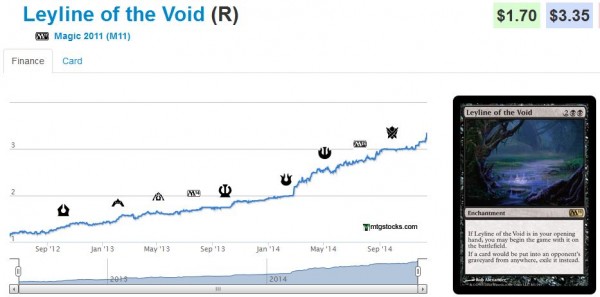
Throughout the past week I noticed another interesting trend on mtgstocks.com. Has anyone else noticed that Leyline of the Void has been an “Interest” a number of times in a row now?

Leyline

While not exactly spiking by any means, the recent jump on the black enchantment has me wondering… are we seeing this movement because of newly printed dredge cards? Of course, if cards cannot go into graveyards, then a card like Treasure Cruise becomes absolutely terrible. Why draw three cards paying eight mana when you can do so with just four mana (Concentrate)?

Is this a coincidence? Or is there truly merit to the idea that players are scooping up sideboard cards they may need to combat the new blue sorcery from Khans of Tarkir?

Other Interests From Last Week

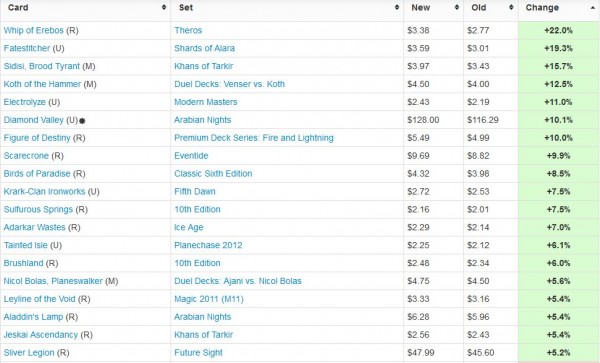
Let’s take another look at the weekly interests on mtgstocks.com to see if there are any other Treasure Cruise hate cards on the move.

Interests

I see some Standard cards finally showing life. That’s refreshing.

Whip of Erebos, Sidisi, Brood Tyrant, and Jeskai Ascendancy are all newer cards with some positive price movement. This has everything to do with the new metagame in Standard alongside the recent success of Jeskai Ascendancy in eternal formats. Fatestitcher is also spiking because of this ascendancy combo deck.

Other than Leyline of the Void, however, I see no more hate cards for Treasure Cruise on the move. Interesting – perhaps the trend is inconsequential after all. Maybe it is just coincidence that two solid hate cards are both on the rise at the same time.

Or…

Or perhaps, although not a guarantee, we are in front of a trend.

A while ago, I noticed that Nekusar was driving some silly price movement on the likes of Teferi's Puzzle Box and I advocated speculating on Winds of Change and Wheel of Fortune. Both of those plays have paid out nicely.

There was an error retrieving a chart for Wheel of Fortune

Maybe we can get in front of this Treasure Cruise hate trend by buying a few extra sideboard candidates in anticipation of a rising demand.

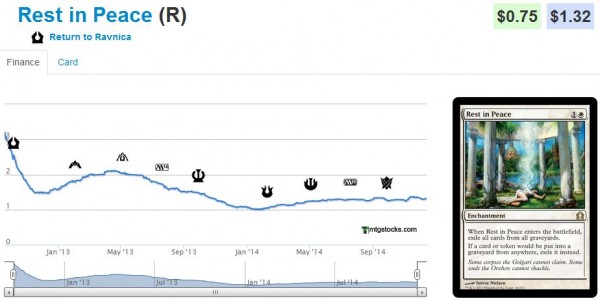
What would be a solid pickup in this category? How about Rest in Peace?

Rest in Peace

There was an error retrieving a chart for Rest in Peace

Foil copies of this enchantment have already exploded, but nonfoils can still be had aplenty for under a buck. That seems awfully inexpensive for a once-printed eternal card, even if it is mostly designated to the sideboard.

Granted, Return to Ravnica was opened a ton and the set itself already has a ton of value thanks to shock lands, Abrupt Decay, etc. But if you wanted to buy into a safe card that should drift up over time (while hopefully staying under the reprint radar), you could do worse than Rest in Peace.

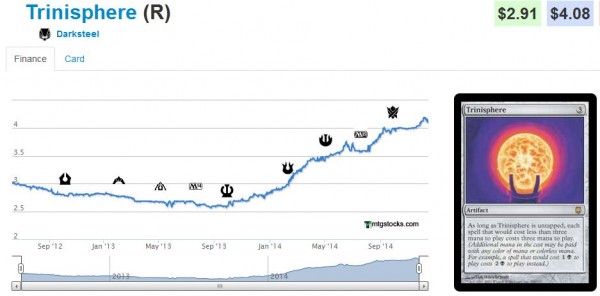
At the risk of further berating, I’ll throw out my off-the-wall idea again: what about Trinisphere?

Trinisphere

The card has been moving higher throughout all of 2014 despite the downward pressure on most Legacy cards during these months.

While this guy doesn’t fit into every deck, the lists that can take advantage of Trinisphere could really hinder a Treasure Cruise strategy. Once cards like Gitaxian Probe and Brainstorm cost three to cast, they all become significantly worse. I’d love to see the face of an opponent after sticking one of these on turn two – perhaps someday I’ll have that maniacal pleasure.

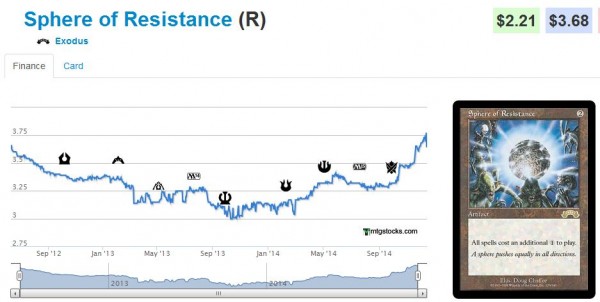
Lastly, if Trinisphere doesn’t strike your fancy, perhaps there is a different sphere that might: Sphere of Resistance.

Sphere

This artifact has an immediate impact on board state. And unlike Thalia, which hits only a subset of spells and requires a player to play white, Sphere of Resistance can be cast by any deck.

Not that every deck would want to cast this artifact – obviously it too has limitations. But Chris Andersen jammed four copies of this artifact in his SCG Open Top 8 deck (Lands) a couple weeks ago.

It’s no fun when your opponent effectively casts Ancestral Recall on turn three. Sphere of Resistance makes this achievement a bit more challenging.

More to Unfold

Khans of Tarkir has been available for less than three months. This is a pittance of time on the scale of Legacy. Even Modern hasn’t fully evolved since the creation of Treasure Cruise and Jeskai Ascendancy. My guess is we’ll see further metagame evolution in 2015.

Rather than sit and wait to see what players pick up, one way to make a little money is to begin speculating on what that metagame will look like in advance. While I’m not a professional player by any means, even I can see how Treasure Cruise will warp Legacy. This means a metagame shift, which in turn means buying opportunities for the speculator.

What happens if Treasure Cruise becomes banned? Well, besides the fact that Legacy would shift yet again, you may argue that speculating on hate cards could lead to a poor outcome. But if you keep to safer, more generic sideboard plays like Rest in Peace and Leyline of the Void, you won’t really be stuck holding a loser. These are both powerful hate cards in their own right, and can destroy many strategies beyond just Treasure Cruise.

Besides, if Treasure Cruise is banned, that could just open the door up for Dig Through Time to become the go-to dredge spell. If this was the case, these sideboard cards would still be highly relevant.

I’m not advocating you go and buy out TCG Player – that’s never my style. But trading for a few extra copies of the cards mentioned in this article could help grow the value of your collection with minimal effort. These cards are easy enough to grab in even the smallest trades, yet they have significant upside due to their utility in eternal formats.

Anticipating metagame shifts is just one way to hedge for the future and try to make a little extra cash in the process.

Sigbits

  • Star City Games has placed their dual lands on sale this month! Now we’ll have a better idea of how well these are really performing at the moment. For starters, I see there are only 15 Volcanic Islands left in stock, with NM copies discounted to $269.99. If these sell out throughout the month, this could be a positive sign for the U/R dual land. Compare that to Underground Sea: SCG has 59 in stock with the same price tag.
  • While 1492 may have been a great year to sail the ocean blue, I had a feeling it doesn’t make for a good price on Polluted Delta. The Khans fetch land is sold out at SCG at $14.92 during the month of December. When the sale is over, expect the price to snap right back to its retail price of over $17.
  • Lastly, shock lands are also on sale at Star City Games this month. The most popular one is probably Steam Vents, which is currently discounted to $11.06 (Return to Ravnica). Only 6 copies remain – I suspect this retail price will only be heading higher through 2015.

Insider: Merchandising Your Collection – Applying Retail Principles to Your Binder and Store

Are you a Quiet Speculation member?

If not, now is a perfect time to join up! Our powerful tools, breaking-news analysis, and exclusive Discord channel will make sure you stay up to date and ahead of the curve.

For most of my working life, I've been in some form of retail. I worked at a card shop and grocery store in high school. I worked at a big box hardware retailer in college. I spent nearly a decade after college working at Walgreens.

I've learned a lot of lessons in retail, many of which only apply to Magic in the abstract. But many more apply in such obvious ways that it's amazing we miss them.

Customer Service

Customer service is not all about being helpful. You may think that customer service is a store employee asking you "Can I help you find anything?" or "Can I take your order?" in a soothing tone, but it's much more than that. Whether you're trading out of your binder or selling out of a booth, you're playing the role of retailer. What can you do to make that trade?

Understand what your customer is looking for, even if they don't.

Retail Jace

If Jim-Bob comes up to you asking for a Siege Rhino, they may be finishing a deck or they might just be starting to build it. Suggesting other cards or asking what else they need can immediately increase the size of the transaction, increasing your profit. Need Abzan Charm? Sorin, Solemn Visitor? Opening that dialogue and making it clear you're willing to sell or trade whatever they're looking for immediately puts you in a position to help both people reach their goals. Retail empires have been built on up-selling to customers.

Be approachable and noncombative.

How many times have you argued with a stranger over the value of a card? And how many of you have people that you're always willing, even eager, to trade with? It's because those folks are not a hassle to deal with.

If you establish yourself as a person that is a pleasure to deal with, people are more likely to want to work with you. Every store has that guy that nobody wants to trade with, just like each of us has had terrible experiences at retail stores or restaurants and never go back.

"Being nice" doesn't mean you can't get value. But as you establish relationships with other traders or customers, they become more willing to give you a little extra rather than deal with the other guy.

Removing Friction

You may have heard of Amazon.com. Amazon has brought a number of things to the forefront of modern sales techniques, but most prominent is their desire to remove the friction that slows down transactions.

In industry studies, you'll hear about an insane number of online shopping carts that go unpurchased. You may have even seen these abandoned shopping carts in brick and mortar retailers. Too often, it's more of a hassle to finish a transaction than it's worth. By removing even just a couple clicks in the checkout process, Amazon has increased profits tremendously.

Whether you're selling or trading, the faster you're able to "close a trade" or make a sale, the faster you can move on to the next one. Spending too much time looking up cards and ensuring that a trade is "exactly equal" takes time. You're often better off just leaving that dollar or two on the table and completing the trade rather than investing more time and coming up empty handed because neither you nor your customer would budge on your prices.

Your trade or sale is never completed until it's completed. As long as those cards are sitting on the table, there is a chance your customer will walk away.

Paying the Rent

"There are no Dollar Stores on Rodeo Drive"

This is a concept many in retail don't understand, especially at the LGS level.

Think of it like this: every inch of your store has a cost associated with it. If you're renting a 2,000 square foot retail establishment for $4,000 a month, then each square foot of that place has to generate an average of $2 in profit per month just to "pay the rent." Your trade binder is no different.

Whaaaaaaat?

What types of cards are you trying to trade for? If you're looking to trade for Gitaxian Probes and Delver of Secrets, then you'll have no problem achieving your goals with a binder full of Abzan Charms and Electrolyzes. If you're in the business of acquiring dual lands, you're going to want to make sure that binder is stocked with a higher level of merchandise.

There was an error retrieving a chart for Underground Sea

Some analogies to explain this better:

  • You don't go to a Kia dealership to buy a luxury car.
  • You don't go to a fancy steak house to eat fried chicken.
  • You don't go an art museum to see anime.

I'm not saying your binder, booth, or store should never have "cheap" cards in it, but it's hard to pay $4,000 a month in rent simply selling bottles of Mountain Dew and Snickers bars, and its hard to trade for dual lands with a binder full of draft scraps. There is no reason to sell something that will net you $1 profit when you could sell something else in that same space for a $2 profit.

The other element of this concept is that certain pages of your binder will simply be seen more than others. You often want high impact cards in the first few pages of your binder, special interest stuff in the middle, and "clearance" in the back.

Some people just aren't going to look through your entire binder and are not going to go all the way to the back on a second or third pass. Putting your hot movers up front along with the higher priced cards you're looking to get rid of will increase the likelihood of those cards being sold or traded. Putting special interest cards in the middle section of your binder allows them to get more exposure as people flip back and forth past them.

There are a number of cards that I'm not actively looking for but would have no reservations trading for if I came across them. Increasing my chances of finding them in your binder increases your chances of getting rid of them. Putting your "crap" in the back of the binder is a concession to the fact that not much is going to move from that location no matter what you put there, so no sense in tying up poor real estate with expensive tenants.

Visual Merchandising

One of the most surprising "tricks" I learned in my years of retail was a real lesson in human psychology. I would spend a decent amount of time creating an elaborate and visually appealing display and people wouldn't buy anything from it. I couldn't figure out why nobody was buying the merchandise--it was a prominent location, a great price, and a popular item. Why weren't they buying?

People don't like disturbing order. The world is full of chaos and nobody wants to be the person to introduce chaos to something that's organized. I went to my boss with my question and he showed me a simple trick: simply take a couple off the shelf. That's it.

Nobody is going to ask you to buy a booster pack when all you have is sealed boxes. Similarly, you may have noticed that nobody wants to "break up your playset" by trading for cards that you visually have four of on a page.

If you're fine with breaking up playsets to trade away, try putting a fourth copy of a card on a different page, you'll notice people are much more likely to ask about those cards than they were before.

Managing Your Stockroom

For many years I worked in management at Walgreens. Middle management at the store level resulted in working for a number of different general managers at a number of locations.

Each of them all had their own strengths and weaknesses, but the best all said the same thing: "door to the floor" -- a term that applied to every piece of merchandise that came in the back door.

Very little merchandise sells from the stock room. Seems like a simple concept right?

It's very unlikely that you'll always have all of your cards with you, so prioritizing your traveling inventory space to cards that will sell or trade quickly gives you more opportunities to sell or trade those cards. Sure, there is probably a guy somewhere that really wants your copy of Legacy Weapon, but how often do you run into that guy?

The other side of this coin is understanding that there is no profit in having inventory. Only profit in selling it.

It doesn't matter if you have "pretty much every card at home". Constantly bringing merchandise from your metaphorical (or literal) stockroom to your metaphorical (or literal) sales floor is critically important.

Applying Lessons

Identifying parallels and properly translating those parallels is akin to "porting over" a favorite deck from Legacy to Modern.

Whether you're in retail, finance, or manufacturing, there is a good chance you can apply lessons from other aspects of your life and career to your MTG Finance experience.

What do you do and what lessons can you bring to the table?

It’s Morphin’ Time!

Are you a Quiet Speculation member?

If not, now is a perfect time to join up! Our powerful tools, breaking-news analysis, and exclusive Discord channel will make sure you stay up to date and ahead of the curve.

I have to imagine that if you go back a month or two, I've likely written a post with this exact same title. I would check, but I'm too damned excited to bring you the glad tidings I have for you today and no one googles my free side posts anyway, except for that one about the anime sleeves and the neckbeards. Or the one about the South Park Episode. Or the one about Ari Lax.

Speaking of Ari Lax, Ari Lax won't be getting any more "Woops. I accidentally Day 2 after all!" judge calls because of an opponent not revealing a morph dude. Why? I'll let Toby Elliot tell you why.

Effective immediately, failing to reveal your morph is now a Warning. A non-morph played as a morph, unless it’s caught by the player almost immediately, remains a Game Loss.

Say whaaaaat? This is a great compromise for a really sticky situation that caused a lot of players a lot of grief. So what's the rationale for the change?

So, yeah, that’s a long explanation as to why sometimes the simplest things are incredibly hard to change if they have the philosophy pulling in other directions. We’re always looking for ways to make things better, but it has to be done in a consistent, coherent way, even if doing so presents a challenge. Hopefully this will cut down on the feel-bads at Competitive events, without opening much of an opportunity for abuse of the morph hidden information.

The Judge Blog Article detailing the changes was updated over the weekend much to the relief of a lot of players who thought the clunky rule and its Draconian enforcement went too far and made for too many hurt butts. The new policy will help a lot with the feel-bads and shows that the judge community really thought about this rationally. It's unlikely too many people will risk a game loss or disqualification by making a fake Scathe Zombies that the opponent could uncover at any moment and more likely that there is less potential for abuse than the original penalty indicated. This is a positive change, solves a problem that bugged a lot of the community unobtrusively and shouldn't upset anyone. I mean, it obviously WILL upset a lot of people in this community. It just shouldn't. Nice work, judge community!

Avatar photo

Jason Alt

Jason Alt is a value trader and writer. He is Quiet Speculation's self-appointed web content archivist and co-captain of the interdepartmental dodgeball team. He enjoys craft microbrews and doing things ironically. You may have seen him at magic events; he wears black t-shirts and has a beard and a backpack so he's pretty easy to spot. You can hear him as co-host on the Brainstorm Brewery podcast or catch his articles on Gatheringmagic.com. He is also the Community Manager at BrainstormBrewery.com and writes the odd article there, too. Follow him on Twitter @JasonEAlt unless you don't like having your mind blown.

View More By Jason Alt

Posted in FreeTagged 1 Comment on It’s Morphin’ Time!

Have you joined the Quiet Speculation Discord?

If you haven't, you're leaving value on the table! Join our community of experts, enthusiasts, entertainers, and educators and enjoy exclusive podcasts, questions asked and answered, trades, sales, and everything else Discord has to offer.

Want to create content with Quiet Speculation?

All you need to succeed is a passion for Magic: The Gathering, and the ability to write coherently. Share your knowledge of MTG and how you leverage it to win games, get value from your cards – or even turn a profit.

It’s Never Too Early

Are you a Quiet Speculation member?

If not, now is a perfect time to join up! Our powerful tools, breaking-news analysis, and exclusive Discord channel will make sure you stay up to date and ahead of the curve.

Grand Prix TBD has been determined after all.
As you all are probably aware, the event will be a Modern Masters 2 Sealed GP in Las Vegas on the weekend of May 28th 2015. What you may not know is that Cascade Games and Channel Fireball want you to sign up. Like, right now.

cfb_banner_gpTbd_special1_520x314_v2


If you want to get the free sleeves and deckbox, you need to pre-register this week.

The GP Las Vegas registration website has it all. Tempting offers, flashy graphics, even a sweet video to entice you to come to the event and test their 10,000 person limit.
Untitled
WTF Dude, did you just throw an Emrakul?

As always, there are registration tiers, but this is the first time we've had so many.

There's "peasant" level which is a mere $75

General Registration - $75

The General Registration package includes the following:

-Entry into Grand Prix Las Vegas – build a sealed deck with 6 packs of Modern Masters 2015!
-Exclusive Grand Prix Ultra-Pro Playmat featuring art from Modern Masters 2015!
-Grand Prix Foil Promo Griselbrand
-Set of ChannelFireball Tokens
-ChannelFireball lifepad and pen
-Exclusive Grand Prix Las Vegas 2015 Token signed by Luis Scott-Vargas!

A little more gets you the sleep-in special, which is legit if you're partying in Las Vegas. Even if you go bed at a decent hour, don't expect the fraternity party or the guy banging his mistress in the adjoining hotel room to keep it down.

Premium Registration - $100

The Premium Registration package includes the following:

-Entry into Grand Prix Las Vegas – build a sealed deck with 6 packs of Modern Masters 2015!
-Exclusive Grand Prix Ultra-Pro Playmat featuring art from Modern Masters 2015!
-Grand Prix Foil Promo Griselbrand
-Set of ChannelFireball Tokens
-ChannelFireball lifepad and pen
-Exclusive Grand Prix Las Vegas 2015 Token signed by Luis Scott-Vargas!
-Sleep-In Special
-Sealed Pool Pre-Registration

For another $50 you get, in my estimation, the best value

Planeswalker Registration - $150

The Planeswalker Registration package includes the following:

-Entry into Grand Prix Las Vegas – build a sealed deck with 6 packs of Modern Masters 2015!
-Exclusive Grand Prix Ultra-Pro Playmat featuring art from Modern Masters 2015!
-Grand Prix Foil Promo Griselbrand
-Set of ChannelFireball Tokens
-ChannelFireball lifepad and pen
-Exclusive Grand Prix Las Vegas 2015 Token signed by Luis Scott-Vargas!
-Sleep-In Special
-Sealed Pool Pre-Registration
-Access to the Planeswalker Lounges
-Exclusive Grand Prix Las Vegas Deck Box featuring art from Modern Masters 2015!
-Exclusive Grand Prix Las Vegas Sleeves featuring art from Modern Masters 2015!
-ChannelFireball Stainless Steel Water Bottle
-ChannelFireball Drawstring Bag

The additional $100 for the "Platinum" tier is pretty hard to justify

Platinum Planeswalker Registration - $250

Our most luxurious registration package ever! Supplies are limited - get your spot before we run out!

The Platinum Planeswalker Registration package includes the following:

-Entry into Grand Prix Las Vegas – build a sealed deck with 6 packs of Modern Masters 2015!
-Exclusive Grand Prix Ultra-Pro Playmat featuring art from Modern Masters 2015!
-Grand Prix Foil Promo Griselbrand
-Set of ChannelFireball Tokens
-ChannelFireball lifepad and pen
-Exclusive Grand Prix Las Vegas 2015 Token signed by Luis Scott-Vargas!
-Sleep-In Special
-Sealed Pool Pre-Registration
-Access to the Planeswalker Lounges
-Exclusive Grand Prix Las Vegas Deck Box featuring art from Modern Masters 2015!
-Exclusive Grand Prix Las Vegas Sleeves featuring art from Modern Masters 2015!
-ChannelFireball Stainless Steel Water Bottle
-ChannelFireball Drawstring Bag
-Access to the Platinum Planeswalker Lounge
-Exclusive Meet & Greet on Thursday evening with artists and members of Team CFB!
-A ChannelFireball Playmat signed by members of Team CFB!
-A second Grand Prix Las Vegas Deck Box!
-A second set of Grand Prix Las Vegas Sleeves!

If you're not a Channel Fireball sycophant, you're basically getting the $150 tier, plus some extra sleeves. If you want to pay $100 to pretend LSV is a Hollywood A lister and wait in line to shake his hand, that's cool. Make sure to hoverhand when you take a picture with him.

If you don't have a flight or a hotel picked out, don't worry - you've got months and months. But I would register soon, and I'd figure out which tier suits you. The higher the registration numbers get in the lead-up to the event, the more hyped everyone will get, and hype is what we want.


Avatar photo

Jason Alt

Jason Alt is a value trader and writer. He is Quiet Speculation's self-appointed web content archivist and co-captain of the interdepartmental dodgeball team. He enjoys craft microbrews and doing things ironically. You may have seen him at magic events; he wears black t-shirts and has a beard and a backpack so he's pretty easy to spot. You can hear him as co-host on the Brainstorm Brewery podcast or catch his articles on Gatheringmagic.com. He is also the Community Manager at BrainstormBrewery.com and writes the odd article there, too. Follow him on Twitter @JasonEAlt unless you don't like having your mind blown.

View More By Jason Alt

Posted in Free1 Comment on It’s Never Too Early

Have you joined the Quiet Speculation Discord?

If you haven't, you're leaving value on the table! Join our community of experts, enthusiasts, entertainers, and educators and enjoy exclusive podcasts, questions asked and answered, trades, sales, and everything else Discord has to offer.

Want to create content with Quiet Speculation?

All you need to succeed is a passion for Magic: The Gathering, and the ability to write coherently. Share your knowledge of MTG and how you leverage it to win games, get value from your cards – or even turn a profit.

Is This the Only Time This Play Has Been Made or What?

Are you a Quiet Speculation member?

If not, now is a perfect time to join up! Our powerful tools, breaking-news analysis, and exclusive Discord channel will make sure you stay up to date and ahead of the curve.

I'm fascinated by the idea of something happening only once in Magic. Given that millions of people play the game in countless different formats and languages and countries, is it possible that there are unique plays in Magic's history?

unique


I'm not talking about  extremely rare plays. I'm talking about things that have happened only one, single, solitary time. The player base is large enough that every possible interaction has probably happened at least once, but I like the idea that we can still witness an interaction for the very first time. It keeps the magic in Magic.

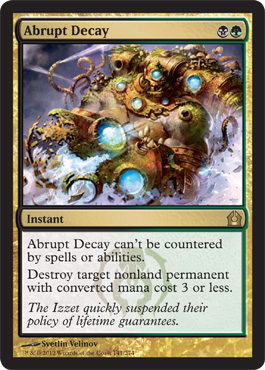
I've expressed my admiration for Channel Fireball's Jacob Wilson's "troll" deck series before, and since then, he has published a couple more of these highly entertaining videos. In match two of game three of a Vintage event (embedded below), at 4:37, we see Wilson's opponent play what I propose is the very first Abrupt Decay cast on a Tibalt, the Fiend-Blooded in Magic history.

But you know, that's just what I want to be true. I'm sure someone out there will be all too happy to deflate my balloon and tell me about how they've seen this play many times before. I mean, in my heart of hearts, I know that it's probably at least happened in kitchen-table Magic, where a much wider range of cards is playable.

But come on. Just let me have this one, guys. This is definitely the first Abrupt Decay ever cast on a Tibalt.

Right?

Vintage Masters… to return?

Are you a Quiet Speculation member?

If not, now is a perfect time to join up! Our powerful tools, breaking-news analysis, and exclusive Discord channel will make sure you stay up to date and ahead of the curve.

It came. We drafted. Then it went. Never to return.

Or so we thought.

snowcoveredforest

But instead it turns out that Vintage Masters isn't gone forever. In fact, as this cryptic tweet shows us, WOTC plans to bring it back at some point.

Until then, we'll remember the good times.

Avatar photo

Corbin Hosler

Corbin Hosler is a journalist living in Norman, Oklahoma (also known as the hotbed of Magic). He started playing in Shadowmoor and chased the Pro Tour dream for a few years, culminating in a Star City Games Legacy Open finals appearance in 2011 before deciding to turn to trading and speculation full-time. He writes weekly at QuietSpeculation.com and biweekly for LegitMTG. He also cohosts Brainstorm Brewery, the only financial podcast on the net. He can best be reached @Chosler88 on Twitter.

View More By Corbin Hosler

Posted in Feature, FreeLeave a Comment on Vintage Masters… to return?

Have you joined the Quiet Speculation Discord?

If you haven't, you're leaving value on the table! Join our community of experts, enthusiasts, entertainers, and educators and enjoy exclusive podcasts, questions asked and answered, trades, sales, and everything else Discord has to offer.

Want to create content with Quiet Speculation?

All you need to succeed is a passion for Magic: The Gathering, and the ability to write coherently. Share your knowledge of MTG and how you leverage it to win games, get value from your cards – or even turn a profit.

Insider: A Holistic Approach to Modern Masters 2015 – Predicting Card Fluctuations Based on the First MMA

Are you a Quiet Speculation member?

If not, now is a perfect time to join up! Our powerful tools, breaking-news analysis, and exclusive Discord channel will make sure you stay up to date and ahead of the curve.

The sky is falling. Modern Masters 2(015) has been confirmed and everyone is now in a rush to sell off their Modern cards suddenly at risk of reprint.

The money is rolling in. Modern 2015 will bring in infinitely more Modern players, and now is the time to get in on cards before they spike! After all, the first Modern Masters raised prices!

Those two sentiments are the ones I’ve seen most commonly expressed after the long-awaited announcement of Modern Masters 2015 edition at Worlds last week (which, by the way, was awesome).

I think both views are, at the least, overstated. At worst, it’s fear-mongering or an opportunistic attack. I’ve talked in the past week mainly about slowing down. We have plenty of time until the set actually releases, and we have several months until anything major actually happens.

At least, that’s my take. Today I want to look historically at Modern Masters and see if we can construct a rough timeline of what Modern Masters 2 will look like. Let’s start with the roughest outline, but the one that has largely become the narrative.

Late 2012

Modern Masters is announced. Tarmogoyf sits at $100 and Dark Confidant is around $40.

June 7, 2013

The set is officially released. Goyf sits around $110 for the first week or so of release. Grand Prix Vegas happens and the big vendors start buying up Bobs and Goyfs. They skyrocket to $70 and $145, respectively.

Today

Goyf is $190 and Bob is $80.

First Takeaways

When people talk about Modern Masters “raising the value of Modern,” they’re referring specifically to these two cards. And superficially it’s true--they’re more expensive now than they were before the reprint.

But that misses a lot of context.

Modern Masters raised interest in the format by quite a bit, and these two cards represent the chasest of chase cards for the format. But while increased interest in the format did drive their price up, they’ve stagnated in 2014. In fact, both are essentially flat from where they sat in March. That’s a lot of money to tie up in an asset that didn’t move in nine months.

There’s another interesting note on these two cards. Everyone expected them to be in the set, and yet the prices didn’t move at all in the last months of 2012. You may have expected a dip in prices on the news, but it just didn’t happen. And, in fact, they began to climb again in 2013. Vendilion Clique followed the same trajectory.

I think this gives us a pretty reasonable look at the top end, so let’s move onto the lower end.

There was an error retrieving a chart for Doubling Season

I think this is another data point worth considering. Here was essentially the holy grail of casual cards reprinted in the set, and it did take a hit. It plummeted hard from a high of $30 in May 2013 to a low of $17 six months ago. Since then, it has begun to rebound, despite the printing of other similar effects (like Primal Vigor), and is now pushing past $20 again (not a bad place to park some money in 2015, by the way). Meanwhile, lesser-tier casual cards like Stonehewer Giant lost about 50% of their value and haven’t recovered.

Let’s try one with its value tied to competitive play: Blinkmoth Nexus. $13 in the months leading up to the reprint (again with no appreciable drop before the printing), and it bottomed out at $8 before rising back to $11 today.

Let’s try a more fringe one next: Ethersworn Canonist. An important sideboard card, it sat at a solid $10 at the end of 2012. It plunged hard after the printing and bottomed out at $4.50 early this year, where it sits today.

Let’s try the power uncommons next, looking at Spell Snare and Kitchen Finks. Both were around $10 before the reprint. Again, we see both plunging hard after the reprint, falling to $4 by the end of 2013 and sitting there today. Looking farther down the ladder, we see Lava Spike, a common, falling from $4 to $1 (though it is rebounding recently thanks to the resurgence of Burn).

I realize it’s hard to distill an entire set down to a few cards, but the trends I’ve highlighted above hold true across the set in the majority of cases. And that is enough to draw some pretty definitive conclusions about the newest round of Modern reprints.

Conclusions

I think we can delineate some pretty distinct categories of cards, and I’ll do that in a moment. But first, let’s consider what’s happened with the two spoiled cards: Emrakul, the Aeons Torn and Etched Champion.

Both are beginning to slide off the cliff. The prices are trending down and so is the graph, something that seems like it will continue for at least a while moving forward. I’ll address these as we come to them.

Chase Mythics

I just don’t see these moving all that much. Sure, Emrakul isn’t Goyf or Bob, but I have little doubt it won’t follow their path when it comes to Modern Masters 2015. The initial sell-off here seems fine since it’s only a few percentage points of movement but there’s no way we should see a drop of 20%. In other words, I don’t expect Emrakul to fall below $40.

The same likely goes for the other truly chase mythics from the set. I can see the Praetor cycle taking a hit of 30-50% if it’s included, similar to how the Kamigawa Dragon cycle was. The casual mythics won’t hold their value, but I expect Eldrazi or new Goyf/Bob/whatever chase mythic is printed to hold.

The moral here? Don’t panic-sell. Because even if Emrakul were to fall to $35, you’re not really making any money by getting out now. Top buylist on MTG.GG is $32, and even if you get a little more than that you’re basically breaking even by reacquiring. If it follows the chase mythic trend from Modern Masters you’re actually losing cash in the transaction.

Competitive Rares

There will likely be some exceptions, based on the metagame. For instance, Cryptic Command took a bit of a hit before rebounding hard and ultimately rising. But that’s as much due to meta shifts as it does anything about print runs.

Still, competitive rares will hold decently, and a few could even become the next Cryptic or Vial and rise later. Should something like Birthing Pod or Spellskite be reprinted at rare as I expect, the prices will stagnate and drop some, but like Blinkmoth Nexus I don’t see the bottom completely falling out. That means holding onto your copies of cards like these is actually a fine strategy if you believe as I do that this set will drive renewed interest into Modern.

Chase Casual Rares

Basically, if we see Vorinclex, Voice of Hunger at mythic I don’t expect a huge price decrease. That said, the future upside will be significantly limited.

Suppose we get It That Betrays at rare in this set. That’s an $11 casual card I could see being put at rare. I expect a trend similar to Doubling Season on these truly popular casual cards. We could easily see a 20-30% drop on these, but again I’m not sure how much you gain by selling out and rebuying. Trading stuff like this away seems like a better idea, and after a year or so when they bottom out I’ll actively like picking them up again.

Casual Rares

Basically whatever Commander goodies they decide to toss into this set. These are going to get wrecked. Unless we see something on the hugely-popular level as Doubling Season, these are the ones to move out of in the next few months.

Because the drop looks to be so precipitous, I’d rather oversell here than undersell. The cost of reacquiring something like Eldrazi Temple is a lot lower than holding onto copies of this level of card and watching them lose 50% or more of their value.

Uncommons/Commons

Get out of Remand and Inquisition of Kozilek and Serum Visions now. These cards seem very likely to be reprinted, and they’re looking at a halving (or more) in their price. Can’t recommend holding these.

Wrap-up

What I discovered in looking back over the original Modern Masters is that we never really saw a panic firesale. For the most part, all the price drops (or gains) came when the cards were actually reprinted, not when they were announced or spoiled.

This reinforces my belief that there’s no reason to panic right now. Move out the stuff I suggested now, but a “wait and see” approach on the rest actually seems viable. Remember, this is a nearly-unprecedented occurrence for all of us, and I’m simply doing my best to read the tea leafs and learn from the past.


Thanks for reading,

Corbin Hosler

@Chosler88 on Twitter

Insider: Dissecting the Modern Masters 2015 Announcement – What to Do Now That It’s Official

Are you a Quiet Speculation member?

If not, now is a perfect time to join up! Our powerful tools, breaking-news analysis, and exclusive Discord channel will make sure you stay up to date and ahead of the curve.

First of all, don't panic.

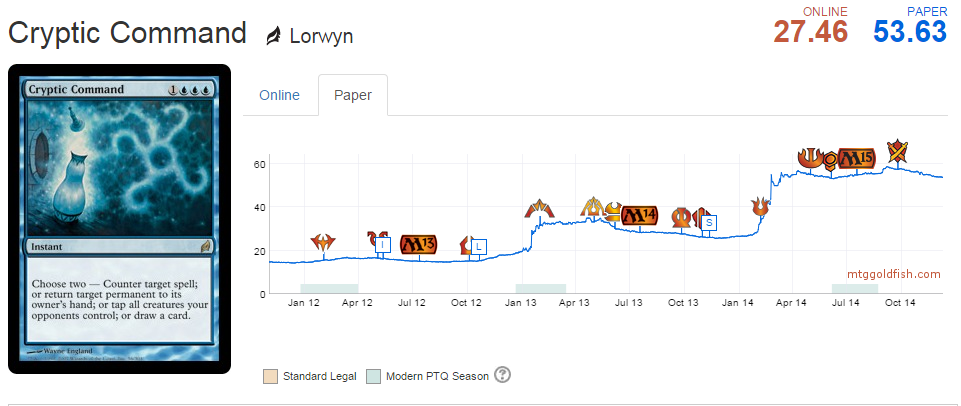
The first Modern Masters drove down prices briefly, but not for long. Tarmogoyf and Dark Confidant went up from their pre-reprint prices, with 'Goyf basically doubling since then. Cryptic Command dipped slightly, then proceeded to reach unprecedented highs in the following year.

crypticcommandhistory

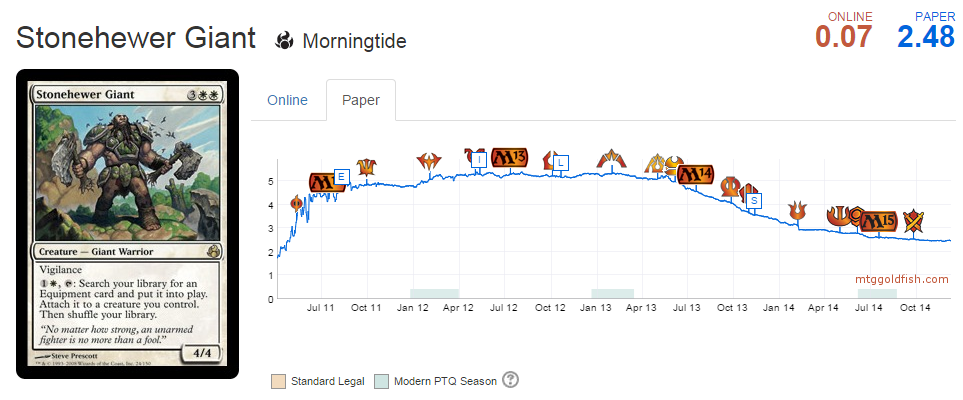
The main cards that took seemingly permanent hits are the casual staples that don't see play in Modern. Stonehewer Giant, for example, was at its all-time high before being reprinted; now it's at half the price and has continuously dropped since Modern Masters.

stonehewergianthistory

The hardest-hit cards may have been the commons and uncommons. Spell Snare was around $10 and today is around $4. Lava Spike was approaching $5 and dipped to around $1 (it's experiencing an uptick due to the resurgence of Burn in the post-Khans Modern metagame, but is nowhere close to $5). Etherium Sculptor used to be a common that would buylist for a solid buck, but now the retail price is half that. Only Path to Exile, probably the best removal spell in the format, seems immune to being reprinted—and, oh, how it has been reprinted.

In fact, it's hard to see how Modern Masters made the Modern format more accessible at all. Although there was an extremely brief period where prices went down, most of the prices for playable cards in the format, in the set and not, have risen well above their pre-Modern Masters printing. What playable, expensive card was reprinted and is now more affordable?
Tarmogoyf costs more. Dark Confidant costs more. Vendilion Clique costs more. Cryptic Command costs way more. Aether Vial, Blood Moon, and Sword of Fire and Ice are all more. In a few cases, important cards have nearly doubled.

The staples that became more affordable, on the other hand, became only slightly more so. Kiki-Jiki, Mirror Breaker is a little less, down from $28 to $25. Arcbound Ravager went down about a dollar. Cards that are powerful but not usually played in Modern took the biggest hits: stuff like Elspeth, Knight-Errant, Tooth and Nail, and Doubling Season (which is still quite expensive for a purely casual card).

So yeah, don't panic. The cards that you already own are probably safe.

Unless...

...the print run is significantly higher. Given the success of the first Modern Masters paired with the general discontentment about its lack of availability, I expect Wizards of the Coast to put a whole lot more Modern Masters 2015 out there. I imagine that will be the justification for the $9.99 MSRP: by pricing the product higher, WOTC will be able to print more of it without entirely crashing the secondary market.

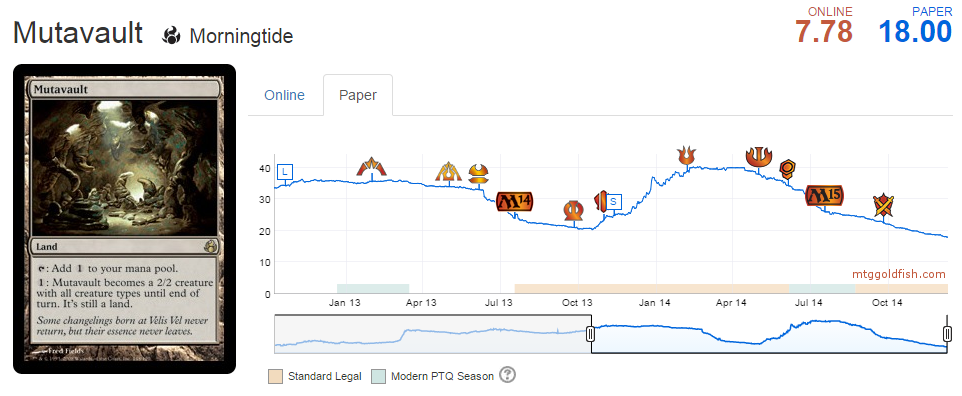
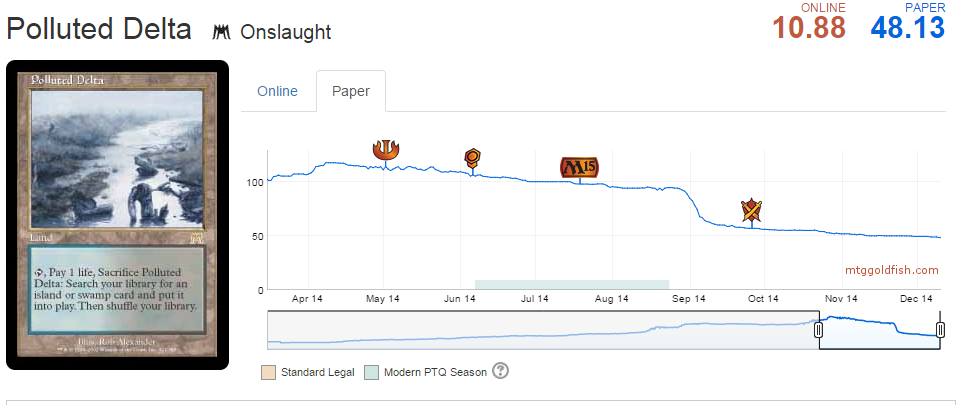
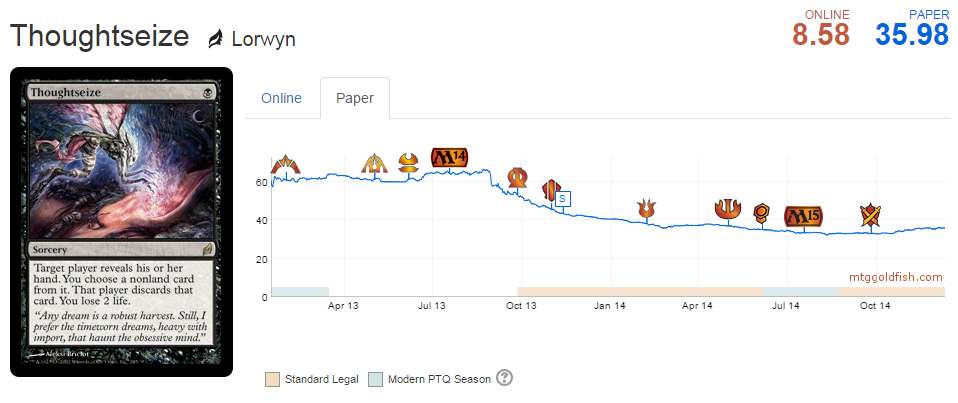
As much as the first Modern Masters didn't kill the price of cards in the set, we've seen that normal-set reprints can absolutely have huge impacts:

mutavaulthistory

polluteddeltahistory

thoughtseizehistory

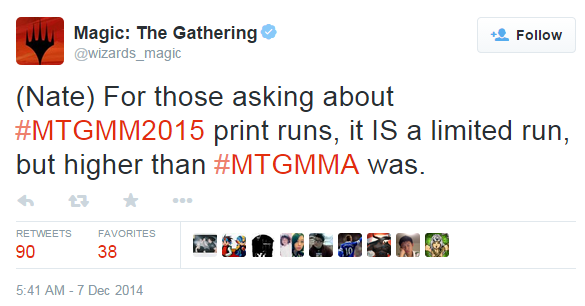
If Modern Masters 2015 has an unlimited print run like the Commander sets of the last couple years, then prices will go down. Now, we already know that it is not unlimited:

wizardstweet

But the fact that it's higher means that this set's impact on card prices will likely be slightly different that the first Modern Masters—unless the $9.99 MSRP offsets the higher print run exactly, I suppose. Until there's observable data, though, we can't really know for sure.

So What Should I Do?

If your primary investment in Modern is for cards to play with, I think it's very reasonable to do nothing at all. Your deck isn't going to become worthless overnight, and any cards that aren't in Modern Masters 2015 will probably rise in price, which hopefully leaves your total collection value more or less the same.
If you can't handle losing any money at all, you could sell the cards you aren't actively using. If you want to rebuy them after MM15 drops, you should do so quickly, based on how soon prices rebounded after the first Modern Masters. If you lag on picking up the cards you want in your collection, you may actually end up losing money.

If you're deep on Modern cards for purely speculative reasons, I ask you: why? Wizards of the Coast has shown that it is more than willing to reprint expensive cards in the format—not just in Modern Masters, but in expert expansions and products like Commander, as well. These days, short-term investments in Modern cards are much safer than long-term holds. If you want to park resources in cards to hold for a while, then you should be looking at cards on the Reserved List. 
As for picking up Modern cards in the next six months: there may be opportunities that are absolutely worth taking, but I'm going to be far less aggressive picking up cards for the format. We may have until May for this set to be released, but many cards dipped in the months leading up to Modern Masters—we have a savvy community and it's not hard to guess what is being reprinted. Don't turn a blind eye to the chance to make money, but give a little extra scrutiny to Modern specs as we move forward.

The Biggest Holes in the Format

Okay, so what's most likely to be reprinted? After not getting the nod in Modern Masters or Magic 2013, Noble Hierarch has to be on the reprint docket. After the banning of Deathrite Shaman, Hierarch became the go-to mana dork in the format, and its current price is just untenable. I would be shocked if it weren't Modern Masters 2015, and I expect it to be reprinted at rare.

Cryptic Command aside, a rare reprint is likely to crash the price much harder than a mythic reprint, which makes Hierarch, in my opinion, the riskiest hold in Modern as we approach MM15.

There was an error retrieving a chart for Noble Hierarch

Affinity has been a go-to budget deck in the format for quite some time, but as card prices rise, Affinity becomes less and less of a budget deck. A big reason for that is Mox Opal, a key part of the strategy and the priciest card in the deck by quite a bit. With the word "Mox" in the title, this will certainly be reprinted at mythic, so don't expect too big a dip. If you're an avid Affinity player, you don't have to move your Opals, but it would probably be the safer play.

There was an error retrieving a chart for Mox Opal

With so few good cantrips in the format, Serum Visions has become unreasonably expensive for a common that is indispensable in the decks that want it. Expect it to be in MM2015, expect it to be at common, and expect it to be a dollar at most after than happens.

There was an error retrieving a chart for Serum Visions

Remand is one of, if not the, premier counterspells in the Modern format. A one-of reprint in the Jace vs. Vraska Duel Deck didn't do much to alleviate its price, and with the rise of U/R Delver, the card is only going to be more in demand. I expect it to perform similarly to Spell Snare after its reprint.

There was an error retrieving a chart for Remand

They have to reprint Tarmogoyf, right? It's a must-have for green creature strategies, which WOTC seems to want to push the last several years. An entire archetype (or multiple archetypes) being inaccessible due to an $800 playset is just not cool, so I expect 'Goyf to get another reprint here. It just seems correct.

There was an error retrieving a chart for Tarmogoyf

I'm pretty disappointed by the $10 MSRP on these packs, but other than that, I'm excited for this product. If stores don't mark it up and the set is absolutely insane, it may even be worth the price. QS will be keeping an eye on the situation moving forward, and we will keep you informed. Until next time.

Insider: Lessons Learned in 2014 – Revising Assumptions Based on the Year’s Experiences

Are you a Quiet Speculation member?

If not, now is a perfect time to join up! Our powerful tools, breaking-news analysis, and exclusive Discord channel will make sure you stay up to date and ahead of the curve.

Welcome back readers and speculators!

The purpose of this site is to help players make money with this awesome hobby/game we all love. I take a rather liberal view (and this is one of the rare occasions I can say that) when it comes to this creed, by which I mean, I personally believe that one way to "make money" is by not losing it. Sometimes it's important to focus on the reasons not to buy something rather than get washed up in all the hype, which is why my fellow writers and I usually parrot the saying "sell into the hype". That being said, let's look at some lessons I learned this year.

Lesson: Patterns Aren't a Guarantee

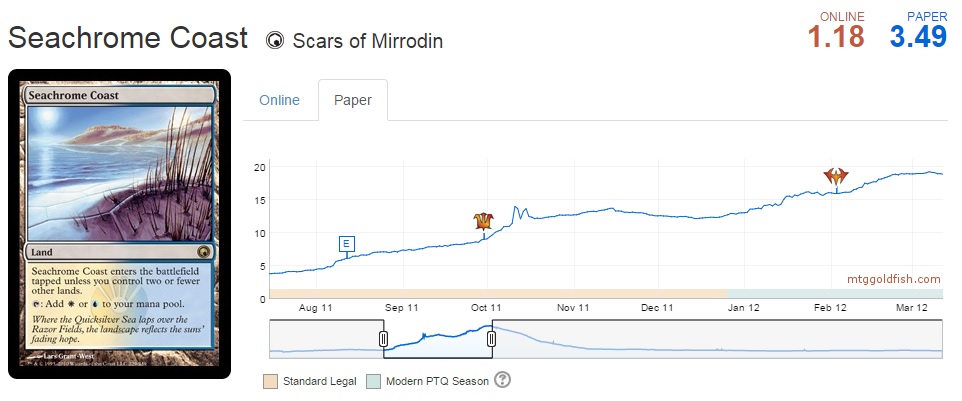
seachrome coast

hinterland harbor

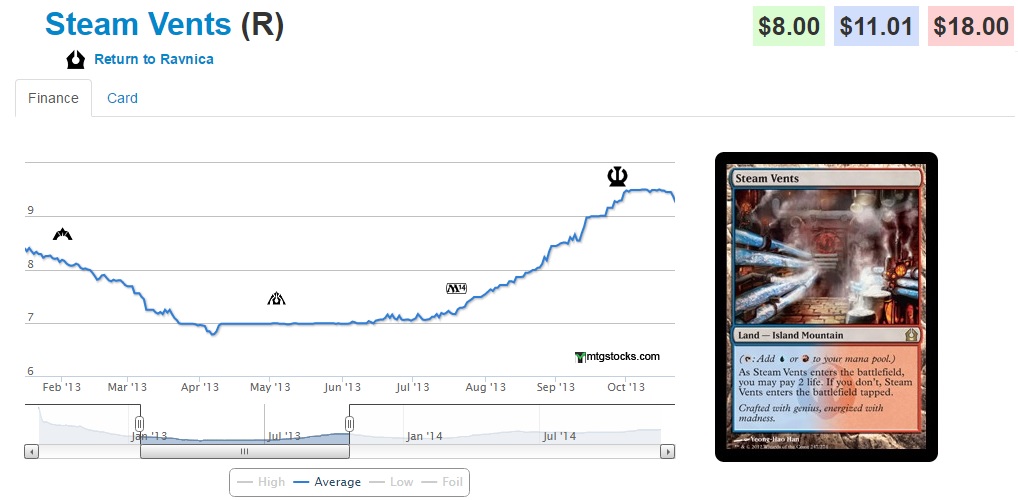
steam vents

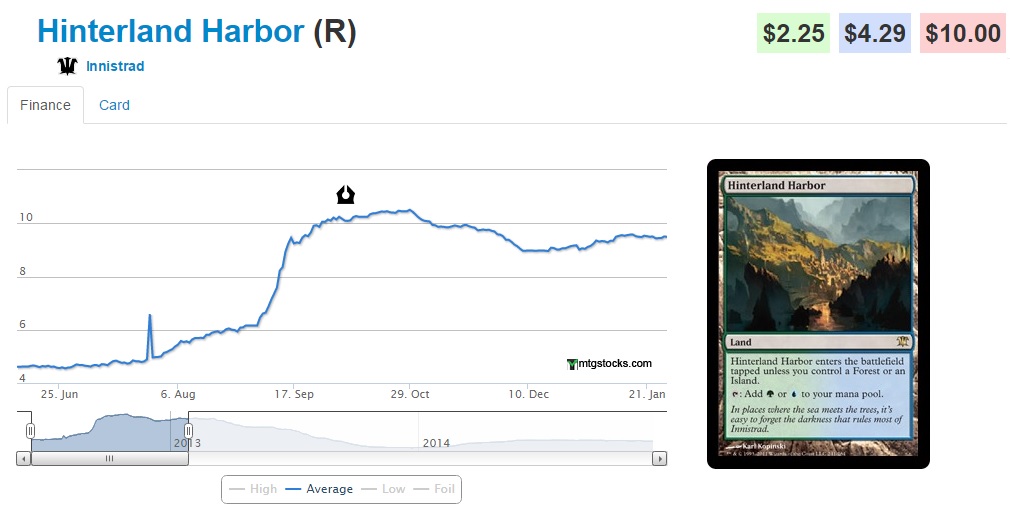
Both the past two Standard-legal rare land cycles saw significant gains when the block after their printing became legal. Many of us (myself included) expected the Theros Temples to follow suit.

What I Learned

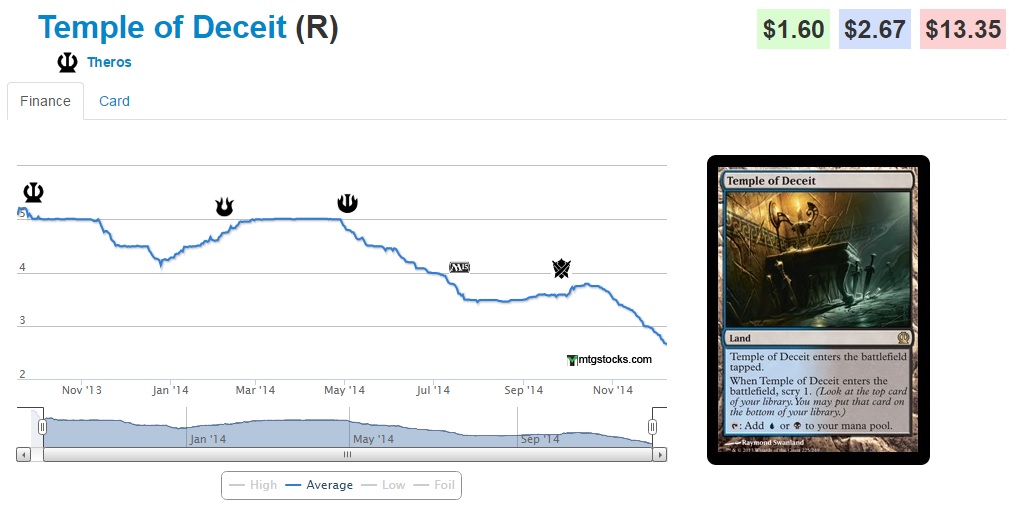
temple of deceit

Rare mana fixing lands aren't a guarantee. The most important difference between the scrylands and the previous three rare lands was that the scrylands are bad for aggro decks (which often have a pretty big footprint in Standard) because they always come into play tapped, though they fit well in many control style decks.

But that logic isn't enough, because that would imply that while the aggro colored lands (Temple of Triumph, Temple of Abandon) could be really cheap, the control ones (Temple of Enlightenment, Temple of Deceit) should have gone up. And they seem to do okay in midrange decks, which are a large portion of the metagame now.

So we can look at how often they are played. Looking over the most recent SCG Standard Open, we have an average of 5.75 per deck.

If we compare that to the Innistrad lands in the previous format we'd see around 4.125 and before that looking back at the Scars lands we'd see closer to 4 per deck. So it doesn't appear that the Temples are seeing less play than previous rare land cycles.

Instead it is more likely that Magic is a victim of its own success. With the rapid growth of the MTG playerbase the last few years more and more packs have been opened with each new set (compared to the similar set the year before). This just means that in all actuality there are likely just a lot more Temples in the marketplace than there were Innistrad lands or Scars fastlands.

However, if the competitive-to-casual ratio remained the same this wouldn't hold true. If I have 300 players in my area but only 50 competitive players who want the lands then the demand for the tournament staples should be the same if I have 3000 players in my area and 500 competitive players.

Granted, this is a massive oversimplification as there's no guarantee that each player will open the same number of packs, but overall, I feel safe making this assumption. As the Temples have actually dipped downward (save Temple of Malady which seems to have held steady), this actually implies that the casual player base has grown at a higher rate than the competitive player base.

Lesson: Diversification Isn't Always a Great Strategy

When you talk to a stock portfolio manager one of the first things they usually bring up is "portfolio diversification," which is synonymous with risk mitigation. The idea being that by having a lot of different stocks, when one drops terribly you don't lose as much of your portfolio.

The problem here is that stocks are much easier to sell than Magic cards. So if a stock is starting to plummet you can usually unload it relatively quickly, whereas a Magic card that starts to plummet is much harder to sell--often because people will keep listing or re-listing copies below the current lowest price, which turns into a race to the bottom where players are weary of buying a card they see keep dropping.

To make matters worse, when your desire is to buylist, then it's easier to do so if you have a lot of copies of a few cards than a few copies of a lot of cards. This is even more true if you buylist as I do, picking a couple stores and pulling out cards they're paying well on, rather than just sending stuff off to whoever has the highest buylist price and losing potential profits to shipping fees.

What I Learned

While it's important to have some diversity in your MTG speculation portfolio it can easily snowball out of hand. When I started my "spec" box, my original intent was to just put away a few cards here and there. Either ones I thought were underpriced at the moment (usually EDH cards, including a lot of the Primordials from Gatecrash) or banned cards which were at their floor, but given an unbanning would likely skyrocket (looking at you Mental Misstep). This slowly grew to include just about any cards I felt had more potential to go up than down.

Now I have an almost full box that has cards ranging from Skaab Ruinator to Snapcaster Mage in value. To make matters worse, when you begin to just throw anything with potential in, then you lose track of what's actually in the box. You also lose potential trades involving those cards because you don't carry them on you.

Lesson: Casual Cards Aren't a Safe Long-Term Bet

This year we saw quite a few casual cards get reprinted, causing their original cards to tank pretty hard.

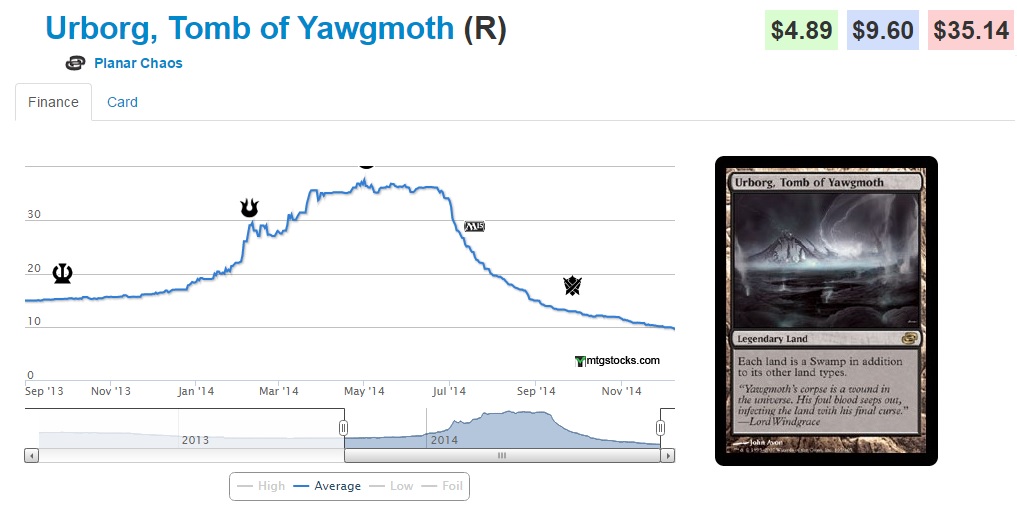
urborg

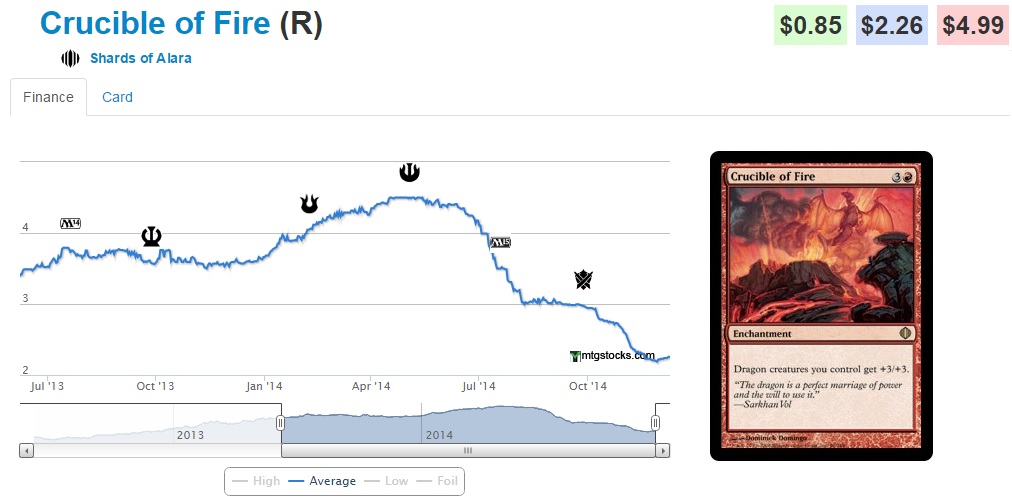
crucible of fire

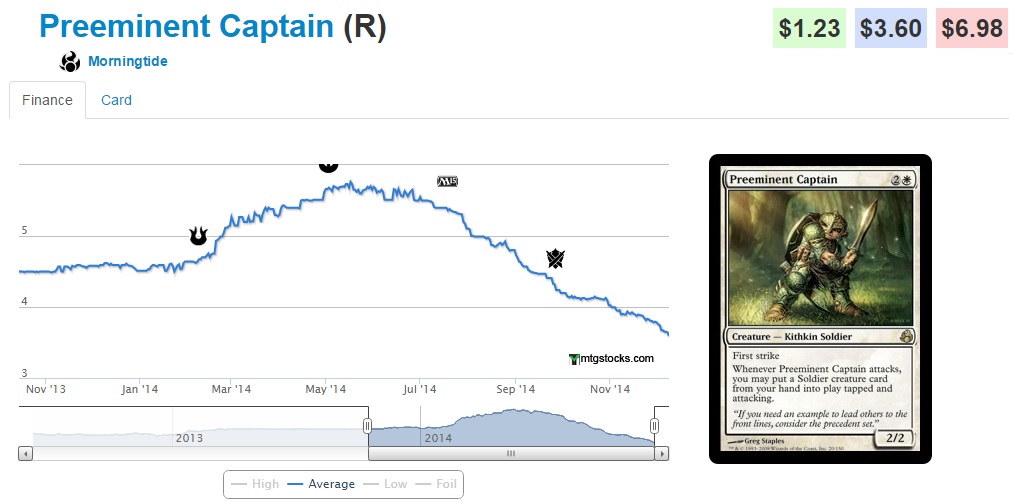
preeminent captain

The reprinting of these cards caused even the originals to drop in value (often by 50% or more). Even worse, their inclusion, albeit in a core set, seems rather arbitrary (though many think that Crucible of Fire is a plant for Khans block).

The point is, WoTC is clearly aware that the casual crowd is the main driving force for pack sales, so it's smart to appeal to them. Many of us (at least those reading this article) likely view MTG from the perspective of card values and when you crack a Crucible of Fire in a pack you likely think, or possibly let loose, a series of expletives, but there are still a lot of players out there who are thrilled no matter what the rare is. They don't see a bulk rare, they see an enchantment that makes all the dragons in their dragon deck even more ridiculous.

What I Learned

Even just a few years ago, many of us were of the mindset that WoTC would focus on new cards with new mechanics and thus the older ones that had casual appeal would slowly appreciate in value for a long time. But we're seeing that WoTC has no problem sprinkling them into sets. All of my previous examples were from the core set, which is having it's last hurrah next year--but I honestly don't expect WoTC to stop throwing in casual reprints in sets.

This being the case, I'm no longer going to just simply hoard all the casual cards at the cost of trading them at their current value for more desirable cards. Now, I'm not saying you shouldn't look at your casual cards differently. For example if someone asks me for a set of the Gatecrash Primordials, I'm not going to price them at the current TCG-Mid, instead I'll use that and add a profit I'm comfortable with and explain my reasoning. If my trade partner accepts that then the trade can continue; if they don't, then I just hold onto my Primordials until they go up or get reprinted.

Lesson: Buylists Give You Power

This was a pretty important, but easy lesson to learn. Thanks to this site giving all of us access to Trader Tools #3, one can very quickly and easily determine what the best buy price is on a card. While the purpose of a buylist is supposed to be so a store can restock, and prices should rise/fall with demand, a lot of stores are pretty lazy on this front. Granted it can be a massive endeavor to properly maintain a buylist, but more and more I see a lot of stores just default to a percent (and more often than not it's 50%).

Of course the more diligent/active a store is with its buylist the more likely they are to get cards...if they have been out of a fetchland for two weeks it's wise to raise the buy price until people actually start sending them in, otherwise they lose potential sales.

The point is, they want your cards and they want to pay you for them. You have every right to ask for a price on your terms (after all, they ask for certain prices when they sell the cards) and the worst they can do is say no. The closer to retail price you get the more "no thanks" you'll get from stores, so you need to weigh that when deciding how much you want for them.

What I Learned

As I mentioned, maintaining a buylist (in an "ideal" world) requires constant updates and management; because many stores can't or don't want to allocate resources for this, their buylists are often out of date. Trader Tools shows us which cards are more in demand (via lower spreads) and what a reasonable offer on our cards should be from a store.

That being said, many stores are perfectly willing to work with you if you know what your cards are worth and what you want for them. In GP NJ I buylisted over $500 worth of random cards to dealers. Often times, some of the buyers would throw a lower price back at me, and I'd just say "no thanks, someone will pay that here" and many times, they accepted my original price because I knew what my cards were worth (though I can't fault them for trying to get them cheaper...it's a business after all). So you don't always have to take the first price they offer and you can negotiate with most of dealers.

Bring Back Snow-Covered Lands

Are you a Quiet Speculation member?

If not, now is a perfect time to join up! Our powerful tools, breaking-news analysis, and exclusive Discord channel will make sure you stay up to date and ahead of the curve.

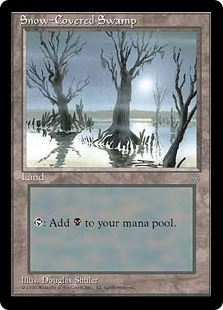
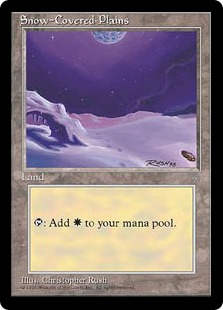
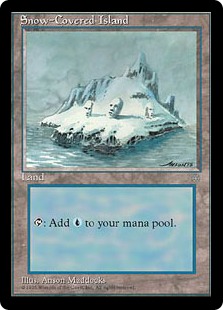
Snow-covered lands are awesome. Not the ugly Coldsnap ones, though. I'm talking about these beauties:

snowcoveredplains snowcoveredisland snowcoveredswamp snowcoveredmountain snowcoveredforest

Having started playing Magic during Ice Age, I have a strong fondness for these cards. At that time, they were more or less mechanically useless. In fact, in many cases, having snow-covered lands in your deck was a strict liability:

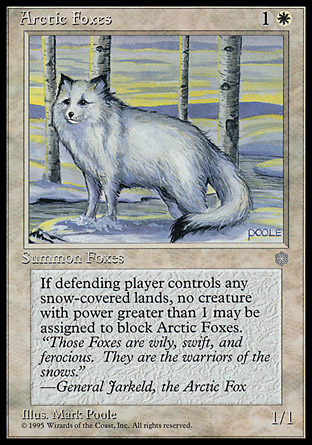
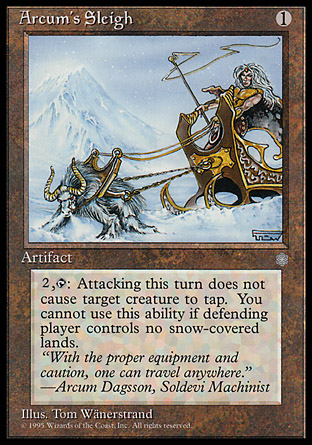
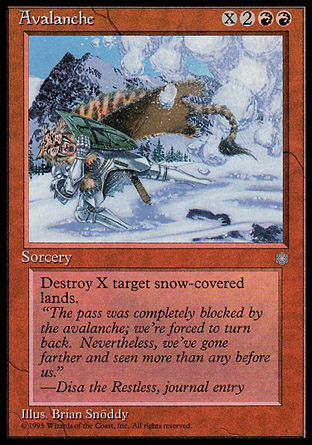
arcticfoxes arcumssleigh avalanche

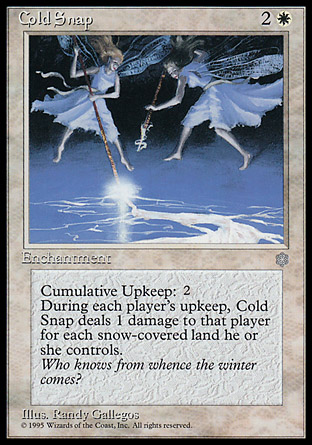
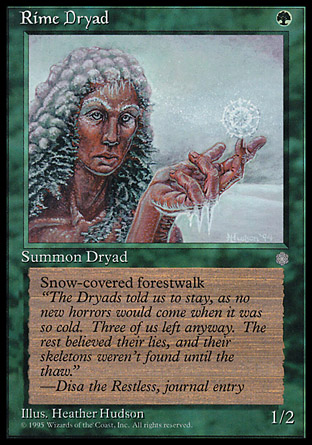
coldsnap rimedryad thermokarst

All of these cards punish you for playing snow-covered lands, and the ones that reward you for it are all pretty bad (talking about Ice Age only here). Not that the above cards are particularly good, mind you.

And yet we played them anyway. Snow-covered lands were mechanically unimportant back then, and when Coldsnap came along, only a few cards, most notably Skred, gave them in-play relevance. I didn't play at that time, but my understanding is that the added mechanics for snow lands didn't exactly go over well.

Despite this, these are basic lands that retail for around 50 cents or more—not a paltry amount for something that is functionally available for practically free—which shows they're obviously liked by at least a subset of players. Whenever I see a decklist that includes snow-covered lands, I'm thrilled, especially if there's no relevant reason they should be that version. LSV ran them in a recent ChannelFireball video, and it was awesome.

In many ways, the longer one plays Magic, the more jaded one becomes. Sure, the flavor of the game is still cool, but the game becomes more and more about power level, curves, and whether something dies to Doom Blade. Snow-covered lands don't care about any of that nonsense. These lands are one of the few vestiges of pure flavor* left in Magic, and if I could run them in my draft decks without being DQ'd, I'd buy my 85-set in a heartbeat.

*Yes, I'm continuing to ignore the mechanical relevance introduced in Coldsnap.

So here's hoping that snow-covered lands make their return someday. They don't even have to be mechanically relevant—I'll still be happy.

As for snow-covered duals? We can only dream.

Avatar photo

Danny Brown

Danny is a Cube enthusiast and the former Director of Content for Quiet Speculation.

View More By Danny Brown

Posted in Free, OpinionTagged , 3 Comments on Bring Back Snow-Covered Lands

Have you joined the Quiet Speculation Discord?

If you haven't, you're leaving value on the table! Join our community of experts, enthusiasts, entertainers, and educators and enjoy exclusive podcasts, questions asked and answered, trades, sales, and everything else Discord has to offer.

Want to create content with Quiet Speculation?

All you need to succeed is a passion for Magic: The Gathering, and the ability to write coherently. Share your knowledge of MTG and how you leverage it to win games, get value from your cards – or even turn a profit.

Want Prices?

Browse thousands of prices with the first and most comprehensive MTG Finance tool around.


Trader Tools lists both buylist and retail prices for every MTG card, going back a decade.

Quiet Speculation