menu

New Set, New Commander Decks! A Review

Are you a Quiet Speculation member?

If not, now is a perfect time to join up! Our powerful tools, breaking-news analysis, and exclusive Discord channel will make sure you stay up to date and ahead of the curve.

I have not been this excited for a Magic set in quite a while, but it looks like Kamigawa: Neon Dynasty is going to have cards that may shake up every single format!

Today we're taking a look at the two Commander decks that have been spoiled: Buckle Up and Upgrades Unleashed.

Here's a link to the official decklists including an "oops" made at the factory. It turns out the Upgrades Unleashed deck actually has 2x copies of Mossfire Valley, so you get a free bonus rare!

One thing I'd like to mention before diving into the article is that I have had the chance to actually play these decks online using some helpful Magic programs. Our focus in this article is on the contents of both decks. In next week's article, we will talk about the changes I made and how they played out. That will come out just in time for the decks to be released in paper for those of you looking to spice them up immediately.

First Impressions on Power Up

Wow, Wizards really outdid themselves. No, I mean they really outdid themselves, and I mean that in the wrong way. The selection of cards in this deck is unbelievable. It feels like an algorithm built this deck rather than a human being. To pivot the deck in a different direction, a lot of cards need to be removed, so many that it would cease being a Kotori, Pilot Prodigy deck. They've made some good decisions from a synergy and staples perspective, but I feel like there is no big picture to the deck. "What could we reprint for Kotori?" seems like the number one question asked and answered by this deck, and I find it severely lacking in flavor.

An Unlikely (and Underwhelming) Commander

I just don't get it. The way the deck is built, you have very few one- and two-drops to play before Kotori. Most of the time, it's just sitting in play as a 2/3. You get some vigilance and some lifelink, but why? There's very little synergy for this commander. In theory it reduces crew costs, but when that even comes up, opponents will just kill it. Nothing has haste! Just writing these notes has me fuming at the memories of how frustrating it was to actually play with this deck. In next week's article, you will see me try to salvage Kotori as the commander. Ultimately, though, I think I have a better suggestion for the shell.

Is There Any Good News?

The good news is it needs nothing to work out of the box as a casual-friendly, low-powered deck, which is a real plus. I know many Commander players like pre-mades for that exact reason. There's also the Shorikai, Genesis Engine theory, which makes more and more sense as I play the deck. TLDR: My guess is that Shorikai was the original commander, but there was some kind of last minute decision which left the deck the way it is. Oops again, Wizards!

So What's Inside?

Fifteen total Vehicles, with 7 completely new from Neon Dynasty. The deck also has 33 total Artifacts to improve deck synergy. It includes cards like Dispatch, which is perfectly on-theme and also extremely strong given what the deck is about; then, there are staple cards like Swords to Plowshares because... white? For me, that's a flavor fail, and a missed opportunity to imbue the deck with some much-needed identity.

Some Weird Includes from Reprinted Cards

Indomitable Archangel feels strange to me. It's essentially a four-mana Standard Bearer that eats a removal spell. Doesn't this deck have a TON of recursion, stock? Do you really need shroud for your artifacts? This doesn't even protect Kotori, which would have made a more compelling reason to include it.

Riddlesmith is fine, but it's never gotten me more than one extra re-draw per turn. The deck simply doesn't have enough low-cost artifacts to legitimize it for me. Also, there's a Jace in here...? This card has zero synergy with the deck. You could convince me that Jace, Cunning Castaway could be an alright include in this deck, but Architect makes absolutely no sense.

Some Weird Includes from the New Cards

As for Release to Memory, I guess they wanted to add a graveyard interaction answer, and it does include Spirits, which adds Kamigawa flavor. The problem is, this should instead be one of a dozen great artifacts that can interact with not only graveyards but also synergize with your plan. And fine, you might say, they wanted to include a new Neon Dynasty graveyard card. Well, why not Lion Sash, which is unbelievably better for this deck and is also a rare from Neon Dynasty in white? Wizards: crickets.

Given the algorithmic level of reprinting… why aren't there any artifact lands AT ALL in this deck? Overall, artifact lands offer a huge synergy boost. You can play Razortide Bridge and Darksteel Citadel if you are that afraid of your land being destroyed. Raff Capashen, Ship's Mage and Shimmer Myr gives all your artifacts flash, but so what? Basically Katsumasa, the Animator is a version of Raff that makes sense in this deck.

The BIGGEST Weird New Card Include

Let me be clear: Shorikai, Genesis Engine is good, fun, and works well with the deck. I almost wish it was the default commander. If I had more time, I would have played more games with the two legends swapped. This week, I am going to try and get in more Shorikai games, as I have a feeling it's the better choice from every angle. It's an extremely easy swap, but even then, I'm still unsure that Kotori is a card good enough to include in the deck.

Some Awesome Includes That Work in Multiple Decks

Where Power Up somewhat fails at its own theme, I can tell you it does have some really great looking cards that will easily slot into many other existing deck archetypes.

Drumbellower is going into my Mellicent, Restless Revenant Spirit tribal deck and is an awesome include in a HUGE number of Commander decks. It's super flexible between mana ramp, crewing on defense, multiple activations of abilities and so on. Expect to see it frequently.

Organic Extinction is an awesome one-sided wrath for this deck and any other strategy featuring a lot of artifacts. While it does not look as good as Blasphemous Act, it definitely should be at least as good as Day of Judgment, and the one-sided potential cannot be ignored.

Kappa Cannoneer is one of the most on-point new cards. It's an artifact creature. It has improvise. Ward 4 is pretty good. Turtle Warrior instead of Turtle Ninja, but, it has a massive CANNON on its back, and for good reason as it will steadily grow and become unblockable. There are many infinite combos involving bouncing artifacts over and over again that charge up the Cannoneer to one-shot someone. A great include in this deck with definite potential for others as well.

What About the Memes?

Swift Reconfiguration takes the absolute top prize here. Killing a commander is good. Turning a commander into an insect with Darksteel Mutation is better. Sending someone's commander to the moon with Imprisoned in the Moon is hilarious. But now you can turn a commander into a Vehicle, and for the low cost of one mana. I'm getting an unhealthy amount of silly ideas just from this one card. Speaking of which, I wonder when the Secret Lair VIP GTA edition comes out....

Was Power Up Fun to Play?

Well, the biggest flaw is the lack of haste, no doubt one of Magic's most powerful evergreen mechanics. While haste is not a common white or blue keyword ability, it would have been nice if Kotori, being a pilot prodigy and all, at least granted the Vehicle that it crews haste, like Speedway Fanatic. The next thing I find lacking is the overall number of artifacts and Vehicles. This Commander deck suffers from a common issue among pre-made decks which I call it "one third" problem. Basically, while drawing a perfect mana curve of roughly one in three draws, you need to draw exactly one-third "engine" cards like Sram, Senior Edificer, Sai Master, Thopterist or Thopter Spy Network while also drawing one-third "gas" cards like artifacts and/or Vehicles. Every time you draw an instant or sorcery, it slows your engine. Every time you draw another engine piece while you already have one, it's another dead draw. Imagine having Sram, Sai, Network, AND Kotori in play at once… crickets... that's right, nothing triggers, nothing happens, and you're left with a bunch of vanilla creatures sitting around moping. Yikes!

When I curved out, played a couple of artifacts early, got an engine online, and then just drew a couple more Vehicles, the deck showed potential. Unfortunately, I felt like I was durdling a lot of the time the ideal draw scenario did not happen.

If I had to rate Power Up on a scale of one (worst) to five (best): for raw power, it gets just about a two. For fun, I'd rate it at three when it's working, or one when it's not. I played it against other decks that I would consider competitive and casual alike, but I had a hard time because the deck itself does not function well.

How Would I Power Up, Uh, Power Up?

For more on this topic, check out my follow-up article next week. I will say now that improving the deck involves doing a lot more of what I think the deck is trying to do, and adding cards to support those gameplans instead of keeping random staple spells that hurt the probability of drawing engine cards. We can certainly improve the consistency, power, and fun of doing what the deck is meant to do. Can we transform Power Up into a cEDH dream deck? Probably not with Kotori, but raising the fun quotient is well within reach.

Next, let's talk about the other Neon Dynasty commander deck, Upgrades Unleashed, lead by Chisiro, The Shattered Blade.

First Impressions on Upgrades Unleashed: a Night and Day Difference

Wow, Chisiro is both powerful and fun! I can see a bunch of *different* ways to improve this deck, and they are all awesome, but it still plays great right out of the box. It doesn't matter what cards you draw; you are always going to threaten to kill players in a few turns. Since the commander gives you both creatures and counters, it does not matter which one-third of the deck you draw, as you can cover the shortfall with your commander's ability. Nearly every card seems to be both a synergistic card and a potential threat left unchecked.

The Secret Sauce

Chisiro is all about the new modified mechanic, so how many cards synergize with that theme? About 45, and after subtracting the lands that DON'T have synergy, that makes 70% of the deck. All in all, Chisiro has tremendous synergy, and every card choice is either decent, good, or extremely good. Now, it does have some staple cards like Kodama's Reach and Rampant Growth that I already have better ideas for, but those are simply swapping non-thematic ramp for thematic ramp. Ramp is ramp and improving the flavor a bit at virtually no cost in power is a no brainer for me.

Where Are the Bad Cards?

Truth be told, there are very few to be found. There certainly exist more powerful cards than Chain Reaction, Decimate and Starstorm, but I think these have a place here nonetheless. Consider that your monsters are likely unreasonably huge. They can survive damage, but not a boardwipe. On the other hand, you need to wipe the board, or at least clear a lot of tokens. Additionally, the cards pair well with the new spell Smoke Spirits' Aid—in that light, these choices belong.

Decimate can be tricky to put on the stack sometimes, but in a four-player game, it's very likely you just enjoy a four-for-one. Even Walking Skyscraper, which looks a bit odd at first, could be a zero mana 8/8 with trample and hexproof that will grow into one-shot territory quickly. Remember how Power Up has no haste? Chisiro has a ton of haste! Gigantic hexproof monsters with trample AND haste for zero mana are never awful.

Reprints vs. New Cards

For the title of best reprint, it's got to be a toss up between Grumgully, the Generous and Forgotten Ancient. They both do exactly what the deck wants to do, and for very little mana. I think I will give the nod to Grumgully because out of seventeen creatures there is only one Human, Champion of Lambholt, and you can see it was a deliberate design choice to limit the number of Humans.

The Best Cards from NEO

This is a really hard choice, but I want to say the best new cards are either Akki Battle Squad or Concord with the Kami. Getting double attacks is outrageous value, but Concord is super flexible no matter the game state. Ultimately, the ability to draw cards and rebuild your board state helps you win, whereas double attack steps is mostly win-more. Of course, this deck does not need a lot to win, and it can build back up from a board wipe surprisingly fast. Silkguard is another really great card, and i is essentially the very heavily played Snakeskin Veil but even better and more thematic in this deck. Instead of jamming the same 10 cards into every commander deck, this is a great example of just slightly re-tooling an existing card and putting it into a commander deck where folks can have 95% of the power but way more flexibility, which keeps games fun.

What About the Memes?

Well, alright, since you asked. I've got to ask, Collision of the Realms? I know the deck has a very loose token sub-theme from Chisiro and cards like Concord, One With the Kami, Elemental Mastery, and Ulasht, the Hate Seed. But is that really compelling enough to include Collision? Time will tell on this one, but I have yet to even cast it. It feels like it has a significant chance of helping someone else at the table a lot more than me, so I'm not sold on it yet.

Was Upgrades Unleashed Fun to Play?

Heck yeah it was! I cannot stress enough how the deck played itself, and seemingly cannot fail to spiral out of control in just a few turns. While it might not look like the deck is resilient to board wipes and removal, cards like Hunter's Insight, Rishkar's Expertise, and Concord with the Kami can restore a game state in quick order. Plus, there's enough hexproof and totem armor effects that Chisiro is unlikely to just die.

If I had to rate Upgrades Unleashed on that same one-to-five scale, it gets a three for raw power and a four for fun. In any game where I was left alone, at all, I quickly became the archenemy at the table and sometimes could kill two players at once. With just a few changes, I am hoping to turn that into three! While it is certainly not a cEDH-grade deck, it's strong for a casual deck because you are always growing. Be wary if your play group wants a slower experience.

And That's a Wrap... Until Next Week!

I'll be busy playing these decks with a few notable changes. Check in next week for my take on substitutions. I'm already super hyped for Chisiro, but I'm hoping I can get at least as pumped for Shorikai. I'm just not sure there's any hope for Kotori itself, but I will give it the best shot I can, and think I'm onto a few cards that do play into its strengths. In any case, all in all, Neon Dynasty looks great for Commander.

Real-world Flavor. Quotations from Poe’s tales and poems

Are you a Quiet Speculation member?

If not, now is a perfect time to join up! Our powerful tools, breaking-news analysis, and exclusive Discord channel will make sure you stay up to date and ahead of the curve.

Resignedly beneath the sky

The melancholy waters lie.

So blend the turrets and shadows there

That all seem pendulous in air,

While from a proud tower in town

Death looks gigantically down.

Edgar Allan Poe, The City in the Sea

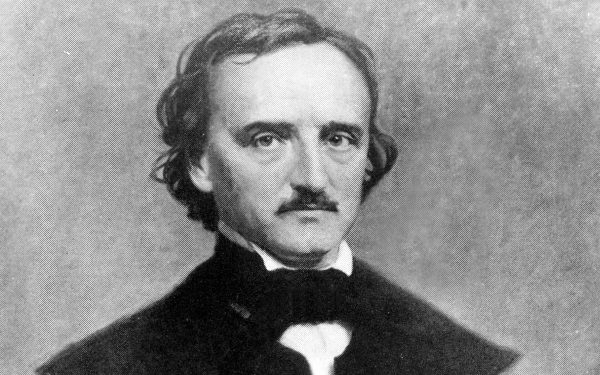
This excerpt, from "The City in the Sea" by Edgar Allan Poe, is a classic of gothic fiction. Not only that, but it’s also the flavor text of Urborg, one of the most famous lands in Magic’s history. Interestingly, this poem has a few similarities with "Kubla Khan", which is why I have chosen it as a bridge between Samuel Taylor Coleridge and Poe. Both are among the most quoted English-speaking authors in Magic, and as we’ll see they share several common traits. So, let’s move from the UK to the US, and from the romanticism of Coleridge to the gothic horror of Poe.

Edgar Allan Poe

Five unique cards were printed with a quotation from American author Poe. That is, one less than Coleridge. Where Coleridge only appeared on cards from Alpha and Portal, Poe shows up in many different editions. He is quoted on cards from Alpha, Legends, Fifth Edition, and Eighth Edition. Let's examine these five cards in detail, and then draw some conclusions by comparing these first two English-speaking authors.

Frozen Shade

There are some qualities—some incorporate things,

That have a double life, which thus is made

A type of twin entity which springs

From matter and light, evinced in solid and shade.

We begin with one of the two cards from Limited Edition Alpha on which Poe appears. This one is a common black creature, with the typical creature class of "Shade." One of the most famous shade cards is Ihsan's Shade, although the best one from a power level perspective is probably Nantuko Shade, printed many years later. Even though it's underpowered by comparison, Frozen Shade is the archetype of this subtheme, exhibiting the typical "pump" effect characteristic to the class.

The poem quoted in the flavor text is "Silence" (1839), a short composition of 15 lines. Four lines from the beginning of the poem are directly quoted on Frozen Shade. The meter is hendecasyllabic, i.e., verses of eleven syllables each, and the poem deals with the opposition between the death of the body and that of the soul.

There is no evident reason to choose this quote for this card, apart from the presence of the word "shade" at the end of the fourth line. Nonetheless, it conveys a certain ominous aura that goes well with the first Shade ever in the game.

Phantom Monster

While, like a ghastly rapid river,

Through the pale door,

A hideous throng rush out forever,

And laugh—but smile no more.

The other card from Alpha with a Poe quote is a creature again. This time, it's a blue uncommon. Phantom Monster is a 3/3 Illusion (formerly Phantasm) with flying for the cost of four mana. It's the typical creature you'd be happy to play in your draft pool, nowadays, but apart from that nothing special.

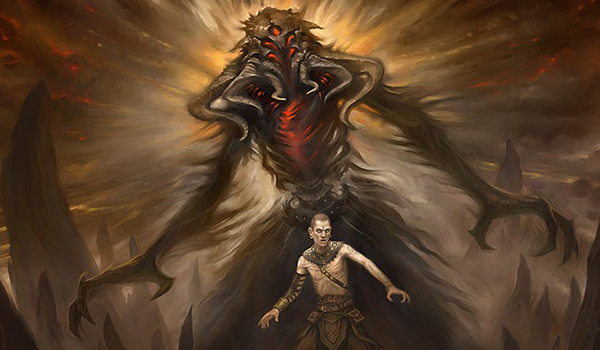
The illustration by Jesper Myrfors (the original art director of Magic) depicts a weird-looking being, that as far as I'm concerned seems almost Lovecraftian. As for the flavor text, it quotes another poem by Poe, this time "The Haunted Palace". It's from the same year as "Silence", 1839, but with its nearly fifty lines it's a bit longer. In Frozen Shade it was the opening lines that were quoted, while in this case, it's the final four.

The poem deals with evil forces and the doom of a king living in a high palace. Most of it is described from the point of view of passers-by, assisting to the progressive damnation of the king and his palace. Just before the lines of flavor text, the poem mentions travelers seeing: "Vast forms that move fantastically / To a discordant melody"—another spooky bit evoking the formlessness of a "phantom" being.

Urborg

Resignedly beneath the sky

The melancholy waters lie.

So blend the turrets and shadows there

That all seem pendulous in air,

While from a proud tower in town

Death looks gigantically down.

Urborg is famously one of the regions with the highest concentration of black mana in Dominaria, the primary setting for the majority of early Magic sets (excluding Arabian Nights). While we get a demonstration of this fact from the more recent Urborg, Tomb of Yawgmoth, the original Urborg is much less impressive. Apart from tapping for black mana, as you'd expect, it lets you remove the ability of first strike or swampwalk from a target creature. A weirdly specific effect, and not one that saw much play.

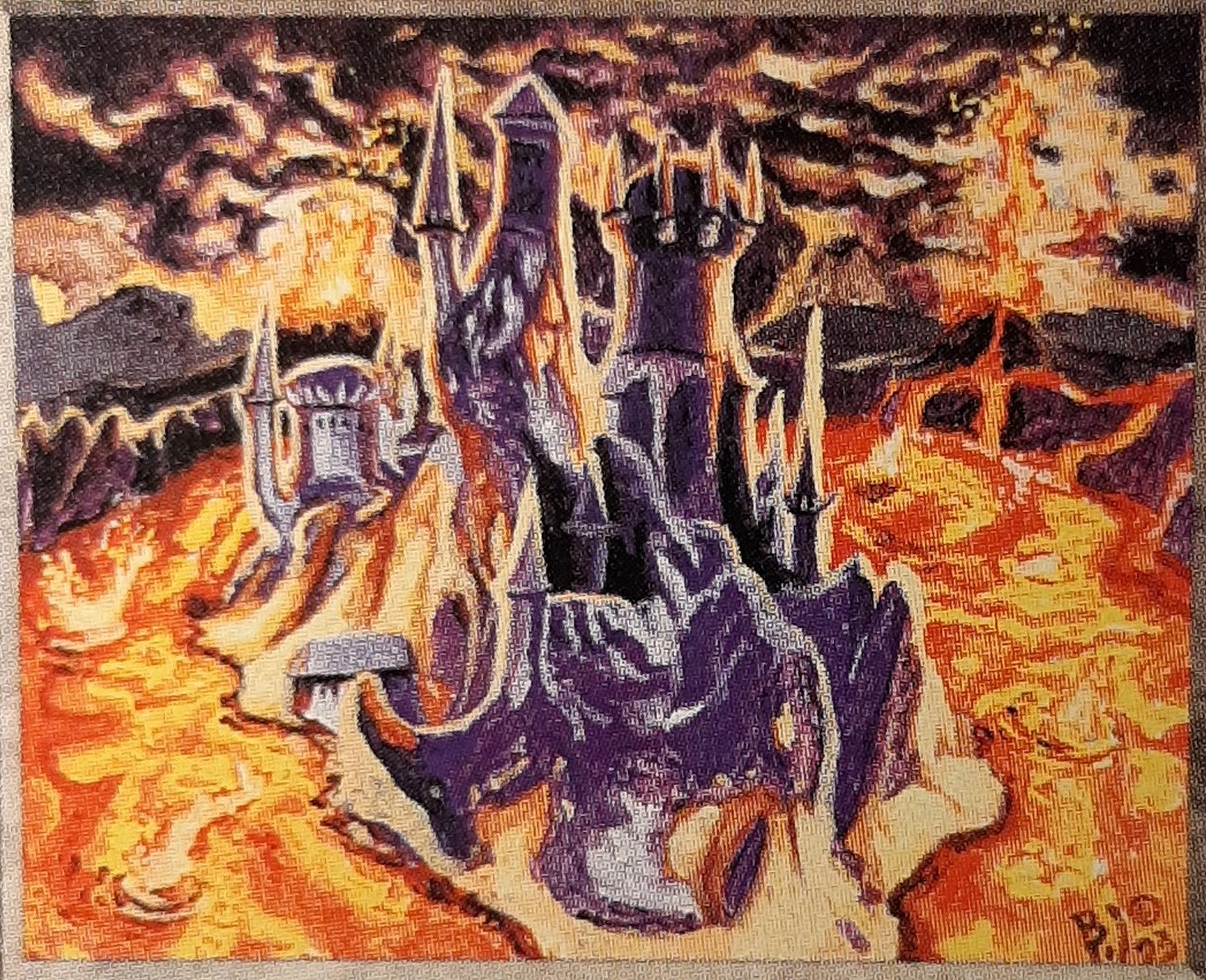
On the other hand, this legendary land from the set Legends is great from an aesthetic perspective. The art by Bryon Wackwitz conjures a haunted palace surrounded by lava, with warm, violent colors such as purple and orange. The quotation comes from Poe's "The City in the Sea" (1845). The rhythm of this poem is that of tetrameter, consisting of four "feet" and thus four main accents. It's funny because this is actually the most common meter used in nursery rhymes, creating an uncanny effect when featured on such a dark card.

Marsh Viper

And the seraphs sob at vermin fangs

In human gore imbued.

With Marsh Viper we are moving forward a few years. A green creature first printed in The Dark (1994), Marsh Viper received this flavor text for its reprint in Fifth Edition (1997). The poem by Poe is "The Conqueror Worm" (1843). It is comprised of 40 lines concerning human mortality and the vanity of life.

The specific quotation used consists of two verses located approximately in the middle of the poem. It describes a play where human-like figures are hastening in vain about the stage until they get devoured by a monstrous "crawling shape." The closure of the poem reveals that the tragedy is called "Man" and the only true hero is the "Conqueror Worm," or death.

Once more, this shows us how the best cards from a lore perspective are often those with lower power levels. Marsh Viper is interesting because it's among the earliest cards mentioning poison counters, many years before Scars of Mirrodin. Apart from that, it doesn't see much play, and the greatness of its tragic flavor text gets perhaps even stronger on such a humble card.

Death Pits of Rath

Neither could I forget what I had read of these pits that the sudden extinction of life formed no part of their most horrible plan.

The last card we are analyzing today is Death Pits of Rath from Eighth Edition (2003). First printed in Tempest (1997), It wasn't until it was reprinted a few years later that it acquired this flavor text. It was kept for the Ninth Edition reprint two years later as well.

This black enchantment makes every creature that gets damaged die. It's a spectacular effect (as dramatic as it is unplayable), and the art shows another spectacular scene of horror. As for the quote, it comes from one of Poe's most famous tales, "The Pit and the Pendulum" (1842).

It's the first quotation we see of prose from Poe. The other four flavor texts were all verses taken from his poems. The quote plays with the concept of "sudden extinction of life," contextually implying that there is no interest here in killing people quickly, but rather in torturing them. Suitably, the quote puts us on the outside looking in, trying to comprehend a horrific force beyond our understanding.

Conclusions

To sum up, we can see a few parallels between the quotations by Coleridge and those of Poe. First, most of the cards that got a quote from one of these poets are black cards. That's not surprising, as both authors are known for their dark, eerie themes. Even when they appear on cards from other colors, there is always some kind of ominous or dark-themed quality. Think of the poison counters from Marsh Viper or the anti-swampwalk ability of Urborg.

Second, there is a strong tendency towards poetry over prose. Both Coleridge and Poe left many writings in prose, but on Magic cards, they got almost totally neglected. We will see in the course of the next articles whether this only happens with Poe and Coleridge or whether it is a wider trend across flavor texts as a whole.

As for their differences, at least when it comes to Magic, I see a slight shift. While Coleridge's quotes were commonly describing physical beings, such as rats or zombies, Poe's evoke more phantasmic entities, such as shades or illusions. What will other English-speaking authors have to offer? Stay tuned for the next installment where we'll explore other English-speaking authors quoted in Magic cards.

Return to Form: January ’22 Metagame Update

Are you a Quiet Speculation member?

If not, now is a perfect time to join up! Our powerful tools, breaking-news analysis, and exclusive Discord channel will make sure you stay up to date and ahead of the curve.

We are now firmly into the new year, so it's time for another metagame update. This one is arriving a little later than normal, but that's what happens when the month begins on a Tuesday. I just don't have time to gather and process the data and then complete the write up in 24 hours. And it's not like I'm missing anything major in the world of Magic by talking about this instead of any new development.

Modern has been in an odd state since last July. On the one hand, there has been considerable innovation, churn, and general change within Modern since the release of Modern Horizons 2. On the other, it has remained remarkably static: Hammer Time has held firmly onto the #1 spot in the metagame, with the same few decks hanging around Tier 1 as well. Will the new year yield a new metagame? Let's dive in and see!

January Metagame

To make the tier list, a given deck has to beat the overall average population for the month. The average is my estimate for how many results a given deck “should” produce on MTGO. Being a tiered deck requires being better than “good enough;” in January the average population was 6.88 setting the Tier 3 cutoff at 7 decks. Which is back where it's been for most of the past year.

Tier 3 begins with decks posting 7 results. Then we go one standard deviation above average to set the limit of Tier 3 and cutoff for Tier 2. The STdev was 12.52, which means that means Tier 3 runs to 20 results. Again, it's the starting point to the cutoff, then one above for the next Tier. The STdev was lower this month, though still on the high end of normal. Therefore Tier 2 starts with 21 results and runs to 34. Subsequently, to make Tier 1, 35 decks are required. Which, again, is on the high end of normal for post-MH2 Modern.

I should note that it will look like there are several outliers in January's data. But they are not in fact outliers. Rather, an unusual number of singleton decks in the data skewed the numbers. And even if the decks were outliers, removing them doesn't change anything about the tier list's composition, so the outliers wouldn't affect the conclusions.

The Tier Data

Total decks fell in January. This is not January's fault, however. Wizards failed to post the January 29 Challenge, and so there's a minor gap in the data. This happens periodically; I'm guessing the auto-updater bugs out. There were also almost no non-Wizards events in January. I have no idea why. As such, the data consists of 502 decks down from December's 528 decks. Had the missing Challenge been posted or there been more non-Wizards events, it would have beaten December easily.

The unique decks were up with 73 unique decks in January to December's 67, just over a third of which were singletons. I've had updates with more in total, but this is high percentage-wise. Not sure how that happened, but it is what it is. Consequently, the number of decks is also a bit up from December's low of 13 at 18, which is back in the normal range.

Deck NameTotal #Total %
Tier 1
Grixis Shadow6713.35
Hammer Time6011.95
4-Color Blink448.76
Tier 2
UR Murktide316.17
Cascade Crashers295.78
Burn275.38
Jund Saga244.78
Tier 3
Amulet Titan163.19
Belcher142.79
4-Color Control132.59
UW Control122.39
Mill112.19
Yawgmoth112.19
Mono-Green Tron101.99
Ponza81.59
Blue Living End81.59
Dredge81.59
4-Color Bring to Light71.39

I hope my into was taken as the foreshadowing it was, because Hammer Time has finally been dethroned... by 2017 boogeyman Grixis Shadow. The more things change, the more they stay the same. However, don't rejoice too loudly yet. I don't know if this is a real metagame shift or a hiccup. Grixis has a lot of nostalgia going for it, and that may be the reason it has dethroned Hammer Time after seven months.

Adjustments

Not to say that Grixis didn't do it on merit, mind. Dress Down is extremely powerful against Hammer Time and many other decks. To say nothing of old standby Kolaghan's Command's effectiveness. Add in discard's power against slow strategies and the fast pressure of Ragavan, Nimble Pilferer, and Grixis has game against the field.

There was an error retrieving a chart for Dress Down

Which may be why I'm seeing a lot of change within the other top decks. Some Hammer Time lists are dropping Sanctifier en-Vec from maindecks because it matches up so poorly against Dress Down. Instead, it's moving to more equipment like Nettlecyst and Kaldra Compleat, which means giving up Lurrus of the Dream-Den. Others are branching out into more colors. Red gives reach and Ragavan, black has discard and Dark Confidant, while blue gives Meddling Mage.

There was an error retrieving a chart for Sanctifier en-Vec

Meanwhile, 4-Color Omnath piles are continuing to evolve. The value blink version with Ephemerate was the most popular, but that was thanks to early-month dominance. By the end, the control version with extra counters and answers for Death's Shadow was the most played. I don't know if this will continue or was linked to a specific streamer's results. We'll all have to see.

Power Rankings

Tracking the metagame in terms of population is standard practice. But how do results actually factor in? Better decks should also have better results. In an effort to measure this, I use a power ranking system in addition to the prevalence list. By doing so, I measure the relative strengths of each deck within the metagame. The population method gives a deck that consistently just squeaks into Top 32 the same weight as one that Top 8’s. Using a power ranking rewards good results and moves the winningest decks to the top of the pile and better reflects its metagame potential.

Points are awarded based on the population of the event. Preliminaries award points for record (1 for 3 wins, 2 for 4 wins, 3 for 5) and Challenges are scored 3 points for Top 8, 2 for Top 16, 1 for Top 32. If I can find them, non-Wizards events will be awarded points the same as Challenges or Preliminaries are depending on what the event in question reports/behaves like. Super Qualifiers and similar higher-level events get an extra point and so do other events if they’re over 200 players, with a fifth point for going over 400 players. There were two 4 points events in October and no 5 pointers.

The Power Tiers

Unlike with population, the total points were down slightly in January, but would have easily beaten December if Wizards had posted the missing Challenge. There are 872 total points in January compared to December's 889. A single Challenge adds 56 points, for the record. There were a lot of very large Preliminaries in January which pushed up the points despite the number of events being down overall.

The average points were 11.94. Therefore 12 points makes Tier 3. The STDev was 21.95, which again is on the high end of normal. Thus add 22 to the starting point and Tier 3 runs to 34 points. Tier 2 starts with 35 points and runs to 57. Tier 1 requires at least 58 points. The number of decks making the power tiers was down from 18 to 16. Because Ponza and 4-Color Bring to Light just don't win events.

Deck NameTotal #Total %
Tier 1
Grixis Shadow11913.65
Hammer Time9911.35
4-Color Blink849.63
Tier 2
UR Murktide576.54
Cascade Crashers485.50
Burn445.05
Jund Saga374.24
Tier 3
Belcher283.21
UW Control273.10
Amulet Titan242.75
Mill242.75
4-Color Control222.52
Mono-Green Tron202.29
Yawgmoth161.83
Blue Living End131.49
Dredge131.49

It's unusual that the top tiers stay the same between population and power, but here we are. There's a lot of movement in Tier 3 and none in the other two. It makes sense as with fewer overall results the effect of a few good placings will be exaggerated. Belcher being at the top of Tier 3 is important because the deck is very well positioned, and I'm surprised it's not more popular online. In a metagame this fair and warped around beating fair decks, you'd think the extremely unfair deck would be the right metagame call. I don't know why that isn't happening.

Average Power Rankings

Finally, we come to the average power rankings. These are found by taking total points earned and dividing it by total decks, which measures points per deck. I use this to measure strength vs. popularity. Measuring deck strength is hard. There is no Wins-Above-Replacement metric for Magic, and I'm not certain that one could be credibly devised. The game is too complex, and even then, power is very contextual. Using the power rankings certainly helps and serves to show how justified a deck’s popularity is. However, more popular decks will still necessarily earn a lot of points. Which tracks, but also means that the top tier doesn't move much between population and power, and obscures whether they really earned their position.

There was an error retrieving a chart for Ragavan, Nimble Pilferer

This is where the averaging comes in. Decks that earn a lot of points because they get a lot of results will do worse than decks that win more events, indicating which deck actually performs better. A higher average indicates lots of high finishes, where low averages result from mediocre performances and high population. Lower-tier decks typically do very well here, likely due to their pilots being enthusiasts. So be careful about reading too much into the results. However, as a general rule decks which place above the baseline average are overperforming and vice versa. How far above or below that average determines how "justified" a decks position on the power tiers are. Decks well above baseline are therefore undervalued while decks well below baseline are very popular but aren't necessarily good.

The Real Story

When considering the average points, the key is looking at how far-off a deck is from the Baseline stat (the overall average of points/population). The closer a deck’s performance to the Baseline, the more likely it is to be performing close to its “true” potential. A deck that is exactly average would therefore perform exactly as well as expected. The further away the greater the deviation from average, the more a deck under- or over-performs. On the low end, the deck’s placing was mainly due to population rather than power, which suggests it’s overrated. A high-scoring deck is the opposite.

Deck NameAverage PointsPower Tier
UW Control2.253
Mill2.183
Belcher2.003
Mono-Green Tron2.003
4-Color Blink1.911
UR Murktide1.842
Grixis Shadow1.771
Baseline1.74
4-Color Control1.693
Hammer Time1.651
Cascade Crashers1.652
Burn1.632
Blue Living End1.623
Dredge1.623
Jund Saga1.542
Amulet Titan1.503
Yawgmoth1.453

Congratulations to 4-Color Blink, the best performing high tier deck and therefore the best deck of January 2022! It's interesting though instructive that Grixis Shadow was right at baseline, indicating it's performing as expected while Hammer is well below. Not that Hammer's average points have been anything special for a while now. I'd also expect a deck undergoing a redesign to underperform. It isn't fully optimized anymore, how is it going to dominate?

On that note, the baseline is quite high by the standards of the past few months. This is not an indication of a shift in the winds but rather the result of a quirk from all the singletons. For some reason, they did very well in a number of Challenges Super Qualifiers and having multiple 3+ point winners skewed the average higher.

Paper's Back

Normally, that would be the end of the metagame update. However, clearly that's not the case, and that's because I have a promise to keep. In the December update, I announced that paper would be returning to the data, and it has. You may rejoice!

There was an error retrieving a chart for Omnath, Locus of Creation

Now cease rejoicing, because this will be underwhelming. There's not a lot of data to work with for paper. I can only work with results that get reported, and the only place that has said reports is MTGTop8.com. Over there, nearly every event is reported as just a Top 8, and sometimes even less data is given per event. The data is therefore extremely lacking in granularity or dynamism. Additionally, not every store that is running usable events is posting so my results reflect a few major stores more than any other. Specifically, Hareruya is responsible for about a third of the data. Keep that in mind as I report the data, and if anyone knows of other sources, please let me know. I'm mildly desperate.

The Paper Metagame

There were 293 total paper decks posted in January, which is roughly 3/5's of the online metagame. As such, the data is less robust and reliable. It is what is it is, and an analyst must work with the available data. Given that almost all the results were just Top 8 results (and many were less) and also didn't the number of players or final records, I'm not doing a power metagame. I don't have enough information to assign points, so even if I did one, it would not look sufficiently different to population justify the effort.

However, this data is significant for backing up a long-held belief. Despite having significantly fewer results than the online results, the paper metagame consists of 66 unique decks, just 7 less than online. It has always been assumed that paper is more diverse than online, and this data backs up the assumption. We'll see if further results corroborate these ones and prove the belief true. That said, only 15 decks made the paper Tiers. Again, lots of singletons in the data set.

Deck NameTotal #Total %
Tier 1
Grixis Shadow289.56
Burn217.17
Hammer Time206.83
4-Color Blink206.83
Tier 2
Amulet Titan155.12
UW Control155.12
UR Murktide144.78
Tier 3
Cascade Crashers113.75
Blue Living End103.41
Jund Saga72.39
Yawgmoth72.39
Mono-Green Tron62.05
Eldrazi Tron62.05
Ponza51.71
Humans51.71

Of course, for all that, Paper Tier 1 looks extremely similar to Online Tier 1. Burn being more popular in paper was a huge surprise. The assumption has always been it's overrepresented online, but that appears to be untrue. In fact, the overall composition of these tiers is quite similar to online's tiers. I have no idea if this is normal or not.

Composite Metagame

At would logically follow to combine the two lists into one. It is what we did in the old days. However, that's not going to work. The math the old system used doesn't work without major paper events. Maybe when Wizards gets Organized Play back together that will change but for now, I can't use it. I can't just combine the two because the online results vastly outweigh paper and will obscure the "true" result. So for now, I'm just going to report their average Tier. This reflects the differences between paper and online play sufficiently well to demonstrate the relative power of decks and the differences between paper and online.

Deck NameOnline Population TierPaper Population TierAggregate Tier
Tier 1
Grixis Shadow111
Hammer Time111
4-Color Blink111
Burn211.5
Tier 2
UR Murktide222
Cascade Crashers232.5
Jund Saga232.5
Amulet Titan322.5
UW Control322.5
Tier 3
Yawgmoth333
Mono-Green Tron333
Ponza333
Blue Living End333
Belcher3N/A3.5
4-Color Control3N/A3.5
Mill3N/A3.5
Dredge3N/A3.5
4-Color Bring to Light3N/A3.5
Eldrazi TronN/A33.5
HumansN/A33.5

Unsurprisingly, the best decks from online are still solidly Tier 1 in aggregate. Burn moves up by a half tier, reflecting that it's #2 overall in paper but Tier 2 online. Those decks that didn't show up on one list but did the other get an N/A, which is treated like a 4 for math purposes.

Just the Beginning

I've got a lot of bugs to work out with the paper results. I didn't really know what I'd have, and so failed to make solid plans prior to gathering the data. If anyone has advice, I'm all ears, but until then, this is the metagame we faced in January. And may still be facing next time. We have to wait and see.

Kamigawa: Neon Dynasty’s Modern Upgrades

Are you a Quiet Speculation member?

If not, now is a perfect time to join up! Our powerful tools, breaking-news analysis, and exclusive Discord channel will make sure you stay up to date and ahead of the curve.

Modern is a diverse and powerful format featuring a myriad of existing synergies that are not easily upgraded or replaced. A typical premier set might only offer one or two cards strong enough to trickle into Modern. Recent sets like Innistrad: Midnight Hunt and Innistrad: Crimson Vow were on the lower end of the power scale, meaning nothing there proved strong enough to enter older formats.

Kamigawa: Neon Dynasty represents a departure from this trend. We've received a host of new and flexible cards thanks to the returning Channel mechanic, cost reducers, and card advantage engines, all designs which tend to flourish in Modern. Today, we'll highlight the decks poised to receive the biggest improvement.

Stoneblade

NEO introduces a new take on Equipment cards with artifact creatures that can reconfigure into creature buffers. These creatures, with few exceptions, bestow their abilities onto the creature they're attached to. One of the struggles for Equipment is that they require creatures in play to do anything, and you only have so many slots in a deck: too many Equipment cards will eat away at your creature density and increase the risk of not having anything to carry your artifacts into battle. Similar to living weapon cards like Batterskull, these new Equipment creatures offer the best of both worlds, buffing creatures without cutting back the total creature count.

Most importantly, the new Equipment creatures are all tutorable with cards like Stoneforge Mystic and Steelshaper's Gift, opening up the toolbox considerably. Lion Sash in particular offers new ways to combat graveyard strategies like Dredge and disrupt decks like UR Murktide that incidentally get value from their graveyard. The Reality Chip provides a potential Future Sight-style card advantage engine that works with Lurrus of the Dream-Den strategies.

Looking beyond Lurrus compatibility, Kamigawa also contains a fixed Tinker in Anchor to Reality, which can find any Vehicle or Equipment. The best payoff available at the time of writing is Kaldra Compleat, an indestructible, haste, and trample threat that's only held back by its seven mana casting cost and Stoneforge Mystic's summoning sickness. At four mana, Anchor provides a substantial discount for Kaldra, and can leave opponents without any outs.

Jeskai Stoneblade

Creatures

4 Stoneforge Mystic
4 Esper Sentinel
4 Fervent Champion
4 Ragavan, Nimble Pilferer
4 Ranger-Captain of Eos
4 Solitude

Artifacts

1 Lion Sash
1 Maul of the Skyclaves
1 Kaldra Compleat
1 Batterskull
2 Sword of Fire and Ice

Spells

2 Prismatic Ending
2 Anchor to Reality

Planeswalkers

3 Teferi, Time Raveler
1 Jace, the Mind Sculptor

Lands

1 Castle Ardenvale
1 Hallowed Fountain
1 Seachrome Coast
1 Island
1 Mountain
1 Steam Vents
2 Sacred Foundry
2 Plains
2 Scalding Tarn
3 Inspiring Vantage
3 Flooded Strand
4 Arid Mesa

Sideboard

1 Sword of Feast and Famine
1 Giant Killer
2 Burrenton Forge-Tender
2 Prismatic Ending
2 Rest in Peace
4 Dovin's Veto
2 Path to Exile
1 Jace, the Mind Sculptor

HollowVine

HollowVine is an older archetype that thrived in Modern prior to the Faithless Looting ban in 2019. It utilized cheap red draw-and-discard effects like Burning Inquiry to power through its deck and pick up value from Madness cards and other discard or graveyard-matters effects such as Fiery Temper, Flameblade Adept, and Vengevine. Without Looting, though, the deck struggled to have the card selection needed to consistently execute its game plan without whiffing.

Hope may not be lost! In the new set, HollowVine picks up an innocuous but powerful addition in the form of Containment Construct. This two-drop creature allows pilots to play anything they discard until the end of the turn. We previously saw an effect like this in Strixhaven with Conspiracy Theorist, but that only got back one card per instance of discard, and didn't affect lands.

Construct turns Burning Inquiry into a potential draw four for a single mana while also (sometimes) disrupting opponents. Unintentionally discarding Hollow Ones used to be a major risk for the deck, but Construct sidesteps that altogether. Combining this shell with the Madness support from Modern Horizons 2 like Asmoranomardicadaistinaculdacar and The Underworld Cookbook may breathe new life into this fan-favorite deck.

HollowVine

Creatures

2 Ox of Agonas
4 Blazing Rootwalla
4 Insolent Neonate
4 Flameblade Adept
4 Vengevine
4 Hollow One
2 Street Wraith
4 Containment Construct
4 Asmoranomardicadaistinaculdacar

Artifacts

3 The Underworld Cookbook

Spells

4 Burning Inquiry
4 Goblin Lore

Lands

1 Scalding Tarn
1 Arid Mesa
1 Shinka, the Bloodsoaked Keep
2 Bloodstained Mire
3 Stomping Ground
4 Copperline Gorge
4 Mountain
1 Sokenzan, Crucible of Defiance

Sideboard

2 Alpine Moon
1 Lightning Bolt
2 Fury
1 Foundation Breaker
2 Chalice of the Void
2 Blood Moon
3 Ancient Grudge
2 Soul-Guide Lantern

Cascade

The third and final archetype I'll mention has perhaps the most subtle of changes, but perhaps also the most critical. Cascade encompasses three main shells in Modern: Crashing Footfalls, Living End and Glimpse of Tomorrow. Each of these attempt to cast their uncosted suspend spells via Violent Outburst and Shardless Agent, planting them firmly in Temur colors. The main way to counteract these strategies is to keep their build-around suspend card from resolving, most commonly through Chalice of the Void and Teferi, Time Raveler.

The deckbuilding requirement for Cascade requires the player to only include spells with mana value 3 or greater so they can always cascade into their intended target. This condition limits the variety of cards they can include to interact and protect their combo to things like cost-reduction mechanics or alternate casting costs like Brazen Borrower // Petty Theft and Force of Vigor.

Kamigawa: Neon Dynasty introduces a cycle of untapped lands with Channel, an activated ability that lets you discard at instant speed for a multitude of effects. Notably, these are abilities and not spells, which means they can't be countered by normal means and aren't affected by Teferi's timing restrictions. The green land of the cycle, Boseiju, Who Endures, destroys Chalice at an efficient rate on curve. Meanwhile, the blue land, Otawara, Soaring City can temporarily bounce either Chalice or Teferi (and a wide range of other relevant card types) to sneak in a cascade spell. Typically, resolving just one suspend spell wins the game.

These two cards are such a big upgrade because there's virtually no opportunity cost. Since they are lands, the deck's spell density just increases for free. And because they enter untapped, no tempo is lost if the lands are played for mana. In matchups where Teferi and Chalice aren't relevant, these function as additional "spells" in the event of mana flood. They simply raise the deck's floor against bad matchups without needing to give up percentage points for anything else. You can bet I'll be playing a lot more Cascade in the coming weeks thanks to this change, even though the "channelands" stand to improve most Modern decks by some measure.

Temur Rhinos

Creatures

3 Fury
2 Seasoned Pyromancer
4 Shardless Agent
2 Bonecrusher Giant // Stomp
4 Brazen Borrower // Petty Theft

Enchantments

3 Blood Moon

Spells

4 Crashing Footfalls
1 Dead // Gone
4 Fire // Ice
4 Force of Negation
1 Valakut Awakening // Valakut Stoneforge
4 Violent Outburst

Lands

2 Forest
1 Breeding Pool
1 Gemstone Caverns
2 Island
1 Ketria Triome
4 Misty Rainforest
1 Mountain
4 Scalding Tarn
1 Steam Vents
1 Stomping Ground
4 Wooded Foothills
1 Boseiju, Who Endures
1 Otawara, Soaring City

Sideboard

1 Blood Moon
2 Bonecrusher Giant
1 Dead // Gone
3 Endurance
3 Force of Vigor
1 Fury
4 Mystical Dispute

End Step

These are the archetypes that I believe have gained the most from this new, high-powered set and I cannot wait to give them a whirl. What cards are you most looking forward to? Leave a comment below to share your thoughts or tweet me at @AdamECohen. Catch you next week!

An Ode to The Dark

Are you a Quiet Speculation member?

If not, now is a perfect time to join up! Our powerful tools, breaking-news analysis, and exclusive Discord channel will make sure you stay up to date and ahead of the curve.

Out of the Four Horsemen sets (Arabian Nights, Legends, Antiquities, and The Dark), The Dark has got to be the most under-appreciated. The small expansion set released in August 1994 is often overlooked as being extremely underpowered relative to contemporary sets.

In all honesty, that’s probably a fair assessment of the set’s power level. Other than Blood Moon, are there any other cards from the set that see tournament play?

There was an error retrieving a chart for Blood Moon

I know Ball Lightning used to be a house back in the day, but it has since fallen out of favor. Maze of Ith is played in some Legacy Lands builds, so that one is still relevant. Anything else? Not really.

This week I am going to shine the light on some of the good, bad, and ugly from this oft-forgotten expansion from Magic's history. If you’re an Old School expert, you’ll appreciate the shout-outs to some cards you wish saw more play. If you’re a newer player and are unfamiliar with this set, get ready for a strange and wild ride—The Dark has so much flavor quirkiness to offer that you’ll be looking up these cards yourself just to confirm I’m not making them up.

Believe me, these are all real.

The Good

The most valuable card in The Dark isn’t even Blood Moon. Instead, it’s a Reserved List goblin creature card that sneaks additional goblins into play. Goblin Wizard’s casting cost is prohibitively high given the fact that you can only use it to cheat in goblin creatures, which are underwhelming to begin with. But it’s still a unique and powerful ability worth acknowledging. I guess it’s good with some of the more recent, more powerful goblins in Magic.

There was an error retrieving a chart for Goblin Wizard

The next most valuable card from The Dark after Goblin Wizard and Blood Moon is City of Shadows, which is approaching $100.

There was an error retrieving a chart for City of Shadows

Don’t get me wrong, I love the artwork (a common theme for me with The Dark), but exiling creatures to ramp colorless mana isn’t my idea of a busted ability. I suppose it’s handy if your creatures are about to be killed anyway, but I can’t help but suspect being a Reserved List card from an old set has something to do with this card’s price tag.

Let’s get into a subset of cards from The Dark that all violate the color pie, starting with Preacher.

There was an error retrieving a chart for Preacher

Here we have a white card that can repeatedly take control of opponents’ creatures. Typically this is a blue (or in a stretch, a black) effect. There aren’t many white Magic cards that boast this ability.

Next, let’s say you want to destroy a bunch of lands—what color comes to mind? If you guessed red because of Stone Rain, you win first prize. If you guessed black (Sinkhole), green (Ice Storm), or white (Armageddon), you get bonus points for thinking outside the box. But how many people think of blue when they consider land destruction cards? Introducing Mana Vortex:

There was an error retrieving a chart for Mana Vortex

This blue enchantment will destroy land after land… not just forests like Acid Rain, we’re talking any lands. I’m not sure how potent the card is in a game, but the utility is not what is driving this card’s price up near $50.

Speaking of blue receiving abilities that normally don’t exist within its color, check out Mind Bomb, the sorcery speed discard/direct damage spell.

Then you have other quirks like direct damage in white via Fire and Brimstone, toughness reduction in white with Holy Light, and additional blue land destruction with Erosion. The color pie was not so holy back in 1994, I guess.

Oh, and let’s not forget about the white spell that exiles all white creatures for just two mana! Sound oddly powerful? Well, for consolation, each creature exiled this way does get to draw a card. This seems like a breakable card though, in the right build. Say hello to Martyr's Cry, a strange card from The Dark with disturbing artwork.

There was an error retrieving a chart for Martyr's Cry

Lastly, let’s not forget Fellwar Stone, a nearly $20 mana rock originally printed in The Dark with some real utility. In a multiplayer game of Commander, Fellwar Stone is likely to generate any color of mana you need.

The Bad

There are many underwhelming cards in The Dark with surprisingly high values. Hidden Path comes to mind, a green enchantment that grants all green creatures forestwalk.

There was an error retrieving a chart for Hidden Path

If you’re playing a green enchantment with four green mana symbols in its mana cost, chances are you’ll have forests in play. If your opponents are also playing green, you’d better have more green creatures out than they do or else you’ll get walked all over. And if they aren’t playing green then what good is giving them forestwalk?

Giving your opponent choices is traditionally a weakening effect on a Magic card. Ideally, you give your opponent as few options as possible throughout a game. So Cleansing isn’t the ideal card to use to destroy lands, especially since paying a few life to keep the most important lands doesn’t seem like a steep cost.

There was an error retrieving a chart for Cleansing

Worms of the Earth also gives opponents a choice. In fact, they have multiple options: stop playing lands, pay five life, or sacrifice two lands. Considering its effect is symmetric, I’m not sure what the upside is to paying five mana for this enchantment (not to mention paying $10 to buy the card!).

Scarwood Bandits is another card that gives your opponent choices. Being able to gain control of an artifact is powerful, but your opponent has the option of paying two mana to prevent the ability from taking effect. This is another one of those random The Dark Reserved List cards worth $10.

Lastly, I’ve already mentioned Mind Bomb for breaking the color pie, but it also fits in this section too because it gives your opponent the option to discard cards or take damage. The symmetric nature of this card makes it especially underwhelming unless you want to discard cards.

The Ugly

This section is going to be my favorite. There are many cards in The Dark with disturbing art. It’s kind of the set’s theme, after all. Don’t expect to find many cute bear cubs, shining angels or paladins, or adorable squirrels in this set. Instead, let’s see some of the more hideously awesome pieces of artwork from this set.

Because there are so many, I’m going to minimize commentary on each card so I can touch upon them all. Let’s start with Eater of the Dead because the creature’s name and art are disturbing. Look closely at the picture—how many eyes does this creature have?

There was an error retrieving a chart for Eater of the Dead

Next, there’s Frankenstein's Monster. I like this card for its reference to a real-life story and I like it twice over because its reference is historically correct. Many people refer to the monster of Mary Shelly’s work as “Frankenstein” but the reality is that was the doctor’s name and the monster was… well, Frankenstein’s monster.

There was an error retrieving a chart for Frankenstein's Monster

One of my favorite pieces of art from The Dark has to be Drew Tucker’s Exorcist. Not only is the concept of an “Exorcist” card really cool, but I love the dark abstraction this artwork evokes.

There was an error retrieving a chart for Exorcist

Worms of the Earth is a disturbing mental image. How about Psychic Allergy? I don’t know what a psychic allergy is, but if it affects an individual as depicted in the card’s artwork, then remind me to avoid such a thing at all costs.

Grave Robbers is a disturbing thought, and the artwork does the concept justice. How these two guys sleep at night given their dark hobby is beyond me.

There was an error retrieving a chart for Grave Robbers

Then there’s a trio of creatures I would never want to see at my doorstep on any given night: Banshee, Rag Man, and The Fallen. Which of these three creatures is most frightening to you? Personally, I think The Fallen is the worst—that smile is just so unsettling.

Then there’s Amnesia, whose artwork is so disgusting that I refuse to keep a copy of the card. Every time I pick one up, I ask myself what pleasure I can possibly glean from such a card. As my mind draws a blank, I add it to the buylist pile.

Even something that could be innately innocent is given a dark spin in this set. Check out the artwork for Scarecrow. The creature looks nothing like the modern-day Scarecrows we are used to seeing in Magic. The original looks so much more sinister.

How about Blood of the Martyr, another favorite of mine from The Dark.

There was an error retrieving a chart for Blood of the Martyr

This card isn’t on the Reserved List and isn’t all that playable, yet it is still worth a solid buck or so. I’d like to think that’s because of the cool art.

Last but not least, there’s Scarwood Hag which looks… well, it looks how a hag should look like from the era of The Dark.

Wrapping It Up

This article just scratched the surface of what The Dark has to offer from a value and aesthetic standpoint. In my modest collection, I have a smattering of cards from each of the Four Horsemen sets. My section on The Dark may be the least valuable of the four, but it definitely isn’t the least interesting. There are so many strange, dark, and quirky cards from this set that I want to own in my collection simply for these reasons alone.

And I didn’t even mention a couple of other favorites of mine. Season of the Witch is a dark and disturbing piece of art on a $30 card. Necropolis has a beautiful piece of art too, even though I couldn’t recite to you from memory what the card actually does. The list goes on and on.

If you have an appreciation for top-down Magic set design, where flavor takes the driver’s seat, then The Dark is for you. You’ll not find cards to help you win competitive games of Magic, but you’ll definitely earn multiple double-takes from your friends when you start casting some of these off-the-wall cards.

Just be prepared to a) lookup rules text in Gatherer, b) wait patiently while your opponents read the cards, and c) remind your opponents that they may have multiple choices and that the cards also impact you as well. As long as you can tolerate all three of these side effects, then The Dark is definitely a set worth shopping for the next time you’re looking to fill out a shopping cart.

Avatar photo

Sigmund Ausfresser

Sigmund first started playing Magic when Visions was the newest set, back in 1997. Things were simpler back then. After playing casual Magic for about ten years, he tried his hand at competitive play. It took about two years before Sigmund starting taking down drafts. Since then, he moved his focus towards Legacy and MTG finance. Now that he's married and works full-time, Sigmund enjoys the game by reading up on trends and using this knowledge in buying/selling cards.

View More By Sigmund Ausfresser

Posted in Collecting, Finance, Old School Magic, Reserved List, The Dark1 Comment on An Ode to The Dark

Have you joined the Quiet Speculation Discord?

If you haven't, you're leaving value on the table! Join our community of experts, enthusiasts, entertainers, and educators and enjoy exclusive podcasts, questions asked and answered, trades, sales, and everything else Discord has to offer.

Want to create content with Quiet Speculation?

All you need to succeed is a passion for Magic: The Gathering, and the ability to write coherently. Share your knowledge of MTG and how you leverage it to win games, get value from your cards – or even turn a profit.

Terr Up the Playbook: Brewing RUG Saga

Are you a Quiet Speculation member?

If not, now is a perfect time to join up! Our powerful tools, breaking-news analysis, and exclusive Discord channel will make sure you stay up to date and ahead of the curve.

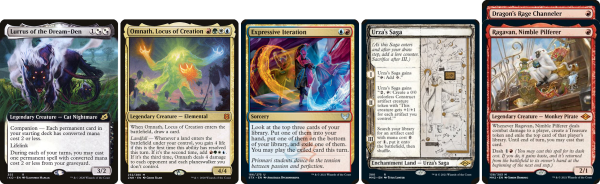
In Unmuddle Modern with Pillar Thinking, I proposed a theory about how five cards—Lurrus of the Dream-Den, Omnath, Locus of Creation, Expressive Iteration, Urza's Saga, and Ragavan, Nimble Pilferer—seemed to be dominating the Modern metagame. Indeed, the top decks leading into 2022 all ran not one, but two of these pillar cards. We closed things off by mentioning how Grixis Shadow and Jund Saga each employ three pillars, discussed the pros and cons to each list, and hinted at the possibility of designing decks top-down to include as many pillars as possible.

I've been doing just that, and with Kamigawa: Neon Dynasty spoilers well underway, my brewing bone (you know the one) has been especially stimulated of late. Today, I'll unveil my latest brew, which not only features the maximum amount of possible pillar cards but gets the most from some brand new tech out of NEO.

The Joy of Flexible Answers

The latest card to firmly grab my attention is Boseiju, Who Endures. This legendary land has pundits like StarCityGames's Dom Harvey claiming every format is about to be warped around it. While I might not drop the w-bomb, I do agree the land provides a huge amount of utility and is sure to become a ubiquitous constructed staple.

Truth be told, this whole cycle of channeling pseudo-basics (Channelands?) is great for Modern deckbuilding. It incentivizes players to reel in their manabases and craft decks that don't get too greedy with fetches and shocks, something there simply isn't much an incentive to do currently (explaining Burn's constant status as a top deck despite its eschewing of format pillars). But Boseiju specifically is great for Modern health in the same way as Fatal Push, which ended up making plenty more creatures playable, and Prismatic Ending, which helps players not "just lose" to random permanents like Solemnity.

Since the format's inception, it's been starved for cheap, flexible answers to proactive plays from across the table, pushing Lightning Bolt to around and above 50% usage. The problem was so pronounced early on in Modern's lifespan that I was stealing games with Isochron Scepter; once upon a time, we didn't even have Kolaghan's Command, and the only way to deal with this card was to naturally draw Maelstrom Pulse!

Wizards has done well in responding to this crisis over the last few years, not only with the Modern Horizons sets but with Standard entries like Abrade. Well, Boseiju is Abrade on crack. Here's a main-playable, can't-be-countered Naturalize that also doubles as a sort of Field of Ruin against players looking to do something unfair with their lands and is, at very worst, an unfetchable Forest.

I just love this kind of broadly applicable design. But I also knew I couldn't simply jam Boseiju into the deck I've been spending the most time on lately, which is an updated build of Counter-Cat that also respects the pillars. When you've got domains to tend and Wild Nacatls to raise, unfetchable Forest is a floor you might not feel like sitting on.

Finding a Core

So I set off on a quest to figure out a 60-card pile that a) made great use of Boseiju and b) I genuinely liked playing. Deciding on a core was easy. I wouldn't be caught dead not playing red right now; not only is Lightning Bolt the best card in Modern, I stand by my claim that Ragavan, Nimble Pilferer is the best creature of all time, and it's no secret that Tarmogoyf is my personal favorite. Finally, the color unlocks Wrenn and Six, a superb compliment to Boseiju. With Wrenn in the picture, we can reuse the Channel effect at will to totally dominate anyone relying on artifacts, enchantments, or nonbasic lands.

Early Draft: Naya Boseiju

As for filling out the list, I found myself with a slew of options. I very much appreciate the pushed Delver of Secrets that is Dragon's Rage Channeler, a route which included Mishra's Bauble and Unholy Heat. Same deal for Expressive Iteration, a card that I agree with Adam would be favored by Izzet mages even over Preordain if my prayers for its unban were ever answered (Earth to Wizards...). But Iteration would require dipping into blue and potentially make that Boseiju we'd love to use as a land drop a lot worse.

Then there's black and white, my least favorite colors, but ones which enable the all-important Lurrus pillar. As we know from Jund Saga, using Lurrus to return massive Goyfs and Wrenns in your land-synergy deck is some heat. Black seemed a bit obvious; of course Jund Saga will be running Boseiju. I'm not here to recreate that deck! So I looked instead to white, which features among other things Prismatic Ending, Esper Sentinel, and Leonin Arbiter. And if we're going with the Arbiter plan, it only made sense to double up on excellent land disruption with Cleasing Wildfire.

Naya Boseiju, by Jordan Boisvert

Creatures

4 Leonin Arbiter
4 Esper Sentinel
4 Ragavan, Nimble Pilferer
4 Tarmogoyf

Planeswalkers

4 Wrenn and Six

Artifacts

1 Shadowspear
1 Pyrite Spellbomb

Instants

4 Path to Exile

Sorceries

4 Cleansing Wildfire

Companion

1 Lurrus of the Dream-Den

Lands

4 Urza's Saga
4 Boseiju, Who Endures
4 Ghost Quarter
4 Flagstones of Trokair
4 Wooded Foothills
4 Copperline Gorge
1 Stomping Ground
1 Temple Garden
1 Sacred Foundry
1 Plains
1 Mountain
1 Forest

Arbiter combines with Boseiju, Wildfire, Quarter, and Path to attack enemy mana while preventing them from searching up lands. I took a page out of the Jeskai Control handbook with Flagstones of Trokair, something we can target with Wildfire for a cantripping rampant growth effect. Esper Sentinel helps protect Arbiter and Ragavan, plus it grows Goyf. The 1/1 isn't so impressive by itself, so I added the Urza's Saga engine to take extra advantage of its artifact status. Shortly after suggesting a top-down Naya Saga build in my last article, a deck just like that went 5-0 in a league. I was anxious to try something similar myself.

I actually did put this together and run some tests. Arbiter yielded some nutty draws, as it can alongside Ghost Quarter and similar effects. But man, is it a terrible card! Without support it's a literal Grizzly Bears. And without Arbiter, the cards we run to support the Cat Cleric become underwhelming.

Then there was tension between Arbiter and my other components. We need fetchlands for Wrenn, and would be foolish to pass up the benefits of Saga; Arbiter, though, forces us to pay for our searches, hampering both. Finally, Sentinel proved a bit anemic even with the Saga engine. It's simply Bad at Combat, something my own prejudices prevent me from excusing in a Stage 1 creature.

Gotta Go Fast!

On the bright side, the good cards were good. Ragavan was good. Saga was good. Lurrus was good. Wrenn was good. And Boseiju was good! So I had a Great Idea: instead of playing bad cards like Leonin Arbiter, why not fill the deck with good cards?

In went Channeler, Heat, and Bauble. I was now GR splashing white for Lurrus, and even started with under 60 cards while goldfishing to get a sense of what else I needed. I kept the Flagstones and Wildfire, which led me to an important realization: how critical that two-mana draw-a-card sorcery was for enabling DRC. Gotta get those mills, man! Still, I wished this sorcery would give me even more velocity. So in went Manamorphose. Sure, it's air, but in the velocity-focused world of today's Modern, who among us isn't a bit starved for oxygen?

Between the "free" instant and Bauble, Channeler was getting even better, but I would sometimes find myself in topdeck mode with nowhere to go. An older build of Counter-Cat ran Light Up the Stage; that was the kind of card I needed here, but I wasn't attacking enough to justify sleeving it up. In went... draft all-star Reckless Impulse!

Finding myself lacking beaters, I fell back on the Saga plan and trimmed Flagstones-Wildfire entirely. That meant just going GR, although since there still weren't any permanent cards with mana value 3 or more I wanted to run in the main, I opted to keep Lurrus in the sideboard and just cast it off Manamorphose when I happened to have the instant handy.

It only took a few games with this deck to fully grasp just how much worse Impulse is than Iteration. (Spoiler: unquantifiably.) But another thing I realized is that I often had access to Manamorphose when I needed to cast Lurrus or even Impulse itself. Why couldn't I lean on the instant a bit harder and splash blue for the better cantrip, in addition to using Manamorphose for Lurrus? Bilbo mode: why shouldn't I?

RUG You the Right Way

Easy, Bilbo. That's just getting greedy. I even said a couple weeks ago that you'd be hard-pressed to encounter a deck running Saga with Iteration because of the latter's stringent color requirements. That's okay, though; it's just brewing! Why even bother if not to break the rules we know so well? And need I remind old-school Modern players just how easy it is for RUG to splash? It's always been the three-color combination voted most likely to run Blood Moon out of the side.

Voilà. But there's still the Lurrus obstacle. That's what made my thought so greedy in the first place. I've got a solution for that, too. Bulk buyers, rejoice!

There was an error retrieving a chart for Terrarion

Repeat after me: Terrarion is not a bad card. Who am I trying to convince? Why you, of course! So here's 200 words in defense of the trinket.

  1. Saga tutors it. To wit, Terrarion is the glue that holds the pillars together. When you need it to, completing the Saga finds you a Manamorphose, essentially linking the colorless-producing Enchantment Land to the color-demanding Iteraetion and Lurrus.
  2. It replaces itself on sacrifice. The artifact isn't exactly a cantrip, which is why we'd never run more than one. But as a draw-a-card effect to find off Saga, it's more or less on par with the slow-tripping Mishra's Bauble. Terrarion enters tapped, but once it untaps, we get the card right away instead of having to wait until the next turn's upkeep. That promise of immediacy has its own benefits when it comes to library manipulation like the surveil from DRC and peeks from Bauble itself (i.e. check your top card somehow, decide it's a card you want this turn, and immediately cash in Terrarion for it).
  3. You can cast Terrarion from hand with a spare mana or a fresh Saga, so drawing it isn't the end of the world. In that case, it's a lot like a slightly clunky 5th copy ofManamorphose, which is still pretty passable when it can only happen at most once per game.
  4. Terrarion isn't only limited to Lurrus. Just as we use Manamorphose to play Wrenn or Iteration off a Boseiju and a Saga or good ol' off-color basic lands, Terrarion too enables these color-intensive plays. We can always draw into Manamorphose down the road if the idea is to cast Lurrus later.
  5. In a pinch, Terrarion just cycles into something else. Sometimes you really need, say, removal, and then we can trade it in for whatever's on top of the deck.

Final Draft: RUG Saga

Behold, the deck contained within a tiny jar:

RUG Saga, by Jordan Boisvert

Creatures

4 Dragon's Rage Channeler
4 Ragavan, Nimble Pilferer
4 Tarmogoyf
1 Snapcaster Mage

Planeswalkers

4 Wrenn and Six

Artifacts

4 Mishra's Bauble
1 Shadowspear
1 Pyrite Spellbomb
1 Terrarion

Instants

4 Manamorphose
4 Unholy Heat
2 Lightning Bolt

Sorceries

4 Expressive Iteration

Companion

1 Lurrus of the Dream-Den

Lands

4 Urza's Saga
2 Boseiju, Who Endures
4 Wooded Foothills
4 Scalding Tarn
2 Stomping Ground
1 Steam Vents
1 Breeding Pool
2 Mountain
1 Forest
1 Island

I really like the upside of 1 Snapcaster Mage in this deck. It recasts all our important spells, and we have no problem making our land drops with 4 Wrenn. Snap's especially nasty with Lurrus, since we can cast it multiple times.

As far as how the deck plays, the gameplan is to deploy engines one at a time in the order that best supports the threats we've drawn. Let opponents totally deal with an engine (for instance, slog through a pair of Construct tokens), then deploy another one (cast EI, recur Saga with Wrenn, or slam Lurrus). This way, we can grind them out all while applying consistent pressure in the air with DRC, in the red zone with Goyf and big Constructs, or via the Splinter Twin effect with Ragavan.

Elephant in the room: the final product's striking resemblance to Jund Saga. Didn't we just say I'm not looking to recreate that deck? I mean, let's face facts; same beaters, same red removal. Same planeswalker. Why play Terrarion.dec over what's been a consistent high-performer since Modern Horizons 2? I'll answer that question with another one:

The year is 2022. We're getting an untapped land that elegantly deals with artifacts, enchantments, and nonbasics—you know, the kind of stuff that spooks you into packing Thoughtseize and two-mana removal spells. With card quality trending upwards, the format's most defining spells are those that cheaply put you up on cards. Would you rather be casting these...

...or this?

There was an error retrieving a chart for Expressive Iteration

Time to liquidate those clunky Kolaghan's Commands!

Pour Out the Baubly

Between its maximum pillar density, wealth of spells I love slinging, and access to permission from the sideboard, I'm very excited about RUG Saga's prospects in Modern. I also wonder if Terrarion is worth trying out in a four-color shell swapping Lurrus for Modern's final pillar, Omnath, Locus of Creation.

As the 61 proposed above represents the first time four Modern pillars have come together, Omnath and Saga have never featured in the same deck before. But the fixing power of Manamorphose and Terrarion must be seen to be believed. I'm way less excited about turning Noble Hierarch sideways than I am Channeler, though, so I might leave that experiment up to you readers.

In the meantime, enjoy the final Kamigawa spoilers and definitely reach out if you end up taking out RUG Saga for a spin!

Unpacking The Decline of Magic-Streaming Viewership

Are you a Quiet Speculation member?

If not, now is a perfect time to join up! Our powerful tools, breaking-news analysis, and exclusive Discord channel will make sure you stay up to date and ahead of the curve.

The Three Worst Months For Magic Streaming

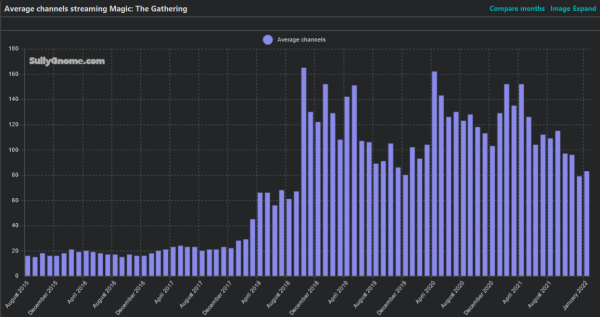
Despite the hype for Kamigawa Neon Dynasty, there's been a lot of doom and gloom in recent Magic: The Gathering news. The hits, unfortunately, just keep coming. On February 2nd, @CubeApril shared this tweet with data from sullygnome.com, a Twitch stats and analytics tracking site:

Looking at viewing data from the peak in October 2018 to the present, we see a general downward trend across the board in Twitch viewership of Magic: The Gathering. While we must note that this data includes both Magic Arena and Magic: Online data combined, these numbers do not look much better than the 2018 numbers prior to Arena's Open Beta release. So what's going on? Today I'll look at three challenges facing Magic streaming, and how Wizards could step in to boost viewership.

The First Challenge: Competition with Other Games

Magic: The Gathering is far from the biggest fish when it comes to Twitch views. Using Data of the past 30 days (as of February 3rd) from sullygnome.com, let's compare Magic stream viewership to two of its other digital Trading Card Game(TCG) competitors.

Hearthstone clearly blows Magic out of the water with nearly seven times the number of hours watched in the past month. What's wild to note is the number two game on the list, Yu-Gi-Oh! Master Duel has nearly three times the views of Magic and twice the streamers of Magic or Hearthstone combined, though the game has only been out since January 18th. Clearly, competition is stiff between these games, and the newcomer is making its presence felt.

The numbers of all three of these games though pale in comparison next to some of the top streamed games on Twitch. Here are the three digital TCGs we've examined VS. three of the top streamed games on the Twitch platform:

The three digital TCGs together have less than half the viewership of VALORANT and are barely a drop in the bucket compared to League of Legends, the most-watched game on Twitch. What does this mean? It means two things. One, that viewers are certainly choosing to watch less Magic streaming. It also hints strongly though that streamers themselves, facing declining viewers, may be choosing to stream less Magic, further accelerating this decline. Data from sullygnome.com on the number of average channels streaming Magic corroborates this theory:

In January 2021, there were an average of 129 channels streaming Magic. One year later, the average number of channels streaming Magic in January 2022 was down to 83. So what is causing this decline in both viewers and streamers? This leads us to the second challenge facing Magic streaming.

The Second Challenge: The State of the Magic Arena Economy

The number one complaint about Magic Arena from pretty much anyone you'll read, not just a number of major content creators, is how brutal the Arena economy is on its players. Jose Lopez a frequent Arena grinder eloquently summed up the issues surrounding the Arena economy and offered some possible solutions to improve it in this thread:

While Lopez indicates that a direct purchase option for wildcards in the Arena store would be a great first step forward, by far the biggest takeaway from his thread was this telling statement that's been echoed by others across social media:

One of the biggest things setting Magic Arena apart from other digital clients is a complete lack of a system for turning unwanted cards into other cards or other resources to play the game. Most digital TCGs have some form of dusting mechanic, allowing cards to be converted to in-client resources. Even Magic Online, in addition to the ability to trade and sell cards with other players for cash, has the ability to cash in cards for Tix, the in-game currency which can be used to enter events.

When you add on that Arena has no duplicate protection, you wind up in situations where you have eight copies of a card like Thalia, Guardian of Thraben or Fabled Passage though you'll never need more than four to play in a deck.

As it stands, the current state of the Arena economy makes it almost prohibitively expensive for players to acquire the wildcards they need to complete decks. This is likely directly contributing to the decline in both Magic streaming viewership and participation. Why would you want to watch others play Magic Arena when you'll never be able to build a deck on the client yourself? Why would you want to stream on the client when it's so prohibitively expensive to build constructed decks? Never mind if there's an audience to watch your content? These are all rhetorical questions, but I've no doubt they're on the minds of both viewers and streamers alike.

The Third Challenge: Lack of Organized Play or In-Client Incentives to Play

The third challenge facing Magic streaming is a lack of any sort of robust Organized Play (OP) program or any significant incentives to grind the game with any dedication other than climbing the Arena ladder. The lack of significant OP is no doubt tied to the ongoing pandemic and the impossibility of safely running large in-person events. The lack of meaningful rewards on Arena's client though is a different story. It can easily be seen as a major failing of the program from a player retention standpoint. Who wants to put in hours of effort grinding, when the rewards for your effort at any level below reaching Mythic are meaningless pittances at best?

Arena End of Season Ladder Rewards Per Level (Constructed and Limited)

Qualification to play in the Mythic Qualifier Weekend events aside, even the in-client rewards for reaching the top tier on the Arena ladder in either Limited or Constructed are pitiful. You'd need to reach Mythic ten months in a row to pay for a single draft entry with those rewards. This doesn't even get into how meaningless card style cosmetic rewards are, or the rewards for anyone below Mythic rank. Can you imagine making it all the way to upper Diamond, just missing making Mythic, and only getting four packs, 1,000 gold, and two cards styles to show for it?

Possible Solutions

Jose Lopez laid out some excellent ideas for improvements to Arena in his Twitter thread beyond just the economy. It's the economic and play incentive improvements though, that I see as the most direct way to draw players back to the game. If more players are excited to play the game, more will be excited to watch the game as well. Here are three improvements I'd like to see to Arena:

  • An easier way to get wildcards, either through direct purchase, through dusting, or through cashing in lower rarity wildcards for higher rarity wildcards at some exchange rate.
  • A more robust rewards system. Offering better incentives for grinding the ladder, and more variety of rewards and challenges for daily and weekly quests.
  • Duplicate protection, where if you already own four copies of a particular card from any set, you'll be able to turn duplicates you open from other sets into Gems or vault progress.

End Step

From my perspective, the decline in Magic streaming viewership is directly related to the overall state of the Arena client. If changes are not made, as we come out of the pandemic, I imagine the decline in viewers will only accelerate.

What are your thoughts about the state of Magic streaming? About the state of Arena? What steps would you take to improve them? Let me know in the comments or on Twitter.

Avatar photo

Paul Comeau

Paul is Quiet Speculation's Director of Content. He first started playing Magic in 1994 when he cracked open his first Revised packs. He got interested in Magic Finance in 2000 after being swindled on a trade. As a budget-minded competitive player, he's always looking to improve his knowledge of the metagame and the market to stay competitive and to share that knowledge with those around him so we can all make better decisions. An avid Limited player, his favorite Cube card is Shahrazad. A freelance content creator by day, he is currently writing a book on the ‘90s TCG boom. You can find him on Twitter and LinkedIn.

View More By Paul Comeau

Posted in Arena, Free, Magic: The Gathering Arena, TwitchTagged , 1 Comment on Unpacking The Decline of Magic-Streaming Viewership

Have you joined the Quiet Speculation Discord?

If you haven't, you're leaving value on the table! Join our community of experts, enthusiasts, entertainers, and educators and enjoy exclusive podcasts, questions asked and answered, trades, sales, and everything else Discord has to offer.

Want to create content with Quiet Speculation?

All you need to succeed is a passion for Magic: The Gathering, and the ability to write coherently. Share your knowledge of MTG and how you leverage it to win games, get value from your cards – or even turn a profit.

Layers, Part Two: Control- and Text-Changing Effects

Are you a Quiet Speculation member?

If not, now is a perfect time to join up! Our powerful tools, breaking-news analysis, and exclusive Discord channel will make sure you stay up to date and ahead of the curve.

We'll Get There When We Get There

I know, I know. Kamigawa: Neon Dynasty is everywhere right now. While we've seen some very cool cards, I'm not quite ready to write about the set mechanics yet. I need the new comprehensive rules first. Expect a Neon Dynasty article in a couple weeks!

We've Been Here Before

With that out of the way, welcome to my second installment on layers. This week we'll tackle layer 2 (control-changing) and layer 3 (text-changing) effects. These layers have a bit less complexity than copy effects, so I figured I should collapse them into a single article.

Let's cover what these effects do before looking at some of the weirder stuff involved.

The Basics: Control-Changing Effects

Astute readers might recognize that a "control-changing effect" changes control of an object—think effects like Act of Treason. Control-changing effects are usually pretty straightforward and tell you that a player "gain[s] control" of one or more things.

Out of Control

Sometimes, an effect might seem like a control-changing effect without actually being one. Bribery, for instance, lets you snag a creature out of your opponent's library and put it onto the battlefield under your control. However, this is not a control-changing effect; the person who stole a creature with Bribery is that creature's default controller.

What's a "Default Controller"?

An object's default controller only matters in multiplayer games. This distinction helps us figure out what happens to objects when a player leaves the game.

For example, let's say Abby, Bill, Carlos, and Deb are playing a game of commander. Abby steals Bill's Grizzly Bears with Act of Aggression. That same turn, Abby loses the game. When Abby leaves the game, any control-changing effects that granted her control of other people's stuff end. Act of Aggression's effect ends, and the Grizzly Bears goes back to Bill.

On the other hand, suppose Abby steals Bill's Grizzly Bears with Bribery. When Abby leaves the game, there's no control-changing effect that needs to end. The game requires that object be somewhere, but since the Bears was only ever controlled by Abby, the game shrugs and exiles it instead.

Odds and Ends

Most of the time, control-changing effects depend entirely on timestamps, but on rare occasion, a dependency can occur. A good example is In Bolas's Clutches. If you played any Dominaria limited, you've probably seen something like this happen once or twice. If Abby enchants Bill's Grizzly Bears with In Bolas's Clutches, Abby gains control of the Bear. However, if Bill then enchants Abby's enchantment with his own In Bolas's Clutches, the first enchantment is now dependent on the second. The "you" on the first Clutches now refers to Bill, so Bill will regain control of his own Grizzly Bears.

It may surprise you that cards like Homeward Path and Brand also create control-changing effects. While it's an easy mental shortcut to just say "other effects end and I get my stuff back," that isn't quite accurate. If that's how Homeward Path worked, you wouldn't get back the creature your opponent stole with Bribery.

You Know One When You See One

Text-changing effects, much like control-changing effects, are easy to spot. They tell you to change the text of something. This kind of effect is also rare; there are about 20 cards (out of over 20,000!) that have text-changing effects. But they're still part of the game, and we should still know how they work.

Generally speaking, text-changing effects modify text in a card's rules text and/or its typeline. If an effect tells you to replace text with something else, the effect only replaces words that are used in the right way. For instance, if you Magical Hack your opponent's Island Fish Jaconius and change "Island" to "Forest," the card's name is unaffected. The "Island" in its name isn't used as a land type.

Effects that modify or change an object's name, like Spy Kit and Awakening of Vitu-Ghazi, are also text-changing effects.

The Elephant (Or Something Else) In the Room

Volrath's Shapeshifter is a weird card. It's the only Magic card that uses the words "full text." That makes it do even more than a normal text-changing effect.

612.5. One card (Volrath’s Shapeshifter) states that an object has the “full text” of another object. This changes not just the text that appears in the object’s text box and type line, but also changes the text that represents its name, mana cost, color indicator, power, and toughness.

Magic Comprehensive Rules

Now, a sane person might think to themselves: "Self, if Volrath's Shapeshifter copies everything printed on a card, why isn't it a copy effect?" In fact, as originally printed way back in Stronghold, it was a copy effect! But that reading fell apart when Wizards developed the current layers system.

Let's pretend for a moment that Volrath's Shapeshifter did use a copy effect. I play a Shapeshifter and the top card of my graveyard is a Grizzly Bears. You cast Act of Aggression on the Shapeshifter, and the top card of your graveyard is Hill Giant. Because we apply copy effects before control-changing effects, the Shapeshifter that you control would still be a copy of my Grizzly Bears. See why that doesn't work?

So, the solution they came up with to maintain the card's intended functionality was just to jam it all into a text-changing effect. Its effect applies after any control-changing effects, so it will always properly "see" the correct player's graveyard to determine what characteristics it has.

Cleanup

Text- and control-changing effects are probably some of the easiest to understand, since by and large you do what they tell you to do. As always, if I overlooked something or you'd like something clarified, don't hesitate to reach out. And the same goes for if you'd like a specific topic covered! Feel free to reach me on Twitter or our Insider Discord.

Next week, we'll look at the ins and outs of triggered abilities.

Question of the week: What's your favorite control-changing effect?

Commander Thoughts on Crimson Vow

Are you a Quiet Speculation member?

If not, now is a perfect time to join up! Our powerful tools, breaking-news analysis, and exclusive Discord channel will make sure you stay up to date and ahead of the curve.

With Kamigawa: Neon Dynasty closing in and looking like a really great set for Commander, I wanted to close out my thoughts on Crimson Vow. Did I mention how absolutely great Neon Dynasty looks for Commander?

Vow was a fairly fun set for draft and added a little bit of spice to Standard. In terms of Commander, though, it was just okay.

Many Legends, Few Commanders

While there are a fair number of decent thematic commanders like Millicent, Restless Revenant, none of them really offered something that did not exist before. There are plenty of thematic Vampire, Spirit, and otherwise spooky commanders sprinkled throughout Magic's history. Making tokens is not a new mechanic, and, it's done vastly better by many other cards. What about the new mechanics presented in Crimson Vow?

There Will Be Blood!

No, not really. The Blood mechanic is not bad, especially for draft! However, in Commander, it suffers from a lack of synergy. Obviously it's a new mechanic and could receive more support once we re-re-return to Innistrad, but for the near future, Blood is unlikely to get an infusion.

I Find Your Lack of Faith Disturbing

Disturb is merely flashback for creatures, and has been done many other ways, so this is nothing new. It's a fine mechanic in terms of power level but, again, it's not really supported enough to consider it a deck type.

Is there any chance at a Commander redemption for Crimson Vow? I think so.

A Real Build Around Beast

If you read my article on degenerate Commander decks, then you know how nasty Cultivator Colossus can be! However, I think that the best days are still ahead of the Colossus. It has a unique ability that can be utilized in a variety of ways and can chain together devastating play sequences. Combined with Abundance and any landfall effect, you likely win on the spot.

Furthermore, there are a large number of existing cards that work well with it, so this card will only get better with time. In my estimation, Colossus is the Vow card that will have the longest lasting impact on Commander and is likely to be the most obviously powerful card in the set.

Still, some other cards have niche uses.

The (Un)usual Suspects

Brine Comber // Brinebound Gift caught my attention for several reasons. It pairs nicely with Flickering Ward in a Verduran Enchantress deck along with many other auras to pay mana, make spirits and draw cards. It's a Spirit, which is extremely important for most tribal decks like Millicent. On top of that, it also has a graveyard function for added versatility, which pushes the card up a notch. Do I think Comber is amazing? No. Do I think it has potential for right now and the future in multiple decks? Yes and also yes!

Screaming Swarm will likely boggle some. It's expensive, doesn't end the game on the spot, and appears to not do very much. However, it is at home in a mill archetype that some players enjoy and I am looking somewhat to the future for this card. Imagine a scenario where you already have a bunch of tokens for any reason. The second Swarm hits the battlefield, your mill plan is active. You can attack any one player... and then mill another! Consider the diplomatic angle: "I need to attack YOU so I can mill THEM!" While I do not claim this card will be format warping or massively played, I think it will earn a spot in some decks and has potential because... you can mill people while you mill them, which of course massively appeals to mill players. (You know who you are.)

Retrieve Some Horrible Cards

Dollhouse of Horrors gets major points for flavor, but think about what "Construct tribal" would look like. Codie, Vociferous Codex is your five-color Construct commander and, with Changelings, there are a good 200 Constructs to choose from! I've been really impressed with Dollhouse. One really cool way to use it is to let your commander die and send it to the graveyard, then return it to play as a Construct, effectively getting to use your commander again for one colorless mana that turn. This can be devastating both short- and long-term for decks that have the general goal of "cast your commander as many times as possible." Netting effectively two commander triggers per tax is very efficient.

Retrieve is another card that I think will actually see significant play in a variety of decks. It's fighting some well known favorites for the card slot, but I think combo decks will eventually come around on Retrieve as the right card for recursion. According to edrec, a lot of green decks are running Eternal Witness, Regrowth, Bala Ged Recovery // Bala Ged Sanctuary, and Noxious Revival as forms of recursion. Compared to all of those, Retrieve gives you twice as much benefit with very little drawback. Again, for creature-based combo decks, I think you may see this card replacing some of the other choices.

A Real Partner

Halana and Alena, Partner is a simple commander that does a fair bit for four mana. Is it the next cEDH commander to watch out for? No, but, I think this is a good commander for a variety of reasons. It demonstrates the strength of haste and can be showcased in a deck that really likes to play Giant Growth effects for double value. Outside of new Commander players, who I think would enjoy this commander, I think this could be a very fun build-around card for more experienced players as well because of the potential for variation. I assert that if you asked a playgroup of four to build Halana and Alena, you would come up with four very different decks. It checks off a lot of the boxes of the Heart of Commander: variety, theme, history, meme potential... everything!

The Ring Shaped Elephant in the Room

There was an error retrieving a chart for Wedding Ring

Wedding Ring.This card was highly speculated to be a Commander All-Star the second it was spoiled. Its price shot through the roof, at times making it the most expensive card in Crimson Vow. Did it turn out to be that powerhouse, auto-include in every white deck? In a word, No.

Ring's price has plummeted 50% in just two months and continues to trend downward. How did this happen? The answer is that people played with the card. It's four mana to "do nothing" on the turn you cast it, and every time you give your opponent an answer or game ending card but you get an extra land, it just feels bad.

Alternatively, in the instances where Wedding Ring is strong, it's probably too strong, much like the banned Trade Secrets.The fact is that in free-for-all multiplayer, politics is allowed, but being an "official" team is obviously not; Wedding Ring makes it a team vs. table scenario, and cards like that are generally frowned upon for casual games.

But What About in cEDH?

Ring is not fast enough. Many existing competitive decks are extremely tight in terms of flexible slots for new cards. Unless a card does more for the same cost, it's unlikely to be adopted by an existing archetype. Wedding Ring competes for slots reserved by cards like Rhystic Study and Mystic Remora, and on a different angle Smothering Tithe. Giving someone a permanent can help them fuel cards like Deadly Dispute, as just another downside to mention. Overall, this card is too strong to be casual and not quite powerful enough to be competitive.

Long-term, though, I bet Wedding Ring could appreciate in value so long as it does not get reprinted any time soon. If they reprint it, it will be sent to the bulk bin.

Bigger and Better Things

Will Kamigawa: Neon Dynasty live up to the hype or be more mild like Crimson Vow? Personally, I think it may exceed it, particularly on the Commander front! There's a huge number of potential new commanders, some popular returning mechanics like Shrines and ninjitsu, and also some rare mechanics like channel. Which Neon Dynasty cards are you most excited to jam in your 100?

Avatar photo

Joe Mauri

Joe has been an avid MTG player and collector since the summer of 1994 when he started his collection with a booster box of Revised. Millions of cards later he still enjoys tapping lands and slinging spells at the kitchen table, LGS, or digital Arena. Commander followed by Draft are his favorite formats, but, he absolutely loves tournaments with unique build restrictions and alternate rules. A lover of all things feline, he currently resides with no less than five majestic creatures who are never allowed anywhere near his cards. When not Gathering the Magic, Joe loves streaming a variety of games on Twitch(https://www.twitch.tv/beardymagics) both card and other.

View More By Joe Mauri

Posted in Commander, Deck Building, Free, Set ReviewTagged , , , , , , , , , Leave a Comment on Commander Thoughts on Crimson Vow

Have you joined the Quiet Speculation Discord?

If you haven't, you're leaving value on the table! Join our community of experts, enthusiasts, entertainers, and educators and enjoy exclusive podcasts, questions asked and answered, trades, sales, and everything else Discord has to offer.

Want to create content with Quiet Speculation?

All you need to succeed is a passion for Magic: The Gathering, and the ability to write coherently. Share your knowledge of MTG and how you leverage it to win games, get value from your cards – or even turn a profit.

15 Gold Cards to Pull from Bulk

Are you a Quiet Speculation member?

If not, now is a perfect time to join up! Our powerful tools, breaking-news analysis, and exclusive Discord channel will make sure you stay up to date and ahead of the curve.

Bulking Up

One of my favorite things to buy is Magic bulk. While I love bulk rares, I also have a soft spot for bulk commons and uncommons. I am one of the lucky people who find picking through bulk to be relaxing and enjoyable. I have also found sorting bulk quite profitable over the past few years. Obviously, it feels incredible to find the huge wins, like the Copy Artifact hiding in a pile of Revised last year, but the small wins are far more common and can really add up.

To celebrate the new year, I thought it would be fun to start a new series. In each entry, we'll focus on a different color of bulk cards, and dive into some of the best sub-$5 finds in each one. Rather than choose one color to start, today we'll look at 15 excellent finds in the gold color category!

Going for Gold

The biggest boon to picking bulk well is knowledge. Indeed, the purpose of this series is to highlight the lesser-known cards, so I will not include any cards whose TCGPlayer mid price exceeds $5. Lastly, I have found that understanding the reason for a card's value is extremely beneficial in evaluating other cards and their potential.

Note: this list isn't in any particular order.

1. Dovin's Veto

Dovin's Veto is a recently printed card that was included in a Challenger Deck, made its rounds as an FNM promo, and enjoyed a reprint in Timespiral Remastered (as a Timeshifted card). Despite all that, it still commands around $3.50. The reason is simple: an uncounterable Counterspell is extremely powerful when aggressively costed. For a bit more color restriction, it is a massive upgrade to Negate, and the fact that many control builds are already UWx helps with the double-colored mana requirement. Being pitchable to Solitude is also a nice perk.

There was an error retrieving a chart for Dovin's Veto

2. Life // Death

This split card from Apocalypse has an FNM promo and a Duel Deck printing. Its value is essentially tied to the Death half, which is a two-mana reanimate that is limited to your own graveyard. The card sees play in GBx Reanimator Commander decks.

There was an error retrieving a chart for Life // Death

3. Fire //Ice

Fire // Ice has multiple printings, most of which do not exceed even $1. The exception to this rule is the original Apocalypse printing, which maintains a TCGPlayer mid price of $4.74. The instant has become a solid support card in Modern. It's hard to argue with the beauty of the older borders, which even Wizards understands, given they made "retro frame" cards a thing.

There was an error retrieving a chart for Fire // Ice

4. Drown in the Loch

Being both a Counterspell or a kill spell is exactly the kind of modality that gives a card staying power. Drown in the Loch's mana cost matches that of the typical spell that does either, and its mana cost isn't terribly demanding in formats with flexible mana bases. It's also new enough of an uncommon to fly under the radar as potentially worthwhile.

There was an error retrieving a chart for Drown in the Loch

5. Ashiok, Dream Render

The static abilities stapled to the planeswalkers from War of the Spark were definitely a change in planeswalker design that ruffled some feathers. Ashiok, Dream Render happens to be one of the three best, as Commander is a format ripe with tutor effects. It also severely hampers the mana bases of most nonrotating formats. Granted, coming down on turn three means your opponent likely got a few opportunities to fetch already, but the fact that they can't after is still relevant. The minus ability also serves as fantastic graveyard hate, giving Ashiok a load of utility.

There was an error retrieving a chart for Ashiok, Dream Render

6. Mayhem Devil

Another War of the Spark uncommon, Mayhem Devil surprised even me, given it was included in the Korvold brawl deck. However, RBx sacrifice decks have been popular in Commander for years, and Mayhem Devil boasts a powerful, repeatable ability that is relatively easy to abuse.

There was an error retrieving a chart for Mayhem Devil

7. Rhythm of the Wild

This card actually waffled on this list only because its price has repeatedly broken $5 TCG Mid. It's now slightly below that, so we're welcoming it back. This new-ish ex-Standard staple also makes a great addition to Commander, which is always looking for ways to grant all creatures haste. The flexibility to grow creatures when attacking wouldn't prove wise just enhances its usefulness.

There was an error retrieving a chart for Rhythm of the Wild

8. Tatyova, Benthic Druid

Tatyova, Benthic Druid was easily my favorite uncommon from Dominaria, which was an over-powered set, to begin with. It does everything you want in a Simic creature, and the fact that it can be your Commander is icing on the cake. I built a Tatyova deck when Dominaria was released, but have found her to be a better support card than the actual commander in any UGx deck. The fact that she brings such obvious value to the table tends to make her a pretty quick target for removal spells, which can run up her commander casting cost fast.

There was an error retrieving a chart for Tatyova, Benthic Druid

9. Boros Charm

Even with numerous reprints, Boros Charm steadily maintains a price tag of $1.50+. It is definitely the best of the charm cycle in this block. Thanks to Sunbaked Canyon, splashing white in Burn is easier than ever, and having a spell that does 4 damage or protects your creatures from mass removal certainly warrants a spot in the archetype. It is also a strong inclusion in most Boros Commander decks.

There was an error retrieving a chart for Boros Charm

10. Wear // Tear

Dragon's Maze seems like forever ago. This uncommon is the best of the set, and it's not even close. Eternal players like Wear // Tear for its flexibility, and the fact that it has so many targets in both Legacy and Modern. Coupled with its "dual" color attribute, allowing it to be exiled for both Fury and Solitude, means it fits well into the Jeskai decks of both formats.

There was an error retrieving a chart for Wear // Tear

11. Manamorphose

Wow, how the mighty have fallen. Prior to its reprinting in Double Masters, Manamorphose was at one point a $20 common. Free cantrips have always been dangerous in Eternal formats (see Gitaxian Probe), so I like this one as a great card to pick up to even out trades. It is close to the $5 TCG Mid mark. Should any Arclight Pheonix decks rise from the ashes of any older formats, expect the cantrip to jump back up into the $10+ range. It currently sees play in Belcher, another all-in deck that can take major events by storm in the right metagame.

There was an error retrieving a chart for Manamorphose

12. Violent Outburst

Crashing Footfalls has made a name for itself in Modern and seems to have congealed into the Temur color scheme. That deck requires four copies of Violent Outburst, one of the best cascaders thanks to its instant status.

There was an error retrieving a chart for Violent Outburst

13. Immerwolf

I have called out this card every time we return to Innistrad. Casual players love the werewolf tribe and Immerwolf is a great lord for it. Sadly, it does not work with the newer Werewolves, so that's a bit of a downer and will likely keep it from ever reaching the $5 mark again.

There was an error retrieving a chart for Immerwolf

14. Legion Lieutenant

I stockpiled Legion Lieutenants after Rivals of Ixalan prices started to drop. If casuals love Werewolves, they adore Vampires. Throw in the fact that Vampires are a much more established tribe with a lot of powerful cards that synergize well, and this lord was bound to gain value.

There was an error retrieving a chart for Legion Lieutenant

15. Steel of the Godhead

This is an interesting option only because it was decently valuable for so long that many times people would pick it out of bulk before selling that bulk. You still occasionally find one hiding in Shadowmoor or Duel Deck bulk piles.

There was an error retrieving a chart for Steel of the Godhead

Keep On Pickin'

While this list is obviously not all inclusive, it includes some of the cards I've had the most luck pulling out of bulk. A lot of players can make the mistake that newer cards aren't worth anything because so many are printed. While it's a generalization that often holds true, it also ensures there are plenty of valuable cards to mine in bulk. I hope to continue this series with another subsection of cards in my next article. Until then, are there any choice gold cards you love finding in bulk? Leave me a comment below or reach out on our QS Discord channel.

Don’t Worry, Wizards Is Watching Modern

Are you a Quiet Speculation member?

If not, now is a perfect time to join up! Our powerful tools, breaking-news analysis, and exclusive Discord channel will make sure you stay up to date and ahead of the curve.

The workings of Wizards of the Coast can appear paradoxical to players. On the one hand, Wizards is quite open with players about the game, especially regarding how and why they make cards and how decisions are made. These topics enjoy a level of transparency between players and company increasingly rare in corporate America. For that transparency, we should all thank Mark Rosewater profusely. At the same time, that same transparency serves to highlight the areas that Wizards refuses to share. And Wizards can be very secretive when they want to be. When those things are very important to players, the ensuing frustration can even lead to resentment.

Case in point: Last week there was a Banned and Restricted Annoucement. When Wizards announced it on their livestream, they were vague about which formats were affected. All that was said was "other formats," which many took to include Modern. When it didn't, there was an outcry big enough to convince Aaron Forsythe, Wizards' VP of Design, to take to Twitter in response. Today, we'll discuss what was said and what wasn't with the aim of figuring out the implications for Modern.

How It Started

The B&R Announcement went live at 9 AM Pacific and was a surprise. How much of that was thanks to what was in the announcement itself versus players being disappointed about their dream scenario not coming to fruition remains impossible to determine. But as the Twitter thread linked above indicates, there was much shock about "no changes" in Modern. I'm not going to get into the specifics of the bans because we've podcasted about it already. I will note that the outcry prompted Forsythe to respond thusly about an hour later:

In the subsequent discussion, it became clear that for most, such a response was all they had wanted. It was simply odd that simple statement was not included in the actual announcement, and players really wanted to know why. Which seems to have taken Aaron slightly by surprise:

Aaron raises a fair point. It is a lot harder to wring blood from a stone than a steak. However, when we're talking about a format that is the most popular on MTGO (and I'm told the most played constructed format in paper, though I've no means to confirm), enough isn't always enough. Players on Twitter clearly expect Wizards to treat Modern with greater attention.

The Implications

Given the strong backlash, the sentiments expressed in the thread, and Aaron's reaction, I expect to see some adjustments to B&R announcements in the future. A lot of players were asking for an official watchlist or statement about Modern (which I'll address separately), but I doubt that we're going to see anything so substantial. Rather, I'd expect that in future updates where Modern isn't affected, there will be something similar to Aaron's Twitter response, if only to keep the mobs at bay.

A Significant Admission

And if that was all that happened, it wouldn't be worth delving into. It's more of a news column than my usual work. And in the initial Twitter thread, Aaron had a very interesting response to a question from Saffron Olive:

Aaron was right, his tweet did set off a bit of storm. But then, Twitter is especially storm-leaning. In any case, Wizards is fully aware of the perceived problem of Lurrus of the Dream-Den, but their metrics don't paint it as a problem. Which I should note is consistent with the data I've been working with. Lurrus decks have been the best decks in Modern for months, just not in a way which is inherently damaging or dangerous. The fact that Aaron specifically calls Lurrus's impact warping is significant, as is the clarification he made next:

Intended as an explanation for why Wizards doesn't just ban everything players dislike, this quote is also very telling. Wizards is fully aware of existing discontent, and knows that not everything is perfect in every format. The perfect format almost certainly doesn't exist, but Wizards doesn't determine format health based on grumbling. That grumbling needs data backing it up for them to want to pull the trigger on a massive change.

The Follow-Up

Predictably, Twitter being Twitter and Magic players being Magic players, that didn't put the issue to bed. Discussion continued throughout the day and I'm guessing filled Aaron's inbox and DM's such that he had to end the day with further explanation of Wizard's position about Lurrus:

Obviously, saying that Lurrus was the most discussed card is significant for the reasons discussed above. However, the fact that it was the "most discussed" and not the "only discussed" card does indicate that there's a lot more potentially on the chopping block. Exactly what those cards might be he didn't say. But I choose to read this statement as hinting at the possibility that there could be a lot more going on in Modern than just Lurrus that is potentially problematic, something just Wizards, with their heaps of data, will know for sure.

More critically, his third tweet on the subject contains the first real insight into Wizards' decision-making process around bans that I can remember:

Wizards wants to let formats happen. They're not in the game of active shaping or influencing formats, or at least they don't want to be. Aaron says they want to let formats play out "to their natural conclusion" (whatever precisely that means), and only act once everything is crystal clear. And this is consistent with the timing of previous bans well after there was absolutely no dissent on something being a problem, though some of that had to do with the limited windows for bans.

The Implications

Here's my take on the above comments: Wizards will not be taking action against Lurrus just because players dislike its prevalence in Modern. They need to see something more perilous and/or immediately threatening to take action. When they do, it's likely that Lurrus won't be the only thing banned. Lurrus may have a warping effect, but R&D remains aware of the format as a whole and sees that removing just one pillar could be destabilizing or allow something else to dominate in a dangerous way. As many commentators agree, Modern is fine right now. So long as it continues to be fine, there will be no changes.

There was an error retrieving a chart for Lurrus of the Dream-Den

That takeaway falls in line with the findings explored on my Watchlist a few weeks ago. I'm not privy to Wizards' data nor its discussions, but it seems as though I am thinking about Modern and potential problems similarly to how they do. I said that Lurrus was the card in the most danger and that other bans would only come as a reaction to changes in the format or as a reaction to Lurrus, which Aaron seems here to corroborate.

Why No Official Watchlist?

As mentioned, there were a lot of commenters asking for Wizards to say more about Modern's health and for Wizards to issue something akin to a Watchlist. Aaron resisted this, and the main reason is in the above tweets. He's worried that such a statement would be a self-fulfilling prophecy or (perhaps even worse) a self-defeating one. Even just mentioning cards they had talked about but have no intention of banning could yield cascading impacts on player behavior.

Aaron is wise to worry. Statements made by business leaders are known to manipulate markets. Just look at what Elon Musk does to the crypto market every time he tweets about it. Should Wizard put out official statements on what is winning or what they're concerned about, players will react. It's new and significant information, of course players will act on it! It might cause them to coalesce around the best decks, or to move out of that deck and create an illusion that there's no problem. To say nothing of the financial implications:

A Legally Sound Policy

That last point is a significant one because market manipulation is illegal, and the fiscal danger of statements meant to move a market forms the basis of the insider trading and securities fraud laws. Musk's tweeting has run afoul of the SEC for that before, and his aforementioned impact on crypto is probably getting him into more trouble. It's a fine line, but there are circumstances that could get Wizards into trouble for talking too much shop.

There was an error retrieving a chart for Ongoing Investigation

I'm not a lawyer. Howver, I've known some, and have had professors with backgrounds in anti-trust and financial fraud, and they've agreed that it's better for any executive in any business to avoid publicly talking shop. There's no way to know how a statement will be taken, and anything might affect their market. Violating that principle risks regulatory scrutiny, which is why official statements trend so bland and generic. As such, I imagine that whenever the subject of an official watchlist comes up, Wizards' lawyers caution them to back far off. So, best to just drop the subject.

Besides, we don't need an official Watchlist. That's my job, remember?!

An Interesting Development

On a lighter note, Aaron did provide an unexpected additional insight. I confess, I didn't see this one until it was posted on Reddit, but Wizards apparently does consider unbans with every potential banning. Or at least, one very specific unban:

So, yeah, the same arguments that break out online every time unbans are discussed appear to be happening at Wizards, too. That Splinter Twin is often discussed is significant; it is the ultimate meme unban topic. As the key card from a very popular deck, it makes sense that Wizards is constantly reevaluating the decision. Which certainly moves Twin from "unlikely" to "plausible" in my unban evaluation (see what I mean about player reactions). And gives me some motivation to at least chcek if I still have Twin pieces anywhere.

There was an error retrieving a chart for Splinter Twin

Still Too Good

More significantly, Aaron appears to be taking Birthing Pod off the table for good. And I agree with his reasoning. A repeatable tutor is always going to be dangerous, and one which can combo off on turn 3 is very dangerous. The chain goes like this:

  1. T1: Mana dork
  2. T2: Cast Pod
  3. T3: Play third land, Pod the dork via the dork into Corridor Monitor, untap Pod
  4. Pod Monitor into Renegade Rallier, get back Monitor, untap Pod
  5. Pod Rallier into Restoration Angel, blink Monitor, untap Pod
  6. Pod Angel into Kiki-Jiki, Mirror Breaker, make infinite Monitors

A lot more straightforward than the older Body Double combo. However, Pod was banned for being a fair value engine, and it has also improved on that front. In addition to generally better creatures (who in this day and age runs Siege Rhino), Pod can now find Grist, the Hunger Tide, and tutoring for planeswalkers is something I'd certainly like to avoid. I've previously said that the problem with unbans is the different environments they're released into, and Wizards clearly agrees. You can't just go home.

There was an error retrieving a chart for Birthing Pod

Gazing Into the Crystal Ball

Taken in total, Aaron's stream of tweets present a significant development in understanding the Modern banned list, and the format as a whole. Wizards, despite appearances, is well tuned into what's going on and is fully aware of player sentiments and desires. However, they're not going to take action unless they absolutely have to, and that is the official policy. We're unlikely to hear more until Wizards is ready to make a decision.

Consequently, I predict that Wizards is just waiting for a critical mass of data before taking action to address the Modern metagame. When they do so, Lurrus is public enemy #1. There may be additional cards accompanying Lurrus if there's hard data to back up the need. And finally, Wizards is at least thinking about unbanning a card, although on that front they're certain to be extremely cautious and appear to prefer waiting. Which is all we the players can do, for that matter.

Living Large with Historic GW Company

Are you a Quiet Speculation member?

If not, now is a perfect time to join up! Our powerful tools, breaking-news analysis, and exclusive Discord channel will make sure you stay up to date and ahead of the curve.

The Core

This week, we're taking a few notes from pre-MH2 Modern and bringing GW Heliod Company to the Historic party. This deck is built around the combo of Heliod, the Sun Crowned and Scurry Oak. These cards, combined with a Soul Warden effect, gains infinite life, creates infinite of 1/1 squirrel tokens, and an infinitely large Scurry Oak.

The Combo

The interaction relies on Scurry Oak's ability to creates a token whenever a +1/+1 counter is placed on it. Heliod puts counters on creatures whenever you gain life, and Soul Warden gains life whenever a creature enters the battlefield. After putting a counter on Scurry Oak, a Squirrel enters the battlefield and starts the loop over again.

Historic has a ton of redundant "soul sister" effects to ensure access to that third of the combo. Between Warden, Lunarch Veteran // Luminous Phantom, and Ajani's Welcome, nearly 20% of the deck is a redundant combo piece.

The Periphery

Rounding out the numbers are Ajani's Pridemate variants, Trelasarra, Moon Dancer, and Voice of the Blessed, all of which naturally synergize with the life gain the deck has access to and function as a passable fair game plan. Other notable players are the one-card advantage engine of Collected Company and mainboard removal in Skyclave Apparition. Filling out the flex slots are Ranger Captain of Eos and Selfless Savior.

The Strengths

This deck is well-positioned against aggressive decks looking to race. Life gain slows down opponents and runs them out of resources while advancing our primary game-plan. It's also strong against decks focused around damage-based removal, as each Pridemate threatens to grow out of range and present game-ending threats.

The Weaknesses

GW creature decks don't have much in the way of interaction or protection. This deck can struggle against combo decks that don't care about life total, and against control decks that don't care about the creature size. There's also the risk of just not drawing the right half of the deck or whiffing on Company. Nothing hurts more than casting the best card in the deck and whiffing! GW Company also is incidentally stopped cold by Rampaging Ferocidon, which sees play in the mono-red deck of the format and prevents life gain.

The Verdict

Company is a robust deck and deserves its slot at the top of the metagame. The deck is flexible in being able to play a fair game, but its combo dimension still gives it the ability to win out of nowhere in games that are otherwise lost. If you're not sleeving up the sisters, at least be prepared to sit across from them, either on ladder and in any Historic tournament you may find yourself in.

The Video

The Deck List

Historic GW Company

Creatures

4 Soul Warden
4 Heliod, Sun-Crowned
2 Ranger-Captain of Eos
1 Selfless Savior
2 Skyclave Apparition
4 Scurry Oak
4 Trelasarra, Moon Dancer
3 Lunarch Veteran // Luminous Phantom
4 Voice of the Blessed

Instants

4 Collected Company

Enchantments

4 Ajani's Welcome

Lands

4 Branchloft Pathway // Boulderloft Pathway
1 Overgrown Farmland
1 Forsaken Crossroads
2 Castle Ardenvale
4 Sunpetal Grove
4 Temple Garden
8 Plains

Sideboard

1 Rest in Peace
1 Cleansing Nova
1 Gideon Blackblade
1 Giant Killer // Chop Down
2 Skyclave Apparition
1 Yasharn, Implacable Earth
2 Thalia, Guardian of Thraben
2 Declaration in Stone
2 Dromoka's Command
2 Ajani, Strength of the Pride

Owning Magic History on the Cheap

Are you a Quiet Speculation member?

If not, now is a perfect time to join up! Our powerful tools, breaking-news analysis, and exclusive Discord channel will make sure you stay up to date and ahead of the curve.

A couple months ago, Star City Games had somewhere between fifty and sixty different Beta rares in stock. As of this article’s writing on January 29th, 2022, that number has dropped to 44. I suspect in a couple more months, the quantity they have in stock will be even lower (unless they increase their buy and sell prices, of course).

What’s more, they used to have some of the least desirable Beta rares in heavily played condition priced at $59.99. Those are long gone (I purchased a couple myself), and now their cheapest Beta rares are played Thoughtlace, Purelace, and Chaoslace for $89.99. But are those the cheapest Beta rares one can find, or are there locations where they may be acquired for less?

How about Arabian Nights cards? Or Alpha? Forget about rares—what are the cheapest cards from these two sets that one can acquire?

For those who aren’t picky about condition, this week I’ll share my approach to finding the least expensive cards from Magic’s oldest and most valuable sets. If you want a piece of history without sinking $100’s, read on!

The Cheapest Beta Rare Is…

The answer is in fact a member of the “Lace” cycle. Looking at TCGplayer, I’ve found the following prices for the cheapest copy of each lace with associated condition, for reference:

Chaoslace: $79.98 (MP)
Deathlace: $95.95 (damaged)
Lifelace: $88 (HP)
Purelace: $78.99 (HP)
Thoughtlace: $89.99 (HP)

It's looking like the answer may be either Purelace or Chaoslace. But there are a couple more places I want to check first, just to make sure I find the absolute cheapest, lowest price copy I can.

ABUGames turns up empty. They’re one of my favorite shops to trade to, but lately, their Alpha and Beta inventory has been pretty anemic—especially on the rare front. Channel Fireball’s marketplace is also lacking on some of the older, harder-to-find cards.

This brings me to Card Kingdom. I filtered their Beta inventory down to only the rares, sorted by price low to high, and this is what I see:

Crusade doesn’t count because Card Kingdom doesn’t buy or sell the card altogether. So the winner is Chaoslace! This is the cheapest Beta rare I could find, and Card Kingdom has the cheapest copies. What’s more, they’re in “Very Good” condition, which probably equates to a decent MP when compared to TCGplayer. Their next cheapest Beta rare is a “Very Good” Web for $83.99.

There was an error retrieving a chart for Chaoslace

Considering you can usually obtain Card Kingdom store credit at a small discount to cash, this is actually a pretty solid deal. If you want a piece of Magic history—one of the approximately 3,200 copies of a Beta rare—then picking up a played Beta Chaoslace from Card Kingdom is the way to go. I’m tempted to grab one myself, and may consider it if they still have any in stock when I next obtain some store credit there.

Let’s face it, the card may be largely unplayable, but it’s a pretty safe bet to say that a few years from now, the cheapest Beta rare will be worth a good bit more. Finding sub-$100 Beta rares will one day be a thing of the past.

Speaking of Things of the Past…

Let’s say you didn’t want to bother with Beta. Instead, you want a piece of Magic’s very first set every printed: Limited Edition Alpha. How much will you have to pay up to obtain such a card?

Well, for a moment let’s ignore rarity. Alpha rares are awfully sparse, making it difficult to find and compare prices. It’s safe to say that it’s very difficult to find Alpha rares for under $400 anymore—maybe a heavily played Lace can be tracked down, but it is ultimately dependent on what’s for sale on the open market at any given moment.

Instead, let’s keep this article more budget-friendly, and seek out the cheapest Alpha card period. This will likely be a common of some sort. How much would the cheapest Alpha common cost you?

Well I started with Card Kingdom, since that was where I found the cheapest Beta rare. Sorting by price, I see that Sea Serpent shows as the least expensive. However, Card Kingdom is completely out of stock of the card, so that doesn’t really count. It turns out Card Kingdom is out of stock of dozens of low-end Alpha cards! I haven’t seen their Alpha inventory this thin in quite some time. I’m not sure if that means they’ve been selling through their Alpha cards lately, or if they’re in the process of repricing everything.

In any event, the cheapest Alpha card I found on their site was a Good (likely HP) Ironclaw Orcs for $32. I’m pretty sure we can do better than that!

There was an error retrieving a chart for Ironclaw Orcs

ABUGames once again under-delivers—they only have a handful of Alpha cards in stock, and their cheapest is a heavily played Paralyze for $40.25. Star City Games has a few heavily played Alpha Plains in stock for $30, but the cheapest Alpha common they have in stock starts at $34.99. That certainly won’t qualify as the cheapest available, though it’s worth noting these cards are in “PL” condition, meaning they’ll be between LP and MP.

That brings me to TCGplayer—filtering to Alpha and sorting by price, I see the cheapest cards are either Power Leak ($20 for Heavily Played) or Jump ($19.99 for Heavily Played). All other copies increase from there.

There was an error retrieving a chart for Jump

Less than a decade ago, you could find Near Mint Alpha commons like these for a buck. Now the cheapest, most played copies surpass $20. Owning a piece of Magic’s very first set isn’t cheap, and I suspect it’ll get even more expensive throughout the 2020s. As long as Magic remains a robust, popular game and collectors dedicate resources to the hobby, these will continue to appreciate. If you’d like to have an Alpha card in your collection, TCGplayer is the way to go—just make sure you shop from a seller with a high feedback rating to avoid potential issues with clipped Beta.

Arabian Nights – Magic’s First Expansion Set

Let’s say you’re less interested in Magic’s first core sets, Alpha and Beta, and would instead prefer some of the more interesting and colorful cards from Magic’s first expansion set, Arabian Nights. What are some inexpensive cards to look at if you wish to add these to your collection, and what stores should you buy from?

I again browsed TCGplayer, Star City Games, Card Kingdom, ABUGames, and a smattering of other locations. ABUGames's prices all start much higher than the rest of the market—I’d rather be selling Arabian Nights cards to ABUGames than buying at their current prices. Card Kingdom has significantly more Arabian Nights inventory than Alpha. But their Arabian Nights prices don’t start very low—their cheapest card is a very good Moorish Cavalry for $3.84 (at least an interesting card with artwork very representative of Arabian Nights).

There was an error retrieving a chart for Moorish Cavalry

Star City Games has exactly one card that’s cheaper than Card Kingdom’s cheapest Arabian Nights card: a heavily played Nafs Asp for $2.99. Is that the best we can do?

Once again, the cheapest copies available can be found on TCGplayer, where Arabian Nights cards can be found for under $2.  

Granted, the sub-$2 Arabian Nights cards are graded “damaged” and also carry a shipping cost, so if you want to pick one up on the cheap your best bet is to find other cards to add to the cart to save on shipping. If you only want to purchase a single Arabian Nights card for as cheaply as possible, you’ll likely have to pay around $3 for someone to throw one in a plain white envelope, smack on a stamp, and drop it in the mail.

It still beats paying $3+ for tracked shipping from Star City Games or Card Kingdom. Unlike with the Beta rares and Alpha commons, Arabian Nights cards are so cheap that things like shipping costs need to be taken into consideration. I’m not going to sit here and make a recklessly bold prediction about the cheapest Arabian Nights cards a few years from now. Instead, I’ll just say that there are plenty of inexpensive options if you’re looking to pick one or two up for your collection. Given there are over 100 listings of most of these low-end cards, that’s likely to be the case for some time yet.

Wrapping It Up

You could expand this exercise to Unlimited, Antiquities, Legends, and The Dark cards as well. But the reality is, the print runs on those sets are sufficiently large that copies of cheap cards from these sets are still plentiful. Sometimes when I’m making a purchase on TCGplayer, I like to browse commons from these sets to see if there are any fun, cheap cards to add to my collection for cheap.

I actually did this just last weekend. I wanted to pick up a cheap Antiquities Colossus of Sardia and I found a heavily played copy that seemed fairly priced. So after adding it to my cart, I browsed the store’s other inventory and found a smattering of other fun oldies to pick up.

None of these cards are going to make me money—it’s not about that. This kind of purchase is just a fun way to enjoy some of Magic’s earliest sets in a budget-friendly way. I may be able to flip a couple of these cards to Card Kingdom’s buylist for a minuscule profit next time I send them an order. Until then, I’ll enjoy the aesthetic of these old cards.

I’m glad we can still experience and collect these nearly thirty-year-old cards for such a low cost. Hopefully, that doesn’t change, so that new players can continue to see where Magic got its beginnings back in 1993. The game looks very different now versus then, and I think owning a piece of this history is something to be cherished.

Want Prices?

Browse thousands of prices with the first and most comprehensive MTG Finance tool around.


Trader Tools lists both buylist and retail prices for every MTG card, going back a decade.

Quiet Speculation