
menu

Insider: Fear of Reprints and Aggressive Buying Strategies

Are you a Quiet Speculation member?

If not, now is a perfect time to join up! Our powerful tools, breaking-news analysis, and exclusive Discord channel will make sure you stay up to date and ahead of the curve.

As everyone knows, MTGO doesn’t obey the same policies as paper Magic. For example, there is no reserved list online, meaning that Wizards can “reprint” (virtually of course) any set, at any time they deem necessary, and as often as they like. Such reprints can take the form of cube events, special drafts, or simply awarded as alternate art promo cards, for those who manage to accumulate 15 QPs in a MOCS season.

Thus, there are implications to holding cards over a long period of time. Wizards could very well announce that the next cube event will award prizes from a set for which you were holding a bunch of rares or mythics. The first good news is they warn us in advance. The second good news is people are scared of reprints and get rid of their stocks en masse, usually leading to an over-correction on the reprinted cards’ prices.

When we hear about reprints, we are generally thinking about our targets' lost value. We then adjust mentally to new, lower floor and celling prices. Perhaps it's time to reconsider the way we deal with reprints. What if we could see reprints as an opportunity to acquire additional stocks of staples, at a significant discount?

Fight Your Fears

My goal is to convince you that after a reprint, the additional supplies are not permanently deflating your targets' prices. Over time, the extra cards are absorbed into the market, and the price increase goes on after a short period of stabilization. To me, this means that when the reprinted card has lost 25-40% of its original value, it becomes the perfect opportunity to buy the card at a discount, almost risk-free.

Modern Masters is likely to create a great deal of depreciation over the next few weeks for the staples that will be reprinted. We must therefore try to anticipate where we should stand during this period of uncertainty, and decide which moves will be most profitable.

First, if you haven’t done so already, please read this article shared by WeQu on the forums last week.

It explains how Modern Masters will be a test, rather than a real attempt at closing the gap between availability of Modern staples and increasing demand for them. There might be a price decline due to fear of losing value, but it is almost 100% sure that the prices of rares and mythics will keep on progressing shortly after, since the projections for new stock will not be able to cover the increased demand of Modern staples.

Implications for Online Play

First of all, it's crucial to keep in mind that Modern will also see increased popularity online over the next few months and years. Additional supplies will be absorbed over time, as new players dive into this exciting format.

Second, we have already seen a good example of a panic sell in Tarmogoyf during the days that followed its spoiling. What we can see is that many online players got rid of their copies in a matter of days, completely out of fear, since we still had a full six months ahead of us before a single copy of MM's Tarmogoyf would hit the online economy. Regardless of buying at the perfect floor price (some could be bought at 38 a piece), stocking on these back then would have led to lots of money.


Reprints During Cube Events & Special Drafts

When special drafts occur for out-of-print cards, the perception of increased supply creates a significant price drop.

Last February, ZZW draft was available for a week. It is hard to estimate how many play sets of each fetchland were released during that week, and equally difficult to know how many players decided to panic-sell their own copies in response to the reprint. Matt Lewis proposed an estimate of 400 play sets of each fetch. If we assume that some players sold their lands at a discount, we can expect anywhere from 400 to 800 play sets were available to grab over the following days.

Now, one must determine if the newly available quantities were sufficient to create a flood that will permanently exceed demand for the cards. The formula for cube and draft events seems to have prevented such floods, and the newly emitted cards merely stabilize the price on the short- to mid-term, before seeing a steady progression afterwards. Let’s have a look at the Zendikar index for fetchlands, to see what the pattern looks like.
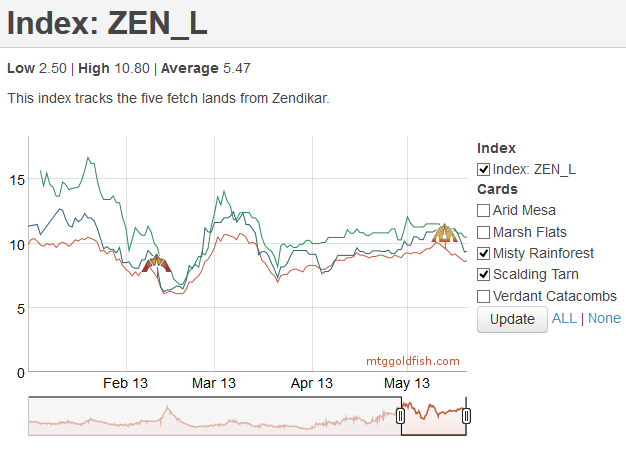
The red line is the index for all five fetchlands. The green and blue lines are for Scalding Tarn and Misty Rainforest, respectively.

As you can see, fetchlands have fully recovered from the ZZW queues. As of now, the fetchlands are a special case we'll have to watch closely. They are incredibly popular in the Modern format. They seem to have been redeemed in fairly large quantities too. They will also be a good refuge over the next few weeks, during MM's spoiler season.

Their current price shows how resilient they are, even out-of-season. So resilient in fact, we must now debate whether we are witnessing a new price floor, instead of a price ceiling. My prediction is that if you can acquire Misty Rainforest and Scalding Tarn for 7 to 8 tix each, you will be spot on with the new price floor, which is much higher than what we were used to.

The Case of Force of Will

Let’s have a look now at another kind of reprint that occurred this year, this time in the form of a promo Force of Will that was awarded as a MOCS prize.
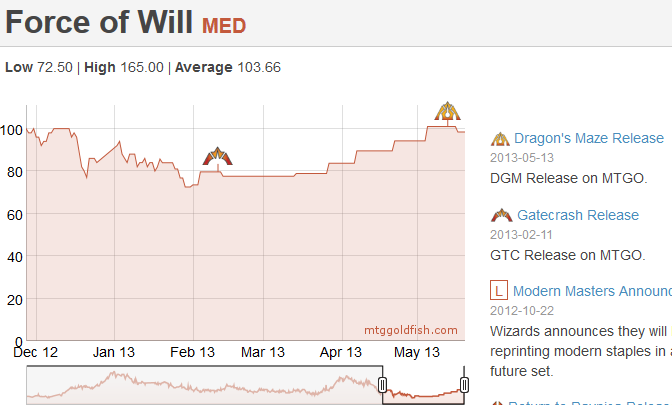
The deflation here shares similarities with the fetchlands. The price for the regular version went down 25%, before fully recovering, back to its usual $100 level. The promo version could be had for $50, and even less. It has caught up with the regular version, now sitting above $88 on mtgotraders.

We can presume that fewer copies of the promo Force of Will were awarded, compared to the fetchlands. Lately, there are indications that Legacy is gaining momentum online, so the increased supply is also met with increased demand. The chart proves that the injected stock did not exceed demand. So far, we can see that MTGO staff has been pretty skilled at balancing supply and demand when reprinting cards.

Core Set Reprints & Availability

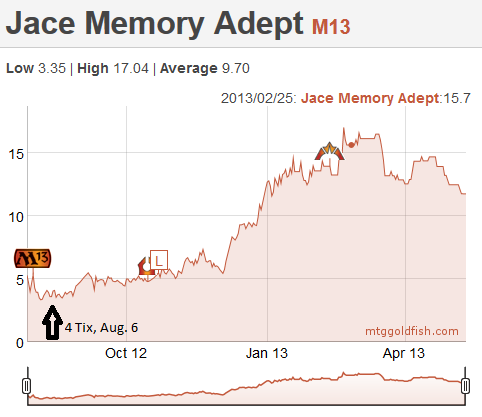
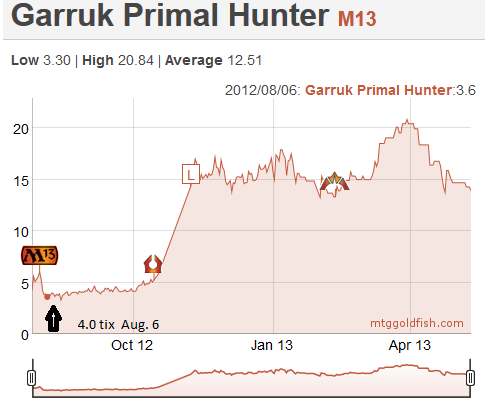
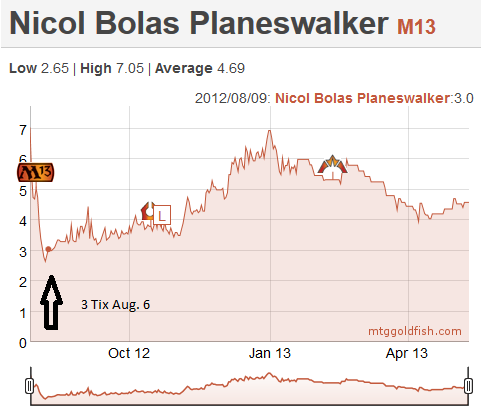
We talked about another kind of reprint last week. When we think of Gideon Jura, Jace Beleren, Garruk, Primal Hunter, Jace, Memory Adept, or even Chandra, we might assume their reprint in a core set doubles the number of available copies on the market. Well, this is flat out wrong, for many reasons.

First of all, redemption destroys a good portion of the virtual stock of each of those cards. Secondly, I have come across many casual players who end up reducing their time spent on MTGO or quitting the platform entirely, condemning their collection and reducing the number of available copies of any given card. Some of them log in so infrequently that their valuable mythics are rarely available for trade, so we cannot consider these copies readily available.

When demand increases significantly for a card, the majority of the online crowd is not necessarily aware of it, nor willing to sell. This also affects the number of available copies.

Another factor one has to consider is the fact that a vendor on eBay or on TCGPlayer can post his entire collection and fix a price at which he consents to sell a card. On MTGO, this isn’t true. Players must be online to make their collection available, and they have limited space to post their ads. There are thousands of players at any given time of the day who cannot offer their cards for sale. That’s why so many players must turn towards bots, who are online 24/7.

My point here is that when a mythic gets reprinted in a core set on MTGO, we believe that its availability has doubled (or that it will double), and we usually see a huge price drop. But in reality, when the metagame shifts and a reprinted planeswalker is now urgently needed, only a small portion of the total copies is available, for the reasons mentioned above. This creates pressure on the market, mostly on bots, who adjust their prices accordingly, eventually reaching the pre-reprint levels.

In other words, the next time you see a reprint of a popular mythic, such as Primeval Titan, watch its price plummet from panic sellers, and tell yourself that this is precisely the discount you needed to restock on that specific card. Make yourself ready for its next big spike.

Aggressive Behaviour from Major Bot Chains

Some bot owners were getting excited on Twitter about the unique opportunity to restock on Force of Will during the ME-to-ME4 drafts. They wanted to make sure to offer the best possible price in order to acquire as many copies of this staple as possible. More recently, some traders have remarked on a strange pattern with Thoughtseize, for which the price actually increased during the first days of LLW drafting.

Bot owners have increased their levels of aggressiveness when acquiring reprinted staples. Panic sellers and drafters turn to them to sell their cards at a decent price, and bots restock plenty. Therefore, the discount is getting narrower of late, and reprinted cards are better retaining their value. Afterwards, when panic sellers realize their cards haven't lost that much value and that they still need them to play their decks, they must return to the best stocked bots to buy their copies back.

If I had very deep pockets, I know for sure I would use a similar strategy, thus buying reprinted staples at a small discount, grabbing as many as I can, and then wait for prices to get back to their regular levels, to sell for a nice profit.

How to Prepare for Modern Masters?

This is still a tough question to answer without being wrong. I would personally grab spoiled rares and mythics, in their original version, when they lose anywhere between 25% to 40% of their actual value. I am convinced their prices will recover by the next Modern season, with the help of Theros prerelease events, which will halt (or slow down) MM drafts. The additional supplies provided by MM drafts will help stabilize the price progression of many Modern staples, but it is highly unlikely that these fresh supplies will permanently affect the MTGO economy.

Dark Confidant has been confirmed to appear in MM, as a mythic. This is going to be the perfect test for my approach with reprints. I will wait for this card to see a price decrease of 25%, hopefully 40%, and then try to load a big bunch of them. Then I will hold all the way until next Modern's season, and sell back for a good profit.

Botting

In two weeks, I'll share with you my crazy adventure in the world of running a bot (actually two bots). It's one of the most serious challenges I've faced since we decided to invest on MTGO. It's easy to lose sight of which cards we have bought and which ones we want to sell. It is also extremely difficult to stay liquid these days, when the bot keeps buying cards, even if they were bought at foolish discounts. So, stay tuned!

The Psycho,
Sébastien Morin

I’m Bored. Let’s Brew.

Are you a Quiet Speculation member?

If not, now is a perfect time to join up! Our powerful tools, breaking-news analysis, and exclusive Discord channel will make sure you stay up to date and ahead of the curve.

I tend to enjoy drafting a lot more than playing Standard for a number of reasons. That said, if you want to take Magic seriously, then Standard events are generally going to be more common and more lucrative (I know, comical word to describe a Magic tournament) than limited ones. I haven't been paying a ton of attention to Standard lately and from what I've heard there are some rather silly things happening. My understanding is that Unburial Rites + Acidic Slime + Restoration Angel is all the rage but that deck apparently can't beat Jund and the aggressive decks are sort of glass cannons.

Oh, and Sire of Insanity is a pretty real thing.

After perusing the SCG Open Series schedule and the PTQ schedule it looks like I have literal zero Standard events that I should care about until August. That, to me, means that it's time to start spamming completely outrageous decks at unsuspecting opponents and hoping that one of them turns out to be alright.

I was experiencing mixed feelings playing Naya prior to Dragon's Maze, as no matchup felt especially bad but everything felt very draw-dependent. So now, I think I'm going to take a hiatus from playing what sounds safe. It'll be a nice throwback to the point in my life when I would just show up to FNM with 56 cards + 4 Jace the Mind Sculptor. Those were the days...

When I brew I have a pretty top-down approach. Travis Woo, for example, likes to start with the question of what he can do. I like to start by asking the question "what do I need to beat?". Here's a short list of things that I don't want to lose to:

That's a pretty mixed bag. Needless to say, the power level of Standard is pretty freaking high right now.

When it comes to aggressive decks, they're typically the easiest to combat as "kill all of your dudes" is extremely consistently a strong strategy against them, so to start off I want to focus on the other decks.

It looks like I'm going to need to be able to beat some very big plays without relying too heavily on my graveyard or on controlling a lot of lands. The easiest solution seems to be just being aggressive, but I'm not about that.

Well, I do like attacking with these guys:

Some time ago I was really into UWR Geist tempo but ended up retiring the deck when UWx flash decks started popping up everywhere. The decks that were better at casting Sphinx's Revelation were just too tough to deal with, but with everything being more midrange I could see Geist Tempo being a pretty serious contender.

Since I played the deck two pretty interesting new toys have become available:

Ral Zarek is also a thing now, but I'm not thinking he's where I'm going to want to be. What I want to do is punch people in the face early and often. So right now I'm asking myself two questions:

Do I Want Geist, Reckoner, or Both

When it comes to combating aggro Reckoner is the clear choice, and if I'm attacking unimpeded then I'll prefer to have Geist. Seeing as I'm insanely out of practice, I'm just going to jam both. The worst thing that could happen is that I'll lose some matches of Magic. I do that all the time soooooooooooooo, pretty low opportunity cost to trying both.

Is Warleaer's Helix Good Enough?

I'd be pretty surprised if the answer was no. It kills the majority of potential opposing threats, provides a life cushion and packs a lot of damage for a singular card. There's no way it isn't an awesome target for Snapcaster Mage, so I think I'm sold for the time being.

Oh yeah, if it wasn't obvious I'm definitely going to be playing Snapcaster Mage. Seems unlikely that I'll pass on Restoration Angel as well.

I suppose I have another pretty important question?

Sphinx's Revelation?

I think I'm going to start off with these ones on the sideboard and see how it feels. I want to see how well I can just kill people. Stopping to durdle, while fun, isn't conducive to this plan. They're definitely a front-runner for sideboard options though.

So, it looks like I want to kill people with these:

I'd make a wager that counterspells are going to be mostly just okay in a deck that wants to tap out for these types of threats, and I know for a fact that I'll need to be able to kill creatures. These look like good options for a spell suit:

In typical early draft fashion, I'm thinking I'll start with a grip of two-ofs and see how everything feels. This looks like a good starting place:

Cosby Sweater

spells

4 Boros Reckoner
4 Geist of Saint Traft
4 Restoration Angel
2 Thundermaw Hellkite
4 Snapcaster Mage
4 Pillar of Flame
4 Searing Spear
2 Mizzium Mortars
2 Detention Sphere
2 Warleaders Helix
2 Izzet Charm

lands

4 Hallowed Fountain
4 Glacial Fortress
4 Sacred Foundry
4 Steam Vents
4 Sulfur Falls
4 Clifftop Retreat
2 Cavern of Souls

Thoughts Going In

Reckoner + Geist might be overloading me on creatures and leaving my Snapcasters hanging from time to time. Cavern of Souls is also awkward with Reckoner in general but I definitely want the Caverns over basics. It's possible that I want to explore some manner of draw option other than Izzet Charm, but things that aren't Sphinx's Revelation in this format are pretty unimpressive. I'm also wondering how good Resto is going to be but I'd find it hard to believe that just Flash 3/4 Flier isn't generally good enough. I mean, come on. Card is stupid. A maindeck Dissipate or two might also be necessary. We shall see.

I plan on running this deck through some Dailies, 8-mans, etc and seeing how things run. Is it quick enough to beat Reanimator and Jund? Is it powerful enough to combat Naya Blitz? I don't know, but it sure looks fun.

-Ryan Overturf
@RyanOverdrive on Twitter

Jason’s Archives: Writing the Second Half Twice

Are you a Quiet Speculation member?

If not, now is a perfect time to join up! Our powerful tools, breaking-news analysis, and exclusive Discord channel will make sure you stay up to date and ahead of the curve.

Greetings, Spectators!

Does anyone even remember why I call this "Jason's Archives?" At this point it's become almost vestigial; a title I've always used so I continue to, despite it losing its contextual significance. It's the appendix of article titles, but I'm fond of it and you guys really can't do a thing to stop me.

On the topic of "things you can't stop me from doing," I'm going to spend the whole time talking about coverage, with one small exception. Let's get going because I want to get this done in time to watch the Blackhawks embarrass the Wings at the Joe in front of a sold out crowd.

Damned If You Do, Damned If You Don't

Wizards pulled something I consider a dick move.

Shut up, Corbin Dallas

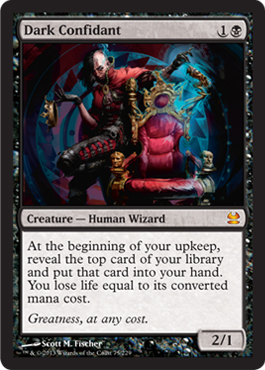
This ain't your daddy's Dark Confidant. Specifically, they managed to combine an iconic card art, based on the likeness of an Invitational winner and turn it into utter steaming garbage by using an artist whose art I like. I like Sriracha, and I like a banana split on a hot summer day, but this is like I decided to mix Sriracha and a banana split and while I was mixing them in a bowl, a dog did awful things in my mouth.

In my view, it's a silly idea to alter an invitational winner's card's art if you reprint it. Add to that the fact that Voidmage Prodigy was reprinted with alternate art (also a picture of Kai) and they didn't dare alter the art on [card Shadowmage Infiltrator]Johnny Magic[/card] when he saw a reprint and you have a slighting of Bob Maher that reminds us of the time they cast Gender Bender on Chris Pikula. To quote to great philosopher Carl Brutanunanulewski, "I don't remember always being this old and black."

To cast Sowing Salt on top of Stab Wound, Wizards made Bob Maher himself write the article announcing the new fugly art. To my mind, that's akin to your wife making you give her paramour a ride home after you catch the two of them in bed. What's wrong, Wizards? Firing him and burning down his house didn't seem like enough of a dick move?

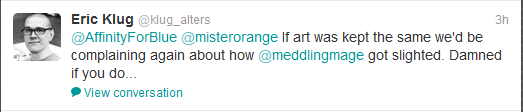
Maybe, but if they had kept Bob's art the same, we'd be talking about how Chris Pikula was slighted, not how Chris Pikula and Bob Maher were slighted -- a conversation that takes more than twice as long. I say damned if you do, less damned if you don't.

Who the Hell is Rob Castellon?

Some people don't watch coverage. They check the Top 8 of the PT, see it's super stacked and then look at the decklists. Since this was a Block PT they pay even less attention to even the decklists. Those people missed. The hell. Out.

I loved him in Ratatouille

We were treated to an interview with Rob Castellon where we learned some staggering facts about the man.

  • He's a Level 2 Judge
  • He was asked to judge a PTQ but forgot to confirm, so he decided to play the event. He won.
  • He went 8-0 on Day 1
  • He referred to his deck as "Deadbride Chant Control". Not bad for a "glorified Staff of Nim" (your words, not mine or his)
  • He hates EDH. We learned this when he said so in an interview. An interview with Sheldon Menery.
  • He's much more ripe for memery than that crazy fundy Chuck Norris

Rob fell in the Top 8, but we spent the whole weekend in awe of a relative unknown (outside of everyone who interacted with him in his judging, which is most of us) entering the Top 8 tied with Craig Wescoe, the event's winner.

He was the Cinderella story of the weekend, and with that inspiring tale, coupled with production value that increases with each event, Magic PT coverage is actually a legitimate spectacle. I spent much of the weekend glued to it.

We'll talk a bit about decks later, but I'd be remiss if I didn't get Rob talk out of the way up top.

I got your financial relevance right here.


 If You Support It, They Will Come

366 players played in Michigan's Spring States competition. Not bad for a weekend that had other state competitions, the PT and an SCG event, and oh yea, it was Game Day.

Try having states be a TCG Player 5K. That gets butts in seats.

While we're on the subject of the (inferior) PA states, one my friends took it down.

76 players or not, they still played an absurd seven rounds before cut top Top 8. 76 players or not, Josh was still X-1 on the day. I don't have a list, but I imagine it's still that silly Jund list that splashes Aurelia's Fury and Lingering Souls (he just told me on Twitter it's just Jund colored but I still don't have a list). Way to grind, Josh.

Something Awesome Happened and That Wasn't the Best Part

Casting Notion Thief isn't that exciting in Standard. It can be exciting if you cast it in response to your opponent using Jace, the Mind Sculptor's "brainstorm".

It's even more exciting on camera at an SCG Open. People react like they've just seen the Crane Kick at the end of "The Karate Kid".

Skip to 12:27:30. NSFW- balls-punching

I didn't think it was as great as most people did, because while this is an epic blowout, it's literally the only utility for Notion Thief I considered acceptable. It was fun to watch, sure, but I don't think it was the best part.

Go back and watch the judge's reaction.

I've roomed with Jeph Foster a few times at various events and he is excellent value. I was delighted to wake up this morning and find this all over Facebook.

Sure, watching someone get blown out by a Notion Thief is good. But you have to admit that seeing a friend turned into a meme is better.

Didn't You Just Do Event Coverage?

I know, right? It sure feels that way, but now I'm going to do the boring decklist recaps only half of you read.

PT Dragon's Maze Decks

This was a PT that involved Block decks. Instead of talking about the Block metagame, which I consider somewhat irrelevant, let's look at specific cards and interactions because those could translate to Standard post-rotation. That's not always the case -- Innistrad block saw the banning of Intangible Virtue after all, a card not even good enough to play in more than one or two decks in Standard.

Advent of the Wurm is great in Block, and was featured in PT winner Craig Wescoe's deck, among many others. It's a combat trick, it's an efficient dude, it's a token to populate -- this card underwhelmed me at first but I bought a few since my co-host MarcelMTG was so excited. I'm glad I did -- Advent trades around $10 before events start. If you can still buy in around $5 still, don't miss the opportunity.

Ætherling has people talking. I think what they're saying is wrong, though. I don't care how exciting Ætherling is, and it's certainly exciting, control finishers don't end up worth a million bucks when they're two-ofs and not mythic. Ætherling features almost exclusively in heavy control decks where it competes for slots with planeswalkers. I don't think buying in at $5 is correct. I just don't see it becoming very expensive unless Standard starts to look a lot like Block did, with lots of Esper control. If Ætherling manages to translate to midrange a bit better and get played a bit more than a two-of, be prepared to buy in quickly, but I'm not holding my breath.

Voice of Resurgence is obviously nutty in Block. It's Modern-playable and I can't imagine it won't get played in Standard. It's trading at an absurd $40, but Jace, Architect of Thought was $50 and now it's $10 so let's have some perspective.

Speaking of Jace, SCG cranked the price to $15 this weekend. This could be a Block bump, but expect him to do more work after rotation.

I see a lot of Assemble the Legion. I've always liked this card. I will continue to like it, and continue to have a few hundred copies, waiting for it to hit $5 or so. Expect this to do work soon. Expect Ratchet Bomb to be pretty useless against it.

I can't believe how much Blood Baron of Vizkopa is going for. I saw Divinity of Pride but a lot of people saw Baneslayer Angel. This card is artificially high, but I don't expect it to go down, rather I expect rotation to make the card better and therefore likely to retain much of its value. This card does work. Its static ability isn't super-relevant outside of EDH, but a pseudo-evasive lifelinker is strong.

Varolz, the Scar-Striped may be the maze runner most likely to be worth money. These went up to $6 this weekend. I think Ruric Thar has potential, too. We have a lot of Sphinx's Revelation legality to deal with.

With a lot of Naya Humans' cards rotating, expect Precinct Captain to finally get the play it should have been getting. A lot of UW control decks played this as the only creature. It kills bigger creatures, punishes slow control draws and builds an army. This guy does work, and with Thalia, Guardian of Thraben, Silverblade Paladin and Champion of the Parish all rotating, expect White Weenie to need recruits.

Civic Saber is going to spike from five to six cents.

Alms Beast is bulk. You can't lose if you go deep on bulk rares. Rob Castellon did work with this guy and I think we may finally have a format with fewer chump blockers where Alms Beast backed by removal will get the job done in a few swings.

Sire of Insanity is still insane, and expect to see it paired with Deadbridge Chant. It's quite good.

Let's take the Block cards with a grain of salt. They won't all hit, but some will be role players moving forward. I'd like it if Scion of Vitu-Ghazi got there. I couldn't convince anyone how good it was with Seance, but Armada Wurm, [card Trostani, Selesnyas Voice]Trostani[/card] and Vitu-Ghazi Guildmage are all stupid with tokens and now we have Advent of the Wurm on the team.

As savage as it was to populate a token copy of Armada Wurm with Trostani, thus gaining 20 life and keeping 15 power of creatures permanently, a lack of imagination won the day and Seance's ship has all but sailed. Expect GW Populate to be a player, however, and expect fringe cards like Rootborn Defenses to do more work. Once again, Block isn't always the best indicator (nearly every Block deck was splashing red for Blasphemous Act a bit over a year ago) but expect to see good cards to still be good going forward.

SCG Nashville

I am not even bothering with a clever title. I hate playing in Nashville. The city is fine, but they can't seem to find a decent venue with onsite parking and as funny as it would be for Ryan Bushard's heart to explode because he had to walk two miles in 70 degree heat with a 40 pound bag, no it actually wouldn't. The last time we went to an event at Opreyland I thought he might actually die. No SCG Open is worth it, especially since we won't be selling any cards.

SCG Nashville decks

Can I just ignore the seven decks that aren't this one? I'd sure like to. This is a pile of good stuff. This decks loses all of its pressure to rotation, but I think there are equivalent threats that can easily be slotted in. I don't know what they are, but that's not really my job anyway. The other Top 8 decks bore me, but this is a fun brew, it clearly was good enough since it made Top 8 and it could show what a control deck might look like going forward, albeit with fewer creatures as the [card Restoration Angel]Resto[/card]-[card Thragtusk]Tusk[/card] package rotates along with [card Huntmaster of the Fells]Huntmaster[/card].

This deck isn't the worst, either and it shows that Desecration Demon might be viable. I've started targeting Demon as it's practically bottomed out at bulk at this point. In a format with fewer creatures and more spells, expect Demon to do work if you can keep it alive. Rakdos, Lord of Riots may be the better 6/6 for four, but Desecration Demon is mono-colored and therefore more flexible. Disciple of Bolas never really caught on, which sucks because we may be about to lose it. Granted, fewer creatures makes sacrifice effects worse, but I feel like Disciple never got a chance.

The rest of the Top 8 we could have actually guessed. 2 +/-1 Reanimator decks? Affirmative! 2 +/-1 Naya decks? Roger! 2 +/-1 Jund decks? Right again! 2 +/-1 metagame brews? Right again. This is getting too predictable to be exciting. The lists haven't changed much, either, besides the decks I already mentioned.

This could be a weird rotation, though. It's mid-May and people are asking me for [card Olivia Voldaren]Olivia[/card], Thragtusk, [card Falkenrath Aristocrat]Falkenrath[/card] and [card Thundermaw Hellkite]Thundermaw[/card] -- stuff I dumped a while ago because it seems like it's too close to rotation to pick it up. People seem like they are going to play these cards up until the last second and prices haven't gone down ahead of rotation the way I'd expected. You may have longer than ever before to dump cards because more people than ever are playing this children's game. Trade accordingly -- you may not want to avoid format staples for another week or two, although you should probably trade for Legacy and Modern cards. I am.

Legacy isn't dead yet. In addition to Justin Uppal getting curb-stomped by event winner Lauren Nolan's Notion Thief, the event featured the return of Natural Order to the Top 8.

No Show and Tell decks in the Top 8?

I'll probably use this a lot

Finally, stupid Show and Tell is banished from the Top 8. How many Rug Delver decks? That'd be a big fat goose egg.

Pet deck of the week goes to Tezzerator. The deck is Tier 3 and I don't think it's correct to move on Tezzeret, Agent of Bolas, but it's fun to see some familiar faces in the Top 8 we haven't seen in a while.

Lots of Blade decks in the Top 8 here. I can't credit Dragon's Maze too much since there aren't a ton of Dragon's Maze cards being used and we've seen no new archetypes with this card pool (it revolutionized Modern, though, so I imagine Wizards is going to stop creating cards for Legacy). Blade decks are making use of Notion Thief, though, and when you do get to do the only thing it's good for (pants someone who just brainstormed) you'll be hard-pressed to lose that game. No finance opportunity here, it will never be more than a one-of. Grab Japanese foils, I guess.

Let's talk about NO Bant again. I don't have much, I just wanted to point out that Knight of the Reliquary decks can still get there. I may sound like a blasphemer but I think Natural Order into Progenitus is much more brutal than Sneak Attack into [card Emrakul, the Aeons Torn]Emrakul[/card]. I've seen plenty of people shrug off that Sneak Attack from the Flying Spaghetti Monster and come back to win the game. Progenitus has to be raced and that pretty much ends the list of options.

Two ANT decks? I was surprised until I remembered Adam Prosak wasn't at the PT. This is a fluke, but this deck has always been a real thing. Any given Sunday, right?

The bottom half of the Top 16 contains the usual suspects we expect in the Top 8. I like Reanimator, but I like to jam four copies of Chancellor of the Annex. It's much better than you think. I'd like for this tech to catch on, but I can't see how to get it out there, short of actually sleeving up a deck, which I don't see happening anytime soon.

I think if Legacy gets new cards, it will be by accident. Legacy is going to stop changing as rapidly as it has been, so while investments will stabilize with a less dynamic metagame, the overall health of the format being in question casts a shadow on these cards as investments. If you can trade format staples into collectible cards like duals and power, you may want to do so. I wouldn't have money tied up in Show and Tells if I have the choice between those and Force of Will.

I'm Done

I never know how to end these things. Some weeks I can think of a way to relate the outro to something I said earlier, but this week I think I'll just leave you all hanging. Life is full of disappointment folks, and it's best you learned that now. Besides, no matter how bad your weekend went, at least no one cast Notion Thief on your Brainstorm.

Insider: The Effect of Judge Promos on Price

Are you a Quiet Speculation member?

If not, now is a perfect time to join up! Our powerful tools, breaking-news analysis, and exclusive Discord channel will make sure you stay up to date and ahead of the curve.

Welcome back readers! The idea behind this article came from our very own Douglas Linn. He brought it to my attention that we haven't had any articles written about the impact of judge foil reprints on a card's value.

First things first. Below is a list of all the judge foils (I found on TCG player) as well as some cost comparison data. Note that the column denoting the difference between pack foils and judge foils is color coordinated (when the pack foil is worth more than the judge foil it's in green, when the judge foil is more valuable it's in red.)

Card Name Judge Foils (TCG Mid) Judge Foils (SCG) Regular Cards (TCG Mid) Foil Cards (TCG Mid) Difference (Foil vs. Judge Foil) Notes
 Argothian Enchantress N/A 54.99 N/A N/A N/A
 Armageddon N/A 79.99 N/A N/A N/A
 Balance 24.99 1.59 N/A N/A
 Balduvian Horde 3.11 0.58 N/A N/A
 Ball Lightning 10.56 2.29 3.99 -6.57
 Bitterblossom 39.99 17.44 32.53 -7.46
 Bloodstained Mire 142.49 39.76 169.99 27.5
 Bribery N/A 79.99 16.69 77.17 N/A *Mercadian masques foil price used
 Burning Wish 47.49 20.99 80 32.51
 Command Tower N/A 17.99 6 19.64 N/A *Commander's Arsenal foil used
 Counterspell 16.32 0.95 14.69 -1.63
 Cunning Wish 29.99 4.93 14 -15.99
 Dark Confidant N/A 119.99 56.99 109.98 N/A
 Dark Ritual 74.98 0.86 43.09 -31.89
 Decree of Justice 22.7 2.71 9.89 -12.81
 Demonic Tutor 199.99 9.99 N/A N/A
 Deranged Hermit 19.97 5.6 15.5 -4.47
 Doubling Season N/A 49.99 28.13 39.98 N/A
 Exalted Angel 46.59 4.04 20.59 -26
 Flooded Strand 194.99 62.99 289.49 94.5
 Flusterstorm N/A 19.99 13.84 N/A N/A
 Gaea's Cradle 249.95 95.34 N/A N/A
 Gemstone Mine 27.4 3.68 23.99 -3.41
 Goblin Piledriver 44.95 23 42.51 -2.44
 Goblin Welder N/A 9.99 6.99 49.97 N/A
 Grim Lavamancer 14.96 4.68 37.5 22.54 *Torment Foil Price used)
 Hammer of Bogardan N/A 3.99 0.49 1.99 N/A
 Hermit Druid N/A 39.99 1.89 N/A N/A
 Imperial Recruiter N/A 149.99 269.99 N/A N/A
 Intuition 175.49 34.67 N/A N/A
 Karakas N/A 99.99 94.99 N/A N/A
 Karmic Guide N/A 19.99 8.95 89.99 N/A
 Land Tax 49.99 14.92 N/A N/A
 Lightning Bolt 101.37 1.7 19.94 -81.43 *Player rewards foil used
 Living Death 35.62 3.22 N/A N/A
 Living Wish 15.82 4.8 14.37 -1.45
 Mana Crypt N/A 99.99 79.79 N/A N/A
 Maze of Ith 175 31.69 27 -148 *FTV: Realms Foil used
 Meddling Mage 12.34 2.74 15.67 3.33 *Planeshift foil used
 Memory Lapse 2.8 0.18 3.67 0.87
 Mind's Desire 11.68 0.83 6.39 -5.29
 Mishra's Factory 49 2.6 N/A N/A
 Morphling 9.99 7.12 N/A N/A
 Natural Order 72.54 25.09 N/A N/A
 Noble Hierarch N/A 39.99 28.56 43.32 N/A
 Oath of Druids 23.74 6.25 N/A N/A
 Orim's Chant 33.14 13.25 39.18 6.04
 Pernicious Deed 58.28 17.11 58.7 0.42
 Phyrexian Dreadnought 26.99 15.19 N/A N/A
 Phyrexian Negator 8.23 1.83 9.71 1.48
 Polluted Delta 249.68 87.37 384.79 135.11
 Ravenous Baloth 6.99 0.74 4.74 -2.25
 Regrowth 65 1.77 N/A N/A
 Sinkhole 47.82 29.98 N/A N/A
 Sneak Attack N/A 34.99 37.99 N/A N/A
 Sol Ring 124.05 10.02 18 -106.05 *FTV: Relics Foil Used
 Stifle 55.03 17.97 45.01 -10.02
 Stroke of Genius 17.75 4.82 N/A N/A
 Survival of the Fittest N/A 119.99 23.7 N/A N/A
 Sword of Fire and Ice 52.97 30.6 68.74 15.77
 Sword of Light and Shadow N/A 39.99 25.22 62.67 N/A
 Swords to Plowshares N/A 79.99 3.15 N/A N/A
 Thawing Glaciers 29.99 6.49 N/A N/A
 Time Warp 33.99 5.7 14.13 -19.86
 Tradewind Rider 8.56 2.01 N/A N/A
 Vampiric Tutor 62.84 23.24 N/A N/A
 Vendilion Clique 94.95 50.34 129.98 35.03
 Vindicate 86.84 24.95 79.98 -6.86
 Wasteland 99.11 49.99 153.4 54.29 *Player rewards foil used
 Wheel of Fortune 51.89 9.49 N/A N/A
 Windswept Heath 178.19 45.58 148.24 -29.95
 Wooded Foothills 146.99 38.33 118.49 -28.5
 Xiahou Dun, the One-Eyed N/A 19.99 164.02 N/A N/A
 Yawgmoth's Will 53.93 14.98 N/A N/A


But this is just the first layer of analysis. The bigger question is what does the judge foil do to the current value of a card? When a new judge foil is announced, should you unload the regular copies you have?

To determine this I used data from the two sites (http://wiki.mtgsalvation.com/article/Judge_Gift_cards and http://blacklotusproject.com/). Using these two sites, I could 1) find a list of when the judge promos came out, and 2) look back in time at the existing cards' value. When values were not on Black Lotus Project, MTG stocks was used as a substitute. Most Judge Foil Announcement dates were taken from posts on MTG Salvation, though some came from CFB and SCG announcements.

It's also important to look more at the trends from BLP rather than the prices, as BLP takes its prices from MOTL and not necessary stores/ebay/etc.

Card Name Judge Foil Year Announce- ment Date Value Before Value After Comments
 Argothian Enchantress 2003 No Data
 Armageddon 2004 No Data
 Balance 2004 No Data
 Balduvian Horde 1999 No Data
 Ball Lightning 2001 No Data
 Bitterblossom 2011 02/10/11 $12.65 $8.22 Judge foil shows a downward trend for 3 months after it's announcement with a low of 8.22 before rising again
 Bloodstained Mire 2009 02/04/09 $12.91 $12.71 A very modest drop a few days after the announcement, which is more likely attributed to different online prices or minimal data. However, it plummeted down to $10.3 about a year after the anoucement, indicating the influx of judge promos was greater than the demand for the card. It's important to remember that legacy hadn't really “caught on” yet so demand was likely mostly from casual players.
 Bribery 2013 01/11/13 $10.00 $7.00 Judge foil announcement seemed to drive demand up briefly before causing it to come back down. It's important to note that there is a “flat-line” with this card's price during the announcement period which may indicate an error/issue with the data
 Burning Wish 2009 11/22/09 $5.19 $3.44 Noticeable drop after the announcement to 3.44 (within a couple months, but it began to rise again afterwards) to the $7 mark
 Command Tower 2012 03/07/12 $2.00 $2.00 No noticeable change in value, given it's low price tag this isn't that suprising. The fact that this is an EDH only card may be a strong indicator that while some still want foils, the demand is considerably lower for foil EDH staples than legacy staples.
 Counterspell 2000 No Data
Crucible of Worlds 2013 03/02/13 $18.99 $16.05 This card jumped all over the place the month of the judge foil announcement (anywhere from $16 to $24) however it has seemed to stabilize in the $23-24 range. It's use in both legacy and EDH are strong indicators that the judge foil shouldn't have affected the price (which it didn't appear to do)
 Cunning Wish 2007 No Data
 Dark Confidant 2011 07/23/11 $29.62 $29.35 This card continued trending upward even with the spoiling of the judge promo (the slight drop is most likely due to slight pricing differences online instead of a drop in demand). The modern announcement caused a much larger jump in price.
 Dark Ritual 2009 03/10/09 $1.53 $1.53 While I again would prefer to compare this with foil copies of the Masques version (the only other foil available) I don't have that data. However, the regular version did drop down by almost ½ within the following month indicating that the people who wanted Dark Rituals back then may have wanted Judge ones over regular ones.
 Decree of Justice 2007 No Data
 Demonic Tutor 2008 No Data
 Deranged Hermit 2004 No Data
 Doubling Season 2011 09/02/11 $17.36 $16.50 Card had recently shown a rise from 14.5 to the 17.50 mark within the year before judge foil announced, shortly after it dropped before climbing back to the 20+ mark within the next year
 Exalted Angel 2006 No Data
 Flooded Strand 2009
 Flusterstorm 2012 11/17/11 $17.00 $16.50 This card has shown a downward trend in it's value since the announcement. However, it's also important to note that this card was easily hyped as the most desirable “Commander” card for the legacy format upon it's spoiling and has since been relegated to sideboards as a 1 or 2 of only. Price may be more telling of over-hyping than it's judge foil announcement.
 Gaea's Cradle 1998 No Data
 Gemstone Mine 2005 No Data
 Goblin Piledriver 2008 No Data
 Goblin Welder 2011 06/09/11 $8.05 $6.79 This card showed a downward trend immediately following the announcement as well as another drastic drop 5 months later (again likely when the foils actually hit the market), but has since recovered to the $7-8 range again.
 Grim Lavamancer 2006 No Data
 Hammer of Bogardan 2002 No Data
 Hermit Druid 2004 No Data
 Imperial Recruiter 2013 01/04/13 $339.37 $308.12 This card has shown a downward trend since it's spoiling as a judge promo to it's current price of around $270. Demand was heavily due to extreme rarity as opposed to playability as it only sees play in a small group of legacy decks notably Imperial Painter and/or Aluren Combo.
 Intuition 2003 No Data
 Karakas 2012 09/19/12 $66.58 $67.03 This card showed a continual rise despite the announcement. It has seen very few drops and continued to it's current price of $95
 Karmic Guide 2012 02/10/12 $6.94 $6.23 This card showed a continual drop after the annoucement to a low of $4.5 before rebounding to pre-judge announcement values in the $6.5-7 range.
 Land Tax 2010 05/22/10 $4.77 $4.68 This card showed a dip in value within a month or so of it's announcement (down to $3.8), but given it was banned in legacy demand was again mostly by EDH/casual players so an influx of cards didn't really drop demand.
 Lightning Bolt 1998 No Data
 Living Death 2003 No Data
 Living Wish 2008 No Data
 Mana Crypt 2011 09/02/11 $55.96 $61.33 Card maintained an upward trajectory for several months after its announcement but then began a downward drop to the $50 mark (which would imply that it's spoiling didn't drop the price, but when it actually started coming out demand exceeded supply. However, it has recovered nicely and is nearer an all time high in the $70-80 range.
 Maze of Ith 2009 03/23/09 $7.84 $8.01 This minimal difference in prices is likely a better indicator of internet price differences than demand changes due to the judge foil announcement. It did not see any sudden drops to indicate the judge foils added enough to the supply to saturate the market.
 Meddling Mage 2006 No Data
 Memory Lapse 1999 No Data
 Mind's Desire 2008 No Data
 Mishra's Factory 2005 No Data
 Morphling 2010 11/19/10 $7.88 $7.94 As expected this card saw no real price drop upon the announcement, however it dropped to the $7 range a couple months later (most likely as supply entered the market). The value has been suppressed ever since. It's also important to note that creatures have gotten better and better over the years and what once was one of the most powerful creatures in the game has since been eclipsed.
 Natural Order 2010
 Noble Hierarch 2012 09/19/12 $18.43 $17.40 This card showed an upward trend for a couple weeks after the announcement before dropping around $1. It has since rebounded to it's current $28.00 price tag
 Oath of Druids 2001 No Data
 Orim's Chant 2008 No Data
 Pernicious Deed 2006 No Data
 Phyrexian Dreadnought 2010 03/02/10 $24.95 $24.55 This card showed a downward trend immediately following the judge foil announcement. It hit a low of $22.50 and then recouperated some only to fall back down. It saw another massive plummet in August which may indicate that's when supplies were added to the market. It has continued a downward trend to this point settling in the $16 range.
 Phyrexian Negator 2004 No Data
 Polluted Delta 2009 11/22/09 $16.81 $16.12 Card showed a downward trend up until the judge foil announcement, continued downward for a few more days and then began a rise to $20
 Ravenous Baloth 2007 No Data
 Regrowth 2005 No Data
 Sinkhole 2010 11/19/10 $28.14 $28.25 This card saw no drop upon the announcement, though there were two sudden drops one in March 2011 and one in May 2011 which likely indicate major events in which many judge promos were added to the supply but demand remained low. The card seems to have regained it
 Sneak Attack 2012 03/07/12 $20.66 $20.66 This card showed almost no change due to the judge foil announcement. Though it began to rise 2 months after the annoucement to a high near $38. It's important to note that Sneak/Show has been putting up very good numbers since around this time until now. Though the card has seemed to stabalize more in the $25 range, which may be lower than expected due to the addition of the judge foils and the fact that it's only played in one legacy deck.
 Sol Ring 2005 No Data
 Stifle 2009 06/23/09 $10.46 $9.00 This card started a downward trend within 2 weeks of it's announcement until reversing the trend and moving back up to it's $18 price tag.
 Stroke of Genius 1998 No Data
 Survival of the Fittest 2009 10/16/09 $10.36 $10.30 This card saw virtually no change upon the announcement. There was a noticeable dip when cards were added to the supply but it continued it's trend upward until it's banning in legacy where it plummeted back down and has remained steady.
 Sword of Fire and Ice 2011 12/08/10 $12.84 $13.02 This card continued it's upward trend peaking at $35 before slowly dropping back to it's $30 price tag. The judge foil seems to have had no effect on this card's value (again due to it's demand in both EDH and some legacy sideboards)
 Sword of Light and Shadow 2012 02/10/12 $20.83 $20.85 This card showed almost no change due to the judge foil announcement. It has slowly dropped in value towards the $18 dollar range, but this may be due to it's falling out of favor in legacy rather than the judge foil announcement.
 Swords to Plowshares 2013 No Data Unfortunately there is no data for the FNM promo of StP which would be the only good comparison as the regular StP has been reprinted numerous times and the judge foil is aimed heavily towards legacy players.
 Thawing Glaciers 2010 06/02/10 No Data Unfortunately there is no data on BLP for this card and it was spoiled as a judge promo before MTG stocks was available.
 Time Warp 2004 No Data
 Tradewind Rider 2002 No Data
 Vampiric Tutor 2000 No Data
 Vendilion Clique 2011 02/10/11 $8.28 $7.78 Again another minor drop within a week or two of the announcement, with a much larger drop (to $6.5) a few months after (again indicating this may be when they began be awarded), however the price rebounded nicely thanks to the modern format and it comfortably sits at $50.
 Vindicate 2007 No Data
 Wasteland 2010 09/03/10 $20.65 $20.69 This card saw a minor drop in price a few weeks after the announcement, but the fact that demand is predominantly from casul/EDH players is a likely indicator of price stability despite any “new” supply. It's currently at a $9.50 price tag and likely stable.
 Wheel of Fortune 2010 09/03/10 $4.65 $4.03 This card saw no downward trend from the announcement, however it reached a high of near $53 in April of 2011 before dropping down to the $40 range, this could be due to judge foils being added to the supply (I don't know when they actually began being awarded) but this sort of massive drop is a strong indicator towards a sudden increase in supply.
 Windswept Heath 2009 06/23/09 $13.22 $12.52 Similar to Stifle, this card continued upward for a few days after the announcement only to reverse direction and drop about a dollar before continuing back up to it's current $45 price tag.
 Wooded Foothills 2009 06/06/09 $13.72 $13.77 This card saw a drop of about 15% within 2-3 months of the announcement, again signaling that the cards were added to the market, but demand was lacking.
 Xiahou Dun, the One-Eyed 2012 11/17/11 $199.00 $176.00 This card plummeted upon the judge foil announcement. A good indicator that it's value was solely based upon it's extreme rarity. It has settled closer to the $100 mark, though some ebay auctions are as low as $45 indicating the demand really isn't there.
 Yawgmoth's Will 2007 No Data


You can check out my comments above to see on a card-by-card basis how each judge foil announcement affected prices. There were, however, several patterns I noticed. These are summarized below.

  1. EDH/Casual favorites rarely lose value upon the announcement or when supply is added to the market.
  2. Legacy staples often lose some value upon either the announcement or the introduction into the market, but for the most part bounce back. The only exceptions are cards that have fallen out of favor for other reasons.
  3. The artwork on the judge foil and more importantly the typical reaction to it will have a large impact on whether it becomes more valuable than a pack foil (if a pack foil exists).
  4. The older announcements seemed to take a little longer to disseminate; i.e. the card's value might not immediately change within the first day or two of the announcement, but as more people learned, its price would change within a week or two. Whereas with newer announcements the price can often change within days. This is a strong indicator that more people are paying attention to this information and reacting accordingly.
  5. Cards with iconic artwork that have not been foil before tend to be more valuable judge foils (see Lightning Bolt and Sol Ring).
  6. Some Judge Foils are a major miss and worth very little (Balduvian Horde/Ravenous Baloth) more often than not these are foils based on good Standard cards, but which see little to no Legacy and EDH play.
  7. Reprinted cards tend to have the following values in foils Original Printing>Judge Foil>Latest Printing
  8. Cards that aren't Legacy or EDH staples tend to have Judge Foil values similar to the original printing foil (see Living Wish/Memory Lapse).
  9. Cards that are valuable due to extreme rarity, but aren't played much, will see a massive drop in value with a judge foil announcement (see Xiahou Dun, the One-Eyed).
  10. Staple Legacy lands (Polluted Delta/Flooded Strand/etc) seem to be far more valuable as pack foils than judge foils, something to keep in mind should they make the Zendikar fetches into judge foils.


*****EDIT*****
I fixed the Wasteland/Wheel of fortune switch; so it is now correct.

Avatar photo

David Schumann

David started playing Magic in the days of Fifth Edition, with a hiatus between Judgment to Shards. He's been playing Commander since 2009 and Legacy since 2010.

View More By David Schumann

Posted in Finance, Free Insider5 Comments on Insider: The Effect of Judge Promos on Price

Have you joined the Quiet Speculation Discord?

If you haven't, you're leaving value on the table! Join our community of experts, enthusiasts, entertainers, and educators and enjoy exclusive podcasts, questions asked and answered, trades, sales, and everything else Discord has to offer.

Want to create content with Quiet Speculation?

All you need to succeed is a passion for Magic: The Gathering, and the ability to write coherently. Share your knowledge of MTG and how you leverage it to win games, get value from your cards – or even turn a profit.

Insider: Reassessing Priorities to Meet Profit Goals

Are you a Quiet Speculation member?

If not, now is a perfect time to join up! Our powerful tools, breaking-news analysis, and exclusive Discord channel will make sure you stay up to date and ahead of the curve.

Speculating on Magic Cards can be a lot of work – often it even feels like a second job. I spend countless hours in the evenings and on weekends trying to stay up with trends. With the recent creation of mtgstocks.com and resulting crazy market movements, the task of maximizing value in Magic has truly become daunting.

There has to be a balance. Not long ago I wrote an article describing how our time should have a dollar value associated with it. Negotiation of our time’s value should not be taken lightly, and it is up to us to always keep this in mind. After all, no one else is going to do that for you.

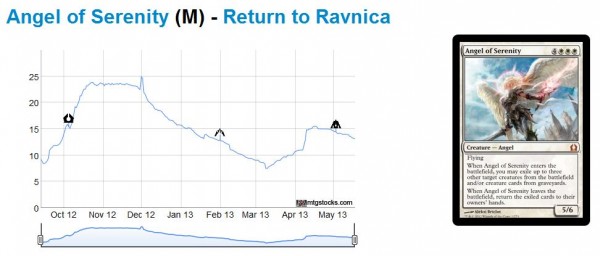
As I’ve thought about this concept some more, I've realized I should take this Magic speculation thing even further. I’ve made some rash purchases in the past in the hopes that I can eek out a bit of profit. I’ll eagerly purchase something like Angel of Serenity at $8 with hopes that come Standard rotation I’ll be able to sell it for $15.

Or better yet, maybe I should purchase fifty Aetherlings since the card performed well at the Pro Tour this past weekend. Surely I can grind out some value there, right?

Is This Worth It?

Even if those Aetherlings do double after the Pro Tour, fees and shipping costs are likely to eat into profits. At the end of the day, a $2 Aetherling purchase sold at $5, even if done so fifty times, is likely to net small profits.

Now, of course, the card could go higher. We could see a dramatic spike like we saw with Wolfir Silverheart last year. In this case, the profits would be much higher and the value vs. time equation would never even become a factor. But statistically speaking, how often does this happen?

Seriously. How often do we speculate on cards and they proceed to increase dramatically, and that price increase is sufficient to have justified our time?

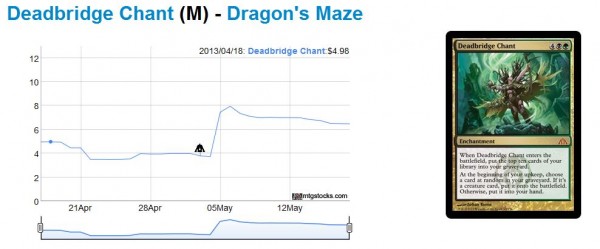
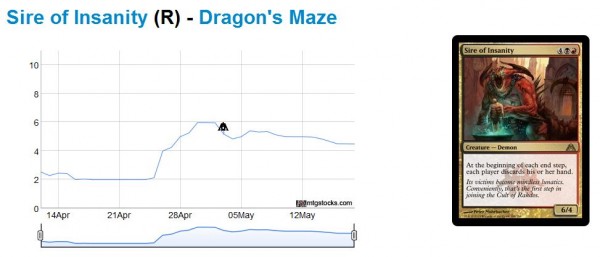
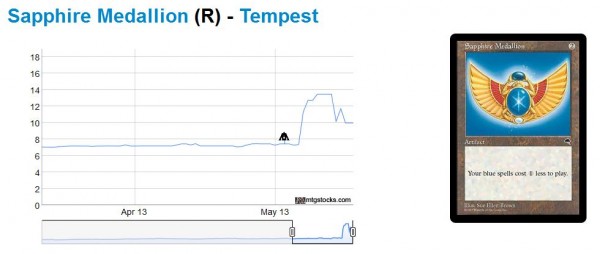
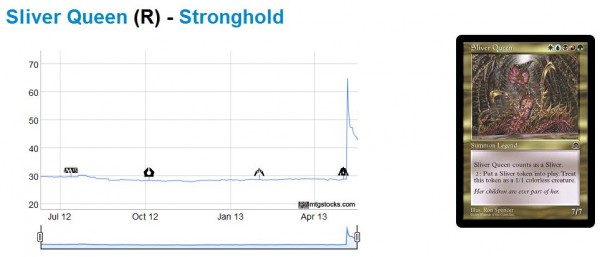
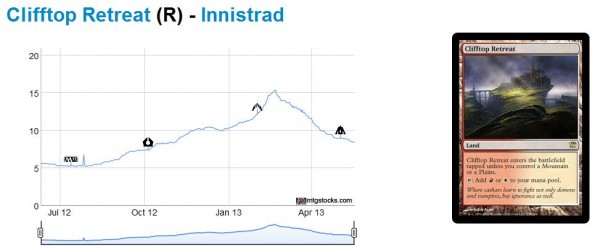
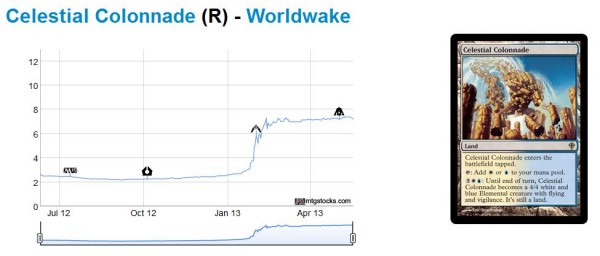
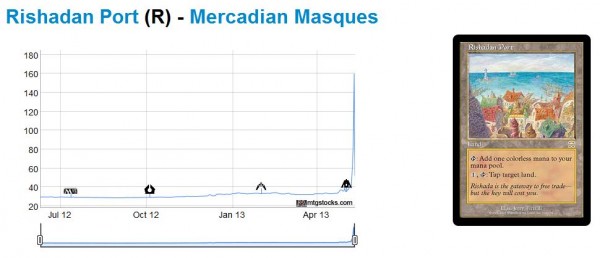
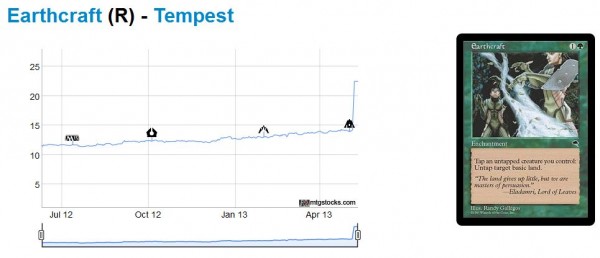
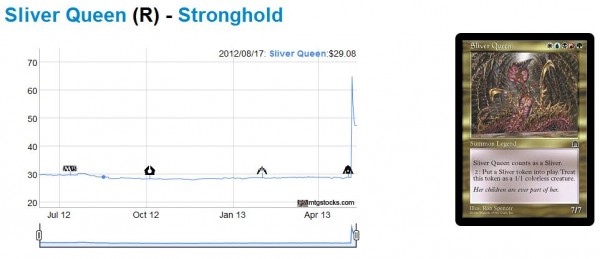
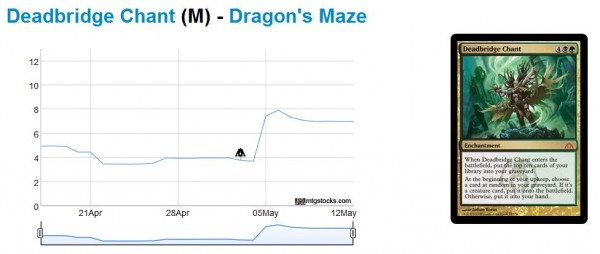
On quick flips like Wolfir Silverheart or, more recently, Deadbridge Chant, one must be highly engaged. The profit window may be a matter of a couple days before a card begins to decline again after an initial spike. Doesn’t it feel like this has become the norm lately, and not the exception? Doesn’t the chart below look familiar?

Or this one?

Or even this one?

If you’re fast enough, then there’s definitely profit to be had with each of these spikes. But hesitate too long and you could be left with very little profit considering the amount of time spent. Holding the hot potato may or may not be costly, but it definitely implies greater risk compared with selling immediately upon a spike.

Speculation & Risk

I have made the conscious decision to not participate in some recent jumps. Rishadan Port baffled me quite a bit. I ignored Earthcraft completely. And these Tempest Medallions are awesome and all, but I have no desire to attempt a quick flip on them.

Did I miss some profitable opportunities? Definitely. If I played the quick flip game, I may have been able to find a few cheap copies left under some unturned stones on the internet. One week later and I could have sold them for a handy profit…assuming one week wasn’t too long to wait.

I sometimes get a rush with these speculations. When Craterhoof Behemoth spiked, I made a nice chunk of change selling my copies to Card Kingdom for a stunningly high buy price. But other times, my endeavors are not rewarded. Nivmagus Elemental still stings. Even if a quick flip attempt pays out, often times the net profits aren’t enough. This means I either should not have bothered or I should have gone deeper – sometimes, way deeper.

This means I would need to take on greater risk. Don’t get me wrong, risk is a necessary aspect of speculation. But at that point, it feels more like I’m gambling than investing. If I want to place larger bets on speculations, why wouldn’t I day trade? Surely doing some speculative buying and quick flips with the stock market would have proven more lucrative than doing so on my most recent quick flip, Sliver Queen, which netted me a measly $5 in profit so far simply because I could only find a couple copies underpriced online.

Hey, doesn’t that chart look familiar?

It’s Time To Focus

This risk/reward equation has been out of whack for me. I’ve been trying to get thrills out of quick flips with only moderate success. Meanwhile, other investments I’ve made in the past have been so obvious and provided much stronger returns.

My initial dive into Booster Box investing has proven highly lucrative. Are these difficult to move? Absolutely. But the limited downside and high likelihood of upside cannot be ignored. In the past, I’ve kept the investment in this area under control with the excuse that I wanted to remain diversified. I was fooling only myself – why did I bother buying Sliver Queens in the hopes I could sell within three days of ordering when I could be sitting on one more Return to Ravnica Booster box instead?

The same goes for other high confidence bets I’ve made in the past. After seeing how Scars of Mirrodin Dual Lands trended up in price, I had extremely high confidence Innistrad Dual Lands would follow suit. Many well-regarded members of the QS community agreed, strengthening my beliefs. Yet despite this, I was so concerned with diversification that I limited myself to a mere couple-dozen copies of these lands.

The result – I made a solid profit but missed incredible upside. And it was such a textbook opportunity.

My strategy needs to change. I need to increase the size of my bets, and stick with a risk-profile I’m comfortable with. I have a difficult time stomaching a purchase like Corbin’s 93 Splinterfrights or Jason’s Deadbridge Chants. These are speculative bets with measurable risk (Corbin’s more so than Jason’s).

Meanwhile I’ve been trying to accumulate Supreme Verdicts because I remember what Terminus did last year. By sticking to consistent performers like board-sweepers and mana-fixing lands, I ensure plenty of upside without the need to worry about flipping quickly. I had months to invest in Innistrad Dual Lands and another month or two to sell with plenty of profit.

Contrarily, with Sliver Queen I had one day to buy. And I’ve already missed the window to sell one for profit.

I’m Doing As I Say

My risk-reward balance may not match yours. You may like the quick flips because you can maintain smaller inventory. You may love the thrill of profiting on something very speculative because you anticipated metagame evolution. I can appreciate these benefits, but I’ve realized they’re not for me.

Stability, higher likelihood of profiting, and longer time horizons are what make the most sense for me at this stage in life. You know what – this is comparable to my stock market investing strategy. Rather than trying to flip AMD stock on hype, I would much rather invest in Intel for a few years to earn a solid, relatively safe dividend. Reducing the amount of risk gives me the courage to invest larger amounts, which in turn yields me greater profit.

This sentiment is most recently manifested in my Innistrad Booster Box play. For the first time, I’ve had the courage to go deep on a Magic investment. But I only managed to do so because of the nearly zero downside I know I have taken on with such an investment. Will I make 1000% profit like some people did with Shared Animosity?

Of course not. But I am also taking on far less risk and I’ll have years to unload these boxes for profit. With Shared Animosity, you may be able to find cheap copies online but by the time they arrive it may already be too late to sell. I know which scenario I’m more comfortable with.

Sigbits – Safe Bets

In light this week’s article, I’ve decided to share some updates on safer MTG investments I’m looking at.

  • Shock Lands. These are so obvious. I’m confident these will follow similar price trends to Scars and Innistrad Dual Lands. If I’m right, the time to acquire these at their cheapest prices is nearly past. Once Standard rotates, we are going to lose Innistrad Duals. If players are still going to play 3+ color decks in Standard, they are going to lean very heavily on Shock Lands. Naturally I like blue ones the most, but Overgrown Tomb and Blood Crypt seem solid with Jund being so strong in Standard.
  • Deathrite Shaman has really stabilized in price. But when Modern season comes around, he should go up in price. Likewise with Abrupt Decay. In fact, I like most Modern-playable rares from RtR block.
  • If Standard’s not your thing, may I suggest Worldwake Manlands? These have been on a steady incline lately. They’re not in Modern Masters, and I expect them to increase further when Modern season returns. Honorable mention to Inkmoth Nexus for being like a Manland – this one is also solid.

-Sigmund Ausfresser
@sigfig8

Insider: MTGO Recent Events

Are you a Quiet Speculation member?

If not, now is a perfect time to join up! Our powerful tools, breaking-news analysis, and exclusive Discord channel will make sure you stay up to date and ahead of the curve.

Outlook for Booster Prices

Previously it was expected that Dragon's Maze (DGM) boosters would flood the market due to the tix-only release events, the switch to DGM for Constructed prizes, and the skewed prize distribution for drafts. This provided strong motivation for buying Return to Ravnica (RTR) and Gatecrash (GTC) boosters in the previous 6 weeks. The underlying trends that would depress the price of DGM boosters would simultaneously support prices for RTR and GTC.

The change to Constructed prizes has adjusted the outlook for booster prices. Fresh supply of RTR boosters will now come from two places. Constructed Daily Events and Premier Events will award RTR, GTC, and DGM boosters. RTR boosters will be awarded from 2-person Constructed queues that are not Momir or Pauper. This should provide a steady supply of RTR boosters into the secondary market. This suggests it is doubtful that prices for RTR can reach 4+ tix in the short term and instead will settle into the 3.7 to 3.9 tix range.

As for GTC the fresh supply from Dailies and Premier Events should slow the expected price increases. This introduces some risk that there is not enough time for these to reach a profitable level. If full block drafting remains popular over the next two months, then prices should increase steadily. But, the release of Modern Masters (MM) will provide something else for drafters to do and this could interrupt the process. Also the release of M14 in August will definitely slow down RTR block drafting, at least temporarily.

With the release of MM and M14, the optimal selling window for RTR and GTC looks to be June and July. There will be another chance to sell in September when players have grown bored of core set draft. After that, the release of Theros will relegate RTR block drafting to an afterthought for a number of months. If you are holding boosters by the end of September, expect price weakness for a number of months as players will be most interested in Theros limited and Fall Standard.

As for DGM, prices will probably not fall as hard as was originally expected, but the skewed prize distribution means that drafters will typically have a few packs of DGM in their accounts, keeping demand low. There might be a short-term opportunity to pick these up at the end of release events once the tix-only events wrap up, but upside will be small.

Release Event Trends

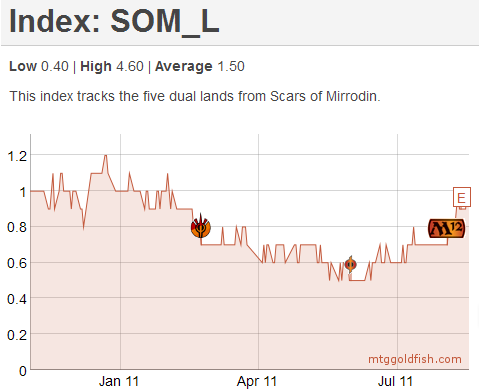
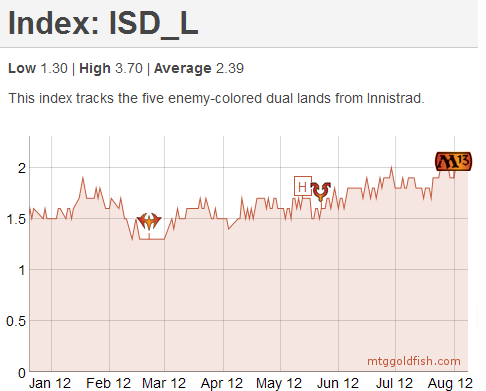
Have a look at the two charts below. They are reproduced from mtggoldfish and track the prices of dual lands from Scars of Mirrodin (SOM) and Innistrad (ISD).

The index for the fast lands from SOM suggests that they bottomed during New Phyrexia (NPH) release events, represented on the chart by the NPH expansion symbol. This is no surprise as the Sealed Release queues are tix-only and offer strong prize support. This encouraged lots of Limited play and the selling of cards into the secondary market to get more tix, which in turn temporarily depressed prices for all cards from SOM.

The same effect is observed for the dual lands from ISD, which bottom out during Dark Ascension (DKA) release events (similarly represented by the DKA expansion symbol). Both indices stabilize afterwards and then start an uptrend with the release of the core set in August. Buying the SOM and ISD land indices was a profitable, low-risk trade as they both saw higher prices in the subsequent Fall.

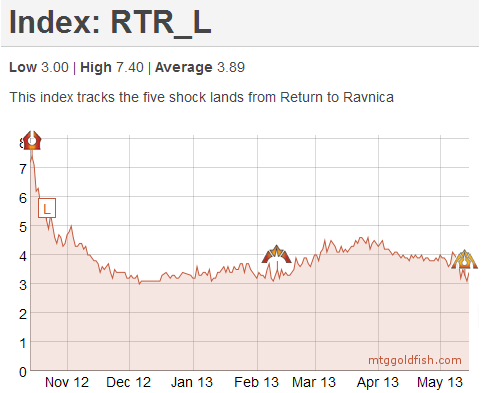
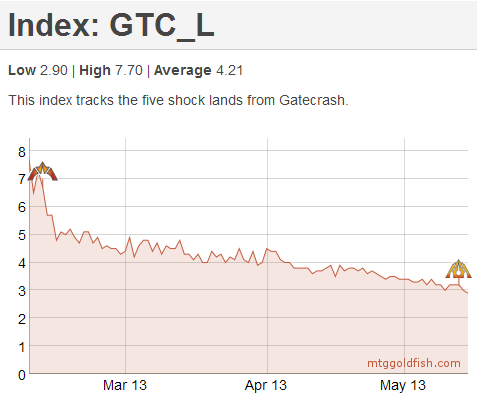
This pattern strongly suggests that the absolute bottom for the shocklands of RTR and GTC will occur right now, during DGM release events. Have a look at the following charts.

Looking at the chart for the RTR shocklands, the price bottom seems to be about 3 tix for this index. The price rose higher after the switch to GGG drafting in February, but DGM release events have brought fresh supply into the market and the price has been falling back to around 3 tix.

The chart for the GTC shocklands is still trending down. Based off of historical patterns, the next two weeks represent the bottom for the shocklands of Ravnica. Real estate is one of the most reliable speculative vehicles in Magic and I don't expect this year to be any different. Buying shocklands now with an eye to Fall Standard is a low-risk and profitable strategy to employ. Although I encourage readers to buy all the shocklands, I tend to weight my basket towards the under-used and thus low-priced shocklands.

The prevalence of green-based strategies powered by Thragtusk and Farseek suggest that Temple Garden and Stomping Ground both have lower upside than the other shocklands. It's quite possible that the aforementioned green spells are not included in M14. If that turns out to be the case, the reign of green as one of the top colours in Standard could be over come the Fall.

Although I expect most shocklands to rise into the 4-6 tix range after Standard rotation, if a card like Stomping Ground goes from being the most played dual land on MTGO to the least played, the upside on this card at current prices will be low, with even some possibility of a loss depending on the purchase price. This is not to discourage speculators from stocking up on green shocklands, but to understand that changes to the Standard metagame may affect their value in ways that are difficult to predict.

Portfolio Update

This is a brief rundown of what I am buying, selling and watching in the market.

Selling:

  • I've started selling RTR boosters. With prices at or near 4 tix and the unexpected supply coming from constructed events, there's less of a possibility of these going to 4.2 or 4.3 tix. Getting 3.8 to 3.9 tix for them seems reasonable given the changes to the Constructed payouts.

Buying:

  • Most of the GTC shocklands are priced at under 3 tix and represent good value. I have been buying these.
  • Lightning Angel saw price increases this week after it featured in a Day One undefeated deck in Modern Constructed at GP Portland. Although not a groundbreaking development, it seems like a solid metagame choice and could see a price spike during the next Modern season. I'll hold onto my copies and will scoop up more if it falls into the 0.2 to 0.3 tix range again.
  • Boros Reckoner touched 5 tix this week and is one of my favorite pick ups for the Fall.

Watching:

  • The adjustments that were made to Constructed payouts has added some risk to continued buying of GTC boosters, so I have stopped buying these. I'll be paying attention to the prices of GTC boosters this weekend. If the price firms up, this bodes well for further gains over the coming weeks. I'll be looking to sell them during June and July, prior to the release of M14.
  • Some of the DGM rares look like they have value. Council of the Absolute looks reasonable at or below 2 tix, and [card Catch]Catch//Release[/card] is one I think has potential, currently priced as a bulk rare. Block Constructed will have a spotlight on it this weekend at PT Dragon's Maze in San Diego, so if there is some new deck technology developed by the pros, we could see a breakout card or two.
  • Last week's pickups such as Restoration Angel and Thragtusk have stabilized in price. There are still a number of PT Theros Qualifiers to be held on MTGO during June and July with the format being Standard Constructed. I'm confident there will be one more price spike on these cards.

Mixing It Up

Are you a Quiet Speculation member?

If not, now is a perfect time to join up! Our powerful tools, breaking-news analysis, and exclusive Discord channel will make sure you stay up to date and ahead of the curve.

A long time ago in a movie rental place probably far away from where you live, I stood wondering why all the horror movies were grouped with the science fiction ones. Back then we did not have a plethora of super hero movies to enjoy like we do today, nor did we have the magnitude of space-related flicks that you can find in the theater almost any time of the year. At that time, we had to deal with various low-budget movies like Wing Commander, The Fifth Element, and Gattica. Now don’t get me wrong, all of those movies are sweet, but there just weren't tons of titles in the genre.

Even with such a small selection, I was curious why they were shelved together. Certainly some movies fit both categories, like the original Alien movie for example. That classic Sci-Fi movie is definitely a horror movie as well.

This is just one example of someone mixing two ideas into one. While I may never know why they were made into one category, it’s likely that someone just thought it was a good idea. There have been many people over the years to employ this technique of putting two things together. Take the classic vanilla chocolate swirl ice cream cone. I’m sure at one time, there was only vanilla and only chocolate. They were completely separate. Now, it would be strange to see them as always separate and usually we have three choices instead of just two.

As Pertains to Magic...

I too have done just that. I have mixed two amazing things into a wonderful combination of magical goodness. This sometimes perfect, sometimes disastrous hybridization of ideas comes up in the realm of Magic as much as it does in the real world. Today, I mixed a little bit of midrange combo and resilient aggro to bring you a totally new creation. Without further delay, I bring you…

Zombie-crats!

Untitled Deck

Creatures

4 Gravecrawler
4 Diregraf Ghoul
4 Cartel Aristocrat
4 Blood Artist
4 Boros Reckoner
4 Falkenrath Aristocrat
1 Zealous Conscripts

Spells

3 Tragic Slip
1 Electrickery
3 Lingering Souls
1 Mark of Mutiny
3 Blasphemous Act

Lands

4 Blood Crypt
4 Godless Shrine
4 Sacred Foundry
4 Dragonskull Summit
4 Isolated Chapel
1 Clifftop Retreat
1 Vault of the Archangel
2 Swamp

Sideboard

2 Paraselene
1 Purify the Grave
1 Blasphemous Act
3 Pillar of Flame
3 Obzedat, Ghost Council
3 Duress
1 Mark of Mutiny
1 Zealous Conscripts

How did this amalgamation come about?

Last week I was playing and writing about a Jund deck based around Varolz, the Scar-Striped. That deck provides early aggression along with a solid midrange plan for the times when you don’t win on turn four. Maybe it was because of the deck supporting sacrifice outlets or because of the way I played it, but the more I played Varolz Jund, the more it seemed like a clunkier, version 2.0 of The Aristocrats.

Although Varolz was a ton of fun, I decided not to play it at my local PTQ because playing a weak version of an existing deck is never a good idea. The part I liked best about Jund were the aggressive zombies. They provided early aggression and forced my opponent to react to them or die. Since I was already looking for something to replace Skirsdag High Priest, adding some early aggression seemed like a good thing to try.

With The Aristocrats, you need a plan for when you don’t draw your combo. Most builds plan to grind the opponent out with Lingering Souls, but they rely heavily on the power level of Falkenrath Aristocrat to close out games. The problem with this plan is that you are not aggressive enough to be successful unless you also draw Blasphemous Act + Boros Reckoner or an aristocrat + Blood Artist. By adding Gravecrawler and Diregraf Ghoul, you should get in enough damage early to make closing games easier.

The first issue I need to address is the manabase. When it comes to manabases, I tend to err on the side of consistency every time I build a deck. I would rather be able to cast my spells than sit with them stranded in my hand unable to affect the game.

This is one of the only times I was willing to play subpar mana. Because the deck combines one-drop black creatures with a triple-white/red creature, obviously you will have some issues. The way I built it, most of the time you won’t have any more problems than you would with the original Aristocrats deck. Sometimes though, you have to be willing to cast your one-cost on turn two or your Reckoner on turn four. Neither of those is usually game ending but it does lead to some clunky hands. With only three lands that can't cast the best minotaur ever printed, you won’t find yourself facing these issues often. The same can be said about your cheap zombies as well. There are ten sources of black mana which is reasonable to cast eight one-mana creatures.

There are additional benefits to combining two decks together as well. Confusing your opponent is likely when you decide to use this strategy because you throw them off when you start the game one way and finish it with another.

For example, consider this game from the PTQ. I lead with Unglued Swamp and full art Diregraf Ghoul (cause that’s how I roll) and second turn another of the same swamp as well as Gravecrawler. Imagine the surprise on the face of your opponent if you followed up that sequence with Blood Artist and Sacred Foundry tapped. My opponent took a minute to recollect himself as would yours. That game ended up being one of the best draws I had all day because I followed it up the next turn with a second Sacred Foundry and Falkenrath Aristocrat. This may be an extreme case but it is an example from an actual game and similar ones will come up.

Maindeck thievery was one of the best decisions I made for the weekend. Both Threaten effects were crucial to some of my game one wins. Virtually zero opponents will try to play around either Mark of Mutiny or Zealous Conscripts in game one and this leads to game wins because they will always be unexpected. Playing Cartel Aristocrat on turn two and Mark of Mutiny on turn three can occasionally leave your opponent too far behind to recover especially if you have a strong follow-up play. Both cards were great and if you are going to play any version of Aristocrats, I would suggest keeping both of these cards maindeck.

The Sideboard

The sideboard was one of the more powerful aspects of the deck. All of the cards were great and worked well in the metagame. Paraselene was a last-minute addition but I am glad I thought of it, even if it was twenty minutes before the event was about to start. Auras are becoming a mainstay in Constructed these days. Bant Auras is the most common iteration of the idea but some players are running UWR or other combinations.

In the future, making them sacrifice a creature with something like Barter in Blood may prove helpful as well because that effect might come up in other matchups. Paraselene helped me win one of the two aura-based matches I played over the weekend and served its purpose well. Make sure you don’t sideboard out all of your removal though because you will be open to losing to cards like Fencing Ace. Not all of their creatures have hexproof.

The aggro package:

  • 3 Pillar of Flame
  • 1 Blasphemous Act
  • 3 Obzedat, Ghost Council

Although I didn’t have to face much aggro, this selection of cards sets up the deck to beat aggro quite well. Sorin, Lord of Innistrad is decent against aggro decks but they usually have a way to break through and kill him. The reigning Ghost Council is not so easily defeated. By starting the game off with more removal, you will be under less stress and that will give you enough time to cast the five-drop. Once Obzedat is in play, I’m sure you know how easily the game will be to finish. He impressed me every time I cast him.

The rest of the cards need little explanation. The threaten effects get sided in against any midrange deck. They can either be used as the nail to seal your opponent’s coffin or as removal. Best case scenario, you get to steal Thragtusk, Voice of Resurgence, or another creature with a leaves play ability. Worst case scenario, you have to use it as a burn spell that hopefully puts you in a position to win the game if you draw other cards.

Personally I still like Duress over Sin Collector but I’m not sure if that is correct. The ability to make them discard a planeswalker is huge in my opinion, but getting a 2/1 might be more relevant. There is the possibility of Appetite For Brains as well. It just depends on what you want to sideboard for and your preference of cards. For now, I like Duress because the main match I sideboard it against is Esper Control and Duress hits the majority of their deck.

This may seem like a clunky, unimpressive deck but I did fight through seven, yes exaggerated seven, Thragtusks in one game this past weekend. The game did not end in my favor but the five lands I drew in a row didn't help me finish off my opponent who gained thirty five life throughout the course of the game.

Zombie-crats is exactly the type of strategy I want to employ right now because it attacks the format from a vulnerable angle. It's also a deck that can beat any deck in the format. Give it a shot and you may find yourself casting Gravecrawlers and Boros Reckoners in the same deck.

Until Next Time,

May you always have first turn black mana and third turn triple red/white.

Mike Lanigan
MtgJedi on Twitter
Jedicouncilman23@gmail.com

P.S. If you have any questions about the deck, please post in the comments and I'll be sure to provide answers.

No, No. I Said “Draw”.

Are you a Quiet Speculation member?

If not, now is a perfect time to join up! Our powerful tools, breaking-news analysis, and exclusive Discord channel will make sure you stay up to date and ahead of the curve.

If not for the fact that it would give my intentions away I wouldn't even bother with rolling for option in most limited matches. Most commonly I find myself wanting to be on the draw and my opponent almost always elects to play if they win the flip. It's not a matter of format for me either. If I have a deck that wants to draw first then I want to draw first. Unless I find myself on Zendikar or Rath I'm pretty convinced of this position.

It's not necessarily a matter of being "correct" to play or draw, at least, I don't think it is. I believe that a big function of why I choose to draw has to do with my approach to drafting.

Laying the Foundation

If you haven't read it, a timeless piece of Magic strategy lies in Zvi Mowshowitz's writing on fundemental turns. It's a piece that should be on most player's short list of greatest Magic articles of all time, but some are unfamiliar and for those familiar a refresher is always worth the time it takes to read.

When it comes to limited I pay a lot of mind to what my turns two and three are going to look like. For aggressive decks this is the turn that I should be forcing my opponents to start playing a reactive game and for slower decks this is the turn I should be able to start relevantly interacting with my opponent.

Having a curve that's heavy on two drops allows aggressive decks to abuse cards like Act of Aggression, which have an impact somewhere between "useless" and "game-breaking". Now, I like attacking on occasion, but the purpose of this article is to explore drafting decks that beat the decks that are good at attacking. That's going to mean finding the best way to push the situational cards that aggressive decks love as far into the "useless" half of the spectrum as possible.

Rule #1: Only Play Spells That Matter

So, this sounds like a no-brainer but it's the sort of thing that I see done wrong all the time. If you're trying to play the control then your spells need to relevantly impact the board. Discard doesn't do anything. Spells that damage your opponent but not creatures don't do anything. Mill spells don't do anything. Creatures that can't block don't do anything. "Threaten" effects don't do anything. All that you want are removal, spells that draw additional cards, creatures that block well and enough creatures that can attack to somehow win the game.

Rule #2: Only Play Creatures if They Block Well on Curve

So, if I wanted to shortcut this section I'd simply say that Grizzly Bears are good and Gray Ogres have become pretty bad.

To go deeper on the issue, let's break down what we expect our opponents to do. It's not uncommon to expect aggressive decks to start playing two power creatures on turns one and/or two, and likely something larger or at least on par on turn three. Meanwhile, we need to either kill these creatures or block them. Seeing as it tends to be much more difficult to draft removal than it is to draft creatures that trade with cheap creatures I like to have a healthy amount of Gutter Skulks and the like to keep myself alive in the early turns.

The reason that Gray Ogres don't really work anymore is that if you're starting on turn three there is a pretty substantial chance that your opponent will be attacking a 3/3 (or maybe even something larger) the turn that you play it. If you can't block effectively on curve you'll take unnecessary damage and Bedlams and Threatens will get the better of you.

Another important aspect of playing the blocking game is that Horned Turtles tend to be of lower value than Blind Phantasms. If you can't block and kill things or at least force your opponent to burn a trick you don't actually discourage attacking and you will take damage that you don't need to, and we all know where that leads. Wall of Denial is right out.

Rule #3: Go Big

The idea of wanting to draw first necessitates having a low-end to your curve, but if you want to actually win you'll need to have spells that have higher impact than your opponent's at some point. I don't necessarily mean anything bomby, but having a monster or two that costs six or seven will go a long way. I don't love Axebane Stag as much as a lot of people, but I understand that it's a pretty tall order for fast decks to beat if and when the game goes that long. I've cast a ton of Horncaller's Chants and it almost always just feels unbeatable.

So What Does Drawing Do for Us?

If our intention is to have a curve that matters early, and goes big, and we want to draw the spells that stop our opponent from killing us, then it stands to reason that we just want to draw more cards. We're trying to play a control game. We need lands and we need options. We need cards.

If our deck is doing what it's supposed to do we'll curve out on answers and be able to handle threats. If our deck isn't doing what it's supposed to do, how do we expect being on the play to help us win?

In my experience I have found that I want to play first if my deck is very aggressive and I have a lot of low-impact or high-variance cards that I need to maximize or if my deck is just too slow to start interacting to want to be on the draw against a decent aggressive deck. However, if I have any semblance of confidence in my deck's ability to combat aggressive decks then I have a great deal of confidence when I tell my opponent I'll be drawing first. This will increase my odds of drawing what I need against fast decks and the extra card is often all that matters against the slower ones.

Thanks for reading.
-Ryan Overturf
@RyanOverdrive on Twitter

Insider: Getting Over Gatecrash

Are you a Quiet Speculation member?

If not, now is a perfect time to join up! Our powerful tools, breaking-news analysis, and exclusive Discord channel will make sure you stay up to date and ahead of the curve.

This may be a bit belated, but it’s time for the set review (review).

Now, to get this out of the way up front. Chad and I had developed a system for grading each other’s predictions intending to remove some bias, but with him on a short break I’m going to try and grade myself here. But don’t worry, I can be a harsh jerk to myself just fine.

Also, the usual disclaimer for anyone who’s new. I do these review pieces for a few reasons. First off, they’re fun, but more importantly it’s a question of accountability. When I started writing years back the internet was rampant with “experts” who would make one accurate call and then talk about it for months on end as an example of just how amazing they were at this MTG Finance Thing, and why you should always listen to them and elevate their opinion.

Of course, these same “experts,” (most of whom are no longer recognized in the community, go figure) would never talk about the cards they missed hard on. Telling someone to buy in [card Venser, the Sojourner]Vensers[/card] or [card Koth of the Hammer]Koths[/card] at high prices and then acting like that never happened when the card falls to bulk planeswalker status is not a good way to build credibility. But because no one was tracking these things, it was very easy for people to overstate their accuracy. This in turn can lead people to make poor financial decisions based off the advice of someone who isn’t forthcoming.

Building Accountability

That’s why I started these reviews, as a way to hold myself accountable. It’s also why I don’t shy away from my missed calls, from Splinterfright to Master of the Pearl Trident. I’ve made plenty of really good calls, and I know my speculation advice makes me money personally, so I’m comfortable with where I’m at. But I don’t want to give the impression that I’m never wrong, because I am.

That’s why we do these. So let’s start.

Aurelias Fury

Then:

The community seems to be split on this card. This strikes me as one of those situations where in a year people will be like “oh yeah, I knew it would be XX,” forgetting that there was once a big debate about the card.

For what it’s worth, I think this card is pretty solid as something like a 2-of in certain decks. It’s sometimes just a Silence with upside, but it’s also sometimes a one-sided board sweep or a Fireball that ends the game. That’s a lot of versatility.

That said, it seems like it can’t really be worth more than Sphinx's Revelation. Even if it spikes, I see this settling somewhere between $10 and $15.

Now:

All the way down to $5 on SCG. It’s quite the drop for a card that people were once predicting to be the big hit from the set. I thought it would be worth a little more because I envisioned it as a 2-of in Flash decks, which didn’t quite pan out. I did, at least, correctly call it moving down from the absurd presale price it was holding at the time.

Aurelia, the Warleader

Then:

There seems to be some renewed hope about this card, and the power level is certainly very, very high. I don’t think it goes in the aggressive Boros deck but I do think the UWR decks could make use of it, since curving [card Thundermaw Hellkite]Thundermaw[/card] into this ends the game. Pre-ordering at $15, and I could see it spiking higher than that, but I do think $10-15 is where this will settle as well.

Now:

$10 on SCG. The two-of spot I saw going to Aurelia’s Fury actually just went to the big angel herself, and this settled accordingly. I don’t think this is a terrible pickup right now, by the way, since we could see $15-20 post-rotation. And it’s a big dumb mythic angel, so there’s that.

Domri Rade

Then:

I’m not as big on this card as Ryan Bushard is on our podcast (www.BrainstormBrewery.com), but I do think it’s solid. That said, so is something like [card Ajani, Caller of the Pride]Ajani[/card], and that sees basically no play. Unless I’m way wrong on the power level here, I imagine this will be a $8-12 ‘walker that sees some fringe play, certainly not the $25 retail it is now.

This is something to keep an eye on down the road, since after rotation it’s still going to be a powerful turn two play.

Now:

SCG still has these at $18, while the TCGPlayer average is a bit under $13. When I make these predictions I usually do so with SCG(ish) in mind, so by that metric I undershot this a little, while being more in line with TCG. The card has steadily trended downward since the Pro Tour spike we covered on QS, but it has shown signs of stabilizing. That means it’s likely to maintain its current price at least until rotation, when metagame shifts could push it down to $5 or up to $20.

Duskmantle Seer

Then:

This is actually a pretty sweet card, and he’s a good beater in an aggressive deck. That said, aggro is hard to do in these colors and there are many better four-drops out there. And since I only think this guy is good as the top-end of an aggro deck, I expect it to come down to $5 or so and maybe even a little lower, though having the Dark Confidant ability will help buoy it some.

Now:

$6 on SCG. Nailed this one, and I don’t see it changing too much going forward. The ability is just so hard to find a home for and I’m not sure it will ever break through. That said, the upside here is obvious if we do start to see something come along with the Seer as a mainstay.

Gideon, Champion of Justice

Then:

Speaking of overhyped cards, I have a hard time seeing Gideon do a ton. I think he’s got enough versatility to work in either a control or midrange deck, but I don’t see him being so insane as to impact the format right away. Retailing at $30 right now, I expect this to come down to $10-15.

Now:

$6 on SCG. It’s come down even further than I expected, and it’s a long way from the $30 it presold for. I hope you took my advice and unloaded any of these you may have gotten at the prerelease.

Obzedat, Ghost Council

Then:

This guy is good. He’s Thragtusk after Thragtusk rotates. Which means, even if he sees some play now, he’s going to come down to $15 or maybe even a little lower in the meantime.

But the power level is definitely there on this card, and he dodges pretty much everything in Standard right now. He’s going to be good, even if it isn’t for a while, although the tough casting cost could be an issue.

Now:

$15 on SCG. With [card Turn]Turn//Burn[/card] printed, I doubt this guy reaches Thragrusk levels of playability, but I do think he’s still the finisher of choice for control decks post-rotation. I don’t hate trading for it at $15, and if it dips any lower I’ll be going very deep into it.

Prime Speaker Zegana

Then:

We’ve seen with Revelation how good card draw can be, and Zegana certainly does that (and she’s a merfolk!) That said, she’s certainly good with a Restoration Angel or ‘Tusk out, but so would anything you’re paying six mana for. Bant decks could use her, perhaps even some midrange deck in the grindy mirrors, but I don’t think it’ll be in great numbers.

Preselling at $15, but probably more like $8-10 down the road.

Now:

Well, I certainly nailed her playability since the grindy Bant Zegana deck did become a thing and spike her price. She’s $7 right now on SCG after falling, spiking, and then falling again. I don’t think she’s going to move much from there, to be honest, as playing Zegana without Thragtusk becomes a lot more risky after rotation.

Assemble the Legion

Then:

Here’s the thing about this card. It’s retailing at $1.50 right now, which is practically bulk. I don’t hate it as a throw-in target because this thing gets out of control pretty quickly, although it doesn’t seem to have a good home yet.

But the power level on this card is high. It could find a place either in a board-control deck, winning on its own if left unchecked without requiring additional mana, or in a midrange deck as a recurring source of creatures against said control decks. Not necessarily expecting big things from this, but the power level is there, so there are worse cards to target on the cheap.

Now:

$2 on SCG, and it spiked higher when it began seeing play as I predicted. That means if you got in for the near-bulk price they were the first few weeks you did very well once it hit. It’s pretty much a known quantity now, so we’re back to picking them up cheaply in case rotation boosts it again. Either way, we’ve already made our money on this card.

Blind Obedience

Then:

People have been slowly catching onto this (after us in the forums, I believe). It slows down the haste decks, provides incremental advantage in extort, isn’t dead in multiples and also stops some of the combo decks in Modern.

That’s a lot of good things, but $5 is still too high. $3 seems more likely.

Now:

$4 on SCG. Not much to see here, this card did as expected, and played a role in knocking off the BR Aggro decks as we predicted.

Boros Reckoner

Then:

I’m not sure Standard play alone will keep this at $4, but the card is solid. It will probably see play even if it’s only in the sideboard, and will be pretty dang good in Boros mirrors or against any non-Wrath deck. I can see this moving up in price when people realize this, even if it doesn’t stay that high forever.

Also, Spitemare buylists for a quarter. Random fact, sure, but the Reckoner is the only card with the same ability we’ve seen since, so it’s something to keep in mind. I like this as a trade target at $2-3 or lower.

Now:

$15 SCG, $12ish TCGPlayer.

Well, targeting this at $2 was certainly correct. Of course, so was targeting it at $12, so I can’t say I called the meteoric rise this card experienced. That said, I did at least identify it as a pickup, and I did so at my prerelease events. I made money from this prediction, and I hope you did too. It’s not often we see the confluence of factors that led to this hitting $25, so I wouldn’t expect that to become the norm moving forward.

Also, I hope you moved yours at $20+ when myself and others suggested it, since it’s halved since then. It does seem fairly stable at its current price.

Shocklands

Finally, we have the Gatecrash shocklands. These haven’t quite hit RTR shock levels, so I’m not going really hard into them when in comparison to something like Steam Vents and Hallowed Fountain. That said, I don’t mind picking them up right now since supply is fairly stable at this point. And, as I pointed out in the original article, Breeding Pool is still the best target from a pure supply perspective, considering it’s the only shock that was in Dissension (the third set of original Ravnica) as well as Gatecrash, which was opened less than RTR.

Well, there we go! Looking forward to grading my Dragon’s Maze picks in a few months.

Thanks for reading,

Corbin Hosler

@Chosler88 on Twitter

Insider: Everything You Need to Know About EV

Are you a Quiet Speculation member?

If not, now is a perfect time to join up! Our powerful tools, breaking-news analysis, and exclusive Discord channel will make sure you stay up to date and ahead of the curve.

From Poker Theory to Trading Magic Cards

A few years ago, I was debating on a poker forum whether to call with Ace-King, when an unknown player pushes all-in on his first hand in a Sit and Go Heads Up (1 vs 1). Back then, my rationale was that if someone is bad enough to push all-in on his first hand (I won’t get into too many details, but this strategy is awful, regardless of your hand), I should wait for a better spot with better odds and lock an easy victory. Why risk my stack now with a 60% chance of winning, when I could wait until I have a 75%, 80% or even 100% chance of winning?

There was one answer I will never forget: “Man, what do you really want? To make your win percentage higher or to make more money?” I told him that raising my win percentage would mean more profits in the long run. He simply replied that I was wrong!

So how can losing 40% of my games make me more money than winning 100% of my Heads Up? Well, this is a little counter-intuitive. In order to answer the question properly, we must first understand a basic, yet crucial principle.

What is Expected Value?

Expected Value (EV) is the average value of the possible payoffs of an investment decision, taking into account the likelihood of each payoff. So, for example, if I’m playing a 100$ Sit and Go Heads Up (my investment equals 100$) there are two things that can happen: I lose the game and I’m down -100$ or I win the game and I’m up +100$.

Then, we must factor in the likelihood of each “payoff”. If I have a 60% chance of winning with AK, the EV would be calculated like this: (60% x 100$) + (40% x -100$) = +20$. So, what does that mean? It means that in the long run, if I play this exact scenario a million times, on average I’ll make 20$ each time. As long as my EV is positive, I’m making money.

Therefore, the higher my win percentage, the higher my EV. Where was I wrong then? I forgot something really important: time! If I call the first hand, it basically takes me two minutes to play my Sit and Go. If I wait until I find a better spot, it may take up to 15-20 minutes to actually win the game.

Let's illustrate this with two scenarios. In the first scenario, I call every time with my first hand being AK, and I win 60% of my games. Doing so, the games end within two minutes. For one hour of poker, I play 30 games and make +600$ (since our EV was +20$ per game, 30 x 20$). In the second scenario, I wait until I'm in a better spot where I have a guaranteed win (100%). In this case, it takes me 15 minutes to trap the guy and win. So now, I only have time to play four games per hour to net a 400$ profit.

I actually lose many more games in the first scenario, but I end up richer than in the second (and less tired too). Which one do you prefer?

How Does This Apply to Trading Magic Cards?

In fact, knowing about EV has a lot to do with trading cards. First of all, I think too many traders try too hard to find the best available opportunity (or the safest), when they could make much more profit by taking more risks, more often. In other words, it's more profitable to buy a card even if it still has a slight chance of losing value, then aim for the absolute floor price and hope for a 100% chance of profit. This was exactly the problem in my thinking when I was waiting for better than 60% odds with my AK.

Let's Get Concrete

Let's consider three planewalkers that were reprinted in M13: Jace, Memory Adept, Garruk, Primal Hunter and Nicol Bolas, Planeswalker. In early August, I remember telling Sébastien that we should buy those in multiples. He posted on the forum and the general advice was to stay away, mostly because they were reprints. As we will see next week, the fear of reprints is another mistake we have learned not to make again. Given that we were pretty new to trading, we listened and mostly stayed away from these planewalkers.

Let's have a look at the charts for them, nine months later.


As you can see, Jace was 4 tix, Garruk was 4 and Bolas was 3, with many copies floating around on the classifieds. After nine months, you can see that Jace peaked at 17, Garruk reached 20.5, and Bolas 7. Sébastien and I ended up buying 20 copies of Nicol Bolas and 4-6 copies of Jace and Garruk. We sold everything for a nice profit. Still, if we had followed our original idea, we would be a lot richer today…

What If I Could Change the Way You Trade, Using EV?

What was the EV for these three calls? We obviously cannot calculate the exact EV for any call, because we cannot predict what will happen. But remember this: as a poker player, I was making money even though I did not know the hands of my opponents. I had to make assumptions. I ended up paying for my tuition, my wedding and my first car just based on such assumptions… So yeah, approximation works!

What if we go back in time, and do the math for these three specs. We are in August. There are rumors that we might be faced with another lockout in the NHL, and we are letting our frustration out on MTGO, buying Jaces and Garruks at 4 tix, and the unloved Nicol Bolas for 3.

We'll start by looking at a list of possible outcomes and trying to estimate the probability that each will occur:

  • 50% -- Chance of losing a ticket (we rarely see PWs under 3 tix, even for reprints)
  • 25% -- Chance of staying at their price (if they never show up in the meta, only redemption and casual play will support their price);
  • 5% -- Chance of gaining 1 ticket (maybe from redemption and casual play)
  • 5% -- Chance of gaining 2 tix (maybe from redemption and casual play)
  • 5% -- Chance of gaining 3 tix (redemption and/or seeing play in one or two Standard decks)
  • 5% -- Chance of gaining 4 tix (redemption and/or seeing play in one or two Standard decks)
  • 5% -- Chance of gaining 10 tix (they play a significant role in the Standard metagame)

Now, let’s do the maths!

EV = (50% x -1)+(25% x 0) + (5% x 1) +(5% x 2) +(5% x 3) +(5% x 4)+ (5% x 10) = +0.40

So, on average, if I bought in August, I would make 0.4 tix per card. This assumes we are not concerned with Return on Investment (ROI), which I'll write an article on later. We could debate whether or not my assumptions were realistic, but I actually erred on the conservative side by granting a 75% probability of losing or selling at par. As a matter of fact, the real EV was much higher.

With such a conservative approach, the buying call on all three cards was supposed to be profitable in the long run. What I want you to realize is this: most traders are looking for the call, when they would make more money investing in lower +EV calls more frequently. Also, if you take a closer look at my calculations, I want to point out that the 5% chance the card breaks out and gains 10 tix balances out the whole 50% chance of losing a tix, given the 10:1 ratio. That means that it’s always better to look for cards with a slight chance to break out, even if there is some risk for their price to drop a little further down the road.

The Case of Baneslayer Angel

I remember a call I made on Baneslayer Angel during last Modern season. The card was getting popular, due to a W/G build played by Medvedev on MTGO. Seeing this, we decided to buy a bunch of them (200$), at an average cost of 7.75 tickets. As it turns out, the angel didn't see as much play as we expected, and we ended up selling our cards for an astonishing profit of 4 tix, after waiting a month.

This almost felt like a lost to me, given the amount of money that we had invested and the long waiting time. As of today, if I had to choose whether to invest or not in this spec again, I would do the exact same thing. The probability that the card could break the format was high enough to accept the risk and if I make the same investment over and over again, chances are I’ll make money.

On a side note, Baneslayer Angel sits pretty at 4.25 right now, so there is even less risk getting into this position now, in anticipation of the next season.

Good Decisions Can Still Result in Losses

Another thing that many people misunderstand about EV is that even if you have a positive EV, sometimes you’ll end up losing. This means that if you took a position in a card with +EV and lost money, you were still right to buy into it, and you should repeat the same process every other time in the future, in order to keep being profitable.

Every time you buy a card for which your calculations indicate a positive EV, you made the right decision, even if you end up losing money! When the rationale and the calculations support a buy, you should not determine if your decision was correct only based on the outcome.

Our contention is that this part of EV theory is the hardest to understand. People are generally outcome-oriented. They refrain from taking further risk based on one or two calls that cost them a few tickets. They end up thinking their reasoning was flawed or they blame their derailed intuition.

For instance, during Return to Ravnica spoilers, everyone was getting excited about G/B Zombies. It was supposed to be the next big thing, so we bought 100 copies of Woodland Cemetery. The deck died even before RTR's online release and Woodland's price dipped and stayed low for a long time. We will not stop buying lands because we lost on Woodland Cemeteries. Nor will we stop making calls based on the anticipated metagame. We know that over time, repeating similar calls will make us rich. Woodland was just a good call that turned sour.

The difference between a good and a bad trader is this: the good trader will not question his good decisions, even if some of them cost him money.

Should I Do the Maths Every Time?

This article is not only about doing math: it's really up to you to adhere to EV theories. Our intention is to share our thinking process when we decide whether we should take a position or not. When I phone Sébastien to talk about a new target, we are not just toying with percentages and calculations. In fact, EV's theory influences the way we talk about our specs. It often sounds like this: "I think this card is worth it because the probability of it going down is rather low, while there is a good chance for it to break out because..." Or: "This card has a good chance of not going up, but there is almost no downside. If it ever goes up, sky is the limit!"

On the Watch This Week

Watch for the dual lands in Legacy, as they all have their own alternate art now! We think they will all get awarded as prizes for MOCS seasons eventually. There are opportunities to make some money out of these, especially with Underground Sea and Tundra.

Jeff Goupil,
The Mathematician

Insider: The Expected Value of Boosters

Are you a Quiet Speculation member?

If not, now is a perfect time to join up! Our powerful tools, breaking-news analysis, and exclusive Discord channel will make sure you stay up to date and ahead of the curve.

Welcome back, readers! Recently I noticed a post in the forum by undercoverlucky requesting a more in-depth look at EV (expected value). Before we delve too deeply I wanted to make a special thank you to one of our fellow QSer's, WeQu, whose help was greatly appreciated as I'm no data miner at heart.

Here's one definition of our topic at hand:

"Expected value, when it exists, is almost surely the limit of the sample mean as sample size grows to infinity."

In relation to cracking Magic packs, this consists of determining the average value of each pack (typically with emphasis on the rares).

Calculating the EV of a Pack

Step 1: Determine the estimated value of all rares in the set.

To accomplish this we'll need to add all the current values and then divide by the total number of rares. We'll want to do the same for mythics, though our calculations will need to include the fact that mythics are less likely to be opened. One could in theory continue this trend to include uncommons (multiplying the estimated value by 3, although that wouldn't take print runs into account) and similarly commons. However, given that the estimated value of commons and uncommons for a set is incredibly low, we typically ignore these calculations. Foils are a different challenge all together.

Here are the current estimated values at TCG mid (on 5/9/13) for the current Standard-legal sets:

Set Mythic Rare Rare Uncommon Double-faced Mythic Double-faced Rare
Dragon's Maze $10.50 $1.87 $0.29 - -
Gatecrash $5.00 $1.91 $0.27 - -
Return to Ravnica $5.50 $2.10 $0.23 - -
Magic 2013 $7.33 $1.31 $0.35 - -
Avacyn Restored $6.56 $1.69 $0.22 - -
Dark Ascension $4.51 $1.18 $0.25 $10.84 $0.37
Innistrad $6.31 $1.93 $0.24 $9 $1.28


Step 2: Find the average aggregate value of the rare slot

This is accomplished by taking a weighted average between the mythics and the rares. The equation is:

Weighted Average = x1 * w1 + x2 * w2

x1 and x2 are the mythic and rare average values, respectively, and w1 and w2 are their proportionate weight. The probability of pulling a mythic in most booster packs is about 1/8, so that makes the weight for mythics 1/8 (0.125) and that for rares 7/8 (0.875).

For the current set, Dragon's Maze, the weighted average is ($10.50 * 0.125) + ($1.87 * 0.875) = $2.95

Step 3: Add the average value of the uncommons

This step is optional, as discussed above. It should yield a more accurate result, but it's important to note that average TCG values for many uncommons can be difficult to find. (This is one reason people often don't factor uncommons into EV calculations.)

Take the rare value above and add the average uncommon value ($0.29) multiplied by 3. This gives us roughly $3.82 a pack, which is right around MSRP. By this calculation, if we can purchase packs at MSRP and sell every rare and uncommon at its average TCG price, we should about break even.

It is crucial to note that this phenomenon occurs with almost every new set, but the average value will drastically decrease as more packs are opened and supply meets up with demand. If you run this calculation in about three weeks, you'll most likely find the average value of Dragon's Maze drastically lower than $4.00. This can be verified looking at an older set:

Avacyn Restored Weighted Average = ($6.56 * 0.125) + ($1.69 * 0.875) = $2.30.

After adding three times the average uncommon value ($0.22) we have roughly $2.96 per pack.

Large Sample Sizes Required

It's important to remember this concept is based on the idea of opening a very large number of packs. I mention this because most people buy just a few boxes, from as little as one or two. If you are in that camp, you want to alter your calculation for a smaller sample size.

Basically, you want to isolate and separate the outliers, the few chase rares and mythics that keep the mean average of a set up. In these cases, it's wise to chart current prices on a bell curve and eliminate the largest outliers on the mythic rare scale. You tend to get only about four per box, out of a total 10-15 mythics in a given set. This means the probability you see one of the more valuable ones is between 26.66% and 40% (depending on the number of mythics and how many are expensive.)

So now you know how to calculate the estimated value of a pack.

The funny thing is that we often estimate a rough value without even doing the equations. Typically when you look at a set's rares and see a lot of $0.5 to $1.00 cards your brain lets you know that you're more than likely not going to get your $4.00 worth out of a pack. This is why with the exception of draft and sealed you'll rarely see competitive players cracking packs. It's usually cheaper to buy the cards you actually need directly, rather than risk pulling a bunch of bulk you don't.

On a Side Note

Cracking packs is still fun (at least for me) and sometimes a necessity, like when a set first comes out. Personally, the only packs I get come from pre-ordered boxes (because the cost per pack is closer to $2.70 or $2.44, depending on how many boxes I buy) or prize packs from tournaments. Outside of (pre-)release events I don't really enjoy drafting or sealed, but that's a personal preference.

One factor unrelated to estimated value that one should consider when determining whether to buy packs/boxes is the opportunity cost for trades. The best time to trade is right when a new set comes out, as all types of players want to get their hands on the new cards. This is why I crack prize packs I receive during the first few weeks of a set's release; any other time I'd rather trade them in for store credit to pick up singles.

Avatar photo

David Schumann

David started playing Magic in the days of Fifth Edition, with a hiatus between Judgment to Shards. He's been playing Commander since 2009 and Legacy since 2010.

View More By David Schumann

Posted in Finance, Free Insider16 Comments on Insider: The Expected Value of Boosters

Have you joined the Quiet Speculation Discord?

If you haven't, you're leaving value on the table! Join our community of experts, enthusiasts, entertainers, and educators and enjoy exclusive podcasts, questions asked and answered, trades, sales, and everything else Discord has to offer.

Want to create content with Quiet Speculation?

All you need to succeed is a passion for Magic: The Gathering, and the ability to write coherently. Share your knowledge of MTG and how you leverage it to win games, get value from your cards – or even turn a profit.

Jason’s Archives: Detroit, Brew City

Are you a Quiet Speculation member?

If not, now is a perfect time to join up! Our powerful tools, breaking-news analysis, and exclusive Discord channel will make sure you stay up to date and ahead of the curve.

Greetings, Spectators!

OK, so KISS, a band with three talented cosplay enthusiasts and one talented musician-cosplay enthusiast, wrote a pretty good song called "Detroit, Rock City." It's got a sweet guitar riff and it tells a story where the narrator dies in the third verse and still manages to sing the chorus afterward, which I think is just awesome songwriting.

KISS

KISS is important because they managed to bridge the gap between fans of hard rock and total nerds (they released a comic book in 1977 where the ink was mixed with the band members' blood -- Hard. Core.) If you were a fan of KISS in the late 70s and early 80s, guess what, you're a nerd. Such a statement would have been a shock to guys like my Dad, who was a card-carrying member of the KISS army [citation needed] and literally, not making this up, owned a KISS belt buckle. Too bad, Daddyo, you were a nerd before anyone even knew what the hell that was.

Retrospectively, all that time spent trying on capes and platform shoes, reading Heavy Metal magazine and quitting football to focus on their bands should have been a hint to the hard rock fans of that generation. But this isn't an article about KISS.

Detroit

In a lot of ways, Detroit is kind of the cradle of nerd rock. The ridiculous glam, spectacle, and medicore song-writing of a megaband like KISS paved the way for eventual mainstream acceptance of actual nerd bands like Rush (not convinced? Rush wrote a song about Rivendell. Try and defend that.) Detroit was the launchpad for a band that really shook up the music metagame at the time. A group of four scrappy kids took a chance on a new way of making music. If capes and makeup could make David Bowie popular out of proportion with his musicianship, could bigger capes, full face makeup and projectile-vomiting blood make people forget that three of the members of KISS were terrible at playing their instruments?

Apparently it could, because here we are talking about them all these years later. A bit of a one-trick pony, Detroit was also the launchpad for another group that tried to pull off the facepaint shtick. That group was called The Insane Clown Posse, and they are the Windreaver to KISS' Morphling -- you can nail down what you think are the salient elements of a tried and true formula, but people will notice right away if you suck. But this isn't an article about Detroit.

Michigan

Michigan is a great place to live if you like craft beer and wine. Southwest Michigan especially -- we boast the state's second largest concentration of wineries and Grand Rapids was just named "Beer City, USA" in a recent poll by homebrewing mogul Charlie Papazian. Kalamazoo, Michigan, the place I currently call home, took second. Not bad for a nation-wide poll.

Detroit didn't do that well in the poll, but KISS never wrote a song called "Grand Rapids, Rock City" so I would have had a really tough time changing every word in the title except for "City" and being able to make any sort of reference to the song. Clearly Michigan is a place where a lot of brewing goes on. But this isn't an article about west Michigan.

What the Hell IS This Article About?

Thank you so much for asking. This is an article about why you, as speculators, need to brew more decks.

It may not make a ton of sense at first, but since you bore with me through an introduction that probably didn't seem immediately relevant I imagine you'll stick with me, now that I've at least indicated I remember I write for a Magic website.

But I Don't Play a Ton of Magic. Why Should I Brew?

If you want to make money speculating (of course you do, look where you're reading articles) then you are eventually going to reach a point where you stop relying on luck and other people. I was relatively new to the speculation game when my first QS e-mail blast alerted me to the money to be made from Food Chain after the spoiling of Misthollow Griffin. I bought in medium and cashed out big. It felt pretty good and it supplemented my income as a writer very nicely. Over the next year, though, I got increasingly bold and bet more and more of my money on my own picks. Occasionally I could make decent money exploiting the lag time between instant coverage and Monday recaps, buying out key cards before everyone realized on Monday that the cards would be important.

But the speculations I've made the most money from have come from analyzing the metagame. If you are going to make money this way, you need to be ahead of the metagame, not slightly behind it.

There are lots of benefits to being slightly behind the metagame. The cards have already established themselves and lots of late adopters will be looking to buy in at the new, higher price while you're looking to dump them. If the hype is just that, it doesn't matter because you're selling into it. You aren't relying on what could be a flawed understanding of the metagame on your part but rather real results from real events. The biggest drawback is you don't always have the time to fully sell into the hype and if the card isn't as good a spec as everyone thought, you could end up holding a lot of copies. If you do this for a while you'll eventually learn the difference between the Alurens and the Sphinx's Revelations and buy in accordingly, but if you're new or sometimes just don't guess correctly, you could end up dumping cards for around what you paid and not making much money.

Being a month or even a week or two ahead of where the metagame is headed allows you to do a portion of your acquisitions through trading thus not having money tied up, allowing you to sell people back cards you traded from them when they didn't see the potential, making you money out of cardboard and keeping your cash for other things. It also allows you to slowly build a stock before everyone else gets wise so you don't fight for copies and can be the first to sell at the new price while everyone else is waiting for their cards in the mail. But how does one get ahead of the metagame?

It wasn't my idea, but I write a portion of my article about decks from over the weekend because I was asked to. I'm glad I was asked to because paying attention to events I wouldn't have ordinarily cared about has made me notice trends in the metagame that I might not have picked out otherwise. I used to skim the lists and say "yep, still seven Caw Blade decks in the Top 8. Magic sucks" and not notice that there were other Top 16 decks that fit my play style better and whose staple cards were going to increase a lot over the next few weeks. As a player, I didn't care about that anyway. By delving a bit deeper into what is up and coming in writing this column, I've been forced to notice metagame shifts that may be coming up and be ready for them when they do materialize. You need to do this as a speculator as well. I do some of it for you, but you have your own ideas and it's worth it to see if you catch anything I missed or didn't mention. Not so long ago, Junk Rites was one result in a Top 32 dominated by other decks and Craterhoof Behemoths cost $2.

Another way is to make friends with players. Follow them on Twitter. Friend them on facebook. Hang out when they get together and test. Listen when they talk, ask questions when you're not sure and ask them to make a case for their claims. If a player much better than you really believes in a card, someone is going to make it work.

Good players do a lot of testing, so they are a very valuable resource. Often if they say something you suspected it will serve as reinforcement that your idea is indeed good. When they printed Assemble the Legion I liked it and bought 10 playsets. After spending half a day trading for them at an SCG Open, I saw a bunch of players from Grand Rapids, Brew City playing Assemble the Legion in The Aristocrats and I bought 100 playsets. The card doubled in price and they spent a weekend trading away at $4 and I happened to be fully stocked because I was ahead of the card. I didn't scramble to trade for them at $4 to keep players back home stocked, I got to out them at $4 and turn a pile of rares I bought near bulk into Legacy staples. I wouldn't have gone as deep as I did if not for having players around to reinforce my ideas.

(Whatever Crap Town You Live In), Brew City

Or you could just do your own testing. You're not going to be ahead of the metagame if you let everyone else do your testing for you, you're not going to see potential card interactions unless you create a scenario where they can happen and you're not going to trust your own card evaluation skills unless you actually test your assumptions.

The money I made from Deadbridge Chant wasn't just a result of guesswork -- we tested the card extensively and I'm confident enough in its power level that I didn't even sell them at $8 despite that being four times what I paid initially. A lot of people argued with me and it's an understatement to say supporting this card put me in the minority. But it didn't matter to me because I knew this wasn't a matter of a difference of opinion. It wasn't a head to head matchup of our card evaluation skills. It was a case of one person who had tested the card, and conferred with friends who also tested it, and other people who hadn't.

Don't like the example where I'm right and everyone else is wrong? Fine, let's talk Mutilate. Mutilate is an embarrassingly-recent spec of mine that made like the guy with the bandage on his ass in Boondock Saints and went nowhere. The theoretical basis for Mutilate was sound.

  1. Base-black control decks didn't have a wrath effect unless they were Esper.
  2. Mizzium Mortars and Bonfire of the Damned were kind of terrible in a metagame swarming with Boros Reckoner.
  3. Shocklands allowed a guy whose only lands were two mountains and two islands to cast Mutilate for four.

I didn't, however, do any testing. Lots of people argued with me about how on turn four you'll have "at most" two swamps when you Mutilate and my response of, "Oh, that's a bummer, you'll only kill every creature Blitz Naya has on the board," didn't really sway many opinions the way I'd hoped it might. I had money invested in Mutilate and when people who were basing their entire argument on theory refused to even test it, that really kind of ticked me off.

However, I didn't really have the moral high ground in that case for two key reasons.

  1. My entire argument was based on theory.
  2. I hadn't tested Mutilate.

If you don't have a list that has been performing well in testing to shut people up with, don't expect to be able to shut them up at all. And if you don't have a good list that utilizes a card like Mutilate to its full potential, even though you're super certain one exists and it would be easy to figure it out, don't invest your money.

Even if you don't play in tournaments you still probably know how to play Magic. So play Magic. You don't have to Top 8 a tournament and prove the card's value (Ryan Bushard Top 8'd states with Seance after all, and the community got together and all chipped in to buy him a box of "we don't give a %&^*") but you just have to prove the card's worth to yourself.

Occasionally, you're going to be wrong. A card is going to be insane in testing, the deck is going to solve all of the problems the metagame complains about and you're going to be far ahead of the metagame and it won't matter. Someone else will come up with a new deck and regardless of whether or not it's better than what you came up with, that deck will be the next big thing. But you're going to hit more than you miss and if your testing confirms your suspicions before you buy, you can buy in big with more confidence.

One last point I'd like to make -- test all assumptions. I was not big on Aurelia's Fury. I dismissed it at first but the card had a large contingent of vocal fans, one of whom went so far as to say the entire cast of Brainstorm Brewery had "zero credibility" because we were too blind to realize RUW would make it a $40 card. I laughed at the sheer hyperbole of a $40 Aurelia's Fury, pointed out that [card Vraska the Unseen]Vraska[/card] presold for $30 and Lotleth Troll for $25 and then I got to work testing Aurelia's Fury.

The sheer number of Fury fanboys had planted a seed of doubt in my mind. I tested it in every existing RUW shell I could find a list for and it was always clunky and underpowered. The times I didn't wish it was a Sphinx's Revelation I wished it was an Azorius Charm. I asked myself whether I was just letting my limited ability to break the card reinforce my preconceptions so I found someone who liked the card, Midwest grinder Josh Milliken.

Josh was splashing white into Jund, practically just for Fury and Lingering Souls. I toyed around with his list (by now the $30 preorder ship had sailed but if the card could got up from $5 I wanted to know) and still didn't like it. I am convinced I did more to test my assumptions about a card than I ever have before and I came to the conclusion that Aurelia's Fury was salty garbage and the $4 you pay for it on eBay is too generous.

Historically, even when a lot of people agree on a card's presale price, they are wrong as hell. Boros Reckoner presold for $5. Abrupt Decay was $20+. Gideon, Champion of Justice was $20+ while Huntmaster of the Fells was $5-$8. Skaab Ruinator was over $30 preorder and that was in the same set that presold Olivia Voldaren for $4. Guess who had zero Ruinators when the full set came out and the first tournaments were held? Would it surprise you if I told you it was me, a guy who played Bant Pod for almost four solid months? Why didn't I drop a mere $120 on a playset of Skaab Ruinator, a card that is theoretically the best Pod target ever printed and which, when spoiled, made the MTG Pundit community say stuff like "GG non-pod decks"?

Because I tested it.

JUNGLE WEAVER?!

GP Portlandia

Players in GP Portland decided to keep Portland weird by playing weird cards. If you had told me two months ago I'd be watching a Jungle Weaver (hard-cast, mind you) fend off a Lightning Angel I would have asked whose kitchen table I'd be sitting around. Modern sure has come a long way from the days of Overextended.

So we have Lightning Angel tearing up Modern but there isn't currently a deck running Intruder Alarm or Aether Vial. Remember what I said about being ahead of the metagame? I'll give you this much for free -- the Intruder Alarm Elf deck I brewed up when they spoiled [card Beck]Beck//Call[/card] is unfair. I don't know why so many lemmings followed Star City over the cliff when they went deep on Cloudstone Curio, but that's wrong.

Curio doesn't help you make infinite creatures end step with Presence of Gond, Imperious Perfect or Sprout Swarm. All of those combos are without ever casting Beck -- a card that allows you access to an entirely different set of combos. Intruder Alarm lets you Misty Rainforest for a Dryad Arbor and untap all your dudes. Cloudstone Curio sits there like a jackass in that situation. Cloudstone Curio lets you untap Nettle Sentinel; Intruder Alarm lets you untap Elvish Archdruid. Have I made my case? I hope so.

The Jungle Weaver is not tech, by the way, but rather a card that's great in the Living End deck because it cycles, and cycle cards are good when you can get them back for free and they happen to be big dudes. Living End is pretty good and Michael Simon got Top 16 with it.

Gifts Ungiven was good enough to take Dave Shiels to 9th place which was a surprise to Dave, especially since they announced he got 8th place a few seconds earlier. You know what's worse than getting 9th place on tiebreakers? Being told you got 8th then hearing "lol j/k, you got 9th bro." And then "my bad" (the latter being a direct quote). Dave Shiels should get free entry to the next GP he attends, minimum. Often the difference between 8th and 9th is how good the guy you beat round one ends up doing, and given that this person is paired with you entirely randomly, this isn't always fair. Oh well, someone has to get 9th. Why not the guy running Gifts?

How good is Voice of Resurgence in Pod? I don't know, I didn't test it. I was too busy writing about how its $22 preorder price wouldn't make you any money unless it miraculously hit $30 (it did). I'm still glad I didn't buy in -- spending $20 to make $10 is great, but I'd rather do it on smaller cards with less risk. Still, I bet Voice traded out well at the GP and will continue to do so. The card is solid, and podding it away for a 3-drop and an X/X is pretty tight, though not as tight as the GP winner Sam Pardee going to 300 trillion with his Pod deck. That said, my 400 trillion Sprout Swarm tokens ain't afraid.

I personally love Orie Guo's RUW Goodstuff build. It's dirty to put a Remand on an Isochron Scepter, but someone has to do it. I'd personally jam more Scepters, but I'm no Orie Guo. My name is literally less than half as cool, and he has more GP Top 8 finishes than I do, so let's defer to him on this one. You start letting me jam more Scepters, I start putting in Boomerang and Magma Jet and pretty soon I'm cutting Snapcaster Mage to make room for Zo-Zu the Punisher. No, I say test this version in your gauntlet. It's sleek, utilitarian and has answers galore.

Zvi Mowshowitz is famous for breaking cards people say are bad. The man broke Yawgmoth's Bargain and Delusions of Mediocrity so if there is any one person I was hoping would break Deadbridge Chant, it's him. Alas and alack, he jammed a straightforward robots list and just made everyone his bitch with consistency. Zvi is my hero, and I'm glad to see him Top 8. Steel Overseer thanks him for the nod as well. The card has always done work, but now everyone remembers.

The rest of the Top 8 was Pod and Scapeshift, which is good but not exciting. Pod got Voice of Resurgence, which is new, but other than that there weren't many new archetypes. Tron rhymes with gone, which it seems to be. I miss it already.

Expect next Modern season to feature Pod as the number one deck with Voice of Resurgence leading the charge. As a guy who tested Skaab Ruinator extensively in Pod before making up my mind, I wish Voice had even occurred to me when I wasn't ordering any at $20.

SCG Open Charlotte Decks

Nice, only two Jund decks in the Top 8. I like this event already.

Steve Kaufmann took it down by adding Firefist Striker to an already fast R/G shell. I like Stromkirk Noble in the current meta and it may see a late price surge if it gets adopted -- perfect for those of us sitting on a few we want to sell. People are roughly three weeks away from starting to be conscious of picking up stuff about to rotate, so start selling now.

Reanimator was entirely pushed out of the Top 8 and only had three in the Top 16. There was a lot of it around the 30s indicating the deck is dropping more games than it used to.

Elementals and Wurms, Oh My!

Bant Hexproof has started to jam Voice of Resurgence also. The card is powerful and should maintain $15+ irrespective of how much product is opened assuming it continues to see play at its current level. Modern adoption won't help its price much after the season is over. I'm not sure how many different decks want Voice, but those that do want four, so keep that in mind. It should get better once [card Pillar of Flame]Pillar[/card] rotates -- right now it's too easy to deal with and needs help from cards like Unflinching Courage.

Bant Flash is a solid deck, and was the best chance Plasm Capture had of seeing play in Standard. Rewind proved to be much better (I knew it!) and the real winner here is Advent of the Wurm, a card the greedy Seance player in me didn't think much of at first.

I'm used to Armada Wurm and how good that is. Seance gives you a zero mana Armada Wurm on their turn, but Advent gives you a four-mana wurm without having to fill your graveyard and cast Seance, so in a flash deck it's obviously nutty. Snapcaster Mage is pretty nutty with Advent and gives you inevitability late, but since the current configuration can't figure out what it wants to do with Restoration Angel besides attack for three, it cut a few. The tempo you get from Unsummon reminds me of how busted Vapor Snag was, especially with Snapcaster. If you're dealing with cards that aren't Thragtusk, this is nutty. Can a Flash deck compete with Voice of Resurgence? It seems like it can so I don't expect to see Voice outside of Hexproof for a while.

All in all there isn't a ton of new stuff here. We have a few months to start getting control dialed in before rotation, which should be a dramatic one. Losing Snapcaster, Bonfire (meh), Restoration Angel, [card Liliana of the Veil]Liliana[/card], [card Garruk Relentless]Garruk[/card], Unburial Rites, Pillar of Flame, Huntmaster and Thragtusk (no way is this card in M14) effectively reduces the number of unscathed decks to zero.

Something we do know for sure, M14 is giving us Scavenging Ooze. I think this card will be excellent in a Deadbridge Chant deck (and not as good against it as you'd think) and I can't wait for M14 to come out. I have a pretty good idea of how good Ooze is at reducing the number of cards in your graveyard to the exact number you want.

I tested it.

Insider: This Last Week’s Buzz

Are you a Quiet Speculation member?

If not, now is a perfect time to join up! Our powerful tools, breaking-news analysis, and exclusive Discord channel will make sure you stay up to date and ahead of the curve.

It’s been yet another wild week. Between more price jumps, some personal big bets, and multiple major tournaments over the weekend, the news has been coming in nonstop. Fortunately I had just enough time to read up on much of this. In rapid-fire form, I will attempt to summarize the most important facts I could dig up from the past week.

Price Jumps

Got any Rishadan Ports for trade?

I sure don’t. But then again, I don’t really want them. Someone decided to buy TCG Player out of this land and this caused an abhorrent spike on mtgstocks.com. The card isn’t on the Reserved List, and there really hasn’t been a recent spike in demand. Granted it does appear in the mono-white Legacy decks that performed well at GP Strasbourg, but it’s already been a few weeks since then. If Legacy performance was the main rationale behind the spike, it should have occurred sooner.

Oh, and pro tip: if you’re going to buy the internet out of a card, you may want to make sure you purchase the copies from Card Shark as well. The fact that this card sold out on TCG Player yet remained in stock on Card Shark and eBay told me the spike was false.

Speaking of false spike, have you seen Earthcraft’s chart lately?

To be honest, the gradual price rise from July until now never hit my radar. But now that the card has spiked to $20+, I’ve taken notice. I do not understand what the main driver is here. The card is banned in Legacy, and I always thought the unbanning price would be in the $20’s. I guess I need to recalculate that? This one is on the Reserved List, but I’m still avoiding it. Again, TCG Player spikes, yet copies remained on eBay and Card Shark – seems like a buyout scam to me.

Finally, we have Sliver Queen.

I’m really glad we decided to send out a blast on this one – the upside potential was definitely there. Even though the initial spike has since recovered as new copies are listed on TCG Player, I know that Sliver Queen’s price will now settle higher than where it was previously. The card is on the Reserved List and is a casual staple. After being a $20-$30 card forever, the increased casual player base will finally help drive this card up in price. Newer players will get to experience what some of us experienced when Slivers first came out.

I am selling my Sliver Queens because I think the upside is now gone. But I can’t blame you for holding. Likewise on Sliver Legion.

Standard SCG Open

The Standard format is very mature now as we are introducing more sets to the format. It seems Dragon’s Maze has made a small impact on the metagame at best. I see a few Sire of Insanity in the top 8, one playset of Advent of the Wurm, a handful of Voice of Resurgence, and zero Deadbridge Chant.

Let’s start with the last one, Deadbridge Chant:

That spike was pretty awesome last week, right? I was able to grab a couple playsets on TCG Player for under $14 shipped and I’ve since sold two sets for a small profit. But there’s a problem here – the supply of this card is increasing and the demand may not keep up. With a no-show in the latest SCG Top 8, I wonder how many people are trying this card out. Sure, it will see plenty of casual play and it’s a Mythic Rare. But I don’t think this price tag is sustainable.

Speaking of unsustainable price tags, have you seen Voice of Resurgence’s price lately? That card has broken $30 on mtgstocks.com, yet it doesn’t dominate Standard as you’d expect it to at that price. I remember when Bonfire of the Damned jumped, it was a mainstay of Standard. This card isn’t there yet, and I see little reason to buy in at this price.

I’m much more optimistic for Advent of the Wurm and Sire of Insanity. Both have their place in Standard and neither have really “spiked” like the previous two. Will they ever break $10? Unlikely, at least not until Standard rotates. But they are powerful cards in decent deck archetypes. As long as Jund and Bant decks exist, these cards will see some play. I’m not buying deeply into these, but I’m also fine with picking em up in trades and holding onto them to see how prices shake out in the coming weeks.

My Biggest Bet Yet

I just went fairly deep, and I’m eager to share this decision with the Quiet Speculation community to hear what others think. I am purchasing about 3 cases worth of Innistrad booster boxes, with an average buy price of somewhere near $147 shipped. Here’s my rationale.

In my experience with Booster Box investing, there are three major factors that contribute to a box’s price: how fun the draft format was, how many Eternal money cards there are, and how large the print run was.

Very few sets satisfy all three of these criteria. In my opinion there have been only three in recent years – Future Sight, Worldwake, and Rise of the Eldrazi. Even these are somewhat questionable, because Future Sight had only one valuable card for the longest time and Worldwake may not have been the best draft set.

Looking at Innistrad, I see some strengths and one weakness. On the plus side, the set has a few valuable Eternal cards and I would love to see Liliana of the Veil’s price trajectory continue to follow Jace’s. I think Liliana will always trail behind Jace in the long term, but I think the pattern is going to be similar barring reprint. Snapcaster Mage and Geist of Saint Traft will also be noteworthy pulls, and the Innistrad Duals won’t ever become completely worthless.

Another plus: I have heard from others that triple Innistrad draft was one of the best draft formats since the Modern card frame. Some have ranked this set right below Rise of the Eldrazi and Ravnica / Guildpact / Dissension in terms of draft enjoyment. This means there will be plenty of casual players who want to draft this set for years to come, long after it leaves Standard.

The largest downside: the print run. Innistrad was a HUGE success story for Wizards. The set significantly increased the Magic player base, and as a result the set was printed a great deal. Innistrad was printed much more than Worldwake and even more so for Future Sight. One saving grace: since Avacyn Restored was drafted alone as the third set in the block, at least the print run was a little smaller.

Taking all these factors into consideration, along with the fact that it’s difficult to find boxes of Innistrad below $160 already, I’m going deep.


The set itself is out of print, so downside is marginal. But the upside is tremendous – I expect these boxes to break $200 in 2014 and possibly $300 a couple years after that. If this comes to fruition, the bet could pay out huge. If not, then I’ll be hosting a lot of Innistrad drafting.

Quick Summary

MTG Finance is more exciting than ever before. We’ve had some tremendously successful sets come out recently that have increased the player base. We’ve had the introduction of a new Eternal format, along with the announcement of the first massive reprint set in many years (Modern Masters). And we’ve had some crazy price spikes in older cards, with seemingly little catalyst behind them.

I made a New Years’ resolution that I would go deep and follow my gut more often, and I’m finally following through on this in Innistrad booster boxes. In the meantime, I’ve sold some stuff off that has already paid out nicely. Inventory turnover is a good thing.

And overall, I’m having a great time speculating with everybody. Our community has grown significantly and everyone brings unique value to the discussion. I hope to continue with the speculating and make more big bets in the future!

Sigbits

  • It appears Star City Games has upped their prices on foil Onslaught Fetches, and I think this is newsworthy. NM copies of foil Polluted Delta are now retailing for $400, and the buy price is $250. The others have certainly not gotten cheaper.
  • I didn’t go deep at all on New Phyrexia Booster Boxes. In fact, I own exactly one. But the fact Star City Games is sold out of these at $174.99 is very reassuring. I haven’t made a bad Booster Box buy yet – they all seem to go up in price. New Phyrexia has a handful of Eternal cards and it’s a third set of a block. I don’t think it added much to draft fun, but having these two characteristics should help drive this set over $200 a box in 1-2 years’ time.
  • Another week has gone by, and Steam Vents hasn’t really budged in price. I still think we’re nearing a bottom here. More copies will be opened, but once Standard rotates and Innistrad Duals are gone, these will become absolutely critical in maintaining a metagame that is dominated by 3-color decks.

-Sigmund Ausfresser
@sigfig8

Want Prices?

Browse thousands of prices with the first and most comprehensive MTG Finance tool around.


Trader Tools lists both buylist and retail prices for every MTG card, going back a decade.

Quiet Speculation