If not, now is a perfect time to join up! Our powerful tools, breaking-news analysis, and exclusive Discord channel will make sure you stay up to date and ahead of the curve.
In 11 years of writing weekly articles, I have yet to experience any dramatic writer's block. This is partly a testament to Wizards of the Coast’s constant evolution of the game of Magic. If Magic remained stagnant, even for a few months, I would run out of topics.
Fortunately, the only constant in Magic is change.
This week, the change I'm covering is the major transformation of Standard. In the past, Standard sets rotated out of the format after two years. With this announcement, sets will now remain in the format for three years! What's more, as a part of this change, there will be no Standard rotation this fall at all. Another full year of Standard life is a fifty percent increase. It also means another full year of Sheoldred, the Apocalypse, Invoke Despair, and Fable of the Mirror-Breaker // Reflection of Kiki-Jiki.
I’m not sure this is going to deliver against Wizards’ objectives. While it bodes well for anyone who has invested in or speculated on Standard cards, the health of the format may not see the measured improvement predicted.
Alas, I am no expert in Standard so I won’t speculate too much on this aspect. Instead, I’ll refer you to David Schumann’s article from last week. David does a fantastic job diving into this topic, as well as covering some of the financial implications and his predictions for what it means for the format in general. I’m not going to re-hash his article.
I will repeat for emphasis my agreement that singles offer more potential as a result of this change. Cards that were on the verge of rotating will now have another year in Standard, and an expanding card base could open doors for new archetypes. This means either popular cards will get more popular and harder to find, or new cards will suddenly rise in popularity. Either way, it should lead to some interesting price increases.
One thing David did not cover in his article, which I'll discuss today, is the potential impact on newer sealed product. In fact, I had already noticed some upward momentum on certain draft booster boxes from Magic’s more recent sets even before the announcement.
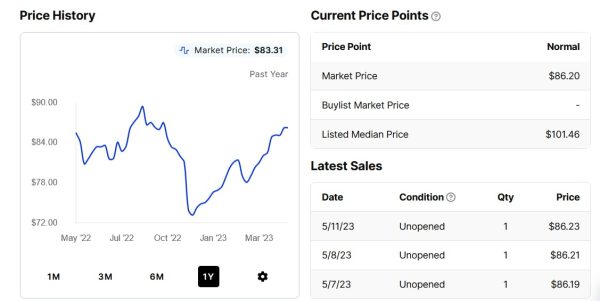
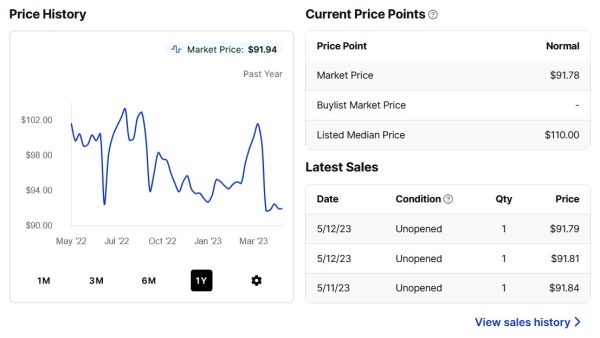
Check out the TCGplayer market price one-year graph for Innistrad: Midnight Hunt draft booster boxes.
These booster boxes were left for dead late last year—I purchased a booster box of the set back in November for $72.99 shipped (plus tax). Now at $86, this set has already seen a 17% increase in value. Granted, I can’t realize any profit yet because of shipping and fees, but it’s promising to see the momentum in the positive direction.
I suspect that, with an extended shelf life in Standard, these boxes will offer more potential upside over the next year. If individual singles from the set increase in price, it could drive increased box openings of the set, reducing the supply of said boxes.
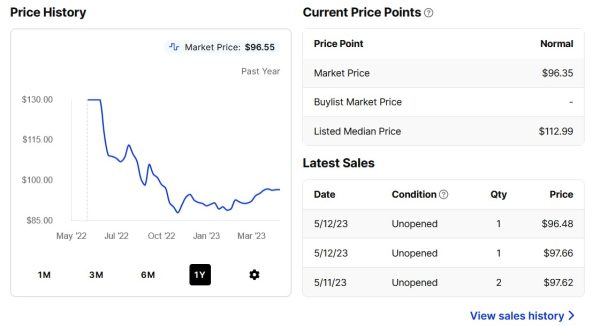
Midnight Hunt isn’t the only set that has seen a rebound. Check out the graph on Dominaria United, or should I say, “the Sheoldred lottery.”
It’s true that this set’s draft booster boxes haven’t rebounded as much as Midnight Hunt. On the other hand, Dominaria United boxes never dropped down as low as $72. These bottomed in the $86 range, and have since rebounded $10. Checking my order history, I see I purchased a draft booster box of this set in November 2022 for $90.94 plus tax.
Honestly, if Sheoldred, the Apocalypse remains legal in Standard, I could see it hitting price points not seen in Standard since the days of Jace, the Mind Sculptor. Should this happen, DMU booster boxes could easily surpass $100 while still legal in Standard.
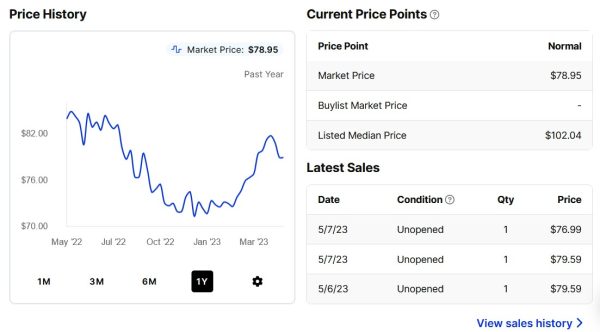
Lastly, the price of Streets of New Capenna booster boxes remains the cheapest of the bunch, but these are also well off their lows.
I’m expecting these boxes to cross $80 soon, with the potential to approach $100 while still in Standard if the set can offer a bit more to the format. Currently, SNC’s biggest contribution is the tri-lands. Hopefully, the set can offer more at some point during its Standard shelf life. If not, then we’ll have to wait for Commander cards like Halo Fountain and Bootleggers' Stash to gradually climb in price.
Bucking the Trend: Neon Dynasty
One set is bucking the overall trend discussed above: Kamigawa: Neon Dynasty. NEO booster boxes haven’t bounced at all.
My hypothesis here is that the set’s draft booster boxes never got as low as some of the others—currently, it is bottoming out in the $91 range, $20 higher than the bottoms of Midnight Hunt and Streets of New Capenna. It's Perhaps because Neon Dynasty never showed any booster box pricing weakness that we’re not seeing a notable bounce.
I’m keeping an eye on these all the same though. NEO offered a fantastic draft experience, and cards like Fable of the Mirror-Breaker // Reflection of Kiki-Jiki, Farewell, and the channel lands offer enough upside to potentially lift box prices while still legal in Standard.
Even though I’m not writing on behalf of a publicly traded company, I still feel obligated to make some sort of forward-looking statement disclaimer. Those who follow the stock market and company earnings reports are probably familiar with this lingo. It’s basically a disclaimer used whenever a company is making written or oral statements about projected financial performance, execution of vision and growth plans, etc.
In my case, I’m using this as my unnecessary caveat around predictions for sealed product. I think the extension of Standard rotation from two years to three years will lead to higher booster box prices, particularly on sets released in that twoish-years-ago range, whose shelf life in Standard just got extended another year.
Namely, this includes AFR, MID, VOW, and NEO booster boxes. I don't expect these to double in price or anything like that. I just have an inkling that extended life in Standard will lead to some higher singles prices and a lengthier time period of demand for these sets in general.
For accountability, I’m going to list the current TCG low pricing for each of these draft booster boxes to track trends over the next 6-12 months. We’ll see if this pans out at all.
AFR: $91.85 MID: $86.19 VOW: $77.52 NEO: $91.75
I don’t think these are going to jump 50%, but I wouldn’t be surprised to see them rise by another $10-$20 throughout their lives in Standard.
Wrapping It Up
I should also disclaim that, while I don’t have much interest in flipping Magic singles these days, I still have a small pile of booster boxes for investment. Naturally, this biases my point of view.
That being said, I do think this change to Standard rotation timelines bodes well for booster box demand. I don’t know if it’ll lead to dramatic profits, but I do think there is some potential here, even after accounting for shipping costs.
Consider, booster boxes from just a few years ago, such as War of the Spark, and Dominaria, already sell for a significant premium over their price points while in Standard. Dominaria in particular has flirted with a $200 price tag. That could provide a reasonable profit for those who bought in when the set was relatively new.
The trend of increasing box prices is likely to magnify a bit under the new Standard rotation rules. For this reason, I remain optimistic about holding a smattering of boxes for the long haul. I can’t pretend to know which sets will be the Innistrad and which will be the Dragon’s Maze, so instead of concentrating on one set I choose to diversify—one box each of many sets should be a way of spreading risk around.
This, along with my recent focus on Magic original art, is what keeps my interest in Magic, fueling more article ideas for the foreseeable future. Here’s to another 11 years without writer’s block!
If not, now is a perfect time to join up! Our powerful tools, breaking-news analysis, and exclusive Discord channel will make sure you stay up to date and ahead of the curve.
Commons will always be the most consistent element of a Limited format. They create predictable openings and familiar exchanges. They communicate the terms of engagement that define the give and take of a format. They create the rhythm of the format.
As we discussed last week, March of the Machine (MOM) is a "prince" format. It has more rares and uncommons than most sets due to the Multiverse Legend and Battle slots and, as a result, the format has a heightened power level, annunciated loudest at higher rarities. These powerful cards exist, however, in a landscape crafted by commons.
To maximize the power of our rares and uncommons, we need to understand what the commons are doing at a fundamental level. Many of the rares are strong, but deck configuration helps us optimize these cards. There is a clear difference between hoping to draw good cards and building a deck that uses those game pieces in a powerful way.
Today, we'll closely examine the dynamic between commons and higher-rarity cards in MOM Draft.
UW: Utility Creatures
The small creatures in this format offer a lot of utility. This is especially true in UW. They ramp out convoke cards and utilize Knight synergies. Many of these small, flexible game pieces are at common to provide pressure and synergy, occasionally flipping into threats.
If our plan is to convoke, then we need to prioritize one-drops. In the right deck, Tarkir Duneshaper // Burnished Dunestomper plays like Llanowar Elves in the early game, and a 4/3 trampler in the late game. That's a powerful card, but it only does those things in the right deck.
UW rhythm
Raff, Weatherlight Stalwart and Baral, Chief of Compliance can both turbo-charge the convoke decks. Marshal of Zhalfir wants to use our creatures to attack. However, without the enablers, all these powerful pieces will fail to generate their game-warping power.
UW variation
Halo Hopper has been a surprising overperformer. This little frog can come down on turn two with as few as one or as many as three one-mana creatures, as well as be a free spell on turn three after a timely Preening Champion or Sigiled Sentinel.
Convoke in Practice
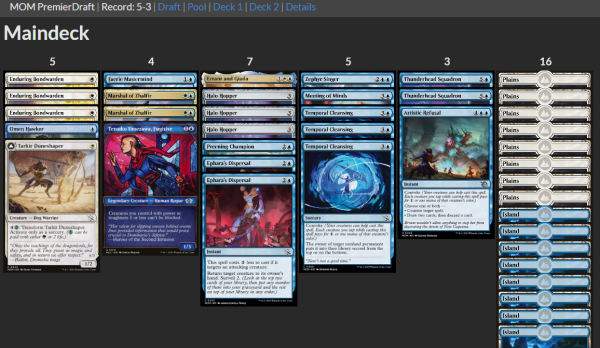
UW Convoke (5-3)
Creatures
1 Omen Hawker
1 Tarkir Duneshaper // Burnished Dunestomper
3 Enduring Bondwarden
1 Faerie Mastermind
1 Tetsuko Umezawa, Fugitive
2 Marshal of Zhalfir
1 Errant and Giada
1 Preening Champion
3 Halo Hopper
1 Zephyr Singer
2 Thunderhead Squadron
Instants
2 Ephara's Dispersal
1 Meeting of Minds
1 Artistic Refusal
Sorceries
3 Temporal Cleansing
Land
8 Plains
8 Island
Here's a different take on UW aggro. Halo Hopper helps build a wide aggressive board, and the discounted convoke cards finish off opponents.
There was an error retrieving a chart for Halo Hopper
Thunderhead Squadron was a little too clunky. Going forward I'd like to try Astral Wings or Tidal Terror in its place. Omen Hawker probably didn't need to be in this deck. The Marshalswere underutilized. I tinkered with the build a few times yet struggled with a final list.
The frog, however, is real:
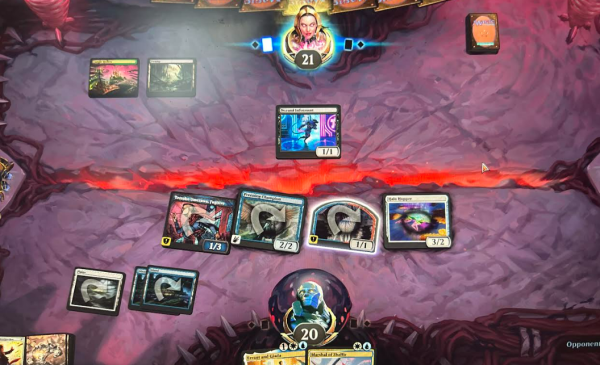
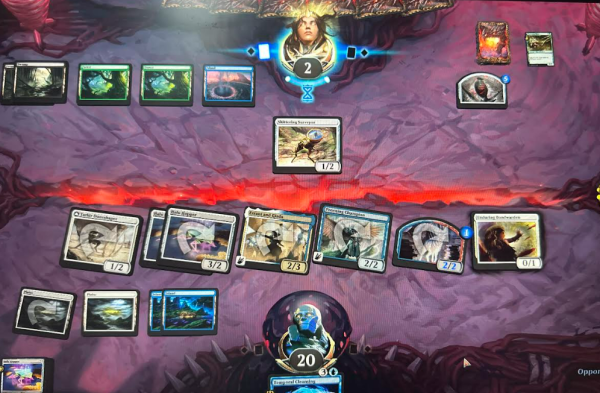
This UW strategy, turbo-charged by Halo Hopper, is quite powerful. If we can find tools to capitalize, this deck becomes a sneaky way to approach the format. Frog aside, the little creatures are important to the format, especially in UW.
BR: Sacrifice and Rectangle Theory
The UW creatures offer versatility. The BR creatures generate value. Cheap creatures in these colors thrive at trading off with a card and potentially leaving behind value. If we can capitalize on that extra bit of value, we can leverage it into big gains.
BR rhythm
Ethan Saks describes this as rectangle theory. The approach values the number of "rectangles" a card generates. This can mean tokens or other fungible game pieces. It's the reason why Lingering Souls saw play in Modern. The more game pieces we generate, the more options we have.
Wizards has labeled this strategy as Sacrifice Control, which is a novel approach to BR's perennial sacrifice theme. While the commons encourage this type of deck, the uncommons dictate what it might look like.
BR variation
The "steal and sac" principles traditionally make for aggressive gameplay, but a lot of the payoffs in this color ask us to move at a slower pace. While the commons provide excellent fodder, the uncommons will cause us to either lean more aggressive or defensive. If we're sacrificing Nezumi Informant after blocks to make an Incubate token or to draw a card, we're playing on a more value-driven spectrum. If the card we're sacrificing is dealing damage with Judith, the Scourge Diva or Juri, Master of the Revue, our deck will be more controlling.
Sacrifice in Practice
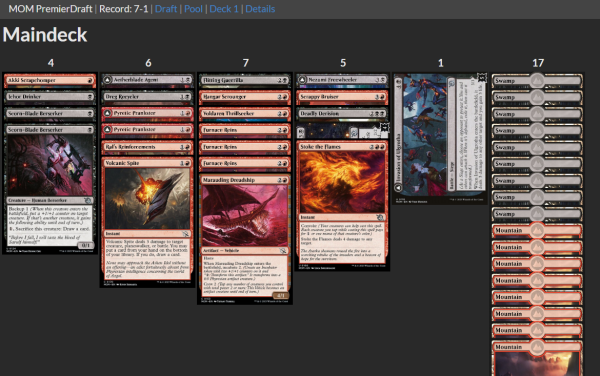
BR Sacrifice (7-1)
Creatures
1 Akki Scrapchomper
1 Ichor Drinker
2 Scorn-Blade Berserker
1 Aetherblade Agent
1 Dreg Recycler
2 Pyretic Prankster // Glistening Goremonger
1 Flitting Guerrilla
1 Hangar Scrounger
1 Voldaren Thrillseeker
1 Nezumi Freewheeler // Hideous Fleshwheeler
1 Scrappy Bruiser
Instants
1 Volcanic Spite
1 Stoke the Flames
1 Deadly Derision
Sorceries
1 Ral's Reinforcements
3 Furnace Reins
Artifact
Battles
1 Invasion of Eldraine // Prickle Faeries
1 Invasion of Ulgrotha // Grandmother Ravi Sengir
Lands
9 Swamp
8 Mountain
This deck casts many of the BR commons to generate small advantages and then utilizes them with sacrifice synergies. While Dreg Recycler and Scorn-Blade Berserker aren't game-enders, they generate a good amount of advantage that aggressive decks can leverage towards victory. The commons pressure opponents well, but also generate value. These effects allow us to keep pressuring until we can cobble together lethal.
While that general strategy is familiar to the Rakdos deck in this format, this deck gets a unique edge from three copies of Furnace Reins. This powerful effect often represented damage and a removal spell. Cards like Juri, Master of the Revue and Judith, the Scourge Diva similarly boost this style of aggression.
However, if we end up with cards like Sheoldred or Phyrexian Garagantua, our gameplan changes. In those cases, we want to prioritize cards like Nezumi Informant or Unseal the Necropolis to grind longer without reach. While the BR small-ball two-for-one engine is consistent, we want to be selective as to how we support our payoffs.
UB: Value and Power
UB is the best color combination in the format. It has been the best combination since the opening weeks. UB generates value more slowly than the other colors, but the format allows this slower approach. The payoff is power.
UB rhythm
These cards all want to play a longer game. They want us to generate cards and use more mana over more turns to overpower our opponents. The format has a lot of interaction at common, and the marriage of card draw and removal spells is timeless. Of all the archetypes in the format, this one is hungriest for payoffs.
Slower decks actively seek top-end power. The longer a game goes, the more of our deck we're going to see. If we plan on seeing a lot of our deck, we want to be confident that it will yield more powerful draws than our opponent can take on.
UB variation
The commons are more interchangeable in this archetype. They draw cards, interact, and prolong the game. However, we still want to optimize our decks around our key cards. Corruption of Towashi wants Incubate tokens and Battles. Grimgrin, Corpse-Born does not.
Nearly all of our big, bomb-y creatures appreciate a Saiba Cryptomancer for protection. Additionally, any of these potent creatures make Unseal the Necropolis skyrocket in value.
Conversely, Halo Forager and Chrome Host Seedshark both want spells, while Breach the Multiverse wants Halo-Charged Skaab to loop its effect. These cards play well together, but to support them could mean cutting something like Nezumi Freewheeler. Don't be afraid to!
UB Value in Practice
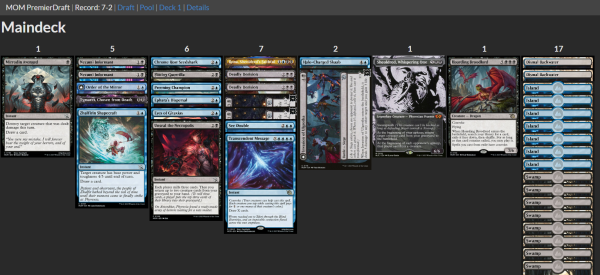
UB Busted (7-2)
Creatures
1 Order of the Mirror // Order of the Alabaster Host
1 Tymaret, Chosen from Death
2 Nezumi Informant
1 Chrome Host Seedshark
1 Flitting Guerrilla
1 Preening Champion
1 Rona, Sheoldred's Faithful
1 Halo-Charged Skaab
1 Sheoldred, Whispering One
1 Hoarding Broodlord
Instants
1 Mirrodin Avenged
1 Zhalfirin Shapecraft
1 Ephara's Dispersal
1 Unseal the Necropolis
2 Deadly Derision
1 See Double
1 Transcendent Message
Sorceries
1 Eyes of Gitaxias
Battles
2 Invasion of Eldraine // Prickle Faeries
1 Invasion of Ulgrotha // Grandmother Ravi Sengir
UB wants commons that say "draw a card," removal, and a strong end game. In general, these decks are looking to play as many powerful things as they can.
In the above case, if my opponent and I were to flip our decks over, we were likely to agree that mine was more powerful. That's how I won, and this is a totally valid strategy in the format. There was some tension between the convoke cards and Chrome Host Seedshark. Cheap creatures help with convoke, but the Shark wants spells. Fortunately, Eyes of Gitaxias, See Double, and Unseal the Necropolis did a nice job tying the room together.
However, it's worth mentioning what I was doing early. Mirrodin Avenged and Zhalfirin Shapecraft helped to make better trades while digging deeper into the deck. The Informants traded off. It proved less important what they traded for. I just wanted the resource.
These cards prevent us from falling behind. From the very beginning of the game, we're looking to grind down our opponents. When we land something like Invasion of Eldraine // Prickle Faeries, the path opens for one of our bombs.
Maximizing Mana
Because the commons in this format don't incentivize aggression, splashing is better than usual. However, not all fixers are created equal. The power in the format can be tempting, so we should be willing to speculate on the gain lands at common.
While we have options for splashing, we want to remain cognizant of our build. Some of the fixers go from unplayable to reasonable options depending on how we're building our decks.
It's hard not to smile when we see this card late in the pack. Colorless fixing is a gift in this format, and the many small-creature strategies want extra bodies. We can speculate on this early. It will usually make the cut.
This is a powerful option that can fix for double-pipped cards like Ghalta and Mavren or Kolga and Yidaro. It's a powerful combo with Portent Tracker, and the duo can do some silly things if our draw lines up.
There was an error retrieving a chart for Flywheel Racer
This little moped is more playable than it looks. Because so many of the cards offer little bodies plus value, an extra way to utilize those bodies can be worth its weight in gold. Especially if we're managing an ambitious mana base. This card does a not-terrible Citanul Stalwart impression, and sometimes we're okay with that. This is a card we should anticipate picking up on the wheel.
There was an error retrieving a chart for Urn of Godfire
This is the weakest piece of fixing in the set in draft. However, in Sealed, it can be quite solid. Having access to a late-game piece of removal is nice when our opponents are less synergistic. Still, in Draft, we can get a little more out of it with Omen Hawker or Lurrus of the Dream-Den. We should still generally look for superior options.
Balancing Rhythm and Variation
This limited format has more payoffs than most. Whether we're thinking about maximizing a bomb rare, optimizing our mana, or getting the most out of our convoke creatures, card values fluctuate throughout the draft.
At common, the format offers predictable options. They may seem unexciting when compared to the Multiverse Legend we first-picked, the rare we got second, and the battle we were passed third. However, making the right choices at common to optimize those selections is the difference between having a good deck and hoping to draw a bomb.
Don't get it twisted: this is indeed a prince format. But that doesn't mean we're completely at the mercy of the draft. This game offers a great deal of autonomy. To take ownership of our draft, we need to know what the commons offer on a fundamental level. By capitalizing on these strategic edges, we can make our uncommons play like rares and our rares feel unbeatable.
As the format changes, and we transition to March of the Machine: The Aftermath (MAT), we will be tempted by new rares and uncommons. Still, all of the commons remain unchanged. This means the fundamentals of this format will be the same. Same rhythm, different variations. While evaluating the new cards, reflect on what this format offers at common. There's plenty of interaction and a lot of little value creatures. They're not going anywhere, so consider them carefully and use them well.
If not, now is a perfect time to join up! Our powerful tools, breaking-news analysis, and exclusive Discord channel will make sure you stay up to date and ahead of the curve.
First, for those who don't read our Discord chat or keep up with Wizards of the Coasts' website announcements, we got a doozy on an otherwise calm Sunday afternoon.
There will be NO Standard rotation this year! That means when the fall set, Wilds of Eldraine, releases, no sets will leave Standard. That means another 16 months with Innistrad: Crimson Vow, Innistrad; Midnight Hunt, Kamigawa: Neon Dynasty, and Streets of New Capenna. This will lead to some financial ramifications for cards in these sets.
The Old Normal: Price Pullbacks
In most years, late spring is when we typically expect to see the Standard staples that will be rotating out in the fall begin to drop in price. They typically reach their floor around late summer. We can see this trend in cards like Adeline, Resplendent Cathar
However, with this announcement, I would expect any cards that had begun to dip pending rotation may rebound in price. This means there are some possible financial gains in finding these types of cards. However, it is important to remember that the Standard metagame is volatile. There is no guarantee that a card that was a Standard powerhouse returns to its former glory given this extra lease on life.
Former Duds May Find a New Home
We all make bad speculation picks from time to time. It's easy to over-value a "what-if" scenario to the point that you convince yourself that everyone else is wrong on a card and you've found the next Arclight Pheonix. Now it seems all of us who missed thus far are given a "next shot" opportunity. I'm not suggesting you double down necessarily, but perhaps it's a good idea to dig through those misses and at least keep them on your radar rather than confining them to the "ole box of shame."
On a similar note, there are some cards that barely found a home in the current Standard environment but are now more likely to find one. Often these are mana-fixing lands. The two I am keeping my eye on are Shipwreck Marsh and Rockfall Vale.
The other lands in this cycle all have a TCGPlayer Market price above $5. Shipwreck Marsh though is at $2.92, and Rockfall Vale is under $1! I think this cycle of lands was well-designed and I've seen most of them in Commander decks I've played against. Barring a reprint, these two especially seem like they have good potential.
There was an error retrieving a chart for Rockfall Vale
The Biggest Potential Winners
I normally focus on rares and mythics for speculation. The cards that typically drop in price the fastest and the farthest though are the strong uncommons. At a glance, the most played uncommons have so far shown little to no drop in value. A deep dive into all the strong uncommons might be worth your efforts if you want to buy up some "penny picks" thanks to this change.
One of these uncommons I will be keeping my eye on is Thirst for Discovery. it is a very strong card that provides card advantage and allows you to easily dump cards from your hand into your graveyard. We are already seeing archetypes built around dumping Atraxa, Grand Unifier into the graveyard and reanimating it.
It is unlikely that the design team behind Wilds of Eldraine or the sets occurring immediately after it was aware of this possible change. It also means that the play design team responsible for playtesting the set for Standard may also not have seen this change coming. If that is the case, it is possible some powerful and or broken interactions may occur with cards that weren't designed to be in the same Standard format. This means we will need to pay extra attention during Wilds of Eldraine spoiler season for speculation targets that fit this bill.
Why Did Wizards Make This Change?
While the focus of today's article has been on the financial ramifications of this change to the Standard Format, I think it worthwhile to briefly examine the reasons Wizards of the Coast stated were behind making the change.
Card Longevity - Like many others, I used to play Standard pretty competitively and rotation was always a time I dreaded as I watched the value of my collection plummet. While I can appreciate the logic behind this the flip side issue is that Standard often gets stale as a format. Like most other formats, the top cards tend to dominate, and having them remain for an additional year could easily dissuade people from playing the format rather than enjoying it. The Standard card pool will likely not be large enough to allow for a "rock/paper/scissors" type of format where different decks keep each other in check.
Mechanics and Archetypes Built Up - This one I will give them, I am sure lots of players noticed some potential cool interactions between cards that were released in the fall and those that had just rotated out of Standard. Oftentimes, these types of interactions aren't strong enough to survive in much larger card pools like Modern and Pioneer but may have worked in something like the old Extended format.
Want to push a more thematic environment instead of all midrange - I would argue that this one is more likely wishful thinking. The reason that midrange decks tend to become dominant is that they tend to play the best cards in the format at the cost of speed.
Lipservice to Local Game Stores
The announcement also mentions a push to strengthen local game stores. This is the part I find the most insincere, given that the push towards the digital realm has kicked most local game stores to the curb by cutting them out of the supply line to the players. It often seems like Wizards of the Coast knows that local game stores are the lifeblood of their game but can't get over the fact that by bypassing them they make a lot more money.
My Personal Take
I'm honestly not a big fan of this change. While I don't play a lot of Standard anymore, when I did, I loved rotation. It gave us a chance to brew and try out cards that couldn't cut it in the previous Standard format. Now, we will have less rotation and a much larger card pool in Standard. This means the cream of the crop cards like Fable of the Mirror-Breaker, Sheoldred, the Apocalypse, The Wandering Emperor, and Farewell will just continue to dominate the format and cards that might have finally had a chance to find a home will be kept out. I'd argue that a better solution would be to rotate one set out each time a new set rotates in. This would mean more opportunities to brew and would likely mean more cards ended up being played in the format.
If not, now is a perfect time to join up! Our powerful tools, breaking-news analysis, and exclusive Discord channel will make sure you stay up to date and ahead of the curve.
Secret Lair is no stranger to controversy, but that has not stopped Wizards from continuing to offer piles of product... and sometimes, product that are piles. The latest Commander-specific offering, From Cute to Brute, is an entire deck full of double-faced reprints. Does this deck make sense to buy? Is it strong? Is it worth it from a financial perspective? Let's take a look.
The Inevitable Comparison
The first full Commander deck offered via Secret Lair was Heads I Win, Tails You Lose. Debuting at a cool $99.99, I've now played against it numerous times... once it had finally got into the hands of players, that is. Absurd delays aside, the deck was reasonable in terms of value, playability, and theme. Also, by value, I don't mean solely the price of the singles in the deck; I mean the entire package, which came with a bunch of swag. Besides the deck, you also got the following:
1x Super Special Coin
2x Display Commanders
10x Double-Faced Tokens
1x Deck box
1x Life Wheel
1x Strategy Insert
1x Reference Card
MTG Arena Sleeves
From Cute to Brute, on the other hand, gives you almost none of these add-ons, but you do get five more double-faced tokens and three more Display Cards. What are "Display Cards?" They are the very thick shiny cardboard cards you get in every Commander pre-con.
For an additional $50, this change certainly seems like a bad deal for you and a great deal for Wizards. One thing they did improve upon was getting the product completed, printed, and ready to ship on time. That being said, it seems like there are some issues that maybe could have been avoided with a little more time and care.
Financial Value
As always, there is a bit of stickiness to predictive analysis. Furthermore, I have covered Secret Lair product before and the same broad generalities apply, so I will truncate my points. The question at hand: is Brute worth your hard-earned cash?
If you took the entire deck right now and purchased it as singles, it would cost about $300. For $149.99 plus tax, that seems like a good deal. Problem is, that's the price of the cards now. There are always plenty of vendors who break their boxes for singles, so the supply of reprints goes straight into the secondary market, depressing prices quickly. In the meantime, the price of every card in this deck will tank upon release. If you like some of the artwork, but not all, then buying the one or two singles you may want a month or two later is a move with solid historical pedigree.
However, there may be a perverse incentive to buy and hold sealed product in this exact case. Overall, there is a fairly weak initial reception to From Cute to Brute, and decks have not immediately sold out like many other SL products have in the past. If nobody buys it, sealed product may end up being a bit rare... in several years. Unopened, unique, shiny, artwork that is somewhat limited tends to appreciate in value.
But realistically, who wants to tie up money for that long in this kind of product? I think there are plenty of other financial plays that would generate more value now, whether in Magic or the world at large. Still, it's something to consider for the gamblers and sealed aficionados out there, and if it's unexciting, it is safe. There are sure to be a select few stowing away one or more copies of this deck, and those copies are all but guaranteed to be worth more in a decade than they are today.
Deckbuilding Disaster
"I want to make a five-color double-faced deck!" Sure, that's a deck building prompt. At least the deck clearly has inspiration behind it. But does it work or make sense?
Unfortunately, I feel like this deck fails on several levels. The first of which is the inconvenience of having to constantly re-sleeve cards. Since they do not give you cool, customized checklist cards, you basically need to double sleeve. Plus, playing against this deck presents a nightmare for players that do not know every card. Have fun de-sleeving multiple times per card as your novice table gets a good look at both sides before choosing targets for their removal spells.
Next, the deck is five colors, but how many lands are? A generous interpretation is five. Consider thatVivid Grove fix colors twice, and Terramorphic Expanse and Evolving Wilds fix once, and there is only one Farseek. If Wizards had at least included Sylvan Scrying and Expedition Map, then maybe you could convince me that you could regularly tutor up The World Tree, but the deck has neither.
The fact that the double-faced lands only tap for one color of mana seems like a big mistake. Over half the deck is made up of double-mana symbols and multi-colored cards, so the land base makes casting difficult, and many hands awkward.
No-brainer auto-includes like Growing Rites of Itlimoc // Itlimoc, Cradle of the Sun, Golden Guardian // Gold-Forged Garrison, and The Restoration of Eiganjo // Architect of Restoration are somehow absent. There's little sense of a "game plan" except for dumping stuff into play, and very limited removal as well.
Well, Pongify is here! Why? Because their deck-building algorithm showed they needed to reprint a blue instant? Recent Commander pre-cons include EDREC Top 100 cards. Having Cultivate, Kodama's Reach, or any signet over Altar of the Pantheon would just be better in every way.
Buy In-Print DFCs to Fix This Mess!
The real reason this deck has no synergy, no battles, is missing obvious includes and is five colors? To get you to buy more MOM, of course! In the least "Secret" move ever, Wizards had an obvious game plan going in:
1) Make a DFC Commander deck right in time for MOM 2) Re-print some older, value DFCs with no real synergy 3) Jam them into a pile and call it a deck 4) ???
Step four is profit, of course. This is where Wizards messed up, in my opinion. If you start looking at building a DFC-based Commander deck as your main focus, it's very likely you don't want most of the cards in From Cute to Brute. Unless you're absolutely married to the art style of the new deck, you'll build something entirely different, less expensive, or simply way better in terms of flavor and power.
So there you have it: Wizards made a product for a very limited audience and is charging them through the nose for it. This is the goal of Secret Lair, right? I'm all for releasing cards as cool art pieces. However, throwing a pile together and calling it a deck while simultaneously reducing value to the consumer and raising prices is, frankly, outrageous.
What They Should Have Done
Including any of the DFC Transformers with deck-defining abilities, mythic DFC lands, a slew of great options from among the Kamigawa: Neon Dynasty Sagas, and more five-color lands with better mana fixing would go a long way to turning From Cute to Brute into a deck.
The fact that Heads I Win, Tails You Lose is a completely functional Commander deck that does not require alteration, offers value in every way to the consumer, and showcases new art proves that Wizards can make good Secret Lair Commander decks. Besides being late to shelves, Heads was a great and beloved product. This time, though, Wizards has instead completely over-compensated and sacrificed everything from value to playability to make sure the deck released and shipped punctually.
Oh, and they also charged 50% more.
I Wouldn't Buy This With Your Money... Let Alone Mine
This is a hard pass for me on multiple levels. While it doesn't feel like a great investment, it could be an okay one. The deck looks difficult to play and not powerful at all, while also not looking very fun. There are definitely vastly more powerful Bridge-based decks that effectively cascade anything you want into play, and that is not this deck. But if you're in love with the art style then, by all means, buy!
One thing I do like about From Cute to Brute, though, is that it makes me want to build a DFC Commander deck. So thanks go to Wizards for all of the inspiration with none of the $150 charge. It seems like a two- or three-color deck will work harmoniously while containing sub-themes besides merely being double-faced. I'll get to brewing, see if I can match up with someone that has the deck on SpellTable, and report back.
If not, now is a perfect time to join up! Our powerful tools, breaking-news analysis, and exclusive Discord channel will make sure you stay up to date and ahead of the curve.
Having seen the full spoiler for March of the Machine: Aftermath, I'm thoroughly underwhelmed. As I mentioned last week, this set feels more like a carved-out piece of the main set than anything unique. Specifically, a piece that was carved out as Commander fodder, as most of the cards seem specifically designed to be used as commanders.
That said, there are a few cards that could make normal constructed formats. Assuming there's a need to fill their very specific niches. Today, we'll explore the most exciting standouts for Constructed play.
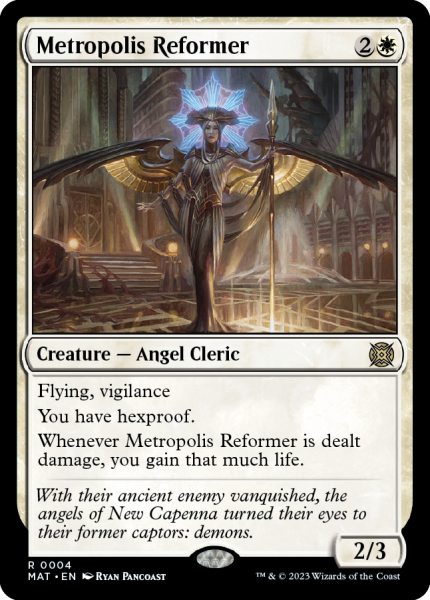
Metropolis Reformer
There is no shortage of three mana white hatebears with niche effects. The one that's seen the most play is Archon of Emeria, as Rule of Law stapled to Kismet is quite potent. The new addition, Metropolis Reformer is unique but isn't going to beat Archon for any slot.
Adding vigilance and a relevant creature type is a solid start but aren't relevant to playability. What matters is the actual hate effect, and Reformer's is too niche for widespread play. While giving players hexproof is sometimes relevant, the previous white creatures that did so (True Believer, Aegis of the Gods, and Keen-Eared Sentry) have never seen much play.
The problem is that all of these creatures are extremely fragile. Leyline of Sanctity still sees play because enchantments are hard to kill. If an opponent really needs to target you, they'll have a way to kill the creature. Also, most of the time the only effects targeting players are discard spells, and other than Leyline, none of these cards are fast enough to protect against them.
The Natural Home
Pioneer Angels could fit Reformer in with no issue whatsoever. I just have no idea why it would bother. Mono-Red is not a difficult matchup, and that deck doesn't go face with its burn much anyway. The lifegain is nice there, but not crippling. It might see play to slam the door shut, but there's no pressing need there, and Angels has other problems to sideboard against.
The other combo decks have ways to remove Reformer and/or win conditions that don't target. Mono-Green Devotion can simply wish for Skysovereign, Consul Flagship or Cityscape Leveler. Lotus Field has Otawara, Soaring City and Approach of the Second Sun. Against everything else, Reformer is an okay threat, but just doesn't stand out.
The Special Niche
I don't think Reformer will see Pioneer play. If it does see play outside of Standard, I suspect it will be in Modern. There, Reformer is easily the best anti-Burn card printed in years. The only card that's more devastating is Collective Brutality, at least among maindeckable cards.
Reformer is immune to Searing Blaze, which is a great start. The hexproof means there's no getting around it: Burn players will have to remove it to make their deck work again. Removing it with damage gains life, meaning that Reformer represents a net of -2 cards to the opponent. The first card is lost killing Reformer, and the second comes from the three life gained, which is an entire spell's worth of life. All without having to discard your own cards.
There's really no need to be this worried about Burn for most decks. Burn isn't that big a piece of the metagame, and there are lots of ways to answer it already. However, if that ever changes, here's a very strong answer.
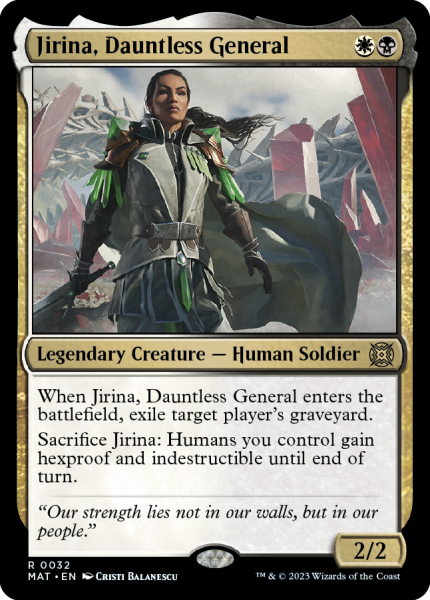
Jirina, Dauntless General
Every time a new, even marginally useful human is printed, players always act like it's the thing that will return Humans to the top of the metagame. Never mind how many times it's been said already that this is the one! Please also ignore that Humans returned to the metagame recently by rediscovering the 18-year-old Shining Shoal. No, it's new cards that will revive the deck. Is my eye rolling coming through?
Aftermath is no exception, and there are a number of potential Humans cards within. The most commonly cited card is Coppercoast Vanguard. 2/2 for two is a standard rate, and increasing Humans' power and giving them ward isn't bad. However, the fact that none of that applies to itself is fatal, literally. Opponents will just kill it first or sweep the board rather than worry about the ward triggers.
Jirina, Dauntless General is a slightly different matter. Her sacrifice ability has been touted as a way for Humans to finally beat Fury. Again, please forget about Shoal. True, Jirina does also protect against Supreme Verdict, but UW Control doesn't always run that card anymore. These types of effects work great when they're surprises, but are mediocre otherwise.
The Natural Home
Obviously, Humans could play Jirina. However, that would require Humans to regress to an earlier era of the deck. The current version sacrifices Aether Vial in order to gain Shoal, and to an extent Emeria's Call // Emeria, Shattered Skyclave. This has weakened Humans against some decks but has proven worthwhile enough against the top decks put to get Humans back in the game.
Selfless Spirit saw a lot of play, but had the benefit of being played alongside not just Vial but Rattlechains and Collected Company. Thus it got to surprise counter Verdict very easily, while Jirina will have Vial at most. This severely limits the critical surprise factor with this effect. Otherwise, opponents will just kill Jirina end step, untap, and then sweep the board.
The Niche Application
That said, Jirina is phenomenal against Living End. The first ability is obviously good as graveyard hate, but the second ability is still relevant. While it doesn't protect against having your board wiped, it can still be sacrificed before Living End resolves, ensuring that you have a creature afterwards. While facing a board of huge monsters is bad, having to rebuild your own from nothing is worse, and Jirina fixes that problem.
There was an error retrieving a chart for Living End
If Living End becomes enough of a problem for Humans to want Jirina, she'll need to justify two significant changes to Humans. First, the mana base will need a rework. Shoal has moved Humans to mono-white, and Jirina requires black mana. That might be easy, but it might also require giving up something to maintain balance. The other issue is that Humans would need to readopt Vial.
In a hypothetical metagame where Living End needs such a specialized answer, that all might be worthwhile. The metagame would likely shift away from red removal toward counters, making Vial more useful. Blood Moon might be less of a concern as Living End always plays Foundation Breaker, sometimes even maindeck. Outside of that kind of shift, I'm skeptical of Jirina.
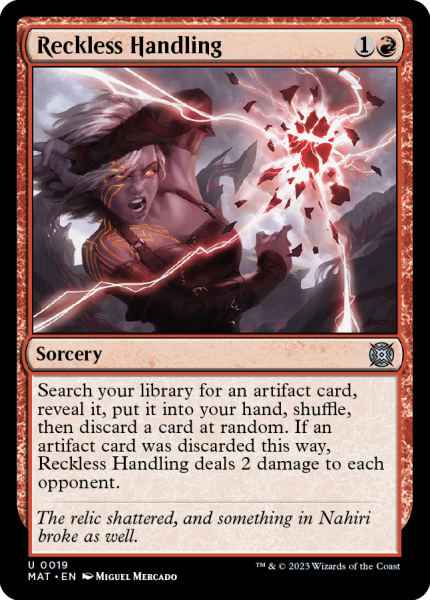
Reckless Handling
Wizards rarely makes tutors anymore, so anytime a cheap one is made it is immediately scrutinized. Which is unfortunate for Reckless Handling, as it is rather narrow. Finding only artifacts isn't bad, but remember that Whir of Invention isn't played anymore. Making matters worse, Handling is a riff on Gamble.
Gamble used to be a staple in Legacy Lands because Lands always needed Life from the Loam and didn't care if it was discarded. That time has passed, and now Gamble is only found in red combo decks that similarly don't care which zone the tutored card is in, but just that it's out of their library. It's reasonable to assume that Handling will only see play in a similar deck.
The Natural Home
The only deck (I can think of) that sees any play and fits all the criteria for playing Handling is Jeskai Urza. It already runs Goblin Engineer to find Sword of the Meek, so Handling provides some redundancy and a marginal upside. Emry, Lurker of the Loch also means tutoring for any other artifact isn't actually gambling, but rather a guarantee that the artifact will end up on the stack.
That's all well and good, but why would Urza bother with Handling? Engineer already does everything they need, and if another tutoring effect was needed, Whir exists. The fact that I haven't seen Whir in any Urza deck is a pretty strong indication that it just isn't good enough anymore. If a tutor that puts the card directly into play isn't good enough (and often costs no mana), how can Handling be?
The Brewer Traps
Every new set release leads to a surge in brewing, which is no bad thing. However, there are always a few cards that are effectively traps. They look like strong cards to either build around or provide so much theoretical value that they can't resist putting it into every deck, regardless of their deck's actual need for the card or overall strategy. Aftermath has several cards that will certainly prove potent traps.
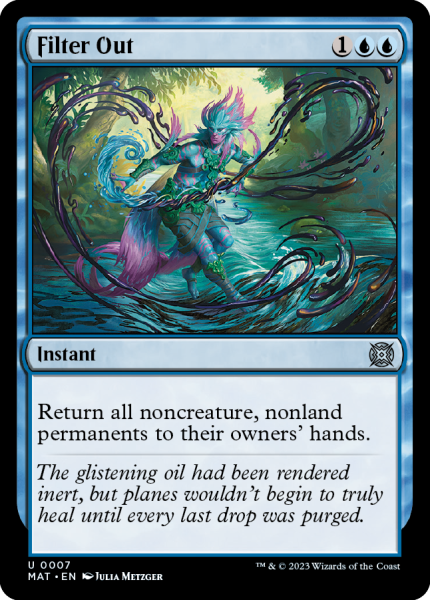
Filter Out
Paradoxical Outcome is a Vintage-defining card, and Filter Out has shades of its utility. While there's a case for using Filter as a way to clear boards of prison pieces, Modern and later formats have Hurkyl's Recall for that job, and that's one sided. Filter not targeting will be mostly, though not entirely, irrelevant, while costing one less mana is always relevant.
Therefore, it is extremely unlikely that Filter would be used for any reason except to fill Outcome's role. In Vintage, I could see it making the cut as additional Outcomes, though significantly worse. Given that Outcome doesn't see play in Modern or Legacy as is, there would need to be a new combo deck to make it work.
I've heard chatter that players are working on it with Urza, Lord High Artificer and zero-cost artifacts, but at that point, why not just play Outcome? Once Urza is out, mana is largely irrelevant, so the difference between three and four mana becomes trivial. What isn't is Outcome drawing cards, which Filter can't do. As Outcome also doesn't automatically destroy tokens, I think working on Filter is wasted effort.
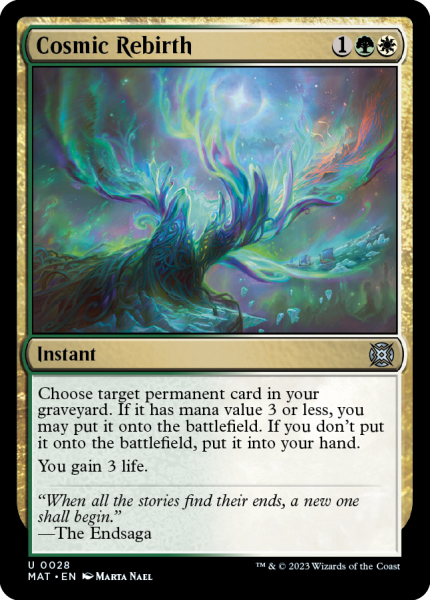
Cosmic Rebirth
This card is dripping with value potential. Instant-speed reanimation is extremely rare, and a spell that reanimates with upside is even rarer. Cosmic Rebirth may be limited to reanimating only three cost or less, but it can get any permanent. It can target higher costs too, though that's just being a bad Eternal Witness at that point. The life gain is gravy.
I've seen a lot of chatter about reanimating Teferi, Time Raveler in Modern in response to cascade triggers. Which I won't deny is really appealing. The issue is that such a situation isn't exactly optimal. Ignoring the possibility of Force of Negation, having Rebirth available to get around a failstate isn't the best use of a card. Furthermore, outside of that scenario, what exactly is Rebirth doing for any deck?
This is a card that almost any deck could play, but that won't do much for most of them. Yes, getting a land back to ramp is a thing, but three mana conditional ramp isn't really constructed-worthy. Pioneer, where I've seen this kind of talk the most, doesn't even have fetchlands to abuse. This is a card with too much value to ignore entirely, but unfortunately, it's useless value.
Design Consequences
Aftermath doesn't have much for non-Commander players. What is available is quite conditional and/or deceptive. They have their uses and can be great, but only in exactly the right situation. While I expect to see some of these cards played against me, I doubt that they'll be setting any format on fire.
If not, now is a perfect time to join up! Our powerful tools, breaking-news analysis, and exclusive Discord channel will make sure you stay up to date and ahead of the curve.
My name is Alex Blackard, but you can call me LessAlex, the Control Freak.
I am an avid Control player that specializes in Pioneer, Explorer, Historic, and Modern. I am a content creator and I couldn't be more stoked to get the opportunity to make videos and articles for Quiet Speculation. I’ve been playing competitive Magic since New Phyrexia came out in 2011. I stream on Twitch weekdays, have a YouTube Channel, and host a podcast called “The Control Freak” where I have guests on to chat about competitive Magic through the lens of a Control player.
Some of my Magic accomplishments include a Standard SCG Top 4 in 2014 with Jeskai Geist, a Modern NRG Series Trial 2nd place finish in 2017 with ol’ reliable Azorius Control, several SCG IQ Top 8’s, and a litany of Gameday wins.
Welcome to New Phyrexia.
In today’s video, I’m testing out the power of Invasion of New Phyrexia // Teferi Akosa of Zhalfir in Explorer Azorius Control.
Why, though? Invasion of New Phyrexia // Teferi Akosa of Zhalfir does an excellent Elspeth, Sun's Champion impersonation and is extremely good at gumming up the board. This is exactly what we want to be doing against some of the best decks in Explorer—Specifically Rakdos Midrange, Mono-Green Devotion, and Mono-White Humans. It's also good in the Azorius Control mirror. I have to say you don’t typically transform it and flip into Teferi Akosa of Zhalfir because more times than not when you resolve a large Invasion of New Phyrexia you win the game soon after. However, if you ever do get to cast Teferi Akosa of Zhalfir every ability is absolute gas. Looting two cards every turn is so powerful. The Emblem makes it so your tokens are often bigger and better than your opponents' creatures. The Ultimate does a good impression of Teferi, Hero of Dominaria’s “tuck” ability.
The Decklist
Azorius Invasion Control, Explorer
Planeswalkers
3 Teferi, Hero of Dominaria
4 The Wandering Emperor
Instants
1 Fateful Absence
2 March of Otherworldly Light
2 Absorb
2 Dovin's Veto
2 Memory Deluge
2 Make Disappear
1 Censor
2 Change the Equation
1 Spell Pierce
Sorceries
1 Farewell
3 Supreme Verdict
4 Lay Down Arms
Enchantments
2 Shark Typhoon
Battles
2 Invasion of New Phyrexia // Teferi Akosa of Zhalfir
Land
7 Plains
1 Hall of Storm Giants
1 Castle Ardenvale
1 Otawara, Soaring City
2 Castle Vantress
3 Glacial Fortress
4 Hallowed Fountain
4 Irrigated Farmland
2 Field of Ruin
1 Island
Sideboard
2 Change the Equation
1 Rest in Peace
2 Dovin's Veto
1 Temporary Lockdown
1 Kaheera, the Orphanguard
1 Shark Typhoon
1 Sunfall
1 Temporary Lockdown
3 Regal Caracal
1 Invasion of New Phyrexia // Teferi Akosa of Zhalfir
1 Mystical Dispute
If you're looking for a fun new look at Azorius Control in Explorer I definitely recommend trying this one out! Thanks for reading and enjoy the Gameplay video! I’m looking forward to the future of Control in this format with the newest addition to the deck!
If not, now is a perfect time to join up! Our powerful tools, breaking-news analysis, and exclusive Discord channel will make sure you stay up to date and ahead of the curve.
Bad dad jokes aside, we have truly entered a new age of Magic collecting with the advent of the game’s newest “rarity” level, serialized cards!
A Brief History of Serialized Magic Cards
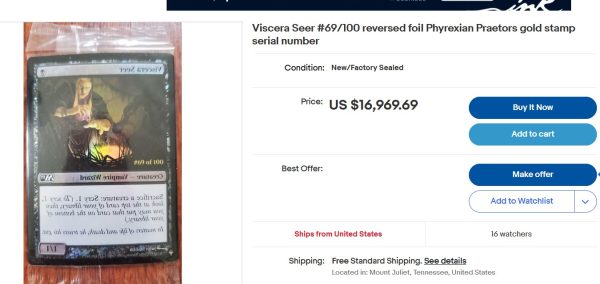
Magic introduced serialized cards with the printing of special mirrored Viscera Seers. These were initially discovered in November 2021 as the bonus card found in foil Phyrexian Praetors: Compleat Edition boxes. News of the uniquely numbered card took the community by storm. Copies of these otherwise-common cards sold for well into the thousands.
About a year later, in November 2022, Wizards of the Coast introduced new serialized cards that could be opened from Brothers’ War products. These were special versions of the Retro Frame Artifact series that were randomly added to booster packs. Everyone dreamed of opening a Retro Frame Wurmcoil Engine in their booster pack, but opening a serialized copy of the card yields a hefty payday.
Instead of being only limited to 100 copies like Viscera Seer, each of the 63 Retro Frame Artifacts had 500 serialized copies printed, meaning there were theoretically 31,500 new serialized Magic cards introduced to the market (not all of them will be opened).
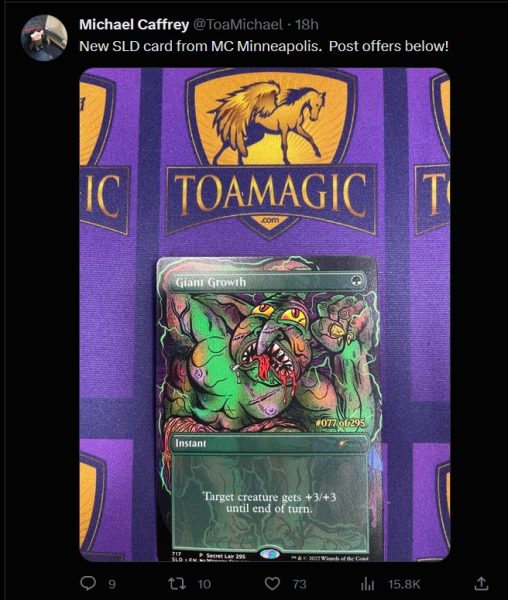
Since then, we’ve seen multiple series of serialized cards either introduced or spoiled for release in the near future. Secret Lair 295 Shivan Dragons, Multiverse Legends, The Lord of the Rings, Secret Lair Giant Growths, and possibly others all contain cards that may have a unique serial number.
I’m beginning to wonder, however, just how “unique” these unique cards truly are.
We’ve Seen This Movie Before
We’ve seen Wizards of the Coast follow this pattern time and again. Remember when each new set launched with a simple 36-pack booster box, and each booster pack contained one rare, three uncommons, and eleven commons? Whatever happened to those days?
First, it was foils, introduced back in Urza's Legacy. I despised the idea at the time but foils back then were very sparse and difficult to open, so their impact felt easy to overlook. Over the years though, the distribution of foils became higher and higher until, eventually, some booster packs included a guaranteed foil.
Then Wizards of the Coast introduced the Mythic Rare with Shards of Alara, and a new level of rarity was born. Imagine opening a foil mythic rare! The odds were so low, it was like winning the lottery.
Having rarities that stopped at mythic still wasn’t enough. As mythic rares became normalized and the player base became desensitized to their special nature, Wizards of the Coast scrambled to introduce another level of rarity. In 2015, Wizards of the Coast did just that—they introduced the Zendikar Expeditions, these special-framed super duper rares were even more difficult to pull from a booster pack. I remember opening an Expedition Wooded Foothills during a game of pack wars with a friend of mine, and was thrilled! I had basically opened a $100+ card in my $3 booster pack.
After numerous sets with MasterpieceSeries cards—as they later became known—even these special cards lost their luster.
Too Much of a Good Thing?
The flavor of this generation, it seems, is the serialized card. When foils, mythic rares, and Masterpieces aren’t special enough, let’s slap some numbers on a card instead to make them really collectible.
At first, the idea sounded exciting. While not novel to card collecting (serial numbering first appeared on a football card in 1990), the introduction of numbered cards brought the same excitement as the previous rarity introductions in years past. Just like those former rarity introductions, however, this one seems to be losing its luster.
Sure, the original Viscera Seer cards still carry significant value and are extremely rare (only 100 made). The more desirable Masterpiece cards such as Sol Ring and Mana Crypt will always hold a significant premium over the less desirable ones. I’m confident that all serialized copies of Ragavan, Nimble Pilferer will cost an arm and a leg due to its playability. Certain numbers will also always be more valuable than others.
Despite all this, I can’t help but wonder if we’ve passed a point of no return now, and the concept of serialized cards has become a mainstay in Magic. The most playable and desirable such cards will of course maintain a significant premium. The concept of owning a serialized card, however, will gradually become less special over time.
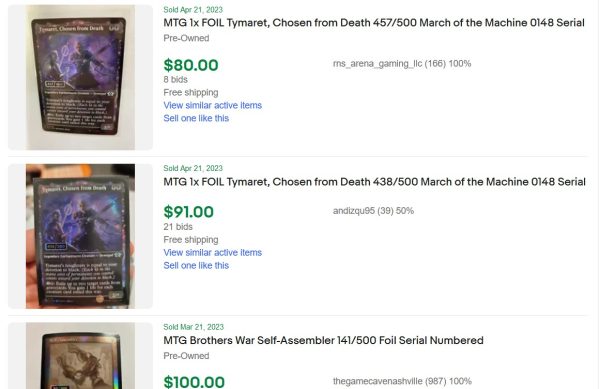
We’ve already seen some serialized cards selling for under $100 on eBay, and this trend is likely to accelerate as more such cards are printed.
In my humble opinion, Wizards of the Coast is taking the concept too far. Making serialized cards the norm and not the exception will gradually detract from the excitement they bring to the game.
At this rate, five to ten years from now, they’ll need to create some new level of rarity.
How Low Can They Go?
When the Zendikar Expeditions first came out, they were all worth at least $50, more or less. Nowadays there are a number of them retailing in the $20’s, and Tectonic Edge can be purchased for even less. While this is arguably the least exciting Masterpiece to be printed, the idea that a Masterpiece can be had for less than the price of a collector booster pack speaks volumes to their availability and desirability.
I predict a similar trajectory for serialized cards. I don’t care that only 500 serialized Tymaret, Chosen from Death cards exist. The card isn’t all that exciting, and will likely decline in price over time. The same goes for some of the other less-than-exciting Multiverse Legends cards that were recently printed.
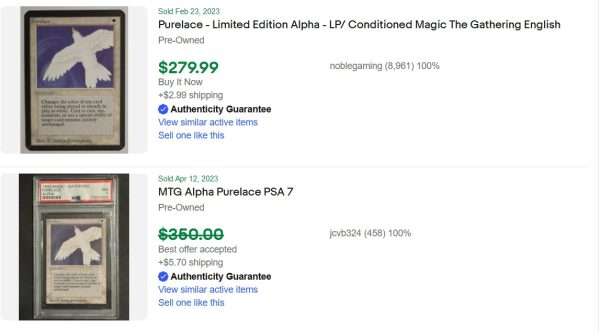
To be fair, serialized cards will always carry some value much like the Masterpieces do. Don’t expect the less playable cards to maintain such a high price point, however. While supply and rarity definitely carry significant weight when determining a card’s price, demand needs to also be there. The serialized Tymaret, Chosen from Death is twice as rare as the cheapest Alpha rare, yet it already sells for 1/4 the price.
A Note on the One Ring
Before concluding, I wanted to spend a moment discussing the one-of-a-kind, 001/001 The One Ring, to be sold in a collector booster of The Lord of the Rings: Tales of Middle-earth.
In a world where serialized cards are becoming more and more common, how much do you think this card should be worth? I’ve already seen public offers north of $100,000 for the card, and this completely baffles me.
While there is a novelty to being “the one” who owns the ring, fueling emotions that Frodo Baggins and Gollum must have felt throughout the novels, I still can’t imagine dropping a mortgage on a single card. I understand that this is a one-of-a-kind card, and that surely makes it special.
Do you know what else is one-of-a-kind? Original Magic artwork. In fact, since last week I successfully found and purchased my first piece of original Magic art! My gratitude goes out to Phil Li (@ThePheylop) who helped me find a piece I loved and negotiate a price I could afford.
I’ll share more once it arrives, but the reason I bring this up is that the art I purchased comes with a serial numbered COA. Do you know what the serial number is for this beautiful piece of artwork, which I plan to frame and hang on my wall for friends and family to see?
You guessed it. 1/1.
Does this mean my artwork is going to be worth more than a house? Of course not! I’m guessing there are thousands of 1/1 paintings that go along with some of Magic’s most beautiful pieces of art. Each one is one-of-a-kind, and each one carries significant value. Only a handful will be worth the same order of magnitude as the special 001/001 The One Ring, however.
If Wizards prints more 001/001 cards in the future, the ultimate rare will eventually become more affordable as well. Until then, this first and only 001/001 card could be the most valuable ever.
Wrapping It Up
When the serialized mirrored Viscera Seers first hit the wires, Twitter was much abuzz with the news of their existence. Now, just a few short years later, I see serialized cards show up in my Twitter and Discord feeds on a monthly (if not weekly) basis. No longer do I double-take, wondering how to obtain such a special card.
Instead, I marvel at their novelty less and less with each new printing. Based on recent spoilers for upcoming sets, I suspect there will be many more coming out soon. So many, in fact, that even if their rarity remains just as high, the demand and price point for the less desirable ones will continue to falter.
If you want a popular serialized card for play, it may not behoove you to wait—the best Masterpieces have become very expensive over the years. If you just want a serialized card to say you own one, however, and you aren’t particular about which one you own… I say wait. Wait another six months or year to see just how many more times Wizards of the Coast prints them.
At this trajectory, you may be able to find one for under $50. While they’ll still be just as rare, with only 500 of a given card to exist, the fact that 100’s of these only-500 printings will be created means that finding one for cheap will become relatively easy. These may be rarer than Alpha rares, but for many of them, they remain less valuable indefinitely.
If not, now is a perfect time to join up! Our powerful tools, breaking-news analysis, and exclusive Discord channel will make sure you stay up to date and ahead of the curve.
When opening a pack, we always hope for the busted rare. This format provides that surge of joy more often than most. March of the Machine (MOM) approaches the "Prince Format" problem, wherein lucky openers of great rares are significantly favored even against skilled drafters, by offering more opportunities for these exclusive pulls. Sheoldred, Whispering One and Invasion of Innistrad // Deluge of the Dead can join a third potent rare in the same pack!
So yes, rares have an outsized impact on the format. That being said, this is still Limited, and as always, Limited gameplay is defined by commons. There are many good commons in the format, but two stand above the rest. Today, we'll consider the commons of MOM and how to leverage that knowledge into more trophies.
1A and 1B: Preening Champion vs. Deadly Derision
Preening Champion has the highest GIH WR% of all commons, while Deadly Derision boasts the top IWD. These are the format's best two commons.
In one corner, we have an above-rate creature. Preening Champion is a Wind Drake with meaningful types that brings along a token to further enable convoke. This card plays well in any blue deck, and has archetypal synergies with blue's two strongest identities. Additionally, it puts us in the best color. While MOM's top color might be contested, blue's deep assortment of commons lets it support multiple drafters.
In the other corner we have... a removal spell. And while I'm embarrassed to admit it, I'm picking the removal spell.
In most formats, I would consider such a decision disgraceful. However, removal spells are just too important in MOM. While blue has a lot of tools for dealing with creatures, most lack the permanence and versatility of this point-and-click answer. Temporal Cleansing and Ephara's Dispersal don't always get the job done. But instant-speed kill anything plus a treasure is one of the safest effects we can include. In a world where every deck has a Chrome Host Seedshark, Boon-Bringer Valkyrie, or Vorinclex, we simply cannot be caught without an answer.
Other Commons to Consider for Pick 1
To be fair, it is disappointing to start a draft with one of these cards. Commons are never the flashiest first picks. Still, these cards are solid, and can help us build a strong deck. They boast flexibility within their colors and power within the format.
Ephara's Dispersal is still underrated. It has the second-best GIH WR% and is a big contributor to blue's stranglehold on the format. We've talked about the importance of tempo-positive interaction in this article basically every week, so I'll spare you the lecture.
While we should want to be blue, we shouldn't sacrifice power level to do so. Open colors will offer us more than the best color in a vacuum. Blue provides strong commons, but if the color isn't open, we won't see the many potent difference-makers. It's similar to red in All Will Be One (ONE) in being so deep at common that we can pair it with anything and get a good deck. The difference is that in ONE, aggro chased away the bombs. In MOM, we want to position ourselves to draft bombs.
There was an error retrieving a chart for Volcanic Spite
Red gives us the option to zig while the meta zags, and Volcanic Spite is a common we should consider as an "on ramp" to the color. Cheap interaction and filtering with the potential to flip a battle is an incredible amount of versatility for a two-mana instant. Once we're in red, this card moves up our pick order rapidly, but in a soft pack one, I'm not heartbroken to walk away with the better Fire Prophecy.
There was an error retrieving a chart for Overgrown Pest
Pest is a jack of all trades, but a master of none. Early on it smooths out land drops, while in the midgame, the ability to dig for a battles provides potent versatility. This card facilitates a green-based multi-color deck, and is often searching up Sultai-flavored battles to pull ahead of our opponents. We should move flip cards up our pick order once we secure a couple of pests.
A Common Cause
Synergy matters a great deal in this format, and while we'd like to start that synergy with a card of higher rarity, doing so is not always an option. Once we commit to a path, an on-plan common will outperform an off-plan rare. Occasionally, we're so enchanted by speculation, we cast discipline to the wind.
In modern limited designs, we see a lot of reskinned effects in new environments. This can cause us to ignore them. We should instead reconsider how they perform in this meta and in our deck. The following cards play well in their archetypes and are easily overlooked. Don't be sure that they'll table. If we need them, we should take them.
It's always a blessing to be in an open color. This is especially true when we can position ourselves to snipe a higher concentration of rares than the average set might hold. Playing multi-colored bomb-soup is a reasonable way to ensure we have access to that plan, which is especially well-supported in green. If we sense ourselves being pulled in this direction, we still want to make sure we're disciplined... even while embarking on the greediest path archetype. That means prioritizing Blighted Burgeoning.
While it's not as powerful as Invasion of Zendikar // Awakened Skyclave, it's a fixer that ramps at common. The card boasts a 2.5 point improvement when drawn, and is typically picked around pick five or six. It's very good in the decks that want it.
Portent Tracker pairs nicely with this aura. Generating seven mana on turn four can create a game-warping advantage if we're able to capitalize. Additionally, Phyrexian synergies are in four of the five colors. These two cards let us cast our spells while leaving mana to flip over our Incubators.
UW Knights is the premier aggro deck in the format, and its best play on turn two is Swordsworn Cavalier. It might be the most important common in UW Knights. With first strike activated, it's basically unblockable until the mid-game. Additionally, it has very powerful interactions with some of the Multiverse Legends.
Knights decks seeking early plays shouldn't wait to grab Swordsworn Cavalier. In UW Knights, this card has the second-highest Opening Hand Win Rate amongst commons (a scintillating 61.7%), second only to Preening Champion.
When we're in UW Knights, we might be tempted by Realmbreaker's Grasp, Phyrexian Censor, or even a rare like Gyruda, Doom of Depths, but be cautious. Swordsworn Cavalier is important for the archetype and should be selected as such.
While UW Knights wants to take an aggressive role, wars of attrition are more often the deciding factor in this format. As a result, Unseal the Necropolis is a powerful tool. It's going slightly before pick seven, so don't expect to see these on the wheel. If we know we need one, and we see it early, it might be time to bite the bullet. These double-Raise Dead effects can serve as strategy lynchpins. It would be a real shame if we missed out because we got greedy.
This card gains value for each bomb we can recover with it. It can create powerful loops with Halo-Charged Skaab. Most importantly, it helps us power through the mid-game while accelerating us toward an ending. The symmetrical mill and instant speed are huge additions to a generally powerful effect. Even getting back a pedestrian pair like Converter Beast and Nezumi Informant to nab a mysterious card from an opponent's hand can feel strong. We don't have to work hard to make this card a two-for-one, and with rares, it can feel much better than that.
Conversely, if we've already secured a couple of these effects, cards like Eyes of Gitaxias and Gift of Compleation should move down in our pick order accordingly. This card plays well with cards that are actually creatures, not just effects that create them. If we're building our decks poorly, we might find ourselves waiting for a second creature to die or hoping to spike one on the mill. That's the fail state for this card, but it's easily avoidable if we draft with it in mind.
March Onward!
This is a format of haymakers. Powerful rares and mythics sometimes dominate games, but timely removal spells and well-built decks can also balance the playing field. Synergies exist at the archetype level, but also within smaller deck-building decisions. By building our decks in a cohesive manner, and knowing the commons that facilitate our plan, we put ourselves in a position to win consistently. Even when we don't draw our game-breaking rares.
There was an error retrieving a chart for Halo Hopper
Every time I venture back into this format, I feel like I'm discovering new synergies. Sometimes I'm eking out value with Nezumi Informant, and other times Halo Hopper snowballs into powerful convoke spells. Many of the overlooked cards can thrive in the right deck, which creates depth in an already beloved format. So don't be afraid to pick a card if you think it will work in your deck. You might just be a trailblazer, and there's no edge sharper than a fresh one.
If not, now is a perfect time to join up! Our powerful tools, breaking-news analysis, and exclusive Discord channel will make sure you stay up to date and ahead of the curve.
Modern has clearly moved towards stability since Modern Horizons 2 came out. The fact that the data for March and April look pretty similar confirms that conclusion. However, the data doesn't tell the full story. There's a lot more going on than the data conveys. Wednesday was about presenting the data; today's article is about explaining how the data happened and if it means anything.
The Song of Monkey and Archon
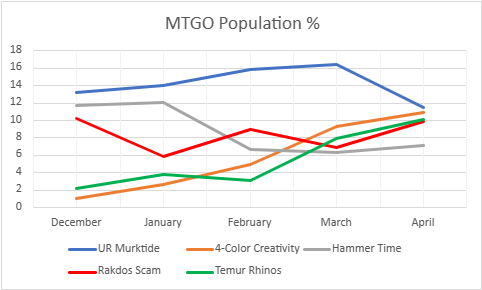
The headline data point in April was that 4-Color Creativity was #1 in paper and very nearly caught UR Murktide on Magic Online (MTGO). While Murktide has fallen in paper before, it was never by the extent it did in April and Creativity has never approached this mark online before.
Some might take that to mean that there's change in the air and that Creativity is the new top deck in Modern. The data backs this up, but only if you just look at the numbers. The story of how that happened paints a very different picture. Murktide, and to a lesser extent Rhinos, had a more impressive month than Creativity, which ended up underperforming.
A Marathon, Not a Sprint
At the start of April, I'd have agreed with the above assessment. After the first week of April, Creativity was out ahead of all the other decks by a significant margin. If I recall correctly, it was up in the 20s in both paper and online while its closest competition was Temur Rhinos with around 10 results. Murktide was barely on the board with around five results apiece.
However, over the following weeks, a trend emerged. After a phenomenal opening weekend, Creativity fell away. It had shown up in force for several Challenges, but on MTGO Creativity just wasn't showing up in the Preliminaries. Murktide did, and just kept putting up results during the week and then placing a few into the Challenges. Rhinos was doing the same thing, but not to quite the same degree.
I record data every Friday, and after April 7, Creativity had a big lead on everything else. By April 14, that lead had halved. Rhinos was closing the gap and Murktide had caught Creativity. On April 21, Murktide caught Creativity online, with Rhinos not far behind. By April 28, Murktide was out in front by a good margin, leaving Rhinos behind. The last-minute surge over the weekend wasn't enough for Creativity to come back, even if Murktide hadn't had a compensating good Challenge as well.
Feast And Famine
I've never mentioned this before, but in my experience tracing the data, most results come in feast and famine cycles. A deck will have a really good weekend, disappear for some time, and then return. The length of the disappearance is often determinative for tier status. The power Tier 3 decks that don't show up on the population tier yet are at or near the top of average power ranking are the kings of this. They almost always have one phenomenal weekend and then completely disappear.
The decks that rise to the top of the metagame limit their famines. They often maximize the feast, but that's actually not required. Consistent results over the course of a month do far more to move a deck up the rankings than single events. This is where Murktide and to a lesser extent Rhinos and Hammer Time excel. They can have exceptional weeks, but even if they don't, they'll still put up decent numbers in smaller events over the week. Rhinos and Hammer still have true famine weeks, but Murktide's never been missing a whole week.
Rakdos Scam and Creativity are big feasters but are also prone to famine. Especially online, they show up in large events in force but are often missing entirely during the week. When they feast, they gorge but the relative lack of consistency holds them back. Murktide is so consistent in putting up results that even when it starts behind (which is very rare) it's able to catch up thanks to its rivals having an off week. It just keeps on keeping on.
What About Paper?
This has been a consistent observation for me about MTGO's data. Paper is a different animal. The above-described effects were definitely happening in paper as well this month. However, Murktide and Rhinos didn't actually catch Creativity. In fact, Creativity maintained a fairly commanding lead all month.
This isn't something to read into. The MTGO data comes out in predictable intervals and produces a predictable number of events. Since Daybreak took over running the program, a minimum of three Challenges and seven Preliminaries will be posted every week. Frequently, there are more, but for the past few months never less.
There's no predictability for paper results. Tournament Organizers don't have to schedule any Modern events in a month, nor report them in a timely fashion. I checked today, and there were a number of events from mid-to-late April that are just now being posted. The effect I saw on MTGO was happening in paper, however, the gaps in the data and lower total results yielded a different result. The metagame isn't at fault for the difference, unreliable reporting is, so don't read into the results.
The Implication
It makes sense that Murktide would pull ahead thanks to its consistency more than anything else. The deck is following the Turbo Xerox formula with many cantrips and a low land count. It has more velocity than any other deck which leads to consistent games. This consistency has translated into a very long run as Modern's most-played deck. Even if it's not the best-positioned deck, players know what to expect.
The cascade decks are similar thanks to effect redundancy, and Hammer Time has tutors. They don't have the smoothing depth that Murktide does, but they do have enough to keep up. Creativity and Scam are lacking in this area. They have some redundancy and smoothing, but it's to a lesser extent and at a higher cost than the other decks. Fable of the Mirror-Breaker // Reflection of Kiki-Jiki and Seasoned Pyromancer are powerful but aren't really smoothing cards like Consider, Mishra's Bauble, and Expressive Iteration. That's probably why Scam has been so volatile.
End Life Care
On the subject of challenging the top decks, what's going on with Living End? That's a genuine question, not remotely rhetorical. It was hot on the heels of the Big Five online, but just barely limped onto Tier 3 in paper. This followed a month where the deck was at the bottom of Tier 1 in both play mediums. Historically, the deck has been quite volatile, but it has never deviated from itself this much.
There was an error retrieving a chart for Living End
It's possible that paper's poor reporting is a factor. However, given how far from Tier 1 it is, that seems unlikely. It'd be one thing if there was a positive trend that got interrupted, but it was completely absent from the results. This points to an actual change in pilots and/or metagame positioning for the paper fall-off. However, I don't see enough deviation between paper and online play for positioning to be the reason.
The only distinct difference I can see is that graveyard hate was down slightly online. The various Urza's Saga decks stopped playing Soul Guide Lantern, either maindeck or sideboard, and alternative graveyard hate was also minimal. The paper decks didn't follow this strategy. Endurance was as prevalent as it ever was, so this explanation seems weak but it's all I have.
Doctor's In
On a similar note, Yawgmoth made it back to Tier 1 online after missing in March. However, I wouldn't exactly call it good news for the deck. Its average points were so bad that it fell to Tier 2 on power and was tied for second worst performance for online decks. Not exactly a rousing success, especially when it was lower-mid Tier 3 in paper and underperformed against the baseline there, too.
While I don't know the ins and outs of its matchups, I do know that Yawgmoth has a reputation for beating Murktide. I'd guess that the high amount of play Yawgmoth saw was predicated on there being lots of Murktide to feed on. While there was a lot of Murktide out there, it wasn't to the extent of previous months, and therefore, the strategy didn't work out. There were too many other matchups out there.
Unfit Prime Time?
Something that the data article didn't show is that for the first time, Amulet of Vigor players are branching out. Rather than being all together on Amulet Titan, a few players got experimental. There were a few trying Aspiringspike's Door to Nothingness brew, and others trying other combos with Amulet. There was even one deck that was otherwise an unremarkable Amulet deck, except that it didn't play any Primeval Titans. That'd have positively been blasphemous before now.
You have to be an Amulet player to understand developments in Amulet Titan. However, the fact that the players are willing to experiment with what had been quite an orthodox deck is significant. It might mean that players are getting bored with the typical game plan, or it might also indicate that there are metagame concerns. Maybe Titan is finally getting pushed out? In any case, Amulet willingly changing itself without new cards is always something to watch.
Finance Corner
As always, I end in the Finance Corner. Here is where I gaze into the financial crystal ball to try and foresee the coming month of market trends. This month will leave many disappointed because I don't see much opportunity on the horizon.
There's no reason to think that the Big Five decks are going anywhere. Scam was quite weak in paper in April, but that's probably down to a lack of events. The deck has never shown up that much in local events but shines at the big events. I suspect there are social considerations/pressures at play. With fewer large events, Scam was down. It's still strong online, so it's not in danger of falling out of the metagame.
Consequently, there won't be a wild swing to drive upward price pressures for any deck. In fact, with all the reprints there continues to be gentle downward pressure on staple prices, with particular pressure on Ragavan, Nimble Pilferer. Thus, this is a (weak) buyers' market rather than a seller's market. Plan accordingly.
Aftermarket Aftermath
While there is another set coming out in May, I don't think it will mean anything for the Modern market. March of the Machine: The Aftermath looks extremely underwhelming, particularly for older formats but I have to imagine it's not great for Standard, either. It's less a new set and more like EA-style downloadable content (DLC). It's content that was meant for the main game but got carved out for a microtransaction. I'm not impressed.
There are a few cards I have my eye on that might see niche play in Modern. However, emphasis on the niche, there. They might adjust a few matchups slightly, but there's nothing to completely revamp any deck. Thus, the financial and metagame impact should be muted.
A Modern Stabilized
There's nothing foreseeable that will cause any dramatic change in Modern anytime soon. With prices falling Wizards might choose to make bans in the near future, or they might continue to wait and watch, I can't know. What I do know is that Modern is fine for the moment and will continue to be fine in May. Not great, not bad, just fine.
If not, now is a perfect time to join up! Our powerful tools, breaking-news analysis, and exclusive Discord channel will make sure you stay up to date and ahead of the curve.
Checking out a new shop can be intimidating, even for Magic veterans. A new venue is always a unique experience; you never know exactly what the store, players, or meta are like until you show up.
When a brand-new local store opened near me, I just had to go check it out. Today, I'll talk about how game night went, and then I'll share some do's and don'ts that are sure to make your next new LGS Commander experience smoother and funner.
The Newest of New Stores
The store in question, Sky High Comics and Games, is certainly a wild card. As the name suggests, they have comics, but they also carry vintage video games, pen and paper RPGs, and a variety of TCGs. They just opened a week ago, and this would be their first Commander night ever. I planned on spending a long night playing as many games of Commander as I could to get a feel for the player base.
I showed up very early because I wanted to check out the store's inventory, and incidentally, another player I knew also showed up. This was surprising because this store was further away for them, and they often commented on how long the drive was to the closer store. In any case, there was also another player who was ready to play, but no one else.
We all decided to play a three-player game and quickly went over a couple of Rule Zero ideas. None of us were looking for a fully competitive game, but one of the players only had one deck on them: an optimized, but not yet fully completed, Grimgrin, Corpse-Born pile with a few infinite combos, but lacking in tutors. I took this as a queue to run something with lots of removal, so I played Chun-Li, Countless Kicks, and the other player ran Sheoldred, The Apocalypse.
We wound up with a nice back-and-forth game with me in the middle of two mostly black decks that were running the exact same cards. Both players landed The Meathook Massacre and cast Gray Merchant of Asphodel. Between death triggers, Gary, and Sheoldred, my life points evaporated, and soon Sheoldred took the game. It was a fun warm up-game while we were waiting for others to arrive. I'd like to say we did not have to wait long, but that would not be accurate.
A Chance to Play Legacy and Pauper: Enter the Yu-Gi-Oh!
As our game finished, a new player showed up, and another was interrupted by a work call and excused themselves. The new player busted out a Yu-Gi-Oh! deck and challenged either of us to a duel. I sat and watched until the person came back from their work call.
Not wanting to interrupt the intense Yu-Gi-Oh! action, he asked me if I had any non-Commander decks with me, and I mentioned I did have a Pauper deck. Well, he had a Legacy deck, and I was fine with playing.
Legacy versus Pauper: who will win? Well, no surprise there. Turn one Dark Ritual, Entomb, Reanimate on Griselbrand killed me easily. However, I did take game two with a timely Fog that stopped his Animate Dead- enchanted Grisel from gaining life on attack. Since he had already drawn a bunch of cards by paying life, he was low enough that he died from my attack. Of course, game three I was on the draw, and died horribly. Still, my entire deck was 1/100th of the cost of that deck, and I had fun scoring a win. Once our individual duels cleared up, we joined together for a pod of four, and this game was quite a bit different.
A Trend Emerges
Two of the four players only had one deck with them. One had the Draconic Rage pre-constructed deck, and the other, a partially-completed cEDH deck with Tymna The Weaver and Thrasios, Triton Hero. In my head, there was no way to reconcile the power level difference, so I talked about expectations and really leaned on the pre-con player to spell out what would make the game work for them.
They were only interested in seeing the game progress, and did not care if it was over in two turns or lasted an hour. Since all the players were fine with pretty much anything, I picked a higher-powered deck in Tivit, Seller of Secrets because it ran a lot of counter magic, even though the only threat was Tivit himself. In this set, I basically sat back and allowed two of the players to play, keeping up counter magic and removal to prevent the game from ending.
There was an error retrieving a chart for Counterbalance
Even though an Enlightened Tutor fetched up a Counterbalance for the Tymna player with Sensei's Divining Top in play, I feared no evil because I had a Nimble Obstructionist in hand. Tivit hit the table and made me a ton of Treasure tokens; Counter Balance hit play and we went around the table.
My draw was too good: Expropriate! After attacking and generating a ton more Treasures, I cast it. The player piloting the cEDH deck knew they could not stop a nine-mana spell, because cEDH decks don't typically run nine-mana spells. Extra turns resulted in eliminating a player, playing an Archaeomancer to get back Expropriate, and re-playing it the turn after. With several extra turns coming up and another Flicker effect ready, the remaining players scooped.
During that game, a lot of players arrived, and multiple pods were firing. There was a pretty large wait until my next game as people made purchases, grabbed a snack, used the restroom, or paired up for other games. I used this time to talk to store management and ask about future Commander events. They were open to suggestions and mentioned the events they already planned. I mentioned just a couple of ideas to spice up the format, but wanted to interact with more players to see how interested they would be in variants. Turns out, quite a bit.
It was very late by the time the final pod started, and it was a group of us all playing slightly modified pre-cons. That game dragged on for nearly two hours due to board wipes, removal, and lack of win conditions. Eventually, I did manage to claw my way into a win by copying three artifacts a turn with a fully leveled-up Artificer's Class, Mishra, Eminent One and Strionic Resonator, but it may have been smarter for us to just call the game sooner because it was such a slog for all involved.
I had just played Commander for about five hours, met a dozen new people, and had a good time. This result begged the question: could my results be replicated? Here are the promised tips to your next trip to a new venue that much better.
1) Do: Bring Lots of (Toys) Decks
This is one of the best moves for a variety of reasons. Most of the other players were relatively new to Commander, and so many had exactly one deck. However, that did not mean those decks were anywhere near the same power level. Yes, there were both extremes present at the same table, those with pre-cons and cEDH decks. Being able to pick something that matches up well with the table will generate a far more interactive experience than picking your best deck to pub stomp.
Obviously, for new players who own one deck, this is not always an option. The idea is that if everyone else brings a few decks, they may be able to lend a deck that can make a better experience for the entire table. Furthermore, some players forgot dice, tokens and play mats. I had enough to help a couple of people out, which broke the ice and made everyone extra friendly.
2) Don't: Expect Everyone to Want the Same Type of Game
Far too often, one player wants to play one deck, and they do not care about the rest of the table. If you want to play a casual deck when everyone else is looking for tournament practice for an upcoming cEDH event, you are the problem.
Want to play your mass land destruction deck and not having luck finding a table that will tolerate it? Having multiple decks is the easiest way to still get games while telling everyone that you are looking for a pod that wants to experience the "joys" of mass land destruction. When the MLD deck meets the stax deck meets the degenerate deck and is completed by the Rule Zero meme deck, you likely have four happy players who are all playing decks that are generally not as well received in more routine pods.
Some players simply dislike mill or infect or control but, of course, others love those archetypes. In an odd-person-out scenario, try your best to gain a new perspective. Maybe it's not the decks or playstyle you don't enjoy, but a combination of previous players and decks that resulted in a less-than-ideal time. At a new venue, there's always room for a new outlook. As an additional option, ask if you can pilot someone else's deck. Maybe a deck you hate playing against is one you would rather be playing.
3) Do: Know What Type of Game You Are Looking For
Slow and grindy, explosive combos, and completely reactive are very different vibes. Expectations that are not set cannot be met. Practically everyone I asked at this new store said they wanted to participate in cEDH events (tournaments for prizes), but outside of that were looking for casual tables.
Another way of saying this is that no one was looking for explicit cEDH tournament practice that night. This mindset is far from unique, but many Commander players seem to not have gotten the memo. There's a very different feeling between simply wanting to cast your Commander and move to combat versus having to keep up mana for responses every turn or play with tight sequencing. In casual Commander, there are a lot of takesies-backsies that will never fly at a competitive event, but are completely permissible at lower-level tables.
4) Don't: Be Afraid to Challenge Your Assumptions
As previously described, a lot of the players who showed up were very interested in cEDH at the tournament level; far more than I would ever expect. While we played, I pressed for details, and a fairly common, unifying theme was the speed of the format. Many of the players at this venue wanted to play a lot of games, and quantity had a quality they were after.
Overall, they were not overly concerned with winning, interaction, or complicated board states. They were more excited to see higher-powered cards and strategies hitting the table, even if that meant the game was over. It was refreshing to see appreciation for a completely different aspect of the game.
5) Do: Bring Something Besides Commander
Whether Standard, Pioneer, Pauper, or Legacy, there is likely some down time between pods as games finish. In particular, there were a couple of "waves" that joined, with a lot of waiting in between. By having a deck of another format available, I could spend my downtime enjoying Magic in another form instead of merely waiting.
However, there is always something to be said for having a good book on hand just in case a game drags on particularly long while you are waiting for a pod to open up. In either case, a tiny bit of preparation can lead to a significantly better experience.
6) Don't: Forget to Have Fun!
Remember: ultimately, everyone comes out to have fun. Other players are fellow enthusiasts, trade partners, and maybe future tournament rivals. You really don't want to give them another reason to go after you in a competitive game with actual stakes on the line, right? Be on your best behavior, and have a good time. It will pay dividends now and in the future.
My New Competitive-Casual Venue?
As for Sky High, It's a very interesting environment with a wide-open meta, at least at first glance. While there was a lot of EDREC style groupthink, there was also enough interest in things like Planechase to keep events fresh. It was an enjoyable new place to play Commander, and I look forward to writing cEDH tournament reports if they do move forward with events as planned.
Currently, this venue would not be as casual and relaxed as another one of my LGS options, and likely not quite as competitive as yet another. So is it too hot, too cold, or just right? That remains to be seen. But as a final tip, I find it can be productive to consider how a new LGS fits into your own local game store ecosystem to get the most out of available options.
If not, now is a perfect time to join up! Our powerful tools, breaking-news analysis, and exclusive Discord channel will make sure you stay up to date and ahead of the curve.
New month, new metagame update. Not a new metagame, though. As I've been explaining for months now, Modern has settled into an equilibrium. The top of the metagame looks basically the same as it did in March. The rest of the metagame has been in flux, but not of the kind that will actually disturb the overall status quo. I have doubts that anything in the coming months will be able to change things, either.
Confusing Outliers
As has been the case since March 2022, there are outliers in the data. However, the number of outliers is not entirely clear. When I do these calculations, I use a variety of tests which use a variety of methods. Normally, their conclusions are consistent, but that was not the case for April.
For the Magic Online (MTGO) results, tests using the interquartile range (IQR) said that the top five results were definitely outliers, and the next two were on the bubble. Which makes sense, given the data. IQR tests look at the spread and gaps in the data, and it is quite large, though not as bad as last month.
However, tests using the z-statistic said there's no outliers. They're focused on the standard deviation and skew in the data, and while both were large, they weren't as bad as in previous months. The unadjusted MTGO population StDev is 22.80 and kurtosis of 10.30 in April where March had 23.58 and 22.68 respectively.
Thus, the stats aren't clear. I went with the IQR conclusions in order to include more decks on the tier list.
For paper, the results gave a clearer answer, but not a clear reason. All tests agreed that the top result was an outlier. After that, there was no agreement. Some z-tests said that only that top result was an outlier, others said that the top four were outliers. Some IQR tests had four outliers, some had six, some had only one.
I decided to only treat the top result as an outlier as every test agreed that it was, but this stands as a testament to how weird the data is this month. As always, outliers are removed from the tier calculations, resulting in adjusted averages and STDev's. The decks remain in their correct place on the tier list.
April Population Metagame
To make the tier list, a given deck has to beat the overall average population for the month. The average is my estimate for how many results a given deck "should” produce in a given month. Being a tiered deck requires being better than “good enough.” Every deck that posts at least the average number of results is "good enough" and makes the tier list.
Then we go one standard deviation (STdev) above average to set the limit of Tier 3 and the cutoff for Tier 2. This mathematically defines Tier 3 as those decks clustered near the average. Tier 2 goes from the cutoff to the next standard deviation. These are decks that perform well above average. Tier 1 consists of those decks at least two standard deviations above the mean result, encompassing the truly exceptional performing decks.
The MTGO data nearly exclusively comes from official Preliminary and Challenge results. Leagues are excluded, as they are curated lists and thus invalid. The paper data comes from any sourceI can find, with all reported events being counted.
The MTGO Population Data
In April, the adjusted average population for MTGO was 6.21, setting the Tier 3 cutoff at seven decks. Tier 3, therefore, begins with decks posting seven results. The adjusted STdev was 7.91, which means that Tier 3 runs to 15 results. Again, it's the starting point to the cutoff, then the next whole number for the next Tier. Therefore Tier 2 starts with 16 results and runs to 24. Subsequently, to make Tier 1, 25 decks are required. The stats have changed marginally, but the tier cutoffs are the same as in March. Which makes sense, given the removal of outliers.
April couldn't match the heights of March. Due to fewer events and smaller Preliminaries, the population is down. January 2023 had 840 decks, February had 876, and March had a staggering 1,003 decks. April fell short at 949 decks.
Along with population, diversity is down. January had 74 unique decks, February had 84, March mustered 88, and April hit 82. The fact that April is below February's mark either says a lot about February's diversity or indicates an actual decrease in diversity. Hard to say.
Of the 82 decks, 29 made the population tier. Which is up from March's 25 decks, though again the extreme adjustment is more at fault for that than the metagame.
Deck Name
Total #
Total %
Tier 1
UR Murktide
109
11.49
4-Color Creativity
104
10.96
Temur Rhinos
96
10.12
Rakdos Scam
94
9.90
Hammer Time
68
7.16
Living End
49
5.16
Yawgmoth
30
3.16
Tier 2
Burn
22
2.32
Amulet Titan
21
2.21
UW Control
21
2.21
Merfolk
20
2.11
Tier 3
Bring to Light
15
1.58
Mono-Green Tron
15
1.58
Affinity
15
1.58
Izzet Prowess
14
1.47
Mill
14
1.47
Coffers
12
1.26
Jund Saga
12
1.26
4-Color Blink
11
1.16
Temur Creativity
11
1.16
Goryo's Kitchen
10
1.05
4-Color Elementals
9
0.95
4-Color Control
9
0.95
Counter Cat
9
0.95
Humans
9
0.95
Jeskai Combo Breach
8
0.84
Belcher
8
0.84
Jeskai Value Breach
7
0.74
Mono-Blue Tron
7
0.74
To carry on a point from last week, the 5-deck concentration ratio is up to 49.63. Tier 1 has consistently taken up a huge chunk of the metagame since I started tracking that stat, while in the past it was more evenly distributed between the member decks. Living End and Yawgmoth's contributions are negligible, and that's worrying.
The Paper Population Data
The paper tiers are calculated the same way as the MTGO tiers, just with different data. In most months there are far more reported paper events than online, but paper also tends to report fewer results per event. It's quite annoying, but paper events rarely report more than the Top 8, and far too often for my purposes, only the Top 4. This makes the paper data far more variable than MTGO.
January saw 667 decks, February is up to 807, March hit 962, but April has plunged to 551. There were a number of large events that reported scattered results (not even the full Top 8!) and others are simply missing. Face to Face Games had an open in Montreal last weekend, but I haven't seen any of the data, or even any talk about the event. They're not alone. Tournament Organizers: get it together! We need data!
Paper events often report the actual records alongside decklists. Thus, I've decided to change how I record decks when win rates are available. For smaller events, I take any winning record which sometimes means I don't include the full Top 8. For larger events, I'm taking the Top 32 and all the decks with the same record as 32nd place. Tiebreakers are a strange and mysterious alchemy, after all, and may benefit or screw players on a whim.
That said, significantly fewer decks recorded did yield a significantly less diverse dataset. January had 101, February 108, March just 103, and April 89. That is almost certainly a function of the lower population rather than metagame forces. 24 decks made the tier list, which is low but again makes sense in context. The adjusted average population was 5.58, so six decks make Tier 3. The adjusted STDev was 8.61, so the increment is 9. Therefore, Tier 3 runs from 6 to 15, Tier 2 is 16 to 25, and Tier 1 is 26 and over.
Deck Name
Total #
Total %
Tier 1
4-Color Creativity
60
10.89
UR Murktide
44
7.99
Temur Rhinos
44
7.99
Hammer Time
42
7.62
Tier 2
Rakdos Scam
24
4.36
Amulet Titan
22
3.99
Burn
21
3.81
Tier 3
UW Control
15
2.72
Izzet Prowess
13
2.36
Merfolk
12
2.18
Mono-Green Tron
11
2.00
4-Color Elementals
11
2.00
Yawgmoth
11
2.00
Jeskai Combo Breach
10
1.81
Goryo Blink
10
1.81
Bring to Light
10
1.81
Boros Moon
9
1.63
Mono-Blue Tron
9
1.63
Counter Cat
8
1.45
Jund Saga
8
1.45
Living End
7
1.27
Ponza
7
1.27
4-Color Rhinos
6
1.09
Grixis Shadow
6
1.09
Tier 1 is much smaller in paper than on MTGO. That's good, but I suspect it's down more to the lower population than anything else. That Tier 2 is similarly tiny lends credence to this idea. It is notable that UR Murktide was not the top deck in paper, having been replaced by 4-Color Creativity. However, don't celebrate just yet. The story of how that happened (in paper and MTGO) is a big piece of Friday's analysis article, and the reason for this isn't quite what you'd think.
March Power Metagame
Tracking the metagame in terms of population is standard practice. But how do results actually factor in? Better decks should also have better results. In an effort to measure this, I use a power ranking system in addition to the prevalence list. By doing so, I measure the relative strengths of each deck within the metagame.
The population method gives a deck that consistently just squeaks into the Top 32 the same weight as one that Top 8's. Using a power ranking rewards good results and moves the winningest decks to the top of the pile and better reflects their metagame potential.
The MTGO Power Tiers
For the MTGO data, points are awarded based on the population of the event. Preliminaries award points based on record (1 for 3 wins, 2 for 4 wins, 3 for 5), and Challenges are scored 3 points for the Top 8, 2 for Top 16, and 1 for Top 32. If I can find them, non-Wizards events will be awarded points the same as Challenges or Preliminaries depending on what the event in question reports/behaves like. Super Qualifiers and similar higher-level events get an extra point and so do other events if they’re over 200 players, with a fifth point for going over 400 players. There were a few 4-point events and no 5-pointer in April.
Total points fell just like the population, from 1631 to 1477. The adjusted average points were 9.74, therefore 10 points made Tier 3. The adjusted STDev was 13.33. Add 14 to the starting point and Tier 3 runs to 24 points. Tier 2 starts with 25 points and runs to 39. Tier 1 requires at least 40 points.
Yawgmoth fell out of Tier 1 because it had a terrible conversion rate. As the average power stat will show, it was present, but not actually winning, a lot of events. Meanwhile, Living End did exceptionally well. It must have been very well positioned, but I don't know enough about its matchups to see how or why it was in April, but no other month. It could also be down to the whims of MTGO's volatile player base.
The Paper Power Tiers
Due to paper reporting being inconsistent compared to MTGO, I have to adapt how the points work. Applying the MTGO point system just doesn't work when I don't know how many points to award and there are data gaps. Thus, I award points based on the size of the tournament rather than placement. That way, I'm being internally consistent with the paper results.
There was an error retrieving a chart for Living End
For events with no reported starting population and those up to 32 players, one point is awarded. Events with 33 players up to 128 players gets two points. From 129 players up to 512 players gets three. Above 512 is four points, and five points will be reserved for Modern Pro Tours if they ever happen again.
April saw a number of absurdly large events early on, then started drying up. January saw 1178 points, February hit 1316, and March had 1890, but April clocked in at only 964. The adjusted average points were 9.61. This sets the cutoff at 10 decks. The STDev was 15.76, thus adding 16 to the starting point and Tier 3 runs to 26 points. Tier 2 starts with 27 points and runs to 44. Tier 1 requires at least 44 points. The total decks stayed the same at 24, though Ponza and Jund Saga fell from the list, replaced by 4-Color Blink and Temur Creativity.
Deck Name
Total Points
Total %
Tier 1
4-Color Creativity
118
12.24
UR Murktide
93
9.65
Hammer Time
75
7.78
Temur Rhinos
69
7.16
Rakdos Scam
48
4.98
Tier 2
Burn
37
3.84
Amulet Titan
32
3.32
UW Control
27
2.80
Tier 3
Izzet Prowess
20
2.07
Mono-Green Tron
20
2.07
Merfolk
19
1.97
Jeskai Combo Breach
19
1.97
Bring to Light
19
1.97
4-Color Elementals
18
1.87
Yawgmoth
18
1.87
Counter Cat
17
1.76
Living End
17
1.76
Goryo Blink
16
1.66
Boros Moon
12
1.24
Grixis Shadow
12
1,24
4-Color Blink
12
1.24
Temur Creativity
12
1.24
4-Color Rhinos
11
1.14
Mono-Blue Tron
10
1.04
Rakdos Scam has usually underperformed relative to the other top decks in paper compared to MTGO. I'm not sure why this happens, other than it shows up at big events and is missing from small ones. I suspect, therefore, that social considerations are more at play than anything else. With fewer big events reported (many more happened than were reported), it fell considerably.
Average Power Rankings
Finally, we come to the average power rankings. These are found by taking the total points earned and dividing them by total decks, to measure points per deck. I use this to measure strength vs. popularity. Measuring deck strength is hard. There is no Wins-Above-Replacement metric for Magic, and I'm not certain that one could be credibly devised. The game is too complex, and even then, power is very contextual.
Using the power rankings certainly helps, and serves to show how justified a deck’s popularity is. However, more popular decks will still necessarily earn a lot of points. Therefore, the top tier doesn't move much between population and power, and obscures whether its decks really earned their position.
This is where the averaging comes in. Decks that earn a lot of points because they get a lot of results will do worse than decks that win more events, indicating which deck actually performs better.
A higher average indicates lots of high finishes, whereas low averages result from mediocre performances and a high population. Lower-tier decks typically do very well here, likely due to their pilots being enthusiasts. Bear this in mind, and be careful about reading too much into these results. However, as a general rule, decks which place above the baseline average are over-performing, and vice versa.
How far above or below that average a deck is can "justifiy" its position on the power tiers. Decks well above baseline are undervalued, while decks well below baseline are very popular, but aren't necessarily good.
The Real Story
When considering the average points, the key is looking at how far off a deck is from the Baseline stat (the overall average of points/population). The closer a deck’s performance to the Baseline, the more likely it is to be performing close to its “true” potential.
A deck that is exactly average would therefore perform exactly as well as expected. The greater the deviation from the average, the more a deck under or over-performs. On the low end, a deck’s placing was mainly due to population rather than power, which suggests it’s overrated. A high-scoring deck is the opposite of this.
I'll begin with the averages for MTGO:
Deck Name
Average Points
Power Tier
Niv to Light
2.50
3
Jund Creativity
2.00
3
4-Color Elementals
1.89
3
Living End
1.82
1
Mono-Green Tron
1.80
2
Izzet Prowess
1.79
2
Humans
1.78
3
Coffers
1.75
3
Temur Creativity
1.73
3
Amulet Titan
1.71
2
Mono-Blue Tron
1.71
3
Burn
1.68
2
UR Murktide
1.63
1
UW Control
1.62
2
Merfolk
1.60
2
Temur Rhinos
1.59
1
Jeskai Value Breach
1.57
3
Baseline
1.54
Rakdos Scam
1.53
1
Bring to Light
1.53
3
4-Color Creativity
1.52
1
4-Color Control
1.44
3
Mill
1.43
3
Jund Saga
1.42
3
Hammer Time
1.38
1
Jeskai Combo Breach
1.37
3
Belcher
1.37
3
4-Color Blink
1.36
3
Affinity
1.33
3
Yawgmoth
1.30
2
Goryo's Kitchen
1.30
3
Counter Cat
1.22
3
Well done, Living End. As the highest ranked Tier 1 deck, you're the MTGO Deck of April. Meanwhile, Hammer Time, what happened? Is Living End at fault (genuine question)?
Now the paper averages:
Deck Name
Average Power
Power Tier
Temur Creativity
3.00
3
Living End
2.43
3
4-Color Blink
2.40
3
Counter Cat
2.12
3
UR Murktide
2.11
1
Rakdos Scam
2.00
1
Grixis Shadow
2.00
3
4-Color Creativity
1.97
1
Jeskai Combo Breach
1.90
3
Bring to Light
1.90
3
4-Color Rhinos
1.83
3
Mono-Green Tron
1.82
3
UW Control
1.80
2
Hammer Time
1.79
1
Burn
1.76
2
Baseline
1.67
4-Color Elementals
1.64
3
Yawgmoth
1.64
3
Goryo Blink
1.60
3
Merfolk
1.58
3
Temur Rhinos
1.57
1
Izzet Prowess
1.54
3
Amulet Titan
1.45
2
Boros Moon
1.33
3
Mono-Blue Tron
1.11
3
This is a first. UR Murktide actually managed to be the Deck of April in paper. I don't think that's ever happened in either medium before. Just goes to show how everyone underestimates the deck, even now.
Composite Metagame
That's a lot of data, but what does it all mean? When Modern Nexus was first started, we had a statistical method to combine the MTGO and paper data, but the math of that system doesn't work without big paper events. I tried. Instead, I'm using an averaging system to combine the data. I take the MTGO results and average the tier, then separately average the paper results, then average the paper and MTGO results together for final tier placement.
There was an error retrieving a chart for Primeval Titan
This generates a lot of partial Tiers. That's not a bug, but a feature. The nuance separates the solidly Tiered decks from the more flexible ones and shows the true relative power differences between the decks. Every deck in the paper and MTGO results is on the table, and when they don't appear in a given category, they're marked N/A. This is treated as a 4 for averaging purposes.
Deck Name
MTGO Pop Tier
MTGO Power Tier
MTGO Average Tier
Paper Pop Tier
Paper Power Tier
Paper Average Tier
Composite Tier
UR Murktide
1
1
1
1
1
1
1.00
4-Color Creativity
1
1
1
1
1
1
1.00
Temur Rhinos
1
1
1
1
1
1
1.00
Hammer Time
1
1
1
1
1
1
1.00
Rakdos Scam
1
1
1
2
1
1.5
1.25
Living End
1
1
1
3
3
3
2.00
Burn
2
2
2
2
2
2
2.00
Amulet Titan
2
2
2
2
2
2
2.00
Yawgmoth
1
2
1.5
3
3
3
2.25
UW Control
2
2
2
3
2
2.5
2.25
Merfolk
2
2
2
3
3
3
2.50
Mono-Green Tron
3
2
2.5
3
3
3
2.75
Izzet Prowess
3
2
2.5
3
3
3
2.75
Bring to Light
3
3
3
3
3
3
3.00
4-Color Elementals
3
3
3
3
3
3
3.00
Counter Cat
3
3
3
3
3
3
3.00
Jeskai Combo Breach
3
3
3
3
3
3
3.00
Mono-Blue Tron
3
3
3
3
3
3
3.00
Jund Saga
3
3
3
3
N/A
3.5
3.25
4-Color Blink
3
3
3
N/A
3
3.5
3.25
Temur Creativity
3
3
3
N/A
3
3.5
3.25
Affinity
3
3
3
N/A
N/A
N/A
3.50
Mill
3
3
3
N/A
N/A
N/A
3.50
Coffers
3
3
3
N/A
N/A
N/A
3.50
Goryo's Kitchen
3
3
3
N/A
N/A
N/A
3.50
4-Color Control
3
3
3
N/A
N/A
N/A
3.50
Humans
3
3
3
N/A
N/A
N/A
3.50
Belcher
3
3
3
N/A
N/A
N/A
3.50
Jeskai Value Breach
3
3
3
N/A
N/A
N/A
3.50
Goryo Blink
N/A
N/A
N/A
3
3
3
3.50
Boros Moon
N/A
N/A
N/A
3
3
3
3.50
4-Color Rhinos
N/A
N/A
N/A
3
3
3
3.50
Grixis Shadow
N/A
N/A
N/A
3
3
3
3.50
Jund Creativity
N/A
3
3.5
N/A
N/A
N/A
3.75
Niv to Light
N/A
3
3.5
N/A
N/A
N/A
3.75
Ponza
N/A
N/A
N/A
3
N/A
3.5
3.75
Thanks to paper's low concentration, the overall share for Tier 1 fell in April. Again, I'd advise against reading too much into that, as all the unreported events would have likely changed that finding.
An Era of Stability?
With me reporting the same top five decks for the second month in a row across all play platforms, this is feeling more like a 2015 update than anything I've done before. Strap in, readers; I don't think this will be changing anytime soon.
As always, this first-of-the-month article merely presents the collected data, offering little in the way of analysis, metagame implications, and financial opportunities. Join me on Friday when I dig into these results and discuss exactly what has my hackles up.
If not, now is a perfect time to join up! Our powerful tools, breaking-news analysis, and exclusive Discord channel will make sure you stay up to date and ahead of the curve.
My hunt for a piece of Magic: the Gathering original art remains ongoing. Currently, I am working to reconcile a reasonable budget and browsing the market for what is available. Unfortunately for my budget, I sold many valuable cards from my collection in Las Vegas last year. I of course allocated those proceeds toward my kids' college fund. I could dip back into the fund if I wanted, to put some of that money back into Magic, but I try not to do that.
Maintaining that discipline necessitated taking a finer comb to my remaining collection. I needed to pull out cards and sealed product I’m willing to part with in order to enable the anticipated, costly artwork purchase. After identifying the lowest-hanging fruit, I am now faced with tougher decisions.
What to Sell?
Do I sell items that I am attached to, or do I sell things I wouldn’t mind letting go of, but at a loss? Not all my Magic purchases over the years have led to financial gains—there are a good number of Magic-related products I own that are valued below what I paid. It’s bound to happen with a volatile market. Everyone knows how prices spiked during the peak of the COVID pandemic in 2021-2022, only to come tumbling back down again a year later.
There was an error retrieving a chart for Singing Tree
Almost any Old School card purchased during the peak is going to be in the red today. Of course, some cards have held up better than others. I've noticed that Dual Lands have remained particularly resilient during this cooldown period. My Beta rares have held up somewhat poorly, but at least I purchased these at a steep discount via ABUGames’ eBay auctions.
I have heard that sealed product and artwork have gone through a similar trajectory, so at least on the buying side I will see some relief. The fact of the matter remains, however, that I need to lick some wounds and move cards at a modest loss if I want to quickly raise funds for another purchase.
Three Reasons to Sell for a Loss
As I considered my eagerness to sell, I realized that I’m OK with taking a financial loss on some cards and sealed products because it is a means to an end. If I'm selling something because there’s something else I am eager to buy, and I don’t want to wait the required months it would take for the market to (potentially) recover, I need to accept the prices that the market is willing to bear at the given time.
What’s more, if I did decide to wait, in the hopes that my cards would jump back up in value, it’s equally likely the item I wish to buy—in this case, a piece of original Magic art—would also climb up in step with the rest of the market. I must expect this trend, so waiting isn’t a good enough solution. As I considered this decision seriously, I thought up other reasons it may be perfectly acceptable to sell something for a loss.
Reason 1: Opportunity Cost
I’ll bucket my motivations to buy something else within this category. Owning something with monetary value carries opportunity cost—that is, the loss of potential gain from other alternatives when one alternative is chosen. By owning item A, you forfeit the opportunity that investments B, C, D, etc. have to offer.
A commentator on CNBC will sometimes state that the decision to not sell a stock on any given day is equivalent to the decision to buy that stock for that day. What does she mean by this? It’s another way of describing opportunity cost, and it indicates the passive choice being made by someone who sits on an asset without selling. It implies that one could have bought other things with that money, but they instead decided to hold that same asset, so that’s where they are deciding to put their money to work.
This goes beyond simple investment allocation management as well. Since we are talking about highly fungible, liquid assets in Magic cards, the resources could be spent pretty much anywhere cash is accepted. Do you want to redo your kitchen or own a Black Lotus[card]? Do you want that [card]Underground Sea or would you rather use that money to pay for urgent car repairs? Would you rather have a large Old School collection or money in a college savings account?
We make these decisions every single day we don’t sell our cards. We’re frequently happy with this choice because of all the enjoyment we get out of the cards, in addition to the financial upside they offer. Sometimes, however, the alternative is correct, and this could be a time it’s OK to sell even for a loss.
Reason 2: New Risks of Value Erosion
You’ve heard the expression, “Don’t throw good money after bad.” Good Life Project explains this concept as follows: once you realize something you’re invested in is not what you thought and likely never will be, don’t keep putting new money into it just because of what you’ve already invested.
This expression is what I think of when I consider the motivation to sell something, even for a loss. A great example here is the risk of impending reprints. You may have speculated on a card for potential long-term growth, only to see it coming up as a reprint in a new supplemental product. The best action to take at that moment is to liquidate, even if you’re still underwater on the card. The price is likely to decay even further before it has any chance of recovering.
Consider Liliana of the Veil’s reprint in Dominaria United, and what it did to her price. This card once flirted with a $100 price tag, but can now be purchased for under $20. If you had picked up a few copies for Modern play a year or two ago, it would have been wise to cash out of the cards as soon as there was news of her reprint in Standard. Back in August, Dominaria United copies were pre-selling in the $50 range; contrast that with her $19 price tag eight months later.
In today’s environment, reprint risk runs rampant. If the card isn’t on the Reserved List, it isn’t safe (with few exceptions). Every time Force of Will tries to break $100, it sees another reprint and pulls back. Fetch lands and shock lands are also perpetually at risk of a reprint—Wizards knows the inclusion of these cards can boost a set’s sales considerably.
In addition to reprints, there is downside risk if a card is about to rotate out of Standard. Metagame shifts can also impact pricing, as can a card’s risk of being banned. All these factors merit a decision to sell a given card, even if your price of entry was higher. There is no sense in holding something simply because you paid more for it—cut your losses and move on.
Reason 3: Altruism
I want to share a personal story that doesn’t put me in the best light—it’s a decision I made many years ago that I regret to this day. Around 15 years ago I was at my LGS trading with folks as was the norm back then. There was a newer player who was interested in one of my cards (I don’t even remember which one anymore). I knew the cards she wanted were valued at around $20, and when I browsed her binder, I didn’t find anything of interest. After hemming and hawing for a few minutes, I apologized and handed her the binder back, declining to trade.
Why is this a regret of mine? I’m disappointed in how I handled the situation. This was a new player, and I had an opportunity to help her out and give her a positive experience in the hobby. This would have been a win for her, a win for Magic, and possibly a win for me in the long term. Instead, I was shortsighted and too value-conscious—I didn’t want to take a small loss and so I declined to trade.
Since when had I become such a miser? I’d like to think that, if faced with the same decision today, I would have been happy to give a new player a great deal in order to help them bolster their collection and strengthen their first deck. It’s not like this player wanted a dual land and only had bulk Standard rares to offer. She wanted some new Standard card, and I balked at a loss of a few bucks.
Don’t be like me. I remember that greedy decision even today, many years later. Helping out a new player is a perfectly good reason to take a small loss on cards if you can afford it. I don’t know if people trade cards anymore, but if there’s an option to help a new player out at a cost of a few bucks, I say it’s worthwhile to make the altruistic investment. What’s good for new players is good for the Magic community.
Wrapping It Up
In an ideal world, every card we purchase increases in price afterwards and every card we choose not to buy continues to become cheaper and cheaper. Wouldn’t that be nice?
Unfortunately, that’s not how it works. Sometimes the cards we purchase decline in price over time, and it leaves us with some negative returns on our investments. Businesses can use these losses as tax write-offs, but for the average player, this isn’t a significant consideration.
Despite the lack of tax help, there still may be a few good reasons to sell cards for a loss. This includes opportunity cost considerations, changing risk profiles, and a desire to help a player in need. I’ve had experiences in all three of these situations, and while I never love taking a loss on cards, I have accepted that it’s the nature of the beast. I am confident I haven’t sold my last card at a loss, especially as my priorities within the Magic world shift away from playing in paper.
As you move forward with your day, I encourage you to scrutinize your collection to see if you’re better off cutting some losses to shift priorities as I have. If nothing else, you’ll develop a greater appreciation for the cards you already own!
If not, now is a perfect time to join up! Our powerful tools, breaking-news analysis, and exclusive Discord channel will make sure you stay up to date and ahead of the curve.
My longtime readers know I love bulk rares. I think that started around the time I got into Legacy, back in 2012. I met a gentleman gladly trading dual lands, power, and other expensive cards for bulk rares and mythics. At the time, I thought it was fantastic trading him all these cards I wasn't using for expensive cards I then didn't have to buy. While he only gave $0.10 on rares and $0.25 on mythics, it was still easy to trade into $50 played Savannahs and $30 played Plateaus. What I didn't realize was that he was collecting all these bulk rares and mythics, trading them to the big vendors, getting credit with the trade-in bonus, and then picking up those same duals with that credit, and netting a nice profit in the process.
There was an error retrieving a chart for Savannah
Fast forward a few years and I am now on the other side of those bulk trades. I am the one who has bought extra dual lands and other high-dollar legacy cards to trade people for bulk rares. Admittedly, it is harder to find people willing to make those trades and I often resort to just buying bulk rares and mythics at the going rates of $0.08 per rare and $0.25 per mythic.
ONE Deal Too Good To Resist
The reason I bring this up is that in March I noticed an interesting trend in Phyrexia: All Will Be One (ONE) rares. Many vendors were selling them below this $0.08 threshold. I began to scour TCGPlayer for sellers with large numbers of these bulk rares. I added all rares that they had below that $0.08 value and all mythics below $0.25. Then I added in shipping and taxes to see if the order made sense. If, with the shipping and taxes, the average card value was still less than $0.10 for a rare or $0.28 for a mythic, it was a good deal. In the end, I ended up with seven orders I could justify pulling the trigger on. Would these stores honor these prices?
There was an error retrieving a chart for Minor Misstep
The Experiment
I was curious to see if the stores I ordered from would actually ship large numbers of bulk rares at or below the going bulk rare and mythic rates. From my perspective as a seller, it doesn't actually seem like a good business plan. When you factor in the selling fees, each transaction likely ends up as a loss. From the start, I wondered how many of these stores might not even ship these orders, and just use USPS as an excuse and refund my order when I brought up that it never arrived. I'll admit, I was concerned about the possibility that if most of the stores refunded my order claiming it was lost in shipping, my account might get flagged by TCGPlayer, thinking I was the one trying to scam people. While I was curious enough about the outcome to go through with it, after this experiment, I'm holding off on more bulk rare orders like this for the immediate future.
A Breakdown of My Seven Transactions
Store 1
This is actually the order that inspired it all. Originally I was looking for Minor Misstep in bulk as a potential speculation target. This store listed 14 copies at $0.09 each. Whenever I buy cards from a store on TCGPlayer I always do a quick look to see what else they have since dividing the shipping costs over more cards lowers the overall buy-in price of each individual card. That is when I noticed them offering a bunch of ONE rares at $0.03, $0.04, and $0.05 each. It took me about half an hour of digging through their inventory to come up with 185 cards at a grand total of $14.86. This made the average price per card about $0.08.
Store 2
This store didn't have any Minor Missteps, but they did have a lot of Commander Legends: Battle for Baldur's Gate (CLB) bulk rares under $0.08 each. Previously, I've mentioned how I think Commander Legends: Battle for Baldur's Gate is a set that has a lot of potential from a speculation standpoint. It was released close to Double Masters 2022 (2X2) which had insane value in it. Most Magic players have limited income for buying product. Talking with some local store owners, it was clear that when given the option of Commander Legends: Battle for Baldur's Gate packs or Double Masters 2022, players almost universally picked the 2X2 packs. My transaction with this store came to 130 cards for $14.02. This made the average card cost about $0.11.
Store 3
The third store had 11 copies of Minor Misstep for $0.03 each, so I dug through what other rares they had and again found a lot of CLB bulk rares under my $0.08 threshold. I also noticed they had a fair amount of Dominaria United bulk rares under $0.08. Given that this set will remain in standard after rotation it seems that there's always a decent chance that some cheap rare from the set ends up finding a home when the format's card pool contracts. This order came out to 62 cards for $11.08. This makes the average card cost $0.18, which is higher than I expected, but there were a fair number of mythics in this order.
Store 4
This store had five copies of Minor Misstep and a bunch of cheap, but not bulk, ONE rares. I only bought 27 cards in this order, but every single one was from ONE. I am trying to finish a playset of Mercurial Spelldancer and they had a copy for $0.75. Other notable pickups were copies of Green Sun's Twilight and Blue Sun's Twilight. This order ended up costing $7.46, with a per-card cost of about $0.28.
This store had a fair number of bulk rares below my $0.08 threshold that are currently Standard-legal. At the time of this order, I was hoping to participate in one of my LGS's Buy/Sell/Trade day events and I currently have almost no Standard cards. The scene there is very casual-oriented, so I figured if I could stock up on a bunch of fun-looking Standard rares I could either trade them towards something I wanted or sell them at $0.25 cents each and still be the cheapest in the area. This order was 58 cards and totaled $8.26 with an average card cost of $0.14.
Store 6
This store had a fairly decent assortment of ONE bulk rares at $0.08 or less, and quite a few Dominaria Remastered (DMR) ones as well. I realized I currently have no DMR bulk rares, so I picked up all of those. I'm not sure how well that set will do ultimately. If it ends up being less opened the rares have a bit more upside. This order was 71 cards for $7.84 with an average card cost of $0.11.
The last store I was able to make a worthwhile transaction with had a lot of Kamigawa: Neon Destiny (NEO) rares listed at less than $0.08 and helped fill out a pretty meager NEO spot in my bulk rare collection. They also had a lot of ONE bulk rares below $0.08 and I managed to buy a large number of them as well. This order was 174 cards for $14.94 for an average card cost of $0.09.
Order Summary
Store 1: 185 cards for $14.86 ($0.08/card)
Store 2: 130 cards for $14.02 ($0.11/card)
Store 3: 62 cards for $11.08 ($0.18/card)
Store 4: 27 cards for $7.46 ($0.28/card)
Store 5: 58 cards for $8.26 ($0.14/card)
Store 6: 71 cards for $7.84 ($0.11/card)
Store 7: 174 cards for $14.94 ($0.09/card)
Total: 707 cards for $78.46 (about $0.11/card)
The Outcome
Overall, four of my orders actually arrived at my doorstep. Store #2 canceled a day after I placed the order. The seller claimed they had inventory issues. Stores #1 and #3 both claimed they shipped, but have not arrived at the time of this writing. These hurt the most as they were some of the largest, and included a large number of the Minor Missteps I was after.
As expected the smaller orders that had an average card cost above $0.20 were all sent and arrived. I should mention that in every case those orders required a padded envelope and oddly enough only two supplied a tracking number despite the fact that all the others ended up having one on the envelope.
Store #7 actually messaged me asking me not to order a bunch of cheap cards from them again, claiming they made no money on my order. Looking over it now, they're probably right.
The two stores that refunded me after claiming they shipped my orders out both came off as very sketchy to me. Speaking as an experienced seller, I know you can't ship 100+ cards without using packaging that would include tracking. I will not be ordering from those sellers ever again. Ultimately though, what this experiment has exposed is more than just problematic individual sellers. It's an issue with how TCGPlayer charges shipping on orders as a whole.
The Issue With TCGPlayer Shipping
I think the above experiment demonstrates that it's ridiculous for TCGPlayer to have a single shipping price for any number of singles. If any of these sellers broke even on these transactions, they were lucky, as my conversation with Store 7 shows.
Smart sellers are going to realize that it's not in their best interest to list cheap cards on TCGPlayer unless they have TCGPlayer Direct or have really high shipping fees. I'd recently been debating whether I would lower my current threshold of $0.79 on singles to increase available inventory in my own TCGPlayer store. However, after this experiment, I think I will keep that threshold in place and pass on trying to sell cheap cards on TCGPlayer.
Fixing TCGPlayer Shipping For Sellers
My suggestion to TCGPlayer would be to break singles shipping down into multiple tiers to allow sellers to charge more for shipping singles when they will have to pay more to ship them. Something like:
0-12 cards: Can easily be sent in a plain white envelope (PWE) with one forever stamp
13-24 cards: Can be sent in a PWE with non-machinable postage paid
25+ cards: This likely requires a small padded envelope which will then include tracking and likely cost somewhere in the $3.50-$4.25 range here in the United States.
Admittedly, had this type of system been in place, my own ordering would have turned out differently. I'd likely have gotten the Minor Missteps that I really wanted, and that would have been the end of it.
Final Thoughts
I'll admit I went into this with the mindset that I could buy a bunch of Standard-legal bulk rares at the same rate I would normally buy random bulk rares in person. While I still got arguably the better end of the deal than all these sellers, my average card cost exceeded the original $0.08 threshold. It just goes to show that even when buying a large number of cards under a certain cost, once you factor in shipping and taxes you can easily exceed your threshold.
Given how Standard cards often spike in price after a Pro Tour, or at rotation when the format shifts, this experience felt like buying a bunch of lottery tickets that I couldn't lose on. Sure, for most of them, I'll just be breaking even. Should one or two hit though, I'll get that rush of success one feels when a speculation target hits. It's a rush I haven't felt in a while.
I mentioned earlier that I'm putting these sorts of bulk rare buys on hold at the moment. It actually takes a fair amount of time to find sellers with enough bulk rares to justify the shipping cost from a bulk buyer perspective. However, I think that if you own a brick-and-mortar shop and have a lot of casual players in your local scene, buying up other online stores' cheap rares could be a viable inventory acquisition strategy.
Want Prices?
Browse thousands of prices with the first and most comprehensive MTG Finance tool around.
Trader Tools lists both buylist and retail prices for every MTG card, going back a decade.