menu

Barrage of Boulders: The Consequences of Back-to-Back Spoiler Seasons

Are you a Quiet Speculation member?

If not, now is a perfect time to join up! Our powerful tools, breaking-news analysis, and exclusive Discord channel will make sure you stay up to date and ahead of the curve.

Modern Horizons spoiler season concluded on May 31.  Yet, if you listen closely, the whistle of the next hype train about to pull into the station can be heard echoing in the distance. The first reveals from the upcoming Standard set Core 2020 are a three-stage planeswalker cycle featuring Chandra, dropped on June 11. That's two separate spoiler "seasons" with less than two weeks between them.

It has been quite some time since we've seen such a glut of products from Wizards release so close to each other. This short period of reprieve has me and many other players taking a step back to literally take inventory going into the next hype cycle. During this time, I think I'm starting to identify a potential problem.

2018 – A Recap

While the main period of releases I'm examining will be War of the Spark onward, it bears mentioning that 2018 had a ton of product releases too, setting a precedent for the year to follow. The spring release of Dominaria will go down as one of the most impactful Standard sets of all time, not only for player acquisition and retention but also marking a turning point in WotC's marketing style. Dominaria's release was incredibly significant to the health of the game today, and I believe we are still riding that wave.

There was an error retrieving a chart for Teferi, Hero of Dominaria

Dominaria is a good starting point, but you must also consider that it was followed by Battlebond, Commander 2018, Commander Anthology: Volume II, Guilds of Ravnica, and finally the surprise release of Ultimate Masters to close out the year. That last one was something else, too. Printing extra full-art box toppers as apology promos for the Guilds of Ravnica: Mythic Edition ordering fiasco was an incredibly unique way to commence a spoiler season. Some may label Commander 2018 as a bit of a dud in terms of significant gains, sealed or otherwise. Despite that small hiccup, it is undeniable that 2018's release schedule was incredibly strong overall.

In fact, a lot of things went right for Magic in 2018, and it's not limited to just set releases. Magic Arena was a huge boon for the game, with its Open Beta launch doing wonders for getting new players into the game and creating opportunities for conversion into paper customers. More importantly, it put Magic in the spotlight on a wider scale than ever before.

These releases had strong hype cycles that felt very evenly doled out, but in my opinion, everything we saw last year has been far-eclipsed by what was offered during War of the Spark's spoiler season.

2019 – The Year of Rapid-Fire Spending

With such a strong previous year, it only makes sense for Wizards to stand firm on their tight release schedule and continue churning out products at a brisk clip. With a huge influx of players, both new and returning, it only makes sense to keep a steady stream of products for them to buy.

Ravnica Allegiance opened up the year strong, finishing the cycle of guilds and moving us toward the final chapter of Magic's latest story thread. Even here, it felt like there was not much time between the spoiler season of Ultimate Masters and Allegiance's release (about a month). Following that, the long, drawn-out hype cycle of War of the Spark began. This set was used as a vehicle for the game as a whole, even propelling MPL events like the Mythic Invitational to the front page of Twitch. We saw the release of a novel, War of the Spark: Ravnica by Greg Weisman, and one of the most hyped trailers of all time, helping propel Magic to heights previously unseen.

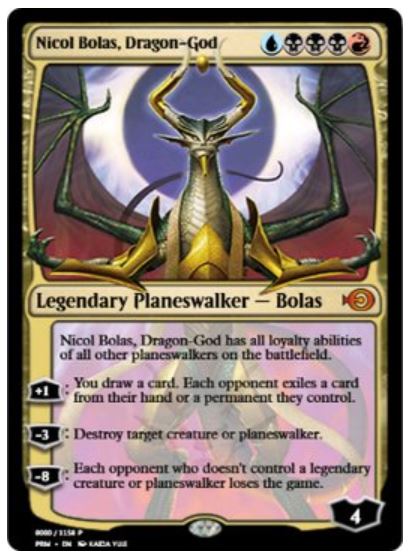
There was an error retrieving a chart for Nicol Bolas, Dragon-God

During War of the Spark's spoiler season, I took care to evaluate every spoiler and identify the relevant cards that would likely see some demand and got to witness (and even participate in) a lot of reactionary purchasing on a daily basis. Every day brought at least one card that created several opportunities to invest in spec cards that would quickly be on the rise, and it was easy to snap them up in time if you were active in the Insider Discord. If you were paying attention, you were probably spending resources.

So, back to that problem I mentioned earlier.

As the spoiler season was coming to a close, the announcement of the Japanese alternate-art planeswalkers came as a shocking finale. With a lot of funds tied up in specs, waiting to be sold or buylisted, it was difficult for many to justify spending even more money on Japanese War of the Spark boxes. The profits were there, either holding them sealed for a longer wait, or flipping them quickly for a nice margin. However, it simply came at an inopportune time. Right after a period of heavy spending, and before a point where most buylists and buyers were willing to catch up, it was rough keeping up.

There was an error retrieving a chart for Bearscape

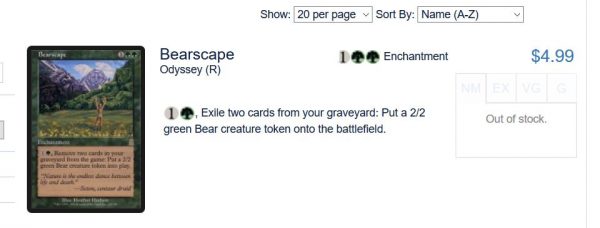
Modern Horizons's spoiler season caused some of the deepest reactionary buying I have ever seen. Slight pressure was put on the price of most Modern staples across the board, but the introduction of new synergies in Modern, and more notably Commander was absolutely unprecedented. We're living in the timeline where people speculated on Bearscape. Let that sink in. As the days wore on, the lamentations grew louder and more frequent. Even today, several Insiders claim to be experiencing "hype fatigue and more importantly, wallet fatigue."

Once Core 2020's hype cycle starts up proper there will, of course, be plenty of cards to invest in. Hopefully, it comes at a time where buyers are ready to start purchasing again, for the sake of market health and more importantly, WotC's sales figures.

Bring it on Home

So what am I saying here? If the successes of this year's product lineup are any indication, 2019 will be one of the best years in Magic's history. It's a great time to be a Magic player, but, it's probably the worst time to be a Magic player's wallet. If you're looking to park your money somewhere during spoiler season for speculations, keep in mind that there is always another opportunity around the corner with a new product release.

Actively participating in this type of buying is certainly profitable, but it comes at a cost. Investing in cards during spoiler season can tie up a lot of your resources, and if you're not careful, you risk leaving a lot of big opportunities on the table.

Exploring the New Horizon with Two Brews

Are you a Quiet Speculation member?

If not, now is a perfect time to join up! Our powerful tools, breaking-news analysis, and exclusive Discord channel will make sure you stay up to date and ahead of the curve.

With Modern Horizons fully spoiled, brewing can get into full swing. So far, my experience has been guardedly positive. There are a lot of very interesting cards and restrained designs that should reinvigorate fringe Modern decks without upending the format. Still, other cards show frightening promise.

Brewing in the Snow

I'll kick things off with snow. Between Ice-Fang Coatl and Marit Lage's Slumber, there's a lot of incentive to make snow a central theme for decks. But I struggled to find a competent shell, failing to produce an even-publishable Temur list.
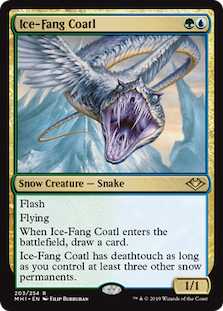
The problem with the Temur Snow lists I tried was the mana. You have to play a lot of basics to make the snow theme work. This makes the mana clunky compared to normal fetch-shock decks. Playing lots of fetchlands helps, but every fetch included is a utility land or actual land you can't play, and if I didn't have a Birds of Paradise, I couldn't hit a good curve. The longstanding problem of Temur being anemic compared to Jund was present, but it wasn't nearly as troublesome as the mana. Get the mana to work, and power can be found. Even with the surprisingly playable and necessary Arcum's Astrolabe greasing the wheel, the decks just never got going, and clunked themselves to death on mana problems.

Blood on Ice

Giving up on Coatl was difficult, but doing so paid significant dividends. Blue Moon has long been a fringe contender in Modern, and more easily accommodates the critical mass of snow permanents necessary for the payoff cards.

Snow Moon, Test Deck

Creatures

4 Snapcaster Mage
2 Vendilion Clique

Planeswalkers

2 Narset, Parter of Veils
2 Jace, the Mind Sculptor

Artifacts

4 Arcum's Astrolabe

Enchantments

2 Winter's Rest
3 Marit Lage's Slumber
3 Blood Moon

Instants

4 Lightning Bolt
4 Skred
4 Cryptic Command

Sorceries

3 Anger of the Gods

Lands

4 Scalding Tarn
4 Prismatic Vista
2 Steam Vents
2 Scrying Sheets
7 Snow-Covered Island
4 Snow-Covered Mountain

This list was fairly unreal against creature decks and almost nothing else. If Blood Moon didn't resolve, it didn't have the means to hang with counter-heavy control or ever disrupt a combo deck. I figured that would happen because I was building it as proof-of-concept rather than actual metagame deck, and in that role, it succeeded.
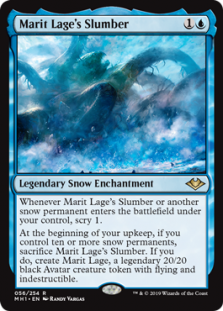
Marit Lage's Slumber is a very interesting finisher. Against control it is terrible, since they have Path to Exile and two types of Teferi to deal with the token before it attacks. It also doesn't provide the continuous card advantage of Search for Azcanta, so you'd never play Slumber in a control heavy meta. Scrying several times a turn isn't good enough in those cases. Against combo and creatures, Slumber is far better, since it threatens to win the game next turn with a massive blocker. It does take a while to fire, but in a more counter-heavy version, time would be less of an issue.

As for the snow theme, it was a bit weak, but still playable. The mana for Blue Moon has always been solid, and Prismatic Vista functions as an additional Scalding Tarn most of the time. Astrolabe proved critical to smooth out the awkwardness, and combos with Slumber to be a sorcery-speed Opt, which isn't bad. Winter's Rest is weird, but Blue Moon typically struggles against big creatures, and Rest does answer them while adding to the snow count.

Oh, The Humanity

After considerable tweaking and testing, I wouldn't end up changing anything about the Humans maindeck. I was very high on Unsettled Mariner last week, and Ranger-Captain of Eos has received some attention. While neither card was unplayable by any measure, they didn't prove themselves to be better than the current stock Humans list. Mariner would definitely make the cut in a different metagame, but it will take seismic shifts towards combo for Ranger-Captain to ever make the cut.
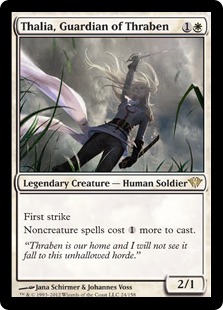
Mariner is phenomenal against any deck looking to trade removal spells for Humans, as predicted. Combined with Thalia, Guardian of Thraben, it is very possible to completely lock opponents out of the early game, and even when that's not possible, the two buy enough time for the rest of the team to get there. Even if they're not the nastiest threat on the board, opponent still needs to spend their limited mana on the Mariner and/or Thalia first, or they'll never be able to catch up. If Jeskai Control were the top control deck, Mariner would be at least a three-of in Humans' main. However, the control deck de jour is UW, which is more about sweepers. The other top decks are Izzet Phoenix, Tron, Humans, and Dredge, so there's little need for Mariner.
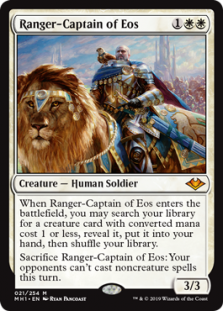
As for Ranger-Captain, the tutoring ability is okay, but not amazing. Champion of the Parish off Militia Bugler is never great, and that's realistically all Ranger-Captain finds. Tutoring is usually best used for silver bullets, and the only one that Captain can find is Burrenton Forge-Tender. Playing Eos for its stats and tutoring is asking for disappointment.

The real draw is the sacrifice ability. Stopping opponents from playing noncreature spells is, in theory, devastating against combo and control decks. Sacrificing Eos is saying "I'm going to win the game next turn." Against a combo deck, that is likely to be true, since you can only use the ability to stop them outright or after letting them use up a lot of resources but before they play their win condition. However, against control, that statement must be modified to "...if you don't also have Cryptic Command or Settle the Wreckage, I'm going to win the game next turn." The odds of that being true are far lower, and given that control is more popular than combo right now, I wouldn't play Ranger-Captain.

Siding into Danger

The sideboard is another story. Plague Engineer is just as powerful and dangerous as I imagined. I've had games where I completely lock my opponent out with multiple Engineers, and others where my Engineer backfired thanks to opposing Phantasmal Images. Given how potent Engineer is against other creature decks, I would definitely run Engineer in Humans; I'm just leery of siding it in for the mirror thanks to Image.
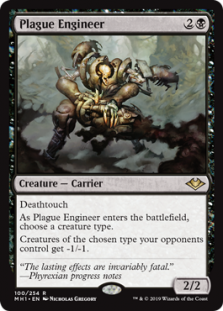
Of course, Engineer isn't the only potential inclusion from Horizons. If artifact decks make a resurgence, Collector Ouphe would make the cut. Stony Silence is incredibly powerful, but can't really be played with Humans' manabase. I wouldn't rely on Ouphe against Tron, because Damping Sphere is so powerful and useful against Amulet Titan. However, if there's a shift towards artifact combo, then a swap could be warranted.

The final human to discuss is Yawgmoth, Thran Physician. Protection from Humans makes him a theoretical mirror breaker. However, four mana is prohibitive. Also, sacrificing your creatures to incrementally shrink opposing creatures isn't great. Noble Hierarch may seem useless, but exalted is critical to force creatures through and/or make Yawgmoth a reasonable clock. The fact that you also have to pay life for the ability is risky, too, since often the mirror is about trading early haymaker damage until a board stall emerges. Yawgmoth wasn't terrible, but I didn't find him great, either.

Living the Life

The final deck I've been testing is the Life from the Loam engine. I call the engine itself a deck because you can build whatever you want around the engine and it is going to move. I've tried out prison, aggressive, and combo versions, and so far the best has been a combo/control version of Assault Loam.

Assault Loam

Creatures

4 Dark Confidant
4 Bloodbraid Elf

Planeswalkers

3 Wrenn and Six

Enchantments

4 Seismic Assault

Instants

4 Fatal Push
4 Assassin's Trophy

Sorceries

4 Life from the Loam
4 Raven's Crime
1 Worm Harvest

Lands

3 Verdant Catacombs
3 Wooded Foothills
2 Stomping Ground
2 Overgrown Tomb
1 Blood Crypt
1 Swamp
1 Forest
4 Forgotten Cave
4 Tranquil Thicket
2 Raging Ravine
2 Ghost Quarter
1 Bojuka Bog
1 Blast Zone
1 Urborg, Tomb of Yagmoth

The idea is to use Dark Confidant and Bloodbraid Elf to find the payoff cards while the unicycle lands dig for Loam. You have the most useful retrace card as disruption and lots of removal to not lose to creature rushes or Scavenging Ooze. These lists have been very hard to build, and I wouldn't actually play my shell, but their purpose was to test the viability of the Loam engine in Modern. And I'm very confidant that it is, in fact, viable.

Potent Engine

Loaming is just as powerful today as I remember it being over a decade ago. Once the engine gets going, Loam decks never run out of cards, and will find whatever they need to win. The engine is mana-intensive, but the odds of ever missing land drops in a 28 land deck are highly unlikely. Its main issue is getting it online. Surviving long enough to actually utilize all the extra cards can be tough in Modern, and my shell is not very good against creature decks. If you dredge away any removal spells, you tend to lose to Humans. This is a solvable problem if the deck is worthwhile enough to keep refining.
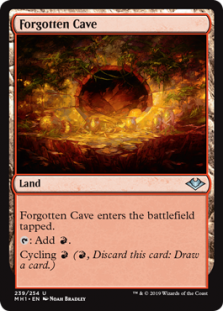
But the engine isn't enough to carry the deck alone. To use a car metaphor, I'm sticking an F1 engine into a commercial subcompact; the car has all the power in the world, but it can't actually wield it. That Assault Loam and similar decks haven't worked in Modern before has as much to do with the shells themselves as the lack of unicycle lands. The decks are land-heavy, thus frequently flooding to death, and depend on a very small number of payoffs. Thus, even with the additional consistency of eight one-mana cantrips, my Loam decks typically clunk out themselves rather than grind out my opponents.

Beneath the Leaves

Engine decks usually fail when their engines never start. Loam decks are particularly prone to this failure because without Loam, the payoff cards are pretty laughable. There's a reason that Seismic Assault is never played for simple value. Between the impending London Mulligan and the unicycle lands, it will be far easier to start Loaming. The lands alone were enough to support Extended Loam.
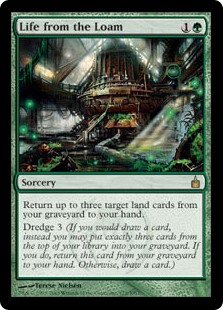
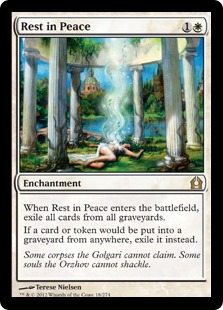
However, Modern Loam decks have to deal with graveyard hate on a scale impossible in Extended. Back then, there was only Yixlid Jailer, Leyline of the Void, and Tormod's Crypt to contend with, and only in quantity when players remembered that Dredge existed. Relic of Progenitus, Surgical Extraction, Rest in Peace, and Scavenging Ooze are everywhere in Modern in addition to Leyline. Without the graveyard, the engine can't run and the deck fails.

All Loam decks need to do to beat Surgical is hold up a unicycler to save their Loams in response. However, Rest in Peace requires an answer. Assassin's Trophy is very good at that, but Rest would still interrupt the engine. Once you have a graveyard again, it will take at least a turn to restart the engine, and losing a turn in Modern can be fatal. In short, the Loam engine is better now than ever before, but the disruption for it is also much better, and my testing was ultimately inconclusive.

New Growth

This leads me to think that if Loam wants to break out in Modern, it will need a radical redesign. Assault Loam has a very long pedigree, and I struggle to envision a deck that could utilize the Loam engine as well, but given how graveyard-hostile Modern currently is and how much more it could be, I think a new shell that attacks from multiple angles must be found.
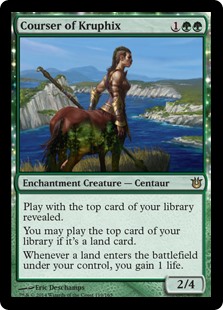
I tried out creature-heavy Aggro Loam and it didn't work. It was between a clunky Zoo deck and bad Dredge. Countryside Crusher isn't the threat it used to be. I also tried a Bant Control deck which used the Loam engine and Courser of Kruphix instead of planeswalkers for card advantage. There, the typical control arsenal didn't work well when I was dredging Loam every turn; Snapcaster Mage and Misson Briefing weren't quite enough to make up the difference, though it was very close. I also tried a planeswalker-heavy build, and it was too clunky. If the problem of running out of answers gets fixed, then Control Loam could be a real deck.

About Wrenn
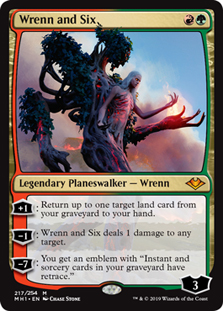
The final thing my Loam testing suggested to me was that Wrenn and Six is overhyped. Wrenn got a lot of hype when spoiled, and it makes sense. Crucible of Worlds is a good card, and Wrenn is cheaper and does other things too, all of which are potentially useful. If nothing else, Wrenn is notable as the first clearly useful two-mana planeswalker. However, I'm always skeptical about heavily hyped cards, so I've been testing him. And I'm unimpressed.

Wrenn is a mediocre card on face. Getting back a land every turn is a good, but not great, ability; see the limited play Ramunap Excavator and Crucible receive. The former is only used to replay Ghost Quarter or Horizon Canopy in GW Valuetown, while the latter is primarily a sideboard card against land destruction. The minus one will kill mana birds, but little else, and while the emblem combines nicely with the +1, retrace has never been gamebreaking.
In a Loam deck, Wrenn is playable because he's the closest substitute to Loam available, but even then he's mediocre. Again, without Loam, the deck isn't very good, and Wrenn can at least get things moving. However, he's only a third of a Loam. Also, a lot of the value of Loam is dredging every turn to find more lands, which Wrenn can't do. Loam decks will also already have a lot of retrace cards, so the emblem is slightly superfluous. Finally, he shares Loam's vulnerability to graveyard hate. Without a graveyard, Wrenn doesn't do anything.

I've only tested Wrenn in Loam, but other players I know have tried it in various non-Loam value shells and found him underwhelming. I'm told Wrenn's generally not bad, and mana-hungry decks appreciate a steady stream of lands. However, that's about all he does for them. Based on this, I think Wrenn will see play alongside Loam as a makeshift copy of the sorcery, but without Loam he's not really useful.

New Dawn

If the results from the MTGO release of Modern Horizons are any indication, Modern is due for a significant shakeup. However, it's important to remember that it's very early, and format inertia takes time to overcome. So far, I've found plenty of potential staples, though the format isn't quite right for them yet. I've also found that the Loam engine is viable and potentially quite powerful. The question is whether that power is enough given that the shells aren't obviously well-suited for Modern.


Beating the Buyouts: Reserved List Edition

Are you a Quiet Speculation member?

If not, now is a perfect time to join up! Our powerful tools, breaking-news analysis, and exclusive Discord channel will make sure you stay up to date and ahead of the curve.

Feedback continues to be positive on this Beating the Buyouts series. One reader cleverly pointed out that the one-week rule doesn’t really hold true for Reserved List cards. In fact, any cards that are older than 20 years won’t follow the one-week rule.

The reason is simple: the market supply on these cards is small and entrenched in collections and shoeboxes under beds that it takes longer for any response to a sudden spike in price. Whether the card spiking is a Dual Land or a Thought Lash, the time needed to return to equilibrium pricing—the pricing that the market is actually willing to support—is much greater.

There was an error retrieving a chart for Thought Lash

Does that mean there are no tools in the arsenal for beating Reserved List buyouts? Is this a territory that MTG finance has already won, and everyone needs to just toss their arms in the air admitting defeat? Absolutely not! With older cards, more patience is required but it’s still possible to get ahead of the MTG finance crowd.

Breaking Down the Curve

Recall the general pattern for the buyout price curve: an exponential price increase followed by a one-week retraction of about 50% from peak. While results vary case by case, waiting one week before buying a spiked card is most often the correct approach.

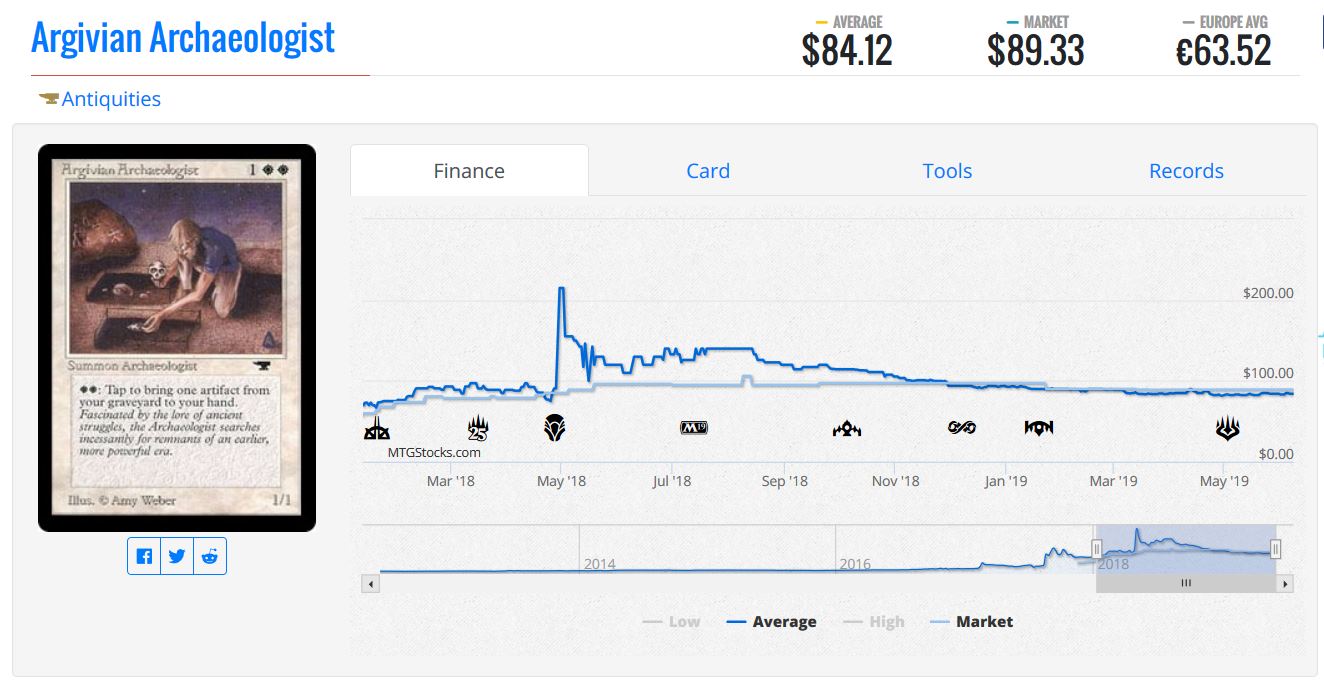
Now let’s examine the buyout curve for something far older than Bearscape: Argivian Archaeologist. This is a good case study because the playability of this white creature isn’t so great. Therefore any price spikes are not due to sudden utility in gameplay—we’re looking at a strictly collectible card here, that has been manipulated by MTG speculation.

The card barely budged in price for many years. Then during the Reserved List rush of 2018, it spiked from $90 or so to north of $200. From there, the spike retracts, just like we saw with Bearscape last week. But instead of fully recovering in a week, we see in this case a short-term retraction followed by a long-term sell-off. Two weeks after the May 2nd spike, Argivian Archaeologist was already back down to $130 or so. Fast forward a year, and the card gradually settled right back down to its previous pre-spike price.

When MTG finance personalities claim that they don’t set the market price, it’s the player base who does, they’re not wrong. Since there was minimal “real” demand for this card—it was mostly Reserved List speculators—the price should not really have changed to begin with. Speculators tried to inflate the price, but the higher price wouldn’t stick. Thus, the market price prevails. But look how long it took to happen!

Readers may push back on this example. They may argue that a more playable card’s price does permanently increase after a buyout.

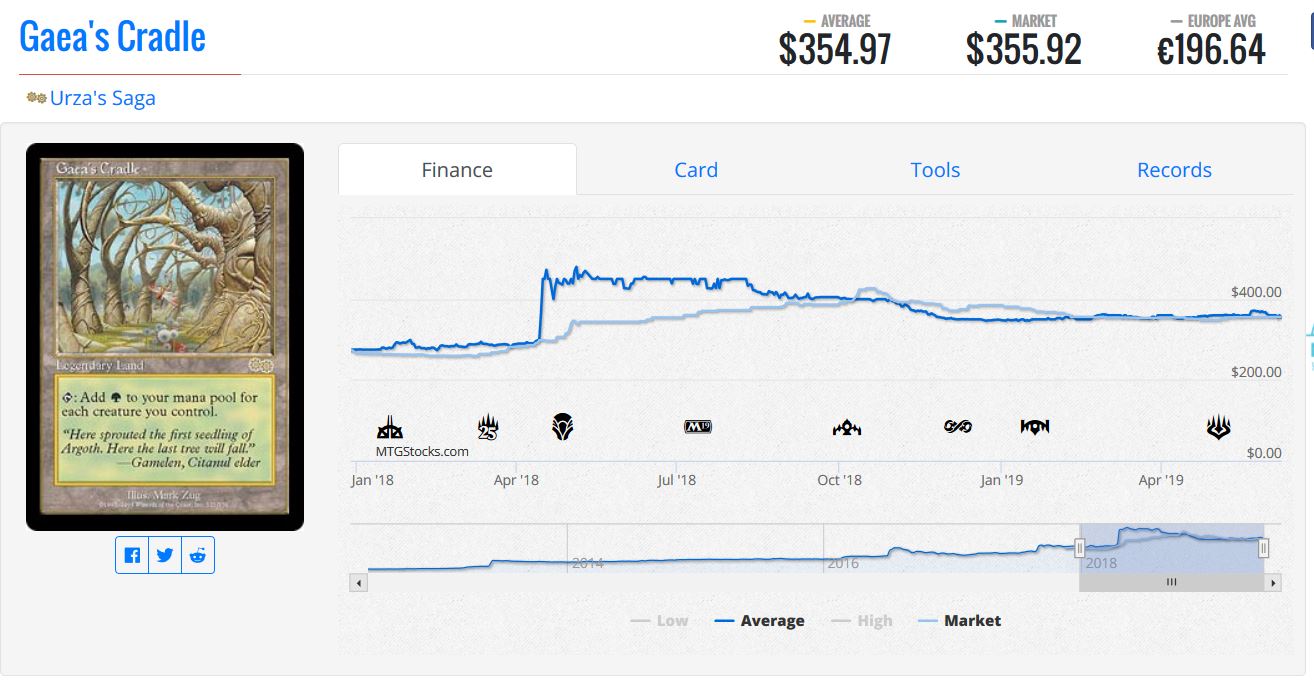
So let’s take a quick look at Gaea's Cradle, which was also swept away in the 2018 buyout craze.

Before the buyout, this was a $290 card. In April of last year, this land spiked to $430. Notice how this card’s chart deviates from that of Argivian Archaeologist. There’s virtually no short-term price retraction. There were enough FOMO (fear of missing out) buyers to sustain a $400 price tag, at least for a little while. After seven months, though, Gaea's Cradle dropped back below $400. It gradually declined until settling at around $355, where it is today. That’s about 20% higher than the pre-spiked price.

What does this mean? If there was no buyout driven by MTG finance, the natural price appreciation of this card would have probably been 22% over the course of the year. Instead of spiking and retracting, we would have seen a gradual incline as this card slowly gets absorbed into Commander decks and the like. The same end result was met, but we had to endure nearly a year of unnecessarily higher prices until the market could correct itself post-buyout.

Beating These Buyouts

This is where MTG finance can really put a sour taste in one’s mouth. Due to the rarity and age of these cards, buyouts cause a longer-lasting impact on the market. Whereas a newer card will sell off within a week, it could take months for a Reserved List card’s price to retract as much as it’s going to. Based on this data, I could recommend a one-year rule. If a Reserved List card is bought out, wait one year before buying.

That’s a long time to wait.

For those who don’t want to wait that long to acquire a Reserved List card (myself included), I have some good news! Reserved List cards haven’t spiked in a while and the one-year wait since the last spike has already passed! Anyone interested in purchasing a Reserved List card should rejoice that prices have all retracted already.

The less playable the Reserved List card, the greater the price has already retracted. If you need Dual Lands, of course, you’ll still be paying up. But even those are cheaper now than they were this time last year.

There was an error retrieving a chart for Tropical Island

I wouldn’t wait too long, though, because prices on the most desirable Reserved List cards have already started to climb in recent weeks. I’ve noticed the return of multiple Dual Lands to Card Kingdom’s hotlist. They have also been increasing their price on Mox Diamond recently, mirroring its price appreciation over the past few weeks. I don’t know if there’s going to be a mad rush on these Reserved List cards, but if you were kicking yourself for missing out on a certain card last year you’d best shop around and prioritize acquisition soon.

There was an error retrieving a chart for Mox Diamond

My only other advice on beating these Reserved List buyouts is to leverage your current Magic assets. Card Kingdom has aggressive buylist prices, and I’m sure they’ll be paying top dollar on Modern Horizons cards once they come out. Modern staples, in general, sell fairly well. You can liquidate some extras and use the proceeds to acquire those few Reserved List cards you’re needing. It sure feels better acquiring a Dual Land with store credit than paying the cash price.

ABU Games has okay pricing on their heavily played Dual Lands. You could ship some foils or Old School cards they offer huge credit bonuses on to pick up a few. I’ve been doing this myself recently. And while paying $260 in store credit for an HP Revised Tropical Island feels wrong, the pain is mitigated when you’re getting $80 in store credit for a played Unlimited Two-Headed Giant of Foriys. Would you trade three played Giants for an HP Trop? I know I would!

There was an error retrieving a chart for Two-Headed Giant Of Foriys

Wrapping It Up

When a newer card is bought out, it’s relatively easy to keep emotions in check, wait a week, and enjoy a cheaper price. This happens in most cases where the buyout is artificial and driven by MTG finance speculation.

With Reserved List and older cards, however, this approach isn’t so painless. It can take up to a year for a card’s price to retract post-buyout. That’s a long time to sit on the sidelines waiting—either the higher price has to be paid or else the card remains out of reach for a long time. Neither of these scenarios are very attractive, and unfortunately, there’s little other advice I can offer.

But there’s good news! If you’re reading this article around the time of its writing, June 2019, then the one-year waiting period has already passed! Prices are retracted, and the dollars required to buy a Dual Land or Gaea's Cradle already matches with overall market sentiment. There are currently no emotions and no speculators artificially increasing prices…for now.

My intent isn’t to incite panic buyout or speculation. Far from it. But a savvy player has to realize that prices are favorable for buying right now. I can’t promise there will be another spike, but after this one year period of calm, it would behoove prospective buyers to shop around for cards this month and make a priority call. If you can’t do it with cash, then try to use other cards to acquire store credit, which in turn can be flipped into Reserved List cards. This is a less painful way of making these acquisitions.

Ignoring this opportunity is an option, and it may be perfectly fine for your life circumstances at this moment. But just be prepared for that inevitable spike. It happens time and again, and given Magic’s continued popularity, it would be foolish to think MTG speculation and buyouts are over. When the next round of Reserved List buyouts happen, you may be kicking yourself for not acting sooner.

At that point, you’ll just have to wait another year.

…

Sigbits

  • As I mentioned in the article, Dual Lands are reappearing on Card Kingdom’s hotlist. Just this past week I saw Bayou and Tropical Island pop up on their list, with buy prices of $200 for each. I suspect there will be more to come as these are once again rebounding in price.
  • Reserved List artifacts are also hot right now. Grim Monolith’s buy price is hitting new highs, now at $120 on Card Kingdom’s hotlist. Mox Diamond’s buy price is up to $185, the highest it’s been in a while. Lion's Eye Diamond is another one, though its buy price keeps fluctuating and is at $140 at the time of this writing.
  • Two other Reserved List cards on the move are City of Traitors and Jihad. The former is a popular Legacy card, and its $145 buy price is truly merited. There aren’t many lands that tap for two mana right out the gate and even fewer that don’t hurt you when they tap. On the other hand, Jihad’s $130 buy price perplexes me. It’s an interesting card, but not all that useful. Perhaps this one is collector driven.

May ’19 Brew Report: Sticking It to ‘Em

Are you a Quiet Speculation member?

If not, now is a perfect time to join up! Our powerful tools, breaking-news analysis, and exclusive Discord channel will make sure you stay up to date and ahead of the curve.

Between the impactful War of the Spark, the approaching Modern Horizons, the looming Core Set 2020, and the approved London Mulligan, now is quite a time to be a Modern player. But that's not all—Modern's continued period of adjustment to War is yielding more novel decks weekly than I can shake a stick at. It's nonetheless my job to try, so grab the nearest branch and let's get poking!

Combo Evolution

Existing combo decks received some impressive boosts with War of the Spark. While we covered some of these in a tech review last month, more have slipped through the cracks or made themselves known in full through the May dumps.

4-Color Copy-Cat, by BOBTHEDOG (5-0)

Creatures

4 Felidar Guardian
4 Birds of Paradise
4 Noble Hierarch
4 Coiling Oracle

Planeswalkers

4 Saheeli Rai
4 Teferi, Time Raveler
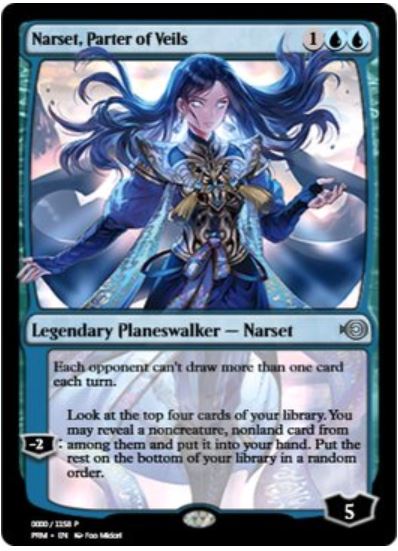
3 Narset, Parter of Veils
1 Jace, the Mind Sculptor
1 Nissa, Steward of Elements

Instants

3 Lightning Bolt
3 Remand

Enchantments

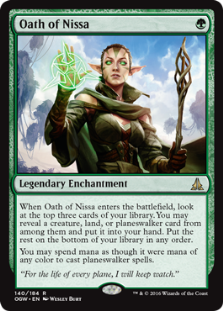
4 Oath of Nissa

Lands

1 Botanical Sanctum
1 Breeding Pool
2 Forest
1 Hallowed Fountain
2 Island
4 Misty Rainforest
1 Plains
1 Sacred Foundry
1 Steam Vents
1 Stomping Ground
1 Temple Garden
4 Windswept Heath
1 Wooded Foothills

Sideboard

3 Fiery Justice
2 Gaddock Teeg
1 Nissa, Vital Force
1 Nissa, Who Shakes the World
3 Rest in Peace
1 Scavenging Ooze
3 Stony Silence
1 Tireless Tracker

The stock, Jeskai build of Copy-Cat actually seems to have done well in May, with multiple copies popping up in the dumps. But that deck is nothing new for Modern, if historically a bit fringe. This 4-Color Copy-Cat doubles-down on its primary strategy, splashing green for additional enablers at the expense of a classically Jeskai Plan B.

From green, the deck cribs eight mana dorks and a set of Oath of Nissa to find its combo pieces. Oath is practically Ponder in this list, whiffing only on itself, Lightning Bolt, and Remand. Nissa, Steward of Elements is also hired as a creature-finder (I saw a lot of this walker in creature-based combo decks from May's published lists). Creature dorks get the nod over the more resilient Utopia Sprawl for their interaction with Oath and Steward, and push the combo to be a turn faster.
The strength of Splinter Twin was its ability to play at instant speed: if opponents tapped out at all, pilots could win from an empty board, slamming end-step Deceiver Exarch into the namesake enchantment. In other words, they needed instant-speed removal to survive.

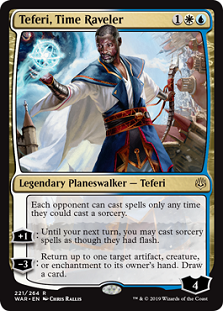
Teferi, Time Raveler also limits the window in which opponents can interact with the combo, forcing opponents to remove Felidar Guardian during their own turns, and in a main phase. But the four-mana 1/4 is not very easy to remove gracefully. A revolted Fatal Push is the cleanest available answer; Path to Exile ramps Copy-Cat into its bigger plays, like cantripping into and resolving planeswalkers. After those, spells begin to get expensive (and subsequently unplayable).

All-In Goryo's, by YAMAKILLER (24th, Modern Challenge #11875603)

Creatures

3 Generator Servant
4 Simian Spirit Guide
4 Ilharg, the Raze-Boar
4 Emrakul, the Aeons Torn
4 Griselbrand

Artifacts

4 Pentad Prism

Instants

4 Goryo's Vengeance
4 Through the Breach

Sorceries

4 Faithless Looting
3 Cathartic Reunion
3 Collective Brutality

Lands

4 Blackcleave Cliffs
2 Blood Crypt
4 Bloodstained Mire
2 Gemstone Caverns
1 Marsh Flats
2 Mountain
3 Swamp
1 Verdant Catacombs

Sideboard

3 Abrade
2 Anger of the Gods
3 Chalice of the Void
1 Fatal Push
2 Lightning Axe
2 Night's Whisper
2 Thoughtseize

All-In Goryo's represents a fundamental shift for Goryo's Vengeance decks, and one I think is here to stay. Gone are the clunky combo pieces of the old reanimator strategy, such as Nourishing Shoal; cheesing Griselbrand into play on turn two or three is good enough without the extra combat steps.

Replacing the chaff is a loaded acceleration package. Pentad Prism and Generator Servant join Simian Spirit Guide to give the deck plenty of ways to reach five mana a turn early. As permanents, these cards are more versatile than the Desperate Rituals of old, if also more disruptable via removal. On the plus side, they don't care so much about Damping Sphere and its ilk, which could previously shut down the Griselbrand decks.
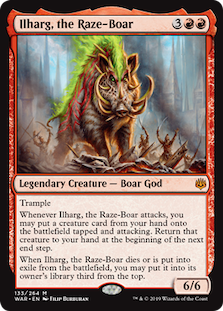
Ilharg, the Raze-Boar makes all these adjustments possible. Generator Servant can pump out the God, increasing the deck's acceleration options. And especially with haste from Servant, Boar functions as extra copies of Through the Breach, granting Grisholabrand an unprecedented level of consistency. It now has 12 payoff cards so long as it can fix them up with the right threat, and stands to become only more consistent under the accepted London Mulligan.

All-In Vizier, by ATOMIC (5-0)

Creatures

1 Vizier of Remedies
4 Devoted Druid
4 Arbor Elf
2 Noble Hierarch
1 Eternal Witness
1 Phyrexian Revoker
1 Scavenging Ooze
1 Tireless Tracker
1 Thrun, the Last Troll
1 Acidic Slime
3 Walking Ballista
1 Duskwatch Recruiter
2 Simian Spirit Guide

Planeswalkers

4 Karn, the Great Creator

Artifacts

1 Trinisphere

Enchantments

4 Utopia Sprawl

Sorceries

4 Finale of Devastation
4 Primal Command

Lands

1 Scrying Sheets
19 Snow-Covered Forest

Sideboard

1 Walking Ballista
2 Damping Sphere
1 Ensnaring Bridge
1 Liquimetal Coating
1 Mycosynth Lattice
1 Pithing Needle
1 Ratchet Bomb
1 Sword of Fire and Ice
1 Sylvok Replica
4 Tormod's Crypt
1 Wurmcoil Engine

In keeping with the theme of putting all eggs into a single basket, All-In Vizier forsakes additional colors and goes mono-green even adapting a snow-land engine, with the introduction of new enablers and payoffs. The former set includes Finale of Destination, an expert tool at finding the right creature at the right time. Its graveyard-searching clause lets All-In Vizier run just a single copy of its namesake threat, instead packing more bullets and raw power.

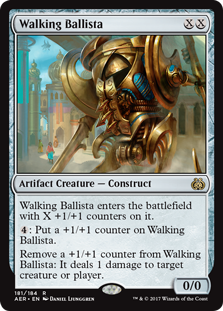
Speaking of power, Walking Ballista appears here in maximum quantity, with a functional sixteen copies in the main—once this deck does achieve infinite mana via Vizier and Druid, which it's tailor-made to do as fast as possible, any of those cards ends the game on the spot. Besides, Ballista is just good in general for a ramping strategy, especially against the disruptive aggro decks that can otherwise pose hurdles for combo (i.e. Humans).
The same goes for Karn, the Great Creator, who here digs Ballista out of the sideboard when going off. The rest of the time, Modern's fastest-rising planeswalker locates surgical hate cards and answers to an opponent's: Sylvok Replica, welcome to Modern! In lieu of the combo, but given an abundance of mana, Karn offers the Mycosynth Lattice lock, a functional win in most game states for the low price of ten mana split over two turns.

All-In Vizier features bullets in the main, too, as Primal Command and Finale help find them fast in the right matchup. Revoker, Ooze, Thrun, Tracker, and Slime all have their applications in different pairings, while the miser's Trinisphere offers free wins when it works against the likes of Phoenix.

Midrange Masters

Perhaps Modern's most beloved super-archetype, midrange has existed here since the format was inaugurated. Many, including myself, have prematurely forecasted the "end" of this archetype-wheel staple more times than I care to recount. But while midrange is evidently not going anywhere, it's also not content to sit still; the May dumps indicate plenty of movement even within the strategy's known quantities.

Esper Blink, by ZXROGUE (5-0)

Creatures

2 Restoration Angel
4 Snapcaster Mage
3 Spell Queller
1 Vendilion Clique

Planeswalkers

2 Narset, Parter of Veils
1 Teferi, Hero of Dominaria
3 Teferi, Time Raveler

Instants

2 Fatal Push
4 Path to Exile

Sorceries

2 Collective Brutality
3 Inquisition of Kozilek
4 Lingering Souls
4 Serum Visions
2 Thoughtseize

Lands

2 Creeping Tar Pit
2 Darkslick Shores
4 Flooded Strand
2 Godless Shrine
1 Hallowed Fountain
1 Island
1 Plains
4 Polluted Delta
2 Shambling Vent
2 Swamp
2 Watery Grave

Sideboard

2 Ashiok, Dream Render
1 Ceremonious Rejection
3 Dovin's Veto
1 Kalitas, Traitor of Ghet
1 Kaya, Orzhov Usurper
1 Liliana's Triumph
2 Supreme Verdict
2 Surgical Extraction
2 Unmoored Ego

Esper Blink gets its name from Restoration Angel, a standby of blink strategies. But its most critical synergy occurs between Spell Queller and Teferi, Time Raveler. The walker prevents opponents from casting the spell, which would be put onto the stack at instant speed should they kill Queller, making the Spirit something of an undercosted, 2/3 counterspell.
I expect this package to gain traction in different archetypes, as it's made up of otherwise playable cards in the same color anyway. So far, the May decklists show it cropping up in Spirits as well as UW Control. It makes sense for a midrange deck to toss in Restoration Angel, further going over the top of other fair decks; blinking Queller with Teferi out permanently exiles the first spell, even should opponents manage to remove Teferi down the road, and nabs a new one. Adding more credibility to the principle, ZXROGUE isn't even the only player who succeeded on Esper Blink last month.

Mardu Tokens, by LILIANAOFTHEVESS (5-0)

Creatures

3 Bedlam Reveler

Planeswalkers

4 Saheeli, Sublime Artificer
1 Kaya, Orzhov Usurper

Artifacts

4 Mishra's Bauble
2 Runechanter's Pike

Enchantments

2 Blood Moon

Instants

2 Fatal Push
4 Lightning Bolt
1 Lightning Helix

Sorceries

1 Angrath's Rampage
1 Collective Brutality
4 Faithless Looting
4 Inquisition of Kozilek
3 Lingering Souls
3 Thoughtseize

Lands

4 Blackcleave Cliffs
2 Blood Crypt
4 Bloodstained Mire
4 Marsh Flats
2 Mountain
1 Plains
2 Sacred Foundry
2 Swamp

Sideboard

1 Angrath's Rampage
1 Blood Moon
1 Collective Brutality
1 Kaya, Orzhov Usurper
2 Anger of the Gods
2 Damping Sphere
4 Leyline of the Void
2 Pithing Needle
1 Wear // Tear

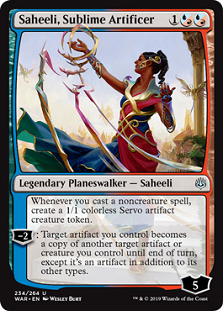
Mardu Tokens gets a promising upgrade in Saheeli, Sublime Artificer, a much-tougher Young Pyromancer that also turns tokens into Reveler clones for extra prowess points. Bedlam Reveler's role here is to gas players back up after a series of one-for-one trades, just as in the old Mardu Pyromancer decks. And Mishra's Bauble triggers both Saheeli and Reveler, as well as "hiding" cards from the Devil's "discard your hand" clause. The most suspicious card is Runechanter's Pike, which I suppose can help generate fast wins against linear combo while tossing damage over gross battlefields with some help from a 1/1 Spirit token.

Broodlord Rock, by LUCKY-DRAGON (5-0)

Creatures

4 Fulminator Mage
4 Dark Confidant
2 Knight of Autumn
1 Nissa, Vastwood Seer
2 Plaguecrafter
2 Scavenging Ooze
1 Shriekmaw
4 Tarmogoyf
2 Tireless Tracker

Planeswalkers

3 Sorin, Vengeful Bloodlord

Instants

2 Assassin's Trophy
4 Fatal Push

Sorceries

2 Inquisition of Kozilek
3 Thoughtseize

Lands

4 Blooming Marsh
2 Forest
1 Godless Shrine
3 Marsh Flats
2 Overgrown Tomb
1 Plains
3 Shambling Vent
2 Swamp
1 Temple Garden
1 Twilight Mire
4 Verdant Catacombs

Sideboard

2 Assassin's Trophy
1 Ashiok, Dream Render
2 Choke
2 Damnation
2 Nihil Spellbomb
1 Nissa, Vital Force
3 Stony Silence
2 Surgical Extraction

Broodlord Rock is a BG Rock deck built around Sorin, Vengeful Broodlord. Its creature selection has been warped around the walker, aiming to maximize the value gained from reanimating dudes as vampires. Fortunately, the creatures seem mostly reasonable, with Fulminator Mage leading the charge.

GR Dragons, by CAVEDAN (5-0)

Creatures

4 Glorybringer
2 Stormbreath Dragon
1 Thundermaw Hellkite
1 Verix Bladewing
4 Bloodbraid Elf
4 Arbor Elf
3 Birds of Paradise
2 Gruul Spellbreaker
2 Tireless Tracker

Planeswalkers

3 Kiora, Behemoth Beckoner
2 Domri, Anarch of Bolas
1 Sarkhan, Fireblood

Enchantments

4 Blood Moon
4 Utopia Sprawl

Instants

1 Lightning Bolt

Lands

1 Kessig Wolf Run
1 Misty Rainforest
9 Snow-Covered Forest
1 Snow-Covered Mountain
3 Stomping Ground
2 Verdant Catacombs
1 Windswept Heath
4 Wooded Foothills

Sideboard

2 Lightning Bolt
1 Abrade
1 Ancient Grudge
2 Anger of the Gods
1 Chameleon Colossus
1 Damping Sphere
1 Flame Slash
1 Grafdigger's Cage
2 Relic of Progenitus
1 Ruric Thar, the Unbowed
2 Scavenging Ooze

GR Dragons is a stompy deck that accelerates into Blood Moon, then bashes face with huge dragons. It's lower to the ground than Ponza, bringing it closer in application to my own GR Moon builds. The dragons are less efficient than Goyf or Rabblemaster or Hazoret, though, requiring a re-tool and giving me the impression this deck could be improved.

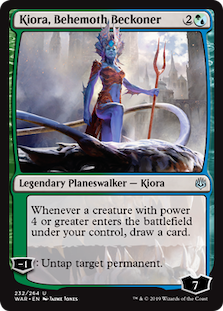
Focusing on what's here, though, Sarkhan Fireblood makes a requisite cameo. Without Looting, I'd think the card selection Sarkhan provides would prove of utmost importance, not to mention the walker's +1 ramping into dragons. But Fireblood takes the backseat to Kiora, Behemoth Beckoner, another walker tailor-made for this sort of deck. Not only does she generate raw card advantage via cantripping dragons, Kiora also functionally ramps into the deck's fatties by untapping lands—hopefully, ones enchanted by Utopia Sprawl.

Horizon Falls

By this time next month, Modern Horizons will be Modern-legal, and we should have plenty of new tech to unearth. Until then, take solace in the apparent fact that Phoenix's iron-fisted reign has ended, and Modern is as bursting with innovation as ever!

June Financial Update: Treasure Chests & Modern Horizons

Are you a Quiet Speculation member?

If not, now is a perfect time to join up! Our powerful tools, breaking-news analysis, and exclusive Discord channel will make sure you stay up to date and ahead of the curve.

Welcome back, folks.

If you haven't already done so, check out last week's article which discusses the major update that goes live this week with the release of Modern Horizons. Today I'm going to bring us up to speed on the changes to the treasure chests as well as offer my perspective on the financial side of what we're likely to see with Modern Horizons. Modern Horizons will follow a different financial trajectory on MTGO than in paper, and it's important to understand the difference.

I. Treasure Chest Update

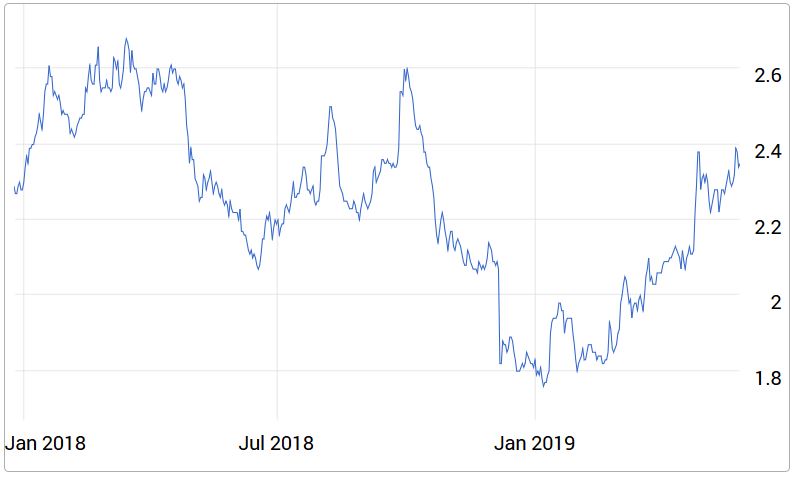
Treasure chests are now worth 2.42 tix, their highest value since October of last year. After bottoming out around 1.80 tix in January, they've been on a steady climb upward. Courtesy of Goatbots' chart:

There are several reasons why treasure chests have been on a steady rebound. Most obviously, there is renewed confidence in MTGO; the panic selling is over; the reduction of the player base because of Magic Arena's release is over; players have been returning to MTGO to play older Constructed formats, and that has been the main driver behind the resurgence in chest prices. Modern remains the most popular format on MTGO (league numbers ~2000); Standard is second (~750); Legacy third (~500); Pauper fourth (~500). However, there are some other notable changes to the treasure chests that have boosted the value of treasure chests.

Japanese Planeswalkers

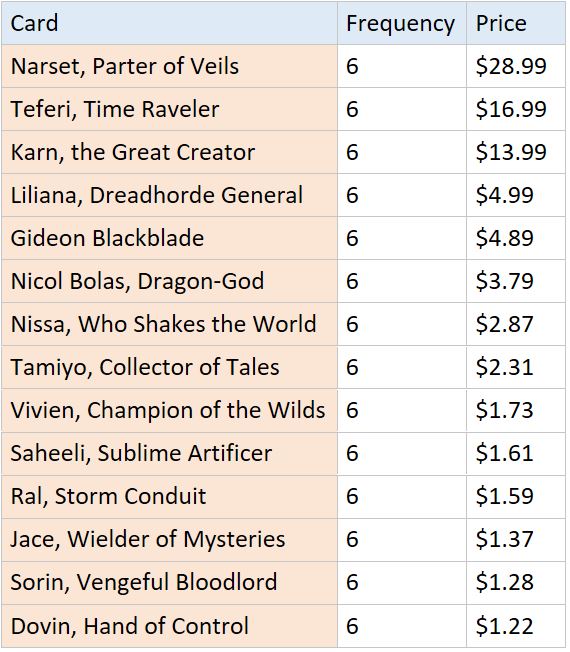
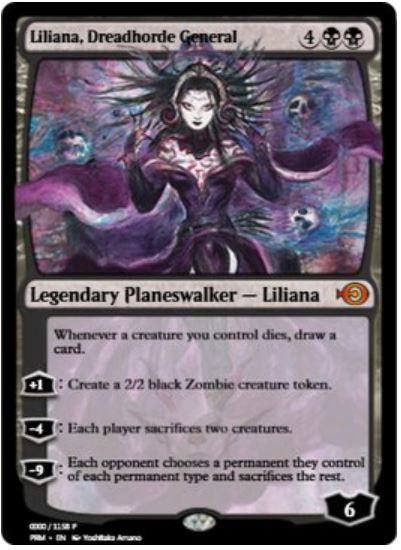
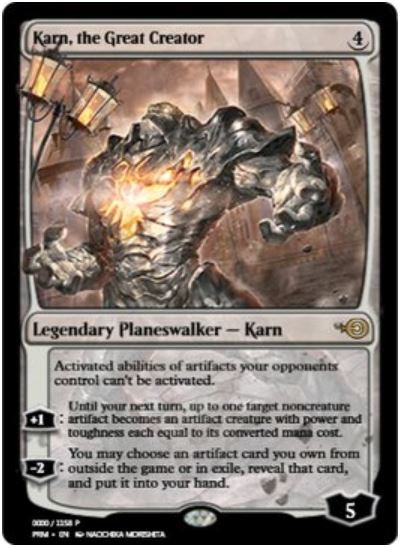
Magic Online is now infusing more value into the treasure chests via premium alternate arts than ever before. This has undoubtedly boosted treasure chest value. Everything from Ultimate Masters Box Toppers to Guilds of Ravnica: Mythic Edition Planeswalkers have made their way into the treasure chests over the past six months. I like this move overall since it props up chest values without exerting as much downward pressure on regular cards as treasure chest printings usually do. Below I've compiled a list of all the Japanese planeswalkers selling for more than 1.00 tix on MTGO:

Should I Invest in these? The short answer is no, not at this time. Demand is high for them, but they are nowhere near peak supply. They are being released into the wild at a low frequency (a curated frequency of 6 is on the lower end), but they will continue to pour in for at least another few months. This question will be worth revisiting around the release of Core 2020.

It is interesting that some like Narset and Nissa are overperforming their non-promo versions by a lot, yet others like Teferi and Karn are worth only a few more tix than their non-promo versions. I'm not entirely sure what to make of this disparity, but it is worth noting that you can play with some of these without paying a huge premium to do so. They're sexy, so if you want to play with them don't let anyone stop you!

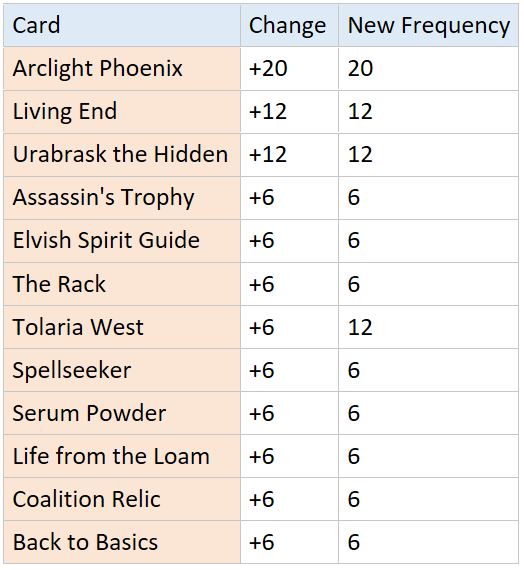
Biggest Gainers

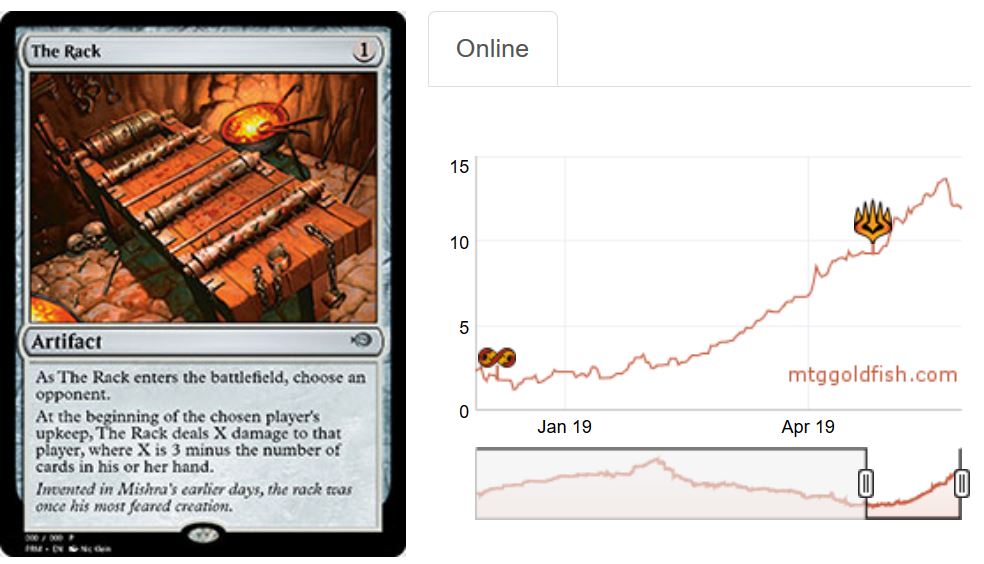
Inclusion on this list typically means that you should sell them because their price is going to take a tumble, but the modest frequencies on several of them have kept their price from tanking. Some, like The Rack, continue to go up as the deck increases in popularity in Modern.

The headline inclusions, though, are Arclight Phoenix and Assassin's Trophy, two premier cards no longer draftable on MTGO. A frequency of 20 exerts a lot of downward pressure on a card, and that's most likely the biggest reason why Arclight Phoenix has taken a tumble from 55 tix to 35 tix over the past few months. If I'm playing Arclight Phoenix in Standard and Modern I'm not a seller; the price may even rebound once Modern Horizons goes live because demand for Modern will pick up. But I don't like holding this card as an investment. Assassin's Trophy is a fine hold for players and investors alike.

Biggest Droppers

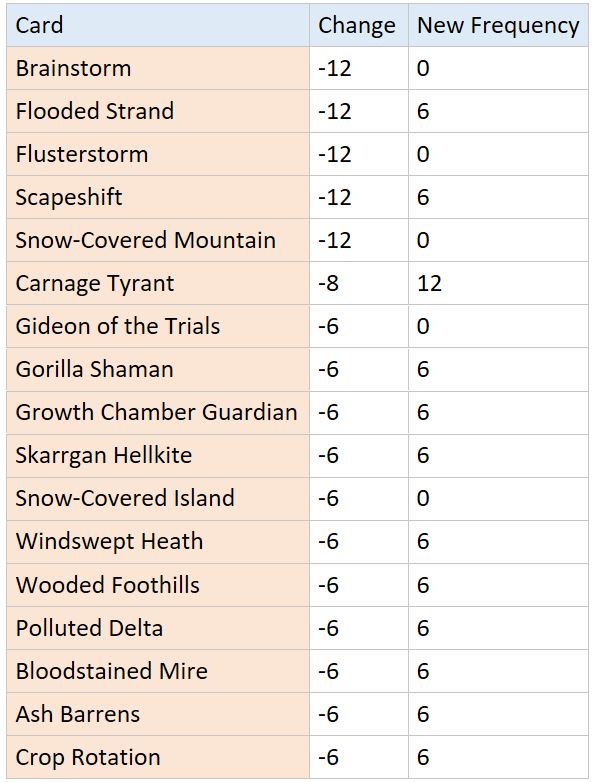
There's a decent amount to unpack here. Remember that a decrease in frequency means that these cards will be opened less in the treasure chests, giving their prices a greater chance at stabilizing or making a recovery. Some of these changes were made in anticipation of Modern Horizons (Flusterstorm and the snow-covered lands). Others were made because enough supply has entered the market that inclusion in the chests doesn't help the chests' overall value anymore (Crop Rotation, Brainstorm, and Ash Barrens).

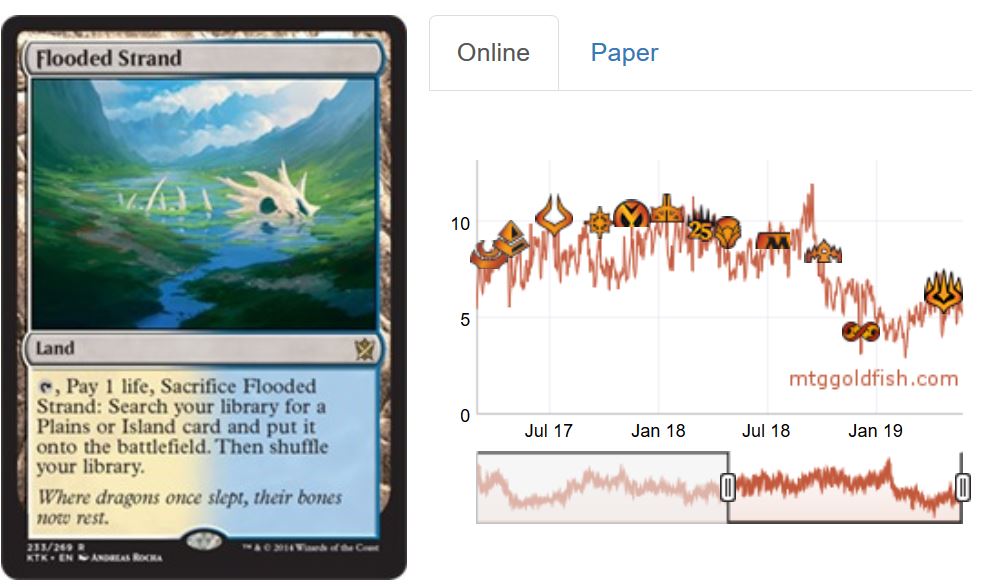
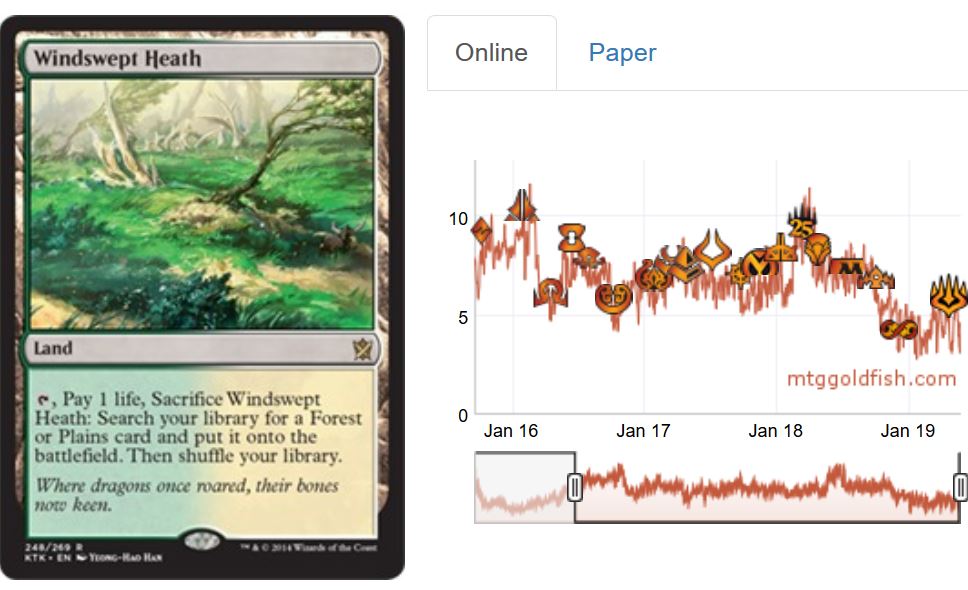
From an investor's perspective, the most interesting cards on this list are Scapeshift and the Khans fetches. I'd counsel against buying Scapeshifts you don't intend to play with because it was reprinted in Core 19 and still has a frequency of 6. I don't see much room for growth, and I expect the card to remain stable in between 0.75 tix and 1.75 tix going forward. The Khans fetches though....now those are interesting!

The prices of the Khans fetches are at three or four-year lows. They were included in treasure chests right from the very start, and for the first time, they're getting rolled back from a frequency of 12 to a frequency of 6. Their price held relatively steady for years, then toward the end of last year, their prices fell by 50% along with the rest of MTGO. Now that they're showing signs of recovery and with Modern Horizons being released in a few days, many players want to know whether now is a good time to buy. My belief is that you should pick these up if you have any holes missing in your collection, but I wouldn't invest in them. The return-on-investment (ROI) might one day reach 100%, but you'll have tied up your capital for far too long to get there. If you're like me and don't own a playset of each though, now's a good time to change that.

II. Modern Horizons Information

Secluded Steppe by Noah Bradley

Modern Horizons comes out on Thursday and with it the usual array of events -- Sealed, Intermediate Draft, and Phantom Draft. Phantom Draft uses the new and improved prize structure I discussed last week. The others remain unchanged.

New this time is the ability to get a discount on the non-phantom events by buying "The Modern Horizon Bundle" for $50. Purchasing this bundle gives you 2.5 drafts at roughly a 20% discount and throws in a Flusterstorm and Serra Angel avatar for free. If you were thinking of buying event tickets, this is a much better option instead if you intend to draft; you may have missed the opportunity to buy tickets at a 20% discount, but there will be no better way to put money into MTGO over the coming months so I recommend this bundle. I'll be buying one or two myself, since I love drafting, and the only thing better than drafting is drafting at a discount.

III. Signing Off

As always, leave your comments down below or message me in the QS Discord if you have any questions. I hope Modern Horizons will be a blast. It hits all of the right nostalgia notes for me, and it looks like a draft environment ripe for exploration and trying new things. Next week I'll be taking a deep dive into MTGO's best-kept secret in 2019: drafting on MTGO is now cheaper than it has been in years and you should be doing more of it. Thanks for reading and I'll see y'all next time.


Bringing Big Business Practices into Your Business, Part 1

Are you a Quiet Speculation member?

If not, now is a perfect time to join up! Our powerful tools, breaking-news analysis, and exclusive Discord channel will make sure you stay up to date and ahead of the curve.

With the advent of TCGplayer opening up to anyone who wants to own an online store without a brick-and-mortar location, numerous people have opened started Magic card businesses out of their apartments/dorm rooms/homes. However, many of us, myself included, do not have any formal business training. That being said, I've worked for various companies since graduating from college, and I've picked up some useful strategies many large corporations use.

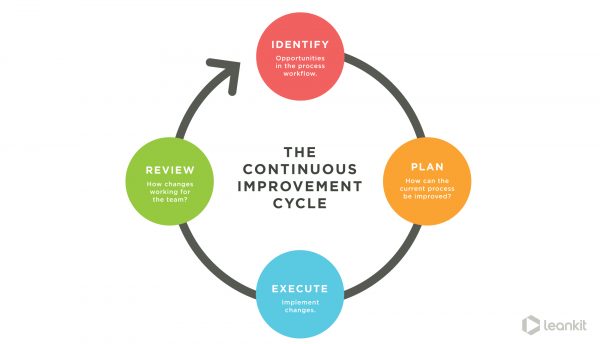
Continuous Improvement

This is arguably one of the biggest practices many big businesses employ. The basic principle is that no business system is optimized. By always looking for ways to improve and streamline the business, you eliminate waste and cut costs, which means larger profits. Most credit the Japanese automotive industry, specifically Toyota, with pioneering this idea, which has since swept through every industry in existence to some degree or another.

Metrics

One important factor with Continuous Improvement is that you can't improve what you don't know, which is why in order to properly improve you need to create metrics to track performance. With said metrics, you can now propose modifications and compare the results to determine your level of improvement. What does this have to do with Magic finance you might ask?
Assuming you own a TCGplayer store, here are things you can track:
  1. How long does it take you to package an order?
  2. How much do you spend on the packaging?
  3. How much time do you spend acquiring new inventory?
  4. How do you track your sales?
  5. What is your actual profit margin when all expenses are accounted for?
  6. What format do you tend to sell the most cards for?
The answers to these questions are trackable metrics and once you start tracking them, you may be very surprised by the results. The first goal of this exercise is to highlight any obvious issues, which might really stand out when you actually account for everything. The second is that once you have a baseline, you can now look for ways to optimize parts of your business operation.

How long does it take to package an order?

For example, let's say we dig into the metric of how long it takes you to package an order. The first thing we need to do is break down our procedure into all the steps and time them. For those interested in the manufacturing world this is called the "takt time".
  1. Gather the card(s) (60 seconds)
  2. Put into penny sleeve (2 seconds)
  3. Place penny sleeve into top loader (2 seconds)
  4. Tape top loader closed (1 second)
  5. Pull envelope (3 seconds)
  6. Print off packing slip (1 second)
  7. Write return address on envelope (1 second)
  8. Write delivery address on envelope (2 seconds)
  9. Place order + packing slip into envelope (1 second)
  10. Seal envelope (1 second)
  11. Place stamp on envelope (1 second)
  12. Place envelope in mailbox (120 seconds)
This process 194 seconds (or 3 minutes 14 seconds). Now, several of these steps take such a small amount of time that speeding them up or eliminating them may not account for much. However, there are two obvious steps that take a lot of time which are the first and last steps. Let's break those down and see if we can optimize them.

Step 1 (60 seconds)

Gathering the cards for your order can be tedious if you don't have your inventory organized well. For more details on that, I have previously written an entire article about inventory management.

In this instance, let's assume that you have your inventory in binders and you have to leaf through them to find the card someone has ordered. Taking one minute to find a card really doesn't sound all that bad until you consider what happens if you scale your business up. What happens if you have to fill thirty orders a day? What about fifty orders? There can be a significant time investment in organizing your inventory up front. However, you will save yourself a lot more time afterward and it will allow you to track your inventory easier.

So, instead of keeping your inventory in binders, what happens if you keep it in boxes separated by color alphabetically? Now that sixty seconds becomes ten seconds.

Step 12 (120 seconds)

Let's say you package your order and then walk out to your mailbox, place your envelope in the mailbox, raise the flag, and walk back inside. The obvious way to save time would be to do this once per day and bring up all your packages at once, thus spreading the time cost amongst all your packages.

If you sell five cards in one day, you can divide that 120 seconds by five and now your travel time is down to 24 seconds per package. But perhaps we can go further. If you make sure you have all your packages ready in the morning before you leave for work, you can simply bring them with you and drop them off in the mailbox on your way out the door, thus reducing your average trip time one second.

How do you track your sales?

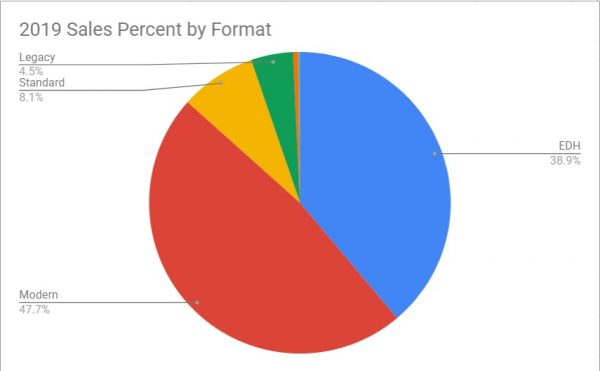
While optimizing your process may seem pretty obvious, what about tracking your sales? First, you might ask yourself why it matters? After all, TCGplayer has a handy calculator that tells you how much you sold between any given time period and they send you money every few days from your sales. I keep a running spreadsheet for all my Magic revenues and expenses, which includes all purchases, all sales, all fees and expenses, the profit margin per transaction, and what format each card was most likely purchased for. Below is the constantly adjusting graph of the sales by format.

The biggest benefit I get from this graph is that it lets me know what kinds of cards I should focus on picking up. As you can see a large majority of my sales are for Commander and Modern purposes. Note that I don't buy a lot of Standard cards for resale to begin with, so it's expected to be a smaller piece of the pie.

What is most interesting is that I predominantly focus on Commander (or EDH for us purists) as that is what my local players tend to want and that is what they tend to have for sale. Yet this year so far, I've sold a lot more Modern cards. Looking over this graph, it appears that I should put emphasis on picking up Modern staples from my local players more than I currently do, given my sales success with the format.

Conclusion

While many view the MTG economy as very niche, the fact is that it has grown dramatically in the past 10 years. Even still, growth continues to be steady. This means that more and more competition will be likely to enter the marketplace. In order to survive and thrive, businesses will need to look at how to cut costs, optimize processes, and continuously improve.

Power Overwhelming from the Modern Horizon

Are you a Quiet Speculation member?

If not, now is a perfect time to join up! Our powerful tools, breaking-news analysis, and exclusive Discord channel will make sure you stay up to date and ahead of the curve.

With Modern Horizons now fully spoiled, it's time to wrap up this series of spoiler articles. Last week, I said that the set was a bit underwhelming. At the time it looked like a Standard set with some added complexity. Immediately afterward, the most potentially powerful cards in the set were revealed, causing me to eat my own words.

Onslaught Cycle Lands

Since they were revealed, the enemy-colored Horizon Canopy cycle has received a lot of press. It makes perfect sense; Canopy is a great card and used in many decks. It fixes mana and can be cycled late game, which makes it a contender for best land ever. Now more decks have access to the effect, and it stands to reason that it will rock the format. However good the new Horizon lands actually are, they're not the most powerful lands in Modern Horizons. They're very good, but they'll never be broken or abusable; they cost too much time, both in mana and land drops.
The reprinted Onslaught unicycle lands, on the other hand, have been absurd before and may be so again. The unicyclers always come in tapped, which isn't good in Modern. However, being lands is more of a bonus. They're meant to be cycled and increase velocity . This is similar to the Horizon lands, but cycling doesn't require a land drop. Instead, these cards combine with Life from the Loam to produce a card advantage engine that cannot be out-grinded. Every turn, interested pilots can draw up to n-2x cards, where n is the number of lands they control and x is how many times they cast Life.

Loam Is Real

When the bicycle lands were debuted in Amonket, my testing showed that they were not good enough for Modern. The mana investment was too high, the engine too inefficient, and the rest of the shell too dependent on the engine to be functional. I predicted then that it would take the unicyclers to make it work. Shaving a mana off anything makes it far more powerful (consider Counterspell vs. Cancel), and when it's part of an engine, the increase is exponential. Therefore, I feel very confident that Assault Loam is a real deck now.

History supports this theory. Loam decks proved a force in Extended for as long as Onslaught Block and Ravinca were legal. And this was a format where Mind's Desire and Chrome Mox were legal, graveyard hate was almost non-existent while dredge and Ichorid ran free, and Affinity had artifact lands. Loam's run started as a prison engine in CAL, evolved into Assault Loam, and survived until the end of its legality. Modern is a very different format form old Extended, but if the Loam engine could hang back then, it may well still be good.

Drifting Away

Loam isn't the only deck the unicyclers could resurrect. Astral Slide is a beloved deck that never had much impact beyond its Standard run, and now has another chance. Back when I was first getting into competitive Magic, Slide was a powerful and plodding board control deck that used the namesake card to contain opposing creatures, cheaply un-morph its own Exalted Angels , and then close the game with Lightning Rift and Decree of Justice. It never had much impact outside of Standard because it was so slow, and Living End fills a very similar role, but is faster. However, I know a lot of players that loved Slide back in the day and lamented that Modern doesn't include Onslaught block so they could keep playing their deck.

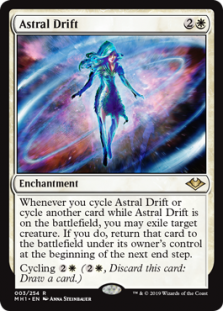
Astral Drift is Slide with upsides, and with the unicyclers back there's potential for a resurrection. However, several problems need to be overcome. First and foremost, the speed problem must be solved. The old Slide deck was glacial, and a reborn version would still need to tap out for a three-mana enchantment that does nothing on its own. If you're still alive by then, you start cycling cards to dig you deeper and blink out attacking creatures.
This brings me to the second problem, one of payoffs. Lightning Rift was cheap to cast and activate. The best analogue is Faith of the Devoted, which isn't as versatile and costs more. Same problem with Drake Haven. Even if those weren't big enough hurdles, why not just play Living End? It offers the same durdly gameplay, but adds competitive precedent.

Snow-Thing Awakens

The other big problem I previously mentioned was a lack of reasons to play snow card. The snow basics are essentially free, but the actual spells required a lot of hoop-jumping to make work. There needed to be more of a reason than Ice-Fang Coatl to bother. That reason has appeared in Marit Lage's Slumber.

As a fixed (uncheatable) version of Dark Depths, Slumber is notable first as a signal that Depths isn't getting unbanned, which is for the best at this point. Secondly, it may end up an exceptional control card. As a two-mana blue enchantment, it directly competes with Search for Azcanta. This is not a fight many cards would relish, but I think Slumber has a chance. Search only triggers once, on your upkeep. Slumber triggers whenever a snow permanent hits play. Combine the basics and some snow creatures and you can scry multiple times a turn. Secondly, the payoff for flipping Search is recurring card advantage. Slumber potentially wins the game outright. Not many decks will be able to make Slumber work, but the one that can may be greatly rewarded. The only control deck that already relies on basic lands is Blue Moon, so that's where I'd start testing.

The Best Thalid-Ninja-Hound Ever

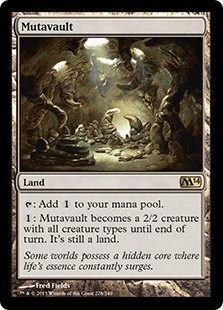
Prior to Modern Horizons, Mutavault was the best changeling in Magic. Considering the competition, that wasn't a hard-fought victory; Chameleon Colossus and Mirror Entity see some niche play, but always in small numbers. Mutavaultmust now step down from its throne, because Unsettled Mariner is absurd. Every tribal deck that can run this card should be doing so.
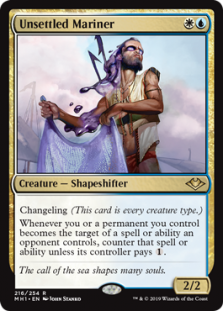
The fact that it benefits from and triggers any tribal synergies is good, but if that was the only criteria, then Mothdust Changeling would see play. It's the ability that makes the Mariner. Mana Tithe-ing anything that targets your creatures is worse than hexproof, but not everything can be Spirits. It's still a very powerful ability that very effectively protects your creatures for two mana.

Spot removal in Modern is meant to break up attacks and slow down creature rushes before the more powerful cards come down. It frequently takes several in a turn to survive a tribal onslaught, and Mariner makes that a difficult task. Midrange and control will struggle against this card, and I predict they go more sweeper-heavy to compensate.
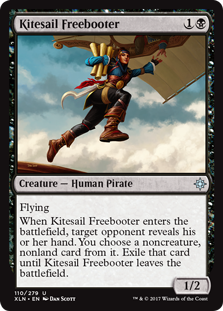
However, that's not the only benefit of Mariner. It also protects you. This gives him utility against combo decks that similar protective creatures like Kira, Great Glass-Spinner cannot match. While most tribal decks are already fine against combos like Storm, they tend to struggle against Valakut, the Molten Pinnacle. With Mariner out, Valakut can't just go for the kill; they must remove it or have enough mana to pay for all the taxes. This is achievable, but takes extra time. And time is all a tribal deck needs to win.

How Many?

However, there is a question of how many to run. Against another creature deck or Tron, Mariner is just a bear. The current metagame doesn't have a lot of targeted removal or combo win conditions. It is great against Dredge, since each Conflagrate target gets its own trigger. It also forces UW to actually hit its sweepers on curve rather than banking on Path and Detention Sphere buying time.
I would run a full set in UW Merfolk because it's perfectly on-curve and replaces Kira, but I'm not sure about other decks. Humans' maindeck is fairly set, with one permanent flex slot. Thalia or Kitesail Freebooter sometimes get shaved if the metagame is unfavorable.  That's not much room there, and Mariner is the kind of card you maindeck. It's decent but very medium in the sideboard, and Humans' sideboard is already stacked. Mariner is good enough for Humans, but the metagame question will dictate how many the deck needs to pack.

Sick Machinations

Sticking to the subject of Humans, we've also received Plague Engineer. Following in the tradition of Prime Speaker Vannifar and Cabal Therapist, Plague Engineer is Engineered Plague (see what they did there?) given legs to power it down. Humans has been highly successful for approaching two years now (thanks to favorable metagame conditions), so it makes sense to curb it with anti-tribal hate. However, Wizards clearly didn't want it to be too hateful. Tribal decks are a cornerstone of Modern, so I appreciate Wizards making a more counter-answerable version of Plague.

That said, I doubt that Engineer will see widespread play or do much to actually curb Humans. Engineer costs three, and by then Humans can grow enough for Engineer to merely shrink them rather than wipe the board. Any subsequent Thalia's Lieutenants or Thalia, Guardian of Thrabens will die on entering, but that won't stop them from growing already-existing copies of Champion of the Parish or Lieutenant. Humans also plays a lot of answers in Reflector Mage, Dismember, and Deputy of Detention, so relying on Engineer is very risky.

Where I see Engineer seeing play, ironically, is in Humans. Right now, Humans struggles against other go-wide tribal creature decks. Thanks to Noble Hierarch, Engineer can land on turn 2 and devastate against Elves, Goblins, and sometimes even Spirits. Most of the creatures in Affinity and Hardened Scales are constructs, so an accelerated Engineer is quite good there too. The tribal hate card may end up significantly boosting the best tribal deck.

Things Get Weird

However, the problem with Humans relying on Plague against creature decks is the mirror. The Humans mirror is either decided by one player going off with multiple Thalia's Lieutenants or by dominating tempo with Reflector Mage. It's not the worst creature mirror (Merfolk is), but it is very frustrating and slightly brainless. Plague Engineer promises to stifle the former by shrinking the team and killing any subsequent Lieutenants before they can grow, which is a very strong plan without downside since Engineer isn't symmetrical.

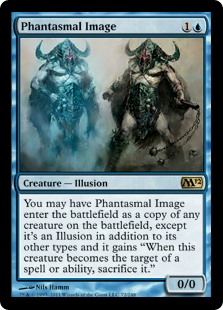
But that clause may also be the Engineer's downfall. Another part of the Humans mirror is Phantasmal Image. Image copying opposing Lieutenants and Mages is incredibly good, and is a reason there's some fear about making the first move in the mirror. It is often necessary to play Mage or Lieutenant to get the deck moving. However, doing so provides a very tempting option for Image, and that card is a four-of. If your opponent is missing a critical card, it's often a good idea not to play yours so their Image can't get them back into the game. You want to do exactly enough to win, but not enough to let opposing Images wreck you.
Engineer further complicates such circling. There's almost certainly not room in the Humans sideboard for more than two Engineers, or three in a tribal heavy meta. That means the odds will always be better for the opponent to have Image than for you to have Engineers. The question then becomes whether the damage you do by playing Engineer outweighs the risk of letting your opponent have one. This dance may lead to a lot of metagaming and next-leveling in the mirror.

Mystic with Gears

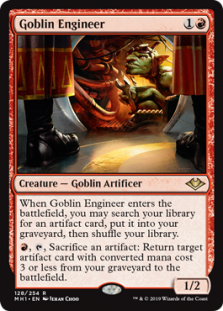
My final card is another engineer, though of a more traditional variety. Goblin Engineer is a throwback card, and interestingly not to just one. Engineer presents like a reference to Goblin Welder, but combines that reference with Stoneforge Mystic. The former reference is the activated ability replacing artifacts in play with ones from the graveyard (though nerfed and making sense with the rules). The latter comes from the tutoring ability, though it sends the tutored card to the graveyard rather than the hand.

From there, Engineer can do a decent Mystic impression. If you use Engineer to tutor for Sword of Fire and Ice or similar, you can then trade it for an artifact in play, which is functionally the same as Mystic (though easier to disrupt). I could see this working as a red splash in Death and Taxes that makes clue tokens to feed Engineer. Whether this is good I can't say, but it might see some play while Stoneforge Mystic remains banned.
Even if that is farfetched, there are plenty of other fair, value-centric uses for Engineer. Tutoring for and then resurrecting Affinity cards come to mind. However, this sort of effect never ends up being played in fair decks.

Fixed it Broken

Goblin Engineer wants to be broken. Its predecessor, Goblin Welder, was broken way back when thanks to the busted artifacts from Urza block, and it couldn't even tutor for targets. Engineer will never return a Platinum Angel or Mindslaver to play since its ability is restricted to CMC 3 or less. However, it can find any artifact. Tutoring is a powerful mechanic, and so is reanimation. That Engineer combines both makes it very dangerous.

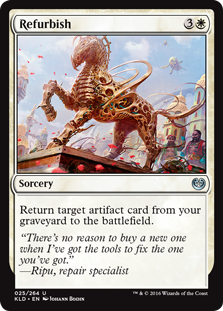
I don't know how to break Engineer. A lengthy Gatherer search for cheap artifacts contained a lot of enablers, but no obvious engine to get the combo moving. However, maybe Engineer doesn't need to do the work itself. Refurbish and Trash for Treasure exist, so there are ways to be a way to cheat in something huge and devastating on turn three. The best I could think of is Sundering Titan, which seems mediocre. If only Blightsteel Colossus could hit the graveyard.

There's also the possibility that Engineer's activated ability is combo-ready, too. I don't know of a great and cheap artifact engine right now, but I could be wrong. Even if I'm right at the moment, Wizards could always print something that is busted for Engineer to tutor for and then cheat in. Watch this card carefully; I can't imagine it won't get abused at some point.

Modern's Upheaval

It is hard to predict how Modern will react to Horizons. There's so much going on that I can't definitely say how the dust will settle. However, I can test decks, and use the ensuing results to extrapolate about the format. Tune in next week to see the results of those experiments.

Beating the Buyouts: The One-Week Rule

Are you a Quiet Speculation member?

If not, now is a perfect time to join up! Our powerful tools, breaking-news analysis, and exclusive Discord channel will make sure you stay up to date and ahead of the curve.

It is confirmed: articles on the negative implications of MTG finance are well received. Feedback was largely positive, and I really appreciate everyone’s mature and thoughtful engagement on the subject.

As I wrapped up the article last week, the momentum was difficult to halt. Rather than combatting writer’s block, I had to do the opposite—I forced myself to stop even though I could have gone on for many more words on the subject. Due to the positive reception, I’m going to explore this subject even further through a series of articles in the coming weeks. As long as feedback remains mostly positive and the ideas continue to flow, I’ll continue to explore this space.

This week will be the second article in this series and will focus on the impact of buyouts on the community and its economy. This data will be used to segue into actions that should be taken in the face of a buyout.

The Buyout Curve

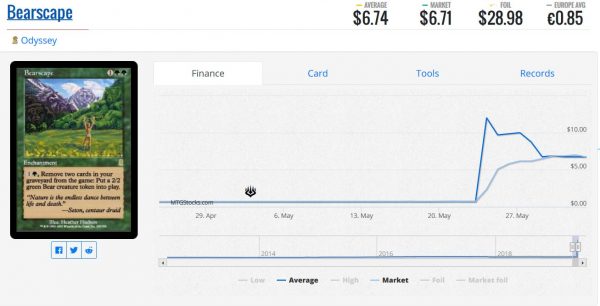
We’ve all seen this happen numerous times. There’s a catalyst of some sort, followed by an overnight buyout, followed again by a rapid “race to the bottom” as sellers seek to undercut one another on price. The resulting graph looks like this:

In the case of Bearscape, a virtually bulk rare shot up to about $12, only to drift back down to under $7 one week later.

This buyout, in particular, is what set me off on this article series because I perceived it to be absolutely ludicrous in nature. There is no way Modern Horizons will give us enough bears to support a massively popular bear-themed Commander deck. And even though Odyssey is an old set, it was printed quite a bit and I’m confident there are plenty of copies out there for every bear fan to obtain their copy. In short, the buyout was hype-driven and fueled by MTG finance: the chase for profits.

Now, on the one hand, the argument made by the MTG finance community about the market naturally setting the price is absolutely true…in the long term. I agree wholeheartedly that the price on Bearscape will be higher now than it was pre-Modern Horizons because of a true increase in demand. I don’t take issue with the higher price tag after a few weeks of settling. What bothers me about MTG finance is the interim period.

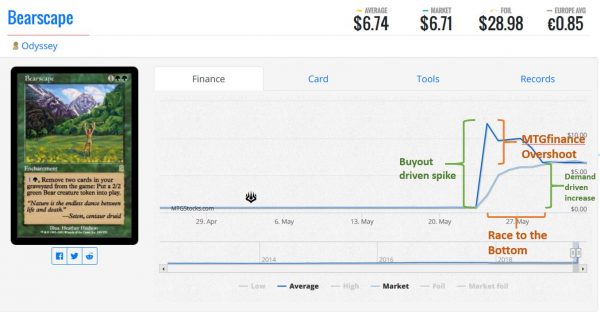
I break down this price trajectory further in the image below.

Here are the numbers:

Magnitude of initial spike: $12
Time it takes for price spike to diffuse and stabilize: 1 week
Final demand-driven price: $6
MTG finance overshoot: $12 - $6 = $6

When the MTG finance community says they are merely accelerating price adjustments that would inevitably happen, they’re right. The price is spiking overnight and will settle at a higher price than previously established, and this is a result of a natural increase in demand. Bears are pretty cool, after all.

What the speculator community doesn’t confess to is the temporary removal of market liquidity in the short-term. After buying out the market, speculators re-list their copies at an exorbitantly high price hoping to capitalize on an emotional buyer afraid they may not be able to own the card if they don’t buy it immediately. The result is an interim period where the price is too high, buyers disappear from the market, and the bid/ask spread—the difference between the least someone is willing to sell an asset and the most someone is willing to pay for that asset—becomes too large.

When the bid/ask spread grows it leads to market illiquidity. An illiquid market introduces a number of risks. Speculators sitting on stacks of Bearscapes that they’re unable to move may become desperate to raise cash. They do so by reducing prices, whether on Bearscape or some other card.

In the extreme, sellers may have to reduce prices and sell their assets at a loss to recoup liquidity, causing the market to overshoot to the downside. This volatility may be great for day-traders, but it disrupts the MTG market and leads to frustration of the masses. Even large vendors may struggle with this volatility, either remaining “out of stock” for far longer than desired or else risk overpaying for a card that is difficult to move, putting a strain on their own liquidity. In the case of Bearscape, Card Kingdom is choosing the former (the right call in my opinion). But there are other cases where Card Kingdom chased a spike, overpaid on a card, and was left holding dozens of copies unable to sell for anything but a loss. I think Star City Games does this too, at times, and I hypothesize this is why they place some of the same cards on sale every Monday.

The average person not participating in MTG finance may wonder, “Why does the price have to overshoot so much to begin with?” The answer is MTG finance, speculation, and the motivation to profit.

What Can Be Done?

A Twitter follower stated in response to last week’s column that this behavior is inherent to Magic because of its economy; it has been this way since the very beginning. To change Magic’s economy is to change Magic entirely. If its economy truly bothers someone, their best alternative is to play Magic Arena because the paper market isn’t about to change.

Since the game itself won’t change, the next best option is to modify one’s behavior to adapt to this volatile environment. Fortunately, I have some ideas to consider.

First and foremost, emotions must be kept in check. Speculative behavior nearly always creates an overshoot in price to the upside, and the worst thing that can be done is making a purchase into the spike. That is precisely what the MTG finance community is hoping for, so they can make that 1000% profit they highly covet. The fewer people who panic-buy, the quicker the price can readjust to a more reasonable level.

In the case of Bearscape, waiting one week to purchase the card post-buyout led to a price drop of nearly $6, a 50% discount from its peak price. Another recent buyout was Fist of Suns,  which spiked to $25 for one day before quickly retracing to $13. Again, this is nearly 50% from peak to trough.

There was an error retrieving a chart for Fist of Suns

Premium cards are no different in this regard. A third example was the recent buyout of Mythic Edition Dack Fayden, which spiked from $60 to $150 before retracing down to $85. While not quite a 50% drop, you are probably starting to get the idea.

In each of these cases, the nearly-50% price retraction from buyout highs took place over the course of about a week. Thus, I’d posit that a “one week rule” be implemented whenever a buyout occurs. From the moment the card shows up with a triple-digit percent increase on MTG Stocks, wait at least one week before purchasing a copy. This same concept is implemented by many well-known traders on Wall Street, except there it’s referred to as the “three-day rule”. Jeffrey Kosnett, a senior editor from Kiplinger, puts it best:

“This prompts me to reiterate a three-day rule, my personal iron law of investing, because Brexit absolutely revalidates it. Simply put, in any news-driven market crisis, wait until the third business day after the news breaks to trade anything—bonds, stocks, funds, gold, anything. Meditate. Breathe. Savor fine wine. Just don’t obsess.”

Such behavior has been effective for Wall Street traders for years. It’s time Magic card buyers behave the same way. The overall intent of such a rule is to combat emotions and refrain from panic buying or selling. Do this, and the speculators won’t be able to profit from the hype. If no one buys Bearscapes at $12, or $10, or $8, or $6 and suddenly speculators have to flip their copies for minimal profit or risk sacrificing liquidity, they may think twice before participating in such activity again.

Wrapping It Up

I’m sick of MTG finance personalities hiding behind generic economic concepts such as supply-and-demand to argue why their buyout activity is somehow a reflection of natural trends. While I do believe the appropriate price will eventually prevail, the volatility that happens in the interim is anything but natural. These buyouts and price spikes occur because of MTG finance, and the repeated pricing patterns on graphs for Bearscape and Fist of Suns highlights this.

In every case, the price overshoots to the upside, liquidity dries up, and the market enters a period of volatility. Can this be healthy for the market? I’d argue it’s not. It feels like the market would be healthier if prices increased gradually as new Bear Commander decks slowly become built by the player base, rather than speculators buying ten copies of the card at a time with the intent to sell with a 1000% markup.

Due to the nature of this game, this activity is here to stay, which is why I recommend the one-week rule. That is, if a card spikes due to a buyout, someone interested in purchasing that card should wait at least one week before pulling the trigger. Most often, they’ll end up paying a much lower price, often 50% lower than the peak buyout price.

If more people embrace this strategy, perhaps the prices will adjust even more quickly. Better yet, if liquidity becomes too much an issue, you may see an overshoot in price to the downside as people panic-sell. It doesn’t usually happen this way—typically I see overshooting to the downside when a card’s reprint is spoiled, and the retrace to a higher price takes much longer. But with enough discipline maybe one day we’ll see it happen during random buyouts as well.

…

Sigbits

  • Card Kingdom has made some noteworthy buylist increases on diamonds lately. They’re now paying $175 for both Lion's Eye Diamond and Mox Diamond. These are local highs, and I think these numbers will bump even higher as the market dries up. I have my eyes set on a $200 buylist price.
  • One card that spiked and did not retrace 50% is Sliver Queen. This leads me to believe older cards—especially Reserved List cards—behave on a completely different time scale. Perhaps this merits further investigation next week. Until then, keep in mind that Card Kingdom is offering $110 on near mint copies of this card.
  • The buylist on Sliver Legion is also up at Card Kingdom, showing a buy price of $60 on their hotlist. This one spiked on MTG Stocks to $140, and is still retracing at the time of this article’s writing. The market price shows as $115, but it wouldn’t surprise me to see this sub-$100 again in a week or two. A time may come when that $60 buylist would be quite attractive.

Insider: QS Cast #125 – #EDHorizons [Unlocked]

Are you a Quiet Speculation member?

If not, now is a perfect time to join up! Our powerful tools, breaking-news analysis, and exclusive Discord channel will make sure you stay up to date and ahead of the curve.

Welcome to the QS Cast 2019! Our co-hosts Chaz and Tarkan explore the financial aspect of Magic the Gathering – and in this episode they discuss the following:

  • #EDHorizons discussion - incredible amount of action in the market.
  • Commander is now the leading format when it comes to price movement. Constructed formats finally have taken a back seat. They are no longer on equal footing.
  • Insider Questions - and does MTG Arena aide Commander more than any other format?

Cards to Consider

*This Podcast was Recorded on 05/24/2019 for QS Insiders. If you want live recording sessions and up to date postings before anywhere check out the QS Insider Discord!

Avatar photo

Chaz V

Started playing during Invasion block at the age of 13. Always a competitive person by nature, he continues playing to this day. Got into the financial aspect of the game as a method to pay for the hobby and now writes, Podcasts, and covers all aspects of the game, always trying to contribute to the community and create great content for readers and listeners.

View More By Chaz V

Posted in Free, QS Cast, UnlockedTagged , , Leave a Comment on Insider: QS Cast #125 – #EDHorizons [Unlocked]

Have you joined the Quiet Speculation Discord?

If you haven't, you're leaving value on the table! Join our community of experts, enthusiasts, entertainers, and educators and enjoy exclusive podcasts, questions asked and answered, trades, sales, and everything else Discord has to offer.

Want to create content with Quiet Speculation?

All you need to succeed is a passion for Magic: The Gathering, and the ability to write coherently. Share your knowledge of MTG and how you leverage it to win games, get value from your cards – or even turn a profit.

‘Walk Your Pets: Re-Introducing TURBOGOYF

Are you a Quiet Speculation member?

If not, now is a perfect time to join up! Our powerful tools, breaking-news analysis, and exclusive Discord channel will make sure you stay up to date and ahead of the curve.

Attempting to home new cards in new decks is an exciting section of spoiler season, sure. But my favorite part of the process occurs when spells are spoiled that might slot into my current and past experiments. Certain Modern Horizons reveals have done just that, and revitalized TURBOGOYF, a deck I've been building on-and-off for four years. Today, we'll take a stroll down memory lane and see exactly how the Horizons cards improve the strategy.

Inside Out

Almost exactly a year ago, I unveiled the concept of reversibility: "Reversibility refers to an aggro-control deck’s ability to assume the role of its archetypical opposite when necessary." There's a lot to unpack there without the context of the linked article, but in essence, reversibility is a measure of the capacity tempo or midrange decks have to switch fluently between aggressive or disruptive roles.
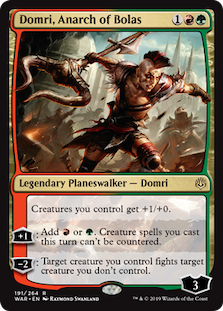
GR Moon's most important cards, Tarmogoyf and Lightning Bolt, exemplify this principle by excelling both on offense and defense. But recent printings, especially combined with other tools, have widened the pool of reversible playables. Leading the charge are a couple planeswalkers, cards known for their ability to interact with the board while asking opponents questions, and a pushed red creature destined to redefine the archetype.

TURBOGOYF '19, by Jordan Boisvert

Creatures

4 Tarmogoyf
4 Arbor Elf
4 Seasoned Pyromancer
3 Goblin Rabblemaster
2 Hazoret the Fervent

Planeswalkers

4 Wrenn and Six
3 Domri, Anarch of Bolas

Enchantments

4 Blood Moon
4 Utopia Sprawl

Instants

4 Lightning Bolt
2 Tarfire

Sorceries

4 Faithless Looting

Lands

4 Wooded Foothills
4 Misty Rainforest
4 Verdant Catacombs
2 Stomping Ground
2 Mountain
2 Forest

Sideboard

3 Damping Sphere
3 Dire Fleet Daredevil
2 Dismember
2 Feed the Clan
2 Anger of the Gods
1 Ancient Grudge
1 Force of Vigor
1 Collector Ouphe

Longtime followers of GR Moon will notice plenty of new technology here. First, the quick hits: Feed the Clan in the sideboard helps a struggling Burn matchup; Arbor Elf makes a better-late-than-never appearance as the actual best dork I could be running alongside Utopia Sprawl. The more recent printings require further explanation, as they've deeply altered the deck's strategic makeup.

Domri, Anarch of Bolas

Earlier this month, I published "War Domri in Temur Delver and GR Moon." That article heralded Domri as the first truly playable planeswalker for the deck, and outlined his numerous benefits. Here they are in a nutshell.

  • Static ability: Domri significantly improves token-producers, notably Goblin Rabblemaster, who has been with the archetype since its humble beginnings. Seasoned Pyromancer now joins Domri as a blue-chip token producer, giving this aspect of the walker additional relevance.
  • +1: Producing mana helps enable our Looting plan by minimizing the effect of pitching excess mana sources (another draw to Arbor Elf over something like Noble Hierarch). Uncounterable threats also makes haymakers like Hazoret, Rabblemaster, and Tarmogoyf all the more frightening, especially as the Modern pendulum swings back towards UW Control.
  • -2: 2/1 tokens actually take out quite few creatures, but Tarmogoyf is the real MVP when it comes to beefing. We're already in the business of growing huge ones; Domri makes us a Hulking-Goyf-Pounds-Your-Dude theme deck.

Seasoned Pyromancer

Enter the card that caused me to drop everything I was doing (um, playing Yu-Gi-Oh!) and double-down on tuning GR Moon: Seasoned Pyromancer. Like I said in the Domri article, "I don’t think [GR Moon] will upend Modern, or even close—[it has] fundamental issues that Domri doesn’t fix." But Pyromancer does fix those issues, and convincingly.
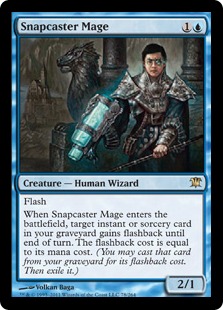
Issue #1: Velocity

A deck named after growing Tarmogoyf must be adept at moving cards between zones. Faithless Looting has always impressed in this role, but as with Tarmogoyf, we could only play up to four copies. Replacements I've employed have ranged from Cathartic Reunion to Sarkhan, Fireblood. In each case, these enablers were done in by their clunkiness; they'd fix our hand, but overcharge for a card that didn't also impact the board.

Pyromancer sifts through the hand just as fast as Looting, guaranteeing upon resolution that we'll access two new cards that turn—even when we're under two cards, something its effect has over the sorcery. But like Modern staple Snapcaster Mage, that card selection (or advantage) comes while affecting the board; any nonland card looted away becomes a 1/1 Elemental.

Compare with Looting: for just 1R more, Pyromancer generates up to four power on the board, spread across three bodies. That's an everyman's Goyf's worth of pressure! And if it's not making guys, Pyromancer is straight-up drawing us cards. Unlike Looting, a dead draw in a top-deck war, Pyromancer is good even when it's "bad."

Issue #2: Clock

Outside of namesake nut-draws chaining Faithless Looting into turbo-charged Tarmogoyfs, TURBOGOYF has always had a problem establishing an adequate clock. I've looked to closers such as Goblin Rabblemaster, Huntmaster of the Fells, Siege Rhino, Goblin Dark-Dwellers, Stormbreath Dragon, Traverse the Ulvenwald (as extra Goyfs), Chandra, Torch of Defiance, Nahiri, the Harbinger, Bloodbraid Elf, and Hazoret the Fervent. Evidently, few of these have stuck.
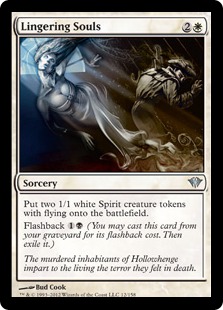
But Pyromancer forges a respectable clock all while enabling the rest of the deck and drawing us into more gas. Throw Domri into the mix and a fully-"escalated" Pyromancer provides a whopping seven power for three mana.

Issue #3: Late-Game Oomph

The last of GR Moon's issues is its lasting power: if opponents deal with our few threats, they can sometimes out-draw Blood Moon or otherwise mount a comeback; sometimes they outright don't care about the enchantment, and it's no so tough anymore to go over a Goyf. Pyromancer remedies this hiccup, too. It's the single best top-deck in our 75, functioning as Divination on a body. Indeed, Pyromancer represents a metric ton of card advantage on a red creature, rivaling Cruise-on-a-Goyf Bedlam Reveler. Dead 'Mancers even exile themselves from the graveyard for more tokens Ă  la Lingering Souls.

Taking stock of all the cards, that's:

  • One card from the body
  • Two cards from the enters-the-battlefield draw
  • Two tokens from the flashback

Talk about value... and, for the first time, on a tempo-positive spell!

Wrenn and Six

Wrenn and Six snuck its way into TURBOGOYF during the testing process, as Pyromancer had been spoiled four days prior. It ended up massively improving the deck on an axis I'd never even tried to remedy, both because GR Moon's other issues were more pressing and because I'd long given up on Modern ever receiving another Goyf-level two-drop suitable for GR Moon.

Curing the Curve

TURBOGOYF's sleeper issue is one of curving, and one I'm growing confident Wrenn and Six will assuage. The deck's curving conundrum is a classic one for dork-dependent decks: effectively building with mana dorks tends to backfire if opponents immediately deal with the dork, or should a dork evade our opener. Both scenarios leave us with precious little to do on turn two. We've long thirsted for a relevant two-drop to compliment our set of Goyfs.

The dork dilemma hit home early in my testing; my first list featured 2 Noble Hierarch, a fourth Rabblemaster, and a fourth Domri over the above Wrenns. In lieu of a better option at two mana, I trimmed one of each three-drop for a pair of Spellskites. My reasoning was that Looting and Pyromancer could cycle the Skite when it wasn't relevant. While the 0/4 trounced certain decks, like Bolt-reliant interactive strategies and Infect, it clogged my hand against many others.

I hadn't long pined for a replacement when Wrenn and Six was spoiled, and I immediately swapped the Skites for the new walker. After a week of exhaustive testing, I cut the Hierarchs for two more Wrenns. I simply found myself wanting it all the time.

With the new curve, we have enough significant follow-up plays that we don't really care if opponents disrupt us with powerful one-shot effects. Kill the dork? Chase with Goyf or Wrenn. Remove Goyf? Punish with Rabblemaster or Pyromancer. Strip our best card? We've got enough cantrip effects to loot into more business. But opponents do need to interact with our plays—let that dork breathe and get hit with Blood Moon a turn early, or meet a turn-three Hazoret post-disruption. Having impactful plays so often is relatively new to GR Moon, and helps it feel, power-level wise, closer to a tiered Modern deck.
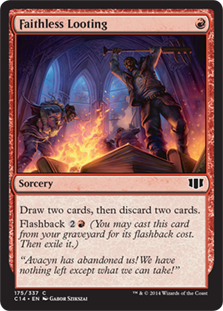
All These Cards

Like Tarmogoyf, Wrenn proved an excellent follow-up to enemy disruption on turn one: returning a land locked in our turn-three play, all while leaving behind a surprisingly menacing planeswalker. And like Skite, Wrenn dominates decks heavy on x/1s, which happen to be quite popular. Slamming Wrenn ends up feeling a lot like slamming Liliana of the Veil after opponents let down their shields. Both interact with the board and enable a successful long-game. The difference is that Wrenn snowballs value and eventually wins us the game, while Liliana simply strips opponents of resources. And Wrenn is 33% cheaper.
When it comes to value, Wrenn functions like Modern planeswalkers are supposed to. His +1 indeed "draws a card" in a deck with 12 fetchlands and 4 Faithless Looting, an impressive feat for a two-mana commitment—it even outdoes Search for Azcanta, which merely scries. And should opponents invest enough resources to actually deal with the walker, we've got three more copies where he came from. I've grinded UW players out with Wrenn alone, baiting them into awkward bounce-draw modes with Cryptic lest the advantage overwhelm them, which it ends up doing anyway.

The Ultimate Price

It turns out coming down a turn earlier than we're accustomed to for planeswalkers does a world of good for the card type's final ability. Superficially, it's one more turn of ticking up; practically, though, the walker sticks before many decks have a way to pressure it, making it that much easier for us to defend through disruption or distract from it by presenting other threats. I've activated Wrenn's -7 ability multiple times as a result, and it's always game-winning.

We don't need a wide selection of instants or sorceries to make the most of the ultimate; just Lightning Bolt. Retraced Faithless Looting is also great for finding surgical answers to the likes of Leyline of Sanctity (see sideboard) so we can "go off" regardless. Combined with the snowballing advantage of repeated Gut Shots and land retrieval, the immediacy and impact of Wrenn's emblem puts lots of pressure on opponents to remove the walker, just as Tarmogoyf's sheer bulk does for the creature. Ergo, Wrenn is the two-drop we've always wanted.

Around the Block Again

My Moon decks have always suffered from some amount of tension: they're full of ramp, but boast a low curve, punishing us when we can't find Faithless Looting; they aim to pump out a three-drop, and therefore flounder when that plan is interrupted and Tarmogoyf proves absent; etc. No more does the deck revolve purely around those two cards. It's become better-rounded in large part thanks to the strategic cohesion enjoyed by its new moving parts. As is necessary in Modern, all that synergy doesn't really come at the cost of being soft to hate. Most of our deck ignores Rest in Peace; Wrenn can single-handedly out-grind sweeper decks; Tarmo and Hazoret crash through whatever beefy body opponents stick; Pyro and Rabble go wide around their blockers.

TURBOGOYF's sudden spryness is unlike anything I've felt with the deck in years, and I can't wait to sleeve it up. Sometimes, a unique card or two are all the new tricks a languishing list needs. Has Modern Horizons injected life into any of your pet decks? If you're not sure, there's one surefire way to find out: take 'em for a 'walk!

Is Oathbreaker Built to Last?

Are you a Quiet Speculation member?

If not, now is a perfect time to join up! Our powerful tools, breaking-news analysis, and exclusive Discord channel will make sure you stay up to date and ahead of the curve.

Modern Horizons spoiler season has been pulling a lot of our attention toward Commander and Modern. Looking past the hot new spoilers, we're seeing a new format emerge in Oathbreaker, and it's got a lot of people interested.

For those not familiar, Oathbreaker is a singleton, non-sanctioned format similar to but distinctly different from Commander. Featuring a planeswalker as your general and a Signature Spell to accompany it, players construct a 60 card deck to face off in a multiplayer setting. Here are some of the quick rules for those who are unfamiliar:

  • Oathbreaker is multiplayer format, played with 60 card singleton decks (only one copy of each card, no limit on basic lands).
  • You start the game with your Oathbreaker and Signature Spell in the command zone.
  • Your starting life is 20 .
  • Your “Oathbreaker” is a Planeswalker. Its color identity determines the contents of your deck.
  • Your “Signature Spell” must be an instant or sorcery card that falls within your Oathbreaker’s color identity.
  • You cast your Oathbreaker from your command zone.
  • Your Signature Spell may only be cast if your Oathbreaker is on the battlefield under your control.
  • Both your Oathbreaker and Signature Spell are subject to “command zone tax”. These taxes are tracked individually, i.e. casting your Oathbreaker doesn’t cause your Signature Spell to cost more.

Keeping this in mind, we've got a lot of community buzz across the Magic sphere of social media, with even the likes of The Professor espousing his love for the format and the gameplay experiences it provides. With a ton of optics on the format right now, I wholly believe it is worth taking a minute to examine Oathbreaker as a legitimate format that people are definitely playing.

Enter Oathbreaker

Oathbreaker was developed near the beginning of 2017, and has been extensively tested since its inception, according to the creators of the format over at Weirdcards.org. The premise of the format was taking a game of Commander, speeding up the rate of play, and shortening game length so that matches could fit into a lunch break of an hour or less. CEDH games can be over as early as turn four, but not every game of Commander has that speed.

With the team of developers bringing their format to Grand Prix (later MagicFests) and local game stores in their area of Rochester, Minnesota, Oathbreaker draws closer to being an established format, albeit one without official WoTC support. Though it doesn't have the support of Wizards officially, there is still an organizational body supporting the format. A unique facet of Oathbreaker is the support and community building being spearheaded by the charitable organizations MagiKids and Weirdcards.

Weirdcards and MagiKids

Weirdcards started as an organization intent on raising money for local charities through Magic, and eventually led to them registering as a 501(c)(7) charity. MagiKids extends this mission even further as a 501(c)(3) charity.

You can find plenty more information on their organization's activities in the links above, but it's time to get into the heart of the matter, and the main question at hand: Is Oathbreaker worth my time, or is it just a flash-in-the-pan format?

Tiny Leaders, Frontier, and Brawl

Oathbreaker is definitely a grassroots format. Although it is not yet an officially sanctioned format, it is fully supported by the Weirdcards nonprofit (and slated to be featured at every US MagicFest starting in June). It is worth mentioning that Commander (formerly known as Elder Dragon Highlander) was once in the same situation, just a format for players looking to have a fun multiplayer experience with their homebrew game type. If players want to adopt a format, they'll do so by dedicating their time and energy into making it happen. However, there are a few formats that were considered failed experiments or cash-grabs that leave many people skeptical.

There was an error retrieving a chart for Smother

Tiny Leaders, a similar Commander variant, was developed with the intention of playing a flavorful format based around legendary creatures and spells that cost three or less mana to cast. It had a really strong start and many players (including myself) were excited to dive into the format and give it a shot, but the gameplay became centered around a very small group of cards. It was dubbed Legacy Lite by a lot of people who had played it and also suffered from a poorly maintained banlist. This more than any other format leaves a bad taste in player's mouths from a gameplay perspective. Then there's the comparison of Frontier.

There was an error retrieving a chart for Siege Rhino

Frontier was a one-on-one format that acted as a new Modern, where anything from Magic 2015 onward was legal for play. It was originally developed as a way for many Japanese stores to sell singles that had crashed in price from rotation around the time of Khans of Tarkir, and had very little regulation in regards to gameplay and balance. While it was nice getting more use out of your newly rotated cards, this format was very short-lived. Many players grew weary of losing to Siege Rhino.dek, Jeskai Black, or Rally the Ancestors piles for the umpteenth time, just like the Standard that spawned them promised. Given time and care, this format could have been adopted to great success but is now considered as little more than a cash-grab.

There was an error retrieving a chart for The Scarab God

Finally, we have the close comparison of Brawl, the Wizards supported format that mirrors Commander but only allows you to use cards currently legal in Standard. Brawl is still active as a format and is supported on official platforms like MTGO and Arena, but isn't exactly popular. Many were burned by the ubiquity of The Scarab God during the first season of Brawl's lifespan, and most players did not pick the format back up for the release of Dominaria for the format's first rotation.

Why Oathbreaker May Be Different

With the track record of failure for those three formats setting a precedent, why would you risk getting burned again? What makes Oathbreaker any different?

In my opinion, Oathbreaker has a stronger leg to stand on than the previously mentioned formats for a few good reasons:

  • This format allows you to use any Planeswalker as your general (not just Commander 2014 and 2018), something that Commander players have requested for years.
  • There are planeswalkers in every new set, meaning there are new decks to explore every new set.
  • The development team behind it is comprised of passionate individuals who are concerned with the health of the format.
  • Oathbreaker will not be easily solved due to the sheer number of customization options available with the Planeswalker+Signature Spell format.

There is a budding community behind this format that is willing to play and support it, and what other format has a charitable organization to back it up? Now, I'll have to restate, this is just my opinion. Oathbreaker's popularity is at an all-time high right now due to factors like the recent release of War of the Spark, and Modern Horizons upcoming release, but the true test will be how long that hype can sustain into the end of the year.

Oathbreaker and Card Prices

Now that I've gone on far too long about why I think this format is legitimate, there is also the question of its financial implications. As we've seen so many times during Modern Horizons spoiler season, a newly printed card can move the needle on several others due to speculative Commander demand. This has never been so prominent before, as many Insiders in our Discord have noted, but has been a relevant factor in the price of many cards over the past decade.

There was an error retrieving a chart for Mycosynth Lattice

The printing of War of the Spark brought us planeswalkers with static abilities attached to them, which caused a lot of cards to move up in price. Synergies like Karn, the Great Creator and Mycosynth Lattice proved to be incredibly powerful and game-winning effects, causing a lot of players to move on Lattice for formats like Modern and Legacy. The card is still quite expensive at nearly $60, considering the price had been at a historical low of $8 due to its Battlebond printing in April of last year. This particular combo doesn't fly in Oathbreaker, as there is no sideboard, but I'll use it as an example of static abilities causing obvious combos.

There was an error retrieving a chart for Mana Severance

If there's any one card I could point to as evidence for Oathbreaker causing some price movement, I think it's Mana Severance. It's a bit of a meme at this point, but the obvious synergy with Jace, Wielder of Mysteries is relevant and can win you the game very quickly.

There was an error retrieving a chart for Forge of Heroes

A callout for a very strong card on the QS Insider Cast, which may prove to be a staple in the format going forward, is Forge of Heroes. There's not all that much movement on it yet, though people have started to take notice of the card and are picking them up for their decks. This natural demand is healthy for the format, and will likely not lead to any buyouts for a high-supply Commander common.

There was an error retrieving a chart for The Elderspell

If you want my pick for an exciting spell for the format, it's The Elderspell. This is more of a sideboard card in formats like Standard, Modern, or Legacy, but it seems like it would be very strong in a format where everyone wants to play and utilize their walkers to help them win the game. As is the case with Forge of Heroes, trying to buy out a card like this with such a high-supply will likely prove unsuccessful.

Going forward, I think there will be spell synergies that will be obvious pairings with each new walker, and that will inevitably put some pressure on those spells. Competitive-minded players will find the best combinations, which will lead some to attempt buyouts if the format continues to grow. However, I think the amount of pressure really depends on whether or not we continue to see static abilities on planeswalkers in future sets, and their potential for game-winning combos.

Charity and MTG Finance

On the topic of price movement, I feel it is necessary to bring up the fact that charity is woven into the fabric of the format of Oathbreaker. Should Oathbreaker prove it has staying power, people will inevitably attempt to speculate on Oathbreaker related cards. There is no governing body that can prevent this from happening, but consider this: how do you feel about profiting off a format that was built on the foundation of charity? To quote our own Chaz Volpe from this week's QS Cast:

...I'd much rather just donate to the charity. I don't feel good buying into a format that was created by a charity for kids, and trying to make money off of it. I just want that to be plainly known - If you want to "invest" in this format, kick back to the charity!

I stand with Chaz on this, and I hope that many of you do too. MTG Finance's public perception and the perception of those who engage in it is currently at an all-time low. Personally, I will not be engaging in any Oathbreaker speculation for the reasons I stated above, other than maybe buying a copy of a card for myself.

Bring it on Home

Oathbreaker represents an exciting, community-driven push not seen in Magic for quite some time, and you may want to get in now if you're missing out. Full disclosure, I have not tried to the format just yet, but all the buzz has got me looking at cards and brewing up decks, and looking for players to jam games with. I'm not the only one either. It may not be as popular as something like Commander, but I think there is plenty of room for Oathbreaker to exist in the Magic sphere, and will likely start causing price movement should the format stick.

That's all I've got for now. Follow me on Twitter @chroberry or on Instagram @chroberrymtg for updates on spoiler content, and my upcoming Oathbreaker build of Dack Fayden (RIP).

Peace!

Insider: QS Cast #124 – Before the Horizon [Unlocked]

Are you a Quiet Speculation member?

If not, now is a perfect time to join up! Our powerful tools, breaking-news analysis, and exclusive Discord channel will make sure you stay up to date and ahead of the curve.


Welcome to the QS Cast 2019! Our co-hosts Chaz and Tarkan explore the financial aspect of Magic the Gathering – and in this episode they discuss the following:

  • Catch up Podcast+Insider Q&A
  • Modern Horizons Previews about to start!
  • Insider Questions

Cards to Consider

*This Podcast was Recorded on 05/16/2019 for QS Insiders. If you want live recording sessions and up to date postings before anywhere check out the QS Insider Discord!

Avatar photo

Chaz V

Started playing during Invasion block at the age of 13. Always a competitive person by nature, he continues playing to this day. Got into the financial aspect of the game as a method to pay for the hobby and now writes, Podcasts, and covers all aspects of the game, always trying to contribute to the community and create great content for readers and listeners.

View More By Chaz V

Posted in QS Cast, UnlockedTagged Leave a Comment on Insider: QS Cast #124 – Before the Horizon [Unlocked]

Have you joined the Quiet Speculation Discord?

If you haven't, you're leaving value on the table! Join our community of experts, enthusiasts, entertainers, and educators and enjoy exclusive podcasts, questions asked and answered, trades, sales, and everything else Discord has to offer.

Want to create content with Quiet Speculation?

All you need to succeed is a passion for Magic: The Gathering, and the ability to write coherently. Share your knowledge of MTG and how you leverage it to win games, get value from your cards – or even turn a profit.

MTGO Financial Update: Major Improvements on the Horizon

Are you a Quiet Speculation member?

If not, now is a perfect time to join up! Our powerful tools, breaking-news analysis, and exclusive Discord channel will make sure you stay up to date and ahead of the curve.

Welcome back, folks.

Major improvements are on the horizon for Magic Online. It's impossible to say with absolute certainty what impact these changes will have on the platform, but they will likely be a significant boon for players and investors. They're even getting headline coverage on gaming outlets like DOT ESPORTS. Today I'm going to give you the lowdown on this update and what it means for the next several months on MTGO.

I. Major MTGO Update

A. Graphics Upgrade

First, MTGO is taking its first step into the 21st century with a major visual update for the lobby. Here's a first look:

The aesthetic is sleek, modern, and matches the aesthetic that Magic eSports has been pushing with Magic Arena and MPL coverage. Notice too that the card display is being standardized to match that of Arena. Some of the card collection and deck construction pages are being modernized too:

Taking a step back, it's hard to know how significant this upgrade will prove to be. The hope is that the updated graphics will appeal to paper and Arena players. Arena, MTGO, and paper all provide different experiences and suit the needs of different players with different life schedules and personal commitments. Undoubtedly MTGO's archaic graphics have hindered its growth in the past and have made it the butt of many a joke; while this upgrade doesn't improve the battlefield visuals, it is undoubtedly a step in the right direction.

Equally important is that the interface is being streamlined and made more user-friendly. Though less eye-catching than the visual upgrades, the more intuitive interface, with formats and options clearly displayed, will help make MTGO more accessible and attractive to new players. More than a few newer MTGO players came to Magic from Arena, and I'd expect more to join as a consequence of this update.

B. Accessibility Upgrade: MTGO now Free to Try

Perhaps most significant of all is that the $10 fee required to create an account is now being pushed back. This part of the update will be implemented in the Fall, likely alongside the release of the Fall set. Players will now be able to create an account and do *some things* without paying the $10 fee. There will still be a $10 fee, but that fee will likely be required only to trade and buy cards from bots and other players in the MTGO marketplace. The rationale for keeping this fee is likely to keep the (undesirable) bots and spam accounts at bay. I wish Wizards would implement enhanced security features on MTGO like two-factor authentication, but that's a rant for another day.

At minimum, what players will likely be able to do without paying the $10 fee is to create an account, participate in all events, and buy product and event tickets (MTGO's in-game currency) from the Wizards Store.

This change, I predict, will bring with it a sizeable number of newer Magic players curious to try out cube, flashback drafts of older formats, and possibly try their hand at an eternal format like Modern or Pauper. It might cause a slight increase in Standard and current set Draft participation as well. Being free to play is huge, and the ability to play events before upgrading one's account is a game-changer.

C. League Consolidation and New Prize Structures

Going forward, Friendly, Intermediate, and Competitive will now only be designations used for Limited events. Historically the most popular Constructed formats on MTGO had two different leagues - Friendly and Competitive - one having prize support concentrated at the top for those with 4-1 and 5-0 records, and the other having prize support more evenly distributed. Modern and Standard have always had two leagues, and last year Pauper was split into Friendly and Competitive. Legacy and Vintage have only had one league.

Of late, Pauper and Standard players have been suffering from having their respective formats divided into two leagues. Pauper never should have been split to begin with (its league numbers were roughly between 500 and 600 before the division). Standard league numbers have been hovering around the 700 to 800 mark since January, which is enough to justify a split but nonetheless inconveniences players.

There will now be one league for each format. The distribution of the prize structure will be in-between those of the Friendly and Competitive Leagues. In my honest opinion, I think the prize support structure looks fantastic. It gives greater overall prize support than the old Competitive League and a touch less overall prize support than the old Friendly League. We also see the continuance of the trend of giving out more playpoints and fewer cards as prize support (a boon to the overall health of the economy and collection values); note the subtle shift of giving out fewer treasure chests and more playpoints here.

Per $10 paid to join these leagues, here's how they stack up against one another, assuming that one chest is worth $2.25 and that 10 playpoints (PP) are worth $1.00:

D. Improved Prize Support for Draft Phantom Events, Including Modern Horizons!

I've continually nagged Lee Sharpe and Alli Medwin over the past five years that a 27.5% rake is ridiculous and turns away people from participating in phantom draft events like Cube or Flashback drafts. Going forward, that rake will be 22% instead of 27.5%, a significant improvement. Along with the visual upgrades, this change will make MTGO a much more attractive option for paper and Arena players to get their cube fix in or experience an old format for the first time. I'm glad that MTGO is making it easier for players new to the game to discover older formats for the first time.

II. Signing Off -- What are the Implications of this Update?

This is one of the best updates we've had since I started playing MTGO in 2013, and it comes at an opportune time that reassures MTGO players that Wizards will be supporting MTGO going forward. MTGO will be more accessible than ever before. Hopefully, that will be a boon to players' experiences and will further continue the recovery in lower card prices we've been seeing over the past several months.

I'm very excited about the improved prize support for phantom drafts and am excited about the introduction of the new prize structure for constructed leagues. If any of you want to draft more Modern Horizons outside of your LGS' allocations, I'd recommend giving it a whirl on MTGO. In my next article I'll be updating y'all on the state of treasure chests on MTGO, so stay tuned!


Want Prices?

Browse thousands of prices with the first and most comprehensive MTG Finance tool around.


Trader Tools lists both buylist and retail prices for every MTG card, going back a decade.

Quiet Speculation