menu

Daily Stock Watch: Magus of the Moon

Are you a Quiet Speculation member?

If not, now is a perfect time to join up! Our powerful tools, breaking-news analysis, and exclusive Discord channel will make sure you stay up to date and ahead of the curve.

Hello, readers and welcome to a new week of the Daily Stock Watch! I was crushed by the opposition over the weekend at Grand Prix Singapore, and missed out on a money finish after losing the last three rounds of day two. It was a fun experience, and I was able to meet some people who are readers of this segment, so I'd like to give a shout to these guys (sorry I didn't get your names!) and I hope that you continue reading our content here at Quiet Speculation.

I was able to get a glimpse of what cards were hot, as well as those that are not, based on the buylists of the different stores that were set up in the GP venue. Usual suspects include Reserved List cards, Standard and Modern staples, and cards from the Masterpiece series, but they still happen to buy pretty much everything that you'd like to sell them. This gives us more options on where to move our other cards around, besides your LGS and online stores.

That was quite an introduction! Let's talk about our featured card for today.

There was an error retrieving a chart for Magus of the Moon

Magus of the Moon just hit its all-time low of $8.30 (for the Iconic Masters version) over the weekend, and it should go down a little more in the next two weeks as the holiday season closes in where I expect more IMA packs will be opened. The same is true for the Future Sight version, which has gone down to $19.92, which is a big drop from its high of $33.91 prior to the IMA reprint. This is also its lowest price since the year 2015, which further cements the trend that any card printed in a Masters set would definitely dip, value-wise.

Part of the blame of why the price went down is its inability to be consistently part of a winning deck. According to the Utility Tracker, only 0.6% of winning decks use an average 1.7 copies of Magus of the Moon on their main deck in Modern, while 0.7% of winning decks use 1.3 copies of it in their sideboard. It actually sees more action in Legacy as part of some Dark Depths and Dragon Stompy decks, where 2.6% of top decks use an average of three copies in their maindeck, and 1.1% use 1.6 copies in the sideboard.

Let's check out how an actual deck running Magus of the Moon in Legacy looks like.

Dark Depths

Creatures

4 Sylvan Safekeeper
4 Magus of the Moon
2 Fling
4 Crop Rotation
4 Punishing Fire
4 Sylvan Scrying

Other Spells

2 Sylvan Library
4 Mox Diamond
4 Expedition Map
3 Pithing Needle

Lands

4 Wooded Foothills
4 Snow-Covered Forest
4 Thespian's Stage
1 Sejiri Steppe
1 Snow-Covered Mountain
1 Taiga
4 Dark Depths
4 Grove of the Burnwillows
1 Ghost Quarter
1 Bojuka Bog

Sideboard

1 Dryad Arbor
4 Thorn of Amethyst
2 Krosan Grip
2 Ground Seal
1 Karakas
3 Pyroclasm

This deck aims to draw out Marit Lage from Dark Depths by using Thespian Stage as the enabler, and have Magus of the Moon shutdown your opponent's mana base to allow your demon to operate freely. It's not really a popular deck choice, but it uses a full playset of the Magus, and could be used as a good reference of a competitive deck that uses it over Blood Moon. However, Blood Moon is still the consensus choice for Modern and Legacy players, as enchantments are harder to answer than creatures.

Blue Moon Pieces

These cards are all very disruptive and control-oriented by nature, so I don't see why Magus of the Moon won't fit in the deck in the near future. It has appeared more often in tournaments lately, and getting it to tier one territory will definitely help push Magus of the Moon's value back up to the double digit range again if it gets the much needed consideration to be part of the list.

At the moment, I'd like to keep an eye on Magus of the Moon from IMA. I'd like to start buying in if it hits $5, but I'm not entirely sure if it could go that low considering the players' awareness of its power. I'm inclined to believe that people just favor selling it more right now due to the influx of supply, but it should rebound a little sometime next year once the IMA box-opening fiasco has ended, and people have started shifting their attention towards Masters 25.

Right now, you could find copies of Magus of the Moon for anywhere between $6.99 up to $8.99 from Channel Fireball, TCGPlayer, Star City Games, and Card Kingdom. I'd like to stray away from the foil copies, as I think that investing on foil Blood Moons would be better in the long run. Don't give up on this card just yet -- it's still as good as it is back in the day when it was a $20 card.

And that’s it for the Monday edition of the Daily Stock Watch! See you again tomorrow, as we check out new cards that should be on the go, or good enough for speculating. As always, feel free to share your opinion in the comments section below. And if you want to keep up with all the market movement, be sure to check in with the QS Discord Channel for real time market information, and stay ahead of the hottest specs!


Insider: More Market Manipulation

Are you a Quiet Speculation member?

If not, now is a perfect time to join up! Our powerful tools, breaking-news analysis, and exclusive Discord channel will make sure you stay up to date and ahead of the curve.

As I’ve gotten more into the Old School MTG scene, my Twitter feed has become a hybridization of Old School news and MTG finance. A bit of a dichotomy I’ll admit, but a functional one that checks each box for what I want out of this hobby. A non-rotating format consisting of cards that are immune to reprinting (either because they’re on the Reserved List or because they’re Alpha, Beta, and Unlimited cards) and that offer me the nostalgia I crave in the game.

So I just run with it.

The most interesting MTG finance news lately came not from the finance half of my newsfeed. Much to my surprise, it came from the Old School community. This may seem surprising until you see the context. You see, the community was thoroughly angry with Rudy of Alpha Investments for a video he posted recently about Bazaar of Baghdad.

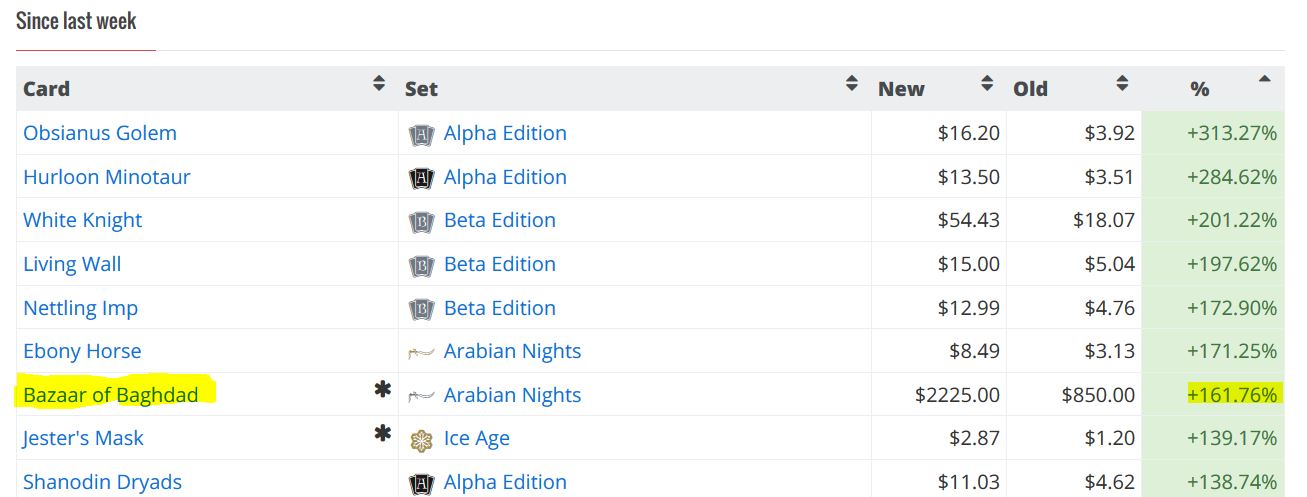
In this video, Rudy presents his possible intentions in buying out Bazaar for under $1000. As much as I hate to give credence to his shenanigans, I can’t argue with the resulting data…

There was an error retrieving a chart for Bazaar of Baghdad

Did He Actually Do It?

While this may be a curious question to answer, it’s really not the important one. To us finance people, we need to understand the impact of the video. Whether or not Rudy is going to buy out the market of a given card is something we can’t predict and have no control over. Therefore, that detail alone is not something to help us make or save money in Magic.

The question we need to address is, “What happens to a card’s price after Rudy posts a video about it?” That’s the key. That’s what we need to be able to predict whenever one of these videos shows up among the Old School community’s chatter. Love him or hate him, if his actions move the market we should at least be aware of this impact.

In the case of Bazaar of Baghdad, it appears his actions may have had an effect.

(Click to expand.)

Clearly TCGplayer’s stock and pricing were impacted by the Alpha Investments video. Whether Rudy was the buyer of the card or it was a group of desperate players and speculators looking to capitalize on the trend is irrelevant. The correlation holds true in this case: a video is posted about Bazaar of Baghdad and the card’s price went much higher throughout the week. And it’s really rare we see a 100%+ gain on a three-figure card!

In essence, Rudy is yanking the chain on this unregulated financial market to see how far he can push things. Given the fact that he has 100,000-plus subscribers—quite the following—I’d say it’s likely he can push things quite far. Is that wrong of him? Is he a greedy market manipulator? While these are interesting moral questions, they’re not relevant to an MTG finance column. Whether or not we agree with the practice, what we need to accept is that Rudy’s videos are correlated with market buyouts.

Okay, so for now we’re tabling our moral compass in order to assess what this guy is doing to the market, particularly on old, rare cards on the Reserved List. He only needs to convince a dozen people out of the hundreds of thousands who watch his videos that they need to acquire their Bazaar of Baghdads immediately before the market explodes. That’s enough to trigger the self-fulfilling prophecy and spike the market.

Period. End of story. Again, this is an unregulated market so what he is doing is legal and very easily achieved. That’s a consequence of the Reserved List and the fact that Magic’s oldest cards are printed in extremely low quantities relative to the millions of global players. The same can happen to similar cards at any time: Library of Alexandria, Juzám Djinn, Diamond Valley, etc. are all extremely vulnerable to manipulation.

There was an error retrieving a chart for Library of Alexandria

Acting Upon This Information

In a way, I kind of did the same thing inadvertently. If I’m not building a deck, Magic tends to get stale to me. I decided to take on a new project with deckbuilding to give me something new to get excited about.

Recently I read about these all-Alpha decks people in Sweden were building, and the idea sounded really cool. At the same time, I coincidentally noticed that Alpha Plague Rats were nearly gone from eBay and TCGplayer, yet I found a handful of copies at a few bucks each at some major retailers. With no four-of rule in an all-Alpha format, I stumbled upon a fun deck idea. What started as an attempt at arbitrage became inspiration for a new deck.

Seventeen Plague Rats later, I can’t find any copies for under $30 anywhere. Major retailers are sold out and eBay/TCGplayer only have overpriced copies to purchase. There are a few copies on MKM at around $10, but it’s not really worth the hassle with shipping and finding an intermediary in Europe (and sufficiently compensating them for their time). So I guess I “bought out” the market.

There was an error retrieving a chart for Plague Rats

While my motivations were certainly different from Rudy’s, the point remains the same. Anyone can do this, at any time. The market on these older cards are so fragile that spending less than $100 on a seemingly useless common can cause a spike on the pricing websites that everyone follows.

So with this market fragility, what are we to do? I’m not advocating you go and buy out Alpha and Arabian Nights cards. I don’t support this kind of intentional market manipulation. But as an MTG finance column, we must acknowledge the reality. By ignoring it, you are basically accepting that you’ll either never own some of these classic cards or that you will be willing to bear whatever the market price is at the time you are ready to make your purchase.

I’m far more proactive than that. I have made sure to prioritize older cards I want to own for whatever reason: an Old School deck, for my collection, or yes, even for speculation. Any card on the Reserved List or from Alpha and Beta that I hope to own, I have prioritized.

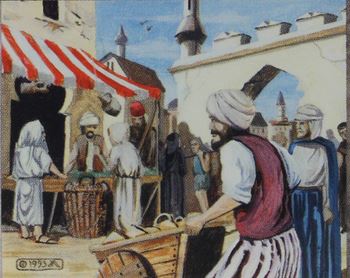
I also had to convince myself that it is okay that I don’t own the ones I don’t prioritize. I used to own a Bazaar of Baghdad but the card sat in my binder rotting. I love the artwork on this classic card, but was that enough to justify sitting on it when I could flip it into cards I would actually play? I didn’t think so. Now I am tempted to scramble and find another copy to reacquire for my collection before all copies disappear. But that wasn’t my priority a year ago so it should not be a priority now. I need to accept this and move on.

Perhaps the most important thing to remember during these hype-driven buyouts is to keep a level head. The moment I watched Rudy’s video I had never wanted to own a Bazaar of Baghdad more. I even found some copies at reasonable prices (mostly in Japan). But to rush out and buy copies out of “Fear of Missing Out” is playing directly into Rudy’s hands. That’s what he wants people to do. He is making profits on others’ panic-buying.

I kept myself in check, but just barely. I already decided before the buyout that this was not a card I needed to own. Therefore, I am not going to give in to emotions and panic-buy a copy. Of course, if I stumble upon an underpriced one somewhere I will consider buying it to flip. But I’m not going to feed the hype machine that Rudy has built.

Some Tips to Consider

In addition to prioritizing your acquisitions, here are some other tips to consider when facing these hype-driven buyouts.

  • Make sure you know right now what Reserved List cards you wish to own eventually, and prioritize those. Buyouts can happen at any time, even during the holidays, so knowing what you wish to acquire—and also what you are okay foregoing—will help you overcome emotions during a buyout.
  • If a buyout does happen, don’t forget to shop around at some of the international sites. Whether it was Rudy who bought out Bazaar of Baghdad or his desperate followers, they did a sloppy job. There are a few copies on Hareruya as of this article’s writing as well as some played copies on eBay, all under $1,000.
  • Don’t be a victim and blame Rudy for market manipulation. If it wasn’t him, it would be someone else. By being proactive, you can reap the benefits of this shady behavior rather than feel left out when a card spikes.
  • Pay close attention to Card Kingdom’s buylist. They change pricing on Old School cards frequently, and I have gotten in front of a few trends thanks to checking their site daily for price changes. They pumped their buy price on Bazaar of Baghdad right around the same time as these buyouts.
  • If you want an expensive Reserved List card but don’t have the funds immediately available, at least make sure you track stock on the card very closely. If you start to see copies disappearing, it could be a sign that your window of opportunity is nearly closed. Don’t panic, but you may want to sell a few things that are less prone to buyouts to fund acquisition of that Reserved List card you need for your deck, cube, or collection.

Wrapping It Up

The Old School community is livid that Rudy posted a video with the intention of manipulating the price on Bazaar of Baghdad. This is damaging to the format because it prices more and more people out. Whether you feel the same way or not about Rudy’s behavior, the impact remains unchanged. Therefore I propose we put our moral compass aside for a moment to accept the reality.

The reality is these Arabian Nights cards are extremely rare. The people who tend to acquire these cards are building Vintage decks and cubes that will likely never be taken apart. Therefore copies are forever drying up from the market, inevitably driving prices higher. When you add hype to the equation, you tend to get crazy price spikes.

Copies will eventually drip back into the market, but the reality is people will start to demand higher prices for their cards simply because they paid higher prices. Buylists will have to adjust because vendors will be out of stock after the buyout.

This is an inevitability. You can either complain about it or you can be proactive. I don’t own Bazaar of Baghdad and I regret the jump in price. But this card wasn’t a priority of mine and I need to accept things and move on. To harp about it and to panic-buy copies is to play into the hands of the manipulators.

Instead, I’m trying to focus on cards I really want for play and making sure to acquire them first. This is exactly why I made it a priority to buy Erhnam Djinns, Serendib Efreets, and City of Brasses for my decks. I didn’t know which card would be manipulated next, but I knew I wanted these so I sold some other things and bought them. It is annoying that others’ antics are influencing my decisions, but I’d rather own these cards now than regret not owning them when someone posts a hype video that gets 100,000 views.

There was an error retrieving a chart for Erhnam Djinn

This is the only way I’ve managed to endure this manipulation without getting too upset. I’d highly recommend you consider this pragmatic approach as well. I can’t stop the manipulators—sometimes I even inadvertently manipulate the market myself—but we can step up our preparation and ignore the “noise” that follows. It’s worked for me, anyways.

…

Sigbits

  • What would be good to prioritize next? How about Library of Alexandria? The card is useful in Vintage, Old School, and Cube. Star City Games has a single played copy in stock at $800, but you can find some cheaper ones if you scour the internet. There are also nearly 20 copies on TCGplayer, so you have some time if you are okay with an HP copy. But watch this one closely if it’s on your “wants” list because it won’t take much to cause another spike.
  • The card that really seems dangerously low in stock is Juzám Djinn. Three copies on TCGplayer, though Star City Games does have five themselves. Again, watch this one closely because it wouldn’t take much for someone to post a video and create the next hype-driven buyout.
  • If this Alpha thing really catches on, it can really apply some upward pressure on prices. I was in the market for an Alpha Hypnotic Specter the other day and was shocked at how expensive this uncommon was! You expect tournament playables like Lightning Bolt and Swords to Plowshares to be expensive. But Hypnotic Specter hasn’t been good in Grand Prix formats for many years. Yet there are just two in stock on TCGplayer and zero on Star City Games, with a price tag in the $150 range!

Jake and Joel Present Friday Nights with Quiet Speculation – December 15, 2017

Are you a Quiet Speculation member?

If not, now is a perfect time to join up! Our powerful tools, breaking-news analysis, and exclusive Discord channel will make sure you stay up to date and ahead of the curve.

Bedlam in Black: Brewing Mardu Shadow

Are you a Quiet Speculation member?

If not, now is a perfect time to join up! Our powerful tools, breaking-news analysis, and exclusive Discord channel will make sure you stay up to date and ahead of the curve.

One important part of brewing is knowing when to plug holes in an existing deck. Sometimes, plugging such holes leads to new decks entirely, or into Frankenstein mashups of multiple decks. Today's brew falls into the latter category. While messing around with various Death's Shadow and Bedlam Reveler decks, I had the kooky idea of integrating the packages into a single shell. And so begins this tale of weird science!
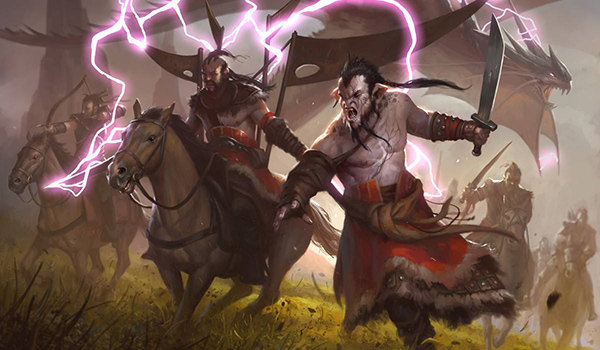
The ensuing pile, hereafter referred to as Mardu Shadow, tries to preserve the strongest aspects of both strategies without giving up too much oomph in between. This article outlines the deck's key cards and strategic benefits, as well as my impressions after two weeks of reps.

Mardu Shadow, by Jordan Boisvert

Creatures

4 Monastery Swiftspear
4 Death's Shadow
4 Bedlam Reveler
4 Street Wraith

Instants

4 Lightning Bolt
2 Fatal Push
2 Kolaghan's Command

Sorceries

4 Inquisition of Kozilek
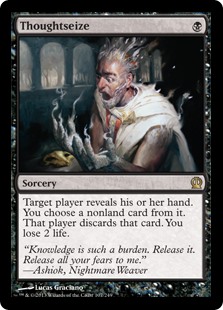
4 Thoughtseize
4 Faithless Looting
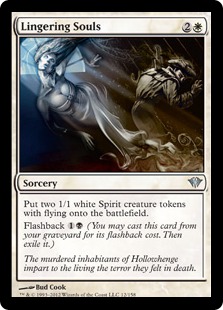
4 Lingering Souls

Lands

4 Bloodstained Mire
4 Arid Mesa
4 Scalding Tarn
4 Blood Crypt
1 Sacred Foundry
1 Godless Shrine
1 Mountain
1 Swamp

Sideboard

4 Blood Moon
2 Stony Silence
2 Temur Battle Rage
2 Pyroclasm
2 Collective Brutality
1 Surgical Extraction
1 Terminate
1 Dismember

Card Choices

Before we jump into the deck's strategic positioning, I want to go over the roles a few of Mardu Shadow's cards play, as well as touch on some notable omissions.

Featured Cards

Monastery Swiftspear: Puts opponents on the backfoot early, allowing us to play the game according to our own terms. In many matchups, Swiftspear marks the difference between us claiming initiative first and it being more of a wash. She's also necessary against decks that ask us to be more proactive to keep up with their gameplan, such as Storm and Tron.
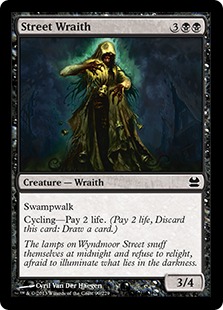
Street Wraith: It's true that Mardu can take a lot of damage to its lands alone. But even with Thoughtseize in the picture, it doesn't take enough damage to enable Death's Shadow against decks that don't touch our life total for a bit (Storm and Tron again among the chief offenders). Wraith gets boarded out against most aggressive and interactive decks and joins Swiftspear as a critical player in many Game 1s.

Kolaghan's Command: An expensive card for this deck, but a necessity in attrition matchups. Command pairs with Reveler to help us never lose the grind game, and Shadow gives the card a mean toolbox aspect.

Faithless Looting: This card lets us tear through the deck like no other, providing a pseudo-Brainstorm effect with dead fetches in the late game and chewing past clunky spells otherwise. Looting's also great with Swiftspear and Reveler, not to mention its synergy with Lingering Souls.

Absent Cards

Young Pyromancer: With Shadow in the mix, we've already got enough threats. And this card is just kind of meh. Fails the Bolt and Push tests; doesn't fit well into our curve; Lingering Souls already attacks from the go-wide angle. You get the idea.
Liliana of the Veil: I went back and forth on this one for a while, but eventually left her out. Lili's expensive, sure; still, the biggest strike against the walker is her typing. We're not Delver, but we still need a relative critical mass of instants and sorceries to facilitate Bedlam Reveler.

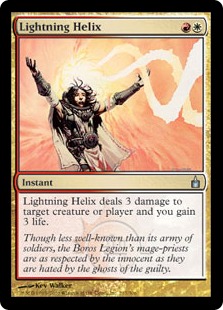
Lightning Helix: When it comes to halting aggro decks, Lightning Helix is king. But we've got Shadow to pull points there, most notably against the Burn decks that hassle Mardu Reveler in the first place. Besides, skipping out on Helix lets us run a reliable Blood Moon plan from the sideboard, as our only white spell becomes Lingering Souls---which can just as well be pitched to Looting or Reveler and cast for black.

Path to Exile: And when it comes to removal, nothing holds a candle to Path. We're in Terminate colors, though, with Bolt and Push to boot, as well as a few plans that go over creatures that ignore all that. Path clashes heavily with our Moon plan and overall just isn't necessary.

Plugging Holes

The reason to play any mish-mash of two archetypes tends to remain constant no matter the style or format: mixes can plug strategic holes in either archetype to yield a deck overall better positioned than either of its ingredients (think Tarmo-Twin; Jeskai Breach; Eldrazi Tron). Both Shadow decks and Reveler decks have such drawbacks, which this deck attempts to remedy.

Problems with Shadow Decks

Death's Shadow has come a long way from its aggressive blitz beginnings, by now becoming one of Modern’s premier threats. It helms both Grixis Shadow, which combines it with delve threats and Snapcaster Mage into a reactive rock shell, and Delirium Shadow (of Jund, Abzan, and 5-color flavors), a highly consistent and proactive take on BGx midrange decks.
Of course, no strategy is perfect. One issue common to both of these shells is their relative lightness on threats. Removal-heavy control shells like Jeskai and Mardu plow Shadow decks, as they pack even more kill spells than Shadow has creatures. And should Shadow fail to replace its dead threats with more, a mere one or two removal spells from the other side of the table can prove enough disruption for whatever deck to get its own gameplan online, even through targeted discard and countermagic---disruption that doesn't interact with the board and looks real silly under pressure.

In Mardu Shadow, two cards address this pitfall: Bedlam Reveler and Lingering Souls. The former cleans up the mess a flurry of interactive spells can leave by gassing us back up on pressure, even serving as a respectable body itself. And Souls overloads the sort of spot removal that shines against Monastery Swiftspear and Death's Shadow, putting a tight squeeze on opponents to react from multiple angles.

Problems with Mardu Reveler

Mardu doesn’t just shine against Death’s Shadow strategies—it excels against most players looking to interact. The aforementioned combination of Reveler and Souls makes one-for-ones quite unappealing. Like many decks that shine at the grind game, though, the deck can be raced rather handily. Faster aggressive strategies tend to decimate Mardu, especially ones that don’t rely too heavily on creatures (between Bolt, Push, and Path, the shard isn’t exactly wanting in the removal department). Usual suspects include Burn, Storm, and Tron.

There are a couple ways to beat Modern’s faster noninteractive decks, but the most reliable has always been to go up on proactivity when possible. That’s why Delirium Shadow has such a ball against Tron while the more reactive UBx shells struggle—cards like Tarmogoyf and Temur Battle Rage let that deck close games out more quickly when it needs to. Unlike traditional Mardu decks, this one ups the Monastery Swiftspear count to four to help with this proactive dimension, and axes Young Pyromancer entirely; I was never big on the Shaman anyway, and it seems much too durdly for this role in particular. And naturally, there’s Death's Shadow itself, which with the right enablers can take opponents from 20 to 0 in a matter of turns. We’ve got the best in the format: Street Wraith, Thoughtseize, and plenty of fetchlands.
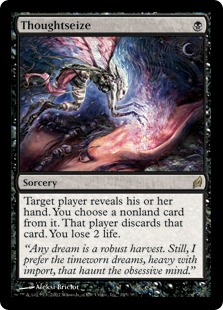
Rounding out the proactivity bump is Mardu Shadow's disruptive suite, which trims some of Mardu Reveler's removal to accommodate the full eight discard spells. Opening targeted discard is the nut in Modern, and this deck naturally mitigates the inherent drawback of topdecking dead Thoughtseizes later with its set of Faithless Lootings. Discard also plays well with Reveler and, surprisingly, Swiftspear. I'd gotten so used to casting her in Serum Visions decks that I'd slept on her interaction with discard, which is just as nice.

Actually, targeted discard is gravy with most of our spells---big plays like Reveler become more rewarding if we can use Inquisition to ensure we don't run into Logic Knot; Lingering Souls improves when we can first strip Electrolyze; etc. This deck also features lots of control over its life total, so having extra information with which to decide how low to go boosts Death's Shadow's potency.

Assessing the Hybrid

So that's my reasoning for the pairing, and I've been running the above build for a couple of weeks. Let's now take a closer look at how I think the deck fares compared with Shadow decks and Mardu Reveler.

Pro: More Robust

Mardu Shadow is less vulnerable to graveyard hate than either Shadow deck, and resists mana denial better than those and Mardu. Since it can leverage its proactive elements into a higher reversibility than Mardu, it's also better-rounded when it comes to matchups generally.

Pro: Free-Winninger

Between many Moons and Stony Silence from the board, the grinding plan of Reveler and Souls, Shadow's excellence in creature mirrors, and the creature-combo-shredding disruptive suite of cheap discard and removal, Mardu Shadow has a great time against plenty of decks in the field. Some of the above cards simply win the game for us.

Con: Less Consistent
The biggest issue I've run into so far is the deck's lack of focus, and of a way to smooth things out for itself---Faithless Looting only works when we've got cards to spare, and the window for Bedlam Reveler only opens in the mid-game. It's true that Mardu Shadow has the tools to beat, well, anything, as well as plans for all the matchups in Modern. But you could say the same thing about a host of other strategies, including Delirium Shadow, a far more consistent deck (albeit a more fragile one). Mardu Shadow can fall victim to drawing the wrong portion of its deck at the wrong time, and doubly so since some of its pieces can be awkward together---think opening Swiftspear, Souls, and Reveler, for instance. Consistency is a big deal in Modern, and for all its supposed improvements on other strategies, there's no denying that Mardu Shadow is less focused than any of its parts.

No Faith, No Problem

But then... so what? Modern's full of decks that cut an edge here for an edge there, and Mardu Shadow features enough individually powerful cards and interactions that I think it's totally viable in this format. Everything isn't always about scooping up small percentage points at high-level tournaments, at least for me; Modern specifically has a stronger emphasis on brewing than any other constructed format. And I hold that Mardu Shadow is one hell of a brew!


Insider: 11 Cheap Singles with a Ton of Upside

Are you a Quiet Speculation member?

If not, now is a perfect time to join up! Our powerful tools, breaking-news analysis, and exclusive Discord channel will make sure you stay up to date and ahead of the curve.

I love cheap investments that have a ton of upside. Who doesn't? They are the best kind!

One of my favorite ways to make a little bit of extra cash is to dig through those four-for-a-dollar boxes at large tournaments like Grand Prix. If you get there early and/or you know what to look for, it is easy to spend a few bucks and walk away with a great haul of potential money makers. If you're lucky and savvy you can often walk away with a handful of cards that buylist for double what you paid!

Today, I'd like to talk about a handful of cheap cards that I think have a lot of potential upside. Obviously, a few things need to break my way in order for these picks to hit. The same things that need to happen for anything to hit. They need to dodge a reprint. They need to see some play somewhere.

These are all cards that buylist for less than fifty cents right now. Several of these cards don't buylist above bulk! Either way, these are cards that I would never toss out when I sell bulk rares and cards that I'm apt to take a chance on if the price is right.

There was an error retrieving a chart for Mantis Rider

Good card is good. Khans was a popular set and there was a lot of it printed which is largely responsible for the price tag. However, Khans block cards should start to rise soon as they have been out of print for a while. It is also worth noting that the card is seeing play in the Five-Color Humans decks in Modern. Modern playability is the key for raising cards out of the bulk box!

There was an error retrieving a chart for Thalia's Lancers

I think Thalia's Lancers is a pretty decent Commander card. It has a decent body and tutors. A creature with an ETB ability that tutors is pretty sweet. Shadows over Innistrad block cards are basically at their rock-bottom prices right now, and as a bulk rare, Lancers really has nowhere to go but up.

There was an error retrieving a chart for Vryn Wingmare

I was pretty surprised to see that this card is still a bulk rare. I've played with this card in Legacy! It is also a fringe Modern card in the Death and Taxes/Hatebears sideboard. It is a legitimately good card that has good stats and a powerful effect.

There was an error retrieving a chart for Blind Obedience

I like to play kind of pseudo-casual Commander decks and this is a pretty awesome card. Extort is really fun in (and really good) in multiplayer. Causing creatures and, more importantly, artifacts to enter the battlefield tapped is deceptively powerful in a multiplayer game. Worth noting, your stuff enters untapped. Great card.

There was an error retrieving a chart for Shapers' Sanctuary

Shapers' Sanctuary is a great Magic card. It hasn't seen a ton of play yet, but I believe that it will. The card generates a ton of value for a single mana in match-ups where the game will tend to go long. It's a powerhouse against removal-heavy decks in Modern. I see Sanctuary as a card that hasn't realized its constructed potential yet.

There was an error retrieving a chart for Wave of Vitriol

Bulk rare, casual multiplayer all-star, or both? The card is gross in a creature-centric deck. The effect is super powerful and exactly the kind of thing that people like to do in Commander. It's a great Commander hate card that punishes the decks everybody hates at the table. It's a hero card! Not a bulk rare.

There was an error retrieving a chart for Fathom Fleet Captain

The only other Ixalan card on my list. I mention this here because I think it has a lot of potential with Rivals of Ixalan coming out. The stats on the card are basically absurd. If it gets some help in the form of other playable aggro Pirates the Captain could easily become a format staple. A big "if" but worth thinking about nonetheless.

There was an error retrieving a chart for Desolate Lighthouse

The Lighthouse is a Modern and Commander staple. It hasn't been reprinted and it is a great card. It feels like it should be more expensive than its modest price tag. I could see this card rising significantly if it continues to dodge a reprint.

There was an error retrieving a chart for Tainted Remedy

Another random Origins card. Tainted Remedy is a powerful effect and a potential Johnny card in a neat Commander or casual deck. The card is unique and powerful which is the hallmark of a casual money card. Keep an eye on this one.

There was an error retrieving a chart for Sigarda's Aid

Another Eldritch Moon card. Sigarda's Aid is a card that I identified as having long-term potential when the set was released. It has modest value despite Innistrad block being bottomed out. As that block fades into obscurity and the prices slowly begin to rise again, I think this will ultimately end up being one of the casual money cards from the block. The card and the effect is so powerful in an equipment-themed deck.

If Stoneforge Mystic ever gets unbanned in Modern, this card will go crazy in value as well.

There was an error retrieving a chart for Creeping Corrosion

Another Modern sideboard staple that has slowly gone from bulk rare to modest rare. Cards that take the first step often take more steps. I've played with this card countless times and am sure I will again. When there are so many artifact-based decks in the field, a spell like this will always have a home in sideboards.

There was an error retrieving a chart for Notion Thief

I actually find it baffling that this card is as cheap as it is. It has an effect that turns games into blowouts and is inherently powerful. It's also reasonably costed for Legacy and Modern play. It even sees Vintage play! So, it has fringe playability in all formats.

However, the Commander appeal is what gives this card the most legs. I literally would not play a deck that can make blue and black mana without this card in it. It is completely absurd in Commander. As long as it dodges a reprint in a Commander deck, I think this might be the strongest pick on my list.

Buying on the Cheap

I love cards like these because they have very little value now, but I can see potential value down the road. It's fun to bet on the little guy. There are plenty of cards that have made the trek from the four-for-a-buck box to the display case. Will any of these cards join those big gainers? Only time will tell!

Daily Stock Watch: Dolmen Gate

Are you a Quiet Speculation member?

If not, now is a perfect time to join up! Our powerful tools, breaking-news analysis, and exclusive Discord channel will make sure you stay up to date and ahead of the curve.

Hello, readers and welcome to the Thursday edition of the Daily Stock Watch! It has been a week of reviews that involved cards that have minimal to no impact in Modern and Standard, and I plan on ending the week by following that trend with today’s feature. It’s another one of those cards that you aren’t really familiar with because it didn’t have much impact back in the day (and even after it left its Standard days), but has seen a reasonable rise in price due to supply shortage.

There was an error retrieving a chart for Dolmen Gate

This card reached its all-time high of $5.05, without actually seeing any competitive air time on any deck, across all formats, based on the Utility Tracker. It is a conditional card at best, and even the unique feature it brings to the table is very mediocre, if you ask me.

In an era where position-less basketball has dominated the hoops scene, Magic has done the same by prying away from the traditional White Weenie versus Green stompy versus Suicide Black days of old, and has since transitioned to a more diverse battlefield that we now know as the “rock-paper-scissors” formats called Modern and Legacy. With this mind, can you imagine a scenario where you would like to have Dolmen Gate in your mainboard or sideboard?

But then again, it could always fit in a casual Commander deck.

Neheb, the Worthy

Commander

1 Neheb, the Worthy

Creatures

1 Gnarled Scarhide
1 Bloodrage Brawler
1 Burning-Fist Minotaur
1 Deathbellow Raider
1 Adaptive Automaton
1 Felhide Petrifier
1 Kragma Butcher
1 Rageblood Shaman
1 Ragemonger
1 Taurean Mauler
1 Anaba Spirit Crafter
1 Ashenmoor Liege
1 Fanatic of Mogis
1 Felhide Spiritbinder
1 Gorehorn Minotaurs
1 Hazoret the Fervent
1 Lord of Shatterskull Pass
1 Mogis, God of Slaughter
1 Oracle of Bones
1 Sangromancer
1 Archfiend of Ifnir
1 Kragma Warcaller
1 Neheb, the Eternal
1 Tahngarth, Talruum Hero
1 Sire of Insanity
1 Minotaur Aggressor

Instants and Sorceries

1 Call to the Netherworld
1 Vandalblast
1 Doom Blade
1 Dreadbore
1 Rakdos Charm
1 Rakdos's Return
1 Terminate
1 Tormenting Voice
1 Dark Deal
1 Hero's Downfall
1 Murder
1 Spontaneous Combustion
1 Unlicensed Disintegration
1 Diabolic Tutor
1 Skull Rend
1 Torrent of Souls
1 Tyrannize
1 Grave Upheaval
1 Blasphemous Act

Artifacts

1 Didgeridoo
1 Sol Ring
1 Dolmen Gate
1 Lightning Greaves
1 Rakdos Signet
1 Herald's Horn
1 Geth's Grimoire
1 Obelisk of Urd

Enchantments

1 Liliana's Caress
1 Waste Not
1 Forsaken Wastes
1 Megrim
1 Necrogen Mists
1 Oppression
1 Pain Magnification
1 Berserkers' Onslaught
1 Painful Quandary

Lands

1 Akoum Refuge
1 Blood Crypt
1 Bloodfell Caves
1 Bojuka Bog
1 Canyon Slough
1 Cinder Barrens
1 Command Tower
1 Dragonskull Summit
1 Evolving Wilds
1 Foreboding Ruins
1 Geier Reach Sanitarium
8 Mountain
1 Rakdos Guildgate
1 Rix Maadi, Dungeon Palace
1 Rogue's Passage
1 Sea Gate Wreckage
1 Smoldering Marsh
10 Swamp
1 Temple of Malice
1 Temple of the False God
1 Terramorphic Expanse

It’s not much of a game changer ala Ensnaring Bridge, but it does some cool stuff for you if you’re facing an aggro deck. It gives your creatures that pseudo-protection feeling, allowing your 1/1 crits to be a threat anytime (if you have combat shenanigans) to take out larger opposing creatures. But $5 for this card? I’m not a fan at all.

Better Artifact Investments

These cards have gotten expensive over time (and Mesmeric Orb is already slowly creeping to that territory) but they are actually very strong right on the get-go, so we could probably try to pattern our artifact specs after them. I’m quite confident that Dolmen Gates won’t be in that realm anytime soon, but I’d be glad to be proven wrong, otherwise.

At the moment, you could find copies of this card from online stores such as Star City Games, TCGPlayer, Card Kingdom, and Channel Fireball from anywhere between $4.49 up to $6.99. Just like how it was for the foil copies of our yesterday’s Stock Watch card, there’s only a mere $2-$4 dollar difference between the normal and foil copies of Dolmen Gate, which further cements our argument that it is only a casual favorite whose demand is driven by the lack of supply, and the age of the set where it was only printed. Try to cash out now if you could.

And that’s it for the Thursday edition of the Daily Stock Watch! We’ll be taking a break tomorrow, so we’ll see you again next week, as we check out new cards that should be on the go, or good enough for speculating. As always, feel free to share your opinion in the comments section below. And if you want to keep up with all the market movement, be sure to check in with the QS Discord Channel for real time market information, and stay ahead of the hottest specs!

Video Series with Ryland: Mono-Blue Living End

Are you a Quiet Speculation member?

If not, now is a perfect time to join up! Our powerful tools, breaking-news analysis, and exclusive Discord channel will make sure you stay up to date and ahead of the curve.

This deck is quite the strange one. Originally popping up on MTGO a little more than a week ago from user 1310HaZzZaRd, Mono-Blue Living End has been making waves in the community. I'll be frank—when I first looked at the deck, I was not impressed. I thought I'd give it one day on my stream since a number of people had asked about it, and it looked like it could be fun. I assumed the day would be fraught with game losses and an all-around good time. While there were certainly some elements of the original decklist that I did not like, the archetype surprised me quite a bit. After some minor tuning (which may not have even been correct), results started showing up.

Some of the leagues with the deck have been impressive; but plenty have been stinkers as well. After a few days on stream last week, I found myself with final league records of (in descending order): 5-0, 4-1, 4-1, 2-3, 2-3. Since then I have had more results, and they have been much of the same. Either relatively successful (4-1 or better), or relatively disappointing (2-3 or worse). To me this speaks of some consistency issues, but also speaks to a powerful core of the deck. There is something worth doing going on here, but fine-tuning is required.

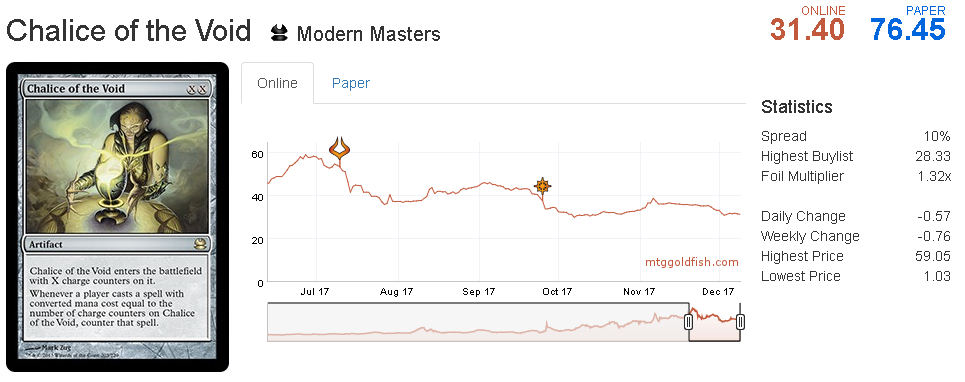
The list we are playing today has a major addition that was not in the original lists: Chalice of the Void. While this has been somewhat of a polarizing decision on my stream (people either love it or hate it), I think it has been worth it overall, and it deserves further testing. This, however, is not the only way you could improve the archetype. There are other colors you could splash, particularly red, and there are advantages to pursuing a true Mono-Blue list similar to the original as well. These are things I want to continue to explore in the future, which I discuss more in the wrap-up video.

I have enjoyed Mono-Blue Living End quite a bit so far—certainly more than I expected. Tuning it has been a unique challenge and I am interested to see if the deck breaks through it's "honeymoon" period to become a real archetype. People are always excited to see something new and interesting come up in the Modern format. That said, I'm curious to see if this deck finds a way to stick around, or if it floats back down to the pit containing hundreds of somewhat viable Tier 3 or lower Modern strategies.

I hope you enjoy the matches and as usual, I'm interested to hear what kind of content you'd like to see moving forward so I can continue to evolve and improve my videos. Please let me know your thoughts, and any improvements you would like to see concerning formatting, presentation, or whatever else strikes your fancy. If you'd like to see similar content, check out my Twitch channel for some live Modern games!

[youtube https://www.youtube.com/playlist?list=PL261kJ_cAQC8nfQaDXkeDp1z6_79gl5Yf]

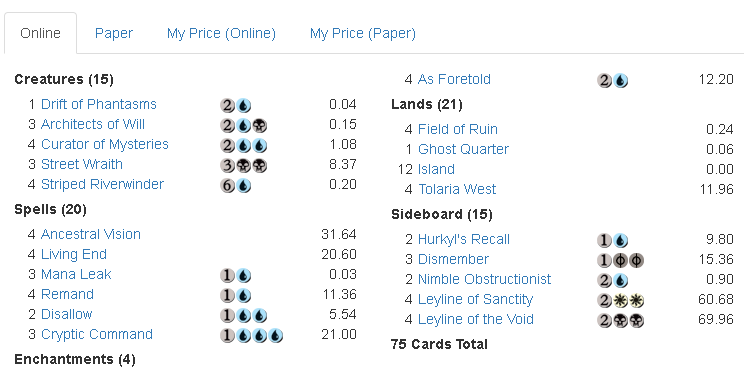
Mono-Blue Living End, by Ryland Taliaferro

Creatures

1 Archfiend of Ifnir
3 Architects of Will
4 Curator of Mysteries
4 Street Wraith
4 Striped Riverwinder

Artifacts

4 Chalice of the Void
1 Engineered Explosives

Enchantments

4 As Foretold

Instants

3 Cryptic Command
4 Remand

Sorceries

4 Ancestral Vision
4 Living End

Lands

1 Bojuka Bog
2 Darkslick Shores
2 Field of Ruin
1 Gemstone Caverns
7 Island
3 River of Tears
4 Tolaria West

Sideboard

1 Baral's Expertise
1 Commandeer
2 Disallow
2 Disdainful Stroke
2 Echoing Truth
1 Engineered Explosives
3 Faerie Macabre
2 Nimble Obstructionist
1 Negate

Daily Stock Watch: Forced Fruition

Are you a Quiet Speculation member?

If not, now is a perfect time to join up! Our powerful tools, breaking-news analysis, and exclusive Discord channel will make sure you stay up to date and ahead of the curve.

Hello, readers and welcome to the midweek edition of the Daily Stock Watch! There has been some noise from the Modern community that the "big decks" are starting to dominate the format again, based solely on the result of Grand Prix Oklahoma, where there was an all-Scapeshift finals that occurred, and other Tron or "unfair" decks, also cracked the Top 8. With this in mind, we'll stray away from Modern specs for now and continue to focus on some Commander and casual cards (unless a big spike or drop in price for a Modern-used card occurs).

Our card for the day is Forced Fruition

There was an error retrieving a chart for Forced Fruition

This was one of my favorite cards back in the day, as I loved meddling with decks that just saps the life out of your opponent at one go. It worked very well with Megrim and Underworld Dreams, and also made some rather unplayable creatures such as Gnat Miser and Locust Miser seem useful. Bear in mind, though, that this was just a casual deck that I used to toy around with when playing with my classmates.

The deck looked just like this:

Forced Fruition Fun Deck

Creatures

4 Drift of Phantasms
4 Gnat Miser
4 Locust Miser

Other Spells

2 Copy Enchantment
4 Font of Mythos
4 Forced Fruition
4 Howling Mine
4 Liliana's Caress
4 Megrim
4 Underworld Dreams

Lands

10 Island
2 Reliquary Tower
10 Swamp

Looks just like any other kitchen table deck, right? Even the lands are all basic with the exception of Reliquary Tower. I mean, where else would you find all these nasty artifacts and enchantments, all coming down to play one-by-one, without the support of hand disruption or permission spells? If you're thinking of a casual deck, then you definitely got that right.

I went to my handy Utility Checker and checked if Forced Fruition is seeing action somewhere else, and was not surprised to find that it's not being used in any competitive Legacy, Modern, or Commander deck. Since Lorwyn was its only printing, and it has been a decade since that set was printed, it's safe to say that the price spike has been caused by some LGS supply shortage, which has prompted some players to purchase them from online stores. As of this writing, there should be less than 100 near mint copies of the card from different online vendors such as Star City Games, TCGPlayer, Card Kingdom, and Channel Fireball.

Forced Fruition Buddies

Based on TCGPlayer's purchase tracker, these are some of the cards that customers who bought Forced Fruition also purchased. I think we could all agree that none of them are the usual suspects in any potent tier one or two decks in Legacy or Modern, so I really don't see a reason for Forced Fruition to maintain this new price tag in the long run. This card is also barely playable in any sideboard strategies, considering its high casting cost, and you'll need other pieces that would interact with it, to win games.

Right now, you would find copies of Forced Fruition from the usual online stores where we check card prices, from anywhere between $9-$11.99. What's funny is that the foil prices of the card didn't even go past $15 from any of the said stores -- a clear indication that the card is only wanted in the casual community.

With the information we have on hand, I think it's safe to say that you could trade away or sell your copies for a fair deal that's near the amounts I've stated above. I'm not sure if this is going to be reprinted anytime soon, but the card doesn't require any major storylines or synergy, to be included in any support product within the coming year. For all we know, it could be part of Rivals of Ixalan for no apparent reason, so it would be best that you get your profit now while it's still hot.

And that’s it for the midweek/Wednesday edition of the Daily Stock Watch! See you again tomorrow, as we check out a new card that should be on the go, or good enough for speculating. As always, feel free to share your opinion in the comments section below. And if you want to keep up with all the market movement, be sure to check in with the QS Discord Channel for real time market information, and stay ahead of the hottest specs!

Insider: MTGO Market Report for December 13th, 2017

Are you a Quiet Speculation member?

If not, now is a perfect time to join up! Our powerful tools, breaking-news analysis, and exclusive Discord channel will make sure you stay up to date and ahead of the curve.

Welcome to the MTGO Market Report as compiled by Matthew Lewis. The report will cover a range of topics, including a summary of set prices and price changes for redeemable sets, a look at the major trends in various Constructed formats and a "Trade of the Week" section that highlights a particular speculative strategy with an example and accompanying explanation.

As always, speculators should take into account their own budgets, risk tolerances and current portfolios before buying or selling any digital objects. Please send questions via private message or post below in the article comments.

Redemption

Below are the total set prices for all redeemable sets on MTGO. All prices are current as of December 12, 2017. The TCGplayer low and TCGplayer mid prices are the sum of each set's individual card prices on TCGplayer, either the low price or the mid price respectively.

All MTGO set prices this week are taken from GoatBot's website, and all weekly changes are now calculated relative to GoatBot's "full set" prices from the previous week. All monthly changes are also relative to the previous month's prices, taken from GoatBot's website at that time. Occasionally, full set prices are not available, and so estimated set prices are used instead. Although Hour of Devastation (HOU), Amonkhet (AKH), Aether Revolt (AER) and Kaladesh (KLD) are no longer available for redemption, their prices will continue to be tracked while they are in Standard.

Standard

This week was another blood bath in terms of prices, with all Standard sets falling in both paper and digital. From a tactical point of view, speculators should stay well clear of Standard at the moment. There is no near-term catalyst to Invigorate prices, heading into a week of Vintage Masters draft followed by a period of Vintage Cube for the holidays. Both of these events are going to be a good reason to sell singles for tix, so I don't think we've seen the bottom yet.

There was an error retrieving a chart for Black Lotus

For full set speculations, typically the strategy is best employed in the final weeks of drafting a set. For Ixalan (XLN) and the upcoming Rivals of Ixalan (RIX), this means targeting these sets just prior to the release of Dominaria (DOM) at the end of April. March will be an excellent time to be a buyer of both XLN and RIX.

There was an error retrieving a chart for The Scarab God

Last week, I punted on my The Scarab God spec and it has continued to fall in price. It looks like this card will get to its pre-XLN price range of 18 to 21 tix, which will be a good level to quietly start accumulating this card again. I will be looking for some price stability beforehand, though. I want to see at least a flattening of the current downtrend before considering dipping back into speculating on this card. Ultimately, I'd be surprised if this card doesn't breach 30 tix again over the next six months, but nothing is guaranteed on this front.

Modern

Prices on Modern cards are starting to roll over a little, with different cards now taking turns rising and falling. A card like Mox Opal has leveled off its price ascent, and the Modern Masters 2015 (MM2) version now sits slightly below its all-time high. A fresh round of interest in Affinity or Lantern Control will be necessary for this card to get back to the 70-tix level.

There was an error retrieving a chart for Lantern of Insight

Although I still think we have not yet hit the peak of Modern demand, the rolling over of prices does mean the buying window is closed for speculators. There will still be opportunity on individual cards seeing price spikes as a result of metagame shifts, but a blanket, buy-everything-and-hold approach is no longer appropriate. Speculators should be starting to sell their profitable positions and looking to trim their failed specs.

It's impossible to predict the future, and there's likely to be another peak in Modern prices over the summer in the months just prior to KLD and AKH block rotating out of Standard. Nevertheless, that's too long a time frame to speculate on cards in the age of Treasure Chests. I'm simply not interested in trying to fight that influx; I want a clear entry and exit point for any single-card spec in Modern. For this purpose, the entry point was in October as Standard rotated and the exit point will be in the coming weeks as we approach the Modern Pro Tour in early February.

There was an error retrieving a chart for Fat Ass

This was the fat pitch and I've taken my swing. I'm happy with the outcome so far, but in order for the outcome to materialize, I'll have to continue to sell down my Modern positions. Trying to stretch a solid double into a triple, to continue the baseball metaphor, risks getting thrown at the third base. There will be another fat pitch down the road, and I want to be ready for that with tix in hand and not a depleted capital base due to holding on too long.

Boosters

Although they briefly and unexpectedly jumped to 3.4 tix in price this week, XLN boosters quickly dropped back to the 3-tix level. The outlook on these is not changed in that lower prices are anticipated over time. In particular, the release of RIX will not stimulate demand for these, despite an increase in overall interest in draft and Standard. The introduction of RIX will necessarily generate a drop in demand as drafters require only one booster of XLN to enter a draft instead of three.

HOU boosters are continuing to show price strength as they sit at 3.6 tix this week, while AKH boosters have trouble maintaining the 1.1 tix price level. This is fascinating dynamic that could inform the next big round of boosters speculation in March and April. Although I would have previously suggested that buying complete draft sets is the way to go to minimize risk, the behaviour of HOU and AKH booster prices indicates there should be a clear preference for the second set.

With no changes to the booster economy between AKH and XLN blocks, the only other factor to consider would be whether the expected value of the booster contents has an impact on price. I think this effect does matter, but only weakly. Both AKH and HOU boosters have an expected value of less than 1 tix, but their price diverges wildly.

The key driver of booster prices is still the cost of entering a draft using tix only instead of boosters and tix. It's the 12-tix price of entry that players can get a discount on by going to the secondary market to purchase their boosters. As long as one can buy a draft set for less than 10 tix, there's an economic reason to spend a little extra time buying boosters from the bots in order to draft AKH block.

Trade of the Week

For a complete look at my recent trades, please check out the portfolio. This week I've been accumulating Iconic Masters (IMA) boosters at around 4 tix. Although these are not as liquid as Standard boosters, the pattern on these premium priced sets is for steady price appreciation after drafting ends. I'll be buying these as long as they are around 4 tix and as long as I've got excess tix to use.

There was an error retrieving a chart for Mana Drain

It doesn't work to try and buy a hundred of these at once, though, since there's just not that many available from enough different vendors. If you try to buy a large quantity at once, the price will get away from a profitable level as the bots react to the perceived increase in demand by raising prices. The best approach is to slowly accumulate your position over a period of days and weeks. Keep in mind your buy price target, and if the price of the booster in question gets away from your target, be sure to reevaluate what is happening.

Last week, I was looking for a drop to 3.5 tix on these, but that never materialized in the days after IMA draft went offline. In this case, I had to adjust my original buy price target based on a persistently higher price than expected. I still think a sell price of 5 tix will be a reasonable target for selling, but this price target could also be wrong. Once we get to end of January, a clear trend will be visible as more normal economic conditions return to the MTGO market.

Note that I intend to repeat this trade with VMA boosters next week. VMA boosters will not drop as low as IMA boosters did due to being drafted for only one week, so a buy price target in the 5- to 6-tix range is expected.


Daily Stock Watch: Tidespout Tyrant

Are you a Quiet Speculation member?

If not, now is a perfect time to join up! Our powerful tools, breaking-news analysis, and exclusive Discord channel will make sure you stay up to date and ahead of the curve.

Hello, readers and welcome to the Tuesday edition of the Daily Stock Watch! A lot of Commander cards are seeing some gains over the past few days, so we'll take a look at a card from a different format that's doing well lately. Our card for the day is one of those creatures that you'd probably see more in a Legacy than in Commander.

There was an error retrieving a chart for Tidespout

Tidesprout Tyrant just hit its all-time high today of $9.26 as its average price, and this will probably continue to tick upwards for a couple more days. This is the only printing of the card, so it makes sense that the price has inflated quite a bit, since it has been more than a decade when it was printed.

In case you're wondering how a deck with it looks like, here's a list for reference:

BR Reanimator

Creatures

1 Iona, Shield of Emeria
1 Tidespout Tyrant
4 Chancellor of the Annex
4 Griselbrand

Instants and Sorceries

4 Entomb
4 Dark Ritual
4 Faithless Looting
4 Unmask
4 Reanimate
4 Exhume
3 Thoughtseize
2 Collective Brutality

Other Spells

4 Animate Dead
1 Chrome Mox
4 Lotus Petal

Lands

4 Bloodstained Mire
2 Swamp
2 Badlands
3 Marsh Flats
1 Scrubland

Sideboard

4 Wear // Tear
2 Surgical Extraction
1 Stronghold Gambit
1 Sire of Insanity
2 Pithing Needle
2 Massacre
1 Grave Titan
1 Collective Brutality
1 Archetype of Endurance

Tidespout Tyrant makes an appearance here as a one-of copy, but a turn one Dark Ritual+Entomb+Reanimate could already put your opponent in a horrible predicament, if left unanswered. Every spell you play as soon as Tidespout Tyrant hits play becomes a Boomerang, and not too many decks could recover from that.

But besides these Reanimator decks, I don't see any other home for Tidespout Tyrant. It also reeks of a reprint very soon, considering that it is a big creature (that dodged being reprinted in Iconic Masters since it's a djinn), card supply is already low (Star City Games is out of stock for normal copies, while other online stores have few copies left), and it could very well fit in Masters 25 as the representative of Dissension. By taking all of these factors in consideration, I think it's a good idea to start moving them soon.

Just like with my issue in the case of Hateflayer, this card doesn't exactly do anything as soon as it hits play. It does some devastating stuff once you let it do its thing, but it's not really a game changer when you have an empty hand that won't be able to back it up. The price increase here is justified only by the fact that you will have a hard time finding copies of this card in your LGS, but there are still some out there via TCGPlayer, Card Kingdom, and Channel Fireball.

Big Creatures I Would Rather Buy

Above are some of the cards that you'd usually see in Reanimator decks, both in Modern and Legacy. I don't mind paying $10 for any of them, but I'm just glad that I don't have to. Online stores that I mentioned above are selling Tidespout Tyrant for as low as $7.68, and as high as $10.99 for normal copies. As a Legacy piece, the foil copies are available for $46.99 up to $59.99, and I'm not sure if there's a market for this. I think that you should start dispatching your copies as soon as someone is willing to buy it for something north of $10, as the risk for this card being reprinted anytime soon is quite high. I just have a strong feeling that we'll see it next year as a part of a new product. Start moving it as soon as you find a favorable trade or deal that works for you.

And that’s it for the Tuesday edition of the Daily Stock Watch! See you again tomorrow, as we check out a new card that should be on the go, or good enough for speculating. As always, feel free to share your opinion in the comments section below. And if you want to keep up with all the market movement, be sure to check in with the QS Discord Channel for real time market information, and stay ahead of the hottest specs!

Deep Analysis: Comparing Metagame Methodology

Are you a Quiet Speculation member?

If not, now is a perfect time to join up! Our powerful tools, breaking-news analysis, and exclusive Discord channel will make sure you stay up to date and ahead of the curve.

The plan for this week was to update my metagame data tables with the results of the Grand Prix. However, Jason surprised all of us with the actual metagame update. Not that I'm complaining, mind you; it was a very nice surprise. I'm glad the more rigorous and comprehensive table is back in action. In light of this development, we can do something unusual: compare results. My article series focused only on the results of high-level paper tournaments in the United States. Jason has those results, and a host of others, providing an opportunity to see if my focused data accurately reflects the metagame at large. It will also provide an excellent example of how perception of data can affect reaction to the data.

To be honest, I'm actually rather relieved. The results of GP Oklahoma City are unusual, and would have really warped my metagame projection. Don't misunderstand me; it is important and useful data. But the temptation would have been to read deeply into the results. By the time the GP rolled around, big-mana decks had mostly dropped off to inhabit the lower end of Tier 2. Even if I were aggregating them, they would have only been mid-Tier 2. No, Eldrazi Tron isn't really big-mana; it's more stompy than ramp. A resurgence, especially to this degree, is definitely worth looking into.

However, it has to be taken with a grain of salt. Wizards is not reporting the Day 2 data, without which we don't know if this phenomenon was a function of population or actual success. If non-Eldrazi Tron and Valakut decks made up most of Day 2, of course they would dominate the finals. If that wasn't the case, there are number of interesting possibilities. As it stands, it's best to evaluate the result in a vacuum. As I said, I'll come back to the GP later. For now, let's look at the two metagame projections.

Comparative Analysis

When comparing anything, it is important to compare relatively similar things. No matter the quality of the apple, it makes a poor orange. I would like to have similar data to compare, but that really isn't possible. I was collecting the Top 16 results of high level events while the full update has many levels of competition. My data is also primarily US-focused while Jason has expanded our metagame sampling overseas. By their nature, the two sets measure different things, and a true side-by-side is disingenuous.

Instead, their differences should be embraced. The metagame update should be regarded as a reflection of the "true" Modern metagame, or as close as can be accomplished. My data is a specialized subset, measuring high-level success within the greater metagame. This analysis will inform us of how well that data reflects reality, and what it may imply about the set itself. Oftentimes this method reveals hidden quirks and other interesting discussion points. For reference, my final table with the Roanoke Open results will be posted below. The total metagame is in the sidebar on the right of the screen and in the Top Decks page. Or go read Jason's article, which features plenty of links.

DeckTotal
Affinity22
Jeskai Control20
Gifts Storm14
Grixis Death's Shadow14
Eldrazi Tron11
Counters Company9
Humans8
Infect7
UW Control7
Burn6
Abzan5
UG Merfolk4
Bant Company4
Jund4
Elves4
Titan Shift4
8-Rack4
GB Tron3
Ad Nauseam3
GW Company3
Death and Taxes3
Mono-G Tron3
Mardu2
UR Breach2
BW Eldrazi2
GR Ponza2
BW Eldrazi and Taxes2
Titan Breach1
Saheeli Evolution1
Temur Aggro1
Knightfall1
5-Color Death's Shadow1
GR Devotion1
RW Prison1
Bant Eldrazi1
Abzan Company1
Grixis Control1
Living End1
Skred Red1
Bogles1
4-Color Company1
RG Vengevine1
GR Tron1
Naya Company1
4-Color Knightfall1
GW Hatebears1
Grixis Delver1
4-Color Death's Shadow1
Dredge1
Mono-Red Prison1
4-Color Control1
Enduring Ideal1
Lantern Control1
WG Taxes1
Mono-Blue Merfolk1

Similarities

First, our top 3 decks are the same. Affinity is even on top by a decent margin. It would be higher by roughly three decks if I'd done what Star City doesn't and separated Jeskai Geist/Tempo from actual Jeskai Control. That would have separated Affinity, but not dropped Jeskai from second place. In fact, Tier 1 for both sets is very similar. Seven of nine top decks are the same, even if the order is different---the order's a relatively small consideration, reflective of noise in my sample that the weighing system seeks to eliminate for the metagame update. But that's where the similarities end. While the Top Level Tier 1 accurately reflects the international metagame, the rest of my set deviates wildly.

Differences

The most notable variation affects Burn and RG Valakut/Titan Shift. Burn is the fourth-place deck in the metagame, but Tier 2 in the Top Level. Looking back, Burn is consistently Tier 1, but never gets any respect at high levels. This disdain is very counterintuitive, as you would think that players would gravitate towards winning decks. Dissecting why Burn sees so little play at high levels is an article unto itself, but I will note that it catches some undeserved flak for being a "kids' deck." Valakut is at best at the bottom of Tier 2 in my sample, yet it made Tier 1 by a decent margin. It's particularly glaring considering that it won. In its place, my data has Infect and UW Control, both of which are actually Tier 2.
My mid and lower tiers are very different from Jason's overall. Some of that may be my splitting of Tron variants, but even with that, many of Jason's lower-Tier 2 and 3 decks only appear as singletons in my data. My Tier 2 decks tend to appear as Tier 3 in the metagame. The simplest answer to these variations is that my data set isn't big enough to accurately reflect the metagame. As I've said before, the more data you have the less likely you are to miss something small but important, or to mitigate the effect of outliers. That said, the update looks at the total metagame, including international and online results, while my data is mostly SCG circuit results. The populations are very different and may not reflect each other well.

Meaning

If you are only going to examine high-level results, you will miss a lot of the metagame. They simply don't capture the whole picture. However, they do accurately reflect the top of the metagame. Consider this: the same decks that reach the finals of an Open or GP are likely to perform throughout the meta. Each high level tournament is a grueling fight through 15 rounds of high-level competition. The overall metagame is built by decks succeeding in the face of many levels of competition. If a deck can rise in the face of constant pressure from all sides in the total metagame, it *should* do similarly well at a given competition. It's also worth noting that when a deck is doing well it does attract players, which will boost its numbers. More players equals more visability.
Of course, anything can happen in a given tournament. That's why you should not draw broad conclusions from any individual result. You need multiple data points to draw a meaningful conclusion. That's why I waited until mid-November to really make statements about the metagame and the official update uses so many different events. This also highlights a flaw in my methodology. While Tier 1 was very similar, the other tiers were far off. This is expected. The lower tiers are by definition both less popular and less successful, meaning if you're only using the highest results, they're less likely to appear. When you cast a wider net they have more opportunities to appear. Therefore, my data is valuable for tracking Tier 1, which in turn determines much about player's reactions to the meta. Let's be honest, nobody metagames against or reacts to Tier 2 or 3; all eyes are on 1. This can be important for predicting how the metagame will evolve, but not to show what the overall metagame is doing.

GP Oklahoma City

Now, on to current events. Since Titan Shift and traditional Tron variants dominated the Top 8, we may learn something from their metagame positioning. The overall Top 32 looks far more like the metagame we've been reporting, featuring lots of Jeskai variants. I would guess that the Tron pilots expected to face plenty of Jeskai, and as a bonus got the gift of the many Lantern Control decks that coverage claimed were present. There's not really any evidence of that in the data. Only two Lantern decks made Top 32, but it wouldn't surprise me if there had been a lot of Lantern players. Sam Black hyped the deck and then played it at the Invitational. Some have even called it the best deck in Modern. Then, proponents discovered that Tron was a horrible matchup. Titan Shift isn't much better. If there really was all that Tron food running around, I'm not surprised by the result.

What I'd Have Brought

As noted, the metagame has been defined by decks with poor Tron matchups over the past month. I couldn't go to the Grand Prix, but if I did, I would have played Jeskai Geist with big mana in mind. I could see the trend as well as anyone, so I assumed that players would gravitate to anti-Jeskai lists. 8-Rack had been the weapon of choice at the SCG Classic, but that deck is soft to an open metagame. Going that deep is too risky, but Tron and Valakut are fine decks in their own right, and now they're well positioned. That's a perfect example of repositioning metagaming.

I had intended to reposition my deck around the big mana decks. Rather than go with the recent plan of Ceremonious Rejection and Disdainful Stroke, I'd planned to go for the cheap win.

Jeskai Tempo, David Ernenwein (Test Deck)

Creatures

4 Snapcaster Mage
4 Spell Queller
3 Geist of Saint Traft

Sorceries

4 Serum Visions

Instants

4 Lightning Bolt
4 Path to Exile
2 Spell Snare
3 Lightning Helix
2 Logic Knot
2 Electrolyze
4 Cryptic Command

Lands

4 Celestial Colonnade
4 Arid Mesa
4 Flooded Strand
2 Steam Vents
2 Hallowed Fountain
2 Spirebluff Canal
1 Sacred Foundry
3 Island
1 Plains
1 Mountain

Sideboard

3 Blood Moon
2 Vendilion Clique
2 Supreme Verdict
2 Relic of Progenitus
2 Negate
2 Stony Silence
1 Elspeth, Sun's Champion
1 Celestial Purge

That's right: three Blood Moons. Normally it's not a great card against Tron because they can just keep making land drops, but Jeskai can really apply pressure. The fact that it randomly hits a lot of decks is gravy. It can be painful for Jeskai too, but in the matchups where we're a massive dog, it's just what we need. That's also why I have Arid Mesa instead of Scalding Tarn. In those matches I have to find my Plains. We're likelier to naturally draw Island and we need white mana to cast the important threats. Given the choice between fetching Island and Plains when I had Blood Moon in hand it was always better to get Plains. Hence, extra ways to find them. I would probably not recommend anything this extreme going forward, but I stand by the plan for Jeskai mages looking specifically to beat Tron and Valakut.

Looking Forward

While metagame trends can be identified, actually using them is tricky. A lot of players saw the trend towards interactive fair decks and Affinity and away from goldfish styles and reacted. I anticipated big mana being a force but didn't predict the (alleged) Lantern surge. The Lantern players were ready to crush the interactive decks, which is what they do, but not the big mana decks. Ramp, in turn, was ready for anything but Storm. I speculate that was the key to its success. It isn't as strong against one thing as a dedicated metagame deck, but it's powerful enough on its own merits that if it didn't hit its awful matchups, it didn't matter.

I believe this strategy will be the norm going towards the Pro Tour. The trend of Jeskai, Death's Shadow, Storm, and Affinity being the top decks is likely to continue, but now players are reacting to this trend and will try to take advantage. More decks that don't fit the trend will rise, weakening said trend. What happens next is impossible to forecast. Whether this development occurs before or after the Pro Tour will prove interesting to watch.

Insider: Speculating vs. Guessing

Are you a Quiet Speculation member?

If not, now is a perfect time to join up! Our powerful tools, breaking-news analysis, and exclusive Discord channel will make sure you stay up to date and ahead of the curve.

Welcome back, readers!

In today's article I want to lay out the difference between guessing, or gambling on a card's future value, and true speculation. The latter involves careful consideration of a variety of factors before locking in your purchase.

I know one trap a lot of people new to Magic finance do is to look at cards from a very optimistic point of view. This isn't necessarily bad, but it can lead people into seeing a card's potential "in a perfect world" and ignoring the fact that there are a lot more variables to consider. For a great example, let's look at a card that was heavily hyped by many in the Magic community (including pros).

There was an error retrieving a chart for Skaab Ruinator

This card started out in the $25-$30 range before eventually falling below $3. A lot of initial analysis focused on the potential behind the card. Writers on many major sites touted just how good it was (as a powerful recursive threat with evasion). As you can see by the graph it never panned out and has fallen to bulk status.

In this particular instance, I believe people wrote off the cost of exiling three creatures from the graveyard. In any case, the hype was strong and a lot of people did buy this card when it was expensive. (I can happily say I wasn't one of them, but to be honest, the only reason was that I was saving up for a house at the time so I kept my expenses to a minimum.)

The point is that a lot of people just followed the herd on this one without truly thinking it over. This happens a lot with Magic finance.

This is one reason why, when discussing speculation targets, I always give reasons behind those decisions. Even more so, I prefer similar examples and/or hard data to back it up. I also always consider the risk associated with each spec.

Asking the Right Questions

One of the simplest and more obvious ways to gauge the risk of a speculation target is to look at the buy-in cost (how much each card is currently valued at) versus the possible sell-out cost (what you'd sell/trade the card out at).

Buy-in price is obvious. It's simply the going rate of the card at the moment you're considering buying in. Sell-out cost is quite a bit more complicated. This is where I often see a lot of guessing and where I am most cautious myself when it comes to suggesting speculation targets.

I like to ask a series of questions before committing to any spec, to ensure I'm appropriately weighing the risk involved:

  1. What is the current buy-in compared to the average value of similar cards in the format?
  2. How am I going to unload this card?
  3. What is my sell price target?
    • Is this price realistic?
    • How often do similar cards reach this price target?
    • What would the format have to look like for this price target to be met?
  4. What is my plan should the price target not be met and the trend start to turn negative?

Perhaps I'll cover that last question in a later article. For today, I'd like to go over the first three questions in more detail.

Comparative Buy-In Cost

When discussing buy-in costs it's best to look at a card's potential in relation to the other cards legal in the relevant format. What do I mean by this? Well let's look at the current standard format (Kaladesh-Ixalan), specifically the mythic value distribution.

This is a graph of TCGplayer prices, rounded to the nearest $0.25, for all the mythics currently legal in Standard (not including the special planeswalkers from the Planeswalker Decks). Prices were taken on December 10, 2017 from the TCGplayer Price Guide.

This graph shows that most mythics in Standard (right around 80%) are under $6 on the mid. There are two exceptions, Chandra, Torch of Defiance and The Scarab God, which could be considered outliers. Of the 68 mythics in Standard, 40 (or about 60%) are $3 or less. Here's that same graph with the two highest card removed.

Say you found a card you were excited to speculate on that was currently selling for $5. Well, the data suggests that there is more likelihood that the value will go down (since the average is $4.67 and the buy-in price is above the average price) than up.

To be fair, the price of a card is dictated by its demand, and one can't just calculate the expected future value using statistical tools; but one can look at data to get a feel for the likelihood that a card's price will go up or down. This is why many people are bigger fans of cheap spec targets, because the floor is lower and the upside is higher.

What Is Your Out?

Depending on how we plan to unload the spec target, different transaction costs will be involved.

If our plan is to sell the card via buylist, then we need to factor that into the sell price target. Say you buy 50x copies of a $5 card you expect to buylist later. It goes up to $8, but the buylist only goes to $5.25. Congrats—you made $12.5 (minus shipping cost, and assuming accurate grading). Thus, if your plan is to out cards to a buylist, then the sell price target needs to be significantly higher than the buy price.

This means you need to be much more confident in the spec target's viability to reach said sell price. The farther the two are from each other, the more risk you take on that it won't reach the desired sell price target.

If you're going to sell the cards through an online retailer, you still want to factor in the loss due to fees/shipping. If we look at my TCGplayer fees chart that I created at the beginning of this year, this may be almost as bad as a buylist. (The more expensive the card sells for, the less painful it is as a percentage.)

Sell Price TCG Player Fee Income Return
$1.00 $0.61 -$0.12 -12.00%
$2.00 $0.72 $0.77 38.50%
$3.00 $0.83 $1.66 55.33%
$4.00 $0.94 $2.55 63.75%
$5.00 $1.05 $3.44 68.80%
$6.00 $1.16 $4.33 72.17%
$7.00 $1.27 $5.22 74.57%
$8.00 $1.38 $6.11 76.38%
$9.00 $1.49 $7.00 77.78%
$10.00 $1.60 $7.89 78.90%
$11.00 $1.71 $8.78 79.82%
$12.00 $1.82 $9.67 80.58%
$13.00 $1.93 $10.56 81.23%
$14.00 $2.04 $11.45 81.79%
$15.00 $2.15 $12.34 82.27%
$16.00 $2.26 $13.23 82.69%
$17.00 $2.37 $14.12 83.06%
$18.00 $2.48 $15.01 83.39%
$19.00 $2.59 $15.90 83.68%
$20.00 $2.70 $16.79 83.95%
$21.00 $2.81 $17.68 84.19%
$22.00 $2.92 $18.57 84.41%
$23.00 $3.03 $19.46 84.61%
$24.00 $3.14 $20.35 84.79%
$25.00 $3.25 $21.24 84.96%

As many buylist price spreads for Standard staples hover in the 70% range, we'd likely want to make sure that any speculation target would reach a price point above $6 if we wanted to sell via TCGplayer.

What Is the Target Price?

The preceding questions affect what our sell price target should be for any speculation opportunity. But we want to ask some further questions on this subject.

Is the Price Realistic?

If you set a sell price that's unrealistic, then you won't reach it and you'll end up losing a lot of money as the cards drop in value at rotation (even the eternal-playable ones).

How often do similar cards reach this price point?

This is important because while some Standard mythics do hit $30 or more (as we have two in Standard currently), this isn't actually a common occurrence. Typically we have maybe one mythic (if any) above $30, so this should be seen as the absolute price ceiling for any Standard mythic speculation target.

What would the format have to look like for this spec to hit?

This question is aimed to making you think about how realistic the card's potential is. The closer to "magical Christmasland" you need to get for it to be valuable, the more likely the card will rot in your spec box/binder until it finds its way into your box of shame. It's very easy to get lulled into tunnel vision with a spec opportunity, however, real money is at stake. So it's incredibly important to take a step back and re-evaluate a card from a non-biased point of view.

Conclusion

I can tell you that I've come very close to pulling the trigger on numerous specs only to step back, ask myself these questions, and empty my cart. To me, this is what differentiates true speculation from guesswork.

It doesn't take a ton of work to see potential in a card, guess at a possible future price, fill your cart, and hit buy. It does take a lot of work to run the numbers, see if a card's potential is worth it, and then make your move. True speculation requires effort and understanding, but that same effort and understanding reduces the risk of losses and allows the speculator to be more profitable than a guesser in the long run.

Insider: Streamers and the Netdeck Effect

Are you a Quiet Speculation member?

If not, now is a perfect time to join up! Our powerful tools, breaking-news analysis, and exclusive Discord channel will make sure you stay up to date and ahead of the curve.

Hello, guys.

This week I'm going to talk about price changes due to decks played and recorded by streamers as well as decks posted online, especially the MTGO Daily 5-0 lists. Recently, a new deck has broken out in Modern – Blue-Black As Foretold + Living End:

The first decklist was posted online on the 4th of December. More players have succeeded with the deck afterwards, plus, more streamers are talking and playing with the deck, and then the following happened:

What makes this different from any other random brew that we can find online?

Very simply, other decks that appear online are mostly lists that are tweaked from previously existing decks. For example, changing the creature base of a Collected Company or Chord of Calling deck; or switching out a planeswalker in a midrange deck; for example, adding Chandra, Torch of Defiance to a Jund deck.

These kinds of moves will only make the specific added card increase in price, assuming that build even becomes popular. As for this blue-black deck, it's an entirely new archetype – and such a brew rarely make it to the WotC's decklist website.

Players online reacted very quickly to the posted decklist, especially streamers who want to provide fresh content to their subscribers. I personally watch a lot of streams, and I'd seen someone playing this deck before the decklist was posted, but I never expected the prices to spike like this. Lesson learned?

Why Is This Deck Good?

Basically, this Blue-Black As Foretold-Living End deck plays like the usual cascade -spell-into-Living End build, except it adds a bunch of control spells like Remand and Cryptic Command. Other than that, Tolaria West also synergizes wonderfully with all the zero-mana spells like Living End and Ancestral Vision. As long as As Foretold is in play, the pilot can easily control the board, slowly fill up the graveyard and bring the monsters back to end the game.

Besides all the synergies, even the sideboard has some straightforward answers to almost everything in the format – including both Leyline of Sanctity and Leyline of the Void. No doubt, these Leylines spiked along with the popularity of this deck.

Leyline of Sanctity slows down Burn decks a lot, forcing them to commit more creatures to the board, which will eventually get cleaned up by Living End. The white enchantment also stops discard spells like Inquisition of Kozilek and Thoughtseize from sniping the key card As Foretold from the pilot's hand. I did suggest to buy in on Leyline of the Void months ago, then reviewed the price here and suggested you guys to be prepared to let go for profit. If you haven't sold them off, now is a great opportunity to do so. Do remember the one golden rule in MTGO speculations: always sell into the hype! Because you will never know when the price will go down again.

Although we missed out the chance to profit from this deck, we can still put this deck on our watchlist and see if there's any updated versions. Also, we can check out the streams that are available regularly to see how the streamers tweak this deck. For example, I saw Caleb Durward streamed the deck with Chalice of the Void, so let's check out Chalice:

As you guys can see, the price is still sticking around 32 tickets, and it doesn't seem like there will be any changes since Caleb already ended his stream as I'm writing this. Anyway, Chalice was just an example I took from Caleb's stream. You guys can watch streams and compare decklists with more popular versions. And if you do find cards that the streamers are testing out, you probably should start monitoring their prices immediately.

Alright, let's look at another deck I found online as example of how we should look at new brews posted online:

So this is a rather fresh build of Ramunap Red but with a slight white splash. If you think this deck has potential to beat all the top-tier decks, which cards would you speculate on? A feneral way to find out which cards have potential is to figure out how dependent is the deck to the specific card and what is the rarity of the card. I've picked a few cards as example:

As always, a deck's land base is the most important part of a deck. Ever since Mardu Vehicles becomes less popular, this land stayed between 1 and 2 tickets. In order to rate the dependencies of this white-red deck on this land, we try to think of other replacements for this card – but currently there's no other untapped land than Inspiring Vantage that can produce red and rhite mana. In conclusion, this deck cannot function without the red-white fastland. In other words, if the deck becomes really good, this will be one of the pieces that will spike.

Kinjalli's Sunwing is a card that has not seen much play. I've only seen this card in the mentioned deck as well as a green-white aggro deck. This card is a bulk rare currently, which means its easy to get tons of playsets. But in order for the price to spike, it needs to be very impactful in games. A recent example of a bulk rare becoming a 1-ticket rare is Regal Caracal. The cat lord was played in blue-white control decks as a transformation option in the sideboard. For Sunwing, its application is to make haste creatures do nothing on the turn they are cast, which is only needed against deck like Ramunap Red. When a sideboard card is too narrow, it can be replaced by other, more important cards. So Sunwing is the type of card that you shouldn't pick as speculation.

The white splash in this deck is mainly for token generators like Servo Exhibition and Legion's Landing. I believe this build of Ramunap Red is to beat the mono red version, as tokens can easily trade with creatures like Bomat Courier and Earthshaker Khenra with 1 toughness. Legion's Landing is an enchantment, which means red decks have no way to deal with it. Therefore, I think Legion's Landing is irreplaceable in this deck – and should this deck become good in the metagame, it will have high potential to spike.


Alright, guys, that’s all for this week. Thanks for reading, and I’ll see you all next week!

–Adrian, signing out.

Want Prices?

Browse thousands of prices with the first and most comprehensive MTG Finance tool around.


Trader Tools lists both buylist and retail prices for every MTG card, going back a decade.

Quiet Speculation