menu

Insider: Speculation on Two Underappreciated Sets

Are you a Quiet Speculation member?

If not, now is a perfect time to join up! Our powerful tools, breaking-news analysis, and exclusive Discord channel will make sure you stay up to date and ahead of the curve.

Nearly three and a half years ago I wrote up an article about something near and dear to my heart: Homelands. The flavorful set has always been a personal favorite of mine ever since I was buying packs for $1.75 at the local hobby shop. To this day I maintain a full set of Homelands for personal enjoyment. Surprisingly, some of the set’s cards have actually proven to be quite lucrative.

An-Zerrin Ruins was the most recent card from Homelands to pop on the back of the tribal-themed Commander 2017 decks. I managed to sell a couple copies for about four bucks each before buylisting the remainder of my stack to Card Kingdom for a modest profit.

There was an error retrieving a chart for An-Zerrin Ruins

Beyond this card, I’ve also seen healthy gains from Anaba Spirit Crafter and Koskun Falls. Say what you will about the underpowered nature of the set—there are still a few obscure cards there worth keeping in a trade binder.

This week I thought I’d investigate cards from another overlooked set: Ice Age. This set isn’t nearly as worthless as Homelands as a whole thanks to the existence of the pain lands. Besides those lands, there really aren’t many cards you’ll run into during tournament play. But just because there are no headliners doesn’t mean the set is completely worthless. What’s more, it contains many Reserved List cards—some of which have shown movement lately, such as Glacial Crevasses. I think there are enough sleepers in the set that it’s worth a deeper look.

Pirates and Dinosaurs

The Ixalan prerelease took place last weekend. Players and speculators were able to get their hands on Magic’s newest set. We’ve already seen the set’s theme catalyze movement in certain areas of the market. Of course I’m referring to the Dinosaur and Pirate themes of the set.

There was an error retrieving a chart for Ramirez DePietro

This theme in MTG finance is likely to continue further.  And it may even extend to various obscure cards from Ice Age. For example, one of my favorites is the card Skeleton Ship. This card has risen from virtual bulk to over a buck.

There was an error retrieving a chart for Skeleton Ship

When I swing by TCGplayer to search for this Reserved List card from Ice Age, I find just 14 sellers with Near Mint or Lightly Played copies. There are a smattering of sellers with MP, HP, and Damaged copies but do you really want to be chasing those? I personally wouldn’t buy this one out, but I could see someone randomly deciding that the $40 it would take is worth a chuckle. Of course, the greatest irony of all is that this isn’t technically a Pirate. It’s a Skeleton. But no one has to know.

When I sort TCGplayer in order of best selling, there’s actually a Dinosaur card that has been quite popular: Pygmy Allosaurus. The card is extremely underwhelming, almost to the point of embarrassment that Wizards printed it as a rare. But with a buy price of over a quarter, this really isn’t bulk anymore, is it? There are still a bunch of copies on TCGplayer, but if you have any Ice Age bulk make sure you pull these out and set them aside.

Mairsil Speculation

If these two obscure targets don’t excite you—or if you prefer to avoid such ho-hum cards—let me direct your attention to another area of speculation that lies within Ice Age: speculation on Mairsil, the Pretender. People have been scouring the history of Magic in an attempt to find exciting cards to exile with Mairsil. Many have gravitated to Shauku, Endbringer, causing the price on the Mirage rare to skyrocket.

There was an error retrieving a chart for Shauku, Endbringer

While exiling creatures on a whim is tempting, I’ve noticed others shift focus towards a different creature with powerful activated ability: that of Minion of Leshrac.

There was an error retrieving a chart for Minion of Leshrac

Why use an ability that only targets creatures when you can destroy either creatures or lands? Seems like it’s worth trying, at least, even if the card itself isn’t very good. There are only 63 sellers left on TCGplayer, and based on the site's sorting it appears this has been the second hottest seller from Ice Age of late.

What’s the hottest seller? It’s another Mairisil spec: Infernal Denizen! Imagine summoning a Mairsil, the Pretender that steals creatures rather than destroys them. Seems pretty strong, right? Just like with Minion of Leshrac, putting this guy under Mairsil gives you the powerful activated ability without having to worry about the downside.

The card hasn’t really caught on yet, as evidenced by its low numbers on EDH REC. But I think it may get there one day, so I think it’s worth picking up a few playsets for dirt cheap.

Shifting to Alliances

Well, I’ll be completely honest here. I thought there would be more inspiring targets in Ice Age, but as I moved deeper and deeper into TCGplayer’s ranking of “best selling,” I found very little worth talking about. Rather than shake a tree with very little fruit, I will instead shift gears and look at the second set in Ice Age “block”: Alliances.

This set has much more going for it. For one, it contains Legacy staple Force of Will. The best seller lately on TCGplayer is Lake of the Dead, a Reserved List land I talked about a few weeks ago. Hopefully some of you picked up some copies before the card spiked. I was also inspired to see Varchild's War-Riders suddenly jump since that was another one I had been watching closely.

Going a little deeper, there are a few other noteworthy cards that are lesser known. These should remain on your radar and certainly be picked out of bulk.

My favorite one is Phyrexian Devourer. This is a Reserved List card that has actually seen tournament play à la its combination with Necrotic Ooze and Triskelion back in the Survival of the Fittest days of Legacy. Phyrexian Devourer’s power can’t exceed seven or it’s toast. But with this and Triskelion in the graveyard, Necrotic Ooze can get bigger and bigger and then shoot down opponents with all the accumulated +1/+1 counters.

There was an error retrieving a chart for Phyrexian Devourer

Now there’s a new game in town: Mairsil! If you exile your Phyrexian Devourer with Mairsil you can make your commander extremely beefy at instant speed. Then you are welcome to abuse all sorts of other cards to take advantage of his newfound power and toughness. This is definitely a card worth buying.

Another Alliances card I like for its Commander utility in multiple decks, though it fits best with Omnath, Locus of Rage due to its ability to trigger landfall repeatedly. Naturally I’m referring to Thawing Glaciers, a Reserved List land from the set.

There was an error retrieving a chart for Thawing Glaciers

This is one worth owning a few copies of, and if you’re really ambitious you could go after the foil copies. The foils are from the Judge Foil program and released in 2010 before the Reserved List tightened restrictions on such reprints. Thanks to these rules, this is the only foil version of the card that will ever exist, yet it trades at a steep discount to other Reserved List Judge Foils in a similar boat. To me, this indicates upside.

The last cards I want to touch upon are the other four lands that make up the “replacement land cycle.” These include Kjeldoran Outpost, Soldevi Excavations, Balduvian Trading Post, and Heart of Yavimaya (Lake of the Dead being the fifth). Of course Lake of the Dead already popped, but the others have some potential. It also helps they’re all on the Reserved List.

When I browse TCGplayer for the best selling Alliances rares, Kjeldoran Outpost shows up sixth in the list, while Heart of Yavimaya shows up tenth. I like both of these the most for their long-term potential. The latter has the lowest stock besides Lake of the Dead, which probably makes it my favorite of the bunch.

Soldevi Excavations and Balduvian Trading Post have deeper stock, but they do show up twelfth and thirteenth in the ranking. The Trading Post is the cheapest one with the most stock, so you may have an easier time finding these in bulk. Definitely pull them out to sit on them.

Wrapping It Up

I really enjoy exploring this time period in Magic’s history because it’s a trip in time to when I started playing the game. I remember cracking my share of Homelands, Alliances, and Ice Age packs. At the time it was always a thrill to open a pack, not knowing what the rare was or what new tools I’d find to build my casual decks. I even distinctly remember buying a Jester's Cap for $25 from a hobby shop…fun times.

Now that these sets are over twenty years old, a few cards—especially those on the Reserved List—have potential to pop. We’ve already seen some obscure and unexpected cards skyrocket out of bulk status, including Glacial Crevasses and An-Zerrin Ruins. Given the rarity and age of these cards, I am confident we haven’t seen the last of the buyouts. But rather than go back and study all these older cards to comb through the uselessness to find the few hidden gems, I have done my best to complete this task for you. Hopefully you found it helpful and informative.

So go out there and dig into your Ice Age and Alliances bulk! There are some pretty interesting cards in these sets worth pulling aside. From Mairsil combos to Dinosaurs and pseudo-Pirates, there are enough catalysts in the newest products to spark interest in these classic and once-forgotten cards. The more ahead of the curve you can be on these oldies, the better off you’ll be!

…

Sigbits

  • I’ve been quite vocal in the Discord chat about Arabian Nights Erhnam Djinn. After seeing Serendib Efreet spike and hold a new price plateau, it feels like Erhnie could be the next card to pop. I urgently completed my playset for Old School play. Now there are just three copies left on TCGplayer and Star City Games has just one played copy in stock for $99.99.
  • I am amazed at the momentum behind Shauku, Endbringer. The Reserved List rare from Mirage went from virtual bulk to nearly $10 in a few weeks. Each time the card spiked to a new plateau, I felt it was overpriced and not worth chasing. But now seeing Star City Games sold out with a $5.99 price tag, I have no choice but to believe the movement will be permanent. If that’s the case, it paints a fairly compelling case for the other Mairsil picks I identified earlier in this article!
  • I recently picked up a Mirror Universe because that one also has very thin stock and an iconic nature. Star City Games is sold out with a $124.99 price tag. That’s not far from Card Kingdom’s buy price of $95. I suspect both of these numbers are due for a bump higher in the near term given both shops’ sold-out status.


Friday Night With Quiet Speculation: Presented by Jake and Joel are Magic

Are you a Quiet Speculation member?

If not, now is a perfect time to join up! Our powerful tools, breaking-news analysis, and exclusive Discord channel will make sure you stay up to date and ahead of the curve.

Insider: Ixalan Top 10

Are you a Quiet Speculation member?

If not, now is a perfect time to join up! Our powerful tools, breaking-news analysis, and exclusive Discord channel will make sure you stay up to date and ahead of the curve.

Vampires, Pirates, and Dinosaurs, oh my! Oh, yeah, and weird Merfolk that are more like Elves than the aquatic creatures we’ve come to know. I think it’s interesting to realize that there are only four tribes though. Vampires take black and white; Pirates get black, blue and, red; Dinosaurs have white, red and green; while Merfolk are now in blue and green.

The color distributions in this set don’t follow typical symmetric pairings like allied/enemy combinations or the tri-color groups. Instead we have two shards, one allied pair, and one enemy pair. That’s quite strange indeed and makes for some interesting financial implications which we’ll get into a little later in the article.

For now, let’s jump into the honorable mention and Top 10 for the brave new world of Ixalan!

Honorable Mention

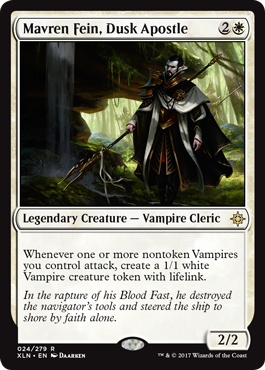
Mavren Fein, Dusk Apostle

Mavren Fein, Dusk Apostle may well be my favorite card in the set, but that doesn’t mean it’s one of the best. I definitely don’t think this lord-style card is good enough for Modern and its playability in Standard is uncertain. The ability is quite powerful but as with any lord, the card is only as good as the creatures surrounding it.

If we look at Wizards's printing record lately, we know Vampires is a hugely popular tribe. Standard players, myself included, will be trying to force this guy to work. Commander players will slot Mavren right into the new Commander deck for this tribe too.

I’m in disbelief that Mavren is preordering for under $2. I think this is a great pick-up especially because there are no Masterpieces to drive the prices of this set down. There’s a ton of room for growth on lots of cards from this set. I think Mavren will be one of the breakout cards from Ixalan.

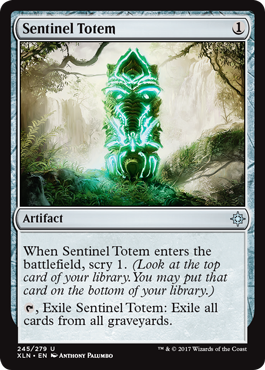
Sentinel Totem

Sentinel Totem is an obvious Relic of Progenitus variant, but this time I think there’s a real choice between the two. I like that with Totem you only have to pay one mana and you get the scry when it comes into play. You don’t have to wait to sacrifice it to help your draws and that’s nice. Because you’re paying one less mana over all, though, you only get a scry instead of actually drawing a card. That’s definitely a downgrade, but I think many decks will be interested in the mana-saving capabilities of Totem over Relic.

The best part about Sentinel Totem is that it gives us a great graveyard answer in Standard. With the future of God-Pharaoh's Gift and other graveyard-based decks uncertain, it’s nice having a counter that any deck can play. The unfortunate part is that I want to be the one playing the graveyard deck so that’s something I’ll have to deal with if I choose to pursue that type of strategy.

Financially, this is a hit for sure. Pick these out of bulk or draft leftovers every time. This may not ever be worth as much as Relic of Progenitus, but it should always be worth something—hold onto them.

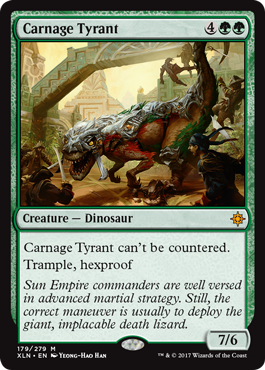
Carnage Tyrant

Carnage Tyrant is now the most expensive card in the exciting Ixalan set. Honestly that confuses me greatly. I don’t know what other writers are saying about this unmythic-feeling mythic rare about to be released, but I don’t get it.

Okay sure, it’s a giant Dinosaur that can’t be countered, has hexproof and trample. My thought is, so what. Plated Crusher costs one more mana (which is actually a lot more, but still) and has been in Standard for a long time now. The same goes for Terra Stomper a little while ago. Now, neither of those had all three abilities, which is obviously important, but not critical.

So then, why is Carnage Tyrant preselling for over $20 and going up more from the initial price? Normally in Standard we see effects that make players sacrifice creatures. Unless I missed something, the only ones we had available are rotating out of the format once Ixalan comes in. We still have wrath effects though, guys. You can still cast your giant Tyrant and then they will follow it up with Fumigate or whatever sweeper is popular at the time.

One way to get around a wrath effect on your uncounterable, hexproof, trample monster is to play Heroic Intervention to make your dude actually unkillable. I actually raised the price of Intervention this week too, so I think players are considering this an option. But this line of play would require eight mana and both cards in hand in addition to staying alive that long. All of that seems rather unlikely.

Can you see why I’m not on board with this mythic? Right now, I am super pumped that it costs a million dollars and is the most expensive card in the set, though. I’ll be really happy cashing in on this hype and making more money than is reasonable for this mythic. This card is definitely not terrible and sure, it might see some play, but $25 for this card is outrageous.
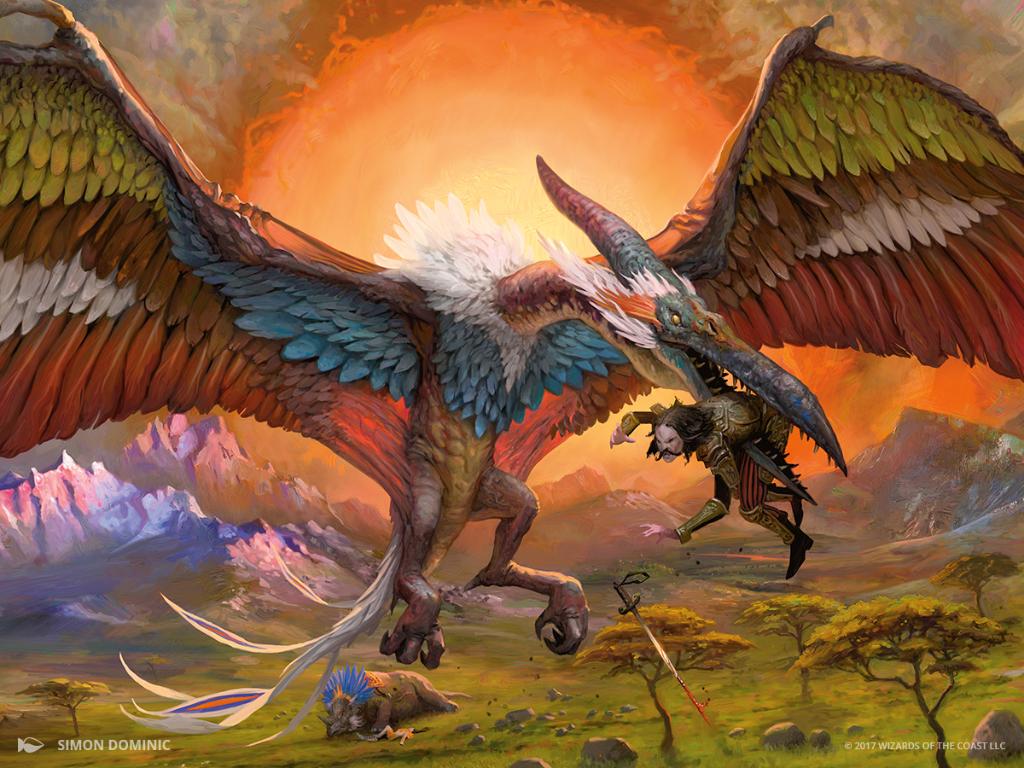
If I’m missing something, please let me know in the comments below. Am I wrong about this card or do you guys agree?

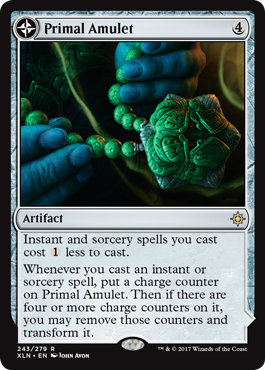
Primal Amulet

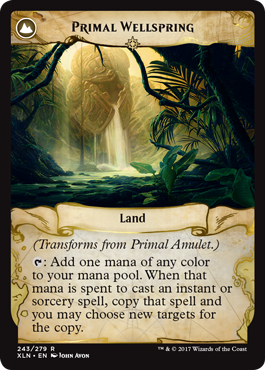
Pyromancer's Goggles comes to mind when I start breaking down Primal Amulet. They aren’t quite the same but I think you can see the comparison. Primal Amulet makes you jump through Thing in the Ice-like hoops but at the end of the process you gain something pretty powerful.

I think the time it takes to set up might prove too much to make this card good, but it’s definitely worth mentioning here in the Honorable Mention section. Commander players will love this so keeping a couple copies on hand would be a great idea. The same could be said of Goggles as well.

Vraska, Relic Seeker

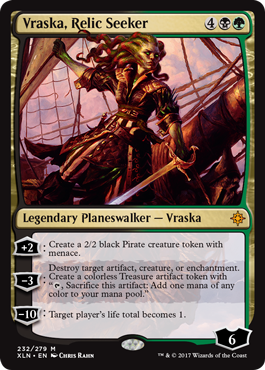
I have not had a high opinion about Vraska, Relic Seeker and my friends have chastised me about it. They are quick to compare her to Elspeth, Sun's Champion but Elspeth is an anomaly and most planeswalkers can’t see play if they cost six mana.

For six mana you are getting to destroy one creature or make one guy per turn. I think the ultimate is obviously good, especially with menace creatures, but the majority of planeswalkers aren’t playable solely because of their ultimates.
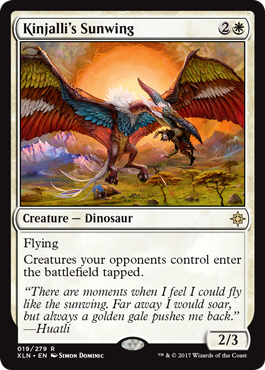
Maybe she could see play, and I think she might draw some attention from casual players, but I think she should be well under the $10 mark.
Top 10

10. Buddy Lands

Standard has regained some of the best lands for the format with the buddy lands. This cycle of allied colors has been reprinted a number of times but this is the first in a while. Every time they are available, they make a big impact on the format.

The reason I put them on the Top 10 is because they certainly will affect things this time around as well, but also because of their financial implications. First of all, I love the new Ixalan-flavored artwork. I think that will draw players to buy these copies even if they own old one with the weird generic art they all have. I know I’ll be keeping these new versions when I open my boxes for sure because they are way cooler.

The other financial impact I wanted to mention was their popularity for casual players. I’ve sold tons more copies of these lands than any other land cycle. I’d go as far as saying these lands are my store’s number-one seller on TCGplayer. They are cheap and good options for whatever task you’re looking for. I’ll still be buying and selling these lands now that they have these new versions as well as the old ones too.

9. Dowsing Dagger

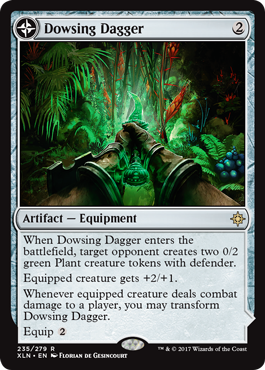
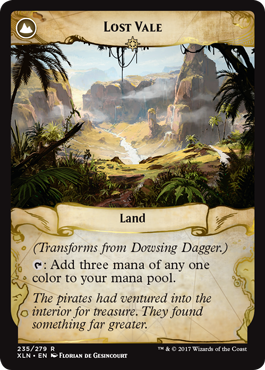
All of these flip cards are really hard to evaluate. Dowsing Dagger seems busted but this is another card with a lot of hurdles to jump over in order to make it work. The payoff is definitely there though. Getting a bonus three mana every turn is no joke and well worth the investment. The only question is whether or not we can make this work in Standard.

Standard dictates the price flow of the majority of cards printed these days. It’s usually not enough for a card to be a Commander favorite for it to affect the price. Cards are printed so much in these print runs that we need a lot of attention to shine on a card for it to break out. That usually only happens when the card sees major play in Standard or another competitive format.

I want to include Vance's Blasting Cannons and Legion's Landing in this conversation for number seven as well. I like all of these flip cards—even Search for Azcanta could be good as well. I think Legion's Landing will see play in Standard because of the presumed Vampire deck. If Ramunap Red, or a new incarnation of that strategy, pops up, Vance's Blasting Cannons might be included in that deck as a way to finish more games.

My point with number seven here is that all of these flip cards have a good payoff. These cards all reward you big-time for triggering their flip sides. The question is which of them will actually be the best of the bunch. Maybe I’m right and all of them will be great, but most likely one or two will assert themselves above the rest.

I like picking up copies of all these cards in the cycle though. As I’ve said, I think they’re all great and they should all be solid sellers. You also have a good possibility one or more of these cards will double up. When we have new styles of cards, players often underappreciated them initially. Then once they are proven to be good, their price jumps. We’ve seen this countless times. A great example is the first time we had flip cards when it took a while for that card type to be utilized.

8. Chart a Course

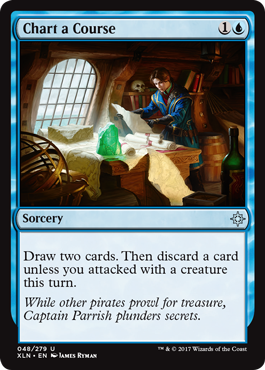
From my perspective this is a bomb uncommon and should be one you’re looking to pick from bulk. We know cards like Night's Whisper and Divination have been playable cards. Chart a Course is just another version of these card-drawing spells.

Sure, we have the drawback of having to attack, but that’s okay. This set has Merfolk in blue that will pair very well with this sweet efficient draw spell. Even if the Merfolk don’t play well competitively we could also run this spell next to number seven on our list.

7. Jace, Cunning Castaway

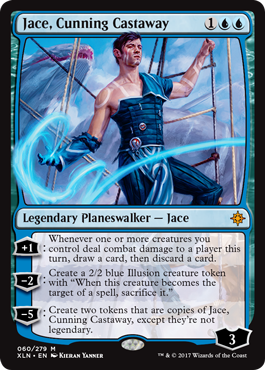
If you read my spoiler articles, you know I love Jace, Cunning Castaway. Not only do we have Chart a Course to draw extra cards with our blue aggressive deck, but Jace as well. Our first Jace that makes creatures is going to take some time getting used to. If this walker had a different name than Jace, I think more players would be on board with a new-style blue card like this.

Remember, too, there is nothing saying we need to play tons of blue cards. We can basically put Jace and/or Chart a Course in any deck and make blue our second color. Let’s take Vampires, for example. Maybe the black part of Vampires will be underwhelming. If that’s the case, we could easily pair the new white Vampires with blue and try that out. My point is that this card is good and we have lots of options for making new Jace work and he will be legal for a long time.

6. Huatli, Warrior Poet

Number six on the list is the one I’m the most uncertain of. I’m probably not supposed to tell you that, but honesty is my best policy. A lot of what I do with Magic is based on my gut feelings. My play style, my deck construction, deck choices, and a lot of my financial decisions are based on how I feel about it. Sure I try to logically break things down, but I go on my gut much of the time.

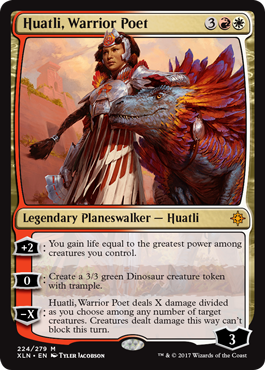
Huatli, Warrior Poet is one of those cards that I just have a good feeling about. I could be wrong, but I think this card is better than what it appears. A lot of why I like it is because when I was trying to compare her to another planeswalker, I thought, this card seems like a Gideon, Ally of Zendikar for one extra mana.

Huatli is definitely not as good as that Gideon, but I think she would do a good job of stabilizing a board state. She can make a 3/3 every turn and then start gaining life to dig you out of the opening-game hole you were in. If you’re already stabilized, you can just make an army of 3/3s and win the game with them. If you are gaining life, you will also have the option of dealing damage as well.

I think Huatli will drop down to $8 or lower though, so hold off on picking up copies until she bottoms out. Once that happens though, I think a tap-out control deck could really do well with a card like her.

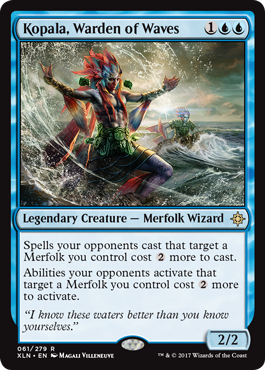
5. Kopala, Warden of Waves

Merfolk have been a well loved tribe for a long time now. I think the reason why is just because they are a competitive creature type in blue. That allows players to jam their awesome blue cards but also be playing creatures at the same time. Playing Merfolk is like saying I wanna play Counterspell but also attack with creatures. I think this is a similar mindset to that of Delver of Secrets players but not quite as drastic.

We’re getting a lot of support for Merfolk in green as well. Kumena's Speaker is a great example of that as well as many others. My concern with these tribal strategies is that we won’t have quite enough pieces to make them work until the next set is released. If that happens we could see many of these great cards bottom out drastically. If that happens, get in as deep as possible for the potential gains that Rivals of Ixalan will bring us.

Kopala is not only a Standard card though. She basically replaces Kira, Great Glass-Spinner for the Modern and Legacy Merfolk decks. Any additions to those strategies makes a big difference too because they are both good options for their respective formats.

I doubt this card will be worth much money. It’s only starting out around $2.50. This is one of those cards that will always have value though. If you see cheap copies for whatever the price point ends up being, they’re worth picking up because players and dealers will always want to have this card for their Merfolk players.

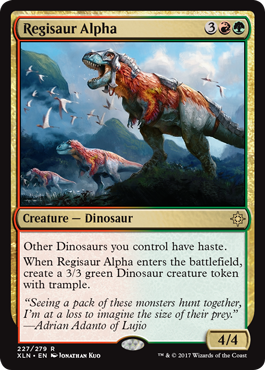
4. Regisaur Alpha

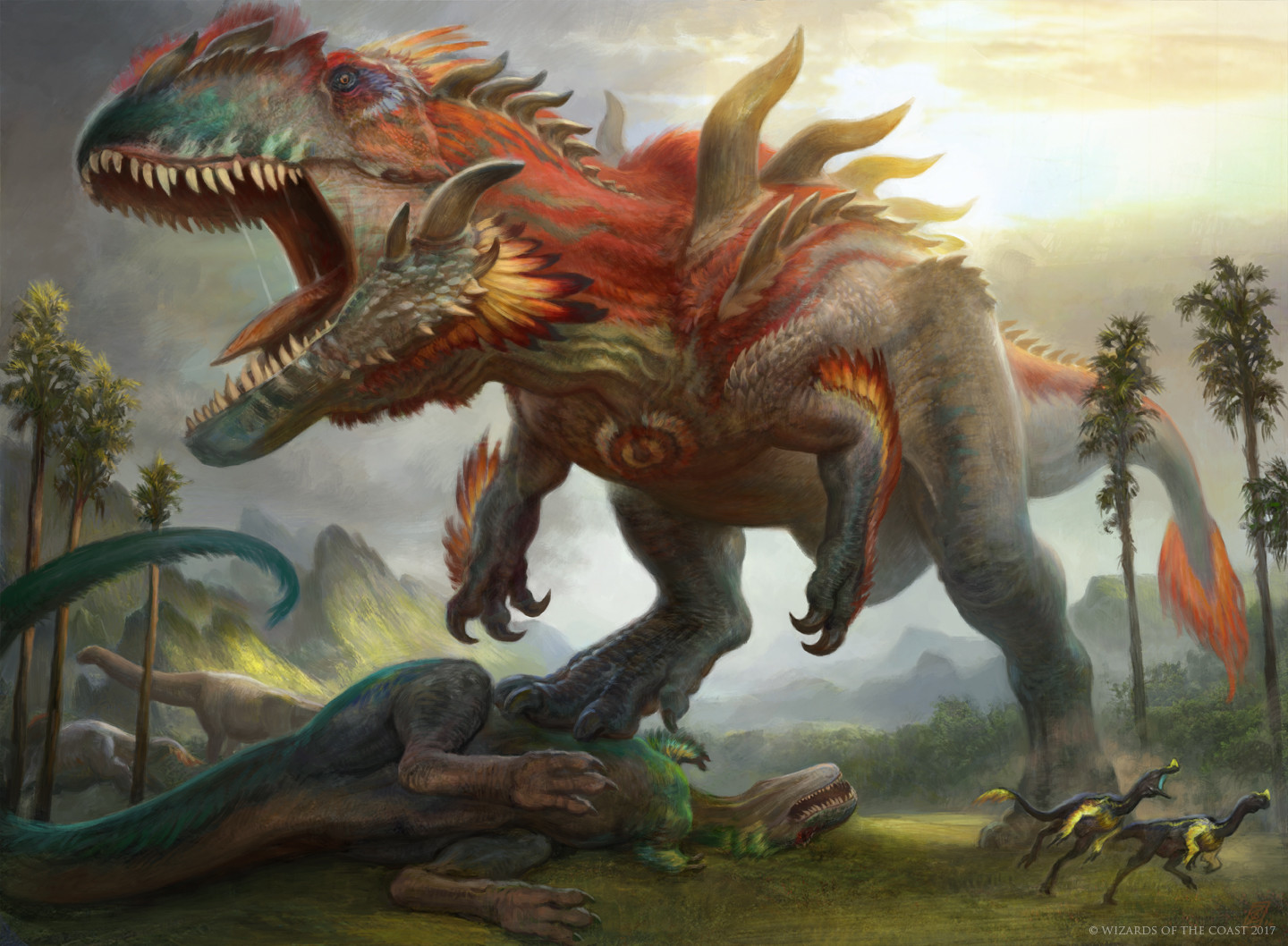
Here we go. Now we’re getting into the best cards in the set. At number four we have Regisaur Alpha. When I saw this card I was in disbelief. The power level here is incredible. For five mana you are getting seven power and on two bodies. If you have pump effects that will increase the total power even more.

When I think about Regisaur Alpha, I think it’s like both halves of Thragtusk at the same time without the lifegain. We could also say it’s like a better Bear's Companion. Regardless, I think Regisaur Alpha is a big reason to be playing red and green and I think it will have a huge impact on the direction of Standard.

Sometimes I even forget that Regisaur gives your dinos haste. That’s sweet for your 3/3 to have haste but more importantly, your follow-up to this card will go straight into the combat zone.

The best part about this new Dinosaur, though, is that it can go in basically any strategy. Making two huge dudes for five mana could be a great thing for a midrange deck. You don’t absolutely have to pair this guy with the rest of his tribe for him to be good.

$8 seems like a perfectly reasonable price for Regisaur Alpha. Most likely that will go down a bit after release per the norm, but this could be one of those exceptions to that particular rule.

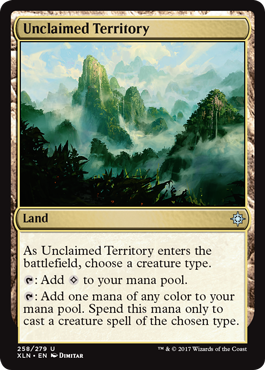
3. Unclaimed Territory

It may surprise you to see Unclaimed Territory on this list, let alone way up here at number three, but hear me out. This land is covered in power creep. Unclaimed Territory is basically Cavern of Souls without the uncounterable part. That’s an important part that's missing, but the rest of it is still amazing. We can play this multicolor-producing land in tribal strategies in Modern and even Legacy!

This is probably my favorite spec from this set. While it is an uncommon as well as a promo, I think tons of players will want copies of this card. It can go in the new Commander tribal decks or competitive strategies in every format. We can’t say these things about very many cards so I think Unclaimed Territory deserves every bit of this number three spot.

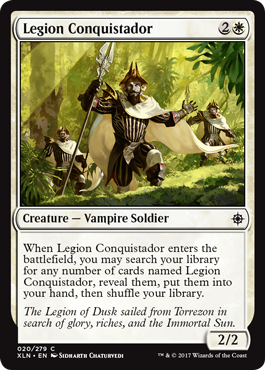
2. Legion Conquistador

At number two we have yet another surprising pick. I think this is another card that is drastically underrated in this set but one that everyone will soon know. I know I plan on rocking this Vampire Soldier a ton but I won’t be the only one. The playerbase will catch on sooner rather than later.

Some writers have suggested this card as an option for Vampire decks, but there are so many more opportunities for this card to be good than just Vampire Aggro. Champion of Wits for example would be a great card to pair with our Squadron Vamps. Combining cards like that would allow you to take advantage of those extra cards in hand. We could even just use the extra cards to help us discard to hand size for a God-Pharaoh's Gift deck. There are just tons of options.

The bottom line is that there are so many options for this card and so many possible strategies that it deserves the number two spot on this list. Any card that says draw three cards for three mana is great. The fact that the cards you have to draw are all 2/2s for three mana isn’t important. The important part is that your three-mana 2/2 draws three cards.

One final note before we move on to the number one spot on our Ixalan Top 10. It’s quite possible that a strategy will emerge in an older format that utilizes Legion Conquistador alongside Squadron Hawk. I don’t know if that will impact the price of this common, but it is worth taking note of.

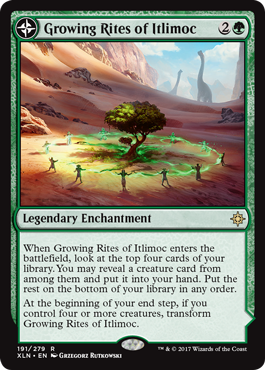
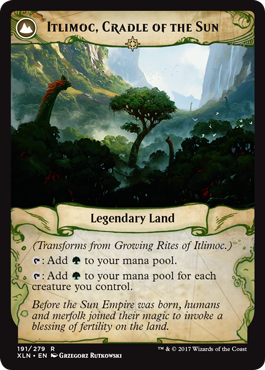
1. Growing Rites of Itlimoc

Last but not least, we have...drum roll, please...Growing Rites of Itlimoc!!! I don’t know if you were expecting Gaea's Cradle to be the best card in the set, but it definitely is. I’ll be tinkering with ways to exploit this card in multiple formats. But no matter what happens in Standard with Growing Rites, this is the best Commander card printed since the original Cradle came out.

I’ll be holding every copy I come across and buying them aggressively at every price point. It is still a rare and that’s one aspect I don’t take lightly, but without Masterpieces the price ceiling should definitely be higher than it would have with that rarity included.

That’ll do it for me today. As always, let me know in the comments or on Twitter which picks you agree or disagree with. What would your Top 10 look like? Did I miss a key card? Let me know. Hope you enjoyed this installment of my Top 10.

HareruyaWayfinder – XLN Edition

Are you a Quiet Speculation member?

If not, now is a perfect time to join up! Our powerful tools, breaking-news analysis, and exclusive Discord channel will make sure you stay up to date and ahead of the curve.

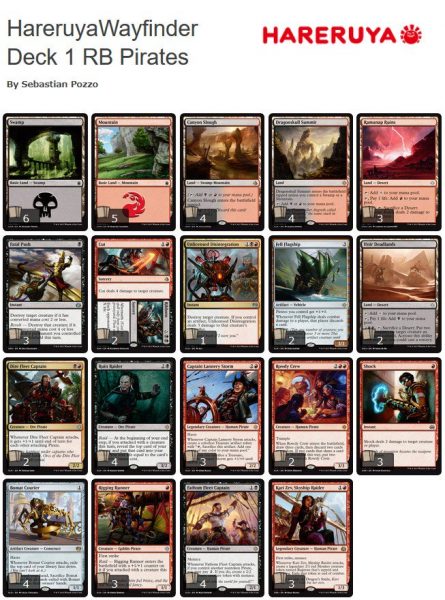
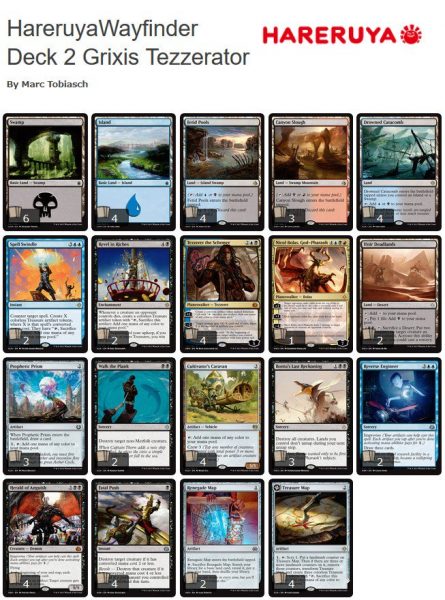
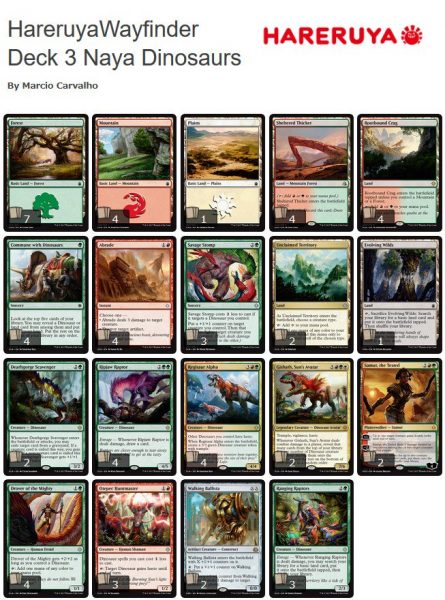
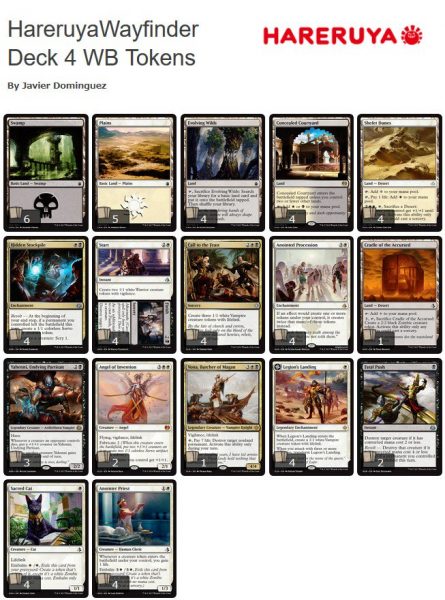
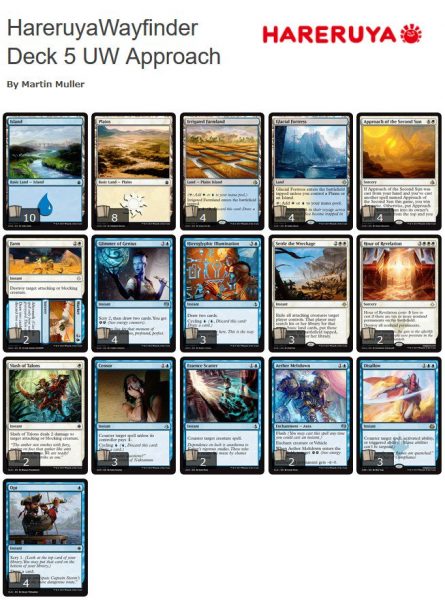
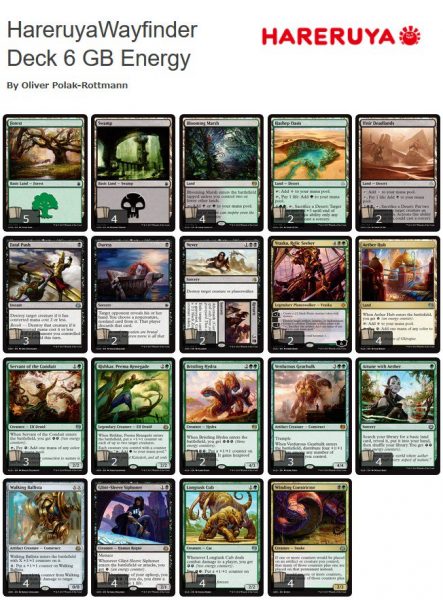
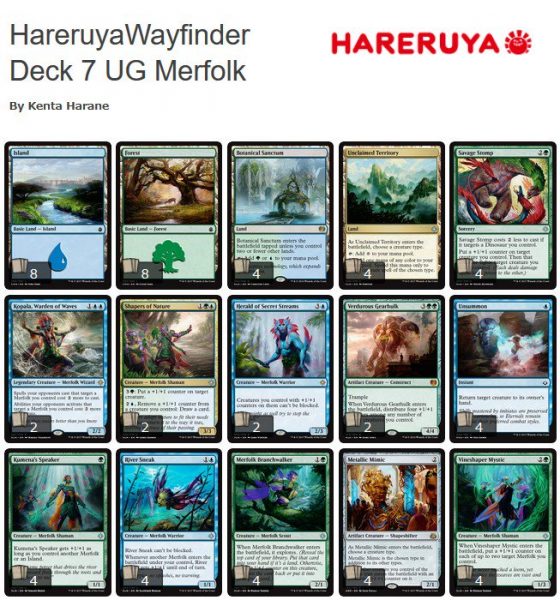
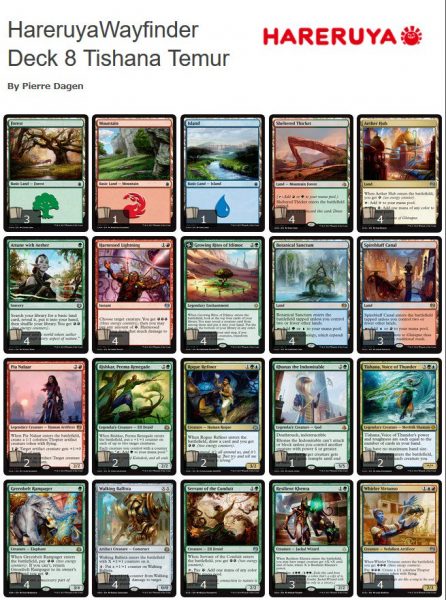
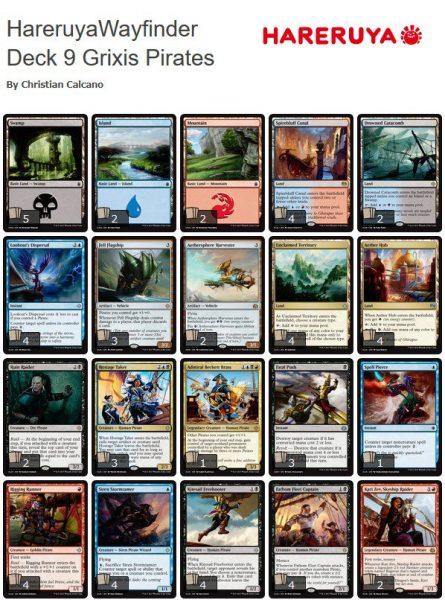
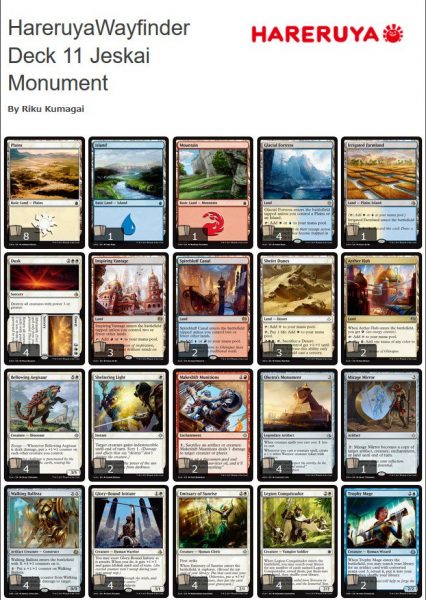
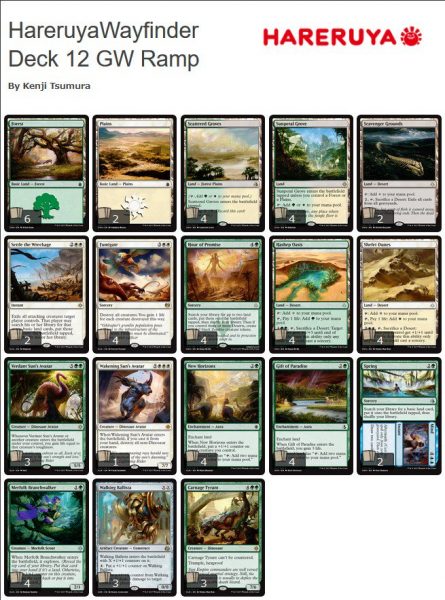
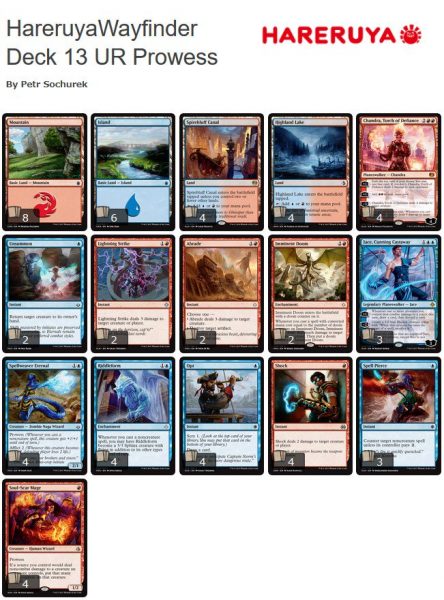
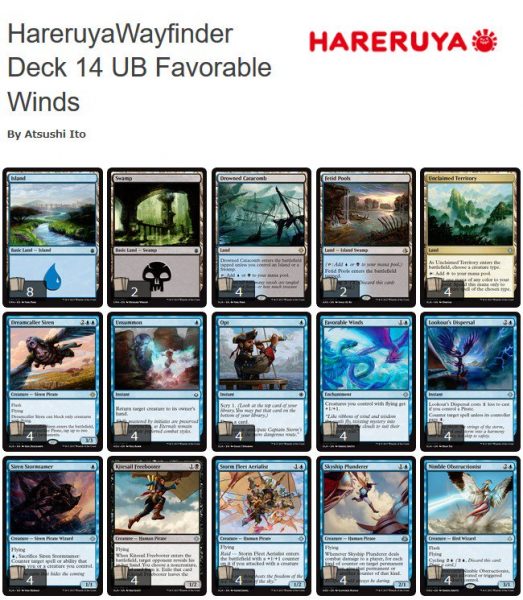
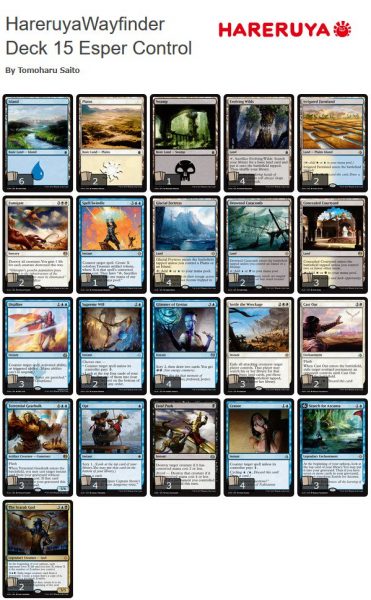
I’m sure many of you are aware of the #Saitowayfinder/#KenjiWayfinder decks of the past. They have since been updated to #HareruyaWayfinder – and this time the entire @hareruyaEnglish pro team joined in! These are brews provided to us by Hareruya English early on when every set is fully revealed. Here are the Ixalan decklists!

Avatar photo

Chaz V

Started playing during Invasion block at the age of 13. Always a competitive person by nature, he continues playing to this day. Got into the financial aspect of the game as a method to pay for the hobby and now writes, Podcasts, and covers all aspects of the game, always trying to contribute to the community and create great content for readers and listeners.

View More By Chaz V

Posted in Free, IxalanLeave a Comment on HareruyaWayfinder – XLN Edition

Have you joined the Quiet Speculation Discord?

If you haven't, you're leaving value on the table! Join our community of experts, enthusiasts, entertainers, and educators and enjoy exclusive podcasts, questions asked and answered, trades, sales, and everything else Discord has to offer.

Want to create content with Quiet Speculation?

All you need to succeed is a passion for Magic: The Gathering, and the ability to write coherently. Share your knowledge of MTG and how you leverage it to win games, get value from your cards – or even turn a profit.

Insider: Picks for New Ixalan Standard

Are you a Quiet Speculation member?

If not, now is a perfect time to join up! Our powerful tools, breaking-news analysis, and exclusive Discord channel will make sure you stay up to date and ahead of the curve.

Ixalan is almost here! Now is the time to get excited about new cards, new decks, and the prerelease!

In particular, Standard will be seeing a pretty major shake-up in the coming weeks. The entirety of Battle for Zendikar and Shadows over Innistrad blocks will be leaving the format to make way for all of that Dino-Pirate goodness that is Ixalan.

With such major changes in store for Standard, it makes a lot of sense that prices also ought to see some adjustment to accommodate demand from players trying to build new Standard decks. A rotation is always a great time to make value because there is always a high number of players who are elated to purchase new cards.

A major rotation is sort of a moment when there is a community understanding that it is time to open up those wallets and build new decks.

I've really only skimmed the surface of what this new Standard format might look like. The fact is, there is a ton of testing and information to wade through, and 99.9% of players don't have a solid understanding of what the new format will entail. With that being said, there are certain assumptions and estimations that are likely to be accurate that we can use to try and predict Standard gainers in the coming weeks.

The Mainstays That Stay

The obvious starting point for any Standard format is to look at the major decks sticking around into the new format. For this season that means Mono-Red, Temur Energy, and GB +1/+1 Counters. All three of these decks remain largely intact going forward and will likely continue to be major pillars of Standard.

I wholeheartedly believe that we will see some new decks coming out, but let's just assume these decks will survive. Whatever new decks emerge in Standard will have to be competitive against the current kings of the mountain. It's not an impossible task but it will certainly, quickly, weed out the chaff.

We can also look at decks that lost major pieces in the rotation to predict what may not port over to the next level of Standard. For example:

There was an error retrieving a chart for Gideon, Ally of Zendikar

The loss of Gideon really hurts a deck like Mardu Vehicles because it was one of the deck's most important pieces. I'd have to see some convincing evidence to believe that Vehicles still has the staying power to dominate and be a player.

Predicting the New Decks

When thinking about what decks might emerge from a new format it is really important to look to the new cards. Occasionally, a new printing can team up with an existing staple (think Saheeli being powered up by Felidar Guardian) but even in this scenario a new printing was the place to look.

It makes a lot of sense that the new cards have the highest probability of creating a new deck. If a deck wasn't good before because it couldn't beat Ramunap Red, GB, and Temur, then why is it good now?

In any case I think the obvious place to start is Dinosaurs. The dinos are large and in charge and the tribe makes up a large percentage of the top-tier cards in the set. I mean, have you seen Carnage Tyrant?

What a buck-wild card. It is obviously insanely powerful and the rest of the tribe delivers as well.

Dinosaurs in Standard probably fall somewhere along an axis of ramp meets midrange, but could ultimately land anywhere in between. It is also possible that some of the "good stuff" dino finishers could just be in a bunch of different strategies. Ramp will almost certainly be a thing, whether it is dino-synergy or just uses cards like Carnage Tyrant at the top of the curve to finish.

It is also worth noting that one of the most efficient ways to defeat Carnage Tyrant is with unconditional sweepers like Fumigate or Hour of Revelation. It makes a lot of sense that a UW-type shell could have a nice place in Standard.

The Tyrant, because it is uncounterable, hexproof, and survives Hour of Devastation, may spell the end of the traditional UR Control shells. This could push Approach of the Second Sun to the premier control strategy.

New Standard Picks

I typically like to find cards that have a cheap price tag and a high ceiling for growth, and invest my dollars there. In that scenario one has a much higher probability to make a significant profit on a minimal investment.

I love digging through $0.50 or three-for-$1 boxes when a format is rotating because if you know what to look for you can really make bank when your picks hit. Even when they miss, the cards often have nowhere to go because they are very cheap when they are acquired, which makes it difficult to lose on the transaction.

Without further ado, here are my picks. I'll break them down by the deck I see them going into, and close with some miscellaneous cards that are harder to classify, along with some bulk picks.

Blue-Based Control

There was an error retrieving a chart for Approach of the Second Sun

Approach is a card that I find very interesting right now. Despite being the premier finisher for UW Control, the card is essentially a bulk rare. If the importance of wrath effects to combat the new Dinosaurs becomes important, I could see this card picking up some value in the coming weeks.

Also, if Carnage Tyrant pushes UR out of the metagame, UW will be the best blue control deck in town.

There was an error retrieving a chart for Fumigate
There was an error retrieving a chart for Hour of Revelation

Speaking of control cards, these two sweepers could both become much more important in the coming weeks if dino ramp or midrange show themselves to be actual tier-one strategies. It's hard to imagine Fumigate not being an extremely important card moving forward. It has solid versatility against a large percentage of the field which is heavily slated toward powerful creatures.

These cards have already begun to tick up slightly but I think there is still more room to grow—especially if that particular deck ends up being well positioned. Fumigate is a pretty amazing Magic card.

There was an error retrieving a chart for Authority of the Consuls

Authority of the Consuls is another solid pick-up right now. It is one of the single best cards against Ramunap Red no matter what type of strategy you are playing. The deck is heavily dependent on sneaking through damage with haste creatures, which Consuls takes away. The incidental life gain makes investing into the card (both financially and in terms of game play!) a strong play.

There was an error retrieving a chart for Commit

Last but not least for the blue deck camp is Commit // Memory. It is worth noting that this spell does deal with Carnage Tyrant (albeit only temporarily). Commit puts the spell second from the top (and hence gets around the "uncounterable" clause). It's a pretty flexible card and could be positioned to see more play. It's technically a bulk rare so it can't go down, which makes it a fine investment.

Ramunap Red

Some of the cheap red-deck rares could also be nice pick-ups right now. I strongly believe that Ramunap Red is positioned to once again be the best deck in Standard out of the gate.

There was an error retrieving a chart for Soul-Scar Mage
There was an error retrieving a chart for Pia Nalaar
There was an error retrieving a chart for Bomat Courier

These cards are floating near the bulk-rare line but will likely be major players in Standard. I could see them making gains if Red comes out of the gate strong (as it likely will).

Temur Energy

Temur Energy is another deck that will likely be at the top of the pack. Its full of awesome synergy and great cards. It has all the tools it needs to be awesome.

There was an error retrieving a chart for Bristling Hydra

Bristling Hydra is cheap right now and probably has a home in the 75 of Energy. The more I play with and against the card the more it impresses me. The fact that it can't be targeted makes it pretty great. The question is whether these decks will just play the six-drop Tyrant instead.

BG Constrictor

There was an error retrieving a chart for Rishkar, Peema Renegade

GB is likely to remain a contender thanks to Winding Constrictor and Walking Ballista. The support cards may become more important than ever. Rishkar makes ramping out Carnage Tyrant easier and just adds a lot of value.

There was an error retrieving a chart for Gonti, Lord of Luxury

I also like Gonti. Well, I've always loved Gonti but it is possible that the card has gotten even better with the rise of the Dinosaurs. It will likely steal an incredibly powerful midrange spell in the mirror. Also the deathtouch body will typically trade way up against a bigger creature.

Miscellaneous

There are some other cards that I think show promise in the new environment, even if I'm not sure what deck they fit into. These cards could well go into several different archetypes, and at current prices I like them as pick-ups.

I've been talking about Dinosuars a lot but this is kind of a sleeper card that I've been impressed with. If you are trying to build around Dino-synergy this one has a nice spot on the curve and provides a lot of bang for its buck. Against Red it essentially turns off haste. In an aggressive deck it makes blockers a turn late to the party. It also counts as a Dino for cards that care about that.

Two power and flying for three mana is not a bad deal when considering the card also plays a tribal role.

There was an error retrieving a chart for Channeler Initiate

Another card I'm interested to see whether or not it will find a home is Channeler Initiate. It provides ramp and fixing in a format that is lacking it. It also turns into a pretty reasonable threat once you are finished using it to ramp out bigger threats.

It's obviously competing with Servant of the Conduit and the dino mana creature—but this could still be a pretty solid include in certain strategies.

There was an error retrieving a chart for Heroic Intervention

I mentioned that wraths are very good against midrange decks and Heroic Intervention is a very nice card at stopping that from happening. I played multiple copies of this card in my GB Constrictor sideboard and was very happy with it.

It stops a removal spell, it counters wrath, but it is extremely underrated in midrange match-ups where large scale combat happens. You attack with everything or block with everything and save your entire team for two mana.

There was an error retrieving a chart for Overwhelming Splendor

If there is a rampy midrange deck I assume that Overwhelming Splendor has a place as a messed-up sideboard card. Assuming the opponent cannot immediately kill this card I don't think they can possibly win the game if it hits the board in a midrange mirror based around giant monsters. It's also cheap and mythic.

There was an error retrieving a chart for Dusk

With Dinosuars on the horizon I'd be shocked if there wasn't a good Dusk // Dawn deck. The card completely wrecks several decks in the metagame: GB, Temur, and potentially Dinos.

Paired with the fact that it can also be used later for the aftermath ability to generate an unending supply of card advantage, I think this card is positioned to make some serious gains. It is extremely powerful and may prove to be an important Standard card. It is easily the best way to deal with Carnage Tyrant. Plague Wind for the win!

Ixalan Bulk

Last but not least, I wanted to end with a couple of bulk rares from Ixalan that feel fairly powerful to me. If I'm able to get my hands on these for bottom-basement prices out of the gate I'll likely buy in.

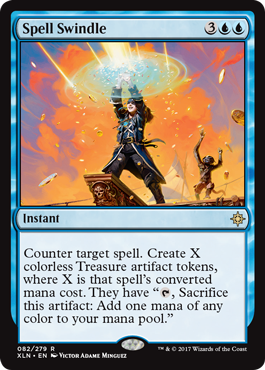
The card is kind of like a five-mana Mana Drain! There is a lot of value to be had here especially if people are going to be tempted to play giant Dinosaurs.

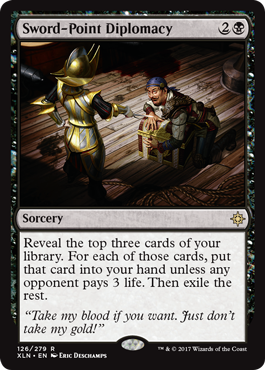
Browbeat sucks. Browbeat has always sucked. Sword-Point Diplomacy is way better than Browbeat. I know that cards where the opponent gets to decide tend to be bad but I think this one is so aggressive that the opponent will simply never have good choices.

Assume they don't give you the best card. Sword-Point is still plus one card and three damage to the opponent. Seems awesome in an aggressive deck. A lot of the time they simply won't be able to afford the life payment.

I think this card is completely insane and likely Modern-playable. It's currently hovering around bulk rare price on presale.

The last card on my list:

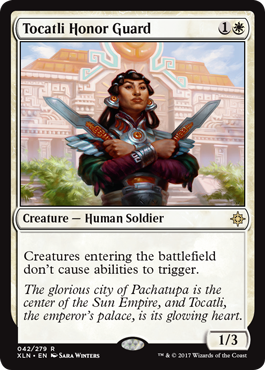
It's a 1/3 body with Torpor Orb attached. I don't know exactly what I'd want to do with this card yet but I feel like it will have a home somewhere. It's just a great Magic card that will be played across formats. Most likely a sideboard card that hasn't gotten much respect yet.

Waiting for Release Day

I'm pretty stoked about Ixalan (as you can probably tell). I've been getting my trade binder ready for the prerelease and am looking to pick up some extra copies of these sweet (but underrated) cards. Obviously excited to get my hands on a foil Carnage Tyrant for the Danger Room too. Did I mention that card was good?

Where Is My Mind: Brewing BW Shadow Pox

Are you a Quiet Speculation member?

If not, now is a perfect time to join up! Our powerful tools, breaking-news analysis, and exclusive Discord channel will make sure you stay up to date and ahead of the curve.

Confession time: one of my pet cards is Smallpox. That might seem weird coming from an attacks-loving aggro-control enthusiast such as myself, but Smallpox has a lot of the elements I prize in a card: its symmetry makes it innocuous; its floor is low, and its ceiling miles high; its conditions ask pilots to build around it, rather than slot it into existing decks. After Tom Ross's success last weekend on 8-Rack, I figured now's as good a time as any to unveil a Smallpox brew of my own.

In this article, we'll take a look at both decks and discuss the different applications of Smallpox.

Smallpox and 8-Rack

On September 17, 2016, Tom Ross piloted his build of 8-Rack to 7th place of a Star City Games Modern Open. Tom's build eschews Ensnaring Bridge for Smallpox, making his list more of an attrition-based midrange deck than a prison one.

In an elegant Mind Twist-of-fate, exactly one year later, Tom Ross piloted a nearly identical deck to 4th place of another Open: SCG Louisville. This updated version swaps three of its four Dismembers out for Fatal Push, and runs a single Marsh Flats over a Swamp (the sideboard does get a significant overhaul).

Here's his list:

8-Rack, by Tom Ross (4th, SCG Louisville)

Planeswalkers

4 Liliana of the Veil

Artifacts

4 The Rack

Enchantments

4 Shrieking Affliction

Instants

1 Dismember
3 Fatal Push
2 Funeral Charm

Sorceries

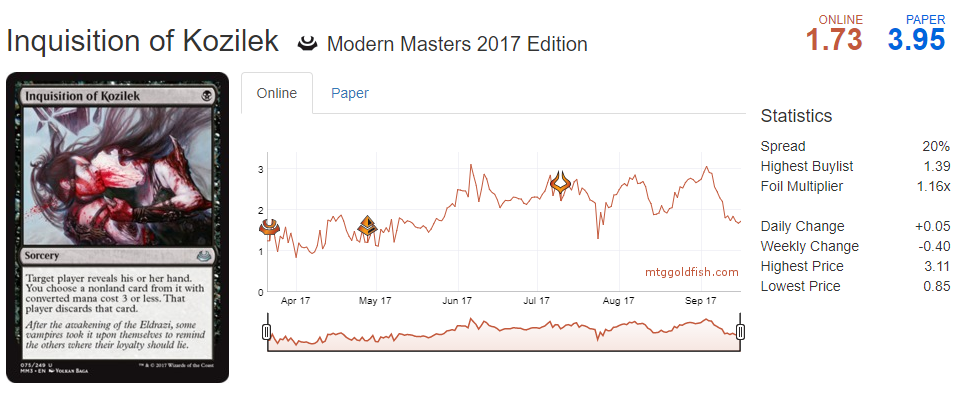
4 Inquisition of Kozilek
3 Thoughtseize
4 Raven's Crime
4 Smallpox
3 Wrench Mind

Lands

1 Marsh Flats
4 Mutavault
4 Urborg, Tomb of Yawgmoth
15 Swamp

Sideboard

1 Asylum Visitor
2 Death's Shadow
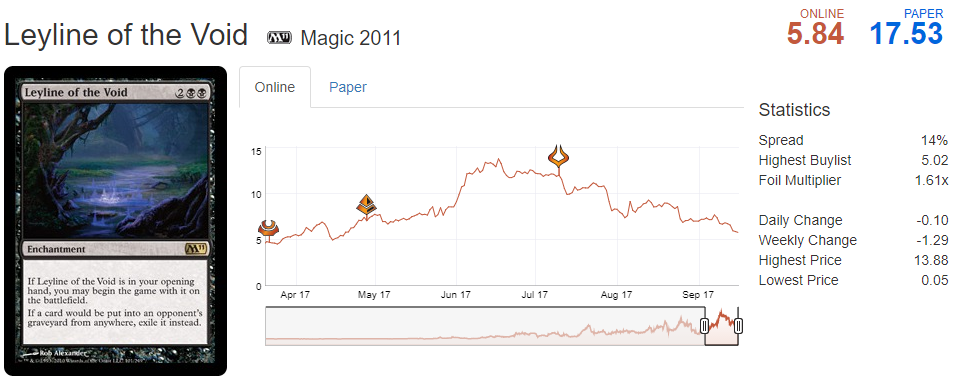
4 Leyline of the Void
1 Fatal Push
1 Shadow of Doubt
2 Bontu's Last Reckoning
4 Delirium Skeins

Explaining 8-Rack

Tom has written three comprehensive articles covering his take on 8-Rack, so I won't delve too deeply into the deck's inner workings. But for our purposes, we will briefly examine what this deck does and why it succeeds.

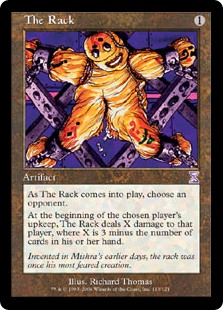
Superficially, 8-Rack's got a simple gameplan: shred opponent's hand, stick The Rack, apply a little more disruption, win. It even claims victory via clocking, or delivering set amounts of damage over multiple turns, contributing to its unintuitive status as something of an aggro-control deck. 8-Rack can be broken down into threats (Rack effects) and disruption (targeted discard and removal), as can Jund or Grixis Shadow.

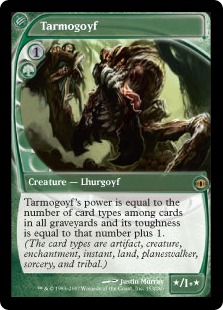
What are the pros and cons of 8-Rack over those decks? Smallpox makes it challenging to play creatures, meaning flexible options like Tarmogoyf and Scavenging Ooze go out the window. It also strains the manabase, complicating splashes. And targeted discard, the deck's principle form of disruption, can prove lackluster in certain matchups (vs. Affinity, for instance).

On the bright side, removal spells are totally blanked by this deck; pilots can Inquisition turn one and take a card that advances the opponent's gameplan rather than a stranded Fatal Push, which can't be said of traditional midrange decks. 8-Rack's functional threats are tougher to remove than creatures. The deck's configuration also makes its mana a breeze, if limiting its sideboard options.

The Next Step

My problem with using Rack effects as threats are threefold. For one, I don't like how many slots they take up. Having historically favored standalone threats like Delver of Secrets and Thought-Knot Seer, leaning too deep into synergy territory turns me off. The Rack and Shrieking Affliction are only threats when backed up with a steady stream of discard effects.

Second, I like to have outs in my deck, and black alone doesn't offer much in the way of hosers or interaction for noncreature permanents. I imagine 8-Rack players sometimes scoops to an unfortunate card (i.e. Leyline of Sanctity) or boardstate opponents manage to assemble (i.e. a couple of menacing planeswalkers) without having outs for the scenario in the deck. And lastly, I just really like attacking. Perhaps too much. Animating Mutavault's all good and well, but I don't feel like I'm really playing Magic if I can't draw for turn and immediately turn a creature sideways.

As a result, my Smallpox decks have always omitted Rack effects and played creatures, starting with Tarmogoyf back in 2013. I realize Tom's got answers to my beefs, i.e. expect tons of Leylines? Don't play 8-Rack. But when I sleeve up a Smallpox deck, it's not to crush everyone in my path with a slick metagame call; it's to get what I want out of the game, which always includes attacking, and at that time happens to also include casting Smallpox.
To clarify, I don't think 8-Rack is necessarily better than other Smallpox decks, which as we'll see operate differently. But it has certainly won more, and I'm positive Tom has tested and tuned enough to have landed on something truly formidable given the right conditions (as his results also indicate). Until a Rackless Pox deck actually starts winning somewhere, I'm more than willing to give him the benefit of the doubt. Of course, that doesn't mean we can't experiment.

BW Shadow Pox

In the car coming back from SCGNY, I caught the Smallpox bug, as I do about once a year, and got to thinking about a shell that could accommodate Death's Shadow. My logic was that the deck already shreds opposing hands to clear a path, and has space for Street Wraith. Besides, running Shadow makes the life-loss inherent to running multiple colors desirable rather than risky. Shadow would help us close out games faster than the Bloodghast/Lingering Souls plan common among non-Rack Pox decks (inasmuch as choices can be "common" for decks this fringe). I jotted down a list on a life pad, put in some reps when I got home, made an update after the new planeswalker rule, and ended up with this:

BW Shadow Pox, by Jordan Boisvert

Creatures

4 Death's Shadow
4 Street Wraith
2 Gurmag Angler

Instants

2 Fatal Push

Planeswalkers

4 Liliana of the Veil
2 Liliana, the Last Hope
4 Gideon of the Trials

Sorceries

4 Inquisition of Kozilek
4 Thoughtseize
4 Smallpox
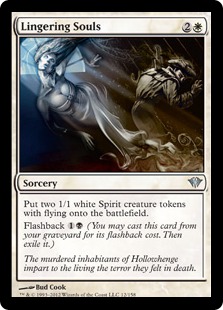
2 Lingering Souls

Lands

4 Marsh Flats
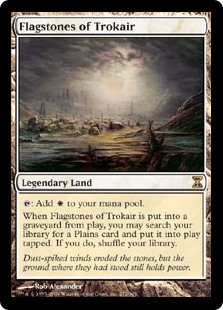
4 Flagstones of Trokair
4 Urborg, Tomb of Yawgmoth
4 Fetid Heath
2 Shambling Vent
4 Godless Shrine
1 Swamp
1 Plains

Sideboard

2 Stony Silence
2 Fragmentize
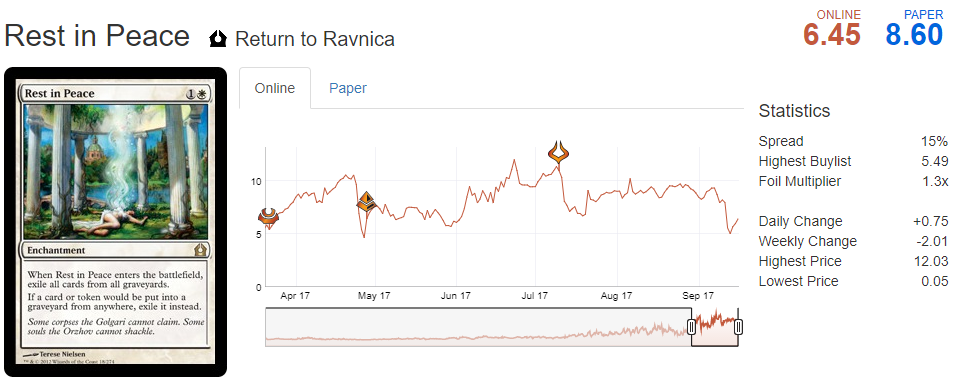
2 Rest in Peace
1 Surgical Extraction
1 Fatal Push
1 Dismember
3 Collective Brutality
1 Lingering Souls
1 Bontu's Last Reckoning
1 Anguished Unmaking

The strength of BW Shadow Pox is its robustness, which comes from its tendency to attack opponents from many different angles. For example, Fatal Push trades with exactly one of our cards. Death's Shadow is too much of a threat for opponents not to keep it in after siding, but when we want to stick Shadow, we can just rip it away with a discard spell before casting the Avatar. The rest of the time, we'll just ignore it. Similarly, many of the most played interactive cards in the format—Chalice of the Void, Rest in Peace, Liliana of the Veil, etc.—are simply "eh" against us. This philosophy informs my numbers and card choices more than other factors.

Leveraging Smallpox

Diabolic Edict effects tend to be excellent versus decks slamming fatties like Gurmag Angler and Death's Shadow. So my first order of business was to mitigate the tension between these threats and Smallpox. The solution lay in the deck's mana curve. Given their own summoning conditions, Shadow and Angler don't easily come down before turn three in most matchups. But with its ten three-mana planeswalkers, this deck is built to wait on deploying them until turn four anyway. By that point, opponents should be struggling with their resources and staring down a card-carrying member of the Gatewatch. Curving out in this way also allows us to cast Smallpox and immediately chase it with a threat, since we'll have three to four mana available on that crucial turn.

8-Rack wants to bring games to a low-resource state for both players, so Tom Ross avoids high-curve cards and value engines. BW Shadow Pox has a different gameplan, though. We use Smallpox to pull ahead of opponents early on, and induce stumbling across the table. That way, they'll have a harder time dealing with the threats we throw at them, which each attack from different angles, or keeping up with us once our value engines get going.
It can't be overstated that while 8-Rack and BW Shadow Pox are both Smallpox decks, they use the card for different purposes and have different gameplans. Some cards Tom advises against in 8-Rack, like Flagstones of Trokair, are natural fits here. Our dream curve is turn one Urbrog, Inquisition; turn two Flagstones, Smallpox; turn three planeswalker. We're fine with opponents making their land drops eventually; we just want it not to matter by the time they do. 8-Rack aims to strip the gamestate down to nothing and win before opponents can rebuild, while this deck aims to mana-screw opponents early and flood them late. For both decks, Smallpox is integral.

Threats

Death's Shadow and Gurmag Angler are threats opponents must answer, lest they close out the game. Once they've been killed, Smallpox becomes live again, and if they go unmolested, our opponent simply becomes dead. Both threats also play excellent defense, which actual creatures should; it's something the fatties have over Bloodghast & co.

Lingering Souls fills multiple roles in this deck. It's an easy way to turn Smallpox back on when we've got a fatty in play, but that's more vestigial. The combat potential of 1/1 Spirits houses the card's true value. Besides its synergy with our self-discard effects, which gives us Spirits on the cheap, Lingering Souls represents a sizable aerial threat at four whole damage. By flying and going wide at once, it incentivizes opponents to have a very specific type of answer that doesn't do anything against the rest of our deck—gumming up the ground with Shadows of their own won't cut it, and spot removal leaves much to be desired in the face of a token horde. Souls also provides some much-needed defense for decks like Affinity, and can chump four times when we need to buy time or protect our planeswalkers.

Shambling Vent is my creature land of choice. As mentioned, we tend to accrue resources with this deck, and can therefore afford its activation cost. I like having access to lifegain in the mainboard on a Shadow plan, and 2/3 are surprisingly relevant stats in this Bolt-light Modern. Another draw to this land is its mana-fixing property. Favoring Mutavault increases our risk of bricking on colors when we consistently need WW or BB in the early turns.

Planeswalkers

As with 8-Rack, Liliana of the Veil is our best walker. She destroys hands and keeps the board clear while dealing with problematic permanents in the late-game.

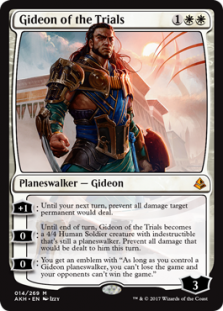
Gideon of the Trials is actually amazing in this deck. He combines well with our other walkers by forcing opponents to stick multiple creatures to break through; with Gideon neutralizing a threat, our removal can usually keep a second at bay, giving us time to tick Liliana back up. Decks that want to beat us off the board have Gideon's emblem to think about, which combined with our kill spells is enough to lock many opponents out. And Gideon even turns sideways once opponents run out of cards.

Liliana, the Last Hope covers many of the weaknesses of Liliana of the Veil. While the latter can struggle against mana dorks or creature tokens, for instance, the Last Hope provides a literal bullet stream of value and tempo. Her minus recurs dead Shadows and can even draw us cards with Street Wraith.

Interaction

As Modern's Shadow decks and Jund before them have shown us time and again, Inquisition and Thoughtseize are some of the most powerful interactive spells in the format. Here, they take away crucial early pieces to give us time to set up with a planeswalker, and clear the path for our important spells later on. We don't mind pacing our discard spells, unlike 8-Rack, which often wants to cast them as soon as possible to maximize its mana usage and damage output.

The Fatal Pushes help with faster creature decks that can power through a discard spell and a Smallpox. Between our many planeswalkers and fatties, we don't need as much removal as 8-Rack does, but it's important to have a little.

Sideboard

I haven't yet put in the reps to have a tuned sideboard (in other words, a tuned 75), but this is where I'm starting. It's a pile of removal, sweepers, hosers, and utility spells.

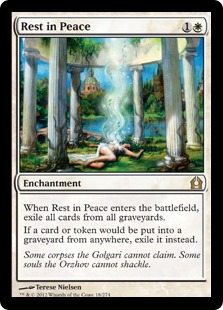
Since BW Shadow Pox attacks from many angles, graveyard hate is weak against us—only four of our cards care, excluding Liliana, the Last Hope. And Lingering Souls is serviceable either way, meaning it's really just the two Anglers that lose out if opponents stick a Rest in Peace. So we play our own Rest in Peaces, as well as Stony Silences. These white enchantments are largely responsible for players praising white as Modern's "sideboard color." They put in work.

It's too bad I couldn't find room for Collective Brutality in the main; this card is nuts. Another card I want to mention directly is Anguished Unmaking, which I think doesn't see play mainly because it lacks a home. Unmaking is a highly flexible (if pricey) card I think will catch on in some decks down the road, providing a similar function to Engineered Explosives.

A Pox on Both Your Houses

BW Shadow Pox is far from optimized. It needs a good deal of jamming and tuning that I'm not really up for—come the end of the weekend, my interest in this kind of deck will have likely started waning. But I think the strategy has potential, as many do in Modern. Either way, Smallpox is a powerful, unique card that's a blast to brew around. Congrats to Tom on his finish, and thanks for inspiring me to dig up this little number.

Ixalan Spoiler Wrap-Up and Looking Ahead

Are you a Quiet Speculation member?

If not, now is a perfect time to join up! Our powerful tools, breaking-news analysis, and exclusive Discord channel will make sure you stay up to date and ahead of the curve.

We’re back! Today, we’re looking at the rest of the spoiled cards for Ixalan, to see what could make an impact in Modern. Like I discussed last week, I’m choosing to approach these spoilers from the mindset of the best-case scenario, imagining what would have to happen to make them see play. As is often the case, most of the cards we look at never make it into Modern, but approaching spoilers in this way will get us prepared and help us keep an eye out for favorable conditions that could help some of these cards along.

There are only a few spoilers left to cover in the context of Modern, so I'll follow those up with a recap of SCG Louisville and my thoughts on the current state of the format. Enough talk, let’s get to it!

Finishing the Spoilers

Perilous Voyage

As a brief aside, I started getting into competitive Magic around Zendikar time, even though I was still relatively green. I remember my dad pulling a Verdant Catacombs as a rare, getting disappointed, and neither of us understanding why you’d want to pay life to get a land when Evolving Wilds does it for free.
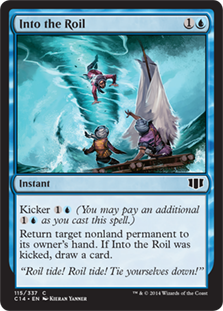
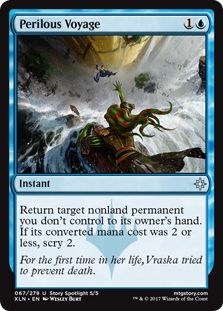
But enough of that; I bring up Zendikar because Perilous Voyage is the latest in a lineage of Unsummon effects, dating back to Into the Roil, one of my first favorite cards. A couple years ago, when the card pool looked very different, Into the Roil was a card that popped up in Modern control sideboards. It wasn’t great, but it was there. Does Perilous Voyage improve enough on the formula that it could see play?

One thing to keep in mind is that scry is actually really, really good, especially in Modern. Since I’m reminiscing, I remember the Theros scrylands being underwhelming at first, and we quickly learned how powerful that effect could be when we got it effectively for free in our mana base. Paying two mana to bounce a permanent isn’t knocking anyone’s socks off if we’re looking at rate, especially because we can't get ahead on mana (by bouncing a four-mana thing or whatever) without missing the scry.

It’s possible that the extra utility of scrying makes up for it, but the answer to this question revolves around context, as most things in Modern do. How aggressive is the format? Is Tarmogoyf seeing widespread play, or are people flooding the board with one-drops? What about problematic permanents? Is there even a control deck that wants this?
These are the questions we need to answer to determine whether Perilous Voyage passes the "environment test" that grants entry into the playable-tier of cards in Modern. Currently, the answer is definitely no, but in a grindy alternate reality of Modern where players are taking more turns and things like Bitterblossom need to get bounced so they can get countered, I could see it. But I’m not excited about it.

Tocatli Honor Guard

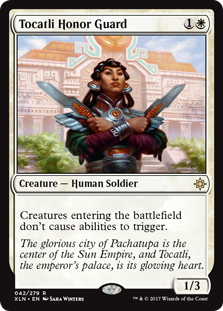
This one was spoiled a while ago, and I passed over it (perhaps wisely). But we’re getting thin, so I’m going to talk about it here. Torpor Orb on a creature took a while for them to print, and now that it has, I wonder if we want it anymore. When Amulet Bloom and Splinter Twin were running around, this guy would have been nice to have. Now his main targets are basically Eldrazi Tron and Breach decks.

Still, stopping Thought-Knot Seer and Primeval Titan is pretty good, as well as hitting Snapcaster Mage (though we weren't targeting him specifically). It will be interesting to see if Hatebears wants this guy, as it hurts our own deck as well, but giving up Flickerwisp and Tidehollow Sculler to turn off the cards that really hurt us seems like a fine tradeoff to make. Plus, don’t forget there’s value in sequencing to get those effects before we shut them down.
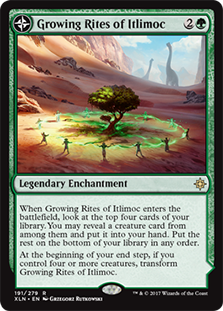
Elves has Elvish Visionary, Dwynen's Elite, Shaman of the Pack… There’s actually a fair number of incidental value we can stop by playing this, and if there’s ever a deck that doesn’t feel embarrassed to play a 1/3, it's Hatebears. Don’t forget, Counters Company is still kicking around too.

Assessing Ixalan as a Whole

And…that’s about it as far as spoilers go. A few other possibilities were mentioned in the comments of last week's article, but I’m less excited about those cards. Star of Exctinction on Boros Reckoner to do 20 is far from great; not only do we need to resolve the spell, we need Reckoner to stay alive in a format full of removal and get to seven mana. Why not just play Scapeshift?

No, for the most part, I don't expect any of the Dinosaur tribal cards to make an impact, and the mechanics in Ixalan aren’t too Modern-friendly either. Treasures actually could have some use in Modern, but it would need to be something that generates a repeated effect at a low enough cost that it can help us power out our hand before we can do it naturally on turn five. It’s difficult to make a card that does that without having it also dominate Standard. Raid is tough to put on a card cheaper than CMC 3 and have it be playable, but not busted, but explore is wordy enough that some use could be made of it. Unfortunately, I didn't see any card using the mechanic that was pushed enough.

So, as a quick recap, the spoiled cards from Ixalan I think have the greatest chance of making it into Modern are Opt, Kopala, Warden of Waves, Growing Rites of Itlimoc, and Tocatli Honor Guard. Of these, potentially Tocatli Honor Guard might provide a minor bump in Hatebears’s value against the field, but Growing Rites of Itlimoc has the most potential for making a larger shift.
It will be interesting to see what Elves as a top tier deck would do to the format. Can Grixis Death’s Shadow afford to drop low in life, only to die to Shaman of the Pack? Can Affinity keep up? How much removal is enough? I’m curious to see what kind of changes that brings about—but first we have to see the card in action to determine if it makes the cut, and then we need to figure out if Rites changes Elves’s position in the grand scheme.

And the Rest...

So, for the rest of my time this week, I wanted to give a little mini-synopsis of my thoughts on the format moving into October, and give some nuggets from the Modern Open in Louisville. This is definitely drifting into "grab bag" territory, but I wasn’t expecting Ixalan spoilers to dry up as quickly as they did. In a way this worked out for the best, as I’ve wanted to get out a few tidbits about the format for a little while but haven’t wanted to tack them on to my more opinionated pieces.

SCG Louisville

I didn’t watch the event, and haven’t heard much buzz about it, but how about Harlon Firer and Brandon Dalloway dominating with almost the same list? And Jeskai Queller, to top it off! Different sideboards (which I prefer, as Modern is very much a format that rewards sideboarding to the player, and not the deck), and only a two-card difference between the two maindecks, sends a clear message: Louisville was their world, and everyone else is just living in it.

Jeskai Queller, by Harlan Firer (1st, SCG Louisville)

Creatures

4 Spell Queller
4 Snapcaster Mage
3 Geist of Saint Traft

Instants

2 Electrolyze
3 Cryptic Command
4 Lightning Bolt
4 Path to Exile
3 Lightning Helix
3 Logic Knot
2 Spell Snare

Sorceries

4 Serum Visions

Lands

4 Celestial Colonnade
4 Flooded Strand
2 Hallowed Fountain
3 Island
1 Mountain
1 Plains
1 Sacred Foundry
4 Scalding Tarn
2 Steam Vents
2 Sulfur Falls

Sideboard

1 Celestial Purge
2 Disdainful Stroke
2 Dispel
1 Engineered Explosives
1 Izzet Staticaster
1 Negate
2 Pia and Kiran Nalaar
2 Relic of Progenitus
1 Supreme Verdict
1 Vendilion Clique
1 Wear // Tear

Grixis Death’s Shadow remains at the top of the pile on MTGGoldish, but you wouldn’t know it by looking at the results of Louisville. I haven’t been following the ins and outs of the format religiously, but I have noticed tell-tale signs of settling. The established decks have been kept relatively in place for a few months at this point, and the format (and player lists) contain few surprises, which lets abominations like Clay Spicklemire’s Five-Color Death’s Shadow do work. When all of the enemies are known, you can build just about anything to attack not individual decks, but format weaknesses.

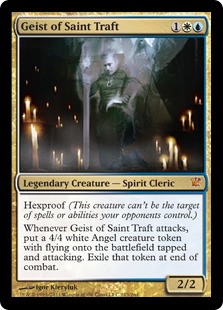
Clearly, that’s what Jeskai Queller—essentially a glorified burn deck—is doing here, as Geist of Saint Traft backed up by tons of removal and Spell Queller to cover bases and keep applying pressure shows. When Modern gets into a rut like it has been recently, oftentimes just playing something rogue that asks the right questions can be enough to bump other decks out of their lane. I liken it to walking down the street in a foggy state of mind. If you aren't vigilant, you won't be able to react to the car driving by and hitting the puddle next to you at 40 miles an hour, and that's what Geist of Saint Traft does to this current format. I imagine most players over the weekend just blinked dumbly as it came down, knowing that they had nothing in their 75 that could deal with it.


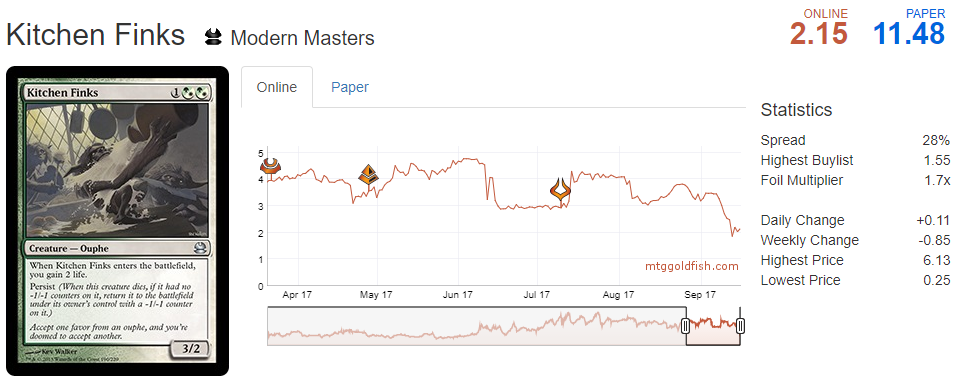
The big question moving forward, of course, is whether Geist of Saint Traft will inspire some changes in decklists that cause ripple effects resulting in format shifts. The card’s weaknesses are well-known at this point—so do the format zombies shift a few cards around and put it back in its place, or will it cause some movement in the market share at the top tier? There’s no way to know until we see it, so the best thing we can do now is try and imagine what a format that's conscious of Geist of Saint Traft might look like, and how can we position ourselves properly to beat it. Looking to you, Kitchen Finks…

Thanks for reading,

Trevor Holmes

Insider: Ixalan Standard Testing Notes

Are you a Quiet Speculation member?

If not, now is a perfect time to join up! Our powerful tools, breaking-news analysis, and exclusive Discord channel will make sure you stay up to date and ahead of the curve.

Hey, Insiders!

Ixalan Standard is upon us, and I wanted to share some information I've accumulated from my testing over the course of a few days. Keep in mind there was less time due to the faster release on MTGO, nevertheless I was still able to play enough games to start noticing some early trends of this format (which is really fun):

Dinosaurs

I'll just come out and say this first - Dinosaurs will likely be real. I was really skeptical, but there's going to be a version that will make it. At least early on in this meta, this deck can quickly power out some scary threats (and not because they're actually Dinosaurs). The combination of Carnage Tyrant, Regisaur Alpha, and Ripjaw Raptor has proven to be quite potent. My vote is for either BG and/or GR - it all comes down to if the cost reduction creatures are worthwhile.

Otepec Huntmaster has looked really good alongside Carnage Tyrant - and RG also gains access to Samut, the Tested. That's right, Samut - it seems like a gimmick, until the double striking Carnage Tyrant is attacking and there's basically nothing you can do about it.

Other Notes

  • Ramunap Red/Snek (Winding Constrictor) Decks/Energy will still be the keepers of this format early on. We'll categorize these as "Tier 0" as we head into this Standard format, because they're still clearly the decks to beat and have lost virtually nothing.
  • Outside of Dinosaurs, Pirates seems like the best chance to be viable. The issue is there's actually many different ways to build this archetype - it's a good problem to have but until then we'll have to see how the archetype settles. I've seen some recurring trends of Jace, Cunning Castaway and Ruin Raider.
  • Speaking of Ruin Raider - it really is the best Dark Confidant imitator and can be utilized in many different archetypes. I saw it a fair deal in plain aggressive decks, and not mutually exclusive to Pirates.
  • Vampires seems close, but more excited that Legion's Landing showed up a fair deal - looked great alongside Oketra's Monument. Flipped effortlessly some games.
  • Merfolk - Unless I'm extremely wrong on this - the archtype is borderline a draft deck. Weakest of the Ixalan tribes by far. There was a UG list floating around by an SCG writer on reddit:spikes that I tried out, and was eaten in testing (ouch).
  • Jace, Cunning Castaway seemed solid overall. Also seemed to slot into a variety of decks from Pirates, to Blue based aggro decks. Also goes without saying it crewed Heart of Kiran quite well and seemed strong together.
  • I didn't see any Tezzeret the Schemer based decks - but still hold out a chance for it to see play alongside cards like Herald of Anguish. I would think trying to go all-in Herald would have the best chance of competing with this early Ixalan meta.
  • Only Flip-Enchantment I saw was Legion's Landing. So far it seems it has the most applications out of the cycle, but the cycle is still overall very good. It may take some time to see the others, or we could still very well see them in early results. This is a hard one to call.

These cards kept showing up in a variety of decks. Ixalan Standard will revolve around the decks to beat that I mentioned, and Ripjaw Raptor/Carnage Tyrant. The long and short of the situation is - there's no efficient way to remove those two cards. Ripjaw is also the best roadblock for Hazoret the Fervent/Energy because at the very least it replaces itself. Deathgorge Scavenger played key roles in Constrictor lists and mostly any decks running Green. Early and efficient lifegain was important and looked strong every time it was cast.

At the same time, the good cards from previous formats are still good - early on in the meta, anyway. There may be a chance for the other forgotten cards (Herald/Tezzeret) to shine, but largely these were the cards that were still very much being cast. In a format where Lightning Strike has made a return, there will be an emphasis on creatures with more than 3 Toughness - and that's where Glorybringer really shines. Beyond that - Hour of Devastation will take care of everything besides Carnage Tyrant, but folks have trend directly to Fumigate as the format's prime removal spell for that very reason.

That's about all I have from my notes. I would say stick to the known quantities at the moment and leave the "speculation" picks to speculation. Granted some are inexpensive enough to be worthwhile either way, but I've seen enough to feel confident in my notes. Early Ixalan Standard will be "Can I beat Ripjaw Raptor and those other 3 decks." There will certainly be enough time to look at off-beat cards if they make an early splash, but right now those cards seem fairly mediocre to stock-up on without any valid claims of testing or taking notes on other games via spectating.

Hope this information is helpful, and eagerly awaiting this Standard format!


Insider: MTGO Market Report for September 20th, 2017

Are you a Quiet Speculation member?

If not, now is a perfect time to join up! Our powerful tools, breaking-news analysis, and exclusive Discord channel will make sure you stay up to date and ahead of the curve.

Welcome to the MTGO Market Report as compiled by Matthew Lewis. The report will cover a range of topics, including a summary of set prices and price changes for redeemable sets, a look at the major trends in various Constructed formats and a "Trade of the Week" section that highlights a particular speculative strategy with an example and accompanying explanation.

As always, speculators should take into account their own budgets, risk tolerances and current portfolios before buying or selling any digital objects. Please send questions via private message or post below in the article comments.

Redemption

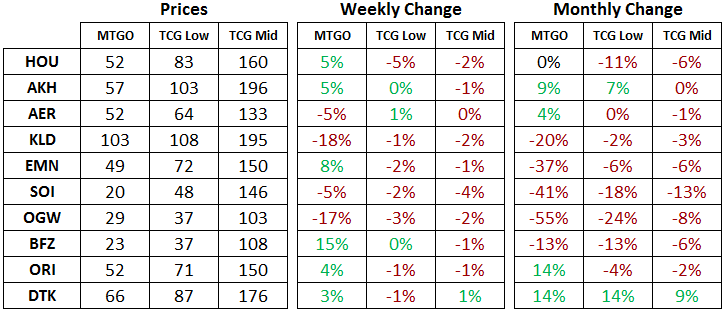
Below are the total set prices for all redeemable sets on MTGO. All prices are current as of September 18, 2017. The TCGplayer low and TCGplayer mid prices are the sum of each set's individual card prices on TCGplayer, either the low price or the mid price respectively.

All MTGO set prices this week are taken from GoatBot's website, and all weekly changes are now calculated relative to GoatBot's "full set" prices from the previous week. All monthly changes are also relative to the previous month's prices, taken from GoatBot's website at that time. Occasionally, full set prices are not available, and so estimated set prices are used instead. Although both Aether Revolt (AER) and Kaladesh (KLD) are no longer available for redemption, their prices will continue to be tracked while they are in Standard.

Standard

Although Oath of the Gatewatch (OGW) dipped again this week, the other three rotating sets look to have established their price bottoms. After touching 45 tix last week, Eldritch Moon (EMN) has rebounded with a price just under 50 tix. Shadows over Innistrad (SOI) and Battle for Zendikar (BFZ) are still fluctuating around the 20-tix level.

There was an error retrieving a chart for Liliana, the Last Hope

AKH and HOU are both up five percent this week as drafting of these sets slow down and players and redeemers stock up on on the cards they need for the new Standard. This trend should continue for the next six weeks as the redemption cutoff date approaches in November.

Ixalan (XLN) will be released on Monday on MTGO, but Standard will be rotating after today's downtime. This makes for a strange few days where Standard will be comprised of KLD, AER, Amonkhet (AKH), Hour of Devestation (HOU) and reprinted cards like Opt and Duress. In particular, keep your eye on the check lands that have historically been printed in the core set. These lands will definitely be integrated into Standard manabases, so look for Glacial Fortress and friends to see some short-term buying activity before giving way to the flood of supply that XLN will bring into the market.

Portfolio Plan

At this critical juncture of the MTGO market, it's a good time to do some long-term thinking about how best to evolve the portfolio. Lately, I've been stocking up heavily on rotating sets. It will be clear by December whether or not this was a good strategy, but I firmly believe this will turn out to be an excellent spot to deploy tix.

The next area to assess will be the foil mythic rare strategy for AKH, HOU and XLN. This is an evolving strategy that relies on the economics of the MTGO market for its success. In the case of AKH and HOU, the end of redemption in November will put a squeeze on available supply, driving prices higher. At the moment, the portfolio returns on complete sets of foil mythic rares and after accounting for the buy/sell spread are 10 percent for AKH and 25 percent for HOU.

There was an error retrieving a chart for Unesh, Criosphinx Sovereign

It's not clear what drives this difference, but if these returns were time weighted, it would be even more obvious that a set of foil mythic rares from HOU is going to be the winner relative to AKH. If XLN block mirrors the returns to AKH block, then clearly tix would be better deployed in the second set than in the first. Speculators would be better off holding onto their tix than buying foil mythic rares from XLN. The second set appears to have the advantage when it comes to the foil mythic rare strategy. Players should still feel free to buy their playsets knowing that they are preserving value in their purchase.

The next area for deploying tix in the near term will be into AKH and HOU boosters. These have been flirting with the 7-tix level, but once XLN is released on Monday, I expect a meaningful dip below that level. I will be a buyer for the portfolio in the next week and players and speculators should also be stocking up.

Notably, as a commenter pointed out in last week's article, the announcement of MTG Arena does add some uncertainty into this strategy. If MTG Arena is released in the next three months and drafting is available at a reduced cost on that platform, then the market for HOU and AKH boosters on MTGO will evaporate.

From my perspective, I think the possibility of MTG Arena making it out of beta testing and being released before the end of 2017 is extremely small. WotC has a poor track record when it comes to developing software, so it would be an astonishing turnaround in that capacity for a fully functional program to be released in such a short timeframe. At least for AKH and HOU boosters, I think this strategy will be perfectly safe.

The last good buying opportunity in the short- to medium-term will come from Modern singles. Look for Modern staples to go on sale over the coming weeks as players test out XLN Standard and Limited. Inevitably, a few Modern players will look to part with some cards in order to enter Draft Leagues and to get the cards they need for Standard. This is a great opportunity for speculators to buy up Modern staples.

There was an error retrieving a chart for Scalding Tarn

It does require a little discretion, though, and purchasing decisions should be made on a case-by-case basis. Avoid cards that are going to be reprinted in Iconic Masters. Target high-quality staples that see play in multiple decks. Fringe or just playable cards should be avoided since these will be under steady supply pressure from Treasure Chests. A good example of a card to target is Scalding Tarn if it dips into the 20- to 25-tix range.  This would be a pending buying opportunity that would require closer scrutiny.

On the selling front, the end of redemption for AKH and HOU in November means that these two sets will lose the price floor provided by redemption. Selling any cards from these sets that only get their value from redemption would be correct. In other words, move out of pure junk rares and mythic rares.

Standard playable cards and Standard staples are another matter. We've seen cards like Chandra, Torch of Defiance and Spirebluff Canal go on to new highs after the redemption cutoff date, so it's clear that Standard playability matters a lot more than the end of redemption.The portfolio has over twenty sets of each of AKH and HOU on its books, so I'll be considering what to do with these over the coming months.

Trade of the Week

For a complete look at my recent trades, please check out the portfolio.  This week I took the plunge on a high priced Standard staple in Chandra, Torch of Defiance. Buying Standard cards at such an elevated price is not recommended for the faint of heart, but I'll explain my process and how I will manage the risk of buying such an expensive card.

Chandra is no question a Standard powerhouse that saw a ton of adoption after the release of HOU. It's clear the big uptrend took root at that time with the rise of Ramunap Red decks although it also shows up in Temur Energy decks. It's also been getting a boost from Modern as it shows up as a very complementary piece in Titan Shift decks. That deck has firmly established itself as a tier-one strategy in the Modern metagame.

With all of that in mind, Chandra, Torch of Defiance was on my radar as a card to keep an eye on. Ramunap Red and Temur Energy are two decks that will be played in the new Standard and Chandra will be a core piece in Ramanup Red and a strong option in Temur Energy.

When a mono-red deck is playable, it historically comes out of the gates in any new Standard as one of the decks to beat. Ramunap Red looks poised to continue that trend, so I was watching the price of Chandra very closely for the signs of a price bottom.

The way to look for a price bottom on MTGO is to pay close attention to available supply. If the market is well supplied at the current price level, then a price bottom in not imminent. One sign that points to a low supply is the presence of a card on MTGOTraders hot list. These are cards that MTGOTraders is paying close to full price for. They want to keep all cards in stock for their customers, so they put a premium on cards that they need to stock.

At a market price of 30 tix, Chandra was still on the hot list, so I took a look around for other signs of low supply. The next stop is to look at how many copies are available on MTGOLibrary's price wiki. This website serves many different bot chains, but they typically try to undercut the bigger bot chains by a little. When I checked the wiki, there were plenty of copies of Chandra available at 30 tix.

One note on the bots served by MTGOLibrary: they typically post buy and sell prices that don't match up with what is being offered during in-client transaction. I use these bots less and less as a result, since I can't rely on getting the posted prices. Still, it's useful to check on what the market is up to even if I don't use them for buying and selling cards anymore.

There was an error retrieving a chart for Bazaar of Baghdad

The last step in determining what is happening to the supply of a given card is to scan the classifieds in the MTGO client. I did a search for "Chandra, Torch Sell" to get a feel for the prices that were being posted. Most posted prices were above 30 tix. A normal level of supply would give a wider variety in prices, higher and lower, when compared to the market price. In this case, the lack of posted prices below 30 tix indicated a tight or low supply.

Taken as a whole, a price bottom appeared to have been forming, but was not yet established. This was a perfect time for me to add a playset into the portfolio in the evening and to reassess how the market evolved overnight. Sure enough, when the morning rolled around, the price had risen to 32 tix as the market appeared to be turning. Running through my checks again, there was not a meaningful change in any of the indicators, but it's hard to argue with a price bump.

Goatbots still had prices at about 31 tix, so that was my first stop in stocking up. Next, I picked off available copies on the classifieds under 32 tix. This got me to a total of five playsets, which was enough for the moment. The plan would be to watch the price carefully over the coming weeks and to observe how the Standard format evolves with the addition of XLN. If Ramunap Red decks are firmly in the upper tier of decks, I anticipate a return to the 40-tix level.

If Standard moves away from Chandra, a return into the 25- to 30-tix range will occur. If prices hit the 30-tix level in the coming weeks, it will be time to take a step back and reassess this trade.

Back on the PPTQ Grind: Week Seven and Wrap-Up

Are you a Quiet Speculation member?

If not, now is a perfect time to join up! Our powerful tools, breaking-news analysis, and exclusive Discord channel will make sure you stay up to date and ahead of the curve.

Yes, you read that title correctly. For better or worse, this series is coming to its end for the year. The only remaining PPTQ for PT Rivals of Ixalan is Sealed Deck, so this is the end. Until the Modern grind resumes next year, anyway.

I really wasn't sure what to expect this week. The PPTQs have been wildly different, both in terms of attendance and metagames. My performance has also swung wildly between almost getting there and just bombing out. It's been mostly highs and lows, with the only middling result coming in week three. Sometimes that has been because of my deck choices. Sometimes I just wasn't there mentally. I've had my share of excellent plays and embarrassing mistakes, good and bad fortune. I just didn't quite get enough to actually make it. That's disappointing, but I've been at this long enough to know that's just how it goes.

Before we go on, I want to draw attention to the SCG Modern Open in Louisville last weekend. The Top 32 is interesting, most prominently Tom Ross being Tom Ross and getting in with 8-Rack, though I especially want to highlight the UW Merfolk list at 29. It's really nice to see others doing well with the decklist I've championed for so long. Self-congratulation aside, the finals were closed out by what Star City is calling Jeskai Control, but they're definitely midrange decks. In fact, the lists are very nearly identical. Both are built to maximize Snapcaster Mage and Geist of Saint Traft with lots of burn and Cryptic Command; they're far more aggressive than true control. I didn't see the finals, but just looking at the lists, I'm guessing that Harlan's Spell Snares gave him the edge to win. Snapcaster is critical to these decks and having a cheap answer is great.

The Deck

While we're still thinking about Louisville, my Spirits list is exactly what you want against those Jeskai lists. Cavern of Souls, Aether Vial, hexproof creatures, and Chalice of the Void shut down their interaction, forcing them to race. You can definitely lose if you can't answer Geist and burn, but that's fairly rare. I've hit the deck many times and it's never been close.

I played basically the same Spirits list for this week as previously, with just a small tweak to the sideboard. The maindeck has consistently proven that it does exactly what it's built to do and lock down interactive decks while having game against the midrange creature decks. Creature swarms continue to be problematic, but solving that would destroy the deck's identity. I'm fine with this and look to improve things with the sideboard.

UW Spirits, by David Ernenwein (PPTQ Deck)

Creatures

4 Mausoleum Wanderer
4 Selfless Spirit
4 Rattlechains
2 Phantasmal Image
4 Reflector Mage
4 Spell Queller
4 Drogskol Captain
2 Ninja of the Deep Hours

Artifacts

4 Chalice of the Void
4 Aether Vial

Enchantments

2 Detention Sphere

Lands

3 Seachrome Coast
3 Hallowed Fountain
4 Cavern of Souls
4 Flooded Strand
1 Moorland Haunt
4 Island
3 Plains

Sideboard

4 Unified Will
3 Rest in Peace
3 Supreme Verdict
3 Stony Silence
1 Kor Firewalker
1 Grafdigger's Cage

Testing had shown Meddling Mage to be largely unnecessary, so I cut him. I was told that Burn and Dredge would be quite popular so I added more cards for those matchups. In retrospect, I should have just played more Cages.

The Tournament

This PPTQ was held in south-central Denver. I had never been to this particular store and knew nothing about the player base. You tend to know who plays where if you grind as much as I do, but while I knew the shop was fairly venerable and reasonably popular, nobody ever talked about it as "their" store. I hate going in unprepared, so I asked around about the local metagame during the week. I was told that Burn, Dredge, and non-creature combo were popular in that area, so I prepared accordingly. This PPTQ was very large for this season at 50 players for six rounds, many of which I had not seen before at any event.

To be fair to my informants, there was a fair amount of those decks present. There were just a lot more Collected Company decks. They'd completely disappeared over the past month, yet here they were, out in force. Even some players who I knew always play other decks were on Company. Did I just miss the memo or was this the strategy all along? Company, and value creature decks in general, are terrible matchups for Spirits. Chalice is too slow, their clock is faster, and they can just combo me out. My day went quite poorly, with only two wins against midrange Abzan and Jund. I played all six rounds because traffic was horrible and lost to Counters Company, Kiki-Evolution, Grixis Delver, and Bant Company. The Delver match was particularly frustrating as that's normally a good matchup thanks to Chalice but I drew the wrong cards at the wrong time and my opponent drew very well. Variance.
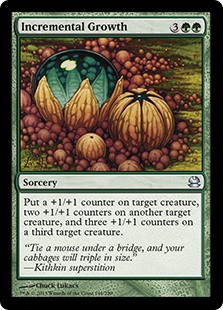
A highlight was Ninja of the Deep Hours. He was phenomenal in both my wins and even in my losses generated quite a bit of value. Lightning Bolt is still out of vogue, though making a comeback, which means many players have to jump through hoops to remove him. In one game against Abzan, Ninja hit turn two and never left the board because my opponent couldn't trigger revolt for Fatal Push. Since adopting this deck, Ninja has averaged two card draws and a favorable trade each time he's played. If you're picking up this deck, I know he looks weird, but you should not cut Ninja of the Deep Hours.

Overall

So with the season winding down, it's time to look back at my performance and look for areas to improve. That was, after all, one of my goals with this series. I've been on the grind for a long time now, and I'm pleased to say that I have been improving. It's hard to quantify exactly how much, since my first PTQ way back in Mirrodin block, and especially since the old PTQs and current PPTQs work differently, but it is working. There was a time that I bombed every single Constructed event that I attended. The only PTQs I actually did well in, until I actually won the last Modern PTQ playing Merfolk, were Limited. My constant work is paying off and I'm getting closer more often. I'm just looking for that last little push to actually get there again.

The other factor for me is that I'm known now. For years, I was underestimated because I wasn't particularly successful or well known. That has changed. During the first year of PPTQs I had a lot more Top 8s than this year, but I was also very well-positioned playing Merfolk in fields of Splinter Twin, and I surprised a lot of players. They didn't know what to expect and I was able to use that information advantage well. I don't get that boost anymore. I think that this shift away from my most familiar deck and players knowing what to expect from me is partially to blame for my only making two Top 8s this year.
The weird part for me is how swingy my results have been. With the exception of week three I've either bombed out or been second. I believe that this is a function of the decks I've played, and for reasons I'm going to detail, I'm not unhappy with this.

Deck Choice

Overall I'm happy with my deck choices, though they didn't always work out. This last week I should have been playing Merfolk, as it has a much better matchup against Company decks thanks to its faster, more consistent clock. But I only know that in retrospect. Based on the information I had going into each tournament, I made the best decision I could on which deck to play. There were certainly decks that were better positioned than what I played (I think that week two was actually Storm's week to win) but I didn't have those decks with me. For what I do have put together and practiced, I picked correctly based on my information.

The other thing is that I ended up playing a very swingy deck. This was huge change for me because I normally play decks with even matchups and often build my deck to be even more average. You never know what you're going to hit at a Modern tournament, and I like to hedge.
This year, I purposefully played a deck that was extreme. I've been advised by a number of actual Pro Tour staple players and some semi-pros that you're more likely to spike a tournament this way. Even BBD during his run to World Champion said that you just need to get lucky and hit the right meta to get there. When I hit favorable metagames and matchups, I went right to the top, losing to decks I was very unlikely to beat under any circumstance. When I was off, I had no chance. I knew this going in, and while I wish I had gotten there, if my finals opponents had been playing different decks I may have won easily. I've never said that about any other deck I've piloted. Merfolk is good, but the games are often close, especially these days.

Areas to Improve

I've kept notes about mistakes and things I missed for years now, and my post-match lists are getting longer. Partially this is because I'm getting more meticulous, but it's mostly because I'm noticing things I've never noticed before. I don't make big mistakes now, when my brain is functioning anyway. Instead, it's a lot of little sequencing errors or misevaluations. Shocking on the wrong turn so that I represent the wrong spell; which creature I run into removal; when to hold excess lands or just play them; playing around too many spells that I know my opponent has in hand. The little mistakes may only be worth a few fractions of a percent, but they add up. I'm noticing that there are a lot of almost undetectable miscues that don't hurt on their own, but when combined with others will turn the game around. I need to get better at the micro-side of my play and managing the game.

I am proud of how far I've come this season, though. Over the past two months I've gotten much better at divining my opponent's deck and cards in their hands and adjusting my play accordingly. Playing a more complicated deck was challenging and for the most part I rose to the challenge and developed my skills noticeably. This bodes well for my future grinding.

About Spirits

I cannot say that UW Spirits is a good deck in an open metagame. It has a lot of very bad matchups that you struggle against even if you heavily sideboard against them. However, it is excellent at doing what it was designed to do: beat Fatal Push. Between all the three-drops and Rattlechains, you're just not vulnerable to Push. You can avoid most other removal as well thanks to hexproof and Selfless Spirit. Combine this fact with Chalice and you have a deck that just stomps on Grixis and Jeskai lists. If your meta is mostly Death's Shadow or control, then I heartily recommend this deck.


However, it is susceptible to being proactively ground out. You only get value from your creatures when they're dodging your opponent's spells, and against a Company deck, you will often fall behind. You don't have much board interaction either, so anything that can go big quickly, like Champion of the Parish, can be very problematic. It's very much a deck that you have to dodge and get lucky with, but when you do it is rewarding.

...Until Next Time

Hopefully some of you actually did get there this year. If so, I wish you luck for the RPTQ. I have one more try in a few weeks, so hopefully I get the good Sealed Pool. Next week, if things come together and I can get the last matches completed, there will be the data from the Preordain testing. See you then!

Insider: Arena, MTGO, and You

Are you a Quiet Speculation member?

If not, now is a perfect time to join up! Our powerful tools, breaking-news analysis, and exclusive Discord channel will make sure you stay up to date and ahead of the curve.

I. Is Arena Just a New Hearthstone?

At its conceptual core, Arena appears to be a Hearthstone clone. From top to bottom, in all aspects of its design and intentionality, Arena seems geared to try to directly compete with Hearthstone and offer a comparable and competing experience to it. Importantly, though this includes its aesthetics, it is goes beyond them as well – what we know about its offerings, game structures, competition structures, and economic structures signal that Wizards is emulating the entirety of Hearthstone's core gaming model. For those of you who have not seen the demo, read various tweets from Wizards employees, or listened to important interviews, let me catch you up to speed on the relevant specific data that matters to you as a Magic player and investor.

(i) Arena will be a free-to-play (f2p) collectible card game (CCG).
(ii) Arena will use the same rules framework as Magic: The Gathering.
(iii) Arena will offer Draft, Sealed and Standard at launch. A format to use cards that have rotated out of Standard will be implemented later.
(iv) Arena will focus on fast, quick play that can be done in short bouts of time. All players will have access to one-game matches. Players at the top of the rankings will have access to best of three matches with sideboarding.
(v) Arena is the platform on which Wizards wants pros to play and stream Draft, Sealed and Standard. MTGO will become the primary platform for Modern, Legacy, Pauper, Vintage, Cube, and Flashback events.
(vi) Arena will not allow trading or buying and selling singles. You build your collections exclusively through opening booster packs and creating cards out of "dust" like Hearthstone.

This vision for Arena leads to some very important questions. The one that I believe we should all be most interested in is teleological. That is, is Magic Arena an end unto itself, or is its intention to get a new sort of gamer interested in traditional forms of Magic? Is Magic Arena fundamentally a missionary enterprise, or a reform and transformation of our experience with Magic itself?

There was an error retrieving a chart for Tireless Missionaries

II. What is Arena Actually Going to Be Like?

What has gone unnoticed, or perhaps unappreciated, is that Arena will enable players to engage with Magic far differently than what is traditional in paper or digital Magic. Right now, we take new players, teach them the rules, and thrust them into gameplay modes that are standard across all skill levels. The new player at FNM drafts in the same manner as the player at a GP and the player at a Pro Tour. We ask these new players to compete using the same rules as veteran players, and to build decks drawing from the same card pool as veteran players. Professional players, veteran players, and players who have recently learned how to play all gather at prerelease or FNM and compete with each other.  We take it for granted that we all collectively build Standard and Modern decks, take those decks to FNM, Standard Showdowns, PPTQs, and MTGO Standard leagues to compete on the same playing field, a playing field comprised of players with a variety of budgets and levels of engagement and metagame awareness. In some ways, this is a positive thing, because it gives all Magic players a shared basis of experience and aspiration that helps Magic players form communities. It does, however, make it less likely that a new prospective player will become more invested in the game and continue to play it.

Arena will fundamentally change this dynamic by giving those prospective players a place to develop their interest in Magic at their own pace, in their own way. In regards to Limited, Arena will create two basic tiers for how Draft (and Sealed) will work. The bottom tier may or may not involve traditional drafting (it is noteworthy that when asked whether Arena is "real Magic", the reply always focuses exclusively on the rules engine and in-game experience, suggesting that everything beyond the battlefield is not sacrosanct), but it will not involve sideboarding. The top tier of players will have access to a traditional Draft experience. It is unclear what percentage of Arena players this will be, but I'd wager the over/under is closer to 10 percent than 50 percent.

In Constructed, the difference between traditional Magic and Arena will be stark. To understand why, we have to understand the basics of a free-to-play game (f2p). Those of you who play Hearthstone can probably anticipate what I'm going to say. In Arena, you cannot buy or sell cards and you cannot trade cards. Instead, you build your collection by buying and opening booster packs or opening booster packs you win as prizes. If you open cards you don't want (I'm looking at you Djeru, With Eyes Open), you can "dust" them and use that dust to create cards you do want. The way f2p games make money is buy making it very costly to craft the cards you want out of dust.  In Hearthstone, for example, you need to dust four "mythics" in order to forge a mythic of your choice. Magic Arena is emulating Hearthstone's economic model, so we can expect roughly the same.

This makes it very, very expensive to build competitive decks in free-to-play games like Arena and Hearthstone. It even makes it expensive to build decks you wouldn't be embarrassed to take to FNM. This year, Hearthstone players had to shell out $670 to acquire 90 percent of the cards Hearthstone released. In previous years, it was closer to $440 to acquire that same percentage. The reason for the cost increase is that Blizzard eliminated small sets in favor of large sets this year; more cards means it costs more to acquire them. Note that Wizards is doing the same thing with Magic, and I highly doubt that that is a coincidence. In Hearthstone, it currently costs about $1,100 per year to keep up with its version of Standard if you don't grind, and in future years that number will rise to $1340 per year. And the fact that you lose 75 percent of the value of your cards if you change decks (as opposed to the 25 to 35 percent you'd lose in paper Magic or the 10 to 20 percent you'd lose on MTGO) makes it very difficult to game the system if you want to consistently compete in the Hearthstone equivalent to Standard.

The hope that many in the MTG community seem to have is that you'll be able to grind a lot so you won't have to spend much money. Hearthstone players' experiences indicate that this is almost assuredly not going to be the case, and we know from the Limited Resources interview that currency acquisition on Arena will follow this same exact model. From the research I've done, most Hearthstone players seem to agree that you can grind about 600 hours per year (a little more than an hour and a half per day every day) and then on top of that spend about $200 to $250 per year to maintain a reasonable Standard collection to be competitive and generally play with the cards you want to play with.

You should expect roughly the same with Arena – perhaps a bit better because competition is always good for the consumer. And that grinding isn't grinding with the decks you want to play with, mind you – it's grinding with the cards you already have as you slowly build up your collection, fulfilling quests like "Cast 10 dinosaurs" or "Kill 10 creatures" along the way. It's Kitchen Table Magic.

There was an error retrieving a chart for Turn the Tables

Knowing this, let's see what the Arena ladders would most likely have looked like this past Standard season. Arena promises the same ladder ranking system that Hearthstone and Starcraft 2 have, so you will be matched with players with roughly the same rank as you. The bottom half of the ladder, (let's say Bronze through Gold) will likely not have spent a dime. They will have grinded for any cards they have; for these players Arena will have been truly free to play. These players will likely be building decks that you won't find at FNM or even in the annals of the jankiest of the jankiest of Saffron Olive brews. They will be piles of cards, possibly strategies that use a bunch of commons and uncommons, possibly a random hodgepodge of a player's best cards.

Those in the next tier (Platinum through Diamond, say) might have spent some money to buy cards, and some might have just managed to acquire tons of cards by religiously completing quests and playing multiple hours per day. You might see some BW Servos or GW Cats. Perhaps you might see some antiquated decks of players who spent a lot of money before but opted to stop investing so heavily into Arena, such as Dynavolt Tower or Red Eldrazi.

The top tier (Master through Grandmaster) will be exclusively comprised of players who spend over $1,000 a year on Arena, those who grind 500 to 750 hours a year plus put in $200 to $250, and professionals who will probably be given all the cards for free so that they stream on Arena and promote the platform. Here, finally, you will see roughly what you see at FNM, PTQs, PTs, or MTGO Standard leagues. You will see your Temur Energy, G/B Constrictor and Ramunap Reds. Here you will get your traditional Constructed Magic experience, with many of you undoubtedly considering the word "traditional" synonymous with "authentic."

There was an error retrieving a chart for Burn the Impure

III. A Return to Kitchen Table Magic

Let's take a step back and look at the picture I have just painted. Arena will be giving players vastly different experiences. Those who spend nothing will have an Arcadian experience, playing Magic as my little brother and I did so many years ago. He would buy Mercadian Masques boosters, I would buy Weatherlight and Prophecy boosters, then we would build casual decks out of our card pools and play each other. Those with the means to do so (i.e., the very wealthy) will be able to play Standard as one does in paper or on MTGO. An intermediary experience will be available to those who spend a couple hundred dollars per year or who have a ton of time to grind ad infinitum.

There was an error retrieving a chart for Ad Nauseam

Taking one more step back, Arena is carving out a new player experience that addresses the issue I raised in the second section. Arena will provide a free way for new players to learn the game and experience authentic Magic with others in their same position. Had I not had a little brother who also found Magic cards alluring and gameplay compelling, I would not have been able to have the gameplay experience Arena will soon deliver to every boy and girl for free. I'm excited for this aspect of Arena and believe it will help grow the game and make Magic more mainstream. There are some hurdles (Magic is a more complex game than Hearthstone; mana flood and screw is a frustrating architectural feature of Magic; the art no longer has the enticing allure of fruit meant for an older audience, making it stand out less from competitors like Hearthstone or Pokemon), but I have faith that Arena will be popular and successful.

I have an equal amount of faith that enfranchised Magic players will be repulsed by the picture I painted above of the experience they can expect. If you are reading this column, chances are high that the type of Magic experience you enjoy will continue to be financially attainable only on MTGO or in paper.

Like Adam and Eve, you and I have already bitten into a certain apple, and I doubt we'll be able to will ourselves to return to a state of ignorance in which we enjoy playing kitchen-table Magic for an hour or two every day. What I want my readers to understand is that f2p card games do not make money primarily through aesthetic cosmetic purchases; they make money primarily by making it extremely expensive to compete with the cards you want to compete with, to compete with the cards you see being streamed, discussed on ChannelFireball and StarCityGames articles, and used at the Pro Tour.

I have seen more than a few Magic content creators say some version of, "Arena will get so many people to pay $2 for what MTGO charges $15 that it will be more profitable." Depending upon how it is phrased, that is either incorrect or misleading. The actual reality is that Arena will be designed, like Hearthstone, to get as many people as possible to become so emotionally invested in the game that they spend $500 to $1,000 or more per year. The problem Arena faces (which Hearthstone doesn't face) is that Arena is competing with other versions of its core game. Shouldn't would-be whales move over into Paper or MTGO?

IV. The Future of MTGO – and the Collections on It

This broaches the conundrum I can't seem to resolve and gets back at the question of teleology I raised at the beginning of the second section. I remain struck by Wizards' insistence that Arena will be the place to play Standard. We've heard it from Arena's developers, we've heard it in the Limited Resources interview, and we've even heard it from MTGO's Lee Sharpe.

But basic economics dictates the opposite. Most of Magic's current player base would not dare touch this thing with a ten-foot pole. The only way for Standard on Arena to be appealing to Magic's current player base would be for Arena to follow a Hex model, not a Hearthstone model. That is, Arena would need to allow a secondary market to exist, accomplished most easily by linking itself to (a visually-updated) MTGO in some fashion. As currently constructed, Arena seems most optimally used as a way to introduce prospective players to and develop an affinity for Magic. As currently constructed, Arena would best fit the model that we saw in Hasbro's report, as a program that ultimately leads people to play paper Magic and MTGO. That is explicitly not the stated goal, however, and that is equally mystifying and concerning.

There was an error retrieving a chart for Mystifying Maze

All of the above is extremely important, because the financial implications for those of us with collections on MTGO depend entirely on the ability or inability of Arena to attain its stated goal – the goal of supplanting MTGO as the primary way to play Limited and Standard. If Arena attains that goal, our collection values will swiftly crumble to dust, because the number of MTGO users will decline, reducing demand without decreasing supply. If Arena does not attain that goal, our MTGO collections should be in good shape, even great shape, since Arena would likely spur interest in Magic and bring in an influx of new players to MTGO.

What we know about the nuts and bolts of Arena leads me to think that MTGO is likely not in grave imminent danger; if the picture I have painted in this article proves to be correct, MTGO will be fine for years to come. The one thing that gives me great concern is Wizards's stated goals for the Arena platform.

Personally, I plan to continue playing MTGO and plan to continue investing. However, Arena will loom like a cloud over MTGO, discouraging user growth. Most of the financial advice I have heard, I think, is misguided. Many have said that we should shift our MTGO investing away from Standard and toward Modern. This would be a big mistake. You should do the opposite. Invest in Standard cards. Modern is not safe. Two Masters sets a year, coupled with Treasure Chests, will make it difficult to make money on Modern investments that aren't based around temporary shifts in the Modern metagame. Standard cards, at least, are supported by redemption and have investment windows shorter and more predictable than Modern or Legacy cards.

V. In Conclusion

Arena's visual display at HASCON excited me, as did its potential to bring in new players to the game, but the stated goals and explicit copying of Hearthstone's economic model feel misguided and leave me worried about the future of investing on MTGO and the future of digital Magic. I will be paying close attention to its development over the next year.

Please share your thoughts on Arena below. I'm sure y'all have much to say, and I'm deeply curious to hear it!

Avatar photo

Kyle Rusciano

Kyle started playing Magic with his little brother when they saw some other kids at a baseball camp playing. His grandma bought them some Portal: Second Age decks, and a hobby was born. Kyle played from Weatherlight through Invasion, then took a lengthy break until 2013. Now a PhD student in the humanities, the Greek mythology component of Theros compelled Kyle to return to the game. He enjoys playing Pauper and Limited as well as focusing on MTGO finance and card design. Follow him on Twitter at @KangaMage!

View More By Kyle Rusciano

Posted in Finance, Free Insider, Magic: The Gathering Arena, MTGO, StandardTagged , , , 4 Comments on Insider: Arena, MTGO, and You

Have you joined the Quiet Speculation Discord?

If you haven't, you're leaving value on the table! Join our community of experts, enthusiasts, entertainers, and educators and enjoy exclusive podcasts, questions asked and answered, trades, sales, and everything else Discord has to offer.

Want to create content with Quiet Speculation?

All you need to succeed is a passion for Magic: The Gathering, and the ability to write coherently. Share your knowledge of MTG and how you leverage it to win games, get value from your cards – or even turn a profit.

Insider: Iconic Masters Revisited

Are you a Quiet Speculation member?

If not, now is a perfect time to join up! Our powerful tools, breaking-news analysis, and exclusive Discord channel will make sure you stay up to date and ahead of the curve.

Welcome back, readers!

When WoTC first announced that this next Masters set was going to be focused on Iconic cards I got excited. That turned quickly to disappointment, when shortly afterwards they said it was going to emphasize some of Magic's oldest tribes: Dragons, Angels, Demons, Sphinxes, and Hydras. I did a breakdown of possible reprints assuming those would likely take up many of the mythic slots, and the set looked like it would likely be a flop.

So how many cards did I guess right that would be in Iconic Masters (IMA)? I looked at every mythic rare over $10 that had one of the announced creature types. Out of these 14 cards, just three made it in:

That's not very impressive. Though, to be fair, after highlighting those tribes in their statement they only included a grand total of three Hydras, five Angels, two Sphinxes, and five Demons in rare (or higher) slots. The only tribe they did really focus on heavily was Dragons (which had 10).

So I honestly can't feel that disappointed in my previous analysis since we kind of got the ol' bait-and-switch from WoT. Not that I'm complaining, as my original article was rather pessimistic. Instead we got another Masters set chock full of valuable cards in dire need of a reprint (from the player perspective).

Dropping Values

As we have seen with all the Masters sets so far, expect the rarity to play a big role in how much the card values drop:

  • Anything printed at common will likely decimate the price of previous versions (I'd expect at 75% drop in value or more).
  • Uncommons will likely drop by somewhere between 50-60% (based on previous drops).
  • Rares will likely drop somewhere in the range of 35-50% (depending on whether the card is a deck staple, a sideboard card, or if its original printing was really long ago when print runs were smaller).
  • Mythics will likely drop somewhere in the range of 15-35% (again, depending on whether it's a staple, sideboard card, or just exceedingly rare).

With that out of the way, let's look at some of the biggest reprints from the set.

There was an error retrieving a chart for Mana Drain

Good ol' Mana Drain. I'm betting there are still some people who think this card is on the Reserved List. Its original printing was as an uncommon in Legends, thus exempting it from the rules of the RL.

While I imagine the original Legends English versions will see modest drops, the Italian ones will likely see the biggest losses. They were already cheaper, and thanks to the new artwork, I imagine they will be less desirable then the Iconic Masters option. I would also expect the judge foils that we got relatively recently to take a bit of a hit, as players may prefer the Iconic Masters foil.

There was an error retrieving a chart for Horizon Canopy

Next up we have Horizon Canopy, which had managed to dodge a major reprint (save the Expedition) throughout its entire history. Horizon Canopy is one of those lands whose value was heavily influenced by scarcity as it was typically played only as a one- or two-of in decks that did play it. With a reprinting at rare and no major shift in Modern towards GWx decks, I expect this one will take a hard hit.

The good news is that the original has the different (and often beloved) alternate border design, so it will likely maintain some sort of premium over the reprint. However, this is definitely one to move out of if you have any before Iconic Masters hits the shelves.

There was an error retrieving a chart for Flusterstorm

With only two previous printings (one a judge foil, the other its original printing in the very first Commander set) this card's value was heavily influenced by scarcity. The Legacy format really took off after it was printed, which meant a low supply. And with WoTC's dislike of the storm mechanic, we aren't likely to see any more storm cards printed in Standard-legal sets—so the options for reprinting this card were pretty limited.

Flusterstorm was very close to $100 prior to this spoiling. I definitely expect it to drop a lot—this would be one of those closer-to-50% drops, if not more. Though, admittedly, its drop will be heavily dependent on the print run of IMA.

Also note that Flusterstorm is rarely a four-of in any deck, much more often appearing in the sideboard as a one- or two-of. Some Miracles decks do run it main now (as their ability to lock Storm decks out is exceedingly more difficult than before).

There was an error retrieving a chart for Grove of the Burnwillows

This card has actually cooled off a bit from its previous highs. This is thanks in large part to a shift away from GR Tron, which ran four copies of Grove, towards other versions (mainly Eldrazi and GW). It has also been replaced in many Legacy Lands decks with the Dark Depths/Thespian's Stage combo, which is a lot faster than trying to Punishing Fire out one's opponent.

Still, Grove was sitting in the mid to low $40s, with an all-time high of $90. I'd expect this one to easily drop to $25 or so.

The Praetors

There was an error retrieving a chart for Vorinclex, Voice of Hunger

Consider the graph above a stand-in for the whole cycle of Praetors from New Phyrexia. I've been wary of this reprint for a while now (I originally called them as likely in Modern Masters 2015 in place of the Dragons we had at mythic in MMA). Although we did get Elesh back in MM2, the other four remained elusive until now.

These are very popular Commander cards and thanks to being mythic will likely see the smallest percentage drops. I advise stores to target Sheoldred and Vorinclex especially, as they seem to be the most popular of the bunch in Commander.

There was an error retrieving a chart for Glimpse the Unthinkable

Mill strategies are more often than not left to the casual crowd, but boy do they love them. Despite the fact that this card isn't even in the top 50 most played non-creature spells in Modern, it was still sitting above $30 thanks to its single printing in the original Ravnica set.

Original copies were already selling for as low as $15 just two days after being spoiled. If you have any you can move out I would do so now, as the floor on this card is very low (I'd guess somewhere in the $5-7 range).

There was an error retrieving a chart for Ancestral Vision

Ever since being unbanned in Modern, this card has held a $40+ price tag despite never really breaking out in the format. It has found a home in some decks, but it hasn't been as format-warping as many worried (and control players hoped). I guess when the optimal play is to suspend it on turn one and there are quite a few decks that can still kill you before it ever resolves, it just doesn't do enough.

This reprint will assuredly knock it down quite a bit. I imagine we'll see it closer to $20-$25 after the set hits.

There was an error retrieving a chart for Serra Ascendant

Despite this card being bonkers in Commander, the other factor behind its price is its inclusion in the Soul Sisters decks in Modern and the fact that it was a single-print rare from M11. I will be targeting these in trade when/if they hit $6, and will probably buy a set if they hit $4.

There was an error retrieving a chart for Bloodghast

Bloodghast had a high of around $30 (when the Modern Dredge deck became dominant) and slowly declined to around $22. There are still some Modern Dredge players. With this reprint, the deck could fall close to the budget category, now that the most expensive card in the deck will likely drop in half (bringing the deck price down to the sub-$530 category).

There was an error retrieving a chart for Cryptic Command

This marks the third Masters set with Cryptic Command in it, and despite the previous printings the card has still managed to keep its head above the $20 waterline. I think that will change this time around.

We have seen a bit of a revival in control-type strategies in Modern recently (many of which play some number of Cryptics). But if this print run matches that of MM3, then I think the sheer number of additional copies will finally knock the best Command down to $12-$15.

There was an error retrieving a chart for Magus of the Moon

Blood Moons number 5-8 for many hate decks, it can be cheated into play via Collected Company, Chord of Calling, or—my personal favorite—Eldritch Evolution. It had been sitting in the $32 range prior to being spoiled but copies can already be found for $22. This leads me to believe this one will be taking quite a big hit as well.

The "Iconic" Tribes

Of course, we've skipped the three that I actually called way back when.

There was an error retrieving a chart for Archangel of Thune

I expect the biggest loser to be Archangel of Thune. The combo with Spike Feeder seems to have fallen out of favor in Modern, thanks largely to the infinite-mana engine of Devoted Druid and Vizier of Remedies, with their favorite pal Walking Ballista.

There was an error retrieving a chart for Consecrated Sphinx

Next we have Consecrated Sphinx, which just had a recent printing as an Invocation and didn't really see a drop in price at all. I think everyone's favorite card-drawing machine will see a modest drop and then likely rebound (especially since copies have dropped all the way to $18 since the spoiling). I will likely try to target them in trades around $15 and buy them in the $11-$13 range (if they drop that much).

There was an error retrieving a chart for Avacyn, Angel of Hope

Last but not least, good ol' Avacyn. This card has proven to be extremely resistant to reprint price drops. Even with the From the Vault: Angels reprint in 2015 she has never dropped below $20 (since late January of 2014). This is thanks to her extremely high power level in Commander (and somewhat due to being from a very popular "collector tribe").

While she might finally fall below that $20 barrier, I don't foresee her staying there long. I'll likely try to trade for an extra copy or two if she hits $16.

Conclusion

I am happy to be wrong on my original impression of this set. WoTC managed to pack in a lot of goodies into yet another Masters set. Though I will reiterate my concerns that the more Masters sets they release, the more diluted the excitement for the next will be, and the higher the risk of over-saturating the market.

Another Look at Modern Metagame

Are you a Quiet Speculation member?

If not, now is a perfect time to join up! Our powerful tools, breaking-news analysis, and exclusive Discord channel will make sure you stay up to date and ahead of the curve.

Hello, everyone.

To start us off today, let's go over the recent top-performing decks in Modern. Abzan Midrange and Grixis Death's Shadow are doing pretty well at Modern PTQs lately.

It's no surprise for Grixis Death's Shadow to perform well, as it's one of the most powerful decks in the today's metagame. It's proven the capability to adapt to most metagame changes since the deck became popular earlier this year. In the last few weeks, Abzan has re-emerged packing a full playset of Lingering Souls, a card that is good against most midrange or control decks, and I believe it will be popular in the coming weeks as well.

Besides the two decks mentioned, Blue-Red Gifts Storm has also re-appeared in the metagame, scoring multiple 5-0s in MTGO Competitive Leagues and two 6-0s in Modern Challenges last week. With Blue-Red Storm and Abzan regaining popularity, here are the current top decks based on MTGGoldfish data:

Graveyard Hate

With the above metagame changes, I'm going to speculate on a few cards. Firstly, its pretty obvious that delirium- and graveyard-themed decks are coming back. So, it's time to take a look  at the best graveyard hate cards again.

Leyline of the Void is very strong graveyard hate. It's usually a three- or four-of in the sideboard of black decks, because players want them in their opening hands against specific decks. Similarly, Rest in Peace is also strong against graveyard strategies, but the difference is that decks that play white, like Blue-White Control and Abzan, might not want to include RIP in their 75s as this card will hurt their own plays. Generally, both Leyline and Rest in Peace are good against Grixis Death's Shadow, Abzan and Blue-Red Gifts Storm. So if these decks continue maintaining or gaining popularity in the Modern metagame, these cards all have the potential to increase in price again – note they are all at relative low points compared to the last six months..

  • Leyline of the Void (GPT): Current Buy Price: 7.2; Target Sell Price: 12; Profit Per Copy: 4.8
  • Leyline of the Void (M11): Current Buy Price: 5.9; Target Sell Price: 10; Profit Per Copy: 4.1
  • Rest in Peace: Current Buy Price: 6.5; Target Sell Price: 10; Profit Per Copy: 3.5

Company Decks

With Collected Company decks like Counters Company and 4C or 5C Humans disappearing from the top-performing decklists, we can probably expect the namesake card to drop in price slowly. If it does drop below the 18-tickets mark, you could consider picking up a few playsets. On the other hand, Chord of Calling, a card that is usually played together with Collected Company, is already at its low point, making it a good investment opportunity.

  • Chord of Calling: Current Buy Price: 2; Target Sell Price: 5; Profit Per Copy: 3
  • Collected Company: Target Buy Price: 20; Target Sell Price: 30; Profit Per Copy: 10

Noble Hierarch is no doubt one of the best mana dorks in Modern. Currently, its not at its lowest point, but if it does drop below 16 tickets, I think that would be a good chance to invest in copies. Based on its historical price, Hierarch can easily be at above 20 tickets when one of the top-performing deck is playing with it.

  • Noble Hierarch: Target Buy Price: 16; Target Sell Price: 21; Profit Per Copy: 5

Faeries

In my opinion, Blue-Black Faeries is a very good deck to play right now because Bitterblossom is such a good card against the midrange decks in the format. Additionally, this deck has counter magic against the big mana decks like Tron, Amulet Bloom and Titan Shift. Recently, I've even seen players squeezing in one to two copies of The Scarab God in their blue-black decks for some grindy matchups, so I wouldn't be surprised if there's a Faeries deck jamming Scarab God doing well in the future. Let's look at some of the components:

As you guys can see, most of these cards are at their respective low prices according to the graphs. Bitterblossom is the main component of this deck. The ability to exchange a life for a 1/1 flyer – every turn – is the main reason why this deck is called an aggro-control deck, as the faeries can quickly take over the game while the player counters or destroys everything that else in their way. Mistbind Clique and Vendilion Clique are the best Faerie-type creatures that help to disrupt the opponent's game plan. Both of these creatures are extremely cheap right now in my opinion, and you might want to get some just in case. As for the blue-black lands, Darkslick Shores has probably reached its lowest point while Creeping Tar Pit can still go lower.

  • Bitterblossom: Target Buy Price: 10; Target Sell Price: 15; Profit Per Copy: 5
  • Vendilion Clique: Current Buy Price: 16; Target Sell Price: 25; Profit Per Copy: 9
  • Mistbind Clique: Current Buy Price: 1.8; Target Sell Price: 4.5; Profit Per Copy: 2.7
  • Darkslick Shores: Current Buy Price: 1.8; Target Sell Price: 4; Profit Per Copy: 2.2
  • Creeping Tar Pit: Target Buy Price: 5; Target Sell Price: 10; Profit Per Copy: 5

Other Random Cards

Inquisition of Kozilek is very popular in Modern. Almost all black decks will play some number of copies of this card in their 75. This card consistently fluctuates between 1.5 and 3 tickets. Although its not as fast as some of the cards with cyclical trends, I think it's relative low point in the fluctuation process provides a good opportunity to see some potential profits.

  • Inquisition of Kozilek: Current Buy Price: 1.7; Target Sell Price: 3; Profit Per Copy: 1.3

Kitchen Finks is commonly used against aggro decks and midrange/attrition matchups. The indirect card-advantage from this card is pretty annoying for some decks, and it's also part of the combos in the Company decks. I'm not very sure on the reason of the drop in price, but it's probably safe to invest in some copies of Finks at its current price of 2.15 tickets each.

  • Kitchen Finks: Current Buy Price: 2.15; Target Sell Price 4.2; Profit Per Copy: 2.05

This card is usually seen in decks with at least three colors because they can't afford to sacrifice their mana base for Ghost Quarter effects. Fulminator Mage is better than Ghost Quarter in some cases; for example, it can help to pressure the opponent when the land destruction effect is not relevant. This card spiked when the full spoilers of Modern Masters 2017 came out, of course with some help from the Modern metagame. Now it's back at 15 tickets, and I think this card is a good choice for a long-term specs.

  • Fulminator Mage: Current Buy Price: 15.4; Target Sell Price: 25; Profit Per Copy: 9.6

Kolaghan's Command was one of the most underrated card in Dragons of Tarkir. The black-red Command is one of the best two-for-one card in Modern and even Legacy. The price of this card has been staying around 13 tickets for quite some time already. If Modern Jund or any black-red deck becomes popular in the future, this card can easily be part of those decks, and has a potential to increase in value.

  • Kolaghan's Command: Current Buy Price: 13.3; Target Sell Price: 18; Profit Per Copy: 4.7


Alright, that's all for this week. Thanks for reading, and I'll see you guys again soon.

–Adrian, signing out.

Want Prices?

Browse thousands of prices with the first and most comprehensive MTG Finance tool around.


Trader Tools lists both buylist and retail prices for every MTG card, going back a decade.

Quiet Speculation