menu

Insider: Bulk Vampire Tribal C17

Are you a Quiet Speculation member?

If not, now is a perfect time to join up! Our powerful tools, breaking-news analysis, and exclusive Discord channel will make sure you stay up to date and ahead of the curve.

Most of you are aware that I record Brainstorm Brewery every week with Jason Alt and Corbin Hosler. I say "most" because I like to imagine that there's someone new reading my articles each week, in which case, welcome to the show!

Most of the time, we talk about bulk here. Buying bulk, selling bulk, bulk rares, bulk common/uncommons, picking bulk, selling picks from bulk – you name it. Every now and again, I jump ship and jam an article about something else, but it always comes Back to Basics.

I had an entire article drafted up for this week about bulk predictions for Commander 2017, which is releasing sooner than you think (August 25, 2017). I was going to discuss the possible tribes they would pick, and then focus on bulk picks that you should be aware of in those relevant tribes. Some could get reprinted, some might not. To make a long story short, I didn't really like the direction that the article was going ,so I scrapped the entire thing. (If you're interested, I could throw it on the burner for next week. Let me know in the comments section, or shout me out on Twitter @Rose0fthorns. I want to write about what you want to read about, because you're paying money to make money.)

So if I put that article on the back burner, what kind of text are we about to scroll down towards? Well, this is another experiment I'm going to test run. I mentioned Brainstorm Brewery earlier, and most of you will be familiar with the Breaking Bulk segment. We try to pick out cards that you probably didn't know about, or at least didn't know their value. It's the kind of segment where we go: "Hey did you know Tyrant's Familiar is up to $2.50 and not a bulk rare?" or "You can sell those Dawn Charms for $.50 each buylist."

So basically, it's a segment that basically is my wheelhouse in Magic finance. This article is going to contain a whole bunch of raw Breaking Bulk picks, and some attempted explanations as to why the cards are worth money. Some of it just boils down to "low supply," but hopefully you'll leave this article today with more knowledge of casual cards than when you came in. If you enjoy Breaking Bulk on Brainstorm Brewery, buckle up.

There was an error retrieving a chart for Bloodmark Mentor

Let's start it off easy with a couple of more well-known picks. If you've ever wanted to throw together a Krenko, Mob Boss Commander deck, you've probably seen this little gobbo popping up on EDHrec.com. For a whole dollar, he turns your little 1/1s into a phalanx that can take down the Voltron-est of decks with first striking goodness. The scarcity of Shadowmoor makes this guy hard to come by, but he's close to mandatory for anyone looking to win through combat damage with their Goblins.

There was an error retrieving a chart for Distortion Strike

My first Pauper deck I ever built had this card in it, combined with Kiln Fiend and Wee Dragonauts following the release of Rise of the Eldrazi. I played that deck in one event and learned my distate for Izzet colors, but this one-mana sorcery continues to entice less competitive players with the one-shot potential it allows. The rebound is less of a deal than the +1/+0 it offers, often giving a double striker or infect creature the last bit of reach to end a game. I've always been surprised by this card's lack of a reprint, which is probably the only thing holding it from the dime level of buylisting. If it ever gets hit in a Commander deck or other supplemental product, you should have a good chance to pick these up for cheap while holding onto them and waiting for the creep back upward.

There was an error retrieving a chart for Blood Knight
There was an error retrieving a chart for Silver Knight

Both of these guys are pickable, but only Mr. Silver gets the rights to being worth more than a dime at the moment. Sometimes stores will run out of Blood Knights and offer quarters on them to restock, but the real prize is the Duel Deck Silver Knight. You can off that guy for at least 50 cents, and it's really common for that card to be left behind once all the rares have been pillaged. People will pull out Thunder Dragon because they don't want to "leave the good stuff", but then Spidersilk Armor and Silver Knight are yours for the taking. Duel Decks are extremely easy money, especially when combined with new artwork. Even the aforementioned Bloodmark Mentor comes in this product, making it easy to pull even if you don't come across Shadowmoor block bulk very often.

There was an error retrieving a chart for Snuff Out

Here's another version of Duel Decks ramping up the prices of commons with artwork changes. While most Doom Blade effects aren't really worth picking unless they're Standard-legal, this version of Snuff Out sidles up right next to Go for the Throat in terms of buylist power. You know that 78-card unsleeved casual player we talk a lot about in this column? This is their card, and this is their version of that card. They want to play Liliana Vess with Liliana's Caress, while playing other cards that feature the Dominaran necromancer in every variation; flavor text, card art, etc.

There was an error retrieving a chart for Tallowisp

There's a niche Spirits deck running around in Modern, that plays off Geist of Saint Traft and Steel of the Godhead. If not interacted with quickly, the deck can end games out of nowhere and is a lot of fun to play when your opponent has to read your Tallowisp.  Obviously, the fact that it only has one printing from Betrayers of Kamigawa helps the price point of $1 as well, and the rest of the value comes from those invisible casual players we all know and love. Breya doesn't really play enough Spirits to make it worth running, so I keep finding these guys in "picked" Kamigawa bulk.

There was an error retrieving a chart for Sunbond

Born of the Gods gets a mostly well-deserved reputation for being a hot dumpster fire of a set. The most expensive mythics don't even hit $10, leaving box value at below $50. Yuck. I think the commons and uncommons have a similar bad reputation, but it's undeserved: there's some goodies in this set such as Sunbond. You can ship these off at 40 or 50 cents a piece, higher than the fifth-most-expensive  non-mythic rare in the set. Searing Blood and Archetype of Courage are similar heroes that have made BNG uncommons worth pulling from.

There was an error retrieving a chart for Gifted Aetherborn

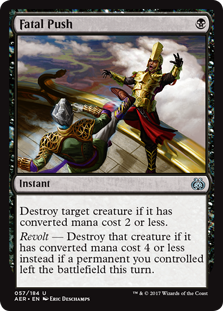
Alright, let's interlude with a more recent card. I picked a couple playsets of these from "picked" Aether Revolt bulk, which basically means I took out the rares and Fatal Pushes. Little do people know, this miniature Vampire Nighthawk is worth more than the original vampire himself. A dozen reprints will do that to a 2/3 flier, even if he is still solidly 25 cents on most buylists. Still, this card curves out into lords much more efficiently, and I can see it creeping towards $1 as AER gets further and further away from being the hot goodness. Ironically, you can scale down the graph of Fatal Push to predict how this card will go up in price over time. We see Push hitting $9 now because of how little Revolt was opened, so expect casuals to dry up the supply of this card by putting it in unsleeved vampire decks.

There was an error retrieving a chart for Leechridden Swamp
There was an error retrieving a chart for Kulrath Knight
There was an error retrieving a chart for Corrosive Mentor
Okay, so picking Shadowmoor is kind of cheating, because it feels like practically everything in that set is worth money. I'm doing a double-take on these two above cards, though, because of the recent resurgence of -1/-1 counter shenanigans. Again, I found both of these in picked bulk. The seller said they pulled out everything worth something, and yet here I am staring at $10 worth of wither. Corrosive Mentor will be easy to ship to someone building Hapetra, Vizier of Poisons, but you'll have to buylist or hunt down a casual player for Kulrath Knight being R/B. Even if someone says their bulk is picked, you should buy it. Jason Alt said it best: buying bulk gives other people thousands of chances to make mistakes.
There was an error retrieving a chart for Sosuke's Summons
This card got a little more popular with the release of Kaseto, Orochi Archmage, but that doesn't explain the continued creep upward in the past 12 months. I think Snakes have been revitalized a bit with the introduction of more Naga, even though the two tribes don't technically mix the way people want them too. Heck, Seshiro the Anointed spiked to $9 recently; while he'll probably settle at around $6 or so, it shows a lot of interest in Snake tribal. Obviously, this card is a little difficult to reprint considering they didn't put it in the Commander deck with Kaseto, and it references a specific long-dead Kamigawa-block character. I literally found these next to Tallowsisps in bulk today. Card Kingdom is paying you $1.15 a piece to send you these. The card has legs. The snakes in the art have legs. Kamigawa was weird.

Were You Surprised? 

My goal today was to make you think "I did not know that card was worth at least $1! Thanks, DJ." Let me know if these were too easy, or if there's a spicy card you think that I won't know about! I only recently learned of Corrosive Mentor from Jason when he used it as his Breaking Bulk pick a couple weeks ago, and I thought I knew Shadowmoor like the back of my hand. Thanks for reading!

Event Preparation: Getting Ready for SCG Baltimore

Are you a Quiet Speculation member?

If not, now is a perfect time to join up! Our powerful tools, breaking-news analysis, and exclusive Discord channel will make sure you stay up to date and ahead of the curve.

Last week, an old Magic buddy texted me out of the blue, asking if I was interested in going to SCG Baltimore at the end of the month to play some live Modern. My first reaction: “Can’t do it, I’ve got way too much going on…” But then I remembered that it’s summer, and I have next to no responsibilities!
Once it was established that I was probably going to go, our follow-up conversation went something like this:

Me: "We’re going. Sweet, now what are we going to play?"
Him: "I always play Jund, year after year, no matter what. I know next to nothing about what my opponents are doing."
Me: "Welp."

I figured this week was as good a time as any to talk about event preparation in general, and specifically give some insight into my work leading up to Baltimore, which is currently in its beginning stages. Next week might serve as a follow-up to our discussion here, but for now, my goal is to provide an introduction to event preparation strategies in general, while also providing solid information about Modern as it stands halfway through May 2017. The hope here is that there's something for everyone: those looking to play in a large-ish event at any point in the future, and those interested in winning in Modern at all levels right now. Hopefully you fall into one of those camps; if not, I suggest reading a finance article or something.

As a brief reminder, from here on I'll be referring to MTGO metagame information and basing my analysis and speculation on that data. I'm exclusively an online player, and when it comes to predicting metagame trends, I've had the most success looking at online data, coupling it with my own experiences, and then translating that info to the paper world. Usually, you can expect the MTGO metagame to move roughly a couple weeks ahead of the paper metagame. It's also often the best window into the pro community's take on the format—not too many pros show up to IQs or local paper tournaments, but you'll find plenty of known usernames in the 5-0 League finishes.

Hopefully that provides some context for why I value MTGO results so highly. Onwards!

Step 1: Lay Out Your “Knowns”
The first step in event preparation is listing all the information available to you at Level 0. As everything we do from here will undoubtedly be tied both to information and speculation from this point, having a visual guide to the “knowns” will help us from straying too far down the rabbit hole, keep us on track, and give us a clear goal to work for. Here’s my list of knowns, two weeks ahead of Baltimore.

Time (10 days). As I’m writing this on Tuesday, I’ve got a little over a week to prepare for the event. Realistically, given other commitments and things going on (getting back from vacation, then starting a new job next week), I’m expecting I’ll be able to devote around 10 hours to event prep at most, spread out in evenings over a week-long period. Outlining how much time you have to work, and thinking about said time both quantitatively and qualitatively (when you’ll be able to work) is essential to event prep. Will we be able to start from “square one” and approach the format from a macro-level, with the ability to devote time and energy to multiple archetypes? Or will we have to concentrate our time on one specific archetype, focusing instead on tuning and matchup practice?

Card Pool. Do you have access to any deck, if necessary? Slightly less important than time, card pool also influences the subsequent decisions we’ll be making. I’ve experienced both extremes, going from having access to virtually every card/deck in the format, to the point I’m at now, where all the cards I own are virtual. I’ll undoubtedly be borrowing cards from various friends/contacts, but I’ll have to test with the knowledge in mind that my first, second, or even third option for final build might not be available to me.

Prior Knowledge. This holds true across all formats, but is especially true for eternal formats like Modern and Legacy: archetype familiarity often trumps right deck for the field. Modern rewards intricate knowledge of deck strategy, sequencing, sideboarding, and understanding of roles, more so than Standard and Limited. Tron might be the best deck in the field, but if I’ve never played a match of Tron in my life, and am well-versed in the ins and outs of Ad Nauseam, I’ll need to take a hard look at what the best use of my time is.
Time and prior knowledge are closely tied, to the point where they should probably be equal on this list. In an ideal world, we’d love to be able to systematically work through our initial format assumptions, proving and disproving, moving closer to the final result with each game played. In reality, we never have enough time to do all the exploring we’d like to do, and some leads result in dead ends, or even backward steps as we spend time tuning archetypes that we later find fall short. It’s no secret that the best-performing players have ways of beating father time, be they teams, Facebook information groups, or sources of expertise that they can rely on to point them in the right direction or specialize the work.

So, let’s lay out where we’re at. Ten days away from SCG Baltimore, MTGGoldfish pegs the top decks as Affinity, Storm, Eldrazi Tron, and Death’s Shadow, with a variety of decks grouped slightly lower in representation below them. Looking back a couple weeks, Dredge has dropped out of the top tier it once occupied, to be replaced by Storm; Death’s Shadow is the most played archetype, though its numbers are split between traditional and Grixis variants. Recently, I’ve had experience piloting various UWx strategies, and both Shadow variants, and I’m well-versed in Burn, Jund, and Abzan. Beyond that, it’s uncharted territory.

Step 2: Define Targets, Narrow Choices

Taking in what we know—prior knowledge, time constraints, and available card pool—our next step is to translate that information into something manageable that takes into account our unique situation. The best way to filter information is to break it into smaller chunks, and refine from there, starting with macro-archetype.

Here is the macro aggro/combo/control breakdown as I see it, among the 13 most represented archetypes on MTGO.

  • Aggro: 25%
  • Combo: 18.5%
  • Midrange: 13.6%

MTGGoldfish metagame numbers are weird, because all archetypes are weighted equally. Any deck that puts up a 5-0 finish grabs a piece of the pie, so you tend to see a larger split than conventional paper metagame breakdowns. Click the "load more" button a few times and you'll see 40 archetypes represented sometimes, often among them duplicates of some top decks but with a different name, or with a single odd card choice the site's formula doesn't seem to like. So, take those numbers with a grain of salt, but for the most part recognize that they are at least slightly accurate, and have some use to us.
What’s immediately apparent to me is Eldrazi Tron’s identity in the field not as a ramp-combo deck, as normal Tron decks would be classified, but as midrange. With Jund falling out of the higher-curve end of deck representation, thanks in large part to Eldrazi Tron, it appears that Tron itself has taken on the role of midrange, thanks to its variety of threats and ability to compete well into the lategame with its card advantage and pricey spells. Dredge essentially swapped places with Storm, and while it might seem like focusing on Storm would be a good place to start, we would do well not to forget that just two weeks ago Dredge occupied Storm’s slot. Focusing on one at the expense of another will just result in Dredge creeping back up into the top tier, as the deck has certainly demonstrated its pedigree at this point.

Another point of interest is the lack of a true control deck among the top options. UW has taken over where Jeskai and Grixis used to roam, but 2% of the metagame is nowhere near enough to make a significant impact. This, to me, suggests two possibilities. The first is that the format is hostile to control, and the deck cannot hope to succeed in a field apparently detrimental to its survival. The second is the opposite—with no control deck making any impact on the format, its possible that other decks have ignored it in terms of preparation and construction, and the field might be ripe for control to come in and make an impact.

Step 3: Look at Individual Decks

Once we’ve gained an understanding of the macro archetypes at work in the format, the next step is to highlight strengths and weaknesses of particular archetypes to determine their viability come event time. We do this not just to figure out what we should be playing ourselves, but to speculate on what other players will be doing as well. Affinity might be one of the most played archetypes right now, but if it can’t beat a clear enemy, and most players know that, the field might decide in large numbers not to bring Affinity to event day. This is one of many variables that can influence disparity between what we see in the statistics compared to the actual day-of metagame. I’ve already done a bit of exploring here, but will continue to do so over the coming days. Here are my initial impressions of some of the top decks in the format.

Affinity
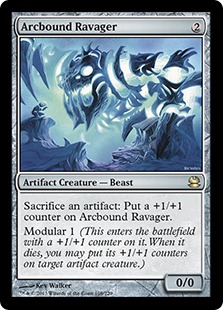
Affinity is well-positioned to capitalize on a field where the best aggro deck doesn’t play a creature on turn one. Thoughtseize and discard are poor against a strategy that dumps its hand on turn two, as is a cavalier approach to one’s life total. Both are core tenets of Death’s Shadow, the deck on everyone’s radar. While the rest of the format continues to warp itself around Fatal Push, Affinity is playing the same list from years ago, with only a few minor changes. It still dies to Stony Silence, but that doesn’t matter, as Stony Silence and Affinity have existed side by side for years and the deck continues to be a staple of the top tables.

Storm

Dropping Pyromancer Ascension and adding Gifts Ungiven, as well as another Goblin Electromancer in the form of Baral, Chief of Compliance, has contributed into Storm’s ascension (heh) to the top decks in the field. Previously, a couple discard spells was all it took to take this strategy down, and it rarely managed to untap with Electromancer and go off. Now, a higher land count and the addition of Gifts Ungiven has Storm well-prepared to go into the midgame against any opponent, and any turn could be your last against this deck, whether they have something on the board or not.

Eldrazi Tron

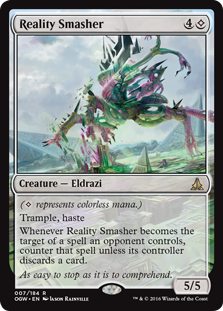
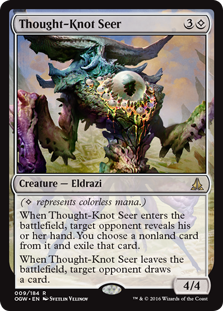
Bant Eldrazi has largely been replaced by colorless Eldrazi Tron, which combines the best of both the old Eldrazi and RG Tron lists into a streamlined powerhouse that plays both sides of the curve well. Basilisk Collar on Walking Ballista handles most of the creature decks in the format, and even with Eye of Ugin banned, the deck still gets to do crazy things with its manabase and undercosted threats. Matter Reshaper, Thought-Knot Seer, and Reality Smasher are assuredly to blame for the deck’s success, as each are packed with as much power, toughness, and incidental value that Wizards’ could possibly fit into the design template. No wonder the deck is so strong.

Death’s Shadow Aggro
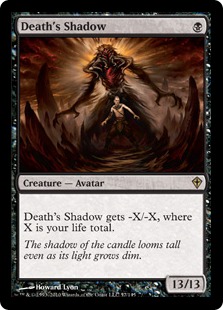
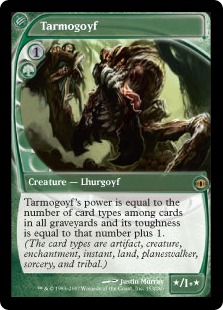
This deck packs more value and punch into undercosted spells than anything I’ve seen in the format since Dig Through Time. Death's Shadow, as long as you cut the chaff and don’t mind being patient, can be played alongside a number of other powerful spells as basically the black Tarmogoyf. Death’s Shadow Aggro does what Jund or Little Kid Abzan never could: present a consistent, powerful clock without sacrificing card quality.

The deck takes advantage of a number of powerful synergies while not overly relying on any one in particular, and gets to play Death's Shadow, in my opinion the most individually powerful card in the format. The fact that the card has spawned multiple decks around it, the fact that it tends to be those decks' namesake, and the (granted, premature) discussion of its possible banning all contribute to my belief that Death's Shadow is running the format right now. No other non-combo card in Modern threatens victory more quickly than this card, and its play is primarily responsible for a decrease in play of Lightning Bolt, the previous so-called king of Modern. Death's Shadow has been around for years, but he’s finally found the right home.

Burn

Burn has benefited greatly from all the recent changes to the format. Jeskai Control’s demise is a welcome sight, as is the rise of Death’s Shadow and Storm’s interest in slowing down its gameplan. Burn's only natural enemy is Dredge (depending on who you talk to, Affinity can be tough as well), but for the most part, Burn is well-positioned to attack a format that is largely ignoring it. Maindeck lifegain in the form of Basilisk Collar is never pretty, but for the most part, I see a field with plenty of solid matchups and not many poor ones.

Knightfall
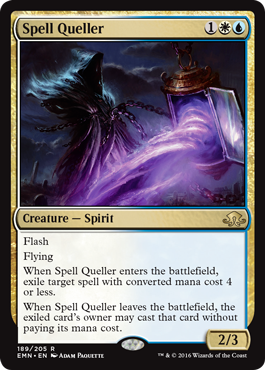
As was prophesied with the printing of Spell Queller, Knightfall has been able to incorporate a few new printings not necessarily “meant” for the archetype, into a shell that has quietly been putting up an increasing number of strong finishes online. At first glance, it seems this is due more to the characteristics of the format than to the individual merits of the archetype itself, but it’s difficult to argue with what the deck brings to the table. A fast, proactive gameplan, individually powerful spells, the ability to switch roles if necessary, and great sideboard spells in all the right colors is a recipe for success. I’m definitely intrigued.

Dredge

It happened more slowly than I expected, but players finally came around to the notion that Dredge is not gone for good, and will continue to put up results if not respected. For now, it looks like the field recognizes the aggro-combo deck’s threat, but as we’ve seen time and again with Affinity, everyone loves to cheat. What Dredge does and how to beat it are clearly known at this point, but who knows what story Baltimore will tell?

Abzan

Jund’s surprising disappearance has left Abzan the format's de-facto reigning midrange deck, depending on how you feel about Eldrazi Tron. Lingering Souls, some maindeck lifegain, and not having to rely on Lightning Bolt are all strong draws to the archetype. The ability to play better sideboard spells is another solid strength it can claim. I’ve wanted to sit down and explore this deck in depth for a bit now, and while I don’t want to speak too soon, I wouldn’t be surprised if my initial impressions about the format lead me down the Abzan road in the next couple of days.

Conclusion

We’re getting a little long here, so for now I think we’ll bring this article to a close. We can build upon this framework next week, on the eve of SCG Baltimore. I currently plan on attending, but card availability and travel costs might prove an issue. If so, I’ll definitely be at Charlotte in early June, and I’m looking forward to backing up all this theory with some strong results, or at least an interesting report.

Let me know what you think in the comments, about the article and the format as a whole. What are your impressions about the field ahead of the event, and what do you expect to see happen on Saturday? Thanks for reading, and I’ll see you next week.


Insider: Pro Tour Amonkhet – Metagame and Finance

Are you a Quiet Speculation member?

If not, now is a perfect time to join up! Our powerful tools, breaking-news analysis, and exclusive Discord channel will make sure you stay up to date and ahead of the curve.

This past weekend, some of the world's best Magic players gathered to compete in Pro Tour Amonkhet. With the banning of Felidar Guardian being tardy to the party, players had to adapt to an uncertain metagame. There were many questions leading up to the event, and a key one was which new decks would emerge from the pros' testing to dominate the tournament? Fortunately for us, the Zombie horde took over the event and shifted the metagame in an interesting direction.

Here’s the winning deck from Gerry Thompson.

Mono Black Zombied by Gerry Thompson (1st place Pro Tour AMK)

Creatures

4 Cryptbreaker
4 Dread Wanderer
4 Metallic Mimic
4 Relentless Dead
4 Diregraf Colossus
4 Lord of the Accursed

Spells

2 Fatal Push
3 Grasp of Darkness
3 Liliana's Mastery
4 Dark Salvation

Lands

2 Westvale Abbey
22 Swamp

Sideboard

2 Aethersphere Harvester
2 Gonti, Lord of Luxury
1 Grasp of Darkness
3 Liliana, the Last Hope
2 Lost Legacy
3 Scrapheap Scrounger
2 Transgress the Mind

The Zombies deck is the story of the event. There were tons of players who did well with this archetype, and the prices of these cards prove the hype is real as well. I’m sure you know that basically every card from this deck jumped in value, but the one that surprised me the most was Dark Salvation. Liliana's Mastery was a close second, but Dark Salvation was probably the key to this deck’s success. Not only does it make zombies, but it’s also a removal spell. As a dealer, this is the price that got updated last as well, so you may even be able to still find these in bulk boxes. If you are not using cards from this deck right now, I’d unload them ASAP while the spike is at its peak. We will have to see if this deck sticks around as one of the best decks in the format, but it seems likely it will, so prices should stabilize above their pre-Pro Tour levels.

The rest of the expected meta was represented as well, but didn’t do quite as well as players hoped. Most of the best GB decks managed only six wins, and Mardu Vehicles didn’t top eight and only had two players in the 24-27 point range, but Aetherworks Marvel outperformed expectations on the weekend.

There were some sweet decks that emerged from the field, so let’s take a look at the standouts.

Temur Energy by Michael Bierley

Creatures

4 Channeler Initiate
4 Servant of the Conduit
4 Rogue Refiner
4 Whirler Virtuoso
4 Bristling Hydra
4 Glorybringer
4 Elder Deep-Fiend

Spells

3 Magma Spray
4 Attune with Aether
4 Harnessed Lightning

Lands

4 Aether Hub
4 Botanical Sanctum
1 Spirebluff Canal
2 Lumbering Falls
2 Game Trail
5 Forest
2 Mountain
1 Island

Sideboard

2 Chandra, Torch of Defiance
3 Kozilek's Return
2 Lifecrafter's Bestiary
1 Magma Spray
1 Manglehorn
4 Negate
1 Release the Gremlins
1 Skysovereign, Consul Flagship

First up is Temur Energy. There were a lot of Temur decks out there that utilized energy tokens, but this one is a consistent aggro deck and not a roll-the-dice activation of Aetherworks Marvel. Hopefully you stocked up on Aetherworks Marvel while they were low, because they sure did jump in price. The real winner from the Marvel decks though had to be Ulamog, the Ceasless Hunger. The big Eldrazi jumped to nearly $30! He’s already on his way back down, though.

Channeler Initiate is an interesting addition to this deck that adds consistency. I think we have just scratched the surface of how playable and good this card is too. Many stores probably have this in their bulk bins, and I think this is a great pickup right now. It has a long life in Standard and can be added to lots of green strategies.

The other card I love in this deck is Elder Deep-Fiend. Despite this deck doing well at the Pro Tour, Deep-Fiend is still sitting under $2. There may still be time to capitalize on this emerge creature before it rotates out of the format in the fall. Even if the price never goes up, this guy is a monster in Standard and is always a blowout.

Jund Gods by Patrick Dickmann

Creatures

4 Greenbelt Rampager
2 Longtusk Cub
4 Voltaic Brawler
4 Scrapheap Scrounger
2 Rhonas the Indomitable
3 Hazoret the Fervent
2 Bristling Hydra
2 Glorybringer

Spells

4 Attune with Aether
2 Fatal Push
2 Blossoming Defense
4 Heart of Kiran
4 Unlicensed Disintegration

Lands

4 Aether Hub
4 Blooming Marsh
4 Game Trail
1 Sheltered Thicket
4 Forest
3 Mountain
1 Swamp

Sideboard

1 Dispossess
1 Fatal Push
1 Nissa, Vital Force
1 Ob Nixilis Reignited
2 Prowling Serpopard
3 Radiant Flames
2 Release the Gremlins
2 Skysovereign, Consul Flagship
2 Transgress the Mind

One of my favorite parts about Amonkhet is the new gods they brought to the format. I love the flavor of the set and the gods are a huge part of that. Patrick Dickmann, well known for his Splinter Twin innovations, brought a sweet energy/god hybrid deck to this event and ended up doing pretty well with it. I think there is a lot of deck design left to do with the gods, and hopefully I’ll find a good build to share with you guys.

In addition to the gods, this deck utilizes some interesting new cards like Glorybringer. I think that card has seen its peak, so I’d definitely sell now if you have extras.

With four Heart of Kirans, maybe this is the new way vehicles can compete in the meta? It seems pretty easy to activate with all the three-power creatures in the list. You also have a couple Blossoming Defense to protect Heart or any other of your big dudes.

UR Control by Peter Vieren

Creatures

4 Torrential Gearhulk

Spells

4 Magma Spray
4 Harnessed Lightning
3 Negate
2 Essence Scatter
3 Censor
3 Disallow
3 Sweltering Suns
1 Void Shatter
4 Glimmer of Genius
4 Hieroglyphic Illumination
1 Pull from Tomorrow

Lands

4 Aether Hub
4 Spirebluff Canal
4 Wandering Fumarole
8 Island
4 Mountain

Sideboard

1 Brutal Expulsion
1 Commit // Memory
3 Dispel
3 Dynavolt Tower
1 Essence Scatter
1 Glorybringer
1 Negate
4 Thing in the Ice

If you’re in the mood for a control deck, this counter control deck only had one loss in Standard at the Pro Tour. We haven’t seen a deck with this many Counterspells in a long while. Tons of cards in this deck spiked too. Here’s the list: Torrential Gearhulk, Sweltering Suns, Pull from Tomorrow, and interestingly, Commit // Memory. Also, I love the Thing in the Ice sideboard plan as well as the value of that card long term.

Abzan Tokens by Sam Black

Creatures

4 Sacred Cat
4 Thraben Inspector
4 Anointer Priest
4 Catacomb Sifter

Spells

4 Fatal Push
3 Cryptolith Rite
4 Hidden Stockpile
1 Anguished Unmaking
4 Anointed Procession
3 Gideon, Ally of Zendikar

Lands

4 Evolving Wilds
4 Concealed Courtyard
4 Blooming Marsh
2 Westvale Abbey
2 Scattered Groves
2 Shambling Vent
1 Fortified Village
4 Plains
1 Swamp
1 Forest

Sideboard

1 Ajani Unyielding
2 Anguished Unmaking
3 Dusk // Dawn
1 Gideon, Ally of Zendikar
4 Grasp of Darkness
3 Lost Legacy
1 Swamp

Lastly, we can almost always count on Sam Black to bring a sweet list to the Pro Tour and he definitely didn’t disappoint us this time. Sam brewed up a list focused on abusing the interaction between embalm and Anointed Procession. Now that’s a spec I can get behind. Anointed Procession is Commander gold and if this archetype takes off at some point in Standard, oh buddy, that card will pop immediately.

For a creature combo deck, this deck seems light on creatures to me. I know Gideon, Ally of Zendikar is in this build to combo with the token doubling of Anointed Procession, but I still think another slot should be dedicated to creatures. The list is tight, though, so there might not be room for another creature slot.

Well that’s all for me for today. Hopefully you enjoyed this peak into the Pro Tour and maybe you can utilize this resource to help you deck build for the coming weeks. I know I’ll be sleeving up Zombies tonight and trying it out. If it’s as good as I think it will be, I’ll definitely be working on improving the archetype. Otherwise, it’ll be back to Mardu Planeswalkers for me. What do you think Standard will do with the results of from the Pro Tour? Let me know in the comments.

Until next time,
Unleash the Force!

Mike Lanigan
MtgJedi on Twitter
MtgJedi on YouTube

Insider: MTGO Market Report for May 17th, 2017

Are you a Quiet Speculation member?

If not, now is a perfect time to join up! Our powerful tools, breaking-news analysis, and exclusive Discord channel will make sure you stay up to date and ahead of the curve.

Welcome to the MTGO Market Report as compiled by Matthew Lewis. The report will cover a range of topics, including a summary of set prices and price changes for redeemable sets, a look at the major trends in various Constructed formats and a "Trade of the Week" section that highlights a particular speculative strategy with an example and accompanying explanation.

As always, speculators should take into account their own budgets, risk tolerance and current portfolios before buying or selling any digital objects. Please send questions via private message or post below in the article comments.

Redemption

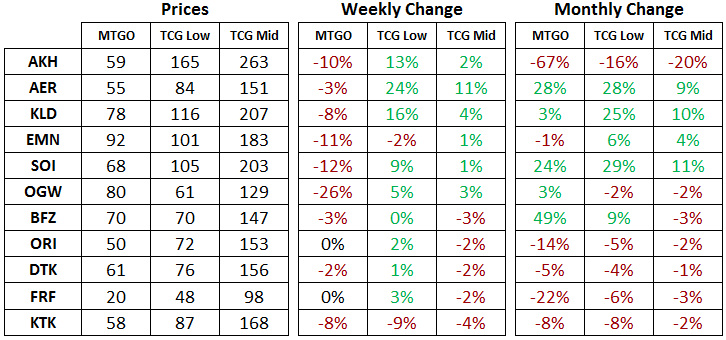
Below are the total set prices for all redeemable sets on MTGO. All prices are current as of May 15, 2017. The TCGplayer low and TCGplayer mid prices are the sum of each set's individual card prices on TCGplayer, either the low price or the mid price respectively.

All MTGO set prices this week are taken from GoatBot's website, and all weekly changes are now calculated relative to GoatBot's "full set" prices from the previous week. All monthly changes are also relative to the previous month's prices, taken from GoatBot's website at that time. Occasionally, full set prices are not available, and so estimated set prices are used instead.

May15

Standard

With Pro Tour Amonkhet (AKH) in the books, the market is digesting the new Standard metagame and prices have dropped on every Standard set. If you were holding cards from the Aetherworks Marvel or Zombie decks, you had a chance to sell your cards this weekend for good prices. If you were holding cards from Mardu vehicles, selling prior to the weekend would have been better, as prices have slumped on cards from this deck. Archangel Avacyn and Nahiri, the Harbinger from Shadows over Innistrad (SOI) are two examples of cards that fell in price significantly in the last week.

There was an error retrieving a chart for Aetherworks Marvel

It's important to reiterate that this not might have been the last good selling opportunity, but they are going to be harder to come by over the coming months. With warmer weather arriving in the Northern Hemisphere, there will simply be fewer players who are eager to jam Standard events on MTGO. This results in a steady erosion of prices over the summer as interest in Standard wanes.

This is not to say that there won't be profitable price swings due to trends in Standard. There's still a brand-new set to come as Hour of Devastation (HOU) will be released on July 10 on MTGO, with the associated Pro Tour event later that month. Standard prices will always react to this type of event, regardless of how the broader playerbase is choosing to spend its  time. The point is that the overall trend will be down over the coming months, and fighting the trend will be a losing proposition for speculators.

My goal over the course of the next four months is to preserve my capital and to remain invested in liquid assets like Aether Revolt (AER) and Kaladesh (KLD) boosters. Regular readers will also know that I am fan of foil mythic rares from AER, and I'll be repeating that trade for foil mythic rares from HOU. Apart from these trades, I want to be out of speculating on cards played in Standard, as fighting the downward trend is not where I want to be. The best time of the year to be deploying tix on MTGO is in October and November, so I am keeping those months in mind as I refrain from speculating on cards in Standard.

There was an error retrieving a chart for Chandra, Flamecaller

On a more short-term basis, Chandra, Flamecaller saw a big jump this week and now sits at over 7 tix. It's definitely seeing application as a sweeper in Marvel decks against Zombies, so I expect it to see higher prices in the short term. Ten tix is possible over the coming weeks, but I'll be a seller into further price strength.

On the full-set front, a reminder that AER and KLD will go offline for redemption in June. I'm still holding my sets of AER, but any resurgence in Mardu Vehicles (and thus Heart of Kiran) will be a good time to exit this trade. Full set prices got as high as 58 tix last week, but it looks like they won't be getting over 60 tix at this point. Any price strength over the next two weeks should be considered a good time to sell AER sets.

Modern

While Standard is not the place to be as the temperature warms up, Modern actually benefits near the end of the summer due to boredom with Standard and a looming rotation. August and September usually sees near-term price peaks for cards from Modern. Standard is pretty stale by that point, so players tend to dip their toes into alternative Constructed formats. That's the next-best selling window for Modern cards.

Speculators can therefore be looking to buy out-of-favor Modern staples and playables. If they reach an attractive price point, then it's fine to start buying. Look to the trade of the week for a good example of this. Otherwise, a long-term outlook to the fall is prudent. I think cards from Modern Masters 2017 (MM3) will be excellent speculative targets in October and November.

Trade of the Week

For a complete look at my recent purchases, please check out the portfolio. This week, I've been buying Elspeth, Sun's Champion. This card has cycled up and down a few times over the last year, going from around 4 tix to touching as high as 8 tix recently. It sometimes sees play in Modern, but I think there will be support for this card from Commander as well. I anticipate this card will return to the 8-tix level, and possibly higher than that, some time over the next six months.

Cards like this, that regularly cycle up and down, should be part of a speculator's portfolio. It's difficult to discern exactly why the prices fluctuate up and down so much, but it's enough to know that the pattern regularly repeats. Buying on the dips and sell into the upswings can generate small but consistent profits, and Elspeth is a card that I've already bought and sold a couple of times in the past year. One more cycle up doesn't seem out of the question.

Financial Set Review – Modern Masters 2017, Part 2

Are you a Quiet Speculation member?

If not, now is a perfect time to join up! Our powerful tools, breaking-news analysis, and exclusive Discord channel will make sure you stay up to date and ahead of the curve.

I'm back this week with more of my popular financial set review, now tackling the Modern Masters 2017 rares. I won't cover each rare in the set, but I will review the most important ones in depth. I also want to talk about a few choice uncommons, so grab your calendars and wallets. You'll need them to plan out the rest of your MM17 purchases!

Fetches

Everyone cares about these cards, right? They surprised at rare, kicking off the spoiler season with a bang. But where will they actually end up? Well, ever since we've had all 10 fetches in Modern, they have slowly gravitated away from the prototypical pricing scheme of years past. No longer are we bound by the "blue tax" typically prescribed to dual lands that produce blue mana. Instead, rarity and deck popularity are more driving forces than ever on the price of these cards.

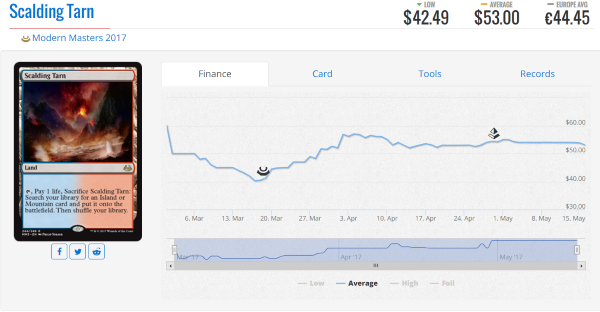
The two most popular fetches, which are likely to remain the most expensive, are Scalding Tarn and Verdant Catacombs. In a distant second will be Misty Rainforest and Arid Mesa. The least popular and least expensive is Marsh Flats, and I'm not expecting that to change. Importantly, the price of these lands should continue to diverge, as the popularity of the lands is more relevant at many levels than their rarity. My expectation is that Tarn and Catacombs will rebound, Mesa and Rainforest will converge to be about the same price, and Marsh Flats will soon hit Khans of Tarkir fetchland prices.

Scalding Tarn

Short-Term Price (next 3 months): $55
Mid-Term Price (next 6 months): $55
Long-Term Price (next 12 months): $65

Verdant Catacombs

Short-Term Price (next 3 months): $45
Mid-Term Price (next 6 months): $45
Long-Term Price (next 12 months): $55

Misty Rainforest

Short-Term Price (next 3 months): $30
Mid-Term Price (next 6 months): $35
Long-Term Price (next 12 months): $40

Arid Mesa

Short-Term Price (next 3 months): $30
Mid-Term Price (next 6 months): $35
Long-Term Price (next 12 months): $40

Marsh Flats

Short-Term Price (next 3 months): $28
Mid-Term Price (next 6 months): $25
Long-Term Price (next 12 months): $20

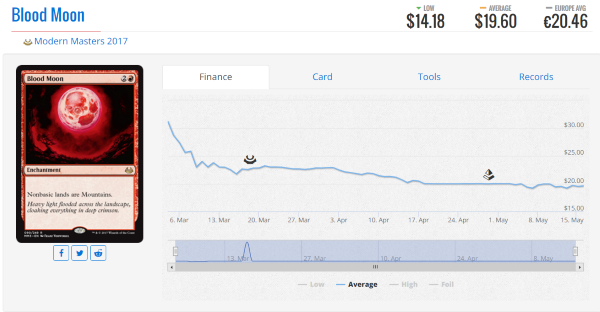
Blood Moon

No matter how many times you print it, Blood Moon is one of those cards that will always manage to claw back to its old price tag. Did you know Blood Moon was $7-8 for about eight months after it was reprinted in Modern Masters in 2013? In four years since then, it's been as high as $55. This is a maindeck card and sideboard card, unlikely to ever get banned, and unlikely to ever fall out of favor. I would be very cautious about waiting to buy these, because I think it will only take one or two strong Modern or Legacy showings to push them back to $30-35.

Short-Term Price (next 3 months): $20
Mid-Term Price (next 6 months): $25
Long-Term Price (next 12 months): $35

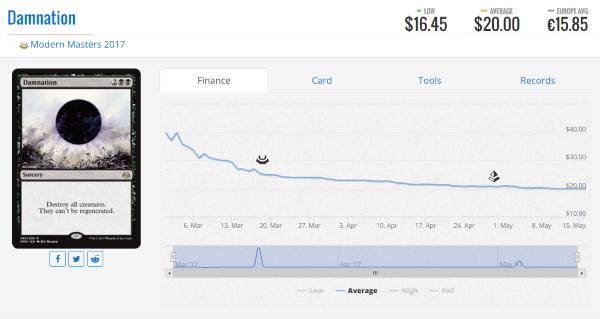
Damnation

Truth be told, I thought Damnation would continue to fall from here. The reality of the situation is that the memes were real. A lot of people wanted a Damnation reprint really bad, and when we got it they decided $20 was the right price to buy in. While it's not terribly popular in Modern, Damnation is still an important sideboard card for some decks. The casual demand for the color-shifted Wrath of God won't slow down, and this flat line is probably as low as it goes. It may start rebounding with the new Commander product in a few months, so I'd hop on this now. The most you could save by waiting is maybe $2-3, but you could lose upwards of $10 on each copy if Commander players go nuts for it again.

Short-Term Price (next 3 months): $20
Mid-Term Price (next 6 months): $25
Long-Term Price (next 12 months): $30

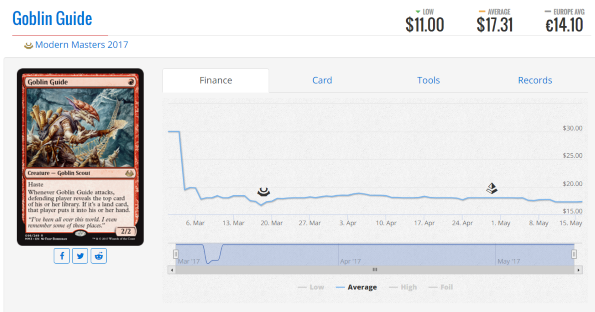
Goblin Guide

Goblin Guide has a curious story. It clearly started out far too expensive for its own good, but now it's still dropping by a few dollars a month. I think part of the reason is that Eidolon of the Great Revel has taken up some of the lost value, but another factor may be the new Guide art, which just isn't very appealing to many players. Burn also isn't putting up the numbers that really help bolster the price of its cards.

In my opinion, for the foreseeable future, Goblin Guide will continue to decline in price until around January of next year if Wizards doesn't throw Burn a bone in new extensions. I think the combination of Fatal Push and additional fast lands (Blooming Marsh, etc.) has put a tangible strain on Burn's better matchups. It's possible that Harsh Mentor helps reinvigorate the archetype, but I don't think improving already-good matchups will solve Burn's problems.

Short-Term Price (next 3 months): $16
Mid-Term Price (next 6 months): $13
Long-Term Price (next 12 months): $20

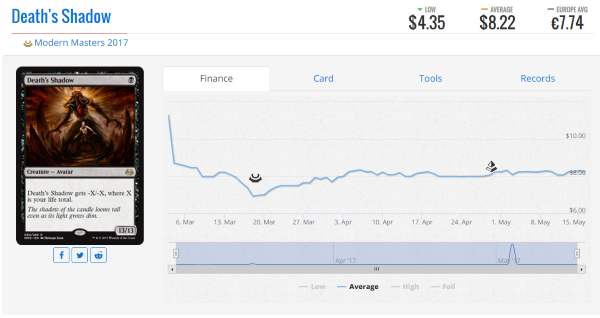
Death's Shadow

Death's Shadow's price is rather low for such a flagship Modern card, but it's likely due to the fact that a lot of the deck's cost is tied up in a few very hard-to-find cards. Mishra's Bauble, Tarmogoyf, Verdant Catacombs, and Thoughtseize make up a larger portion of the deck than Death's Shadow itself. We have seen the reprint of some of those cards start to filter down to the previously much-less-expensive cards in the deck. Thoughtseize itself has finally shown some signs of life after being relegated to $11 for almost a year. It's now up $6 almost exclusively thanks to its play in Shadow decks.

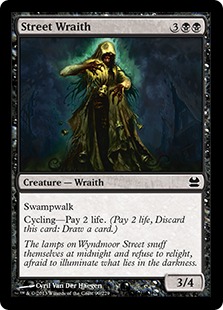
I would continue to wait for the price to drop if you are looking to get into the deck until we see some marquee reprints. Some less-assuming ones I would watch out for are Street Wraith, Mishra's Bauble, and ironically, Fatal Push. Fatal Push is pretty expensive due to its dual Standard and Modern demand, but it seems like the perfect kind of card to be reprinted heavily as an FNM promo. If we see a reprint of Bauble, Fatal Push, or Street Wraith, I would make a move on Death's Shadow.

Short-Term Price (next 3 months): $8
Mid-Term Price (next 6 months): $6
Long-Term Price (next 12 months): $15+ (assuming reprints)

Stony Silence & Grafdigger's Cage

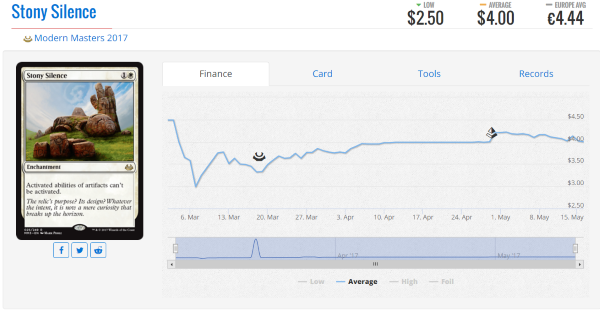
Stony Silence and Grafdigger's Cage are very similar to each other and can be looked at the same way. They're powerful hate cards that fall in and out of favor depending on the top decks in the format. That being said, they're from sets that, generally speaking, are a little under-printed. They were each worth $10-15 before the reprint, and it wouldn't surprise me if a good weekend for Affinity or Dredge propelled them close to their pre-reprint price.

If you want to see an analogous scenario, look at Rest in Peace, which didn't get reprinted and doubled in price almost instantly. These are the kinds of cards that I tell people to buy a few copies of and throw into a closet for a few years. They're not exciting, and nobody will talk about them—but they will move.

Short-Term Price (next 3 months): $4
Mid-Term Price (next 6 months): $5
Long-Term Price (next 12 months): $8-10

Path to Exile

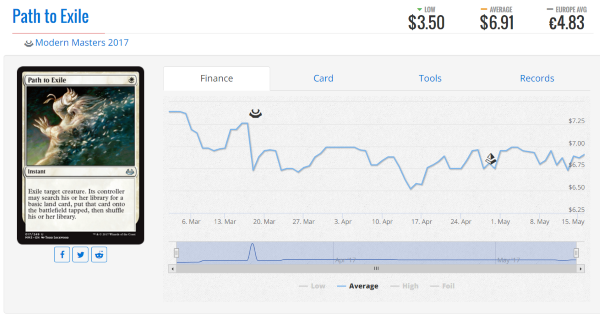
Path to Exile hasn't be less than $8 in years. Please don't do yourself the disservice of failing to buy these again. I understand it doesn't look like a big discount, but players literally cannot get enough of Path. It's hugely popular in casual circles because it removes almost any creature, and nearly every white deck in Modern plays four copies in their 75. If you have plans to play any deck with white mana in Modern, you will not regret owning a set of these as soon as possible.

Short-Term Price (next 3 months): $7
Mid-Term Price (next 6 months): $8
Long-Term Price (next 12 months): $10

Inquisition of Kozilek

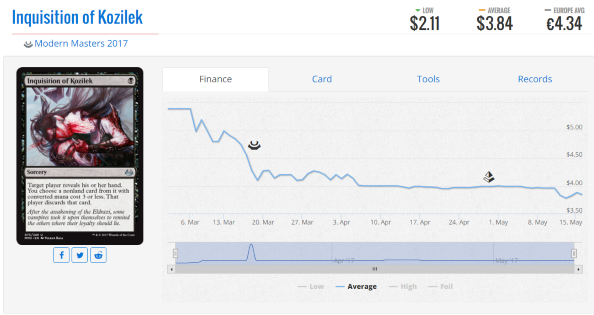
If you came up to me and said, "Hey Jim, I have $20 to spend on Modern cards, what should I buy?" I would only have one answer. This card was $26 right before Oath of the Gatewatch was released, and it wasn't even reprinted there! From $26 down to $4 you are able to buy a whole playset of these and then still have money for another half a playset for the cost of a single copy a year ago. Inquisition of Kozilek is ubiquitous, powerful, and—right now—cheap. There is no place for it go but up unless it gets reprinted again. I'm not expecting that to happen and I think you will be happy if you purchase these today.

Short-Term Price (next 3 months): $4
Mid-Term Price (next 6 months): $5
Long-Term Price (next 12 months): $8

Honorable Mentions

Serum Visions, Terminate, and Might of Old Krosa are the remaining uncommons in this conversation. If you don't have Serum Visions yet, I'm honestly not sure what you're waiting for. But if you need Terminate, it's probably not going to get cheaper. Might of Old Krosa is only played in one deck, and was expensive because of its rarity. If you have no interest in playing Infect, you don't need to worry about Might of Old Krosa.

I expect all of these cards to remain under $2 for the next year.

It's a Wrap

Hopefully I covered all the cards you are interested in in Modern Masters 2017. If not, you can always feel free to leave a comment below or shoot me a message on Twitter. If you enjoy this style of writing or would like to see more regarding future expansions, please let me know in the comments! I'm always looking for new ways to present information about the financial side of Magic.

Insider: Sorting Through the Post-Pro Tour Market

Are you a Quiet Speculation member?

If not, now is a perfect time to join up! Our powerful tools, breaking-news analysis, and exclusive Discord channel will make sure you stay up to date and ahead of the curve.

The Pro Tour was a blast! Now we have a solid sense of what the metagame is going to look like moving forward. The major storylines of Pro Tour Amonkhet were the decline of Mardu Vehicles, and the rise of both Aetherworks Marvel and Zombie Aggro. Mardu, the most played deck of the tournament, didn't have nearly as high a win percentage as Zombies and the various flavors of Temur.

Don't count Mardu out for the long game—it's a powerful deck and Gideon, Ally of Zendikar is still a busted planeswalker. The key to the equation is that the staple cards in the Zombie and Temur decks will have spiked up, while the Mardu cards are likely to stay about the same or lose slight value. Expensive Mardu-specific cards like Heart of Kiran will likely begin the downward spiral of their Standard-based life cycle.

There was an error retrieving a chart for Heart of Kiran

These are good cards, and the time might come when sleeving up Mardu looks like a sexy metagame choice (especially once Shadows block rotates). However, now is likely a good time to start selling out of these Mardu staples while they still have decent value.

There was an error retrieving a chart for Gideon, Ally of Zendikar

Gideon is great, but his months are limited at this point. He will start to leak value in the coming weeks and it is likely a good move to trade copies off while they still has decent value. Chris Fennel's BW Zombies list featured four in the sideboard—so demand and price should stay stable long enough to find a buyer or trade partner.

Capitalizing on the New Meta

Let's talk about the big movers of the tournament. Gerry Thompson's Zombies deck took down Yuuya Watanabe's Temur Marvel Control. It seems pretty obvious that these are the sets of cards most likely to see upticks in the coming days. Zombies in particular seems like a ripe place to look, because many of the cards were cast-offs before the new Amonkhet printings brought the deck back to the top tier.

It is good to remember that the highest prices on most cards are achieved directly after the Pro Tour. The reason is that there is a high critical mass of players clamoring to acquire copies of random cards to build whatever deck they are moving in on in the metagame. The prices on most cards tend to creep down, so be looking to move off of these spiking cards quickly.

Zombie Aggro

Let's start with the undead horde. There are several cards that have gained new life in the wake of Gerry's PT win.

There was an error retrieving a chart for Dark Salvation

Dark Salvation is a perfect example of why I never bulk out Standard cards. There is always a chance that new printings can make sketchy misfit toys become a hot commodity. Dark Salvation is already up to about three bucks, and it wouldn't surprise me to see it continue to climb. It is a four-of staple regardless of whether people adopt Chris Fennel's black-white version or Gerry T's mono-black version.

There was an error retrieving a chart for Relentless Dead

Relentless Dead has already skyrocketed in price to well over $20. I don't feel like this price is sustainable on a card that goes into a niche Standard aggro deck. I kind of hate when they make cards like these mythics. What is so "mythic" about a non-legendary two-drop anyways?

Alas, the purple stamp on the set symbol and the demand are going to make this card a very hot commodity as Standard players scurry to copy PT decklists. I recommend moving on extra copies of the card ASAP.

There was an error retrieving a chart for Cryptbreaker

Cryptbreaker is one of the lynch pins of the Zombie deck and so it is unsurprising to see it has shot up. All of these cards are going to be near peak value, so kudos if you bought into Zombies cards in anticipation of a strong PT showing. You're about to get paid off (assuming you find an outlet to dump them).

There was an error retrieving a chart for Liliana's Mastery

One of the new Amonkhet cards that brought the Zombies back from the grave! Mastery is a junk-turned-chase-rare from the set. A lord that doesn't die to removal and brings two dorks to the party, it's a big time card in the deck. Zombies is a tokens-style deck, so a card that both makes tokens and acts as an anthem is a big game. These are going to be a hot commodity. Hope you didn't bulk them off!

Aetherworks Marvel

I played Temur Aetherworks Marvel at the PT and will likely continue to moving forward, despite it not actually winning at the PT. The deck is great and Aetherworks Marvel is a busted card in Standard right now.

I actually hate Marvel a lot (it literally destroys all the decks I actually enjoy playing) and as a result I had to buy copies of Ulamog and Marvel in Nashville for the tournament. I'm kind of glad I did because it looks like they've both jumped up in price significantly since then!

There was an error retrieving a chart for Aetherworks Marvel
There was an error retrieving a chart for Ulamog, the Ceaseless Hunger

I doubt they will ban anything and so I think the prices on these will likely remain high. The metagame feels very warped around Marvel vs. Anti-Marvel (with Marvel being the deck to beat). I think these are going to be very popular cards that people will be looking to acquire to play in the coming weeks. Then they will start to trail off in value.

There was an error retrieving a chart for Chandra, Flamecaller

Chandra is another card that saw a resurgence in Standard. The fact that it can come down and wrath away a horde of Zombies is important in a Zombies vs. Marvel metagame. It's also a pretty decent Marvel hit/payoff card. These are likely to make significant gains right after the PT. I actually think the card is going to be a very important player moving forward. I'd also anticipate that Marvel with as few creatures as possible will be the norm because Chandra will be important in the mirror.

There was an error retrieving a chart for Lumbering Falls

Lumbering Falls has secretly become the best creature land in Standard. Marvel makes great use of the card at attacking pure control decks, as well as blocking down small creatures. I was very impressed with the card in my deck, and anticipate good things for people who pick them up on the cheap.

There was an error retrieving a chart for Attune with Aether

Kind of a sleeper pick here but I think this could be a chase common going forward. This is exactly the kind of common that stores sell out of (because demand is infinite) and have to start buying up. After PT Kaladesh the same thing happened at my local game store with cards like Vessel of Nascency which were just hard to get ahold of. I'd suggest sifting through old draft scraps and pulling these out—they might be something you can turn into value.

There was an error retrieving a chart for Aether Hub

As of writing, I haven't seen any movement on Aether Hub, but it is secretly one of the best cards legal in Standard. The ability to generate energy for free and fix mana in a three-color deck is amazing. Aether Hub also bleeds over into an amazingly high number of the decks in Standard (Mardu, BG Energy, UR Control, and all Marvel decks). I think this card could easily break into the $5-plus range because it is just such a useful card in the format.

There was an error retrieving a chart for Sweltering Suns
There was an error retrieving a chart for Radiant Flames

Last but not least, sweepers are key for the Marvel decks to fight against the token-y Zombie decks. I think these are smart investments right now if you can pick them up cheap. Everybody is going to be looking for these for their sideboard in the first week.

Conclusion

Well, looks like we have a format and some new chase singles! I hope you guys like Marvel vs. Zombies, because that is what the week one post-PT metagame looks like. Marvel feels pretty busted and it feels like more sweepers could diminish some of Zombies' early success. I'm interested to see how it plays out. Are Zombies here to stay? Or, will Marvel be too Marvelous? Flossie, flossie.

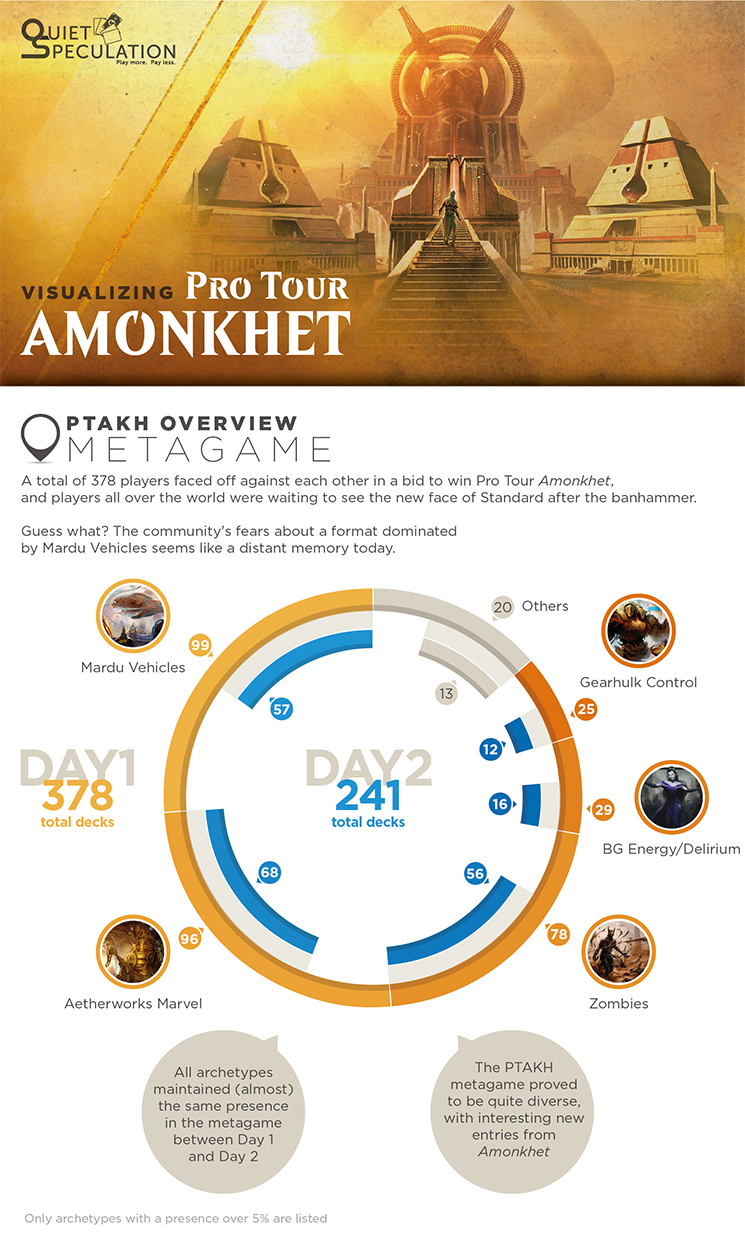
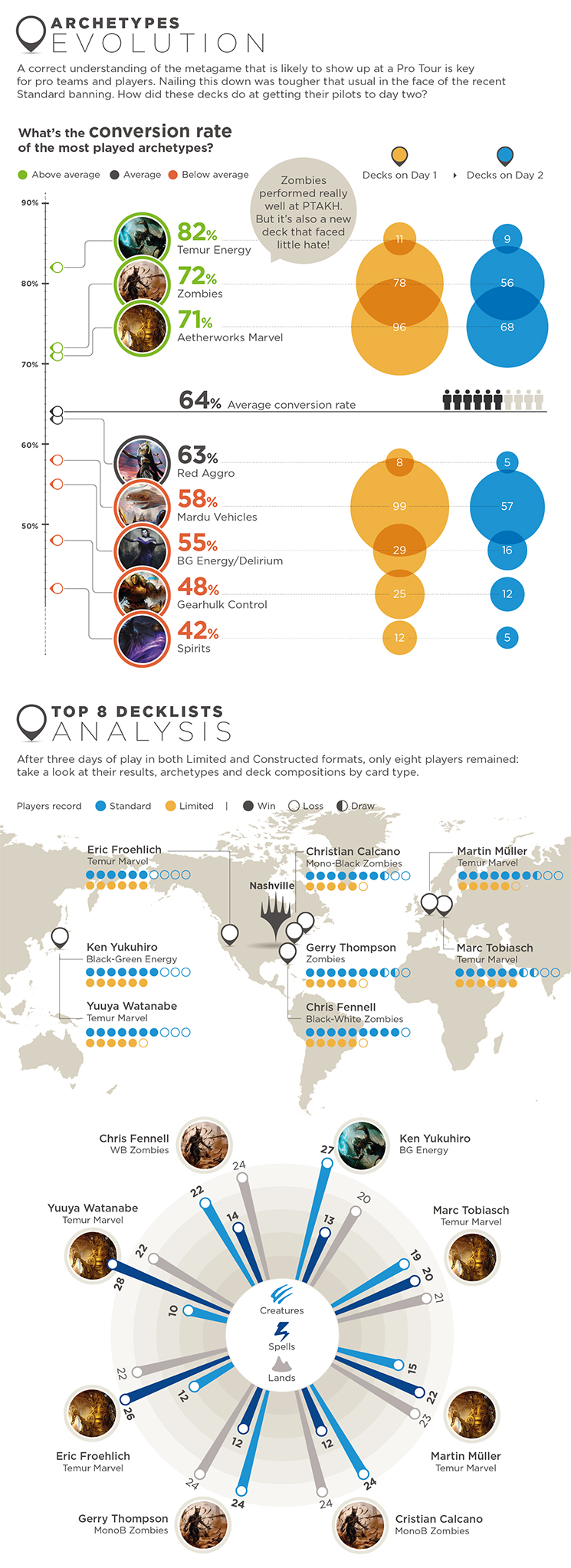
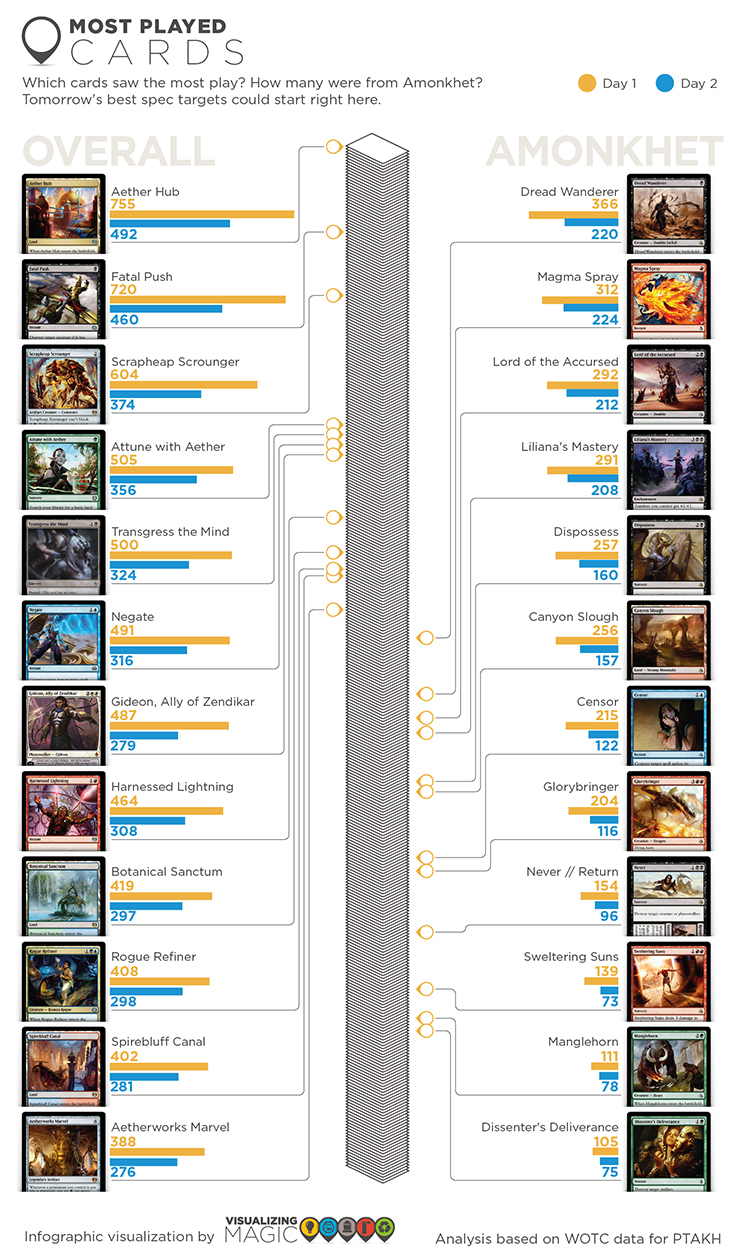
Insider: Visualizing Pro Tour Amonkhet

Are you a Quiet Speculation member?

If not, now is a perfect time to join up! Our powerful tools, breaking-news analysis, and exclusive Discord channel will make sure you stay up to date and ahead of the curve.

Stampa
Stampa
Stampa

It’s Time Again: Banlist Options

Are you a Quiet Speculation member?

If not, now is a perfect time to join up! Our powerful tools, breaking-news analysis, and exclusive Discord channel will make sure you stay up to date and ahead of the curve.

Tilt is quite a mighty thing. Re-reading my fevered scrawlings from last week proved deeply concerning. I knew I was unwell, but I didn't know how unwell. While I'm better now, I may need to refocus before things get worse. Therefore, it's time to torture myself by beginning another Banlist Test.

In Moby Dick, Ishmael goes to sea to center himself when teaching gets him down. When I start to feel too sane and begin perceiving the truth behind reality (again), I dip into the insane with complicated and strenuous academic research. I'm once again prepared to exhaust myself (along with the poor souls who acquiesce to being my testing partners) in an investigation of Modern's banned list.

I've done this twice before, and it has not gone well for those who advocate for a shorter list. Stoneforge Mystic and Jace were highly impactful against fair decks but ineffective against unfair decks, which does little to address the problems players have identified with Modern. Suppressing fair decks allows more unfair deck to rise, to the detriment of the format. Everyone should have expected this result. Jace, the Mind Sculptor and Stoneforge Mystic were very oppressive to fair decks in Standard and, reportedly, Extended. This time I'm looking to the other end of the metagame, with a new strategy for testing the banlist.

Unfinished Business

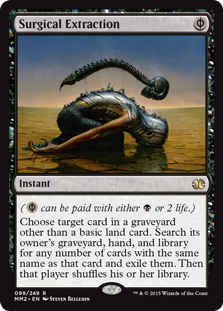
First thing's first: I need to close a previous thread. During last week's fugue, I noticed that Death's Shadow is far more fragile than the old Jund decks. I postulated that this would make Surgical Extraction a maindeckable card for the first time (that I can remember) in UW Control. However, enough of my rationality remained to solicit opinions about my conclusions. As the feedback was guardedly optimistic, I thought it reasonable to actually test my idea. Not in paper, you understand. My rational mind would not allow it. I was still conscientious enough to be ashamed of myself for conceiving this idea. Public humiliation just isn't my thing. I have a reputation to uphold. While the Paper Sack Mask of Shame is always an option, I decided to test for free online. With actual free software. I wasn't willing to pay MODO for this crazed idea.
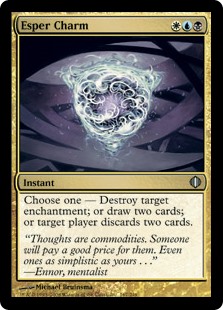
It was a colossal failure. I'm not going to share the decklist I tried because it was an appallingly bad idea. Surgical Extraction proved itself wholly unworthy of maindeck inclusion in my UW list. However, I could not tell whether this was a result of Extraction itself providing a marginal effect, or of the surrounding shell. UW Control cannot make full use of Extraction because it cannot actively put targets into the graveyard. The deck is purely reactive, and only has the opportunity to extract what opponents want extracted. Path to Exile's "upside" of exiling doesn't help matters. All I really found is that UW cannot maindeck it profitably. The question of its actual maindeck potential was uncertain.

Question of Home?

So I changed over to an Esper list. I thought that Inquisition of Kozilek and Thoughtseize would enable Extraction enough to actually test my hypothesis. It didn't. At least not verifiably. Having either discard spell in hand with Extraction and then hitting a card you wanted to Extract didn't happen very often. Having Fatal Push to get Shadows into the graveyard was better, but it didn't always matter. My win percentage only incrementally increased, which may have just been variance. I didn't acquire enough data to give a good answer, which might be the answer by itself. Extraction may only be good in games you'd win anyway with control decks.

I cannot say that this disproves my overall theory, because I'm told the strategy actually works in Lantern decks. I've even received testimonials on this subject. I don't know if they're true or even plausible, as I'd rather chew my own head off than play Lantern. That may be the real answer though. If you have to go as far as to play Lantern Control for an idea to be good, it might not be worth it.
One last thing, and this one is just shameless bragging—I was right about the bicyclers. Sam Stoddard shared developer comments that clearly showed that they did cost these away from Modern playability. Life from the Loam is one lesson that Wizards has actually learned from.

Banlist Adjustments

Anyway, back to the plot. I asked for feedback on my the Banlist series and you responded. The main request was for me to do Preordain, followed by Dig Through Time. Conveniently, those would have been my own picks for another test. The problem is how. I still intend to test cards in the decks that got them banned. If the old offender still offends, then the card should probably remain banned. However, neither you nor I care about that part. We want to know if these cards would boost the fair blue decks. Most of the clamor about unbanning centers on this idea, and the cards I've tested so far are believed to boost fair decks. This was borne out by your feedback.
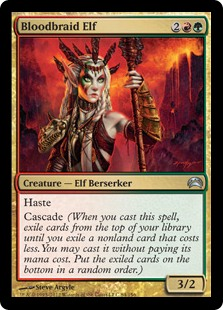
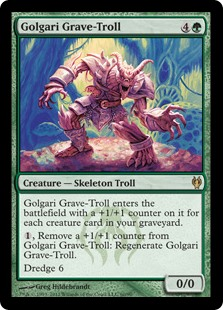
The thing is that unbanning a card to boost a deck can be dangerous, as Golgari Grave-Troll demonstrated. I need to proceed delicately with this test because I cannot ignore the impact that the test cards would have on unfair decks. No, it really isn't the point of the test or what we all care about here, but it is the gatekeeper to their actual acceptability in Modern. Therefore, I need to alter my methods. I've already decided how to proceed, and I will lay out my plan shortly. Before I get to that, I need to address something that I will inevitably be asked about, again, and explain why I will continue not to test Bloodbraid Elf.

Because Bloodbraid Elf

Here's how the argument for Bloodbraid goes: It's not fair. Bloodbraid Elf wasn't the problem, it was Deathrite Shaman. It's powerful but fair. It died for Shaman's sins. Bring back Bloodbraid Elf! It's not that good anymore.

Look, I've heard it all. It all. You've made these arguments about unbanning the Elf repeatedly, and I have repeatedly answered them. Henceforth, I will respond simply with "No, because Bloodbraid Elf." Deathrite was the real problem at the time, but Bloodbraid was never innocent. It has always been a format-defining card and frustratingly overpowered. Cascade for value has never been fun to play against or good for the game as a whole.
Wizards may have gotten the order of the bans wrong, but both cards needed to go. Elf was just better than anything else you could do, and even now it still would be. I tried it. It's stupidly good. Return it to Modern and you make everything about Jund again. And it would be Jund. Elf gets better the more individually powerful your cards are, and Jund has always had the highest density of high-impact cards. It defines the deck. Jund is its home and one true love; all the other decks are just pretending. I know what will happen if I test the deck, you know what will happen, and there's nothing interesting to learn. I'm not testing Bloodbraid Elf.

Bloodbraid and Shadow Together

Midrange Jund has been replaced by Death's Shadow Jund. It has dropped to low Tier 2 status everywhere. It's provably not as good anymore. At four mana, Elf is too expensive for DSJ to reliably support currently. It also doesn't play well with all the discard and Mishra's Bauble. Ergo, the Elf partisans are already pointing to this as a reason to unban the Elf. It isn't, but they will argue it is. The best-case scenario under current conditions is that midrange Jund and DSJ coexist and split their metagame share. This would still make both Tier 1 decks. Considering that the two decks share a card pool, it's mostly a case of different win conditions—it would be more reasonable to combine their metagame shares, pushing them well above everyone else. I would consider this a metagame warp.

More likely, players would simply alter DSJ to accommodate Bloodbraid. DSJ is Jund, just pushed to a Shadow-facilitatating extreme. Playing two spells for the price of one is good. Playing two spells for the price of one is very good. In fact, cheating on mana is busted. Why wouldn't you play Bloodbraid in DSJ? I don't have an answer, and neither did any Jund experts I asked. I've asked a wide range of current and former Jund players, including my Jund test partner, and they would all play Bloodbraid Elf in DSJ. In fact, several independently gave me the same recommendation about how to build such a deck. Both of them would cut the Traverse the Ulvenwalds and Baubles for Elf, some extra lands, and Kolaghan's Command. Shave some discard for an extra Tarfire, and you have a less explosive, but more powerful and grindy deck.

I'll take their word. Elf would probably be good in Shadow. Unbanning something to make the best deck better is bad for Modern. No Bloodbraid Elf. Because Bloodbraid Elf.

Adjusted Methodology

So, how do I intend to actually test the next card? First of all, I have already chosen both the possible cards and decks that I will use. As you will see, I need to get started as quickly as possible. This test is not just about the cards being "okay" for Modern. We are investigating whether or not they are "worth it." In other words, we are looking to see if their impact on fair control decks is greater than their impact on the decks that got them banned. I have every expectation that the unfair decks will see a boost. How big I don't know, but it will be there. That's not a question worth investigating. Whether that impact is greater than that on other, fairer decks is.

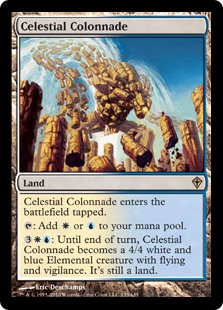
The cards will first be tested in the decks that got them banned. This will be done like the previous tests. After that, I will repeat the tests with UW Control. I picked UW because it is a fair blue deck that is performing reasonably well in the current meta, or at least better than other versions. Yes, there may be better homes for both cards in a vacuum, but looking at the current metagame, I doubt either card will have much effect outside of UW. Grixis Control is not doing as well, and RUG Scapeshift is no longer viable. Even if either card is utterly busted, I don't think the deck will get enough of a boost to produce a decent result. Going from unplayable to reasonable would be an interesting result, but I'm not willing to spend all my time on such a gamble.
After that, I will compare the two results. I will look not only for which deck performed better in the tests, but the size of the difference too. Similar results would indicate a general boost in power, while significantly different results would show that one deck is favored by that card. Exactly what either result means depends greatly on context. Control and test deck receiving a similar boost may indicate that a card is safe, or it could mean that it is metagame-warping. The test decks doing significantly better obviously means that unbanning is a bad idea, but a massive boost to control could indicate that it would be oppressive in a different way. A lot will depend on why the results happen.

Finally, to forewarn you, I am not gong to play 500 matches with each deck. It took four months to get the data for Jace, and I will not make you wait eight-plus months for this test. It's just not acceptable. I will have to play more matches in total this time, and I've committed to that, but I don't know yet exactly how many. I'll see how the first test goes.

Make Your Choice

I imagine everyone has figured it out already, but I will make it explicit. You have two choices for the next banned test. They are:

  • Dig Through Time - Banned because Wizards feared that it would just replace Treasure Cruise. It will be tested in an updated UR Delver shell based on the deck that got Treasure Cruise banned.
  • Preordain - A victim of Modern's severe brokenness at inception. Preordain was banned along with Ponder to slow down combo decks, specifically Storm and Splinter Twin. Since Twin is also banned I will use a UR Gifts Storm list.

Once again, you can exercise your voting rights to pick my next torment/project. Write in the comments of this article which card you want to see. Note that only comments to this article will be counted—I won't be tallying votes from other social media or other articles. Discuss it as much as you like elsewhere (not like I can stop you), but if it isn't written here, it won't count. Voting closes next Sunday at 11:00 Pacific time. Any vote after that point will not be heard. Go.

Insider: Debunking the “Value Trap” Mantra

Are you a Quiet Speculation member?

If not, now is a perfect time to join up! Our powerful tools, breaking-news analysis, and exclusive Discord channel will make sure you stay up to date and ahead of the curve.

The Pro Tour was a wild success! Actually, it’s Saturday morning as I’m writing this week’s article so can I really claim that? One look at MTG Stocks convinces me that I can!

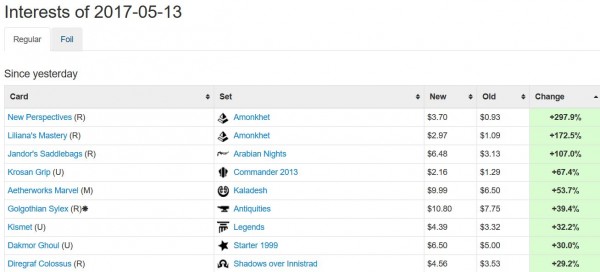
Four cards popped overnight thanks to Pro Tour play, and that number is likely to double throughout today and tomorrow as the Pro Tour enters its later rounds and Top 8. I thoroughly enjoyed engaging with QS Insiders in the Discord chat when I could pop in to discuss all the Pro Tour finance buzz. Shout-out to Chaz for orchestrating Insider Alerts and Discord discussion as well!

A Pre-Pro Tour Purchase

Most of you already know Standard isn’t my forte. I generally try to avoid the format as it requires an aggressive agility that’s difficult for me to maintain. Also, margins have become far thinner with the advent of the Masterpieces. Lastly, the dip in Standard interest throughout the era of Copy-Cat made for an underwhelming environment, financially.

Interests

This may have shifted, and that can generate opportunity. But at the same time, rotation is on the horizon and that will bring with it another shift in the Standard metagame. Net, I don’t go deep on Standard.

Right before the Pro Tour I did pick up a few Sphinx of the Final Word for around $2 each after noticing it sell out on TCGPlayer.

There was an error retrieving a chart for Sphinx of the Final Word

When I tweeted about the card, I received backlash from prominent members of the MTG finance community. Why did I purchase a Standard card that was yet to be proven? What kind of upside possibly existed for this card if it’s only played as a one-of? What kind of margins could I really expect by buying a card at $2 and selling at $5? These were some of the questions I received, and I didn’t bother attempting to fend them off as it would have resulted in a dialogue which held no value for me.

But there is a point I wanted to bring up here that addressed one of the above questions. I can’t argue the merits of Sphinx of the Final Word as a spec nor can I comment on its playability. What I can defend, however, is the premise of purchasing cards at $2 and selling at $5…

Value Trap?

The practice of buying cards at $2 to sell at $5 has developed a bad rep. Some have gone so far as to state that it's a complete value trap. But this rests on something of a misconception of what the term means.

"[A value trap is] a stock that appears to be cheap because the stock has been trading at low multiples of earnings, cash flow, or book value for an extended period of time…the trap springs when investors buy into the company at low prices and the stock never improves.”

- Investopedia

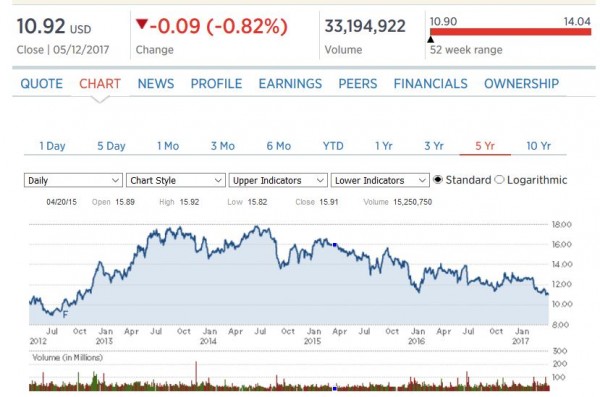
Ford stock would be a good example of a true value trap.

Ford

Ford stock has been trading at a very low P/E multiple for a long time now—some may be interested in the equity because, relative to the S&P 500, the stock is incredibly cheap. Despite this, the performance of the stock has been abysmal. It’s currently at a 52-week low and is approaching its five-year low set back in mid-2012. Other than the dividend, there was very little money made holding this stock for the long term.

Sphinx of the Final Word was not a value trap in the same sense. Those who bought at $2 could out their copies for a profit. If you hold the card for five years, it’s also unlikely you’ll lose money, as the card is a mythic rare that sees steady play in Commander.

Profit Is Profit

Taking this one step further I want to state here that buying a card for $2 to sell at $5 in general is a fine proposition for the right population. Some MTG speculators work with seemingly limitless capital—you know the type. They post about their incredible collection and arbitrage purchases totaling four or five figures. They leverage their network to get the best returns they can on a sizable bankroll.

Others, like myself, are more about small-time speculation. We don’t like to commit hundreds of dollars to a single spec because a miss could wipe out a large fraction of our available speculation funds. We’re not in this as a business—we focus on MTG finance to support our hobby and achieve a long-term goal. We accomplish this by running the margins one buy at a time.

For us, there’s nothing wrong with buying a card at $2 and selling it at $5. The math suggests this is still profitable. Selling a single card for $5 on eBay nets $3.36 after fees and shipping. This represents a 68% profit margin. But I don’t think I need to convince anyone that the margins are solid. I need to justify why the time investment is worth that $1.36 profit.

Buying the cards takes a negligible amount of time. I can literally buy copies of a card on my phone while at a red light (not that I’d condone this). Waiting in line for a coffee, that morning lull at work while your computer’s booting up, or while you’re waiting for lunch to microwave—all viable ways of buying cards without actually taking up time.

Listing a card on TCG Player is extremely fast. I generally use eBay, which is a little slower but still fairly quick. Especially because I use existing listings to “copy-to-create” a new one. I’d estimate this takes about 1.5 minutes. Then after a card sells, it takes about 3.5 minutes to package it up in a plain white envelope for shipment. I actually timed myself doing this, so I can report this time is accurate. The grand total time invested: about 5 minutes.

So now we can multiply that $1.36 profit out over an hour’s time for a comparison that most can relate to. 12 * 1.36 = $16.32/hour. By combining trips to the post office and buying shipping supplies in bulk, you can really drive out other costs. Thus, it’s not a bad hourly wage if you ask me.

Is it worth it? Perhaps not to those high rollers, but I’m never unhappy when I can make this kind of money doing something that I love. And that’s really the missing piece: the fact that I truly enjoy the thrill of the hunt and the practice of flipping cardboard for cash. The sound effect my eBay app makes when a sale is made can alone make it worth my while!

Not to Mention the Alternatives

The numbers above make a major assumption: that copies are sold out at a time. In reality, many Standard and Modern staples can sell four at a time. In these cases, margins are far improved as there are fewer shipping costs.

eBay isn’t the only route to sell cards. Sometimes a hot card will get a reasonable bump on a store’s buylist, offering another easy out for that $2 purchase. Now, of course shipping a single card to a buylist for $3 isn’t a winning proposition. That’s not how I do it. If I want to out a couple cheaper cards to a buylist, I always combine the order with some other sales I’ve had sitting idle for a while. Keep in mind I have a large position in Old School cards. These fluctuate in value often as vendors adjust their numbers and stock. Any time I want to sell something, I browse through my Old School collection and I typically find a few other things I can sell to make the order worth my while.

Lastly, there’s always trading. I don’t do it much these days so I won’t position it like it’s a universal option for everybody. But it is an option. When trading, there are no fees and no shipping. This is truly the best way to maximize value of those $2 cards that spike to $5.

Some Specifics

This wouldn’t be a true finance article without some specific ideas. If you’re like me and you appreciate the modest profits that come from those $2 to $5 jumps, then these could be targets to appreciate. They don’t all follow a $2-to-$5 price trajectory exactly, but they’re close enough that they may escape the radar of those “big-time” speculators who cannot justify the $16/hour rate.

There was an error retrieving a chart for Necroskitter

Hapatra, Vizier of Poisons has caused a lot of price spikes from older cards with -1/-1 counter generating abilities. Necroskitter is one of the more popular includes in the Commander deck. While the MM2 foiling process wasn’t great, they’re still foils. I like these in the $2 range and can see them approaching $5 over the next month or two.

There was an error retrieving a chart for Black Sun's Zenith

Another Hapatra staple, this card has been dwindling in stock over the past couple weeks. While it had been reprinted back in 2014, all copies now are three years old or older. The cheapest ones I can find on TCGPlayer are in the $2.75 range. These are likely to dry up slowly, while no one is watching, and then suddenly spike to $6-$8. You won’t be able to stake your retirement on this move, but this pickup seems like a solid low-risk play on a hot trend.

There was an error retrieving a chart for Jandor's Saddlebags

Is Jandor's Saddlebags a playable card in Old School? Beats me. I do think it partners with Colossus of Sardia very well. Stock is very low on TCGPlayer, but you can still pick up some played copies for $3. Given the fact that Arabian Nights is ancient and will only appreciate in value over time, this may be a no-brainer if you’re patient enough. I can see these selling for $6-$8 given enough time. Oh, it’s also worth mentioning that the top buylist is $3.73 according to Trader Tools. So you have that as your downside support.

There was an error retrieving a chart for Karametra, God of Harvests

All of the original Theros block gods are casual gold. Some of them are already on the pricey side, but others are fairly inexpensive given how unique they are. I called out Karametra specifically because her price movement has been gradually climbing from a low base. But honestly I like Thassa, God of the Sea even more because of her power level. The right Modern deck could really leverage Thassa’s strengths in the right metagame. Price memory is also a factor with Thassa as well, which is perhaps why she hasn’t dipped nearly as low as some of the other gods.

Wrapping It Up

I bought a few Sphinx of the Final Word for around $2 each and I hope I can sell them for around $5. This will net me a decent profit. Some MTG speculators have written off these small-time profits as not worth their time. You know what? I think that favors us home-gamers. We are the ones who love the game so much that making any profit from it whatsoever is a thrill. I get to build out my Magic collection, appreciate some sweet card art, and get paid in the process? Sign me up!

After all, profit is profit. I always like to say that no one ever went bankrupt selling for a profit. And if some folks don’t see the smaller gains as worth their time, then it leaves more room for me to scrape those margins. When you do the math, the hourly rate really isn’t that bad—I suspect blueprinting collections to pull out three-cent cards pays a far less attractive hourly rate.

So I think I’ve found my sweet spot. It has worked out very well for me lately, making gains on stuff like foil Dusk Urchins, Debt of Loyalty, and Conqueror's Flail little by little. In enough quantity, these profits can really add up and help make the hobby self-sustaining while gradually banking some money for my son’s college education. Little by little. For me, that’s good enough.

Sigbits

  • For those of you curious about Legends Spirit Link, I can say that it absolutely is a playable Old School card. The price you’re seeing on MTG Stocks nowadays is completely real. I myself had two playsets of HP copies that I bought from Star City Games at $1 each a while back. I sold one set on eBay for around $14 shipped and I buylisted the other set to Card Kingdom for about $10. Star City has just a couple copies in stock, with Near Mint ones listed at $5.99.
  • There aren’t many English Thassa, God of the Seas left in stock at Star City Games. The only copies they have in stock are MP ($5.59). This isn’t going to double in price overnight, but this kind of casual all-star is the perfect buy-and-hold target. Reprinting these will be really tough, so it seems like these are safe holds for the time being.
  • Meditate is a Tempest rare on the Reserved List. It has seen competitive Legacy play in the past, and the decks it was played in just got better with the banning of Top. Sounds like this should be a $10-$20 card right? Nope. It’s $3. In fact Star City Games has over fifty SP/MP copies in the $2.45-$2.99 range. Clearly this won’t be spiking imminently, but the potential is always there and you could do worse than to park twenty bucks in this card for a rainy day.

Insider: The Casual Mindset – More Card Analysis

Are you a Quiet Speculation member?

If not, now is a perfect time to join up! Our powerful tools, breaking-news analysis, and exclusive Discord channel will make sure you stay up to date and ahead of the curve.

A while ago, I asked the forums for cards to discuss in my articles. In addition to the alternate win condition cards I analyzed in the last article in this series, Getting There Games also suggested a number of other cards to look at. Today I will be giving you my thoughts on these cards from a casual perspective.

As a reminder, this is how I analyze casual cards as described in my first article in this series:

  • WOW! Factor – How much potential does this card have? Can you create a crazy board position with it? Will opponents be impressed when you manage to resolve this? Does it lead to memorable stories?
  • Playability – Contrary to popular belief, the casual player does care about things like mana cost—they will, however, be more willing to see steeper costs as a challenge rather than an impossibility. Can a card’s drawback be (easily) overcome?
  • Scalability – Casual players will often find themselves in multiplayer games. They know Swords to Plowshares is a good card, but they also know that Wrath of God is much better at dealing with threats from multiple players.
  • Personal Taste – Some players like to build pillow forts, others want to attack with the most impressive creature they can, and yet others go for the biggest army they can muster—a friend of mine will play anything just as long as it’s mono-white. How does this card compare to the taste of this particular player?

Alright, let's get at it!

There was an error retrieving a chart for Frost Titan

WOW! Factor – Frost Titan is big and can lock down anything! It is, however, not all that special when you take a closer look and compare it to other things you could be getting at six mana (Consecrated Sphinx springs to mind).
Playability – Six mana is not cheap, but most casual games will reach this point. The point at which you can cast Frost Titan is probably when something has come out that you want to keep locked down.
Scalability – He protects himself just as well in larger games as in one-on-one. On the other hand, larger games will likely have more things you would want to lock down, but you still only get a single trigger. Finally, it's likely that someone can be attacked safely (perhaps by promising that they can choose what to lock down). On the whole, scalability could be better. It's certainly better with fewer opponents, but at least there is some scaling.
Personal Taste – I'm not sure who is going to like this Titan: he does a lot of things reasonably well, but he's just not exciting.

Basically, Frost Titan is challenged in the PR department. All his abilities look decent and his size is decent for the mana, but he just doesn't stand out. To speak to casual players, he absolutely needs to stand out, so the ones most likely interested are those without cards that stand out more. This would be players with fairly small collections and those wouldn't be likely to spend money on him. Therefore, as a speculation target, Frost Titan is lacking.

There was an error retrieving a chart for Sun Titan

WOW! Factor – Sun Titan is big and recurring things is so much fun! White has a few ways to recast him too, while also conveniently providing quite a few interesting cards to recur.
Playability – Six mana is not cheap, but most casual games will reach this point. White has some way of searching for lands, and you'll want things to have been put into you graveyard anyway, so likely you'll want to play Sun Titan later for the best results.
Scalability – Like Frost Titan, Sun Titan still only gets a single trigger in multiplayer. However, in this case, the trigger is basically as good as whatever he could recur, which could be scalable.
Personal Taste – Some people just love recursion, myself included. There aren't too many ways to put things in play from the graveyard that are easy to repeat.

To me, Sun Titan is a much more interesting card than its blue brother. Its price is higher despite having been printed 50 percent more often, and I believe that if Wizards stopped printing it, we would start seeing a gradual, but consistent, rise. If you believe that this won't quickly be reprinted again, it's a good place to park some money.

There was an error retrieving a chart for Rite of Replication

WOW! Factor – Through the roof for Rite of Replication. You know that one crazy creature John has in play? I now have five copies. This nearly always does crazy stuff, whether it's copying Eternal Witness for the recursion or Artisan of Kozilek for a near unstoppable force. The casual player will definitely focus on what it could do kicked.
Playability – Normally it's a Clone, which is not half bad. It does get quite expensive at nine mana when you include the kicker cost, which should be a concern, as reaching that point is a challenge even in casual games. This card is worth building around, though, so playing it in decks with acceleration is not uncommon. Control decks may even reach nine mana naturally and play it as a late-game win condition.
Scalability – This scales decently well for multiplayer in the sense that more players means a better chance of a juicy target. You don't get more copies with more players and more people will be trying to deal with whatever you created, though, so it does leave something to be desired.
Personal Taste – Many people like to make tokens, they especially like to make strong tokens. This is a pretty big subsection of all casual players.

Rite of Replication has very obvious potential. Everybody can understand that getting five strong creatures for nine mana is a good deal, and even when not playing it kicked, the card is pretty decent. It's another card Wizards likes to reprint, and I believe it would see a gradual rise if only they stopped reprinting. I'm just not sure I believe they will stop reprinting it.

There was an error retrieving a chart for Venser, Shaper Savant

WOW! Factor – Venser, Shaper Savant is capable of stopping anything, but only temporarily. He's an unimpressive creature otherwise, though people who like recursion may see some potential.
Playability – Four mana is a playable cost in casual games; not cheap, but not expensive to the point of scaring people away (for anything but Tiny Leaders).
Scalability – This does not scale well, as it will still only stop one card unless you can somehow get it into a loop to stop more cards.
Personal Taste – People who like recursion will likely see good uses for Venser. It helps that he could be played as a Commander.

Venser is a bit of a mixed bag. Novice players won't see his strength; experienced players will. He fits particularly well with recursion-happy players like myself. Of course, he has at various times made it to tournament-level decks too, so naturally even after a couple of reprints he's still quite valuable. I believe his price is tied more to competitive play than to casual play. When considering him for casual play only, I believe he would behave similarly to Frost Titan, as he just doesn't stand out enough.

There was an error retrieving a chart for Prophet of Kruphix

WOW! Factor – Through the roof. With Prophet of Kruphix in play, you basically gain an extra turn on every other player's turn.
Playability – Five mana is feasible, especially in green. It's certainly not cheap, but you'll build around it and make it work.
Scalability – Prophet scales linearly with the number of players in the game. This is about the best result we can expect on this criterion.
Personal Taste – Beyond feeling that the card slows down the game a bit (because its controller keeps "taking turns" on other player's turns), there really isn't much people will dislike about Prophet.

Great card. Too great, perhaps, as it was banned in EDH. EDH play constitutes a large part of casual play, and the ban explains why the card just barely hovers above bulk. I imagine that if it was ever unbanned, it would soar to great heights. However, I don't expect that to happen. On one side, the card is too easily just thrown in a deck, and on the other side it will take over any game in which it is played, even when the deck is not tuned to take advantage of it. I highly doubt that the EDH Rules Committee is going to change their minds on this one. As a result: stay away.

There was an error retrieving a chart for Birthing Pod

WOW! Factor – Birthing Pod reminds players of Survival of the Fittest. Survival is of course a great card, and Pod looks interesting by extension. The thing is, though, that Pod requires you to jump through a lot more hoops to make it good. People can certainly dream about what Pod can do for them, but they will soon realize that it takes effort in deck construction to get it to work smoothly.
Playability – Pod is fairly cheap for what it does, its activation cost is reasonable considering that you do need to have paid for the sacrificed creature too.
Scalability – Pod doesn't get better with more players, but you may be playing creatures that do. People know it's a strong card, and more people means more removal. On the whole, I would generally expect it to get worse with more players.
Personal Taste – Pod requires that you tune your deck for it. This is right up Johnny's alley. People who like to think about convoluted combos will certainly appreciate thinking about the creature chains you could form with Pod.

Personally, I am the kind of person who likes Pod. Its biggest downside is that it takes a pretty sizable collection to be able to build good chains or, if you're just going to buy what you need, to be aware of many creatures so that you can even come up with them. Basically, Pod is strong, but it's not an easy card to play, so you'll need more advanced players to trade it to. From a casual perspective, I don't expect too much movement because of this challenge.

There was an error retrieving a chart for Phyrexian Metamorph

WOW! Factor – It's common to see creatures being copied; it's less common to see the effect for artifacts. Adding both effects together makes Phyrexian Metamorph pretty special. Special enough for it to have the WOW! Factor, though? No, I don't believe so, as to many it will look like just another Clone.
Playability – At three mana and two life, it's a cheaper Clone; otherwise, it's the same price with extra flexibility. Metamorph certainly looks playable, and in casual there are often good targets to copy around the table.
Scalability – Any Clone gets better with more targets, but the increase in selection quality won't likely outweigh the increase in the number of opponents working against you.
Personal Taste – Flexibility is the key characteristic of Metamorph. People who like cards that can do a lot of different things will like this.

It's hard to get excited about "just another" Clone, and that's the biggest problem here. People who like their decks to be able to deal with anything will probably appreciate such a flexible card, but many would probably prefer to play something that is good by itself. Its current price seems about right, and you'll probably be able to trade them on, just don't expect much of a rise.

There was an error retrieving a chart for Lotus Cobra

WOW! Factor – Getting free mana! It's usually very nice to get something in return for something you want to be doing anyway. It's even better when the effect comes attached to a decent creature and can sometimes be triggered multiple times when you put additional lands into play.
Playability – Lotus Cobra is cheap and will often pay for itself in the same turn or the next.
Scalability – Zero scalability: Cobra does the same thing no matter how many opponents you're playing against (except for corner cases that depend on other cards, like someone else playing a Collective Voyage).
Personal Taste – If you like acceleration, you're bound to like this Cobra. Because of its effect and efficiency as a creature, it could fit most deck archetypes you would expect a casual player to build.

Interestingly, I am not much into acceleration. I would much rather use cards lower on the curve, especially those that remain useful in the late game. Many casual players like to accelerate towards more expensive cards, though. It won't take much to convince them of the usefulness of a Cobra, and even I can see some combo potential and synergy. At about $10, Cobra's biggest problem is that it's priced beyond many casual budgets. I would wait for it to get reprinted, then pick up low-priced copies expecting their price to go back up. In the meantime, I would pick up copies in trade as a safe place to store value

If you'd like me to look at more casual cards, I would be happy to oblige. Let me know in the comments or on the forum.

Digging Into Grixis Death’s Shadow

Are you a Quiet Speculation member?

If not, now is a perfect time to join up! Our powerful tools, breaking-news analysis, and exclusive Discord channel will make sure you stay up to date and ahead of the curve.

Last week, I suggested Grixis Death’s Shadow as one of a shortlist of archetypes that I felt was strongly positioned against the major players in the format. A combination of disruption, cheap threats, and a proactive gameplan that can mold to fit a variety of matchups seemed very appealing in a Modern format full of fast, powerful opponents, all pursuing various strategies.

Not one to avoid my own advice, I felt it necessary to pick up the deck myself and see what it had to offer. So, this week's article discusses Grixis Death's Shadow specifically, but overall I’ll be looking at the format critically, with an eye towards how best to attack the field as it stands today.

The Premise

To begin a discussion on Grixis Death’s Shadow, it’s important to outline what drew me to the archetype in the first place. Without a clear question in mind, like “does this deck effectively attack the top strategies while presenting its own powerful gameplan,” it can be difficult to objectively evaluate performance. Elves, for example, "does its thing” pretty consistently, but who’s to say we’re in the market for what Elves brings to the table?

It seems like basic, self-explanatory stuff to put into writing, but oftentimes just making a list, or jotting down bullet-point observations about the format, can go a long way towards asking the right questions. We don’t have ages to find the right archetypes to test against a specific field, as oftentimes the window of opportunity can open and close within a matter of days. Starting the race halfway down the track might sound like cheating, but if all we’re doing is getting a clear picture of readily available information, you have to ask yourself: why haven’t I been doing this all along?

So, with that being said, the structure of this article will break down into three sections. First, I'll give an overview of what I like about Grixis Death's Shadow, followed by an in-depth breakdown of my experiences against the top decks. To close, we'll bring it all together into a definitive conclusion about the archetype.

Untitled Deck

Creatures

4 Death's Shadow
4 Street Wraith
4 Snapcaster Mage
2 Tasigur, the Golden Fang
2 Gurmag Angler

Sorceries

2 Inquisition of Kozilek
4 Thoughtseize
4 Serum Visions

Instants

4 Fatal Push
1 Terminate
4 Thought Scour
2 Kolaghan's Command
2 Stubborn Denial
2 Lightning Bolt

Lands

2 Blood Crypt
4 Bloodstained Mire
4 Polluted Delta
4 Scalding Tarn
1 Steam Vents
1 Island
2 Watery Grave
1 Swamp

Sideboard

2 Collective Brutality
1 Izzet Staticaster
1 Kolaghan's Command
1 Kozilek's Return
1 Liliana, the Last Hope
1 Liliana of the Veil
2 Stubborn Denial
2 Surgical Extraction
1 Terminate
2 Fulminator Mage
1 Vendilion Clique

An Overview

As a quick aside, last week I got some helpful feedback indicating confusion about which metagame I was talking about. In most of my articles, I refer to the Magic Online metagame by default. The MTGO metagame is usually a couple weeks ahead of the paper metagame, and slightly more aggro-slanted. Moving forward, I'll do a better job of specifying this in each article that deals with the MTGO metagame specifically, but as a general rule, most of my articles will be geared towards the MTGO metagame (in other words, the possible near-future paper metagame).

So, Grixis Death’s Shadow. Last week, we outlined the major players in the format as Affinity, Eldrazi Tron, and Dredge. Grixis Death’s Shadow was one of three archetypes that came to mind as being strongly positioned against both the top decks, and the majority of the field, and I felt it warranted a deeper look. To summarize, Grixis Death's Shadow:

  • Is a faster, more proactive version of Grixis Control, trading its top end for a quick clock.
  • Upgrades weak creatures and situational tempo spells from Grixis Delver into a reliable, powerful shell.
  • Positions itself between fast aggro and grindy control, while retaining elements of both.
  • Employs removal, permission, and cheap/robust threats to survive against control.
  • Possesses the best sideboard options outside of white.

Playing a few matches with the deck confirmed most of these initial impressions. Against aggro, 4 Fatal Push and 2 Lightning Bolt is a strict upgrade to some number of Terminate, as killing enemy threats at mana parity helps greatly in the tempo department. Assuming we can stabilize, our cheap threats boast bodies big enough to gum up the ground long enough for us to find a second creature and start attacking, without having to worry about killing everything.

The downside, of course, is that while our creatures usually cost B, each comes with a restriction. Death's Shadow can be stranded in hand if we don’t have a Street Wraith to help out, and while opponent will usually play along and help us below 13 life, we sometimes end up in an awkward position where we’d rather play Death's Shadow now, but must must wait a turn.

Gurmag Angler is a fine creature as well, but sometimes having to wait until turn 3 to cast it, or having to cast Thought Scour under fire first, can feel strange. We’d often rather interact with the board than do those things. You could make a case for Gurmag Angler just costing UB in those situations (the Thought Scour plus its own casting cost), but especially in a deck with 19 lands, we’d much rather use that early mana on other spells.

Against combo, Thoughtseize into threat into Stubborn Denial is about as good as it gets. Discard backed up by a quick clock and counterspells is the dream, and this deck assembles the combination more reliably than Grixis Delver ever could. Supported by ample sideboard room for options like Fulminator Mage and Surgical Extraction, Grixis Death’s Shadow is well-positioned to handle most of the unfair strategies in the format (besides Bogles, which is somehow still kicking around).

The downside, of course, are those opponents who can capitalize on our cavalier approach self-damaging. Burn is an absolute nightmare, and Affinity can be difficult to beat if we get off to a slow start. That being said, let’s move forward into individual matchup breakdowns.

Affinity

On paper, in theory, or whatever other cliché you’d like to use, this matchup looks great. Upgrading from Terminate to Fatal Push is even better when our opponent is playing multiple 1 and 0 costs creatures on turn 1 instead of one guy. A couple removal spells, backed up by Kolaghan's Command, followed quickly by a fast threat should be enough to take over.

In reality, this example scenario happens most of the time, but disaster can still strike. It's possible to miss on one of our six one-mana removal spells in our opener, leaving us with awkward creatures that don’t block Affinity’s and a whole lot of air. 19 land and some greedy spell costs price us into grabbing at least one shockland, and we can get run over before stabilizing.

A lot of lists online are running Kozilek's Return over Anger of the Gods, which is pretty much a necessity thanks to our manabase. Casting Anger means fetching two shocks, as we’re not running basic Mountain, which doesn’t really help cast anything else in our deck. This version of Grixis Death’s Shadow is UB-based, evidenced by its mere two copies of Lightning Bolt. Anger of the Gods is clearly better than Return, but we can’t afford it. Luckily, Return pulls extra weight against Affinity, where it blows out mid-combat modular dumps, slays infecting manlands, and kills Etched Champion.

The big issue with this matchup is that Affinity positions itself to be great against discard, and we relying on our discard as a turn one play. We can cast Fatal Push instead, but in the draws where we don’t see Push, this shortcoming comes into focus. Affinity also mostly dodges Stubborn Denial, our main catch-all answer to most problems. Still, a little bit of sideboard help should be all we need to handle the little robots.

Eldrazi Tron

Were this a regular Tron deck, our gameplan would be simple: Thoughtseize a thing, play a threat, and keep them behind with Fulminator Mage and Stubborn Denial. The fact that they get to play their top end and have relevant beaters like Thought-Knot Seer and Reality Smasher a turn faster than they should makes things really difficult for us. Go too reactive and they’ll run us over with the creature half of their deck. Load up on removal and die to their top end. Eldrazi Tron gets to benefit from so much incidental text on their spells that trying to play fair starts to seem like a ridiculous uphill battle.

So, don’t play fair. Our clearest path to victory is the simplest one: drop a threat and beat down for four turns. Stubborn Denial and Fulminator Mage won’t quench our opponent's unending value stream, but making them stumble for a turn or two might be all we need to put the game away.

As much as Lightning Bolt doesn’t do much in the matchup, keeping it in post-board can often be the difference between winning and losing. Six damage with a Snapcaster Mage in the mix speeds up our clock by a full turn—just beware of Relic of Progenitus. And Chalice of the Void. And the rest of their deck.

Dredge

Luckily, Dredge isn’t too much trouble for us, assuming we find Surgical Extraction. I’m not a fan of Nihil Spellbomb, as we’re really only looking to nab Bloodghast and Prized Amalgam. Extraction does all we need it to do, and Snapping it back slows Dredge to a laughable crawl. Nihil Spellbomb is a little less impactful, meaning we probably have to play two in addition to a copy of Surgical Extraction in the board.

So, why not just play 2 Surgical Extraction and save ourselves the extra sideboard slot? I’ve seen some players bring Spellbomb in for mirror matches, but I’m amazed they find enough cards to trim for it, and I don’t think it's very good. Fatal Push and Stubborn Denial are what that matchup revolves around.

Conclusion

Against the big three in the online metagame, Grixis Death's Shadow performs about how you would expect, but there are some nuances and traps to avoid in specific matchups. The deck isn’t perfect, and by playing with our life total we literally are playing with fire (no Burn pun intended) but overall I’m pleased with how it performs against the field.

Outside of the big three, most matchups go relatively the same way depending on macro-archetype, but beware of strategies that are really far left of field. Storm can be difficult if we don’t see discard, and every matchup goes smoother if our creatures come down quickly. I’ve learned the hard way not to play Grixis Death's Shadow like a control deck, but I have found success with some Vendilion Clique-like effects in the board. Good luck, and let me know how you are attacking the format!

Death’s Shadow of Doubt: Exploring Aggro-Control

Are you a Quiet Speculation member?

If not, now is a perfect time to join up! Our powerful tools, breaking-news analysis, and exclusive Discord channel will make sure you stay up to date and ahead of the curve.

Immediately following its mainstream introduction to Modern by Josh Utter-Leyton and his crew at GP Vancouver, Death's Shadow gained significant footing in the metagame. The explosion of Jund Shadow onto the paper scene at roughly 10% has since cooled, with the deck taking a more reasonable 8% share when lumped in with Abzan Shadow builds. Part of the reason for this change is the deck's splintering into distinct BGx and UBx variants, with Grixis Shadow leading the charge for Snapcaster Mage aficionados. The success of Grixis Shadow---or more specifically, Shadow's occasional adoption of soft permission and cantrips---has led many to wonder whether the deck falls under the ever-misunderstood strategic umbrella of "tempo."

I've touched on archetype theory before (a few times, in fact), and have since crystalized my vision. The aggro-control archetype in particular merits further discussion, and even a comprehensive text of its own. As I see it, tempo is one of two subsets of aggro-control... in addition to being a mostly-unrelated in-game mechanic! Confused yet? In this article, I'll do my best to clear the smoke hanging over the murky waters of tempo and midrange.

*Disclaimer 1: Archetype discussion can prove tricky and controversial, so some readers may disagree with the theory laid out in this article. My goal here is simply to clearly articulate my own definitions. Success will inform my future articles, giving me a linkable piece to explain what I mean. That said, feel free to pick bones/brains in the comments.
*Disclaimer 2: I may self-plagiarize a little.

What Is Aggro-Control?

Magic strategy consists of three universally-accepted super-archetypes: aggro, combo, and control. Picture the three archetypes as occupying corners of a triangle. The triangle's sides, then, represent hybrid archetypes: aggro-combo, aggro-control, and combo-control (aggro-combo-control, the G-Class of Magic archetypes, is rarely seen and smugly occupies the center of the triangle). Aggro-combo decks are aggro decks containing turbulent combo elements (Infect, Affinity), and combo-control decks are control decks boasting a combo finish (Temur Scapeshift). Aggro-control, though, is a trickier beast to pin down.

The Flavors of Aggro-Control

I disagree with the popular school of Magic thought that uses the terms "aggro-control" and "tempo" interchangeably. These definitions awkwardly exclude midrange decks from the archetype triangle, despite the fact that midrange decks clearly employ elements of aggro and elements of control.

In my eyes, aggro-control decks are interactive creature decks that disrupt opponents with either spells or permanents. They are also fair, meaning they don't cheat on resources and do win over multiple combat steps. There are two types of aggro-control decks: midrange and tempo. Whether an aggro-control deck falls under one category or the other depends on the order in which it tends to deploy its threats relative to its disruption.

Midrange: Disrupts opponents, then establishes a clock.
Tempo: Establishes a clock, then disrupts opponents.

Midrange, or "Revenge of the Fatties"

Midrange decks spend their early turns disrupting opponents. By the time they're ready to play threats, they have multiple mana sources available, giving the archetype access to some of the most impactful creatures in the game (Siege Rhino, Reality Smasher).

The two subdivisions of midrange are defined by the type of disruption they employ: spell-based or permanent-based.

  • Rock: Disrupts opponents with noncreature spells and planeswalkers and accrues card advantage with favorable trades, then takes games with its few, individually powerful threats.
    Modern examples: Death's Shadow Jund, Abzan
  • Stompy: Disrupts opponents with noncreature permanents, then ends the game with high-curve threats. Stompy decks sometimes play similarly to fish decks, except the disruptive effects are more powerful and not on bodies (i.e. Thorn of Amethyst over Thalia, Guardian of Thraben). Since that means fewer attackers, stompy’s threats have to pull double-duty when it comes to closing out games and they’re frequently more expensive.
    Modern examples: Skred Red, Colorless Eldrazi Stompy

Rock is historically one of the strongest archetypes in Modern. Until recently, Jund has policed the format with an iron fist; today, the more consistent, more proactive Death's Shadow Jund has arisen to take its place.
Stompy's a relative newcomer to Modern that rarely saw competitive success prior to Eldrazi Winter. Modernites have since wizened up to the bad-assness of Chalice of the Void, and together with other highly capable lock pieces like Relic of Progenitus and Blood Moon, the archetype has made a name for itself in the format. For those wondering, Eldrazi Tron also qualifies, but it straddles the line between stompy and ramp---some recent builds even relegate Chalice to the sideboard, and pack just two copies. I went with my own Colorless Eldrazi deck as an example because it's a purer stompy deck.

Tempo, or "Oops, I Won Lol"

Midrange is a relatively simple form of aggro-control to explain. Not only is Modern's history littered with examples of midrange decks, the term itself doesn't refer to anything else. Before we explore the tempo side of aggro-control in the same way, we need to address the dimension that makes the word so inaccessible: tempo actually has two discrete meanings.

The Meaning of Tempo

One such meaning is the commit-then-disrupt aggro-control archetype described above. The other describes an in-game resources that translates to time, and that's what this mini-section examines.

Many players peg Vapor Snag and Spell Pierce as "tempo cards," thereby associating them with tempo decks. In doing so, they conflate "tempo" with "temporary advantage," which is a common American affectation. Vapor Snag indeed generates a temporary board advantage, and Spell Pierce is only live temporarily. But even these two concepts of "temporary" are disjunct, demonstrating that "temporary advantage" is not what "tempo" actually means.

In fact, the word tempo comes from the Italian for "time" (as seen in sheet music). It's an in-game mechanic as fundamental as card advantage, but less tangible, and therefore tougher to grasp. To understand tempo, it helps to think of mana as time (you know, like Dad always used to say---"time is mana!"). It takes time to produce mana; players are only allowed one land drop per turn, and lands can only tap for mana once each turn.
Snag and Pierce often affect the board or the game state in a way that steals mana (and by extension, time), from opponents. Examples include bouncing a three-drop, or countering a CMC2 removal spell. If anything, their ability to "trade up" on mana in this way is what makes them tempo cards, and not their apparent transience.

This whole notion of tempo cards is ambiguous, though. When you Pierce a Thoughtseize, the counterspell hasn't netted you a mana advantage. So is it still a tempo card? I think it's more useful to think of tempo as an in-game mechanic, as we do with card advantage. Spell Pierce can generate tempo, just as Kolaghan's Command can generate card advantage. But it won't always, and where it does or doesn't depends greatly on the situation, the deck it's played in, and the reasons it's in that deck at all. Pierce is never played as a tempo card in combo decks, for example, where its role is usually to protect key cards.

Now that we've established the meaning of tempo as an in-game mechanic, we can see why it's so bewildering to also have a strategic archetype with the same name. If control decks were instead called "card advantage decks," those would also inspire dubiety---after all, don't midrange decks also care about card advantage? Realistically, every deck cares about card advantage to a degree, and every deck cares about tempo, too; I've even written that Modern in particular is the most tempo-centric constructed format, meaning its decks tend to care more about tempo than they do in other formats.

Unfortunately, the two unconnected meanings of tempo are so entrenched in Magic theory that it would be nigh impossible to replace one with a different word, even if doing so promises an unprecedented level of clarity. Silver lining: with that depressing reality acknowledged, we can finally dissect tempo decks the same way we did with midrange decks earlier in the article.

Tempo: The Archetype

Tempo decks spend their early turns playing threats, and subsequent turns disrupting opponents while their threats close out the game unmolested. Since cheap threats come down in the early-game, when opponents are less likely to have mana available for interacting, soft permission and taxing effects prove ideal forms of disruption with which to protect those threats. These types of cards are also the most likely to steal tempo from opponents, who often feel like they're on the edge of resolving some meaningful spell all game, but suffer defeat what always seems like one turn too early. Midrange decks have mana set aside in the early game exactly for interacting, which makes tempo strategies easy prey for them.
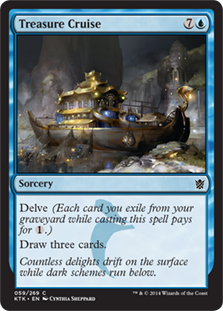
As with midrange, the two subdivisions of tempo are defined by the type of disruption they employ; in this case, creature-based or spell-based.

  • Fish: Plays many interchangeable/synergistic threats that work together to accelerate the clock or disrupt opponents, and a small number of noncreature spells.
    Modern examples: Merfolk, Death & Taxes, Humans, Spirits
  • Thresh: Plays a few highly efficient, individually powerful threats and disrupts opponents with noncreature spells. Often trades card advantage for speed. Modern contains very few viable thresh decks. For the sake of example, the most celebrated thresh deck in Magic is Legacy’s Canadian Threshold.
    Modern examplesMonkey Grow, Grixis Delver

Despite the name, fish decks don't solely include Merfolk; Death & Taxes, Hatebears, and Spirits are all go-wide aggro-control decks that gently disrupt with like-minded weenies as they increase their own board presence. Most fish decks rely on tribal synergies to keep up with Modern's goodstuff decks, while others assemble squads of weenies that disrupt in similar or complimentary ways. Merfolk, a strategy as old as the game itself, is unequivicolly the most iconic example of a tribal fish deck in Magic; in my opinion, an exemplar non-tribal fish deck is Vintage's Noble Fish.

Thresh decks are protect-the-queen strategies stocked with permission, removal, and cantrips. The name refers specifically to Threshold, a format-hopping tournament staple that included the first stand-alone "queens" in Nimble Mongoose and Werebear (today, All Grown Up! as Delver of Secrets and Tarmogoyf).

Just as not all fish deck creatures boast a Merfolk creature type, thresh decks don't necessarily have to use the graveyard. But they often do, as the undercosted threats Wizards prints tend to come with graveyard-reliant conditions. As an example to the contrary, Death's Shadow strikes me as an example threat with potential in thresh strategies (although I honestly don't see such a deck coming together in Modern anymore without Gitaxian Probe).

Veteran readers will notice that "thresh" is a new name I've given to what I used to call grow decks. Like "tempo," "grow" is a loaded word with a convoluted history and multiple meanings*---in other words, the type of term I'd like to avoid if able. I think "thresh" more accurately reflects an important aspect of these decks: that they'll happily throw away cards in exchange for a tempo advantage, and closely budget their resources (especially mana) throughout the duration of most games.
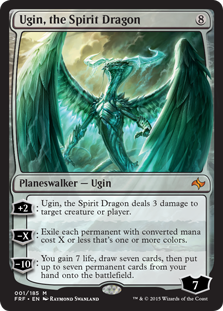
*Conversely, many of Magic's most famous grow decks, including the fabled Miracle Grow and the combo-control slanted Vintage powerhouse Gro-A-Tog, possess built-in ways to recoup card advantage at little cost à la Treasure Cruise (frequently, via Gush), which Thresh decks lack. In hindsight, the only true grow deck Modern has seen was the Cruise-featuring URx Delver.

Death's Shadow: Tempo Deck, or China Fake?

According to my presented definitions, Jund, Abzan, Grixis, and Esper Shadow alike are all firmly rock midrange decks. That said, I recognize the ambiguity, which I think comes from a few places:

  • "Tempo" being a term that refers at once to an in-game mechanic and to a division of aggro-control strategies is highly disorienting
  • Grixis and Esper Shadow play cards often associated (however correctly) with thresh decks, including Serum Visions, Thought Scour, Stubborn Denial, and Tasigur, the Golden Fang
  • Death's Shadow decks enjoy high "reversibility," allowing them to take on tempo roles with ease in matchups that require it of them

The Hallmark of Flexible Aggro-Control Decks

That last point introduces a new Magic term I've concocted. Reversibility refers to an aggro-control deck's ability to assume the role of its archetypical opposite when necessary.

Tempo decks want to defeat opponents before they can execute their gameplans, and midrange decks want to bring the game to a state in which an opponent's game plan isn't impactful enough. It's no wonder, then, that BGx has always struggled against Tron; all the Thoughtseizes in the world won't bring the game to a point at which Tron cares about Olivia Voldaren, or at which Jund and Abzan can laugh off Ugin, the Spirit Dragon. BGx's only realistic option in this matchup is to assume a tempo role, playing threats as quickly as possible and then disrupting with Fulminator Mage or Crumble to Dust while praying, against all odds, to deal 20 damage in time.

Of course, Jund and Abzan are still absolute dogs to Tron. Their "tempo plan" simply isn't effective enough to succeed in the matchup. We can say, then, that traditional BGx midrange decks have relatively low reversibility. Death's Shadow Jund, by contrast, has high reversibility: thanks to cards like Street Wraith, Temur Battle Rage, and of course Death's Shadow itself, the deck excels at shifting gears, goldfishing turn 4 kills the Kalitas decks of Christmas past could only dream of.

For a closer-to-home example, I've often included cards like Huntmaster of the Fells in the sideboards of my Temur Thresh decks to help with reversibility. While Thought Scour and Stubborn Denial shine against linear combo decks like Ad Nauseam, they do squat against faster creature decks like Infect, Affinity, and Merfolk. Such decks force Temur Thresh to transform into a midrange deck post-board to weather the assault.

Dreadnoughts Need Nought Apply

Tarmogoyf and Lightning Bolt are examples of cards that perform admirably both offensively and defensively, making them usual suspects in high-reversibility decks. The same can be said of Death's Shadow. It's no wonder Jund Shadow is so powerful---in addition to being highly proactive, highly interactive, and highly consistent, it's got high reversibility. But despite its remarkable competence, there's still one thing Death's Shadow ain't got: a membership to Tempo Decks of America.

Insider: Hapatra and other Commander Spikes

Are you a Quiet Speculation member?

If not, now is a perfect time to join up! Our powerful tools, breaking-news analysis, and exclusive Discord channel will make sure you stay up to date and ahead of the curve.

Amonkhet brought -1/-1 counters into the spotlight, and its impact has been greatest in the Commander format.

Hapatra, Vizier of Poisons

The new legend, Hapatra, Vizier of Poisons, is a great commander that has introduced a new deck archetype. This deck has suddenly increased the demand for certain cards, many of which were previously obscure and not very playable. A handful of older cards have seen massive spikes that have made them the best price performers in the past week, which calls to attention just how important 100-card decks are to the financial market. It’s also been a very revealing case study about how the market reacted to a new commander and a lesson about how to profit from it in the future

There was an error retrieving a chart for Flourishing Defenses

Flourishing Defenses was the single biggest percentage winner from last week, growing 690 percent from $0.35 to $2.77. This spike is remarkable not just because of the scale of the price change, but because it was entirely predictable. When the Hapatra, Vizier of Poisons deck broke out on the internet, we immediately saw some of its components spike, starting with Crumbling Ashes from Eventide and Blowfly Infestation from Shadowmoor quickly following.

Flourishing Defenses is another -1/-1 counter uncommon from Shadowmoor, and anyone paying attention to the Hapatra, Vizier of Poisons deck could have noticed its bargain price having nowhere to move but up.

There was an error retrieving a chart for Dusk Urchins

What’s even more remarkable is the price spike of Dusk Urchins, which has a percentage gain nearly as high as Flourishing Defenses's 670 percent, but a much more significant pure dollar jump, from $0.83 to $6.40 (fallen from its post-spike high over $8). This spike occurred after Flourishing Defenses, and with a long lag after the original spike of Crumbling Ashes.

Adding insult to injury, the spike of Dusk Urchins came a full week after the price of foil Dusk Urchins spiked a couple days after Amonkhet’s release. The strong demand for foils in EDH decks mean the price of foil cards will often increase first, with the price of nonfoils to follow. In this case, the potential for Dusk Urchin to spike was out in the open after the foil version spiked. By paying attention to the spikes of foil cards in the future, it will be possible to get insight into the mind of savvy EDH players and see into the future of the format – and predict the price increases of non-foil staples.

These spikes teach many lessons. They show that the EDH market has great impact on card prices, and that any new legend with EDH applications has the potential to send cards spiking, so getting ahead of the curve and figuring it out soon after the card is spoiled could yield massive profits. They show that card prices don’t change in a vacuum, and that the effect that causes one card to spike is likely impacting the demand for other cards too. Taking this example further, the spike of Quillspike and Devoted Druid is not simply because of Modern speculation and potential, but also because of actual applications in the Hapatra, Vizier of Poisons deck.

It seems obvious now, but there was plenty of money to be made for anyone who looked a little deeper. The simplest way to get ahead of these spikes would have been to look at what card Hapatra, Vizier of Poisons EDH decks have been including, which would show all of these spiked cards and the others that players are using with the potential to spike in the future.

This makes me wonder what cards in the [card]Hapatra, Vizier of Poisons[/deck] deck are still undervalued and could see a spike. Looking through the decks shows some possible targets, and a few look particularly attractive.

There was an error retrieving a chart for Corrosive Mentor

Corrosive Mentor is in 45 percent of the decks and is starting to creep up in price, now at 90 cents after being at 50 cents when Amonkhet was released. It could be poised to spike further, especially considering that the foil version has spiked from under $2 to over $5.

There was an error retrieving a chart for Grim Poppet

Another card from Shadowmoor, Grim Poppet is being used in almost 40 percent of the decks, and at just $1 it looks like a bargain. Making it look even more attractive is the fact that the online price has moved up to almost a third of a ticket after being just pennies before Amonkhet’s release.

There was an error retrieving a chart for Deity of Scars

Deity of Scars is used in about a third of Hapatra, Vizier of Poisons decks, and as an Eventide rare without reprints, it looks like a bargain at just $2.25. It’s also interesting that the online price has spiked from pennies to 0.3 tix over the past few days, so this interest could indicate a coming paper demand spike. The foil version has seen no movement, and is just twice the price of the nonfoil at $4.50, so it could yield some serious profits if the demand does increase.

There was an error retrieving a chart for Debt of Loyalty

A fascinating spike this week was Debt of Loyalty, which grew from $2.3 to $9, nearly a 400-percent price increase. This reserved list card sees play across a variety of different commanders, but there wasn’t any specific Amonket card that sent its price upward.

It’s interesting that Sigmund Ausfresser discussed the card in his article a couple weeks ago that focused on getting ahead of a buyout. He identified it as a card with a great graph and numbers that could be headed for a buyout and price spike, and that’s exactly what has happened.

There was an error retrieving a chart for Flash

The price of both prints of Flash saw a spike of around 150 percent this week after the unbanning of Protean Hulk in Commander, which opens up the card to combine with the card it got banned in Legacy.

What’s the next Hapatra, Vizier of Poisons Commander deck card to spike? What are your Commander specs? Let's discuss in the comments below.

--Adam

Want Prices?

Browse thousands of prices with the first and most comprehensive MTG Finance tool around.


Trader Tools lists both buylist and retail prices for every MTG card, going back a decade.

Quiet Speculation