menu

Insider: MTGO Market Report for April 5th, 2017

Are you a Quiet Speculation member?

If not, now is a perfect time to join up! Our powerful tools, breaking-news analysis, and exclusive Discord channel will make sure you stay up to date and ahead of the curve.

Welcome to the MTGO Market Report as compiled by Matthew Lewis. The report will cover a range of topics, including a summary of set prices and price changes for redeemable sets, a look at the major trends in various Constructed formats and a "Trade of the Week" section that highlights a particular speculative strategy with an example and accompanying explanation.

As always, speculators should take into account their own budgets, risk tolerance and current portfolios before buying or selling any digital objects. Please send questions via private message or post below in the article comments.

Redemption

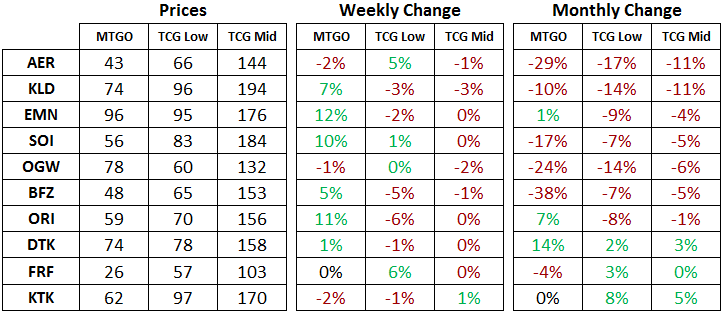
Below are the total set prices for all redeemable sets on MTGO. All prices are current as of April 3, 2017. The TCGplayer low and TCGplayer mid prices are the sum of each set's individual card prices on TCGplayer, either the low price or the mid price respectively.

All MTGO set prices this week are taken from GoatBot's website, and all weekly changes are now calculated relative to GoatBot's "full set" prices from the previous week. All monthly changes are also relative to the previous month's prices, taken from GoatBot's website at that time. Occasionally, full set prices are not available, and so estimated set prices are used instead.

apr3

Standard

The liquidity crunch triggered by the release of Modern Masters 2017 (MM3) has largely dissipated with prices having rebounded this week. On top of that, the start of Amonkhet (AKH) previews has fueled demand for Standard cards as players dream of their pet decks and the potential for a metagame shakeup. The best buying window has passed, but there are still a few pockets of short-term opportunity.

There was an error retrieving a chart for Gideon, Ally of Zendikar

Aether Revolt (AER) looks like it has a found a price floor of around 40 tix and is a low-risk speculative purchase at current prices. Even during the first few days after the release of MM3, it barely dipped below this level. If you've been waiting on buying cards or sets, the bottom looks like it's in. Remember, though, that redemption for Kaladesh (KLD) and AER will end in early June, so this is not a long-term strategy; unloading of full sets should be completed in May.

There was an error retrieving a chart for Grim Flayer

Previews from the new set and the new allied-colour dual lands with cycling are going to be shaping Standard right from the get-go. Good mana fixing shapes what is possible in Constructed formats and upcoming Standard will be no different. Right off the top, delirium strategies are going to get a boost with a new way to get the land type into the graveyard beyond Evolving Wilds. Grim Flayer is already seeing the benefit as it has bumped up to 19 tix.

Modern

With the release window of MM3 drawing to a close, players and speculators alike are contemplating the purchase of singles from this reprint set. Examining how a few key staples from Modern Masters 2015 (MM2) fared will give some guidance on whether or not now is the time to be a buyer. The price graphs below are all courtesy of MTGGoldfish.

goyf

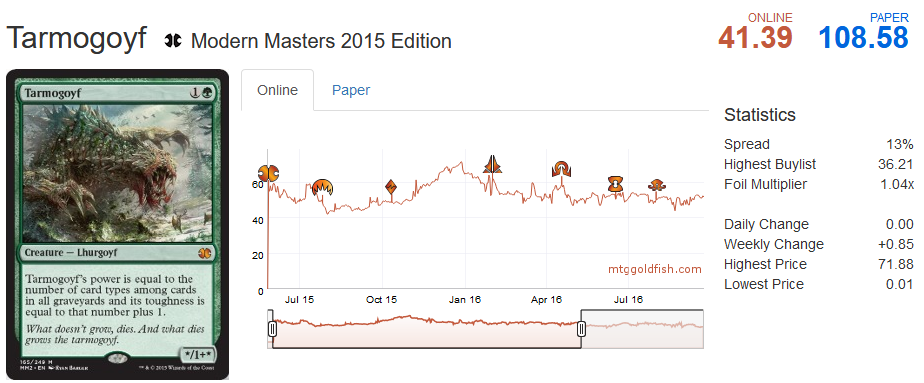
Starting with Tarmogoyf, the flagship card of the original Modern Masters (MMA), seems appropriate. MM2 was released on MTGO at the end of May in 2015. By the end of June, this card was a little under 50 tix, but it would get to 42 tix after the release of Magic Origins (ORI). Looking at the above chart, being a buyer of this card anywhere prior to the release of Battle for Zendikar (BFZ) would mean a large opportunity cost of having a bunch of tix tied up in one card, with no appreciable benefit.

If you timed the market perfectly, you could have bought Tarmogoyf at 49 tix on June 29, and sold on July 12 for 59 tix. But considering a typical buy/sell spread of 10 percent, this would have left you with a net gain of about 4 tix. This is an awful rate of return for a speculative position with perfect hindsight. The best buying and selling window was buying at the release of BFZ in the fall, and selling at the end of December 2015. The buy in price would have been the same at 49 tix, but the sale price would have been 72 tix. After accounting for the spread, this would have been a net gain of 15 tix.

mox

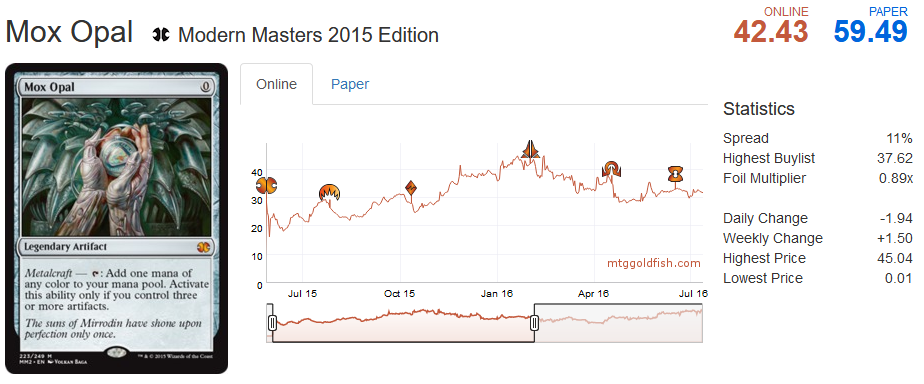
Next we can look at Mox Opal in a similar way. Clearly this would have been a better speculative target buying during the release period of MM2, as it rose from 20 tix to 29 tix just before the release of ORI. Although there are ups and downs around the release of ORI and BFZ, the overall trend is higher into the winter. Buying this card right away or during the release of BFZ were both good choices in hindsight, but like Tarmogoyf, buying in the fall was still the superior choice on a time-adjusted basis. In other words, considering the opportunity costs involved, buying at the release of BFZ and selling a few months later was the ideal speculative strategy.

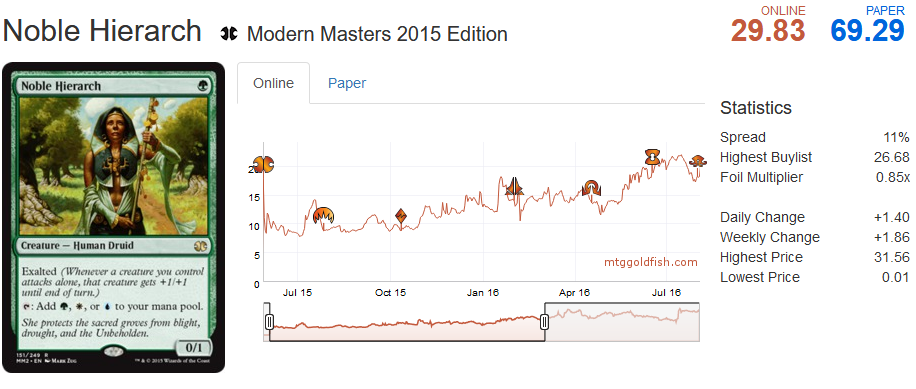
hierOur last example is a regular rare, but Noble Hierarch displays a similar pattern. Buying in the first four months of this cards release was largely a bust, unless you hit the peak around the release of ORI perfectly. Speculators would again have done better waiting until the fall before buying this card. But even then, the ideal purchase window is pushed back a little further to the release of Shadows Over Innistrad (SOI) in the spring of 2016. One could have bought this for 12 tix at that time, and then quickly ridden the wave higher to 20 tix only two months later.

From these three examples, I think the best thing for speculators to do is to hold onto their tix and to come back to buying cards from MM3 in the fall. This set has been massively popular online and there is a lot of interest in Modern Constructed at the moment too (evidenced by the gains in non-reprinted staples in recent weeks). Once this all dies down, I anticipate lower prices for many cards from MM3 into the summer, although there will always be outliers that go through profitable price swings.

For players, I think it's an excellent time to be a buyer of reprints. If you are going to be using cards from MM3 right away and will get playing utility from them, then there's no better time to be a buyer. Timing the buys and sells takes a lot of work, but if you are going to be getting playing enjoyment out of your cards, then now is a great time to pick up the cards you need from MM3.

Standard Boosters

KLD and AER boosters have rebounded this week, peaking at 3.7 tix and 1.7 tix respectively. I expect these to fluctuate up and down over the next three weeks with an overall bias downward. With the release of AKH on April 24, there will be another round of selling as players liquidate their boosters in order to draft the new set. This will be a good opportunity for tucking away a few cheap boosters for a rainy day.

The recent price drop in response to the release of MM3 is instructive for what to expect when AKH is released. AER boosters dipped below 3 tix and KLD boosters fell below 1.3 tix. If prices get this low again, then it will be a good time to start buying. However, the recent removal of boosters from Treasure Chests has cut off the supply coming from Constructed players, which points to a repeat of those price lows as being unlikely. Further monitoring of the situation as it develops will be prudent.

There was an error retrieving a chart for Jace, Unraveler of Secrets

As for the only other Standard-set Draft queue that is available, Shadows Over Innistrad (SOI) Block Draft will be removed from the draft queues with the release of AKH. SOI boosters are already cheap at 1.0 tix and don't have much further downside, so selling these is not correct as long as you don't need the tix. On the other hand, Eldritch Moon (EMN) boosters are fully priced at 4.0 tix and will steadily drop in price over the coming weeks and months. Selling EMN boosters is definitely correct if you are holding any.

Trade of the Week

For a complete look at my recent purchases, please check out the portfolio. I took advantage of the rebound in AER and KLD booster prices to unload my purchases from last week. With a 20 percent gain on the table, I felt it was a good idea to build up my stash of tix in advance of AKH. Set releases are always a time of flux in the market, so having your tix ready to go is prudent in order to take advantage of any opportunity that presents itself.

There was an error retrieving a chart for Heart of Kiran

At the very least, I want tix on hand in order to buy foil mythic rares from AKH. My recent experience with AER foil mythic rares has given me strong confidence that this strategy will deliver steady gains in the 10- to 20-percent range. Although in the past I've encouraged players to use this strategy as a way to play Standard without losing a ton of value, it looks like its ready for speculators to experiment with. I'll be expanding my purchases beyond just a playset of each foil mythic rare with AKH, and I will be reporting on the results over the summer.

Citrus Plays: UW Control Competitive League

Are you a Quiet Speculation member?

If not, now is a perfect time to join up! Our powerful tools, breaking-news analysis, and exclusive Discord channel will make sure you stay up to date and ahead of the curve.

Editor's Note: Please give a warm welcome to gold pro Gregory Orange, fresh off of his team Grand Prix win last weekend! For a while we have been discussing the potential of him of making content for Modern Nexus. Today I'm excited to debut his first MTGO videos, where he runs UW Control through the paces of a competitive league. The videos below constituted some of his testing regimen in the lead-up to Grand Prix San Antonio, so you'll see an earlier build of the deck on display.

Let us know what you think, and I'll see if I can wrangle some more video content from him. Without further ado (and fully cognizant of the serendipitous timing of the whole affair), I'll pass the mic to Greg. Enjoy!

- Jason

Deck Tech

[youtube https://www.youtube.com/watch?v=uSqnNT5EtoE&w=560&h=315]

Round 1 vs. Tron

[youtube https://www.youtube.com/watch?v=OqmGaEbdjVc&w=560&h=315]

Round 2 vs. Abzan

[youtube https://www.youtube.com/watch?v=SkaxEbfecfc&w=560&h=315]

Round 3 vs. Death's Shadow Jund

[youtube https://www.youtube.com/watch?v=XXlTTW1rI9E&w=560&h=315]

Round 4 vs. Ad Nauseam

Note: At about 4:05 in this round, Greg looks up some information on the opposing decklist online. You'll notice a brief cut in the video at this time.

[youtube https://www.youtube.com/watch?v=zzqGPGjeeg4&w=560&h=315]

Round 5 vs. Beck // Call Control

[youtube https://www.youtube.com/watch?v=PwDS0cOQKr8&w=560&h=315]

UW Control, by Gregory Orange

Creatures

4 Snapcaster Mage

Enchantments

4 Spreading Seas

Instants

3 Condemn
4 Path to Exile
2 Spell Snare
2 Blessed Alliance
2 Remand
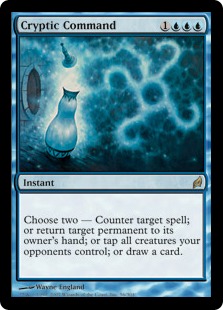
3 Cryptic Command

Planeswalkers

2 Jace, Architect of Thought
1 Elspeth, Sun's Champion

Sorceries

4 Ancestral Vision
4 Serum Visions
2 Supreme Verdict

Lands

4 Flooded Strand
3 Hallowed Fountain
4 Seachrome Coast
2 Celestial Colonnade
4 Island
2 Plains
3 Ghost Quarter
1 Urza's Factory

Sideboard

2 Porphyry Nodes
2 Celestial Purge
2 Stony Silence
4 Kor Firewalker
2 Negate
1 Dispel
1 Vendilion Clique
1 Crucible of Worlds

Testing the Mind Sculptor: The Data

Are you a Quiet Speculation member?

If not, now is a perfect time to join up! Our powerful tools, breaking-news analysis, and exclusive Discord channel will make sure you stay up to date and ahead of the curve.

At last, the time has come to reveal the data about my Jace testing. As a reminder, these data come from 500 matches, well over 1000 individual games played over five months. I publish my methods so that you can replicate my experiment if you disagree with the results, but I have to warn you that this is a substantial time commitment. There is a reason nobody else is undertaking this experiment.

To recap the qualitative results from last week, Jace, the Mind Sculptor is still extremely strong. You don't need to use the ultimate because, left alone, Jace's other modes win the game. He is an incredible value engine and is more powerful, if less versatile, than Nahiri, the Harbinger. I cannot fathom why you would play Nahiri over JtMS, especially when Emrakul is a liability . All that's left is to look over the numbers and see what they say.

The Total Data

I will start with the overall results before the individual matchups. This is partially because the statistical analysis of the total set is far more accurate than the individual results, and mostly so I only have to explain the what and how of the analysis once. Everything I did with the big set applies to the small sets, though the smaller n's of the individual results make them less accurate.

Onto the numbers!

Total Match Wins:

  • Jeskai - 123/250: 49.2%
  • Jacekai - 149/250: 59.6%

The baseline Jeskai Nahiri deck won just under half of the matches while the test deck with Jace won nearly 60%. While I did get better with the decks as testing went on (and on, and on), I mitigated this by alternating my decks, never playing two Jeskai or Jacekai matches in a row.

The Analysis

When I committed to doing actual statistical analysis, I looked for how to test a binary data set. There were a number of tests suggested to me and I did all of them. I wasn't sure which one was best, because I'm not a statistician—I'm a researcher who uses stats. Since the results were relatively consistent (the numbers weren't all the same, but the conclusions they reached were) I will only publish the results from the z-test. It's one of the common tests so I expect more people to understand the results. If you want to do these tests yourself, I placed all 250 matches for each deck into columns, recorded match wins as ones, losses as zeros, and then performed the tests with a null hypothesis of H = 0.
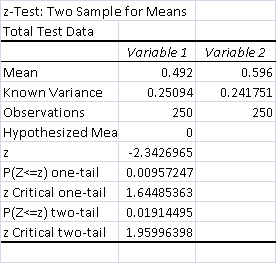
As a result of this test, I reject my null hypothesis and accept the alternative that the means are different. This means that the test results were statistically different from the control results.

The key thing to look at is the P-value. If it is less than .05 your data is significant at the 95% confidence interval. I consider this a one-tail test as I'm only interested in one deck being better than the other, but I know arguments can be made for it being two. Seeing that both .0095 and .019 are less than .05, this is not an issue.

The Meaning

The addition of JtMS to Jeskai Control had a positive and statistically significant impact on its win percentage. On that basis, Jacekai would have been firmly Tier 1 in the old metagame. What does this mean in terms of his safety for Modern? Hard to say. All this result proves is that JtMS is very powerful and lends that power well to my test platform. To determine whether remaining banned is warranted, we need to look at the individual test results, in the order I tested them.

Jund

I need to stress at this point that all the individual results are less reliable, statistically, than the overall result. The smaller the n of your sample, the higher the threshold of significance becomes. With only 50 matches per deck (100 total) to compare, you expect more results not to be significant. With those excuses out of the way, here's my experimental data:

Vs. Jund: Total Match Wins

  • Jeskai - 24/50: 48%
  • Jacekai - 33/50: 66%

Yes, your eyes do not deceive you. That is an 18% jump from Nahiri to Jace. I should also mention that this was the hardest match for me to test. Jeskai vs. Jund is a long, hard-fought war of attrition. Sometimes Jund won by completely stripping Jeskai's hand with Inquisition of Kozilek and following up with Liliana of the Veil and Tarmogoyf, but mostly games were decided by attrition. Jeskai seemed to have a slight advantage thanks to having more card advantage, but it was the experience of the pilots that really determined individual matches.

Nahiri fared worse overall because she could only provide incremental advantage. Exiling a creature was nice and helped some, but it just wasn't as good as fixing your hand with Jace. Ancestral Vision is good against Jund for a reason, and with fetchlands Jace could replicate that repeatedly.

Sideboarding

Jeskai's Sideboarding:

On the Play:

-2 Spell Snare -2 Remand

+ 1 Celestial Purge +2 Spreading Seas +1 Timely Reinforcements

On the Draw:

-2 Remand -2 Mana Leak

+2 Spreading Seas +1 Celestial Purge +1 Timely Reinforcements

Tempo cards are really bad in attrition matchups, so Remand had to go. On the play I was more concerned about Liliana, so I kept in Mana Leak. On the draw Dark Confidant was my main concern, so I kept in more answers to Bob.

We spent a long time trying to determine if I was supposed to board in Wear // Tear. We decided against it since it was a dead card too often, but Cage shutting off Emrakul was the deciding factor in several games.

Jacekai's Sideboarding:

-2 Snapcaster Mage -3 Mana Leak -2 Anger of the Gods

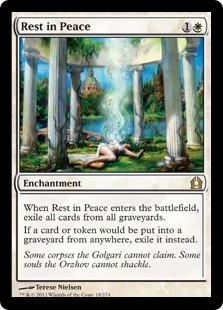
+4 Spreading Seas +1 Supreme Verdict +2 Rest in Peace

Rest in Peace is a beating against Jund and barely affects Jeskai decks. Anger is worse than Verdict here and was only kept in the other deck because it didn't have Verdict. Anger over Verdict only mattered twice. Leak was a dead card too often and was cut. I could see cutting all my Mages and playing all the RiPs, but you need some creatures to draw fire from Colonnade and JtMS.

Jund's Sideboarding:

-1 Lightning Bolt -2 Abrupt Decay -1 Slaughter Pact -1 Maelstrom Pulse

+2 Painful Truths +2 Grafdigger's Cage +1 Pithing Needle

Jund's plan was to cut down on more expensive or situational removal in favor of card draw and hate. The Cages were much worse against Jacekai, but my opponent felt that he would have brought the card in anyway. It was amusing seeing it and RiP in play the one time it came up.

Analysis

The results of the z-test confirm what your instincts might tell you about the above results.
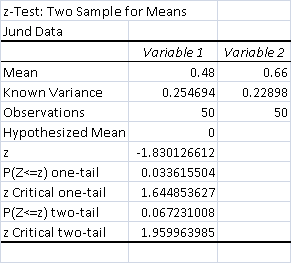
Once again P < .05 so we reject the null hypothesis. This result is from actual variation in the data, and the result is statistically significant.

Meaning

Jacekai did statistically significantly better than normal Jeskai Nahiri. This is to be expected, since Jace actively draws cards and card advantage is critical to the matchup. One interesting aspect was that when JtMS and Liliana faced off, you often hid your best card on top after you Brainstormed unless you were going to play it right away.

Based on these results and his observed utility in Legacy, I expect that Jace would have a similar impact against other fair midrange decks in Modern. This would likely make him the focal point of those matchups. Value engines are always very potent in attrition matchups, and attaching one to a hard-to-kill permanent is dangerous, as Birthing Pod will attest. Ancestral Vision is used for this now, and Jace is a much better topdeck. I would imagine this would lead to the fairer metagames warping around him. Again, this is not surprising. This is very similar to what happened back in Standard.

Ad Nauseam

The most powerful and consistent combo deck in Modern, Ad Naus is advantaged against Jeskai. Game one is heavily in its favor since most of Jeskai's cards are dead and the clock is slow. While after sideboarding the matchup improves, I still wouldn't want to face it repeatedly.

Jeskai is the beatdown deck and it isn't very good at the job. Pact of Negation is serious game when we're counterspell-light. Playing more helped some, but many of my wins came by Ad Naus failing to combo rather than me stopping him.

Vs. Ad Naus: Total Match Wins

  • Jeskai - 25/50: 50%
  • Jacekai - 27/50: 54%

A very slight increase, which I attribute to the extra Vendilion Clique game one more than anything else. Snagging Ad Nauseam in response to Lotus Bloom was the best thing Jeskai could do, and having more chances over the course of a match made the difference. I rarely tapped out unless I was desperate so I didn't record a difference between the planeswalkers, except for when I attacked for lethal and then exiled Phyrexian Unlife.

Sideboarding

Jeskai's Sideboarding

-4 Path to Exile -1 Timely Reinforcements -2 Anger of the Gods -1 Lightning Helix

+2 Dispel +2 Negate +2 Geist of Saint Traft +1 Vendilion Clique +1 Wear // Tear

Jacekai's Sideboarding

-4 Path to Exile -2 Blessed Alliance -2 Anger of the Gods -1 Supreme Verdict

+2 Dispel +2 Negate +1 Stony Silence +1 Wear // Tear +3 Spreading Seas

The plan for both decks was to take out dead cards for not dead cards. Seas is not actually good here, but it's better than the sweepers.

Ad Nauseam's Sideboarding

-3 Spoils of the Vault -1 Phyrexian Unlife

+1 Pact of Negation +2 Thoughtseize +1 Boseiju, Who Shelter's All

Spoils is mostly there as a desperation card. Since Jeskai gave my opponent more time to go off, he chose to play a longer game and reduce the chance of killing himself.

Analysis

The test just confirms what you'd expect looking at the raw data.
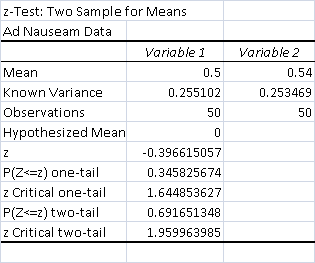
This data is not significant. The variation in the means can be explained by normal variance and not by an actual difference in the data.

Meaning

Jace had no noticeable effect on this matchup. Honestly I wasn't expecting him to—Valakut, the Molten Pinnacle psuedo-combo decks were the only decks that could hang with Cawblade back in the day. In Legacy Jace is just a finisher against combo, interchangeable with any creature. I doubt that Jace will impact matchups against combo in Modern.

Bant Eldrazi

I expected this matchup to be hard, and it was. Eldrazi prey on slower decks, and it was especially hard for Jeskai decks when they had Cavern of Souls. This didn't happen all that much, but it made going long with Cryptic Command a dicey plan. The best was to trade as much as possible and hope they started flooding, which happens more than you think.

My opinion on Ancient Stirrings came from these tests. Seeing how poorly Serum Visions compared really made me question why Stirrings is legal.

Vs. Bant Eldrazi: Total Match Wins

  • Jeskai - 20/50: 40%
  • Jacekai - 26/50: 52%

That is quite the spike, but I'm not certain that I can attribute it to Jace. Supreme Verdict and Blessed Alliance are shockingly good against the deck, and I think their inclusion had a larger impact—though Jace giving you more chances to find them certainly helped. Exiling tapped Eldrazi was hardly irrelevant, but I'd rather be wiping their board or digging for answers at four mana.

Sideboarding

Jeskai Sideboarding

-2 Spell Snare -1 Vendilion Clique -1 Timely Reinforcements

+1 Crumble to Dust +2 Spreading Seas +1 Wear // Tear

I didn't have much to bring in, so I went for answers to Cavern of Souls and Chalice of the Void. Spell Snare is amazingly dead and Clique is uninspiring.

Jacekai Sideboarding

-2 Spell Snare

+1 Supreme Verdict +1 Wear // Tear

Since I had more good cards maindeck, I sideboarded fewer cards than in the control test, but I think it was better overall. Clique could have come out for Seas but it was a wash impact-wise during practice.

Bant Eldrazi Sideboarding

-4 Path to Exile -2 Engineered Explosives

+4 Chalice of the Void +2 Grafdigger's Cage

Eldrazi only cared about Jeskai's creatures when the game was lost, so answers were cut for disruption. Jacekai's sweepers made Chalice much less of a problem. Cage prevented Jeskai from winning on several occasions.

Analysis

This particular test highlights the problem of working with smaller n's in statistics.
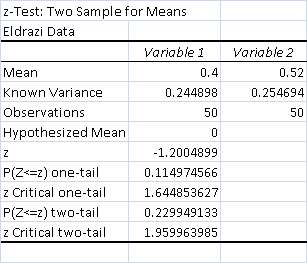
P > .05 so the null hypothesis is accepted and the data is not significant. This is nearly significant at the 90% level, but that is not good enough. I must conclude that this result is within normal variation.

Meaning

I believe that if I had a larger n this would have been a significant result. Jace finding you answers more efficiently was important in a number of games and I think more testing might prove this. If I were going to do a revisit, I would start here.

Aggressive decks are aggressive decks as far as the data is concerned and Jace had no detectable impact here.

Affinity

The Affinity matchup surprised me. Most of my losses came from really broken starts or Plating-equipped Etched Champion. All of the medium Affinity games went Jeskai's way. Power Card decks do not like facing waves of removal.

Vs. Affinity: Total Match Wins

  • Jeskai - 29/50: 58%
  • Jacekai - 35/50: 70%

This actually should have been more lopsided in Jacekai's favor, but something I didn't expect kept it close: Nahiri answers Blood Moon. Affinity got a turn-two Moon against Jacekai several times—and turn-one'd it once—and crushed me. Had Jeskai been turn-oned it would have lost too, but it never happened. Instead, as long as I fetched for a Plains right away, I could hold on until I hit Nahiri and exile the Moon. Once I got to play Magic again, winning was easy. This kept the spread at least five matches closer than it would have otherwise been (three Jacekai wins denied, two Jeskai wins gained).

Sideboarding

Jeskai Sideboarding

-2 Remand -1 Mana Leak

+1 Stony Silence +1 Timely Reinforcements +1 Wear // Tear

Jacekai Sideboarding

-3 Mana Leak -1 Serum Visions

+1 Stony Silence +1 Wear // Tear +1 Anger of the Gods +1 Supreme Verdict

Two-mana counters are fairly poor against Affinity, so out they go for hate and more removal. I was unsure what to cut for Verdict in Jacekai so I cut a card I didn't like in my opening hand.

Affinity Sideboarding

-2 Master of Etherium -4 Galvanic Blast -1 Vault Skirge

+2 Thoughtseize +2 Ghirapur Aether Grid +1 Etched Champion +2 Blood Moon

Sideboarding with Affinity is hard, but my opponent felt that the extra reach from Blast was worse than the red enchantments. Master was big but not great against waves of removal. As mentioned above, when Moon landed it was devastating.

Analysis

Much like Eldrazi, I think the small n really hurts my analysis here.
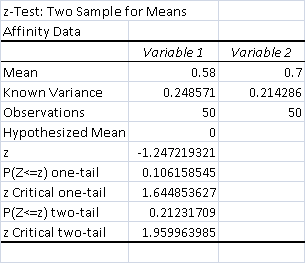
Again, P > .05 means that this data is not statistically significant. It is more significant than Eldrazi by a small margin, but not enough. Therefore I cannot conclude that Jace had a significant impact on the Affinity matchup.

Meaning

I'm not exactly surprised by the result. The fast aggro matches played out as I expected, with Jace only being a factor once the game was won. That said, this was the one matchup where playing specifically Nahiri actually made an impact. Had she been any other planeswalker, the difference between the sets would have been larger and yielded more significant data.

Infect

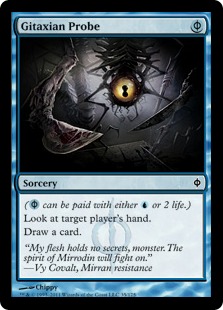
Remember, this was pre-banning Infect. This was a weird matchup because when Infect had Gitaxian Probe it was heavily in its favor, but if not then Jeskai's relentless removal won the day. It was important to remember not to fight during the combat step except when I had Blessed Alliance. I did lose a few matches to turn-two kills.

Vs. Infect: Total Match Wins

  • Jeskai - 25/50: 50%
  • Jacekai - 28/50: 56%

Not much change, though again having non-targeting removal was very strong. This was the only time when I always aggressively +2'd Jace. There are so few cards that matter in Infect that being able to deny Infect's draw step was more important than me drawing cards. Yes, Nahiri would have won me the game outright. But the Cage kept me from winning in two matches, so I think we'll call it a wash.

Sideboarding

Jeskai Sideboarding

-2 Spell Snare -2 Mana Leak -1 Cryptic Command

+1 Crumble to Dust +2 Dispel +1 Wear // Tear +1 Negate

Jacekai Sideboarding

-2 Spell Snare -3 Mana Leak -2 Cryptic Command

+2 Dispel +2 Negate +1 Supreme Verdict +2 Spreading Seas

I took out the clunky or expensive counters for the more efficient ones and extra removal. Removing Inkmoth Nexus from circulation was very good, which is why I had Crumble in Jeskai.

Infect Sideboarding

-2 Twisted Image -1 Dismember -1 Distortion Strike

+2 Grafdigger's Cage +2 Dispel

Infect removed what the pilot's experience said were useless cards for some disruption and protection. He decided against Spellskite because it was a one-of, but given the choice would have played two maindeck. That's not what the mainstream decks were doing at the time, but maybe his plan was correct.

Analysis

If you read the Ad Nauseam section, this should come as no surprise.
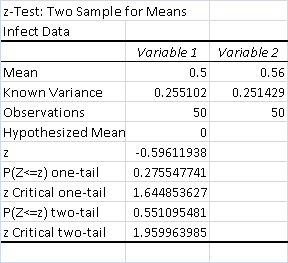
This is not significant data and only shows normal variation within a sample. JtMS does not impact the win percentage against Infect.

Meaning

JtMS would not impact the fast aggro matchup relative to Nahiri. As I said, this doesn't surprise me at all—against really fast gotcha! aggro a win condition is just a win condition. Jace put the game out of reach the same way a Baneslayer Angel or Gurmag Angler would.

Conclusion

I feel the need to hedge my conclusion. On the one hand, the totality of the data showed that JtMS has a significant impact on Jeskai Control and would dramatically increase its win percentage. However when you get into the individual results that impact gets more indeterminate. This makes it harder to be definitive.

What I can safely conclude is that JtMS would have an uneven impact on Modern. Fair decks would be substantially impacted, with lessening impact the more unfair a deck becomes. This suggests that in a very unfair environment Jace would have no measurable impact. However, unfair environments do not last long before Wizards steps in. It is important to consider whether this uneven impact would be good for Modern long-term rather than just in a given metagame. Again, this testing was conducted in a pre-ban metagame. The meta has slowed noticeably and Infect isn't a deck anymore. Given the data and the current context of the format, I see only one conclusion.

Jace, the Mind Sculptor is not an implausible card to unban, but it is risky. Fair decks would feel the brunt of the impact, with JtMS' power likely to function like a black hole and warp those matchups around himself. It is possible that Modern can adapt and benefit, but the potential for oppression and a total metagame warp also exists. An unban would need to be seen as a calculated risk and an experiment rather than a permanent addition. If it works out, that's great. If not, and he must be rebanned, it should come as no surprise. I don't think that's worthwhile, but I would also really enjoy wielding the power of Jace again.

And that's enough writing about banned cards for a while. Next week we look at new cards from the Amonkhet spoiler!

Deck of the Week: Eldrazi Stompy & Taxes

Are you a Quiet Speculation member?

If not, now is a perfect time to join up! Our powerful tools, breaking-news analysis, and exclusive Discord channel will make sure you stay up to date and ahead of the curve.

Greetings, Nexites. We have some exciting things in the works this week, but today I merely get to bring you another Deck of the Week. Much as I wanted to highlight something novel from Grand Prix San Antonio, it seems an avalanche of Death's Shadow and Affinity decks were the going fare throughout much of the weekend. So far it looks to me like Death's Shadow (the card) is sort of the new Tarmogoyf, as it's seeing play across diverse color combinations, from Jund, to Grixis, to Abzan, to several varieties of four-color. No, I don't think it merits a banning, but that's neither here nor there. For Deck of the Week we prefer the odder to the established, so that draws our attention elsewhere. In today's case, back towards the noodly.

Since their auspicious return in Oath of the Gatewatch, the Eldrazi have made an enormous impact on Modern, spawning several new archetypes and revitalizing others. Putting aside Eldrazi Winter itself, which was more the fault of a Sol Ring impersonator than the Eldrazi themselves, they're the centerpiece of at least three post-banning decks: BW Eldrazi and Taxes, Bant Eldrazi, and Eldrazi Tron. Jordan, meanwhile, has been hard at work brewing and writing on Eldrazi Stompy. That deck tries to relive the glory days of busted Eye of Ugin/Eldrazi Temple draws with accelerants like Simian Spirit Guide and Serum Powder.

So what happens when you try to jam the stompy elements of Jordan's Eldrazi decks with the disruptive ones of Eldrazi and Taxes? It might be a tough squeeze to fit all that inside 75 cards, but MTGO user Stabilo appears to have managed. Since February, Stabilo has posted a few 5-0 League finishes—he or she has apparently stuck with the deck, and recently took it to a Top 16 berth in the MOCS.

Eldrazi Stompy & Taxes, by Stabilo (11th, MOCS on 3/27/17)

Creatures

4 Eldrazi Displacer
4 Leonin Arbiter
3 Matter Reshaper
4 Reality Smasher
4 Simian Spirit Guide
3 Thalia, Guardian of Thraben
2 Thalia, Heretic Cathar
4 Thought-Knot Seer

Artifacts

4 Chalice of the Void

Instants

3 Dismember

Lands

3 Battlefield Forge
2 Cavern of Souls
1 Eiganjo Castle
4 Eldrazi Temple
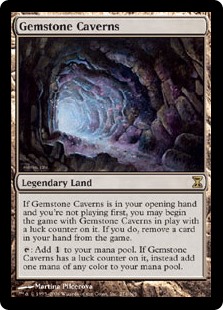
3 Gemstone Caverns
4 Ghost Quarter
3 Horizon Canopy
5 Plains

Sideboard

1 Celestial Purge
1 Grafdigger's Cage
2 Journey to Nowhere
3 Path to Exile
1 Ratchet Bomb
2 Rest in Peace
3 Stony Silence
2 Worship

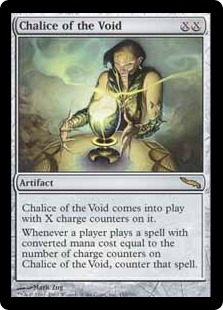
This is definitely a get-'em-dead-now kind of deck. The creature suite is meant to hit hard and fast—there are no Tidehollow Scullers, Wasteland Stranglers, or Flickerwisps to generate card advantage and try to win the long game. They're pared down the disruptive creatures to just the most efficient: Thalia, Guardian of Thraben, Leonin Arbiter, and Thought-Knot Seer. Thalia's big sister (uh, also named Thalia, as it were) also makes an appearance. These elements, of course, appear in most of the Death and Taxes shells, but they're not flanked by the usual assortment of other hatebears and Aether Vials. Instead, we have Simian Spirit Guide and Gemstone Caverns to power them out faster, and Chalice of the Void to cheese out opponents.
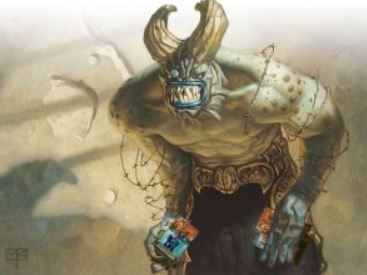
The inclusion of Matter Reshaper points to this deck's overarching goal. It's not so much about the card advantage gained from the death trigger as it is the extra board presence. When you're trying to put the opponent on the backfoot from turn one, you want card advantage to hit in the form of more threats. Combined with the acceleration package of Spirit Guide, Caverns, and Eldrazi Temple, a dying Matter Reshaper helps to further cement your mana advantage and put the opponent in a bigger hole. All told, opponents are likely to be facing down a colossal amount of power and toughness in the early turns.

Of course, this explosiveness comes at the expense of longevity. For one, outside of Eldrazi Temple, those acceleration pieces require you to pitch an extra card to function. It won't be long before you're hellbent and at the mercy of the top of the deck. If Stompy and Taxes' initial onslaught of beaters are answered, it may be in for some trouble. The only late-game is really has is Eldrazi Displacer, and topdecks from an opponent are likely to outshine yours.

That isn't necessarily a bad thing, though—Eldrazi and Taxes decks are a little underpowered for a fair strategy, and this one gets to cut fiddly stuff like Aether Vial for the prospects of much faster kills. When you can't go up against interactive decks pound-for-pound, the winning strategy is usually to go unfair. Eldrazi Tron tries to do this by going over the top, with obscene mana production that can be funneled into Endbringer and Walking Ballista. Eldrazi Stompy and Taxes goes the opposite route and tries to get under interaction instead.

And what better way to undercut interaction than with Chalice of the Void? This is the deck's real late-game plan, attempting to brick huge swath's of an opposing deck in one fell swoop. It doesn't matter if our topdecks are medium when the opponent effectively doesn't get as many as us. And we don't sweat too much the possibility of them ripping an artifact destruction spell—we only need enough time to find that nail-in-the-coffin threat that will deal the final points. In this way the Chalice plays nicely with acceleration. The game is essentially contracted down to very few turns, in which the Eldrazi player will be operating at full capacity and the opposing deck will cast one spell per turn with many stranded in hand. Classic stompy.

Proximal Developments

Next week I'll have the write-up for the March metagame breakdown. In the meantime check back with us during the week, as I'll post the actual numbers earlier than that. This is something I intend to do moving forward, as it lets you see the meta earlier and relieves a little of the stress on my end. I'm also working to automate some of the data gathering—for the most part you won't see the effects of that directly, but it does mean faster turnarounds.

In other news, we're in discussions to bring on a few new authors, and I have some MTGO videos queued up for this week! Without teasing it too much, I'll say they should be of interest to anyone who tuned in to see GP San Antonio.

Thanks for reading,

Jason

Insider: Finding the Underpriced Gem

Are you a Quiet Speculation member?

If not, now is a perfect time to join up! Our powerful tools, breaking-news analysis, and exclusive Discord channel will make sure you stay up to date and ahead of the curve.

A couple weeks ago I talked about one strategy I implement to find and purchase underpriced cards. I sort a MTG site by a certain set and rarity and simply window shop. Inevitably I find something that is listed for under eBay completed prices and since eBay is my primary outlet for selling, I pull the trigger accordingly.

There’s a bit of a corollary to this strategy that I think may be non-obvious until mentioned explicitly. It has to do with the obscurity of older cards from Magic’s earliest years. Because these singles are off almost everyone’s radar, there are some trends that can be easily exploited with minimal competition. Of course, mentioning some of these trends here may erase the opportunity if suddenly dozens of speculators begin to implement the same strategy.

That’s a risk I’m willing to take—I’m fairly confident that even if many copy-cats decide to follow my suit, they won’t be able to locate every possible deal I would find. So it may become harder, but it will still be worthwhile. Besides, I’d rather make my readers money in Magic than make the money myself because it ensures this writing gig keeps me profitably employed. Just being honest here.

Demon

A Saturday Morning Purchase

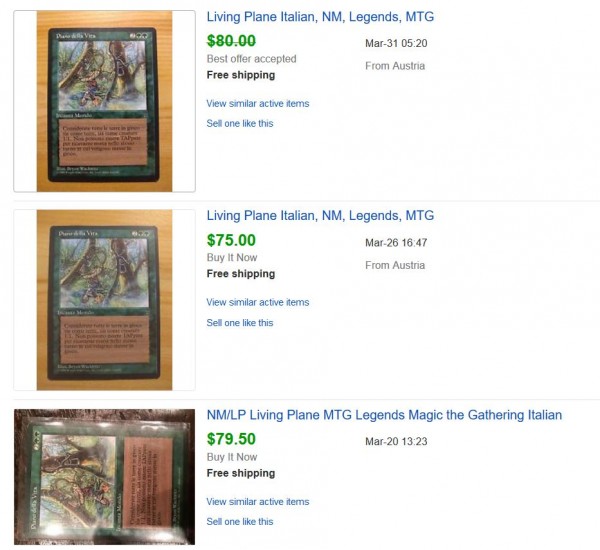
Last Saturday morning I bought a Slightly Played Italian Living Plane from Star City Games’ website. The total cost including shipping was $29.99. This was one of the easiest snap-buys I have experienced in quite some time.

Sold Planes

A quick search on eBay indicates this card—yes, even the Italian printing—should be retailing for $79.99 with SP copies probably in the $69.99 range. Thus the copy I purchased was essentially half price versus the rest of the market. This isn’t an artificial spike either. There is real demand for the card, and I have been watching it continuously hit all-time highs on MTG Stocks.

There was an error retrieving a chart for Living Plane

While I may be seemingly bragging here, I want to emphasize the process here rather than the result. After all, aren’t you curious as to why I was up on Saturday morning looking for Italian Living Planes in the first place?

It All Started…

Clearly there was an active buyout for Living Plane. A card like this doesn’t just suddenly spike on its own. And I don’t think the 300 EDH REC lists that include this card really justify such a huge price swing. But being from an old set, and legal in Old School, and an Enchant World, and on the Reserved List, means any sudden interest is likely to make this card’s price stick higher. And that’s exactly what happened.

But this is only the beginning of the story. Old School cards spike all the time. That wasn’t enough to develop the strategy that led me to this sweet purchase. It wasn’t coincidence that I ran the search for Living Plane and found a match. Here’s how events unfolded:

  1. I observed Living Plane spike a while back when it initially showed up on MTG Stocks’ Interests page.
  2. I searched furiously for copies at the old price—all the usual sites such as ABU Games, Card Shark, Star City Games, Card Kingdom, etc. (No luck.)
  3. I signed up for a restock alert on Star City’s site.Restock
  4. Months passed. I actually forgot about this card except for when it showed up on MTG Stocks’ All Time Highs/Lows page.
  5. I received an email alert that this card was restocked.

You may be wondering if this was the end of the story. But it’s not. By the time I clicked on the email link and navigated to Star City’s site to purchase the (still-underpriced) Living Plane, it had already sold. My purchase would have to wait another day.

The Secret Sauce

When I saw Star City Games restock this card at the old price, I knew that they hadn’t adjusted their pricing yet, despite the market data suggesting the new price was real. The restock email I received came a week or two ago—well after the spike in Living Plane’s price. This fact served as a reminder to me that this card could still be purchased at below-market pricing if I had enough agility.

Clearly, waiting for the email reminder that a card was restocked would not work. I don’t have the time to watch my email like a hawk, and there are probably dozens of others with the same alert saved.

That’s when I realized something—these email alerts are only available for Near Mint cards. When Star City Games is out of stock of a Near Mint card, they give you the option to request a restock alert via email. But if they are out of stock of SP and MP copies of a card, they simply don’t show those line items on their site. There’s nowhere to click for a restock alert.

What’s more, see that little “1” on the bottom of the picture above? That’s their page numbering. In other words, there are no other matches found for the card search. What’s missing? Italian copies! They don’t offer restock alerts for foreign cards, including Italian Legends! This means I have a fighting chance of finding these underpriced cards. With no email alerts, it becomes a matter of persistence and luck; I simply run a search on Star City’s site for those underpriced cards I’m after whenever I remember, and see if I find a hit.

If not, I move on. Minimally this brute force method gives me important pricing information on SCG’s site. And once in a blue moon I get lucky and find a match resulting in a snap-buy.

It is also worth noting that Star City Games seems to restock cards by set. This is only anecdotal data, but the information should be assumed true until proven otherwise. After I told my friend about my Italian Living Plane purchase, he ran a search for an Italian Legends card on his radar: Thunder Spirit.

There was an error retrieving a chart for Thunder Spirit

Sure enough he found a couple copies had been restocked! The price was somewhere in the $12.99 range, which is a steal when compared to eBay completed listings most recently in the $30 range. It appears that Star City Games restocked a handful of Italian Legends cards all at the same time. This strategy is implemented by other sites as well—I once found Card Kingdom had restocked their International Edition cards, leaving many prices where they were previously. That’s when I sharpen my pencil and get to work, picking up anything underpriced I can find.

My Radar

The most obvious question you may be asking now is, “What are the other cards on your radar that Star City Games still has at below-market pricing?” It’s a fair question, and one that’s difficult to answer. If I report the list here, what’s to stop SCG from simply adjusting their prices accordingly in reaction to this column? I hear they have a QS subscription, so it wouldn’t surprise me.

Remember the time I wrote about buying a Beta NM Wheel of Fortune from Japan to flip to SCG’s buylist, which was $500 at the time? Well within 24 hours of my article going live they dropped their buy price on Beta Wheel to $400. I’m not sure this was a coincidence.

I fully expect Living Plane’s price to be adjusted shortly after this article goes live. SCG’s price is just way too low given how much these are selling for on eBay. If I start mentioning other cards that are out of stock and priced too low, no one will have an opportunity to profit because prices will be modified.

My advice to you is to formulate your own list, then use my tips above to track down those relisted underpriced copies. The more obscure the card, the more likely people won’t find them before you. Old School cards are best. But if you can get even more random, such as foreign black-border (FBB) cards or Italian Legends, then you will increase your odds of a lucky find.

…

Okay, fine, I’ll give you one other card on my radar just so you believe me when I state that this is worth it. But I’m going to take a picture of SCG’s price now to see if they adjust pricing going forward.

The card is Beta Icy Manipulator.

Beta Icy

As usual, they show the “Restock Alert” option for Near Mint copies of the card. But in reality, their NM price isn’t what’s compelling. It’s their much cheaper Slightly Played and Moderately Played copies I’d be after, and I can’t request restock alerts for those.

Actually, as I write this article, I’m realizing they just increased their price on this card by $10. It used to be $69.99 for Near Mint copies, $49.99 for Slightly Played, and $29.99 for Moderately Played. In fact I know this because back in February I got lucky and found an SP copy:

Icy Purchase

This was well below eBay pricing, and I proceeded to flip the card on eBay for a small profit (sadly eBay got most of the profits via fees).

So now at $10 higher I’m not so sure this is worth tracking as closely. That said, the card is iconic and Alpha and Beta copies are in hot demand, so I will probably still track this one going forward just to monitor pricing. I just may not end up buying any.

Wrapping It Up

These obscure strategies may appear tedious, but they are definitely effective. In a world where there’s near-perfect information at everyone’s fingertips, the low-hanging fruit of finding underpriced cards are simply not there anymore. I wish it was easier, but the advent of the internet pretty much ensures everyone is on a level playing field when looking for deals on cards.

What remains are the nooks and crannies that most people don’t look into for one reason or another. Some may not be interested in these obscure cards, while others may simply not know about them. I can’t help the former, but my goal is certainly to eliminate the latter. I’m doing this by writing about all the little tips and tricks I can dig up that can be used to make a little extra money from the game.

I’ll leave you with one more, although I know that as I write this I won’t be able to get one for cheap anymore: Collectors’ Edition Sedge Troll. This is a card sold out just about everywhere. Star City’s prices on other copies are all too high to be profitable, but their CE and IE prices are compelling low-budget options for the card.

Sedge

Sadly, they never get any back in stock. But that doesn’t stop me from checking all the time. One of these days, they just may have an SP copy worth grabbing. Of course, now they probably won’t because I’m writing this, but hopefully the example illustrates my point. Stick with the obscure and the played cards, and you just may find a gold nugget to make it worth your while.

…

Sigbits

  • I tweeted about this, but I’m so shocked by the data that I felt compelled to mention it here as well. Check out Juzam Djinn on Star City’s site. They have one SP copy and one MP copy, while having zero NM copies in stock. Their price tag is $699.99, a huge jump from one year ago. They are best in class on buylist for this card too, paying a whopping $450 for a NM copy!
  • When we saw that cycling would return in Amonkhet, I immediately went out and bought a few copies of Living End for around $7 each. These copies sold the day I listed them on eBay for around $13. At this point, I think the easy money from this spec is gone. Star City Games is testing the waters themselves with four SP copies listed for $13.49. Given this is right around where I sold my copies at, I don’t think this card will climb measurably higher unless something is spoiled that bumps Living End decks to Tier 1 in Modern.
  • Here’s one last card to keep searching on Star City’s site, just for those who stuck with this article to the end. Have you seen Three Wishes spike? Well SCG still has their price at $0.49 (for now). Chances are any NM copies restocked will be purchased within minutes. But it’s worth checking back frequently just in case a foreign or played copy pops up at this “old” price. You never know!

Announcement: Doug Linn’s Retirement from QS

Are you a Quiet Speculation member?

If not, now is a perfect time to join up! Our powerful tools, breaking-news analysis, and exclusive Discord channel will make sure you stay up to date and ahead of the curve.

It is with an honest and heavy heart that I have retired from QS today.

ON GOOD TERMS, by the way! I want to let you know why, where you can turn to for QS help, and where to find me next.

Kelly and I co-founded what you see here in 2009. In that time, I have talked to thousands of Insiders (and those yet to be). I've helped you with requests, talked about the current state of Standard and swapped Modern decks. I have had the joy of running the @quietspec Twitter feed for most of that time. I emailed you Pro Tour coverage from the floor in Madrid and sent out Insider Alerts when we knew a card could spike. If you got some piece of writing emailed to you from QS, it was probably from me.

When we started QS, I was a law student. I'm now a lawyer with five years of experience under my belt, running a thriving business and corporate litigation practice in Cincinnati, Ohio. I learned a tremendous amount about business while building and running QS and one piece of advice I can pass along is this: it's hard to serve two masters. In the end, I concluded that I needed to turn my operations role in QS to people who could make it their first priority. Most of what I did at QS was behind the scenes, so you probably won't notice my absence very much.

If you're a current Insider, you'll still be in good hands for help requests, billing and other technical things. Just fill out a support ticket on the help desk and you'll get the same high quality of care you're used to. Don't worry about event coverage, either. Kelly and Tyler have known about my need to leave for a long time and we have set up a great staff to fill my shoes. The new Discord channel that our own Chaz runs is an example of the next phase of great event coverage from QS.

If you want to keep in touch with me, I'll still be active on the QS forums. Although I am not going to be running the official Twitter account any more, I have a long-dormant account at @wrensrun that I'll be using from now on. I'm also on Instagram as @wrens_run too. Let me level with you: I'm in dire need of some followers. Smash that “follow” button. Outside of Magic, I love talking about gardening and food. You'll get a lot of that on Twitter as well as longer-form pieces on my blog, Wren's Run.

You may notice that my blog's name comes from Magic. I told someone the other day that just about every good thing that's happened to me has come from Magic. I met my wife at Tom Lapille's college graduation party. I knew him from playing lots of cardboard together and she grew up next to him. I met Kelly and Tyler and scores of other amazing people through QS, and I met my law partner while playing Modern on a Tuesday night. If you've been playing for awhile, I know you've got those sort of stories, too.

I'd like to thank Kelly Reid. I'm reminded of Gen. William Tecumseh Sherman, who said of General Grant that “Grant stood by me when I was crazy, and I stood by him when he was drunk, and now we stand by each other.” You've been a friend for over a decade and, in that time, we've been there for each other in tremendously personal and rough periods, as well as in amazing times. Good luck.

Next, I'd like to thank Tyler Tyssedal and our amazing crew of writers and editors, past and present. You've produced amazing writing that succeeds at being both technical and narratively engaging. I've gotten to know many of you closely and I can say, without a doubt, that QS has the best Magic finance writing around because our writers and editors work hard to make it so.

Finally, I'd like to thank everyone who has been an Insider, past and present. You've made what I've done a thrill and I hope I helped you make some money along the way. I rarely tell Magic players that I'm involved with QS (I'm allergic to bragging), but when I do, I smile when people tell me that they are or were a member.

We have a great community and we have helped people in all sorts of ways. Some members tell me their goals. One person went from living out of their car to getting financially stable in a month of being on QS. Another told me recently that he sold $80,000 in cards in the past two years, entirely thanks to our Trader Tools. My favorite, though, was an Insider whose goal was to buy a Birmese cat. He shared photos and it's certifiably adorable.

Whatever your goal is, I'm glad to have been a part of it. I hope that QS can continue to be a part of what you want to achieve, just like it was for me.

Thanks, and stay in touch.

Insider: Starting a Store on TCGPlayer

Are you a Quiet Speculation member?

If not, now is a perfect time to join up! Our powerful tools, breaking-news analysis, and exclusive Discord channel will make sure you stay up to date and ahead of the curve.

Welcome back, readers! Today I've decided to cover my foray into the world of being a true online seller on TCGplayer. I figure I'll go through a step-by-step of the process along with my thoughts along the way.

TCGlogo_calogo1328

Creating a TCGplayer Seller Account

The first big step is creating your TCGplayer seller account, if you don't already have one. You may want to create a new one for your store for one of several reasons.

  1. It is wise to have a very challenging password, especially with anything related to financial information. In this case you will have to link a bank account to your TCGplayer account (so they can transfer funds). To take precautions it might be wise to create a new account with a more difficult password.
  2. You may prefer additional anonymity.
  3. You want to use a separate email address for your new store and link it directly to your account.

Linking a Bank Account

The next step is linking your bank account. I'll be honest and say this was my biggest hangup for a long time (hence why it's taken me years to start selling on TCGplayer). I really don't like the idea of linking my bank account to many things, but I can understand why TCGplayer wants to do this.

Depending on your bank and your balance, you can often create an additional savings or checking account for free. I happen to use Bank of America, and they allowed me to create an additional savings account free of charge, which I used to link to TCGplayer. Since the amount of money in that account is minimal, so is the risk. This may be overly cautious, but this day in age I feel it's important to protect our financial assets as best we can.

The last thing I will note about creating an additional account is to be sure that your bank doesn't charge additional fees for it. Some will also require a minimum balance (with penalties for going under), so make sure your bank setup isn't eating into your profits.

Seller Portal

Next you'll want to navigate your way to the TCGplayer Seller Portal.

tcgplayer seller portal

This is the TCGplayer Seller Portal home screen. The tabs at the top take you to all the relevant pages. The first thing you need to do to start selling is to load in an inventory.

Everyone starts as a Level 1 seller, which limits you to 10 listed cards at any time (including multiples of the same card). Once you've made two successful sales you progress to Level 2 and can list up to 50 items. Level 3 requires 11 successful sales and allows you to list 250 items. Finally, once you've made 51 sales, you reach Level 4 and the listing restriction is lifted entirely. Check out TCGplayer's description of the various levels for more information.

Obviously we want to progress relatively quickly so we can list more items. There are two ways of doing this. The first is to list very hot, in-demand items at a competitive price. The second is to list items at a very cheap price, below the other offers. Either way you should get sales relatively quickly.

Understanding Fees

Here a word of caution is in order: because of how fees add up, the actual profit percentage you'll make on a given card sale can vary greatly.

The key things to remember are that TCGplayer takes a flat percentage, and PayPal has a standard 2.5% + $0.5 fee per transaction. The TCGplayer fee does depend on what you're selling (additional information can be found here). However, for the purpose of this article the focus will be on selling singles, which TCGplayer charges a flat 8.5% fee on.

But this isn't all, because you still have to ship the card(s) as well. If you're based in the US you can ship via a plain white envelope with a forever stamp for around $0.51 cents ($0.49 for the stamp, $0.01 for the envelop and $0.01 for the card protector). One final cost is tracking, which TCGplayer requires for all orders of $50 or more, which brings shipping to about $2.50 total.

I bring all this up because you want to factor it into your decision of what to sell. Personally I want to get at least 70% back on a card. To help me figure out where to set my floor, I created the following table:

Sale Price TCGplayer Fee Shipping Net Income Return
$1.00 $0.61 $0.51 -$0.12 -12.00%
$2.00 $0.72 $0.51 $0.77 38.50%
$3.00 $0.83 $0.51 $1.66 55.33%
$4.00 $0.94 $0.51 $2.55 63.75%
$5.00 $1.05 $0.51 $3.44 68.80%
$6.00 $1.16 $0.51 $4.33 72.17%
$7.00 $1.27 $0.51 $5.22 74.57%
$8.00 $1.38 $0.51 $6.11 76.38%
$9.00 $1.49 $0.51 $7.00 77.78%
$10.00 $1.60 $0.51 $7.89 78.90%
$11.00 $1.71 $0.51 $8.78 79.82%
$12.00 $1.82 $0.51 $9.67 80.58%
$13.00 $1.93 $0.51 $10.56 81.23%
$14.00 $2.04 $0.51 $11.45 81.79%
$15.00 $2.15 $0.51 $12.34 82.27%
$16.00 $2.26 $0.51 $13.23 82.69%
$17.00 $2.37 $0.51 $14.12 83.06%
$18.00 $2.48 $0.51 $15.01 83.39%
$19.00 $2.59 $0.51 $15.90 83.68%
$20.00 $2.70 $0.51 $16.79 83.95%
$21.00 $2.81 $0.51 $17.68 84.19%
$22.00 $2.92 $0.51 $18.57 84.41%
$23.00 $3.03 $0.51 $19.46 84.61%
$24.00 $3.14 $0.51 $20.35 84.79%
$25.00 $3.25 $0.51 $21.24 84.96%
$26.00 $3.36 $0.51 $22.13 85.12%
$27.00 $3.47 $0.51 $23.02 85.26%
$28.00 $3.58 $0.51 $23.91 85.39%
$29.00 $3.69 $0.51 $24.80 85.52%
$30.00 $3.80 $0.51 $25.69 85.63%
$31.00 $3.91 $0.51 $26.58 85.74%
$32.00 $4.02 $0.51 $27.47 85.84%
$33.00 $4.13 $0.51 $28.36 85.94%
$34.00 $4.24 $0.51 $29.25 86.03%
$35.00 $4.35 $0.51 $30.14 86.11%
$36.00 $4.46 $0.51 $31.03 86.19%
$37.00 $4.57 $0.51 $31.92 86.27%
$38.00 $4.68 $0.51 $32.81 86.34%
$39.00 $4.79 $0.51 $33.70 86.41%
$40.00 $4.90 $0.51 $34.59 86.48%
$41.00 $5.01 $0.51 $35.48 86.54%
$42.00 $5.12 $0.51 $36.37 86.60%
$43.00 $5.23 $0.51 $37.26 86.65%
$44.00 $5.34 $0.51 $38.15 86.70%
$45.00 $5.45 $0.51 $39.04 86.76%
$46.00 $5.56 $0.51 $39.93 86.80%
$47.00 $5.67 $0.51 $40.82 86.85%
$48.00 $5.78 $0.51 $41.71 86.90%
$49.00 $5.89 $0.51 $42.60 86.94%
$50.00 $6.00 $2.52 $41.48 82.96%

As you can see, you lose a ton of money to fees on the cheap stuff, primarily because of the flat $0.5 from PayPal. If you sell a bunch of $1 cards to one person, the percentage drops dramatically, but that's outside of your control. Usually the most you'll get back on a $1 card is around $0.39—once you factor in shipping that's actually a loss.

I set my limit at a 70% return on the card's sale value. This means I don't want to list anything below $5 in my inventory. This is a personal decision, and depending on your situation and the cards you're trying to sell you may choose a different cutoff.

Another interesting takeaway is to see how the mandatory tracking makes selling at $50 pretty much always worse than selling at $48 or $49. Not only do you make less by percent, you actually make less period. Of course, remember that shipping high-end cards without tracking is a risk itself—so trying to skimp here may not be advisable.

Populating Your Inventory

Now that you can see what your return will be on any given sale, it's time to pick what to add to your initial inventory. There is a bit of a nuance to this, because each individual will have different cards to sell, but we want to cast as wide a net as possible. The more types of players you can reach, the faster your cards will sell and the faster you'll level up.

We also know that if someone buys several cards from us our shipping per card averages out lower. So if you can afford to list more items, it's best to do so.

For my initial inventory, I focused on a bunch of cheaper Modern cards that weren't reprinted in Modern Masters 2017. With other Modern staples dropping in value thanks to MM3, there's a sudden demand from players trying to finish their decks. It doesn't hurt that I found a few copies I had tried to buylist at the last GP (with no takers), which I was already willing to take a hit on anyway.

There was an error retrieving a chart for Simian Spirit Guide

Remember that once an item is purchased, it frees up a spot in your inventory. So you can continue to refill as cards ship, which is very important early on when inventory size is limited due to your seller level.

Conclusion

As I don't have a store, my predominant reason to sell on TCGplayer is to get more than buylist for a lot of my $5+ cards that I want to move. Setting up my store was very easy (and I actually hit Level 2 before completing this article, so I can now list 50 items). I am still a big fan of ogreing the little stuff ($2 or less) at GPs, as the charts above show that you'll likely get about the same or more than you would selling them on TCGplayer.

I will also say that I haven't hit any pitfalls yet (but again my store is very new). So if any of you readers have some for new sellers I'd love to hear them in the comments.

Avatar photo

David Schumann

David started playing Magic in the days of Fifth Edition, with a hiatus between Judgment to Shards. He's been playing Commander since 2009 and Legacy since 2010.

View More By David Schumann

Posted in Finance, Free Insider, Selling, TCGPlayer2 Comments on Insider: Starting a Store on TCGPlayer

Have you joined the Quiet Speculation Discord?

If you haven't, you're leaving value on the table! Join our community of experts, enthusiasts, entertainers, and educators and enjoy exclusive podcasts, questions asked and answered, trades, sales, and everything else Discord has to offer.

Want to create content with Quiet Speculation?

All you need to succeed is a passion for Magic: The Gathering, and the ability to write coherently. Share your knowledge of MTG and how you leverage it to win games, get value from your cards – or even turn a profit.

Say Hello to My Furry Friend: Revisiting Temur Delver

Are you a Quiet Speculation member?

If not, now is a perfect time to join up! Our powerful tools, breaking-news analysis, and exclusive Discord channel will make sure you stay up to date and ahead of the curve.

It's a crazy time to be a disruption-plus-clock player in Modern. The options seem limitless, even if they also seem to point back at Death's Shadow. Messing around with Shadow in a Temur Delver deck for the last couple weeks has made me a slobbery wet one, nostalgic for the glory days of 4/4 tramplers and surprising pet cards. More recently, I've zoned back in on Temur Delver.

This article examines Temur Delver's perceived strengths and weaknesses in the current metagame, relative to those of Death's Shadow Jund.

Analyzing Monkey Grow

Monkey Grow exemplifies what I love about Modern: its endless surprises. It's packed with efficient spells like Lightning Bolt and Tarmogoyf, and with head-turners like Disrupting Shoal and Simic Charm. It punishes opponents trying to interact as little as possible. The deck also offers a commit-then-disrupt gameplay approach closer to Legacy's Canadian Threshold than anything else in the format.

For a long time, Monkey Grow hovered on the cusp of Modern playability, but gave up too many points against midrange decks to truly shine. With Jund on the decline, the deck's time may finally be upon us.

Post-Probe Pondering

After the Gitaxian Probe ban, I redesigned the deck completely, abandoning Disrupting Shoal to include a Traverse the Ulvenwald package in the mainboard and finally beat up on the Jund Midrange strategies that had always proved horrible matchups for Temur Delver.

While the BGx and URx matchups improved with Traverse, losing Shoal (and Probe) made the deck slightly worse against its natural prey. The Burn matchup became more about opening Goyfs and less about budgeting resources. The Ad Nauseam matchup became more about not drawing Traverse in game one. Monkey Grow still tested favorably against linear decks with Traverse in the main, but losing a percentage here and a percentage there started to add up for me over the course of long events. Frustrated, I turned my focus away from Monkey Grow and towards Colorless Eldrazi Stompy, which has continued to impress me at the competitive level.

From the Shadows

Then, a new deck catapulted itself to Modern super-stardom: Death's Shadow Jund. DSJ is in many ways a superior version of the Traverse-featuring Monkey Grow: it's a clock-plus-disruption strategy that goldfishes kills around the same time and runs the most efficient spells in the format. The deck achieves delirium so blisteringly fast that relying on Traverse as a primary threat, and not just as a recovery back-up plan, becomes both feasible and ideal. To do so, DSJ runs Street Wrath and Mishra's Bauble, cards that don't play so nicely with Delver; since threat density is less important with Traverse always active, though, losing Delver doesn't hurt the deck.

There are two other dimensions of Monkey Grow that Death's Shadow Jund correctly evolves beyond. First, blue countermagic is replaced by black hand disruption. Inquisition of Kozilek and Thoughtseize are much stronger than Stubborn Denial and Mana Leak in terms of efficiency and reliability. Countermagic plays optimally with a turn-one threat, though, while discard incentivizes threats that resolve on turns two through four. Since DSJ runs Goyf and Shadow over Delver and Mandrills, the discard mechanic better synergizes with its threats in addition to boasting generally stronger Magic cards.

Second, DSJ shifts gears for grindy games. Monkey Grow has historically relied on Huntmaster of the Fells and Blood Moon to beat midrange and control decks, and has recently moved into Bedlam Reveler and Traverse the Ulvenwald. DSJ can't run Reveler—it doesn't play enough instants and sorceries. But its non-Gruul colors give it plenty of gas for longer games. Liliana of the Veil, Liliana, the Last Hope, and Ranger of Eos are all fine grinding options that outlast Huntmaster while also providing utility against aggro decks.
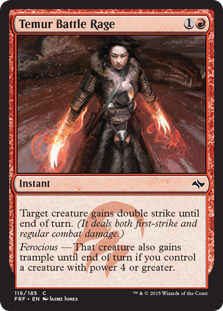
DSJ does have one major weakness in comparison to Temur Delver, however: you can't expect discard into Goyf to get there against strategies that go over the top of fair decks. Tron, Valakut, and Ad Nauseam could care less about Inquisition of Kozilek, and Death's Shadow's threats won't close the game out fast enough to outrace a Karn. Delver strategies address this problem in a few ways: Delver of Secrets, a turn-one threat, applies pressure from the start of the game; Lightning Bolt and company shave turns off the clock; permission, like Leak and Denial, stops Tron and other big-mana decks from actually resolving the bombs they tap out for. DSJ lacks access to these options—it has no turn-one threat, prefers Tarfire to Bolt, and can't play counterspells. But all is not lost: Temur Battle Rage plugs this hole in Death's Shadow strategies admirably.

Go Ape or Go Home

If Death's Shadow Jund already does what Monkey Grow does but better, why return to Monkey Grow at all? There's something to be said for the Bolt-Shoal-Leak-Denial disruption suite, for starters. While countermagic is less efficient and more conditional than discard in Modern, it still answers things Thoughtseize can only dream of, like Wurmcoil Engine off the top. Modern is full of random decks doing random things, and Mana Leak is a great card to have on-hand when those inevitably come around.

I also love Hooting Mandrills's positioning right now. Fatal Push doesn't kill the Ape, and trample gets through Lingering Souls, a common answer to the big grounded beaters Modern has come to revolve around.

Finally, the rise of DSJ has led to a steep decline in traditional Jund's metagame shares. Abzan Midrange has always been easier than Jund for Monkey Grow to beat, as they ramp us into Huntmaster with Path, care more about Moon and Pyroclasm, and lack multipurpose ways to remove Delver of Secrets. On the other hand, Jund is a nightmare for this deck. The Traverse version can beat it, sure. But Monkey Grow's more general strengths, like the ability to cast Shoal proactively and reactively, are lost to the grindy dumbness of a Traverse build. Without Jund to worry about, we can run a more traditional list with Shoals and tune our sideboard to defeat Death's Shadow Jund, a far less frightening proposition given how streamlined that deck is.

Monkey Reborn

Monkey Grow, by Jordan Boisvert

Creatures

4 Delver of Secrets
4 Tarmogoyf
4 Hooting Mandrills
2 Snapcaster Mage

Enchantments

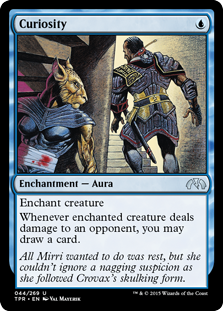
1 Curiosity

Instants

4 Thought Scour
4 Lightning Bolt
1 Tarfire
1 Dismember
4 Disrupting Shoal
3 Mana Leak
3 Stubborn Denial
2 Simic Charm

Sorceries

4 Serum Visions
2 Sleight of Hand

Lands

4 Scalding Tarn
4 Misty Rainforest
1 Wooded Foothills
2 Steam Vents
1 Stomping Ground
1 Breeding Pool
3 Island
1 Forest

Sideboard

3 Blood Moon
3 Huntmaster of the Fells
2 Engineered Explosives
2 Threads of Disloyalty
1 Ancient Grudge
1 Destructive Revelry
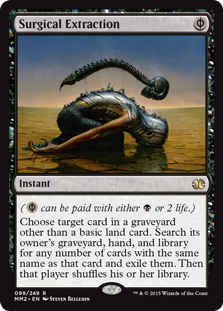
1 Surgical Extraction
2 Pyroclasm

Here's where I landed for my first draft of the deck. This section explains my choices.

Disruption

  • Lightning Bolt: Okay, Bolt isn't what it used to be with Shadow around. After all, toughness-based removal kind of blows against that deck. But going upstairs is no joke, even (especially?) against Death's Shadow strategies. That goes double in a deck with multiple copies of Snapcaster Mage.
  • Disrupting Shoal: I've had some friends dispute Shoal's worth against Shadow. Doesn't discard make the card inconsistent? Shadow players can take either Shoal or the blue card we plan to pitch! Perhaps in theory, but not in practice. This build packs a whopping 29 blue cards, so the odds that Shadow can take our single one-drop in the early game are slim. Beyond that, Shoal represents Cancel or Last Word at worst in this matchup. In my experience, it's often correct for Shadow to strip Shoal from our hand when they see it regardless of our other blue cards, which actually incentivizes us to max out on the counterspell. Still, Shoal sometimes underwhelms against truer midrange decks than Shadow, and for that reason I can see cutting one or two copies for Spell Snare.

Utility

  • Simic Charm: Look who else is back! Without Reveler's pesky condition to worry about, we can afford to run less efficient bounce spells. The utility of hexproof mode is especially relevant in a Fatal Push world, and Giant Growth mode becomes much better when so many Modern players run a set of Goyfs to battle ours with.
  • Sleight of Hand: One-mana sorceries numbers 5 through 6. Necessary for Tarmogoyf, as early-game sorceries allow us to cast Goyf on turn two with no fear of Lightning Bolt. Honestly, I think Sleight is an underrated Modern card. Cantripping is broken.

Flex Spots

  • Curiosity: A hedge against linear decks and midrange. We miss Probe against the former, and Traverse against the latter. Curiosity is also very good with Disrupting Shoal, and I swore by a pair of the enchantment in my early builds of the deck.
  • Tarfire: I'm big on big Goyfs. It's crucial to hit 5/6 against creatures like Tasigur and Smasher.
  • Dismember: A hedge against Eldrazi. The one copy can also nab a Goyf or Shadow against off-guard DSJ players in the early game. Without four copies of Gitaxian Probe, it becomes easier to budget our life around Dismember.

Sideboard

  • Huntmaster of the Fells: Reveler left so much to be desired against go-wide aggro strategies like Merfolk that I ended up even running Huntmaster in the Traverse build. Hunt's also superb against Eldrazi, where he guns down dorks and Skyspawners during topdeck wars (er, topdeck-another-Brushland wars) and generates blockers.
  • Engineered Explosives: Incredibly flexible and enables blowouts. Very strong against DSJ, and lets us run fewer artifact/enchantment-removal cards.
  • Threads of Disloyalty: A more direct hedge against DSJ. I liked Threads there when I drew it in Temur Shadow, but not so much when I opened it, as it would just get discarded. Running two makes it more reliable, and I think we have room for both.

The Joy of the Hunt

If I had to sleeve up Delver of Secrets at a competitive event, I would strongly consider a Temur Delver build similar to the one in this article. Of course, I won't have to; Colorless Eldrazi Stompy's plenty good right now, despite having lost some great matchups in Jund and Infect to format shifts. Still, Jund becoming DSJ bodes well for Monkey lovers jungle-wide, and I'm excited to see if my testing yields an upkeep-trigger-transform deck I can back with my usual baboonian confidence.

Esper Control: Approaching Perfection

Are you a Quiet Speculation member?

If not, now is a perfect time to join up! Our powerful tools, breaking-news analysis, and exclusive Discord channel will make sure you stay up to date and ahead of the curve.

Since my article last week detailing why I think Esper Control is strongly positioned in Modern, I’ve been tweaking and tuning my list online. In the process I've learned a great deal about both the archetype and the current state of Modern. Today, we’ll be digging deeper into the archetype, discussing my current list, finer points, matchup plans, and some general thoughts on the metagame (for those that might not be interested in Esper Control). While I’m still in the process of tweaking my list, I’m pretty confident with where it’s at right now, as I’m currently 9-1 in my last two Modern League events. So stick around—today will be an exercise in archetype analysis, the tuning process, and metagame evaluation.

As a quick recap, last week I began exploring Esper Control as an alternative to Grixis, having found the metagame a little too saturated with poor matchups for my liking. Death’s Shadow Jund, various midrange decks, Tron, Eldrazi, and Burn made up a majority of the enemies I was facing round to round, and all of those archetypes are either poor matchups or well-prepared for fighting a reactive opponent at this point. Grixis Control is a fine reactive strategy, but it often wins by inches, leveraging synergy and efficiency over general card quality. This is not necessarily bad—in a linear field the ability to maximize mana usage on every turn of the game often translates well to victory. In today's field, however, I’ve found myself preferring higher-impact spells (e.g. Supreme Verdict) over synergistic interactions (Lightning Bolt-Snapcaster Mage-Lightning Bolt).

The reasoning behind this is twofold: diverse threats leveraged against us discourage low-impact synergistic spells, and most archetypes are well positioned to fight our primary means of reaction. Think playing Tasigur, the Golden Fang or Lingering Souls to dodge Fatal Push and Lightning Bolt. One-for-one conditional removal, no matter how efficient, is increasingly becoming a liability in this format. Hence the desire to move towards sweepers. While we could stay on-color and play Damnation if we wanted, if we’re not excited to play Lightning Bolt, why stay in red?

"Esper Control, by The_Architect (5-0, Modern League)"

Creatures

3 Snapcaster Mage

Instants

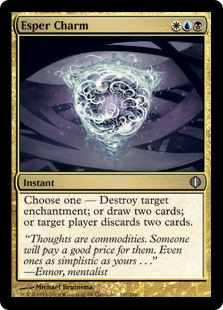
4 Esper Charm
2 Fatal Push
2 Logic Knot
2 Secure the Wastes
2 Mana Leak
3 Path to Exile
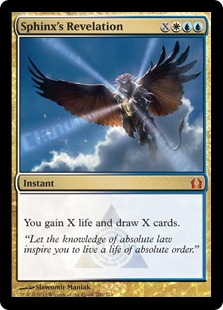
2 Sphinx's Revelation
4 Cryptic Command
4 Think Twice

Sorceries

4 Serum Visions
3 Supreme Verdict

Lands

3 Celestial Colonnade
3 Drowned Catacomb
4 Flooded Strand
3 Glacial Fortress
2 Hallowed Fountain
3 Island
1 Plains
4 Polluted Delta
1 Swamp
1 Watery Grave

Sideboard

1 Elspeth, Sun's Champion
1 Engineered Explosives
1 Fatal Push
1 Gideon Jura
2 Lingering Souls
2 Negate
2 Rest in Peace
2 Stony Silence
2 Thoughtseize
1 Timely Reinforcements

Dropping red for white might seem like a small move, but it fundamentally alters the composition of our deck and thus influences positioning in our matches. Access to Lightning Bolt and the Shock from Kolaghan's Command can really add up with Snapcaster Mage, as anyone familiar with either side of the Grixis Control matchup can attest to. This characteristic is one of two driving forces behind why we see card choices like Tasigur, the Golden Fang and Creeping Tar Pit in those lists. Two or three hits from a single creature is often all it takes to get our opponent into burn range.

The other reason, of course, is the card pool we’re given to work with. Lightning Bolt, Terminate, and Kolaghan's Command are our red spells of choice because, simply, those are the best options in that color for us. This is not necessarily negative—there are fields where those spells are exactly what we want to be playing.

However, in this current field, Supreme Verdict, Esper Charm, Sphinx's Revelation, Secure the Wastes, Path to Exile, and Celestial Colonnade are all enticing options to help us forget we ever missed red. Esper decks are “slower” than Grixis decks because they play slower spells, and they play slower spells because those spells are often better in the abstract. This sounds self-explanatory, but understanding this concept can really help us when we’re constructing our list and the inevitable “Geist of Saint Traft vs. Gideon Jura” or “Negate vs. Dispel” arguments pop up. Know your identity going in, and you’ll be able to make much better informed decisions throughout the process.

Individual Card Choices

That being said, let’s dive into a few points about my current list. The numbers might seem random, but they’re actually pretty tight if we understand spell choices as relatively interchangeable within categories. For example, with cantrips we want the full twelve: four each of Serum Visions, Think Twice, and Esper Charm. However, you can make an argument for cutting one Serum Visions and treating Sphinx's Revelation for x = 2 as the twelfth cantrip. I could also see replacing a Visions for the fourth Snapcaster Mage, which can similarly function as a cantrip.

In any case, Visions is definitely the cantrip I would cut if you wanted to trim. Think Twice is invaluable for pulling ahead. Remember that we’re playing 25 land and looking to play a land and a spell (at least) every turn. Before turn five our mana is stressed. Past turn five we’re fighting basic math. We’re either going to flood out or run out of spells—in both cases more cards are the answer.

Continuing with numbers, it doesn’t matter much what mix of removal you play, as long as you’re playing eight or nine. I have eight (3 Path to Exile, 2 Fatal Push, 3 Supreme Verdict) to make room for the second Secure the Wastes.

Having two copies of Secure means I can be liberal with the first one, firing it off the first chance I get. If you have the option between making two soldiers or flashing back Think Twice on turn three, take the creatures unless you’re digging for a specific answer like Logic Knot against Tron. Casting Secure for x = 1 isn’t going to get us anywhere in game one; our opponent more than likely is sitting on one dead removal spell and would love to get a full card’s value out of it. Postboard that play is fine, but only against an aggressive (non-Death's Shadow) opponent. Assuming we’ve kept their board clear, we don’t have to worry about haste, so holding it as long as possible is the preferred play. Death's Shadow Jund cannot beat Secure the Wastes (more on this later).

Three Snapcaster Mage is the right number in my opinion. We’re playing 4 Cryptic Command and casting the first one as soon as possible. So Snapcaster Mage is at its best in our list when we’re casting it on turn three to flashback a removal spell or on turn six to rebuy a used Cryptic. Yes, there are definitely spots where we don’t have a turn-four Cryptic and can "build our own” using Snapcaster Mage and a spent Mana Leak (the 2/1 being the card we “draw”). Still, 4 Snapcaster Mage leads to us having two in hand more often, which we really don’t want alongside the playset of Cryptic Command. All the value in the world doesn’t help us if we can’t do anything meaningful until turn four. I see Snapcaster Mage as more of a late-game way to extend the value of our spent Cryptics, Revelations, and Secure the Wastes we've cast early to get us through the midgame, with the added value of what Snapcaster can provide on the early turns. If you insist on playing four, cut a Cryptic and try and squeeze in another one-mana spell (perhaps a Thoughtseize in the right field).

Given the choice between flashing back Think Twice and casting Esper Charm on its draw-two mode, I’ve begun leaning towards casting Think Twice first. My reasoning before was a variation of “two cards is better than one,” basically thinking that more cards faster will lead to more information about sequencing and added value later on. For example, against an aggressive deck, two shots at a Supreme Verdict will inform whether I’m taking 3 damage or casting Fatal Push this turn, etc.

However, the more games I’ve played, the more I realize just how invaluable Esper Charm’s Mind Rot mode is. I truly believe Esper Charm is the best card in the deck, and its ability to put the nail in the coffin of the opponent's resources is a huge part of this. Sure, game one they may discard stranded removal spells, and there’s always a chance we trade the opportunity cost to draw two cards of our own for two of their extra lands in hand. In practice, this first Esper Charm just sets up for the second one to hit harder. A turn-five Snapcaster Mage on Mind Rot in their draw step will usually get whatever "big" spells they had left, and Time Walk them in the process. As with Wrath effects against aggro, they can usually weather the first one, but it's the second that ends the game.

And what if we never tag anything good with Charm? In the event they didn't have anything relevant in hand, we were probably winning anyway. So in a certain sense, the worst-case scenario of Esper Charm's discard mode is still good for us! Maybe I’m a glass half-full kind of guy, but I’m struggling to see the drawback. If you need cards, just draw them. You can always Divination.

Matchups

To close things out, my last segment will focus on how our Esper list lines up against some of the top decks in the field. This isn’t a sideboard guide—and we do approach most matchups with the same overall plan—so instead I’ll focus on unique strengths and weaknesses present in the matchups and some tips for how to navigate lines.

Death’s Shadow Jund

Up first, of course, is the de facto “best deck," and one of our best matchups. Death’s Shadow Jund is the over-the-top control deck’s dream. Postboard they dilute their aggressive gameplan with all of these “anti-control cards,” when what we’re really scared of the most is pressure. Yes, sometimes Liliana of the Veil can win for them, but in reality I’d be more scared of facing a Monastery Swiftspear.

This archetype’s primary weakness is their poor play options on turn one, hence their use of discard. While no control deck likes to see Thoughtseize, our list is redundant enough that it rarely matters. Take my Fatal Push? You’re not playing a creature on the first turn anyways, so I’m probably only getting hit once before I can just flash it back. Take my counterspell? You just traded your one-drop for my two-mana counter—I’ll take that exchange any day. Discard Esper Charm? There’s more where that came from, trust me. Yes, there are times where they grab the perfect thing and we whiff on answers, but those are few and far between.

Beyond that, Rest in Peace and Secure the Wastes are both pretty close to lights out. Blanking Tarmogoyf, Traverse the Ulvenwald, Kolaghan's Command, and Lingering Souls shuts down a significant portion of their threats with one card, leaving just Death's Shadow and some Liliana ultimates to worry about. We lose some flashback of our own, but our losses pale in comparison to theirs. As for Secure the Wastes, the Temur Battle Rage/Ghor-Clan Rampager argument is a non-issue. They’re only playing two now, and we’re casting Secure on their end step. If we’re going into their combat step tapped out we’ve got bigger things to worry about. Making four 1/1s to chump-block 6/7s feels pretty dirty, and can buy us a ton of time.

Gx Tron

The Tron matchup is the same as it always has been, but I just want to use this section as an excuse to sing Esper Charm’s praises further. The back and forth tends to revolve around us countering as many of their things as possible and putting them into topdeck mode quickly, where we draw much better than them and can hopefully put the game away before they eventually reach Tron. Which will happen, by the way, as we can’t pressure them quickly enough to kill them before this happens.

Hence why Esper Charm is so important. In most games, by the time they’ve assembled Tron (assuming we were able to interact with some significance) they are down to the last couple cards in hand. Soft-locking them by making them discard in their draw step is our primary path to victory, but only if we have some sort of pressure going on. Don't be afraid to Ambush Viper a Snapcaster Mage or make two 1/1s quickly, as that’s how we’re winning this matchup.

A wall of counterspells can help, but Worldbreaker, Ulamog, the Ceaseless Hunger, and Sanctum of Ugin can be difficult to fight. If classic Tron cracks the top five most represented decks I could see boarding a Surgical Extraction to take off their top end.

Bant Eldrazi

The name of the game here is value, any way we can get it. They will try and overrun our removal with Thought-Knot Seer, Matter Reshaper, and Reality Smasher. Meanwhile, Cavern of Souls makes most of our counterspells irrelevant. Chalice of the Void is a problem too if they have it (though most Chalice decks are the Eldrazi Tron versions). Regardless, they have a lot of hard-hitting threats that can punish us if we stumble.

Luckily, Timely Reinforcements, Secure the Wastes, and Lingering Souls are great at forcing them to commit into our Supreme Verdict. They tend to play one spell per turn, which lets us respond and use the rest of our mana to pull ahead on cards. Sphinx's Revelation is our ticking time bomb that they can’t stop, but watch out for Stubborn Denial, Disdainful Stroke, or Negate.

This matchup revolves around making sure we don’t take too much damage early so we don’t die to a Reality Smasher late. Oh, and they always have expensive things left over for us to grab with Esper Charm.

Conclusion

Overall, I’ve been having a ton of fun with Esper Control lately. I've also been winning consistently, which rarely goes hand in hand with bringing control to the table in Modern. I’ll reiterate my point last week and say that if you’ve ever wanted to play classic Draw-Go in Modern, this is probably the best it’s ever been. Draw-Go is a fun exercise in some classic under-the-hood Magic fundamentals, and locking our opponent out from casting spells is just good clean fun as well. Good luck to you, and may all your Esper Charms hit double spells.

Thanks for reading,

Trevor Holmes

The_Architect on MTGO

twitter.com/7he4rchitect

Twitch.tv/Architect_Gaming

Insider: QS Cast #58: Early Signs of Amonkhet

Are you a Quiet Speculation member?

If not, now is a perfect time to join up! Our powerful tools, breaking-news analysis, and exclusive Discord channel will make sure you stay up to date and ahead of the curve.

Play

The QS Cast has returned: Chaz Volpe, and Tarkan Dospil continue on with where the cast left off and in this episode they discuss the following:

  • Kelly Reid re-joins the cast to discuss early news of Amonkhet. Kelly Reid is the CEO of Quiet Speculation/ION Scanner
  • Interests
  • We discuss how the AKH Invocations could leave extra growth room for AKH cards.
  • Looked at reactionary cards, and how we can traverse new Standard from early signs.

Cards we discussed:


As always, please comment and leave questions for us to address on the next cast! We will be making QS Insider questions a priority, and we want to know what you want covered.

Enjoy! We’re glad to be back.

Find us on Twitter: @ChazVMTG  @the_tark @kellyreid

Insider: That Lotus I Bought, Graded

Are you a Quiet Speculation member?

If not, now is a perfect time to join up! Our powerful tools, breaking-news analysis, and exclusive Discord channel will make sure you stay up to date and ahead of the curve.

Hey, everyone!

I hope these Black Lotus articles haven't been too polarizing. I recognize that some of you don't care at all about $x,000 cards, but I hope most of you have been entertained by my journey. For those in the former group, this will be the last article on the subject. For those in the latter group, feel free to follow me on Twitter, where I'll continue to talk about this stuff whenever I come across it.

As the existence of this article probably indicates, my Lotus came back. I stated in the prequel to this piece that I would be comfortable with an 8.5, and ecstatic with a 9. I didn't even consider the possibility that it would come back as anything greater than that.

I'll let this speak for itself:

20170327_090602

So... yeah. A 9.5 on three of the four grades, with edges "only" being a 9.

This changed everything. While I was originally hoping to get somewhere between $4,000 and $5,000, I'm suddenly looking at maybe double that.

I immediately messaged the person I got it from and let them know they'd be receiving a bonus as well when I finally managed to move it. Remember that comment last week about how being open and honest is the best policy? I'm friends with that person on Facebook, which is coincidentally where I'll be trying to move this Lotus. The last thing I want to happen is to start posting this on high-end groups for $8,000, and have my friend see that post and watch me more than double up on the Lotus that we both initially (and mistakenly) thought was LP because of our harsh scrutiny that allowed me to pick it up for $3,000 plus $250 in trade in the first place. The person this Lotus came from still has more Power waiting to be unloaded when they're finished spending the money from the Lotus, so I still want to maintain that relationship in the long term.

So let's talk a little bit about how many of these things are out there. I mean, Lotuses aren't exactly commonplace already, even less of them are graded, and an even smaller percentage receive a grade this high. My inquisition was rewarded when I was told that there exists a "population report" for all of BGS's graded products. I mean, that makes sense when I actually think about it, because it has a serial number and everything now, but I was pleasantly surprised when I checked out the pop report for BGS Unlimited 9.5 Lotuses.

pop report

There are 24 of these in existence. Twenty-four. While some may have been since cracked open and played with to decrease that number, there's a stark difference between the number of 9.0s and 9.5s that sets this gem apart from the rest of the pack. While there's no direct financial value correlating to this population report, it's certainly a bargaining chip on my side of the table when I'm trying to find a buyer. How often are you going to see one of these in the wild again? Where do you even find something like this on the internet to price check it?

Okay, so maybe that last paragraph was a little melodramatic. You can actually find two on the internet right now, and both are being sold by the two eBay powerhouses of Magic: Dan Bock and Dave & Adams. They're asking $8900 and then $9350, with wiggle room for a best offer. Those are the numbers that I'll obviously have to undercut by some degree if I ever intend to make a sale, but it's something I can work with.

Untitled

I don't have a realistic way to sell this on eBay and TCGplayer; the former because I literally have no experience selling on eBay, and the latter because you can't really sell graded cards. That leaves either locally (possible, but extremely unlikely) or social media. I'm almost definitely going to have to find a buyer on a high-end group and use the fact that I have a reputation with references at my disposal. I'll almost certainly take another hit on shipping when I find a buyer, but we're still looking at well over a $3,000 profit when everything is said and done. Maybe some QS Insiders are looking to pick up a nice 9.5 with all the money that this site has made them...?

lotussalepost

Here's the post that I made to all the various high-end groups that I'm in. I set my initial asking price at $8,700, but I'm obviously willing to negotiate that down. I just posted it earlier this morning, but the highest offer I've gotten so far is $7,000. That sounds like a snap deal considering the margins I'm working with, and I might take them up on it in a couple weeks if no one else bites, but every high-end vendor who I've asked for advice on this so far has suggested that I try to get at least $8,000.

Regardless how much I make, it's going right back into my student loans, so I can hopefully pay those off by the end of the calendar year. Thanks for reading!

Insider: Top 10 Cards Not in MMA17

Are you a Quiet Speculation member?

If not, now is a perfect time to join up! Our powerful tools, breaking-news analysis, and exclusive Discord channel will make sure you stay up to date and ahead of the curve.

With all the hype surrounding Modern Masters 2017, I’ve written thousands of words on the subject. One of the main topics I haven’t covered yet is what didn’t get printed in the set. We can gain just as much from the cards that were not included in the set as the ones that were. Today, I’ve chosen one of mine and your favorite article formats: the Top 10! So, let’s dive right in:

Top 10 Modern Cards Not Included in MMA17

Honorable Mentions

There was an error retrieving a chart for Vendilion Clique

There are a couple cards previously printed in Modern Masters that didn’t make the cut this time around. The ones that stick out are Vendilion Clique and Doubling Season. Clique hasn’t seen a ton of play recently, because tempo decks aren’t as prevalent as they used to be in the format. I think this has a lot to do with the existence of Cavern of Souls paired with Eldrazi, because fast, potent aggro like that runs over tempo decks that can’t counter important spells to stay ahead. Doubling Season is a good one to mention as well as it’s seen some growth recently. The third one worth mentioning is Kitchen Finks. This uncommon should be seeing some growth in the near future. With no reprint, I’d expect to see this creature bump back up to the $10 range.

There was an error retrieving a chart for Ensnaring Bridge

Maybe a Masterpiece is enough to keep the price of Ensnaring Bridge down, but this is still an important card that was not on the reprint list.

There was an error retrieving a chart for Horizon Canopy

As I said a couple of weeks ago, I thought that this iteration of Modern Masters would include some lands in the mythic slots. I was slightly off, and happy to be so, because we got the Zendikar fetches at rare. I would have still liked Horizon Canopy and Grove of the Burnwillows in the set, but fetches are fetches and they’ll always be awesome. We notably also didn’t get any of the creature-lands like [Cards]Creeping Tar Pit[/Cards]. That land cycle has been slowly on the rise for a while now, and that trend should continue until it finally gets a reprint. The Zendikar creature lands could be reprinted in Standard, though, because they were not overpowered enough to warp the format.

10.
There was an error retrieving a chart for Mishra's Bauble

Wowzers. I’m sure this is old news by this point but the success of Death's Shadow has propelled this older card to approximately a million dollars. Mishra's Bauble, a Coldsnap uncommon, is now a $50 card. With a name like that, who knows when this card will be reprinted. This is the most expensive uncommon in Modern by a mile, and it could still go higher. I expect that most players will be priced out of owning this card because they won’t be able to justify spending $200 or more on a play set for their deck.

9.
There was an error retrieving a chart for Ancestral Vision

I expected Ancestral Vision as a reprint, but we didn’t get it. I think the hype has slowed a bit on this card, but tournament results sporting this deck could propel it above its unbanning price point of $40.

One thing I’m wondering is that with the prices of the high-end Modern cards coming down under $100, are we entering an era of $50 cards? It seems like more and more cards are converging on this price point. Is that going to be a trend in the format? This is definitely something to keep our eye on going forward. Spoiler: Most of my list fits this description.

8.
There was an error retrieving a chart for Glimmervoid

Glimmervoid is another card that has already gotten a reprint, but it’s back to its original price point now. With Death's Shadow taking over the format, Affinity’s dominance has slowed considerably. We didn’t get any cards from this deck in MMA17, though, and that most likely means a price increase. We could see a plateau on Glimmervoid in particular if new players don’t gravitate towards this strategy.

7.
There was an error retrieving a chart for Mox Opal

Again for one of the most historically popular strategies in Modern, Mox Opal is another important component that didn’t get the reprint it needed. Now $60, we’ve already seen a price bump from not being reprinted; with some tournament success, we could see it jump even higher. Affinity has been in a state of flux lately due to all of these new artifacts that could possibly see play in the deck. The best version needs to be found once again, and when that happens, look for your investments to increase on this one. The same could be said of Inkmoth Nexus and Arcbound Ravager as well, who almost got included on this list. [Card]Mox Opal[Card] also sees play in a couple other strategies, and that pushes the price forward as well.

6.
There was an error retrieving a chart for Karn Liberated

Next up is Karn Liberated. Urzatron has been one of the latest developments in Modern. It seems like every major event that passes, someone else has a sweet new version of Tron with a different list of cards to pair with the powerful mana lands. Karn could continue to rise as well, so if you need your copies, I’d get in now.

One detriment to the brewing with Tron is the shifting away from Grove of the Burnwillows. If players aren’t running red and green together for this strategy, not as many players actually need this powerful land. If the meta shifts back to red-green, though, expect a quick price jump on Grove.

5.
There was an error retrieving a chart for Scapeshift

Scapeshift is one of those cards you don’t see printed very often. This green sorcery is basically a one-card strategy. Just like Primeval Titan, Scapeshift can do a number of things just with the land base you construct your deck with. The main strategy with this card is of course Valakut, the Molten Pinnacle, but there could be others that come about in the future. Valakut is just the most powerful land to pair with Scapeshift. All we need for this card to have huge gains is a new card to include in the strategy. The last one was Dig Through Time. I thought Bring to Light was going to be the next big thing, but that never took off.

4.
There was an error retrieving a chart for Chalice of the Void

Chalice of the Void has exploded in price since it was reprinted in the first Modern Masters. The format has adopted this hate artifact into a couple different strategies. From experience, many players just don’t have an answer to this card. Sometimes you cast Chalice for one and your opponent concedes. We would see an even bigger price jump on this card if it found a home in a tier-one deck. As of now, the decks that play it aren’t dominating the meta and so the price is only $60. It could go a lot higher if it finds the right home.

3.
There was an error retrieving a chart for Engineered Explosives

At number three, we have the new hotness, Engineered Explosives. Modern players figured out that Explosives is basically a better version of Ratchet Bomb. You can play both for two mana and deal with tokens, which can be a huge deal. It also has versatility to use more mana to blow up higher cost things faster than Ratchet Bomb can tick up. Finally, the reason Engineered Explosives is such a dangerous card is because nearly any deck can play it.

Reminder: you can play Explosives for additional mana to get around things like Counterbalance in Legacy or Chalice of the Void in Modern by paying additional colorless mana. This is a great trick to remember if you’re playing this card.

2.
There was an error retrieving a chart for Noble Hierarch

Noble Hierarch is up next. This mana dork is the best ever printed, even better than the old-school Birds of Paradise. I doubt we will ever see another mana accelerant as great as Noble. Currently it’s a centerpiece of Bant Eldrazi as well as the currently less popular Infect deck and others. As long as it’s legal, Noble will be played, and it will be awesome. Without a reprint this time, it's going to continue to grow above its previous price peak.

1.
There was an error retrieving a chart for Through the Breach

Finally, number one on this list is Through the Breach. With a keyword on this card, it’s hard to say when this could be reprinted. They had a great opportunity the last time around when splice onto arcane was already a supported mechanic, and I think they missed this necessary reprint. At the time, it was only $25 dollars, but it has since double up. You can combine Breach with Goryo's Vengence or just play it separately with cards like Primeval Titan or a giant Eldrazi. Either way, this Sneak Attack variant is a powerful strategy to be playing in Modern right now.

So, there you have it. The top 10 cards not printed in MMA17. Did I miss a card you thought should be on the list? What would you have included? How high do you think these cards could go? Let me know in the comments. Next week, I’ll most likely be diving into Amonkhet cards, so stay tuned for that!

Until next time,
Unleash the Force!

Mike Lanigan
MtgJedi on Twitter

Insider: The Magic of Sealed Product

Are you a Quiet Speculation member?

If not, now is a perfect time to join up! Our powerful tools, breaking-news analysis, and exclusive Discord channel will make sure you stay up to date and ahead of the curve.

Welcome back, readers!

Today's article stems from an interesting phenomenon I've noticed recently regarding a lot of sealed product (specifically from older sets). Many older sealed boxes are worth considerably more than the best card one could pull from them, and more than the estimated expected value of all the packs combined. This difference is often by a pretty large margin.

As I'm a data-driven person, let's look at some actual numbers.

saga

Set Name Box EV (According to Dawnglare) Box Price (most recent on eBay) Ratio
Innistrad $68.00 $285.00 0.239
Dark Ascension $29.00 $115.00 0.252
Avacyn Restored $58.00 $164.00 0.354
Scars of Mirrodin $96.00 $200.00 0.480
Mirrodin Besieged $71.00 $190.00 0.374
New Phyrexia $158.00 $320.00 0.494
Mirrodin $98.00 $245.00 0.400
Darksteel $175.00 $411.50 0.425
Fifth Dawn $178.00 $250.00 0.712
Fallen Empires $3.00 $136.50 0.022
Urza's Saga $175.00 $2,000.00 0.088
Zendikar $178.00 $515.00 0.346
Worldwake $121.00 $654.00 0.185
Rise of the Eldrazi $114.00 $436.00 0.261
Time Spiral $103.00 $392.00 0.263
Planar Chaos $89.00 $377.00 0.236
Future Sight $305.00 $721.00 0.423
Champions of Kamigawa $187.00 $400.00 0.468
Betrayers of Kamigawa $115.00 $249.00 0.462
Saviors of Kamigawa $100.00 $158.50 0.631
Onslaught $98.00 $351.50 0.279
Legions $54.00 $185.00 0.292
Scourge $81.00 $173.00 0.468
Ravnica: City of Guilds $169.00 $415.00 0.407
Guildpact $86.00 $204.50 0.421
Dissension $142.00 $285.00 0.498

This table compares the expected value (EV) of sealed boxes with the most recent eBay sold listing (including shipping). Prices in the first category are taken from TCGPlayer Low, because that's the price you'd likely need to sell the cards at in order to move them quickly.

The numbers are all over the place, but the trend is pretty clear. Not a single set comes close to recouping your investment, with only two (Fifth Dawn and Saviors of Kamigawa) cracking the 50% mark. Overall the average EV of an out-of-print box is around 36.5% of its current selling price. If we remove the two big outliers (Urza's Saga and Fallen Empires), it moves up towards 39%.

Drafting

BoosterBox_Ravnica

This means if you are buying older boxes to draft, you really need to place a high value on the drafting part of it—because you're likely losing a significant amount of money to do so.

It's interesting to see how the numbers break down for the most popular formats. Here's a sampling of some of the "funnest" draft formats of all time, according to Channel Fireball:

  • Ravnica: City of Guilds-Guildpact-Dissension - Box prices of this block are 100% or more of MSRP. It's interesting that all three sets have an EV-to-price ratio above 0.4.
  • Mirrodin-Mirrodin-Darksteel - What is interesting in this draft format is that the set not included (Fifth Dawn) has the highest EV-to-price ratio on our list, whereas Mirrodin (0.4) and Darksteel (0.425) are at a similar ratio to our previous RGD draft set.
  • Time Spiral-Time Spiral-Planar Chaos - Again we have only the first two sets in a three-set block, but more interestingly this draft set has a very low ratio (in the 0.25 range).
  • Champions-Champions-Betrayers - This draft set has an EV-to-price ratio close to 0.46.
  • Triple Innistrad - This draft format has terrible EV-to-price ratio, but as someone who played during this time, I can say it was a fun set to draft (good mechanics and solid synergy).
  • Triple Rise of the Eldrazi - Again another 0.26 ratio, but a fun format (I know I really enjoyed triple Rise drafts).

This not a definitive list or anything (fun is very subjective, after all). But the key takeaway is that the supposed funnest draft formats tended to have a relatively low EV-to-price ratio. So again, before you decide to buy and crack old boxes in draft you need to accept that you are very likely going to lose money.

Lottery Tickets

mtgfuturesightbx2

Another reason people might want to buy these boxes is because there's always a chance (largely thanks to foils) of cracking something very valuable. For the data below, I searched TCG Player for the most valuable card in each set—which for everything post-foil era is the foil version—and then compared that to the box price.

Set Name Most Valuable Card Price Box Price (most recent on eBay) Lottery Ratio
Innistrad $171.85 $285.00 0.603
Dark Ascension $41.87 $115.00 0.364
Avacyn Restored $116.21 $164.00 0.709
Scars of Mirrodin $78.19 $200.00 0.391
Mirrodin Besieged $48.57 $190.00 0.256
New Phyrexia $88.21 $320.00 0.276
Mirrodin $85.84 $245.00 0.350
Darksteel $65.14 $411.50 0.158
Fifth Dawn $85.27 $250.00 0.341
Fallen Empires $2.00 $136.50 0.015
Urza's Saga $192.62 $2,000.00 0.096
Zendikar $154.61 $515.00 0.300
Worldwake $314.84 $654.00 0.481
Rise of the Eldrazi $124.90 $436.00 0.286
Time Spiral $194.47 $392.00 0.496
Planar Chaos $97.14 $377.00 0.258
Future Sight $684.90 $721.00 0.950
Champions of Kamigawa $79.54 $400.00 0.199
Betrayers of Kamigawa $166.74 $249.00 0.670
Saviors of Kamigawa $79.84 $158.50 0.504
Onslaught $252.00 $351.50 0.717
Legions $49.30 $185.00 0.266
Scourge $27.84 $173.00 0.161
Ravnica: City of Guilds $126.40 $415.00 0.305
Guildpact $100.00 $204.50 0.489
Dissension $116.50 $285.00 0.409

The average lottery ratio is right around 0.38. Again the two worst sets are Fallen Empires and Urza's Saga, and if we eliminate them it's closer to 0.41. So the lottery ratio is actually close to the box EV-to-retail price ratio (which makes sense as the box EV likely incorporates this lottery aspect somewhat).

This gives us the "lottery ratio," or what you'll get in return if you're lucky enough to open the most valuable card. Notice not a single box listed has a ratio exceeding 1.0 (the closest is Future Sight with foil Tarmogoyf). So even in the best-case scenario (barring extremely unlikely boxes with multiple high-value foils), you're losing money! Some lottery.

There was an error retrieving a chart for Tarmogoyf

"Reserved List" Investment

The last reason I can see people purchasing these boxes is as a sort of "Reserved List" investment. What I mean by this is that it's unlikely that Wizards will print more of these boxes directly, which means they carry some of the same benefits as the Reserved List. Though it is critical to understand that WotC could reprint a set if they so chose to, even if they haven't yet.

It also makes sense that the older sets (which likely had a smaller print run and less unopened product in the market) command higher prices, even when their "lottery card" and their box EV aren't particularly high (as with Darksteel, for example).

Recently we've seen more people invest in sealed product after seeing the very high prices that some older sets command. Now that it's a "known" potential investment, we will likely see box prices muted as more people put away extra sealed boxes of newer sets. As WoTC prints to demand, this will result in more sealed product being created, and thus lower prices.

Conclusion

While there are a multitude of reasons behind the current values of some sealed product, it's important to consider the likelihood that the "lottery card" and the draftability of said product play a role. There are obvious exceptions for very old product like Urza's Saga, which has very low ratios on both fronts but sells for far more than any of the other boxes on this list.

That being said, if one wants to move into speculating on sealed product, all these factors should be considered. Especially relevant to watch out for are reprints that would hurt both the "lottery card" value and the box EV.

An example of this final note is Innistrad sealed product. It dropped in value with the reprinting of both Liliana of the Veil and Snapcaster Mage as RPTQ promos, and now with their inclusion in MM3. In fact, if you look at the eBay sold listings for Innistrad booster boxes before MM3 spoilers started going up, you'll see several that hit or broke $300 a box. In light of the reprints, the box EV will likely continue to trend downward.

There was an error retrieving a chart for Snapcaster Mage

Want Prices?

Browse thousands of prices with the first and most comprehensive MTG Finance tool around.


Trader Tools lists both buylist and retail prices for every MTG card, going back a decade.

Quiet Speculation