menu

Insider: The Lack of Equipment in Kaladesh

Are you a Quiet Speculation member?

If not, now is a perfect time to join up! Our powerful tools, breaking-news analysis, and exclusive Discord channel will make sure you stay up to date and ahead of the curve.

We're going to take a bit of a break from bulk commons and uncommons this week to discuss something I should have written about last week, maybe even the week before. Or a month before. Ah well. Hopefully we'll go on a bit of a twist halfway through so we can use what we learn here to figure out future specs, or something like that. You won't even notice the seamless transition; I promise. If you follow me, MTGFinance Central, or Brian Dale on Twitter (You absolutely should), you may have noticed us having a bit of a light-hearted debate on the merits of Sigarda's Aid as a spec. They believed it had merit because of its low buy-in price and perceived Equipment synergies with Kaladesh being a steampunky, artifact themed block; I countered with some summarized arguments that I'm going to expand on throughout this article. While I disagree with their viewpoint on this card and theme specifically, you should absolutely follow them for some other solid specs and topics of discussion. MTGFinance Central was a strong supporter of Traverse the Ulvenwald early on, a card that showed up huge during Pro Tour Eldritch Moon.

There was an error retrieving a chart for Sigarda's Aid

sig1

To be perfectly honest, I'm going to assume that most of you reading this article agree with my side of the equipment debate. I put up a Twitter poll a few days ago, and 2/3 of respondents turned down the possibility. While I failed to specify the different between a full on equipment "theme" vs. "sub-theme," and didn't include Aether Revolt in my poll, I'd like to clarify  now that I do reject the possibility of all things equipment in the whole block of Kaladesh. I'm perfectly happy selling Sigarda's Aid at $1 because I know that competitive players are happily willing to move them at $.50 or even $.25.

If we use Gatherer to check out the number of "equipment matters" cards in Standard before Kaladesh, there's only a couple "speccable" cards that come to mind. We're not unaccustomed to Wizards of the Coast planting themes for future blocks in the current block (Steel Overseer before our return trip to Mirrodin is the first that comes to mind), and you might have been picking up the following bulk rares since Kaladesh was announced to be the fall set this year, thanks to the Origins sneak peek into what the world looked like. Stone Haven Outfitter looked like a "maybe one day" bulk rare, and I don't fault anyone for picking these up at .10. Slayer's Plate seemed like it could have been viable if the heavy equip cost could be avoided. Cards like Weapons Trainer gave the subtle hint that an equipment deck might be in the near future, and I was picking them out of bulk commons and uncommons on the off-chance that a tier 2 Standard deck happened to emerge. Unfortunately out of all the Gatherer results for equipment, we still come up short of a real deck; it would have needed support from Kaladesh to manifest.

As soon as vehicles were spoiled, the chance of any equipment theme or sub-theme was dead. Vehicles play very poorly with equipment on either end; you either tap your equipped creature to Crew a vehicle (feels bad) or you Crew a vehicle and equip something to it, only for it to fall off at the end of the turn (feels bad). Neither outcome feels very rewarding, especially when vehicles are aesthetic equipments in their own right. Kaladesh will likely have the same number or even less equipment than other sets, because there's no room in either the mechanics or the flavor. Do you remember the last set where we had a real Equipment theme? It was Scars of Mirrodin block, and that was because we had a literal war of the world going on. There were divided factions, and both sides needed weapons to do battle with. In fact, pretty much every plane we've visited in the past seven years has had a significant conflict, antagonist(s), and/or war. Kaladesh is a breath of fresh air from life or death conflict, and I don't foresee the need for an armory of weapons. While the next set name implies conflict in Aether Revolt, it makes much more sense to convert vehicles into more weapon-like devices that still use the Crew mechanic instead of trying to make both equipment and Crew work across a draft format.

So why am I launching a Campaign of Vengeance against Sigarda's Aid? Honestly, that initial difference for the buy in cost is massive. When we get down to bulk and near-bulk specs, buying in at $.25 and $.10 are worlds apart. If you went on TCGplayer, eBay, or SCG and purchased 40 copies of Aid at $1.00, you're hoping that it triples or quadruples before you start to see realistic profits that cover the costs of shipping and fees. Traverse the Ulvenwald was run as a 4-of in successful Pro Tour decks, and it still barely meets that threshold today. On the other hand, you've had months to be picking up Stone Haven Outfitter at $.41 each from retail sites like TCGplayer. That's excluding the possibility of picking them up for quarters or even dimes (Hint; you should be paying dimes) out of the binders of your local players who cracked Oath of the Gatewatch boxes for Eldrazi.

sig3

So what's the trick to picking up Aid at a half of TCG market, and Outfitter at a dime? Well, cash is the easiest method; I'll get that out of the way right now. It's so much faster to deal in dollars and dimes instead of trying to reanimate the dead art of trading. While there are a few stalwart LGS where trading at TCG mid/market still exists, I've found it to be utterly miserable for the past few years. Offering cash dollars for bulk and near bulk rares is an incredibly effective way to help Standard players get their fix for the next set. Spike wants to spend $500 on a case of Kaladesh, but his binder is still thick with recent rares that didn't end up seeing play, because he only built Bant Company and Temur Emerge for the past six months. Send Spike a Facebook message, and let them know that you'd be happy to buy all of those jank rares out of their binder at buylist prices. You'll even drive to their house and sort out everything by price. Put that Aid in the .25 or .50 pile, and the Outfitter in the dime pile. If he wants to trade for staples to fill out his next Standard deck, ship him/her that Liliana, the Last Hope at TCG low while you swim in bulk rares. Everyone's happy.

End Step

Our podcast Cartel Aristocrats is on iTunes now! We're on episode 24 now, and I really like Jim's pick of the week for this most recent cast. It got me thinking about the quantity and power level of current Planeswalkers in Standard, and the possibility of a Superfriends deck being viable. All of the Oaths sans Nissa are currently bulk rares, which makes them easy to pick up and set aside just in case. My "pick of the week" for this article is in the similar vein of being a bulk mythic, but has a lot of potential upside thanks to being an Eldritch Moon mythic with lower than normal supply.

There was an error retrieving a chart for Deploy the Gatewatch

I'm a big fan of trading for these at $1 if you're moving out of cards like Sigarda's Aid, and I'm very happy buying as many as I can for $.50-.75. While there is risk in buying at above buylist prices, I'm hoping that its' low supply will help keep buylist numbers higher than an average bulk mythic. As always, thanks for reading! I'm happy to discuss finance or any questions on Twitter at @Rose0fthorns, or in the comments section below.


Insider: MTGO Cards to Buy, Sell or Hold – Episode 9

Are you a Quiet Speculation member?

If not, now is a perfect time to join up! Our powerful tools, breaking-news analysis, and exclusive Discord channel will make sure you stay up to date and ahead of the curve.

Hello investors and welcome back! This week has been a blast for me as I managed to win the Battle of Tix hosted by Cardhoarder, the first ever Magic Online finance competition. I hope there will be other competitions in the future where I will try to participate as well; this might be the beginning of something bigger in the finance community. About the speculations for this episode, we are in a particular scenario, hard to invest with very few good buys, because of the Modern Masters 2017 announcement and draft league events. So let's get going:

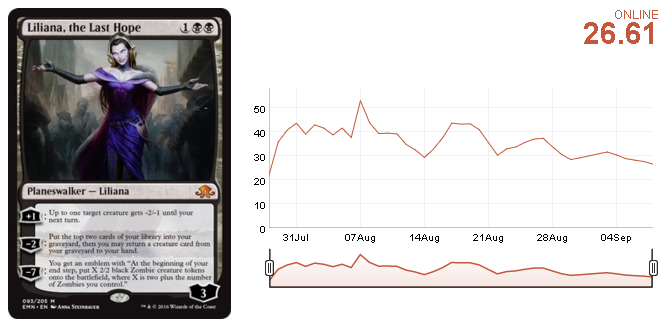
Liliana, the Last Hope

liliana-the-last-hope

I'm not sure how big will be the impact in price of the newly introduced Draft League, but one thing is certain it will lower the prices. Add it that we are one moth away from the new set online prerelease, so people usually sell all of their cards. My personal strategy is to close every position from EMN or SOI that it is positive and rebuy them in a few days cheaper.

Verdict: SELL

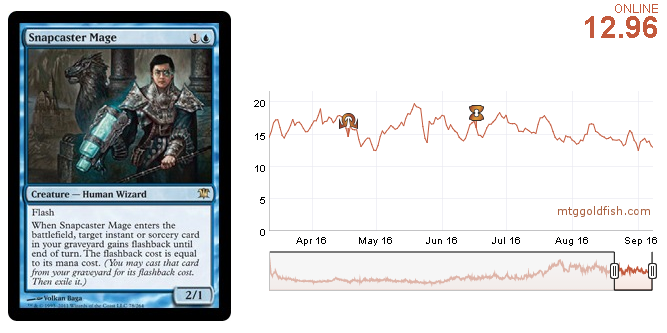
Snapcaster Mage

snapcaster-mage

People are so worried about this mage being reprinted that I expect a second wave of sells making the price go lower. It doesn't really matter if it will be reprinted or not (for now) because you can't control what other investors or players will do. With the information we currently have I think its better to sell it as soon as possible to minimize the loss. If the don't reprint it, then yes I will happy to buy them as they will spike fast.

Verdict: SELL

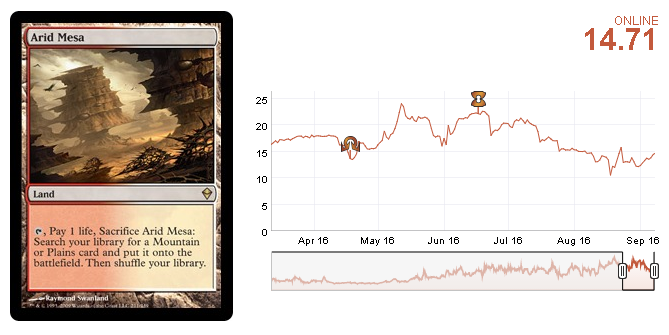
Arid Mesa

arid-mesa

Zendikar flashback draft ended a dew days ago and fetchlands have already rebounded, but I don't think it's a good move to liquidate them so fast, not even if you like the short term strategy as much as I do. A good moment to sell them would be after all Modern Masters 3 have been spoiled. If you check price history of modern staples you will see that many of the staples that weren't reprinted in Modern Master sets spiked really high with a price adjustment after that. I don't think they will reprint them, but it is definitely a possibility, in this case I would sell them as soon as they are spoiled.

Verdict: HOLD

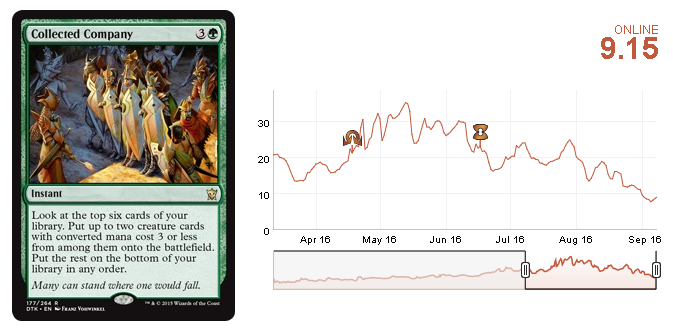
Collected Company

collected-company

One of the very few cards from the sets leaving standard that is playable in modern is Collected Company. You might be tempted to buy them because they are really cheap, but wait! Just wait a few more weeks, after it leave the format or after the Pro Tour when people would want to change their decks, and you will find a much better price.

Verdict: SELL

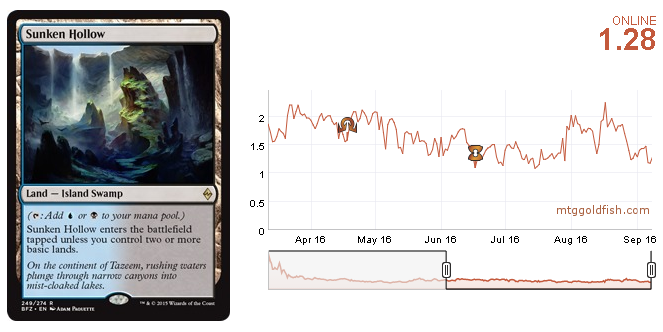
Sunken Hollow

sunken-hollow

One of the few secure buys this week are cards from BFZ and OGW sets. Sunken Hollow is at the bottom of its trend, so its a good time to buy in. I prefer to sell it for a fast 10% to 20% profit rather than waiting for the Pro Tour for a bigger profit.

Verdict: BUY


That's it for right now, see you next week!

High Stakes MTGO – Aug 28th to Sep 3rd

Are you a Quiet Speculation member?

If not, now is a perfect time to join up! Our powerful tools, breaking-news analysis, and exclusive Discord channel will make sure you stay up to date and ahead of the curve.

Hi everyone, and welcome back to High Stakes MTGO!

Similarly to the Aug 21st-27th week, this past week was skewed towards buying with only a couple more playsets of painlands sold. My buying activities were nonetheless lighter considering the bulk of my Zendikar block specs were done.

Rise of the Eldrazi was the next set to be flashback-drafted and although this third set is drafted three boosters at a time it was clearly not as intense as it was with Zendikar and prices haven’t dropped much as of Saturday afternoon. This doesn’t mean there’s nothing to pick up in ROE though and it won’t be long before I make a move.

With three GPs featuring Modern Constructed on the same weekend a week ago, the interest for Modern is not dying. While aggressive strategies, recent or old, are still kings, the format is again very wide open. Here are a few things I noted during last weekend:

  • Dredge showed its limits and key cards revolving around this deck such as Golgari Grave-Troll, Greater Gargadon, Bridge From Below and Leyline of the Void are most likely bound to take a big cut in the coming days and weeks. Even the half-priced Bloodghasts I picked up last week don’t look so great.
  • Through the Breach set a new record for itself after a doubling to more than 32 tix in merely a week. As sexy and efficient as the GR Titan Breach and Griselbrand decks may look after doubling in price, this isn't sustainable. I would have sold any Through the Breaches if I had some. Interestingly Scapeshift hasn’t picked up much after Titan Breach's recent successes. It is certainly more about Primeval Titan and Through the Breach these days but who knows when a full combo Scapeshift-only deck will return. Scapeshift is a card I have on my radar.
  • Amulet 2.0 might well have arrived. With his 9th place finish at GP Lille, Kevin Grove proved that without Summer Bloom Amulet can be not just viable but competitive. News I gladly welcome since I own a pile of Azusa, Lost but Seeking purchased at a discounted price after Champions of Kamigawa flashback drafts. Azusa doubled over the course of this past week and Summoner's Pact, also played in the RG Titan Breach decks, tripled in less than two weeks. We might see even more action here.

While this isn't really specific to the triplet of Modern GPs, buying Modern staples is time and time again proving to be one of the safest and most profitable ways to generate tix on MTGO. Although the Standard environment is about to change, Modern is definitely where I place my bets these days. Let's see what happened for me this past week.

The new portfolio snapshot is available here.

Buys This Week

RaresWWK

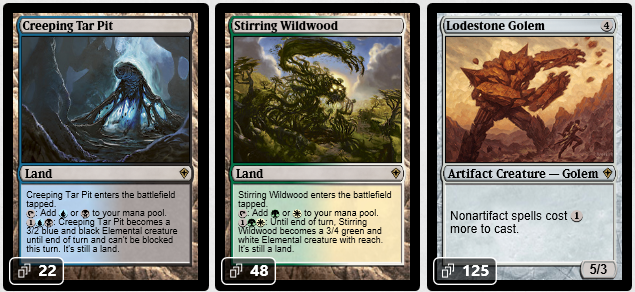
After Celestial Colonnade and Death's Shadow last week I put my hands on two other creature lands. Although I didn't exactly catch the absolute floor for the Wildwood these two lands have the potential to triple from my buying prices to their respective record highs.

With a much thinner margin of progress I didn't buy Raging Ravine. That being said the price the red-green creature land is on the loose---I'll probably be a buyer if the price get closer to 4 tix.

As bulk rare as could be, Lodestone Golem is one of those cards I'm happy to accumulate virtually for free and wait for something to happen, for a long time if needed. With a reprint in Modern Masters 2015 and a round of WWK flashback drafts I'm assuming the price of this golem couldn't be cheaper.

Now, the only thing I'm waiting for is for Lodestone Golem to find a home in a Modern deck which, who knows, could happen with a little push from Kaladesh block's artifact focus. My other option is a good budget deck from SaffronOlive.

TE

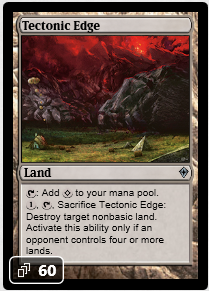
Often fluctuating between 1 and 2 tix and with the potential to reach 3 tix, Tectonic Edge is simply a solid uncommon pick here. As an uncommon I'm expecting to see a lot of fluctuations in the price but I'm hoping to sell this land between 1 and 1.5 tix soon. I may have to sell it in different batches though.

CF

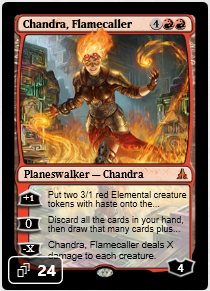
After a very strong first three months and a peak above 27 tix, Chandra, Flamecaller gradually lost steam to bottom around 7.5 tix about two weeks ago. I wish I had pulled the trigger a little bit early but I think this version of Chandra can make a comeback to the 15-20 tix price range sometime in the rest of her Standard life.

Bg

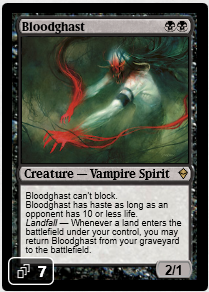
As it was plumbing a new floor around 6.5 tix, I bought a few more copies of Bloodghast this past week. As I said earlier I'm not crazy about this spec but it makes sense prize-wise so let's go for it and hope for the best.

Sales This Week

200 more copies of Magic Origins painlands gone. I'm still selling Yavimaya Coast with a profit but that's no longer the case for the other lands. I have more work to do here and I don't really want to go through the incoming Standard rotation with painlands in my portfolio.

Even with losses at the end of this Standard season, I'll probably be closing these gigantic painland stacks with an overall profit of 50%. I had clearly expected more but to keep things in perspective making a 50% profit on a initial investment of ~2800 tix over only five positions is something I would sign up for almost every day.

On My Radar

Both Standard and Modern are in the hot seat now. With the release of Kaladesh only one month away Standard will rotate one more time this year. If it's not already the case, Shadows over Innistrad and Eldritch Moon will very soon be at their lowest price point.

Free from the oppression of Collected Company, current underdog strategies may emerge stronger and demand for cards from the last four Standard sets unplayed thus far may suddenly increase. I'll probably focus on that in a week or two.

Modern is where my immediate attention is. Prices are moving in both directions and I have to carefully watch virtually all of my Modern positions. Both Zendikar and Scars of Mirrodin block are rich in Modern staples so this is the time to invest in a lot of good Modern specs. Alternatively I'm also scrutinizing the MTG Goldfish Modern Movers and Shakers even more often than usual to make sure I'm not missing good selling opportunities.


Thanks for reading,

Sylvain

An Honest Review: Enemy Fastlands in Modern

Are you a Quiet Speculation member?

If not, now is a perfect time to join up! Our powerful tools, breaking-news analysis, and exclusive Discord channel will make sure you stay up to date and ahead of the curve.

With Kaladesh spoilers starting to come in, it’s about that time again for my quarterly voice of reason article. Even though we know better, there’s something about spoilers that causes us to throw all our inhibitions to the wind, drizzle ourselves in chocolate sauce and run around on the beach without a care in the world. Maybe I’m speaking from experience, maybe not, but we’ve all been there. Card A gets spoiled, which pairs oh-so-nicely with Card B printed 10 years ago, so naturally we throw them in a deck with 67 other less-important cards and wonder why we’re losing matches. Welcome back to spoiler season.

Spirebluff Canal

Enemy fastlands just got spoiled, and for many of you, the gears are working overdrive, dreaming up new archetypes made possible by stars-aligned mana gifted to you by the gods of R&D. While it certainly is possible Blooming Marsh might have a strong impact on the Modern metagame, I’m not going to jump for joy until it passes my Context Test. This week, it might seem like I’m the bad guy, or the fun police, but hopefully my explanation of my new card analysis process will help keep you grounded as new cards are spoiled in the coming weeks. Let’s break it down.

[wp_ad_camp_1]

The Context Test: Setting the Stage

When a new card/cards are spoiled, the first step is always, always, to establish context. I’ve spoken at length about context in Modern, (it’s kind of my thing), so feel free to take a look through some of my past writings on the topic. (If you don’t want to click away don’t worry, I’ll be talking at length about the theory here). Part 1 of this article will focus exclusively on the concept of context, and how we can apply it towards gaining an understanding of the metagame to gain an edge in event preparation. Part 2 will build on Part 1 by taking the same concept and shifting it to evaluating new cards.

When I say context, what I’m referring to is what some people colloquially call the “metagame,” but what they really are referring to are the combination of surface conditions and underlying variables at play that combine to manufacture whatever current environment we’re seeing. That sentence sounds suspiciously like a bunch of words about nothing that my architecture professors like to throw at me to make themselves sound smart, so I’ll do what they won’t, and break it down for you.

When Magic players refer to the “metagame,” they are often talking about what decks are occupying a large percentage of market share at the moment. In reality, the concept of “metagame” really includes a complex conglomeration of current top archetypes, rising and falling deck strategies, fresh tech and community attitude that all combine to create the environment we play Magic in. At Level 1, most players are only familiar with the current most popular decks, shown as percentage data on “metagame pages” seen across the interwebs on sites like Modern Nexus. This information is accurate, and helpful, but really only tells part of the story.

greater gargadonMost players will skim these sites for information looking for a few quick takeaways. Jund is the most played deck, Dredge is falling, RG Breach is rising, Affinity, Infect and Burn are still Top 5, etc. This is perfectly fine, and can help you prepare for an event or inform some sideboard changes if you need quick information at a glance. But, if we’re being completely honest, these metagame charts are inherently flawed, and almost useless for anyone looking to gain an edge.

Why is Jund the most played deck? Why is Dredge falling and RG Breach rising? Why do Affinity/Infect/Burn continue to occupy top 5 metagame share when the tools to defeat them have been around for years? The answers to these questions, and questions like them, make up 95% of the information you should be arming yourself with if you’re looking to prepare for an event. That percentage is arbitrary, of course, but the point remains: most of the “real” information you need to succeed can’t be found on an MTG website’s metagame snapshot, because that information A) isn’t quantifiable and B) doesn’t package well to translate to readers looking to gain a quick edge. Players hunt around for new tech, spend hours dreaming up decklists with new cards thinking they’ll find something that others missed, while meanwhile the tools to succeed are in plain sight, available for anyone willing to put in the work.

By the way, I’m not disparaging brewing---in fact, I’ve had more fun (and probably lost more tickets) in the past few weeks battling with a brew than I’ve had in months of grinding with Grixis Control, or any number of the current top decks. We play the game to have fun. For some, that means doing the best they can at the highest level of competitive play they can possibly reach. For others, it’s solving the puzzle of making bad cards do good things, or creating the coolest in-game scenarios possible. For me, I enjoy every approach, but really my main goal in Magic is to know. When a deck wins a Grand Prix, I want to know why. When I go 0-5 with a top deck in a Modern League when I went 5-0 with it last week, I want to know why. So, what’s the process?

Step One: Metagame Charts

Hold on, I just bashed metagame charts three paragraphs ago! What gives?! While inherently flawed and dangerous to trust blindly, metagame charts nevertheless still contain accurate, useful data to analyze. If our goal is to gain familiarity and knowledge, our best course of action is to gain a broad understanding of the overall conditions we’re looking at, before analyzing specifics to gain an edge. Metagame charts won’t tell us why certain decks are doing better than others, but they will give us a general sense of the current state of the field and what decks are relatively putting up strong results.

Step Two: Decklist Sideboards

Most players skim decklist results for spicy starting 60s to copy card for card, when really the sideboards more often than not contain all the relevant information. Whether a deck is playing Blood Moon or not, how many copies of Stony Silence are present, is graveyard hate plentiful or non-existent---the answers to all these questions can give us much more insight than some top pro’s starting 60.

Step Three: Macro Archetype Analysis

What type of decks are performing? In a midrange-dominated, removal-heavy field, fast combo’s value starts to go up. In a linear, hyper aggressive format, slow combo or clunky control might not be the best option. This is where things start to get murky, as we have to start placing weight to the assumptions we are generating. The three top decks might be Jund, Infect and Dredge, with the next tier primarily aggro. That looks to me like an aggressive field, but what if the second tier is all aggro, while the top tier is nothing but midrange decks? Is the field aggressive, or removal-heavy?

Step Four: Constructing a Narrative

We’re fully into theoretical territory here, as almost all concrete evidence has been exhausted, and we need to start pursuing theories. If the field is aggro-heavy; Dredge is performing well because of this; most players are packing Rest in Peace to fight Dredge; and they are cutting Affinity hate to do so, maybe playing Affinity is a good option. Or maybe most players are anticipating that move, so really what I want to do is play Dredge and either have a plan for/dodge the hate? Everyone gets to Step Four at some point in their pre-event preparation, but the difference is how organized and thorough they were with Steps 1-3.

Reading articles and theorycrafting about Level 0 and Level 1 deck responses to last week’s event winners really should only happen in Step Four, after a general understanding of metagame conditions has been gained. You should be in fine shape when you can look at a combination of metagame percentages and sideboard cards and be able to construct a sentence like, “Jund is performing well because Dredge is getting hated out of an aggro-defined field, so in theory a consistent combo deck like RG Breach that dodges Dredge hate and simultaneously does well against the aggressive decks and the midrange decks preying on the aggressive decks should be a good choice this weekend…” And all the ladies will be impressed.

Evaluating Fastlands in Modern

We’ve impressed all of the ladies, and we’re ready to coolly, calmly view new spoilers with a critical, analytical eye. We pull up our spoiler site of choice, feast our eyes upon new enemy fastlands in Modern and panic!!!!!!

tumblr_ocyix4SrNN1seof36o1_1280New spoilers are exciting for me, but probably not for the same reasons as they are exciting for you. I don’t play Standard, and don’t pay much attention to Standard, so when it comes to evaluating new cards for Standard all I have to go off of is my analysis of the card on rate alone. I couldn’t tell you one thing about Standard, other than that I know Collected Company is nuts because of Twitter and Eldrazi is unfair because of my dad. As a result, when spoilers come out I get to log my opinions of the cards based on rate alone, and then see if they show up in Standard once they’ve been put through the Context Test. Liliana, the Last Hope on rate alone doesn’t hold a candle to Liliana of the Veil, so unless she sets up some excellent synergies I can feel confident she won’t see much play in Modern. As for Standard, context is everything. If creatures are similarly sized to where -2/-1 is affecting a large percentage of boards, if there are a lot of x/1’s she can kill, if her minus ability has synergistic power in the format, I can definitely expect her to see lots of play.

For new cards like the enemy fastlands, we’re starting at a disadvantage as we don’t have much (read: any) concrete data to analyze. Basically everything is theory, which is why you get scenarios where almost everyone maligned Jace, Vryn's Prodigy until he went on to dominate Standard and heavily impact Modern, or Nahiri, the Harbinger looked underwhelming at first but grew to sponsor whole archetypes helped up just by the contextual power of one card. Still, we can apply the above model towards new card analysis, as long as we realize things might look different.

Step One: Metagame Charts

Deaths ShadowI thought things were going to look different!? Again, they’ve done the work for us, it makes no sense to start from square one. New cards coming into eternal formats always have to answer one basic question: “What are they bringing to an already established format?” Unless said new card is completely broken on rate alone (looking at you, Treasure Cruise), it will almost always slot into an existing deck rather than sponsoring a new archetype by itself. Yes, corner cases exist, but these are most often combo decks (Death's Shadow Zoo getting Become Immense, Living End getting Living End, Retreat Combo getting Retreat to Coralhelm). For everything else, we need to gain an understanding of what decks are currently being played in Modern, and whether said new card fits into any of these decks by either A) supplanting an older, less powerful option; or B) providing a new threat or shoring up an old weakness.

Step Two: New Archetypes

Evaluating new cards based on both rate and synergy, and then pairing them with a pre-existing card pool can help create a new archetype “out of nothing.” I put this in quotations because in almost all cases most of the tools for the archetype already existed in the format, they just needed a bit more push to cross over into playable range. Think Collected Company for Elves, or Nahiri, the Harbinger for Jeskai. To have an actual impact in the format, the new card must provide enough power for the deck to compete where it wasn’t able to before, or provide in some other fashion an irreplaceable effect that the deck was missing previously. Judge's Familiar isn’t integral to Merfolk’s success, while Master of Waves is.

This makes sense to us on our side of history, but this is the most common pitfall players fall into when looking at spoilers. Some white toolbox creature with a neat effect that pairs synergistically with White Weenie gets printed, and players point to it as the final piece of the puzzle that will push White Weenie into relevance. In reality, that creature is just providing another similarly powerful effect that a bunch of other cards already provide, where what White Weenie really needs is something insane like Stoneforge Mystic to make it relevant.

Step Three: Theorycrafting

The card might not slot into an existing archetype, and might not be powerful enough to create a new archetype by itself, but perhaps it will find success as a niche roleplayer or sideboard spell in specific metagames. Virulent Plague isn’t a “good” card, but it popped up in sideboards here and there until Splinter Twin got banned. In an alternate reality where Lingering Souls and Deceiver Exarch copies are running rampant, who knows what would have happened?

For me, the fastlands probably won’t make a significant impact in Modern, for a few reasons. Looking at existing decks, consistency in their mana isn’t a determining factor in winning or losing games. Sure, some three-color decks might take a couple extra points against Burn that could swing the matchup a bit away from their favor, but those decks probably could be built to take less damage against Burn/Affinity from their lands if the really wanted to. Even if they couldn’t, it’s still a large stretch to imagine that having access to a specific fastland would really change the matchup around enough to make a significant difference. Looking at Jund, even assuming it wanted to play Blooming Marsh, does it really change anything for the archetype? Say it lets us go Raging Ravine turn one into Blooming Marsh, Thoughtseize, Lightning Bolt turn two against an aggressive deck. This will only matter if both the extra green source and the extra point from not fetching a basic end up making a difference further down the line.

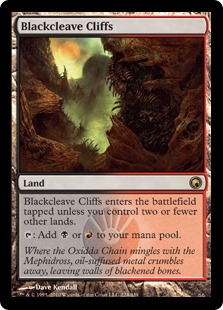
blackcleave cliffsIt just doesn’t seem impactful. Jund specifically wants Blackcleave Cliffs so it can cast Lightning Bolt and a discard spell on the first turn without having to take three to fetch a shockland. There’s gameflow and deck composition to take into account, and I’m just not sure there’s an archetype in Modern that was really wishing for better mana and if they just had it they would be able to win this matchup that they kept losing. Even black-white decks that might play Concealed Courtyard were often Taxes or Eldrazi decks anyways. Those decks need to play a certain number of Ghost Quarter and other colorless sources, and once you add in the requisite shocks/fetches/basics they often couldn’t even afford to play the full four Shambling Vent.

Conclusion

If the fastlands are going to make an impact in Modern, it will be because their existence sponsors a new archetype that wasn’t possible previously due to poor mana. In a fetch/shock format, the mana is good enough that every two-color deck can splash a third color almost for free, thanks to fetchland pairs being off-color once we have more than four. BG Death Cloud is an archetype, but metagame conditions aside Jund is just better and stronger, as it can play Lightning Bolt, Kolaghan's Command and Raging Ravine basically for free.

The new lands are great and they might see play here and there, as Seachrome Coast and Darkslick Shores see play in Ad Nauseam, and Blackcleave Cliffs sees play in Jund. But I don’t anticipate them being “impactful” in the sense that they will change the current context of Modern. Tasseled Dromedary, on the other hand….


Thanks for reading!

Trevor Holmes

The_Architect on MTGO

Twitch.tv/Architect_Gaming

Twitter.com/7he4rchitect

Turning Up the Heat in Orlando: Tweaking Burn

Are you a Quiet Speculation member?

If not, now is a perfect time to join up! Our powerful tools, breaking-news analysis, and exclusive Discord channel will make sure you stay up to date and ahead of the curve.

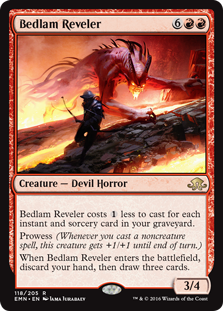
With the conclusion of SCG Richmond last weekend, we are set up for a weekend of Team Sealed in Louisville. It's not exactly the most exciting tournament for a reader of Modern Nexus. The following weekend, however, is a Star City Games Open in my home city of Orlando! I'm working on a tweak to an existing archetype that will hopefully give me the edge that weekend. Unlike fellow Modern Nexus writer Ryan Overturf, I think Bedlam Reveler will be really good for me in the coming weekend. That's because I intend to use it not in Delver, but in Burn.

proph bolt

Burn and I go way back. Well, I guess it depends on how you feel about the term "way back." Almost all of last year I played Burn at PPTQs and managed to top-eight three of them in two weekends without managing to put one away. I also played Burn to my best Grand Prix finish at Grand Prix Pittsburgh in 2015. It was a much simpler time. Molten Rain was a three-mana Time Walk that defeated many Tron opponents. But we've had some changes and new cards come out that make me want to go back to the drawing board.

I know I can be successful with stock lists of Burn. With cats, without cats---as you can see from the SCG Richmond Classic, both are viable options. But I want to take the next step for the specific metagame I'm expecting in Orlando. As of this article, the five most popular decks make up about 30% of the Modern metagame. I, however, have some additional knowledge that I'd like to use to slant the odds in my favor.

Being a resident of the city the Open is in, know a lot of people that will be going. I've been to many tournaments in Orlando and in the surrounding cities that are likely to bring people to the tournament. Jund and Abzan are by far the most popular decks. Affinity is also fairly popular and past that it's just a bunch of people playing a different deck every week. I want to tune my deck to be able to beat GBx decks first and foremost. I believe focusing on those matchups will bring me the most wins.

[wp_ad_camp_1]

Figuring Out the Flaws

From my extensive experience with the GBx matchups, I only lose the games where they are able to mitigate some damage via discard spells and then land a large threat (usually a Tarmogoyf) without taking much damage from their lands. The inclusion of Grim Flayer in some of these lists only exacerbates the problem of threats being able to close down the game too quickly. Kalitas Traitor of GhetYou can't often profitably trade with this likely 4/4 and you're quickly put to the test of emptying your hand before Liliana of the Veil does it for you.

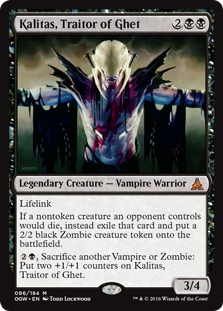
Another big problem is the more recent addition of Kalitas, Traitor of Ghet. I don't know if he will still have a spot after the arrival of Grim Flayer, but it's likely I will run into some decks with either of them. Kalitas is the perfect finisher for Jund against Burn. It's likely better than Kitchen Finks in a lot of spots because it can gain the Jund player a steady stream of life. Every time Kalitas deals damage to something it means the Burn player needs to play one more spell. Sometimes it brings the Jund or Abzan player from 1 life to 4 life, which can still be answered by a timely Boros Charm---but when they go from 6 to 9, or 8 to 11, you quickly realize there is almost no way to win the game. I want to remove Burn's inability to draw into a relevant later-game threat.

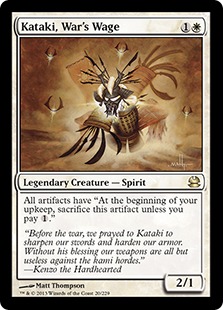
Against Affinity the quickest thing I've realized is that I'm missing out on the "Affinity can't play Magic" sideboard cards. My current list didn't have Stony Silence, Kataki, War's Wage, Shatterstorm, etc. We can fix that problem pretty easily.

Enter the Reveler

With a few tweaks to the deck, I think Burn can take advantage of Bedlam Reveler. I came to this idea while watching Sam Black's videos with a Bedlam Reveler Burn deck which, in my opinion, took it a little too far. Bedlam RevelerListen, I know Sam is a great Magic deck builder but there's no way I'm going to write "4x Manamorphose" on my deck sheet instead of Goblin Guide. My plan is to change the maindeck and sideboard to support Bedlam Reveler for better game against the grindier GBx decks.

Watching Sam's videos, I will concede that I am interested in playing Gitaxian Probe. In a deck chock full of one-mana 3-damage spells, I would rather play the minimum of two-mana analogs. Probe allows us to sculpt a game plan that doesn't involve our Goblin Guide running straight into a Lightning Bolt after giving away a land, and also increases the density of cheap spells in our deck. If you ever lose a game of Burn with cards in your hand there's a big problem. Decreasing the number of two-mana spells that can get stranded is important. Wild Nacatl, for its part, is almost exclusively out of the question because we won't have enough spells for the Reveler.

This leads us to our newly developed decklist:

Bedlam Reveler Burn, by Jim Casale

Creatures

4 Goblin Guide
4 Monastery Swiftspear
4 Eidolon of the Great Revel
3 Bedlam Reveler

Instants

4 Lightning Bolt
4 Boros Charm
4 Searing Blaze
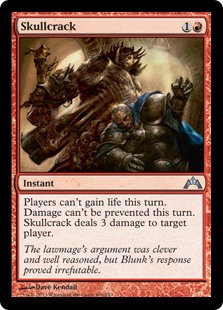
1 Skullcrack

Sorceries

4 Lava Spike
4 Rift Bolt
4 Gitaxian Probe

Lands

3 Wooded Foothills
4 Arid Mesa
4 Bloodstained Mire
4 Mountain
4 Sacred Foundry
1 Stomping Ground

Sideboard

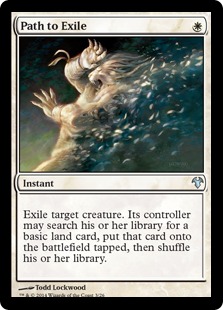
4 Path to Exile
3 Kor Firewalker
3 Kataki, War's Wage
2 Skullcrack
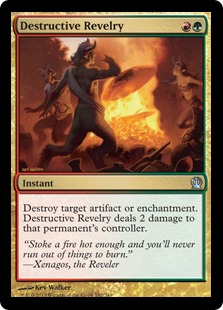
2 Destructive Revelry
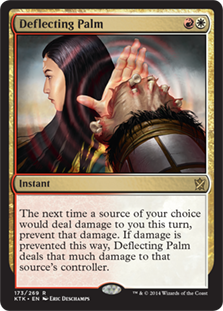
1 Deflecting Palm

Sideboarding

Rather than list out every matchup and what would come in/out, I'll talk about why each card is in the sideboard.

  • Path to ExilePath to Exile
    This primarily comes in against decks where Searing Blaze doesn't kill their creatures. I like to bring them in against decks with delve creatures (Tasigur, the Golden Fang, Gurmag Angler), Tarmogoyf, Primeval Titan, Wurmcoil Engine, and decks that are likely to be playing Kor Firewalker. Although you're not cold to a resolved Firewalker, it is obviously a very difficult creature to beat.

Path to Exile is the most efficient removal you can play but it doesn't do any damage so it's really only worth a card if you couldn't kill the creature with Searing Blaze. There are three exceptions to this rule: Death's Shadow Zoo, Bant Eldrazi, and Infect. Most of their creatures die to Searing Blaze but I complement it with Path to Exile in these matchups. Infect and Death's Shadow Zoo play so few threats that a well-timed removal spell can often set them back way too far to win the game anymore. On the play, a one-mana creature into Searing Blaze on their mana guy can quickly end a game.

  • Kor Firewalker
    It's pretty obvious these are for the mirror, but I'm also a fan of bringing them in against some decks that lean heavily on red removal spells. I've brought them in against Mardu style control decks whose main form of interaction is Lightning Bolt, Lightning Helix, and Terminate. That being said, I'm not sure if it's necessary to do that anymore since Bedlam Reveler can easily put you back into the driver's seat in those games.
  • katakiKataki, War's Wage
    An efficient attacker that also happens to wreck serious havoc on Affinity. For a long time I leaned on Ancient Grudge, Smash to Smithereens, and other similar effects to beat Affinity but I think that's the wrong approach. The best card out of the Affinity sideboard is Spell Pierce, and there have been many games where I got blown out by a Spell Pierce but could have easily won the game if I had a Kataki, War's Wage. This card is very narrow, so you may want to swap it out for some number of Sudden Shock if you feel like your local metagame will have more Infect than Affinity.

I will mention that Kataki is a weird card in that it gives an ability to other artifacts, so technically your opponent can "miss" the trigger without you having to announce it. It's much like a Pact of Negation where it is assumed you chose not to pay and can cause a misstep by your opponent to lose all of their artifacts.

  • SkullcrackSkullcrack
    There is one maindeck Skullcrack and two in the sideboard because it's just a terribly inefficient burn spell if you're not actively stopping any life gain. It is easier to cast than Atarka's Command which is why I'm giving it priority. With the added damage you will end up taking from Gitaxian Probe, it's hard to justify so many green spells. Its ability to stop damage from being prevented also comes up sometimes. I bring these in against Soul Sisters (although that deck is kind of impossible to beat), Scapeshift and other Obstinate Baloth decks, Bogles, Kor Firewalker, and the Burn mirror. Pretty much against any deck that's likely to be gaining 4+ life on a crucial turn, I want access to Skullcrack.

Now the hidden mode of Skullcrack is that you can use it to kill Kor Firewalkers that are unfortunate enough to be caught blocking. Protection prevents the damage that would be dealt by the protected source (in this case red) but Skullcrack makes it so that damage can't be prevented this turn. A Kor Firewalker that blocks any of our two-power creatures can be killed in combat by a timely Skullcrack.

  • Destructive REvelryDestructive Revelry
    This is most flexible sideboard slot and you can bring in any number of them in most matchups and it won't usually be a dead card. If you think they might have Spellskites, it's defensible to bring in Destructive Revelry. The deck I bring it in against the most is Ad Nauseam because a lot of their game plan revolves around sticking an enchantment or artifact. Many times they board in Leyline of Sanctity which puts a hamper on your ability to kill them.

Leyline isn't a lights-out card but it can get really awkward when you have to Lava Spike and Searing Blaze yourself to help Monastery Swiftspear get across the finish line. In my experience, players newer to Modern are also more likely to bring in Leyline even in decks that shouldn't necessarily have it in their sideboard. I have played against Jeskai and Mardu control decks at SCG Opens playing Leylines against me. Finally, Destructive Revelry is also a pretty easy card to bring in against Bogles. We need to find something to replace the 4 Searing Blaze.

  • Deflecting PalmDeflecting Palm
    Oh, I have such great memories of this card from Pittsburgh. Many people thought they had the game in the bag until they realized their creature was actually attacking them. This card is not very good if you draw too many of them but the one copy is just right. It's great against Infect because it doesn't target the creature. Short of a Spell Pierce or a Dispel, the creature is likely to be dealing damage to your opponent (not in the form of poison counters either!). Not targeting is also great against Bogles and it prevents all the damage to help buy precious time against a lifelink enchantment. You can also Deflecting Palm an Emrakul, the Aeons Torn, Primeval Titan, or Griselbrand with generally good results.

The one deck I would probably not bring it in against where it might seem good is Tron. You have many ways to deal with a Wurmcoil Engine and it is unlikely you will have any white sources in play when they cast World Breaker and Ulamog, the Ceaseless Hunger. Most of the time you are in too much of a losing position to leverage a Deflecting Palm at that point.

What to Board Out

I don't have any hard and fast rules when it comes to sideboarding. I think it's important to keep sideboarding guides loose because there are so many ways to approach a match and what I do in my situation might not work out well for you. If you're interested in a more in-depth Burn article sometime just let me know in the comments.

Generally, Searing Blaze comes out when it's bad (big things, hexproof, not many creatures, etc). Goblin Guides come out if the opponent is likely to have bigger creatures early (Wild Nacatl Zoo decks usually), especially on the draw. You can shave Bedlam Revelers if you need to be quicker. Skullcrack comes out when the text outside of dealing 3 damage doesn't matter.

Final Thoughts

With the maindeck inclusion of Bedlam Reveler, we lose a little bit of speed when we draw too many of them early. One in our opening hand is also an effective mulligan if we're playing against a faster deck where we won't have time to cast it. For now, I think it's the best bet against the field I expect in Orlando, and we'll see how it fares in the developing metagame.

My sideboard configuration definitely makes concessions to certain matchups, and I'm hoping simply to dodge the ones I've made myself softer to. Notably we're missing Atarka's Command, Rest in Peace, Grafdigger's Cage, Grim Lavamancer, and Lightning Helix. Giving up traction in some matchups helps us make sure we never lose to the ones we expect to face the most. Modern is unfortunately a format with way more possible opposing decks than sideboard cards. Trying to beat everything at once will often end in disaster. Sometimes you just have to get lucky and play matchups that are favorable for your chosen archetype/build.

Insider: Kaladesh Spoilers

Are you a Quiet Speculation member?

If not, now is a perfect time to join up! Our powerful tools, breaking-news analysis, and exclusive Discord channel will make sure you stay up to date and ahead of the curve.

“People of Kaladesh, whether you hail from distant fields or green belt towns or from our great city centers, this is your time. The Kaladesh Inventors Fair invites you, our best and brightest, to share your ingenuity with the world. As an official entrant you may fuel your creativity with unrestricted aether access. Demonstrate that you can channel the aether into bold new creations. Showcase your new ideas, your inventions, your genius. In this time when anything is buildable, you can invent your tomorrow, today!”

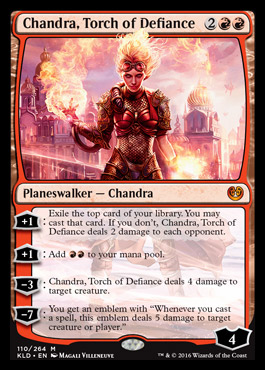
In a few short weeks we will all be invited to step into this fresh new world of Kaladesh. Chandra, along with some new friends and new mechanics, will join us on our journey through this new plane. Speaking of Chandra, everyone is going nuts for her. Before I join the masses preordering our new four mana planeswalker friend for over $50, let’s see what’s really going on.

chandratorchofdefiance

At first glance, you mind should immediately pick up on the fact that Chandra, Torch of Defiance has four abilities. The only other planeswalker boast such a reputation is none other than Jace, the Mind Sculptor. When your immediate comparison of a new card is to a card that was so powerful it was banned in multiple formats, thoughts accelerate quickly. The preorder price mountain we just climbed is clear evidence of this in players' minds.

Although we have our second planeswalker with four abilities, this red planeswalker also gives us card advantage, mana advantage and acts as a removal spell. If we are going to compare these two cards, let’s be thorough in our break down. I’m sure you know what he does, but take a look at Jace, the Mindsculptor and remind yourself how good he is.

There was an error retrieving a chart for Jace, the Mind Sculptor

Jace’s first ability is basically Scry 1 on your opponent’s library. This was the mode that really took over the game. Once you created a board state where you could mess with the cards your opponent would draw, the game was likely over. There were times when you could get out of it, but often that soft lock was enough to win the game.

Instead of this level of control, Chandra has a different way to control the game and that’s by achieving a mana advantage over the opponent. If you have more resources to work with than your opponent you will likely be able to use that advantage to defeat them. In this case, you can jump from four mana to cast her up to seven mana the turn after. So as long as you hit your land drops, you get a free Explosive Vegetation style accelerant every turn. You could also think of this as a free Dark Ritual each turn.

This is a huge jump in mana and the Hedron Archive-like jump in mana is obviously powerful. The fact that you can also play a spell like Incendiary Flow or Tormenting Voice on the same turn you play her is similarly strong. That line of chaining spells together reminds me of Koth of the Hammer. This +1 mana ability of Chandra’s is very good but it’s not the same as Jace’s deck manipulation.

Next up we have Brainstorm for zero loyalty on Jace. When you take the best draw spell legal in Legacy and add it as an ability on a planeswalker, things can get out of control quickly. Chandra has her own version of card advantage but it’s toned down a lot from the power level of Mind Sculptor. You get to see an extra card per turn, which is good, but it’s nothing compared to Brainstorm. I do like the option to not draw the card and deal two damage. Every card is valuable but not every card is always necessary to win the game. Chandra’s +1 allows you to take advantage of cards you don’t need like extra lands or other copies of herself.

The third abilities on both cards match up well. They both possess minus abilities that interact with the opponent’s creatures. Our blue ability is bouncing a creature while our red one is killing it. The blue one is yet again more versatile because it can deal with any creature, while the red one only interacts favorably with four or less toughness creatures.

Once we’re through with the plus and minus abilities that we will encounter most frequently, we get to the top of the mountain. For the first time, I think Chandra has the advantage on this ability. Not only does her ultimate trigger faster, but it’s also just as lethal. Most of the time winning with a Chandra ultimate should only take a turn or two. Usually Jace’s ultimate prompts a concession but I think most players will try to win through Chandra’s.

So, to summarize, we have four similarly laid out abilities on both cards. Almost all of Chandra’s abilities are worse than Jace’s, but that’s not going to stop her from being one of the most important pillars of every format she’s in though. I’d say that once we consider all of the implications that her loyalty allows us to accomplish that $50 sounds about right for her. There will be an interesting balance between Chandra, Torch of Defiance and Chandra, Flamecaller though. Both cards do impressive things but you can only have one in play at a time. At the end of the day, I think the Torch of Defiance will lead the way. Her flame will burn through Standard and definitely leave an impression.

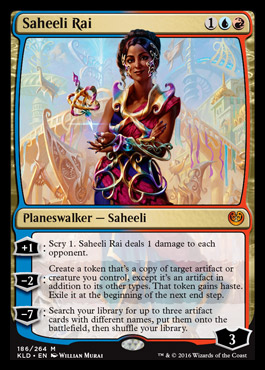
saheelirai2

Up next, we have our second planeswalker spoiled so far, Saheeli Rai. While she may seem lackluster in comparison to what is likely the second most powerful planeswalker ever printed, Saheeli may find her place in the meta as well.

Three mana is a good starting point for a planeswalker. Being two colors is sometimes the downfall of cards, but I think blue and red will get a lot of support in Kaladesh. Much of her strength though relies on what the blue red color combination has access to.

Her abilities are interesting. She gives us some minor card selection and the ability to copying artifacts. We haven’t had many ways to copy artifacts in the past and certainly not on a planeswalker. What we copy needs to have an immediate impact though because we are using up a significant portion of her loyalty to execute the ability. We need something to copy that has a potent enters the battlefield ability or does something immediate to progress our board state.

Her ultimate is intriguing, but again, what three artifacts are we going to tutor for that will win us the game? This is an easier question to answer in older format so exploring her synergies in Modern or Legacy will be important, but as for Standard we have yet to see the cards that might pair well with a potential ultimate from her.

We have not seen many cards from Kaladesh that fit to pair with Saheeli Rai yet, but there are many cards left unspoiled. There is one that might pair well with Saheeli’s copying ability though and that’s Cataclysmic Gearhulk.


What we know currently is that this card has not been spoiled in English. Here’s what the translated text says.

3WW
Artifact Creature – Construct
Vigilance
When Cataclysmic Gearhulk enters the battlefield, each player chooses from among the non-land permanents he or she controls an artifact, a creature, an enchantment, and a planeswalker, then sacrifices the rest.

Originally there was Cataclysm, then they updated that to exclude lands with Tragic Arrogance, and now we have a 4/5 tacked onto this ability. In a control deck, this creature seems highly exploitable. In Standard we are rewarded with cards that trigger upon having different card types in our graveyard. This creature rewards us for playing different card types because we can gain an advantage. If we build our deck such that we only have one of each card type in play at a time, then this creature can seem like a one sided board wipe.

If we are able to continue playing three colors in the new format, we could not only force this condition on our opponent once, but we could copy it and do it again with Saheeli’s -3. Considering how much play Tragic Arrogance has seen, I think Gearhullk is going to fit right in.

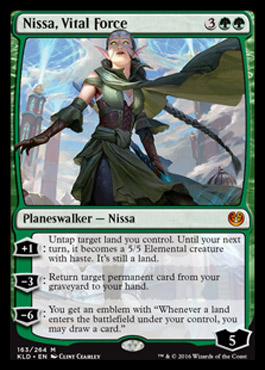
nissavitalforce (1)

Although Nissa, Vital Force popped up on the spoiler once I was well into writing this article, I wanted to add her in as a topic of discussion as well. She may fit in well with the cards I’ve been discussing today, but I’m worried about her fitting into the Standard format well.

Nissa’s new name implies that she is an important cog in a competitive deck’s machine, but my initial impression is the exact opposite. This Nissa doesn’t seem like a Vital Force at all. In fact, she doesn’t even seem like she will see much play at all.

Both her +1 and -3 are great abilities, but costing five mana and not being able to protect yourself create huge gaps for a deck to fill. Maybe my perspective on her is wrong but to me she seems like a finisher. I don’t think we are hurting for finishers in Standard though. Don’t get me wrong, a 5/5 haste for five mana is good, but this is more of a Ball Lighting style effect and less of a Thundermaw Hellkite one.

Being able to regrow a card is always a powerful tool, but again, with no protection, how relevant will that be if your opponent just kills her that first turn? I think Nissa is cool but if players are going to rely on her, I think it will be as Nissa, Voice of Zendikar and not Nissa, Vital Force.

Between energy counters, new shiny artifact toys, and vehicles, Kaladesh has no shortage of innovation. How good are energy counters and will we get more cards that use them in the future or is this just an ability for this block? I’m always skeptical of new mechanics like this, but there are already some cards that have proven to me that the mechanic will see competitive play. Let’s look at a couple of cards that highlight this point.

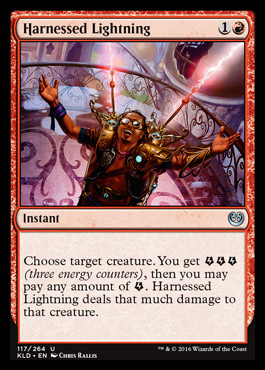
harnessedlightning

I think the best example of energy counters being constructed playable is Harnessed Lightning. This Incinerate or Searing Spear variant is just as good as those staples. The best part about our new version is that if you don’t need to do three damage, you will have some number of energy counters left over. Additionally, if you are getting these counters elsewhere, you can do more than three damage. Technically you could even cast one for zero damage and cast the second one for six. The versatility this card offers is great and provides us with a clear example of some basics that make this mechanic solid.

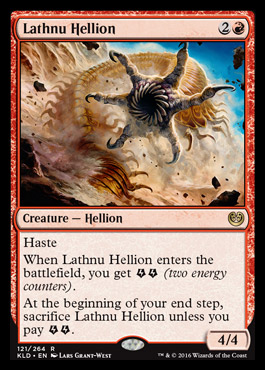
lathnuhellion

Another example might be Lathnu Hellion. This creature seems comparable to Ball Lightning but it could turn out to be more like a creature with vanishing counters like Blastoderm. If you have extra counters from your Harnessed Lightnings you could use them to fuel the Hellion or let the Hellion die to do more damage with the Lightning.

Either way, energy counters are most likely going to see some play in a couple decks. There will be many options when it comes to spending your energy and your opponent can’t destroy or interact with that resource. This new mechanic has some deep strategy and I’m looking forward to seeing how it plays out.

That’s all the time I have for today. Come back next week for some more great innovation from the plane of Kaladesh!

Until next time,
Unleash the Force of Kaladesh!

Mike Lanigan
MtgJedi on Twitter

Insider: QS Cast #35: We love Kaladesh!

Are you a Quiet Speculation member?

If not, now is a perfect time to join up! Our powerful tools, breaking-news analysis, and exclusive Discord channel will make sure you stay up to date and ahead of the curve.

Play


After a long hiatus the QS Cast has returned with a new panel of hosts: Chaz Volpe, Corbin Hosler, and Tarkan Dospil continue on with where the cast left off and in this episode they discuss the following:

  • Kaladesh Previews (up to 9/6/2016)
  • Joined by respected guests Kelly Reid and Ryan Overturf (Corbin is off until next cast)
  • Nissa > Chandra?
  • Is Saheeli Rai bad?
  • Kaladesh interests by all panel members (Ghirapur Orrery, Nissa Vital Force,) Kaladesh reaction cards: Emrakul, the Promised End - Second Harvest

*we usually like to keep this Podcast a bit shorter – but with 2 guests and great card evaluation discussions we didn’t want to edit too much out.*

As always, please comment and leave questions for us to address on the next cast! We will be making QS Insider questions a priority, and we want to know what you want covered.

Enjoy! We’re glad to be back.

Find us on Twitter: @ChazVMTG @Chosler88 @the_tark @RyanOvedrive @KellyReid

Avatar photo

Chaz V

Started playing during Invasion block at the age of 13. Always a competitive person by nature, he continues playing to this day. Got into the financial aspect of the game as a method to pay for the hobby and now writes, Podcasts, and covers all aspects of the game, always trying to contribute to the community and create great content for readers and listeners.

View More By Chaz V

Posted in Free Insider, QS CastLeave a Comment on Insider: QS Cast #35: We love Kaladesh!

Have you joined the Quiet Speculation Discord?

If you haven't, you're leaving value on the table! Join our community of experts, enthusiasts, entertainers, and educators and enjoy exclusive podcasts, questions asked and answered, trades, sales, and everything else Discord has to offer.

Want to create content with Quiet Speculation?

All you need to succeed is a passion for Magic: The Gathering, and the ability to write coherently. Share your knowledge of MTG and how you leverage it to win games, get value from your cards – or even turn a profit.

Grixis Delver Sideboard Guide

Are you a Quiet Speculation member?

If not, now is a perfect time to join up! Our powerful tools, breaking-news analysis, and exclusive Discord channel will make sure you stay up to date and ahead of the curve.

I get a lot of questions and comments pertaining to Grixis Delver, with a lot of the focus being on the sideboard. My sideboard notably doesn't take advantage of the sorts of hammers that you see in many Modern decks. I'm not about "destroy all artifacts" or "exile all cards in graveyards" cards, and instead have crafted a sideboard that allows me to solidify consistent gameplans. Today I'll go over the current sideboard that I would play, and my strategy for a variety of Modern matchups.

Snapcaster Mage-cropped

Let's start by taking a look at an updated decklist. Albertus Law won GP Guangzhou with a list that looks significantly different from mine, though I don't see it as a manner of metagame updates, rather as stylistic differences. Law's list is more about stealing games with an aggressive tempo plan, whereas my build is more about being able to interact at every stage of the game. His build is certainly fine, though this is the list that I currently endorse:

Grixis Delver, by Ryan Overturf

Creatures

4 Delver of Secrets
4 Snapcaster Mage
3 Tasigur, the Golden Fang
1 Gurmag Angler
1 Vendilion Clique

Instants

1 Dismember
1 Kolaghan's Command
4 Lightning Bolt
4 Mana Leak
1 Remand
4 Spell Snare
4 Terminate
4 Thought Scour

Sorceries

4 Serum Visions

Lands

2 Island
1 Mountain
1 Swamp
1 Darkslick Shores
1 Blood Crypt
2 Bloodstained Mire
4 Polluted Delta
4 Scalding Tarn
2 Steam Vents
2 Watery Grave

Sideboard

2 Engineered Explosives
3 Countersquall
1 Dispel
2 Magma Spray
2 Spell Pierce
1 Go for the Throat
1 Cavern of Souls
3 Fulminator Mage

The maindeck departures are minor, but worth discussing. I changed Pillar of Flame out for Dismember, which is worse against Burn and decks without creatures, but is a concession to Tarmogoyf and Bant Eldrazi. Both of these are larger portions of the current metagame, and Dismember also plays dramatically better against Infect. The other major change is subbing out the second Remand for Vendilion Clique. There aren't too many combo decks right now, which means there are plenty of decks where Remand is extremely marginal. Kevin Jones said Clique was great, and it's a nice tool to help you clock the Bant Eldrazi deck, which can be a tough matchup. The other change is adding a Darkslick Shores over a Bloodstained Mire. This is another Kevin Jones special, and what it primarily adds is just an extra mana-producing land. I don't care about taking damage, but I do care about having a bunch of lands in play for Snapcaster Mage wars.

With regard to the sideboard, you'll recall that I'm off Ancestral Vision, though the slots that it previously occupied have been in flux. There is a strong argument for using graveyard hate in that slot, which I'll get to later. For now I'm content to let the field and public perception hate out Dredge. Dredge hate is as narrow as Dredge's dwindling metagame share, and with so few pilots willing to pick the deck up now, I'm willing to throw that matchup. I would rather focus on matchups that are more popular, closer, and that allow me to use widely applicable sideboard slots. Fulminator Mage is my most recent experimental slot, as it helps both the Tron and Jeskai Control matchups, which are on the closer side. It has been successful in other decks, so it probably works here.

Now that you've got the updates, let's talk shop. I'll go through the major decks I expect to face in Modern and discuss how I see each matchup and what to do post-board. Editor's note: The categories here are just for organization---they're not meant to be a vigorous classification scheme.

[wp_ad_camp_1]

Interactive Decks

Bant Eldrazi

There are a lot of swings in this matchup. Their hands either offer a completely broken strategy or a mish-mash of medium nonsense. Eldrazi Temple is great, and Cavern of Souls is a beating, but hands that only have one Temple and/or crutch on Noble Hierarch are super weak against us. Cavern of SoulsTheoretically if you wanted to hammer them they can't cast their best spells (or Matter Reshaper) through a Blood Moon, though at that point you're just adding more variance to your draws. I choose to accept that sometimes you get them and sometimes they get you.
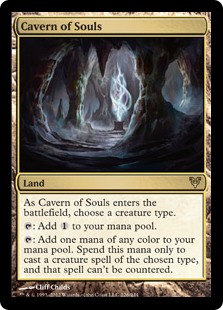
Magma Spray is neat here because it's another way to punish their Hierarch hands in addition to being great against Reshapers. Mana Leak is going to suck sometimes, but Spell Snare is very bad here despite the fact that they're likely to have Spellskite. You just hope not to get Caverned, and fifty percent of the time, it works every time. I don't know how good Fulminator Mage is here, but given that their only advantage comes from their lands it seems great.

Out:
-4 Spell Snare
-1 Remand
-1 Kolaghan's Command

In:
+2 Magma Spray
+1 Go for the Throat
+3 Fulminator Mage

Jund
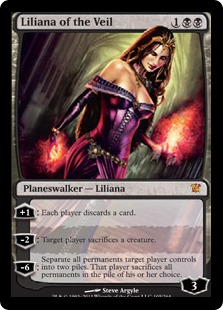
Liliana of the VeilThis is the matchup I'm asked about most commonly, and the impression of many seems to be that it's a bad one. It's not. In fact, I would argue that this is among the better matchups for my configuration. Patience is key, and as long as you play with Liliana of the Veil in mind you should be fine. It is their only card that has power level near that of Snapcaster Mage, and leveraging your Mages and counters against Liliana while Snaring and Terminating their threats will more often than not be a recipe for victory.

I haven't played this matchup with the Fulminators yet, though there's really nothing in the maindeck that is actively bad here. I sideboard very minimally, and post-board they generally don't get to add much of significance. Sometimes they Thrun you, but your delve creatures are bigger and Delver flies over.

Out:
2 Thought Scour

In:
1 Countersquall
1 Go for the Throat

Abzan

This is arguably your worst matchup. The differences between this and Jund are that Path to Exile can't be hit by Spell Snare like Terminate can, and that Lingering Souls is a beating. Lingering SoulsThere aren't really maindeck cards that are especially bad in the matchup, it's just that strategically they are significantly advantaged.
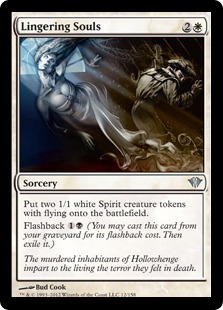
Spell Snare is going to have variable value here depending on how many twos your opponent is on, though it is considerably less good than against Jund. As of now, it's the card that I'd recommend cutting to make sure that you have play against Lingering Souls. It's possible that trying to cheese them with Fulminators is reasonable here, though I don't have enough data on that plan to report. Given that Souls are backbreaking and only cost three, I believe that just bringing in Engineered Explosives and Countersqualls is correct. The nice thing about Explosives is that you can use it to kill a Gofy/Scavenging Ooze in a pinch, which helps offset the fact that you're boarding Snares out.

Out:
4 Spell Snare

In:
2 Engineered Explosives
2 Countersquall

Jeskai Control

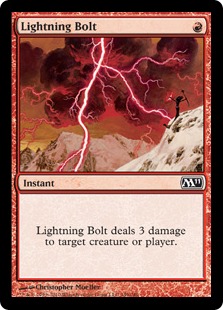
Patience is very important here, and making land drops is all that matters in the early game. In Game 1 you are an underdog, as Nahiri, the Harbinger doesn't die to Lightning Bolt, while Delver of Secrets does. Lightning BoltIf they have Electroylze, forget about it. Post-sideboard it's all about winning counter wars and making land drops. As such, Cavern of Souls is great here. Be patient, picks fights that matter and that you can win, and don't tap out if your opponent is likely to punish you for it. I think you're favored in a three-game set, but unless your opponent is less skilled in Modern blue mirrors it's not by much.
My current configuration forces you to leave black removal spell in post-board, and Dismember and Terminate both have unique downsides. Dismember can't get hit by Spell Snare, but the life loss and inefficiency can hurt. I could go either way on that one.

Out:
1 Dismember
3 Terminate
4 Delver of Secrets

In:
3 Fulminator Mage
3 Countersquall
1 Dispel
1 Cavern of Souls

Hatebears
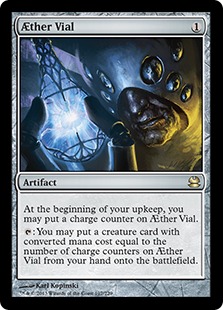
Aether VialDeath and Taxes is really strong against Legacy Delver, but Modern Hatebears doesn't execute at a disruptive level anywhere near that of Legacy D&T. The matchup in this format is solidly positive for Delver, and if they don't have an Aether Vial it's hard to imagine losing.

Out:
1 Remand
2 Mana Leak

In:
2 Magma Spray
1 Go for the Throat

Aggro

Burn

This matchup is super close, and if you play well you will put your Burn opponent's skills to the test. Spell Snare covers a lot of their best spells, and the delve creatures are excellent here. Searing BlazePlay conservatively, but be mindful of what combinations of cards can kill you in 1-2 turns and how to best play around what they might have. Some players seem to think that an aggressive Delver plan is how you win, but Delver is actively terrible here, largely because in order to block a Goblin Guide you need to flip it first. Aggressively interacting is how you win this matchup, and getting Delver Searing Blazed or just having Delver versus a creature-heavy draw is how you lose.
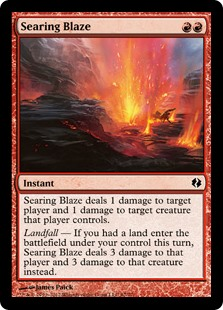
Remember to fetch for lands that can actually cast your spells. Many players are afraid to find duals, but if you save two points now to not be able to cast relevant spells later you'll take a lot more damage down the line. You'll often need 2-3 blue mana up in later turns, and you'll generally want 2 black and red mana as well to enable you to represent the most possible combinations of your interactive spells. This deck is color-mana-hungry, and shocking yourself is better than leaving yourself in one-spell territory in the mid to late game.

Out:
4 Delver of Secrets
1 Remand
1 Dismember
2 Thought Scour
1 Termiante

In:
2 Magma Spray
1 Dispel
3 Countersquall
2 Spell Pierce
1 Go for the Throat

The Termiante for Go for the Throat switch is very minor, but it can matter with regard to managing colored mana.

Death's Shadow Zoo

Terminate is really good here, and having a fast clock against a deck that is trying to beat itself up is great. Mutagenic GrowthThey'll often have Tarmogoyf post-board, though savvy players can actually leave themselves without any two-mana spells to catch with your Snares. Killing the creatures is the plan, and as such cutting Snares is generally fine considering that your strategy makes their Temur Battle Rages pretty bad. Watch out for Mutagenic Growth, and don't be afraid to use red removal as sorcery speed to play around it. Aim to kill all of their stuff more so than to race, though either plan can get there in many of the games.
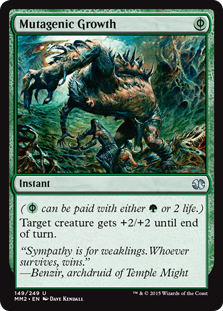
Out:
4 Spell Snare
1 Remand
1 Kolaghan's Command

In:
2 Magma Spray
1 Go for the Throat
2 Engineered Explosives
1 Dispel

Affinity
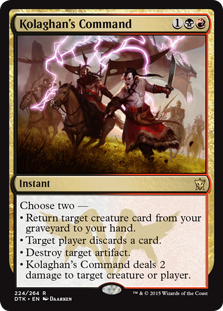
Kolaghans CommandThis matchup is solidly positive, though Etched Champion can get you. Spell Snare counters almost all of the cards that make their deck playable, and Kolaghan's Command is gas here. This is yet another matchup where you might consider Fulminating, though on the draw they are definitely slow, and you have a ton of game here anyway.

Out:
1 Remand
3 Mana Leak

In:
2 Magma Spray
2 Engineered Explosives

Infect
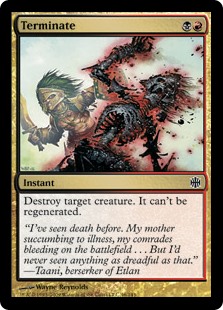
TerminateMuch like Burn, this matchup really puts the relative skills of both players to the test. Speed is good, but this matchup is all about attrition. Kill everything, and avoid casting removal spells in combat as much as possible. It doesn't feel great to take any infect damage, but if you go for a Terminate in combat and they just Vines of Vastwood their creature it's often game over. In most games you can fetch untapped duals indiscriminately, but be mindful of just dying to Noble Hierarch. Mana efficiency is all that maters. Your spells are better than theirs, but you have to survive long enough to turn the corner.

Out:
1 Remand
1 Kolaghan's Command

In:
2 Magma Spray

Merfolk
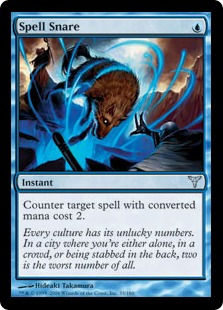
Spell SnareKevin Jones thinks this is the deck's worst matchup, though I think it's fairly even, maybe slightly favorable. They punish hands that stumble, but their weakness is that the majority of their cards are terrible. You don't have enough stuff to bring in to take out all of your counters, so I leave in Spell Snare. They're always trying to Spreading Seas you, they don't always have an Aether Vial/Cavern of Souls, and often they have to commit two creatures in a turn to be competitive, which causes them to play into it anyway.

Out:
1 Remand
4 Mana Leak

In:
2 Magma Spray
1 Go for the Throat
2 Engineered Explosives

Ramp

Breach Titan

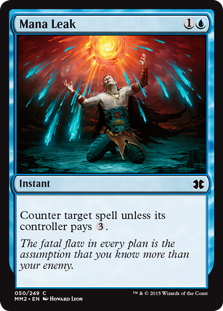
This is the new hotness with regard to Valakut, the Molten Pinnacle decks, and it is a much better matchup than Scapeshift, as countering Scapeshift with one Mana Leak is almost never possible. Mana LeakAlways leave up Spell Snare for their two-mana spell if you have it, even at the expense of casting a Delver. Counter their stuff so they can't get off the ground either to naturally Valakut you or play around Mana Leak[/card], and find a way to pressure them while doing so. Don't play two Delvers into [mtg_card]Anger of the Gods, and don't counter an Anger that only kills one Delver. Save those counters for their business spells unless you're very counter-heavy or have an avenue to kill them in short order with Countersqualls and Bolts.
I'll state again that I haven't played with the Fulminators yet, but it's worth experimenting with them here. The swaps posted here are tried and true, but theoretically something like trimming Scours or Bolts for Fulminators could improve the matchup.

Out:
4 Terminate
1 Dismember
1 Kolaghan's Command

In:
3 Countersquall
2 Spell Pierce
1 Dispel

Tron
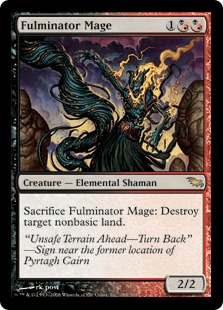
Fulminator MageNow here's a matchup where I know you want Fulminators. This deck is stupid and playing against it is the worst. A lot of wins come from the fact that you're way better against their bad hands than other decks. You can also catch their Sylvan Scrying with a Spell Snare[/card] or their [mtg_card]Expedition Map with a Spell Pierce post-board, which can conveniently also tag Karn Liberated[mtg_card] or [mtg_card]Ugin, the Spirit Dragon in a lot of spots.

World Breaker and Ulamog, the Ceaseless Hunger have made this matchup a lot harder, and this is a big motivation for the Fulminators. Those cast triggers are obnoxious, and I can't wait to Stone Rain some Tron players.

Out:
4 Terminate
1 Dismember
3 Lighting Bolt

In:
3 Countersquall
2 Spell Pierce
3 Fulminator Mage

Combo

Dredge
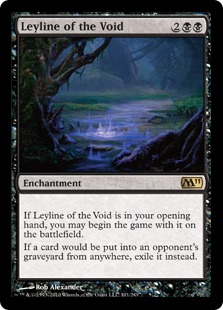
Leyline of the VoidYou probably can't win without graveyard hate. As I said above, you just bank on the field both not to pick up Dredge and for those who do to get smashed by those packing hate. Locally, this deck barely exists, but if it did I would just pack four Leyline of the Void. Theoretically you can play Magic with two hate pieces, but your actual gameplan is so bad that I would just play the card that you know wins if you want to use any sideboard space at all. Just take the opportunity to go get lunch if you get this pairing.

Out:
4 Spell Snare

In:
2 Magma Spray
2... Engineered Explosives?

Living End
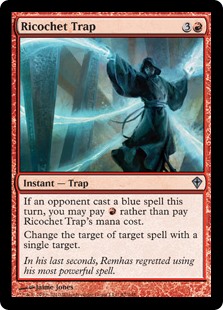
ricochet trapThis isn't a very popular matchup, but I included it because more information can't be bad, and also to illustrate that graveyard hate is unnecessary. Living End and every other non-Dredge graveyard deck relies on casting spells, which means that you have game against them. Sometimes you can actually just get them by hitting a couple creatures with Thought Scour, but most often you're able to prevent Living End from ever resolving.

Spell Snare is useless here and Terminate is fighting the wrong battles, but things get way better post-board. The Dispel may look weird, but it lets you fight Ricochet Trap/mtg_card] efficiently and can also catch a [mtg_card]Beast Within. Unfortunately, even after bringing in the Cavern of Souls you're still stuck with two Terminates in the deck, but the matchup is still solidly positive.

Out:
4 Spell Snare
2 Terminate
1 Dismember

In:
3 Countersquall
1 Dispel
1 Cavern of Souls
2 Spell Pierce

Abzan Company & Kiki-Chord
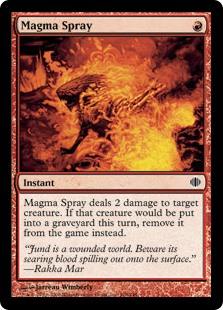
Magma SprayYou don't see a ton of this one anymore, though even if you did it's another great matchup. Collected Company is a strong card, but this deck isn't generally great against Mana Leak. So you just have to one-for-one their creatures and counter all their Companies. This is the matchup where Magma Spray is more than just another one-mana removal spell, as it wrecks Voice of Resurgence and Kitchen Finks. You're great at disrupting their combo, and they're great at getting punched in the face by Delver.

Out:
1 Remand
1 Kolaghan's Command
1 Thought Scour

In:
2 Magma Spray
1 Go for the Throat

I haven't played against Eldritch Evolution yet, and if you see it you should leave Remand in, probably over another Thought Scour.

Elves
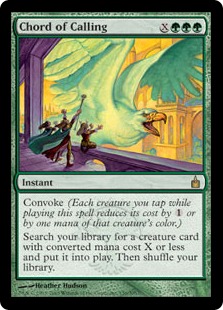
Chord of CallingThis deck got a lot better with the addition of Dwynen's Elite, but I still believe it is very winnable. You don't have haymakers, and despite wanting Snares for the Elites you can't afford having them because of Cavern of Souls. Luckily, they play Collected Company and Chord of Calling to make it so your Mana Leaks are always live. Use your removal spells wisely, and don't bolt Llanowar Elves aggressively. They have lords and Nettle Sentinels that you want to kill. Be mindful of your life total and carefully calculate when you want to start attacking, and you should be fine.

Dispel may look out of place, but they're basically never winning without resolving Collected Company, and the stuff you're bringing out is just less effective.

Out:
1 Remand
1 Kolaghan's Command
4 Spell Snare

In:
2 Magma Spray
2 Engineered Explosives
1 Go for the Throat
1 Dispel

Creatureless Combo
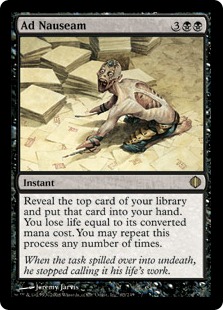
Ad NauseamThese matchups get less and less popular all the time, but you're bound to run into Ad Nauseam or Pyromancer Ascension from time to time. Basically, all of these matchups are removal-out, counters-in matchups, and all of them are solidly positive. Easy!

Out:
1 Dismember
4 Terminate
1 Kolaghan's Command

In:
3 Coutnersquall
1 Dispel
2 Spell Pierce

Maximizing Sideboard Space

Woof! That was a lot of information! You may have noticed that Dredge was the only matchup that was listed as convincingly problematic, while many matchups are considered favorable. I think that Grixis Delver is among the best decks in Modern, though it can be quite difficult to learn. It's important to utilize sideboard options that apply broadly, and you'll notice that I'm getting a ton of mileage out of almost all of my sideboard cards---a nice departure from lists that jam narrow cards for a small set of decks. There are a ton of decks in Modern, so I certainly didn't cover everything. But this is a great starting point and should offer general insight with regard to theorizing how to modify for other matchups.

If you decide to pick the deck up, I wish you the best of luck. It's a blast to play once you get the basics down. If you take issue with Modern having a lack of interactivity, then this deck should set you on the right course. I've been known to play these decks even when they're bad, but Grixis Delver is actually very well positioned currently, which makes now a great time to get on the Delver train.

Thanks for reading.

-Ryan Overturf
@RyanOverdrive on Twitter

Insider: MTGO Market Report for September 7th, 2016

Are you a Quiet Speculation member?

If not, now is a perfect time to join up! Our powerful tools, breaking-news analysis, and exclusive Discord channel will make sure you stay up to date and ahead of the curve.

Welcome to the MTGO Market Report as compiled by Matthew Lewis. The report will cover a range of topics, including a summary of set prices and price changes for redeemable sets, a look at the major trends in various constructed formats, and a "Trade of the Week" section that highlights a particular speculative strategy with an example and accompanying explanation.

As always, speculators should take into account their own budget, risk tolerance and current portfolio before buying or selling any digital objects. Questions will be answered and can be sent via private message or posted in the article comments.

Redemption

Below are the total set prices for all redeemable sets on MTGO. All prices are current as of September 6th, 2016. The TCG Low and TCG Mid prices are the sum of each set’s individual card prices on TCG Player, either the low price or the mid price respectively. Note that sets of Theros (THS) are out of stock in the store, so this set is no longer redeemable.

All MTGO set prices this week are taken from Goatbot’s website, and all weekly changes are now calculated relative to Goatbot’s ‘Full Set’ prices from the previous week. All monthly changes are also relative to the previous month prices, taken from Goatbot’s website at that time. Occasionally ‘Full Set’ prices are not available, and so estimated set prices are used instead.

Sept6

Players and speculators alike should be looking to get liquid over the next few weeks as we approach the release of the new Fall set, Kaladesh (KLD).

Any time a new set is released, it generates a large liquidity crunch where tix become more valuable and prices drop across the board. Being prepared in advance of this means selling down cards and boosters in order to acquire tix. Getting more liquid now means being able to deploy tix when prices are depressed in early October.

The exception to this are cards from the currently drafted sets of Shadows over Innistrad (SOI) and Eldritch Moon (EMN). The next few weeks will see these sets reach their cheapest levels heading into the winter.

Flashback Draft of the Week

With the plane of Zendikar now in the rear view mirror, flashback drafts return to the core set of Magic 2011 (M11). This was the second of the rebooted core sets and brought back the original five planeswalkers and Baneslayer Angel at mythic rare, though it it was a new cycle though that would have its fingerprints all over Standard for years. The titans came out of the gate running and never really stopped, with Primeval Titan still palling around with Valakut, the Molten Pinnacle in Modern.

Removal is still generally excellent with Doom Blade, Lightning Bolt, Pacifism and Aether Adept at common, while Fireball, Mind Control, Condemn and Corrupt appear at uncommon.

Blue's card selection and card draw is getting toned down a little at this point, but the excellent Foresee and Jace's Ingenuity would be top picks from more recent sets. Green is still suffering a bit due to the power imbalance between creatures and removal, so you generally will only want to be in green as a support colour and if it is clearly open. Red, white and black all have their strengths, but sticking to removal and efficient creatures will serve drafters well.

There's value in this set so keep an eye out for the Leyline cycle as Leyline of the Void and Leyline of Sanctity are both Modern sideboard staples and are priced accordingly. Obstinate Baloth, Steel Overseer and Serra Ascendant are three other rares that are all worth more than 3 tix due to seeing play in Modern.

Standard

Spoiler season for Kaladesh (KLD) is in full swing and a doozy was spoiled last night with the new version of Chandra, Chandra, Torch of Defiance.

This looks to be the flagship card of the set, much like Gideon, Ally of Zendikar was last year for Battle for Zendikar (BFZ). This planeswalker is very flexible, with the choice of the two +1 abilities offering good ways to develop your game plan, and the -3 ability being an excellent way to protect herself. Notably, the first ability is not strictly card advantage as when you reveal a land, you will deal two damage as you are unable to "cast" lands.

The new artifact subtype of vehicle is an interesting new twist on equipment. Both are artifacts and need creatures to function. Keep in mind that creatures that have summoning sickness are possible candidates to crew your vehicles. Skysovereign, Consul Flagship looks like a Standard staple in the making though I would be skeptical about its chance in larger formats.

Notably, vehicles make Reflector Mage marginally worse in Standard since it typically won't be able to target Vehicles with its enters-the-battlefield effect.

Modern

Spoilers from KLD will be impacting Modern as well. Most importantly, the completion of the fast land cycle with the five opposing-colour combinations will have a bigger impact than most new land cycles.

These lands are particularly well suited for Modern since the bulk of Modern decks are focused on mana costs up to three mana. Being able to develop your mana base without loss of life and with a choice of colours has made each of the Scars of Mirrodin fast lands Modern-playable. Look for the new cycle to be taken up immediately in multiple decks.

Grim Flayer continues to make waves in Modern, showing up in many of the GBx strategies at the 2016 Magic World Championships. The paper price on this card jumped to over $20 this week and the digital price is poised to reach 10 tix. The prime drafting window for EMN still has a few weeks to go so we'll see if supply can respond to this uptake of play in Modern.

Two cards from Journey into Nyx (JOU) are moving in different directions. Eidolon of the Great Revel is a known staple of burn strategies in both Modern and Legacy. The recent success of Naya Burn decks has pushed this card back to over 20 tix. This card has generally fluctuated between 14 and 20 tix over the last year, so keep an eye on it if it falls back to 15 tix or less.

Keranos, God of Storms on the other hand continues to suffer from the banning of Splinter Twin. Although it still shows up in the odd sideboard, the format is too fast for a card like this to be in high demand. Something would have to radically change for this card to regain its lofty heights seen this past winter.

Speculators should be wary of holding onto this card as it looks set to go below 5 tix. I've sold my position in the portfolio this week though players should feel free to hold onto their copies.

Standard Boosters

Shadows over Innistrad (SOI) boosters look poised to dip below 2 tix in the next two weeks. Players should be holding only as many boosters as they can use and speculators should be avoiding holding any boosters at the moment.

There will be another price drop when KLD is released. At that point, there's a chance for a short-term bounce, but the long-term trend is down. This set is destined to follow the path that BFZ boosters have trod, which are still languishing in the 1.0 to 1.2 tix range.

Elsewhere, Eldritch Moon (EMN) boosters are holding around 4 tix, and OGW boosters are likewise holding at around 3 tix. Both will see drops at the end of the month as players look to sell boosters in order to enter KLD prerelease events and to buy the new cards. If you have any excess tix at that time, these should both be considered good short-term plays; low risk and low reward, but a safe store of value.

Edit: After publishing, it came to my attention that a subtle change in payouts for the new draft leagues will have an impact on booster prices. Draft leagues start on September 7th, 2016, and WoTC has modified the prize structure in the 6-2-2-2 payouts in order to help balance the supply of boosters. The new payout will not be two draft sets to first place, but will instead be 5 EMN boosters and 1 SOI booster. This means that the structural difference that favors the prices of EMN boosters will be removed, at least for draft leagues. If WoTC switches other prizes structures in a similar way, this will support prices on SOI boosters down the road. This is worth watching but not actionable at the moment.

Trade of the Week

As usual, the portfolio is available at this link. This week I sold my Rise of the Eldrazi (ROE) boosters for a modest profit. The strategy of buying up boosters in advance of their flashback draft has turned out to be only marginally successful. I would put this down as a good way for players to lower the costs of playing, but not a great strategy for speculators.

Speculating on boosters requires a high volume for it to be worthwhile since the cost of each booster typically is below 3 tix. It is hard to sink a lot of tix into boosters that are not from the current draft format. Bots also typically sell only one draft set at a time, meaning the transactions themselves are quite tedious.

To top it all off, demand for flashback drafts is typically a small fraction of demand for the current draft format. This means buying and selling boosters has a large effect on the market, whereas normally it would cause barely a ripple. Exiting a large position of flashback draft boosters will be difficult given the lack of liquidity in this aspect of the market.

All in all, it's a niche strategy that I won't be pursuing in the future. Again, for players that are seeking to lower their costs, a draft set or two bought in advance will shave a few tix off of the costs of drafting. A reminder that this strategy will only work for boosters drafted in triplicate, and for boosters that are 2.7 tix or less.

Return to Ravnica and Gatecrash are both below 2 tix at the moment. These sets will be drafted in December so players keen to revisit these draft formats should salt away a draft set or two now in order to take advantage of the discounted booster prices. With a flashback draft entry fee of 10 tix, the product plus tix entry fee is roughly 8 tix at current prices.

Advanced Sideboarding: A Beginner’s Guide

Are you a Quiet Speculation member?

If not, now is a perfect time to join up! Our powerful tools, breaking-news analysis, and exclusive Discord channel will make sure you stay up to date and ahead of the curve.

Welcome once again to the Beginner's Guide. Back in May I laid out some basic rules and recommendations for how to construct a Modern sideboard. The intention was to provide guidelines for building a sideboard in Modern. The time has come to explain how it's actually done.

Mind-Rot-banner-cropped

Everyone likes to complain about Modern. I don't understand why, but players just aren't happy with the format. People complain about its power level and the perceived non-interactivity. Nobody likes the ban list. Most confusingly to me, players seem to dislike the diversity. There are so many decks in Modern that you have the option to play what you want, and yet players don't like that they can't metagame against a Standard-sized field. In response some have called for more sideboard space to cope with this diversity. Honestly, what does everyone want?

I'm not sure what to do about the players in the first camp. Jund has been sitting at the top of our metagame chart since Eye of Ugin was banned. How much more fair and interactive can you get? If you want more control decks, then play them more instead of falling in with the aggro crowd. It can be done.

The last camp is the focus of today's article because those players seem to need this lesson as much as the new players. In Magic, diversity is something of an illusion. There are many different decks, but the deck types are limited. When confronted by Modern's diversity, stop focusing on the Standard strategy of preparing for each individual deck. This is Modern. Stop trying to beat individual decks.

[wp_ad_camp_1]

The Problem

Yes, you read that right: To properly build a Modern sideboard, stop focusing on how to beat individual decks. Down that path lies madness.

Go to the Top Decks tab. Look at all the decks we list. Imagine trying to build a sideboard against all those decks, piecemeal. You can't. The human mind simply cannot process that much data all at once. If you try to bite off too much at one time you just get confused and lost. Whether this is an academic research project or trying to determine which deck to play, you cannot process all the data at once.

Deep AnalysisThis is why data analysis exists. You have a massive table full of numbers and you cannot understand it. So you simplify and turn those numbers into an analytical readout of only a few numbers that describe the big set. Only then can you make meaningful decisions.
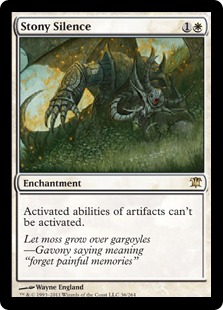
This is the problem that most players have in constructing Modern sideboards. The total Standard meta is about the size of Tier 1, many of which aren't serious contenders. As a result it's eminently possible to understand how the format operates in its entirety and make meaningful decisions without requiring any analysis and simplification. People try that in Modern and quickly find themselves overwhelmed---I believe this is the source of the sideboarding angst. It's not that they actually have too few slots, it's that they have tunnel vision. It's why I recommend against using The Elephant.

The Solution

You have to organize, simplify, and categorize to have any hope of drawing meaningful conclusions from extremely diverse datasets. This is where the broad categories I laid out last time are useful. It is impossible to prepare for every deck individually. Instead, you should select a small number of decks to specifically target, then prepare against the deck types that you're vulnerable to.

If this sounds confusing, don't worry, I'm going to walk you through the process in a moment. It makes much more sense when you see it action. What you're trying to do is cover your bases as much as possible by having a small number of powerful win-the-game buttons and then hedging against as many possible decks as you can. Will the end result be as powerful as when you tried to crush every deck? No. Will you have game against more decks? Absolutely.

To put it another way, you can build a sideboard that gives you a win percentage boost of 25%+ against four decks in Standard reliably, but in Modern that is impossible. What I'm advocating is that you try for that percentage against two or three decks, and use the rest of your space to improve 10% against the field. In such a diverse format you may give up a few dominating matchups, but you'll gain far more wins overall.

Building a Modern Sideboard

Anyone who hasn't read my previous articles on sideboarding and deck categorization may want to do so now. What I'm going to do is put everything I talked about there together and show you how to apply the principles by actually building a sideboard. If you don't know where I'm coming from this will make no sense.

If I'm going to build I sideboard, I need a deck. The deck closest to me at the moment is my build of Jeskai Control, so it will do.

Jeskai Control, by David Ernenwein

Creatures

4 Snapcaster Mage
3 Vendilion Clique
3 Baneslayer Angel

Instants

4 Lightning Bolt
4 Path to Exile
4 Mana Leak
3 Spell Snare
3 Lightning Helix
2 Cryptic Command

Sorceries

4 Serum Visions
2 Anger of the Gods

Lands

4 Celestial Colonnade
4 Flooded Strand
4 Scalding Tarn
2 Steam Vents
2 Hallowed Fountain
2 Sulfur Falls
2 Island
1 Plains
1 Mountain
1 Desolate Lighthouse
1 Sacred Foundry

So we have our maindeck, now we need the sideboard.

Step One: Don't Concede to Affinity/Dredge

Always begin by making sure you don't just lose to these decks. If your maindeck beats one or both even after they sideboard then you can skimp. Otherwise, save the space.

Affinity

Game one is generally pretty favorable. As long as we keep a reasonable hand with removal we can attrition them down. The only thing we really need to worry about is Etched Champion with Cranial Plating. If they assemble that we probably lose unless Baneslayer can race them. We need to hedge against that scenario.

Stony SilenceOne option is to play no direct hate and instead play more removal. If you're going that route Supreme Verdict is probably the best option since Affinity sometimes plays Spell Pierce. A second is to play some general anti-artifact cards. Of the options available Wear // Tear is best due to flexibility. It pairs well with Snapcaster and can sometimes get an enchantment. The third is targeted anti-Affinity hate. We're in white so that means Stony Silence, which nicely shuts down a lot of that deck. The only problem is drawing it too late.
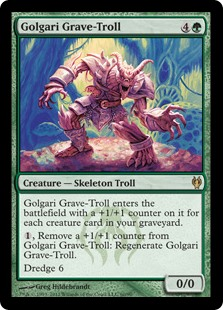
Once the options are laid out, we need to gauge how many slots are needed. Affinity is reasonably popular and we are reasonably good against it. We probably need 2-3 cards. For now, lets say a couple Stony's and a Supreme Verdict.

Dredge

Dredge is a bad matchup. Our one-for-ones are very ineffective. The only truly good cards we Golgari Grave-Trollhave are the Paths and Anger of the Gods. Anger is very good, but if they play around it or we never see it we have to race to win, and we are not good at racing. We need to prepare.
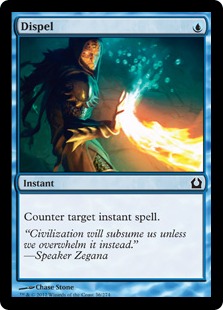
The best option is Rest in Peace. It's simple, powerful, and definitive. Dredge can work around the one-off effects like Relic of Progenitus or Tormod's Crypt much more easily. The problem is that RiP shuts off Snapcaster. That isn't so bad given that we will lose otherwise. I think this deck is pretty popular and we're bad against it, so pencil in another Anger and three Rest in Peace.

Step Two: Win Close Matchups

In my experience the fair decks and Burn are pretty close matchups for Jeskai. The mirror should also be included.

Fair Decks

All of these decks care about interaction and attrition. We should plan for attrition fights no matter which deck we hit, as well as the unique aspects of each deck. The best way to win an attrition fight is to draw more cards, and the cheapest way to do that is Ancestral Vision.

Liliana of the VeilNo matter the list, GBx matchups are about attrition and Liliana of the Veil. You will lose if she sticks in play, so we need a plan to beat her. Mana Leak is very good at that, but they're likely to bring in more discard to help stick threats. Our options are to remove her once she's in play or counter her. The counters that aren't Mana Leak are pretty specialized, and that's not optimal against discard. Thus we should focus on what happens once she hits play. Celestial Purge is the most efficient answer to a resolved Lili, so it gets the nod.

In the Jeskai mirror, game one is all about knowing Who's the Beatdown. If you have more answers, you are the control. If you have burn, you're the beatdown. Knowing when to fight over end-of-turn spells is critically important. You don't want to fight over unimportant life, but you also don't want to let your opponent pull ahead on damage and change the game into a race. The Jeskai mirror is hard.

DispelThe most important cards in the matchup are all instants, so we really want Dispel. Actually winning the game in the face of lots of answers can be tricky, so in the past Keranos was used to win the mirror. The proliferation of Nahiri makes that a shaky strategy these days.
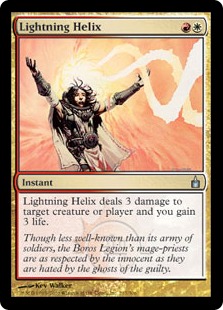
Grixis is a weird hybrid of GBx and the mirror. They have discard and big creatures like GBx with Jeskai's counters and burn. It's always an attrition fight, but you can race with otherwise mediocre burn thanks to their lack of lifegain, unlike Jeskai and GBx. Most of their important threats are black, so Purge might be a consideration. They have counters and we want to win that fight, so Dispel still shines.

Another thing to consider is changing the battlefield of the fight. Grixis utilizes its graveyard far more than Jeskai, so we might cripple them with Rest in Peace. It also hits a lot of Jund cards.

Burn

We deal a lot of damage to ourselves, and Burn takes advantage. Game one we need to avoid doing that as much as possible. Lightning HelixThe normal strategy against Burn is lifegain. We already have a bunch of that maindeck between Baneslayer and Lightning Helix. Therefore we should focus on how Burn will board and counter that. Additional Skullcracks and Path to Exile are common, so we should have answers---the best one is Dispel.
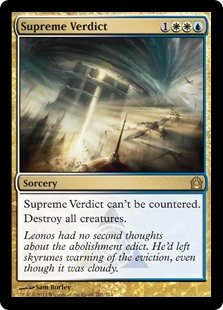
Taking all this together, to win my close matchups I want the maximum amount of Ancestral Vision, a couple Celestial Purges and 2-3 Dispel. If you're wondering about the meager space that leaves, don't worry. We'll address that in Step Seven below.

Step Three: Check Your Good Matchups

Non-Merfolk linear aggro, Abzan Company, and unfair combo decks tend to be favorable, so make sure nothing changes after sideboard.

Linear Aggro/Abzan Company

They play creatures, we play a lot of cards that kill creatures. As long as we don't fall too far behind or lose to a combo, we are favored to win. Supreme VerdictWrath of God was the traditional way that control beat aggro. These days we one-for-one and then two-for-one using Snapcaster Mage. As long as we are able to do that we should be fine.
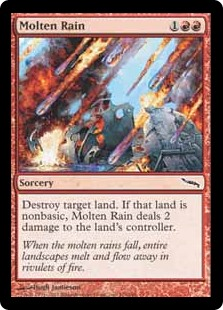
Anger is an excellent answer to most of these decks, though against Merfolk far less so thanks to Cursecatcher. Sweepers are generally pretty good in case we fall behind or our mana comes out awkward, so a few more wouldn't be unwelcome. Verdict is the most reliable option, though regeneration might get popular again one day.

Abzan is a problem because of its combo and Collected Company. Grafdigger's Cage is the best card against them. It isn't dead against Dredge, but it's less powerful than Rest in Peace. And as long as we don't lose to the combo, just playing sweepers should deal with Company well enough.

Unfair Combo

The truly unfair decks do not like counterspells. Or getting burned out while waiting to play around counters. We do both. Our only fear is Pact of Negation, and the Vendilion Cliques should help play around those and provide a clock.

Ad NauseamAd Nauseam will sometimes bring in discard spells against our answers, but if we play enough we should be fine. Gone are the days when we needed to fear an end-of-turn Gigadrowse or Boseiju, Who Shelters All killing our counters, so a few more counters should be enough. Most of the key spells in every unfair combo are instants, so make sure we have Dispels at the ready.

To make sure we don't lose our good matchups we should make sure we have sweepers and Dispels. A couple Verdict and three Dispels are sounding like sound investments at this point.

Step Four: Can We Win Bad Matchups?

Bant Eldrazi, Ramp, and fair combo decks are pretty poor matchups for Jeskai. Is there any way to change that and have it be worthwhile?

Bant Eldrazi

This is a hard matchup because most of our answers are poor. You can Bolt the birds just fine, but the Eldrazi themselves are pretty immune to fire. If they resolve it takes several of our spells to remove one of their creatures, nevermind the tokens. They win the attrition fight handily. Drawing extra cards is fine, but we only have so many answers to go around. We need to sweep them up, so we need to play Supreme Verdict. This matchup still won't be great, but now our answers won't be strained so much. Between counters, Path, and Verdict we have a much better answer suite to make the matchup even at the very least.

Ramp

Whether it's Tron or the RG Valakut decks, Jeskai never wants to see ramp. We play fewer counters than they play bombs, and if they go off with Valakut we just lose. These are hard. Against Tron we can pull it out if they draw only a few bombs and we can counter them or molten rainPath Wurmcoil Engine. If they start dropping Eldrazi we're sunk. Sometimes we can race the RG decks, but they're very fast and redundant. It's not likely.
The most common way to fight Modern ramp is land destruction. Breaking up the Urzatron or slowing down Valakut is a very successful strategy when paired with a fast clock. Our clock is not fast. Yes, Crumble to Dust is powerful against both decks, but it hits after they've assembled their mana and started playing their threats. Molten Rain is an option, but the problem with single-use LD has always been that if you can't exploit the tempo it doesn't matter. I think we just have to write these matchups off. Stony Silence has some value against Tron so were not completely cold to them.

Fair Combo

Decks like Temur Scapeshift are tough. They have the same interactive elements you do, but they also have "I win" buttons maindecked (their combo kill). They can fight over our win condition, tap us out and then kill us. Like most combo decks, they do need to target us, so we could run Leyline of Sanctity. In addition to combo decks it also protects us from Burn. The problem being that if we go this route, we have to play all four. I dislike this option. We can simply play the counter game, use Clique to pressure their hand and life total and use Dispel to save Cryptic for the critical spell.

Merfolk

Jeskai does not like creatures growing out of Bolt range. It also does not like having to spend two spells to kill one creature. Merfolk does both and disrupts our mana. It also hates having its board swept. Anger can do the job, but to have a chance we need Supreme Verdict. A Verdict or two will go a long way.

Step Five: What Are We Still Vulnerable to?

So after thinking about our known matchups, we need to examine the field and the deck types and think about what hasn't been addressed yet.

Gotcha!

What first stands out are the Gotcha! decks. They often play like the linear aggro decks, but the speed and ability to win from nowhere make them far more dangerous. The other problem is that they play cards to protect their creatures, from actual protection like Apostle's BlessingApostle's Blessing to Mutagenic Growth growing creatures out of Bolt range. And then there's Bogles with its obnoxious hexproof creatures.
Blessed Alliance is a card that plays around a lot of these problem cards. The question is whether it's necessary. Dispel counters everything they play cheaply, and it's not that hard to play around sacrifice effects. I think our maindeck plan is good enough that a little bit of shoring it up should suffice. Dispel is good enough here.

Blood Moon

We're a three-color deck, and Blood Moon really hurts us. It is a reason to run Wear // Tear. However, Celestial Purge also works.

Step Six: Is There Anything Else We Can Cover?

We've got most of what we need to worry about done, so can we incidentally hit any other decks? At this point you should have hit most of Tier 1 and 2, so look at the bottom of 2 and into 3 and see if there's anything you can hit without actually dedicating slots.

Lantern of InsightThe one deck that I would actually put thought into is Lantern Control. We really struggle against that deck, which is not surprising. Lantern was built to beat slower fair decks. Dedicated Affinity hate really hurts it, but we don't have a lot of that since we're relying on our maindeck plan to win most of the time. Since we are vulnerable and Lantern does sneak in when you aren't looking, I definitely want an out or two.

Another thing to consider are Delver-style decks. While not too popular, you do see them and we have some vulnerability to a fast threat backed by counters. Given the counters, I'd like to have a reliable way to clear the board and since Verdict can't be countered it seems like it should see play.

Step Seven: Put it All Together

So now we look through out list and pull out the cards that we really want. The cards we most consistently wanted across matchups are:

  • Dispel
  • Celestial Purge
  • Supreme Verdict
  • Ancestral Vision

In addition, we need our Affinity and Dredge hate, Stony Silence and Rest in Peace. Now we need to figure out the numbers. My initial reaction is that Dispel, Verdict, and RiP strike me as cards we really want, so they should be three apiece. Vision is one we need to have early, so it has to be a four. That's thirteen cards. Hmm. We need to rethink the numbers.

Dispel is very important in a lot of matchups. Verdict is reasonably important in a smaller number of matchups. RiP is critical in one and welcome in a few more. And we do have Serum Visions. I think we can cut a Verdict and a RiP.

This leaves room for Stony and Celestial Purge as two-ofs, producing the following sideboard:

Jeskai Sideboard

Sideboard

3 Dispel
2 Supreme Verdict
4 Ancestral Vision
2 Stony Silence
2 Rest in Peace
2 Celestial Purge

The Result

In the end I have four cards that are very high-impact in a couple of matches and eleven cards that are excellent across a lot of different matchups. You might not be playing the highest-possible-impact cards, but your average impact is much higher than trying to run a lot of fun-ofs. This way you are far more likely to actually see your sideboard cards and have more relevant cards against more matchups.

This is how I build my sideboards in Modern, and I find that it works very well. Note that there is some nuance that I'm skipping over to make this approachable for new players, but as always I'm happy to discuss questions in the comments.

Insider: Eight Pickups for Standard Rotation

Are you a Quiet Speculation member?

If not, now is a perfect time to join up! Our powerful tools, breaking-news analysis, and exclusive Discord channel will make sure you stay up to date and ahead of the curve.

It is more than a little weird to be focusing on practicing Shadows over Innistrad Limited for a Team Sealed next weekend when spoilers for a brand new set are popping. Don't get me wrong, I love Team Sealed. It is easily my favorite format of all time and I would fly across the country to play a Homelands Team Sealed event with my friends, but it is strange to be practicing a limited format with all the excitement for a new set looming on the horizon.

I could talk all day about the nuances of various limited formats but let's get down to the brass tacks of what you are here for: MTG finance.

The window for cashing out any Dragons of Tarkir or Magic Origins Standard staples is rapidly closing (if it hasn't shut already). We want to focus on picking up currently undervalued Standard staples that have a shot to make gains next month when the new Standard metagame is unveiled.

Obviously, we are betting on and against an unknown commodity (there are currently only 44 spoiled cards so far) but that doesn't mean we can't leverage what we do know in order to place a few smart bets given the context.

1. Creature Lands


There have been so many creature lands printed over the years that sometimes we forget how unique it is to have lands that can transform into creatures and attack and defend in Standard. It isn't everyday that Standard decks just get to put threats into play by virtue of hitting land drops!

The whole cycle is great and many of these cards have already started to see very consistent Modern play. In particular, Shambling Vent and Hissing Quagmire are quite a house in various GBx Modern midrange decks.

Yet, I'm not completely interested in how good these cards are in Modern as the driving force for potential gains. I think they will be very important in Standard for a couple of reasons. Firstly, pretty much all mana fixing is always required playable in Standard. We are losing the Apocalypse painlands but gaining a new cycle of enemy-colored "fast lands" which means there will be ample fixing to play enemy colors.

There was an error retrieving a chart for Shambling Vent

So, we know for sure there will be enough fixing to play enemy colors and a big reason behind that is the creature lands themselves. I see all of these lands being extremely important in Standard and expect to see significant gains in value.

Lumbering Falls and Needle Spires have been lingering on the edge of "bulk rares" and these are clearly very, very strong Standard staples. As we move away from packs of Battle for Zendikar block being cracked, these cards will casually become more difficult to find in trades with random players. Whichever of these lands lend themselves to the best constructed decks will likely bump up at least a couple of bucks.

2. Goblin Dark-Dwellers


I know a good value card when I see one... Also, I've played with a ton of Goblin Dark-Dwellers in a wide range of Standard decks (and even dabbled in it in Modern) and the card is the truth.

With Collected Company making its much awaited exit from Standard this fall, there will be a lot of room for non-Company decks to compete for. I can certainly see Dark-Dwellers carving out a nice piece of the metagame for themselves.

The card does a lot of the the fundamental things that are good in Magic right now. It generates card advantage while significantly impacting the board. If you are able to cast this creature and buy back a removal spell with it, we are basically shifting the board by killing their best threat and also adding an evasive 4/4 to the mix.

There was an error retrieving a chart for Goblin Dark-Dwellers

It also doesn't help that Dark-Dwellers tend to be a pretty solid blocker. People are sleeping on this card because red has been borderline unplayable for a while in Standard but there is a good chance that will change with a big rotation.

3. Drowner of Hope


I completely fail to understand why people have this card pegged as a bulk rare (reflected in its absurdly low price). The card is clearly Modern-playable (Bant Eldrazi is literally one of the best decks in the format!) and the card has also branched out into fringe Legacy and Modern play.

It is also worth noting that this card will be in basically every kitchen table Eldrazi deck ever.

If Battle for Zendikar were rotating out of Standard today, I still think Drowner of Hope would be undervalued! Which says a lot about how I feel about the price tag on this card.

There was an error retrieving a chart for Drowner of Hope

I've already made a case for why I think this card is undervalued based on its playability outside of Standard---now let me make a case for why this creature could see more Standard play this fall.

First of all, the vehicle mechanic often wants players to have a bunch of durdle creatures hanging around to crew up. In case you missed it, vehicles are a type of artifact that can be turned into creatures until the end of turn by tapping any number of creatures with total power equal to the vehicle's "crew" cost.

Drowner of Hope seems really sick with vehicles (assuming they print ones that are constructed-playable) because you can use the two Eldrazi Scion tokens to crew up a ship and then sacrifice them to tap down potential blockers! The Scions can play a big role in being on the crew and clearing the way for the ship!

4. Sanctum of Ugin


Another card that has already sneaked its way into Modern R/G Tron lists as a lategame replacement for the newly banned Eye of Ugin. Say what you will about Ugin, that guy is always giving Tron new toys to play with!

The card already has a nice home outside of Standard in the form of R/G Tron. It is also worth noting that the card says "search your library" which means it is automatically good in Commander. Finally, most of the cards on my list of potential breakout Standard gainers are already making some small waves in Modern or Legacy. That's no accident. Good cards are good cards and will eventually find homes as long as they are not outclassed by something else in the metagame.

There was an error retrieving a chart for Sanctum of Ugin

Sanctum is a card that has really impressed me in the Temerge (Temur Emerge) decks in Standard. The ability to flash out an Elder Deep-Fiend, tap down an opponent's team, play Kozilek's Return for Bonus Round value from the yard, aaaaaaand sacrifice Sanctum of Ugin to find yet another Deep-Fiend is filthy. Is it fair to say that anytime you cast a spell at instant speed and put four triggers onto the stack you are probably winning? Yeah, totally agree.

The Sanctum is also an important piece in Standard because it will allow whatever flavor-of-the-month ramp deck comes into being to search for whatever giant Eldrazi they want to play next turn. My guess: typically Emrakul, the Promised End.

5. Thing in the Ice


"It's clobbering time!" Seriously, does nobody else ever imagine the card is Thing from Fantastic Four encased in ice from some diabolical Dr. Doom freeze ray? Then he busts out and starts wailing on people. It is kind of the Thing's thing... The clobbering time... Anyways...

Thing in the Ice is already a Modern staple. It has also already had some Standard success earlier in the season. Remember U/R Goggles?

Okay, if you don't think of Fantastic Four when you flip this card at least tell me it makes you think of the crazy shapeshifting alien from The Thing with Kurt Russel. I think the card is very real and has probably already seen its bottom-barrel price. I wouldn't sleep on this card any longer if you don't have your playset yet.

There was an error retrieving a chart for Thing in the Ice

With all of the Thopters, tokens, and nonsense that I'm seeing from Kaladesh I could see a card that just bounces the board being very good in Standard post-rotation. Obviously, everything is context-driven but I could at least see the opportunity for a card like this to shine.

6. Dragonmaster Outcast


Baby Kibler! People seem to have forgotten that Dragonmaster Outcast was once pushing $30 from casual demand alone. I don't think it's unreasonable to assume the card could find a price point better than a couple of bucks in the end.

It is also reasonable to assume (as is the case with other cards on this list) that with Collected Company out of the format red will not continue to stay unplayable forever. Dragonmaster Outcast is the kind of card that just seems to find its way into different decklists because it is so powerful. Sure, it requires you to hit a bunch of land drops first but once you do the payoff is tremendous for the very small investment of one mana.

There was an error retrieving a chart for Dragonmaster Outcast

The card has been sitting at its current price point for months and I don't believe it can really sink much lower. My guess is that it will continue to tick up now that cracking BFZ packs will no longer be a thing.

7. Drana, Liberator of Malakir


The amount of text tacked onto this card is pretty unreal and it generates all kinds of board advantage. The card has never found a home in Standard just because the other decks went over the top of it, but there is an opportunity for Drana to see play yet. It will be one of the first cards that I try to build around once the full spoiler goes up, just because I think what it does is inherently busted in half.

Even if the card doesn't end up lighting the world on fire in Standard I still think it will be a sleeper hit with the casual crowd. How could any kitchen table fan see that card and not be like, "Yeah, gimme two of those."

There was an error retrieving a chart for Drana, Liberator of Malakir

With that being said, I think there is an opportunity for a black-based aggro deck to be great in Standard and that Drana would be exactly the type of card we'd want at the top of the curve.

8. Collective Brutality


I have been super impressed with Collective Brutality in Modern so far. Being able to simply trade cards from your hand for "free spells" via escalate is a huge game.

Collective Brutality is a lot better than people are giving it credit for right now. It is a pure synergy card that ends up allowing a player to do more than they should be able to with two mana. Don't forget that both delirium and madness are supported mechanics in Standard, and pitching cards (which is typically a drawback) can be actively transformed into an upside!

There was an error retrieving a chart for Collective Brutality

Brutality is also a Duress effect that doesn't suffer from being a dead draw in a lategame topdeck war. You know what I'm talking about---when you and your opponent are drawing off the top and you get an Inquisition of Kozilek after they drew a Dark Confidant? Collective Brutality has the option to do multiple different things and so it is never dead late in the game.

This is one of those cards that, as it sees more play, will end up making players wonder how they didn't recognize its greatness earlier.

~

Whew, that was a long one and to think there are only 40 cards spoiled so far! I'm looking forward to Kaladesh and to seeing what Standard will look like without Company and pals. I'm also excited to see how my little Standard stock portfolio will pan out. If you have any hot tips that I missed feel free to share them in the comments. Enjoy spoiler season!

Deck of the Week: Pyromancer Thing

Are you a Quiet Speculation member?

If not, now is a perfect time to join up! Our powerful tools, breaking-news analysis, and exclusive Discord channel will make sure you stay up to date and ahead of the curve.

Last week we checked in on Kentaro Yamamoto's finish with Goryo's Vengeance in GP Guangzhou. Today I have another less established deck from the same Top 8 for you. This is a deck I've been meaning to feature here at Deck of the Week since I first ran across it while going through the MTGO League results a few months ago. At first I misevaluated the nature of the deck, likening it to a new build of Storm---in reality this is a brand-new archetype that wouldn't be possible without the printing of Thing in the Ice.

Pyromancer Ascension

Pyromancer Thing looks super cool to me, but also viable. It appeared a few months ago in the hands of several people grinding away in the online queues. Off the back of those performances it barely cracked Tier 3 in July. The GP triple-header last weekend saw the deck earn its first Top 8 in a prominent event, piloted by Ryoichi Tamada. Tamada clearly believes the deck has legs, as he ran it back one week later in the World Championship with only a minor change to the sideboard.

[wp_ad_camp_1]

Pyromancer Thing, by Ryoichi Tamada (8th, GP Guangzhou)

Creatures

4 Thing in the Ice

Enchantments

4 Pyromancer Ascension

Instants

4 Visions of Beyond
4 Thought Scour
4 Manamorphose
4 Lightning Bolt
4 Lightning Helix
3 Remand

Sorceries

4 Gitaxian Probe
4 Serum Visions
3 Faithless Looting

Lands

4 Scalding Tarn
4 Flooded Strand
1 Polluted Delta
1 Steam Vents
1 Hallowed Fountain
2 Sacred Foundry
1 Sulfur Falls
3 Island
1 Mountain

Sideboard

3 Rest for the Weary
2 Dispel
1 Swan Song
1 Wear // Tear
1 Engineered Explosives
2 Path to Exile
2 Anger of the Gods
3 Blood Moon

Until recently, Pyromancer Ascension's main job in Modern was to fuel broken Storm turns and provide that deck insurance against grindy decks that could counter or discard its combo pieces. Ascension was certainly one of the centerpieces of Storm, but was really more of a means-to-an-end than anything else. Back in the stone ages I remember winning a PTQ with a build running Pyromancer's Swath and Seething Song. At different times, the likes of Goblin Electromancer, Epic Experiment, or simply a stream of now-banned cantrips, have formed the main avenue to generating that critical spell count. Call to MindTo Modern Storm, Ascension has never been more than a workhorse, a tool to leverage towards other purposes.
Pyromancer Thing has much more in common with the old Standard deck built around the crazy enchantment. That deck was truly a Pyromancer Ascension deck, notorious for struggling to win without its namesake card. The plan was sometimes to assemble a bizarre non-infinite combo involving Call to Mind to generate heaps of value, but more often to just string together the requisite number of Lightning Bolts and Burst Lightnings for a clean kill.

In Standard, Pyromancer Combo fluctuated between excellent and middling, depending on the surrounding metagame and how prepared opponents were for it. Trying to migrate a fiddly deck like this that's so reliant on one card to a format as explosive and crazy as Modern is unlikely to yield success. It's no surprise that deck didn't get ported over to the eternal format in its burn-heavy variants---it's hard to justify your one-card combo when you don't even win every time it resolves.

Thing Continues to Thaw

Enter Thing in the Ice. When Thing was first spoiled Modern and Standard enthusiasts alike began brewing with ferocity. We've seen the card be instrumental in Standard decks alongside both Pyromancer's Goggles and Thermo-Alchemist. In Modern people first gravitated towards Delver shells, but it turned out to be much more viable in a controlling shell like Blue Moon. It's apparent that Thing in the Ice is a powerful build-around but it's also a tough nut to crack---finding a place for such an odd niche card like this doesn't happen overnight.

Pyromancer AscensionPyromancer Thing points to Thing in the Ice's potential when you just buckle down and build a deck from scratch dedicated to it. In this case Pyromancer Ascension is the perfect companion, because both cards pair with the same supporting suite to win the game singlehandedly. If you imagine this deck as a glorified burn deck, where instead of drawing extra copies of Lava Spike we endeavor to make copies on the stack, Thing in the Ice is a sort of weird double or triple burn spell. In addition to smacking the opponent around for 7 points (I'm assuming we're timing our spells intelligently to counter their disruption, or when they're tapped out), it also buys time to draw more burn by resetting the board.
Most crucially, Thing in the Ice plus Pyromancer Ascension gives us access to eight win conditions, enabling an archetype that was nowhere near doable before. It's also nice that they fold to different kinds of answers. Rest in Peace or Nature's Claim will do bupkis against Thing in the Ice, and leaving in creature removal may prove embarrassing against an Ascension draw. Of course the name of the game in Modern to beat combo is disruption plus a clock. Pyromancer Thing is set up well against anyone trying to accomplish that using creatures, with its 8 Lightning Helix/Bolts. Against more controlling strategies this deck seems to have tons of inevitability, and sticking an Ascension or resolving a Visions of Beyond will be hard to overcome for an attrition-based deck.

(Not) The Second Coming

Before you break out the pitchforks and decry my naive and foolish belief that Pyro-Thing is The One True Deck that will inherit the crown and rule them all, I'll remind you that this deck is merely Tier 3 at the moment. In many ways it looks like a bad Burn deck, a bad Jeskai Control deck, and a bad Storm deck all rolled into one.

Birthing PodWhat I find interesting isn't necessarily the build itself, but more so the process through which the Modern community has approached Thing in the Ice. It's been a slow and halting gestation period, but the card seems to reveal more of its secrets every day. Even the great and feared Birthing Pod underwent a period of wild experimentation before everyone figured out the optimal Melira Pod build. If that card had a more proven track record (and certainly offers more payoffs than Thing in the Ice), it nonetheless took time for the community to learn how best to use it.


The strength of Pod also changed dramatically as more cards were introduced to the format. Granted, a tutor effect benefits from new printings in a way few cards can, but my point here is that the value of cards in Modern shifts and mutates as new tools become available. In less diverse eternal formats like Legacy and Vintage this effect can be steamrolled by the sheer brutal efficiency of cards like Brainstorm or Mishra's Workshop that crush whatever new, cute strategy people are attempting. In Modern, however, the presence of a pantheon of Tier 3 and lower decks provides fertile ground for new adoptions and printings to push something truly novel up the tiers.

In the case of Pyro-Thing, my intuition tells me it's still lacking a critical piece or two to start really crushing tournaments. If we get another build-around card that pairs as well with spells as the deck's two current headliners, I consider it something to watch. That, and a great choice for some FNM malarkey.

Insider: High Stakes MTGO – Aug 28th to Sep 3rd

Are you a Quiet Speculation member?

If not, now is a perfect time to join up! Our powerful tools, breaking-news analysis, and exclusive Discord channel will make sure you stay up to date and ahead of the curve.

Hi everyone, and welcome back to High Stakes MTGO!

Similarly to the Aug 21st-27th week, this past week was skewed towards buying with only a couple more playsets of painlands sold. My buying activities were nonetheless lighter considering the bulk of my Zendikar block specs were done.

Rise of the Eldrazi was the next set to be flashback-drafted and although this third set is drafted three boosters at a time it was clearly not as intense as it was with Zendikar and prices haven’t dropped much as of Saturday afternoon. This doesn’t mean there’s nothing to pick up in ROE though and it won’t be long before I make a move.

With three GPs featuring Modern Constructed on the same weekend a week ago, the interest for Modern is not dying. While aggressive strategies, recent or old, are still kings, the format is again very wide open. Here are a few things I noted during last weekend:

  • Dredge showed its limits and key cards revolving around this deck such as Golgari Grave-Troll, Greater Gargadon, Bridge From Below and Leyline of the Void are most likely bound to take a big cut in the coming days and weeks. Even the half-priced Bloodghasts I picked up last week don’t look so great.
  • Through the Breach set a new record for itself after a doubling to more than 32 tix in merely a week. As sexy and efficient as the GR Titan Breach and Griselbrand decks may look after doubling in price, this isn't sustainable. I would have sold any Through the Breaches if I had some. Interestingly Scapeshift hasn’t picked up much after Titan Breach's recent successes. It is certainly more about Primeval Titan and Through the Breach these days but who knows when a full combo Scapeshift-only deck will return. Scapeshift is a card I have on my radar.
  • Amulet 2.0 might well have arrived. With his 9th place finish at GP Lille, Kevin Grove proved that without Summer Bloom Amulet can be not just viable but competitive. News I gladly welcome since I own a pile of Azusa, Lost but Seeking purchased at a discounted price after Champions of Kamigawa flashback drafts. Azusa doubled over the course of this past week and Summoner's Pact, also played in the RG Titan Breach decks, tripled in less than two weeks. We might see even more action here.

While this isn't really specific to the triplet of Modern GPs, buying Modern staples is time and time again proving to be one of the safest and most profitable ways to generate tix on MTGO. Although the Standard environment is about to change, Modern is definitely where I place my bets these days. Let's see what happened for me this past week.

As usual, you can always follow the live portfolio here.

Buys This Week

RaresWWK

After Celestial Colonnade and Death's Shadow last week I put my hands on two other creature lands. Although I didn't exactly catch the absolute floor for the Wildwood these two lands have the potential to triple from my buying prices to their respective record highs.

With a much thinner margin of progress I didn't buy Raging Ravine. That being said the price the red-green creature land is on the loose---I'll probably be a buyer if the price get closer to 4 tix.

As bulk rare as could be, Lodestone Golem is one of those cards I'm happy to accumulate virtually for free and wait for something to happen, for a long time if needed. With a reprint in Modern Masters 2015 and a round of WWK flashback drafts I'm assuming the price of this golem couldn't be cheaper.

Now, the only thing I'm waiting for is for Lodestone Golem to find a home in a Modern deck which, who knows, could happen with a little push from Kaladesh block's artifact focus. My other option is a good budget deck from SaffronOlive.

TE

Often fluctuating between 1 and 2 tix and with the potential to reach 3 tix, Tectonic Edge is simply a solid uncommon pick here. As an uncommon I'm expecting to see a lot of fluctuations in the price but I'm hoping to sell this land between 1 and 1.5 tix soon. I may have to sell it in different batches though.

CF

After a very strong first three months and a peak above 27 tix, Chandra, Flamecaller gradually lost steam to bottom around 7.5 tix about two weeks ago. I wish I had pulled the trigger a little bit early but I think this version of Chandra can make a comeback to the 15-20 tix price range sometime in the rest of her Standard life.

Bg

As it was plumbing a new floor around 6.5 tix, I bought a few more copies of Bloodghast this past week. As I said earlier I'm not crazy about this spec but it makes sense prize-wise so let's go for it and hope for the best.

Sales This Week

200 more copies of Magic Origins painlands gone. I'm still selling Yavimaya Coast with a profit but that's no longer the case for the other lands. I have more work to do here and I don't really want to go through the incoming Standard rotation with painlands in my portfolio.

Even with losses at the end of this Standard season, I'll probably be closing these gigantic painland stacks with an overall profit of 50%. I had clearly expected more but to keep things in perspective making a 50% profit on a initial investment of ~2800 tix over only five positions is something I would sign up for almost every day.

On My Radar

Both Standard and Modern are in the hot seat now. With the release of Kaladesh only one month away Standard will rotate one more time this year. If it's not already the case, Shadows over Innistrad and Eldritch Moon will very soon be at their lowest price point.

Free from the oppression of Collected Company, current underdog strategies may emerge stronger and demand for cards from the last four Standard sets unplayed thus far may suddenly increase. I'll probably focus on that in a week or two.

Modern is where my immediate attention is. Prices are moving in both directions and I have to carefully watch virtually all of my Modern positions. Both Zendikar and Scars of Mirrodin block are rich in Modern staples so this is the time to invest in a lot of good Modern specs. Alternatively I'm also scrutinizing the MTG Goldfish Modern Movers and Shakers even more often than usual to make sure I'm not missing good selling opportunities.


Thanks for reading,

Sylvain

Want Prices?

Browse thousands of prices with the first and most comprehensive MTG Finance tool around.


Trader Tools lists both buylist and retail prices for every MTG card, going back a decade.

Quiet Speculation