menu

Life Lessons on Collectibles, Pt. 2 (2004-2012)

Are you a Quiet Speculation member?

If not, now is a perfect time to join up! Our powerful tools, breaking-news analysis, and exclusive Discord channel will make sure you stay up to date and ahead of the curve.

In part one of this series, I shared my foray into collectibles, starting with baseball cards and eventually ending up a casual Magic player. Today I'll continue the story and consider the lessons learned collecting in and beyond college.

Collecting in College

There was an error retrieving a chart for Tolarian Academy

There were no game stores anywhere close to my university, which nowadays seems unthinkable, but at the time it forced me to pull away from the hobby I had loved for so long. However, my freshman year, I did look to see if I could find any other Magic players on a local forum.

I met up with one guy who had a full Ravager Affinity deck built, and he stomped most of the casual decks I had made. All of them except one: I had fallen in love with Tolarian Academy after reading just how broken the archetype was, and built an insanely powerful deck utilizing Windfall, Stroke of Genius, Mind Over Matter, and a lot of artifacts. I enjoyed winning every game on turn 1, and he had never seen most of those cards before. The fun I had in those games kept me from selling any of my cards during this break, and when the siren again, I answered with a vengeance.

Lesson learned : Cherish the rare things that bring you great joy.

There was an error retrieving a chart for Stroke of Genius

The summer before my last semester, I had a medical issue that required a week-long hospital stay. I was not used to being cooped up in a bed, and began looking for something to stimulate my brain. Sadly, this was in the days before hospitals had wifi available, and I quickly got bored playing single-player Diablo 2. That is when I remembered my old Magic collection and had my parents bring me my cards.

I spent the remainder of my stay building decks and playing against my brother when he came to visit. The current standard block was Lorwyn, and I opened a pack with a planeswalker, a card type I had never seen before.

There was an error retrieving a chart for Ajani Goldmane

Lesson learned : when times get dark and stressful, having a hobby you love to fall back on is invaluable.

The Real World

After graduation, I was able to land my dream job. However, it required I move to Baltimore, far from my friends and family. I was excited for this fresh start, but also aware that I was no social butterfly, and many evenings were spent cooking dinner and watching TV.

Fortunately, the company I worked for happened to have an internal forum for coworkers to discuss hobbies, so I asked around for fellow Magic players and met a coworker at a local game store (Games and Stuff in Glen Burnie, MD). We played in a Shards of Alara draft and quickly became good friends.

Lesson learned: making new friends is a lot easier when you share a hobby.

There was an error retrieving a chart for Tezzeret the Seeker

It was during this time that I was introduced to EDH (the format now called Commander) and learned it was my preferred format to play. I began buying cards I thought might be powerful in the format or ones I wanted for specific decks. Prior to this revelation, I had almost always bought packs and traded their contents for cards I wanted, which obviously meant I acquired cards pretty inefficiently.

Lesson learned: when you want something specific, just buy it.

Most of the EDH games I played at this time were with a small group of likeminded casual players. We would play at our LGS until they closed, and then moved the games to a Denny's that wasn't too far away until we were ready to call it quits for the night.

Other players watched us, and interest in the format grew, which isn't surprising given that UB Faeries was dominating Standard deck and many found it abysmal to play against. This growth led the store to start an EDH tournament, which of course brought in some more competitive players. I wanted to give them a run for the money, so I built a one-trick pony Maralen of the Mornsong combo deck and took down the tournament. I don't even remember what the prize was, but I do remember that I didn't really enjoy playing the deck and I took it apart after the tournament.

There was an error retrieving a chart for Maralen of the Mornsong

Lesson learned: play what you love, be that competitively or not.

All Good Things...

Sadly, I graduated smack-dab in the middle of "The Great Recession" and my dream job evaporated along with the jobs of 500+ of my coworkers. It could have easily been an opportunity for me to fall into depression, but I had my trusty cards and friends, and we kept playing right up until I moved back home to look for a new job.

I was able to land a position at a company I had interned at for several summers, and there was a card store about 40 minutes away. I made my way there and ended up meeting two brothers who ended up being best men in my wedding and whom I still hang out with as often as possible. Magic had once again brought me new friendships and kept my spirits high.

It was also at this time that I began to find enjoyment in competitive Standard. This was before Cawblade had caught on big, and the format was still pretty wide open. I built a very powerful Mono-Green Elves deck that utilized Copperhorn Scout, Elvish Archdruid, and Ezuri, Renegade Leader to flood the board with elves and kill my opponents on turn 4 or 5 consistently.

Lesson learned: playstyles and enjoyment can change, so don't be afraid to branch out and try new things.

There was an error retrieving a chart for Ezuri, Renegade Leader

Just a Children's Card Game?

Thus concludes my Life Lessons on Collectibles series... psych! Stay tuned for my wrap-up next time. Until then, I hope you enjoyed taking this stroll down memory lane with me. What are your Magic stories? And the most valuable lessons you've learned along the way? Let us know in the comments!

Magical Creatures: Beeble, Masticore, and Metathran

Are you a Quiet Speculation member?

If not, now is a perfect time to join up! Our powerful tools, breaking-news analysis, and exclusive Discord channel will make sure you stay up to date and ahead of the curve.

Hello everybody! Welcome to the latest installment of Magical Creatures, a series reviewing every creature type that was created specifically for Magic: The Gathering. Last week, we finished our double feature on Tempest. That expansion set introduced so many new creatures that we had to split the analysis into two pieces. The first dealt with Thalakos and Soltari; the second, with Licid, Spike, and Sliver.

What's next? The Rath cycle was followed by a starter set (Portal Second Age) and by the first "Un-set" (Unglued). Neither of them, however, introduced new creature types unique to Magic. Therefore, we'll have to wait for one of the most beloved cycles ever: the Urza block, often regarded beetwen 1998 and 1999 as the most powerful block ever and printed.

Urza's Saga

Beeble, Masticore, and Metathran are the three creature types unique to Magic that were created for the Urza block. None of them appeared in the first set, Urza's Saga, which introduced no new creature types at all. Not that it needed them in order to become legendary! It boasted plenty of powerful spells and lands, as you can see.

Some of the most powerful cards from Urza's Saga

Anyway, we'll get back to this abundance of high-power cards on another occasion. For now, let's focus on the three creature types introduced in the other two expansions from Urza block, Urza's Legacy and Urza's Destiny.

Beeble

Beeble looks a lot like a creature from an Un-set. And for good reason. Of the five unique creatures with that subtype, three are from an Un-set! However, when they were first printed, Beebles were included in a regular set, by which I mean one legal for sanctioned play. The first two Beebles are Bouncing Beebles, from Urza's Legacy, and Bubbling Beebles, from Urza's Destiny.

Both are small, magical beings, similar in concept to the fantasy creature known as the "homunculus." Their history is well-known, as Beebles may be the most adorable and funny creatures ever created for Magic. But one interesting fact about the Beeble is their first appearance: the cover of Duelist n°22. Illustrated by Jeff Miracola, it showed a famous Magic character (Squee, as in Squee, Goblin Nabob) with a bunch of little, pink beings bouncing around. The illustration was published exactly one year before the arrival of the first official Beeble!

The creatures are obviously unplayable, at least in competitive lists, as their only feature is a semi-evasive ability. The first is unblockable if defending player controls an artifact, and the second is unblockable if they control an enchantment. Despite their relative elusiveness, Beebles are depicted on many other cards, such as Donate and Wizard Mentor. I personally hope to see many more of them in the future.

Masticore

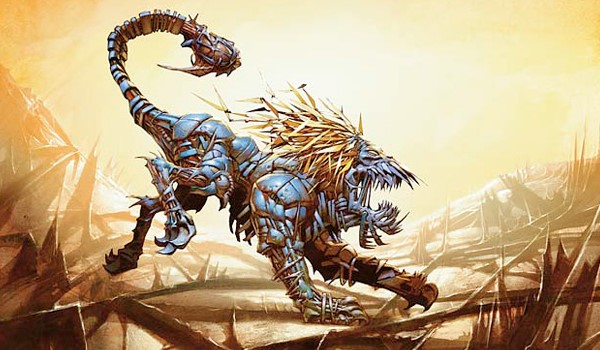
Masticore, on the contrary, is a totally serious creature type. The exact opposite of Beebles. You can tell as soon as you check out the illustration of the first of its knid, which is called Masticore. So, what's a masticore, apart from being ferocious? Well, its menacing and aggressive qualities are surely relevant characteristics, but they are shared with another similar type: Manticore. Why create a new type entirely?

Let's start with the similarities. Both types are fierce, lion-like beasts of a certain size. And... that's it. Now, what about the differences? The most relevant, at least for our purpose, is that a manticore is a legendary Persian creature which enjoys countless appearances all across the history of literature. A masticore, though, is a creature that just didn't exist before its introduction in Urza's Destiny in 1999. All this to say that the masticore takes inspiration from the manticore, and not the other way around.

Another difference is the alignment. Masticores are colorless, whereas Manticores are normally aligned with red (and sometimes with black and green). What else? If you look at the art, you'll see that most Manticores are winged, while Masticores are always flightless. (To be honest, this was true only for the first Manticores, since in recent years they printed some wingless specimens, too.) Finally, the very name "masticore" is a pun. It doesn't only refer to the famous Persian manticore, but also plays with the verb "masticate," meaning "to eat!"

Finally, all Masticores are artifact creatures, and they share the trait of having an effect that deals direct damage (normally as an activated ability). Another trait they share is making their owner discard cards, either at the beginning of the upkeep or when they enter the battlefield. In both cases, that's a drawback used to balance the fact they are colorless (making them easier to cast) and generally quite powerful.

Metathran

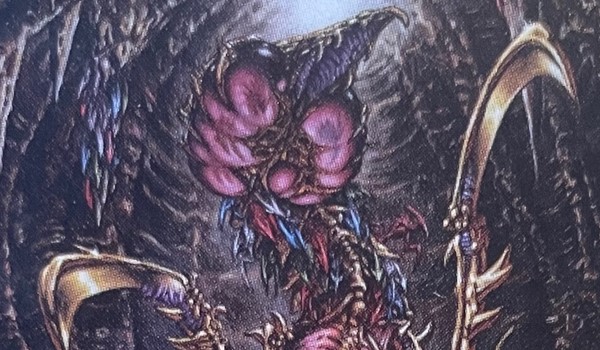
Metathran is probably the least famous among the creature types we're dealing with today. And yet, it's the most printed... in fact, no less than eight different cards exist bearing this subtype, versus five for the other two! That's not all. As we'll see soon, metathrans appear on many other cards, at least if you focus on illustrations.

What differentiates Metathran from Beeble and Masticore is also that this creature type followed the same path as Thalakos, Soltari, Kithkin, and many others. In other words, when the first Metathrans appeared, they didn't bear the Metathran subtype, as shown in the gallery above. It was only with Tenth Edition (2007) that Sky Weaver appeared, the first Metathran that actually received the type.

From an in-game perspective, this subtype is not that consistent. I mean, their art is always recognizable, but their abilities are quite varied. The first two Metathrans share an evasive ability, while the others don't. Four of them have activated abilities, but their effects are not alike. The only thing Metathrans share is their blue alignment.

The most interesting thing about Metathrans, given their unexceptional power level, is the frequency with which they appear in the illustrations of other cards. Some of those include Chromatic Sphere, Kavu Scout, and Minotaur Tactician, to give an idea of how widespread they are across all colors. If you're interested, a full list is available here.
Opposites Attract

In today's piece, we sw some new creature types, but also some long-standing characteristics that we have by now come to recognize. For instance, the very common practice of naming the first card of a new creature type with the same name as the subtype itself. Masticore was just the latest in a long line of creatures such as Lhurgoyf, Phelddagrif, Homarid, Orgg, Atog, and many others!

The most relevant feature we came across today, though, is the opposition between serious and comical creature-type designs. We saw something similar while analyzing Brushwagg and Viashino, or unpacking illustrations. This time, however, the opposition is particularly strong, perhaps because of Masticore's epicness, in total contrast with Beeble's playfulness.

What do you think of today's creatures? Are you team grandeur or team irony? Let me know in the comments or on Twitter, and stay tuned for next week's piece, where we'll deal with the new subtypes from Mercadian Masques!

Pioneer Deck Spotlight: MonoG Devotion

Are you a Quiet Speculation member?

If not, now is a perfect time to join up! Our powerful tools, breaking-news analysis, and exclusive Discord channel will make sure you stay up to date and ahead of the curve.

In recent months, Pioneer has gotten especially popular among the competitive Magic crowd. It's the inaugural format for the first Regional Championship and many of the Regional Championship Qualifiers feeding the event. Thanks to the influx of Pioneer tournaments and additional eyes on the format, more players have begun to iterate on the established top decks with some interesting results. The most notable innovations seem to all relate to MonoG Devotion, the current top dog of the metagame.

What Does it Do?

The Splash

At face value, MonoG Devotion is a ramp deck that takes advantage of Elvish Mystic and Llanowar Elves alongside Nykthos, Shrine to Nyx to power out midrange threats like Cavalier of Thorns and Karn, the Great Creator. However, the deck also includes Oath of Nissa and Storm the Festival as forms of card advantage and selection. Thanks to Oath's mana-washing and Festival putting permanents directly into play, there is enough consistency to reliably splash otherwise uncastable planeswalkers.

Initial builds played a single copy of Nicol Bolas, Dragon-God as a standalone value engine. Bolas is an enticing include as it provides a consistent source of card draw and removal, things green decks often struggle with. Hall of Fame member and professional mathematician Frank Karsten recently released an article on the likelihood of getting a Bolas in play and found it to have an 82.5% success rate by turn six, with no substantial difference in success rate between one or two copies.

Karsten's findings suggest that it's perfectly reasonable to play off-color planeswalkers, and may arguably be correct for the sheer increase in power level. Recently, the deck has moved away from Bolas in favor of Teferi, Who Slows the Sun as it provides consistency toward combo wins.

The Combo

As mentioned above, the midrange plan is just surface level. MonoG also has access to an impressive combo finish involving The Chain Veil and Pestilent Cauldron // Restorative Burst out of the Karn, the Great Creator wishboard.

There was an error retrieving a chart for The Chain Veil

With sufficient devotion, a player can use Teferi or Kiora, Behemoth Beckoner to repeatedly untap The Chain Veil and/or Nykthos. Restorative Burst can pick up Kioras and Karns in the graveyard that have minused to zero loyalty. Each fresh copy can activate an additional time for each activation of the Chain Veil, even if they weren't in play when the artifact was activated. Since Restorative Burst exiles itself and is an artifact on the front side, Karn can repeatedly find the spell from exile to recast.

After performing this loop a sufficient number of times, Karn can then find Reckoner Bankbuster in the sideboard, activate it, then activate Kiora or Teferi to untap the vehicle until its charge counters deplete. This produces a treasure token that can be used to cast Pestilence Cauldron and mill the opponent infinitely.

What I Like

MonoG feels like a Swiss Army Knife. It utilizes one of the key pillars of the format (Nykthos/one-drop mana dorks) better than any other deck allowing it to fight on just about any axis. Threats like Old Growth Troll can provide an aggro game plan to take down opponents before they set up, while Karn can adjust to any matchup with a variety of hate cards. Having maindeck access to niche options like God-Pharaoh's Statue or even Pithing Needle can deal a critical blow to linear strategies, and "good stuff" options like Skysovereign, Consul Flagship and Esika's Chariot can overpower anyone playing fair Magic.

I'm also a big fan of how consistent the deck is. Each effect has multiple cards performing similar roles. Nine mana dorks and functionally eight land auras, plus Nykthos, almost guarantees acceleration in the early game, while ensuring Kiora will untap a land that produces multiple mana. Oath, Storm the Festival, and Karn all provide consistency in assembling the end game lines as well. Cavalier is either a game-winning threat on its own, or fixes the next draw when it dies for a follow up win condition.

What I Don't Like

Since you are a green deck with only nominal access to other colors, it's hard to make significant deckbuilding changes without affecting the deck's ability to reliably cast its necessarily pip-intensive spells.

The deck's natural predator is white aggro. Decks like WR Heroic, and White Weenie are especially difficult where their clock is fast, disruptive, and can get underneath us. Brave the Elements is a catch-all way for them to completely sidestep MonoG's defenses, so blocks aren't always reliable ways to guarantee another turn.

The list below incorporating Portable Hole on the back of shocklands and pathways may be the closest MonoG can get to early interaction and removal.

The Deck

Pioneer MonoG Devotion

Creatures

4 Elvish Mystic
4 Llanowar Elves
1 Sylvan Caryatid
4 Old-Growth Troll
4 Cavalier of Thorns

Enchantments

4 Oath of Nissa
4 Wolfwillow Haven

Planeswalkers

4 Kiora, Behemoth Beckoner
2 Teferi, Who Slows the Sun
4 Karn, the Great Creator

Spells

4 Storm the Festival

Lands

2 Boseiju, Who Endures
3 Branchloft Pathway
6 Forest
2 Lair of the Hydra
4 Nykthos, Shrine to Nyx
4 Temple Garden

Sideboard

3 Portable Hole
1 Treasure Vault
1 Tormod's Crypt
1 Pithing Needle
1 Damping Sphere
1 Transmogrifying Wand
1 The Chain Veil
1 Skysovereign, Consul Flagship
1 God-Pharaoh's Gift
1 Meteor Golem
1 Pestilent Cauldron
1 Esika's Chariot
1 Reckoner Bankbuster

End Step

All in all, MonoG Devotion is a powerhouse of a deck, and probably the best all-around choice for Pioneer right now. I plan on locking in the list above for a local RCQ this weekend, and I plan to share updates on Twitter. Follow me there for all the latest updates! See you all next week (and hopefully with my invite in hand)!

Dominaria United Spoilers: A Pioneer Shakeup

Are you a Quiet Speculation member?

If not, now is a perfect time to join up! Our powerful tools, breaking-news analysis, and exclusive Discord channel will make sure you stay up to date and ahead of the curve.

It's spoiler season again, and as I look around the web, there's speculation running rampant. Nobody knows how cards fit in, whether they're home runs or the pits. We don't even have the full spoiler yet. It's tempting to jump into theorycrafting with unproven, untested cards, but I'm going to refrain. I'll stick to reprints this week.

For those unaware, Dominaria United (DMU) spoiler season is less than a week old. However, about half of the set has been spoiled. This was not intentional, someone at Wizards accidentally posted the entire Dominaria United Release Notes document on the official site last Friday. They took it down quickly, but the internet never forgets. The set looks quite interesting overall. However, six intentionally spoiled cards currently overshadow everything else in terms of format impact. Today, I'll focus on those reprints and what they mean for Pioneer.

Bringing Back the Pain...lands

Confession: I said six cards, but that's only technically correct. See, five of the cards are from a cycle of ten that haven't been in Standard since 2009. This makes me feel very old, as I remember when these were the absolute pinnacle of mana fixing available. The allied pain lands are being reprinted and will therefore be Pioneer playable for the first time.

...though not all of them right away. Wizards is printing six pain lands now, and the rest are coming in The Brother's War in a couple of months. Which is a really weird division. Printing either the five allied and then five enemy-colored lands, or vice versa, makes a lot more sense—but apparently, the needs of Creative outweigh the need for logic.

There was an error retrieving a chart for Adarkar Wastes

This might explain why the reprints in DMU seem arbitrary. We're getting Adarkar Wastes, Caves of Koilos, Yavimaya Coast, Karplusan Forest, Shivan Reef, and Sulfurous Springs. I guess they're important to the story, but I don't follow the story anymore. I'm tired of setting everything on fire being Wizards' only storytelling strategy. Regardless, three allied pain lands are making it into Pioneer now, and the others will join in a few months.

A Needed Addition

I'm looking forward to having the allied pain lands back. The selfish reason is that I acquired multiple playsets of each back in the day, and I can finally unload them. I haven't found anyone who's wanted them since the shock lands were printed. Even the Ice Age versions. The design change towards always having mana fixing for all colors made them somewhat obsolete. The eternal formats have fetch lands and duals, and Standard is, well, Standard.

There was an error retrieving a chart for Scalding Tarn

However, now pain lands will be in Pioneer forever, and I strongly suspect they'll be in high demand. Mana Confluence has been seeing a lot of play precisely because the allied pain lands aren't available. Paradoxically, the mana fixing for enemy colors was a lot better than allied since the enemy pain lands were already available via Magic Origins. Confluence will almost certainly be immediately replaced, which will also make some mana bases less painful on average. The pain lands can be used for colorless mana, after all.

There was an error retrieving a chart for Mana Confluence

Beyond that, it's not clear how the new pain lands will fit into Pioneer mana bases. The enemy pain lands aren't always included in enemy-colored decks, even faster ones. Replacing the Pathways is the logical starting point, but I don't know if that's ultimately correct. I am certain that there will be a lot of tinkering in the next few months.

The Queen Returns

Of course, all that pales in comparison to the news that Liliana of the Veil is being reprinted. Yes, I did bury the lede. It's a legitimate journalistic stratagem. Unlike with the allied pain lands, Modern (and maybe Legacy) is interested in this reprint.

There was an error retrieving a chart for Liliana of the Veil

Liliana's (arguably) most powerful incarnation is fairly expensive and has been so for quite a while, despite a few printings in Masters sets. A new printing in a Standard-legal set (with a Standard sized print run) represents a large increase in supply. This should put downward pressure on the overall price, with the new printing having the most pressure due to older versions having extra collector value. Of course, the new printing will also stimulate demand as players want to play a full set. Whether this will yield a net increase or decrease in price won't be known for some time.

She Finds a New Realm...

Of course, the biggest impact will be on the format that Liliana's never been in, Pioneer. Or maybe we should all just agree to call it Veil.format for the next few months. I'm not even making a joke. I fully expect everyone and their hamster to be running Liliana of the Veil in every deck possible for the next few months. Whether that will still be true in 2023 is another matter entirely.

There was an error retrieving a chart for Thoughtseize

Liliana of the Veil was a staple of Modern for many years. She's still a very potent card and sees considerable play, however, it's definitely not as much as pre-Modern Horizons. Liliana also sees play in Legacy, though it's neither widespread nor consistent. There's no reason to think that Pioneer would be an exception.

There was an error retrieving a chart for Tarmogoyf

The real question is what role Liliana will play in Pioneer. Liliana is a resource denial planeswalker. The symmetrical discard is used to pressure the opponent into taking action while (in Modern and Legacy) powering up Tarmogoyf. The latter isn't possible in Pioneer, but the former will likely have a large impact on UW Control matchups.

...With a Ready Palace

That being said, I don't think that is currently the utility on most players' minds. I'm going to make a bold prediction right now: Liliana's printing will primarily benefit Greasefang, Okiba Boss decks in the immediate future. Whether it's the Abzan Greasefang deck or other variants is irrelevant. Greasefang is the archetype that will most fully adopt Liliana.

There was an error retrieving a chart for Greasefang, Okiba Boss

The reason is simple: Liliana makes Greasefang better. The card, I mean. The whole deck too, I suppose, but I'm specifically pointing to Liliana closing a big hole in the Greasefang plan. Specifically, Liliana makes it possible to discard Parhelion II reliably, repeatably, and consistently. Using Greasefang on Parhelion is the primary strategy for the deck, but also a sometimes-fatal flaw. The Abzan version in particular has many ways to get Parhelion into the graveyard from the library but few to discard it, meaning Liliana is closing a blindspot.

There was an error retrieving a chart for Parhelion II

A blindspot that is relevant. There are plenty of ways for a Greasefang trigger to not result in an attack. My personal favorite is tapping Parhelion with Shacklegeist. Many lists now run Esika's Chariot to avoid this problem, but it's not as powerful as Parhelion. And now there's a way to reset while also disrupting the opponent. It's an exceptional deal.

Make Pioneer Make Sense

With all that said, I really hope that Liliana (and to a lesser extent the pain lands) will make Pioneer make more sense to me. It may just be me, but the Pioneer metagame doesn't make sense. There are some decks that make perfect sense as good decks. There are many others that seem like they shouldn't work and yet see a lot of play. More perplexingly, there are a number of decks that seem like they should be better or even exist but don't, one of which Liliana could revive.

Why Must This Be?

I realize that it sounds weird, but Pioneer's metagame feels very arbitrary. As if there's a gentleman's agreement being enforced that "This is how it is to be, don't ruin everything." However, there's no particular reason that The Things That Are Good have to be, nor is there a reason other things couldn't be too. And yet, things are as they are.

There was an error retrieving a chart for Brainstorm

For comparison, Standard makes sense. It is the reflection of whatever Wizards decided would be good when the legal sets were designed. Whatever's good is whatever is able to be good. Modern makes sense (even if it is a bit wonky). Its metagame is a function of the best threats and answers available. Legacy makes sense. It's Brainstorm decks vs anti-Brainstorm decks, and the top deck is the most efficient Brainstorm deck. Are there holes and oddities in all of these? Absolutely, but the reasons the holes exist have explanations that fit their respective metagames.

There was an error retrieving a chart for Bloodtithe Harvester

To me, that isn't the case for Pioneer. It feels far more arbitrary. I don't have a specific reason why I feel this way. It's a general feeling, but I can point to the source of the feeling. Pioneer was brand new when the pandemic ended almost all paper Magic for a year and serious competitive play for two. The format was poised to be heavily pushed in competitive play to develop its player base, but that never happened. Instead, it was left to wallow and the only players that kept it going were the hard-core enthusiasts. Now that Pioneer is getting pushed again, it's like everyone else is stepping into the enthusiast's exclusive club and being told to conform, and we don't know better.

A Case in Point

The best encapsulation of my issue is that there is only one Nykthos, Shrine to Nyx deck, and that feels wrong. Nykthos is the most powerful mana engine in Pioneer (Lotus Field is a combo, not an engine) and yet it only sees play in one deck anymore. Devotion in general seems like it's being underplayed. I'm not saying that every color needs a devotion deck. Mono-Blue Devotion would be worse than Mono-Blue Spirits. Mono-White Devotion was a thing until Walking Ballista was banned. It isn't anymore because there's no good white mana-sink.

There was an error retrieving a chart for Nykthos, Shrine to Nyx

But why don't existing mono-red decks play Nykthos? They're well set up to do so now as they did before. Many play several varieties of Chandra, have many creatures and play red artifacts and enchantments. All of which provide red pips to power Nykthos. Red even has the perfect mana-sink/finisher in Banefire. However, I've never seen anyone try. I proxied up a few versions at the start of RCQ season and they performed about the same as the normal mono-red decks, yet, they see no play.

There was an error retrieving a chart for Banefire

Similarly, mono-black decks have never played Nykthos despite being (arguably) the best Devotion deck in Ravnica-Theros Standard. I didn't get it then, and I don't get it now. It's especially egregious since Urborg, Tomb of Yawgmoth is legal and removes Nykthos' colorless mana drawback. It can't be that Pioneer is too fast. Rakdos Midrange and UW Control are two of the most successful decks. What's the problem?

Liliana As a Fix

This is where Liliana can help me. She's better in many roles than competing red planeswalkers, which will push them out. With a reduced need for red, there will be an incentive to go mono-black. The biggest losses are Bonecrusher Giant and Fable of the Mirror Breaker. However, there are other removal and card advantage options available. Thus, she might make the deck that I think should exist, actually exist.

There was an error retrieving a chart for Fable of the Mirror-Breaker

Not that it's a certainty. My problem is my problem. It may be that I'm simply out of touch. However, as I noted earlier this year, it does feel like Pioneer is missing something. Other players I've discussed this with agree, but nobody knows what's wrong or what's missing. Just that the format feels somehow incomplete. Liliana and the pain lands will certainly lead to more exploration of Pioneer, so hopefully, that will fill in the missing decks.

More to Come

DMU isn't even out yet and it's already having a major impact on Pioneer. Hopefully, these reprints are the most impactful cards and everything else will be interesting build-arounds and role-players. Some pretty overpowered cards need printing to shake up any format as much as Liliana of the Veil and allied pain lands promise to. Which is a troubling thought.

Navigating Arena’s Latest Cube

Are you a Quiet Speculation member?

If not, now is a perfect time to join up! Our powerful tools, breaking-news analysis, and exclusive Discord channel will make sure you stay up to date and ahead of the curve.

A good format demands to be explored. It presents unique possibilities down each avenue and promises discoveries at every bend. The best example of this is Cube, and Arena's most recent iteration is no exception. Even experienced players will have to adjust to the new card list and relearn the terrain. The lessons of last Cube are still valuable, but the changes impact the environment. A knowledge of the landscape can help you navigate your draft to consistent success.

The best place to start is in the two mono-colored aggressive decks.

Red Aggro

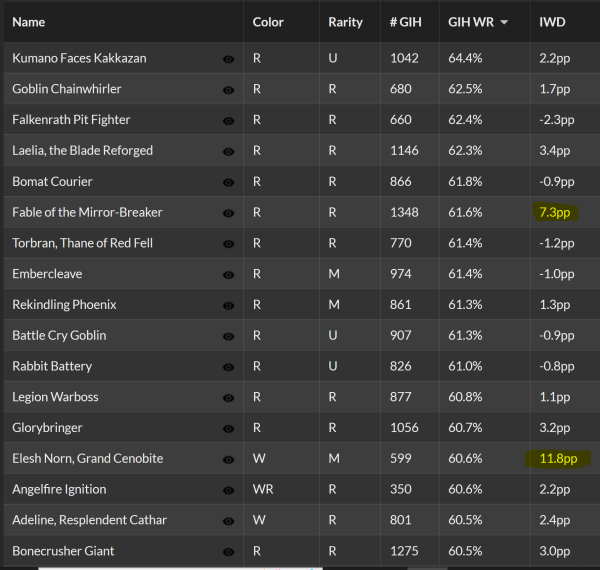
The trick to the aggressive decks in this format is the one drops. Kumano Faces Kakazhan, Bomat Courier, Falkenrath Pit Fighter, Rabbit Battery, and Voldaren Epicure are all amongst the cards with the highest game-in-hand win rate, and that's not an accident. Two drops are always important in aggressive decks. When they follow aggressive one drops they can quickly pressure opponents.

In traditional draft sets, we first pick the top-end threats. In Cube, the power level is high all around. The best way to capitalize on that is to ensure we have the cards that make our deck work consistently. For an aggressive deck to perform consistently, it needs to set the tone early. This means prioritizing cheap creatures. The more expensive cards are mostly interchangeable, but cheap creatures are essential. Of the expensive cards, Embercleave is by far the best finisher.

White Aggro

Similarly, the best white decks are low to the ground. We want a deep arsenal of one and two drops. Adanto Vanguard and Luminarch Aspirant are effective and white's three-drops are very deep. Elite Spellbinder and Adeline, Resplendent Cathar have consistently looked powerful.

Oketra's Monument improves with the addition of Sigardian Evangel. The two combine to create X 1/1s and 3/1s while tapping X creatures down. Both cards are strong on their own and should not be overlooked. The white deck can use the monument to go wide with Clarion Spirit, Wedding Announcement, Angel of Invention and others.

The Alchemy Baldur's Gate legend Lae'zel, Githyanki Warrior is the most powerful addition to the color. It blanks removal and is very hard to deal with in combat. While I don't want a lot of four drops, this is one of the best. Similar to the red decks, you won't need to prioritize traditional bombs in the drafting portion. Focus on curving out and applying consistent pressure. There are enough bombs to go around.

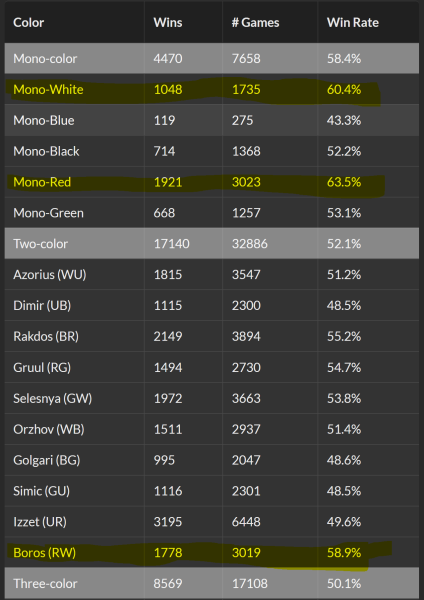
The data provides compelling reasons as to why we should start our draft looking to be aggressive. While this chart doesn't explicitly aggregate aggressive decks versus slower decks, it reveals a clear color preference.

The red aggressive cards boast the highest win rates in the format. Additionally, I highlighted the IWD (improvement when drawn) of the two midrange threats. While Elesh Norn, Grand Cenobite and Fable of the Mirror-Breaker have strong win rates, their decks struggle when those cards aren't drawn. The is clearer when we explore the rules of engagement for midrange decks in the format.

Midrange Migraines

The aggressive decks want to curve out, pressure our life total, and close out the game fast. This linear strategy leads to consistent gameplay. These decks have an abundance of tools and are on top for a reason.

Comparatively, the midrange decks need to provide a defense that can stabilize the board. Then they need to develop threats that can close out the game before aggressive decks assemble lethal damage. The following pieces are all valuable for different brands of midrange decks.

  • Fixing - to provide access to more powerful cards
  • Defensive Speed and Interaction - to not die to aggressive decks
  • Grind and Card Advantage - to win the mirror and beat more controlling decks.
  • Win Conditions - This can refer to any collection of tools that can actually win the game.

The aggressive decks are focused on doing one thing, whereas the midrange decks are torn between establishing a game plan and turning the corner. The aggressive decks define the updated Cube environment, but other decks can still thrive if they're built correctly.

Data Be Damned

Me and the Pod Navigating the Unknown

Arena Cube is a lower-stakes format (as measured through the cost of entry and the reward for winning, as well as a lack of attached rankings). Take advantage of this format and explore what it has to offer.

One of the best ways to learn about this format is to look across the table. So many of the decks do powerful things, and there are a lot of viable options to consider. Cube encourages creative approaches and can turn any Spike into a Johnny.

Ramp/Lands/Go Big Green

Going bigger than the aggressive decks is a nice way to position yourself against the meta. Oracle of Mul Daya is a powerful centerpiece, while Thragtusk, Elder Gargaroth, and Workshop Warchief all generate value and gain life which makes things difficult for the aggressive decks.

Best of all, this is a deck that can start on turn one. Elvish Mystic, Llanowar Elves, and even Gilded Goose can put aggressive decks on the back foot. There are plenty of finishers, but the ones worth prioritizing are Kogla, the Titan Ape, Ugin, the Spirit Dragon, and even Ulamog, the Ceaseless Hunger.

The elves are good in a lot of the midrange decks. Taking one early is a reasonable place to start your draft and can help you get into this archetype while leaving other options open.

Gruul Beatdown

The Red Green deck is a bigger aggressive deck. This deck doesn't have the high count of one drops, although it does want the elves. Your threats should be bigger than the mono-colored decks, but you're still playing aggressive creatures.

Domri, Anarch of Bolas and Halana and Alena, Partners are both powerful cards for this deck and exemplify your game plan. Dragons like Glorybringer are great ways to end the game in a deck like this and the burn spells are both interaction and reach.

Esper Midrange

White provides a number of options that the aggressive drafters will ignore. You can often wheel Banishing Slash, Seal Away, and The Birth of Meletis in addition to board wipes like Day of Judgment. Most white players will pursue an aggressive deck, which means these types of cards will be available late. The black removal spells haven't been as impressive, but you probably want some number of them.

Contrary to many of the decks in the format, the top-end threats are the draw to this archetype. Elesh Norn, Grand Cenobite, Sheoldred, Whispering One, The Scarab God, and Hullbreaker Horror are all very difficult to beat.

Timeless Witness Decks

I've spent most of my drafts in the Cube working on Timeless Witness decks. Usually, these are three-color piles with a lot of powerful cards and card advantage. These decks don't tend to play as many top-end threats and are more formidable in the midgame. Timeless Witness has strong synergies with Baral's Expertise and Mythos of Illuna. Every copy of the Witness can regrow either sorcery while fighting down the opponent's creatures or resetting their development.

Even without any specific synergies, I like this card. It brings back a useful answer or a problematic threat, and it can do it again when you eternalize it. This type of deck uses a diverse array of pieces. You want to keep the card quality high and keep the hits coming. Cards like Mulldrifter, Crystalline Giant, Once Upon a Time, The Scarab God and Fable of the Mirror-Breaker don't have much in common, but they all fit in this deck based on card quality alone.

Mizzix's Mastery

Mizzix's Mastery has powerful applications. Most famously, it combines with Magma Opus to fuel a glut of value on turn three. However, if the game goes long, knowing that this is in your deck makes it feel like you can't lose.

Many of the red decks pull you towards being aggressive, but this card wants to play a longer game. It fits best in control shells and makes good use of the red burn spells. Cards like Young Pyromancer and Smoldering Egg play well with the Mastery as they set up your late game. The aggressive spell-based cards don't belong in this deck.

Aristocrats

This has been the biggest underperformer in my eyes. It has good tools in Blood Artist, Lolth, Spider Queen, Morbid Opportunist, and The Meathook Massacre. I think the problem is the creatures are too small for the aggressive matchup and the midrange decks are going over the top of it.

Weaknesses aside, I think this deck has potential, and perhaps it just needs to go bigger. The Esper endgame cards might be a good direction, but the aggressive black and white cards might provide a better direction. There is a lot of room for variance in Cube and this deck has potential.

Conclusion

Cube's high power level makes every draft feel like a novel experience. There are countless archetypes that we can iterate on and experiment with. In the current Arena Cube, the aggressive decks will give us the best chances to win, but that doesn't always equate to the best experiences. This is a format that deserves exploration and it's hard to play it without being tempted to stray from the data.

I've had success playing midrange decks and the format has been a blast. Each synergy makes me want to explore further, and there are many cards I've yet to test. This format is a great forum to pursue your creativity and that path will lead to fundamental growth as a drafter and Magic player. While I hope this guide gets you the wins you want, I'm more excited to hear about the discoveries you've made. Make sure to comment about what decks have worked best for you!

Inkworks and Autographs: Thinking Outside the Box

Are you a Quiet Speculation member?

If not, now is a perfect time to join up! Our powerful tools, breaking-news analysis, and exclusive Discord channel will make sure you stay up to date and ahead of the curve.

At this point, it’s safe to say Magic: the Gathering is the most successful collectible card game of all time. While Pokemon and Yu-Gi-Oh! have had their time in the number one spot, and there will always be fans of Decipher’s Star Wars CCG, Magic reigns supreme. I don’t have sales numbers to compare, but I think after nearly 30 years it would be extremely difficult to contest this statement.

During the 1990s and early 2000s, however, there were TONS of different collectible card games. I’ve read through numerous InQuest Gamer magazines, and in most issues, there’s a section on new and upcoming card games. If there was a successful science fiction or fantasy franchise, it would have a game.

Most of these games have since failed, though some maintain a strong following. I wrote about this a couple of years ago, with a focus on Star Wars CCG. Some of these older games still maintain surprisingly high values.

This week I’m going even deeper because I learned something new recently that I felt was worth sharing with the Magic finance community. This week, I’ll be looking at a series of still valuable non-sports, non-game trading cards manufactured by the now defunct company Inkworks.

What Was Inkworks?

Good question! I tried Googling the company and, while there are a handful of hits, there’s really no official company page. I guess that makes sense since they went bankrupt over a decade ago. Considering the magnitude of their impact on the trading card market—an impact that still lingers even today—I’m surprised there isn’t more coverage of the company’s products.

I’m going to change that.

As far as I can tell, Inkworks started producing trading cards associated with various movie and tv show franchises back in 1996. According to the Trading Card Database, their first release was with the movie Pinocchio. Since then, they released over 100 sets of cards all the way up until 2010, around when they closed their doors.

In addition to printing quality trading cards with images from a set’s respective movie or television series, Inkworks would also include special promos and the like. The chase cards from a given set, however, were sure to be their autograph inserts.

What kind of autographs were included in the various Inkworks sets? There really is a gigantic range here—you have stars like Angelina Jolie, Dwayne “The Rock” Johnson, Sopranos star Katherine Narducci, Alias’ Bradley Cooper, Alyssa Milano, and tons more.

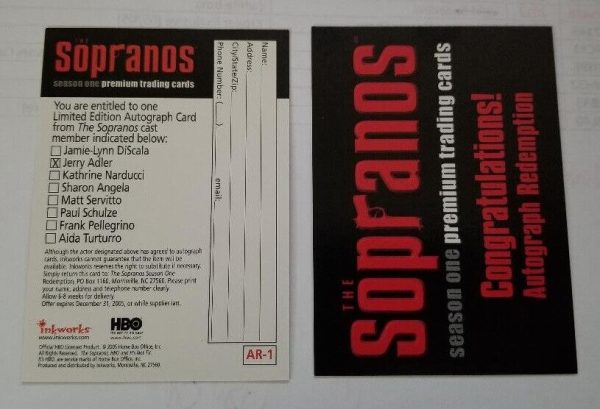
My understanding is that these autographed cards were not present within the packs directly. Instead, you would open some sort of redemption card, kind of like the one below.

This was probably both really exciting and really disappointing at the same time. Eventually, Inkworks tried using autographed stickers to be placed on a card, so that they could be included directly in booster packs. People complained about this approach as well.

Separately, I’m trying to picture Wizards of the Coast doing something like this, and I suspect players would complain quite a bit, though that’s nothing new. More on this later.

After a while, Inkworks also started to include cards that contained snippets of actor-worn clothes, movie props, etc. associated with a set’s franchise. They named this subset of cards “Pieceworks”. I believe some of these would be inserted right inside booster packs, though some may have been too thick. Sarah Michelle Gellar fans may appreciate my first Pieceworks purchase:

My daughter loves Scooby Doo so I thought this would be a fun card to purchase and put on display at home. It's coming from the UK, so I'm still waiting to receive it. Hopefully, it's worth the $50 price tag.

Why Should You Care About Inkworks?

Some people (my spouse, for example) care very little about famous people and their notoriety. To the indifferent, someone like Angelina Jolie is just another person—their autograph is just some squiggly lines on a piece of cardboard. Who cares?

To me, however, a movie or television star’s autograph is a connection to Hollywood. This famous person, adored by millions of fans, actually took the time to sign their name on this card! There are only so many such cards in existence, and that makes something like this highly collectible in nature. The fact that I can purchase a costume piece or prop from an actual movie or television show is also exciting.

Even if you are completely apathetic towards Hollywood stars, it’s worth being aware of this collection simply because of the values associated. Clearly, there are enough people out there who agree with me because some of these Inkworks signature cards are quite expensive!

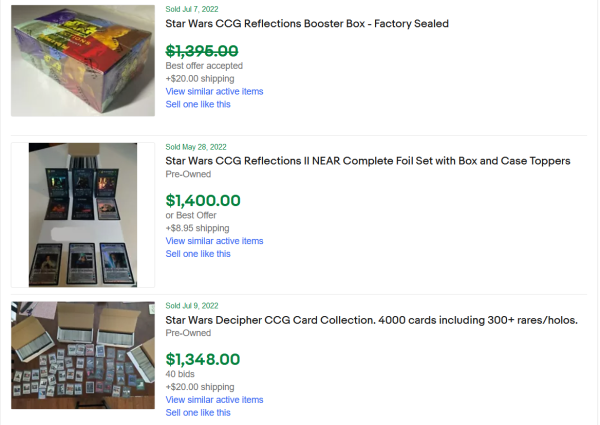
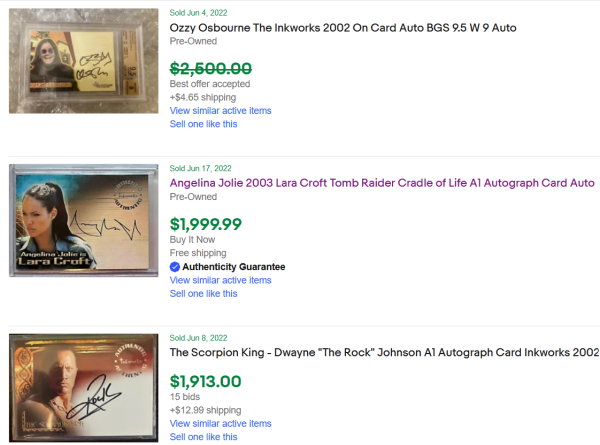
How expensive? Try four figures!

Inkworks autographs seem to demand a hefty premium over other signature listings on eBay. I assume this is because of a) the collectability of these cards, and b) the confidence in their authenticity. Whatever the reason, these cards are still highly desirable despite being two decades old!

I myself have shelled out a couple hundred bucks in order to purchase some Buffy the Vampire Slayer autograph cards. Despite the steep cost, I felt confident that these cards would hold their value—if they can be this expensive two years after the show, then chances are they won’t erode much in value going forward. Die-hard fans may be willing to pay even more over time since these are relatively rare and it’s not like any more are getting made anytime soon!

The Pieceworks collection of cards isn’t quite as expensive, though some are still worth a couple hundred bucks. I’m not sure if their print run was higher, or if more were circulated because you didn’t have to mail in a redemption card to obtain one. Perhaps people just prefer autographs over pieces of costumes. Whatever the reason, it’s still worth noting their collectibility.

Translating to Magic

I know this is a website dedicated to Magic, so I would be doing a disservice to readers if I neglected to mention the beloved game. Luckily, I have a thought exercise worth discussing in this area.

What would it be like if Magic included something along these redeemable autograph cards in a set? I could envision these modern-day “golden tickets” covering all sorts of surprise perks.

What if there were randomly inserted cards that granted you permission to tour Wizards' headquarters? Maybe there are twenty cards inserted that cover your airfare and hotel to attend the next Pro Tour as a spectator? Maybe some cards could be redeemed for a webcam Commander game with Mark Rosewater. Of course, some inclusions of autographs from the game’s design team would also be pretty neat (especially if Richard Garfield's signatures were included).

What would something like this do for Magic? On the one hand, they’d be a bit of a distraction from the game itself. It would be awkward if chase cards in a set were not game pieces at all, but were instead something altogether different. If they were rare enough, however, I think this confusion could be minimized. Wizards has already included random inserts in packs before—honestly, I think I’d be OK receiving an invitation to battle Mark Rosewater on Arena instead of an advertisement card or useless insert.

You could make the argument that including these cards would be difficult to orchestrate given Wizards’ printing and collation process. However, they just broke down that barrier with the inclusion of Lost Legends in Dominaria United collector booster packs! Was it a significant effort to have people manually crack open Legends packs to insert singles into random collector boosters? I suppose so.

That being said, no one would have to be cracking open any product to include these inserts. There would just have to be some sort of manual seeding process for these redeemable inserts and autograph cards. I don’t think it would be too difficult, and the hype it would drive and the potential increase in sales would be worth the effort, at least as a test scenario.

If it’s a huge bust, then Wizards wouldn’t have to continue the program. All I’m saying is that it’s worth a test—depending on what you offer, you could see a significant bump in sales and potentially reach a broader audience, especially if you offer benefits that go beyond the game of Magic. Imagine opening an invitation to create your own custom version of Monopoly. Or the chance to include your name in an upcoming card's flavor text? The possibilities are endless.

Wrapping It Up

I have more evidence that these Inkworks cards still cause lasting effects in the collectible market. I found this forum thread from 2020, long after Inkworks permanently closed its doors, where people argued about what Inkworks did well and didn’t do well. If people are debating this so many years after the company ceased to exist, you know there must be a lot of passion for their products.

This dialogue, along with the fact that these autograph and Pieceworks cards still sell for quite a bit, indicates to me how popular Inkworks cards can be. It’s a shame the company went out of business, and it seems the fad of collecting such cards may have gone the way of most failed trading card games. I suspect there isn’t much value associated with the common cards of these sets.

Yet, the autographs and Pieceworks cards still carry demand. It makes me wonder if Wizards could ever reapply the Inkworks model to include some non-game rewards or prizes as random inserts in booster products. It may seem gimmicky if executed poorly, but I would still love a shot at opening a card signed by Mark Rosewater or Richard Garfield.

Would it drive me to purchase more product? Probably not. However, it’s not because I don’t like the idea. It’s more that I don’t normally have good enough luck to open something so sweet. I’d be more inclined to shop around on the secondary market for these redeemable cards, which I could then redeem myself for the associated prize. Now that’s something I could see myself buying, just like I’ve been buying some Inkworks autographs.

Generational Magic Player Spotlight: Alice

Are you a Quiet Speculation member?

If not, now is a perfect time to join up! Our powerful tools, breaking-news analysis, and exclusive Discord channel will make sure you stay up to date and ahead of the curve.

Sharing our Magic: the Gathering journey with each other is what makes this game more than just a game; it becomes a community. We create enjoyable moments with people who become friends and friends who become family. Here's a glimpse into someone's Magical life and how the game has influenced it.

I Play a Game Called Magic: The Gathering... No, It's a Card Game

Today we're meeting Alice, a Gem City Games employee and Commander enthusiast. Join me as Alice shares their Magic journey!

Help Me Welcome Our Next Contestant...

What's your name and how long have you played Magic: the Gathering?
My name is Alice and I've been playing from around 2011/2012; right around Zendikar.

Alice

Who initially shared Magic with you?
My father and some of my mother's co-workers back in Maryland.

That's a good distance away. Did your family move over here to Ohio?
No, just me, but I'm with my partner. My father doesn't play anymore, so I've been able to borrow some cards from him.

I see. Does your partner play as well?
Yes, we actually met each other through a Tumblr Magic role-playing group.

Cool. So, tell me about one of your first experiences playing Magic.
Sometime in 2010, my mother worked at a small company, different from the previous one. They had a game night for everyone, so my father brought his cards and we all had a fun, casual evening of tabletop Magic. One of my favorite cards from that time was my first foil mythic, a Novablast Wurm.

There was an error retrieving a chart for Novablast Wurm

How long have you worked here at Gem City Games?
I'm pretty new. I've been here since last November. I enjoy it since it gives me more opportunities to assist others with their decks and appreciate what everyone is playing. Working here has also helped me make more friends in the area since moving from Maryland last June.

That's great. It's can be difficult when coming into a new area. Who do you normally play with?
Generally the people here at Gem City.

I know you're working currently, but will you be playing Commander tonight?
Yes, after I get done with my shift.

What deck or decks are you planning to run?
Now that's a question! I have about 14 or 15 different decks on me. Each one is based around a different concept.

That's quite a few. How do you decide on which one to play?
It depends. Sometimes I'll ask the table; sometimes I'll go with my mood. I like to mess around with new or odd mechanics. I try to shine some light onto cards that are overlooked or messing around with the rules of Magic; testing the limits.

If you would, give us a glimpse into the types of decks you have?
Well, I have a Breya, Etherium Shaper deck that focuses on Thopters. I also have a deck called Prime Fractalization, that is, of course, Fractal-based. The commander for it is Adrix and Nev, Twincasters. I've been able to create 2^70 amount of fractals each with 2^61 power worth of counters on them. I'm kind of a math nerd, so it's been great fun doubling to absurdity.

The decks I last played were my Zevlor, Elturel Exile and Tivit, Seller of Secrets decks. Zevlor can create a lot of mischief by itself and is a great enabler for different styles of play. Tivit, of course, is great with voting cards. I haven't been able to draw it so far, but I can see Expropriate being great. For me, that is.

Do you play other formats, or mainly Commander?
Yes, mainly Commander, but I have been looking to try out Pioneer. I've seen many people here enjoy it, So I figure I'll give it a run sometime.

What's one of your favorite Magic cards?
That's a tough one for me, because I do have more than one. Currently one of my favorites is Moonfolk Puzzlemaker. The art is so cute, with her smiling and having fun with the puzzle box.

Is there anyone else you try to mentor or assist with the game?
As I mentioned before, I love to interact with others about deck building; share my decks, check out new decks. I'm always happy to give and receive suggestions on new cards, interesting combinations. Whatever would help bring out the fun.

On a slightly humorous and fun note, I'm always ready to lend a hand and assist others with opening packs! Opening packs is great fun, but it helps me not spend my whole paycheck on cards.

As a final note, is there anything you'd like to share with our audience?
I do have to say, Gem City is a very open place. As a transgender person new to the area, I've felt very welcome here.

The Wrap-Up

I want to thank Alice for sharing their story and how Magic has been a part of it. I hope you enjoyed our discussion and look forward to the next installment. Do you have some interesting stories? Feel free to share in the comments or on Twitter.

My New 32: A Deck for Each Color Identity, Part 2

Are you a Quiet Speculation member?

If not, now is a perfect time to join up! Our powerful tools, breaking-news analysis, and exclusive Discord channel will make sure you stay up to date and ahead of the curve.

Greetings Magic fans, and welcome to the follow-up piece to My New 32, a list of Commander decks I am currently building, testing, and optimizing. As explained last week, the idea to build around each color identity sprang from a desire to create decks that were functionally unique, rather than ones that recycle the same core of staples in a given color, to yield a collection of decks that are truly different from one another and offer distinct play experiences.

Previously, we went over one-, four-, and five-color options. Today, we'll cover two- and three-color decks. Piles based on the shards and wedges of Magic are by far the most common choice in Commander. The land base of two- and three-color decks is easier to assemble now than ever before, and there are plenty of good budget choices in that regard.

Without further ado, I present the rest of my 32.

Three's Company

Esper

There was an error retrieving a chart for Tivit, seller of secrets

When I sort collections, I passively pull cards for decks. I have been building a small stack for Tivit for quite some time now, and it is almost complete. I look forward to casting cards like Split Decision and Expropriate while playing thematic cards like Telepathy. When the flavor text of the card matches the deck, you know you are doing it right! Tivit looks powerful, thematic and hopefully the added interaction of voting will make it fun too.

Grixis

There was an error retrieving a chart for Zevlor, Elturel Exile

Step one, cast huge Grixis spells. Step two, Zevlor. Step three, profit! I won't care if I ultimately lose the game so long as I get to copy some huge spells like Cruel Ultimatum, Bribery, or Jeska's Will. It's mean to single out an opponent so Zevlor makes it completely fair, right?

Jund

There was an error retrieving a chart for Karrthus, Tyrant of Jund

This is an oldie but goodie and pure meta call. There are a large number of Dragon decks at one of my local venues. On top of that, there are a lot of decks that utilize changeling. Karthus will give me a powerful Insurrection effect in my back pocket to solve crazy Dragon-based board states. As it's likely just a "Jund good stuff" deck, I'm more interested in the effect of my deck on the meta than how the deck plays.

Naya

There was an error retrieving a chart for Rocco, Cabaretti Caterer

Can you smell what Roco is cooking? This will be another art-based build restriction. Everything in this deck must feature artwork of food, cooking, kitchen or otherwise culinary things. I don't think this will be an impossible artwork-based deck and I am hoping to stumble into something spicy. Building these types of decks is all about the journey and not so much the destination.

Bant

There was an error retrieving a chart for Falco Spara, pactweaver

This deck could be something special. Like many others, I saw Falco and thought about the possibilities. One obvious approach is proliferate, but I wanted something a little different.

There are a large number of enchantments like Helix Pinnacle that can get a pile of counters easily. If I can turn them into creatures, I could play my entire deck quickly. Thus, I have built an Enchantress-style deck with just a few creatures but a ton of enchantments, Opalescence, and Starfield of Nyx. It's something I have not seen anyone else try and I'm pumped to test it out.

Abzan

There was an error retrieving a chart for Myrkul, Lord of Bones

I opened four copies of this card in one Baldur's Gate box. Guess I should build it, right? Myrkul is a bit all over the place but I am going to explore the enchantment aspect. Maybe I can make a Mulch reanimator deck that leverages constellation effects to great ends. Highly experimental deck incoming!

Jeskai

Jeska is a really powerful planeswalker that makes a strong commander. Ishai? A bit weak for four mana. However, with Jeska's triple damage effect, you don't need much to delete one opponent per combat step. Overall, this deck will have a lot of control and protection effects to guarantee Ishai stays around. In grand total, you only need six enemy spells to make Ishai a potential one-shot.

Sultai

First and foremost, this is a Ukkima deck; Cazur is a backup wincon at best, but it opens up green. My concept is to buff up Ukkima with various enters the battlefield and copy effects like Elegant Entourage or Bramble Sovereign and use various blink effects like Teferi's Time Twist and Displacer Kitten to flicker Ukkima for damage.

Mardu

There was an error retrieving a chart for Extus, Oriq Overlord

The first time I saw this guy in a game of Brawl on MTG: Arena, I was floored. Your commander is a SORCERY?! What kind of chicanery is this? There's all sorts of fun stuff to be done with Extus, and I intend to do it all!

My favorite part about this card is that it single-handedly solves what I call the "one-third" problem. If you get too many creatures and tokens, you can use Extus as a sorcery. If you have a hand full of spells, you can get extra value from the creature side. A very solid and unique card.

Temur

There was an error retrieving a chart for Maelstrom Wanderer

My degenerate Wanderer deck is coming out of semi-retirement. There have been many new cards printed that legitimize the concept such as Magma Opus and great new lands with abilities to interact with the table like Boseiju, Who Endures. After I steal a couple of games, I'll re-retire the deck for a while before pulling it out again.

It Takes Two

Azorious

There was an error retrieving a chart for Chun-Li, Countless Kicks

Thankfully, Chun-Li, Countless Kicks is already starting to come down in price, and I'm hoping to snag one for $10 or less because this is the next Azorious deck I will work on. The plan: re-casting a pile of cantrips and cheap removal spells over and over again until the deck goes off with copies of Dramatic Reversal, High Tide, and Turnabout, generating insane levels of mana to win in a variety of ways.

Dimir

There was an error retrieving a chart for captain n'ghathrod

The boat deck returns, evolves, and continues to optimize with a much better commander and new Pirate Horror sub-themes. While I have had this deck on ice to limit its power, the constant printing of new boat-based cards has worn away at my self control. Mill, reanimation, and surprisingly a lot of counterspells are all included, on-theme for the deck and color combination.

Rakdos

There was an error retrieving a chart for Xantcha, Sleeper Agent

This card looks so spicy and no one in any of my play groups has ever brought it to a game, so I'm definitely going to be the one. The concept builds itself: a bunch of Warp World-style effects and hopefully a lot of bad blood around the table.

Gruul

There was an error retrieving a chart for chishiro, the shattered blade

My very first Magic deck was RG beatdown with cards like Kird Ape, Lightning Bolt, and Giant Growth, so Gruul has always been near and dear to my heart. I really enjoyed the Chishiro, The Shattered Blade pre-con and I'm going to work on bringing it up a level. My guiding principle here will be nostalgia and a throwback to many of Gruul's stompiest cards throughout Magic's history, such as Bloodlust, Berserk, and Rancor.

Selesnya

There was an error retrieving a chart for Dragonlord Dromoka

One day, I will have built a deck for each Elder Dragon. While I have played all of the originals, I have played none of the modern ones, and am going to try a couple. I've drafted and played Dragonlord Dromoka numerous times on Magic Online and it has proven its power. It will definitely be a more controlling, hatebears-style deck with plenty of stax elements.

Orzhov

There was an error retrieving a chart for Shadrix Silverquill

The diplomatic angle of giving your opponents creatures, +1/+1 counters, or cards is something I want to exploit, and it's really cool to have that kind of effect on an Elder Dragon. Part diplomacy, part double-striking monster, Shadrix offers a lot of replayability and many build options.

Izzet

There was an error retrieving a chart for Vadrik, Astral Archmage

I've always loved Dark Ritual and the ability to turn Reckless Charge into a ritual effect with Vadrik looks awesome. The plan is to combo several cards together to create huge turns; think Past In Flames, Galvanic Iteration, and Geist Blast.

Golgari

There was an error retrieving a chart for Baba Lysaga, Night Witch

Originally I was going to build a theme deck using Baba but this card is too interesting not to explore. The value from interaction with cards that have two or more types is palpable. I look forward to bringing a pile of cards to game night and seeing what the table thinks of my take on "baked lasagna."

Boros

There was an error retrieving a chart for Hofri Ghostforge

This is a tough color combination to design. Boros is a very aggressive deck that loves to completely overkill one player and then, typically, lose. It sort of turns into a non-game for the table. For that reason, I'm going to try something different.

Hofri Ghostforge will let me build a primarily red Spirit tribal deck which I intend to use to match the power of the Millicent, Restless Revenant that I play against at home. Maybe with a broader token-based strategy it will be able to hold its own in a multiplayer game.

Simic

There was an error retrieving a chart for Volo, Guide to Monsters

Volo is one of two different decks I'm testing for use with Spy Kit. It's a convoluted idea, especially since it will have many weird and different creatures from throughout Magic's history. While it will probably end up as more of a pile of cards than a deck, I'm hoping Volo can give it a more powerful angle of attack.

That's a Whole Lot of Decks...

It sure is! I look forward to the next several months of collecting, trading, building and playtesting. I hope you found my process interesting or insightful. For me a lot of the value of the Commander format comes from the creative process of deck building. The rest of the value? The games themselves, of course! I look forward to sharing the unique highlights and lowlights of my games and the ongoing evolution of each deck.

How do you approach Commander construction? Does it involve going to EDREC? And before or after making a decision? I'd love to hear the details. Let me know in the comments what new decks you are working on. Until next time, happy building!

Life Lessons on Collectables, Pt. 1 (1993-2004)

Are you a Quiet Speculation member?

If not, now is a perfect time to join up! Our powerful tools, breaking-news analysis, and exclusive Discord channel will make sure you stay up to date and ahead of the curve.

I found trading card games at a young age and immediately developed a love for buying, exchanging, and collecting them. In today's article, I'll unveil some of the life lessons I learned over years of picking up and exploring different TCGs.

Baseball Cards in the 90s

Like many my age, I grew up collecting baseball cards. Ironically, I wasn't a huge fan of watching the games on TV, but I did enjoy watching games live. I think many of us just shared a love of collecting things. Baseball cards were small, easily transportable, and relatively inexpensive. Even as a child, I found that one could support their hobby by buying in bulk and reselling. In my case, that looked like buying a box of cards from my local Big Lots and selling individual packs to people at a slight profit. This lesson allowed me to build up a decently sized collection with my meager weekly allowance. 

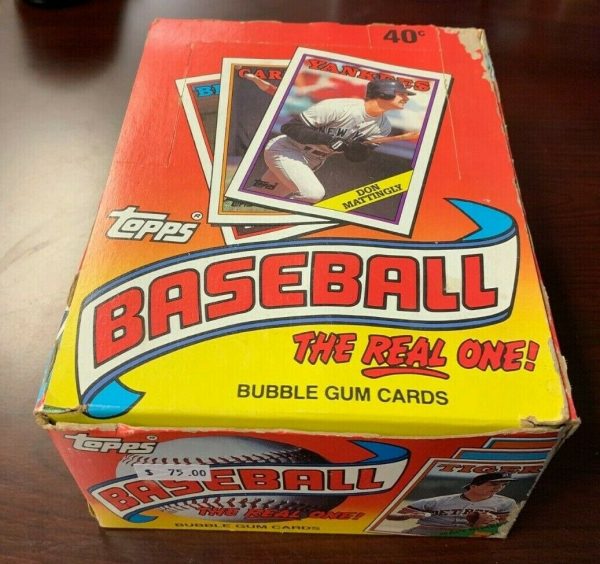
1988 Topps Baseball Card Box

Lesson learned: find a way to make your hobby pay for itself.

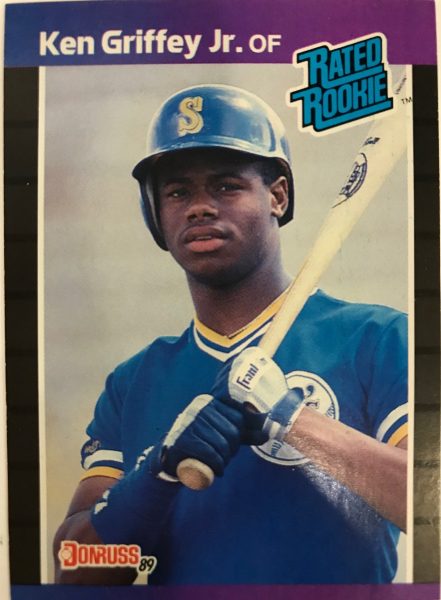
The next lesson I learned was regarding the importance of trading. When I was young, the internet didn't exist. Your trading sphere was limited to those you spent time with, typically at school. Unlike many baseball card collectors, I had no desire to collect full sets. I focused on collecting the cards of the best players: Frank Thomas, Ken Griffey Jr, John Smoltz, Greg Maddux, Tom Glavine, etc. In the early 1990s, the most valuable cards for any given player was their rookie card, so I tried to get those when I could.

1989 Donruss: Ken Griffey Jr. Rookie Card

Lesson learned: the best cards hold value longer than any others.

Years ago, card prices were determined by companies contacting stores and compiling their card prices into a magazine such as Beckett Price Guide. These prices were technically dated, as the magazines came out monthly and thus reflected information from the previous month. However, many stores used that price guide to determine their own prices, creating a chicken-and-egg conundrum.

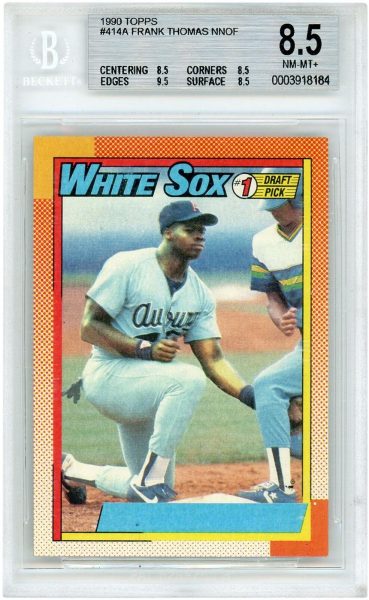
These magazines typically cost $3-4 each, which isn't a lot of money to most adults. But when your income is limited, choosing between a magazine or another pack of cards usually meant using old magazine prices when trading. Thankfully, my trades were always with fellow kids, so there wasn't a big risk of being ripped off. My biggest "loss" was not buying a Frank Thomas rookie card that was missing his name on the front because I felt bad that it was priced higher at my local hobby store than my Beckett said it should be, only to see its price skyrocket a few months afterwards.

1990 Topps Frank Thomas Rookie Card - Error (No name)

Lesson learned: never turn down a smart buy because you didn't get it at its cheapest price. 

Lessons from the Early Days of Magic

When I first got into Magic in 1997, the internet did exist, but websites were far more primitive, smart phones were a thing of the future, and metagames were still very localized. I traded in my Becketts for Scrye and Inquest magazines for pricing. These magazines gathered pricing the same way Becketts did, and so were never truly up to date.

However, while there wasn't much available on the internet for Magic, there was a site called TheDojo where people posted deck lists along with "tournament reports" of their FNM experiences. I would religiously read the posts on this site and even printed many of them out and read them while riding the bus to and from school. I focused on decks whose players did well, and especially with those with similar successful decklists. I would then trade for cards from these decks, assuming they were better than other cards.

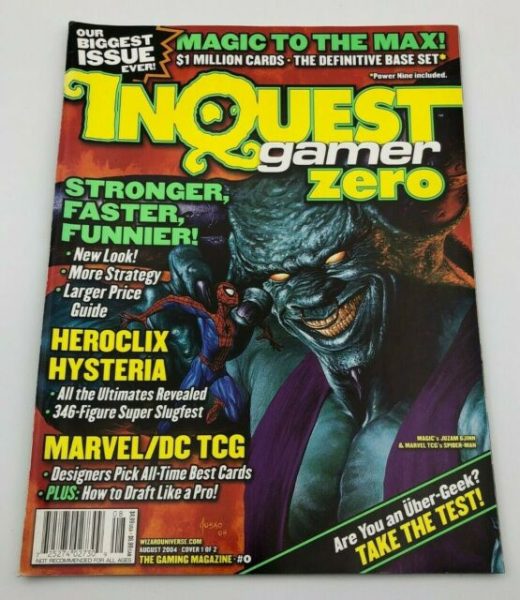
Inquest Magazine: August 2004

Lesson learned: staying ahead of the curve will save make you money in the long run.

I fell in love with a deck called RecSur which used Recurring Nightmare and Survival of the Fittest as a toolbox deck that could combo off with [card]Great Whale[card] to gain infinite life, draw the whole deck, destroy all enemy lands, and do infinite damage.

In my 12 year old mind, it was the epitome of deck perfection, because it could do everything. Unfortunately, the key cards in the deck were expensive, often $10+ each. I was only playing casually with a few friends at the time, so I simply waited until Exodus block rotated out of Type 2 (what is now called Standard). I then picked up all the cards in the deck after they lost value by trading newer cards that people needed for FNM.

Inquest Magazine : December 1999

Lesson learned: maximize time-based value in trades as much as possible.

The original Pokemon TCG came out in 1999. My brother and I loved playing the original game on the Nintendo Game Boy, so we both sort of stopped playing Magic and focused on Pokemon for the year. While this actually worked out well thanks to many of those cards holding their values, we unfortunately continued this trend with other games like Dragonball Z, The Lord of the Rings, and Star Wars.

None of those games proved to be as enjoyable to us as Magic, so we eventually shifted back. However, we wasted a fair amount of our money on those games and thus missed out on picking up more Magic cards back when they were cheaper.

Lesson learned: try new games out for awhile before buying into them.

Never Stop Collecting

I hope you enjoyed this stroll down memory lane. I imagine a fair number of you may not have the same reference points, but I feel the lessons I learned from TCG collecting are timeless, and I hope that they help you moving forward.

Please feel free to comment below or reach out to me on our QS discord server if you want to chat about any of these ideas or my bit of personal history tied to them. And tune in next time for a look at my post-college experience collecting TCGs!

Magical Creatures: Licid, Spike, and Sliver

Are you a Quiet Speculation member?

If not, now is a perfect time to join up! Our powerful tools, breaking-news analysis, and exclusive Discord channel will make sure you stay up to date and ahead of the curve.

Hello everyone, and welcome back to Magical Creatures. In this series, we analayze every creature type that was created specifically for Magic: The Gathering. Every piece normally comes with an expansion, but last time we made an exception. Indeed, Tempest is kind of a big deal when it comes to new creatures, and thus we only dealt with Thalakos and Soltari.

Three other types were introduced in that set, and we'll cover them in today's article. Get ready for two minor types (Licid and Spike), and very major one: Sliver! We'll start the smaller types, as each one only appears on a dozen cards.

Licid

Licid, just like Soltari and Thalakos, is a creature type specific to the Tempest block (or Rath cycle), including Tempest, Stronghold and Exodus. They present as small parasitic beings resembling snails or insects, and are equally present in all five colors. From an in-game perspective, they are quite elaborate, at least when compared to other creatures from those days.

Each Licid is a creature with two abilities. The first is an activated ability, the second static. When you activate the former, that creature stops being a creature and becomes an Aura enchantment with enchant creature. You then attach it to a target creature, and for the cost of one mana, can end this effect at any time. As for the static ability, it simply modifies the characteristics of the enchanted creature.

It's a complex mechanic, and above all, paves the way for even more complex interactions. This is never a good thing, especially if the cards are just not worth it. As such, Licid are considered among the top 10 worst mistakes in Magic development. There are 12 creatures with this type, and none are powerful enough for competitive play, nor funny enough for the kitchen table. So where does that leave Spike?

Spike

Spike, too, is almost only present in the Rath cycle, with the only exception being Spike Tiller from (of course) Time Spiral. There are 11 creatures bearing this type, and they are mostly green. Again, only one exception exists, and it's Spike Cannibal.

A spike is another weird being, resembling something between a slug and an insect. All of them (except the black one) are 0/0 creatures which enter the battlefield with a certain number of +1/+1 counters. They also have an activated ability that, for two generic mana and the removal of a +1/+1 counter, puts a counter of the same type on target creature.

Most of them feature yet another ability to spice things up. Even so, if you ask me, Spikes are another not-that-brilliant invention. We have seen four creature types from Tempest so far: Thalakos, Soltari, Licid, and Spike. And all of them follow the same pattern: they contain the creature type in their very name, they are mostly confined to the Tempest block, and they all have consistent abilities. None strike me as particularly exciting.

The next creature type, however, is something else entirely. At last, it's time to talk about Slivers!

The Origins of Slivers

Sliver could easily be the most representative creature type in Magic, especially if you speak with players from the early days. Appearing for the first time in Tempest, they came back again and again throughout most of Magic's history, with appearances as late as Magic 2015. Not to mention special sets such as Modern Horizons and Time Spiral Remastered.

Most slivers appeared in the Tempest, Onslaught, and Time Spiral blocks. It's not that much, and in fact 109 (however significant a number it is) is still relatively small. For a few good reasons, though, players love Slivers, and that is why everyone has come across the tribe one way or another. But first, what exactly is a sliver?

This question used to be easier to answer. The original Slivers, as some may remember, had more distinctive features: an armored body; a bifurcated tail; a funny crested head. When more slivers appeared in later expansions, their form had changed, although some vague resemblance is always easy to spot.

And why are they called slivers? This is easier: all slivers form part of a collective mind, or in other words share a hive mind. The in-game consequence is that most of them are able to share their static abilities with all the other Slivers. As such, they are each but splinters, fragments, or slivers of the greater hive mind.

Slivers After the Rath Cycle

Players must have loved Slivers from the very beginning, since it was the only creature type among the five created for Tempest to come back in other expansions. Thalakos, Soltari, Licid, and Spike were not as lucky. Sliver returned five years later in Legions, the second set from the Onslaught block. Legions contained only creature cards, and no less than 15 were slivers, divided into three cycles.

Onslaught was the perfect block for hosting more slivers, since it was all about creature tribes. After all, it was the block that truly launched legendary tribes such as Elf and Goblin. A sixteenth Sliver from this block was printed in Scourge, the block's third and last set. I'm referring to Sliver Overlord, a sort of homage to Sliver Queen, the first lord from Stronghold. They are both 7/7 creatures costing one mana of each color, and each remains very popular among casual players.

Slivers After the Onslaught Block

Three more years had to pass before the third and final wave of Slivers. This time, it happened with the Time Spiral block. Their return was spurred not so much by of a particular tribal focus, but by a look back to the past. Time Spiral was all about time and dimensional travel, yielding another perfect chance to revisit the tribe.

Counting all three expansions (Time Spiral, Planar Chaos and Future Sight), that block brought to us roughly fifty Slivers. Which is half of the total Slivers we have. To sum up, between Tempest and Future Sight, the majority of Slivers existing today were printed. In my humble opinion, this is where Slivers reached their peak. I just love how full of references they are: this block was already packed with quotations from the history of Magic, and Slivers fit in perfectly.

If you look at the gallery above, you can see tributes to Bonesplitter, Psionic Blast, and the two lords (Queen and Overlord). Not to mention Virulent Sliver, a sort of anticipation on the poisonous mechanic that would become much more famous with Scars of Mirrodin.

Slivers After Time Spiral Block

After Future Sight, most of the Slivers' potential had already been used. Nonetheless, they came back again in some later sets. Over a dozen more arrived in Magic 2014, and another seven in Magic 2015. This included a new sliver costing one mana of each color, and a return to the original art with Sliver Hive.

No new slivers were printed in Dominaria, although many expected them. Some more arrived in Modern Horizons, and others still in Time Spiral Remastered. The period of Slivers, however, had already ended, as these were just reprints. No new Slivers have seen print since.

The Philosophy of Slivers

New players (and older ones, too) love tribal themes. And Slivers are simply the tribe par excellence. You don't even need Coat of Arms in order to have your creatures pump each other and share their abilities.

At the same time, Slivers are an all-or-nothing concept. If you want them to be effective, you need to play a deck based around Slivers. Just a few playsets won't do. And since they are not strong enough for competitive play, it can be difficult to force competitive deck playing Slivers. Even that hasn't stopped some Modern and Legacy grinders from shaking a stick at the tribe, always while packing a full set of Aether Vial and sometimes even achieving tournament finishes.

Do you have any funny story about Slivers? Have you ever tried building a deck with this incredible tribe? Let me know in the comments or on Twitter, and stay tuned for the next instalment. We are finally going to leave behind the Tempest block, and move forward to the Urza block!

Tournament Fundamentals: How to Prep

Are you a Quiet Speculation member?

If not, now is a perfect time to join up! Our powerful tools, breaking-news analysis, and exclusive Discord channel will make sure you stay up to date and ahead of the curve.

My last several articles have focused on my recent successful tournament runs, and I've received quite a few requests to touch on how I prepare for an event. This seems like an excellent opportunity to start a new series on tournament fundamentals. Let me know if this is something you're interested in seeing more of, and what other topic areas you'd like me to cover.

Step 1: Archetype Decisions

Do Your Research

First and foremost is figuring out what you want to play. This is often easier said than done. Many players tend to only have a single competitive deck in their possession. This can be both a blessing and a curse. If there's only one option in your arsenal, the decision is easy, but there's less agency in the outcome if the meta is more or less hostile in a given week.

For those with fluidity in their card pool (or those with a network of other players to borrow cards from), I recommend taking a look at online resources like MTGTop8, MTGGoldfish, and most importantly, the previous week's Magic: Online (MTGO) Challenge finishes or other large, recent tournament results to get an idea of what the meta at large looks like. Other players will be using these resources to guide their decision-making as well.

Look out for new tech like Sundering Titan showing up in Four Color Pile to break the mirror, or Invasive Surgery out of blue decks to fight Cascade. Also, keep an eye out for the density of a particular deck in high placing finishes. Perhaps Hammer Time doesn't win the event, but if there are six copies of it in the top 16, consider that a significant data point. Over time, look for recurring trends across multiple weeks. For example, when UR Murktide Regent decks consistently put up solid results, it points to the deck being on more than just a lucky streak.

Timing is Everything

There's an old adage that the best time to play Dredge is when Dredge is unplayable. In essence, choose the deck that players aren't overwhelmingly prepared against. If the meta has started to trim on Chalice of the Void and Flusterstorm, Cascade decks might be the right choice. When Four Color Pile is moving away from Counterspell, combo decks are the right call. For example, Calibrated Blast combo just won this past Saturday's Modern Challenge.

Alternatively, there may be a deck that just doesn't fold to singular hate pieces. Right now, Four Color Pile is in this sweet spot. It just plays the best cards on rate and can self-insulate from Blood Moon effects, making it difficult to punish in the way Rest In Peace or Stony Silence might for other decks.

These well-rounded decks are typically my preferred option when going into a smaller tournament like an RCQ where I don't know what to expect and there may be a few off-meta pet decks running about. There's still a chance that bad matchups show up like Tron or Belcher, but the likelihood of pairing against those compared to Cascade, Hammer, Murktide, or Amulet is relatively low.

Step 2: Know Thy Enemy

Sleeve 'em Up

The best thing a player can do to level up is to play different decks. Between rental services on Magic: Online, free clients like Cockatrice, or good 'ole fashioned paper proxies, there are plenty of ways to learn how different decks function. By understanding what lines these decks prioritize and their range of keepable hands, it becomes easier to combat them as well as discern what cards may be in the opponent's hand.

Knowing What to Expect

Knowing how opposing decks function, helps with sideboard decisions as well, particularly when it comes to knowing which cards stop the hate cards they're likely bringing in. For example, Esper Reanimator will expect the opponent to have something to stop graveyard interactions after sideboarding.

If that card is likely Nihil Spellbomb, Stony Silence is a great next-level answer. However, if it's Leyline of the Void, Stony Silence would have no effect. Additional copies of Teferi, Time Raveler from the sideboard would be better. When we know the opponent is more likely to have Endurance as their card of choice, something like Dress Down is ideal.

Step 3: Card Selection

All Around me are Familiar Faces

Ok, we've picked our archetype for the weekend and found a list we like. The next step is to keep in mind what the deck's strengths are in the metagame and what are its weaknesses. We have a general idea of what to expect at the upcoming event, so we can make tweaks to tune up or tune down certain elements based on the anticipated metagame.

At an event like an RCQ, there will be many familiar faces as the same grinders will be chasing the qualification each weekend. This may hint toward what matchups may be more or less likely, especially since (as discussed above) many players only own a single competitive deck. If, for example, there are several Burn players expected to show up, it might be prudent to include something like Weather the Storm in the sideboard. On the other hand, something like Mill is very uncommon in paper play, despite the occasional result online. It's less likely that the Emrakul, the Aeons Torn in your sideboard will be worth its slot.

Knowing the Murktide decks are playing Ledger Shredder over Dragon's Rage Channeler means that Spell Snare might have enough targets to warrant a mainboard slot in a blue deck.

Ch-Ch-Changes

In my most recent tournament, I swapped in The Wandering Emperor in Four Color over a copy of Ice-Fang Coatl as well added Tale's End to the sideboard over Nimble Obstructionist. These changes were meant to target the mirror, providing additional ways to answer opposing Teferi, Time Ravelers while trimming on cards less crucial to the matchup.

I also exchanged Castle Vantress for Boseiju, Who Endures to deal with Cavern of Souls which has started to see more play in the Elementals-heavy variant. It additionally provides some help against the Indomitable Creativity deck along with Tron, both of which can be difficult matchups. It doesn't hurt that it's also a great help against Amulet and Hammer, which, while good matchups, can eke out a win depending on the draw.

Tweaking a deck has a bit to do with statistical analysis and a lot to do with gut feeling. At the end of the day, these modifications offer only a few small percentage points of difference, but they can absolutely make the difference when the hunch is right.

End Step

This is just an overview of the thoughts that go into preparing for an event, and I'm looking forward to discussing other elements of successful tournament grinding. Let me know what other topics you'd like to see, and if any of this is helpful for your next event. Good luck, have fun, and I'll see you all next week.

Top 8 RCQ Finish: Modern Burn

Are you a Quiet Speculation member?

If not, now is a perfect time to join up! Our powerful tools, breaking-news analysis, and exclusive Discord channel will make sure you stay up to date and ahead of the curve.

It's been hard to love the new RCQ system. On the one hand, I'm grateful to have competitive paper Magic back. However, the whole thing feels confused and rushed to me. It should be easier to know what tournaments are happening and when but for some reason DreamHack doesn't have a complete list anywhere. They don't even require stores to have judges for the events, which seems a huge oversight. It's been sufficiently off-putting compared to the old PTQ and PPTQ systems that I haven't been to an RCQ since mid-July.

...which isn't that scathing of an indictment, if I'm honest. The RCQs for the rest of July were farther away than I was willing to travel. Last weekend there was a Modern RCQ within my willing travel radius, but I was tipped off that a lot of former Platinum-level Pros were heading there, including Matt Nass, whom I have played several times before and never beaten. So, I skipped it. This makes me look clairvoyant as Matt won that RCQ. Kudos to him. As for me, skipping that event left this weekend's Modern RCQ as the last chance for me if I was going to qualify via my preferred format. Even though it was further than I'd normally go anymore, off I went.

Pre-RCQ Preparations

I vaguely remembered hearing the name of the store before, but I couldn't remember why. Back when PPTQs first started I traveled to pretty much every store in the whole state. Pandemic aside, I have dramatically scaled that back over the years. I didn't see a player cap, but I preregistered early just to be safe.

There was an error retrieving a chart for Goblin Guide

Registration locked in, the problem still remained of what deck to play. Burn didn't perform well last time out. It has in fact never performed well when I've taken it to anything bigger than an FNM. Constant poor variance had completely gutted my confidence in the deck. However, I didn't have anything better. After tooling around with various other decks while still playing Burn on MTGO and paper, nothing outperformed Burn overall. There's a reason it's a Tier 1 deck. There were, however, certain specific sideboard configurations I liked in other decks more than Burn.

There was an error retrieving a chart for Chalice of the Void

Specifically, Living End had proved to be a nightmare. Burn can punish cascade but can't stop it (normally), and when my opponents were going off on turn three with Grief protection, it was not really possible to race. Especially since they'd bring in removal for all the punishing enchantments. I kept easily losing game one, then trying to sneak in two wins after sideboarding. This left me frustrated and undecided on my deck the night before the RCQ. I finally decided to bring both Burn and a heavily anti-cascade tilted Merfolk deck and just pick one based on what I saw on-site. UW Control would have been a better choice in such a metagame, but I don't have the deck experience with Control necessary to have a chance against 4-Color of any flavor.

Tournament Day

I drove right past the store because the turn-in is not obvious and had to circle the block to get back. As I passed by, I remembered why the name sounded familiar. One of (possibly, the) last PPTQ of 2015 had been there. I was playing UW Merfolk, and I lost my Top 8 win-and-in to Kiln Fiend. That PPTQ was also notable as the last time I saw anyone play Amulet Bloom. Summer Bloom was banned for the next season. Memories are why paper play matters. Also, I hadn't played there in seven years! Begone from me, irresistible march of time!

Scouting Report

I walked in with two possible decks and a small mountain of extra sideboard cards. I didn't know exactly what to be ready for nor which deck exactly I was going to play. I deliberately arrived quite early so I could watch as many decks being laid out and practice games as possible. This proved invaluable, as there was a lot of Yawgmoth and Glimpse of Tomorrow decks present. At least seven of each. A fair number of UR Murktide players too. Given that the nemesis deck wasn't present, I opted to play Burn and built my sideboard.

Burn, David Ernenwein (RCQ deck, Top 8)

Creatures

4 Goblin Guide
4 Monastery Swiftspear
4 Eidolon of the Great Revel

Sorceries

4 Lava Spike
4 Rift Bolt
2 Skewer the Critics

Instants

4 Lightning Bolt
4 Searing Blaze
4 Boros Charm
4 Lightning Helix
2 Skullcrack

Lands

4 Arid Mesa
4 Inspiring Vantage
4 Sunbaked Canyon
3 Sacred Foundry
2 Arid Mesa
2 Snow-Covered Mountain
1 Mountain

Sideboard

3 Wear // Tear
3 Roiling Vortex
2 Silence
3 Path to Exile
2 Sanctifier en-Vec
2 Grafdigger's Cage

I really need to switch those snowy Mountains out. The troll has long run its course and just makes more work for me now.

The maindeck hasn't changed because Burn is Burn. Silence remains a strong anti-cascade card as well as great against other combos and Summoner's Pact. Given the amount of Murktide and no visable Living End, I went with Sanctifier en-Vec instead of Kor Firewalker.

Reading the Room

Grafdigger's Cage looks quite weird, but I think it's genius. Cage doesn't see much play because Indomitable Creativity dodges it for some weird reason and most graveyard decks these days just want bulk in the 'yard. There's not much being flashbacked or any Dredge, and Reanimator plays Prismatic Ending. In the meta I faced, however, Cage looked quite powerful. Yawgmoth doesn't work under Cage. The persist creatures don't, and the tutoring also doesn't work. Without those mechanics, it's a very mediocre beatdown deck. Similarly, Glimpse can't combo against Cage, making it very potent given the room.

There was an error retrieving a chart for Grafdigger's Cage

I am not playing Deflecting Palm anymore. I don't dislike the card nor is it bad in the metagame. The problem is that it's best at answering a single alpha striking threat post-sideboard. These days most players will know to play around Palm. Hammer Time used to be a reasonable matchup thanks to Palm but these days they're sitting on Burrenton Forge-Tender to answer Palm and/or attacking with multiple constructs rather than get Palmed for 10+ damage. With that in mind, I took Palm out for an additional Roiling Vortex and Path to Exile.

The Tournament

70 players showed up to battle, which meant there were seven rounds. I felt sorry for all the 4-Color players. There was also a lengthy lunch break after round two, so it was definitely going to be a long day. The posse of pros from the week before didn't show up, but I did spot Cedric Philips in the crowd. I'm always amazed at how many Magic personalities have migrated to Denver, we used to be a relative backwater.

Round 1: Yawgmoth

I was immediately rewarded for my scouting and sideboarding decisions. Not that it mattered in game one, but did I ever feel smart! Of course, there is a reason that Yawgmoth is a poor matchup and I was four damage short of winning the race.

Sideboarding:

Game Two: -4 Monastery Swiftspear -1 Rift Bolt

Game Two: +3 Path to Exile +2 Grafdigger's Cage

Game Three: -4 Eidolon of the Great Revel

Game Three: +4 Monastery Swiftspear

I shave creatures against Yawgmoth because of Wall of Roots. On the play I cut Swiftspear, on the draw I cut Eidolon of the Great Revel because I won't get many triggers by turn three.

Game two went exceptionally well. I opened with Goblin Guide, Searing Blaze'd a mana dork, and then played Cage. My opponent couldn't catch up or do anything meaningful at that point.

There was an error retrieving a chart for Searing Blaze

In game three I drew both my Cages but was stuck on three mana with only two mana burn spells. Thus, my clock was very slow. My opponent and I traded creatures until he got out Outland Liberator. He was able to flip it because I misplayed thinking that it works like the old werewolves, and he gets the first Cage with his attack. When I fired off end step burn, he taped out for Chord of Calling, forgetting about the second Cage. This buys me exactly enough time to burn him out.

I was rewarded for my cleverness, and for having bad mistakes cancel out. A nice way to start the day. Record: 1-0

Round 2: Burn

Oh, good. The Burn mirror. Where the fastest hand wins. Palm would have been good here, but I had deliberately weakened myself in the mirror. Oh well. In game one I was on the draw, which is often a death sentence, but my opponent only had one land. Playing more spells is good.

Sideboarding:

-4 Eidolon of the Great Revel

+2 Path to Exile +2 Sanctifier en-Vec

On the draw again, I end up too slow. I could have killed my opponent on the next turn, but he killed me first. That's just how the mirror goes.

There was an error retrieving a chart for Sanctifier en-Vec

For game three, I kept a hand with creatures and Blazes. He never played creatures. I couldn't do anything and just lost. The Burn mirror isn't fun, but it is very fast. I had plenty of time for a leisurely lunch. Record 1-1

Round 3 and 4: Coffers Control and Mono-Green Tron

I'm lumping these rounds together because they played out exactly the same. Neither deck could threaten anything I care about before turn four, and Tron has no interaction. I 2-0'd them both while being on the draw in both games. The only real threat was a turn four Thragtusk from Tron which I Skullcrack. I killed Coffers on turn three in game two and Tron mulliganed to four in game one.

Sideboarding:

-4 Searing Blaze

Against Coffers: +2 Roiling Vortex +2 Sanctifier en-Vec

Against Tron: +2 Path to Exile +2 Wear // Tear

Record: 3-1

Round 5: Cascade Crashers

And here were the Cascade decks at last. Yay. I was on the draw and he got turn three rhinos. I was a Boros Charm away from victory and didn't get there.

Sideboarding:

-4 Searing Blaze -1 Rift Bolt

+3 Roiling Vortex +2 Silence

Game two I keep a fast hand of Swiftspears and Silence a rhino attempt. It felt great to finally have that happen when it counts.

There was an error retrieving a chart for Crashing Footfalls

In game three my opponent played around open white mana, then tiptoed around Vortex and Eidolon. After destroying both he did get two rounds of rhino tokens, but I had enough time to burn him out exactly. Record 4-1

Round 6: 4-Color Blink

Based on standings, at that point, I should have been in a position to win and then draw into the Top 8. Standing in my way though was Cedric Philips himself. The most well-known player in the room and former StarCity Games tour player and commentator. I expected it to be hard. Instead, I won the die roll and on the play game one just ran him over with multiple Goblin Guides. He had a slow hand and was on the Yorion, the Sky Nomad version of 4-Color.

Sideboarding:

-4 Rift Bolt -2 Skewer the Critics

+3 Path to Exile +3 Roiling Vortex

In game two he had removal for all my creatures, but not Vortex which chipped away until I could kill him with Boros Charm. Cedric never saw Omnath which made the game really easy for me. Record 5-1

There was an error retrieving a chart for Omnath, Locus of Creation

At the end of the round, standings went up. I could draw into the Top 8, so I did. Final Record 5-1-1

The Top 8 consisted of two Burn decks, two Glimpse decks, and one each of UR Murktide, Hammer Time, Tron, and Yawgmoth. How'd my room read look? Yes, I still felt smug about that.

Quarter Finals: Glimpse Combo

I keep a hand that kills on my turn four. My opponent Glimpsed for eight on turn three and hit Omnath, Locus of Creation with lands and Risen Reef. That was the game.

Sideboarding:

-4 Rift Bolt -3 Lightning Helix

+2 Silence +2 Grafdigger's Cage +3 Roiling Vortex

In game two I threatened a turn four kill with Vortex out, so my opponent evoked Fury then Violent Outbursted for a six-card combo try, taking 10 damage from Vortex. He didn't hit Omnath, and I killed him on my turn.

There was an error retrieving a chart for Glimpse of Tomorrow

I mulliganed in game three and kept Swiftspear, Cage, two Eidolons, and two lands. My opponent set up for a turn three nine-permanent combo, but Cage stopped it. Unfortunately, he had Fury for my creatures while I kept drawing sideboard cards. I lost to beatdown. I was consoled by the fact that my opponent was ultimately the RCQ winner.

After Action Report

Unlike previous tournaments, things went my way. My deck was running well, I got favorable matchups when I needed them, and (in the Swiss, anyway) I drew the right sideboard cards at the right times. It may take skill to play well, but luck is a huge factor in tournament success. This time, variance and pairings were on my side.

There was an error retrieving a chart for Yawgmoth, Thran Physician

That said, I did have the right read on the room and prepared my sideboard well for what I actually faced. I had to be weak somewhere, and I chose the mirror. It bit me, but it wasn't fatal. My loss in game three came down to drawing too many sideboard cards after they were useful. One piece of hate is a nuisance for cascade decks and easily removed. Two are necessary to actually slow them down, so the keep made sense. The problem was I didn't draw enough of a clock. That could easily have gone my way instead.

Feels Good

While I didn't win the qualification, this is the best paper tournament result I've had in two and a half years. It was a long day, but it felt so good to be able to do this again. Hopefully, I'll be able to keep playing them for a long time to come.

Introducing the Macchio Method

Are you a Quiet Speculation member?

If not, now is a perfect time to join up! Our powerful tools, breaking-news analysis, and exclusive Discord channel will make sure you stay up to date and ahead of the curve.

In The Karate Kid Part II, Chozen Toguchi challenges Daniel LaRusso (played by Ralph Macchio) to an impromptu battle to the death. As O-Bon festival-goers watch in awe, our protagonist defeats his rival with decisive finality. While holding his opponent's life in his hands, Ralph Macchio utters four words that have come to define the titular character.

No. Not "wax on, wax off."

A despondent Chozen chooses death. However, the choice was never truly his. Ralph responds by shouting "wrong" in his face, honking his nose like an overzealous uncle, and dropping his limp foe to the ground as he embraces a moral, and very literal, victory.

In games of Magic the Gathering we face similar decisions. Creatures threaten to determine the outcome of each game, and we must decide if and when to use removal. Do we destroy it? Or do we let it live and preserve these precious spells? When making this critical decision, using the MACCHIO Method can help us land on the optimal choice. What's the MACCHIO Method? It's a heuristic to help determine when to cast our removal spells, and what to target with them. The acronym MACCHIO breaks down as follows:

  • M - Mana Efficiency
  • A - Assess the Threat
  • C - Clock Management
  • C - Cache of Removal
  • H - Hidden Hazards
  • I - Invalidate Later
  • O - Opportunity

Let's look at each of these in-depth.

M - Mana Efficiency

A critical piece of evaluating removal is efficiency. We rarely want to use our whole turn answering a threat, though sometimes it's unavoidable. While it can be tempting to immediately answer a threat, if it costs us our entire turn, are we really getting ahead? We should sequence our spells to maximize efficiency. That may mean answering a threat on a future turn to develop our plan in the present turn.

Conversely, I will fire off a removal spell on a smaller threat if it helps smooth out my curve. On the draw, I'm salivating over an opportunity to shock my opponent's two-drop during their end step with little consideration to its potency. Maximizing your mana efficiency is a strong incentive to make a play. A more critical juncture, however, can come later in games.

If we plan on casting expensive spells over two turns, we may not have the luxury of holding a removal spell. Often times we wait too long, losing the presumed flexibility as our dwindling life total constricts our options. We need to maximize the use of our mana to get the most out of our lands.

A - Assess the Threat

What happens if we don't answer this threat? In games of Magic, as in life, when problems aren't answered they often get worse. A creature like Talrand, Sky Summoner or Blood Artist will do more damage the longer they stick around. Because these creatures generate value, we are incentivized to answer them quickly. While leaving them around for a single turn might be okay, the situation becomes more precarious the longer they stay on board.

The same can be said for unchecked attackers. Kruin Striker isn't an early pick in Draft, however, the damage that it presents can alter our time frame. On turn six, this card probably isn't a threat. On turn two, it might represent six to eight damage before you're able to set up a "profitable answer."

Nothing happens in a vacuum. Context is essential to assessing any threat. Consider how each card is going to impact the game before defaulting to using a removal spell.

C - Clock Management

The clock represents how many turns you anticipate before the game ends. As the game progresses you want to consider your strategy and your opponent's. How many turns is it going to take for your opponent to win and how many turns will it take you? The slower the clock, the less definite it is, as it allows players to access more of their resources.

For this reason, an aggressive deck might need to use a Cast Down on a Wall of Omens. The defending player already got their value off of the wall, however, the longer that card stays in play, the longer it soaks up damage. As an aggressive player, I want to accelerate the clock and reduce my opponent's draw steps. Using removal to push damage can be a winning strategy when I'm reliant on shortening the clock. The opposite can be true for a more controlling player. This is why you might see a Cast Down targeting a freshly cast Kruin Striker during an opponent's end step.

In racing situations, this becomes even more important. When racing, life total becomes the most important resource. For this reason, an oft-ignored Steadfast Paladin might become the target of a Grim Bounty. Additionally, if we know the race favors us, we may want to wait for an opponent to use a clock-altering pump spell before firing off an instant-speed answer.

C - Cache of Removal

This comes down to scarcity, but unfortunately, there is no "s" in Macchio.

The less removal you have in your deck, the more you want to consider other alternatives. Last week we discussed how combat tricks can serve as de facto removal spells. If I'm limited to one band together and a portable hole as my removal spells, I'm going to be judicious with them. I'm saving them for critical threats and critical moments.

H - Hidden Hazards

Live footage of my opponent's hand after I Doom Blade their Basri's Acolyte:

Probably wasn't winning this one anyway...

It's a tale as old as Time Walk. After some deliberation, I play my removal spell on my opponent's creature. They untap and slam an even bigger threat and I have no way of dealing with it. This is the nightmare scenario. It happens.

We can rarely afford to play around mythics and rares, but we want to be cognizant of this possibility. The best we can do is enact our game plan and play around what we can reasonably afford to play around. If we know our opponent is dead unless they have one of these cards, we have to ask ourselves why they haven't played it yet. It's good for us to leverage our advantages when we can, but hiding our removal until we see an absolute bomb is going to cause more problems than it will solve.

Post-sideboard, we might know about the presence of one of these creatures. That changes the calculus, but we don't want to devalue a card in our hand because of a card in an opponent's deck. If we're so far ahead that a bomb of this caliber is the only way we lose, then hold the removal. Don't play scared, but be aware.

I - Invalidate Later

Powering Down the Opponent

Sometimes we can save removal because playing out the cards in our hand will lessen or invalidate a threat. Occasionally this will be an effect that neutralizes the threat. Earlier I brought up the Kruin Striker. Unchecked, a two-drop can really do some damage. However, if we know that we have something like a Skeleton Archer in hand, we don't need to worry about it. Additionally, if we can deploy a blocker with high toughness or first strike, it's going to keep the striker at bay.

The most common way to invalidate creatures is sizing, which a fastidious player will note for sideboarding. If our opponent has 2/2s and we're holding a 2/3, we have a huge advantage. Combat favors the blocker and a single Tolarian Scholar can dissuade a slew of Grizzly Bears.

If we can neutralize a threat without expending a resource, we can save removal for more troublesome creatures.

O - Opportunity

Timing matters.

If my opponent has a threat that I know I have to remove, I want to use my removal spell when they have less mana to protect it. Playing around a Ranger's Guile or Negate can be the difference between winning and losing.

However, more nuanced is the battle between removal (especially damage-based removal) and pump spells. Fortunately, these are situations we can set up. If an opponent hints at a pump spell, usually by making a strange attack, we can use that information against them later. Similarly, if our opponent relies on a fight spell to remove a threat, interrupting their removal with your own can be a game-deciding play.

Consideration and Context

There are no universal rules for deciding when we should take certain actions. Each game has different situations and circumstances. Each deck has its own plan and tools for executing that plan. To better prepare for these situations, we want to reduce the relevant information down to meaningful variables.

These seven variables will help us maximize the impact of our removal in Limited, determining when our opponents' creatures should live or die. By paying close attention to them, we can start winning tournaments like Daniel LaRusso.

Want Prices?

Browse thousands of prices with the first and most comprehensive MTG Finance tool around.


Trader Tools lists both buylist and retail prices for every MTG card, going back a decade.

Quiet Speculation