
menu

Insider: Commander Cards in Eternal Masters, Part 2

Are you a Quiet Speculation member?

If not, now is a perfect time to join up! Our powerful tools, breaking-news analysis, and exclusive Discord channel will make sure you stay up to date and ahead of the curve.

Welcome back, readers!

Last week I went over my Commander picks for green, blue, black and red from the Eternal Masters set. This week I'll be covering white, gold, artifacts and lands.

Before I begin I feel I should include a small disclaimer. I've been playing a lot of Sheriff Commander, which may affect how I view specific cards. As I really enjoy and even now prefer this style of Commander it has definitely skewed some of my viewpoints on specific cards.

Something like Xantid Swarm from last week may be a lot less useful in a big game of regular Commander where your goal is to eliminate everyone. But it can be really amazing in any form of team Commander, where more powerful general answers (like say City of Solitude) might hinder your teammates as well.

Since I don't know what type of Commander every reader plays I will take precautions to highlight the fact that some of my picks may be much more suited for a team environment than the "every man for himself" environment. Now let's get into the picks.

White

1. Eight-and-a-Half-Tails

There was an error retrieving a chart for Eight-and-a-Half-Tails

I've seen this card chosen as a commander before (though not often). It's a very good support card in other decks though.

Protection from one's own color is actually not all that common and the ability to grant protection to other creatures is a powerful ability, especially when you couple it with the ability to turn spells or permanents that color. As long as you have three open mana you can blank any removal spell cast by an opponent---if that spell happens to already be white it only costs you two.

Many might not know that the original Kamigawa printing of this card is still sitting in the $7 range. With the shortness of the EMA print run, now is your best time to pick up a copy or two for personal use. With the ceiling already set at $7, the EMA printing might be able to move up a bit from its current position around $2.

2. Enlightened Tutor

There was an error retrieving a chart for Enlightened Tutor

As I said last week, tutors are key to any singleton format and enchantments and artifacts are often incredibly powerful in Commander. This is the card I've had the most requests for from fellow traders and I imagine it'll eventually match the price of the originals (around $15).

The opinion on the new artwork on all the tutors seems to be pretty evenly divided between the "give me the original classic artwork or nothing" and the "this looks more accurate than a random person looking back at you" groups. I personally prefer the original, but it's probably because I have a lot of fond memories of casting it with my small group of high school friends back in the day (always tutoring up my one copy of Survival of the Fittest).

3. Humble

There was an error retrieving a chart for Humble

I know this is just a common so I don't suggest buying tons of them, but for those unaware this card only has two printings. The first was in Urza's Saga (at uncommon) and now this Eternal Masters printing. It's not really a kill spell, but it can serve as solid disruption (similar to Sudden Spoiling) or set up a creature to die that normally wouldn't (say one with indestructibility). This is the first and only foil printing, and foil copies are what I'd focus on.

4. Karmic Guide

There was an error retrieving a chart for Karmic Guide

This Commander staple is part of a good number of infinite recursion combos and is just powerful in general. Foils of this one are already close to the judge foil price and both have the new artwork. I like picking this one up to even out trades, but I will say that because of its ubiquity in so many Commander decks I do have the feeling that WoTC will keep including it in Commander product whenever they feel it could fit.

5. Monk Idealist

There was an error retrieving a chart for Monk Idealist

This is a more niche card that only tends to show up in enchantment-themed decks. But it is the first foil printing and at his current price under $3 he's not a bad pickup.

Keep in mind that niche cards are a double-edged sword. It may be more difficult to find the person who wants to foil out their W/x enchantment-heavy Commander deck. But it's just as awkward for WoTC to include a card like Monk Idealist in any set that doesn't feature a decent number of enchantments. That isn't to say they won't, but it'd be weird to include him as a "throw-in" in a set without at least a few decent enchantments for him to get back.

This card has also been supplanted by the more generic-sounding Auramancer, which has appeared in Core Sets where they wanted this effect. For Commander purposes, of course, players may want both.

6. Mother of Runes

There was an error retrieving a chart for Mother of Runes

I know she sees a lot more play in Legacy (specifically Death and Taxes and Maverick builds), but good ol' Mom is still a very powerful Magic card. The ability to turn off pinpoint removal or make a creature unblockable (against any decks with only a common color of creature on the battlefield) is the kind of versatility you want in your Commander deck.

Add in the fact that the new artwork is a Terese Nielsen and you have yourself a solid investment target. Foils are already 8-9 times the regular price.

7. Swords to Plowshares

There was an error retrieving a chart for Swords to Plowshares

Many Commander players shy away from pinpoint removal, as you quickly run out of cards when you keep trading one-for-one against multiple players. That said, this is the gold standard of removal and it can keep the really dangerous commanders off the table for the low cost of one white mana. The life gain is pretty irrelevant in a 40-life format compared to giving them another land via Path to Exile.

8. Unexpectedly Absent

There was an error retrieving a chart for Unexpectedly Absent

This is one cards designed for Commander that looked like it had potential in Legacy but never really succeeded in either. However, with as much deck shuffling that goes on in both formats (Legacy via fetchlands and Commander via tutoring) this is still a very potent removal spell. People also forget that it can hit any nonland permanent.

Its "downside" can have political benefits too. While it might seem like a temporary answer, if whatever you're targeting is threatening enough, you end up the "hero" at the table and make the other player become the number one target.

9. Wrath of God

There was an error retrieving a chart for Wrath of God

There's a reason this card keeps returning to the $4-$5 range despite having so many printings. It's just that good. In Commander you want as many x-for-one trades as possible and Wrath can allow for really big x's in that category. The no-regeneration clause is often critical in Commander since some of the hardest-to-kill creatures can regenerate (of course Wrath doesn't help against indestructibility).

Gold

1. Armadillo Cloak

There was an error retrieving a chart for Armadillo Cloak

A lot of players shy away from creature auras in Commander because if they do kill your target it's a two-for-one. However, giving a creature trample and pseudo-lifelink is surprisingly powerful. The old-school wording also means that sometimes you can double up on the lifegain.

Again this is more of a niche card as there are plenty of GWx Commander decks that won't run this. But it's still a solid card and casual players' love for lifegain and auras has bouyed its price in the past.

2. Baleful Strix

There was an error retrieving a chart for Baleful Strix

This is again more of a Legacy/Vintage card but it still has applications in Commander. On the surface it's a two-for-one (cantripping and trading with any creature it blocks thanks to deathtouch). But Commander loves its recursion, and being both an artifact and a creature means Strix can be recurred in a million ways.

3. Bloodbraid Elf

There was an error retrieving a chart for Bloodbraid Elf

While Commander tends to be a format with a much higher average mana cost than most other eternal formats, good ol' BBE is always a two-for-one (unless you have no spells with CMC 3 or less left in your deck). Haste is also powerful. It doesn't find a home in every GRx deck, but it is does appear now and again.

4. Brago, King Eternal

There was an error retrieving a chart for Brago, King Eternal

Brago actually makes for a pretty interesting commander, providing a mass blink effect every time you damage an opponent. He tends to be the actual commander in the decks that want to run him (alongside lots of enter-the-battlefield creature effects).

The regular version is under $1 but the foil is near $10. It probably helps that his only previous printing was in Conspiracy which by most counts was a pretty underwhelming set. (I actually liked it a lot, but I think a lot of people were turned off by paying the full cost of a draft and then getting one slightly longer game out of it rather than a full tournament).

5. Dack Fayden

There was an error retrieving a chart for Dack Fayden

Dack is another of our Legacy/Vintage all-stars that sees occasional Commander play. A lot of people see him and only think of his looting ability, but the ability to permanently steal artifacts (i.e. the owner doesn't get them back when he leaves the battlefield) is very powerful in Commander. Stealing someone's Nevinyrral's Disk before they can activate it is particularly satisfying.

6. Deathrite Shaman

There was an error retrieving a chart for Deathrite Shaman

With the amount of graveyard shenanigans that goes on in most Commander games, a mana producer that can also exile cards in graveyards and provide additional life swings is always a welcome addition to any GBx deck.

7. Extract from Darkness

There was an error retrieving a chart for Extract from Darkness

This is another Conspiracy-only reprint that is actually very good in Commander. While milling out is not a typical Commander win condition (unless it's infinite) the ability to recur a creature from anyone's graveyard is always powerful. I don't see enough demand to warrant investing in regular copies, but the foils are still plenty cheap right now and would again be a decent spec as a trade throw-in.

8. Glare of Subdual

There was an error retrieving a chart for Glare of Subdual

This is again more of a niche card that sometimes makes the cut in GWx token decks. It actually serves as a pretty good pseudo-prison card, though its inability to hit lands doesn't mean the opponent is completely locked out.

9. Maelstrom Wanderer

There was an error retrieving a chart for Maelstrom Wanderer

Finally we have another good commander for decks. As I mentioned with BBE earlier, cascade provides guaranteed card advantage (at the cost of not knowing what that card is going to be most of the time). Wanderer gives us two extra cards and is a tri-colored legend with the two best colors in the format (blue and green).

A lot of people seem to like this new artwork and I expect a lot of demand for it moving forward. If you don't have a personal copy (and think you might ever want one) I'd pick yours up now. Outside of specialty product, I don't see cascade coming back to Standard (and thus a mass reprinting) ever again.

10. Sphinx of the Steel Wind

There was an error retrieving a chart for Sphinx of the Steel Wind

While this guy has been largely replaced by Griselbrand in Legacy Reanimator builds, he's still a very powerful option for Esper Commander players (especially since good ol' Grizz is banned in Commander). He has the benefit again of being both an artifact and a creature, and can serve as a solid threat on both offense and defense (thanks to vigilance, lifelink, and protection from red and green).

The biggest challenge with him as a speculation opportunity is that honestly WoTC keeps putting him in products, so his price never gets a chance to really recover before he gets hit with another reprint. Hopefully this is the last for a while.

11. Vindicate

There was an error retrieving a chart for Vindicate

A very powerful one-for-one removal spell in BWx decks. Its overall versatility means it finds a home more often than not in those colors. The artwork is also gorgeous. Interestingly enough this is one of only a handful of cards that has had multiple judge foil printings (with different artwork).

12. Void

There was an error retrieving a chart for Void

Void is a card that is often either very good or simply mediocre. It does act as a very specific/limited board wipe and can even hit a few cards in hand. This card is often in the 95th-105th position for a RBx deck (i.e. it either barely makes the cut or barely misses it).

This is only the second reprint (with the first being a Timeshifted one) and the first with new artwork. I wouldn't aggressively pick these up, but again board wipes are board wipes so it's not a terrible throw-in to even out a trade.

Artifacts

 1. Ashnod's Altar

There was an error retrieving a chart for Ashnod's Altar

This artifact leads to quite a few infinite combos in Commander, serving as both a sacrifice outlet and a mana generator. This is a first-time foil and foils are already around $28-$30. I love picking up extra copies of this to even out trades. Before this printing I never had more than one copy in my trade binder for long (as people always need more of them for new decks).

2. Duplicant

There was an error retrieving a chart for Duplicant

In Commander this card often acts like a targeted removal spell that sticks around. It can be blinked or recurred to kill another creature. It's a great, colorless answer to indestructible creatures or creatures with death triggers.

The EMA copy is by far the cheapest (with the Mirrodin and Archenemy copies sitting around $8). I honestly won't be surprised to see this guy trend upward after a while to match his counterparts (especially since I personally really like the Commander's Arsenal/EMA artwork a lot).

3. Isochron Scepter

There was an error retrieving a chart for Isochron Scepter

While any imprint cards can be risky (as you set yourself up for a two-for-one if they destroy it before you get to activate it), there are enough powerful two-or-less instants that repeatedly casting them via Scepter can be backbreaking. I've personally played against Scepters imprinting Counterspell, Memory Lapse and Mana Drain (different games obviously), and it can be a huge pain to deal with.

4. Mana Crypt

There was an error retrieving a chart for Mana Crypt

The second most expensive mythic in the set (behind Force of Will), this is a Vintage all-star that also finds a home in a lot of Commander decks. After all, if people almost always make room for Sol Ring, then a Sol Ring for zero is also a pretty obvious inclusion, life loss potential aside.

The fact that the previous printings of this card were as a book promo and a judge promo means that the supply has always been extremely limited. I don't see the EMA printing as being nearly large enough to satisfy demand. If you want one get it now.

5. Nevinyrral's Disk

There was an error retrieving a chart for Nevinyrral's Disk

The original colorless board wipe. A lot of mono-colored EDH decks like to run this card to answer permanents they can't normally handle (like black versus artifacts or red versus enchantments). It does keep getting reprinted over and over and its price seems to be stuck around $1.50-$2. But prior to the Commander 2013 and 2014 printings this was a $5 card.

Disk may not get back to that price but foil copies from EMA are sure to command a strong premium. The only other foil option is From the Vault: Relics and a lot of people don't like the FTV foiling process. That means the EMA version will likely become the de facto "best foil version," so its current $6-$7 price may well rise after EMA packs run out.

6. Sensei's Divining Top

There was an error retrieving a chart for Sensei's Divining Top

Colorless Ponder. This card is a staple in almost every EDH deck (I know I usually make sure to find room for them) as it continually helps you filter your draw and allows you to "float" cards on top of your library in the face of any sort of heavy hand disruption. This is definitely a Legacy staple as well as the backbone of UWx Miracles builds, and getting bumped to rare means that there aren't going to be nearly as many opened as players who want them for decks.

My only concern with this one is if WoTC decides to add a few to the upcoming Commander 2016 decks. The card filtering could be important in four-color decks without access to expensive dual lands, to make sure they hit their colors in a timely manner. Its biggest detractor is that it can add a ton of time to games if players continually Top with shuffle effects (like we do in Legacy).

7. Winter Orb

There was an error retrieving a chart for Winter Orb

You tend to see this card played more in "griefer" decks (or decks that are prison style and tend to make opponents hate playing against them), but it is incredibly powerful and punishing in a format where you want to cast big things turn after turn. Winter Orb is one of the best ways to slow the game to a crawl and if you happen to have a way to tap it at the end of an opponents turn you can make its effect one-sided.

8. Worn Powerstone

There was an error retrieving a chart for Worn Powerstone

Another good ol' mana rock that helps ramp people quickly in any color. EMA is the first time we have a foil option available and it already commands a huge premium (it's currently sitting around 17x the cost of a regular). Don't pass foil copies in draft.

This is also the kind of card that may get left over as draft leavings by non-Commander players so it's definitely worth picking up if you see them abandon it on the table (though it's important to make sure they actually don't want it first).

Lands

1. Maze of Ith

There was an error retrieving a chart for Maze of Ith

Maze of Ith used to be a huge boon in the old Legacy Maverick decks of 2011-2014, but it's also a very good land in Commander. It provides a colorless way to repeatedly blank a creature's attack and it's actually not legendary so if you can find ways to copy/clone it you can have multiples.

2. Wasteland

There was an error retrieving a chart for Wasteland

While this card's demand (and price) are primarily driven by Legacy players, there are tons of broken lands that are legal (and played often) in Commander. Having an uncounterable (for the most part) way to deal with them that also taps for mana when needed means that it's a solid "spell" land in any deck that can handle a few colorless sources.

Conclusion

This concludes my list of Commander cards from EMA. As you can tell, there's a ton from this set for Commander players to love. We got some sweet new first foils, a few really expensive reprints, and a good bit of generally fun-to-play cards in the set. While Modern players may have felt left out in the cold on this set, us Commander players should be very satisfied with it.
Forgotten Tech: Part One

Are you a Quiet Speculation member?

If not, now is a perfect time to join up! Our powerful tools, breaking-news analysis, and exclusive Discord channel will make sure you stay up to date and ahead of the curve.

It annoys me greatly when I hear people derisively discuss the size of the Modern cardpool. The typical conversation revolves around deriding some odd card choice in someone's deck because it isn't "good enough" to see play in Modern or dismissing someone's brew because it "has no staying power." Part of me is always angered by the arrogance of this sentiment and the rest is upset by their short-sightedness. Experimental results always trump theory. Just because you don't think it's powerful enough to see long-term play means nothing. If it works well enough to be noticed, it's good enough to see play.

Boomerang-banner-cropped

Look, I get it. The power cards of Modern are the power cards for a reason. Path to Exile, Inquisition of Kozilek, Lightning Bolt, Snapcaster Mage, and Tarmogoyf are highly played for a reason and if you could be playing them and are not you need a really good reason. Staples exist, no question, and they do limit what cards can see play, as Jordan pointed out a few weeks ago.

The problem is that far too many Modern players allow the power of the format-defining staples to limit their thinking and the power of known decks to scare them off of exploration. Modern's cardpool is huge, with plenty of old forgotten staples languishing in the dark corner of trade binders and collection boxes. There is plenty of room for new cards and strategies to enter the format if you're willing to spend the time in Gatherer to find them. Today I'll highlight a few that I think could prove to be valuable additions to the "real" cardpool of Modern. These may not be powerhouses or even great innovations, but they may just be the thing you need to pull out a surprise win at your next PPTQ or IQ.

[wp_ad_camp_1]

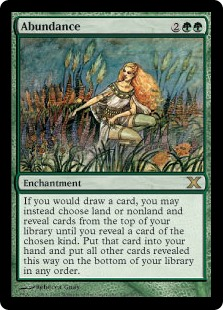
AbundanceAbundance

Go ahead and take some time to process this card. The last time it saw serious play was alongside Oath of Druids and Enlightened Tutor, and its only success was in Bob Maher's PT Chicago winning deck in 1999. As a one-of. Some Legacy Enchantress decks have tried it since but it never stuck. I don't even think this was a Limited card, either in 1999 or 2009. So why do I think that this card is Modern-playable? Simple: RUG Scapeshift mirror matches.

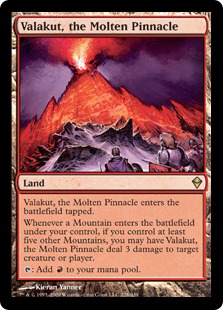
In my own experience and according to after-action reports from Scapeshift pilots (seriously, someone come up with a better name for that deck) the RUG mirror is either one player blitzing out the combo or a prolonged grindfest that frequently involves winning with Valakut, the Molten Pinnacle the way it was intended. Some players still try and resolve Scapeshift for lethal damage but in a long game that gets very risky since they're increasingly likely to draw their Mountains normally. The matchup normally comes down to whoever gets better usage of their cantrips and the typical control vs. control battle of mana advantage and card efficiency, with the added problem of drawing Valakut at the wrong time. I'm told that it can be a very skill-intensive matchup, but it can also be frustratingly luck-based, which leaves players cursing their lack of Ponder or Sensei's Divining Top.

ValakutSince neither card should be unbanned, I think that Abundance is a solution to this problem. Yes, it's a four-mana enchantment that does nothing when you resolve it and yes that usually means that it is unplayable. However if you untap with it the incremental advantage Abundance produces will spiral out of control. Have a hand full of spells, then never miss a land drop. If you're well ahead on mana, then find spells. Card filtering is powerful and persistent card filtering is rare. This could be exactly what you need to break the Scapeshift mirror.
There are also some fringe benefits to consider. It is theoretically possible to stack your deck with Abundance. How or why you would do this I have no idea but the possibility is there. Also, this is a replacement effect. As such you can never lose to decking with Abundance in play. Is this a serious consideration? Probably not, but if you need that effect it is there.

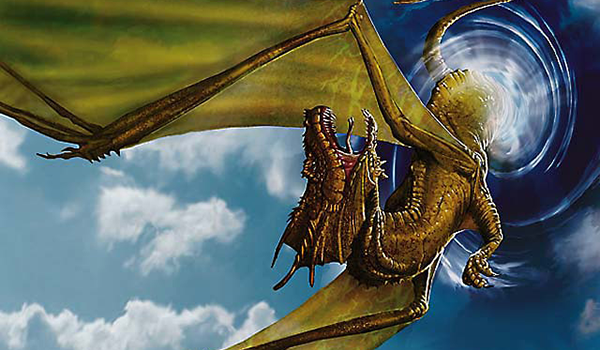
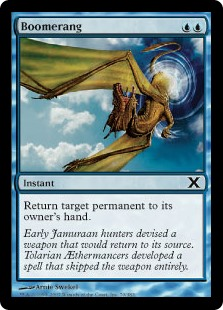
BoomerangBoomerang

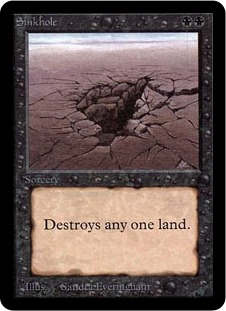
If Sinkhole were Modern-legal it would see play. Probably a lot of play. Land destruction is very powerful and cheap land destruction is insane. Boomerang is Sinkhole with benefits. Yes, they can replay the land but in a typical Modern game this setback is just as good as actually destroying it. Tempo is important.

This card should see at least some play but it never does outside Pauper. Part of the problem is that very few decks want bounce spells and those that do usually want Vapor Snag. At two mana, it is competing with the easier-to-cast and arguably more powerful Echoing Truth. It is usually seen as a middle-of-the-road bounce spell, and that's not good enough.

However, if you look at it as Sinkhole with benefits then the card is much better. GR Land Destruction has been doing well online recently, so we know that Stone Rain on turn two is good. Boomerang does that without a mana elf. It's also not a dead topdeck lategame, since it does target any permanent. You'd think that a Blue Moon style LD deck would have picked this up by now, but it hasn't happened.

SinkholeI'm not just speculating on this. I've tried Boomerang in Merfolk before and it was really, really close to being excellent. It was an amazing piece of tech against Amulet Bloom. The defining moment was when on the draw my opponent was going for the turn-two win with two Amulet of Vigors and Gruul Turf. In response to the untap triggers I Boomerang the Turf. The following turn he tries again and I do it again. Coupled with Aether Vial this bought me enough time to win a game I would have lost otherwise. Yes, if it had a been a counterspell or Path to Exile it would have worked too, but Boomeranging karoos in response to the return trigger proved to be unbelievably powerful.
The problem was that my version really wanted more counters than board control spells and it wasn't good enough against the aggro decks that started swamping events, so I ended up cutting them. Now that things have slowed down I'm trying them again. On average it feels a little weak, but sometimes you get to play Aether Vial into Boomerang followed by Spreading Seas and you opponent gets locked out of the game. If Merfolk can do that, imagine what a more dedicated mana denial deck could do. Tempo is powerful in Modern, and this could be an amazing tempo card in the right shell.

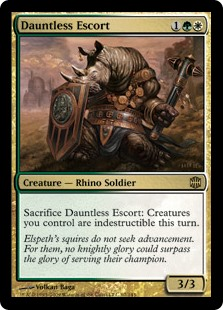
Dauntless EscortDauntless Escort

Chord of Calling players, why don't you run more tutoring bullets? I know that you've got your combos, your backup plans, and the enablers to cram into your decks, but there has got to be a way for you to play at least a few more bullets in your 75.

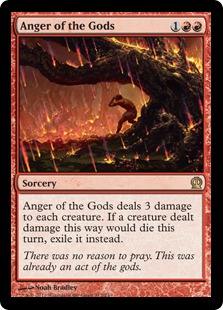
Case in point, Dauntless Escort. Remember how great this card was back in Alara block Standard against the control decks? Modern Chord decks are fairly vulnerable to sweepers, with Abzan Company being particularly weak to Anger of the Gods. Why not maindeck a tutorable answer? Frequently you only need to survive one to be able to go off and/or win, and this serves as a Time Walk against the best cards against the Chord strategies. It seems obvious.

Assuming that it hasn't just been forgotten about, I think that most players look at its CMC, compare its average impact to Eternal Witness, and run the more powerful-on-average card. However, when you're facing a backbreaking Anger with Chord in hand, which will be better, the fourth Witness or the first Dauntless Escort? Why grind when you can win?

Anger of the GodsFull disclosure, I have direct experience against this card that might color my thinking. Last summer I was playing Jeskai Control and lost a finals round against Abzan Company when he Chorded for Escort in response to my stabilizing Anger. I knew that he had a Chord for three available, but he wasn't showing the combo at the time so I decided not to play around it. I could not conceive of a card that could possibly help him in that situation so despite being able to Dispel I let the Chord resolve. Most of the answers to sweepers that Chord decks play are proactive like Thoughtseize or Sin Collector, so I didn't think there was anything I needed to worry about. I never expected Escort and lost as a result.
The benefit to the card is that most control players won't answer Chord for less than five in response to a sweeper because whatever you tutor for will get caught in the blast. With Escort, if they don't answer the Chord there is no way to save themselves other than a preemptive and probably speculative Pithing Needle. For this reason I always leave up Dispel for Chord when I play a sweeper these days. I think the card is underplayed, and I've noticed it slipping back into Chord lists locally the past week so I'm not the only one.

Inkmoth NexusInkmoth Nexus

Ah Infect. I hate you as a mechanic deeply and profoundly. So inherently overpowered and unfun. I'm glad that Wizards has come around to my way of thinking on this, but since Modern is stuck with you we might as well try to make use of you.

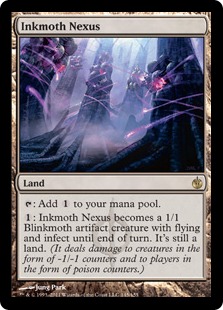
I am not advocating for the Infect deck, mind you. It's an effective deck, but very much a glass cannon and a decent metagame call when Lightning Bolt isn't prevalent. It's doing well now, but I suspect that's because Splinter Twin is gone and the format is still adjusting. What I'm suggesting is that more decks should make use of the Infect mechanic. Now most Infect cards are pretty bad (probably for a reason if murmurs from Development are anything to go by) but Inkmoth Nexus is good and can be played in any deck. In fact, it was played in a number of non-Infect decks during its run in Standard, so the history is there for this to see greater adoption.

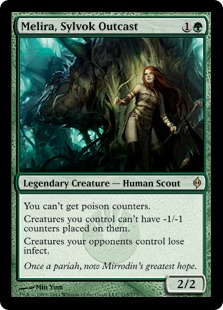
MeliraI bring this up because this is an excellent out against lifegain. If you see a lot of Abzan Company in your metagame and you struggle with it I would start your search for a solution here. Who cares how much life your opponent has when everyone only ever gets ten poison counters. This manland is the best alternate win condition available in Modern and Affinity shouldn't be the only deck taking advantage. True, Affinity makes better use of Nexus than any other deck, even Infect, but most decks have room for colorless utility lands and can clear the way for Nexus to attack. It may not be the most powerful option, but sometimes it's the option you need.
Something to consider is that Abzan Company rarely runs more than four Path to Exile and a Qasali Pridemage or two as answers to Inkmoth. Yes, if you're going to be pedantic they can use Gavony Township and Birds of Paradise to stop it, but if that's what they're doing you have bigger problems and will likely lose very soon anyway. A deck like Jeskai Control can take Abzan apart in a long game, but sometimes they just win the lottery with Collected Company and leave you unable to win. Inkmoth Nexus gives you a way to win in that situation. The rest of your deck is exceptional at grinding through Company's creatures but if you can't actually win the game, what's the point? Attacking ten times with Nexus will win you a few matches that you would have otherwise lost, and that makes it worthy of consideration.

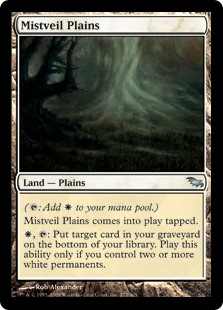
mistveil plainsMistveil Plains

A few weeks ago I discussed transformational sideboards, which are intended to reposition your deck to dodge hate or take your opponent by surprise. What I didn't mention at the time was that you can reposition your deck in other ways. Usually this involves changing your deck's role in a matchup, like control decks bringing in Geist of Saint Traft against combo or Jund becoming a stronger control deck with Damnation and Night of Souls' Betrayal. Sometimes it involves changing what matters in a matchup, like Carlos Romão's famous decision not to fight over card advantage in the Psychatog mirror at 2002 Worlds, choosing instead to fight over the cards that actually mattered: Upheaval and Psychatog. Occasionally you can choose to utilize a resource that was previously irrelevant and completely change how a matchup plays out. Mistveil Plains is one such card.

Story time. A few months ago I was on one of my control outings, trying out another iteration of Esper Mentor. I had been running decently for the previous several weekly tournaments and was expecting another good outing at FNM. In the second round I hit a regular who always plays Soul Sisters. He was pretty good with the deck, but I'd beaten him handily the previous few nights by grinding him out of creatures, and did so again in game one of our match.

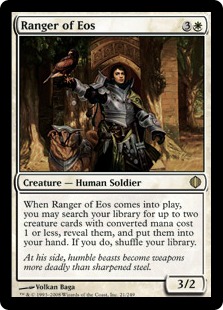
In games two and three he turned the tables and ground me out of answers. He used Flagstones of Trokair to find Mistveil, used Mistveil to put creatures on the bottom of his deck, and Ranger of Eos to find those creatures and shuffle non-one-drops back into his deck. Ranger of EosOccasionally he used Ghost Quarter or more Flagstones to shuffle his library when I countered Rangers. He looped his Rangers repeatedly until I had completely run out of answers and he could finally build up a board to overwhelm my defenses while I could never outrace his lifegain. My deck didn't have answers to lands so I was doomed. My only solution was Relic of Progenitus, and he was playing Pithing Needle. Get wrecked.


Mistveil Plains allows white aggressive decks to make the graveyard matter. Combined with shuffle effects and tutors you can ensure that you never run out of relevant cards, and since most control decks won't be able or willing to bring in graveyard hate against you it is possible to grind them out of answers. Not just answers in hand, answers in deck. I know it can work in Soul Sisters, though the local meta has gotten more aggro in recent months and I'm not sure he still runs Mistveil. Still, if you're a white deck and you want to humiliate a control player, this is something to seriously consider.

The Bottomless Well of Ideas

Modern has a huge cardpool. Trying to scour Gatherer for tech can be an exercise in poor time management. However, it can also be rewarding. These are just a few cards lurking in the format. There are thousands more that I've forgotten about or don't see the potential of but probably should. I am always open to hearing about weird ideas. These were just a few cards that I think can go into existing decks. Tomorrow I will dive into cards that could spawn entirely new decks.

Avatar photo

David Ernenwein

David has been playing Magic since Odyssey block. A dedicated Spike, he's been grinding tournaments for over a decade, including a Pro Tour appearance. A Modern specialist who dabbles in Legacy, his writing is focused on metagame analysis and deck evolution.

View More By David Ernenwein

Posted in Modern, TechTagged , , , , , 9 Comments on Forgotten Tech: Part One

Have you joined the Quiet Speculation Discord?

If you haven't, you're leaving value on the table! Join our community of experts, enthusiasts, entertainers, and educators and enjoy exclusive podcasts, questions asked and answered, trades, sales, and everything else Discord has to offer.

Want to create content with Quiet Speculation?

All you need to succeed is a passion for Magic: The Gathering, and the ability to write coherently. Share your knowledge of MTG and how you leverage it to win games, get value from your cards – or even turn a profit.

Deck Overview- Zur’s Prodigy

Are you a Quiet Speculation member?

If not, now is a perfect time to join up! Our powerful tools, breaking-news analysis, and exclusive Discord channel will make sure you stay up to date and ahead of the curve.

Zur the Enchanter is one of the more odd cards to see fringe Modern play, though he finds his way into the Top 8 of events now and again. The power of the Zur deck is high, though the restrictions of needing to include four copies of a four mana legendary creature and a number of other oddball cards is pretty prohibitive. These restrictions can really hurt the deck's consistency, and that's why Lance Austin employed the once most expensive card in Standard to help filter his draws on the way to a Top 8 finish in Orlando's Modern Classic:

Esper Zur

Creatures

4 Geist of Saint Traft
4 Jace, Vryn's Prodigy
4 Zur the Enchanter

Spells

3 Detention Sphere
1 Ghostly Prison
2 Spreading Seas
1 Steel of the Godhead
2 Negate
4 Path to Exile
4 Inquisition of Kozilek
4 Lingering Souls
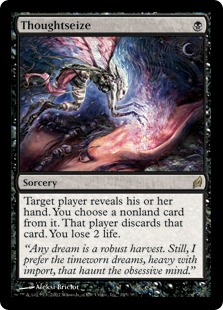
3 Thoughtseize

Lands

2 Island
1 Plains
1 Swamp
3 Creeping Tar Pit
2 Darkslick Shores
2 Flooded Strand
2 Godless Shrine
1 Hallowed Fountain
3 Marsh Flats
4 Polluted Delta
1 River of Tears
1 Watery Grave
1 Eiganjo Castle

Sideboard

2 Engineered Explosives
3 Leyline of Sanctity
2 Rest in Peace
1 Steel of the Godhead
3 Stony Silence
1 Night of Souls' Betrayal
3 Timely Reinforcements

This deck has a lot to like. Suiting up Geist of Saint Traft with a Steel of the Godhead will close games quickly, Spreading Seas can mess up certain manabases, and the tutorable Ghostly Prison can really slow aggressive opponents down. The deck also features Lingering Souls, a card that I've never beaten a single copy of in my life.

With only thirteen non-Lingering Souls instants and sorceries in the deck, Snapcaster Mage doesn't really fit, and that's where Jace really shines. I've played a few decks that could sequence a discard spell into a turn three Snapcasted discard spell, and this deck can emulate that with Jace's ability to card a spell from the graveyard without the inconsistency of playing Snapcaster with so few targets.

There was an error retrieving a chart for Jace, Vryn's Prodigy

While the deck does have some "oops, I win" factor in the form of Geist, it's a little slow relative to the format on that front. What it lacks in speed though, it makes up i the ability to interact very well, both with the heavy discard suite and plenty of options to play to the board. I believe that this juxtaposition shows a lot of promise, and it wouldn't surprise me to see this style of deck start to show up more frequently.

Insider: Deep Modern Specs Before EMN Previews

Are you a Quiet Speculation member?

If not, now is a perfect time to join up! Our powerful tools, breaking-news analysis, and exclusive Discord channel will make sure you stay up to date and ahead of the curve.

Card evaluation is challenging during spoiler season. Without actually testing the cards, many players have no idea how to separate the next Jace, the Mind Sculptor from a Narset, Transcendent. Even isolated testing can lead to misevaluations because testers won't even know the best way to build around a certain card.

This can make for perilous speculation during a preview period, when it's hard to know whether the big breakout will go the way of Thing in the Ice or Nahiri, the Harbinger. Thank goodness I got my Things for a mere $7.99 a copy!

Booms and busts from Shadows

Think investment during a preview season is hard? What about before the preview season even begins? Of course, you can't actually buy cards from the unrevealed set, but all the synergistic combo pieces from previous releases are ripe for the taking. There's even more room for such profit in a massive format like Modern, where synergies like Nahiri and Emrakul, the Aeons Torn can mean increases across the board in both combo pieces and supporting cards (e.g. Celestial Colonnade) alike.

On the one hand, this style of preemptive investment gives you a chance to get ahead of any spikes and make big bucks. On the other hand, how the heck can you invest in synergies and combos without knowing any cards in the set? That seems like an even riskier investment than the $19.99 Thing copies I hope none of you bought before Shadows' release.

In today's article, we'll go over a few strategies for investing in older Modern cards ahead of a new release. This will include a few potential pickups for those who want to go deep into pre-Eldritch Moon speculation in the hopes of getting ahead of the hype.

Identifying Set Themes

Even if you don't know a single card in an upcoming set, you can still make some educated guesses about what might be around the corner. Nowhere is this truer than in the second set of a block (after you already have a sense of themes from set #1), and in a set with such clear lore surrounding its storyline. Eldritch Moon fits that bill perfectly.

We're getting our first Moon previews today on Monday courtesy of Jimmy Wong, and rumors have been buzzing for months about how Innistrad's lore and fate might impact card printings. I have no idea whether #TeamEmrakul, #TeamMaritLage, or #TeamCURVEBALL is going to prevail for the coming preview season, but I have a sneaking suspicion the set is going to keep playing on a few big themes we've seen in Shadows already.

Theme 1: The Eldritch Horror Approaches!

Wizards said it, players observed it, Shadows flavor indicated it, and the community has been gossiping about it ever since: something big and scary is coming to Innistrad. What else is Nahiri, the Harbinger going to bring to the plane other than some giant evil monstrosity, whether artifact or creature?

There was an error retrieving a chart for Nahiri, the Harbinger

Flavor-heavy Shadows block suggests Wizards would never create a Nahiri ultimate that didn't somehow fetch the block's ultimate villain, which points directly to some kind of Emrakul, the Aeons Torn second-coming in the pending Eldritch Moon. Equally possible is some kind of artifact moon card to emulate Innistrad's silver moon, which we recently learned is actually made of silver.

Here, the key is not to identify Emrakul, Marit Lage, or whatever other entity you are rooting for. The key is that Nahiri is summoning something, and that something is likely to be big.

Fatties coming to Innistrad

If we are to assume Wizards hit a flavor home-run with Nahiri's -8, that also means this creature needs to be the kind of big-bad that might not have Ulamog, the Ceaseless Hunger's on-cast restrictions. It might just be big and scary enough to win the game on the spot. If so, that bodes well for all the Modern effects which cheat fatties into play, not just Urzatron ramp effects which cast them.

Theme 2: More Werewolves

Innistrad means werewolves, and werewolves means more players trying to get Werewolf Tribal to work. The RGx deck has yet to make a Modern impact, even with such powerful additions as Collected Company last year and Duskwatch Recruiter a few months back. Both MTG Goldfish's SaffronOlive and the MTG Salvation brewing community have been hard at work on the deck, but with no strong results so far.

The Modern Werewolves status quo

Thankfully for #WolfPack fans everywhere, Eldritch Moon is sure to see even more lycanthropes added to the existing pool. This doesn't guarantee the strategy's success after set release, but even a few extra cards could push them into Tier 3 territory. Tribal staples like Sedge Sliver have gained value off even untiered performances in their home deck, which is great for all the werewolves that players have hoarded since Shadows' release.

In this theme, we're not looking for a Tier 1 or even Tier 2 werewolves deck. We're just looking for a few cards that make the strategy a little better. There are big margins to be gained on many deck staples, even if the strategy can just start matching Allies, Slivers, Goblins, and other fringe tribal options.

Theme 3: Graveyards Matter

If you play as much MTGO as I do, you've already encountered the Modern Dredge deck. Packed with Prized Amalgams and enough dredgers to please even the most nostalgic Ravnica fans, the Dredge strategy is seeing more and more play as people refine its core 60.

There was an error retrieving a chart for Prized Amalgam

Although no other graveyard cards made a huge Modern impact, we're virtually guaranteed to get more in Moon. With Liliana as the set's poster-lady, and with both the Cecani siblings Gisa and Geralf still causing trouble, it's impossible to envision an Eldritch Moon without more graveyard themes.

I'm not sure whether this means more delirium, madness, Stitchwing Skaab reanimation, or some good old Gravecrawler recursion, but no matter which particular graveyard flavor we get, it's good news for Modern players who are trying to make graveyard strategies work.

Other Notable Themes

I'm not going to dig through all of Innistrad's considerable lore for more specific themes, but here are some general ones to keep an eye out for in the next set. Our following section won't explicitly discuss cards from these thematic categories, but you can still apply the same kind of thinking and analysis to each of these themes to identify other zesty speculation targets.

  • Zombies: Modern brewers love tribal decks, and people have been trying to get Zombies to work from Gravecrawler until today.
  • Vampires: Nahiri may have killed most of Sorin's brood, but Olivia, Mobilized for War is still bringing the pain with her own house. Another tribal investment.
  • Clues: I'm not sure if we'll see investigate and clues return to Moon; the mystery might be solved by then. But if we do, all the previous clue cards may get better, as may older Modern cards that care about clue tokens (i.e. artifacts).
  • Eldrazi: With articles like Wizards' "Something Twisted This Way Comes," it's getting harder and harder to deny Emrakul and the Eldrazi. Or maybe it's a huge red herring. If not, old Eldrazi cards are likely to pick up steam if we get any new colorless-matters creatures. Bant Eldrazi is already Tier 2 in Modern, so new Eldrazi cards could push it further.

If you can think of other themes from the lore, articles, Blogatog posts, or other esoteric sources of Magic knowledge, feel free to hit me up in the comments with some other ideas!

From Themes to Pickups

Between our three core themes and many others you can pick up on (madness synergy, a possible blue-white or mono-blue Tamiyo, etc.), there are ample opportunities to make educated guesses about what Modern cards are worth investing in. Maybe you'll miss entirely, but with some of these cards already being worthwhile speculation targets, and with others costing peanuts, it's hard to go wrong.

Following this theme-identification method, here are some cards and card categories on my radar as we head into Eldritch Moon month.

Cheating Fatties

I will be stunned and more than a little unhappy if the big Eldritch Moon reveal does not synergize with Nahiri, the Harbinger. My guess is others will be too, which suggests the combo was too obvious for Wizards' designers and developers to miss. If we're banking on a big creature, artifact, or artifact creature nemesis, that means we're also banking on Modern cards which can cheat the monster into play.

Modern Grishoalbrand has not put up notable results since its Grand Prix Charlotte 2015 debut, but the deck is still formidable off just Griselbrand and Worldspine Wurm alone. More traditional Griselbrand decks swap the Nourishing Shoal/Wurm combo for trusty Emrakul, and these decks may improve with more redundant threats.

Either way, the Grishoalbrand example shines a spotlight on two of Modern's best ways to get scary finishers into play. Of course, the first is the powerful reanimation staple which even sees Legacy play with the deck's namesake demon: Goryo's Vengeance.

There was an error retrieving a chart for Goryo's Vengeance

A big Eldritch Moon monster might avoid the graveyard entirely Ă  la Blightsteel Colossus, or it might keep Emrakul's original shuffle trigger. If the latter, Vengeance is a great investment target to pair with Faithless Looting and other Griselbrand staples for quick kills.

Up next is the second half of the Griselbrand cheat-package, the powerful one-shot Sneak Attack effect of Through the Breach.

There was an error retrieving a chart for Through the Breach

Unlike Vengeance, Breach doesn't care about graveyard shuffle triggers and generally synergizes well with all fatties except the on-cast ones like Ulamog and Kozilek, the Great Distortion. I doubt the Moon bad guy has the on-cast stipulation or it wouldn't be as exciting with Nahiri. Or maybe that's why Nahiri bounces it to your hand, as a follow-up blow after giving you a hasty preview. Either way, Breach would get the creature into play and swinging before your opponent could do much to stop it.

There's a small risk Wizards has learned from old Emrakul's power and tacked on some kind of nonsense Phage the Untouchable clause to the card, but again, this is flagrant Nahiri anti-synergy I just don't see.

Outside of Breach and Vengeance, there's a huge list of Modern cards which cheat big creatures into play. Or big artifacts! It's always seemed odd that Nahiri can get both creatures (obvious) and artifacts (surprising), which suggests artifacts could be central to the Eldritch Moon theme. If so, Shape Anew and clue tokens are great, and flavorful, ways to also fetch the win condition.

There was an error retrieving a chart for Shape Anew

As you try to speculate around this theme, first look for cheating mechanisms that are currently playable in Modern. Then look to the unplayed gems like Shape Anew. Of course, this also includes Nahiri herself, but you'll also want to check out synergies like Gifts Ungiven/Unburial Rites.

That said, stay away from the cards that are bad to begin with and have no hope of later success: for instance, Descendant's Path and its much-hyped spike from the 2016 Pro Tour were toxic for speculators.

Werewolves' Time to Shine?

I haven't seriously tried the werewolves decks. Even so, I can see how the RGx strategies can abuse Collected Company, a go-wide aggressive strategy, card advantage engines, and even some interaction in Lightning Bolt to try and make competitive waves.

If you're banking on werewolves in Moon, the first place to start is with the strong werewolves which would currently be part of a playable deck today.

There was an error retrieving a chart for Huntmaster of the Fells

Huntmaster of the Fells is the rare example of a mythic creature with an existing top-tier pedigree that is also a fringe tribal player. If the card can sustain a $13-$15 price-tag off sporadic Jund inclusion and even more fringe appearances in Temur decks, imagine what it could do off a breakout Werewolves performance.

Naturally, Collected Company, Mutavault, Aether Vial, and Atarka's Command all join Huntmaster in the current top-tier club which only looks to benefit from an improved werewolves strategy. If you have extra copies lying around or were looking to invest in these anyway, keep an eye on them for movement around new Werewolves staples.

On the other side of the tiering fence, we have potential Werewolves inclusions that are far from top-tier. That said, with many of these cards costing less than $2 or even less than $1, there's a lot of potential for growth and virtually no risk.

Untiered Werewolves possibilities

It's unclear what form a tiered Werewolves deck would take, but some combination of these cards would likely make the cut. For instance, Daybreak Ranger gives you early interaction against Abzan Company and Kiki Chord dorks, Affinity fliers, and Infect's Inkmoth Nexus attacks, before transforming into a reusable removal powerhouse.

Another example is Magus of the Moon, which puts a passable 2/2 Gray Ogre body to the devastating Blood Moon effect which can end matchups on the spot, all with a casting-cost under Collected Company's threshold.

Werewolves may remain stuck on the fringe after Eldritch Moon, but if Wizards tossed even a few bones their way, cards like these could benefit. Besides, with entry-costs so low, why not take a small gamble?

A Good Day for Graveyard Decks

Unlike the Eldritch Moon monstrosity or werewolves, we really have no clue what form the graveyard cards will take in our newest set. Maybe they are unplayable filler like Rise from the Grave. Or perhaps we get more ammunition to accompany Prized Amalgam in the dredge arsenal. Either way, I'm optimistic about a few graveyard staples going into preview season.

There was an error retrieving a chart for Golgari Grave-Troll

Someone already tried to buy out Trolls during Shadows preview season, and although they floundered after underestimating Troll stock, it shows how Modern's best dredge engine can move in the right conditions. These are not getting cheaper and are certain not to be reprinted before Modern Masters 2017, so keep your eyes on them if you have any interest in profiting from Modern graveyard strategies.

You can follow a similar speculation approach with any of the dredge bigshots, whether foil Stinkweed Imps or the extremely low-circulation Conflagrate (a discard engine that doubles as a win condition and interaction option). Greater Gargadon also saw movement alongside Bridge from Below, and all such interactions may improve after Moon.

Of course, you can also speculate on anti-graveyard cards, not just dredge shenanigans. There are lots of options here including the surprisingly expensive Leyline of the Void, the underplayed but awesome Surgical Extraction, and many others.

Speculating on graveyard hate

Grafdigger's Cage is a particularly juicy speculation target, which would both combat graveyard decks and any uptick in Nahiri and sneak-fatty-into-play strategies, with added upside against Company and Chord players.

We're unlikely to see the second coming of Dread Return in Eldritch Moon, but even a few additional graveyard options would push a number of other decks. Stay sharp on these and don't be afraid to move early.

Eldritch Moon Rising!

By the time many of you read this article, Jimmy Wong will have already unveiled his preview card and the Magic content-sphere will be abuzz with hype and hostility. Previews begin in earnest next week, so you can bet I'll be back again with more Modern-focused analyses of Wizards' newest set. Who knows? Maybe we'll actually get that Innocent Blood black mages have been pining for since Modern's birth.

Thanks for joining me and let me know in the comments if you have any questions or other observations about possible speculation targets. Also, fill those TCGPlayer carts early with your investment options before Wong's preview at 10:00 AM today. Make smart buys, stick with reputable dealers who won't suddenly be "out of stock," and I'll see you all soon!

Insider: High Stakes MTGO – June 12th to June 18th

Are you a Quiet Speculation member?

If not, now is a perfect time to join up! Our powerful tools, breaking-news analysis, and exclusive Discord channel will make sure you stay up to date and ahead of the curve.

Welcome back for another High Stakes MTGO!

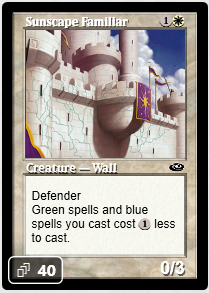
Only a few adjustments this week while waiting for the big Legacy sale season. I notably picked up a few Sunscape Familiars as they were heading down and I still believed in that spec. It appears now that it is going to pay off big and fast!

I also sold a few loose positions and liquidated the rest of my big Legendary Cube Prize Packs pile which really was an exciting spec.

The link to the live portfolio is here.

Buys This Week

MR

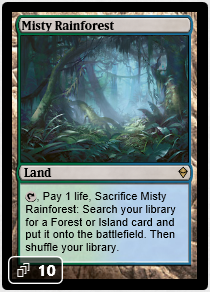
Misty Rainforest dipped again below 18 tix; this was not the first time I restocked a couple of playsets of this Zendikar fetchland. The rainforest topped 27 tix three weeks ago but I'm expecting a little more---closer to 30 tix---with the Legacy Festival event coming up.

SF

Peregrine Drake is reprinted as a common in Eternal Masters and this might resurrect the Esper Familiar combo deck in Pauper even in the absence of Cloud of Faeries---at least that's my bet at this point. The white wall from Planeshift had already spectacularly jumped from nothing to 2 tix with the full list of EMA out before settling down around 1.5 tix.

If Esper Familiar gets back to its past efficiency then Sunscape Familiar is likely to reach 5 tix again. As of writing the wall has already jumped over 3 tix. Let's see where this entirely speculative bet leads me a few weeks from now.

ToA

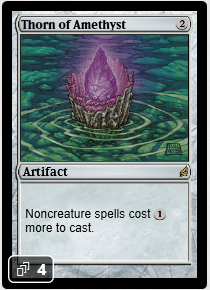
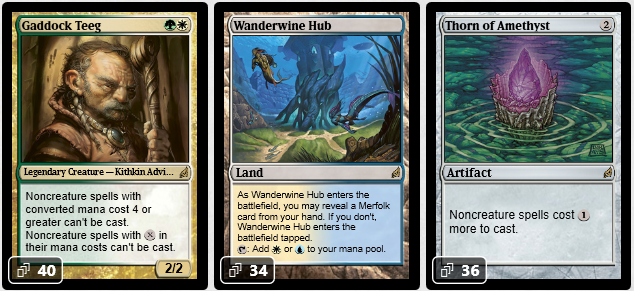
The price of Thorn of Amethyst has not really rebounded yet after the Lorwyn block flashback drafts. I simply reinforced my position here a tiny bit since the price was the same as what I was looking for during my first wave of purchase.

Sales This Week

Legendary Cube Prize Pack

This position is finally closed---what a ride! More than 90% profit on a booster spec is definitely a rare thing and I'm very satisfied with the way this spec went. 3 tix seems to be the current ceiling for the PZ1 packs but without any special events awarding these boosters,who knows what the real ceiling is.

However, since we are on MTGO any of the cards from the Legendary Cube set can be reprinted any time, and the packs can be awarded again for any special event. Keep this in mind if you are still riding the trend.

Another of these cards that never rebounded the way I wanted. After a one month-long dip below 4 tix in May, the Ascendant came back in the 5-5.5 tix range recently. Magic 2011 drafts are only scheduled in September but I don't see any good reasons to hold on to this spec for the time being. I'm out with a symbolic +2.1 tix of profit.

This version of Kozilek has been lagging as well since last summer when I bought it. The new Eldrazi additions from BFZ and OGW certainly didn't help Kozilek, Butcher of Truth make a comeback in Modern Tron decks, or in any other deck.

From a desperate 1 tix, Kozilek's price doubled up in three weeks to come back, again, slightly above 2 tix. This time around I let this big Eldrazi go for good and cashed out a marginal profit.

My temples spec (Temples of Enlightenment, Malady, Malice and Epiphany) was actually a decent set of specs, although maybe on too small a scale considering the size of my current bankroll.

All temples have been higher than my buying prices at some point for as long as I held them. After Temple of Enlightenment, Temple of Malady is the second one I'm selling, taking advantage of local spike. I develop a little bit more on the Theros block temples below.

On My Radar

Although not part of the Legacy-related hype, Oath of Nissa and Kozilek's Return are two cards I'm keeping a very close eye on as they are approaching my target sale prices.

Oath of Nissa has been on a very steady rise since mid-April as this legendary enchantment is very often played as a four-of in the almighty G/W Tokens in Standard. This card has been highly considered in several constructed formats and it might well break over 5 tix.

However one might think that the price is almost only supported by the performance of G/W Token decks and nobody really knows what could happen next. I'm past doubling up with my copies at the moment and I'm looking for a signal to sell the green Oath. Most likely I won't hold onto them if it crosses the 5 tix bar.

From a solid 5 tix floor in March-April, Kozilek's Return is now over 10 tix. With multiple-format playability, this red sweeper makes strong arguments for itself. Here too, now that is has doubled I'm looking for the best window to sell this position.

Unlike Oath of Nissa which has a very singular effect, Kozilek's Return could potentially dip if something better shows up in Eldritch Moon or the next block.

I mentioned the possibility that Snap and Sunscape Familiar could take off if the reprint of Peregrine Drake at common in EMA could signify the return of the Esper Familiar combo deck in Pauper. That happened last week. Both cards are rapidly getting closer to their record high and the time to sell is approaching at a fast pace.

Questions & Anwsers

I'm coming back here to develop a bit more on the temples. With a unique ability to smooth your draws, the Theros block scry temples have proved to be Modern-playable. When THS block rotated out of Standard, prices predictably dipped to their lowest point, including Temple of Epiphany which plunged from as high as 19 tix down to a quarter of a tix.

With such potential I decided to go for the Born of the Gods and Journey into Nyx temples that had the most chances to rise up again, because of their potential playability and for being in the second and third sets. I bought 25 playsets of four temples and was expecting prices to reach 2 or 3 tix during the following year.

So my expectations were a little bit too optimistic but the strategy was clearly good. Despite obvious price fluctuations, all temples rose in price, up to eight times their lowest value around BFZ release. Instead of waiting for the long run like I'm doing now, selling and rebuying the temples according to fluctuations would have been more profitable. In addition, as the redemption for BNG and JOU will come to an end sometimes soon, the prices may settle down once again.

Nonetheless I believe the long-term price potential of these temples is pretty good. Temple of Enlightenment and Temple of Epiphany certainly hold the most promise. They could behave similarly to Stony Silence, for instance, in terms of price trend post-rotation---5 to 8 tix is totally possible.

Buying them whenever the opportunity presents itself at 0.5 tix or less seems very good to me. Temple of Malady hasn't really broken through in Modern yet but I bet it will one day. So why not accumulate dirt-cheap copies now that could potentially see a twenty-fold price gain?

Thank you for reading,

Sylvain

Tempo in Modern and the Card Advantage Trap

Are you a Quiet Speculation member?

If not, now is a perfect time to join up! Our powerful tools, breaking-news analysis, and exclusive Discord channel will make sure you stay up to date and ahead of the curve.

When I began tuning Monkey Grow, the biggest surprise among peers and opponents was my sworn dedication to Disrupting Shoal. Certain players couldn't believe that countering a spell was worth losing a card, citing Force of Will's status in Legacy as a check to degenerate combo decks that usually gets boarded out against fair strategies. But Legacy's a different animal than Modern. Against Modern's degenerate and fair decks alike, I would play four Force of Will in a heartbeat.

fact or fiction art crop

I can't say it better than Ryan Overturf, so I'll quote his Monday article directly:

Modern is a format where efficiency and tempo are dramatically more valuable than card advantage. [...] As much as I would love drawing extra cards to be the best thing we could be doing, it’s simply not true in an abstract sense.

Card advantage isn't the end-all-be-all of competitive Magic. There are plenty of other in-game mechanics that decide games, and most of them have more relevance in Modern.

[wp_ad_camp_1]

What Is Card Advantage?

In a nutshell, card advantage refers to accumulating cards at a faster rate than opponents.

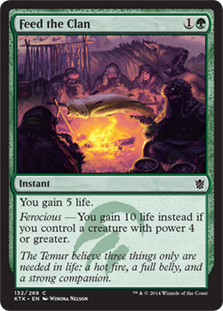
Feed the ClanThese "cards" take different forms depending on the matchup. Against Burn, a deck that wants to throw six Lightning Bolts at your face, Feed the Clan is a card advantage spell. Specifically, it's Ancestral Recall. A ferocious-enabled Feed essentially draws you three copies of Counterspell and casts them for you.
For a less obvious example, against a removal-packed deck light on board wipes, Spectral Procession is a card advantage spell. Here, it "absorbs" three Terminates. We saw this example in full force at GP Los Angeles, when Matt Nass destroyed Jeskai Control with his GW Tokens deck.

Playable card advantage spells in Modern are ones that only conditionally provide card advantage, like Feed the Clan or Spectral Procession. These aren't card advantage spells in a vacuum. More traditionally, "card advantage" refers to the actual process of drawing cards. This article primarily discusses the classic card advantage signifier of cards-in-hand, and not the conditional, "virtual" card advantage of Feed the Clan. It also examines the opposite side of the same coin: card disadvantage as it refers to hand size.

Proving the Premise

I opened this article with Ryan's loaded claim that card advantage is less valuable than other in-game mechanics in Modern. This section defends that claim by looking at how important card advantage is to the top ten Modern decks as of this month.

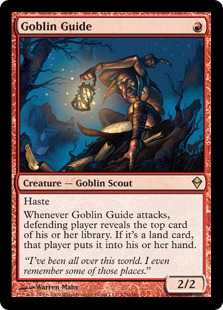
Goblin GuideWe can divide Modern's top ten decks into three groups: ones to which card advantage is very important, ones to which it's hardly important, and ones to which the importance of card advantage varies greatly based on the matchup. Obviously, card advantage carries various degrees of usefulness depending on the matchup for every deck. But I think that some decks, especially interactive ones, have a wider "usefulness spectrum" than others. Burn, for example, very rarely tries to generate card advantage, preferring instead to use tempo to get ahead on the board and damage to kill opponents before card advantage starts to matter. Goblin Guide embodies this philosophy perfectly, drawing opponents cards over the course of a game, but banking on opponents never being able to capitalize on that card advantage.
Card advantage-reliant decks (1/10): Jeskai Control

Varies (2/10): Jund, Abzan Company

Tempo-reliant decks (7/10): Tron, Infect, Burn, Affinity, Scapeshift, Merfolk, Gruul Zoo

The numbers indicate that card advantage is not a prime mechanic in Modern. So does experience. There's a reason Disrupting Shoal performs so well for me. It's the same reason I would play four Force of Wills without hesitation. Countering Siege Rhino for zero mana and two cards might not be game-winning in Legacy, but it can certainly be nuts in this format. On the other hand, there's also a reason I struggled to get Day's Undoing off the ground. Three mana might seem like a very small price to pay for seven cards, but even that apparently minimal tempo loss can translate to game losses in Modern.

The Control Conundrum

Besides Ancestral Vision, which has a significant cost of its own, these traditional card advantage spells carry a hefty mana cost. Just look at the most efficient card advantage tools of formats past: Jace, the Mind Sculptor, Fact or Fiction, and Stroke of Genius all gouge players heavily for mana.

It follows that modern card advantage tools cost more mana than turn-four decks of the aggro, combo, and tempo varieties can pay comfortably. This predicament basically dooms card advantage generators to live in control decks. And control is far from the strongest archetype in Modern.

Card Advantage: Past to Present

Card advantage was Magic's first major in-game mechanic to be "discovered" by top players. Armed with the knowledge that more cards invariably equated to more wins, players radicalized their deckbuilding processes. Brian Weissman's 1996 deck, The Deck, was feared and venerated, and remains to this day a prime example of winning via card advantage.

The Deck, by Brian Weissman

Creatures

2 Serra Angel

Artifacts

1 Black Lotus
2 Disrupting Scepter
1 Jayemdae Tome
1 Mirror Universe
1 Mox Emerald
1 Mox Jet
1 Mox Pearl
1 Mox Ruby
1 Mox Sapphire
1 Sol Ring

Enchantments

2 Moat

Instants

4 Swords to Plowshares
4 Disenchant
4 Mana Drain
2 Counterspell
2 Red Elemental Blast
1 Ancestral Recall
1 Braingeyser

Sorceries

1 Demonic Tutor
1 Timetwister
1 Time Walk
1 Recall
1 Regrowth
1 Amnesia

Lands

4 City of Brass
4 Island
1 Library of Alexandria
3 Plains
3 Strip Mine
4 Tundra
2 Volcanic Island

Here's a quote from Mike Flores on The Deck:

The Weissman deck (affectionately called The Deck) concentrated solely on defense; while most other players divided their resources between both offense and defense, this philosophy chose to concentrate almost exclusively on one side of the game only... effectively doubling their prowess in that regard. The card mix was equal parts selection, speed, and efficiency. While The Deck may have taken a long time to win, it played from the first turns of the game with answers like Red Elemental and Swords to Plowshares. Even its kill cards played blocker while serving in the air: Serra Angel was the Blinding Angel or Morphling of her day, and Mirror Universe played both life gainer and game winner.

This quote reveals a lot about the current state of Magic, and specifically, about how dramatically the game has changed in twenty years. I've heard cries since Modern's inception from players aching to play a "true control" strategy in the format, and their descriptions of this dream deck tend to sound like Flores's analysis of Weissman's. Let's break down the elements of this Flores excerpt.

The card mix was equal parts selection, speed, and efficiency.

Here's where things start to go wrong. If a control deck is almost all answers, those answers need to be more efficient than the cards they answer. Modern's best cards are proactive questions: Lightning Bolt, Tarmogoyf, Liliana of the Veil. Using Negate and Mana Leak to keep up with these threats isn't exactly ideal for control mages.

Even its kill cards played blocker while serving in the air: Serra Angel was the Blinding Angel or Morphling of her day.

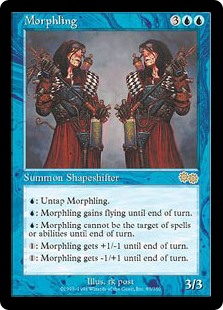
morphlingSerra Angel, Blinding Angel, and Morphling all look decidedly unimpressive now. But during their respective reigns, each of these creatures was a real pain to remove, played both offense and defense, and provided more pressure than any other one card in the format. Some creatures exist in Modern with similar credentials, with Tarmogoyf perhaps exemplifying the Serra Angel legacy. But Goyf shines in decks more dedicated to tempo than to card advantage.
Up until very recently, go-long, card advantage-focused decks have not had access to a "Morphling" in Modern. Nahiri, the Harbinger stands to change that. It's no coincidence that the previously unplayable Jeskai Control suddenly looks viable at 6%. Nahiri offers the deck a unique way to turn the corner early and win games by turn six, a basic requirement of all decks in this turn four format.

Notably, Jeskai Control often wins via card advantage, or "stabilizing." But a significant chunk of the time, it instead secures victories by out-tempoing opponents with Snapcaster Mage and Lightning Helix or by cheesing them with an Emrakul.

Breaking Card Advantage

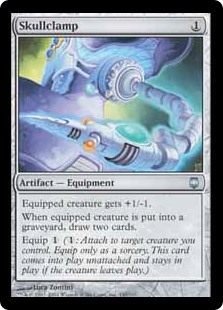
Every so often, a cheaper card advantage engine is printed. Dark Confidant is the fairest example. While he's easy to counter, an unchecked Bob will quickly show his controller the power of inexpensive card advantage. SkullclampSpeaking of scenarios that aren't coincidences, the Bob-loving Jund has remained Modern's best deck despite multiple bannings throughout the format's existence.
Since he's so answerable, Dark Confidant might not earn the "broken" tag. But spells that fulfill his same function often devastate formats. Skullclamp, Gush, and Treasure Cruise were all banned from almost every format for providing cards at too light a price. With efficient card advantage providers legal, formats start to revolve around card advantage more and more. Legacy, a format housing Jace, the Mind Sculptor and Brainstorm, is far more card-advantage-focused than Modern.*

[su_spoiler title="* Aside on definitions of tempo" style="fancy" icon="arrow"]I'm well aware that "tempo decks" are some of the best in Legacy, which isn't as tempo-centric a format as Modern. We mustn't confuse tempo the deck archetype, which applies pressure quickly before disrupting opponents, with tempo the in-game mechanic, or the concept of time and mana advantage. Ironically, "tempo decks" like Temur Delver and Death & Taxes tend to excel in formats driven by card advantage, and to suffer in those driven by tempo, which are in turn ruled by aggro and midrange decks.[/su_spoiler]

Accepting a Disadvantage

What's the strategic incentive to admit card advantage is overrated in Modern? If it stopped at "I won't try to play Thirst for Knowledge," I don't know that this discussion would merit an entire article. But I think Modern players have a lot to gain from doing away with their fears of card disadvantage.

Finding Sleepers

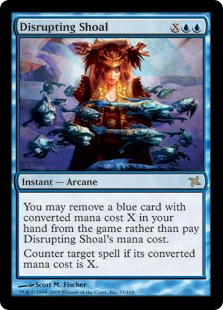
Disrupting ShoalI sang Disrupting Shoal's praises above, but it's not a card you can really oversell. Shoal excels in matchups where card advantage doesn't matter at all. Burn, Tron, and any strain of linear combo struggles immensely against this card, which trades a resource players are supposed to care about---cards in hand---for one much more valuable in tempo-focused matchups: mana. Sheridan wondered this week why more decks aren't packing the Temur Delver favorite. I think it's because players are too afraid to throw away cards.
Our Modern Nexus overlord (yeah, I went there) also mentioned the possible inclusion of Snapback in more Modern decks. I've tried Snapback myself to compensate for tempo losses incurred by casting a three-mana sorcery in a Delver deck, and came to the conclusion that it's generally not efficient enough for what it does. Blue already has Vapor Snag, which tags a small bonus ability onto a card that, let's face it, only costs one mana. Bounce spells are supposed to cost one mana, and such a small price reduction doesn't earn the card lost to Snapback's alternate cost.

Now, hard-answering a Tarmogoyf? Here's a one-mana effect that's quite a bargain. Even Path to Exile doesn't do it without passing opponents card advantage and tempo. No wonder Spell Snare sees so much play. In this case, another one-mana reduction is totally worth it, as Spell Snare is already so efficient and unique. I have no problem pitching a card to Shoal to counter Tarmogoyf, especially since Shoal does so much more, sniping Guide and Map and Goryo's Vengeance for free before hard-countering anything for XUU in the late-game.

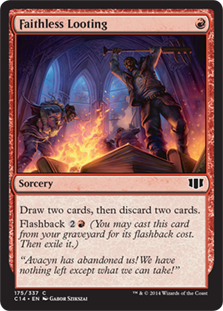
Faithless LootingAnother overlooked card I think has wider potential in Modern is Faithless Looting. My love for this card is no secret, and I've always been dismayed to see it relegated to dredge decks and graveyard strategies. Looting is a two-time selection tool that trades card advantage for efficiency, something Modern generally rewards. I don't doubt we'll eventually see this card play some unintuitive roles as new design space opens up with further printings.
And about new printings, always keep an eye out for spells that trade card advantage for efficiency. Something like a four-mana 4/4 that allowed players to skip a draw step and reduce its cost by two would definitely see play in Modern, although it would prove less effective in formats less tempo-oriented.

On Mulligans

More than other formats, Modern rewards a multitude of archetypes for taking very aggressive mulligans. Even midrange decks, which traditionally don't mulligan often, regularly go to five cards to find Stony Silence or Grafdigger's Cage.

At its most basic, a mulligan gives players the chance to try a new hand by assuming some degree of card disadvantage. It stands to reason that in a format less defined by card advantage than by tempo, mulligans present more of a potential benefit than elsewhere. Shedding an irrational fear of card disadvantage should help some players take trickier mulligans instead of keeping five-card hands that are what I like to call "incompetent"---incapable of getting the job done.

Keep Your Head on the Board

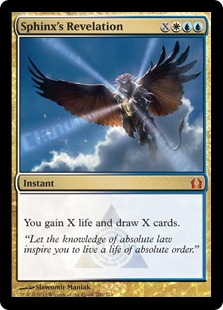
sphinx's revelationAs a lover of combat, mulligans, and all things tempo, I find the dynamics between mechanics like card advantage and tempo in Modern fascinating. Card advantage's awkward positioning as a Modern mechanic intrigues me, and I'm glad Ryan mentioned it this week and inspired me to flesh out my theory.

I'm always eager to discuss these theories in the comments, so don't be afraid to drop a line. Until then, may you play to the board and leave your Sphinx's Revelations at home.

Stock Watch- Thalia, Guardian of Thraben

Are you a Quiet Speculation member?

If not, now is a perfect time to join up! Our powerful tools, breaking-news analysis, and exclusive Discord channel will make sure you stay up to date and ahead of the curve.

About a month ago I highlighted Thalia, Guardian of Thraben as a financial highlight of the Modern Eldrazi Taxes deck, and the window for sub-$10 Thalias looks to be closing. Since then Thalia has jumped from about $5 to about $8 and is trending up. This is in part due to the Modern Thalia decks being a lot better, and in part due to Legacy hype.

thalia chart

If you're interested in buying into Thalia for Modern and/or Legacy play, I recommend doing so sooner than later. There are still quite a few copies available online, though they won't last forever. Some buylist prices are already as high as the card's market price was a month ago, which is a strong indicator of future growth. Buy now, or pay more later.

There was an error retrieving a chart for Thalia, Guardian of Thraben

For more adventurous folk, the pack foils of Thalia are also enticing buys. Innistrad foils are currently just over $20, which puts them at about a 2.5x multiplier- a little low for Modern and Legacy staples. Further, the promo Thalia retails for over $40 currently, and it being worth more than the pack foil by that margin doesn't make a ton of sense to me. It also wouldn't surprise me if the promo started ticking up in value as well.

Insider: Tracking Modern Buylist Price Increases

Are you a Quiet Speculation member?

If not, now is a perfect time to join up! Our powerful tools, breaking-news analysis, and exclusive Discord channel will make sure you stay up to date and ahead of the curve.

I’ve focused my study of the Magic market on retail price changes, but there’s a whole other world of buylist price changes that may be an even better indicator of the future. Dealers base their buylist numbers on future sales projections, so any large increases mean the dealers are confident in high future demand.

There’s a lot to be gained from understanding buylist prices, and because Trader Tools offers us the ability to track buylist price changes, today I am going to take the opportunity to begin a journey of studying them.

Khans Trilands

There was an error retrieving a chart for Mystic Monastery

You saved all the trilands you drafted, right? Those guys looking through the discarded stacks of cards that are common at large events had the right idea, because Khans of Tarkir trilands like Mystic Monastery are beginning to appreciate and aren’t going to stop soon.

Shards of Alara trilands like Arcane Sanctum are worth over $2, and I fully expect the wedge lands to head there eventually too. I recommend targeting the blue lands, which typically demand the highest prices historically.

Scrylands

There was an error retrieving a chart for Temple of Enlightenment
There was an error retrieving a chart for Temple of Epiphany

Scrylands like Temple of Enlightenment might not be "true" dual lands, but they are excellent mana fixing with a ton of appeal in casual formats. They’re truly among the best lands in the game, especially in singleton formats like Commander, and they’ve been adopted into the pantheon of go-to mana fixing whenever someone is building their deck.

The price of these lands plummeted hard after rotating out of Standard because of their limited appeal in eternal formats, but recent buylist increases indicate that we’ve reached the bottom and the price is beginning to rise.

I don’t see a lot of downside on these lands, particularly blue lands. These two from small expansion sets saw the biggest buylist increase and have the most long-term potential, while Temple of Deceit will see more mild growth due to higher supply.

Checklands

There was an error retrieving a chart for Clifftop Retreat

Clifftop Retreat and Woodland Cemetery saw buylist growth this week, and it points to a general trend of the Innistrad checklands being great holds for the long term. I’ve long been a fan of Sulfur Falls, but the least-popular of the lands increasing in value points is a good sign for the cycle. Hinterland Harbor may still be a bargain for a blue land, and Isolated Chapel is still a bargain as the cheapest of the bunch.

Shocklands

There was an error retrieving a chart for Temple Garden

Shocklands were long considered to be a gold standard spec that couldn’t go wrong, but it has taken a long time for the prospects of high demand and higher prices to come to fruition. The prices are beginning to increase, however, and with the bottom behind us, the future is now.

These lands are critical to the mana bases of Modern, and as the popularity of the format grows, so do the price of these lands. It’s hard to say where they will settle, if they do settle, but I fully expect they will continue to steadily appreciate.

Fetchlands

There was an error retrieving a chart for Arid Mesa

Despite the hopes of many, no Zendikar fetchlands were reprinted in Eternal Masters. With no relief in sight their price is going to rise, and Arid Mesa is leading the charge with a 20% increase in buylist price this week. These lands won’t go down soon, so I’d get them now and profit later. Just keep your eye out for any announcement of a reprint.

Gemstone Mine

There was an error retrieving a chart for Gemstone Mine

Modern real estate in general remains a good place to invest, and both printings of Gemstone Mine saw a buylist price increase this week. The paper price has been steady for a year, but the Magic Online price of both versions has more than doubled over the past month, which leads me to believe the paper price will continue to rise.

Griselbrand

There was an error retrieving a chart for Griselbrand

High-profile rares from Avacyn Restored did well this week, including Griselbrand, which is beginning to recover from the influx of Grand Prix promos last year.

Cavern of Souls

There was an error retrieving a chart for Cavern of Souls

Cavern of Souls continues to perform in eternal formats, where its fate is currently tied to the success of Eldrazi.

Restoration Angel

There was an error retrieving a chart for Restoration Angel

Restoration Angel is a versatile card with Modern playability and casual appeal, and while its price has sagged this year after more than doubling in price in January, it’s back on the uptick.

Maelstrom Pulse

There was an error retrieving a chart for Maelstrom Pulse

Modern staples continue to appreciate, and the buylist price of both versions of Maelstrom Pulse has been particularly strong this week. It’s a staple in the Jund deck that remains among the most popular in the format, and has now reached its all-time high price (since rotating from Standard) with more room to grow.

Serum Visions

There was an error retrieving a chart for Serum Visions

Serum Visions continues to avoid reprint, and its price continues to fall from its high of over $20. It’s a bargain at this point around $6. I expect increased demand in the future will bring the price back upwards, if buylist increases this week are any indication.

Mindbreak Trap

There was an error retrieving a chart for Mindbreak Trap

Mindbreak Trap saw a buylist price increase this week, so now might be a good time to stock up on this eternal format sideboard staple that’s not likely to see a reprint. The online price increased over fourfold this year, to almost 17 tix, so the paper price of $5.50 seems like a bargain, and a discount compared to its high over $8 two summers ago.

Blood Moon

There was an error retrieving a chart for Blood Moon

Modern was caught in a Blood Moon frenzy last summer when Urzatron and Amulet Bloom were everywhere, but the price began to fall until the Eldrazi invasion renewed interest in hosing nonbasic lands. Their banning has lessened demand on the enchantment, but a buylist price increase this week is indication that the trend is reversing.

Engineered Explosives

There was an error retrieving a chart for Engineered Explosives

Engineered Explosives saw a buylist price increase this week, which is symptom of increased demand and steadily rising retail demand. Between steady online growth for a few months, high retail prices, and the buylist price increase, all signs point to high growth potential over the coming year.

Insider: Foil Eternal Masters Picks

Are you a Quiet Speculation member?

If not, now is a perfect time to join up! Our powerful tools, breaking-news analysis, and exclusive Discord channel will make sure you stay up to date and ahead of the curve.

While cards reprinted in Eternal Masters initially caused dips in prices, it's clear now that there is significant demand for many cards in the set relative to the supply. We've seen this previously with Tarmogoyf in Modern Masters---reprinted cards can ultimately end up increasing the value of a card as more players who have acquired their first copy clamor for the rest of their set.

Interestingly, when you compare the price of foil Future Sight Tarmogoyfs to the foil reprints, the original printing is significantly more valuable. The opposite is true when you compare the judge promo Force of Will to the Eternal Masters foil. This is also true with regard to Vampiric Tutor, and a few other cards from the set.

The long and short of it is that despite being a reprint set, EMA isn't exactly Chronicles. Some EMA foils barely exist online currently, such as Toxic Deluge, and there are some great investment opportunities in foils from the set. I've taken the time to go through foil prices from the set to present the best options.

Some of these cards are abstractly good specs, while others are more so great buys for people who would actually play them.

There was an error retrieving a chart for Argothian Enchantress

The judge foil Argothian Enchantress is currently priced at about $45, compared to the EMA foil at $30. This isn't the most sought-after card, though it's a casual favorite with some fringe Cube and Legacy implications. The ceiling for this one is likely to closely resemble the price of the judge promo, though if you're in the market for a foil then $30 is the cheapest price you're going to see for a while.

There was an error retrieving a chart for Baleful Strix

Despite multiple non-foil printings, Eternal Masters is the first foil printing of Baleful Strix. Non-foils are pretty cheap right now, though foils are sitting around $55-$60. A Cube, Commander, and Legacy all-star, I only see this price increasing. If you're in the market for these, I strongly recommend buying soon. It wouldn't surprise me to see a $100 price tag on these foils before long.

There was an error retrieving a chart for Beetleback Chief

Beetleback Chief is another first-time foil, though a significantly less sought-after one. Given the MTGO legality of the card in Pauper and the card's relative power level as an uncommon, the card sees a solid amount of casual and Cube play, and as such I feel it's slightly undervalued in the $4 range. I expect these to at least double in the next six months.

There was an error retrieving a chart for Braids, Cabal Minion

The original Braids foil is currently $15, and the EMA reprint is in the $5-6 range. Braids is better than Sol Ring, so it's banned in Commander, but it shows up in a large number of Cubes. I expect this to be the cheapest you'll be able to find a foil Braids for some time.

There was an error retrieving a chart for Control Magic

Yet another first-time foil and Cube all-star, foil Control Magic can currently be had for about $15. Despite being a rare in EMA, the legality in the peasant format adds some demand to the equation on this one. $15 sounds like a bargain to me, and I expect this to at least double up over the course of the next year.

There was an error retrieving a chart for Dack Fayden

Dack doesn't quite hack it in Legacy, though he's a Cube and Vintage staple. There's not a ton of people sitting around waiting to buy Dacks, but the disparity between the EMA foil at $155 and the Conspiracy foil at $225 is notable. This is mostly a buy for people who are specifically looking for foil Dacks and less of a growth stock.

There was an error retrieving a chart for Daze

Speaking of price disparity, EMA Daze is currently at $35 as compared to Nemesis foils at $75. I largely prefer both the old border and the old art, though I fully expect EMA Dazes to drive demand. Once again you can expect the original foil to more or less function as the ceiling, though there is a good amount of room to grow here.

There was an error retrieving a chart for Diminishing Returns

Diminishing Returns has a very niche market as a sideboard card for Legacy Storm, though with this being the only foil printing $8 seems like a bargain. It's hard to say exactly what the ceiling on such a niche card would be or how easy one would be to move, but given the low cost to entry I like picking up a few of these while they're still sub-$10.

There was an error retrieving a chart for Entomb

EMA foil Entomb is currently $22 as compared to the $35 judge promo and the $60 Odyssey foil. I personally think that the new art is great, and this foil being valued at the same price as the Graveborn printing with their goofy foiling seems criminal to me.

There was an error retrieving a chart for Gamble

Gamble is another first-time foil, and with Cube, Commander, and Legacy appeal it's not surprising to already see the card at $45. If you need these, get them now. I'm not as interested in these as a spec as Baleful Strix, though the growth will be real.

There was an error retrieving a chart for Heritage Druid

The original foils of Heritage Druid are currently valued at about $30 compared to the EMA foil at $15. This is a Legacy, Modern, and casual card, and I expect to see the EMA version gain value more than I'd expect the Morningtide printing to lose it. This is a solid buy right now.

There was an error retrieving a chart for Hydroblast

Hydroblast doesn't see nearly as much play as Pyroblast in Legacy or Vintage, though it's a very popular Pauper sideboard. This is another first-time foil, and while the demand is niche enough that I don't love this card as a spec, I would definitely get them now if I was intending on playing them.

There was an error retrieving a chart for Hymn to Tourach

The only previous foil of Hymn to Tourach was the From the Vault version, which basically makes EMA the first foil. At $7, these are priced to move, and I like picking up a few sets at that price. I imagine it won't take long for these to hit the $15-$20 range.

There was an error retrieving a chart for Jace, the Mind Sculptor

Foil Worldwake Jaces are currently around $300, with the majority of EMA Jaces listed at $220+. A small number of copies are available at $200, and I like the card at that price. There won't be enough foil EMA copies to drive the original prices down, and I expect cheaper copies to dry up pretty fast.

There was an error retrieving a chart for Maze of Ith

This one is somewhat interesting. EMA foil Maze of Ith is around $30 while the From the Vault printing with the same art is $20. Meanwhile, the judge promo with different art is about $100. I don't believe that the art is nearly bad enough to account for this difference, and I expect that the EMA printing will move closer to the judge promo price than the From the Vault price.

There was an error retrieving a chart for Mother of Runes

This one is worth pointing out mostly for this being the first foil printing of the new art. The FNM promo with the old art is at $20, compared to the Urza's Legacy foil at $38. I strongly prefer the old art, though I could see players moving in on the new art and pushing its price closer to that of the original foil printing.

There was an error retrieving a chart for Mystical Tutor

The only foil Mystical Tutor printed prior to this was a From the Vault printing, and it's not surprising to see the EMA copy at $30 as opposed to the FtV at $15. Not to mention that the new art is great. Mystical Tutor is deservedly banned in Legacy, though it's a sweet one for Cube, Vintage, and Commander. The demand for this one is fairly limited, but the supply is likewise small. I expect significant growth here, though some difficulty in actually selling the card.

There was an error retrieving a chart for Natural Order

The judge promo Natural Order is $130. The EMA printing is $60. The art is the same, and the judge promo doesn't even have the old border. I expect significant growth for the EMA foil.

There was an error retrieving a chart for Peregrine Drake

This is another first-time foil, though this card's applications are pretty much limited to Pauper. There's not a ton of demand for Pauper foils, though I personally need one for my Cube, and at $4 I know I'm getting a deal.

There was an error retrieving a chart for Price of Progress

This is similar to Hymn to Tourach, in that the only existing foil for Price of Progress was from a premium deck. The garbo foil is $4, with the EMA printing sitting at $5-6. Price of Progress is a staple of Legacy Burn, and also sees play in the stock Izzet Delver build. I expect the EMA copy to at least double in the next six months, especially if Eldrazi continues to be a popular Legacy deck for Price to prey on.

There was an error retrieving a chart for Serendib Efreet

Serendib Efreet is mostly just a Cube card, though if you have a foil Cube that includes it now is the time to buy on this one. The only previously existing foil was the FtV printing which is deservedly worth nothing, though I believe that the EMA foil is a nice Cube pickup at $7.

There was an error retrieving a chart for Shardless Agent

The EMA foil Shardless Agent is currently at $37 as compared to the $55 judge promo. There isn't a ton of room to grow, though the current price for the EMA promo is the best price you'll see on foil Shardless Agents for a while.

There was an error retrieving a chart for Sinkhole

Sinkhole is legal in paper Pauper, fits into a good number of Cubes, and is technically Legacy playable. The judge promo for the card is $45, while the EMA foil is sitting at $20. I would anticipate at least 50% growth for the EMA copy.

There was an error retrieving a chart for Sylvan Library

The EMA foil Sylvan Library is currently $50 to the $65 Commander's Arsenal printing. Commander's Arsenal is another set with weird foiling, and for most EMA foils we see these price comparisons favoring the EMA foil. I predict that before long the EMA foil will be worth more than the other foil version.

There was an error retrieving a chart for Wasteland

Wasteland has a couple judge promos and an MPT promo that are all worth at least $120. The EMA foil is currently $80. This more or less sets an immediate absolute ceiling at about 50% growth, though more than anything this is just a great price for somebody looking for foil Wastelands.

There was an error retrieving a chart for Winter Orb

This is the first foil printing of Winter Orb, and it's already $50. It doesn't make a ton of sense to compare to Alpha and Beta copies at over $200, though I anticipate that foil Winter Orb will be $75-$100 before terribly long.

There was an error retrieving a chart for Worn Powerstone

This is another Cube all-star seeing its first foil printing. I don't expect foil Worn Powerstone to gain a ton of value, though if you ever plan on owning a Cube that would want a foil, I'd lock in now at $13.

~

With foils, you want to be especially mindful of your exit strategy, as the foil market is pretty niche. I believe that some of these picks are strong speculative picks abstractly, though just be careful not to invest too much into cards that are going to take some time to move.

At any rate, Eternal Masters is proving to be a significantly different release than Modern Masters, with the lack of a major sealed Grand Prix for players to open product and a limited run being contributing factors. While researching these prices, I came across a couple promos from the set that are already scarce online, and I don't believe that the window is going to be terribly long for many of these.

Thanks for reading.

-Ryan Overturf
@RyanOverdrive on Twitter

Insider: Virtually Infinite – Picks of the Week and Slowing the Bleed

Are you a Quiet Speculation member?

If not, now is a perfect time to join up! Our powerful tools, breaking-news analysis, and exclusive Discord channel will make sure you stay up to date and ahead of the curve.

I am so stoked to crack some Eternal Masters packs. No chance to catch a paper draft this week so MTGO is going to have to do. Check out last week's article (Part 1 and Part 2) for some drafting tips.

Fortunately, we’ve got on-demand draft and sealed for the next three weeks. Unfortunately, the EV is super low and dropping.

This article is going to focus on how to get the most out of EMA drafts to slow the bleed. But first let’s start with a few picks of the week so you can recoup the tix you’re burning, with a vengeance, on this set.

Fulminator Mage (SHM)

Fulminator Mage

Current: 10.5 tix
Target: 16 tix

In February, Fulminator hit 22 tix and had a baseline of 15 until the Shadows over Innistrad release. Shadowmoor drafts plus the EMA release is putting pressure on this. I think 16 is a pretty sure bet and 20+ is probable for the patient.

Kitchen Finks (SHM)

Kitchen Finks

Current: 2.9 tix
Target: 5 tix

This one has seen a steady cycle of dips and rises. Same story as Fulminator. A persistent Modern staple that will make it back to the top shelf.

Eye of Ugin (MM2)

Eye of Ugin

Current: 2 tix
Target: 4 tix

This is a key part of the Legacy Eldrazi deck. Not sure why it has seen such a steep drop—I suspect that this is the result of a speculator who got impatient. Their loss is our gain, as I see this hitting 4+ tix in a few weeks when Legacy picks up.

Bitterblossom

Bitterblossom

Current: 10 tix
Target: 15 tix

I had my eye on this at 9 tix but failed to pull the trigger. It’s still a relative bargain at 10. The risk here is that this is not a staple and is reliant on price memory more than performance. But it’s a low-supply rare that is likely to gain.

Cavern of Souls

Cavern of Souls

Current: 29.6 tix
Target: 38 tix

Not as sure about this one, but it is part of the Legacy Eldrazi deck and was at 40 a week ago. It will probably bounce back, but to cover the margin and make this worthwhile it will need to go from its current price to 35+ tix. Likely, but not a slam dunk. I don’t think this spec is quite ripe as it has some room to drop, but keep an eye on this one.

Languish

Languish

Current: 4 tix
Target: 7 tix

The window on this is tight, as it is for all Magic Origins cards, which are not far from rotation. We are looking at three weeks of EMA draft followed by the Eldritch Moon release in late July. That said, this is one of the cornerstone cards in Standard in a set that was not heavily drafted. It was recently 8 tix, and it has a decent shot of getting back there. Higher-risk because of rotation.

Manamorphose

Manamorphose

Current: 0.5 tix
Target: 2.5 tix

This one has hit 2.8 twice in the past three months. A relatively low-risk spec since this is a very low price for a card which sees occasional spikes.

Slowing the Bleed

If you’ve read my previous articles (or have any firsthand experience with the MTGO economy) you know that drafting is a bleed. That’s especially true with high-cost sets like EMA. The key is to slow that bleed. Here are some of the keys to doing that:

  • Play phantom. Playing phantom is almost certainly a losing proposition, but it substantially limits the amount you can lose in each draft.
  • Play Swiss. The payout for Swiss is the same as an 8-4 (6-2-2-2) but you are guaranteed three matches for your effort. Unless you're a truly top-caliber player this will give you more gaming for your money. Yes, it’s not for the impatient but it will slow your losses. It’s also a great way to ensure you get some reps in early in the format.
  • Value-draft. Rare drafting has a bad name, so let's rebrand it... In EMA, as with many flashback sets, some of the more valuable cards aren't rares, anyway. Here's what I wrote about rare drafting a while back:

"Unless you are practicing for a Pro Tour (or are a reclusive billionaire on your wifi-eqipped yacht) it makes sense to rare-draft. The logic to rare drafting is that you’re playing the long game. Even the best card in your deck only marginally increases your win percentage, whereas a rare in your pile is money in the bank.

I always keep a browser tab open with a pricelist from the set I’m drafting. When drafting Standard-legal sets, I prefer Goatbots because they list buy and sell prices for every card in the set, including money uncommons, and it’s super fast to Ctrl-F a card. For flashbacks I use MTGO Traders, which doesn’t show buy prices, or MTGOWikiprice.com."

  • Sell your cards as soon as your draft concludes. While there are occasional exceptions, it almost always makes sense to sell your rares as soon as the draft is done during release events. In the first 24 hours, prices are in free fall; when they firm up varies, but I usually don't risk it.
  • Don’t hesitate to report bugs. It goes without saying, but if anything related to Wizard’s infrastructure causes you distress, you should file a compensation request. Even if it doesn’t directly lead to a game loss, if it’s an ordeal that impinges on your enjoyment you are entitled to reimbursement for your entry fee. Make sure not to bleed value because of technical difficulties. Wizards currently has a fairly generous policy on reimbursements—be honest and don’t abuse it or you will ruin it for everyone.
  • Open Wasteland. I recommend opening as many Wastelands as you can. I got a lucky pull on my first draft which will cover a couple forays in the queues.

You saw my article last week on what's theoretically possible with EMA. But what works? Here's a few 3-0 draft decks pulled from Twitter. Take these with a grain of salt, of course, since we don't know whether these folks were drafting at Finkel's pad or at the FNM in Duluth. Nevertheless, it's always cool to see what is winning.

Watkins2
Matthew Watkins went 3-0 with Green White: "Just kind of followed my own advice and went 3-0, 6-0. Opponents weren't in archetype decks, played bad cards."
Watkins1
Watkins's deck, part two

GlareTrenches
Jacob Fusco ‏(@thereservasian) paired Glare of Subdual with Goblin Trenches and other token generators to lock things down. Don't pass this combo!
Burning Vengeance
Adam Victor Klesh ‏(@madolaf) went 3-0 with an Izzet deck splashing Rally the Peasants, noting, "Burning Vengeance is the real deal."

WU
Griselbrand's Goryo (‏@TankofJank) went 3-0, noting, "My deck is straight fire." Said 8.5 Tails is underrated.
GBU Deck
Archie Owen ‏(@Owen_AC) took the #saitodecklistchallenge after going 3-0 with a "literally all the value" Abzan deck.
Erik Peters ‏(@ESP_MTG) forgot to take a picture, but here's a recreation of his 3-0 mono-blue #MTGEMA Midnight release draft deck. Nice if it's open!
Bobby B. ‏@Yammedup  Jun 11 3-0 deck was AWESOME! Set is a blast to draft, wish all my draft decks were this fun and good. #MTGEMA
Bobby B. (‏@Yammedup) with G/W Midrange: "3-0 deck was AWESOME! Set is a blast to draft, wish all my draft decks were this fun and good."
Esper Blood Artist
Serena Quinn (‏@RestoBunny) posted her 3-0 Esper build, noting, "Blood artist is one hell of a card."
BR
Max Kahn (‏@MaxPlaysMTG) went 3-0 with this Rakdos reanimator strategy.
Boros
Anthony Avitollo ‏(@Antknee42) rode his Boros two-drops to victory.
BorosVerhey
Gavin Verhey (‏@GavinVerhey) also pursued the Boros two-drop strategy (with 15 lands) to an undefeated record at the employee #MTGEMA prerelease.

High Stakes MTGO – June 5th to June 11th

Are you a Quiet Speculation member?

If not, now is a perfect time to join up! Our powerful tools, breaking-news analysis, and exclusive Discord channel will make sure you stay up to date and ahead of the curve.

Good morning and welcome back to High Stakes MTGO!

On the menu this past week were round two of Lorwyn block flashback drafts, a little bit of Modern and Eternal Masters. After two weeks being relatively active, this past one was definitively more quiet. The reason is simple---I'm holding my breath for the incoming Legacy events.

The release of EMA and the associated hype surrounding Legacy on MTGO has pushed up the price of a lot of cards. Profits are sure to be made but timing the optimal selling window could yield even more tix. I'll give my two cents on the topic at the end of this article. The is also going to be an exciting buying time as EMA cards will start flooding the market this week---we'll probably have more to see and say later this month.

Last Saturday's snapshot can be found here.

Buys This Week

My targets this past week were kind of divided into two categories: Modern Storm and Lorwyn flashback drafts.

PA,PiF

Storm has been around since the beginning of Modern, and most likely always will be. The banning of Splinter Twin and Summer Bloom last January caused Pyromancer Ascension to jump from ~3.5 tix to more than 8 tix in less than a week. The Eldrazis then came around, pretty much relegating all the others decks to tier 2 or 3 decks.

Despite the ban of Eye of Ugin, Storm never really reached the level of notoriety it had in the past. Nonetheless the Ascension managed to climbed again to a record high at 9.5 tix at the very end of March. Down below 3 tix last week, with a potential to triple and rather active price fluctuation, the opportunity was too good to let pass.

Although not exactly mirroring each other, the price of Past in Flames and Pyromancer Ascension are, not surprisingly, tied to some extent. The 9-10 tix range seems to be a solid baseline for the red sorcery. With 15 tix as a primary target, this spec looks simple but good to me, not to mention that this strategy worked just fine a few months ago---I'm in for another cycle.

LRW

Of these three, Thorn of Amethyst may have the most chance of immediate success in my opinion. Being a key card in both Legacy and Vintage Eldrazi strategies increases the chance to see this artifact reaching new heights sooner rather than later.

Gaddock Teeg is moderately played in several Modern and Legacy decks and has shown some price strength with record high after record high over the last twelve months. Lorwyn flashback drafts naturally brought him close to his lowest point since last Summer. Here again I'm counting on the incoming Legacy events to jump-start the rebound of Gaddock Teeg.

Although the price trend looks great---free-falling from 17 tix to 5 tix---Wanderwine Hub might actually be more of a gamble than it seems. This card can pretty much only be played in one deck---Modern Merfolk. And even there we are talking about Merfolk decks that want to include some white spells, which was a much popular version of Merfolk when the Eldrazis were around.

So nothing really guaranteed concerning the rebound of this land and I'm likely to exit as soon as the price reaches 7-8 tix.

Sales This Week

I'm trying to get rid of a big chunk of my painlands as their rotation is getting closer every day. My return on investment with the Magic Origins painlands is clearly not as high as I had anticipated---but considering that all of them were in the red until 2016 I'm okay with profit averaging 100%. The volume with these five lands is what will make all the difference in the end, even without a groundbreaking return on investment per position.

I was holding this guy for more than six months now and even with some support from redemption this rainbow land didn't get as much attention as I had expected. In April Mana Confluence even plunged lower than my buying price. With a nice recovery just below 5 tix in May, the price seemed to have stabilized. With only fringe plays in eternal formats I thought now was the good time to sell with a decent 54% profit.

Legendary Cube Prize Pack

13 more Legendary Cube Prize Packs sold this week. I'm expecting to have the 39 remaining boosters sold by the end of July at the latest.

On My Radar

All my attention is on Legacy and Legacy-playable Modern cards. This is what players will be focusing on and this is money time for speculators. It's hard to perfectly time the right selling window especially as not all the cards are likely to reach their top at the same time. I guess you know my philosophy by now---I'd rather sell too early than too late. I'll probably start selling profitable positions this month.

Questions & Answers

A lot has already happened among Legacy staples, and a lot could still happen. Taking several valid points into account, Alexander Carl in our forum tried to open the dialogue on one of the hottest questions these days---when is the best time to sell these Legacy specs?

Q

Although there might not be a clear best answer, here are my thoughts on the subject.

As for any specs, the two parameters I'm considering when selling are timing and price. If one of these two is right then there is virtually no reason not to sell. Note that when it is a question of timing this can lead to some losses; if the price is good enough to sell then obviously it will be for a gain.

Timing

For what concerns us here the Legacy Constructed events will resume this Wednesday with Legacy Competitive Leagues, followed by Legacy Leagues awarding invitation to the Legacy Championship from July 6th to July 20th. The Legacy Championship will take place on July 24th and conclude a month and a half of EMA plus Legacy special events. So the timing is pretty clear and if you were planing on selling your Legacy specs in August you might be seriously late.

With this, the best overall window to sell is likely around early July when the demand should be at its peak as players need to build decks to enter the Legacy Leagues that feed the Legacy Championship. The demand after these events is very uncertain and nothing leads me to believe prices would sustain or, even more unlikely, go higher in August.

Price

With cyclical positions like Modern or some of the Legacy staples, when prices approach their previous record high it is often worth considering selling. Often enough record highs are broken and new records are established but it's not the norm and if you are waiting for your spec to break a new record before selling them you might be waiting for a long time.

At best, I'm looking at my Modern/Legacy specs to match their previous record highs before selling---and usually no more. That being said, a special and popular event such as the Legacy Festival is exactly when you would predict new price heights to be reached.

Should we then wait for each Legacy staple to reach crazy new heights before selling? I'm not so sure. Different cards have surged since they were confirmed out of EMA---Infernal Tutor, Counterbalance and Show and Tell are three examples of cards that greatly benefited from the hype.

Show and Tell and Counterbalance have doubled since last month but are still decently far from their record high and I would most likely be using the timing parameter to sell these at this point unless they double again quickly.

Infernal Tutor is, however, in a special situation. The black sorcery broke its record high this past weekend with 26 tix. Is selling very soon a good call or gambling by waiting four more weeks a better option? If I'm referring to my price decision parameter then the selling window is now. This is actually what I'm really close to doing; here's why.

We have had special Legacy events in the past and the Tutor reached about 50 tix in these circumstances. The Legacy demand may have grown a little since then but we just had flashback drafts including Dissension (admittedly they probably didn't flood the market with thousands of copies of Infernal Tutor).

So besides more excitement from speculators, there might not be enough real demand to see Infernal Tutor reach a crazy 80 tix, for instance. I believe that 60-65 tix would already be a nice price and selling my copies for 50 tix is what I'm aiming for at the moment.

The hype surrounding the Legacy Festival is a good reason to sell your Legacy positions at a premium, but breaking record highs should not be a goal in itself. And if cards reach their previous record high early this July maybe there's no need to wait longer to cash out.

Timing vs. Price

To summarize, when prices are still significantly below their previous record highs, I recommend holding on until early or mid-July and then selling, whatever the price is at that point.

On the other hand, if the price skyrockets and sets a new record high before the heat of the Legacy Festival constructed events, I would suggest seriously considering selling even with a few weeks to go before mid-July. One thing to take into account in this case it that other speculators might sell their positions and the price may not go any higher anyway.


Thank you for reading,

Sylvain

The Colors of Modern – Part 3: Black

Are you a Quiet Speculation member?

If not, now is a perfect time to join up! Our powerful tools, breaking-news analysis, and exclusive Discord channel will make sure you stay up to date and ahead of the curve.

Two weeks ago I began a five-part series of articles focused on analyzing the varying impact each color in Magic has upon Modern, based on the individual cards that see play in the format and, to a broader extent, the archetypes made possible by these cards. If you missed last week’s article on blue, check it out here. Today, we’ll be focusing on black---analyzing its color identity in Modern along with the strengths and weaknesses associated with common archetypes that employ the color. Let’s go!

Damnation-cropped

The Cards

Staples

  • Thoughtseize
  • Inquisition of Kozilek
  • Dark Confidant
  • Liliana of the Veil

Sideboard Powerhouses

  • Leyline of the Void

Strong Options

  • Bitterblossom
  • Kalitas, Traitor of Ghet
  • Damnation
  • Viscera Seer
  • Death's Shadow
  • Tasigur, the Golden Fang
  • Painful Truths
  • Waste Not
  • Goryo's Vengeance

Multi-Color

  • Lingering Souls
  • Abrupt Decay
  • Terminate
  • Kolaghan's Command
  • Maelstrom Pulse
  • Tidehollow Sculler

[wp_ad_camp_1]

The Black Big Three

Black in Modern is summed up by one word: power. With access to both powerful threats and strong interaction, black has no real immediately apparent weakness. Compared to blue and white, which both lack powerful threats, black enjoys various options at multiple spots
Thoughtseizeon the curve in the form of Tasigur, the Golden Fang, Dark Confidant, Liliana of the Veil, and Kalitas, Traitor of Ghet. Where other colors are only able to present a few “staple-worthy” threats (green has Tarmogoyf, red has various one- and two-drops) Black’s depth has contributed to its reputation as the strongest color in Modern.
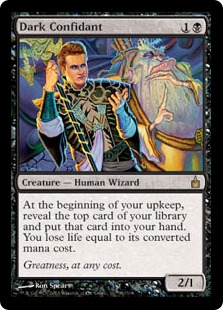
I’ve talked in previous articles about Modern as a format controlled by exchanges, primary among them being mana exchange. For one mana, you get answers, for two mana you get threats, for three mana you get card advantage, and so on. Most colors in Modern enjoy a top-tier staple that fits in one of the three categories, but not all. For example, white has Path to Exile as a one-drop answer, blue has Snapcaster Mage (as a pseudo-three drop). Black, in my opinion, can singlehandedly claim dominance in every category.

Thoughtseize (and to a slightly smaller extent Inquisition of Kozilek) can answer literally every card in the format, placing it miles above Path to Exile and Lightning Bolt in terms of value.

Dark ConfidantDark Confidant’s power waxes and wanes with Burn and Affinity’s strength in the format, but currently it is one of the strongest two-drops on the block. Without Dark Confidant, Jund and Junk’s attrition strategy would possibly fall apart, and certainly be diminished. More than almost any creature in the format (except perhaps Tarmogoyf) Dark Confidant demands an immediate answer, or it can singlehandedly win the game by itself. It’s possible (but outside the scope of this article) that Dark Confidant can actually “win” faster than Tarmogoyf swings, as just two free cards can be enough to guarantee victory in some matchups. Regardless, as a single card that can threaten victory for only two mana, Dark Confidant has earned its place as the best creature in black.
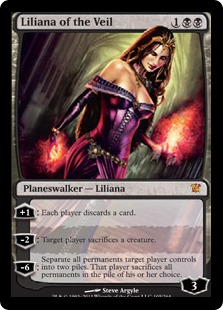
Liliana of the Veil needs no explanation, but with the recent success of Nahiri, the Harbinger in Modern this is a good excuse to revisit what makes a planeswalker “work” in Modern. As a format that relies so heavily on exchanges and mana efficiency, we often see decks “pricing themselves out” of flexibility in terms of spells that deal with planeswalkers. Liliana of the VeilAll-around answers like Maelstrom Pulse, Detention Sphere, or Dreadbore are left on the table in favor of hyper-efficient solutions like Terminate and Path to Exile. As a result, a planeswalker that can effectively defend itself from creatures is deceptively hard to remove in Modern.
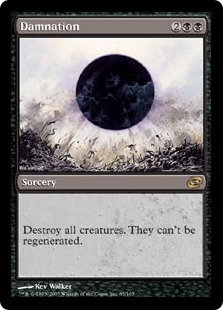
Currently, Liliana of the Veil and Nahiri, the Harbinger both see strong play in Modern, due to a few factors. They both provide card advantage and can threaten victory if unanswered, but mainly, they can survive a Lightning Bolt! Damage-based removal is one of the only common ways to kill a planeswalker outside of the combat step, and the ability of these planeswalkers to stay above 3 loyalty makes them incredibly difficult to kill. Often, discard followed by removal on a creature and a Liliana of the Veil is enough to win the game by itself. Not bad for three mana!

Additional Strengths

Besides the Big Three black has to offer, black’s major strengths in Modern come from two areas of focus: discard and removal. If Modern is a format built on powerful threats and exchanges, this means the ability to control said exchanges and interact (reactively or preemptively) to our opponent’s threats is just as powerful as card advantage or other forms of disruption. DamnationDiscard in the form of Thoughtseize and Inquisition of Kozilek is invaluable in a format as wide open and powerful as Modern, and I believe is singlehandedly responsible for holding Modern together and reining in all the broken strategies available in the field.
Aside from combo decks, Modern consists of various strategies focused on dealing twenty damage (or ten) inside the combat step, which naturally makes removal one of the most important elements of every archetype. While various strategies exist for fighting creatures (chumping with Lingering Souls tokens, sweeping the board with Damnation, casting Tarmogoyf, playing Ensnaring Bridge) the most common method involves removal, of the one-for-one variety. Of these, Path to Exile and Lightning Bolt are undoubtedly king (as we discussed two weeks ago in the white review) but beyond these options black holds the reins as removal champion.

Four removal spells in a list of 75 is rarely enough, forcing many colors to look to other options for their creature-killing needs. Kolaghans CommandWhile Dismember exists to allow mono-color archetypes to fight creatures without employing other colors, black benefits greatly from a plethora of creature killing options. Most of the best options are multi-color, but as mono-black currently isn’t a strategy in Modern that’s not too much of an issue. BGx archetypes have access to Abrupt Decay, which kills most creatures in the format (along with most everything else as well). BRx archetypes get Terminate, along with Kolaghan's Command, which incidentally combines with just about everything to be one of the strongest, but most unassuming cards in the format.
Before tackling the downsides of black, lets take a look at a few archetypes that demonstrate the power of black in Modern.

Jund Midrange, by Dustin Roberson (1st, SCG IQ)

Creatures

4 Tarmogoyf
3 Kalitas, Traitor of Ghet
2 Kitchen Finks
3 Dark Confidant
3 Scavenging Ooze

Instants

3 Terminate
2 Kolaghan's Command
4 Lightning Bolt
2 Abrupt Decay

Sorceries

2 Thoughtseize
3 Inquisition of Kozilek
1 Maelstrom Pulse
1 Damnation

Planeswalkers

3 Liliana of the Veil

Lands

4 Blackcleave Cliffs
1 Blood Crypt
3 Bloodstained Mire
1 Forest
2 Overgrown Tomb
3 Raging Ravine
1 Stomping Ground
2 Swamp
1 Treetop Village
4 Verdant Catacombs
2 Wooded Foothills

Sideboard

1 Ancient Grudge
2 Anger of the Gods
2 Choke
1 Creeping Corrosion
2 Feed the Clan
1 Maelstrom Pulse
2 Nihil Spellbomb
2 Obstinate Baloth
1 Thragtusk
1 Virulent Plague

Jund Midrange takes advantage of the power of black in Modern and pushes its strengths to the max, relying on a combination of discard and powerful removal to grind down the opponent and take advantage in the midgame with powerful threats and strong manlands. Employing almost a full playset of the Big Three (Thoughtseize, Dark Confidant, and Liliana of the Veil), Raging RavineJund Midrange fills out the archetype with a solid mix of threats and reactive elements, stretching to red and green primarily for Lightning Bolt and Tarmogoyf respectively, but also to enable access to Terminate, Abrupt Decay, and Raging Ravine.
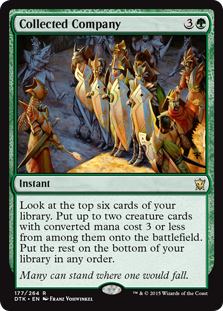
While we could sit and talk all day about what Jund does well and why, for this article I’ll just point to the overall redundancy and fine-tuning present in the archetype we see here. Jund really isn’t doing anything crazy, just a solid mix of efficient threats, answers, and the most powerful cards across three colors together in one archetype. Its main weaknesses are weak draws going late (as discard becomes worthless and its high land count catches up to it) and just being outmatched versus specific archetypes. Black is well suited to beating up on any opponent bringing creatures to the table, but it relies heavily on its discard elements to compete against combo and control archetypes, leaving it vulnerable to fast non-creature combo like Tron or grindy, over-the-top control archetypes like Jeskai.

Abzan Company, by Andrea Pintaldi (1st, SCG IQ)

Creatures

2 Anafenza, Kin-Tree Spirit
4 Birds of Paradise
3 Eternal Witness
4 Kitchen Finks
1 Linvala, Keeper of Silence
2 Melira, Sylvok Outcast
1 Murderous Redcap
3 Noble Hierarch
1 Qasali Pridemage
1 Scavenging Ooze
1 Spellskite
3 Viscera Seer
1 Wall of Roots
1 Orzhov Pontiff
1 Fiend Hunter

Instants

4 Chord of Calling
4 Collected Company

Lands

2 Forest
3 Gavony Township
1 Godless Shrine
2 Overgrown Tomb
1 Plains
3 Razorverge Thicket
1 Swamp
2 Temple Garden
4 Verdant Catacombs
4 Windswept Heath

Sideboard

2 Abrupt Decay
1 Burrenton Forge-Tender
3 Path to Exile
1 Pharika, God of Affliction
1 Reclamation Sage
1 Sin Collector
2 Thoughtseize
4 Voice of Resurgence

Here we see black in a support role to green, with the major strengths of black notably absent. Thoughtseize makes an appearance in the sideboard, but really black only exists in this archetype to make use of Viscera Seer to enable combo elements of the archetype. Viewing Abzan Company for what it is, a green creature deck splashing black and white elements, provides us insight to analyze its strengths and weaknesses.

collected companyFor one, reduced access to discard suggests a natural weakness to combo and control strategies, and Abzan Company indeed struggles greatly against those archetypes. As it’s based primarily on individually weak creatures with few ways to gain card advantage outside of Collected Company, we can infer that sweepers like Damnation and Anger of the Gods are strong against the archetype.
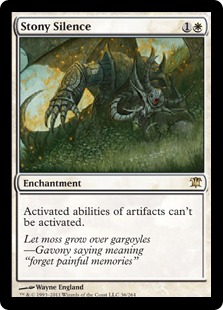
This might come as common sense to someone used to playing with or against the archetype, but we can take this same style of analysis and apply it to any “rogue” archetype based simply on the lands our opponent has placed on the table and the few spells we’ve seen him/her play. While at high-level events an Overgrown Tomb strongly suggests to us that our opponent is on Jund or Abzan Company, it’s worth keeping in the back of our head that we don’t really know for sure, and being prepared to analyze our opponent’s deck based on limited information can help us with scrying decisions and the like and can definitely influence the course of a game.

The Downsides

All this talk of the greatness of black puts us in danger of painting black as an all-powerful color with no weaknesses, which is definitely not true. Black does a few things well, such as preemptively attacking an opponent’s hand and removing problem cards through discard, and killing creatures of course. Unfortunately, it suffers strongly from problematic permanents, with no good ways to handle artifacts or enchantments without stretching into other colors. Stony SilenceIn addition, discard spells are some of the most powerful cards to see in an opening hand, but can be terrible topdecks in the midgame and akin to a dead draw in a format that heavily punishes dead draws. These weaknesses are minor and easily solved by incorporating other colors, though, and nowhere near as damning as the lack of powerful threats out of blue, for example.

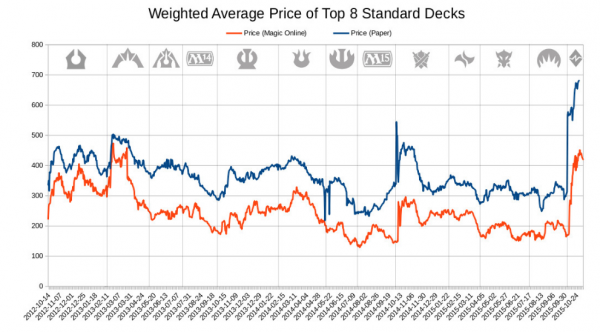
In addition, black doesn’t really have much to offer as far as sideboard options are concerned. Where white has powerful hoser-type cards that invalidate whole strategies like Stony Silence does for Affinity, black really just has Leyline of the Void to combat graveyard strategies, and that card only sees fringe play. Sweepers like Damnation have to count at least a little bit, but Damnation and cards like it are just more of the same rather than an actual high-impact spell that draws us to the color. Virulent Plague deserves at least an honorable mention as a solid answer to tokens, but token strategies aren’t prevalent enough in the format to deserve specific attention.

Conclusion

Black benefits from access to powerful threats, answers, and a wide variety of options to interact with the opponent’s hand and board. Dark Confidant and Liliana of the Veil are format staples, and Thoughtseize is strongly in the argument for best one-drop in Modern, depending on who you ask. Black struggles with interacting with problematic permanents once they hit the table, but discard can often solve those issues before they develop.

We often see black paired with other colors in Modern to shore up specific weaknesses, be it blue for card advantage or red/green for more removal/threats respectively. Black needs no new cards to continue being a strong force in Modern, and will probably remain so for the length of the format.

Thanks for reading, and I’ll see you next week!

Trevor Holmes

The_Architect on MTGO

Twitch.tv/Architect_Gaming

Twitter.com/7he_4rchitect


Insider: SOI Standard – Diverse and Affordable

Are you a Quiet Speculation member?

If not, now is a perfect time to join up! Our powerful tools, breaking-news analysis, and exclusive Discord channel will make sure you stay up to date and ahead of the curve.

Standard has been quite the format to watch as of late. Along with myself, other writers on QS have written a plethora of articles about Standard. We've been following the rapidly changing format since SOI was released, from the beginning doom-and-gloom dominance of Collected Company, past the Pro Tour, to the eve of Eldritch Moon's release.

While many will attest (and they're right) that the format is largely solved and G/W Tokens is the undisputed "deck to beat," it's still fascinating that we see so much innovation on this format. Week in and out, it seems like there's another fun and incredibly interesting deck to look at in the result pages of an SCG Open or GP.

While cards like Sylvan Advocate and Collected Company still have extraordinary dominance percentages on a weekly basis, there are still new and exciting nuances and changes to those lists. Company lists are a plenty, and we have just seen the rise of an actual effective control list in U/R Eldrazi Control.

I wanted to take the time to highlight some of these decks that I see on a weekly basis, perhaps giving you all some ideas on what to play in the coming weeks at FNM or something to augment with new cards from Eldritch Moon.

U/W Aggro, by Hugo Terra (6th place at SCG Standard Open)

Creatures

4 Rattlechains
3 Stratus Dancer
2 Bygone Bishop
4 Reflector Mage
4 Dimensional Infiltrator

Spells

4 Spell Shrivel
4 Gideon, Ally of Zendikar
2 Essence Flux
3 Clash of Wills
2 Invocation of Saint Traft
4 Declaration in Stone

Lands

4 Prairie Stream
3 Evolving Wilds
1 Westvale Abbey
4 Port Town
6 Plains
6 Island

Sideboard

1 Invasive Surgery
2 Stasis Snare
2 Hallowed Moonlight
4 Silkwrap
2 Secure the Wastes
1 Dispel
3 Negate

Wow, I love decks like these. Hugo Terra is onto something here, and as someone who enjoys a good aggro deck I can say for sure this is a twist on a traditional aggressive archetype. Hugo felt that the best direction for blue-white was an aggressive tempo strategy.

While Rattlechains still doesn't have viable spirits to play along with, it's still an extremely efficient and effective creature. Flying and flash are still great keywords to see on a creature, and Dimensional Infiltrator falls into that category as well. This innocuous card from Oath of the Gatewatch has silently become quite the effective creature not only in Standard (as seen in Saito's U/R Fliers) but also as a fringe card in Modern.

It turns out that the core of Rattlechains and Dimensional Infiltrator is something to build a deck around. Essence Flux is a card I always felt could have a chance, and here we are showing that it doesn't always needs to be paired with a spirit creature (though that would be great), but just a good 'ol Reflector Mage for great value.

We round out the deck with copies of all-around great cards like Declaration in Stone and Gideon, Ally of Zendikar to support the creature base. Spell Shrivel has also begun to show up in more lists, enabling archetypes like the recent U/R Eldrazi Control deck to really flourish in this format.

Bant Humans, by Todd Stevens (2nd place at SCG Standard Open)

Creatures

4 Lambholt Pacifist
3 Thraben Inspector
4 Duskwatch Recruiter
4 Thalia's Lieutenant
4 Tireless Tracker
4 Reflector Mage
3 Eldrazi Displacer

Spells

1 Ojutai's Command
4 Collected Company
4 Dromoka's Command

Lands

1 Wastes
1 Prairie Stream
3 Canopy Vista
4 Evolving Wilds
4 Fortified Village
1 Island
2 Forest
5 Plains
4 Yavimaya Coast

Sideboard

1 Graf Mole
2 Archangel Avacyn
2 Declaration in Stone
1 Linvala, the Preserver
2 Gideon, Ally of Zendikar
2 Den Protector
2 Profaner of the Dead
3 Negate

Todd Stevens is a cool person---I know him via Twitter---and the fact that he brought up Graf Mole on Twitter prompted me to see what he was playing at the event.

Turns out Bant Humans has more than solidified itself in this meta. It seems like old news but it's a great new take on a known quantity. Collected Company strategies are nothing new, but over the course of SOI Standard I think it's awesome that we continue to see variation in the archetype. It keeps the format fresh if nothing else---and provides something for me to talk about!

The strategy of playing a bunch of humans, then dropping Thalia's Lieutenant has been a viable since day one, but this list offers so much variation in the core strategy. Throwing Duskwatch Recruiter into the mix seems like a no-brainer on the surface, but keep in mind humans never really splashed into green before this. Add a little bit of spice (enter Eldrazi Displacer) and we have ourselves quite a potent brew. Much like the Brood Monitor combo of versions before this, it seems Thalia's Lieutenant can fill that roll much easier, and close out games much quicker.

There are plenty of other examples of known-quantity decks that have evolved over the last month or so:

  • Mono-White Humans adopting a red splash to utilize Reckless Bushwhacker.
  • Cryptolith Rite decks are still very much alive and have adopted various 4-color versions.
  • Looks like Pyromancer's Goggles lists evolved into U/R Eldrazi Control, relying on heavy end Ulamog, the Ceaseless Hunger.

...and the list goes on.

But outside known quantities and new innovations on the archetypes we've all grown accustomed to by now, SOI Standard still has plenty of curve balls to throw our way. People still seem to sleeve up unorthodox decks and end up performing quite well (even if it is sporadic).

Like this next deck by Jared Greenway:

Temur Clues, by Jared Greenway (7th place at SCG Invitational Qualifier)

Creatures

3 Sylvan Advocate
1 Jori En, Ruin Diver
1 Dragonmaster Outcast
2 Dragonlord Atarka
2 Matter Reshaper
1 Nissa, Vastwood Seer

Spells

4 Weirding Wood
2 Arlinn Kord
3 Oath of Nissa
4 Oath of Chandra
1 Oath of Jace
1 Epiphany at the Drownyard
3 Traverse the Ulvenwald
2 Kiora, Master of the Depths
2 Radiant Flames
2 Sarkhan Unbroken
1 Dispel
2 Negate

Lands

1 Wastes
1 Wandering Fumarole
2 Lumbering Falls
2 Cinder Glade
2 Evolving Wilds
1 Game Trail
3 Forest
3 Mountain
4 Shivan Reef
4 Yavimaya Coast

Sideboard

2 Clip Wings
2 To the Slaughter
2 Pulse of Murasa
2 Warping Wail
1 Radiant Flames
2 Dragonlord Silumgar
2 Surrak, the Hunt Caller
2 Negate

Never thought I would see Weirding Wood in Standard---I guess green is even better than I thought. I think this deck can be summed up as, "All the cards I want to play in Standard---but which weren't good."

Format Diversity Financial Outlook

Why am I harping on format diversity so much? Well, other than being interesting and fun, a diverse format is beneficial for players when it comes to talking prices.

A general trend shows us that overall new set prices drop considerably because today's supply is way higher then ever before. Some anomalies and high Standard prices may still happen (we saw this with the coupling of Jace, Vryn's Prodigy and Khans fetchlands), but largely now that the two-block cadence is in full swing we see lower card prices on average.

While players may be spending on new sets more often, they will likely be spending less overall on specific cards. We can see this in action already---high-dominance cards like Sylvan Advocate are only $5. Sure, you have your chase mythics like Nahiri, the Harbinger, but when you look at the trend you realize that most cards required to build an effective deck are under $10.

SOIStandard
Chart courtesy of MTGGoldfish

We can see this with SOI Standard prices in the course of just two months---a considerable 25% decrease in format price. While some cards may fluctuate in that time and certain cards trend upwards as they become popular, there will always be a card that subsequently decreases by just as much. There's just a metric ton of supply in today's market.

It's hard for most cards to maintain prices over $10, and diverse formats compound that scenario. When players can choose between four different versions of Humans, or Collected Company decks (or...Clues?), they're more likely to choose the list that costs less (and is still viable).

I did mention that Standard can still be expensive, and I'll have to make sure to track this going forward so there's more data behind the two-set block structure. But, my feeling is that this new method of releasing sets greatly alleviates format prices overall. Just from the preliminary data, we already see with an increased speed of releases players will be spending more frequently but less overall on individual cards.

StandardPriceAverages
Chart courtesy of MTGGoldfish

Coming from the expensive Khans of Tarkir Standard with Jace, Vryn's Prodigy plus fetchlands, to today's SOI Standard, the format price has decreased dramatically. With average prices of decks roughly in the $600-700 range we see a 50% decrease (taking numbers from the MTGGoldfish Metagame Page), with deck averages in the new format trending in the $300 range.

I also went ahead and looked around for metagame snapshots of previous Standards to verify that very diverse metagames coincide with lower overall average value:

  • Return to Ravnica/Theros metagame snapshot (Nick Vigabool GatheringMagic): 14 different archetypes over 1% with "Other" at 21%---looking at the chart above, the average cost of the format fluctuated between $400-500 with a low of $300.
  • Theros/Khans of Tarkir metagame snapshot: 18 archetypes over 1% with "Other" at 24%---average format cost fluctuated between $300-400 with a low of $250.
  • Khans of Tarkir/Battle for Zendikar metagame snapshot: 13 archetypes over 1% with "Other" at 19%---average format cost around $700.
  • Average cost of SOI Standard Top 8 archetypes (taken from MTGGoldfish's Metagame Page): $297

The data isn't finalized yet in terms of a metagame breakdown for Shadows Over Innistrad Standard. But by the looks of it we're looking at one of the cheapest Standards in quite some time. I guess anything seems affordable coming from an average $700 Standard that was KTK/BFZ. SOI looks to be just as diverse as its predecessor formats and there is a correlation to diverse formats and cost. I would say that BFZ Standard was a "perfect storm" when it comes to cost. Jace, plus fetchlands, plus battle lands was just a disaster for players.

While the data is still inconclusive, I think the general trend of Standard is going in the right direction. We will need more sets to release under the two-block structure to have more detailed numbers, but I think my inclinations will be realized very shortly. Obviously Eldritch Moon will release and prices will likely be in flux again---but I think the law of averages will prevail yet again when the dust settles and the initial hype and craze has subsided.

I've talked about this with fellow writers many times on many platforms---it's just hard for cards (rares and mythics alike) to maintain a price tag over $10 and we've seen this for a little while now:

Standard staples under $10

So, go out there and enjoy some Standard. It's diverse, it's fun and it's affordable. Sure, if you want to win handily I would suggest playing a "solved" deck like G/W Tokens. At the same time, I would also suggest sleeving up something off-beat. My personal choice would be Hugo Terra's list, or Saito's U/R Fliers---there's just so much diversity in this format and I think it will only get better as we go.

As always I'd love to discuss everything I talked about. What do you think the new block cadence structure will bring? What are your thoughts on low Standard prices? Comment away!

-Chaz
@ChazVMTG

Want Prices?

Browse thousands of prices with the first and most comprehensive MTG Finance tool around.


Trader Tools lists both buylist and retail prices for every MTG card, going back a decade.

Quiet Speculation