menu

Identifying the Worse-Version Brew

Are you a Quiet Speculation member?

If not, now is a perfect time to join up! Our powerful tools, breaking-news analysis, and exclusive Discord channel will make sure you stay up to date and ahead of the curve.

We've heard it a million times. Many of us have proudly said it ourselves. Modern's a wide-open format. Wide-open! In other words, players can sleeve up whatever they want and hope to have a chance. Well, not exactly. Players can't really sleeve up, say, Vampire Nighthawk. Like all formats, Modern follows a set of rules; creatures need to pass a playability benchmark to see play, and many archetypes already have their exemplars. There's currently little reason to play something like Esper Control with the vastly superior Jeskai deck available.

guile art crop

Despite these barriers, new cards and strategies break into Modern fairly regularly. Sheridan's article from this week explores how novel technology often takes the shape of precise, eyebrow-raising tweaks to known quantities, or of format staples reapplied in fresh contexts. My article today sizes up some of the bolder innovative strokes Modern has witnessed in the last month, ultimately aiming to explain why we don't see such strategies surface frequently: usually, these decks are worse versions of existing decks. Understanding why is one of the keys to brewing successfully in Modern.

[wp_ad_camp_1]

Temur Pili-Pala

Of the three decks in the article, McMartin-Rosenquist's Temur Pili-Pala seems the most viable. Not coincidentally, it also has the most impressive finish to its name. McMartin-Rosenquist also enjoyed a decent run with his brew at GP LA itself, going 6-2-1 on Day 1.

Temur Pili-Pala, by Lars McMartin-Rosenquist (1st, GPT)

Creatures

4 Grand Architect
4 Pili-Pala
4 Snapcaster Mage
4 Tarmogoyf
1 Scavenging Ooze

Artifacts

4 Aether Vial

Instants

4 Whispers of the Muse
4 Lightning Bolt
4 Remand
2 Cryptic Command

Sorceries

4 Serum Visions

Lands

1 Kessig Wolf Run
4 Misty Rainforest
4 Scalding Tarn
1 Wooded Foothills
2 Steam Vents
1 Stomping Ground
1 Breeding Pool
5 Island
1 Forest
1 Mountain

Sideboard

2 Ancient Grudge
1 Blood Moon
1 Crumble to Dust
1 Dismember
1 Dispel
1 Electrolyze
1 Flame Slash
1 Glen Elendra Archmage
1 Island
1 Izzet Staticaster
1 Negate
1 Pia and Kiran Nalaar
1 Scavenging Ooze
1 Stormbreath Dragon

Gameplan

Temur Pili-Pala is a midrange deck with a built-in combo. The list reads like a mashup of Temur Twin and Eternal Command. Full sets of Snapcaster Mage, Tarmogoyf, Remand, and Lightning Bolt make this deck highly interactive. Untapping with Grand Architect and Pili-Pala gives the deck's pilot infinite mana, best spent here on an infinite number of Whispers of the Muse and then on every spell in the deck. Of those, the Bolts probably close out most games.

Shortcomings
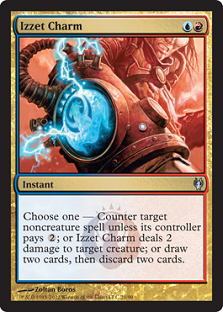
Izzet CharmOne thing I don't like about this deck is its "spacing." It has too many four-ofs. Playsets of Serum Visions and Snapcaster Mage, coupled with Temur Pili-Pala's apparent penchant for dragging things into the mid-game, would make me want to play more bullets. Spell Snare, Mana Leak, Dispel, Roast, and Izzet Charm all come to mind as cards that could slot naturally into the mainboard and provide pilots with more options throughout a match.

As a deckbuilder, I can understand the aesthetic appeal of a deck full of four-ofs, but I'm not sure it's warranted in disrupt-then-commit interactive shells. Midrange decks want to see a variety of cards as the game drags on.

McMartin-Rosenquist seems to have indulged me with the sideboard, which features almost only one-ofs. I think it would be healthier for the deck to spread these bullets out across the 75. In a format where 46% of the decks play four copies of Lightning Bolt, I just don't see the benefit of being as linear as possible in Game 1. That linear plan is easily disrupted by the ubiquitous instant.

Scrutinizing the Combo

The Pili-Pala combo has a glaring weakness: it doesn't necessarily win the game. Deceiver Exarch plus Splinter Twin was an infinite-damage combo that didn't die to Lightning Bolt. Pala and Architect make infinite mana, not damage, meaning they don't win the game on their own. A third card---Whispers of the Muse---is needed to secure an instant win. And that's assuming we haven't made a land drop yet, allowing us to play and activate Kessig Wolf Run with our infinite mana if the four Bolts don't get us there. Otherwise, some decks will let us play every creature in the deck, tap their Boseiju, and Ad Nauseam us to death the following turn. Without a Whispers handy, all that mana helps us dig through the deck with Serum Visions to find a Whispers, but there's no guarantee we hit it on time. Opponents can untap, topdeck Lightning Bolt, and break our combo before we get a chance to go off.
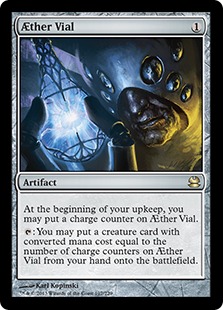
Aether VialAnother problem with Pili-Architect is its sluggishness. Pili-Pala needs to remain on the field for a whole turn before it can start untapping and generating mana. Twin's combo creatures don't have haste, but the deck didn't have this problem for a couple of reasons. First, Deceiver Exarch and Pestermite have flash, leaving pilots free to hold up mana and commit it to the combo whenever comfortable. Second, Twin would sometimes run Kiki-Jiki, Mirror Breaker as an extra copy of its namesake enchantment. The legendary Goblin allowed mana-flooded players to go off on an empty board, since Kiki has haste and can therefore start making tokens without needing to recover from summoning sickness.

McMartin-Rosenquist mitigates the speed issue by playing Aether Vial. Vial lets the deck play Pili and Architect at instant-speed, and for no mana to boot. My concern with this strategy is that the combo now requires too many cards to be efficient. Pili-Pala and Grand Architect go infinite, Aether Vial gives the creatures flash, and Whispers of the Muse ensures that "infinite" actually translates into a win. These extra cards do something on their own, but that something has to prove valuable to the rest of the deck to justify inclusion---probably not the case with Whispers, and I think there's a reason we haven't seen Vial make a lot of noise in creature-light Temur shells since Shouta Yasooka's breakout performance with Eternal Command in 2012.

In comparison, Splinter Twin and Pestermite achieved all that with just two cards. With an Exarch instead, the combo even resists Lightning Bolt.

That brings us to the third major strike against this combo: its fragility. Lightning Bolt kills both Pili-Pala and Grand Architect. The combo also sustains significant splash damage from Affinity hate. Ancient Grudge is a super-efficient way to ensure the combo never gets off the ground, and Stony Silence is like a harder-to-remove Torpor Orb.

Future Positioning
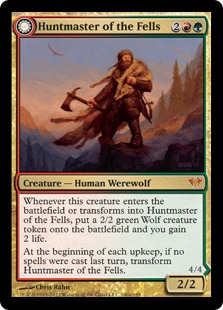
Huntmaster of the FellsSince the Eye of Ugin ban, multiple Temur Midrange decks have been popping up, all employing the unshakable core of Snapcaster Mage, Tarmogoyf, Serum Visions, and Lightning Bolt.

It seems to me like Temur Pili-Pala is a worse Temur Midrange. Pili-Pala trades some key midrange elements for the ability to play a game-winning combo. As explained above, though, I don't consider that combo Modern-level good. I haven't done any testing with this deck, but I would assume that splashing Pili-Archetect-Whispers into an otherwise reasonable Temur Midrange deck dilutes the strategy enough that it loses an unacceptable amount of points to more committed interactive decks like Jund.

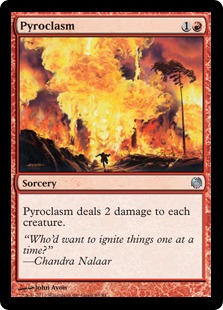
Temur Twin ran the combo to have a turn-four win condition against decks like Tron that would go much bigger than Huntmaster of the Fells in the late game, and Abzan Company, which could make infinite life to bar fair decks from winning. The Pili-Architect combo still doesn't beat infinite life, and I don't think it's fast enough to put a real clock on Tron. That big mana deck has always played sweepers like Pyroclasm and Firespout, which wreck this deck's combo outside of a live Aether Vial. Tron's recent shift towards Lightning Bolt, spearheaded by Joe Losset at GP Los Angeles, makes prospects for Pili-Architect even bleaker. Splinter Twin actually solved problems for URx midrange decks, in that matchup and in others. If the main reasons to play a combo don't apply to this combo, this combo probably doesn't belong in the deck.

Monoblue Plumeveil

Okay, time to get weird. This monoblue control deck features a hefty amount of unplayed Modern cards, including the namesake threat, Plumeveil, and one bulk rare I never expected to see in any constructed format: Guile.

Monoblue Plumeveil, by k_f_chicken (4th, MTGO League)

Creatures

4 Plumeveil
2 Guile

Artifacts

4 Vedalken Shackles
2 Warmonger's Chariot

Instants

4 Condescend
2 Confirm Suspicions
4 Cryptic Command
2 Pact of Negation
4 Remand
4 Spell Snare
4 Stubborn Denial

Lands

4 Tectonic Edge
20 Island

Sideboard

1 Bribery
4 Master of Waves
4 Spellskite
4 Spreading Seas
2 Vendilion Clique

Gameplan

This deck has a couple of angles to attack from. I'd imagine k_f_chicken secured most of his wins on the back of Vedalken Shackles alone, as that card can prove nightmarish for many aggro decks to remove. Even ones with mainboard answers, like Jund with its Abrupt Decays and Maelstrom Pulses, have trouble dealing with a full playset.

Another route to victory is to suit up Plumeveil with Warmonger's Chariot. That gives us a 6/6, flying, flash creature for just... seven mana! The coolest thing about Plumeveil is its ability to flash in during combat and kill attackers like Wild Nacatl, or even Restoration Angel. Opponents definitely won't see the Elemental coming, and I'd bet k_f_chicken took more a few games en route to his Top 8 finish thanks to the off-color removal spell a surprise Plumeveil can grant. Plumeveil also turns on ferocious for the whopping four Stubborn Denials.
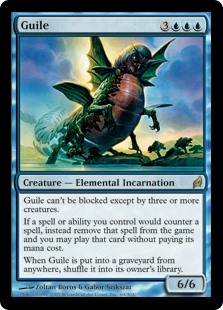
guileFinally, the Plumeveil deck can win by beating down with Guile. Here's a 6/6 we don't need Warmonger's Chariot for. Guile even has super-menace. But the funniest part about this creature (okay, debatable) is that he scares opponents into not casting spells. If we leave up two blue mana, opponents will fear Remand for all their life. Guile lets us cast any spell, meaning that Spell Snare won't just neutralize a Tarmogoyf, it will put it into play under our control.

Out of the sideboard, k_f_chicken has even more win conditions. Master of Waves generates an enviable crew of 2/1s with a Plumeveil on board, and Spellskite slows down some decks (Bogles, Infect) so much he's practically a win condition of his own at four copies. All that said, I doubt this sideboard took more than a couple minutes to make.

Shortcomings

Like the Pili-Pala deck, Monoblue Plumeveil seems totally untuned. For one, Guile is too expensive. Six-drops are rarely played in Modern outside of ramp decks, because they don't land on time. The only one I can think of is Elspeth, Sun's Champion, whose home is a fringe control deck. Even Elspeth carries the game on her own, while Guile requires live counterspells to do anything.

Many Modern strategies want to end the game on turn four. Without cards like Path to Exile, Monoblue Plumeveil simply doesn't boast the kind of interaction necessary to consistently keep that from happening. Even decks that do, like Blue Moon with its Lightning Bolts, curve out at five mana for Goblin Dark-Dwellers and Batterskull.

The next section to doctor is the counter suite. While I'm a fan of four Spell Snare---a card also endorsed by Ryan Overturf last week---I can't get behind the "extra" Cryptic Commands, Confirm Suspicions. Five-mana counterspells have never seen Modern play for good reason: they're way too slow. Additionally, there are better options available to this deck in those slots.
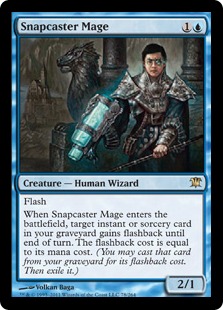
Snapcaster MageThe obvious missing link is Snapcaster Mage. Here's an "extra" Cryptic I can rally behind! Snapcaster gives opponents a reason to keep in Lightning Bolt against us, plays well with the Shackles-based tempo plan, and has an ability that synergizes perfectly with this deck. Importantly, Snapcaster can come down on turn two to clock decks like Ad Nauseam, which shoot to defeat opponents long before they get to the stage of the game in which they feel comfortable slamming Guile. Getting back Remands, Snares, and Denials while sneaking in damage is another path to victory that k_f_chicken can run here at no cost to the harmony of his deck.

While we're adding Snapcasters, why not add Lightning Bolt? The best reason I can come up with for not splashing red in this deck is that if we did, we'd just end up with Blue Moon. That said, I think this deck is a much worse Blue Moon, so that's not much a reason not to splash red at all. Let's face it, Warmonger's Chariot on a Plumeveil is not a reliable way to win games in Modern, no matter how many Stubborn Denials we run. (Splashing white over red could also work, and would eventually yield UW Control.)

Future Positioning

Reviewing Monoblue Plumeveil made me think of my Mantis Rider decks, which looked for ways around the "Bolt test" with enchantments like Honor of the Pure. I had a lot of fun testing those decks, but found after a certain number of reps that it was much better to play good cards than it was to run bad cards in the interest of making other bad cards playable. Luckily for Monoblue Plumeveil, more coherent versions of the deck already exist in Modern, and the deck can be easily upgraded to either Blue Moon or UW Control.

Angel Control

Kyriakos20's Angel Control doesn't look a thing like you might expect it to. The tribe's single Modern-played creature, Restoration Angel, is notably absent from his list. Instead, Kyriakos20 loads up on board wipes, and hopes to dodge Terminate and Path to Exile with a full set of Baneslayer Angel. We won't delve too deeply into this list, but I found it too entertaining not to at least share.

Angel Control, by Kyriakos20 (7th, MTGO League)

Creatures

4 Baneslayer Angel
4 Guardian Seraph
2 Linvala, Keeper of Silence
1 Sunblast Angel
1 Gisela, Blade of Goldnight

Enchantments

4 Blood Moon
3 Leyline of Sanctity

Instants

4 Faith's Shield
2 Riot Control
2 Angelsong
1 Celestial Flare
2 Dawn Charm

Sorceries

4 Day of Judgment
1 Wrath of God

Lands

4 Battlefield Forge
4 Clifftop Retreat
2 Sacred Foundry
14 Plains
1 Mountain

Sideboard

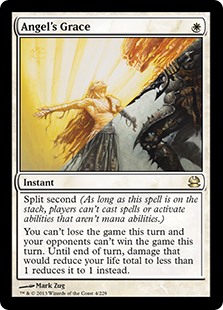
2 Angel's Grace
3 Celestial Flare
2 Guttural Response
4 Rest in Peace
4 Vandalblast

Finding the Better Version

Angel's GracePlayers can't really sleeve up, say, Vampire Nighthawk.

Or can they? In reality, players "can" play what they want in Modern. Even Guile. The above decklists put up some results, or I wouldn't have found them at all. But that doesn't mean they're optimized builds. Pushed to their respective extremes, I think Temur Pili-Pala eventually becomes Temur Midrange, and Monoblue Plumeveil evolves into Blue Moon or UW Control.

Can you guess which Modern deck Angel Control is a worse version of? Let me know in the comments. Until then, let's take a moment of silence to admire Kyriakos20's monastic dedication to the "Angel" theme.

High Stakes MTGO – May 22nd to May 28th

Are you a Quiet Speculation member?

If not, now is a perfect time to join up! Our powerful tools, breaking-news analysis, and exclusive Discord channel will make sure you stay up to date and ahead of the curve.

Welcome back to another High Stakes MTGO report!

No doubt this past week saw a lot of movements. Not all of them resulted in buys or sales for me but with two GPs featuring Modern Constructed and an entire set spoiled there were a ton of speculative opportunities for MTGO speculators.

The two Modern GPs didn't revolutionize the format but at least proved once again that Modern is constantly evolving with dozens of viable archetypes. Who would have bet on Merfolk and Ad Nauseam for the two winning decks few weeks ago? Modern is a speculator's best friend and any good card will eventually go up in price at some point. I took advantage of the recent price movements and proceeded to sell a few cards while they were profitable. I also tried to keep up with the pace of Modern flashback drafts with the sale of some Lorwyn block positions.

For those who were able to keep up minute by minute with the release of Eternal Masters spoilers, there were certainly a lot of great specs to jump on. As for other full reprint sets such as the Modern Masters series, when a highly played card is confirmed not being in the set its price spiked in no time. The spoilers list of EMA was of interest for all of Modern, Legacy, Vintage and even Pauper.

My current life schedule is not exactly compatible with split-second reactions to spoilers so I had to rely on my bets prior to this past week. We knew Modern-only staples had only a little chance to be reprinted so I had very few positions exposed to a reprint risk. In the end Chrome Mox is my only loser and Infernal Tutor and Counterbalance my big winners.

When I heard about Mox it was too late to sell without a significant loss. Since Chrome Mox is reprinted as a mythic I think I'll be better waiting and, most likely, buying fresh copies during EMA release events.

I hit a little bit of luck on the tutor and Counterbalance, as I was actually very close to restocking some Counterbalance when the price dropped back to 8.5 tix on Tuesday with just one card left to be reveal between Control Magic and Daze.

Now, and here luck has little to do with it, several Modern staples benefited from their non-surprising absence from the EMA set. Most of the fetchlands (from Zendikar or Onslaught/Khans of Tarkir), Cavern of Souls, Omniscience, Griselbrand and Inkmoth Nexus are among the cards that have benefited from their absence from EMA, and which should have been bought days or even weeks ago. They are likely to shine during the incoming Legacy events but they are also likely to rebound for Modern purposes.

One last thought related to the price movements due to EMA. Prices have spiked and these initial spikes are mostly due to speculators. Some cards have already dropped a bit and I don't think there's anything to worry about. The demand should be slowly replaced by players and valuable Legacy staples not reprinted in EMA have nowhere to go but up in the short term. This being said I would not try to test the limit of prices past the end of Legacy events at the end of July.

Let's see now how I did this past week. The snapshot of the account is here.

Buys This Week

LE

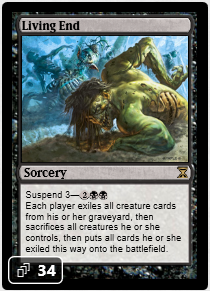
During Time Spiral flashback drafts the price of Living End rapidly dropped below 3 tix before stabilizing around 4 tix and finally climbing to 5 tix. At that point I thought I had missed the good buying window for good and was about to forget about this spec. But the price unexpectedly fell below 4 tix again and I went in for a small pile of 34 copies. At 3.85 tix on average per copy I have much more potential with a card that has reached 10 tix four times in the past ten months.

EoU

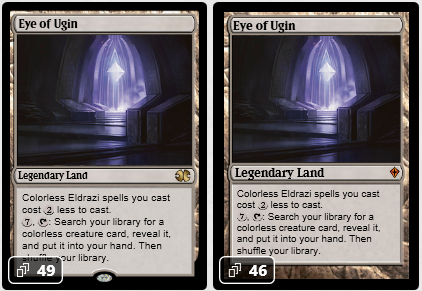
As Matthew Lewis published in the MTGO Market Report a week ago Wednesday, I was thinking the night before that there might be something to do with Eye of Ugin. Clearly the Eldrazis are able to stomp over Legacy and even Vintage, with the land banned in Modern only a couple months ago. Although 1.9 tix is not really the absolute bottom, the potential is here. Let's try not to be too greedy here but this is a short-term spec that can pay off big.

LF

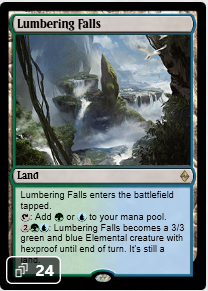
I was chasing this blue-green land from Battle for Zendikar around 0.5 tix. Like a lot of cheap or near-bulk cards, Lumbering Falls oscillates frequently and with a price amplitude equivalent to its own price, between 0.5 and 1 tix in this case. Taking advantage of another dip below the 0.5 tix bar, I grabbed six more playsets.

Bg

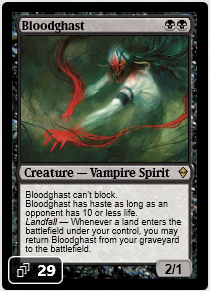
Another decent Modern/Legacy/Vintage card that dodged a reprint in EMA. Bloodghast is played in dredge decks in all three of the eternal formats just mentioned. With recent price heights at 14 tix and 20 tix and with a potential regain in interest trickling down from the release of EMA, I'm betting this vampire could see some gains soon. It's not a slam dunk but it could be an easy 50% profit in only a few weeks.

Sales This Week

Cheating a titan or a flying spaghetti monster into play regained some interest in Modern a few weeks ago. However the hype didn't really last long and the number of Through the Breaches in the top finishers in both GP LA and GP Charlotte was nothing to brag about. Certainly nothing to make me want to hold a spec that was close to doubling. As the card is not a model of price stability the timing was great here. Actually it might almost be time to buy again!

A little round of Modern Masters 2015 sales. Since its release Clique kept oscillating between 15 and 20 tix and never seemed to find a good spot in solid Modern decks. With an expected little dip with Morningtide flashback drafts approaching I thought I would be better with some tix than the actual card.

I had picked up the titans in the wake of the ban of Summer Bloom last January. That was certainly a good entry point for Primeval Titan but finding another home was not easy. With the little resurgence of Titan Shift decks the price bumped two weeks ago to the 8-9 tix price range. That was a good opportunity to close that spec with a respectable 50% gain.

Although the global trend since its MM2 release is up, I never really found the good timing to sell Noble Hierarch. Down to 12 tix at the very end of April, the Hierarch moved up to 18 tix this past week and I decided to use that opportunity to sell my copies of Noble Hierarch.

Another spec that never panned out the way I had hoped for. With Lorwyn block flashback drafts starting, I don't want to be holding cards from flashbacked sets. With a bump slightly under 6 tix a week ago I could not miss this chance to sell this land with minimal losses. See you again during Lorwyn drafts!

This leyline got trendy lately. Leyline of the Void might do more but as it was approaching the 5 tix mark my target price was met so I saw no reason not to take my profit and moved on. Despite a slight regain of interest for Dredge decks (which may have caused this little price hike recently) and a potential additional demand from Legacy/Vintage in the coming weeks, I'm inclined to let specs that are rather metagame-dependent go before they cycle down without notice.

PZ1 packs

My stock is almost gone here. Another week and another round of sales for the Legendary Cube Prize Packs.

These ones too are regulars in my selling department and I'm far from being done except for Caves of Koilos. The painlands are not increasing as much as I wanted but the demand is still constant, which is rather fortunate considering the stock I have to liquidate.

I should have certainly sold these guys before Shadows over Innistrad release, although I was not in a rush with this near-bulk spec. The big plunge that occurred earlier this month reminded me that any potential profit can totally collapse in a matter of days. Luckily the Ad Nauseam winning deck from GP Charlotte played a full playset of this temple and most likely caused the recent spike over 1 tix. I still have some copies to sell but I didn't let this spike go without selling two thirds of my stock.

I had bet that the red-black command would keep cycling up next when I bought it. Missed. With not enough demand from Standard, this card is clearly heading down with its rotation only four months away. Selling now with some losses seemed more appropriate than selling later with even more losses.

On My Radar

As mentioned in the introduction, EMA shook a lot of things around. Speculators went full-throttle into anything and everything leaving a lot of cards with a double-digit percentage growth this past week. Now that the storm of speculation has passed we'll see where the real demand is situated and if players actually want to play Legacy.

We know that if an increased demand for Legacy staples really exists we should see it materializing withing a month of the Legacy Festival events, so we have our selling window. Legacy staples that are also Modern staples, such as the ZEN fetchlands, could see prices sustaining after July.

Nonetheless selling into hype is always a good idea and here again this is what I intend to do. Cards such as Counterbalance and Infernal Tutor could see new record highs, but consistent with my speculating philosophy I'm not in the business of breaking new price records with my specs. This whole EMA craze created a perfect storm to generate great profit in few weeks from good specs that would have otherwise taken months to get there.

For the next few weeks with all of my specs concerned by the recent events I'll try to be extra vigilant about price movements. Misty Rainforest for instance is about to top its 18-month price ceiling around 29 tix. I'm certainly not going to wait and see if this fetchland can match its pre-KTK price in the 50s and I'll actually be considering selling my Rainforests sooner rather than later. Selling positions like this sooner also allows my tix to rotate toward discounted cards opened during EMA release events.


Thank you for reading,

Sylvain

Insider: Virtually Infinite – Eternal Masters Shakes Things Up

Are you a Quiet Speculation member?

If not, now is a perfect time to join up! Our powerful tools, breaking-news analysis, and exclusive Discord channel will make sure you stay up to date and ahead of the curve.

This series is for MTGO players and speculators looking to build value in their collection and play Magic for free. My focus recently has been on Eternal Masters (EMA) which means this has been a big week.

Winners and Losers

A dozen or so cards shot up the moment they were confirmed out of the set, and others dropped hard. Here are some of the winners and the losers:

These cards gained in value once full EMA set was announced
Click to expand
Many of these cards were reprinted in EMA, and dropped
Click to expand

I kept folks updated in the forums, and if you moved quickly (or placed good bets in advance) there were some nice profits for the taking. On Friday morning I restocked the "watch list" playsets I dumped and stocked up on omitted staples. Infernal Tutor, Cavern of Souls, and Grove of the Burnwillows are not in the index above, but were nice winners as well.

Disappointing Omissions

It was a good day finance-wise, but as someone who has predicted, and hoped for, the growth of Legacy as an online format, the final round of EMA spoilers was pretty disappointing.

Many people had expected to get Rishadan Port or Show and Tell, which would have lowered the barriers to entry for the format. I understand if they didn't want to include Port and Wasteland in the same set, but they missed an opportunity by omitting other cards that are expensive on MTGO but cheap in paper.

Including a few of these would have boosted the MTGO expected value (EV) and increased the volume of drafting while leaving paper EV unaffected. (Paper EV is a concern since they don't want stores hoarding boxes or cracking packs for profit.)

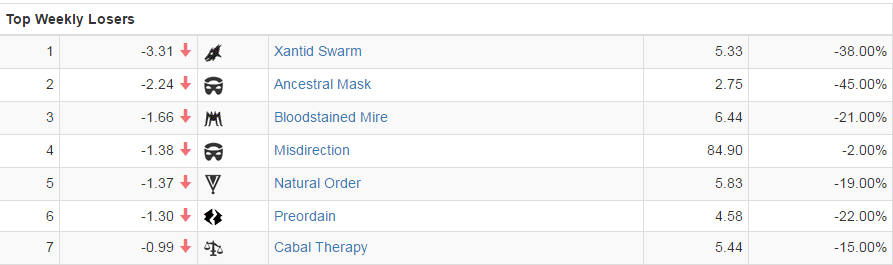
By this logic, Tangle Wire (50 tix online, $4 paper) and Misdirection ($85 online, $5 paper) should have been no-brainers. The high prices of these cards create a distorted MTGO ecosystem and metagame.

There was an error retrieving a chart for Tangle Wire

The bottom line is that we're looking at a low-EV set for MTGO---significantly lower than Modern Masters (MMA), Vintage Masters (VMA), and Modern Masters 2015 (MM2) when they first hit the draft queues. Saffron Olive has crunched the numbers and it's not a pretty picture: the average draft will cost 24 tix but contain only 10.8 tix of value in singles. And that's the high mark, since EV will fall quickly once drafting starts.

I still think people will draft it because the set looks fun and because, let's face it, we're degenerates. But the volume will be lower because chewing through 20 tix a draft is no fun (nor sustainable for many). Wizards left some money on the table by not making the MTGO EV better.

Less drafting means we may not see as deep a drop in the price of Wasteland and Force of Will. Most of the rares and uncommons will still plummet, but mythics may hold a good deal of their value.

What About the Cards That Weren't Reprinted?

There is a huge need for Rishadan Port and Misdirection in the MTGO metagame and I think Wizards will find a way to reprint them. The question is how and when---and whether it will be enough. Port is 60 tix more expensive than Black Lotus right now, which is bizarre to say the least. Do you want to be holding a 197-tix time bomb?

In the forums, Bill Quick speculates that a MOCS quarterly promo is likely, but that won't introduce much supply. That they chose not to reprint some key Urza's and Mercadian Masques block cards makes me think we will see some flashbacks (or remasters) of these sets. VMA2 is another possibility. But these methods will take a while.

It's always risky to be holding high-value MTGO cards since there is no online Reserved List and reprints can come in many forms: promos, flashbacks, Legendary Cube prize packs, etc. It's worth taking some profits on the gains you've made rather than sitting on these cards too long.

There are two good exit points for EMA "hits" (which include our Reserved List specs and last week's round of non-reprinted EMA cards).

  • The first is to sell between now and when EMA drafting starts online, on June 17. Why sell before EMA? All set releases put pressure on prices as players sell cards to draft and bots preemptively adjust prices.
  • The second opportunity will be to sell directly before the Legacy Festival. (This includes competitive Leagues and a high-payout Championship.) The window here is between July 6 and July 20.

I'm not sure which of these opportunities will offer higher sell prices. Selling before June 17 is safer, but you may be leaving money on the table. Most likely I will split the difference and sell some of my stock before June 17 and hold the rest for the Festival.

Picks This Week

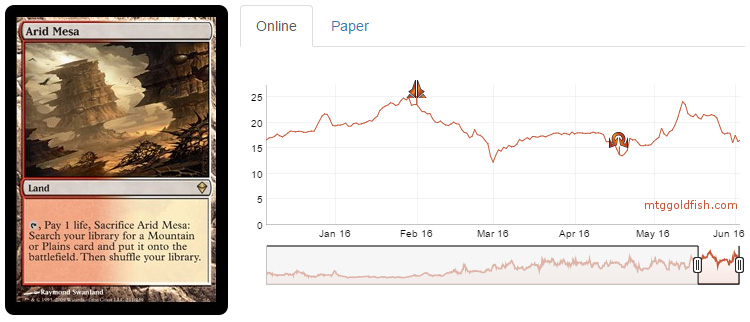
Arid Mesa (ZEN)

Arid Mesa

Current: 16 tix
Target: 21 tix

Arid Mesa is Modern staple and sees play in Legacy. And yet it is down 8 tix in the past month despite not appearing in EMA. A very safe investment.

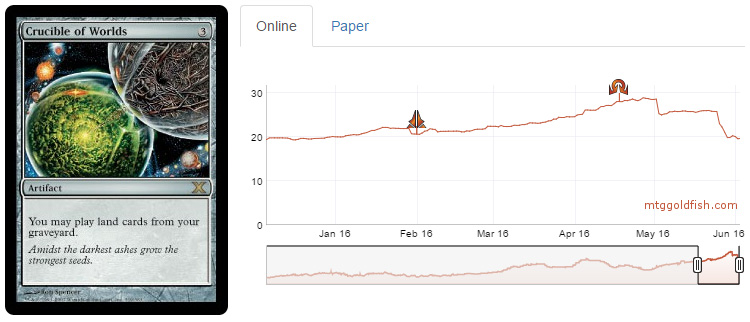
Crucible of Worlds (10E)

Crucible of Worlds

Current: 19.5 tix
Target: 25 tix

A low-supply card with a home in Legacy. Has a set point of 20, so not a huge value right now. Was recently at 28.5 tix just on the basis of Legacy speculation before 10th Edition flashbacks drove the price down. Should climb past 25 before long.

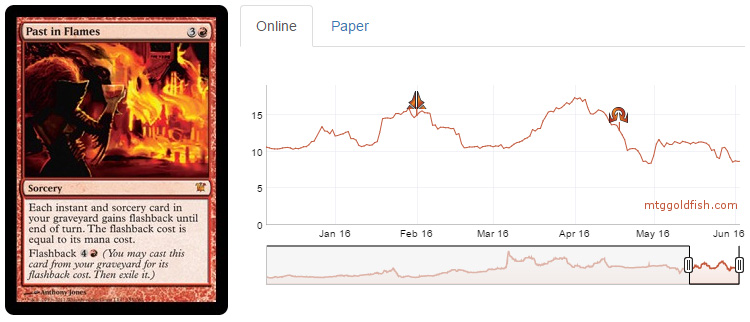
Past in Flames (INN)

Past in Flames

Current: 8.7 tix
Target: 13-16 tix

With the exception of one week last November, this card has not dropped below 10 tix. And it has recent highs of 17 tix. It's a mythic played in both Legacy and Modern, a clear recipe for success.

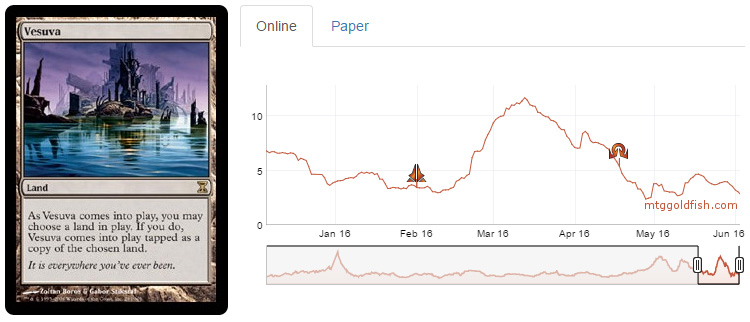
Vesuva (TSP)

Vesuva

Current: 3 tix
Target: 8 tix

Vesuva was at 11 tix not long ago. It's back to its 3-tix floor; low risk, and nice returns are possible.

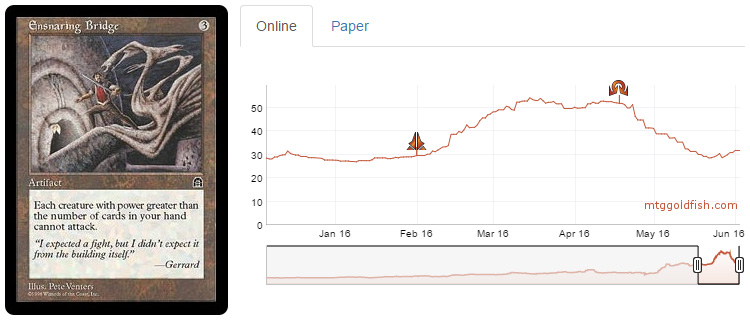
Ensnaring Bridge (STH)

Ensnaring Bridge

Current: 31.8 tix
Target: 45 tix

Bridge hit 50 tix not long ago and then drifted down because of EMA reprint concerns. It has not really rebounded, so there's still a window to buy in. You can save a few tix by buying white border if you are looking for cheaper playsets.

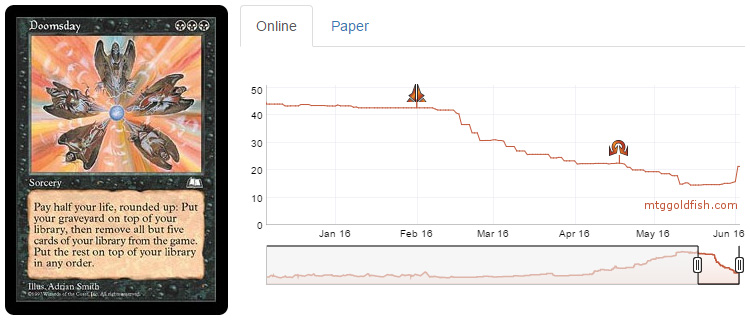
Doomsday (WTH)

Doomsday

Current: 18 tix
Target: 40 tix

Shout out to Justin Vickers in the forums for this one! Doomsday slowly crept up to 46 tix around BFZ release and stayed there for months before plunging when EMA was announced. It has not recovered, but it will.

All KTK Fetchlands

These are down 5-10% this week, but the future is bright as multi-format all stars in a set that is being redeemed but not opened.

Cards to Watch

The following cards are likely to drop a bit further as we enter two weeks of Lorwyn block drafts. Keep an eye out, as there is value to be had.

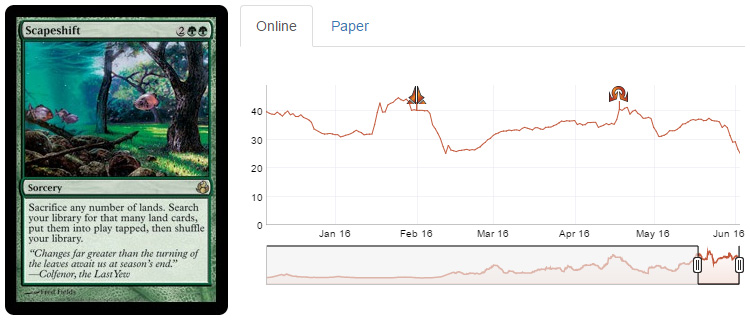
Scapeshift (MOR)

Scapeshift

Current: 26.3 tix
Target: 36 tix

Morningtide drafts are coming, which will be a good time to snag some Scapeshifts. The linchpin of the deck that bears its name, Scapeshift has hit 40 tix before. The deck has seen Tier 1 success, and a strong performance at a GP or in the hands of a popular pro will net a tidy profit. But even barring that, 35 tix seems likely.

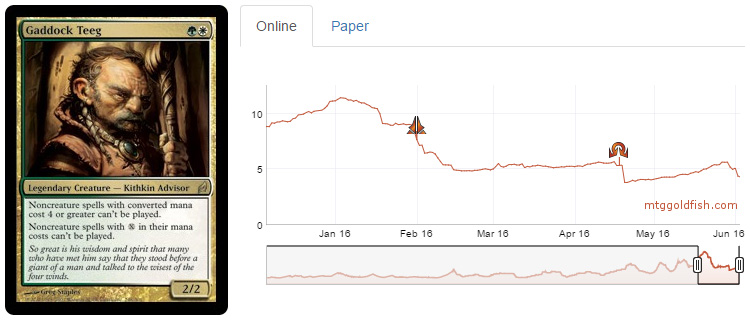
Gaddock Teeg (LRW)

Gaddock Teeg

Current: 4.5 tix
Target: 7 tix

Teeg hit 11 tix before Oath of Gatewatch. I don't expect him to get back there, but 7-8 tix is possible.

~

That's it for now. Let's go pad our wallets before EMA takes its toll.


-Alexander Carl

@thoughtlaced

Insider: Underrated Standard Specs

Are you a Quiet Speculation member?

If not, now is a perfect time to join up! Our powerful tools, breaking-news analysis, and exclusive Discord channel will make sure you stay up to date and ahead of the curve.

Standard has a huge player base, and changes in demand can have a big impact on price. Last weekend there were two Standard Grand Prix that have provided players with a ton of new decklists, and as players copy them, they change the demand of cards. I’ve pored through the results and the financial aftermath, and I’ve identified some cards that I like as Standard specs going forward into the summer.

Jace, Unraveler of Secrets

There was an error retrieving a chart for Jace, Unraveler of Secrets

Jace, Unraveler of Secrets was initially snubbed as a weak five-mana planeswalker, and to some degree it was kept out of the format because of competition with Jace, Vryn's Prodigy, as it can’t be in play at the same time as Jace, Telepath Unbound. Now the planeswalker is beginning to be appreciated, and it just had a big weekend, being featured in the Top 8 of both Grand Prix.

In Manchester, a pair of the planeswalker could be found in the maindeck of the U/R Eldrazi Ramp Control deck that finally broke into the spotlight, and in Minneapolis it could be found in the sideboard of a Bant Humans deck. Last week I played against Kenji “kogamo” Tsumura online with a Temur Superfriends deck based around Oath of Nissa, and he played Jace, Unraveler of Secrets to great effect.

The price of the planeswalker has been on a long, slow decline since printing, now under $9. I like targeting them through the summer in anticipation of price increases later in the year, potentially even after rotation.

Oath of Nissa

There was an error retrieving a chart for Oath of Nissa

Oath of Nissa is slowly earning its place as a “green Ponder,” and as players have stopped drafting and opening Oath of the Gatewatch, its price is beginning to appreciate.

It’s a long, slow burn, but Oath of Nissa is going to remain a key factor in Standard for its lifetime. Recent trends, like Raph Levy using it to splash Chandra, Flamecaller in G/W Tokens, and Joel Larsson using four in his Four-Color Dragons deck, lead me to believe it’s underplayed in general. This card is only to get more popular in Standard, and the price is only going up.

Drowner of Hope

There was an error retrieving a chart for Drowner of Hope

I love Brian DeMars’ advice of targeting Eldrazi creatures, but he left off my favorite, Drowner of Hope. The blue mana makes it a bit more constrictive than some Eldrazi, but on the other hand it’s more accessible to decks without colorless mana. It sees crossover play in decks like U/R Eldrazi Ramp Control, which just had a breakout weekend and is poised to become a real player in the metagame.

Drowner of Hope was once nearly $2, but it has been in steady decline to under $0.50, and I love it as a Standard spec.

Goldnight Castigator

There was an error retrieving a chart for Goldnight Castigator

Tomoharu Saito finished well in Grand Prix Minneapolis with a new U/R Fliers deck that includes a set of Goldnight Castigator. This card was heavily hyped, but it completely fell from grace and the price plummeted. Saito takes advantage of it along with other fliers and burn spells to create a deck that directly fliers over a metagame focused on ground creatures.

Saito’s deck has been gaining popularity online, and I expect it to gain a lot of paper followers. The price of this mythic is currently under $2, so there’s clearly room to grow.

Rattlechains

There was an error retrieving a chart for Rattlechains

Rattlechains is another component of Saito’s U/R deck, so if it becomes mainstream it’s going to grow past its sub-$1 price point. I’ve also played against the card in U/W Spirits online, and I wouldn’t be surprised if the spirits tribe received more support in Eldritch Moon---that’s another case for acquiring a card that’s certainly an inclusion in any spirit-themed Standard deck.

Goblin Dark-Dwellers

There was an error retrieving a chart for Goblin Dark-Dwellers

Goblin Dark-Dwellers has become surprisingly popular as a sideboard card in decks like R/G Goggles Ramp and Saito’s new U/R Fliers deck, and it’s seeing more play in general as Grixis has increased in popularity. I expect it has great times ahead of it in Standard.

It has also been seeing Modern play, particularly because it can cast Ancestral Vision from the graveyard. Pat Cox built a U/R Blue Moon deck around the interaction to nearly Top 8 Grand Prix Charlotte.

It’s a great Commander, Cube, and casual staple. It’s the red Snapcaster Mage, and it’s a freakin’ goblin, arguably Magic’s single-most iconic tribe. All these things are good for the long-term prospects of Goblin Dark-Dwellers.

Day's Undoing

There was an error retrieving a chart for Day's Undoing

Day's Undoing hasn’t been used in Standard, so I’d argue that the impending fall rotation isn’t impacting playability---maybe the price is slightly inflated because of the uncertainty and potential, but I’m pretty confident the price isn’t falling any lower after rotation. This is the sort of card worth stocking up and turning a profit on in the long term.

That said, it’s now seeing serious Standard consideration in Martin Müller’s Mono-Blue Prison deck from GP Manchester, where he finished a match win out of the Top 8. The price of Day's Undoing has doubled online since the event, and the paper price continues to slowly fall to new lows.

I’d be confident targeting these this week and beyond; their short remainder in Standard does off some room for gain, but I like these with the long-term in mind.

Part the Waterveil

There was an error retrieving a chart for Part the Waterveil

Part the Waterveil is also a part of Müller’s Prison deck, and as a four-of mythic it’s going to see a price increase if the deck becomes popular. Battle for Zendikar also has a long life ahead in Standard, and I think Part the Waterveil's best days in Standard are still ahead of it. Part the Waterveil has minor eternal appeal, but great casual appeal, so it’s going to appreciate in the long run.

The price has nearly tripled online since the event, while the paper price continues to sag after more than doubling in price a month ago. Under $5 it still feels like a bargain, and I could easily see it breaking $10 if it becomes a Standard staple.

Insider: Putting Bot Credit to Work

Are you a Quiet Speculation member?

If not, now is a perfect time to join up! Our powerful tools, breaking-news analysis, and exclusive Discord channel will make sure you stay up to date and ahead of the curve.

Other than the horrible trade listings page that is the Classifieds, my biggest complaint with Magic Online is the fact that trading cards for tix ends in having fractions of a ticket as credit with bots, which means that any given time some amount of value is being left on the table.

For a long time when I traded for cards I would use some of this leftover credit to search for what commons the vendor had available to either fill out a deck or just to make a small investment in the Pauper format. This is a minor way to clean up some lost value, though in order to turn those dimes into dollars, it simply makes more sense to target rares.

I introduce this piece in this manner to stress the fact that my topic for today largely revolves around small investments, which naturally yield small returns. Theoretically you could invest heavily in bulk rares, though what I'm specifically advocating is rounding out your fractions of tix in bulk rares with promise. If they were slam dunks, they'd probably never be bulk, though Magic Online is a great platform for penny stocks.

The thing that put me on this topic for this week is Saito's flash deck. The deck is very inexpensive relative to other Standard decks, and a lot of players picked the deck up online after he posted his list following a 12-3 finish in GP Minneapolis.

Izzet Tempo, by Tomoharu Saito

Creatures

4 Stratus Dancer
4 Dimensional Infiltrator
4 Rattlechains
4 Goldnight Castigator

Spells

4 Fevered Visions
4 Exquisite Firecraft
4 Fiery Impulse
4 Spell Shrivel
4 Clash of Wills

Lands

4 Shivan Reef
4 Wandering Fumarole
9 Mountain
7 Island

Sideboard

4 Negate
4 Roast
4 Goblin Dark-Dwellers
3 Seismic Rupture

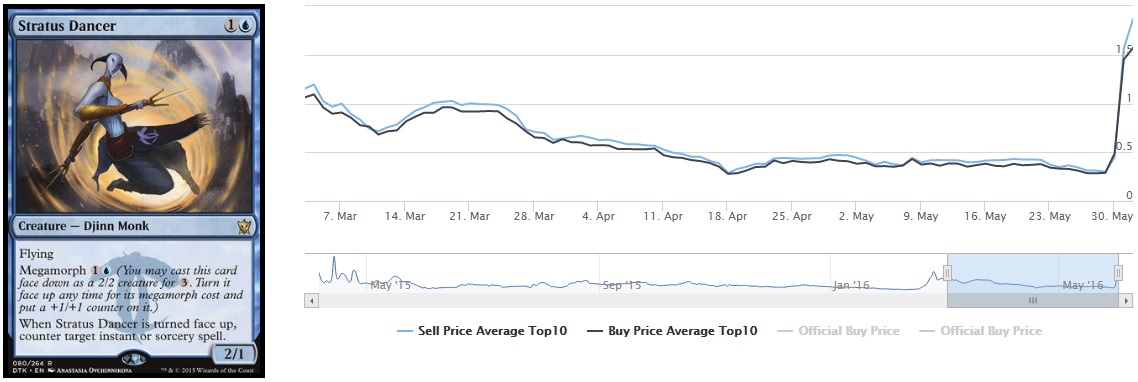
Once people start buying in, prices move pretty quickly online, and this deck has gained significant value this week. Goldnight Castigator went from below 2 tix to over 4 in a short window, though the card I was personally most invested in was Stratus Dancer.

I've always thought that Stratus Dancer was a solid card, and it has been featured in a number of decks that I've brewed up throughout its Standard legality. It was a four-of in the deck that I played in GP Minneapolis, and when copies could be had for a quarter or a third of a ticket, I rounded out a number of trades with them.

In the aftermath of Saito's finish, the card has gone from a fraction of a ticket to nearly two tix, which is a very good return.

Untitled

Of course, bulk is bulk for a reason, and while you're not gambling with much on bulk rares, the only way to get that investment back is to pick winners. What follows is a short list of great bulk pickups available on MTGO right now.

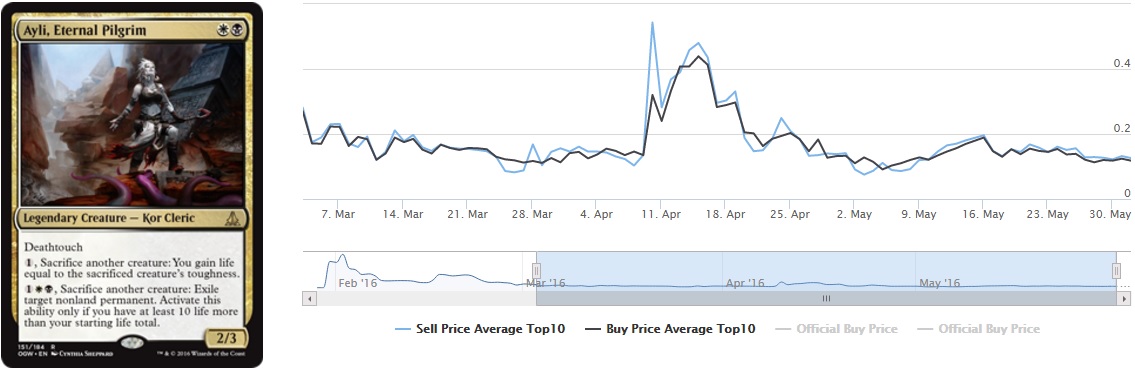
Ayli, Eternal Pilgrim

Ayli

Ayli can currently be purchased for just over 0.1 tix, and has previously pushed 0.5 tix. The reason I like Ayli so much is there are several pushed black-white cards currently in Standard, and I imagine that when Collected Company rotates Ayli will be an obvious place to start a mana curve. A 2/3 deathtouch creature for two is already pretty good, and it would be pretty amazing if Ayli never appeared in another popular Standard deck.

Bearer of Silence

Ayli

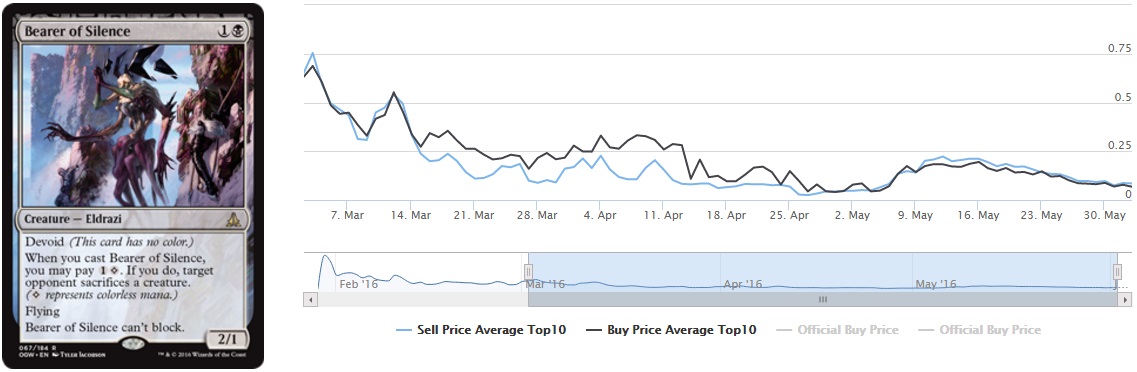
Bearer of Silence is currently worth less than 0.1 tix, and has already appeared in the maindeck or sideboard of a few Standard decks. Bearer strikes me as a pretty pushed card, and I expect it to show up at some point. It really only takes one weekend of reasonable success to turn a small profit on a card with such a price. These types of cards are more risky in paper, though they're great pickups online.

Bygone Bishop

Ayli

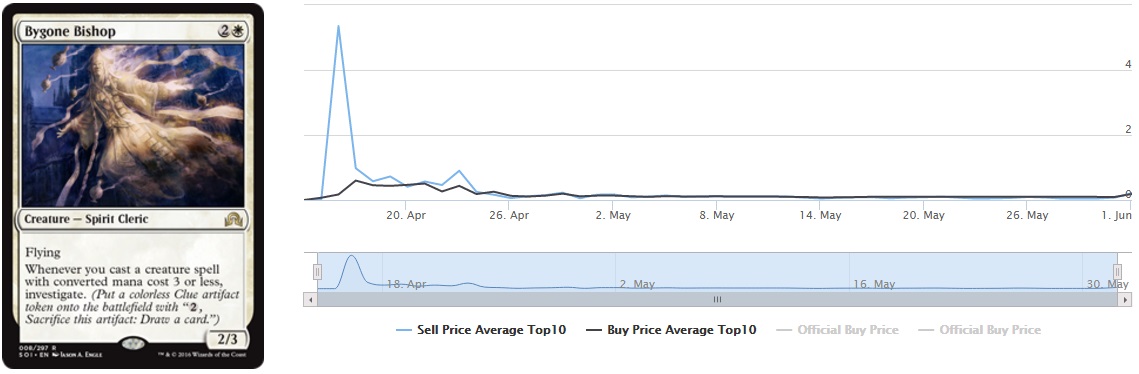
Bygone Bishop is another bargain at sub-0.1 tix. Gerry Thompson played this card in his build of Humans at the Columbus Invitational, and I suspect we'll be seeing more of it.

A 2/3 flier for three is a completely reasonable rate, and as a spirit the Bishop could easily show up alongside Rattlechains, a strong constructed card given the right support. Once Collected Company rotates, this is could be a great option for generating value in Standard.

Drowner of Hope

Ayli

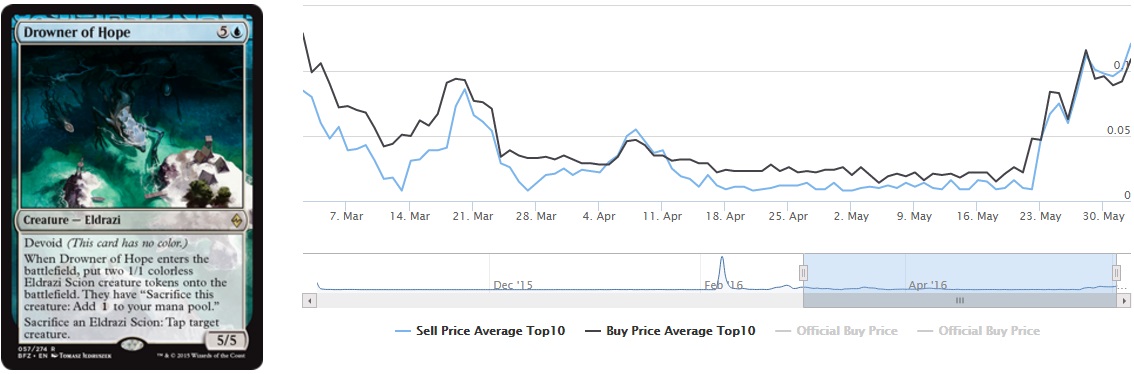
Drowner of Hope has been doing some climbing lately, but is still below 0.15 tix. Drowner plus Eldrazi Displacer once dominated Modern, and even now is making a resurgence. This card is also receiving some attention as a standalone win condition in a Standard Izzet Control deck.

I believe Drowner to be a very powerful card, and I even featured two copies in my sideboard last weekend in Minneapolis. The fact that the card has both Standard and Modern appeal makes it a particularly good pick.

Prized Amalgam

Ayli

Prized Amalgam can be found for just over 0.1 tix, and has already seen prices above 0.5 tix based on Modern appeal. It is both entirely possible that Eldritch Moon offers a reason to play this card in Standard, and that Modern Dredge has a successful weekend that boosts its price. Standard hope may be ambitious, though a bump due to Modern is likely inevitable.

Stoneforge Masterwork

Ayli

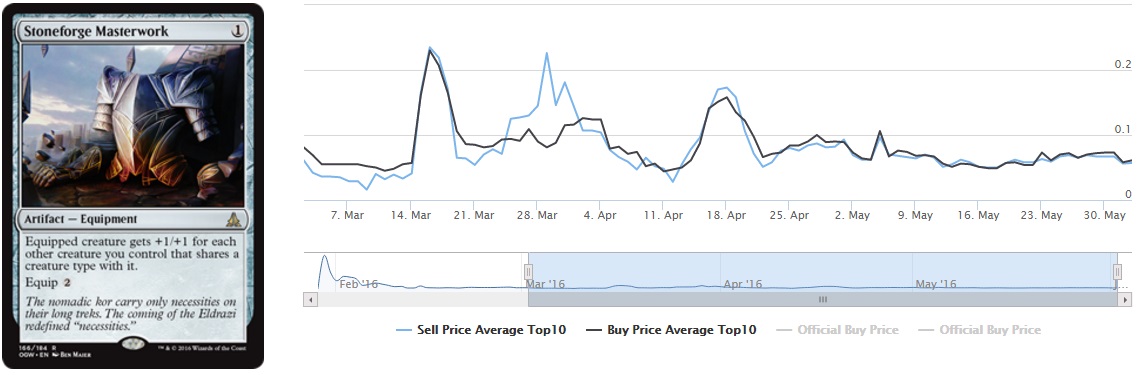
The most common price for this card is about 0.07 tix. While I don't believe it's exceptional, this is the kind of card that tends to end up in budget decks, and there is a large contingent of Magic Online players just waiting to jump on those. If and when this card starts moving, the jump to 0.5 tix wouldn't take long.

Wasteland Strangler

Ayli

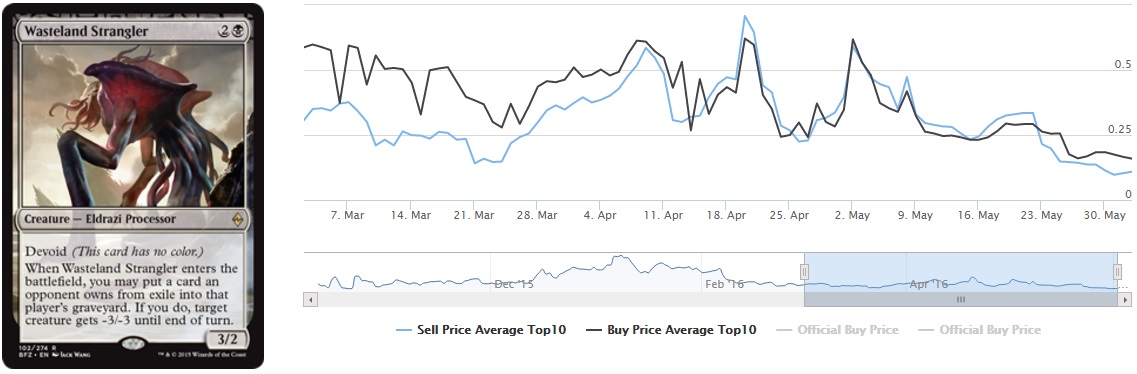
Wasteland Strangler looks to be hitting a low point, with copies available around 0.15 tix. This card has had buy prices of 0.5-0.6 tix in the past, and with appeal coming from both Standard and Modern I would expect to see those prices again. Honestly, I don't know what is causing Strangler to drop off currently, and I would expect this one to turn around pretty quickly.

~

You're won't retire off these picks, but speccing on MTGO bulk is a great way to take money you'd normally lose to rounding and generate some bonus tix for further speculation or to sustain your drafting addiction. The selling strategy is to keep your eyes on the market for any reason one of your holdings might bump up, such as a popular article or fringe tournament success, and to capitalize on even small gains.

Generally, I use 0.5 tix as a selling point unless I am confident in continued growth, with 0.25 tix being the high side of what I'm willing to spend on a bulk rare.

Thanks for reading,

-Ryan Overturf
@RyanOverdrive on Twitter

The Colors of Modern – Part One: White

Are you a Quiet Speculation member?

If not, now is a perfect time to join up! Our powerful tools, breaking-news analysis, and exclusive Discord channel will make sure you stay up to date and ahead of the curve.

For the past two weeks I’ve been in Rome, experiencing the city and all its wonders through a roughly six-week study abroad program for architecture. Among many things, my studies have dealt significantly in history, be it the bloody history of Rome’s oft-changing seat of Caesar or the general majestic forces at work in Rome’s grand churches. This interest, as my personal interests often do, has had an effect on my interests in Magic. Which is my way of saying buckle up, because we’re going to be talking history.

Restoration Angel-banner-cropped

Why Colors?

Concerning real-world historical analysis, it’s often been said that history is "written by the victor." Had the Mongols burned Rome to the ground, angsty 21st century college students would be ignoring an entirely different set of architectural wonders, and tourist mothers would be shielding their tourist children's eyes from statues of beheadings rather than male genitalia. In Magic, this concept carries over as well. Pro Tour Return to Ravnica was won by Eggs. Can you name another storyline from that event? You get my point. So, instead of discussing the history of Modern the “normal” way, by framing the discussion around top decks and influential bannings, instead I would like to take a different approach, by looking at the impact each of Magic’s five colors have had upon the game.

This approach carries with it a few benefits. Analyzing a color’s various identities and influences in the format will come in the form of lists, which will serve as a useful reference for deckbuilding. In a format defined as much by mana constraints as it is by safety valves, determining the strengths and weaknesses of a specific color can be quite influential in archetypal decisions. Also, while the vast card pool available will undoubtedly result in “bleeding” of what a color is capable of, this analysis will show what each color does well, and more importantly, poorly. Just because white has Path to Exile doesn’t necessarily make it the king of removal. And with that, we begin.

[wp_ad_camp_1]

The Cards

Staples

  • Path to Exile
  • Lingering Souls

Sideboard Powerhouses

  • Leyline of Sanctity
  • Rest in Peace
  • Stony Silence

Strong Options

  • Elspeth, Knight-Errant
  • Restoration Angel
  • Kitchen Finks
  • Wall of Omens
  • Soul's Attendant
  • Leonin Arbiter
  • Flickerwisp
  • Spectral Procession
  • Intangible Virtue

Role Players

  • Angel's Grace

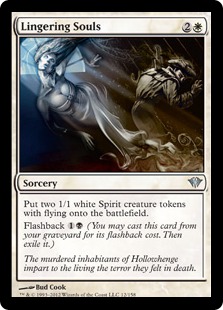
White’s color identity in Modern is so intriguing because its power is amazingly disproportionate related to its scope. By that, I mean the amount of influence white has in the format should translate to a breadth of powerful spells, but it doesn’t. Lingering SoulsTake a look at the format staples. Path to Exile is undoubtedly the gold standard when it comes to removal, but beyond that, that’s it. Lingering Souls is an excellent spell, and the best possible rate, but requires black to be fully effective, so it’s unfair to call it a “white card” completely.
As anyone familiar with Modern knows, the strength of white in the format comes from its sideboard. Stony Silence is the single best answer to one of the best archetypes in the format (Affinity) and Leyline of Sanctity and Rest in Peace are both the strongest options for fighting Burn/Discard and graveyard strategies respectively. All of this should be well-covered territory by now, but these characteristics exhibit an interesting underlying trait: white is powerful, but mainly in a supporting role.

Support via Disruption

White contains few truly powerful threats. At the top of the curve you have things like Gideon Jura, Elspeth, Knight-Errant, or Elspeth, Sun's Champion. But those see little play, lacking the raw efficiency of staples like Tarmogoyf or Liliana of the Veil. White also contains no powerful card advantage-generating effects outside of multi-color options like Sphinx's Revelation or Lingering Souls. No Dark Confidant or Snapcaster Mage.

Instead, what white offers is excellent disruptive elements: the best, most high-impact sideboard spells for fighting specific matchups, and Path to Exile. In a support role, white’s lack of strong staple creatures or card advantage spells no longer becomes a weakness, as it can fulfill its role by playing to its strengths while pairing with other colors to overcome its weaknesses.

Let’s take a quick look at some lists that incorporate white as a support color in this way.

Junk, by Arya Roohi (21st, SCG Milwaukee)

Creatures

3 Scavenging Ooze
4 Tarmogoyf
2 Tasigur, the Golden Fang
3 Siege Rhino

Instants

3 Abrupt Decay
3 Path to Exile
1 Disfigure

Planeswalkers

3 Liliana of the Veil

Sorceries

4 Inquisition of Kozilek
3 Thoughtseize
1 Maelstrom Pulse
4 Lingering Souls
2 Painful Truths

Lands

1 Forest
1 Gavony Township
1 Godless Shrine
1 Hissing Quagmire
3 Marsh Flats
2 Overgrown Tomb
1 Plains
2 Shambling Vent
1 Stirring Wildwood
2 Swamp
1 Temple Garden
1 Twilight Mire
4 Verdant Catacombs
3 Windswept Heath

Sideboard

1 Creeping Corrosion
1 Disfigure
1 Engineered Explosives
1 Gideon, Ally of Zendikar
3 Kitchen Finks
1 Languish
1 Night of Souls' Betrayal
1 Nihil Spellbomb
1 Painful Truths
1 Path to Exile
3 Stony Silence

Here, we see a base black-green archetype that provides power through the strong, individually high-impact spells like Tarmogoyf, Dark Confidant, and Liliana of the Veil. White plays a support role, offering Path to Exile (and Lingering Souls/Siege Rhino) in the maindeck, and powerful silver bullets out of the sideboard. If we’re evaluating colors on share of the workload, white clearly underperforms, contributing around eight spells to black’s 14+ and green’s 10+ (and we could easily count Noble Hierarch and Tarmogoyf as 1.5 if we wanted to, as they truly are “that good”).

Jeskai Control, by William Craddock (1st, SCG Super IQ)

Creatures

1 Emrakul, the Aeons Torn
4 Snapcaster Mage
1 Vendilion Clique

Instants

2 Spell Snare
3 Remand
2 Cryptic Command
2 Electrolyze
4 Path to Exile
4 Lightning Bolt
3 Lightning Helix
2 Mana Leak

Planeswalkers

4 Nahiri, the Harbinger

Sorceries

4 Serum Visions

Lands

1 Mountain
1 Plains
1 Sacred Foundry
1 Arid Mesa
4 Celestial Colonnade
3 Flooded Strand
1 Glacial Fortress
1 Hallowed Fountain
2 Island
1 Desolate Lighthouse
4 Scalding Tarn
2 Steam Vents
2 Sulfur Falls

Sideboard

2 Ancestral Vision
2 Anger of the Gods
2 Crumble to Dust
1 Engineered Explosives
2 Negate
2 Relic of Progenitus
2 Spellskite
2 Timely Reinforcements

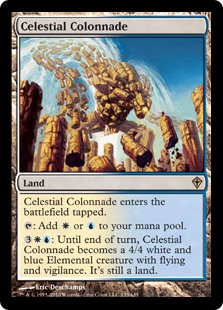
Celestial ColonnadeHere again white plays a support role, contributing Path to Exile and sideboard spells primarily, but also helping to cast Nahiri, the Harbinger and activate Celestial Colonnade. It is easy to see white play a support role to blue, with format powerhouses like Snapcaster Mage, Ancestral Vision, and counterspells doing much of the work. In this archetype, red might be pulling the least weight, as it really only offers Lightning Bolt (as a less universal Path to Exile) and again access to Nahiri, the Harbinger. Red’s sideboard options are also strong (Blood Moon should we build for it, Vandalblast, and Anger of the Gods) but are overshadowed by white’s and can often be replaced.
The Case of Death and Taxes

If the most prominent and successful white strategies use the color in this support role, that doesn't necessarily mean white can't form the core of an archetype. If our hypothesis is that white is poor in this latter role, we need to examine some white-based archetypes to compare their performance to that of the ones above.

Death and Taxes, by Gregory Matthews (20th, SCG Indy)

Creatures

3 Eldrazi Displacer
4 Flickerwisp
4 Leonin Arbiter
2 Reality Smasher
4 Thalia, Guardian of Thraben
4 Thought-Knot Seer
4 Tidehollow Sculler
3 Wasteland Strangler
1 Spellskite

Artifacts

4 Aether Vial
1 Relic of Progenitus

Instants

4 Path to Exile

Lands

4 Caves of Koilos
4 Eldrazi Temple
4 Ghost Quarter
4 Godless Shrine
3 Plains
2 Shambling Vent
1 Swamp

Sideboard

1 Burrenton Forge-Tender
1 Eidolon of Rhetoric
2 Kor Firewalker
2 Pithing Needle
1 Reality Smasher
2 Rest in Peace
1 Sea Gate Wreckage
1 Spellskite
2 Stony Silence
1 Sunlance
1 Worship

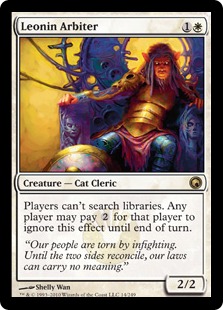
Death and Taxes includes the ever-present mainstays of Path to Exile and Stony Silence, but also incorporates less prevalent white options not seen in other archetypes. Of these, Leonin Arbiter and Restoration Angel lead the pack as the “best of the rest,” but much of their power comes from synergy rather than individual strength. leonin arbiterWhen comparing heads up, Leonin Arbiter doesn’t hold a candle to Dark Confidant or Tarmogoyf, yet when supported by Ghost Quarter and Aether Vial to power out other threats, Leonin Arbiter’s strength grows considerably. Restoration Angel is clunky as a 3/4 flier for 4 but excels when doubling up on enters-the-battlefield effects or saving one of your lock pieces from death.
Death and Taxes has been a mainstay in Modern for some time now, and some conclusions about it can safely be drawn. While the archetype is enjoying Tier 2 popularity at the moment, this is a relatively recent development. Traditionally it has waxed and waned continuously in Modern without ever really being considered a serious contender.

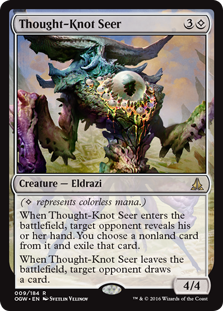
In my personal experience, Death and Taxes exhibits some inherent weaknesses that are hard to overcome. It is soft to hand disruption and struggles to recover from resource deficits or unexpected angles of attack. A simple Liliana of the Veil can send them reeling. Tarmogoyf outclasses all of white's creatures by itself, requiring a timely Path to Exile for them to break through. A few removal spells on key creatures can leave it topdecking extra lands and useless Aether Vials with no way to recover lost card advantage. Control strategies in particular can be extremely hard to combat. Thought-Knot SeerTheir plentiful removal and card advantage, along with a naturally higher land count, fights Death and Taxes' disruptive elements on all fronts.
The newfound success of Death and Taxes is likely a function of the introduction of the Eldrazi to the format, which have shown their ability to define and revitalize archetypes from Standard to Legacy. In many ways the iconic colorless tribe acts as a kind of sixth color, and we can see how it augments white's core disruption package. In Thought-Knot Seer and Reality Smasher, D&T finally gets access to some significant bodies. These allow it to address the Goyf-as-Moat problem and capitalize on its disruptive elements by closing games quickly before opponents topdeck out of the bind. It also acquires a powerful interactive element in Eldrazi Displacer, which contributes to the disruption plan while boasting flexibility the other "hate bears" can't.

More than anything else, the takeaway for me regarding Death and Taxes is that it clearly demonstrates white's ability to function as a disruptive element, but suffers from an overall lower power level compared to other established archetypes. This may be changing now that it has elected to "splash" colorless mana.

Let's look at one more white-based archetype.

Soul Sisters, by Rvng (5-0, Modern League)

Creatures

4 Ajani's Pridemate
4 Squadron Hawk
4 Serra Ascendant
4 Soul Warden
3 Soul's Attendant
3 Martyr of Sands
3 Ranger of Eos

Enchantments

4 Honor of the Pure

Instants

4 Path to Exile

Sorceries

1 Return to the Ranks
4 Spectral Procession

Lands

12 Plains
4 Flagstones of Trokair
4 Ghost Quarter
2 Windbrisk Heights

Sideboard

2 Celestial Flare
1 Dismember
2 Ethersworn Canonist
1 Pithing Needle
2 Rest in Peace
2 Stony Silence
2 Sundering Growth
1 Worship
2 Wrath of God

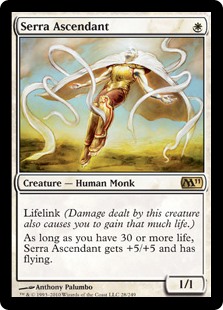
Without question, white excels in the area of lifegain, enough to support a whole archetype dedicated to the strategy. Besides disruption, this is white's one great skill---the unfortunate fact being that lifegain just isn’t a good strategy. Ad Nauseam doesn’t care. Serra AscendantInfect doesn’t care. Jund destroys the deck. Affinity is too fast if they don’t have Stony Silence.
The very fact that the white-based decks resort to lifegain or "tricky" effects in Death and Taxes shows the color's weaknesses. Its main strengths are its disruptive elements, which take many forms: answers to aggro and creature-combo in Path to Exile, knock-out bullets out of the sideboard like Leyline and Rest in Peace, hate bears that stymie mana development like Arbiter and Thalia. What all these cards share in common is their ability to put an opponent off balance---but they lack the raw power and game-winning potential of the Goyf's, Snapcasters, Bobs, and Goblin Guides of the multiverse.

Thus white typically takes on the support role, providing backup and disruption to the other colors while they execute their core strategies. In Death and Taxes, white has endeavored to form a "mono-disruption" archetype on the model of old-school prison decks, but it seems to have struggled until the arrival of the colorless-matters Eldrazi gave it additional tools.

The Takeaways

So, to recap, bullet point style.

  • White's core contribution to Modern are its disruptive elements, which usually appear in a support role.
  • White has Path to Exile, easily the most versatile unconditional removal spell in the format, sharing with Lightning Bolt the status for best removal spell in Modern.
  • White has access to some of the strongest sideboard spells in the format, namely Stony Silence, Rest in Peace, and Leyline of Sanctity.
  • White suffers from a lack of depth when it comes to general, powerful threats based on rate alone.
  • White has no general ways to accumulate card advantage, be it actual (Snapcaster Mage, Dark Confidant) or virtual (Tarmogoyf).

Multicolor spells that include white are plentiful in Modern, and offer various effects for a solid rate. The best of these include:

  • Lingering Souls
  • Siege Rhino
  • Tidehollow Sculler
  • Nahiri, the Harbinger
  • Sphinx's Revelation
  • Celestial Colonnade
  • Voice of Resurgence
  • Qasali Pridemage

Pairing white with every other color gives access to multiple stronger options, with the red-white pairing being the weakest. While outside the scope of this article, this hints at one of the reasons why Mardu has traditionally underperformed in Modern while Abzan has fared much better. This could, however, be more accurately attributed to the favorable heads-up fight between Tarmogoyf and Lightning Bolt.

White-green offers some of the strongest incentives, with Voice of Resurgence and Qasali Pridemage seeing abundant play in Company lists of both Naya and Abzan varieties.

Conclusion

For white to truly become a strong contender for stand-alone power in Modern, it requires either a build-around-me card like Balance, or a pushed format staple like Stoneforge Mystic. As long as it lacks a strong creature, white will always be relegated to a support role and paired with other archetypes that can provide such spells to overcome its inherent weaknesses.

Pairing white with blue naturally overcomes its difficulties associated with card advantage, while pairing white with green or "colorless" gives it much-needed big creatures and aggressive elements. Until then, may white players continue to Path creatures to their hearts' content, and may Affinity always cower in fear.

Thanks for reading, and I'll see you next week when we cover blue!

Trevor Holmes

The_Architect on MTGO

Twitch.tv/Architect_Gaming

Twitter.com/7he4rchitect

Every First Time Foil in Eternal Masters

Are you a Quiet Speculation member?

If not, now is a perfect time to join up! Our powerful tools, breaking-news analysis, and exclusive Discord channel will make sure you stay up to date and ahead of the curve.

The full spoiler for Eternal Masters has been up for a little while now, and we are starting to get reasonable calculations of the set's expected value. It's not surprising that things got less exciting after we saw Mana Crypt, though getting the exact number of bulk rares is very relevant in EV calculations. SaffronOlive did an EV calculation on MTGGoldfish, and he figures a box has a buylist EV of about $200.

This number isn't surprising, and I've consistently warned against purchasing sealed Eternal Masters above MSRP, and honestly it may not be wise to open product even at MSRP given that the value of cards in the set will generally decline as product is opened. One question mark that is relevant going forward though, is the price point of cards that will be printed in foil for the first time in EMA. It's unclear what these cards will be worth at this time, though for the relevant Legacy, Cube, and Commander cards I would venture that a lot is a good estimate. Here's a list of all the cards being printed at foil for the first time:


I don't expect foil Roots to be worth anywhere near the cost of a pack, though there are plenty of cards on this list that will command substantial multipliers. Legacy staples like Baleful Strix and Toxic Deluge are going to be filthy, and Cube staples like Winter Orb, and Worn Powerstone will also command significant multipliers.

As copies of these foils start entering the market, I expect they'll be rather volatile initially, though ultimately getting in soon on the sought-after cards on the list should yield good returns provided that these cards don't see a second foil printing.

Insider: Looking for Value in Eternal Masters

Are you a Quiet Speculation member?

If not, now is a perfect time to join up! Our powerful tools, breaking-news analysis, and exclusive Discord channel will make sure you stay up to date and ahead of the curve.

There's a lot to look forward to with Eternal Masters. We could sit around and debate why Wizards isn’t just making another Modern Masters set, or critique the cards they missed their opportunity to reprint (like anything from the Portal sets) but let’s stay positive. Believe me, there is a lot of positive to focus on.

Today we will take a look at what you can expect from Eternal Masters, what cards are worth opening, and what you can hope for financially.

To start things off, the product allocation and print cycle will be akin to that of the first Modern Masters. That means there won’t be enough to go around. My business partner and I expect there won’t be an opportunity to reorder this product. The initial demand, just like with Modern Masters, will deplete the entire supply of the set. So, whatever amount of product your local stores get, that’s all you should count on being able to purchase.

Hopefully you have made your decision about committing to this product or not already, but if not, there may still be time to track down some boxes. Currently they are selling a little higher than $300 on TCGPlayer, but I’ve heard many people in the finance community saying that brick-and-mortar stores are selling for less. I know my store started out our preorder price at $260 and raised it to $280. Some stores started at $240, so hopefully you were able to lock in some boxes at that price for full value.

Is this set worth working hard to obtain though? Let’s delve into what opening a normal pack of this set might yield for your collection. I’ll still be doing a box report for this set, so look for that article after the set releases.

Value Breakdown

Eternal Masters has 15 mythics and 56 rares. Ten of the 15 are worth $10 - $150, so opening a mythic will typically pay for the pack itself at minimum. Even on the low end, only Worldgorger Dragon and Sphinx of the Steel Wind will feel bad to open. Maelstrom Wanderer has Commander appeal so you will easily be able to find someone to take that off your hands, especially with the cool new art (more on that later).

There was an error retrieving a chart for Maelstrom Wanderer

Of the 56 rares, 11 are in the $5 range and nine are $10 - $50. That leaves a whopping 36 rares that are unlikely to make you happy about spending $10 or more on a pack. To help out some of the underwhelming rares, 18 uncommons will add value to whatever you open. That’s a lot of good uncommons to lean on for help in the value department.

One of the big differences between the original Modern Masters and the 2015 Edition were the uncommons. In the first one, we had lots of great uncommons to help increase the value. That’s true of Eternal Masters as well. Chain Lightning and Cabal Therapy will nearly pay for your pack on their own, and with all the growth Wall of Omens has seen in the past year, that should get you at least halfway.

New Foils

The best part about this set, is just like with the Modern Masters sets there will be a foil in every pack! This is quite significant because foils of this set will be extremely desirable.

Starting off, many cards in this set have never had a foil printing. Take a look at the list below and remember it well. These may be easy to obtain because not everyone will care about foils, but with this as their only foil printing, these cards should be much more valuable than the normal foil spread might indicate.

First foil printing

You may note that Mother of Runes does have a judge promo, but I included it here because this is the first printing of mom with new art and also the correct creature types. As a Cube enthusiast, I think this will be a great addition to my foil cube, as will the other cards on this list.

There was an error retrieving a chart for Mother of Runes

The great thing about this set is that they developed it with different types of players in mind. This set is not just for aspiring Legacy players, but also for the casual and Commander crowd as well. There aren’t really any Modern staples in the set unfortunately, but there are many cards that appeal to a wide variety of players.

All of these cards should have an expected value of $10 or more. The Legacy staple uncommons Hydroblast and Pyroblast have presale prices over $50! While that price isn’t set in stone, it does give you a good idea about how the community values this type of first-foil printing.

Humble, Pyrokinesis, Tooth and Claw and Skulking Ghost are also receiving their first foiling, but I think fewer players will put weight on that. Grab them cheap if you can because someone always wants hard-to-find cards.

Next up we have the judge promo list.

Judge foils only

Mana Crypt was only a book promo and a judge promo. Wasteland has had a bunch of promos but still kept a high price point. Dack Fayden was printed in Conspiracy but due to supply issues his foil was hundreds of dollars. For the rest of the cards their only foil printing was the judge promo.

There was an error retrieving a chart for Dack Fayden

What this means is that while these cards have been printed as foils before, they were never very accessible. In addition, there are plenty of players that hate promo foils because of the stamping. The set foils may command even higher prices on these already-desirable cards.

New Art

Some of these new cards might generate more demand simply based on their new artwork. Many of us, myself included, are nearly to the point of snobbery about which art we prefer. I know I always have strong feelings about art and go out of my way to obtain the version I like best. This will be the same for some cards from Eternal Masters.

Rares and mythics with new art

Void and Giant Solifuge might not be going out of stock anytime soon, but the other cards on the list are sure to make waves.

The judge promo Force of Will has already dropped from a grand all the way down to $300. But $300 is still a huge value to open from a pack. The new Terese Nielsen art is already sold out of preorders on TCGPlayer, which illustrates the point I’m trying to make here. Changing the art can have a big impact on the value of a card.

Uncommons with new art

My favorites on this list are the previously mentioned Hydroblast and Pyroblast, but you may be surprised by my next picks after that.

No, it’s not the obvious giant price tag on foil Daze, but rather Night's Whisper and Deep Analysis. Neither of those cards have foil printings with the newer artwork.

Ashnod's Altar is another home run, with new artwork and never having appeared in foil before. I know I need them for the Commander deck I’ve been trying to foil out and I’m sure lots of other players do too.

There was an error retrieving a chart for Ashnod's Altar

Wrap-Up

I expect the prices of cards from this set to follow similar trends as Modern Masters cards. The mythics didn’t lose much value at all and in fact some even went up because of increased demand!

Certainly supply will increase, but that will fuel even more demand to make up for it. Why not get the other Jace, the Mind Sculptors you need for Legacy instead of selling the one you opened in a pack? That same cycle happened with Tarmogoyf after its first reprint and is likely to happen again here.

Unlike with other sets, make sure to gather up those draft leftovers from your event. If your friends don’t want theirs, grab those too. Remember, there are tons of valuable uncommons in this set---draft leftovers have a different meaning than they normally would. There’s a lot of hidden value laying around.

Hopefully this article has given you a good perspective on the set and brought to light some aspects you were unaware of. Thanks for reading and I'll see you next week!

Until next time,
Unleash the Force!

Mike Lanigan
MtgJedi on Twitter

Bolts and Dreadbores at Grand Prix Weekend

Are you a Quiet Speculation member?

If not, now is a perfect time to join up! Our powerful tools, breaking-news analysis, and exclusive Discord channel will make sure you stay up to date and ahead of the curve.

Grand Prix weekend may be over, but with few major Modern events between now and the next GP bonanza, players will need to look to Charlotte and Los Angeles for the most recent Modern home-runs. And what a weekend of home-runs we got to enjoy! Between Jeskai Control solidifying Tier 1 status, Affinity making its inevitable comeback after a stint in hiding, and my beloved Ad Nauseam sailing to the Charlotte gold, there was a Modern slam dunk for everyone. Even those Eldrazi expatriates got to bring the CRUNCH back to coverage and top tables. With more success stories than a self-help book infomercial, we'll have plenty of innovations to experiment with until August.

Dreadbore art

Our monthly metagame update is scheduled for next Wednesday, and if current trends hold, we're on track for the most diverse period of Modern since last summer. Today, we'll trade our bird's eye view of the format for a magnifying glass. When most Moderners think of "technology," they often picture new cards, stunning sleepers, and breakout bombs the world has never seen. It's an exciting portrait, but a rarer one than we think. As we saw at both Grand Prix, most technology takes the form of cards we already know getting reapplied in new contexts, or in seemingly minute decisions about ratios and splits. We'll be examining two top-tier case studies of this micro-technology approach, unpacking card choices to educate players or opponents of these decks, and to illustrate some principles about making smart innovations for your own strategies.

[wp_ad_camp_1]

Lightning Bolt in Tron

I know what you're thinking: "since when does the venerable Lightning Bolt qualify as new technology?" In a format where technological achievement is often awarded to splashy powerhouses like Nahiri, the Harbinger or format-shattering monsters like all things Eldrazi Winter, Bolt feels like a letdown. That is, unless you're Joe Lossett piloting RG Tron to a 5th place finish at GP Los Angeles and you've traded all your maindeck Pyroclasms or Firespouts for the hallmark instant. If you're Joe Lossett, that playset of maindeck Bolts probably feels like taking an old deck to a whole new level.

RG Tron, by Joe Lossett (5th, GP Los Angeles 5/2016)

Creatures

2 Ulamog, the Ceaseless Hunger
2 World Breaker
2 Wurmcoil Engine
2 Spellskite

Artifacts

3 Oblivion Stone
4 Chromatic Sphere
4 Chromatic Star
4 Expedition Map

Instants

4 Lightning Bolt

Planeswalkers

2 Ugin, the Spirit Dragon
4 Karn Liberated

Sorceries

4 Ancient Stirrings
4 Sylvan Scrying

Lands

1 Forest
2 Sanctum of Ugin
4 Grove of the Burnwillows
4 Urza's Mine
4 Urza's Power Plant
4 Urza's Tower

Sideboard

1 Forest
2 Sudden Shock
1 Crumble to Dust
2 Grafdigger's Cage
3 Nature's Claim
3 Warping Wail
3 Thragtusk

From a slot perspective, Lossett has made a key decision which makes the Bolt technology such an intriguing discussion point: he's negotiated a sweeper slot which previously felt non-negotiable. In a sample of about 50 RG Tron decks played between May 1 and today, literally 0% lacked some combination of Pyroclasm, Kozilek's Return, and/or Firespout in the maindeck. Similarly, 0% had maindeck Bolt. A cursory review of most Tron literature also emphasizes the importance of these cards, and few prospective Urzatron assemblers leave home without them.

pyroclasmI mention this context because I can already hear the RG Tron pioneer who claims he's been using maindeck Bolt for years. Maybe you have, but even so, you're in a private minority. For the majority, conventional Tron wisdom demanded sweepers in those 2-4 slots. Even Lossett followed this imperative two weeks earlier at SCG Milwaukee, taking 2nd with 3 Firespouts main and Bolts shunted to the board. Of course, none of this is to say Tron has never considered maindeck Bolt. Indeed, an RG Tron player named Johannes Wagner ran 4 Bolts at the end of March to a Top 8 finish in Germany. It's just incredibly uncommon from a metagame perspective.
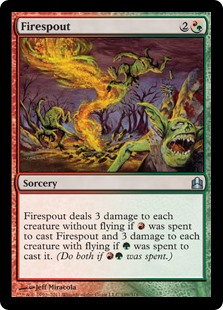
What changed for Lossett at Los Angeles? Looking over pre-GP numbers and considering Tron's matchups, you can practically see the crispy Noble Hierarchs and Blighted Agents in Lossett's crosshairs. Infect was the third most-played deck going into the Grand Prix, surpassing both historic top-dig Affinity in the aggro department and edging out Tron itself. Infect vs. Tron isn't quite as calamitous as Infect vs. Ad Nauseam, but it can feel very much like Tron vs. Jund from the Tarmogoyf side of the table. It's a Game 1 massacre that only improves marginally in Games 2 and 3, but Bolt goes a long way towards repairing this broken contest. The maindecked Spellskites further point to Infect being one of Lossett's major considerations.

FirespoutOn top of Infect, Bolt also handles the Burn decks which could push through a Pyroclasm-proof Wild Nacatl, not to mention the other x/3-or-better maulers in Gruul Zoo strategies. It might not clear Affinity's Signal Pest and Ornithopter swarm, but Bolt does stop Inkmoth Nexus and Arcbound Ravager lines where a sorcery-speed sweeper is helpless.
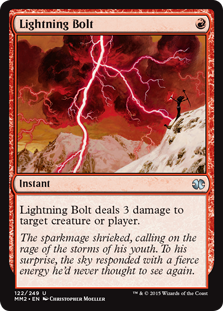
It's true that Bolt can be ineffective against strategies like Elves and Merfolk, where blasting individual creatures is less effective than firing up the entire field. That said, Bolt has enough applications against swarm strategies (crisping a Lord or nuking a key Heritage Druid) to ensure it isn't totally useless. Besides, if it improves the Infect showdown, that's a percentage point trade most Tron mages would take. Add the surprise factor against hapless opponents not expecting instant-speed interaction and it's not hard to see how Lossett's clever substitution and metagaming earned him a spot in the Top 8.

Lightning BoltLossett's preference for spot removal over sweepers illustrates one of the most important lessons in selecting new technology: have a specific goal in mind. Tron is notoriously soft to fast Infect starts. Bolt is notoriously effective at slowing and outright stopping those starts. As a Tron player, if your goal is to improve a bad and common matchup, then Bolt is where you want to be. This is in contrast to another approach where cool technology is applied in a context vacuum, like trying to get the Lightning-rod Tireless Tracker to work in Goodstuf.dec Jund.
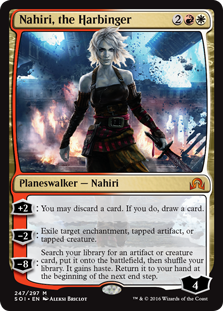
Going forward, I expect we'll see more Tron players opting for the Bolt playset over the sweeper suite, and not just because they're netdecking Lossett's list. Bolt is a sharp metagame call if you expect high levels of Infect and aren't worried about too many "go-wide" strategies in Elves, Gruul Zoo, and others. Tron opponents will need to be wise to this play, especially if you are packing mana dorks or other Boltable targets.

Dreadbore vs. Maelstrom Pulse

There was a time in Modern when Liliana of the Veil was the only planeswalker in town. No, your sideboarded Jace, Architect of Though singleton doesn't count. In those days, Modern's preeminent policeman, Jund and BGx Midrange generally, could get by with Bolt, a quick zap from Kolaghan's Command with beatdown backup, and the almighty catchall Abrupt Decay. Sure, you were still dead in the water to Modern's other competitive planeswalker, Karn Liberated, but Tron was already a matchup that demanded far more than just more effective walker slayers.

1_nahiriThen came Nahiri, the Harbinger and BGx had a real problem.
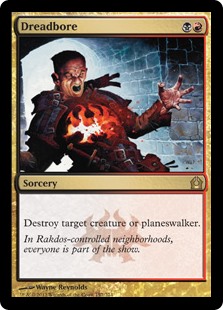
To be sure, Jeskai Nahiri doesn't represent quite the same challenge to BGx as Tron, but its namesake planeswalker is the exact kind of durable, decisive, and popular threat which causes Jund pilots trouble. Inquisition of Kozilek can't nab her from the hand. Decay can't snipe her off the board. Nahiri's +2 takes her out of Tarmogoyf, Tasigur, and Raging Ravine range alike, and her -2 quickly removes any active, non-Ravine threat on Jund's field. Needless to say, "Suspend 2: fetch Emrakul, the Aeons Torn" is lights out for a deck relying on Terminate for opposing big bads.

With Jeskai Control up to 5.5%-6% (still settling based on data added every day), format king Jund has already done what Jund does best: adapt and evolve. Team Jund representatives Mike Sigrist and Adonnys Medrano tweaked their core 60 to combat opposing Nahiris, and with both players finishing in the Charlotte Top 8, it's clear they had the right idea. How did they solve the Nahiri dilemma without diluting the goodstuff pile? Medrano with Dreadbore and Sigrist with +1 Maelstrom Pulse.

Jund, by Adonnys Medrano (6th, GP Charlotte 5/2016)

Creatures

2 Huntmaster of the Fells
3 Scavenging Ooze
4 Dark Confidant
4 Tarmogoyf

Instants

2 Abrupt Decay
2 Kolaghan's Command
4 Lightning Bolt
4 Terminate

Planeswalkers

4 Liliana of the Veil

Sorceries

1 Dreadbore
1 Maelstrom Pulse
3 Inquisition of Kozilek
3 Thoughtseize

Lands

1 Blood Crypt
1 Ghost Quarter
1 Stomping Ground
1 Twilight Mire
1 Wooded Foothills
2 Bloodstained Mire
2 Forest
2 Swamp
3 Overgrown Tomb
3 Raging Ravine
4 Blackcleave Cliffs
4 Verdant Catacombs

Sideboard

1 Olivia Voldaren
3 Kitchen Finks
1 Thrun, the Last Troll
1 Night of Souls' Betrayal
1 Damnation
2 Duress
1 Anger of the Gods
2 Ancient Grudge
1 Crumble to Dust
1 Painful Truths
1 Grafdigger's Cage

Both Medrano and Sigrist dedicated two maindeck slots to combating Nahiri, sharing a Pulse before splitting on Dreadbore #1 vs. Pulse #2. We'll start our comparison with Dreadbore because it's the flashier and techier of the two routes. Doubling your Pulse count feels even less exciting than adding Bolt to Tron. Importing an effectively unplayed rare into Modern feels like innovation at its most successful.

DreadboreIt's easy to see where Medrano was going with including the former Standard standout in his Jund list. Mana-efficiency is huge in Modern, with the difference between two and three mana separating the Counterspells from the Cancels. Although not an instant, two-drop Dreadbore is an on-curve answer to almost all fair creatures in Modern (opposing Tarmogoyfs, the delve creatures, Eidolon of the Great Revel, etc.), doubling as the cheapest way to one-shot an active Nahiri in the format. Whether nuking Nahiris or doing a passable imitation of Terminate #5, Dreadbore appears an elegant way to manage Jeskai's rising presence without compromising Jund's gameplan elsewhere.
Sigrist, who reflected on his Grand Prix performance in an SCG premium article last week, went a different route, staying true to the Jund core by upping his Pulse count. Dreadbore didn't even make the sideboard cut!

Jund, by Mike Sigrist (4th, GP Charlotte 5/2016)

Creatures

1 Grim Lavamancer
2 Kalitas, Traitor of Ghet
2 Scavenging Ooze
4 Dark Confidant
4 Tarmogoyf

Enchantments

1 Seal of Fire

Instants

1 Kolaghan's Command
1 Slaughter Pact
2 Abrupt Decay
2 Terminate
4 Lightning Bolt

Planeswalkers

4 Liliana of the Veil

Sorceries

2 Maelstrom Pulse
2 Thoughtseize
4 Inquisition of Kozilek

Lands

1 Blood Crypt
1 Forest
1 Stomping Ground
1 Twilight Mire
1 Wooded Foothills
2 Overgrown Tomb
2 Swamp
3 Raging Ravine
4 Blackcleave Cliffs
4 Bloodstained Mire
4 Verdant Catacombs

Sideboard

1 Grim Lavamancer
1 Disfigure
1 Ancient Grudge
1 Shatterstorm
1 Grafdigger's Cage
1 Crumble to Dust
3 Kitchen Finks
3 Fulminator Mage
2 Thrun, the Last Troll
1 Duress

Like Dreadbore, Pulse nukes Nahiri while also blowing up a wide range of opposing creatures. Unlike Dreadbore, Pulse costs three instead of two, ostensibly making it a much worse option in "mana matters" Modern. Dreadboring a two-drop at least answers a threat at parity. The red-black sorcery also gives you the option of Bolting Boring the Bird if you're on the play against a turn one dork. But Pulse? You'll almost never Pulse the Parrot (or whatever avian species is depicted on Birds of Paradise), and with so few three-drops played in Modern, you're also unlikely to kill creatures at parity. Given these seemingly steep drawbacks, why does Sigrist take the haymaker over the bullet?

Maelstrom PulseThinking contextually, I'm seeing a few distinct advantages to a second Pulse over a first Dreadbore. For one, Pulse is an actual catchall which answers a wide range of devastating Modern threats. This includes popular trumps like Ensnaring Bridge, Cranial Plating, Blood Moon, and Prismatic Omen, as well as more obscure roleplayers such as Ghostly Prison, Pyromancer Ascension, and Phyrexian Unlife. Jeskai may have jumped by 2%-3% in the past month, but all those decks demanding effective catchall solutions comprise well over 2%-3% of the format. Unless you're expecting disproportionate Jeskai Nahiri levels, Pulse is the more versatile bet.
In addition to this flexibility, Pulse doesn't crumble to the widely-played Spell Snare (a frequent one- or two-of inclusion in Jeskai's countermagic suite), and can sometimes compensate for those three mana symbols in the upper right by virtually sweeping a committed opponent. Pulse is no Pyroclasm, but it sure feels good to take out a Burning-Tree Emissary pair after Bolting the lone Nacatl. All of these edges combine to give Pulse a slight advantage over Dreadbore in my books.

Slaughter PactOf course, it doesn't have to be a question of Dreadbore or Pulse. Why not Dreadbore and Pulse instead! As Sigrist discussed in his article, he almost ditched the fourth Terminate for the additional Dreadbore, a deckbuilding decision shared by Reid Duke who also talked post-Nahiri Jund leading up to the Grand Prix weekend. In fact, Duke was down to just a single Terminate, trading one for Dreadbore, another for Slaughter Pact, and a third for the flex Seal of Fire or Kolaghan's Command #2 slot. Those are all options, but I'd shy away from Seal or Pact if I wasn't also packing Kalitas.

Sigrist cautioned against this 2 Pulse, 1 Dreadbore line, warning that sorcery-speed Dreadbore is not interchangeable with Terminate when facing down manlands, a notable worry if you have Infect's Inkmoths and Jeskai's Colonnades on the mind. I echo Sigrist's fears and also point to Jund's existing curve as additional reason to avoid Dreadbore. BGx Midrange is historically bloated in the one-mana and two-mana slots. Three-mana, however, is typically empty outside of Liliana and the occasional Kitchen Finks, which creates a slick opening for the Pulse bomb. Jund loves to be efficient with its mana, and although Dreadbore with Bolt backup feels nice on turn three too, committing to Pulse is going to feel better in most case. Especially when you're nuking random artifacts and enchantments Dreadbore can't touch!

Overall, the Dreadbore vs. Pulse question points to the importance of tiny innovations in compact spaces. Adjusting even just a single card can make a massive difference in your matchups and gameplay. Moreover, as this particular comparison illustrates, that extra card doesn't even need to be some splashy technology no one has ever seen. Sometimes you just need to increase the count of an already powerful staple to fix your problems.

Small Technology, Big Improvements

As someone whose been experimenting with a singleton Mystical Teachings in their Ad Nauseam maindeck, I can appreciate the important of small adjustments to make major improvements. RG Tron and Jund are two of Modern's most-played and least-modified strategies around. If these little refinements can play out in such established cores, imagine what similar corrections can do in lower-tier decks with more room for evolution. I'm excited to see these kinds of changes play out over the summer; it's the kind of deck growth we expect in non-rotating formats.

Thanks for joining me today on our technological deep-dive. I'll be back next week with our darling data tables and a metagame description to kick off the summer. What technology are you working on as we head into June? Any Tier 1 or Tier 2 decks you feel are prime for small shifts to get them to the next level? Let me know in the comments and I'll see you all soon!


The Greediest Splash of all Time

Are you a Quiet Speculation member?

If not, now is a perfect time to join up! Our powerful tools, breaking-news analysis, and exclusive Discord channel will make sure you stay up to date and ahead of the curve.

I'm a pretty risk averse person. I avoid splashing whenever possible in limited, and in constructed I usually play more sources of all of my colors than stock lists, even adding an extra land or two to my decks to make sure that I can cast my spells. It is from this perspective, that I pronounce Raphael Levy's GP Manchester winning deck as completely insane.

Naya Tokens by Raphael Levy

Creatures

4 Sylvan Advocate
4 Archangel Avacyn
4 Hangarback Walker
2 Lambholt Pacifist

Spells

4 Gideon, Ally of Zendikar
4 Nissa, Voice of Zendikar
2 Chandra, Flamecaller
4 Dromoka's Command
4 Oath of Nissa
2 Stasis Snare
1 Evolutionary Leap

Lands

4 Fortified Village
4 Canopy Vista
3 Westvale Abbey
7 Forest
7 Plains

Sideboard

1 Evolutionary Leap
2 Clip Wings
1 Silkwrap
2 Hallowed Moonlight
3 Den Protector
2 Tragic Arrogance
2 Planar Outburst
1 Angelic Purge
1 Declaration in Stone

Incorporating Chandra, Flamecaller into Selesnya tokens is a pretty sweet innovation. I though about adding Chandra to my deck before this weekend though I didn't know how well I could make the mana work. Raphael Levy apparently started on a similar line, though instead of tweaking his manabase he decided that he already had four Oath of Nissa and that you only live once.

There was an error retrieving a chart for Oath of Nissa

I would be amazed if this become the stock version of the deck, though I would think twice about not making a tokens opponent sacrifice their Oath of Nissa when you cast a Dromoka's Command in the future. This is probably the greediest slot that I've ever seen in a constructed deck, and I say this as somebody who once splashed a sideboard Cruel Ultimatum in an Izzet deck. Perhaps Levy was tired of winning Grand Prix utilizing only spells that his lands could cast.

Insider: MTGO Market Report for June 1st, 2016

Are you a Quiet Speculation member?

If not, now is a perfect time to join up! Our powerful tools, breaking-news analysis, and exclusive Discord channel will make sure you stay up to date and ahead of the curve.

Welcome to the MTGO Market Report as compiled by Matthew Lewis. The report will cover a range of topics, including a summary of set prices and price changes for redeemable sets, a look at the major trends in various constructed formats, and a "Trade of the Week" section that highlights a particular speculative strategy with an example and accompanying explanation.

As always, speculators should take into account their own budget, risk tolerance and current portfolio before buying or selling any digital objects. Questions will be answered and can be sent via private message or posted in the article comments.

Redemption

Below are the total set prices for all redeemable sets on MTGO. All prices are current as of May 30th, 2016. The TCG Low and TCG Mid prices are the sum of each set’s individual card prices on TCG Player, either the low price or the mid price respectively. Note that sets of Theros (THS) are out of stock in the store, so this set is no longer redeemable.

All MTGO set prices this week are taken from Goatbot’s website, and all weekly changes are now calculated relative to Goatbot’s ‘Full Set’ prices from the previous week. All monthly changes are also relative to the previous month prices, taken from Goatbot’s website at that time. Occasionally ‘Full Set’ prices are not available, and so estimated set prices are used instead.

May30

Flashback Draft of the Week

Triple Lorwyn (LRW) drafts start this week, and this is a set which marked a turning point in Magic as a game. Although they were hinted at in Future Sight, the introduction of the original five planeswalkers ushered in a new era of Magic and is the most distinct development that arose from this set.

On a more subtle front, the gameplay that arose from the Lorwyn draft format helped set the stage for the New World Order of Magic R&D. If you haven't read the article before, I highly recommend reading Mark Rosewater's piece on it.

Although the creatures are underpowered relative to what we're used to today, there exist a ton of tribal synergies that can create very complicated board states. It was this complexity that helped spur the changes that showed up in the core set reboot of Magic 2010. Needless to say, the triple LRW draft is not for the faint of heart.

LRW doesn't offer a ton of value, but there are some notable Modern staples that players and speculators should be aware of. The original printings of Cryptic Command and Thoughtseize are from this set, but the fringe-playable Wanderwine Hub is the most expensive card from this set at 9 tix currently. Avoid this rare land and focus on more-played cards from Modern and Legacy, like Thorn of Amethyst.

Modern

Lots of Modern staples saw depressed prices lift this past week after the full Eternal Masters spoiler was revealed. Cavern of Souls, Grove of the Burnwillows and Infernal Tutor are a few cards that are up sharply this week.

If there's anything to glean from the price activity around the release of a Masters set is that the fear of a reprint is much bigger than the reality of a reprint. I had been willing to buy cards like these in recent weeks, and on the final morning of EMA previews I put the last few of the Market Report portfolio's tix into more copies of Modern staples like these.

Wizards of the Coast has had a lot of practice by now balancing out the value of these reprint sets, and they aren't willing to just helicopter-drop a ton of value into players hands. Modern cards that get expensive will eventually see a reprint in a Modern Masters set or in a new cycle of Expedition-type cards, but speculators and players should not fear reprints.

If a card gets reprinted and you are stuck with a big loss on a position, that's a risk that you should be willing to take at this point. Let the rest of the market be fearful and when most of the reprints don't occur, be happy to sell cards back at the new price after players scramble to buy back the cards that they need to play with.

The usual caveats about diversification apply here, of course. As long as your portfolio is spread across a variety of cards and/or formats, a drop on one shouldn't sting too much.

Standard

There were two high-level Standard events this past weekend: Grand Prix Minneapolis and Grand Prix Manchester.

Although he didn't finish in the Top 8, Tomoharu Saito took an innovative blue-red deck to a Top 32 finish, which Ryan Overturf briefly wrote about here. We can see the immediate impact of a new Standard archetype, with Goldnight Castigator from Shadows over Innistrad (SOI) more than doubling in the past week.

Jace, Vryn's Prodigy is back up to his old tricks, falling to around 30 tix before staging a rebound back to 39 tix this week. Although the overall downtrend continues, there have been many potentially profitable swings on this Magic Origins (ORI) mythic rare.

With bot margins on Standard cards being so narrow, this can be a profitable price range for speculators to move on. Only nimble speculators who can dedicate time to watching the market should be trying to speculate on Jace, but it's very possible there is another cycle down coming for this card.

In Battle for Zendikar (BFZ), Part the Waterveil has made an unusual move higher in the last six weeks. A 500% increase is nothing to sneeze at, but it's unclear if this is organic market activity or someone trying to corner the market.

Recent tournament results from decks using this card suggest that it's fringe-playable only, which doesn't justify the current price. If you are holding any copies of this card, it's a good time to sell.

Standard Boosters

Last week I predicted that Battle for Zendikar (BFZ) and Oath of the Gatewatch (OGW) boosters would stabilize and rise above 2.2 tix and 3.2 tix respectively as Tenth Edition draft replaced the relatively popular Time Spiral block draft in the flashback queues. As of writing, BFZ boosters have sunk below 2.1 tix, though OGW boosters have bumped up to over 3.3. tix. Let's call this one a draw and see what happens next week.

Trade of the Week

As usual, the portfolio is available at this link. When your portfolio is tix-constrained and there's no current release event draining liquidity from the market, it's correct to assess which positions have reached their short-term potential.

One of my recent purchases at the start of Pro Tour Shadows over Innistrad was Nissa, Voice of Zendikar, a powerful planeswalker that anchors the G/W Tokens strategy of Standard. This deck took down both Standard Grand Prix events this weekend, and the price of Nissa did not budge.

I think the ceiling on this card while it's in Standard is in the 15 to 20 tix range, though it might take until the winter to reach its peak. It's also possible that shifts in the Standard metagame push G/W Tokens out of contention, but it definitely looks like players on MTGO aren't picking up this deck in great numbers.

With no short-term catalyst visible and no recent upward price movement, it's become time to harvest profits on Nissa and prepare for other opportunities. I'll be looking to cull additional cards from the portfolio over the next month in order to build liquidity heading into the summer. The release of Eternal Masters and then Eldritch Moon will be a good time to have tix standing by.

Building a Modern Sideboard: A Beginner’s Guide

Are you a Quiet Speculation member?

If not, now is a perfect time to join up! Our powerful tools, breaking-news analysis, and exclusive Discord channel will make sure you stay up to date and ahead of the curve.

Welcome to the second edition of Beginner's Guide, the article series where we help Standard players make the transition to Modern. Two weeks ago I talked about the importance of choosing and then mastering your deck. This week we discuss sideboarding, easily the hardest and most essential part of Modern.

Rhystic-Study-banner-cropped

In my experience, players moving from playing Standard exclusively to try out Modern struggle to win a game for their first half-dozen tournaments. The first few come down to unfamiliarity and inexperience. It's one thing to playtest and to watch Modern coverage to figure out how a deck plays and what you can expect from other decks. It's entirely another to figure out for yourself how to navigate a removal-light hand against Infect, or how to correctly sequence your shocklands against Burn when under attack by a Goblin Guide so you don't just lose. There is a learning curve and it can be quite steep.

The later struggles can usually be traced back to deckbuilding errors, especially sideboard decisions. Maindecks are already challenging enough to build because small changes can have enormous consequences, but it is a solvable puzzle. Generally speaking, a given deck has certain cards that you need to play all the time, the only question being proportions. And that can be figured out through the deck testing process and adjusted based on your playstyle without harming your deck.

[wp_ad_camp_1]

The Standard Player's Problem

The same cannot be said of the sideboard. Make a mistake and it will cost you, either because your strategy was wrong or because you ignored a matchup that you shouldn't have. Now, every Modern player does this periodically. The format is too open and too volatile to get it right all the time. What differentiates the more experienced Modern player from a Standard convert is how deck positioning and sideboarding are perceived. Standard sideboards are usually about fine-tuning maindecks while in Modern it's about repositioning to change how the matchup functions.

sphinx's revelationLet me explain. As I said last time, over the past few years Standard has centered around a relatively small number of powerful, format-defining cards such as Thoughtseize, Sphinx's Revelation, Thragtusk, and Siege Rhino. (Rally the Ancestors was a deviation from this pattern, which we'll get to below.) The trick for deckbuilders has been to determine which of these staples are best positioned at any given time, and which of the less powerful roleplayers to pair with them.

The best decks have the best support for these power cards, and the best answers to opposing ones. The result is a pile of midrange good-stuff decks. The sideboard becomes an extension of the maindeck, where all you're really trying to do is shift to better answers to a specific power card. In other words sideboarding in Standard revolves around answering cards, not strategies. For the most part you aren't dramatically altering your deck or trying to change gears but simply adjusting your support cards so that you can continue to do your powerful thing and prevent the opponent from deploying theirs.

While trying to do that can work in Modern it's likely to be less optimal than simply playing win-the-game cards in your sideboard. If you accept the idea that Standard is about the most recent power cards, then Modern is all the power cards from all of the Standards since Mirrodin. As such the total power level is much higher and spread out over more cards. With this flatter power level across archetypes and individual cards, trying to support a few generic haymakers to overpower the opponent doesn't work as well.

Yes, there are decks that do that, namely BGx, but these decks also contain the defining aspect of Modern decks: internal synergy.Melira All the pieces may be individually powerful, but put it together and the whole is much greater than the sum of its parts. Thoughtseize and Tarmogoyf are very powerful individually, but they're much better together. Thoughtseize proactively protects Goyf and provides an average of two power for it, while Goyf provides the pressure that ensures Thoughtseize's disruption stays relevant. Abzan Company plays a reasonable fair game of creature-based beatdown but put the right reasonable creatures together and you have an instant win.
The recent dominance of Rally in Standard much closer resembles the situation in Modern. Rally had some individually powerful cards but when combined with sacrifice outlets and graveyard recursion made a deck that was far greater than any of its individual components. What this means for sideboarding is that you can't just try to tweak your deck because the internal synergy and power of the opposing deck will allow it to overcome refining changes. You also need to consider that the opponent will be sideboarding against you, bringing in answers for your answers or even their own disruption.

Given that the power of sideboard cards is much higher in Modern than in Standard, you can't rely on fine-tuning to win you games two and three. You need to be more drastic.

Choosing Sideboard Cards

You need to have a good reason to put a card into your deck, be it in Standard or Modern. When you put a card into a Standard sideboard and are challenged a perfectly acceptable Negateanswer is, "It improves my matchup against <deck>" or "It answers <card> in <matchup>." In Modern that's not good enough for most decks. If I ask you why a card is in your Modern sideboard, your response should be, "If unanswered it beats <deck>," or "It's my out to <card that beats you>." A Modern deck should have as many "I win" cards in its sideboard as possible. Powerful options that make that possible exist, so you should be playing them. Trying to eek out small advantages isn't good enough. Yes, Negate may have a lot of applications out of your sideboard but it's never The Best Option.
Alternatively you need cards that keep you from just losing to these hate cards. Affinity plays Wear // Tear not because it beats other decks (though it can under some circumstances) but because it keeps them from losing to Stony Silence. If all your card does is incrementally improve a game one matchup, it is detrimental to winning games two and three. Play higher-impact cards.

The Big Misconception

The biggest complaint about Modern, typically heard just before the Pro Tour, is that there's not enough sideboard space and it's impossible to prepare for the format because it's too big with too many decks. This is both true and untrue. Yes, Modern has a much bigger cardpool with far greater diversity than Standard. Our Top Decks page has eight decks listed as Tier 1. That's nearly as many archetypes as see play in Standard in total. Plus another ten in Tier 2, and seventeen in Tier 3. In Standard it is possible to have strategies and dedicated sideboard slots for each deck. That isn't possible in Modern.Stony Silence

What isn't true is that you cannot prepare for the format or be ready for any deck. The truth of the matter is that there is considerable overlap between decks in terms of both their axes of attack and what they're vulnerable to. Look back at those Top Decks. How many decks utilize the graveyard? How many are vulnerable to artifact hate? Night of Souls' Betrayal?

The simple fact is that you can and should play cards that are very good in certain matchups and then have applications against a wide variety of decks. Stony Silence is one of the best cards around against Affinity and Lantern Control and also cripples Tron and the Thopter combo. In Modern, you don't want to target specific decks very often. You're better off targeting strategies and resources.

The Rules

When new players ask me for sideboarding advice I always give them some general guidelines to follow. I should stress that these are just guidelines and they don't apply to every deck. But I've found they apply often enough to function as a good starting point. They break down into two categories: specific card selection and matchup preparation.

Card Selection Rules

Beyond my already stated admonishment to only play the best cards, I have one rule and a corollary for sideboard cards.

1. Play cards that are good whenever you draw them.

Modern isn't Legacy---you can't dig for your cards with lots of cantrips. It is not unlikely that you will never actually see any sideboard cards in your opening hand or at all. Therefore Chokerelying on cards that are only good in your opening hand is not a winning strategy. Some players will advocate mulliganing to hit your hate cards but the odds decrease each time you do that (unless you're Jordan with his Serum Powders), and after the first mulligan it's unlikely to be worth it.
Instead play sideboard cards that will be helpful and impactful on both turn one and ten because you may not see them until late in the game. This will let you keep more reasonable hands and prevent you from drawing dead cards in the late game.

 1a. If you absolutely need it, play four.

Leyline of Sanctity MM2015Unless, of course, you will lose the game if you don't have the card. In that case you need to maximize your chances of drawing it, particularly in your opening hand. Cards like Leylines and Chalice of the Void are exponentially worse to draw than they are to see in your opening hand, so if you really need them to not lose (say Bogles with Leyline of Sanctity against Jund or Merfolk with Hurkyl's Recall against Affinity) you need to play a full set. This takes up a lot of space in your board, but if it's a matchup you expect to see a lot it will definitely be worthwhile. Hopefully the four-of has applications in other matchups to make its presence less burdensome.
Matchup Selection Rules

This section covers my rules for what matchups to specifically prepare for. Remember, you should try to have general sideboard cards that hit a lot of matchups, but you should focus on a few that you know you'll hit a lot to maximize your chances of winning. My rules, from most to least important:

1a. Don't concede to Affinity.

Affinity is a good deck. It will be present at every tournament of PPTQ level or higher and you Arcbound Ravagerare likely to face it at least once. If your maindeck plan isn't very good against Affinity then you must have sideboard slots allocated to defeating the deck. There is a lot of hate available against the deck, and it is very effective. Don't just lose. You can beat the robots.
How many hate cards depends on your deck. Jeskai Control's maindeck is good enough against Affinity that it doesn't need to play more than a card or two. Ad Nauseam can largely ignore the deck and might only run a few ways to protect itself from Affinity's sideboard. Merfolk on the other hand has a terrible game-one matchup and so needs to dedicate a lot of space, but as a reward it has a much better overall matchup. The deck is beatable as long as you prepare for it, so do so.

1b. Don't concede to Dredge.

Prized AmalgamUntil a month ago this was just a holdover from Extended, and was the point that I was most willing to negotiate on or drop entirely. Then players figured out that Prized Amalgam was good and now I'm holding firm: Play graveyard hate!
You shouldn't concede to Dredge for the same reasons as Affinity: The deck loses to hate cards, and these hate cards are also good in other matchups. It's easy to fit a few Relic of Progenitus into any deck, so just make sure that you aren't cold to this deck. Scavenging Ooze is an okay maindeck answer, but it's easy to overwhelm. Have some hate and beat that deck, and improve your Grixis matchup while you're at it!

2. Win close matchups.

The place where sideboard choices can be most impactful are the close matchups. When game one is 50/50, you will need every edge to win games two and three. You don't want to go overboard, but make sure that you have what you need to win the game. You're not likely to see your matchups where you're 65%+ to win or lose all that often compared to your close matchups so spend the sideboard space to either keep it close or outright win.

3. Don't lose good matchups.

Arrogance and overconfidence are the downfall of more players than anything else. Just because game one is really good for you doesn't mean the match will be. As I've said before there are very powerful sideboard options available for all decks in Modern. Your good matchup knows they're weak to your deck and will have something that can turn things around. Either pack an answer or your own "I win" button to make sure your good matchup stays good. You have no excuse to give away percentage points, so spend the slots.

4. Win bad matchups (if they're winnable).

Crumble to DustLook, there are decks out there that you can't beat. This is Modern---no matter your chosen archetype, there's bound to be a matchup you're 20% or less to win. Even if you had fifteen slots for that deck you're still only 50% to win. (If not then you're Eldrazi and on your way to the banlist.) In these cases there's no point trying to beat the deck---your best bet is to focus on other decks and hope to dodge.


However, there are also decks where you may only be 40% to win game one, but with the right sideboard cards you shift to 60%. GR Tron is a huge favorite to win against Jund game one, but if in game two Jund has Fulminator Mage and Crumble to Dust it has a huge advantage. Don't fight hopeless battles, but if you can beat it out of the sideboard without giving up other matchups then you should absolutely try to win.

You Will Learn With Time

If that seemed like a lot to take in, it was. And I'm skipping over a lot of nuance and subtlety about overlapping hate and preboarding some kinds of hate cards. However this article series is intended as a general guide to help new Modern players adapt and learn the format. Check back next week for a more detailed guide to sideboard cards and the maindecking question.

Is there anything you think I've missed? Do you have additional questions as a new player? Are there questions you wish someone had answered when you were new? Let me know in the comments and I'll do my best to answer them as this series progresses.

Insider: Eldrazi Specs & Holding onto Bulk

Are you a Quiet Speculation member?

If not, now is a perfect time to join up! Our powerful tools, breaking-news analysis, and exclusive Discord channel will make sure you stay up to date and ahead of the curve.

Have you ever had the Grand Prix or Open experience where you quickly lose three of four matches and spend the entire weekend cheering on friends or grinding trades, dealer booths and dollar boxes? Yeah, me too.

Two of the four friends I attended GP Minneapolis with made Top 8. So I had a lot of cheering to do. I also spent a lot of time trading and buying cards as an investment. I always say: "If you can't win in the tournament, you can always win at the trade tables!"

Eldrazi Standard Specs

I spent the vast majority of my actual trades targeting basically anything that was an Eldrazi creature. If the offer was right, and the price was cheap, I wanted every playable Eldrazi I could get my hands on.

I have a couple of reasons for suspecting that the Eldrazi are among the best value pickups in Standard right now.

1. Many are realistically hitting their bottom prices. How low can cards that are Vintage, Legacy, and Modern staples really get? Likely, not much lower and not for too long.

2. There's a significant chance Eldrazi will be a top-tier deck when Dragons of Tarkir and Magic Origins rotate. Those two sets have a ton of significant Standard-defining cards and when they leave things will change dramatically. Goodbye CoCo!

3. Eldrazi are iconic, unique, and a fan favorite. People collect dragons. People collect angels. People will collect Eldrazi. In a lot of ways Eldrazi are even more interesting than other creature types because the lore is 100% unique to MTG. It helps that many are busted-in-half powerful, as that contributes to the unique feel and flavor of the cards.

4. There could be more Eldrazi in Eldritch Moon. When Emrakul comes bursting out of the moon and going buns wild on Innistrad, maybe she'll bring some more Eldrazi scions with her? I mean, all of the sweet Thought-Knots and Smashers are minions of Kozilek, and Emrakul may have some friends of her own! (Assuming she is in the set, of course.)

All of these are great reasons to love Eldrazi cards. Here are my prime targets:

Eldrazi Displacer

There was an error retrieving a chart for Eldrazi Displacer

I designed the Humans deck splashing Eldrazi Displacer that Andrew Elenbogen made Top 4 of the GP with. The card is so sick that making the mana worse to play it in a human tribal deck still makes the deck significantly better...

Also, a recent MTGO Vintage event had four mono-white Eldrazi decks with 4x Displacer. The card is easily the best Eldrazi card ever printed and will be a format staple of every format where it is legal.

To me, Displacer "feels" more like a $10 card than a $4 card. I'm very interested in continuing to pile up more copies of this card. I've written about it before, for a few weeks, but I really think this card will take off at some point in the near future.

Matter Reshaper

There was an error retrieving a chart for Matter Reshaper

I have a hard time fathoming how Matter Reshaper is a sub-$2.00 card. I've been very happy to try and pick up as many copies as possible as they have dipped down into the gutterball price range. The card is a good analog to Kitchen Finks, and Finks is a $10 uncommon with multiple printings!

It's the kind of card that will be a format staple if Eldrazi becomes a thing post-rotation because every single Eldrazi deck would be forced to auto-include it! The card is also actively great in Legacy versions of the deck. Legacy staples always have a home. Forever.

Reality Smasher

There was an error retrieving a chart for Reality Smasher

In what smashed reality is this a $3 card? It is one of the best aggressive cards of all time and helps define an entire archetype in Legacy! Nice Jace, think I'll smash it.

The big separation between foil and paper versions is pretty telling. It means people speculate that the foil will be expensive because there will be demand in the future. If there is demand for foils there will be demand all around which means these cards will likely hold and gain value.

Corrupted Crossroads

There was an error retrieving a chart for Corrupted Crossroads

You guys mark my words: When the Origins painlands rotate and Eldrazi are a thing in Standard they will all play four copies of this card and it will jump in price. Its price right now is basically $0 which makes it a great time to pick up a stash to hide away just in case.

The Bulk You Trade Is Equal to the Bulk You Save

I had a pretty interesting experience at the Grand Prix. After a scrubbed out I noticed that one of the dealers had an offer going on their bulk. Basically, they had 20,000 or so "bulk rares" and "random foils" and were letting people dig through them and charging $0.25 per card.

Typically, I see this kind of offer at $1 a card or $0.50 a card. At a quarter I felt compelled to dig through the junk to see what I could find. I decided as an experiment that I'd spend about $50 and pick out the best 200 cards that I could find in the boxes.

Obviously, when you look at that many cards you're going to find some good deals. You don't need me to explain why buying a bunch of copies of Awakening and Cover of Darkness for $0.25 is a good deal.

The point is that 99% of the cards in the bulk box retail for below $1 on TCG Player, but some are destined for higher prices. Here are some of the ones I gravitated towards that I was happy to pick up for a quarter.

Hold onto these cards for a year or two and see if you are not pleasantly surprised. Maybe even pick these cards out of bulk or from local game stores.

Lifebane Zombie

There was an error retrieving a chart for Lifebane Zombie

I was pretty shocked to see stacks of Lifebane Zombies being sold for a quarter a piece. I know they plummeted from their glory day prices in Standard but I didn't know how tough the times had gotten.

First of all, LBZ is a messed up, busted, and ridiculously good Magic card. It made Voice of Resurgence (an equally busted card) basically terrible in Standard for its entire lifespan!

Secondly, Lifebane Zombie is a zombie. Casual people love zombies. Also, zombies could get even better after Eldritch Moon. You never know.

My thought process is that the card is extremely powerful. It is a great tribal card. And I think it has fringe Modern applications. I can't even tell you how many times I've seriously considered trying to Collected Company into this card in Abzan!

Devastating Dreams

There was an error retrieving a chart for Devastating Dreams

Another card that I was kind of surprised is basically junk. Devastating Dreams is a pretty powerful spell. Anything that just randomly blows up tons of lands for two mana is playable somewhere!

Another thing to think about is that Wizards has hinted that a new eternal format isn't an 'if' but a 'when.'

I've speculated at what such a format might look like. Maybe it could be Legacy with all Reserved List cards banned (duals, The Tabernacle at Pendrell Vale, Gaea's Cradle). Maybe it would be Mercadian Masques-forward because the Reserved List ends with Masques?

I have no idea but it opens up some space for random old cards to once again shine. And they sure don't make cards like Devastating Dreams anymore.

Destructive Flow

There was an error retrieving a chart for Destructive Flow

According to the lowest listed price on TCG I actually lost money on Destructive Flow! Hard to imagine.

The card is unbelievably messed up. Cheap, recurring land destruction? Centerpiece of an old Extended deck? Doesn't seem like the kind of card that should be worth less than a quarter.

Scab-Clan Berserker

There was an error retrieving a chart for Scab-Clan Berserker

It is worth noting that Scab-Clan Berserker literally won the last Vintage Bazaar of Moxen tournament. Yeah, 4x Scab Clan > Gush in Vintage. Somehow. Don't ask...

The cool thing is that Scab-Clan is a human which means it can be cast off Cavern of Souls in a tribal human deck. It becomes a 3/3 Eidolon of the Great Revel that targets all of your opponent's spells! The card is pretty unique and great in eternal formats, especially Vintage.

Beastcaller Savant

There was an error retrieving a chart for Beastcaller Savant

Yeah, how the mighty have fallen. This card was pre-selling for something ridiculous like $6. I think it is safe to say that we are all pretty good at identifying things that are unique and have potential. Whether things turn out to be good is to be determined.

Beastcaller Savant is a card that hasn't found a home but is kind of cool. Haste and making mana of any color don't usually come on the same card. It's also an elf.

At thirty cents I'm pretty interested in having a couple playsets set aside just in case the card does something in the future.

Woodland Wanderer

There was an error retrieving a chart for Woodland Wanderer

Maybe we can pair this creature up with Beastcaller Savant in Standard!

6/6 trample for four is a pretty big game no matter how you cut it. You never know what a format will look like but this is something that interests me. It's kind of hard to lose when cards get so cheap in the here and now.

~

Two takeaways from today's article:

  1. Eldrazi are great. I think they are the most undervalued cards in Standard.
  2. When you bulk out cards be careful about what you give up. Plenty of cards that are undesirable now suddenly become valuable down the road. I can't even imagine how many Dark Depths people bulked off before Vampire Hexmage got printed!
There was an error retrieving a chart for Dark Depths

You never know what will suddenly form a combo with some new printing or become well-positioned in a new metagame. Always err on the side of holding cards that are unique and interesting.

Want Prices?

Browse thousands of prices with the first and most comprehensive MTG Finance tool around.


Trader Tools lists both buylist and retail prices for every MTG card, going back a decade.

Quiet Speculation