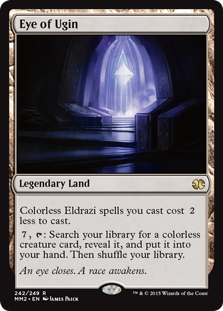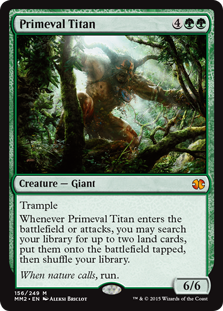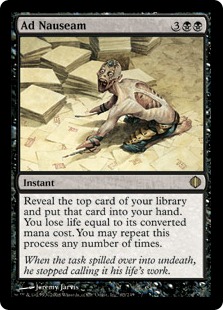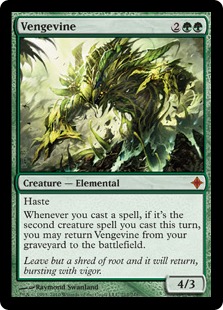
menu

Delver, On a Bulk: Counter-Cat in Practice

Are you a Quiet Speculation member?

If not, now is a perfect time to join up! Our powerful tools, breaking-news analysis, and exclusive Discord channel will make sure you stay up to date and ahead of the curve.

When I introduced Counter-Cat to Modern Nexus last week, a number of readers voiced understandable concerns about the deck. Didn't it auto-lose to Burn? Why not just play Monkey Grow? Or... Domain Zoo?! I promised answers, and this week I have them---sort of. I haven't had the time to play much Magic this past week, but I attended Face to Face's monthly Modern tournament with the deck and cracked Top 8.
mutagenic growth art crop

That tournament was by no means a huge event, but as the purpose of last week's article wasn't to unveil the new best deck in Modern, the purpose of today's isn't to demonstrate that Counter-Cat is Modern's new boogeyman. Rather, this article aims to give readers a better understanding of how the deck works by examining some of its games close-up.

[wp_ad_camp_1]

The Deck

I played the exact list from last week's article at the tournament. For a detailed explanation of the list, check out that piece.

Counter-Cat, by Jordan Boisvert

Creatures

4 Delver of Secrets
4 Wild Nacatl
4 Tarmogoyf
2 Hooting Mandrills
2 Snapcaster Mage

Instants

4 Mutagenic Growth
4 Path to Exile
4 Lightning Bolt
2 Lightning Helix
2 Spell Pierce
1 Spell Snare
1 Remand
1 Mana Leak

Sorceries

4 Serum Visions
3 Gitaxian Probe

Lands

4 Misty Rainforest
4 Flooded Strand
3 Arid Mesa
1 Wooded Foothills
1 Steam Vents
1 Temple Garden
1 Stomping Ground
1 Hallowed Fountain
1 Island
1 Forest

Sideboard

3 Huntmaster of the Fells
2 Isochron Scepter
2 Pyroclasm
1 Lightning Helix
2 Destructive Revelry
1 Ancient Grudge
2 Negate
2 Boros Charm

Face to Face Modern Monthly Report

Round 1: Bye

My opponent is a local Burn player, and I'm excited to prove Counter-Cat's anti-Guide chops to the Nexus readership. Unfortunately, he never shows up to the event, and I end up with a bye. I use the round to walk around and write down most of the decks I see, which gives me extra info for the rest of the event. Most of Modern's top decks are represented. Sadly, Storm is the only dedicated combo deck in the room. I'm very happy with my positioning, as the only decks I see that I don't want to face are GR Ponza and Abzan Midrange.

Round 2: GR Tron (2-0, lose roll)

In August, I wrote an article series on Modern archetypes and struggled while placing Tron, since it has many hallmarks of a midrange deck---ramp and disruption, and big creatures. Now, though, I always organize my sideboard guides with Tron helming the combo section. The deck plays like a combo deck, and more importantly, Delver plays against it as though it were a combo deck. This matchup was a lot worse last autumn, when I experimented with Disrupting Shoal in Counter-Cat; with the two-mana counterspells and Spell Pierce back, it becomes clearly favorable.

Game 1
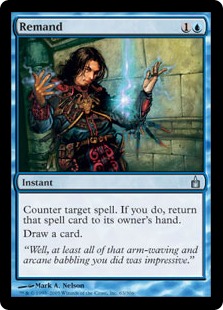
RemandI open a decent seven with a pair of Mandrills, two fetches, Bolt, Path, and a Serum Visions. But knowing my opponent is on GR Tron, I ship it to find Delver and Nacatl. I succeed there and keep six.

My opponent starts us off with Ancient Stirrings, which finds him a Tron land. I play a Delver and pass. He drops some Spheres and passes back to me. I flip the Delver, drop a Nacatl, and attack for three with blue mana up. His Sylvan Scrying eats Spell Pierce, and a second one gets Remanded after I play a second Nacatl. Finally, my opponent makes Tron at 8 life and resolves Karn, exiling my Delver. The Nacatls go for the jugular and Mutagenic Growth makes lethal.

Sideboarding:
-4 Mutagenic Growth
-3 Lightning Bolt
-2 Lightning Helix

+2 Isochron Scepter
+2 Boros Charm
+2 Negate
+2 Destructive Revelry
+1 Ancient Grudge

Game 2

I keep three lands, Goyf, Nacatl, Bolt, and Remand. Three lands is a lot, and Bolt is mostly dead, but if I mulligan to six, I risk finding a hand that depends on Serum Visions to land a threat. I already have threats for turns one and two, plus a counterspell, so I keep the hand.

Nacatl and Goyf go to work on my opponent's life total, but I can't stop him from assembling Tron. I get to Negate a Karn and an Oblivion Stone, but at 1 life he casts Ulamog and exiles my attackers. I Remand the Ulamog to buy myself a little time. I draw Tarmogoyf and keep it in hand, knowing Ulamog is coming; I'm also slow-rolling an Arid Mesa, since I want to make sure my opponent doesn't take out all of my red sources with Ulamog. The Eldrazi comes down again and eats two of my lands.
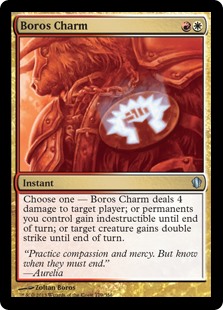
Boros CharmI play the Mesa and the Goyf now, hoping to stop my opponent from attacking me with Ulamog long enough for me to draw one of my Boros Charms or a Path. He casts Oblivion Stone, though, and activates it to kill the Goyf. Then he resolves another Stone and attacks for ten. I respond by searching up my Stomping Ground so I don't lose it for good, then Ulamog exiles 20 cards. We look through the pile, which contains two Revelries and a Boros Charm, and I realize I only have one Boros Charm left in the deck as an out. I draw it and win.

My sideboard plan could have used some work in this matchup. Isochron Scepter really doesn't belong in my post-board configuration. I even board out my removal! I won some games against a friend on GR Titan Shift last week by locking him out with Scepter-Remand, but I don't think that's a very reliable plan against Tron (or even against Titan Shift). We don't play enough countermagic. Besides, one or two of those spells should prove more than enough in the race, and we can't always afford the two-mana down-payment on Scepter in this matchup.

Round 3: GR Ponza (1-2, win roll)

All I know about this deck going in is that I'm going to have a rough time. I saw my opponent sling some Stone Rains in Round 1, but don't know much of what's on the menu for me besides some Utopia Sprawls, Arbor Elves, and mystery fatties.

Game 1
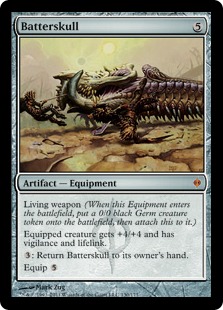
BatterskullI blaze out the gate with Delver and Nacatl, never even seeing a Blood Moon. My opponent spends his time ramping. At 8 life he resolves Inferno Titan, which I deal with in the messiest way possible---I Grow Delver past the 187 damage, and double-Bolt the Titan. My opponent's out of cards at this point, and I have Delver and Nacatl on the table. But he rips another Titan off the top, and I'm also out of cards. This titan kills Delver, and then Nacatl when it attacks next turn. I drew and resolved a Goyf in the meantime, but I'm no match for a Batterskull off the top that joins in on the assault.

Sideboarding:
-2 Hooting Mandrills
-1 Snapcaster Mage
-2 Lightning Helix
-2 Spell Pierce

+3 Huntmaster of the Fells
+2 Destructive Revelry
+2 Pyroclasm

Game 2
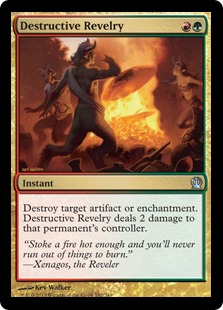
Destructive REvelryMy opponent mulls to six, and I keep a Moon-proof hand of Temple Garden, Forest, Tarmogoyf, Nacatl, Bolt, Revelry, and Growth, and lead with Temple Garden, Wild Nacatl. In these scenarios, I like to save basics in my hand, baiting opponents into uselessly allocating time and resources into early Blood Moons. It's also important to lead with Garden here so that Growth saves Nacatl from Lightning Bolt.

My opponent leads with Utopia Sprawl, and sure enough, casts Moon on turn two. I swing with Nacatl and Tarmogoyf, and use the red from Temple Garden to Revelry his Sprawl before combat damage. He plays an Arbor Elf and passes without making a third land drop. I swing for five with Bolt in hand, and when my opponent doesn't block, burn him out with the instant in post-combat main.

Sideboarding:
-1 Snapcaster Mage
-1 Spell Snare

+2 Isochron Scepter

On the draw, I'm expecting even faster Moons. Isochron Scepter lets me cast Bolt and Path under the enchantment, and I've realized at this point my opponent probably doesn't have Goyfs for my Snare to eat. Snapcaster is a little slow for this matchup, and uncastable without an Island under Moon.

Game 3
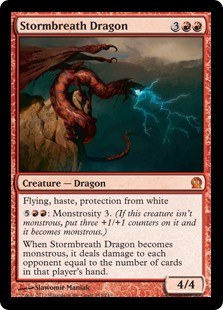
Stormbreath DragonMy opponent quickly resolves two Blood Moons, and I kick myself for not casting Serum Visions when I had the chance. I'm without blue with two Visions and a pair of Paths in hand, and even Scepter and Huntmaster are no match for a flock of Stormbreath Dragons. I ran a Stormbreath in the side of my Temur Traverse decks for the reason that some decks, including Abzan Company and Hatebears, simply can't remove it and lose to it very soon after it resolves. Counter-Cat is one of those decks.

I don't think there's much I could have done differently during my games in this match to improve my chances at victory. Ponza decks have always been a struggle for Counter-Cat, and Living End is by far the worst combo matchup for that reason. That said, I think I could have sideboarded much better. I had the ill fortune of facing this opponent again in the Top 8, where I lost my second match of the day; my sideboarding errors became more obvious after that round.

Round 4: Naya Zoo (2-0, win roll)

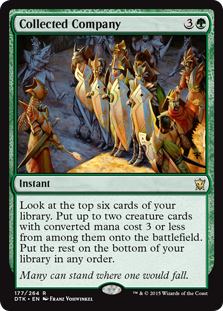
I know this player is on Nacatl, Knight of the Reliquary, and Tarmogoyf, but am unsure if he sleeved up Collected Company or not. Either way, I feel very comfortable going into this match, as I'm essentially playing a version of his deck with more Paths via Snapcaster Mage, and a set of Mutagenic Growths to deal with Bolts and win in combat.

Game 1
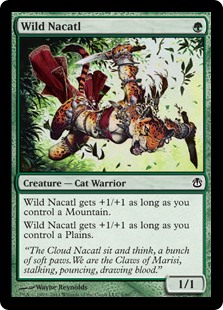
Wild NacatlMy deck gives me a great hand of two Nacatls, Bolt, Visions, Growth, Steam Vents, and Arid Mesa. I lead with Temple Garden into Wild Nacatl, and my opponent responds with his own Wild Nacatl. We briefly discuss the merits of his English Cats versus my objectively stronger German ones, but as they say, talk is cheap.

I play the Vents to Bolt his cat, attack for three, and play a second Nacatl. My opponent also plays a second Nacatl. I attack with both of mine, and he tries to trade one; Mutagenic Growth wins that fight, and a third Nacatl I drew comes down after I Serum Visions. Like clockwork, my opponent resolves another Nacatl as well, and a Voice of Resurgence. I draw a scried-top Bolt for his new Cat, attack my opponent to one, and get a concession.

Sideboarding:
-1 Remand
-2 Spell Pierce
-2 Serum Visions
-3 Gitaxian Probe

+3 Huntmaster of the Fells
+2 Isochron Scepter
+1 Lightning Helix
+2 Pyroclasm

Game 2

I open two Bolts, Isochron Scepter, a pair of lands, and a Delver. My opponent leads with Nacatl, which I Bolt. He follows up with a tapped land and a Noble Hierarch. I slam the Scepter and imprint Lightning Bolt. He responds with a Loxodon Smiter. I untap, make a land drop, cast Delver, and pass. My opponent taps out to Bonfire of the Damned the Delver for 1, and I Grow it in response. Then, Delver chumps Smiter, and Scepter finishes the elephant off. I untap and zap the Hierarch with Scepter before passing, and the game continues in this fashion for a few turns, with me killing creatures when they show up and shooting my opponent when they don't.

Eventually, I miss a turn of casting Bolt off my Scepter to resolve Huntmaster of the Fells on an otherwise empty board. My opponent is out of cards at this point and also resolves a Huntmaster. The second Huntmaster is always the worst one, since the first one's transform trigger will resolve first (APNAP) and kill the other one. That's exactly what happens, and Ravager of the Fells teams up with Scepter to quickly take my opponent to zero. I end the game with Nacatl, Growth, Path, and another Scepter in hand.
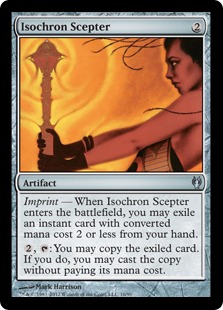
Isochron ScepterZoo is a fine example of a matchup that Scepter will single-handedly take over post-board. My opponent conceded that he boarded out his Pridemages for Game 2, but either way, Pridemage only provides players with two or three answers in their deck. We also have enough mana in this matchup that Scepter can come down later and immediately activate.

It's rare that I board out Serum Visions, but against Zoo, all I really want is creatures and removal spells. I would have kept Pierce if I'd expected CoCo, but I guessed (correctly) after Game 1 that my opponent wasn't playing it.

Round 5: Abzan (Intentional Draw)

I know my opponent's on Abzan, so when he offers me the draw, I take it. I'd rather try my luck against the eternally annoying Lingering Souls in Top 8 than before. If I'd been paired with anyone else, though, I would have played, to ensure I had the play in each round of Top 8. Little do I know that drawing here will screw me in the Top 8 regardless. I should maybe pay closer attention to the standings sheet next time.

Top 8, Round 1: GR Ponza (1-2, lose roll)

This guy again? Just my luck! We're pretty jovial, which makes for some really fun games, and end up playing a bit longer after we finish the round. After some readers misunderstood me last week as saying Counter-Cat had no bad matchups (it does, if few among Modern's current Top 10), it's fitting I get stomped twice at my first event with the deck in forever by one such matchup.

Game 1
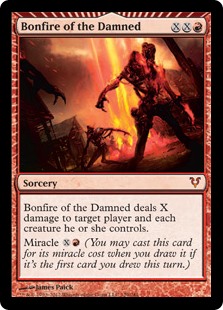
bonfire of the damnedMy opponent keeps a very slow hand with no acceleration, but reveals Bonfire for its miracle cost and kills my Delver. I have three Goyfs, and they eventually meet a speed bump in Thrun, the Last Troll. My opponent tries to Beast Within one Goyf, but I Leak it to get in a little extra damage and put him at 3. My opponent reveals another miracle Bonfire and taps out to deal five to all my creatures, kill the Goyf armada, and put me at 8. Thrun takes me down to 4, but I draw a Snapcaster Mage to flashback Bolt.

Sideboarding:
-2 Hooting Mandrills
-2 Snapcaster Mage
-2 Lightning Helix
-3 Serum Visions

+3 Huntmaster of the Fells
+2 Isochron Scepter
+2 Destructive Revelry
+2 Pyroclasm

I try a new sideboard plan for this round, dumping the Serum Visions I can rarely cast under Moon. I prefer Probes in this matchup because they tell me whether I can afford to tap lands for more threats or whether I need to hold up Remand mana to deal with something like Inferno Titan.

Game 2

Mutagenic Growth saves Delver from a turn-three Bonfire for two, and I plant Leak on a Scepter after seeing Inferno Titan in my opponent's land-light hand. He manages to draw lands for the rest of the game, though, and eventually resolves the Titan anyway. I Grow Delver again to save him from the Titan, and attack my opponent down to 3. He swings with the Titan and kills the Delver, and I draw a bunch of lands and die to the Titan in a couple attacks.

Even though I wished those lands were Serum Visions this game, I decide to keep my new plan intact for Game 3 and see how it performs.

Game 3
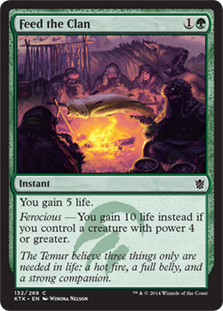
Feed the ClanI attack my opponent down to 8 before he casts Thrun and double Feed the Clan. My opponent has enough time after that to draw Stormbreath Dragon and pummel me in the air.

I did lots of testing with my partner last year with GRx Moon variants and Counter-Cat, and she found the deck to be quite resilient against speedy Moons if it could get a Forest on the table. Unfortunately, this was no ordinary GRx Moon deck. I was utterly unprepared for a stream of Stormbreath Dragons and Inferno Titans, and my opponent even boarded out his Moons in our second match, leaving me wishing I'd left my Helixes and Visions in after all. I don't think it's worth crafting a thorough board plan for these kinds of fringe decks. So much of the deck creation process and boarding decisions are up to my opponent that I have no idea what to watch out for.

To Be Cat-inued....

My biggest regret from the tournament was not having the opportunity to play more matches. Sure, I could have played instead of drawn in Round 5, but it just didn't make a lot of sense from a competitive standpoint to risk my chances at making Top 8. I had a great time for my first real tournament with the deck in a year, and can't wait to bring Counter-Cat to other events in the future. And who knows---some may even have Burn pilots!


 

Deck Overview- Azorius Taking Turns

Are you a Quiet Speculation member?

If not, now is a perfect time to join up! Our powerful tools, breaking-news analysis, and exclusive Discord channel will make sure you stay up to date and ahead of the curve.

We've seen monoblue Taking Turns see periodic success in Modern, though it has never held a significant share of the metagame. While perusing decklists, I happened upon an Azorius version that looked interesting. Perhaps it was the Narset Transcendent that got me excited, or maybe it was that the deck was piloted to a 5-0 finish in a Modern league by Reiderrabbit, or as you might know him, Reid Duke.

Taking Turns by Reid Duke

Creatures

1 Snapcaster Mage

Spells

1 Narset Transcendent
4 Ancestral Vision
4 Serum Visions
4 Temporal Mastery
1 Temporal Trespass
4 Time Warp
2 Timely Reinforcements
1 Walk the Aeons
2 Cryptic Command
1 Gigadrowse
2 Path to Exile
4 Remand
4 Dictate of Kruphix
1 Talisman of Progress

Lands

3 Celestial Colonnade
4 Flooded Strand
2 Hallowed Fountain
6 Island
1 Mikokoro, Center of the Sea
2 Misty Rainforest
1 Plains
2 Polluted Delta
1 Prairie Stream
2 Scalding Tarn

Sideboard

2 Path to Exile
2 Timely Reinforcements
1 Celestial Purge
2 Dispel
1 Gideon Jura
2 Jace, Vryn's Prodigy
3 Stony Silence
2 Supreme Verdict

Path to Exile is a nice speed bump for aggressive decks, and Timely Reinforcements is kind of a three mana Time Walk against non-Infect aggressive decks. The Paths matter a lot against Infect though, and that is the one thing that gives this deck game in that matchup, where the monoblue version would usually just get rolled. Ancestral Vision helps ensure that the deck will be able to continue taking extra turns ones it starts, though it doesn't really help you get there. It's a nice boon for consistency, though I'm slightly skeptical. It might just be correct though.

Seeing Reid posting a result like this so close to a weekend with two Modern GPs makes you wonder if we'll be seeing this deck this weekend. Pros are often tight-lipped with technology and you wouldn't expect something like this to occur, though one way or the other Reid did 5-0 the league.

Dictate of Kruphix is only about a buck right now, which makes it a reasonable pickup. I recommended picking up Time Warps when they were closer to $10, and they've seen some slight growth since then. I like the card just as a long term hold due to casual appeal, and a good GP showing could lead to significant growth.

There was an error retrieving a chart for Time Warp

High Stakes MTGO – May 8th to May 14th

Are you a Quiet Speculation member?

If not, now is a perfect time to join up! Our powerful tools, breaking-news analysis, and exclusive Discord channel will make sure you stay up to date and ahead of the curve.

Welcome back for another High Stakes MTGO article!

I haven't been as productive in speculations as I wanted this past week. Nonetheless a few of my positions reached my target selling price and it always feels good to sell a profitable position at the time and price you originally intended. In the meantime I also did something every speculator has to do from time to time---cutting losses.

This week there were more cards on my list of positions to acquire that I didn't get to. Sometimes it's difficult to find the right price given my limited time available for MTGO specs. So I did what I do whenever my time is limited---I bought the most expensive of my targets to invest quickly in the largest number of tix.

The percentage return may not be as big when the time comes to sell, but ultimately I expect to generate more tix from a larger position. Concretely, doubling up on a 100-tix position is not as good as making 30% on a 400-tix position. Especially when the 100-tix position involves 50 copies of a card and the 400-tix position involves 20 copies of a card---what this really means is making more tix in less time.

With a bankroll as large as this one and not all the time in the world to do what I would like, I'm often confronted with this kind of choices. I regularly pass on potential specs because it would take too much time (or too many copies of a card) to build up a 300-tix position.

Here the latest snapshot of the account.

Buys This Week

SSV

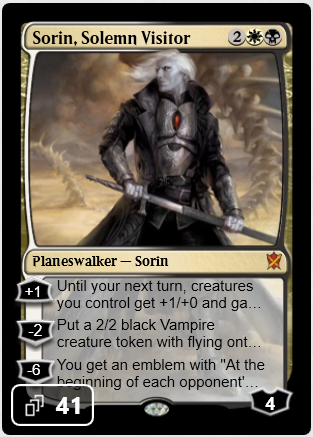
As a spec, this Khans of Tarkir version of Sorin touches on at least two categories---KTK set redemption and Modern. Approaching the Standard rotation last March, Sorin, Solemn Visitor found a floor at 3 tix and quickly rebounded to 6 tix a few weeks later. During Shadows over Innistrad release events Sorin dropped a bit back to 4 tix. This second discount was the opportunity for me to invest in the current top KTK mythic.

Sorin, Solemn Visitor saw some play in Modern last year in B/W Token and Junk decks. These decks are not heavily played currently but with Modern it's only a matter of time before good decks make an appearance once again. Hopefully the combined effect of redemption plus Modern will push Sorin, Solemn Visitor closer to 10 tix.

CB

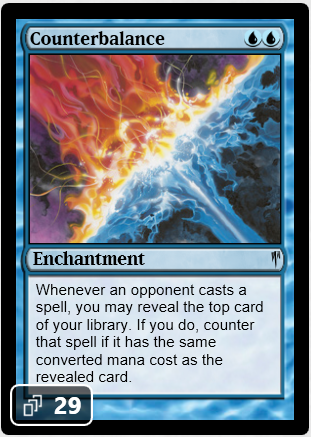
As long as Sensei's Divining Top is legal in Legacy, Counterbalance should see a constant demand. Back to its long-time floor of 8-9 tix in the wake of Coldsnap flashback drafts, this blue enchantment felt like a natural bet. With a record high just below 25 tix and regular price cycles, I'm guessing it won't take long for Counterbalance to rise again, provided Eternal Masters doesn't mess things up here.

Sales This Week

Judging by the current Standard metagame, the blue dragons' era may have come to an end. Both Dragonlord Ojutai and Dragonlord Silumgar were supposed to be short-term bets. Ojutai, which I certainly may have bought too high, never got back to the 25 tix I was hoping for. Silumgar, on the other hand, performed exactly as I was hoping with a nice comeback to its previous record high around 10 tix.

With only one more set to come before the dragonlords rotate out of Standard, it was time to let Ojutai go with some losses and to sell Silumgar with a nice profit and no regrets.

Another quick and successful spec resulting from the Year of Modern Flashback Drafts. Graveyard- and dredge-based strategies seem to be finding favorable winds in the current Modern metagame. Golgari Grave-Troll, Bloodghast, Vengevine and several others have recently risen appreciably. I sold my trolls as they were approaching the 10-12 tix range which almost corresponds to the record high Golgari Grave-Troll topped since it got unbanned in Modern.

A few more copies sold in the painland department. Black and white are still a strong color combination in the current Standard metagame which nicely maintains the price of Caves of Koilos in the 2.5-3 tix range. At this rate Caves of Koilos will become my largest successful spec for a single, with an estimated profit slightly over 1,000 tix.

In the eight months I have held the blue command the spec never really panned out, and although the price had some fluctuations it never went over 10 tix. I was expecting much more from Cryptic Command and now that Lorwyn flashback drafts are only few weeks away I don't see any upsides in the short term. I'd rather sell now than wait for the inevitable temporary plunge in price.

A return to 24-25 tix is the best scenario I could reasonably wish for when I bought my copies of Arid Mesa. This is exactly what happened last week. The decision to sell was therefore very easy. +50% is really what I'm targeting with my Zendikar fetchland specs so I'm totally satisfied with +62% in this case.

On My Radar

As of Saturday 14th I haven't bought any Time Spiral block cards that are currently flashback-drafted. As it happened before I may have been late to the party on these ones but even after the absolute bottom is missed prices might still be interesting. If I get into any Time Spiral or Planar Chaos positions it will definitely be this week.

Another group of cards I have been paying attention to lately are the "misses" from Battle for Zendikar and Oath of the Gatewatch. These cards may not be included in any relevant Standard decks at the moment but nonetheless have potential. Now that the Standard format rotates twice a year that's twice as many opportunities as before for cards to shine.

Red is not a top color these days and I wonder how many red cards are currently undervalued. I'm also considering increasing my positions on BFZ lands, as several of them got even cheaper than they were when I bought them initially. Specs on lands very rarely disappoint so I should accumulate more copies.

Drana, Liberator of Malakir is another example of card that hasn't seen the light of day despite strong potential and I'm likely to add a few playsets to my existing stock.


Thank you for reading,

Sylvain

Insider: Modern Growth Specs

Are you a Quiet Speculation member?

If not, now is a perfect time to join up! Our powerful tools, breaking-news analysis, and exclusive Discord channel will make sure you stay up to date and ahead of the curve.

There has been a lot of excitement around Modern this week, with a weekend of multiple Grand Prix set to define the metagame after the unbanning of Ancestral Vision and Sword of the Meek. Remember that Splinter Twin and Summer Bloom were banned immediately prior to the Eldrazi invasion. Modern is very much a new and unexplored place, with ample space for new decks to flourish and develop into format-defining fixtures of the metagame.

I’ve been watching metagame trends and the market and have identified some cards that I believe are poised for growth. These cards are included in decks that are establishing themselves as key players in the new Modern world, so these cards have a bright future ahead of them.

Through the Breach

There was an error retrieving a chart for Through the Breach

Through the Breach has taken the spotlight as one of the hottest cards in Modern, primarily being used with Primeval Titan.

Not only does Through the Breach shave a mana off the cost, it lets Primeval Titan attack immediately to get two more free lands. In most practical scenarios this combination wins the game, so it’s a bonafide two-card combo and one of Modern’s scariest new elements. Through the Breach is also great with Emrakul, the Aeons Torn, and some of these decks include that along with Nahiri, the Harbinger.

There are also blue-based versions of Through the Breach that play many copies of Emrakul, the Aeons Torn and try to operate something like a Splinter Twin combo deck. Finally, Through the Breach can also be found alongside Griselbrand in decks with Goryo's Vengeance.

Valakut, the Molten Pinnacle

There was an error retrieving a chart for Valakut, the Molten Pinnacle

Valakut, the Molten Pinnacle is the real workhorse behind the success of Primeval Titan and Scapeshift decks. The price of the card doubled earlier this year, but at under $8 this Zendikar rare seems like a bargain compared to $85 fetchlands in the same set. Its price on Magic Online has more than tripled in May, now to an all-time high over 2 tix.

It was widely distributed as an online promo card, so the price increase is a testament to a large increase in demand, which will be mirrored in paper as players begin to adopt these decks. There is a paper foil Launch Party printing currently under $10 that adds to the total number of these in circulation, but it’s a small number relative to the current player base.

Emrakul, the Aeons Torn

There was an error retrieving a chart for Emrakul, the Aeons Torn

The rise of Nahiri, the Harbinger in Modern has shaken up the format. It’s being included everywhere, and in all of these places along comes a copy of Emrakul, the Aeons Torn as the single-best creature in the format to find with Nahiri's ultimate.

Emrakul, the Aeons Torn may just be a one-of, but Nahiri, the Harbinger making its way into the format's top decks means a lot of decks playing that one-of---a huge increase in demand for a card that was nothing more than a niche player outside the mainstream.

The online price grew by 33% this week, up to almost 9 tix. The paper price has been sitting steadily under $30 for months, but it has seen growth of about 8% in the last month. I expect that pace to accelerate as it sees increased play.

Supreme Verdict

There was an error retrieving a chart for Supreme Verdict

Supreme Verdict was tailor-made as an eternal-format card with its “can’t be countered” clause. It immediately found a home in Legacy, and while it has seen Modern too, it has been a minor factor as UWx control hasn’t been a permanent fixture in the metagame. The unbanning of Ancestral Vision was a boon to control, and Nahiri, the Harbinger has brought about a resurgence in Jeskai Control specifically.

Supreme Verdict has a place in these decks, if not now, then in the future, so it’s poised to see a real increase in demand. The paper price has been slowly rising all year, up from an all-time low under $3 at the end of December, to $6.5 today. That is the highest the price has been since the card was in Standard, and if this pace continues, it will break $10 this year.

Abrupt Decay

There was an error retrieving a chart for Abrupt Decay

Abrupt Decay has always been talked about as a future $20 card, and that time is finally here. It peaked over $17 last summer, but it’s down under $13 now.

The Eldrazi pushed Abrupt Decay out of the metagame temporarily. Now a return to a more classic Modern metagame with traditional aggressive decks means Abrupt Decay is once again excellent, and players are back to playing three or four copies. I expect the price will do nothing but rise from here on until a possible reprint in a future Modern Masters set.

Vendilion Clique

There was an error retrieving a chart for Vendilion Clique

Ancestral Vision bringing back classic blue decks means a return of Vendilion Clique. This card has long been a tool of blue decks for fighting against combo decks and control mirrors, and that describes much of the Modern metagame. Vendilion Clique is specifically included in Jeskai Nahiri, which is going to be a big deck this weekend and in the future of Modern, so I like its chances for growth.

Daybreak Coronet

There was an error retrieving a chart for Daybreak Coronet

When Cedric Phillips won a MTGO Modern PTQ with G/W Hexproof a couple of weeks ago, he told the world. It may have been news to some, but any experienced Modern player is acutely aware of the beatings the deck is capable of delivering with the right draw. The deck is straightforward and powerful, and it’s well-positioned against a field of Lightning Bolt.

I expect the deck to do well this weekend and develop into a more permanent fixture of the metagame, so I like picking up staples. Daybreak Coronet was over $33 before being reprinted in Modern Masters 2015, and the new version is now available for $6. The price isn’t going to break $30 again, but it certainly has a lot of room to grow.

~

I selected this batch of cards because they are very solid staple cards with wide applications. They are in position to see modest continuous growth as players begin to adopt the decks that include them.

Decks that perform well at this weekend's Grand Prix will be widely publicized and copied, so they will play some part in defining the Modern metagame going forward. Big finishes this weekend for any of these cards could certainly cause a price spike, and assuming they are currently undervalued, a new price point.

Insider: What SCG Indy Taught Us About Modern

Are you a Quiet Speculation member?

If not, now is a perfect time to join up! Our powerful tools, breaking-news analysis, and exclusive Discord channel will make sure you stay up to date and ahead of the curve.

The metagame transition from SCG Milwaukee to SCG Indianapolis has been insane. After a dominant performance by Abzan Company in Milwaukee, the deck failed to make the second day of competition in any capacity in Indianapolis. Additionally, after Joe Lossett proved that Tron was alive and well in Milwaukee, Tron went on to be the most represented deck in day two of Indy!

No doubt the anti-Company technology didn't fare well against the dreaded Tron. And while all that was happening, Nahiri Control had a dominant breakout weekend in the hands of Pete Ingram. It was a pretty good weekend for yours truly as well, but let's discuss this one thing at a time.

Why Tron Is Succeeding

The Eye of Ugin ban didn't have a non-zero impact on Tron, though it's important to remember that some great cards have been printed for the Tron deck recently.

Eye into Emrakul was lights out against control decks, though just putting Ulamog, the Ceaseless Hunger on the stack can be game over in those matchups anyway. World Breaker's cast trigger is a huge problem as well. The consistency over the course of a long game has been damaged, though the power level has been increased significantly.

Linear decks and Abzan Company were the level one metagame after the Eye of Ugin ban, and with these decks seeing success many players picked up Jund to check the creature decks. The more midrange the format gets, the easier the road is for Tron.

Every article about Modern Jund makes Tron just a little bit better of a deck choice. Tron won't go anywhere, and I think 1.5 copies in a given Top 8 is a good line given the deck's metagame position. Once the Tron player gets in the Jund bracket they are home free.

Currently I think that Ugin, the Spirit Dragon is poised to start increasing in value. The card saw $40 heights when 4x Ugin decks were successful in Standard, and now the card has leveled off at about $20. It's a casual/Commander all-star, and I like buying Ugins at $20.

There was an error retrieving a chart for Ugin, the Spirit Dragon

Why Abzan Company Is Failing

Abzan Company is on the slow side, though it's a great deck for sculpting gameplans and beating linear decks. Collected Company has a reasonable amount of variance, though Chord of Calling is what you need every time. If your opponent is just great at killing creatures though, it's very difficult to sculpt a gaemplan with Abzan Company, as Chord of Calling is ineffective without creatures to convoke.

As long as Jund and blue-based control decks are popular, I don't think we'll see a Top 8 very similar to Milwaukee's. I'd say that Indy is more the norm and that Milwaukee was the fluke.

The Power of Nahiri

Shaun McLaren is a hard dude to get a read on. When I saw that he was streaming with Nahiri and Emrakul in Modern I didn't know if this was actual testing or something akin to his Séance stream. As I watched him win a bunch of games, it became clear that Nahiri was a totally reasonable card to put in your Modern deck.

There was an error retrieving a chart for Nahiri, the Harbinger

Pete Ingram's run in Indy was nothing short of dominant, though it's important to remember that there were other players on the deck in the event who fared poorly. I do think that the deck is great, but I don't think it has what it takes to dominate Modern.

Nahiri offers a great way to close games for Jeskai, but the power level and timing simply aren't as powerful as Splinter Twin once was. Jeskai decks are going to be very difficult to grind out playing an honest game of Magic, though the deck can still get Tronned out and struggle in other ways.

With a huge Nahiri and Celestial Colonnade spike, I think it's a horrendous time to buy into Jeskai, though the deck is great and something that should be a strong consideration for competitive players. I just don't believe it's open-and-shut the best deck. Luckily we'll be getting plenty of data this weekend to find out how great these decks really are and what players are doing to combat them.

Valakut

There are a lot of ways to Valakut right now. There's Gruul or Temur Scapeshift, there's Nahiri Titan lists, and then there's Matthias Hunt's Gruul Titan Breach deck. Matthias has put a lot of thought into this deck, and while he didn't make day two in Indy, Daniel Hendrickson made Top 4 with his list.

I've talked to Matthias at length about this list, and I like a lot of what is going on there. He tried Nahiri, and while it is a strong card you really just end up being a bad Nahiri deck relative to Jeskai and a slow Valakut deck relative to the other options. Matthias's list doesn't have the play that something like Temur Scapeshift does, though it does have extremely high win percentages and inevitability in its good matchups.

Max McVety (Invitational champion), Andrew Elenbogen (Grand Prix Top 8 competitor), and Matthis (Rookie of the Year) all came up significantly short in Indy with the deck, though Daniel Hendrickson, a young man who I once watched try to special order gumbo, put up a very impressive finish. The deck is great in the right field, and the most important thing is to dodge the Infect matchup, which Andrew lost to twice in a row to fall out of Top 8 contention on Day 2.

Through the Breach is an interesting target, as it is quite difficult to reprint as an arcane spell and also sees fringe Legacy play. But the slam dunk from these decks is the namesake card. We just left Zendikar, so I don't expect to see a Valakut, the Molten Pinnacle reprint any time soon. There are a lot of copies around in the $6 range, though as we see more 4x Valakut decks show up I could see these disappearing before too long.

There was an error retrieving a chart for Valakut, the Molten Pinnacle

Dat Delver Deck, Doe

Fifth place in a 650+ person tournament is not a bad finish, especially when you're the only person playing your deck. I've been playing close to the same Delver deck for a long time, and if you read my articles there wasn't much that could be deemed surprising in my list. The only change from my most recent tournament report was removing the second Kolaghan's Command for a maindeck Pillar of Flame.

Grixis Delver's metagame position is basically next-level Jund. The deck is flush with interactive spells to beat up on linear decks, and then utilizes Snapcaster Mage to go over the top of Jund decks. Delver of Secrets is pretty bad in Modern, though it enables you to race when you can't meaningfully interact forever against decks like Tron.

It's not difficult to see how the deck beats linear decks, and if you need any evidence on how the deck dispatches Jund then I suggest this match for your viewing pleasure.

Grixis Delver and Nahiri Jeskai occupy similar metagame spaces. Given the current configurations, when you compare my list to Ingram's I'd say that he's favored heads up, while my deck is better in matches where you want to close quickly such as Tron.

I believe that there's a configuration of my list that can be build to make this matchup favorable with a few minor tweaks. The current issue is that Nahiri and Celestial Colonnade require very different answers. It's for this reason that I believe Dreadbore is a poor tool against Jeskai, as it's extremely narrow and not a guarantee even for its one job.

The overlap of Grixis and Jeskai, and the single card that makes the decks as powerful as they are, is Snapcaster Mage. There were only two Snapcaster Mage decks in the Indianapolis Top 8, and I expect this number to be below average as players figure out how to build them. Ol' Snappy was once an $80 card, and if it has the kind of weekend I expect then $50 is going to seem cheap before long.

There was an error retrieving a chart for Snapcaster Mage

~

I think that Modern is in a pretty great place right now. They sky was falling previously with Abzan Company and it's falling now with Nahiri, but I don't think either deck presents something that the format can't adapt to. There are a lot of forces acting to keep the metagame diverse, and plenty of pressure on the sideboards for the more controlling decks to keep them from dominating.

Without a Modern Pro Tour, it will be interesting to see how the market behaves, though things like a double GP weekend are certainly going to drive market movements. Keeping an ear close to the ground this weekend will be wise.

Thanks for reading.

-Ryan Overturf
@RyanOverdrive on Twitter

Recapping the SCG Indianapolis Metagame

Are you a Quiet Speculation member?

If not, now is a perfect time to join up! Our powerful tools, breaking-news analysis, and exclusive Discord channel will make sure you stay up to date and ahead of the curve.

Two weeks ago I called Abzan Company one of the top decks of the format. Last weekend, in Indianapolis, Abzan Company failed to even crack the Top 32. Instead, the top tables were overrun with copies of Infect and R/G (Tron and Valakut), while Jeskai Control took home the trophy. Today, we’ll analyze the results of the Star City Games Indianapolis Open, looking at archetype performance and digging deeper into specific lists for technology and information. Let’s get to it!

Nahiri-the-Harbringer-cropped

The Top 8

SCG Indianapolis’ Top 8 contained seven different archetypes, grouped into roughly five categories. In order of finish, we have:

  1. Jeskai Control
  2. Infect
  3. RG Valakut
  4. Infect
  5. Grixis Delver
  6. RG Tron
  7. Jund
  8. WR Control

While distinct differences exist between RG Valakut and RG Tron, they can both be classified under the umbrella of “ramp combo.” The same can be said for Jeskai Control and WR Control. Thus, another way of looking at these results are as follows:

  • Control: 2
  • Ramp combo: 2
  • Linear aggro/combo: 2
  • Tempo/aggro: 1
  • Midrange: 1

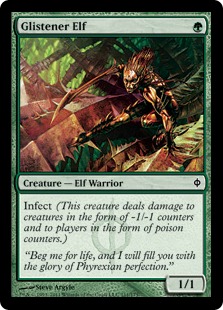
Glistener ElfAt a macro level, we can infer a few things about the state of Modern from this information. First, linear aggro is successfully being pushed out of the metagame. Affinity only managed to sneak one copy into the Top 32, and decks like Zoo and Merfolk are nowhere to be found. In their place, the pendulum has shifted to focus on various fast, non-interactive combo decks as the new Level 0. Level 1 decks (archetypes that boast positive matchups against the expected Level 0) include control decks, or midrange/tempo decks with access to disruption and permission elements respectively.
Thus, we see fast combo decks like Infect and Tron gearing their sideboards to fight both Abzan Company and the (now defunct) old Level 0 of aggro decks like Zoo and Affinity. R/G Tron specifically is able to capitalize on a natural advantage against Abzan Company while tooling their maindecks and sideboards to fight linear aggro.

In response to this positional shift, control decks are finding success against this new influx of linear combo. Jeskai Control at an archetype level is an excellent choice against a combo/creature-heavy field, and less so against a field full of other control decks and grindy midrange archetypes like Jund and Abzan. While those decks exist and are putting up small numbers, an overwhelming majority of the format are either combo- or creature-based archetypes that Jeskai excels at defeating.

WR Control is basically a streamlined Jeskai deck that replaces the cantrips, Snapcaster Mages, and Celestial Colonnades with a maindeck playset of Blood Moon instead. With its natural predators (pure control and midrange) under-represented, we are seeing some significant success out of what is really a “metagame deck.”

Before moving on, let’s dive a little deeper into some specific lists to see what information we can glean from the results.

[wp_ad_camp_1]

Jeskai Control, by Peter Ingram (1st, SCG Indy)

Creatures

4 Snapcaster Mage
1 Emrakul, the Aeons Torn
1 Vendilion Clique

Instants

2 Cryptic Command
2 Electrolyze
4 Lightning Bolt
3 Lightning Helix
2 Mana Leak
4 Path to Exile
3 Remand
2 Spell Snare

Planeswalkers

4 Nahiri, the Harbinger

Sorceries

4 Serum Visions

Lands

2 Island
1 Mountain
1 Plains
1 Arid Mesa
4 Celestial Colonnade
1 Desolate Lighthouse
3 Flooded Strand
1 Glacial Fortress
1 Hallowed Fountain
1 Sacred Foundry
4 Scalding Tarn
2 Steam Vents
2 Sulfur Falls

Sideboard

1 Engineered Explosives
1 Stony Silence
1 Celestial Purge
1 Dispel
2 Negate
1 Wear // Tear
1 Vendilion Clique
2 Ancestral Vision
2 Anger of the Gods
2 Crumble to Dust
1 Timely Reinforcements

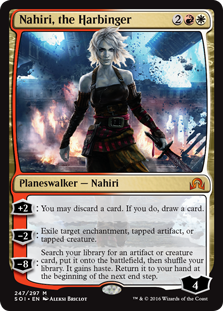
As always, we start with the champion list, this time Jeskai Control in the hands of Peter Ingram. The biggest piece of technology here is the full embrace of a playset of Nahiri, the Harbinger and a singleton Emrakul, the Aeons Torn. Where Jeskai Control decks of old were forced to take total control through over-the-top measures like Sphinx's Revelation or Gideon Jura, here Nahiri, the Harbinger has given the archetype a much cleaner path to victory. I will admit, I was initially pretty cool on Nahiri in Modern, but she has proved herself a capable inclusion in multiple archetypes and is directly responsible for the current success WR Control enjoys in the format.

1_nahiriNahiri, the Harbinger, while still a slightly clunky, expensive four-drop, nevertheless solves multiple problems for the control archetypes that are currently employing her. Reactive strategies in Modern face the awkward issue of employing high-impact, relatively narrow answers to powerful threats. Think Stony Silence against artifacts, Izzet Staticaster against X/1’s, and so on. A certain love-hate relationship exists with these spells, as their value can vary wildly from life-saving to life-taking based on various in-game conditions. Stony Silence does nothing against a triple Signal Pest draw, Izzet Staticaster is worthless against a unchecked Steel Overseer, etc.
In this context, Nahiri’s loot ability simultaneously helps her owner dig to specific answers while discarding under-performing spells and extra lands. Her +2 rewards the current high-impact, narrow-application style of Modern sideboarding, as well as working to overcome the inherent disadvantage control decks suffer with their comparatively high land count.

Her -2 is functional, and her ultimate wins games, but above all else is actually reachable. Unlike Liliana of the Veil (the other planeswalker that sees play in Modern), Nahiri, the Harbinger starts at 6 loyalty more often than not, and is threatening ultimate two turns later.

In a format that contains no Hero's Downfall type effect, opponents are forced to answer the Abrupt Decay-immune in-play Nahiri with either attacking creatures or damage-based removal. Her starting 6 loyalty requires two Lightning Bolts immediately to remove, and attacking with creatures against an archetype with eight one-drop removal spells and Snapcaster Mage is suspect at best. Ancestral VisionWhile her two active main abilities are functional, her best “ability” is the fact that her +2 is a +2, and not a +1. When paired with a high starting loyalty, Nahiri can even sit on board looting against a 4/5 Tarmogoyf for multiple turns with no protection.
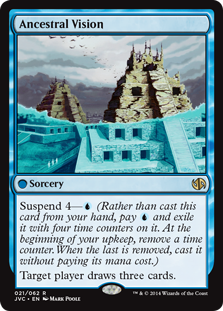
The rest of Ingram’s list is fairly standard, though we are starting to see a scale-back in Ancestral Vision, with no copies in the maindeck and only two in the sideboard. The format has proven itself to be quite capable of handling Ancestral Vision’s inclusion, with Remand, discard, and Chalice of the Void on 0 proving effective enough to keep it in check.

The card is still very strong, just not broken. Expect Ancestral Vision’s use to fluctuate based on metagame factors, but also specific archetype construction. Ingram has shown that you can build a blue-based control deck without Ancestral Vision. The same (currently) cannot be said for Snapcaster Mage or Serum Visions.

RG Valakut, by Daniel Hendrickson (3rd, SCG Indy)

Creatures

2 Oracle of Mul Daya
4 Primeval Titan
4 Sakura-Tribe Elder
2 Pia and Kiran Nalaar

Enchantments

4 Oath of Nissa

Instants

4 Lightning Bolt
3 Summoner's Pact
4 Through the Breach

Sorceries

4 Farseek
4 Search for Tomorrow

Lands

2 Forest
6 Mountain
3 Arid Mesa
2 Cinder Glade
4 Stomping Ground
4 Valakut, the Molten Pinnacle
4 Wooded Foothills

Sideboard

2 Grafdigger's Cage
1 Relic of Progenitus
3 Spellskite
3 Obstinate Baloth
1 Reclamation Sage
3 Anger of the Gods
2 Crumble to Dust

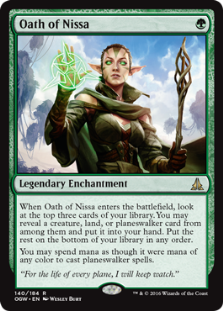
Daniel’s RG Valakut deck seems fairly standard for this archetype, which has been around for a couple months now to the point that we can no longer call it “new.” Rather than stretching to three colors to play Scapeshift with permission or colorless lands, the red-green version seeks to consistently and promptly deliver Primeval Titans to the battlefield.

Oath of NissaThe biggest piece of tech here is the use of Oath of Nissa as a green Ponder of sorts (not suggesting it is as strong as Ponder, so lower the pitchforks) to supplement the four Search for Tomorrows as turn-one plays. Search for Tomorrow allows for turn-three Through the Breach, and while Oath of Nissa doesn’t ramp us, it does allow us to find extra copies of Primeval Titan and Sakura-Tribe Elder.
I’ve had a fair amount of experience against this archetype playing both Grixis Control and Naya Blitz. The deck is consistent and fast, and even a hyper-aggressive deck like Naya Blitz has trouble killing fast enough in Game 1s. Postboard, Valakut has access to Obstinate Baloths and Anger of the Gods to make this matchup quite poor for aggressive decks, to the point where I believe it can devote more energy to focus on its relatively poor control matchup.

I’ve seen variations with Khalni Heart Expedition for explosive mana development, Kozilek’s Return for maindeck board control, and Scapeshift/Summoning Trap for extra threats.

Clearly the Scapeshift and Summoning Trap variants have better game against control decks, and should control decks start to adapt to this threat (or gain a larger market share of the metagame) I imagine this archetype will shift to favor that configuration. The maindeck is tight, however, and this change will probably result in the removal of Oath of Nissa again, though I’ve never seen Oracle of Mul Daya be anything close to resembling “good.”

Grixis Delver, by Ryan Overturf (5th, SCG Indy)

Creatures

1 Gurmag Angler
4 Delver of Secrets
4 Snapcaster Mage
3 Tasigur, the Golden Fang

Instants

1 Kolaghan's Command
4 Lightning Bolt
4 Mana Leak
2 Remand
4 Spell Snare
4 Terminate
4 Thought Scour

Sorceries

1 Pillar of Flame
4 Serum Visions

Lands

2 Island
1 Mountain
1 Swamp
1 Blood Crypt
3 Bloodstained Mire
4 Polluted Delta
4 Scalding Tarn
2 Steam Vents
2 Watery Grave

Sideboard

2 Engineered Explosives
3 Countersquall
1 Dispel
1 Go for the Throat
2 Magma Spray
2 Spell Pierce
4 Ancestral Vision

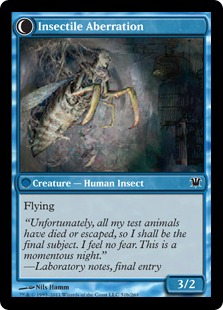
Could this be the beginning of a Grixis Delver revitalization? Ryan Overturf brought to Indy, in my opinion, the best deck for the field. Correctly anticipating a field full of control, combo, and Infect, Ryan capitalized on the lack of Abzan Company, Affinity and Burn with his choice of Grixis Delver.Insectile Aberration Delver of Secrets (along with four delve creatures) puts a quick clock on opponents, and when backed up with permission can be absolutely deadly against an unprepared opponent. Speaking of unprepared opponents, talk about a field ripe for the picking. RG Valakut decks with four Lightning Bolt as interaction? No Scapeshift or blue to defend their bombs? Overturf got mileage out of his playset of Mana Leak over the course of the weekend for sure.
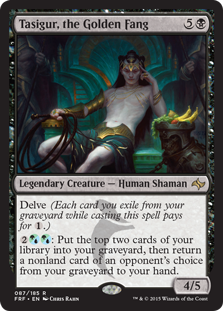
Infect is a relatively simple matchup as well, as Grixis Delver’s inherent self-damage is free against the archetype. With enough removal and permission to go toe-to-toe with Infect’s tricks, the matchup is solid for an experienced opponent. Jeskai Control, on the other hand, can be a difficult matchup, as their 4x Path to Exile and Lightning Bolt make it difficult to present a strong attack. Still, should Abzan Company, Burn and Affinity remain pushed out of the metagame, Grixis Delver will continue to put up strong results.

Quick Hits

  • A few weeks ago, Remand was excellent against half the metagame (Ancestral Vision, combo archetypes) and atrocious against the rest (linear aggressive decks). Currently, combo has risen and aggressive decks have fallen in popularity, to the point where Remand is possibly at the same relative position it was before, despite all these changes.
  • TasigurHard counters are definitely better. I'm back to playing a Deprive in my Grixis Control maindeck. Mana Leak is a solid enough answer to Living End, Primeval Titan and the like, but the card Scapeshift is seeing increased play in dedicated Scapeshift archetypes and RG flavors as well.
  • Kalitas, Traitor of Ghet is slipping, and Tasigur, the Golden Fang's stock is rising. Maindeck lifelink is an excellent thing, and Kalitas does strong incidental work against Kitchen Finks, Voice of Resurgence---the whole Abzan Company deck, really. But Tasigur, the Golden Fang's ability to come down fast and hit hard, with minimal mana investment that allows for counterspell interaction, cannot be understated in a combo-focused metagame.
  • Where is Thopter-Sword? Affinity has fallen off the map, and it's just a matter of time before players start trimming their sideboard Ancient Grudge and Stony Silence in favor of silver bullets for other matchups. So far, the most impressive Thopter-Sword deck I've seen has been UW Gifts, and that archetype has a million options available to it that I know will make tuning a worthwhile endeavor.

Conclusion

This week, we saw the field adjust to the strength of Abzan Company, shifting solidly to a new form defined by fast combo and reactive decks. Where the Eldrazi metagame of old favored aggressive, linear strategies, this new Modern has proven to be quite hostile to traditional combat-focused strategies. In their place, combo decks like Tron, Affinity, and to a lesser extent Ad Nauseum and Living End, have risen to replace them.

Tron is experiencing a strong resurgence, and its re-entry into the format will bring with it some interesting consequences. Abzan Company will clearly diminish in popularity, and midrange/control strategies like Jund and Jeskai will be forced to make some adaptions to deal with this matchup, weakening their positions elsewhere.

Where the format moves from here is too early to tell, but it will be interesting to see whether the combo decks or the control decks come out on top of this developing tug-of-war. Thanks for reading, and I’ll see you next week!

Trevor Holmes

The_Architect on MTGO

Twitch.tv/Architect_Gaming

Twitter.com/7he4rchitect

Insider: Three Traits of Cards that Impact Modern

Are you a Quiet Speculation member?

If not, now is a perfect time to join up! Our powerful tools, breaking-news analysis, and exclusive Discord channel will make sure you stay up to date and ahead of the curve.

Why is Nahiri, the Harbinger good in Modern? This is the question I’ve been pondering this week.

Obviously she is good if she can win a Star City Games Open like in Indy this past weekend. Not only that, but she was included in a completely different deck that made Top 8 as well! If you look to the Top 32 decklists for observations about the format, in addition to an extremely diverse field of decks, you will find her in a third archetype as well.

There was an error retrieving a chart for Nahiri, the Harbinger

When a card slips into three distinct strategies in Modern, we know it's powerful. The question of why has been burning through my mind.

Let’s set out to explore this question. Today we will look at why Standard cards impact the Modern format and suggest a few pick-ups.

Three Traits of Modern Playables

Starting off with the why of the matter, I broke it down into three traits you can look for in a Modern playable. These will help us understand the case of Nahiri specifically, but can also be used to identify potential Modern-playable cards in future sets.

Mana Cost

One of the most important aspects of a card is converted mana cost. We can’t generalize by saying only cheap cards will see play because huge spells have a place in Modern due to things like Tron and Scapeshift. Most of the time however, the cap for spells in Modern is four mana.

An exception to this rule are cards that let you cheat on mana cost. What we want to think about are cards that can be played in the first four turns of the game. Cards like Treasure Cruise or Eye of Ugin were banned because they enabled more expensive plays in early turns. Nahiri does fit the bill of cheap enough, but by itself I didn’t think that would be enough for her to impact an older format like Modern.

A good example of a legal card that lets you cheat on mana right now is Kozilek's Return. We know that Pyroclasm is an efficient way to deal with the small creature decks. Adding an additional mana to an already established card seems like sealing it out from playability. But once you factor in the free five-damage sweeper that triggers from doing things the deck wants to be doing anyway, it’s easy to see why this Standard card has broken into Modern.

There was an error retrieving a chart for Kozilek's Return

All of the aggressive Eldrazi are another great example. We’ve seen how much damage Thought-Knot Seer and Reality Smasher can do in Modern, but they’re not done yet. We still have Eldrazi Temple to help us cheat out our Eldrazi Mimic on turn one, and our Matter Reshaper, Wasteland Strangler or Eldrazi Displacer on turn two.

We’ve even seen a couple different versions of Eldrazi popping up since the ban. Most players have been working on B/W "Eldrazi and Taxes," but some have opted for a bigger strategy with Endless One and World Breaker. Then this past weekend, Bant Eldrazi made some waves in the meta. These are all made possible because their printed mana cost isn’t the amount paid most of the time.

Nahiri also has elements of this. If you ever do manage to ultimate her, she also lets you cheat on mana. In the Jeskai Control deck this translates to a four-mana Emrakul, the Aeons Torn!

Unique or Proven Effect

Cards obviously must have a high level of potency to impact an eternal format like Modern. Discerning which cards meet this criterion has a lot to do with identifying similarities with current staples.

If you want to know whether a one-mana creature is worthy of an older format, it will have a lot of competition with cards like Wild Nacatl, Goblin Guide and Death's Shadow. A four-mana planeswalker, on the other hand, has much less competition. Nahiri is really only competing with Ajani Vengeant, and maybe Elspeth, Knight-Errant, for a slot.

Most of the time you will be looking for one of two properties. A new Modern playable should either provide a unique effect or duplicate another powerful effect to create redundancy.

Identifying similar cards to replicate a desired effect is typically the easier of the two for determining playability. This concept can be seen with cards like Atarka's Command, Harbinger of the Tides, or even Pia and Kiran Nalaar.

These three cards are similar to others that already see steady play in the format. Burn decks love an upgrade to Skullcrack, Merfolk gets another bear with a relevant ability, and Lingering Souls is great so a creature version should be great as well. Jace, Vryn's Prodigy mimics old standby Snapcaster Mage. You could even highlight Anafenza, Kin-Tree Spirit here as well because of her ability to simulate the effect of Melira, Sylvok Outcast.

There was an error retrieving a chart for Anafenza, Kin-Tree Spirit

The other trait we should be looking for is a unique effect. This is one of the key pieces to the Nahiri puzzle that I was missing. The Boros planeswalker provides a difficult-to-answer win condition for any deck because of the strength of the creatures it can get with the ultimate. While keeping your planeswalker in play for three turns can be a challenging proposition, in a control deck that goal can be feasibly reached the majority of the time.

Kalitas, Traitor of Ghet is a good example of this. In addition to providing lifelink and value in a top-end finisher, Kalitas doubles as graveyard hate. His exile effect is highly relevant and hard to find, so any deck interested in it only has so many options to choose from.

Another card that shines some light on this point is the Birthing Pod replacement in Collected Company. Now we are all familiar with this card’s greatness, but that was not always the case. This green instant hasn’t proven itself as a card worthy of aggressive strategies because other cards achieve that goal more consistently, but as a semi-tutor for creature combo pieces, it stands above the rest.

Finally, one card that hasn’t received a lot of attention is Bring to Light. Although this tutor is five mana and requires many colors of mana, the effect it provides is unrivaled. It may cost five to cast, but casting the spell you’re searching for without an additional cost is absurdly powerful in a format with such a large card pool like Modern.

Versatility

You may think that Kolaghan's Command should be spoken of for its unique effect, but I think it fits better in a discussion of versatility.

This multicolored instant provides so many options. It can be a removal spell, a Raise Dead, a Shatter or a discard spell. Any one of those would be great but with this spell we always get two. Against Affinity you get to destroy two permanents and against most other decks you get two cards to their one in a variety of other ways. We know this card is good because of the sheer amount of options it provides.

Nahiri can be cast in this role as well. Yes, she has the right mana cost and power level, while providing a unique effect as a win condition, but her flexibility is what pushes her to the next level. She's card selection, Disenchant, creature removal and win condition all in one.

Investment Opportunities

Any of the cards discussed above are great long-term investments. No matter what type of player you are, holding these cards if you have them or searching them out before they’re out of print will always be a good strategy.

If you only play one archetype, determine which of these cards could be useful and track down your copies. If you’re like me though, you just want all the Modern playables you can hold onto. Whether you get copies so you have access to the cards you need for the right deck or you just want cards that will raise in value, this list is a great way to invest your money.

Here are all of the cards that were discussed in one organized space:

Already-Established Cards

White

Blue

Black

Red

Green

Multicolored

Colorless

If Nahiri is going to become a format staple as it seems right now, then we should be thinking about how the format will adjust. Furthermore, if Nahiri really is that good, then it is likely we will eventually have more planeswalkers seeing Modern camera time.

We need answers to these permanents. Luckily, ways to deal with these card types outside of aggressively attacking already exist. We don’t give enough credit to the versatility offered to us by this group of cards. Take a look.

Terminate already sees a lot of play. Dreadbore is just a sorcery version of the same card except that it deals with Nahiri or Liliana of the Veil, as well as any other planeswalkers that pop up. Both of the three-mana cards could see play as well, but adding a mana is a pretty big deal in Modern.

I think Dreadbore is bound for the limelight and I put my money where my mouth is on this one. Bought and paid for. I’d get in now if I were you too.

There was an error retrieving a chart for Dreadbore

Up next we have some cards that have seen fringe play but are still worth your attention.

Slight Play with Potential

White

Blue

Black

Red

Green

Multicolored

Land

The cards on this list seem like they have potential. Cards like Prized Amalgam and Thalia's Lieutenant have already seen modest amounts of play. What’s holding these cards back is proven success. A big finish for any of these potential candidates could bump the price right away.

Some of these cards, like Inverter of Truth, haven’t seen play yet but seem built for older formats. Others, like Startled Awake, I’ve already seen in play at the SCG Invitational. These inexpensive cards are ones I would be looking for in trades rather than purchasing outright because there is a bit more uncertainty than with the previous list.

Not Quite Good Enough

Last up we have a handful of cards that I don’t think will make it in Modern. These cards seem good enough on the surface but don’t quite pan out.

Thing in the Ice isn’t worth your time in my opinion because there are too many answers to punish your investment---foremost on the list Path to Exile. The same goes for Westvale Abbey.

Originally I thought Dragonlord Atarka might be worth playing but then I realized it’s just a worse version of Bogardan Hellkite.

Finally, when Shadows over Innistrad was released I tested a lot with the new dual lands. Theoretically, with all of the shocklands they should work well in the format, but the drawback of coming into play tapped sometimes isn’t worth the risk. Even if you lose less life, these lands aren’t worth the tempo loss to include them.

~

That's all the info I have for you today. Identifying potential Modern breakouts can make you a lot of money, and picking these up is usually relatively easy because players will trade their Standard cards more easily than Modern-only staples.

Nahiri is great and so are many other cards that can be ported from Standard to Modern. Use these skills in the future when analyzing new cards. You never know, maybe you will be the person who breaks a new card first.

Until next time,
Unleash the Force!

Mike Lanigan
MtgJedi on Twitter

Respecting Other Players

Are you a Quiet Speculation member?

If not, now is a perfect time to join up! Our powerful tools, breaking-news analysis, and exclusive Discord channel will make sure you stay up to date and ahead of the curve.

No, this isn't about Steve Rubin's blog post. It was a fine post, but person to person interactions based on events are of a less severe nature than today's topic. I'm talking about the Women in Magic Panel. I'm talking about Athena's vlog inspired by that panel and the aftermath. It's 2016, and there is no excuse to be ignorant about the inequalities that our world is flush with, and as informed members of society it is our duty to stand with the marginalized.

A common reply to these discussions has been to say that women should just ignore negativity on this topic. As somebody who has been around on the internet for a while and who has recently gotten a huge boost of exposure, I can say that yes, this is a good rule for an individual. If you post something stupid about Ryan Overturf online, I can shrug it off because you're a coward who wouldn't say it to my face and who likely has few enviable traits. That's not the issue when we're talking about negativity expressed towards a group. To act as if the two things are comparable is absurd. People might recognize me and not like me. That's cool, and there's nothing I could do to make everybody like me as a person, writer, or commentator. People frequently treat women and other marginalized groups negatively without knowing anything about them. That's not cool. There is nothing that they can do as a person to overcome this type of negativity. You can't prescribe personal solutions to societal problems.

Watch the panel. Listen to the women you know. Actually listen. Sexism, racism, and many other kinds of intolerance are very much alive. Offering half-assed workarounds and ignoring these problems only perpetuates them. Listen. Call people out when you see intolerant behavior. Call people out when they act as if their mega-busty angel playmat is worthy of anything but being tossed into a dumpster and/or set on fire. Don't ask women players about their significant other in contexts in which you wouldn't ask men about theirs. Empathize.

Magic players are largely no strangers to being bullied. As such, it doesn't make a lick of sense to see members of this community enforcing otherness. You and I have our own issues that we wish others would respect, and the best way to get this result is to start by being respectful of others.

#mtgforall

Avatar photo

Ryan Overturf

Ryan has been playing Magic since Legions and playing competitively since Lorwyn. While he fancies himself a Legacy specialist, you'll always find him with strong opinions on every constructed format.

View More By Ryan Overturf

Posted in Free6 Comments on Respecting Other Players

Have you joined the Quiet Speculation Discord?

If you haven't, you're leaving value on the table! Join our community of experts, enthusiasts, entertainers, and educators and enjoy exclusive podcasts, questions asked and answered, trades, sales, and everything else Discord has to offer.

Want to create content with Quiet Speculation?

All you need to succeed is a passion for Magic: The Gathering, and the ability to write coherently. Share your knowledge of MTG and how you leverage it to win games, get value from your cards – or even turn a profit.

Metagame Guide to May’s Grand Prix Weekend

Are you a Quiet Speculation member?

If not, now is a perfect time to join up! Our powerful tools, breaking-news analysis, and exclusive Discord channel will make sure you stay up to date and ahead of the curve.

So. Much. Modern. I can barely update the Top Decks spreadsheet fast enough to keep pace! Since May 1st, we've had two Star City Games Opens, over 55 events from the SCG States and Provincial Championships, another batch of 50+ events from TCGplayer's State circuit, and dozens of online and paper tournaments in between. The April metagame update looked healthier than ever, and we still haven't reached the crowning glory of this Modern May-hem: Grand Prix Modern Weekend. Today, we're breaking down the format on the eve of the Grand Prix showdown so you know what you need to beat, what you need to play, and what to expect at the coast-to-coast Modern extravaganza.

Grand-Prix-Weekend-Logo-cropped

Leading into this weekend, you read a lot of unwarranted hyperbole about Modern. Blue-based control was dead. RG Tron was dead. Abzan Company was unbeatable. Ancestral Vision would render Jund unplayable. Sword of the Meek would invalidate aggro. Almost without fail, all of these overstated and groundless predictions turned out to be wrong. You only need to look at the SCG Indianapolis Top 32 to see just how off-base most Modern pundits were, let alone the April 8 - May 1 metagame breakdown. Instead of succumbing to the popularized panic that so often characterizes Modern articles, we're going to break down the data from over 200 events and almost 2,000 individual decks to equip you for your Grand Prix exploits. Championing my Ad Nauseam in battle? Trying out Nahiri Jeskai Control? Figuring out your Jund sideboard? Sitting at your chair and watching the spectacle on Twitch? No matter how you're enjoying the weekend, today's article will prepare you for what is to come.

[wp_ad_camp_1]

Pre-Grand Prix Tierings

I love the iconic Modern Nexus metagame breakdown as much as the next Nexite, but we have a different order of business today than in our normal updates. Our job is not to describe the international metagame to gauge format health, determine a deck's average positioning, and track changes from one month to the next. Our task today is to see exactly what Modern looks like before the dual Grand Prix and translate that into specific takeaways for choosing a deck, anticipating matchups, and adjusting maindeck and sideboard slots.

To fulfill our pre-Grand Prix mandate, we'll still unpack our Top Decks dataset to identify Modern's three tiers, but we'll analyze them to pinpoint specific Grand Prix marching orders. Should you play Deck A? Should you swap Card X for Card Y? Should you expect Deck B and ignore Deck C? These are the kinds of questions we'll aim to answer today. For each tier, I'll list out the decks in that segment and then give some overall takeaways across the different strategies.

In describing Modern's Tier 1, 2, and 3 decks, we'll draw on the recently updated Top Decks spreadsheet with its over 170 paper events (comprising about 1,300 decks) and 34 tournaments from Magic: The Gathering Online (spanning north of 350 lists). We'll join our paper and MTGO data with Day 2 breakdowns from both SCG Milwaukee and SCG Indianapolis, along with the Top 16 results from both major tournaments. Our Top decks page explains the math and statistical methods we use to combine all those numbers into actual tierings, as well as the weighted and adjusted "Overall Metagame %" shares.

Current Tier 1 strategies: decks to beat

Thinking about the Grand Prix, Tier 1 decks are the strategies you should expect to play against at least once over the course of Days 1 and 2. You might not play against all of these decks over the course of the tournament, but you are all but guaranteed to play against at least half of them. That's doubly true if you hit Top 8, where you should expect at least 50% of the Top 8 to consist of Tier 1 decks. You'll need both specific sideboard cards for these matchups, as well as a clear understanding of your deck's role and play in each of the Tier 1 matchups. Haven't decided on a deck yet? Any of the Tier 1 contenders are good options.

Tier 1: 4/8/16 - 5/16/16

DeckOverall
Meta %
Paper %MTGO %Major Event
Day 2 %
Jund8.7%9.0%6.1%10.3%
Burn6.2%6.6%5.6%6.2%
Infect6.1%5.7%5.3%7.4%
RG Tron6.0%4.3%3.9%9.7%
Affinity4.6%5.8%5.6%2.2%
Jeskai Control4.5%5.0%3.6%4.4%
Scapeshift4.4%3.2%3.6%6.3%
Abzan Company4.1%6.0%1.4%3.9%

Our April breakdown tackled the Tier 1 strategies deck by deck, and that's roughly the same approach we'll lean on today. This will give you a sense of which Tier 1 decks have better positioning than others and how you want to build your deck to prepare for Tier 1 contenders.

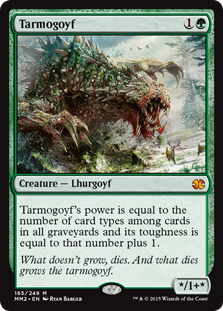
  • TarmogoyfJund (8.7%) is the safest interactive bet
    The BGx mainstay sticks around at the top yet again! If you aren't sure what to play and want to go interactive, it doesn't get more reliable than Jund. In even the toughest matchups, you can leverage the powerful BGx core (and your tailored sideboard bullets) to eke out small margins. In the average matchup, you're the 53% favorite, to quote Brian Bruan-Duin. As for your good matchups and when mopping up Modern's sub-Tier 2 fringe, you have at least a 60-40 edge across the field. Not playing Jund? Make sure you can kill or race Tarmogoyf, and make sure your synergies aren't shredded by efficient disruption.
  • SkullcrackIf in doubt, Burn (6.2%) 'em
    If Jund is the safest interactive choice for the Grand Prix, Burn is the safest overall. It's fast and linear: whether you're facing Tier 1 Nahiri or a Tier 3 Tooth and Nail, "Bolt the face" tends to remain the gameplan. It's consistent, which means you're less likely to stumble on bad draws and more likely to deliver over 15 rounds. If you have no idea what to play, Burn is forgiving and, although hard to master, easy to learn. Sure, you'll sometimes lose to Kitchen Finks, but your opponent just needs to flub one draw step for you to win.

All that said, Burn does not have the best positioning among top-tier aggro (people expect it and the Jeskai uptick hurts), but it's still a great choice if you're lost. If you need to beat Burn, either win on turn three or try to maindeck some form of lifegain like Finks, Lightning Helix, Huntmaster of the Fells, or Kalitas, Traitor of Ghet.

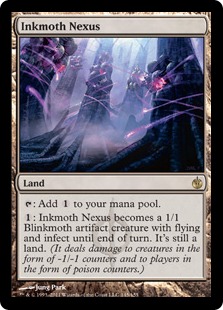
  • Inkmoth NexusRoll the dice on Infect (6.1%)
    Grishoalbrand is wallowing in Tier 3 misery. Most Burn and Zoo decks are geared towards turn four instead of turn three, and Affinity has the worst positioning in years. This leaves Infect as the fastest top-tier strategy still standing. Because the Grand Prix are going to be so diverse, Infect is poised to sneak wins while everyone else is worrying about assembling Urzatron, grinding the mid-game, or sending Wild Nacatls into the red zone a turn too slow. Unfortunately, traditional UG Infect struggles against both Abzan Company's toolbox and Jund's, Burn's, and Jeskai's removal: I'd gamble on Phyrexian Crusader and a BG Infect list like Alex Zurawski's. When beating Infect, remember to combine removal with clocks unless you want Infect to topdeck a win from nowhere.
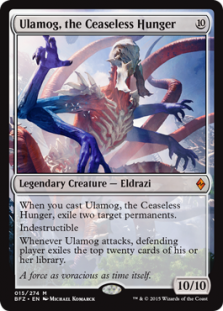
  • Ulamog the ceaseless hungerRespect RG Tron (6%)
    Hopefully, none of our readers run in the "Tron is dead" crowd. We've buried that myth every week since SCG Milwaukee and the Grand Prix shouldn't overturn that trend. There's a chance Moderners still buy this fantasy and yet again forget Crumble to Dusts and Fulminator Mages, but it's unlikely. We saw a similar narrative last year, with Tron rising before Charlotte 2015 and big-mana busters fighting back at the Grand Prix itself. Expect Ulamong and friends to perform, but also expect players to be ready. Tron players: you'll have fewer freebies but will still prey on lingering doubters. Tron haters: don't be a dupe and do include your 3-4 Tron countermeasures, especially if you're on the Jeskai hype train.
  • Arcbound RavagerAffinity (4.6%) is not where you want to be
    Between spot removal, sweepers, Company and Chord toolboxes, and extensive artifact hate, Affinity is in a bad place. Jeskai Control hitting Tier 1 is a real disaster for the deck. Kiki Chord's and Abzan Company's rise also stings. To make matters worse, the Grand Prix aren't far enough from Milwaukee and Indianapolis that players are likely to have simply forgotten Affinity in a few days. Unless you're a Frank Karsten master of Affinity, stay away. People will start forgoing Ancient Grudges and Stony Silences soon enough, but it's unlikely to happen this Saturday. Affinity opponents: don't be afraid to tweak an anti-Affinity slot or two.
  • 1_nahiri#Hype. #Nahiri. #JeskaiControl (4.5%)
    Love her or hate her, Nahiri, the Harbinger heralds a new era of blue-based control. Her flavorful combo with Emrakul, the Aeons Torn gives control a proactive and imminent win condition, and although she's no Splinter Twin, the planeswalker definitely fills a critical archetype gap. It's a testament to Nahiri's power that Peter Ingram's SCG Indianapolis-winning list is basically 2014 Jeskai Control plus five cards.

The #Nahiri hype is massive (#CleganeBowl-massive <-- VERY NSFW) and this is going to translate to lots of Jeskai during the Grand Prix. Even if you think the deck is bad (results suggest the opposite), you must still respect the #Hype and still prepare for #Nahiri. After all, if you can stop Nahiri herself, whether via Maelstrom Pulse or Pithing Needle, you just need to beat boring old Jeskai.

  • ScapeshiftUnder the radar with Scapeshift (4.4%)
    To be clear, this decktype includes blue-based Temur and Bring to Light variants, not the RG Primeval Titan builds we see under "Titan Shift" in Tier 2. This confusion underscores Scapeshift's positioning in Modern. It's got solid Tier 1 stats going into the Grand Prix, even jumping .6% since May 1, and yet most people don't have it in their sights. Of the eight Tier 1 strategies, it's the one most would consider as Tier 2, or confuse it with the higher-profile, worse-finishing Titan Shift. Scapeshift pilots can abuse this by pairing a Scapeshift combo finish with Cryptic Command and Snapcaster Mage control. Scapeshift opponents can prepare with ample hand disruption, a fast clock, or pressure paired with modest disruption.
  • collected companyAbzan Company (4.1%): viable but overblown
    As I wrote about in my April update, it was the "right time" and "right place" for Abzan Company, but I did not expect its reign to last. Most Modern commentators reactively pegged it as the deck to beat, an unwarranted characterization that has fallen flat since. Abzan Company exploited metagame holes and those holes have largely closed, especially with Tron's continued presence.

That said, Company's SCG Indianapolis performance surely under-represents its true viability, so don't ditch or ignore Team Melira just because it sent zero pilots to Indy's Day 2. I rank this as a decent choice going into the Grand Prix, but not the format king many inaccurately identified. Don't overprepare with Grafdigger's Cages. Your Anger of the Gods will be enough.

I wouldn't get into this level of detail for most Grand Prix, but given the evolving nature of the post-April 4 Modern and the dual, coast-to-coast tournaments, there's a lot at stake for the format and format specialists. This Tier 1 breakdown won't necessarily point you to or away from one deck (unless that deck is Affinity), but it will give you all the context you need to have the best shot possible at navigating the weekend metagame.

Current Tier 2 strategies: decks to play

In our normal metagame updates, Tier 2 decks are the strategies you might encounter at a given event and those you should enjoy success with. This is also true during Grand Prix weekend, but I want to take that a step further in both directions. On the expectation front, you should not Eye of Uginnecessarily expect to play against all of these strategies, although I would still devise a plan for beating them. You'll also still want to know how they win and what cards they play so you aren't caught off-guard by a Kiki Chord trick or the RG Eldrazi pilot who missed the Eye of Ugin memo. On the playability front, don't think of these as fringe alternatives to the Tier 1 options. Rather, consider these as serious under-the-radar contenders which have a shot at Top 8 glory.
People are not expecting these decks and won't prepare for them. This makes many Tier 2 decks excellent choices for the Grand Prix. In fact, and you can quote me on this, I'd go so far as to say some Tier 2 choices are actually better-positioned than Tier 1 staples going into the weekend.

Tier 2: 4/8/16 - 5/16/16

DeckOverall
Meta %
Paper %MTGO %Major Event
Day 2 %
Gruul Zoo4.3%3.4%7.8%2.5%
Death and Taxes3.1%1.8%5.9%2.6%
Kiki Chord3.0%2.8%2.2%3.7%
Abzan2.8%2.8%1.1%4.0%
Merfolk2.8%4.3%0.8%2.5%
Titan Shift2.7%2.1%2.0%4.1%
Elves2.7%2.2%1.7%4.0%
Grixis Control/Midrange2.5%3.1%2.2%1.8%
Ad Nauseam2.5%2.6%3.9%1.1%
Eldrazi2.4%1.2%1.7%4.4%

Repeat: if you know how to play a few of these decks, play one at the Grand Prix. Most people are going to have Tier 1 strategies in their mind when they select their 75. For those who know a certain Tier 2 deck inside and out, the metagame has already proven your strategy exceeds a playability baseline. It will just be up to you to wield it in on the Grand Prix floor.

Instead of taking Tier 2 one deck at a time, I'm going to highlight three strategies I have my eye on for the weekend.

  • Kiki JikiKiki Chord (3%)
    Remember the Nahiri, the Harbinger and Abzan Company hype in Tier 1? Kiki Chord combines elements of both into a potentially breakout competitor at the Grand Prix. Lists like Nicholas Davis' 10th place build at Indianapolis highlight this potent strategic mix. The Hoogland specialty combines midrange Pia and Kiran Nalaar/Restoration Angel value and a Kiki-Jiki, Mirror Breaker combo kill (now from multiple angles courtesy of Nahiri), all built around a Chord of Calling toolbox. Kiki Chord's metagame share hasn't changed much since May 1, but its Indianapolis finishes and Nahiri-centric hype make it a solid pick for Grand Prix weekend.
  • Primeval titanTitan Shift (2.7%)
    Despite only a modest uptick in the standings (+.5% since May 1), Titan Shift has been getting a lot of attention on stream, in articles, and across the Modern community. Daniel Hendrickson took a Through the Breach-powered variant to 3rd place at SCG Indy, with Adam Liu going 11th at the earlier SCG Milwaukee on the Scapeshift version. Between online buzz, these discrete Top 16 finishes, the deck's upward metagame trend, and its punchy mix of linearity and interaction, Titan Shift has the trappings of a breakout Tier 2 contender at Charlotte and Los Angeles.
  • Ad NauseamAd Nauseam (2.5%)
    I'm not just highlighting Ad Nauseam because I have my Spoils of the Vault 75 sleeved up on my desk at all times. Rather, I legitimately believe Modern's last "true" combo deck is an excellent choice for the weekend.

One of Ad Nauseam's biggest strengths is instant-speed timing. Many Modern opponents are committing to turn 4-5 bombs like Nahiri, Titan, Company, Scapeshift, etc. Ad Nauseam and Angel's Grace in response seals the game quickly. Moreover, many of those same decks are preoccupied with spot removal and sweepers, with hard countermagic few and far between. The combo strategy blanks most removal and can play through countermagic off its huge mana reserves, which means opponents can't even safely wait to deploy threats with counter backup. Added bonus: Grace and Phyrexian Unlife are spectacular against most aggressive strategies. Darien Elderfield lived the Ad Nauseam dream at Charlotte 2015, so here's hoping for an encore a year later.

That's not to say these are the only Tier 2 options or even the best. Elves, for example, combines elements of Infect's turn three win, Abzan Company's board-restocking and flexibility, and Gruul Zoo's and Affinity's aggressive width. Elves veterans can leverage this to have a good Day 1 and Day 2 at Los Angeles and Charlotte.

When considering other Tier 2 decks, make sure you aren't playing a worse version of a Tier 1 strategy. If you have any doubts, go with the Tier 1 option instead. For instance, Grixis and Eldrazi do have legitimate strengths and unique characteristics over Jeskai and Tron respectively, but the overall metagame context is more favorable to the latter than the former. Unless you're planning to pull a Chapin or a Thompson, stick with the Tier 1 fallbacks in these cases.

Current Tier 3 strategies: decks to avoid or abuse

Repeat after me: "I will not audible to a Tier 3 deck." In fact, you will also not even play a Tier 3 deck unless you have extensive experience with it going into the Grand Prix. Sorry. Starting to put in your Storm or Goblins reps today is not going to cut it. On the plus side, all of these decks Vengevinearen't just under the radar like Tier 2. They are off the map entirely, so if you know your Tier 3 strategy, you can steal serious percentage points just from opponents having no clue how to beat you. Or going on tilt when they lose to you in Game 1.
On the minus side (the stronger side of the equation), there are metagame conditions which prevent these decks from reaching Tier 1 or Tier 2 status. Stated another way, these might just be bad decks. If you play a Tier 3 deck, you are basically gambling that your experience with the deck is enough to outweigh its internal and contextual weaknesses. I won't judge you if you're claiming to be the world's foremost Dredgevine or RW Lockdown expert, but make sure you can back up your claim with actual experience. And even then, some of these decks might just be bad...

Tier 3: 4/8/16 - 5/16/16

DeckOverall
Meta %
Paper %MTGO %Major Event
Day 2 %
Bogles1.4%1.9%1.7%0.7%
Living End1.3%1.6%0.8%1.4%
Temur Midrange1.1%0.6%2.0%1.1%
Naya Company1.1%1.6%1.1%0.4%
UW Tron1.0%1.1%1.7%0.4%
Griselbrand1.0%0.4%1.4%1.5%
Suicide Zoo1.0%0.7%2.2%0.4%
Grixis Delver1.0%0.7%1.4%1.1%
Storm0.9%1.1%0.3%1.1%
Goblins0.9%0.4%2.2%0.4%
Hatebears0.8%0.4%0.3%1.5%
Lantern Control0.8%0.8%1.4%0.4%
Mono Blue Tron0.6%0.4%1.7%0.0%
Summoning Trap0.6%0.7%1.4%0.0%
Dredgevine0.6%0.3%1.7%0.0%
RW Lockdown0.4%0.1%0.3%0.8%
Tooth and Nail0.4%0.3%1.1%0.0%

See your list on that table? Time to ask yourself if you think you're a real prodigy on the list because if the answer is "no," keep Mr. Goblin Electromancer at home. Tier 3 lists are much more viable at the local level, where you can dodge bad matchups over five rounds and write off an 0-4 Friday Night Magic as bad luck. You don't get that luxury over the Grand Prix weekend, which makes Tier 3 candidates much less attractive.

Goblin ElectromancerTo be very clear, this is not a knock against unfair, linear, non-interactive decks. There's a myth in Modern that such "inconsistent" decks are bad choices for long tournaments, but that neither plays out mathematically or in practice. It's also not a jab at fringe decks: some Tier 2 mainstays started in Tier 3 before climbing the ranks. Rather, it's a strike against unfair, linear, non-interactive decks a) that are Tier 3 and b) in a Grand Prix setting. Want to play linear Infect this weekend? Go for it. Want to roll with UW Tron at your FNM? Be my guest. Thinking of bringing Storm, Temur Midrange, or Lantern Control to Charlotte or Los Angeles? I hope you got your reps in or you'll have a bumpy few hours on Day 1.

Tier 1 and Tier 2 decks, linear, unfair or otherwise, have a baseline metagame share to suggest they can execute their gameplans and win. Tier 3 decks do not meet this benchmark because there is a fundamental misalignment between their strategies and the current format context. Only play them if you know their ins and outs like Kibler knows his Wild Nacatls.

Charlotte, Los Angeles, Modern, and You

As a data-driven Modern player, one of my hardest challenges is using format-wide data to inform decisions for specific events. One moment, you've put in some reps, crunched the matchups and shares in Excel, and picked the perfect deck. The next moment, you're down a game in round three after going 0-2 to your two worst matchups. That's Modern for you, but more importantly, that's Magic and that's life. The key here is not to question your critical selection method just because you bombed out on a smart choice like Jeskai Control. Perhaps you should have audibled to Goblins and ignored the data, but it's much more likely you should have read the numbers differently, made small deckbuilding shifts, and adjusted your gameplay over those early rounds.

I'll be up and down from my computer all weekend, so as much as I'd love to live-Tweet the action, we'll have to save that coverage for another Grand Prix. That said, I'll be around Twitter and the comment sections as much as I can, so shoot me a note if you have any questions or want to talk Modern. Same thing goes for your preparations for the Grand Prix: if I didn't address a specific card or deck, come find me in the comments.

Thanks for reading and brace yourselves for one of the most epochal moments in Modern tournament history: the post-Twin, post-Eldrazi, post-Vision/Sword/#NahiriHypeIsReal Grand Prix Weekend. See you all after the dust has settled and enjoy the weekend show!

Announcement Day Overview

Are you a Quiet Speculation member?

If not, now is a perfect time to join up! Our powerful tools, breaking-news analysis, and exclusive Discord channel will make sure you stay up to date and ahead of the curve.

Hello everyone! Big news dropped from Wizards - dubbed "Announcement Day". I'm here to help everyone traverse everything that was announced and give some thoughts behind each of the individual announcements. There's a lot to cover, and plenty for players to be excited for!


CilfddcWwAA7oOh


There's a lot of product to digest and think about going forward. Each of these new and exciting products is a great boon to the game and part of an overall push to add exposure to the game. I'm all for knowing what's coming, and really appreciate WOTC's transparency here. Some of these products will entice some players more than others, though there's something for everyone. I'm here of course to help players make the best decisions they can in terms of keeping their hobby affordable and maximizing the value (and fun!) they can extract from the game we all love. Let's get started:


Kaladesh & Aether Revolt


Here's what we know from these two set reveals: Not a whole lot.

We assume that Kaladesh will revolving around artifacts and thopters, and is placed in a very "steampunk" setting. This is gathering from the imagery (The Art Book was also revealed) and the story behind the Planeswalker Chandra and various cards from Magic Origins: Pia and Kiran Nalaar, Thopter Spy Network, and Thopter Engineer to name a few. They all seem to fit right in and this is consistent to what we've seen from the new planeswalker reveal: Saheeli Rai.

We are still left wanting though - What exactly will we see other than Artifacts? How will they play a roll? We're left with more questions than answers. That was likely the point of the reveal (and reveals before that) and assuredly we'll know more soon enough. One huge positive to take away is "aether" won't have that pesky spelling it had before - so that's a plus.

Of course, set reveals can't be set reveals without some sort of market movement these days. I wanted to highlight what not to do when a set is revealed and we know virtually nothing of the set.

There was an error retrieving a chart for Steamflogger Boss

I just can't get behind actual speculation like this. We have no idea if contraptions will be part of Kaladesh, and even if they are we have no idea how viable they will be. Another thought that clearly has eluded these hopeful buyers is that Steamflogger Boss could actually be reprinted in the set. It's just an all around bad decision in my opinion - and not something I (and likely others) would recommend when trying to stay cost effective with our hobby. This is nothing more than burning a hole in our pockets and hoping there's some unfortunate, uninformed player out there that will buy these.

Unfortunately this is just something that happens with a regular frequency when it comes to new set reveals and a select few players getting ahead of themselves. Could it actually pan out? Who knows. In the meantime, it's still never a good idea to purchase anything based on pure baseless speculation.

Kaladesh and Aether Revolt are made for all players, and just another two set block in Magic's new set cadence.  Whether you like drafting, constructed, or playing casually there should be something new for you out of Kaladesh


Set Bundle and Planeswalker Deck


This announcement was actually really interesting. Let's talk about the "new" Fact Pack first. Apparently they're doing away with the "Fat Pack" nomenclature and renaming them "Set Bundle" so in this case we'll be starting off with the "Kaladesh Bundle".

Nothing really huge here other than a few key changes:

  • MSRP $42.99
  • 10 Booster Packs
  • Decorative Reusable Box
  • Player's Guide
  • Spindown Life counter
  • Rules reference card
  • 80 card Land-Pack

One key phrase here is "it's not our intent for beginners to buy the Bundle" (taken from "Ramp of Approval") but since they know many beginners will they wanted to include something that will help guide them into other avenues of the game. In this case "Magic Duels" with the Rules reference card.

These have been pretty popular historically, and it's unlikely that these changes will impact that. There's a lot here, but I don't know if the increased MSRP for essentially 1 extra pack is going to make players want this product more than they did before. Time will tell, but I wanted to at least highlight it.

The really great announcement here (I think anyway) is the Planeswalker Deck:

IrggBCBQsN


This is how these will work going forward: Each set will have Two Planeswalker Decks released alongside them. Each of them will be built around a different Planeswalker, and they will be relevant to that block (in this instance Kaladesh). These are essentially replacing "Intro Packs" in the future and I couldn't be happier for all players - especially beginners and casual players.

Here's the actual contents and information:

  • MSRP $14.99
  • One copy of a Mythic Rare Planeswalker
  • Two copies of a rare spell that has an effect and also tutors for the specific Planeswalker
  • Three copies of an uncommon that's enhanced by the Planeswalker being on the Battlefield
  • Four common cards flavored to the Planeswalker
  • Four copies of an appropriate common dual land
  • 2 Booster Packs

So, let’s talk about the obvious concern here first. These planeswalkers are constructed legal, and these Planeswalker Packs are the only way to acquire these specific planeswalker cards and the other cards in these decks. I’m going to be honest here - it’s a legitimate concern to have, but probably not one to worry about just yet.

Many will tout this as a ploy similar to other TCG’s like Yugioh/Pokemon and those people would have a point to some degree. At this juncture without seeing how these walkers will be constructed by R&D we shouldn’t start a community uproar just yet - what we do know is this bit of information as to the design:

“Ideas ran the gamut from three to zero. In the end, we decided that we wanted them to work like all the other planeswalkers, but that we would make sure to design them more with beginners in mind."

I will be the first to say that all that needs to happen is one of these planeswalkers to be viable and all bets are off. In the meantime I have faith in WotC to make these severely underpowered and truly make them for the audience they’re made for. I don’t want to sully a really good product line with skepticism right now, because this is a really good first step toward Magic: the Gathering appealing to more people.

Thinking beyond the product itself is seeing this as a very good stepping point to something bigger. Pushing the actual characters (planeswalkers) and appealing to a larger audience. Increasing the game’s exposure, and almost becoming more like an entity as Marvel in some sense. Increasing exposure of it's characters and letting players and non-players alike connect with the planeswalkers. Maybe this is how Magic makes it to the big screen - wouldn’t players (and non-players) be drawn to Magic’s multiverse and planeswalkers battling it out in theaters? Magic: Civil War - I can see it now.

That sounds really exciting it me, and maybe I’m drawing too many conclusions from a simple Planeswalker Pack, but my wishful thinking wants me to see past this and embrace a bigger picture here.

Either way, I love this product as a replacement for Intro Packs and at $14.99 it may be the same value as an Intro Pack, but it just feels a bit better to open an actual deck and planeswalker than some (most of the time) crummy Intro Pack rare and random cards. I think it has so much more appeal than before and super excited to see what these decks will actually contain!

If you want to read additional information fellow writer Ryan Overturf wrote about the Planeswalker Packs here.

Commander 2016

The Commander product has been really good since WotC started creating these box sets. I can't think of a year were these weren't good at the very least. Outside of the Mind Seize debacle (which they resolved) it seems this product gets increasingly better. There's always something for everyone who enjoys EDH/Commander. 4-Color legendary commanders is no exception, and is something that has been on many player's wishlists for quite some time.

56 new cards, probably some decent reprints and 4-color legendary commanders - what's not to love? Even I'm intrigued by this and each progressing year the EDH product pulls me in to want to actively play EDH more than ever before. I'm sure it has the same effect on players who normally don't play, or don't play as much. I have a good feeling about this product because like I said - it always delivers.

I think the key here is balancing what exactly will be reprinted, and the power level of the new cards. WOTC R&D has largely done an excellent job thus far.

There was an error retrieving a chart for Wurmcoil Engine

These are the types of reprints that are really effective when creating and releasing this product. While Wurmcoil Engine continues to be fairly expensive (even after a reprint) it fits the theme, and is a key reprint for other formats. Speaking of good reprints- maybe it's time to bring back some of the older Commander cards? Some of them are quite old in terms of today's market standard, and many of them can likely fit thematically and help out players when trying to acquire new cards along with their renewed interest. Kaalia of the Vast anyone?

Each of these will be MSRP: $34.99

Nissa vs Ob Nixilis - Planechase Anthology

DDR_Header


We round out Announcement Day with our Planeswalker Duel Deck: Nissa vs Ob Nixlis and Planechase Anthology. The Duel Decks are nothing new, but obviously there's some financial impact on Ob Nixilis, Reignited and Nissa, Voice of Zendikar. This is actually a really good reprint, and I'm totally fine with it. It fits with the schedule of releases, and Zendikar was our "first" 2 block cadence so it makes sense to use planeswalkers from that block.

The art looks to be fantastic for these promo cards, and I'm going to love to get my hands on some cheaper versions of the foil promo for my collection. Obviously Gideon, Ally of Zendikar would have been the better card to choose, but these are still really good. Depending on the cards in each of the decks, we usually have a well rounded value in these Duel Decks. MSRP: $19.99

~

Another Anthology to add to the product line, and I have to say I think it's a lot better than some people may give credit for. Some of the Planechase cards were only printed once, so it gives players a chance to grab these cards. In addition to that - I don't know the last time anyone cared to check, but the plane cards are actually quite expensive. It's just one of those random occurrences in the Magic market. If anyone really wants all of the Planechase singles and planes in one place, then an MSRP at $150 is probably a good enough price to purchase.

Well, that about wraps things up folks. I really am intrigued by Announcement Day, and some of these products are really sweet. I can't wait to see more, and I'm sure all of you are in the same boat. I also think looking at Announcement Day from a broader meta sense, can give us a better idea of where our game, and the Magic brand could be headed.

As always comments, questions, concerns are appreciated and feel free to comment below!

-Chaz @ChazVMTG

Insider: MTGO Market Report for May 18th, 2016

Are you a Quiet Speculation member?

If not, now is a perfect time to join up! Our powerful tools, breaking-news analysis, and exclusive Discord channel will make sure you stay up to date and ahead of the curve.

Welcome to the MTGO Market Report as compiled by Matthew Lewis. The report will cover a range of topics, including a summary of set prices and price changes for redeemable sets, a look at the major trends in various constructed formats, and a "Trade of the Week" section that highlights a particular speculative strategy with an example and accompanying explanation.

As always, speculators should take into account their own budget, risk tolerance and current portfolio before buying or selling any digital objects. Questions will be answered and can be sent via private message or posted in the article comments.

Redemption

Below are the total set prices for all redeemable sets on MTGO. All prices are current as of May 16th, 2016. The TCG Low and TCG Mid prices are the sum of each set’s individual card prices on TCG Player, either the low price or the mid price respectively. Note that sets of Theros (THS) are out of stock in the store, so this set is no longer redeemable.

All MTGO set prices this week are taken from Goatbot’s website, and all weekly changes are now calculated relative to Goatbot’s ‘Full Set’ prices from the previous week. All monthly changes are also relative to the previous month prices, taken from Goatbot’s website at that time. Occasionally ‘Full Set’ prices are not available, and so estimated set prices are used instead.

May16

Flashback Draft of the Week

This week Time Spiral block draft finishes up with the addition of a booster pack of Future Sight. Keep your eye out for the high-priced rares from this set, such as Tarmogoyf, Grove of the Burnwillows and Horizon Canopy. This is still a pre-mythic rare set which means rares are harder to come by than they are today. Time Spiral block was not the most popular draft format either, so I wouldn't anticipate substantial price dips on Future Sight singles.

A reminder for the players: the complete block draft format adds the powerful Virulent Sliver to the sliver tribe. A 1/1 for G isn't much to look at, but it only takes 10 hits from this card to kill an opponent with poison counters, so it's almost like a 2/1 for G, which is decent and playable depending on the draft format. The fact that it also gives other slivers the ability to deliver poison counters pushes this card over the top. It's also a common that will routinely go around the table if you are the only sliver drafter.

An interesting note on the sliver deck from Time Spiral block: that was the strategy that propelled Chris Lachman and Jacob van Lunen to victory at Pro Tour San Diego in 2007, the first and only Two-Headed Giant Pro Tour event.

Legacy

There are now two significant events for speculators to focus on related to these formats. The first is the pending complete spoiler from Eternal Masters (EMA). The second is the just-announced Legacy Festival in July. Both of these will drive prices in different ways.

First of all, spoilers for EMA will begin on Monday, May 23rd and culminate with the complete spoiler by the end of the week. We know that Reserved List cards will not be reprinted, and we know that Force of Will and Wasteland will be reprinted. Beyond that, there is a lot of guessing!

For players holding playsets of Legacy- and Vintage-playable cards that might get reprinted, it's not worth trying to sell cards if they get spoiled. You will have to be very attentive and sitting at your computer to catch prices before they plummet. I think players are better off just holding onto the cards that they enjoy playing.

Speculators, on the other hand, should be considering reducing their holdings of cards that might be reprinted. For myself, I am not going to worry about it, and if Grove of the Burnwillows gets reprinted in EMA, so be it. The market portfolio will take a hit, but if history tells us anything, EMA will not be full of value. This means that a well-diversified portfolio will be able to bounce back quickly as it's unlikely that most of the portfolio suffers from reprint risk.

Next, the Legacy Festival is offering substantial prizes for players to play the Legacy format. This will drive interest in all Legacy-playable cards, so although we have to be a little wary of reprints, it's a good time to start looking for deals on Legacy cards. Most of the Reserved List cards have been rising in price since EMA was first spoiled, so looking elsewhere for potential opportunities is a good start.

Modern

Prices on Modern staples are recovering from their Shadows over Innistrad (SOI) release lows, but there are still plenty of cards on sale relative to their historical prices.

I put Inkmoth Nexus into the portfolio this weekend, and I was fortunate to catch a key card from the winning Modern deck from the Magic Online Championship this past weekend. Infect had been largely off the radar since recent banned list changes in Modern, but it only took this one high-level finish to pump some life into the price of the Mirrodin Besieged rare. Check out the trade of the week for more on this card.

Standard

Prices firmed up for all redeemable sets this week except for Magic Origins (ORI). With Jace, Vryn's Prodigy dropping down to 35 tix before rebounding to 40+, ORI isn't what it used to be! It's possible that the recent high prices for paper sets of ORI have encouraged box-cracking which has started having an impact on paper prices, which has then started filtering into MTGO prices.

The next six weeks will likely be the last best opportunity to move out of ORI cards before interest in Standard wanes due to the release of EMA. ORI will rotate out of Standard in the fall, but the selling window to get out of cards from this set at a decent price will be closing soon. A similar line of reasoning can be applied to Dragons of Tarkir (DTK).

Elsewhere in Standard, sets of SOI have been holding steady in the mid-90 tix range this week, but value is flowing to and from cards within the set. The performance of Nahiri, the Harbinger in Modern has catapulted that card into top spot for singles prices out of the set, knocking Archangel Avacyn under 20 tix for the first time.

Using Battle for Zendikar (BFZ) as a guide, we are months away from any buying opportunity on this set. Targeting junk rares and junk mythic rares that have some shot at play in Standard is the only viable speculative strategy right now from the new set.

Look for mythic rares priced below 0.2 tix and for rares priced at 0.01 tix or less. But remember, they have to have some chance at showing up in Standard otherwise they will just rot in your collection forever.

Geier Reach Bandit is an example of a card price at 0.009 tix right now that I think has some potential to see play. If a Werewolf tribal deck gets support in Eldritch Moon, then this card will be tested. From Under the Floorboards seems like it could be playable in the right context, and it's almost fallen to junk prices.

Standard Boosters

It might be trite to say this, but before anything will go up in price, it first has to stop going down. When any price is in decline on MTGO, it means that more people would rather hold tix than hold the object in question. When prices stop going down, then the market is in balance. Sometimes prices stop going down only temporarily before resuming a downtrend, but with boosters the price range is usually well defined.

Checking in on the only boosters with potential for decent gains at the moment, that being Battle for Zendikar (BFZ) and Oath of the Gatewatch (OGW) boosters, it looks like BFZ and OGW boosters have stabilized at 3.3 tix and 2.2 tix respectively. Although BFZ boosters had been dropping about 0.1 tix per week, I am tentatively seeing that a bottom has formed at this price. OGW boosters bottomed at about 2.8 tix and an uptrend has been established.

Week to week, we'll have to confirm the continuation of the trend. For example, if BFZ boosters are at around 2.3 tix next week, this would confirm that a bottom has been put in place at 2.2 tix, and that an uptrend has started. Typically the uptrend continues until interest around a new set release starts to build, at which point the uptrend typically levels off.

With Eternal Masters (EMA) and then Eldritch Moon (EMN), there are two upcoming sets that could interrupt the ascent of these two boosters, however EMA is a premium product which quickly won't be providing a lot of value. Therefore the weeks prior to the release of EMN will be the short-term target for selling these boosters.

After that, there will be another window at the end of August before the hype starts building around the release of the new fall set, just announced as Kaladesh (KLD). When October rolls around, it will be correct to start accumulating SOI and EMN boosters, with an emphasis on EMN boosters since they will be structurally favored and in lower overall supply. For BFZ and OGW boosters, if they haven't peaked at 4 tix by December or January, that will be the ultimate selling window before rotation starts eating into the value of the booster contents.

Trade of the Week and Process

As usual, the portfolio is available at this link. There's always room to be scouting out for Modern staples that are out of favor, for whatever reason. Inkmoth Nexus from Mirrodin Besieged is a great example. This card is played as a four-of in two different Modern archetypes: Affinity and Infect. The fact that Infect is also a legitimate deck in Legacy means that there will be some added upside heading into the Legacy festival.

My process for targeting and buying this card starts with the trends observable in the MTGGoldfish price charts. Since the release of Modern Masters 2 (MM2), Inkmoth Nexus has seen a price range of 15 to 30 tix, with a brief spike to 35 to 40 tix during the window when the Eldrazi were running rampant in Modern. At around 18 tix, current prices are not far off from the bottom of the recent price range. This is a good signal that further downside, while possible, is limited.

Having identified that a staple of Modern was priced near its lows from the past year, I start looking at the various bots for their prices and available stock. Since this card is a small-set rare from a few years ago, supply is not that high and there are not many ads in the classifieds. I search the classifieds by entering "inkmoth nexus sell" and a few ads pop up, but most of them are selling at over 20 tix so I head to the regular bots I use next and check what they have available.

Goatbots has about five play sets, MTGOTraders has a similar amount listed on their website, and there is another five play sets on the various MTGOlibrary bots. All prices are around 18 tix, though there are some cheaper play sets on MTGOlibrary. With this information in hand my experience tells me that the market is not oversupplied at current prices. This is a judgment call, but it looks like another good signal for an entry point.

With the list of available supply in hand, I then buy a couple of play sets from MTGOlibrary and one play set from Goatbots. At this point, I am just dipping my toes into the market since I don't know for sure that prices won't be lower tomorrow. On Saturday night I put three play sets into the Market Report Portfolio at an average price of 17.8 tix, which is a little under the MTGOtraders price of 18.2 tix. Next I will check back on Sunday morning to see how things are going.

The next day, prices are listed at 16.2 tix on MTGGoldfish. Uh-oh! Was my judgment off? Did I buy in before prices had fully bottomed? Did I make a mistake? Who knows! All I know is that Inkmoth Nexus will probably cycle back up to 25+ tix over the next year, and that buying in the 15 to 18 tix range will yield long-term gains. So, I scrounge a few more tix and head to MTGOtraders to add another play set.

But lo and behold, the price when interacting with the bots was 18 tix, the same as Saturday night. This type of discrepancy between the price listed at MTGGoldfish and the actual price crops up from time to time, so it's a good idea to always confirm prices before doing anything rash. This check confirmed that my timing had not been proven wrong yet.

Next, I recheck all the usual suspects, which also tells me that nothing has changed overnight. There are still some play sets available, but prices are a notch higher. However, another scan of the classifieds reveals a bot that was not listing Inkmoth Nexus on Saturday night. The posted sell price was 16.55 tix and they indeed had a play set for sale which I happily scooped up. With four play sets in the portfolio and 280 tix committed to this trade, I am happy with what I have bought and will probably not buy more at this point.

The one real downside is the possibility of a poison theme emerging in Eternal Masters (EMA). I will be on the lookout for spoilers this week as getting reprinted as a rare in EMA will quickly lower the price of this Modern staple and I will have to be quick in order to get out of this trade with minimal losses.

If no reprint is pending, then I will happily wait until interest in Modern rises, and Affinity or Infect takes down a high-profile tournament and pushes the price back up to 25+ tix. The Legacy Festival could also drive buying interest.

Welcome to Modern: A Beginner’s Guide

Are you a Quiet Speculation member?

If not, now is a perfect time to join up! Our powerful tools, breaking-news analysis, and exclusive Discord channel will make sure you stay up to date and ahead of the curve.

So, you want to play Modern? I’ve been hearing a lot of that lately. Standard players have been flocking into the format since the start of Eldrazi Winter. A good number also flocked out when that anomaly was corrected, but quite a few have stuck around and by my observations seem a bit lost. Modern is very, very different from Standard and trying to get yourself grounded can be difficult.

Refocus-Banner-cropped

It was pointed out in the comments of Sheridan’s metagame article that we don’t have a proper introduction article. While this article is not going to be the full intro that is necessary, I can at least point newcomers in the right direction. So let’s start at the beginning: What do you want to play?

All of you who just answered “a good deck” or some variant thereof, slap yourself.

This is important, maybe the most important question when it comes to Modern. What deck do you want to play? Any deck can be viable. Abzan Company, Jund, Infect, Grixis, and Burn may consistently sit near the top of our metagame standings but they’re hardly the absolute best decks. In fact there really isn’t a true “Best Deck” in Modern. With Eldrazi (finally) banned there isn’t a deck that has a clear advantage in every matchup. Modern decks are either high-variance combo decks (Infect, Grishoalbrand), have some very good matchups and some nearly unwinnable matchups (Burn, GR Tron) or have across-the-board average matchups (GBx). You can’t just “play a good deck” or “play the best deck”---there’s more to Modern than that.

[wp_ad_camp_1]

What is Modern?

Sheridan has been working hard to define Modern, and Wizards is finally helping him out.Birthing Pod However, those explanations are a little technical for my taste for introducing players to Modern. For simplicity’s sake, I tell them that Modern is a huge format with a massive cardpool and completely open metagame. Think about it, we have the past thirteen years of Magic in the format and for the first time there isn’t a truly format-defining, interact-with-me-or-lose deck. Splinter Twin’s gone, Birthing Pod’s gone, Treasure Cruise’s gone, and Jund is depowered enough to not be the default configuration of GBx.
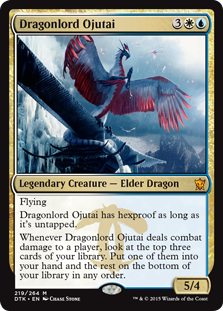
The cardpool is massive but it lacks the overwhelming power and consistency of Legacy or Vintage. This is the most exciting and frustrating aspect of Modern. The key to success is not necessarily your choice of deck but how well you understand and pilot your deck in the metagame. Sure, the popular decks are popular for a reason but that does not mean they are the optimal choice, especially for beginners. Far more than in Standard you have to take ownership of your deck and put in the time to learn how to play the matchups, how to sideboard and the optimal numbers for your maindeck.

The Importance of Deck Choice

The hardest thing I’ve found for new Modern players is how different it is from Standard. In Standard card power can sometimes make up for inexperience or suboptimal play, but Modern is more about card synergy and tempo and for this reason you cannot rely on the power of your deck to pull you though. It will happen some of the time, but more experienced players will recognize inexperience and misplays, and will know exactly how to punish you. Experience and format knowledge will get you a far greater edge than trying to metagame your deck choice.

I’ve heard Standard described as an amorphous blob where there are a number of good cards and that the greatest skill is to know when and how to combine these cards for a given tournament.Dragonlord Ojutai It’s more about deck choice and positioning than skill with any one deck.
Modern is different. It's not so much about piles of powerful cards as it is internal synergy and incremental advantage. Yes, Jund looks like a pile of good cards, and it is, but it wouldn't be Modern Jund if the pieces didn't work together well and there wasn't a lot of synergy between the cards that gradually pull you ahead. Haymakers are rare (outside of Tron) and hard to resolve so it's far more about efficiency and combinations of cards than Standard. There are decks that don’t play “normal” Magic like Lantern. Many decks may attack from the same angle(s) but they operate and must be answered in very different ways; think Zoo vs. Affinity. Your deck may change its matchup role based on who wins the die roll and which game you’re on.

Therefore the experience necessary to pilot a Modern deck optimally is much higher than Standard and this means that more practice is necessary. Picking up a netdeck is a good place to start, but you cannot leave it there.

This is especially important since there are no consensus best builds in Modern. Many cards will be common between builds but they won't always be in the same proportions. In Standard there tend to be correct builds, like the Blue Devotion and Azorius Control decks from Theros/Return to Ravnica Standard.Thoughtseize Decklists tend to merge together in Standard thanks to the smaller cardpool, but in Modern there is tremendous variation within archetypes except for a few combo decks. These card choices also tend to have an enormous effect on the deck's positioning and role, to the extreme that you can make your deck exactly fit your preferences and play style.
All Modern Junk lists will have Inquisition of Kozilek, Thoughtseize, Liliana of the Veil, Tarmogoyf, and Lingering Souls but the numbers of each card vary deck to deck depending on how the pilot sees the format and the speed they want for the deck. Slower decks will play more discard while a faster deck will cut some discard for Birds of Paradise. Tempo-oriented RUG Scapeshift decks will play Remand where the control versions pack Mana Leak, but a more combo-focused deck may have Spell Pierce and Dispel instead. Deck tuning and optimization are a huge part of Modern and are a critical skill to develop, and to do that you will need to put in a lot of practice.

Getting Started

If this sounds intimidating, then well done, you were paying attention. But don’t let that put you off. There is a very good reason to play Modern despite the intimidation. I mentioned it in the first paragraph. What do you want to play? Modern is a format where you can play any deck and win.Lantern of Insight I am completely serious. Remember when I said that the field was now completely open? It is also largely unexplored. There is no reason to stick to the mainstream decks if you don’t want to. Put the time in, and your odd combo deck might become the next Lantern Control breakout (though it’d be nice if it were also more fun to play against). So, start practicing and optimizing.
Another reason to play your own deck is you need to play your deck a lot to be successful in Modern. This means it is important to play what you most enjoy playing. When playing or even goldfishing a deck is fun, testing isn’t a chore. To really get the most out of your deck you need to master it so why force yourself to play something just because you think it’s good? Rogue pet decks can win just as easily as the known decks. In fact, examining even stock decklists shows considerable variation between archetypes that reflects the testing and preferences of their pilots. So there is no reason not to play your deck.

Why is This?

Consider Pro Tour Fate Reforged. The most-played decks were Junk, Infect, Twin and Burn. Treasure CruiseWhy? The short answer is that the two decks that were most played prior to that tournament, Birthing Pod and UR Treasure Cruise Delver, were banned and this left most of the Pros adrift. This left them to fall back on previous decks or look for decks to which they could transfer their established skills. Junk and Pod had a fair amount of overlap as did Twin and Delver so it makes sense that Junk and Twin were very popular. When you don’t play much Modern or are uncertain about a new brew this makes a lot of sense.
Burn is always a reasonable deck given how much damage decks do to themselves, and it got much better once Pod left and there were fewer Kitchen Finks running around, making it an attractive metagame choice. It also benefited from the perception that it’s a zero-skill autopilot deck (it very much is not) which bumped its numbers up.

Infect was the only surprise among the top four decks. Its numbers weren't explainable by positioning or familiarity but because The Pantheon team by and large adopted the deck on Tom Ross’ insistence. Infect has always been around but since the first wave of bannings hasn't been very good. The results of GP Vancouver before the Pro Tour indicated that it was better than before thanks to Become Immense, and was probably well-positioned for the GP. However, the only member of Pantheon running Infect to place highly was Jon Finkel, because Jon Finkel. By several accounts after the tournament he would have rather played Storm like he usually did, since it had better matchups against the decks he actually faced than Infect, which really struggles against Lingering Souls and Lightning Bolt.Lightning Bolt

More surprising and instructive was Justin Cohen getting second with Amulet Bloom. Bloom had been around for some time but was always seen as a bad fringe combo and never seriously considered. However according to the coverage Justin disagreed and had put in the time to master the deck, which proves the value of investing time in Modern. He actually understood how to play the deck against the unprepared field and correctly read the metagame as favorable for his glass cannon deck (if you were unaware, Bloom just loses to Blood Moon). He knew what he was doing and could navigate his deck around everything that his opponents threw at him until the finals. His preparation and experience were rewarded and should be your model to Modern success.

The Problem of Modern

One final note for newbies: you need to accept that you will have poor to unwinnable matchups.Blood Moon Certain decks will have natural advantages over others that cannot be fixed with any amount of sideboarding, such as the aforementioned Blood Moon against Bloom. Other decks are simply very well-positioned against other decks, like Infect against Soul Sisters and Tron. Infect can lose those matchups, but it isn’t likely (Infect ignores most of Sisters’ deck and is too fast for non-interactive Tron). This is balanced by these same decks having very good matchups against other decks, like Tron against GBx decks or Sisters crushing Burn.
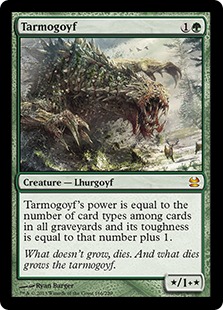
This is the natural result of the diversity of the metagame and the cardpool size---you have to just accept it and move on. The only alternative is to have average matchups across the board, never being particularly favored or disadvantaged and having to grind out wins most games, which is what Junk and Jeskai Control do. You just need to pick your poison and try to compensate as best you can.

Find Your Deck

So now that you know what you’re in for, it’s time to actually pick a deck. The best way to approach a new format is from the one you know, so the natural place to start is with a port of a Standard deck. However I would recommend against a straight port of your favorite Standard deck especially if it was a reactive deck. Until you know the format well, trying to build your own deck can be an exercise in frustration, particularly if you want to play control.

TarmogoyfI’m not going to lie, there is going to be some sticker shock, though the recent Standards may lessen the impact (the price for Jace is just ridiculous). There are a lot of older cards that are scarce for many reasons and as a result are very pricey (If you’re looking to pick up Jund your accountant may have a heart attack). This is balanced by the fact that once the initial investment is made there is very little additional overhead to Modern. Most of the truly staple cards like the manabase and utility spells are safe from bannings and see play in lots of different archetypes so even if you tire of one deck you’ll have little trouble or expense building another. It might be daunting to get in, but stick around for a few years and it will pay off. Ultimately Modern is cheaper than Standard over the long term.

collected companyFor this reason, now is an excellent time for Standard players to get into Modern! Wizards has printed a number of unexpectedly good cards over the past couple years that you’ve probably played in Standard which are also seeing considerable Modern play. Collected Company, Jace, Vryn's Prodigy, Atarka's Command, and Tasigur, the Golden Fang all see heavy Modern play and the fetchlands are essential. Take a look around: you may already have most of a deck and just need to fill out some older staples.

I can’t give you advice about what deck to actually play because I don’t know what your Standard deck is, nor do I know what you want to play. What I can do is point you to a number of example decks that are similar to current or recent Standard decks to use as guides.

Abzan Company is very popular, largely based on how well it did during Eldrazi Winter, and while its creature base is fairly old and expensive most of the support spells and mana have been reprinted enough that you can get them reasonably cheap. Grixis in its many forms also plays quite similarly in Standard and Modern if you want to go the control route, but be warned that the deck actually functions differently most of the time (closer to midrange aggro-control than true control). Eldrazi may have been depowered but is still a threat, and there are plenty of different builds you can pick up fairly inexpensively. All that’s left is to find your deck and start testing!

This is just an introduction. Once you learn what is being played you can tune the maindeck and sideboard for your metagame and eventually start to branch out to make your own deck and really start to enjoy Modern. So, do you want to play Modern?

Insider: A Strong Foundation – Cost

Are you a Quiet Speculation member?

If not, now is a perfect time to join up! Our powerful tools, breaking-news analysis, and exclusive Discord channel will make sure you stay up to date and ahead of the curve.

Welcome back, readers! Today I'm continuing my series on the concepts needed to have a strong foundation with regards to Magic: The Gathering finance and/or speculation. The past two weeks I covered risk and value. Now we need to look at cost.

"Who wishes to fight must first count the cost."

-Sun Tzu

Sun-Tzu

There are many types of cost associated with business.

  • Direct Cost - These are the costs that tend to be easy to figure out. If you buy a card for $5 the cost to you was $5.
  • Indirect Cost - These are also referred to as "hidden costs."
  • Fixed Costs - These are costs you know you'll incur. If you own a store front then you know you have to pay your rent/lease every month on a certain date. This is a fixed cost.
  • Variable Costs - These are costs which can change over time. One of the best examples are your store utilities (power, water) which are typically calculated based on usage and vary from month to month.
  • Relevant Costs - These are costs that actually matter to your business. Paying employees, buying collections and advertising are all relevant costs.
  • Irrelevant Costs - These are costs that don't actually matter and are often "phantom" costs. A good example of this might be maintenance costs on the old computer you're likely to replace soon (as you're more likely to just replace it when the first thing goes wrong than maintain it for a bit then replace it).
  • Actual Costs - Costs that you have previously paid.
  • Budged Costs - These are expected future costs, like next month's rent or preparing for the next set release.

Now that we've gone through the different types of cost associated with business, let's compare them and go a little more in depth.

AmbitionsCost

Direct vs. Indirect Cost

This is likely one of the most important differences to understand. As I stated earlier, direct costs are usually very obvious and they aren't hard to track and understand. If you have someone contact you and say they have a collection they want to sell for $500 then you know the direct cost is $500. But the indirect costs can be substantial. What are they?

Cost of transporting the collection. If you have to drive 40 miles to their house to pick up the collection and your car gets 20 miles to the gallon, then even before deciding whether or not to buy the collection you've already invested 4 gallons of gas in it (about $8 with today's prices in the US). You're also putting additional wear and tear on your car, something many of us don't think about.

There is a reason the IRS pays a mileage rate to employees when they have to use their personal vehicle for official business. The current mileage rate here in the US is $0.54 per mile. That rate is much higher than the cost of gas, which shows the US government has factored in the need for oil changes, new tires, regular maintenance, etc. This should emphasize that vehicle wear and tear is definitely not an indirect cost you want to ignore.

Now, the US government rate does include the value of gas in it. So in this instance if you drove a total of 80 miles (40 to get there and 40 to get back) you've already sunk $43.20 into the collection.

Cost of sorting the collection. If you have employees whose job it is to sort, then however long that process takes is another indirect cost of acquiring it. If you pay your employees $9 an hour and they can sort about 1000 cards an hour, and the guy said his collection is 10,000 cards, that's an additional cost of $90 for sorting.

Cost of grading the collection. While this can often be done during the sorting process, if you have only specific people who do your grading (as opposed to those who only do sorting) there is an additional cost of their time. Now, you're unlikely to grade everything, but you might require a grader to go over the top 10% of what you picked up. This might take an hour or so and they are likely to make more than the sorter so you could potentially be looking at another $15 towards the collection.

Cost of adding it into your store's inventory. If you sell these cards online you also need to add them to your inventory. Again assuming you only put up the top 10% of the collection (that's been properly graded now) you are likely to have another $15 (or an hour of time) putting these new cards into your online inventory (again, I'm assuming the person who does this gets $15 an hour).

When we look at the total cost to buy this collection we have to add up both the direct and indirect costs. So the total collection purchase is now costing you: $500 (direct cost) + $43.20 (indirect travel cost) + $90 (indirect sorting cost) + $15 (indirect grading cost) + $15 (indirect inventory management cost) = $663.2. That's 32% in indirect costs.

You need to respect that these costs will "eat away" at your profit from flipping the collection. That's why it's important not only to understand these costs, but also to estimate them up front. By doing the legwork and getting as much information from your perspective seller ahead of time, you can truly figure out if it's worth your time. This is especially important this day in age when so many sellers look up the retail prices and expect to get that for their collections.

It's also critical to factor these indirect costs in when doing your card pricing. In this example, flipping the $500 collection for $650 doesn't sound too terrible on paper (if you can do so relatively quickly). If you didn't know your indirect costs you might be perfectly content thinking you made a 30% profit on the collection, when in fact you lost 2%.

Fixed Cost vs. Variable Cost

As I noted earlier, a fixed cost is one that you know and can ideally plan for (in the future). You can often budget for these so ideally you shouldn't have to worry about them as much.

Variable costs change. In some cases you can generally budget knowing they exist (you know you'll have a power bill every month) but without knowing the exact cost it makes budgeting difficult.

A great example is when you have a heat wave in the fall. Typically fall weather is either cold or mild so your store's air conditioning unit sits idle. If you have a heat wave at an unexpected time your power bill might be considerably higher than you anticipated (I know personally that during the summer my power bill tends to double when compared to the fall or winter).

In order to account for variable costs it's often important to build up your store's "emergency savings." That way when these types of things occur you aren't eating Ramen noodles six nights in a row (unless that's your thing, in which case at least your grocery bill is only like $10).

Relevant Cost vs. Irrelevant Cost

This one should be pretty self-explanatory thanks to the naming convention, but as a business you really only want to focus on and pay relevant costs. Now an irrelevant cost is typically associated with some specific decision---for example if your store unfortunately picked up a couple of fake cards. Those are sunk costs and are irrelevant to whether you buy the next collection you see, though you can clearly learn from this mistake and take a more careful look at what you pick up.

Actual Cost vs. Budgeted Cost

Actual cost is the cost you've paid in the past. Last month's rent is an actual cost. You know exactly what that was (or you should). A budgeted cost (as I mentioned above) would be next month's rent. It's likely to be the same as last month's rent, but rent prices do go up. The major importance of budgeted costs is that if you don't track your money well and plan how it'll be spent, then you often waste it or lose it---neither of which is good for a business.

Conclusion

Most actual business costs will fall into several of the categories above. Typically they are grouped together so that they can be compared against others in a similar group. The most important distinction to keep in mind is that between direct and indirect costs. I've seen a lot of small businesses miss, ignore or misunderstand indirect costs, while the owners end up wondering why they can't seem to turn a profit. Make sure you know everything that you're investing in a given decision.

Want Prices?

Browse thousands of prices with the first and most comprehensive MTG Finance tool around.


Trader Tools lists both buylist and retail prices for every MTG card, going back a decade.

Quiet Speculation