
menu

Shopping the Lesser Known Offerings

Are you a Quiet Speculation member?

If not, now is a perfect time to join up! Our powerful tools, breaking-news analysis, and exclusive Discord channel will make sure you stay up to date and ahead of the curve.

Has this ever happened to you?

I have my eye on a particular card at a large Magic vendor’s website—typically it’s Card Kingdom, Star City Games, or ABUGames. Rather than commit funds to the purchase, I head downstairs to the basement and dig through my cards, looking for cards I can ship to the site’s respective buylist. This takes some time because I don’t want to ship just any card. I want to make sure the amount of store credit I receive is competitive with the market.

With that in mind, I take the time required to piece together the buylist. After submitting, I package up the cards and ship them out to the vendor. Now, if I’m shipping to ABUGames, I’ll immediately place the order using their “WILL BE SENDING IN BUYLIST (TRADE PENDING)” option.

But for Card Kingdom, Star City Games, and (I assume) other vendors, this isn’t an option. Instead, I have to wait for the credit to be issued before I can place my order.

So I wait. And wait. And wait some more.

About a week(ish) later, my credit is issued. Time to place my order and acquire that card I’ve been dying to get… only to find that it’s sold out.

Now What?

I could always choose to wait for the card to be restocked. Oftentimes, however, I wanted that particular card because the vendor’s price was very attractive. What’s more, most of the singles I’m after nowadays are from older sets, so they don’t necessarily get restocked all that frequently.

I don’t like sitting on credit for long periods of time; it’s effectively like loaning “money” to the vendor interest-free, and it makes me vulnerable to price fluctuations over time. If prices climb, my store credit effectively loses purchasing power—not a place I want to be in.

This is normally when I shift gears and seek out an alternative way to spend my store credit. If I can’t find something similarly old and collectible (e.g. a well-priced Beta rare or Arabian Nights card), then I need to start getting creative. This is precisely what I started doing recently, and it’s what I wanted to share in more detail this week.
There just may be some neat, outside-the-box options on which one could spend store credit at these sites. I am not sure how well-known they are, so I thought I’d share them for consideration.

Card Kingdom

This is the vendor I have the most experience with, as well as the most recent experience. Just last week I received some store credit from the site even though I had nothing in mind for potential acquisition. I just knew I wanted to sell them my Beta Clockwork Beast because they were paying competitively on the card.

There was an error retrieving a chart for Clockwork Beast

Fast forward, and I suddenly had $150 or so in store credit to the site with no desire for any particular singles. What I was interested in, however, was picking up some more sealed product. I’ve been on a sealed product kick lately and this seemed like an inexpensive way to expand that collection.

Unfortunately, their booster box prices weren’t all that thrilling, either exceeding the market price by a modest margin or else exceeding my budget. That’s when I started browsing their other sealed offerings.

Did you know that Card Kingdom makes and sells Chaos Draft bundles? Check out this one themed around all sets legal in Pioneer:

With this product, you get 24 different booster packs from sets that range between the 2015 Core Set and Zendikar Rising. Granted, you’re not going to make a ton of value here, but $100 for a Chaos Draft for eight people is a great deal. That’s $4.17 a pack! I think my LGS charges around that for Standard sets, so purchasing some new and some old boosters at that rate seems like a steal. Plus, I have a soft spot for Chaos Drafting.

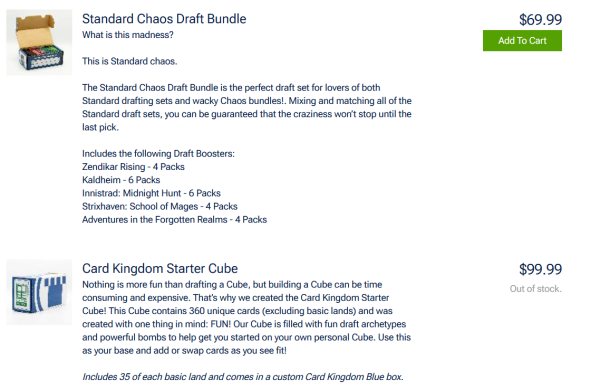
If you’re on a budget but still want the Chaos Draft experience, Card Kingdom also offers a Standard version of the chaos bundle for $69.99, just $2.92 per booster pack. They also have a $100 starter Cube, which sounds like an inexpensive and convenient way to build a Cube for playing with friends. Unfortunately, they’re sold out of that one, but I love the concept.

How do you find these options? They’re under “CK Exclusives” on the website. This is a menu choice I had never really explored before since I normally focused on singles. But there are some hidden gems within!

Another less-known option at Card Kingdom is their “Deals” page. Here’s what it looks like currently:

There usually aren’t a ton of options here, but it’s worth a glance when you’re looking to burn store credit. That non-English booster surprise is kind of cool, though it is a gamble. On the one hand, you could end up with a foreign booster pack from Portal: Three Kingdoms or The Dark, which would definitely be worth the $20.

There was an error retrieving a chart for Three Visits

On the other hand, if you end up with a foreign booster pack of Prophecy or Invasion, you’re probably less than thrilled.

Lastly, Card Kingdom has an interesting selection of fat packs (aka “bundles”) in stock. This is what I ended up shopping from with my store credit. I picked up a Coldsnap fat pack for $199.99 plus shipping. There’s not a lot of pricing data on this one, but the cheapest on eBay was $300 plus shipping so I figured I did alright. Besides, I love the artwork on that particular fat pack box.

Star City Games

I don’t trade in cards to Star City Games nearly as often as I do to Card Kingdom. Once in a blue moon, however, I’ll find that Star City Games is paying more competitively on a given card and it’s worth my while. SCG matches Card Kingdom’s 30% trade-in bonus, and I have been purchasing some Magic singles and products from SCG throughout the year.

At one point I was snapping up heavily played, discounted Alpha and Beta cards. Star City finally adjusted their prices on these sets though, so deals aren’t so easily found anymore. That said, there are some other categories worth browsing, especially if you have some store credit to burn.

On the main menu across the top of their site, they offer “Lots & Collections”. These are some convenient instant collection-building options for an up-and-coming player. They have bulk commons and uncommons, and also various options to acquire a stack of rares. Bulk rare chaos draft anyone?

Star City Games also puts together these gift boxes that make for fantastic gifts for the Magic player in your life.

Ok, that last line may sound cheesy, but you do get a lot of cool stuff for $50. There are nine set boosters included, which are worth over $4 a piece at retail anyways. That means you’re paying around $15 for the rest: a bunch of card sleeves, playmats, spindown life counters, and tokens. Is it the deal of the century? Of course not. But if you’ve got store credit lying around and you have a friend’s birthday coming up, there are worse things you could spend it on.

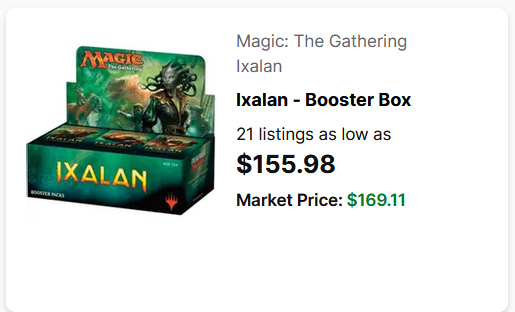
Star City Games also has some decent prices on their sealed product. I already mentioned last week how I picked up Battle for Zendikar, Ixalan, and Oath of the Gatewatch booster boxes from SCG for below market price. I’m not sure I’d go crazy buying newly released boxes from Star City Games, but some of their older inventory can be priced competitively.

Don’t forget they always have a weekly sale going on, so you could always sit on your store credit for a little while to see if there’s a relevant sale that pops up. Just don’t wait too long—often times the sales are only slightly better than the deals you could get by simply subscribing to their SCG Premium service for a month ($7.99). I often find it’s worth subscribing to that service simply for their discount on singles and sealed product. I make my purchase, earn that discount, and then after the month is up I’ll cancel until next time.

Wrapping It Up

Hopefully, you learned something new about some of the product offerings from Card Kingdom or Star City Games this week. I never really investigated these alternatives until recently, but there are some worthwhile considerations. Again, not all of them are going to make you the most value for your store credit. If you’re looking for something fun and different though, these options can be attractive considering the inherent discount you’ll get by using credit instead of cash.
If Card Kingdom ever puts together some Chaos Draft options with boosters from even older sets (e.g. Modern legal), I’d be even more tempted. Of course, the price would be significantly higher. With that 30% trade-in bonus though, the store credit can really lessen the blow of a steeper price point.

I don’t like sitting on store credit for the long term—there are too many fluctuating market factors for my taste. If there are no singles I’m after, or no deals I can find in those oft-searched places, dabbling in the corners of these store offerings can be worthwhile. There are probably not many instant profit-making deals to find in these areas. However, if you’re OK with losing a little value to acquire some fun and diversification in your collection, then these are certainly viable considerations.

Generational Magic: Store Spotlight—Gem City Games

Are you a Quiet Speculation member?

If not, now is a perfect time to join up! Our powerful tools, breaking-news analysis, and exclusive Discord channel will make sure you stay up to date and ahead of the curve.

Along with sharing my own Magic: the Gathering journey, I want to share what's going on with others in the community. Not just the players, but the people that provide a place to gather. The Greater Cincinnati/Dayton area is fortunate to have a lot of options when it comes to Magic and gaming in general. Here's a glimpse into one of them.

Come On Down!

What's your name, the name of your store, and where are you located?
I'm Matt Meily and I'm the owner of Gem City Games in Dayton, OH.

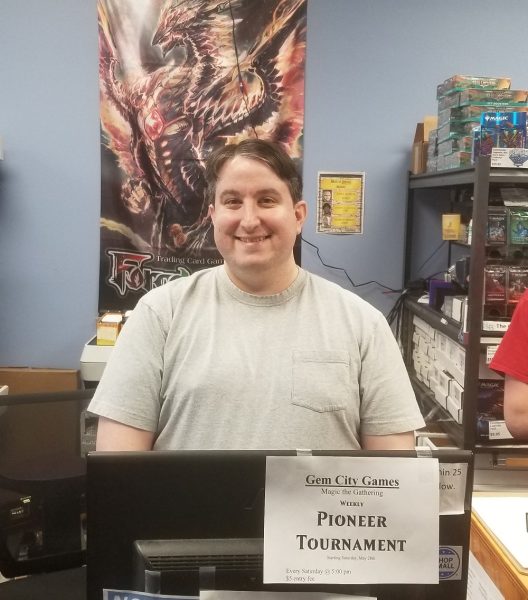
Matt, Owner of Gem City Games

When are you open?
We're open every day except for the major holidays.

How do you connect with your customers?
Through Facebook and our website.

What gaming experiences and events do you offer?
For Trading Card Games (TCGs), Magic: the Gathering and Pokémon are our major draws. We also delve a little into Flesh and Blood. We support our tabletop players with Dungeons and Dragons and our Board Game Night on Thursdays.

How did Gem City start for you?
It began as Schumer's Baseball Cards and Comics in the early '90s. Around 2009 the original owner sold the business and the new owner brought me in to manage the store. A couple of years later that owner decided to sell and I took the opportunity to buy it.

We officially became Gem City Games in 2011 and moved to our current location in 2015.

What Magic experiences do you provide?
We have Commander events on Tuesdays, Wednesdays, and Saturdays. Draft events on Fridays that fire pretty consistently, and a Saturday evening Pioneer event. Of course we support all the Magic Pre-releases, Store Championships, and similar events.

How did Gem City deal with and adjust to the pandemic?
Right before it hit, we received a call from another local store. They said they were going to suspend events and limit access into their store. We decided to follow suit and informed our customers, and lo and behold, the next week the state closed everything up.

In response, we developed our online service, provided curbside [pickup], and created a temporary discord server to keep in touch with everyone as best as we could. Whatever we could do to keep things moving. It was difficult for a while, but after the restrictions were relaxed and people started feeling more comfortable coming back into the store, we've been fortunate to bounce back to where we were at before.

What are your hot sellers for Magic?
Specific Commander cards are the most sought after. All of the staples; shocklands and fetchlands, of course. Rhystic Study, Smothering Tithe, Cyclonic Rift, etc. Even the smaller items, like the Talismans (Conviction, Resilience, etc.).

How do you make Gem City special for the players?
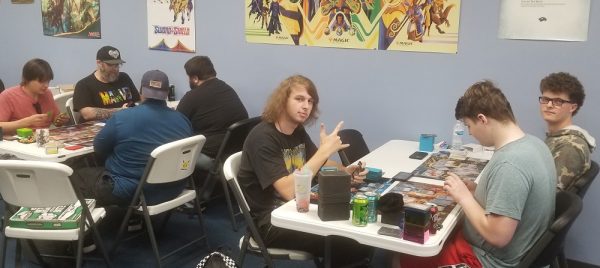
We work to make our store very welcoming to everyone. I believe we have a good atmosphere for anyone to come and play. Being close to a few universities, we have our fair share of students coming in, but not as many as you'd think. At least for us, our average age skews more toward the upper 20's, so we do get a variety of customers. We also get a decent amount of employees from the Wright-Patterson Air Force Base. Magic and the Military have generally worked very well together.


Want to play some Commander?

When did you get started playing Magic and what do you personally enjoy playing?
I started back around Revised. I've enjoyed many different types of play, but my favorite has been Commander. I like to build decks that are off the beaten path; put a little twist in them.

With all of my focus on the store, I don't play much anymore. I still follow the game and keep up on the trends. I say no one ever quits Magic, they just take breaks!

What's one of your favorite Magic cards?
Definitely Animar, Soul of Elements. He was one of my first Commanders. I would tweak the deck to not be the "standard" Animar deck, but try to use him in different ways that people normally wouldn't.

There was an error retrieving a chart for Animar, Soul of Elements

To finish up, is there anything else you'd like to share?
One interesting aspect of the store, for me personally, is that it's forced me to grow. I'm normally a pretty shy guy, but running a business, meeting so many people, it's helped me to better myself and make many friends. Gem City is going strong and I'm looking forward to what the future holds.

LGS Is Where the Heart Is

I want to thank Matt for providing us a glimpse into Gem City's Magic life. I hope you enjoyed the visit and look forward to the next! Do you know the story behind your own LGS? Feel free to share in the comments. And if not, maybe now's a good time to get up to speed...

My New 32: A Deck for Each Color Identity, Part 1

Are you a Quiet Speculation member?

If not, now is a perfect time to join up! Our powerful tools, breaking-news analysis, and exclusive Discord channel will make sure you stay up to date and ahead of the curve.

Are there any limits to just how many Commander decks it makes sense to build? As you continue to add to your collection, there is bound to be overlap in concepts and cards. One of the best ways to have a large but functionally diverse collection of Commander decks is to build one per possible color identity. This brings us to exactly 32 potential decks.

Some of these decks will work out, and others won't. Anything that fails to function will be sidelined while I continue testing decks that work initially. Once I've gotten decks to a point where they function, I try and tune them to the approximate power level they should be. When I have time or when a table asks for lower-powered options, I will move on to some of my less-loved decks and see if they can be salvaged.

In this two-part article, I'll unveil my current picks for 32 functionally unique Commander decks. Today's piece will focus on single-, five-, and four-color decks. Next week, we'll unpack the three- and two-color pairings. But first, a bit more on "functionally unique..."

How Many Red Decks Run These Cards?

To elaborate a bit, assume you were going to build two different mono-red decks. Sure, you might choose to build Krenko, Mob Boss tribal Goblins and then have a Daretti, Scrap Savant artifact deck. These seem like two ideas far enough apart that the overlap would likely be minimal. I believe many players will eventually "optimize" both decks by making some of the same choices.

Take red removal. It's likely both decks end up playing Lightning Bolt, Chaos Warp, Blasphemous Act, and Vandalblast. For non-removal, it is quite likely both decks would run Deflecting Swat and even Ragavan, Nimble Pilferer. An overlap of six cards does not seem like that many, but consider also artifacts and lands.

Playing a few of the same cards in several decks is usually a non-issue. Seeing any one particular card is not likely considering the deck size in Commander. However, it is a world of difference when you have the exact same ten or so cards in multiple decks. For multi-colored decks, things arguably get worse, since they have access to even more must-play staples (the best in each color).

There are only so many of such staples in any given color, and if they are both thematic and powerful, it's easy to pick the same few cards over and over again for multiple decks. This becomes a problem when those cards crowd out unique ideas and sap a deck's identity in exchange for raw power.

Thus, when I build a deck for Commander, I prioritize answering two questions: "Is this deck going to play differently than my existing decks?" and "Am I going to have a unique play experience every time I sit down with this deck?"

With all that established, here are my 32 commanders of choice (one for each color identity).

Colorless

There was an error retrieving a chart for Hope of Ghirapur

This was my toughest choice, as there are not that many potential commanders. I've played with some of the Eldrazi before, and am looking for a different experience. What could be more different than going from a gigantic monster to a piddly 1/1? Hope of Ghirapur, I choose you!

I think my concept for this deck will be a beefed-up Hope Voltron using equipment. Not the most original idea, but it's something I have not done before. Killing people with a 1/1 does sound funny, too.

Mono-White

Dog and Horse form the ultimate team up to make a very aggressive mono-white weenie deck that comes out swinging turn two on. My vision is a very low-to-the-ground, combat-centric deck with the best one-mana cards available. This will allow me to play some unfair cards like Armageddon, Ravages of War, and Cataclysm.

Mono-Blue

There was an error retrieving a chart for Svyelun of sea and sky

Interestingly enough, I have a difficult time with blue commanders. It's hard to find a sweet spot between pure control and theme. With Svyelun, I will play a full-on Merfolk tribal deck and keep the control elements in check. That won't stop me from trying to achieve a win with Lullmage Mentor, although doing so will not be the deck's primary focus. I'll also do my best to include Merfolk from throughout Magic's history as a primary build restriction to keep things interesting.

Mono-Black

There was an error retrieving a chart for Arvinox, The Mind Flail

Oh boy, where to begin? I've run numerous black or effectively mono-black decks in Commander for years. Where would I go from here? Simple, Arvinox, the mind flail. I've waited a long time to get this card, and the plan of attack is excruciatingly simple. Step one ramp, step two commander, step three steal, steal, and steal some more!

I look forward to figuring out how to improvise my way out of a variety of situations by using everyone else's deck as my own. Additionally, I will get to play some early cards like Cunning Rhetoric to give myself early- and mid-game presence and Victory Chimes and Spectral Searchlight to establish early-game diplomacy.

Mono-Red

There was an error retrieving a chart for Norin the wary

My current red deck is Norin the Wary, and I cannot see changing it. It's great for multiplayer and shows off just how good a card that originally did nothing has become many years later. I have updated this deck consistently and playing it is always an experience. Just like every other Norin deck, I play various Pandemonium effects and Norin blinks the table into submission. My version also runs lots of mass artifact and mass land destruction because that's fun for the whole table, right? I bring this deck out for tables that enjoy cutthroat mechanics and keep it away from casual games.

Mono-Green

There was an error retrieving a chart for Aeve, Progenitor ooze

This commander struck me as particularly interesting. I already feel like I have a few concepts together, like using Greenbelt Rampager for bonus storm count, which also has synergy with say Thrasta, Tempest's Roar.

Of course, there's a literal storm theme here, and I'm going to continue to develop that concept with other notable green cards like Hurricane and Tornado. I refuse to use tribal Ooze, say that three times fast, and am focusing on the storm idea.

Five-Color

Currently an experiment between Kyodai, Soul of Kamigawa and the partner combination of Cecily, Haunted Mage plus Othelm, Sigardian Outcast. These commanders form a classic five-color "good stuff" type deck that seeks to draw the game out, literally, by playing and protecting Divine Intervention.

Kyodai is a little bit of everything, as players seem to be unaware that I can flash my commander in for a block or save. And later, it can be pumped up to make for a considerable 8/8 flying blocker. I can also use Kyodai to save an opponent's permanent, which can prove a game-winning diplomatic play.

On the other hand, Cecily and Othelm give me early- and mid-game plays while I'm setting up value pieces. I'll keep testing more until I'm happy with the feel. In either case, they are definitely more unique than the previous five-color commanders I've run.

"Not" Colors

These are decks made up of the other four colors. While there have been historical names for these combinations, the common consensus is to use names from the Nephilim cards printed in Guildpact. It's surprising that Wizards has not taken a more active stab at re-establishing a naming convention here. With the additions of partner and friends forever, more combinations are possible than ever.

Not-Green aka Yore-Tiller

There was an error retrieving a chart for Breya, Etherium Shaper

Surprisingly enough, I have not yet had the chance to play this commander! Not new by any means, Breya was first printed in Commander 2016. It's easy enough to build a deck with artifact and token synergy, but I think I will try a life gain deck.

Even though red would seem like the odd color out, cards like Lightning Helix and Warleader's Helix stay on theme while serving as removal. There is a slew of life gain artifacts that I can get double or triple synergy out of like Zuran Orb and Fountain of Renewal. The ability to gain life, draw cards, or turn them into removal offers a lot of flexibility.

Instead of just countering spells, I can play Absorb, Punish Ignorance, and Dromar's Charm. I hope this turns out to be a more fun version of Breya than what I have seen at many tables.

Not-White aka Glint-Eye

There was an error retrieving a chart for Yidris, Maelstrom Wielder

This feels like one of the least-loved four-color combinations. Outside of Yidris, Maelstrom Wielder, nothing strikes my fancy. What I have done in the past is play a five-color commander and simply omit one color's worth of cards.

I'm going to give Yidris a try this time and play as many suspend cards and cards with no casting cost as possible. On top of that, I'm going to try and pair it up with the "cast from exile" theme of the Exit From Exile Baldur's Gate Commander decks featuring Faldorn, Dreadwolf Herald and Durnan, of the Yawning Portal. Hopefully, this turns into a spicy brew worthy of an entire article on its own.

Not-Blue aka Dune-Brood

Saskia the Unyielding is a good commander and one I have played in the past. The replacement? Looks like a combination of Elmar, Uvenwald Informant and Wernog, Rider's Chaplain. I'm feeling a heavy artifact-style deck, giving opponents clues that can fuel Viridian Revel and Disciple of the Vault with a mixture of creatures that should have a sort of aristocrats feel. There are a fair number of blink effects in white I think would work well for my concept along with tons of reanimation for Wernog.

Not-Black aka Ink-Treader

Kynaios and Tiro of Meletis has been my preferred "group hug" style deck forever, and also my go-to deck for this color combination. However, I want to try something different. The problem? Very few choices. I'm not an Omnath, Locus of Creation player, and I don't want to be forced into a tribal Elementals deck.

I'm considering an artifact-heavy deck featuring Akiri, Line Slinger and Kydele, Chosen of Kruphix. This deck would turn every cantrip artifact into mana for Kydele and damage for Akiri. Utilizing artifact lands for a free boost to Akiri seems good. I think I can fit in a lot of different keywords throughout Magic's history, like metalcraft and affinity. I'm hoping it turns into a pretty cool deck.

Not-Red aka Witch-Maw

There was an error retrieving a chart for Atraxa, praetors' voice

This is by far the most common four-color combination with heavy hitters like Atraxa, Praetor's Voice and the classic partners Thrasios, Triton Hero and Tymna the Weaver. My Atraxa deathtouch deck is undergoing a heavy revamp based around two Baldur's Gate cards: Nalia De'Arnise and Multiclass Baldric. I'm still going to maintain the deathtouch theme, but will also much more heavily incorporate a multicolored, party theme. This deck has continued to evolve and I am very happy with how it plays as a casual Atraxa deck.

Building a Bridge to Chapter 2

That's all for today. Next week, we'll look at the shards, wedges, and color pairs to round out this behemoth of a concept. Until then, do you ever find your Commander decks looking a bit same-y? Which deckbuilding solutions have you tried to remedy this issue? Or are you content to slam your very favorite cards over and over again in different shells? Let me know in the comments!

My Favorite Green Penny Picks for August 2022

Are you a Quiet Speculation member?

If not, now is a perfect time to join up! Our powerful tools, breaking-news analysis, and exclusive Discord channel will make sure you stay up to date and ahead of the curve.

Those of you who have been playing for some time may remember a yesteryear when Wizards's release schedule was well known, with four sets coming out a year, typically a few supplemental products, and minimal reprints. Those were good days for speculators, as we knew generally what to expect from Wizards with regards to reprint potential for any speculation targets. I remember buying out my LGS of Abrupt Decay each week when they sat under $5, as I knew the card would eventually be worth $8-$10 card thanks to its power in modern.

With Wizards adding so many new products to the market, the risk of a reprint tanking any given card's value is higher than it has ever been. As I am a risk-averse investor, this means I am shying away from more expensive (read: non-Reserved List) speculation targets as the time it typically takes for a target to reach an attractive sell point is still several years, and thus a lot of new products will come out in that same time frame.

All that leaves 3 major speculation areas:

  • Reserved List cards
  • Cards whose value is heavily tied to a specific printing (Alpha/Beta and Four Horseman cards)
  • Cards at or very near "bulk" rare/mythic pricing (hereafter: penny picks)

Today, we'll focus on penny picks.

Often, I view penny stock picks as similar to purchasing lottery tickets. The buy-in is very low, and it can honestly be a bit of fun looking for them. The big difference is that lottery tickets are entirely dependent on randomness for financial success, whereas penny stock Magic cards are dependent on inherent characteristics of both the card itself and the game as a whole.

A wise speculator isn't just gambling. I view playing with penny picks as closer to knowing two of the five numbers that will come up in a lottery. You still may not win, but your chances of success are much higher if you make smart picks. I feel it is necessary to provide context for every card I call out as a potential investment, as that differentiates a smart pick from a random one. 

This Week's Picks

There was an error retrieving a chart for Jaheira's Respite

Fog effects aren't typically played in a lot of Commander decks, as they only mess with a single opponent. Similar to Arachnogenesis, Jaheira's Respite is aFog with some solid upside. Unfortunately, holding up five empty mana is a lot worse than holding up three, and there isn't the potential to create a token army and kill a few of the attacking creatures. Still, Arachnogenesis is sitting at $26.

Both cards scale well, though the limitation means at very best, you may strip your deck of basics. That's really powerful in a mono-green deck, and pretty powerful in a G/X deck, but gets progressively worse the more colors you play. However, given most two-land ramp spells cost four mana already, I could easily see Respite finding a home in decks with at least somewhat aggressive local metagames. 

There was an error retrieving a chart for Shigeki, Jukai Visionary

I called this out Shigeki in our Discord server last week, but for those who missed it, I really like this card. I have watched SaffronOlive build two different Standard decks based around abusing Shigeki, Jukai Visionary and Colossal Skyturtle to create card advantage loops. The fact that both happen to utilize the channel mechanic makes them harder to interrupt.

Shigeki provides both potential mana fixing by hitting your land drops, a way to fill the graveyard, and a way to recur cards from said graveyard, essentially making it a small engine in itself. I like this as both a Commander card and a Standard card whose power level likely increases at rotation given that its current "engine" remains in the format.

There was an error retrieving a chart for Workshop Warchief

I actually couldn't believe this card is as cheap as it currently is. While many players may not have been around for the time of Thragtusk, that Beast was a $20 rare for three months and dominated Standard until its rotation. The only reason it dropped in price was thanks to inclusion in the Gatecrash event deck "Thrive and Thrash," or else it likely would have held a $15 or higher price tag well into 2013.

While Workshop Warchief doesn't provide as much life as Thrags does, it does offer a bigger body, trample, and blitz. I can only imagine that its low price is driven by a lack of high-profile Standard events, and players aren't investing as much into the format.

There was an error retrieving a chart for Tanuki Transplanter

Green is the color of giant creatures, and it would seem that a card that can allow you to massively ramp when it's reconfigured to a larger creature could be pretty broken. The biggest issue with most equipment is that if your opponent kills the creature being equipped in response, you've spent mana on nothing. However, in that scenario, you can still attack with Tanuki Transplanter (or reconfigure it onto to a different creature) and net the additional mana.

A Closing Pro Tip

As per my usual stance, I always favor the extended art versions of the above cards, as they are likely much rarer than regular versions or even foils nowadays. In most cases, you can pick these up (even foils sometimes) for under $1. Such alternate versions tend to jump exponentially in the case of a spike or buyout, so prioritize them! Have any penny picks you've been scooping up? Share them in the comments or on our Insider Discord.

Up to Eleven: Learning to Play Faster

Are you a Quiet Speculation member?

If not, now is a perfect time to join up! Our powerful tools, breaking-news analysis, and exclusive Discord channel will make sure you stay up to date and ahead of the curve.

It is often surprising which parts of my articles and other comments resonate with readers. This isn't a problem as a content creator. It's all about putting out material and hoping something, anything, sticks and keeps the views coming in. However, there have been plenty of times where what I get feedback on is not at all what I was expecting. Today's article stems from exactly that scenario.

About a month ago in my RCQ Prep article, I mentioned that it's advantageous to play up-tempo. Not just because it helps prevent unintentional draws but because it exudes confidence and can make opponents make mistakes. I then followed up with my actual RCQ experience and mentioned that I already play quite fast and play fast decks. Since then, I've fielded a number of questions about how I play faster. The past week one player asked how I was able to play so quickly without mistakes. Another was surprised I could shuffle so quickly in-game. So, I guess now's the time to dive into how I play faster than most and how you can too.

The Basics

A lot of my techniques aren't anything new. I picked them up reading articles by pros in the mid-to-late-2000s, articles that are obscured in the internet's back archives. I had no luck with Google-fishing for the older articles, though there are some newer ones accessible. However, all agree that there are a number of fundamentals to keep in mind.

1. Practice, Practice, Practice

This one should be quite obvious. There is no way to play Magic faster without practice. A lot of practice. In fact, the primary reason that I see players play unintentionally slowly is inexperience. It takes a lot of goldfishing to get the ins and outs of a given deck to be able to competently pilot the deck. It takes a lot more practice games to actually play that deck well. There's no shortcut to this step. To play faster, it's critical to know the available plays intuitively and not have to puzzle through every scenario. The better the pre-game practice, the faster a deck can be played.

There was an error retrieving a chart for Practiced Tactics

With the caveat that it should never get to the point of playing a deck on autopilot. Just because a scenario during testing happens in an actual game does not mean it is the exact same scenario. The opponent always has a say in what happens and may be reading from a different playbook. Context always matters, so never just turn your brain off.

2. Deck Selection Matters

There's a minimum amount of time each turn takes. Regardless of other factors, players must always untap, go to upkeep, then draw. Beyond that, the additional amount of time is different for every deck. This should also be obvious, but it affects the pilot's ability to finish a game in the desired timeframe. For Modern Burn, that time is only a few seconds. Play a land, attack, decide whether or not to throw burn during the main phase, done. A goldfished game shouldn't take more than a couple of minutes total.

There was an error retrieving a chart for Goblin Guide

For Modern Enchantress, the length of a turn is much longer. There are more decisions around spells to cast, their targets, and all the triggers associated with all of that. Which land to play when can be a relevant decision depending on the need to cast On Thin Ice or Utopia Sprawl. Then there are all the draw triggers to keep track of. Even an experienced pilot will require a minute or more per turn to goldfish this deck.

There was an error retrieving a chart for Enchantress's Presence

Therefore, players need to be realistic about their ability to pilot a deck and choose one that works given their play speed. A player that is naturally slow picking a naturally slow deck makes for very long, frustrating tournaments. A fast player with a fast deck gets plenty of time for lunch and rest. The easiest way to speed up play speed is to just pick a faster deck.

3. Thinking Ahead

Don't just react. Plan your turns out before you take them. Have contingencies for what the opponent might do. Spend the opponent's turn thinking about your next turn. The more planning and thinking that's done before a decision needs to be made, the less time needs to be spent deciding.

There was an error retrieving a chart for Well-Laid Plans

4. Don't Play Too Fast

Speed is a means to an end. If speed causes you to miss that end, you're playing too fast. There's a limit to how fast anyone can play with accuracy, and this limit is different for each player. Magic is not an easy game and it's easy to make mistakes. Forcing one's self to go faster than they're capable will lead to more mistakes and ultimately more losses. Know yourself and don't try to play too fast too quickly. As with any skill, it takes time to learn. Let yourself have that time.

My System

If that's the wisdom of the ancients, what do I do that makes my speed stand out? To be honest, before it was brought up, I hadn't really thought about it. I've been playing since Odessey-block and over time have built up so much muscle memory and experience that a lot is second nature. Frankly, I'm fast because I've been playing so long that I can be. I know the motions I need to make, intuit my land drops well in advance, and think through things quickly because I've done it so many times. I'm a fast player because I don't need to think through a lot of the game basics.

There was an error retrieving a chart for Scars of the Veteran

However, that isn't the whole story. I may play fast thanks to experience, but I've also learned to speed up just by wasting less time each turn. This gameplay efficiency, combined with my mindset during games, forces me to be faster. I'll freely admit that both efficiency of play and mindset may take a lot of practice to learn (and I wouldn't say I've fully mastered them myself), but at least efficiency of play is something that every player can pick up right away. Let's talk about the two biggest aspects of gameplay efficiency, mechanical efficiency, and shuffling efficiency.

Mechanical Efficiency

The easiest change to speed up your gameplay is to drop unnecessary actions. How much time does the average Magic player waste by fiddling and futzing around rather than actually playing the game? I don't know, but I'd wager most players have some extraneous motions and fidgeting that just drags the game out. Fidgeting with cards in hand, combing through graveyards, rearranging lands compulsively, the list goes on. These take time, and when done on your own turn are just a waste of time. Doing it on the opponent's turn necessarily isn't harmful, but it isn't contributing either. So, stop doing needless things.

There was an error retrieving a chart for Brainstorm

I used to snap and shuffle my in-hand cards constantly. It was a fidgeting reflex for me. There was a vague hope opponents would be distracted too, initially. However, over time I realized that it was taking my mind off the game and lulling me into a stupor instead. So, I've stopped. These days, when it's not my turn I place my cards face down on the table and watch my opponent's actions. If I'm going to do something on the opponent's turn, I'll wait until I take the action to pick them up. This has forced me to pay closer attention to what's happening and play better. I also don't have to stop fidgeting to start my turn.

There was an error retrieving a chart for Hesitation

On that note, don't hem and haw over everything. If you're going to make a play, make the play. Only fiddle around if you have a complicated line and manipulating lands or writing it out helps you make it correctly. Otherwise, just play the spell and be done with it.

Shuffling Efficiently

Being told that I shuffle impressively fast was rather unnerving. After all, I'm just doing a standard mash shuffle. However, a lot of players do struggle with shuffling, and shuffling is such a time sink that Wizards tries to minimize it these days. Here's how I shuffle and why it's (apparently) so fast.

Misplaced Frugality

First and foremost, sleeves matter. Better sleeves can take more shuffling before getting damaged. Never cheap out on sleeves, paying more up-front saves money down the line. Good sleeves don't have to be replaced. After many years of experimentation, I will only use Dragon Shield matte sleeves. With my shuffling style, Dragon Shield sleeves never split, mash well after years of play, and the matte finish gives extra grip. More importantly, they never stick together. Which happens all the time with glossy sleeves, in my experience. Altogether, it means that I have confidence while shuffling and can just do it without fear of breaking sleeves. I've found that double sleeving doesn't affect anything, shuffle-wise, but it does add longevity to the cards themselves.

The Shuffle

Next, don't pile shuffle. It is a waste of time. It's not a shuffle per the official Tournament Rules, just a way to count cards and only allowed once per game. In practice, the only reason to ever do so is if cards were exchanged between you and your opponent and something may have gotten lost. Otherwise, it is quite noticeable when a deck isn't the expected number of cards. It will feel wrong when held, in which case then a count is warranted.

There was an error retrieving a chart for Flooded Strand

For my actual shuffle, I simply pick up my deck and start mashing. I always mash half-to-half, lower edge tip inserted into the middle of the other cards. I find that the cards flow better that way. How you hold the cards will impact the flow and you have to hold them firmly but loosely enough that each card can move freely. I tried to describe it in greater detail, but after numerous attempts, I just confused myself. It's a matter of feeling. After seven mashes, I'm done. There's no benefit to more than seven shuffles of any type.

There was an error retrieving a chart for Scalding Tarn

If it's the shuffle to start a new game, I will throw in some cuts as well. These aren't shuffles, just ways to reorder the deck after cards were clumped together last game. Generally, I open with a few random reordering cuts, then a couple more after a few mashes. I'll do the same for the opponent's deck at the start, with a random cut before returning their deck. All the in-game shuffling will just be swift mashing. No need to do more. There is nothing to be gained with special shuffles except for additional wear and tear to the cards.

Pre-Tournament Planning

Next, there are certain things that I decide upon before going to a tournament. These aren't typical preparation steps, or at least I don't hear other players discussing them. They save time by preventing me from agonizing over certain decisions during games.

1. What Do I Play Around?

Whether to play around opposing cards has been an argument for as long as tournament Magic has existed. I recall an article where someone surveyed the pros at a Pro Tour about whether they played around anything or not. Roughly a third said play around everything, a third said don't play around anything, and a third said play around some things. My experience leads me into the play around some things camp, but all are valid choices.

There was an error retrieving a chart for Supreme Verdict

Since I believe in playing around some things, I make sure to know exactly what those things are and in which situations I need to/can play around them. Because sometimes, I can't afford to play around anything. I just have to hope the opponent doesn't have "it". These situations should have come up in practice games, so there should be no doubt when they arise. If you are going to play around something, do it. If not, don't. There should be no need to think about playing around something in-game.

2. What Should the Match Look Like?

How do I want a given matchup to go, why won't it go that way, and how can I get the actual matchup to look more like that ideal outcome? I think that it's obvious, but many players try to figure out how they want a match to go while the match is happening. Your deck does something. The opponent's deck does something. You should know how the two interact and how each player can win the match. Have a plan to make that happen before the game begins. Don't fight then seek to win. Know how you and your deck plan to win before the first card is played.

In-Game Mindset

The biggest contributor to my play speed is how I think about individual games. This is also the hardest to explain or teach. I have come to recognize that there is a lot out of my control in a game of Magic: the Gathering. Variance in its many forms is a factor, and the opponent's decisions are independent of my expectations and experience. This was infuriating at first because it was incredibly frustrating. Losing to the whims of the universe doesn't feel great. It still doesn't, but I've learned to take a more Zen approach and let it go. I can't worry about everything and trying to do so clouds my judgment. I just focus on what I can actually control. Two aspects of this stand out as ways to speed up play.

1. Some Decisions Aren't Decisions at All

Magic is a game of decision-making. However, not all the choices are equivalent. Many players act like every choice is between multiple equivalent options. This means they will think seriously about everything they do. This is unnecessary and wastes time. Many decisions in a game aren't actually between two equal options. They're Hobson's Choices. The choice is between doing one thing or doing nothing. Nothing can often be a valid strategic decision.

There was an error retrieving a chart for Multiple Choice

Frequently, players will agonize over every decision. However, thanks to mana constraints, there will be only one or two choices, of which one is better than the other in the game's context. Thus, the choice is just between that option and doing nothing. It's important in these situations to stop weighing these choices as if they're equal. They're not. Save the agonizing for the times when there are multiple equally good options. When the choice is just something or nothing, choose the one that benefits you more.

There was an error retrieving a chart for Illusion of Choice

One example that frequently infuriates me is watching players agonize over their last card in hand. It should be obvious if it's useful or not. There's no need to waste time planning out scenarios. It can either be used right now or it can't. Staring at the card isn't going to change anything.

2. Don't Depend on Multiple Unknowns

On that note, as I'm planning out my turn and future turns, I've learned to only focus on what I have and could have. The scientific method teaches that you should only test one variable at a time. Similarly, when making gameplay decisions, it's imperative to limit the number of unknowns under consideration. There's enough variance in Magic that trying to plan around a specific sequence of plays from both players is unlikely to pan out. Assuming nobody's been Thoughtseized recently, anyway. Perfect information alleviates many constraints.

There was an error retrieving a chart for Enter the Unknown

I know what's in my hand and in my deck. I don't know my deck's order (excepting Brainstorm or similar), but I know what I could draw. Therefore, I can make plans based on the current boardstate, my hand, and what I want/need to draw and the odds of doing so. Once I start adding in my opponent, things get more speculative. I don't know what's in their hand or deck. I can make reasonable guesses, but they are just guesses. If my plan requires multiple things to happen over several turns from both me and my opponent, that's not planning. That's wishful thinking. Recognizing this has saved me a lot of time and stress worrying about things I can't control. I simply focus on what I definitely know, not on what might happen.

Increasing Your Speed Limit

If you want to play your own turns faster, there is no alternative to practice. The more practiced and experienced a player is with a deck, the faster they can play. However, eliminating little extraneous time sinks goes a very long way to speeding up games. Being more efficient with mechanics and planning is most of the battle. What have you done to speed up your gameplay? Let me know in the comments or on Twitter.

Top 2 RCQ Finish: Modern 4C Control

Are you a Quiet Speculation member?

If not, now is a perfect time to join up! Our powerful tools, breaking-news analysis, and exclusive Discord channel will make sure you stay up to date and ahead of the curve.

In the wise words of DJ Khaled, "ANOTHER ONE!" For the third week in a row, I've had a successful run at a Regional Championship Qualifier, this time a finals appearance with Four-Color Omnath Control. The list I played was courtesy of my friend, @GavinBennettMTG, whose name you may recognize from my UW Control article a few weeks ago. Gavin won an RCQ the week prior with the same 95, so I trusted his recommendation when he said it was cracked in half. Sure enough, the deck didn't disappoint.

Overview

The Four-Color archetype focuses on slowing down the game with flexible, early interaction in Prismatic Ending backed up by various two-for-ones such as Expressive Iteration and Ice-Fang Coatl to build up card advantage. It utilizes Wrenn and Six and Omnath, Locus of Creation to guarantee land drops and create a life total buffer so that aggressive decks lose steam. Meanwhile, Teferi, Time Raveler shuts down control strategies while providing a tempo advantage.

There was an error retrieving a chart for Omnath, Locus of Creation

Once both players are in top-deck mode, the Yorion, Sky Nomad companion can come in to draw extra cards with Omnath, Coatl, and Abundant Growth, reset loyalty on planeswalkers, or exile additional threats with Solitude.

This tried and true core has been extremely successful at dismantling the other popular decks in the Modern metagame. Anything trying to play fair will ultimately tire itself out against this "good stuff" deck.

What I Like

The current flavor of the month with the Omnath deck is a Traverse the Ulvenwald package including game-winning threats like Emrakul, the Promised End, and even Sundering Titan for the mirror match. It also has a handful of slots for Eternal Witness and Ephemerate. These cards provide an additional value-oriented core as well as a tutorable way to close out the game for an archetype that can accidentally run out the clock. However, this package struggles a bit when it comes to combo-style decks as the only countermagic is Counterspell proper.

What I like about this build of four-color is that it's closer to a straight UW control deck, just splashing for a few high-impact spells. There's no fiddling around with Fury, Endurance, Risen Reef or other tribal shenanigans. Instead, it gains access to Archmage's Charm and Teferi, Hero of Dominaria. Charm provides additional forms of interaction against combo decks (where the archetype tends to struggle) as well as card draw in a pinch.

There was an error retrieving a chart for Teferi, Hero of Dominaria

Teferi is especially powerful when combined with Omnath's second landfall trigger. A typical sequence is landing Omnath on turn 5, playing and cracking a fetchland, then using the additional mana generated by Omnath to cast Teferi. Teferi upticks and untaps two lands for its controller to then hold up Counterspell. Having access to 11 mana's worth of plays and going up two cards at that stage of the game is often enough to break parity and take over.

What I Don't Like

I know it comes with the territory, but bringing this deck to a paper tournament is a slog. Every round will either go to time or close to it, commonly with 1-0-1 record wins. This means planning plays ahead of time and trying to keep up the pace with the more dexterous aspects of the deck, like knowing which lands to fetch and finding them quickly. Also important—bring snacks! There will be no time between rounds to get something to eat, so pre-packaging something is critical to offset the mental fatigue. This tournament was seven rounds before the cut to Top Eight, and I played the mirror a total of five times. Expect that to be the standard.

With that disclaimer out of the way, I don't have much to critique about the actual composition of the deck. I was unimpressed with Nimble Obstructionist in the sideboard, which primarily was meant to answer Emrakul's cast trigger in the mirror. However, this sequence still leaves the opponent with the 13/13 creature, and holding up three mana for a Stifle effect, albeit an uncounterable one through a Teferi, Time Raveler, is still too much.

There was an error retrieving a chart for Tale's End

I'd be interested in replacing it with Tale's End, a cheaper Stifle variant with the added benefit of being a clean answer to opposing planeswalkers and legendary creatures like Omnath. Incidentally countering Boseiju, Who Endures and the rest of the channel land cycle is a big plus too. It can even counter the exile trigger from an opposing Solitude or hose an opposing fetchland for an early game advantage.

Speaking of Boseiju, it's likely incorrect for the deck to have zero copies in the 95. The blue lean in the mana base is already taxed by snow-covered basics to support Ice-Fang Coatl's conditional deathtouch ability, which was the thought process against having it. However, seeing as this is a slow-to-win Wrenn and Six deck, it's at a natural disadvantage against Tron. Boseiju hedges against that matchup while giving up minimal ground elsewhere. It's possible the deck simply replaces spell slots with a copy or two of the channel land and calls it a day. Alternatively, Castle Vantress could be the cut, but it was an absolute powerhouse in the five separate mirror matches I played.

The Deck

4c Control

Companion

Creatures

4 Ice-Fang Coatl
4 Omnath, Locus of Creation
4 Solitude

Spells

4 Archmage's Charm
4 Counterspell
4 Expressive Iteration
1 Force of Negation
3 March of Otherworldly Light
1 Memory Deluge
4 Prismatic Ending
3 Supreme Verdict

Planeswalkers

2 Teferi, Hero of Dominaria
4 Teferi, Time Raveler
4 Wrenn and Six

Enchantments

4 Abundant Growth

Lands

2 Arid Mesa
2 Breeding Pool
1 Castle Vantress
4 Flooded Strand
2 Hallowed Fountain
1 Ketria Triome
4 Misty Rainforest
1 Otawara, Soaring City
1 Raugrin Triome
4 Scalding Tarn
1 Snow-Covered Forest
2 Snow-Covered Island
1 Snow-Covered Plains
1 Spara's Headquarters
2 Steam Vents
1 Temple Garden

Sideboard

2 Aether Gust
3 Chalice of the Void
2 Dress Down
1 Flusterstorm
1 Force of Negation
2 Nimble Obstructionist
3 Subtlety

End Step

Going forward, I think the best build of the Omnath deck may still be the Traverse package, but maintaining some number of Archmage's Charms and Teferi, Hero of Dominaria. They overperformed throughout the day and I was happy whenever I drew them. My run in the event was, fortunately, able to sidestep Living End and other graveyard strategies, but this list included zero graveyard interaction due to the limited number of green spells to make Endurance worthwhile. There was also just not enough sideboard space to devote to more targeted hate like Relic of Progenitus. If decks like Dredge start to show back up in greater numbers, some corrective measures may be called for.

Given that this build was not my personal brainchild and I will likely make some edits (as described above) for a future run, I'm foregoing a sideboard guide. Don't worry, I'll be sure to post my changes on Twitter in time for your next big event, so be sure to follow me there. I'll catch you all next week!

Choose Your Weapon: Combat Tricks vs. Equipment

Are you a Quiet Speculation member?

If not, now is a perfect time to join up! Our powerful tools, breaking-news analysis, and exclusive Discord channel will make sure you stay up to date and ahead of the curve.

Creatures decide games of Draft. Interactive spells like removal or counters can slow the impact of creatures, but rarely will they blunt their overall impact. Creatures pressure our opponent, defend our life total, occasionally generate card advantage, and dictate the pace of the game. When we talk about the curve of our deck, we are most often talking about creatures.

While some creatures generate value from their text, most do their work during the combat step. Whether it be a single evasive creature pecking in for damage, or two boards accumulating strength to crash towards each other, it's the creatures that determine that outcome. It's why we play Murder in the maindeck and Disenchant in the sideboard.

During the draft, we seek out creatures, removal spells, card advantage, and fixing. Oftentimes, we walk away with other options in our pool. Since combat is so important to the outcome of Draft games, we need to make sure we're building our decks to optimize this step. Magic the Gathering offers multiple tools to augment our creatures. However, figuring out which one is the best for our deck isn't always simple.

You Need Creatures

While I'm willing to first pick a Sword of Feast and Famine, it's far more common that you won't bother with combat tricks or equipment until you have a strong assortment of creatures to augment.

Tricks and equipment help us take advantage of the combat step. However, if we don't have a powerful selection of creatures, they won't actually do all that much. It should never feel like we're assembling a combo to make our combat trick work.

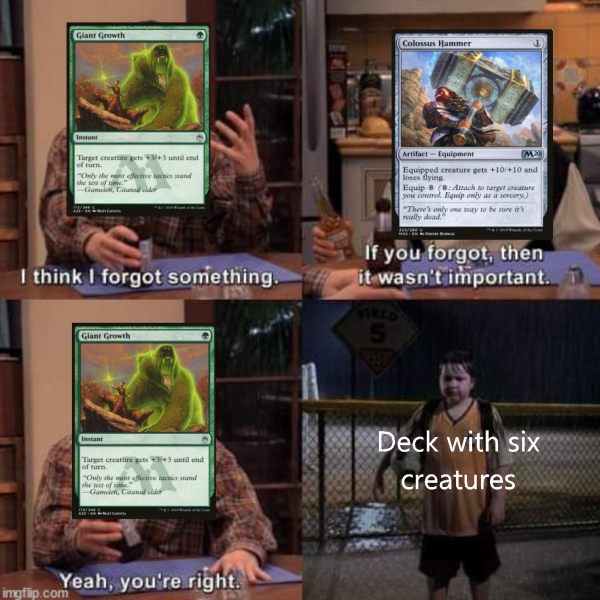
In fact, the number one problem I see when I look at Draft decks from new players is that they simply don't have enough creatures. As a result, their decks don't do anything. Creatures really are the pawns of Limited, and it's difficult to win without them.

The Problem with Auras

Auras can be powerful when they're uncontested. Unfortunately, the fact that they so often result in getting two-for-one'd is a convincing reason to avoid them. While there are some exceptions, I generally do not like putting auras in my deck unless I'm netting some kind of card advantage for playing them.

Less Vulnerable Auras

These cards all make themselves less susceptible to a blow-out. They each provide a little bit of value, and as a result, it's not a total disaster if the creature they enchant crosses paths with a kill spell. Certain formats, such as Theros Beyond Death, incentivize auras in other ways. While I caution against their inclusion, they're not without use.

Last week, my local game shop held an M14 draft. I built a pretty mopey red-green deck filled with reasonable creatures and some interaction. It was nothing special. However, I drafted and included two copies of Shiv's Embrace. My deck lacked the aggressive three-drops to pressure opponents early, and I knew I needed a way to close out games. While the auras were vulnerable, I tried to hold them until I thought they would finish off the game. A single Ranger's Guile helped my efforts. I had some success, going 2-1 for the evening.

Equipment vs. Combat Tricks

You should be including equipment and tricks more often than auras. A single combat trick can blow open a game and create exploitable leverage. A single piece of equipment can be used over multiple combat steps to grind out a powerful advantage. While sometimes a single card should be prioritized based on power level, you generally want the one that supports your plan better.

The Trick With Combat Tricks

The combat trick is the most versatile tool one can use to augment creatures. Though it has a one-time use, it requires very little set-up cost. All you need is a creature to target and a situation to exploit.

These cards can swing combat. Yet, they're not always easy to hide. If you attack a tapped-out opponent with a 2/2 and open mana into their 3/3, they're going to sense that something is up. Don't expect a snap-block.

However, if you're playing a deck that is constantly attacking and willing to throw creatures away for damage, it becomes significantly harder to identify a trick. If you're aggressive enough, then your opponent may be concerned about the trick, but have no other recourse than to "make you have it." Combat tricks are great for decks that are looking to set up alpha strikes or that are constantly pressuring opponents.

Setting up timely combat tricks can do more than just push damage. Oftentimes, they're used to remove difficult creatures. Once blockers are declared, a combat trick can bin an opponent's creature just as effectively as a traditional removal spell. When your deck lacks removal, the value of combat tricks increases significantly.

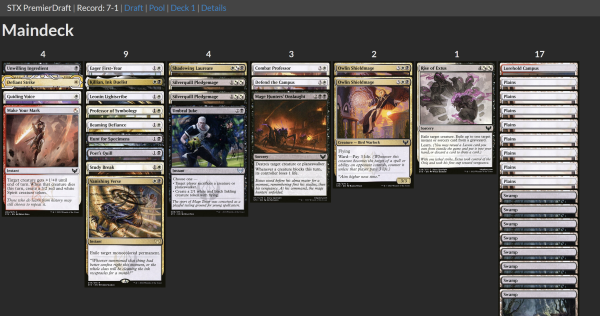
Few archetypes in recent history used tricks better than Silverquill out of Strixhaven (STX). This aggressive deck was willing to throw away resources to increase its clock. Make Your Mark, Beaming Defiance and Defiant Strike all helped to pressure opponents while triggering spellcraft. Sidenote: Poet's Quill was included not because it is an equipment, but because it's a huge bomb.

Permanents Are Just That. Permanent.

Equipment cards are often very powerful. Take a card like Vulshok Morningstar. I just sang the praises of Beaming Defiance, which provides the same boost to power and toughness as the artifact. However, the equipment can be used every turn to enhance an attack. Though the costly down payment and recurring tax to reequip the Morningstar will cost me far more tempo than the combat trick ever could. Though they are more powerful, they're much clunkier.

Whereas a combat trick needs a small window to be effective, equipment typically requires that you play it, equip it, and attack before you net any value. A lot needs to go right for that to work. If I'm relying on evasive attackers, like in a Blue White skies deck, being able to turn every Wind Drake into a Serra Angel is going to be hard to beat.

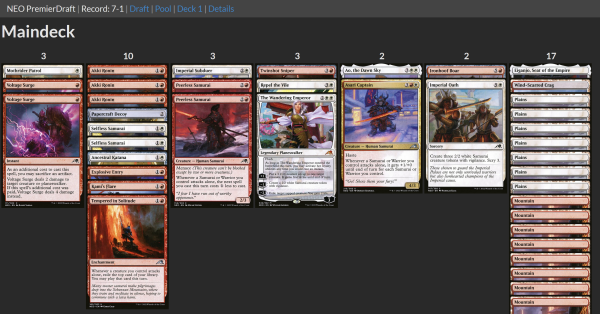
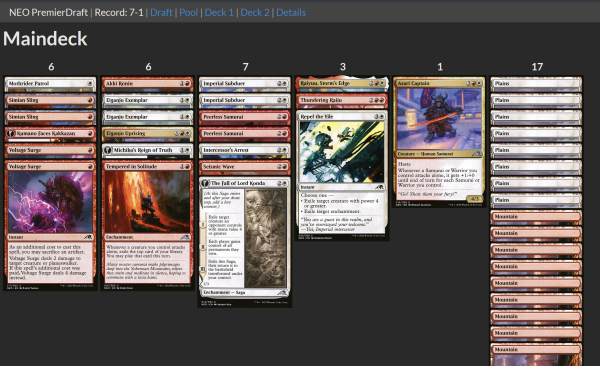
If my deck wants to pressure my opponent over a longer period of time, typically with smaller attacks, then equipment becomes valuable. In Kamigawa Neon Dynasty (NEO) the Red White Samurai Archetype was built around this strategy.

These were the first two trophy decks I played in NEO. While the reconfigure equipment provides a lot of versatility, knowing that I was going to be surgically dissecting my opponents' defenses one turn at a time caused the equipment to overperform.

Playing Against Cheap Removal

Efficient removal spells punish both equipment and combat tricks. However, if I know my opponent has access to cheap interaction, I want to consider the expectations of my game plan. If I know I plan on winning with tempo, then I want to use combat tricks to finish the job. Though I need to be cautious with my timing, I can still set up powerful tricks. If my opponent is likely to stick a Wall of Omens or Psionic Snoop before hiding behind removal spells, my combat tricks can keep them off balance.

Equipment can help me grind out wins, but it can be a liability in a race. While a super aggressive deck might not recover from the tempo loss associated with equipment, a more midrange approach might. Surely they won't remove every creature on my board. If at the end of the day a top-decked creature can pick up the artifact, I can force an opponent into a frustrating spot.

Cheap removal does make me question the inclusion of these types of cards. However, if I know my plan and understand how my opponent plans to defend against it, I can make tactical choices to put myself in the best possible situation.

Making the Critical Decision

One advantage of combat tricks is that they can act as interaction. When I draft a deck that is short on removal, then I prioritize combat tricks. If I'm the aggressor, it can be easy for me to turn a Skulduggery into a Doom Blade.

Equipment generally provides more value, while tricks leverage a tempo game plan. Tricks that draw cards will often times over-perform, but some equipment can dominate games. These cards will usually be available on the wheel and later in the draft, but that doesn't mean they're not significant choices. Remember that small edges are the only edges, especially when playing in more competitive circles. Know what your deck is doing as you build it and look to optimize every choice.

While heuristics can help, every deck and every match-up is different. The biggest step forward is being cognizant of how your choices are impacting your plan. There is no better teacher than experience. Make your best choice, reflect on it, and use your learning for next time. Choose wisely!

Back to Booster Boxes

Are you a Quiet Speculation member?

If not, now is a perfect time to join up! Our powerful tools, breaking-news analysis, and exclusive Discord channel will make sure you stay up to date and ahead of the curve.

Back in the Spring, I wrote a couple of articles that focused on sealed booster box prices. I focused mostly on the oldest products—sets that came out prior to 2000—and showcased just how expensive these have become over the years. Touching on this topic after ignoring sealed boxes for years really got me thinking.

A while back I had sworn off booster box investing for a number of reasons. The first and foremost reason I abandoned the strategy was opportunity cost. While singles were all soaring in price (particularly the Old School cards I had developed an affinity for), I felt sitting on a booster box for ten years in the hopes of turning $100 into $300 was not the best play. This was compounded by the fact that boxes took up more space, were more costly to ship, and were much slower to sell.

Some of these variables have changed enough lately to cause me to reconsider this space. In fact, I’ve already made a few booster box purchases last week as a way of getting back in. This week I’ll cover four reasons I am examining sealed booster boxes as investments once again, and I’ll touch on which boxes, in particular, have caught my eye so far.

Reason #1: Sealed Product Still Appreciates

One reason I originally abandoned booster box investments was the skyrocketing print runs associated so that Wizards could meet the demands of their ever-growing player base. I interpreted this trend to mean that the days of the $500+ booster boxes may be stuck relegated to sets printed before 2010. I was particularly burnt on Return to Ravnica and Magic Origins, which I purchased in disproportional quantity only to see their values rot.

In fact, sealed boxes of these sets can still be had for $138 and $145, respectively, even today.

Consider: Return to Ravnica turns ten this October, yet box values have only really appreciated about 30% in that time frame. Recent recession fears aside, this doesn’t even beat the return of the S&P 500 over that timeframe. I was smart to sell out of all those RTR boxes when I did.

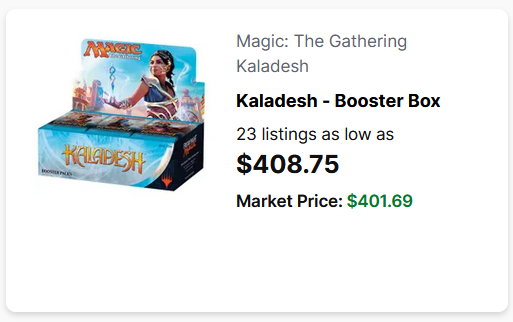
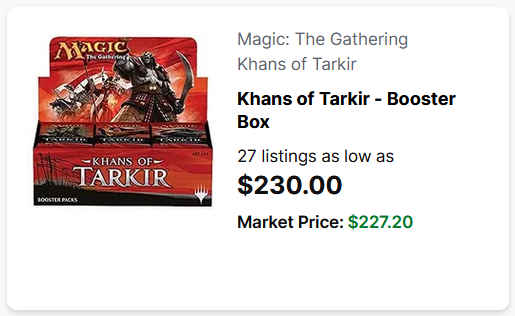
Wait a second… doesn’t this undermine the point I was trying to make in this article? Well, it turns out Return to Ravnica was a particularly poor choice for box investment. One of the worst, in fact. Booster boxes from more recent sets have done far better. Consider Kaladesh and Khans of Tarkir, for example, which came out in 2016 and 2014, respectively.

The former’s booster boxes sell for over $400 and the latter’s are around $230.

If I had been picking up cases of these sets instead of Return to Ravnica, I would have done much better in my investment. Thus, I will not let a couple of poor choices deter me from making another go at sealed product.

Reason #2: Shifted Priorities

The last time I attempted to speculate on sealed product, I would find myself sitting in my basement and thinking of all the value I had stuck in these boxes. In my mind, those were dollars that could have been used to improve my decks and expand my Old School collection. It was beginning to feel like I was wasting resources by waiting for an extremely slow booster box appreciation process. I needed cards and I needed them right away!

Thus, after selling out of my sealed inventory I quickly put that money to work elsewhere. This helped me build up my collection to what it has become, and I have no regrets about this decision.

Fast forward to today, however, and my sentiments have changed. I haven’t found myself really wanting another Old School card in months. It’s not that I’ve lost interest—instead, I am simply content with the cards I have in my collection currently. Of course, I wouldn’t turn down a great deal on a card that’s currently absent from my collection, nor would I ignore a deeply discounted Shahrazad.

There was an error retrieving a chart for Shahrazad

On the other hand, the fact that most of my gameplay nowadays takes place on Arena means I have little need to purchase more singles for my collection. As cash sits idle in my Magic account, I can’t help but wonder if there’s a better place to put my resources. The stock market seems precarious at the moment, and I am not really of the mind to purchase surplus Old School cards strictly for investment purposes—if I won’t appreciate the card in my collection, I’d just as soon sell it.

Thus, booster boxes suddenly become an attractive option because I can park money there for a slow, steady return. These also make nice display pieces on my shelf, which I do appreciate.

Reason 3: Planning for a Rainy Day

Arena has reminded me just how much I enjoy Limited play. Now that the Historic format has gotten stale (in my opinion), I’ve shifted my gameplay time back to Draft and Sealed events on the digital platform. Being able to play Limited with the newest sets for free is an extremely attractive notion.

This re-engagement with Limited play reminded me how much I used to have fun drafting paper Magic. Granted, I must face facts: I don’t have seven Magic playing friends, nor do I have much opportunity to draft paper Magic these days. However, there is hope ahead. My son is now ten years old and has expressed interest in the game. Perhaps in just a few years, the two of us can start attending FNMs and larger events together.

As he gets older, and if he maintains an interest in Magic, I’ll want to have some sealed product on hand with the promise of one day enjoying them. What’s more, I’ve always enjoyed the notion of opening older sets, so sitting on sealed product for a few years will be the best and most affordable way to accomplish this objective. Lastly, for the very long-term view, having some sealed boxes many years from now—perhaps after paper Magic eventually sunsets—will be something to cherish.

Reason 4: Another Reason to Shop for Deals

I experience a sort of thrill when shopping for deals. When I can find a Magic card I want with a price that’s discounted to the rest of the market, it gives me a very small hit of dopamine. To me, it’s akin to winning $4 on that $1 scratch-off ticket. The amount isn’t life-changing in any way, but the idea that I won something that is not easy to win gives me a temporary warm and fuzzy feeling.

My recent disinterest in acquiring new singles, however, has unintentionally diminished this feeling. If I’m not actively looking for cards to add to my decks or collection, then I’m not shopping for deals nearly as much. This apathy could lead to a larger disinterest in Magic—something I want to avoid as I still enjoy the game overall and I want to make sure I still have new topics to write about for this website!

Enter: sealed product.

Even if my seedling interest in buying sealed product is minuscule, I still want to water it and foster it so that it grows into something meaningful. This way my interest in the game continues and I maintain some involvement. Plus, as a critical bonus, I get to experience more dopamine hits as I once again can shop for deals!

What kind of deals? Last week I purchased a few booster boxes for what looked like the best prices I could find. I bought two different boxes directly from Star City Games: one box of Ixalan and one of Battle for Zendikar. The former cost me $151.59 and the latter was $199.09. How does this compare to TCGplayer?

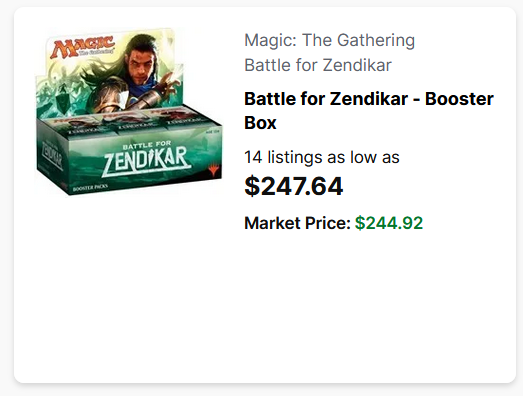
I was especially excited to grab that BFZ box—Battle for Zendikar has Expeditions, making the set attractive for the long term. The fact that there are only 14 listings on TCGplayer tells me that supply has really thinned out, meaning there could be some sizable upside in the next few years. While Ixalan didn’t resonate with me nearly as much, there are only 21 listings on TCGplayer, which is also surprisingly low. Anytime a booster box’s TCGplayer inventory dips into 20s of listings, I see that as a good sign for growth ahead.

Besides these two boxes, I also recently purchased booster boxes of Unstable, Aether Revolt, and War of the Spark. Unstable was an impulse purchase because I enjoy the Un-sets, Aether Revolt felt like a discounted Kaladesh with Masterpiece potential, and War of the Spark interested me for all its planeswalkers.

These sets are all newer than Return to Ravnica, but their boxes have already appreciated more than RTR’s. This gives me confidence that these will be winners, unlike RTR, and therefore offer greater upside potential.

Wrapping It Up

Before anyone asks, I’m not going extremely deep on these booster boxes. If anything, I’m going to aim for some breadth and diversification rather than attempting to go deep on any one set. This spreads out my risk, expands my options for Limited play in the future, and makes for a more interesting display on my basement shelf.

In the coming weeks, I plan to hunt and shop for a couple more boxes—I’m interested in picking up a booster box of Dominaria in preparation for the coming release of Dominaria United. When Unfinity is released, I may pick up a couple of those as well—one to open immediately with my son and one or two to sit on for a rainy day.

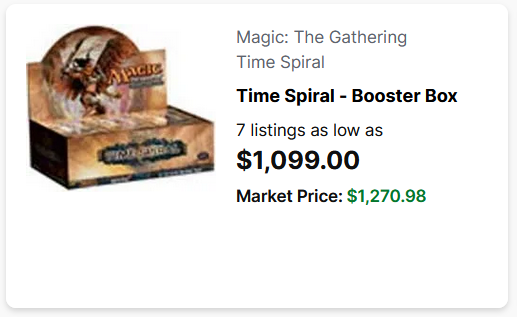
That’ll probably be about it for the short term. Sure, I’d absolutely love to pick up some boxes of older sets—sets from before 2010 or even 2000. But those are so expensive nowadays that the cost has really become prohibitive. I absolutely loved Time Spiral block, for example, but I have no interest in dropping a couple thousand dollars to relive the paper draft experience of that set.

Looking at these exorbitant prices really has me regretting that I abandoned my sealed booster box investment of a decade ago. There’s no sense in regretting past decisions, however. The best I can do is learn from it and move on, and that’s precisely what I’m doing now. Sealed booster boxes can still be viable investments or storages of value, and I hope to leverage the new generation of sets to some success in the years to come.

Generational Magic: Tossing About with New Friends

Are you a Quiet Speculation member?

If not, now is a perfect time to join up! Our powerful tools, breaking-news analysis, and exclusive Discord channel will make sure you stay up to date and ahead of the curve.

Never Tell Me the Odds...

In last week's article, I contemplated player familiarity and interaction, and asked "Can you have fun anywhere with anyone?" This week I pick up where that story left off, and put my theory to the test.

After wrapping up my game with some of the regulars at Mavericks, I said my goodbyes and drove a hundred yards or so over to the Gaming Goat. Each place has a different atmosphere. 'Mavs' is quite large with many people milling about. Gaming Goat is a very nice venue, but smaller, tucked in-between a Jersey Mike's and Skyline Chili. What do both game stores have going on? Plenty of Magic and Gaming!

I've visited Gaming Goat a couple of times before and talked with the owner, Connor, but I wasn't familiar with the players. I hoped lady luck would shine and provide a group to play Magic with. When I arrived around 9:30, fortune favored me. There was a single six-player Commander game in progress.

As I sat and watched their game, Harry invited me to join the next one. I expressed interest and waited until they finished the current game. A couple of the players left, so we formed a five-person pod. I introduced myself and told everyone that I wrote for Quiet Speculation, that I was looking for material for this article...and for a fun game of Magic!

Introducing the 'Unfamiliar Faces

I could tell immediately on walking into the store that everyone at the table was having a great time. They all knew each other and were in a comfortable setting—and Ryan brought baked goods for everyone to enjoy! Without further ado, here are some new friends from the Gaming Goat.

Harry

How old are you?
I'm Twenty.

How long have you played or what Magic set did you start with?
I started in 2016 with Shadows over Innistrad.

How did you start playing?
I joined in with my friends during my freshman year of high school. Shortly afterward, I was able to convince my Mom to buy me a few packs and I was hooked.

What's one thing you enjoy about Magic?
Being able to discuss and share with others the joy of the game. Talking about different decks, themes, plays, how to build decks.

Who's your commander for this game?

There was an error retrieving a chart for Minn, Wily Illusionist

What's one of your favorite memories of Magic?
My Dad enjoys an online game called Destiny. One of his friends that he played with decided to stop playing Magic back in 2018. He knew that I played, and so sent me all of his Magic cards! I received a good amount of cards and got my most expensive card from it; a foil Unhinged Island. I was really happy and grateful for this gift. We had a great time going through the cards, organizing, and checking them out.

There was an error retrieving a chart for Island

Very nice! What's one of your favorite Magic cards?
Lyra Dawnbringer. I have a mono-white angels deck that I play online with college friends. I'm pretty stoked about it because I've almost got it built in paper as well. One of my other favorites is Xanathar, Guild Kingpin. I don't combo out with him, but I enjoy grabbing my opponents' spells and having fun with their deck.

Ryan

How old are you?
Twenty-two.

How long have you played or what Magic set did you start with?
My brother bought me the pre-constructed Oko Planeswalkers deck and that got me interested in the game. I became more consistent with it just in the last year and a half.

How did you start playing?
I played Dungeons & Dragons before getting into Magic, but when the pandemic hit, that paused our playgroup for a while. I still wanted to get out where I could, so when Gaming Goat was able to start up Friday Night Magic again, I figured to try it out, and have been playing ever since.

What's one thing you enjoy about Magic?
I enjoy when games have a lot of back-and-forth. When the decks are evenly matched which many times provides good games for everyone. I played in an Innistrad: Midnight Hunt draft where I built a self-mill/zombie deck. There was a lot of interaction with it and the games were great.

Who's your commander for this game?

There was an error retrieving a chart for Captain N'ghathrod

What's one of your favorite memories of Magic?
The fact that I still have the deck that my brother gave me. It has some sentimental value and I slowly tweak it from time to time for when we're able to play against each other.

What's one of your favorite Magic cards?
I have three. Of course, Oko, the Trickster for the sentimental value, Frogify, because why wouldn't you like to turn something into a frog?, and Mistford River Turtle. What's not to love about giant turtles that make creatures un-blockable?

Eric

How old are you?
Twenty-three.

How long have you played or what Magic set did you start with?
I started just after Amonkhet was released. I took a break from 2018 until this past April.

How did you start playing?
My Magic experience started when I was working at summer camp. A group of people was playing, it looked like fun, so I joined with them.

What's one thing you enjoy about Magic?
The comradery. The ability to interact with others through Magic.

Who's your commander for this game?

There was an error retrieving a chart for Elenda, the Dusk Rose

What's one of your favorite memories of Magic?
Being pretty new, I would actually have to say the game we just finished. I believe that's the best I've done in a large game like that. I gained a ton of life, had a huge wall of vampires, and everyone had fun.

Yes, we did. So, what's one of your favorite Magic cards?
Interestingly enough, I would have to say Elenda, the Dusk Rose. She was great!

Abigail

How old are you?
Twenty-eight.

How long have you played or what Magic set did you start with?
I've been playing since Time Spiral, so 2006.

How did you start playing?
Funnily enough, summer camp and no, not the same one as Eric. Some of the others played and I remember one person had some snakes, from, I believe, one of the Kamigawa sets. I just thought the cards were really cool and intellectually stimulating.

What's one thing you enjoy about Magic?
Interacting with others through the game, of course, but I like figuring out puzzles. Whether my back's against the wall or figuring out a way to win, I like to work out the problem and see what I can achieve.

Who's your commander for this game?

What's one of your favorite memories of Magic?
Definitely the first time I played my Kaalia of the Vast Commander deck. It was very fulfilling to say, "I made this deck", put it together, see it run well, and achieve what I was looking for.

What's one of your favorite Magic cards?
Chaos Warp. A fun removal spell where you just aren't sure what you'll end up with. I like the randomness of it.

Once More Unto the Breach...

Once they finished their first game, we all got seated and ready to battle! It was noted in our pregame conversation that I had Obeka, Brute Chronologist as my commander. They were initially concerned about its combo potential, but I reassured them that Obeka actually had very little to do with the deck. When I played the Sorcerer's Strongbox Abigail realized what I was doing and shared with the table that Obeka wouldn't be a problem.

If the Fates Allow.

Most Commander games start slowly while everyone builds up. Ryan decided to not wait and within a few turns had a couple Consuming Aberrations ready to start milling everyone. The second one was a copy from Mirrorhall Mimic, so he was ready to get his 'mill on'!

Needing to slow down Ryan's shenanigans, I Dreadboreed the original Aberration and hit the copy a turn later with a timely Rakdos, the Showstopper. Rakdos Destroyed many of Harry's creatures as well, which was a bonus, though Harry didn't see it that way.

Throughout the game, Harry and Eric continued to generate illusion and vampire tokens, respectively. Abigail was sacking creatures, drawing cards, and making wolf tokens. I soon copied Rakdos with a Spark Double and again cleared a good portion of the board.

One interesting play I was able to complete for the first time in over twenty years was actually activating Goblin Bomb. I won a couple of flips and used Karn's Bastion to get it up to five counters to throw 20 damage at someone. That was the great part. The not-so-great part was I didn't have any great targets. Eric had a ton of life, so I threw it at him to hopefully keep him in check.

Too Much of a Good Thing...

Toward the end of the game, I ended up with the following cards on the board:

One of the cards you don't see in the picture is the Frenetic Sliver I cast the turn before. Abigail knew what it could do with the current board and had a response. See, Abigail had exiled three of my cards and one of them was a Counterspell. Abigail tried to counter the Sliver and I almost let it go through until I looked down at my hand. I had a Dualcaster Mage. So I copied, and in turn, countered the Counterspell and was able to resolve the sliver. I was planning to wait, and activate it right before my turn, but one of the other players went to destroy it.

In response, I had to start flipping my way to victory, but we all noticed Zndrsplt, Eye of Wisdom's ability isn't a may ability. I couldn't activate the sliver too many times without possibly drawing myself out of the game. Through a little group discussion, we determined to use an application on Abigail's phone to determine the flips instead of me flipping two coins way too many times. I chose 40 flips and was able to get to the ten counters I needed for Chance Encounter, draw a bunch of cards, and survive to my turn.

Unfortunately for me, at the end of Harry's turn, Ryan flashed in Hullbreaker Horror and on his turn, played a spell and bounced my game-winning enchantment back to my hand.

It's time to go home people!

My amazing reach for glory, then followed by a fast plummet to mediocrity was short lived. The nice young lady running the store really wanted to close up since it was close to midnight. They normally close an hour or so before that, so we all promised we were just about done. We rushed through some of the plays from here on, but I was again the first one out.

I assume it was because they didn't want to take a 'chance' I could come back. From that point, Eric's vampire horde started picking everyone off. By this point in the game, Eric had recouped his army of vampires, lead by a huge Elenda, the Dusk Rose, and sitting comfortably at 70+ life. If I recall correctly, he took out Harry and Abigail about the same time and finished up with Ryan.

Would You Like to Play a Game?

So, is there a difference between the familiar and the uncertain? Of course, but the overall answer is yes and no. Hanging with people you know really isn't that much different than with people you don't. Once you start getting to know people and making that connection, they can easily become people you know. I know it's not always comfortable to open yourself to a new experience that may backfire, but the difference is in you.

I'm a pretty open and friendly person, ready to hang out with almost anyone. Of course, not everyone is like me in that regard. Are you allowing yourself to get to know others? To reach out, open up, and share our love of gaming and Magic? If not, you might be missing out on some amazing moments and people.

Thanks again to everyone at Gaming Goat for taking the time to share about themselves. How about you? Feel free to share any fun experiences in the comments or on Twitter.

July ’22 Metagame Analysis: Stability’s Price

Are you a Quiet Speculation member?

If not, now is a perfect time to join up! Our powerful tools, breaking-news analysis, and exclusive Discord channel will make sure you stay up to date and ahead of the curve.

Data analysis in a stable system creates and eliminates opportunities. On the one hand, there is a consistent target to pull apart, dissect, and discuss. Why is this trend as it is? How might it be overcome, does it need to be overcome, etc? On the other, you tend to start repeating yourself when this continues for months on end. This is where I'm finding myself in this fifth month since Lurrus of the Dream-Den was banned.

Checking In

I swear every month that I'm not going to make it all about UR Murktide being the outlier among outliers in Modern. I've said everything that could possibly be said already. However, there is simply no escaping it because look at the data! However, that's not all that's going on, and getting past Murktide (or trying to, anyway) does suggest that Modern is dynamic beneath the surface.

Deck NameMarch %April %May %June %July %
UR Murktide12.92 14.6513.3714.1419.46
Cascade Crashers7.58 7.55 5.495.202.09
Hammer Time6.74 10.37.169.3611.09
4-Color Blink6.465.03 10.749.983.77
Living End6.18 7.326.683.956.28
Amulet Titan4.78 5.034.53 3.535.23
Yawgmoth4.21 5.727.165.206.69
UW Control3.65 1.833.582.702.09
Burn3.37 4.354.06 6.244.60
Mono-Green Tron3.37 3.201.682.702.30
Grixis Shadow3.37 2.291.685.617.11

Updating my tables from last month makes that clear. A number of decks have seen rapid changes in position from June. It will be easier to see in graph form:

Trendlines!

Murktide was at least being shadowed by a number of decks and by a relatively stable margin in previous months. That's all gone out the window in July. Not only did it just take off, but many other decks fell precipitously and the gaps in the metagame are becoming more pronounced. This is continued in the paper data:

Deck NameMarch %April %May %June %July %
UR Murktide10.08 7.6412.7511.8813.02
Cascade Crashers6.52 9.207.165.206.26
Hammer Time4.15 3.905.306.256.13
4-Color Blink0.79 5.777.318.286.39
Living End3.95 3.742.583.594.47
Amulet Titan6.32 4.993.444.224.98
Yawgmoth3.36 3.124.735.006.13
UW Control6.72 5.463.873.433.83
Burn5.73 4.994.733.285.11
Mono-Green Tron1.78 2.812.443.282.30
Grixis Shadow4.74 1.404.153.434.09

There may be only one outlier in paper this month, but the scale of the gap between Murktide and its next competitor looks worse than online:

Nice muddle around 4% there.

The gap isn't actually worse, as Magic: Online's (MTGO) ~8% is bigger than paper's ~7% gap, but with no additional outlier to bridge the gap it's more pronounced. Always remember when reading graphs to pay attention to the scale.

All Together, Now

This brings me to the bigger problem with the current metagame. Last month I made the argument that, while Modern is quite diverse, the percentage that the 11 selected decks are taking up poses a long-term problem by stifling the space for creativity and innovation. I'm really feeling that argument is vindicated by the July numbers:

March %April %May %June %July %
MTGO62.63 67.2766.13 68.6170.71
Paper54.14 53.0254.3157.8462.71

Yeah, 70% of a metagame made up of Tier 1 decks (with a few from Tiers 2 and 3) isn't great. Especially when I remind everyone that these 11 decks are only half of the Tier list. That is a very concentrated metagame, and far from ideal.

Consistent upward trends are worrying.

Both paper and MTGO saw the total decks making the Tier list fall in July, and these trendlines are plausibly explanatory. I've said it before, but I'll hammer it in again, when 70% of the metagame is taken up by 11 decks there's not much room for innovation. It's hard to gain traction when being shoved around by 800-pound gorillas.

That Said...

This is all true and concerning in a vacuum. However, 2022 is the first year I'm gathering this type of data and watching it all happen in real-time. This kind of concentration might be relatively normal. However, I'm skeptical. Looking back at 2021, the top 11 decks for the whole year only amounted to ~48% of the year's metagame. The average percentage for MTGO so far is ~67% while paper is ~56%. It's going to take a major falloff of multiple currently Tier 1 decks for this concentration to not be maintained. Of course, 2021 was far from a typical year and so maybe that year being so unconcentrated was the deviant. I don't know.

Is There a Problem?

Murktide's individual metagame percentage coupled with the concentration of the top performing decks is concerning. This is balanced by each deck being fairly evenly matched, with no one deck winning events more than others. On the one hand, Murktide shows up in such high numbers in high-level events (despite never winning them) that it sure looks like it wins more than other decks. However, the deck has to earn all its wins—there are no freerolls in Murktide. I could go on like this for the rest of the article.

There was an error retrieving a chart for Murktide Regent

It is obvious that this isn't a Splinter Twin or Eye of Ugin situation. Rather, the current metagame most closely resembles post-Eldrazi Winter 2016 Modern. There are a number of viable decks that are relatively well-balanced against each other, but the top deck is the popular, grindy midrange deck. Back then it was Jund, now it's UR Murktide. Gameplay-wise, they're quite similar with a matchup spread of 50% against everything.

There was an error retrieving a chart for Bloodbraid Elf

Admittedly, Jund never had Murktide's popularity. That might be because playing blue cantrips is more appealing to many players than black discard. It could also be that Jund's price tag was more odious in 2016 than Murktide's in 2022. I have no way to know for certain, but it definitely isn't down to a better win percentage.

What Will Happen?

I'm not sure how this will ultimately shake out. There are good arguments for leaving Modern as is, however, history shows that Wizards doesn't like Modern's metagame to stay too stable for too long. They also don't like one deck being too popular forever. Of course, in previous times where that was an issue, said decks were also winning too much. Whether just being insanely popular is enough to warrant action is unknown. I foresee two possibilities:

1) Wizards Sleeps

If Wizards is fine with Modern as-is and doesn't intervene this current metagame will persist for the foreseeable future. I doubt there's anything waiting to massively shake up the metagame nor is there anything that will simply dethrone the established decks. They're all based around playing the most powerful and efficient cards possible. How does one improve on that?

There was an error retrieving a chart for Solitude

For Murktide to fall off independently of metagame changes would require player tastes to change. Again, it isn't a deck that wins too much, it just sees an inordinate amount of play because players like its gameplay. For that to change would require players to get bored and/or frustrated enough to abandon the deck completely. Unlikely, but not impossible.

There was an error retrieving a chart for Consider

On the other hand, the upcoming releases might have Modern playable cards. It's a little unlikely given the Alchemy nerfs to Unholy Heat and Dragon's Rage Channeler, but it's not impossible. Wizards designed these sets years ago, they wouldn't have known how Modern would turn out and could have left powerful cards. The problem is that, given Wizards' current design proclivities, it's more likely that new Modern cards would reinforce current gameplay rather than fight it. Wizards is in a cantrip and velocity-heavy period of design. This would tend to make Murktide a better/more popular deck, which just makes the problem worse.

2) Wizards Wakes

If Wizards instead decides that bans are necessary, it's hard to know how that'd go. Remember, Wizards doesn't like to outright kill decks unless absolutely necessary and wants to ban surgically. The question is what could be banned to make Modern less concentrated. Ragavan, Nimble Pilferer was on my list, and it's such a feels-bad card and potent threat it might be enough.

There was an error retrieving a chart for Ragavan, Nimble Pilferer

The catch is that if Murktide is taken down a peg, what might rise in its place? I don't think 4-Color could, simply because it's so unstable. If it was going to consistently win and/or take over Modern, it should have done so already. However, it may be being held down by Murktide. In which case Wizards would need to nerf it too. Conveniently, Expressive Iteration is an important card the two decks share, so maybe that's a target.

There was an error retrieving a chart for Expressive Iteration

However, that's ignoring the impact that nerfing either deck could have on the cascade decks, not to mention Hammer Time. Hammer has already been the target of a ban this year and yet continues to thrive. What I'm saying is that it feels like Modern is heading towards another mass-spectrum ban. The top decks are sufficiently powerful to counteract and contain each other but far surpass the rest of Modern. Taking out one and leaving the others is very risky and Wizards showed itself to be risk averse last time.

An Odd Development

On that note, why did 4-Color Blink crash in July? I'm not being rhetorical, that's an actual question. For a deck to fall from an outlier to Tier 2 on MTGO is shocking enough, but there's no obvious cause for it to happen. Living End and Amulet Titan are up, and they're not great matchups for 4-Color, but aren't terrible either. Burn's a bad matchup and it fell too. Meanwhile, Grixis Shadow was rising and my impression is that it's a good matchup for Blink. The combined metagame forces would suggest that 4-Color Blink should have done better.

There was an error retrieving a chart for Death's Shadow

What definitely didn't happen online was 4-Color players switching from Ephemerate to Counterspell. 4-Color Control was slightly down from 2.70% to 2.51% on MTGO. That is accompanied by Blink falling ~6% from 9.98% in June to 3.77% in July. This leaves me wondering if Blink was just really badly positioned or if price fluctuations priced a lot of players out of the deck. Rental services can be harsh.

There was an error retrieving a chart for Ephemerate

Players switching might explain the fall in paper, on the other hand. Control was up to 3.19% from 0.94% in June, a rise of 2.25%. Blink fell from 8.28% to 6.39%, a fall of 1.89%. Given that the decks are nearly identical, it is easy enough to swap a few cards around in paper, so players may have switched. I can't say for certain of course, but the theory's plausible.

Be Wary

As is tradition, I'll wrap up with a glimpse into my finance crystal ball. It advises caution. As noted above, Modern may be stable but it is very unlikely to persist. Whether something gets printed to shake things up or Wizards intervenes, there's no way the current metagame's spread will continue. I believe that any new cards are more likely to reinforce current trends than fight them given how Wizards has been designing over the past year. That would most likely lead to a short-term boost in Murktide play (and therefore staple prices) before crashing due to a banning. Whether that would affect other decks is impossible to say.

There was an error retrieving a chart for Omnath, Locus of Creation

Consequently, be cautious around Tier 1 decks. Wizards can just announce a ban out of nowhere and for any reason and while I don't think it is likely or soon, I do believe Modern is heading towards a ban. Maybe many. Thus, I'd cool any speculation or investment plans. Prices are fairly stable now, so there's not much opportunity in the first place. There's considerable price growth possible in the next few months, but be ready in case the rug gets pulled out.

Dark Clouds Building

Modern is in a great/terrible place. Players (generally) like the gameplay and deck interplay. However, the statistics on the format don't look good. This cannot remain as-is forever, so I'd make whatever preparations necessary before the actual storm breaks.

How I Would Beat Post Malone For $100K

Are you a Quiet Speculation member?

If not, now is a perfect time to join up! Our powerful tools, breaking-news analysis, and exclusive Discord channel will make sure you stay up to date and ahead of the curve.

Attention Magic fans! Musical artist and fellow Magic aficionado Post Malone is engaging with the MTG community in a big way. You have a chance to play him and win $100,000. Besides being a huge publicity stunt for the Whatnot app, this is a chance to throw down in a contest of the ages for ultimate bragging rights. Let's talk strategy and winning that huge cash prize!

Which Deck Would You Play?

It depends. The rules are a little unclear. In a couple of articles it mentions a "match" and in others a "game." However, I would not play a four- or five-color deck for the plain fact that mana can be an issue. Everyone has lost to mana screw before, and there's no way I'd risk it here. Two or three colors is a lot safer. While I currently have a deck of each single color, they are just too limited in card selection.

First, Some Ground Rules

This is the part where details are a bit sketchy, but it looks like you're playing one game or potentially one match of 1v1 Commander for all the marbles. There's also this gem from the Official Rules: "Post Malone determines in his discretion that the Winner has won the Game." This is, in fact, the best super power.

With the data we have at hand, our next-best resources are EDREC for the saltiest cards and the French or Duel Commander banned list. These are some of the most powerful, impactful, and unfair cards available. When you bring a deck full of these cards to a 1v1, you are at a huge advantage versus an opponent that does not fight fire with fire.

The overall strategy should be total game control through either raw Counterspell power or hard stax prison elements. Which are the best commanders for that?

Winning at the Commander Selection Screen

These are the only three commanders I would consider, for several reasons. Both Edric, Spymaster of Trest and Derevi, Empyrial Tactician are banned in Duel Commander and Grand Arbiter Augustin IV is commonly considered to be oppressive. In many ways, they are all sort of the same card. Derevi allows you to play all three, which is a nice bonus for three colors.

I feel like my version of Edric could steal a game, but in a series, with any kind of swapping decks or alterations, it's the frailest. Meanwhile, both Derevi and Augustin would be more solid on average over a series, but be a lot less explosive in any given single game.

So we are potentially Azorious, Simic, or Bant. Here's why.

Blue Opens Up Free Counters

You have to play blue. Permission is the universal answer to nearly everything in Magic, and your opponent has an unlimited budget, so they could be playing anything. The only way to have an answer for everything and anything is to play blue, and with it free counterspells and the best two-mana counterspell in Mana Drain.

White Offers Removal and Control

Obviously, white has the most efficient removal in the game with Swords to Plowshares and Path to Exile. It also has low-cost stax effects like Drannith Magistrate and Thalia, Guardian of Thraben. As a bonus, if you add blue, you get access to uncounterable spells like Supreme Verdict and Dovin's Veto, which is very important considering I assume my opponent will also play blue.

Green Means Ramp and Hate

Green has the best ramp for only one mana. Is that alone enough to legitimize playing it, though? How about some powerful, blue-centric hate on top of that? If I put my opponent on blue, there are very powerful cards green specifically brings to this matchup, and I want to play them.

Sorry, Rakdos Players!

Red and black? I just would not risk 100K on Lightning Bolt and Demonic Tutor, even if they are excellent cards. Some cards that are normally powerful like Dockside Extortionist, Jeska's Will, and Blasphemous Act are all much less effective when used in a 1v1. Furthermore, black brings the obvious to the table: a boatload of tutor effects, which is normally a good thing. But here, there's a problem.

Just Counter It

Regularly I counter a tutor instead of what was tutored up. This is contrary to normal Magic logic, and has tilted many players I've played. This is the right move in many cases in multiplayer, but not always. In a 1v1? It's correct every single time. The following cards, and cards like them, are why.

Countering lands is exceedingly difficult, and there are more than a few that can ruin your day. Either version of Boseiju can prove a massive headache in many scenarios. Cavern of Souls obviously gives your opponent uncounterable creatures for the rest of the game. Strip Mine can ruin your mana base and, if you have two lands up for a counter, they can kill one and then safely make their play.

Next, there are plenty of uncounterable spells, some of which we spoke about already. Allosaurus Shepherd turns every counter in your hand into a brick for the rest of the game. Talk about game-winning.

What about cards like Ulamog, the Ceaseless Hunger or Emrakul, The Promised End that heavily impact the gamestate even when they do get countered? There are more than a few "when cast" cards that do not care about resolving.

Allowing an opponent to dig through their deck is a demonstrably bad idea. Keep this in mind and don't let them do it!

There's Jail, and There's Super Jail

We've talked a lot about how to control the game and not let our opponent get an early start by leaning into a controlling archetype. This begs the question of how we are going to close out the game. It's as simple as letting the other player quit. For $100,000, I'm not taking any chances. I am stacking the sandbags high until my arms fall off. The best part about these commanders, though, is that we have the potential to both pile on various stax effects and slowly win at the same time with creatures.

Ding Dong, Your Ability to Play Magic Is Gone

It's extremely hard to play Magic without mana. All of these cards do a very good job of removing mana from the equation. We are essentially countering or removing everything for the first few turns, and then attacking the mana base as of turn four. Finally, no matter which commander we pick, we are aided by untap effects, card draw, or cost reduction so we can always keep ahead of the curve.

Once the Lands Are Locked Down, the Wincon Emerges

Winning in twenty turns is still a win. I see no point in taking a risk, so any creature will do. Hatebears with stax effects will be more than adequate to take the win as a side effect of controlling the game. Simple and effective, "bears" have been finishing games since '93.

Good Luck Out There!

Even assuming that the number of people following Mr. Post on Whatnot doubles in the next day before selection, each person would have a 1 in 20,000 chance to get invited. This is a lot more probable than winning the lottery. If you were lucky enough to be picked, what deck would you bring versus Post Malone? Let me know in the comments.

A Guide to Cutting Your Shipping Costs

Are you a Quiet Speculation member?

If not, now is a perfect time to join up! Our powerful tools, breaking-news analysis, and exclusive Discord channel will make sure you stay up to date and ahead of the curve.

Way back in 2018, I wrote about maximizing card shipments with a standard USPS forever stamp. The purpose of that article was to help reduce shipping costs on low-value, multi-card orders. It dawned on me recently that I haven't actually written any articles specifically focused on helping sellers reduce costs. I have always been someone who is conscious of price, so I hope you enjoy reading about optimizing your cost reduction as much as I enjoy writing about it.

One key thing to remember about shipping costs is that they provide no additional benefit to the customer once the product arrives, so their only value is protecting the goods on the way to the customer. While valuable, the takeaway of this preamble is that the benefits end when the customer opens the package and retrieves their goods.

Buy In Bulk

Many of you may have memberships to bulk discount stores. The two big ones we have here in the US are Sam's Club and Costco. While it isn't always true, most of the time, buying large quantities of a product tends to be cheaper per unit. Here are some examples:

Bubble Mailers

I could go into my local Walmart and buy bubble mailers for my $50+ orders that I want to make sure are protected and tracked. As you can see by the simple breakdown, buying 2 means they are $0.57 each; buying 10 means they are $0.516 each. I don't know why buying 12 is actually more expensive per unit than 10, but it's likely due to the fact that many people don't actually break prices down and instead just assume it's a better deal. So consider that a lesson within a lesson: always price compare by a standard unit of measurement!

If I don't need the mailer immediately and can afford to wait a few days, I can go to Amazon and buy a 50 pack for $9.59. This has a unit cost of $0.19 each.

By buying your mailers in bulk, you can save $0.30 or more per order, which can really add up over a year's worth of sales. I looked at last year's sales and found that I had 44 orders that required bubble mailers, meaning I saved $13.20 over the year.

Look for Cheaper Alternatives

Many sellers may remember that about 6 months after COVID-19 hit the US, top loaders dried up. The cost of polycarbonate skyrocketed due to strong demand for face shields and the guarding that many stores put up as barriers to help reduce the spread of the disease. This meant the big top loader manufacturers were unable to source the material needed to manufacture top loaders and they were pushed down the waiting list given the importance of the other items soaking up all the available material. Looking at BCW's website, they are still back ordered well into 2023. Looking at their "best deal," new top loaders would come out to $0.1124 per if you bought 1000 and could wait until January.

If you wanted to find new top loaders that are readily available, it appears the current going rate is right around $0.14 each.

Used Over New

Prior to the Pandemic, used top loaders were far more available and cheaper than new ones. I used to buy large boxes of them off of eBay.

These top loaders came out to right under $0.09 per, which was pretty typical for what I would pay for them when buying larger boxes. Occasionally, a few might be warped enough that I wouldn't want to risk putting a card in them, but that wasn't common enough to really cause me to rethink my purchasing strategy. Interestingly, a similar sale ended just a few days ago in which the total cost of 600 used Top Loaders was $70.50, which comes out to $0.1175 per.

Cardboard Sleeves

There was a big push by many of the larger retailers to find reliable sources of card shipping protection, and many ended up turning to cardboard sleeves like the ones shown below, which come out to $0.1244 per. Looking over Amazon's listing of cardboard sleeves, the non-bulk options end up costing a bit more at around $0.15 per.

It's important to point out that a lot of the price differences shown so far aren't vastly different, and for small-time sellers, it may not be worth the time to put too much effort into optimizing these costs. However, for larger sellers, these costs can be significant. A $0.05 savings on 1000 orders equates to $50, or to a $500 savings on 10,000 orders.

Free Is the Best Price

One of the challenges I faced throughout the early parts of the pandemic was shipping material shortages. As I previously mentioned, a lot of people shifted from plastic to cardboard sleeve protection simply due to no top loaders being available. I ran through that box of used top loaders sometime around August 2020. One day while packing up our recycling to take to the recycling center, I realized that I was essentially throwing away tons of potential card sleeves in the form of various boxes my family had used up. I started cutting up cereal boxes and found I could get between 8 to 10 "sleeves" from a given cereal box.

Now, not only do I keep my heart healthy by eating a box of cereal, I also save an additional $1.24 on shipping materials. Obviously, this does require some effort on my part by cutting up the boxes, but it's something that can easily be done while watching Netflix with my wife so really there is no loss of free time on my part. It may also be apparent that this is something that works well for a smaller store with a limited number of daily or weekly orders, but might be difficult to scale. However, I would suggest that store owners who don't mind putting in this effort consider asking customers to donate cereal boxes or similar style boxes, or even offer some minor reward (say, a free drink or snack for every 10-20 boxes).

A Penny Sleeve Saved...

This article features plenty of tiny numbers, but also some bigger ones. That's because those small costs can really add up, and it pays (literally) to be proactive about streamlining your shipping costs when selling cards online. Have you tried out any of the above ideas? Are you suddenly craving cereal? Got any great tips of your own to share? Drop a comment below and let us know!

Magical Creatures: Tempest’s Thalakos and Soltari

Are you a Quiet Speculation member?

If not, now is a perfect time to join up! Our powerful tools, breaking-news analysis, and exclusive Discord channel will make sure you stay up to date and ahead of the curve.

Hello everybody, and welcome to a new installment of Magical Creatures. In this series, we comprehensively analyze each creature type specific to the Magic universe. With every piece comes an expansion. We started with Antiquities, and last time, discussed the new types introduced with Mirage.

Mirage was the first expansion in a three-set block, but we won't touch the other two (Visions and Weatherlight). Even though they both introduced several new creature types (such as Chimera and Jellyfish), none were unique to this game. Sorry, Avizoa fans!

Today, we'll jump straight into Tempest, from 1997. The last set of that year was also the first set in the Rath cycle (followed by smaller sets Stronghold and Exodus, both from 1998). Tempest introduced no less than 5 new creature types unique to the Magic: The Gathering franchise, even though a few clarifications need to be made. But first, let's take a look at the set itself, and see what it brought to the game.

Tempest and the Rath Cycle

Released in October 1997, Tempest is the 12th Magic set. Its 350 cards were not only sold in starter decks and booster packs, but also in preconstructed decks. The set's new mechanics were buyback and shadow. The first one was not all that successful, although it did contribute to a very strong card in Sprout Swarm (discussed in detail a few weeks ago alongside Thrulls, Homarids and Saprolings). The second one is just another evasive ability, like flying and fear, but only ever appeared in the Rath cycle, excluding a few exceptions.

But what about the new creature types? Tempest introduced Crab and Shapeshifter, which we won't take into account since they are not specific to this game. But it also introduced Licid, Spike, and notably, one of the most prolific and beloved creature types of all time!

Subtypes Added Retroactively

Wait... three? Didn't I say five? The fact is the other two types (Soltari and Thalakos) did not exist right away. They were retroactively added with the advent of Time Spiral. For instance, neither Soltari Priest nor Thalakos Sentry featured the relevant subtype on paper, although their races appeared in the name of the cards. At least, not in their original version from Tempest. Something similar would happen again with the subtype Kor, which we'll circle back to in a future article.

Since five new types is quite a lot, and given that the final tribe is especially storied, we'll split this set into two separate articles. Today's will discuss Soltari and Thalakos, while next week's will focus on the others.

Soltari

Soltari is a white creature type not unlike Spirit. Its creatures are all white, with the lone exception of Soltari Guerillas being both white and red. They all feature the keyword shadow. Lastly, they all come from the Rath cycle. Only ten cards exist with this creature type: eight from Tempest, one from Stronghold, and one from Exodus. No more Soltari were printed, apart from a reprint of Soltari Priest in Time Spiral and a couple more reprints in Vintage Masters.

All in, the Soltari tribe looks proves quite consistent. They are all low-curve white creatures that make for decent beaters, especially considering shadow. None of them has ever been particularly successful, at least in the competitive environment. However, shadow can be a popular keyword with casual players, and there are enough Soltari in existence to make a tribal deck.

Thalakos

Thalakos is something of a blue analogue to Soltari, as they also represent Spirit-like beings and its cards have shadow. They are basically shadow creatures trapped on the plane of Rath. Only seven cards exist with this subtype, and they again all come from the Rath cycle: four from Tempest, one from Stronghold, and two from Exodus.

It's another consistent tribe, but if I must be honest, they are not that interesting. The only aspect that differentiates them from the Soltari is their sneaky quality, which is in line with blue's color pie identity. Apart from that, they are just another shade of shadow creature, caught between the planes, and not really able to interact with the world at large.

They shadow keyword prevents all these creatures from being blocked by creatures without shadow, but it also prevents them from blocking creatures that don't have shadow. While flavorful when it comes to illustrating a creature caught between planes, the absence of interaction has never been good on a Magic card. That's why most people despise combo decks, especially those not allowing the opponent any kind of counterplay. And that's why some of them were banned (think of the infamous deck Eggs). Even newer players often grimace when met with a creature that "can't be blocked," as such texts suppresses a key element of the game.

Two Colours, One Fate

Initially, these creatures could be identified as Soltari and Thalakos solely because those respective tribes appeared in their names, but they didn't actually carry those subtypes. Things changed with the Grand Creature Type Update, as has become a theme in this series!

The only difference is that Soltari got the subtype a year earlier than Thalakos, since Time Spiral (2006) reprinted Soltari Priest. Its typeline read not Summon Cleric, but rather Creature – Soltari Cleric. Poor Thalakos had to wait until Lorwyn (2007).

Do you have a preference between these two oft-forgotten tribes? Have you ever sleeved one up? Let me know in the comments or on Twitter, and stay tuned for next piece, where we'll do a 180 and dive into one of Magic's most beloved creature types... Sliver!

Want Prices?

Browse thousands of prices with the first and most comprehensive MTG Finance tool around.


Trader Tools lists both buylist and retail prices for every MTG card, going back a decade.

Quiet Speculation