menu

Deck Overview- Orzhov Eldrazi

Are you a Quiet Speculation member?

If not, now is a perfect time to join up! Our powerful tools, breaking-news analysis, and exclusive Discord channel will make sure you stay up to date and ahead of the curve.

Going into last weekend there was a lot of buzz about Red Eldrazi. It was a playable deck pre-rotation that more or less stayed in tact, and as such it was a great starting point for testing. As things played out, it was a black and white brew that ended up being the most represented eldrazi shell in Baltimore, with most of the Roanoke crew playing the deck. Nick Miller did a deck tech on the deck with Brad Nelson, though it was Eric Hymel who gave the deck it's highest finish by clinching third.

Orzhov Eldrazi

Creatures

3 Hedron Crawler
4 Eldrazi Displacer
4 Knight of the White Orchid
1 Matter Reshaper
4 Thought-Knot Seer
4 Archangel Avacyn
2 Ayli, Eternal Pilgrim

Spells

2 Gideon, Ally of Zendikar
2 Sorin, Grim Nemesis
2 Anguished Unmaking
2 Ultimate Price
4 Declaration in Stone

Lands

6 Plains
2 Swamp
4 Battlefield Forge
2 Blighted Fen
4 Caves of Koilos
3 Forsaken Sanctuary
1 Foundry of the Consuls
4 Shambling Vent

Sideboard

2 Reality Smasher
2 Virulent Plague
1 Anguished Unmaking
1 Ayli, Eternal Pilgrim
1 Gideon, Ally of Zendikar
3 Duress
2 Read the Bones
3 Tragic Arrogance

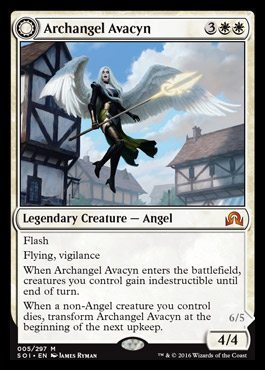
While it's labeled as an eldrazi deck, it's hard not to notice that this deck is just jamming a lot of generically powerful black and white cards. Hedron Crawler and Thought-Knot Seer are the ports from Red Eldrazi, with Eldrazi Displacer being the significant colorless upgrade. Displacer has already proven its worth in Modern, often winning games that no other card in the Modern Eldrazi deck could by either recurring your own enter the battlefield abilities or investing three mana to incapacitate an opposing creature. This deck doesn't have anything on the lever of Drowner of Hope to blink, though recurring Archangel Avacyn to make your team indestructible multiple times can be extremely powerful. If you didn't pre-order Avacyn, you kind of missed the boat on that one, though I imagine that Eldrazi Displacer has room to grow in price during its time in Standard.

There was an error retrieving a chart for Eldrazi Displacer

The other major card that I'd make note of is located in the sideboard, and that's Tragic Arrogance. Arrogance was a card that we had in our Abzan deck for PT Origins, and it was excellent. We actually expected other teams to be on the card, and it's nice to see it seeing some play now. Even if it's just a sideboard card, the deck does feature three copies, and it wouldn't be terribly surprising to see copies show up in main decks. It's a pretty solid penny stock right now, and I like picking up a few sets.

There was an error retrieving a chart for Tragic Arrogance

Announcement: On the Partnership With Quiet Speculation

Are you a Quiet Speculation member?

If not, now is a perfect time to join up! Our powerful tools, breaking-news analysis, and exclusive Discord channel will make sure you stay up to date and ahead of the curve.

Greetings, Nexites!

Hopefully by now you've seen Sheridan's announcement last week of the new partnership Modern Nexus is starting with Quiet Speculation. My name is Jason Schousboe and I'll be taking over as Editor in Chief.

A little about myself. My Magic career started about 10 years ago, and has seen me travel for a few Pro Tours and plunge deeper into the rabbit hole that is the Magic community each year (no doubt a familiar story). My approach to the game usually comes from the competitive side, and I enjoy the intellectual challenge of solving formats, finding tough lines, and predicting metagames.

In college I studied sociology, where I picked up a (perhaps unhealthy) love for analysis, statistics, and scientific appraisal. I can truly say there is little that excites me more than the intersection of statistics, social science (fundamentally, a metagame is a product of social intercourse), and Magic: The Gathering.

Over at Quiet Speculation we're immersed in the finance side of the game--one that certainly lends itself to critical analysis and theoretical thinking. Sheridan has been writing for QS for several months now and has always impressed with his rigorous and evidence-based analysis of all things Modern. The two sites really are a great fit for each other, and I look forward to building on what he's created here at Modern Nexus.

modern_nexus_lg

I'm still familiarizing myself with the site and all the back articles, so I hope you'll bear with me as I get acclimated. Rest assured the focus of the site isn't changing. We're still going to offer a data-driven analysis of the Modern metagame each month. We're still going to bring you informed content on archetype selection, tuning lists, positioning for the metagame, and banned and restricted discussion. We're still going to appeal to the academic side of Magic, expounding on not just the what, but the why, of the Magic landscape and Modern in particular.

And no, there will be no paywalls. While premium content of some kind in the future is not completely off the table, there are no plans to go that route any time soon--in any case such content would be a supplement to, not a replacement for, the free articles. We're well aware that Quiet Speculation serves a very different niche in the Magic economy, which lends itself to a different model. Ultimately, we acquired Modern Nexus because we love what it's doing and want to help it thrive. That means continuing to bring you the same high-quality, free content you've come to expect.

What is changing are the resources at Modern Nexus's disposal. A month ago MN announced some long-term plans to bring you better and more integrated content this year. I intend to make good on those promises, starting with more writers and videos, and later in the year a full-scale metagame database. The time frame on these is still up in the air, but we should be able to roll out more concrete plans in a couple weeks once everyone has had some time to adjust.

All our regular writers are staying on, so expect more from David, Jordan, and Trevor in the future. Sheridan, for his part, will continue his regular column. As for me, I may write some articles on more broad themes and topics related to Modern, if there is interest. I am interested to hear what kind of articles and content you would like to see.

If you have any concerns about this transition, please don't hesitate to contact me, either via email at jason@quietspeculation.com or in the comments below. Your input as readers is crucial to making Modern Nexus the best it can be. Any suggestions, questions, worries, complaints, et.al. are welcome.

I'm super excited to roll up my sleeves and get to work breaking down and reporting on the Modern format in all its glory. I hope you, our readers, will continue to accompany us as we move forward and expand what Modern Nexus has to offer.

Jason Schousboe
Editor in Chief


Ancestral Visions is Unbanned- A Tournament Report

Are you a Quiet Speculation member?

If not, now is a perfect time to join up! Our powerful tools, breaking-news analysis, and exclusive Discord channel will make sure you stay up to date and ahead of the curve.

I won't deny that week one of Standard is an exciting time, though finding cards and an event to battle so quickly isn't a given. I had the option to stay in and watch coverage of the Baltimore Open this weekend, though the unbanning of Ancestral Vision piqued my interest in battling a local Modern event. I don't own Visions myself, yet, though local judge Steve Farkas had my back this weekend. Thanks Steve!

If you read my Insider piece last Friday, then you already know that my strategy was to play Grixis Delver and experiment with Visions in the sideboard. I think that the maindeck is great against most of the decks that you would expect to play against in Modern, and my only real concern was battling against players with Visions in their maindeck. In case you don't have Insider access (shame on you) and also for a crisp presentation, here's the list I played:

Grixis Delver

Creatures

4 Delver of Secrets
4 Snapcaster Mage
3 Tasigur, the Golden Fang
1 Gurmag Angler

Spells

4 Mana Leak
4 Serum Visions
4 Thought Scour
4 Lightning Bolt
4 Terminate
4 Spell Snare
2 Remand
2 Kolaghan's Command

Lands

4 Scalding Tarn
4 Polluted Delta
3 Bloodstained Mire
2 Steam Vents
2 Watery Grave
1 Blood Crypt
2 Island
1 Mountain
1 Swamp

Sideboard

3 Countersquall
1 Dispel
2 Spell Pierce
2 Magma Spray
2 Engineered Explosives
1 Go for the Throat
4 Ancestral Vision

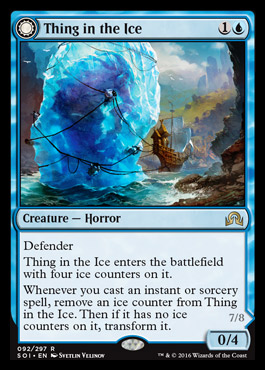
I believe that Grixis is easily the best home for Delver right now, and that Thing in the Ice and Young Pyromancer are dramatically worse than Tasigur. A turn two Tasigur or a turn three Tasigur with counterspell backup is a mile ahead of what most decks in Modern are doing, and demands very specific answers immediately. What I wasn't sure of was whether Delver was good enough to put in a Grixis deck, and this weekend would put this question to the test in Visions Modern. 84 players made it out to the Level Up Cup Magic Cup Qualifier at Level Up Games in South Saint Paul, which meant we were settling in for seven rounds.

Round 1 Vs. Azorius Thopter Sword

In terms of matchups, this has be be close to my nightmare game one. My opponent was on a full set of Ancestral Vision and Thopter Foundry, as well as three Sword of the Meek. That said, my opponent's game one hand didn't come together at all, and things get much better post board. I was very fortunate that my turn one Delver just went the distance against dedicated Thopter Sword with four Path to Exile among other removal spells and sweepers.

The sideboarded games were pretty much all about Ancestral Visions. In game two my opponent resolved two to my one, and in game three I resolved one to his zero. The most interesting remark about this matchup, is that in game three I chose to take the draw, and I believe that are about to be quite a few matchups where this decision is correct. Visions mirrors are going to go long, and hitting land drops and having more counters is what the games are about. Having Visions come off suspend first is obviously ideal if it resolves, but your opponent will have access to exactly as much mana as you do at the start of the counter war if both players have hit all of their land drops, and having the extra card going into the battle is a real advantage.

1-0

Round 2 Vs. Monored Goblins

In game one my opponent led on Mogg Fanatic. This card matches up exceptionally against Delver of Secrets, but my first play was a Tasigur, the Golden Fang. Some Spell Snares for Mogg War Marshal coupled with some removal spells made it easy for Tasigur to close game one. Post-board I get to bring in more removal spells and have fewer two mana counterspells, and I think this matchup is significantly favorable.

2-0

Round 3 Vs. Gruul Tron

Historically, I've won most of my matches against Tron playing Delver, though there are some things that have to go right. Specifically, you need an early threat and a healthy mix of counters. In game one, I mulliganed into four lands, Serum Visions, and Thought Scour. It's a pretty bad hand, but it's keepable. My opponent led on Urza's Mine, and when my cantrips found garbage like Terminate things only got worse as the game progressed.

In game two I kept on seven with four lands, a Tasigur, a Mana Leak and a Spell Snare. Spell Snare is great when they have Sylvan Scrying, but I really wished it was Spell Pierce when my opponent played Expedition Map. I was able to land Tasigur and connect twice with it in this game, though my topdecks were not great, and weren't enough to defeat my opponent despite him sequencing very poorly. The first haymaker that he deployed in game two was a Karn Liberated, which I hit with the Leak, and the turn after he played Ancient Stirrings finding a Wurmcoil Engine which he had mana to resolve through another Leak. Instead he played a second Karn, which I Countersqualled. If I peeled red cards from here I would have closed this game easily, though I was unable to punish my opponent for his mistake. Had he played the Wurm the first turn he had the option to though, I would have never even had a chance.

2-1

Round 4 Vs. Jund

This matchup is great for Grixis as long as you can cover Liliana of the Veil. This can be accomplished easily with counterspells and/or Snapcaster Mage, though it's not a given. Every other card in their deck can be answered cleanly by multiple spells in your deck, and Snapcaster Mage is the best card in the matchup.

While sideboarding in this match I ended up leaving Delvers in because this matchup has always been good and Delver has never been expressly bad, though later in the event I rethought this plan. Ultimately it didn't matter because this matchup is so good, but I do think I boarded incorrectly.

3-1

Round 5 Vs. Elves

I didn't see a Collected Company out of my opponent this round, and that's really their only card that matters. Cavern of Souls can be obnoxious, but unless they draw multiples you're usually able to counter something, and if it's a Company then that's great. Delver puts them on a real clock, as does Tasigur, and meanwhile you have plenty of removal to stop them from going crazy. On top of that, this is one of very few matchups where you get access to an actual factual haymaker in Engineered Explosives.

4-1

Round 6 Vs. Blue Moon

My opponent led on basic Island, and I was immediately suspicious, and I told him as much. When he played a Sulfur Falls as his second land and passed, I told him that he wasn't going to Blood Moon me, and I fetched a basic Swamp on turn two and a basic Island on turn three. On his turn four he played a Blood Moon, which I Mana Leaked because even with two basics it still makes my Snapcasters quite bad, though he had Spell Snare backup. Ultimately, he drew too many lands (his deck has more of them than mine, after all) and a second Blood Moon which allowed me to come out on top despite being limited to one blue mana and one black mana per turn for the entire game. Had I fetched a Watery Grave on turn two- which there was a high incentive to do- I would have assuredly lost this game.

Post sideboard I get to board out Delvers and Terminates for Countersqualls and Visions, and things get so much better. The knowledge that I want to actively find basics and that my opponent has no way to just kill me with early game spells is a strong advantage as well.

5-1

Round 7 Vs. Jund

The tournament was only seven rounds, and with me in tenth place going into the final round I had to battle for a Top 8 slot. I was relieved when my opponent led on Raging Ravine. After winning game one, I rethought my sideboarding from earlier and boarded out Delvers with their vulnerability to Abrupt Decay being the point that settled the debate. After the match I found out that my opponent had boarded out Decay, which was amusing, though they can't beat an Ancestral Vision anyway.

6-1

Quaterfinals Vs. Grixis Control

The good news was that I was the second seed by virtue of playing all seven rounds and not being able to ID. The bad news was that I was paired against a maindeck Ancestral Vision deck. In game one I led on a fetchland into Serum Visions, while my opponent cast an Inquisition of Kozilek. Another fetchland from my hand coupled with the card I was forced to discard gave me access to a turn two Tasigur. The Inquisition took my Spell Snare that would have been able to fight over a Terminate, so the Tasigur was vulnerable by casting it on turn two instead of waiting for Mana Leak mana, though ultimately I decided that it was better to get under opposing Mana Leak and Remand. Things worked out perfectly, and my opponent didn't have the Terminate and the Tasigur went the distance.

Once again, the sideboard makes things dramatically better for me, and now I have access to more counters and Visions of my own. Fortunately for me, my opponent didn't have an early Ancestral Vision in game two, and he died with the ones that he did draw still on suspend.

Semifinals Vs. Jund

I don't remember the exact details of game one, though what I do remember is that I was probably overly aggressive with the way I spent my interactive spells and I'm pretty sure my opponent just had a great attack on board with a 5/6 Tarmogoyf that he didn't make out of fear of dying on the way back. I'm relatively confident that I was dead on board or easily in two turns for a short window, though the way my opponent played it I was able to topdeck a lethal burn spell.

Things went much better in game two, and I never allowed my opponent to have a winning position in the first place. Sitting back on counterspells with Ancestral Vision on suspend just feels great.

Finals Vs. Abzan

Lingering Souls is about the only card that it really sucks to have your opponent cast when you're playing Delver. It's basically unbeatable. My opponent played two copies in game one. I lost and it wasn't close.

In game two I ended up winning a long game with a little help from Ancestral Vision and a lot of help from drawing both copies of Engineered Explosives to deal with Lingering Souls. This was another match where I happily took the draw, and I wouldn't consider revising this position for a second.

Game three was super disappointing. I kept a four lander with Serum Visions on the draw, and drew the fifth land on my draw step and the sixth off the Visions. There was a point in this game when I made my land drop and passed with my hand being four more lands exactly. I ended up losing to Siege Rhinos and a Liliana that actually didn't matter- cards that numerous combinations of spells from my deck could easily combat. It would have been nice to win, but more than that it was a horrible way to go out.

~

On the balance, I was happy with the deck, though I'm taking moving off of Delver entirely under strong consideration. I think I was too worried about drawing Visions in the matchups where it's not good, in large part because the cheap interaction and Tasigur does so much work against these decks, and minimally that Visions needs to find a way into the main. Mostly it feels terrible to not have access to Visions in all three games in the matchups where it is good.

Before Eldrazi was unleashed on the format, I was very happy to play Grixis in Modern, and with just Eye of Ugin being banned I would think the deck was great. With Ancestral Visions being unbanned on top of this, I think that Grixis is the best deck in the format by a lot. Even without Delvers in your deck, Lingering Souls is still a tough card to face down, and Abzan definitely has merit with a favorable Jund matchup and Souls to keep Grixis in check, though Grixis does have tools to keep Souls in check. Engineered Explosives is great, and if push comes to shove you can always channel Legacy sideboards and jam Sulfur Elemental.

Going forward I will be working on Grixis Control, and as of now I'm not sure that unbanning Ancestral Vision was safe- though time will tell. Interestingly, Sword of the Meek may be less good in Modern that I thought it could be given the number of decks that just don't care about the combo in addition to the number of powerful sideboard options against it. I still suspect that this combo will be a major player in Modern, though many of the cards and strategies that are strong against the deck are actually just things that people are happy to be playing anyway.

I don't know what the exact 75 I'd play tomorrow would be, but I assure you it would have Steam Vents and Watery Graves.

Thanks for reading.

-Ryan Overturf
@RyanOverdrive on Twitter

Insider: High Stakes MTGO – Apr 3rd to Apr 9th

Are you a Quiet Speculation member?

If not, now is a perfect time to join up! Our powerful tools, breaking-news analysis, and exclusive Discord channel will make sure you stay up to date and ahead of the curve.

Hello and welcome back for another High Stakes MTGO article!

Like the last few weeks, this week was something of a transition. I'm trying to establish positions in rotating staples and other cards likely to gain some value in the new Standard metagame. Meanwhile I'm also looking for good deals in Modern, and I sold a few mature positive positions in order to rotate my investments.

Here is the link to my live portfolio.

Buys This Week

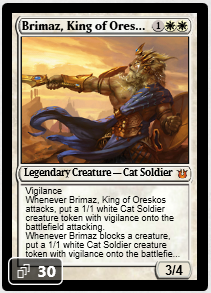
brimaz

This legendary cat from Born of the Gods is not really a powerhouse in Modern and merely sees some play in Legacy. Nonetheless he was able to jump from 3.5 tix to over 8 tix after last October's Standard rotation. His price went back to 4 tix in February and stayed fairly flat for more than a month.

Although it's not necessarily big, I felt there was another speculative opportunity here. I'll be targeting 8 tix again with Brimaz.

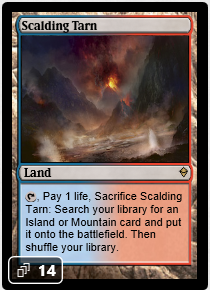
ST

I had been watching Scalding Tarn since it went back around 30 tix around a month ago. I missed the train back then as this fetchland slowly creeped up to 40 tix about two weeks ago. However, the price plunged again and I seized the opportunity this time around.

Regardless of the next Modern metagame, the blue-red fetchland is likely to always be in demand, in Modern as in other eternal formats. Getting in at ~32 tix I'm looking at small gains, but it should be a worthwhile investment for my bankroll.

DLM

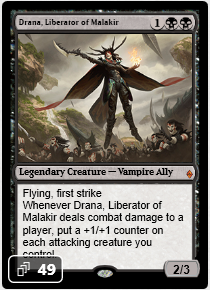
I lurked on this vampire a while ago and then the first spoilers for Shadows over Innistrad (SOI) spiked its price to 8 tix. At the time I regretted waiting too long to pull the trigger. Now it appears the spike was purely speculative---I bought my copies of Drana when it came back down to 4.5 tix last week. This is still a strong card and I believe it has a good chance to see play in the future, hopefully pushing its price again around 8 tix.

WB

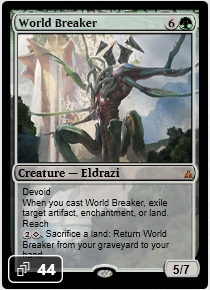
World Breaker is a mythic from Oath of the Gatewatch (OGW) with unique flavor and certainly worthy of a spot or two in midrange or ramp decks in Standard. It seems like the bottom for this card was found around 4 tix about a month ago and World Breaker's price has been on a slow rise ever since. While I'm not expecting a huge profit with this guy the opportunity seemed good enough for me.

UtSD

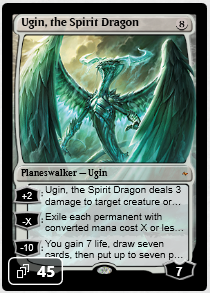
Ugin is an iconic planeswalker that retained a high value as Fate Reforged (FRF) rotated out of Standard. The loss of Eye of Ugin may have handicapped Tron decks a bit but I bet we'll see Ugin in Modern again. I also hope that redemption will help support the price of FRF cards, including Ugin, the Spirit Dragon.

KTK sets

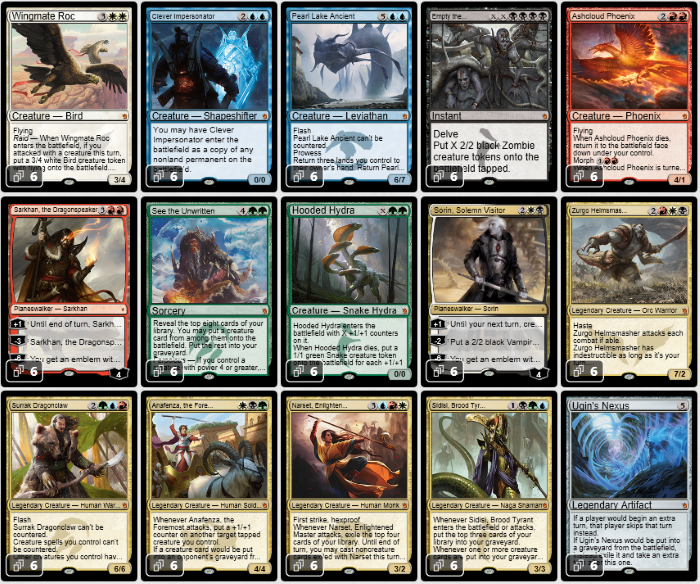
Another six Khans of Tarkir (KTK) sets this week. The price is not currently going down and I'm not even sure if it will during SOI release events. As the top six cards of the set include all five fetchlands, I feel more like buying full sets rather than individual fetchlands. I'm hoping the price will drop back to the low 60's/high 50's in the following two weeks. Ideally I'd like to have something around 20 KTK full sets.

Sales This Week

I bought this card at what appeared to be a long-term floor (around 10 tix), and sold it at what appeared to be its long-term resistance (around 15 tix). I don't know if the new changes to Modern will be more or less favorable to Storm decks. I happily closed this position with a respectable 51% gain in only a few weeks.

The situation with Bonfire is similar to Past in Flames and well suited to what I'm trying to do with Modern positions in general---catch them at the established floor and sell them around previous heights. I'm not looking for the next spike nor the next record high. With this spec I cashed out another 150+ tix of profit.

I sold what I could during the short spike that followed the B&R list changes. The spread was pretty big on this one and I didn't want to sell everything at any cost. This spike was a good opportunity, but the price of this planeswalker is still pretty cheap on sum. I'm okay to wait longer on the remaining copies.

M15

I didn't expect to sell Magic 2015 full sets at these prices. On two different occasions this past week ClanTeam Bots had their buying price for M15 full sets at 97 tix and 69 tix.

Too good to be true? That's actually what I asked them just to make sure I wan't abusing an algorithm glitch. Although they were doing some algorithm adjustments they told that these prices were legit. I don't think I'll ever manage to sell M15 full sets over 69 tix again. 65 tix would already be a great selling price for me.

On My Radar

I'm not really looking into new things until Pro Tour Shadows over Innistrad. Buying Standard cards involved in rotation remains my main goal these days. As I write these lines I'm still holding on to Archangel of Tithes and Kytheon, Hero of Akros, but I'm very close to selling them as they tripled since last month.

These are typical spikes related to new decks currently receiving a lot of hype. If I want to give credence to my words I will have to sell them or find a good excuse not to. Do they have more potential price-wise with the PT coming up? Maybe, maybe not. They do, however, surely have the potential to lose all their gains if nothing significant happens in Madrid in two weeks.

Questions & Answers

This week I'll expound a bit on two sets of questions relative to Standard rotation. One question revolves around cards staying in Standard and one on cards leaving Standard.

The BFZ and OGW Lands

Q1

Although it may have been the exact same comment by the exact same reader login in with two slightly different names, the question remains: what should happen to BFZ and OGW rare lands from now on?

To start with, cycles of rare lands in any set have always been very solid speculative targets. Special lands (land producing different types of mana, lands with a special effect, or creature lands) always find a place at some point in the evolution of the Standard metagame.

You almost always want to buy them while they are heavily drafted and thus as close as possible to their absolute bottom. Once Standard rotates and a new set is being opened these lands have a good chance to rise.

Now, a raise can unfortunately happen at any time during their one-and-a-half-year tenure in Standard. If it happens during PT SOI great; if it's later that's also fine. My price target with these lands is between 4 and 6 tix. If at any time such prices are met, I'll consider selling my BFZ and OGW land positions.

KTK and FRF After Rotation

Q2

To start with, my expectation with KTK and FRF full sets is around +30-40%. I would expect that to happen within the first six months. These are typical price increases for full sets and there's no reason to set my expectations too high just because KTK contains fetchlands.

On a case-by-case basis, some cards won't gain much while others could double or even triple. It is not usual, though, for "good" rares to see huge price increases after rotation.

Bulk or cheap rares have a different potential, but take a look at Snapcaster Mage, the Return to Ravnica and Gatecrash shocklands, and Thoughtseize, for instance. Doubling is the most you can expect during their first year post-Standard. You can also clearly see that their price tends to fluctuate a lot.

So for KTK fetchlands, which seemed to have bottomed between 5 and 7 tix, I would not wait for them to reach 15 tix before selling them (unless you want to wait two years).

Since the five fetchlands are pretty much the most valuable cards in KTK and are currently making up an unprecedented 50% of the set's value, my investment in KTK full sets should mirror quite closely what happens to the five fetchlands.

Mythics are the bottleneck cards for set redemption. Bulk mythics are needed as much as a 20-tix mythic. Simply on this basis I would expect bulk mythics to rebound quickly this month and the following. A mythic currently valued at 0.2 tix should soon be priced in the 0.5-to-1 tix price range. I would not expect more since they are most likely unplayable otherwise, but that can be a nice double-up at the reach of small bankrolls.


Thank you for reading,

Sylvain

Insider: Staying Aggressive in Post-Unban Modern

Are you a Quiet Speculation member?

If not, now is a perfect time to join up! Our powerful tools, breaking-news analysis, and exclusive Discord channel will make sure you stay up to date and ahead of the curve.

Best Modern week ever? Since we last checked in on Monday, April 4, the Modern world as we know it has forever changed. This time, it's for the better. Eye of Ugin went the way of the Cloudpost to quell the Eldrazi nightmare but still preserve Eldrazi Temple-powered variants.

That much was expected. Ancestral Vision's and Sword of the Meek's parole? Not so much. Although I've been calling for these unbans for over a year, I never believed Wizards would release both so close to the Splinter Twin ban and simultaneously with Eye's execution.

Call me a Modern and Wizards believer again. As I wrote about on Modern Nexus all week, these changes have huge implications for both the metagame and Modern management, almost all of them categorically positive. Wizards even acknowledged control's floundering position in Modern! I'm more combo than control mage, but I'm still excited to see Modern's control renaissance after its historic oppression.

Faces of the New Modern

Whether suspending turn one Vision, cranking out thopters and life, or snapcastering back the rest of your blue-based shell (not Vision itself, although there's always Goblin Dark-Dwellers for that), control pilots look like big winners in this update.

They even gain ground in the R/G Tron and Eldrazi matchups, which so often came down to Eye of Ugin inevitability. Say what you will about Cryptic Command's and Spell Snare's relevance in Modern, but neither did much to stop the unstoppable Ulamog, the Ceaseless Hunger that would eventually hit play.

Many Moderners are racing to pack their new unbanned cards around Tezzeret, Agent of Bolas, Ensnaring Bridge, Sun Titan, Thirst for Knowledge, Academy Ruins and all those other deliciously slow Modern sleepers. Prices have reflected this shift, with numerous control staples and spec targets blasting into the finance stratosphere since Monday. I can't blame investors---it's definitely a control aficionado's world.

How is the metagame going to evolve around these changes? How are players going to adapt? Although a large subset of format regulars will stay on their proven decks or switch to control, the next few months will also see a perhaps counterintuitive transition to something sleeker, faster, and way more unfair.

As the old Modern adage goes, if you can't beat 'em, goldfish 'em.

Faces of the Good Old Modern

In today's article, I'll break down the big linear winners after the April 4 banlist update. Vision, Sword, Foundry, and all their buddies incentivize Modern players to go fast and ditch interaction, an effect we'll see play out in the first months of our post-unbanning format. You'll want to build decks and invest your dollars accordingly.

Control grinders have it better than ever, but don't count the goldfishing sprinters out of the fight just yet. As we'll discuss today, they're just getting started.

Linear Dynamics in New Modern

All last week, a number of other authors observed how Vision's and Sword's unbanning would precede a linear resurgence, notably Reid Duke in his widely-read piece released the day of the unban. In this section, I'm going to unpack a few of the factors that will likely contribute to an uptick in decks like Affinity, Infect, Burn/Zoo hybrids, and others.

"U - Suspend 4: Target Player Wins the Game."

As we saw in the Treasure Cruise era of Modern, drawing three cards is an incredibly powerful effect. Few fair decks can beat the sudden resource surge, especially opponents like BGx Midrange which rely on stripping resources early in favorable one-for-one exchanges.

This is also true of permission decks and their variants, which look to answer threats efficiently before putting an opponent in topdeck mode. It's particularly dangerous in the kinds of decks which use Vision, which tend to draw more powerful spells and effects as games go long (see: Snapcaster Mage plus anything).

For these reasons, Ancestral Vision is gamebreaking in such matchups and the first player to resolve one will usually win. Or, if they don't win outright, it will either stabilize a board or put them back in the fight from far behind.

There was an error retrieving a chart for Ancestral Vision

As a Vision opponent, this gives you three possible outs. First, you can try to build your deck or play in such a way as to beat the additional influx of cards. For instance, an engine like Dark Confidant or even old-school Phyrexian Arena can replenish your hand enough to keep you afloat.

Second, you can try to answer Vision as a card. Imp's Mischief/Redirect (cute, but don't spec too heavily here), Remand, Spellstutter Sprite, and others can stop Vision from ever drawing a single card, keeping you in the fight without worrying about a Modern-legal Ancestral Recall.

These solutions can work, but the first gambles on your cards being better than your opponent's (not a great bet against late-game blue strategies), and the second banks heavily on the Vision turn itself. Your opponent just has to sit around for Vision to win him the game. You better draw your cards and hope your opponent doesn't draw the cards to protect a Vision resolution. Bad odds, all in all.

Risky Answers to Vision

Of course, as you've probably predicted, the third option is to gear your entire deck towards racing the Vision player and winning before the card even comes online.

This method has a distinct advantage over the "Redirect/counter Vision" strategy in that it doesn't require one or two cards. Your entire deck can just be aimed to win before turn five, and we all know how many such options exist in Modern. This puts the burden on the Vision player to stop you from winning off multiple cards and synergies (hard), instead of letting them protect and ride a single resolution to victory (easy).

Indeed, Vision itself encourages this approach by costing one mana and forcing the control mage to commit their first turn to the card. If they do, they are down a Lightning Bolt on the play or a Spell Snare on the draw, which any aggressive player worth their salt can abuse.

If they don't cast Vision and instead try to stem the tide, they are effectively down a card with a Vision stuck in their hand, and will continue to be down a card until they bite the bullet and suspend it. Either way, the edge is to the goldfisher.

Vision may be a virtual win for the player who resolves it, but fast decks are both well-positioned and incentivized to race Vision decks, not durdle around waiting for the card to come off suspension.

Control Gems Take Time to Shine

Last week, Michael Majors over on Star City Games published a Select article titled, "The Dawn of a New Modern Era." In it, he gave some post-unban control decklists including Jeskai, Blue Moon, Faeries, and Tezzerator. Although these lists showcase the archetype's newfound strength and relevance, they also perfectly illustrate a new tension which will help linear decks keep their footing even in a controlling Modern.

Both Vision and Sword strategies are incentivized to play new tools to help them win the mid- and late-game. This includes Vision itself for the dedicated control builds that will just add Ancestral and call it a day, and the entire Sword, Thopter, Tezzeret and artifact package for the Foundry combo strategies.

At the least, that's four more cards which don't do anything until at least turn five. At the most, it can be as many as ten or more staples which sit around until you get the mana and synergies to use them.

Guess who is waiting to punish players who want to painstakingly assemble their combos, energies, and toolboxes over a few turns? Blighted Agent, Goblin Guide, Inkmoth Nexus, and all their lightning-fast friends.

Durdling in Modern

Cards like those shown above, and many more in Majors' article and other post-unban brews, all illustrate this major tension in the new Modern. On the one hand, control players want to play cards which synergize with their Visions and Swords. On the other hand, many of those cards don't come online until after Modern's fastest decks are winning or have already won.

This puts control players in a position where they are drawing one half of the Thopter/Sword combo when they really want to draw another removal spell. Or when they have both halves of it and maybe even a Thirst for Knowledge when they really need all three of those cards to be removal or countermagic to stop early aggression or combos.

In addition, top-decked or cantripped cards have a lower chance of being the defense mechanisms control needs to survive into the mid- and late-games. You can see this in all of Majors' theoretical lists, especially that Tezzerator take, as well as in those of other players who have brewed up post-unban strategies.

That's not to knock the power of these cards or their synergies. It's just to point to the problems of going turn two Sword, turn three Foundry and making a token against Infect or Affinity. Control mages will argue they don't have to play those cards early, but again, those are still two fewer cards in their hands to help them live long enough for the combo to matter.

All of this creates added pressures for control players trying to survive the first few turns, and additional incentives for aggressive decks to capitalize on these holes and win early.

The Race Is On!

Between Vision encouraging players to race it and control players cramming slower cards into their main 60, linear decks gain plenty of opportunities to excel in the new Modern. These are also by no means the only pro-linear factors in this revamped Modern world.

Sword and Foundry also give a similar incentive structure to aggressive players as Vision: do you want to beat that engine later or just race it before it matters? Moreover, all of these control cards will shift players to including more efficient answers like Abrupt Decay and Scavenging Ooze, which dominate the grindy control contest but collapse in speedy matchups.

Each of these dynamics will help promote linear decks in Modern, leading to a diverse and high-stakes environment where more players are going fair and slow but many others are staying degenerate and fast. That naturally begs the question of what linear decks are likely to succeed in this new climate.

Solitaire 101 in Post-Unban Modern

Now that we've identified the format-wide and metagame forces pushing players into linear strategies, we can talk about the linear winners in this visionary and thoptered format. Here are the decks I'm keeping my eye on as the format develops over the past weekend and beyond, keeping an eye to the control cards and themes which will drive these strategies' relevance.

U/G and B/G Infect

In most metagames, your default aggressive option should probably be Affinity because it has a favorable combination of raw power and resilience against hate.

In a Thopter/Sword metagame, I'm expecting a lot of added artifact hate, with every deck playing either Stony Silence or Ancient Grudge. Gone are the days where players will just rely on Kolaghan's Command as a lazy and surprisingly ineffective answer to Affinity. This means Affinity's share is likely to drop (but not disappear), and that of another aggressive deck is likely to rise.

Infect has three distinct advantages in a control-geared metagame. For one, it's really, really fast. That seems obvious, but it's a distinct edge over Burn, Merfolk, Suicide Zoo, and other aggressive strategies that can't threaten a turn three win with such regularity, or a turn two win at all. When your opponent is messing around with a turn one Ancestral Vision, Glistener Elf looks a lot scarier.

Infecting 2016 Modern

Infect's second advantage is its ability to ignore elements of the Thopter combo. Poison counters don't care if your life total is 5 or 5,000,000. Blighted Agent doesn't care how many Thopter chumps you have. Rancor even gives Glistener and Inkmoth a boost to push through that last bit of venom, and there's always Ichorclaw Myr if boards start getting too clogged.

Don't forget Distortion Strike and Slip Through Space to push even the landlocked and flying infectors through as well! As for Vision, Infect has killed you twice by turn five.

Finally, Infect is strong against a number of cards and staples which are likely to themselves get stronger after the unbans.

For instance, Ensnaring Bridge gets a lot better in the new metagame, both in Lantern decks packing a Thopter Plan B, or Tezzeret decks finding Bridge to stabilize. Infect can slip in their one-power attacker under an incomplete Bridge (non-Lantern players may struggle to fully dump their hand by turn 2-3), and can even win with Noble Hierarch, Spellskite, and Wild Defiance against a fully-functional Bridge.

Infect has similar advantages against removal like Decay, graveyard hate like Ooze, and others.

Also, this guy:

There was an error retrieving a chart for Phyrexian Crusader

In a metagame shifted heavily towards URx and UWx strategies, Crusader is impossible for most decks to remove. This added degree of maindeck flexibility gives Infect yet another leg up in the post-unban world. If you're looking for a deck to capitalize on these dynamics, Infect is where you want to play or invest your money.

Elves: Trample and Toolbox

Speaking of fast decks that act on an entirely different axis than Vision and Sword, Elves is another excellent strategy going forward. It succeeds in all the same dimensions as Infect.

It's fast, with explosive Elvish Archdruid and Nettle Sentinel starts and speedy wins if the opponent misses a beat on interaction. It can trample over Thopters with Ezuri, Renegade Leader, punch past even "infinite" life totals with the Dwynen's Elite loop and Ezuri, Chord up Reclamation Sage to bust a Bridge or disrupt the Thopter/Sword combo, or Ooze to rip up graveyards, and many other similar lines.

On top of that, Elves thrives in an environment where sweepers are absent, one-for-one removal isn't killing one-drops at parity, and players are trying to grind out advantage late. That's the post-Vision and -Sword world in a phrase, which makes Elves a very solid choice going forward.

There was an error retrieving a chart for Ezuri, Renegade Leader

There's about a 0% chance Eternal Masters sees no significant Elves reprints, so even expensive uncommons like Heritage Druid or the combo-centric rare Cloudstone Curio aren't likely to stay pricey for long.

Once we get more Eternal Masters information in the coming months, you'll be able to make better decisions around investing in Modern's little green tribal guys. Until then, the strategy is still a solid choice going into the next few months.

Comboing out Ad Nauseam

I don't get to play a lot of big Modern events these days, but if I do get to any in 2016, there's a good chance I'll have my Ad Nauseams and Angel's Graces sleeved up for battle. Modern's last true, top-tier combo deck has some major advantages after the unbans and I wouldn't be surprised to see Ad Nauseam repeat its Grand Prix Charlotte Top 8 from last year in an upcoming tournament.

Thinking back to Vision and Sword, Ad Nauseam can win both before these cards and strategies come online, and even as they are coming online: instant-speed wins are a huge part of Ad Nauseam's appeal. The deck also wields Pact of Negation to swat down control spells, and Boseiju, Who Shelters All as a decisive trump for half their combo. I'm really excited to win with a Vision on the stack, especially with Pact backup.

Gracing Modern with Real Combo

Whether you're using Darren Elderfield's Spoils of the Vault build from Charlotte, the old-school Peer Through Depths and Mystical Teachings variants from 2011 and earlier, or newer updates with Glittering Wish toolboxes, Ad Nauseam has something for you in 2016 Modern.

The deck suffers some small splash damage from Stony Silence (many builds pack both Lotus Bloom and Pentad Prism), but you can minimize their effects with careful sideboarding and play. Just be careful of Infect mages capitalizing on the new metagame themselves (it's a close-to-unwinnable matchup, even with tech like Darkness) and show the new Modern that combo is alive and well.

Looking to buy into Ad Nauseam or invest around key staples? Keep an eye out for Spoils of the Vault, a one-printing rare from old Mirrodin, as well as Glittering Wish. Both of these cards feature prominently in two of its three main builds, and look to pick up major value if the deck goes big.

New Is New, Old Is New

We've had Modern for almost five years now, and the format continues to boast an impressive mix of old-time staples, throwbacks making a resurgence, and new strategies hot off the presses. The April 4 update may have shaken up the format, but don't expect mainstays like Jund, Abzan, Tron, Burn, Affinity, and others to decline too much.

Similarly, don't think the newest poster-children such as Company, Grixis, and Eldrazi are gone in this new year. Linear decks might be the unexpected beneficiaries of format changes, but Tier 1 and Tier 2 shouldn't look too different in three months than they did a year ago.

Our first major post-unban events happened yesterday, and you can be sure I'll be writing about all these tournaments and the new Modern data as we get further past the April 4 update. Until then, find me in the comments with any questions you have about the format, its winners, losers, metagame dynamics, and any other Modern questions you have. Go linear, go control, or go old-school, and I'll see you all next week!

Insider: QS Cast 30 – Decoding the Unbanning Hype

Are you a Quiet Speculation member?

If not, now is a perfect time to join up! Our powerful tools, breaking-news analysis, and exclusive Discord channel will make sure you stay up to date and ahead of the curve.

Play

Between a hyped-up prerelease and some big bannings and unbannings in Modern, we’ve got a lot to talk about this week! We discuss:

  • Ulvenwald Hydra
  • Rogue’s Passage
  • Sword of the Meek
  • Thopter Foundry
  • Ancestral Vision
  • Illness in the Ranks
  • One-Eyed Scarecrow (!)

And lots more! Chaz and Kelly also share their prerelease stories, giving us a good idea of what to expect in Standard.

Douglas Linn

Doug Linn has been playing Magic since 1996 and has had a keen interest in Legacy and Modern. By keeping up closely with emerging trends in the field, Doug is able to predict what cards to buy and when to sell them for a substantial profit. Since the Eternal market follows a routine boom-bust cycle, the time to buy and sell short-term speculative investments is often a narrow window. Because Eternal cards often spike in value once people know why they are good, it is essential for a trader to be connected to the format to get great buys before anyone else. Outside of Magic, Doug is an attorney in the state of Ohio.  Doug is a founding member of Quiet Speculation, and brings with him a tremendous amount of business savvy.

View More By Douglas Linn

Posted in Free Insider, QS CastLeave a Comment on Insider: QS Cast 30 – Decoding the Unbanning Hype

Have you joined the Quiet Speculation Discord?

If you haven't, you're leaving value on the table! Join our community of experts, enthusiasts, entertainers, and educators and enjoy exclusive podcasts, questions asked and answered, trades, sales, and everything else Discord has to offer.

Want to create content with Quiet Speculation?

All you need to succeed is a passion for Magic: The Gathering, and the ability to write coherently. Share your knowledge of MTG and how you leverage it to win games, get value from your cards – or even turn a profit.

Draw Three Brews: Eldrazi Stompy, Ancestral Sultai, and Blue Moon

Are you a Quiet Speculation member?

If not, now is a perfect time to join up! Our powerful tools, breaking-news analysis, and exclusive Discord channel will make sure you stay up to date and ahead of the curve.

By now, we’ve all rejoiced at the Eye of Ugin banning and rejoiced even harder at Wizards’ reparations. It seems the banlist moderators understand that actions speak louder than words, so instead of issuing a plodding “we messed up!”, they actually gave us some new toys. Apology accepted!

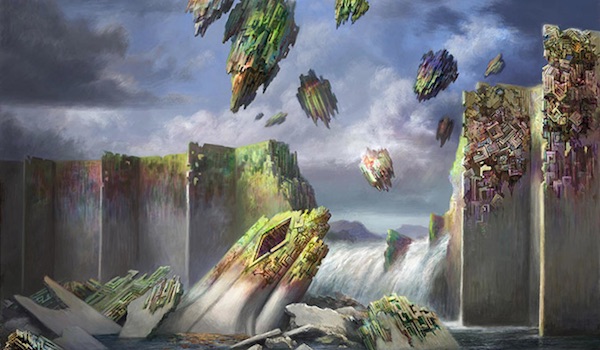
sea gate wreckage art crop

Readers know I’ve spent some fine afternoons in the hot tub with Thought-Knot Seer, but the Eye ban came as good news to me, too. The Eldrazi deck all but solved itself in Louisville, and for me, the deck’s appeal counted on its brewing possibilities. Now, building a viable Eldrazi deck is actually challenging. In this article, I’ll unveil my new Colorless Eldrazi Stompy build and explore some ideas for blue-based decks running Ancestral Vision and Sword of the Meek.

[wp_ad_camp_1]

The Fun-Banned Police

Not every card on Modern's banned list is "broken." Even the more busted ones have natural checks, and could potentially be okay in a format that grew around them (operative term: potentially). Trevor already described the implications of Ancestral Vision and Sword of the Meek in Modern, so I’ll mostly focus on integrating them into deck skeletons today. But first, I want to mention a few Modern cards that interact very well with the format’s new toys. I'll only consider cards that do something other than beat Modern's recently unbanned cards; you won't get any Nix discussion from me!

Ancestral Vision

Spellstutter Sprite: Even if it gets Bolted, Sprite will counter an Ancestral Vision. Michael Majors has already written about Visions-powered Faeries in the new metagame, and this interaction alone is a great reason to try it out.

Imp's Mischief: Redirects Bolts, Decays, Thoughtseizes… and now, Ancestral Recalls! Mischief might see sideboard play as a trump in the Ancestral Vision mirror. Resolving it against the card once should secure quite a lead.

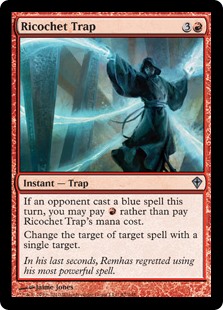
ricochet trapRicochet Trap: Similarly, Ricochet Trap changes the target of Vision to the caster’s opponent. Control decks should be especially wary of this card against Living End, and should Vision decks explode onto the scene, even aggressive decks might start playing it.

Invasive Surgery: One of my favorite cards from Shadows over Innistrad. I wasn’t sure Surgery would prove good enough for Modern, but with Ancestral Vision and Traverse the Ulvenwald entering the format at the same time, it’s at least worth considering alongside Dispel.

Sword of the Meek

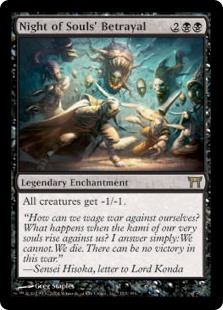
Night of Soul's Betrayal: We’ve seen this card used to combat Splinter Twin, BW Tokens, and x/1 decks like Infect and Abzan Company. Now, it stands to gain relevance even against control decks. With Night on the battlefield, the Thopter combo gains life, but doesn’t generate any bodies.

Illness in the Ranks: A far cheaper and more specific counter to the combo. Affinity has played this card in the past and I don’t doubt they’ll return to it should Thopter/Sword pick up steam.

Night of Souls' BetrayalIzzet Staticaster: Traverse-searchable, and in competitive colors. Staticaster might have to activate every turn and dodge a few removal spells, but he outshines Pyroclasm at keeping the field clear of Thopters.

Kolaghan's Command: A major player in pre-Eldrazi Modern, Kommand should make a big comeback with Thopter/Sword around.

Surgical Extraction: Grishoalbrand hate that happens to disrupt Abzan Company’s infinite life combo, and now control’s new potential win condition.

Rest in Peace: The best grave-hate card in Modern. Singlehandedly cripples so many decks, and prevents Sword from ever returning to the battlefield.

Stony Silence: Once reserved for Affinity, this sideboard staple keeps control opponents from ever activating Thopter Foundry.

Eldrazi on Life Support

On to the decklists. First thing's first: we've got to fix Eldrazi Stompy. This ultra-sweet deck ended up an unfortunate casualty of Wizards' refusal to test for Modern, but I think it can still survive in some form. Turn one Chalice of the Void is simply too good to pass up against a lot of the format. Chalice can even pre-emptively counter a suspended Ancestral Vision for zero... yum!

Colorless Eldrazi Stompy, by Jordan Boisvert

Creatures

3 Oblivion Sower
2 Spellskite
4 Simian Spirit Guide
4 Matter Reshaper
4 Thought-Knot Seer
4 Reality Smasher
1 Endless One

Artifacts

4 Serum Powder
4 Chalice of the Void
2 Ratchet Bomb

Instants

4 Dismember

Lands

4 Eldrazi Temple
4 Sea Gate Wreckage
4 Ghost Quarter
4 Blinkmoth Nexus
4 Mutavault
1 Urborg, Tomb of Yawgmoth
1 Gemstone Caverns
2 Wastes

Sideboard

2 Pithing Needle
4 Gut Shot
1 Ratchet Bomb
1 Ulamog, the Ceaseless Hunger
3 Eldrazi Mimic
1 Mutagenic Growth
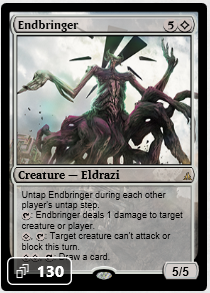
3 Endbringer

A husk of its former self, sure. But Eldrazi Stompy nonetheless. I've debated the card's inclusion before, but since the Eye of Ugin ban, Serum Powder becomes an absolute necessity in this deck. If we don't find an early Sol land (of which we now play only four, not eight), we effectively are playing a worse version of just about every midrange deck in Modern. Same deal with Simian Spirit Guide - we simply can't afford not to play this guy anymore. Eldrazi is too slow without it. That pushes the archetype into two directions: the more controlling GR version with mana rocks, Kozilek's Return, and World Breaker, and the aggressive Chalice version, featured here. I don't think UW will survive without Eye of Ugin fueling explosive Skyspawner plays.

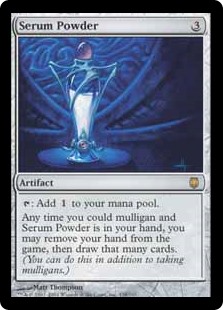
Serum PowderBetween the set of Temples, four Spirit Guides, and Serum Powder, Eldrazi Stompy can still resolve turn two Thought-Knot Seer with some frequency. But the loss of Eye means the loss of Eldrazi Mimic, and with that card, our explosive aggro starts.

As a result, this version of Eldrazi Stompy plays a longer game right out of the gate. Endless One can be a great topdeck while flooding or put beefy pressure on opponents if we open the right lands, but it's no longer reliable enough to play at four. Thanks to the Eye and Urborg interaction, Endless One was a dream curve-fixer before, and now mostly plays "fairly:" come down for as much mana as we have. Considering Matter Reshaper, Thought-Knot Seer, Reality Smasher, and Oblivion Sower all benefit from improved stats or abilities for the same X cost, that makes our Ugin-less Endless Ones pretty unexciting. But I like that he can come down at any point in the game, so it's one for now.

More midrange also implies more interaction. My older versions of the deck excluded Ratchet Bomb and Spellskite from the mainboard, as I preferred to run Serum Powder and maximize my chances of an explosive hand. (A bit too late, I realized that if I desired explosive aggression over efficient interaction, I should have just played UW Eldrazi.) With Eldrazi Mimic out of the picture, though, I’m happy to include these cards alongside my Dismembers. Bomb removes problematic permanents like Ensnaring Bridge and Blood Moon, while Spellskite shuts down soup-em-up decks like Infect and Bogles while safeguarding our marquee threats.

Finally, a slower plan allows us to run more costly threats. Oblivion Sower is my mainboard fatty of choice, powering up Sea Gate Wreckage and allowing us to cast multiple expensive creatures in a turn. I've included an Ulamog in the sideboard for help against grindier decks, and Sower is crucial to hitting ten mana.

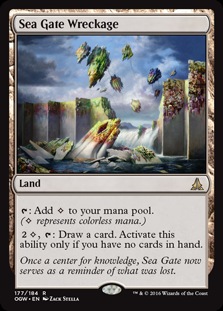
Sea Gate WreckageThat brings us to the deck’s deepest change. In my previous versions of Eldrazi Stompy, Sea Gate Wreckage showed a lot of promise as a mini-Eye of Ugin, netting me cards before I had seven mana to activate the Eye with. Unfortunately, games often ended before I could get any value from it, or I would hit seven mana before I wanted to use the Wreckage. In this deck, I’ve replaced Eye with Wreckage, running the full four copies to ensure we hit one by the time we’re out of cards.

Obviously, Eye is much better; searching for specific Eldrazi trumps drawing random cards, and Sea Gate doesn't pump out monsters any faster than Wastes. But hey, we can't have everything (anymore). Wreckage still does a decent job of securing the late-game. Interestingly, it stacks, so multiple copies are far from dead. The worst thing about Wreckage is that drawing multiple lands in a turn prevents us from keeping the engine going, since we can only play one land per turn. The next version of Eldrazi Stompy I’ll test will return to black for Liliana of the Veil, who solves this problem by discarding extra lands to the graveyard.

Rally the Ancestrals

We know Ancestral Vision slots into existing blue midrange strategies pretty handily; Jeskai, UW, and UR can all expect a boost from this card. I’m more interested in its applications for rarer color combinations. In Eat My Dust: Blowing Smoke With BUG Faeries, we discussed Sultai’s limitations in Modern. Vision’s card advantage should at least make the shard playable in the format, even if the deck ends up a worse version of something with Lightning Bolt.

Ancestral Sultai, by Jordan Boisvert

Creatures

4 Jace, Vryn's Prodigy
4 Tarmogoyf
1 Scavenging Ooze
1 Snapcaster Mage
1 Kalitas, Traitor of Ghet
2 Tasigur, the Golden Fang

Planeswalkers

4 Liliana of the Veil

Instants

3 Abrupt Decay
2 Murderous Cut
1 Sultai Charm
1 Dismember

Sorceries

4 Ancestral Vision
4 Serum Visions
4 Inquisition of Kozilek
2 Thoughtseize

Lands

3 Darkslick Shores
4 Polluted Delta
4 Misty Rainforest
2 Creeping Tar Pit
1 Ghost Quarter
1 Watery Grave
1 Breeding Pool
1 Overgrown Tomb
2 Island
2 Swamp
1 Forest

This deck is more of a blue BGx deck than a green UBx one. Jund's and Abzan’s famous disruptive package of Inquisition of Kozilek, Abrupt Decay, Liliana of the Veil, and Tarmogoyf forges the deck’s backbone, while Jace, Vryn's Prodigy, Serum Visions, and Ancestral Vision give it the digging faculties needed to play a slew of one-off bullets and out-grind control strategies. In exchange for this added late-game power, Sultai loses out on Jund's early interaction capabilities from Lightning Bolt. All it misses from Abzan is Lingering Souls and Siege Rhino, which I’m pretty confident are just worse than our blue cards at this point.

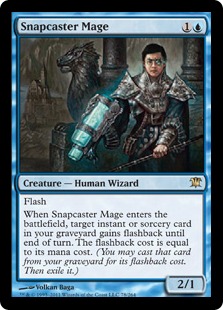
Snapcaster MageJace, Vryn's Prodigy gets the nod here over the full Snapcaster Mage playset, since we primarily operate at sorcery speed. I don’t really buy the notion that Jace is incompatible with Ancestral Vision. Between Serum Visions, Abrupt Decay, Thoughtseize effects, and various removal spells, we’re bound to have juicy targets for his -3 regardless, and the play style Jace encourages meshes with the kind of deck that wants to play Ancestral Vision anyway. In this deck, the flip-walker loots past extra lands, grows Tarmogoyf at instant speed, and fuels Tasigur and Ooze. He also cycles through “dead” copies of Ancestral Vision in soon-to-end midgames, and forces opponents to keep their Lightning Bolts in against us for Games 2 and 3.

On to the bullets. Snapcaster Mage is a nice surprise card we can dig for, but I don’t think this deck can truly abuse a set of him. Since we primarily cast spells on our own turn, flash is mostly just relevant for combat tricks. Scavenging Ooze can take over grindy games and is a trump in the Goyf mirror. Kalitas helps stabilize against aggressive decks, and Tasigur helps stabilize against everyone. These bullets mostly serve as a starting point. Sultai colors have plenty of options in these slots, and depending how the meta shapes up, I can also envision Vendilion Clique or Ashiok, Nightmare Weaver making the cut.

Creeping Tar PitI think Jace, Vryn's Prodigy works best with a spattering of different removal options, explaining the Dismember/Murderous Cut/Sultai Charm/Abrupt Decay split. Go for the Throat, Darkblast, and Disfigure might also have homes here, but it’s still too early to tell what the best removal spells will be in these colors. Again, our interactive choices depend on the decks that show up in the coming metagame.

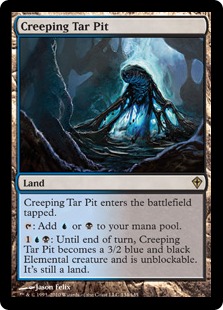
Lastly, I really like our ability to play Creeping Tar Pit. Other UGx shells might favor Lumbering Falls, but as long as we’re in black, I think Tar Pit is the best manland for an attrition strategy. It overcomes board stalls to hit for a never-negligible three points every turn.

Once in a...

Blue Moon had a decent on-camera showing at Pro Tour Oath of the Gatewatch, until the Channel Fireball Eldrazi deck gobbled up al the coverage. We haven’t heard much about the Batterskull-toting control figurehead since then, but Ancestral Vision should change things. Blue Moon also seems well-equipped to splash the recently unbanned Thopter-Sword combo.

Blue Moon Unchained, by Jordan Boisvert

Creatures

2 Pia and Kiran Nalaar
4 Snapcaster Mage
1 Keranos, God of Storms

Artifacts

2 Talisman of Progress
3 Thopter Foundry
2 Sword of the Meek
1 Vedalken Shackles
1 Batterskull

Enchantments

2 Blood Moon

Instants

2 Thought Scour
4 Lightning Bolt
3 Remand
3 Thirst for Knowledge

Sorceries

4 Serum Visions
4 Ancestral Vision

Lands

4 Scalding Tarn
4 Flooded Strand
1 Desolate Lighthouse
1 Academy Ruins
2 Steam Vents
1 Sacred Foundry
1 Hallowed Fountain
5 Island
1 Mountain
1 Plains

Like most control-oriented midrange decks, we boast a fairly compact threat suite. Batterskull, Keranos, Pia and Kiran Nalaar, and Vedalken Shackles are our dedicated beaters, and the Thopter-Sword combo sits on top of them for good measure. Pia and Kiran can decimate developing boards in small-creature aggro decks like Abzan Company or Infect, and provides at least four power on their own. Even without Foundry, a Thopter made by Chandra’s parents returns Sword of the Meek from the graveyard to the battlefield and makes a 2/3 flying creature, which trades with a Plating-equipped Ornithopter. I originally tried Stormbreath Dragon in this deck, but settled on Pia and Kiran instead because of their immense versatility.

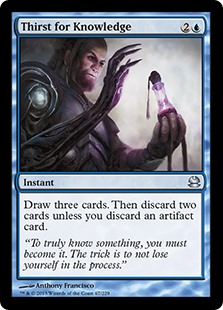
Thirst for KnowledgeThis version of Blue Moon relies heavily on artifacts. Academy Ruins revives more than half of our threats should opponents find answers to them. We can also cycle artifacts away with Thirst for Knowledge, a big draw to packing Thopter-Sword in any blue midrange deck. Thirst is a card so efficient it was once restricted in Vintage, and it simply reads “Draw 3 cards” if we discard Sword of the Meek, which we want to have in the graveyard anyway. Remand also meshes well with Thirst for Knowledge. If we’re holding up mana to counter spells, we can capitalize on the tempo gained from opponents not trying anything by tapping out on their end step to reload. Another artifact I've included is Talisman of Progress, whose presence allows us to drop an early Moon and lock ourselves out of white, but still resolve Thopter Foundry later. Extra Talismen make terrific Thirst food.

I've also opted for a pair of Thought Scour. Scour makes our graveyard into Snapcaster Mage’s ultimate playhouse, giving him nearly endless targets. It also enables graveyard eaters like Grim Lavamancer in the sideboard, and messes up enemy scry, which should be relevant if a lot of decks start playing Ancestral Vision. Dumping Sword of the Meek with Thought Scour is our best-case scenario, since Scour then becomes a draw two for blue, at once cantripping and binning the equipment for later use.

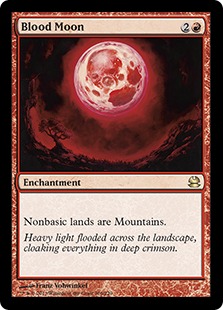
Blood MoonBefore we wrap up, I’ll address the elephant in the room: this Jeskai-colored deck plays zero white spells in the mainboard! New metagames usually signal brief periods of hyper-linearity, and Blood Moon preys on the greedy strategies players opt for. Dipping too far into white compromises our ability to run the hoser effectively. On the other hand, with decks like Burn and blue anything surely in our immediate future, we don't want to play too many copies mainboard. I plan on sticking a third in the sideboard for now, and adjusting as the metagame shifts. As for the white cards, Path to Exile seems like our strongest option, but it butts heads with Blood Moon. I'd rather keep the splash as minimal as possible, just to enable Thopter-Sword. We can run powerful white cards in the sideboard, including Lightning Helix and Leyline of Sanctity.

Wreckage No More

I haven’t played much Magic since GP Detroit, and that’s entirely because of the state of the format. Luckily, the trash can that was Modern is now a brewer’s paradise again. I look forward to seeing the waves made by Vision and Sword decks, and adapting my Delver builds to take on the new challengers. Hopefully, so do you!

Announcement: New Management at Modern Nexus

Are you a Quiet Speculation member?

If not, now is a perfect time to join up! Our powerful tools, breaking-news analysis, and exclusive Discord channel will make sure you stay up to date and ahead of the curve.

Happy Friday, Modern Nexus community!

About a month ago, we celebrated our one-year birthday at Modern Nexus. And what a year it's been! I've loved being a part of the site and engaging with the Modern community, and if even one more Moderner has been using our Top Decks statistics to justify format decisions, I'm calling our mission accomplished. As part of that celebratory article, I laid out four goals we had for 2016 and beyond: thanking readers for their loyalty and support, expanding our staff to improve content-delivery, adding more video coverage, and developing a real deck and metagame database to inform the format. After lots of discussion and number-crunching, I realized it would be quite challenging to fulfill these promises alone, both from a resource perspective and due to changes in my personal and professional life. This would be a disservice both to the site and the Modern community as a whole.

Based on this, I'm turning over the management reins to a larger Magic website and stepping down as Editor in Chief, effective Monday. Going forward, Jason Schousboe from Quiet Speculation will be coming on as Editor in Chief, and Modern Nexus will fall under the Quiet Speculation content umbrella. I'll stay on board as both a writer and a site adviser for the foreseeable future.

modern_nexus_lg

I'm as pumped by these changes as that bro in Might Beyond Reason is jacked up on Emrakul (or #TeamMaritLage) mojo, and you should be too. Modern Nexus is going to thrive under Quiet Speculation's management and Jason's editorship. Back when I started thinking about partners months back, Quiet Speculation was the first website I approached and the only group I ended up negotiating with. I've written for Quiet Speculation since September 2015, and I've been consistently impressed with their data-driven philosophy and their focus on evidence-based analysis. They also run a tight website with great features and content. As a whole, their methods are a perfect fit for Modern Nexus' mission, which makes me confident they are the best partners to maintain and grow the site.

Change is hard. We play Modern so we should all know this by now: I still haven't fully recovered from Wizards banning my beloved Seething Song in 2013, to say nothing of more recent decisions! Whenever websites undergo these kinds of changes, there's always a worry about declining content, unfulfilled promises, and mission-drift. Personally, I'm not worried. I selected Quiet Speculation as my "successor," so to speak, because I am confident they would uphold the site's core aims, honor our readership, and build Modern Nexus to where it deserves to be.

Editor's note: Just to clarify an important question we've received, there are no plans to put Modern Nexus behind a paywall! Free content will continue for the foreseeable future, so you can save all your hard-earned dollars for teching out your decks and investing in the latest Modern spike.

Just in case you're still worried, remember I'll also be sticking around to help Jason manage the transition and blaze new trails. We're keeping the same address, server, domain, and Modern Nexus feel. All current authors will be given an opportunity to stay on board too, so don't think you've seen the last of David's Merfolk, Trevor's Jaces, or Jordan's Delvers and Tarmogoyfs. On top of that, I'll continue writing Modern Nexus articles, especially the in-depth metagame analyses you've come to expect. This will include maintaining our Top Decks page and spreadsheet, and transitioning us to a more formal data-tracking system. I may not be Editor in Chief beyond next Monday, but I'll still live up to my MTG Salvation handle of "The Mad Statistician" as long as I'm a Nexus affiliate!

If anyone has any questions about the changes, the road-map, the staff, or anything else related to Nexus or Modern, either ping me in the comments or shoot me an email at sheridan@quietspeculation.com. I'll do my best to answer, and I'm sure Jason will be watching as well to chime in. Look for Jason to post an announcement next week introducing himself.

See you all after the jump and after our first weekend of post-Ancestral Vision and Sword of the Meek metagame. Keep brewing, keep crunching numbers, keep running tests for statistical significance, keep down the ban mania, and keep on playing Modern!

Sheridan
-Editor in Chief


Brewing with SOI- Azorius Always Watching

Are you a Quiet Speculation member?

If not, now is a perfect time to join up! Our powerful tools, breaking-news analysis, and exclusive Discord channel will make sure you stay up to date and ahead of the curve.

I'd be remiss if I didn't submit a Reflector Mage deck as something with exploring in Shadows Standard. Today's list borrows from both Brian Braun-Duin and Tom Ross. BBD for the Always Watching synergies, and Tom Ross for Thraben Inspector.

Azorius Humans

Creatures

4 Thraben Inspector
4 Knight of the White Orchid
2 Hidden Dragonslayer
4 Reflector Mage
4 Archangel of Tithes
4 Dragonlord Ojutai
2 Archangel Avacyn

Spells

4 Always Watching
4 Declaration in Stone
2 Stasis Snare
2 Gideon, Ally of Zendikar

Lands

4 Port Town
4 Prairie Stream
4 Meandering River
3 Island
8 Plains
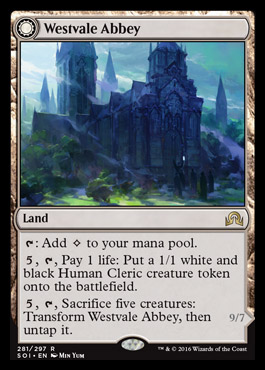
1 Westvale Abbey

Always Watching combines excellently with Dragonlord Ojutai and Archangel of Tithes to remove the downside from them tapping to attack. It's pretty excellent that Archangel doesn't even check to see if it's tapped for the restriction it puts on the opponent's blockers as well. Beyond that, you're mostly just a boring Glorious Anthem deck. The tokens from Gideon won't get pumped by Always Watching, but I can't imagine that you're not supposed to play any Gideons in decks like this.

There was an error retrieving a chart for Gideon, Ally of Zendikar

With regard to Thraben Inspector, the card is better than it looks. To be playable it has to be. The card is at its best when it can actually trade with an opposing creature- a Falkenrath Gorger, for example. In situations when the opponent doesn't have small creatures, the Inspector should be able to get in a chip shot or two, and then will inevitably replace itself. Once you get Always Watching online, suddenly you have a creature with a reasonable body that also replaces itself. I definitely think that Tom Ross is onto something with this card.

This is the sort of midrange deck that would really love to have a creature land, though unfortunately there isn't an on-color option. This deck can afford to jam at least one Westvale Abbey, though this definitely isn't the best shell for that card. The question for this deck's viability is whether the Always Watching synergies are worth the concessions that you make in deck building to feature them. I think they are definitely worth exploring.

If you pre-ordered Always Watching when they opened for under a buck, you did alright for yourself. As of now, they're selling between $3-4, which isn't a good price for buying more than a set. I don't hate picking up a set to battle with, though I'd rather trade for them than outright buy them.

Insider: Shadows Over Innistrad Top 10

Are you a Quiet Speculation member?

If not, now is a perfect time to join up! Our powerful tools, breaking-news analysis, and exclusive Discord channel will make sure you stay up to date and ahead of the curve.

It's time again for the Top 10 of Shadows over Innistrad (SOI)! What follows are my picks for the biggest Constructed cards from the new set, the ones I see defining Standard (or other formats) for the next year to come. I'll explain why I chose them and what I see in their financial future.

As always, I'll start with the honorable mentions that didn't quite make the list proper. Without further ado...

Honorable Mention

Solid Finishers

Shadows has a ton of late-game threats and I’ve been impressed by almost all of them. Goldnight Castigator is the one that has seemed lackluster. Your opponent can often kill you on their turn due to the double damage drawback. With such a huge liability against even a modest board, I think the card isn't worth it most of the time.

The other cards like Sorin, Grim Nemesis, The Gitrog Monster, and Sigarda, Host of Herons have been great so far. They only fill a small niche though, which makes them fall out of contention for the Top 10 cards in the set.

Sorin sometimes has a tough time keeping up with all the threats on the board and you need a strong presence to keep him defended. If those things happen, Sorin can have a huge impact on a game while dealing your opponent tons of damage.

I need to see more Gitrog Monsters in play to make a better judgment on that one, but I think it will be a solid inclusion in many cases.

Sigarda, finally, is a huge bomb. The problem is you probably only want one in your deck and she’s only going to be good in the very late game. Great sideboard card against control but not one I’d be excited to play a lot of copies of.

Financial Takeaway: Of these finishers the only one I would try to get my hands on is Goldnight Castigator. I think picking up a play set under $20 could net huge rewards if a burn style deck takes off in Standard. This is minimal risk with potentially high reward.

The rest of the cards in this section have the wrong trajectory. It would take a lot for any of these cards to increase in value, so trade them into other staples.

Removal

The removal is great in this set. There is so much of it that I even wrote a whole article about it last week! Nahiri, the Harbinger, To the Slaughter, and Anguished Unmaking are all great cards in this category. My favorite of these so far has been Nahiri.

They are, however, situational. At first glance it might appear like Anguished Unmaking doesn't fit this description, but that life loss is a real thing. Three life for each removal spell will add up quickly against an aggressive deck.

Hitting any nonland permanent is not something we've seen much of though, and that makes Anguished Unmaking an important tool. If aggressive decks are forced out of the format, then we could see this spell take a more prominent role.

Financial Takeaway: As with most of the honorable mention finishers, I think the typical downward trend of most cards from their presale prices will apply to these cards as well. We may see them getting played in Standard, but I don't think their price will grow despite minor amounts of play.

Synergistic Creatures

My favorite part of Innistrad is the flavor of the world. So far Limited has been a tremendous amount of fun with games that are fresh and interesting. So many of the creatures are cool and unique, and this translates to Constructed as well.

Deathcap Cultivator is great but its power relies on green and black being good because otherwise we could just play Leaf Gilder. Sometimes Cultivator will have deathtouch but I don’t think we can rely on that frequently, making it more like a solid uncommon than a rare.

Prized Amalgam seems great but it has been taxing trying to decipher how best to use it. My gut says that someone will figure this out and we will all be scrambling to pick up copies. Do yourself a favor and grab a sub-$5 playset or two in case someone breaks it.

Diregraf Colossus is one of my favorite cards in the set. This does everything I want in an aggressive tribal creature. The problem is that the zombie tribe is weak right now. Even when we get more zombies in the following set, a lot of things have to go right for this card to make a big impact.

Drownyard Temple

Drownyard Temple provides an interesting effect on a game. I’ve been trying to figure out whether this effect is amazing or underwhelming. Honestly I’ve been on both sides of this topic so I don’t know which it is.

Being able to discard this land and later play it from your graveyard is something we’ve never seen before. Weird cards like this tend to spike drastically if they do spike.

I’m being cautious in pricing with this land. My starting price for this card is low, as is the buy price. You can always increase your effort to obtain cards, but you can’t unbuy a card you overpaid on. This is one of my cards to watch in this set though, so keep your eye on it too.

Mindwrack Demon

We’re almost to the Top 10 and Mindwrack Demon nearly made the list. This threat is cheap for the effect it can have on the game. As one of the only self-mill cards in the set, it has a chance to really impact the format as well.

By its stats alone, the demon is decent. You don’t necessarily have to play cards like Ever After or Necromantic Summons for this flyer to be good, but they do provide a shell to build around.

Financial Takeaway: The "synergistic creatures" above, along with Mindwrack Demon, are some of the cards with the most potential for gains out of Shadows. Much of their price future depends on seeing play in older formats as well as in Standard, but if they become staples, they could double up after success at a big event.

Deathcap Cultivator may look unassuming when compared to Rattleclaw Mystic, but that card was also the Buy-a-Box promo which held the price in check. Deathcap is currently about the same price as Rattleclaw's peak, but it doesn't have the same limiting factor. Pick up a cheap playset and sit on this sleeper until it breaks through.

Top 10 Shadows Over Innistrad Cards

10. Arlinn Kord

arlinnkord arlinnembracedbythemoon

Look a planeswalker on the Top 10 list! I know this isn’t a surprising move but putting Arlinn Kord at number ten might be. From playing with this planeswalker, which happens to be my favorite color combination, I haven't been blown away by the power level. I’m not saying Arlinn Kord is bad but it’s worse than my initial impression indicated.

I think the main problem is that the starting loyalty is so low. It’s easy for your opponent to attack and kill this planeswalker though a single wolf token. As a result I don’t think you can run this in a midrange or ramp deck because it will lack protection.

My initial testing suggests she would be best in an aggressive deck where you're pressuring your opponent. This makes it harder for them to attack her for fear of the counterswing, and allows us to take advantage of the plus abilities. Unfortunately I'm not sure the cards in the format are suited to building this type of strategy.

Pairing her with other planeswalkers that make creatures is another possible avenue. Making a plant army with Nissa, Voice of Zendikar and then pumping them every turn with Arlinn seems like a shell I’d be excited to build around.

Arlinn may not be the epic card we were expecting, but I think it can still be a solid role player. She also has absolutely amazing flavor as a werewolf planeswalker that transforms at will. She'll probably command some casual pedigree in the future.

Financial Takeaway: Sell, sell, sell on this one. I expect the price to drop quickly before the Pro Tour. She may be a flip card mythic but that won't help the price hold where it is.

9. Jace, Unraveler of Secrets
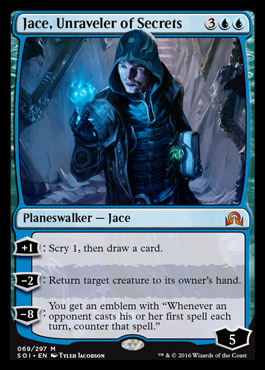
jaceunravelerofsecrets

Here I was all set to tell you how we got a huge downgrade on our Jace and we were back to his normal power level. This time though, Jace is sticking his nose into everyone else’s business and we will take notice. After playing with and against the newest version in a long lineage of Jaces I have concluded it is one of the best cards in the set.

When we look at this card we probably focus on the fact that he costs five mana. That seems to be the worst number these days. Wizards has figured out how to create six-mana planeswalkers that can win you the game, but they haven’t translated that knowledge into the five-mana slot yet. Four mana is usually the sweet spot between efficiency and power but five is just an awkward spot that is hard to nail down.

Let’s break down his abilities. Jace, Unraveler of Secrets has a +1 to scry 1, then draw a card, and a -2 to bounce a creature. He also has an ultimate that basically wins you the game by all but locking your opponent out of playing spells.

Both the +1 and -2 are relevant and powerful abilities. They are also normal things you would want to do over the course of the game in basically any deck. Many times we see planeswalkers with interesting and hard-to-evaluate abilities, like Arlinn Kord, where we have to figure out if they're good or not. With Jace, the two abilities are obviously good. We want to draw extra cards and scry, and bouncing creatures not only protects him but also helps slow down your opponent and get to a better board position.

That five mana could be a sticking point, but imagine for a second he cost just four. This Jace has an ability that nets you a card with selection, an ability that bounces a creature, and an ultimate that's basically game over. Sound familiar?

That's right, he has the same ability set as the big man himself, Jace the Mind Sculptor. The difference is a mere mana (along with that random fourth ability tacked on for no reason).

When you think about him in that light, Jace, Unraveler of Secrets seems a lot better. He's basically a more balanced, five-mana version of the powerhouse from Worldwake. Clearly the power level difference is large. But you can downgrade JTMS quite a lot and still end up with a good Magic card. He even gets a higher loyalty to make him a little harder to kill.

I think this Jace will see tons of play in Standard. Maybe even in addition to Jace, Vryn's Prodigy, but at the very least as a replacement when he leaves the format.

Fincancial Takeaway: At $17 I don’t like this card as an investment unless you're planning to play it right away. Once it drops closer to the $10 range though, I would start picking up copies. If the price sticks around its presale amount for over a month though, no dip is coming and you should close in on finding your copies.

8. Relentless Dead
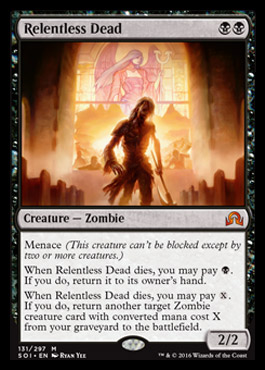
relentlessdead

I spent a lot of time thinking Relentless Dead wouldn’t be good because there are too many exile effects in Standard and because it won't have a home right away. Once I honed in on the actual card, I found myself thinking highly of it. Hopefully this is a plant for more sweet zombie friends to join the format down the road. We could also see a black-based deck without a heavy zombie them that utilizes Relentless Dead.

On its own, we have a bear of a threat on our hands. This isn’t your typical two-mana 2/2. Relentless Dead is a nuisance with three relevant abilities.

The first, menace, gives us some important evasion. Menace can be difficult to deal with because even if they have two blockers you can always use a removal spell on one to attack past the lone remaining defender. Menace is a newer kind of evasion and I don’t think we're giving it enough credit yet.

The second and third abilities both generate card advantage. If your zombie dies, you can return it to your hand. You may have to decide if that's better than getting back another zombie from your graveyard to play. This may depend on how much mana you have available, but if you get to use either of these abilities the game should go well for you.

In order for these abilities to be effective, you need to keep mana ready. I’m not sure how easy that will be. In a perfect world, you will always have mana to use either ability but the truth is you'll often need those resources for other things. That means Relentless Dead will be very skill-intensive to play correctly.

Financial Takeaway: With no immediate horde for this zombie to run alongside, I expect its price to halve within the first month. If someone finds a place for him, then he could stay with his current crazy price tag of almost $20.

7. Olivia, Mobilized for War
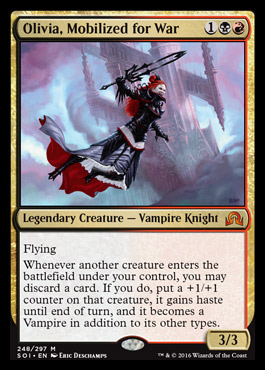
oliviamobilizedforwar

Olivia mobilized for war alongside the vampire army, and they flew hastily into battle. Most players have been thinking about Olivia only in the context of her vampire tribe. Remember though, there is no barrier to playing her in other decks. Once we break free from the tribal wars that have chained our minds, there will be so many other possibilities for her.

Olivia is the leader of any army you give her and she will show the other creatures how to Reckless Charge across the battlefield. You probably can't haste up everything, but a few timely haste threats with a permanent +1/+1 should be enough to get the job done. She also provides a wonderful madness outlet.

Olivia, Mobilized for War is a great threat no matter which red and black creature deck you are playing. I’m sure whatever version of Vampires turns out to be the best will contain this vampire leader, but I think there is room in Standard for more than one deck with Olivia. There could be a red-black midrange deck, or maybe Jund or Mardu will make a comeback. Unlike Relentless Dead, Olivia is a lot easier to build around and can go in a lot of shells.

Financial Takeaway: With multiple possible decks for her to synergize with immediately, I think $14 is a fine price to pick Olivia up at if you need her. I wouldn't be surprised to see her dip a little and then regain those losses. She may even crest her presale price if one of her decks is strong enough.

6. Shadow Lands

porttown forebodingruins

Many players are skeptical about our newest mana fixers in Standard, but I’m thrilled about these shadow lands. Personally, I like that the mana will be worse than last season. When the mana isn’t that amazing it creates interesting constraints for deck building.

The shadow lands may not be as good as the cycle of fast lands like Copperline Gorge, but most of the time they seem the same. If you had a negative opinion about these new lands, think about them in that light and you will put yourself in the right frame of mind.

Financially they're better positioned than their brethren from Battle for Zendikar. The BFZ lands were kept down by fetch lands decreasing the number that saw play, as well as the drastic amount of product opened in order to crack Expeditions.

Financial Takeaway: There are no such barriers for the lands from this set. That makes them a much better investment. Port Town, Choked Estuary, Fortified Village, Foreboding Ruins and Game Trail will see lots of play and I see a bigger price tag in the future as well.

My strategy for every set is to get at least one playset of each land at as low a price as I can find within the first month. Lands have a broader application than any creature or spell because more players will need them. I also buy lands at a higher percentage because I always want to be well stocked on real estate so my player base can run anything they want.

5. Falkenrath Gorger
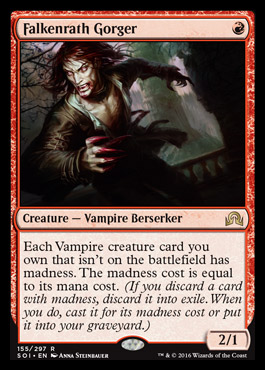
falkenrathgorger

Many players have commented on how amazing this card is. Red creatures that are cheap and efficient have historically had drawbacks. I played a lot of Jackal Pups, and even pup’s upgrade Firedrinker Satyr, throughout my career and they were good. Now we are to a point in Magic history where those cards are obsolete.

This is important for constructed formats as well as things like Cube. Foils of this vampire should be worth a bit more than normal due to the popular tribe it’s part of as well as Cube owners needing to replace older versions of this type of creature.

This isn’t a generic 2/1 though. All of your vampires getting madness might not be relevant all the time, but it’s pretty amazing. There's a lot of upside.

I think players are undervaluing how potent this ability really is. Take a card like Call the Bloodline as an example of an effect that turns this ability into a powerhouse. Instead of casting your creature normally, you can add a 1/1 vampire to the battlefield for an extra one mana. You can do this with every creature as long as Gorger is in play!

At the end of the day, we have a 2/1 for one mana, but giving out madness can be a huge deal. I think Vampires will definitely be a deck in Standard but I think the build will be more subtle than just jamming the most obvious aggressive vampires into sleeves and trying to rock that. Whatever the build ends up being, I think Call the Bloodline will be an important part of that shell as well.

Financial Takeaway: In a set with so many money rares, which is exactly what promises a ton of profit, I don't think there is room in the financial landscape for Gorger to be worth a lot of money. It could climb to $5 but I'd be surprised to see it slip over that amount.

$2.5 should be about the lowest it can get and even if it drops lower you aren't losing much value. Get them when you need them, otherwise having a playset to trade to that person building Vampires will never be a bad idea.

4. Westvale Abbey

westvaleabbey ormendahlprofaneprince

Stalking Stones is crying in the corner from the power creep of Westvale Abbey. Not only can you make a human token army but you can also summon a giant monster that your opponent will lose quickly to. This colorless land has been crazy good in testing so far and it’s expected to have a huge impact on the format.

There are ways to answer Ormendahl, Profane Prince once he kills everyone in the Abbey and comes out to play, but they are limited. It hasn’t been that difficult to accumulate five creatures in play by the time I have six mana, and every game I’ve made the demon monster I’ve won.

Don’t be fooled though, this land is quite skill intensive. There are plenty of times you can crack it when it's probably strategically incorrect to do so. Against white decks, for instance, you should probably never make that line of play. They have many ways to exile any creature, and you might just find your whole board exchanged for a single Declaration in Stone or Stasis Snare.

Either way, this is a great card and it will be one of the pillars that shapes the format.

Financial Takeaway: There are many money rares in this set. I think once the market floods with the draft rares, Abbey will come down in price. But in the first couple of weeks it will be so hot, you could see an increase to keep up with initial demand. I'll be holding my copies until after the Pro Tour unless I'm offered a lucrative deal.

3. Thing in the Ice

thingintheice awokenhorror

With Thing in the Ice we have a Modern playable in addition to a Standard build-around. It’s easy to see why this creature is good, and I fully expect it to make waves somewhere.

One thing I’ve found is that you can slow-roll the flip when necessary, which makes for some interesting standoffs. Then your opponent has to decide whether to commit more threats to the board to force you to flip it or just keep attacking with their small assault force. Beware of your line of play though as the trigger is mandatory---you don't want to flip it at the wrong time because you cast an extra spell too early.

At this point it’s uncertain how much play it will see in either format. Standard will most likely have at least one decent deck that supports this strategy. Whether that will be a tempo or control deck remains to be seen. This card is so much fun to play, and lots of players will be dragging their Thing in the Ice into their brews.

Financial Takeaway: Initially I think our ice cube monster will trend downward simply due to supply, but in the long term I like this card a lot. Playability in both Modern and Standard doesn't happen every day. I would compare this rare to Kolaghan's Command or Atarka's Command and look to those cards for a similar price path.

2. Declaration in Stone
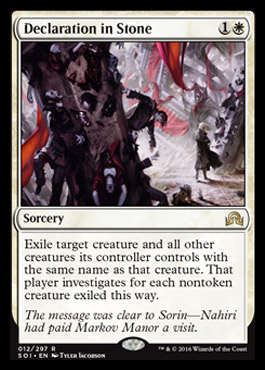
declarationinstone

Coming to the end of the Top 10, we have possibly the most surprising and controversial pick on the list. At number two I chose Declaration in Stone. If you read my article from last week, you know how much I love this spell. You may give your opponent a clue token but the biggest drawback in my mind is that it’s a sorcery.

Like many other players I started out with two copies of this all-inclusive removal spell, then quickly increased to three, then four copies. Declaration in Stone’s price has doubled in the past week as well which tells me other players are catching on to its power level.

Exiling is especially relevant in so many situations. You can remove Ormendahl, stop delirium from becoming active, or prevent Hangarback Walker from granting tokens. Not many spells can say the same thing. And all this for two mana. This spell will be dictating the flow of Standard for the entire time it’s legal.

Financial Takeaway: While I was writing this article, I was prepared to say get your copies ASAP before they spike. Well, that already happened while I was writing, so let's readjust.

This card is amazing and should be a four-of in multiple decks throughout the entire length of its legality. It may be good enough for Modern but I don't think so because it's a sorcery.

Relying on this card to increase from its current spike would be a bad idea but it could very well stick close to the $10 mark. I hope you picked some up at the prerelease, but if not, now or in a week should be a safe time to invest.

1. Archangel Avacyn

archangelavacyn avacynthepurifier

To finish up we have the least surprising card on the list, Archangel Avacyn. This angel is obviously powerful and we all know it. She isn't unbeatable or broken or anything, but the combination of flash, vigilance and indestructible for a turn makes it extremely hard to prepare for her. Talk about format-defining cards, and the conversation has to start with Avacyn.

I love that they're making these iconic creatures from the story playable for constructed formats. For too long, we’ve had these great characters with huge mana costs that were relegated to the realms of Commander decks. No longer do we have to watch these legends slot into multiplayer decks alone. Now we can demolish our opponents with the creatures from the stories.

Avacyn is amazing without even processing the implications of her flip side. We would all be happy with our instant-speed, indestructible Serra Angel. But there's more to her than just that!

Taking advantage of the flip side will prove challenging, though. My first thought was to play her in an Aristocrats-style deck that can sacrifice a creature to make the flip happen whenever it would be most impactful. This has the downside of giving your opponent the option of forcing her to flip in order to kill your other creatures---so be careful how you build your deck.

The short story is that Avacyn will save the day for many players during her time in Standard. I even think she could find a home in Modern.

Financial Takeaway: She is worth every bit of her $30 price tag, and if you need her early in the season, don’t be afraid to make the investment. Depending on how much she takes over the format, she could even go up further. As a mythic angel, flip card that will define Standard, she shouldn't fall very far and it's more likely she will rise in value.

Wrap-Up

I went through many changes to this list throughout the writing process. Some cards didn’t start on it while others were cut to the Honorable Mention section. What that really means is that there are a ton of playable cards in this set.

They also happen to be diverse and different from cards we’ve seen in the past. I think Wizards hit a home run with this set. So many of these cards are amazing but they don’t overlap into the same decks. That means we should have a powerful, but diverse metagame that shifts as we get new cards to pair with Shadows.

Many of these cards in past years would have made the Top 10. This is a phenomenon I’ve been noting more and more. Wizards is printing each set with a denser distribution of powerful cards.

We need to take that into consideration when trying to nail down the future price of cards. If there are tons of good cards, all of them can’t be worth money. We saw this with Khans of Tarkir. The fetchlands helped hold down prices from that set but I think even without them we would have seen a similar price distribution.

That’s all for this week. What’s your opinion about the cards from this set? Did I pick the Top 10 correctly or do you think I missed something? Let me know in the comments. See you next week when we start looking at what’s happening in the metagame and what that means for prices!

Until next time,
Unleash the Shadow Force!

Mike Lanigan
MtgJedi on Twitter
Jedicouncilman23@gmail.com

Insider: Visions of a New Modern

Are you a Quiet Speculation member?

If not, now is a perfect time to join up! Our powerful tools, breaking-news analysis, and exclusive Discord channel will make sure you stay up to date and ahead of the curve.

Eye of Ugin had a good run in Modern, but now is the time for Mike Hawthorne to stop winning Modern IQs.

Without Eye there is interesting space to explore with regard to Modern Eldrazi, and there are still configurations that enable turn two Thought-Knot Seer. That said, the older iterations of Eldrazi hinged on mulliganing into a two-mana land---going forward you can expect Eldrazi decks to be more fringe and/or just light on actual Eldrazi spells.

Meanwhile, two potential juggernauts are being introduced to Modern for the first time:

Already we are seeing lists pop up with one or both of these "new" tools, and already it seems clear that their impact on Modern will be more significant than, say, the unbanning of Bitterblossom.

One mistake I've seen with regard to building Thopter Sword decks is players just jamming both pieces into a deck alongside spells that have nothing to do with the combo. This worked for Splinter Twin, but Thopter Sword provides much higher upside when you build with the combo in mind.

The long and short of it is that as long as you have any artifact to sacrifice to Thopter Foundry when you find it, you can do so to get your Sword of the Meek back from the graveyard. This makes sacrificing or discarding the Sword "free," and improves the power level of cards that do so. The most common historical example of this was discarding Sword to Thirst for Knowledge.

Alternatively, you can use Tezzeret, Agent of Bolas to turn your sword into a 5/5 to threaten to win the game on its own while Tezzeret digs for the Foundry.

Tezzeret has already spiked significantly, though he's just an example of one approach. It's unclear that a Tezzeret build is actually the best way to feature Thopter Sword, considering that its matchup against Ancient Grudge can be rather dismal.

There was an error retrieving a chart for Tezzeret, Agent of Bolas

Make no mistake, you'll want to have non-Sword artifacts so that you can safely bin the Sword, you just don't want to go overboard. Something as simple as including a couple Darksteel Citadel in your deck will do the trick. Maindeck Engineered Explosives are also just generally good to have while also fitting your "any artifact" requirement to get the Sword back the first time.

Meanwhile, the other decks that showed up to PT Oath of the Gatewatch will be the obvious fallbacks for the format. These include Affinity, Infect, Burn, and Suicide Zoo. For all of these decks, the goal will be to win before they're buried by thopters or Ancestral Vision comes off suspend. If you build your Visions or Thopters decks without enough cheap interaction, then you'll find yourself in the losers bracket in short order.

You can fully expect these staple decks to start showing up again, and speculation targets for them have been pretty well documented on this site.

If Death's Shadow becomes the aggro creature of choice, then it definitely has room to grow from $6, a very likely outcome in the near future. Death's Shadow plus Temur Battle Rage can shake off quite a few thopters if your opponent doesn't have a removal spell.

There was an error retrieving a chart for Death's Shadow

Another card that is about to be excellent again is Kolaghan's Command. It beats up on Affinity and Infect, breaks a Thopter Foundry, and gives you value to keep up with Ancestral Vision decks. I fully expect there to be a good Grixis shell with Snapcaster Mage out there---a deck which definitely benefits from Tron losing Eye of Ugin.

A Grixis deck could also jam Vision and Thopter Sword on top of this, which sounds like a great place to be. I don't know how much room K Command has to grow with it already being a $16 Standard-legal rare, though Snapcaster Mage is coming back to Modern in a big way. I expect it won't be long before ol' Snappy starts climbing in price.

There was an error retrieving a chart for Snapcaster Mage

Another interesting idea that I had for Modern revolves around Glittering Wish. The idea is still in its infancy, but the long and short of it is that Glittering Wish can find both Jeskai Ascendancy and Thopter Foundry.

When Thopter Foundry was an Extended force, the best list also featured access to the Dark Depths/Vampire Hexmage combo. Access to two combos that are relatively difficult to disrupt puts a lot of pressure on your opponent to draw the right cards at the right time.

Both Jeskai Ascendancy and Thopter Foundry fold to Abrupt Decay, though beyond that their juxtaposition leads to two win conditions that are relatively difficult to interact with. It's definitely nice that Ascendancy can't get hit by Ancient Grudge, too. It's a rough sketch, but something like this is worth exploring:

Thopter Ascendancy

Creatures

4 Sylvan Caryatid
4 Fatestitcher

Spells

3 Jeskai Ascendancy
1 Thopter Foundry
3 Sword of the Meek
4 Glittering Wish
4 Thought Scour
4 Gitaxian Probe
4 Serum Visions
4 Manamorphose
1 Crimson Wisps
1 Noxious Revival
1 Scarscale Ritual
1 Cerulean Wisps
1 Slip Through Space

Lands

2 Darksteel Citadel
1 Forest
1 Breeding Pool
1 Stomping Ground
1 Temple Garden
2 Wooded Foothills
1 Island
4 Misty Rainforest
1 Hallowed Fountain
1 Steam Vents
4 Windswept Heath
1 Plains

Sideboard

1 Jeskai Ascendancy
1 Thopter Foundry
1 Wear // Tear
1 Flesh // Blood
11 Snow-Covered Island

The mana definitely isn't perfect, the exact mix of cantrips probably needs ironing out, and I don't know that Darksteel Citadel is necessarily the best backup artifact for the first Foundry activation. But I think there's something here.

Having access to five copies of Thopter Foundry with four tutors is pretty stellar, and Thought Scour can flip over Fatestitcher or Sword of the Meek to get either combo going. I'll admit that I'm not the best person for building decks like this, though theoretically there is a shell for a resilient and explosive combo deck here.

Glittering Wish once pushed $20, and if a deck like this breaks out then you can expect a return to that price. A couple sets of Glittering Wish is a gamble I could get behind.

There was an error retrieving a chart for Glittering Wish

There will be a reasonably sized Modern tournament near me this Saturday, and I'll be battling with old reliable. It's time for Grixis Delver to make a comeback, baby! It's hard to say exactly what will come out on top this weekend, but given the short time frame to prepare I think four copies of Spell Snare will do a great job of keeping Thopter Foundry at bay while Tasigur beats down.

I liked the deck against the expected field pre-Eldrazi, and my only concern with these unbannings is losing long games to Ancestral Visions decks. I don't like the idea of playing Visions in Delver, because I think it's a liability everywhere except against the grindy decks, though I have a plan for a transformational sideboard:

Grixis Delver

Creatures

4 Delver of Secrets
4 Snapcaster Mage
3 Tasigur, the Golden Fang
1 Gurmag Angler

Spells

4 Mana Leak
4 Serum Visions
4 Thought Scour
4 Lightning Bolt
4 Terminate
4 Spell Snare
2 Remand
2 Kolaghan's Command

Lands

4 Scalding Tarn
4 Polluted Delta
3 Bloodstained Mire
2 Steam Vents
2 Watery Grave
1 Blood Crypt
2 Island
1 Mountain
1 Swamp

Sideboard

3 Countersquall
1 Dispel
2 Spell Pierce
2 Magma Spray
2 Engineered Explosives
1 Go for the Throat
4 Ancestral Vision

It's a bit generous to call it transformational, but the plan is simple. If they have Visions, Delver goes out and Visions come in. I was already boarding out Delver against decks that were adept at killing it, and this is a significant upgrade.

It might turn out that I'm just supposed to maindeck the card---this is what happened with Kolaghan's Command, after all---though this will be my starting point this weekend. I have some concerns about finishing three-game matches against Visions decks, though we'll burn that bridge when we get there.

It's unclear just how safe the unbannings were this go-'round for Modern, and it will be pretty exciting to see how things shake out. Whether you decide to invest in the established or the up-and-coming, the players who quit Modern for Eldrazi winter will be returning to the format, and you can expect increases in the pricing of the Modern format in coming months.

Insider: Modern Cards in Demand After the B&R Changes

Are you a Quiet Speculation member?

If not, now is a perfect time to join up! Our powerful tools, breaking-news analysis, and exclusive Discord channel will make sure you stay up to date and ahead of the curve.

Monday’s Banned and Restricted (B&R) announcement will have a huge impact on Modern. The nerfing of the format’s bogeyman, Eldrazi, was inevitable, and the banning of Eye of Ugin expected, but the unbanning of Ancestral Vision and Sword of the Meek caught many off guard.

Rather than simply rewinding Modern back to the pre-Eldrazi days, R&D have created a brave new world where blue decks have two incredibly powerful and efficient tools to fight against the field.

Blue control decks have always have had problems in Modern, and the most successful among them have relied on combos like Splinter Twin. Ancestral Vision provides control decks with a fantastic source of card advantage that makes an attrition strategy viable, and Sword of the Meek completes the Thopter Foundry combo, which gives control decks a kill condition.

This combo is more palatable than Splinter Twin, because rather than ending the game instantly, it ends the game through the crushing inevitability of endless evasive creatures and life gain, and in theory it’s a healthy change to the format.

Finally, Shadows over Innistrad brings us Thing in the Ice, which has been pegged a new eternal staple akin to Delver of Secrets or Young Pyromancer.

Profiling the New Meta

The sum of these changes is an environment very favorable to blue decks. Beyond crippling blue’s enemy #1 , Eldrazi, the banning of Eye of Ugin also rids G/r Urzatron decks of the late game tutoring engine that blue decks have an impossible time beating. It’s a great time to be a blue mage, and that’s going to be reflected in the metagame and the market.

It’s also a great time to attack blue deck and cards like Ancestral Vision and Sword of the Meek, so foils to those cards and to blue strategies will also demand a premium. I’ve thought about how the banned list changes impact the metagame, and I’ve studied post-ban price movements of card sales on MTGO, and I’ve identified some cards that I foresee experiencing an increase in demand and price.

Thopter Foundry is an artifact that synergizes with other artifacts, so that card type is on the rise. Players are already hyping cards like Tezzeret, Agent of Bolas and Tezzeret the Seeker, and it’s clear that this combo is going to be everywhere in the near future.

Affinity was directly exploited by U/W Eldrazi, but now it’s clear water ahead and smooth sailing for the format’s oldest archetype---except for the heaps of artifact hate that will begin to fill sideboards and creep into maindecks. For every action there is an equal and opposite reaction, and the format will react to Thopter Foundry by getting artifact removal however and wherever they can.

My Picks for Gainers

Stony Silence

There was an error retrieving a chart for Stony Silence

Stony Silence is the card Affinity players fear the most, because it turns their deck into a pile of inefficient, if not completely useless cards. It also stops Thopter Foundry from producing anything. Tron, down but not out, will persist, and will be as reliant on artifacts as ever, and Stony Silence is the one artifact hoser that works against them.

It’s going to be great going forward, but at its relatively high price I don’t see it spiking again. That being said, this might be the single best sideboard card in Modern, and its value can do nothing but rise until it’s reprinted.

Night of Souls' Betrayal

There was an error retrieving a chart for Night of Souls' Betrayal

This one is a bit more narrow, but it’s a direct and no-nonsense solution to Thopter Foundry. It neutralizes all thopter tokens, present and future. It also means Sword of the Meek won’t have the opportunity to attach to a thopter and enter play, so it stops the engine completely and thus eliminates the life gain aspect of the combo as well.

I’ve always liked Night of Souls' Betrayal as a spec in general, and now it looks better than ever. Orzhov Pontiff is another card in the same vein that’s going to see a lot more play, but it’s considerably more narrow in the decks that can use it.

Abrupt Decay

There was an error retrieving a chart for Abrupt Decay

Abrupt Decay is an answer to Thopter Foundry that players can maindeck. Rather than being forced to play a narrow answer, BG/x decks can happily play four of a removal spell that will find targets against every other opponent.

Abrupt Decay is even uncounterable, so it’s an ideal answer to a blue combo that can be accompanied by counterspells. Abrupt Decay was the bane of Splinter Twin decks, and it will be the bane of Thopter Foundry decks.

With the banning of Splinter Twin and the rise of the Eldrazi, Abrupt Decay went from sacrosanct format staple to unplayable, a sideboard card at best. The recent change cutting Eldrazi also re-introduces a blue combo card at three mana or less, bringing Abrupt Decay back to where it was before, and perhaps better than ever.

The format change is also a knock against Tron decks, a matchup where Abrupt Decay traditionally fails. The rise of Ancestral Vision also means an increase in cards like Bitterblossom and Vedalken Shackles, where Abrupt Decay also shines.

For years people have talked about $20 Abrupt Decay, and that time is probably finally here.

Scavenging Ooze

There was an error retrieving a chart for Scavenging Ooze

Scavenging Ooze was released in M14 to great fanfare. It’s always been noted for its tremendous eternal potential, but the demand has never been high enough to bring the price upwards. Now enough time has passed since release, and the popularity of Modern increased enough. As of the new year the price began to increase, and I expect this trend to accelerate.

Now, with Scavenging Ooze as a way to remove Sword of the Meek and end the combo, it has new role to fill. It’s also a solution to Snapcaster Mage, so it’s simply an excellent card against blue strategies going forward. It even disrupts Academy Ruins, Crucible of Worlds, and any Gifts Ungiven graveyard shenanigans.

Snapcaster Mage

There was an error retrieving a chart for Snapcaster Mage

Speaking of Snapcaster Mage, this staple will ride the currents of the rising blue tide. There’s really not a lot to say about the card in the metagame except that it’s useful in blue decks of all sorts. It’s also the perfect complement to the cheap spells that tend to accompany Ancestral Vision, even though it can’t cast Vision itself.

When Snapcaster Mage broke $80 last June I thought it was well on its way to breaking $100 within the year, but as it turned out that was the peak. It’s been stable around $60 since before Eldrazi, but now with nothing suppressing it the price will grow, and $85 is not the peak this year. Vendilion Clique, Cryptic Command and Remand are other blue staples with demand on the rise.

Academy Ruins

There was an error retrieving a chart for Academy Ruins

Academy Ruins has long been a great tool for artifact-wielding blue decks, which are back in full force. It’s useful for recovering any lost Thopter Foundry, so count on it being used in Sword of the Meek combo decks. It’s also very good with Mindslaver in Urzatron decks, which will increasingly become blue.

Engineered Explosives

There was an error retrieving a chart for Engineered Explosives

Engineered Explosives can destroy Thopter Foundry or all thopter tokens alike. It’s flexible, powerful, and potentially very efficient, so it’s simply a great card in general, but historically it has been particularly useful in blue control decks.

It’s a tool new blue decks are going to use regularly, and it’s widely accessible to all sorts of other decks. I like its prospect as a stable growth spec.

Eldrazi Temple

There was an error retrieving a chart for Eldrazi Temple

Eldrazi loses overall, but both Eye of Ugin’s and Eldrazi Temple’s prices have been suppressed in anticipation of a ban. Now that Eye has been banned, Eldrazi Temple has room to grow. The deck was left intact in some form, and it will slowly establish itself as a bit player in the metagame.

Vesuva

There was an error retrieving a chart for Vesuva

Vesuva has been suggested as a replacement for Eye of Ugin in Eldrazi decks. It requires Eldrazi Temple to work, but it will still be useful in these decks. Even more so if Eldrazi decks start to play Expedition Map or focus on green for Ancient Stirrings.

Master of Waves

There was an error retrieving a chart for Master of Waves

As a final note, Merfolk always thrives when blue decks reign. Dodging counterspells with Aether Vial and Cavern of Souls and islandwalking en masse makes them a nightmare for blue decks. The deck will be well positioned going forward.

Therefore any Merfolk staples are likely to be solid buys. Splashing white for artifact hosers might be common, so Wanderwine Hub could be another good target.

-Adam

High Stakes MTGO – Mar 27th to Apr 2nd

Are you a Quiet Speculation member?

If not, now is a perfect time to join up! Our powerful tools, breaking-news analysis, and exclusive Discord channel will make sure you stay up to date and ahead of the curve.

Welcome back for another week of High Stakes MTGO!

Quite a few buys and sales this past week, with the notable sale of all of my Legendary Cube Prize Pack (PZ1) prize singles. The MTGO release of Shadows over Innistrad (SOI) is imminent and with it a lot of changes in both Standard and Modern should occur.

Particularly for Standard I intend to perform much better this time around than I did during the previous Standard rotation. After the Pro Tour (PT) results I was inclined to wait for additional profits for a lot of positions, selling only very few positions in the pre- and mid-Pro Tour hype.

I think a better play is to sell the vast majority of your positions that have gone up, even if by a little bit. Here are few words about my observations and reasoning.

The excitement of Standard rotation and the Pro Tour hype lift up prices much more than they actually should and on too many cards. Once the new Standard metagame version 1.0 emerges after the PT, only a handful of cards will sustain the hype or gain more value in the following weeks.

The price fall, which can be quick or spread over few months, is on the other hand much more common. I have lost countless tix and time waiting and waiting again for a card to either finally gain some value or recover from a Pro Tour height. Those losses are not outweighed by my few successes.

So if you want my strategy in Standard for the weeks to come---selling as much as possible of everything that sees gains of roughly 80% and up. I don’t have concrete data to back this up but it seems that selling everything positive rather quickly is likely to be more profitable, on average, than selling the exact same positions after several more weeks (whether or not some of them get better).

What is certain, however, is that getting out early, as opposed to waiting three or four months, is an enormous opportunity benefit. I’m rather enjoying my "rapid turnover + moderate profits" method lately.

Let’s check back in a few weeks if I’m able to finally follow my own words of wisdom. In the meantime, here is what happened this past week. The snapshot of the account as of Saturday April 2nd is here.

Buys This Week

BFZ lands

Battle for Zendikar (BFZ) rare lands are still great speculative targets. I bought 55 copies of Canopy Vista and reinforced the positions I already had.

They are not as cheap as they were a month ago. But even at about 2 tix a piece they have the potential to double, even with the loss of Khans of Tarkir (KTK) fetchlands. If they keep dipping I might buy more playsets. Lands are always a good place to invest.

TBD

This dragon fell below 3.5 tix this past week. I was not fully stocked from my first buying wave so it was a good opportunity to complete my stock.

EB

As a bulk spec this Eldrazi has enough potential for me. I might even buy more copies as quantity makes all the difference for bulk specs. My target is to grab somewhere around 200 copies total.

BFZ2

With a little bit over 3000 tix invested in BFZ sets I’ll now wait and see what happens in the next two months. My goal with full set specs is +30% to +40%. I hope to see a big increase in BFZ prices right after Pro Tour Shadows over Innistrad. If the raise is significant enough it might as well be the opportunity to sell both singles and full sets.

GGT

Since the dredge troll returned from the Modern ban list it has hit the 10 tix bar more than once already, most recently less than a month ago. Ravnica: City of Guilds flashback drafts pressured Golgari Grave-Troll to a sub 5 tix price about a week ago.

Unlike in Legacy and Vintage, Dredge decks are not as good in Modern but post competitive results here and there. With another round of bans in Modern and SOI adding cards for graveyard-based strategies, Golgari Grave-Troll could rebound quickly.

GG

After two periodic dips in February came another sharp dip for Goblin Guide to under 5 tix. I hadn't yet maxed out my position with this goblin, so this third dip was another opportunity to buy, hopefully before a comeback to the 8-10 tix price range after the next B&R list announcement.

KTK sets

Since early March the price of a KTK full set seems to have found a floor around 60 tix. Because of the fetchlands this set is retaining a higher value than previous large sets in the paper world and consequently might not go as low as other sets on MTGO.

I bought a few playsets circa 62 tix and intend to buy more. Several of the cheapest mythics of that set aggressively rebounded four weeks ago, compensating for the rares still slowly drifting down and stabilizing the price of the set.

I expect an additional brief little dip right during SOI release events. I'll be buying more full sets and several singles during that period, whether this dip actually happens or not.

Sales This Week

This past week I completed the sale of all of my Legendary Cube Prize Pack singles. With an average profit of +52% for a total gain of 567 tix, these guys were incredible speculative targets. All of my 11 positions here yielded some profits---all winners, zero losers.

I'm glad I didn't push it too much by buying more copies, especially of the cheap ones. The spread on these cards was big and my selling prices decreased quickly between the first and last copy I sold for a given position. As I stated before, I'm selling now to avoid bad surprises with a potential return of PZ1 prize packs and to move on to new targets available at this time of the year.

This angel rode a nice upward trend between mid-January and now. Will this sustain after another change in the Modern metagame? Nothing less certain, and that's actually not even a question I need to answer. My position here has more than doubled and was therefore ready to be sold.

Baneslayer Angel illustrates what I like to do these days with Modern and Standard---take certain profits today rather than higher, uncertain ones tomorrow.

On My Radar

I'll be dedicating my time to several things in the following days. The first is to buy more BFZ and Oath of the Gatewatch (OGW) singles, as well as OGW full sets.

I've been mentioning this for several weeks now but this is the last opportunity to get them at their best price before a potential rise. Although the price of an OGW full set is still amazingly high for a small set, it will only be more expensive after the release of SOI.

A few cards from the current Standard sets that are not rotating out---Dragons of Tarkir, Magic Origins and Battle for Zendikar---have shown some increases lately, such as Archangel of Tithes. As I said in the intro I'll try hard not to sleep on positions showing decent gains in the short term. Particularly I'm looking to sell several Origins positions, including my big pile of painlands.

Finally, I intend to buy more KTK full sets and also some Fate Reforged ones. I will also try to cherry-pick a few singles such as the fetchlands, Anafenza, the Foremost, Monastery Mentor and Ugin, the Spirit Dragon.

Thank you for reading,

Sylvain

Want Prices?

Browse thousands of prices with the first and most comprehensive MTG Finance tool around.


Trader Tools lists both buylist and retail prices for every MTG card, going back a decade.

Quiet Speculation