menu

Preparing For A New Modern

Are you a Quiet Speculation member?

If not, now is a perfect time to join up! Our powerful tools, breaking-news analysis, and exclusive Discord channel will make sure you stay up to date and ahead of the curve.

After weeks of waiting, the time has come! Eldrazi is gone, and we could possibly be on the precipice of a Control Takeover. Before I wake from this dream, I have to do the only thing I know how: analyze! This week, we’ll briefly go over the ban announcement, the immediate impacts, and make some predictions as to how Modern will evolve to incorporate these changes.
AncestralVision

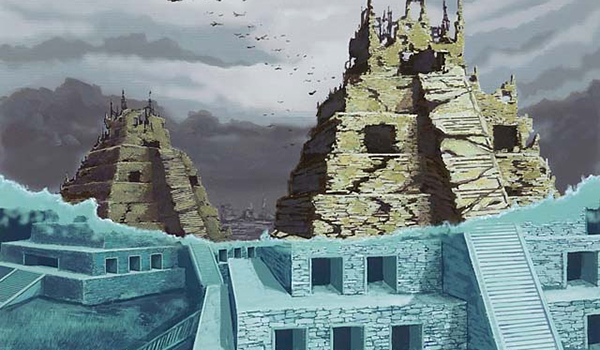
With everyone in the community brewing up Sword of the Meek decklists, how can we get a step ahead of the competition? Rather than just cobbling together a 75 with outdated information, let’s instead put to paper what we can infer about how Modern will react to these changes. Hopefully, we’ll have a stronger understanding of not only how things will change, but why. Let’s get to it.

[wp_ad_camp_1]

Context

April 4, 2016 Banned and Restricted Announcement

Eye of Ugin is banned.
Ancestral Vision is unbanned.
Sword of the Meek is unbanned.

Eye of Ugin

Wizards' banning of Eye of Ugin over Eldrazi Temple is probably for the best, and for a few reasons. With Eye gone and Eldrazi Temple remaining, the archetype can remain relatively intact. At its core, the Eldrazi deck is Eye of Uginmostly fair when compared with the rest of Modern, even though the eight Sol lands pushed it over the top. Removing Eye of Ugin takes away the possibility of busted turns (free Eldrazi Mimics, 4+ mana out of one land on double-spell turns) and puts a strict leash on the deck. Eldrazi Temple is still powerful, but so is Mox Opal, Noble Hierarch, and the Tron lands. Eight copies of a pushed card is broken, while four copies is much more reasonable.
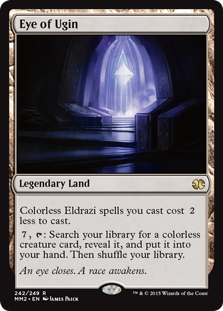
With Eye of Ugin gone, Eldrazi loses explosiveness, consistency, and late-game inevitability (as does Tron, which is worth mentioning). This last point is telling, as Wizards’ unbannings and explanation point strongly towards a desire for a true control presence in Modern. R/G Eldrazi tutoring for World Breaker, U/W finding Drowner of Hope, or even just drawing an extra card a turn (where that card is always gas) is a nightmare for control and midrange decks alike. While I was hoping for an Eldrazi Temple ban because I just wanted the archetype gone, a diminished Eldrazi is probably better for the format, not to mention Wizards’ pack sales.

Ancestral Vision
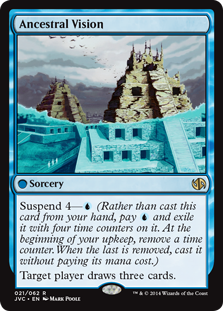
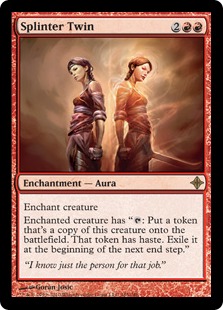
Ancestral VisionOf the blue control cards currently on the banlist (Jace, the Mind Sculptor, Ponder, Preordain, Treasure Cruise, Dig Through Time) Ancestral Vision has often been called the least deserving of the bunch. The main argument in favor of an unban has been this: in a Turn Four format, drawing three cards on turn five doesn’t seem that overpowered, right? Besides, this is assuming you had Ancestral Vision on turn one, and were either on the play or your opponent didn’t have discard! While the argument is slightly more complicated than that, there is some truth to their point. Compared to the now-banned Splinter Twin, or to Living End, turn three Karn Liberated, and similar strategies, drawing three cards seems downright benign.

When paired with control strategies, Ancestral Vision transforms from a “slow” value-spell into a potent mid-game goal, and a relatively certain win condition in the form of inevitability. Control decks leveraging disruption and counterspells against their opponent can delay the game past their turn four goldfish draws, to the point where three extra cards becomes not merely influential but actually scale-tipping. Common gameflow has most players emptying their hands by turn four/five, as illustrated here:

  • Turn 1: Land, spell
  • Turn 2: Land, spell
  • Turn 3: Land, spell
  • Turn 4: Land, spell, spell
  • Turn 5: Spell, spell, (maybe a 5th land)

With a starting hand of seven, plus four draws on the play, five on the draw, you can expect both players to be twelve cards deep by turn five. Thus, players should have at most one or two cards by the end of turn five assuming normal conditions and minimal wasted mana. Resolving an Ancestral Vision at this point of the game can be devastating, said Marshall Sutcliffe. Throw in the fact that the mana investment has already been paid, giving you “free” cards on an often pivotal turn, and you can start to see why Ancestral Vision was considered ban-worthy for the entirety of Modern.
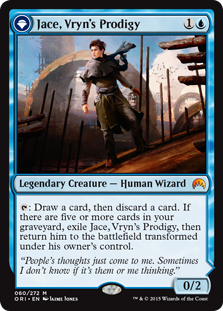
Jace ProdigyAncestral Vision has some drawbacks, however. Waiting four turns for our draw three can be fatal if we’re up against the ropes, and Ancestral Vision is a poor topdeck if we’re behind on board or close to death. Ancestral Vision interacts poorly with Jace, Vryn's Progidy and Snapcaster Mage (two of the best reasons to play Blue in Modern). Also, it places heavy pressure on control players to cast it as soon as possible, leading to awkward turn two’s with counterspells and can put us behind on board against one-drop creatures if we’re casting Visions over removal.

Of course, the most exciting potential of Ancestral Vision is its immediate response to an over-saturated aggressive metagame. Ancestral Vision plays perfectly into a control deck's Plan A; disrupt, interact, stabilize, turn the corner. Where pure control decks previously had to hope cards like Sphinx's Revelation and Celestial Colonnade were good enough, now they can just play normal Magic, resolve Ancestral Vision and calmly take control from there. Diverse control hate is present in Modern, and has been used before to great success, but the greatest enemy for the control archetype has always been a field too diverse to truly take control by playing reactively. Ancestral Vision, on surface level, seems like it could change this.

Sword of the Meek

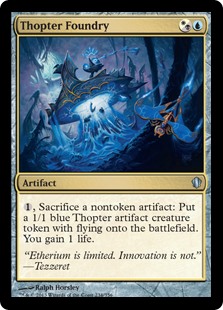
Useless by itself, but when paired with Thopter Foundry the Sword of the Meek combo can provide a potent stream of 1/1s and life points limited only by the amount of mana we have to spend and our opponent’s patience. With help, swordFoundry/Sword on a stable board can singlehandedly shut the door against all aggro decks, and given enough time can even generate enough material advantage to beat any combat-oriented opponent on its own. Foundry's/Sword’s true strength comes in its ease of use; sure, both cards are poor on their own, but assembling them together often slams the door on anyone fighting fair. In old Extended, many decks (even dedicated Combo strategies) found five-seven slots for Foundry/Sword, because mise.
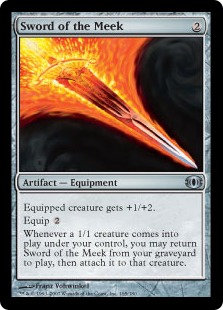
With Sword’s unbanning, control has a proven late-game option should they want it, and we could possibly see various midrange decks adopting the strategy as well. Tezzeret decks of various flavors have incorporated the combo in the past, looking to take advantage of Tezzeret, the Seeker and his tutor ability to find both halves of the combo. Modern has checks in place in the form of prevalent artifact hate for Affinity, and it will interesting to see if Foundry/Sword can carve out a niche (pun definitely intended).

Similar to Ancestral Vision, we can't overstate the presumed impact of Sword of the Meek on an over-saturated aggressive metagame. Against aggressive archetypes, assembling Sword/Foundry is usually game over, as Sword of the Meek can immediately stabilize the board and push the user out of burn range, and can even win the game by itself going late. Sword of the Meek stabilizes, invalidates opposing draws, and wins the game, all in one card. Once it hits the field, activating Sword as much as possible is often just the best possible thing to do, similar to Pack Rat in old Return to Ravnica Standard. Linear archetypes like Zoo, Affinity, Burn, and even Infect (short of unblockable Blighted Agent) will all have to adjust to Sword's presence, should it prove to be a force in Modern.

Predictions

Moving forward, my predictions for how Modern will adapt to these banlist changes hinges on a few standpoints. In particular order:

  • Eldrazi as an archetype will remain; diminished but present nonetheless.
  • Ancestral Vision will sponsor a control resurgence of some undefined measure.
  • Foundry/Sword will find its way into the metagame in some fashion, be it a new archetype or existing strategy.

Those seem like safe predictions, but that’s the idea. When looking ahead, its best to establish a Level 0; a list of things we can assume with some certainty. This not only keeps us grounded, but also lets us concentrate on the possibilities as a whole rather than blinding us into a narrow focus. For example, were we to focus single-mindedly on the possibility of Foundry/Sword as a dedicated strategy, we could go through testing, find that it doesn’t stand up to hate, and move on with the assumption that it won’t influence the metagame. If we start from a broader perspective, we could imagine how Foundry/Sword could be incorporated into existing archetypes like U/W Control, Lantern, or maybe even Jund Midrange, and get a much clearer view of the possibilities.

In my "Context" portion I already wrote a bit on why I think the above three points are relatively safe bets, so this will serve as our baseline for speculation. From here, we embark on a journey; filled with guesswork, fraught with presumption, dogged by assumption. Enter at your own risk.
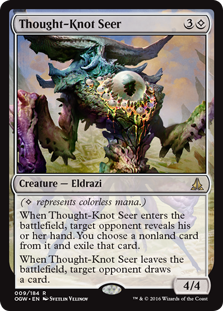
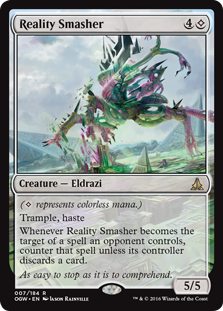
Thought-Knot SeerEldrazi will morph from a format devastator to a reality check in Modern. A diminished, but still present, Eldrazi archetype will have a few effects. One, Burn will have a slightly easier time keeping up, but I believe will still fall short in the matchup. Eldrazi has tools available to fight Burn should they need it, and haven’t had to implement them up to this point. Chalice of the Void is still nuts, and an excellent tool against a bunch of decks in the format. Two, non-interactive decks like Tron and Scapeshift will still be pressured into interaction by the hard-hitting Eldrazi, reducing their overall potency against the field.

Abzan Company will gain dominance over Eldrazi, but will be hindered by control. Already blessed by a favorable Eldrazi matchup, Abzan Company was kept in second-place by the sheer unfairness of Eldrazi, which saw it still winning matches in an unfavorable matchup. Now that the playing field has been leveled, we can expect to see Abzan Company take a sizable portion of Eldrazi’s market share, and the onus will be on Eldrazi to make the next move in this matchup. On the other hand, Abzan Company is about to gain a new enemy, in the form of control decks. Whether control will be Grixis, U/W, or some other color combination is unclear, but removal/counterspells backed up by card advantage has proven tough for Abzan Company to overcome, and I imagine this will continue in the future.
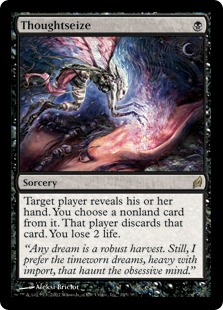
ThoughtseizeControl decks will fight an increasingly aggressive, linear field. With Ancestral Vision heavily incentivizing aggressive decks to finish off control before they gain much needed resources to stabilize, I expect we’ll see aggro become even more hyper-aggressive in response. Draw effects like Ancestral Vision have a tendency to push out the middle of the archetype spectrum, polarizing fields that once were diverse. We saw this before with Treasure Cruise, and while Ancestral Vision is no Treasure Cruise I expect we might see a similar, smaller effect here.
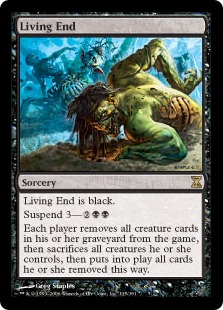
Living EndFocused combo strategies will fall away without discard help. With Ancestral Vision giving control archetypes a major boost in games going late, combo’s traditional plan against control (sculpt a solid hand for a pivotal turn) will face severe opposition. While Scapeshift and Storm can play Ancestral Vision of their own, other combo like Living End and Grishoalbrand will have some trouble. Besides just winning before Vision comes online, discard is the best way to combat Ancestral Vision, but even that might not be enough. You can expect any player with Ancestral Vision in their opener to play it on the first turn, meaning the opponent with discard has to not only have discard in their opener but also be on the play to snag Vision before its cast. A topdecked Vision in the early game is also impossible to defend against, though Vision does get rapidly worse as the game goes on.
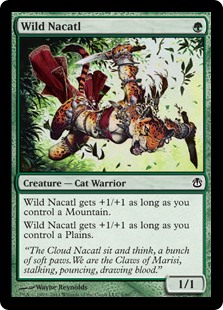
Wild NacatlVision will sponsor an increase in discard and one-drops. We’ve covered discard above, as well as the increase in hyper-aggression, but the reason why might not be so clear. A control player casting Ancestral Vision on turn one means he/she is forgoing casting a Lightning Bolt or Thoughtseize instead. The Grixis Control/Burn matchup specifically is defined almost entirely on the first turn. Burn should almost always mulligan openers without a one-drop creature, as Grixis only has Lightning Bolt to kill it without losing tempo. Even if Grixis does have the Bolt, it’s often right to take two extra damage from Goblin Guide on Burn’s turn two to threaten Spell Snare on Eidolon of the Great Revel. None of this can happen if Ancestral Vision is being cast on turn one. (Note: This particular interaction is why Serum Visions (and now Ancestral Vision) will often be trimmed post-board against Burn). Expect almost all Burn lists to be of the Naya variety with Wild Nacatl, and other aggressive decks to ramp up their one-drop count as well.
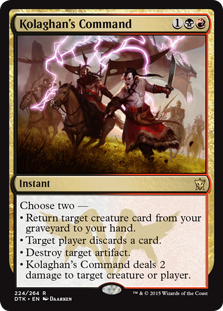
Kolaghans CommandDedicated Foundry/Sword decks will face maindeck hate. Before Eldrazi pushed everything else out of the metagame, Kolaghan's Command was seemingly everywhere, and we can expect a mini-Kolaghan's Command resurgence now that Eldrazi is gone. Affinity will go back to being at the forefront of everyone’s mind, and I expect Grixis Control to return as well, bolstered by Ancestral Vision. While Jund’s position in this new metagame is unclear, it’s safe to assume Kolaghan's Command will see maindeck play as artifacts will be rampant. Eldrazi is still playing Chalice of the Void, Affinity is still present, and now we have Thopter Foundry/Sword of the Meek added to the mix as well. Ancient Grudge, Stony Silence, and the like are here to stay as they always have been, and Foundry/Sword will have to take that into account when defining their role.

I expect Foundry/Sword to pop up first as a win condition in a U/W style Control deck rather than a dedicated Tezzeret archetype, but I also expect we’ll see attempts at both. Abrupt Decay, once widely accepted as the best answer in Modern, fell away from favor with the introduction of Tasigur, the Golden Fang and Gurmag Angler, and I predict Jund (and every BGx deck that can play it) to do so in the future. Reverberations from this decision impact Blood Moon, Ensnaring Bridge, and Pyromancer's Ascension specifically.

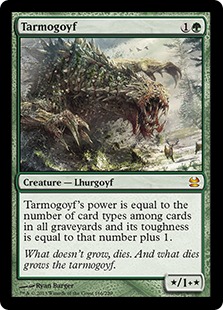
A lot of these points share many similarities with each other, to the point that they are not so much Venn Diagram as much as they are Spirograph, but I hesitate to combine some of them together. For example, point three and point five both deal with the immediate impact of Ancestral Vision to the established "baseline", but it is worth differentiating the two. An aggressive field as a result of Ancestral Vision could include a general increase in the amount of Tarmogoyf, for example, which isn't a one-drop. This is worth elaborating because should Ancestral Vision prove not powerful enough to see play in Modern Control decks (yet we still experience a control resurgence as a result of Sword of the Meek) we might see a more aggressive field without increased discard or one drops. Elaborating in this way might seem verbose, but can definitely be useful when trying to predict trends.

Conclusion

As we head into a fresh Spring, we’ll be leaving the cold dark memory of Eldrazi Winter behind us. Diminished, but not gone, Eldrazi remains, and along with Ancestral Vision and Sword of the Meek promise to influence the format. Will Control rise to the top? Will Affinity retake the throne? Will Sword of the Meek be as dominating a combo force as Splinter Twin? What do you think? Let me know in the comments and I’ll see you next week, with decklists!

Trevor Holmes
The_Architect on MTGO
twitch.tv/Architect_Gaming
twitter.com/7he4rchitect



Brewing with SOI- Selesnya Tokens

Are you a Quiet Speculation member?

If not, now is a perfect time to join up! Our powerful tools, breaking-news analysis, and exclusive Discord channel will make sure you stay up to date and ahead of the curve.

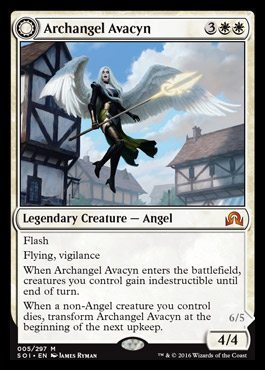
It might be a bit generous to call this one a "tokens" deck, though it definitely generates plenty of them. Basically, today's deck is the obvious shell to slot Nissa, Voice of Zendikar, Gideon, Ally of Zendikar, and Archangel Avacyn into the same deck. For as uninspired as the deckbuilding is, we could just call this "Green/White Cards":

Selesnya Tokens

Creatures

4 Elvish Visionary
4 Deathmist Raptor
4 Den Protector
4 Archangel Avacyn
2 Knight of the White Orchid
1 Nissa, Vastwood Seer

Spells

4 Nissa, Voice of Zendikar
4 Gideon, Ally of Zendikar
2 Oath of Nissa
2 Secure the Wastes
4 Declaration in Stone
2 Stasis Snare

Lands

5 Plains
4 Forest
4 Canopy Vista
4 Fortified Village
4 Tranquil Expanse
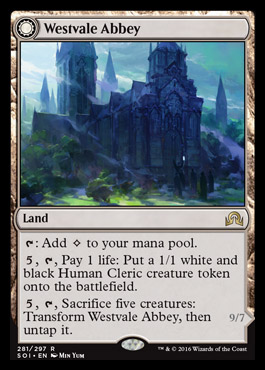
2 Westvale Abbey

The idea is to jam some of the most powerful cards in Standard into one shell, and it just so happens that there are some token synergies built in. Both Gideon an Nissa will make tokens in addition to pumping your team, which plays well with Secure the Wastes and Westvale Abbey. Since we're a green deck, it makes sense to jam Den Protector, and white offers Declaration in Stone as a great removal spell in addition to Stasis Snare to catch opposing Ormendahls.

There was an error retrieving a chart for Westvale Abbey

This deck doesn't look like anything special, but if the decks you're building can't stand up to it, then you might be in trouble. One of the defining cards of the format will be Archangel Avacyn, and if your deck can't beat her then it's probably wise not to bring it to a tournament. The shell here is a great starting point for determining whether you can beat an Avacyn.

There was an error retrieving a chart for Archangel Avacyn

Alternatively, if this is the deck you want to play, this list doesn't need much polishing to be tournament worthy. The two and three drops should be adjusted based on your expected metagame- specifically you may want to maindeck Silkwrap. I also might be too big on Elvish Visionary, but it seems right at home here, and I'm not too impressed by Sylvan Advocate in a deck without creature lands.

Insider: Tips for Buying Collections on Craigslist

Are you a Quiet Speculation member?

If not, now is a perfect time to join up! Our powerful tools, breaking-news analysis, and exclusive Discord channel will make sure you stay up to date and ahead of the curve.

In the past year I've bought about 30 or so collections off of Craigslist, some very profitable, some not so much. Today I'll pass on all the tips and tricks I learned along the way.

Overall I think buying collections on Craigslist can be a profitable, albeit erratic way of making money. Sometimes you can make over a thousand dollars on a single collection, but you can also go months without seeing a single deal.

Your prospects will be heavily based on your location, both for the number of opportunities presented and the amount of competition you will face. Are there many Magic players living around you that are trying to sell their collections? How many people are you competing against when you are trying to buy a collection? These are the factors that will determine your profits.

I initially assumed there wouldn't be much money to be made in my area, but you should never underestimate the laziness of others! This holds both for people selling their collections and for your competition.

Anyways, here are my nine most important tips.

1. Check Craigslist Every Single Day!

It takes me about one minute every morning to check Craigslist and I can't count how many times I've gotten a collection simply because I was the first to notice it. I've also gotten punished on the other end. A few times I missed great opportunities from being too slow.

The cost of checking each day is very low and the rewards are high. Maybe I should even be checking twice a day.

2. Check the Option for "Include Nearby Areas"

If you are like me, you won't mind driving out an hour or two to make a thousand bucks. Check this option to give yourself a wider search area. It can't hurt.

3. Search for Both "Magic" and "MTG" as Separate Searches

Sometimes people list one keyword and not the other. Pretty self-explanatory.

4. Ask for Additional Information When Necessary

What cards are in the collection? Ideally you will have a fairly complete list, but often the best deals come with limited information because the seller doesn't have the time to list every single card.

If I can't get a good list I usually ask some of the following questions:

  • About how many cards are in the collection?
  • About how many rares/mythics are in the collection?
  • Where did you get these cards?
  • What condition are the cards in?

It never hurts to have more information to go off of. This helps you avoid wasting time on an obvious dud collection.

5. Construct a Worst-Case Scenario Valuation for the Collection

Know your outs. What can you get for the collection in cash, at the very least? Here is my formula to give you an example:

First, I input all of the cards I can (that are Near Mint) into Trader Tools and use the total buylist price for those. Next, for the unlisted cards, assuming I'm not buying bulk, I add $1 per rare or mythic and $10 per 1000 commons and uncommons. Finally I total everything and use that as a sort of worst-case scenario when determining how much I am willing to pay.

6. Be Extremely Courteous at All Times

I've learned this lesson the hard way. You can get extremely different responses just based on your wording. For example, which do you think will work better:

Option A: I'll buy it for $300.

Option B: Hey, I saw you were asking for $500, which is a very reasonable price. You will probably get someone to buy it, but if you can't, I'm willing to buy it for $300. Thanks for your time.

The answer should be pretty clear. This tip is easy to forget yet deceptively important. It's always good business to be courteous. You never know where you may meet people again down the line.

7. Show up with Cash in Hand and Do All of the Bartering in Person

You should only be making a deal beforehand in one situation: you want to make sure the deal will fire before you drive off a long ways. Otherwise, you should always discuss the final price in person. When you have cash in hand there are many psychological biases playing in your favor.

8. Only Look at Collections Matching Your Particular Criteria

I've bought all kinds of collections. Small collections, big collections, $50 collections, $3,000 collections, old cards, new cards... You get the point. Over time I learned that some collections were worth my time and others weren't. I think this comes down to two factors: time and budget. What kind of budget are you working with and how much do you value your time?

If you value your time at say, $50 per hour, and you are buying a collection that will take around 10 hours to sort through, you should only be willing to buy if you can see yourself making at least $500 dollars profit when all is said and done.

Personally, I try to make at least $20/hour. This means on a reasonably sized collection that takes 10 hours of work, I want to make at least $200.

9. Answer this Question: "Why am I Getting a Deal?"

Okay, so you've found a collection that matches your criteria and will make you a good amount of profit even in a worst-case scenario. There is inevitably some reason you are getting a "deal." Some of the reasons are great and some of the reasons are awful. It's your job to figure out which is the case. I'll list some potential reasons here:

Great Reasons

  1. They don't have time to sell the cards individually.
  2. They don't know what their cards are worth.
  3. They need cash immediately for some other reason.

Terrible Reasons

  1. The cards are in bad condition.
  2. They are effectively selling you bulk disguised as a true collection.
  3. The cards are fake.

You should use all of the clues from the listing and your interaction with the seller to try and identify the true reason. Usually the good reasons are easy to hone in on, and if none of them are fairly obvious, I start to suspect the worst.

The clues are usually very obvious. Oftentimes the seller will explicitly say why they need money quickly in their listing if that is the case. Similarly, if the seller doesn't have the time to list out all of their cards, they will have very few cards in the listing and be reluctant to give too much more information when you inquire.

Again, the bad reasons are tough to spot. A good strategy is to assume the worst if you can't pinpoint a good reason.

An Example of a Great Buy

So what does a great sale look like? Here's one example of a sale that I benefited from quite a bit.

A guy was selling his entire collection and asking for $3,500. Based on all of the cards I could gather from the ones he listed and pictured, as well as an estimation of the value of the rares, commons and uncommons left in his collection, I calculated it was worth at least $2,750 in buylist prices.

I offered him $2,500. He said he would do it for $3,000 if I drove down the next day. I drove around an hour to meet him, and checked through the unlisted rares to make sure there were at least $250 in cards I had not accounted for. As soon as I estimated there was enough value in the collection I made the deal and drove home with it.

After 10 hours of work I entered all of the cards into Trader Tools and ended up with a total of $4,250 buylist value. I probably made around $1,500 profit in the end because I sold a lot of the higher-end singles on TCG Player. Often you will find you get more for very expensive cards on TCG Player than via buylist. All tolled, it took me maybe 20 hours of work which put my profits at around $75/hour.

The reason I had a great feeling about this collection was because I could tell by the few cards listed that it was a true collection, left entirely intact. None of the high-end cards had been removed. This gave me confidence that a lot of the unlisted cards would be expensive instead of bulk. Also, when someone is selling a collection of this size all at once you can assume there is likely some urgent need for cash.

This was definitely a way-above-average deal, but I think I can expect to get these kinds of deals around 3-4 times a year. At no point did I hesitate at all, which was probably very important.

~

Thanks for reading. I hope you liked this article and can now go out and grab some deals on Craigslist.


Song of the Week - Explosions in the Sky - Tangle Formations (Post-rock)

Enjoy!

Avatar photo

Luca Ashok

Luca has been playing Magic on and off since Invasion, but for the past year has chosen to shift focus to the financial aspects of the game. He uses his studies in economics at Stanford as a basis for his thoughts on the MTG marketplace. He has been known to play Pauper from time to time and was the first person to develop the Esper Familiars deck for which Frantic Search and Temporal Fissure were eventually banned.

View More By Luca Ashok

Posted in Buying, Finance, Free InsiderLeave a Comment on Insider: Tips for Buying Collections on Craigslist

Have you joined the Quiet Speculation Discord?

If you haven't, you're leaving value on the table! Join our community of experts, enthusiasts, entertainers, and educators and enjoy exclusive podcasts, questions asked and answered, trades, sales, and everything else Discord has to offer.

Want to create content with Quiet Speculation?

All you need to succeed is a passion for Magic: The Gathering, and the ability to write coherently. Share your knowledge of MTG and how you leverage it to win games, get value from your cards – or even turn a profit.

Investigating April 4 Banlist Update Consequences

Are you a Quiet Speculation member?

If not, now is a perfect time to join up! Our powerful tools, breaking-news analysis, and exclusive Discord channel will make sure you stay up to date and ahead of the curve.

A lot happened since Monday morning. At 9:39 AM, Wizards released its April 4 banlist update. About five seconds after 9:39 AM, the Modern community went nuts. While some have criticized aspects of the update, the overwhelming majority of players responded on the scale of cautious optimism to frenzied ecstasy. Surprising no one who lived through the post-Modern Masters 2015 spikes, Magic markets reacted immediately. Eldrazi staples crumpled into the single-digits. Meanwhile, the unbanned cards and their engines skyrocketed like the price of a Comcast XFINITY bundle after its promotion ends. This elation will surely pass as Modern evolves around the new environment, but the April 4 update will still remain a significant moment in format history. Today, we are going to investigate why it is so important, focusing on the format policy perspective.

April-4-Banlist-Update-Analysis

By the end of this week, I expect we'll see about 10-12 banlist pieces from major content sites. We're already on track as of Tuesday evening, with my Monday piece being joined by Reid Duke's on Channel Fireball, followed again by Mike Sigrist's on StarCityGames Premium from today. Add a Mana Source video and a TCGPlayer "Fact or Fiction" breakdown and we're actually fixing to exceed our weekly target. Get used to it. This update is arguably more significant than the recent Splinter Twin ban in January, and we all know how formative that was. As I promised on Monday, today's article is a deep-dive into the most important consequences of Eye of Ugin's banning and Ancestral Vision's and Sword of the Meek's release, paying special attention to banlist and format management takeaways. Although metagame implications are important too, there has been plenty of discussion on these effects and not nearly enough on the update's impact on Modern as a format.

[wp_ad_camp_1]

Analyzing Source Material

Wizards doesn't have great communication surrounding Modern. It's getting better, but it remains a historic problem. I've examined this in two separate "Fixing Modern" columns, one on "Defining Format Mission" and another on "Improving Communication," and I'm certain we'll revisit this challenge again in the future. After all, the Pro Tour and Splinter Twin fiasco are still hanging over us. That said, banlist Twinupdates are one of the rare sources of Modern information which are simultaneously accessible, accurate, and helpful. Personally, I love reading banlist announcements. And re-reading them. And re-re-reading them... When there aren't many accessible/accurate/helpful sources of information about Modern management, you need to analyze the material you do have, not complain about what you lack.
In that spirit, the April 4 update is easily one of the best troves of Modern information out there. At almost 900 words in the Modern section alone, it's the longest announcement to-date, and Wizards doesn't waste a single letter conveying their decision-making process. I respect this clarity and comprehensiveness and you should too. What's the best way to pay those respects, besides Tweets of praise to Aaron Forsythe and his team? Re-re-re-reading the update!

Click here --> April 4, 2016 Banned and Restricted Announcement <-- Click here

Back in college, I remember doing far too many "close-readings" of various texts. One of my friends accomplished this in a windowless study cubicle with 12 cans of Mountain Dew. Another never picked up the books until the hour before class and read them an inch from his face. Whether you're a believer or a mocker of the close-read, it's a useful tool for understanding the kind of high-level takeaways in the recent update. Let's take one last re^4-read before we break out our Shadows Over Innistrad investigator hats and Magnifying Glasses to analyze the decision.

The Anatomy of a Ban

Eye of Ugin's banning was the update's most predictable element. Aaron Forsythe had already declared Modern a DEFCON 1 in the wake of Grand Prix Detroit, and practically a Modern article hadn't gone by without either suggesting the impending ban or assuming it. Because Eye's eventual demise was so obvious, it's easy to speed through the Eldrazi part of the announcement. I can't blame you: who wants to read another word about the tentacled tyrants? That said, more than 60% of the announcement's Modern content focuses on Eye's execution alone. The text is packed with important takeaways about both this ban and future bans alike. We'll need to brave the Eldrazi Winter one last time as we explore the ban-related takeaways before moving to details about unbans.

Data-driven bannings

Contrary to opinions of your average Modern detractor, Wizards often uses data to inform bans.  Almost every past Modern banlist update made some reference to tournament results and April 4's was no exception. I've done a relatively thorough overview of previous announcements in my "Last Word on the Splinter Twin Ban" article from January, and I encourage you to read the first section for a summary of those different ban explanations. Sam Stoddard also confirmed this data-driven approach in his fantastic "Using Real-World Data" article, one of those re-re-read pieces you'll want bookmarked in your Modern favorites. Eye's ban rationale gives us even more information about how Wizards uses tournament results to inform banlist decisions, and we can use the April 4 text to further sharpen our understanding of this often opaque process.

Eye of UginEye's obituary makes two references to real-world event data. The first discusses Pro Tour and Grand Prix tournaments:

"At the Pro Tour, Eldrazi were represented in six of the Top 8 decks, including Jiachen Tao's winning deck. On the weekend of March 6, three Modern Grand Prix were held, in Melbourne, Bologna, and Detroit. There were 24 players who had Top 8 performances, fourteen of whom were playing Eldrazi, including two of the three winning decks."
Wizards of the Coast, "April 4, 2016 Banned and Restricted Announcement" (April 4, 2016)

The second mentions Magic: The Gathering Online results, concluding with a statement that could refer to MTGO stats in particular or, more likely, to the state of Modern as a whole:

"Results on Magic Online are quite similar. Eldrazi decks are running rampant. The format is very imbalanced, and far from a healthy mix of competitive decks."
Wizards of the Coast, "April 4, 2016 Banned and Restricted Announcement" (April 4, 2016)

Before we start parsing these quotes or describing a banning formula, it's important to acknowledge the pitfalls in this kind of extrapolation. Wizards' banning process is probably more flexible and nuanced than any single "rule" could describe. That or it's totally scattershot, like many of my own middle-management meetings. Either way, we're in uncertain waters when trying to attribute a model to this kind of process. Thankfully, this is Modern Nexus and I'm comfortable trying to identify a pattern to the best of our abilities with all available evidence. Banlist speculation is guaranteed to continue in Modern, and I'd rather it be grounded in careful analysis than Internet hyperbole and rage faces.

With that in mind, these two quotes from the April 4 update give important definition to a process we've seen develop in the past and seen explained in Stoddard's "Real-World Date" article.

As with the Twin ban decision and every preceding update, the April 4 announcement explicitly mentions Top 8 performances. Not Day 1 shares. Not Day 2 prevalence. Not even Top 16 or Top 32 standings. It's all Top 8, all the time. Although I believe other metagame indicators are also used to determine bannings (more on that shortly), the evidence now firmly points to Top 8s being the primary determinant of bans. For instance, compare the discussion of Eye's tournament performances with that of Twin's in the January update:

"Antonio Del Moral León won Pro Tour Fate Reforged playing Splinter Twin, and Jelger Wiegersma finished third; Splinter Twin has won two of the four Modern Pro Tours. Splinter Twin reached the Top 8 of the last six Modern Grand Prix. The last Modern Grand Prix in Pittsburgh had three Splinter Twin decks in the Top 8, including Alex Bianchi's winning deck."
Wizards of the Coast, "January 18, 2016 Banned and Restricted Announcement" (January 18, 2016)

Given that every update mentions Top 8s, whereas only some mention MTGO or paper prevalence, it's hard to identify any other factor as a primary driver. Indeed, it's also hard to deny there is a primary driver at all: the Top 8 reference is just too consistent to indicate much else. This puts a quote from Stoddard's "Real-World Data" piece in new light. After explaining how time-consuming the data-collection and analysis processes are, Stoddard mentions what Wizards is capable of doing:

"We can look at what decks are winning, as well as the Top 8 decks at independent tournament series, and use that as a baseline for what the Magic populace enjoys and what is succeeding."
Sam Stoddard, "Using Real-World Data" (February 11, 2016)

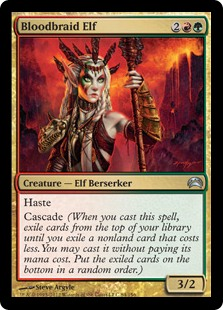
Key word: "winning." Key term: "Top 8 decks at independent tournament series." Stoddard's words point most directly to actual Top 8 wins, not just Day 1 wins to reach Day 2, or League wins to reach the top of an MTGO queue. This focus is amply supported by the different ban updates that all made consistent and Bloodbraid elfregular mention of Top 8s since Bloodbraid Elf bit the dust. Taken as a whole, this means we need to consider Top 8s as the primary decider of a ban. Unhealthy Top 8 shares, as defined by the precedent of unhealthy decks like Eldrazi, Delver, Pod, etc., is a sure sign of a pending ban.
But what about MTGO and Day 2 shares? Readers will remember I've cited these before, notably in my Twin banning indictment, and I can already hear Twin ban defenders and commentators heading down to the comments to have their "I told you so" moment. Let's ignore the Twin ban in itself. For some, it's hard to talk about without losing their minds. For others, it's hard to read another word of the ban without wanting to stop reading. Instead, let's look at where other ban announcements did mention factors like MTGO or non-Top 8 shares.

Although the Twin ban did not make this reference, Bloodbraid Elf's, Birthing Pod's, and now Eye of Ugin's definitely did. Bloodbraid's mentioned Jund performances in the Top 16 at Grand Prix Bilbao. Pod's talked about the deck both winning Grand Prix but also occupying a high share of the field on top of its wins. Then there's Eye's explanation, which explicitly calls out MTGO. That said, there are some announcements which make no reference to Top 16s, Day 2s, MTGO, or anything else, or only a cryptic and ambiguous mention. Stoddard also clarifies the importance of MTGO in his article:

"Fortunately for us, we do get a ton of very useful data from Magic Online. Between Leagues, on-demand queues, and premier events, we know a lot about the decks that are winning. Beyond just seeing what won, we also get very accurate matchup percentages as well as percentages of decks in the metagame."
Sam Stoddard, "Using Real-World Data" (February 11, 2016)

Going ahead, this means we need to consider Top 8s before all else in ban decisions, with MTGO, Top 16s, Day 2s, etc. as only supporting factors. Within those secondary factors, MTGO is the most decisive, with the others falling behind. It was easy to suspect such a weighting before Eye's ban and Stoddard's article, but the evidence against this position was at least as strong as the evidence supporting it. Now, the combination of the Twin ban, the Stoddard article, and the Eye ban much more strongly suggest a hierarchy of data when it comes to determining bans. Top 8s come first. MTGO comes second. Everything else is tertiary to that.

Surgical ban strikes

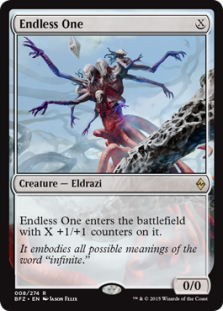
We're a data-driven website, so I've spent much more time on the data-driven elements of banning than I will on the other dimensions of Eye of Ugin's destruction. That said, there's much more to Eye's ban than just the data side, even if that side is probably the most Endless oneimportant. One of the other critical takeaways from Eye's ban is Wizards preference to conduct tactical, limited-end strikes on problematic decks. They don't want to carpet bomb an entire strategy into dust, Ted Cruz style. The banlist update couldn't be much more direct about this:
"While the Eldrazi decks have a lot of powerful cards, the powerful draws are generally based on the mana acceleration from Eldrazi Temple and Eye of Ugin. Rather than ban multiple creatures, we find it preferable to ban a single land."
Wizards of the Coast, "April 4, 2016 Banned and Restricted Announcement" (April 4, 2016)

It's hard to know why Wizards prefers single-card bans to multiple ones. Perhaps the length of a banlist matters. Tom LaPille's old "Welcome to the Modern World" article suggests as much, stating "First, this list is a lot longer than it was at the Community Cup. By default, Magic players tend to want to play with more cards rather than less, and react unhappily when a card they like is banned." Maybe Wizards doesn't want the bad press of a silly looking banlist with Endless One. It's possible Wizards just wants to sell Oath packs and is obscuring the issue by banning an old card rather than a newer toy.

Whatever the reason, the April 4 update confirms Wizards' continued preference for banning as little as possible in offending decks. We saw this in the Summer Bloom ban as well, and I expect we'll see it again, both when decks are too dominant and when they violate the turn four rule.

Maximizing interactivity and diversity

Leading up to the April 4 deadline, there was considerable debate over banning Eye or banning Eldrazi Temple. Everyone knew at least one of them had to go (everyone except some die-hard Eldrazi sympathizers who wanted to keep Smashing and Seering their way through tournaments), and there were decent arguments on both sides of the conversation. In explaining their choice of Eye, Wizards not only stayed in dialogue with this community-wide discussion, but also hinted at some important considerations in how they value interaction and diversity.

During the April 4 article, Wizards considers the likely results of an Eldrazi Temple ban:

"If Eldrazi Temple is banned and Eye of Ugin is legal, the deck focuses on playing multiple lower-casting-cost Eldrazi per turn. A discount of two mana for each Eldrazi becomes a discount of four or more over the course of a turn. The deck becomes more explosive, more focused on a single build, and the powerful draws are still not interactive."
Wizards of the Coast, "April 4, 2016 Banned and Restricted Announcement" (April 4, 2016)

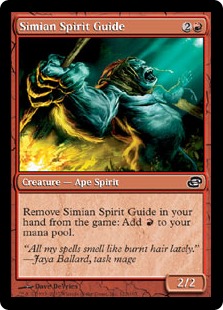
Here, we see two Modern elements Wizards tries to combat. The first is homogeneity. Wizards does not want decks to be "focused on a single build" if there is potential for diversity within that build. Eye of Ugin decks are heavily Eldrazi-oriented, gravitating towards Simian Spirit GuideUrborg, Tomb of Yawgmoth and Simian Spirit Guide to maximize explosive starts. Eldrazi Temple decks range from UW grinders to RG aggro, with even non-Eldrazifed strategies, like those Jordan described in February.
Wizards also tries to reduce non-interactivity. Decks need to give their opponents a window for interaction, whether that's removal, discard, countermagic, blockers, or some other form of disruption. We've known about Wizards' diversity paradigm for a while now (it's mentioned in essentially every bit of Modern press), but it's nice to get more information about interaction. Notably, the notion of certain Eldrazi draws not being interactive returns to an earlier Stoddard piece about Modern development. Speaking about All-In-Red and mana acceleration, Stoddard breaks down the struggle:

"In some sense, this deck isn't inherently unbalanced—after all, plenty of decks can deal with one of these turn-one threats after All-In-Red has, as named, gone all in; and thereby have an easy time winning the game. But it's not the sort of game play that we want to encourage in Modern. Turn one: make a huge play. If you can beat it, you win; if not, I win."
Sam Stoddard, "Development Risks in Modern" (May 22, 2015)

It's important not to put too much emphasis on the notion of a turn one "huge play" as it relates to bans. Such lines are inevitable in Modern, and range from aggressive Affinity starts to hand-crunching Jund openers. That said, when the huge play is happening in a deck that is already stifling format diversity, it becomes much more problematic. These factors combined to guarantee an Eye of Ugin ban.

As a whole, this is an important lesson for future banlist speculation. When Wizards bans cards from problematic decks, they will ban to encourage the most diverse builds, while also maximizing deck interactivity. We saw this at play in the Twin ban. A Splinter Twin ban leaves various flavors of URx decks intact, even if those decks needed some extra help in the form of Ancestral Vision. A Snapcaster Mage or Deceiver Exarch ban might de-power the deck, but it doesn't do a thing for net format diversity within Twin or URx decks. As for interactivity, Wizards is going to aim at cards that reduce interaction in a matchup, especially surrounding explosive starts. For instance, if (a big if) Affinity ever needed a ban, that would put something like Mox Opal right in the crosshairs.

Minimizing and accepting collateral damage

The final banning takeaway to focus on today involves innocent Modern bystanders. One of the most common objections to a given ban is the notion that it might hurt a guiltless deck. For example, poor Shamans players losing Deathrite when the one-mana planeswalker took the fall for BGx Midrange's sins. Or, to cite more recent arguments, Ad Nauseam pilots defending Simian Spirit Guide when most the hate for the Ape stems from Goryo's Vengeance combo decks and turn one Chalice of the Void. With Eye of Ugin's much-deserved departure from Modern, we must also reconsider these defenses.

One of the most prolific arguments against an Eye of Ugin ban concerned incidental damage to RG Tron. Wizards responds to this in the update:

"While the Eye does add a lot of late game power to the deck, the core gameplay of the deck—casting large threats with the Tron lands—remains intact. It is regrettable that banning Eye of Ugin also impacts these Tron decks, but weighing everything in consideration, we feel this is the correct solution to the Eldrazi menace and makes Modern the most fun overall."
Wizards of the Coast, "April 4, 2016 Banned and Restricted Announcement" (April 4, 2016)

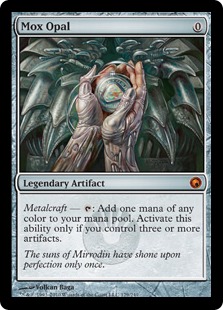
This quote introduces an important dimensions that Wizards may weigh when inadvertently harming one deck with a ban targeted at another: the concept of a deck remaining "intact." The excerpt suggests Wizards accepts some degree of collateral damage if the damaged decks preserves its "core gameplay." In Tron's case, although Eye provided inevitability and a late-game solution to flooding, its banning doesn't really affect the primary plan of assembling Urzatron into turn three Karn Liberated or turn four Ugin, the Spirit Dragon.Mox Opal Note that WIzards never talks about the viability or competitiveness of the deck. They merely discuss its "core gameplay," which I read as more of a central deck identity and not its tiering.
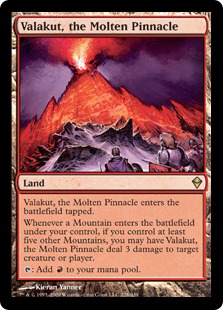
We can readily apply this to other future scenarios. For example, an Affinity-centered Mox Opal ban would certainly injure Lantern Control, but because Lantern's core prison strategy would stay together, we couldn't rule out Opal entirely. A Grishoalbrand-related Simian Spirit Guide ban could also fall in this category, despite Ad Nauseam being in the line of fire. After all, the main synergies of Ad Nauseam, Angel's Grace, Lightning Storm, and Phyrexian Unlife would still be present. As Wizards might assert, Ad Nauseam pilots would just need to wait a turn to execute their combo, using something like Infernal Plunge and a lone Memnite instead of the free Guides. I'm not personally making this evaluation, but the Eye and Tron case suggests it could happen in an update to come. It already happened to the poor Kiki Pod pilots, whose decks were not involved in the Siege Rhino-powered Pod dominance of 2014, so don't be surprised to see it again.

Informing future bans

One banlist update, one card banned, and at least four major takeaways for future banlist policy. Talk about improving communication! Although Wizards has not confirmed any of our observations to be ban process rules, we've seen them all in action in the April 4 update, Modern policy articles, and previous banlist announcements. To review, here are the four high-level implications of Eye of Ugin's ban.

  1. When using real-world data to inform bans, Wizards prioritizes major event Top 8s first, MTGO prevalence second, and other measures of metagame diversity third.
  2. Wizards prefers to ban the fewest cards that have the highest impact in a problematic deck.
  3. Bans should maximize diversity across the format, diversity within certain strategies, and Modern-wide interaction.
  4. Collateral damage is acceptable in bans, so long as the "core gameplay" of affected decks remains largely intact.

As 2016 unfolds and we undoubtedly see more Modern bans, I'll be checking to see if these takeaways are predictive of future banning decisions, or just descriptive of ones we've seen in the past. Time will tell, and hopefully we don't encounter another Eldrazi to do the telling. If nothing else, this limited model of Wizards' banlist policy gives us a nuanced and critical foundation for future ban discussion, one I'll certainly return to as we approach later banlist announcments.

The Unbanning Process

Of course, Eye of Ugin's banning was only one part of the three-part Modern update. For many, it probably wasn't even the most exciting change. The dual Ancestral Vision and Sword of the Meek unban was unprecedented and thrilling on many levels, and I want to wrap up today's article with a rapid-fire rundown of all the consequences for subsequent unbans. If you think we've spent too much time on bans, welcome to my Modern world! Ban suggestions are far more common than unban ones, both because they are reactions to real events and experiences, and because Modern has had far more bans than unbans. Even the update itself spent more words on the one ban than the two unbans. We're shifting gears now to the boundless possibilities of Modern unbannings, and the series of critical takeaways we'll need to remember as we vouch for more pardons down the road.

  • Unbans no longer just happen before the Pro Tour
    Up until April 4, every single Modern unban happened on the eve of a Pro Tour. This led many players to allege Wizards would only unban cards before a Pro Tour, whether to spice up a stale format, generate format excitement around an event, make sure the banlist changes got lots of press, or any number of other reasons. All of that is out the window as of April 4. With no Pro Tour on the horizon and two major unbans in circulation, we can no longer accuse Wizards of chaining unbans to the Modern Pro Tour. Of course, this doesn't mean Wizards lacks secondary motives, whether "apologizing" for the warped Eldrazi Winter with a double unban, pushing a post-Twin URx agenda, presaging the end of a Modern Pro Tour next year, or something else. It's all speculation for now, but the end of pre-Pro Tour unbans is as real as the four Ancestral Visions finally free of my tradebinder.
  • Unbans help underplayed decks, not top-tier decks
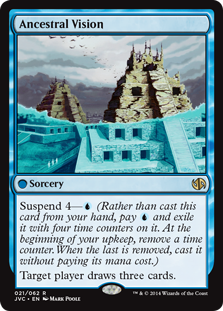
    ValakutBetween Valakut, the Molten Pinnacle, Bitterblossom, Wild Nacatl, Golgari Grave-Troll, and now Vision and Sword, Wizards has never unbanned a card that readily slotted into a top-tier deck. Wizards cites this not once but twice in the April 4 update, first with Vision ("To allow for an increase in the number of blue-based control or attrition decks, we are unbanning Ancestral Vision") and then again with Sword ("To allow for an increase in the number of controlling combo decks in the format, we are unbanning Sword of the Meek"). Barring a major format or ban policy shift, we should not expect that to change in future updates. That is good news for something like Jace, the Mind Sculptor if blue-based decks remain bad, but bodes poorly for the artifact lands.
  • Unbans help under-represented archetypes, not common ones
    As a corollary to the above point, Wizards also has a pulse on what archetypes are played in Modern, not just individual strategies. As they said in the April 4 update, "Currently, the format tends to favor aggressive decks and quick-kill combo decks. We looked for cards that tend to work best in slower decks." Keep this in mind as you predict unbans in future metagames. If aggro and combo are running rampant, that's not the time to support a #FreeDread Return campaign. If aggro decks are barely surviving a tide of Thopters, Stoneforge Mystic is probably staying where she is.
  • Wizards does not appear to thoroughly test unbans
    Forsythe and others have gone on record numerous times stating they don't explicitly test for Modern, but it was always less clear how often they test for the banlist update. The April 4 announcement suggests the answer is "not much" or "not at all." In introducing the two unbans, Wizards explains "While there is some risk that these cards will cause further problems, we think that risk is small. Sometimes unbanning these cards doesn't create any change in the competitive metagame." I might be reading too much into this, but that's not the confidence of someone who has tested hundreds of games with dozens of decks. To me, that suggests a simple cost-benefit, risk-reward analysis done by R&D members in a boardroom. I'm sure these conversations are deep and rich with historic and contemporary examples, but I doubt they involve much hard testing. As a content producer, this makes articles like my Stoneforge vs. Affinity series feel more valuable: Wizards might not be doing the testing at all so we need to pick up the slack.
  • Bloodbraid Elf is getting sold down the river
    We'll wrap up our takeaways list by zeroing in on Jund's leading lady, an iconic Elf who is getting kicked down the creek by Wizards. Although Bloodbraid absolutely does not meet a number of our unbanning criteria above (Jund isn't remotely "underplayed"), she's also getting badly misrepresented in the April 4 article: Ancestral Vision"With the current banned list, including Bloodbraid Elf, the types of cascade cards usually played with Ancestral Vision are not available." This should be an alarming quote for Bloodbraid hopefuls, because it suggests there is an added impediment to her freedom: cascade combos with Vision. I'm sure this arises from the Shardless Agent example in Legacy (Bloodbraid and Vision were seldom used together), but Shardless decks are an entirely different beast. The curve is different, the format is different, and even the supporting cast is different: Brainstorming to top a Vision before a Shardless is an awesome line, but one totally unavailable in Modern. If we ever want to see Bloodbraid free, we will not only need to address the criteria above, but we'll also need to show that a Temur Bloodbraid/Vision shell doesn't bust the format. I'm optimistic it won't, but that's a topic for another day.


For me, the most exciting implication is unban timing. It is now possible, although perhaps not likely, for us to get unbans at any time in the year. Maybe we need a Pro Tour to do it. Maybe we need a format-crushing Tier 0 monster to do it. Maybe we need a post-Twin URx agenda to do it. Whatever the reason, however, Wizards has now shown a willingness to actually give us those unbans, and not even token ones like sad Grave-Troll. I welcome this policy shift and hope it is a sign of better Modern days to come.

A Vision of Modern

Between banning and unbanning consequences, we've digested all the format policy implications we can stomach for one day. Hopefully you all found it a worthwhile and helpful endeavor. I can sense the ban maniacs sharpening their daggers and grinding their axes in the wings, and the framework we've presented today will help placate them. I also hope this kind of analysis encourages the detailed, even-handed, and comprehensive analysis I'd expect from any of our Modern Nexus community. Even if you disagree with specific conclusions, I'll just be happy if I got readers to re-re-read the article, and then re-re-read it again.

Thanks for joining us on this dissection of the April 4 update, and I'll see you all in the comments with your reactions, feedback, analyses, and celebration about the changes. Until then, get those brewing caps on because it's going to be a wild and Visionary Modern spring!

Brewing with SOI- Izzet Madness

Are you a Quiet Speculation member?

If not, now is a perfect time to join up! Our powerful tools, breaking-news analysis, and exclusive Discord channel will make sure you stay up to date and ahead of the curve.

Early reviews suggest that Vampire Madness isn't quite there. Insolent Neonate though, is a very intriguing card. I've churned out a number of Neonate lists, and am very excited to find the best shell for this subtly powerful vampire. Today's deck combines the subtle power of Neonate with the significantly less subtle Thing in the Ice. I'm not big on the Izzet Prowess decks featuring Thing, though I do like the idea of incorporating the card in a control deck. Here's a draft of what such a deck might look like:

Izzet Madness

Creatures

4 Insolent Neonate
4 Thing in the Ice
4 Jace, Vryn's Prodigy

Spells

4 Avacyn's Judgment
2 Lightning Axe
4 Fiery Temper
2 Just the Wind
1 Roast
4 Nagging Thoughts
4 Broken Concentration
2 Chandra, Flamecaller

Lands

4 Shivan Reef
2 Evolving Wilds
5 Island
6 Mountain
4 Wandering Fumarole
4 Highland Lake

There are builds of madness floating around featuring Pyromancer's Goggles, which pushes the deck towards playing Tormenting Voice and Magmatic Insight. The power level of those interactions is real, though I think the interactions in this build are worth exploring. Both Nagging Thoughts and Broken Concentration are generally being written off, and I think that turning a discard into an effect slightly more powerful than cycling or a counterspell is a powerful effect- though I'll admit that these cards aren't especially efficient. Activating Jace to actually just draw while countering a spell is a great exchange.

Avacyn's Judgment is kind of a question mark, though I'm currently still experimenting with running four. It will help you win Jace wars and will generally be able to kill something on turn two, while helping you close out games when you madness it. Thing in the Ice doesn't need much help closing games after connecting once, which makes the burn spell particularly valuable.

I might be a little nuts for trying to hard to find an Insolent Neonate home, though the card is excellent here. You get in a couple chip shots in the early game, which makes it easier still for Thing in the Ice to close, and down the road you both get access to an ability that digs you towards more business while also enabling madness.

The motivation for pursuing a build like this is operating under the knowledge that Izzet Prowess wasn't good enough even when Treasure Cruise was legal, and that both this deck and the Goggles decks are more robust and feature more flexible cards. It's unclear at this point whether this build or the Goggles will perform better, but I believe that both are better starting points than Prowess.

Insider: MTGO Market Report for April 6th, 2016

Are you a Quiet Speculation member?

If not, now is a perfect time to join up! Our powerful tools, breaking-news analysis, and exclusive Discord channel will make sure you stay up to date and ahead of the curve.

Welcome to the MTGO Market Report as compiled by Matthew Lewis. The report will cover a range of topics, including a summary of set prices and price changes for redeemable sets, a look at the major trends in various constructed formats, and a "Trade of the Week" section that highlights a particular speculative strategy with an example and accompanying explanation.

As always, speculators should take into account their own budget, risk tolerance and current portfolio before buying or selling any digital objects. Questions will be answered and can be sent via private message or posted in the article comments.

Redemption

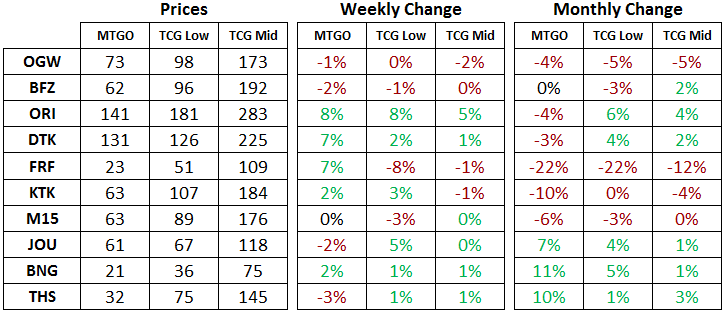
Below are the total set prices for all redeemable sets on MTGO. All prices are current as of April 4th, 2016. The TCG Low and TCG Mid prices are the sum of each set’s individual card prices on TCG Player, either the low price or the mid price respectively.

All MTGO set prices this week are taken from Goatbot’s website, and all weekly changes are now calculated relative to Goatbot’s ‘Full Set’ prices from the previous week. All monthly changes are also relative to the previous month prices, taken from Goatbot’s website at that time. Occasionally ‘Full Set’ prices are not available, and so estimated set prices are used instead.

Apr4

Flashback Draft of the Week

Triple Coldsnap is the flashback draft this week, running April 6th through April 15th. Coldsnap was released as a "lost" set in the summer of 2006. Core sets at the time were being released every other year, so this set was released in the intervening year to fill the gap.

The "lost" gimmick was that Randy Buehler said the set was designed along with Ice Age and Alliances, but was put aside for the notoriously underpowered Homelands. Coldsnap was filed in away in a drawer and forgotten about. Mark Rosewater clarified later that the set was indeed a new design, and that supplied back story was just a ruse.

In any case, the set returns to Dominaria during the titular Ice Age and fleshes out the use of snow-covered lands and snow mana, as well as revisiting cumulative upkeep and pitch spells.

The expected value of Coldsnap boosters is high due to the presence of two valuable uncommons. Legacy staple Counterbalance currently goes for over 10 tix and the Modern playable Mishra's Bauble is over 5 tix at the moment. Also, snow-covered lands are common but can often get to 0.5 to 1.0 tix, so don't be afraid to stick these in your draft pile near the end of the pack even if you're not drafting a snow-related deck.

The ripple mechanic is something to watch out for in draft. Drafting one or two of the same ripple spell isn't a big deal, but if you start getting into three, four or five copies, then the impact can ramp up and be incredibly high.

Take, for example, Surging Dementia. On its own, this card is probably not worth playing. Forcing your opponent to discard one card of their choice for two mana is not playable in any draft format. But if you manage to draft a bunch of these "unplayable" cards, the possibility of chaining into multiples on turn two becomes very high.

Imagine having five copies of this spell in your deck. The chances of having it in your opening hand are very high, and then the chance of chaining into the others is also high. Your opponent just might have to recover from a two-mana Fugue (or worse) that you draw every game.

The ripple mechanic turns a bad spell into an efficient way to totally wreck your opponent's hand in the early game. It's a bad mechanic from a design perspective as multiple copies of a bad card can reduce variance while simultaneously increasing the impact of the spell. You have been warned!

Modern

If you missed the news, Eye of Ugin was banned while Ancestral Vision and Sword of the Meek were unbanned. Although the writing was on the wall for the Eldrazi-enabling land, the unbanning of the other two cards is a surprise and will shake up the format considerably.

It is pointless to try and predict what will happen and make speculative bets based on the prediction. The knee-jerk price reactions have already occurred and it would be prudent for players and speculators alike to sell into these price moves. Now is the time to be holding off on buying new cards until we have more information on the new Modern metagame and to make sure to stay liquid for Shadows over Innistrad (SOI) release events.

What interests me is the potential for Eldrazi decks to continue their level of play in Modern. Ancestral Vision is weak to Eldrazi processors, so it's possible that the more midrange, black-based Eldrazi archetype we saw in December returns. A hybrid Eldrazi Tron build is also still possible and has been showing results in the pre-ban Modern leagues.

Outside of Modern, Eye of Ugin will see play in Legacy Eldrazi builds, so stashing a few copies away for the future is a good long-term move while everyone is selling.

Standard

Unlike Modern, we are in a small window for buying future Standard staples from Battle for Zendikar (BFZ), Oath of the Gatewatch (OGW), Magic Origins (ORI) and Dragons of Tarkir (DTK). Once new results from the Star City Games Open Series and other big events start rolling in, the metagame will become more defined and the opportunity for big gains will disappear.

At the moment, there are a number of cards that are unplayable in Khans of Tarkir (KTK) Standard that will prove to be very useful in SOI Standard. Predicting which cards start seeing more play is tricky, but we can make some educated guesses.

My experience at the SOI prerelease is that Thalia's Lieutenant is a great card that pushes human tribal decks. Combined with Always Watching, white has access to two strong anthem effects in Standard as well as a powerful removal spell in Declaration in Stone. Melissa DeTora wrote about potential mono-white weenie decks featuring these cards over at TCG Player.

Two ORI cards that could slot into an aggressive white deck are Knight of the White Orchid and Kytheon, Hero of Akros. I put over 40 copies of Kytheon into the Market Report portfolio this morning as I have a hunch that white will be the colour of choice for aggressive decks at the start of this iteration of Standard.

Although Kytheon has more than doubled in the last month, going from 2 tix to over 4 tix, the price could be 7 to 10 tix quite quickly if white weenie shows up as a viable archetype this weekend.

Standard Boosters

There's not much to report on boosters this week as prices have been fairly stable. Look for a price drop on Fate Reforged and Khans of Tarkir boosters once SOI is released. BFZ and OGW boosters will also drop at that time and these will both eventually get back to 4 tix, a price level where DTK and ORI have consistently been hanging out.

Trade of the Week: Deciding to Sell

As usual, the portfolio is available at this link. Again I was focused on the price of Jace, Vryn's Prodigy from ORI as it jumped back up to over 80 tix. A 20 tix move up in just over a week is substantial, and this was almost the mirror of last week when it had dropped 20 tix in a week. With such a rapid recovery in price, it was time to reassess this trade.

When deciding to sell, there are a number of factors to consider, but the first thing to look at is the price history. At 80+ tix, Jace was back into its recent mid-to-high price range, with some possible further upside but now with some downside. There is no certainty that Jace will continue to hold its lofty price in SOI Standard, and until tournament results start coming in with the new cards from SOI, Jace at 80 tix is a lot riskier than Jace at 60 tix.

We are also heading into a new set release on MTGO, a time when tix are in high demand as players and bots scramble for new cards. Everyone is looking to sell old cards in order to buy new cards and to draft with the new set.

Selling cards during set releases is a bad idea from a top-down, financial perspective. Everyone needs tix, so if you are asking to exchange cards for tix you won't be getting full value for your cards. When a new set is released, you want to be the one with the tix, scooping up discounted cards. This is a big motivator for getting liquid and selling cards in the weeks ahead of any set release on MTGO.

Another signal which I like to look for is available supply. Similar to last week when I noticed supply of Jace was drying up around 60 tix, I noticed that the supply of Jace at 80 tix was starting to build. Along with a building supply was a growing spread between buy and sell prices.

When supply is tight, and the price is heading up, bots will be willing to lower their margins to keep cards in stock. But when a price peaks, the first price to drop will be the buy price. Once a card stops rising in price, a good operator will lower the buy price so as not to build up too much inventory at too high a price.

This combination of widening spreads and building supply was another indicator that it was time to sell.

Add it all up, and selling my copies of Jace was an easy decision. If Jace falls back to 60 tix or lower, then it will be time to think about buying again. By that time, we'll have more information on the state of Standard and whether or not Jace, Vryn's Prodigy maintains its viability in that format.

I love speculating on high-value mythic rares because the gross price swings can be large and the work of buying and selling them is small. It's also easy to pay very close attention to supply and bot margins.

Insider: Shadows over Innistrad Set Review (Rares)

Are you a Quiet Speculation member?

If not, now is a perfect time to join up! Our powerful tools, breaking-news analysis, and exclusive Discord channel will make sure you stay up to date and ahead of the curve.

Welcome back for part two of the financial set review, Shadows over Innistrad (SOI) edition. If you missed my article on the mythic rares yesterday, be sure to brush up on that first. Next up, rares!

Like always, I want to take time to reflect on my evaluation of the last crop of rares, this time from Oath of the Gatewatch (OGW). Here are my notes:

OGW Rare Reflection:

  • It seems my placement of most rares ended up holding true. While most of the set's rares declined drastically there was one card that stood out. I listed Eldrazi Mimic in Mid Tier, and it easily jumped to Top. With the recent B&R announcements that will likely change again.
  • Sylvan Advocate did some work during pre-rotation Standard---but with the new Standard landscape in April, Sylvan Advocate looks like it might be the best thing to do with two mana. If you play green you'll likely play this card, and even if you don't you will try very hard to incorporate it.

Let's dive into the rares, shall we?

Rare Breakdown

Top Tier

  • Thing in the Ice
  • Westvale Abbey
  • Shadow Land Cycle
  • Declaration in Stone

Mid Tier

  • Always Watching
  • Anguished Unmaking
  • Asylum Visitor
  • Avacyn's Judgement
  • Bygone Bishop
  • Cryptolith Rite
  • Deathcap Cultivator
  • Diregraf Colossus
  • Drownyard Temple
  • Eerie Interlude
  • Engulf the Shore
  • Elusive Tormentor
  • Epiphany at the Drownyard
  • Ever After
  • From Under the Floorboards
  • Falkenrath Gorger
  • Geier Reach Bandit
  • Hanweir Militia Captain
  • Odric, Lunarch Marshal
  • Prized Amalgam
  • Rattlechains
  • Scourge Wolf
  • Silverfur Partisan
  • Sin Prodder
  • Thalia's Lieutenant
  • Tireless Tracker
  • To the Slaughter
  • Traverse the Ulvenwald

Low Tier

  • Altered Ego
  • Angel of Deliverance
  • Brain in a Jar
  • Burn from Within
  • Confirm Suspicions
  • Corrupted Grafstone
  • Devil's Playground
  • Drogskol Calvary
  • Fevered Visions
  • Flameblade Angel
  • Forgotten Creation
  • Harness the Storm
  • Inoxerable Blob
  • Invocation of Saint Traft
  • Markov Dreadknight
  • Nephalia Moondrakes
  • Sage of Ancient Lore
  • Second Harvest
  • Slayer's Plate
  • Soul Swallower
  • Tamiyo's Journal
  • Triskaidekaphobia
  • Welcome to the Fold

Top Tier Rares

Westvale Abbey

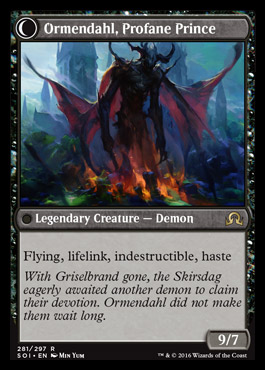
westvaleabbey ormendahlprofaneprince

I knew right away that I liked this card, and that it would become important in the future. I didn't know the future would be the very next day when it spiked to $20. I guess that's just the nature of this hobby sometimes. To be fair this had a lot to do with early testing around Cryptolith Rite. Then more people realized it's just a good card in general.

That's sort of where I was coming from. I compared it to Gavony Township from the original Innistrad. It would be one of those lands that just got gradually better and increased in price steadily. When it turned out to be a contender for the defining card of Standard, that expedited the process.

This card is the real deal, and it's likely going to sit over $10 for quite a bit of time. It has more applications outside of Standard, and will likely supplant every other rare for "chase rare" status.

Even outside of Aristocrats built around Cryptolith Rite, black-white strategies are incorporating this simply because they can cast Secure the Wastes. We also talked about Ulvenwald Hydra and how important it can be by fetching certain lands---Westvale Abbey is another excellent target.

Thing in the Ice

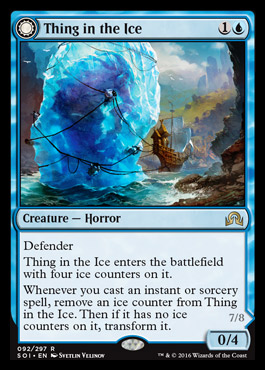
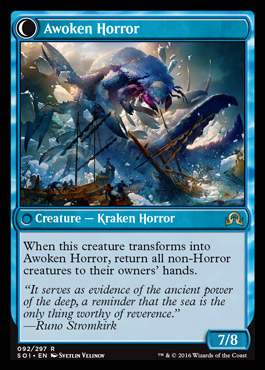
thingintheice awokenhorror

This card increased quickly during pre-orders. It started at $3.99 and now sitting at $19.99 continues to sell. I think it's an extremely good card---but perhaps not in Standard as much as other formats. It's so much better when casting cards like Brainstorm or Gitaxian Probe, and with the added benefit of being pitched to Force of Will.

That doesn't mean that this too (alongside Westvale Abbey) won't command a fairly high price tag for quite some time.

Even in Modern there are plenty of ways to utilize Thing in the Ice and flip it to a gigantic threat quickly. That being said, this is likely not the second coming of Tarmogoyf. The big downside of Thing in the Ice is that each copy gets increasingly difficult to flip, while a card like Tarmogoyf just rewards you for playing Magic.

In Standard this will be a big problem (along with Reflector Mage), and something of an issue even in older formats. There won't always be a constant stream of spells to flip Thing in the Ice in a timely manner.

Declaration in Stone

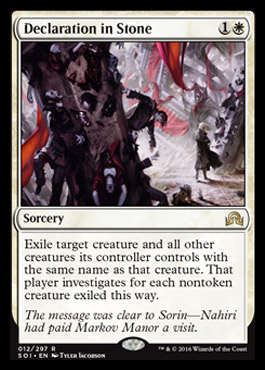
declarationinstone

This card has really grown on me. It might be one of (if not the) best removal spells we have access to in SOI Standard. It's splashable and the drawback is mostly negligible, especially when trading with their best creature. Remember that giving them a clue token does not equate to drawing a card---not right away anyway. It's delayed and most of the time doesn't get cashed in for a while.

When dealing with multiple copies of a card, obviously some caution is needed. We want to be winning the game in short order before our opponent gains access to a bunch of clue activations.

The recent price increase is justified; it usually ends up making the 75, and like I stated earlier it's easy to cast. Exiling is important now, and Declaration in Stone basically does everything we want without giving our opponent a huge advantage.

Shadow Lands

The Shadow land cycle is a great boon to two-color allied lists. There's really not much to say here other than that they will be necessary to play Standard. After playing with them, they feel fine and I'm okay with these going forward. I don't think we need to elaborate more than that. I would keep an eye on all of them, since every one will see heavy play over the next year and a half.

Mid Tier Rares

In this tier I'm going to group a bunch of these cards together as there's a lot of cover. These feel better than the cards I would consider actual bulk. Just keep in mind that many of these prices can and will decrease. A select few might increase also.

The Human Militia

I like grouping these cards together because Humans is really strong. I've been able to test all different variants of the archetype and each one has really solid plays. Ultimately I think the blue-white version will end up coming out ahead---but only slightly.

Thalia's Lieutenant really is the backbone of the archetype, and it's extremely potent. I won't talk about Eerie Interlude on its own so I will throw it into this group as well. It's actually proven itself to be a card to dabble with in the main deck as a way to save creatures, as well as continue to extract value from Thalia's Lieutenant, or say a Reflector Mage.

Considering how much praise Sheridan have given this card for Modern (and rightfully so) I think it can be better than a $2-3 card in the future. We might well see a Humans tribal list pop up in Modern abusing this and Champion of the Parish.

Always Watching is really pushing the envelope for anthem effects much like Intangible Virtue once did. I always feel like there needs to be two of these in the blue-white version, and it can end games quickly.

I don't know where the ceiling on a card like this will end up, but it could maintain a price somewhere in the $4-6 range if it really takes off.

Tireless Tracker is really good. I really love green value creatures, and this one delivers. I always feel like this card is doing something great and I never have to invest much into it.

Other than paying for extra cards, Tireless Tracker provides a new dynamic to aggressive and even slightly midrange lists because it turns dead land draws into card advantage. One fellow QS writer really likes this card too (I'll divulge that below). As great as the card is though, I just don't know if it can easily surge past the $5 mark.

Vampires

Vampires received another boost with SOI, unsurprisingly to say the least. We have aggressively costed vampires, starting with Falkenrath Gorger leading the bloodsuckers to battle. It's not "just another 2/1 for R"---it has no drawback and all upside.

I've never seen a printing obsolete so many cards at the same time. Like previous red one-drops this could fetch quite a few dollars. The pre-order prices are correct and will likely stay that way for at least a few weeks to come. This likely stays in the $4 range and if Vampires ends up being better than we think we can always revisit it.

Asylum Visitor feels like it can slot into many archetypes besides Vampires. It's not just another Dark Confidant impersonator in a long line of failed experiments. This one might stick, and this card could trend into the $6-8 range quietly when it's in the spotlight. I think this card is fantastic, and I do expect it to find success in multiple archetypes.

Elusive Tormentor may look a little weird appearing in this Tier, even more so paired with really good vampires. Just bear with me---I only placed it here because it's a vampire, so you can calm down now. I just think this card is really well designed and very cool. It's also the Buy-a-Box promo, so I'm holding out that we may end up living the dream with this card.

I could care less about the four-mana 4/4 side (although that is on curve for the most part). I'm looking to flip this, load up the Mist with a whole bunch of goodies and go to town.

Maybe it's wishful thinking, but I'm leaving this here for now and I don't care what anyone says. We have to attach Invocation of Saint Traft to something, right? This will more than likely be $1 or below, but again I'm holding out stubbornly.

Value

Traverse the Ulvenwald is going to be hit or miss. Another QS Writer really likes this card, and I'll provide their opinion below. I have to say that in testing sometimes this card is really clunky, and casting it as Lay of the Land is just dreadful. When I'm casting it with delirium then I'm really happy.

So there's no in between. At the very least it does smooth out potential mana issues in three-color decks. At the same time this might compete a lot with Oath of Nissa. Sometimes they will be good together, sometimes they won't. I think this card's success (and price tag) hinges solely on delirium and how reliably it can be achieved. I say this sticks around in the $3 range and has some good upside.

To the Slaughter has been producing good results in testing. I've had this cast against me a plethora of times, and each time it seems to be good enough. The delirium is gravy, and it helps subsequent copies by putting an instant in the yard. I don't know if any of that translates to financial success which is why it's in this Tier. I feel like this stays in the $1-2 range despite all its good qualities.

Anguished Unmaking - I know it might be controversial not to put this in Top Tier, but I just feel Declaration in Stone will end up being the best removal of the bunch in Standard. This probably has some applications outside of Standard so there is some upside here.

If anything I would say this is a Middle Tier card (likely inexpensive compared to Declaration) but should be treated as a Top Tier card. Down the line this could trend upward since it removes so many cards. Three life is huge in Modern, and should be kept in mind. But with incidental life gain in Modern like Scavenging Ooze the cost won't be as devastating. To that end there's always Linvala, the Preserver in Standard.

I gave this the bump down because of its casting cost and because it won't be as ubiquitous as Declaration in Stone in Standard. It's a $4-5 card at best with some upside in the future.

Cryptolith Rite - I'll admit I was wrong here. I didn't respect this card enough when I first saw it. It's extremely powerful and is already forming the centerpiece of brews. It lets already-great cards like Catacomb Sifter enable even better cards like World Breaker, Ulamog, the Ceaseless Hunger and Ulvenwald Hydra. These cards hit the battlefield much quicker than they should---it's really an insane build-around card.

It might not hit a zenith like Westvale Abbey, but if this breaks into Modern I think all bets are off. Keep tabs on this card---if it starts gaining any more traction I'd say pull the trigger. For now it's likely to stay a solid $5, much like Jeskai Ascendancy did for a period of time.

Zombies

From Under the Floorboards is my sleeper pick of the set. I love this card and think it's extremely powerful. I haven't seen this anywhere in testing but I have a feeling this is the type of card we see unveiled at a Pro Tour where it dominates the tables.

Madness is really what does it for me. Being able to instant-speed cast this off a Jace, Vryn's Prodigy is something I think will become commonplace. Even if you're paying the same cost you essentially have the option of casting it at any time. So it's not just a sorcery. I'm happy to stash these away when/if it closes in on $1 or less.

Diregraf Colossus could end up as pure bulk, but it feels a little better than that. It has the zombie tribal thing going for it and threatens to generate a lot of value for just 2B. Keep in mind you can trigger this by casting zombies from any zone. Gravecrawler makes some absurd stuff happen with the Colossus.

Ultimately I think this could go either way. It could trend down to under $1 or end up maintaining a few dollars.

Ever After - I guess this is technically a zombie card. I have no other explanation for this card other than this: I feel like a graveyard-based Tooth and Nail for six mana shouldn't be bulk. Two creatures for six mana is ahead of the curve, folks. Just pair this with cards like Dragonlord Atarka and good things will happen. It won't be another chase rare, but like I said, better than pure bulk.

Prized Amalgam is really awesome. I placed it here because it can go either way---either this makes Dredge decks viable or it's just another card.

Even if the graveyard-based list isn't centered around zombies as a tribe, this just seems amazing with Gravecrawler or Vengevine. It adds another dynamic to the archetype and provides more threats that recur themselves to continuously apply pressure.

In Standard this might be a natural pair with Relentless Dead in a Zombie Aristocrats list. With Nantuko Shade as a Standard-legal enabler there might be something there.

This will likely stick around $2-3 but can easily increase. Should this catch on in Modern foils will be even more lucrative.

The Rest

I love Rattlechains. I can't articulate exactly why---it's just efficient and really cool. Besides that I don't feel there's enough viable support around this card. There's just nothing really amazing for Rattlechains to protect! I suppose Topplegeist could be enough, or Anafenza 2.0.

This will likely be $1 or less but I think it will turn around and come back with the release of Eldritch Moon.

Sin Prodder - I'm not as down on this card as everyone else. I will say LSV stating this card is "unplayable" in Standard doesn't really bode well, but it could all just be mind games. Sin Prodder is the second coming of Vexing Devil and everyone hated that card also. Turned out Vexing Devil was good enough for Modern---who knew? I knew, that's who.

I think it's going to be the same scenario. If this finds its way into midrange lists then the triggers start to become extremely difficult for your opponents. Red-based aggro lists are obviously fine too. I think pre-order prices are way too high for this, but it's far from bulk.

Avacyn's Judgment is super efficient. Let's be honest; they weren't going to make this Forked Bolt with madness. This is really close, and the madness is insane. If there's a Grixis control list to be had based around flip-Jace and some madness cards then this and Under the Floorboards will be amazing.

I see this settling in the $2 range but I could easily see it trending back upward. At its madness cost it's really potent removal and can close out a game if need be.

Silverfur Partisan is an extremely interesting card. It can be great in multiples when you consider each triggers separately off of one spell. This could be part of some infinite combo, or merely a great value play with something along the lines of Dromoka's Command. For now I think it will maintain a couple dollars, but could creep up if the card makes it in a Constructed setting.

Deathcap Cultivator is an awesome new take on the new-age mana producers at two mana. Delirium is a bit easier to manage in Constructed, and in this instance it grants deathtouch. That means our mana dork isn't a completely dead draw off the top, and later in the game these can really clog up a board state.

That makes Cultivator a key card in midrange and ramp lists, for which it could fetch a few dollars. In the near future this may trend down closer to $1, similar to Rattleclaw Mystic. There is upside though because while it can't provide a third color, late-game deathtouch is probably better.

Drownyard Temple - This obviously pairs well with our friend The Gitrog Monster. It could be included as a one-of just to enable a very potent synergy. In other formats we will see if a self-recurring land is worthwhile. For now there could be an argument for a Standard archetype built around the Monster.

I'm excited to see the interactions as an engine piece. I don't know if there will be financial upside in the short term, but this might be one to think about in the future. For now I think Drownyard can stay in this tier---but it will likely trend down.

Wrap-Up and Writer's Choices

Instead of droning on about Low Tier junk I wanted to conclude this set review with something new. I wanted to add some commentary and select card choices from other writers here at QS. I asked them to choose a card to endorse as a sleeper, chase rare, value pick, etc. Here are their responses:

  • Ryan Overturf - Goldnight Castigator is his choice for "undervalued mythic."
  • David Schumann - From Under the Floorboards is his choice. His words: "The card is extremely powerful and plays really well with Origins Liliana."
  • Paul Baranay - Tireless Tracker is the choice here. He feels the card should have been a 2/3 but thinks it's a neat card and has a spot in midrange archetypes.
  • Tarkan Dospil - Traverse the Ulvenwald was his choice for "safe bet." He figures this card can slot into Ramp lists and in Modern it will be easier to trigger delirium to tutor a creature.
  • Kelly Reid - Ulvenwald Hydra. "This card tutors for Rogue's Passage." 'Nuf said.

~

That wraps up the set review for Shadows over Innistrad. Hope you all enjoyed!

Questions? Comments? Concerns? Feel free to comment below or message me via social media. Hopefully this list is helpful going forward to decide what’s worth trading for or buying, at the release and beyond!

- Chaz @ChazVMTG

Spring Has Arrived

Are you a Quiet Speculation member?

If not, now is a perfect time to join up! Our powerful tools, breaking-news analysis, and exclusive Discord channel will make sure you stay up to date and ahead of the curve.

Rejoice, fellow Nexites! The Powers-That-Be have at last stepped in to put an end to Eldrazi Winter. We may at last emerge from the ruins, gaze upon the metagame again with clear eyes and eager hearts, and go forth and enjoy this beautiful new world. Breathe in, good Nexites, and breathe out a great, joyful sigh of relief.

Heartbeat Banner

So, did you get all that out of your system? Good: don't get too carried away with the festivities. This is Modern Nexus and we are factual analysts here, so lets back up a bit and try to look at this realistically. The banning part of the Banned and Restricted Announcement really shouldn't have surprised anyone. Aaron Forsythe was unequivocal about Eldrazi being a problem, and everyone knew Wizards was going to ban at least one of the Eldrazi lands. The unbans are a much greater surprise, though back in January it was mentioned part of the rationale for banning Splinter Twin was that it made cards like Ancestral Vision a plausible unban. My cynicism will not allow me to believe that Wizards timed these unbans as anything other than an apology for the past few months, but that's neither here nor there: they've happened, so it's time once again to evaluate how we will all be affected.

Rather than focusing on the logic of this latest banning (Sheridan covered that yesterday, and will elaborate tomorrow) I'm going to focus on looking ahead to how the metagame will shape up, just like I did in February prior to Regionals. To that end I will evaluate both the banned and unbanned cards and develop my ceteris paribus assumptions for the first week of this new Modern.

[wp_ad_camp_1]

Eldrazi (Not Quite) Begone

As I alluded to above, everyone was expecting Eye of Ugin to get banned. I know there was an argument for banning Eldrazi Temple, and frankly it wasn't a bad one, but when it comes down to it Eye was always far, far more broken than Temple.Eye of Ugin Lands should tap to produce mana, and if you want to use them for mana more than once a turn, you should have to pay for the privilege. Eye broke both those rules so the ban decision makes sense. This means the explosive Eldrazi draws are gone and with them its ridiculous Enigma-level power. The ability for Eldrazi to simply play threats "off curve" is also severely diminished.  Eldrazi pilots are unlikely to mulligan as aggressively for their four-of Temple and this will slow down the deck enough that it should fall at least a tier. With only the four Temples, the forgiveness of free mana doesn't make up for the card disadvantage as often and the poor odds of "hitting" on a mulligan means Eldrazi will have to play the same game as the rest of us, which will probably turn a lot of pilots away.

The deck will not be gone, however. Thought-Knot Seer and Reality Smasher are too powerful for that to happen. The question is what form the new deck will take and there isn't enough data yet to make a truly educated guess beyond it containing the aforementioned cards. Eldrazi Mimic may still be playable, and the devoid creatures are still good enough that I suspect for the first few weeks or so you'll just see slower versions of existing Eldrazi decks. After that, anything is possible. I know players will try to make processors work again (especially with all those suspended Ancestral Visions) but I never thought Processor Eldrazi was very good. While Thought-Knot does play well with that theme, why would you want to cast Blight Herder or Oblivion Sower when you could cast Reality Smasher?Reality Smasher On the other hand, it is unlikely the current builds are as good without Eye, so there will be considerable debate and rebuilding going on. It is unlikely the question will be answered before StarCityGames' States series, and it may take until the next Grand Prix before we know just how effective this ban actually was.
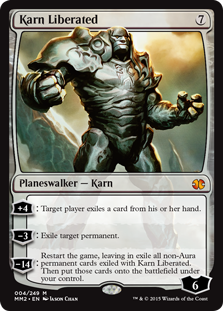
If I sound a little doubtful then I have good news! You have excellent reading comprehension. Eye may have removed the explosive draws but Eldrazi Temple is still an extremely powerful Sol land and I'm worried allowing any land like that in Modern is dangerous. I know Forsythe said Wizards wants there to be an Eldrazi deck in Modern but I think Thought-Knot and Smasher are reasons enough and players really don't need Temple to make them play Eldrazi. Again, this is pure speculation but I wouldn't be surprised if Temple eats a ban in a year or so for remaining too big a presence.

Collateral damage

The other deck affected by this banning is RG Tron. Eye was Tron's get-out-of-mana-flood free card, providing late game use for its land search and smoothing out the clunky, all-mana draws that traditionally plague ramp decks. This had been an argument against banning Eye, but I celebrate this aspect of the bannings. This isn't because... well, it isn't just because I despise RG Tron, but rather because this actually saves the deck. RG Tron has long been on the knife-edge of being oppressive and has certainly been a diversity killer, and if something wasn't done to nerf it soon it would almost certainly have necessitated a more aggressive ban down the line. Yes, that is a bold claim: let me explain.

Karn LiberatedWhen Tron was just ramping out Karn Liberated and Wurmcoil Engine with an Emrakul, the Aeons Torn endgame it was powerful but not dangerous. It had good matchups against slower decks, but the aggro decks laughed at Karn and could get around or manage Wurmcoil well enough that they kept Tron in check. Old Tron needed multiple Oblivion Stones to beat Merfolk or Zoo decks with Fulminator Mage, and Twin held it in check as well. Infect was unwinnable. This made it a metagame call for when BGx and other midrange decks were big rather than a permanent presence. Ugin, the Spirit Dragon changed all that. It is an on curve threat that beats any non-Affinity board and swings aggro matchups in Tron's favor (Burn is still a problem but that's because it's Sligh to Merfolk's Stompy and isn't reliant on creatures). That, coupled with Twin's banning, means that all Tron really needed to really take over was a little more consistency or a better six-drop than Wurmcoil. With Wizards pushing colorless permanents recently, it was only a matter of time. Now that its late game is much weaker, Tron suddenly becomes more vulnerable to attrition strategies which should prevent the deck from growing too oppressive.
The other consideration is diversity. Everyone knows about RG Tron keeping control decks, particularly counterspell-based control decks, down. What no one ever notices is the effect RG Tron had on other Tron decks. There has been only a single version of Tron since Cloudpost was banned. Yes, players have constantly tried to make blue, blue-white, and black Tron work, but they're just not as good as RG and largely fell by the wayside. Think about it: RG had the most consistent Tron of any version thanks to all its cantrips and land search. As a result, it was more likely to see more of its impact cards than any other version. If one deck is packing counterspells where the other has cheap cantrips, and they're both on the same general gameplan, the cantrip deck is more likely to actually do its powerful thing than the counterspell deck. It is also more likely to have more things to do afterwards.Mindslaver Blue Tron almost never ran Eye or Emrakul because it favored Platinum Angel and Mindslaver with Academy Ruins, which gave it less inevitability than RG Tron. Now there is an actual choice between versions. I believe that inevitability has shifted to the Mindslavers, but RG Tron remains more consistent which creates a nice tension in deck choice. Ironically, the freeing of Blue Tron will keep Cryptic Command decks down (Blue Tron always had an advantage against those decks in the past and I don't think that's changed), but the net diversity gain should be positive and work to correct any negative drift caused by the unbannings.
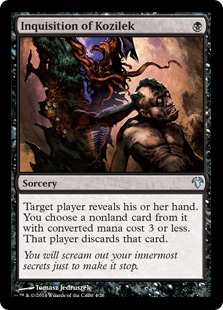
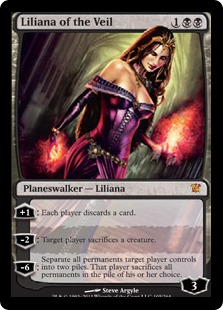
These arguments therefore lead me to the following assumptions about the meta based on the Eye ban:

  1. Eldrazi decks remain powerful though in a slower and less consistent form
    1. It is not clear what that form is
  2. RG Tron will get weaker
    1. This will allow more slow blue decks to exist
    2. Some of these slow blue decks will be Blue Tron

Hopeful Visions

I expected Ancestral Visions would be unbanned following the reveal by Wizards that with Twin gone it was now under consideration. What I didn't expect was that it would be this soon. Now, everyone and their speculators (it's Monday nightAncestral Vision and Visions is over $50 and nearly sold out everywhere!) have been going wild about this card as control's savior, and they're not too far off base. Drawing three cards for a single blue is very good and waiting four turns is not that big of a burden, especially in card-draw starved Modern. Back in January when the Twin announcement was made, I quietly looked into how good Visions would be and I was surprised. The burst of card advantage helped control decks power through though attrition fights and made it easier to survive to the late game. This leads me to believe that Visions is a very reasonable control card and will see quite a bit of play.

A Sadder Reality

And this will be far more than it really should. My testing showed it was good, but not $50+ and almost completely bought-out good, which is why I didn't pull the trigger back then (though my bank account is angry at me for this now). The good news for the BGx players out there is that Visions does not hurt you all that much and the core GBx cards are still devastating against slow blue control decks.

Dark Confidant MM2015 Inquisition of Kozilek Liliana of the Veil Tarmogoyf

Disruption and cheap threats that get under counters remain very good against control and Liliana of the Veil is close to game-over against these strategies, especially when she's paired with all the manlands that are now available. All BGx needs to do is slip a Tarmogoyf or Dark Confidant onto the board, CounterSliver style, or use Inquisition of Kozilek to force through Liliana. If that happens, the delayed draw from Visions will not matter: the blue deck will be too far behind. Is this a major change of playstyle? Maybe. Is it particularly burdensome? No.

Also, and I know this is a bit of a cliché, but you also need to survive the four turns for your Visions to arrive. Even if you do suspend it turn one, Modern aggro is powerful enough that you may be dead before that happens. This is also why it is such a terrible topdeck, especially on an empty hand. The only Eternal play Vision received prior to this was in Shardless BUG in Legacy where cascade made up for the card's weakness. As the announcement noted, with the best cascade card banned, this is not likely to be a viable option. I am not saying Visions is a bad card but I am saying that Modern is very different from Extended and Standard where once it shined. Card draw does not magically erase a deck's vulnerabilities which leads me to the following conclusions:

  1. Players will play Ancestral Vision in any deck that it will fit in
    1. Players will therefore overplay and over-rely on Vision
    2. Strategies that worked against control before will still be effective
  2. Blue-based control will become more popular

Incoming Thopters

swordThe most unexpected and possibly significant announcement was Sword of the Meek being unbanned. This deeply concerns me. I vividly remember Thopter Depths' domination of Extended in 2010. The combination of Sword, Thopter Foundry crushed aggressive decks so badly they were almost completely driven from the metagame despite the efforts of Domain Zoo players. Admittedly it was the combination of Thopter combo and the Dark Depths combo that made the deck dominant, but the fact remains that gaining as much life while making as many chump blockers as you have open mana is very, very good against aggressive decks. I have long argued this would be unhealthy for the meta and I still think this combo will severely harm aggro decks, which interestingly was the stated intention of the unbanning.

Thopter FoundryThe other thing I fear is the impact that Thopter combo will have on diversity. The whole combo only requires five cards (three Foundry and two Swords) and it isn't strictly necessary to play any other artifacts (Depths generally only ran Chrome Mox). Any deck that could run this combo has a pretty good incentive to do so even if they're not focused on the combo, which is the same argument I've made against Stoneforge Mystic incidentally. Wizards said they hoped Thopter combo would enable new combo-control decks to rise and that it would see a lot of play, but I suspect a lot of that play will be in existing decks like Grixis that are looking for an easy way to fight Burn. This makes me very worried that aggro will get hated out, leaving only Infect as a viable strategy to get around the lifegain.
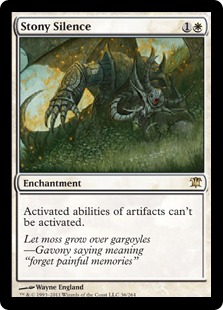
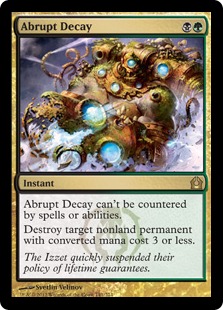
How time flies

Fortunately, 2016 is not 2010 and it is probable that Thopter combo is healthier now than it was back then, even if I don't think it's healthy enough. Unless I am very mistaken, back then the best artifact hate was Ancient Grudge and the most effective graveyard hate was Yixlid Jailer or Extirpate. Grudge was not that effective against the combo, Jailer was vulnerable, and Extirpate could be played around. The following year, possibly as a reaction to Thopter Depths, Stony Silencewas printed and Rest in Peace followed the year after that. Coupled with Abrupt Decay and Scavenging Ooze, and Magic is equipped to effectively fight that combo for the first time.

Scavenging Ooze Stony Silence Abrupt Decay

This proliferation of hate cards, many of which see considerable maindeck play already, should serve to keep the combo from being too overwhelming, at least at first. Control players are pretty good at adapting and may find ways to overcome the hate. I suspect while there will be considerable value in just jamming Thopters into any deck that can support the five cards, it will take a dedicated combo strategy like the old Thopter Depths package to really take advantage. Even then, the splash damage from Affinity decks will limit the impact. While I disagree with this unbanning decision, I am willing to believe I'm wrong and Modern can now handle this beast. Thopters will also push players to play more counterspells which should keep the combo decks that already exist, and the new ones sure to spring up to outrace Ancestral Vision, in check. This leads me to conclude:

  1. Thopter Foundry/ Sword of the Meek combo will be very popular
    1. Splash damage from anti-Affinity cards will keep its effectiveness and numbers down
  2. The most effective hate cards are in white, green, and black

Putting it All Together

Having done the individual analyses, the next step is to put it all together to actually see what it says about the expected week one metagame. As a recap:

  1. Eldrazi decks remain powerful though in a slower and less consistent form
    1. It is not clear what that form is
  2. GR Tron will get weaker
    1. This will allow more slow blue decks to exist
    2. Some of these slow blue decks will be blue Tron
  3. Players will play Ancestral Vision in any deck it will fit in
    1. Players will therefore overplay and over-rely on Vision
    2. Strategies that worked against control before will still be effective
  4. Blue-based control will become more popular
  5. Thopter Foundry/ Sword of the Meek combo will be very popular
    1. Splash damage from anti-Affinity cards will keep its effectiveness and numbers down
  6. The most effective hate cards are in white, green, and black
This tells me three things. First, there will be a lot of slow blue decks and they will all have Ancestral Vision and probably Thopter combo. Secondly, BGx has the most tools against these expected blue decks, particularly Abzan. It also benefits from the weakening of RG Tron. Third, Eldrazi still remains a threat to be respected regardless of the new decks. Therefore, I expect for the first few week at least, the metagame will revolve around the new blue decks and BGx with all the other tiered decks trying to regain their feet around this new metagame. Infect will be popular in response to Thopter combo and Eldrazi will remain a force, though how much of one is unclear. I doubt the actual metagame will shake out according to my predictions, but this is definitely where I would start my preparations for the upcoming Modern season. If you have your own predictions or analysis I would love to hear them. See you in the comments!

Insider: Shadows over Innistrad Set Review (Mythics)

Are you a Quiet Speculation member?

If not, now is a perfect time to join up! Our powerful tools, breaking-news analysis, and exclusive Discord channel will make sure you stay up to date and ahead of the curve.

Stay a while, and listen. It's been a few weeks, folks.

I'm back for yet another full set financial evaluation, Shadows over Innistrad (SOI) edition. Like with every set, I'm going to break down the mythics and rares and discuss the set from a financial perspective. First up is mythics. Check out my other article on rares going up tomorrow.

We're back to a normal set launch, so this time around we don't have to consider Expeditions. This is a relief (for analysis purposes), and provides some extra incentive to extract value from this set.

Before we get into the full analysis I wanted to disclose some notes I've taken prior to writing this review and reflect on my Oath of the Gatewatch (OGW) review as well.

Shadows over Innistrad notes:

  • Without Expeditions this will be a normal set where normal supply/demand is in full effect.
  • This set seems extremely top-heavy with emphasis on competitive viable mythics, including four planeswalkers. I suspect most of the value will be evenly distributed across mythics, with some rares (which I review in the next part) holding value as well.
  • Shadow lands give us a semi-soft floor, but likely won't cause the same scenario as Battle for Zendikar (BFZ) and OGW. There will be expensive cards in both rare and mythic no doubt, and most of the set won't be under $5.

OGW Mythic Review:

  • Most of my mythic evaluation was solid. There were some really sharp increases in the Mid Tier as I suspected. My praise for World Breaker held true. What I didn't expect was Chandra, Flamecaller and Kalitas, Traitor of Ghet to increase as drastically as they did. Well, maybe Kalitas.
  • Turns out I (as well as others) ended up being wrong about Kozilek's Return. It's by no means a bad card, and could make a glorious comeback, but it's undeniable how much the card tanked in price. More than a 50% decline.
  • To the same end Nissa, Voice of Zendikar increased rapidly from $14.99 to $29.99 by the end of pre-orders. It's now sitting at roughly the price it started at---and the future is bright for Nissa with the release of SOI. I was extremely confident in this card, and I think rightly so. This has slowly and steadily gained in price. Be on the lookout for a deal if you need these; the chance to buy at value has come and gone.

Now, on to Shadows over Innistrad!

The Tier System

Breaking the cards down into a tiered list makes it easier to determine what will hold the majority of the set’s value. I will most likely use this methodology going forward in evaluating future sets. I also wanted to do it this way because I don’t like attaching a future value to any of these cards. I feel like that method is a tad inefficient and doesn’t take into account future card printings that could potentially make these cards better. It's really all based around what's in the card pool. So, I like to display a snapshot baseline power for these.

So, in that regard I wouldn’t want to attach a low value to a card that’s inherently powerful like I have in the past. Or attach a high price tag to a card that looks good on the surface, but just isn't good in the pool around it. (Underworld Cerberus anyone?). That will happen when we only look at the card with nothing around it. I wanted that to really influence the cards placement. The truth is while a card may look terrible right now, we don’t know the future and how this card could interact with cards that are printed after them. Any one of these could suddenly become much better than another.

As an avid player of fighting games, the tiered method makes the most sense to me, since it also allows for cards to move around, which undoubtedly will happen as time goes on. This happens all the time in many of the fighting games in their life cycles as well.

This is my explanation for each tier in the list:

  • Top Tier is reserved for the cards that will most likely hold the majority of the value in the set. More commonly known as the “chase cards.”
  • Mid Tier is reserved for the cards that aren’t necessarily bad but may be overshadowed at this current point. These could easily jump to top tier in the future, or vise versa.
  • Low Tier is reserved for the cards that will most likely be near bulk. Like Mid Tier these cards could easily jump up to higher tiers but the road traveled will be harder. Again, I don’t think these cards are necessarily bad but my analysis is that they will be the cheapest cards in the set.

These tiers are built primarily for Standard, however if a card has clear implications in Modern or beyond, it will also appear in a higher tier. Commander and casual appeal are not factored heavily into these ratings.

Mythic Breakdown

Top Tier

  • Archangel Avacyn
  • Arlinn Kord
  • Olivia, Mobilized for War
  • Mindwrack Demon

Mid Tier

  • Jace, Unraveler of Secrets
  • Sorin, Grim Nemesis
  • Nahiri, the Harbinger
  • The Gitrog Monster
  • Relentless Dead
  • Ulvenwald Hydra
  • Sigarda, Heron's Grace

Low Tier

  • Descend upon the Sinful
  • Goldnight Castigator
  • Season's Past
  • Behold the Beyond
  • Wolf of Devil's Breach
  • Startled Awake
  • Geralf's Masterpiece

Top Tier Mythics

Archangel Avacyn

archangelavacyn avacynthepurifier

Everything that can be said about Archangel Avacyn has likely already been said. It's incredibly powerful. I'll go through the motions and talk about it yet again, but likely won't say anything you don't know already. When we discussed this on QS Cast, as with other writers, it was the consensus pick for most sought-after card. And for good reason.

Avacyn is extremely potent this time around, and both sides of the card are really packed full of value. I wouldn't be surprised if this had enough power to battle something like Baneslayer Angel in Modern, even.

Gigantic Ambush Viper on one end (and providing indestructible to everything) and Anger of the Gods on a 6/5 flier on the other. Each side is proving to be fantastic in early deck building, and the unanimous assumption is that this will be in a wide variety of decks during SOI Standard.

I fully anticipate this card to maintain a high price tag. Not only is it just extremely good, but it has everything else going for it too. It's an angel, it can be used as a Commander (in just two colors), and it's double-sided which historically is a bonus. This is likely to stick in the $20 range for quite some time.

Current Price: $30

Arlinn Kord

arlinnkord arlinnembracedbythemoon

Okay, I know I'm a little biased here. I'm trying really hard to be objective for the sake of the review, and every time I still feel like I can't place this any lower. Arlinn Kord is a viable walker, and it's a flip-walker which always adds brownie points (even for prices in the future).

It might take some time, but Arlinn Kord is going to find a home somewhere. It just has so much depth and too many options not to. The player base is really undecided regarding Arlinn Kord, and that can only mean (to me anyway) that the long run will probably show we got it wrong somehow.

I'm liking some of the initial decklists in articles about SOI Standard, and there are a lot I can get behind that utilize Arlinn Kord in a successful way. You can check out some of these decks by our very own Adam Yurchick, but I also pulled up a sweet list by Micheal Majors:

Jund Control, by Michael Majors

Creatures

4 Deathcap Cultivator
1 Den Protector
3 Goblin Dark-Dwellers
4 Sylvan Advocate
1 Dragonlord Atarka
1 Kalitas, Traitor of Ghet

Spells

2 Arlinn Kord
2 Chandra, Flamecaller
2 Dead Weight
2 Fiery Impulse
1 Kolaghan's Command
2 To the Slaughter
3 Oath of Nissa
2 Transgress the Mind
4 Traverse the Ulvenwald

Lands

3 Forest
4 Mountain
2 Swamp
4 Cinder Glade
3 Evolving Wilds
1 Foreboding Ruins
4 Game Trail
4 Hissing Quagmire

Will Arlinn Kord sustain its current price? Likely not; there's room for it to decrease. I don't think this is a sub-$10 walker though just from the casual appeal and its inherently playable abilities. Even with the price decreasing I'm still going to leave this card in the High Tier category. Like a wise man once said: "Pepsi bottle, Coca Cola glass---I don't give a damn."

Current Price: $25

Olivia, Mobilized for War

oliviamobilizedforwar

Just as strong as ever, Olivia returns in another iteration. This time she's extremely aggressive and less midrange. What's ironic is that Olivia might actually end up reaping the most value in midrange lists. That's what's so great about this card---it's not a vampire-specific card, and it's not strictly aggro.

The ability is just good all the time. When we look at the larger picture and the card pool surrounding this card, you can start to realize that there can be many successful archetypes built around (and with) Olivia 2.0.

As pointed out by Pascal Maynard, Olivia can be extremely potent when built into a Collected Company shell alongside Deathmist Raptor as essentially a "free" card to use in order to buff other creatures.

I'm excited to see where Olivia ends up, but right now it feels like the price is justified. It might decrease somewhat, but if it starts to near the $10 mark (or, wishfully thinking, under that) I'd be looking to move in just for value (and playing) purposes. similar to Drana, Liberator of Malakir, this is mythic that can suddenly double in price in an instant.

Current Price: $15

Mindwrack Demon

mindwrackdemon

I understand this is a Duel Deck promo, but that doesn't seem to matter. This card clearly isn't going to be held down, and could likely settle in the $10-12 range. It's already been increasing since I've started writing this article and could be more by the time it's published. It's turning out to be the same scenario as Polukranos, World Eater.

It's an extremely effective flying threat, and not that many cards can deal with it. Sure it "dies to removal" but it's one of the best delirium enablers, attached to a body that can tussle with most anything in SOI Standard. Having trample is a nice bonus.

I see this being utilized as a delirium enabler for certain cards (Traverse the Ulvenwald, for instance). Or why not just pair it with Archangel Avacyn in black-white and have two huge flying threats? It survives the red flip side of Avacyn, and that's just gravy.

The placement of this card was probably the most difficult of the mythics, and ultimately I felt it was good enough not to leave out. The current price trend is obviously reflecting that.

Mid Tier Mythics

Remaining Walkers

I'm obviously bunching these together and they will all go into Mid Tier. They're all viable and have distinct roles. I felt none of these should have been placed lower since none are anywhere close to Tibalt, the Fiend-Blooded.

Jace is simply a blue clone of Ob Nixilis Reignited. It's strong, and does three blue things---fairly uninspiring but not in any way bad. It's not really exciting, but it's a Jace card which adds brownie points for future pricing.

I think this could end up at the $8-10 mark and could trend up a bit if control dominates Standard. It may take some time for control to establish itself but it could be amazing as early as Pro Tour SOI.

Current Price (Jace): $15

Nahiri might be the walker everyone is sleeping on. The ultimate feels like a precursor to pair with some creature we haven't seen yet. At the same time Boros walkers are really a hit or miss. This is far from Ajani Vengeant but still good enough to consider.

If this trends down low enough I would grab them for a value play, or for any deck you would want to construct around Nahiri. It's not a terrible walker by any means, and if any of these walkers prove us wrong it will probably be Nahiri. I anticipate Nahiri will also be in the $8-10 range for quite some time.

Current Price (Nahiri): $12

Finally we have Sorin. Another six-mana walker, huh? This one seems to be hitting it off well with the Commander/EDH crowd, since it hits multiple people with the first ability. This Sorin is quite powerful and severely proved me wrong once I cast this card. I felt the game ended relatively quickly once this version of Sorin was on the battlefield, which is where we want to be for a six CMC walker.

The one big flaw for Sorin is the fact that it's really weak when you're behind. He likely won't pull you out of as many dire situations like Elspeth, Sun's Champion, or even Chandra, Flamecaller.

I expect Sorin to settle in the $10-12 range.

Current Price (Sorin): $20

The Gitrog Monster

thegitrogmonster

If nothing else this large and in charge toad has to be the coolest mythic in the set. That has to count for something right? It likely will mean something for foils, considering there will be a whole new wave of Commander players that will want The Gitrog Monster as their commander. I don't blame them---I do too.

I really think this is the quintessential "Rock" card and can really add a ton of value to a midrange deck. Or it can be built around as an engine and I would love for this to make a card like Death Cloud viable again. I don't need a good reason to sleeve up a Death Cloud deck. At five mana that could be wishful thinking, but at the very least something along the lines of a Life from the Loam deck could incorporate this somehow.

In Standard we have Drownyard Temple to consider, and on QS Cast Doug brought up some interesting interactions with Groundskeeper and/or Molten Vortex.

This card will likely hang out in the $5-7 range unless we realize this is much better than we're giving the Monster credit for. We don't want to end up in its mouth, do we?

Current Price: $8

Relentless Dead

relentlessdead

Relentless Dead is extremely strong and I really like it. That being said I ended up settling on Middle Tier for this card. The main reason is it has a chance of not finding an immediate home. I know that might sound crazy, but it's a real possibility.

I do feel like this is surely a mythic that will shift into Top Tier eventually. It has so many uses, not just delegated to Tribal Zombies or a black-based aggressive list. It can continuously feed cards like Nantuko Shade or Kalitas. It gains strength in multiple copies, and it can obviously extend into Aristocrats archetypes which gain value with this card's ability to constantly trigger death trigger cards like Zulaport Cutthroat.

Such a potent two-drop also has the potential to revive Mono-Black Devotion in Modern. The deck severely lacked cheap cards, and could warrant revisiting now.

Like I said, this will likely trend up into Top Tier and its current $15 is justified. I just wanted to take everything into consideration, and with a PT on the horizon it's possible pro groups could pass this over initially.

If this card decreases, it likely won't be by much.

Current Price: $15

Ulvenwald Hydra

ulvenwaldhydra

Normally I would be upset over a card like Ulvenwald Hydra. I try to love every green card, but I wasn't excited about this---at first. Then I decided to playtest with it and incorporate it into Ramp shells, and it was doing some really good things.

Fetching any land is actually quite powerful right now in Standard (I'm going to leave Commander talk out of this). We can be sneaky and grab cards like Rogue's Passage, or we can set up some World Breaker chains with our Sanctum of Ugin. It's also good at grabbing Westvale Abbey in the decks built around Cryptolith Rite that have started popping up.

It's also worth mentioning how important reach is right now, with Mindwrack Demons, Avacyns and Olivias running around.

Will all this transfer to financial success? Maybe. At the very least Hydra is far from the bulk mythic it would normally be in most circumstances.

There could be some upside here. Not much, but there's probably some room to grow. I do think this will end up staying in the Mid Tier though. This is probably a solid price for purchase if you need them for a deck. Foils have some appeal as well for obvious reasons.

Current Price: $3

Sigarda, Heron's Grace

sigardaheronsgrace

Sigarda 2.0 is interesting. It's obviously oozing with flavor, and could potentially be a top end card in a Humans list. At the same time I wasn't really enamored with this iteration of Sigarda, and wouldn't be surprised if it ended up at a paltry $2-3.

The good thing is you can exile any card from the graveyard and activate it at any time. It doesn't die to a flashed-in Avacyn, and can wall an opposing Mindwrack Demon.

Other than that it's really vulnerable. It's not deserving to be in Bottom Tier, so I wanted to place it in this tier on the off chance it gets incorporated in some capacity into Human lists.

Current Price: $4

Low Tier Mythics

Let's go through the motions, shall we? Here we round out the bulk mythics of SOI. I don’t have much to say about these, so I’ll just leave some thoughts in the form of bullet notes:

  • Goldnight Castigator could be worthwhile somewhere, in some situations. I just don't see many red decks adopting this, and when it doesn't win the game it will likely ensure your loss.
  • Seasons Past could be an interesting one-of in some midrange or control list. If you get three cards with this I think that's great value, and likely the sweet spot. Interesting card, but not likely to be financially relevant. Foils could be appealing, so keep that in mind.
  • Descend upon the Sinful - If you think about this card as a six-mana 4/4 that exiles all other creatures (when delirium is active, of course) it makes me feel a tiny bit better about it. Still likely to end up a near-bulk mythic.
  • Startled Awake - As cool and flavorful as this card is it just won't equate to financial upside. I'd wait to grab this if you need a copy for any deck, as it will undoubtedly decrease. Foils could be interesting. Obviously this is a bomb Limited card, but that's about it.
  • Behold the Beyond - Commander, I suppose? I'll let the format's aficionados weigh whether seven mana and your whole hand is worth exchanging for the three best cards in your deck. It's probably a decent rate, but still a near-bulk to bulk mythic.
  • Geralf's Masterpiece could be decent in some spots. It is terrible to play normally, but it does have some good Zombie/Dredge implications. I want to see the positives in this card, and they are certainly there, but they don't change my final evaluation of the card as bulk.
  • Wolf of Devil's Breach - Yuck.

Up next, rares! I have discussed these rares and mythics in my spoiler coverage and on QS Cast, so if you want to hear additional information and opinions feel free to check those out.

Questions? Comments? Concerns? Feel free to comment below or message me via social media. Hopefully this list is helpful going forward to decide what’s worth trading for or buying at the prerelease and beyond!

- Chaz @ChazVMTG

April 4th B&R Announcement

Are you a Quiet Speculation member?

If not, now is a perfect time to join up! Our powerful tools, breaking-news analysis, and exclusive Discord channel will make sure you stay up to date and ahead of the curve.

Sometimes it's not clear what action, if any, will be taken when the Banned and Restricted announcement rolls around, though we all knew something was going to happen this time. I don't know that very many people predicted the exact announcement though:

Modern:

Eye of Ugin is banned.

Ancestral Vision is unbanned.

Sword of the Meek is unbanned.

Vintage:

Lodestone Golem is restricted.

I like the Vintage change, though that doesn't matter to too many people, financially or otherwise. The topic on most people's mind is Modern.

I know that some people were on banning Eldrazi Temple because Tron plays Eye, though it's clear that Eye was the real problem in the deck, often generating four or more mana in one turn. There were no major surprises here, and the question now is to what extent Eldrazi Temple continues to see Modern play. There's real potential for a midrange deck to play painlands and filter lands in addition to Temple to have access to potential turn two or three Thought-Knot Seer.

There was an error retrieving a chart for Twilight Mire

With regard to Ancestral Visions and Sword of the Meek, there has unsurprisingly already been a lot of market movement. Good luck finding either of those cards for a reasonable price. Now is a great time to be figuring out exactly what kind of shell that people will look to play these cards in.

Thopter Foundry has, of course, spiked, along with Tezzeret, Agent of Bolas. People don't have lists ironed out yet, though an artifact heavy deck with a combo finish is the obvious place to start. Expect demand to increase for Academy Ruins, and indeed we are already seeing small market movement on this card. Engineered Explosives also fits naturally into this shell, and has also started to move. It's important to not buy into the hype, and to try to find the pieces that will spike next. Ruins and E.E. definitely stand to grow more, though the best places to invest will be in places where you can get ahead of the initial hype.

With regard to Ancestral Visions, the obvious home is in a deck with Snapcaster Mage- not because of any direct synergy- there isn't any- but because these are the best blue cards for generating card advantage in Modern. During the reign of Eldrazi, Snapcaster Mage was at a low point for Modern play, and that is about to change. It won't be long before we see ol' snappy making significant gains.

There was an error retrieving a chart for Snapcaster Mage

Insider: Opportunities Surrounding The Gitrog Monster

Are you a Quiet Speculation member?

If not, now is a perfect time to join up! Our powerful tools, breaking-news analysis, and exclusive Discord channel will make sure you stay up to date and ahead of the curve.

Welcome back, readers!

How many of my fellow EDH---or Commander, for you newer players---enthusiasts became giddy when they saw Omnath, Locus of Rage spoiled in Battle for Zendikar (BFZ)? How many immediately began planning their Omnath deck and started to scour Gatherer for synergy?

We saw a lot of cards jump in value thanks to Omnath, but we also had some time to find them. Most of these jumps occurred after BFZ was released (and a good bit of time after Omnath was spoiled).

elemental mastery

perilous forays

Tempt with Vengeance

You can see the BFZ release symbol on the graphs and you can also see the lag (especially with Tempt with Vengeance).

When a new and unique legendary creature comes out, a lot of Commander players get excited and build decks around them (myself included). The beauty is that because Commander is less competitive (for the most part) and the card pool is so vast, it often takes a while for cards to pick up in demand. This lag means a smart speculator can reap solid financial gains by digging in and finding the opportunities.

Right now this phenomenon is particularly relevant. We're seeing the same kind of excitement in the Commander community surrounding The Gitrog Monster.

the gitrog monster

Squandered Resources has already skyrocketed in value thanks in large part to this commander. Squandered Resources is a rare on the Reserved List (so its quantities are limited to what currently exists), it plays insanely well with The Gitrog Monster, and it was a powerful engine in an old combo deck (Pros Bloom).

In a stroke of luck I actually picked up 15 copies last week because some friends of mine want to start playing old Standard favorites against each other and nobody in our area had the cards for Pros Bloom, so I picked those up (but that's an idea for a future article).

squandered resources

This spike (along with my own search for the perfect Gitrog deck) got me thinking about other potential speculation targets for the deck. I've come up with a few currently.

natural balance

Commander players (myself included) typically frown upon mass land destruction. I have a particular hatred for Armageddon, but in some of the more competitive scenes mass LD is viewed as a viable "control" strategy to help fight the mass ramp decks that are a large part of the format.

Natural Balance is another Reserved List rare from Mirage (so a lot fewer copies exist than newer rares) and likewise part of the old Pros Bloom deck (I picked up eight copies for myself). This one is particularly nasty with Squandered Resources as it can act as a huge mana generator and wreck your opponents' ramp plans.

Lake of the Dead

Lake of the Dead is another Reserved List rare that serves as a continual source of self land destruction which, while not normally desirable in Commander, actually plays very well with The Gitrog Monster. It turns every swamp into 4 black mana and a card draw. It's also likely that most Gitrog decks will play land recursion so the pain is offset a bit.

This one has the added benefit of often finding a home in mono-black Commander decks and again being so old is much harder to find than you might think. I again picked up another eight of these (mainly because I traded off my personal one unknowingly and I like this spec a lot).

lotus vale

In Lotus Vale we have another Reserved List rare that requires the sacrifice of lands. It provides multiple mana, which is always highly desirable in a land thanks to numerous untap abilities available in the format. Its starting price is already near a recent high so the cost of this spec is a bit higher than I'd like, but for the sake of this article it's still a potential option.

realms uncharted

With The Gitrog Monster out, Realms Uncharted is a tutor that puts two lands in your hand and draws two random cards---all for three mana at instant speed. This one is a few years old (with no reprints) and is near bulk status. This is the type of card that goes from $0.5 to $5 if it hits.

I like this particular one because the upfront cost is so low and it's a tutor for a very hard-to-deal-with permanent. That being said, cards that let your opponents make the decision typically have difficulties finding homes in ultra-competitive decks, so this could be one that's more limited in its demand.

herald of leshrac

A few of the Gitrog lists popping up feature Herald of Leshrac, a bizarre little gem from Coldsnap. That set was short-printed so we can expect supply to be relatively low.

Herald is capable of stealing a massive quantity of your opponents' lands. The downside is that because the lands are owned by your opponent they don't go to your graveyard to trigger the Gitrog's draw ability. However, because you have a continual source of land sacrifice it means when this guy eventually dies your opponents may not get all the lands taken back.

The other downside is that it's expensive. Cumulative upkeep is a pretty slow mechanic for Commander, especially on a seven-drop.

ob nixilis

Ob Nixilis, the Fallen is an original Zendikar block mythic with a really powerful landfall ability. Similar to Omnath decks, I imagine Gitrog decks will play a lot of extra lands, both to make sure the frog is well fed and to take advantage of the attached Exploration effect. This means a lot of Ob Nixilis triggers and a powerful, cost-efficient threat.

life from the loam

Life from the Loam is a pretty obvious inclusion in this type of deck. It recurs lands indefinitely to keep The Gitrog Monster alive, and lets you retrigger all kinds of valuable land effects in the process.

It has a higher price tag thanks to Legacy/Modern demand, as well as several printings, but it could see some decent gains anyway. As you can see by the graph it has held a much higher price ceiling in the past, though that was before being reprinted in the Izzet vs. Golgari Duel Deck.

titania

Titania, Protector of Argoth is one of the most commonly paired cards with The Gitrog Monster. Her ability is unique and powerful and she's only had one printing, in the green Commander 2014 deck. She started out with a lot of hype which slowly died down (along with her price).

Note how powerful her first ability can be given it's an enters-the-battlefield effect, so if you have a way to recast and/or blink her she can serve as a land recursion engine. While blinking is not really green or black's strong suit, they are the two colors best at recurring cards from the graveyard (with white being the other major player).

Conclusion

I hope this week's article gets your wheels spinning with regards to potential speculation opportunities for one of the funnest (in my opinion) potential commanders to come out in awhile. There are likely other speculation options I didn't run across in my search, so please feel free to let me know if you have any others in the comment section below.

Either way, you can bet I'm not the only one who's excited to build around The Gitrog Monster, and a whole rash of people are going to be looking for weird, old cards to pair with it. Commander specs may not be as exciting or high-profile as Modern or Standard, but when prices jump, the prepared investor benefits all the same.

Insider: The Universal Currencies of Magic

Are you a Quiet Speculation member?

If not, now is a perfect time to join up! Our powerful tools, breaking-news analysis, and exclusive Discord channel will make sure you stay up to date and ahead of the curve.

In Magic investing certain types of cards hold the position of the "gold standard" in binders and portfolios all around the world.

Imagine a rough and extremely loosely rendered hierarchy looking something like this: Power Nine > blue dual lands > non-blue duals > enemy fetch lands > allied fetch lands > shock lands > Battle for Zendikar lands.

Yes, obviously cards that are more expensive than other cards are, well, more expensive...

Consider though, when we think about card value we often use these archetypes to assess and determine the prices on everything else. These types of cards are essentially the "gold standard" of Magic collecting and investing---because they are the most-traded cards they sort of set the price ranges for everything else!

When I look at a new card and try to assess how valuable it is I'm often thinking (either consciously or unconsciously) whether it's worth more or less than a Standard-legal dual land, shock land or fetch land. It gives us perspective for what price range a card will ultimately end up in.

When I got back into playing Magic back during Mercadian Masques the landscape of Magic finance was very different than today. Power 9 was about $100+, dual lands were in the $5-$10 range and fetch and shock lands didn't even exist yet! Can you imagine?

The top end for cards was about $150 for Black Lotus, $100 for Power, $50 for Library of Alexandria, $30 for Mana Drain, $15 for the very best Extended and Standard Staples and so on and so forth. The hierarchy of prices looked this way for a long portion of Magic's history.

The fact of the matter is that certain types of cards settle into certain kinds of price points. The highest-caliber cards set the tone for everything else and constitute a point of departure for conceptualizing value.

We do this all the time, often intuitively and reflexively. "Would I trade that brand new Archangel Avacyn for a Canopy Vista? No, that doesn't seem right... Okay, how about a Steam Vents? No, still not good enough... Alright then, how about a Polluted Delta? Yeah, that seems about right."

Even without knowing the exact fluctuations of prices, a powerful, highly anticipated mythic rare has to be worth more than a shockland but probably less than a Verdant Catacombs. Feels like it's worth about a Polluted Delta from Khans...

Profiling the Categories

Based on what seems plausible I'd establish price points for trading these categories of cards to look something like this:

  1. Power: $400+ (also Beta duals, Workshops, and all the other super expensive rare stuff)
  2. Blue Duals: $200+
  3. Non-Blue Duals $100+
  4. Zendikar Fetches $50+
  5. Khans Fetches $25+
  6. Shock Lands $10+
  7. Standard Duals $5+

Now, these numbers don't exactly match up with reality. Not exactly... But, I'm going to make the case that they should and that may be an indicator of where prices will end up.

I've basically laid out a model where the prices from one tier to the next roughly double---there is a reason for this.

Trading. I'll trade you two Sunken Hollows for a Watery Grave. I'll trade you two Watery Graves for a Polluted Delta. I'll trade you two Polluted Deltas for a Verdant Catacombs. I'll trade you two Verdant Catacombs for a Taiga. I'll trade you two Taigas for a Tropical Island.

It doesn't work out exactly once we get further up the totem pole since a 20% difference on a $200 price range card is equal to a lot of Canopy Vistas! However, for the purposes of creating categories for cards, I think it holds to be fairly true that card categories tend to settle into these doubling archetypes.

It is also true that cards tend to want to settle into these price points. A card rises in price until it hits one of these points and then sits stable for a while. Think about it. Pretty weird, right?

I'm not saying there is some system in place that makes certain cards worth certain amounts of money. Rather, I think this sort of "doubling" appears in the price patterns because it makes intuitive sense to buyers and traders.

It isn't something I can prove, or that even needs to be proved. Rather, it is an observation about how cards tend to end up being priced and a possible explanation for why this is the case.

Using Universal Doubling to Predict Trends

One thing to keep in mind, and something that I tend to believe is true, is that some generic "archetype card" needs to occupy every relevant price point space.

Fetches Continuing to Rise in a Rotation Market?

It seems odd to predict that a card rotating from Standard is likely to go on the rise. Albeit there will be an immediate, and likely only slight price dip for fetches as many players look to dump them and reinvest in Shadows over Innistrad cards. However, the cards that become available in this "buyer's market" will be very quickly and hungrily snatched up---and the prices will quickly go back up.

There was an error retrieving a chart for Windswept Heath
There was an error retrieving a chart for Polluted Delta

I know it is kind of strange to predict this, especially on the eve of Khans fetches rotating out of Standard, but the way I have laid out this model it seems like Khans fetches should rise in value to occupy the price point between $25 and $50. Maybe there could be a "swap-o-rama" where shocks leap-frog fetches and the two trade places?

However, the price point around $25+ feels like it is shaky right now, waiting for something else to settle in and replace it as the "gold standard" of $25 cards. I'm not going to bet against what feels right. I'm continuing to hold onto Khans fetches and believe that after a slight rotation dip they will get back to the business of making me money.

Non-Blue Dual Lands Undervalued?

There was an error retrieving a chart for Plateau

According to the price scale I've laid out I'm apt to believe that the lowly non-blue dual lands are currently underpriced. Cards like Plateau and Badlands hold a very modest price tag when compared to cards like Bayou. These cards have demand and are on the Reserved List.

My thought process is that we are likely to see all of these cards push well over the $100 price point.

True, demand for these cards for tournament play is much lower than some of the more popular Legacy and Vintage staple duals---however, I suspect there is more buying interest in these cards right now than in the past. In particular, savvy investors looking to corner Reserved List cards, and the growing market of the "less newbish" casual players.

There are a lot of people who play casually with friends at the kitchen table but are actually decent at Magic and want to play real decks with real cards. Seriously, this is a thing... Semi-competitive casual players, and they buy a lot of cards. Duals are for sure in the equation for these types of players.

APAC Lands Are Sweet

One last little bit of free advice.

APAC Forest China

I think the APAC lands are sweet and I'm not the only one. They look fantastic and are actually quite uncommon for the price tag they currently command. Many of these fantastic basic lands only command $5ish price tags. I don't think this kind of price point is long for this world.

The gap between the lowest ones and the highest ones is pretty large, with the latter landing in the $25-$30 price range.

It is also worth noting that the APAC's with the highest price point are extremely cool-looking and have iconic art for basic lands:

APAC Plains Sunflower

Seriously, is this not one of the coolest-looking basic lands you've ever seen? If GURU lands can be $200 each I think basics like these (which are in my opinion much cooler) are an absolute steal. I feel like they have a lot of room to grow. There will always be high demand for cool and unique basics.

After all, lands have always been the gold standard currency of Magic.

Modern Banlist Update (4/4/2016): Eye of Ugin banned, Vision and Sword unbanned

Are you a Quiet Speculation member?

If not, now is a perfect time to join up! Our powerful tools, breaking-news analysis, and exclusive Discord channel will make sure you stay up to date and ahead of the curve.

In the beginning of Eldrazi Winter, there was darkness and tentacles and a Tier 0 deck where there had once been diversity. And Wizards said, "Let there be bans," and there were bans. And, to surprise the players they had forsaken and restore balance to the Modern Force, Wizards said, "Let there be unbans," and there were unbans too.

Announcement date: April 4, 2016
Effective date: April 8, 2016
Magic Online effective date: April 13, 2016

Eye of Ugin is banned
Ancestral Vision is unbanned
Sword of the Meek is unbanned

Thus, Modern was saved by the Wizards Gatewatch and its players opened a new chapter of glory and possibilities.

April-4-Ban-Banner

Following a week of fake banlist announcements that made all of us feel like we were living in Max Banlist Modern, anticipation was high for Monday's update. Anxiety, too! I'd even seen some buzz about a Mox Opal ban from multiple sources, and the mere prospect of that change was enough to have me awake three hours before the announcement in a sweat of ban mania. At 9:39, the April 4 announcement went live. I dropped my breakfast muffin on the floor in excitement, my cat proceeded to eat the breakfast muffin, and Modern was changed forever. Today's article will be a shorter piece analyzing the impact of these changes, with a deeper and more formal reaction to follow on Wednesday. With just over an hour between the update's publication and this article's deadline, and crumbs still on the floor, I'll save most of my analysis for Wednesday and just unpack the high-level takeaways today.

[wp_ad_camp_1]

Eye of Ugin is Banned

Get #rekt, Eldrazi. This is literally the most justified ban I've seen in the format's history: not even demonstrable violators like Amulet Bloom warranted a ban quite as much as Eldrazi. At its height, the monstrosity occupied a 35% share of Modern, exceeding even the Bloodbraid Jund hegemony by 5%-10% and blowing Treasure Cruise clean out of the water. Aaron Forsythe made it clear at Grand Prix Detroit that some element of Eldrazi would be on the chopping block, and since that March weekend, it's been a question of "When" and "What," not "If."

Wizards' decision to ban Eye of Ugin has implications for both the immediate post-April 4 metagame, and for ban policy and format management down the road. Eye of UginFrom a metagame perspective, it means Eldrazi will survive in some form off of a combination of Eldrazi Temple, Vesuva, and/or the Urzatron. In their announcement, Wizards predicted such a strategy to be "powerful yet beatable" and I agree with this assessment. Expect to see a number of Eldrazi decks linger through the summer even without their precious Eye of Ugin. This will include BW Processor decks like those we saw back in December, UR Eldrazi strategies such as JC Tao's at Pro Tour Oath, the UW Eldrazi variants which dominated Grand Prix weekend, and many others. Eldrazi decks will lose their explosive Eldrazi Mimic and Endless One starts, and the one-two punch of Thought-Knot Seer and Reality Smasher will become far rarer. That said, the deck will still exist, so pack your Ghost Quarters, Blood Moons, Fulminator Mages, and other hate cards accordingly.

By a similar token, the continued presence of Eldrazi bodes well for the best anti-Eldrazi decks of the past few months. Abzan Company is poised to remain a major Tier 1 player as we move past April 8. Naturally, Affinity will be a major player as well, although this would have happened whether Eye got banned, Temple got banned, or both walked the banlist plank. We're also likely to see more UW Control, Lantern Control, and Living End in Tier 2, along with the types of cards (especially sweepers) that made those deck viable in the Eldrazi world.

Urza's TowerRG Tron decks take a sizable hit from the Eye of Ugin ban, something Wizards acknowledged in their announcement: "While the Eye does add a lot of late game power to the deck, the core gameplay of the deck—casting large threats with the Tron lands—remains intact." Some players will speculate that Eye's banning was also a backhanded safety measure against Tron. Although this might be true in practice, it does not seem to be Wizards' primary motive, and I'm unwilling to speculate on it without more evidence. This means Tron's share is likely to fall, although Eldrazi Tron decks may stay afloat. By a similar token, a point that relates directly to the unbans, traditional and hybrid control decks are likely to do much better in this post-Eye world. Even thrive! Eye of Ugin offered considerable inevitability to Tron and Eldrazi decks alike, and its removal secures the late-game for control deck.
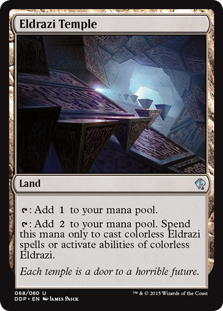
Eldrazi TempleFrom a banlist and format management perspective, Eye's removal is equally significant. For one, it shows Wizards is willing to do limited bans of even major offenders. It is possible this is motivated by ulterior, economic agendas (e.g. the infamous "sell packs" argument), but it is more likely this relates to format diversity. Wizards wants Modern to have diverse strategies, and they believe a depowered Eldrazi contributes to that. The ban also shows Wizards prefers to make surgical bans on engines, not sweeping bans on win conditions. As they said in the update, "Rather than ban multiple creatures, we find it preferable to ban a single land." We've seen this at play in previous announcements, including Seething Song's and Summer Bloom's banning, and I imagine we'll see it again. Banlist discussion should reflect this policy preference. As a final point on format management, the announcement suggests how R&D considers Modern in testing:
"When Battle for Zendikar and Oath of the Gatewatch were in development, the development team knew that all the Eldrazi creatures in the block would be more powerful in Modern because of these two-mana lands. While there was some risk that Eldrazi decks could be too strong, there was also the possibility that a fun new competitive deck would emerge."
Wizards of the Coast"April 4, 2016 Banned and Restricted Announcement" (4/4/2016)

This quote, although potentially an after-the-fact justification and excuse for the Eldrazi Winter, most likely shows how Wizards "tests" and "designs" for Modern in their development process. We'll want to consider all of these high-level consequences, and many others, in more detail on Wednesday. For now, this is a good starting point in understanding the Eye of Ugin ban, and I'm happy to talk more about it in the comments.

Rest in small, banned pieces, Eye of Ugin. You will not be missed.

Ancestral Vision is Unbanned

The Eye of Ugin ban was more predictable than an 11th hour Bulls loss to the Detroit Pistons this past weekend. The Ancestral Vision unbanning, however, was much more unexpected. To be sure, I and many others predicted this would be the probable unban in July, after Wizards had seen how the post-Twin metagame shook out with no Eldrazi to gum everything up. Wizards defied our conservative expectations and unbanned Vision today. They identified a notable lack of control in the metagame ("it is an underplayed portion of the metagame") and chose to act in advance of the June Grand Prix events, perhaps as a consolation for the miserable Eldrazi Winter, and perhaps knowing that Modern was unlikely to get less linear even after Eye's departure. Get ready for the blue-based control renaissance!

Ancestral VisionFrom a metagame perspective, Ancestral Vision is unlikely to break the format or plunge us into a Vision Spring of blue decks. There will certainly be an immediate uptick in these strategies as players try out their new toy, but it probably won't last and in all likelihood will fold into the rest of Modern's powerful strategies by June. That said, Vision is certainly going to have an impact, even if that impact doesn't outright break the format. Jeskai, Grixis, Esper, UW, Blue Moon, Temur Midrange, and a host of other strategies are drooling over this card and are all likely to benefit from its addition. Similarly, BGx Midrange decks are going to struggle with the turn one suspension before discard comes online, although this won't be nearly as back-breaking as the topdecked Treasure Cruise from Winter 2014. I'll be doing plenty of Ancestral Vision testing in the coming weeks, so you can be sure we'll report back on the card's prospects soon.

Thinking about banlist management, I see two immediate takeaways from the update. First, that Wizards is following through on the Splinter Twin ban by freeing some other control cards into circulation. This will likely be a net positive for the format, and I'm excited to see how control plays out in its new, Twinless, Visionary form. Second: Wizards expressed some worries about Bloodbraid Elfs power alongside Vision, which suggests the card may be a less probable unban than many believed. Jund mages may yet see the Elf but the announcement's phrasing makes it seem less likely.

Break out the Goblin Dark-Dwellers and get ready for control to rise again!

Sword of the Meek is Unbanned

April's final unban is Sword of the Meek, a card that has long appeared to be the most ridiculous and unjustifiable entry still on the list from the initial 2011 bannings. I've wistfully called for a Sword unban in numerous updates, and I'm thrilled to see it finally released from undeserved imprisonment. Sword's most important impact swordwill be to stave the tide of linear, aggressive decks in Modern. Burn and Zoo hybrids, as well as Affinity, will struggle to punch through the repeated lifegain and Thopters in the Sword/Thopter Foundry engine. Some aggro players have expressed concern about Sword pushing these decks out of the format, but I believe this is unwarranted. The decks affected by Sword already enjoyed commanding pre-Pro Tour shares and are unlikely to retreat too much in the face of the new combo. It will also force them to run more interaction and, potentially, diminish the need for future bans or banlist speculation. That's a net win as far as I'm concerned, and I hope other players agree.

As for what decks actually use Sword/Foundry, the sky is the limit! Tezzeret strategies are the most obvious and immediate winners, but the hybrid cost in Thopter Foundry really opens up the combo in Jeskai, Grixis, Esper, or anything based in blue. Lantern Control, blue-based Tron, and perhaps even my beloved Puresteel Paladin decks may find the card useful as well. This kind of depth ensures players will be trying to "solve" the Sword/Foundry puzzle for months, and I don't expect anything definitive to emerge until at least September.

Sword's release suggests a number of banlist management points, but the most significant for me is the continued overturning of the initial banlist. Since Modern's start, we've seen Valakut, Bitterblossom, Golgari Grave-Troll, and now both Vision and Sword removed from that list. It's looking less and less sacred by the month. Of course, some monsters like Hypergenesis deserve to stay right where they are, but Swords' unbanning might start raising further questions about cards such as Stoneforge Mystic and Jace, the Mind Sculptor. We'll need to watch Vision and Sword closely to see if any ofthe other initial banlist rationale can be challenged.

The New Modern

Many players and pundits are going to focus on the immediate metagame implications of these cards, which are certainly huge. That said, it's important to also consider the long-term management consequences of these decisions. Like it or not, Modern is defined by its banlist and Wizards' use and understanding of that banlist. The three changes today give us significant datapoints as we look to the future and see how Modern is likely to change in 2016 and into 2017.

Lightning BoltOne big question mark still surrounds this update: is it enough to push back linear decks or are they just empty appeasements for control players? Time will tell, but I'm leaning heavily towards "Yes" on the former and "No" on the latter. Between the additional incentive these cards provide to control mages, and their immediate impact on games, we should see a new Modern with fewer linear deck and more interaction. For instance, Jeskai decks have always been favorites in the aggressive matchup, but have struggled mightily in other contests and can run out of steam in protracted aggro contests. Vision immediately addresses that, to say nothing of Sword doing its part. Remember: it's not like control mages will just settle for "turn two Sword, turn two Foundry, go." Lightning Bolt and Electrolyze will still be there to hold down the first few turns before the control gets online. These new control gems just strengthen existing strategies and make players more likely to invest in a control game-plan, which is a net win for format diversity and a net loss for linear dominance.


More academic analysis aside, this update frikkin rocks. It's the most significant unbanning in the format's history and the most appealing ban, all bundled into one awesome way to start the week. Looks like no one will have a case of the Mondays today! Join us this week as we explore the post-April 4 metagame in more detail and keep unpacking the consequences of this high-impact announcement. See you all in the comments and I hope you all bought those new staples from reputable dealers who won't rescind your purchase!

Want Prices?

Browse thousands of prices with the first and most comprehensive MTG Finance tool around.


Trader Tools lists both buylist and retail prices for every MTG card, going back a decade.

Quiet Speculation